Advertising: kete@cdh.org.nz Sign up for more Kete online news: ketekorero.cdh.nz
Phone: 07 856 6989
Postal: PO Box 4353, Hamilton East 3247 ISSN number: 2357-2221
Deadline for content: 22 June, 2026 @catholicdioceseofhamilton youtube.com/CatholicDioceseofHamiltonNZ
Taila Burton.
FROM THE BISHOP’S DESK
It has been said and repeated in different ways that ‘the Church does not have a mission so much as the
Mission of Jesus has a Church’. The Lord, having gathered to Himself a people, trained them in His methods, and then told them to “Go into all the world and preach the gospel to every creature.” (Mark 16:15). The word church is English for the Greek ekklesia or Hebrew qahal - where the whole assembly of Israel gathered to worship the Lord. (see Joshua 18.1)
The Mission of Jesus is Human Salvation. The gospel is the news that “God loves us so very much that He became human to save us from ourselves and our sin and to gather us to Him”. This Good News is expressed differently throughout the ages, but fundamentally remains the same. Everything we do as a church should be directed towards this mission, since that is why Jesus came to earth and gathered His disciples into His Church, built upon Jesus the Rock and the one He designated as Rocky-Cephas or Peter. Peter and his successors are only Rock in so much as Jesus has made him a partaker in the God-Man. Everything we do as a Christian is a sharing in Jesus Christ. There are different participations in Christ, which leads to different roles and outcomes.
Easter is that time of year when the Mission of Jesus reaches a climax. Easter is a participation in the Triumph of the Lamb of God, where He defeated sin and death and the power of the devil. God did this in God’s own particular way, which often leaves us mere humans scratching our heads.
In the Old Passover, a passover lamb was slain, blood poured out, flesh eaten, death was avoided (at least for a while) and a gathering of people were brought into the promised land. In the New Passover, God does something similar but way better. Jesus, the Passover Lamb of God, is slain, His blood poured out (with water from His side), His flesh offered to God. Then He rose from the dead and transformed the human tragedy of the cross into a divine object of grace. Through His Death and Resurrection, the Christ of God, shatters the chains of death, and offers us the promise of Immortality.
When we are washed in the water of Baptism, God frees us from sin not in a legal fictional way, (eg. imputation of righteousness), but simply by making each of us, individually, His son or daughter, gifting to us by adoption what Jesus has by nature — divinity with a whole humanity. Through Baptism, we now participate in the Divine Nature of Jesus. In the presence of God, sin flees away, and this is why and how we are freed from sin.
“Easter is a participation in the Triumph of the Lamb of God, where He defeated sin and death and the power of the devil. God did this in God’s own particular way, which often leaves us mere humans scratching our heads.”
Now, due to our creaturely nature, damaged by sin, this gift from God requires nurturing and growth as well as constant attention and reform. God, knowing all this, established in His Church certain signs that contain, carry, and give us His all-powerful grace. These things we call Sacraments. They are the means by which God ordinarily and deliberately showers us with His love.
When we eat His flesh that was sacrificed for us, we are made whole. When we drink His blood that was poured out for us, we are washed clean. This Divine Medicine frees us from the corruption of sin, and orients us towards God, our Love and our Life. When we are anointed with oil for healing, we participate in the Love of God, sin is forgiven, healing is offered firstly for the Soul, then - in my experience - for someone (elses’) salvation in body.
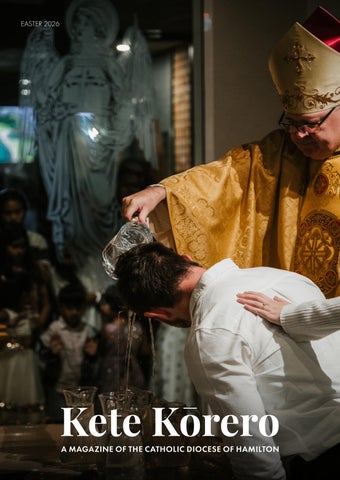
This Easter there are a good number of people in our Diocese who are experiencing these divine gifts. Some for the very first time. They have spent time in formation, being called into the wonderful light that is Jesus. Many are being baptised, and converted from a son of Adam into a Son of God. There are others who, having been converted years ago — often in some protestant denomination — have been called into a full communion with the Church Christ established when He first called Peter and Andrew, James and John, and the others to follow Him.
By entering the church this Easter, these new Catholics are committing their lives to the Lord in Faith, in Hope, in Love. Let us who have been here for a while open our hearts, and our lives to our new brothers and sisters. I ask you all to show them how we follow Christ more closely each day. Join with them in small groups and study groups, so that they do not feel abandoned as they come off the natural high we all get when doing something significant in our lives. This is a real challenge. We are used to taking people by the hand and leading them to the Sacraments, but we forget that this is a beginning to the Christian Life.
EDITOR’S NOTE
Lent calls us to prayer, almsgiving, and fasting, but Easter reminds us why, because Christ has already won the
victory. As St. Pope John Paul II once wrote, “We are an Easter people and Alleluia is our song.” The Resurrection is not only something we remember; it is something we live.
In this issue we celebrate those who are preparing to enter the Church through the Rite of Christian Initiation of Adults. The RCIA journey is always one of the most hopeful signs in the Life of the Church. To see people listening for the voice of Christ and responding, is a reminder that the Gospel still calls hearts today and their “yes” strengthens the faith of the whole community.
For me personally, this Easter season also brings an anniversary. I did not receive the Sacrament of Confirmation with my peers in my teenage years, but later as an adult. That experience gave me a particular appreciation for those who approach the sacraments as adults. For me, Confirmation was a moment of consciously choosing the life of faith after returning to the Church as an adult. Watching RCIA candidates take those same steps at the Easter Vigil each year reminds me again how beautiful that choice is.
You will also read in this issue an article about seafarers and the quiet ministry that supports them. These men and
Take an inventory of your parish. Are there small groups studying the Scriptures, are there groups helping the poor, are there groups gathering young mothers, visiting the shutins and other prisoners? Are people volunteering to help at Seafarers’ mission, hospital visitation, Communion rounds? After all, most parishes have only one priest, two at the most and in some parishes there are up to 17 rest homes. One priest cannot (and should not) do it all.
If the answer is no, then start something, invite the new Catholics, invite the old Catholics to spend time learning how Jesus did it. All catholics have the right to gather to accomplish the mission. It does not have to be in a ‘church space’. Often it is better to meet in your homes, or any other space that works, and then — go and do.
+ BISHOP RICHARD LAURENSON.
women live much of their lives far from home, carrying the goods that keep our world moving. Since that article was written, the world has only grown more uncertain, and for those who spend months at sea, the challenges are likely to become even greater. The Church has long recognised this vocation, and initiatives such as the World Day of Prayer for Seafarers remind us that they are part of our human family. Perhaps this year we might do more than simply notice, maybe by supporting missions that serve them, or even offering our time as volunteers.
While we encourage you to see your parish priest, we have included a section to jot some notes regarding your final Mass. Remember we can always offer Masses for the dead too. “We have loved them during life; let us not abandon them in death, until we have conducted them by our prayers into the House of the Lord” St Ambrose of Milan.
Easter ultimately draws our attention back to hope. The empty tomb tells us that suffering, uncertainty, and even death do not have the final word. As St. John Chrysostom proclaimed in his famous Easter homily: “Christ is Risen, and not one dead remains in the tomb.” The Resurrection reminds us that Christ’s victory is not symbolic but real - life has triumphed over death.
May this Easter renew our faith, strengthen our charity, and remind us that Christ continues to call people into the fullness of life with Him. Alleluia.
SEMINARIANS
FOR THE CATHOLIC DIOCESE OF HAMILTON, NEW ZEALAND
It is not a matter of inventing new models or redefining the identity we have received, but of proposing anew, with renewed intensity, the priesthood in its most authentic core — being alter Christus –, allowing Him to shape our lives, unify our hearts, and give form to a ministry lived from intimacy with God, faithful dedication to the Church, and concrete service to the people entrusted to us.
NHAT CAO
SAMUEL TURNBULL JACK FRASER-JONES HUNG VAN HA
Norse Mobile’s Holy Berth
Late November 2025, Iain Dickson, the United Seafarers Mission (USM) Centre Manager visited the Sailing Vessel Norse Mobile as she berthed in Tauranga Port. Norse Mobile is a 183 metre Bulk Carrier, a general cargo ship. Norse Mobile had brought fertilizer into New Zealand and on departure was transporting New Zealand logs to China and Korea.
STELLA MARIS VOLUNTEERS
After meeting with the crew, Iain identified that the majority were Filipino
Catholics. He asked if they would like him to arrange to have a Catholic Mass said onboard. Captain Brian Simbajon and his 20 Filipino crew members were very pleased to accept Iain’s offer.
After Iain contacted the Stella Maris Tauranga team at the USM, Father Sojan Abraham from the Parish of All Saints by the Sea agreed to hold Mass onboard.
Father Sojan, who belongs to the Claretian Order, came to New Zealand from India some twelve months ago. He had, only days before, joined Stella Maris Tauranga as a member and had completed his port induction giving him access to visit ships berthed at the Tauranga Port.
Fr Sojan was accompanied by Mary Joyce, USM Assistant Centre Manager /Stella Maris Tauranga Member; Peter Fitzgerald, Stella Maris Tauranga Treasurer; and Len Savil, USM Ship Visitor.
The crew on board rarely has the opportunity to attend Mass during their contracted term at sea, which is generally around nine months in length.
While the Tauranga ship visitors waited for a schedule break in loading the logs which would enable the full crew to come together for the Mass, Fr Sojan provided the Sacrament of Reconciliation to crew members who wished to avail themselves of this sacrament.
Captain Brian Simbajon and his Filipino crew had gone to great lengths to prepare for the priest’s arrival, transforming the crew mess into a humble chapel, complete with Christmas decorations.
Everyone participated in the Mass enthusiastically with singing in the Filipino language, being led by one of the crew members playing his guitar.
Fr Sojan had also been asked to bless the ship. The blessing of the ship was a real eye opener for the Tauranga ship visitors. He started on the bridge, six floors above the deck, included all the living quarters and culminated in the vast engine area. Each crew member has his own cabin,
which is compact but most adequate. The ship was built in 2022 and has been maintained in an “as new condition”. The Tauranga visitors were amazed at the cleanliness of the ship.
The crew also prepared a sumptuous banquet enjoyed by everyone at the end of the evening. The positive leadership of Captain Brian and the comradeship of the crew was impressive.
In 2001, three like-minded seafarer welfare organisations joined forces: Apostleship of the Sea/ Stella Maris (Catholic), Mission to Seafarers (Anglican) and Galilee Mission to Seafarers (Presbyterian/ Baptist).
These three organisations recognised that their mission would be stronger and more effective together, leading to the creation of the United Seafarers Mission Tauranga. This ecumenical organisation continues to serve visiting seafarers with hospitality, practical help, and pastoral care. Approximately 12,000 seafarers visit the Centre each year.
Around 25 Catholics from the Parish of All Saints by the Sea and the Parish of St Thomas Aquinas regularly volunteer on a weekly basis at the USM aiming to provide the basic needs of seafarers. As well as their spiritual welfare, seafarers are offered the opportunity to contact their families overseas, given transport to and from the local town centre where they can purchase personal items for the next leg of their journey, participate in recreational activities and always receive a warm welcome from the many USM volunteers on duty Monday to Sunday.
World Day of Prayer for Seafarers | Sea Sunday
Sunday, 12 July 2026
St Joseph’s Catholic School, Whakatāne LEADS THE WAY with Solar Energy
In his Apostolic Letter, issued ‘motu proprio’, Fratello Sole, Pope Francis highlighted solar energy’s pivotal role in achieving climate neutrality, entrusting the Vatican with building an agrivoltaic plant to power its needs sustainably, ”a transition to a sustainable development model that reduces greenhouse gas emissions”. Echoing this call, Pope Leo XIV, in his Message for the World Day of Prayer for the Care of Creation in 2025, urged us to “till and keep the garden of the world,” sowing “seeds of peace and hope” through environmental justice and care for our common home. Inspired by these teachings, St Joseph’s Catholic School, Whakatāne has made history as the first Catholic school in the Hamilton diocese to install solar energy, and is now officially live as a SUPA Community Energy Hub.
JO BRADY
This milestone also marks the first Community Energy system funded by Trust Horizon via Community
Finance, a significant step forward for both the school and the wider community. Trust Horizon is a local charity that owns Horizon Networks as part of the Horizon Energy Group, and its support highlights the power of locally owned organisations backing local schools.
The project was made possible through low-interest funding from Trust Horizon, which delivers a much stronger return for the school than traditional finance. This means more savings remain with St Joseph’s and more benefit flows back into the Whakatāne community.
A special thank you goes to Derek Caudwell and the Trust Horizon team for their commitment and support in bringing the project to life.
St Joseph’s is not only the first Catholic school, but also the first state-integrated school, to step into Community Energy. While the journey was not without challenges, the school’s perseverance has helped pave a clearer path for other schools looking to follow.
This project is a strong example of what community energy can be: local, practical, and making a real difference for schools and the communities they serve.
One Light
The Easter Vigil begins in darkness. It does not deny the uncertainty of the world or the
persistence of our questions. Instead, as the sun sets, a single flame lights up the night.
The Paschal candle is held high and lit from the bonfire in which everyone is gathered around. From that one flame, another candle is lit. Then another, and another. Slowly and quietly, the darkness recedes. No one lights their own candle, each receives the flame from someone else, and then passes it on. By the time the Exsultet is sung, the whole church is aglow.
Fr Mark Field (parish priest in Gisborne), says many
things move him at the Easter Vigil. “The procession of light into the darkness of the church, our salvation history narrated through the readings, the renewal of Baptismal promises, the pouring of water and oil... I think what moves me most is the affirmation of the community, their delight in seeing these new Catholics profess their faith, accept baptism and receive the Lord for the first time in the Eucharist. The People of God are genuinely excited to be able to welcome them into their family and hope that good things will happen through them. And, if they’re anything like me, they will be amazed that these people have chosen to join us - us! - with all of our foibles, our weaknesses, our struggles - and our goodness and holiness too!”
In many ways, just like the Easter Vigil, this is what happens throughout the year as people journey through the Rite of Christian Initiation of Adults (RCIA). The Light of Christ is received ….. and then it is shared. The Light of Christ is not diminished when shared, rather it multiplies: spreading from person to person, heart to heart, generation to generation. Elaine is tending the flame in Rotorua.
Sophie is waiting to receive it in Taupō.
Kazu is passing it on in Tauranga.
Our priests are enkindling the flame throughout the diocese.
Sponsors grow in faith as they accompany others.
Catechists are humbled by the hunger they witness. New Catholics discovering that they have come home.
PHOTOS (THIS PAGE) BY TAILA BURTON.
Tending the Flame - Elaine Kannan (Catechist):
For Elaine, a catechist in Rotorua, the role of catechist has been both humbling and deeply moving. RCIA is not a classroom alone; it is accompaniment.
What has surprised me over the years, is the variety of people searching for a deeper, coherent spirituality. More than half have already done their research. They are keen to learn and to be part of our faith. When someone misses a session, they contact me to arrange a time to catch up. When I wonder whether something might be “too much of an ask,” they respond without hesitation. God has really called them. Our sponsors have also grown by the process of accompanying their Catechumens and candidates. The sharing of lived faith one on one encourages the candidates and catechumens to share more confidently in a group. Connecting over a meal before our meeting has brought us closer and relaxed conversations occur. The hardest part is making sure I do justice to our faith, they need to make an informed decision. But the beautiful part of accompanying is watching their ‘ah ha’ moments, when they connect Jesus to the Mass, to the Rosary, to the liturgical year. Things we (cradle Catholics) may take for granted.
Like someone shielding a fragile flame from the wind, she tends the light carefully, watching it grow brighter in those she accompanies.
Waiting to Receive the Light - Sophie Radford (to be baptised this Easter):
In Taupō, Sophie is preparing to be received into the Church this Easter. As the Vigil approaches, her heart is full of excitement, hope, and honest questions. Her words echo the longing many catechumens describe, not just for answers, but for home.
I am most looking forward to receiving God’s grace in full and being part of the Tongariro Catholic Parish community. Having structure and stability and a sort of guideline for a life that’s more whole, very much a sense of belonging.
There are uncertainties too, such as what if I struggle with one of the Church’s teachings? But the image of light means guidance and hope for me. It means having God close to me and knowing He’s looking out for me and loves me no matter what! The feeling of hope fills me up after Mass and when I have read scripture or prayed. Just knowing He is there and guiding me and watching over me brings me hope and joy.
Faith is not the absence of questions. It is the decision to believe that the Light is trustworthy, even when we do not yet see clearly. At the Easter Vigil, a candle will be placed in her hands. But already, that light is dawning within her.
When the Light Catches - Kazu Saito (recently received into the Catholic Church):
For Kazu, now part of the Parish of St Thomas Aquinas in Tauranga, the journey to the Catholic Church was unexpected. Received into the Catholic Church at Easter 2025, he was on a quest to find the ‘right’ church.
Growing up as a non-Catholic Christian, entering the Catholic Church was something that never crossed my mind. As I started to take my own faith more seriously during my university years and into my first few years of working, I was actually very comfortable in the Reformed Church, with its passionate and intellectual sermons, the four-part harmony on every hymn and the young church community there. As I was discerning marriage with a lady, I came across one question. “Is marriage a sacrament? Wait, what is a sacrament?” If I didn’t believe marriage was a sacrament, then I didn’t have to worry about it, but if I did truly believe that Matrimony is a sacrament, I must join a church that administers it as one. With an open mind (which was not so easy to have all the time), I opened the pages of the Catechism of the Catholic Church, and found the Catholic teaching on sacraments. I was stunned by how beautifully and convincingly the words were written. I could not protest any of it. So, what drew me to the Catholic Church was the Truth it teaches.
In 2023 I attended my first Catholic Mass, I arrived late with a friend who is now also Catholic, just in time for the homily ….on Purgatory. We witnessed the Liturgy of the Eucharist and I thought, “This is actually really cool, but probably not for me.” How wrong I was. It was for me. It’s for everyone.
Conversations with priests deepened my understanding, but it was beauty that captured my heart. The chanted Liturgy of the Hours, Adoration, and vibrant community at Hearts Aflame. By the time Holy Week arrived, I was ready and the anticipation and preparation for Easter were extremely powerful. Joining hundreds across the city for Stations of the Cross, the solemnity of Good Friday, my first Confession. However, the most powerful moment for me was when I received the true Body of Jesus for the first time. I was fully united to our Lord and had really come home, where I belong …. where we all belong.
After Mass, members of the community approached me one by one: “Welcome to the Church.”
I have now been blessed with an opportunity to be one of the leaders of RCIA at St Mary Immaculate, which has been an incredibly grace-filled journey. As we celebrate the entry of new Catholics into the Church this Easter, let’s embrace them with love and tell them, “Welcome home.”
The flame he received is now passed on to others.
Fr Adam (parish priest of Ngāruawāhia, Huntly and Te Kauwhata):
The range of people drawn to the Catholic faith through RCIA is extraordinary. Some have been thinking about it quietly for years. Others arrive on the parish doorstep quite unexpectedly. Often, someone comes because a friend or family member is exploring faith, and it makes the journey less daunting when you don’t walk it alone.
Every person brings their own story, often with obstacles to navigate such as family situations, questions, past experiences, or misunderstandings about the Church. However, even in the midst of those complexities, something is moving.
At a time when society can seem to be drifting away from God, it’s incredible to witness people being drawn towards Jesus and the Church. It gives me great hope. The Holy Spirit is clearly at work.
One of the beautiful things about conversion is the enthusiasm that often comes with it. People who choose to enter the Church do so intentionally, they are making a conscious decision. That brings energy and generosity. Many want to become involved and serve. That enthusiasm can really lift a parish community.
My favourite part, though, is simply seeing God at work in people’s lives. One woman who grew up in a non-Catholic Christian home was at Mass one morning when she suddenly had a deep realisation that the Eucharist truly is Jesus. That moment changed everything for her. You can’t manufacture experiences like that, they are pure grace. It’s also incredibly inspiring for those who have grown up Catholic. When cradle Catholics witness someone discovering the faith with fresh eyes, it often renews their own appreciation and love for what they may have taken for granted.
RCIA isn’t a programme, but a place of encounter and the journey doesn’t end at reception into the Church. In many ways, that’s just the beginning. We need to continue walking with people as they grow into the life of the Church, helping them continue to deepen their faith, grow in connection with the community, and use their gifts to bring the light of Christ to others.
Adult initiation is essential to the Church’s mission. I remember the day that I met Henry* in the foyer after Mass, a new face, clearly unsure of what to do and where to be. I introduced myself to him and he said, “Father, I think I have finally found where I am meant to be.” He went through the RCIA programme, was baptised, bringing with him his background, his experiences, his story. Today Henry is a great Catholic in our community - his community. The old saying goes, “God writes straight with crooked lines.” Many of us are cradle Catholics, and belonging to our Church from our earliest days is all we have ever known - even if some of us drifted away for a while - it is where we belong, it is where we have always belonged. If a person hasn’t had the experience of being Catholic all their life, it is important that we be able to bring them in, guide them in their searching, nurture their faith, so that they too can be a part of the Church’s mission, with all of their struggles, their joys, their hopes, their fears... like all of us.
*Name has been changed for privacy.
When a parish receives new Catholics, it is an ongoing commitment for them - they have affirmed throughout the catechumens’ and candidates’ RCIA journeys that they will support them, encourage them and pray for them. The receiving of new Catholics doesn’t just happen at the Easter Vigil, but continues for months, years even, until the new Catholics can stand confidently in the assembly and feel that they truly belong. Someone who became a Catholic a little while ago came to me and said, “Father, I have my first complaint as a Catholic!” A valid complaint it was too, and easily sorted - he really does belong! Receiving new Catholics means meeting them, involving them, encouraging them, listening to their complaints... and most of all, knowing them personally.
Fr Mark continues this sentiment:
SUZANNE AUBERT CATHOLIC SCHOOL
SCHOOL’S 5TH ANNIVERSARY AND POMPALLIER CENTRE BLESSING
ANTHONY MILLS
On 12 February, Suzanne Aubert Catholic School celebrated its 5th Anniversary and the blessing of its
new Pompallier Centre. Bishop Richard blessed the building with a special liturgy that acknowledged five years since the school opened and 100 years since Suzanne Aubert passed away. The blessing liturgy was well attended by the school, whanau, parish, contractors and local community.
Suzanne Aubert Catholic School was first blessed by Bishop Steve Lowe in February 2021 and opened with only 80 learners. The Year 1-6 contributing primary school now has over 200 learners that attend from the wider Papamoa and Te Puke area. The school vision is to ‘Engage, Inspire and Empower Through Christ’. Guided by the school values ‘the 7Cs’, the learners aim to be:
• Christlike
• Compassionate
• Connected
• Courageous
• Curious
• Collaborative
As a growing foundation school, it has been exciting to see continued development in the learning environment. The last couple of years has seen the addition of a new senior learning hub, senior playground, orchard, library and now the Pompallier Centre. This is a multi-purpose facility that will be a central hub for the school, parish and wider local community.
The Centre is appropriately named after Jean Baptiste Pompallier - the French missionary who became the first Catholic Bishop of Aotearoa. Pompallier first travelled to New Zealand in 1838 and was instrumental in spreading the Catholic faith throughout Aotearoa. In 1860, Pompallier invited the school’s patron Suzanne Aubert, a young French nun to New Zealand to support his missionary work. This partnership was the beginning of a very special legacy for the Church, our Diocese and our school. This has been effectively depicted in the window designs throughout the new Centre.
The Pompallier Centre includes a large sports floor, commercial kitchen, music room and office space. It is equipped with a large LED digital screen, quality audio system, basketball hoop, staging and seating for an audience. The facility will be used for weekly school and parish Masses, liturgies, learning celebrations, stage performances, sporting activities, clubs and community events. The school is thankful to Tauranga City Council and TECT who provided generous grants towards the equipment fitout of the centre. They are also thankful to the many local businesses and families who sponsored and donated towards this fitout. If you are interested in enrolment at Suzanne Aubert or would like to know more about the Pompallier Centre, please make contact with the office: office@suzanneaubert.school.nz.
Synodality in the Hamilton Diocese: MOVING FROM FINAL DOCUMENT TO ACTION
PHASE 3 - The implementation for a Synodal Church
We are now in ‘Phase Three - the implementation for a synodal church’. We share what this looks like for the Hamilton Diocese for 2026 heading into 2027.
The implementation phase of the Synod on Synodality marks a pivotal transition from reflection to action. Drawing directly from the Final Document of the XVI Ordinary General Assembly of the Synod of Bishops (2024), this phase is not mere repetition, but emphasises discernment tailored to our local context by establishing synodal structures, engaging in parish conversations and fostering opportunities for all the People of God to walk together in communion, participation, and mission.
Our main next goals:
1. Establish and strengthen Synodal Structures in the diocese.
2. Discern locally appropriate actions: Identify fruitful initiatives for Hamilton’s unique context, offering new opportunities for the People of God (laity, clergy, religious) to engage.
3. Hold Synodal conversations through to the end of 2026, generating a diocesan report for submission to NZCBC in early 2027, ready for nominated persons to attend the national gathering later that year.
4. Unpack the Final Document and share communication.
This timeline outlines a process to embed the recommendations of the Final Document on Synodality in the Diocese. The desire from the Pope is that we do not create new bodies and new meetings so much as transform our regular ways of discernment in Parish and Diocese.
JAN-MAY 2026
• Bishop forms core Diocesan Synodal Group (DSG)
• Spends time with Priest Council in Synodal Gatherings
• DSG is officially registered to maintain contact with and receive updates from the Synod General Secretariat
• Continue education for facilitators and communication diocesan wide, ‘breaking open’ the final document
MAY - JUL 2026
• DSG discerns priorities for connection with Parish Synodal Groups.
• Parish synodal facilitators join DSG for a day’s formation in Synodal methods.
AUG - OCT 2026
• Goals discerned by DSG for synodal structures in the diocese, including questions to help begin parish dialogue
• Parish conversations begin
NOV-DEC 2026
• Diocesan-wide discernment continues
• DSG collates information to provide an interim report for the year
LOOKING AHEAD BRIEFLY TO 2027
• Diocesan evaluation of 2026
In a synodal Church, the authority of the Bishop, regarding decision making, is grounded in the hierarchical structure of the Church established by Christ; it both serves unity and legitimate diversity (cf. LG 13).
As such:
The Bishop (or Parish Priest) will define the questions for consultation. These should not be trivial matters. Those who are consulted, offer their input honestly, sincerely, and with a good conscience, respecting the confidentiality of the information received, offering clearly formulated thoughts that identify their main points. When the bishop has formulated the decision all should respect and implement the decision. They should be free to participate honestly in an evaluative phase. There is always a possibility of making an appeal to the higher authority in matters that affect them directly. (see Final Document 92-93)
IN HIS LENTEN MESSAGE FOR 2026, POPE LEO XIV REMINDS US,
"In this context, conversion refers not only to one’s conscience, but also to the quality of our relationships and dialogue.”
THIS INVITES US TO RENEW OUR COMMUNAL BONDS ON THIS SYNODAL JOURNEY, LISTENING TO GOD AND ONE ANOTHER.
CALLED BY NAME
Mum of five and parishioner of St Thomas Aquinas, Tauranga Moana, Anna shares her vision for a faith-filled summer camp created especially for pre-teens, a place where young people can encounter God personally, build friendships, and discover that they are truly called by name. Born from prayer, courage, and a simple “yes,” this faith-led initiative became a powerful experience of belonging and joy!
ANNA OPIE
Around the middle of last year, I felt a stirring in my soul. It was a whisper of an idea which grew and grew
until finally I realised it was time to take action. I called Kirsty Muir and asked her how on earth do I do something I’ve never done before, and would she please help me. She generously leapt on board and a Catholic Summer Camp was born, bridging the gap between the diocesan annual family weekend and Set Free which is from Year 10 upwards.
We began with a very clear vision; a desire for kids from 11 to 14 years old to know that they are seen, known and loved by God, that there is a plan and a purpose for their lives and that they matter, no matter what. We wanted to give them a chance to deepen and take ownership of their own faith, especially as they approached the tumultuous era of the dreaded teenage years. We wanted a place set apart for them where being Catholic is normal. All of these things came to life by the grace of God, and the whole experience of planning and executing the camp was probably the greatest experience I’ve had of saying ‘yes’ to God’s call, and letting go. The help we needed was given to us, the location we booked late in the year was available and very affordable, the Bernadette Trust very kindly accepted our application for funding, and the kids actually came!
We pondered what to call the camp until one day Kirsty said “What about ‘Called By Name’?” and we knew that hit the nail on the head. It fit the bill perfectly. So, in the middle of January this year, 25 amazing youngsters joined us at Waitawheta Camp for three nights and four days of prayer, delicious food, bite-sized talks on prayer, value, faith and the saints given by the adult helpers, and campstyle fun and adventure. “Camp Grandma” brought the
kids together for a session creating prayer journals and shared how she uses hers to enhance her prayer life in different ways.
Our lovely new youth worker, Jess, opened the camp for us with a beautiful testimony and time of reflection, and of course the all important camp grace before meals; a suitably cringe-worthy, interactive prayer that every single kid on camp remembers and brings home, and which most parents hope will quickly be forgotten! She really helped set the mood of the camp to be one of fun, and authenticity in faith.
Deacon Kerry from Whangamata joined us for an afternoon and brought the Blessed Sacrament with him for a time of Adoration. He spoke for less than 10 minutes, and concluded with undeniable authority, saying “And now you will be completely still and quiet in front of Christ for fifteen minutes!” And they did! With not a foot shuffle or a cough, 25 children gazed at our Lord in the Eucharist for a quarter of an hour.
We also spent time in outdoor activities; our groups took it in turns to hike along a track in the Karangahake Gorge, through a long, old mining tunnel to a swimming hole with a very large rock, off which almost every kid and leader jumped into the deep water! We were very impressed by the kids’ bravery, and saw some positive peer pressure being put to good use!
We spent one morning at a nearby adventure camp, working on team building and personal challenges, taking turns on the flying fox, and getting drenched in the river filling a barrel riddled with holes. One warm afternoon we walked a few minutes down the road to a hidden-away swimming hole under a bridge with some of the kids who’d done their dash in the prayer journal session and were ready for some outside time.
Our teenage leaders were fantastic role models, old enough to be cool and young enough to be relevant to our campers. First thing every morning my husband, whom I dubbed “Camp Fun guy,” set team challenges to wake them up and get them moving. Feedback shows it also increased their appetites for breakfast! The Daily Quiz marked the end of each dinner time, with questions from geography and zoology, to church history and the sacraments.
The Nerf gun war in the hall was a highlight for some, particularly the adults who got to test the guns on each other before handing them over to the kids. One of our leaders suggested we use a points system to encourage competition and engagement, and in an interesting experience of personalities, I discovered that my somewhat arbitrary, haphazard allocation of points lead to what I
would call..balancing on the knife edge of mutiny, until a more consistent, logically-minded person took charge of that area!
In the evenings before bed, we gathered in the chapel for Prayer of the Church or a rosary. The reverence these kids brought was beautiful to see, even if they’d rather still be outside playing cricket with their mates. If the future of our church is our youth, then I think we can rest easy with these ones.
“Dear young people, aspire to things,great to holiness, wherever you are. Do not settle for less.”
POPE LEO, 2025 JUBILEE OF YOUTH.
NOT SETTLING
Pastoral Services Manager, Joanna Kearney, shares how 2026 has begun as a scoping year to explore a more formative approach to sharing the living Gospel with our youth, as part of the New Evangelisation.
JOANNA KEARNEY
Last November, I had the opportunity to attend the Spiritus Conference for Catholic teachers and leaders in Christchurch. Led by Australian Catholic University’s La Salle
Academy, we delved into the New Evangelisation which, inspired by the Holy Spirit, offers ways that we can connect more effectively with young people in today’s world. Our Catholic Schools stand at the frontline of evangelisation and, given the number of students who walk through their gates with little to no prior exposure to the Gospel, their task has become an increasingly challenging one.
Indeed, in our postmodern context where faith and family bonds have weakened, and mental health struggles have surged, the need to share with youth the kerygma, the joy of the Gospel, has never been more urgent. Operating on the premise that God is active, purposeful and lovingly involved in our lives, the New Evangelisation takes a more formative approach over purely instructional methods. While many of us aging ‘cradle Catholics’ can recite the Ten Commandments from memory, we may have largely missed out on exploring who Christ really is and how He works in the here and now to transform lives. To this end, today’s Catechesis emphasises conversation and encounter over rote learning, and a personal relationship with a loving Father over dogma alone.
With this understanding, Bishop Richard has invited our secondary schools to join a 2026 Catholic Schools Youth Ministry International (CSYMI) Scoping Group. Founded by Australian educator Peter Woods (formerly a Religious Education teacher and now part of La Salle Academy), CSYMI aims to:
• inspire and equip Catholic schools to become vibrant centres of the New Evangelisation
• deepen young people’s faith formation
• model peer-to-peer ministry, with senior students leading retreats for juniors
• offer powerful accompaniment for youth
• deliver staff formation programmes (such as Spiritus) to build teachers’ confidence and capacity for evangelisation
FOR LESS
Aquinas College in Tauranga has embedded the CSYMI programme over the past seven years and has served as the pilot school in New Zealand. Principal Matt Dalton expresses absolute confidence in the way this programme creates space for young people to be accompanied and ministered to by senior students, as a visible sign of God’s love:
“Through this intentional discipleship pathway, students are formed and equipped to be disciples of Christ, living out their faith as the hands and feet of Christ in the world. The programme has been transformative for our College, fostering visible expressions of faith within the life of the school and creating authentic opportunities for young people to explore, deepen, and articulate their faith, which we pray will continue long after they graduate from our college.”
With an eye toward wider adoption, our Pastoral Team welcomed Jess Samaila in December as Youth Ministry Co-ordinator for the Bay of Plenty. Jess is already familiar to many, having led the dynamic NET (National Evangelisation Team) ministry in 2024, which delivered Christ-centred witness and retreats across our schools and parishes. Brimming with an infectious evangelising zeal, Jess is based between the Parishes of St Thomas Aquinas, Tauranga Moana, and All Saints by the Sea, Pāpāmoa Coast. She will lead or support youth and young adult groups in parishes that request her involvement, while dedicating one day a week to Aquinas College— bolstering their Discipleship Programme and bridging the vital connection from school to parish life.
This initiative reflects our commitment to share the Gospel’s joy in ways that truly reach and form today’s young people. As our Holy Father counsels, we won’t settle for less.
BELOW: AQUINAS STUDENTS WITH TEACHERS MARLEY MACKAY, SUSAN VAN ZYL AND ELIZABETH STEER, CAMPION STUDENTS WITH TEACHER TAMIN SIMMER, AND ST JOHN STUDENTS WITH TEACHER BRIAN BELCZACKI, WITH JESS CENTRE MIDDLE.
LEFT: JPC STUDENTS WITH THEIR TEACHERS, BERNADETTE FREDRICKSON AND JASPER MANABA
Catholic Character in Schools
My name is KC BORIGA. I am a Filipino student who has been attending Campion College since Year 7, and I am the Special Character Prefect this year. Catholicism has been part of my life since I was born into a Catholic family. Before coming to Campion, I attended St Mary’s, which is a Catholic primary school. My Mother is part of the parish council and choir at our church, St Mary, Star of the Sea. I regularly attend Mass and I am always supportive of school Masses and liturgies. As a Special Character Prefect, I want to encourage all students to strengthen their faith in Christ and see the goodness He can provide us.
At St John’s College Hamilton, our Special Character Leaders are JOSEPH PAGUIA (right) and ASHER NASIRE (left). Our goals for this year are to give opportunities allowing students to grow their faith in an environment of like-minded individuals. We will be doing this by consistently:
• Offering Bible studies (weekly).
• Inviting students to Prayer (the Rosary) twice weekly.
• Giving opportunities for student participation in our fortnightly house Masses at school.
• Being a visible Christian witness around the College both formally and informally.
My name is RUI DE FREITAS, and I am a 17-year-old student at Aquinas College in Tauranga. I was born and raised in South Africa before moving to New Zealand, an experience that has shaped my resilience, adaptability, and appreciation for different cultures and communities.
I currently serve as a CoCaptain of the Special Character Committee, where I help lead initiatives that strengthen our school’s values, faith, and sense of belonging. As a leader, my vision is to create an environment where every student feels included, supported, and confident to be themselves. I aim to lead by example through service, kindness, and integrity, and to encourage others to step forward, use their voices, and contribute positively to our community.
Kia ora, my name is DAMYA MAHAPPU ARACHCHIGE DON, and I am a student at Campion College, which is a part of St Mary, Star of the Sea Parish. I am honoured and grateful to serve as one of the Special Character Prefects for 2026.
A little about me: I moved to New Zealand from Sri Lanka in 2023, and I have been a student at Campion College since the end of Year 10. During my time at the college I have been given many opportunities to grow in my faith and to put that faith into action. I actively participate in the Mission Monday group which is a combination of Caritas and St Vincent de Paul. I participate in Girls’ breakfast prayer group, support school liturgies, and serve at our parish Masses. As a Special Character Prefect, I strive to uphold our Campion values: Commitment, Compassion, and Community. I aim to strengthen the Catholic character in our school in all that I do. I strongly believe that servant leadership means to serve rather than be served and to put others first, following the example of Jesus.
AIMEE COOPER
As a Special Character Leader, I’m really passionate about helping our school live out its Catholic values in a genuine and relatable way. I am very grateful for this role I get to fulfill, as I believe it is the core of Aquinas. My vision is to encourage students to feel confident in their faith, support one another, and show kindness in everyday actions, do to others, as you would have them do to you. I hope to lead by example, creating a positive and welcoming environment where everyone feels included and proud of our special character.
My name is KATE HOANG, and it is a privilege to be Deputy Head Girl - Catholic Character at Sacred Heart Girls College. I am a proud Vietnamese. Daughter. Sister. Someone who chooses to serve with love. I believe that when we do everything with love, everything we do matters. Serving others brings me joy, and the arts — especially singing and acting — are how I express myself, connect with people, and celebrate everything that makes us both different and alike. My faith is the foundation of everything that I do. Trusting in God and His plans help me understand that I’m exactly where I need to be.
My name is ANNIE SOWERBY and I am a Year 13 student at Aquinas College. Having lived in several countries, I have been blessed to experience diverse cultures, traditions, and expressions of faith. These experiences have broadened my perspective and strengthened my appreciation for the universality of the Church and the power of community. In 2026, I am privileged to serve as Head of Special Character alongside Rui and Aimee. My vision is to foster a Special Character culture that is vibrant, welcoming, and deeply meaningful, where faith is not just something we talk about but something we live. I hope to lead with integrity, joy, and purpose, encouraging others to recognise the beauty and relevance of our faith in everyday school life.
MIKAERE HAUMAHA
A prefect and member of the Faith Team at John Paul College, Mikaere belongs to the Parish of St Patrick’s Catholic Church, Putāruru. He is a member of the JPC Miha group which is building a foundation of Katorika Māori within the school and parish. Mikaere lives on his whānau Marae - Mangakaretu with his extended whanau which includes his Māma Catherine Haumaha.
ETHAN D’SOUZA
A prefect and Leader of the Faith Team at John Paul College, Ethan is a parishioner of the Parish of St Mary of the Cross, Rotorua. Ethan is a member of the College’s Liturgical band and actively supports music ministry in the parish.
ELIZA CHAPMAN
A prefect and member of the Faith Team at John Paul College, Eliza is a parishioner of the Parish of St Mary of the Cross. A talented student of the Arts, Eliza also enjoys participating in Parish, Diocese and National events such as Life Teen and Set Free.
LORAINE UMADHAY
A prefect and member of the Faith Team at John Paul College, Loraine is proud of her Filipino and Catholic heritage and is a parishioner of St Mary of the Cross Parish. Loraine is a Reader of the Word and member of the Parish Youth group.
Whakamaumahara and Christmas Hope at Taumarunui’s Final Miha Māori of 2025
PARISH & CHURCH OF THE IMMACULATE CONCEPTION
CHERYLEA HEPI
On Sunday, the 21st of December 2025, we had a day of remembrance for those who had passed in
our parish and families. Their photographs were on the overhead projector while we recited the holy rosary before Miha Māori. Included in those photographs were Pīhopa Takuira Mariu our first Māori Bishop, Pā Wiremu Te Awhitu our first Māori Priest, Sir Tumu Te Heuheu Tūkino VIII, (Arikinui of Ngāti Tūwharetoa), Sir Archie and Lady Martha Taiaroa, Father Nicholas Zeyen, the Mill Hill Priests that served in our parish and our precious sisters of Saint Joseph. It enkindled in us the desire to maintain our prayers for the holy souls and never forget them.
Piriponotia our Māori Catholic group decided to organise this day after re-introducing the rosary before Mass every Sunday. After Mass we celebrated a hāngī feast with beautiful salads and desserts that were all contributed by our parish family. This was such a success it has been decided to be an annual event.
Nā tō rourou, nā taku rourou ka ora ai te iwi
With your food basket and my food basket, the people will thrive.
In loving memory of our first Maori Priest, Father Wiremu Te Awhitu, and our first Maori Bishop, Bishop Takuira Max Mariu.
The beautiful feast, all contributed to by our parish family.
Parish priest Father Vince Jones.
A Practical Way to Care for Your Family and Support the Church
A simple way to prepare for future funeral costs while supporting parishes, pastoral work and religious education across our Diocese.
MARIAN GREENE
Funeral planning is something many people prefer not to think about, yet it is one of the most practical
and caring steps we can take for our families. Preparing financially for funeral costs in advance can ease pressure at an already difficult time and ensure that arrangements can be made without added financial stress. One option available within our Diocese is the Funeral Savings Account offered by the Catholic Development Fund, which supports both personal preparation and the wider mission of the Church across the Hamilton Diocese.
A Funeral Savings Account is designed specifically for those who wish to set aside funds to cover future funeral expenses. Many people choose to set aside a designated amount or to contribute regular amounts over time, building a dedicated reserve that can be accessed when needed. This approach provides peace of mind, knowing that loved ones will not need to make financial decisions during a time of grief. It also allows individuals and families to plan thoughtfully and responsibly for an important life event while maintaining flexibility around how funds are contributed.
In addition to helping individuals prepare for future costs, funds deposited with the Catholic Development Fund plays an important role in supporting Catholic life locally. Deposits are further invested, with the interest earned used to fund parish initiatives, and pastoral work throughout the Diocese. In this way, savings placed in a Funeral Savings Account continue to contribute to the mission of the Church while they remain held for their intended purpose. Many account holders appreciate that their savings not only
serve their own future needs but also strengthen Catholic community life, religious education, and the pastoral mission.
The Funeral Savings Account is structured to be simple and accessible. There are no account fees, and funds can be added at any time. All deposits are 100 per cent guaranteed to be returned to you. This makes it suitable for both those who wish to plan ahead and for families supporting elderly relatives with future arrangements. Another important aspect of the Funeral Savings Account is its pastoral context. Funeral directors across the Diocese are familiar with the account and often suggest it as part of broader funeral planning conversations. This reflects a growing awareness that practical preparation can be an act of care and consideration for family members. Planning ahead does not diminish the emotional or spiritual significance of a funeral; rather, it allows families to focus more fully on remembrance, prayer, and support for one another.
Ultimately, the Funeral Savings Account offers a gentle and practical way to plan for the future while contributing to the ongoing work of the Church. For many people, it represents a meaningful balance between personal responsibility and faith- based stewardship. Those who would like to learn more about the account or other savings and investment options available through the Catholic Development Fund are encouraged to contact the Catholic Development Fund for further information.
For more information about Funeral Savings Accounts or other investment options, please get in touch with the Catholic Development Fund. Ph: 07 8566989
In the Light of the Resurrection
Sharing Your Wishes for Your Funeral
“I am the resurrection and the life; whoever believes in me, even if he dies, will live.” - John 11:25
Planning ahead for your funeral may feel unusual. In the days after a death, families are often making many decisions while grieving. A few written thoughts, a favourite hymn, a reading, or simply a word about what faith has meant to you, can bring clarity and peace for them.
For Catholics, a funeral is more than a farewell. It is an act of faith. The Church gathers to pray for the dead and to proclaim the hope of the resurrection. The prayers, readings, and symbols of the funeral liturgy remind us that through Baptism we have already been united with Christ in death and resurrection.
Your parish will likely have a full resource, with approved Scripture readings and hymns, for you to read and complete. We strongly encourage you to ask for a copy of this from your parish priest or office. This worksheet is
Often, the evening before the funeral, family and friends gather for a vigil of prayer. This may include Scripture, the Rosary, or quiet sharing of memories. It can take place at home, in the church, or at a funeral home.
You might wish to note: Where would you prefer the vigil to be held?
Would you like the Rosary prayed or another family prayer and who would lead should a priest not be available?
just a starting point for ideas and personal reflection. It is not official and does not replace your parish’s guidance. Always consult your parish priest for the approved Order of Christian Funerals (OCF), local customs, and to ensure everything aligns with Church norms. In New Zealand’s multi-cultural context, parishes may incorporate elements sensitive to these traditions, but these must be discerned with your priest to respect Catholic liturgy.
If you would like to begin thinking about these things, the following prompts may help. When the time comes, your parish priest will always guide your loved ones through the funeral rites.
Taking time to reflect on these things is not about dwelling on death, but about expressing faith in the promise of eternal life.
Scripture Readings
The Order of Christian Funerals provides an approved lectionary with options: typically one reading from the Old Testament, one from the New Testament, and one Gospel (Psalm to discuss with priest). Check your parish’s full list.
Common inspirations include Isaiah 43:1-3, Psalm 22(23), Romans 6:3-9, and John 14:1-6.
If you have a specific reading in mind, you might note it here:
Old Testament:
New Testament:
Gospel:
Music and Hymns
Music allows the Church to pray with both grief and hope. Hymns often stay with us throughout life — sung at Mass, at weddings, at moments of joy and sorrow.
Common inspirations: “Here I Am, Lord”, “Make me a channel of your peace” or “How Great Thou Art” Are there hymns that have meant something to you?
Would you prefer a cantor, choir, or particular musician if possible? _____________________________________
Symbols of Faith
Catholic funerals are rich in symbolism. At the beginning of the funeral Mass the coffin is sprinkled with holy water, recalling baptism.
Sometimes families also place a Bible, a cross, or rosary beads near the coffin. You may wish to note any preferences:
Remembrance
A short reflection on the deceased’s life and faith, may be shared during the vigil or at the beginning of the funeral.
Sometimes the most helpful thing for family and priests is simply knowing what faith has meant in your life.
Was there a ministry, devotion, or part of parish life that mattered to you? Is there something you would like remembered about your faith?
You might write a few thoughts here:
Committal: Burial or Cremation
The Church traditionally prefers burial of the body, but cremation is permitted provided it does not deny belief in the resurrection of the body (Catechism of the Catholic Church 2301).
You might note your wishes here: Burial or cremation: ______________________________
Place of burial or interment (if known):
Would you prefer donations to a charity instead of flowers?
Participation of family and friends
In the celebration of the funeral rites, lay people may serve as readers, musicians, ushers, pall-bearers, and, according to existing norms, as Extraordinary Ministers of Holy Communion. Family and friends should be encouraged to take an active part in these ministries if possible. You may like to write some of your own prayers of the faithful with guidance. These are always a great way to include younger children too. Any further notes or names here:
Final Reminder: Bring your notes to your parish priest for review when you are ready, and complete with official resources. These are only starters, your parish ensures fidelity to Catholic tradition.
Titus Tidbits
EASTER QUIZ:
What greeting did Jesus give after He rose from the grave?
a. Do not be afraid.
b. Peace be with you.
c. Follow me.
Who was the first person to see Jesus after He rose?
a. Peter.
b. A guard.
c. Mary Magdalene.
Who doubted the resurrection until they saw and touched His wounds?
a. Thomas.
b. Mary, his Mother.
c. James.
Which disciple cut off the ear of the high priest’s servant in an attempt to protect Jesus from being taken as a prisoner?
a. Judas.
b. James.
c. Peter.
What promise did Jesus give before ascending?
a. He would return.
b. He would see them in Paradise.
c. He would send the Holy Spirit.
Who were the two men who helped prepare the body of Christ for burial?
a. Joseph of Arimathea and Nicodemus.
b. Caiaphas and Bartholomew.
c. Nicodemus and Caiaphas.
Who helped Jesus carry His cross on the way to Golgotha?
a. Simon of Cyrene.
b. John the Beloved.
c. A Roman soldier.
Who betrayed Jesus and handed Him over to be crucified?
a. Matthew.
b. Judas.
c. Peter.
Confidential Catholic Relationship Support
There is a real need for Catholic counselling in our diocese. Gabi offers individual & couples counselling, all ages. Using creative therapies like REBT (thoughts/feelings leading to actions); and IDT, art therapy (explore symbols: that represent parts of ourselves). Re-language experiences: no longer “my depression/ anxiety; to now say the depression/anxiety”
Specialties: Addictions therapy (yet not drugs/ alcohol), grief (previously Gabi was the trainer in Seasons for Growth) which is not just about death, but lost jobs, ended friendships, regrets), post-abortion healing (Project Rachel experience), unplanned pregnancy support, anxiety, spiritual distress, family issues like caring for aging parents, sibling conflicts, life coaching, and child/teen support.
Family violence would be referred to specialists. Mixedfaith counselling, exploring beliefs together prayerfully.
NZAC member; ACSDANZ MEMBER; SGM Spiritual Director AND PROFESSIONAL SUPERVISOR (sgm.org.nz).
Safeguarding & absolute confidentiality ensured (spouses begin singly in one to one meetings). Spiritual direction is distinct from therapy, yet complementary.
Wednesdays (out of St Mary’s, Tauranga; open to parishes/Teams). Pre-book: TEXT ONLY (no calls)/ email for availability, rates, qualifications, Enneagram (novels have been written, one is published!).
Final note: This is a confidential space to express, heal from deep wounds, forgive self/others. Live lighter, with a chance to laugh as a family and bring peace to your life journey.