March 2026 - Service and Sacrafice

Page 1


CATHOLIC CONNECTION

CATHOLIC CONNECTION

PUBLISHER

Bishop Francis I. Malone

EDITOR

Sophia Romanski White

EDITORIAL BOARD

CONTRIBUTORS

Mary Arcement Alexander

Dr. S. Germain Cassiere

JB Cordaro

Lexi Corum

Karen Dill

Dr. Sarah Duncan

Diane Libro

Lisa Marcalus

Lucy Medvec

Lisa Miller

Jennifer Nix

Elise Reis

Noemi Saybe

Jean Woods

MARCH 2026

Volume 35 Number 7 IN CHRIST WE ARE ONE

P ope Leo XIV's Prayer Intention For The Month of March

FOR DISARMAMENT AND PEACE.

Let us pray that nations move toward effective disarmament, particularly nuclear disarmament, and that world leaders choose the path of dialogue and diplomacy instead of violence.

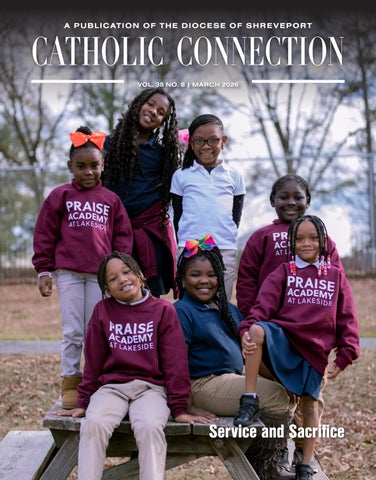
Cover photo: Praise Academy at Lakeside student, (left to right) Ra’Lynn, Mi’Kyla, Jennedy, Omari, Aaliyah, Makyia, and Corinthian enthusiastically participate in a photoshoot at recess.

Photo by Sophia Romanski

SUBSCRIPTIONS & ADDRESS CHANGES

Blanca Vice bvice@dioshpt.org 318-868-4441

SUBMISSIONS

Sophia Romanski sromanski@dioshpt.org

The Catholic Connection is a member of the Catholic Media Association

The Diocese of Shreveport complies with Virtus' Protecting God's Children program (www.virtus.org). Online sessions are available. To report child sexual abuse by a cleric or church worker in the Diocese of Shreveport, call your loval law enforcement agency and Mary Arcement Alexander, Diocesan Victim Assistance Coordinator at 318-588-2120. Thank you for helping to keep our children and vulnerable adults safe.

The Catholic Connection is funded in part by a grant from the Catholic Home Missions Appeal and donations to the Catholic Service Appeal.

MISSION STATEMENT

The Catholic Connection is a monthly publication funded by your Catholic Service Appeal, mailed to every known Catholic household in the Diocese of Shreveport. Our mission is to advance knowledge and understanding of our Catholic faith among the faithful. We seek to foster the application of Christ's teachings and our Church's mission in our daily lives and to encourage our sense of Catholic identity within our family, parish, and faith community.

March Second Collections

MARCH 14 & 15 CATHOLIC RELIEF SERVICES carries out the commitment of the Bishops of the United States to assist the poor and vulnerable overseas.

Rev. Kevin Mues
Deacon Charles Thomas, OFS
Rosalba Quiroz
Karla Alvarez

Read Across America; Cathedral of St. John Berchmans School, Shreveport; 1:00 PM

Memorial of St. Cyril of

St. Joseph School & Cathedral of St. John Berchmans School Grade Six Presentation of Religion Projects; Catholic Center, Shreveport; 9:00 AM

Solemnity of the Annunciation of the Lord Mass; Cathedral of St. John Berchmans, Shreveport; 8:00 AM

OCIA Class; Parish Office Library, Cathedral of St. John Berchmans, Shreveport; 9:00 AM

Loyola College Prep Executive Committee Meeting & Board of Directors Meeting; St. Vincent Cafeteria at Loyola College Prep; 4:30 PM – 6:00 PM

Palm Sunday Mass; Cathedral

Bishop Malone's Calendar Special Events in the Diocese of Shreveport

presence in the sacraments.

Priest Retirement Committee Meeting; Catholic Center, Shreveport; 11:00 AM

Notre Dame Seminary & St. Joseph Seminary Board of Trustees Meetings; St. Joseph Seminary, Saint Benedict, Louisiana; 10:30 AM – 3:00 PM

Student of the Year Competition; Catholic Center, Shreveport; 8:30 AM

of the

Vincent’s Chapel, Catholic Center, Shreveport; 4:00 PM

Help our priests to be strong in their vocation. Set their souls on fire with love for your people.

Grant them the wisdom, understanding, and strength they need to follow in the footsteps of Jesus.

Inspire them with the vision of your Kingdom.

Give them the words they need to spread the Gospel.

Allow them to experience joy in their ministry. Help them to become instruments of your divine grace.

We ask this through Jesus Christ, who lives and reigns as our Eternal Priest. Amen.

Fr. James Dominic Thekkemury
Kelby Tingle
Msgr. Earl Provenza
Solemnity of St. Joseph, Husband of Mary
Fr. James Moran
Fr. Joseph Ampatt
Fr. LaVerne “Pike” Thomas
Fr. Keith Garvin
Fr. Peter Mangum
Memorial of St. Frances of Rome
Memorial of St. Patrick
of St. John Berchmans, Shreveport; 11:00 AM
Memorial of St. Turibius de Mongrovejo
Memorial of Sts. Perpetua and Felicity
Palm Sunday of the Lord's Passion
Memorial of St. Casimir
Student
Year Mass & Awards Ceremony; Saint
Jerusalem
Fr. Rigoberto Betancurt Cortés
Fr. Adrian Fischer
Fr. Karl Daigle
Fr. Charles Glorioso Fr. Joseph C. Howard, Jr. Fr. Timothy Hurd
Fr. Osang Idagbo
Fr. Joseph Martina
Fr. Joseph Maddala
Fr. Calistus Barasa Mokokha
Fr. Bwalya Mobe
Chrism Mass; Cathedral of St. John Berchmans, Shreveport; 6:00 PM

Thoughts from the Pew

Dr. S.G. Cassiere consults Bishop and Doctor of the Church St. Augustine to examine how our good works on earth are multiplied in heaven.

20

Seeing Possibilty

The story of Pam Allen, volunteer extraordinare and Executive Director of the Louisiana Center for the Blind.

FROM THE EDITOR

I usually don’t have a personal reason for choosing themes for this magazine. This month, however, I chose specifically because of my experience working as a secretary at St. Joseph. In big and small parishes alike, volunteers are a crucial, and often scarce, resource. There is a severe shortage of people willing to show up early and stay late to prepare for Mass, minister throughout the liturgy, aid in the smooth running of parish events, catechize our children, and evangelize to the wider community outside our church buildings.

I wanted to use this issue to highlight all the wonderful people who do make time to serve the church, inside and outside their parish buildings, because the work they do is absolutely vital.

You will read about many inspiring people who already do the best they can with the time and tools they have to give back to God. You will also read many convincing arguments for and thoughtful reflections on why all of us should endeavor to join them in whatever way we can.

It may seem like you are stretched to your limit between all manner of things which are good in themselves, but I - and this month’s contributors - encourage you to ask God to show you how you might be able to do more for our Church. God will never set you up to fail, and He will never ask you to do something you can’t handle. If you approach Him with a humble heart and an honest desire to please Him, He will walk with you every step of the way.

16 When God Makes a School

Discover the inspiring story of a group of Christian missionaries who built a private school in the AllendaleLakeside neighborhood in Shreveport.

So, let’s offer a shout of grateful praise to God for all of our diocese’s faithful volunteers, to everyone working behind the scenes to enrich our lives, and to everyone who gives of themselves for the glory of God in any small (or large) way. Let us also pray for the strength and courage to step up in our own way, that we may all grow in grace and charity.

FROM THE BISHOP

Service – just the mere mention of the word can make us think of the degree to which we are or might be asked to help others. Of course, it can also exacerbate the weight of responsibilities we already undertake. Service. Perhaps, we should not be surprised that my editor, when asked to write an article on service, added another word: sacrifice. Both words are used, almost synonymously, when we are called to give deeper meaning to the work we do day-in and day-out. In fact, for those engaged in service work, especially the kind that benefits those most in need of our gifts, it’s almost impossible to speak of one without the other.

I attended a dinner just this past month in Shreveportto thank numerous

parishioners for their generosity in contributing their time and talent to last year’s annual Service Appeal. What I again noticed was that those invited for their generously given time, often at a personal sacrifice, are also those whose Church lives are synonymous with service. Looking around at the hundred plus people in the room, I realized more fully that their presence at this dinner sprang from both their generosity and personal sacrifice. At varying levels, they each served their brothers in the community – not just sporadically but consistently.

Service and sacrifice – two indispensable qualities for the Christian’s way of life. I remember when, as a pastor in Little Rock, we held an annual appeal for people

to become more engaged in service projects, and not a small number responded, “How about if I just give you a check?” Money is important, we know this. But service and the sacrifices we make for others account for the vast majority of the Church’s work and ministry in our parishes and in our schools.

So, how about accepting the challenge to both generosities – by prudently using our financial resources and accepting the challenge for service, even and especially when it is sacrificial of us in our time and talents.

Servicio – solo el mencionar esta palabra nos hace pensar en la medida que se nos pide que tengamos y de cómo podríamos ayudar a otros. Claro, también puede cargar más al peso de las responsabilidades que ya tenemos. Servicio. Tal vez no deberíamos estar sorprendidos que cuando mi editora me pidió escribir un artículo sobre el servicio, también le añadió otra palabra: sacrificio. Las dos palabras son usadas casi simultáneamente, cuando somos llamados a dar un significado mas profundo al trabajo que hacemos día a día. De hecho, para los que están involucrados en trabajo de servicio, especialmente del tipo de servicio que beneficia a los más necesitados de nuestros dones, es casi imposible hablar de una de estas palabras, sin hablar de la otra.

El mes pasado participé en una cena en Shreveport para agradecer al gran número de fieles su generosidad al contribuir su tiempo y talentos a la Cooperación del Servicio anual diocesano. Ahí me di cuenta una vez

por el obispo

más que los que fueron invitados por haber donado generosamente su tiempo, frecuentemente también un sacrificio personal, son los que su vida eclesial está al mismo tiempo ligada al servicio. Viendo a las mas de cien personas reunidas en esta cena, me di más cuenta de que su presencia se debía a ambas, su generosidad y su sacrificio personal. En diferentes niveles, cada uno sirvió a sus hermanos en la comunidad – no solamente esporádicamente si no constantemente. Servicio y sacrificio – dos cualidades indispensables para llevar una vida cristiana. Recuerdo que cuando siendo párroco en Little Rock, teníamos la cooperación anual para que la gente se involucrara más en los proyectos de servicio, a lo cual, muchos respondían, ¿Qué tal si solo te doy un cheque? El dinero es importante, ya lo sabemos. Sin embargo, el servicio y sacrificio que hacemos por otros abarca la mayoría del trabajo y ministerio que la Iglesia lleva a cabo en nuestras parroquias y escuelas.

Así que los invito a aceptar el reto de ser generosos de las dos maneras –usando prudentemente sus recursos financieros y aceptando el reto del servicio, aun y, especialmente cuando es sacrificante dar de nuestro tiempo y nuestros talentos.

Para obtener más información sobre las oportunidades del Ministerio Multicultural en la Diócesis de Shreveport y para encontrar nuestros horarios y lugares de misa en español, por favor escanee el código aquí.

Living a Life with a Servant’s Heart

For we are God’s handiwork, created in Christ Jesus to do good works, which God prepared in advance for us to do. - Ephesians 2:10

What does it mean to have a servant’s heart? There are many wonderful definitions, but I think it means to put others before yourself and serve with humility, devotion, and selflessness. Most importantly, as we are called to serve and do good deeds for others, we need to be living a life that reflects God’s love.

Jesus calls all of us to serve in many ways, both big and small. As we journey through this Lenten season, we should prayerfully ask ourselves, “How can I serve others? What can I do to strengthen my love of Christ through service?” These are questions to ask ourselves every day, but especially while at Mass. What are you doing to not only grow your faith but also serve others in your church community? Do you volunteer in your parish? Do you serve as a lector, eucharistic minister, usher, or choir member? Do you support your parish with offertory gifts? Those are acts of service that are not only needed, but can bring you joy and enhance your participation in the Mass.

Do you participate or lead a Bible study? Do you volunteer for other organizations, such as St. Vincent de Paul, Mary’s House, or Knights of Columbus ? It’s easy to say, “I don’t have time for service, it’s hard enough to get to Mass.” Maybe, all you need is to attend Mass weekly (and that may be all you can do at this time in your life). But I challenge you this year to fully become involved with a servant’s heart. Look around, see what you can do to humbly serve others and care for those who need our help. It could be as simple as praying for people on your parish prayer list, writing a note to someone you’re thinking about, or making a donation to an organization that improves our community. Little acts of service make a big difference in the lives of others.

As you read the stories of service and sacrifice in this month’s magazine, take a moment to pray for each volunteer and the ministries they serve. Their stories should inspire you to think about how you can be the servant that shines with God’s love.

One person who always seems to shine with God’s love is Father Mike Thang’wa (pictured above). I met Fr. Mike when he first came to St. Joseph in Shreveport many years ago, and I’ve loved his infectious personality ever since. It was such a good feeling in Mass when he said, “God is good,” and we answered, “All the time” — a special phrase we should say all the time. Fr. Mike returned to his home diocese in Nairobi, Kenya, last December, but he will always be remembered by the many lives he touched while serving in the Diocese of Shreveport. I treasure his friendship and hope to see him again one day soon.

When I think of servants like Fr. Mike, as well as all the men and women who serve in our diocese, I truly believe that God is good, all the time.

Lucy Medvec is the Director of Development and Stewardship for the Diocese of Shreveport.

From

Blending Devotion with Service

This is the third article in our series exploring significant events and select churches in the Diocese of Shreveport’s 40-year history.

Service-oriented associations of the faithful – those working behind-the-scenes or forward-facing – have long been a mainstay of Catholic parish life. With their quiet presence, they are extensions of Jesus’ hands and heart and free up clergy to offer the sacraments and their shepherding care to parishioners.

Having particularly deep roots, the Altar Society (originally the “Ladies’ Altar Society”) is one such organization, established to care for vestments and sacramental vessels, clean sacred spaces, decorate for the seasons, and maintain liturgical supplies for Masses and events. In times past, these societies required a membership fee and held fundraisers to enable their works.

In June of 1861, Fr. Louis Gergaud, St. Matthew’s first pastor (and now a Servant of God awaiting canonization), organized a Ladies’ Altar Society, whose fifty charter members chose the motto “O Lord, we have loved the beauty of Thy House” ( Roman Catholic Church: Celebrating 150 Years as a Parish (1851-2001), Chase E. Machen). In 1920, St. John Berchmans Altar Society members paid monthly dues of twenty-five cents, and in 1923, St. John’s, Many, Altar Society published the church’s first cookbook to support its efforts. (Clearly reflecting the limited temperature control of the day’s ovens, some recipes simply read, “Bake very slowly” or “Bake in a moderate oven,” leaving baking times up to the cook.) The organizations’ funds sometimes enriched a parish’s external appearance, as when the Ladies Altar Society of Holy Trinity provided funds to renovate, relandscape, and refence the Garden of Our Lady in 1983.

Established in 1914, its name derived from their patronage under the Queen of Heaven, the Blessed Mother. The society originated from the goodwill of a small group of women who saw a compelling need to help the priests care for the parish’s poor. Over time, membership grew to such a size that subgroups of “Circles” were eventually formed – thirteen in all – with their own officers, increasing their ability to help with additional spiritual and corporal works of mercy. Rev. John D. Druhan, S.J., noted in 1944 that “their pioneering effort in the field of social welfare work has commanded the respect and admiration not only of the Most Reverend Bishops and priests of the diocese but of public officials as well.” The groups expanded their assistance over time. The January 1, 1967, Sundial noted that Circle 7’s “… projects range from cake sales to rummage sales, serving refreshments to the Inquiry Class and donating clothes to Catholic Charities.” Queen’s Workers also helped furnish the church’s material needs, such as Circle 8’s procurement of holy water fonts (for the entrances), collection baskets, and the stained-glass window in the Baptistery depicting Christ and Nicodemus.

The Queen’s Workers society at St. John Berchmans provided social welfare assistance, and it also had a distinguished history.

Radiating Jesus’ love, these volunteers built a legacy of service to the Church and undoubtedly received much more than they

Lisa Marcalus is the archivist for the Diocese of Shreveport.

Laborers of Mercy: Visible and Hidden Servants of Life

Across the Diocese of Shreveport, quiet and courageous acts of mercy unfold each day. Some are visible – like the pro-life volunteers from ministries like Mary’s House or the Church’s life advocates that offer hope by helping pregnant parents in distress. Other ministries are hidden, like those running Rachel’s Vineyard retreats, where people wounded by abortion find the courage to begin healing in confidential locations and settings. Whether public or private, these ministries reflect the heart of the Church family in defense of life.

While sidewalk counselors are no longer needed in Louisiana, the battle for life is far from over. Sidewalks may no longer host protests, but the spiritual battlefield has moved inward – into our communities, families, and personal witness. Abortion pills, mailed in secrecy, continue to trap men and women in isolation and sin – often abandoned by those they trusted and left to carry the burden alone. That is why the witness of life must now flourish at the parish level, where both laity and clergy speak of God's mercy.

Yet, what happens to those who rarely set foot in a church? Thanks be to God, volunteers who go the extra mile aid individuals and families by witnessing to Christ’s truth wherever they are needed – especially in the deepest, most hidden places where the evil one seeks to keep souls trapped.

In both visible and hidden ways, the Church carries out her mission to defend life and nurture the human person – physically, emotionally, and spiritually. The pro-life mission is not merely about saving lives; it is about saving souls. It is about reaching those lost in shame and silence and offering the mercy of God instead of the world’s judgment. Along with the Lenten themes of redemption and salvation of souls, it reminds us that our task is the labor: to serve and sacrifice as our Master taught us. Christ Himself came not to condemn but to save. He reached out to the brokenhearted, the cast aside, and the sinful – not with stones, but with healing.

In Rachel’s Vineyard, women and men who believed their sins were unforgivable encounter Christ through the hands of gentle volunteers. In our parishes, former sidewalk counselors have become catechists, mentors, and neighbors, offering love where condemnation once reigned. Both missions – healing the post-abortive and preventing future wounds – are acts of mercy that reflect the Gospel.

Let us thank every volunteer, seen and unseen. To the clergy who listen with compassion, lay volunteers who offer alternatives and support, and intercessors who never stop praying: you are the heart of this mission. Every act of service, whether shouted in public or whispered in prayer, helps bring souls back to God.

To all laborers of life – thank you. You are helping to build a culture where life is cherished, wounds are healed, and souls are saved. May we all continue to serve, to forgive, and to deliver others from evil – until the day when every heart knows it is loved.

The Office of Marriage and Family Life in the Diocese of Shreveport once again invites those hurt by abortion to step forward and contact healingjourney@dioshpt.org or visit www.rachelsvineyard.org/weekend/ sitesbydate.aspx for a retreat near you. Your request will be handled with strict confidentiality, and a mentor can walk with you through the restoration process with prayer, the Word of God, spiritual counseling, and the reception of the sacraments.

You are not alone. God wants you to have freedom and peace.

“And forgive us our trespasses, as we forgive those who trespass against us; and lead us not into temptation, but deliver us from evil.” — Matthew 6:12–13

Noemi Saybe is the Director of Marriage and Family Life at the Diocese of Shreveport.

Obrando la Misericordia: Servidores de la Vida al Descubierto y en Encubierto

Alo largo de la Diócesis de Shreveport, cada día se desarrollan valientes y silentes actos de misericordia. Algunos son visibles—como aquellos hechos por los voluntarios provida de ministerios como la Mary’s House, que ayudan a madres embarazadas y angustiadas. Otros hechos quedan ocultos, como los de quienes organizan retiros de Rachel’s Vineyard, donde las personas heridas por el aborto encuentran el valor para comenzar a sanar en total privacidad. Ya sean públicos o privados, estos ministerios reflejan el corazón de la Iglesia en defensa de la vida y la familia.

Aunque los consejeros en las aceras ya no son necesarios en Luisiana, la batalla por la vida está lejos de haber terminado. Las aceras tal vez ya no alberguen protestas, pero el campo de batalla espiritual se ha trasladado hacia el interior: a nuestras comunidades, nuestras familias, necesitando asi nuestro testimonio personal. Las píldoras abortivas, enviadas en secreto, siguen atrapando a hombres y mujeres en el aislamiento y el pecado—con frecuencia abandonados por aquellos en quienes confiaban y cargando con su peso en soledad. Por eso, el testimonio en favor de la vida debe florecer ahora a nivel parroquial, donde tanto los laicos como el clero hablen de la misericordia de Dios.

¿Pero qué sucede con quienes rara vez pisan una iglesia? Gracias a Dios, hay voluntarios que van más allá y acuden en ayuda de personas y familias, dando testimonio de la verdad de Cristo allí donde más se necesita—especialmente en los lugares más ocultos y secretos, donde el maligno busca mantener

atrapadas a las almas.

De formas tanto visibles como invisibles, los voluntarios por la vida llevan a cabo su misión de defender y cuidar a la persona humana— física, emocional y espiritualmente. La misión no se trata solamente de salvar vidas; sino de salvar almas; de alcanzar a quienes están perdidos en la vergüenza y el silencio, y ofrecerles la misericordia de Dios en lugar del juicio del mundo. Unido a uno de los temas centrales de la Cuaresma—la redención y salvación de las almas— esto nos recuerda que nuestra tarea es trabaja: sirviendo y sacrificándonos como nos enseñó nuestro Maestro y Señor. Cristo mismo no vino a condenar, sino a salvar. Se acercó a los quebrantados de corazón, a los marginados y a los pecadores—no con piedras, sino con acción sanadora.

En Rachel’s Vineyard, los hombres y mujeres que creían que sus pecados eran imperdonables se encuentran con Cristo a través de las manos de voluntarios compasivos. En nuestras parroquias yacen antiguos consejeros de acera convertido en catequistas, mentores y vecinos que ofrecen amor donde antes reinaba la condena. Ambas misiones—sanar a quienes han sufrido un aborto y prevenir nuevas heridas—son actos de misericordia que reflejan el Evangelio.

Demos gracias por cada voluntario, visible u oculto. Al clero que escucha con compasión, a los voluntarios laicos que ofrecen alternativas y apoyo, y a los intercesores que nunca dejan de orar: ustedes son el corazón de esta misión. Cada acto de servicio ya sea proclamado en público o susurrado

en oración, ayuda a acercar las almas a Dios.

A todos los trabajadores por la vida— gracias. Ustedes están ayudando a construir una cultura donde la vida es valorada, las heridas son sanadas y las almas son salvadas. Que todos sigamos sirviendo, perdonando y liberando a otros del mal—hasta el día en que cada corazón sepa que es amado.

La Oficina de Matrimonio y Vida

Familiar de la Diócesis de Shreveport invita nuevamente a quienes han sido heridos por el aborto a dar un paso adelante y comunicarse con: healingjourney@dioshpt.org o indagando en: www.rachelsvineyard.org/weekend/ sitesbydate.aspx para encontrar un retiro cercano. Tu solicitud será manejada con estricta confidencialidad, y un mentor podrá acompañarte en el proceso de restauración con oración, la Palabra de Dios, consejería espiritual y la recepción de los sacramentos.

No estás solo. Dios quiere darte su libertad y su paz.

“Perdónanos nuestras ofensas, como también nosotros perdonamos a los que nos ofenden. No nos dejes caer en la tentación y líbranos del mal.”

— Mateo 6,12–13

es la

Noemi Saybe
directora de Matrimonio y Vida Familiar de la Diócesis de Shreveport.

YOUR SERVANT IS LISTENING

While I may not remember the exact year, I vividly remember the feeling. If asked to describe said feeling, I would do so in six words, “What the heck was I thinking?!” Fast forward to today, and I’d answer, “It’s a piece of cake (sort of).” What I am referring to? Reading for Mass, more properly known in church terms as “lectoring.” With my re-conversion to the Catholic faith roughly 15 years ago, I developed a strong desire to do more within the parish. I had been the proverbial “pew parishioner,” fulfilling my weekly duties through Sunday Mass attendance, but that is where I left it. No more, no less. Reflecting on my then notspiritually-fed feelings, I clearly see how I inadvertently closed

my spiritual mouth while simultaneously getting angry at the priest for being too boring. It’s all his fault, right? My now much wiser and more spiritual self knows the difference. I say with an honest heart that when I began to pour myself more into my parish, my parish began to pour into me.

Not long after I began lectoring, I co-led a middle school youth group, joined Mary’s Workers, attended the ACTS retreat (where I eventually served as a co-director), gave talks at church, and so much more. God is indeed good and mysterious! He knew all along that once I opened the door to serving my church community, He would grab the doorknob

and open it much wider… to the point of discomfort. He allowed me to stretch beyond my limits, and equipped me for each role in the process. I am a big believer in the tremendous work God does in us when we allow ourselves to get uncomfortable. Sadly, we live in a world that leans toward comfort, complacency, and a touch of laziness. As we listen to the world less and to God more, we quickly discover His plans for us, and yes, they will involve us leaving our comfort zones.

I address the remainder of this article to the person(s) who is more like the pew parishioner I used to be. First off, please know I am not judging you. I am so glad you attend weekly Mass – it is one of the best ways to start your faith walk. Instead, I’d like to challenge you. My challenge is broken into three parts: open your mind, find the ministry, and take action.

the trick.

Returning to my first time lectoring for Mass, I not only wondered what the heck I was doing up there, I also thought my heart was going to pound out of my chest. My palms were sweating (alarming when carrying the very heavy “Book of the Gospels”), my mouth suddenly turned into the Sahara, and my eyes were freaking out about the possibility of accidently losing my place because they happened to look up.

Give, and it will be given to you. Good measure, pressed down, shaken together, running over, will be put into your lap. For with the measure you use it will be measured back to you. —Luke 6:38.

What does it mean to open your mind? Be willing to allow yourself to be more involved in your church parish. Avoid just responding with, “I am not a good reader,” “My schedule is so packed I can’t fit one more thing into it,” or “They wouldn’t want me because I’m too (fill in the blank).” First, open your mind to show you are willing to just see the possibility of being a lector, an usher, a greeter, or other role. Find a ministry that speaks to you: through your church bulletin, the parish website, and fellow parishioners you know who frequently volunteer.

Try one or two ministries, being honest with the leaders about this all being new to you. Explain that you are in the searching phase and not sure what will stick.

Last but not least, do it! You have already opened your mind to the possibilities, done the research, and now, it is time to take action. Quick sidebar here, did you know that research has proven that the cure for fear is action? I know it may sound a bit impossible, but I can attest that it absolutely does

To say I was fearful in that moment is an understatement. Fast forward to lectoring today… I still experience a few butterflies, but also have newfound confidence and joy in reading The Word.

Brothers and sisters, God does not want us to only be pew parishioners. He wants us to participate in our church community because He knows that in giving of ourselves we will receive so much more in return.

“Give, and it will be given to you. Good measure, pressed down, shaken together, running over, will be put into your lap. For with the measure you use it will be measured back to you.” —Luke 6:38.

Buying Eternal Riches with Earthly Ones

St. Augustine on Service, Sacrifice, and the True Economy of Grace

We chase wealth, guard it, and measure our worth by it – but seldom ask what it’s worth beyond the grave. Saint Augustine once preached, “Buy eternal riches with your earthly ones” (Sermon 36 on the New Testament). He meant that everything we possess –time, talent, and treasure – is meant to be spent, not hoarded, in love of God and service to others. In this world’s economy, the goal is to accumulate; in God’s economy, the goal is to give. Every act of charity is a sacred exchange – earth’s coin traded for Heaven’s currency.

This month’s theme, Service and Sacrifice, invites us to reflect on that exchange. The Church calls us not merely to generosity and volunteerism, but to something deeper – the stewardship of our whole lives. When done in charity and grace, our service is not merely a social good; it is an eternal investment. Augustine saw the poor as bankers for Heaven, not burdens. “You deposit your gold on earth,” he said, “and you fear thieves; deposit it in Heaven, and it will be kept safe by God.”

Ill-gotten gains can build an earthly house, but never a home in Heaven. Augustine knew that possessions

themselves were not evil. Wealth, he said, is neutral – its moral value depends on how it is used and how it is obtained. What corrupts is not gold but greed, not abundance but attachment. “It is not the possession of riches that is condemned,” he preached, “but the desire for them.” The problem is not that we own things, but that our things come to own us. The world teaches us to cling; the Gospel teaches us to cleave.

Grace is the true economy of Heaven, where no act of charity is wasted and no sacrifice forgotten.

selves – can be hoarded just as easily. Yet, whatever we cling to eventually perishes; only what we give endures.

In parish life, this truth plays out quietly every day: a lector proclaims God’s Word, a catechist teaches a restless class, a volunteer washes dishes after a funeral luncheon. The world doesn’t count these as profitable, but God does. Each unseen act of love is a spiritual investment – deposited not in a bank but in a heart transformed by grace.

The diocesan theme reminds us that Christian service flows from sacrifice. Our time, talents, and treasures are not ours absolutely; they are entrusted to us for the good of others. Saint Paul puts it plainly: “Present your bodies as a living sacrifice, holy and acceptable to God” (Rom 12:1). Augustine understood this as the foundation of Christian stewardship – our whole life offered as an oblation of love.

He likened the rich fool to a sailor on a sinking ship who clings to his gold rather than casting it into the sea. The wise, by contrast, throw their riches into the hands of the poor, who carry the wise safely ashore to Heaven. The principle extends beyond money –our time, our energy, even our very

When we serve at the altar, teach a child, comfort the grieving, or share what we have, we are not simply helping out. We are participating in the self-emptying of Christ. The smallest act of service, done in humility and love, becomes a share in

His redemptive work. What the world tallies as loss, Heaven records as gain. “Whatever you do to the least of My brethren,” Christ says, “you do unto Me.” The labor of love is never wasted – it is transformed into grace.

Here lies the deepest truth – and the sharpest edge – of Augustine’s teaching: Generosity alone is not enough. Saint Paul warns, “If I give away all I have… but have not charity, I gain nothing” (1 Cor 13:3). Without sanctifying grace – the indwelling life of God in the soul – no good deed, no matter how impressive, has supernatural value. It may feed bodies, but it cannot heal souls.

Fulton Sheen put it succinctly in The Mystical Body of Christ: only what grace touches becomes part of Christ’s own life within us – and only those acts done in Him carry weight in eternity. As theologian Adolphe Tanquerey, SS. DD., teaches in his classic manual The Spiritual Life, only works done in the state of grace possess supernatural merit; everything else, however generous, remains merely natural.

The Catechism teaches the same with clarity: “The merit of man before God… is due to God’s free plan, for He has freely chosen to associate man with the work of His grace” (CCC 2008). Acts done in grace, through charity, share in Christ’s own merits; acts done without grace remain only natural, not salvific. “For it is God who works in you, both to will and to work for His good pleasure” (Phil 2:13). Grace is the hidden fire that turns our natural goodness into supernatural glory.

This is why the saints never tired of urging Confession and Holy Communion. Only in a soul that is living in sanctifying grace can service become salvific. Augustine’s theology is the perfect antidote to modern voluntarism: the point is not doing more, but loving more – and loving

rightly, through grace.

Lent gives this theology its living context. “Though He was rich, yet for your sake He became poor” (2 Cor 8:9). Christ Himself is the model of service and sacrifice – the divine Word who emptied Himself for our salvation. Augustine’s homilies on almsgiving often portray Christ as the beggar at the door; hidden in the hungry, the thirsty, the lonely. When we serve others, it is Christ who receives our gift and repays it a hundredfold.

Offered in love, each volunteer hour, each dollar given, each hidden kindness becomes participation in that same poverty of Christ. We meet Him not only in the Eucharist, but in the neighbor who needs our time, our patience, and our presence. As J. Patout Burns notes in Augustine’s Preached Theology, Augustine’s vision of the Church was profoundly reciprocal: the Body of Christ sustained by the mutual charity of rich and poor alike. “The poor need the rich to survive, while the rich need the poor to get to Heaven.”

Saint Augustine’s theology of wealth and sacrifice turns the world’s logic upside down. What we spend in love is never lost; what we hoard for ourselves vanishes. Grace is the true economy of Heaven, where no act of charity is wasted and no sacrifice forgotten.

As Lent deepens, let us remember the divine calculus: We lose by holding on, but we gain by

letting go.

Wealth, time, and talent are safest when spent in love.

What we hand to God through others, we shall find again – with interest – in eternity.

“Buy eternal riches while you still can.”

S. Germain Cassiere, MD, FACP is a retired Internist and parishioner at the Cathedral of St. John Berchmans, writing on faith, virtue, and the Catholic spiritual life from the pew perspective.

Sandro Botticelli. “Saint Augistine in His Study.” 1494. Tempera on wood panel. Uffizi Gallery, Florence, Italy.

When God Makes a School

The Father, His Children, and Praise Academy at Lakeside

Every morning, Grazier’s mother had to face telling her firstgrade son that yes, he was going to school that day. Every morning, he cried and begged her not to send him. She persisted – she wanted her son to have an education. His morning tears became angry outbursts at school, so that more than once the principal reported that Grazier visited his office that day. Unhappy and not learning, Grazier flunked first grade. At the end of every school day, he returned home to one of Shreveport’s most abandoned areas.

In the Allendale-Lakeside neighborhood and its environs, one

Housing in the Allendale-Lakeside neighborhood in Shreveport.

in every three houses is empty. Whole blocks contain only vacant lots or unoccupied houses on one side of the street, and as high grasses and low tree limbs swallow some houses, others let in daylight through the roof. Iron bars cover many of their windows.

But people have lived here, some for forty years. Men and women still keep their houses sound and their yards tidy. Families and children here endure crisis after crisis and still get up to face each new day. Like Grazier’s mom, the parents, grandparents, and greatgrandparents of the neighborhood have been doing everything they can for their children.

Then, in the fall of 2014, more than two hundred of those residents heard a knock at their house: “We’re some Christian missionaries who live in the neighborhood. We think God wants us to start a school here. What do you think?”

A question more than ten years in the making originated from a group of Christians, both Catholics and Protestants, who heard a call from God in the early 2000s to move into some of America’s poorest neighborhoods, not as a charity organization but as neighbors and missionaries. When three of the missionaries scouting out Shreveport neighborhoods in 2002 took a wrong turn and asked for directions, a man told them, “If you ended up here in this neighborhood, God must have sent you.”

– almost three hundred people –the initial, exploratory question: “We’ve heard the Lord calling us to do something with kids, maybe something like a school. What do you think about kids in the neighborhood, and what do you think about education?”

“It was crazy,” remembers David Zimmel, one of the canvassers. “We asked open-ended questions to find out what people [wanted]. It felt like we weren’t getting anywhere, because all the conversations were the same. Then, we stepped back and looked at the data, and it was amazing. Everybody was saying the same thing, and they weren’t talking to each other! This was a clear word from God about what we were supposed to do!”

That was in Allendale-Lakeside. Once they looked around, all three men quickly, independently, and inexplicably wanted to move there. After much conversation and prayer, they recognized that their desire came from God. This part of town was perhaps not so abandoned after all: it seemed to be very close to God’s heart and very much on His mind.

Over the next ten years, additional missionary men, women, and families continued moving into the neighborhood. As they talked with, prayed with, and got to know their neighbors, they learned that the children were among the people’s biggest concerns.

This led to several missionaries knocking at every house in their immediate neighborhood in 2014 asking everyone who answered

One after another, mothers, fathers, grandparents and guardians in Allendale-Lakeside said they wanted a neighborhood school, one that would teach reading, writing, and math where their children would be safe and any student could succeed. They also wanted to participate in their children’s education, which for them meant paying something for it. And they said the school needed to be about Jesus.

In November of 2014, the canvassers asked their neighbors a new question: “We think God wants us to start a school here.

What do you think?”

“We talked to about two hundred people [in the second round of canvassing],” Zimmel remembers, “and there were only two who were not outrageously supportive. The most common response was, ‘Stop saying you think God wants you to do this, you know. And stop saying you want to start a school, you’re gonna start a school. Stop talking and get it done, now.’ That,” says Zimmel, “was pretty

striking.”

When they talked to a man named Neal, then nearly eighty and legally blind, the missionaries had to shout for him to hear them. But once he did, he reached into his pocket and pulled out a $5 bill. “That’s a great idea,” he said. “Here’s this money so you can start the school.” Neal’s $5 was the first donation.

Praise Academy at Lakeside opened its doors nine months later.

A Christian, non-public school, Praise Academy offers an elementary education to children from preschool to 8th grade. Its goal is that every student “would grow in their understanding of the world around them and know the dignity of being God’s sons and daughters,” said Mary Grams, Head of School. Grazier’s mother enrolled him at Praise Academy after he failed first grade and had made a name for himself as a kid with a temper –neither of those claims to fame disqualified him from what Praise Academy offered.

“Praise Academy meets every student where they are at,” says Grams, whether they are at grade level, ahead of it, or like Grazier, far behind. Latisha, the school’s first graduate, began as a fifth grader who could hardly write a sentence, and Alonzo, the school’s second graduate, arrived as a sixth grader still sounding out words with little understanding of what he read.

the girl who couldn’t sleep because she shared her bed with a crying baby, and the boy who arrived at school shaken and tense after hearing gunshots outside his house.

“It’s not easy,” says Grams. “But God sent us to these kids and this neighborhood. God is making it possible.”

Indeed, He is. After two years at Praise Academy, Latisha caught up to sixth grade in both reading and math. By the time Alonzo graduated eighth grade, he had surpassed the eighth grade reading level. Both attended high school at Loyola College Prep. Latisha is now a sophomore at the University of Louisiana at Lafayette, one of the few in her family to attend college.

It’s not easy, but God sent us to these kids and this neighborhood. God is making it possible.

So, Grazier was not the only child at Praise Academy who experienced rough mornings at school. Among his peers were the five year old whose dad walked out on the family last night,

Latisha and Alonzo’s stories are exciting, but not unique. Just as the people of the neighborhood wanted, Praise Academy is a school where every child can receive a good education. Its students receive an hour of math and two hours of English Language (reading and writing) every day. They study history, science, and the Bible. They also learn “life skills,” including building (for the boys) and cooking (for the girls), along with how to speak well of others, reconcile, work through frustrations, and pray.

“Our faith is not a separate activity, it’s part of our makeup,” says Grams. “The faculty prays together every day before school [and we] have daily all-school morning prayer. Every age group has some sort of Bible class. We pray at the beginning of every class, and if needs come up [during the day], we pray with the students.”

“Praise Academy is meant to be a little piece of heaven on earth, far away from the bitterness of the current world,” says teacher Abby Earhart, quoting the school’s Christian Culture Statement.

“And it is! The kids thrive here. They love the school, and they know they are loved… We’re small, but every student is seen, heard, and noticed by all the teachers because we’re small. Everybody knows everybody’s name within a few months. It feels like family.”

“Heaven on earth” may explain why some students run to school when they’re dropped off in the morning, or why one girl insisted to her family, “I wish school were also on the weekends!” LaBrittney, a mom who was employed by Praise Academy after she lost her job and her house, testifies that “the healing started there in that [Praise Academy] kitchen,” where teachers frequently stopped to talk and pray with her. There is also the testimony of the police crime map, which shows that crime is high in Allendale-Lakeside except in the blocks surrounding Praise Academy. As all those parents and grandparents wanted, Praise Academy is a safe place.

neighborhood, individualized learning, and affordable.”

“If you came to visit, you’d hear a lot of squeals and laughter coming from our students and teachers,” says Grams. “Students are happy and learning… it’s a place of peace, joy, freedom, trust, and learning.” One student looked at the row of homelike school buildings with wide lawns and trees flowering in the sun and added, “Then it’s, like, beautiful, and the sun just be shining on the grass…” That student was Grazier.

Families outside the neighborhood have noticed; some new families are relatives and friends of current students. “Our current families love and trust us enough that they want to share us with others,” says Grams. “Other new families have found us online… They had a picture of what they wanted for their child, and we met that picture for them: small, Christian,

Parents like LaBrittney pay what they can for tuition, some as little as bringing snacks. The rest of Praise Academy’s support comes in the form of donations and volunteers. Parishioners of Our Lady of the Blessed Sacrament and Holy Trinity visit regularly to read with students during the thirty-minute “Reading Workshop” that begins every school day. As Grams says, it’s not easy to operate a neighborhood school in Allendale-Lakeside – but God, who did not spare His only Son for these kids, seems to think it’s worth it.

“In the Gospel of John,” Grams recalls, “Jesus says, ‘I came that they may have life and have it abundantly’ [Jn 10:10]. The story of Praise Academy at Lakeside is a story of God giving abundant life to the people of Lakeside and beyond. It is a story of God’s extravagant love for the poor and especially for His little children.”

Grazier is one student who can tell what a difference Praise Academy made for him. “The teachers gave us time [to learn a subject], we didn’t have to rush through it,” he says. “That’s when I fell in love with the school.”

His mother reported that within a year of being enrolled, he was one of the kids running to school when he was dropped off, and he would cry only when he couldn’t come to school. Grazier caught up to grade level, and by the time he graduated in 2023, he had learned a lot about how to control his anger. He is now a junior at Booker T. Washington High School. “I don’t know what I would’ve been if I weren’t here,” he said once, almost in tears.

“What do I tell people about Praise Academy?” says Zimmel. “I tell them it’s the best-kept secret in Shreveport. But we think God wants us to not keep it a secret anymore.”

Beatrice Hall is a Chirstian missionary and Communications Assistant for Praise Academy at Lakeside.

Seeing Possibility:

Pam Allen’s Life of Faith and Leadership

Life rarely unfolds the way we expect. For Pam Allen, life’s earliest challenge arrived before most memories even begin. At just two years old, Pam lost her sight due to cancer. What could have become a defining tragedy became instead the start of a life shaped by faith, resilience, and a quiet determination to live fully – on her own terms and in service to others.

Growing up outside Buffalo, New York, Pam was the youngest of six children in a lively Catholic household. Faith, family, and high expectations filled her childhood. Rather than frame her cancer diagnosis and what followed as a tragedy, her parents presented her life as one that could (still) be full, meaningful, and rich with possibility. They never treated blindness as a limitation, but as one part of who Pam was. When her sighted classmates learned to read, Pam learned Braille alongside them. When her siblings tried new activities, Pam expected to do the same.

“Being the youngest of six, I often joke that my parents didn’t have time to be overprotective,” Pam says. “They had six kids in eight years – there was just too much life happening.” That reality worked in Pam’s favor. Her parents never lowered expectations or allowed blindness to become an excuse. Instead, they reinforced a belief that Pam was just as capable as anyone else – she might simply need different tools.

Faith was woven deeply into Pam’s upbringing. As a cradle Catholic educated in Catholic schools, she grew up immersed in parish life. Though she was the only blind student in her school, she was never sidelined. When her mother began to serve as a lector in their home parish, she encouraged Pam to do the same, hoping it would

“ It’s not how much you give, but how much love you put into giving. - St. Teresa of Calcutta

that long before Pam could articulate the importance of accessibility, she experienced what it meant to be welcomed without barriers.

help her grow in faith and confidence of not only who the Lord was, but who she was as well. Pam accepted –and decades later, she continues that ministry at St. Thomas Aquinas in Ruston.

Pam’s early experience of inclusion was also shaped by the Xavier Society for the Blind, which provides prayer books, catechetical resources, and the full Bible in Braille and audio formats— free of charge—so that blind Catholics can fully participate in the life of the Church. She first received their Braille materials in elementary school for her classes and religious education, so

While attending Denison University in Ohio, about five hours from home, Pam explored psychology, law, and advocacy – drawn to work centered on people, justice, and human dignity. She met a successful blind woman working at Oberlin College who became a mentor and role model: seeing her navigate professional life with confidence expanded Pam’s understanding of what was possible. That mentor connected Pam with Joann Wilson, then executive director of the Louisiana Center for the Blind, through which Pam secured an internship at the center – an opportunity that quietly shaped her future. Although she did not arrive in Ruston intending to build a career in blindness services, once she stepped into the work, she recognized it as a place where education, independence, and dignity intersected.

During her internship, Pam helped individuals learn Braille and supported programming rooted in high expectations and self-determination. The experience led to a summer camp position working with children, many learning Braille for the first time. She returned the following summer, building relationships and witnessing the transformation that occurs when

people are given both skills and belief in themselves.

After graduation, Pam chose to complete the center’s training program as a student, strengthening her own skills and deepening her understanding of the participants’ experience. Her early roles included coordinating summer programs, supporting students academically, and recruiting educators into the field.

In 2001, Pam’s leadership role arrived unexpectedly when Joann Wilson was appointed to a federal role in Washington, D.C., leaving the executive director position vacant. As Executive Director of the Louisiana Center for the Blind, Pam now guides the organization into a new chapter.

She leads with a simple but demanding belief: blind people are capable of independence and meaningful contribution. “Everyone has a responsibility to make the community better than they found it,” she says. The center reflects that belief by preparing students to live full, engaged lives – challenging long-held assumptions about blindness.

Living in Ruston, Louisiana, a predominantly Protestant community, Pam finds her Catholic faith to be both grounding and an opportunity for witness. The move from a heavily Catholic area to a town with one Catholic parish gave her new perspective.

“When you live as part of a minority –whether that’s being Catholic or being blind – you’re often invited to explain who you are,” Pam says. “That creates space for understanding.” Through conversation, questions, and quiet example, Pam sees education as an act of hospitality.

Her faith was tested – and strengthened – in 2019 when a tornado tore through Ruston and into her neighborhood.

Pam and her husband, Roland, rushed to safety moments before multiple trees crashed onto their home – one falling onto their bed only seconds after they left it. The house had to be demolished, displacing them for fifteen months.

What Pam most remembers is not the loss, but the response. Neighbors, colleagues, and students stepped in immediately. They even found a rental close enough for Pam and Roland to continue walking to work. “That experience reinforced my faith,” Pam reflects. “There were people everywhere doing God’s work.”

Celebrating 25 years of marriage this November, Pam and Rolan share both blindness and a deep commitment to their work. Roland teaches blind individuals how to travel safely, navigate communities, and explore the outdoors. Together, they remain grounded by shared values and faith.

Pam’s hopes for her legacy are straightforward. She wants the Louisiana Center for the Blind to continue reaching people of all ages. She hopes blindness will be widely understood as a characteristic – not limitation. Above all, she wants lives changed through opportunity, education, and belief.

Pam carries a quote from Mother Teresa with her that captures her approach: “It’s not how much you give, but how

much love you put into giving.” And she turns often to Philippians 4:13, especially in moments of challenge: “I can do all things through him who strengthens me.”

For Pam Allen, blindness never defined her life’s limits. Instead, it sharpened her vision – enabling her to see possibility, dignity, and purpose where others might not yet know to look.

Lexi Corum works as a digital reporter for KTVE News in West Monroe. She and her husband Travis attend Jesus the Good Shepherd Parish in West Monroe, LA.

Pam Allen poses confidently in a smart red suit. Photo from the National Federation for the Blind website (nfb.org).

Grazie Mille!

John Benedict (JB) Cordaro’s Acceptance Remarks upon his reception of the Loyola University 2025 Integritas Vitae Award

“Each of us comes for a short visit, not knowing why, yet sometimes seeming to divine a purpose… there is one thing we do know: that we are here for the sake of others… those upon whose smiles and well-being our own happiness depends, and for the countless unknown souls with whose fate we are connected by a bond of sympathy.” - Albert Eintstein

Thank you, President Cole, members of the Loyola University Board of Trustees, and Father Dawson.

I humbly and proudly accept Loyola’s 2025 Integritas Vitae Awardon behalf of my family that nurtured me, teachers that schooled me, friends that supported me, and others that mentored my personal development and professional career. My mother, Lucille, and father, Joseph, made countless sacrifices to raise 11 children and send us to Catholic schools. We began with the Daughters of the Cross nuns and then the Jesuits at St. John’s in Shreveport and, in my case, to Loyola University New Orleans. Throughout these years, our religious life was centered on Holy Trinity Catholic Church to receive the Sacraments, attend Mass, and service as altar boys. Liz, my wife of 58 years, shares this award. She has tolerated my antics and activities beyond reasonable expectations. To our three children – Susan, Greg, and Mike – their spouses, Sean and Erica, and two special grandchildren, Dan and Holly, thank you for helping me understand and respond to parenting challenges.

Early in my life, when asked about my ambitions, I replied “Depending

on the sport season either I want to play center field for the Yankees or point guard for the Celtics.” I did not achieve either! However, I achieved something far greater with a Hall of Fame family and a six-decade global food security career. I have tried to help vulnerable populations improve their health and well-being, in fraternity and solidarity with the teachings of St. Ignatius of Loyola.

I am 84 years young, and I know that my life is in extra innings, but I continue to ask “what’s next” and respond “I’ve got this” to new challenges.

My journey has unfolded within three intersecting elements:

•Grandparents who immigrated to America from Sicily

•Catholic upbringing and Jesuit education

•Implementing lessons learned into my daily personal and professional activities

We called my grandfather Cordaro “Papa.” None of my personal or professional success would have been possible without this courageous immigrant farmer who left Palermo, Sicily, for America. 25-year-old Giovanni Domenico Cordaro disembarked from the S.S. California to room #219 of the New

Orleans Customs House on October 22, 1900. He was a part of the wave of Italian immigrants that settled in New Orleans.

Papa operated a produce stand in the French Market while he waited for his bride to be, Benedetta Sunseri, to come to America. They were married in St. Louis Cathedral, began a family, and moved to Shreveport. Then, with other immigrant friends, they founded Shreveport Macaroni, manufacturing the finest pasta in the South.

While my father was in the Army/ Airforce, my early years were spent with my mother and Papa, whose wife, my grandmother, had died. I learned the role Papa played in my formative years from letters my mother and father wrote during the war. Fortunately, I have even stronger memories, as Papa lived until the age of 96, providing years of personal lessons and guidance. My conversations with Papa instilled lasting insights into character and integrity. We often sat on his front porch and slowly rocked back and forth in weather-beaten chairs. He usually sipped a glass of red wine. As we shared either a bowl of sliced apples or pieces of parmigiana cheese, I listened to his warm, soothing,

affectionate, Sicilian dialect… that I can still hear.

Papa told me – more than once -when speaking or listening to someone, always look directly at them to show respect. He told me to always remember that my public actions would define my family name to others and that I must make my word a “bond,” a “trust,” that others could always count on.

When I took a summer school class at Tulane, I realized no one else wrote AMDG at the top of their papers. Although I no longer do this myself, I try to fulfill the meaning of our Jesuit motto Ad Maiorem Dei Gloriam, “For the greater glory of God.” AMDG remains my guiding philosophy.

I recall the 20-plus-hour class schedules needed to fit in Theology, Philosophy, Logic, and Ethics. Debate team activities, campus and local politics, and performance in the thespian society helped overcome my shyness to make me feel secure to speak with confidence in public. Truly, I found my speaking voice at Loyola!

When I graduated in 1963, I could not have imagined that decades later another young man, whose Italian grandparents had immigrated to Argentina, would be ordained a Jesuit priest in Argentina. He would retrace his immigrant grandparents’ journey by returning to Rome as Cardinal Bergoglio and later be elected Pope –Papa Francesco. Further, I could not have imagined that his Papacy would provide me the opportunity to bundle Loyola learnings, global food security knowledge, and experiences to help implement the words in his encyclical – Fratelli Tutti.

During six decades of global food security experience, I have worked in approximately 50 countries on scores of programs. I will highlight here the Vatican initiative, which is a

cornerstone to my award.

Just when I thought I had received all the Jesuit training that I needed, Pope Francis issued Fratelli Tutti Subsequently, I was asked to coordinate creation of Villaggio della Fraternità to bring to life the words of this encyclical, as a member of the Vatican Leadership Team under the guidance of Cardinal Mauro Gambetti, archpriest of Saint Peter’s Basilica, and with Father Francesco Occhetta, a Jesuit, who is General Secretary of the Fratelli Tutti Foundation.

Villaggio will be a harmonious, interfaith community on over 100 acres near Saint Peter’s Basilica. It will serve as a convening forum focused on food and agriculture to train African agriculture extension experts, who will return to Africa to help farmers produce and deliver nutritionally improved foods. Villaggio will bring Fratelli Tutti to life by demonstrating how food promotes equitable social integration, solidarity, sustainability, and social friendship.

In summary, the nuns taught me to memorize the answer to the Baltimore Catechism question: Why did God make me? And the answer is – to know, love, and serve God. Later, the Jesuits underscored for me the reason for human existence and the relationship between people and the world.

Accepting this award allowed me to return to where my grandparents began in America 125 years agoand to honor and thank them and everyone that has guided my incredible journey. Giovanni and Benedetta created a remarkable legacy that flourishes across six generations. Papa thrived as a successful businessman and respected community leader. Papa and Grandma raised five children. From their union grew a lineage of 15 grandchildren, 47 great-grandchildren, 59 greatgreat-grandchildren, and even one great-great-great-grandchild. Their

family tree has blossomed into an extraordinary network of professionals contributing to enriching the economic, social, and religious fabric of our great country and the world.

My journey does not end tonight. I continue to seek to fulfill my mission, with further inspiration and encouragement that Pope Francis stimulated and which continues with Pope Leo. I will help create Villaggio della Fraternità through universal fraternity and social friendship to achieve global food security, by eliminating hunger, malnutrition, and stunting.

Thank you, to the Jesuit priests and Loyola professors who shaped and guided the contours of my life with knowledge, wisdom, and common sense… And helped me find my voice!

And a special thanks to each of you for the opportunity to express appreciation for my immigrant grandparents, for their bravery in coming to America, and to recognize my parents for sacrificing, guiding, and supporting my efforts.

Thank you again for the 2025 Integritas Vitae award.

GRAZIE! Grazie Millie!

JB Cordaro is a member of the Vatican’s Leadership Council, a member of the Vatican’s Human Constitutional Assembly, Coordinator for the Vatican’s Villaggio della Fraternità, Senior Advisor for Faith and Development, St. Peter for Humanity Foundation, African Orphan Crops Consortium (AOCC) Coordinator to UN Agencies and African Countries.

Graces Given for Greatness

When I first decided to join the Catholic Church, I admit I was nervous. I saw these beautiful churches filled with beautiful people and wasn’t quite sure I’d belong. Covered in tattoos with streaks of green in my hair when I encountered Jesus, I was also deep in the throes of poverty, and so, wondered what I could possibly offer to a church that asked to invest in me as a catechumen.

Having just survived cancer by the grace of God, I’d been unable to work for a year as my husband dedicated his time to helping me learn to navigate life with an amputation. Barely able to muster a widow’s mite, I wanted to give somehow. It wasn’t long before I learned there were plenty of opportunities to give. All it would cost was my time, and with my cancer gone, I felt I finally had time to give! Throwing myself into volunteering, I gradually realized that the gift of service also served me in many ways .

It was one reason I was brought into St. Elizabeth Ann Seton Parish, where my lack of money did not mean I lacked what I needed to contribute. After all, my call to join the Church and glorify Him in any way I could was written long before I knew Jesus. I learned that “in love he destined us for adoption to himself through Jesus Christ, in accord with the favor of his will, for the praise of the glory of his grace that he granted us in the beloved” (Eph. 1:4-5). And if God selected me to help the Church grow in whatever way I could, He would give me the tools and gifts I needed to be successful. All I had to do was say yes!

When I think of my own “yes” to God, I recall the greatest “yes” of all – that of our Blessed Mother. She, too, was destined

to a calling, and just like me, she was given all the graces she needed to enter into the role God had for her. He still gave her free will to accept or decline that call, just like all of us. But God, in his infinite wisdom, bestowed unfathomable graces on her so that she could fill her role in a way that literally no other woman could. I know that God created me with my mission in mind, and if I happen to live a life that doesn’t include riches, that was part of the plan; He gives me graces to overcome that and still spread His love. When thoughts of unworthiness creep in, I always recall the weight of Mary’s calling and how she humbled herself while simultaneously accepting the great gifts and honor God gave her.

I go forward in my mission, and when I have hardships, I pause and ask God, “Is this still the path You choose for me? If so, I know You will give me the grace I need to persevere. And in the words of our Blessed Mother, ‘Let it be done to me according to your will.’”

Jennifer Nix is a parishioner and catechist at St. Elizabeth Ann Seton Catholic Church in Shreveport and the Day Service Coordinator at Hope Connections.

Artwork: Bartolomé Esteban Murillo. “The Annunciation.” 16551660. Oil on canvas. Hermitage Museum, St. Petersburg, Russia.

Volunteers Multiply Good Works

Ilike to brag about the number of people our program’s small staff helps each year. Last year, our crew of nine served more than 2,600 people.

Well, really, it is not just those nine paid people. Our volunteers – those who help parents “shop” in Gabriel’s Closet, teach financial literacy, review our finances, and plan our fundraisers – they enable nine people to do the work of many more.

Pope Francis said, “Volunteers are the strength of the church” (12th edition of the Pope Video for 2022 December). Without question, Catholic Charities would not be who we are without volunteer support.

We often think of volunteers as those who work directly with those we serve. One of our most loved programs, Gabriel’s Closet, is run almost entirely by volunteers, which keeps our costs down and ability to serve clients up.

But I also want to recognize those people who apply their skills in less traditional ways.

When Ms. Barbara arrives each week, she follows up on calls to our emergency-assistance clients. She investigates how they are doing, letting them know we still care. And her reports on the number of people still housed and current on their bills tell us that our programs work.

Talented CPAs on our board have spent countless hours ensuring our books are in order and answering our accountant’s detailed questions, all to ensure we follow best practices. The result – two years of clean audits.

Once or twice weekly, [LB1.1]Ben sits in the front area and answers phones to free our regular receptionist for

immigration work that occurs away from the front.

And[LB2.1] a board member who’s worked in media for years helped us create a new public service announcement to better spread the word about our work.

Everyone’s skills are needed. We desperately need clerical help in our Monroe office, where budget cuts prevent us from paying a receptionist. Our staff must juggle assisting clients with answering the phone, which rings constantly. For the Shreveport office, we seek additional people to either teach classes for our parents in Gabriel’s Closet or help parents shop.

Time commitments are flexible, and we will help you learn everything you need to know.

In every case, your gifts of time and talent truly multiply the work we can accomplish.

As Pope Benedict XVI told bishops in 2011: “The little that we manage to do to relieve human needs can be seen as a good seed that will grow and bear much fruit; it is a sign of Christ’s presence and love which, like the tree in the Gospel, grows to give shelter, protection and strength to all who require it” (Address Friday, 11, November 2011).

HELP WANTED

Job opportunities available for workers in the Kingdom of God. See details below.

JOB DESCRIPTION: Building the Kingdom of Heaven on Earth.

AGE REQUIREMENT: Youth to old age. Non-discrimination policy as regards to age, gender, race, or nationality.

PREREQUISITES: No education or experience necessary. Active prayer life. Love and compassion for others. Ability to leave your comfort zone. Spiritual awareness. Discernment. An open mind and willing heart. Willingness to take instruction and follow marching orders. Faith the size of a mustard seed. Humility is a valuable asset.

DUTIES: Feed the hungry. Clothe the naked. Give alms. Care for the sick. Pray for all those in need. Visit prisoners, including people imprisoned by their own choices. Advocate for the rights of the vulnerable and powerless. Forgive those who have hurt you. Love those who don’t love you back. Care for the environment. Welcome the stranger. Share your God-given talents and gifts. Serve with a cheerful heart.

HOURS: On call 24 hours per day, 7 days a week.

SALARY: No monetary compensation, but spiritual benefits range between ten to a thousand-fold. Blessings are guaranteed with luxurious housing promised at the end of your tenure.

HOW TO APPLY: Command your mornings! Pray for specific instructions, then listen to hear where the Holy Spirit directs your attention, today – before your feet hit the floor! If possible, consult your local priest or parish leaders for directions or suggestions. Consult the Diocesan website.

The harvest is plentiful, but the laborers are few (Mt 9:37). Start by praying about and noticing needs in your immediate surroundings: Which person in your family needs encouragement? Instruction? Immediate physical or financial assistance? Then, widen your scope to look at your immediate community: Are there neighbors whose faith could be strengthened by you reaching out to them? What about the immediate needs of your school or workplace? Next, look closely at your parish: Are there underserved groups? Homebound people needing connection to others? People in hospitals or nursing homes who would be cheered by a card, phone call, or visit? Does the PSR program need an instructor? Does the OCIA group need sponsors? Does the St. Vincent de Paul Society need a donation or another pair of hands? Does your pastor need to hear some words of encouragement or a hot home-cooked meal?

Look further by taking a diocese-wide approach! Our seminarians always need prayers, encouragement, financial assistance, and appreciation. Our Catholic school teachers and administrators would love to hear from you, and tuition assistance is always a pressing need.

Keep going… to the larger community around you: the town or city where you live. What might you be called to do, even in a small way, to help the homeless, sick, widow, orphan, people on welfare, women facing unplanned pregnancies, foster families, people with disabilities… the possibilities are endless! All these needs offer each one of us a unique

and wonderful opportunity to grow in our faith as we serve others with our gifts and abilities. It’s a win/win call to action!

UNACCEPTABLE EXCUSES: I am not worthy (Nobody is!!!). I don’t have time (We all get the same 24 hours a day). I am not able (“Now go; I will help you speak and will teach you what to say,” Ex 4:12). I’m too tired (“Take my yoke upon you and learn from me, for I am gentle and humble in heart, and you will find rest for your souls. For my yoke is easy and my burden is light,” Mt 11:29-30). I’m too weak (“My grace is sufficient for you, for my power is made perfect in weakness,” 2 Cor 12:9). I’m scared! It’s a dangerous world out there! (“The one who is in you is greater than the one who is in the world,” 1 Jn 4:4). I don’t know what You want me to do! (“Ask and it shall be given to you; seek and you will find; knock and the door will be opened to you,” Mt 7:7). I can’t do this by myself! (“But the Helper, the Holy Spirit, whom the Father will send in my name, he will teach you all things and bring to your remembrance all that I have said to you,” Jn 14:26). May Jesus come alive in each of us during this Lenten season as we offer ourselves as His laborers.

Karen Dill is a spiritual director for the Diocese of Shreveport and a parishioner at St. Elizabeth Ann Seton.

Seminarian Burses

Thanks to our Recent Donors:

(005)2 Cathedral of St. John Berchmans Burse #2

The Congregation of St. Johns Roman Catholic

Church In memory of Pam Shaughnessy (008) St. Jude Parish Burse

Anonymous (011)2 Rev. David Richter Memorial Burse #2

Anonymous (015) Bishop’s Seminarian Burse

St. Elizabeth Ann Seton Parish Seminarian Bake Sale

(017)2 Msgr. George Martinez

Knights of Columbus Council 1337 Burse #2

Knights of Columbus Council 1337 (022) Rev. Blane O'Neil, OFM Memorial Burse

Anonymous In memory of Fr. Blane O'Neil (023)2 Msgr. Edmund J. Moore Memorial Burse #2

Charles & Brenda Taylor (024) Rev. Joseph Puthuppally

Memorial Burse

Edward & Cathy Dinger (032) Madeline & Joe Tiller Memorial Burse

Mr. Randy G. Tiller (036)6 Msgr. Earl Vincent Provenza Burse #6

John Suarez & Becca Owen In memory of Dr. Louis & Becky Whitten Provenza (036)7 Msgr. Earl Vincent Provenza Burse #7

Mr. & Mrs. James Powell

John Suarez & Becca Owen In memory of Dr. Louis & Becky Whitten Provenza (039) St. Elizabeth Ann Seton Knights of Columbus Council 9260 Burse Knights of Columbus Council 9260 (045) Sister Martinette Rivers, OLS Memorial Burse

Anna G. Livengood

(049) Rev. Philip Michiels Burse

Mr. and Mrs. Robert McGowen (050)2 St. Joseph Shreveport Mary’s Workers Burse #2

Mary’s Workers of St. Joseph Church, Shreveport (050)3 St. Joseph Shreveport Mary’s Workers Burse #3

Mary’s Workers of St. Joseph Church, Shreveport

(052) Dr. Matthew Ragan Green, Jr. Memorial Burse Anonymous (058) Monsignor Warren T. Larroque

Memorial Burse

Mr. and Mrs. James E. McKeithen (060) Father David Buss Memorial Burse

Mr. and Mrs. James E. McKeithen (063) Rev. Charles Glorioso Burse Anonymous

Incomplete Burses:

(001) Fr. Mike Bakowski Burse #2 ($1450)

(002) Joseph & Antoinette Bakowski Burse ($3250)

(003) Sam R. Maranto Burse ($1750) (004) Kathryn Atherton Cook Burse ($450)

(005) Cathedral of St. John Berchmans Burse #2 ($4876)

(007) Dr. Carol Christopher Burse ($1200)

(008) St. Jude Parish Burse ($9800) (009) St. John Berchmans Knights of Columbus Council 10728 Burse ($1550)

(011) Rev. David Richter Burse #2 ($7400)

(015) Bishop’s Seminarian Burse ($8543)

(016) Elaine Malloy Frantz Burse ($1000)

(017) Msgr. George Martinez Knights of Columbus Council 1337 Burse #2 ($4004)

(018) Knights of St. Peter Claver Council 144 Burse ($1500)

(021) Rev. Edmund "Larry" Niehoff Burse ($2350)

(022) Rev. Blane O'Neil, OFM Burse ($8400)

(023) Msgr. Edmund J. Moore Burse #2 ($4400)

(024) Rev. Joseph Puthuppally Burse ($8800)

(025) Kathleen Hightower Burse ($800)

(027) Rev. Richard Lombard Burse #4 ($5000)

(028) Friends-n-Faith Burse ($750)

(029) Rev. Kenneth Williams Burse ($400)

(030) Ottis and Anne Krupa Littlejohn Burse ($9000)

(035) Dr. James V. & Rosemary C. Ward Burse #4 ($6720)

NEW (036) Msgr. Earl Vincent Provenza Burse #7 ($3001)

(037) Manuel & Catherine Licciardi, and John & Beverly Miller Burse ($7000)

(038) The Malone Family Burse ($500)

(039) St. Elizabeth Ann Seton Knights of Columbus Council 9260 Burse ($1300)

(045) Sister Martinette Rivers, OLS Burse ($700)

(046) Domestic Church Burse ($5000)

(047) Troops of St. George Burse ($7000)

(048) Rev. Joseph Kallookalam, CMI Burse ($5000)

NEW (050)3 St. Joseph Shreveport Mary's Workers Burse #3 ($395)

(052) Dr. Matthew Ragan Green, Jr. Burse ($2850)

(054) Fr. Franz Graef Burse ($5000)

(056) Hazel Iles & John Paul Woodley, Sr. Burse ($860)

(057) Father Robert Inzina Memorial Burse ($5000)

(058) Monsignor Warren T. Larroque Burse ($5000)

(059) ACTS of Northwest Louisiana Burse ($800)

(060) Father David Buss Burse ($5000)

(061) Sister Maria Smith, DC Burse ($3500)

(062) Joan E. Anderson Sneed Burse ($2000)

(063) Rev. Charles Glorioso Burse ($6200)

The most recent seminarian burse to be completed (with donations totaling $10,000) is the Fr. Philip Michiels Burse (#49). This burse was opened in January 2024 with a donation of $250 in honor of Fr. Phil from parishioners of St. Elizabeth Ann Seton. For the next two years, many gifts to the burse were made in his honor by members of St. Elizabeth Ann Seton with the final gift completing the burse in February 2026. Before retiring in June 2017, Fr. Phil served throughout the Diocese of Shreveport for many years. His last assignment was at St. Elizabeth Ann Seton from 2005 where he served for 12 years before retiring to Alexandria.

Gifts to the Diocese of Shreveport's Seminarian Burse Program create a legacy of giving in support of our seminarians. It currently costs an average of $50,000 per year to educate and support one seminarian and we are blessed to have six at this time.

A seminary burse can be opened with a donation of $250 or more. A burse is completed when it reaches $10,000. Once a burse is open, it can receive donations in any amount. Burses can be opened to memorialize a loved one, honor a priest, and represent a group or organization. Anyone can contribute to any of the diocese's incomplete burses.

For a list of incomplete and completed burses, please scan the QR code on this page or visit www.dioshpt. org/seminarian-burses

For more information on how to establish or contribute to a burse, please contact the Development Office at (318) 219-7260.

Service and Sacrifice

We are all called to serve. Volunteers are the backbone of every church, enabling them to fulfill their mission to serve both the parish community and the broader world. By lending our time, talents, and gifts to our parish, we grow in fellowship and community.

My mom always said: We give time to our families, jobs, friends, school, social gatherings, and the list goes on. Surely, we can sacrifice time for gratitude. Service is about gratitude. Look what Jesus did for us: so, we can ask ourselves what can we do for Him?

Our parish, St. Mary of the Pines Catholic Church in Shreveport, LA, comprises twenty diverse cultures and works with our Pastor, Fr. Mark Watson, to create an active faith community. The diverse skills and experiences enable us to share our talents across the board and enrich the church’s ability to respond to varied needs.

We all have talents and skills. We can serve as greeters, ushers, lectors, gift bearers, choir members, musicians, and PSR teachers; serve on councils, committees, and the appeal; maintain and beautify the church property; work with youth; visit the sick and homebound; create videos; cook and serve food; set up for and clean up after events; wash dishes; prepare the sanctuary and care for the liturgical linens; make a prayer quilt; and work with St. Vincent de Paul to serve our communities.

Fr. Mark encourages our parishioners to be supportive, and he inspires us to live out our faith by service and sacrifice. Volunteering in your parish enables you to take ownership of your church and appreciate both the blessings it offers and your contribution toward those blessings. Ask God to guide you to where you are needed. Attend Mass regularly and look for opportunities to serve. Remember, it is an honor and a privilege to be God’s hands and feet.

Woods is a volunteer and parishioner at St. Mary of the Pines Parish in Shreveport, LA.

Jean

St. Frederick Hig H Sc Hool

The Spirit of Service

The Holy Spirit is clearly at work at St. Frederick High School, as students respond to a growing call to lives of service and sacrifice – both within our school community and throughout the wider Church. And their answer is meaningful and inspiring.

More than 50 students recently volunteered for training to serve as altar servers at both St. Frederick High School and their respective parish churches. Their commitment reflects a willingness to serve, along with a deep reverence for the altar servers’ sacred role in Church life. Their response demonstrates a growing understanding of service as an expression of humility, responsibility, and faith.

In addition, three current students and one recent graduate have entered into full communion with the Catholic Church, and two additional students shared their intention to do so this spring! These faith journeys were nurtured through participation in religion classes, involvement on the Discipleship Team, regular opportunities for Mass and Eucharistic Adoration on campus, and – most importantly – through the daily witness of faculty and staff who authentically live out their Catholic faith.

And what began as a desire among students to deepen their relationship with Christ has now developed into a third year of vibrant, student-led Bible study communities. Led by senior Discipleship Team members, a girls’ Bible study group meets weekly in the evenings at Jesus the Good Shepherd Church, and a boys’ Bible study group partnered with the Knights

of Columbus, whose members generously provide both space and hospitality when students gather to study Scripture, grow in faith, and build Christian fellowship.

Our Fellowship of Christian Students meets weekly before school, with a change from previous years when the group relied on adult guest speakers. This year, students stepped forward to lead, offering personal testimonies of faith. These peer-led reflections have been especially powerful, encouraging classmates to both recognize Christ at work in their own lives and discern how they are called to serve others.

One example of this lived discipleship is Ritter Benedetto, an outstanding student in academics and athletics, who recently shared his musical gifts through piano accompaniment during worship at Jesus the Good Shepherd Church. In his generous offering of talent, he serves his parish community in a meaningful and selfless way.

Such examples reflect the intentional formation of young disciples at St. Frederick High School. Witnessing students choose faith, leadership, and service over typical distractions of adolescence leaves me both humbled and hope-filled. Their witness offers encouragement and promise for our Church’s future.

Lisa Miller is the Director of Development at St. Frederick High School in Monroe, LA.

JeSuS tHe good SHepHerd catHolic Sc Hool

Congratulations, Paxton Pulliam!

2025 - 2026 JGS Student of the Year

We are so proud to celebrate Paxton Pulliam, pictured here with his parents, Micah and Haley Pulliam, as our 2025–2026 Jesus the Good Shepherd School Student of the Year.

For the past 15 years, JGS has annually recognized one outstanding 5th grade student with this special honor. Each recipient goes on to represent our school at the Diocesan Student of the Year competition held in January, alongside other non-public school honorees from across North Louisiana.

This recognition reflects more than academic success. The Student of the Year is chosen for excellence in the classroom throughout 3rd, 4th, and 5th grades, strong standardized test performance, a heart for service, Christ-like attitude,

exemplary conduct, and meaningful leadership among peers.

We feel incredibly blessed to have Paxton represent Jesus the Good Shepherd School. Please join us in congratulating him and keeping him in your prayers as he continues this journey!

Amy Fakhre is the Director of Development at Jesus the Good Shepherd Catholic School.

catHedral oF St. JoHn Berc HmanS catHolic Sc Hool

The SJB family begins every school day with morning assembly, when we gather to celebrate accomplishments and birthdays, share announcements and news, and pray together as we start the day. Key in this ritual is our collective recitation of the Mission of the Cathedral School, during which we state our intent to live out a “life of service.” These are not mere words – our students are given so many opportunities to serve!

In our Kinder Hallway classrooms, the youngest Cardinals practice an approach to self-directed learning, in spaces intentionally designed for three-, four-, and five-year-olds. Cleaning and returning a space to order are key components of this approach, in a way that makes this act of service fun. Elementary students cheerfully turn canned food, coat, and toy drives into competitions, overflowing the baskets on the stage with gifts for people in our community. The students are also seen around campus participating in Love the Boot Day and in beautifying our flower beds and garden center, with laughter spilling from the weeds and leaf piles in a love of service.

The Middle Schoolers literally take off their jackets and roll up their sleeves while delving deeper into lives of service. They routinely reconfigure the Multi-room from a gym to a banquet room and back again, first arranging the chairs and tables just so, then loading them back onto trolleys and stowing them away neatly and safely. Our eighth graders serve at the Highland Blessing Meal, the Junior Honor Society wraps gifts at the Gingerbread House, and the sixth and seventh graders clean and tidy Mary’s House. The “City

of SJB” continues learning that service is not only a sacrifice of their time, it is a joy.

The ultimate service is witnessed at every school Mass and Masses all over the diocese where SJB student altar servers give their time to serve at God’s altar. They work hard to know their roles – Book, Cross, Bells, Incense – and volunteer to serve at funerals, Holy Days of Obligation, and the beautiful (and late at night!) Masses of Christmas and Easter. Saint John Berchmans is the patron saint of altar servers, and we strive to make him proud of our service.

Standing by the morning carpool line, I find great joy in seeing parents give quick hugs and hearing their words of encouragement as children climb out of cars, laden with books, bags, nap mats, lunch boxes, and all the trappings of their busy lives. Amid the calls of “I love you,” “Play hard,” and “Do your best,” is the most beautiful of benedictions, “Find a way to serve today!” At SJB, may we always seek to find a way to serve with joy amid the sacrifice.

Dr. Sarah Duncan is the librarian and Media Arts teacher at St. John Berchmans Cathedral School in Shreveport, LA.

our lady oF Fatima catHolic Sc Hool

OLFS Celebrated Catholic Schools Week Feb 2-6

Each class made posters for the United in Faith and Community themed wall. Monday was a “Zoom on top but pj’s on bottom” dress-down spirit day. On Tuesday, the Mardi Gras King and Queen from Krewe of Janus visited. For Wednesday, the CSW committee hosted a “7th v. 8th grade” basketball game, and all classes came out to cheer on the teams. Students dressed in their Sunday best on Mass day then enjoyed Yeti snowballs that afternoon. Finally, students finished the week with our Amazing Race, a school-wide, Catholic-trivia scavenger hunt led by eighth grade team leaders. On Friday afternoon, Pilots for Patients shared how they help patients in the community through flight missions.

Overall, it was a joyful week to be at our Catholic school!

Elise Reis is the Math and 7th grade Social Studies teacher at Our Lady of Fatima

Catholic School in Monroe, LA.

Around the diocese...

Thank you for your steadfast service, your generosity of spirit, and the countless ways you strengthen our Church community. Your dedication is a blessing, and we are deeply grateful for all you do!

St. Jude Council 18108 Knights of Columbus donating 96 coats to “Coats for Kids.”

CATHOLIC CONNECTION

DIOCESE OF SHREVEPORT

3500 Fairfield Ave. • Shreveport, LA 71104

Catholic Connection USPS 024-824 is published monthly except for July by the Diocese of Shreveport, 3500 Fairfield Ave., Shreveport, LA 71104. Periodicals Postage PAID at Shreveport, LA 71102. POSTMASTER: Send address changes to Catholic Connection, 3500 Fairfield Ave, Shreveport, LA 71104.

PHOTO OF THE MONTH: Xavier Society for the blind provides free religious, spiritual, and inspirational reading materials in braille, large print and audio to blind and visually impaired individuals worldwide. We are able to provide these materials free-of-charge thanks to the generous support of our donors. We support this community of the faithful in understanding, developing and practicing their Faith. Our service began in 1900 and we hope to serve many more people in new and innovative ways for many years to come.

For more information or to register for services, visit xaviersocietyfortheblind.org or follow us on Instagram, X, Facebook, and YouTube @Xavier Society.

Turn static files into dynamic content formats.

Create a flipbook