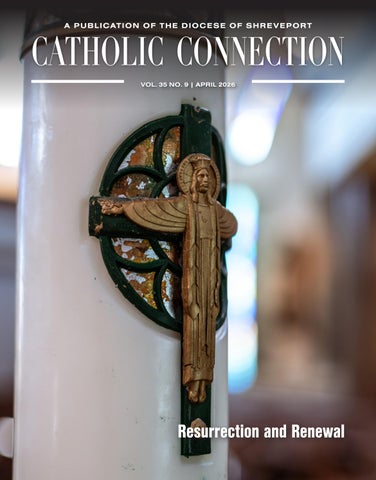
April 2026 - Resurrection and Renewal

Page 1


CATHOLIC CONNECTION

CATHOLIC CONNECTION

PUBLISHER

Bishop Francis I. Malone

EDITOR

Sophia Romanski White

EDITORIAL BOARD

CONTRIBUTORS

Mary Arcement Alexander

Chase Baker

Dr. S. Germain Cassiere

Karen Dill

Dr. Sarah Duncan

Amy Fakhre

Diane Libro

Lisa Marcalus

Lucy Medvec

Lisa Miller

Jennifer Nix

Dr. Laurie Salvail

Tracie Stroud

Noemi Saybe

Mike Van Vranken

Volume 35 Number 9 RESURRECTION AND RENEWAL

P ope Leo XIV's Prayer Intention For The Month of April

FOR PRIESTS IN CRISIS.

Let us pray for priests going through moments of crisis in their vocation, that they may find the accompaniment they need and that communities may support them with understanding and prayer.

Cover photo: The Paschal Candle at St. Jude Catholic Parish in Boenton, LA. Photo by Sophia Romanski

SUBSCRIPTIONS & ADDRESS CHANGES

Blanca Vice bvice@dioshpt.org 318-868-4441

SUBMISSIONS

Sophia Romanski sromanski@dioshpt.org

The Catholic Connection is a member of the Catholic Media Association

The Diocese of Shreveport complies with Virtus' Protecting God's Children program (www.virtus.org). Online sessions are available. To report child sexual abuse by a cleric or church worker in the Diocese of Shreveport, call your loval law enforcement agency and Mary Arcement Alexander, Diocesan Victim Assistance Coordinator at 318-588-2120. Thank you for helping to keep our children and vulnerable adults safe.

The Catholic Connection is funded in part by a grant from the Catholic Home Missions Appeal and donations to the Catholic Service Appeal.

MISSION STATEMENT

The Catholic Connection is a monthly publication funded by your Catholic Service Appeal, mailed to every known Catholic household in the Diocese of Shreveport. Our mission is to advance knowledge and understanding of our Catholic faith among the faithful. We seek to foster the application of Christ's teachings and our Church's mission in our daily lives and to encourage our sense of Catholic identity within our family, parish, and faith community.

April Second Collections

APRIL 3 PONTIFICAL GOOD FRIDAY COLLECTION Funds benefit the Church in the Holy Land.

APRIL 4 & 5 OFFICE OF DIOCESAN VOCATIONS OFFICE 100% of funds benefit vocations in the Diocese of Shreveport.

APRIL 25 & 26 CATHOLIC HOME MISSIONS APPEAL supports essential pastoral programs in financially challenged dioceses and eparchies in the United States.

Rev. Kevin Mues
Deacon Charles Thomas, OFS
Rosalba Quiroz
Karla Alvarez

Friday

SVdP Good Friday Way of the Cross Walk for Justice; First Methodist Church, Shreveport; 9:00 AM Commemoration of the Passion; Cathedral of St. John Berchmans, Shreveport; 3:00 PM

of

Confirmation; St. Elizabeth Ann Seton Church, Shreveport; 11:00 AM

Pigs & a Blanket benefitting CCNLA; Layton Castle 1133 S. Grand St. Monroe, LA; 4:00 PM - 7:00 PM

Patrick Madden

Richard Norsworthy

Msgr. Earl

Feasts & Solemnities Priest(s) in the Diocese of Shreveport to pray for daily

Bishop Malone's Calendar Special Events in the Diocese of Shreveport

Charles Ssennyondo

Michael Thang’wa

James Dominic Thekkemury

Kelby Tingle

SUGGESTED PRAYER FOR OUR PRIESTS:

Gracious and loving God, we thank you for the gift of our priests. Especially ___________________________________ (insert name(s) here) Through them, we experience your presence in the sacraments.

Duane Trombetta

Jean Bosco Uwamungu

St. Ann Church, Stonewall; 6:00 PM

Help our priests to be strong in their vocation. Set their souls on fire with love for your people.

Grant them the wisdom, understanding, and strength they need to follow in the footsteps of Jesus.

Inspire them with the vision of your Kingdom.

Give them the words they need to spread the Gospel.

Allow them to experience joy in their ministry.

Help them to become instruments of your divine grace.

We ask this through Jesus Christ, who lives and reigns as our Eternal Priest. Amen.

Matthew T. Long
Msgr. Rothell Price Fr. Gabriel Cisneros Campos
Fr. Fidel Mondragón
Peter Romanus Mallya
Philip Michiels
Shreveport
Bishop Francis I. Malone
Jerry Daigle, Jr.
Mark Franklin
Fr. James McLelland Fr.
Mark Watson Fr. Kevin Mues
Do Minh Vu
Raney Johnson
Provenza
Memorial of St. Anselm
Fr. James Moran
Fr. Joseph Ampatt
Fr. LaVerne “Pike” Thomas
Fr. Keith Garvin
Fr. Peter Mangum
Good
of the Lord’s Passion
Memorial
St. Martin I
Memorial of St. Fidelis of Sigmaringen
Holy Thursday of the Lord’s Supper
Confirmation;
Feast of St. Mark the Evangelist
Holy Saturday
Easter Sunday of the Lord’s Resurrection
Loyola College Prep Executive Committee Meeting; St. Vincent Cafeteria, Loyola College Prep, Shreveport; 4:30 PM
Memorials of St. Adalbert and St. George
Confirmation; St. Pius X Church, Shreveport; 11:00 AM
Confirmation; St. Mary of the Pines Church, Shreveport; 9:00 AM
Easter Vigil; Cathedral of St. John Berchmans, Shreveport; 8:00 PM
Mass of the Lord’s Supper; Cathedral of St. John Berchmans, Shreveport; 6:00 PM
Fr. Rigoberto Betancurt Cortés
Fr. Adrian Fischer
Fr. Karl Daigle
Fr. Charles Glorioso Fr. Joseph C. Howard, Jr.
Fr. Timothy Hurd Fr. Osang Idagbo
Fr. Joseph Martina
Fr. Joseph Maddala
Fr. Calistus Barasa Mokokha
Fr. Bwalya Mobe
Easter Sunday Mass; Cathedral of St. John Berchmans, Shreveport; 11:00 AM
Memorial of St. Catherine of Sienna
Memorial of St. Pius V
Memorials of St. Louis Grignion and St. Peter Chanel
Confirmation; St. John the Baptist Church, Many; 5:30 PM
Confirmation; St. Joseph Church, Shreveport; 6:00 PM
Divine Mercy Sunday

Re-Created, Not Reset

Dr. S.G. Cassiere returns with more Thoughts from the Pew, reflecting on the resurrection of Lazarus.

16

Jesus at the Mass Director of Communications

Tracie Stroud shares her family’s deeply personal journey to the Catholic Church. Her story is a powerful reminder that the Eucharist is a gift intended for all of God’s children.

FROM THE EDITOR

Two months ago, my husband and I got married. For over a year leading up to that, we attended counseling with our celebrant (shoutout Bishop Malone!) and mentor meetings with a local couple (Hi, Elise and Tobais! Hi, Switzer girls!). One theme that recurred throughout the process was the concept of sacrificial love.

More than just the acknowledgment that joining two lives requires compromise, our trusted friends taught us that true sacrificial love is a perfect imitation of Christ: the Bridegroom who laid down His life for His Bride, the Church.

As I write this, Holy Week has just begun (I know, I’m really coming in under the wire this month, don’t tell anyone). We are all about to embark on a week of intense reflection, penance, and anticipation. We are all about to walk with Jesus through the final week of His life, from His Last Supper to His Sorrowful Passion and Death, and finally to His Glorious Resurrection. We are going to meditate on those harrowing final hours, and really consider the pain He endured for our sakes.

We are going to honor and celebrate and mourn the Bridegroom who loved each of us with a perfect, sacrificial love, a love we must strive to replicate every day in our marriages, our families, our workplaces, our schools, even out on the streets.

18 Why I Became Catholic

Chase Baker, Office Administrator at St. Joseph Church, Zwolle, shares the story of his conversion.

Let’s keep in mind this Easter season this sacrifice, this pure, perfect love, and let’s renew our promise to imitate that love for Jesus, ourselves, and each other, every day.

For God so loved the world that he gave his only Son, so that everyone who believes in him might not perish but might have eternal life. - John 3:16

© Unveiled Radiance 2026

FROM THE BISHOP

Iremember when a professor gave us seminarians a reflection on the Paschal Mysteries (the suffering, Death and Resurrection of Jesus). He quoted a reflective hymn he learned in his seminarian days, but could not remember the hymn’s title. When I somehow learned its title – [LB1.1]“What could my Jesus have done more?” – it recalled a poem with this line about Jesus: “He giveth, and giveth, and giveth again.” As Lent concludes, once we have reflected sufficiently on the Paschal mysteries and Easter finally arrives, we might consider the cost of salvation by asking ourselves the same question, “What could my Jesus have done more?”

The hymn’s full lyrics are quite profound. They ask us to reflect on all that Jesus did to win us eternal life: all the sufferings He endured – took on Himself – so that our sins would be washed clean, our chance for eternal life would be assured, and the gates of heaven would be opened wide for us.

At times, I think this is the wrong question, for it sounds as if there might actually be more Jesus could have done for us. The simple answer is that there is nothing more transforming, life-giving, and life-saving than His suffering, Death and Resurrection. But in pondering the question, we might add, “Was there anything else He did for us?” The answer, of course, is that His Resurrection, His victory over sin and death, is complete; yet, as we travel along in life, He also accompanies us on the way. How? By the constant gift of His Body and Blood in the Eucharist. Each time we participate in the Mass, each time we receive His Body and Blood, and each moment we spend in His presence He continues His saving work in us –drawing out from us our sins, restoring us to grace, strengthening us for today or the next day, and enabling us to shoulder the burdens we carry. We could not, of course, join Him in such ways without His saving works – but even more, without realizing that with each days’ challenges, we have Him in

the Eucharist to carry us along.

As a very young priest, I heard a minister on a Christian music station identify the word “grace” as an acronym for “God’s riches at Christ’s expense.” That’s what the Eucharist is for us: the riches the Lord gives to us, over and above the incomparable gifts we receive from His Paschal Mysteries. “What could my Jesus have done more?” Only give us one more opportunity to breathe in the riches that come to us through encountering Him in the Eucharist: at Mass, in adoration, and in reflecting upon Who it is we receive when we receive Him—Body, Blood, Soul, and Divinity.

With Easter comes the added promise and presence of our Lord and Savior in the Eucharist. May this Easter remind us of the price He paid for us to have Him!

The Importance of Renewing Our Faith

Ilove being Catholic.

I love the traditions, music, scriptures, priests, history, and so much more. Most importantly, I love being able to receive the Eucharist and be united with my fellow Catholics every Sunday at Mass. That is the best thing about being Catholic!

On April 6 of this year, I will celebrate 30 years of being Catholic. I remember my day of entry, and how over 50 men, women, and children lined the walls of St. Joseph Church as we received our sacraments and welcomed the love and support of our Church and its people. Besides April 6th being my half-birthday (yes, it’s a thing), it is a special day in my life and a blessing for which I am truly thankful.

On Saturday, April 4, 2026, over 250 people across North Louisiana were welcomed into the Catholic Church – our faith – during the Easter Vigil Mass. If you never attended this vigil Mass, or it has been a few years, I encourage you to go and witness the beautiful sacraments within this celebration. It may be a long Mass, but it is worth every minute and gives you an opportunity to renew your own baptismal promises.

On Easter Sunday, we enter the Season of Easter, or Eastertide, 50 days of joyful celebration until Pentecost Sunday on May 24. From the penitence of Lent we move forward in joy to a renewed life in Christ.

Whether you are a “cradle Catholic” or one who just entered the Church, you have numerous opportunities to grow and renew your faith. Add one daily Mass to your weekly Sunday attendance, join a bible study group, attend a retreat, volunteer with your parish’s youth group, sponsor someone

entering the Church through OCIA, commit to support your parish through weekly offerings, or get involved with St. Vincent de Paul, Catholic Charities, or similar service organizations. These not only help grow your faith, they strengthen your community’s faith.

And you can also strengthen our Catholic community in North Louisiana by supporting the 2026 Catholic Service Appeal. Gifts to the Appeal support all ministries of our diocese, such as seminarian education, care for retired priests, college campus ministry, tuition assistance for our Catholic schools, multicultural ministries, and faith formation, to name just a few. Just think how your gift can grow and renew the faith of Catholics, zero to 100 years old, throughout our diocese. Your gift builds our Church’s faith while renewing your love of being Catholic. For your convenience, you can give online at www.dioshpt.org/stewardship.

We are now entering the most joyous time of year. Next time you are in Mass, I encourage you to be present in the moment and thankful for your blessings.

Enjoy the love of being Catholic.

Lucy Medvec is the Director of Development and Stewardship for the Diocese of Shreveport.

A Toast!

Celebrating Milestone Church Anniversarries

This is the fourth article in our series exploring significant events and select churches in the Diocese of Shreveport’s 40-year history.

As the Diocese of Shreveport observes its 40th year, so too, several churches mark significant anniversaries of canonical establishment in 2026. They remained steadfast spiritual presences for generations of families and surrounding communities – and through momentous historical highs and lows. Just imagine if those walls could talk!

We begin by recognizing our two oldest churches, Holy Trinity in Shreveport, which is on the National Register of Historic Places, and St. Matthew in Monroe; both were established in 1856 and have an impressive 170 years of history. Each was founded by a Servant of God: Fr. Jean Pierre at Holy Trinity and Fr. Louis Gergaud at St. Matthew (the latter also established the church cemetery, where he is buried). Both churches had pastors who enjoyed lengthy years of ministry: four Holy Trinity pastors led their flocks for over 22 years each, and Fr. Nicholas F. Vandegaer served as St. Matthew’s shepherd from 1912 to 1945 –an impressive 33 years during particularly transformative decades.

during his three-year tenure. However, the church we see today is not the original; the current one was personally designed and constructed by Fr. (later Msgr.) Robert C. Friend during his 31-year pastorate, which started in 1944.

St. Thomas Aquinas Church commemorates its 85th year, having begun with the arrival of Franciscan friars to the Ruston area in 1940. The following year, Fr. Jasper Mauss, OFM, erected the first church, with Fr. Humilis Soland, OFM, as the inaugural pastor until January 1944 when he left to become an Army Chaplain. Awareness of the growing need to serve the pastoral needs of Louisiana Tech University’s Catholic students prompted a number of the students’ parents, Tech alumni, and friends to construct a Catholic Center in 1968. A new church building followed and was dedicated in 1972.

St. John the Baptist Church, established in Many in 1871 by Fr. François LeVézouët (another Servant of God) as a permanent mission, proudly recognizes its 155th anniversary. He oversaw construction of a frame church and the installation of its first resident pastor, Fr. Joseph A. Aubree, who served for a distinguished 27 years until 1897. A fun bit of trivia is that the church was so named because three of the initial settlers and leading Catholics in the community were all named John. Fire struck in 1922 and a new church was built in the Spanish colonial revival style. That chruch was completely renovated in 1951 under Fr. Richard Gremillion, who thankfully preserved the beautiful Spanish architecture.

With humble beginnings as a small mission on Bayou Scie in the late 1700s, St. Joseph Church was formally established in Zwolle 145 years ago, with Rev. J.M. Ledreaux as its first pastor, from 1881 until 1884. His successor, the same Fr. Aubree as above, is credited with building a church sometime

Finally, let’s raise a glass to St. Benedict Church as it celebrates its Diamond Jubilee as a parish serving the spiritual needs of the Grambling community and Catholic students at Grambling State University. The trailblazing Fr. James Patterson Lyke, OFM, was the first African American priest assigned to St. Benedict and served until 1979, when he was named bishop – one of the first African American bishops in the US. Later named Archbishop of Atlanta in 1991, he and his successor, Fr. Edward Branch, were both elected president of the National Black Catholic Clergy Caucus while pastors at St. Benedict.

Cheers, and here’s to many more!

Lisa Marcalus is the archivist for the Diocese of Shreveport.
The original (top) and current (bottom) façades of St. John the Baptist Church, Many, LA. Photos courtesy of the Diocese of Shreveport Archives.

Re-Created, Not Reset

The Resurrection that Begins with Prayer

Margaret had stopped arguing with her son years ago.

At first, there were conversations— careful ones, then strained ones, then none at all. Church was “his grandmother’s thing.” God was “complicated.” Sin was an outdated word. Margaret learned quickly that pleading only hardened the silence.

So, she did something else.

Every morning before the house stirred, she sat at the kitchen table with a cup of cooling coffee and said the same names out loud—hers, her husband’s, her son’s. No speeches. No bargaining. Just names.

She did not know what else to do with love when it had nowhere to go.

Some days, she wondered if prayer was simply a way of talking into an empty room.

But she kept speaking.

When Jesus raised the dead in the Gospels, the dead never asked for it.

Jairus begged for his daughter.

A widow wept for her son.

Martha and Mary pleaded for their brother.

The corpse was always silent. The living did the asking.

That detail is easy to miss, but it is essential.

Christ’s triumph over death is not a reset button that returns life to how it was.

It is re-creation.

And re-creation, whether bodily or spiritual, begins not with human initiative but with divine mercy— often invited by the prayers of those who love us.

Scripture is blunt about our condition apart from Christ: “You were dead through the trespasses and sins” (Eph 2:1).

Not wounded.

Image: Vincent Van Gogh. “The Raising of Lazarus (after Rembrandt).” 1890. Oil on Canvas. Van Gogh Museum, Amsterdam, Netherlands

Not stalled. Dead.

A dead man does not reform himself. He does not ask for help.

That is why grace must act first: God intervenes where the will cannot yet move. What is true in the raising of bodies is true in the raising of souls as well.

Bethany is not an accident in the Gospel narrative. Lazarus had been dead four days—long enough for the odor of decay to remove all doubt. Jesus waited deliberately. When He finally stood before the tomb, He did not negotiate with death. He commanded it.

“Lazarus, come out.”

Christ did not raise Lazarus because Lazarus tried harder. He raised him because love stood outside the grave and asked. Martha and Mary did not bring their brother back to life, but their faith brought Christ to the tomb.

Resurrection, as Christ reveals it, is not rehabilitation but replacement. When Christ raises someone, He does not restore the old life. He ends it.

St. Paul is unsparing: “Our old self was crucified with Him” (Rom 6:6). Baptism is not cosmetic repair. It is death and rebirth. That is why resurrection costs something. The price is the former man—the version of us that wants control without conversion.

Grace awakens, but it does not coerce.

Christian prayer does not end at the grave. The Church has always known that love does not stop working simply because time does. We commend the dead to God not because we presume their destiny, but because mercy is larger than our sight, and prayer is an act of trust, not control.

Even here, we place souls—living and dead—into the hands of the One who conquered death and knows what we do not.

Easter is not about returning to who we were before sin took hold. It is about becoming someone we could never have been without Christ. And for many souls, that miracle begins the same way it always has—not with the dead asking for life, but with the living kneeling in hope.

This is not sentimentality. It is the Gospel’s recurring logic. God acts first, but He often acts because love refused to be silent. “

That same pattern still holds. Every parent praying for a wayward child, every spouse aching for a hardened heart, every friend interceding for someone trapped in sin stands where Martha and Mary once stood. Spiritually dead souls rarely ask for resurrection. They are distracted, resistant, or convinced they are fine. Yet, grace still finds them—often because someone else refused to stop praying.

This is not sentimentality.

It is the Gospel’s recurring logic. God acts first, but He often acts because love refused to be silent.

Once life is given, the will must respond. Lazarus still had to walk out of the tomb. The newly risen soul must still say yes—again and again— to the life it has been given. God does not save us without us, but He never waits for us to save ourselves.

After Lazarus emerges, Jesus gives a curious instruction: “Unbind him, and let him go.” Even after resurrection, there is work to do. Grave clothes must be removed. Habits must be shed. The community has a role in helping the newly alive learn how to live. Renewal is not instant perfection. It is new life that must be protected, nourished, and defended.

Christ still stands before tombs.

He still listens to love.

And He still calls the dead by name.

That is resurrection.

Not reset—but re-creation.

S. Germain Cassiere, MD, FACP is a retired Internist and parishioner at the Cathedral of St. John Berchmans, writing on faith, virtue, and the Catholic spiritual life from the pew perspective.

Be the Light of Resurrection

Rarely does anything good happen when darkness is mentioned in Scripture.

The darkness theme begins in the very first chapter of Genesis, “God saw that the light was good; and God separated the light from the darkness” (Gn 1:4).

And it was the ninth plague God sent to the Egyptians, when He told Moses: “Stretch out your hand toward heaven so that there may be darkness over the land of Egypt, a darkness that can be felt” (Ex 10:21).

The gospels continue it, as Matthew quotes Jesus in multiple parables, including: “Throw him into the outer darkness, where there will be weeping and gnashing of teeth” (Mt 25:30).

We have all experienced this darkness when we feel abandoned, confused, or hopeless. But every time the darkness grows too much, the light appears.

A woman came to Catholic Charities recently, behind on her rent and facing eviction. This mother of three lost a daughter to gun violence months earlier and struggled to get back to normal working hours. The darkness was overwhelming. Even the staff –who has heard every story out there –had a hard time shaking this one.

Our staff was determined to help, but it was tricky. The mom’s current income and expenses did not match and were not sustainable. So, despite her awful circumstances, the case manager had to be honest.

Through conversations with the mom and a pledge of monetary support to the landlord, we helped stop the eviction. The mom assured us she was ready to return to her normal workload and was so grateful for the second chance.

She could see the light.

As we walk through Holy Week, we will experience this cycle of ultimate darkness and the light of new beginnings.

My favorite Good Friday homily discussed how we can’t rush through the pain of Good Friday. We have to confront the sin that brought us there. Only then can we appreciate the power of Easter Sunday.

As resurrection people, it is our job to be the light. We can face the darkness – and even acknowledge its potential –with the knowledge of what will defeat it.

We are light when we reach out in friendship to those who are struggling with grief or loss. We are light when we offer prayers. We are light when we serve and guide those in need.

Even Easter Sunday starts in the darkness as Mary Magdalene approaches the tomb. Then, she sees an angel who appears “like lightning and his clothing was white as snow” (Mt 28:3).

With that light, the world is suddenly changed. Darkness is defeated.

“I am the light of the world. Whoever follows me will never walk in darkness but will have the light of life.” —Jn 8:12.

Image: Matthias Grünewald. “Resurrection - Isenheim Altarpiece.” c. 1515. Oil on panel. Unterlinden Museum, Colmar, France.

Honoring My Mother Through the Struggle of Secrets: The Redeeming Power of Prayer

Growing up, my mother was my hero. She was the mom at every event: bringing homemade treats to every class party, traveling all over Texas for my journalism competitions, holding my hand when I was scared, and rubbing my back until I fell asleep on more nights than I can count. She was truly a great friend to me in my childhood and adolescence as I learned to navigate the world as confidently as I could with Muscular Dystrophy.

As a child with a disability, I spent much of my life relying on my mother for basic needs. As I grew and gained increasing independence, I felt a quiet distance growing between us. It wasn’t from anger but rather a new dynamic in which I was less reliant, and fears crept in for both of us. Then, we were both diagnosed with cancer and that small crack between us transformed into a monstrous river of turmoil and self-focus. Sometimes, we called out to each other, barely able to comprehend what the other was saying over the rushing waves of our own troubling thoughts. Our closeness never returned.

I remember the call from my dad after weeks of my mother’s hospitalization, my throat closed with worry. I didn’t even say hello. It took a few seconds, and he sighed then whimpered, “Your momma’s gone.” I survived my battle with cancer. My mom did not. I choked out a silent cry as my dad explained that in the end, she reconciled with God.

Trying to cling to anything that would make me feel close to my mother again,

I attempted to strengthen relationships with family members who knew her best – people who knew Mom before I even existed. And, it was during this search for familiarity, that I met my mother as a stranger.

There were painful truths revealed that called into question everything I thought I knew about her. I discovered two adult brothers I never knew existed: Mom abandoned one as an infant and lost custody of the other in a brutal divorce.

My world collapsed around me. How could this woman, such a great mom who showed me unconditional love, have the heart to leave two children behind and never mention them again? Was my memory of an idyllic family life all a lie? Had I crafted this dream mother when she could have as easily discarded me as she did them?

But if I hadn’t made it all up, why did she choose to keep me? The boys were healthy, “normal” babies. Did she keep me out of pity, seeing that I would need her more than most children? These questions brought greater anger every time I asked them.

But the ugliest, most disturbing question that crept into my thoughts almost daily haunted me: How could I pray for the repose of her soul when I never knew her to be Christian and I now knew these horrible truths that marked her life?

I can’t count how many times I went to reconciliation for these thoughts and my resistance to pray for her. But each time, I felt the hardened feelings toward her chip away, leaving

a raw wound that needed healing. In Mass one day, I received a powerful consolation. It was simple, “Whoever honors his father atones for sins, and preserves himself from them. When he prays, he is heard; he stores up riches who reveres his mother” (Sir 3:3-5).

Prayers for my mother are a gift: I gift to her, who was a great mother to me, and I gift to myself… healing. It is my duty as a child of God and a child of my mother to pray for the repose of her soul. Looking over the things I discovered, it seems my mother spent her life running from her past. But maybe, in the end, she ran to the arms of God. Only God knows her faith, and only Jesus can open Heaven’s gates to her. If Jesus had never come, that would have been the end of my mother’s story. But He did come. Alleluia! And I can trust Him in that He never abandons His children. He will call them home. And just as my mother cared for me when I didn’t know how to ask for help, I must act on her behalf, asking that my mother, Brenda Reel, be welcomed into Heaven with Jesus and be one with Him in His Resurrection.

Jennifer Nix is a parishioner and catechist at St. Elizabeth Ann Seton Catholic Church in Shreveport and the Day Service Coordinator at Hope Connections.

Image: Heinrich Hoffman. “Christ in Gethsemane.” 1886. Oil on canvas. Riverside Church, New York City, New York.

A Marriage Crucifix and the Hope of Resurrection: A Wedding Tradition

It used to be common for households to display a crucifix on the walls of their living rooms and bedrooms, especially above the parents’ bed. That latter crucifix, often received and blessed on their wedding day, remained throughout their entire lives together. It was never replaced according to trends or décor, for it was not merely an ornament: it was a cherished sacramental, a holy sign of their covenant.

Some couples today still keep a crucifix in their home. While others might not, it is worth reflecting on the profound meaning and enduring blessings that such a sacramental can bring.

The Sacrament of Marriage begins with the profound hope of the Resurrection—matrimony is a path toward the new life Christ won for us—yet walked by way of the Cross, because true love requires self-giving and sacrifice through which the Lord leads His people into Easter joy.

Our Catholic Church celebrates marriage with a Rite adapted to culture and tradition. A Croatian custom has the bride and groom place their hands on a crucifix during their wedding to express maturity, with striking clarity. In that solemn moment, the couple declares that their covenant—this sacred and lifelong promise—begins at the foot of Christ’s Cross. They make it clear that their marriage will not rest on fleeting emotions or idealized dreams of effortless happiness, but on the steadfast love of Christ who transforms sacrifice into life.

While couples in some cultures

fantasize about a perpetual honeymoon, this Croatian custom stands as a gentle corrective. As hopes for constant ease and comfort face inevitable challenges, disappointment sets in for some couples. Croatian couples, by contrast, can grasp the crucifix and publicly reject this illusion, proclaiming instead, “We choose the real path. We choose the path Christ walked.” They know the sacrament does not shield them from hardship but sanctifies them through it. As Scripture teaches, “If we endure, we shall also reign with Him” (2 Tim 2:12).

Together holding the crucifix during the ceremony, the couple willingly offers their joys, trials, and very selves to the Lord of Life, acknowledging that a covenant is not maintained by human strength alone but by grace—grace that flows from Christ’s sacrifice. Only by walking with Him can husband and wife discover the renewal promised in the Resurrection, for “unless a grain of wheat falls into the earth and dies, it remains alone; but if it dies, it bears much fruit” (Jn 12:24).

Unless each spouse is willing to lay down his or her life for the other, genuine and mature love cannot truly be shown—just as the gold of their wedding rings had to pass through fire to be purified and strengthened. And as the Cross is the doorway to lasting love, the couples kiss the crucifix before kissing each other during the ceremony, proclaiming that their love will be shaped by Christ’s own. Fully aware at this shared beginning that the road will sometimes be steep, they

trust the One who walks with them, strengthens them, and raises them up. As this tradition invites us to ponder with awe the true substance of Christian marriage, we’re reminded that a covenant rooted in the Cross is not fragile; it does not collapse when life becomes difficult. Rather, it becomes a living testimony to Christ’s triumph—a love purified, strengthened, and renewed by His grace. It is worth noting that Croatia’s divorce rate is among the world’s lowest—a reality often attributed not only to the strength of their love but also the spirit of sacrifice they embrace from their marriage’s very beginning.

While Croatian descendants have a notable community in Louisiana, mainly in southern towns, Northern Louisianans can learn from this devout custom: a marriage that begins at the Cross will rise with Christ. A covenant built on truth, sacrifice, and grace will not be shaken. And in embracing the Cross, husband and wife discover not the false promise of easy happiness, but the deeper and unshakable joy of the Resurrection where the Groom and His Bride join together in everlasting union.

Noemi Saybe is the Director of Marriage and Family Life at the Diocese of

Shreveport.

Un Crucifijo para la Boda con la Esperanza de la Resurrección: Una Tradición Nupcial

Hace algunas decadas, era común que los hogares tuvieran un crucifijo en las paredes de la sala y de los dormitorios, especialmente sobre la cabecera de los padres. A menudo, ese crucifijo era el mismo que la pareja había recibido y bendecido el día de su boda, y permanecía con ellos durante toda su vida. Nunca se reemplazaba según las tendencias o la decoración, porque no era simplemente un adorno, sino un sacramental apreciado, un signo sagrado de su alianza.

Hoy en día, algunas parejas aún conservan un crucifijo en su hogar, mientras que otras no. Sin embargo, vale la pena reflexionar sobre el profundo significado y las bendiciones duraderas que un sacramental así puede aportar. De hecho, el sacramento del matrimonio comienza con la esperanza profunda de la Resurrección —un camino nuevo pero que se recorre por medio de la cruz, porque el verdadero amor exige la entrega y el sacrificio a través de los cuales el Señor conduce a su pueblo hacia la pascua.

En nuestra Iglesia Católica, el Matrimonio se celebra con un Rito adaptado a la cultura y la tradición. Por ejemplo, la costumbre croata en la que los novios colocan sus manos sobre un crucifijo durante la boda, expresando una madurez de manera sorprendentemente clara. Solemnemente, la pareja declara que su alianza sagrada de por vida— comienza a los pies de la Cruz. Dejan claro que su matrimonio no se basará en emociones pasajeras ni en sueños idealizados de una felicidad sin esfuerzo, sino en el amor firme de Cristo, quien transforma el sacrificio en vida.

En otras culturas, algunas parejas fantasean con una luna de miel perpetua, pero los croatas ofrecen una corrección sutil. Con frecuencia, muchos entran al matrimonio esperando comodidad y facilidad constantes, y cuando surgen los desafíos, llega la decepción. En contraste, las parejas croatas, al tomar el crucifijo, rechazan públicamente esta ilusión. Proclaman, más bien: “Elegimos el camino verdadero. Elegimos el camino que Cristo recorrió”. Saben que el sacramento no los protege de las dificultades, sino que los santifica a través de ellas. Como enseña la Escritura: “Si perseveramos, también reinaremos con Él” (2 Tim 2,12).

Al sostener el crucifijo, la pareja entrega voluntariamente sus alegrías, sus pruebas y su propio ser al Señor de la Vida. Reconocen que una alianza no se mantiene solo con la fuerza humana, sino con la gracia que brota de Cristo crucificado y resucitado. Solo caminando con Él pueden el esposo y la esposa descubrir la renovación prometida en la Resurrección. Porque “si el grano de trigo no cae en tierra y muere, queda solo; pero si muere, da mucho fruto” (Jn 12,24).

A menos que cada uno esté dispuesto a entregar su vida por el otro, el amor auténtico y maduro no puede manifestarse a cabalidad—asi como el oro de los anillos nupciales debió pasar por el fuego para ser purificado y fortalecido, la Cruz es la puerta hacia un amor duradero. Cuando la pareja besa el crucifijo antes de besarse mutuamente, proclama que su amor será modelado según el de Cristo. Comienzan su vida juntos plenamente conscientes de que el camino a veces será empinado, pero confiando que

camina junto a ellos Aquel que los fortalece y los realza.

Esta tradición nos invita a contemplar con asombro la verdadera esencia del matrimonio cristiano. Realiza una alianza enraizada en la Cruz que no es frágil ni se desmorona ante las dificultades. Más bien, se convierte en un testimonio vivo del triunfo de Cristo —un amor purificado, fortalecido y renovado por su gracia—. Vale la pena señalar que Croacia tiene una de las tasas de divorcio más bajas del mundo, una realidad atribuida no solo a la fortaleza del amor conyugal, sino también al espíritu de sacrificio que las parejas abrazan desde el comienzo de su vida matrimonial.

Es de notar que Luisiana tiene una notable comunidad de descendientes croatas, principalmente en la zona sur. Sin embargo, los habitantes del norte de Luisiana también pueden aprender de esta devota costumbre. Un matrimonio que comienza en la Cruz resucitará con Cristo. Una alianza edificada sobre la verdad, el sacrificio y la gracia no será sacudida. Y al abrazar la Cruz, el esposo y la esposa descubren no la falsa promesa de una felicidad fácil, sino el gozo inquebrantable de la Resurrección, donde el Divino Esposo y Su Esposa, la Iglesia, se unirán eternamente.

Noemi Saybe es la directora de Matrimonio y Vida Familiar de la Diócesis de Shreveport.

Jesus at the Mass:

A Miracle of the Real Presence

A Path I Never Expected

On a fall Saturday afternoon in 2016, I found myself facing what I wouldn’t have considered a possibility only a few months earlier: driving to Benton to attend a Catholic Mass then talk with the priest about my family becoming Catholic. Even more daunting, I would ask if our middle child could become Catholic as well.

Raised in an environment deeply skeptical of Catholicism, I had carried many misconceptions into adulthood. Despite my education and life experiences, those old biases remained; however, my husband and I were at a breaking point. Our son, Noah, had been diagnosed with severe autism years before. He had extremely limited verbal capabilities, experienced frequent meltdowns, and was generally difficult to handle. Soon after his diagnosis, our non-denominational church of many years suddenly became unwelcoming. We quickly learned that lifelong struggles were not easily accepted in a faith tradition that embraced the “prosperity gospel.”

Because of that hurt, we did not

attend church regularly for a long time. We eventually tried a smaller, more welcoming congregation, but our family still carried the scars of rejection and being “othered.” We also learned that no Evangelical pastor would ever baptize Noah because he couldn’t make the choice[LB4.1] for himself. While we didn’t then fully understand baptism’s importance, we knew we wanted it for him, if it was possible.

The Quiet Presence

Aware that we didn’t have a church home, a friend at St. Jude Church invited us to Mass a few times. We always declined because, obviously, attending a Catholic Mass was not something we would ever consider. God’s sense of humor is really an incredible thing… The summer following those invitations, our daughter volunteered for St. Jude’s VBS, and we were invited to the parish family dinner at the week’s end. To our astonishment, no one at the dinner made us feel out of place at all, even though we weren’t Catholic and Noah was with us. It sounds ridiculous now to say we were shocked to be welcomed, but we had been through so much difficulty with churches in

the past that we were expecting the worst.

Something miraculous happened that evening that changed the trajectory of our lives forever. My friend invited us to walk down to the sanctuary just to have a look. We followed her with our son between us, feeling more than a little trepidation. The dimly lit sanctuary was silent except for Noah’s vocalizations, but it was absolutely beautiful and felt “alive.”

My husband and I realized only later that we both experienced the exact same thing in that moment. Having never heard the word “Eucharist,” we had no understanding of what it meant. We had no idea we were in the literal presence of Jesus. Looking back now, we both laugh at our having no clue about what we were getting ourselves into! There we stood, our eyes repeatedly drawn back to the altar, and we both felt a profound, tangible peace blanket us like nothing we had ever experienced. We had not encountered many moments of peace for quite a few years, and we both wanted to stay and bask in it.

Overcoming the Obstacles

We were both pretty quiet on the drive back to Shreveport, reflecting on what we had felt. Over the next few weeks, we researched Catholic doctrine and shared numerous discussions about what the Church actually teaches and what we had believed about it. We began attending Mass in shifts with our other two children so one of us could stay home with Noah. We felt a sense of hope but still recognized one massive obstacle: our son.

Mass was quiet and reverent. Noah was neither, most of the time. Understandably fearful of being seen as “those people” who couldn’t handle their disruptive child in church, we worried about meltdowns during Mass and wondered about the response to his tablet and headphones that help him manage in sensory overload environments. When I shared our concerns with my friend, she spoke to her priest, Fr. Pike, to ease our minds, and he asked to meet with us. I returned to Mass a few days later and spoke with him afterward. I was so nervous, feeling the weight of all those years of rejection, but Fr. Pike listened to our situation. Then, he said one sentence that I will never forget as long as I live: “No child of God should ever be denied the sacraments because of a disability.”

He assured me that St. Jude wanted us there and especially wanted our son there. He said if it was our desire, our entire family could become Catholic, and our son could be baptized, receive First Communion, and be confirmed. I didn’t even fully understand what all those things meant, but I wept the entire drive home, finally feeling that we had found a church home that would embrace us.

No Child Denied

My husband and I started RCIA (now OCIA) a few weeks later, and to our amazement, Noah absolutely loved Mass. It wasn’t always easy, but he experienced far fewer meltdowns at Mass than he did in our daily lives.

He started asking, “Go to St. Jude?” All the parishioners were welcoming and understanding, even when those meltdowns did happen.

Still, to be completely frank, we didn’t really attempt to teach Noah much about the faith. In our underestimation of both God and Noah, we didn’t expect him to comprehend. We were just content knowing he could be fully received into the Church. Our family joyfully became Catholic at the Easter Vigil in 2017.

“Jesus at the Mass!”

A few months later, we experienced another miracle, at a Sunday morning Mass. Noah was vocalizing and “stemming” quite a bit, then Fr. Karl elevated the Host and began, “Behold the Lamb of God…” Noah stopped and stared. Then, our mostly nonverbal son, who can’t tell us when he’s hurt or happy or how his day went at school, pointed to the Host and said as clear as anything, “Jesus at the Mass!” We were absolutely floored. My husband, I, and our other two children had to gather ourselves just so we could walk up to receive the Eucharist. Any doubts about the truth of the Eucharist or about God’s miraculous power that I ever had, I never had them again.

A Lasting Dignity

Noah didn’t miraculously gain the power of speech or intellectual ability that day. He’s still a severely disabled young man who will depend on others for his entire life. But every Sunday as he receives, we know that he understands Who he is receiving.

We’re thankful for the strong stance the Church has taken on persons with developmental disabilities. In 2017, the USCCB released a revised edition of “Guidelines for the Celebration of the Sacraments with Persons with Disabilities,” which states in part: “Persons who because of intellectual or developmental disabilities may never

attain the use of reason can receive the Sacrament of Confirmation and should be encouraged … to receive it. It is important that they receive the pastoral guidance needed, along with the welcome and embrace of the whole community of faith.”

On the matter of Holy Communion, it notes: “...the criterion for reception of Holy Communion is the same for persons with intellectual and developmental disabilities as for all persons, namely, that the person be able to ‘distinguish the body of Christ from ordinary food,’ even if this recognition is evidenced through manner, gesture, or reverential silence rather than verbally ... Cases of doubt should be resolved in favor of the right of the Catholic to receive the sacrament. The existence of a disability is not considered in and of itself as disqualifying a person from receiving Holy Communion.”

My husband and I are so incredibly humbled by the gift of the Eucharist and by the knowledge that even when we’re no longer here to take care of him, Noah will still be receiving Jesus.

The irony of my current reality isn’t lost on me. I’ve transformed from someone who scoffed at the Catholic faith to a devoted parishioner, an OCIA catechist, and an employee of the Diocese of Shreveport. God has brought us a long way, and I have faith that He will continue to sustain us. The Eucharist brought miracles into our lives, and we’re humbled and grateful that Jesus brought us into His Church to receive Him.

Tracie Stroud is the Director of Communications for the Diocese of Shreveport and proud mother of three wonderful kids.

Why I Became Catholic

Iwas raised and lived as a Protestant for almost 40 years. From there, the Catholic Church seemed an intimidating fortress of architecture and traditions. I didn’t understand it. And it seemed hereditary – if you weren’t born into it, then that was that.

Then came the winter of 2023: after diligent employment since I was 16, working up from stocking shelves and bagging groceries all the way to bank mortgages, I found myself unemployed. I live in a small rural town, and no one was looking for a 40-year-old male accountant. For a year, I did not know what to do with myself.

Then, my mother-in-law mentioned

in passing that her church sought someone for their office. Wondering if you needed to be “religious” to work at a church and not considering myself such, I applied anyway; what could I lose? Over the next year and a half, I discovered not what I could lose but only what I could gain that I didn’t know I was missing.

After meeting with the church’s priest, I accepted the job – and the Catholic Church opened to me in ways I neither looked for nor expected. So, for all my Protestant friends interested in the Catholic faith and all my new Catholic friends curious about the journey, the following is why I became Catholic.

Dedication of the Parish

I was first struck by the frequency with which I saw church members. Raised a Baptist, my church experience was 11 to 12 o’clock on Sundays, then see you next week. But the Catholic faith was not just a one-day-a-week venture – it was a lifestyle.

Church members show up to Mass multiple times a week, help decorate, participate in funerals, bring their children to religion classes, dedicate Masses for their loved ones, receive sacraments, and… the list goes on. There is a level of participation in faith I haven’t witnessed elsewhere. And this is not a one way relationship – the

Church gives back.

Shortly after I started, the parish priest became very ill. I witnessed his struggles, even through a major, lifealtering surgery he finally required.

Throughout his ongoing ordeal, I’ve watched this man continue ministering to his parish. I’ve seen a sick man care for sick people, a man with barely the strength to walk counseling grieving family members. Seeing behind the curtain, I found for the first time in my spiritual life what was not disappointing.

The dedication of the Catholic people tapped my curiosity.

Reverence & Tradition

Another notation in my mind is the reverence Catholics show for Church services. There were no rock bands or light shows. I was met with a quiet and stillness that enabled me to reflect on my relationship with God, exactly what it was that I wanted out of it, and vice versa.

When I first attended Mass, I didn’t know what everything meant, but I observed: people genuflected before the altar, made the sign of the cross, prayed the Rosary, and made intentional movements throughout. As I learned more and practiced on my own, I found myself slowly having a change of heart.

What for years to this outsider seemed robotic movements with no thought were quite the opposite. Every practice became another tool to keep oneself grounded in the faith – not just on Sunday, but every day. My personality benefits from consistency. So, when life would throw me for a loop and I lacked an answer, the Church had one. When times seem to weaken my faith, the structure of Catholicism holds it together.

“A healthy tree cannot bear

bad

fruit, nor can a diseased tree bear good fruit.” - Mt. 7:20

For over a year and a half, the Church’s people showed me, in real time, the importance and effect that respecting the Church and its practices can have. Without those, my transition would have been rougher.

The Fruit Test

The Gospel of Matthew speaks of the fruit a tree bears; in layman’s terms, the results of one’s actions. It says: “You will recognize them by their fruits. Are grapes gathered from thornbushes, or figs from thistles? So, every healthy tree bears good fruit, but the diseased tree bears bad fruit. A healthy tree cannot bear bad fruit, nor can a diseased tree bear good fruit” (Mt 7:16-20).

That’s a fair way to judge whether something is spiritually sound or whether you are on the right general track. Does this thing bear good fruit? I had to ask myself that question as I started OCIA classes and as I now approach Easter, when I will officially take this journey’s next step. I believe I found an affirmative answer.

A medical term might best explain my confidence in joining the Catholic Church: pathognomonic. It refers to a sign or symptom that is so unmistakably particular to a condition that no other testing is required to make a diagnosis. Lyme disease’s unmistakable bulls-eye rash is an example. It is a clear sign to doctors that this is the diagnosis – there’s no confusion as to what they are dealing with.

For me, the Catholic Church’s results

are so distinctive of the greatness of God that it is pathognomonic. The kind of people that make up the Church, the effect it has on the community (especially in a small town like mine), the dedication it inspires, and the ways in which the Church strengthens your spiritual life are all distinct symptoms of a faith that is not merely practiced; they are lived in direct communion with Christ.

In other words, the Church passes the fruit test.

As I start new and continue this journey in my Catholic faith, I won’t be perfect. I may not even be good at it. But I have the example of our priest and the parishioners and their model of faith that is lived every day. It shows up in quiet consistency, reverence, and service. And when I fall short, as I inevitably will, I won’t be left to figure it out on my own. I’ll be surrounded by people who are a product of their dedication and by a God that never fails.

Chase Baker is the Office Administrator at St. Joseph Catholic Church in Zwolle, LA.

Considering The Joy of the Lord

Afew months ago, a group of friends and I met weekly for several weeks to discuss a recent study by Fr. Joseph Tetlow entitled “Becoming an Easter People: Considering the Joy of the Lord.” Daily for twelve weeks, we read scripture passages pertaining to the Resurrection, along with prayer prompts and short essays by Fr. Tetlow. I gained from the experience a much deeper appreciation of the truth of the Resurrection and how it impacts my own spirituality.

In one section, Fr. Tetlow reviewed the very familiar gospel stories of Jesus’ post-Resurrection appearances. St. Ignatius of Loyola proposed that, although it is not recorded in the New Testament, Jesus would certainly have appeared first to His mother. What a beautiful picture that meditation inspired in me! I pondered the incredible joy Mary must have felt at His appearance, after watching her Son tortured, crucified, and placed in a borrowed tomb. The pain she had suffered as a witness to His Passion could only have intensified her

feelings of jubilation and strengthened her sorely tested faith. What did they talk about in the early hours of that first Easter morning? Did she recount to Him the prophetic words Simeon made years ago when she and Joseph presented Him at the Temple? Did He give her divine reassurance about the realities of eternal life? Maybe they just quietly basked in each other’s love.

I next read about His appearance to Mary Magdalene that same morning. In her distress, she didn’t recognize Him and mistook Him for the

Image: Caravaggio. “Supper at Emmaus.” c. 1601. Oil on canvas. National Gallery, London, England.

the Lord

gardener. Only when He called her by name did the reality become apparent. I tried to imagine her joy! He gave her a personal commission, then: Go to the apostles and tell them what you have seen. I wondered—when has He appeared to me and I didn’t recognize Him? In the poor, the homeless, the oppressed, the handicapped… He crosses my path daily if I seek Him. The commission He gives to all of us is the same one He gave to Mary Magdalene. Go, and tell people what you have seen. Tell people how He has impacted your life along with the

Good News of the Resurrection.

Fr. Tetlow included Jesus’ appearance to the two disciples on the road to Emmaus. Again, they at first didn’t recognize this stranger who caught up with them, who seemed unaware of the public execution only days earlier in Jerusalem. Jesus took that opportunity to remind them about the ancient prophets’ descriptions of the Messiah, teachings familiar to every Jewish person who attended synagogue. It was only when He sat down to eat with them and blessed the bread that their eyes were opened, a second before He vanished. Then, they remembered how their hearts had burned as He explained the scriptures to them. They hurried back to Jerusalem to tell the apostles the Good News: He is risen! I mentally chewed on this story for a bit. Am I receptive to the fiery inspiration of the Holy Spirit as I approach familiar scripture? Do I gratefully recognize the Real Presence of Jesus in the Sacrament of the Eucharist?

When the pair returned from Emmaus and reported this encounter to the apostles, Jesus appeared to them all. Even though His first words were “Peace be with you,” they were initially startled and terrified. Disbelief quickly set in, so Jesus hastened to reassure them. He invited them to observe His feet and hands, which bore the wounds from His Crucifixion. He encouraged them to lean in and touch Him. The clincher was when He took a piece of fish and ate it in their presence. As He reminded them of the Messianic prophecies, they became convinced. They, too, were given the responsibility to go out and preach repentance and forgiveness in His name to all the nations. I can easily identify with their initial misgivings. Do I have faith sufficient to believe things that can’t be scientifically proven? Are my fears and anxieties a subtle form of weakened trust in His promises? Do I celebrate often enough the very good

news that my sins have been forgiven?

Perhaps, my favorite story is the barbecue breakfast on the beach. Peter, who had to regret his triple betrayals on the night Jesus was arrested, recognized first the stranger on the beach who encouraged him and his crew to cast their empty nets on the boat’s right side. I think he suddenly remembered that first miraculous catch of fish that called him to discipleship three years earlier. I could almost feel his jubilation when he cried out, “It is the Lord!” and jumped overboard in his eagerness to be reunited with his resurrected Friend. But this reunion came with a reckoning. After the meal, Jesus pointedly asked him not once, but three times, “Peter, do you love me?” Aren’t we all called to examine our consciences frequently, acknowledge our own shortcomings, and remember that we are called to live out the gospel message by feeding His lambs, those less fortunate humans we encounter on a daily basis? Aren’t we always given the opportunity to confess our sins and receive the welcome comfort of forgiveness and restoration?

May the joy that we experience this Easter be a foundational experience throughout the year! Paul tells us that joy is a gift of the Holy Spirit. Like our Blessed Mother, Mary Magdalene, the disciples from Emmaus, Peter, and all the apostles, may we be so receptive of this gift that we evidence it in our daily words and actions, and it marks our identities as Christians. Then we will truly be Easter People!

Karen Dill is a spiritual director for the Diocese of Shreveport and a parishioner at St. Elizabeth Ann Seton.

Sound the Bells, Our Savior Lives!

Imagine for a moment that your death is imminent, and you know exactly how it will happen. Then, imagine that as you pray for God to please take it away, you simultaneously tell Him that you ultimately desire His will to be done, even if it means death. Lastly, imagine the feeling of knowing both the extreme pain and agony you will soon experience in your death and the extreme joy and gratitude you will experience in your life after death. Brothers and sisters, we thankfully only have to imagine and not actually experience it. With great gratitude, I praise God for not taking the cup from Jesus on that fateful night; otherwise, we would not now be here celebrating the Resurrection of our Lord and Savior Jesus Christ!

As I write this article about the Resurrection of Jesus, we are only 15 days out from Jesus’ birth. While it is a bit challenging to shift my focus so quickly, it does remind me that, despite the magic and beauty of Christmas, it is ultimately the immense sorrow and immense joy of Easter that make Easter my favorite holiday. Christmas brought Him into the world and gave us hope, while Easter took Him out of this world and gave us salvation. This same salvation is what delivers us

from our sins and gives us the hope of Heaven. In reading this last sentence, what came to mind? Did it make you smile and feel excited? Or did you initially smile but suddenly feel anxious? While I pray you were the first and not the latter, I understand how our excitement for salvation and going to Heaven can also raise feelings of inadequacy, which leads to anxiety.

I believe some anxiety is not so much because we fear Heaven or question its greatness, but because we fear that we are not enough. I encounter many Christians (myself included) who are so hard on themselves that they wonder if they will make it to Heaven or spend eternity in Purgatory. Whether you expect to go straight to Heaven or Purgatory, it is important for all of us to believe that, because of His birth, Death, and Resurrection, we are made holy and worthy. His Resurrection is our renewal. Every time we get to see another sunrise is a time for renewal. How we choose to live our lives, treat those around us, walk in our faith, and praise God is related to how we renew ourselves and our lives. Do you understand that each new day is a clean slate despite what you did the day before? Do you believe this, or does it sound ridiculous to you?

Perhaps I kid myself, but I firmly believe, despite whatever bad choices I made yesterday: today is a new day and a new opportunity to make wiser choices that both please God and bring me closer to Him.

Brothers and sisters, God does not hold anything against us. He desires for us to choose Him daily, and when we choose to renew our lives, we are in essence choosing Jesus. I encourage you take a few minutes after you are done reading the Catholic Connection to sit with God and revel in this reality: He chose to be born, to die on a Cross, and to be resurrected on the third day. Make no mistake – He is alive, He is here, and He is waiting on you and me to love Him, to follow Him, and most importantly, to spend eternity in Heaven with Him and all the angels and saints. Happy Easter ya’ll!!

“He went away a second time and prayed, “My Father, if it is not possible for this cup to be taken away unless I drink it, may your will be done.” —Matthew 26:42

The Risen Lord is Among Us

Pope Leo’s ongoing teaching about Vatican II’s documents continues to resurrect life back into the Church. And Easter is a wonderful time to reflect on how perfectly those documents gently lead us to recognize that living the Resurrection means encountering the risen Christ in everyday life. “By communicating His Spirit, Christ made His brothers, called together from all nations, mystically the components of His own Body” (Lumen Gentium, 7).

If we learn anything from the 16 major documents, it is of our call to encounter and experience Christ in our joys and fears, in our dogmatic teachings, liturgy, scripture, and people of other religions and to realize we are journeying with and experiencing Christ each-and-every moment of our lives. And these encounters continually echo the Paschal joy and hope of our being called and sent to live the gospel.

These next five weeks or so of Easter seem like a good time to reflect and ponder the spirit of Resurrection found in the Vatican II teachings. Would you be willing to spend time each day considering what Christ and

Week 1: How do I search for – and what do I find in my own life that appear as – moments of new life, new hope, and new transformation evolving in me? Can I articulate this, and, perhaps, write it down for myself?

Week 2: How has my active participation in Liturgy this Easter opened my eyes to a Synodal Church that is walking together – listening, helping, and nurturing each other –and confident that we are experiencing Christ? Will I pray for grace at each day’s end to see it all with new eyes?

Week 3: How am I recognizing my encounters with the Risen Christ in scripture, in listening to others, in prayer, and in seeing the needy all around me? During these reflections, how is God moving and stirring within me?

Week 4: Since Lumen Gentium is dogmatic (theology) and Gaudium et Spes is pastoral (lived experience), how will I form or transform my image of these teachings to recognize their equal importance in my journey with the Risen Lord?

Week 5: As the Easter season comes to a close, how is Christ calling me to “be transformed by the renewal of [my] mind,” using the Vatican II teachings as my guide (Cf. Romans 12:2; Cf. Christus Dominus, 13)? Am I willing to allow God to mold me into a “new creation” (2 Cor 5:17)?

Pope Leo suggested we get to know the Council again, through direct reading and not through 60-year-old hearsay. There is no better time than Easter to begin this relationship with Christ through Vatican II. I propose that you, by engaging in this process, will find more than ever before that the Risen Christ is always among us!

Mike Van Vranken is a spiritual director for the Diocese of Shreveport and a teacher of new spiritual directors for the Archdiocese of New Orleans.

the Church are asking of you?

Seminarian Burses

Thanks to our Recent Donors:

(005)2 Cathedral of St. John

Berchmans Burse #2

The Congregation of St. John’s Roman Catholic Church (006)3 Msgr. J. Carson LaCaze

Memorial Burse #3

Donations made in memory of Bob Morgan by:

Mary Morgan

Jennifer Morgan

John & Katie Morgan

Joanna & Justin Huckabee

Jeanette & Clint Buckley (008) St. Jude Parish Burse

Anonymous (011)2 Rev. David Richter Memorial Burse #2

Donations made in memory of Bob Morgan by:

Mary Morgan

Jennifer Morgan

John & Katie Morgan

Joanna & Justin Huckabee

Jeanette & Clint Buckley (021) Rev. Edmun “Larry” Niehoff

Memorial Burse

Dr. & Mrs. S.G. Cassiere

Debra Robertson (022) Rev. Blane O’Neil, OFM

Memorial Burse

Tom & Becky Garza

Anonymous In memory of Fr. Blane O’Neil (036)7 Msgr. Earl Vincent Provenza

Burse #7

Mr. & Mrs. Brian R. Smith

Ms. Patricia Mitchell

Dr. & Mrs. Donald J. Nici

Donations made in memory of Bob Morgan by:

Mary Morgan

Jennifer Morgan

John & Katie Morgan

Joanna & Justin Huckabee

Jeanette & Clint Buckley (037) Manuel & Catherine Licciardi, and John & Beverly Miller Burse

Mr. & Mrs. Larry A. Miller

(052) Dr. Matthew Ragan Green, Jr.

Memorial Burse

Anonymous In honor of Margaret Green’s Birthday (061) Sister Maria Smith, DC

Memorial Burse

Mr. and Mrs. James E. McKeithen

Mr. Lyle Miller

(062) Joan E. Anderson Sneed

Memorial Burse

Mr. Billy G. Sneed

Incomplete Burses:

(001) Fr. Mike Bakowski Burse #2 ($1450)

(002) Joseph & Antoinette Bakowski Burse ($3250)

(003) Sam R. Maranto Burse ($1750)

(004) Kathryn Atherton Cook Burse ($450)

(005) Cathedral of St. John Berchmans

Burse #2 ($6301)

(006) Msgr. J. Carson LaCaze Burse #3 ($150)

(007) Dr. Carol Christopher Burse ($1200)

(009) St. John Berchmans Knights of Columbus Council 10728 Burse ($1550)

(011)2 Rev. David Richter Burse #2 ($7550)

(015) Bishop’s Seminarian Burse ($8543)

(016) Elaine Malloy Frantz Burse ($1000)

(017) Msgr. George Martinez Knights of Columbus Council 1337 Burse #2 ($4004)

(018) Knights of St. Peter Claver Council 144 Burse ($1500)

(021) Rev. Edmund “Larry” Niehoff Burse ($4050)

(023) Msgr. Edmund J. Moore Burse #2 ($4400)

(024) Rev. Joseph Puthuppally Burse ($8800)

(025) Kathleen Hightower Burse ($800)

(027) Rev. Richard Lombard Burse #4 ($5000)

(028) Friends-n-Faith Burse ($750)

(029) Rev. Kenneth Williams Burse ($400)

(030) Ottis & Anne Krupa Littlejohn Burse ($9000)

(035) Dr. James V. & Rosemary C. Ward Burse #4 ($6720)

(036) Msgr. Earl Vincent Provenza Burse #7 ($4551)

(038) The Malone Family Burse ($500)

(039) St. Elizabeth Ann Seton Knights of Columbus Council 9260 Burse ($1300)

(045) Sister Martinette Rivers, OLS Burse ($700)

(046) Domestic Church Burse ($5000)

(047) Troops of St. George Burse ($7000)

(048) Rev. Joseph Kallookalam, CMI Burse ($5000)

(050) St. Joseph Shreveport Mary’s Workers Burse #3 ($395)

(052) Dr. Matthew Ragan Green, Jr. Burse ($2875)

(053) Leo N. Plette Burse #2 ($3376)

(054) Fr. Franz Graef Burse ($5000)

(056) Hazel Iles & John Paul Woodley, Sr. Burse ($860)

(057) Father Robert Inzina Burse ($5000)

(058) Monsignor Warren T. Larroque Burse ($5000)

(059) ACTS of Northwest Louisiana Burse ($800)

(060) Father David Buss Burse ($5000)

(061) Sister Maria Smith, DC Burse ($6500)

(062) Joan E. Anderson Sneed Burse ($2200)

(063) Rev. Charles Glorioso Burse ($6200)

To donate to the Catholic Service Appeal, please scan here!

To donate to an established seminarian burse, please scan here!

Manuel and Catherine Licciardi John and Beverly Miller

In 2022, Larry and Beverly Miller, parishioners of St. Elizabeth Ann Seton, created a seminarian burse in honor of their respective parents, John and Beverly Miller, and Manuel and Catherine Licciardi. They wanted to create a lasting memorial to their parents while also supporting the future of the Catholic Church through the education and formation of our seminarians. Over the years, the Millers and their children contributed to the Manuel & Catherine Licciardi and John & Beverly Miller Burse with the final donation received in March to complete the burse at $10,000. Beverly’s parents were married for 60 years while Larry’s parents were married for 65 years. Larry and Beverly will celebrate their 55th anniversary this year and their legacy will continue through their generous support of our current and future seminarians.

HELP US CLOSE THESE BURSES:

(030) Ottis & Anne Krupa Littlejohn Burse ($9000)

(024) Rev. Joseph Puthupally Burse ($8800)

(015) Bishop’s Seminarian Burse ($8543)

(011)2 Rev. David Richter Burse #2 ($7550)

Gifts to the Diocese of Shreveport's Seminarian Burse Program create a legacy of giving in support of our seminarians. It currently costs an average of $50,000 per year to educate and support one seminarian and we are blessed to have six at this time.

A seminary burse can be opened with a donation of $250 or more. A burse is completed when it reaches $10,000. Once a burse is open, it can receive donations in any amount. Burses can be opened to memorialize a loved one, honor a priest, and represent a group or organization. Anyone can contribute to any of the diocese's incomplete burses.

For a list of incomplete and completed burses, please scan the QR code on this page or visit www.dioshpt.org/seminarian-burses

For more information on how to establish or contribute to a burse, please contact the Development Office at (318) 219-7260.

Jesus the Good shepherd CatholiC sC hool

Far Above Louisiana State Benchmarks:

Jesus the Good Shepherd Catholic School (JGS) stands out as a model of excellence in early literacy formation, with 98% of students in kindergarten through third grade (K-3) reading at or above grade level.

Exeptional Early Literacy Outcomes

In January 2026, JGS School reported that 109 of 111 students in K-3 were reading at or above grade level, representing 98% proficiency among its youngest learners.

When placed alongside statewide benchmarks, this achievement is striking: Louisiana reported 50% for K–3 proficiency, so JGS students are performing at nearly double the state average.

Early reading success is widely recognized as one of the strongest predictors of long-term academic achievement. By ensuring that nearly every child is reading on grade level before entering upper elementary grades, JGS builds the academic confidence and cognitive foundation students need for lifelong learning.

Assessment & Instruction

To maintain high literacy outcomes, JGS employs a structured and measurable assessment framework aligned with non-public Bulletin 741 guidelines (from the Louisiana Board of Elementary and Secondary Education).

Prekindergarten and third through sixth grade students are assessed four times annually using Renaissance STAR Early Literacy and STAR Testing, an adaptive assessment suite that evaluates individual reading proficiency. Because STAR

JGS Early Literacy Outcomes Reflect a Culture of Reading Excellence

adjusts question difficulty based on student responses, it delivers precise insights into reading comprehension, vocabulary development, foundational literacy skills, and instructional reading level. This data empowers teachers to differentiate instruction, identify skill gaps early, and tailor interventions to individual student needs.

Reading Success at JGS

JGS School’s reading success is not accidental. It is the product of a thoughtfullydesigned, multi-tiered literacy model led by experienced, certified teachers in a loving, faithfilled environment.

Key elements include:

Savvas Realize MyView Literacy (K–6th grade)

This comprehensive reading curriculum integrates phonics, writing, vocabulary, and comprehension through evidence-based instructional design.

Accelerated Reader: A Culture of Reading

Perhaps one of the most defining features of literacy life at JGS is its long-standing Accelerated Reader (AR) Program, now in place for more than 20 years. The program motivates students to read independently while it measures comprehension through quiz performance and point accumulation.

These figures reveal not only proficiency, but enthusiasm. Students are not simply learning to read; they are learning to love reading!

Preparing Students for Lifelong Success

By ensuring that nearly all students, approximately 98%, meet or exceed reading benchmarks well before third grade, Jesus the Good Shepherd School positions its learners for continued academic momentum without pressures related to peers. At its heart, literacy at JGS is more than a metric, it is part of the school’s mission to form the whole child.

Spalding Phonics (K–2nd grade)

A proven, language-rich approach, it emphasizes phonemic awareness, spelling, and writing integration.

Cursive Writing Instruction (3rd-6th grades)

Research supports the connection between handwriting fluency and reading development. JGS reinforces literacy through formal cursive instruction at the transitional reading stage.

Renaissance Home Connect

This digital platform enables parents to monitor reading practice, quiz performance, and progress in real time, strengthening the school-home literacy partnership.

Current outcomes demonstrate extraordinary engagement at JGS:

•166 of 168 students (99%) met their Accelerated Reader goal during this academic quarter.

•154 of 172 students in grades one through six earned placement in the Accelerated Reader Point Club this year, beginning at 25 points.

•The most remarkable indicator of JGS’s literacy culture is revealed in their million-word readers. Last school year alone, 44 students achieved “Million-Word Reader” status, with many individuals surpassing several million words. Reaching one million words requires sustained discipline, comprehension mastery, and a genuine love of books.

Through intentional instruction, data-guided support, faith-filled curriculum, and a joyful reading culture, Jesus the Good Shepherd Catholic School continues to cultivate articulate thinkers, compassionate leaders, and confident learners bound for college, life, and ultimately heaven.

In an era when literacy outcomes are under the microscope, JGS stands as a powerful example of what is possible when strong curriculum, faithful mission, engaged and academicallyfocused families, and dedicated educators work in harmony.

Amy Fakhre is the Director of Development at Jesus the Good Shepherd Catholic School.

st. FrederiC k hiG h sC hool

St. Frederick Students Share Easter Joy Through Annual Service to St. Paschal Parish

For the past eight years, the St. Frederick High School Sociedad Honoraria Hispanica has joyfully served the Hispanic community of St. Paschal Catholic Church in West Monroe through a cherished tradition—the Annual Easter Egg Hunt. What began as a simple service project has grown into a meaningful ministry of presence, generosity, and connection between two Catholic communities.

In the weeks leading up to Holy Week, NHS members collect hundreds of plastic eggs and carefully fill each one with candy, small toys, and thoughtful surprises. More than 600 eggs are prepared each year through the students’ efforts. On the Sunday before Easter, the students travel to St. Paschal to set up the event, hide the eggs across the parish grounds, and welcome the children and families who gather in anticipation.

Each year, approximately 30–40 children participate in the Easter Egg Hunt, filling the parish lawn with excitement and laughter. For many of the NHS students, witnessing that joy is the highlight of their service.

“I loved helping the kids find the eggs

and seeing their smiles,” shared Archer Ashbrook.

“It was fun seeing the kids hunt for the eggs,” added Evan Harrell.

While the Easter eggs are certainly a treat for the children, they also offer a beautiful opportunity for catechesis. Students are able to remind the participants that the Easter egg is a symbol of rebirth, new life, and Jesus’ Resurrection. The hard outer shell represents the sealed tomb, while the emerging chick signifies Christ rising from the dead. By connecting what the children learn in their religion classes with this hands-on experience, the event becomes not only fun and festive but also spiritually rich. This blending of service, learning, and faith formation benefits everyone involved. Several NHS members reflected on the deeper meaning of this tradition.

“The Easter Egg Hunt has always been one of my favorite traditions,” said Ella Grace Bratton. “It brings our parish community together in such a joyful way, and I love seeing younger kids’ excitement as they search for eggs. It’s not just about the hunt— it’s about celebrating the Lord with friends, family, and faith.”

Others noted how the event allows them to grow in service.

“The Easter Egg Hunt gave me the opportunity to participate in something I would not normally have the chance to do otherwise. I loved being able to provide a fun experience for the children,” shared Lexie Lexing. “It means a lot to me when I get to help the kids find the eggs and see the excitement on their faces,” reflected Luke Rocconi.

For the St. Frederick students, the annual Easter Egg Hunt is more than a volunteer activity—it is a way to live out the Gospel call to serve others with joy and humility. As this tradition continues to flourish, both St. Frederick High School and St. Paschal Catholic Church celebrate the bonds of faith and community strengthened through this shared expression of Easter hope.

Lisa Miller is the Director of Development at St. Frederick High School in Monroe, LA.

Cathedral oF st. John BerC hmans CatholiC sC hool

Inspired by the Way of the Cross

In this Easter season, the Cathedral of Saint John Berchmans Catholic School rejoices after a time of preparation. Throughout Lent our school deliberately catechizes our students for two beautiful Rites of Initiation, First Communion and Confirmation, even as we ready our hearts for the joy of His Resurrection. Our confirmandi and First Communion students have been diligently preparing for these rites through prayer, service, retreats, reflection, and intentional work. And one of the most beautiful events of this season of preparation is SJB’s tradition of Living Stations.

A powerful event because it is for the entire school family, Living Stations is difficult to describe, so we welcome you to experience it next year and the year after! It is the literal turning of the familiar into the holy: these familiar young people seem to become those ancient ones who experienced the Passion of Christ. The same eighth graders who play on sports teams, laugh in the hallways, and agonize over tests become the apostles, the Roman guards, Simon carrying the cross, Mary with the women of Jerusalem, Pontius Pilate, and Christ. The students seem to fade behind the persona of those people who witnessed the Passion and are telling again their personal story of Jesus and His love. The same gym that hosts ball games, dances, banquets, and P.E. becomes the sorrowful way where Jesus and His friends walked in His final hours.

Each year, the students write a new script, putting the story in their own words as they consider the reality of those events. A tearful Mary realizes she saw Jesus take His first steps and is now watching Him stumble through His last. A solemn Simon picks up the Cross for the exhausted Jesus. A cold

Pontius Pilate condemns this innocent Man. The rehearsals that began with good-natured teasing and competition for the roles resolve into the Stations of the Cross and come to life. The eighth graders, amid confirmation and graduation schedules and plans, give this great gift to the SJB family, year after year. Our teachers and parents watch our graduating students and children, hoping that we have sufficiently prepared them for their next steps.

One year, the young man who played Jesus noticed after school that elementary students were clearly upset at the harsh sorrow that Living Stations portrays. In a grace-filled moment, he stopped and said to them, “It is a sad story, but that’s not the ending. I’ll see you Sunday.” May we all have such a genuine encounter with Jesus, our Risen Lord! Happy Eastertide from SJB.

Godhead here in hiding whom I do adore Masked by these bare shadows, shape and nothing more. See, Lord, at thy service low lies here a heart Lost, all lost in wonder at the God thou art.

Dr. Sarah Duncan is the librarian and Media Arts teacher at St. John Berchmans Cathedral School in Shreveport, LA.

loyola ColleGe prep

Resurrection and Renewal at Loyola College Prep

The Easter season reminds us that resurrection is not only a moment in Scripture but a promise that continues to unfold in our lives and communities. At Loyola College Prep, we are witnessing a beautiful example of resurrection and renewal through the transformation of a building that holds deep meaning in our school’s history.

For many years, the residence beside our campus was home to the Jesuit priests who faithfully served Loyola and helped shape the spiritual and academic foundation of our school. Within those walls, countless conversations, prayers, and plans for the future of Catholic education took place. While the Jesuits no longer live in the residence, their legacy remains an essential part of who we are.

Today, that same building is being renewed with new purpose as it becomes Jesuit Hall, a space designed to serve the next generation of Loyola students. When complete, Jesuit Hall will house twelve classrooms, providing additional space for learning and collaboration. A chapel that seats approximately ninety people will give our community a place for prayer, reflection, and small liturgies throughout the school day. The building will also include a faculty lounge to support our teachers, a technology classroom on the fourth floor, an elevator, and restrooms on every floor to better serve students and staff.

This transformation represents more than construction. It reflects Loyola’s commitment to honoring our past while preparing faithfully for the future. The Jesuits who once lived in this building devoted their lives to forming young people in faith, knowledge, and service. By renewing this space for education once again, we continue that same mission in a new way.

Resurrection and renewal often begin with remembering where we have been and asking how God is calling us forward. At Loyola College Prep, we are grateful for the foundation laid by those who came before us and excited to see how this renewed space will help form the next generation of Flyers.

Dr. Laurie Salvail is the Principal of Loyola College Prep in Shreveport, LA.

Around the diocese...

Christ the King CCM Fish Fry Fun Raiser!

Once again, Christ the King Catholic Campus Ministry at the University of Louisiana at Monroe has held its annual fundraiser and major event: the Lenten Fish Fry. This event, which provides delicious fish meals to ULM CCM students and community for each of six weeks during Lent, has been in place for 23 years and is the major source of funds needed to sustain the operation of the Catholic Campus Ministry. Since the CCM lacks an established body of parishioners, it must rely on fundraisers and donations to help defray its operational costs.

The CCM and Christ The King Chapel buildings were constructed about fifty years ago, so there is a constant need for repairs and renovations. Accordingly, the theme for this year’s fundraiser is “Revive, Renew, Renovate.” It is the hope of the CCM staff that, through the sale of fish meals, and particularly donations, enough funds can be raised to provide for the annual budgetary expenditures and perform some much needed repairs.

The CCM is the spiritual home to a significant number of Catholic students who attend weekly Masses, bible study sessions, and several other activities. As important as the fundraising aspect of this event can be, so is its fellowship and “friend raising” dimension. With over two hundred volunteers, it is remarkable how, with the Lord’s blessings, ULM students and parishioners from the various churches in the Eastern Deanery come together every Friday during Lent to work for a common cause. he day begins with Holy Mass at 8:15 am and ends with Stations of the Cross at 3 pm. It is a source of joy for some of the veteran “Fish Fry” gentlemen to teach students the finer points of getting the fish, french fries, and hush puppies “just right,” and for the ladies to work along students in making cole slaw and putting it all together. It is also common to see some of the local priests breading fish and selling plates!

Please pray for the continued success of the ULM CCM. If you would like to support the annual fundraiser, please go to ulmccm.org

The Men’s 2026 Emmaus Retreat sponsored by the Diocese of Shreveoprt Multicultural Ministry
(Top) The Men’s 2026 Emmaus Retreat Team at the Catholic Center and (lbottom) the Women’s 2026 Emmaus Retreat hosted at St. Mary of the Pines Parish. These retreats and many others are sponsored by the Diocese of Shreveport Multicultural Minisrty.

CATHOLIC CONNECTION

DIOCESE OF SHREVEPORT

3500 Fairfield Ave. • Shreveport, LA 71104

Catholic Connection USPS 024-824 is published monthly except for July by the Diocese of Shreveport, 3500 Fairfield Ave., Shreveport, LA 71104. Periodicals Postage PAID at Shreveport, LA 71102. POSTMASTER: Send address changes to Catholic Connection, 3500 Fairfield Ave, Shreveport, LA 71104.

PHOTO OF THE MONTH: Very Rev. Msgr. Rothell Price and the St. Elizabeth Ann Seton OCIA Class of 2026 after the Rite of Election on February 22, 2026. Photo by Luz Martinez.

Turn static files into dynamic content formats.

Create a flipbook