Strengthening Catechesis and Mission in the AEC - p2
Calls from pope to Gaza church bring ‘great joy,’ says parish priest- p3
Interior Jesuits meet - p3
A Christian Perspective on Social Issues - p4
Sunday Scripture - p5
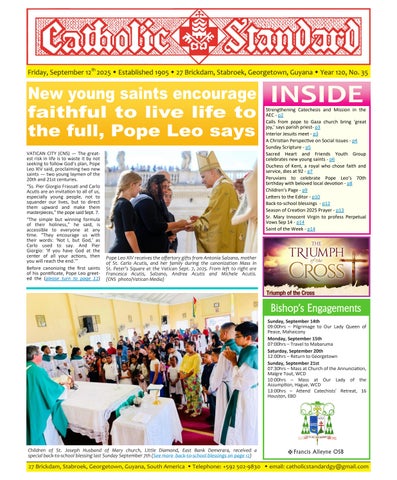
VATICAN CITY (CNS) The greatest risk in life is to waste it by not seeking to follow God’s plan, Pope Leo XIV said, proclaiming two new saints two young laymen of the 20th and 21st centuries.
“Ss. Pier Giorgio Frassati and Carlo Acutis are an invitation to all of us, especially young people, not to squander our lives, but to direct them upward and make them masterpieces,” thepopesaidSept.7
“The simple but winning formula of their holiness,” he said, is accessible to everyone at any time. “They encourage us with their words: ‘Not I, but God,’ as Carlo used to say. And Pier Giorgio: ‘If you have God at the center of all your actions, then you will reach the end.'”
Before canonizing the first saints of his pontificate, Pope Leo greet-
Sacred Heart and Friends Youth Group celebrates new young saints - p6
Duchess of Kent, a royal who chose faith and service, dies at 92 - p7
Peruvians to celebrate Pope Leo’s 70th birthday with beloved local devotion - p8
Children’s Page - p9
Letters to the Editor - p10
Back-to-school blessings - p12
Season of Creation 2025 Prayer - p13
Sr. Mary Innocent Virgin to profess Perpetual Vows Sep 14 - p14
Saint of the Week - p14
Bishop’s Engagements
Sunday, September 14th
09:00hrs – Pilgrimage to Our Lady Queen of Peace,Mahaicony
Pope Leo XIV receives the offertory gifts from Antonia Salzano, mother of St. Carlo Acutis, and her family during the canonization Mass in St. Peter’s Square at the Vatican Sept. 7, 2025. From left to right are Francesca Acutis, Salzano, Andrea Acutis and Michele Acutis. Children of St. Joseph Husband of Mary church, Little Diamond, East Bank Demerara,
The Jubilee Prayer
Strengthening
The Pontifical Mission Societies (PMS) have identified four points of action for the Church in the Caribbean, highlighting the importance of catechetical programs. Through catechesis, young people and adults are introduced to the Catholic faith and formed as disciples. The 2020 Directory for Catechesis reminds us that, in today’s secular world, catechesis must be kerygmatic, evangelizing, and centered on a livingencounterwithChrist.
Father in heaven, may the faith you have given us in your son, Jesus Christ, our brother, and the flame of charity enkindled in our hearts by the Holy Spirit, reawaken in us the blessed hope for the coming of your Kingdom.
May your grace transform us into tireless cultivators of the seeds of the Gospel. May those seeds transform from within both humanity and the whole cosmos in the sure expectation of a new heaven and a new earth, when, with the powers of Evil vanquished, your glory will shine eternally.
May the grace of the Jubilee reawaken in us, Pilgrims of Hope, a yearning for the treasures of heaven. May that same grace spread the joy and peace of our Redeemer throughout the earth.
To you our God, eternally blessed, be glory and praise for ever.
Amen
To strengthen formation, the PMS team under Archbishop Charles Jason Gordon has prepared three online teachings for catechists on Thursdays September 11, 18, and 25 at 7:00 p.m. Eastern Caribbean Time (8:00 p.m. French Guiana & Suriname; 6:00 p.m. Jamaica; 5:00 p.m. Belize). Speakers include Bishop John Persaud, Mr. George Alayon, and Mrs. Bernadette Gopaul. Catechetical teams are encouraged toparticipate fully.
From September 28–30, PMS Directors will gather in Suriname for a Formation Meeting. This session will focus on magisterial documents and the Synod on Synodality, with a strong emphasis on mission and evangelization. The group will also plan strategies for promoting Missionary Childhood, nurturing in children and youth a personal relationship with Christ andamissionary spirit.
Looking ahead, Mission Month 2025 will be celebrated under the theme: “Missionaries of hope amongthenations.” Each diocese is invited to prepare a message encouraging clergy, religious, and faithful to embrace this theme and to contribute generously to the Mission Sunday Collection, which showed an increase last year. Four online study sessions, open to all, will be held on ThursdaysOctober9,16,23 &30.
Finally, in July, clergy from Mandeville and Montego Bay participated in a Workshop on Evangelization and Missionary Parishes, led by PMS. Similar workshops can be offered in other AECdioceses nextyear. Together, these initiatives reflect our shared call to live as true missionaries of hope in the Caribbean. ❖
bring ‘great joy,’ says parish priest
VATICAN CITY (CNS) Getting phone calls from the pope continues to bring “great joy” to the hundreds of people receiving shelter and support from the only Latin-rite Catholic church in Gaza, the parish priest said.
About 450 people forced to flee their homes, mostly the elderly, the sick and children, are housed in the Holy Family Church compound, Argentine Father Gabriel Romanelli told Vatican Media Sept. 10 in a video message.
Pope Francis, a fellow Argentine, called the parish priest almost every day for more than a year and a half since the start of the war in Gaza in October 2023 and including just two days before his death in April.
Father Romanelli told Vatican Media that Pope Leo XIV also has called them, but he did not specify how often.
After Israel launched an attack on Hamas leaders in Qatar Sept. 9, Pope Leo told reporters gathered outside the Villa Barberini in Castel Gandolfo that he had just tried to phone the parish in Gaza City.
“I just tried to call the pastor, but I have no news,” the pope had said, expressing concern about a new evacuation order from Israel; Israeli planes had dropped leaflets on Gaza City in the morning, warning of a new attack on the city and encouraging civilians to evacuate.
Father Romanelli then shared a video with Vatican Media Sept. 10 saying he and other residents had been able to speak to the pope after his attempt to call. “We told him that we are fine, that the situation continues to be difficult.”
“Most of the population does not want to leave,” he said, underlining that “we continue to be near them.”
“We are fine, despite the terrible situation throughout the Gaza Strip,” he told Vatican Media in his video.
Interior Jesuits meet
On Thursday 4th and Friday 5th September, the Jesuits serving in the Interior met to reflect on their mission and plan common pastoral initiatives.
On Thursday, they were visited by Bishop Evaristo Pascoal Spengler O.F.M, bishop of neighbouring Roraima in Brazil, along with his pastoral team. The Guyana Jesuits joyfully shared on their work in the Interior, and discussed with Bishop Spengler and his team possible areas of cross-border pastoral collaboration such as migrant ministry. ❖
(Adapted from the Jesuits in GuyanaJamaica Facebook page)
A screen grab shows Argentine Father Gabriel Romanelli’s profile picture on his @gabrielromanellisivori account on the social media platform Instagram Sept. 11, 2025. (CNS photo/screengrab, Instagram)
In a video shared on his Instagram channel Sept. 10, Father Romanelli said it was not the first time Pope Leo called.
“He is always closely following the situation and is very committed to ending this war, to working and praying for peace,” the priest said in Spanish. The pope “sends his blessings to everyone, to the entire Gaza Strip, to the entire parish community.”
“It is a great joy to be in communication with the Holy Father, with Pope Leo,” he said.
The priest explained he was unable to answer the phone when the pope called because they were in the middle of a long, beautiful liturgical celebration. He told Vatican Media they were celebrating Mass and the sacrament of matrimony for a Catholic couple, “so a great joy.”
Other joyful news, “in the midst of so much sorrow,” he said, was the birth of a baby boy named Marcos. The mother is one of the many internally displaced people they are sheltering.
Priests at both the compounds of the Holy Family Church and the Greek Orthodox St. Porphyrius Church have refused to evacuate since they were providing refuge for hundreds of civilians who have nowhere else to go.
Both church compounds have been damaged by Israeli forces St. Porphyrius in October 2023, and Holy Family in December 2023 and in July of this year. Israel’s military said the strikes were unintentional.
Father Romanelli referred to the aftermath of those attacks in his video to Vatican Media, saying, “We continue to stay here in the parish with the people we care for,” which includes families and “a considerable number” of those who are elderly, sick and children.
“In other parts of Gaza City, there are people who are moving south,” he said, emphasizing that “most of the population does not want to leave.”
“Many say the same thing we have heard since the beginning of the war: Everywhere there is danger, there are bombardments, real danger, there is death, bombings, injuries, destruction,” he said. However, since many want to continue living in the city, he said, “we continue with our daily activities, which is what we can do. We have been able to help many families.”❖
A Christian Perspective on Social Fresh start
By GHK Lall
Time to move on. Time for each one to do his or her part to build a different Guyana. Different in that it is better, not worse. How one may have voted, that aspect of life is now over. Once the government does what is right by every citizen, regardless of their political persuasion, their deeply held political positions, then that’s what is new and bright, and has potential for more of the same. In another verbal construction, equitable treatment for every citizen, regardless of who they are, how they look, where they stand. At the end of the day, the defining mark of Guyanese is that they are citizens first, and with all attached rights. Everything else pales into secondary significance, fades into lesser priorities. Equitable treatment in a land of plenty is the recipe for a better Guyana.
The government knows it. Christians know it. The first duty was to vote, have a say in the system of governance that is desired. The next duty is to be vigilant, so as to ensure that the system of governance possesses a certain quality that would be lauded
anywhere in the world. Guyana has not done too handsomely in the department of equitable treatment. First, it was that the pie was too small, so there were not enough slices to go around. Many got left out; more ignored, dismissed. Nowadays, the pie is too big, and the slices too many. But human priorities intervene and rearrange what has all the potential to be a just order. Too few Guyanese get too many slices of the local economic pie. That has to change (the part about the many slices). Too many citizens get too small a slice, or no slice at all, and that also must change in the shortest time and at the swiftest rate.
No question that there are sharp political differences in this country.
Some of this has seeped into the sacred sanctuary of Jesus, and not for the better. It is what divides. Sharp political differences don’t mean, shouldn’t condemn, another to the ranks of a sworn enemy. But those differences have, haven’t they? The question for each Catholic is what can I do to build instead of breakdown? How can I overcome my disappointments and be a contributor for the common good? The wider mass, the bigger picture, the greater good. Guyana hasn’t done particularly well with these challenges before. The option of failure is now removed from the table. National leaders have a duty, a mandate, to see to that state, and that it goes. For what would all this God-given wealth be, if all there is in the home, in the street, in the heart is rancor and strife?
Jesus taught the revolutionary. Forgive, forget, start over, move on.
Be a Christian in the truest, most expansive sense of the word, of the calling. Can I? I am trying. Can you? Do you want to try? If the knots of elections bind into unraveling, then Jesus is failed. Let now familiar saying, thinking, seeking: what would Jesus do if he were here today? Today, as in right now, post elections 2025? How would he be, and what would he say? I am confident that his words would be infinitely more profound than anything that I am capable of presenting. But, then again, his words may not be that far from the visions, the appeals, expressed here.
It is a weighty responsibility to be a believer, a worshipper at this time. The call of mammon, the love of that master, intercedes. There is that to overcome, and then there is all that work left to do. Hard work. Thankless work. Work that brings revilement and calumnies. But that work of the Lord must still go on. Who is willing? To be a peacemaker? To be a groundbreaker? To be a difference The least I can do is give it my best effort. And why should any determined and genuine Roman Catholic be lesser committed to those ideals of Jesus?
Gracious and loving God, we thank your for the gift of our priests.
Guyana needs this now. If Guyana is ever going to make a start at being different, I must (and you must) carry a full load, and do a complete part. My intuition is to fade away from these spaces. Not leave altogether, bit lowdown and pick spots to deliver a message. Such a luxury, I have found, is not mine. Therefore, there is tarrying on. God is in charge. God will provide and guide. Peace to all.❖
Baptism at Shulinab
Through them, we experience your presence inthe sacraments.
Help our priests to be strong in their vocation.
Set their souls on fire with love for your people.
Grant them the wisdom, understanding, and strength they need tofollow inthe footsteps ofJesus. Inspire them with the vision of your Kingdom.
Give them the words they need to spreadthe Gospel.
Allow them to experience joy in their ministry.
Help them to become instruments ofyour divine grace.
We ask this through Jesus Christ, who lives and reigns as our EternalPriest.
Sacrament of Baptism last Sunday September 7th at St. Stanislaus church, Shulinab, South Central Rupununi, Region 9, Essequibo, Guyana. (Catholic Media Guyana Facebook Page)
FIRST READING: Numbers 21:4-9
If anyone is bitten by a serpent, he looked at the bronze serpent and lived
On the way through the wilderness the people lost patience. They spoke against God and against Moses, ‘Why did you bring us out of Egypt to die in this wilderness? For there is neither bread nor water here; we are sick of this unsatisfying food.’
At this God sent fiery serpents among the people; their bite brought death to many in Israel. The people came and said to Moses, ‘We have sinned by speaking against Yahweh and against you. Intercede for us with Yahweh to save us from these serpents.’ Moses interceded for the people, and Yahweh answered him, ‘Make a fiery serpent and put it on a standard. If anyone is bitten and looks at it, he shall live.’ So Moses fashioned a bronze serpent which he put on a standard, and if anyone was bitten by a serpent, he looked at the bronze serpent and lived.
Responsorial Psalm: Psalm 77
Resp: Never forget the deeds of the Lord.
1 Give heed, my people, to my teaching; turn your ear to the words of my mouth. I will open my mouth in a parable and reveal hidden lessons of the past. Response
2 When he slew them then they would seek him, return and seek him in earnest. They would remember that God was their rock, God the Most High their redeemer. Response
3 But the words they spoke were mere flattery; they lied to him with their lips. For their hearts were not truly with him; they were not faithful to his covenant. Response
4 Yet he who is full of compassion forgave their sin and spared them. So often he held back his anger when he might have stirred up his rage. Response
SECOND READING: Philippians 2: 6-11
He humbled himself therefore God raised him high.
The state of Jesus Christ was divine, yet he did not cling to his equality with God but emptied himself to assume the condition of a slave, and became as men are; and being as all men are, he was humbler yet, even to accepting death, death on a cross.
But God raised him high and gave him the name which is above all other names so that all beings in the heavens, on earth and in the underworld, should bend the knee at the name of Jesus and that every tongue should acclaim Jesus Christ as Lord, to the glory of God the Father.
On this Feast of the Exaltation of the Holy Cross, we celebrate the Holy Cross as the instrument of our salvation. Multiple times in scripture a reference is made to Jesus having been “hung on a tree.” This reference
to the Cross as a tree has a much deeper meaning for us. The Cross became a life-giving tree for us, and it turned around Adam’s original sin when he ate of the tree of knowledge in the Garden of Eden. The Cross is so central to our beliefs.
One of the aspects of our stewardship should be a desire to understand and appreciate the significance of many of the celebrations, feasts, and solemnities we as Catholics observe and experience. Today’s Feast of the
GOSPEL: John 3:13-17
The Son of Man must be lifted up.
Jesus said to Nicodemus: No one has gone up to heaven excepttheonewhocamedownfromheaven, the Son of Man who is in heaven; and the Son of Man must be lifted up asMoseslifteduptheserpentinthedesert, so that everyone who believes may have eternal life in him.
Yes, God loved the world so much that he gave his only Son, so that everyone who believes in him may not be lost but may have eternal life.
For God sent his Son into the world not to condemn the world, but so that through him the world might be saved.❖
Exaltation of the Holy Cross celebrates three historical events: the finding of the True Cross by St. Helena; the construction and dedication of churches by Helena’s son the Emperor Constantine on the site of Mt. Calvary where Christ was crucified; and, the return of the Cross to Jerusalem by the Emperor Heraclius II. As Catholics, we need to remember the Cross every time we make the Sign of the Cross. We make that sign often and almost always at the beginning and the end of our prayers. However, that sign in
itself is a prayer. Sometimes we do it automatically without really considering its meaning and importance. Rather than a hurried sign, we should make the Sign of the Cross with reverence, respect, and the constant reflection of how vital the Cross is to our salvation. Stewardship invites us to practice our faith with this deference and appreciation to the Lord, truly in the Name of the Father, the Son, and the Holy Spirit. ❖
[www.catholicsteward.com/blog/ ]
Group celebrates new young saints
By Sasha Woodroffe-Hanoman
On Sunday September 7, the Church canonized two young men, Carlo Acutis (aged 15) and Pier Giorgio Frassati (aged 24), officially declaring them saints! To celebrate, the Sacred Heart and Friends Youth Group gathered on the afternoon of Saturday September 6.
We watched short videos on their inspirational lives and reflected on their virtues. In honour of their strong Eucharistic devotion, we spent time in adoration of the Blessed Sacrament. We prayed the Holy Rosary, sang worship songs, and several people received the Sacrament of Reconciliation. The event concluded with Mass celebrated by Fr. Santiago – followed by pizza, customized cupcakes, video games in honour of St. Carlo, and fellowship.
Saints Carlo Acutis and Pier Giorgio Frassati reminded us that holiness is possible even at a young age. They showed us that dedicating our youthfulness to Christ leads to freedom, joy and fullness of life! May their examples inspire us to follow Jesus wholeheartedly in every age and situation. Saints Carlo Acutis and Pier Giorgio Frassati, pray for us!❖
The Sacred Heart and Friends Youth Group consists of young people aged 13-35 from several different parishes / communities across the country. They meet online on Saturdays from 3-4pm for sessions on the faith and have regular in-person activities such as retreats, movie and games days, and visits to youth of other parishes. All young persons are welcome to join. For more information, follow them on: Facebook – Sacred Heart and Friends Youth Group - Guyana Instagram – sacredheartyouthgroupgy
chose faith and service, dies at 92
The Duchess of Kent attends the 1995 Childline awards. Remembered for her passion for charity, teaching music and unwavering humility, Katharine, the Duchess of Kent a senior Catholic member of the British royal family died Sept. 4, 2025, at age 92. (OSV News photo/Reuters) On Guyana’s Independence Day, Thursday, May 26th 1966, Prime Minister Forbes Burnham is seen receiving from the Duke of Kent the constitutional instruments designating Guyana an independent nation. The event took place in the Parliament Chambers. The Duchess ofKent can be seen second from right.
(OSV News) Remembered for her passion for charity, teaching music and unwavering humility, the Duchess of Kent a senior Catholic member of the British royal family died Sept. 4 atage92.
Cardinal Vincent Nichols of Westminster said in a Sept. 5 statement that he recalled “with fondness” the memory of the duchess, born Katharine Lucy Mary Worsley, who became a Catholic in1994.
“Ihavereceived withsadness thenews today of the death of Her Royal Highness, Katharine, the Duchess of Kent,” said Cardinal Nichols, president of the bishops’ conference of England and Wales.
“I recall with fondness her presence in our community, especially her participation in the pilgrimage to Lourdes, as well as her lifetime of public service,” saidCardinal Nichols.
“I have written to His Royal Highness the Duke of Kent and assured him of the prayers of the Catholic community in England and Wales,” the cardinal continued.
“We pray that God will receive her soul into heaven, the promise given to us by Our Lord, Jesus Christ. May Katharine now rest in peace and rise in glory.”
The duchess was received into the faith by Cardinal Basil Hume in 1994 in a private ceremony at Westminster Cathedral, discussing the possibility of becoming a Catholic as early as the 1980s. She was the first British royal to jointheCatholic faithsince1685.
“Her decision was supported by her husband’s cousin, Queen Elizabeth who decided that Prince Edward’s position in the line of succession would remain unaltered,” the BBCsaid.
An active and committed Catholic She was thereafter an active and committed Catholic, often serving as a helper to sick and elderly people on pilgrimages to the Marian shrine of Lourdes,France,for instance.
She not only became a patron of the Samaritans a charity aimed at providing emotional support to anyone in emotional distress, struggling to cope or at risk of suicide throughout the United Kingdom and Ireland but also underwent a 10-week training course so she could work four-hour shifts counseling people on the brink ofsuicide.
She also supported The Passage, a Catholic Church-run charity for people whoarehomeless.
The duchess seldom used her title of Royal Highness and increasingly preferred obscurity to royal duties. Eventually she disappeared from public life, choosing instead to teach at a primary school in Hull, in the north of England, from 1996to 2004.
‘Driven by love for music and children’
“She made weekly 400-mile round trips to teach, driven by love for music and children,” her own charity, Future Talent, said inherobituary.
“Deliberately understated, she was known simply as ‘Mrs. Kent,’ and her pupils and their parents were unaware of whoshetruly was,” the charitysaid.
The death of the duchess was announced “with deep sorrow” by Buckingham Palace in a Sept. 5 statement tothe media.
The statement said that the duchess “passed away peacefully” at Kensington Palace, her London residence, “surroundedbyher family.”
Duchess’s ‘life-long devotion’ to causes
It said that King Charles III and Queen Camilla and “all Members of the Royal Family join the Duke of Kent, his children and grandchildren in mourning their loss and remembering fondly the duchess’s life-long devotion to all the organizations with which she was associated, her passion for music and herempathyforyoungpeople.”
On Sept. 6, Buckingham Palace said that the duchess will be buried in Windsor following a Sept. 16 requiem Mass at Westminster Cathedral in London.
The statement said that initially the Duchess’s coffin “will rest in the private chapel at Kensington Palace” before it will be taken by hearse to the cathedral on Sept. 15, where “the Rite of Reception and Vespers will take place.”
The coffin will rest overnight in the Lady Chapel and the king and queen and other members of the Royal Family will join mourners for the funeralthefollowingday.
Cardinal Nichols to preside at funeral
According to reports in the British media, Cardinal Nichols will preside at the funeral, and the Anglican dean of Windsor willalsoparticipate.
The duchess came from a wealthy, but not aristocratic family and became the first nontitled person to marry a member of the British royal family since the Tudor period when she wed Edward, the Duke of Kent and a cousin of QueenElizabethII, in1961.
Their first son, George, was born in 1962, followed by Helen in 1964 and Nicholas in1970.
In 1975, she contracted measles during the pregnancy and aborted a fourth child on medical advice and upon consulting Anglican religious authorities.
Adeepimpactonherlife
The experience had a deep impact on her life and in 1977 she was unable to deliver a speech to the British Congress of Obstetrics in 1977 and instead it was read on her behalf, the Telegraph said in its massive obituary onthedutchess.
In her speech, she expressed the view that human life was a gift from God, and she praised the pro-life movement.
Two years later, she lost her fifth child, baby Patrick, when he was stillborn. “It had the most devastating effect on me,” she later said,BBCreported.
“I suffered from acute depression for a while. I think it would be a fairly rare individual who didn’t cave in under those circumstances,” she said.
For decades seen as beacon of empathy
For decades, the duchess was however seen as a real beacon of empathy and associated with the annual international tennis championship at Wimbledon, London, presenting the Ladies’ Singles Trophy from 1976 to 2001 on allbutthreeoccasions.
One instance became iconic when in 1993, the Duchess of Kent comforted a devastated Jana Novotna, a Czech tennis player, who lost the final to SteffiGraf, simplyhugging her.
She is survived by her husband and three children the youngest of whom, Nicholas, followed her into the Catholic faithin 2001.❖
birthday with beloved local devotion
(CRUX) – A group of Peruvian expats in Italy will celebrate Pope Leo XIV’s 70th birthday this weekend in true local fashion, bringing a beloved popular devotion in Chiclayo to the pope’s front door.
Every year during his time as bishop of Chiclayo from 2015-2023, then-Bishop Robert Prevost would visit the shrine of Jesús Nazareno Cautivo, or “Jesus Nazarine, Captive” in the small northern town of Monsefú, in the Diocese of Chiclayo, to celebrate its feast with locals.
The statue, depicting a bloodied and imprisoned Jesus dressed in an elegant robe but bound with chains and wearing a crown of thorns, is a beloved popular devotion for locals, and its Sept. 14 feast day coincides with the birthday of Prevost, now Pope Leo XIV.
Carlos Llontop Puicón, a Peruvian from the small town of Monsefú, in Chiclayo, told Crux that this year, since the pope cannot go to the shrine to celebrate jointly his birthday and the feast of “el Cautivo,” they will bring the devotion to him.
This Sunday, Sept. 14, Puicón said, some 2-300 Peruvians, including a group of around 15-20 from Monsefú, will make “a small pilgrimage walk” from the Piazza Pia, at the beginning of the Via Conciliazione leading up to St. Peter’s Basilica, into the square ahead of the pope’s Sunday Angelus address.
“Since our image is small, the Captive Lord is carried in our arms,” rather than placed on a large platform and carried on shoulders, he said, saying the small image “will be passed around among the faithful who are going to make the pilgrimage.”
Once they arrive in the square, Puicón said the group will unveil a large, handmade banner that says, “Happy birthday, Pope Leo, Monsefú, Chiclayo
banner, made by hand by artisans in Peru.”
“It will then return to northern Peru and be part of the museum of Jesús Nazareno Cautivo,” he said.
Puicón said his former bishop is especially beloved for locals due to his closeness during the COVID-19 pandemic in 2020, during which his own mother passed away.
Then-Bishop Prevost at one point held a large outdoor Eucharistic procession through the empty streets, which was followed by many via livestream, and which served as a source of inspiration for locals, Puicón said, saying it was, “the act of going out, of feeling like you’re not alone in that moment.”
“It’s the same as what happened with Pope Francis when he went out to give the Urbi et Orbi” in an empty and rainy St. Peter’s Square, he said.
honest,” that the next pope would be Italian, he said, saying he personally knows Cardinal Matteo Zuppi and thought it could be him or Italian Cardinal Pietro Parolin.
However, when the moment came, “with the commotion of the people, the audio wasn’t very clear, but when he came out, and even more so when he mentioned Chiclayo,” there was a wave of emotion, he said, “because mentioning Chiclayo, it’s a small part of the world, mentioning it was a kind of gratitude.”
“Remembering the city where he was, where he had been so welcomed, where he defended Catholic fervor so much that it created so much faith, unity, it’s impressive. It’s one thing to hear him say it there, but to hear him say it right here, right now, for me it was completely moving,” he said.
awaits you!” in anticipation of a papal visit, which Puicón said he expects will happen soon.
Participants will dress in traditional clothing in northern Peru, and the pilgrimage up to St. Peter’s Square will also be displayed live on maxi-screens in Monsefú, so locals can follow along and celebrate with their former pastor, and now pope.
Puicón said he himself was present on several occasions when then-Bishop Prevost celebrated Mass at the Monsefú shrine and led the annual Sept. 14 pilgrimage.
Despite now living abroad, Puicón maintains close ties to his Peruvian roots, and belongs to a small association, Jesús Nazareno Cautivo, a confraternity of Peruvian Catholics in Italy. He is also part of another association dedicated to the popular Peruvian devotion, Our Lord of the Miracles, which is celebrated annually in Rome with a small pilgrimage to St. Peter’s Square for the feast day in October – a feast which Puicón believes will be extra special this year, given the fact that there is now a “Peruvian pope” in the Vatican.
Normally the image of Jesús Nazareno Cautivo sits in Holy Redeemer parish out the outskirts of Rome, but it will be brought to the heart of the city Sunday for the pope’s birthday festivities.
Puicón said they are expecting a special greeting from the pope after his Angelus address Sunday, and they have also requested a special private audience with the pope either Sept. 15 or 16, depending on his availability, to offer a personal greeting.
Only around five or six people will be in the private audience, he said, saying the idea is “apart from congratulating him for his pontificate and his birthday, it is to have him sign this big
Puicón said he was in the square when Pope Leo’s election was announced, calling it “a very emotional moment,” especially for the Peruvians who were there.
“Many people were expecting, and honestly I expected it too, to be
As the pope’s birthday approaches, Puicón said that family matters will take him back to Peru, but he hopes that the Peruvians in Rome are excited about this Sunday’s celebration, and “we hope that he’s happy, too, on a very special day. 70 years is an important date.”❖
Bishop Robert Prevost, now Pope Leo XIV, celebrates Mass at the Shrine of Jesus Nazareno Cautivo in Monsefu, Chiclayo. (Credit: Courtesy of Harry Gordillo)
Dear Girls and Boys,
Today we celebrate the feast of the Exaltation, or Triumph, of the Holy Cross on which Our Lord died.
The cross was an instrument of torture used to punish criminals and to show other people what would happen to them too, if they broke the Roman laws. Our Lord used the cross for a different reason though. He offered His sufferings on the cross to repay for the sins of everyone else in the world. He died in a place where many people could see Him so that they could see and know how much He loves us.
In the 300's AD, St. Helena, who was a Christian queen, went to Jerusalem to find the cross of Jesus. She found three crosses there so she decided to test to see which was Christ's. A very sick woman touched each cross.
When she touched the third one she was healed instantly!
They had found the cross of Christ!
We celebrate this feast on September 14. On this day in the year 335, the Church in Jerusalem dedicated a new church built on the site where Jesus died and rose from the dead. The church was built to honour both His crucifixion and His resurrection. Every year since then, the Church remembers this day and the power of the Cross.
The Feast of the Triumph of the Holy Cross is a time to reflect on what the Cross means to us. It is more than a symbol. It is a reminder of God’s love and mercy. By celebrating this feast, we honour the victory Jesus won for us through His death and resurrection. ❖
DearEditor,
International election observer missions have commended Guyanese citizens and the Guyana Elections Commission (GECOM) for conducting the 2025 elections free from violence, fear, and intimidation. However, none of the five Observer Missions the European Union (EU), the Organization of American States (OAS), the Commonwealth, CARICOM, and the Carter Center concluded that the elections met the standardsofbeing ‘free’ and ‘fair’.
All observer missions highlighted the ruling Peoples Progressive Party’s (PPP) abuse of incumbency, citing the use of state media, state-owned property, government vehicles, and personnel to advance the party’s campaign. Despite these advantages, the PPP fell short of securing a twothirds parliamentary majority, with lower-than-expected voter turnout in itstraditionalstrongholds.
Meanwhile, the Peoples National Congress (PNC), the PPP’s main rival for over sixty years, experienced significant losses in its strongholds in Regions 4 and 10, as the newlyformed We Invest in Nationhood (WIN) party made unexpected
2025 Elections in Guyana: Peaceful,
inroads. WIN, established some three months before the elections, successfully leveraged community-based electoral campaigns to counter sustained PPP efforts to pressure and penalizeitsmembership.
Transitioning from an electoral strategy to a Parliamentary party will present a challenge for WIN. Few of its members are household names, and even fewer have prior legislative experience. Nevertheless, the party enters Parliament with broad support from economically marginalized communities.
Early indications suggest the PPP may attempt to put WIN on the defensive, focusing on allegations against WIN leader Azrrudin Mohammed, whohasbeensanctionedbytheUnited States for alleged involvement in gold smuggling. These sanctions also implicated Mohammed’s father and Mae Thomas, a Public servant, for allegedly misusing official positions to benefittheMohammeds.
Ex-President Bharrat Jagdeo’s disappointment over the PNC’s decline as the main opposition party was evident. Beyond policy positions, WIN’s rise may help reduce decades-long ethnic polarization between Afroand Indo-Guyanese communities, an
unexpected but welcome development.
While Election Day passed without major incidents, concerns about GECOM’s structural and professional capacity were reinforced. The Commission’s dependence on nominations from the two major parties limits its independence, making it unable to make decisions that could threaten the interests of those parties. The GHRA and other civic bodies have constantly called for implementation of electoral reforms agreed unanimously in the constitutional reform process of year 2000. While agreed to by both major parties, no major changes have been implemented. Even declaring the 10 Regions as constituencies, a supposedly one-off transitory arrangement for the 2001 Elections hasnever been convertedintosingleseats.
Without sustained advocacy, these and other reforms, elections in Guyana will remain vulnerable to the abuse of State resources and the influenceofmoney.
September 9,2025
Executive Committee
Guyana Human Rights Association (GHRA)
Season of Creation, an ecumenical initiative promoting integral ecology
Recognizing the importance of authentic human ecology, the Season of Creation is an opportunity to join the many efforts of Christians and of people of good will around the world who are working for ecological conversion.
The Season of Creation is an ecumenical initiative celebrated every year from September 1 to October 4 (Feast of St. Francis of Assisi) and promoted and supported by various organizations, including the Laudato Si’ Movement, the World Council of Churches, the Lutheran World Federation, and the Anglican Communion.
The theme of the Season of Creation 2025 is “Peace with Creation” and, as every year, the Laudato Si’ Movement has prepared a Celebration Guide
History of the Season of Creation
In 1989, Ecumenical Patriarch Dimitrios I proclaimed September 1 as the Day of Prayer for Creation for Orthodox Christians.
Subsequently, the World Council of Churches (WCC) extended the celebration until October 4, the feast day of St. Francis of Assisi.
In recent years, the Catholic Church has encouraged all people to embrace ecological conversion and to participate in the initiatives of this ecumenical season. ❖
[The Dicastery for Promoting Integral Human Development]
Sixteen couples from St John Francis Regis Church, Sand Creek , South Rupununi, Region 9, Essequibo, Guyana
live life to the full, Pope Leo says (From Page 1)
more than 80,000 faithful who had gathered early in St. Peter’s Square because he wanted to share his joy with them before the start of the solemn ceremony.
“Brothers and sisters, today is a wonderful celebration for all of Italy, for the whole church, for the whole world,” he said before the Mass.
“While the celebration is very solemn, it is also a day of great joy, and I wanted to greet especially the many young people who have come for this holy Mass,” he said, also greeting the families of the soon-to-be saints and the associations and communities to which the young men had belonged.
Pope Leo asked that everyone “feel in our hearts the same thing that Pier Giorgio and Carlo experienced: this love for Jesus Christ, especially in the Eucharist, but also in the poor, in our brothers and sisters.”
“All of you, all of us, are also called to be saints,” he said, before leaving to prepare for Mass and paying homage to a statue of Mary with baby Jesus and the reliquaries containing the relics of the two young men.
In his homily, the pope underlined Jesus’ call in the day’s Gospel reading “to abandon ourselves without hesitation to the adventure that he offers us, with the intelligence and strength that comes from his Spirit, that we can receive to the extent that we empty ourselves of the things and ideas to which we are attached, in order to listen to his word.”
That is what the two new saints did and what every disciple of Christ is called to do, he said.
Many people, especially when they are young, he said, face a kind of “crossroads” in life when they reflect on what to do with their life.
The saints of the church are often portrayed as “great figures, forgetting that for them it all began when, while still young, they said ‘yes’ to God and gave themselves to him completely, keeping nothing for themselves,” the pope said.
“Today we look to St. Pier Giorgio Frassati and St. Carlo Acutis: a young man from the early 20th century and a teenager from our own day, both in love with Jesus and ready to give everything for him,” he said.
Pope Leo then dedicated a large portion of his homily to sharing quotes from the two and details of their lives, which is something Pope Francis had shifted away from, preferring to focus more on the day’s readings.
“Pier Giorgio’s life is a beacon for lay spirituality,” Pope Leo said.
“For him, faith was not a private devotion, but it was driven by the power of the Gospel and his membership in ecclesial associations,” he said. “He was also generously committed to society, contributed to political life and devoted himself ardently to the service of the poor.”
“Carlo, for his part, encountered Jesus in his family, thanks to his parents, Andrea and Antonia who are here today with his two siblings, Francesca and Michele,” he said, as the crowd applauded, and Antonia smiled shyly at the camera.
St. Acutis also encountered Jesus at the Jesuit-run school he attended and “above all in the sacraments celebrated in the parish community,” he said. “He grew up naturally integrating prayer, sport, study and charity into his days as a child and young man.”
The pope said the new saints “cultivated their love for God and for their brothers and sisters through simple acts, available to everyone: daily Mass, prayer and especially Eucharistic adoration.”
St. Frassati was born April 6, 1901, in Turin and died there July 4, 1925, of polio at the age of 24. St. Acutis was born to Italian parents May 3, 1991, in London and died in Monza, Italy, Oct. 12, 2006, of leukemia at the age of 15.
The pope said that “even when illness struck them and cut short their young lives, not even this stopped them nor prevented them from loving, offering themselves to God, blessing him and praying to him for themselves and for everyone.”
Several family members and people closely associated with the new saints attended the Mass, along with dignitaries, such as Italian President Sergio Mattarella.
St. Acutis’ parents, Andrea and Antonia, and his twin siblings, Michele and Francesca, who were born four years after their brother died, were present and together brought the pope the
offertory gifts. Michele also did the first reading at the Mass in English.
Valeria Valverde, who read the first prayer of the faithful, is a young Costa Rican woman who suffered a severe head injury while living in Italy. It was her unexplained healing that provided the second miracle needed for St. Acutis’ canonization.
St. Frassati was active with Catholic Action, the St. Vincent de Paul Society, the Italian Catholic University Federation and the Dominican Third Order. Lorenzo Zardi, vice president of the youth group of Italy’s Catholic Action read the second reading at the Mass and Michele Tridente, the secretary general of the lay movement, also presented the pope with offertory gifts.
Before praying the Angelus, the pope once again thanked everyone for
coming to celebrate the church’s two new saints.
However, he also called for people’s “incessant prayer for peace, especially in the Holy Land, and in Ukraine and in every other land bloodied by war.”
“To governing leaders, I repeat, listen to the voice of conscience,” he said.
“The apparent victories won with weapons, sowing death and destruction, are really defeats and will never bring peace and security,” he said.
“God does not want war. God wants peace!” he exclaimed to applause. God gives strength to those who work toward leaving behind the cycle of hatred and pursue the path of dialogue.❖
More than 80,000 people gather in St. Peter’s Square at the Vatican for the canonization Mass of Sts. Pier Giorgio Frassati and Carlo Acutis celebrated by Pope Leo XIV Sept. 7, 2025. (CNS photo/Lola Gomez)
Fatima
Cathedral
Hispanic Community
Karasabai
Malgre Tout
profess Perpetual Vows Sep 14
On Sunday September 14, at Santa Rosa Parish, Moruca, Region One, Essequibi, Guyana, Diana Rose Vieira, now Sr. Mary Innocent Virgin will profess her perpetual vows. Perpetual vows are the final, lifelong promises a sister makes to God and her religious community, committing herself forever to live in poverty, chastity, obedience and Consecration to Mary. By professing these vows, she becomes a spouse of Christ and dedicates her entire life to His service and to the mission of the Church.
It is especially meaningful that the ceremony will take place in her home parish, where she grew up and where she first felt the call to religious life at the age of six. She recalls watching a movie about Mother Teresa the first time she had ever seen a sister and thinking to herself, “One day I want to be like her.”
In 2012, she encountered the Servants of the Lord and the Virgin of Matará (SSVM Sisters) for the first time, when they visited Santa Rosa for a Popular Mission. Sr. Innocent Virgin participated in that mission and, over the years, continued to spend time with the sisters during the annual Summer Girl’s Camp. At the age of fifteen she expressed her desire to enter religious life but was asked to wait until she was older.
After completing secondary school, she entered the SSVM convent at Charity in 2017. Although she thought her family might be disappointed, expecting her to continue her studies, they were very supportive. Her father encouraged her with the words, “You have chosen the best.”
Sr. Innocent Virgin is now serving as a missionary in the Philippines, where she works in a home with
38 girls from difficult family situations. She has returned to Guyana to profess her vows and to become a spouse of Christ forever.
The faithful are asked to keep her in their prayers, and to continue praying that many young people may remain open to God’s call in their own lives.
Her advice to young people discerning a vocation:
"Seek to hear Jesus, to open your heart to Jesus, because it is He who calls you every day and asks of you the same question He asked me: 'Do you love me?' We can be sure that we are responding with love to His daily question if we accept the call for our lives that He helps us to see. We can be sure that we love Him if we respond to whatever He is asking of us."❖
Saint of the Week
St Robert Bellarmine
Patron Saint of Catechists & Catechumens
When Saint Robert Bellarmine was ordained in 1570, the study of Church history and the fathers of the Church was in a sad state of neglect. A promising scholar from his youth in Tuscany, he devoted his energy to these two subjects, as well as to Scripture, in order to systematize Church doctrine against the attacks of the Protestant Reformers. He was the first Jesuit tobecomeaprofessoratLouvain.
His most famous work is his three-volume Disputations on the Controversies of the ChristianFaith. Particularly noteworthy are the sections on the temporal power of the pope and the role of the laity. Bellarmine incurred the anger of monarchists in England and France by showing the divine-right-of-kings theory untenable. He developed the theory of the indirect power of the pope in temporal affairs; although he was defending the pope against the Scottish philosopher Barclay, he also incurred theire ofPopeSixtusV.
Bellarmine was made a cardinal by Pope Clement VIII on the grounds that “he had not his equal for learning.” While he occupied apartments in the Vatican, Bellarmine relaxed none of his former austerities. He limited his household expenses to what was barely essential, eating only the food available to the poor. He was known to have ransomed a soldier who had deserted from the army and he used the hangings of his rooms to clothe poor people, remarking, “The walls won’tcatchcold.”
Among many activities, Bellarmine became theologian to Pope Clement VIII, preparing two catechisms which have had great influence in theChurch.
The last major controversy of Bellarmine’s life came in 1616 when he had to admonish his friend Galileo, whom he admired. He delivered the admonition on behalf of the Holy Office, which had decided that the heliocentric theory of Copernicus was contrary to Scripture. The admonition amounted to a caution against putting forward other than as a hypothesis theories not yet fully proven. This shows that saintsarenotinfallible.
Saint Robert Bellarmine died on September 17, 1621. The process for his canonization was begun in 1627, but was delayed until 1930 for political reasons, stemming from his writings. In 1930, Pope Pius XI canonized him, and the next year declared him a doctor of the Church.❖