October 24th 2025_Catholic Standard

Page 1


Friday, October 24th 2025  Established 1905  27 Brickdam, Stabroek, Georgetown, Guyana  Year 120, No. 41

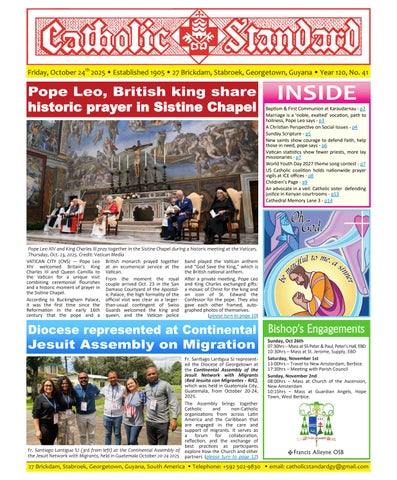
historic prayer in Sistine Chapel

Pope Leo XIV and King Charles III pray together in the Sistine Chapel during a historic meeting at the Vatican, Thursday, Oct. 23, 2025. Credit: Vatican Media

VATICAN CITY (CNS) Pope Leo

XIV welcomed Britain’s King Charles III and Queen Camilla to the Vatican for a unique visit combining ceremonial flourishes and a historic moment of prayer in the Sistine Chapel.

According to Buckingham Palace, it was the first time since the Reformation in the early 16th century that the pope and a

British monarch prayed together at an ecumenical service at the Vatican.

From the moment the royal couple arrived Oct. 23 in the San Damaso Courtyard of the Apostolic Palace, the high formality of the official visit was clear as a largerthan-usual contingent of Swiss Guards welcomed the king and queen, and the Vatican police

band played the Vatican anthem and “God Save the King,” which is the British national anthem.

After a private meeting, Pope Leo and King Charles exchanged gifts: a mosaic of Christ for the king and an icon of St. Edward the Confessor for the pope. They also gave each other framed, autographed photos of themselves.

(please turn to page 10)

Fr. Santiago Lantigua SJ represented the Diocese of Georgetown at the Continental Assembly of the Jesuit Network with Migrants (Red Jesuita con Migrantes - RJC), which was held in Guatemala City, Guatemala, from October 20-24, 2025.

The Assembly brings together Catholic and non-Catholic organizations from across Latin America and the Caribbean that are engaged in the care and support of migrants. It serves as a forum for collaboration, reflection, and the exchange of best practices as participants explore how the Church and other partners (please turn to page 12)

Baptism&FirstCommunionatKaraudarnau - p2

Marriage is a ‘noble, exalted’ vocation, path to holiness, Pope Leo says - p3

A Christian Perspective on Social Issues - p4

SundayScripture - p5

New saints show courage to defend faith, help those in need, pope says - p6

Vatican statistics show fewer priests, more lay missionaries - p7

World Youth Day 2027 theme song contest - p7

US Catholic coalition holds nationwide prayer vigils at ICE offices - p8

Children’s Page - p9

An advocate in a veil: Catholic sister defending justice in Kenyan courtrooms - p13

Cathedral Memory Lane 3 - p14

Bishop’s Engagements

Sunday, Oct 26th

07:30hrs–MassatSSPeter&Paul,Peter’sHall,EBD 10:30hrs – Mass at St. Jerome, Supply, EBD

Saturday, November 1st

13:00hrs – Travel to New Amsterdam, Berbice 17:30hrs – Meeting with Parish Council

Sunday, November 2nd

08:00hrs – Mass at Church of the Ascension, New Amsterdam 10:15hrs – Mass at Guardian Angels, Hope Town, West Berbice.

Francis Alleyne OSB
Fr. Santiago Lantigua SJ (3rd from left) at the Continental Assembly of the Jesuit Network with Migrants, held in Guatemala October 20-24 2025

The Jubilee Prayer

Baptism and First Communion at Karaudarnau

Father in heaven, may the faith you have given us in your son, Jesus Christ, our brother, and the flame of charity enkindled in our hearts by the Holy Spirit, reawaken in us the blessed hope for the coming of your Kingdom.

May your grace transform us into tireless cultivators of the seeds of the Gospel. May those seeds transform from within both humanity and the whole cosmos in the sure expectation of a new heaven and a new earth, when, with the powers of Evil vanquished, your glory will shine eternally.

May the grace of the Jubilee reawaken in us, Pilgrims of Hope, a yearning for the treasures of heaven. May that same grace spread the joy and peace of our Redeemer throughout the earth.

To you our God, eternally blessed, be glory and praise for ever.

Amen

Subscribe to the Catholic Standard - it’s free!

Message us giving your name & number at +592 701-7639. Send us an email at catholicstandardgy@gmail.com under the heading CS Subscription, and include your name ❖

On October 19th - World Mission Sunday - eight children joyfully received their First Holy Communion, while five infants were baptised at St Mary Magdalen Church, Karaudarnau, South Rupununi, Region 9, Essequibo, Guyana.

These beautiful celebrations remind us of the Lord’s command: “Go, therefore, and make disciples of all nations...” (Mt 28:19). The Gospel continues to take root and flourish in the Rupununi, passed faithfully from one generation to the next.

Catholic Standard

For 120 years, the Catholic Standard has been sharing the Gospel of Jesus Christ.

Now reaching 10,000+ followers on Catholic Media Guyana Facebook plus going straight to your inbox and WhatsApp, our vibrant weekly e-paper is a trusted source which delivers informative and inspiring stories from across the diocese and around the world.

Want to promote your business or event? Advertise with us! Call 675-4542 or email catholicstandardgy@gmail.com ❖

Even amid challenges, especially the irregular celebration of Mass in many communities, the lay faithful continue to carry forward the mission of the Church, nurturing and

VATICAN CITY (CNS)

Sacramental marriage and traditional family life increase joy in the good times, give strength during hard times and are a path to true holiness, Pope Leo XIV said.

Marking the 10th anniversary of the canonization of Sts. Louis and Zélie Martin, the parents of St. Thérèse of Lisieux, Pope Leo said the couple ineffable happiness and profound joy that God grants, both here on earth and for eternity, to those who commit themselves to this pathoffidelityandfruitfulness.

‘First couple to be canonized as such

The pope message to Bishop Bruno Feillet of Séez, France, the home diocese of the Martin family. The message was released at the Vatican Oct. 18, the date of the anniversary of the Martins becoming couple to be canonized as such, thepopesaid.

At a time when much of the media and popular culture seem to present lifelong marriage and a commitment to family life as “outdated and dull,” the pope said, “Louis and Zélie Martin testify that this is not the case: they were happy deeply happy! giving life, radiating and transmitting the faith, seeing their daughters growandflourish under thegazeoftheLord.”

LITURGY NOTES

All Saints and All Souls

in advance of the couple's canonization. (CNS photo/Paul Haring)

This year the solemnity of All Saints is on Saturday November 1st and the Commemoration of All Souls on Sunday November 2nd. Following is the program of religious observances. On Saturday all Masses celebrated are of All Saints as is the Liturgy of the Hours (Morning and Evening prayer, etc.). Even though the Saturday evening Mass is of All Saints, it satisfies the need to attend Sunday

On Sunday the Masses celebrated are of the Commemoration of All Souls. However, the Liturgy of the Hours is that of the Sunday (31st week in Ordinary Time) - if the Office is prayed publicly the Office of the Dead may be used. The Gloria and CreedarenotusedintheAllSoulsLiturgy.

Solemnity of All Saints

Saturday November 1st

All Saints (including Liturgy of the Hours: All Saints Commemoration of All Souls

Sunday November 2nd

• Masses - All Souls

Sts. Louis and Zélie Martin’s lives highlight “marriage as a path to holiness,” the pope wrote.

“Among the vocations to which men and women are called by God, marriage is one of the most nobleandexalted.”

Good life under ‘gaze of the Lord’

Anyone with “a sincere desire to lead a beautiful and good life under the gaze of the Lord, in joy as in trial,” should look to the Martinsforinspiration,hesaid.

They are “the model of a couple that the holy church presents to young people who wish – perhaps hesitantly – to embark on such a beautiful adventure,” Pope Leo said. They are “a model of fidelity and attention to one another, a model of fervor and perseverance in the faith, of Christian education of children, of generosity in the exercise of charity and social justice; a model also of trust in timesoftrial.”❖

• Liturgy of the Hours: Sunday Week 3. If prayed in public the Office of the Dead may be used. 

Dedication of the Lateran Basilica Sunday, November 9th

The Dedication of the Lateran Basilica is celebrated on November 9th, this year a Sunday. Since the feast is seen as a feast of the Church, the Body of Christ, it supersedes the normal Sunday celebration so all liturgy (Masses, Liturgy of the Hours)willbethatofthefeast.

The Basilica (actually the archbasilica, the only one in the world,) is known as ‘the mother and head of all churches’. It is the cathedral of the Bishop of Rome, the Pope, and since all bishops are to be in union with the Pope, the feast speaks of the unity of the Church, the Body of Christ. ❖

Workers prepare a banner of Louis and Marie Zelie Guerin Martin, the parents of St. Therese of Lisieux, on the facade of St. Peter's Basilica at the Vatican Oct. 16, 2015,

A Christian Perspective on Social Holy Land desecrated

The Holy Land. Simply thinking of those three words ushers in a sense of awe. The grandeur of the Holy Land has been spoken of in the Old Testament and the New Testament. From God’s covenant with Abraham to the New Covenant that removed all frontiers, the one with Jesus as a pure and living sacrifice. All tongues and tribes, all nations and peoples, and to the ends of the earth, there is a name held sacred, and before which a knee is taken. The Word of the Lord springs to life, is fulfilled. Now, in the last two years more than at any other time, there has been another side of some fractions in the Holy Land seen, one that few, very few, want to see. There has been war. Where there is war, it is inevitable that bloodshed is a part of its grim, scything presence. When so much blood is spilled from the horrors raining down from the air and on the ground, there is the untimely and unwelcomed arrival of death. There is also hunger. When a land is torn and savaged, degraded and devastated, then hunger becomes a constant, burdensome companion. And, when there are all these dreadful developments in many cities and villages in the Holy Land, then in no time at all pestilence comes visiting. These have been the realities in a brutal and unforgiving environment, the news coming out the Gaza, the land of Judea and Samaria. War. Hunger. Pestilence. Death.

In many respects, and as boosted from the facts on the ground in the Gaza, it is as if the Four Horsemen of the Book of the Apocalypse have all been let loose at the same time in parts of Palestine, and given the freest rein to wage destruction. The toll has been high and harrowing, with the numbers climbing all the time. Palestinian men, women, and children have all come under an unrelenting hail of deadly fire. No place is safe; few are the places left for them to go. It is a living hell on earth for the people of Palestine. There are limits to war. I readily take that position. All the limits and conventions of war have been trampled upon; and that, too, is another condition of mine.

I long for a fair and strong referee to intervene and take control. Sadly, that moral fiber and forthrightness have been lacking, and glaringly so. Those who have taken a different stance have had to endure their share of ridicule and blows. Those are worth the bearing, for so much has been violated, and if not stood against, then the questions that should haunt all of us are: what kind of a person am I, what is the depth of the humanity that I possess, and what profoundness as a Christian, I represent?

The rights of self-defense have their limits. Even in war, with all its attendant madness, there are limits. It was U.S. Confederate Civil War general Robert E. Lee who said, “it is well that war is so terrible. We should grow too fond of it.” Provocative and piercing, but soaring in the scope of its wisdom. What is happening in the Gaza cannot be called war anymore. It is a human charnel house. One that has lost any justification that once stirred some favorable reception. It was heartening to hear Guyana’s leader standing in front of the assembled countries of the world at the UN General Assembly, and speaking as he did. Focusing on his words as they apply solely to the Palestinian condition (catastrophe), and not anything that goes on in Guyana, it was encouraging

to read that principle must not yield before power, and might is not a good standard, through which to dictate what is right. In both instances, principle and right are barbarously savaged, have no existence. Though least expected, it was good that Guyana took an unambiguous stance, and joined with 70 plus countries in a walkout from the floor of the UN General Assembly when the destroyer of the Palestinian right to existence took his turn before the microphone.

What did he have to say that was worth giving a hearing? What could he offer, other than a ceasefire, and a right to their homeland and statehood for Palestinians? Waging war against the Palestinians is one thing. Waging war against the world is quite another.

Gracious and loving God, we thank your for the gift of our priests. Through them, we experience your presence in the sacraments.

Help our priests to be strong in their vocation.

Set their souls on fire with love for your people.

Grant them the wisdom, understanding, and strength they need to follow in the footsteps of Jesus. Inspire them with the vision of your Kingdom.

Give them the words they need to spread the Gospel.

Allow them to experience joy in their ministry.

Help them to become instruments of your divine grace.

Tickets: $2,500

We ask this through Jesus Christ, who lives and reigns as our Eternal Priest. Amen

FIRST READING: Ecclesiasticus35:12-14.16-19

The humble person’s prayer pierces the clouds. The Lord is a judge who is no respecter of personages. He shows no respect of personages to the detriment of a poor man, he listens to the plea of the injured party. He does not ignore the orphan’s supplication, nor the widow’s as she pours out her story.

The man who with his whole heart serves God will be accepted, his petitions will carry to the clouds.

The humble man’s prayer pierces the clouds, until it arrives he is inconsolable, norwillhedesistuntiltheMostHightakesnoticeofhim, acquits the virtuous and delivers judgement. And the Lord will not be slow, nor will he be dilatory on their behalf.

Responsorial Psalm: Psalm 33: 2-3, 17-19, 23

Resp: Thispoorman called;theLordheard him.

1. I will bless the Lord at all times, his praise always on my lips; in the Lord my soul shall make its boast. The humble shall hear and be glad. Response 2. The Lord turns his face against the wicked to destroy their remembrance from the earth. The just call and the Lord hears and rescues them in all their distress. Response 3. The Lord is close to the broken-hearted; those whose spirit is crushed he will save. The Lord ransoms the souls of his servants. Those who hide in him shall not be condemned. R/

Gospel Acclamation Mt 11: 25

Alleluia, alleluia!

Blessed are you, Father, Lord of heaven and earth, forrevealingthemysteriesofthekingdomtomerechildren Alleluia!

or 2 Cor 5: 19

Alleluia, alleluia!

God in Christ was reconciling the world to himself, and he has entrusted to us the news that they are reconciled.

Alleluia

In last week’s readings, we were encouraged to remain persistent and constant in our prayer life. Today, we

SECOND READING: 2 Timothy 4:6-8. 16-18

All there is to come now is the crown of righteousness reserved for me

My life is already being poured away as a libation, and the time has come for me to be gone. I have fought the good fight to the end; I have run the race to the finish; I have kept the faith; all there is to come now is the crown of righteousness reserved for me, which the Lord, the righteous judge, will give to me on that Day; and not only to me but to all those who have longed for his Appearing. The first time I had to present my defence, there was not a single witness to support me. Every one of them deserted me – may they not be held accountable for it. But the Lord stood by me and gave me power, so that through me the whole message might be proclaimed for all the pagans to hear; and so I was rescued from the lion’s mouth. The Lord will rescue me from all evil attempts on me, and bring me safely to his heavenly kingdom. To him be glory for ever and ever. Amen.

focus on the proper attitude of a steward at prayer.

In the Gospel passage from Luke, Jesus illustrates the humble attitude we must have as we approach God in prayer through a parable of two praying men. One is a Pharisee, a man with respected status, theological training and all the right credentials. He marches right up to the front of the temple to speak a prayer “to himself,” thanking God for making him just a little bit superior to everyone else!

GOSPEL:

Luke 18:9-14

The publican, I tell you, went home again at rights with God; the Pharisee did not.

Jesus spoke the following parable to some people who prided themselves on being virtuous and despised everyone else, ‘Two men went up to the Temple to pray, one a Pharisee, the other a tax collector. The Pharisee stood there and said this prayer to himself, “I thank you, God, that I am not grasping, unjust, adulterous like the rest of mankind, and particularly that I am not like this tax collector here. I fast twice a week; I pay tithes on all I get.”

The tax collector stood some distance away, not daring even to raise his eyes to heaven; but he beat his breast and said, “God, be merciful to me, a sinner”.

This man, I tell you, went home again at rights with God; the other did not. For everyone who exalts himself will be humbled, but the man who humbles himself will be exalted.❖

The other man is a tax collector, known by those of his day to be a cheater and a sell-out to his fellow Jews. In contrast to the Pharisee, he stands near the back and cries out to God in a simple and honest way: “Be merciful to me a sinner.” Jesus tells us that it is the tax collector and not the Pharisee who leaves the temple justified. Why?

The Pharisee was full of self as he approached God. He felt no real need for God as he rattled off his resume of good works and spiritual practices. He

was simply going through the motions of prayer. His lack of humility prevented him from entering into a real dialogue with the Father. The tax collector, by contrast, emptied himself as he approached God. He recognized who he truly was (a sinner) and asked for mercy, leaving all the rest up to God. This is the kind of attitude God can work with! This is how a good steward prays with trust, with complete openness to God’s will, with a listening mind and heart, ready to serve as God leads. ❖ [www.catholicsteward.com/blog/

New saints show courage to defend Gospel Reflection

If we are honest with ourselves, we will have to admit that at times most of us are just like the Pharisee in the parable. We parade our good deeds before God and use them as reason for looking down on others. If we do not do so openly, at least we think that way. The Pharisee was no doubt a sincere and highly religious man. He was certainly honest in his dealings with others, a faithful family man and a careful observer of God’s Law. In fact, he did more than the Law asked of him – he fasted twice a week instead of once. While the Law required that he pay tithes on certain goods, he paid on all of them. Where, then did the Pharisee go wrong? Why wasn’t he right with God?

First of all, the attitude of the Pharisee towards God was all wrong. He believed that because he had done all that the Law required of him, God was in his debt. It is easy for us all to fall into this trap. Secondly, his attitude towards his neighbour wasalso wideofthemark.Hefelt that his good and upright life put himaboveothers.Notonlydidhe look down on sinners, he actually despised them. The tax collector, who was a despised person because of his job, said, “God, be mercifulto me,a sinner.” Hewas telling the truth. If we can acknowledge our sinfulness and spiritual poverty with conviction and humility before God then we are very close to God. It will give us a great sense of freedom because we do not have to pretend to be holy. Being righteous does not mean that we will never fall once in a while. It means we cangetupandtryagain.

ThePhariseedid not thinkhewas sinful in any way. Therefore, insteadofexamininghisownconscience and confessing his own sins, he examined the conscience of another person and confessed theirsin.Wecanlearnmuchfrom the Pharisee. Like him so many of us are conscious of the sins of others but we are blind to our own. The tax collector, on the other hand, was concerned with hisowncondition.Forhimthesin of another person is something betweenthatpersonandGod.❖

[From: Journeying with the Word of God, The Religious Education Department, DioceseofGeorgetown, Guyana ]

VATICAN CITY (CNS) Holiness flourishes in those who serve the weakest, and Christians should defend the truths of the faith, no matter the cost, Pope Leo XIV said, highlighting key traits of the new saints he proclaimed.

Meeting with visitors from different countries who were in Rome for the Oct. 19 canonization of seven new saints, Pope Leo said, “the men and women we proclaimed saints yesterday are shining signs of hope for all of us, because they offered their lives in love for Christ and for their brothers and sisters.”

“I hope you return to your homelands with hearts filled with gratitude and an ardent desire to imitate the new saints,” he told the visitors in the Paul VI Audience Hall Oct. 20.

Speaking about St. Peter To Rot, a martyred lay catechist from Papua New Guinea who was arrested in 1945 during the Japanese occupation in World War II and was killed by lethal injection while in prison, the pope said he offers “an inspiring example of steadfastness and fortitude in preaching the truths of the Gospel when confronted by difficulties and challenges,eventhreatstoourlives.”

“Although he was an ordinary catechist, he showed extraordinary courage by risking his life to carry out his apostolate in secret, because his pastoral work was prohibited by the occupying forces,” he said. The saint also “firmly defended the sanctity of marriage and even confronted some

powerful people” who supported the practice of polygamy.

“May the example of Saint Peter To Rot encourage us to defend the truths of the faith, even at the cost of personal sacrifice, and to rely always on God in our trials,” Pope Leo said.

Turning to St. Ignatius Maloyan, the Armenian Catholic archbishop of Mardin who was executed in Turkey in 1915, the pope prayed that his intercession would “renew the fervor of believers and bring fruits of reconciliationandpeaceforall.”

Looking to Venezuela’s first two saints St. Maria Rendiles Martínez and St. José Gregorio Hernández Cisneros, who were canonized Oct. 19 the pope said they were “people very similar to ourselves, who lived facing problems that are not unfamiliar to us.”

St. Rendiles, the founder of the Congregation of the Servants of Jesus, was born in Caracas in 1903 and died in 1977. St. Hernández was born in 1864 and became a Third Order Franciscan.

A Venezuelan doctor, he became known as “the doctor of the poor,” and he was killed in an accident in 1919 on his way to helping a patient. Following their example, the pope said, the faithful should be motivated by the two saints’ trust in God, who “was present in their lives and transformed them” from being “a normal person, like any one of us, into a lamp that illuminated everyone with a new light in their daily lives.”

Their acts of charity should also be an inspiration, he added, because charity points to “the true meaning of life and asks us to build it through service, whether to the sick, the poor, or the little ones.”

Pope Leo also highlighted the outstanding traits of: St. Vincenza Maria Poloni, founder of the Sisters of Mercy of Verona, Italy, who lived from 18021855; St. Maria Troncatti, a Salesian sister born in Italy in 1883, sent as a missionary to Ecuador in 1922 and killed in a plane crash in 1969; and St. Bartolo Longo, an Italian lawyer born in 1841. He had been a militant opponent of the church and involved in the occult, but converted, dedicating himself to charity and to building the Pontifical Shrine of the Blessed Virgin of the Rosary of Pompei. He died in 1926. St. Poloni “bears witness to Jesus’ compassion for the sick and marginalized,” he said, encouraging the faithful “to persevere in daily service to the most fragile: it is precisely there that holiness of life flourishes!”

Looking at St. Longo, the pope “wholeheartedly” recommended that priests, religious, families and young people pray the saint’s prayer to Our Lady of the Rosary. “By contemplating the mysteries of Christ through Mary’s eyes, we assimilate the Gospel and learn to put it into practice day by day.”❖

Pope Leo XIV gives his homily during Mass for the canonization of seven new saints in St. Peter’s Square at the Vatican Oct. 19, 2025 - World Mission Sunday. (CNS photo/Lola Gomez)

Vatican statistics show fewer priests, more lay missionaries

VATICAN CITY (CNS) While the number of Catholic priests and religious continues to decline, the number of lay missionaries, catechists and permanent deacons continues to increase, according to the news agency Fides.

In anticipation of the celebration Oct. 19 of World Mission Sunday, the Vatican’s missionary news agency shared statistics about the Catholic population, church personnel and the works theyareengagedin.

In a message released Oct. 13, Pope Leo XIV, who served for decades as a missionary in Peru, encouraged all Catholics to mark World Mission Sunday with their prayers and financial support for the church’s missionary work.

World’s Catholics number justover1.4billion

According to Fides, the number of Catholics in the world was just over 1.4 billion as of June 30, 2023, Fides reported. That represented an increase of 15.8 million Catholics over the previous year, an increase reported in every continent, including Europe, which had reported a

decrease in the Catholic population from 2021 to 2022.

The continents with the largest increases were Africa, with more than 8.3 million baptisms, and the Americas with close to 5.7 million baptisms.

“For the past five years, available statistics show that the total number of priests in the world continues to decline, reaching 406,996,” a decrease of 734 over the previous year, the news agencysaid.

Permanent deacon numberontherise

The number of permanent deacons in the world continued to climb, reaching 51,433 in the world. The largest number of ordinations was in the Americas, with 1,257, followed by Oceania Australia, New Zealand and the South Pacific with 57 new deacons.

The number of religious brothers in the world declined slightly to 48,748 while the number of religious sisters dropped by more than 9,000 to 589,423.

At the same time, Fides reported, the number of lay

missionaries grew by more than 31,000 to reach 444,606. And the number of catechists increased by more than 17,000 to reach more than 2.8 million.

The Catholic Church, Fides said, runs more than 103,000 health care facilities, including 5,377 hospitals and 13,895 clinics or dispensaries. There are 504 church-run care homes for people with Hansen’s disease, mainly in Asia and Africa.

Homes for elderly and orphanages

Other church facilities include more than 15,000 homes for the elderly or chronically ill and close to 8,600 orphanages.

Journeying with the Word of God

The number of Catholic schools and the number of students served also continues to grow, Fides reported.

The Catholic Church runs 74,550 kindergartens with more than 7.6 million students, 102,455 primary schools with more than 36.1 million students and more than 52,000 secondary schools serving more than 20.7 million pupils. ❖

Calling all songwriters! The World Youth Day 2027 theme song contest is open

(Aleteia) - The World Youth Day Seoul 2027 theme song contest has begun and entries from around the world are accepted, the event's local organizing committee said in a September 25 press release.

The winner of the contest's song "will accompany millions of young people at the next World Youth Day (WYD) celebration," said the release. World Youth Day Seoul 2027 will begin on August 3, 2027.

More than just background music, "at every WYD, the theme song plays a vital role," said the release. The song "helps young people connect with one another and with the heart of the event."

"Long after WYD concludes, the song continues to live on, carrying with it the memory of joy, hope, and unity," said the press release.

The theme of WYD Seoul 2027, "Take courage! I have overcome the word," is inspired by the Gospel of John 16:33.

The organizers believe "this message proclaims Christ's victory and peace anew" during a time when the world is "marked by anxiety, division, and rapid change."

People from all around the world, of all nationalities and residences, are invited to submit up to three songs for the contest, said the organizers. The songs should be original

compositions and inspired by the theme of WYD, and they must be in any of the official WYD languages. These languages are Korean, English, Italian, Spanish, French, and Portuguese.

In addition to becoming the official theme song of WYD Seoul 2027, the composer will receive a plaque and support for their pilgrimage to World Youth Day, said the organizers.

How to enter the theme songcontest

The songs will be judged both on artistic merit and their faithfulness to the theme of WYD, said the organizers. Songs that are "easy to sing and remember" can be sung in a group setting, and are able to be translated into different languages will be given "special weight" in the contest. Additional details for the contest can be found on the WYD Seoul 2027's website. Songs must be submitted by November 30, 2025.

WYD Seoul 2027 marks the first time the event has been held in a country where Christians are a minority population. Only about 30% of South Koreans identify as any denomination of Christianity.

MAKING THE WORD OF GOD YOUR OWN

1st Reading: God has no respect for a person because of his or her position in society. God shows no preference for the rich and powerful but listens to the prayers of the just and the poor. This is a good example for the believer to follow.

2nd Reading: Paul is a prisoner in Rome and feels his death is approaching. The feelings he expresses show that he is committed to the task of witnessing to the faith.

Gospel: Jesus’ great parable of the Pharisee and thetaxcollectorneverfailsto opentheeyesof the self-satisfied Christian. The biggest danger facing the Christian is not living in a sinful world but the feeling of complacency that can creep into his relationship with God.

Step 2: ApplyingthevaluesoftheReadings toyourdailylife.

1.Like the Pharisee, we can fall into the habit to doing the right thing for the wrong reason. Is this something in your life you need to look at?

2.The race Paul describes is his faith journey. We too are on our own faith journey. How does our faith journey measure up against our ambitions and the success of power?

3.It is said that too much emphasis is being placed on the sins and not enough on the fact of being a sinner. Whatisthatstatementsayingtoyou?

4.While the Pharisee boasted that he was not like other people, meaning that he was not a sinner, we realise that his chief sin was that of pride. Do you think people can accuse you of this sin?

Step 3: Accepting the message of God’s Wordinyourlifeoffaith

Many people believe that they have to be dressed up, both outwardly and inwardly, before they can join others in worship in God’s church. Nothing can be further from the truth. We have to come before God just as we are, with all our weaknesses and sins. The church is for all of us precisely because we are sinners who know we need help.

Step 4: Somethingtothink&prayabout

1.Ask God to help you see how the Gospel speaks to you about your private life, about the lack of humility in your life, and the reasons for the ‘good deeds” you do.

2.Ask forgiveness for thinking that God owes you something in return for what you have done, for the times you set out to pray and ended up making speeches about yourself, to yourself. ❖

[From: Journeying with the Word of God, The Religious Education Department, Diocese of Georgetown, Guyana ]

US Catholic coalition holds nationwide

Participants gathered Oct. 22, 2025, in front of the U.S. Immigration and Customs Enforcement offices in Philadelphia as part of the nation-wide “One Church, One Family” prayer vigils organized by the Jesuits West province and several Catholic organizations, including the U.S. Conference of Catholic Bishops’ Migration and Refugee Services, to protest mass deportations and promote pastoral accompaniment for immigrants lacking permanent legal status in the U.S. (OSV News photo/Gina Christian)

WASHINGTON (OSV News) A coalition of Catholic organizations held prayer vigils across the country on Oct. 22 for what organizers called “a national day of public witness for our immigrant brothers and sisters.”

The vigils came amid growing concern from some faith communities including a Catholic parish in Chicago about the impact of the Trump administration’s rollback of a policy that prohibited immigration enforcement in sensitive locations, such as churches, schools, and hospitals.

“One Church, One Family” vigilsspearheadedbyJesuits

The “One Church, One Family: Catholic Public Witness for Immigrants,” vigils took place in multiple locations around the country on Oct. 22. A second series of events is scheduled for Nov. 13, the feast day of St. Frances Xavier Cabrini, universal patroness of immigrants.

The grassroots initiative was spearheaded by the Jesuits West province, with additional sponsors including Jesuit Refugee Service USA, the Ignatian Solidarity Network, Maryknoll, Network Lobby for Catholic Social Justice, Pax Christi USA, the U.S. Conference of Catholic Bishops‘ Migration and Refugee Services and several orders of women religious.

The protest and prayer vigil in the nation’s capital took place in front of the headquarters for the U.S. Immigration and Customs Enforcement as ICE employees entered the building and as rush-hour drivers occasionally honked at the group in apparent acknowledgment.

“We wanted to be a witness,” Judy Coode, communications director for Pax Christi USA told OSV News at the Washington vigil.

The rollback of the sensitive locations policy is among the Trump administration’s immigration actions that have been met with criticism from the U.S. bishops. They recently offered their support to a lawsuit challenging the policy change, submitting an amicus brief, sometimes called a friend-of-the -court brief, to the U.S. Circuit Court of Appeals for the District of Columbia.

“The church is a sanctuary and refuge,” Art Laffin, a member of Dorothy Day Catholic Worker House, told OSV News at the Washington vigil.

Immigration enforcement actions in churches, he said, would be “a terrible sin and injustice, and so it really calls for all the people of God to stand together with those who are being targeted and criminalized, whether it’s in the sanctuary or whether it’s in the streets.”

Catholic social teaching on immigration

“Both as Catholics and also as U.S. citizens, we have a responsibility to bear witness to injustices that we see,” Coode said. “And so part of our tradition is to pray publicly. We have the right to do that, and so we take advantage of that, and we want to bear witness to those who are in power, who are making decisions. We want to call to their consciences, ask them to consider praying for another outcome, praying for another way to be.”

Concern for immigrants in churches

The day before the vigils, the Department of Homeland Security, which oversees ICE, objected on social media to a CBS News article about pastors expressing concern that fear of ICE raids is keeping some of their congregants away from church. In a post on X, DHS claimed it was “PROTECTING innocent people in our churches by preventing criminal illegal aliens and gang members from exploiting these places of worship.”

“DHS’s directive gives our law enforcement the ability to do their jobs. Our agents use discretion and have secondary supervisor approval before any action can be taken in locations such as a church or a school,” the post said. In the CBS report, ICE Director Todd Lyons claimed that despite the rollback, houses of worship are not a target.

However, earlier in October, reports of ICE agents near St. Jerome Catholic Church in Chicago’s Rogers Park neighborhood prompted warnings of caution from its pastor, although a spokesperson for ICE denied the church was targeted, NBC Chicago reported.

we become more prosperous or have more advantage, we forget our origins and our own humble beginnings.”

She added that “lack of memory,” along with a “scarcity mindset” which fails to see that God’s love, compassion and mercy are “enough for all of us” lie at the core of anti-immigrant sentiment.

According to Pew Research Center data released in June, more than four out of 10 Catholics in the U.S. are immigrants (29%) or the children of immigrants (14%). Eight out of 10 Hispanic Catholics are either born outside the U.S. (58%) or are the children of an immigrant (22%), while 92% of Asian Catholics are either immigrants (78%) or are the children of an immigrant (14%). In contrast, the vast majority of white Catholics are three generations or more removed from the immigrant experience: just 6% were born outside the U.S., with another 9% born in the U.S. to at least one immigrant parent.

Catholic social teaching on immigration also balances three interrelated principles the right of persons to migrate in order to sustain their lives and those of their families, the right of a country to regulate its borders and control immigration, and a nation’s duty to regulate its borders with justice and mercy.

Sister of St. Joseph Bethany Welch, part of the national planning team for “One Church, One Family,” told OSV News in a phone interview Oct. 22, “It’s essential that we stand in solidarity, particularly with our brothers and sisters who are being detained.”

Sister Bethany had attended the Oct. 12 binational pilgrimage led by Bishop Gerald F. Kicanas, apostolic administrator of the Diocese of Tucson, Arizona, as part of a mission to stand in solidarity with migrants. She said her participation in the “One Church, One Family” Oct. 22 vigil at an immigration detention center in Newark, New Jersey, was a continuation of that effort and of “the Gospel call to be attentive to those who are being harmed or marginalized.”

While immigrants are often seen “as other,” she said, “in fact, they are part of our church.

Across the U.S., Christians account for approximately 80% of all of those at risk of Trump’s mass deportation effort, with the single largest group of affected Christians being Catholics, according to a joint CatholicEvangelical report published by World Relief. The report found one in six Catholics (18%) are either vulnerable to deportation or live with someone who is.

“The church in Philadelphia, the church in Newark, the church in D.C. has been built and sustained through various histories of migration, whether that be Irish immigrants or Latin American immigrants or African or Haitian, etc.,” said Sister Bethany. “So often, as

Sister Bethany said the “One Church, One Family” vigils are “an invitation to remind ourselves where we came from,” she said.

Several dozen participants at a “One Church, One Family” vigil in Philadelphia, which took place outside of that city’s ICE offices, reflected on Christ’s announcement of his earthly mission to the poor, the blind and the captive, as recounted in Luke 4:16-30.

“Who are the poor among us who need to hear the Gospel, and who are the blind who need to recover their sight?” asked Sister of St. Joseph Linda Lukiewski, one of the event’s speakers.

Sister Linda whose longtime ministry has included assignments in Central America and among U.S.-based Latino communities responded, “I believe that the poor among us who most need to hear the Gospel are those who lack a sense of compassion and a sense of justice, who suffer from poverty of right judgment, and who are deficient in the knowledge that we are all brothers and sisters, and that we all deserve respect and dignity. I believe the poor among us are those starving for power and domination.”

Peter Pedemonti, founding member and co-director of New Sanctuary Movement of Philadelphia an immigrant advocacy nonprofit based on Catholic teaching noted in his address that “we are standing in front of some captives right now.” He said “at least four people” had been arrested by ICE that morning and were in detention in the building behind vigil participants.

“Let us hold those people who are in holding cells behind us in our hearts, in our prayers,” said Pedemonti.

He also urged those present to “let our hearts break over and over again” so that such detentions do not become “normal.”❖

The Pharisee &the Tax Collector

Dear Girls and Boys,

In our Gospel reading today, Jesus tells a story about a man who thought he was better than everyone else. In the story that Jesus told, two men went to the temple to pray. One of the men was a Pharisee, a religious group that was very strict in obeying the law of Moses. The Pharisee stood up and prayed about himself: "I thank you, God, that I am not a sinner like everyone else. I don’t cheat, I don’t sin, and I’m certainly not like that tax collector over there! I fast twice a week, and I give you a tenth of all my income."

The tax collector stood at a distance and would not even lift his eyes to heaven as he prayed. Instead, he bowed his head in sorrow, saying, "Oh God, be merciful to me, for I am a sinner."

Now, which of these two prayers do you think was pleasing to God? You are right. The prayer of the tax collector. Jesus said, "The tax collector, not the Pharisee returned home justified before God. For those who exalt themselves will be humbled, but those who humble themselves will be exalted."

When we are tempted to brag about ourselves, we need to remember that other people are not impressed and neither is God!

Dear Father, we pray that you will help us to remain humble so that we will not think more highly of ourselves than we ought. In Jesus' name we pray. Amen ❖

The Parable of the Pharisee and the Tax Collector

Pope, British king share historic prayer in Sistine Chapel (From

But the two also exchanged top honors.

The king conferred on the pope the “Knight Grand Cross of the Order of

the Bath,” which traditionally is given to heads of state, and the pope conferred on the king the “Knight Grand Cross with Collar of the Vatican Order of Pope Pius IX.” Pope Leo made Queen Camilla a dame of the same order.

Their majesties originally had planned to make the visit in April in conjunction with a formal state visit to Italy. While the Italian portion of their trip went ahead as scheduled, they only went to the Vatican briefly to greet Pope Francis, who died a few weeks later.

After the private meeting and exchange of gifts, Pope Leo and Anglican Archbishop Stephen Cottrell of York, the ranking prelate of the Church of England, led midday prayer in the Sistine Chapel with a focus on “care for creation.”

Pope Leo and Archbishop Cottrell sat in front of the altar under Michelangelo’s Last Judgment during the prayer service, while the king and queen sat slightly to one side.

Cantors from the Sistine Chapel choir were joined by adults from the choir of St. George’s Chapel at Windsor Castle and children from the choir of the Chapel Royal of St. James’ Palace in London.

Cardinal Vincent Nichols of Westminster, president of the Catholic Bishops’ Conference of England and Wales, and Archbishop Leo Cushley of St. Andrews and Edinburgh, representing the Cathbishops of Scotland, and the Rev Rosie Frew, moderator of the Presbyterian Church of Scotland, joined the king and queen for the prayer service. Briefing reporters about the visit, Archbishop Flavio Pace, secretary of the Dicastery for Promoting Christian Unity, said the moments of prayer and the exchange of honors were clear signs of the progress made in CatholicAnglican relations since the 1960s.

Pope Leo and King Charles left the Sistine Chapel together and went into the adjoining Sala Regia to meet business leaders and activists committed to fighting climate change and promoting sustainability.

The pope personally accompanied the

king back to the San Damaso Courtyard where his “Bentley State Limousine,” an armored car used for formal visits, was waiting for him and the queen.

As is customary, the Vatican press office provided no information about the pope and king’s private discussion. However, in a meeting with Cardinal Pietro Parolin, Vatican secretary of state, and Archbishop Paul R. Gallagher, foreign minister, the press office said, “matters of common interest were discussed, such as environmental protection and the fight against poverty.”

“Particular attention was given to the shared commitment to promoting peace and security in the face of global challenges,” the statement said. And “recalling the history of the church in the United Kingdom, there was a shared reflection on the need to continue promoting ecumenical dialogue.”

After leaving the Vatican, King Charles and Queen Camilla went to Rome’s Basilica of St. Paul Outside the Walls and walked through the Holy Door, prayed at the tomb of St. Paul and attended another prayer service.

With the approval of Pope Leo, King Charles was recognized as a “royal confrater” of the basilica, a decision made by Cardinal James M. Harvey, archpriest of the basilica, and Benedictine Abbot Donato Ogliari, head of the monastery of St. Paul Outside the Walls.

In return, Buckingham Palace said, “with the approval of the king, the dean and canons of the College of St. George Windsor have offered that Pope Leo XIV become ‘Papal Confrater’ of St. George’s Chapel at Windsor Castle and the pope has accepted.”

“These mutual gifts of ‘confraternity’ are recognitions of spiritual fellowship and are deeply symbolic of the journey the Church of England of which His Majesty is Supreme Governor and the Roman Catholic Church have traveled over the past 500 years,” the palace said in a statement. ❖

Pope Leo XIV and Britain’s King Charles III leave the Sistine Chapel at the Vatican after midday prayer Oct. 23, 2025. (CNS photo/Vatican Media)

Diocese represented at Continental Jesuit Assembly on Migration

(From Page 1)

can continue to respond with compassion and solidarity to the realities of migration in the region.

During the Assembly, Fr. Lantigua shared the experience and ongoing work of Catholic Charities GuyanaMigrant Support, which has been serving migrants in Guyana for the past seven years.

Catholic Charities Guyana

- Migrant Support

The Migrant Support Office was established following the creation of the Venezuela Support Group in 2018, a network of eight Guyanese civic organizations formed to assist Venezuelan nationals arriving in Guyana. As migration to Guyana increased, the Roman Catholic Church assumed a leading role in coordinating ongoing support through Catholic Charities Guyana.

Since then, the Migrant Support Office has continued to serve migrants of various nationalities, offering a wide range of services that are provided free of cost and also benefit members of the local Guyanese host communities.

Services Offered:

• Translation of official documents

• Psychosocial support (individual and group sessions)

• Legal assistance

• Temporary shelter for survivors of

gender-based violence

• Rental assistance

• Food & Hygiene Kits

• English as a Second Language classes (online and in-person)

• Educational support and school enrollment

• Small business assistance

• Medical Support

• Employment and livelihood support

Notable Achievements:

• Hosting bi-weekly Spanish-language Catholic Masses for the migrant community.

• Developing an English as a Second Language workbook, now used in schools across Guyana.

• Being the only organization in Guyana providing free extension-ofstay assistance for migrants.

Catholic Charities Guyana - Migrant Support since 2020 has been the only organization in Guyana that has a gender-based violence shelter for migrant women and children. Through its continued mission, Catholic Charities Guyana - Migrant Support reflects the Church's ongoing commitment to accompany, serve, and advocate for migrants, helping them to rebuild their lives with dignity and hope.❖

(Adapted from Catholic Media Guyana Facebook )

defending justice in Kenyan courtrooms

(Vatican News) - When people picture a Catholic religious sister, they image a woman in a habit, perhaps teaching, praying quietly in a chapel,or caring for the sick. Few imagine a religious sister in a courtroom, dressed in professional attire, standing before a judge, and introducing herself not just as “Advocate Immaculate Muthoni,” but as “Sister Immaculate.”

Sister Immaculate Muthoni, a member of the Little Sisters of Saint Francis (LOSSF), is not only a nun but also an attorney of the High Court of Kenya, as well as a legal officer at the Catholic University of Eastern Africa, an accredited trainer by the National Training Authority, and a legal auditor recognized by the Law Society of Kenya.

Beyond titles, she is a defender of dignity and a witness of hope, proving that the Gospel of justice does not stop at the altar; it also speaks in courtrooms.

Yet, she presents a calm, resilient, and radiant image, bridging two worlds many think cannot coexist: religious life and the practice of law.

A call within a calling

Her story began not with law, but with a youthful dream of political science. Then, religious formation and norms redirected her path.

Political science, she was told, was too entangled with partisan battles. Law, however, offered a way to pursue justice without compromising the religious vocation, a life she longed to serve from childhood.

In an interview with Vatican News, she laughs when she recalls, “I thought law was the lesser evil, and to this day, I do not regret being a lawyer.”

For Sister Immaculate, law and religious life are not separate callings; they are two sides of the same mission.

“Religious life grounds me in prayer, resilience, and compassion,” she says. “Law gives me the platform to act on those values. Together, they complement one another to bring real transformation.”

Justice with a human face

Every case she handles carries more than legal weight; it carries a human soul, a person sometimesbroken, often unheard, and above all, always deserving of dignity.

“It’s not about winning or losing a case,” she says with conviction. “It’ about journeying with people, even those who lose, and ensuring that justice is not only done but felt.” Her faith shapes her practice. She brings compassion where others see procedure, dialogue where others see conflict, and hope where others see defeat.

She recalls her introduction as “Sister Immaculate,an Advocate” at an event.

“A woman, overwhelmed by injustice and afraid of the legal system, opened up to me because I was a nun,” she says. “I journeyed with her through the legal process, pro bono, until she found justice and healing. This affirmed how powerful the intersection of law and faith can be in restoring someone’s hope.”

Breaking stereotypes

Her dual role has not been without skepticism. Some colleagues in court have dismissed her as “too soft” for legal battles. Some in religious circles have wondered why a nun is “immersed in secular work,” but she has learned to let her results and consistency speak.

“People begin to see that being both a nun and a lawyer brings depth and credibility. It challenges stereotypes of what a woman of faith can contribute in professional spaces,” she explains.

“When I introduce myself in court as ‘Sister Immaculate, appearing for the client,’ the title often disarms opponents, softens tension, and even opens space for dialogue and out-of court settlements,” she confesses.

She laughs as she recalls, “The main challenge I get is every time I go and log in to the court system, the magistrate asks if I am sure I am an advocate and asks for my practicing certificate number, and says that they are not used to seeing nuns as advocates.”

A new face of evangelization

Sister Immaculate is part of a quiet revolution in the African Church. She embodies what Pope Francis and many religious founders have long urged: to read the “signs of the times” and embrace new ways of serving God and humanity.

Pope Leo XIV has encouraged religious men and women to remain rooted in their charism and attentive to the signs of the times as their founders once did.

“Your founders were observant, evaluative, and loving and then set out, even at the risk of great suffering and failure, to serve the real needs of others, recognizing the voice of God in thepovertyoftheirneighbours,” hesaid

“Evangelization is not only through preaching,” insists Sr. Immaculate. “It is also living Gospel values of justice, compassion, and integrity through other means. Whether in law, media, or any other field, religious women can and must let their faith shine in their

Her dream is to see more sisters ministering in law, governance, and professional spaces once considered “secular,” and to see religious life in Africa break old boundaries and shape justice systems with the Gospel spirit. “I hope to advance my studies in law to influence policies and empower communities on a larger scale,” she says.

A witness for our times

Sr. Immaculate’s life is a reminder that the Church is alive, creative, and prophetic when women religious step boldly into spaces of justice.

She embodies the harmony of faith and reason when she carries her rosary beads and legal books, traversing the courtroom and the chapel in both a habitand attorney’s garb.

Her mission, as she quotes the prophet Micah, is “to live justly, love mercy, and walk humbly with God.” ❖

Sister Immaculate Muthoni, a member of the Little Sisters of Saint Francis (LOSSF), attorney of the High Court of Kenya

Stations of the Cross

Twelve of the fourteen Stations of the Cross around the Cathedral of the Immaculate Conception are over 150

Those twelve Stations of the Cross were saved from the fire in March 1913 that destroyed the previous Cathedral. The other two were recreated to complete the set of fourteen. The fourteen Stations of the Cross were placed in their respective positions upon the opening of the new Cathedral in December of 1925. ❖

Saint of the Week

October 28th

Saints Simon and Jude

Jude is so named by Luke and Acts. Matthew and Mark call him Thaddeus. He is not mentioned elsewhere in the Gospels, except of course where all the apostles are mentioned. Scholars hold that he is not the author of the Letter of Jude. Actually, Jude had the same name as Judas Iscariot. Evidently because of the disgrace of that name, it was shortened to “Jude” in English. Simon is mentioned on all four lists of the apostles. On two of them he is called “the Zealot.” The Zealots were a Jewish sect that represented an extreme of Jewish nationalism. For them, the messianic promise of the Old Testament meant that the Jews were to be a free and independent nation. God alone was their king, and any payment of taxes to the Romans the very domination of the Romans was a blasphemy against God. No doubt some of the Zealots were the spiritual heirs of the Maccabees, carrying on their ideals of religion and independence. But many were the counterparts of modern terrorists. They raided and killed, attacking both foreigners and “collaborating” Jews. They were chiefly responsible for the rebellion against Rome which ended in the destructionofJerusaleminA.D.70.

Reflection

As in the case of all the apostles except for Peter, James and John, we are faced with men who are really unknown, and we are struck by the fact that their holiness is simply taken to be a gift of Christ. He chose some unlikely people: a former Zealot, a former (crooked) tax collector, an impetuous fisherman, two “sons of thunder,” and a man named Judas Iscariot.

It is a reminder that we cannot receive too often. Holiness does not depend on human merit, culture, personality, effort, or achievement. It is entirely God’s creation and gift. God needs no Zealots to bring about the kingdom by force. Jude, like all the saints, is the saint of the impossible: Only God can create his divine life in human beings. And God wills to do so, for all of us.

Saint Jude is the Patron Saint of desperate situations, and Saint Simon is the Patron Saint of tanners and saw workers.❖

[From: franciscanmedia.org]

Turn static files into dynamic content formats.

Create a flipbook