Year 120, No. 43
![]()

Year 120, No. 43

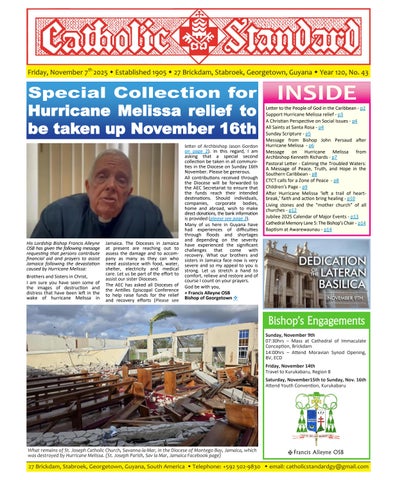
requesting that persons contribute financial aid and prayers to assist Jamaica following the devastation caused by Hurricane Melissa: Brothers and Sisters in Christ, I am sure you have seen some of the images of destruction and distress that have been left in the wake of hurricane Melissa in
assess the damage and to accompany as many as they can who need assistance with food, water, shelter, electricity and medical care. Let us be part of the effort to assist our sister Dioceses.
letter of Archbishop Jason Gordon ). In this regard, I am asking that a special second collection be taken in all communities in the Diocese on Sunday 16th November. Please be generous. All contributions received through the Diocese will be forwarded to the AEC Secretariat to ensure that the funds reach their intended destinations. Should individuals, companies, corporate bodies, home and abroad, wish to make direct donations, the bank information please see page 3).
Many of us here in Guyana have had experiences of difficulties through floods and shortages and depending on the severity have experienced the significant challenges that come with recovery. What our brothers and sisters in Jamaica face now is very severe and so my appeal to you is strong. Let us stretch a hand to comfort, relieve and restore and of

LettertothePeopleofGodintheCaribbean - p2
Support Hurricane Melissa relief - p3
A Christian Perspective on Social Issues - p4
All Saints at Santa Rosa - p4
SundayScripture - p5
Message from Bishop John Persaud after Hurricane Melissa - p6
Message on Hurricane Melissa from Archbishop Kenneth Richards - p7
Pastoral Letter - Calming the Troubled Waters: A Message of Peace, Truth, and Hope in the Southern Caribbean - p8
CTCT calls for a Zone of Peace - p8
Children’s Page - p9
After Hurricane Melissa ‘left a trail of heartbreak,’ faith and action bring healing - p10
Living stones and the “mother church” of all churches - p12
Jubilee 2025 Calendar of Major Events - p13
CathedralMemoryLane5:TheBishop’sChair - p14
BaptismatAwarewaunau - p14

Sunday, November 9th
07:30hrs – Mass at Cathedral of Immaculate Conception, Brickdam
14:00hrs – Attend Moravian Synod Opening, BV, ECD
Friday, November 14th
Travel to Kurukabaru, Region 8
Saturday, November15th to Sunday, Nov. 16th
Attend Youth Convention, Kurukabaru


Dear Brothers and Sisters in Christ,
In recent years, experts have warned of the increasing intensity and slower movement of hurricanes across our beloved Caribbean region phenomena directly linked to climate change. We have seen this reality unfold before our eyes. Hurricanes such as Irma and Maria in 2017, which devastated the Northern Leewards and Dominica, respectively, and Dorian in 2019, brought untold destruction to the Bahamas. Now, Hurricane Melissa has left deep scars on sections of Jamaica, eastern Cuba, and the southern Bahamas.
In our Pastoral Letter “In the Eye of the Hurricane”, we, your bishops, reminded you that natural disasters are not merely acts of nature, but

Father in heaven, may the faith you have given us in your son, Jesus Christ, our brother, and the flame of charity enkindled in our hearts by the Holy Spirit, reawaken in us the blessed hope for the coming of your Kingdom.
May your grace transform us into tireless cultivators of the seeds of the Gospel.
May those seeds transform from within both humanity and the whole cosmos in the sure expectation of a new heaven and a new earth, when, with the powers of Evil vanquished, your glory will shine eternally.
May the grace of the Jubilee reawaken in us, Pilgrims of Hope, a yearning for the treasures of heaven. May that same grace spread the joy and peace of our Redeemer throughout the earth.
To you our God, eternally blessed, be glory and praise for ever.
Amen


solidarity. As we wrote, “In times of disaster, our Christian vocation calls us to be instruments of hope, compassion, and concrete love.” The same letter urges us to see every hurricane not only as a meteorological event but also as “a moral and spiritual summons to care for one anotherandforourcommonhome.”
Several years ago, the Antilles Episcopal Conference established the AEC Disaster Fund to respond quickly and effectively to dioceses affected by natural disasters. Due to the destruction caused by Hurricane Melissa, we now call on every diocese, parish, and faith community across the Caribbean to organise a special collection during November in support of this Fund. We request that dioceses offer
methods for contributions whether via parish collections, wire transfers, or bank deposits so that both individuals and organisations can give generously.
We thank you, People of God of the Caribbean, for your resilient spirit of solidarity. Time and again, you have demonstrated that even in the face of adversity, we remain one Caribbean family.
As we rebuild together, may our faith lead to generous action. Our vulnerable brothers and sisters of the Caribbean are relying on your compassion and generosity. May the Lord, who calmed the storm, bless you abundantly for your kindness.
In Gratitude,
MostReverendCharlesJasonGordon


A Christian Perspective on Social Issues

By GHK Lall
From a bomb to what is brotherly
I run the risk of being attacked for this. Nothing new; just the usual, since it is the unusual presented. A bomb tore a hole and gouged a piece out Guyana, two Sunday nights ago. Currently, a foreign connection is alleged. The bomber is Venezuelan and he had a goodly number of helpers, some likely Guyanese. A child is dead, and there is familial dread. Seven survivors mend slowly; may they heal completely. In the heat of the moment, I read of readiness to apply the ultimate penalty. Death. Indeed, an eye for an eye, or a life for a life, lives on. What do I see?
To where do I wish to bring my fellow citizens, fellow believers, and fellow worshippers, in this time of tragedy and terror? So, that they can see this boiling, frightening, issue a little differently.
For starters, everything seems to match. Appearance, origins, clothing, and whatever surrounding intelligence that state agencies have gathered. Looks open and shut, with the energy for the death penalty taking flight. Blood for blood and pain for pain. The passions are that high, and the gallows, or whatever is used in these modern days, are readied. Thirst should be satisfied. A head on a platter eases the rage. If the bomber is found guilty in a clear and fair trial, I urge that the victim(s) be remembered, and their memory honored. Is the death penalty held at the ready the best way to do so? Is the death penalty springing from out of nowhere and slammed down on the public table, not prejudicial to Senior Daniel Peodomo’s interests? However careful, reassuring, the qualifying language, has he already been tried and found inarguably guilty? I fear where we are, as fueled by the heady atmosphere.
Let there be no mistake. A great wrong resulting in greater harm has been perpetrated. I shrink when the thinking gains traction that a still greater wrong would be the death penalty administered, should the evidence all fall into place and there is only one ruling possible. Guilty. A great crime has been committed against the people of this country, and it will take
a long time to recover from that fatal and wounding blast. The family of young Soraya Bourne mourn the loss of their little angel. Seven other Guyanese nurse their pain, probably jump out of their skin at the slightest noise. There must be punishment of the guilty, but it must not be the death penalty.
Consider these realities. Many studies have found that the death penalty is not the deterrent that it is made out to be. Hence, what is proved, what is satisfied? The ones found guilty are gone, wouldn’t be able to commit any more crimes, but there are those other realities. Those that are sinister ones. What about those who are of like mind? What about others who may be similarly bent on terrorizing Guyanese, in an attempt to introduce fear and weakness? It could happen at any place and on any day, and with any level of collateral damage occurring. What do we do then, keep a hanging party within hand reach? I insert this
with their own death never not featuring prominently. Either in the middle of their actions (or its aftermath): or in their passage through the court system.
Thus, this talk of zeal for the death penalty may have the unintended consequences of creating heroes and martyrs for the homeland locked in a struggle that is over a century in length for land and treasure. For clarity, the homeland is not Guyana. More reckless and more dangerous exploits could be in the making, now that the first window has been cracked, the first victims smashed. Guyana may have the justification to deliver and administer quickly the maximum penalty to level the scales for the Regent and King Street bombing. Legal justification, yes; but what else does Guyana have in its corner for foundation?
Tensions have been inflamed. A child is no longer alive. The piercings from that same Sunday night will live on in


Gracious and loving God, we thank your for the gift of our priests.
Through them, we experience your presence in the sacraments.
Help our priests to be strong in theirvocation.
Set their souls on fire with love foryourpeople.
Grant them the wisdom, understanding, and strength they need to follow in the footsteps ofJesus.
Inspire them with the vision of yourKingdom.
Give them the words they need tospreadtheGospel.
Allow them to experience joy in theirministry.
Help them to become instrumentsofyourdivinegrace.
We ask this through Jesus Christ, who lives and reigns as our EternalPriest. Amen


FIRST READING Ezekiel 47: 1-2, 8-9, 12
The angel brought me to the entrance of the Temple, where a stream came out from under the Temple threshold and flowed eastwards, since the Temple faced east. The water flowed from under the right side of the Temple, south of the altar. He took me out by the north gate and led me right round outside as far as the outer east gate where the water flowed out on the right-hand side. The man went to the east holding his measuring line and measured off a thousand cubits; he then make me wade across the stream; the water reached my ankles. He measured off another thousand and made me wade across the stream again. The water reached my knees. He measured off another thousand and made me wade across the stream again; the water reached my waist. He measured off another thousand; it was now a river which I could not cross; the stream had swollen and was now deep water, a river impossible to cross. He then said, “Do you see, son of man?” He took me further, then brought me back to the bank of the river. He said, “This water flows east down to the Ababah and to the sea; and flowing into the sea it makes its waters wholesome. Wherever the river flows, all living creatures teeming in it will live. Fish will be very plentiful, for wherever the river goes it brings health, and life teems wherever the river flows. Along the river, on either bank, will grow every kind of fruit tree with leaves that never wither and fruit that never fails; they will bear new fruit every month, because this water comes from the sanctuary. And their fruit will be good to eat and the leaves medicinal.

Today is the Feast of the Dedication of the Lateran Basilica in Rome. It may seem unusual to celebrate a Feast commemorating a church building, but the Lateran Basilica is more than just a building to us Catholics.
The Basilica of St. John Lateran is the cathedral of Rome. This is not St. Peter’s at the Vatican, but it is the Pope’s cathedral. It was built in the time of the Emperor Constantine and was consecrated by Pope Sylvester in 324. Almost 1,700 years old, it was the baptism church of ancient Rome. In 313 Constantine issued an edict which granted Christians the freedom to practice their religion. St. John Lateran was built on the exact spot where Constan-

RESPONSORIAL PSALM Psalm 45
Response: The waters of a river give joy to God’s city, the holy place where the Most High dwells.
1. God is for us a refuge and strength, a helper close at hand, in time of distress: so we shall not fear though the earth should rock, though the mountains fall into the depths of the sea.
2. The waters of a river give joy to God’s city, the holy place where the Most High dwells. God is within, it cannot be shaken; God will help it at the dawning of the day.
3. The Lord of hosts is with us: The God of Jacob is our stronghold. Come, consider the works of the Lord the redoubtable deeds he has done on the earth.
tine had a vision leading him to issue that edict. For that reason alone this Feast is worthy of our celebration. However, as you might expect, the readings for this Feast Day speak to churches and buildings and then St. Paul associates those to us personally. In the Word of God a temple of stones becomes a living Church to us with Jesus as the foundation and the cornerstone. Our churches are more than just places of worship. They represent an order and structure to our Church which enhances our relationship to Christ.
Many Gospel scholars conclude that the waters running from the temple in the first reading represent the Gospel of Christ which went forth and spread throughout the world. The volume of the waters increases as they flow, even though there is no indication of tributaries or other waters flowing into them. We, as stewards of the word, are to take these living waters and to spread them everywhere we go as disciples.
SECOND READING 1 Cor. 3: 9-11, 16-17
You are God’s building. By the grace God gave me, I succeeded as an architect and laid the foundations, on which someone else is doing the building. Everyone doing the building must work carefully. For the foundation, nobody can lay any other than the one which has already been laid, that is Jesus Christ. Didn’t you realise that you were God’s temple and that the Spirit of God was living among you? If anybody should destroy the temple of God, God will destroy him, because the temple of God is sacred; and you are that temple.
GOSPEL John 2: 13-22
Just before the Jewish Passover Jesus went up to Jerusalem, and in the Temple he found people selling cattle and sheep and pigeons, and the money changers sitting at their counters there. Making a whip out of some cord, he drove them all out of the Temple, cattle and sheep as well, scattered the money changers’ coins, knocked their tables over and said to the pigeon-sellers, “Take all this out of here and stop turning my Father’s house into a market.” Then his disciples remembered the words of scripture: Zeal for your house will devour me. The Jews intervened and said, “What sign can you show us to justify what you have done?” Jesus answered, “Destroy this sanctuary, and in three days I will raise it up.” The Jews replied, “It has taken forty-six years to build this sanctuary: are you going to raise it up in three days?” But he was speaking of the sanctuary that was his body, and when Jesus rose from the dead, his disciples remembered that he has said this, and they believed the scripture and the words he has said.❖
In the second reading St. Paul declares to the Corinthians that in Corinth he, Paul, laid a foundation. That foundation, of course, is Jesus Christ, and it is on that foundation that the church is built. However, Paul cautions the Corinthians to “be careful” how they build on that foundation. Furthermore Paul reminds them that the temple is not just the building in which they worship, but he also speaks to each individual, and each of us, in writing, “…you are the temple of God and the Spirit of God dwells in you.” Paul places the concept of temple on three levels: the building, the community, and each individual member. Stewardship calls us to keep in mind all of those as we are the stewards of our churches, our faith communities, and our individual lives.
The Gospel from John is a passage that is likely familiar to many. Jesus visits the temple and is upset by what is going on in the plaza outside, filled with vendors and money changers. Following His reaction to what He found, and after He “drove them all out of the
temple area,” the Lord was asked, “What sign can you show us for doing this?” Of course, His answer to that is one that we may know but we may not always understand it. Jesus said “Destroy this temple and in three days I will raise it up.” John explains that those who heard this answer were confused because the temple had been under construction for decades and how could it be rebuilt in three days?
“But he was speaking about the temple of his body.”
Just as Paul describes more than one temple, the Lord does as well. Jesus knew of His death and resurrection. The Lord knew that His body could not be destroyed. The message to us is that our temples, our bodies, cannot be destroyed either if we become disciples of the Lord and commit to following Him, commit to living lives of stewardship, serving God, our Church, and one another.❖
[www.catholicsteward.com/blog/ ]

In the year 324, Constantine, the first Christian Emperor, presented the Lateran palace in Rome to the Church as a gift. We celebrate the dedication of this massive building today because it is considered to be the “mother of all the churches of Rome and of the world”. Many churches around the world, both famous and not-so-famous, carry the title “basilica”. In the both Greece and Rome, basilicas were important government buildings where official business were conducted. As Christians began to construct buildings where they could gather for worship, they followed the pattern in which basilicas were built. The name was kept for large churches. This celebration gives us the opportunity to reflect on the importance of sacred buildings in which the Lord is worshippedallroundtheworld.
There are two ways by which we understand the meaning of the word “church”. The most common and obvious meaning of church is merely a building of stone or wood in which the assembly of believers meet together for worship. However, in today’s second reading, St Paul points out that the most important assembly is not that of stone on stone, but of the believers gathered together as “God’s building” with JesusChristasthefoundation.Therefore, even though the buildings for Christian worship are some of the most magnificent structuresin Christian culture, they are not to be considered the most important part of Christianity. In fact, nowhere is the splendour and glory of the church more clear than in the knitting together of people as a community of believers through their baptism in the name of Jesus, the foundation of it all. This image of “church” is most inspiringandcompellingtobelievers.
The church building is not God’s home although we believe that he is present to us in a very special way in the Tabernacle and when we come togethertoworship. Then we are the Church gathered. If Jesus is present to us in the church when we come together, then this sacred space must be a place of fellowship, love, forgivenessand reconciliation. There is no place in the church for petty jealousies, hatred, hurtful gossip and all those attitudes and actions that divide the body of Christ. Our worshiping community must make sure that the building is worthy of the Lord’s presence, clean and fresh, with bright flowers, sweet smells, music, joy and laughter. But no matter how lovely the building looks, how bright and shiny its vessels and decorations are, they will mean nothing if there is no love and unity among the worshiping community. There is no place in the Church, whether building or people, for hatred, selfishness, racism, greed and all those attitudes that destroy ratherthanbuild.❖
[
The Antilles Episcopal Conference (AEC) has shared the following message from Bishop John Persaud, Bishop of the Diocese of Mandeville, Jamaica, following the passage ofHurricaneMelissa:
MESSAGE FROM BISHOP JOHN PERSAUD AFTER HURRICANE MELISSA
If you have hope, this will make you cheerful. Do not give up if trials come; and keep on praying. If any of the saintsareinneedyoumust sharewith them; and you should make hospitality yourspecialcare
(Romans 12:12-13)
6th November, 2025
My dear Brothers and Sisters, I was off the Island when Melissa visited. I returned on Friday, October 31. The images I saw on television prior to my return did not prepare me for what I would eventually experience as I visited communities in the Diocese of Mandeville. IT IS BAD. In some places it looked like a “war torn area” like Ukraine or Gaza. Four of our communities in the Diocese of Mandeville were badly hit Black River (which has been very much in the news and is clearly the worse hit), Maggotty, Balaclava and Santa Cruz – all of these are in the Civil Parish of St. Elizabeth. This is not to say that other areas do not have damage and destruction but not on a scale as these.
All our buildings in Black River have been pretty much destroyed – Church, School and Rectory. In Maggotty, the Rectory roof has gone, the Convent roof is gone, and other buildings have been destroyed. BUT the Church remains standing almost untouched. In Balaclava the building that houses the Missionary Sisters of Charity and a home for the aged destitute has lost its roof. The Church doors were blown off and destroyed. In Santa Cruz there was some minor damage to the Church, and we lost the roof of the Medical Clinic.
I am O.K., all our priests and Religious Sisters are O.K. Our bodies are tired, but our spirits are strong. At the moment, we are trying to respond to emergency needs: covering roofs, providing water, food, hygiene kits, lamps, etc. This is being done with partners such as Caritas International, Catholic Relief Services, Food For The Poor (FFTP), Samaritan Purse and others. It will be a long and painful road to recovery, but God has given us the signs (a Tabernacle untouched in St. Theresa’s Church at Black River, the Holy Spirit Church in Maggotty untouched) that he is with us and will
continue to walk with us. The spirit of the Jamaican people is amazing and resilient.
Thank you for your prayerful support, your care, concern and love expressed in so many ways. We are truly experiencing what it means to be CHURCH, the Body of Christ. As we face the future we know that you are walking with us and this gives us much encouragement and hope.
With every good wish and prayer,
Most Reverend John D. Persaud Bishop of Mandeville Diocese of Mandeville ❖

I have not yet travelled to the Montego Bay Diocese, but from the reports received there is much more damage to church related buildings than in the Mandeville Diocese. We have lost roofs to the Chancery building, the Cathedral Rectory, Parish Hall, Convent, and all three schools. The Parish of Reading: rectory roof was lost, Church and Parish Hall roofs still in place but leaking badly. The two mission communities of this parish has had significant damage to Church and school. The Church at Savanna-laMar has been destroyed and significant damage to the Sir Clifford Campbell School. In Lucea, we have lost a major part of the Church’s roof. The Church roof at Discovery Bay is completely gone. Seaford Town has been hit badly – all our buildings have lost their roofs. The Parish Priest is presently sleeping in his car.

TheAntillesEpiscopalConference (AEC) has shared the following message from Archbishop Kenneth D. Richards, Archbishop ofKingston,Jamaica:
"We Stand with You in Your Time of Need"
As a nation and as a Church, we have been deeply affected by the passing of Hurricane Melissa. Lives have been lost, homes destroyed, and livelihoods shattered. The devastation, especially across the western end of the island, is immense, and our brothers and sisters there urgently need our assistance.
Some may see this tragedy as divine punishment, but we reject that view. When Jesus spoke about suffering (Luke 13:1-5), He reminded us that such events are not God's judgment but a
call to conversion, compassion, and solidarity. We believe in a God who walks with us:" The Word became flesh and dwelt among us" (John 1:14).
Christ is present in our response. Parishes have mobilized care packages, schools are offering support to affected institutions, and Catholic schools across the island are welcoming displaced students. Together, we are embodying the Gospel call to serve.
In this dark hour, we hold fast to hope:
“And hope does not disappoint us, because God's love has been poured into our hearts through the Holy Spirit that has been giventous" (Romans 5:5).
Hope empowers us to rebuild,
To strengthen our collective response, a special collection for the 'Hurricane Melissa Relief Fund' will be held on the Solemnity of Christ the King, Sunday, November 23, 2025.
The Archbishop's Development Fund Collection will follow on Sunday, December 28, 2025.
Details for direct contributions are attached.
Let us stand together in faith, hope, and loving action. May our compassion be a beacon of light for those most in need, especially in the western parishes. Continue to pray for the victims, their families, and all who serve in relief effort.

Dated November 5, 2025
Most Rev. Kenneth D. Richards, DD, CD


1st Reading: The God who dwells in the Temple grants many blessings on his people. The lifegiving stream that flows from the Temple is a symbol of God’s unlimited generosity.
2nd Reading: The true “temple” of God is the whole community of believers. The Holy Spirit, dwelling in this community, purifies and blesses all itsmembers.
Gospel: Jesus warns his hearers that the Temple will be destroyed. God will be present in the person of Jesus Christ and in the Christian community.
Step 2: ApplyingthevaluesoftheReadings toyourdailylife.
1. The building that we call “church” can be destroyed but the people of God that is the true Church cannot ever be destroyed. Why, in your opinion, is this so?
2. If Jesus is the foundation and we are the blocks that go on the foundation to build up the Church, what kind of blocks are we expected to be?
3. What do you think are the consequences of seeing the Church as the people, whether gathered in the building for worship or scattered into the world out there?
4. Do you feel that a church building necessary for you to really worship God?
Step 3: Accepting the message of God’s Wordinyourlifeoffaith.
Jesus is present to us in a very special in our sacred spaces, our churches, cathedrals, basilicas and chapels. ButJesusisalsopresenttousinourhomes, workplaces, shops and markets. And every time we reach out to others in love for his sake, he is present. When we pass on a compassionate word, or a comforting gesture, he is there. He just cannot be limitedtoabuilding.
Step 4: Somethingtothink&prayabout
1. Reflect on your community and the attitudes and feelings found there. Would you say that it is community worthy of being called the people of God? Would you say that it is a true Church of God? ❖
[From: Journeying with the Word of God, The Religious Education Department, Diocese of Georgetown, Guyana ]
The following is a Pastoral Letter from Archbishop Charles Jason Gordon, Archbishop of Port of Spain, Trinidad and Tobago, in light of the recent statement from the Antilles Episcopal Conference (AEC) regarding the military buildup in the Southern Caribbean:
In light of the recent Press Release by the Antilles Episcopal Conference (AEC) regarding the military build-up in the Southern Caribbean, I write with a message of hope and pastoral guidance. The AEC’s statement is not merely a public declaration it is a guideforouractionsasChurchherein the Archdiocese of Port of Spain, just miles off the coast of Venezuela. We are living in uncertain times. The heightened military activity in our waters stirs fear and confusion. Yet, as followers of Christ, we are called to overcome anxiety and remain steadfast in faith. Scripture reminds us: “Peace I leave you; my peace I give you. Do not let your hearts be troubled or afraid” (John 14:27). Our hope rests not in worldly security but in the peace that only Christ can give. The Church’s mission is clear - bringing the gospel to all strata of society especially the poor, the vulnerable, and those displaced by violence or poverty, especially migrants and refugees. Pope Francis reminds us,
“Migrants and refugees are not pawns on the chessboard of humanity. They are children of God, bearers of hope” (Message for the World Day of Migrants and Refugees, 2014).
To strengthen this mission, the Archdiocese will deepen its outreach to migrant families, ensuring our parishes are places of welcome, protection, promotion, and integration. We are called to open our hearts and homes, following Christ’s example of hospitality. In the coming weeks, we will also host a webinar on trauma to assist families, teachers, ministers in accompanying our young and old who suffer silently because of the turbulent waters around us.
I encourage all Catholics to be vigilant against misinformation. The flood of speculation and rumour can easily stir fear and division. Let us be discerning in what we share, remembering always that truth is a form of love.
The Church must act according to conscience guided not by political expediency but by the Gospel of peace. We must resist any logic that normalizes conflict or weaponizes fear. The Christian response is not to mirror aggression but to cultivate reconciliation wherever we are.
As communities of faith, let us pray together for peace in our region, organize moments of prayer, family

Below is a Media Release from the Conference on Theology in the Caribbean Today (CTCT). In this statement, issued on expresses solidarity with our Caribbean brothers and sisters affected by Hurricane Melissa and raises concern about the escalating geopolitical tensionsintheSouthernCaribbean:
The Conference on Theology in the Caribbean Today (CTCT) joins with the Antilles Episcopal Conference (AEC) of RC Bishops as well as the Archdiocese of Port of Spain and many others, in expressing solidarity with our brothers
and sisters of the Caribbean in these most perilous times. On Monday 27 ’,
ravaged the island of Jamaica, leaving persons dead and thousands of persons displaced and homeless. Similar reports have emerged in the neighbouring countries of Haiti, the Dominican Republic and the Bahamas, and the possibility of such experiences being repeated presents itself as Melissa continues on a trajectory towards Bermuda. The Caribbean is no
solidarity with our brothers and sisters devastated by the ravages of
Hurricane Melissa. Their suffering reminds us of our shared vulnerability and shared humanity. May our compassion be expressed through prayer, material aid, and renewed commitment to care for one another
May Christ, the Prince of Peace, calm the storms within and among us. May the Lord, our refuge and strength, bless our region with peace. And may we, as Church, become ever more a

stranger to experiencing itself as vulnerable to the serious effects of climate change. At the same time, the Caribbean also bears witness to a history of resilience, generosity, hospitality and community spirit from its people in the aftermath of such threats. It is this spirit that the CTCT appeals to at this time as we call on all our brothers and sisters to rally around those most seriously affected through whatever means possible.
The CTCT also calls attention to another serious threat posed to our Regionthe escalation of geopolitical tensions between Venezuela and the U.S.A., which has taken on a potentially dangerous turn with consequent aggressivemilitarypresenceand action by the U.S. and other international countries in the Southern Caribbean.
This has been followed by a breakdown in relations among CARICOM member states and also among our Latin American neighbours, sowing seedsofdivision,confusion,andmistrust.
The CTCT wishes to add its voice to the many others at this time urgently calling upon our leaders, particularly those directly involved in this situation, for sound decision-making, good relations and peace. The CTCT reiterates the call of CARICOM and Latin America, first made in 2014, for the
Caribbean space to remain a ‘zone of peace’ – a space of peaceful geopolitical relations and non-militarised action, including the absence of naval bases used for war against countries within the Region. The ‘zone of peace’ is meant to further recognize the sovereignty of nation states of the Caribbean and Latin America, especially to foreign intervention.
The CTCT maintains that the ideals of peace and fraternal relating must never be eschewed for political interests. Furthermore, the CTCT calls on both regional and local religious bodies, through their leaders, to advocate vociferously for the protection of their peoples, particularly the most vulnerable, to urge their faithful to embody the ideals of peace and good judgment, and to call on leaders to carefully guard against threats to peace and stability within the region. Lastly, the CTCT calls on all people of faith and goodwill to entrust the cause of the Caribbean to divine guidance and protection, believing that the ‘Lord hears the cry of the poor’. (Ps. 34:7).❖
The CTCT is a regional body of Caribbean theologians of different denominations foundedin 1993 whose mission is to foster and celebrate pastorally grounded theological reflection shaped by Caribbean culturesandexperiences.


Dear Girls and Boys,
Today November 9th is the feast of the dedication of the Lateran Basilica. This basilica is the cathedral of Rome and is called the mother church of all churches. The feast reminds us of its importance as the Pope’s church and a symbol of unity for Catholics everywhere. Special Masses and prayers are held on this day to honour the dedicationof the basilica.
This feast is a time to give thanks for the faith passed down through the Church. It helps us remember that we are united as one family in Christ. The Lateran Basilica stands as a sign of that unity and of the strength of the Catholic faith across the world.
In today’s gospel reading, Jesus travelled to Jerusalem for the annual Passover celebration. When he arrived in Jerusalem, Jesus went to the temple. He couldn't believe his eyes. There in the temple area he saw people who were selling cattle, sheep, and doves for the people to use as sacrifices in the temple. There were tables set up for money changers so that people could change their money to pay their temple taxes. It looked more like a carnival than a house of worship.
Jesus did not like what he saw. He was so angry that he made a whip from some rope and he drove the cattle and sheep and those who were selling them from the temple. He went to the tables of the money changers and turned them over, scattering coins all over the temple floor. To the ones who were selling the doves he said, "Get these out of here! How dare you turn my Father's house into a market." Yes, Jesus did some cleaning inthetemplethatday!
As we think about Jesus cleansing the temple, we should also think about some other cleaning that needs to be done. Are there some areas of your life where Jesus needs to do some cleaning?
Dear Jesus, we ask you to forgive us when we do wrong and to make us clean


(OSV News) In Jamaica, Hurricane Melissa “has left a trail of heartbreak across our beloved island,” said the Diocese of Montego Bay and now parishes, schools and other communities throughout the Caribbean are seeking help as they begin the arduous task of rebuilding and healing after the deadly storm.
As of Nov. 4, a total of at least 75 were confirmed killed by the storm 43 in Haiti, where even without landfall the storm’s fierce rain caused massive flooding and landslides; and 32 in Jamaica, where Melissa struck Oct. 28 as a Category 5 hurricane, with winds of 185 miles per hour. Official totals of the numbers killed by the storm are still being calculated as recovery effortscontinue.
The hurricane ranked as the first of such intensity to directly hit Jamaica, sparking memories of 1988’s Hurricane Gilbert, which made landfall as a Category 4 storm.
well as an image from inside the tiny church, the roof of which was completely ripped away by the storm.
The Compassionate Franciscan Sisters of the Poor who operate a clinic and mission center in Montego Bay sustained “considerable damage” to their convent, said the diocese, which noted the building now lacks electricity, water and its roof.
However, said the diocese, the sisters themselves “are safe and well,” and “send their thanks for everyone’s prayers.”
The Franciscan Friars of the Province of Guadalupe, who have communities serving in Jamaica and Cuba, reported on their website Oct. 29 that their members in both countries are safe, with electricity for their Havana friars now restored after an eight-hour outage.
Friars assigned to the western town of Negril, Jamaica, have collaborated with Mary, Gate of Heaven Parish there to post regular reports on Facebook regarding their pastoral visits after the storm.
According to the United Nations, Hurricane Melissa impacted some 6 millioninthe Caribbean, withJamaica, Haiti and Cuba the hardest hit.
Speaking Nov. 4, Jamaica’s Prime Minister Andrew Holness said the hurricane had caused home and infrastructure damage equivalent to about one third of the nation’s 2024 gross domestic product.
‘Families are struggling’
In a Nov. 5 Facebook post, the Diocese of Montego Bay said that “from St. Ann to Westmoreland, families are struggling churches have lost their roofs, classrooms are flooded, and communities of faith are gathering in the open air to pray for strength.”
Photos and video posted by the diocese on its Facebook timeline in the wake of the storm show splintered trees, heavily damaged buildings and flooded streets.
The church of St. Joseph Parish in Sav la Mar was completely razed by the hurricane, the parish reported in a Nov. 1 Facebook post.
Images included in the post showed a pile of rubble where the church once stood, with a few damaged pews remaining under the open sky.
“What once stood as a place of prayer, weddings, baptisms and community now lies in ruins its walls gone, its roof torn away, its altar exposed to the sky,” said the parish in its post.
One clip uploaded by the Diocese of Montego Bay shows St. Mary Church and its school, located in Cambridge, with the roofs of both structures sheared off. Water pours across the grounds and adjacent road, coursing over downed power lines and broken branches.
Another Facebook post by the diocese shows a raging torrent in front of St. Agnes Church in Chester Castle, as
On Oct. 30, the friars said they had witnessed “extensive damage” at St. Luke Parish in Little London, with two water tanks “blown off,” the gate “completely blocked” by storm debris, and a trailer that served as a clinic tossed sideways, with some images showing significant flooding.
The friars said they “continue to face challenges, with no electricity or internet access at the friary,” adding they “are running low on clean water.”
They said they had partnered with a nonprofit to feed Negril residents, adding, “We anticipate a significant increase in the number of people coming to the kitchen, expecting numbers similar to COVID times –around 400 to 500 people.”
But “even in this devastation,our faith stands firm,” said the Diocese of Montego Bay in its Facebook post. “The Church remains – serving, comforting, and rebuilding in the name of Christ.” ❖


Tickets: $2,500


By Deacon Greg Kandra, OSV News
Happy Church Day! As feast days go, this Sunday is one of the more unusual ones on the church calendar.
We don’t commemorate a Biblical event (say, the baptism of Jesus) or a saint. We don’t mark a new season (but be patient: Advent is coming soon). Instead, we celebrate a building more specifically, the Dedication of the Basilica of St. John Lateran in Rome. It’s the oldest of the four major
basilicas in Rome and serves as the official “home” of the pope the seat of the bishop of Rome.
St. Peter’s Basilica gets all the attention, but it’s the Lateran that is really the “pope’s church.” During this Jubilee Year, it’s been flooded with pilgrims passing through its Holy Door.
But why does this matter? Why all the fuss over a church?
History is part of it. The original Lateran was actually built by the emperor
“mother church” of all the churches in the world.
Readings for Nov. 9, 2025, Feast of the Dedication of the Lateran Basilica
Scripture Ez 47:1-2, 8-9, 12
Ps 46:2-3, 5-6, 8-9
1 Cor 3:9c-11, 16-17
Jn 2:13-22
But this Sunday is about more than an important piece of Roman real estate. This Sunday actually goes to the heart of our identity as Catholics, as believers, as Christians on a pilgrim journey of faith.
If you’ve ever attended the dedication (or rededication) of a church, it’s a profoundly moving experience. In so many ways, it echoes the sacrament of baptism. The church is sprinkled with water; the altar is anointed with oil; the walls are blessed. It is a moment of great promise and possibility, with a building in effect being commissioned for holiness. Isn’t it that way for all of us? This Sunday, we are given a chance to remember the dedication of a great symbol of our faith and to rededicate ourselves, too, to recall that our ultimate purpose is to strive to live as holy people of God.
So we hear again the Gospel from St. John, recounting how Jesus drove the money-changers out of the temple, and we encounter the words of Ezekiel, describing the water flowing from the temple, nourishing everything around it.
But we also hear these words of St. Paul: “You are God’s building. You are the temple of God and the Spirit dwells in you.”
A church building is brick and mortar, wood and glass. But ultimately, it is people.
So this weekend, we are reminded that we are the “living stones” that make up the church; like the Lateran, we have been consecrated to stand before the world as landmarks for Christ. In a sense, we are the doors through which people can enter into a closer relationship with him, and we are the windows that shine forth the light of his love.
In his autobiography, Thomas Merton wrote, “I thought churches were simply places where people got together and sang a few hymns and yet now I tell you, it is the Sacrament Christ living in our midst it is He alone who holds our world together.”
More than a building, this Sunday calls us to remember what we believe. That is what this feast is really all about.
Constantine over an ancient Roman palace (The Lateran Palace) in the 4th century. The baptistry was dedicated to St. John the Baptist (which is why the church bears his name) and the Vatican website will tell you the structure has been destroyed and rebuilt several times over the centuries. It is a testament to survival and endurance. It also contains some priceless relics, including wood from what is said to come from the table of the Last Supper. It is considered the
We do it because of this: The One who draws us to church on any given Sunday. The One who nourishes our hopes, and who calms our fears, and who makes of each of us with all our flaws and imperfections his tabernacle, the sacred space that rests in the heart of every church.
It is all because of Christ in the Eucharist.
Remember that this Sunday. Cherish that. And celebrate it!❖


By Francis Canzius
The Bishop’s Chair or Cathedra is another item of furnishing over 150 years old.
Saved from the fire of the previous Cathedral in 1913, it was positioned in the sanctuary of the rebuilt Cathedral. Well made and ornamented on the upper back, it has served since 1925 the following bishops - Compton Theodore Galton SJ, George Weld SJ, Richard Lester Guilly SJ, Benedict Singh and now Bishop Francis Alleyne OSB.
The Bishop’s Chair is called a Cathedra, which is the Latin word for Chair. This chair represents the teaching authority and pastoral office within his Diocese. The church that contains the Cathedra is a Cathedral and so the name of the building is derived from the chair.❖


Martin was born in 316 AD in the Roman Empire in what is now Hungary. His father was a senior officer in the Roman army. At the age of ten Martin attended the Christian church against the wishes of his parents, and became a catechumen. He was still an unbaptized catechumen when he was forced to join the Roman army at 15. He found the duty incompatible with the Christian faith he had adopted and became an early conscientious objector.
He is best known for using his military sword to cut his cloak in two, to give half to a beggar clad only in rags in the depths of winter.
Martin founded a monastery in France under the direction of Saint Hilary. He was later chosen as Bishop of Tours; here he worked hard to visit his flock, and preach against paganism. He died in 397, and was honoured as a saint - one of the first non-martyrs so to be honoured. ❖
[http://www.salfordliturgy.org.uk & https://en.wikipedia.org ]
