27 Brickdam,
Stabroek, Georgetown,
![]()

Stabroek, Georgetown,
November in preparation for the
Remarking on the theme of this
You also are my witnesses, because you have been the Pope said as pilgrims of hope and by power of the Holy Spirit we prepare ourselves to become courageous witnesses of Christ,andhefocusedontwoaspects )

Pope’s first trip to focus on religious harmony, peacemaking - p2
Pope returns Indigenous artifacts from Vatican Museums to Canada - p3
Pope inaugurates second Vatican medical clinic forthepoor - p3
A Christian Perspective on Social Issues - p4
Sunday Scripture - p5
Synod study groups release interim reports - p6
Pope calls treatment of migrants in U.S. ‘extremely disrespectful’ - p7
Youth Convention at Kurukabaru - p8
Children’s Page - p9
Catholic Education in Guyana: 1841-2008 - p11
Cathedral holds a Festival of Trees - p12
Cathedral Memory Lane 7 - p14
Baptism at Springlands - p14

Sunday November 23rd
08:00hrs - Mass at Our Lady of Lourdes, Hosororo,Region1
Wednesday, November 26th
09:00hrs–AECZoomMeeting
Friday, November 28th
10:00hrs–ReturntoGeorgetown
November 30th: First Sunday of Advent Year A 07:00hrs – Mass at Our Lady of the Mount, MeadowBank 09:00hrs–MassatSt.PiusX,WestLaPenitence


Father in heaven, may the faith you have given us in your son, Jesus Christ, our brother, and the flame of charity enkindled in our hearts by the Holy Spirit, reawaken in us the blessed hope for the coming of your Kingdom.
May your grace transform us into tireless cultivators of the seeds of the Gospel. May those seeds transform from within both humanity and the whole cosmos in the sure expectation of a new heaven and a new earth, when, with the powers of Evil vanquished, your glory will shine eternally.
May the grace of the Jubilee reawaken in us, Pilgrims of Hope, a yearning for the treasures of heaven. May that same grace spread the joy and peace of our Redeemer throughout the earth.
To you our God, eternally blessed, be glory and praise for ever.
Amen


Pope Francis visits the Sultan Ahmed Mosque, also known as the Blue Mosque, in Istanbul in this 2014 file photo. Pope Leo XIV is scheduled to visit the mosque Nov. 29. (CNS photo/Vatican Media)
VATICAN CITY (CNS) By choosing to make his first trip as pope to Turkey and Lebanon, Pope Leo XIV will shine a huge spotlight on the faith Christians share and on the yearnings for peace and prosperity common to all people.
The main motivation for the trip Nov. 27-Dec. 2 is to celebrate the 1,700th anniversary of the Council of Nicaea, which laid the basis for the Creed all mainline Christians still recite.
But the pope is scheduled to spend only one hour near the archaeological excavations of the ancient Nicene Basilica of St. Neophytos in Iznik, Turkey, where there will be an ecumenical prayer service Nov. 28 commemorating council’s anniversary.
Orthodox Ecumenical Patriarch Bartholomew of Constantinople will host the visit and has invited the three other Greek Orthodox patriarchs of the East the patriarchs of Alexandria, Antioch and Jerusalem to join them, along with representatives of other Christian communities.
Council of Nicaea anniversary key to papal trip
The Council of Nicaea, convoked by the Emperor Constantine, met in 325 to resolve issues that were tearing the Christian community apart, particularly the crisis posed by Arius, who taught that Jesus Christ was not eternal but was created by God the Father.
More than 300 bishops from across the known Christian world met at Nicaea, condemned Arius and professed “the Son of God is ‘begotten, not made, of the same substance homoousios as the Father,'” as the Catechism of the Catholic Church explains.
The teaching is an essential truth of Christianity, the catechism says: “Jesus Christ is true God and true man, in the unity of his divine person; for this reason he is the one and only mediator between God and men.”
Catholics in Turkey, and they belong to the Latin, Armenian, Chaldean and Byzantine rites.
Father Pugliese said the church in Turkey is growing and not only because of Catholic students from Africa and workers from the Philippines. “Many Turks, local people, are interested in Christianity and want to become Christians.”
Young people especially “knock on the doors of our churches because they want to know Jesus,” he said.
Stops in Turkey and Lebanon on itinerary for pope’s first trip
In Lebanon, Christians make up at least 33% of the population. The Vatican estimates Catholics number more than 1.9 million with the Maronite Catholics forming the largest rite. The Catholic community also includes Melkite, Armenian, Syriac, Chaldean and Latin Catholics.
Catechetical material prepared for the anniversary by the Greek Orthodox Archdiocese of the United States explained: “Our salvation depends on who Christ truly is. If He were not fully God, He could not unite humanity to God. If He were not fully human, He could not heal and redeem our human nature.” Background context on the countries Pope Leo will visit In Turkey and Lebanon, Pope Leo also will meet with government officials and is likely to praise the people of both nations for the generosity they have shown to refugees, particularly from Syria. Lebanon has the highest number of refugees per capita in the world, and Turkey is not far behind. Many Syrian refugees have begun returning home, but fragile and often interrupted peace throughout the Middle East will be on the pope’s mind during the trip, especially once he arrives in Lebanon Nov. 30.
Despite a ceasefire agreement, Israel has been targeting what it says are Hezbollah and Hamas militants in southern Lebanon; 13 people were killed Nov. 18 when Israel fired drones and missiles on what it claimed was a Hamas training camp.
Father Paolo Pugliese, superior of the Capuchins in Turkey, told reporters in Rome Nov. 18 that papal pleas for peace, especially in Gaza, have given Turkey’s small Catholic community a visibility and credibility that other Christians might not enjoy.
“The pope has our back,” he said.
“First Francis and now Leo, for example, have spoken significant words about Gaza personally, and while others remained silent. In this land, hearing those words from the popes was not insignificant and helped to increase our credibility.” Christians make up less than 1% of the population in Turkey which, while overwhelming Muslim, is constitutionally a secular democracy. The Vatican estimates there are 36,000
While Pope Leo will hold meetings with Catholic bishops, priests, religious and pastoral workers in both countries, relations with other Christians and with Muslims will be high on the agenda.
The pope will visit the famed “Blue Mosque,” formally called the Sultan Ahmed Mosque, in Istanbul Nov. 29 and will hold an ecumenical and interreligious meeting in Beirut Dec. 1. In addition to the ongoing violent clashes with Israel, Lebanon has been beset by a deep economic crisis and, until the beginning of 2025, a political crisis that left the nation without a president for two years. And citizens still are waiting for a clear explanation of the cause of the 2020 explosion at Beirut’s port, where Pope Leo will stop to pray.
The blast, triggered by the ignition of thousands of tons of improperly stored ammonium nitrate in the port’s silos, killed more than 200 people. Some 7,000 others were injured, and an estimated 300,000 people were displaced. Because the port is close to predominantly Christian neighborhoods, many of the victims and displaced people were Christians.
Carmelite Father Michel Abboud, president of Caritas Lebanon, told Vatican News that Pope Leo’s trip is “a visit of solidarity: thanks to it, the people will know that, despite all the difficult situations they have gone through, they should not feel abandoned. The church and the world stand beside Lebanon.”
Father Abboud said Lebanese know that peace, respect and mutual help among believers of different religions is essential for their survival and for their faith.
“If Muslims believe that God is merciful, then they must live the consequence of that; this mercy is for the people they live alongside. If Christians believe that God is love, then they must live this love toward others,” he said. “So, if every community lives out its faith, we will live in harmony.”❖

A wampum belt, from what is now Quebec, symbolizing Indigenous people forming an alliance with French Catholic colonizers is seen in this 2008 file photo from the Vatican Museums' ethnological collection. (CNS photo/courtesy Vatican Museums)
VATICAN CITY (CNS) Pope Leo XIV fulfilled a promise made by the late Pope Francis to return to Canada’s Indigenous communities artifacts including an Inuit kayak, masks, moccasins and etchings that have been held by theVatican for more than 100 years.
The pope gave 62 artifacts to the leaders of the Canadian bishops’ conference Nov. 15, the Vatican and the bishops’ conference said ina joint statement.
The bishops “will proceed, as soon as possible, to transfer these artifacts to the National Indigenous Organizations,” which will ensure they are “reunited with their communities of origin,” said a separate statement from the Canadian Conferenceof Catholic Bishops.
‘Concrete sign of dialogue’
Pope Leo “desires that this gift represent a concrete sign of dialogue, respect and fraternity,” the joint statement said. “This is an act of ecclesial sharing, with which the Successor of Peter entrusts to the Church in Canada these artifacts, which bear witness to the history of the encounter between faith and the cultures of the indigenous peoples.”
The artifacts, which came from different First Nation, Métis and Inuit communities, “are part of the patrimony received on the occasion of the Vatican Missionary Exhibition of 1925, encouraged by Pope Pius XI during the Holy Year, to bear witness to the faith and cultural
richness of peoples,” the joint statement said. “Sent to Rome by Catholic missionaries between 1923 and 1925,” it said, “these artifacts were subsequently combined with those of the Lateran Ethnologic Missionary Museum, which then became the ‘Anima Mundi’ EthnologicalMuseum of the Vatican Museums.”
Indigenous asked for years for their return
Members of Canada’s Indigenous communities have been asking for years that the items be returned. In the spring of 2022, when community representatives visited the Vatican for meetings with Pope Francis before his trip to Canada, they visited the Vatican Museums and were given a private tour of the collection.
Pope Leo’s decision to give the artifacts to the Canadian bishops instead of to the government or to an Indigenous organization “is a tangible sign of his desire to help Canada’s Bishops walk alongside Indigenous Peoples in a spirit of reconciliation during the Jubilee Year of Hope and beyond,” said Bishop Pierre Goudreault, president of the Canadian bishops’ conference.
In 2023, the Vatican did something similar, giving the Orthodox Church of Greece three marble fragments from the Parthenon in Athens; the church then gave the marbles to the government.
Pope Francis addressed artifacts in 2023
Speaking to reporters in April 2023, Pope Francis had said the Canadian artifacts would be returned.
“This is the Seventh Commandment: if you have stolen something, you must give it back,” he said. What can be returned to its rightfulowners should be, headded.
The return of the artifacts “is an important and a right step,” Joyce Napier, the Canadian ambassador to the Holy See, told Catholic News Service.
The artifacts will go first to Canadian Museum of History in Gatineau, Quebec, she said. There, the Indigenous communities, their experts and elders will try to identify them and their provenance and determine where they should bekept.❖

VATICAN CITY (CNS) Pope Leo XIV kicked off the celebration of the Jubilee of the Poor by blessing the St. Martin Clinic, an addition to the free clinic the Vatican operates to provide medical care to people without homes or resources or the legal documents needed to access Italian health care.
The new clinic is located under the colonnade surrounding St. Peter’s Square not far from the Mother of Mercy Clinic, which Pope Francis had
inaugurated before opening the Year of Mercy in 2015. Showers and a barber shop serving the same clientele are nearby.
Like the older facility, the St. Martin Clinic is operated by the Dicastery for the Service of Charity in collaboration with the Vatican health service. Pope Leo inaugurated it Nov. 14 with Cardinal Konrad Krajewski, dicastery prefect.
The new clinic has two new examination rooms “fitted with state-of-the-

Every year, the Church is called to reflect upon and celebrate youth and young adults. Diocesan World Youth Day is the global celebration of young people that takes place annually on the Solemnity of Christ the King, this year Sunday, November 23, in every diocese and community around the world, including at the Vatican with the Holy Father.
This celebration takes place on multiple levels, often on the local stage in towns, parishes and dioceses, leading up to the international World Youth Day celebration that takes place every 2-4 years. ❖
Jesus Christ, King of the Universe, to you we turn in humble prayer. Look with favor upon all young people, bearers of hope for the Church and the world.
art instruments, as well as a new radiology service,” the dicastery said. The “latest-generation X-ray machine will make it possible to diagnose quickly and accurately pneumonia, bone fractures, tumors, degenerative diseases, gallstones and intestinal obstructions conditions often overlooked in those living in poverty.”
“The early diagnosis of these pathologies will make it possible to begin appropriate treatments in a timely manner, helping to improve the quality of life of those who have nothing,” it said.
The Mother of Mercy clinic already offers flu shots and other vaccines, blood tests and visits with general practitioners, internal medicine specialists and dentists. It also offers a wide range of medications at no cost, dentures, eyeglasses and hearing aids.
Each month, Cardinal Krajewski’s office said, there are more than 2,000 patient visits thanks to 120 volunteer physicians, nurses and medical technicians. In the past 10 years, there have been more than 102,000 visits by patients coming from 139 different countries ❖
Jesus Christ, companion of youth and young adults, bless the paths of discovery and discernment, through times of joy and experiences of hardship, with the constant love and support of your Church.
Jesus Christ, alive in the hearts of all your people, grant that we may “journey together, young and old to nourish our enthusiasm, cause dreams to emerge, awaken prophesies and enable hope to blossom.” *
Jesus Christ, Redeemer of all humankind, open our hearts to encounter all young people, to accompany and be in community together, and as one Church, embark upon our holy mission.
Jesus Christ, in the company of the Father and the Holy Spirit, graciously hear our prayer and be with us forevermore. Amen
* Pope Francis, Christus Vivit, 199 (United States Conference of Catholic Bishops)
A

By GHK Lall
And who do you say I am?

“But what about you? Who do you say that I am?” (MT 16:15) The Messiah, the Son of the living God, answered a grace-filled Peter. Now, for my question: and what is a Messiah? Is he not king, a divine one, given his sacred ancestry? On this day of Christ, the King, he is rightly and reverently hailed as king and high priest by many. But how deep does that go? And in Guyan again, who is held closer as master, as role model, and the most meaningful figure in the lives of Christians, with the gaze narrowed down to Roman Catholics? Worshippers from other denominations are not part of this conversation, due to them having their own divine hierarchies and belief systems. This is about Christ the King, and much of a king he is to each of us Christians, Catholics.
I hear the cry and call and chant. Jesus! Jesus! Jesus! Good; very good. Yet I see and hear so much more from those same voices chanting Jesus, Jesus, who have made earthly princes their heroes, their gods. There is no doubt that there is love and regard for Jesus Christ, this invisible king. But in this country today, there are those who have made themselves into
kings, and who are paid homage to as if they are kings. Catholics rush to rub elbows with them, pay tribute to them. Other Christians have made it their cause to get closest to local kings by telling what they want to hear, while shortchanging the love of Jesus in the process. There is no question that, in obedience to Jesus’s command, Caesar should be given the things due to Caesar. But the close association for some sort of favorable consideration speaks its own volume of who and what features more prominently in this life.
A dangerous undertaking, I warn. For it was the same Jesus, the same Christ the King, who reminded everyone of that commonsense piece of brightness: no one can serve two masters. Either you will hate the one and love the other, or you will be devoted to the one and despise the other. You cannot serve both God and money” (MT 6:24). Who has the money in Guyana? Who controls access to the money, and who should get a big or small slice? Or no slice at all, not so much as a crumb, if of the wrong look, and of the wrong attitude. But Christians and Catholics do some skillful acrobatics go some extra miles to be in the right way with the right people, who can make so many enriching things happen. Just be of good cheer. Pretend that all is well with the world (and soul). And the good times and good things will flow. Where is that regal, prominent, place of Jesus in our lives then? Who comes first? God, or man, or money? When the times and things are so bad, there is often little choice. On the other hand, why compromise
Christian conscience, put Christ the King in second place, and behave as though that is godly? It is timely that I bring in the Prince of Darkness into this contribution, for he fits nicely. Remember that temptation from Luke 4:6 these kingdoms and authority over them sure, and sweet, and so effortless to do, so small in its implications. At least, in the way that it was presented by the devil.
Moe than a few Guyanese of Christian persuasion, with Catholics well represented, have yielded to the pull of money, the allure of being near to those who can make lovely things come to pass. I think that Christ the King suffers some more, when his painful sacrifice is treated so casually, so cheaply. We are either with Jesus heart and soul, or we are cheating him hand and foot of what is due. When the Christian ethos is chipped away here and chipped away there, then where is this Christ, the King? Our king? Here is a crossword question: did Jesus ever get so close to Caiaphas, or Herod, or Pontius Pilate?

The record is of Jesus, the disciples, and the early Christians walking the paths of the Father in the 1st century. Live the truths that Jesus taught, and from Romans to provincials had some objection to offer. Harsh, final objection. It says something, doesn’t it? Yet, in Guyana men and women of Christian calling brush that aside and draw closer and closest to Caesar. There is a king in heaven. And who do you say that I am? Words and actions must coincide closely.❖


Gracious and loving God, we thank your for the gift of our priests. Through them, we experience your presence in the sacraments.
Help our priests to be strong in their vocation.
Set their souls on fire with love for your people.
Grant them the wisdom, understanding, and strength they need to follow in the footsteps of Jesus.
Inspire them with the vision of your Kingdom.
Give them the words they need to spread the Gospel.


FirstReading: 2 Samuel 5:1-3
They anointed David king of Israel.
All the tribes of Israel then came to David at Hebron.
‘Look’ they said ‘we are your own flesh and blood. In days past when Saul was our king, it was you who led Israel in all their exploits; and the Lord said to you, “You are the man who shall be shepherd of my people Israel, you shall be the leader of Israel”.’ So all the elders of Israel came to the king at Hebron, and King David made a pact with them at Hebron in the presence of the Lord, and they anointed David king of Israel.”’
Responsorial Psalm Psalm121
Response: I rejoiced when I heard them say: ‘Let us go to God’s house.’
1. I rejoiced when I heard them say: ‘Let us go to God’s house.’ And now our feet are standing within your gates, O Jerusalem. Response
2. Jerusalem is built as a city strongly compact.
It is there that the tribes go up, the tribes of the Lord. Response

On this Feast of Christ the King, our readings show us that we serve the greatest of Kings, who is at the same time the humblest of Kings. Christ is the perfect model of servant leadership. And it is an indescribable


3. For Israel’s law it is, thereto praisethe Lord’sname. There were set the thrones of judgement of the house of David. Response
SecondReading: Colossians 1:12-20
He has created a place for us in the kingdom of the Son that he loves.
We give thanks to the Father who has made it possible for you to join the saints and with them to inherit the light.
Because that is what he has done: he has taken us out of the power of darkness and created a place for us in the kingdom of the Son that he loves, and in him we gain our freedom, the forgiveness of our sins.
He is the image of the unseen God and the first-bornofall creation, for in him were created all things in heaven and on earth: everything visible and everything invisible, Thrones, Dominations, Sovereignties, Powers –all things were created through him and for him. Before anything was created, he existed, and he holds all things in unity. Now the Church is his body, he is its head.
As he is the Beginning, he was first to be born from the dead, so that he should be first in every way; because God wanted all perfection to be found in him and all things to be reconciled through him and for him, everything in heaven and everything on earth, when hemade peacebyhisdeathon the cross.

when they approached to offer vinegar they said, ‘If you are the king of the Jews, save yourself’. Above him there was an inscription: ‘This is the King oftheJews’.
Gospel:
Luke 23:35-43
Lord remember me when you come into your kingdom.
The people stayed there watching Jesus. As for the leaders, they jeered at him. ‘He saved others,’ they said ‘let him save himself if he is the Christ of God, the Chosen One.’ The soldiers mocked him too, and
privilege that He has called us to be servant leaders stewards in the work of advancing His Kingdom.
In our second reading, from St. Paul’s letter to the Colossians, Paul describes the great power and dignity that characterize Christ the King. “All things were created through him and for him. He is before all things and in him all things hold together.” It makes you want to stand up and cheer. That’s our King!
One of the criminals hanging there abused him. ‘Are you not the Christ?’ he said. ‘Save yourself and us as well.’ But the other spoke up and rebuked him. ‘Have you no fear of God at all?’ he said. ‘You got the same sentence as he did, but in our case we deserved it: we are paying for what we did. But this man has done nothing wrong. Jesus,’ he said ‘remember me when you come into your kingdom.’ ‘Indeed, I promise you,’ he replied ‘today you will be with me in paradise.’❖
Yet, what a contrasting description of the same King we find in our Gospel passage, from Luke. Now, we see our King nailed to the Cross. Everyone from rulers, to soldiers, to the criminals on either side of Christ is mocking Him. They tauntingly urge Him to prove His kingship by coming down from the Cross to end His suffering with a great show of power. “if you are the King of the Jews, save yourself.” But He does not. Amazingly, it is in this moment of seeming weakness that the full breadth of His greatness as king is
displayed. Though all things were created through and for Him Christ chooses to live entirely for others, for us!
What does this mean for us as His followers and stewards of His kingdom? Precisely that our lives are not about us. They are about Christ and others. And we will advance his kingdom to the extent that we embrace this mindset: my life is not about me; it is about serving the King of kings. ❖
[www.catholicsteward.com/blog/ ]

Jesus is hanging on the cross. He is jeered by those who stand about, especially by the religious leaders and the soldiers. They want to know why the Messiah, the Chosen One, the King of the Jews, can’t save himself. Jesus is even taunted by one of the condemned criminals. This is a strange position for one whom we consider our king. Again, if we think about what we know of the behaviour of kings throughout history, Jesus is without doubt the strangest king of them all. We see that he never set out to conquer but to serve. He was not out to gather possessions but to share. He devoted all his time and energies to seeking out the sick, the poor, the lost and the lonely. In the end he gave away his life for those he loved, and most of his love he reserved for those who needed it.
It is our firm belief that our King and Saviour, Jesus Christ, lives on in the Church. But he needs messengers to give meaning to his generosity. He needs us. He has no hands but ours, no feet but ours, no tongue but ours. We are invited to share his gifts – his love, his mercy, his forgiveness, his good news. But he can only give to those who are open to him. Being a part of Jesus’ kingdom changes our hearts and transforms our lives. We learn to live as he teaches us and we try each day in all our actions to do what he would want us to do. This is in no way an easy task for us but we have his help as we go on with our lives. I can spread his message best if I understand and live the message.❖
[From: Journeying with the Word of God, The Religious Education Department, Diocese of Georgetown, Guyana ]

The work was aided by the fact that Pope Francis gave then-Cardinal Robert F. Prevost, prefect of the Dicastery for Bishops, “the faculty to examine the confidential Instructions sent to Pontifical Representatives concerning the procedure for episcopal appointments.” The report gave no further details, however.
The group said its conclusions would include “the need to promote an understanding of the process of selecting candidates to the episcopacy as a spiritual journey, characterized at every stage by the search for the will of God for his church.”
Synod members, along with Pope Francis, attend the morning session in the Paul VI Audience Hall at the Vatican Oct. 15, 2024. (CNS photo/Lola Gomez)
VATICAN CITY (CNS) The study groups Pope Francis had established to provide an in-depth reflection on controversial, complex or “emerging” questions raised during the Synod of Bishops on synodality have published interim reports.
The groups were asked to look at questions including the formation of priests, the selection of bishops, women’s leadership in the church and ministry to LGBTQ Catholics.
The late pope had asked the groups to complete their work by June 2025, but Pope Leo XIV extended the deadlines to the end of the year.
However, Cardinal Mario Grech, secretary-general of the synod, said Nov. 17 that the work of some groups “given the richness and complexity of most of the topics entrusted to them -– has required more time than originally anticipated.”
“Some groups are now nearing completion of their work, while others will continue in the months ahead,” he said.
Deadline for synod study groups extended; interim reports publishedNov.17
The reports, the cardinal said, also include the initial work of a study group on “the liturgy in a synodal perspective,” which began working in late July.
The interim reports published Nov. 17 vary in their depth and detail, with some groups listing their members and providing concrete proposals and with others giving only a vague description of the methodology they were using.
The study group on priestly formation, which was focused ways to ensure future priests are educated in synodality listening, discernment and shared responsibility with laypeople said its members concluded that “a complete overhaul” of the Vatican and national guidelines for priestly formation “does not currently seem appropriate” because the guidelines are so recent.
But the group identified “a series of needs,” which it said “cannot be ignored.” These included: “the need to
deepen the identity of ordained ministry in relational terms”; “joint formation moments involving laypeople, consecrated persons, ordained ministers and seminarians”; greater participation of women and families in formation; and a focus on missionary outreach.
Interim reports on participation of women, priestly formation, bishopappointments
One of the shortest reports was from the group convened by the Dicastery for the Doctrine of the Faith to look at “the participation of women in the life and leadership of the church.”
The group’s final report, it said, would include: “Significant female figures in the history of the church; personal accounts from women currently engaged in church leadership; personal accounts from women serving within the Roman Curia;” the nature and exercise of authority in the church; “critical tensions regarding clericalism and male chauvinism;” and “the contribution of Pope Francis and Pope Leo XIV concerning the role of women in the church.”
On the question of the possible ordination of women to the diaconate, the report said that materials from the synod and contributions received more recently have been forwarded to the commission Pope Francis had set up in 2020 to continue studying the issue and which he “revived” during the Synod of Bishops on Synodality.
The study groups on the ministry of the bishop and on the role of nuncios and other papal representatives had a joint meeting to discuss a topic they both were looking at: the choice of bishops, the report said.
The group looking at bishops said its first focus was “the selection of candidates to the episcopacy in the perspective of a synodal and missionary church, highlighting the participation of the bishops of the territory and of the entire people of God in the process coordinated by the apostolic nunciature.”
Members of the group, it said, are not hoping just to get more people involved in the process of identifying potential bishops, “which could unduly slow down episcopal appointments, but rather to pursue qualitative improvement, for instance by ensuring balanced participation of clergy and laity, of men and women, and by valuing the role of participatory bodies within the local church.” Ministry and controversial issues focusofonestudygroup
Commonly referred to as “Study Group Nine,” another group was focused on “Theological criteria and synodal methodologies for shared discernment of controversial doctrinal, pastoral and ethical issues,” including ministry to LGBTQ Catholics.
The final report of the synod in October 2024 had called for reflection on “the relationship between love and truth and the repercussions that it has on many controversial issues.”
The study group’s mandate also included a note from Pope Francis’ apostolic exhortation “Amoris Laetitia” that “not all discussions of doctrinal, moral or pastoral issues need to be settled by interventions of the magisterium. Unity of teaching and practice is certainly necessary in the Church, but this does not preclude various ways of interpreting some aspects of that teaching or drawing certain consequences from it.
”
The two quotations, the report said, risk suggesting that love and truth as well as moral teaching and pastoral practice are separate issues but in the church’s view they always intersect.
The final report, it said, would deal with three main topics: “homosexuality; conflicts and the nonviolent practice of the Gospel; and violence against women in situations of armed conflict.
”
“For these cases, a concise presentation will be offered of the positions upheld by tradition and the magisterium, the new questions that have recently emerged, concluding with some questions to be addressed in the discernment process, mentioning the principal references drawn from Scripture and anthropology, including contributions from the scientific disciplines,” it said.❖

Pope Leo also was asked about what hedoes in CastelGandolfo. Tuesdays traditionally are the one day a week when popes have no official audiences or public events. When his schedule permits, Pope Leo goes to Castel Gandolfo late Monday afternoon and returns to the Vatican Tuesday night.
Pope Leo said he uses the day for “a bit of sport, a bit of reading, a bit of work,” specifying that at Castel Gandolfo he plays tennis and swims in thepool.
Having a break during the week “helps a lot,” the pope said. And it is important to take care of the bodyas well as the soul.

VATICAN CITY (CNS) Insisting that the dignity of all people, including immigrants, must be respected, Pope Leo XIV asked U.S. Catholics and “people of goodwill” to read and listen to the U.S. bishops’ recent pastoral message on the topic.
“When people are living good lives and many of them (in the United States) for 10, 15, 20 years to treat them in a way that is extremely disrespectful, to say the least,” is not acceptable, the pope said Nov. 18.
Meeting reporters outside his villa in Castel Gandolfo, Pope Leo was asked what he thought of the “special pastoral message on immigration” approved overwhelmingly by members of the U.S. Conference of Catholic Bishops Nov. 12.
“We are disturbed when we see among our people a climate of fear and anxiety around questions of profiling and immigration enforcement,” the bishops said. “We are saddened by the state of contemporary debate and the vilification of immigrants. We are concerned about the conditions in detention centers and the lack of access to pastoral care. We lament that some immigrants in the United States have arbitrarily lost their legal status.”
The bishops also said, “We oppose the indiscriminate mass deportation of people,” and they prayed “for an end to dehumanizing rhetoric and violence, whether directed at immigrants or at law enforcement.”
Pope Leo told reporters in Castel Gandolfo that the pastoral message is “a very important statement. I would invite especially all Catholics, but people of goodwill, to listen carefully to what they said.”
“No one has said that the United States should have open borders,” the pope said. “I think
every country has a right to determine who and how and when people enter.”
However, he said, in enforcing immigration policy “we have to look for ways of treating people humanely, treating people with the dignitythatthey have.”
“If people are in the United States illegally, there are ways to treat that,” he said. “There are courts. There’s a system of justice,” butthesystemhas“alotofproblems” that shouldbe addressed
As he prepares for his first trip outside Italy as pope a visit to Turkey and Lebanon Nov. 27-Dec. 2 he also was asked when he thought he would get back to Peru where he served as a missionary and asa bishop.
Pope Leo said he likes to travel, but the events of the Jubilee year kept his 2025 calendar full. The challenge for 2026 will be finding a way to schedule the trips he would like to make, including to the Shrine of Our Lady of Fatima in Portugal, Our Lady of Guadalupe in Mexico and then a trip to Uruguay, Argentina and Peru, “of course.”❖

MAKING THE WORD OF GOD YOUR OWN
Step 1: Lookattoday’sReadingsprayerfully.
1st Reading: We read an account of the anointing of David as king of a united country after the death of King Saul. He is asked to take on the role of shepherd and leader of Israel.
2nd Reading: Paul gives thanks to God for having delivered believers from the kingdom of darkness and transferred them to the Kingdom of his Son.
Gospel: This is a mockery Christ suffered as he hung on the cross and how, in the midst of all his suffering, he brought hope and salvation to one of the thieves crucified with him.
Step 2: Applying the values of theReadingsto yourdailylife.
1.We see Jesus in many ways and in many roles. He is consoler, teacher and healer. Now we celebrate his role as king. What does this suggest to you?
2.The Gospel passage is taken from St. Luke’s passion narrative. How can such a passage which deals with his death be associated with Jesus as king?
3.With kings come kingdoms. What role do you see yourself playing in God’s kingdom? How do youintendto prepareyourselfforthatrole?
4.Why do you think so many people refuse or are lukewarm towards Jesus’ invitation to be a part of his kingdom?
Step 3: Accepting the message of God’s Wordinyourlifeoffaith.
The Feast of Christ the King comes at the end of the Church’s year. It sums up our role and identity as followers of Christ and helps us to understand that the way of Jesus is not through success and power in this world but by means of a love stronger than all the powers of this world.
Step 4: Somethingtothink&prayabout
1.Most leaders are motivated by self-interest and domination of others. Control is maintained by division and fear and those who question their authority are seen as a threat to be dealt with severely. Is the above your experience of leaders? How is the Christian way different?
2.How will you respond to Jesus’ call to follow his leadership during the following week? How do you intend to prepare yourself for this task?
3.Pray for the strength and courage to understand and follow Jesus’ example of leadership. ❖
[From: Journeying with the Word of God, The Religious Education Department, Diocese of Georgetown, Guyana ]
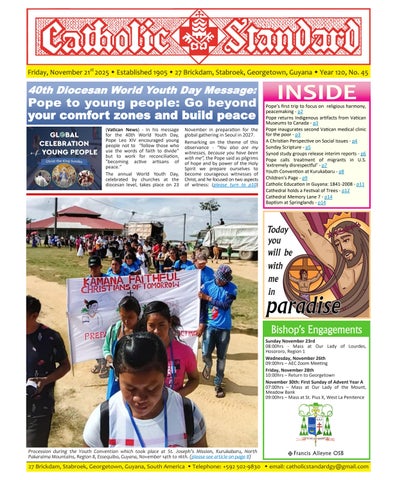
One hundred and ten young people from communities across Region 8 came together over the weekend for a Youth Convention at St. Joseph’s Mission, Kurukabaru, North Pakaraimas, Region 8, Essequibo, Guyana.
Held under the theme ‘Pilgrims of Hope’, the convention began on Friday November 14th with the Mari Marithe beautiful Indigenous traditional dance - accompanied by the young people singing hymns. The participants then engaged in two inspiring sessions: “Pilgrims of Hope” and “God’s Call.”
On Day 2 of the Youth Convention, Saturday, November 15th, His Lordship Bishop Francis Alleyne, OSB, celebrated Holy Mass.
During a special session of the convention, Bishop Francis addressed the young people. The youths openly shared their questions and reflections, creating a meaningful atmosphere of dialogue and learning. The Bishop’s message was reflective, inspiring, and deeply encouraging, leaving the participants uplifted and motivated as they continued their spiritual journey.
The Youth Convention concluded with a beautiful procession that brought together the young people and the wider community, followed by a meaningful celebration of Holy Mass and a joyful concert.
During the procession, participants reflected deeply on the theme “Pilgrims of Hope,” reminding everyone that they continue their journey together with faith, courage, and unwavering trust in God’s guiding presence. (Adapted from Catholic Media Guyana FB).❖


Dear Girls and Boys,
Today's Gospel reading is about a King who was born many years ago. This king was different from most. What made this king different? Well, for one thing, he didn't live in a palace. He didn't wear a beautiful robe or a jewelled crown. He had no servants to wait on him and no soldiers to fight his battles. He didn't even have a country over which to rule and there were no coins engraved with his face or his name.
We imagine that most of you have probably guessed who this king is. The King is Jesus. He is not just any king, he is the King of Kings. His kingdom is not on earth, his kingdom is in heaven. That is why many people never chose to make him their king. When Jesus was here on earth, the people were all looking for a king who would set up a kingdom on earth. A kingdom where they would share the wealth and power.
Jesus finally wore a crown, but it was a crown of thorns. A cross became his throne and above his head was a sign for all to read, "This is the King of the Jews."
Some people still do not recognize Jesus as King. But all around the world today the Word is spoken, "Jesus Christ is still the King of Kings." ❖


“ receive from God as a gift, and our commitment to be builders of peace in society.
Friends, therefore witnesses
Explaining that Christian witness arises from friendship with the Lord, who was crucified and rose for the salvation of all, the Pope said, “This witness is not to be confused with ideological propaganda, for it is an authentic principle of interior transformation and social awareness.”
Jesus, he continued, fully knows who we are, our hearts and our indignation in the face of discrimination and injustice.
“He does not want us to be servants, nor ‘activists’ of a political party; he calls us to be with him as friends, so thatourlivesmayberenewed.”
He added that “His example reminds us that true witnesses do not seek to occupy the centre stage, nor to bind their followers to themselves. True witnesses are humble and inwardly
to speak the truth to everyone, even in the presence of those who are powerful.”
Thus, he added, true Christian witness is recognising and pointing to Jesus when he appears, as he is the only one who saves us.
To that end, Pope Leo said, “Pope Francis insisted so often that if we do not go beyond ourselves and our comfort zones, if we do not go to the poor and those who feel excluded from the Kingdom of God, we cannot encounter Christ and bear witness to him.”
Witnesses, therefore missionaries
The Holy Father then reminded young people to never forget that many of their peers “are exposed to violence, forced to use weapons, separated from their loved ones, and compelled to migrate or flee. Many lack education and other essential goods.”
pressures, the difficulty of dealing with family crises, the painful feeling of a lack of opportunities, as well as the remorse for mistakes they have made.
”
“You can stand alongside other young people, walk with them and show that God, in Jesus, has drawn close to each person,” he affirmed.
And he invited young Christians to continue to seek out Jesus’ friends and witnesses in the Bible who show us how they discovered the true meaning of life through their living relationship with Christ.
“Indeed, our deepest questions are not heard or answered by endlessly scrolling on our cell phones, which captures our attention but leaves us with tired minds and empty hearts,” he said, adding that “The fulfilment of our authentic desires always comes through going beyond ourselves.”
ness and make efforts to nurture bonds of friendship and fraternity, working together to build new living conditions for all.
“Do not follow those who use the words of faith to divide; instead, make plans to remove inequalities and reconcile divided and oppressed communities,” he said.
Dear young people, dear friends, the Pope concluded, “Let us listen to the voice of God within us and overcome our selfishness, becoming active artisans of peace.”
“That peace, which is a gift of the risen Lord will become visible in the world through the common witness of those who carry his Spirit in their hearts.”❖
The full message may be found at https://www.vatican.va/content/leoxiv/en/messages/youth/ documents/20251007-messaggio-xlgmg.html


One of the major events of this Jubilee Year was the Jubilee of the World of Education, which took place in Rome from October 27 to November 1. To commemorate this, Sr. Marie Harper OSU, the first Principal of Marian Academy, has provided the following talk which was given by the late Professor Sr. Mary Noel Menezes RSM PhD at a Dinner in September 2008 held to mark the 10th Anniversary of the re-establishment of Catholic education in Guyana:
“Since brevity is the soul of wit" Shakespeare said so well, I will attempt to be brief. But how can one encapsulate the history, not only of the Ursuline Sisters in Guyana but of the other religious bodies - the Society of Jesus, the Mercy Sisters, the Carmelite Sisters in a mere afterdinner talk?
The history of Catholic education in Guyana obviously follows the history of the Catholic Church. How truly Robert Ricard grasped the truism: "Nothing," he wrote in his SPIRITUAL CONQUEST OF MEXICO, "is more evident in the stabilization of the Church than the importance of the school." In British Guiana, the CATHOLIC Church did not get off to a brilliant start; there were very few Catholics in the colony at the time of the British take-over in 1803. In 1825 the first Catholic Church was built in Brickdam - the number of Catholics still miniscule. Ten years later the Madeiran Portuguese immigrants arrived-all mostly Catholic and desirous of priestly services. There was a crucial need for a free school for the education of poor children. Dr William Clancy, the newly appointed VicarApostolic in 1837, was keen on getting a start in education and made proposals to the Home Government to erect 3 school houses, one in Georgetown, one in New Amsterdam and one in Essequibo and to bring out religious at his own expense. He met with objections from the Catholic Committee but overriding these objections Clancy in 1841 had the distinction of bringing the first religious sisters into the colony - six Presentation sisters from Cork, Ireland, who immediately opened a school for poor children. The saga of this first convent of religious Sisters on the Continent of South America and the first Catholic School is replete with a history of contradictions and maledictions. The Sisters did begin to teach but whatever good they accomplished was counterbalanced and militated against by the Catholic Committee, although Governor Henry Light had praised the work of the Sisters when he visited the conventand school.
1841

unimaginable friction and schism in the Catholic Church, Revd. Hynes, a previous Vicar 1843 to dislodge both Revd. Clancy and the Presentation Sisters. It was what Governor Light would dub... "a great scandal to Christianity."
This year, 2008, the Catholic Church and Catholic education have come a long way since the trials and tribulations of the early 19th century. This year, 2008, we celebrate an auspicious ten years of outstanding service to education in Guyana by the Marian Academy - in the Light of Wisdom. Should we be surprised, amazed at such a record? Not at all. The Ursuline Sisters have had a long, wellestablished, meritorious history in Catholic education in Guyana.
At the invitation of Revd. Hynes on 1 July 1847, six Ursuline Sisters and 2 postulants arrived in British Guiana. Their purpose - to carry out the original mission of their Order - the education of young girls. On the Feast of St. Rose of Lima (hence St. Rose's) 31 August 1847, the Sisters opened the first Secondary School for girls in the colony. Shortly after boarders were admitted and by 1851 St. Angela's School to educate the girls from St. Ann's Orphanage and the poor girls of the neighbourhood. In 1883 St. Ursula's School of Portuguese Catholic girls followed in 1890 by St. Mary's Secondary School in New Amsterdam, Berbice. It was heartening to know that the boys were remembered and in 1899 a prep School - St. Joseph's was established for the 4-10 year olds. Indeed, as Sr Jacqueline Da Silva stated many of the Colony's professional and businessmen began their education at St. Joseph's. Over those fifty years the Ursuline Sisters led the way in Catholic education. In mid-century, 1857, the Ursuline Sisters were joined in the educational enterprise by the Society of Jesus whose priests opened St Stanislaus College, a real boon in the education
of economic decline, the need for education among the immigrant classes was vital. The Sisters arrived from Barbados on 23rd April 1894, settled in Charlestown and opened Carmel R.C. School in one of the poorest areas in the country catering to children of various ethnic groups and having to playacombinationof roles - teacher, nurse, magistrate, peacemaker, adviser to parents. In the late 1890s, a Portuguese school for girls and a Sacred Heart Boys' School was established. In 1923 they were called to take charge of St. Mary's Roman Catholic School. Fifty years after the Ursuline Sisters pioneered Secondary Catholic education the Mercy Sisters followed in their footsteps, opening St. Joseph High School in a part of their conventinCharlestown
By the end of the century the Sisters had moved into the interior of the country facing untamed jungle inhabited by gentle people, our Amerindians at Santa Rosa, Takutu, Morawhanna, Hosororo, Koriabo and Mabaruma. Other schools which came under the influence of the Sisters of Mercy were Henrietta, Essequibo, Belfield, and St Winifred's, Newtown, Kitty and St John's Roman Catholic, Plaisance. As with the Order of St. Ursula (OSU) education was always a key priority, an important norm of their foundress, of the Religious Sisters of Mercy, CatherineMcAuley.
Let us leave the Sisters of Mercy and turn all our attention to Marian Academy. Indeed, a beacon in the dark night of education in Guyana today. Marian Academy has had an unusual and unique history. Since the takeover of the denominational schools by the Government of Guyana in 1976 the church, both religious and laity, had been deeply concerned over the
erosion of morals in the society. In "Send God back to School" by Roxana Kawall in the CATHOLIC STANDARD enkindled the spark that flamed into a fire of action involving the Ministers of Government, Bishop Singh, the religious communities, the Catholic laity and many other non-Christians who long realized and benefitted from the tenets of sound education.
In 1998 the Ursuline Sisters with a long, outstanding service in education, rightly took up the torch. Meetings to plan action and policy got off the ground, ably chaired by Sr Jacqueline Da Silva, OSU. The response was overwhelmingly supportive; hurdles with the government were leapt over. Our renowned Sr Marie Harper, OSU, with an exceptional background in teaching and administration was selected as Principal - an extremely wise selection as the past years have proven. Before your eyes today you witness the results of ten years of admirable achievements in the field of education. There is NO doubt whatsoever that Marian Academy leads the way in education in today's Guyana in every area of education, nursery, primary and secondaryin every facet of education, in cultural arts, language, sciences, sports, community activities. The late David De Caires rightly called Marian Academy: "a magnificent enterprise". Over the ten years the enterprise has become even more magnificent. Never have we needed such an establishment in education today at a time when this country is mired in crime, violence and immorality. Marian Academy is the hope of our children's future. The success of the school has moved beyondyourwildestdreams.
May you continue, Sr. Marie Harper, the Board of Governors, parents, teachers and friends to grow from strength to strength, educationally and morally, in the Light of Wisdom, surrounded and enmeshed in God's love and enriched with his Blessings. Your teaching here is indeed LOVE MADEVISIBLE.❖

from above, displays by: Our Lady of the Mount Church, Meadow Bank; the Missionary Childhood Association; and Marian Academy at the Festival of Trees.
On Monday November 17th and Tuesday 18th, the Cathedral of the Immaculate Conception, Brickdam, was resplendent with a Festival of Trees. Decorated trees on a variety of themes done by parishes and other organisations were on display inside the cathedral. Most of the displays were artificial Christmas trees, but a few were natural.
In addition to the display of trees, persons were treated to a wide range of live music throughout both days, including organists and the Guyana Police Force Band MS playing classical and contemporary music, hymns, Christmas music, patriotic songs, music on the steel pan, and beloved classics.
The Festival of Trees was one of the activities held to celebrate the centennial of the official opening of the Cathedral, which takesplace in December.
The Cathedral had previously held A Festival of Flowers in 2015, 2004 and 1989 to mark the 100th, 90th, & 75th anniversaries (of the beginning of construction [1914] and laying of the foundation stone [1915]), as well as “A Day of Music’ in 1999 to mark the85th anniversary. ❖


By Francis Canzius
The old Pipe Organ in the Cathedral was imported from J.W. Walker & Sons of London and installed in the gallery on the south side of the sanctuary. It was blessed at Easter 1931 by Bishop Compton Theodore Galton SJ. The organ had contained several
ranks of pipes totaling 1,200. The first organist was Mr. Harold Gadd followed by Ms. Olga Stonehouse and after by Mr. Michael Pereira along with Ms. Jane de Freitas. Michael Pereira had been the longest-serving organist. The organ was decommissioned in 1993 owing to the high cost of maintenance.
In 1993 a new Allen Organ was
purchased and installed. This has now (in 2025) become unserviceable despite many attempts by overseas technicians to repair it, and can no longer operate as it should. For the present, a Yamaha keyboard has been put into service.
Sadly, there are no longer any functioning Pipe Organs in Guyana. ❖


November 24th
On June 19th 1988, Pope John Paul II canonized a group of 117 martyrs who died for the Roman Catholic Faith in Vietnam during the nineteenth century. The group was made up of ninety-six Vietnamese, eleven Spaniards, and ten French. Eight of the group were bishops, fifty were priests and fifty-nine were lay Catholics. Some of the priests were Dominicans, others were diocesan priests who belonged to the Paris Mission Society.
St. Andrew Dung-Lac, who represents this group of heroes, was a Vietnamese diocesan priest. He came from a poor, non-Christian family and was taught by a Christian lay catechist. He worked in the missions with the priests of the Foreign Mission Society of Paris. He was imprisoned and repeatedly tortured during the persecutions of Minh-Meng, the emperor of Vietnam between 1820 and 1840 who was famed for his persecutions of the Christians. Among the many Vietnamese and international martyrs who died alongside St. Andrew Dung-Lac was Saint Peter Thi.
This feast day, and the witnesses of the lives of the martyrs, give testament to the sufferings inflicted on the Vietnamese Church, which are among the most terrible in the long history of Christian martyrdom .❖
