November 14th 2025_Catholic Standard

Page 1


for the poor, says pope in message

VATICAN CITY (CNS) Christian hope must move beyond comforting words to real responsibility and structural change to uplift the poor, Pope Leo XIV said in his message for the 2025 World Day of the Poor.

“We must never forget that we were saved in this hope, and need to remain firmly rooted therein,” the pope wrote in the message, released June 13 and titled after Psalm 71: “You are my hope.”

Marking the ninth annual

trials, our hope is inspired by the firm and reassuring certainty of God’s love, poured into our hearts by the Holy Spirit.”

The pope warned against relying on wealth or power and said that “the poor can be witnesses to a strong and steadfast hope, precisely because they embody it in the midst of uncertainty, poverty, instability and marginalization.”

The city of God “impels us to improve the cities of men and women” Calling spiritual neglect the gravest poverty, Pope Leo cited Pope apostolic exhortation

First laundry for the poor under Pope Leo - p2

Caring for creation is part of peacemaking, pope tells COP30 - p3

A Christian Perspective on Social Issues - p4

Sunday Scripture - p5

Pope’s November Prayer Intention - p6

AishaltonsaysfarewelltoFr.JoelThompsonSJ - p7

Mary, mother of Jesus and all believers, is not co-redeemer, Vatican says - p8

Children’s Page - p9

Growing in Grace Week 72 - p10

At education Jubilee, Pope Leo names St. John Henry Newman ‘doctor of the church’ - p11

World Day of the Poor, an examination of conscience - p12

Cathedral Memory Lane 6 - p12

Congrats Sister Carla! - p14

The Joy of

Monday November 17th to Tuesday 18th

Visit other communities inKurukubaru

Wednesday November 19th

Return to Georgetown

Friday November 21st

07:00hrs – Travel to Hosororo

Sunday November 23rd

08:00hrs - Mass at OurLady ofLourdes

The Jubilee Prayer

Ahead of World Day of the Poor, first laundry for the poor under Pope Leo opened in Parma

Father in heaven, may the faith you have given us in your son, Jesus Christ, our brother, and the flame of charity enkindled in our hearts by the Holy Spirit, reawaken in us the blessed hope for the coming of your Kingdom.

May your grace transform us into tireless cultivators of the seeds of the Gospel. May those seeds transform from within both humanity and the whole cosmos in the sure expectation of a new heaven and a new earth, when, with the powers of Evil vanquished, your glory will shine eternally.

May the grace of the Jubilee reawaken in us, Pilgrims of Hope, a yearning for the treasures of heaven. May that same grace spread the joy and peace of our Redeemer throughout the earth.

To you our God, eternally blessed, be glory and praise for ever.

Amen

(OSV News) During the pontificate of Pope Francis, the papal laundries for the poor were traditionally named after the pope. Pope Leo XIV asked that during his pontificate, they be named afterSt.Francis of Assisi.

The first such laundry room under Leo was opened in the northern Italian city of Parma on Nov. 6, only daysaheadof World Dayof the Poor.

“It seems a small thing,” Cardinal Konrad Krajewski, longtime papal almoner and prefect of the Dicastery for the Service of Charity, told OSV News. But for the poor “to have a place to wash their clothes and change them is something that transforms lives,” he emphasized.

The laundry room in Parma opened after Mass, which was followed by a lunch for those in need, in the presence of a “fantastic team of people who show a real joy of working together for the poor” including the local diocesan Caritas, the mayor of Parma and the regionalprefect.

“It will not be the solution to world poverty, which must be sought with intelligence, tenacity, and social commitment. But we need to practice almsgiving to touch the suffering flesh of the poor,” Cardinal Krajewski said in a Nov. 6 press release from

the Vatican’s charity office.

“The place is incredible really well done, like a home,” the papal almoner told OSV News. Northern Italy’s Parma, famed for Parmesan cheese and Parma ham, is a university city not only full of foreign nationals, but also migrants, who will also use the laundry room.

“This inauguration,” Bishop Enrico Solmi of Parma said, “represents a precious piece that completes the mosaic of Caritas’ care and services for people in need, in their various basic needs.”

“Thank you to the people who come to us asking for help,” the bishop said. They “are a constant appeal to remain humanand to make our coexistence more humaneandjust.”

Supported by Procter & Gamble, which provided laundry detergents for the whole year, the initiative follows in the footsteps of Pope Francis’ Laundries, now widespread in various partsof Italy, includingRome.

The first one opened in the Eternal City in 2017, followed by Genoa, Turin, Naples, Catania and San Ferdinando in Reggio Calabria. The laundries are “places where the needy and homeless can find everything

Catholic Standard

For 120 years, the Catholic Standard has been sharing the Gospel of Jesus Christ.

Now reaching 10,000+ followers on Catholic Media Guyana Facebook plus going straight to your inbox and WhatsApp, our vibrant weekly e-paper is a trusted source which delivers informative and inspiring stories from across the diocese and around the world. Want to promote your business or event? Advertise with us! Call 675-4542 or email catholicstandardgy@gmail.com ❖

they need for personal hygiene and laundry free of charge, including access to shower facilities,” the Vatican’s press release said.

“It gives them back their dignity,” Cardinal Krajewski said of the place.

“The needy don’t have washers, and the fact that they will be able to wash their clothes really changes the way society treats them. They are not different from others on the streets when their clothes are clean,” and they can also “use showers at the same time” in the provided space.

Il Poverello or “The Little Poor

One” as St.Francis is called in Italy was quoted several times in Pope Leo’s first apostolic exhortation, “DilexiTe” (“I have loved you”).

“By embracing poverty, he wanted to imitate Christ, who was poor, naked and crucified,” the pope said in the document that was started by Pope Francisand finishedby Pope Leo.

“Francis did not founda social service organization, but an evangelical fraternity,” the pope said in “DilexiTe.”

“In the poor, he saw brothers and sisters, living images of the Lord. His mission was to be with them, and he did so through a solidarity that overcame distances and a compassionate love,” he said, adding that “Francis’ poverty was relational: it led him to become neighbor, equal to, or indeed lesser than others. His holiness sprang from the conviction that Christ can only be truly received by giving oneself generously to one’s brothers and sisters.”

The laundry in Parma was opened only days ahead of the Nov. 16 Jubilee of the Poor, celebrated during the World Day of the Poor, established by Pope Francis.

In his message for the 2025 World Day of the Poor, released June 13 and titled after Psalm 71’s “You are my hope,” the pope said that Christian hope must move beyond comforting words to real responsibility and structural change to uplift the poor.

“We must never forget that we were saved in this hope, and need to remain firmly rooted therein,” the pope wrote in the message.

Love for the poor is often underlined by PopeLeo.

On Aug. 17, spending the day with the poor, Pope Leo XIV prayed that Catholics would make sure their parishes are welcoming of all people and would be “on fire” withGod’s love.

In his apostolic exhortation “Dilexi Te,” promulgated Oct. 9, Pope Leo XIV has taken up the call of Pope Francis for Christians to see in the poor the very face ofChrist and to be a church that “walks poor with the poor” in order to authentically live out theGospel.

The exhortation “to all Christians on love for the poor,” explores the topic through the lens of Scripture, church teaching and the witness of the saints.❖

The first laundry room for the poor under Pope Leo XIV was opened in the northern Italian city of Parma on Nov. 6, 2025, only days ahead of the 2025 World Day of the Poor on Nov. 16. (OSV News photo/courtesy Dicastery for the Service of Charity)

peacemaking, pope tells COP30

VATICAN CITY (CNS) “If you want to cultivate peace, care for creation,” Pope Leo XIV told global leaders attending the U.N. Climate Conference in Brazil.

As the international community rightly focuses on resolving war and conflict, countries must recognize that “peace is also threatened” by climate change and environmental destruction, the pope said in a message to the Leaders Summit of COP30 in Belem, Brazil.

Threats to peace are heightened “by a lack of due respect for creation, by the plundering of natural resources and by a progressive decline in the quality of life because of climate change,” said the message, read to the assembly Nov. 7 by Cardinal Pietro Parolin, Vatican secretary of state and head of the Vatican delegation to COP30.

Pope Leo quoted Pope Benedict XVI’s message for World Peace Day 2010: “The quest for peace by people of goodwill surely would become easier if all acknowledge the indivisible relationship between God, human beings and the whole of creation.”

Climate change, pollution and the destruction that follows the thoughtless exploitation of natural resources have a global impact, Pope Leo said, and they “endanger the lives of everyone on this planet.”

Pope Leo also quoted St. John Paul II’s message for World Peace Day 1990, which said that “the ecological crisis ‘is a moral issue’ and, as such, it ‘reveals the urgent moral need for a new solidarity, especially in relations among

the developing nations and those that are highly industrialized.'”

“Tragically,” Pope Leo said, “those in the most vulnerable situations are the first to suffer the devastating effects of climate change, deforestation and pollution. Caring for creation, therefore, becomes an expression of humanity and solidarity.”

The pope asked the global leaders gathered in Brazil to work together to achieve a concrete plan that puts “the sacredness of life, the God-given dignity of every human being and the common good at its center.”

“Regrettably,” he said, “we observe political approaches and human behaviors that go in the opposite direction, characterized by collective selfishness, disregard for others and shortsightedness.”

The U.S. government was not represented at COP30 because U.S. President Donald Trump withdrew the country from the Paris Agreement adopted in 2015 at the U.N. Climate Change Conference, also known as COP21.

Quoting a homily he gave in July, Pope Leo said, “‘In the midst of a world that is in flames, as a result of both global warming and armed conflicts,’ this Conference should become a sign of hope, through the respect shown to the views of others in the joint endeavor to search for common language and consensus, while putting aside selfish interests, bearing in mind the responsibility for one another and for future generations.”

Prayer inspired by Pope Leo’s message for the ninth World Day of the Poor

Sunday,

November 16th 2025

O God, Father of all the living, You are the God of hope. Our rock and our fortress, You are our steadfast support. In You we take refuge amid the trials of life. You are our first and only hope, our companion on the journey. We are in need of You of Your friendship, Your blessing, Your Word, and the celebration of the Sacraments that we may grow and mature in faith. In You we find our true treasure; without You, whatever we possess only leaves us more empty.

O Lord Jesus, Word made flesh, You embraced our poverty to make all rich through our voices, our stories, and our faces. By our lives, and by the words and wisdom You have entrusted to us, may we invite all to experience the living truth of Your Gospel. Increase our faith in You, who have saved us by Your death and resurrection, and who will come again to dwell among us. May our hearts ever remain fixed on You, our one and only hope.

The pope prayed for an “ecological conversion” that would include recognizing the need for a “new humancentered international financial architecture that ensures all countries, especially the poorest and those most vulnerable to climate disasters, can reach their full potential and see the dignity of their citizens respected.”

Greater efforts also need to be made to promote “an education in integral ecology” that would help everyone understand how their personal, family and political decisions “shape our common future, while raising awareness of the climate crisis and encouraging mindsets and lifestyles to better respect creation and safeguard the dignity of the person and the inviolability of human life,” the papal message said.

Pope Leo prayed that all the participants at COP30 would “commit themselves to protecting and caring for the creation entrusted to us by God in order to build a peaceful world.”❖

O Holy Spirit, love of the Father and the Son, You awaken in us the longing for the heavenly city. Enlighten and strengthen our Christian brothers and sisters, that they may work for the good of our earthly cities, making them, even now, a reflection of our blessed homeland. Grant that all men and women of good will may face and remove, on an international level, the structural causes of poverty, creating new signs of hope and bearing witness through concrete acts of charity to the love You mysteriously pour into their hearts.

O Most Holy Mary, Consoler of the Afflicted, and Saint Anthony of Padua, Patron of the Poor, pray for us, that this Jubilee Year may foster the development of policies to combat both old and new forms of poverty, and inspire new initiatives of assistance and solidarity for the poorest among us, so that all may have a home, food, medical care, andeducation. Amen!

[Dicastery forEvangelization]

Cardinal Pietro Parolin, far right on the bottom row, joins world leaders for a group photo Nov. 7, 2025, during COP30, the U.N. Climate Change Conference, in Belem, Brazil. (CNS photo/Antonio Scorza, COP30)

A Christian Perspective on Social Issues

The foreign brigade

I am a migrant. Know what it is be cursed, called foul names. Heard those in the fury of the addicted and drunken. How people like me should be chased all the way back to where I came from, never to return. Though as far back as decades ago, I still hear those echoes, reencounter those few distant circumstances every now and again, when sleep is deep. Now back in this homeland, migrants are on national radars. Individual and communal ones, too. Who looks like what? Who is capable of what, could be a clear and present danger lurking, waiting for ambushing Guyanese when they are least looking?

It is a dark time. Foreigners are on the frontline of broad national scrutiny. Venezuelans occupy first place. Unfortunate, but the way that that border matter grows with energy, spins out of control. How far will this staring, suspecting, denouncing go? There are a lot of them here, not easily separated from the thick pack of foreigners hustling to Guyana seeking economic opportunity. Economic migrants, is the name given to them; at least, the genuine ones, who only want to make an honest dollar, so as to send some of those back to their families. Many Guyanese know about that also, having fled from pillar to post, and to wherever else would accept a man or woman from Bee Gee. The life of a migrant is not an easy duty. Take that from me been there, done that, know such a state of living. Now all eyes are on Venezuelans. May it not be a time of paranoia, seeing threats that don’t exist under every rock. The imagination can be a gift. It can also be a terrifying burden, with the worst fears stalking. Is he? What about she? I see them hurrying on the streets in the hours prior to sunrise, when many Guyanese are still sleeping, merely stirring. Backpacks on their shoulders, a swift stride gliding them to their destination. The sounds of Spanish are heard from government offices. Construction. The same from private projects; more construction on the move. The other day, there was a small leak with the water supply, and who were the workers contracted and sent? Venezuelan plumbers, according to their Guyanese boss. I go to church to worship, and there they are in their numbers. They are the best at praying and worshipping. Was fascinated by that spiritual aura, that religious intensity, in different parts of America. Little did I know that the same would be found right here.

What to do with them? How to treat them? Tensions have crawled high on the thermometer. Following that bomb blast from the last Sunday in October, the first rush to find the first suspects has only one national identifier. The conditions are as raw as that in Guyana currently, the conclusions likely to be sharper and stronger. There is precedent now, and it was in Georgetown, not some infiltration and violent action deep in the interior. It is striking at the soul of Guyanese, a dagger straight into the eye. It will require a considerable degree of maturity and national responsibility to manage these situations well. Regrettably, I believe that the first incident may not be the last. Yet, the last objective on my part is not to add to local uneasiness. There are enough challenges in the domestic space. Why make matters worse, however unintentionally, however wellmeaning?

There is a choice before all Guyanese. Bury heads in the sand, and pretend that all is well. Or, be sensible, and recognize that this country (this region) is now existing on a different plane. Some of it has external origins. The trouble for Guyana is that there is no separating of what is driven from afar, to what has been a tense part of the local atmosphere.

Land and resources lead to such contentiousness. Nonetheless, there is still a duty to be welcoming, understanding and caring. That must come from the migrant in me. The worst must not be thought of brothers, sisters, and neighbors, as a product of automatic reflex. A law and distressed, brother, sister, and neighbor must first be seen, and not an enemy. The first is godly; the latter is unsightly. I think that, as deep thinking, Christlike, citizen, this can be done. An effort would be required, but it must be made. Having had the benefit of others, strangers, looking out for me in sometimes hostile places, I try to return the favor now. My prayer is that others who call this land their birthright will also be so inclined. Amen.

Prayer for our Priests

Gracious and loving God, we thank your for the gift of our priests. Through them, we experience your presence in the sacraments.

Help our priests to be strong in their vocation.

Set their souls on fire with love for your people.

Grant them the wisdom, understanding, and strength they need to follow in the footsteps of Jesus.

Inspire them with the vision of your Kingdom.

Give them the words they need to spread the Gospel. Allow them to experience joy in their ministry.

Help them to become instruments of your divine grace.

We ask this through Jesus

First Reading: Malachi 3:19-20

For you the sun of righteousness will shine out.

The day is coming now, burning like a furnace; and all the arrogant and the evil-doers will be like stubble. The day that is coming is going to burn them up, says Yahweh Sabaoth, leaving them neither root nor stalk. But for you who fear my name, the sun of righteousness will shine out with healing in its rays.

Responsorial Psalm: Psalm 97

Response: The Lord comes to rule the peoples with fairness.

1. Sing psalms to the Lord with the harp with the sound of music. With trumpets and the sound of the horn acclaim the King, the Lord. Response

2. Let the sea and all within it, thunder; the world, and all its peoples. Let the rivers clap their hands and the hills ring out their joy at the presence of the Lord. Response

3. For the Lord comes, he comes to rule the earth. He will rule the world with justice and the peoples with fairness. Response

Second Reading: 2 Thessalonians 3:7-12

Do not let anyone have any food if he refused to do any work.

You know how you are supposed to imitate us: now we were not idle when we were with you, nor did we ever have our meals at anyone’s table without paying for them; no, we worked night and day, slaving and straining, so as not to be a burden on any of you. This was not because we had no right to be, but in order to make ourselves an example for you to follow.

We gave you a rule when we were with you: not to let anyone have any food if he refused to do any work. Now we hear that there are some of you who are living in idleness, doing no work themselves but interfering with everyone else’s. In the Lord Jesus Christ, we order and call on people of this kind to go on quietly working and earning the food that they eat.

Today’s readings are filled with predictions and warnings. In particular the Gospel from Luke that quotes Jesus about what we might expect if

:

Your endurance will win you your lives.

21:5-19

When some were talking about the Temple, remarking how it was adorned with fine stonework and votive offerings, Jesus said, ‘All these things you are staring at now the time will come when not a single stone will be left on another: everything will be destroyed’. And they put to him this question: ‘Master,’ they said ‘when will this happen, then, and what sign will there be that this is about to take place?’

‘Take care not to be deceived,’ he said ‘because many will come using my name and saying, “I am he” and, “The time is near at hand”. Refuse to join them. And when you hear of wars and revolutions, do not be frightened, for this is something that must happen but the end is not so soon.’ Then he said to them, ‘Nation will fight against nation, and

we truly strive to be His disciples and good stewards of His Word. Jesus says, “…they will seize and persecute you; they will hand you over to the synagogues and to prisons, and they will have you led before kings and governors because of my name.”

That all sounds grand and dramatic, but the truth is that Jesus is warning us of something far more subtle. If we truly strive and try to be the Lord’s disciples, we may well be persecuted

kingdom against kingdom. There will be great earthquakes and plagues and famines here and there; there will be fearful sights and great signs from heaven.

‘But before all this happens, men will seize you and persecute you; they will hand you over to the synagogues and to imprisonment, and bring you before kings and governors because of my name –and that will be your opportunity to bear witness. Keep this carefully in mind: you are not to prepare your defence, because I myself shall give you an eloquence and a wisdom that none of your opponents will be able to resist or contradict. You will be betrayed even by parents and brothers, relations and friends; and some of you will be put to death. You will be hated by all men on account of my name, but not a hair of your head will be lost. Your endurance will win you your lives.❖

not only by secular forces, but also by religious forces. The Lord’s point is that we must be prepared to endure and be patient.

The Gospel closes with Jesus saying, “By your perseverance you will secure your lives.” The whole idea of endurance and patience is a common theme for Jesus (and for St. Paul in his many letters as well). In the Gospel the original Greek word that we translate into “perseverance” is

hupomone. The meaning of this word is not passive, not a patient waiting so to speak. We endure because of the promises of Christ.

It is these “promises” that give us the strength and hope to practice stewardship, to be good stewards. St. Teresa of Calcutta said, “Without patience we will learn less in life. We will feel less. We will hear less. Ironically, rush and more usually mean less.” ❖ [www.catholicsteward.com/blog/ ]

Gospel
Luke

Gospel Reflection

Today’s Readings all speak to us about our attitude and behaviour towards the “end-times”. To be a follower of Jesus is to be a person of hope. We do recognise that this world will end. We do not know when this will happen. We live in hope of the world to come. This quality of hopefulness is a vital part of our day-to -day living. As Christians this quality of hopefulness gives greater meaning to our lives. Our responsibilities in this life include sharing this hope with others. Quite often we hear others say that the end is very near. Their message warns us of the signs of evil all around us and of the horrors of tomorrow. Jesus’ teaching reminds us, and Paul’s letter tells us, to keep our minds on the saving power of Christ and on the God‘s presence in difficult times.

We must not fail to recognise God’s presence among us now. God has come to us in Christ and the Lord remains with us. Jesus’ words and presence are our strength to live by today. When we are aware of his presence we have nothing to be afraid of. However, if we become so taken up with worrying about the “endtimes” we will not be able to feel Christ’s presence in our time and so can hardly share in his message of hope and love. Jesus never told his followers to live their lives in a world apart where they would be safe, secure and comfortable. He sent them out into the real world where they would be needed. In spite of this, many of us try to keep ourselves free from the world and the evil there. But good is also found in the world. ❖

[From: Journeying with the Word of God, The Religious Education Department, DioceseofGeorgetown, Guyana ]

Pope Leo XIV, in a screen grab from a video recorded in the Villa Barberini at Castel Gandolfo, Italy, calls on Christian communities to support those struggling with suicidal thoughts. The video was released Nov. 4, 2025, by the Pope’s Worldwide Prayer Network. For the month of November, the pope invited Catholics to pray that people experiencing despair may find care, love and hope in their communities. (CNS photo/screen grab, Pope’s Worldwide Prayer Network)

VATICAN CITY (CNS) Pope Leo XIV has asked Catholics to join him in praying for those who struggle with suicidal thoughts, and for all people “who live in darknessand despair.”

“May they always find a community that welcomes them, listens to them and accompanies them,” including by offering comfort, support and “necessary professional help,” he prayed.

The pope’s video sharing his prayer intention for November was distributed Nov. 4 by the Pope’s Worldwide Prayer Network.

“Let us pray that those who are struggling with suicidal thoughts might find the support, care and love they need in their community, and be open to the beauty oflife,” he said in the video.

“May we know how to be close with respect and tenderness, helping to heal wounds, build bonds and open horizons,” Pope Leo said. “Together, may we rediscover that life is a gift, that there is still beauty and meaning, even inthemidstofpainandsuffering.”

“We are well aware that those who follow you are also vulnerable to sadness without hope,” hesaid.

The pope prayed that the Lord would “always make us feel your love so that, through your closeness to us, we can recognize and proclaim to all the infinite love of the Father who leads us by the hand to renew our trust in the life you giveus.”

Choosing suicide prevention as his prayer intention for the month of November coincided with an international conference titled, “Ministry of Hope: International Catholic Forum on Mental Well-being,” being held inRome Nov. 57.

Organized by the International Association of Catholic Mental Health Ministers and under the patronage of the Pontifical Academy for Life, the conference was to discuss how the Christian community can accompany people who struggle with mental health issues, depression and extreme pain, and how to prevent the risk of suicide through listeningand closeness.

The November video was filmed in the Diocese of Phoenix, Arizona, which has made mental health a pastoral priority with an office dedicated to mental health ministry. The diocese celebrates an annual Mass of remembrance for those who have died by suicide and seeks to provide safe spaces for listening, to share clear guidance on how to help someone in crisis and to lead public campaigns to reduce the stigma surrounding mental illness.

Bishop John Dolan of Phoenix told the Pope’s Worldwide Prayer Network, “I have personally walked the difficult road of suicide loss,” having lost a brother, two sisters and a brother-inlaw to deathby suicide.

“There are certain wounds and mysteries that we cannot comprehend. And yet, we hope,” trusting in a loving Father “who holds our loved ones near, and we turn to one another, walking forward together as companions on the journey,” he said.

“If you feel broken, if you are struggling with suicidal thoughts, know that you are deeply loved and the Church is here for you. You are not alone.”

The Catechism of the Catholic Church (2280-2283) teaches that suicide contradicts love of self, others and God. However, it also recognizes that “serious psychological disturbances, anxiety, or fear of hardship, suffering, or torture can diminish personal

responsibility,” the prayer network said in a press release.

The church “invites us not to despair of the eternal salvation of those who have taken their own life, but to entrust them to God’s mercy and to the community’s prayer,” it said.

“The general practice of the church today is to treat very respectfully those who have died by suicide, partly because in recent years, the church has progressively grown in its attentiveness to mental health, both through prayer anditspastoral care,” itadded.

Jesuit Father Cristóbal Fones, international director of the Pope’s Worldwide Prayer Network said, “The church is not a substitute for healthcare professionals psychologists, doctors, therapists. It can carry out an important role by offering proximity, listening, andhope.” Catholics can learn in their parishes and dioceses how to reach out to those who suffer, comfort those who are sad, take care of each other and share in Christ’s hope, he said in the press release.

Each month, the prayer network’s Click To Pray app, has a day dedicated to praying to support those who are going through a particularly vulnerable time, he added.

The World Health Organization estimates that more than 720,000 people die due to suicide each year. In the United States, the current suicide rate is about third higher than it was in 2000. About 56% of those who choose to end their life are under the age of 50, with suicide being the third leading cause of death among people 15 to 29 years old.❖

Journeying with the Word of God

munity of St. Robert Bellarmine, Aishalton, Deep South Rupununi, Region 9, Essequibo, Guyana, said goodbye to their Parish Priest, Fr. Joel Thompson SJ, who, after serving them for three years, will depart Aishalton to continue his Jesuit formation in Tertianship from February 2026.

2022, at the Cathedral of the Immaculate Conception. Apart from his spiritual guidance, he has also contributed to the life of the Church through his work in Catholic media, faith formation, youth ministry, and as a member of the DiocesanPastoral Council.

Known for his down-to-earth spirit, warm presence, and

MAKING THE WORD OF GOD YOUR OWN

Step 1: Lookingattoday’sReadingsprayerfully

1st Reading: The prophet Malachi speaks of that great and terrible Day of Judgement when the wicked will bring down punishment on themselves because of their wrong-doing, while the just will experience God’s healing mercy.

2nd Reading: Some members of the community at Thessalonica thought that the Day of the Lord was near and had given up. Paul speaks out against this attitude.

Gospel: Jesus urges his followers to be faithful in the face of catastrophes that will precede the coming of the Lord.

Step 2: ApplyingthevaluesoftheReadings toyourdailylife.

missionary heart, Fr. Joel continues to walk closely with the people ofGod.

As Fr. Joel embarks on this next stage of his journey, heartfelt prayers and best wishes are extended to him. May the Lord continue to bless, guide, and inspire him in his studies and ministry ahead. (Adapted from Catholic Media Guyana FB).❖

Message for World Day of the Poor (From P1)

which the poor suffer is the lack of spiritual care,” stressing the need to share with the poor God’s “friendship, his blessing, his word, the celebration of the sacraments and a journey of growthandmaturityinthefaith.”

The pope urged all the faithful to embody the Gospel through service and solidarity. The city of God, he said, “impels us to improve the cities of men and women,” and Christian hope is not passive optimism but a mandate to create “new signs of hope” throughcharityandjustice

He urged the church and society to recognize and support structures that support and uplift the poor. Hospitals and schools, he said, were established “to reach out to the most vulnerable and

marginalized” and should be included in “every country’s public policy, yet wars and inequalities oftenpreventthisfromhappening.”

Still, “signs of hope” persist in “care homes, communities for minors, centers for listening and acceptance, soup kitchens, homeless shelters and lowincome schools” quiet efforts that often “go unnoticed and yet are so important for setting aside our indifference.”

“Helping the poor is a matter of justice” While acknowledging the good done through hospitals, shelters and soup kitchens, Pope Leo called for systemic reform.

“Helping the poor is a matter of justice before a question of charity,” he said, quoting St.

Augustine: “It would be better if none were hungry.”

Looking to the conclusion of the Holy Year 2025, Pope Leo said the closing of the Holy Door must not mean an end to action. Rather, in the life of the church the poor remain “creative subjects who challenge us to find novel ways of living out the Gospel today.”

“It is my hope, then, that this Jubilee Year will encourage the development of policies aimed at combatting forms of poverty both old and new, as well as implementing new initiatives to support and assist the poorest of the poor,” he wrote. ” Labor, education, housing and health are the foundations of a security that will never be attained by the use of arms.”❖

1.How can we see a message of hope behind the description of disasters and persecutions in today’s Gospel? What do you see hope as being for you at this time?

2.What do you think of the attitude of the Thessalonians who used the rumours of the coming of the Lord to stop working? Does Paul’s advice make sense then and does it make sense now?

3.The “end-times” speaks to us about the end of the world as we know it. How do you feel when you think of this?

4.“Faith is not a way of wishing or hoping that things were different. Rather, faith gives us the strength to cope with the reality as it is.” What is this statement saying to you?

Step 3: Accepting the message of God’s Wordinyourlifeoffaith

As Christians we do not live in a special world. We live in the real world, a world full of confusion, disasters and trouble of every kind. But it is exactly because we live in the midst of this world that we have to let our Christian faith shine through. Jesus never promised his followers an easy life. Rather, he offered a demanding one. He did promise to be with them always and this offers us hope and confidence to face whatever the future holds for us.

Step 4: Somethingtothink&prayabout

1.Whenever you feel inadequate in the face of suffering or death, remember that all that is important at such times is simple presence. Knowing that there is someone there who cares, makes the world of difference to the sufferer.

2.Pray for all of us Christians that like Jesus we may bring peace, encouragement and hope to all we meet. ❖

[From: Journeying with the Word of God, The Religious Education Department, Diocese of Georgetown, Guyana ]

Pope Leo XIV prays in the chapel with the Marian icon of “Salus Populi Romani” (health of the Roman people) in the Basilica of St. Mary Major in Rome, Nov. 3, 2025. (CNS photo/Vatican Media)

VATICAN CITY (CNS) While praising devotion to Mary, the Dicastery for the Doctrine of the Faith firmly rejected moves to formally proclaim Mary as “co-redemptrix” or “co-mediatrix.”

In a lengthy doctrinal note titled “Mater Populi Fidelis” (“Mother of the Faithful People of God”), the dicastery said the title co-redemptrix or coredeemer “carries the risk of eclipsing the exclusive role of Jesus Christ” in salvation.

And, regarding the title co-mediatrix or co-mediator, it said that Mary, “the first redeemed, could not have been the mediatrix of the grace that she herself received.”

However, it said, the title may be used when it does not cast doubt on “the unique mediation of Jesus Christ, true Godand true man.”

Pope Leo XIV approved the text Oct. 7 and ordered its publication, said the note, which was releasedNov. 4.

Cardinal Víctor Manuel Fernández, prefect of the doctrinal dicastery, presented the document during a conference at the Jesuit headquarters in Rome and said its teaching becomes part of the church’s “ordinary magisterium” and must be consideredauthoritative.

For more than 30 years, some Catholics, including some bishops, have asked for formal dogmatic declarations of Mary as co-redemptrix and comediatrix, the document’s introduction said. But Msgr. Armando Matteo, secretary of the dicastery’s doctrinal section, told the conference that the Vatican’s first study of the doctrinal implications of the titles goes all the way back to 1926.

Cardinal Fernández said that one time, when St. Peter’s Basilica was closed, he spent a long time in front of Michelangelo’s Pietà. The sorrow on Mary’s face because of the death of her son and, at the same time, her obvious strength, he said, “was so beautiful it was understandable why people would want to say everythingand moreaboutMary.” The new document said that titles used for Mary should speak of her motherly care for all people and her

place as the first and perfect disciple of Jesus but must not create any doubt that Catholics believe Jesus is the redeemer of the world and the bestower of grace.

“Any gaze directed at her that distracts us from Christ or that places her on the same level as the Son of God would fall outside the dynamic proper to an authentically Marian faith,” it said, becauseMary alwayspointsto herson. The titles co-redemptrix and co mediatrix have been used in reference to Mary by theologians and even popes in the past millennium, the doctrinal dicastery said, but without elaborating on the precise meaning and the extent to which those titles could describe Mary’s role in salvation history.

St. John Paul II “referred to Mary as ‘Co-redemptrix’ on at least seven occasions,” the note said, but after consultation with the then Congregation for the Doctrine of the Faith and its prefect, then-Cardinal Joseph Ratzinger, in 1996, he did not issue a dogmatic declaration and stoppedusing the title.

Citing Scripture and tradition, the future Pope Benedict XVI said, “The precise meaning of these titles (co-redemptrix and co-mediatrix) is not clear, and the doctrine contained in them is not mature.”

“Everything comes from Him Christ as the Letter to the Ephesians and the Letter to the Colossians, in particular, tell us; Mary, too, is everything that she is through Him. The word ‘Co-redemptrix’ would obscure this origin,” PopeBenedict said.

Pope Francis, at a general audience in 2020, said that Jesus entrusted Mary to humanity as a mother, “not as a goddess,notasco-redemptrix,” adding that love motivated some people to call her co-redemptrix, but love often leads peopleto “exaggerate.”

“Given the necessity of explaining Mary’s subordinate role to Christ in the work of Redemption, it would not be appropriate to use the title ‘Co-redemptrix’ to define Mary’s cooperation,” the doctrinal note said.

The title, it said, “risks obscuring Christ’s unique salvific mediation and can therefore create confusion and an imbalance in the harmonyof the truths of the Christian faith, for ‘there is salvation in no one else, for there is no other name under heaven given among men by which we mustbesaved.'”

“When an expression requires many repeated explanations to prevent it from straying from a correct meaning, it does not serve the faith of the People of God and becomes unhelpful,” the dicastery concluded.

The use of the title “co-mediatrix” is morecomplicated,thedoctrinalnotesaid, because the word “mediation” often is “understood simply as cooperation, assistance or intercession” and easily could apply to Mary without calling into question “the unique mediation of Jesus Christ, true God andtrue man.”

Mary’s role in salvation history is unique, the document said. She willingly accepted to become the mother of Jesus the savior, she raised him, traveled with

While Christ, fully human and fully divine, is the one mediator between God and humanity, it said, “he enables various forms of participation in his salvific plan because, in communion with him, we can all become, in some way, cooperators with God and ‘mediators’ for one another.”

“If this holds true for every believer whose cooperation with Christ becomes increasingly fruitful to the extent that one allows oneself to be transformed by grace how much more must it be affirmed of Mary in a unique and supreme way,” the doctrinal note said.

The church believes that those in heaven can pray and intercede for people still on earth and, “among those chosen and glorified with Christ, first and foremost is his Mother,” the note said. “Therefore, we can affirm thatMary has a unique collaboration in the saving work that Christ carries out in his Church. With this intercession, Mary can become for us a motherly

Dear Boys and Girls,

One day Jesus was with his disciples in the temple. The disciples were commenting on how beautiful the temple was when Jesus began to tell them about some things that were going to happen. He told them that the temple would one day be destroyed and that there would be wars, earthquakes, and people starving. He also told them that they were going to be hated and persecuted and even thrown into prison. Those are pretty scary things, aren't they? It would be understandable for the disciples to be afraid, but Jesus told them not to be afraid. He promised that he would be with them and that not a hair on their heads would be harmed if they put their trust in him. Jesus has also promised to help us when we are afraid. Every one is afraid of something, and fear can be a good thing, but we should not let our fears keep us from enjoying the life that Jesus wants us to have. After all, he has promised to help us when we are afraid.

Dear Jesus, we put our faith and trust in your promise to be with us when we are afraid. Amen. ❖

Colour in the squares without a star (*) to reveal what Jesus said we should do

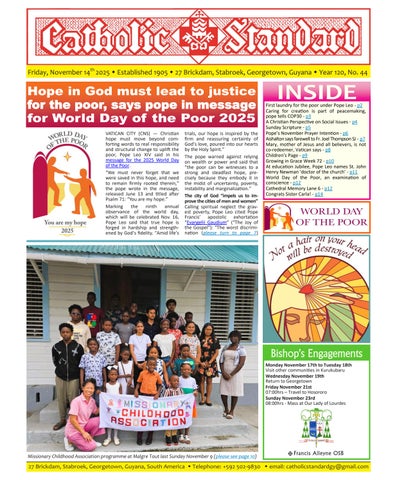
Childhood Association programme held

Choosing Our Leaders

Linda Chavez, the former Director of the Office of Public Engagement of the United States, once said “Choosing one’s leaders is an affirmation that the person making the choice has inherent worth.”

As young people, it is a given fact that we must depend on the leadership and guidance of others to build good lives. It is a fact that we must learn to depend on leaders whenever we make important choices. Without good leaders and mentors, there is no way for us to map our lives or to determine whether we are travelling in the right direction. This means that we have the responsibility to choose the right leaders at every stage in our lives.

Strangely, in this era, we seem to often allow ourselves to be led and influenced without even being aware of it occurring. Every time we listen to an influencer or celebrity, and every time we watch a video or movie created by someone, we are subconsciously accepting these people to be our leaders and their ideologies to be our values. If we are not careful, we may end up being misguided or misinformed!

Choosing leadership must be a conscious and responsible decision that we make. Before we allow someone to influence or change us, we must first ask ourselves if they are the right person to lead us.

Watch out for false prophets. They come to you in sheep’s clothing, but inwardly they are ferocious wolves. By their fruit you will recognize them. Do people pick grapes from thornbushes, or figs from thistles?Matthew 7:15-17❖

The Missionary Childhood at Our Lady of the Annunci- participated in the event. which added a creative and spiritual touch to the Catholic

At education Jubilee, Pope Leo names St. John Henry Newman ‘doctor of the church’

St John Henry Newman - tapestry hanging from the facade of St Peter's Basilica for his canonization in 2019 (Vatican Media)

VATICAN CITY (CNS) The lives of St. John Henry Newman and of all the saints teach Christians that “it is possible to live passionately amidst the complexity of the present without neglecting the apostolic mandate to ‘shine like stars in the world,'” Pope LeoXIVsaid.

Celebrating Mass Nov. 1, the feast of All Saints, Pope Leo concluded the Jubilee of the World of Education and proclaimed St. Newman the 38th doctor of the church, including him among the men and women of the Christian East and West who have made decisive contributions to theology and spirituality.

Earlier in the week, Pope Leo had officially recognized St. Newman as copatron of education along with St. Thomas Aquinas.

Who was St. John Henry Newman?

St. Newman was born in London Feb. 21, 1801, was ordained an Anglican priest in 1825, became Catholic in 1845 and was made a cardinal in 1879 by Pope Leo XIII. He died in 1890.

Leading members of the Anglican Church of England and the British government attended the Mass where he was declared a doctor of the church. The Anglican delegation was led by Archbishop Stephen Cottrell of York, currently the top-ranking prelate of the Church of England. The government delegation was led by David Lammy, deputy prime minister of the United Kingdom and secretary of state for justice.

Greeting Archbishop Cottrell publicly at the end of Mass, Pope Leo prayed that St. Newman would “accompany the journey of Christians toward full unity.”

The banner used during St. Newman’s canonization Mass in 2019 hung from the central balcony of St. Peter’s Basilica during the Mass and his relics were placed on a tablenear the altar.

UK Deputy Prime Minister David Lammy (second from right) at Mass with Pope Leo XIV on the Jubilee of the World of Education on the Solemnity of All Saints, at which Newman was declared a Doctor of the Church, St Peter’s Square, on November 1. Lammy, who is of Guyanese parentage, holds dual UK/Guyanese citizenship and visits Guyana regularly. (SOPA Images Limited/Alamy Live News)

Newman’s ‘Lead,KindlyLight’ quotedinpope’shomily

While St. Newman’s theology, philosophy and thoughts about university education were cited in the Dicastery for the Causes of Saints’ presentation at the Mass, Pope Leo chose to quote in his homily from the British saint’s poem, “Lead, Kindly Light,” now a popular hymn.

“In that beautiful prayer” of St. Newman’s, the pope said, “we come to realize that we are far from home, our feet are unsteady, we cannot interpret clearly the way ahead. Yet none of this impedes us, since we have found our guide” in Jesus.

“Lead, Kindly Light, amid th’encircling gloom, Lead Thou me on,” the pope quoted in English while reading his homily in Italian.

Speaking to the teachers, professors and other educators gathered for the Mass in St. Peter’s Square, Pope Leo said, “The task of education is precisely to offer this Kindly Light to those who might otherwise remain imprisoned by the particularly insidious shadows of pessimism and fear.”

The pope asked the educators to “reflect upon and point out to others those ‘constellations’ that transmit light and guidance at this present time, which is darkened by so much injustice and uncertainty.”

He also encouraged them “to ensure that schools, universities and every educational context, even those that

are informal or street-based, are always gateways to a civilization of dialogue and peace.

Another quote from St. Newman “God has created me to do Him some definite service; He has committed some work to me which He has not committed to another” expresses “the mystery of the dignity of every human person, and also the variety of giftsdistributedbyGod,” thepopesaid Catholic educators, he said, have an obligation not only to transmit information but also to help their students discover how much God loves them and how he has a plan for their lives.

“Life shines brightly not because we are rich, beautiful or powerful,” the pope said. “Instead, it shines when we discover within ourselves the truth that we are called by God, have a vocation, have a mission, that our lives servesomethinggreaterthanourselves.”

“Every single creature has a role to play,” he said. “The contribution that each person can make is uniquely valuable, and the task of educational communities is to encourage and cherishthatcontribution.”

“At the heart of the educational journey,” Pope Leo said, “we do not find abstract individuals but real people, especially those who seem to be underperforming according to the parameters of economies that exclude or even kill them. We are called to form people, so that they may shine like stars in their full dignity.”

‘Doctor of the church’ proclamation “a moment of unityandreflection

Lammy, the British government official, told Catholic News Service that he had had the “great honor and privilege” to meet Pope Leo before the Mass.

As a member of the Anglo-Catholic tradition within the Church of England, he said he believes “John Henry Newman really encapsulates the deep connections between our countries and between the Christian communities, across the Christian community.

The proclamation was “a moment of unity and reflection,” Lammy said. “It’s not just a religious honor, but a powerful moment of cohesion that shows how engaging in our differences can also unite us.

St. Newman’s legacy, he said, “reminds us that Britain’s religious story is broader than one tradition. It’s been enriched by Catholic thought, courage and contribution.”

In addition, the deputy prime minister said, “I think his life and his writings show how belief and reason together can guide moral leadership, diplomacy, compassion, and I think in an age of polarization, Newman’s insistence on moral reflection calls us back to what truly matters, which is leadership in the cause of what is right and just, which is a principle that should shape our politics.”❖

The following is the Conversations with Archbishop J column by Archbishop Charles Jason Gordon in The Catholic News of Trinidad & Tobago of November 16-22 2025: Q: Archbishop J, what is the message for World Day of the Poor?

“You, O Lord, are my hope” (Ps 71:5). ‘Hope’ is a small word with an infinite horizon. It stretches between the heartbreak of the present and the promise of God’s faithfulness.

Pope Leo XIV’s message for the Ninth World Day of the Poor invites us to rediscover hope as the gift the poor offer the world. The Holy Father writes: “The poor are not a distraction for the Church, but our beloved brothers and sisters, for by their lives, their words and their wisdom, they put us in contact with the truth of the Gospel” (5).

The message comes as our Caribbean hearts are still heavy with the devastation of Hurricane Melissa. The storm tore through several of our islands flooding valleys, sweeping away homes, crippling livelihoods, and shattering fragile infrastructures.

We saw again how the climate crisis multiplies poverty, how one violent nightof windandwater can erase years of effort. Yet, we also saw something else: the astonishing generosity of communities that have little yet share much. In those faces mud-streaked, exhausted, but smiling we saw hope incarnate.

The Poor as teachers of Hope Pope Leo XIV reminds us that the poor are not merely to be helped; they are teachers of the Gospel. Those who live without the securities of wealth or power reveal what it means to trust in Godalone.

Their faith, often unadorned and unheralded, echoes the psalmist’s cry: “You have made me see many troubles and calamities, yet you will revive me again” (Ps71:20).

In his Apostolic Exhortation Dilexi Te, the Holy Father continues the same melody: love for Christ and love for the poor are one and the same movement of the heart. The Church’s credibility depends on this union.

When we bend to serve the least among us, we touch the wounds of Christ Himself. When we listen to the cry of the poor, we rediscover the heartbeat of the Gospel. The poor evangelise us. They call us back to simplicity, to compassion, and to the truth that holiness is measured not by perfection but by mercy.

Hope that acts

The Pope writes with urgency: “Poverty has structural causes that must be addressed and eliminated. In the meantime, each of us is called to offer new signs of hope that will bear witness to Christian charity, just as many saints have done over the centuries” (5).

Christian hope is never passive. We cannot pray for the poor while tolerating systems that create poverty. The Church must read the Gospel with a shovel in one hand and a lamp in the other digging foundations for justice, shining light on inequity, and building structures of inclusion.

Structural poverty takes many forms in our region: the lingering scars of colonial economies, the debt traps that strangle small nations, the neglect of rural and indigenous communities, the fragile housing perched on eroding hillsides.

Now, climate change has added new layers drought in one season, deluge in another, and hurricanes like Melissa tearing at the fabric of our islands.

To speak of the poor today is to speak also of ecological poverty, where the destruction of creation leaves the most vulnerable exposed andpowerless. We need both charity and justice Charity heals immediate wounds; justice preventsnewones.

As Pope Leo reminds us, helping the poor is first a matter of justice before it is a matter of generosity. When we repair a roof after the storm, we do good, but when we change building codes, strengthen coastal protections, or advocate for climate reparations, we do justice. Both are necessary; both are Gospel.

Every form of poverty calls us

The Holy Father insists: “Every form of poverty, without exception, calls us to experience the Gospel concretely and to offer effective signs of hope” (5). That “without exception” is crucial. Material want, moral loneliness, spiritual emptiness, environmental collapse, all are wounds to the Body of Christ. And every wound calls for love madevisible.

In the aftermath of Hurricane Melissa, love took the form of fishing boats turned into rescue craft, churches opening their halls as shelters, children sharing schoolbooks, and neighbours offering power from a generator. These were not isolated gestures of kindness; they were sacramentsof solidarity signs of the Kingdom sprouting in the debris of disaster.

To be Christian is to transform compassion into culture. Hope is not sentiment; it is a social project. We build hope when we ensure that each child has access to education, that every worker earns a living wage, that our elderly are cared for with dignity, and that our islands are protected as common homes entrusted to our stewardship.

In this sense, the World Day of the Poor, celebrated on the 33rd Sunday in Ordinary Time, is not an annual event but an annual examination of conscience: How have we made hope visible this year?

Policies of Hope

Pope Leo XIV continues: “It is my hope, then, that this Jubilee Year will encourage the development of policies aimed at combatting forms of poverty both old and new, as well as implementing new initiatives to support and assist the poorest ofthe poor” (6). This is a bold call to move from emotion to institution. It is not enough to comfort the afflicted; we must also reshape the systems that afflict them. For the Caribbean, this means economic policies that prioritise resilience and human development; education that forms minds and hearts; and environmental strategies that protect thepoorestfrombearing theheaviest burdens of climate change

It also means fostering economies of solidarity credit unions, cooperatives, social enterprises that embody what Dilexi Te calls the “fraternal economy”. Such initiatives are not utopian; they are acts of faith in the God who multiplied loaves and fishes and who still multiplies grace through human creativityand compassion. When governments, churches, and citizens work together to craft policies of hope, they participate in God’s own dream for humanity. They proclaim that love can be organised, justice can be planned, mercy can be institutionalised. This, too, is holiness.

The face of Hope

Pope Leo warns that the gravest poverty is to live without God. In our Caribbean Church, we see this spiritual poverty in those who feel abandoned or excludedfrom faith. Our response must be to offer both bread and blessing food for the body and the soul. The saints have always done both: feeding the hungry and announcing the Gospel. We are called to do the same.

The poor are not on the margins of our pastoral agenda; they are the place where the Gospel becomes flesh.Theyareliving iconsofChrist who “though he was rich, became poor for our sake” (cf 2 Cor 8:9).

To love them is to love Him; to serve them is to worship Him. In their eyes we glimpse the face of the CrucifiedandRisen Lord, and in their endurance we discover the seed of hope that will renew the world. ❖

Key message

The World Day of the Poor is not a day of guilt but of grace. It calls us to see as God sees: beyond scarcity to possibility, beyond despair to renewal. Hurricane Melissa has reminded us how fragile life is, but also how resilient love can be.

Action Step

For the month of November make a tithe on your income. Whatever it is trust God and give 10 percent ofyour income.

The Fogarty’s Pulpit

Constructed in marble and concrete, the Pulpit was used for Sermons/Homilies in pre-Vatican II times, and with the absence of public address equipment in those early days, was well positioned to deliver voice to the congregation.

The Pulpit was donated by Mrs. N.M. Fogarty in memory of her husband William Fogarty and her three sons, one of whom died in the First World War. The Fogarty family came from Ireland and established business in British Guiana in 1892 as wholesale and retail merchants and continued in independent Guyana into the 1980’s.❖

Congrats Sister Carla!

Guyanese-born Sr. Carla Thomas OP, a member of the Dominican Sisters of St. Catherine of Siena in Trinidad & Tobago, has completed her doctoral degree at the Regis St. Michael’s Faculty of Theology, Regis College, University of St. Michael’s College, Toronto School of Theology in the University of Toronto.

According to the University of St. Michael’s College, her outstanding academic achievement has earned her this year’s Governor General’s Academic Medal, awarded to the doctoral student with the highest academic standing.

Her dissertation focused on family life in the Anglophone Caribbean, examining Pope Francis’ contributions to family ministry and proposing themes for a regional pastoral strategy.

The university notes that Sr. Carla credits her congregation for supporting her throughout her studies.

Sr. Carla is the daughter of Mr. and Mrs. Raymond and Elaine Thomas. Mrs. Thomas is well-known to the Cathedral community, having served for many years as an Extraordinary Minister of Holy Communion. Sr. Carla is also the niece of the late Mr. Colin Smith, who was Editor of the Catholic Standard.

Congratulations to Sr. Carla on this remarkable achievement!❖

Saint of the Week

St. Elizabeth of Hungary

In her short life Elizabeth manifested such great love for the poor and suffering that she has become the patron of Catholic charities and of the Secular Franciscan Order. The daughter of the King of Hungary, Elizabeth chose a life of penance and asceticism when a life of leisure and luxury could easily have been hers. At the age of 14 Elizabeth was married to Louis of Thuringia (a German principality), whom she deeply loved; she bore three children. Under the spiritual direction of a Franciscan friar, she led a life of prayer, sacrifice and service to the poor and sick. Seeking to become one with the poor, she wore simple clothing. Daily she would take bread to hundreds of the poorest in the land, who came to her gate.

After six years of marriage, her husband died, and Elizabeth was grief-stricken. Her husband’s family looked upon her as squandering the royal purse, and mistreated her, finally throwing her out of the palace. The return of her husband’s allies from the Crusades resulted in her being reinstated, since her son was legal heir to the throne.

In 1228, Elizabeth joined the Secular Franciscan Order, spending the remaining few years of her life caring for the poor in a hospital which she founded in honour of St. Francis. She died in 1231 at the age of 23. Her great popularity resulted in her canonization four years later.❖

Turn static files into dynamic content formats.

Create a flipbook