Friday March 6th 2026 Established 1905 27 Brickdam, Stabroek, Georgetown, Guyana Year 121, No. 9
Diocese, Order of Malta sign MOU on Special
Mercy Associates of Guyana give message for InternationalWomen’sDay - p2
Catholic Sisters call US-Israeli strikes on Iran illegal,immoral - p3
Preventive wars risk setting the world ablaze, saysCardinalParolin - p3
AChristianPerspectiveonSocialIssues - p4
SundayScripture - p5
YouthOfficeholdsLentenOutreach - p6
SacredHeartandFriends LentenRetreat - p7
Children’sPage - p9
GrowinginGraceWeek80 - p10
FaithinPracticeWeek5 - p11
Pope's March prayer intention: 'For disarmamentandpeace' - p11
DailyLentenactivitiesforfamilies - p12
CatechistsSeminaratYurongParo - p14
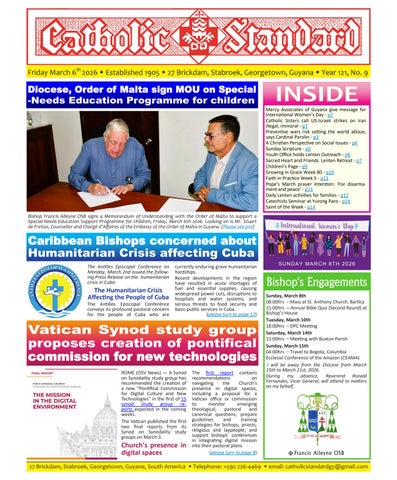
Bishop Francis Alleyne OSB signs a Memorandum of Understanding with the Order of Malta to support a Special-Needs Education Support Programme for children, Friday, March 6th 2026. Looking on is Mr. Stuart de Freitas, Counsellor and Chargé d’Affaires of the Embassy of the Order of Malta in Guyana. (Please see p10)
The Antilles Episcopal Conference on Monday, March 2nd issued the following Press Release on the humanitarian crisis in Cuba:
The Humanitarian Crisis Affecting the People of Cuba
The Antilles Episcopal Conference conveys its profound pastoral concern for the people of Cuba who are
currentlyenduring grave humanitarian hardships.
Recent developments in the region have resulted in acute shortages of fuel and essential supplies, causing widespread power cuts, disruptions to hospitals and water systems, and serious threats to food security and basicpublicservicesinCuba.
(please turn to page 12)
Caribbean Bishops concerned about commission for new technologies
ROME (OSV News) A Synod on Synodality study group has recommended the creation of a new “Pontifical Commission for Digital Culture and New Technologies” in the first of 15 synod study group reports expected in the coming weeks.
The Vatican published the first two final reports from its Synod on Synodality study groupsonMarch3.
Church’s presence in digital spaces
The first report contains recommendations on navigating the Church’s presence in digital spaces, including a proposal for a Vatican office or commission to monitor emerging theological, pastoral and canonical questions; prepare guidelines and training strategies for bishops, priests, religious and laypeople; and support bishops’ conferences in integrating digital mission intotheirpastoralplans.
(please turn to page 8)
15:00hrs Annual BibleQuiz (Second Round) at Bishop’sHouse.
Tuesday,March10th
18:00hrs – DPC Meeting
Saturday,March14th
15:00hrs –MeetingwithBuxtonParish
Sunday,March15th
04:00hrs –TraveltoBogota,Columbia EcclesialConferenceoftheAmazon(CEAMA) I will be away from the Diocese from March 15thtoMarch21st,2026.
During my absence, Reverend Ronald Fernandes, Vicar General, will attend to matters onmybehalf.
Francis Alleyne OSB
Year of St. Francis Jubilee Prayer
Saint Francis, our brother, you who eight hundred years ago went to meet Sister Death as a man at peace, intercede for us before the Lord. You recognized true peace in the Crucifix of San Damiano, teach us to seek in Him the source of all reconciliation that breaks down every wall.
You who, unarmed, crossed the lines of war and misunderstanding, give us the courage to build bridges where the world raises up boundaries.
In this time afflicted by conflict and division, intercede for us so that we may become peacemakers: unarmed and disarming witnesses of the peace that comes from Christ.
Amen
Mercy Associates of Guyana MessageforInternationalWomen’sDay
The Mercy Associates of Guyana and the South Georgetown Cluster have given the following message for International Women’s Day, Sunday, March 8, 2026:
DearBrothersandSistersinChrist,
The Mercy Associates of Guyana and the South Georgetown Cluster greet you warmly on this day designated International Women’s Day by the United Nations(UN).Today,March8, 2026, marks the 115th anniversary of the global movement for collective action, advocacy, and progress towardgenderequality.
The United Nations theme for this year’s observance is “Rights. Justice. Action. For All Women and Girls.” Accordingly,the UNcallsonallmember states to close the legal gaps between men and women and to ensure that women and girls around the world enjoy equal rights and equaljustice.
The UN also notes that “women have only 64 percent of the legal rights that men hold worldwide.” In fundamental areas of life including work, money, safety, family, property, mobility, business, and retirement the law systematically disadvantageswomen.
In addressing the theme of International Women’s Day 2026, the UN has issued a global call for member statesto takethe necessaryactionto “dismantle all barriers to equal justice: discriminatory laws, weak legal protections, and harmful practices and social norms that erode the
As Catholics, how does our faith invite us to respond to the issues of ourtime?
Firstly, Catholic Social Teaching reminds us that both men and women are created in the image of God (imago Dei), and they possess identical fundamental rights and dignity. In fact, the book of Genesis clearly shows that equality is God’s grand designforhiscreation.
Secondly, we invite you to revisit Pope John Paul II’s Letter to Women (1995), in which he expresses deep gratitude for women and what he called the “feminine genius.” The Pope begins with the assertion that “The Church desires for her part to contribute to upholding the dignity, role and rights of women.” He goes on to thank women for the roles they play in marriage, in the home, in society, and in the Church, but laments the fact that “Women’s dig-
and their prerogatives misrepresented; they have often been relegated to the margins of society and even reduced to servitude.” This, he said, has “prevented women from truly being themselves and it has resulted in a spiritual impoverishment of humanity.”
Although we know that women have made significant strides since the Pope’s letter in 1995, it is also true that for many women around the world,andherein Guyana,thesituationremainsamatterofconcern.
Call to Action
So, what then are we invited to do on this International Women’s Day, 2026?
As individuals and as a collective, we cantakeanyofthefollowingstepsto markthesignificanceofthisday:
1. Show appreciation by thanking the women who have impacted your lifeorcareer.
2. Challenge bias by calling out stereotypes and discrimination wheneveryouencounterthem.
3. Support organizations dedicated to upholding human dignity and improving the quality of life for women and girls.
4. Join us in prayer at noon today (Sunday), wherever you are, as we remember the women of Guyana especially those who have lost their livestodomesticviolence.
We thank you for standing with us as we strive to build a world where the dignity of every woman is honored andherrightsarefullyrealized.❖
- Pope Leo XIV The Central Cluster (Brickdam Cathedral, Sacred Heart and Our Lady of Fatima) held its Annual Lenten Retreat on Tues. March 3rd (Phagwah holiday) at the Cathedral of the Immaculate Conception [photo: Catholic Media Guyana]
Catholic Sisters call US-Israeli strikes on Iran illegal, immoral
(ICN) - Sisters and lay representatives of sisters' congregations, as well as leaders of Catholic peace organizations, are condemning in the strongest possible terms the US and Israeli war against Iran, calling it "illegal, immoral and potentially destabilizing."
"I condemn what the United States has done," Sr Barbara Bozak, who represents the Congregations of St Joseph at the United Nations, said to Global Sisters Report. "It is an act of aggression and goes against the United Nations Charter. We had no righttodoit."
Beth Blissman, the Loretto Community's UN representative, was equally critical,saying it appeared that the preemptive moves against Irandone without the approval of the US
Congress and without much apparent public support - could likely be in violation of international law. "This doesn't uphold our country's values" she said. "This is not going to bring security to the region and it's not goingtobringpeace,"SrBethadded.
The conflict began Feb. 28 when the U.S. and Israel launched airstrikes across Iran, killing its supreme leader and dozens of other high-ranking officials. Attacks by both the U.S. and Israel have continued, killing hundreds, and Iran has responded by attacking Israel, its neighbors, and U.S. assetsacrosstheMiddleEast.❖
See the full report at: www.globalsistersreport.org/catholic -sisters-call-us-israeli-strikes-iranillegal-immoral
More than 175 people, mostly children, were reportedly killed when a girl’s elementary school in Minab was hit by an airstrike on Feb. 28 during a wave of attacks across Iran by the U.S. and Israel. Credit...Mehr News Agency
world ablaze, says Cardinal Parolin
ROME (OSV News) The Vatican secretary of state appealed for peace and diplomacy on the fifth day of the U.S. and Israel-Iran war, warning that recognition of any country’s right to wage “preventive war” according to their own criteria would risk the world “beingsetablaze.”
In an interview on March 4, Cardinal Pietro Parolin, the Holy See’s top diplomat, spoke to Vatican News as the United States and Israel continued to hit Iran’s capital and other cities in multiple airstrikes and as Iran responded with retaliatory strikes and drone attacks on Israel and across the region.
‘Erosion of international law’
The cardinal expressed concern over the “erosion of international law” and condemned what he called a dangerous drift toward the “law of force” ininternationalaffairs.
“Justice has given way to force; the force of law has been replaced by the law of force,” Cardinal Parolin said, “with the conviction that peace can arise only after the enemy has been annihilated.” Cardinal Parolin stopped short of directly mentioning the United States or Israel by name, but emphasized that under the United Nations Charter, force must be considered only as a last and most grave resort after all political and diplomatic options have been exhausted, and only “after carefully assessing the limits of necessity and proportionality.”
Risk of world being ‘set ablaze’ “If states were to be recognized as having a right to “preventive war,” according to their own criteria and
Smoke rises after Israeli strikes in Lebanon, following an escalation between Hezbollah and Israel amid the U.S.-Israeli conflict with Iran, as seen from Marjayoun, Lebanon, March 5, 2026. (OSV News photo/Karamallah Daher, Reuters)
without a supranational legal framework, the whole world would risk beingsetablaze,” thecardinalsaid.
Asked about the massive street demonstrations in Iran earlier this year which were bloodily suppressed, Cardinal Parolin said, “The aspirations of peoples must be taken into consideration and guaranteed within the legal framework of a society that ensures everyone can freely and publicly express their ideas and this also applies to the dear Iranian people.”
“At the same time, we may ask
ourselves whether anyone truly believes that the solution can come through the launching of missiles and bombs,” headded.
‘Pray for peace, work for peace’
His remarks came one day after Pope Leo XIV, told journalists at Castel Gandolfo on the evening of March 3, “Pray for peace, work for peace, less hatred. Hatred in the world is constantly increasing.” The pope called on everyone to “truly strive to promote dialogue” and to “seek solutions withoutweaponstoresolveproblems.”
Pope Leo previously issued a fervent appeal for return of diplomacy in his Angelus address on March 1, about 12 hours after the U.S. and Israel revealed that Iran’s supreme leader, 86-year-old Ayatollah Ali Khamenei, had been killed intheearlymorningstrikesofFeb.28.
“Faced with the possibility of a tragedy of immense proportions, I make a heartfelt appeal to all the parties involved to assume the moral responsibility of halting the spiral of violence before it becomes an unbridgeablechasm,” thepopesaid. ❖
A Christian Perspective on Social Issues Lenthow
By GHK Lall
it should be
This is a conversation with fellow believers. They may ardently practice their faith or do so to a lesser degree. It doesn’t matter. This is a sharing for all to reflect on.
The Season of Lent, a long one it is, can be. Here are some questions that each of us do well to ask of ourselves, then consider carefully. What is this season with lots of self-denial to me? Do I see Lent as a duty to be fulfilled any way I can, or in the most devoted manner that is possible for me? Do I take it casually, the mere observation, of going through the motions, and counting the days? Or do I take the many days and weeks of Lent in all seriousness, and with deep joy as a close companion? For emphasis: more of a heartfelt joy and less of a necessary duty to be done.
There should be joy over the mercy of Almighty God given freely, and the example of Jesus while preparing, gathering, himself on earth. The joy of yet another chance to draw closer to God,
to identify with Jesus, to search ourselves, and to make honest amends. We are frail men and women. We falter, lapse; on occasion, even fall, and fall hard. Lent provides the weak and worn down with an opportunity to take stock of ourselves, and commit and recommit to our Creator our hope and joy in him. There is joy that he can be approached, can be asked, to look with favor upon our repentance, our little penances, and the sacrifices made as part of our contrition. And our love; love for neighbor who struggles to make it, love for those who need that brace when times are so hard as to be unbearable and unmanageable.
There is joy that God, good and great and grand, can also be so compassionate that he opens a door for us to come back to him, through Jesus. We walk through that door, and we are better for it. The disciplining of the body. The serious and meaningful sacrifices that are made. The surrender before our Maker, and ready confession to him that our own strength is negligible and that we need him. Or that there has been erring, and there is need for reconciling with him. When one sinner turns back from his or her selfish ways, the angels in heaven rejoice, and God is glorified. The Prophet Ezekiel spoke of how highly that genuine man or woman who comes to God on hands and knees stands in his sight. Jesus himself made it clear of what his mission was, what his priority was. It was to call sinners. It was to rescue the lost; reel in the reckless.
In the time of Lent, there’s outward
and the inner. For Lent to be of value, the inner must be about authentic self examination. When there is that honest selfelation. It is that no matter how well we have done, there are still some steps to make, some places to go. The unthought of and untouched areas in the life of each one of us Roman Catholics, Christians. The areas left behind, the people and works, the worship and homage due to God, that could all use some improvement. A little more time and attention and energy that makes me and you a better servant of the Lord our God. And what makes others better: stronger believers, sturdier faith, deeper love for righteousness and the commands that go hand hand with those.
Lent is a reminder of how clever Satan and his servants are. Lent reminds of how much havoc temptation can interfere with one
Lent is a channel that reinforces how much we need to walk closer with Jesus, and let his great commandments, his own impeccable standards, take hold of us, and stay with us. Lent helps all those who come to God with an open heart, a humbled spirit, to be refined in ways divine. Lent is the joy of self-sacrifice and self-discovery. Lent is that ideal: of being as one with Jesus, the Christ, the Savior, who is one with the Father. The continuation and connection should be easy to make. When you and I can aspire to be as one with the will of heaven, then there has to be, must be, infinite joy in that saving grace. Let it be, O Lord, our God.❖
Gracious and loving God, we thank your for the gift of our priests. Through them, we experience your presence in the sacraments.
Help our priests to be strong in their vocation.
Set their souls on fire with love for your people.
Grant them the wisdom, understanding, and strength they need to follow in the footsteps of Jesus. Inspire them with the vision of your Kingdom.
Give them the words they need to spread the Gospel.
Allow them to experience joy in their ministry.
Help them to become instruments of your divine grace.
We ask this through Jesus Christ, who lives and reigns as our Eternal Priest. Amen
‘Growth is the only evidence of life.’ Saint John Henry Newman (1801-1890)
First Reading Exodus 17:3-7
Tormented by thirst, the people complained against Moses. ‘Why did you bring us out of Egypt?’ they said. ‘Was it so that I should die of thirst, my children too, and my cattle?’ Moses appealed to the Lord. ‘How am I to deal with this people? he said. ‘A little more and they will stone me!’
The Lord said to Moses, ‘Take with you some of the elders of Israel and move on to the forefront of the people; take in your hand the staff with which you struck the river, and go. I shall be standing before you there on the rock, at Horeb. You must strike the rock, and water will flow from it for the people to drink.’
This is what Moses did, in the sight of the elders of Israel. The place was named Massah and Meribah because of the grumbling of the sons of Israel and because they put the Lord to the test by saying,’ Is the Lord with us, or not?’
Responsorial Psalm Psalm 94
Response: ‘O that today you would listen to his voice: Harden not your hearts.’
1. Come, ring out our joy to the Lord; hail the rock who saves us. Let us come before him, giving thanks, with songs let us hail the Lord. Response
2. Come in; let us bow and bend low; let us kneel before the God who made us for he is our God and we the people who belong to his pasture, the flock that is led by his hand. Response
3. O that today you would listen to his voice! ‘Harden not your hearts as at Meribah, as on that day at Massah in the desert when your fathers put me to the test; when they tried me, though they saw my work.’
Second Reading Romans 5:1-2. 5-8
Through our Lord Jesus Christ, by faith we are judged righteous and at peace with God, since it is by faith and through Jesus that we have entered this state of grace in which we can boast about looking forward to God’s glory and this hope is not deceptive, because the love of God has been poured into our hearts by the Holy Spirit which has been given us. We were still helpless when at his appointed moment Christ died for sinful men. It is not easy to die even for a good man –though of course for someone really worthy, a man might be prepared to die – but what proves that God loves us is that Christ died for us while we were still sinners.
GOSPEL: John 4:5-42
Jesus came to the Samaritan town called Sychar, near the land that Jacob gave to his son Joseph. Jacob’s well is there and Jesus, tired by the journey, sat straight
Today
’s readings on this third Sunday of Lent present us with the theme of “thirst” and show us that a stewardship way of life can both satisfy our spiritual
down by the well. It was about the sixth hour. When a Samaritan woman came to draw water, Jesus said to her, ‘Give me a drink’. His disciples had gone into the town to buy food. The Samaritan woman said to him, ‘What? You are a Jew and you ask me, a Samaritan, for a drink?’ – Jews, in fact, do not associate with Samaritans. Jesus replied: If you only knew what God is offering and who it is that is saying to you: Give me a drink, you would have been the one to ask, and he would have given you living water’.
‘You have no bucket, sir,’ she answered ‘and the well is deep: how could you get this living water? Are you a greater man than our father Jacob who gave us this well and drank from it himself with his sons and his cattle?’ Jesus replied ‘Whoever drinks this water will get thirsty again; but anyone who drinks the water that I shall give will never be thirsty again: the water that I shall give will turn into a spring inside him, welling up to eternal life’. ‘Sir,’ said the woman ‘give me some of that water, so that I may never get thirsty and never have to come here again to draw water.’ ‘Go and call your husband’ said Jesus to her ‘and come back here.’ The woman
thirst for Christ and help us to satisfy Christ’s thirst for souls.
Our first reading, from the book of Exodus, begins with the words, “In their thirst for water, the people grumbled against Moses.” What little faith and lack of trust they show after all God has done to free them from slavery. But Moses cried out to God for help, and sure enough God provided generously to satisfy thirst. He continues to provide generously for us these many centuries later.
answered, ‘I have no husband’. He said to her, ‘You are right to say, “I have no husband”; for although you have had five, the one you have now is not your husband. You spoke the truth there.’ ‘I see you are a prophet, sir’ said the woman. ‘Our fathers worshipped on this mountain, while you say that Jerusalem is the place where one ought to worship.’
Jesus said: ‘Believe me, woman, the hour is coming when you will worship the Father neither on this mountain nor in Jerusalem. You worship what you do not know; we worship what we do know: for salvation comes from the Jews. But the hour will come – in fact it is here already – when true worshippers will worship the Father in spirit and truth: that is the kind of worshipper the Father wants. God is spirit, and those who worship must worship in spirit and truth.’
The woman said to him, ‘I know that Messiah – that is, Christ – is coming; and when he comes he will tell us everything’. ‘I who am speaking to you,’ said Jesus ‘I am he.’
At this point his disciples returned, and were surprised to find him speaking to a woman, though none of them asked, ‘What do you want from her?’ or, ‘Why are you talking to her?’ The woman put down her water jar and hurried back to the town to tell the people. ‘Come and see a man who has told me everything I ever did; I wonder if he is the Christ?’ This brought people out of the town and they started walking towards him.
Meanwhile, the disciples were urging him, ‘Rabbi, do have something to eat; but he said, ‘I have food to eat that you do not know about’. So the disciples asked one another, ‘Has someone been bringing him food?’
But Jesus said: ‘My food is to do the will of the one who sent me, and to complete his work. Have you not got a saying: Four months and then the harvest?
Well, I tell you: Look around you, look at the fields; already they are white, ready for harvest! Already the reaper is being paid his wages, already he is bringing in the grain for eternal life, and thus sower and reaper rejoice together. For here the proverb holds good: one sows, another reaps; I sent you to reap a harvest you had not worked for. Others worked for it; and you have come into the rewards of their trouble.’
Many Samaritans of that town had believed in him on the strength of the woman’s testimony when she said, ‘He told me all I have ever done’, so, when the Samaritans came up to him, they begged him to stay with them. He stayed for two days, and when he spoke to them many more came to believe; and they said to the woman, ‘Now we no longer believe because of what you told us; we have heard him ourselves and we know that he really is the saviour of the world’.❖
(Shorter form 4:5-15,19-26,39-42)
Our Gospel passage from John recounts the life-changing encounter Christ has with the Samaritan woman at the well beginning with His words to her, “Give me a drink.” Then, He adds, “If you knew the gift of God and who is saying to you, ‘Give me a drink,’ you would have asked him and he would have given you living water.” Christ is speaking the very same words to us to us today. These two verses encapsulate the call to stewardship. Christ asks us to “give him a drink” by sharing
what we have with Him and with others for His sake. Yet, it is Christ Himself who provides the water the living water that is His grace.
God has chosen to include us in His plan for bringing all people to salvation through Him. We live out our part in His plan through a stewardship way of life. This Lent, let us resolve to respond to His call with passion and commitment. Let us do our part to quench His thirst. ❖ [www.catholicsteward.com/blog/ ]
Gospel Reflection
The First Reading and the Gospel tell of thirst, both physical and spiritual. But for us “thirst” can also stand for our “desires”. There are so many things we thirst for, some positive and some negative We thirst for knowledge, for truth, for justice, for freedom, for solid and lasting relationships, for the best for our children, for life. It seems that the vast majorityofushaveadesire,a thirst, for a life beyond our present situation. But on the down side, we at times also thirst for revenge, for material things, for more and more money, for physical pleasure. Intryingtosatisfythirstssuch as these we move away from all that makes us truly human. Our focus becomes more on self and so it becomes more difficult to reach outtoothers.
Each of us is like the lonely Samaritan woman. There is a thirst in every human heart. Weare thirstingfor something that we feel will satisfy all our longings. The only problem with this is that we often search in the wrong places hoping to find the thing which will satisfy us. We draw water from many wells: the water of praise to quench the thirst for self-respect and a sense of worth; the water of success to quench our thirst for importance; the water of pleasure to quench our thirst for happiness. But we still get thirsty. For those who have encountered Christ and have formed a strong relationship with him, the search is over. OnlyChristcanprovideuswith cleanlivingwater tosatisfy our inner thirst. The encounter with Christ can happen at any timeandinanyplace. Wejust havetobeopentoit. ❖
[From: Journeying with the Word of God, The Religious Education Department, Diocese of Georgetown, Guyana ]
On Tuesday March 3rd (Phagwah holiday), young people from Georgetown and its environs came together for a meaningful Lenten activity centred on acts of Faith and Charity.
As part of their Lenten journey, they walked through the streets of Georgetown sharing a speciallyprepared meal with their homeless brothers and sisters, following a spiritual formation talk by Monsignor Terrence Montrose, CCH .
The day also included games and fellowship as the young people connected, learned, and grew together infaith.
The Diocesan Roman Catholic Youth Office wishes to thank all participants and supporters for helping to make this Lenten activity a truly spirit-filling one ❖
-7639. Send us an email at
Catholic Media Guyana
Sacred Heart and Friends Lenten Retreat
Journeying with the Word of God
By Karisma Das
On Saturday February 28, Sacred Heart and Friends Youth Group held its Lenten Retreat at Arrupe House (Theme: Joel 2:12– “Come back to me”). Attendance was positively overwhelming, with over 35 participants present. The parishes / communities represented included: St Catherine of Siena, St. Joseph Husband of Mary, Cathedral of the Immaculate Conception, St. Jerome, alongwithSacredHeart.
The day began with an introduction by Fr. Ronald Fernandes SJ (Fr. Ronnie), who warmly acknowledged the young people gathered. A brief history of Arrupe House was shared, along with an overview of the work of the Society of Jesus. The purpose of the retreat was underscored as an opportunity to pause, reflect, and examine the way we areliving.
Copies of Identity:Identified were distributed to the youth, kindly sponsored by the Bible Society. Participants were encouraged to engage with the book and consider how its message could be applied in their daily lives. An ice-breaker game centred on identifying saint names helped draw participants out of their seatsandeaseanyinitialunfamiliarity This was followed by an interactive session inviting the youth to reflect on the purpose of different levels of beings, highlighting that humans are unique because they can think, reason, andpossessasoul.
The second session focused more deeply on our purpose and identity. Through Scripture, the youth were reminded that we are not accidents but are made in the image and likeness of God (Genesis 1:26–27). Psalm 139:13–14 affirmed thateach ofusis personally designed by God, while Isaiah 43:1 reminded us that we belong to Him. Jeremiah 1:5 reinforced the truth that God knew us even before we were born. Ephesians 2:10 reminded us that we are God’s masterpiece, created with intention and purpose, and 1 Corinthians 12:4–6 highlighted that while our gifts are varied, there is beauty in that diversity.
The youth were reminded that “we are like light and salt,” called to bring flavour and illumination
into the world. They were further encouraged through the words of the saints and holy figures. St. John Paul II reminded us that “Life with Christ is a wonderful adventure,” while Mother Teresa described herself as “a little pencil in the hand of a writing God.” St. Catherine of Siena’s call to “Be who God meant you to be and you will set the world on fire” echoed alongside St. Francis de Sales’ counsel to “Bewhoyouare and be that well.” Pope Francis affirmed this message simply:
“You are not a mistake; you are a childofGod.”
After a brief coffee break, the youth gathered to pray the Rosary (Sorrowful Mysteries), followed by a spirited session of hymn singing. We were joyfully accompanied on the guitar and violin by Mr. Eugene Gonsalves and Jonathan Robinson, respectively.
Post-lunch, the group made their way to Our Lady of Fatima Church to walk the Way of the Cross. This proved to be a meaningful and active experience, as the youth journeyed around the church, reflecting on the suffering of Jesus and deepening their awarenessofHislove.
Upon returning, Fr. Ronnie facilitated a guided meditation session, after which the youth completed a self-reflection worksheet. Confessions were then heard by Fr. Ronnie, Fr. George, and Fr. Santiago, with concurrent Adoration of the Blessed Sacrament. The day concluded with a joyful Mass celebrated by Fr. Ronnie. The intentions of the youth were brought forward, including prayers for the less fortunate and the lonely, the war-stricken, our families and friends, and for the strengthening of our faith. The youth were encouraged to pursue holiness and to strive to be perfect as our HeavenlyFatherisperfect.
Sacred Heart and Friends Youth Group extends sincere thanks to all the priests, young people and adult leaders who made the effort to attend and facilitate the retreat. We continue to keep in our prayers those who were unable to join us. We encourage everyone to stay connected by participating in our Zoom meetings on Saturdays at 3pm and followingoursocialmediapages:
1st Reading: On their journey in the desert, the faith of the Hebrews falter and they complain that God has abandoned them. But God provides waterforthem.
2nd Reading: Paul points out that we receive the peace and glory of God because Jesus died for us outoflove.
Gospel: While the Samaritan woman is thinking of physical thirst which water can satisfy, Jesus talks of spiritual thirst which only he cansatisfy.
1.The Israelites, because of their thirst, grumbled and tested God. Do you not also in your momentsofthirstforthingstestGod?
2.How can some of our thirsts (e.g. for revenge or greed for material things) hamper us from living fullhumanlives?
3.“Our thirst for meaning in life, for truth and for positive values can be fulfilled through the inner strength given to us from our God.” What do youunderstandfromthisstatement?
4.“It doesn’t do us much good to be loved for being perfect. We need to be accepted and loved because we are sinners.” What does this statement mean to you?
Step 3: Accepting the message of God’s Wordinyourlifeoffaith
It is a basic Catholic belief that we should gather together to worship God and so that as a community of believers we praise God our Creator, thank God our provider, express sorrow to God our Saviour and turn to God our helper.
We are sure of God’s love for us because of the fact that Jesus dies for us while we were still sinners. This means that his love for us does not result from anything we may have done on our own.
Step 4: Somethingtothink&prayabout
1.We are all filled with a longing for something in our lives. It may be a thirst for something material or for something spiritual. Reflect a moment on your life. What would you say you are thirsting after at this time in your life? Would what you are thirsting after have a positive or a negative impact onyourlife?
2.When we befriend the lonely, visit those who are sick, share food with the hungry, look after those who have been abandoned, especially the old and the very young,we are recognising others who are thirstingandwearedrawingwaterforthem. ❖
[From: Journeying with the Word of God, The Religious Education Department, Diocese of Georgetown, Guyana ]
Vatican Synod study group proposes creation of pontifical commission for new technologies (From P1)
The second report focuses on guidelines for the formation of future priests and includes a call for more women to play a role in aiding the formation of seminarians for the priesthood. The report also lists 26 real world examples of “best practices” fromseminariesaroundtheworld.
In one of the examples, the report points to how almost all seminaries in France now include at least one woman on their seminary council with voting rights, after a 2021 directive from the country’s bishops. In one French seminary, a married couple, a marriage counselor and her retired husband, married 39 years with six children, lives in the seminary as an integral part of its formation team alongsidesixpriests.
Pope Leo XIV directed that the study group reports be made public, accordingto theGeneralSecretariatof the Synod, “in order to share with the entire People of God the fruit of the reflection and discernment undertaken, thereby giving concrete expression to one of the essential characteristics of the synodal Church: transparencyandaccountability.” Cardinal Mario Grech, the secretary general of the Synod of Bishops, noted thefinalreports “aretobeunderstood as working documents, a point of departure rather than arrival,” but
Proposals to guide Church’s digital mission
The 26-page final report from the studygroupontheChurch’smissionin the digital environment provided recommendations both at the diocesan level and for the bishops’ conferences and Roman Curia to better serve the needs of people online.
The report reflected on feedback gathered from Catholics throughout the global synod process, citing clergy who said they felt “ill-equipped to navigate digital spaces.”
The report called on appropriate Vatican bodies to study potential canonical adaptations to accommodate what it termed “supraterritorial digital realities,” acknowledging that online ministry often goes beyond traditional geographic diocesan boundaries. The group noted that “much more consultation and discernment remains tobedoneregardingjurisdictionalissues.”
Digital risks of polarization, manipulation
Additional Vatican-level proposals included developing guidelines on digital risks such as polarization and manipulation, fostering international networks of those engaged in digital mission, and creating a Church-wide digitalresourcehub.
stages of formation. The document specified this should not prolong the overallformationperiod.
‘ Well - prepared and competent women ’
The report called on seminaries to include “well-prepared and competent women as co-responsible at all levels of formation, also within the formation team, in order to benefit from their indispensable contribution to vocational discernment and to the accompaniment ofcandidatestothepriesthood.”
Responsibility for the formation of future priests, the document said, “cannot remain limited to the Bishop and those directly given the task of formation, but requires the contribution of the entire People of God.” It called for bishops to promote listening and interaction among people of different vocations in drafting national formation plans, and said the People of God should be “truly listened to” before the conferral ofHolyOrders.
said they “already contain valuable indications from which local Churchesandvariousecclesialrealities may draw inspiration from this very moment.”
The General Secretariat of the Synod will publish 13 more study group final reports, according to its website, with thenextbatchexpectedMarch10.
The study groups were established by Pope Francis followingthe firstsession of the Synod on Synodality in October 2023. Twelve groups were originally formed to examine issues raised at that assembly, including women’s participation in the Church, the role of papal nuncios and the liturgy in a synodalperspective.
The groups, composed of cardinals, bishops, priests and lay experts from both inside and outside the Vatican, had originally been asked to submit their conclusions by June 2025. After the death of Pope Francis and the election of Pope Leo XIV last year, the new pope extended the deadline, requesting final reports be delivered “insofaraspossible” byDec.31,2025.
The proposals drawn from all of the final reports will be submitted to Pope Leo XIV, who will evaluate and may approvethem,thesecretariatsaid.
The group’s recommendations emphasized that digital spaces represent genuine terrain for evangelization. Local churches, it said, should affirm digital culture as “a real space for mission, where true human relationships occur.” The report also cautioned that “mainstream digital platforms are not neutral but have algorithms that may hinder the spread ofpositivemessages.”
Study group on seminary formation guidelines
The second report, a 24-page document, provided guidelines and recommendations for how seminarians are formed, including closer immersion in parish life, the inclusion of women in the process of formation, and greater lay involvement in decisions about priestlycandidates.
Rather than issuing a wholesale revision of the 2016 Ratio Fundamentalis Institutionis Sacerdotalis, a document from the Congregation for the Clergy on priestly formation, which the synod secretariat said the group judged as “still valid in its fundamental principles,” the study group produced a guiding document for its implementation in a “missionary synodal key.” Among its key guidelines, the report called for priestly formation to be immersed in the life of the Christian community, with the possibility of alternating traditional seminary residence with periods living in parish communities or other ecclesial environments, particularly during later
The document includes 26 real-world best practice examples from seminaries around the world. Among those highlighted: a program in eight U.S. dioceses focused on healing woundscausedby theexcessiveuseof technology and family breakdown, centered on an eight-day silent retreat and a small-group chastity program; and a Nigerian seminary that requires seminarians to perform all maintenance work and cleaning of their seminary building to “experience thedignityofhumanlabor.”
The report also outlined a three-year action plan under the supervision of the Dicastery for the Clergy, in which each episcopal conference could establish a working group to oversee implementation of synodal elements in its seminaries. Comprehensive reports would be submitted to the dicastery at the end of the three-year period, which would compile a summaryreportforthepope.
With the submission of their final reports, both study groups have concluded their mandates and are considered dissolved. The General Secretariat of the Synod and the competent Vatican dicasteries will nowworkto translatethe findingsinto proposals to be submitted to the pope.❖
Jesus gives us living water
DearBoysandGirls,
ThepartoftheworldwhereJesuslivedwas veryhotanddry.Oneday,ashewastraveling through Samaria, Jesus passed through a small village by the name of Sychar. Jacob's well was there and Jesus, hot and tired from the long walk, sat down beside the well about noon-time to rest. Soon a Samaritan woman came to the well to fill her water jar. "Please give me a drink," Jesussaidtothewoman.
The woman was shocked! You see, in those days a Jew wouldn't be caught dead talking to a Samaritan. "Why are you, a Jew, asking me,aSamaritanwoman,foradrink?"
Jesus answered, "If you knew who it is who is asking you for a drink, you would ask him for a drink and he would give you living water. Everyone who drinks from this well will be thirsty again, but whoever drinks thewaterthatIgivewillneverthirst."
The woman said to him, "Sir, give me this water so that I won't get thirsty and have to keep coming to this well to draw water." She didn't understand that the "living water" was to believe that Jesus was the Saviour.
"Go and get your husband and bring him here," Jesus told the woman. "I don't have a husband," she replied. "You are right," Jesus answered. "You have had five husbands and the man you are living with nowisnotyourhusband."
"You must be a prophet because you know everything I have done," the woman said. ThenJesusexplainedto herthathewasthe Messiah. The woman was so excited that she ran into the city and told her friends, "Come and see a man that told me everything I have done. Surely he must be theChrist."
Because of what the woman told them, many Samaritans came to know Jesus and accept his offer of living water. Water refreshes the body, but it can't compare to the "Living Water" that Jesus gives. It refreshes our soul!
Dear Jesus, As the deer longs for streams of water, so do we long for you, the living water.Amen. ❖
Diocese, Order of Malta sign MOU on Special
The Roman Catholic Diocese of Georgetown, through Catholic Charities Guyana – Migrant Support Programme, on Friday March 6th 2026 signed a Memorandum of Understanding (MOU) with the Embassy of the Sovereign Military Hospitaller Order of St. John of Jerusalem, of Rhodes and of Malta in Guyana to support a Special Needs Education Support Programme forchildren.
The agreement outlines collaboration aimed at strengthening educational assistance and specialized support for children with special needs. The initiative forms part of ongoing efforts byCatholicCharitiesGuyanato provide care and resources to vulnerable communities.
The MOU was signed by Most. Rev Francis Alleyne. OSB, Bishop of Georgetown, and Mr. Stuart de Freitas, Counsellor and Chargé d’Affaires of the Embassy of the Order of Malta in Guyana. Under the agreement, the Embassy will provide support for the programme over an initial period of four months, with the initiative focusing on strengthening educational support services for children who requirespecialassistance.
By Renika Anand
The connections we form
Helen Keller once said “The best and most beautiful things in the world cannot be seen or even touched. They must be felt with ”
There is a lesson that we are often not taught explicitly, but learn by ourselves as we continue to grow. Unfortunately,itisoftenthecasethat bythe time we learn this lesson, we have already crossed the moments when wisdom would have been most useful to us. This lesson, of course, is the importance of connecting with others and building strong relationships.
This partnership reflects the shared commitment of the Diocese and the Order of Malta to promote human dignity,compassion,and care for those mostinneed.
The Sovereign Military Hospitaller Order of St. John of Jerusalem, of Rhodes and of Malta, commonly known as the Order of Malta, is a Catholic lay religious order with a long tradition of humanitarian service.
Founded in the 11th century in Jerusalem, the Order originally cared forpilgrimsandthesick.
Today, the Order operates in more than 120 countries providing humanitarian aid, medical care, disaster relief, and assistance to the poor, sick, and displaced. Guided by its mission of defending the faith and serving the poor, the Order continues to support charitable initiatives and humanitarian programmesaroundtheworld.
Parents/Guardians interested in enrolling children with special needs between the ages of 2–4 years are asked to contact 614-6598 or
Being a member of the younger generations means that we are prone to becoming entrapped in the web of social media and technology, consequently missing out on the richness of lifeconnections.
Life, in its essence, is about love and the connections we form with one another. We can find the answer to our questions and the solution to our struggles in the likeness of God that is present in every single person webondwith.
Two are better than one, because they have a good return for their labor: If either of them falls down, one can help the other up. But pity anyone who falls and has no one to help them up - Ecclesiastes4:9-10 ❖
608-8740. All classes will be conducted by a qualified Special Needs Educator ❖
FaithinPractice:LivingandKnowingourFaith
The Eucharist: Jesus Truly Present Among Us
Fr Joel Thompson SJ
Imagine that an important world leader (perhaps the Pope!) were visiting your parish this Sunday. People would arrive early. They would dress carefully and the liturgy would be well prepared with good music and readers. The church would likely be full. There wouldbeexcitementandreverence.
Yet Catholics believe that at every Mass we encounter someone infinitely greater. In the Eucharist we meet Jesus Christ Himself truly present among us If we truly grasped this mystery, our churches would be overflowing. Many Catholics grow up attending Mass and receiving Holy Communion. Yet some remain unsure about what the Eucharist really is and what the Church teaches about it. For Catholics, the Eucharist is not merely a symbol or reminder of Jesus. The Church’s constant teaching is that in the Eucharist we encounter Christ. This belief stands attheverycenterofCatholiclife.
What We Believe
The Second Vatican Council described the Eucharist as “the source and summit of the Christian life.” (CCC 1324). Everything the Church believes anddoesflowsfromthismystery.
At the Last Supper, on the night before He died, Jesus took bread, blessed it, broke it, and gave it to His disciples saying, “This is my body.” Then He took the cup and said, “This is my blood.” He commanded them, “Dothis in memory of me.” (See Luke 22:19–20;1Corinthians 11:23–25)
Catholics believe that when the priest repeats these same words during the Mass, the bread and wine truly become the Body and Blood of Christ. This change is known as transubstantiation. While the physical appearance and taste of bread and wine remain, their deepest reality is transformed into Christ Himself. This change is not natural but supernatural, brought
about by the power of Christ working through the sacrament. It also does not depend on the personal holiness of the priest, but on Christ who acts throughtheChurch.
This belief is rooted firmly in Scripture. In the Gospel of John, Jesus declares: “Myfleshistruefood,andmybloodis true drink.” (John 6:55). Many of His listeners found this teaching difficult. In fact, some of the disciples themselves said, “This is a hard saying; who can accept it?” (John 6:60). Many walked away because they could not accept it. Yet Jesus did not soften His words or call them back to say they had misunderstood Him.
From the earliest centuries, Christians believed in this real presence. Around the year 150 AD, St Justin Martyr explained that Christians did not receive the Eucharist as ordinary bread and drink. Rather, the food blessed by Christ’s words becomes the flesh and blood of Jesus who became human for our salvation (First Apology, 66). The Eucharist was never understoodasameresymbol.
and remind us of the extraordinary mystery present at every Mass: the humble appearance of bread and wine concealingthelivingChrist.
Why It Matters
If the Eucharist is truly Jesus, then the Mass is not simply a gathering or a prayer service. It is an encounter with the living Christ. At every Mass, the sacrifice of Christ on the Cross becomes present to us. The Church does not repeat the sacrifice of Calvary, but we are drawn into the one sacrifice of Christ that brings salvation to the world. The same Jesus who gave His life for us now gives Himself to us as spiritualfood.
Throughout history there have also been reported Eucharistic miracles (such as Lanciano in Italy, Buenos Aires in Argentina, and Sokolka in Poland) often occurring in moments of doubt. In several cases where the host has visibly changed, scientific studies have identified tissue consistent with human heart muscle and AB blood type. These events are notrequired for faith, but they can strengthenbelievers
Just as ordinary food nourishes the body, the Eucharist nourishes the soul. As the Catechism beautifully says: “What material food produces in our bodily life, Holy Communion wonderfully achieves in our spiritual life.” (CCC 1392).
The Eucharist has often been described as medicine for the soul. Like medicine,however,itmustbereceived properly. It does not magically force us to change. God does not force grace upon us. We must receive the Eucharist with faith, repentance, and openness to the transformation Christ offers.
The Eucharist also has important social implications. When we receive Holy Communion, we become more deeply united not only with Christ but also with one another. St Paul reminds us that we are one body in Christ
(1 Corinthians 10:16–17). This means that Eucharistic faith must lead to care for others, especially the poor and those on the margins. If we truly receive Christ at the altar, we must also recognizeandserveHiminothers.
This is why the Church treats the Eucharist with such reverence. We genuflect before the tabernacle where the Blessed Sacrament is reserved. Many Catholics spend time in Eucharistic adoration, quietly praying before the Lord present in the host. These gestures remind us that we are in the presenceofChristHimself.
How We Live It
Belief in the Real Presence shapes how we live. First, it reminds us of the importance of the Mass. Participating in the Eucharist is not merely fulfilling an obligation. It is responding to Christ’s invitation to share in His life andtobenourishedbyHisgrace. Second, we approach HolyCommunion with reverence and preparation. The Church asks us to fast from food and drink for at least one hour before receiving Communion and to examine our conscience. If we are aware of serious sin, we should first seek reconciliation through confession so that we may receive the Lord with a clean heart.
Finally, the Eucharist calls us to become what we receive. When we receive Christ in Holy Communion, we are invited to carry His presence into the world. The love we encounter at the altar must be reflected in our daily lives, in our families, our workplaces, andourcommunities.
If we truly believed that Jesus Himself was waiting to meet us at every Mass, how would we prepare? How would we pray? How would we act in His presence? Perhaps our churches really wouldbeoverflowingwithbothpeople andlove. ❖
Pope prays for leaders to ‘abandon projects of death’ in peace prayer video
renounce weapons and choose the path of dialogue and diplomacy,” Pope Leosaidinthevideo.
Help us understand that true security does not come from control fueled by fear, but from trust, justice, and solidarityamongpeoples,” headded. minute video, published by s Worldwide Prayer Network as part of the pope’s monthly prayer intention for March, shows Pope Leo holding an olive branch inside the ChurchofSanPellegrinoinVaticanCity
Disarm our hearts of hatred, resentment and indifference, so we may become instruments of reconciliation,” thepopeprayed.
New significance of intention
The selection of March for a prayer intentionfocusedondisarmamentand peace had been announced in 2025, but takes on added significance following the outbreak of the U.S. and Israel-Iranwarearlierthisweek.
Pope Leo XIV prayed for world leaders to “abandon projects of death” in a video message released by the Vatican on March 5, 2026, calling on people around the world to pray for peace.
pontificate from the loggia of St. Peter’s Basilica on May 8: “Peace be with you,” a phrase drawn from the Gospel of John 20:19, which Jesus speaks to his disciples after the Resurrection.
“Lord of Life, you shaped every human being in your image and likeness. We believe you created us for communion, not for war,for fraternity, notfordestruction,” thepopeprayed.
around the world to prayforpeace
“Today we lift up our prayer for peace in the world, asking that nations
At the start of each month, the pope releases a video offering a prayer for a specific intention, inviting the faithful tojoinhim.
“Lord, enlighten the leaders of the nations, so they may have the courage to abandon projects of death, halt the arms race, and place the lives of the most vulnerable at the center,” Pope Leo prayed. “May the nuclear threat never again dictate the future of humanity.”
In the video, Pope Leo also repeated the words with which he began his
“You who greeted your disciples saying, ‘Peace be with you,’ grant us the gift of your peace and the strength to make it a reality inhistory.”
The pope closed with a prayer for the Holy Spiritto make people faithful and creativebuildersofpeaceindailylife.
“May every kind word, every gesture of reconciliation, and every choice for dialogue be seeds of a new world,” he said.❖
ROME (OSV News) Pope Leo XIV prayed for world leaders to “abandon projects of death” in a video message released by the Vatican on March 5 calling on people
Caribbean Bishops concerned about Humanitarian Crisis in Cuba
These conditions risk deepening anguish and suffering among ordinary citizens who have already endured much. While Cuba stands in need of renewal and positive change, it does not need more pain. Nor should our brothers and sisters on the island feel isolated from us in their suffering, especially as we have been recipients oftheirowngenerosityinthepast.
As bishops of the Caribbean, we speak first as members of one human family and one Body in Christ. The Church cannot remain silent when dignity is threatened and access to food, healthcare, and basic necessities becomes increasingly uncertain. Our foremost concern is for families, the elderly, children, and the most vulnerable, who bear the heaviest burdens ofcircumstancesbeyondtheircontrol.
We acknowledge the appeals voiced by several Caribbean leaders calling for the urgent reconsideration of policies that may deepen the suffering of ordinary people and unsettle the wid-
er region. As a community of nations bound not only by geography but by a shared history and common destiny, the Caribbean experiences suffering not in isolation but in solidarity. When one people endure hardship, the entire region shares in theirburden.
We reaffirm the fundamental principles of humanity, impartiality, neutrality, and independence in responding to human need. We believe that assistance must reach those most in need without political manipulations or delays. The care we offer to those who are hurting reflects
the works of mercy by which we will be judged.
We express our closeness to the Cuban people at this time, and to the Church in Cuba, whose members continue to serve courageously, and to have hope in the midst of uncertainty.
In the spirit of our previous statements regarding the people of Venezuela and Haiti, we reaffirm our position thatsolutions must be pursued in a true spirit of genuine concern for our common humanity. Disagreements among nations must be resolved through dialogue and diplomacy rather than by coercion or
(From Page 1)
conflict. Humanitarian considerations must never be overshadowed by politicalorstrategicinterests.
WithinCuba andacrosstheregion,we encourage the fostering of an environment of healthy plurality and mutual respect. Such conditions strengthen both domestic harmony and fruitful international engagement. The risk of deeper social instability is real when basicnecessities become inaccessible. All policies, therefore, must be evaluated in light oftheirhumanconsequences.
At this critical moment, we invite all the faithful of the Caribbean to pray for the people of Cuba, for relief from suffering, for wisdom among leaders, and for pathways to peace, justice, and reconciliation. May solidarity replace indifference, and may charity overcomedivision.
May Our Lady of Charity of El Cobre, Patroness of Cuba, intercede for her children and accompany them in hope. ❖
Catechist’s Seminar Yurong Paro Saint of the Week
learned and continue building our
March 12th
Blessed Angela Salawa
(September 9, 1881 – March 12, 1922)
Angela served Christ and Christ’s little ones with all her strength. Born in Siepraw, near Kraków, Poland, she was the 11th child of Bartlomiej and Ewa Salawa. In 1897, she moved to Kraków where her older sister Therese lived. Angela immediately began to gather together and instruct young women domestic workers. During World War I, she helped prisoners of war without regard for their nationality or religion. The writings of Teresa of Avila and John of the Cross were a great comfort to her.
Angela gave great service in caring for soldiers wounded in World War I. After 1918, her health did not permit her to exercise her customary apostolate. Addressing herself to Christ, she wrote in her diary, “I want you to be adored as much as you were destroyed.” In another place, she wrote, “Lord, I live by your will. I shall die when you desire; save me because you can.”
At her 1991 beatification in Kraków, Pope John Paul II said: “It is in this city that she worked, that she suffered and that her holiness came to maturity. While connected to the spirituality of Saint Francis, she showed an extraordinary responsiveness to the action of the Holy Spirit” (L’Osservatore Romano, volume 34, number 4, 1991)
Reflection: Humility should never be mistaken for lack of conviction, insight or energy. Angela brought the Good News and material assistance to some of Christ’s “least ones.” Her self-sacrifice inspired others to do the same.❖