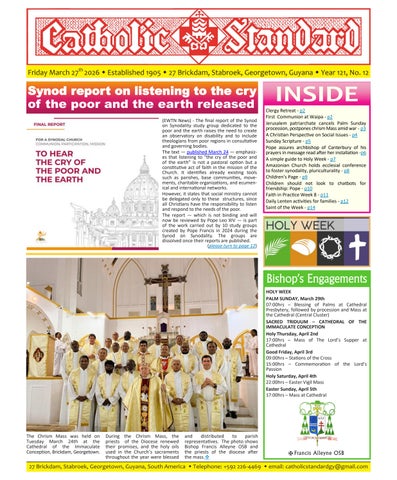

Synod report on listening to the cry

(EWTN News) - The final report of the Synod on Synodality study group dedicated to the poor and the earth raises the need to create an observatory on disability and to include theologians from poor regions in consultative and governing bodies.
The text published March 24 emphasizes that listening to “the cry of the poor and of the earth” is not a pastoral option but a constitutive act of faith in the mission of the Church. It identifies already existing tools such as parishes, base communities, movements, charitable organizations, and ecumenical and international networks
However, it states that social ministry cannot be delegated only to these structures, since all Christians have the responsibility to listen and respond to the needs of the poor. The report which is not binding and will now be reviewed by Pope Leo XIV is part of the work carried out by 10 study groups created by Pope Francis in 2024 during the Synod on Synodality. The groups are dissolved once their reports are published. (please turn to page 12)

Chrism Mass was
Tuesday March 24th at the
of the Immaculate Conception,Brickdam,Georgetown.
parish representatives. The photo shows Bishop Francis Alleyne OSB and the priests of the diocese after the mass.❖
Clergy Retreat - p2
First Communion at Waipa - p2
Jerusalem patriarchate cancels Palm Sunday procession,postponeschrismMassamidwar - p3
A Christian Perspective on Social Issues - p4
Sunday Scripture - p5
Pope assures archbishop of Canterbury of his prayersinmessagereadafter herinstallation -p6
A simple guide to Holy Week - p7
Amazonian Church holds ecclesial conference to foster synodality, pluriculturality - p8
Children’s Page - p9
Children should not look to chatbots for friendship: Pope - p10
Faith in Practice Week 8 - p11
Daily Lenten activities for families - p12
Saint of the Week - p14

Bishop’s Engagements
HOLY WEEK
PALM SUNDAY, March 29th
07:00hrs – Blessing of Palms at Cathedral Presbytery, followed by procession and Mass at the Cathedral (Central Cluster)
SACRED TRIDUUM – CATHEDRAL OF THE IMMACULATE CONCEPTION
Holy Thursday, April 2nd
17:00hrs – Mass of The Lord’s Supper at Cathedral
Good Friday, April 3rd
09:00hrs – Stations of the Cross 15:00hrs – Commemoration of the Lord’s Passion
Holy Saturday, April 4th
22:00hrs – Easter Vigil Mass
Easter Sunday, April 5th
17:00hrs – Mass at Cathedral

Francis Alleyne OSB
The
held on
Cathedral
During the Chrism Mass, the priests of the Diocese renewed their promises, and the holy oils used in the Church’s sacraments throughout the year were blessed and distributed to


Year of St. Francis Jubilee Prayer
Saint Francis, our brother, you who eight hundred years ago went to meet Sister Death as a man at peace, intercede for us before the Lord.
You recognized true peace in the Crucifix of San Damiano, teach us to seek in Him the source of all reconciliation that breaks down every wall.
You who, unarmed, crossed the lines of war and misunderstanding, give us the courage to build bridges where the world raises up boundaries.
In this time afflicted by conflict and division, intercede for us so that we may become peacemakers: unarmed and disarming witnesses of the peace that comes from Christ.
Amen - Pope Leo XIV


On Tuesday March 24th, Bishop Francis Alleyne OSB and the clergy of the Diocese gathered for a retreat at the Catholic Life Centre, Brickdam, Georgetown. The retreat was conducted remotely by Bishop John Persaud of the Diocese of Mandeville, Jamaica. This gathering preceded the Chrism Mass, held later that day, during which the clergy renewed their promises to Bishop Francis. The retreat continued the next day, Wednesday, March 25th, with an informative session on the Marriage Act of Guyana by Registrar General Mr. Raymon Cummings.❖ (Adapted from Catholic Media Guyana)


Holy Communion at St Francis Xavier Church, Waipa, Region 8, Essequibo, Guyana, Sunday, March 22nd

JERUSALEM (OSV News) The Latin Patriarchate of Jerusalem said wartime restrictions have forced the cancellation or postponement of key Holy Week observances, urging the faithful to remain united in prayer despite the inability to gather for traditional celebrations.
In a March 22 statement, Cardinal Pierbattista Pizzaballa, Latin patriarch of Jerusalem, said the ongoing conflict has disrupted customary Lenten practices in Jerusalem, including communal observances at some of Christianity’s holiest sites.
‘Loss of the community journey’
“Due to the war, this year we were unable to experience the traditional Lenten journey in Jerusalem, with the solemn celebrations at the Holy Sepulcher and in the Holy Places of the Passion,” the statement said. “Though we were able to pray and prepare personally, we felt the loss of the community journey towards Easter.”
The statement described uncertainty surrounding upcoming Holy Week liturgies central to the Christian faith and typically drawing large gatherings of pilgrims and local worshippers in Jerusalem.
“Now we ask ourselves about the celebrations of Holy Week, the beating heart of our faith, in Jerusalem and at the Holy Sepulcher,” Cardinal Pizzaballa said, adding the patriarchate remains in communication with civil officials and leaders of other Christian communities to determine what
limited observances may still be possible.
Situationremainsfluid
“The restrictions imposed by the conflict and the events of recent days do not bode well for any imminent improvement,” the statement said, adding that the situation remains fluid, leaving little room for firm planning.
“The situation is constantly evolving, and it is not possible to provide definitive indications for the days to come; we will therefore be forced to coordinate on a day-to-day basis,” the statement said.
Cardinal Pizzaballa made clear however that large, public liturgies will not take place this year: “Ordinary celebrations open to all cannot take place,” the statement said.
Among the most significant changes is the cancellation of the traditional Palm Sunday procession from the Mount of Olives into Jerusalem, an event that typically commemorates Jesus’ entry into the city and draws thousands of participants.
Momentofprayerforcityof Jerusalem
“The traditional Palm Sunday procession, which goes up to Jerusalem from the Mount of Olives, to Jerusalem is canceled,” the statement said. “It will be replaced by a moment of prayer for the city of Jerusalem, at a location to be determined.”
The chrism Mass, during which priests renew their vows and sacred oils are
Church of the Holy Sepulcherclosed
Israeli authorities closed Jerusalem’s Church of the Holy Sepulcher as part of wider closures for security concerns, beginning Feb. 28, when Israel and the United States launched attacks against Iran.
A statement from the head of Israel’s Civil Administration confirmed that “all holy sites in the Old City of Jerusalem, including the Western Wall, the Temple Mount and the Church of the Holy Sepulcher, will remain closed for security reasons in light of the current tensions in the region.”
In a March 21 statement, the Custody of the Holy Land said the Church of the Holy Sepulcher remains a place of continuous prayer despite restricted access and ongoing uncertainty over Holy Week and Easter, as friars now praying without the faithful and unsure how long limits will last appealed to Catholics worldwide to unite in prayer for an end to violence and for dialogue and diplomacy to prevail in what they described as a “time of trial.”
The Latin patriarch’s March 22 statement pointed to Scripture for encouragement, recalling Jesus’ exhortation to perseverance.
blessed, has also been postponed “to a date to be determined,” and it will be concelebrated “as soon as the situation allows, possibly within the Easter season,” the statement said, noting that “the Dicastery for Divine Worship has already granted the necessary approval.”
Despite the disruptions, churches in the diocese will remain open, and clergy have been instructed to encourage participation in whatever forms are feasible.
Acknowledging the emotionaltoll
The Latin patriarch acknowledged the emotional toll of the situation, describing the inability to celebrate Easter together as an additional burden amid the broader suffering caused by the U.S. and Israel-Iran war.
“The harshness of this time of war, which affects us all, today bears the added burden of not being able to celebrate Easter together and with dignity,” the statement said. “This is a wound that adds to the many others inflicted by the conflict.”
Even so, the message urged resilience and perseverance in faith and prayer.
“But we must not allow ourselves to be discouraged. Though we may not gather as we would like, let us not give up prayer,” Cardinal Pizzaballa said.
“This is the time to remember Jesus’ invitation to his disciples: ‘Pray always and do not lose heart’ (Luke 18:1),” it said.
The faithful were encouraged to pray within their homes and religious communities as a substitute for public gatherings.
“We therefore wish to compensate for these limitations with moments of prayer as families and in our religious communities,” the statement said. “I know that prayer is already being practiced everywhere, and I am comforted by the commitment to keeping spiritual tension alive.”
Shared prayer as sign of unity
As a sign of unity, Cardinal Pizzaballa proposed a shared day of prayer March 28 “reciting the Rosary to implore the gift of peace and serenity, especially for those suffering because of the conflict,” the statement said.
The appeal emphasized that physical separation does not diminish spiritual unity.
“We will do so with humble hearts, certain that our prayer, even while we are physically distant, is capable of drawing upon the strength of God’s love, which unites us in a spirit of hope and trust,” it said.
“Easter, which we celebrate in the name of Christ’s passion, death, and resurrection, reminds us that no darkness, not even that of war, can have the last word,” Cardinal Pizzaballa concluded. “The empty tomb is the seal of the victory of life over hatred, of mercy over sin.” ❖
Cardinal Pierbattista Pizzaballa, Latin patriarch of Jerusalem, waves as he walks the traditional path that Jesus took on his last entry into Jerusalem during the Palm Sunday procession on the Mount of Olives in Jerusalem April 2, 2023. (OSV News photo)
A Christian Perspective on Social Issues

By GHK Lall
Palm Sunday - the power and the glory

Palm Sunday is here. There was the slightest lull in Jesus’s flurry of activity, the messages of his ministry. The calm before the storm, I would say. Palm Sunday of the Lord’ s Passion, more formally. From a king hailed, to a criminal cursed. From a human standpoint, the ecstasy and the agony, then the power and the glory, at long last, after the unending intervals of barbarous savagery.
The prophesy embedded in Zechariah 9:9 fulfilled. Whoever never heard of a
side of that coin. How people driven to madness by the bloodlust of impending kill made members of the crowd clamber over each to get a piece of him later in the week, tear him limb from limb.
Jesus was biding his time, carefully making his arrangements. Now his time had come, so it was onto the ordeal that awaited him in Jerusalem. Up the road he had to go, and down the hard rockiness that waited. And so, the salvation of the world hung in the balance. Through one man who disobeyed at the first temptation, sin entered the world, and with that its wages -death. To balance the scales in a just manner, one man was required to make the sacrifice of a pure and perfect life (his own), so that sin could be expelled and light and life return to their ascendant levels.
At every turn in his ministry, there were adversaries waiting for him. Every step that Jesus made during Holy Week, the chief priests and scribes, the forever plotting Pharisees and Sadducees were waiting to trip him. They said he was a bad man, an instrument of the devil. Those who had no light in them saw only darkness. The power of a presence that they couldn’t overpower. The virtues of a life that they couldn’t challenge honestly. The spirit of grace in Jesus that they couldn’t
many days and years giving way to his feet.
Divine, I would say. The only time that Pharisees and Sadducees, and the names of High Priests and high Roman tribunes, are ever mentioned is in the context of the name Jesus. His soars; theirs is a sidebar. The hand of the divine at work. The promise made ages before now coming to full fruition. Do you believe a little more today, fellow worshippers? What do I believe, and how am I setting a standard for others? Feet marching resolutely to Jerusalem. Swords and spears, whips and other weapons of torture, circling and gathering in secret conclave right there in that nest. Jerusalem, O Jerusalem, the city that kills the prophets and stone those sent.
In this most solemn of days and hours, you and I should put our feet in Jesus shoes. Indeed, this was where he walked, that rough, unforgiving road to Calvary, so that each one of us could walk in the light his grace, wisdom, and righteousness. Jesus made the supreme sacrifice, and for sinners of all kinds. What sacrifice am I making for him? How much am I prepared to give for him? How far will I go, which path am I ready to travel? The life of a man and woman of Christ is not easy. Palm Sunday proved it. How what is bright and right change in a hurry. The

Gracious and loving God, we thank your for the gift of our priests. Through them, we experience your presence in the sacraments.
Help our priests to be strong in their vocation.
Set their souls on fire with love for your people.
tiply, gather together, then stand in opposition to the choices made. There liberty of God is granted. Jesus was the substitute in our place. Time for each
Grant them the wisdom, understanding, and strength they need to follow in the footsteps of Jesus.
Inspire them with the vision of your Kingdom.
Give them the words they need to spread the Gospel.
Allow them to experience joy in their ministry.
Help them to become instruments of your divine grace.
We ask this through Jesus Christ, who lives and reigns as our Eternal Priest. Amen
the First Aid Training they -
The chaplain also invited students to later join the St. John Ambulance Brigade which is present at all large gatherings to respond in cases of emergency. He concluded by wishing the students success in their future


completing


Procession Gospel: Matthew 21:1-11
When they were near Jerusalem and had come in sight of Bethphage on the Mount of Olives, Jesus sent two disciples, saying to them, ‘Go to the village facing you, and you will immediately find a tethered donkey and a colt with her. Untie them and bring them to me. If anyone says anything to you, you are to say, “The Master needs them and will send them back directly”.’ This took place to fulfil the prophecy: ‘Say to the daughter of Zion: Look, your king comes to you; he is humble, he rides on a donkey and on a colt, the foal of a beast of burden.’
So the disciples went out and did as Jesus had told them. They brought the donkey and the colt, then they laid their cloaks on their backs and he sat on them. Great crowds of people spread their cloaks on the road, while others were cutting branches from the trees and spreading them in his path. The crowds who went in front of him and those who followed were all shouting:
‘Hosanna to the Son of David! Blessings on him who comes in the name of the Lord! Hosanna in the highest heavens!’
And when he entered Jerusalem, the whole city was in turmoil. ‘Who is this?’ people asked, and the

Most of us know today as Palm Sunday, although officially in the Church it is called Palm Sunday of the


crowds answered, ‘This is the prophet Jesus from Nazareth in Galilee’.
First Reading Isaiah 50:4-7
I did not cover my face against insult-I know I shall not be shamed.
The Lord has given me a disciple’s tongue.
So that I may know how to reply to the wearied he provides me with speech. Each morning he wakes me to hear, to listen like a disciple.
The Lord has opened my ear. For my part, I made no resistance, neither did I turn away.
I offered my back to those who struck me, my cheeks to those who tore at my beard; I did not cover my face against insult and spittle. The Lord comes to my help, so that I am untouched by the insults. So, too, I set my face like flint; I know I shall not be shamed.
Responsorial Psalm
Psalm 21 Response: My God, my God, why have you forsakenme?
1. All who see me deride me. They curl their lips, they toss their heads. ‘He trusted in the Lord, let him save him; let him release him if this is his friend.’ Response
2. Many dogs have surrounded me, a band of the wicked beset me. They tear holes in my hands and my feet. I can count everyone of my bones. Response
3. They divide my clothing among them. They cast lots for my robe. O Lord, do not leave me alone, my strength, make haste to help me! Response
4. I will tell of your name to my brethren and praise you where they are assembled. ‘You who fear the Lord give him praise; all sons of Jacob, give him glory. Revere him, Israel’s sons.’ Response
Lord’s Passion, and to many Church leaders it is simply Passion Sunday, which comes from the Latin name for it, Dominica Passionis. We have reflected on this day previously how the liturgy begins with great joy and becomes more and more sombre with the reading of the Passion.
During the procession of the palms Jesus arrives in Jerusalem to great tumult and rejoicing as the people cry out “Hosanna… blessed is he who comes in the name of the Lord, hosanna in the highest.” As the Mass
Second Reading Philippians 2:6-11
He humbled himself, but God raised him high. His state was divine, yet he did not cling to his equality with God but emptied himself to assume the condition of a slave, and became as men are; and being as all men are, he was humbler yet, even to accepting death, death on a cross.
But God raised him high and gave him the name which is above all other names so that all beings in the heavens, on earth and in the underworld, should bend the knee at the name of Jesus and that every tongue should acclaim Jesus Christ as Lord, to the glory of God the Father.
GOSPEL
The Passion of Our Lord Jesus Christ according to Matthew (26:14-27:66)

progresses we get an overview of what is to occur during this holiest of weeks, including the institution of the Eucharist, the passion and death of the Lord, the prediction of His Resurrection, and then His Resurrection itself.
Imagine the confusion of the Twelve Apostles. Jesus has been spending time with them in the recent weeks prior to the Passion trying to get them to understand that His time of suffering was near and approaching, and that is the reason He must go to
Jerusalem. And here is the crowd welcoming and praising and laughing and celebrating His presence. We are not much different in many ways, but now is the time for us to really embrace and understand the sacrifice the Lord made for each of us, and the incredible gift He has given us. In the coming days it is our final chance to truly rededicate ourselves to being His disciple. ❖
[http://www.catholicsteward.com/blog/ ]
Gospel Reflection

Palm Sunday is also called Passion Sunday. These two titles go together because they tell us something about today’s celebration. Our liturgy unties two important incidents in Jesus’ life – this final entrance into Jerusalem with much support and loyalty from the crowd, and his Passion, the suffering he endured, lonely and rejected by the same crowd, until his death. As we walk and sing in procession, waving our palms, we remember and become a part of that moment of his joy. And as we listen to the story of his Passion, we become a part of the crowd as Jesus suffers and dies. We do not just remember two incidents in his life; we actively take part in these final days of his earthly life. This is a great privilege which carries with it great responsibilities. We cannot be untouched by it all as if we were just innocent bystanders. We are all involved.
At this celebration we not only remember an important incident in Jesus’ life but we relive the moment as an active participant. The big question, then, is where do each of us stand in the drama as it unfolds. I have to ask myself if I am like the religious leaders, so sure of my own righteousness and my relationship with God that I can easily condemn others Or am I like Pilate who, even though he knew Jesus was innocent, went along with the crowd so as not to upset anyone? Is there a Peter in me, weak and cowardly when I am most needed? At least Peter cried over what he had done and did not try to find excuses for his actions. Am I one of the crowd, being carried along by the ugly emotions of the moment? Too often we justify our actions by saying, “Well, everyone is doing it, so why shouldn’t I?” And let us not forget Jesus who shows that the only way to overcome evil is by being and doing good. ❖ [From: Journeying with the Word of God, The Religious Education Department, Diocese of Georgetown, Guyana ]

Archbishop Sarah Mullally of Canterbury waves following her installation at England's Canterbury Cathedral March 25, 2026, as the 106th archbishop of Canterbury and the first woman to lead the Church of England in its 1,400-year history. (OSV News photo/Yui Mok, Pool via Reuters)
(OSV News) Pope Leo XIV has assured Archbishop Sarah Mullally, the 106th archbishop of Canterbury and the first female to lead the Church of England, of his prayers and invoked “grace, mercy, and peace in truth and love.”
The pope’s remarks came in a message to the archbishop a day after her installation ceremony took place March 25 in a packed Canterbury Cathedral.
Common prayer service
The message was delivered March 26 in Canterbury Cathedral at the conclusion of a common prayer service presided over by Archbishop Mullally and the pope’s envoy, Cardinal Kurt Koch, prefect of the Dicastery for Promoting Christian Unity, with Cardinals Timothy Radcliffe, a Dominican theologian, and Vincent Nichols of Westminster present, along other Vatican officials.
During her installation, in her first sermon as the leader of the Anglican Communion, Archbishop Mullally said, “As I look back over my life at the teenage Sarah, who put her faith in God and made a commitment to follow Jesus I could never have imagined the future that lay ahead, and certainly not the ministry to which I am now called.”
She warned against overlooking victims harmed by “the failures of those in our own Christian churches and communities,” the BBC reported. Among 2,000 guests gathered at Can-


terbury Cathedral for the ceremony, the Prince and Princess of Wales were present.
St. Augustine of Canterbury Anglicans claim 1,400 years of history because they identify the Church of England not as a new entity created during the 16th-century Reformation, but as the continuation of the church established in England by a Catholic saint St. Augustine of Canterbury in A.D. 597. St. Augustine is considered the first archbishop of Canterbury and all previous 105 archbishops have been men. Women were allowed to become priests in the Church of England in 1994.
During the celebration, the kneeler used was the same one used in the 1982 encounter between St. John Paul II and Archbishop Robert Runcie of Canterbury, Vatican News said. The pope and the Anglican archbishop used the kneeler in Canterbury Cathedral together on May 29, 1982, to symbolize reconciliation and unity between the Roman Catholic Church and the Anglican Communion.
St. John Paul’s historic six-day visit was the first by a reigning pope to Britain.
‘Challenging moment’ for Anglican family
In his message to Archbishop Mullally, Pope Leo stressed the Anglican leader is commencing global duties “at a chal-

lenging moment in the history of the Anglican family.”
“I know that the office for which you have been chosen is a weighty one,” Pope Leo said. He recalled moments of close dialogue and also difficulties in Catholic-Anglican relations.
First, the pope remembered a historic meeting between St. Paul VI and Archbishop Michael Ramsey of Canterbury, when, exactly 60 years ago, they “committed Catholics and Anglicans to ‘a new stage in the development of fraternal relations, based upon Christian charity,'” Pope Leo said, citing a Joint Declaration of March 24, 1966.
‘Fresh chapter of respectful openness’
“That fresh chapter of respectful openness has borne much fruit over the past six decades and continues to this day,” the pope said, citing initiated “theological dialogue” and saying the Anglican-Roman Catholic International Commission, or ARCIC, “has contributed enormously to a growth in mutual understanding since its creation.”
At the same time, Pope Leo reminded Archbishop Mullaly that the “ecumenical journey has not always been smooth.”
“Despite much progress, our immediate predecessors, Pope Francis and Archbishop Justin Welby, acknowledged frankly that ‘new circumstances have presented new disagreements among us.'” Nevertheless, “we have continued to walk together,” because differences “cannot prevent us from recognizing one another as brothers and sisters in Christ by reason of our common baptism,” Pope Leo said, citing a joint Catholic-Anglican declaration of Oct. 5, 2016
‘Dialogue in truth and love’
“For my part,” Pope Leo wrote to Archbishop Mullally, “I firmly believe that we need to continue to dialogue in truth and love.”
Encouraging unity “which Christians seek,” is “never an end in itself,” he stressed, “but is directed toward the proclamation of Christ, in order that, as the Lord Jesus himself prayed, ‘the world may believe.'”
Calling Archbishop Mullally a “dear sister,” the pope concluded: “I invoke upon you the blessings of Almighty God as you take up your high responsibilities. the Holy Spirit come down upon you and make you fruitful in the Lord’s service.”❖
For 121 years, the Catholic Standard has been sharing the Gospel of Jesus Christ.
Now reaching 10,000+ followers on Catholic Media Guyana Facebook plus going straight to your inbox and WhatsApp, our vibrant weekly e-paper is a trusted source which delivers informative and inspiring stories from across the diocese and around the world.
Want to promote your business or event? Advertise with us! Call 675-4542 or email catholicstandardgy@gmail.com ❖
Anglican
A simple guide to Holy Week Journeying with the Word of God
By Heidi Busse, OSV News

The week between Palm Sunday and Easter Sunday, Holy Week, is the most sacred time of year. During this special time, we enter into the passion of Christ Crucifixion, death and Resurrection through liturgical celebration and personal conversion. While the season of Lent is a very important time in the Church, it is helpful to remember that our Lenten practices (prayer, fasting and almsgiving) are meant as preparation for the three days of the Triduum.
The three days of the Triduum are counted as the Hebrews counted their days, from dusk to dusk. Lent officially ends and the Triduum begins at dusk on Holy Thursday and continues through dusk on Easter Sunday. Because we cannot separate Jesus’ death from his resurrection, the Church teaches that the Triduum is really one celebration that lasts for three days. We do not spend all of the three days in church, of course, but at various times during these days we are called to gather together at church to celebrate and remember the saving action of Christ.
The evening Mass on Holy Thursday begins the sacred Triduum. On this night, we remember the Last Supper and celebrate the institution of the Eucharist and the sacrament of holy orders. At the end of the liturgy, the sanctuary is stripped clean in preparation for the most somber of feasts, Good Friday.
The spirituality of the Triduum is centered on the accounts of the Paschal mystery in the Gospel of John. In John’s Gospel, the Last Supper is not the Passover meal; rather, Jesus is crucified at the same time the lambs are being slaughtered for Passover, as a sign that he is the Lamb of God, sacrificed for all of humanity. The last meal Jesus shares with his apostles in the Gospel of John is marked by the washing of feet. Jesus gets down in the dirt and washes the feet of his disciples and in this way connects the holy Eucharist with service to others.
Most Holy Thursday liturgies include a modern-day experience
also referred to as Maundy Thursday, meaning “a new mandate.” It refers to the mandate put forth by Jesus in John 13:34, “Love one another as I have loved you.”
Good Friday is a somber remembrance of Jesus’s crucifixion and death on the cross. It is a day of fasting and penance and a time to examine all of the places in our lives where we fail to follow Christ and fall into sin. Good Friday is not only a commemoration of a historical event; rather, Christ’s sacrificial death on the cross, along with his glorious resurrection, comprise the heart of the Christian faith.
The church is bare on Good Friday, the altar stripped of ornamentation and the tabernacle left open and empty. Good Friday is a day of mourning. Traditionally, there is no music (other than chanting) on this day, and the prayer of consecration is also omitted from the service as a sign of what Christ’s sacrifice on the cross truly means. Good Friday is not a Mass; the holy Communion that is given out has been consecrated on Holy Thursday and kept in the tabernacle for adoration.
The service is divided into reading of the Passion, Veneration of the Cross and reception of the Eucharist. Christ’s passion is read from the Gospel of John and concludes with the prayers of the faithful, offered for the unity of the universal Church. The veneration of the cross is a time for the faithful to individually revere the cross and ponder the enormity of Christ’s salvific act. Holy Communion is then distributed, and the priest, along with the entire congregation, departs in silence. Many parishes offer Stations of the Cross on Good Friday. Meanwhile, fasting is required on Good Friday. Catholics are to take in only one full meal (smaller than a regular meal and often substituting fish for meat) in solemn remembrance of our hunger for Christ and his everlasting sacrifice on the Cross.

The Easter Vigil is the restoration s tradition as the great celebration of adult baptism and confirmation. It is the high point in the Church liturgical year. The Vigil begins in darkness (usually outside), and the long procession of candlelight that enlivens the church reminds us that Jesus is the light of the world who has conquered all darkness and death. The Paschal candle that is lit at the Easter Vigil will remain in the church throughout the year as a sign of Christ’s death and resurrection.
Those who are coming into full communion with the Church receive the sacraments of initiation at the Easter Vigil, and we, as the community of believers, participate in this initiation by renewing our own baptismal promises. We recommit ourselves to Christ by once again rejecting sin and accepting the freedom that comes from living as children of God. We pray and welcome the newly initiated as they receive the oil of chrism and “share in the outpouring of the Holy Spirit” at confirmation. The white garments given to the newly initiated represent Christ’s everlasting victory over death.
The Vigil concludes with reception of the Eucharist. As the newly confirmed receive the final sacrament of initiation, the body and blood of Jesus, we are ready to celebrate Easter. The tomb is empty. There is light in the darkness. Alleluia, Christ has risen!
The Triduum is the culmination of the entire liturgical year and the three most sacred days in the lives of Catholic Christians. The single celebration that comprises the Triduum commemorates the fullness of the Paschal mystery the passion, death and resurrection of Jesus Christ. Because Jesus was willing to die for our sins and was resurrected,death is no longer the end of life for us. It is the beginning of new life.
We gather together during Holy Week, then, to remember the saving act of Jesus, to celebrate the miracle of his resurrection and to embrace his promise of eternal life.❖
MAKING THE WORD OF GOD YOUR OWN
Step 1: Lookattoday’sReadingsprayerfully.
1st Reading: The prophet suffers in carrying out his mission but he is sustained by the firm belief that God would not abandon him.
2nd Reading: Because Jesus took on himself our human condition and accepted death on the cross, the Father raised him up and make him Lord of all. Gospel: Matthew shows the passion of fulfilling the prophecies of Scripture.
Step 2: ApplyingthevaluesoftheReadings toyourdailylife.
1.The religious leaders made a choice to condemn Jesus because of what they believed in. God made us free to make choices that will affect our lives, whether for good or bad. We does this tell us about the choices we make?
2.Even in the midst of the cruelty of Jesus’ Passion, there are moments of kindness. Check the Gospel account for those moments?
3.The prophet Isaiah says that whenever he is troubled, the Lord comes to his aid. When, in your life, has the Lord come to your help in your moments of need?
4.Pilate felt that he could escape responsibility for Jesus’ death by just washing his hands of the whole affair. Do you sometimes act in the same when faced with a difficult situation? Is it the best route for the Christian to take?
Step 3: Accepting the message of God’s Wordinyourlifeoffaith
It can be a great comfort to us knowing that Jesus, the innocent one, has travelled down the same road of suffering that we sometimes experience. On the cross he gathered up all human pain and makes it his own.
Step 4: Somethingtothink&prayabout
1.We are all capable of committing evil against our fellow human beings because there is evil residing in us all. Lent and the Holy Week give us the opportunity to face up to this evil and to overcome it so that we may become instruments of peace, truth, love and justice in our families, workplaces, neighbourhood, parish community and country.
2.Pray that you will always be moved to respond with compassion to the sufferings of those around you . ❖
[From: Journeying with the Word of God, The Religious Education Department, Diocese of Georgetown, Guyana ]
Amazonian Church holds ecclesial conference

(Vatican News) - Inspired by the biblical text, “I am about to do something new; even now it is springing forth. Do you not perceive it?” (Is 43:19), the Ecclesial Conference of the Amazon (CEAMA) held its 6th General Assembly from March 16 to 19, electing a new presidency for the 2026–2030 period and renewing its missionary and synodal commitments in the Amazonian territories.
The new presidency of CEAMA is composed of Cardinal Leonardo Steiner, OFM, of the Archdiocese of Manaus (Brazil), as president; and the vice presidents: Fr. Jesús Huamán, of the Apostolic Vicariate of Puerto Maldonado (Peru); Juan Urañavi, of the Apostolic Vicariate of Ñuflo de Chávez (Bolivia); Marva Joy Hawksworth, of the Diocese of Georgetown (Guyana); and Sr. Sônia Maria Pinho de Matos, of the Archdiocese of Manaus (Brazil).
“We are gathered in Bogotá, Colombia, at the CEAMA Assembly, the Ecclesial Church of the Amazon,” Cardinal Leonardo Steiner told Vatican News.
“We are reflecting on our mission, deepening the question of our mission, and we are also seeking some common horizons for the action of our particular Churches, our dioceses, our prelatures, our vicariates. It is a path we are undertaking, and we wish to give it continuity.”
He said the General Assembly also saw the election of a new presidency, “to give continuity to that dream of Pope Francis to go to the Churches of the Amazonia and to be an ecclesial Church. We want to carry forward that dream of Pope Francis, implementing especially the four dreams he addressed to us in Querida Amazonia We take into consideration the social question, the cultural question, the ecological question, and also, naturally, our ecclesial situation.”
“This way of being Church is deeply synodal and missionary. May God bless us, and may Our Lady of the Amazon always accompany us,” he said.
The diversity of members of the new presidency offers a concrete sign of the synodality that drives CEAMA, a Church that walks together, values the diversity of gifts, and allows itself to be challenged by the reality of the territory. It is also a living expression of the dream of a Church with an Amazonian face, where interculturality, participation, and shared responsibility are fundamental pillars.
Marva Joy Hawksworth, Vice President of CEAMA

Representing the laity of the Amazon, Marva Joy Hawksworth, of the Diocese of Georgetown (Guyana), was elected vice president of CEAMA. Belonging to the Macushi people, she was born in the community of Tipuru, (South Pakaraimas) where she has developed much of her educational and community vocation.
“These last few days have been very informative and very interactive,” she said in an interview with Vatican News.
“I have learned a great deal, and I have become involved and participated in everything that has happened. It has been a wonderful time here, and today, I was elected Vice President. And that was a surprise to me; it was an absolute surprise. I know it is a great
short cycle and operates within an editorial hierarchy that decides what counts and what does not. The Amazonia story appears when there is a catastrophe, when there is a summit, or when there is the murder of an indigenous leader. And then it disappears. To break the wall of silence and disinterest, creativity is needed,” Dr. Ruffini said.
He also invited participants “to act on the dominant platforms without being colonized by the logic of the same media system that marginalizes the Amazonia. Effective global communication on these issues instead requires a plural grammar of languages, each with a different function and a different audience.”
“This is where you can give free rein to your creativity,” he said. “Your communication must not only be about Amazonia, but also from Amazonia.”
The Pope: missionaries in the Amazon
office, that it is an enormous responsibility that I am taking on, but I also know that I am not alone.” Her ministry has been centered in rural and indigenous contexts, where she has promoted an intercultural education that strengthens the identity, language, and traditions of indigenous peoples. Her pedagogical work has been characterized by integrating ancestral knowledge and contemporary methodologies, generating meaningful educational processes for the new generations.
Amazonia and communication
In a video message at the opening of CEAMA’s 6th Assembly, Pope Leo XIV encouraged the Church in Amazonia “to continue together, pastors and faithful, in strengthening the identity of missionary disciples in the Amazon Region. Keep sowing in the furrow that has been watered even with the blood of so many men and women who have gone before you, and who, united to the passion of Christ, have become the root of a ‘giant tree’ growing in the Amazonia.”
“I am pleased that among the objectives of the Assembly is the formulation of the Synodal Pastoral Horizons, which could be a useful instrument for of a God who infinitely loves every human being, who has fully manifested that Querida
As it renews its mandate and mission, CEAMA confirmed its commitment to the defense of life, the dignity of peoples, and care for our Common
an people with hope, faith, and deep

Presidency of CEAMA for 2026-2030
Three persons from Guyana were among the Antilles Episcopal Conference’s (AEC) delegation to CEAMA’s 6th General Assembly. From left: Fr. Santiago Lantigua SJ , Ms. Marva Joy Hawksworth and Bishop Francis Alleyne OSB.

Dear Girls and Boys,
Today is Palm Sunday. Today the Church celebrates the kingship of Jesus with the observance of Palm (Passion) Sunday, the start of Holy Week.
Today we celebrate the entry of Jesus into Jerusalem. It was a day that marked the beginning of an incredible week. A week that would see Jesus cheered, then arrested, tried, condemned, and crucified. But as that week came to an end, another week began just as the previous week had begun with a celebration.
We remember that happy day when Jesus rode into Jerusalem on a donkey and the people welcomed him by waving palm branches; others spread their coats on the ground. They praised him: “Hosanna! Blessed is He who comes in the name of the Lord.”
Jesus is indeed a special person. He is a king. However, in the midst of that joyous celebration, Jesus knew he had enemies and that he would be crucified on Good Friday.
Today blessed palm branches are distributed in churches in memory of the love shown to Jesus.
Please hang your palms in a special place in your home to remind you that Christ is your king. Sing Hosanna!
Dear Jesus, our voices join with the voices of the people in Jerusalem some two thousand years ago. Hosanna! Blessed is he who comes in the name of the Lord. Amen. ❖


Children should not look to chatbots for friendship: Pope

(CathNews) - Pope Leo XIV has warned that children must not come to see artificial intelligence chatbots as substitutes for real friendship, cautioning that such reliance could harm their intellectual and emotional development.
Source: EWTN News.
“We must not allow children to end up believing they can find in artificial intelligence chatbots their best friends or the oracle of all knowledge, dulling their intelligence and their capacity for relationships, and numbing their creativity and thinking,” the Pope said.
Pope Leo made the remarks in a message published on Sunday in Popotus, the weekly supplement of the Italian newspaper Avvenire dedicated to children, marking its 30th anniversary.
In that context, he urged adults to “safeguard” childhood and guide “the growth of children so that they may become protagonists of a renewed world”.
The Pope has consistently highlighted artificial intelligence as a central concern of his pontificate, framing it as an ethical challenge comparable to the industrial revolution addressed by Pope Leo XIII.
In his message to Popotus readers, Leo encouraged children to rediscover the beauty of the world.
“I want to tell you that restoring the world’s beauty is possible and that you can help adults to see it – precisely through this newspaper designed for you – with renewed wonder, to think about it with trust, and to build it without prejudice,” he said.
He also emphasised fundamental values to be preserved in childhood: “Trust in those who love you, the universal language of love, the disarming power of a smile, the courage to ask forgiveness, the beauty of making peace.”
He expressed “great concern” over wars threatening humanity’s future and underscored the need to recover a pure way of seeing reality.
Pope Leo thanked parents and educators for “the care and love with which they educate children,” helping them “to draw out the beauty within them and to express it in ever new ways.”
“Today especially, in the digital age and the age of artificial intelligence, we all need ongoing education. And to remain human, we must preserve a childlike way of looking at reality,” he concluded.❖


FaithinPractice:LivingandKnowingourFaith
The Priesthood: A Gift of Service, Sacrifice, and the Eucharist
Fr Joel Thompson SJ
On Holy Thursday, we hear Jesus say: “Do this in memory of me.” (see Luke 22:19, 1 Corinthians 11:24-25). On the night before He died, Christ gave us not only the Eucharist, but also the priesthood. The Catechism of the Catholic Church teaches that the priesthood is “the sacrament through which the mission entrusted by Christ to his apostles continues to be exercised in the Church until the end of time” (CCC 1536).
But this raises a serious question: How do we continue this remembrance without men willing to offer themselves for the priesthood?
At times, I joke with people about one or two words that may be preventing men from joining the priesthood. I say it begins with “S,” and everyone assumes it is sex. But the two words are service and sacrifice. Perhaps that is the real challenge.
Key Beliefs:
• The priesthood is a sacrament of apostolic ministry (CCC 1536)
• The priest acts in the person of Christ
• The priesthood exists for the Eucharist
Related Scripture:
• Luke 22:19
• John 20:21–23
• 1 Timothy 4:14
• 2 Timothy 1:6
What We Believe
Priesthood is not a human invention. It is rooted in Christ Himself. After His resurrection, Jesus breathed on the apostles and entrusted them with His mission. Through the laying on of hands, passed down through generations, the Church continues this mission in what we call apostolic succession
At ordination, a man receives a sacred power that comes from Christ alone (CCC 1538). Through this grace, the priest can celebrate the Eucharist, speaking the words of Christ: “This is my body this is my blood.” It is not the priest who changes the bread and wine, but Christ working through him. The Sacrament of Holy orders has three degrees: bishops, successors of the apostles, priests, co-workers of the bishop; and deacons, ordained for service.
At its heart, priesthood exists for the Eucharist and for service. Without the priest, the Eucharist cannot ordinarily be celebrated. Without the Eucharist, the Church loses her source and summit. At the same time, ALL the baptized share in the priesthood of believers. Every Christian is called to offer their lives to God. The ordained priesthood exists to serve this wider priesthood so that the whole Church

may be made holy and the world transformed. The wider priesthood exists to serve the world.
Why It Matters
The priest is not simply a leader or administrator. He is a servant of Christ’s presence. He stands at the altar not in his own name, but in the person of Christ. He brings the Eucharist, the forgiveness of sins, blessings, counselling, peace, and the Word of God to those longing to hear it. In a world searching for meaning, the priest points beyond himself to Christ. Yet today, many hesitate. Service and sacrifice can feel demanding. The call to celibacy, which is freely embraced for the sake of the Kingdom (see Matthew 19:12) can seem difficult. But at its core, priesthood is not about giving something up. It is about giving oneself completely. We also recognize that the Church does not ordain women to the priesthood, not because of inequality, but because Christ Himself chose twelve men as apostles, and the Church remains faithful to His example. Permitting some/all priests to marry as well as
ordaining women are sometimes given as pastoral solutions to a shortage of priests. The discernment continues but sacrifice and service will still be part of vocation.
How We Live it: Is Christ worth giving one’s life for?
Priestly vocations do not grow in isolation. They grow in families, parishes, and communities that value faith, generosity, and sacrifice. Young men need encouragement. Sometimes they do not come forward because no one has ever said: “Have you considered that God may be calling you?” We must also support those who respond. Priests are not perfect, but their humanity does not limit the grace of God. Christ remains the one who acts.
In Conclusion
Holy Thursday reminds us that the priesthood and the Eucharist are inseparable gifts. Without the priesthood, we cannot continue to “do this” in memory of Him. Without generous
hearts willing to serve and sacrifice, the Church’s sacramental life grows weaker. But Christ still calls. He calls young men not to comfort, but to love. Not to status, but to service. Not to self-preservation, but to sacrifice. The priesthood exists so that Christ may remain present in the world.
The real question is not whether vocations are declining, but whether we are still willing to give everything for Him. ❖
Living the Priesthood:
• Pray for vocations
• Encourage young men to listen to God’s call
• Support and appreciate your priests
• Help create a culture where service is valued
Reflection Questions:
• What is God asking of me, and am I willing to give it?
• How am I living my Baptismal call to serve?
Synod report on listening to the cry of the poor and the earth (From

Within the group on the poor, another subgroup was established, mostly composed of people with disabilities.
This subgroup produced the proposal to create an international “Ecclesial Observatory on Disability” that would establish similar bodies at the diocesan, national, and regional levels.
The aim, the text states, is to use this model to “create structures and processes for listening to other marginalized groups,” including “the LGBTQIA+ community.”
“The Church has many means to listen to the cries of the poor and the earth. However, the Synod learned that women, Indigenous people, Dalits, young people, people with disability, victims of class or caste discrimination and racism, LGBTQIA+ people, those made poor, and other marginalized groups, are still asking to be heard,” it states.
“We need to deepen our listening and respond with transformative action. Synodality invites us to move from having means of listening to becoming a means of listening in the service of God’s mission,” the report says.
The document also highlights the importance of the language used for people in vulnerable situations and urges that it respect the “diversity of their experience” and reflect their dignity, for example through the use of “person first language.”
Groups for single parents and widowed people
Another recommendation in the report is for dioceses and bishops’ conferences to consider creating “groups for single parents, widows, and widowers” in order to offer support and learn about their needs, and that there be deeper exploration of “effective ways of listening to those affected by war, conflicts, and violence.”
It also calls for ensuring the presence of vulnerable groups, women, and those coming from territories affected by climate change and conflicts in Church bodies.
Greater role for the marginalized and the poor in theology
The report also raises the need to include theologians from “poor, marginalized, or excluded” contexts in the drafting of Church statements.
“The appointment of women, people with disabilities, and people of color should be a key priority,” it says.
It proposes creating global networks connecting theologians with organizations working on the ground, strengthening dialogue with other Christian denominations and religions, and promoting collaboration among Catholic media, universities, and young people in order to translate theological reflection into concrete action.
It suggests creating “global networks” that connect the poor “with organizations closest to the reality of the world of the poor.” According to the report, the goal is to promote a theology more connected to the reality of the poor and open to intercultural dialogue and other disciplines.❖


April 4th: Saint Isidore of Seville Patron Saint of the Internet and Computers
s life were a time of
The Visigoths had invaded the land a century and a half earlier, and shortly before Isidore’s birth they set up their own capital. They were Arians Christians who said Christ was not God. Thus, Spain was split in two: One people (Catholic Romans) struggled with another (Arian Goths).
Isidore reunited Spain, making it a center of culture and learning. The country served as a teacher and guide for other European countries whose culture was also threatened by barbarian invaders.
Born in Cartagena of a family that included three other sibling saints – Leander, Fulgentius and Florentina – he was educated by his elder brother, whom he succeeded as bishop of Seville.
An amazingly learned man, he was sometimes called “The Schoolmaster of the Middle Ages” because the encyclopedia he wrote was used as a textbook for nine centuries. He required seminaries to be built in every diocese, wrote a Rule for religious orders, and founded schools that taught every branch of learning. Isidore wrote numerous books, including a dictionary, an encyclopedia, a history of Goths, and a history of the world beginning with creation! He completed the Mozarabic liturgy, which is still in use in Toledo, Spain. For all these reasons, Isidore is a patron saint of the Internet.❖ [www.franciscanmedia.org ]

Bishop Francis Alleyne OSB presents the holy oils to the representative of St. Francis Xavier church, Port Mourant, Berbice, during the Chrism Mass at the Cathedral on Tuesday, March 24th, 2026 ❖