March 21st 2025_Catholic Standard

Page 1


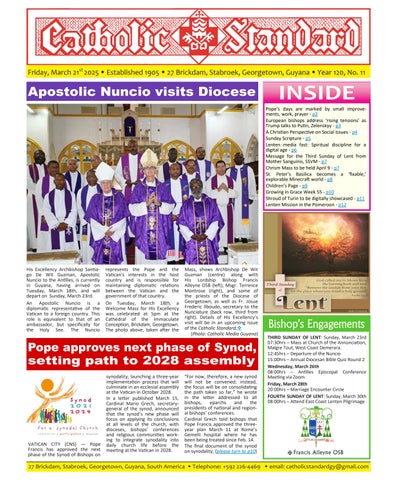
His Excellency Archbishop Santiago De Wit Guzman, Apostolic Nuncio to the Antilles, is currently in Guyana, having arrived on Tuesday, March 18th, and will depart on Sunday, March 23rd.

An Apostolic Nuncio is a diplomatic representative of the Vatican to a foreign country. This role is equivalent to that of an ambassador, but specifically for the Holy See. The Nuncio

represents the Pope and the Vatican's interests in the host country and is responsible for maintaining diplomatic relations between the Vatican and the government of that country.

On Tuesday, March 18th, a Welcome Mass for His Excellency was celebrated at 5pm at the Cathedral of the Immaculate Conception, Brickdam, Georgetown. The photo above, taken after the

Mass, shows Archbishop De Wit Guzman (centre) along with His Lordship Bishop Francis Alleyne OSB (left), Msgr. Terrence Montrose (right), and some of the priests of the Diocese of Georgetown, as well as Fr. Josue Frederic Ilboudo, secretary to the Nunciature (back row, third from right). Details of His Excellency’s visit will be in an upcoming issue of the Catholic Standard.❖

(Photo: Catholic Media Guyana)

VATICAN CITY (CNS) Pope Francis has approved the next phase of the Synod of Bishops on

synodality, launching a three-year implementation process that will culminate in an ecclesial assembly at the Vatican in October 2028.

In a letter published March 15, Cardinal Mario Grech, secretarygeneral of the synod, announced that the synod’s new phase will focus on applying its conclusions at all levels of the church, with dioceses, bishops’ conferences and religious communities working to integrate synodality into daily church life before the meeting at the Vatican in 2028.

“For now, therefore, a new synod will not be convened; instead, the focus will be on consolidating the path taken so far,” he wrote in the letter addressed to all bishops, eparchs and the presidents of national and regional bishops’ conferences. Cardinal Grech told bishops that Pope Francis approved the threeyear plan March 11 at Rome’s Gemelli hospital where he has been being treated since Feb. 14. The final document of the synod on synodality, (please turn to p10)

s days are marked by small improvements, work, prayer - p2

European bishops address ‘rising tensions’ as Trump talks to Putin, Zelenskyy - p3

A Christian Perspective on Social Issues - p4

Sunday Scripture - p5

Lenten media fast: Spiritual discipline for a digital age - p6

Message for the Third Sunday of Lent from Mother Sanguinis, SSVM - p7

Chrism Mass to be held April 9 - p7

St. Peter’s Basilica becomes a ‘fixable,’ explorable Minecraft world - p8 ’s Page - p9

Growing in Grace Week 55 - p10

Shroud of Turin to be digitally showcased - p11

Lenten Mission in the Pomeroon - p12

Engagements

THIRD SUNDAY OF LENT: Sunday, March 23rd

07:30hrs – Mass at Church of the Annunciation, Malgre Tout, West Coast Demerara.

12:45hrs – Departure of the Nuncio

15:00hrs – Annual Diocesan Bible Quiz Round 2

Wednesday, March 26th

08:00hrs – Antilles Episcopal Conference Meeting via Zoom

Friday, March 28th

20:00hrs – Marriage Encounter Circle

FOURTH SUNDAY OF LENT: Sunday, March 30th

08:00hrs – Attend East Coast Lenten Pilgrimage

Pope’s days are marked by small

The Jubilee Prayer

Father in heaven, may the faith you have given us in your son, Jesus Christ, our brother, and the flame of charity enkindled in our hearts by the Holy Spirit, reawaken in us the blessed hope for the coming of your Kingdom.

May your grace transform us into tireless cultivators of the seeds of the Gospel.

May those seeds transform from within both humanity and the whole cosmos in the sure expectation of a new heaven and a new earth, when, with the powers of Evil vanquished, your glory will shine eternally.

May the grace of the Jubilee reawaken in us, Pilgrims of Hope, a yearning for the treasures of heaven. May that same grace spread the joy and peace of our Redeemer throughout the earth.

To you our God, eternally blessed, be glory and praise for ever.

Amen

VATICAN CITY (CNS) Pope Francis continues to show small signs of improvement and spends his days following through on all his therapies, doing some light work and praying, according to theVatican press office.

“His medical condition remains stable with some small improvements” regarding his mobility and breathing capacity, it said in anevening briefing.

The pope is following a daily regime made up of pharmacological, respiratory and physical therapies, which are yielding positive results, the press office said March 21. He has not needed nighttime mechanical ventilation through a mask after it was suspended the night of March 17

-18, it said March 21. Instead, he has been receiving high-flow oxygen through a nasal tube overnight.

The press office also noted as a positive sign that the 88-year-old pope is maintaining a reduced need for the “high-flow oxygen therapy” through a nasal tube during the day.

Cardinal Víctor Manuel Fernández, prefect of the Dicastery for the Doctrine of the Faith, told reporters a “new stage” of the pontificatehas begun.

“He is the man of surprises, right?” he told reporters during a book presentation in RomeMarch 21.

Since the pope was hospitalized Feb. 14 for respiratory difficulty and infections, “Surely he will have learned many things this past month and who knowswhatwillcomeforth?” hesaid

Even knowing that this has been difficult and very burdensome for him, he said, “I know that it will be fruitful for the church and for the world.

Asked whether the pope would be out of the hospital in time for Easter April 20, the cardinal said, “he could be back, but the doctors want to be 100% sure and they prefer to wait a

bit longer.”

It’s a well-known fact that the pope “wants to give it his all,” Cardinal Fernández said, and that “the little time he has left he wants to use, not nursing himself.”

The cardinal has not been among the very few people who have been able to visit the pope, but he said the pope is now doing “very well” physically, “almost as he was before his illness.” However, as is often the case with patients who have had to be on additional oxygen, they have to “learn how to talk again,” that is, regain the strength of their voice.

The pope’s doctors, citing his “gradual” improvement, stopped providing daily medical bulletins March 6, the same evening the Vatican released a very brief audio message from Pope Francis thanking people for their prayers.

On Sunday March 16, for the first time since Pope Francis was hospital-

ized, the Vatican press office released a photograph of him; the image shows him concelebrating Mass that morning in the chapel of his suite of rooms at Rome’sGemelli hospital.

The last medical bulletin from the pope’s doctors was March 19, and the one before that was published March 15, although the Vatican press office continued to provide news each day about the pope’s progress and activities in the hospital. However, because the pope’s condition was consistently improving, the press office did not issue a statement March 20 and did not plan to provide any over the weekend March 22 and 23. The next medical bulletin was not expected beforeMarch 24.

Father Armando Nugnes, rector of the Pontifical Urbanian University in Rome, led the evening recitation of the rosary for the pope’s health, a recitation that began Feb.24.❖

Pope Francis is seen in the chapel of his suite of rooms at Rome's Gemelli hospital March 16, 2025. The Vatican press office said the 88-year-old pope concelebrated Mass that morning. (CNS photo/Vatican Press Office)
Drawings

(OSV News) As President Donald Trump held new talks with Russia’s President Vladimir Putin March 18, followed by a call with President Volodymyr Zelenskyy of Ukraine March 19, bishops across Europe expressed alarmatcurrentgeopoliticaldevelopments

The head of the Greek Catholic Church in Ukraine has spoken out against ceding territory to Russia as part of peace negotiations. In an interview with the Italian daily Il Foglio March 18, Major Archbishop Sviatoslav Shevchuk of Kyiv -Halych said that the Russian aggression against Ukraine was not only about territorial gains, but also about the people living in the territories.

“Evil can neither be pacified nor satisfied,” Major Archbishop Shevchuk said. “It must be stopped. And that is exactly what we are doing and paying for it with our blood.”

Warning Against ‘Illusion of Peace’

The prelate emphasized that “if evil is not punished, sooner or later it will revive with even more vigor and even more dramatic consequences,” warning against “an illusion of peace.”

In a March 18 readout of Trump’s call with Putin, the White House said, “Both leaders agreed this conflict needs to end with a lasting peace.”

According to the statement, the two leaders “stressed the need for improved bilateral relations between the United States and Russia.The blood and treasure that both Ukraine and Russia have been spending in this war would be better spent on the needs of their people.”

Following the March 19 conversation with Zelenskyy, Trump said in a social media post that the call was to “align both Russia and Ukraine in terms of their requests and needs.”

‘Future of Humanity’

Major Archbishop Shevchuk in his interview said that it was worrying for the Ukrainian people that Russian propaganda was now being repeated even in the West. “If our resistance is

according to the Kremlin, as reported by The New York Times, but did not agree to the unconditional 30-day ceasefire that Ukraine had already agreed to.

‘ReArm Europe’ Plan

Uncertainties also continued over NATO’s military preparedness as European heads of government discussed a peacekeeping mission, after pledging $876 billion March 4 for a “ReArm Europe” plan.

In a March 12 communique, Italy’s Catholic bishops called on governments to avoid “warlike rhetoric,” and said current concerns over security and defense should not “become the drumbeats of war.” The Italian bishops dwelled on “rising tensions and the increasingly aggressive, violent and divisivelanguage of international politics.”

and intelligence aid for Kyiv. A Hope for ‘Sincere Dialogue’

In a March 17 statement, the Vatican press office said President Zelenskyy had explained the ceasefire initiative during March 14 telephone talks with Cardinal Pietro Parolin, Vatican secretary of state, adding that the Holy See hoped all parties would “seize the opportunity for a sincere dialogue, free from any preconditions, aimed at achieving a just and lasting peace.”

The president of the Nordic bishops’ conference,NorwegianBishopErikVarden of Trondheim, said Europeans were being forced “to rethink everything,” and should mobilize around common values “more essential than the stocking of arms.” The Nordic conference, comprising bishops from Denmark, Finland, Iceland, Norway and Sweden, held its plenary March 10-14.

judged according to the categories of Russian propaganda, we are worried not only about ourselves, but about the future of humanity.”

Meanwhile, the Polish bishops meeting in their March plenary in Warsaw urged prayers for current efforts to end the bloody Ukraine war, but also stressed the need to “define the principles of a just peace.”

Prominent lay Catholics in the region said that they are worried about what they see as a loss of trust in their continent’s traditional U.S. ally.

“When Trump was elected, he was viewed positively in clergy circles here, as a conservative seeking to rein in a radical leftist revolution,” said Marcin Przeciszewski, chief editor of Poland’s influential Catholic Information Agency.

“Such confidence is now drastically diminished because of his actions over Ukraine, which clearly reflect in large part the interests of Russia.”

Fearing Uncertainties

A fellow editor in Britain, whose government has led calls for European rearmament, told OSV News many Catholics feared current uncertainties were seeking pastoral guidance.

The German bishops’ conference warned of “high global political tensions,” as it feared Ukraine is being forced into unjustified concessions to secure a short-term peace deal with Russia and that Ukraine “threatens to become a victim of the global turnaround,” the bishops said in a March 13 statement after their spring plenary.

The statement circulated as German parliamentarians approved a massive increaseinmilitaryspendingMarch18.

Russia has continued missile attacks on Ukrainian cities, while making slow battlefield gains, following a temporary early March suspension of U.S. military

In her OSV News interview, Siedlecka said she would be “among those making Molotov cocktails in their kitchens” if Russia invaded her country. However, she added that she feared arms industries would seek to profit from current rearmament and urged bishops across Europe to stand against anewdrifttowar.

Przeciszewski told OSV News “the pope has appealed to all sides to spend less on arms,” but “if Russia doesn’t wish to listen,thereisnootheroption.Wehave a right to defend ourselves against potential threats fromour enemies.”❖

Catholic priest in Gaza says bombs exploded near parish

“Besides a massive increase in defense spending, there’s talk of bringing back military conscription all of which contradicts past appeals by the pope,” said Josephine Siedlecka, editor of the London-based Independent Catholic News.

“With Europe preparing for war, our bishops should be speaking out not aggressively, just reflecting on what Jesus would say,” she said.

The exchanges took place as Trump held telephone talks March 18 with Putin amid continuing efforts to secure a 30-day ceasefire in the war, which has left hundreds of thousands dead and wounded.

Putin agreed during a phone call with Trump to temporarily halt strikes on Ukrainian energy infrastructure,

(CathNews) - The parish priest of Holy Family Parish in Gaza says the Israel Defence Force’s latest attacks on Gaza, following the breakdown of the truce between Israel and Hamas, were close to his parish. Source: CNA.

Fr Gabriel Romanelli told Vatican News the bombings on Tuesday occurred just 300 or 400 meters from the church, awakening the faithful and causing a growing sense of insecurity throughout the community.

“The bombings woke us up; they were very close. Fortunately, no shrapnel[hit us] and we’re fine, but throughout the Strip there is already talk of more than 350 dead and more than a thousand injured,” Fr Romanelli said.

At the outset of the war the parish building, the only Catholic church in the Gaza Strip, was converted into an improvised shelter where 500 people now live.

Most are Orthodox Christians, Protestants, and Catholics, but it also serves as a shelter for more than 50 Muslim children with disabilities and their families.

The priest of the Institute of the Incarnate Word emphasised that, given the continued uncertainty, some of the families who had returned to their homes after the ceasefire was declared have decided to return to the parish, feeling safer “with Jesus,” despite the fact that no place in the region is completely safe.

“Here we are together with Mother Teresa’s sisters, the male religious of my congregation of the Incarnate Word, the sisters of the same congregation, the Servants of the Lord and the Virgin of Matará.

“We all try to do good, to serve; we pray, we assist the elderly, the children; we also have children with special needs, and we try to make sure they don’t suffer, because children are sponges they realise if adults are anxious,” he added. ❖

Residents stands next to a car destroyed in Kramatorsk, Donetsk region, Ukraine, Feb. 27, 2025, by a Russian airstrike. (OSV News photo/Inna Varenytsia, Reuters)
Fr Gabriel Romanelli IVE (CNA/ Facebook, Gabriel-Romanelli)

A Christian Perspective on Social Issues

The real essence of Lent

The days of Lent are lengthening. It is a time of solemnity, of deep internal contemplation. No question about that, either. But Lent does not mean that Catholics go through their days with pious outward expression and other outward signs of devotion. Take a moment and note carefully that the emphasis is on outward. Because the truly devout does not need the apparel of sackcloth and ashes to convey seriousness, and commitment to following the way of Jesus. Lent is about much more than about signs and symbols of sanctimony.

Jesus toiled in the wilderness for forty days and forty nights. His only eyewitnesses were the beasts of the wilds. They don’t take note, applaud the rigors of a testing time. Jesus was alone and in constant communion with God, his father. The record he left for us to sift through is an astonishing one. At his physically weakest moment, the challenges came. Eat, and all will be well. But he was of an iron will: a mind made of divine fabric when earthly stones were put before him. Oh! For that moment of succor, of sweet bodily relief. We can identify with that, can’t we? To yield an ideal, in a moment of acute physical yearning. Jesus didn’t. Hence, the standard is set for us. It is an essence of Lent, what complements the dedication of time spent in the holy sanctuary, and speaking in suddenly hushed tones.

When the body is famished, the mind can be strained to the point that it plays tricks on us. It is the perfect situation for the chief trickster to appear, and whisper in our ear. His words can be beguiling. Depart from what is righteous for only a moment. Who would know? How could that be a big deal? Why get bent out of shape with what matters so little in the bigger picture? There is one consideration, a problem, really: that one moment of separating from what is divine, what is righteous, can be fateful, indeed. To stand firm is part of the essence of Lent. Jesus did, and

without a moment of hesitation, without a second thought. The lures before him were mouthwatering, and a lesser man mat have been encouraged to weigh and measure, could have succumbed. Not Jesus. He knew where the innocent sounding would lead, and that he stepped on and stamped out of his presence.

The temptations of today are many and they glitter like refined gold. To dabble is to derail oneself from that track of righteousness that is the way of Jesus. One thing could lead to another, and then matters are so far gone that it is too late. Jesus’s response is another element in the essence of Lent. It is healthy to give up something for Lent, as long as one can manage. But what about the bigger things, the sweet baits of the world, that captivate us, reel us in, and take control of us? The love of money is one such bait. We should think of what we are doing, when keeping the company of scorners and scoffers Temptations can come in many disguises, and many of them are as subtle as a serpent. In time, there will come that hour when a choice has

to be made.

All that is required is one moment, one expression, of homage. What will we do, then? How will we be, when those tests of fidelity and priority are put square on the table? For certain, these are not cheesecake moments. Jesus could not have been clearer about who must be bowed down before, and who must be worshipped with our all. These are the real essences of Lent and beyond. It is not of chocolate or fudge given up. This is of things with much substance, and on which much can hinge. There is one God, and in him we trust, we hope. Remember that one about trusting in princes? Following fallible man is a pathway to failing oneself and falling. Lent is that sturdy resistance to temptation when they come in their many forms. For from there is where the sinning comes. God is still open to receiving heartfelt repentance from each one of us. Let us recall the procrastination of Jonah. Let there be the fullest appreciation for the surrender of the people he reached, from a king down.

Gracious and loving God, we thank your for the gift of our priests.

Through them, we experience your presence in the sacraments. Help our priests to be strong in their vocation.

Set their souls on fire with love for your people.

Grant them the wisdom, understanding, and strength they need to follow in the footsteps of Jesus. Inspire them with the vision of your Kingdom.

Give them the words they need to spread the Gospel.

Allow them to experience joy in their ministry.

Help them to become instruments of your divine grace.

We ask this through Jesus Christ, who lives and reigns as our

(Note: If the Scrutinies are to be celebrated on the Third, Fourth and Fifth Sundays of Lent, then Year A Readings for those Sundays are used)

FIRST READING Exodus 3:1-8; 13-15

I Am has sent me to you.

Moses was looking after the flock of Jethro, his father-in-law, priest of Midian. He led his flock to the far side of the wilderness and came to Horeb, the mountain of God. There the angel of the Lord appeared to him in the shape of a flame of fire, coming from the middle of a bush. Moses looked; there was the bush blazing but it was not being burnt up. “I must go and look at this strange sight,” Moses said “and see why the bush is not burnt.” Now the Lord saw him go forward to look, and God called to him from the middle of the bush. “Moses, Moses!” he said. “Here I am” he answered. “Come no nearer” he said. “Take off your shoes, for the place on which you stand is holy ground. I am the God of your father,” he said “the God of Abraham, the God of Isaac and the God of Jacob.” At this Moses covered his face, afraid to look at God. And the Lord said, “I have seen the miserable state of my people in Egypt. I have heard their appeal to be free of their slave-drivers. Yes, I am well aware of their sufferings. I mean to deliver them out of the hands of the Egyptians and bring them out of that land to a land rich and broad, a land where milk and honey flow.”

Then Moses said to God, “I am to go, then, to the children of Israel and say to them, ‘The God of your fathers has sent me to you.’ But if they ask me what his name is, what am I to tell them?” And God said to Moses, “I Am who I Am. This” he added “is what you must say to the children of Israel: ‘I Am has

Today’s Gospel passage reminds us that life is precious and the gift of time on this earth is just that a

sent me to you.’” And God also said to Moses, “You are to say to the children of Israel: ‘The Lord, the God of your fathers, the God of Abraham, the God of Isaac, and the God of Jacob, has sent me to you.’ This is my name for all time; by this name I shall be invoked for all generations to come.”

RESPONSORIAL PSALM Psalm 102:1-4,6-8,11

Rresponse: The Lord is compassion and love.

1. My soul, give thanks to the Lord, all my being, bless his holy name. My soul give thanks to the Lord and never forget all his blessings. Response

2. It is he who forgives all your guilt; who heals every one of your ills, who redeems your life from the grave, who crowns you with love and compassion. Resp.

3. The Lord does deeds of justice, gives judgement for all who are oppressed. He made known his ways to Moses and his deeds to Israel’s children. Response

4. The Lord is compassion and love, slow to anger and rich in mercy.

For as the heavens are high above the earth so strong is his love for those who fear him. Resp.

SECOND READING 1 Corinthians 10:1-6; 10-12

The life of the people under Moses in the desert was written down to be a lesson for us.

I want to remind you, brothers, how our fathers were guided by a cloud above them and how they all passed through the sea. They were all baptised into Moses in this cloud and in this sea; all ate the same spiritual food and all drank the same spiritual drink, since they all drank from the spiritual rock that followed them as they went, and that rock was Christ. In spite of this, most of them failed to please God and their corpses littered the desert. These things all happened as warnings for us, not to have the wicked lusts for forbidden things that they had. You must never complain: some of them did, and they were killed by the Destroyer.

All this happened to them as a warning, and it was written down to be a lesson for us who are living at the end of the age. The man who thinks he is safe must be careful that he does not fall.

GOSPEL Luke 13:1-9

Unless you repent you will all perish as they did. Some people arrived and told Jesus about the Galileans whose blood Pilate had mingled with that of their sacrifices. At this he said to them, “Do not suppose these Galileans who suffered like that were greater sinners than any other Galileans? They were not, I tell you. No; but unless you repent you will all perish as they did. Or those eighteen on whom the tower at Siloam fell and killed them? Do you suppose that they were more guilty than all the other people living in Jerusalem? They were not, I tell you. No; but unless you repent you will all perish as they did.”

He told this parable: “A man had a fig tree planted in his vineyard, and he came looking for fruit on it but found none. He said to the man who looked after the vineyard, ‘Look here, for three years now I have been coming to look for fruit on this fig tree and finding none. Cut it down: why should it be taking up the ground?’ ‘Sir,’ the man replied ‘leave it one more year and give me time to dig round it and manure it: it may bear fruit next year; if not, then you can cut it down.’”❖

gift. None of us knows how much time will be granted to us, so it is urgent that we use this gift intentionally to glorify God and serve our neighbour.

Jesus offers the parable of the fig tree to further illustrate this truth. The owner of the orchard came searching for fruit on a fig tree he had had planted in his orchard. Finding no fruit on the tree after three years, he told the gardener to cut it down. But the gardener intercedes and asks for one

more year to cultivate and fertilize the tree in hopes it would bear fruit in the future. The fig tree was not dying; it simply wasn’t doing much of anything at all. Can this be said of us and our lives as well?

The season of Lent is a time to reflect carefully on the way we spend our time. Do we give first priority to God, tending to our spiritual growth and sacramental life with diligence? Do we give next priority to our loved ones,

focusing intentionally on them each day without distractions from phones, screens or thoughts of work? If not, now is the moment to repent of our waste of time or of misplaced priorities on our use of time. God is merciful but just. Let’s turn to Him and ask Him to make our lives fruitful while we still have time to do so. ❖

[www.catholicsteward.com/blog/ ]

Lenten media fast: Spiritual Gospel Reflection

It was the common belief during the time of Jesus that misfortune was the result of one’s sins. This is why the Pharisees had no time for sinners. Jesus, on the other hand, points out that this is not God’s way. He tells the story of the useless fig tree which, with care and attention, is given a chance to become useful. This means that sinners are not to be condemned out of hand. They are to be helped to repent and to reform their lives. With God there is always another chance. God is always with sinners. And this is why Jesus was found regularly among sinners, teaching and healing them. You can never help people by shunning them or condemning them outright. However, if we refuse God’s mercy and compassion after being given chance after chance, it is not God who shuts us out. We, by our own conscious choices, have shut ourselves out.

The call to repentance is at the heart of the Gospel message. Jesus begins his ministry with just such a call. In the Gospel passage today he makes it plain that everyone, good and bad, needs to repent. We tend to associate repentance only with sinners but Jesus says that even the good need to repent. This is because we see sin only as the bad things we have done and not as the good we failed to do. The fig tree was useless not because it produced bad figs but because it produced no figs at all. This is why we need to ask ourselves from time to time what we have failed to do. The call to repentance, then, is not only a call to turn away from evil but to actively do good, wherever and whenever we can. It is when we feel we are safe that we must take the most care that we do not fall. We cannot take our relationship with God for granted. While nobody is so evil that he or she cannot be redeemed, no one is so secure that he or she cannot fall. ❖

[From: Journeying with the Word of God, The Religious Education Department,Dioceseof Georgetown, Guyana ]

Like many people, I find myself absorbed by social media reels and algorithm-generated content.

Occasionally I check the “screen time” function on my phone and am shocked by how much time I spend on my device. At that point, I quickly put it away and focus on my duty at the moment. A media fast helps me take charge of my digital media instead of it taking charge of me!

I gave a talk to college students about living authentically in the digital culture. One young woman came to me afterward and told me she tried fasting from Instagram for Lent. I asked her how it went. She told me that she struggled with anxiety to check her account and was worried she would lose followers by being off it for six weeks.

“What happened after the fast?” I asked. She said, “On Easter Sunday I went right back to my same old pattern.” That’s when the idea for the book “Media Fasting: Six Weeks to Recharge in Christ” developed.

We can fast from food or drink or media. But fasting is a spiritual discipline to tune our hearts to God and to refocus our lives on the One who desires our good.

As a spiritual practice, fasting involves the addition of prayer and consideration for what we fill our lives with when we remove something through a fast. A media fast involves praying over our media use and choosing what we will do instead of engaging in a particular form of media.

We don’t have to wait for Lent to fast from our media, but it can be a perfect timetoreflectmoredeeplyonourrelationshipwith Christ - and our media use!

Media fasting tips

Let’s get down to it. What ways can we fast from media?

It’s not necessary to fast from all media, because we use media for work, school and connecting with family and friends. Instead, we can consider what is the one thing that is most problematic or time-consuming for us and choose that for a Lenten media fast.

We can remove that app or device for the entire six weeks of Lent or set time limits for ourselves by putting on an alarm or notification to help us limit our use.

Here are eight ideas for media fasting:

1. Limit television news watching to onehouraday.

2. Play a favorite video game for a maximum of two hours a week.

3. Remove a social media app from the phone that is most problematic.

4. Pray a rosary instead of listening to podcasts during a commute.

5. Check emails only three times a day at set hours.

6. Watch only one streaming series episode at a time instead of binging several in a row.

7. Invite friends or family to watch a movie and afterward discuss how it reflects Gospel values or not.

8. Avoid checking the number of likes or follows on social media apps. It is important to decide what media we will fast from and whether we avoid it altogether or put time limits on our use. The more specific we get in our media fast, the more likely we can hold ourselves to it.

After we discover ways to fast from our media, we can consider what we will do instead with our time when not on that app or device. Perhaps we can call a friend, visit a grandparent or go for a walk. Considering alternatives to absorbing media engagement allows us to reflect on our relationships with God and others. It also opens space in our lives for other hobbies or projects we have been desiring to do but didn’t have the time.

Media fast for spiritual gains

As a spiritual discipline, media fasting requires prayer. Praying over our media and inviting Christ into our media experience can show us what our hearts truly yearn for when we engage with our screens. We start to realize how the content we engage with affects our minds, hearts and souls and whether it aligns with our values. Not all media is bad, but we must ask how we are using our media and why. When we do take time to reflect on our media use, we break habitual use and become more intentional about the information and entertainment we consume.

A media fast takes responsibility, discipline and courage. But as St. Paul says, “I can do all things through him who strengthens me” (Phil 4:13).

Joining others in a media fast can create a community that holds us accountable to the fast. My religious sisters and I are inviting you to join us for a Media Fast Challenge during Lent so we, as a community, can break compulsive screen use to recharge our lives in Christ!❖

Sister Nancy Usselmann, a Daughter of St. Paul, is director of the Pauline Center for Media Studies in Los Angeles and a media literacy education specialist.

Message for the Third Sunday of Lent from Mother Sanguinis SSVM

Each week during the season of Lent, the Interim Evangelization Commission will share a short message of encouragement from one of our Religious Sisters. This s message is by Mother Sanguinis, SSVM:

As we celebrate this Jubilee Year of Hope, let us acknowledge and proclaim the good news of man’s dignity. God who is pure and infinite perfection, power, goodness and happiness, freely chose to create the Human Person. Space, earth, ocean, plants, and animals were created first, but for man. Man was not created last as if What more should I create? O yeah, now I will create man in my image and likeness.” No, St. Ignatius of Loyola says, Other things on the face of the earth are (actually) created for man to help him to attain the end for which he is created.”

Next to better appreciate the dignity of the human person, let us reflect on the mystery of Christ’s Incarnation, a feast we will celebrate later this month. God Himself took our human nature. He walked with His own feet, worked with His own hands, laughed, smiled and cried. How blessed is the human nature, how fortunate it is to have been chosen as a home for God Himself. Every human person, body and soul is now forever marked by Christ’s life. It is in this flesh that He suffered, died, rose and now wishes to dwell in a soul living in a state of grace. Let us be prepared to live and proclaim this great dignity in this 2025th anniversary of Christ’s Incarnation. And let us accept His invitation to be like Mary, Gratia Plena - full of the grace of God.❖

Journeying with the Word of God

Chrism Mass to be held April 9

The Annual Chrism Mass of the Diocese of Georgetown will be held on Wednesday April 9th, 2025 at the Cathedral of the Immaculate Conception, Brickdam at 17:00hrs At this mass the bishop consecrates the holy oils that are used throughout the year for various sacraments in the Church. These oils include:

• Oil of the Sick (used for anointing the sick).

• Oil of Catechumens (used in the sacrament of baptism)

• Sacred Chrism (a perfumed oil used in the sacraments of baptism, confirmation, and holy orders).

During the Chrism Mass, priests renew their vows of priestly service, publicly reaffirming their commitment to the ministry. All are invited to attend the mass as we come together to thank God for our Bishop and Priests and to pray together a family for more vocations to the priesthood.❖

MAKING THE WORD OF GOD YOUR OWN

Step 1: Lookattoday’sReadingsprayerfully.

1st Reading: God hears the cries of his oppressed people and chooses Moses to lead them out of slavery. This leads to the Exodus, a turning point in the history of the Jews.

2nd Reading: Paul warns the Christians about feeling complacent in their relationship with God. They still have to work at making sure they do not fall.

Gospel: Jesus emphasises the need for repentance by all, good and bad alike.

Step 2: ApplyingthevaluesoftheReadings toyourdailylife.

1.God tells Moses that the ground is holy and must be treated as such. Where do you find your holy ground?

2.Paul gives a clear warning against selfrighteousness when he says, “The man who thinks he is safe must be careful that he does not fall.” Do you feel this warning is also addressed to you?

3.Jesus makes it clear that all are in need of repentance. Do we as a community act as if we believe this or do we tend to see ourselves as the good people of the world who do not need to repent?

4.The parable Jesus tells in the Gospel passage is sometimes called the parable of the second chance. What does this tell you about God?

Step 3: Accepting the message of God’s Wordinyourlifeoffaith.

Jesus’ parable is a clear warning to us. While God, who is patient, will always give a chance for repentance, there will come a time when the opportunities will run out. The time to repent is now and not at some uncertain time in the future that may never come.

Step 4: Somethingtothink&prayabout

1.Are you one of those people who see the misfortune of others as punishment from God? Is the AIDS sufferer being punished for “loose” living? Don’t you think it would be better to turn your attention away from what you think are the sins of others and look at your own guilt?❖

[From: Journeying with the Word of God, The Religious Education Department, Diocese of Georgetown, Guyana ]

Chrism Mass at the Cathedral of the Immaculate Conception, Brickdam, Georgetown, March 26th 2024.

‘fixable,’ explorable Minecraft world

A screengrab shows two characters welcoming a player in St. Peter’s Square in front of the basilica in a new interactive game, “Peter is Here: AI for Cultural Heritage,” released worldwide March 18, 2025, by Microsoft’s Minecraft Education in collaboration with the Vatican and St. Peter’s Basilica. (CNS photo/ courtesy of Microsoft/Mojang Studios)

ROME (CNS) Imagine being able to explore all of St. Peter’s Basilica, its artistic masterpieces and the saint’s underground tomb as well as interact with its caretakers and archeologists to learn more about the world’s largest church and even have a go at restoring it virtually, that is, and in the 3-D blocky world of Minecraft.

Students around the world now have a chance to be an explorer-restorer of the 519-year-old basilica thanks to a new online educational opportunity created by Minecraft Education, Microsoft’s game-based learning platform, and with the help of St. Peter’s Basilica and Vatican City State.

“Peter is Here: AI for Cultural Heritage” is a new interactive game released worldwide March 18.

“It invites students and children to explore one of the most compelling stories: the history of the basilica,” and “to try their hand at restoration challenges and discover how cultural heritage and modern innovation intersect,” Franciscan Father Enzo Fortunato, president of the Pontifical Committee for the World Day of Children, told reporters at a news conference at the foreign press club in RomeMarch 18.

Players use simulated AI-enabled “scanners” like real preservationists use to inspect key elements of the basilica and square outside to discover what needs repair and problem-solve with others to decide the best approach to take.

Cardinal Mauro Gambetti, archpriest of St. Peter’s Basilica, said they chose the release date of March 18, the vigil of the feast of St. Joseph, because of the saint’s role as an educator “par excellence of the son of God” and to place the gameunder his patronage.

The game’s emphasis on learning about the basilica’s past, the significance and meaning of its sacred spaces and collaboration means kids can “experience with others building and

A middle school student from Rome’s Jesuit-run Massimiliano Massimo Institute plays a new interactive game, “Peter is Here: AI for Cultural Heritage,” after a news conference at the foreign press club in Rome March 18, 2025. (CNS photo/courtesy of Microsoft)

winning together in the spirit of fraternity,” he said.

The accuracy and level of detail of the basilica, which covers nearly six acres, was facilitated by the creation of an AI-enhanced, 3-D “digital twin” of the basilica last November. Microsoft’s “AI for Good” lab used AI to stitch together almost half a million high-resolution images of St. Peter’s Basilica, creating a realistic replica people can visit online and helping restorers pinpoint previously unseen problems and places needing repair.

That immersive experience, geared toward adults, aims to allow people worldwide to “visit” and learn about the basilica, its history, beauty and spiritual significance.

So, recreating the basilica in Minecraft as an educational journey “represents a natural and important extension, another big step forward, because this is the way we take this wonderful institution, the culture, the religion, the heritage, and we put it into the hands of children in every country around the world,” Brad Smith, president of Microsoft, said in a recorded video.

Middle school students at Rome’s Jesuit-run Massimiliano Massimo Institute were on hand at the news conference, demonstrating the game which starts off as “mission-based” with several tasks to restore the basilica with the help of the basilica’s “sanpietrini,” as the church’s specialized artisans and workers are known.

Once the tasks are completed, players are free to explore the open world, find and collect items and interact with historic figures, such as Michelangelo, who was appointed to oversee the design and construction of the basilica, and Gian Lorenzo Bernini, who was its official architect and who designed the immense baldachin over the main altar. Virginia and Vittoria, both 11, told Catholic News Service they have never visited the basilica “in real life,” even though they live in and grew up in

Rome. In a city with countless artistic and historical landmarks to visit, family and school field trips somehow missed that one icon, they said. They will be visiting as part of the school’s pilgrimage to the Holy Door for the Holy Year and the game was a great way to get an idea what is in store, Vittoria said.

“Now I’m looking forward to seeing (the basilica). Its history is very interesting,” which was fun to learn because they get to go back in time, Virginia said.

Designed for students aged 8-18, the platform includes workbooks and resources for students and teachers in both public and Catholic schools or communities and for parents who homeschool. Every student also receives a certificate in Latin after completing the 45-60-minute game, recognizing them as honorary preservers of this cultural heritagesite.

“Peter is Here” is available for all licensed users in the Minecraft Education lesson library and trial versions are free to download by logging in with Office 365 or Microsoft 365 Education accounts.❖

Dear Boys and Girls,

In today’s Gospel reading, Jesus tells a story about a man who planted a fig tree in his garden. After some time had passed, he went to look for some fruit on the tree, but there was none. Year after year he watched the tree, but the tree never produced any fruit. Finally, the man went to the gardener who took care of the tree and said to him, "For three years I have been coming to look for fruit on this fig tree and haven't found any. Cut it down! It is just taking up space in the garden."

The gardener answered, "Please, sir, give it one more chance. Leave it for another year. I will give it special attention. I will dig around the tree and give it plenty of fertilizer. If the tree produces fruit next year, great, if not, then you can cut it down."

In telling this story, Jesus was really talking about us and about God. God has "planted" us here on this earth and he expects us to produce good fruit in our life. What kind of fruit does he expect? When He looks at the way we live our life, he wants to see things like love, joy, peace, patience, kindness, and gentleness. There are times when he is disappointed in what he sees, but he is willing to give us another chance. What can we do to help us produce the kind of fruit that God expects? We can go to Mass every week, read God’s Word, and pray. Those things will help us to live a fruitful life. Let's pray right now and ask God to help us.

Heavenly Father, we know that you expect good things from your children. Help us live a life that will be pleasing to you. In Jesus' name we pray. Amen.❖ God wants us to bear good fruit!

approved by Pope Francis in October 2024, emphasized synodality as essential to the church’s mission and called for greater lay participation, mandatory pastoral councils and continued study on women in ministry and seminary formation.

Over the next three years, dioceses, bishops’ conferences and religious communities will work to integrate synodal principles into church life with the guidance of a Vatican-issued document scheduled to be published in May. Evaluation assemblies at diocesan, national and continental levels from 2027 to early 2028 will assess progress before a final ecclesial assembly at the Vatican in October 2028, where church leaders will reflect on the synodal journey and discern future steps, the cardinal said.

According to the apostolic constitution “Universi Dominici Gregis,” which governs procedures when the papacy is vacant, a council or Synod of Bishops is immediately suspended when a pope dies or resigns. All meetings, decisions and promulgations must cease until a new pope explicitly orders their continuation, or they are considered null

In the letter, Cardinal Grech noted that implementation phase of the synod “provides the framework” for implementing the results of the 10 Vaticanappointed study groups which, since March 2024, have been examining key issues raised during the first session of the synodal assembly in 2023, such as the role of women in the church, seminary formation and church governance. The study groups were scheduled to present their findings to the pope before June 2025; however, they can also offer an “interim report” then as they continue their work, Cardinal Grech said.

The cardinal added that a key component of the implementation process will be the strengthening of synodal teams, composed of clergy, religious and laypeople, who will work alongside bishops to accompany “the ordinary synodal life of local churches.”

In an interview with Vatican News accompanying the letter’s publication March 15, Cardinal Grech said that this phase of the synodal process is not

about adding bureaucratic tasks but about “helping the churches to walk in a synodal style.” He explained that the church must continue “a path of accompaniment and evaluation” rather than treating the synod as a one-time event.

The cardinal encouraged local churches to engage in ongoing reflection on the insights of the synod rather than simply

replicating past listening sessions, warning that the synod’s implementation “must not take place in isolation.” The 2028 ecclesial assembly, Cardinal Grech said, will be an opportunity to “gather the fruits of the journey” and offer the pope “a real ecclesial experience to inform his discernment as the successor of Peter, with perspectives to propose to the entire church.” ❖

Let us rest, so we can grow

Ovid, a Roman poet, once said “Take rest; a field that has rested gives a bountiful crop.” We learn starting from a young age that good things come to those who work hard. After all, perseverance and determination are truly the keys to success. Nevertheless, we may often find ourselves situated on a plateau, where no matter how hard we seem to work, we do not reap the benefits of our efforts. We may begin to feel tired and soon, we may lose our strength.

Life is unpredictable. This means that sometimes, even when we put in the right efforts, we simply do not experience success or make achievements immediately. This does not mean that we do not deserve rest after hard work. Rest is a necessity for survival. It should not be treated as a reward for the achievement of goals. In fact, the peace we find through rest can provide us with more energy to move towards our goals.

The beauty of human beings lies in our resilience and our ability to grow. Let us seek peace in the safety that God provides for us in the safety of rest. Let us rest so we can grow.

In peace I will lie down and sleep, for you alone, Lord, make me dwell in safety.

- Psalm 4:8 ❖

Shroud of Turin to be digitally showcased during Holy Year

VATICAN CITY (CNS) The Shroud of Turin, one of Catholicism’s most valued devotional items, will be digitally showcased during the Holy Year 2025, allowing visitors to engage with the revered relic like never before.

The shroud, a linen cloth many believe is the burial shroud of Jesus Christ and bears his image, traditionally draws thousands of pilgrims during rare public displays.

While there will be no physical exposition of the shroud in 2025, the

Archdiocese of Turin unveiled plans March 15 for a multimedia initiative featuring a full-scale digital version of the cloth to offer the faithful a new way to explore its image and mystery.

“In this Jubilee Year, we have sought a new approach to the shroud, focusing on new digital technologies,” said Cardinal Roberto Repole of Turin at a news conference in Turin announcing the initiative while virtually linked to the Vatican press office.

“That cloth, the shroud, is an invitation to live life with hope, because it is

also the imprint of the Resurrection of someone who is no longer in death,” the cardinal said, connecting the shroud to the Jubilee theme of hope.

Visitors to the northern Italian city can experience the “Tent of the Shroud” in Turin’s main square, Piazza Castello, April 28-May 5, where the life-sized digital replica will be displayed on an interactive table. The installation allows viewers to illuminate and explore key details of the cloth, such as the face, the crown of thorns and the marks of crucifixion. The digital replica of the shroud will be made available online after its exhibition in Turin.

The tent will also host a photographic exhibit titled “Faces in the Face” a collection of portraits and images that explore the face of Christ as reflected in the Shroud of Turin and in the faces of people both throughout history and in present day.

Daily talks on faith, youth and hope also will be offered in the tent.

A major goal of the initiative, organizers said, is to engage young people in the mystery and message of the shroud. On May 3, the feast of the Shroud of Turin, hundreds of young people from the dioceses of Turin and Susa will gather at the tent for a day of prayer and reflection as part of

local Jubilee celebrations.

Organizers also are planning for the young people to join for a moment of prayer in front of the digital shroud while connected live with Pope Francis.

Cardinal Repole said he hoped the new way of engaging with the shroud “will draw new people who are interested in the shroud, in its vision and particularly what it represents to younger generations.”

Especially at a time marked by war, economic insecurity and social isolation, “the shroud, as a mold of the Resurrection, is hope,” the cardinal said, ” because it opens us up to contain all the good that we experience in this life, but also to redeem all the bad.”

The Shroud of Turin has been venerated for centuries as a relic of Jesus’ passion and resurrection. While its authenticity remains a topic of scientific debate, the shroud holds deep devotional significance to many Catholics and has inspired pilgrimages and extensive research.

It is housed in the Cathedral of St. John the Baptist in Turin, and due to its fragile condition is only occasionally displayed to the public during special events. The last time the shroud was on display was in 2015.❖

The Shroud of Turin is pictured in a file photo during a preview for journalists at the Cathedral of St. John the Baptist in Turin, Italy. (CNS photo/Paul Haring)

Lenten Mission in the Pomeroon

St. Louis King of France church, upper Pomeroon River, Region 2, Essequibo, Guyana, began Lent with a Holy Mission. This was a week of many graces, where FOCUS missionaries from the USA along with local parishioners worked together to bring many lost sheep back to the fold of our Church.

Many souls received the sacraments after many years and some for the first time. Please continue to pray for the fruits of the mission!❖ (Adapted from Catholic Media Guyana FB page)

Saint of the Week

March 24th Saint Oscar Romero

August 15th 1917 to March 24th 1980

Training Seminar

for Catechists & Service Leaders held at Sand Creek

Oscar Romero was born on August 15th 1917 in El Salvador. He was ordained a priest in 1942. Recognising the power of radio to reach the people, he convinced five radio stations to broadcast his Sunday sermons to peasant farmers who believed they were unwelcome in the churches.

In 1974 he became Bishop of Santiago de Maria. During his two years as Bishop of Santiago de Maria, Romero was horrified to find that children were dying because their parents could not pay for simple medicines. He began using the resources of the diocese and his own personal resources to help the poor. In 1977, Romero became Archbishop of San Salvador, the capital city. The situation in El Salvador was becoming worse and he couldn’t remain silent any longer. The military were killing the Salvadorian people - especially those demanding justice such as teachers, nuns and priests. Thousands of people began to go missing. Romero demanded that the President of El Salvador thoroughly investigate the killings, but he failed to do so. In his actions and words, Romero demanded a peace that could only be found by ensuring people had access to basic needs and their rights upheld. In 1979, the number of people being killed rose to more than 3000 per month. Oscar Romero continued to use the radio broadcast of his Sunday sermons to tell people what was happening throughout the country, to talk about the role of the Church and to offer his listeners hope that they would not suffer and die in vain. On March 23, 1980, Oscar Romero began to speak directly to soldiers and policemen: “I beg you, I implore you, I order you... in the name of God, stop the repression!” The following evening, while saying Mass, Archbishop Oscar Romero was shot by a paid assassin. Like many great leaders who have fought for truth, Oscar Romero was killed and became a martyr, but his voice could not be silenced. He is a symbol of hope in a country that has suffered poverty, injustice and violence. He was canonized on October 14th 2018. ❖ [www.caritas.org ]

On the Lighter Side

Francis Regis Church, Sand Creek, South Central Rupununi, Region 9, Essequibo, Guyana, for those
Thompson SJ. The aim of these seminars is to the next generation. (Adapted from St Ignatius Mission Facebook page)

Turn static files into dynamic content formats.

Create a flipbook