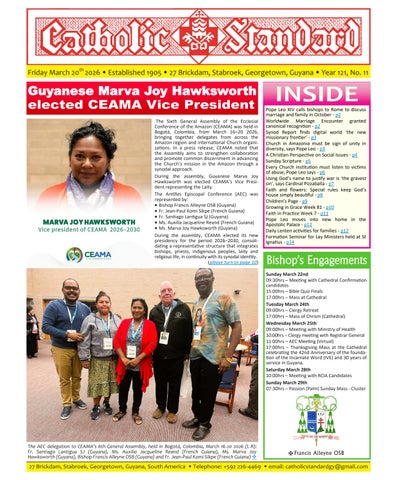

Guyanese Marva Joy Hawksworth

The Sixth General Assembly of the Ecclesial Conference of the Amazon (CEAMA) was held in Bogotá, Colombia, from March 16–20 2026, bringing together delegates from across the Amazon region and international Church organizations. In a press release, CEAMA noted that the Assembly aims to strengthen collaboration and promote common discernment in advancing the Church’s mission in the Amazon through a synodal approach.
During the assembly, Guyanese Marva Joy Hawksworth was elected CEAMA’s Vice President representing the Laity.
The Antilles Episcopal Conference (AEC) was represented by:
• BishopFrancis Alleyne OSB(Guyana)
• Fr. Jean-Paul Komi Sikpe (FrenchGuiana)
• Fr. Santiago Lantigua SJ (Guyana)
• Ms. Auxilia Jacqueline Reand(FrenchGuiana)
• Ms. Marva Joy Hawksworth (Guyana)
During the assembly, CEAMA elected its new presidency for the period 2026–2030, consolidating a representative structure that integrates bishops, priests, indigenous peoples, laity and religiouslife,incontinuitywithitssynodalidentity.
(please turn to page 10)

Pope Leo XIV calls bishops to Rome to discuss marriage and family inOctober - p2
Worldwide Marriage Encounter granted canonical recognition - p2
Synod Report finds digital world ‘the new missionary frontier’ - p3
Church in Amazonia must be sign of unity in diversity,says Pope Leo - p3
AChristianPerspective on Social Issues - p4
Sunday Scripture - p5
Every Church institution must listen to victims of abuse,Pope Leo says - p6
Using God’s name to justify war is ‘the gravest sin’, says Cardinal Pizzaballa - p7
Faith and flowers: Special rules keep God’s house simply beautiful - p8
Children’s Page - p9
Growingin Grace Week 81 - p10
Faithin Practice Week 7 - p11
Pope Leo moves into new home in the Apostolic Palace - p12
Daily Lenten activities for families - p12
Formation Seminar for Lay Ministers held at St Ignatius - p14
Bishop’s Engagements
Sunday March 22nd
09:30hrs – Meeting with Cathedral Confirmation candidates
15:00hrs – Bible Quiz Finals
17:00hrs – Mass at Cathedral
Tuesday March 24th
09:00hrs – Clergy Retreat
17:00hrs – Mass of Chrism (Cathedral)
Wednesday March 25th
09:00hrs – Meeting with Ministry of Health
10:00hrs – Clergy meeting with Registrar General
11:00hrs – AEC Meeting (Virtual)
17:00hrs – Thanksgiving Mass at the Cathedral celebrating the 42nd Anniversary of the foundation of the Incarnate Word (IVE) and 30 years of service in Guyana.
Saturday March 28th
10:00hrs – Meeting with RCIA Candidates
Sunday March 29th
07:30hrs – Passion (Palm) Sunday Mass - Cluster

Francis Alleyne OSB
The AEC delegation to CEAMA’s 6th General Assembly, held in Bogotá, Colombia, March 16-20 2026 (L-R): Fr. Santiago Lantigua SJ (Guyana), Ms. Auxilia Jacqueline Reand (French Guiana), Ms. Marva Joy Hawksworth (Guyana), Bishop Francis Alleyne OSB (Guyana) and Fr. Jean-Paul Komi Sikpe (French Guiana) ❖


Year of St. Francis Jubilee Prayer
Saint Francis, our brother, you who eight hundred years ago went to meet Sister Death as a man at peace, intercede for us before the Lord.
You recognized true peace in the Crucifix of San Damiano, teach us to seek in Him the source of all reconciliation that breaks down every wall.
You who, unarmed, crossed the lines of war and misunderstanding, give us the courage to build bridges where the world raises up boundaries.
In this time afflicted by conflict and division, intercede for us so that we may become peacemakers: unarmed and disarming witnesses of the peace that comes from Christ.
Amen - Pope Leo XIV

VATICAN CITY (OSV News) Pope Leo XIV announced March 19 that he is asking the presidents of all bishops’ conferences around the world to convene in Rome in October to renew and deepen the Church’s discussion on marriage and family in light of “Amoris Laetitia.”
The pope made the announcement on the Solemnity of St. Joseph, saying that he was convening the meeting “in light of the changes that continue to impact families in an effort to proceed, in mutual listening, to a synodal discernment on the steps to be taken in order to proclaim the Gospel to families today, in light of Amoris Laetitia and taking into account what is currently being done in the local Churches.”
“
sion of Saint Joseph, guardian of the Holy Family of
The pope issued the invitation at the end of a
anniversary of the signing of “Amoris Laetitia,” Pope Francis’ post-synodal apostolic exhortation on the pastoral care of families published after the 2014 and 2015 Synods on the Family.
“Amoris Laetitia,” Latin for “The Joy of Love,” was signed by Pope Francis on March 19, 2016, and released publicly the following April. The document, which runs more than 50,000 words, addressed married life and love, children, extended family, education and related pastoral challenges, with special attention to integrating wounded or marginalized families into the life of the Church.
“Our era is marked by rapid changes which make it necessary, even more than ten years ago, to give particular pastoral attention to families, to
circumstances in which the Church ‘can become the salt of the earth’ only through the lay faithful and, in particular, through families.” “For this reason, the Church’s commitment in this area must be renewed and deepened, so that those whom the Lord calls to marriage and family life can, in Christ, fully live out their conjugal love, and that young people may feel attracted, within the Church, to the beauty of the vocation to marriage.”
‘A luminous message of hope’ At the time of its publication, “Amoris Laetitia” garnered an uneven reception. While Church leaders generally praised the exhortation’s aim of improving pastoral care for families, it met swift and sharp criticism for some ambiguities that appeared difficult to reconcile with Church teaching, especially pertaining to divorced Catholics in new civil unions, without a prior declaration of nullity, and their reception of the Eucharist. Disagreement among theologians and Church leaders persists over these elements.
Pope Leo called the document “a luminous message of hope regarding conjugal love and family life” adding that both “Amoris Laetitia” and St. John Paul II’s 1981 exhortation, “Familiaris Consortio,” “strengthened the Church’s doctrinal and pastoral commitment to the service of young people, married couples and families.”
“On this 10th anniversary, we give thanks to the Lord for the stimulus that has encouraged reflection and pastoral conversion in the Church, vere on this path, always welcoming the Gospel anew in the joy of being Pope Leo

al private association of the faithful.
The Decree of recognition is dated February 2nd 2026, Feast of the Presentation of the Lord, and also approves the associations statutes, and grants it juridical personality in canon law.
undertakes in order to help couples discover their faith and the power of the sacrament of matrimony, through the renewal of their commitment to one another.
Worldwide Marriage Encounter is marked by the intuition that couples could discover God’s love in their
lived experience, in their commitment to love each other, and in the strengths and weaknesses of their relationship, and that ministry to these couples could be led by couples
For over fifty years Worldwide Marriage Encounter has carried forward this apostolate, constituting a treasure of spiritual experience which, with today’s Decree from the Dicastery, is recognised as a treasure for the whole Church. ❖ (Dicastery forLaity,FamilyandLife)
Pope Leo greets a baby and family at the conclusion of his weekly general audience in the Paul VI Audience Hall at the Vatican Aug. 27, 2025. (CNS photo/Vatican Media)

Synod of Bishops study group has underscored the need for the Church to engage the digital environment as a vital space for evangelisation, dialogue, and pastoral accompaniment. Source: Vatican News.
“The Church’s presence in the digital sphere can be a sign of communion and a witness of hope, capable of re-
final report states.
The reflection is presented by Study Group 3: “The Mission in the Digital Environment” prepared as part of the synodal process of the 16th General Assembly of the Synod of Bishops on “For a Synodal Church: Communion, Participation, Mission”.
The document notes that the digital environment is not simply a collection
of technological tools but a cultural space with its own language, dynamics, and ways of forming relationships. For this reason, it represents a new missionary field where the Church is called to proclaim the Gospel.
Drawing on recent reflections by Pope Leo XIV, the report encourages Christians to renew their commitment to sharing Christian hope on social networks and in online spaces.

Pope expressed his closeness to all those whom the Church accompanies.
He encouraged the ecclesial assembly in its mission to formulate Synodal Pastoral Horizons to guide local Churches forward.
Pope Leo drew on the image of the shihuahuaco tree (Dipteryx micrantha), which grows very slowly but stands dozens of meters tall, can live over a thousand years, and creates an ecosystem for animal life.
This can help us understand,” he said, what the Church desires to be: a sign of unity in diversity and a safe refuge that generates and protects life.”
The Pope invited the Church in the Amazonia to keep its faith rooted in Christ and in His love, which the faithful should frequently contemplate in prayer.
The Pope has called for “missionary disciples who convey the gift of the Risen Lord to the world” and who are attentive to the needs of people they encounter online.
The digital environment, the report notes, is increasingly interconnected with everyday social life, particularly among young people, making it a crucial area for pastoral engagement and evangelisation.
During the discussion, the group noted that “rather than seeing digital spaces as secondary or supplementary, the Church must recognise them as integral to its mission, particularly in a world where many people’s primary means of engagement is online”.
They recognised the cyberspace as place for spiritual encounter where people go to the digital environments for all manner of things, including information about the Gospel and about finding God ”.
The study group concludes with proposals addressed to the levels of the Holy See, bishops’ conferences and dioceses, suggesting several steps to implement the Church’s mission in the digital world. As a new missionary frontier, “the mission in the digital environment is a journey in progress.
” As digital technologies continue to evolve, further theological, pastoral, and canonical reflection will be necessary to understand concepts such as digital mission, online synodality, and digital accompaniment. ❖
of the Amazonia (CEAMA), taking place in Bogota, Colombia.
He thanked the Bishops, clergy, consecrated religious, and lay faithful
for attending this “privileged time of listening to the Holy Spirit in order to discern the path of the communities rooted in that region.”
Recalling people’s material and spiritual struggles in the Amazonia, the
“The present context requires an adequate response to the many social, environmental, cultural, and ecclesial challenges that persist in the Amazon, threatened by situations of abuse and exploitation,” he said.
In the midst of challenges, the Church must proclaim the kerygma and the new life in Christ, as she accompanies those who suffer and seeks to safeguard creation and respect life in all its forms, especially human life.
Pope Leo upheld the importance of inculturating the Gospel in local cultures, so as to manifest and celebrate the mystery of Christ more fully.
“Inculturation is a difficult but necessary path,” he said. “‘We need to accept courageously the newness of the Spirit, who is always capable of creating something new from the inexhaustible treasure of Jesus Christ’,” he added, quoting Querida Amazonia.
In conclusion, Pope Leo XIV urged Catholics in the Amazon Region to strengthen their identity as missionary disciples of Christ.
“Keep sowing in the furrow that has been watered even with the blood of so many men and women who have gone before you, and who, united to the passion of Christ, have become the root of a ‘giant tree’ growing in the Amazonia.”❖
(Vatican News) - Pope Leo XIV sent a video message on Tuesday March 17 to the 6th Assembly of the Ecclesial Conference
Participants record Pope Leo XIV as he addresses them during the Jubilee of Digital Missionaries and Catholic Influencers at the Vatican in July 2025 (ANSA)
Pope Leo XIV sent a video message to the 6th Assembly of the Ecclesial Conference of the Amazon (CEAMA) in Bogota, Colombia (Vatican Media)
A Christian Perspective on Social Issues Sacrifice

By GHK Lall
It is not what we sacrifice during Lent. It is not how much is sacrificed at the individual level. It is what sacrifice means to eachone of us.
When sacrifice is a matter of quantity and formality, then its meaning is lost. Of little value it is before God; and that is with whom it counts. There are many passages in the Old Testament, where God reminds his flock in the strongest terms that sacrifice is a wonderful expression of homage, but it falls short of the mark, if there is nothing behind it. The condition of the heart is what matters. The visions that inspired selfsacrifice have much value before a kind and compassionate God. Self-sacrifice is about surrendering one’s own interests, being unselfish and giving to those around us, so that God is pleased, and others are guided to giving glory to him.
Who could have sacrificed more bulls and rams than the Israelites? Who knew more about the laws and the prophets than the Israelites, as they and their children were practically weaned from the knee up in the precepts and commandments of the God of their forefathers, Abraham, Isaac, and Jacob? Yet what can be said about their record of faithful worship and steadfast obedience in times of plenty and times that were difficult? Despite knowing all that they knew, they failed to live up to those other laws and standards of God that called for a true and generous heart in their day-to-day activities.
Whether great landowners or small day laborers, the command was to be fair and straight in dealings with others. Do not underpay or overcharge, which means not to cheat. Do not take callous advantage of the weaker and
the helpless, as it was the case of the powerful man who snatched the sheep for his own purposes. It was a sheep that grew up from little lamb with the children of the man who suffered from the ruthless predatory instincts of his oppressor. In other words, pay heed to that commandment given through Moses: thou shalt not covet they neighbor’s property
There are many lessons for us in these modern times from the Hebrew Scriptures and from the Gospel accounts of Jesus’s life and times. He was seemingly always locked in some difference of position, some confrontation, with an ever-present audience of Pharisees, Sadducees, chief priests, elders, and scribes. They knew all the laws of their forefathers. But beyond the law, or behind the law, what else did they know? As one point of reference, how much were they ready to acknowledge and yield to the demands of love, kindness, mercy, and forgiveness? In other words, hear Almighty God’s concern for the poor, the weak, the outsider, and the despised, and be generous in those human attributes that make for a more manageable life. The kindnesses that go a far way. The mercy that is reflective of God’s own love and his patience
with sinners. The treating of others through what is fair, as such would be wished, insisted, for ourselves. There is a choice staring every Christian, every Roman Catholic, worshipper in the face in this 21st century. Be outstanding relative to the ceremony of the laws and statutes from A to Z. But, away from the light of day, live in hypocrisy through deeds that do not match the teachings. Be they of the Old Testament prophets of God. Or of the New Testament commandments of the Son of God. They are not contradictory. They are part of a continuing line that has no interruption, what builds and strengthens in a two Knowledge and sacrifice are great elements in the worship of any believer. What is still greater is how our lives complement law, knowledge and sacrifice. They are not in conflict with each other. They make the others better. We are better believers, worshippers, and servers, when the whole circle of teachings and practices that match are in unity. There is the sturdiness of genuine spirituality. In this Lenten Season that calls for different sacrifices, among other actions, may this message be taken to heart by all those who believe. The proof before God is in the quiet livingof it.


Gracious and loving God, we thank your for the gift of our priests.
Through them, we experience your presence in the sacraments. Help our priests to be strong in their vocation.
Set their souls on fire with love for your people.
Grant them the wisdom, understanding, and strength they need to follow in the footsteps of Jesus. Inspire them with the vision of your Kingdom.
Give them the words they need to spread the Gospel.
Allow them to experience joy in their ministry.
Help them to become instruments of your divine grace.
We ask this through Jesus Christ, who lives and reigns as our EternalPriest. Amen


‘Growth is the only evidence of life.’ Saint John Henry Newman (1801-1890)

First Reading Ezekiel:37:12-14
“The Lord says this: I am now going to open your graves; I mean to raise you from your graves, my people, and lead you back to the soil of Israel. And you will know that I am the Lord, when I open your graves and raise you from your graves, my people. And I shall put my spirit in you, and you will live, and I shall resettle you on your own soil; and you will know that I, the Lord, have said and done this – it is the Lord who speaks.”
Responsorial Psalm Psalm 129
Response: With the Lord there is mercy and fullnessofredemption
l. Out of the depths I cry to you, O Lord, Lord, hear my voice!
O let your ears be attentive to the voice of my pleading. Response
2. If you, O Lord, should mark our guilt, Lord, who would survive?
But with you is found forgiveness: for this we revere you. Response
3. My soul is waiting for the Lord, I count on his word.
My soul is longing for the Lord more than watchman for daybreak. (Let the watchman count on daybreak and Israel on the Lord.) Response
4. Because with the Lord there is mercy and fullness of redemption, Israel indeed he will redeem from all its iniquity. Response
Second Reading Romans 8:8-11
People who are interested only in unspiritual things can never be pleasing to God. Your interests, however, are not in the unspiritual, but in the spiritual, since the Spirit of God has made his home in you. In fact, unless you possessed the Spirit of Christ you would not belong to him. Though your body may be dead it is because of sin, but if Christ is in you then your spirit is life itself because you have been justified; and if the Spirit of him who raised Jesus from the dead is living in you, then he who raised Jesus from the dead will give life to your own mortal bodies through his Spirit living in you.
Gospel John 11:1-45
There was a man named Lazarus who lived in the village of Bethany with the two sisters, Mary and Martha, and he was ill. – It was the same Mary, the sister of the sick man Lazarus, who anointed the Lord with ointment and wiped his feet with her hair.

Easter is two weeks away. There is an understandable and logical reason that we hear the Gospel Reading from St. John about Jesus raising Lazarus


The sisters sent this message to Jesus, ‘Lord, the man you love is ill’. On receiving the message, Jesus said, ‘This sickness will end not in death but in God’s glory, and through it the Son of God will be glorified’. Jesus loved Martha and her sister and Lazarus, yet when he heard that Lazarus was ill he stayed where he was for two more days before saying to the disciples, ‘Let us go to Judaea’. The disciples said, ‘Rabbi, it is not long since the Jews wanted to stone you; are you going back again?’ Jesus replied: ‘Are there not twelve hours in the day? A man can walk in the daytime without stumbling because he has the light of this world to see by; but if he walks at night he stumbles, because there is no light to guide him.’

He said that and then added, ‘Our friend Lazarus is resting, I am going to wake him’. The disciples said to him, ‘Lord, if he is able to rest he is sure to get better’. The phrase Jesus used referred to the death of Lazarus, but they thought that by ‘rest’ he meant ‘sleep’, so Jesus put it plainly, ‘Lazarus is dead; and for your sake I am glad I was not there because now you will believe. But let us go to him.’ Then Thomas – known as the Twin – said to the other disciples, ‘Let us go too, and die with him’.
On arriving, Jesus found that Lazarus had been in the tomb for four days already. Bethany is only about two miles from Jerusalem, and many Jews had come to Martha and Mary to sympathise with them over their brother. When Martha heard that Jesus had come she went to meet him. Mary remained sitting in the house. Martha said to Jesus, ‘If you had been here, my brother would not have died, but I know
from the dead on this Fifth Sunday of Lent. Jesus’ Resurrection is ever nearer for us. His miracle of raising Lazarus is the last recorded by John, but its timing is exactly what the Lord wished it to be.
In the Gospel, Jesus makes it all clear to us. The Lord says, “I am the resurrection and the life; whoever believes in me, even if he dies, will live.” That understanding and acceptance and rejoicing at the Resurrection is what
that, even now, whatever you ask of God, he will grant you’. ‘Your brother’ said Jesus to her ‘will rise again.’ Martha said, ‘1 know he will rise again at the resurrection on the last day’. Jesus said:
‘I am the resurrection.
If anyone believes in me, even though he dies he will live, and whoever lives and believes in me will never die.
Do you believe this?’
‘Yes, Lord,’ she said ‘I believe that you are the Christ, the Son of God, the one who was to come into this world.’ When she had said this, she went and called her sister Mary, saying in a low voice, ‘The Master is here and wants to see you’. Hearing this, Mary got up quickly and went to him. Jesus had not yet come into the village; he was still at the place where Martha had met him. When the Jews who were in the house sympathising with Mary saw her get up so quickly and go out, they followed her, thinking that she was going to the tomb to weep there. Mary went to Jesus, and as soon as she saw him she threw herself at his feet, saying, ‘Lord, if you had been here, my brother would not have died’. At the sight of her tears, and those of the Jews who followed her, Jesus said in great distress, with a sigh that came straight from the heart, ‘Where have you put him?’ They said, ‘Lord, come and see’. Jesus wept; and the Jews said, ‘See how much he loved him!’ But there were some who remarked, ‘He opened the eyes of the blind man, could he not have prevented this man’s death?’ Still sighing, Jesus reached the tomb: it was a cave with a stone to close the opening. Jesus said, ‘Take the stone away’. Martha said to him, ‘Lord, by now he will smell; this is the fourth day’. Jesus replied, ‘Have I not told you that if you believe you will see the glory of God?’ So they took away the stone. Then Jesus lifted up his eyes and said: ‘Father, I thank you for hearing my prayer. I knew indeed that you always hear me, but I speak for the sake of all these who stand round me, so that they may believe it was you who sent me.’ When he had said this, he cried in a loud voice, ‘Lazarus, here! Come out!’ The dead man came out, his feet and hands bound with bands of stuff and a cloth round his face. Jesus said to them, ‘Unbind him, let him go free’.
Many of the Jews who had come to visit Mary and had seen what he did believed in him. ❖
Lent has been about and what our preparations in these final days of Lent should be about as well.
Phillips Brooks is probably best known as the author/composer of one of the most endearing Christmas Carols “O Little Town of Bethlehem.” However, Brooks also understood what faith is all about. He said, “Let every man and woman count himself and herself immortal. Let them catch the revelation of Jesus in His resurrection.
Let each say not merely, ‘Christ is risen,’ but also ‘I shall rise’.”
The Catechism of the Catholic Church (1002) says, “Christ will raise us up ‘on the last day’; but it is also true that, in a certain way, we have already risen with Christ. For, by virtue of the Holy Spirit, Christian life is already now on earth in participation in the death and Resurrection of Christ.” It is this truth, this hope, that we are to embrace as Easter approaches.❖ [catholicsteward.com ]
Every Church institution must listen Gospel Reflection

Jesus says: “I am the resurrection and the life.” The theme of resurrection to new life is found in all our Readings this Sunday. In just a few short weeks we shall be celebrating the fact of the resurrection which gives meaning to all that we believe and do as a Christian community. But when you think about it, we do not have to physically die to have a resurrection experience. We taste death in moments of rejection, grief, disappointment and failure. And when we live in bitterness, hatred and isolation we are dying before our time. On the other hand, whenever we turn from sin and evil, whenever we decide that there is no place for revenge and hatred in our lives, whenever we move from despair, loneliness, fear, illness and pain, we experience a resurrection of the body and the spirit.

Annual report ‘a tool of great importance
’
Pope Leo called the commission’s annual report a tool of “great importance,” since “it represents an exercise in truth and responsibility, as well as in hope and prudence, which must go hand in hand for the good of the Church.”The pope also underlined that ordinaries and major superiors have a responsibility that cannot be delegated.
The Holy Father urged members of the commission to continue to serve as a resource to assist every community and institution in the Church in listening to victims and accompanying them, “so that no community within the Church feels alone in this task,” especially where resources or expertise are lacking.
Pope Leo stated that he looks forward to receiving additional information in their third annual report on the encouraging progress already made, as well as on the areas in which further development is still required.
Jesus told the people to unbind Lazarus and let him go free. Many times we too would like to hear those wonderful words and to have the things that tie us down removed so that we may live in freedom. The ties that bind us may take various forms: a life of hatred, anger and sin, relationships that destroy rather than give life, a deadend job, a wayward child, addiction of some kind. Sometimes it is difficult to recognise what it is that ties us down. It means then that, from time to time, we all need to reflect on our lives in as honest a manner as possible. Then we can work with Jesus at making our lives free from the ties that bind us to a way of life that leads to death. ❖
[From: Journeying with the Word of God, The Religious Education Department, Diocese of Georgetown, Guyana ]
VATICAN CITY (Vatican News)
Addressing the Pontifical Commission for the Protection of Minors March 16, Pope Leo XIV underlined the importance of preventing abuse in the Church, insisting that such responsibility must be concretely confronted and notdelegated.
“Your mission is to help ensure that abuse is prevented. Yet prevention is never just a set of protocols or procedures,” he said. “It is about helping to form, throughout the Church, a culture of care, in which the protection of minors and persons in vulnerable situations is not seen as an obligation imposed from outside, but as a natural expressionof faith.”
Gratitude to commission
In a speech at the Vatican March 16, Pope Leo expressed his gratitude to the pontifical commission for its efforts to protect children, adolescents and persons in vulnerable situations.
“It is a demanding service, sometimes silent, often burdensome, but one which is essential for the life of the Church and for the building of an authentic culture of care,” Pope Leo said.


Pope Francis placed the commission permanently within the Roman Curia “to remind the whole Church that the prevention of abuse is not an optional task, but a constitutive dimension of the mission of the Church,” the pope recalled.
A path of conversion
With this in mind, the Holy Father suggested that a path of conversion, in which the suffering of others is heard, must continue to propel them to take action, with the experiences of victims and survivors as essential reference points.
“While they are certainly painful and difficult to hear, these experiences powerfully bring the truth to light and teach us humility as we strive to assist victims and survivors,” Pope Leo said. He added that it is through the recognition of the pain that has occurred that a credible path for hope and renewal is opened.
The pope also encouraged the commission to engage in dialogue with other dicasteries and institutions of the RomanCuria.

Engagement with Church at every level
The Holy Father recalled that the commission’s engagement with the Church at every level, with victims, survivors and their families, as well as with civil society partners, has prompted them to deepen their study in two rapidly developing areas of safeguarding, namely the concept of vulnerability in relation to abuse and the prevention of technology-facilitated abuse of minors inthe digital space.
“Let me reiterate,” Pope Leo concluded, “that the protection of minors and persons in vulnerable situations is not an isolated area of ecclesial life, but a dimension that permeates pastoral care, formation, governance, and discipline.”
“Every step forward on this journey is a step towards Christ and towards a more evangelical and authentic Church,” he said.❖
For 121 years, the Catholic Standard has been sharing the Gospel of Jesus Christ.
Now reaching 10,000+ followers on Catholic Media Guyana Facebook plus going straight to your inbox and WhatsApp, our vibrant weekly e-paper is a trusted source which delivers informative and inspiringstories fromacross the diocese andaround the world.
Want to promote your business or event? Advertise with us! Call675-4542oremailcatholicstandardgy@gmail.com ❖
Pope Leo XVI listens to a speaker during a meeting with the Pontifical Commission for the Protection of Minors in the Consistory Hall of the Apostolic Palace at the Vatican March 16, 2026. (OSV News photo/Elisabetta Trevisan, Vatican Media)
Using God’s name to justify war is ‘the

Cardinal Pierbattista Pizzaballa, the Latin patriarch of Jerusalem, gestures as he speaks with journalists during a news conference in Jerusalem Dec. 22, 2025, at the end of his pastoral visit to the Holy Land.(OSVNewsphoto/DebbieHill)
(OSV News) Cardinal Pierbattista Pizzaballa said the use of God’s name to justify war is a grave sin, stressing that God is present with those who suffer and die in conflict, not with those who exploit religion for political ends.
“The abuse and manipulation of God’s name to justify this and any other war is the gravest sin we can commit at this time,” the prelate said. “War is first and foremost political and has very material interests, like most wars.”
Speaking via video link from Jerusalem at a March 15 webinar organized by the International Oasis Foundation, Cardinal Pizzaballa, the Latin patriarch of Jerusalem, warned against what he described as “pseudo-religious language.”
‘No room for pseudo-religious language’
“We must do everything we can to leave no room for this pseudoreligious language, which speaks not of God, but of ourselves,” he said, speaking publicly for the first time since the U.S. and Israel-Iran war broke out Feb. 28. His remarks were published first by the Pontifical Institute for Foreign Missions’ AsiaNews agency March 16. The organizer of the webinar, the Italian Oasis Foundation, is a Catholic organization based in Milan and dedicated to fostering mutual understanding and dialogue between Christians and Muslims. It was founded in 2004 in Venice by Cardinal Angelo Scola, then patriarch of Venice and later archbishop of Milan. Responding to remarks by U.S. Defense Secretary Pete Hegseth, who cited Psalm 144 during a March 10 Pentagon briefing, Cardinal Pizzaballa said believers must reject attempts to frame the conflict in religious terms.
“There are no new crusades,” he said.
God among those dying in war
“If God is present in this war, He is among those who are dying, who are suffering, who are in pain, who are oppressed in various ways, throughout the Middle East,” the patriarch said.
This conflict has religious connotations, but they are manipulations: those who wish to bring religion into it exploit the name of ” he underlined.
Cardinal Pizzaballa also referred to repeated appeals for peace by Pope Leo XIV, acknowledging they are unlikely to be heeded.
We know that Leo XIV’s appeals will fall on deaf ears,” he said, but we must continue to speak the truth. Information is a weapon in this conflict.”
Decades of violence
He said decades of violence in the Middle East have produced “the human devastation in which we now find ourselves.”
“What is built on violence perishes; it has no future, but it also creates a void around itself: fear, resentment, hatred all that which, in Christian language, belongs to the world of death. It does not allow you to see anything beyond yourself,” the cardinal underlined.
The cardinal also highlighted the role of media in shaping perceptions of the conflict, describing information as “part of the conflict itself.”
“The role of journalists is not merely to report the news, but to scrutinize it critically, to help the reader make sense of what we find, to provide as accurate an interpretation as possible, or at the very least to help them form a critical view and make their own judgment,” he said.
Media urged to show war’s human face
A day after Cardinal Pizzaballa spoke in the live-streamed event, Pope Leo urged the media to show the human face of suffering amid war and to verify news so as not to recirculate “propaganda” or become a “mouthpiece for those in power.”
“Always, but especially in the dramatic circumstances of war, such as those we are currently experiencing, the media must guard against the risk of becoming propaganda,” the pope said in an address to broadcast journalists who produce the TG2 news programs for the Italian state-owned television channel, Rai 2.
Cardinal Pizzaballa further pointed to what he described as an information blackout surrounding Gaza, where he said humanitarian conditions remain severe. About 2 million people are displaced, much of the territory is destroyed and medical supplies, including basicantibiotics,arescarce,hesaid.
Gaza situation ‘remains dire’
“Gaza has been forgotten, yet the situation remains dire. In the West Bank, there are almost daily attacks by settlers on Palestinians,” he pointed out.
Cardinal Pizzaballa is in constant contact with the Holy Family Parish that he last visited ahead of Christmas2025onapastoralvisit. He said, “There is no longer a
problem of hunger, but there are still 2 million displaced people, deprived of everything; 80% of the Strip is still destroyed, and no reconstruction has begun,” pointed out.
“Thirty-six hospitals are partially operational, but medicines are lacking, even basic antibiotics. People are literally living in the sewers; the images cannot convey the smells,” he highlighted.
‘A sort of vicious circle’ “It is impossible to understand how and when this dramatic situation will be resolved: The Bo of Peace has not yet understood what it should do. And in any case, it is a sort of vicious circle: if Hamas does not hand over its weapons, Israel will not withdraw; Hamas will not hand over its weapons unless Israel withdraws. Everything remains at a standstill,” the cardinal said March 15.
Journeying with the Word of God

MAKING THE WORD OF GOD YOUR OWN
Step 1: Lookattoday’sReadingsprayerfully.
Earlier in February, the leading Holy Land prelate strongly criticized the U.S.-led Board of Peace, an international body chaired by U.S. President Donald Trump to oversee the governance and reconstruction of Gaza.
At a Feb. 6 event at the Roman parish of San Francesco a Ripa Grande, Cardinal Pizzaballa was asked by moderator Maria Gianniti, Rome correspondent for the Italian news channel RAI, about his thoughts on the Board of Peace.
Board is ‘colonialist operation’ “What do I think of the Board of Peace? I think it is a colonialist operation: others deciding for the Palestinians,” Cardinal Pizzaballa said, according to a report by Italian newspaper Il Sole 24 Ore.
During the March Oasis Foundation event, as reported by AsiaNews, the cardinal said in the West Bank, near-daily attacks by Israeli settlers on Palestinian communities continue, along with widespread movement restrictions and a growing number of checkpoints.
He also expressed concern about recent Israeli government measures affecting land registration and the recognition of Palestinian academic qualifications, warning of further strain on Palestinian communities and Christian institutions, including schools that rely on teachers from nearby areas. Situation ‘complicated’ for all These “are just two examples,” he said, “to illustrate how complicated the situation remains for all of us.”
Meanwhile, on March 16, missile and interceptor fragments fell in and around the Old City, including near the Temple Mount, the Church of the Holy Sepulchre, the Jewish Quarter and the Western Wall, The Jerusalem Post reported, with Rabbi Shmuel Rabinowitz of the Western Wall and Holy Sites condemning Iranian fire toward Jerusalem.❖
1st Reading: Through the prophet Ezekiel, God reveals his plan to restore the exiled people to their homelands, which is like restoring them from death to life.
2nd Reading: Paul tells us that with the Spirit of Christ in us, we belong to Christ and so have the ability to resistsin.
Gospel: We see and feel the humanity of Jesus in this passage as he shows his grief, love and concern atthe deathof afriend.
Step 2: ApplyingthevaluesoftheReadings toyourdailylife.
1.Jesus cried and this showed that he was very human. How does our society view crying, especially by aman? What are your views oncrying?
2.Lazarus was physically dead but came back to life. There is also spiritual death. In what ways can we be spiritually dead?
3.We note that at the end of the Gospel passage that many of the Jews came to believe because of what they had seen. Would you say that you are a person who believes even though you have not seen?
4.What areas in your life have come back to life after being dead? How have you changed because of this experience?
Step 3: Accepting the message of God’s Wordinyourlifeoffaith
Jesus is the source of life, not just physical life, but the undying life of God. This new life is not just a hope for the future but something real in the present. The delay in coming to help his friend who died before he got there underlines the point that Jesus is master over life and death.
Step 4: Somethingtothink&prayabout
1.Jesus told the people to unbind Lazarus and let him go free. Reflect on your life so as to identify the areas that need unbinding so that you may enjoy the freedom to grow as God would like you to. The question that follows is this: what do you do after you have identified the changes that need to be made inyour life.
2.Talk to God in prayer about the help you need to free yourself fromthe ties thatbindyou down. ❖
[From: Journeying with the Word of God, The Religious Education Department, Diocese of Georgetown, Guyana ]
keep God’s house simply beautiful


the immobility of the architecture” and church furnishings with their ability to appropriately represent different feast days and the changing cycle of seasons both in nature and the liturgy, she said.
Flowers are meant to be an integral part of the liturgy,” Soranzo said, “not filler.”
that a small arrangement would not be in the way.
VATICAN CITY (CNS) Of the many traditions and penitential practices observed during the season of Lent, one of the more visible is the stark change in church decor and a complete absence of flowers.
That shift was markedly noticeable during Pope Leo XIV’s series of pastoral visits to different parishes in Rome.
He started the weekly Sunday visits Feb. 15, before Lent, and the areas around the altar in the Church of Santa Maria Regina Pacis in Ostia Lido were resplendent with bright yellow and white blooms and lushgreenery.
Then, after Ash Wednesday Feb. 18, each church visit has featured an altar and surroundings to be somberly bare of all floral decorations.
Flowers absent during Lent
“Using flowers is absolutely forbidden” during the season of Lent, according to Micaela Soranzo, a professor and expert in liturgy and religious architecture.
However, this doesn’t mean the church should be devoid of greenery, as small plants or simple compositions made up of leaves and branches are permissible, Sorano told Catholic News Service in an interview in 2019. She has since published a book on the subject, “Il giardino del cielo. Arredo floreale e liturgia,” (The Garden of Heaven: Floral decoration and the liturgy.)
Even fruit and berries are acceptable adornments all year, and the cherry is particularly suitable for Lent because, as St. Augustine noted, its red pulp is a powerful symbol of Christ’s passion and the pit recalls the wood of his cross, said Soranzo, who has also worked for the liturgy office of the Italian bishops’ conference for two decades.
A modest display of flowers during Lent is possible on “Laetare” (Rejoice) Sunday, the fourth Sunday in the season, when the liturgical vestments change from purple to rose. This sudden visual variation is meant to strike the faithful that something new and joyful is approaching as Easter draws near,she had toldCNS.
An ‘explosion of flowers” for Easter
On Easter day, there is a true “explosion of flowers,” representing new life and “light,” which means the predominant colors should be yellow and white, she said. All the other colored blossoms and plants are there “to give the idea of a garden, the garden of the Resurrection,” she said.
For the Catholic Church, those sprigs, sprays and bouquets adorning church interiors are meant to bring deeper meaning and attention to the liturgy and the key elements inside each place of worship, Soranzo said.
“The liturgy needs the language of flowers” because they complement
Infact, when the true purpose of floral arrangements is misunderstood, churches run the risk either of being bereft of any gift of nature presented in homage to Christ or of being turned into a greenhouse “obstacle course” with pots and plants placed in every available space,she said.
GIRM, bishops’ conference guidelines: Decorations must focus on Christ
The topic is so important that the General Instruction of the Roman Missal and bishops’ conference guidelines include norms on the appropriate use of floral decoration, saidSoranzo.
Like all adornments, flowers and plants must not ignore or detract from the symbolic and theological meaning of sacred spaces and furnishings, and they should highlight not hide the altar, the ambo and the baptismal font,said Soranzo.
The altar the table of the Lord is Christ; the ambo from where the word of God is proclaimed is the visible image of Christ resurrected; and the baptismal font is where God’s children are welcomed into the Church, she said.
The need to focus on Christ and his sacrifice means only those elements necessary for the eucharistic celebration should be on the altar, she said, which means flowers should be placed near or next to the altar, never on top unless the altar is so large
Potted plants with roots should never be used near the altar only cut flowers to represent life “that is sacrificed,” like the sacrifice of the Eucharist, she said. That is also why no artificial flowers or fake candles should ever be used, she said, because objects near the altar must always be things that “are consumed,” depleted andfade away.
The use of flowers also should reflect the hierarchy of what is most important in the church, she said; for example, “it is not right if there are more flowers adorning the statue of the patronsaint than the altar.”
Soranzo said that a frequent concern of sacristans and parish workers in Italy is the high cost of floral decorations.
She said she tells them, “We must recognize that nature offers us so much,” not just the usual hothouse flowers andexpensive imports.
“Creation is so beautiful and wide. The Lordreally gave us a lot,” she said.
Parishes can keep their costs down by working with florists or farmers and using what is available in their community, said Soranzo. Sometimes the greater the challenge be it low budgets, high snowdrifts or long droughts the more room for creativity.
“Often simplicity is what makes a compositionmore beautiful,” she said. The aim, she said, is to create a space where a person of faith or a visitor walks into church and says, “‘How beautiful it is to be here.’ It has to feel welcoming and flowers help do that.”❖
Volunteers organize trays of flowers on the steps of St. Peter’s Basilica at the Vatican April 19, 2025, as part of the preparations for Easter Mass. (CNS photo/ Lola Gomez)
A crucifix is seen behind purple hyacinths on the steps of St. Peter’s Basilica at the Vatican April 19, 2025, as volunteers prepare St. Peter’s Square for Easter morning Mass. (CNS photo/Lola Gomez)

Dear Boys and Girls,
Our Gospel reading today tells about Jesus and one of his friends. It tells about something very special that Jesus did for that friend. Thatfriend's name was Lazarus.
Jesus received word from Mary and Martha, the sisters of Lazarus, that their brother was very ill. When Jesus heard about it, he said, "Lazarus's sickness will not end in death. This has happened so that God will receive Glory from this." So, although Jesus loved Mary, Martha, and Lazarus he stayed where he was for two more days. Finally, he told his disciples that he was going to Bethany to the home of his friends. "Our friend Lazarus has fallen asleep,but nowI will go and wake him up."
The disciples said, “Master, if he’s gone to sleep, he’ll get a good rest and wake up feeling fine.” Jesus was talking about death, but his disciples thought he was talking about taking a nap.
When Jesus finally arrived in Bethany, Martha ran to meet Jesus and told him that Lazarus had been dead for four days. "If only you had been here, my brother would not have died. But even now I know that Godwill give youwhatever youask.”"
Jesus told her, “Your brother will rise again.”
"Yes," Martha said, “I know that he will be raised up in the resurrection at the end of time."
Jesus told her, "I am the resurrection and the life. Anyone who believes in me will live, even after dying. Everyone who lives in me and believes inme will never ever die."
So, Martha went back and got her sister Mary and they took Jesus to show him the place where Lazarus was buried. When he arrived at the tomb, Jesus told them to roll away the stone that covered the entrance. He prayed to his Father and then he called in a loud voice, "Lazarus come out!" Do you know what happened? Even though he had been dead for four days, Lazarus walked out of the tomb! He wasn't dead he wasn'tevensick!
Oh my! How would you like to have a friend like that? Well, you do! Your best friendis Jesus.
Heavenly Father, we are thankful that Jesus is our Best Friend Forever. We praise him, we love him, and we thank him for dying on the cross so that we might have everlasting life. In Jesus' name we pray,Amen. ❖


Cardinal Leonardo Ulrich Steiner OFM, Archbishop of Manaus, Brazil, was elected as the head of the organization, accompanied by a plural vice presidency: Father Jesús Huamán Conisilla (Priests), Juan Urañavi (Indigenous Peoples), Marva Joy Hawksworth (Laity) and Sister Sônia Maria Pinho de Matos (Religious Life ).
Marva Joy Hawksworth was born in Tipuru, South Pakaraimas, Region 9, Essequibo, Guyana and now lives in St Ignatius, Central Rupununi, Region 9, Essequibo,Guyana.
The followingis fromCEAMA’s website: Marva Joy Hawksworth, CEAMA’s New Vice President RepresentingtheLaity
CEAMA continues to build a synodal and participatory Church with the appointment of Marva Joy Hawksworth as its new vice president representing the laity. A native of Guyana and a member of the Macushi people, she was born in the community of Tipuru where she has carried out much of her educational and community work.
She holds a bachelor’s degree in social sciences, with a specialization in teaching English as an additional language, and also has training in early childhood education. Her career has focused on rural and indigenous contexts, where

she has promoted intercultural education that strengthens the identity, language, and traditions of indigenous peoples.
Her pedagogical work has been characterized by integrating ancestral knowledge and contemporary methodologies, creating meaningful educational processes for new generations. In this vein, she participated in the QBEP bilingual program, where she contributed to the production of early childhood education materials adapted to the cultural realities of the communities.
She recently completed a book of stories from the Macushi people, a valuable initiative that captures the
memory, spirituality, and narrative richness of their culture, and which will be publishedon March 28.
The appointment of Marva Joy Hawksworth as vice president of CEAMA represents a significant step toward strengthening the role of the laity in the Amazonian Church. Her experience, commitment, and intercultural sensitivity contribute to the building of a Church with an Amazonian face, where education, culture, and community life are privileged paths for proclaiming hope and caring for our CommonHome.❖
By Renika Anand
A Million Dollars
Bertrand Russell, an English philosopher, once said "It is the preoccupation with possessions, more than anything else, that prevents us from living freely and nobly."
What would you do if you woke up one day and suddenly found yourself as the owner of a million dollars? In the answer to that question lies the revelation of our true,innermost desires. The reality is, when given a million dollars, most people would not spend it frivolously. Instead they would spend it on solving problems that they battle in their daily lives, on achieving their goals, or on taking care of their friends and family. We often spend a large portion of our lives seeking wealth and material possessions. In reality, what we seek is peace, contentment and a way to care for the people we love. Money is simply a tool we use to achieve the things that truly matter.
As we enter adulthood, we can easily become preoccupied with possessions. If we do so, then we may lose sight of the noble and beautiful things that our heart truly desires. As such, let us resolve to live life not in pursuit of wealth, but in pursuit of the peace that we really seek behind the material possessions - the peace that we may find in God.
Command those who are rich in this present world not to be arrogant nor to put their hope in wealth, which is so uncertain, but to put their hope in God, who richly provides us with everything for our enjoyment - 1 Timothy 6:17 ❖


Marriage is not a Prison: A Catholic Vision of Love
Fr Joel Thompson SJ
Once, after a wedding, I stayed back greeting families. An older woman came up to me, laughed softly, and said, “Father, marriage is sweet, but it’s hard, you know!” We both smiled, because she was right. Relationships can be fragile, pressures are real, and many wonder whether lifelong marriage is still possible. Do you think itis?
One of the myths of our modern world is that life should not involve challenges. Yet, the things most worth pursuing like education or meaningful relationships often require commitment and sacrifice. In a world where marriage is often seen as a prison, a piece of paper, or outdated, the Catholic Church proposes something radically different: marriage as a path to holiness, a school of love, and a livingsignofGod’slove
Marriage is not a burden, but as a vocation, a call from God, and a path worth saying yes to if we discern that God is indeed leading us in that direction.
A Call from God: More than justaWeddingDay
Marriage is not just about a beautiful ceremony or a good reception. In many of our local weddings (especially in Georgetown), the church is practically empty while the reception is full. Marriage is not just a contract or social arrangement. It is a sacrament (CCC 1601), a visible sign of God’s grace. This means that God is not just watching from a distance. He is actively present, givinggrace. At its heart, Christian marriage is Christocentric (has Christ as its center). St. Paul tells us that couples are called to love “as Christ loves the Church” (see Ephesians 5:25-32). This is not merely sentimental or physical love. It is faithful, sacrificial, life-giving and enduring to the end. How does Christ love us? Does he leave us in difficult times? Does he only love us when we are strong, successful, or without sin? Would Christ ever harm us physically or emotionally? To love another as Christ loves the Church is the heartof Christian marriage. The essential properties of a Catholic marriage are unity (faithful love between one man and one woman), indissolubility (a lifelong commitment – until death!), and openness to life (a generous welcome of children). Marriage is therefore not about personal happiness. We do not enter it simply to receive, but to give. Am I capable of giving myself fully and lovinganother personfaithfully forever?
Importantly, the spouses themselves are the ministers of the sacrament. Through their free and mutual consent, they confer the sacrament on each other. The priest or deacon receives that consent in the name of the Church and gives the blessing,

together with witnesses. In that moment, God gives the grace necessary to live this vocation, the grace to forgive, to persevere, and to love even when itis difficult.
Living the Vocation: Real Love in Real Life
The Church is realistic. Marriage is beautiful, but it is also demanding. In our Caribbean reality, marriage is lived amid many pressures: economic struggles, migration, distance, family expectations, and sometimes the wounds of past relationships. That is why the vows are so honest: “for better, for worse for richer, for poorer…” Not just for the good days, butfor the difficultones too.
Marriage is not sustained by feelings alone. It is sustained by commitment, by daily choices, and by grace. Living it well requires patience, forgiveness, communication and sacrifice. Marriage preparation courses (which are not optional) aim to help couples understand the full significance of their commitment and connects them with experienced couples for guidance andsupport.
Mixed
Marriages
- Can I marry aMuslimorHindu?
People often assume that the Church does not permit marriage to someone of another denomination or religion. This is not true. A dispensation is usually required, not as a barrier, but as a way of ensuring that both people understand what they are entering. In simple terms: (1) both spouses must respect what marriage truly is (a lifelong, faithful, life-giving union), (2) the Catholic spouse promises to remain faithful to their faith and to do their best to raise the children Catholic (CCC 1635). This helps protect the unity of marriage, especially when differences arise later.
Openness to Life and Complementarity
Marriage is naturally ordered toward life. The love of husband and wife is meant to be fruitful, reflecting God’s creative love. This is one of the reasons the Church teaches that marriage is only between a man and a woman. From the beginning, Scripture speaks
of humanity as male and female (Genesis 1:26–27), equal in dignity, yetdifferentand complementary.
If Things Break Down: Mercy and Truth
Couples have struggles. Some marriages experience deep wounds. There may be betrayal, breakdown in communication, or even abuse. In such situations, the Church does not ask anyone to remain in harm’s way. Physical separation may be necessary and is permitted. At the same time, the words: “until death do us part” remind us that marriage is not something we can simply set aside. If a marriage was validly entered, the bond remains before God, even if the couple canno longer live together.
Annulments are often misunderstood. An annulment is not a Catholic divorce. Rather, it is a careful process by which the Church examines whether a valid marriage ever existed. If something essential was missing from the beginning such as true freedom (e.g. pressured into marriage), proper understanding, or genuine consent, the marriage may be This is not about breaking up a marriage, but about discerning whether it was ever fully
Why Marriage is still worth it
Despite all its challenges, marriage remains one of the most beautiful vocations. It is not easy. It requires sacrifice. Love is tested and selfishness is transformed into generosity. It calls for forgiveness.
As a vocation, it helps two people help each other to grow, to carry crosses, and ultimately to become saints. That older woman was right, marriage is sweet, but hard at times. Yet with God’s grace,itis also strong.
For those discerning marriage, do not be afraid to say yes. When God calls, He also provides. Your love can become a quiet but powerful witness of Christ’s love here in Guyana. ❖

Pope Leo moves into new home in the Apostolic Palace
library and a small chapel. According to Italian media, the apartment also includes ahome gym.
With Pope Leo’s return to the Apostolic Palace, his rooms will be different from those of Pope Benedict XVI, the last pope to live in that space. Instead of occupying the traditional papal living quarters, Italian media has reported that Pope Leo will live in a loft, or attic, above the “Third Loggia,” or top floor, of the building. Vatican media has reported that Pope Leo will live with his private secretaries, Msgr. Edgard Rimaycuna and Father Marco Billeri.
Dicastery for Bishops.
In 1903, St. Pius X became the first pope to live in the apartments overlooking St. Peter’s Square. The apartments were completely remodeled by Pope Paul VI in 1964 and have undergone smaller modifications by each pope since, according to “Mondo Vaticano,” a Vatican-published miniencyclopedia about Vatican buildings, offices andtradition.
On May 11, 2025, Pope Leo removed the seals that had been placed on the door of the papal apartment in the Apostolic Palace on April 21, following the deathof Pope Francis.
Lights can be seen above the third floor of the Apostolic Palace at the Vatican on the evening of March 14, 2026, the day the Holy See Press Office informed media that Pope Leo XIV would be moving into his official papal apartments at the palace. (OSV News photo/Paulina Guzik)

the Holy See Press Office announced that afternoon in Rome. Pope Leo’s
new quarters include several rooms, where the pope appears at the window to lead the Angelus prayer in St. Peter’s Square every Sunday a
Pope Leo’s choice to live in the Apostolic Palace marks a change from his immediate predecessor and a return to more than 100 years of tradition. Pope Francis lived his entire pontificate in a suite in the Vatican guesthouse, formally known as the Domus Sanctae Marthae, preferring to be residingwithinalarger community.
Pope Leo’s move takes place after months renovation at the Apostolic Palace and accompanying speculation during which the Holy Father continued to live at his apartment at the Vatican’s Palazzo del Sant’Uffizio, where he had already been residing while serving as prefect of the
In St. Peter’s Square on the evening of March 14, it was business as usual as tourists milled around taking in the sights mostly unaware that a major shift in the life of the pope was happening nearby. A group of Romans who learned from OSV News that the pope was moving into the apostolic palace that day were very excited to hear the news.
And though Pope Leo’s bedroom for reasons of security and privacy won’t be as public as that of his predecessors, a small light in the palace was visible from the square an indicator that the space officially is inuse once again.❖


Over 120 Parish Lay Assistants (PLAs) from the South Pakaraimas, Central and South-Central Rupununi gathered at St Ignatius, Central Rupununi, Region 9, Essequibo, Guyana for a very enriching two-day formation seminar where we learned more about our mission and responsibilities in serving the Church. The sessions helped us understand how to prepare a homily, conduct prayer services, and work together as a church team in our communities. We also learned new hymns and shared moments of prayer and reflection, which strengthened our faith and unity. As Scripture reminds us, “There are different kinds of service, but the same


Lord” (1 Corinthians 12:5), and we were encouraged to serve faithfully and handle the Word of God with care (2 Timothy 2:15). These
two days helped us grow in confidence and commitment as PLAs serving God’s people.❖ (Adapted from St Ignatius Mission FB)

Saint of the Week

March 24th Saint Oscar Romero August 15th 1917 to March 24th 1980
Oscar Romero was born on August 15th 1917 in El Salvador. He was ordained a priest in 1942. Recognising the power of radio to reach the people, he convinced five radio stations to broadcast his Sunday sermons to peasant farmers who believed they were unwelcome in the churches.
In 1974 he became Bishop of Santiago de Maria. During his two years as Bishop of Santiago de Maria, Romero was horrified to find that children were dying because their parents could not pay for simple medicines. He began using the resources of the diocese and his own personal resources to help the poor. In 1977, Romero became Archbishop of San Salvador, the capital city. The situation in El Salvador was becoming worse and he couldn’t remain silent any longer. The military were killing the Salvadorian people - especially those demanding justice such as teachers, nuns and priests. Thousands of people began to go missing. Romero demanded that the President of El Salvador thoroughly investigate the killings, but he failed to do so. In his actions and words, Romero demanded a peace that could only be found by ensuring people had access to basic needs and their rights upheld. In 1979, the number of people being killed rose to more than 3000 per month. Oscar Romero continued to use the radio broadcast of his Sunday sermons to tell people what was happening throughout the country, to talk about the role of the Church and to offer his listeners hope that they would not suffer and die in vain. On March 23, 1980, Oscar Romero began to speak directly to soldiers and policemen: “I beg you, I implore you, I order you... in the name of God, stop the repression!” The following evening, while saying Mass, Archbishop Oscar Romero was shot by a paid assassin. Like many great leaders who have fought for truth, Oscar Romero was killed and became a martyr, but his voice could not be silenced. He is a symbol of hope in a country that has suffered poverty, injustice and violence. He was canonized on October 14th 2018. ❖ [www.caritas.org ]

Lazarus tries to explain why he was so late in sending a birthday card.