March 13th 2026_Catholic Standard

Page 1


women’s role in Church leadership

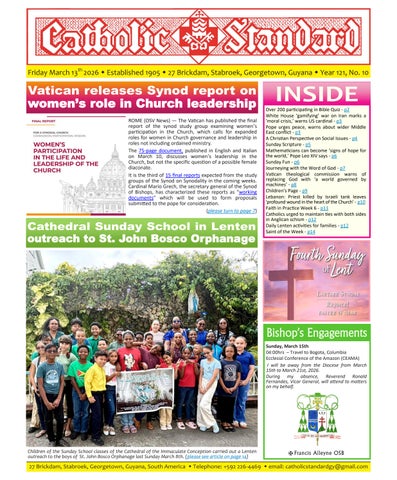
ROME (OSV News) The Vatican has published the final report of the synod study group examining women’s participation in the Church, which calls for expanded roles for women in Church governance and leadership in roles not including ordained ministry.

The 75-page document, published in English and Italian on March 10, discusses women’s leadership in the Church, but not the specific question of a possible female diaconate.

It is the third of 15 final reports expected from the study groups of the Synod on Synodality in the coming weeks. Cardinal Mario Grech, the secretary general of the Synod of Bishops, has characterized these reports as “working documents” which will be used to form proposals submitted to the pope for consideration.

(please turn to page 7)

outreach to St. John Bosco Orphanage

Over 200 participating in Bible Quiz - p2

White House ‘gamifying’ war on Iran marks a ‘moral crisis,’ warns US cardinal - p3

Pope urges peace, warns about wider Middle East conflict - p3

A Christian Perspective on Social Issues - p4

Sunday Scripture - p5

Mathematicians can become ‘signs of hope for the world,’ Pope Leo XIV says - p6

Sunday Fun - p6

Journeying with the Word of God - p7

Vatican theological commission warns of replacing God with ‘a world governed by machines’ - p8

Children’s Page - p9

Lebanon: Priest killed by Israeli tank leaves 'profoundwoundintheheartoftheChurch' - p10

Faith in Practice Week 6 - p11

Catholics urged to maintain ties with both sides in Anglican schism - p12

Daily Lenten activities for families - p12

Saint of the Week - p14

Sunday, March 15th

04:00hrs – Travel to Bogota, Columbia Ecclesial Conference of the Amazon (CEAMA) I will be away from the Diocese from March 15thtoMarch21st,2026.

During my absence, Reverend Ronald Fernandes, Vicar General, will attend to matters onmybehalf.

Francis Alleyne OSB
Children of the Sunday School classes of the Cathedral of the Immaculate Conception carried out a Lenten outreach to the boys of St. John Bosco Orphanage last Sunday March 8th. (please see article on page 14)

GrowinginFaiththroughScripture:

Over 200 participating in 21st

Year of St. Francis Jubilee Prayer

Saint Francis, our brother, you who eight hundred years ago went to meet Sister Death as a man at peace, intercede for us before the Lord.

You recognized true peace in the Crucifix of San Damiano, teach us to seek in Him the source of all reconciliation that breaks down every wall.

You who, unarmed, crossed the lines of war and misunderstanding, give us the courage to build bridges where the world raises up boundaries.

In this time afflicted by conflict and division, intercede for us so that we may become peacemakers: unarmed and disarming witnesses of the peace that comes from Christ.

Amen - Pope Leo XIV

people from across the regions are participating in the Junior (12–14), Senior (15–17), and Young Adult (18 –25) categories. Participants were also tested on the YOUCAT (Youth Catechism of the Catholic Church) and hymns related to the Scriptures.

The quiz is conducted in a hybrid format (both in-person and online) and utilizes the Kahoot platform to engage young people in learning about God’s Word. The objectives of the quiz are: (1) to deepen the relationship between participants and God through an encounter with Sacred Scripture; (2) to foster a love for Scripture and an appreciation of its importance in our lives; and

understanding the Word of God. It is important to note that the Bible Quiz is not primarily about winning or losing. Rather, it is an opportunity for participants to study the Scriptures, deepen their faith, and grow in their understanding of the message of the Gospel. We are grateful for all the catechists, parents, and youth leaders that are helping teams to reflect on the Gospel.

Participants in this year’s quiz include: St. Lawrence (Nappi), St. Louis (Siriki), St. Joachim (Springlands), St. Theresa (Karasabai), St. Aloysius Gonzaga (Tipuru), St. Ignatius, St. Bernard (Monkey Mountain), Presentation of

Francis Xavier (Charity), St. Francis of Assisi (Lima Sands), Our Lady Queen of Peace (Lethem), Church of the Ascension (New Amsterdam), Cathedral of the Immaculate Conception, St. Jerome (Supply), St. Angela Merici (Parfaite Harmonie), Holy Spirit (North Ruimveldt), Holy Rosary (Kitty), Sacred Heart (Main Street), St. Joseph (Diamond), St. Teresa (Campbellville), St. John the Baptist (Plaisance), Our Lady of the Mount (Meadow Bank), and Our Lady of Fatima (Bourda).

The finals of the Bible Quiz will be held on Sunday March 22nd at 1:30pm at Bishop’s House.❖

(OSV News ) - An American cardinal has issued “a call to conscience,” while deploring efforts to “gamify” the U.S.Israel war with Iran particularly on the part of the Trump administration.

“A real war with real death and real suffering being treated like it’s a video game it’s sickening,” wrote Cardinal Blase J. Cupich of Chicago in a March 7 statement published to that archdiocese’s website.

The cardinal pointed to a 42-second video posted March 5 on the White House X account, which showed a mashup of action clips, interspersed with unclassified video from U.S. Central Command showing U.S. missile strikes on Iran and Secretary of War Pete Hegseth.

The clip, captioned “JUSTICE THE AMERICAN WAY,” included film, video game and television scenes, such as from “Iron Man,” “Top Gun,” “Halo,”

“Superman,” and “Breaking Bad,” with a voiceover at the end declaring, “Flawless victory.”

The war, launched by the U.S. and Israel on Feb. 28, has so far killed more than 1,200 in Iran, including Iran’s Supreme Leader Ayatollah Ali Khamenei and several senior officials. At least 165, including a number of children, died at a school adjacent to an Iran Revolutionary Guard Base in Minab, Iran. Emerging footage indicates that strike appears to have been initiated by the U.S.

With the war engulfing multiple nations in the Middle East, and sending global economic shockwaves, another 400 people have been reported killed in Lebanon, and 11 in Israel.

Seven U.S. soldiers have so far been killed amid the war.

warns US cardinal

war itself, but also how we, the observers, view violence, for war now has become a spectator sport or strategy game.”

Cardinal Cupich observed that Kalshi a prediction exchange market that allows participants to trade on the outcome of future events faced a lawsuit from users unhappy with the company’s decision to invoke a “death carveout” and not pay out $54 million users had “wagered on Iran’s Supreme Leader Ali Khamenei’s ouster after his was killed.”

The cardinal described the “gamifying” of war as “a profound moral failure” that “strips away the humanity of real people.”

“Let’s not forget, a ‘hit’ isn’t putting points on the board; it’s a grieving family whose suffering we ignore when we prioritize entertainment, and profit, over empathy,” he said.

“Hundreds of people are dead, mothers and fathers, daughters and sons, including scores of children who made the fatal mistake of going to school that day,” said Cardinal Cupich in his statement.

He added, “Hundreds of thousands displaced, and many millions more are terrified across the Middle East.”

Cardinal Cupich said the fallen U.S. soldiers who at the time his statement was released numbered six “are also dishonored” by the White House’s social media post.

The cardinal stressed that the post was symptomatic of an even greater threat.

“This horrifying portrayal demonstrates that we now live in an era when the distance between the battlefield and the living room has been drastically reduced,” he said. “The moral crisis we are facing is not just a matter of the

“Our government is treating the suffering of the Iranian people as a backdrop for our own entertainment, as if it’s just another piece of content to be swiped through while we’re waiting in line at the grocery store,” Cardinal Cupich said.

He warned, “In the end, we lose our humanity when we are thrilled by the destructive power of our military. We become addicted to the ‘spectacle’ of explosions. And the price of this habit is almost unnoticeable, as we become desensitized to the true costs of war.”

But, said Cardinal Cupich, “the longer we remain blind to the terrible consequences of war, the more we are risking the most precious gift God gave us: our humanity.”

“I know that the American people are better than this,” he said. “We have the good sense to know that what is happening is not entertainment but war, and that Iran is a nation of people, not a video game others play to entertain us.” ❖

(OSV News) Pope Leo XIV called for an end to the war in Iran and warned that the conflict could drag more countries in the Middle East into instability.

Speaking to pilgrims after praying the Angelus prayer March 8, the pope said that developing news from Iran and from across the Middle East has caused “deep dismay.”

“Amid episodes of violence and devastation, and the widespread climate of hatred and fear, there is also the concern that the conflict may widen and that other countries in the region, including Lebanon, may once again sink into instability,” he said.

Strike on oil storage facility

According to The Associated Press, Israeli forces struck an oil storage facil-

ity in Tehran, as well as targeted assaults in southern Lebanon against commanders of the Lebanese branch of Iran’s Revolutionary Guards.

Iran has continued striking U.S. allies in the Gulf, including Bahrain, where it fired missiles at a desalination plant. Iranian Foreign Minister Abbas Araghchi defended the attack, arguing that the “U.S. set this precedent” after it struck a desalination plant in Iran, AP reported.

The pope’s concern for Lebanon came as government officials confirmed that the conflict between Israel and Hezbollah militants resulted in the deaths of 394 people, including 83 children.

Death toll since start of war

Since the start of the war Feb. 28, at least 1,230 people in Iran, about a

dozen in Israel and six U.S. service members have been killed, AP said.

In his appeal, Pope Leo called on Catholics to pray so that “the roar of bombs may cease, that the weapons may fall silent, and that a space for dialogue may open in which the voice of the peoples can be heard.” “I entrust this supplication to Mary, Queen of Peace,” the pope said. “May she intercede for those who suffer because of war and guide hearts along the paths of reconciliation and hope.” Diplomacy’s ‘proper role’

Less than a day after the start of the war, the pope called for diplomacy to “regain its proper role” and that “the well-being of peoples, who yearn for peaceful existence founded on justice, be upheld.”

At his Angelus address March 1, several hours after the U.S. and Israel revealed that Iran’s supreme leader, 86-year-old Ayatollah Ali Khamenei, was killed, the pope expressed his concern, highlighting that “stability and peace are not achieved through mutual threats, nor through the use of weapons, which sow destruction, suffering, and death, but only through reasonable, sincere, and responsible dialogue.”

“Faced with the possibility of a tragedy of immense proportions, I make a heartfelt appeal to all the parties involved to assume the moral responsibility of halting the spiral of violence before it becomes an irreparable abyss,” the pope warned ❖

Smoke rises following an explosion in Tehran, Iran, March 7, 2026,, amid the U.S.-Israeli war with Iran. (OSV News photo/ Naser Safarzadeh, West Asia News Agency via Reuters)

A Christian Perspective on Social Issues

Remember Lent: Prayer, submission and petition

Prayer is one of the cornerstones of Lent. What do the content of our prayers say about us to God? How do we pray before our God? Why even emphasize prayer during Lent, or at any other time?

I answer the last question with a question. If we don’t have the gift of prayer, and the power of prayer, in our lives, then what do we have? For starters, we would have only ourselves, which is an alarming consideration, given how uncontrollable some situations can turnout to be, and how powerless the feeling. For where there’s no prayer, it is likely that there is no God in our lives. The danger is of depending too much, if not exclusively, on our own strengths. Human strengths that are frail, opening us to faltering, with spirits crushed. There is no higher power to appeal to, with defeat looming as a distinct possibility. My answer to all this is simple, somewhat on the stubborn side, too. Since Jesus prayed so much, then there’s the model for us. It is the model for me. End of discussion. In a world and time where secular beliefs come first, shove prayers to the side, likely totally out of the picture, prayer is what Christians know, and what should be central in their lives, their worship.

What’s the content of our prayers? What should it be, in a person’s life that could be as different from another’s as the freezing Arctic is from the blazing Tropics? What do we ask for, prioritize? Hold the Lord’s Prayer for a moment. This is an oil country, a tangled one, a divided one, and a tormented one. How are those part, or not part of our prayers? Riches versus the richness of wisdom. Remember Solomon and what he decided before God. The passions and hates that impale this country should never be part of our prayers. There may be disappointments and hurts in full floods. But the simplicity and majesty of the prayer that Jesus taught must infiltrate and dominate our personal prayers.

A prayer that recognizes the first priority is to Our Father in heaven. The sacredness of his name. To God be the glory. To his holy will I surrender. Let thy will be done to me. Not as I pray, but as that prayer comes closest to thy will. The bread of life, of the daily word, of the spiritual sustenance that comforts in times of actual physical shortage. Manna came from heaven millennia ago in the desert. God will provide on this day, and in his way. And this one line in the Lord’s Prayer that reveals its own logic; that component that is nonnegotiable. Asking for mercy, but how forgiving have I been? What old grudge, or new malice, am I keeping; keeps me burning? Personal prayers with that hardheartedness, that heavy blotch, are nonstarters in the hearing of God. Jesus made that clear, so all believers should be clear. And, another big one. Help us in the time of impending test.

Prayers reveal, emphasize, the ongoing dependence, about what should be an uninterrupted relationship, with our Father in heaven. If we have become a little sloppy, a shade casual or haphazard, prayers in the

other seasons of the year, Lent brings us right back to that central and crucial place: close contact, close association with the Father through the Son. On our own, the odds that trouble comes quickly, as if on the hunt for vulnerable prey. Believe it! On our own confirms our worst fears at times: powerless and defenseless in the face of a prowling adversary. Plus, the needs that increase, but which there is difficulty addressing. Knock, and there shall be opening. Plus, the comforts of reassurance. Intensify my faith, O Lord. Hear my cry. The fears I harbor. The gifts that would make a difference. The lift I need to be a better believer, a faith filled follower and worshiper.

Prayers don knows. Prayers don convenient to us. Anytime is a good time. The worst of times are the best times to pray. God approves of the faith vested. Prayers don a production. God loves the humble. No comparison to others. No poisons stirring inside. Living the love of Jesus should make us want to pray. Loving enemy and praying for them is loving Jesus, and living like him.❖

Gracious and loving God, we thank your for the gift of our priests. Through them, we experience your presence in the sacraments. Help our priests to be strong in their vocation.

Set their souls on fire with love for your people.

Grant them the wisdom, understanding, and strength they need to follow in the footsteps of Jesus. Inspire them with the vision of your Kingdom.

Give them the words they need to spread the Gospel.

Allow them to experience joy in their ministry.

Help them to become instruments of your divine grace.

We ask this through Jesus Christ, who lives and reigns as our Eternal Priest. Amen

First Reading 1Samuel 16:1. 6-7, 10-13

David is anointed king of Israel.

The Lord said to Samuel, ‘Fill your horn with oil and go. I am sending you to Jesse of Bethlehem, for I have chosen myself a king among his sons.’ When Samuel arrived, he caught sight of Eliab and thought, ‘Surely the Lord’s anointed one stands there before him’, but the Lord said to Samuel, ‘Take no notice of his appearance or his height for I have rejected him; God does not see as man sees; man looks at appearances but the Lord looks at the heart.’ Jesse presented his seven sons to Samuel, but Samuel said to Jesse, ‘The Lord has not chosen these.’ He then asked Jesse, ‘Are these all the sons you have?’ He answered, ‘There is still one left, the youngest; he is out looking after the sheep.’ Then Samuel said to Jesse, ‘Send for him; we will not sit down to eat until he comes.’ Jesse had him sent for, a boy of fresh complexion, with fine eyes and pleasant bearing. The Lord said, ‘Come, anoint him, for this is the one.’ At this, Samuel took the horn of oil and anointed him where he stood with his brothers; and the spirit of the Lord seized on David and stayed with him from that day on.

Responsorial Psalm Psalm 23

Response: The Lord is my shepherd; there is nothing I shall want.

1. The Lord is my shepherd; there is nothing I shall want.

Fresh and green are the pastures where he gives me repose. Near restful waters he leads me, to revive my drooping spirit. Response

2. He guides me along the right path; he is true to his name.

If I should walk in the valley of darkness no evil would I fear.

You are there with your crook and your staff; with these you give me comfort. Response

3. You have prepared a banquet for me in the sight of my foes.

My head you have anointed with oil; my cup is overflowing. Response

4. Surely goodness and kindness shall follow me all the days of my life. In the Lord’s own house shall I dwell for ever and ever. Response

Second Reading Ephesians 5:8-14

Rise from the dead, and Christ will shine on you.

You were darkness once, but now you are light in the Lord; be like children of light, for the effects of the light are seen in complete goodness and right living and truth. Try to discover what the Lord wants of you, having nothing to do with the futile works of darkness but exposing them by contrast. The things which are done in secret are things that people are ashamed even to speak of; but anything

exposed by the light will be illuminated and anything illuminated turns into light.

That is why it is said: Wake up from your sleep, rise from the dead, Christ will shine on you.

Gospel Acclamation Jn 8:12

Glory and praise to you, O Christ! I am the light of the world, says the Lord; anyone who follows me will have eternal life. Glory and praise to you, O Christ!

Gospel

John 9:1-41

The blind man went off and washed himself, and came away with his sight restored.

As Jesus went along, he saw a man who had been blind from birth. His disciples asked him, ‘Rabbi, who sinned, this man or his parents, for him to have been born blind?’ ‘Neither he nor his parents sinned,’ Jesus answered ‘he was born blind so that the works of God might be displayed in him.

‘As long as the day lasts I must carry out the work of the one who sent me; the night will soon be here when no one can work. As long as I am in the world I am the light of the world.’

Having said this, he spat on the ground, made a paste with the spittle, put this over the eyes of the blind man. and said to him, ‘Go and wash in the Pool of Siloam (a name that means ‘sent’). So the blind man went off and washed himself, and came away with his sight restored.

His neighbours and people who earlier had seen him begging said, ‘Isn’t this the man who used to sit and beg?’ Some said, ‘Yes, it is the same one’. Others said, ‘No, he only looks like him’. The man himself said, ‘I am the man’. So they said to him, ‘Then how do your eyes come to be open?’ ‘The man called Jesus’ he answered ‘made a paste, daubed my eyes with it and said to me, “Go and wash at Siloam”; so I went, and when I washed I could see.’ They asked, ‘Where is he?’ ‘I don’t know’ he answered.

They brought the man who had been blind to the Pharisees. It had been a sabbath day when Jesus made the paste and opened the man’s eyes, so when the Pharisees asked him how he had come to see, he said, ‘He put a paste on my eyes, and I washed, and I can see’. Then some of the Pharisees said, ‘This man cannot be from God: he does not keep the sabbath’. Others said, ‘How could a sinner produce signs like this?’ And there was disagreement among them.

So they spoke to the blind man again, ‘What have you to say about him yourself, now that he has opened your eyes?’ ‘He is a prophet’ replied the man. However, the Jews would not believe that the man had been blind and had gained his sight, without first sending for his parents and asking them, ‘Is this man really your son who you say was born blind? If so, how is it that he is now able to see?’ His parents answered, ‘We know he is our son and we know he was born blind, but we don’t know how it is that he can see now, or who opened his eyes. He is old enough: let him speak for himself.’ His parents spoke like this out of fear of the Jews, who had already agreed to expel from the synagogue anyone who should acknowledge Jesus as the Christ. This was why his parents said, ‘He is old enough; ask him’.

So the Jews again sent for the man and said to him, ‘Give glory to God! For our part, we know that this man is a sinner.’ The man answered, ‘I don’t know if he is a sinner; I only know that I was blind and now I can see’. They said to him, ‘What did he do to you? How did he open your eyes?’ He replied, ‘I have told you once and you wouldn’t listen. Why do you want to hear it all again? Do you want to become his disciples too?’ At this they hurled abuse at him: ‘You can be his disciple,’ they said ‘we are disciples of Moses: we know that God spoke to Moses, but as for this man, we don’t know where he comes from’. The man replied, ‘Now here is an astonishing thing! He has opened my eyes, and you don’t know where he comes from! We know that God doesn’t listen to sinners, but God does listen to men who are devout and do his will. Ever since the world began it is unheard of for anyone to open the eyes of a man who was born blind; if this man were not from God, he couldn’t do a thing.’ ‘Are you trying to teach us,’ they replied ‘and you a sinner through and through, since you were born!’ And they drove him away.

Jesus heard they had driven him away, and when he found him he said to him, ‘Do you believe in the Son of Man?’ ‘Sir,’ the man replied ‘tell me who he is so that I may believe in him.’ Jesus said, ‘You are looking at him; he is speaking to you’. The man said, ‘Lord, I believe’, and worshipped him. Jesus said: ‘It is for judgement that I have come into this world, so that those without sight may see and those with sight turn blind’.

Hearing this, some Pharisees who were present said to him, ‘We are not blind, surely?’ Jesus replied: ’Blind? If you were, you would not be guilty, but since you say, “We see”, your guilt remains. ❖ (ShorterFormJn9:1,6-9,13-17,34-38)

Gospel Reflection

The story of the blind man in the Gospel is not just a story of an unfortunate man who was given back his sight. It is above all the story of a man who was touched by Christ and came to faith through that encounter. Without faith we are in a deep dark night and we are never sure of knowing where we are or where we are going. We all know that life is full of moments of darkness. Our faith helps us make sense of the darkness. This is because the one person on whom we can rely to guide us along the dark paths of life is Jesus. We can put our total trust in him who said: “Those who follow me will never walk in darkness but will always have the light of life.”

In a message conveyed through Vatican Secretary of State Cardinal Pietro Parolin, Pope Leo XIV on Friday said that mathematicians can ” particularly in a context marked by rapid technological advancements and challenges facing humanity.

The pope’s message was addressed to the Turkish mathematician and university professor Betül Tanbay, chair of the International Day of Mathematics, which was observed March 13.

Tanbay had informed the pontiff of a webinar dedicated to the theme “Mathematics and Hope.” In response, the pope sent a letter extending his cordial greetings and best wishes to all participants in the initiative.

In the text, Leo XIV invited reflection on the role that mathematics can play in the face of “the multiple challenges confronting the human family,” citing rapid technological development, with all its potential “for both good and evil.”

The pontiff encouraged participants to consider how mathematicians can offer a positive witness to society. “A particularly fruitful area of research is the use of algorithms, especially in the field of artificial intelligence,” he noted.

However, the pope emphasized that work in these fields demands something more than technical competence.

what the meaning of life is.”

Along these lines, the pontiff expressed his hope that participants would be attentive “to the profound spiritual needs of the human heart” and seek ways to humanize the digital realm so that it may become an opportunity for fraternity and creativity.

Likewise, he encouraged mathematicians to be “prophets of hope, truth, and goodness in the world.”

The message concluded with a prayer from the pope for all participants in the International Day of Mathematics, upon whom he invoked “abundant divine blessings of wisdom, joy, and peace.”

Pope Leo’s mathematical background

Robert Francis Prevost, now Pope Leo XIV, graduated in 1977 from Villanova University in Pennsylvania, earning a bachelor of arts degree in mathematics alongside studies in philosophy. This preceded the beginning of his theological studies upon his formal entry into theAugustiniannovitiatethatsameyear

During his time at the Catholic Theological Union in Chicago, Prevost combined his religious formation with teaching: He taught mathematics part time at Mendel Catholic High School in Chicago and worked occasionally as a substitute physics teacher at St. Rita of Cascia High School.❖

Jesus came to bring healing, to announce a new kingdom based on justice and compassion, a kingdom rooted in God’s light and love. This is shown in his healing ministry. He brought light to those who suffered in darkness, whether physical, emotional or spiritual. Each one of us suffers from some form of blindness. It may be selfishness, jealousy, pride, prejudice, hatred or any one of those failings to which we human beings are so prone. Knowing that Jesus heals means that there is always hope for us. Today, his light can be shininginourdarkness. ❖

[From: Journeying with the Word of God,TheReligious Education Department, Diocese of Georgetown, Guyana ]

As he pointed out, this task requires “not only intellectual effort and ingenuity but also the integral growth of the whole person,” capable of taking into account the moral dimension of emerging technologies.

Recalling his own experience as a mathematics and physics teacher, Leo XIV quoted words he addressed to students during the Jubilee of the World of Education, held on Oct. 30, 2025: “Possessing vast knowledge is not enough if we don’t know who we are or

For 121 years, the Catholic Standard has been sharing the Gospel of Jesus Christ.

Now reaching 10,000+ followers on Catholic Media Guyana Facebook plus going straight to your inbox and WhatsApp, our vibrant weekly e-paper is a trusted source which delivers informative and inspiring stories from across the diocese and around the world.

Want to promote your business or event? Advertise with us! Call 675-4542 oremail catholicstandardgy@gmail.com ❖

Synod report on women’s role in Church leadership

A ‘charismatic path’ for women

In the document, the study group calls for “new spaces” for women to exercise leadership in evangelization and administration in collaboration with ordained ministers.

“Alongside the sacramental path and distinct from it, there is also a charismatic path that can be fruitfully pursued to open new spaces of participation for the lay faithful, particularly for women,” it states. “It follows that even in the exercise of governance within a Diocese, opportunities of this kind may arise and should be employed.”

The report argues that laywomen possess distinct charisms from the Holy Spirit that demand recognition.

“Today laywomen have the right to affirm their participation in the mission of the Church not only on the basis of their equal human and Christian dignity but also on the basis of the charisms given by God,” it says.

“A new evangelization has become urgent,” it adds, “One that depends less exclusively on priestly resources and is enriched by the presence and contributions of women.”

‘New forms of exercising

authority

The synod study group calls for theology and canon law to “explore new forms of exercising authority grounded in the Sacrament of Baptism and distinct from those deriving from Holy Orders, so that adequate canonical forms may be found to make effective the participation of women in roles of leadership within the Church.”

“There is no reason or impediment that should prevent women from carrying out leadership roles in the Church,” the report states.

The document also recommends a “reformulation of the areas of competence of the ordained ministry,” suggesting that redefining those boundaries “could open the way to recognize new spaces of responsibility for women in the Church.”

Female diaconate not addressed

Notably, the report does not address the specific question of a possible female diaconate, a controversial topic of debate within the Synod on Synodality. During the second session of the synod, Pope Francis reactivated a commission studying women’s access to the diaconate under

(From Front Page)

Cardinal Giuseppe Petrocchi. That commission’s conclusions, published in December 2025, stopped short of recommending the female diaconate but approved by a wide margin a proposal to broaden women’s access to instituted ministries, like that of catechist.

The Virgin Mary as a model

Drawing on Scripture and Church tradition, the report invokes both the Virgin Mary and St. Mary Magdalene as paradigms for female authority in the Church.

“Mary is the supreme model of the charismatic dimension. Though she does not belong to the hierarchical structure, she possesses within the Church a unique authority and spiritual fruitfulness,” it states.

The document also notes that Christ chose a woman, Mary Magdalene, to first announce the Resurrection, “The Apostles themselves received this proclamation from her.”

Pope Leo’s appointments of women to Roman Curia

The report outlines appointments made by both Pope Francis and Pope Leo XIV as evidence that women can and already do lead at the highest levels of the Church.

It cites the Apostolic Constitution “Praedicate Evangelium,” which allows the possibility for a laywomen to head a Vatican dicastery, “depending on the power of governance and the specific competence and function of the Dicastery or Office in question.”

At the same time, the report states that women working in the Roman Curia have indicated “that certain attitudes marked by

Journeying with the Word of God

clericalism persist” in which “women, even in positions of responsibility, sometimes struggle to be involved and listened to on equal footing with male colleagues, particularly in interactions with ordained ministers.”

The study group highlighted Pope Leo XIV’s appointments of Trappistine Mother Martha Elizabeth Driscoll, and Sister Iuliana Sarosi, a member of the Congregation of the Mother of God, as consultors to the Dicastery for the Clergy and of Cristiana Perrella as president of the Pontifical Insigne Academy of Fine Arts and Letters of the Virtuosi al Pantheon.

The report also cited Pope Leo’s comments in an interview in July 30 in which he said that “the role of women in the Church has to continue to develop” and expressed his intention to continue “in the footsteps of Francis, including in appointing women to some leadership roles at different levels in the Church’s life.”

Women in the Bible and Church history

The synod final report is organized in three parts. The first recounts the history of the study group and the second offers a “synthesis of the themes” emerging from the synodal process.

The third part is an extensive appendix containing six sections: female figures in the Old and New Testaments; significant women in Church history; contemporary testimonies of women in Church leadership; the Marian and Petrine principles; ecclesial authority; and the contributions of Pope Francis and Pope Leo XIV.

Among the examples of women highlighted by the document are St. Catherine of Siena, St. Joan of Arc, St. Elizabeth Ann Seton, Maria Montessori, and Servant of God Dorothy Day.❖

MAKING THE WORD OF GOD YOUR OWN

Step 1: Lookattoday’sReadingsprayerfully.

1st Reading: God chooses David, the youngest son of Jesse, to be anointed king by the prophet Samuel. The Spirit of the Lord is with David from that day.

2nd Reading: Paul tells the Christian community that they have been empowered by God and so, after living in the darkness, they have become children of the light.

Gospel: The cure of the blind man is a sign of the spiritual sight which Jesus gives to those who sincerely look for God.

Step 2: ApplyingthevaluesoftheReadings toyourdailylife.

1.It has been said that the greatest tragedy is not being born blind, but to have eyes and yet fail (or refuse)tosee. Inwhatwaycanthisbeappliedtoyou?

2.There is a frightening amount of darkness in the world today. What can you do about the darkness that may be affecting you?

3.Jesus says that he is the light of the world. What part do you play in ensuring that this light shines brightly in the world around you?

4.In biblical times blind people had no place in society because it was felt that they were being punished because of their sins. Do you ever feel a sense of being left out? How does your relationship with Jesus help you cope with the feeling of being unwanted?

Step 3: Accepting the message of God’s Wordinyourlifeoffaith

As Christians we must be able to admit our blindness knowing that Jesus will help us out of our darkness. We are members of a community on which Jesus continues to shed his light and we are called to act as guides to others who have not as jet seen the light of Christ or to those for whom the light has grown dim. Those who are blessed by the light of Christ must live according to the will of God, that is, in complete goodness, in truth and uprightness.

Step 4: Somethingtothink&prayabout

1.Reflect on your own life. In what way are you now experiencing darkness? Have you experienced God’s light before? Is the light in danger of becoming dim? What obstacles are blocking the light? What do you feel you need to do in your life to “be in the light”?

2.Talk to God about your “darkness” and the help you need to cope with it.❖

[From: Journeying with the Word of God, The Religious Education Department, Diocese of Georgetown, Guyana ]

A file photo shows an extraordinary minister of the holy Eucharist distributing Communion during Mass. (OSV News photo/CNS file, Gregory A. Shemitz)

replacing God with ‘a world governed by machines’

Ameca, a humanoid robot by Engineered Arts, interacts with attendees at the entrance to the UK Pavilion during CES 2022 in Las Vegas Jan. 6, 2022. OSV News photo/Steve Marcus, Reuters

ROME The Vatican’s International Theological Commission has warned that if humanity places total trust in technology in a “world ruled by machines,” it risks replacing the “living God” with a counterfeit “virtual God.”

The assessment came in a sweeping new document, published on March 4, examining how artificial intelligence, transhumanism and other technological developments can pose profound risks to human identity and dignity. The document seeks to propose a response rooted in Christian anthropology and the Gospel.

The 48-page document, titled, “Quo vadis, humanitas? Thinking about Christian anthropology in light of some scenarios for the future of humanity,” was published in Italian and Spanish after being approved by Pope Leo XIV. Its Latin title meaning “Where are you going, humanity?” echoes the question tradition holds was put to St. Peter before his crucifixion in Rome.

“At this juncture in the 21st century, the human family is faced with questions so radical that they threaten its very existence as we have known it,” the document says.

“The eruption of scientific and technical development unprecedented in the history of the planet must be accompanied by a corresponding growth in responsibility that directs progress toward the good of human beings, because they are today exposed to risks never imagined before.”

The document, written by a subcommission that met between 2022 and 2025 and approved unanimously at the ITC’s 2025 plenary session, was written to mark the 60th anniversary of “Gaudium et Spes,” the Second Vatican Council’s landmark Pastoral Constitution on the Church in the Modern World.

and indicating the ultimate purpose is identified with the implementation of technological potential,” it says.

“In this context, religious and spiritual traditions still have something essential and indispensable to contribute regarding the wisdom of living in relationship to God.”

Cosmetic surgery, biotechnology and the ‘cult of the body’ Advances in biotechnology, neuroscience, DNA mapping, pharmacology and robotics have brought changes to how human beings perceive and relate to their own bodies, the commission pointed out. While acknowledging the genuine health gains these advances have produced, the document warns against “the trends that reduce the body to biological material to be enhanced, transformed, and reshaped at will, with the dream of achieving living conditions that avoid pain, aging, and death.”

The document links both movements to what Pope Francis has called “neoGnosticism,” a mindset that seeks to free the person from the body, the cosmos, and history, reducing created nature to “matter to be transformed.”

“The dreams of transhumanism and posthumanism presume to simplify the tensions that run through human experience,” the commission writes. “But on closer inspection, this project proves to be dehumanizing.”

A Christian alternative: life as vocation

Against these trends, the commission proposes the concept of life as vocation receiving oneself as a gift, sharing that gift with others and recognizing its transcendent source in God.

AI, social media and ‘digital spiritualism’

The commission devoted considerable attention to artificial intelligence, describing it as a technology capable of “replacing all computational and operational aspects of human intelligence” and warning that its rapid development sometimes proceeds “without the prudence born of the wise recognition that good always involves an appropriate limit and proportion.”

The document raised particular concerns about automated AI decisionmaking in sensitive areas, questioning the use of algorithms “when deciding whether or not to provide medical care, granting loans, or mortgages, or providing insurance, or when preparing criminal cases in court … or when deciding on military strikes.”

On social media and the profound changes in mass communications brought by the internet, the commission acknowledged benefits such as more direct and participatory information at the social and political levels, but warned that platforms too often produce contacts “without ties, functional relationships without real solidarity, in an infinite market of news and personal data, not always verifiable and often manipulated.”

The document also warned that “spiritual seekers often place indiscriminate trust in online search engines, rendering human mediations of the sacred superfluous, replaced by digital technology,” up to and including requests for virtual blessings, exorcisms, and “digital spiritualism.”

Trends claiming to save humanity through technology ultimately impact “the relationship with the Mystery of the origin and ultimate purpose of human life,” the document states.

“When human beings reduce created nature (person, cosmos) to matter to be transformed, they no longer manifest the glory of the Creator, but replace Him. The same happens when the task of giving meaning to existence

In the West in particular, the commission notes, advances in cosmetic surgery combined with hormone treatments and cognitive-enhancement drugs have fostered a widespread “cult of the body,” marked by “the frantic pursuit of a perfect figure, one that always stays fit, youthful, and beautiful.

The document also discusses the concept of “human enhancement,” defined as the use of biomedical, genetic, pharmacological and cybernetic technologies to improve human physical, cognitive or sensory capabilities beyond normal levels. Its applications range from advanced prosthetics and electronic devices implanted in the body, to performance-enhancing drugs in sport, work and military contexts, to artificial fertilization techniques.

Transhumanism and posthumanism

The document’s sharpest critique is aimed at transhumanism and posthumanism, which it presents as cultural challenges to Christian anthropology.

Transhumanism, defined as the philosophical movement that believes that science and technology can and should overcome biological limitations including aging and death, is described as holding “a distinctly anthropocentric perspective, subscribing to an ideological and naively uncritical vision of scientific and technological progress.” Its utopian pursuit of individual immortality supported by technology, the document says, can be interpreted as “the existential expression of a presumption that is both naive and arrogant.

Posthumanism, which questions the distinctiveness of the human being and envisions a fluid boundary between human and machine, including a world with “cyborgs,” is characterized as “an existential expression of escape from reality, which stems from a radical devaluation of humanity.”

“The anthropological and cultural proposal of Christianity refers, today more than ever, to a conception of life as a vocation, which makes possible a human way of inhabiting time and space,” the document states, calling this vision “a prophetic judgment on the most disturbing aspects” of transhumanism and posthumanism.

“Man is not an atom lost in a random universe, but is a creature of God, to whom He wished to give an immortal soul and whom He has always loved,” it says.

The document insists that “the future of humanity is not decided in bioengineering laboratories, but in the ability to navigate the tensions of the present,” while remaining open to the mystery of the risen Christ.

The poor as a touchstone

The commission closes with a call to keep the poor at the center of any reckoning with technological development, warning that its benefits accrue disproportionately to the powerful and that the weakest risk becoming “collateral damage, swept away without mercy.”

Citing Pope Leo XIV, it affirms that Christ’s love shows “the dignity of every human being” and calls Christians to act as “humble sentinels” alert to the consequences new developments may hold for the lives of the least fortunate.

“What the human family needs,” the document says, “and within it every person who is searching for his or her true identity, is not an evolutionary leap that transcends the present condition, but rather a saving relationship that makes the adventure of selfrealization fully meaningful and beautiful. In this sense, we speak of humanity saved, that is, respected as a gift from God and not replaced.”

“The encounter with the humanity of Jesus Christ illuminates our humanity and reveals us to ourselves,” it adds. “First of all, it restores to us the sense of our freedom in the face of the Creator’s call, precisely as He fulfills our vocation to participate in the eschatological fullness of His risen life.”❖

Dear Girls and Boys,

Jesus was walking with his disciples when they saw a man who had been blind since birth. The disciples thought that man was blind because he or his parents had sinned, but Jesus told them, "It is not because of his sins or his parents' sins. This happened so that the power of God could be seen in his life." Then Jesus knelt down, spit on the ground, and stirred up some mud. He took the mud and put it on the blind man's eyes. He told him, "Now, go wash yourself in the pool of Siloam." The man went and washed the mud from his eyes and when he came back, he could see!

Now, you would think that everyone would think that it was wonderful that the blind man could see, but the Pharisees weren't. Do you know why? It was because Jesus healed the blind man on the Sabbath. The Pharisees thought that was a sin to do anything on the Sabbath even if it was to help someone in need. You see, they were more concerned with keeping their religious laws than they were with helping people. When the Pharisees asked the man how he had been healed, he told them that Jesus had healed him. They became angry and said to him, "God should get the glory for this we know this man Jesus is a sinner."

"I don’t know whether he is a sinner," the man replied. "But I do know this: I was blind, and now I can see!"

We don't know what problems you may be facing in your life, but we know that if Jesus can heal a blind man with a little bit of mud, he can help you with anything you might be facing.

Heavenly Father, we are here today in need of the touch of Jesus. We pray that lives will be changed so that your name will be glorified. In Jesus' name we pray

Lebanon: Priest killed by Israeli tank leaves 'profound wound in the heart of the Church' In memory of Father Keith Hardless

Members of the clergy are seen in a procession as people carry the coffin of Father Pierre al-Rahi during his funeral in Qlayaa in southern Lebanon March 11, 2026. The Lebanese Maronite Catholic priest died March 9 after sustaining wounds from Israeli tank fire on a house in Qlayaa following an escalation between Hezbollah and Israel amid the U.S.-Israeli war with Iran. (OSV News photo/Karamallah Daher, Reuters)

(ICN) - Pope Leo and the head of the Maronite Catholic Church have both condemned the deadly attacks on Lebanon, after a priest was killed there on Monday, 9th March. Father Pierre Al Rahi lost his life in Qlayaa, as he sought to help parishioners whose house had been attacked by an Israeli tank.

The 50-year-old Maronite priest had rushed to the house in the mountainous area of his parish with some young people when the tank struck the house a second time, wounding him. He was taken to hospital where he died from his injuries.

A statement from the Vatican March 10th reads: "Pope Leo XIV expresses profound sorrow for all the victims of the bombings in these days in the Middle East, for the many innocents, including many children, and for those who were helping them, such as Father Pierre El-Rahi, the Maronite priest killed this afternoon in Qlayaa. He is following what is happening with concern and prays that every

hostility may cease as soon as possible."

Patriarch Bechara Boutros Rai paid tribute to Fr El Rai saying he "gave his life as a testament to love and devotion to his priestly mission".

He said: "The martyrdom of a priest dedicated to the service of God and his people, steadfast in his pastoral mission alongside the faithful in times of hardship, is a profound wound in the heart of the Church.

"It reveals once again the tragedy for which innocents pay the price in the cycle of violence and wars, against which we have long warned, urging everyone to keep our nation out of its tragedies and to embrace negotiation, dialogue, and diplomacy."

Fr Toufic Bou Merhi, Roman Catholic parish priest in Tyre and Deirmimas, told Vatican News Fr El Rai was a "true pastor for the Christians of his parish".

Lebanon has been hit by dangerous military escalations between Hezbollah and Israel. A fragile ceasefire

agreed in 2024 collapsed following the US-Israeli offensive against Iran on 28th February, killing its Supreme Leader Ayatollah Ali Khamenei.

Fr El Rai was a project partner of Aid to the Church in Need (ACN) and was supporting pastoral outreach in Klayaa Parish, in Tyre, which serves around 3,000 parishioners.

The charity had been working with the priest and staff on the ground said despite the growing insecurity in southern Lebanon, many priests and religious sisters have chosen to remain with their communities.

Many Christian families have also stayed in their villages, unwilling to abandon their homes, land and livelihoods.

ACN has also received reports that Sami Ghafari, 70, the brother of another Lebanese priest, was killed while in the garden of his home in Aalma el Chaab, a Christian village located near the border.

Patriarch Rai added: "We strongly condemn every attack targeting civilians, religious figures, places of worship, homes, institutions and every inch of our homeland.

"We see this tragic event as a blatant assault on human dignity and the sanctity of life. We affirm that the continuation of the logic of war and weapons will bring nothing but more killing, destruction, and displacement to Lebanon and the region."

Patriarch Rai said: "We call upon all officials in Lebanon, the region and the international community to shoulder their historical responsibilities and work immediately and diligently to stop this senseless war that threatens the lives of the people and the future of the nation.

"This is especially crucial given the Lebanese state's clear position of neutrality in the war waged in support of Iran, a war in which Hezbollah unilaterally decided to participate… "Lebanon was not created to be an arena for wars, but rather a homeland for coexistence and a beacon of freedom and human dignity."❖

July 5th 1944 — March 14th 2019

March 14th marks seven years since Father Keith Hardless went to his eternal home after ministering selflessly to the people of Guyana for 48 years.

“God will wipe away every tear from their eyes, and death shall be no more, neither shall there be mourning, nor crying, nor pain anymore, for the former things have passed away – Rev 21:4

“I will never forget you my people”

To live in hearts we leave behind is not to die – Thomas Campbell

FaithinPractice:LivingandKnowingourFaith

The Sacrament of Reconciliation: A Healing Encounter with Christ

All analogies are imperfect but consider this one. Imagine going for a week without brushing your teeth. You continue eating, drinking coffee or juice, speaking with friends, and going about your daily routine. After a few days your mouth begins to feel unpleasant. Your breath is no longer fresh. Perhaps even a dull pain begins to appear. Sooner or later, you realize something is wrong and that you need help.

Brushing our teeth daily helps maintain our health and prevents decay. In a similar way, examining our conscience regularly helps us remain attentive to our spiritual health. Our spiritual lives can slowly accumulate the effects of sin, often without us noticing until the discomfort becomes impossible to ignore. Even the most diligent person occasionally needs more than daily care. Sometimes deeper healing is required. This is where the Sacrament of Reconciliation comes in.

Just as we go to the dentist when something is wrong, we approach the sacrament when we recognize the need for God’s mercy, grace, and healing. Both experiences aim at cleansing, restoration, and renewal. Even those who sincerely strive to avoid sin eventually discover wounds that require God’s healing touch.

The Catechism offers a striking comparison: “If a sick person is too ashamed to show his wound to the doctor, the medicine cannot heal what it does not know” (CCC 1456). Sin wounds the soul just as disease harms the body. Healing requires light. Confession is the moment when we allow the light of Christ to shine into our lives. Jesus himself reminds us: “Those who are well have no need of a physician, but those who are sick… I have come to call not the righteous but sinners” (Matthew 9:12–13). The temptation of the devil is to deny our sins or hide them in darkness. Christ, however, always calls us into the light where healing can begin.

A key element of the sacrament is contrition. This means sincere sorrow for sin and the firm resolution/ promise not to sin again (CCC 1451). The Gospel word often used for repentance is metanoia, a Greek word that means a change of mind. True repentance means allowing God to reshape our thinking, our choices, and ultimately our way of life. When we approach confession with humility and honesty, God’s grace restores our relationship with him and with the Church. This grace not only forgives past sins but also strengthens us to resist future ones. Grace builds upon our human efforts and helps us grow in virtue.

Why Confess to a Priest?

Many people ask: “Why should I confess to a priest instead of speaking directly to God?”

Throughout salvation history, God often communicates his forgiveness through visible signs and ministers. In the Old Testament, reconciliation was mediated through priests and sacrificial rites. In the New Testament, Christ entrusted this ministry to his apostles. After his resurrection, Jesus breathed on his disciples and said: “Receive the Holy Spirit. If you forgive the sins of any, they are forgiven them; if you retain the sins of any, they are retained.” (John 20:22–23)

Saint Paul also speaks of the Church’s “ministry of reconciliation” (2 Corinthians 5:18). And the Letter of James encourages believers: “Therefore confess your sins to one another and pray for one another, that you may be healed.” (James 5:16)

Through the Sacrament of Holy Orders, bishops and priests share in this ministry of reconciliation. Acting in the person of Christ, they pronounce God’s forgiveness. As the Catechism teaches, priests have the authority to forgive sins “in the name of the Father, and of the Son, and of the Holy Spirit” (CCC 1461). Ultimately, it is Christ himself who forgives in the confessional.

Overcoming Fear

Many people hesitate to go to confession because of embarrassment or fear. Yet people often share their deepeststruggleswithfriends,therapists, or even on social media. In the confessional, however, we are not speaking merely to another human being; we are speaking to Christ, who already knowsourheartsanddesiresourhealing.

The shame we feel when confessing our sins can itself be a temptation to avoid the sacrament. Priests too are sinners who regularly confess their own sins to other priests. The confessional is not a place of judgment but a place of mercy.

The Church also safeguards the sacredness of this encounter through the seal of confession, which is unbreakable. A priest may never reveal anything he hears in confession under any circumstances.

The Church’s Practice

The Church encourages all Catholics to approach this sacrament regularly. Catholics who have reached the age of reason (about eight years old) must confess serious sins at least once a year. Anyone conscious of mortal sin should receive the Sacrament of Reconciliation before receiving Holy Communion.

During Lent, many parishes offer penance services to help the faithful prepare spiritually for Easter. Please do not ever worry about not knowing how to confess. The priest will guide you through it.

A Path of Healing

Confession is not merely about listing sins; it is about encountering the mercy of Christ. Just as we seek medical care when our bodies are wounded, we turn to this sacrament when our souls need healing. Just as a toothache points to the need for a dentist, examining our conscience and paying attention to the pains in our heart and life often reveal our deeper woundedness.

The invitation of Christ remains open to all. In the Sacrament of Reconciliation, we discover again that God’s mercy is greater than our sin and that his grace restores us to new life. ❖

(CathNews) - As bishops from the worldwide Anglican Communion sever links with England’s first female Archbishop of Canterbury, Catholics are being urged to maintain friendly ties while dropping illusions about future reunification. Source: OSV News

“Whatever the Catholic Church may say officially, restoration of sacramental communion between our churches, sought for so many years, simply isn going to happen now, Michael Nazir-Ali, who was one of several Anglican bishops received into the Catholic Church in 2021.

“But the Catholic Church talks to people from all denominations and faiths – and links of friendship and joint action should continue,” he said.

The Pakistan-born priest spoke as dissenting leaders of a Global Anglican Future Conference (GAFCON), formed in 2008, announced a new international council to represent conservative Anglicans following the January 28 confirmation of Archbishop Sarah Mullally as the 106th archbishop of Canterbury and the Church of England’s first female to lead the Anglicans.

At a March 3-6 meeting of 347 bishops in Abuja, Nigeria, GAFCON said it had now created a new Global Anglican Council, headed by Rwandan

Archbishop Sarah Mullally (OSV News/ Toby Melville, Reuters)

Archbishop Laurent Mbanda, after concluding that current “Instruments of Communion” no longer met Anglican needs.

Leaders of GAFCON, which claims to represent at least half the world’s 85 million Anglicans, spread over 165 countries, withdrew from contacts with the Church of England in October following Archbishop Mullally’s appointment, accusing her of promoting “unbiblical and revisionist teachings” by supporting same-sex blessings and other liberal reforms.

Besides heading the English Church, founded when King Henry VIII broke with Rome in 1534, the Archbishop of

Canterbury is traditionally recognised as holding first place among primates of the world’s 42 Anglican churches.

Apart from the Global Anglican Council establishment, in a separate March 7 “Abuja Affirmation,” GAFCON said it had long urged “repentance” from Anglican leaders who maintained “the fiction of ‘walking together’,”

while failing to “uphold fundamental Anglican doctrine” established during the 16th-century Reformation.

The Catholic Church has not rescinded Pope Leo XIII’s ruling in an 1896 apostolic letter, Apostolicae Curae, that Anglican holy orders are “absolutely null and utterly void”.❖

Last Sunday March 8th, a group of children from the Cathedral of the Immaculate Conception’s Sunday School classes carried out a meaningful Lenten outreach to St. John Bosco Orphanage.

The day began with the children attending Sunday Service In the Absence of a Priest at St. John the Baptist Church, Plaisance, East Coast Demerara. Following the service, they visited the St. John Bosco Orphanage where they shared breakfast with the boys and the Sisters who care for them.

The children spent the remainder of the morning engaging in games and activities with the boys. It was a joyful and fulfilling experience as friendships were formed and the spirit of community and kindness was shared among all present.

The outreach provided the children with an opportunity to live out the values of Lent by showing compassion, generosity, and solidarity with others.❖

(Catholic Media Guyana FB)

Saint of the Week

March 19th

Saint Joseph, Husband of Mary

The Bible pays Joseph the highest compliment: he was a “just” man. When the Bible speaks of God “justifying” someone, it means that God, the all-holy or “righteous” one, so transforms a person that the individual shares somehow in God’s own holiness, and hence it is really “right” for God to love him or her. By saying Joseph was “just,” the Bible means that he was one who was completely open to all that God wanted to do for him. He became holy by opening himself totally to God.

The rest we can easily surmise. Think of the kind of love with which he wooed and won Mary, and the depth of the love they shared during their marriage.

It is no contradiction of Joseph’s manly holiness that he decided to divorce Mary when she was found to be with child. The important words of the Bible are that he planned to do this “quietly” because he was “a righteous man, yet unwilling to expose her to shame” (Matthew 1:19).

The just man was simply, joyfully, wholeheartedly obedient to God in marrying Mary, in naming Jesus, in shepherding the precious pair to Egypt, in bringing them to Nazareth, in the undetermined number of years of quiet faith and courage.❖ [www.franciscanmedia.org ]

Turn static files into dynamic content formats.

Create a flipbook