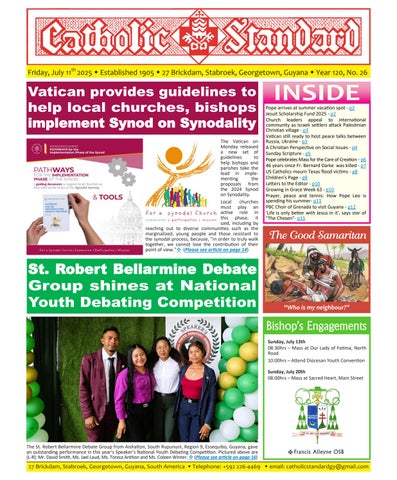

implement Synod on Synodality


The Vatican on Monday released a new set of guidelines to help bishops and parishes take the lead in implementing the proposals from the 2024 Synod on Synodality.
Local churches must play an active role in this phase, it said, including by
reaching out to diverse communities such as the marginalized, young people and those resistant to the synodal process, because, "in order to truly walk together, we cannot lose the contribution of their point of view."❖ (Please seearticleon page14)
St. Robert Bellarmine Debate
Pope arrives at summer vacation spot - p2
Jesuit Scholarship Fund 2025 - p2
Church leaders appeal to international community as Israeli settlers attack Palestinian Christian village - p3
Vatican still ready to host peace talks between Russia, Ukraine - p3
A Christian Perspective on Social Issues - p4
Sunday Scripture - p5
PopecelebratesMassfortheCareofCreation - p6
46 years since Fr. Bernard Darke was killed - p7
US Catholics mourn Texas flood victims - p8
Children’s Page - p9
Letters to the Editor - p10
Growing in Grace Week 63 - p10
Prayer, peace and tennis: How Pope Leo is spending his summer- p11
PBC Choir of Grenada to visit Guyana - p12
'Life is only better with Jesus in it', says star of "The Chosen"- p15


Pope Leo arrives at summer vacation spot; locals delighted
The Jubilee Prayer

Father in heaven, may the faith you have given us in your son, Jesus Christ, our brother, and the flame of charity enkindled in our hearts by the Holy Spirit, reawaken in us the blessed hope for the coming of your Kingdom.
May your grace transform us into tireless cultivators of the seeds of the Gospel.
May those seeds transform from within both humanity and the whole cosmos in the sure expectation of a new heaven and a new earth, when, with the powers of Evil vanquished, your glory will shine eternally.
May the grace of the Jubilee reawaken in us, Pilgrims of Hope, a yearning for the treasures of heaven. May that same grace spread the joy and peace of our Redeemer throughout the earth.
To you our God, eternally blessed, be glory and praise for ever.
Amen


The pope will stay in Castel Gandolfo for his customary retreat through July 20. (CNS photo/Vatican Media)
CASTEL GANDOLFO, Italy (CNS)
After more than a decade without its most famous vacationer, the quiet town of Castel Gandolfo once again counts the pope among its summer residents.
Pope Leo XIV became the 16th pope to reside in the papal summer residence when he moved there July 6, following the recitation of the Angelus in St. Peter’s Square.
“This afternoon, I will travel to Castel Gandolfo, where I intend to have a short period of rest,” the pope told pilgrims gathered in the square. “I hope that everyone will be able to enjoy some vacation time in order to restore both body and spirit.”
The tradition of popes escaping the summer heat of Rome for the cooler
Alban Hills began with Pope Urban VIII in 1626. While Pope Benedict XVI spent nearly three months in the papal villa during the summer of 2012, his successor, Pope Francis, chose not to stay there, opting instead for his Vatican residence at the Domus SanctaeMarthae.
In 2016, Pope Francis converted the papal property into a museum, opening the villa and gardens to the public.
That decision transformed the character of tourism in the town, said Marina Rossi, a local resident who has operated a mosaic workshop along the town’s main drag for more than 30 years.
“During the week there wasn’t this
flow of people,” she told Catholic News Service July 1, since the popes only presented themselves publicly to pray the Angelus on Sundays. “Instead, by opening the palace and the pontifical villas, the type of tourism has changed,” shifting from frugal pilgrims to paying visitors. As a result, “the last 12 years were good for us.”
Still, she said, the return of a pope is “fantastic.”
“It’s an important showcase” for the town, Rossi said. “We’re happy,yes.” Rossi, an artist, said she and others had considered creating a portrait of the pope, adding, “Yes, it’s an idea we’ve had; right now, we are doing stuff a bit different, more simple, because making a portrait is not the most ‘sell-able’ right away.”
Assunta Ferrini, who manages Sor Capanna, a restaurant right off the square at the foot of the papal palace, said the town has not lacked tourists in the pope’s absence.
“The tourists came, many of them,” she told CNS. “But to have a pope return is always an honor for the town, that he comes here to meet us.”
At a local coffee shop, barista Stefano Carosi echoed that sentiment. “To have the pope here among us after so long is a beautiful thing,” he said. “We’ve waited for it for so long.”
Without the steady presence of Pope Francis, he added, the town was “without that spark, that light, but now it seems like these 12 years have flown by and we hope that everything may return as before.”❖
Jesuit Scholarship Fund 2025

The Jesuit Scholarship Fund for 2025 is open. The Jesuit Scholarship Fund provides financial assistance to students at the tertiary level who are ready to serve their community and their country, who show academic promise and are in need. Applications for scholarships will be considered both from those who have been accepted to begin a course this year at the Guyana School of Agriculture, the Cyril Potter College of Education, the Guyana Technical Institute, the Burrowes School of Art, a School of Nursing, or any other tertiary educational institution in Guyana and also from those who are already students at these and similar institutions. Applications for scholarships cannot be considered for courses outside Guyana or for courses at secondary schools. Online courses may be considered depending on the course being pursued, its cost and local availability. Once granted, a scholarship will continue until the student has completed his or her course, provided that satisfactory reports of the student’s community service and academic progress are received and his or her financial need continues.
Please access the form here: https:// drive.google.com/file/ d/1ZLh9neYjaLJlW4M3e32uSs5_TtEnbtVC/view? usp=sharing ❖
Pope Leo XIV greets a child as he arrives in Castel Gandolfo, Italy, July 6, 2025, after reciting the Angelus at the Vatican.
as Israeli settlers attack Palestinian Christian village

(OSV News) In the West Bank, Christian leaders in Taybeh the region’s only entirely Christian Palestinian village are sounding the alarm over escalating settler violence.
On July 8, the Latin, Greek Orthodox and Melkite parish priests denounced attacks on Christian residents, farmland and historic sites, urging international and church missions to document the damage.
“These assaults threaten the security and stability of our town and aim at undermining the dignity of its residents and the sanctity of its sacred land,” the priests said.
Ancient Town of Ephraim
Known as the ancient town of Ephraim the location mentioned in the Gospel of John where Jesus took refuge after the resurrection of Lazarus Taybeh is where the Christian community has extremely ancient roots.
The village is home to three churches,
Latin, Greek Orthodox and Melkite, whose pastors, Fathers Bashar Fawadleh, Jack Nobel Abed and Daoud Khoury, issued an appeal July 8, calling on Israeli authorities to prevent further settler violence, which so far has largely occurred all under the watch of Israeli soldiers,the priests said.
On July 7 a group of Jewish settlers set fires near the Byzantine Christian cemetery and at the Church of Al-Khader (St. George), dating back to the fifth century one of the oldest and most venerated places of worship for Christians in Palestine. Arson attacks followed a series of violent acts against the town’s Christian residents, which have been escalating in recent weeks. The settlers have also damaged olive groves Taybeh’s primary source of income and are preventing farmers from accessing and working their land.
‘Violations Go Beyond Provocation’ “In a scene that has become provocatively routine, settlers continue to
graze their cattle in Taybeh’s agricultural lands, including family-owned fields and areas near residential homes, without deterrence or intervention from the authorities. These violations go beyond provocation; they cause direct harm to olive trees a vital source of livelihood for the people of Taybeh and prevent farmers from accessing and cultivating their land,” the church leaders’ July 8 statement said.
The eastern part of the town, the three priests lamented, “has effectively become an open target for illegal settlement outposts that expand quietly under military protection. These outposts serve as a base for further assaults on the land and its people.”
The priests are calling on the international and church communities to send missions to the area to document the damage and the progressive deterioration of the situation.
In recent weeks, settler terrorism has targeted not only Taibeh but also several other Palestinian villages near illegal settlements, such as Ein Samia and Kafr Malik, where settlers have set fire to homes, vehicles and crops.
Rampage Results in 3 Deaths
On June 26, the rampage resulted in the deaths of three people from Kafr Malik, the Palestinian health ministry said. In Ein Samia, located along the Jordan Valley, settlers attacked and destroyed the local aqueduct the spring that, through a Roman-era canal system, still provides water to hundreds of thousands of Palestinians, all the way to Ramallah.
Taybeh is located in the central Ramallah highlands at almost 2,800 feet above sea level, where both the lights of Jerusalem and Jordan’s Al-Salt mountains are visible at night. The Christian residents of Taybeh live peacefully alongside Muslims from neighboring villages.
Their troubles began in 1977 when the Israeli government confiscated dozens of acres of nearby land and illegally established a settlement called Rimonim. Large agricultural areas were taken from Taybeh’s farmers to build roads connecting various Jewish settlements. In the days leading up to the July 7 attacks on Christian sites, settlers had already targeted the village outskirts, setting fire to a house and several cars. Hundreds more acres of Palestinian land are at risk of confiscation to further expand settlements.
Situation Calls for Global Attention
The greatest concern of TaybehEphraim’s Christian residents today is that with global attention focused on the immense tragedy in Gaza the increasingly serious threats to the survival of the world’s oldest Christian community may not be fully grasped by the international community.
The advocacy website reliefweb reported July 9 that “Palestinian communities are being displaced and dispersed across the occupied West Bank as settler violence, backed by Israeli authorities, forces families from their land. One community has just been emptied. Others may soon follow.”
The website reported that the Norwegian Refugee Council warned that “the recent uprooting of families from Muarrajat East could soon be repeated in Ras Ein al-Auja, where sustained settler attacks and mounting restrictions on water and grazing access are making it nearly impossible for families to remain.”
“These are not isolated acts” but a part of “broader strategy of coercion,” the group said, which is “marked by settler violence, the spread of illegal outposts, and state complicity that is rendering life unviable for Palestinians. The resulting displacements amount to forcible transfer, a grave breach of international humanitarian law.”❖
Vatican still ready to host peace talks between Russia, Ukraine

VATICAN CITY Meeting with Ukrainian President Volodymyr Zelenskyy, Pope Leo XIV reiterated his willingness to host representatives of Russia and Ukraine at the Vatican for peace negotiations.
“During the cordial conversation, the importance of dialogue as the preferred means of ending hostilities was reaffirmed,” the Vatican press office said in a communique released after the meeting.
The two leaders met in the early afternoon July 9 at the papal villa in Castel Gandolfo, southeast of Rome, for their closed-door meeting, which lasted about 30 minutes.
The pope spoke to Zelenskyy about “the ongoing conflict and the urgent need for a just and lasting peace,” the Vatican communique said.
“The Holy Father expressed his sorrow for the victims and renewed his prayers
and closeness to the Ukrainian people, encouraging every effort aimed at the release of prisoners and the search for shared solutions,” it said.
“The Holy Father reiterated the willingness to welcome representatives of Russia and Ukraine to the Vatican for negotiations,” it added.
Outside the villa after the meeting, Zelenskyy told Vatican Media reporters that “we really count on” the pope’s offer to host a meeting of “high-level leaders to finish this war.”
“I am very grateful to his holiness for this meeting, for hosting us, and of course for his help,” and the Vatican’s help, not only with prayers, but also in trying “to get back our children, stolen children by Russia during this war,” he said in English. “This is a very important question; we spoke about it.”
“We want peace, we want this war to be finished,” he said. (please turn to p4)
Palestinian Bedouins flee their homes as settler violence surges near Jericho in the Israeli-occupied West Bank July 4, 2025. (OSV News photo/Ammar Awad, Reuters)
Pope Leo XIV and Ukrainian President Volodymyr Zelenskyy wave from the papal villa in Castel Gandolfo, Italy, during their meeting July 9, 2025. (CNS photo/Vatican Media)
A Christian Perspective on Social Issues

By GHK Lall
Be deep, be real, be about what is spoken, written (Part 1)
Talk is cheap in Guyana. An explanation, perhaps, regarding why Guyanese speak so much. Since it costs almost nothing, then there is the big rush to deliver a stream of what makes for good listening. There is the vastness of social media; and there is anywhere that a box can be placed and a bullhorn used, which serve as great launching pads. I think that if we all (me and you) were held responsible for producing something to backup what we are putting out, there just might be a little less talking. Then a whole lot less of the talking for the sake of saying something. We would be too busy with the doing. Who are better than Guyanese in talking about division and exclusion? Then reality comes crashing down on the heads of everyone. None are exempt. After all the pronouncing, how is it, how can it be, that Guyana remains divided, hopelessly deadlocked, as if in the jaws of a pit bull? It is either that there is no movement when the talking has stopped. Or that the talking
was, just that, all talking, and nothing more. To say this in a different way, the talking had nothing behind it. Good for the sound of it, but severely lacking in substance. With no commitment of energy and passion. Or, in the manner of a Christian, heart and soul. Lip service seems like a good label, as any. Lip service is like the passing wind. It touches, then it is gone, with barely an impression on a scorching day. Here now, vanished in the blink of an eye. Was it ever really felt? Or, all the talking about what divides and how there is exclusion a figment of the imagination, or maybe even a product of malice? Unfortunately, Guyana’s reality is of division and exclusion and beside the talking, there is scant effort at bridging the gaps. Intensifying the prejudices and widening chasms have attracted more attention, absorbed more energies.
Who is so bold here as to take a stand? To reach out by extending a hand? By taking that first small step and narrowing the gap? A true Christian does that, lives that way of Christ. Jesus did that with the Samaritan woman by the well. He highlighted that grace in the parable of the Good Neighbor. And who was the rescuer in an hour of need, the timely neighbor, but a Samaritan? Talk without action is not worth the effort, spares one the evaluation of being a hypocrite. Ask about who is angry and aggressive, and a round-the-clock radio station takes over. It is always somebody else, with no source, no cause, for the anger and aggression. What am I doing to defuse that condition, through the trust I have built up? How do I remind and console the distraught about the

peace of Jesus, the power of the peaceable, the place of the peacemaker? Or, quietly do I go the other way, by fanning the flames that make the anger and animosities flare higher? Conversations and comportment have a lot to do with this. Whatever we do, let there be the deepest authenticity, and the greatest care, in not adding to the mix that so wrenches this society. In this year, with so much hanging in the balance, so much discontent and so many expectations, the Roman Catholic from priest to parishioner must be sensitive to the stresses in the environment. Navigating a minefield is never easy, a most dangerous line taken. Maintaining a straight path, keeping one’s balance, on the narrow road becomes increasingly demanding. But succeed we must with pleas to the Father and Son for the cool hand of the Holy Spirit. Failing is not an option, which is why mistakes must be corrected quickly and convincingly. There must be that sincerity of spirit to fix quickly and move on even more quickly. There is so much in the world of today, the world of Guyana, that calls for an unburdened heart, an unfettered conscience, and a true spirit of devotion. To the ones that Almighty God hold dear, to those that came in for heartfelt consideration by Jesus during his time on earth. They are best identified in St Matthews Gospel (Mt 25:31-46), and in the starkest terms. There is plenty of work to do. But, as Jesus himself recognized, the flood of workers is at low tide.
Many are too busy; distracted or disengaged. We do so at our own risk. ❖ (To be continued next week).
Vatican still ready to host peace talks between Russia, Ukraine (From Page 3)
On the social media platform, X, Zelenskyy said the proposal for highlevel talks at the Vatican “remains open and entirely possible with the goal of stopping Russian aggression and achieving a stable, lasting and genuine peace. At present, only Moscow continues to reject this proposal, as it has turned down all other peace initiatives.”
“We will continue to strengthen global solidarity so that diplomacy can still succeed,” he posted, saying he also invited the pope to visit Ukraine.
He said he thanked the pope for his support of Ukrainian children, especially those returned from Russian captivity. “Ukrainian children now have the opportunity for rehabilitation and rest in Italy, and such hospitality and sincerity are extremely important.” He said they also spoke about “the deep respect that Ukrainian society holds for (the late Metropolitan) Andrey Sheptytsky,” who was declared “venerable” by Pope Francis in 2015. Metropolitan Sheptytsky led the Ukrainian Catholic Church from 1901 until his death in 1944. During his leadership Ukraine and its people were ruled by seven different regimes: Austrian, Russian, Ukrainian, Polish, Soviet, Nazi, and finally, the Soviets again.
Zelenskyy highlighted “his actions, including the rescue of Jews during the Second World War and his defense of the Christian faith,” in his post. “We hope that Metropolitan Sheptytsky’s contribution and merits will receive the recognition they deserve.”
Brief video clips released by the Vatican showed Zelenskyy arriving by car at the summer residence where the pope is staying for two weeks.
A contingent of Swiss guards stood at attention, surrounded by greenery, gardens and singing cicadas, as the Ukrainian leader was welcomed and accompanied by Msgr. Leonardo Sapienza, an official of the papal household.
Video clips showed Pope Leo greeting Zelenskyy, telling him, “Good morning, welcome,” followed by showing him the “beautiful view” outside the window of Lake Albano, a bright blue volcanic crater lake.
As they sat before the private talks, the U.S. pope conferred with the interpreter, “So, we’ll speak in English?” to which the interpreter agreed.
“How are things going?” the pope asked before the clip ended.
Another series of clips showed Pope Leo taking Zelenskyy to the roof and balcony of the papal villa to get a view
of the gardens and a distant view of the Mediterranean Sea.
The Ukrainian leader thanked him for sharing the pleasant vistas, which offered him a moment of peace and relaxation. They posed for a few pictures from the balcony for the photographers below.
During an exchange of gifts, the pope gave Zelenskyy a bas-relief he called “The Dialogue of Generations,” which shows a younger, stronger man standing to help an older, bearded man sitting up on the ground.
Before Zelenskyy departed, Pope Leo told him it was a “pleasure to see you. You are in my prayers.”
Zelenskyy met with the pope and Italian President Sergio Mattarella ahead of a two-day Ukraine Recovery Conference being held in Rome July 10-11.
More than 90 countries, at least 15 heads of state and government, 40 international organizations and 2,000 companies were expected to attend the conference, according to the Italian newspaper, Il Sole 24 Ore.
Gracious and loving God, we thank your for the gift of our priests. Through them, we experience your presence in the sacraments.
Help our priests to be strong in their vocation.
Set their souls on fire with love for your people.
Grant them the wisdom, understanding, and strength they need to follow in the footsteps of Jesus. Inspire them with the vision of your Kingdom.
Give them the words they need to spread the Gospel.
Allow them to experience joy in their ministry.
Help them to become instruments of your divine grace.
We ask this through Jesus Christ,


The Rome conference is the fourth conference dedicated to Ukraine’s recovery since 2022, the year Russia launched its full-scale invasion of Ukraine and started the largest war in Europe since World War II.❖

FIRST READING: Deuteronomy 30: 10-14
The Word is very near to you for your observance.
Moses said to the people: ‘Obey the voice of the Lord your God, keeping those commandments and laws of his that are written in the Book of this Law, and if you return to the Lord your God with all your heart and soul.
‘For this Law that I enjoin on you today is not beyond your strength or beyond your reach. It is not in heaven, so that you need to wonder, “Who will go up to heaven for us and bring it down to us, so that we may hear it and keep it?” Nor is it beyond the seas, so that you need to wonder, “Who will cross the seas for us and bring it back to us, so that we may hear it and keep it?”
No, the Word is very near to you, it is in your mouth and in your heart for your observance.’
Responsorial Psalm: Ps 69:14,17,30-31,33-34,36-37 (Alternative: Ps 18:8-11)
Response: Seek the Lord, you who are poor, and your hearts will revive.
1. This is my prayer to you, my prayer for your favour.
In your great love, answer me, O God, with your help that never fails: Lord, answer, for your love is kind; in your compassion, turn towards me. Response
2. As for me in my poverty and pain let your help, O God, lift me up. I will praise God’s name with a song; I will glorify him with thanksgiving. Response
3. The poor when they see it will be glad and God-seeking hearts will revive; for the Lord listens to the needy and does not spurn his servants in their chains. Resp 4. For God will bring help to Zion and rebuild the cities of Judah.
The sons of his servants shall inherit it; those who love his name shall dwell there. Resp
SECOND READING: Colossians 1: 15-20
All things were created through Christ and for him. Christ Jesus is the image of the unseen God and the first-born of all creation, for in him were created all things in heaven and on earth: everything visible and everything invisible, Thrones, Dominations, Sovereignties, Powers –all things were created through him and for him.

In today’s Gospel passage from Luke, we read the well-known parable of the Good Samaritan. Here, Jesus teaches us in rich detail what stewardship in action looks like. In fact, this parable


Before anything was created, he existed, and he holds all things in unity. Now the Church is his body, he is its head As he is the Beginning, he was first to be born from the dead, so that he should be first in every way; because God wanted all perfection to be found in him andallthingstobereconciledthroughhimandforhim, everything in heaven and everything on earth, when he made peace by his death on the cross.
GOSPEL: Luke 10: 25-37
Who is my neighbour?
There was a lawyer who, to disconcert Jesus, stood up and said to him, ‘Master, what must I do to inherit eternal life?’ He said to him, ‘What is written in the Law? What do you read there?’ He replied, ‘You must love the Lord your God with all your heart, with all your soul, with all your strength, and with all your mind, and your neighbour as yourself’. ‘You have answered right,’ said Jesus ‘do this and life is yours.’
could just as accurately be called the parable of the Good Steward.
The first thing we note about the Good Samaritan is that he is aware of the needs of those around him and responds generously. While the priest and Levite brush right past the man on the side of the road, the Samaritan is watching for those who might be in need. He has a hospitable way of looking at the world around him, and so, he is able to “see” in a way that the others did not, and he was “moved
But the man was anxious to justify himself and said to Jesus, ‘And who is my neighbour?’ Jesus replied, ‘A man was once on his way down from Jerusalem to Jericho and fell into the hands of brigands; they took all he had, beat him and then made off, leaving him half dead. Now a priest happened to be travelling down the same road, but when he saw the man, he passed by on the other side. In the same way a Levite who came to the place saw him, and passed by on the other side. But a Samaritan traveller who came upon him was moved with compassion when he saw him. He went up and bandaged his wounds, pouring oil and wine on them. He then lifted him on to his own mount, carried him to the inn and looked after him. Next day, he took out two denarii and handed them to the innkeeper. “Look after him,” he said “and on my way back I will make good any extra expense you have.” Which of these three, do you think, proved himself a neighbour to the man who fell into the brigands` hands?’ ‘The one who took pity on him’ he replied. Jesus said to him, ‘Go, and do the same yourself.’ ❖
with compassion at the sight” of the man.
Next, we see the Good Samaritan spring into action to serve this man, setting aside his own schedule and plans in order to meet his needs. He does not just give the man a few dollars or offer some quick words of encouragement from across the road. He goes right up to the man. He cleans and bandages his wounds. He puts the man on his own animal and brings him to an inn where he can heal. He
ensures that the innkeeper would continue to look after him and he commits to returning to the man on his way back.
That is how we live out God’s commandments. That is true hospitality and service. That is how a good steward springs into action when he/ she comes upon a neighbour in need. And Jesus says to each of us personally, just as He did in today’s Gospel, “Go and do likewise.”❖ [www.catholicsteward.com/blog/ ]
Gospel Reflection

“Who is my neighbour?” asks the lawyer in today’s Gospel passage. And we see from the parable that a true neighbour is the one who comes close in time of need. The parable questions us on what is our response when people in need cross our path. Illnesses, accidents, natural disasters like floods, fire and drought, hunger and all kinds of social turmoil throw people in disarray. These are times when they need a neighbour to be there for them. So the parable asks if we will be like the robbers who strip the defenceless of the little they have when they are down. Do we, because of our own very good reasons, pass on the other side, minding our own business and hoping the problem will go away? Or are we moved by compassion to get involved in whatever way we can? Is the reason for our involvement just the fact that someone is in need? The world can be a hard place to live in. Being Christians demands that we be the neighbour for anyone in need regardless of who they are.
Jesus chose the Samaritan to be the hero because he was the outsider. A Samaritan would not be expected to lend a helping hand because they were despised by the Jews. Yet, the interesting thing is that this situation is played out today in many parts of the world. People always meet other people in need. The question is how do they respond when the person is not of their kind. Is the most important consideration whether the person is of my tribe, my race, my neighbourhood, my religion, my social status? Does race play a part here in Guyana when we see others facing hardship or danger? The parable of the Good Samaritan is a challenge to us all to reconsider the boundaries we set up and to remove the labels we stick on people. These labels and boundaries imprison us in our own little world. We are called upon to ask again and again, “Who is my neighbour?”❖
[
Pope prays for conversion of those who don’t

ROME (CNS) - "We must pray for the conversion of many people, inside and outside of the church, who still do not recognize the urgency of caring for our common home," Pope Leo XIV said while celebrating a new formulary of the Mass "for the care of creation."
Far from the pounding organ of St. Peter's Basilica or the throngs of faithful sprawled across St. Peter's Square, the pope celebrated Mass July 9 to the accompaniment of chirping birds in the gardens of the papal villa in Castel Gandolfo, the traditional summer residence of the popes some 15 miles southeast of Rome.
The Mass was attended by the staff of the Borgo Laudato Si' ecology project a space for education and training in integral ecology hosted in the gardens- as well as Vatican officials and Holy Cross Father Daniel Groody, an expert on migration and associate provost for undergraduate education at the University of Notre Dame in Indiana.
Although Pope Leo was scheduled to meet with Ukrainian President Volodymyr Zelenskyy later in the day, he was not present at the Mass.
Lamenting the natural disasters around the world that "are in part caused by the excesses of human beings, with their lifestyle," the pope urged the intimate gathering in his homily "to ask ourselves if we ourselves are living this conversion or not: how greatly it is needed!"
The formulary of the Mass "for the care of creation" was added to the Roman Missal the liturgical book that contains the texts for celebrating Mass in the Roman Rite of the Catholic Church by the Dicastery for Divine Worship and the Discipline of the Sacraments June 8.
The formulary, included among 17 other "civil needs" for which a priest
can offer Mass, selects prayers and readings for the celebration of Mass that affirm the place of God's creation in worship.
While the pope's Mass was celebrated in Italian, parts of the Mass pertaining to the new formulary were read in Latin.
"In a burning world, be it because of global warming or armed conflicts," people today find themselves filled with fear, just as the disciples were in the face of a storm that was calmed by Christ, Pope Leo said in his homily. But, he added, "there is hope! We have found it in Jesus."
"The mission of safeguarding creation, of bringing peace and reconciliation" is "the mission which the Lord has entrusted to us," Pope Leo said. "We listen to the cry of the earth, we listen to the cry of the poor, because this cry has reached the heart of God. Our indignation is his indignation; our work is his work."
neighbor, and the earth because of sin," he said.
Pope Leo was scheduled to spend two weeks in July at the papal summer residence in Castel Gandolfo, reviving a custom skirted by Pope Francis. The pope moved there July 6 following his noontime recitation of the Angelus in St. Peter's Square. ❖

The church, he added, must speak prophetically before the climate crisis "even when it requires the boldness to oppose the destructive power of the 'princes' of this world."
"The indestructible covenant between creator and creatures mobilizes our intellect and efforts, so that evil may be turned to good, injustice to justice, greed to communion."
Quoting at length from Pope Francis' 2015 encyclical "Laudato Si', on Care for Our Common Home," Pope Leo recalled the harmony with creation that St. Francis of Assisi achieved in his lifetime to the point of calling created things "brother, sister, mother."
"Just one contemplative gaze can change our relationship with created things and bring us out of the ecological crisis that has, as its cause, the breakdown of relationships with God,
SOUTHERN CLUSTER’S PILGRIMAGE TO PARAMARIBO, SURINAME
Thursday October 2nd to Monday October 6th 2025
Registration is now open to other Parishes in the Diocese
Registration forms are available from Father Carl Philadelphia at St. Pius X Church, West La Penitence (620-7555), and the Bishop’s Office on Brickdam.
Please submit the completed registration form along with the registration fee of $5,000 by Monday July 28th.❖
From: Journeying with the Word of God, The Religious Education Department, Diocese of Georgetown, Guyana ]
Pope Leo XIV celebrates Mass for the Care of Creation on the grounds of the Borgo Laudato Si' ecology center in Castel Gandolfo, Italy, July 9, 2025. (CNS photo/Cristian Gennari, pool)
46 years since Fr. Bernard Darke SJ was killed

Andrew Morrison SJ, who was the Editor of the Catholic Standard at that time. Fr. Morrison had incurred the wrath of the thengovernment because he was one of the persons at the forefront of the struggle for democracy and human rights in Guyana.
On Saturday, July 14th 1979, the Working People’s Alliance was holding an anti-government demonstration at the Magistrate’s Court where some of their leaders were answering what many felt were politicallymotivated charges. The demonstration followed the police van which was carrying the leaders past St. Stanislaus College on Brickdam.
Fr. Darke - who taught Scripture and Maths at St. Stanislaus College and was also the Scout Master there -took a break from marking end of term exam papers and went out to take photos of the demonstration. (Fr. Darke was also a photographer for the Catholic Standard). He noticed Mr. Mike James (who was the Assistant Editor of the Catholic Standard at the time) and who had been covering the case in Court, and his wife, Maria. Suddenly the crowd was attacked by a gang of young men armed with staves, cutlasses and knives. Mr. James was attacked by three men, and fell to the ground, bleeding. Fr. Darke, on the other side of the road, was photographing the attack. The attackers then turned on Fr. Darke, and he started to run, but was encumbered by his cameras, strung around his neck. They beat him with staves, continuing to beat him when he fell, and took his camera. As Fr. Darke was rising, a fourth man stabbed him in the back with a bayonet. He was taken to hospital, but died that evening, at around 6 pm, from a ruptured lung.
Fr. Darke’s funeral took place on Wednesday, July 25th, 1979 at the Cathedral of the Immaculate Conception,Brickdam,Georgetown.
After a short service at St. Stanislaus College, Fr. Darke’s coffin was carried to Brickdam

Father Bernard Darke SJ (left), on the morning of Saturday July 14th, 1979, being chased across the road by members of the House of Israel cult, one with bayonet in hand (3rd from right) and another with stave in hand (4th from right) before being beaten and stabbed. He died later the same day.
Cathedral by a group of Scouts, while crowds of people walked alongside. More than six thousand people crowded into the Cathedral and overflowed onto the streets outside. Those unable to get in listened to the service though a public address system.
Some thirty priests, led by Fr. Robert Barrow, the Jesuit Superior, concelebrated the funeral mass. Bishop Benedict Singh and Anglican Bishop Randolph George, Chairman of the Guyana Council of Churches, were in the Sanctuary.
The homily was delivered by Bishop Singh. He preached on Luke 23: 26 34, which speaks of Simon of Cyrene and the weeping of the women of Jerusalem, and finished with the words: “Father, forgive them...”.
Bishop Singh addressed the young people present: “Bernard would want you to become men and women who would never let hatred govern your actions,” he told them, adding that they should “be sorry not for Bernard but for the violence that caused his death and for those who supported violence by failing to speak out.”
Fr. Darke was buried in the Jesuit tomb at Le Repentir cemetery. A memorial cross and stone on
Brickdam mark the place where he was killed.
Journeying with the Word of God

Bernard Darke was born in the UK in 1925 and became a Jesuit in 1946, after wartime service in the Royal Navy. During formation at Heythrop, he maintained his involvement in the scouting movement and developed an interest in photography. Following ordination in 1958, he came to Guyana in 1960 and taught at St Stanislaus College, where he transformed the scout troop and took the scouts on many trips to the Interior. Fr. Darke continued to develop his photography skills and built a dark room at his community house. His aim was to produce reliable documentation of people and events, which would improve communications between communities, people and cultures.
Fr. Darke was not a public figure and was never involved in politics or controversy; which is why his murder during a political demonstration sent shockwaves through the Christian community of Guyana and the wider Caribbean. ❖ (Sources include Justice: the struggle for Democracy in Guyana 1952-1992 by Fr. Andrew Morrison SJ and Saints News & Views: Volume 22, Issue 3 - 8 Sept., 2015)

MAKING THE WORD OF GOD YOUR OWN
Step 1: Lookattoday’sReadingsprayerfully.
1stReading: The law of God is not something remote and hard to understand. You can recognise it because it is already on your lips and in your heart.
2nd Reading: Christ is the head of the body which is the Church. Through Christ, God brings everyone to him.
Gospel: The heart of the commandments is to love God and our neighbour. Jesus tells a parable to show how to be neighbours to each other.
Step 2: ApplyingthevaluesoftheReadings toyourdailylife.
1.“Who is my neighbour?” asks the lawyer. After listening to the parable, shouldn’t our concern be reflecting on what kind of a neighbour am I and if my circle of neighbours is limited to a few people?
2.If Christ is the image of the unseen God, what does this say to us, his followers, about who we are as individuals and as community?
3.“Go, and do the same yourself.” These words are addressed to us today. How do you see yourself and your community carrying out this direction?
4.The priest and the Levite were religious people yet they showed no concern for the wounded man. A religion that does not demand compassion from its people is not worth following. Is this your understanding?
Step 3: Accepting the message of God’s Wordinyourlifeoffaith.
Jesus used the parable of the Good Samaritan to teach the lawyer (and us) that our neighbour is anyone who needs our help, regardless of class, race or religion. It raises the question in our minds about the kind of neighbour we are to people in need,regardless of who theyare,
Step 4: Somethingtothink&prayabout
1.Imagine yourself in a situation similar to the one in the parable. Honestly examine what would be your reaction. Which character are you most likely to be? Won’t you say we are all more likely to pass on the other side?
2.The priest and the Levite sinned not because of what they did, but because of what they didn’t do. Such sins could very well be our worst sins, because we do not see than as doing evil. Yet they affect people just as much as if we did something to them.❖
[From: Journeying with the Word of God, The Religious Education Department, Diocese of Georgetown, Guyana ]
Fr. Bob Barrow SJ (front left) - then Jesuit Superior in Guyana - and other priests bear Fr. Darke’s coffin out of the Cathedral of the Immaculate Conception following the funeral mass on Wednesday, July 25th, 1979.
Texas flood’s catastrophic death toll rises

(OSV News) Texas Gov. Gregg Abbott declared Sunday, July 6 a day of prayer throughout the state, as the death toll from catastrophic flooding July 4 has now risen to nearly 90 people as of July 7, including 28 children in Kerr County. More than 40 people remain missing.
A search remains underway for at least 10 girls and a camp counselor still missing from Camp Mystic, a Christian, girls-only sleep away camp in Hunt, Texas. The camp’s director, Richard “Dick” Eastland, perished while trying to save campers from the deluge.
“Texans are known for their faith, strength, and resilience,” said Abbott, who is Catholic. “Even as floodwaters raged, neighbors rushed in to rescue, comfort, and bring hope. In times of loss, we turn to God for comfort, healing, and strength. I urge every Texan to join me in prayer this Sunday for the lives lost, for those still missing, for the recovery of our communities, and for the safety of those on the front lines.”
Prayers From Pope Leo XIV
The state received prayers from Rome as Pope Leo XIV spoke of the horrific events at his Sunday Angelus talk.
“I would like to express sincere condolences to all the families who have lost loved ones, in particular their daughters, who were at the summer camp, in the disaster caused by flooding of the Guadalupe River in Texas in the United States,” he said, adding, “We pray for them.”
The Archdiocese of San Antonio asked for the intercession of St. Anthony of Padua for “our communities in need.”
In a social media post, it prayed for “families who have lost loved ones, homes, or livelihoods due to the recent flooding in the Hill Country, that they may find strength and healing through Christ.”
The Archdiocese of Galveston-Houston posted prayers in English and Spanish for those affected by the flooding saying, “In this time of uncertainty and sorrow, we unite ourselves to the Good Shepherd and ask for His protection and comfort over the victims, families, and first responders. We entrust the souls of those who passed to the mercy of Our Heavenly Father, and we seek the intercession of Our Lady
of Perpetual Help, imploring her assistance in the rescue of those still missing.”
Sisters Found With Hands Clasped Together
Among the dead were two sisters from St. Rita’s Catholic Church in Dallas, Blair and Brooke Harber, 13 and 11 years old. The girls were camping with their grandparents along the Guadalupe River. According to a GoFundMe for the family, the girls were known to love religion class and had their rosaries with them on the trip. The sisters’ bodies were found 15 miles away with their hands clasped together.
The girls’ parents were in a separate cabin and were able to survive the flood, but their grandparents were still missing as of July 7.
“Please keep the Harber family in your prayers during this time of profound grief. May our faith, our love, and our St. Rita community be a source of strength and comfort in the days ahead,” St. Rita’s pastor, Father Joshua J. Whitfield, said in a message to the church community.
Catholic Parish Church a Hub of Support
Notre Dame Catholic Church in Kerrville, where Archbishop Gustavo García-Siller of San Antonio celebrated a July 6 Mass following the tragedy, has been a hub of both material and spiritual support for the devastated community. The outpouring of support has been so great that the church has paused collection of food, water, clothes and cleaning supplies, although financial donations are still being accepted.
“We were overwhelmed by the amount of support that has poured in over the last two days,” the parish said in a July 6 Facebook post, which included pictures of dozens of cases of bottled water, paper products, shelfstable food, diapers and cleaning supplies.
The parish has also announced a nightly rosary, which will be prayed July 7-11 at 6:30 p.m., for flood victims, families still searching for loved ones, first responders and volunteers.
“All are invited, parishioner or not, Catholic or not, to join us” in prayer, said the parish.❖
People in Kerrville, Texas, July 6, 2025, gather to pray together after receiving an SMS alert on more potential floods in the area. Nearly 90 people are dead and at least 41 more remain missing after devastating flash floods slammed the Texas Hill Country, with water rescues taking place along the Guadalupe River, which rose rapidly early July 4, to the height of a two-story building. (OSV News photo/Marco Bello, Reuters)

Dear Boys and Girls,
One day, a lawyer asked Jesus what he had to do to have eternal life. When Jesus asked him what God's Law said, the lawyer answered, "Love the Lord your God with all your heart and love your neighbour as yourself." Jesus answered, "You are right. Do this and you will live." But the man wanted to make himself look good, so he asked Jesus another question. "Who is my neighbour?" he asked.
To answer this question, Jesus told a story about a man who was travelling from Jerusalem to Jericho when he was attacked by robbers. They beat him, took his money, stripped him of his clothes, and left him beside the road to die.
A priest came by and when he saw the man, he crossed over to the other side of the road andcontinuedon his way.

A little while later, a Levite who worked in the temple came along. He also saw the man lying there and passed by on the other side of the road.
Finally, a man from Samaria came along, and when he saw the man, he stopped to help him. He put medicine on his wounds and wrapped them with bandages. That isn't all. He took the man to an inn and took care of him. The next day, he gave the innkeeper some money and told him to take care of the man. "Give him anything he needs. If it costs more than I have given you, I will pay you the next time I am here."
Then Jesus asked, "Which of these three men was a neighbour to the man who was attacked by the robbers." The lawyer answered, "The one who helped him." "You are right," said Jesus, "now you go and do the same."
The world is full of people today who are in desperate need of a neighbour. "Won't you be my neighbour?" they ask. Just as the good Samaritan in the story helped the one in need, Jesus says to us, "Go and do the same."
Dear Jesus, you have taught us to love our neighbour. Help us to be a good neighbour toeveryone we meet. Amen ❖


Dear Editor,
We all have faults and failures. There is no success that isn’t checkered with failures.
We can do anything we want; that is the nature of the freedom with which God endows us. Then, rather being created in the image of God, we begin to create God in our own fallen image. But if you are serious about being Christian, then it follows that you are serious about seeking and doing the will of God.
Faults
There are two truths of selfknowledge here. The first is that as human beings we all have an incredible ability to deceive ourselves. The second is that we almost never see things as they really are.
Excellence in any field requires coaching. Coaches see things we don’t, and they are able to hold us accountable.
In our relationships, God gave us husbands and wives, brothers and sisters, parents, colleagues, and friends to help us see things as they really are. And there is no relationship more precious in this world than the friendship of people we love, trust, and respect enough to allow them to correct us when we are not seeing things as they
really are. We need to be constantly mindful of our ability to deceive ourselves and our tendency to distort the way we see things in our relationship with God and our relationship with others. We need more divine Grace. Grace is the power of God alive within us. It heals the wounds that our sins have created and helps us to maintain moral balance. Grace helps us to persevere in the pursuit of virtue. It enlightens our minds to see and know which actions will help us become all God has created us to be. Grace inspires us to love what is good and shun what is evil.
Leon Jeetlall
Guyana – if only in its own self-interest – needs to condemn Israel
Dear Editor,
In September 2024, 124 member nations of the United Nations General Assembly passed a resolution setting a 12 month deadline for Israel “to bring an end to its unlawful presence in Occupied Palestinian Territory of Gaza.” Guyana made a forceful, wellreceived contribution to that debate. The resolution also imposed obligations on the voting States to freeze assets, cease imports and the sale of arms, sanctions, prosecutions and investigations of Israeli criminality
Almost twelve months on, these ringing declarations have generated little follow-up action. Although the responsibility of abandoning Gaza falls heavily on large Western countries, this does not leave countries like Guyana as innocent bystanders. Silence and failure to challenge the continued destruction of Gaza and the accelerating genocide of the Palestinian people renders signatory countries like Guyana complicit in the atrocities. Inaction amounts to compliance.
While Israel does not figure prominently as an economic or political partner of Guyana and Guyanese products are not imported or exported directly to Israel, Guyanese private and public sector companies do business with their Israeli counterparts. Other coun-
tries with similar insignificant economic ties have taken symbolic actions such as banning Israeli-flagged ships from using their ports and deterring tourism. The issue is less what the effect on Israel may be, as the moral and political effect of signalling continued flouting of international law.
As a country which depends, literally, for its continued physical integrity on international law, Guyana shows remarkably little interest in sustaining the integrity of the international legal system. Respect for decisions of the international Court of Justice is Guyana’s sole defense against international aggression by Venezuela. Guyana has no military, economic or numbers of citizens to counter Venezuelan aggression. To this extent Maduro’s designs on Essequibo have clear similarity to Netanyahu’s intentions for Gaza, minus the genocide.
Both Trump and Netanyahu have made clear that Palestinians are to be completely removed from Gaza which – unless the international community intervenes – will be reduced to upscale residential areas for wealthy Israelis and farms for Israeli settlers. While Israel’s continuous/sustained barbaric behaviour is sufficient reason for repetition of Guyana’s prior condemnation, a forceful additional argument is to emphasize the cost to other
nations of continued flouting of international law.
Moreover, in light of the UN declaration of Gaza as ‘the hungriest place on earth’ Guyana’s claim to be the ‘breadbasket of the Caribbean’, would make even a symbolic gesture of a shipment of rice commendable.
GHRAExecutive Committee

By Renika Anand
The Golden Rule
Joseph Joubert, a French writer and moralist once said “A part of kindness consists in loving people more than they deserve.”
In the modern world, our interactions with each other have unfortunately become analogous to transactions we make in a business place. Although we do not realise it, we often measure the amount of kindness that an individual deserves depending on the way they may have acted in the past, or how many mistakes they have made. The truth is that kindness should not be used as a reward for good behaviour, mainly because we do not have the authority to judge each other on the quality of their characters.
For instance, if we believe that thieves do not merit our kindness, then does this mean that we should be cruel to a hungry child who has stolen some bread? If we believe that liars do not deserve kindness, then should we shun those who have lied to protect the safety of their families?
The world is a complex place. Everyone has made mistakes that have made them imperfect, however we all have chances to become better people. The kindness we offer to each other can often become a door for people to walk out of a dark place. So, rather than using our own limited knowledge to determine how we should treat others, we can use a simple rule: treat others in the same way you wouldlike to be treated.
So in everything, do to others what you would have them do to you, for this sums up the Law and the Prophets. - Matthew 7:12 -14 ❖


Pope Leo is spending his summer

ROME (OSV News) Pope Leo XIV began his summer break July 6 at Castel Gandolfo, where he’ll stay through July 20. But don’t expect the Holy Father to simply relax.
According to Augustinian Father Alejandro Moral Antón, a longtime friend, Pope Leo plans to draft the framework of his first encyclical during the break possibly touching on peace, unity or artificial intelligence.
Father Moral, prior general of the Augustinian order, shared insights with the Italian daily Il Messaggero on how Pope Leo will spend his summer break in Castel Gandolfo.
“When he informed me that he would take a break by going to Castel Gandolfo, I was personally very happy. I know he is working a lot, with astonishing rhythms. He is an indefatigable person and I know that by nature he never backs down. But lately, I have even seen him a bit thinner,” Father Moral, 70-year-old Spaniard told Il Messaggero’s Vatican correspondent Franca Giansoldati.
He said that even in his time as prior general in the Augustinian curia, Father Robert Francis Prevost “always operated tirelessly.”
“I remember that even when he was prior, he was the first to cross the chapel threshold, early in the morning, and at night in his room, the light stayed on until very late. I remember because we were neighbors. Now that he is pope, things have not changed
much, and he has many more responsibilities.”
Working on an encyclical
Father Moral told Il Messaggero that the pope stays up late, replying “to many messages on WhatsApp even at 3 in the morning, evidently when he reaches the end of his day, before going to bed. It’s his nature. Reliable, consistent, prepared, never inattentive.”
While the fellow Augustinian admitted his “public commitments have been reduced to a minimum” for vacation and that “he will recite the Angelus and celebrate Sunday Mass in nearby parishes,” he also said that at Villa Barberini, where the pope will be staying, “I know he will begin work on his first encyclical.”
Asked whether the title is known yet, the prior replied: “I don’t think so, the other day he just told me that he will use these two weeks to develop the main structure of the text. Obviously, he is already working on it, but he is forced to do it in the evening or in spare moments and would need more time, which will happen during the vacation.”
Regarding the encyclical, Father MoraI said: “I can imagine it will be something related to the concepts evoked since the first hours of his election. The theme of peace, social doctrine, unity, artificial intelligence. But these are just my deductions.”
Asked whether the pope will play tennis the sport he enjoys most,
according to reports, the Spanish Augustinian said: “To be honest, he never stopped. Even though he has only done it once in two months, a couple of weeks ago, coming right here, to the house of the Augustinians. He played with his personal secretary, Don Edgar. It was one of his rare moments of leisure. He lacks time now. In the past, we played together too, we challenged each other many times” on a court that overlooked “the general curia.”
He said the Augustian general house in Rome is “a good place to play, and then there are tall plants around, and no one sees.
”
Helping the pope to ‘weigh everything’
Despite the fact that the papal stay will take place in a villa, not the main palace transformed into a museum by Pope Francis the pope’s fellow friar said that for him, “the important thing is that he rests because then a heavy autumn awaits him, very dense, between Jubilee (Year) commitments, appointments and travels.”
Only after the summer break, the pope will make changes to the Vatican government in other words the Curia, Father Moral predicted.
“This break will certainly help him weigh everything. The time available willthenbeusedtowritetheencyclical.”
Asked about papal trips, Father Moral said that “this year, apart from the trip to Turkey, I don’t think there will be any other trips, considering that there
is the Jubilee and many other commitments. Next year, however, I think we will see him with a suitcase in hand, something he has always done when he was prior.”
Communication is ‘fundamental’
Father Moral remembered the time when now-Pope Leo governed the Augustinian order between 2001 and 2013 with gratitude in his Il Messaggero interview.
“When he left the order after being elected for two terms, he was greeted with an applause lasting over 10 minutes, a standing ovation. He governed us for a long time with righteousness, judgment, loyalty and transparency. A person of rare balance.”
He said the pope, in his free time, likes to play the piano. “He studied music when he was little, (he) reads sheet music. A few days after the election, he received a famous Italian orchestra conductor, and Leo XIV played a noteasypiecebyBelaBartokonthepiano.”
Asked what his relationship with the press would be and what communication policy he would pursue, the Spanish Augustinian prior said, “He knows well that without communication it is complicated for a complex organization to move forward. For him, communication is fundamental. When the Augustinians didn’t have a web page, it was he who wanted it and he who created it, materially.”
The prior also said that Pope Leo loves Rome “so much.”❖
One of the gardens of the papal villa at Castel Gandolfo, Italy, is seen in this undated photo from 2025. The gardens are also home to the "Borgo Laudato Si'" project, which Pope Francis set up to promote ecology education. (CNS photo/courtesy Borgo Laudato Si)
ACelebrationofMusic,Faith,CultureandCaribbeanYouth
The Roman Catholic Diocese of Georgetown, through St. Pius X RC Church
welcome the Presentation Brothers College Choir (PBC Choir) from Grenada, who will be July 24 to August 3, 2025. This special visit promises to be a time of fellowship, worship, hope, cultural exchange and inspiring music.
The PBC Choir is an all-male ensemble, comprising over 50 current and past students of Presentation Brothers College in St. George’s, Grenada. What began as a small school initiative has blossomed into a vibrant musical movement that champions discipline and hope. For 17 years, they have distinguished themselves through musical excellence, Catholic witness, and a deep commitment to preserving and promoting Caribbean culture.
Presentation Brothers College is a Catholic secondary school known for its high academic standards and values -based education. In keeping with the charism of the Presentation Brothers, the school encourages holistic development intellectually, spiritually, and creatively. The choir is one of its most visible and impactful ministries, providing a platform for boys to express themselves while upholding Catholic and Caribbean values.
Under the leadership of Ms. Olympia Lewis (Administrator) and Mr. Halim Brizan (Musical Director), and supported by a strong network of alumni, the choir has captivated audiences both locally and internationally. Their notable appearances include three CARIFESTA events, a royal performance for Prince Harry, and performances at high-level meetings of the Heads of Government, including the Conference of CARICOM Heads of Government (July 2024) and the 2nd Caribbean Heads Meeting (2023). In 2022, the choir received a standing ovation at the wedding of Hollywood actress Aisha Hinds and was featured in a viral video post by R&B singer Major.
Over the years, the PBC Choir has become a national symbol of youth excellence in Grenada, often called upon for high-profile state events, national celebrations, and community outreach efforts. Their appearances at events such as the National
Independence Day celebrations, State Funerals, and interfaith services underscore their role not just as performers

s diverse and rich musical repertoire includes classical, gospel, folk, reggae, calypso, R&B, and traditional Caribbean music, reflecting their commitment to musical and cultural richness. The choir frequently collaborates with local Grenadian artists and performs at the island’s top venues, particularly during festive seasons. More than just performers, the young men of the PBC Choir are ambassadors of discipline, academic excellence, and national pride. Through their music ministry, they inspire both audiences and fellow youth across the region, embodying the values of unity, faith, and purpose.
At its core, the choir is rooted in faith. Many of the songs they sing are inspired by Scripture, social justice, and spiritual reflection. In every note, there is a desire to honour God, uplift the community, and remind listeners of the beauty and strength of the Caribbean spirit.
The Presentation Brothers College (PBC) Choir from Grenada will grace Georgetown, Guyana, with a special concert hosted by St. Pius X Roman Catholic Church. The performance is scheduled for Sunday, July 27, 2025, at 5:00 PM at Our Lady of Fatima RC Church, Bourda.
Following their concert at Our Lady of Fatima, the PBC Choir will also perform at the Echoes of Freedom Concert on Thursday, July 31, 2025, at 7:00 PM at the National Cultural Centre. This special event, held on the eve of the Emancipation holiday, promises an evening filled with powerful harmonies, Caribbean rhythms, and messages of hope and liberation. With an admission fee of $2,000 GYD, the concert invites the wider community to come together in celebration of freedom, faith, and cultural heritage through the inspiring voices of these talented young men.
As they bring their voices to Guyana in July 2025, the PBC choir continues its mission: to be a shining light for others, to represent Grenada and CARICOM with pride, and to empower young men to use their gifts in service of something greater.❖


VATICAN CITY (CNS) - Local churches and bishops worldwide will be instrumental in helping implement the proposals and foster the spirit of the 2024 final document of the Synod of Bishops on synodality, the Vatican synod office said.
To more effectively carry out the mission of evangelization, the implementation phase of the synod "aims to examine new practices and structures that will make the life of the church more synodal," the General Secretariat of the Synod of Bishops said in a new set of guidelines released July 7 "Concretely, the priority is to offer the people of God new opportunities to walk together and reflect on these experiences in order to reap their fruits for the mission and share them," the text said.
The 24-page text, titled "Pathways for the Implementation Phase of the Synod," is a guide for bishops and synodal teams, and an invitation to them to share their initiatives as they apply the synod on synodality's final proposals locally. It also seeks to answer some key questions the office received recently. The text was released in multiple languages at synod.va.
Divided into four chapters, the document offers responses to: What is the implementation phase and what are its objectives?; Who will participate in the implementation phase and what are their tasks and responsibilities?; How to engage with the 2024 synod assembly's final document during the implementation phase?; and What method and tools can help shape the implementation phase?
The guidelines underline how the local churches must play an active role in this phase, including by reaching out to diverse communities such as the marginalized, young people and those resistant to the synodal process, because, "in order to truly walk together, we cannot lose the contribution of their point of view."
Engagement should extend beyond the parish to include schools, hospitals, prisons and digital platforms, it said, and relations with religious communities, movements and associations should be strengthened to further exchange the variety of gifts toward mission.
Synodality "cannot be a path limited toacoregroupof'supporters,'"itsaid "On the contrary, it is important that this new process contribute concretely 'to expand possibilities for participation and for the exercise of differentiated co-responsibility by all the baptized, men and women' in a spirit of reciprocity," it said. "Moreover, it is crucial that it aims to involve those who have so far remained on the margins of the ecclesial renewal process established by the synod."

The diocesan or eparchial bishop is the first person responsible for the implementation phase, the guidelines said. "It is his responsibility to initiate it, officially indicate its duration, methods and objectives, accompany its progress and conclude it, validating its results."
This phase "will be an appropriate opportunity to exercise authority in a synodal way," it said, reminding bishops they are not alone and should encourage all members of the church to share the journey together.
Synodal teams and participatory bodies "will be essential in the implementation phase as well," the guidelines said, so "existing teams should be valued and, where necessary, renewed; those that have been suspended should (please turn to p15)

in it', says star of "The Chosen"
the team, recently travelled to Rome from Matera, in southern Italy a location whose renowned rock-cut architecture has made it a faithful backdrop for film crews filming scenes on Jesus for decades.
Recent success and the portrayal of Jesus
Roumie expressed his gratitude for the opportunities that The Chosen has given him. He pointed out that when the crew first started shooting, there was no guarantee that the show would go beyond four episodes.
Roumie’s impact on set
In May, the cast filmed scenes depicting the crucifixion of Jesus, which Roumie described as “heavily emotional.”
According to him, having a good relationship with castmates during these scenes generated good onscreen chemistry. Roumie said he tries “to love them in a way that I think Jesus loves all of us” and with this approach, gives them “as much as I have to give.”
Members of the cast and crew of the series, "The Chosen," pose for a picture at a red-carpet screening at a Rome movie theater June 23, 2025. From left to right are: Actor Elizabeth Tabish, who portrays Mary Magdalene; Dallas Jenkins, creator and director; actors Jonathan Roumie, who portrays Jesus; Vanessa Benavente, who portrays Jesus' mother Mary; and George Xanthis, who portrays John. (CNS photo/courtesy TheChosen.tv)
(Vatican News) - Jonathan Roumie, along with other members of the team of “The Chosen” presented Pope Leo XIV with a wooden box on June 27. Having just attended his weekly General Audience, the cast and production team of the hit show depicting the life of Jesus were given time to meet with the Pope and present him with the box and other gifts.
In an interview with Vatican News
following the meeting, Jonathan Roumie, cast as Jesus, explained that the show’s team made the box “out of the wood from one of our crosses on set.”
The box held items used during the filming of season seven, includingnails from the crucifixion, the Crown of Thorns, and a piece of a bloodied garment.
“That’s why we’re in Italy,” explained Roumie, who, along with the rest of
Now, as they film their sixth season, s gratitude circles back to God, whom, he noted, “thankfully had other plans. It’s been an extraordinary adventure for me.” Now, all five of The s released seasons are in the top ten ranking for viewership on Amazon Prime Video.
Roumie described his work in seeking to portray Jesus in ways that viewers can easily connect to him. One of his techniques, he said, is to try to bring the humanity of Christ to life that viewers may have never seen before.
He explained that “seeing His humanity on full display has been revelatory for so many people, and it’s always about finding the balance between Christ’s divinity and His humanity.”
“Life is only better with Jesus in it”
At the end of the interview, Roumie also shared what he wants viewers of The Chosen to take away from the show. To him, understanding the works of Jesus is just part of the experience.
Growing closer to Jesus, however, is something he hopes everyone gets to experience.
Finally, Roumie shared his hope that the show helps people understand that “Jesus loves them unconditionally” and that “everyone’s life has the potential to change irrevocably for the better."
"Life is only better with Jesus in it," he said.❖
churches, bishops implement Synod(From

be reactivated and appropriately integrated; and new teams should be formed where they have not been established previously."
Every diocese or eparchy also needs to register its synodal team with the synod office by requesting a link to its database at synodus@synod.va to aid communication and effective coordination, it said.
The implementation phase of the
synod was opened by Pope Francis in November 2024 when he called upon local churches, bishops' conferences and others to implement "the authoritative proposals contained in the document through the processes of discernment and decision-making provided for by law and by the document itself," the late pope wrote.
The three-year period of implementation and evaluation on the local, national, regional and international levels will culminate in a "celebration of the ecclesial assembly" in October 2028 at the Vatican "to share the fruits of the implementation phase and to have a kind of evaluation," Xavière Missionary Sister Nathalie Becquart, undersecretary of the Synod of Bishops, said.
"The best way to start the implementation phase is really to read the final document of the synod. That is the reference for this implementation phase," she said in an interview with Vatican News July 7.
The new guidelines then "are a kind of tool to help to dive into the final document of the synod and to take it up in a discerning way, to see how to implement it at the local level, also
with this creativity that is coming from the Holy Spirit, because you can’t have just one way for everybody all over the world," she added.
The synod's final document "is the point of reference for the implementation phase," the guidelines said.
The mission of proclaiming the Kingdom of God "constitutes the backbone" and final goal of the synod's final document, the text said. "Reflections on the tools to be adopted or the reforms to be implemented should always be placed within the perspective of the mission."
The final document "firmly promotes a church that is increasingly courageous in its outreach," it said, and "it embraces the conciliar vision of a church in the world, in dialogue with everyone, with other religious traditions andwith the entire community."
"Growing as a synodal church capable of dialogue has a prophetic value that includes a commitment to social justice and integral ecology. These dimensions cannot be neglected in the implementation phase, leading to the creation of opportunities for dialogue based on the concrete needs of the
territories and societies in which we live," the text said.
Sister Becquart said the guidelines and the implementation phase are a prime opportunity for the "exchange of gifts" between the local churches, which is "a core notion of the final document, a core notion of a synodal church."
"We all have something to give and something to receive," she said. "This document is also really to highlight that you can't just do your synodal conversion alone, but it's very important to work together as different local churches." ❖

St. Robert Bellarmine Debate

FromSt.RobertBellarmineParish
The St. Robert Bellarmine Debate Group from Aishalton, South Rupununi, Region 9, Essequibo, Guyana, has made history by placing third out of forty-nine teams in this year’s Speaker’s National Youth Debating Competition Their outstanding performance, which earned them a place in the semi-final round, marked a significant achievement not only for the group but for the wider Hinterland region. The group is the only hinterland team in the past five years to reach this advanced stage of the national competition.
The Debate Group was comprised of Ms. Coleen Winter, Ms. Jael Laud, Mr. David Smith, and Ms. Tonica Anthon, all first-time debaters who courageously embraced the challenge and grew stronger with each round. The team was especially commended by judges for their willingness to take feedback seriously and show marked improvement throughout the competition.
A highlight of the team’s journey was the exceptional performance of Ms. Jael Laud, who was recognized as Best Debater in three separate rounds. This was a rare
and notable achievement that testifies to her eloquence, analytical skill, and poise under pressure.
The topics tackled during the competition were diverse, timely, and intellectually demanding.
Debaters engaged in thoughtful discourse on themes such as:
“Preserving traditional cultures should take precedence over

enhancing globalization in Guyana,” “Military draft must be implemented in Guyana” and “Artificial intelligence cannot be regulated.” These topics required deep research, careful reasoning, and the ability to engage with multiple perspectives.
While the group did not walk away with the top title, we are grateful for their personal and communal growth. As a parish community, we are immensely proud and grateful for this journey. The youths represented not just St. Robert Bellarmine Parish, but the entire South Rupununi. We especially thank Fr. Joel Thompson SJ and Ms. Sydney Stewart for their unwavering support, mentorship, and encouragement throughout the team’s preparation and participation.
Debates are a powerful tool for youth formation. They help develop public speaking skills, critical thinking, self-confidence, and the ability to work effectively as a team. The team’s performance reminds us that talent knows no geographic boundaries, and when faith, community, and opportunity come together, remarkable things happen, even in the most remote corners of our country.❖

Kateri was born near the town of Auriesville, New York, in the year 1656, the daughter of a Mohawk warrior. When she was four, Kateri lost her parents and little brother in a smallpox epidemic that left her disfigured and half blind. She was adopted by an uncle, who succeeded her father as chief. She was moved by the words of Jesuit missionaries, but since her uncle objected to the presence of the missionaries, fear of him kept her from seeking instruction. She refused to marry, and at 19 finally got the courage to take the step of converting. She was baptized with the name Kateri (Catherine) on Easter Sunday. Her conversion incurred great hostility, and she was treated like a slave. Because she would not work on Sunday, she received no food that day. Although she had to suffer greatly for her Faith, she remained firm in it. Her life in grace grew rapidly. She was powerfully moved by God’s love for human beings and saw the dignity of each of her people. She was always in danger, for her conversion created great opposition. On the advice of a priest, she stole away one night and began a 200-mile walking journey to a Christian Indian village near Montreal, Canada. Here she lived a life dedicated to prayer, penitential practices, and care for the sick and aged. She was devoted to the Eucharist and to Jesus Crucified. She died on April 17th, 1680 at the age of twenty-four. She is known as the "Lily of the Mohawks". Saint Kateri Tekakwitha is a patron of the environmentand ecology. ❖
On the Lighter Side Saint of the Week

July 14th: St. Kateri Tekakwitha
The St. Robert Bellarmine Debate Group (from left):Mr. David Smith, Ms. Jael Laud, Ms. Tonica Anthon and Ms. ColeenWinter,alongwithFr.JoelThompsonSJ attheyear’sSpeaker’s NationalYouthDebatingCompetition.