January 31st 2025_Catholic Standard

Page 1


120, No. 4

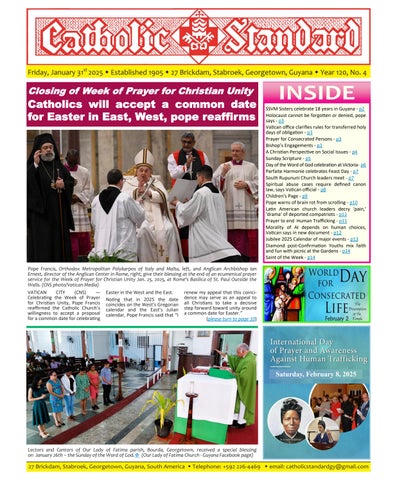
ClosingofWeekofPrayerforChristianUnity

Catholics will accept a common date for Easter in East, West, pope reaffirms

Pope Francis, Orthodox Metropolitan Polykarpos of Italy and Malta, left, and Anglican Archbishop Ian Ernest, director of the Anglican Center in Rome, right, give their blessing at the end of an ecumenical prayer service for the Week of Prayer for Christian Unity Jan. 25, 2025, at Rome's Basilica of St. Paul Outside the Walls. (CNS photo/Vatican Media)

VATICAN CITY (CNS)

Celebrating the Week of Prayer for Christian Unity, Pope Francis reaffirmed the Catholic Church’s willingness to accept a proposal for a common date for celebrating

Easter in the West and the East.

Noting that in 2025 the date coincides on the West’s Gregorian calendar and the East’s Julian calendar, Pope Francis said that “I

renew my appeal that this coincidence may serve as an appeal to all Christians to take a decisive step forward toward unity around a common date for Easter.”

(please turn to page 10)

Lectors and Cantors of Our Lady of Fatima parish, Bourda, Georgetown, received a special blessing on January 26th – the Sunday of the Word of God.❖ (Our Lady of Fatima Church - Guyana Facebook page)

SSVM Sisters celebrate 18 years in Guyana - p2

Holocaust cannot be forgotten or denied, pope says - p3

Vatican office clarifies rules for transferred holy days of obligation - p3

Prayer for Consecrated Persons - p3

Bishop’s Engagements - p3

A Christian Perspective on Social Issues - p4

Sunday Scripture - p5

DayoftheWordofGodcelebrationatVictoria- p6

Parfaite Harmonie celebrates Feast Day - p7

South Rupununi Church leaders meet - p7

Spiritual abuse cases require defined canon law, says Vatican official - p8

Children’s Page - p9

Pope warns of brain rot from scrolling - p10

Latin American church leaders decry ‘pain,’ ‘drama’ of deported compatriots - p11

Prayer to end Human Trafficking - p11

Morality of AI depends on human choices, Vatican says in new document - p12

Jubilee 2025 Calendar of major events - p13

Diamond post-Confirmation Youths mix faith and fun with picnic at the Gardens - p14

Saint of the Week - p14

February 2

The Jubilee Prayer

Dear Editor,

Do Catholics worship Mary and the Saints? No. We pray to them but not to worship them, and not in the same way we pray to God.

Think of it in this way. If you got sick and asked me to pray for you, I would. This does not make me uniquely Catholic, or even uniquely

Prayer to Mary and the Saints

Christian. There are many nonChristians who believe in the power of prayer.

If I ask my non-Catholic Christian friends whether they pray for their spouse or children, they will say yes. If I ask them to pray for me, they will say yes. This is the same principle. We believe that Mary and the Saints are not visible in this world, but we also believe they live on in the next world. And we believe that their prayers are just as powerful - even

more powerful. We are essentially saying to them, “We have problems down here. You know what it is like because you have been here; pray for us!”

Our non-Catholic Christian friends don’t believe people can still pray in the afterlife. We do. Our spiritual universe is just bigger. In fact, one of the most incredible things about our Catholic faith is the vastness of our spiritual universe.

SSVM Sisters celebrate 18 years in Guyana

Father in heaven, may the faith you have given us in your son, Jesus Christ, our brother, and the flame of charity enkindled in our hearts by the Holy Spirit, reawaken in us the blessed hope for the coming of your Kingdom.

May your grace transform us into tireless cultivators of the seeds of the Gospel. May those seeds transform from within both humanity and the whole cosmos in the sure expectation of a new heaven and a new earth, when, with the powers of Evil vanquished, your glory will shine eternally.

May the grace of the Jubilee reawaken in us, Pilgrims of Hope, a yearning for the treasures of heaven. May that same grace spread the joy and peace of our Redeemer throughout the earth.

To you our God, eternally blessed, be glory and praise for ever.

Amen

On Thursday January 23rd, the Sisters of the Servants of the Lord and the Virgin of Matara (SSVM) joyfully marked eighteen years since their arrival in this beautiful Land of Many Waters.

Since Mother Rosa Mystica and Sister Santo Nino first came to Guyana, followed by Sister Gloria and Sister Passi, the SSVM sisters have dedicated themselves to serving as Spouses of Christ and Mothers to Souls to the communities of Region 2, Essequibo, Guyana. Their journey has been filled with love, compassion, and a commitment to the community.

&

When asked to reflect on their eighteen years in the Diocese, Superior of the SSVM sisters Mother Sanguinis said “We give thanks to God for the many graces and fruits of these last 18 years”. (Adapted from Catholic Media Guyana FB page) ❖

Holocaust cannot be forgotten

Pope Francis speaks to visitors gathered in St. Peter's Square at the Vatican for the recitation of the Angelus prayer Jan. 26, 2025. (CNS photo/Vatican Media)

VATICAN CITY (CNS) “The horror of the extermination of millions of Jews and people of other faiths” before and during World War II “can neither be forgottennor denied,” Pope Francis said.

After reciting the Angelus prayer Jan. 26 with visitors in St. Peter’s Square, the pope drew their attention to the following day’s commemoration of InternationalHolocaustRemembranceDay

“Eighty years have passed since the liberation of the Auschwitz concentration camp,” the pope noted. Soviet troops liberated the camp Jan. 27,

1945. The Auschwitz-Birkenau camp complex was the largest of the Nazi work and death camps; an estimated 1.1 million of the more than 6 million victims of the Holocaust died there.

Pope Francis urged people to seek out and listen to the stories of the survivors of the Shoah, and he recommended Italians watch a program featuring his friend, the Hungarian poet Edith Bruck on television that night.

On International Holocaust Remembrance Day, he said, “I renew my appeal for everyone to work together

to eradicate the scourge of antisemitism, along with all forms of discrimination and religious persecution.”

Pope Francis also remembered the many Christians, including martyrs like St. Maximilian Kolbe, who were killed at Auschwitz and other Nazi camps.

“Let us build a more fraternal, more just world, together,” he said. “Let us educate young people to have a heart open to all, following the logic of fraternity, forgiveness and peace.”

Pope Francis also used his Angelus address to appeal for an end to the fighting that began in Sudan last April asapowerstrugglebetweentwogenerals

The conflict, the pope said, “is causing the most serious humanitarian crisis in the world, with dramatic consequences in South Sudan, too.” The United Nations reported Jan. 21 that more than 1 million people fleeing the violencehavecrossedintoSouthSudan.

“I am close to the peoples of both countries, and I invite them to fraternity, solidarity, to avoid any kind of violence and not to allow themselves to be exploited,” the pope said. “I renew my appeal to those who are at war in Sudan for them to put an end to hostilities and to agree to sit at the negotiating table.”

Pope Francis also asked the international community “to do all it can to get the necessary humanitarian aid to the displaced people and to help the belligerentsfindpathstopeacesoon.”❖

transferred holy days of obligation

Pope Francis greets people gathered near a Marian statue by the Spanish Steps in Rome Dec. 8, 2024, the feast of the Immaculate Conception. (CNS photo/Lola Gomez)

VATICAN CITY (CNS) When a holy day of obligation falls on a Sunday and so is transferred to another day, the Catholic faithful are encouraged to attend Mass, but they are not obliged to do so, the Vatican said.

The feast of the Immaculate Conception of Mary Dec. 8 fell on the Second Sunday of Advent in 2024 and so, in most dioceses around the world, the feast was transferred to Monday,Dec.9

Some bishops in the United States insisted the faithful still had a moral obligation to attend Mass on the feast day while others issued a formal dispensation from the obligation.

The Dicastery for Legislative Texts, in a September letter to

Bishop Thomas J. Paprocki of Springfield, Ill., had said, “the feast must be observed as a day of obligation on the day to which it is transferred.”

But in a formal note dated Jan. 23, the Dicastery for Divine Worship and the Discipline of the Sacraments said it had consulted with the legislative texts office and determined that “in the event of the occasional transfer of a holy day of obligation, the obligation to attend Mass is not transferred.”

Every Sunday is a holy day of obligation because it is a commemoration of the death and resurrection of the Lord.

The additional holy days when Catholics have a moral obligation to attend Mass are: Christmas; the feast of Mary, Mother of God; Epiphany; the Ascension; the feast of the Body and Blood of Christ; the Assumption; the feast of St. Joseph; the feast of Sts. Peter and Paul; and the feast of All Saints.

Because the church’s liturgical calendar includes fixed feasts, like the Dec. 8 celebration of the Immaculate Conception, and “moveable feasts” like Pentecost, Easter or even the Sundays of Advent or Lent, occasionally two feasts will fall on the same day, the dicastery said.

In that case, the one that holds “the highest rank according to the Table of Liturgical Days is observed,” and the other feast is transferred to the closest available day, the note said. In December, the Second Sunday of Advent had a higher rank than the feast of the Immaculate Conception.

The issue is not addressed in the Code of Canon Law, the dicastery said, so the church follows “a well-established practice according to which, in the event of the transfer of a holy day of obligation, the obligation to attend Mass is not transferred.”❖

World Day of Prayer for Consecrated Life

February 2nd, 2025

In 1997, Pope Saint John Paul II instituted a day of prayer for women and men in consecrated life. This celebration is attached to the Feast of the Presentation of the Lord on February 2nd. This Feast is also known as Candlemas Day; the day on which candles are blessed symbolizing Christ who is the light of the world. So too, those in consecrated life are called to reflect the light of Jesus Christ to all peoples.

Please pray for all those who have made commitments in the consecrated life, and be sure to thank them on their special day. May they continue to be inspired by Jesus Christ and respond generously to God's gift of their vocation. ❖

Prayer for Consecrated Persons

GOD OUR FATHER, we thank you for calling men and women to serve in your Son's Kingdom as sisters, brothers, religious priests, consecrated virgins, and hermits, as well as members of Secular Institutes. Renew their knowledge and love of you, and send your Holy Spirit to help them respond generously and courageously to your will. We ask this through our Lord Jesus Christ, who lives and reigns with you and the Holy Spirit, one God, for ever and ever Amen

[www.usccb.org]

Bishop’s Engagements

Monday, February 3rd

Return to Guyana

Tuesday, February 4th

18:00hrs – Diocesan Pastoral Council Meeting

Wednesday, February 5th

17:00hrs – Mass at St. Bernadette’s Hostel

Sunday, February 9th

14:25hrs – Travel to Mexico to attend a meeting with Bishops of Mexico, Central America and Caribbean.

Saturday, February 15th

Return to Georgetown.

A Christian Perspective on Social Issues

Real, sustained help - where is it? (Part 1)

We have a national budget that is in the middle of debates, but is as good as passed, official. It is a record budget. There were three other record ones before it. This year’s budget has its positives, things to cheer, and then it has what leaves in a state of disappointment, if not distress. In addressing this budget in this space, some may ask themselves, why here, why this place? I remind them of one of the seven Catholic Social teachings; the one about option for the poor. The concerns and energies, followed by the provisions, that help to lift them out of their depressed state. Further, it was Jesus himself, who in MT 25:31-46 highlighted the priority that must be given to the poor. They are the hungry, and thirsty, and sickly, and those trapped in some form of captivity, while lacking the support of family. Oftentimes, not so much as a roof that is over their heads. Indeed, this is hearing the Master Teacher, and responding with humble vigor to his call, his warning. Last, in this Jubilee Year, I must be a Pilgrim of Hope. There is someone giving a voice to the voiceless, so that the poor have a presence. The 2025 budget has its positives: new structures to be erected, new projects to be undertaken, and existing projects and buildings to be given new life. Hundreds of billions will be approved for this compressed representation of some of what is on the drawing board, and will soon be infused with many millions to make them a reality. More schools, more medical facilities, more miles of roads, and more bridges. No one should argue with those, as long as Guyanese get true value for their millions. Every dollar spent would be impressive and inspiring. But it must be remembered that frail men and women are in charge of the cashbox, plus there is that enduring culture, that practice, that has plagued this society and cost it so much.

I am for infrastructure and paving the way for a Guyana Century. Let that be said in the clearest and most unambiguous manner. But what do I say, where do I stand, as a member of the Roman Catholic community? As a simple citizen, as a hopefully thinking and caring man, when there are those who fall into one or more of those categories, maybe even all of them, that Jesus

identified so frankly in his Last Judgment reminder, his searing counsel? The poor and the punishing - famished and parched, wretched and dreadful, all alone and all about nothing - are in front of us, what is to be done about them? They are in front of my face, stir my mind, shake my soul, so what do I do about them? What can I do for them? Whatever I do, may be so paltry as not to make much of a lasting difference. Still, I must try, give of my heart. Because the poor is my root; the isolated and ostracized, I know about that, too. So, when they are spoken for, I am really speaking for myself, and those who number (or numbered) with that bunch of forgotten humanity. They are not bland statistics. They are men and women of flesh and blood, sisters and brothers under the skin. When they hurt, I hurt. And so must all of us, those who are proud to call ourselves Christians, observant Catholics. So, when I speak or write of what should have been in this year’s $1.386 trillion budget, it is not about the cheapness and lowness of politics in Guyana. It is about a Christian, a concerned Catholic, caring,for a brother,

a sister, one who is down in the dumps, and need a hand to rise from that most painful of places. Jesus has challenged us, his followers, those who say that they believe, and no question that they do. So, what do we do? Sit on hands? Zip our lips? Oh, that is not my business? Oh, the Lord will take care? I may think about being so, but there is something inside that warns against doing so. Perhaps, it is the spirit inside that just would not let go. Thus, there is the interest and strength to speak for the poor, even if that means that toes may be stepped upon, some sensitives (and loyalties) troubled, some slanders are the reward. Since Jesus was fiercely focused on his message and mission, then there is the road that is open to me. It must be travelled, come what may. It is the Way, the Truth, and the Life that must be more than about words. They must be about what is required to live all three honesty and constantly. The budget, therefore, must be addressed, with what could have been done, but was not. Where a helping hand was most needed, and should have been given, but was not, in that there was too little of it. (To be continued)❖

Gracious and loving God, we thank your for the gift of our priests.

Through them, we experience your presence in the sacraments. Help our priests to be strong in their vocation.

Set their souls on fire with love for your people.

Grant them the wisdom, understanding, and strength they need to follow in the footsteps of Jesus. Inspire them with the vision of your Kingdom.

Give them the words they need to spread the Gospel.

Allow them to experience joy in their ministry.

Help them to become instruments of your divine grace.

We ask this through Jesus Christ, who lives and reigns as our Eternal Priest. Amen

Counselling Services at Brickdam Presbytery

Carmelite Sisters are available for counselling on Mondays and Thursdays from 9:00am to 12 noon and 1:00pm to 2:00 pm, at theCathedral Presbytery. They are also available by appointment. Persons are encouraged to avail themselves of these services. Kindly contact the Cathedral parish office on tel. no. 226-4631fordetails.

FIRST READING Malachi 3: 1-4

The Lord you are seeking will suddenly enter his Temple.

The Lord God says this: Look, I am going to send my messenger to prepare a way before me. And the Lord you are seeking will suddenly enter his Temple; and the angel of the covenant whom you are longing for, yes, he is coming, says the Lord of hosts. Who will be able to resist the day of his coming?

Who will remain standing when he appears? For he is like the refiner’s fire and the fullers’ alkali. He will take his seat as refiner and purifier; he will purify the sons of Levi and refine them like gold and silver, and then they will make the offering to the Lord as it should be made. The offering of Judah and Jerusalem will then be welcomed by the Lord as in former days, as in the years of old.

RESPONSORIAL PSALM Psalm 23

Response: Who is the king of glory? It is the Lord.

1. O gates, lift up your heads; grow higher, ancient doors.

Let him enter, the king of glory! Response

2. Who is the king of glory?

The Lord, the mighty, the valiant; the Lord, the valiant in war. Response

3. O gates, lift high your heads; grow higher, ancient doors.

Let him enter, the king of glory! Response

4. Who is he, the king of glory?

He, the Lord of armies, he is the king of glory. Response

SECOND READING Hebrews 2: 14-18

It was essential that he should in this way become completely like his brothers.

Since all the children share the same blood and flesh, he too shared equally in it, so that by his death he could take away all the power of the devil, who had power over death, and set free all those who had been held in slavery all their lives by the fear of death. For it was not the angels that he took to himself; he took to himself descent from Abraham. It was essential that he should in this way become completely like his brothers so that he

Today we celebrate the Feast of the Presentation of the Lord, when Mary and Joseph brought their

could be a compassionate and trustworthy high priest of God’s religion, able to atone for human sins. That is, because he has himself been through temptation he is able to help others who are tempted.

Gospel Acclamation Acts 16: 14

Alleluia, alleluia!

The light to enlighten the pagans and the glory of your people Israel. Alleluia!

laws of their Jewish faith. This is a beautiful, and in many ways, mysterious feast and one that is filled with lessons for a stewardship way of life.

Our Gospel passage from Luke, recounting the details of the Presentation, teaches us a stewardship lesson through the example of St. Joseph and the Blessed Mother, the “Holy Parents.” Even knowing their Son was God, they still carefully observed the faith practices of their day bringing him to the temple “to present Him to the Lord, just as it is

GOSPEL Luke 2: 22-40

My eyes have seen your salvation. When the day came for them to be purified as laid down by the Law of Moses, the parents of Jesus took him up to Jerusalem to present him to the Lord – observing what stands written in the Law of the Lord: Every first-born male must be consecrated to the Lord – and also to offer in sacrifice, in accordance with what is said in the Lord of the Lord, a pair of turtle-doves or two young pigeons. Now in Jerusalem there was a man named Simeon. He was an upright and devout man; he looked forward to Israel’s comforting and the Holy Spirit rested on him. It had been revealed to him by the Holy Spirit that he would not see death until he had set eyes on the Christ of the Lord. Prompted by the Spirit he came to the Temple; and when the parents brought in the child Jesus to do for him what the Law required, he took into his arms and blessed God; and he said:

“Now, Master, you can let your servant go in peace, just as you promised; because my eyes have seen the salvation which you have prepared for all the nations to see, a light to enlighten the pagans and the glory of your people Israel.”

As the child’s father and mother stood there wondering at the things that were being said about him, Simeon blessed them and said to Mary his mother, “You see this child: he is destined for the fall and for the rising of many in Israel, destined to be a sign that is rejected – and a sword will pierce your own soul too – so that the secret thoughts of many may be laid bare.”

There was a prophetess also, Anna the daughter of Phanuel, of the tribe of Asher. She was well on in years. Her days of girlhood over, she had been married for seven years before becoming a widow. She was now eighty-four years old and never left the Temple, serving God night and day with fasting and prayer. She came by just at that moment and began to praise God; and she spoke of the child to all who looked forward to the deliverance of Jerusalem. When they had done everything the Law of the Lord required, they went back to Galilee, to their own town of Nazareth. Meanwhile the child grew to maturity, and he was filled with wisdom, and God’s favour was with him.❖

written in the law of the Lord.” Later in the passage we read that, “When they had fulfilled all the prescriptions of the law of the Lord, they returned to their own town of Nazareth.” The Holy Parents were good stewards of their child, teaching Him to live in obedience to the practices of their faith from His infancy and throughout His “growing up” years.

Those of us entrusted with the care of children whether our own children, godchildren, nieces, and nephews, grandchildren, or students have a

vital role to play in the faith formation of these young ones. We, like the Holy Parents, must steward these children well, forming them in the faith by both instruction and example throughout their lives.

What a privilege and high calling we have as Christian stewards. Let us take these stewardship lessons to heart and present our gifts and our young ones joyfully to the Lord.❖

[www.catholicsteward.com/blog/ ]

infant Son to the Temple in obedience to the

Sunday of the Word of God Gospel Reflection

Children, and not a few adults, live in fear of the dark. We all prefer the light of day than the dark of night. Jesus is called the light of the world. The old man Simeon describes him as “a light to enlighten the pagans.” The light has come into the world but darkness still rules. While we have made great life-giving strides in the areas of science, technology and medicine, we have done a terrible job in the business of living in peace with one another, of loving and caring. And all the while the light is right there showing the way back to God. But many strive to live in the light by responding to the one who brings the light. You cannot go wrong in making a choice for the light. The consequences of making a choice for darkness are disastrous.

Being a follower of Christ does not mean sitting back and being led. Discipleship is much more than that. It means accepting Jesus’ invitation to be part of his life and work here and now in this moment in history. Jesus was a man who lived in a particular region of the world at a certain time in history. But since his Ascension, he is no longer limited to that place and that moment in time. He is available to all in all places and at all time. Discipleship is therefore action oriented. It means doing more than just being. It means taking up our crosses, living for truth and justice, for peace and right relationships, for high moral standards. There is no easy way to discipleship. It comes with a price but Jesus assures us that it is worth the effort.❖

[From: Journeying with the Word of God, The Religious Education Department, Diocese of Georgetown,Guyana ]

The parishioners of the Church of the Immaculate Conception, Victoria, East Coast Demerara, and St. Michael Church, Clonbrook, East Coast Demerara, joined together last Sunday at the Church of the Immaculate Conception to celebrate this special day, the Sunday of the Word of God. Our celebrant was Fr. Stephen Selvanathan, SJ. Mass started with the congregation assembling at the entrance of the church. A brief introduction was given about the purpose of the establishment of this day by papal decree (Aperuit illis) – the third Sunday in Ordinary Time. This year, it was observed on January 26. The two communities coming together was a great sign of fulfilling the Pope’s intention that throughout the Church, the Sunday of the Word of God may be celebrated in unity.

As we commenced Mass, Fr. Stephen opened by letting us know that today is a special Sunday as we respect the Word of God in our lives. The Word of God plays a vital role in each of our lives. It saves us, gives us strength, and leads us in the right way. The Word is not a simple word, and today, what Jesus wants us to understand as the “Word of God” is the voice of the poor and the voiceless, as we hear the Word in today’s context. Sadly, the voices of the voiceless are suppressed all over the world.

But we come together and celebrate, and we cannot function without each s support because we are united in Christ. He pointed out St. Paul’s “the parts of the body that seem weaker are all the more necSimilarly, the weaker sections of society and the poor in the Church should be given importance and due respect. This was the main essence of the manifesto of Jesus as well.

Fr. Stephen encouraged everyone to get a Bible but emphasized reading the Word every day, even if it is just two or three lines a day, trying to understand what the Word is saying to us. He concluded that we should read the Word, listen to the Word, receive it in our hearts, and practice it in our lives so that we can liberate ourselves and liberate others.

At the end of the Mass, a copy of the

There was a moment of levity as Fr. Stephen observed that the parishioners were seated together according to their respective parishes. This, we recognized, was unintentional, and we all had a good laugh, considering that we were coming together in unity. In this happy moment, the Clonbrook and Victoria communities celebrated the Word of God together as one community. We thank the Lord for this moment and for all that He has done for us and our relatives. We ask the Lord to give us the wisdom and knowledge to understand the meaning of His Word, the moments we fail to give respect to the Word of God, the moments we fail to listen to the Word of God, the moments we fail to receive the Word of God into our hearts, and the moments we fail to put the Word of God into practice.

Fr. Stephen explained the readings for the day. In the first reading from Nehemiah, the people, having rebuilt the temple, were assembled, and the Word of God was read to them from morning until noon. They listened attentively and responded, “Amen.” The people were very sad after listening to the Word because they realized that they had not followed the teachings of the Word for many years, but the priest told them, “Do not be sad, and do not weep. Go, eat rich foods and drink sweet drinks, and send portions to those who had nothing prepared; for today is holy to our LORD. Do not be saddened this day, for rejoicing in the LORD must be your strength!” This was the beauty of Jesus’ proclamation as well to go and proclaim the Lord’s year of favour. What is the Lord’s year of favour? It is the year of Jubilee.

In the second reading, we are told that we are one body, even though we are of different races, colours, and classes.

Fr. Elias Surin SJ

Fr. Elias Surin SJ celebrated the 13th anniversary of his ordination to the priesthood on Friday January 10th.

Fr. Amar Bage SJ

Fr. Amar Bage SJ celebrated the 19th anniversary of his ordination to the priesthood on Saturday, January 18th.

Fr. Carl Philadelphia

Fr. Carl Philadelphia celebrated the 7th anniversary of his ordination to the priesthood on Tuesday January 28th.

Bishop Francis Alleyne OSB

Bishop Francis Alleyne OSB on Thursday January 30th celebrated the 21st anniversary of his Episcopal Ordination.

Sr. Elizabeth Small RSM

Sister Elizabeth Small RSM on Sunday, February 2nd celebrates the first anniversary of her profession of perpetual vows as a Sister of Mercy.

We pray that God continues to bless and guide them ❖

St. Angela Merici Church, La Parfaite Harmonie, West Bank Demerara, Region 3, celebrated its Feast Day last Sunday, January 26th.

The joyous occasion included the installation of two new lay ministers and the Sacraments of First Holy Communion and Baptism. The mass was celebrated by Parish Priest Fr. Francis Savarimuthu.

(Adapted from Catholic Media Guyana Facebook page) ❖

Journeying with the Word of God

MAKING THE WORD OF GOD YOUR OWN

Step 1: Lookattoday’sReadingsprayerfully.

1st Reading: The prophet Malachi announces the coming of the messenger of the Lord. He will be a purifying presence.

2nd Reading: Because Christ was tested and suffered, he is able to be a merciful and faithful high priest to us all.

Gospel: Jesus is presented to God in the Temple in Jerusalem. There the child is greeted as saviour and redeemer, but his mission will meet with rejection.

Church leaders and catechism coordinators from 13 communities across the South Rupununi gathered at Aishalton, Deep South Rupununi, Region 9, Essequibo, Guyana, to reflect on the last four months and to plan for the next quarter.

opportunity for prayer and reflection on servant leadership and the call to be a Church leader in today's context.

Each leader provided updates on the challenges and dreams of their parish community.

ing to social and environmental issues as a Christian community, on preparing for the sacraments, and on supporting and accompanying youths and families. We thank these leaders for their faithful service despite challenges. (Robert Bellarmine R.C Church Aishalton FB page) ❖

Step 2: ApplyingthevaluesoftheReadings toyourdailylife.

1.What do you think of the image of Jesus as the “light of the world”.

2.Christ took on himself the human condition with all its imperfections and weaknesses, except one. What was the human condition that Jesus did not take on?

3.In your experience, why is it so difficult and troublesome to live your faith in the harsh realities of your daily life?

4.Jesus came to the Temple, not as the refiner’s fire of the prophet Malachi, but as a child in his mother’s arms. Does this say something to you about the nature of Jesus?

Step 3: Accepting the message of God’s Wordinyourlifeoffaith.

Both the Letter to the Hebrews and the Gospel reminds us that we have someone who can identify with us in our moments of weakness and poverty of spirit. We are reminded that we have someone who can help us get up when we fall, someone who is ready to lend a helping hand when we walk an unsure road, and who can help us unite our faith with the demands of modern day life. We just have to reach out to him.

Step 4: Somethingtothink&prayabout

1.The scene in the Temple is a joyful one. The first-born child is being offered to God and old Simeon and Anna are saying wonderful things about him. But there are also shadows. The child will cause people to make hard choices, cause both rising and falling and stir up opposition and rejection. Where do you stand among all this? ❖

[From: Journeying with the Word of God, The Religious Education Department, Diocese of Georgetown, Guyana ]

Spiritual abuse cases require defined

Cardinal Víctor Manuel Fernández, prefect of the Dicastery for the Doctrine of the Faith, reads a prayer during a penitential liturgy in St. Peter’s Basilica at the Vatican in Oct. 2024. In a Jan. 2025 interview, the cardinal said that the Code of Canon Law must more directly address the frequent spiritual manipulation and abuse of office wrought by members of the Church. (CNS photo/Lola Gomez)

VATICAN CITY (CNS) The Code of Canon Law must more directly address the frequent spiritual manipulation and abuse of office wrought by members of the church to solicit sex, the Vatican’s doctrinal chief said.

“Various dicasteries frequently received reports or complaints about situations where spiritual elements were used as an excuse or motivation to have sexual relations,” Cardinal Víctor Manuel Fernández, prefect of the Dicastery for the Doctrine of the Faith, said in an interview with Alfa y Omega, the newspaper of the Archdiocese of Madrid

“In these cases, there is a manipulation of people who entrust themselves to a spiritual guide and at the same time a manipulation of the spiritual beauty of our faith in order to obtain sex,” he said.

In the interview published Jan. 23, the cardinal said that the lack of a specific offense in canon law regarding spiritual abuse makes it “necessary and urgent to address it, because we have discovered that it is unfortunately not uncommon.”

The dicastery released a document in November 2024 stating that the pope had approved its creation of a working group with the Dicastery for Legislative Texts to analyze possibilities and present concrete proposals to classify the crime of “spiritual abuse.”

Greater clarity needed in canon law

In the interview, Cardinal Fernández said that greater clarity is needed in canon law since the only recourse currently is canon 1399, which states that unspecified violations of divine and

Though Cardinal Fernández said that cases bordering on spiritual abuse are not always easy to adequately prove” and punish, he said that certain cases special perversity” such as having sex in sacred places under the pretense that it would foster a special relationship with God should receive the maximum penalty allowed by canon law.

The study group, chaired by Archbishop Filippo Iannone, prefect of the Dicastery for Legislative Texts, will look at classifying the crime of spiritual abuse and studying interpretations of existing canon law that could include spiritual abuse. The result could be a new definition of spiritual abuse in

canon law or a modification of existing laws to make clear their application in cases of spiritual abuse.

Those steps are important, Cardinal Fernández said, because current cases of spiritual abuse are treated as cases of “false mysticism,” however that term also captures purely doctrinal errors that are not necessarily crimes. “But canonists need to typify a crime with another name –‘spiritual abuse,’ for example so as to not always have to resort to canon 1399 when judging such a serious, scandalous and frequent crime, and to avoid the confusion that the broad and obscure meaning of the expression ‘false mysticism’ could generate,” he said.❖

canon law can be punished with a just penalty “only when the special gravity of the violation requires it, and necessity demands that scandals be prevented or repaired.”

However, the cardinal said, “when a serious crime becomes very frequent it is not advisable to have to refer to such a general canon,” especially because it is difficult to use a general law to apply a severe penalty.

Creating a precise classification of spiritual abuse is essential, he said, otherwise “any misconduct could be reported as a serious offense or be punishable by a maximum penalty,” a situation that could lead to a “generalized suspicion” among members of the Church or create a “cancel culture.”

“When everything seems to have the same gravity, we end up committing an injustice in the face of particularly serious cases that must be confronted with greater force,” he added.

The prevalence of spiritual abuse in the church was particularly noticed after news reports about the former Jesuit and artist Father Marko Rupnik, who was accused in 2022 of spiritually manipulating women for decades to receive sex acts. A Vatican investigation into the priest, who was expelled from the Jesuits, is ongoing.

Receiving the maximum penalty

Cardinal Fernández said that the study group is not preparing proposals to apply solely to the case of Father Rupnik since “it would prejudice the objectivity of the work” but that the dicastery’s investigation into him is continuing and an independent tribunal is currently being prepared.

Presentation of the Lord

Dear Girls and Boys, Today the Church celebrates the Feast of the Presentation of Jesus in the temple. Forty days after Jesus was born, Mary and Joseph brought him to the great Temple in Jerusalem. There they presented Baby Jesus to the Heavenly Father. That was the Jewish law. The Holy Family obeyed it with loving hearts.

This was a very popular feast called Candlemas in past centuries and candles were blessed and carried in procession, to show the entry of Jesus as the light of the world.

While they were in the Temple, Mary also attended the Purification ceremony which was another custom. After the birth of their children, all Jewish mothers were supposed to go to the Temple for this ceremony. Mary did her duty cheerfully. She teaches us to be humble and obedient as she was. A holy old priest of the Temple named Simeon learned from God that the Infant Jesus was truly the Saviour. He held Mary's Son Jesus in his arms with joy and awe. "My own eyes are looking at my salvation," he exclaimed.

God allowed him recognize Jesus as the Saviour and Simeon put his trust in the little Child. Imagine what Mary and Joseph were thinking. Then, inspired by God, Simeon told Mary that she would have to suffer very much. He was talking about the terrible pain our Blessed Mother would feel when Jesus died on the cross.

This feast of the Presentation reminds us that we belong to God first of all. Because he is our Father and Creator, and we owe him our loving obedience. ❖

Simeon and Anna thank God

Pope warns of brain rot

(Aleteia) - Pope Francis is concerned about the “brain rot” produced by scrolling. He said this in an address to participants in the Jubilee of Communicators, released this January 25, 2025. He urged journalists to be courageous and tell “stories of hope.” Meeting journalists and communications executives in a packed Paul VI Hall, the pontiff said he didn't want to read his 9-page speech because the "stomach is starting to growl." He therefore asked that it be distributed to the participants.

Earlier in the morning, in a previous speech to rectors of French seminaries, he had appeared to have a very hoarse voice and had had some coughing fits.

Improvising a few words for his guests, the Pope urged the journalists to be “truthful” not just in what they say, but in who they are, “in [their] interior life.”

Courageous journalists

In the address delivered to the communicators, the Pope praised the courage of journalists who “risk their lives to seek out the truth and denounce the horrors of war.” In particular, he praised those “who sign their articles in their own blood.” He reflected that 2024 was “one of the deadliest years for journalists.” “I call on those in power to ensure that all unjustly imprisoned journalists are released,” he urged, calling the freedom of the press to be defended and protected. Without this, “we risk no longer distinguishing truth from lies.”

The danger of scrolling

The Pope also noted concern about the “brain rot” caused by the addiction to constant scrolling on

social media. He said young people needed to be taught about this, and learn to be conscious in taking in information.

He used the word "scrolling" in English, and noted that brain rot “putrefazione cerebrale” in Italian is the Oxford Dictionary's word of the year.

The Pope further encouraged journalists to fight the “good fight” by telling stories of hope. This echoes the theme of his message released for the World Day of Communications earlier this week.

The 1st jubilee event of the year

Some 9,000 participants took part in the Jubilee of Communications Jan 24-26 in Rome, the first event of this Jubilee year.

On Friday evening, participants gathered in the Basilica of St. John Lateran for a penitential liturgy, followed by a Mass celebrated by Cardinal Baldassare Reina, Vicar of Rome, on the feast of Francis de Sales, the patron saint of journalists.

At first light on Saturday morning, a large number of journalists made the pilgrimage along Via della Conciliazione to St. Peter's Basilica, to pass through the Holy Door.

Afterwards, in Paul VI Hall, participants listened to two speeches by prestigious guests: Filipino journalist Maria Ressa, winner of the 2021 Nobel Peace Prize, and Irish journalist and writer Colum McCann. They then listened to a concert by Italian choral conductor and violinist Uto Ughi, before Pope Francis made his entrance to thunderous applause. After his brief address, the pontiff took a long moment to pass through the ranks to greet and exchange with the pilgrims present.

The Jubilee for Communicators continued with conferences on the communications professions, followed by a Mass celebrated in St. Peter's Basilica on Sunday morning on the occasion of Word of God Sunday.

The next Jubilee event will take place from February 8 to 9: the Jubilee of the Armed Forces, Police and Security Agents.❖

“The Catholic Church is open to accepting the date that everyone wants: a date of unity,” he said Jan. 25 during an ecumenical evening prayer service at Rome’s Basilica of St. Paul Outside the Walls.

The service marked the end of the Week of Prayer for Christian Unity, which focused on this year’s celebration of the 1,700th anniversary of the Council of Nicaea, which gave Christians a common Creed and a formula for determining a common date for the celebration of Easter.

Before the Council of Nicaea in 325, different Christian communities celebrated Easter on different dates; the council decided that for the unity of the Christian community and its witness, Easter would be celebrated on the first Sunday after the first full moon after the spring equinox.

But the Julian calendar, which is what Christians used in the fourth century, was increasingly out of sync with the actual solar year, so March 21 generally assumed to be the date of the Northern Hemisphere’s spring equinox gradually “drifted” away from the actual equinox.

In 1582, Pope Gregory XIII reformed the calendar, dropping 10 days and making the equinox fall on March 21 again. Most Eastern Christians did not adopt the new calendar, leading to a situation where Easter occasionally is on the same day, but Eastern Christians’ celebration can be as much as four weeks later.

Pope Francis has reaffirmed on several occasions the position officially taken by St. Paul VI in the 1960s that if Eastern Christians agree on a way to determine a common date for Easter, the Catholic Church would accept it.

The ecumenical prayer service began with Pope Francis praying before the tomb of St. Paul. He was joined by Orthodox Metropolitan Polykarpos of Italy and Malta and by Anglican Archbishop Ian Ernest, director of the Anglican Center in Rome. The Orthodox and Anglican bishops also joined the pope at the end of the liturgy in giving their blessing to the crowd.

The theme of the 2025 week of prayer was Jesus’ question to Martha of Bethany: “Do you believe this?”

In the Gospel of John, Martha tells Jesus that if he had been there, her brother Lazarus would not have died. Jesus tells Martha, “I am the resurrection and the life; whoever believes in me, even if he dies, will live,” and then he asks if she believes. Martha responds with a declaration of faith: “Yes, Lord. I have come to believe that you are the Messiah, the Son of God, the one who is coming into the world.” Pope Francis said, “This tender encounter between Jesus and Martha from the Gospel teaches us that even in times of desolation, we are not alone, and we can continue to hope. Jesus gives life even when it seems that all hope has vanished.”

“Hope can falter following difficult experiences such as a painful loss, an illness, a bitter disappointment or a sudden betrayal,” the pope said. “Although each of us may experience moments of despair or know people who have lost hope, the Gospel tells us that Jesus always restores hope because he raises us up from the ashes of death.”

Sometimes, the pope said, people may feel like the search for Christian unity has reached a dead end or that ecumenical dialogue is “doomed to failure.”

“All of this makes us experience the same anguish as Martha, but the Lord comes to us,” he said. “Do we believe this? Do we believe that he is the resurrection and the life? That he rewards our efforts and always gives us the grace to continue our journey together? Do we believe this?”

The anniversary of the Council of Nicaea is “a year of grace, an opportunity for all Christians who recite the same Creed and believe in the same God,” the pope said. “Let us rediscover the common roots of the faith; let us preserve unity! Let us always move forward! May the unity we all are searching for be found.”❖

Latin American church leaders decry ‘pain,’ ‘drama’ of deported compatriots

leaders on migration or Trump’s threats, which brought swift retaliation with tariffs, the cancellation of visa appointments at the U.S. Embassy in Bogotá and a U.S. travel ban for Colombian officials.

That potential economic damage and complicated domestic politics with business leaders wanting to keep U.S. markets open offer “no incentive” for politicians to confront Trump, Will Freeman, senior fellow in Latin American studies at the Council on Foreign Relations, told OSV News. “This is not the hill they want to die on.”

The treatment of deportees in transit has made regional headlines, however. A deportation flight to Brazil landed in the Amazon due to technical issues.

The shackled passengers opened emergency exits to escape the sweltering heat as air conditioning units had broken, The New York Times reported.

migrant ministry, told OSV News. “Nobody is concerned for deportees.” Another factor complicating the return of migrants to their countries of origin is a lack of resources. A source with a Catholic migrant assistance organization in Colombia said several nongovernmental groups in the region that receive migrants lost funding with the Trump administration’s pause in development assistance through the U.S. Agency for International Development.

“There are no conditions to receive migrants,” the source said, requesting anonymity to speak candidly. Migrants continue leaving Venezuela, Haiti and conflict zones in Colombia, the source said.

Elías Cornejo, migrant services coordinator for the Jesuit ministry Fe y Alegría in Panama, said migrants continue crossing the Darién Gap, albeit in smaller numbers.

BUENOS AIRES (OSV News) As Colombians deported from the United States Jan. 28 arrived to their home country on flights operated by Colombia’s military, shockwaves reverberate among Latin American bishops and bishops’ conferences as the church decries “pain” and “drama” of compatriots.

Colombian President Gustavo Petro welcomed them back with posts on X, pointing to the conditions of their journey. The president had clashed with the Trump administration by denying permission for U.S. military aircraft carrying deportees to land two days earlier, only to back down after President Donald Trump slapped 50 percent tariffs on Colombian imports.

“Our compatriots come from the U.S. free, dignified and without being handcuffed.” Petro posted. “Migrants are not criminals. They’re free human persons.”

Migrants have long fled poverty, violence and a dearth of opportunities in Latin America. Their remittances float economies across the region and account for more than 20 percent of GDP in Central America.

The prospect of mass deportations and reduced remittances has provoked disquiet among leaders across Latin America and the Caribbean, especially as the Trump administration shows renewed interest in a region overlooked by his predecessors and increasingly embraced by China.

Catholic leaders and migrant advocates have expressed alarm over Trump’s executive orders mandating mass deportations, too, along with the manner in which the deportations were carried out.

“Since the new American president took office, migration policies have been formulated that are adverse to migrants’ situation. The experience of migrants from the moment they leave

their homeland … is marked by suffering and pain,” the Guatemalan bishops’ conference said in a Jan. 24 statement. “This situation worsens when they are captured and deported. The dream of a better future crumbles.”

Cardinal Álvaro Ramazzini of Huehuetenango, Guatemala, added at a press conference the same day, “We denounce with sadness and pain the drama that our compatriots are experiencing in so many cities in the United States.”

Archbishop Jose Domingo Ulloa of Panama City warned in a Jan. 25 interview with ADN CELAM, a media branch of the Catholic Church of Latin America and the Caribbean, that “these restrictive policies generate instability in transit countries such as Panama, turning our borders into human dams.”

The archbishop was referring to the Darién Gap, the treacherous jungle separating Central and South America, which migrants have increasingly crossed in recent years and which Panama’s President José Raúl Mulino promises to close.

Panama, however, has come under unexpected U.S. pressure as Trump talks of retaking the Panama Canal.

The U.S. ceded control over the waterway in 1999 after signing a treaty with Panama. But Trump has refused to rule out military force to take it back.

Archbishop Ulloa called the threats “worrying” and called for the treaty to be respected.

“It is worrying that expressions have been made public that attempt to attack our sovereignty, ignoring the generational struggle and sacrifice that has allowed us Panamanians to fly a single flag throughout the national territory,” the archbishop told SIR, the Italian Catholic Church’s news service.

Colombia’s Petro’s social media post showed a rare outburst from regional

“These planes are arriving as if they were criminals,” Jaime Solares, coordinator of the Red Jesuita con Migrantes in Guatemala, told OSV News of the situation in Central America. “We hadn’t seen that before: migrants arriving like that, in chains.”

Conditions for receiving returned migrants appear to be lacking across the region.

“The government receives them, but in practice there’s no concrete plan,” Solares said. “The government presents this as a ‘happy return’ … but that’s a joke.”

Complicating matters more, he said, many returning migrants return to communities after years away and where “there may no longer have been any emotional ties with their families” or communities.

Economic conditions also appear bleak for returnees. “The country’s most serious problem is the lack of employment,” Bishop José Antonio Canales of Danlí, Honduras, told OSV News.

Mexican President Claudia Sheinbaum said Jan. 27 that nearly 4,100 migrants had been returned to Mexico. Some non-Mexicans are expected to arrive with the reinstatement of the Remain in Mexico program, in which migrants wait in Mexico as their asylum claims are heard in U.S. courts.

Sheinbaum promised to receive returning migrants with “open arms.” A program will provide them approximately $95 for bus fare home and enrollment in social services. “Mexicans there sustain the U.S. economy, in the fields, in services, everywhere,” she said in a defense of migrants Jan. 25.

Mexican presidents have called migrants “heroes” for decades. But returning migrants’ treatment often falls short of the accolades.

“They’re heroes when they’re there, sending remittances that contribute to the country’s economy. But when they arrive (back in Mexico) they’re nobodies,” Scalabrinian Father Julio López, coordinator of the Mexican bishops’

“Most of them have told us that they want to get to Mexico or wherever they can,” he told OSV News. “They are reevaluating their migration goals, although they may be thinking of staying and, if the opportunity arises, continue” onward to the United States.❖

Saturday, February 8, 2025

Prayer to end Human Trafficking

Loving Father,

We seek your divine protection for all who are exploited and enslaved.

For those forced into labor, trafficked into sexual slavery, and denied freedom.

We beseech you to release them from their chains.

Grant them protection, safety, and empowerment.

Restore their dignity and provide them a new beginning.

Show us how we might end exploitation by addressing its causes.

Help us reach out in support of victims and survivors of human trafficking.

Make us instruments of your spirit for their liberation.

For this we pray through our Lord Jesus Christ, who lives and reigns with you in the unity of the Holy Spirit, one God, forever and ever.

A migrant is greeted by a family member outside the Returned Migrant Reception Center in Guatemala City, Guatemala, Jan. 27, 2025, after he and other Guatemalan migrants arrived at La Aurora Air Force Base on a deportation flight from the U.S. (OSV News /Cristina Chiquin, Reuters)

choices, Vatican says in new document

VATICAN CITY (CNS) “Technological progress is part of God’s plan for creation,” the Vatican said, but people must take responsibility for using technologies like artificial intelligence to help humanity and not harm individuals or groups.

“Like any tool, AI is an extension of human power, and while its future capabilities are unpredictable, humanity’s past actions provide clear warnings,” said the document signed by Cardinals Víctor Manuel Fernández, prefect of the Dicastery for the Doctrine of the Faith, and José Tolentino de Mendonça, prefect of the Dicastery for Culture and Education.

The document, approved by Pope Francis Jan. 14 and released by the Vatican Jan. 28 the day after International Holocaust Remembrance Day said “the atrocities committed throughout history are enough to raise deep concerns about the potential abuses of AI.”

Titled, “Antiqua et Nova (ancient and new): Note on the Relationship Between Artificial Intelligence and Human Intelligence,” the document focused particularly on the moral use of technology and on the impact artificial intelligence already is having or could have on interpersonal relationships, education, work, art, health care, law, warfare and international relations.

AI technology is used not only in apps like ChatGPT and search engines, but in advertising, self-driving cars, autonomous weapons systems, security and surveillance systems, factory robotics and data analysis, including in health care.

The popes and Vatican institutions, particularly the Pontifical Academy of Sciences, have been monitoring and

raising concerns about the development and use of artificial intelligence for more than 40 years.

“Like any product of human creativity, AI can be directed toward positive or negative ends,” the Vatican document said. “When used in ways that respect human dignity and promote the wellbeing of individuals and communities, it can contribute positively to the human vocation.”

“Yet, as in all areas where humans are called to make decisions, the shadow of evil also looms here,” the dicasteries said. “Where human freedom allows for the possibility of choosing what is wrong, the moral evaluation of this technology will need to take into account how it is directed and used.”

Human beings, not machines, make moral decisions, the document said. So, “it is important that ultimate responsibility for decisions made using AI rests with the human decisionmakers and that there is accountability for the use of AI at each stage of the decision-making process.”

The Vatican document insisted that while artificial intelligence can quickly perform some very complex tasks or access vast amounts of information, it is not truly intelligent, at least not in the same way human beings are.

“A proper understanding of human intelligence,” it said, “cannot be reduced to the mere acquisition of facts or the ability to perform specific tasks. Instead, it involves the person’s openness to the ultimate questions of life and reflects an orientation toward the true and the good.”

Human intelligence also involves listening to others, empathizing with them, forming relationships and

The dicasteries warned that “AI could be used to perpetuate marginalization and discrimination, create new forms of poverty, widen the ‘digital divide,’ and worsen existing social inequalities.”

While AI promises to boost productivity in the workplace “by taking over mundane tasks,” the document said, “it frequently forces workers to adapt to the speed and demands of machines rather than machines being designed to support those who work.”

Parents, teachers and students also need to be careful with their reliance on AI, it said, and they need to know its limits.

“The extensive use of AI in education could lead to the students’ increased reliance on technology, eroding their ability to perform some skills independently and worsening their dependence on screens,” it said.

And while AI may provide information, the document said, it does not actually educate, which requires thinking, reasoning and discerning.

making moral judgments actions which even the most sophisticated AI programs cannot do, it said.

“Between a machine and a human, only the human can be sufficiently self -aware to the point of listening and following the voice of conscience, discerning with prudence, and seeking the good that is possible in every situation,” the document said.

The Vatican dicasteries issued several warnings or cautions in the document, calling on individual users, developers and even governments to exercise control over how AI is used and to commit “to ensuring that AI always supports and promotes the supreme value of the dignity of every human being and the fullness of the human vocation.”

First, they said, “misrepresenting AI as a person should always be avoided; doing so for fraudulent purposes is a grave ethical violation that could erode social trust. Similarly, using AI to deceive in other contexts such as in education or in human relationships, including the sphere of sexuality is also to be considered immoral and requires careful oversight to prevent harm, maintain transparency, and ensure the dignity of all people.”

Users must also be aware of AI’s “serious risk of generating manipulated content and false information, which can easily mislead people due to its resemblance to the truth. Such misinformation might occur unintentionally, as in the case of AI ‘hallucination,’ where a generative AI system yields results that appear real but are not” because it is programmed to respond to every request for information, regardless of whether it has access to it.

Of course, the document said, AI’s falsehood also “can be intentional: individuals or organizations intentionally generate and spread false content with the aim to deceive or cause harm, such as ‘deepfake’ images, videos and audio referring to a false depiction of a person, edited or generated by an AI algorithm.”

Military applications of AI technology are particularly worrisome, the document said, because of “the ease with which autonomous weapons make war more viable,” AI’s potential for removing “human oversight” from weapons deployment and the possibility that autonomous weapons will become the object of a new “destabilizing arms race, with catastrophic consequences for human rights.❖

with picnic at the Gardens

Saint of the Week

receiving our Sacrament of Confirmation in it to the Botanical Gardens in Georgetown last were eight of us from our group, along with (coordinator) and Fr. Ronnie.

During our picnic at the Botanical Gardens, we prayed and also had lots of fun. Nathan (a member of our group) gave us a Bible Quiz. We had breakfast and lunch together (smile); we visited the zoo; then, when the rain came down, we had more fun. We swang in the rain, had a run in the rain, and marched under a blanket to the park. Trey fell down in the rain; I fell under the benab and Fr. Ronnie and John’s dad rescued meboth incidents were free from injury.

“The picnic was fun with the children especially when it rained and they had the best fun running and marching in the rain at the zoo. There was also the educational quiz and rosary prayers” recalled John’s mum, Ms. Dawn. Another parent, Ms. Priya, spoke of how she enjoyed being able to get out and spend time with her family and the church family. She felt that it was very relaxing and she had great fun talking with Fr. Ronnie and the other adults.

We left the zoo while the rain was pouring down and returned home wet but all very happy. In the photos you can see how much we enjoyed ourselves. ❖

February 8th: St. Josephine Bakhita Patron Saint of all who suffer from DomesticViolenceand Human Trafficking

Born in Olgossa in the Darfur region of South Sudan in 1869, our saint had a loving family and happy childhood. At age seven, however, she was abducted by slave traders; the trauma of which caused her to forget her own name. A slaver sarcastically named her Bakhita, Arabic for lucky. She experienced the cruelties, humiliations and sufferings of slavery, including severe emotional abuse, beatings and indescribable mutilations.

In 1883, at age 14, Bakhita was sold to an Italian consul. Two years later he took Bakhita to Italy and gave her to an Italian couple - she would become nanny to their infant daughter. Needing to leave the country on business in late 1888, the couple entrusted their daughter and Bakhita to the care of a Venetian convent of the Canossian Daughters of Charity. When they returned from SudanandwantedtotaketheirdaughterandBakhita back with them, the future saint refused to go. During the ensuing court case, the Canossian sisters and the patriarch of Venice intervened on Josephine's behalf. An Italian court ruled that because Sudan had outlawed slavery even before Bakhita’s birth and because in any case Italian law did not recognize slavery, Bakhita had never legally been a slave, could not be considered property, and having reached majority age, could make her own decisions. Bakhita chose to remain with the religious community.

In 1890, Bakhita received the sacraments of Christian initiation, and embraced the name Josephine. Josephine entered the Institute of St. Magdalene of Canossa in 1893 and made her profession three years later. In 1902, Sister Josephine was assigned to the convent in Schio, in the Italian Alps. Sister Josephine happily served her community as sacristan, cook, and portress (the community member appointed to interact with the public and provide hospitality to guests). She was a model of forgiveness and service.

Sister Josephine died on February 8th, 1947,and was canonized in 2000. Many have sought her prayerful intercession, especially those who experience any form of slavery, and those who need to find peace, forgiveness and reconciliation

Turn static files into dynamic content formats.

Create a flipbook