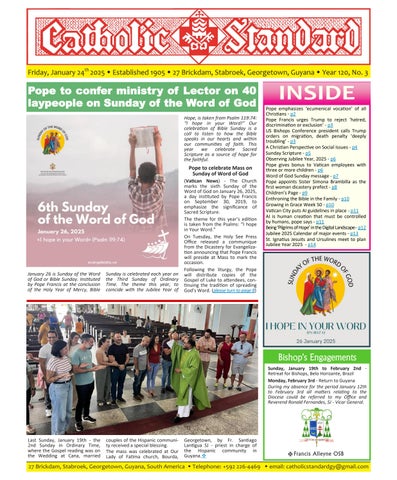
January 24th 2025_Catholic Standard

Page 1


Pope to confer ministry of Lector on 40 laypeople on Sunday of the Word of God

Hope, is taken from Psalm 119:74: “I hope in your Word!” Our celebration of Bible Sunday is a call to listen to how the Bible speaks in our hearts and within our communities of faith. This year we celebrate Sacred Scripture as a source of hope for the faithful.

Pope to celebrate Mass on Sunday of Word of God (Vatican News) - The Church marks the sixth Sunday of the Word of God on January 26, 2025, a day instituted by Pope Francis on September 30, 2019, to emphasize the significance of Sacred Scripture.

The theme for this year’s edition is taken from the Psalms: “I hope in Your Word.”

On Tuesday, the Holy See Press Office released a communique from the Dicastery for Evangelization announcing that Pope Francis will preside at Mass to mark the

Pope emphasizes ‘ecumenical vocation’ of all Christians - p2

Pope Francis urges Trump to reject ‘hatred, discrimination or exclusion’ - p3

US Bishops Conference president calls Trump orders on migration, death penalty ‘deeply troubling’ - p3

A Christian Perspective on Social Issues - p4 Sunday Scripture - p5

Observing Jubilee Year, 2025 - p6

Pope gives bonus to Vatican employees with three or more children - p6

Word of God Sunday message - p7

Pope appoints Sister Simona Brambilla as the first woman dicastery prefect - p8

Children’s Page - p9

Enthroning the Bible in the Family - p10

Growing in Grace Week 50 - p10

Vatican City puts AI guidelines in place - p11 AI is human creation that must be controlled by humans, pope says - p11

Being‘PilgrimsofHope’intheDigitalLandscape- p12

Jubilee 2025 Calendar of major events - p13

St. Ignatius Jesuits and Ursulines meet to plan Jubilee Year 2025 - p14

Sunday, January 19th to February 2ndRetreatforBishops,BeloHorizante,Brazil

Monday,February3rd - ReturntoGuyana

During my absence for the period January 12th to February 3rd all matters relating to the Diocese could be referred to my Office and ReverendRonald Fernandes, SJ - Vicar General.

the Wedding at Cana, married Lady of Fatima church, Bourda, Guyana.❖

The Jubilee Prayer

Dear Editor,

Change is one of the laws of the natural universe. Nature teaches us that everything in this world is constantly changing. Everything God created is constantly in the process if either growing or dying.

While these laws of change are true of the natural realm, we also experience supernatural realities, Faith, Hope, and Love are perfect and personal examples - and they are unchanging. Amid this dynamic and

Father in heaven, may the faith you have given us in your son, Jesus Christ, our brother, and the flame of charity enkindled in our hearts by the Holy Spirit, reawaken in us the blessed hope for the coming of your Kingdom.

May your grace transform us into tireless cultivators of the seeds of the Gospel.

May those seeds transform from within both humanity and the whole cosmos in the sure expectation of a new heaven and a new earth, when, with the powers of Evil vanquished, your glory will shine eternally.

May the grace of the Jubilee reawaken in us, Pilgrims of Hope, a yearning for the treasures of heaven. May that same grace spread the joy and peace of our Redeemer throughout the earth.

To you our God, eternally blessed, be glory and praise for ever.

Amen

Supernatural realities

everchanging natural environment, we also experience truth - and truth is unchanging. The environment changes, the culture changes, people change, but truth does not change; the supernatural realities of faith, hope, and love do not change; and God does not change.

Interestingly the yearnings of the human heart do not change either. It is for this reason that the unchanging truth of the Gospel resonates with the people of all eras.

Some Catholics say the Church needs to change. Let’s not forget that we are the Church. Are we willing to change? Most people do not.

Some use the Church’s shortcomings as excuses not to change or get involved.

The question is how should the Church change? It is important to understand that the Church is the connection between two worlds. The first is the supernatural world. The second is the natural world as we know it. In one hand the Church holds truth, eternal and unchanging. In the other hand, she holds the practices that encourage and enable us to apply the unchanging truth of the Gospel to the ever-changing circumstances of our daily lives.

Pope emphasizes ‘ecumenical

audience held at the Vatican with Finnish representatives of various Christian denominations who have made a pilgrimage to Rome on the occasion of the feast of St. Henry, celebrated Jan. 19.

The Jan. 20 meeting took place in the Vatican Apostolic Palace and was attended by the head of the Finnish Orthodox Church, Archbishop Elia of Helsinki, as well as Catholic Bishop Raimo Goyarrola of the Diocese of Helsinki and Bishop Matti Salomäki of the Evangelical Lutheran Church.

The Holy Father stressed that bearing witness to the incarnate love of Christ “is our ecumenical vocation, in the communion of all the baptized.”

As part of the Week of Prayer for Christian Unity and the 2025 Jubilee Year, the pontiff stressed that St. Henry, the patron saint of Finland, represents an icon of hope “that finds its sure and firm foundation in God.”

As a messenger of peace, he continued, St. Henry “urges us to never cease lifting up our prayers for the precious and fragile gift of peace.”

different churches and ecclesial communities in the common praise of the Lord.”

He also applauded the fact that this pilgrimage is accompanied by the choir of the Sanctae Mariae Chapel, recalling that “whoever sings, prays twice.”

Whoever listens to this symphony of truth’ not only with their ears but [also] with their hearts will be touched by the mystery of God, who bends down toward us, full of love, in his Son,” he said.

To express with confidence the “filial vocation” of ecumenism, Pope Francis invited those present to pray the Lord’s Prayer.❖

He then referred to the NiceneConstantinopolitan Creed shared by Christians as an “extraordinary and a with Jesus

Pope Francis meets with an ecumenical delegation from Finland on Jan. 20, 2025, at the Vatican. (Vatican Media)

Pope Francis urges Trump to reject ‘hatred, discrimination or exclusion’

messages on Sunday and Monday.

The Pope’s brief remarks came in a Sunday night Italian television interview on the eve of Mr Trump’s inauguration for a second term. Mr Trump has vowed to evict millions of immigrants from the country.

“If it is true, it will be a disgrace, because it makes the poor wretches who have nothing pay the bill for the inequalities,” said the Pope of Trump’s plans for widespread deportation. “It won’t do.”

In a message delivered hours before Mr Trump took the oath of office, Francis said, “Inspired by your nation’s ideals of being a land of opportunity and welcome for all, it is my hope that under your leadership the American people will prosper and always strive to build a more just society, where there is no room for hatred, discrimination or exclusion.”

“At the same time, as our human family faces numerous challenges, not to mention the scourge of war, I also ask God to guide your efforts in promoting peace and reconciliation among peoples,” he said.

Mr Trump was sworn in overnight for as the nation’s 47th president, as JD Vance also took the oath of office, becoming the nation’s second Catholic vice president, OSV News reports.

The inauguration ceremony was moved indoors amid frigid temperatures in the nation’s capital, taking place in the Capitol Rotunda rather than the exterior West Front of the Capitol Building.

An opening prayer was delivered by Cardinal Timothy Dolan of New York, who cited the Rev. Dr. Martin Luther King, whose federal holiday was also observed yesterday, “who warned without God our efforts turned to ashes.”

(CathNews) - Pope Francis delivered dual messages to Donald Trump on his inauguration as president of the United States, urging him to reject “hatred, discrimination or exclusion” and denouncing his migrant deportation plan asa “disgrace.”

Francis offered prayers for Mr Trump’s second term “that Almighty God will grant you wisdom, strength, and protection in the exercise of your high duties,” the papal statement said.

The cardinal prayed that Mr Trump “may know your designs,” and also wished God’s blessings on President Joe Biden in the final moments of his term.❖

The pontiff delivered the back-to-back

orders on migration, death penalty ‘deeply troubling’

Archbishop Timothy P. Broglio of the U.S. Archdiocese for the Military Services, who is president of the U.S. Conference of Catholic Bishops, delivers a homily to fellow bishops attending the opening Mass of the USCCB’s fall plenary assembly Nov. 11, 2024, at the Basilica of the National Shrine of the Assumption of the Blessed Virgin Mary in Baltimore. (OSV News photo file/Kevin J. Parks, Catholic Review)

WASHINGTON (OSV News) Executive orders signed by President Donald Trump on issues including migration, the environment and the death penalty are “deeply troubling,” Archbishop Timothy P. Broglio, president of the U.S. Conference of Catholic Bishops, said in a Jan. 22 statement, while praising another on gender policy.

Among the first acts of his second term beginning Jan. 20, Trump signed a slew

of executive orders. Some implement his hardline policies on immigration, including seeking to change the interpretation of birthright citizenship under the 14th Amendment, an order that prompted a legal challenge.

Others include withdrawing from the 2015 Paris Agreement on climate and another sought to expand the use of the federal death penalty. Trump also signed an order directing the U.S.

government to only recognize two sexes, male and female.

Archbishop Broglio, who heads the U.S. Archdiocese for the Military Services, said many of the topics that the first batch of executive orders concern “are matters on which the Church has much to offer.”

“Some provisions contained in the Executive Orders, such as those focused on the treatment of immigrants and refugees, foreign aid, expansion of the death penalty, and the environment, are deeply troubling and will have negative consequences, many of which will harm the most vulnerable among us,” he said. “Other provisions in the Executive Orders can be seen in a more positive light, such as recognizing the truth about each human person as male or female.”

Archbishop Broglio stressed that neither the Catholic Church nor the USCCB is “aligned with any political party.”

“No matter who occupies the White House or holds the majority on Capitol Hill, the Church’s teachings remain unchanged,” he said. “It is our hope that the leadership of our Country will reconsider those actions which disregard not only the human dignity of a few, but of us all.

Executive orders are legally binding directives from the president and are published in the Federal Register. At the same time, the term “executive actions” is broader and may include informal proposals for policy the president would like to see enacted. While it is typical for new presidents to issue some executive orders on their first day

in office to signal certain priorities, Trump signed a larger number of orders than usual.

Citing the current Jubilee Year of Hope declared by Pope Francis, Archbishop Broglio said, “As Christians, our hope is always in Jesus Christ, who guides us through storm and calm weather.

“He is the source of all truth,” Archbishop Broglio said. “Our prayer is one of hope that, as a Nation blessed with many gifts, our actions demonstrate a genuine care for our most vulnerable sisters and brothers, including the unborn, the poor, the elderly and infirm, and migrants and refugees. The just Judge expects nothing less.”

Also among its first actions, the Trump administration said Jan. 21 it would rescind a long-standing policy preventing Immigration and Customs Enforcement agents from making arrests at what are seen as sensitive locations, including houses of worship, schools and hospitals.

Bishop Mark J. Seitz of El Paso, Texas, said in a Jan. 21 statement the policy change is one of “many drastic actions from the federal government related to immigration that deeply affect our local community and raise urgent moral and human concerns.”

Bishop Seitz, who heads the USCCB’s migration committee, told reporters at the bishops’ general assembly in November that the bishops would watch how Trump’s migration policy actually unfolds and “raise our voice loudly” if those policies violate basic human rights protections.❖

Donald Trump is sworn in as the 47th U.S. president in the Capitol Rotunda in Washington Jan. 20, 2025. (OSV News photo/Saul Loeb, pool via Reuters)

A Christian Perspective on Social Issues

Jubilee Year 2025 (Part 2)

Grace has been given to each one of us. We must hold this deeply, ponder these blessings constantly. Let us cherish the love of God so generously extended, so undeserved we are. Now that we have received, a duty has been placed on each of us. I can only speak for me, but there is every intention of sharing the message of what is expected.

There are some timeless teachings and truths with which the Roman Catholic Church has long been associated. At a very high level today, I compress those teachings and social truths into a tight phrase: a duty to care. The overall objective is to break them down into bite-sized chunks and flesh them out later. A duty to care, or a duty of care, provides a faint but growing strain of love. Look at a snapshot of what is involved. The sacredness of life, and the many forms in which that can be manifested. We must care, as Catholics. As people of God, the giver of life, we honor God when stand against what destroys life, tampers with it, or hastens it end. The will of the Father is for free moral agents operating not with unfettered latitude, but deep Christlike conviction in how we hold life, what is supported, and what is fought against. God gave us Jesus, his one and only begotten, so that we may have another chance for knocking on his door and finding it welcoming.

A duty to care extends beyond human life. From the Book of Genesis, we learn of the paradise that was carefully prepared, with just that right blend and balance of forces, and then that open-ended command. “Be fruitful and increase in number; fill the earth and subdue it. Rule over the fish in the sea and the birds in the sky and over every living creature that moves on the ground” (Gen 1:28). And in Genesis 2:15: “Then the Lord took the man and put him into the Garden of Eden to cultivate it and keep it.” The words to “cultivate and keep” mean precisely what they say: care for it, hold it, maintain it, and respect it. From all the evidence, and only a fraction is needed, great treasons have been wreaked on the land that Almighty God has put into the hands of man. Instead of the earth being harnessed as a great protective barrier, a natural food basket, and a matchless filter to keep it healthy and in its prime, the opposite has become the norm. Many of the marvelous beauties of the earth and atmosphere remain in place, but so much more has been tarnished and reduced to the unrecognizable. In many areas, the earth has been so degraded that it now turns against man. This must be of concern to us as Christians, as citizens, as people of conscience concerned about the habitat in which we live. The vision is to share some moments in a number of instalments on these troubling real-life, in our lifetime issues.

A duty to care, of necessity, must reach into how we manage our affairs

from the rights involved, to our own responsibilities to be active participants in the issues of the day, the quality of life that is part of the vision for ourselves. There are so many aspects to this, and they are all essentials elements in the great social truths and teachings of the Roman Catholic Church. The form of governance, the standard of governance, and our say in such matters. The right to work and the kind of wages that are fair and just are all crucial features of a dignified life. As Lk 6:38 notes, “Give, and it will be given to you. Good measure, pressed down, shaken together, running over, will be put into your lap. For with the measure you use it will be measured back to you.”

In a world of interchangeable parts and fastmoving developments, these extracts from Catholic social teachings and truths are part of the blueprint that could lead to a better life, a more wholesome Christian existence. Something should have stood out in all of them, in that it is common throughout: there is care, there is love, and there is truth and justice. The obligation is on all of us (at a universal level), and me and you (and the personal one) to find the heart to care, which means to give. To give is to love. God and neighbor. Jubilee 2025 is ready for all the giving that each can deliver. May God guide us to live the mercies of Jubilee 2025. Let us give hope to one another, then reach beyond the familiar and into the unknown and spread the mercy. From mercy comes hope.❖

Gracious and loving God, we thank your for the gift of our priests.

Through them, we experience your presence in the sacraments. Help our priests to be strong in their vocation.

Set their souls on fire with love for your people.

Grant them the wisdom, understanding, and strength they need to follow in the footsteps of Jesus. Inspire them with the vision of your Kingdom.

Give them the words they need to spread the Gospel.

Allow them to experience joy in their ministry.

Help them to become instruments of your divine grace.

We ask this through Jesus Christ, who lives and reigns as our Eternal Priest. Amen

Counselling Services at Brickdam Presbytery

Carmelite Sisters are available for counselling on Mondays and Thursdays from 9:00am to 12 noon and 1:00pm to 2:00 pm, at theCathedral Presbytery. They are also available by appointment. Persons are encouraged to avail themselves of these services. Kindly contact the Cathedral parish office on tel. no. 226-4631fordetails.

FIRST READING Nehemiah 6. 8-10

Ezra read from the Law of God and the people understood what was read.

Ezra the priest brought the Law before the assembly, consisting of men, women, and children old enough to understand. This was the first day of the seventh month. On the square before the Water Gate, in the presence of the men and women, and children old enough to understand, he read from the book from early morning till noon; all the people listened attentively to the Book of the Law. Ezra the scribe stood on a wooden dais erected for the purpose; In full view of all the people-since he stood higher than all the people-Ezra opened the book; and when he opened it all the people stood up. Then Ezra blessed the Lord, the great God, and all the people raised their hands and answered, ‘Amen! Amen!’; then they bowed down and, face to the ground, prostrated themselves before the Lord. And Ezra read from the Law of God, translating and giving the sense, so that the people understood what was read.

Then (Nehemiah-His Excellency-and) Ezra, priest and scribe (and the Levites who were instructing the people) said to all the people, ‘This day is sacred to Yahweh your God. Do not be mournful, do not weep.’ For the people were all in tears as they listened to the words of the Law.

He then said, ‘Go, eat the fat, drink the sweet wine, and send a portion to the man who has nothing prepared ready. For this day is sacred to our Lord. Do notbe sad:the joyof the Lordis yourstronghold

Responsorial Psalm Psalm 18

Resp: Your words are spirit, Lord, and they are life.

1. The law of the Lord is perfect, it revives the soul.

The rule of the Lord is to be trusted, it gives wisdom to the simple. Response

2.The precepts of the Lord are right, they gladden the heart.

The command of the Lord is clear, it gives light to the eyes. Response

3.The fear of the Lord is holy, abiding for ever.

The decrees of the Lord are truth and all of them just. Response

4. May the spoken words of my mouth, the thoughts of my heart, win favour in your sight, O Lord, my rescuer, my rock! Response

ISECOND READING 1 Corinthians 12: 12-30

You together are Christ’s body; but each of you is a different part.

Just as a human body, though it is made up of many parts, is a single unit because all these parts, though many, make one body, so it is with Christ. In the one Spirit we were all baptised, Jews as well as Greeks, slaves as well as citizens, and one Spirit was given to us all to drink.

Nor is the body to be identified with any one of its many parts. If the foot were to say, ‘I am not a hand and so I do not belong to the body’. Would that mean that it stopped being part of the body? If the ear were to say, ‘ I am not an eye, and so I do not belong to the body,’ would that mean that it is not a part of the body? If your whole body was just one eye, how would you hear anything? If it was just one ear, how would you smell anything?

Instead of that, God put all the separate parts into the body on purpose. If all the parts were the same, how could it be a body? As it is, the parts are many but the body is one. The eye cannot say to the hand, ‘I do not need you,’ nor can the head say to the feet, ‘I do not need you.’

What is more, it is precisely the parts of the body that seem to be the weakest which are the indispensable ones; and it is the least honourable parts of the body that we clothe with the greatest care. So our more improper parts get decorated in a

n St. Paul's letter to the Corinthians, it states “If they were all one part, where would the body be?

But as it is there are many parts, yet one body” (1 Cor. 12:18-20).

What does this teach us as Christian stewards? It shows us that we all have equal dignity and worth in God’s sight,

way that our more proper parts do not need. God has arranged the body so that more dignity is given to the parts which are without it, and so that there may not be disagreements inside the body, but that each part may be equally concerned for all the others. If one part is hurt, all parts are hurt with it. If one part is given special honour, all parts enjoy it. Now you together are Christ’s body; but each of you is a different part of it. In the Church, God has given the first place to apostles, the second to prophets, the third to teachers; after them, miracles, and after them the gift of healing; helpers, good leaders, those with many languages. Are all of them apostles, or all of them prophets, or all of them teachers? Do they all have the gift of miracles, or all have the gift of healing? Do all speak strange languages, and all interpret them?

GOSPEL Luke 1:1-4; 4:14-21

This text is being fulfilled today.

Seeing that many others have undertaken to draw up accounts of the events that have taken place among us, exactly as these were handed down to us by those who from the outset were eyewitnesses and ministers of the word, I in my turn, after carefully going over the whole story from the beginning, have decided to write an ordered account for you, Theophilus, so that your Excellency may learn how well founded the teaching is that you have received.

Jesus, with the power of the Spirit in him, returned to Galilee; and his reputation spread throughout the countryside. He taught in their synagogues and everyone praised him.

He came to Nazara, where he had been brought up, and went into the synagogue on the sabbath day as he usually did. He stood up to read and they handed him the scroll of the prophet Isaiah. Unrolling the scroll he found the place where it is written: The spirit of the Lord has been given to me, for he has anointed me.

He has sent me to bring the good news to the poor, to proclaim liberty to captives and to the blind new sight, to set the downtrodden free, to proclaim the Lord’s year of favour.

He then rolled up the scroll, gave it back to the assistant and sat down. And all eyes in the synagogue were fixed on him. Then he began to speak to them, ‘This text is being fulfilled today even as you listen’.❖

and that if God sees us as equally precious, we should view each other in this same light. It teaches us to humbly recognize our own gifts as well as the giftedness of every member of our parish family. And, while God designed us to be ultimately dependent on Him, it seems He has also designed us to need each other!

This is part of the beauty and richness of a stewardship way of life. No one person can “do it all” in life whether in family life or parish life. But God does not ask us to do it all. He simply asks us to share the gifts and talents we do have in the season of life we find ourselves right now.❖

[www.catholicsteward.com/blog/ ]

Observing Jubilee Year, 2025 Gospel Reflection

One Sabbath day in the synagogue in Nazareth Jesus made use of a passage from the prophet Isaiah to sum up his ministry. Filled with the Holy Spirit he announced what he had been sent to do. He said that the time had come when God’s favour was to be extended to everyone without exception and not just to those who deserved it. And having said this, he began to make it a reality. And his life showed that there was no difference between what he said and what he did. Having announced his preference for the poor and the downtrodden he spent the rest of his life among them, teaching, healing and ministering to them. He gave them hope in a world where hope was lacking. His life was an extension of his mission and so it must be for all of us too

The Catholic Church’s Jubilee Year, a sacred observance held every 25 years, began on Christmas Eve 2024. Pope Francis inaugurated the year by opening the Holy Door at St Peter Basilica in the Vatican during the traditional Christmas Vigil Mass.

Themed Pilgrims of Hope, the 2025 Jubilee focuses on renewal, forgiveness, and fostering hope in a divided and turbulent World.

Origins and significance

The Jubilee Year is a time to “intensify the love of Christ in the world in terms of our witness of that love.”

This observance finds its roots in ancient traditions of forgiveness, reconciliation, and renewal, offering the faithful an opportunity to deepen their spiritual lives.

Pope Francis mentions that we are surrounded by new forms of brutality. When we thought we had enough technology and wisdom to avoid war, we see the world seems to be entering a third World War piecemeal. Yet, the Pope urges Catholics to focus on hope, becoming “pilgrims of hope in concrete ways.”

How to mark the Jubilee?

It is a chance for personal and communal transformation. The purpose of the Jubilee Year is to intensify the love of Christ in the world. It is time for us to focus: How can we be more Christlike? How can we witness to Christ better personally, as communities, and in our social structures?

The Jubilee is a chance to re-centre family life around shared time and faith. Build your lives around family time prayer, conversations, and simple joys like a hike together.

Ultimately, the Holy Year of Jubilee invites all families to step into God’s grace, rediscover their faith, and rekindle the bonds that unite them. As Pope Francis reminds us, “Family life is a series of pilgrimages, big and small.” Let this Jubilee Year be a journey of hope and renewal for families everywhere.

The Year emphasises the importance of forgiveness and reconciliation, drawing on St Paul’s teaching: God in Christ was reconciling the world to Himself, not holding people’s sins against them. The Jubilee is a time to practise reconciliation in our lives.

We are encouraged to promote corporal and spiritual works of mercy, such as feeding the hungry, comforting the sorrowful, and fostering reconciliation in families and communities.

A message of hope

The Jubilee is about becoming signs of hope in a world that so desperately needs it. It is a reminder that all is not lost and that hope truly does not disappoint. (From the Online Catholic Opinion of Jamaica) ❖

employees with three or more children

Jesus came with good news, not bad news. His message is meant to inspire and bring hope. Although it is good news, it is not necessarily comfortable news. We sometimes find that it challenges us to a radical reforming of our lives and relationships. It is good news for everyone, but more so for the poor, for those who realise their sinfulness and are hungering and thirsting for God’s love and mercy. What is wonderful is that it is not a question of whether we deserve God’s love and mercy. These are ours for the taking at any time because of God’s goodness. The good news Jesus brings then is about God’s love and concern for creation and the one commandment presented to us is simply to love.❖

[From: Journeying with the Word of God, The Religious Education Department, Diocese of Georgetown,Guyana ]

Pope Francis greets a child at the conclusion of his weekly general audience in the Paul VI Audience Hall at the Vatican Jan. 15, 2025. (CNS photo/Lola Gomez)

VATICAN CITY (CNS) Pope Francis personally decided that employees of Vatican City State who have three or more children will receive a monthly bonus, the Vatican announced.

As of Jan. 1, it said, the monthly bonus of 300 euros (about $310) will be paid to employees who have three or more children under the age of 18; the age limit increases to 24 if the son or daughter is enrolled in a university or other studies.

The announcement published Jan. 16 by the governor’s office of Vatican City State mentioned the bonus only for its employees, not those of the Roman Curia. The governor’s office oversees those who work in the Vatican Museums, the gardeners, trash collectors, firefighters, police and post office employees as well as those who work for the Vatican health service and pharmacy.

In addition to the bonus, Pope Francis extended the paid leave of new fathers from three days to five days.

The paternity leave can be taken when a child is born, adopted or fostered, it said.

The announcement said the bonus, “a personal initiative of the Holy Father,” was communicated to Cardinal Fernando Vérgez Alzaga, president of the commission governing Vatican City State, and Franciscan Sister of the Eucharist Raffaella Petrini, secretarygeneral of the governing office, during an audience in December.

Pope Francis has asked the world’s cardinals to help reduce the Vatican deficit, he cut allowances paid to the cardinals who head Vatican offices and, in 2021, approved pay cuts for cardinals, clergy, religious and upper management officials who work in the Roman Curia and other Vatican entities. In addition, from 2021 to 2023 he put into effect a freeze on regular salary increases for all but the lowest-paid employees.❖

Fr Hugh Logan, Zonal Coordinator for the Caribbean Zone of the Catholic Biblical Federation, is calling on the faithful and all local churches within the Antilles Episcopal Conference (AEC) to unite in celebrating the Sunday of the Word of God, January 26. This event, which has become an important occasion in the universal Church, offers a chance to reflect on the power and significance of God's Word.

In a video message shared by Good News Catholic Communications in the Diocese of St George's-in-Grenada, Fr Logan highlighted the theme for this year's celebration, chosen by Pope Francis: "I hope in your word," inspired by Psalm 119:74.

Fr Logan emphasised that this verse teaches believers to place their trust not in ever-changing circumstances, but in the unchanging and faithful Word of God. He explained that God's Word is a source of hope that can sustain people through even the most difficult times.

Fr Logan reflected on the meaning of God's promises, acknowledging that life's struggles and hardships do not mean that God's promises have failed. Instead, he suggested that enduring through such challenges in faith becomes a powerful testament to God's reliability.

He commented, "When struggling parents are unable to put food on the table for their children are faced with hardship, it does not mean that the promise they made has failed. In fact, the very perseverance in the midst of struggle, the refusal to give up on the Word becomes a greater testament to the promise itself."

The message focused on the need to anchor one's faith in the constancy of God's Word, particularly in today's turbulent world

Fr Logan reminded faithful that hope must be placed in God's Word, which is "dynamic and faithful, ever true."

Fr Logan also shared ideas for parishes to consider as they prepare for the Sunday of the

Word of God. These activities, designed to deepen the celebration and bring the Word of God into everyday life, include:

• Prayer and Study: Bishops, priests, and deacons can come together in prayer and study, reflecting on biblical texts, and sharing homiletic ideas. "This could be the beginning of what can be a weekly or monthly exercise," Fr Logan said.

• Parish Reflections: Pastoral teams can gather to discuss the readings for the liturgy and prepare spiritually for the Sunday celebration.

• Bible Blessings: Parishioners can be encouraged to bring their Bibles to Mass "to be blessed."

• Witnessing the Word: During the Mass, individuals can be invited to "witness" to how the Word of God has "nourished" their lives.

• Bible Procession: A procession with an enthroned Bible throughout the streets of the parish community or a church compound could be held before or after the Mass.

Journeying with the Word of God

•Recognising small wins: Groups and individuals who have "digested" the Word of God and are "manifesting" its fruits in "concrete ways" in the community could be recognised. "Special recognition" can be given to children, youth, and young adults.

• Children's Liturgy: A special liturgy of the Word can be prepared for children, celebrated in a "space specially designed" for that day. "Again, this could be the start of an ongoing children's ministry," Fr Logan said. ❖

(From The Catholic News of T&T)

MAKING THE WORD OF GOD YOUR OWN

Step 1: Lookattoday’sReadingsprayerfully.

1st Reading: After the Jews returned from exile in Babylon, Ezra worked to re-establish the Jewish religion. He reads from the book of the Law of Moses and explains it to the people.

2nd Reading: Just as the human body is one though made up of many parts, so the Church, though composed of different members with different gifts, forms a unity in Christ.

Gospel: Jesus announces the theme of his entire ministry – he has come to bring the good news of salvationtoall who areinneed,especially thelowly.

Step 2: ApplyingthevaluesoftheReadings toyourdailylife.

1.“There is no such thing as an isolated Christian.” What do you think this statement means when you consider the Second Reading?

2.Jesus announced his mission in the synagogue and the people who listened to him were filled with awe. What is your understanding of mission?

3.Why do you think every member of the Body of Christ, that is the Church, is (or should be) on mission? What do you think this mission should be for the Church?

4.It is said that the best way to preach the Gospel is bylivingaChristianlife.Why doyouthink thisis so?

Step 3: Accepting the message of God’s Wordinyourlifeoffaith

Jesus began his ministry by making the words of Isaiah his own: ‘He sent me to bring good news to the poor.’ The good news he brings is that God’s mercy and goodness is available to all those in need. We should therefore never be afraid to admit our sinfulness and our need before God. Jesus made himself the friend of sinners and the poor. We canbesurethatheisalwaysourfriendandguide

Step 4: Somethingtothink&prayabout

1.Reflect on what you think Jesus’ mission was all about. Do you have a mission in life? How did you come to take part in your mission? Was it forced on you by circumstances? Do you find comfort or challenge as you strive to carry out your mission?

2.Look up in the Old Testament the passage that Jesus read in the synagogue (Is. 61:1-2). Read the entire chapter to understand why Jesus chose Isaiah for his mission statement.

3.The poor are not only those who have no money. Who else would you consider to be poor? In what way do you feel yourself poor? ❖

[From: Journeying with the Word of God, The Religious Education Department, Diocese of Georgetown, Guyana ]

as the first woman dicastery prefect

VATICAN CITY (CNS) Pope Francis has appointed Consolata Missionary Sister Simona Brambilla to be the first woman to lead a Vatican dicastery, naming her prefect of the Dicastery for Institutes of Consecrated Life and Societies of Apostolic Life.

The 59-year-old Italian sister had served as secretary of the dicastery since October 2023.

The announcement of her appointment Jan. 6 also said Pope Francis named as pro-prefect of the dicastery Spanish Cardinal Ángel Fernández Artime, 64, the formerrectorgeneraloftheSalesians

The Vatican press office did not reply to requests to explain why the cardinal was given the title pro -prefect or how his role would be different from that of a dicastery secretary.

The dicastery, according to the apostolic constitution on the Roman Curia, is called “to promote, encourage and regulate the practice of the evangelical counsels, how they are lived out in the approved forms of consecrated life and all matters concerning the life and activity of Societies of Apostolic Life throughout the Latin Church.”

Vatican oversight of religious orders and leadership changes

According to Vatican statistics, there are close to 600,000 professed women religious in the Catholic Church. The number of religious-order priests is about 128,500 and the number of religious brothers is close to 50,000. When a vowed member of a religious order asks to leave or is

study groups authorized by Pope Francis to examine issues raised at the

asked by the community to leave, the decision must be approved by the dicastery. It approves the establishment of new religious orders, approves the drafting or updating of the orders’ constitutions, oversees the merger or suppression of religious orders and the formation of unions of superiors general.

Sister Brambilla succeeds 77-yearold Brazilian Cardinal João Bráz de Aviz, who has led the dicastery since 2011.

She is one of two women Pope Francis appointed in early December to be members of the Ordinary Council of the General Secretariat of the Synod, the committee

that oversees the implementation of the most recent synod and prepares the next assembly.

Born in Monza, Italy, March 27, 1965, she earned a degree in nursing before entering the Consolata order in 1988. She studied psychology at Rome’s Pontifical Gregorian University, and in 1999, after taking her final vows, she went to Mozambique where she did youth ministry before returning to Rome in 2002, earning her doctorate in psychology from the Gregorian University in 2008. She served two terms as superior of the Consolata Missionary Sisters, leading the congregation from 2011 to May 2023.❖

Sunday of the Word of God (From Page 1)

Supporting the faithful in spiritual growth

During the celebration, the Pope will confer the ministry of Lector upon 40 lay faithful men and women from various nations: 4 from Albania, 3 from Argentina, 5 from Austria, 1 from Bolivia, 4 from Brazil, 5 from the Philippines, 1 from Iceland, 6 from Italy, 5

from Mexico, 1 from Poland, and 5 from Slovenia. Each will receive a copy of the Nova Vulgata Bible according to the rite.

To aid the faithful in their spiritual growth and deepen their connection to God’s Word, the Section for Fundamental Questions of Evangelization in the World, part of the Dicastery for Evangeliza-

WEEK OF PRAYER FOR CHRISTIAN UNITY 2025 JANUARY 18 -

25

Prayer for the Week

Lord our God, we confess together our faith in the mystery of your perfect unity, Father, Son and Holy Spirit, one and only God.

We pray for the grace to grow in unity together as your Church.

By baptism, we profess this unity in the gift of your Holy Spirit, born again as your sinless children, yet we quickly surrender to the temptation of division.

Forgive us this sin and lead us to the miracle of being reconciled by the love of our Lord Jesus Christ.

Sin and division lead to death and destruction.

In Jesus, who conquered death forever by his supreme act of love, we are empowered in this world to build his kingdom of forgiveness and peace.

We pray, heavenly One, to you as our Father, that we truly believe and trust in the promise of the Gospel, “that they all may be one.”

We ask this through Jesus Christ, our brother and Lord, in the power of the Holy Spirit.

Amen

tion, has made a free liturgicalpastoral guide available online in six languages.

The guide, downloadable from the official website evangelizatio.va, offers suggestions for a deeper encounter with Scripture in communities, families, and daily life. It also includes articles, meditations, texts for Adoration, and pastoral recommendations.

Cardinal Pizzaballa: ‘Scripture inspires love for God’

In a message to the faithful, Cardinal Pierbattista Pizzaballa, the Latin Patriarch of Jerusalem, highlighted the significance of the initiative, which has been celebrated since 2020 on the third Sunday of Ordinary Time according to Pope Francis’s decree.

The sixth edition of the Sunday of the Word of God offers Christians an opportunity to renew their commitment to reading and meditating on the Bible as a fundamental tool for growth in faith and spiritual life, as well as a source of hope for the faithful worldwide.❖

The Pope distributed copies of the Gospel of Mark at the Mass in 2024 (VATICAN MEDIA Divisione Foto)
Consolata Missionary Sister Simona Brambilla, secretary of the Dicastery for the Institutes of Consecrated Life and the Societies of Apostolic Life, speaks during a news conference at the Vatican March 14, 2024, about
synod on synodality. (CNS photo/Lola Gomez)

Dear Boys and Girls,

One day Jesus was in Nazareth on the Sabbath so he went to the temple as he always did. When he stood up to read the Scriptures, he was handed the book of the prophet Isaiah. He looked through the book until he found the part that said, "The Lord's Spirit has come to me and has chosen me to tell the good news to the poor. He has sent me to free the prisoners, give sight to the blind, and to set everyone free from their suffering."

When he had finished reading, he handed the book back to the man who was in charge and sat down. Everyone in the place was looking at Jesus and waiting to see what he would say.

Jesus said to them, "What you have just heard me read has come true today."

What did Jesus mean? He meant that he was the one who came to make us happy and whole the way God intended for us to be. He came to heal the sick and the lame. He came to make the blind to see and to free us from sin. Now if we want to have what Jesus came to give, we must put our trustinhimanddo whathehas toldusto do

Dear Father, we thank you for your love. We thank you for sending your Son to free us from sin so that we can know the joy that you want for us. In Jesus' name we pray. Amen. ❖

Enthroning the Bible in the Family

As everyone enters the house or room, they may sing a suitable song.

Then Scripture is read from the Bible

Matthew 4:17-23 Jesus calls and heals through the power of his Word/

Mark 4:1-20 The Word is like the seed./

Luke 4:14-21 Jesus proclaims the Word in Nazareth./

John 1:10-14 Jesus, the Word of God and the light of the world.

After the reading, the leader places the Bible in the place prepared for it.

All bow deeply before the enthroned Bible.

Leader: We have heard your words, Jesus.

They give us joy and bring light and truth into our lives.

Your presence gives us peace in our troubled and divided world.

Let your Word create in our hearts a deep desire for you.

Your response to hardships

Charles Stanley, an American pastor and writer once said “It is not the trials in your life that develop or destroy you, but rather your response to those hardships"

ing the Sacred Scriptures in a prominent place decorated with flowers and art, and by gathering at this spot for daily prayer, families show that God is present and active through his Word. Enthroning the Bible in your home is easy to do. Simply pick a place where the Bible can be honoured. The Bible should be placed where it will be seen regularly, but removed from the noise and confusion of the family entertainment centre. Place the Bible, opened to a favourite passage or the readings of the day, on a table or shelf. Decorate the area around the Bible with a cloth, flowers, and/or a candle whatever makes sense to you. Use the following ritual prayer when you gather as a family to enthrone the Bible.

Things to prepare:

• Bible

• A shelf or table where the Bible will be placed (the shelf may be adorned with a cloth and candles)

When possible, the ritual may start outside the main door to the house or the main entrance to the room. One member of the family holds the Bible, raised slightly. The father, mother, or other leader begins the celebration with the Opening Litany.

Leader: Our Lord Jesus Christ, you are the Word of the Father.

R. Come, Lord Jesus, come.

Leader: You became one with us to tell of the Father's love.

R. Come, Lord Jesus, come.

Leader: Youarethelightthatshinesin thedarkness.

R. Come, Lord Jesus, come.

Leader: You save us from fear and break the bonds of sin and death.

R. Come, Lord Jesus, come.

Leader: You come to guide our steps and lead us to God.

R. Come, Lord Jesus, come.

Leader: You are the Word of eternal Life.

R. Come, Lord Jesus, come.

Leader: You fill us with the Holy Spirit.

R. Come, Lord Jesus, come.

Be with us in our hearts and homes, in our community and country. Give us your Holy Spirit to help us to understand your Word. We enthrone now this Holy Bible in our midst.

Make your Word the center of our lives.

May your Word inspire all that we think and say and do.

May your Word bind us together in unity with each other and with you. Today and forever.

R. Amen.

All join in saying the Lord's Prayer. All repeat after the leader: We promise to respect the Word of God in our midst.

We shall read and reflect on it as a family of God.

May we draw from it inspiration for our decisions, strength for our work, and comfort in suffering.

Jesus, help us to be faithful to our promise, you who live forever and ever. Amen. The celebration concludes with a sign of peace ❖

[https://www.usccb.org/committees/divine-worship/ sunday-word-god ]

The process of growing up has many facets. However, the most prominent one of them all is learning the ability to face obstacles without allowing them to destroy you.

Human beings are shaped by their memories and experiences. When you experience joyful things, it is easier for you to be a kinder person. When you experience grief or pain, it becomes a little more difficult for us to be kind and compassionate. Nevertheless, we must learn to refuse difficult experiences from changing us into a worse person. Our core values must guide us through every part of our lives, regardless of whether that part is negative or positive. There is a silver lining to be found, even in the darkest clouds. Allow your values to be a beacon that reminds you who you are, even when the entire world seems to be intent on changing you. We are hard pressed on every side, but not crushed; perplexed, but not in despair; persecuted, but not abandoned; struck down, but not destroyed. - 2 Corinthians 4:8-9 ❖

Vatican City State puts AI guidelines in place

VATICAN CITY (CNS) To ensure artificial intelligence is developed and used in an ethical, transparent and responsible manner in Vatican City State, the city-state governors’ office has released a set of guidelines on AI, which will be followed by new laws and regulations.

“The guidelines highlight the importance of a balanced and mindful approach in regulating artificial intelligence and will act as a ‘compass'” and a framework for “future regulatory actions” regarding AI technology, the city-state said in a Dec. 23 press release on vaticanstate.va. The guidelines went into effect Jan. 1. The president of the governor’s office will also set up a five-person AI com-

mission, presided over by the secretary -general of the governing office, to oversee the implementation and regulation of AI within Vatican City State. Specifically, the commission will: prepare the proposed laws and regulations; provide input and opinions about the use of AI systems and models; and monitor the activities of AI systems and models and their impact on individuals, employment and the environment.

“The key principle is that technological innovation cannot and should never overtake or replace human beings,” the press release said. “On the contrary, it should serve humanity, and support and respect human dignity,” individual rights and freedom.

“The aim is to make artificial intelligence a resource that, if properly regulated, will be able to foster well-being and progress, without compromising ethical and social principles,” it added.

The 13-page policy, released as a decree by the pontifical commission governing Vatican City State, covers a series of general ethical principles, specific guidelines for certain offices and prohibitions.

The bans include prohibitions against AI technology and practices that: cause discrimination; harm individuals physically or psychologically through subliminal manipulation; exclude people with disabilities; create social inequalities; demean human dignity; violate fundamental human rights; compromise Vatican City State security and public order; encourage criminal conduct; and conflict with “the mission of the pope, the integrity of the Catholic Church and the proper operation” of the Vatican entities overseen by the governor’s office.

The office oversees those who work in administration and human resources, the Vatican Museums, the gardeners, trash collectors, firefighters, police, post office employees as well as those who work for the Vatican health service, pharmacy and Vatican court system. The guidelines and future regulations also cover third-party suppliers, operators and professionals who are

hired temporarily.

Some offices were given specific guidelines pertaining to their field, such as offices dealing with: personal data and data processing; scientific research and healthcare; copyright protection; cultural heritage; maintenance and services; administrative procedures; human resources and labor practices; judicial activities; and security.

Some examples included: mandating that all texts, music, photos, audiovisual and radio content that have used AI systems and models in their creation or reproduction be labeled with the acronym AI; and insisting that patients being treated by the Vatican’s health care service must be informed about theuseandapplicationofAIintheircare

While most offices have been given the green light to adopt AI in ways that streamline and facilitate human labor, the guidelines specified that the Vatican’s judicial offices may only use AI “for the organization and simplification” of its research and work. Interpretation of the law, analysis of the facts and evidence of a case, and deciding on sentencing or other measures must never be handled by AI as these tasks are “reserved exclusively for the magistrate.”

Laws and regulations applying the guideline’s principles were to be adopted within the current calendar year, the press release said.❖

AI is human creation that must be

VATICAN CITY (CNS) Artificial intelligence or any other technology that worsens inequality around the world and increases fake news should not be embraced as “progress,” Pope Francis told business and government leaders meeting in Davos, Switzerland.

“Technological developments that do not improve life for everyone, but instead createor worsen inequalitiesand conflicts, cannot be called true progress,” the pope said in a message to the World Economic Forum.

AI, he said, “should be placed at the service of a healthier, more human, more social and more integral development.”

Pope Francis’ message, addressed to Klaus Schwab, chairperson of the forum, was delivered by Cardinal Peter Turkson, chancellor of the Pontifical Academy of Sciences and the Pontifical Academy of Social Sciences, and was published by the Vatican Jan. 23.

The annual meeting in Davos Jan. 2024 brought together leaders in business, government, academia and media to discuss security and cooperation, particularly regarding Russia’s war on Ukraine; technology’s impact on businesses and development; and safeguarding the planet.

While the Catholic Church supports technological development as a result of God-given human creativity, “AI is

intended to imitate the human intelligence that designed it, thus posing a unique set of questions and challenges,” the pope said in his message.

Since “the results that AI can produce are almost indistinguishable from those of human beings,” the pope wrote, questions must be raised about “its effect on the growing crisis of truth in the public forum.”

Pope Francis also reiterated his concern about artificial intelligence and its use in weapons systems, health care and other life-and-death situations.

“This technology,” he wrote, “is designed to learn and make certain choices autonomously, adapting to new situations and providing answers not foreseen by its programmers, thus raising fundamental questions about ethical responsibility, human safety, and the broader implications of these developments for society.”

People need to be aware that AI really “is not an artificial form of human intelligence but a product of it,” the pope said. “When used correctly, AI assists the human person in fulfilling his or her vocation, in freedom and responsibility.”

But it is simply an assistant, he said, and not the answer to all the world’s problems.

Too often, the pope wrote, “human dignity and fraternity are frequently

subordinated in the pursuit of efficiency, as though reality, goodness, and truth inherently emanate from technological and economic power.”

“Human dignity must never be violated for the sake of efficiency,” Pope Francis said. “As with all other human activity and technological development, AI must be ordered to the human person,” he said.

Citing the vision of true progress promoted in the Second Vatican Council’s Pastoral Constitution on the Church in the Modern World, Pope Francis insisted that AI should “become part of efforts to achieve ‘greater justice, more extensive fraternity and a more humane order of social relations’ which are ‘more valuable than advances in the technical field.'”❖

Pope Francis gives his blessing to visitors in the Paul VI Audience Hall at the Vatican at the end of his weekly general audience Jan. 22, 2025. (CNS photo/ Lola Gomez)

Digital Landscape

The Jubilee Year 2025 is upon us, and Pope Francis has asked that we all attempt to be “pilgrims of hope” to witness to the love and power of Jesus Christ in the world today. What does that mean in practical terms? How am I to be a pilgrim of hope to the world?

how to navigate our media world as followers of Jesus.

The Oxford dictionary defines a pilgrim as one who journeys to a sacred place for religious reasons. Pilgrim can also mean one who journeys through life. This is the aspect of “pilgrim” that’s captured in “pilgrims of hope.” We are all pilgrims on the journey of life, looking forward to being with God forever in heaven once our earthly life is over. There are many complexities to the journey of life. We may sometimes be tempted to fall into nostalgia about “simpler times” or “the way things used to be.” One aspect of 21st-century life that can complicate the journey is the digital landscape. How can we be pilgrims of hope when it comes to the digital media culture? How do we cultivate an attitude of hope when so much media, especially social media, seems self-centered, introspective and anything but hopeful?

Even more importantly, how do we encourage the young, who are so immersed in digital everything, to buck the selfish trend and be a hopeful and faithful presence in their online interactions? The answer lies in fostering an attitude of media mindfulness and putting some practices in place to help us out of the digital rabbit hole when we find ourselves falling in. With some determination and effort, these suggested practices can bring us a sense of hope as we journey every single day through the digital landscape. If we, as adults, learn these practices, they can offer us hope as we endeavor to teach the young

Bring your faith and values to bear within the digital landscape. It takes practice, but asking ourselves if what we’re doing online is helping us grow in our relationship with God and with others can give us the pause we need to look at the way we use media. Stopping every once in a while and doing an examination of conscience about our online activities can be spiritually healthy and hopeful Practice discernment. Pope Francis, in many of his writings, has emphasized how crucial discernment is to our spiritual lives. Asking the Holy Spirit to help us understand what it is God wants of us is desirable in all areas of life, but especially in our digital lives. Is what I’m watching, reading, listening to, interacting with, in line with God’s holiness?

Be critical thinkers. Applying critical thinking skills to our digital lives and the messages that we get from the media we experience means that the negative aspects of media can have less influence on our ways of thinking. When we bring media messages into conversation with the values we hold as Christians, recognizing what is good and worth keeping and what we want to discard becomes easier. This is especially hopeful for parents trying to instill responsibility in their kids for the way they use media.

Hope implies a trust that God has things in hand, that he is in charge and is with us on the pilgrimage of life. Hopefully, we’ve had experiences that have shown us just how much God holds us in love. Other experiences, however, may have us wondering where God is. Using these tips give us hope that even in our media and digital interactions, God is present and leading our life’s pilgrimage.

If our online lives are out of balance, other parts of our lives will be, too, especially our relationships, and that includes our relationship with God. Being a “pilgrim of hope” encompasses all aspects of our life journey. As we set off on this jubilee year, let’s take up the challenge to incorporate the virtue of hope into our own digital landscape.❖

St. Ignatius Jesuits and Ursulines

The Priests and Sisters who serve the 50 communities which comprise the St Ignatius Mission

The members of the St. Ignatius Jesuit Community, along with the Ursuline Sisters of Tildonk gathered at St. Ignatius, Central Rupununi, Region 9, Essequibo, Guyana, from Thursday January 9th to Friday January 10th for reflection, faith sharing, and planning for the Jubilee Year. It was a truly enriching and grace-filled experience.

As St. Ignatius of Loyola reminds us, "Love is shown more in deeds

than in words." This gathering was a testament of their shared commitment to journey together in faith and action, embracing the spirit of St. Ignatius with renewed zeal and purpose. (Adapted from St Ignatius Mission FB page) ❖

January 27th: St. Angela Merici (March 21, 1474 January 27, 1540)

St. Angela Merici has the double distinction of founding the first teaching congregation of women in the Church and what is now called a “secular institute” of religious women. Angela was born in 1474 in Lombardy, Italy. As a young woman, she became a member of the Third Order of Saint Francis, and lived a life of great austerity, wishing, like Saint Francis, to own nothing, not even a bed. Early in life she was appalled at the ignorance among poorer children, whose parents could not or would not teach them the elements of religion. Angela’s charming manner and good looks complemented her natural qualities of leadership. Others joined her in giving regular instruction to the little girls of their neighborhood. She was invited to live with a family in Brescia (where, she had been told in a vision, she would one day found a religious community). Her work continued and became well known. She became the center of a group of people with similar ideals.

At 57, she organized a group of 12 girls to help her in catechetical work. Four years later the group had increased to 28. She formed them into the Company of Saint Ursula (patroness of medieval universities and venerated as a leader of women) for the purpose of re-Christianizing family life through solid Christian education of future wives and mothers. The members continued to live at home, had no special habit and took no formal vows, though the early Rule prescribed the practice of virginity, poverty, and obedience. The idea of a teaching congregation of women was new and took time to develop.

The community (the Ursulines) thus existed as a “secular institute” until some years after Angela’s death.❖ [www.franciscanmedia.org]

Marian Academy held an Opening Mass for the new school term on Monday, January 20th. The Mass was celebrated by Fr. Carl Philadelphia. Fr. Carl also blessed the school’s new electric piano. (Adapted from Marian Academy FB page). ❖

Turn static files into dynamic content formats.

Create a flipbook