February 27th 2026_Catholic Standard

Page 1


Bones of St. Francis draw hundreds of thousands of pilgrims - p2

Pope renews ‘heartfelt appeal’ for ‘immediate ceasefire’ in Russia-Ukraine war - p3

Russia’s war on Ukraine means ‘No Priests Left,’ documentary shows - p3

A Christian Perspective on Social Issues - p4

Sunday Scripture - p5

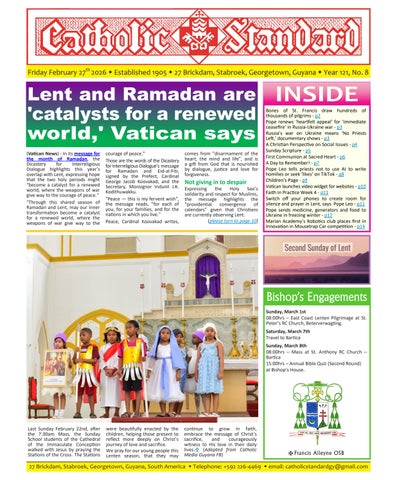
(Vatican News) - In its message for the month of Ramadan, the Dicastery for Interreligious Dialogue highlights this year’s overlap with Lent, expressing hope that the two holy periods might “become a catalyst for a renewed world, where the weapons of war give way to the courage of peace.”

"Through this shared season of Ramadan and Lent, may our inner transformation become a catalyst for a renewed world, where the weapons of war give way to the

courage of peace.”

Those are the words of the Dicastery forInterreligiousDialogue’s message for Ramadan and Eid-al-Fitr, signed by the Prefect, Cardinal George Jacob Koovakad, and the Secretary, Monsignor Indunil J.K. Kodithuwakku.

"Peace this is my fervent wish", the message reads, "for each of you, for your families, and for the nations in which you live."

Peace, Cardinal Koovakad writes,

comes from "disarmament of the heart, the mind and life", and is a gift from God that is nourished by dialogue, justice and love for forgiveness.

Not giving in to despair

Expressing the Holy See’s solidarity and respect for Muslims, the message highlights the "providential convergence of calendars" given that Christians are currently observingLent.

(please turn to page 10)

First Communion at Sacred Heart - p6

A Day to Remember! - p7

Pope Leo tells priests not to use AI to write homilies or seek ‘likes’ on TikTok - p8

Children’s Page - p9

Vaticanlaunchesvideowidgetforwebsites - p10

Faith in Practice Week 4 - p11

Switch off your phones to create room for silence and prayer in Lent, says Pope Leo - p11

Pope sends medicine, generators and food to Ukraine in freezingwinter p12

Bishop’s Engagements

Sunday, March 1st

08:00hrs – East Coast Lenten Pilgrimage at St. Peter’s RC Church, Beterverwagting.

Saturday, March 7th

Travel to Bartica

Sunday, March 8th

08:00hrs – Mass at St. Anthony RC Church –Bartica

15:00hrs –Annual Bible Quiz (Second Round) at Bishop’s House.

 Francis Alleyne OSB
of the Immaculate Conception walked with Jesus by praying the Stations of the Cross. The Stations
journey of love and sacrifice. We pray for our young people this Lenten season, that they may
witness to His love in their daily lives.❖ (Adapted from Catholic Media Guyana FB)

Year of St. Francis Jubilee Prayer

Saint Francis, our brother, you who eight hundred years ago went to meet Sister Death as a man at peace, intercede for us before the Lord.

You recognized true peace in the Crucifix of San Damiano, teach us to seek in Him the source of all reconciliation that breaks down every wall.

You who, unarmed, crossed the lines of war and misunderstanding, give us the courage to build bridges where the world raises up boundaries.

In this time afflicted by conflict and division, intercede for us so that we may become peacemakers: unarmed and disarming witnesses of the peace that comes from Christ.

Amen - Pope Leo XIV

Bones of St. Francis of Assisi draw

ROME (CNS) Eight hundred years after his death, the bones of St. Francis of Assisi have been placed on public display for the first extended public viewing in history, drawing hundreds of thousands of pilgrims to the hilltop town.

Following Pope Leo XIV’s approval and blessing of this exposition, St. Francis’ skeleton was exhumed Feb. 21 from the sarcophagus where it normally rests and placed on a specially prepared table in the crypt of the Basilica of Saint Francis of Assisi. His remains will be on display until March 22, when Cardinal Matteo Maria Zuppi, archbishop of Bologna and president of the Italian bishops’ conference, is to preside over a closing celebration.

As of the opening day Feb. 22, more than 370,000 people had registered to venerate the remains, according to the Franciscan community at the Sacred Convent of Assisi. The majority have been Italian pilgrims, though the second-highest number of registrations have so far come from the United States.

The friars at the Sacred Convent in Assisi described the exposition as “an invitation to rediscover the legacy of Francis, a man whose message of peace and fraternity continues to resonate deeply with humanity.”

For some, the sight of a saint’s bones inspires devotion. For others, it may provoke discomfort or morbid curiosity about why the Catholic Church displays the physical remains of its holy men and women.

According to Catholic tradition, the physical remains of a saint are known as first-class relics. They are venerated not as magical objects, but as tangible reminders that holiness touches both body and soul.

Elizabeth Lev, a U.S. art historian who teaches in Rome, said relics serve as

“a concrete reminder that the blessed or saint’s body is here on earth and his or her soul iswith God.”

“It feels like you’ve got almost like a hotline into heaven,” she told Catholic News Service in 2011. The relic is “something we can see and touch, and it becomes our portal to a world we cannot seeand cannot touch.”

Relics, she emphasized, are not charms or spiritual talismans.

“God controls what he’s going to do and how he’s going to do it,” she said.

The object itself has no power; it is understood as a channel through which believers direct their prayers.

Even in a secularized age, relics continue to draw large crowds. Tours of saints’ remains in Europe and the United States in recent decades have attracted hundreds of thousands of visitors, including many who might not otherwise attend church regularly.

Assisi also holds the remains of the first millennial saint, St. Carlo Acutis, who was canonized last year. His body can be found at the Church of St. Mary Major, where more than 620,000 individuals visited in the first eight months of 2025, according to the Diocese of Assisi.

While in Paris, an estimated 2-3 million annual visitors come to see St. Catherine Labouré’s preserved body. Next to the altar, she lies in a glass shrine in the Chapel of Our Lady of the Miraculous Medal, where she is reported to have seen the Virgin Mary in 1830.

The body of St. Thérèse of Lisieux went on a tour of the United States last year, attracting an estimated one million visits across more than 30 stops. Her permanent shrine in Lisieux brings more than 600,000 visitors annually.

Lev suggested that the enduring appeal may reflect a deeper hunger.

“An over-secularized world that rejects the divine and embraces the finite and man-made leaves a void in people,” she had said. Relics, and the traditions surrounding them, offer a reminder that death does not sever the bonds between the living and the dead in the Christian imagination.

At the Basilica of Saint Francis in Assisi, the friars said in the press release that they invite the faithful to be inspired by the mortal remains of St. Francis, that death can bear fruit.

“This awareness, eloquently expressed through the mortal remains of St. Francis, serves as an invitation to view one’s personal life in a similar light: like Francis, each person is called to give themselves generously in relationships, becoming a living tree of fraternity that continues to bear fruit in the history of the Church and the world,” the convent’s press release said.

The monthlong exposition includes a vigil with members of the Italian Parliament, a youth gathering titled “Sister Death: An Experience to Embrace,” and a theological conference exploring St. Francis’ understanding of death not as an end, but as a passage.

Though he died 800 years ago, St. Francis is still reminding the faithful that death should be viewed as a transition. During his life, he was known for his love of nature, renounced his wealthy upbringing to live as a beggar, and restored several chapels. He viewed death not with fear, but as a sibling, calling it “Sister Death.” For the saint, death was not the end, but a peaceful transition to eternal life with God.❖

Pilgrims venerate St. Francis of Assisi's relics in the lower church of the Basilica of St. Francis in Assisi, Italy, on February 22, 2026. (photo: Daniel Ibáñez/EWTN News)

heartfelt appeal’ for Ukraine war

According to the United Nations Human Rights Monitoring Mission in Ukraine, 2025 was the deadliest year for civilians since the beginning of the full-scale invasion.

The U.N. documented at least 2,514 civilians killed and more than 12,000 injured a 31 percent increase compared to 2024 and roughly 70 percent higher than in 2023. The figures include only verified casualties in areas under Ukrainian government control, meaning the overall numbers are likely higher.

Firefighters work at the site of a residential building damaged during Russian drone and missile strikes in Kyiv, Ukraine, Feb. 22, 2026. (OSV News photo/Valentyn Ogirenko, Reuters)

Four years have passed since the ”

war against Ukraine and again urged dialogue “be strengthened to pave the way toward peace.”

“Peace cannot be postponed,” the pope said at the end of the Angelus Feb 22 in St. Peter’s Square. “It is an urgent necessity that must find a home in our hearts and be translated into responsible decisions. Let the weapons fall silent, let the bombings cease.”

‘No Priests

full-scale invasion of Ukraine. Initiated in 2014, Russia’s war against Ukraine was accelerated by the invasion on Feb. 24, 2022.

Russia’s most recent assaults have particularly targeted civilian infrastructure and energy systems amid winter, deepening the country’s humanitarian crisis.

My heartfelt thoughts remain focused on the tragic situation unfolding before the eyes of the whole world: so many victims, so many lives and families shattered, such immense destruction, such unspeakable suffering!

“Every war is truly a wound inflicted upon the entire human family; it leaves in its wake death, devastation and a trail of pain that marks generations.”

Since February 2022, more than 14,500 civilians including 745 children have been confirmed killed, with tens of thousands more injured. Humanitarian organizations are scaling up efforts to meet an unprecedented need.

Across the country, an estimated 10.8 million people including both internally displaced and war-affected residents who remain in their communities will require humanitarian support this year, according to the U.N. “I invite everyone to join in prayer for the embattled people of Ukraine and for all those who suffer due to this war and every conflict in the world, that the long-awaited gift of peace may shine upon our days,” Pope Leo said.❖

Left’ in Ukraine, documentary shows

This is an image from “No Priests Left,” a short-film documentary series produced by “A Faith Under Siege” that documents the persecution of Catholics in Russian-occupied Ukraine. (OSV News photo/courtesy A Faith Under Siege)

(OSV News) - Four years ago, Ukrainian Greek Catholic priest Father Oleksandr Bohomaz was serving at a parish in the southern Ukrainian city of Melitopol, alongwithhispastor,FatherPetroKrenitskyi

Then Russian forces launched a fullscale invasion of Ukraine on Feb. 24, 2022, continuing attacks initiated in 2014 which up to that point alone had killed more than 14,000.

A week into the 2022 invasion, “repression began,” said Father Bohomaz, speaking in the recently released short documentary “No Priests Left.” “Priests and pastors were arrested. They were interrogated. They were beaten. They were held in torture chambers,” said Father Bohomaz, who was forcibly deported from Russianoccupied Melitopol in December 2022. He added, “People come out of Russian captivity looking like they came out of

Auschwitz, from a death camp. And actually many don’t make it out, because they do die there.”

In a June 2024 interview with the media outlet Ukrinform, Major Archbishop Sviatoslav Shevchuk, father and head of the Ukrainian Greek Catholic Church, said that as a result of Russia’s war on Ukraine, “There is not a single Catholic priest in the occupied territories today either Greek Catholic or Roman Catholic.”

That grim reality led to the naming of the documentary, part of the film project “A Faith Under Siege.”

The documentary initiative has resulted in several works examining Russia’s persecution of faith communities in occupied regions of Ukraine. Spearheading the project are executive producers Colby Barrett, an entrepreneur and former U.S. Marine; Steven E. Moore, a former chief of staff in the U.S. House of Representatives and founder of the Ukraine Freedom Project, a nongovernmental organization bringing humanitarian aid to the front lines of Russia’s war in Ukraine; and Anna Shvetsova, a Ukrainian native and an expert on U.S. policy in that nation. Appearing in the film along with Father Bohomaz and Father Krenitskyi are Metropolitan Borys A. Gudziak of the Archeparchy of Philadelphia, head of externalrelations for the global Ukrainian Greek Catholic Church; and Jesuit Father Andriy Zelinsky, deputy head of the Department of Military Chaplaincy for the UGCC.

Both Archbishop Gudziak and Father Zelinsky noted the long historical precedent for Russia’s persecution of Ukrainian Christians not affiliated with the Russian Orthodox Church from Russia’s czarist era and into communism.

That repression which has spanned “the 18th, 19th, 20th and now 21st centuries,” Archbishop Gudziak noted included the 1946 liquidation of the UGCC by Soviet authorities, driving the Church underground until 1989, ahead of the fall of the Soviet Union.

Russia’s targeting of these Christians as well as Jewish and Muslim communities in Ukraine has become a salient feature of its war, which has been assessed as a genocide in two joint reports from the New Lines Institute and the Raoul Wallenberg Center for Human Rights.

The strategy is part of Russia’s “weaponized” Orthodox Christianity, Moore who has testified before the U.S. Helsinki Commission in Washington on the issue told OSV News.

In March 2024, the Russian Orthodox Church declared Russia’s war on Ukraine a “holy war,” with Russia “protecting the world from the onslaught of globalism and the victory of the West that has fallen into Satanism.” Patriarch Kirill, the church’s head, told believers in a September 2022 sermon that Russian military personnel killed in Ukraine will have “all sins” washed away by their deaths.

“It’s the same way that the Islamic extremists have tried to create martyrs with religion,” Moore explained to OSV News. “That’s what Patriarch Kirill is doing. Catholics, Baptists, Presbyterians, Pentecostals these are all people that we’ve met that have been tortured or lost loved ones to the Russians.” Moore said that “Kirill’s followers and Russian Orthodox soldiers have taken him (Kirill) seriously when he says that he’s declared a holy war.

“They have killed by some counts as many as 80 pastors and priests,” Moore added. “And they’ve shut down every church in occupied Ukraine that is not controlled by the Kremlin.”

Since Russia’s full-scale invasion in 2022, some 700 churches and religious structures have been damaged or destroyed. Catholic churches and properties have been seized and rededicated for theRussian Orthodox Church, described by UGCC leadership as a sacrilege.

Russian officials in the occupied Zaporizhzhia region formally “banned” the UGCC, the Knights of Columbus and Caritas.

Torture including beatings, mutilation and burning and execution are commonplace and systematic in Russian captivity.

Two UGCC Redemptorist priests, Father Ivan Levitsky and Father Bohdan Geleta, were abducted in late 2022 and subjected to torture while held in Russian custody for some 18 months prior to their Vatican-brokered release.

Archbishop Gudziak told OSV News that “global, particularly American, awareness, prayer and action are crucial” to prevent further atrocities.

He encouraged “all bishops and priests” toshow “NoPriestsLeft” tothefaithful Everyone who does see the film “cannot but be mobilized to prayer and action,” he said.

Archbishop Gudziak said it was crucial for people of goodwill “to see what has happened, to realize the biblical nature of this war, and to do everything we can spiritually, socially, or politically to help the innocent victims.”

“No Priests Left” may be viewed at https://www.youtube.com/watch?v=Rj_SUu9NsY ❖

A Christian Perspective on Social Issues

Christianity, Roman Catholicism, citizens

At times, I find myself on the edge of throwing up hands and walking away from the quicksand that’s Guyana. The secular environment is razed with the combustible. But must that heat seep into the sacred precincts of the Church? Try this scenario.

There’s a clip circulating on social media. It centers on the Ash Wednesday Mass at the Cathedral of the Immaculate Conception, Brickdam. The clip shows a Eucharistic Minister distributing Ash to who I believe was worshipper Susan Rodrigues. There was some rage that this was happening; even an attack on a brother Minister of the Eucharist, which I believe was out of place. In any place, be it inside or outside the Brickdam Cathedral. For that matter, in any Church or temple or synagogue or masjid in this country. Differences are healthy, a vital part of democracy. But those stop at the door, do not belong inside of our sacred meeting places, and how worship and serving God are conducted. I quietly disagree, softly object, to the characterizations in that social media post, of two fellow worshippers, one a sister, the other a brother. Surely, there must be understanding, that political and social brutalities are off-limits inside places of worship. Surely, there must be the self-discipline that guides-nay, commands each of us-to avoid desecrating certain places. I think we

know better, must aim higher, learn to be more tolerant.

From my perspective, Ms. Rodrigues is a sister and parishioner when in God’s House. She is still an honorable minister, but fellow worshipper and parishioner rule inside the Cathedral. Therefore, she is due the same standard of care that is offered to others. Ms. Rodrigues did me an injustice, but if that’s held against her, then there is absolutely nothing that distinguishes me from the ugly brawling now so commonplace, so delightful, in the local environment. Ms. Rodrigues has made her choices about what is dear to her in this life. I cannot, will, not condemn her. Nor cast her into outer darkness, even if such were in my hands. If Ms. Rodrigues was in the line when I was serving ashes or the Holy Eucharist, then she can be assured that what I write here would have been observed in letter and spirit. Should our paths intersect later, my word bonds.

The Church has its teachings. But each Roman Catholic, as a free moral agent, as a Christian thinker and believer, has to face reality. When choices must be made on the run. Hard decisions made immediately. I have raised matters of a close nature in Church meetings, with constructive spiritual guidance provided. My personal position when made clear wasn’t too far off the track. Who am I to stand as inquisitor, adjudicator, juror, Star Chamber, sentencer, and executioner over another? One who may likely be a better individual than me?

To register deeper, I revisit past writings to repeat prior public assertions. If Pres. Ali or Vice Pres. Jagdeo were to be present in the Brickdam Cathedral, they can be assured of the most courteous, respectful reception. If either or both has a preference for going low, or whipping up their loyal soldiers to attack in attempts to

denigrate, that I have no control.

There is too much anger and loathing in this country. There are too many who are ready to force how they see the world should be upon others. I will not yield one inch in the face of such standards, such a monopoly on morals and who should be and who shouldn language in the local domain requires some serious overhaul, with a different tone and lower volume being among the foremost areas to be addressed. Yesterday it was Ms. Susan Rodrigues. Before her, there was me. Tomorrow there another. Then what? Then who is left? It is mandatory that the political and ecclesiastical be separate. A man or woman seeking communion with the Almighty should, at least, be able to find some peace in their spiritual sanctuary. Fellow believers, Guyanese chew on this: if an Embassy can be sought for safe haven and that granted, then the embassy of God must be more welcoming, as a matter of routine. Peace of Christ to all.

Gracious and loving God, we thank your for the gift of our priests. Through them, we experience your presence in the sacraments. Help our priests to be strong in their vocation.

Set their souls on fire with love for your people.

Grant them the wisdom, understanding, and strength they need to follow in the footsteps of Jesus. Inspire them with the vision of your Kingdom.

Give them the words they need to spread the Gospel.

Allow them to experience joy in their ministry.

Help them to become instruments of your divine grace.

We ask this through Jesus Christ, who lives and reigns as our Eternal Priest. Amen

First Reading Genesis 12:1-4

The call of the people of God.

The Lord said to Abram, ‘Leave your country, your family and your father’s house, for the land I will show you. I will make you a great nation; I will bless you and make your name so famous that it will be used as a blessing.

‘I will bless those who bless you: I will curse those who slight you. All the tribes of the earth shall bless themselves by you.’

So Abram went as the Lord told him, and Lot went with him.

Responsorial Psalm Psalm 32:4-5, 18-20, 22

Response: May your love be upon us, O Lord, as we place all our hope in you.

l. The word of the Lord is faithful and all his works to be trusted.

The Lord loves justice and right and fills the earth with his love. Response

2. The Lord looks on those who revere him, on those who hope in his love, to rescue their souls from death, to keep them alive in famine. Response

3. Our soul is waitingfor the Lord. The Lord is our help and our shield, May your love be upon us, 0 Lord, as we place all our hope in you. Response

Second Reading 2 Timothy 1:8-10

God calls and enlightens us.

With me, bear the hardships for the sake of the Good News, relying on the power of God who has saved us and called us to be holy – not because of anything we ourselves have done but for his own purpose and by his own grace.

This grace had already been granted to us, in Christ Jesus, before the beginning of time, but it has only

Our readings for

Sunday of Lent offer us Christian stewards motivation to continue on our 40-day journey towards deeper holiness. The first reading from the book of Genesis describes God’s call to Abram

been revealed by the Appearing of our saviour Christ Jesus.

He abolished death, and he has proclaimed life and immortality through the Good News.

GOSPEL: Matthew 17:1-9

His face shone like the sun.

Jesus took with him Peter and James and his brother John and led them up a high mountain where they could be alone. There in their presence he was transfigured: his face shone like the sun and his clothes became as white as the light. Suddenly Moses and Elijah appeared to them; they were talking with him. Then Peter spoke to Jesus.

(who would later be called Abraham). God instructs Abram to leave his home and set out to a land that God had chosen for him. Abram’s response is an ancient example of a good stewardship. Instead of clinging to his comfortable home and way of life, he recognizes that all he has is gift from God, puts his trust in God and obeys. And God rewards him saying, “I will make your name great, so that you will be a blessing.”

To “be a blessing” is the true aim of a stewardship way of life. It is also an excellent way to live out the season of

‘Lord,’ he said ‘it is wonderful for us to be here; if you wish, I will make three tents here, one for you, one for Moses and one for Elijah.’ He was still speaking when suddenly a bright cloud covered them with shadow, and from the cloud there came a voice which said, ‘This is my Son, the Beloved; he enjoys my favour. Listen to him.’ When they heard this the disciples fell on their faces overcome with fear. But Jesus came up and touched them. ‘Stand up,’ he said ‘do not be afraid.’ And when they raised their eyes they saw no one but only Jesus. As they came down from the mountain Jesus gave them this order. “Tell no one about this vision until the Son of Man has risen from the dead.” ❖

Lent. The sacrifices we take on, the spiritual disciplines we practice, the extra acts of service we perform during this season all give glory to God and transform our lives into a blessing for others.

Lest we grow weary on this path, our Gospel passage today, from Matthew, offers us a powerful image of the great God we serve. It is the story of the Transfiguration of Jesus, when our Lord reveals Himself in His true glory and the Father says, “This is my beloved Son, with whom I am well pleased; listen to him.” The apostles

who witnessed this were awestruck. But our loving Saviour reassured them saying, “Rise, and do not be afraid.” As we continue on our Lenten journey, let us take these two verses, “Listen to him,” “Rise, and do not be afraid” to heart. Let us rely on God’s strength to aid us in our spiritual disciplines as we move through Lent. We will arrive at Easter with deeper holiness, as a blessing to God and others and as better stewards of all God’s gifts to us.❖

[www.catholicsteward.com/blog/ ]

this second

we make through our involvement in the world around us as we try to find our role and purpose there. The second is the inward journey, the search for oneself, which eventually leads to a search for God. In reality these two journeys are closely linked together. Life’s journey is truly a journey of faith because we never know where it will take us. Faith begins with a call from God. God calls us forward, away from where we are at present. This is not necessarily into a new place but into a new way of seeing, towards new values, a new way of living, of relating with others. As we continue to build a closer relationship with Jesus, we come to realise more and more what we are called to be and to do. ❖

[From: Journeying with the Word of God, The Religious Education Department, Diocese of Georgetown, Guyana ]

On Sunday February 15th, 10 children received the Second Sacrament of Initiation, that is, First Holy Communion.

The sacraments of Christian initiationBaptism, the Eucharist and Confirmation - lay the foundations of every Christian life. "The sharing in the divine nature given to men through the grace of Christ bears a certain likeness to the

Message us giving your name & number at +592 701-7639. Send us an email at catholicstandardgy@gmail.com

origin, development, and nourishing of natural life. The faithful are born anew by Baptism and receive in the Eucharist the food of eternal life. By means of these sacraments of Christian initiation, they thus receive in increasing measure the treasures of the divine life and advance toward the perfection of charity."

"Dear Jesus, may the joy of this First Holy Communion day remain in the hearts of these children forever. Help them to grow in the grace and knowledge of You, and to always feel the peace of Your love within them."❖

(Sacred Heart Roman Catholic Church Guyana FB)

For 121 years, the Catholic Standard has been sharing the Gospel of Jesus Christ.

Now reaching 10,000+ followers on Catholic Media Guyana Facebook plus going straight to your inbox and WhatsApp, our vibrant weekly e-paper is a trusted source which delivers informative and inspiringstories from across the diocese and around the world.

Want to promote your business or event? Advertise with us! Call 675-4542 or email catholicstandardgy@gmail.com ❖

A Day to Remember! Journeying with the Word of God

On Saturday February 21st, the young people of St. Bernadette church, Moco Moco, Central Rupununi, Region 9, Essequibo, Guyana, and those of Saint Ignatius church, Saint Ignatius, Central Rupununi, Region 9, Essequibo, Guyana, had the wonderful opportunity to come together for a special day filled with spiritual and recreational activities.

We were accompanied by Brother Javier Rodríguez, S.J. and the Youth Leader of the church of Moco Moco, Ms. Fiona Torquato.

In the morning, Brother Javier gave a talk on "Vocation", followed by moments of prayer and meditation, inviting us to reflect deeply on an important question that touches the heart:

MAKING THE WORD OF GOD YOUR OWN

Step 1: Lookattoday’sReadingsprayerfully.

1st Reading: Abram is called by God to leave all that is closest to him – his relatives, his home, and his country. His response is immediate.

2nd Reading: Towards the end of his life, Paul is writing from prison to his trusted fellow worker, Timothy, urging him to endure hardship for the sake of preaching the Good News.

“ It was a meaningful moment that encouraged us to look at our lives with hope and to discover the unique calling God has for each one of us.

Afterwards, as one family, we shared a fraternal lunch that strengthened our bonds, followed by a fun-filled afternoon of games, laughter, and joyful activities.

s presence was felt in friendship, reflection, and in the joy of being young people walking together in faith.

May we continue to respond generously to the call He has placed in our hearts!❖

(Adapted from St Ignatius Mission Facebook)

Gospel: This is Matthew’s account of the Transfiguration. We hear the very words spoken by the Father in heaven that we heard at Jesus’ baptism. Now “Listen to him!” is added.

Step 2: ApplyingthevaluesoftheReadings toyourdailylife.

1.The Transfiguration story is always heard on the Second Sunday of Lent as we prepare to celebrate the death and resurrection of Jesus. Can you tell why?

2.Paul gives encouragement to the young Timothy to rely on the power of God rather than on his own efforts. In what way are we encouraged and challenged today?

3.Matthew’s account of the Transfiguration has the voice from the clouds saying “Listen to him”. Why do you think he adds this line to the words heard at Jesus’ baptism?

4.Abraham gave up all he knew to go forward into the unknown when he answered God’s call. In answering God’s call, what are the secure things you will feel you have to give up as you set out in a new direction?

Step 3: Accepting the message of God’s Wordinyourlifeoffaith

On Transfiguration Sunday we are challenged to remember the call we receive at our baptism to bring the light of Christ into the darkness of our world. We reflect on the call to continue the journey into the unknown that is the future, trusting in God.

We are made in the image of God. We carry the beauty of godliness within us. Sin darkens that image and so disfigures us. Goodness causes that image to shine and so brighten our lives. We are at our best when we are good.

Step 4: Somethingtothink&prayabout

1.The Transfiguration experience is meant for us as much as it was for the three apostles. We have to be conscious of such moments in our everyday lives. They are moments of real joy. Recall such moments that you have experienced. ❖

[From: Journeying with the Word of God, The Religious Education Department, Diocese of Georgetown, Guyana ]

Pope Leo tells priests not to use AI to write homilies or seek ‘likes’ on TikTok

(OSV News) Pope Leo XIV has urged priests to not to use artificial intelligence to write their homilies or to seek “likes” on social media platforms like TikTok.

In a question-and-answer session with clergy from the Diocese of Rome, the pope said priests should resist “the temptation to prepare homilies with artificial intelligence.”

“Like all the muscles in the body, if we do not use them, if we do not move them, they die. The brain needs to be used, so our intelligence must also be exercised a little so as not to lose this capacity,” Pope Leo said in the closed door meeting, according to a report by Vatican News on Feb. 20.

AI cannot ‘share faith’

“To give a true homily is to share faith,” and artificial intelligence “will never be able to share faith,” the pope added.

Pope Leo has expressed interest in the topic of artificial intelligence and the dignity of work since the first week of his pontificate, telling the College of Cardinals shortly after his election last May that he took his name in honor of Pope Leo XIII, who wrote the social encyclical “Rerum Novarum” in the context of the first industrial revolution.

“If we can offer a service that is inculturated in the place, in the parish where we are working,” the pope told the priests of the Diocese of Rome. “People want to see your faith, your experience of having known and loved Jesus Christ.”

Don’t seek ‘likes’ on TikTok

In his meeting with the clergy of Rome, Pope Leo underlined that with a “life authentically rooted in the Lord,” one can offer something

The pope first urged them to keep their “eyes open” to the families from which many young people come from, which often have been through “very serious crises,” with absent parents or parentswhoare “divorced,remarried.”

Many young people “have also experienced abandonment,” so priests must “know their reality,” the pope continued. “Be close to them in this sense, accompany them, but do not be just one of the young,” he said, adding that in this regard, “the testimony of the priest” is important, as it offers “a model of life.”

Seek initiatives as outreach

The pope also asked priests not to be satisfied with just the young people who continue to come to the parish: “We must organize, think, seek initiatives that can be a form of outreach.”

“We must go ourselves, we must invite other young people, go out into the streets with them; perhaps offer different ways,” activities such as sports, art and culture, he insisted.

another and to resist the temptation of “invidia clericalis,” or clerical envy.

“Let us not be afraid to knock on another’s door, to take the initiative, to say to companions or a group of friends: why don’t we meet from time to time to study together, reflect together, have a moment of prayer and then a good lunch? The parish priest with the best cook can invite the others,” Pope Leo said.

He recalled a “beautiful” example of priestly fraternity in Chicago, his hometown, where a group of priests decided to meet once a month, starting when they were still in the seminary. Some continued until they were over 90 years old and they would gather, pray and study.

Bearing witness to life amid euthanasia

different, calling it “an illusion on the internet, on TikTok,” to think one is offering oneself and gaining ‘likes’ and ‘followers’ in thatway.

“It is not you: if we are not transmitting the message of Jesus Christ, perhaps we are mistaken, and we must reflect very carefully and humbly about who we are and what we are doing,” the pope emphasized. He underlined that for a priest “a life of prayer” is fundamental, adding that this means “time spent with the Lord,” not “the routine of reciting the breviary as quickly as possible.”

Pope Leo’s advice for young priests

The pope’s Feb. 19 closed-door dialogue with clergy of the Rome Diocese was introduced by Cardinal Baldo Reina, vicar general of Rome, who presented four priests representing four age groups who were selected to ask the pope a question. Among them was a young priest ordained by Pope Leo last May. He asked how young priests can support their peers in today’s world.

Getting to know others is the key element, according to Pope Leo, and knowledge comes through “a human experience of friendship” with young people who “live in isolation, in incredible loneliness.”

An increasing loneliness

He highlighted how this loneliness has increased after the pandemic especially, in part because of the use of smartphones. “They live a kind of distance from others, a coldness, without knowing the richness, the value of truly human relationships,” the pope explained.

Therefore, he continued, we must understand how to offer young people “another type of experience of friendship, of sharing, and gradually of communion,” and from that experience “invite them also to know Jesus.”

Pope Leo emphasized that this requires “time” and “sacrifice,” considering also that many young people today are trapped in “a terrible life” of drugs, crime and violence.

Priestly fraternity in Chicago

Pope Leo encouraged priests to nurture true friendships with one

During the question-and-answer session, Pope Leo also addressed the issue of euthanasia, underlining that priests “must be the first to bear witness to the fact that life has enormous value.”

“If we ourselves are so negative about our life, and sometimes with less suffering than that borne by many people, how can we say to them: ‘No, you cannot take your life, you must acceptit’?” the pope asked.

“If one lives one’s whole life as a journey that takes us forward, even with the weight of the years, often also whether young or old with illnesses and difficulties, one will have the ability, with God’s grace, to accept the cross, the suffering that comes,” he said.

Bringing Communion to the sick

The pope also urged priests to bring Communion and the anointing of the sick to parishioners who are ill.

“Today, with fewer priests and more elderly, it has become: ‘Well, let’s send the lay people, they will do it,'” he said. “It is a beautiful service that lay people provide but that does not mean that the priest can stay at home watchingthings on the internet.” ❖

Pope Leo XIV gives his homily during Ash Wednesday Mass at the Basilica of Santa Sabina in Rome Feb. 18, 2026. In a closed-door dialogue with clergy from the Diocese of Rome Feb. 19, the pope urged priests to not to use artificial intelligence to write their homilies or to seek "likes" on social media platforms like TikTok. (CNS photo/Lola Gomez)

Dear Girls and Boys,

One day Jesus took three of his disciplesPeter, James, and John - up on a mountain so that they could be alone. While they were on the mountain, an amazing thing happened. Jesus' appearance began to change. His face shone like the sun, and his clothes became as white as the light. Then Moses and Elijah appeared and were talking with Jesus. The disciples couldn't believe their eyes! Then they couldn't believe their ears! They heard the voice of God saying, "This is my Son. I love him and I am pleased with him. Listen to what he has to say."

Well, from that moment on Peter, James, and John had no doubt about who Jesus was. He was the Son of God. God said it and that settled it. Peter himself said, "We were eyewitnesses of his majesty...we ourselves heard the voice that came from heaven when we were with him on the mountain." (2 Peter 1:16,18)

There are many people today who still don't know who Jesus is, but we know, don't we? He is the Son of God. How do we know? Because God said it and that settles it whether others choose to believe it or not.

Dear Father, we thank you for sending Jesus, your Son. We know that he is your Son because you said so and that settles it. In Jesus' name we pray. Amen.❖

Vatican launches video widget for Catholic websites

(Aleteia) - In a note sent to bishops globally, Pope Leo XIV invited them to embed Vatican News’ widget on the websites of dioceses, parishes, and Catholic organizations. The tool, he wrote, is designed as “a tool for evangelization opportunity “to create a network and exchange gifts between Rome and the Church in your country.”

“Dear brother, this initiative by Vatican News is a tool for evangelization; it offers an opportunity to create a network and exchange gifts between Rome and the Church in your country. It is a way for your parishes and communities to constantly obtain information from the primary source the pope wrote.

Developed by the Dicastery for Communication, the widget allows Catholic institutions to feature updated news and short videos about the Pope and the Holy See at no cost. Onceinstalled,itrefreshesautomatically

Fighting fake news

Andrea Tornielli, Editorial Director of the Dicastery, told Vatican News that the widget can also help address the spread of misinformation. By directing users to original sources, it offers clarity and transparency priorities that Pope Leo XIV himself underscored in supporting the project.

The widget includes direct links to VaticanNews, L'OsservatoreRomano, and VaticanRadio. Content is available in multiple languages and can be displayed in horizontal or vertical formats, with adjustable dimensions and fonts to suit a website’s design. Videos can

also be shared easily on social media. Installation requires a single step: a webmaster selects the preferred language and layout through the Vatican News generator page and copies the customized code into the website. After that, the content updates automatically without further maintenance. The initiative highlights a practical expression of ecclesial unity. By placing official Vatican content directly on local platforms, dioceses and parishes can remain closely connected to the teaching and daily activity of the Successor of Peter.❖

Lent and Ramadan are 'catalysts for a renewed world

(From Page 1)

In today’s world, overloaded with "information, narratives and competing viewpoints," the message reads, we can be tempted to despair or violence.

Believers, Cardinal Koovakad says, must choose another path. Christians and Muslims are "called to imagine and to open new paths by which life may be renewed." This happens through prayer, "fasting that clears our inner vision, and concrete acts of charity."

Dare to strive for peace

Cardinal Koovakad expresses the Church's closeness to our

Muslim brothers and sisters, "especially those among you who struggle or suffer in body or spirit because of your thirst for justice, equality, dignity and freedom "

Muslims and Christians "are united not only by our shared experience of trial, but also by the sacred task of restoring peace to our broken world".

The message ends with the hope that Lent and Ramadan might "become a catalyst for a renewed world, where the weapons of war give way to the courage of peace." ❖

Muslims offer prayers inside a mosque on the first Friday of Ramadan, May 1, 2020, in Ahmedabad, India. (CNS photo/Amit Dave, Reuters)

FaithinPractice:LivingandKnowingourFaith

Fr Joel Thompson SJ

Since sin is a reality in our Christian lives, the question is not whether we will fall but what do we do when we offend God and one another? We need to receive and practice forgiveness because we are sinners. This week we reflect on the heart of the Christian message: forgiveness.

God

and Forgiveness

From the beginning, God reveals Himself, not as harsh and unforgiving but as “merciful and gracious, slow to anger, and abounding in steadfast love” (Exodus 34:6; Psalm 103:8). This is how the people of Israel experienced their relationship with Him. God is a merciful Father.

His very name means salvation. Jesus ate with sinners and touched the unclean. He welcomed tax collectors. He saved the woman caught in adultery from death and told her, “Neither do I condemn you; go, and do not sin again” (John 8:11). Mercy does not deny sin. It transforms the sinner. The Catechism reminds us: “There is no offense, however serious, that the Church cannot forgive” (CCC 982). All we need to do is to repent (turn away from sin) and open our hearts to His mercy.

read, or the way we arranged the flowers. Bitterness quietly grows while gossip quickly flows. A mature Christian practices compassion, kindness, humility and patience. We bear with each other and forgive as soon as a quarrel begins as the Lord has forgiven us (Colossians 3:13). This is spiritual strength.

What does Forgiveness Look Like?

Forgiveness begins with humility. When we become aware that we have

I Forgive You, I Love You, You Are Mine Forgiveness

Through the prophet Isaiah, God promises: “Though your sins are like scarlet (bright red), they shall be as white as snow” (Isaiah 1:18). Through Micah, we hear the astonishing words: “He will cast all our sins into the depths of the sea” (Micah 7:19). In Psalm 51, traditionally attributed to King David after his grave sins of murder and adultery, we hear repentance and forgiveness beautifully expressed: “Have mercy on me, O God, according to your steadfast love Create in me a clean heart” (Psalm 51:1,10).

God’s mercy and forgiveness were an essential part of the covenant relationship with His people. This allowed them to recognize that He does not deal with us according to our sins, nor punish us according to the full consequences our sins deserve (see Psalm 103: 10-11). What God wants is a repentant and transformed heart.

Jesus: Mercy Made Flesh

In the New Testament, mercy is no longer only spoken, it becomes “incarnate” and walks among us. The angel tells Joseph that the child will be called Jesus, “for he will save his people from their sins” (Matthew 1:21).

“Forgive Us as We Forgive…” God forgives us. The greater challenge is forgiving others and sometimes forgiving ourselves. Jesus knew how hard this would be and so taught his disciples to pray daily: “Forgive us our trespasses, as we forgive those who trespass against us” (Matthew 6:12). He adds immediately: “If you do not forgive others, neither will your Father forgive your trespasses” (Matthew 6:15).

When Peter asked how often he must forgive, “as many as seven times?”, Jesus replied, “Not seven times, but seventy times seven” (Matthew 18:22). In other words, do not keep count!

Forgiveness is a way of life. In our parishes and families, we sometimes carry wounds for years over a careless comment or misunderstanding. We remember who didn’t like the way we

hurt someone, the Christian response is not avoidance or defensiveness. It is the simple courage to say: “I am sorry.” Not over-explaining. Not justifying. Just apologizing. Simply to ask forgiveness.

Children learn forgiveness in families where adults are not afraid to say those words aloud. A home where “I was wrong, please forgive me,” is spoken freely becomes a school of mercy. That humility forms hearts more deeply than many homilies. Forgiveness is not merely emotional. It involves conversion. In the Act of Contrition, we pray: “With your help and grace, I will sin no more.” To repent is to turn. To forgive is to release. Both require grace.

Forgiving Ourselves

Sometimes the hardest person to forgive is ourselves. If God has forgiven us, who are we to cling to guilt that

He has already washed away? To cling to forgiven sins is to doubt the power of Christ’s Cross. As Saint Paul writes: “Where sin increased, grace abounded all the more” (Romans 5:20). In the Sacrament of Reconciliation, once absolved, we are truly forgiven. To refuse to forgive ourselves can become a hidden form of pride as though our judgment were greater than God’s mercy.

The Church: A Community of Mercy

Christ entrusted the power of forgiveness to His Church: “If you forgive the sins of any, they are forgiven; if you retain the sins of any, they are retained” (John 20:23). Through the Sacrament of Reconciliation, Christ continues to say to each of us: “I forgive you. I love you. You are mine.”

The Catechism reminds us: “Those who approach the sacrament of Penance obtain pardon from God’s mercy and are reconciled with the Church” (CCC 1422). The Church does not exist to condemn the world, but to extend Christ’s mercy to it.

Lent: A School of Mercy

Lent is a privileged time to practice mercy. What grudges are we carrying? What judgmental attitudes weigh us? Mercy frees us. Bitterness binds us and prevents us from seeing the good in others. Sinners judging sinners is a confusing, and at times almost comical, phenomenon. Jesus tells us plainly: “Be merciful, even as your Father is merciful” (Luke 6:36).

Our sins have been forgiven by Christ’s death and resurrection. The question is how we will respond. In the end, we forgive because we have been forgiven. “I forgive you. I love you. You are mine.” Those words were spoken first by God to us. The question is: will we speak them to one another?❖

(CathNews) - Pope Leo XIV on Sunday Feb 22 urged Catholics to switch off their phones during Lent to create room for silence and prayer.

“Let us create space for silence by turning off televisions, radios and mobile phones for a while,” the Pope said duringhis Angelus address.

“Let us meditate on the Word of God, approach the Sacraments, and listen to the voice of the Holy Spirit who speaks to us in our heart. Let us also listen to one another in our families, workplaces and communities.”

The Pope invited the faithful to view Lent as “a luminous path” of “prayer, fasting and almsgiving,” saying these practices can renew cooperation with God “in the crafting of our lives as a unique masterpiece,” allowing the Lord to “cleanse the stains and heal the wounds of sin” until life reaches “the fullness of love the only source of true happiness.”

Leo warned that Lent is “a demanding journey,” and that there is “always the risk of discouragement or of being

drawn to easier paths to satisfaction, such as wealth, fame and power. Such temptations, he said, “are merely poor substitutes for the joy for which we were created,” and ultimately leave people “dissatisfied, restless and empty.”

The Pope also urged care for those on the margins: “Let us dedicate time to those who are alone, especially the elderly, the poor and the sick, said, adding that by giving up what is superfluous, “we can share what we save with those in need.”❖

Pope sends medicine, generators and

(ICN) - Pope Leo has arranged for the delivery of 80 electricity generators, along with medicine and food supplies, to Ukraine.

During the General Audience in the Pope Paul VI Hall on Wednesday, 4 February, Pope Leo said: "consequences of the bombings have once again begun to strike energy infrastructure."

The Pope expressed his gratitude for the many initiatives of solidarity that have emerged in numerous dioceses, especially in Poland. That appeal has now been translated into action through the Dicastery for the Service of Charity, which, at the Pope's request, has sent three lorries carrying 80 electricity generators to the country.

Many bishops, aware of the suffering caused by the war, have appealed for

assistance to help address the hardships brought about by the intense cold gripping Ukraine. Nighttime temperatures are falling to minus 15 degrees Celsius, while daytime temperatures range between minus 10 and minus 12 degrees. Many people have been forced to leave their homes in order to find warmth in heated shelters where, thanks to the generators, they are also able to receive a hot meal.

The vehicles departed from the Basilica of Saint Sophia in Rome, the church of Ukrainians in Italy, and have already reached their destinations in Fastiv and Kyiv, areas that have been particularly affected by recent attacks. Military operations also took place overnight in Odessa and Kharkiv, where a 10-year-old child lost his life. War shows no mercy, not even towards the youngest. In this climate of fear and violence, every gesture of solidarity offers a moment of relief to those who have been living with the trauma of conflict for four years.

Alongside the generators, thousands of medicines have been sent to Ukraine, including antibiotics, antiinflammatories, supplements and melatonin, which is especially in demand as it helps people sleep amid ongoingfear and constant stress.

The Dicastery for the Service of Charity, which is headed by Cardinal Konrad Krajewski, has also announced that preparations are underway for the departure of another lorry carrying thousands of antibiotics, anti-inflammatories, antihypertensive medicines and various food supplies. Once the aid reaches the country, distribution is organised through the parish networks of the different dioceses.

This outpouring of generosity has been made possible thanks to the Banco Farmaceutico, a network of pharmaceutical companies, the Procter & Gamble group and - Cardinal Krajewski emphasises, expressing thanks on behalf of the Pope - all people of goodwill who continue to support those who suffer ❖

(November 26, 1858 -March 3, 1955 )

Katharine Drexel was born in Philadelphia, USA in 1858 to wealthy parents. She had an excellent education and traveled widely. In 1887, while on a European tour, she met Pope Leo XIII and asked him to send more missionaries to Wyoming. The pope replied, “Why don’t you becomea missionary?”

CongratulationstoMarianAcademy

Robotics club for gaining first place in the Innovation Category of the Fourth Annual Guyana–Monaco Mousetrap Car Grand Prix Competition 2026, held on Thursday February 26th at the Cliff

AndersonSportsHall,Georgetown

Coordinated by SBM Offshore

challenged secondary school students to design and build race cars powered solely by the original mousetrap trigger mechanism.

Marian Academys students showed dedication and commitment, which has borne fruit. Special thanks to their teacher Mr. Freeman for his guidance and availability, and also to their parents.❖ (Adapted from Marian Academy Facebook)

In 1889 she entered a convent. A newspaper carried a banner headline: "Miss Drexel Enters a Catholic Convent Gives Up Seven Million." In 1891, Katharine professed her first vows as a religious sister, dedicating herself to work among Native Americans and AfricanAmericans. Joined by thirteen other women, she soon established a religious congregation, the Sisters of the Blessed Sacrament. She and her first band of nuns opened a boarding school in Santa Fe. A string of foundations followed. By 1942 she had a system of Black Catholic schools in 13 states, plus 40 mission centers and 23 rural schools. Segregationists harassed her work, even burning a school in Pennsylvania. In all, she established 50 missions for Native Americans. Her crowning achievement was the founding of Xavier University in New Orleans, the first Catholic university in the United States for African Americans. She died at 96 and was canonized in 2000.❖ [www.franciscanmedia.org & wikipedia.org ]

Turn static files into dynamic content formats.

Create a flipbook