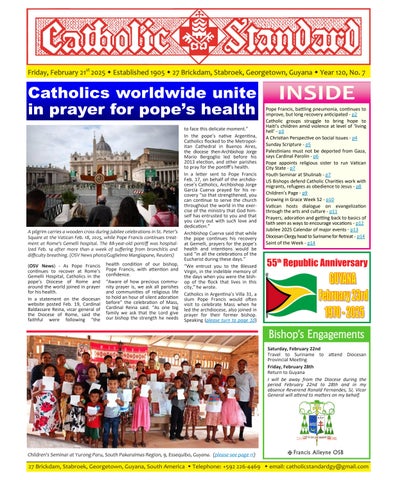
A pilgrim carries a wooden cross during jubilee celebrations in St. Peter’s Square at the Vatican Feb. 18, 2025, while Pope Francis continues treatment at Rome's Gemelli hospital. The 88-year-old pontiff was hospitalized Feb. 14 after more than a week of suffering from bronchitis and difficulty breathing. (OSV News photo/Guglielmo Mangiapane, Reuters)
(OSV News) - As Pope Francis continues to recover at Rome’s Gemelli Hospital, Catholics in the pope’s Diocese of Rome and around the world joined in prayer for his health.
In a statement on the diocesan website posted Feb. 19, Cardinal Baldassare Reina, vicar general of the Diocese of Rome, said the faithful were following “the
health condition of our bishop, Pope Francis, with attention and confidence.
“Aware of how precious community prayer is, we ask all parishes and communities of religious life to hold an hour of silent adoration before” the celebration of Mass, Cardinal Reina said. “As one big family we ask that the Lord give our bishop the strength he needs
to face this delicate moment.”
In the pope’s native Argentina, Catholics flocked to the Metropolitan Cathedral in Buenos Aires, the diocese then-Archbishop Jorge Mario Bergoglio led before his 2013 election, and other parishes to pray for the pontiff’s health.
In a letter sent to Pope Francis Feb. 17, on behalf of the archdiocese’s Catholics, Archbishop Jorge García Cuerva prayed for his recovery “so that strengthened, you can continue to serve the church throughout the world in the exercise of the ministry that God himself has entrusted to you and that you carry out with such love and dedication.”
Archbishop Cuerva said that while the pope continues his recovery at Gemelli, prayers for the pope’s health and intentions would be said “in all the celebrations of the Eucharist during these days.”
“We entrust you to the Blessed Virgin, in the indelible memory of the days when you were the bishop of the flock that lives in this city,” he wrote.
Catholics in Argentina’s Villa 31, a slum Pope Francis would often visit to celebrate Mass when he led the archdiocese, also joined in prayer for their former bishop. Speaking (please turn to page 10)
Pope Francis, battling pneumonia, continues to improve, but long recovery anticipated - p2
Catholic groups struggle to bring hope to Haiti’s children amid violence at level of ‘living hell’ - p3
A Christian Perspective on Social Issues - p4 Sunday Scripture - p5
Palestinians must not be deported from Gaza, says Cardinal Parolin - p6
Pope appoints religious sister to run Vatican City State - p7
Youth Seminar at Shulinab - p7
US Bishops defend Catholic Charities work with migrants, refugees as obedience to Jesus - p8
Children’s Page - p9
Growing in Grace Week 52 - p10
Vatican hosts dialogue on evangelization through the arts and culture - p11
Prayers, adoration and getting back to basics of faithseenaswaystoencouragevocations - p12
Jubilee 2025 Calendar of major events - p13
DiocesanClergyheadtoSurinameforRetreat - p14
Saint of the Week - p14
55th Republic Anniversary
Bishop’s Engagements
Saturday, February 22nd
Travel to Suriname to attend Diocesan Provincial Meeting
Friday, February 28th
Return to Guyana
I will be away from the Diocese during the period February 22nd to 28th and in my absence Reverend Ronald Fernandes, SJ, Vicar General will attend to matters on my behalf.
Francis Alleyne OSB
The Jubilee Prayer
Dear Editor,
We say, we all come from God, He has made us all; are we not all His children? Yes we are, and by Christian rebirth we may say, now we are sons and daughters of God. Our Lord Jesus Christ taught us to say when we pray, Our Father who art in Heaven.
We are men and women committed to follow Jesus, and the way he
Father in heaven, may the faith you have given us in your son, Jesus Christ, our brother, and the flame of charity enkindled in our hearts by the Holy Spirit, reawaken in us the blessed hope for the coming of your Kingdom.
May your grace transform us into tireless cultivators of the seeds of the Gospel.
May those seeds transform from within both humanity and the whole cosmos in the sure expectation of a new heaven and a new earth, when, with the powers of Evil vanquished, your glory will shine eternally.
May the grace of the Jubilee reawaken in us, Pilgrims of Hope, a yearning for the treasures of heaven. May that same grace spread the joy and peace of our Redeemer throughout the earth.
To you our God, eternally blessed, be glory and praise for ever.
Amen
Sons and daughters of God
took. The way of perfect obedience of His Father’s will, and of self-giving service and love. We too are called to glorify God, as Jesus glorified God on the earth. And, as we go in trustful obedience in close communion with our Lord who knows the way, there will always be upon our path, however rough, the light of peace and joy.
But make no mistake, it is a hard road. Upon itself has again and again to be denied. Temptation to shrink from suffering for Jesus’ sake has to be overcome- and a constant, bitter battle that is to wage and win:
day by day our willed journey means costly spending of ourselves upon the needs of men in body and soul, to the glory of God, Yes it is a hard road: Say rather, heroic and rich and satisfying and redeeming. Ours must be the obedience of loving hearts, of those who have learned to give and not to count the cost, to fight and not to heed the wounds, to toil and not to seek for rest, to labour and not ask for any reward save that of knowing that we do God’s will.
Leon Jeetlall
(CathNews) - Pope Francis continues to improve and the 88-year-old pontiff remains without fever and with a well-functioning heart, as he carries on his hospital recovery from double pneumonia. Source: NCR Online.
“The clinical conditions of the Holy Father are slightly improving,” announced a Feb 20 Vatican bulletin released at just after 7:30 pm local time.
“He is without fever and his hemodynamic parameters continue to be stable.”
Francis has now spent seven days in hospital, after first being admitted for a respiratory tract infection on February 14. By February 18, the Vatican acknowledged that the Pope’s condition had deteriorated and that he was battling pneumonia in both lungs.
Medical reports have repeatedly described the Pope’s clinical condition as “complex,” but in recent days, Vatican statements have trended in a positive direction.
A brief statement released earlier yesterday noted the Pope was able to
have breakfast sitting in an armchair.
Notwithstanding the long hospitalisation, papal advisers have advised against alarmism.
Vatican sources note that the Pope continues to breathe on his own, but also acknowledge a lengthy hospitalisation is likely. To date,
Francis’ longest hospitalisation was a 10-day stay in 2021 following an intestinal operation.
Despite the Pope’s closely watched medical care, business is proceeding mostly as usual around the Vatican.
High-profile cardinals are continuing to travel, nominations of new bishops are being rolled out and visitors participating in events related to the 2025 Jubilee Year are flowing through St Peter’s Square to make a pilgrimage through the Holy Door.
Even so, the Pope’s medical crisis has managed to cast a shadow over many of these activities.
At a Vatican press conference yesterday for an upcoming initiative promoting peacebuilding around the Mediterranean, many of the questions circled around the octogenarian Pope’s health.
Barcelona’s Cardinal Juan José Omella Omella told reporters that while he doesn’t have a holistic understanding of the Pope’s medical records, “it seems that he is doing much better”.
Cardinal Jean-Marc Aveline of Marseille joked that hospitalisation is the only way to get the notoriously stubborn Francis to take a break.❖
Nuns pray next to the statue of St. John Paul II outside Rome's Gemelli Hospital Feb. 20, 2025, where Pope Francis is admitted for treatment for double pneumonia. The Vatican press office said early Feb. 20 that the pope had a peaceful night, "got up and had breakfast in an armchair." (OSV News photo/Guglielmo Mangiapane, Reuters)
Votive candles and flowers are seen at the base of a statue of St. John Paul II outside Rome's Gemelli hospital Feb. 19, 2025, where Pope Francis is being treated for double pneumonia. (CNS photo/Pablo Esparza)
Catholic groups struggle to bring hope to Haiti’s
(OSV News) As the growing violence in Haiti directly impacts more and more children and teenagers, Catholic missionaries struggle to offer safe havens to regain hope and dreams of a better future.
According to the United Nations Children’s Fund, known as UNICEF, sexual violence against minors grew 1,000% between 2023 and 2024 “a staggering” number, UNICEF spokesman James Elder said Feb. 7. “Almost equally staggering is how little coverage this gruesome statistic has received. And so, if numbers have lost meaning, perhaps the children living this horror will count,” he cried out during a press conference at the Palais des Nations in Geneva as he recalled the story of 16-year-old Rosalyn, kidnapped and sexually exploited for a month until the gang kidnappers realized that there was no one to pay her ransom and let her go.
She is now under the care of the “UNICEF-supported safe house with more than a dozen other girls, all receiving care,” Elder said.
Only in 2024, the recruitment of kids by armed groups increased 70%. More than 1 million children live under the continual threat of violence. Half a million minors have been displaced by violence and 3 million will require urgent humanitarian assistance this year, with 300,000 out of school due to violence, displacement and school
closures, UNICEF said.
‘A Living Hell for the Kids’
“Over the past decade or so, life has been a living hell for the kids, especially for the poorest ones,” Father Gilbert Peltrop, secretary general of the Conference of Religious of Haiti, told OSV News. He added that extreme poverty and the state’s inaction were the major reasons for the situation’s degradation.
Both the bishops’ conference and the Conference of Religious of Haiti have continually denounced such degradation, Father Peltrop added. Missionaries face extremely dangerous situations in order to keep accompanying families and children, something that shows that they have not been completely abandoned.
“Minors are especially vulnerable to joining gangs, something that psychologically tortures us, given that those kids have a dark future ahead of them if they have any kind of future,” Father Peltrop lamented.
UNICEF estimates that 85% of the capital is now controlled by armed groups. With violence on the rise and threat to the lives of missionaries, many Catholic congregations have decided to leave Haiti. The Apostles of the Sacred Heart of Jesus decided to stay however, no matter what difficulties they would face in the future.
“We couldn’t leave them in the moment they most need us to stay,” Sister Helia Sange Moreira, a Brazilianborn member of the Apostles, told OSV News.
Congregation’s Neighborhood School
Along with four other Brazilian sisters and four Haitian ones, Sister Helia works in the congregation’s school, kept in the Santo 9 neighborhood. About 270 children frequent the institution.
“They are directly affected by the atmosphere. Even if they don’t suffer physical violence, they feel it,” she described.
Many students tell the nuns about the shots they hear in the night, the threats they receive and the overall insecurity.
“Even their games with one another are violent. Violence forms their consciousness,” Sister Helia said.
She also pointed out that more and more children have been losing their parents either because they were killed or they had to move to another province or country in order to work.
“Those kids are terribly sensitive. They come to us for emotional support, for a hug. Missionaries who come from other countries are seen by them as a special reason for hope hope of school opportunities, of having food to eat during lunch,” she added.
The Apostles of the Sacred Heart of Jesus also created a program for unemployed women to teach them cosmetology. They offer computer classes for the whole community and activities to improve the self-esteem of elderly citizens.
“I think many Catholic groups have been trying to work like that with vulnerable social sectors, especially the children. The church has limits to deal with such problems, but it’s making great efforts,” Sister Helia added.
She has been living in Haiti since 2021. In 2024, she and her colleagues were kept from leaving their house for three months due to the criminal turmoil in the city.
“We needed to stay here and show the children that we must unite and struggle together for a better world. Only that way will they be able to develop new life strategies,” said Sister Helia.❖
man and child take cover from gunfire near the National Palace in Port-auPrince, Haiti, March 21, 2024. (OSV New photo/Ralph Tedy Erol, Reuters)
Children at a school run by the Apostles of the Sacred Heart of Jesus in Port-au-Prince, Haiti, are seen in an undated photograph. Amid growing violence in Haiti, Catholic missionaries struggle to offer safe havens to regain hope and dreams of a better future. (OSV News photo/courtesy Apostles of the Sacred Heart of Jesus)
A Christian Perspective on Social Issues
By GHK Lall
National holidaysoccasions to rise
A national holiday is a special occasion. It is a time, a day, to put aside the usual wrangling. To avoid holding still to those memories that bedevil and devastate to that point where there is only a certain kind of thinking. Not my holiday, it is theirs. We all know who ‘theirs’ and they and them are represented by in this country. It is with this as context that I bring in Mashramani, a true and pure Guyanese holiday, and examine it openly. Christmas can lay claim to being a near universal holiday in Guyana. It touches in some way even those who are not believers. Then, there are religious holidays, such as Easter, Eid, and Diwali. They have their following, which is to be absorbed and understood. The national holidays honoring the arrival of Indians and the freeing of Africans have their official celebrations. But there is segmenting and duplicating. It is the way things are here, it is Guyana. A Guyana that I neither like nor ever can accept. Why should there be intervention, even interference, in what is thoroughly communal, traditional, and familial? One should have the choice, the freedom, to invite who they want to share in their celebration of what is held as a sacred day. I want that privilege, to determine who participates in my circle of joy. For ethnic-oriented holidays, this is the standard that I support. No one should foist themselves on such gatherings, nor make arrangements that compete with those whose holiday it is. This I can neither understand nor finds favor with me.
Aside from the ethnic and religious holidays, there is Mashramani, the one national holiday that is not inherited nor limited. It is Guyanese originated, Guyanese oriented, and Guyanese owned. For me, it is discomforting that there are some who didn’t use to, as I shall put it, get into the spirit. Why was this so? It was because it was seen as the creation of another national figure from another era. One whose very name still provokes considerable agitation in significant sections of this country. Today, there is this irony that pierces. The same Mashramani holiday is now the toast of those who had no use for it before. It does say a lot, doesn’t it?
About how Guyanese can be. About what grabs hold of them, and which just wouldn’t let go. For some, there is that satisfaction in holding on, not letting go, as though life itself depended on it. In a nutshell, what I see happening is this readiness (and zeal) to shift positions, to embrace the old that was once scorned and mocked, because of one key element. It depends on who is in charge, who decides that what was once disdained, turned back
on, it is now fine to enjoy without any inhibition. When a national holiday becomes the source of such dispute, more than sourness, then it does say something about how narrow the thinking is in this society. It says also how easily ordinary citizens can be manipulated, or allow themselves to be influenced. Regrettably, there are Roman Catholics, who also seem to have lost touch with that call of Jesus to brotherhood. And to think for oneself. And not be a participant in what is divisive. And to think of what aligns closely with Christian virtue. And then be a part of it. This society is too torn and too scarred to cultivate what has the potential to divide further and destroy.
A national holiday with the substance of Mashramani should not be reduced to who is for or against; who is in, and who is out. Guyanese are staring at a calendar where the months are progressing, and another month later in the year is drawing closer. Every citizen here has a responsibility-indeed, an obligation-to be a contributor to what kind of society appeals to them.
The quality of it. The unity embedded in it. The sturdiness and resilience in it that empowers it to be stronger, and to be visionary. One aspect of Catholic Social Teachings (Truths) is that the common good must be served, and that each Roman Catholic has a part to give towards that end. It is the right and duty to participate in the kind of society desired. In this Jubilee year, the call is to be a light in a dark world. Speaking for myself, there is no interest, no joy, in living in a country that is divided to the point of self not easy self should be. No Christian should partner with dividers and disrupters. A national holiday should not be about studying who is friend, who is foe. If a national holiday that is Guyanese through and through cannot unify us, help us celebrate quietly, then I lose ground in thinking that anything could. A holiday with the unique heritage of Mashramani should energize all Guyanese to feel a sense of ownership, that pride in something that belongs, in that it was born right here.
Gracious and loving God, we thank your for the gift of our priests.
Through them, we experience your presence in the sacraments. Help our priests to be strong in their vocation.
Set their souls on fire with love for your people.
Grant them the wisdom, understanding, and strength they need to follow in the footsteps of Jesus. Inspire them with the vision of your Kingdom.
Give them the words they need to spread the Gospel.
Allow them to experience joy in their ministry.
Help them to become instruments of your divine grace.
We ask this through Jesus Christ, who lives and reigns as our Eternal Priest. Amen
FIRST READING 1 Samuel 26:2, 7-9, 12-13, 22-23
The Lord put you in my power, but I would not raise my hand.
Saul set off and went down to the wilderness of Ziph, accompanied by three thousand men chosen from Israel to search for David in the wilderness of Ziph.
So in the dark David and Abishai made their way towards the force, where they found Saul asleep inside his camp, his spear stuck in the ground beside his head, with Abner and the troops lying round him. Then Abishai said to David, “Today God has put your enemy in your power; so now let me pin him to the ground with his own spear. Just one stroke! I will not need to strike him twice.” David answered Abishai, “Do not kill him, for who can lift his hand against the Lord’s anointed and be without guilt?” David took the spear and the pitcher of water from beside Saul’s head, and they made off. No one saw, no one knew, no one woke up; they were all asleep, for a deep sleep from the Lord had fallen on them. David crossed to the other side and halted on the top of the mountain a long way off; there was a wide space between them. David then called out, “Here is the king’s spear. Let one of the soldiers come across and take it. The Lord repays everyone for his uprightness and loyalty. Today the Lord put you in
In today’s Gospel, taken from the sixth chapter of Luke, Jesus offers a very challenging, seemingly impossible approach to daily life. “Love your enemies, do good to those who hate you,
my power, but I would not raise my hand against the Lord’s anointed.”
RESPONSORIAL PSALM Psalm 102
Response: The Lord is compassion and love.
1. My soul, give thanks to the Lord, all my being, bless his holy name. My soul, give thanks to the Lord and never forget all his blessings. Response
2. It is he who forgives all your guilt, who heals every one of your ills, who redeems your life from the grave, who crowns you with love and compassion. Resp
3. The Lord is compassion and love, slow to anger and rich in mercy. He does not treat us according to our sins nor repay us according to our faults. Response
4. As far as the east is from the west so far does he remove our sins.
As a father has compassion on his children, the Lord has pity on those who fear him. Resp.
SECOND READING
1 Corinthians 15:45-49
We who have been modelled on the earthly man will be modelled on the heavenly man.
The first man Adam, as scripture says, became a living soul; but the last Adam has become a life-giving spirit. That is, first the one with the soul, not the spirit, and after that, the one with the spirit. The first man, being from the earth, is earthly by nature; the second man is from heaven. As this earthly man was, so are we on earth; and as the heavenly man is, so are we in heaven. And we, who have been modelled on the earthly man, will be modelled on the heavenly man.
GOSPEL
Luke 6:27-38
Be compassionate as your Father is compassionate. Jesus said to his disciples: “But I say to you who are listening: Love your enemies, do good to those who hate you, bless those who curse you, pray for those who treat you badly. To the man who slaps you on one cheek, present the other cheek too; to the man who takes your cloak from you, do not refuse your tunic. Give to everyone who asks you, and do not ask for your property back from the man who robs you. Treat others as you would like them to treat
bless those who curse you, pray for those who mistreat you. To the person who strikes you on one cheek, offer the other one as well, and from the person who takes your cloak do not withhold even your tunic.” It makes one want to say, “Seriously, Lord?” And He doesn’t stop there. Jesus adds, “Give to everyone who asks of you, and from the one who takes what is yours do not demand it back.”
It seems so unfair! That is, unless we look at this way of life from a stewardship point of view. Then, not only does
you. If you love those who love you, what thanks can you expect? Even sinners love those who love them. And if you do good to those who do good to you, what thanks can you expect? For even sinners do that much. And if you lend to those from whom you hope to receive, what thanks can you expect? Even sinners lend to sinners to get back the same amount. Instead, love your enemies and do good, and lend without any hope of return. You will have a great reward, and you will be children of the Most High, for he himself is kind to the ungrateful and the wicked.
“Be compassionate as your Father is compassionate. Do not judge, and you will not be judged yourselves; do not condemn, and you will not be condemned yourselves; grant pardon, and you will be pardoned. Give, and there will be gifts for you: a full measure, pressed down, shaken together, and running over, will be poured into your lap; because the amount you measure out is the amount you will be given back.”❖
it seem doable (though challenging), it actually makes perfect sense. A steward understands clearly that all he has and all that he is his very life is a gift from God given to him from an unfathomable abundance of love. This changes everything! This means “my” cloak, “my” tunic, “my” money and time all of it ultimately belongs to God. He has entrusted these things to each of us in love to use for His purposes and His glory.
Does this mean we are to be passive “doormats” to anyone who wants to
take advantage of us? Certainly not. Jesus explains this in the next verse of this passage when He says, “Do to others as you would have them do to you.” There is nothing wrong with loving oneself since God loves us and has made us in His own image and likeness. Jesus is simply asking that we also approach others, and the sharing of our gifts, with this same attitude. He is giving us a definition here of real love, a steward’s love! ❖
[www.catholicsteward.com/blog/ ]
Gospel Reflection
Today’s Gospel presents us with a great challenge. Some might call it an impossible test. Jesus asks us to respond to evil with good, to answer darkness with light, to resist evil without doing further evil in the process. He tells us that our Christian duty does not end with not doing harm to our enemies. He asks us to do much more: we are to love those who hate us. We all know this is difficult to do because our natural reaction is to protect ourselves in whatever way necessary from what we feel is threatening us. Instead of treating others as we would like them to treat us, we treat them in the same way they treat us. But Jesus’ teaching makes sense if we are ever going to break out of the tit-fortat, revenge-filled way of living. Reacting to hatred with an equally powerful loving response breaks the cycle of hatred and begins a cycle of good.
Palestinians must not be deported
peace in Ukraine held in Stansstad, Switzerland, June 16, 2024. Heads of state from around the world gathered at a resort in central Switzerland for a June 15-16 summit to kick-start a peace process. (CNS photo/KEYSTONE/EDA/POOL/ Alessandro della Valle) Photo courtesy of the Federal Department of Foreign Affairs of Switzerland
ROME (CNS) The same week U.S. President Donald Trump reiterated his idea of emptying Gaza of more than 2 million Palestinians so it could become a “Riviera of the Middle East,” a top Vatican official said there must be no deportations.
Cardinal Pietro Parolin, Vatican secretary of state, said one of the “key points” of what must happen in Gaza is “no deportations.”
The cardinal spoke to reporters on the sidelines of a ceremony at the Embassy of Italy to the Holy See Feb. 13 marking the signing of the Lateran Pacts of 1929 in which the Vatican and the Italian state recognized each other as sovereign nations and normalized relations.
According to Vatican News, Cardinal Parolin told reporters that “neighboring countries are not willing (to take in refugees); we heard for example the king of Jordan recently who absolutely said ‘no.'”
An unnamed Italian official had noted that any mass deportation “would create tension in the area,” the cardinal added.
“We have to find a solution, and the solution in our opinion is a two-state solution because this also means giving hope to the people,” he said.
Cardinal Parolin also commented on a recent phone call between Trump and Russian President Vladimir Putin. Trump had told reporters Feb. 13 that he and Putin agreed to begin negotiations to end the war in Ukraine.
Later in the day he told reporters in the Oval Office that Ukraine and “other people,” too, would be involved in the peace talks.
Cardinal Parolin said, “A just peace is needed.” Diplomatic efforts are continuing and “there is lots of activity, many small openings.”
The Vatican hopes the possibilities “will materialize, and we hope that we can arrive at a peace that, in order to be solid and lasting, must be a just peace, including all the parties involved and taking into account the principles of international law and the declarations of the U.N,” he said.
“Everything that is proposed is useful because we need to put an end to this carnage,” he added. ❖
When Jesus tells us to forgive our enemies, it is not for the sake of the enemy but for our own sake. Revenge and retaliation add darkness to darkness. We will never add the light of peace and reconciliation to the world if we are quick to retaliate and seek revenge. A vindictive attitude poisons our lives with hatred. The power of love, on the other hand, is more beautiful than the power of evil. Yet it is a struggle to overcome the feelings of bitterness, hatred and revenge that rise up within us when we feel we are being badly treated by others. To forgive is never easy. It must be struggled for and prayed for. Anger, hatred and resentment cannot develop where there is humble and sincere prayer.❖
[From: Journeying with the Word of God, The Religious Education Department,Dioceseof Georgetown, Guyana ]
Trump had first said the U.S. would “take over” Gaza and “own” the strip of land, which faces the Mediterranean Sea and borders Egypt and Israel. Smaller than the West Bank – the other territory making up the Palestinian state the Gaza Strip was established as a refuge for Palestinians who fled or were forced from their homes during the war in 1948, which ended with the establishment of the State of Isreal.
Speaking alongside Israeli Prime Minister Benjamin Netanyahu at a White House press briefing Feb. 5, Trump said they were focusing on the future of the region after the 15-month-long IsraeliHamas conflict ended in a ceasefire. Gaza has been “an unlucky place for a long time,” Trump said, and it should not be rebuilt and occupied “by the same people.”
“The U.S. will take over the Gaza Strip” and “level it out” in order to “create an economic development” to create jobs and housing “for the people of the area,” he said.
Asked by reporters at the White House Feb. 9 if the U.S. would force the exodus of Palestinians, Trump said, “You’re going to see that they’re all going to want to leave,” according to The Associated Press. He claimed in an interview with Fox News the same day that Palestinians would not want to return “because they’re going to have much better housing” somewhere else.
Journeying with the Word of God
Sister Petrini, 56, was born in Rome and made her perpetual vows with the U.S.-based Franciscan Sisters of the Eucharist in 2007.
The Vatican governor's office oversees departments as diverse as the Vatican Museums, post office and police force; it has the largest number of employees of any Vatican office. In 2021 when Sister Petrini was named secretary-general of the office, she became the highest-ranking womanat the Vatican.
The position of secretary-general previously had been held by a priest, who was named a bishop shortly after becoming secretary general. The president of the office always has been a cardinal or archbishop.
MAKING THE WORD OF GOD YOUR OWN
Step 1: Lookattoday’sReadingsprayerfully.
VATICAN CITY (CNS) - Franciscan Sister of the Eucharist Raffaella Petrini, secretary-general of the office governing Vatican City State, will become president of the office March 1, the Vatican confirmed.
On an Italian television program in January, Pope Francis had announced that Sister Petrini would succeed Cardinal Fernando Vérgez Alzaga. The Vatican announcement Feb. 15 said Sister Petrini's appointment would
take effect March 1, the day Cardinal Vérgez turns 80 and is required to step down.
Appearing on talk show "Che Tempo Che Fa" Jan. 19, Pope Francis said that the process of women being given leadership roles in the Roman Curia "is something that has gone slowly," but would continue with Sister Petrini talking over the governor's office.
Sister Petrini holds a doctorate in social sciences from Rome's Pontifical University of St. Thomas Aquinas and a master's degree in organizational behavior from the Barney School of Business at the University of Hartford, Connecticut. Before being appointed secretary-general, she worked at the then-Congregation for the Evangelization of Peoples and taught courses in sociology and economics at the University of St. Thomas Aquinas.❖
Youth Seminar at Shulinab
1st Reading: Saul had made several attempts on David’s life because he had become jealous of his popularity. David, however, refused to treat Saul badly even when he could have easily captured and killed him.
2nd Reading: Paul points out that Adam was born of this world and we are all like him. Christ, the second Adam, has brought us a new life around which mercy,love andforgiveness revolve.
Gospel: Jesus leaves us in no doubt that the only way to respond to those who treat us badly is with forgiveness and understanding. Revenge has no place in a Christian’s life.
1.It is easy to give to a friend or to someone from whom we can expect something in return. This is not exceptional behaviour and it doesn’t call for much from us. As Jesus says, “Even sinners do that much.” If we love only those who love us we are not doing anything outstanding. The real test is to give to an enemy or to someone from whom we have no hope of getting anything in return. From a human point of view this may be unachievable but we know that divine help is available through prayer.
Step 3: Accepting the message of God’s Wordinyourlifeoffaith
It is easy to give to a friend or to someone from whom we can expect something in return. This is not exceptional behaviour and it doesn’t call for much from us. As Jesus says, “Even sinners do that much.” If we love only those who love us we are not doing anything outstanding. The real test is to give to an enemy or to someone from whom we have no hope of getting anything in return. From a human point of view this may be unachievable but we know that divine help is available through prayer.
Step 4: Somethingtothink&prayabout
1.Reflect on your life. Think about all those who continue to love you and treatyou withrespect in spite of your failings and who never turn their backs on you when you disappoint them by what you say and do. In your prayers, thank God for such people. Do you ever try to act in the same way to others? ❖
[From: Journeying with the Word of God, The Religious Education Department, Diocese of Georgetown, Guyana ]
came from Shulinab and its Adapted from St Ignatius
Franciscan Sister of the Eucharist Raffaella Petrini, secretary-general of the office governing Vatican City State, will become president of the office March 1, the Vatican confirmed. (CNS photo/Pablo Esparza)
with migrants, refugees as obedience to Jesus
Migrants seeking asylum in the U.S. walk into a temporary humanitarian respite center run by Catholic Charities of the Rio Grande Valley in McAllen, Texas, April 8, 2021. (OSV News photo/Go Nakamura, Reuters)
(OSV News) The numbers alone are impressive: 16 million people and 28 million meals served; services supporting strong families for 500,000 clients; basic needs and emergency financial services for 2.8 million people; behavioral health and wellness services for 526,000 individuals; 2.8 million nights of emergency shelter; emergency housing services for 295,000 without lodging; 52 disasters responded to in the U.S. and its territories.
These figures represent the work of Catholic Charities USA and its 168 diocesan affiliate agencies, work that has come under scrutiny by Vice President JD Vance, himself a Catholic, and some in the media.
In a Jan. 26 interview on CBS’s “Face the Nation,” Vance questioned the motives of the U.S. bishops’ criticism of the new Trump administration’s hardline immigration policies including allowing raids on churches and schools asking whether it had more to do with losing federal resettlement funding and “their bottom line.”
Fox News Channel’s Laura Ingraham, also a Catholic, said in a Jan. 29 broadcast, “I mean, no one wants to criticize Catholic Charities, but you can’t be facilitating illegal immigration.”
Vigorous Rebuttal
Such claims have ignited a vigorous rebuttal from U.S. Catholic bishops in defense of the church’s charitable agencies.
“Certain news outlets continue to make claims that Catholic Charities participates in illegal immigration and human trafficking, earning large profits while doing so,” Bishop Kevin C. Rhoades of Fort Wayne-South Bend, Indiana, said in a Feb. 3 message to the faithful.
“As your Bishop and Chairman of the Board of Catholic Charities of the Diocese of Fort Wayne-South Bend, I can assure you these are false claims levied against our Catholic Charities agency.”
“The complete opposite is true,” he said. “Our diocesan Catholic Charities participates in pathways for legal immigration and supports survivors of human trafficking, while operating those programs at a fiscal deficit.”
According to Catholic Charities USA, only 5% of the services provided by its agencies last year were immigration and refugee services.
“Catholic Charities agencies serve migrants not because they are newcomers to the U.S., but because they are vulnerable and in need, like all those we serve. This work is a response to the Gospel mandate to feed the hungry, clothe the naked and welcome the stranger,” the CCUSA website states.
Essential Services
Catholic Charities agencies provide essential services, such as food, clothing and a place to sleep, as part of how the church puts the Gospel mandate from Jesus Christ into action.
Federal, state, and local governments have asked some Catholic Charities agencies especially those near the U.S.-Mexico border to assist migrants the federal government has processed and released with pending immigration court proceedings. Others also offer legal assistance to migrants navigating the complicated immigration legal system.
Such assistance, Bishop Rhoades emphasized, should not be mistaken for abetting illegal immigration especially since federal authorities have regularly brought migrants to local Catholic Charities agencies after processing them through U.S.-Mexico ports of entry.
“This does not mean that we support open borders and disregard the rule of law,” he said.
“While the Catholic Church recognizes and respects the right of every nation to regulate its borders for the common good, we must balance this with the rights of vulnerable migrants to access protection, and with the fundamental right of all to life and dignity as human persons; as well as,” Bishop Rhoades added, “the rights of parents and the family, the cradle of life and love, the first and most vital cell of society.”
Bishop Rhoades also explained how Catholic Charities worked as a “contracted resettlement agency” working under the U.S. Conference of Catholic Bishops.
“Funds received are used to provide financial support for the first 90 to 240 days after arrival, until the refugee families become economically selfsufficient; provide immigration legal services as they study to become U.S. citizens; as well as to partially pay for the staff that provide those services,” he said.
In his own diocese, he said, Catholic Charities in the latest fiscal year “received $3.0 million in contract revenue and spent $3.2 million to administer the program.”
Bishop Joseph J. Tyson of Yakima, Washington, also spoke out concerning immigration and refugees in his Feb. 2 pastoral letter, “A Light for the Gentiles,” citing his six years leading the U.S. bishops’ efforts for the pastoral care for migrants and refugees. He had sharp words specifically for Vance’s “Face the Nation” claims.
Commands From Jesus
“We follow the command to ‘love our neighbor’ and to ‘welcome the stranger,’ which are commands from the words of Jesus himself,” Bishop Tyson said, rejecting charges that the church’s assistance encourages illegal activity or profits from its immigration efforts.
“We receive no money to resettle ‘illegal’ migrants,” he said. But when it resettles refugees, he said the church loses money “on every resettlement.”
“The government contracts do not cover the cost of resettlement,” he explained.
He noted Washington state no longer has a Catholic Charities office that offers these services, because the church “could not sustain the loss.”
“In Central Washington, neither the Diocese of Yakima nor Catholic Charities receive any money from the government for resettling refugees or migrants. Not a single penny!” he said. The bishop’s diocese is located in one of the world’s leading sources of apples and other produce, largely harvested through migrant labor. Any welcome extended to migrants, refugees and asylum-seekers, he said, is due to the diocese’s generous parishioners.
‘Our Fellow Parishioners and Neighbors’
Bishop Tyson emphasized that people without legal immigration status are “our fellow parishioners and neighbors.” Regarding them, he shared how hundreds of Catholic youth in his diocese now fear their parents may be deported. He condemned Vance’s eager affirmation of deliberately instilling fear such as by making schools generally open to immigration raids as an immigration enforcement tactic.
“That the vice president who refers to himself in the CBS interview as a devout Catholic would want to engender fear as a tactic is deeply disturbing,” he wrote. “It’s also contrary to the teaching of Christ and the teachings of the Church.” Bishop Rhoades also denounced attacks on the U.S. Refugee Admission Program, or USRAP, which his diocesan
Catholic Charities agency has participated in since that federal program was launched in 1980.
“USRAP is the formal process by which people are legally resettled in the United States as refugees. Resettlement through USRAP is distinct from the U.S. asylum process,” he said.
‘Screened, Vetted, Approved’ Individuals resettled through USRAP are “screened, vetted, and approved by the U.S. government while outside of the United States,” he explained.
Bishop Tyson likewise in his letter emphasized that refugees resettled by the Catholic Church underwent 12-24 months of screening.
“That screening is conducted by the federal government itself. So, if there’s a problem with screening, it’s not because we have failed the federal government as a partner,” he said. “It’s because the federal government has failed us.”
More bishops have come to the fore to defend the church’s ministries to migrants and refugees.
In a Jan. 24 interview with Vatican News, Archbishop Timothy P. Broglio of the U.S. Archdiocese for the Military Services, president of the USCCB, likewise talked about the U.S. church’s “tremendous network of Catholic Charities, of migration services that respond to people in these difficult situations and we want to make those possibilities available to those most in need.”
Vance’s Comments ‘Harmful’ Cardinal Timothy M. Dolan of New York, who offered prayers at both of President Donald Trump’s inaugurations also expressed frustration with Vance’s comments on “Face the Nation” calling them “not only harmful” but demonstrably “not true,” pointing to the church’s audited financials.
“You think we make money caring for the immigrants? We’re losing it hand over fist,” Cardinal Dolan said Jan. 29 on his SiriusXM Catholic Channel. He said Vance’s remarks were a “let down” from “a guy that struck me as a gentleman and a thoughtful man and from whom I’m still expecting great things.”
At the same time, Bishop Mark J. Seitz of El Paso, Texas, who heads the U.S. bishops’ migration committee, told attendees at a Georgetown University event Feb. 12 that he wanted to offer the vice president an opportunity to dialogue over the church’s work with migrants and refugees.
Vance Is ‘Misinformed’
“I would love to sit down sometime with Vice President Vance and talk to him about these issues in regard to our resettlement work and things like that because he clearly has been misinformed,” he said.
“That is so unfortunate when it comes from a person who has a loud megaphone,” Bishop Seitz said. “It can be very harmful to this work of the church to very vulnerable people.” ❖
Dear Boys and Girls,
One day Jesus was teaching outdoors. In his sermon, Jesus said some things that really surprised his listeners. "You have heard that you should love your neighbors and hate your enemies," Jesus said. "But I say, love your enemies and if someone does mean and hateful things to you, pray them."
Why should we love our enemies? Jesus said that when we love our enemies, we are acting like children of God. If we only love those who love us, will God reward us for that? If we are only kind to our friends, what is so great about that? Everybody does that!
It isn't always easy to love your enemies, but there are some good reasons for doing it.
• It demonstrates the love of God to others.
• It sets a good example for others to follow.
• It turns enemies into friends. Father, it is easy to love those who love us. Help us to love our enemies so that they might know that we are your children. In the name of Jesus we pray. Amen.❖
“Do to others as you would have them do to you.”- Luke 6:31
Worshippers attend a Mass at the Metropolitan Cathedral in Buenos Aires, Argentina, Feb. 19, 2025, to pray for Pope Francis’ health, as the Archdiocese of Buenos Aires calls on all churches in Argentina to hold Masses for the pontiff’s quick recovery. (OSV News photo/Pedro Lazaro Fernandez, Reuters)
with the Associated Press, Claudia Doldan, a resident of the slum, said she was saddened because of his “delicate health.”
“I know the pope. In that time, Bergoglio would wash the feet (of people) here in the neighborhood. The whole neighborhood is united in prayer; the pope is in our prayers.”
Prayers also came in from Canada, with Bishop William McGrattan of Calgary, Alberta, president of the Canadian bishops’ conference, assuring in a Feb. 19 message that the country’s faithful and the bishops are “praying for the full recovery of the Holy Father, Pope Francis, as he continues to lead the Church with courage and a generosity of spirit.”
Catholics in Asia, including China, have rallied to pray for the pope. Catholic news site xinde.org in mainland China urged readers to “pray for the pope through the Holy Mass, Eucharistic Adoration, the Rosary, the Chaplet of Divine Mercy, and other devotions.”
“Let us also accompany the pope by observing fasting and penance, praying that the Lord may assist and bless him with a swift recovery,” the site read.
While the fragile ceasefire in Gaza continues, Catholics in the region joined in prayer for the pope’s health. In a video posted by DRM News, an online news outlet, an unnamed Palestinian in Gaza expressed gratitude to the pope who “communicated with us amid the war and the conflicts that Gaza has endured.”
“And now, from his sickbed, from his hospital bed, he continues to reach out to check on his children in Gaza,” he said. “This gives us reassurance and confidence that we are well, that we are in his thoughts. We pray for him
and wish him a full recovery.”
Despite the seriousness of his condition, which has forced him to cancel all events and meetings, the pope did not want to miss his daily call with Father Gabriel Romanelli, pastor of Holy Family Church in Gaza
In an interview with Vatican News published Feb. 17, Father Romanelli said Pope Francis called “during the first two days of his hospitalization.”
“He asked how we were, how the situation was, and he sent us his blessing People expressed their closeness to him; he thanked them and gave his blessing.”
“We heard his voice. It’s true, he is more tired,” the parish priest continued. “He himself said: ‘I need to take care of myself.’ But his voice was clear, and he listened to us well.”
However, on the evening of Feb. 16, as the complexity of the pope’s condition became more serious, parishioners in Gaza had “no expectation of communication with the pope.”
Nevertheless, Father Romanelli said, “he sent me a short message saying he was grateful for the closeness and prayers and reciprocated with his blessing.”
“We hope that his recovery happens soon and that he can return to St. Peter’s to continue his mission and his work,” he added. ❖
By Renika Anand
A new dawn, A new day
Richie Norton, an author and entrepreneur once said “Every sunset is an opportunity to reset. Every sunrise begins with new eyes.”
The period of youth is characterised by many failures and mistakes. However, it is also characterised by growth and change. When we learn to walk as infants, we rarely take steady steps immediately. We fall and struggle to find our balance several times before we truly begin to walk smoothly. Similarly, life involves a learning period where we must face several situations and learn from them before we can become the best versions of ourselves.
Sometimes, our mistakes and failures, though natural, can become a limitation to our growth. They can discourage us from making new attempts in the things that truly matter. In moments like those, it is crucial for us to remember that life is dynamic - that yesterday will not repeat itself as long as our actions are different today. We must learn to find beauty even in the small mistakes that we make, and find ways to make use of opportunities in every day that we receive.
“Forget the former things; do not dwell on the past. See, I am doing a new thing! Now it springs up; do you not perceive it? I am making a way in the wilderness and streams in the wasteland.” - Isaiah 43:18-19 ❖
Vatican hosts dialogue on evangelization through the arts and culture
VATICAN CITY (CNS) Evangelizing through culture is a challenge for the church, especially in societies where faith is seen as “something alien,” participants said at a Vatican-sponsored discussion on faith and culture.
“The church needs to have a good relationship with the arts,” said Stephen Callaghan, a playwright and director of the Archdiocese of Glasgow Arts Project, which, since 2006, has allowed artists of all backgrounds to have a “positive encounter with the Catholic Church.”
“The arts are about exploring what it means to be human, and the incarnation of Jesus Christ changed that forever,” he said Feb. 17 during a meeting of representatives of Catholic cultural centers from around the world at the Vatican.
The gathering, held at the Vatican as part of the Jubilee of Artists and the World of Culture Feb. 15-18, brought together representatives of Catholic cultural centers and church bodies dedicated to culture.
Callaghan said the church should not shy away from expressing its values through the arts, and he pointed to his organization’s faith-inspired performances as examples of how culture can become a bridge to evangelization.
A ‘custodian of truth, beauty and goodness’
His project organizes initiatives like LentFest, an annual festival of performances, exhibitions and discussions hosted by the Archdiocese of Glasgow, as well as productions at the Edinburgh Festival Fringe, the world’s
largest performing arts festival.
Last year’s performance on Antoni Gaudí, the architect behind Barcelona’s Basilica of the Holy Family, often referred to by its Spanish name as the Sagrada Familia, drew a sold-out audience.
“The church is not a moral watchdog on the arts it is the custodian of truth, beauty and goodness, and it is therefore of the utmost importance in restoring hope,” he said.
Cardinal José Tolentino de Mendonça, prefect of the Dicastery for Culture and Education, hosted the meeting on the theme, “Artisans of Hope” and underscored the urgency of overcoming the “divorce between culture and faith” identified in the Second Vatican Council’s Pastoral Constitution on the Church in the Modern World (“Gaudium et Spes“).
Among the speakers was Thomas Landy, director of the McFarland Center for Religion, Ethics and Culture at the College of the Holy Cross in Worcester, Massachusetts. Landy described how his institution works to counteract a “dystopian vision of the world” prevalent in U.S. culture.
Through lectures, conferences and educational media projects, Landy said, the center offers “a witness that bravely looks at all kinds of aspects of American life” and helps students discern “how to shape a meaningful life and engage hopefully in the world.”
Creating ‘hope for the wider culture’
One of the center’s flagship initiatives is a project that develops multimedia teaching resources on how Catholicism is lived in different cultures. The
center publishes a journal on global Catholicism and produces an online archive of audiovisual materials that document contemporary Catholic practices around the world, offering educators and students tangible ways to explore the Church’s cultural diversity.
While many students sense “a certain inevitability” about US. culture continuing to become more and more secularized, he said, “they can look at other places in the world that are industrialized and changing in all sorts of ways where the same story isn’t holding true.”
Paul Burghart, director of extension programs at Benedictine College in Atchison, Kansas, said the college’s “Transforming Culture in America” initiative seeks “to take the academic learning that’s going on in the classroom and form students to be able to go out and transform the culture.”
The college hosts conferences featuring Catholic scholars, policymakers and artists who address contemporary cultural challenges through a faithbased lens, he said. Additionally, it provides students with hands-on experiences in leadership and service, such as participating in pro-life advocacy, engaging in urban outreach missions and collaborating with Catholic media to produce content that reflects Church teaching on human dignity.
As such, Burghart said the college seeks to give “hope to the students,” but also to form students who become “hope for the wider culture.”❖
Children's Seminar at Yurong Paru
Last Saturday February 15th, the Ursuline Sisters of Tildonk conducted a children’s seminar at Yurong Paru, South Pakaraimas Region, 9,
Essequibo, Guyana. The seminar focused on three key topics: My Life’s Journey, Eucharist/Response, and Mother Mary.
A total of seventeen children, two Catechists, and three mothers participated in the event.❖
(Adapted from Catholic Media Guyana Facebook page)
Vatican Museum. (Shutterstock)
Prayers, adoration and getting back to basics of faith seen as ways to encourage vocations
NAPLES, Fla. (OSV News) Prayers and fasting, eucharistic adoration and getting back to the basics of the Catholic faith are some of the ways the laity can encourage priestly and religious vocations in 2025.
Those were among the recommendations that a panel of lay and religious offered during the 2025 Legatus annual summit for Catholic business men and women Feb. 6-9 at the RitzCarlton in Naples. Some 700 people attended the three-day national gathering.
New Jersey native Sister Pia Jude, who entered the Sisters of Life community in 2013 after law school and a short law career in New York City’s Wall Street district, recalled the importance of a strong parish engagement within her family.
“Parish life for me was everything I was a little altar server and that meant being so close to the Lord standing up there, being involved in the parish and the parish and having eucharistic adoration Holy Hours available to the young does make a difference,” said Sister Pia Jude, who has an identical twin sister, Sister Luca Benedict, also a Sister of Life.
Sister Pia Jude currently lives at Annunciation Motherhouse in Suffern, N.Y., and serves as an assistant to Mother Mary Concepta, superior general of her order.
“We had a priest in our parish and his thought was to have a Holy Hour for the parish pro-life society that my
mom was part of she brought her two little daughters to this Holy Hour,” Sister Pia Jude said.
“And so sitting before Our Lord in the Eucharist praying; I didn’t really know how to pray but I knew Jesus was there,” she added.
“I do think that we’re planting seeds we don’t even know and that I couldn’t have articulated back then, but the Lord showed me later on as I was in religious life that ‘I’ve seen you and I’ve known you from this moment. I saw you there, I was calling you, I was drawing you.'”
“Those confirmed my vocational graces, those were bedrock for me,” Sister Pia Jude told the Legatus audience. Also on hand was Father John Burns, a priest of the Archdiocese of Milwaukee ordained in 2010 and author of “Lift Up Your Heart: A 10-Day Personal Retreat with St. Francis de Sales.” He is the founder of Friends of the Bridegroom, an apostolate dedicated to the renewal of the church through the renewal of women’s religious life.
Father Burns noted that canon law defines religious life as the most perfect way to imitate Christ, “not meaning that it is better than other states in life, but it is the fullest way you can cling to Christ, and it is given to us so that the world may see something of what it looks like to being completely to Christ,” he said.
Recent decades of secularism, clericalism and scandals among the clergy
Jason Shanks, CEO of the National Eucharistic Congress Inc. which recently announced its next national congress will be held in 2029, told the gathering of his work as a layman organizing a Catholic youth summer camp in Ohio in 2000, replete with jet skis, a ropes course and other adventure sports.
“The kids would leave and would say, ‘We came for the adventure but what we got out of it was the Mass, the adoration, the worship,” Shanks said.
“I think the parents would send the kids for the jet skis and the high ropes course but were tickled and touched that they came back talking about Jesus.”
What families need to do is carve out more quiet and reflective time for youth to escape the pressures and distractions of daily life in order to discern their calling, according to Shanks. He agreed with Sister Pia Jude that adoration time is a great time and place for such discernment.
“We live in a world of so much distraction and so much pressure on these kids that we need to create that space of silence so they can discern what the voice of the Lord is doing in their life,” he said, adding that last year’s Eucharistic congress seemed to renew the participating clergy and hierarchy as well.
brought the church to a place where many priests are themselves embarrassed by their priestly vocation and identity, he added. They may, as a result, have backed away from the supernatural and attempted to make religious life look more normal and approachable.
“But it isn’t normal; it is supernatural,” Father Burns said of religious vocations.
“I would never trade this life given a thousand times to redo things I would never choose another pathway,” he said.
“And as a church we are getting comfortable saying, ‘We need holy priests and we need holy sisters and it would be a gift if my son or my daughter were called to that.’ It would be an honor if God might be interested in your son, your daughter, your granddaughter, your grandson and to encourage them in that,” Father Burns said.
He also recommended parishes and the laity adopt prayer, fasting and alms to ask God for an increase in vocations even if the fruits of those efforts are notrealizedinthe short run.
“We have to believe that God wants his church renewed, that God wants holy priests, holy marriages and holy religious and that he is the one doing the work and we have to align with his will,” the priest added. “Be willing to say, God, what do you want to do; how do you want to mobilize us to renew your church?”
“All of us in Legatus can be part of that healing solution as this revival moves forward and to love and encourage our priests and our religious and our families every day,” Shanks said.
EWTN’s Colm Flynn, who moderated the vocations conversation, added his recollection of reporting from 2023’s World Youth Day Lisbon in Portugal, and how the event featured a broad range of activities both traditional and secular.
The morning of the final day before the closing World Youth Day Mass with Pope Francis featured a DJ priest “who for 40 minutes did this really loud techno set” of music, Flynn said.
“Not one person we interviewed said that was the highlight that touched me, that made me think differently. It was the Eucharist, or the priest who led late night discussions they remembered.”
“There is this idea that if we don’t be more like the world, they won’t come for us, rather than, ‘Let’s invite the world to be more like the Gospel,'” Flynn added.
“A priest I know back in Scotland who had been in Angola for 30 years said to me: ‘You have to tell more young people that besides the supernatural aspect, it is a great exciting life. You travel, you meet people. He said the church needs to be not arrogant but more bold and say, ‘This is the best thing you could ever do with your life.'”❖
Sister Pia Jude, a Sister of Life, speaks on a panel Feb. 8 at the 2025 Legatus International Summit in Naples, Fla., during a conversation on vocations to the priesthood and religious life. Also on the panel are Jason Shanks, CEO of the National Eucharistic Congress Inc, and Father John Burns, a priest of the Archdiocese of Milwaukee. (OSV News photo/Tom Tracy)
of the Week
to Suriname for Retreat
Oguejiofor, and Joel Rathna will be away from the Diocese of Georgetown from Saturday 22nd to Friday 28th February.
Bishop Alleyne, along with the Diocesan clergy, will gather in Paramaribo, Suriname, over these few days to reflect and pray. In an invited comment to Catholic Media Guyana, Vocations Director Fr. Carl Philadelphia stated that the Diocesan priests' retreat is a time for prayer, renewal, and opening themselves to grace by engaging with the Word of God. He further noted that, especially in the Jubilee year, it can help deepen their relationship with God, with each other, and with God’s people. Additionally, it serves as an opportunity to examine theirconsciencesandrecharge their sense of purpose as priests in service of the Church in Guyana.
The retreat will be conducted by Fr. Don Chambers, a priest for over two decades who currently serves as the General Secretary of the AEC. Fr. Don is a Diocesan Priest from the Archdiocese of Kingston, Jamaica. Prior to his role as General Secretary of the AEC, he held many positions, including National Director for Pontifical Mission Societies, Vocation/ Formation Director for the Archdiocese of Kingston, and Director of Priestly Formation and the Pre-Seminary Programme, just to name a few.
We ask that you keep our Bishop and Diocesan priests in your prayers as they participate in their retreat.❖(Catholic Media Guyana)
Fatima Youth Group meets
February 27th Saint Gabriel of Our Lady of Sorrows
Born in 1838 in Italy into a large family and baptized Francis, Saint Gabriel lost his mother when he was only four years old. He was educated by the Jesuits and, having been cured twice of serious illnesses, came to believe that God was calling him to the religious life. Young Francis wished to join the Jesuits but was turned down, probably because of his age, not yet 17. Following the death of a sister to cholera, his resolve to enter religious life became even stronger and he was accepted by the Passionists. Upon entering the novitiate he was given the name Gabriel of Our Lady of Sorrows.
Ever popular and cheerful, Gabriel quickly was successful in his effort to be faithful in little things. His spirit of prayer, love for the poor, consideration of the feelings of others, exact observance of the Passionist Rule as well as his bodily penances always subject to the will of his wise superiors made a deep impression on everyone.
His superiors had great expectations of Gabriel as he prepared for the priesthood, but after only four years of religious life symptoms of tuberculosis appeared. Ever obedient, he patiently bore the painful effects of the disease and the restrictions it required, seeking no special notice. He died peacefully on February 27, 1862, at age 24, having been an example to both young and old.❖ [www.franciscanmedia.org ]
held its first meeting of the year last Sunday, February 16th. the year were pitched by the members. Let's keep our youths
Fatima Youth Group FB page
Bishop Francis Alleyne OSB, Msgr. Terrence Montrose, and Fathers Carl Philadelphia, Francis Savarimuthu, Uchenna Joseph