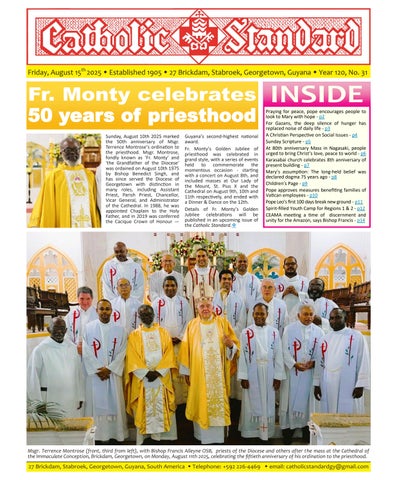

50 years of priesthood

Sunday, August 10th 2025 marked the 50th anniversary of Msgr. Terrence Montrose’s ordination to the priesthood. Msgr. Montrose, fondly known as ‘Fr. Monty’ and the Grandfather of the Diocese’ was ordained on August 10th 1975 by Bishop Benedict Singh, and has since served the Diocese of Georgetown with distinction in many roles, including Assistant Priest, Parish Priest, Chancellor, Vicar General, and Administrator of the Cathedral. In 1988, he was appointed Chaplain to the Holy Father, and in 2019 was conferred the Cacique Crown of Honour
Guyana’s second-highest national award.
Fr. Monty’s Golden Jubilee of priesthood was celebrated in grand style, with a series of events held to commemorate the momentous occasion - starting with a concert on August 8th, and included masses at Our Lady of the Mount, St. Pius X and the Cathedral on August 9th, 10th and 11th respectively, and ended with a Dinner & Dance on the 12th.
Details of Fr. Monty’s Golden Jubilee celebrations will be published in an upcoming issue of the Catholic Standard.❖
Praying for peace, pope encourages people to look to Mary with hope - p2
For Gazans, the deep silence of hunger has replaced noise of daily life - p3
A Christian Perspective on Social Issues - p4
Sunday Scripture - p5
At 80th anniversary Mass in Nagasaki, people urged to bring Christ’s love, peace to world - p6
Karasabai church celebrates 8th anniversary of present building - p7
Mary’s assumption: The long-held belief was declared dogma 75 years ago - p8
Children’s Page - p9
Pope approves measures benefiting families of Vatican employees - p10
PopeLeo’sfirst100daysbreaknewground - p11
Spirit-filled Youth Camp for Regions 1 & 2 - p12
CEAMA meeting a time of discernment and unity for the Amazon, says Bishop Francis - p14


On the feast of the Assumption, pope prays for peace, encourages
The Jubilee Prayer

Father in heaven, may the faith you have given us in your son, Jesus Christ, our brother, and the flame of charity enkindled in our hearts by the Holy Spirit, reawaken in us the blessed hope for the coming of your Kingdom.
May your grace transform us into tireless cultivators of the seeds of the Gospel.
May those seeds transform from within both humanity and the whole cosmos in the sure expectation of a new heaven and a new earth, when, with the powers of Evil vanquished, your glory will shine eternally.
May the grace of the Jubilee reawaken in us, Pilgrims of Hope, a yearning for the treasures of heaven. May that same grace spread the joy and peace of our Redeemer throughout the earth.
To you our God, eternally blessed, be glory and praise for ever.
Amen


Message


CASTEL GANDOLFO, Italy (CNS)
Mary’s “yes” to God, to life and to love continues “in the martyrs of our time, in witnesses of faith and justice, of gentleness and peace,” Pope Leo XIV said as he celebrated Mass on the feast of Mary’s Assumption into heaven.
In the small parish Church of St. Thomas of Villanova on the main square of Castel Gandolfo, the pope celebrated the Mass Aug. 15 before going to the doorway of the nearby papal summer villa to lead the recitation of the Angelus prayer.
The Mass and prayer took place hours before U.S. President Donald Trump and Russian President Vladimir Putin were scheduled to meet in Alaska to talk about steps toward ending Russia’s war on Ukraine.
During the Mass, one of the prayers of the faithful was: “For peacemakers, that guided by God’s plan to unite all humanity in one family and inspired to promote the true progress of peoples, they would serve the common good with love.”
After reciting the Angelus, Pope Leo told an estimated 2,500 people in the square, “Today we want to entrust to the intercession of the Virgin Mary, assumed into heaven, our prayer for peace. She, as a mother, suffers for the evils that afflict her children, especially the little ones and the weak.”
Often, he said, “we feel powerless in the face of the spread of violence across the world a violence increasingly deaf and indifferent to any impulse of humanity. And yet, we must not stop hoping. God is greater than the sin of human beings.”
“We must not resign ourselves to the dominance of the logic of conflict and weapons,” the pope said.
“Through Mary, we believe that the
Lord continues to come to the aid of his children, remembering his mercy. Only in his mercy can we find the path to peace.”
The Gospel reading at the morning Mass included Mary’s “Magnificat,” which proclaimed the great things God had done for her and her certainty that God already had fulfilled his promise to rescue the poor and oppressed.
Still today Mary’s canticle “strengthens the hope of the humble, the hungry, the faithful servants of God,” the pope said. “These are the men and women of the Beatitudes who, even in tribulation, already see the invisible: the mighty cast down from their thrones, the rich sent away empty, the promises of God fulfilled.”
The kingdom belongs to God, the pope said, but like Mary, saying “yes” to God’s love “can change everything.”
“On the cross, Jesus freely uttered that ‘yes’ which would strip death of its power the death that still spreads wherever our hands crucify and our hearts remain imprisoned by fear and mistrust,” the pope said. “On the cross, trust prevailed; so did love, which sees what is yet to come; and forgiveness triumphed.
”
In a world that often seems resigned to evil, selfishness and “contempt for the poor and lowly,” he said, the church “lives in her fragile members, and she is renewed by their Magnificat.”
“Even in our own day, the poor and persecuted Christian communities, the witnesses of tenderness and
forgiveness in places of conflict, and the peacemakers and bridge-builders in a broken world, are the joy of the church,” Pope Leo said. “Many of them are women.”
The pope ended his homily praying that all Catholics would look to their example and learn to sing with Mary, “He who is mighty has done great things for me.”
“Let us not be afraid to choose life! It may seem risky and imprudent. Many voices whisper: ‘Why bother? Let it go. Think of your own interests,'” he said. “These are voices of death.”
“But we are disciples of Christ. It is his love that drives us soul and body in our time. As individuals and as the church, we no longer live for ourselves. This and only this spreads life and lets life prevail.”❖

Pope Leo celebrates Mass for the Solemnity of the Assumption of the Blessed Virgin Mary at the Pontifical Parish of Saint Thomas of Villanova in Castel Gandolfo, Italy, Friday August 15, 2025. (@Vatican Media)
hunger has replaced noise of daily life

(OSV News) The streets of Gaza are quieter than they used to be not because peace has returned. The deep silence of hunger has replaced the noise of daily life.
Every corner bears the marks of a deepening humanitarian catastrophe: gaunt faces of children, long lines at makeshift aid points, and parents who have nothing left to give but words of comfort and prayer.
The humanitarian collapse in Gaza did not happen overnight. On March 2, the Israeli Defense Forces sealed all crossings into the enclave 16 days before the collapse of the temporary ceasefire between Israel and Hamas. With borders sealed, the already limited flow of food, medicine and fuel stopped entirely. Within weeks, hunger and malnutrition spread at an unprecedented pace. Preventable diseases began to take hold.
Dyingfromfamineandmalnutrition
By early August, the Hamas-run Ministry of Health in Gaza reported 201 people had died from famine and malnutrition since the start of the war, including 98 children. Those numbers rise daily.
In the middle of Gaza City, amid rubble and market stalls selling a handful of overpriced simple popular sweets, 35year-old Ahmed al-Sawafiri described the reality of survival:
“Out of poverty, we have children we want to feed nothing more or less,” he said in an interview for Catholic Near East Welfare Association, or CNEWA. “The situation in general is really difficult, really tragic, and we hope from God things get better.” Hunger, he added, is now part of everyday life. “The famine is great; children sometimes sleep without eating. What can we do? We just need to get by. It’s all in God’s will.”
‘We ask God that things get better’ For Sawafiri, faith is both a comfort and a lifeline. “Hopefully for the better,” he said, glancing at the street around him. “We ask God that things get better.” A few steps away, a boy in a small stall, barely tall enough to see over the market crowd, spends his days trying to earn enough to support his eight siblings, “so we can eat and live, and feed
my little siblings.” Abdul Rahman Barghouth, 12, dreams of school, but for now his hope is that “the war ends, and prices go down.”
Faith runs through these conversations as naturally as breath. People speak of God’s will even as they recount the impossible choices they face, whether to send a child to line up for aid despite the risk of shelling, whether to sell the last piece of jewelry for a bag of rice, whether to skip their own meal so a child can eat.
‘We have no income, nothing left to sell’
For 54-year-old Mozayal Hassouna, those choices leave deep emotional scars. “Some days we spent four days without bread,” she said. “My youngest son tells me, ‘You let me go to sleep hungry, Mom.’ But I can’t provide anything. My husband is 65 and sick; he can’t run after trucks for aid. We lost our stall in the market; our house was bombed like others. We have no income, nothing left to sell, but we do not object to God’s will.”
Her son has developed a stutter, which a doctor says is the result of trauma from bombardment. Now they live in a tent, displaced for two months. “I hope the war ends all over Gaza,” she says. “Let us live, and the children live a little.”
No story captures the cruel intersection of war, siege and hunger clearer than that of 2-year-old Muhammad AlMutawaq. His mother, Hidaya, has been displaced seven times since the war began on Oct. 7, 2023, sparked by Hamas’ attack on Israel.
Her husband was killed early in the conflict in Jabalia, leaving her alone with four children. Before the recent escalation, Muhammad weighed 20 pounds. Today, he weighs just 13.
Gaza’s borders are closed
“There is no aid entering Gaza,” she told CNEWA. “Borders are closed; prices are very high. His only cure is to eat and drink.”
She has tried hospitals, aid groups and community kitchens, but nothing has been enough. “I registered in many associations as a mother of orphans, but I didn’t benefit at all,” she said. “I
got really tired going to hospitals, associations, schools, trying to find something for him.”
Muhammad suffers from muscle relaxation, worsened by malnutrition. Physical therapy has helped, but without proper food, recovery is impossible.
“Since I lost my husband, these are all God’s tests,” she said. “We will be patient, and hopefully it will end, and Muhammad will be like he used to be.”
It’s a ‘man-made catastrophe’ UNICEF spokesperson Salim Oweis calls the situation “a man-made catastrophe.” He warns hunger is now killing children in staggering numbers. “Over 90 have died from malnutrition since the war began a staggering increase of more than 50 percent in less than three months,” he said. “We are witnessing a generation growing up with toxic stress, deprivation and trauma that will probably last a lifetime.”
In July, nearly 12,000 children were diagnosed with acute malnutrition, compared with 2,000 in February.
The Integrated Food Security Phase Classification, a collaborative initiative of worldwide crisis relief organizations, including UNICEF, warned in mid-July that Gaza’s food consumption and nutrition indicators were at their worst since the war began. More than one in three people were going days at a time without eating, and half a million people nearly a quarter of Gaza’s population were enduring faminelike conditions.
“Every hour we wait, more children will die if not from bombs, then from the humanitarian crisis that follows them around every corner,” Oweis said. While some aid trickles in the IDF controls what little aid is allowed into Gaza he described it as “a drop in the ocean of needs.”
Airdrops are inefficient and dangerous
Airdrops, though symbolic, are inefficient, expensive and dangerous, sometimes killing people in the scramble for supplies. “They don’t compare to what could come in through land routes if full and unimpeded access is allowed,” he said.
At Al-Ahli Hospital, medical director Dr. Maher Ayyad describes a health system on the brink of collapse.
“Really, it is catastrophic,” he says. “We are short of medicine, supplies, equipment. Our machines are damaged, and there are no spare parts or engineers to repair them. We are dependent entirely on generators, needing about 238 gallons of fuel daily often unavailable.”
Much of the hospital’s trained staff has fled or been displaced.
“Sometimes we receive 400 casualties in a single day,” Ayyad said. “We cannot deal with all of these patients, and we are sorry to lose some because of shortages.
”
Famine is visible at hospital, too
While Al-Ahli is primarily a surgical hospital,famine’sshadowisvisiblethere,too.
“We can see people are starving,” he said. “Some goods are in the market, but they are so expensive nobody can
buy them.”
Ayyad expressed gratitude for the symbolic gestures of airdropped aid but warns that without stopping the war, relief will always fall short.
“Please work for peace,” he urges. “Without stopping this war, the problem will go deeper and deeper.”
The layers of collapse in Gaza reach into every part of life. Drinking water is scarce, forcing people to drink untreated water that carries the risk of cholera and other diseases. Tens of thousands live in tents or overcrowded shelters, with no privacy and little safety. Livelihoods have been erased as markets are bombed, fishing is blocked, and farmland is inaccessible. Schools lie in ruins or serve as shelters, and many children have forgotten how to read or write under the weight of trauma.
Dangerous increase in diseases
The Ministry of Health warns of a dangerous increase in Guillain-Barré syndrome and other diseases linked with poor nutrition and sanitation, calling the situation “a warning of a real, potential infectious disaster.”
The common refrain is not only that aid is scarce, but that it is uneven. “Some people eat and some don’t,” Sawafiri said.
Hassouna describes how her family cannot physically reach aid drops, either because they are too far or because the scramble is too dangerous. UNICEF’s Salim Owais confirms this, saying that security risks, coordination delays and desperate crowds make it almost impossible to distribute aid fairly. The difference between survival and starvation, he says, can come down to whether someone is young and strong enough to run for a bag of flour.
Despite the destruction, there is a shared refrain: “Alhamdulillah,” praise be to God. Faith becomes the language that fills the space where certainty used to be.
Thanking God for whatever food comes in
For Sawafiri, that means believing things will “get better and better.” For young Abdul Rahman, it means thanking God for whatever food comes. For Al-Mutawaq, it means viewing her son’s suffering as a test from God, one that will one day end.
International agencies insist this crisis is not inevitable it is preventable. UNICEF has called for an immediate and permanent ceasefire, unrestricted entry of humanitarian and commercial supplies, and protection for civilians and aid workers. Without these steps, the warnings are stark: Famine will deepen, disease will spread, and more children will die.
“All the help will not be enough without stopping this war,” said Ayyad. “The situation is catastrophic. I hope soon the leaders will reach comprehensive peace in this area.”
As Gazans wait for peace, Mozayal Hassouna repeated her faith-filled wish: “We have no objection to God’s will. But I hope the war ends completely, so we can live, and the children can live a little.”❖
Young Palestinian Ana Ayad, who is malnourished, according to medics, lies on a bed July 29, 2025, as she receives treatment at a hospital in Gaza City, Gaza Strip, amid a worsening hunger crisis. (OSV News photo/Mahmoud Issa, Reuters)
A Christian Perspective on Social Light of the world

By GHK Lall
Because the Chosen One said so, then it is so. End of story. No debate. No differences. Neither quibbling nor retreating. You are the light of the world. Really, Jesus! Am I? Then why do I allow the little glow from my candle to flicker, when it needs to be at its strongest, brightest right now? Elections. Elections in Guyana. Rather than representing a time bright with possibilities of nationhood and brotherhood, a deep, savage darkness overtakes this land. I should rise above the fray; really, I should. Then why am I not? Here is the big question: what would Jesus do, if he were right here, right now? How would he be amid the disharmonies and vexations in this torn world of Guyana?
You are the light of the world. What does that mean? The prophets of old spoke and wrote of the one to come who will be a light to the world. Jesus fulfilled that, then went farther. He passed that grace of light onto us. It is to love where there is hate. To be about righteousness where there is wickedness. Pardon where there is injury. If only Guyanese would, if only we would…. All these and more may be possible at other times, but not during the time of elections in this country. No! No! No! The devil takes up residence here, prowls even more fitfully. He is looking for prey, those easy ones that fall effortlessly into his grasp. Look at all these kingdoms, these riches, in the world that is Guyana, and they can be yours. There’s the choice. What do I want? Which one-kingdom, profit-comes first?
There is a little hiccup, what is a big one. The challenge is that the kingdom of God is out of sight, and nobody knows when it will come from beyond the horizon. The kingdoms and riches that the crafty one tempts with are here, now, visible, palpable. It can be touched. The properties and substances of the physical. The kingdom of which Jesus spoke is beyond tomorrow, or might be right now, deep in the heart. The difficulty is that Guyanese-from unbelievers to Christians, from young to old-are too busy to allow that light to shine through, make the world pause, be drawn to the little oasis that it represents. Elections! The energies reserved for the call and pull of elections often overpower the spirit and light of Jesus that is within us. The pews grow cold. There is a grimness, the slightest of chills, in the sanctuary. In the house of God, there is the desecration of division layered on the very heart of Jesus. What happened to the teachings, as read, as heard and absorbed, as sung and prayed, as knelt before, then petitioned for before God? Elections in Guyana prove who we are. The light of the world. Or a farce wearing the clothing of a pretender. To be the light of the world demands that we separate from the darkness that plagues it, frequently cherished by it. As a vicar of Christ, an evangelizer and minister, a toiler in the vineyards of the Lord, why am I almost indistinguishable from the thick surrounding and consuming darkness? Elections the ticket punched. Elections, the passport to rising. To see and be seen. Almighty God doesn’t
sleep, and his vision is universal. He sees everything and everyone, and not just what is on the outside. But that little light struggling to deliver a ray of illumination in a dark time. Elections or no elections, I should be walking Jesus, rising with him. Fellow Guyanese, fellow Catholics, we must all be vigilant not to be engulfed by the tides that now rise high, then higher still. Reach for the Word. Hear the voice of Jesus amid the storms that batter this society. Now is not the time to fear, or to weaken, or walk around, or away from, Jesus, whatever form that takes. et the messages of peace and understanding, of Christian embrace be what takes to another level. Guyana can be an
ugly place, a dirty and disfigured one, also. Take it from me, and the adversity of firsthand experience. Therefore, be sensible and let the power of the grace of Jesus fall on the heart and stick there. The heart of Jesus is sacred, hence that of a Catholic should not be impious. You are a light to the world. Let us dig deep, show to the world that inner light that comes from Jesus. Not a word said. Not one promotion necessary. The light within that speaks to the world speaks for itself. It comforts, does not condone. It lifts, doesn the world means that there is a gleam that seeps through and touches, mends, heals.❖


Gracious and loving God, we thank your for the gift of our priests. Through them, we experience your presence in the sacraments.
Help our priests to be strong in their vocation.
Set their souls on fire with love for your people.
Grant them the wisdom, understanding, and strength they need to follow in the footsteps of Jesus. Inspire them with the vision of your Kingdom.
Give them the words they need to spread the Gospel.
Allow them to experience joy in their ministry.
Help them to become instruments of your divine grace.
We ask this through Jesus Christ, who lives and reigns as our Eternal Priest. Amen

Monday, August 17th to 21st: Attend the Ecclesial Conference of the Amazon (CEAMA) I will be away from the Diocese during the period Aug. 16th to 21st.
During my absence Rev. Ronald Fernandes, SJ, Vicar General, will attend to matters on my behalf.

Francis Alleyne OSB


FIRST READING: Jeremiah 38:4-6. 8-10
You have borne me to be a man of dissension for all the land.
The king’s leading men spoke to the king. ‘Let this man be put to death: he is unquestionably disheartening the remaining soldiers in the city, and all the people too, by talking like this. The fellow does not have the welfare of this people at heart so much as its ruin. ‘He is in your hands as you know,’ King Zedekiah answered ‘for the king is powerless against you.’ So they took Jeremiah and threw him into the well of Prince Malchiah in the Court of the Guard, letting him down with ropes. There was no water in the well, only mud, and into the mud Jeremiah sank.
Ebed-melech came out from the palace and spoke to the king. ‘My lord king,’ he said ‘these men have done a wicked thing by treating the prophet Jeremiah like this: they have thrown him into the well where he will die.’ At this the king gave Ebedmelech the Cushite the following order: ‘Take three men with you from here and pull the prophet Jeremiah out of the well before he dies’.

Responsorial Psalm: Psalm 39
Response: Lord, come to my aid!
1. I waited, I waited for the Lord and he stooped down to me; he heard my cry. Response

Today’s readings set a high bar for us Christian stewards, reminding us that a stewardship way of life is meant be a challenging way of life.

2. He drew me from the deadly pit, from the miry clay.
He set my feet upon a rock and made my footsteps firm. Response
3. He put a new song into my mouth, praise of our God.
Many shall see and fear and shall trust in the Lord. Response
4. As for me, wretched and poor, the Lord thinks of me.
You are my rescuer, my help, O God, do not delay. Response
SECOND READING: Hebrews 12: 1-4
We shall keep running steadily in the race we have started.
With so many witnesses in a great cloud on every side of us, we too, then, should throw off everything that hinders us, especially the sin that clings so easily, and keep running steadily in the race we have started. Let us not lose sight of Jesus, who leads us in our faith and brings it to perfection: for the sake of the joy which was still in the future, he endured the cross, disregarding the shamefulness of it, and from now on has taken his place at the
In the second reading, from the Letter to the Hebrews, we are told to live as Christ lived. And how did Christ live?
“For the sake of the joy that lay before Him He endured the cross.” If we are tempted to complain about the sufferings we must endure in living as Christ’s disciples, we are told, “In your struggle against sin you have not yet resisted to the point of shedding blood.” In other words, “If you’re not bleeding, what are you complaining about?” That is quite a high bar!
right of God’s throne. Think of the way he stood such opposition from sinners and then you will not give up for want of courage. In the fight against sin, you have not yet had to keep fighting to the point of death.
Gospel Acclamation Acts 16: 14
Alleluia, alleluia!
Open our heart, O Lord, to accept the words of your Son. Alleluia!
Or Jn 10: 27
Alleluia, alleluia!
The sheep that belong to me listen to my voice, says the Lord, I know them and they follow me. Alleluia!
GOSPEL: Luke 12: 49-53
I am not here to bring peace, but rather division. Jesus said to his disciples: ‘I have come to bring fire to the earth, and how I wish it were blazing already! There is a baptism I must still receive, and how great is my distress till it is over! ‘
Do you suppose that I am here to bring peace on earth? No, I tell you, but rather division. For from now on a household of five will be divided: three against two and two against three; the father divided against the son, son against father, mother against daughter, daughter against mother, mother -in-law against daughter-in-law, daughter-in-law against mother-in-law.❖

The Gospel reading from Luke continues this challenging theme. Our Lord tells His disciples “I have come to set the earth on fire, and how I wish it were already blazing.” A couple of verses later Jesus adds, “Do you think that I have come to establish peace on the earth? No, I tell you, but rather division.” Jesus’ life on this earth and the message He brought were not meant to simply make us feel good. In fact, His words can make us downright
uncomfortable at times. That’s because His Good News (and it is indeed good news!) Is meant to change us, to make saints of us.
The stewardship way of life sets a high bar indeed. But deeply embraced, this way of life focused on God and others will make us the saints we are called to be. ❖
[www.catholicsteward.com/blog/ ]
At 80th anniversary Mass in Nagasaki, people Gospel Reflection

All of us want peace in our lives. We see peace as the opposite of stress and for many of us stress is found in the workplace, city life, the roads, the marketplace, even our home. Religion is seen as offering peace. However, today’s Readings from Scripture do not guarantee much in the line of peace. In fact, the images presented are ones of suffering, murder, shame and family division. As we walk our journey as Christians living in our society, we are constantly challenged to decide what is right and how important to us is the person of Jesus. The decisions we make in reaction to the message and person of Jesus can cause division and disagreements. They can divide families and friends and create splits among people. But they have to be made in the cause of truth, compassion and justice. No less is demanded by discipleship.
We must always be careful not to tame the message of the Gospel, to turn it into lovely sayings and experiences that make us feel good. When we do so, we betray the Gospel and hold it in total disrespect. The fire of the Gospel goes out, the salt loses its taste, the light grows dim and eventually goes out. Christians should not be disturbed if the Gospel divides people. Because of his sense of justice Jesus came into conflict with those who exploited the weak and the poor. His sincerity brought him into disagreement with the dishonest. His tolerance cause dispute with the narrow-minded and the bigot. Jesus said that he came to bring fire to the earth. Fire purifies and burns up what is useless. But a fire once lit has to be tended or it will go out. We, who are the followers of Jesus, have a duty to keep the fire going. ❖
[

After a Peace Memorial Mass at Urakami Cathedral in Nagasaki, Japan, on Aug. 9, 2025, the 80th anniversary of the U.S. atomic bombing of that city, people participate in a torchlit procession to Nagasaki Peace Park. (OSV News photo/ Mihoko Owada, Catholic Standard)
(OSV News) In his homily at a solemn Peace Memorial Mass Aug. 9, Archbishop Peter Michiaki Nakamura of Nagasaki, Japan, issued a passionate plea to the world.
“We must abandon the fists, weapons, and tools of violence we hold in our hands, and stop creating and using nuclear weapons. Let us use our hands toloveandembraceothers,” hesaid.
The Mass was offered at Urakami Cathedral in Ngagasaki on the exact day that 80 years ago the U.S. dropped an atomic bomb on that city which followed by three days the Aug. 6, 1945, U.S. atomic bombing of Hiroshima, Japan.
At the Mass, Japanese Catholics were joined by four U.S. prelates two cardinals and two archbishops and by Catholic university leaders and students from the United States who were participating in a “Pilgrimage of Peace” to commemorate the 80th anniversary of the bombings and to pray together for peace and for a world without nuclear weapons.
Recounting horror unleashed on city In an English translation of Archbishop Nakamura’s homily, which he had delivered in Japanese, he recounted the horror that the nuclear bombing unleashed on that city.
“Eighty years ago, on August 9, 1945, at 11:02 a.m., an atomic bomb exploded approximately 500 meters above Urakami in Nagasaki. The city was reduced to a wasteland. At that time, 74,000 of Nagasaki’s 240,000 residents lost their lives. In Urakami alone, more than half of the 12,000 parishioners, totaling 8,500 people, lost their lives. The Urakami Cathedral, once hailed as ‘the largest cathedral in the East,’ was almost completelydestroyed,” he said.
BeforetheMass,anewbelldonatedby U.S. Catholics rang out for the first time in one of the two bell towers of Urakami Cathedral, replacing a bell that had been destroyed inthebombing. Urakami Cathedral was rebuilt in 1959 with one of the original bells recovered in the rubble of the original cathedral. As a sign of solidarity and faith from U.S. Catholics, the Nagasaki Bell Project
raised funds for the casting and installation of the new bell, which rang together with the recovered bell at 11:02 a.m. the moment when the atomic bomb exploded over the city in 1945.
Blessing artifacts recovered from rubble
As the Peace Memorial Mass at Urakami Cathedral began, Archbishop Nakamura blessed with incense two damaged religious artifacts that had been recovered in the rubble of the original cathedral after the bombing the head of a wooden statue of Mary and a wooden crucifix with the figure of Jesus missing his head and limbs. Those two items were displayed near the altar during theMass, and the archbishop framed his homily around them. He told the story of a church in Germany damaged by bombing during World War II, and the arms of Jesus on its cross were missing. After the war, they kept the cross where it was, and in the place of the cross beam where Jesus’s arms were missing, they put an inscription in German that read, “I have no hands but yours.”
“A similar thing happened here in Nagasaki. The head, hands and feet of Jesus on the cross that you see next to this altar are also missing. Mary’s head is still there, but her face is blackened, and her eyes are gone. It was our hands that started wars and created weapons of mass destruction,” Archbishop Nakamura said.
‘Work together with hands of Jesus’
Noting that people use their hands, feet and minds to hurt others, Nagasaki’s archbishop said, “We must work together with the hands of Jesus. More than that, we must live as the hands of Jesus. … Our hope lies in God’s hands. LetusliveasGod’shands.”
Concluding his homily, Archbishop Nakamura said, “Our peace depends on what we do. Our peace depends on how we walk. It depends on our feet, our way of thinking, our perspective, and our way of life. In other words, our peace depends on living like Christ. This means thinking, speaking, acting and loving likeChrist.
“For that reason, let us once again begin our true journey by gazing upon Jesus and Mary who survived the bombing, and considering how they became like this out of love for us.”
Prayers ‘for lasting peace among all people’
During the Mass, Archbishop Francisco Escalante Molina, the Vatican’s apostolic nuncio to Japan, noted that people had journeyed together to commemorate the anniversaries of the atomic bombings in Hiroshima and Nagasaki, “to offer our prayers for those how suffered and those who died, and for lasting peace among all people.”
He noted that week included interreligious gatherings and meetings with civil authorities, religious leaders, diplomatic representatives and Hibakusha, survivors of the atomic bombings, to pray for peace, “a prayer that must never end.”
Archbishop Molina read a message from Pope Leo XIV, who offered respect to the Hibakusha, as the survivors of the atomic bombings are known. Their “stories of loss and suffering are a timely summons to all of us to build a safer world and foster a climate of peace,” he said.
‘Living reminders’ of nuclear weapons Hiroshima and Nagasaki “remain living reminders of the profound horrors wrought by nuclear weapons. Their streets, schools and homes still bear scars both visible and spiritual from that fateful August of 1945,” the pope said.
Quoting words often said by Pope Francis, he said, “War is always a defeat for humanity.”
Decrying nuclear weapons, Pope Leo said, “True peace demands the courageous laying down of weapons especially those with the power to cause an indescribable catastrophe. Nuclear arms offend our shared humanity and also betray the dignity of creation, whose harmony we are called to safeguard.”
Rebuilt cathedral is ‘sustaining star’ “The Martyrs Museum points to the need for true faith in God, who is the author and prince of peace. The Atomic Bomb Museum speaks to the need to recognize the tragic human failings that produce wars, inflame hatreds and inflict searing wounds. And the rebuilding of this great cathedral points to overwhelming hope, the sustaining star which guides us toward peace even when it seems farthest away,” the cardinal said.
After the Mass, the pilgrims from the United States and Japanese Catholics marched together from Urakami Cathedral to Nagasaki Peace Park in a torchlight procession symbolizing the light of faith and the hope for a nuclear -freefuturethatunitedthem.
On Aug. 10, the Japanese hosts and U.S. pilgrims attended a Mass together at Oura Cathedral in Nagasaki, the oldest standing church in Japan and a national landmark built in 1864 by missionaries who learned that the hidden Christians had been keeping the faith alive there for generations. ❖
From: Journeying with the Word of God, The Religious Education Department, Diocese of Georgetown, Guyana ]
Karasabai church celebrates 8th

Journeying with the Word of God


through the dedication, hard work, and generous

Service led by one of our Rodrigues,followedbyafellowshipmeal.
In the evening, a lively Bible Quiz was heldespeciallyfor the children, with prizes and words of encouragement that brought smiles and motivation to all the youngparticipants.

A short but heartwarming concertfollowed,featuringlocal talents whose performances delighted the audience. Alongside the concert, traditional roasts and a variety of snacks were served, creating a warm andfestiveatmosphere.
These activities were also part ofafundraisingeffortinsupport of the upcoming 100-year Jubilee celebration of St. ThereseChurch,Karasabai ❖

MAKING THE WORD OF GOD YOUR OWN
Step 1: Lookattoday’sReadingsprayerfully.
1st Reading: The prophet Jeremiah is arrested and ill-treated because he has faithfully spoken the word which was entrusted to him.
2nd Reading: We do not make the journey through life alone. We are accompanied by a great number of witnesses, some of whom have already reached the goal before us.
Gospel: Following Jesus may sometimes involve becoming witnesses to the truth and taking an unpopular stand. This can easily result in division and conflict.
Step2:ApplyingthevaluesoftheReadings toyourdailylife.
1.Do you think people today prefer to speak the truth like Jeremiah, regardless of the consequences?
2.In your opinion, how do we live in our Christian community? Is it a place of welcome for strangers or is it just a reflection of the world outside our church doors?
3.“There is no greater disturber of the peace than the person who preaches justice and truth.” How do you feel about this statement?
4.Why is it that we prefer to have an easy peace rather than to speak a difficult word?
Step 3: Accepting the message of God’s Wordinyourlifeoffaith.
The Scripture readings today are an invitation to decide how we are going to respond to Jesus and what changes will that response make in our lives.
A true Christian is a threat, a source of division, a light that shows up in the darkness. He or she is therefore resented by those who prefer to remain in the dark.
Step 4: Somethingtothink&prayabout
1.Reflect on some of the decisions you as a Christian have to make that may cause division and make you unpopular. Ask yourself sincerely if you are willing to make those decisions.
2.After listening to today’s Gospel, how do you hear yourself being called to live the Gospel this coming week?
3.What in your life you feel you have to change or give up in order to live the Gospel this coming week? ❖
[

Mary is shown being taken up to heaven in a painting inside a dome of the Basilica of the National Shrine of the Assumption of the Blessed Virgin Mary in Baltimore, USA. The feast of the Assumption of the Blessed Virgin Mary, Aug. 15, celebrates the belief that Mary was taken body and soul into heaven at the end of her life. (OSV News photo/Nancy Wiechec)
(OSV News) - Linked integrally with Scripture and the magisterium, the church’s tradition is God’s revelation. Thus, it acts as a source from which our knowledge and practice of the faith is drawn. The feast of the Assumption, possibly the oldest celebration of the Virgin Mary, is rooted in the tradition of Christian practice, supported by magisterial teaching and defined as one of fourMarian dogmas.
As ancient as this belief is, however, 2025 marks only the 75th anniversary of the Assumption being declared a Catholic dogma.
Scripture makes no direct reference to the bodily ascension of Mary to heaven, but several passages speak of the great dignity of her life, lending support to the idea that Jesus would have continued to reveal his glory by removing the corruption of the grave and extending the privilege of the Assumptiontohismother.
In the Hebrew Scriptures, the Song of Songs contains passages which some scholars today say are prophetical references to Mary. We read, “Arise, my friend, my beautiful one, and come!” (2:10). Also, “Daughters see her and call her happy, queens and concubines, and they praise her” (6:9). The New Testament also provides evidence supportive of Mary’s special privilege. Gabriel’s greeting, “Hail, favored one! The Lord is with you. Blessed are you among women” (Lk 1:28,42), and Revelation 12:1, in its description of “a woman clothed with the sun,” are illustrative.
The silence of history and Scripture concerning the death of Mary, coupled with the definition at the Council of Ephesus (431) of Mary as the “Theotokos” (Mother of God), most probably were the catalysts behind the rise of a wealth of apocryphal literature descriptive of the dormition (falling asleep) of theVirgin.
The title and the idea of “the sleep of Mary” is more formally known as “the
falsely attributed to St. Melito of Sardis, was another popular account of the Virgin’sdeath.
Dormition of Mary.” (Dormition comes from the Latin “dormire,” meaning “to sleep.”) The title “dormition” can be misleading because it seems to focus more on the death and burial of Mary. However, the belief surrounding the dormition is intrinsically linked with the assumption of our Blessed Mother, bodyand soul, intoheaven.
One body of apocrypha from the fourth and fifth centuries, attributed to Leucius (whom Pope Gelasius I condemned in 494 as “a pupil of the devil”) is titled “De transitu Mariae” (“The Passing of Mary”).
“Transitus Beatae Mariae Virginis,”
The chief authority for information on Mary’s death comes from St. John Damascene (who died around 750), who used the otherwise unknown scholar Euthymius for his data. Pulcheria, the wife of Emperor Marcian (450457), ordered the construction of a church in a suburb of Constantinople called Blachenae, to where she wanted brought the earthly remains of Mary. In speaking with Bishop Juvenal of Jerusalem during the Council of Chalcedon (451), the empress was informed that the Virgin’sbody was not in Jerusalem. Buried in the Garden of Gethsemane in the presence of the apostles, with the exception of Thomas, it was discovered three days later, when the apostles came to venerate her body, that the tomb was empty. It was concluded that Jesus had taken his mother to heaven. These apocryphal accounts, although they contain no historical foundation, nevertheless serve an important function in demonstrating what the people believed, which became important for the development of the tradition of the church.
As with many church feasts, the liturgical celebration of the Assumption began its evolution in the East. That led to the introduction of the feast at Rome in the mid-seventhcentury.
Proclaimed as “Natale Sanctae Mariae,” this celebration was held, again as in the East, on Aug. 15. Pope Sergius I (r. 687-701), a Syrian who was instrumental in the introduction of many Eastern customs to the Roman Church, made the celebration a principal feast
and added a procession toits liturgy. During the medieval period, recognized scholars and leading church officials continued to promote the celebration of the Assumption. St. Thomas Aquinas referenced Psalm 131:8 (132:8 in modern translations), “Arise, Lord, come to your resting place, you and your mighty ark,” in promoting belief in the assumption of Mary, the true ark of God.
St. Anthony of Padua, in a 13th-century sermon, stated: “The Lord arose when he ascended to the right hand of the Father. The Ark which he has sanctified arose when the Virgin Mother was assumed to the Heavenly bridal chamber.” Albert the Great, mentor to Aquinas, in commenting upon Luke, Chapter 1, wrote: “It is plain that the Most Blessed Mother of God has been assumed in body and soul beyond the choirs of Angels. And this in every way we believe to be true.”
The feast of the Assumption was a major feast of the 1570 Sacramentary published by Pope Pius V during the Counter-Reformation. Thus the church, in eliminating abuse and defending Catholic teaching and tradition, reaffirmed its belief in this long-standing feast.
The final page to the evolution of the Assumption, however, was written on Nov. 1, 1950, when Pope Pius XII, in the apostolic constitution “Munificentissimus Deus,” stated, “We pronounce, declare and define it to be a divinely revealed dogma: that the Immaculate Mother of God, the ever Virgin Mary, having completed the course of her earthly life, was assumed bodyand soul intoheavenly glory.”❖


Dear Girls and Boys,
In today’s Gospel, Jesus says that he is going to be the cause of division among the people. What did he mean? He meant that even though he came to die on the cross to save the whole world, there would be some who would not believe. He wanted everyone to follow his teachings and be on his team, but he knew it wasn't going to be that way. There would be some who would follow, and others who would not. If we were to say to you, "Everyone who wants to follow Jesus, raise your hand" We’re sure that you all would raise your hands. That would make Jesus happy, but sadly, it doesn't always happen that way. There are some who follow Jesus, and there are some who do not. That makes Jesus very sad and it makes us sad too. That is why we should tell others the good news that Jesus loves them and pray that they will choose to follow him too.
Jesus, we love you and we want to follow you day by day. Help us to tell others that you love them too, and that you died for them, so that they might choose to follow you too. Amen. ❖


(CathNews) - Pope Leo XIV has approved a series of measures that benefit Vatican employees, including expanded paternity leave, enhanced rights for parents of children with disabilities, and family subsidies.
Source: CNA.
A document published on Monday and signed by Maximino Caballero, prefect of the Secretariat for Financial Affairs of the Holy See, lists the “Provisions for the Family” approved by the Pope following an audience on July 28.
These resolutions were previously unanimously accepted by the council of the Labor Office of the Holy See
(ULSA, by its Italian acronym), a body composed of representatives from various entities of the Holy See and the Vatican Governorate, as well as their respective employees.
Regarding paternity leave, the pontiff established that a father is entitled to five days of 100 per cent paid leave after the birth of a child.
The text specifies that the days off are “understood as working days and may be taken sequentially or one at a time in full days and not by hours, and not beyond 30 days from the birth of the child, under penalty of forfeiture of the right”.
In January, Pope Francis extended paternity leave from three to five days, a measure already modified in 2022, when it was increased from one to three days.
Parents of children with proven severe disabilities will be entitled to three days of paid leave per month, which may be taken in a row as long as the child is not hospitalised full-time.
In addition, a monthly subsidy was introduced for families with severely disabled or incapacitated members as well as for pensioners in the same situation.
The document also redefines the concepts of disability and incapacity,
specifying that the assessment will be carried out by a Vatican Medical Association, whose decision will be “without appeal”.
Finally, to facilitate assistance to family members with disabilities, it is stipulated that the time off granted for this purpose cannot be used to work another job.
Regarding the family subsidy, Pope Leo XIV has expanded the right for adult children who are students. They may receive this aid until the age of 20 for secondary school studies and until the age of 26 for university studies or equivalent studies recognised by the Holy See. ❖


Pope Leo meets with children of Vatican employees taking part in the "Estate Ragazzi" summer program (@VATICAN MEDIA)
Pope Leo’s first 100 days break new ground

(CNA) - Saturday, Aug. 16, marks Pope Leo XIV’s 100th day as pope. Since his May 8 election, the 69-year-old has already left his mark on a jubilee year filled with papal liturgies and a surge in pilgrim enthusiasm.
Here are some of the highlights of the first 100 days of the new Holy Father:
Papal jubilee: Pope Leo offers 16 public Masses in 14 weeks Pope Leo XIV began his papacy in the heart of the Church’s 2025 Jubilee Year of Hope, and he made the most of this opportunity to interact with Catholic pilgrims from across the globe by offering many Masses with the public.
Leo XIV offered 16 large public Masses in just 14 weeks an average of more than one per week including seven Masses in June alone. The pace marks a significant shift from the final years of Pope Francis’ pontificate when the aging pope was unable to offer Mass himself at the altar. Pope Francis was present at only four Masses with the public in the same time period last year.
The papal Masses have drawn large crowds and significant attention, beginning with his first inaugural Mass, which brought 200 foreign delegations including heads of state and royalty to the Vatican. Since then, Pope Leo has celebrated liturgies for the jubilees of Families, Priests, and Youth as well as on major solemnities and feasts including Pentecost, Corpus Christi, the Most Sacred Heart of Jesus, the Holy Trinity, Sts. Peter and Paul, and Mary, Mother of the Church.
Leo XIV is the first pope elected during a jubilee year since 1700.
A singing pope
One of Pope Leo’s most unexpected moments came during his first Regina Caeli address, when he stunned a crowd of 200,000 in St. Peter’s Square by singing the Marian hymn rather
to stop the tragedy of war before it becomes an irreparable
Following an Israeli strike that killed three people at Gaza’s only Catholic church in July, he appealed a ceasefire, the release of hostages, and full respect for humanitarian
Today more than ever, humanity cries out and pleads for peace,” the pope said during an Angelus from the window of the Apostolic Palace.
Leo also met with bishops and pilgrims from the Ukrainian Greek Catholic Church and welcomed Ukrainian President Volodymyr Zelenskyy to Castel Gandolfo in July, where the two discussed the urgency of “just and lasting according to the Vati-
Leo carries the Eucharist through the streets of Rome
Pope Leo personally carried the Blessed Sacrament through the streets of Rome during a Corpus Christi procession from the Archbasilica of St. John Lateran to the Basilica of St. Mary Major.
Leo XIII, who responded to the industrial revolution with Rerum Novarum, and today’s digital revolution, explaining that the rise of AI poses “new challenges for the defense of human dignity, justice, and labor.” “Humanity is at a crossroads, facing the immense potential generated by the digital revolution driven by artificial intelligence,” he warned in a message to the Geneva-based AI for Good Summit. “The impact of this revolution is far-reaching, transforming areas such as education, work, art, health care, governance, the military, and communication.”
The Vatican website received a revamp shortly after Leo’s election, and insiders noted Leo’s relatively techsavvy background, including a personal Twitter account prior to his papacy.
The pope also expressed concern in a speech to another AI conference about the negative effects that AI can have on the “intellectual and neurological development” of rising generations and the “loss of the sense of the human” that societies are experiencing.
than reciting it in Latin like his recent predecessors. Since then, he has continued chanting during liturgies and leading crowds in sung versions of the Our Father in Latin.
The move inspired the Pontifical Institute of Sacred Music to launch “Let’s Sing with the Pope,” an online series aimed at making Gregorian chant more accessible.
Pope’s love of sports
The new pope’s love of sports has led to some memorable moments. He blessed 159 cyclists as they passed through Vatican City in the final leg of the Giro d’Italia.
A self-described “amateur tennis player,” Pope Leo XIV joked with tennis star Jannik Sinner, ranked the world’s No. 1, whether his white cassock would meet Wimbledon’s requirement for all white attire.
In June, the first pope born and raised in the United States appeared on the jumbotron at a gathering of American Catholics at Chicago’s Rate Field home of his beloved White Sox Baseball team. In a video message delivered entirely in English, Pope Leo urged young people to be “beacons of hope” and invited all to see that “God is reaching out to you, calling you, inviting you to know his son, Jesus Christ.”
It was the pope’s first direct address to his hometown since his election and one of the earliest papal speeches given entirely in English.
A voice for peace in Gaza and Ukraine
Pope Leo XIV’s first words were “Peace be with you all,” recalling the first greeting of the risen Christ recorded in Scripture. As wars continued and at times intensified during Pope Leo’s first months, the pope has continued to be a voice for peace.
In June, after U.S. airstrikes on Iranian nuclear facilities, Pope Leo urged
“Together, as shepherds and flock, we will feed on the Blessed Sacrament, adore him, and carry him through the streets,” he said. “In doing so, we will present him before the eyes, the consciences,and the hearts of the people.”
More than 20,000 people turned out for Leo XIV’s first Eucharistic procession as pope.
Return to Castel Gandolfo
Pope Leo revived the papal tradition of spending summer days at the papal residence in Castel Gandolfo. During his two-week stay in July, he led public Masses in local parishes, greeted pilgrims as he led the Angelus prayer in Liberty Square, and received visiting dignitaries. His stay marks the first papal summer retreat in the lakeside town since the pontificate of Pope Benedict XVI.
Pope Leo introduces the worldtogreatquotesbySt.
Augustine
A member of the Augustinian order, Pope Leo has quoted St. Augustine in nearly every one of his homilies as pope. In his first public words on May 8, he said: “I am an Augustinian, a son of St. Augustine, who once said, ‘With you I am a Christian, and for you I am a bishop.’”
Addressing 1 million young people at the Jubilee of Youth in August, he quoted Augustine’s “Confessions”: “You called, you shouted, and you broke through my deafness I have tasted you, now I hunger and thirst for more.”
A focus on artificial intelligence
Pope Leo has frequently spoken about artificial intelligence (AI), which is already shaping up to be a topic of interest in his pontificate with many hoping that he will address it in an encyclical.
Early on in his pontificate, Leo drew parallels between his namesake Pope
Leo declares a new doctor of the Church
In one of his most significant theological gestures, Pope Leo named St. John Henry Newman, a 19th-century English convert from Anglicanism, a doctor of the Church a rare title given to just 37 other saints. The title is granted in recognition of an already canonized saint’s significant contribution to advancing the Church’s knowledge of doctrine, theology, or spirituality.
Leo also approved the upcoming canonization of Blessed Carlo Acutis and Blessed Pier Giorgio Frassati in September as the first saints of his pontificate. He greenlit seven additional causes for canonization, including that of Blessed Bartolo Longo, a former satanist turned founder of the Marian shrine in Pompeii.
Carrying the cross before a million young people at the Jubilee of Youth
Pope Leo addressed the largest crowd of his papacy to date at the Jubilee of Youth, where an estimated 1 million young adults camped out in fields in Tor Vergata, southeast of Rome.
He surprised them by walking through the crowd to the stage, personally carrying the jubilee cross. During the evening vigil, he answered youth questions in English, Italian, and Spanish, offering reflections on loneliness, discernment, and friendship with Christ. After Eucharistic adoration, chants of “Papa Leone!” echoed long into the night. Leo stayed past 10 p.m. well beyond the scheduled end.
Earlier in the week, he made a surprise appearance at the opening Mass, joyfully proclaiming in English: “Jesus tells us: You are the salt of the earth. You are the light of the world!” and the crowd erupted in cheers. ❖
The Jubilee Cross, illuminated by the setting sun, is carried by Pope Leo at the head of a procession of young people during the Prayer Vigil at Tor Vergata on Saturday, August 2 (@Vatican Media)
Spirit-filled Youth Camp for Regions 1 & 2

From July 20th to 29th, 2025, young people from Regions 1 and 2 gathered at Itiribisi Lake (also known as the Hot and Cold Lake), Region 2, Essequibo, Guyana, for a vibrant and spirit-filled youth camp. The camp was held under the theme “Heaven, Our Hope: Mary, Star of the Sea.”
Held by the SSVM Sisters, the camp brought together 46 girls from Regions 1 and 2 and 18 boys from Region 2, all eager to deepen their faith, form new friendships, and reflect on the hope that heaven offers with Mary, the Star of the Sea, as their spiritual guide. ❖


discernment and unity for the

From August 17 to 20, the Ecclesial Conference of the Amazon (CEAMA) will bring together 120 bishops from across the Amazon region in Bogotá, Colombia, at a historic moment: the first major episcopal meeting since the 2019 Synod for the Amazon. It will be a space to reflect, share, and discern together how to be Church in this blessed and wounded land, in the spirit of synodality and in the light of the Jubilee Year.
In conversation with CEAMA, Bishop Francis Alleyne OSB of the Diocese of Georgetown (Guyana), expressed the profound significance of this ecclesial moment.
“In the spirit of synodality and in this Jubilee Year, I believe it is an opportune moment for the Amazonian bishops to gather and, together, discern and affirm the most appropriate ways of being Church.”
Bishop Francis will be accompanied by Fr Joel Thompson SJ who will be one of the theologians at the meeting.

“I carry in my heart the spirit of the indigenous communities that enrich the Church. I come with a heart deeply concerned about the pain caused by the abandonment and exploitation that these communities too often suffer,” he shared with firmness and sensitivity.
Recalling the journey since the Synod and the words of Pope Francis in the apostolic exhortation Querida Amazonía, Bishop Francis
feels motivated by the living presence of God in creation and the Gospel mandate to care for it:
“I am inspired by ‘Querida Amazonía,’ the magnitude of God’s presence in his creation and the mandate to be faithful stewards who protect all of creation.”
Looking ahead to the meeting of bishops, Bishop Francis hopes that this gathering will bear concrete fruit to strengthen the pastoral ministry and coordination of the Church in the Amazon region:
“I hope there will be a strong consensus among the episcopate to form ecclesial conferences in the dioceses of the Amazon and to create a network to promote and share best practices.”
The meeting of Amazonian Bishops will be a space for communion, listening, and joint construction, to continue weaving a Church with an Amazonian face that responds to the cries of the earth and the peoples who inhabit it. (CEAMA) ❖

Saint of the Week

August 21st: St. Pius X ( June 2nd 1835– August 20th 1914 )
Pope Pius X is perhaps best remembered for his encouragement of the frequent reception of Holy Communion, especially by children. Most Catholics at that time received Holy Communion only once or twice a year. He encouraged them to receive Holy Communion frequently, even daily, and lowered the age of first communion from about 18 to the age of 7. He promoted communion to be brought to the sick. He encouraged all Catholics to read Sacred Scripture each day, preached publicly every Sunday on the Gospel, and founded the Pontifical Biblical Institute to help in the understanding of the Bible. Pius also worked for the reform of Church music, began the reform of Canon Law, and fostered Marian devotion. During his 11 years as pope, he brought renewal to almost all areas of Church life. Describing Pius X, a historian wrote that he was “a man of God who knew the unhappiness of the world and the hardships of life, and in the greatness of his heart wanted to comfort everyone.” Pius X died on August 20th
