April 11th 2025_Catholic Standard

Page 1


s visit to St. Peter’s is sign of improved health, press office says

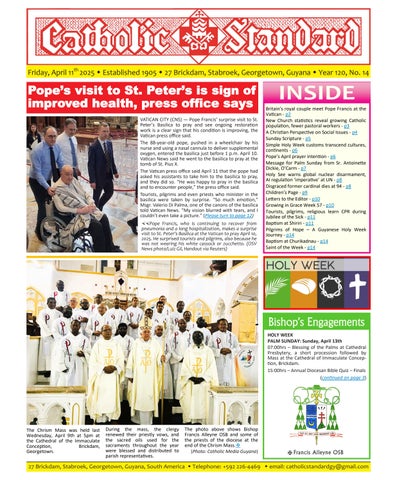
VATICAN CITY (CNS) Pope Francis’ surprise visit to St. Peter’s Basilica to pray and see ongoing restoration work is a clear sign that his condition is improving, the Vatican press office said.

The 88-year-old pope, pushed in a wheelchair by his nurse and using a nasal cannula to deliver supplemental oxygen, entered the basilica just before 1 p.m. April 10. Vatican News said he went to the basilica to pray at the tomb of St. Pius X.

The Vatican press office said April 11 that the pope had asked his assistants to take him to the basilica to pray, and they did so. “He was happy to pray in the basilica and to encounter people,” the press office said.

Tourists, pilgrims and even priests who minister in the basilica were taken by surprise. “So much emotion,” Msgr. Valerio Di Palma, one of the canons of the basilica told Vatican News. “My vision blurred with tears, and I couldn’t even take a picture.” (Please turn to page 12)

Pope Francis, who is continuing to recover from pneumonia and a long hospitalization, makes a surprise visit to St. Peter’s Basilica at the Vatican to pray April 10, 2025. He surprised tourists and pilgrims, also because he was not wearing his white cassock or zucchetto. (OSV News photo/Luiz Gil, Handout via Reuters)

Britain’s royal couple meet Pope Francis at the Vatican - p2

New Church statistics reveal growing Catholic population, fewer pastoral workers - p3

A Christian Perspective on Social Issues - p4

Sunday Scripture - p5

Simple Holy Week customs transcend cultures, continents - p6

Pope’s April prayer intention - p6

Message for Palm Sunday from Sr. Antoinette Dickie, O’Carm - p7

Holy See warns global nuclear disarmament, AI regulation ‘imperative’ at UN - p8

Disgraced former cardinal dies at 94 - p8

Children’s Page - p9

Letters to the Editor - p10

Growing in Grace Week 57 - p10

Tourists, pilgrims, religious learn CPR during Jubilee of the Sick - p11

Baptism at Shiriri - p11

Pilgrims of Hope – A Guyanese Holy Week Journey - p14

Baptism at Churikadnau - p14

Saint of the Week - p14

HOLY WEEK

PALM SUNDAY: Sunday, April 13th

07:00hrs – Blessing of the Palms at Cathedral Presbytery, a short procession followed by Mass at the Cathedral of Immaculate Conception, Brickdam.

15:00hrs –Annual Diocesan Bible Quiz – Finals (continued on page 3)

The Chrism Mass was held last Wednesday, April 9th at 5pm at the Cathedral of the Immaculate Conception, Brickdam, Georgetown.
During the mass, the clergy renewed their priestly vows, and the sacred oils used for the sacraments throughout the year were blessed and distributed to parish representatives.
The photo above shows Bishop Francis Alleyne OSB and some of the priests of the diocese at the end of the Chrism Mass.❖
(Photo: Catholic Media Guyana)

The Jubilee Prayer

Britain’s royal couple Pope Francis at the Vatican

VATICAN CITY (CNS) Although they postponed their official state visit to the Vatican because of Pope Francis health, Britain’s King Charles and Queen Camilla met privately with the pope April 9, the Vatican press office said.

The pope congratulated the royal couple on the 20th anniversary of their wedding and “reciprocated His Majesty’s wishes for a speedy recovery of his health,” the press office said.

King Charles was hospitalized briefly March 27 for what was described as “temporary side effects” from his cancer treatment. Pope Francis has been convalescing at the Vatican since being released from the hospital March 23 after more than five weeks of inpatient treatment for breathing difficulties, double pneumonia and a polymicrobial infection in his airways.

Father in heaven, may the faith you have given us in your son, Jesus Christ, our brother, and the flame of charity enkindled in our hearts by the Holy Spirit, reawaken in us the blessed hope for the coming of your Kingdom.

May your grace transform us into tireless cultivators of the seeds of the Gospel.

May those seeds transform from within both humanity and the whole cosmos in the sure expectation of a new heaven and a new earth, when, with the powers of Evil vanquished, your glory will shine eternally.

May the grace of the Jubilee reawaken in us, Pilgrims of Hope, a yearning for the treasures of heaven. May that same grace spread the joy and peace of our Redeemer throughout the earth.

To you our God, eternally blessed, be glory and praise for ever.

Amen

Their Majesties were delighted the Pope was well enough to host them,” said a statement from Buckingham Palace, and they were pleased “to have had the opportunity to share their best wishes in person.”

The private meeting lasted about 20 minutes and included an exchange of gifts, a source said.

The Vatican press office had said April 8 that the pope was just beginning to receive a few visitors rather than spending his days only with his personal secretaries and the medical personnel caring for him.

The king and queen’s brief meeting with the pope April 9 was very different from the full schedule that had been planned for their state visit.

In addition to an audience with the pope, they would have attended “ service in the Sistine Chapel, focused on the theme of ‘care for creation, reflecting Pope Francis’ and his majesty’s long-standing commitment to nature,” according to the itinerary originally released by Buckingham Palace.

Members of the choir of the king Chapel Royal and the choir of St. George’s Chapel from Windsor were to sing at the service with the Sistine Chapel Choir.

While he was still the prince of Wales, the king last met Pope Francis in 2019 when he came to the Vatican for the canonization of St. John Henry Newman. His last private audience with Pope Francis was in 2017.

The state visit of the king and queen had been planned to coincide with the Holy Year 2025, “a year of reconciliation, prayer and walking together as ‘Pilgrims of Hope,’ which is the Jubilee’s theme,” Buckingham Palace said.❖

Britain’s King Charles III and Queen Camilla greet Pope Francis during a visit at the Vatican April 9, 2025. (CNS photo/Vatican Media)

VATICAN CITY (CNS) The number of Catholics and permanent deacons in the world rose in 2023, while the number of seminarians, priests, men and women in religious orders, and baptisms all declined, according to Vatican statistics.

However, the Vatican’s Statistical Yearbook of the Church said, 9.1 million people received their first Communion in 2023, up from 8.68 million people the previous year, and almost 7.7 million people were confirmed, up from 7.4 million people in 2022.

At the end of 2023, the number of Catholics in the world reached 1.405 billion, up 1.15 percent from 1.389 billion Catholics at the end of 2022, according to the Vatican’s Central Office of Church Statistics, which publishes the yearbook.

This came despite a smaller growth rate in the world’s population, which, for that period was 0.88 percent.

According to the United Nations’ Demographic Yearbook, the estimated mid-year world population for 2023 was approximately 8.045 billion.

The Vatican published its statistical yearbook offering data “on the life and activity of the church in the world in 2023” at the end of March.

The yearbook cautioned that its numbers were based on the information it received back from its surveys and that of 3,188 dioceses and other jurisdictions about 140 did not send information.

The number of Catholics “does not include those in countries that because

of their present situation have not been included in the survey,” it said, adding that it estimated that number to be about an additional 5 million Catholics. Mainland China and North Korea, for example, had no data in the yearbook.

The percentage of Catholics as part of the global and continental populations remained about the same as in 2022.

Catholics represented about 17.8 percent of the global population at the end of 2023, it said. The highest proportion is in the Americas with 64.2 percent of its population being baptized Catholic. Europe follows with 39.6 percent and Oceania with 25.9 percent. In Africa, 19.8 percent of the population is Catholic and the lowest proportion of Catholics by continent is Asia with 3.3 percent.

While the number of Catholics is increasing, the administration of the sacrament of baptism has continued to decrease worldwide, according to the yearbook. It fell from 17,932,891 baptisms administered in 1998 to 13,327,037 in 2022 and 13,150,780 in 2023. A peak was reported during the Holy Year 2000 when 18,408,076 baptisms were administered worldwide.

The yearbook said the “general downward trend in the relative number of baptisms” has been “following closely the trend in the birthrate in most countries.”

It said the ratio of infant baptisms to the Catholic population is of “great significance” because it notes differences between one country and another. While the world average is 7.4

Bishop’s Engagements

(From Front Page)

Tuesday, April 15th

11:00hrs – Mass at Mercy Resident Care

SACRED TRIDUUM BEGINS –CATHEDRAL OF THE IMMACULATE CONCEPTION

Holy Thursday, April 17th

17:00hrs – Mass of the Lord’s Supper

Good Friday, April 18th

09:00hrs –Stations of the Cross 15:00hrs – Commemoration of the Lord’s Passion

Holy Saturday, April 19th

22:30hrs –Easter Vigil Mass

Easter Sunday, April 20th

17:00hrs – Mass at the Cathedral of the Immaculate Conception

infant baptisms per 1,000 Catholics, the highest ratios are in American Samoa (71.2), several islands in Oceania (37.7 to 21.8), followed by Burundi (23.6), Cambodia (22.3), Timor Leste (20.3) and Myanmar (20.1). The lowest ratios are in Armenia, Georgia, Saudi Arabia, Oman, Iran, Tunisia and Algeria (below 1) followed by Russia and Djibouti (1.1).

The total number of adult baptisms registered in 2023 was 2,696,521, which is about 20 percent of the total number of baptisms. The highest proportion of adult baptisms is in Africa (35.9 percent) and the lowest is in Europe and the Middle East.

The Catholic Church had 5,430 bishops at the end of 2023, an increase of 77 bishops from 2022. The majority of them are serving in the Americas and Europe.

The total number of diocesan and religious order priests decreased by 734 men to a total of 406,996, the Vatican office said. The only significant increase in the number of diocesan and religious order priests was in Africa and Asia, which was not enough to offset the declines in the Americas and Europe.

While the number of religious-order priests had increased by 297 men in 2022, the number went down to 128,254 in 2023, about what it had been in 2021. The number of diocesan priests continued to decrease globally with 278,742 men at the end of 2023.

The yearbook also offered a chart tracking the overall change to the number of diocesan clergy from 2013 to 2023 by calculating how many of

those already serving were newly ordained, minus those who died and those who left the priesthood. It showed there was modest growth from 2013 to 2016 (0.31 percent to 0.05 percent) followed by a negative rate starting in 2017 that peaked in 2020 during the pandemic (-0.73 percent). The rate was recorded at -0.45 percent in 2021 and -0.12 percent in 2022.

The number of Catholics per priest increased slightly to 3,453 from 3,408 Catholics per priest in 2022.

The total number of religious brothers continued to decrease in 2023 from 49,414 to 48,748 and the total number of religious women, it said, was down to 589,423 from 599,228 at the end of 2022 a decrease of 9,805 women or 1.64 percent.

The number of permanent deacons continued to increase. There were 51,433 permanent deacons at the end of 2023 a 2.54 percent increase over the previous year, with the highest numbers being in the Americas.

The number of seminarians continued to decrease globally with a 1.67 percent average rate of decline from 2018 to 2023. There were 106,495 seminarians at the end of 2023 with the only growth 383 men being in Africa.

The number of Catholic weddings celebrated around the world in 2023 was down from 1.97 million in 2022 to 1.85 million; of those, about 10.3 percent involved a Catholic marrying a non-Catholic.❖

An enthusiastic crowd waits for Pope Francis’ meeting with young people and catechists in the Democratic Republic of Congo in 2023 (CNS/Paul Haring)  Francis Alleyne OSB

A Christian Perspective on Social Issues Palm Sundayso much to the moment

What holds so much meaning for Christians, particularly Roman Catholics, meant even more for Our Lord and Savior, Jesus Christ. In the midst of the movement, the branches, and the lusty singing in street processions in many communities across Guyana, we should all pause and ponder on what Jesus was readying for, the gruesome fate that awaited him. His closest followers, knew but really still didn’t know. We know, because there is the benefit of the record and time, and the wisdom that flows from both. Jesus was preparing to die, as sure as any Death Row criminal awaiting his last call, that longest of long walks. Jesus was not a criminal in any letter of that word, but there he was, steeling himself, to begin his own long walk to Gethsemane and that hill called Calvary. It takes a man of rare courage to do something of that nature. Like a lamb led to the slaughter. Pure. Unblemished. Innocent. It takes a figure of unbelievable substance, a spirit that can only be divine, to lay down his life for wretches, all bona fide sinners. Some worse than some. Some that we ourselves have difficulty considering, much less forgiving. But it was what he came for, what he did, through a haze of battering and blood and flesh beaten and brutalized.

Which one of us the noblest, the most pious can see ourselves doing so, is made of that kind of essence? When there is no mercy in us, when we allow the vindictive to grab control of us, then how can we bring ourselves to forgive those that have done us some terrible wrong? Jesus did no wrong, but he came to right all that was wrong. The sins of the stranger. The lapses of the outcast. The failures of the despised. God is, indeed, of love. When there is tangling and wrangling about our own pet peeves and petty hurts, then is when we must remind ourselves of

how much Jesus gave for us, and without a word of objection, a moment of resistance.

Who, therefore, on this Palm Sunday should there be remembrance of, and taking the first steps towards making amends? What could be more about living the call of Lent? When there is forgiveness in our hearts, humbled by our own sins, then Lent is lived. Humility gets us to that state of mind, that grace of the spirit. Let us think of Jesus entering Jerusalem on the back of a donkey. A donkey of all beasts, what type of warrior and savior can he be? But he was and is. The Prince of Peace at war with the forces of darkness, battling the agents of evil. That was the curious beauty, the righteous strength, of the peace that Jesus manifested.

We need that type of peace in this country. This society would do well to take the teachings of Jesus close to its treacherous heart, and close to its raging spirit. The two are so powerful in their local presences that both even cross into the threshold of the holy sanctuary. What is Palm Sunday if there was no Jesus? What has Palm Sunday become for a billion spread across the world? It is the signal to start in pious celebration of the holiest week in the Christian calendar.

A precious and sacred life given up willingly. A whole world is saved. One weak man dragged it into the gutter. One strong man restored it back to its divine relationship. There is no price that could be paid for that bitterest of ransom cups.

Once called to servanthood in the mold of Jesus, there must be the grace to be sacrificing. For the unworthy. Most of all, for those who make us mighty unhappy. There is the best role model left for us. The season of Lent is more than an annual routine to be observed. It is the life to be lived. The arrival of Palm Sunday is more than red clothes and welcoming the Holy Triduum with the Easter Season right in it. Palm Sunday is thinking about Jesus came of it. There is an event coming up towards the end of this year, with old and new ugliness promised. Roman Catholics do well not to tarnish themselves by getting embroiled in what goes on in separate parts of this country. There is civic duty. Then there is the first duty, and what should be the first love of each one of us, i.e., putting God first. May it a blessed and deep-thinking Palm Sunday for all. It’s the best stage setter for Holy Week.❖

Gracious and loving God, we thank your for the gift of our priests. Through them, we experience your presence inthe sacraments.

Help our priests to be strong in their vocation.

Set their souls on fire with love for your people.

Grant them the wisdom, understanding, and strength they need tofollow inthe footsteps ofJesus. Inspire them with the vision of your Kingdom.

Give them the words they need to spreadthe Gospel.

Allow them to experience joy in their ministry.

Help them to become instruments ofyour divine grace.

We ask this through Jesus Christ, who lives and reigns as our EternalPriest. Amen

PROCESSION GOSPEL Luke 19:28-40

Jesus went on ahead, going up to Jerusalem. Now when he was near Bethphage and Bethany, close by the Mount of Olives as it is called, he sent two of the disciples, telling them, ‘Go off to the village opposite, and as you enter it you will find a tethered colt that no one has yet ridden. Untie it and bring it here. If anyone asks you, “Why are you untying it?” you are to say this, “The Master needs it”.’ The messengers went off and found everything just as he had told them. As they were untying the colt, its owner said, ‘Why are you untying that colt?’ and they answered, ‘The Master needs it’

So they took the colt to Jesus, and throwing their garments over its back they helped Jesus on to it. As he moved off, people spread their cloaks in the road, and now, as he was approaching the downward slope of the Mount of Olives, the whole group of disciples joyfully began to praise God at the top of their voices for all the miracles they had seen. They cried out:

‘Blessings on the King who comes, in the name of the Lord!

Peace in heaven and glory in the highest heavens!’

Some Pharisees in the crowd said to him, ‘Master, check your disciples’, but he answered, ‘I tell you, if these keep silence the stones will cry out’.

Two very different responses to our Lord’s passion are highlighted during the Gospel reading from Luke today: the response of Simon of Cyrene and the response of Jesus’ acquaintances.

FIRST READING

The Lord has given me a disciple’s tongue.

Isaiah 50:4-7

So that I may know how to reply to the wearied he provides me with speech.

Each morning he wakes me to hear, to listen like a disciple.

The Lord has opened my ear.

For my part, I made no resistance, neither did I turn away.

I offered my back to those who struck me, my cheeks to those who tore at my beard; I did not cover my face against insult and spittle.

The Lord comes to my help, so that I am untouched by the insults. So, too, I set my face like flint; I know I shall not be shamed.

RESPONSORIAL PSALM

Psalm 21

Response: My God, my God, why have you forsakenme?

1 All who see me deride me. They curl their lips, they toss their heads.

‘He trusted in the Lord, let him save him; let him release him if this is his friend.’ Response

2 Many dogs have surrounded me, a band of the wicked beset me. They tear holes in my hands and my feet. I can count every one of my bones. Response

3 They divide my clothing among them. They cast lots for my robe.

O Lord, do not leave me alone, my strength, make haste to help me! Resp

4 I will tell of your name to my brethren and praise you where they are assembled.

‘You who fear the Lord give him praise; all sons of Jacob, give him glory.

Revere him, Israel’s sons.’ Response

SECOND READING: Philippians 2:6-11

His state was divine, yet he did not cling to his equality with God but emptied himself to assume the condition of a slave,

Of Simon we are told, “They took hold of a certain Simon, a Cyrenian, who was coming in from the country; and after laying the cross on him, they made him carry it behind Jesus.” Whether Simon entered willingly and compassionately into this service or whether he took up the Cross of Christ with a grudge, we don’t know. What we do know is this: Simon did his part faithfully. He stayed near to Christ, carrying the Cross until our Lord reached Golgotha, the site of His crucifixion. We also know that Simon’s family were among the first of the ear-

and became as men are; and being as all men are, he was humbler yet, even to accepting death, death on a cross. But God raised him high and gave him the name which is above all other names so that all beings in the heavens, on earth and in the underworld, should bend the knee at the name of Jesus and that every tongue should acclaim Jesus Christ as Lord, to the glory of God the Father.

Gospel Acclamation Phil2:8-9

Praise to you, O Christ, King of eternal glory! Christ was humbler yet, even to accepting death, death on a cross. But God raised him high and gave him the name whch is above all names. Praise to you, O Christ, King of eternal glory! ❖

GOSPEL

The Passion of Our Lord Jesus Christ according to Luke (Luke 22:14-23:56)

ly Christians. Staying near to Christ, embracing the Cross (quite literally), transformed his life and the life of his family.

In contrast, near the end of this Gospel account we are told of another reaction to Jesus’ passion and death, namely that “all His acquaintances stood at a distance.” They knew Jesus! They had heard him preaching and teaching, witnessed His signs and miracles, maybe even benefited personally from them. Perhaps they did not participate in mocking Him or calling for His crucifixion. But they chose to

stay a safe distance from Him when the going got tough. Unlike Simon, they refused to go too near to Christ. Where will you place yourself this week? Keeping your distance from all the pain and suffering Christ endured? Or close by, staying near to Him like Simon did? It is when we go near to Christ that we can be transformed by Him. It is by embracing the crosses in our lives, stewarding them well rather than trying to run from them, that we become His true disciples. ❖

[www.catholicsteward.com/blog/ ]

transcend cultures, continents Gospel Reflection

With Passion Sunday we begin the holiest week of the Church’s year. There is so much to think about and celebrate during this week. Our catechumens are at the final moments of preparation as they prepare for baptism at Easter. Those of us who have already been baptised find that this is the ideal time to review our lives especially in the light of our baptismal promises and to renew those promises. And through the Gospel Readings this week we follow Jesus from this glorious entry into the holy city of Jerusalem, to his arrest, trial and execution and to his resurrection. The coming week offers us the wonderful opportunity to walk with Jesus during his final days on earth and to rejoice in his resurrection. This annual experience is good for renewal and recommitment.

Jesus’ suffering was both physical and mental. He suffered the pain of being let down by his friends and of even being betrayed by one of them. He suffered from fear in the garden and there was no one there to comfort and support him during his agony. He was falsely accused in his presence, insulted, taunted, spat upon and beaten. In one way or another, we too have similarly suffered. A close friend has let us down, someone starts a gossip about us that really hurts, we feel lonely and unsupported in our moments of personal pain. But we know that we can turn to Jesus at such moments because he has personally experienced it all. We can therefore be sure we will not be alone in our suffering if we take it to him. This is surely a reason for hope and peace in a world that can be harsh and lonely.❖

[From: Journeying with the Word of God, The Religious Education Department, Diocese ofGeorgetown,

(OSV News) - From baking sweet breads to blessing baskets, Holy Week is full of long-standing traditions that transcend cultures and continents. The following list includes a quick overview of family favorites.

Palm crosses: From medieval times, people have believed that blessed palms formed into the shape of a cross would protect them from danger. The easiest way to make a cross from blessed palms is to cut two pieces of the palm, arrange in the shape of a cross, put a thumbtack in the middle, and attach the cross to a doorway or a bulletin board. Check the Internet for directions on how to braid or weave palms into more decorative crosses.

Housecleaning: In many cultures the Monday, Tuesday and Wednesday of Holy Week are designated as days for vigorous housecleaning in preparation for Easter. This custom probably evolved from the Jewish custom of ritual cleaning before Passover.

Coloring eggs: Decorating eggs was a pagan symbol of rebirth at springtime for the Romans, Greeks, Egyptians, Persians and even the Chinese. Christians adopted the colored egg as a symbol of new life which comes with the Resurrection.

Easter lilies: The tradition of buying Easter lilies during Holy Week for use as decorations in homes and churches came into practice in the 1800s. The

white flower is a symbol of purity and new life that heralds the resurrection of Jesus.

Visiting churches: The custom of visiting several churches to say a prayer on Holy Thursday was a tradition that evolved from the practice of making pilgrimages to holy places.

Sweet breads: In many cultures, Holy Week was traditionally a time for baking sweet breads, cakes and pastries that would be served on Easter Sunday.

Blessing of Easter baskets: In many cultures, families bring food that will be eaten on Easter Sunday to church in a basket for a special blessing on Holy Saturday.

New clothes: From the time of the early Christians, the newly baptized wore white garments made from new linen. In medieval times, it became a tradition for people to wear new clothes on Easter Sunday, symbolizing the “new life” that comes with the Resurrection. In some places it was believed that bad luck would come to those who could afford new Easter clothes but refused to buy them.

Holy Water blessings: Some families bring holy water containers to Mass on Easter so they can bring home some Easter water, which is blessed during the Easter Vigil, to bless their homes. Many people and families also participate in the full cycle of Triduum liturgies, from Holy Thursday to Easter Sunday, walking with the Lord through his passion, death and resurrection. However you mark Holy Week, intentionally set it apart from the other 51 weeks of the year, because this one is truly special.❖

April Prayer Intention: Pope prays people stare

VATICAN CITY (CNS) Technology should be used to improve people’s lives and to connect people as members of one human family, Pope Francis said. However, often “the screen makes us forget that there are real people behind it who breathe, laugh and cry,” the pope said in a video message to present his prayer intention for the month of April: “For the use of new technologies.”

“How I would like for us to look less at screens and look each other in the eyes more!” he said. “Something’s wrong

if we spend more time on our cell phones than with people.

The video, which was recorded before Pope Francis was hospitalized Feb. 14, was released April 1 and did not include the usual footage of Pope Francis at his desk reading the message but used only his voice for the narration. The final frame of the video says, “The video was recorded before he was admitted to the hospital. Let us join in prayer with Pope Francis on clicktopray.org.”

In the message, Pope Francis said, “It’s true, technology is the fruit of the intelligence God gave us. But we need to use it well. It can’t benefit only a few while excluding others.”

“We should use technology to unite, not to divide. To help the poor. To improve the lives of the sick and people with different abilities,” he said. “Use technology to care for our common home. To connect as brothers and sisters.”

“It’s when we look at each other in the eyes that we discover what really matters: that we are brothers, sisters, children of the same Father,” the pope said.

“Let us pray that the use of the new technologies will not replace human relationships, will respect the dignity of the person and will help us face the crises of our times,” he said.❖ (see more on page 7)

A woman holds a palm frond cross during Palm Sunday Mass outside St. Mary's Chapel at the National Shrine Grotto of Our Lady of Lourdes in Emmitsburg, Md., April 2, 2023. (OSV News photo/Bob Roller)

Message for Palm Sunday from Sr. Antoinette Dickie, O’Carm

Journeying with the Word of God

Commission has shared a short message of encouragement from one of our Religious Sisters. The final message is by Sr. Antoinette Dickie, O’Carm:

As we approach the 6th Sunday of Lent, also called Palm Sunday, the Scriptural Readings remind us of God's incomparable love

17 " if you keep my commands, you will be my people, and I will be your God. "

Sadly, if we look at our world, our countries, our families and ourselves, we must plead pardon, like the Prodigal son, and beg for forgiveness for which we have sinned in our thoughts,

words, deeds, attitudes and behavior, and beg for forgiveness. St. John in his Writings Ch. 3:16 reminds us: For God so loved the world that He gave His only begotten Son, to suffer, die and rise again, so that all who believe in Him will not perish. Palm Sunday occurs at the door of the Lenten period and the beginning of that most sacred period when Jesus set out for Jerusalem to accomplish His Father's will.

The crowd went before him wanting to make him king. They threw Palm branches and their clothes on the ground before singing Hosanna to the Son of David trying to distract Him from going to Jerusalem to do His Father's will.

We, too, are asked to enter with our whole body, mind and spirit, into this very sacred and profound experience and journey with Jesus as we recall His Passion, Death and Resurrection’s. Paul reminds us of "The true way of Christian salvation. (Philippians 9: 11) Through faith in Christ and uprightness from God based on faith, We may come to know Him and the power of His resurrection and share in his suffering by being molded to the pattern of His death.❖

Pope’s April Prayer Intention: Fortheuseofnewtechnologies

MAKING THE WORD OF GOD YOUR OWN

Step 1: Lookattoday’sReadingsprayerfully.

1st Reading: The prophet suffers in carrying out his mission because he is confident in his commitment to God.

2ndReading: Because Jesus accepted the role of a servant, even to accepting death on the cross, God raised him to glory.

Gospel: Jesus willingly and knowingly accepts suffering as part of his mission on earth. He is merciful and forgiving even to those who executed him.

Step 2: ApplyingthevaluesoftheReadings toyourdailylife.

1.A good disciple of Jesus is one who listens to every word and scrutinises every action of Jesus in order to imitate him as closely as possible. What does this statement mean to you as a Christian?

2.Just a few short days after joyfully welcoming Jesus into Jerusalem, most of the same crowd called for his death. What do you think could be the reason for this?

3.Compassion is a necessary feeling in all Christians. How can suffering help us to learn compassion?

4.At the Holy Thursday celebration of the Mass there is the “washing of the feet” by the celebrant. What is the significance of this action?

Step 3: Accepting the message of God’s Wordinyourlifeoffaith

There is no loneliness, hunger, oppression, exploitation, torture, imprisonment, violence or threat that Jesus does not know first hand. Therefore there can be no human being who is completely alone in his or her suffering since God is with us, in and through Jesus. The passion of Jesus gives courage, strength and hope to all who suffer for it means that we are not alone.

Step 4: Somethingtothink&prayabout

1.Pay careful attention to the story of the Passion of Jesus. Notice how he prays for his killers: “Father, forgive them; they do not know what they are doing.” Do you think you are in anyway burdened by things you cannot forgive? What can you do about this?

2.What kind of a friend are you? Are you always willing to walk the whole journey with your friends when they are in trouble or are you quick to turn your backs on them when problems arise?

3.Pray that you will always act according to your conscienceeveninthefaceofridiculeofothers?❖

[From: Journeying with the Word of God, The Religious Education Department, Diocese of Georgetown, Guyana ]

Holy See warns global nuclear disarmament,

In his statement, Archbishop Caccia surveyed the broader context for his calls to action.

“As political instability and conflicts continue to rise across various regions of the world, many states have turned to military solutions in an effort to safeguard their sovereignty and protect their interests,” said Archbishop Caccia.

As a result, he said, deterrence is “often seen as the essential guiding principle.”

Currently, more than 120 conflicts are taking place throughout the world, according to the International Committee of the Red Cross.

Among the most prominent are Russia’s war in Ukraine; the IsraelHamas war; civil wars in Myanmar and Sudan; insurgencies in various African nations, as well as in Afghanistan and Pakistan; and armed gang violence that has destabilized Haiti.

Moreover, pursuit of nuclear deterrence fails to account for “the changing nature and complexity of conflicts and the undeniable reality that any use of these weapons would have catastrophic humanitarian and environmental consequences,” he said. “These repercussions would not discriminate between combatants and non-combatants and would cause lasting damage, harming both present and future generations.”

While a legal framework on AI may be “beyond the immediate scope” of the U.N.’s disarmament commission, he said, “the principles, guidelines, and recommendations developed here” can contribute to instruments that ensure “the use of new and emerging technologies does not fuel violent

escalation of any kind, but rather benefits all humanity and peace worldwide.”

Archbishop Caccia concluded by quoting Pope Francis’ January address to diplomats accredited to the Holy See, saying, “In the face of the increasingly concrete threat of a world war, the vocation of diplomacy is to foster dialogue with all parties, including those interlocutors considered less ‘convenient’ or not considered legitimized to negotiate.

“Only in this way is it possible to break the chains of hatred and vengeance that bind and to defuse the explosive power of human selfishness, pride and arrogance, which are the root of every destructive determination to wage war,” said the pope.❖

(OSV News) - With fear “the driving force” in the current global climate, nations must recommit to nuclear disarmament and the regulation of artificial intelligence, said Archbishop Gabriele Caccia, the Holy See’s permanent observer to the United Nations.

The Holy See established diplomatic relations with the U.N. in 1957, representing the Vatican City State as well as the supreme authority of the Catholic Church, including the pope as bishop of Rome and the head of the college of bishops.

In remarks Archbishop Caccia delivered to the U.N. Disarmament Commission April 8 in New York, he restated the Holy See’s call to all nations to “overcome the fallacy of nuclear deterrence” and “to accede to the Treaty on the Prohibition of Nuclear Weapons.”

Adopted by the U.N. in 2017, the treaty serves as a legally binding instrument towards the total elimination of nuclear weapons. To date, there are 94 state signatories and 73 states party to the treaty.

Neither the U.S. nor Russia, which together account for approximately 88% of the world’s nuclear weapons, have adopted the treaty.

Archbishop Caccia urged “a spirit of cooperation and mutual respect” at an upcoming session regarding the treaty in order to further its advancement.

The regulation of AI, which has increasingly transformed the defense industry, is also crucial, said the archbishop.

He cited the “multiple challenges posed by the use of emerging technologies, including artificial intelligence,” noting that their “increasing weaponization could pose further existential risks.”

Defense spending has soared worldwide, with the global total reaching a record high of close to $2.5 trillion in 2024, up more than 7% from 2023 and averaging just under 2% of nations’ gross domestic product. The European Union, the United Kingdom and Canada have accelerated defense investments, as moves by the U.S. under the Trump administration have unsettled longstanding defense alliances.

Archbishop Caccia said the shift towards defense investment “comes at a significant cost, not only in terms of financial resources but also in terms of the erosion of multilateralism, dialogue and international cooperation, which have long been the cornerstones of our collective efforts.”

He quoted St. John XXIII’s 1963 encyclical, “Pacem in Terris” (“Peace on Earth”): “There is a common belief that under modern conditions peace cannot be assured except on the basis of an equal balance of armaments If one country increases its military strength, others are immediately roused by a competitive spirit to augment their own supply of armaments.”

Those words “resonate deeply today,” said Archbishop Caccia, adding that “the cycle of arms buildup and the logic of deterrence foster an atmosphere of suspicion and division.” This in turn, he said, “pushes the international community further from the prospect of achieving lasting peace.”

In particular, he said, “the threat of nuclear conflict is once again alarmingly close,” stressing that “it is imperative to recommit, with renewed urgency, to the path of disarmament.”

Nuclear proliferation, along with other weapons of mass destruction, “multiplies risks and offers only the illusion of peace,” while obscuring “the true path to peace,” said Archbishop Caccia.

(CathNews) - The disgraced former cardinal Theodore McCarrick, removed from the clerical state in 2019 after revelations of credible allegations of sexual abuse of minors and misconduct against adults, has died in Missouri, aged 94. Source: OSV News Archbishop of Washington from 2001 2006 and a once powerful figure in the Church in the United States known to successfully fundraise for Vatican causes, Mr McCarrick was removed from ministry at the direction of the Vatican in June 2018 due to a credible allegation of sexual abuse of a teenager investigated by the Archdiocese of New York.

Mr McCarrick’s attorney confirmed his death on Friday. According to multiple sources, he died on Thursday.

“Today I learned of the death of Theodore McCarrick, former Archbishop of Washington,” Cardinal Robert McElroy of Washington said in a statement.

“At this moment I am especially mindful of those who he harmed during the course of his priestly ministry.

“Through their enduring pain, may we remain steadfast in our prayers for them and for all victims of sexual abuse,”

In July 2018, The New York Times detailed allegations that Mr McCarrick abused two seminarians in the 1980s that resulted in abuse settlements from the Metuchen Diocese in New Jersey, and a separate allegation from the first child Mr McCarrick baptised, who detailed instances of abuse over 20 years, beginning when the boy was 11.

The public allegations led to revelations that Mr McCarrick had been accused over the years of sexual misconduct involving adults, including against seminarians and young priests, some of which had resulted in legal settlements between

dioceses and victims.

At the time he was removed from ministry, then-Cardinal McCarrick maintained his innocence and said he did not have recollection of the alleged abuse.

In July 2018, Pope Francis accepted Mr McCarrick’s resignation from the College of Cardinals and suspended him from public ministry.

In October 2018, the Vatican said a preliminary investigation into an allegation against then-Archbishop McCarrick had already occurred, and the results would be combined with a further study of documents.

Pope Francis confirmed Mr McCarrick’s removal from the priesthood in February 2019.

Mr McCarrick had faced sexual abuse-related charges in Massachusetts and Wisconsin filed in July 2021 and April 2023, respectively. These cases were ultimately dismissed with Mr

deemed unfit to

trial due to his dementia.

McCarrick
stand
Archbishop Gabriele G. Caccia, permanent observer of the Holy See to the United Nations, is pictured in a 2023 photo addressing the General Assembly at U.N. headquarters in New York City. Archbishop Caccia delivered an April 8, 2025, statement expressing concern at the continued rise of political instability and conflict. (OSV News photo/Rick Bajornas, courtesy United Nations)
Then-Cardinal Theodore E. McCarrick arrives for Ash Wednesday Mass in St. Peter’s Basilica at the Vatican in this Feb. 13, 2013 file photo. (CNS photo/Paul Haring)

Dear Girls and Boys,

Today is Palm Sunday. Today the Church celebrates the kingship of Jesus with the observance of Palm (Passion) Sunday, the start of Holy Week.

Today we celebrate the entry of Jesus into Jerusalem. It was a day that marked the beginning of an incredible week. A week that would see Jesus cheered, then arrested, tried, condemned, and crucified. But as that week came to an end, another week began just as the previous week had begun with a celebration.

We remember that happy day when Jesus rode into Jerusalem on a donkey and the people welcomed him by waving palm branches; others spread their coats on the ground. They praised him: “Hosanna! Blessed is He who comes in the name of the Lord.”

Jesus is indeed a special person. He is a king. However, in the midst of that joyous celebration, Jesus knew he had enemies and that he would be crucified on Good Friday.

Today blessed palm branches are distributed in churches in memory of the love shown to Jesus.

Please hang your palms in a special place in your home to remind you that Christ is your king. Sing Hosanna!

Dear Jesus, our voices join with the voices of the people in Jerusalem some two thousand years ago. Hosanna! Blessed is he who comes in the name of the Lord. Amen.❖

Dear Editor,

The human heart is on a quest for happiness, like the desert yearns for rain. If you have a desire for happiness, I have a desire for happiness. This desire is a universal common trait among every member of the human family. We simply desire to be happy and act from this desire. We often do things that we think will make us happy, only to discover that

Happiness

they end up making us miserable. This is often because we confuse pleasure with happiness. And sometimes long-term misery comes disguised as short-term pleasure. We often seek the happiness we desire through pleasure, profession, power, and the path of least resistance. Each of these may offer moments of happiness, but they end too soon, having lasted ever so briefly, and our quest for lasting happiness continues. These moments of happiness are of course real, but only as real as a shadow. A person's shadow is real, but it is nothing compared to the actual person. So many of us spend a large

portion of our lives chasing shadows. God wants us to be happy. As a father who takes a sincere and active interest in the lives of his children, God sent His only Son to reprove humanity, meaning, for happiness, and to teach us how to satisfy that yearning. God sent His Son into the world to reconcile us with Himself, certainly, but He also sent Jesus to show us how to live.

The philosophy of Jesus is the ultimate philosophy of human happiness. It isn’t just a way of life; it is the way of life. At the same time it is one of selfdonation.

Mustard Seeds

Margaret Mead, an American cultural anthropologist, author and speaker once said “Never doubt that a small group of thoughtful, committed citizens can change the world; indeed, it'stheonlythingthateverhas.”

Perhaps the most fascinating fact about the world is that it is constantly evolving. Whether human beings are present to catalyse this change or not, the occupants of the planet and the planet itself are gradually, but surely, changing.

As we grow, we spend much of our time attempting to unravel the mysterious purpose that we are meant to fulfil during the time we are given. However, when our purpose is finally revealed to us, many of us fail to believe that we are powerful enough to fulfill such a role. As we progress through life, we shall inevitably meet parts of our world that need to be changed. As we discover these parts, we must also allow ourselves to discover that we are capable of creating the necessary changes.

The most difficult obstacle to overcome is not the struggle of changing such a large world, but is the very act of believing in ourselves enough to try in the first place. With just a little faith in ourselves, moving mountains is the least we can do.

He replied, “Because you have so little faith. Truly I tell you, if you have faith as small as a mustard seed, you can say to this mountain, ‘Move from here to there,’ and it will move. Nothing will be impossible for you.” - Matthew 17:20 ❖

Tourists, pilgrims, religious learn

ROME (CNS) Just outside the walls of the Vatican, the Bee Gees’ “Stayin’ Alive” blared through speakers as health care workers tapped out chest compressions to the beat.

“Ah, ha, ha, ha, stayin’ alive, stayin’ alive,” sang the 100 red-shirted volunteers near the entrance to the Vatican Museums, using the Bee Gees’ disco

anthem with its tempo of 103 beats per minute to guide tourists, pilgrims and even religious sisters through CPR basics.

The American Heart Association ran an open training event next to the Vatican to teach emergency resuscitation as part of programming for the

Jubilee of the Sick and Health Care Workers April 5. Over two days, health care related events were scheduled to take place throughout Rome before concluding with a Mass in St. Peter’s Square April 6.

“Pilgrims that are passing by can learn, in just a few minutes, how to save a life,” Marida Straccia, global training organizer with the AHA, told Catholic News Service.

More than 20,000 pilgrims were expected to come to Rome for the Jubilee of the Sick and Health Care Workers, including patients, health care workers and religious leaders from more than 90 countries.

Yet Straccia emphasized that CPR is not just for health care professionals.

“It doesn’t matter if you’re a layperson, a priest,” she said. “More than 80% of cardiac arrests happen outside the hospital. Somebody could fall in front of you while you’re walking in a store, in the Vatican, and knowing what to do, even just how to call for help, it makes a difference in somebody’s life.”

Harim Lee, visiting from Los Angeles with her 14-year-old daughter, said the training was an unexpected but welcome part of their Jubilee pilgrimage. “I had no idea I’d be learning

CPR,” she said. “But it’s wonderful, because most people think someone else will do it but it’s so important that everyone knows how.”

Alessia Cambela, a health care worker and volunteer with the AHA, said she was surprised to see religious sisters stopping by the bustling square to learn CPR.

“Religious nuns asked us to teach them how to perform CPR and I think it’s great,” she said. “It doesn’t matter what you do in your life, but we can all learn how to save a life.”

One of them, Sister Maria José de Mesquita, a member of the Congregation of the Sisters of St. Anne, told CNS that it’s important for pilgrims headed to the Holy Door of St. Peter’s Basilica to stop and learn CPR “because we don’t know if at any time we will need to help someone.”

And with Pope Francis missing out on several Jubilee events during his recovery from respiratory infections, the Jubilee of the Sick and Health Care Workers takes on a special meaning, she said.

“The pope, having had the experience of this illness, it certainly brings him closer to those living through experiences of pain and distress in their lives,” she said.❖

A volunteer instructs a passerby on emergency resuscitation in Rome’s Piazza del Risorgimento outside the Vatican during the Jubilee of the Sick and Health Care Workers April 5, 2025. (CNS photo/Pablo Esparza)
Baptism on the 4th Sunday of Lent (March 30th) at St Simon Church, Shiriri, South Central Rupununi, Region 9, Essequibo, Guyana. The beautiful village of Shiriri lies at the foothills of the Shiriri Mountain Range. (Adapted from St Ignatius Mission Facebook page)

Pope Francis greets the faithful in St. Peter's Square at the end of the closing Mass for the

Of course, others present in the basilica did take photos and videos on their phones and posted them to social media, capturing him blessing a baby and chatting with a young boy.

Pope Francis was not wearing his white cassock or white zucchetto. Instead, his head was bare, and he wore black trousers and a white shirt. He had a striped blanket draped over his chest and arms.

The pope was released from Rome’s Gemelli hospital March 23 after 38 days of treatment for breathing difficulties, double pneumonia and an infection of his airways.

His doctors said they released him with a recommendation that he spend two months convalescing, avoiding large groups. For his first two weeks back at the Vatican, he stayed close to his room and office in the Domus Sanctae Marthae where he lives. He concelebrated Mass each morning with his secretaries, did physical and respiratory therapy and paperwork.

Surprise visit during Jubilee of the sick

Two weeks after his release from the hospital, the pope surprised people attending the closing Mass of the Jubilee of the Sick and Health Care Workers April 6 in St. Peter’s Square by arriving at the end of the Mass.

The pope shocked the thousands gathered in the square who broke out

in cheers upon seeing his nurse, Massimiliano Strappetti, wheel him out of St. Peter’s Basilica and into the square. He wised the people “a happy Sunday” and thanked them for their prayers.

Pope Francis met April 7 with Cardinal Pietro Parolin, Vatican secretary of state, and with Britain’s King Charles III and Queen Camilla April 9.

The meeting with the British royals lasted 20 minutes, and the pope did not use or need supplemental oxygen during that time, the press office said, adding that the pope has been able to go longer periods without such assistance.

In the days after meeting the king and queen, the press office said, the pope met with: Archbishop Edgar Peña Parra, the substitute for general affairs in the Secretariat of State; Archbishop Paul R. Gallagher, the Vatican foreign minister; Archbishop Luciano Russo, head of the secretariat’s section for diplomatic personnel; and heads of several Roman Curia offices.

The press office also announced April 11 that Argentine Cardinal Leonardo Sandri, vice dean of the College of Cardinals, would preside over the Vatican celebration of Palm Sunday Mass as Pope Francis’ delegate.

A source said the pope’s presence at the liturgies of Holy Week and Easter would depend both on his condition and the weather.❖

Jubilee of the Sick and Health Care Workers at the Vatican April 6, 2025. (CNS photo/Pablo Esparza)
Pope Francis blesses a baby as he makes a surprise visit to St. Peter's Basilica at the Vatican, April 10, 2025, in this screengrab taken from a handout video. (OSV News photo/Luiz Gil, Handout via Reuters)

Pilgrims of Hope AGuyaneseHolyWeekJourney Saint

Vicar General Rev. Fr. Ronald Fernandes SJ gives the following reflectionforHolyWeek:

As we walk through Holy Week, we are invited to become pilgrims

of hope people on a journey, not just through the liturgical calendar, but through life itself.

Ignatian spirituality teaches us to find God in all things in joy and in suffering, in community and solitude, in progress and uncertainty. That invitation rings especially true in our present situation today, where the winds of economic change and social growth blow strongly, yet unevenly.

On Palm Sunday, the crowds greeted Jesus with shouts of “Hosanna,” full of hope, unaware of the road ahead. We too cheer for new beginnings whether in leadership, development, or opportunity. But as a pilgrim we know: hope must be rooted not in fleeting triumph, but in the steady companionship of Christ. Like Jesus, we must keep walking, even when the path leads through shadow and challenges.

On Holy Thursday, “Jesus showed how perfect his love was” - Jesus kneels to wash the feet of His disciples. This act of humility is our call to service. In our communities across ethnic lines, economic divides, and political apprehensions true leadership means kneeling, not climbing. As pilgrims of hope, we serve, not for gain, but for reconciliation, peace, and justice.

Good Friday reminds us that love bears the cross. Many in our nation still carry the weight of poverty, violence, or displacement. A reflective and passionate heartdoes not look away - it stands at the foot of the cross and asks, “Where is God calling me to respond?” Hope isn’t the absence of suffering it is the conviction that suffering is not the end.

Holy Saturday brings silence, the in-between or inconclusive. We often live in this “waiting space” between great promise and unfinished progress. Yet, we are called to trust in God’s hidden work. Even when the tomb seems sealed, God is not absent. He is preparing resurrection.

And so, Easter arrives not just as a celebration, but as a mission. The stone is rolled away. Christ is risen. And we, as pilgrims of hope, are sent forth to be witnesses to live with joyful courage, to speak truth with love, to build a humanity that reflects the dignity of every child of God.

May this Holy Week move us to see more clearly, choose more wisely, and love more deeply walking in hope, like or with Christ, for the life of the world.

Amen. ❖

de Paul Society, Gianna earned degrees in Paviaandeventuallyopened a clinic inMesero. Gianna also enjoyed skiing and mountain climbing.

Shortly before her 1955 marriage to Pietro Molla, Gianna wrote to him: “Love is the most beautiful sentiment that the Lord has put into the soul of men and women.” She and Pietro had three children, Pierluigi, Maria Zita, and Laura.

Early in the pregnancy for her fourth child, doctors discovered that Gianna had both a child and a tumor in her uterus. She allowed the surgeons to remove the tumor but not to perform the complete hysterectomy that they recommended, which would have killed the child. Seven months later, Gianna Emanuela Molla was born. The following week, her mother Gianna died in Monza of complications from childbirth.SheisburiedinMesero.

Gianna Emanuela went on to become a physician herself. Gianna Beretta Molla was beatifiedin1994andcanonized10yearslater. With great faith and courage, Gianna Beretta Molla made the choice that enabled her daughter to be born. We can often wish that we were in different circumstances, but holiness frequently comes from making difficultchoicesinbadsituations. ❖

[From: http://www.americancatholic.org/ ]

Baptism at St Martin de Porres Church, Churikadnau, Deep South Rupununi, Region 9, Essequibo, Guyana, last Sunday April 6th. (Adapted from Robert Bellarmine R.C Church Aishalton Facebook page)

Turn static files into dynamic content formats.

Create a flipbook