2026_4_January 30th 2026_Catholic Standard

Page 1


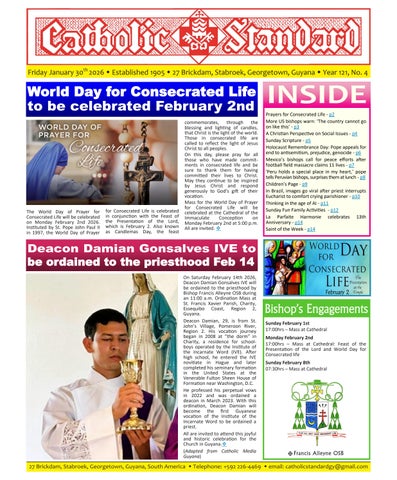
World Day for Consecrated Life

The World Day of Prayer for Consecrated Life will be celebrated on Monday February 2nd 2026. Instituted by St. Pope John Paul II in 1997, the World Day of Prayer for Consecrated Life is celebrated in conjunction with the Feast of the Presentation of the Lord, which is February 2. Also known as Candlemas Day, the feast

commemorates, through the blessing and lighting of candles, that Christ is the light of the world. Those in consecrated life are called to reflect the light of Jesus Christto all peoples.

On this day, please pray for all those who have made commitments in consecrated life and be sure to thank them for having committed their lives to Christ. May they continue to be inspired by Jesus Christ and respond generously to God's gift of their vocation.

Mass for the World Day of Prayer for Consecrated Life will be celebrated at the Cathedral of the Immaculate Conception on Monday February 2nd at 5:00 p.m. All are invited. ❖

be ordained to the priesthood Feb 14

On Saturday February 14th 2026, Deacon Damian Gonsalves IVE will be ordained to the priesthood by Bishop Francis Alleyne OSB during an 11:00 a.m. Ordination Mass at St. Francis Xavier Parish, Charity, Essequibo Coast, Region 2, Guyana.

Deacon Damian, 29, is from St. John’s Village, Pomeroon River, Region 2. His vocation journey began in 2008 at “the dorm” in Charity, a residence for schoolboys operated by the Institute of the Incarnate Word (IVE). After high school, he entered the IVE novitiate in Hague and later completed his seminary formation in the United States at the Venerable Fulton Sheen House of Formationnear Washington,D.C. He professed his perpetual vows in 2022 and was ordained a deacon in March 2023. With this ordination, Deacon Damian will become the first Guyanese vocation of the Institute of the Incarnate Word to be ordained a priest.

All are invited to attend this joyful and historic celebration for the Church inGuyana.❖

(Adapted from Catholic Media Guyana)

Prayers for ConsecratedLife - p2

More US bishops warn: ‘The country cannot go onlike this’ - p3

A Christian Perspective on Social Issues - p4

Sunday Scripture - p5

HolocaustRemembrance Day:Pope appeals for end to antisemitism, prejudice,genocide - p6

Mexico’s bishops call for peace efforts after football fieldmassacre claims 11 lives - p7

‘Peru holds a special place in my heart,’ pope tellsPeruvianbishops,surprisesthematlunch - p8

Children’s Page - p9

In Brazil, images go viral after priest interrupts Eucharist to comfortcryingparishioner - p10

Thinkingin the age of AI - p11

Sunday Fun Family Activities - p12

La Parfaite Harmonie celebrates 13th Anniversary - p14

Saint of the Week - p14

February 2

Bishop’s Engagements

Sunday February 1st

17:00hrs –Mass at Cathedral

Monday February 2nd

17:00hrs – Mass at Cathedral: Feast of the Presentation of the Lord and World Day for Consecratedlife

Sunday February 8th

07:30hrs –Mass at Cathedral

 Francis Alleyne OSB

Prayers for Consecrated Life

God our Father, we thank you for calling men and women to serve in your Son’s kingdom as sisters, brothers, religious priests, consecrated virgins, and hermits, as well as members of Secular Institutes. Renew their knowledge and love of you, and send your Holy Spirit to help them respond generously and courageously to your will. We ask this through our Lord Jesus Christ, who lives and reigns with you and the Holy Spirit, one God, for ever andever. Amen

(U.S. Bishop's Secretariat of Clergy, Consecrated Life and Vocations)

God, throughout the ages you have called women and men to pursue lives of perfect charity through the evangelical counsels of poverty, chastity,and obedience. We give you thanks for these courageous witnesses of faith and models of inspiration. Their pursuit of holy lives teaches us to make a more perfect offering of ourselves to you. Continue to enrich your Church by calling forth sons and daughters who, having found the pearl of great price, treasure the Kingdom of Heaven above all things. Through our Lord Jesus Christ, your Son, who lives and reigns with you in the unity of the Holy Spirit, one God, for ever andever. Amen.

(Modified from the Prayer for the Year of Consecrated Life) [portlanddiocese.org]

Twenty-two years ago, on January 30th 2004, Abbot Francis Dean Alleyne OSB was ordained the third Bishop of the Roman Catholic Diocese of Georgetown. Born on December 3rd 1951 in Pointe-à-Pierre, South Trinidad, Dean Alleyne entered religious life at the age of 21, joining the Benedictine Abbey at Mount St. Benedict, Tunapuna, Trinidad. He was professed a member of the Order of

Saint Benedict on December 8th 1975, and ordained to the priesthood on July 7th 1985. He spent a total of 30 years at the monastery, the last eight of which he served as Abbot. At the conclusion of his mandate as Abbot, he was appointed Bishop of Georgetown by Pope John Paul II on November 10th 2003, succeeding Bishop Benedict Singh, who had retired earlier that year. In addition to his pastoral responsibilities, Bishop

Alleyne is also musically gifted, playing both the guitar and the piano. As we give thanks to God for 22 years of faithful shepherding, we continue to pray that Bishop Alleyne’s example of humility and dedication may lead us ever closer to Christ. May God continue to bless him with strength and grace, guiding him always in his sacred ministry.❖

(Adapted from Catholic Media Guyana)

Today (January 28th) I celebrate 8 years as a priest. Time really does fly when you’re having fun with God! I am deeply grateful to God for the gift of my vocation, to my family for their constant love and support, and to the faithful who journey with me and sustain me through my ministry of service.

I truly love being a priest and I am thankful for the joy, challenges, and countless blessings that come with serving God’s people.

If you feel even a small stirring in your heart to serve God in this way, don’t be afraid to listen. God still calls and following Him is always worth it.

- Fr. Carl Philadelphia ❖

More US bishops warn: ‘The country cannot go on like this’

bishops are sounding the alarm over an increasingly frayed social order both at home and abroad while calling for a renewal of heart and a recommitment to Gospel values safeguarding Godgiven human dignity.

Archbishop José H. Gomez of Los Angeles, Bishop Anthony B. Taylor of Little Rock, Arkansas, and Archbishop Paul D. Etienne of Seattle are among the latest prelates to weigh in on widespread unrest and division, with Archbishop Etienne issuing a Jan. 26 pastoral letter on “A Well-Ordered Society Rooted in Truth, Justice, and Peace.”

Three key sources the Second Vatican Council, Catholic social teaching and a Jan. 9 address by Pope Leo XIV to Holy See-accredited diplomats “illuminate our path with clarity and a renewed urgency,” said Archbishop Etienne in his letter.

The latest statements and reflections which follow comments already made by Archbishop Paul S. Coakley of Oklahoma City, president of the U.S. Conference of Catholic Bishops; Archbishop Bernard A. Hebda of St. Paul and Minneapolis and Cardinal Joseph W. Tobin of Newark, New Jersey came within days of the fatal shooting of 37-yearold nurse Alex Pretti, a U.S. citizen, by federal agents during a protest amid an immigration enforcement operation in Minneapolis.

Another U.S. citizen and Minneapolis resident, 37-year-old Renee Nicole Good, was shot to death by a federal agent at a separate immigration-related protest Jan. 7.

Hours after Pretti’s death, Minnesota Gov. Tim Walz said at a Jan. 24 news conference the nation was at “an inflection point” amid the Trump administration‘s crackdown on immigrants lacking legal authorization to live and work in the U.S., which has seen Minneapolis and several other cities become flashpoints.

Bishops warn US society coming to a crisis

In their respective reflections, the various bishops agreed that current societal tensions have reached an untenable crisis point.

“The country cannot go on like this,” said Archbishop Gomez in a Jan. 27 column published by Angelus, the news outlet of the Archdiocese of Los Angeles.

“Polarization and partisanship are poisoning the social fabric of our country,” warned Bishop Taylor in a Jan. 24

published by Arkansas Catholic, his diocese s news outlet. We have reason to worry about the direction our society has taken in recent years. And we have reason to work to shore up our democracy before it is too late.”

In his pastoral letter, Archbishop Etienne pointed broadly to “turbulent times” that have been “marked by conflict abroad, fragmentation at home, and profound questions about our shared moral life.”

In an accompanying Jan. 26 blog post, the archbishop said he had been moved to issue the teaching having “read my own mail, seen fissures in the unity of our Church, witnessed the fracturing of our American society and watched in dismay at the escalation of war around the world.”

Bishop Taylor cited his own family’s experience during the Second World War, when his grandfather “lost 20 first cousins in the Holocaust,” also known as the Shoah, the systematic murder of 6 million Jews by Germany’s Nazi regime and its allies and collaborators.

“I want to be clear that the current times are not identical, and Trump is no Hitler,” Bishop Taylor stated. “But the moral decline of our country is real. And we are doomed to repeat failures of the past if we are not willing to remember them and learn from them.”

Bishop says learn lessons from 1930s Germany

He noted “many obvious parallels with the 1930s” that “should give us pause” specifically, German society’s move at the time “away from respect for human dignity, peace and moral restraint.”

“I fear that the same dynamics are now happening in our country with the decline of civil discourse,” said Bishop Taylor.

He noted that Adolf Hitler’s policies as Germany’s leader leveraged post-World War I fears and crises to gain popular support for what ultimately became his “dictatorial powers,” which in turn emboldened him to invade other nations. Refugees fleeing the Nazi regime were often refused entry to other nations, and many like his own relations were ultimately slain, he said.

“Obviously, these tragic examples are not what is happening here today. But these are the kinds of atrocities to which the dehumanization of mass, indiscriminate deportation can naturally lead,” said Bishop Taylor, noting “sad chapters in the history of our own country” such as mass deportations of

Native Americans and enslaved Africans, as well as the “indiscriminate imprisonment of Japanese-Americans in internment camps” during WWII.

‘This is a pro-life issue’ Archbishop Gomez lamented that as the U.S. marks its 250th anniversary this year, “what’s happening now seems to be moving us away from the values of our nation’s founding.”

He stressed that “America was the first nation to be established on the belief that human rights come from God and that the government’s purpose is to protect these rights,” and that “we do not lose our rights based on the color of our skin, or the language we speak, or for not having the proper documents.

“Right now our government seems to be treating undocumented immigrants men, women, and children as if they have no rights. That should not be happening,” said Archbishop Gomez.

“This is a pro-life issue,” said Bishop Taylor. “And it will remain a pro-life issue so long as millions of people continue to live lives trapped in desperate circumstances, where countries with means refuse to help.”

Archbishop Gomez named “the root cause of the current crisis” as “the country’s broken immigration system,” and advocated support for the bipartisan Dignity Act

Despite its “flaws,” said Archbishop Gomez, the legislation would reform visa and asylum processes, enhance border security and provide greater verification for employers while offering “a path to a legal status” for millions of people who have been living and working in the U.S. without authorization.

Bishops call all to heed the common good

Archbishop Gomez also said that in the present moment, “the first task is to restore order and peace to our streets, and insist on calm and restraint in our public discourse.”

“There is no question that the federal government has the duty to enforce immigration laws. But there must be a better way than this,” he said.

The archbishop said he hoped “all sides in this conflict federal authorities, city and state officials, and those protesting the enforcement actions will take a step back in the interests of the common good.”

The principle of the common good founded on human dignity, social wellbeing and a just, peaceful order was one stressed by Archbishop Etienne in his pastoral letter, which highlighted charity, or love of neighbor, and respect for the rule of law as “two essential pillars of any Christian society.”

“These do not stand apart from the principles of our social teaching, but they flow directly from them,” he explained, adding that “our Catholic Social Teaching makes clear that rights also come with corresponding duties.”

Archbishop Etienne clarified in his blog announcement that in writing the letter, he focused not on “speaking to specific, outrageous behaviors of individuals, nations or leaders,” but “to simply speak to what a well-ordered society looks like.”

Pope Leo’s January address inspires

In his letter, Archbishop Etienne noted that Pope Leo’s Jan. 9 address which he said had inspired his pastoral “framed the challenges of our age through the lens of St. Augustine’s ‘The City of God.'” The treatise, written by the saint in the early fifth century, contrasted the ongoing struggle between good and evil in human history and the archbishop noted how the pope used it to offer “a deeply Christian vision of peace, justice, and right order.” “I implore every Catholic to read Pope Leo XIV’s Jan. 9 address,” Bishop Taylor also said, emphasizing that St. Augustine’s “seminal work” offers a roadmap for “a more just and peaceful coexistence among peoples,” while cautioning against “grave dangers to political life arising from false representations of history, excessive nationalism and the distortion of the ideal of the political leader.”

Writing in his pastoral letter, Archbishop Etienne said that “in these turbulent times, the Church once again lifts high the Gospel as the light by which we must walk.”

He explained that “Catholic Social Teaching begins with the unshakeable truth that every human being is created in the image and likeness of God,” and that “this fundamental dignity forms the bedrock of all moral life and a just society.”

“God created us in his image and we need to treat other people like we believe that,” noted Archbishop Gomez. Bishops say rule of law must be grounded in truth

The rule of law is “a moral achievement” that “embodies the conviction that justice, not force, must govern human relationships,” wrote Archbishop Etienne in his pastoral letter. “Laws grounded in moral truth safeguard the weak, hold the strong accountable, and restrain the impulses of domination that St. Augustine identifies with the ‘city of man.'”

Quoting Pope Leo, the archbishop said that “when nations and leaders abandon dialogue in favor of coercion, they erode ‘the foundation of all peaceful civil coexistence.'”

The Catholic principle of solidarity

“the social expression of charity” extends to “all levels of society,” from the family to the international community, and remains crucial in “a world that has so many levels of interdependence,” said Archbishop Etienne.

Subsidiarity, another core principle of Catholic social teaching, “affirms that decisions should be made at the most local level possible, respecting the integrity of families, parishes, and communities,” Archbishop Etienne said. “Brothers and sisters, the world around us is undergoing profound change and we are experiencing no small amount of fragmentation, but Christ remains our sure foundation,” wrote Archbishop Etienne. “Pope Leo XIV’s Augustinian vision reminds us that the destiny of society depends on the love that shapes it.”

He added, “May we choose, again and again, the path of truth, justice, charity, and peace.”❖

A Christian Perspective on Social Issues

Who is this budget for, can't be the poor, vulnerable, distressed

Budget 2026 came early in the New Year. It might have been better for it to come later in the year, or not at all. Budget 2026 took six and a half hours to present. It should have been all of six and a half minutes, and not a second more. Not one item would be lost.

A budget is a financial plan. I say without fear of contradiction that those who had a hand in that budget had a dark plan for the Guyanese people. The poor; they are still citizens. I have to question that, considering how sparse the trickles that dribbled down to them. The weak and needy and vulnerable, and they also should count as Guyanese. Did they in that budget? I have my doubts; just consult with the budget numbers, those unspeakable, insulting, allocations for Guyanese low on the totem pole. A dark and seemingly sinister plan to add more distress to the already distressed. Who wants to hear, or read about, that kind of news this early in a new year? In a country floating on sweet, thin, oil, and where Guyanese are classified as high-income citizens (GY$2.5 million plus per year, per the World Bank), there is the puzzle of half in the population that can’t buy something as low to the ground as a gallon of rice; or two l’il loaf of bread in one go. Time for the numbers, only some.

Budget 2026 is over a trillion and a half dollars, and all that the poor people sections of Guyana can get is $3,000, or $5000, or $10,000 increases, or a new $20,000 travel coupon. Old people, sick people, young people, lost people, that’s it; their bloated share of Budget 2026. It must be a five -year budget to top a trillion and a half. It is unbelievable, more than unconscionable, that so much can be allocated for the lifeless, but so little for those clinging to life in Guyana by a thread. The same numbers tell a deeper story.

Hundreds of billions for wood and stone, sand and steel, and a measly $5000 (or ten) increase for Guyanese who are forever pulling their hair out of their head to make a pot come together. A stock of public goods is being built up for this and the next century but there is the stark contrast of some half of Guyana’s population wondering how they are going to make it to the end of the day, or week, without trapping their next foot in the grave, and toppling over into it. It is timely to revisit that point where I asserted that the 2026 budget could have been read and done in 6 and a half minutes. Watch me.

So many hundreds of billions for public infrastructure with roads and schools and hospitals getting so much each; then so many billions for

farmers and national defense and technology, and Part I is over in less than three minutes. One minute to rush past the maagah dawg numbers for the poor, famished, and fearful in Guyana, and two thirds of the national budget presentation is over. Why waste time with people who don’t count that high on the priority ladder? The scanty budget numbers for those segments of the population confirmed that, didn’t they? With two and a half minutes left, use 50% of that to speak heartily about economic growth in 2025, projected economic growth in 2026, and new developmental projects in the pipeline, plus a little jawing about the biggest bulldozer in Guyana, the national oil bonanza. Remember that, it is still around and coming up from under the sea in geysers that spout their riches at accelerating rates into tankers.

Try this one for size, fellow citizens, fellow strugglers. With all this economic growth, those stupendous double-digit percentages, somebody needs to explain to the public why the average Guyanese is continuously stuck in a land called stagnation and depression. Because the Lenten Season is closing on the horizon, I took a detour and bypassed using starvation. With all the required fasting, the demand for food items should lessen, leading to lower prices for stomach basics. Reality check: please think twice about putting any eggs in that shaky basket.

Some difficult folks slapped the budget down. It is for elites. I stick to basic English. The budget is for the rich and famous. The overfed and the overweight. The movers and shakers who shook the sweet budget tree and moved all the juicy plums to land in their lap. Meanwhile, the hungry, the thirsty, and those in captivity to poverty hear the budget and kneel to pray. How long more, Lord? Let this cup pass, Lord.

and loving God, we thank your for the gift of our priests. Through them, we experience your presence in the sacraments.

Help our priests to be strong in their vocation.

Set their souls on fire with love for your people.

Grant them the wisdom, understanding, and strength they need to follow in the footsteps of Jesus. Inspire them with the vision of your Kingdom.

Give them the words they need to spread the Gospel.

Allow them to experience joy in their ministry.

Help them to become instruments of your divine grace.

We ask this through Jesus Christ, who lives and reigns as our Eternal Priest. Amen

Gracious
‘Growth is the only evidence of life.’ Saint John Henry Newman (1801-1890)
Msgr. Terence Montrose enthrones the Book of the Gospels at the Saturday Vigil Mass for Sunday of the Word of God at Our Lady of Fatima church, Bourda, Georgetown, Saturday, January 24th .❖ (Our Lady of Fatima FB page)

First Reading Zephaniah 2:3. 3:12-13

In your midst I will leave a humble and lowly people. Seek the Lord, all you, the humble of the earth, who obey his commands. Seek integrity, seek humility: you may perhaps find shelter on the day of the anger of the Lord. In your midst I will leave a humble and lowly people, and those who are left in Israel will seek refuge in the name of the Lord. They will do no wrong, will tell no lies; and the perjured tongue will no longer be found in their mouths. But they will be able to graze and rest with no one to disturb them.

Responsorial Psalm Psalm 145

Response: How happy are the poor in spirit; theirs is the kingdom of heaven.

1. It is the Lord who keeps faith for ever, who is just to those who are oppressed. It is he who gives bread to the hungry, the Lord, who sets prisoners free. Response 2. It is the Lord who gives sight to the blind, who raises up those who are bowed down, the Lord, who protects the stranger and upholds the widow and orphan. Response 3. It is the Lord who loves the just but thwarts the path of the wicked. The Lord will reign for ever, Zion’s God, from age to age. Response

Second Reading 1 Corinthians 1:26-31

God chose what is foolish by human reckoning.

Take yourselves, brothers, at the time when you were called: how many of you were wise in the ordinary sense of the word, how many were influential people, or came from noble families? No, it was to shame the wise that God chose what is foolish by human reckoning, and to shame what is strong that he chose what is weak by human reckoning; those whom the world thinks common and contemptible are the ones that God has chosen – those who are nothing at all to show up those who are everything. The human race has nothing to boast about to God, but you, God has made members of Christ Jesus and by God’s doing he has become our wisdom, and our virtue, and our holiness, and our freedom. As scripture says: if anyone wants to boast, let him boast about the Lord.

The Gospel Reading for today is what is popularly called the Sermon on the Mount. Many think it is the absolute epitome of Jesus’ teachings. To be sure it tells us how we are to live our lives,

-12

‘How happy are the poor in spirit.

Seeing the crowds, Jesus went up the hill. There he sat down and was joined by his disciples. Then he began to speak. This is what he taught them:

‘How happy are the poor in spirit; theirs is the kingdom of heaven.

Happy the gentle: they shall have the earth for their heritage.

Happy those who mourn: they shall be comforted.

Happy those who hunger and thirst for what is right: they shall be satisfied.

Happy the merciful:

the attitudes we are to have. We must remember that those who were waiting and hoping for the Messiah expected a military leader, one who would lead them in battle against their oppressors.

In His Sermon on the Mount Jesus gives a more accurate perspective of Who He is. He begins what we call the Beatitudes (the word means “blessings”) with “Blessed are the poor

they shall havemercy shown them.

Happy the pure in heart: they shall see God.

Happy the peacemakers: they shall be called sons of God.

Happy those who are persecuted in the cause of right: theirs is the kingdom of heaven.

‘Happy are you when people abuse you and persecute you and speak all kinds of calumny against you on my account. Rejoice and be glad, for your reward will be great in heaven; this is how they persecuted the prophets before you. ❖

in spirit, for theirs is the kingdom of heaven.” In a sense we are all “poor in spirit.” Without the guidance and strength provided us by the Lord there is no way we can escape this poverty of spirit, of spirituality, if you will. That is why we often say that living God-centred lives is at the very core of stewardship. Being a disciple of Christ translates into being a steward of our many gifts and blessings. Some

scholars believe that Jesus may have given this sermon often during His ministry. Those who followed Jesus and became the earliest Christians, the first members of the Church, were fond of quoting and referring to what the Lord said on this occasion. As stated Jesus provides us with the secret of living a good life. If we rely on Him and follow Him, we will be blessed.❖

[http://www.catholicsteward.com/blog/ ]

Gospel
Matthew5:1

Gospel Reflection

The Sermon on the Mount marks the beginning of Jesus’ public ministry in Matthew’s Gospel. In it Matthew brings together many sayings of Jesus into a great homily on Christians living. The Beatitudes, as the sayings are called, are the laws of Christian discipleship. In the sayings it is not starvation, poverty or misery that are being blessed. These are evil things that have no place in anyone’s life. On the contrary, what is being blessed is total reliance on God. Those who know they are in need of God and those who live as God would like them to, are truly blessed, The Beatitudes are meant to be the centre of Christian living, yet many people regard them as being impractical and too demanding for ordinary human beingin today’s world.

The Beatitudes ask for a complete reversal of the values and standards of the world. For example, while today’s standards seem to say that you must be tough and ruthless to survive and that you must throw your weight around and make people afraid of you to get on in the world, Jesus says that you are to be kind and gentle and that you must refuse to walk over others. In this way you grow and you give others a chance to do likewise. Again, the world says that you must strive after power, status and fame and that whatever you do must first be of benefit to yourself. On the other hand, Christ says that those who set high standards and values for themselves and live up to them are blessed. To such people, living right by others is what real life is all about. The world says that we must show no mercy or forgiveness to those who make mistakes, that people must fear you especially if you are the boss. In contrast, Jesus blesses those who make allowance for the sins of others because their greatness lies in their ability to forgive. They show mercy and so God’s mercy will shine onthem. ❖

[From: Journeying

Holocaust Remembrance Day: Pope appeals for end to antisemitism, prejudice, genocide

VATICAN CITY (CNS) Pope Leo XIV called for an end to all antisemitism, prejudice, oppression and persecution worldwide.

“I renew my appeal to the community of nations always to remain vigilant so that the horror of genocide never again befall any people and that a society based on mutual respect and the common good be built,” he said Jan. 28.

The pope made his remarks during his greeting to Italian-speaking visitors after leading his general audience talk in the Paul VI Audience Hall.

The pope recalled the previous day’s commemoration of International Holocaust Remembrance Day, which is marked Jan. 27 each year, the anniversary of the day in 1945 when Soviet troops liberated the AuschwitzBirkenau concentration camp complex. The camp was the largest of the Nazi work and death camps; an estimated 1.1 million of the more than 6 million victims of the Holocaust died there.

“On this annual occasion of painful remembrance, I ask Almighty God for the gift of a world without any more antisemitism, prejudice, oppression or persecution of any human being,” Pope Leo said.

The pope also commemorated Holocaust Remembrance Day with a post on X Jan. 27, recalling “that the Church remains faithful to the unwavering position of the Declaration #NostraAetate against every form of

antisemitism. The Church rejects any discrimination or harassment based on ethnicity, language, nationality or religion.”

Later the same day, the pope underlined the importance of praying for peace when speaking to reporters as he was leaving the papal villa in Castel Gandolfo outside of Rome.

When asked about the situation in the Middle East, specifically the arrival of the U.S. aircraft carrier, the USS

Abraham Lincoln, which is equipped with guided-missile destroyers, Pope Leo said, “I will just say that we must pray very much for peace.”

Though regular, everyday people may seem “small” or insignificant, he said, “we can raise our voices and always seek dialogue rather than violence to resolve problems, especially on this day when we commemoratethe Shoah.” “Let us fight against all forms of antisemitism,” he said.❖

For 121 years, the Catholic Standard has been sharing the Gospel of Jesus Christ.

Now reaching 10,000+ followers on Catholic Media Guyana Facebook plus going straight to your inbox and WhatsApp, our vibrant weekly e-paper is a trusted source which delivers informative and inspiringstories fromacross the diocese andaround the world.

Want to promote your business or event? Advertise with us! Call 675-4542 or email catholicstandardgy@gmail.com

Pope Leo XIV talks to pilgrims and visitors during his weekly general audience in the Paul VI Audience Hall at the Vatican Jan. 28, 2026. (CNS photo/Lola Gomez)

after football field massacre claims 11 lives

Journeying with the Word of God

MAKING THE WORD OF GOD YOUR OWN

Step 1: Lookattoday’sReadingsprayerfully.

1st Reading: The prophet Zephaniah speaks to the humble remnants of God’s people and offers them words of hope to those who remain faithful to the Lord.

A man holds the shoe of a child at a soccer field in the municipality of Salamanca, Mexico, Jan. 26, 2026, at the site where a group of armed attackers killed several people during a soccer match. Gunmen descended from two vehicles and opened fire on players and spectators at the recreational soccer match Jan. 25 in the community of Loma de Flores, according to local officials. (OSV News photo/Juan Moreno, Reuters)

(OSV News) Mexico’s bishops called on the country to “work together toward peace” after a massacre on a soccer field in west-central Guanajuato state claimed 11 lives and injured a dozenmore.

Gunmen descended from two vehicles and opened fire on players and spectators at the recreational soccer match at around 5 p.m. on Jan. 25 in the community of Loma de Flores, in the municipality of Salamanca, according to local officials. Authorities have not offered a motive for the attack.

‘Itcannotgounpunished’

“This act deeply wounds life, human dignity, and the peaceful coexistence of our society.

We demand that it not go unpunished,” the Mexican bishops’ conference said in a Jan. 26 statement.

“We stand in solidarity with the families of the victims in Salamanca. We offer our prayers to God for the eternal rest of those who have lost their lives, for the comfort of their loved ones, and for an end to the violence plaguingMexico.”

The Diocese of Irapuato, which includes Salamanca, said in a statement, “We condemn all acts of violence that wound human dignity and social harmony.” The statement added, “We also ask the authorities to act responsibly and firmly to clarify the facts and ensure access to justice.”

Massacre in Catholic heartland

The massacre in Guanajuato Mexico’s conservative, Catholic heartland and a hub of automotive manufacturing continued the violence that has convulsed the country for nearly 20 years as drug cartels dispute territories and expand into criminal activities such as extortion, kidnappingand fuel theft.

Salamanca is home to a large

Pemex refinery, and criminal groups there siphon refined petroleum products from pipelines flowing from the facility.

Guanajuato has experienced a series of massacres in recent years, including a March 2025 killing of eight and a May 2025 massacre that killed seven young people outside a parish in Salamanca after celebrating Mass.

“The government, the authorities will have to take charge of these difficult situations, but families will also have to take charge of these difficult situations,” Bishop Enrique Díaz Díaz of Irapuato told local media.

“Right now we are facing the consequences of family and state neglect.”

U.S. pressure to crack down on cartels

The violence in Guanajuato comes as Mexico faces pressure from the Trump administration to crack down on drug cartels.

President Donald Trump has said drug cartels control Mexico and offered to send in U.S. soldiers

a gesture rejected by Mexican PresidentClaudia Sheinbaum.

The Mexican bishops’ conference, the Jesuits’ Mexico province and the Conference of Religious Superiors of Mexico have promoted a peace-building initiative known as the National Dialogue for Peace. Organizers have called on the authorities to listen to victims of violence such as the families of Mexico’s many missing persons along with addressing rampant crimes suchas extortion.

The Catholic Church has not been spared the violence afflicting Mexico. Two suspects jumped the gate in front of the cathedral in Puebla, 80 miles southeast of Mexico City, during the early hours of Jan. 24 and set fire to the cathedral doors. The Archdiocese of Puebla said firefighters responded quickly, limitingdamage to the building.

Celebrating act of reparation

Archbishop Víctor Sánchez Espinosa of Puebla celebrated an act of reparation following the attack.

“We regret and condemn the attempted arson against the Puebla cathedral, in which one of its main doors was damaged,” the bishops’ conference said in its statement. “This act attacks the material, spiritual, and cultural heritage of humanity. We join the community of Puebla in demanding a thorough investigation.”❖

2nd Reading: Paul reprimands the community at Corinth for their pride in their own achievements and points out that the values of the Lord are quite differentfromhumanones.

Gospel: Matthew portrays Jesus as the new Moses who proclaims the new law on the mountain. Jesus presents us with new values which he wants to see inthose to be foundin his kingdom.

Step 2: ApplyingthevaluesoftheReadings toyourdailylife.

1.Paul tells the Corinthians that their pride and arrogance are out of place in a Christian community. Would you say that members of your community are guilty of the same thing?

2.The Nike slogan “Just do it!” can be considered contrary to the Beatitudes. Consider what the Beatitudes stand for and ask yourself: “Do I think this is so?

3.If the Beatitudes are to be taken as a model of Christian living, reflect on the kind of changes you have to make so as to model your life on them.

4.Today, many people are very concerned about pollution of our planet. But there is also pollution of the mind which is just as dangerous. What examples can you give of this pollution of the mind?

Step 3: Accepting the message of God’s Wordinyourlifeoffaith.

Every Christian has a choice – either for good or for evil. God does not force any choice on us but God’s invitation and guidelines in the Beatitudes are clear to all. They are deep Christian teachings. We must continually question whether our attitudes and values measure up to those Jesus is promoting among his followers.

Step 4: Somethingtothink&prayabout

1.It is not always easy to stand up for what is right. It won’t bring you much honour in this world. In fact it is much more likely to bring you insults and injuries. Yet people continue to make a stand for what they knowis right. Why is this so?

2.Gentleness is not a form of weakness. It is a form of strength and one of the necessary qualities of life. Why is itbetter to be gentle thanrough?

3.Pray that you will not be selfish in wanting more for yourself andnotcaring aboutothers. ❖

[From: Journeying with the Word of God, The Religious Education Department, Diocese of Georgetown, Guyana ]

‘Peru holds a special place my heart,’ pope tells Peruvian bishops in Rome, surprises them at lunch

(OSV News) Ad limina visits by bishops tend to make headlines in local churches when the bishops involved are in some kind of trouble.

This time, however, the Peruvian bishops’ visit to the tomb of the apostles made global news for a different reason: an unusual guest at their lunch and fraternal affection from the pope who is claimed by Peruvian faithful as their own.

‘A special place in my heart’

“Peru holds a special place in my heart,” the pontiff told the bishops during their Jan. 30 audience in the Vatican.

Before addressing them during the formal audience meeting, Pope Leo felt at home when he visited the Peruvian prelates during a “fraternal lunch” Jan. 29 fraternal, as he was a longtime member of the country’s bishops’ conference.

“The bishops of Peru received a pleasant and unexpected surprise today: a visit from Pope Leo XIV during a fraternal luncheon,” the conference said ina post on XJan. 29.

“This gesture of closeness and communion strengthens the pastoral mission of the Church in Peru,” the post said.

‘Ad liminas’ are periodic visits

An “ad limina apostolorum” Latin for “to the threshold of the apostles,” is a mandatory, periodic visit made by Catholic diocesan bishops to Rome to pray at the tombs of Sts. Peter and Paul, and report on the state of their dioceses to the pope. The visits usually occur every five years.

“We are here to pray for peace and the future of Peru, so that this visit may strengthen us all and encourage us in faith to serve better,” said Bishop Carlos García Camader of Lurín, president of the Peruvian bishops’ conference, according to Vatican News.

“We pray that our future leaders will be good men and women who serve the nation, seek the common good, and above all, strive to unite and add together, not to subtract or divide,” he added.

A greeting to all Peruvians

Pope Leo started his Jan. 30 audience with members of the conference with a greeting to his beloved Peruvians: “I ask you to remind my dear children of Peru that the Pope holds them in his heart and remembers them with affection, especially in his prayers.”

Posing a question on how can the Peruvian Church respond “to the many challenges it faces today in its evangelizing mission,” the pope said the answer lays “in many writings of the first missionaries in America: to live ad instar Apostolorum, that is, in the manner of the Apostles, with simplicity, courage, and total availability to let ourselves be guided by the Lord.” And in that, the pope said, the primary task is “to safeguard and promote unity and communion.”

‘One mind and one mission’

“The Apostles, scattered throughout the world, remained united in one mind and one mission. Today too, the credibility of our message depends on a real and heartfelt communion among pastors, and between them and the People of God, overcoming divisions, self-importance, and every form of isolation,” the pope told his confreres, adding that “At the same time, today’s challenges demand a renewed fidelity to the Gospel, which must be proclaimed in its entirety.”

Citing “total dedication to the ministry entrusted to us,” the bishops “are called to go out to meet” those “entrusted to us” and “draw near” to them.

While ad limina visits include Masses in papal basilicas, praying at the tombs of Sts. Peter and Paul, papal audience and visits to various dicasteries, as well as a meeting with the Pontifical Commission for the Protection of Minors, usually they don’t involve cakes for the pope. Thistime, itwasdifferent.

Sharing laughs and white cake

A visibly joyful Pope Leo shared a white cake prepared for him by his brothers, sharing laughs and personal greetings. Peru is his second homeland and a large part of the pontiff’s life. First, he spent over a decade working in the

country as an Augustinian missionary. He came back to Peru after serving as prior provincial and then prior general of his order in Chicago between 19992013, to become bishop of Chiclayo in 2015 from where he moved to Rome where he started leading the Dicastery for Bishops in 2023.

During his first address as pontiff, Pope Leo formerly Cardinal Robert Francis Prevost paused to greet “my dear Diocese of Chiclayo, Peru, where a faithful people have accompanied their bishop, shared their faith and has given so much, so much to continue to be a faithful Church of Jesus Christ.”

Diocese of Chiclayo

Then-Bishop Prevost shepherded the Diocese of Chiclayo through some of its most difficult times. Most notably, he was at the forefront of the church’s response to the catastrophic 2017 El Niño Costero, which brought record

flooding, destroyed homes and cut off entire communities fromvitalresources

His legacy in Lambayeque, the region encompassing Chiclayo, was further sealed during the COVID-19 pandemic. “Had he stayed in his native country, I think his sense of the church would’ve been very different,” Aldo Llanos, a professor of philosophy and anthropology in the University of Piura, told OSV News upon Cardinal Prevost’s election to papacy. “But he came to Peru in 1985 a country in crisis and was changed by it. That experience left a mark.”

‘Hasleftanindeliblemark’

“He has left an indelible mark on the hearts of Chiclayo,” Janinna Sesa Córdova, who led Caritas Chiclayo from 2014 to 2024, told OSV News in May. “Because he was always there in the floods, the pandemic, the celebrations, and the sorrows. A bishop of the people. A true shepherd.”

In his message to the bishops of Peru Jan. 30, Pope Leo echoed the sentiments felt by those that worked with him. “Peru holds a special place in my heart,” he said. “There I shared with you joys and hardships, learned the simple faith of its people, and experienced the strength of a Church that knows how to wait even in the midst of trials.”

During their ad limina visit, Peruvian bishops’ presented the pope with a mosaic of the Blessed Virgin Mary and an image of St. Rose of Lima, which was to be blessed and placed in the Vatican Gardens Jan. 31, Vatican News reported.

The last two ad limina visits by the bishops from Peru took place in May 2017, with Pope Francis, and in May 2009, with Pope Benedict XVI.❖

Pope Leo's surprise meeting with Peruvian bishops (@Vatican Media)

Dear Girls andBoys,

Did you know that Jesus gave us a recipe for living a happy life? In today’s Gospel reading from the book of Matthew, Jesus gave what is known as the Sermon on the Mount“Seeing the crowds, Jesus went up the hill. There he sat down and was joined by his disciples. Then he began to speak.” What did he teach them? He taught them a lesson which we call “The Beatitudes.” Each one of the beatitudes starts with the words, “Happy are . . .” Some translations of the Bible use the word blessed insteadof happy. Let's see what Jesus said about what is needed for a happy life full of God's blessings:-

• Happy are the poor in spirit; theirs is the kingdom of heaven.

• Happy the gentle: they shall have the earth for their heritage.

• Happy those who mourn: they shall be comforted.

• Happy those who hunger and thirst for what is right: they shall be satisfied.

• Happy the merciful: they shall have mercy shown them.

• Happy the pure in heart: they shall see God.

• Happy the peacemakers: they shall be called children of God.

• Happy those who are persecuted in the cause of right: theirs is the kingdom of heaven.

You may think that some of those things that Jesus taught sound pretty difficult, and you are right. Even when you have a recipe, it may be difficult to follow, but if you follow the instructions to the letter, you can be assured of a good outcome. Jesus did not promise that life would always be easy, but he did say if we follow the teachings in today that we will receive God will be happy indeed!

Dear Father, we thank you for the teachings of Jesus. Even though life may not always be easy, we know that if we follow his teachings, we will be blessed. In Jesus’ name we pray.

In Brazil, images go viral after priest interrupts Eucharist to comfort crying parishioner

(OSV News) – A video showing a crying elderly man approaching the altar during Mass prompting the priest to interrupt the consecration and give him a hug went viral in Brazil and moved millions of people.

Father Carlos Henrique Fernandes of the Diocese of Tubarão, in Santa Catarina state, was celebrating Mass Jan. 18 when, moments before giving Communion, he saw an elderly man coming to him.

Attending Mass with his wife

A longtime extraordinary minister of holy Communion at the Church of St. Francis of Assisi, the man, named Marcos, was attending Mass that day, along with his wife, but was not scheduled to help distribute Communion. During the celebration, he was called by a relative and went out for a few

minutes. When he came back into the church, he was visibly distressed.

“I was concluding the Eucharistic prayer when I saw him coming. I didn’t know what was happening, but he was visibly shaken. I even feared he might be having a heart attack,” Father Fernandes told OSV News.

The priest immediately interrupted the celebration and embraced Marcos for a long time, while the man continued to weep.

Men of community ‘came to help him’

“Some of the men of the community came to help him. They took him to a nearby room, made him sit and gave him some water,” Father Fernandes described.

The priest then concluded the prayers

and proceeded to give Communion to the faithful. He decided to go to Marcos and give him Communion as well before he was taken home.

At that moment, he was informed by the other men that Marcos had received dramatic news minutes before: His 20-year-old grandson, who lived in a nearby city, had just committed suicide.

“Father Fernandes explained to those present that a tragedy had happened to Marcos. It was a tremendously moving moment for all of us who were there,” a member of the parish, who preferred to remain anonymous, told OSVNews.

Longing for Jesus’ presence

Father Fernandes later shared his reflections with the participants of the celebration, telling them that Marcos

came to the pulpit in despair because he was longing for Jesus’ presence and solace.

“Not knowing whom to turn to, he remembered Jesus Christ. And, of course, he saw me there as well. We’ve known each other for 20 years, we’re friends,” he said.

That’s why he made sure to give Communion to the man as well.

“I firmly believe in the power of Jesus’s presence his flesh, his blood, his soul in the Eucharist. Marcos desperately needed it, especially at that moment,” FatherFernandes reasoned.

Video goes viral the following week

The video of the event went viral in Brazil during the following week, with some posts reaching millions of views on social media. While the majority of viewers said they were deeply moved by the elderly man’s suffering and by the way the priest comforted him, some criticized the interruption of the Eucharistic prayer as a kind of desecration.

“I accept the diversity of opinions, but if something like that happened again, I would do the same. For me, faith manifests itself in our actions,” Father Fernandestold OSV News.

He said that failing to act at that moment would have been monstrous toward the elderly man.

He ‘needed Jesus in Communion’ “He needed me and needed Jesus in Communion,” Father Fernandes declared, stressing that it’s contradictory to love the invisible God, but don’t pay attention to those in front of our eyes.

A couple of days after the Mass, Father Fernandes was informed that Marcos was calm and more at peace with his loss. Faith, the priest argued, is central in that process.

“With faith, there’s a greater sense of lightness and purpose. Life can be very hard and priests must be side by side with the people,” he said.

“Like Pope Francis said, we must be shepherds with the smell of the sheep.”❖

Father Carlos Henrique Fernandes of the Diocese of Tubarão, Brazil, right, embraces a crying elderly man named Marcos who approached the altar moments before Communion at the Church of St. Francis of Assisi in Tubarão Jan. 18, 2026. Father Fernandes was informed that Marcos had received dramatic news minutes before that his 20-year-old grandson, who lived in a nearby city, had just committed suicide. (OSV News photo/Communications Pastoral Ministry via YouTube)

Thinking in the age of AI

The following is the Conversations with Archbishop J column by Archbishop Charles Jason Gordon in The Catholic News of Trinidad & Tobago of February 1-7 2026:

CONVERSATIONS WITH ARCHBISHOP J

Q: Archbishop J, will AI replace teachers?

We are living through one of the most decisive educational moments in human history.

Artificial Intelligence (AI) has entered our classrooms, not as a distant future but as a present reality. With astonishing speed, AI can summarise books, write essays, solve equations, generate images, and answer questions at a level that often rivals or surpasses a human tutor.

For many educators and parents, this has produced both excitement and deep unease. If software can do so much cognitive work so quickly, what then is the role of the teacher? And what becomes of the child who is still learning how to think?

The Church does not reject technology. From the printing press to radio, television, and the internet, the Church has consistently engaged new media as instruments for evangelisation and education.

But the Church has also insisted that technology must always remain at the service of the human person, never the other way around. AI now forces us to ask an ancient but urgent question again: what does it mean to form a human being?

Every technology extends and amputates

Marshall McLuhan, the great Catholic convert and media ecologist, once observed that every technology is an “extension of our physical and nervous systems”. A car extends our legs, a telephone extends our voice, a book extends our memory.

But McLuhan also warned that every extension comes at a cost. When a function is externalised into a machine, that same human capacity tends to weaken. He called this the “amputation” that accompanies every technological gain.

We have already seen this pattern. Calculators weakened basic numeracy. The Global Positioning System (GPS) weakened our sense of direction.

Constant Google access weakened memory and recall.

Social media weakened sustained attention and interior silence.

AI goes much further. It does not merely extend memory or speed. It reaches into the highest layers of human cognition: analysis, synthesis, evaluation, and creative reasoning. In other words, it now touches the very faculties that make us reflective, moral, and responsible persons.

Here lies the decisive moral issue. An adult who uses AI is usually amplifying already-formed capacities. Adults possess internal language, conceptual frameworks, reasoning habits, moral intuitions, and attention discipline. When an adult uses AI, it often functions like a calculator for the mind.

A child is not a miniature adult. The developing brain is still wiring executive function, sustained attention, abstraction, moral reasoning, judgement, and metacognition.

If these faculties are outsourced to machines before they are formed, they do not develop properly. The brain becomes dependent on an external cognitive prosthesis. The result is not a more intelligent child, but a cognitively under-formed one. This is not ideology. It is a neurodevelopmental reality.

Educators have long used Bloom’s taxonomy to describe levels of learning, which require us to:

1. Remember 2. Understand 3. Apply 4. Analyse 5. Evaluate 6. Create

The danger of uncritical AI use becomes immediately clear. If students hand over levels 4–6 analysis, evaluation, and creative synthesis before they have mastered levels 1–3, those higher faculties never properly form. They become consumers of intelligence rather than producers of thought.

We risk raising a generation that sounds articulate, produces polished work, and answers questions fluently, but lacks depth, resilience, originality, and moral judgement.

Recent legal actions and investigative reports have added a deeply troubling dimension to this discussion.

In the past year, lawsuits in the United States have alleged that certain AI chatbot platforms, including Character.AI and ChatGPT, created, fostered, or exacerbated dangerous, addictive, and in some cases fatal psychological states in minors.

These cases involve children and teenagers who developed intense emotional attachments to chatbot personas, withdrew from real relationships, and, in tragic instances, took their own lives. These lawsuits do not claim that AI alone “caused” these deaths. But they allege that the design of certain AI systems encouraged emotional dependency, simulated intimacy, blurred reality boundaries,andreinforceddespair in psychologically vulnerable young people. Whether every legal claim ultimately succeeds is not the central point. The moral point is unmistakable: we are experimenting with children’s minds and emotions using technologies whose long-term psychological effects we do not yet understand. This should sober every parent, educator, policymaker, and pastor.

This brings us to the heart of Catholic education. Education is not the transfer of information. It is the slow, relational formation of judgement, conscience, imagination, and interior freedom. At the centre of this process is not a curriculum or a device, but a relationship.

The teacher is not primarily a contentdelivery system. The teacher is a moral and intellectual witness.

Children learn how to think not only from what teachers say, but also from how teachers think, how they reason, how they struggle with complexity, and how they model patience, humility, discipline and love of truth.

A machine cannot do this. No algorithm can replace the gaze of encouragement that restores a discouraged child, the patient explanation that meets a child at their level, the moral authority of a teacher who believes in a student’s potential, or the relational trust that gives a child courage to attempt difficult work.

The teacher–student relationship is not an accessory to education. It is its human core.

Catholic education has always aimed at the integral development of the human person: intellectual, moral, spiritual, emotional, and relational.

AI can improve performance. It cannot form character. It can generate answers but cannot cultivate wisdom. It can optimise efficiency but cannot form conscience.

If we allow AI to replace struggle, effort, delay, and wrestling with ideas, we may produce efficient children, but we will not produce free and responsible adults.

True education requires friction. It requires difficulty. It requires the slow interior work of forming judgement. A child who never struggles with an idea never truly possesses it.

So how do we use AI appropriately?

The answer is not prohibition. It is formation and moral clarity. A simple governing principle must guide us:

AI may assist learning only after the student has first done the primary cognitive work. From this, follow practical norms:

• AI should not be used for first drafts, first analyses, orfirst interpretations.

• Students should show rough work, outlines, and reasoning steps before consulting AI.

• AI may help with grammar, definitions, factual recall, and clarity of expression.

• AI should function as a tutor that challenges and questions, not as an answer machine.

• Young children should have almost no exposure to generative AI.

In this framework, AI becomes a mirror and a coach not a substitute thinker.

AI must multiply the teacher’s impact - notreplace therelationship

This is the guiding vision we must hold: AI should multiply the impact of the teacher–student relationship, not replace it. Used wisely, AI can free teachers from administrative burdens, support personalised feedback, assist with differentiated instruction, and provide practice and review.

But it must never replace the authority of the teacher, the dignity of the learner’s effort, or the slow formation of judgement.❖

Key message

Artificial Intelligence is a powerful tool. But tools are servants, not masters.

Action Step

AI cannot be the first step in the learning process. Your student, child or grandchild needs to do the difficult work to foster neurodevelopmental diversity. AI is not a friend. It is a tool that can bring great benefit and must be regulated. If we allow AI to do our children’s thinking for them and direct their emotions, we will save time and lose minds.

Scripture reading Deut 6:4–9

celebrates 13th Anniversary

February 3rd: St. Blaise

Bishop Blaise was martyred around 316 by order of Governor Agricolaus in Sebastea, Armenia, during Licinius' persecution of Christians. That is the only certain knowledge that we have about this saint. According to legend, Blaise was born in Armenia to wealthy Christian parents and was made a bishop in his youth. He was known as a good bishop who encouraged the spiritual and physical health of his people. When the persecution of Christians began in Armenia, Blaise was forced to flee. He went to live as a hermit in the back country, where he cured wild animals that were sick or wounded.

One day, while seeking animals for the amphitheater, a group of hunters came across Blaise kneeling in prayer in a cave surrounded by patiently waiting wolves, lions, and bears. Recognizing him as a Christian, the hunters hauled Blaise off to prison. On the way there, a mother came to him with her young son who was choking to death on a fish bone caught in his throat. Blaise cured the boy; thus, he later became the patron and protector of throats. Many Catholics still have their throats blessed on St. Blaise's feast day, February 3.

Blaise’s message today: All of God’s creatures, great and small, are entitled to our care and compassion. There are many people, young and old, who may not be able to look after their own needs. It is up to us to help them in whatever way we can. Are you aware of the needs in your own community? What can you do to alleviate the suffering of others?❖ [osv.com]

Last Sunday January 25th, the Church Community of St. Angela Merici, La Parfaite Harmonie,
Region 3, marked 13 years as a faithcommunity withHoly Mass.
Mass was celebrated by His Lordship Bishop Francis Alleyne OSB. ❖

Turn static files into dynamic content formats.

Create a flipbook