Train children in the right way, and when old, they will not stray (Proverbs 22:6)
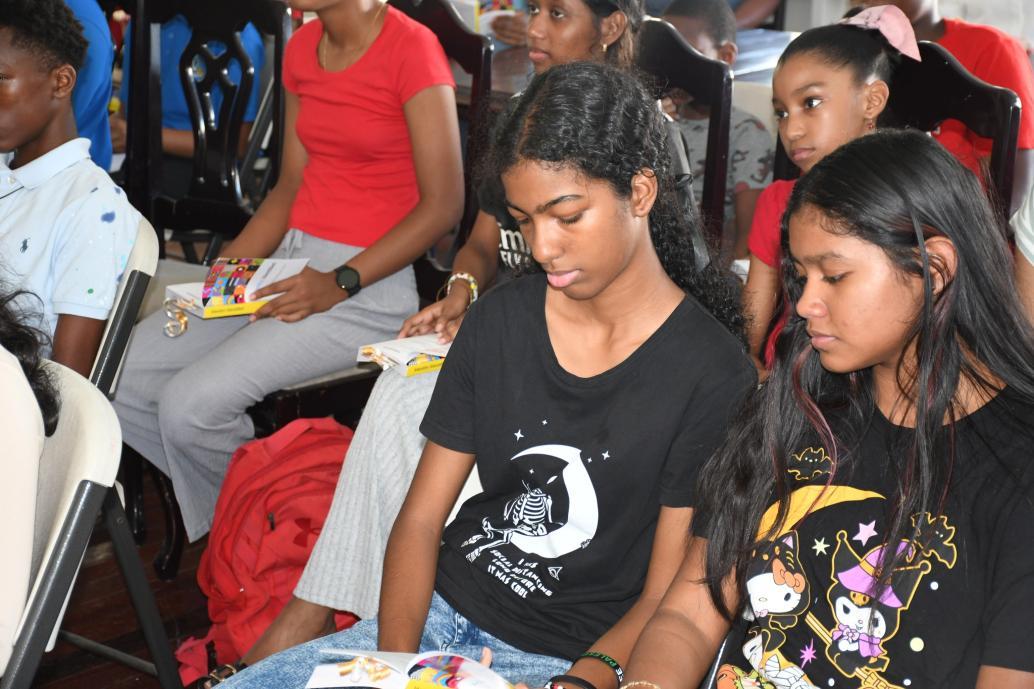
After three rounds covering the Gospel of Matthew, and a portion of the Gospel of John, the Youth Catechism of the Catholic Church and hymns related to scripture, the 21st Annual Diocesan Bible Quiz concluded on Sunday, March 22nd. Around 200 young people from across the diocese participated in three categories: Junior (12–14), Senior (15–17), and Young Adult (18–25).
A special awards and appreciation ceremony was held on Sunday, April 12th, 2026 (Divine Mercy Sunday) for participants from Georgetown and surrounding areas at Bishop’s House. Notably, this year’s quiz saw participation from teams in Regions 1, 2, 8, and 9, in addition to those from the Coast.
The closing ceremony began with welcome remarks from Mrs. Angela Abraham-Parks, Diocesan Youth Coordinator, followed by a brief presentation on the significance
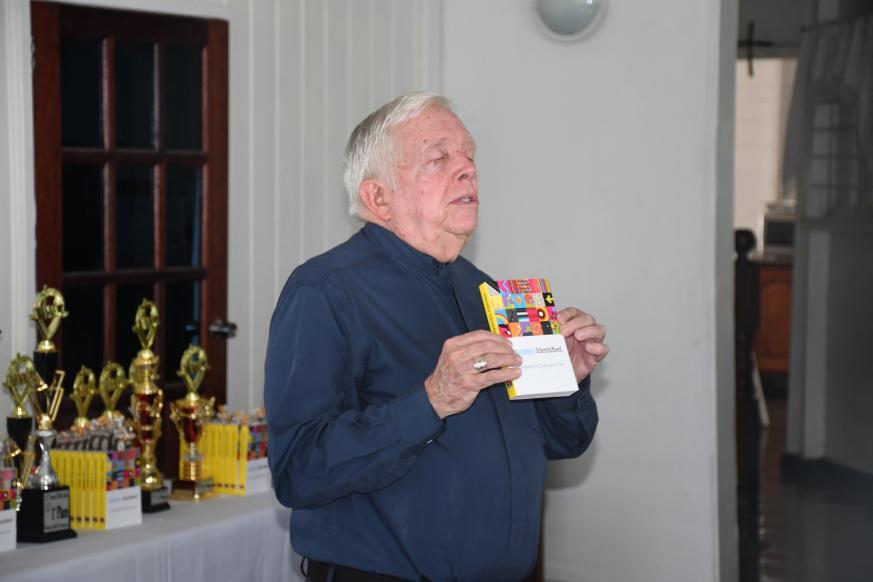
of Divine Mercy by Ms. Jada Gonsalves. Those present prayed the Divine Mercy Chaplet at 3.00 p.m. Bishop Francis Alleyne, OSB, then addressed the gathering, presenting copies of the New Testament resource Identity: Identified – Navigating the Challenges of Life, compliments of the Guyana Bible Society. The text invites young people to reflect on questions of identity, purpose, and belonging, offering reassurance that they are not alone. Rooted in God’s love, (please turn to page 13)
Caribbean bishops to meet with Pope Leo
The Antilles Episcopal Conference (AEC) has given the following press release on the upcomingAd Limina visit of the bishops of the region to Rome, which will take place April 27 – May 3, 2026:
The Bishops of the Antilles Episcopal Conference (AEC) will undertake their Ad Limina Apostolorum visit to Rome from 27 April to 3 May 2026, a significant occasion in the life of the Church that strengthens communion between the local Antillean Churches and the Holy See.
The term Ad Limina Apostolorum means “to the thresholds of the Apostles,” referring to the tombs of Saint Peter and Saint Paul in Rome. This visit, which normally occurs approximately every five years, is a pastoral pilgrimage where diocesan bishops meet with the Holy Father and various departments of the Vatican to reflect on the life and mission of the Church.
During the visit, the Bishops will present quinquennial reports from their respective dioceses. These reports offer a comprehensive overview of the pastoral, spiritual, and social realities of the Church in the region over the past five years. They include reflections on the life of parishes and communities, the work of clergy and religious, the role of the laity, and the Church’s engagement with the
wider society.
During their time in Rome, the bishops will be meeting with several Dicasteries of the Roman Curia; the Vatican offices that assist the Holy Father in governing and pastoral mission to the universal Church. These meetings offer an opportunity for dialogue and collaboration, enabling the bishops to share both the blessings and challenges faced in the Antillean Region.
A key moment of the visit will be the bishops’ meeting with His Holiness Pope Leo XIV. This encounter demonstrates the strong communion between the bishopsandthesuccessorofSaint Peter. During this meeting, the bishops will present the realities experienced in the Antilles and discuss pastoral priorities and concerns affecting the nations. Among the issues that may be raised are (please turn to page 4)
Pope Leo XIV celebrates Mass with 120,000 peopleinCameroon - p2
Pope’s journey to Africa is chance to rediscover the Church’s African roots, say historians - p3
A Christian Perspective on Social Issues - p4
Sunday Scripture - p5
Pope’s Easter message - p6
Easter Egg Hunt at Fatima - p7
I do not fear Trump, says Pope Leo - p8
Trump draws backlashover Pope Leo rant, ‘deeply offensive’ imageofhimselflookinglikeChrist - p8
Children’s Page - p9
Growing in Grace Week 83 - p10
Vatican affirms permanent place of ‘Anglican heritage’ in the Catholic Church - p10
Faith in Practice Week 10 - p11
Cathedral to hold a Festival of Flowers to celebrate Guyana’s60thIndependenceDay - p14
Bishop’s Engagements
Saturday, April 18th
09:00hrs:PrayerBreakfast atMarianAcademy
16:30hrs – Mass at Our Lady of Fatima
Sunday, April 19th
07:30hrs – Mass at the Cathedral
17:00hrs - Mass at the Cathedral
Wednesday, April 22nd
Travel to Rome – Ad Limina Meeting (April 25th – May 2nd.)
All Bishops of the AEC meet with Pope Leo and heads of departments at the Vatican.
Annual Plenary Meeting with Bishops (May 3rd – 8th)
Iwillbeawayfromthe Diocese from April 22ndtoMay9th,2026. During my absence, Reverend Ronald Fernandes, Vicar General will attend to matters on my behalf.
Francis Alleyne OSB
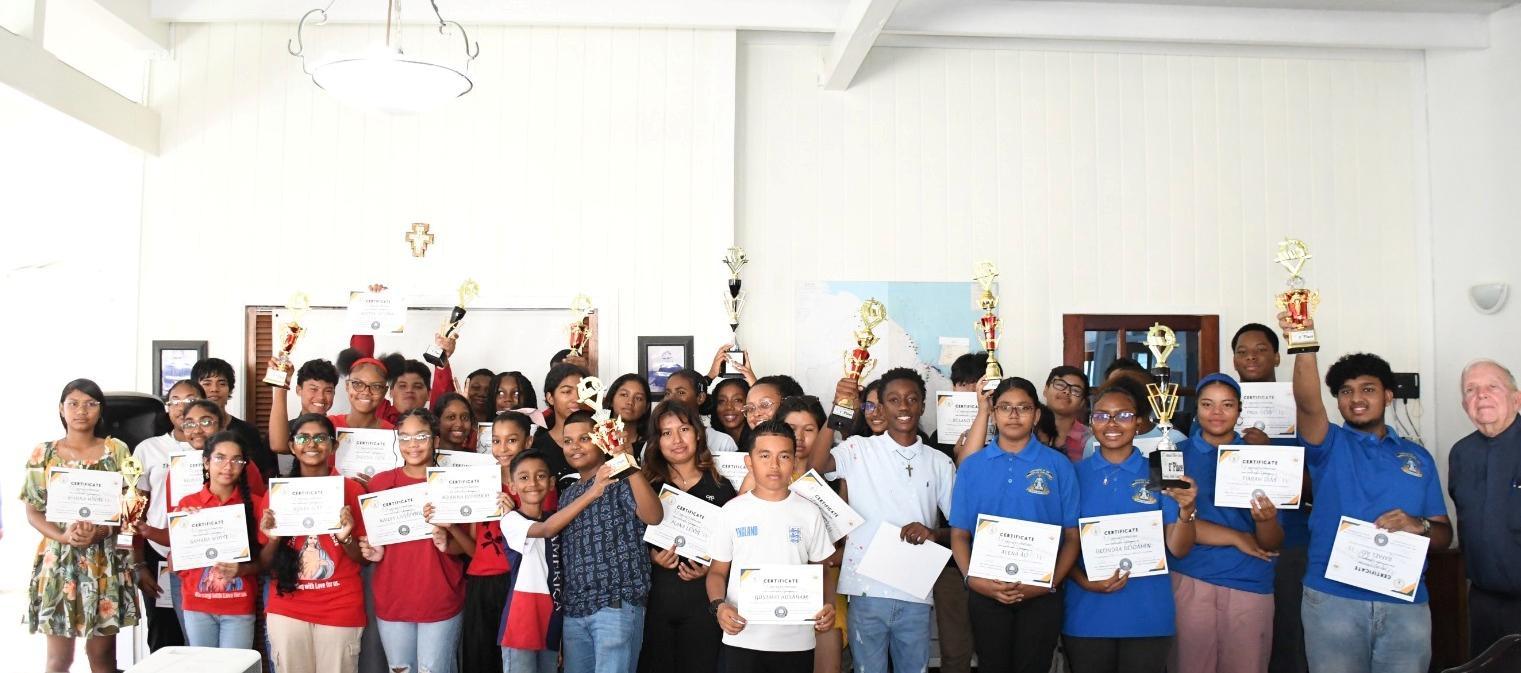
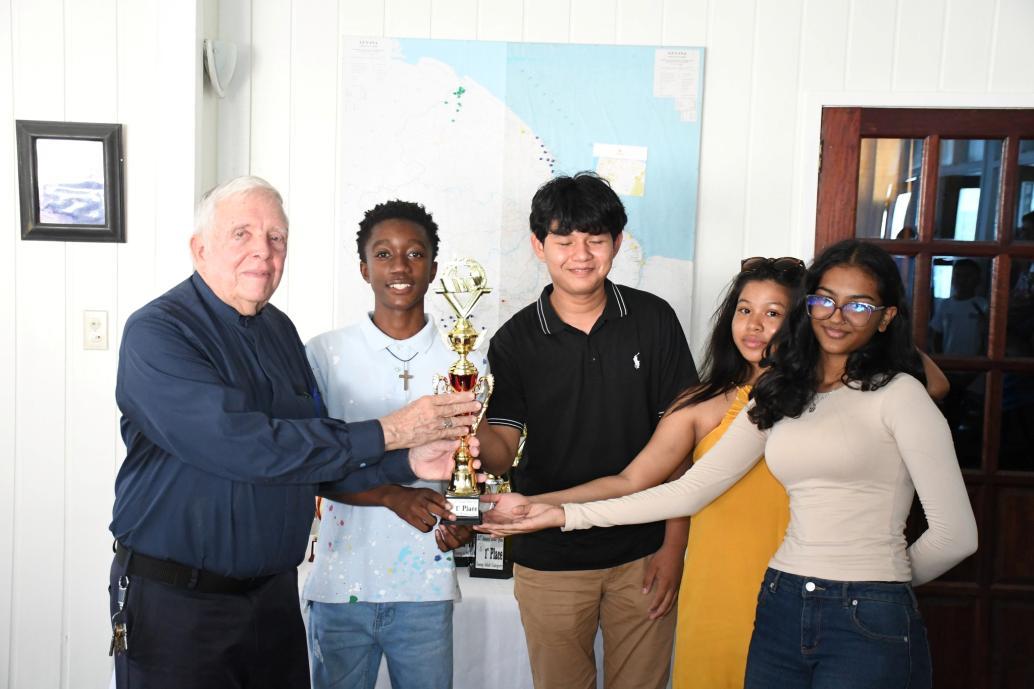
Bible Quiz participants with Bishop Francis Alleyne OSB at the awards ceremony, Sunday April 12th 2026.❖
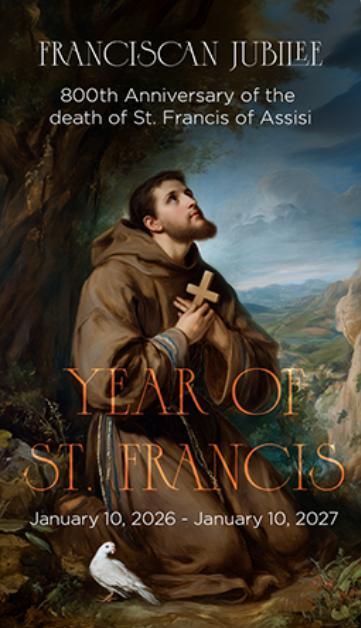
Year of St. Francis Jubilee Prayer
Saint Francis, our brother, you who eight hundred years ago went to meet Sister Death as a man at peace, intercede for us before the Lord.
You recognized true peace in the Crucifix of San Damiano, teach us to seek in Him the source of all reconciliation that breaks down every wall.
You who, unarmed, crossed the lines of war and misunderstanding, give us the courage to build bridges where the world raises up boundaries.
In this time afflicted by conflict and division, intercede for us so that we may become peacemakers: unarmed and disarming witnesses of the peace that comes from Christ.
Amen - Pope Leo XIV
with 120,000 people in Cameroon
DOUALA, Cameroon (OSV News)
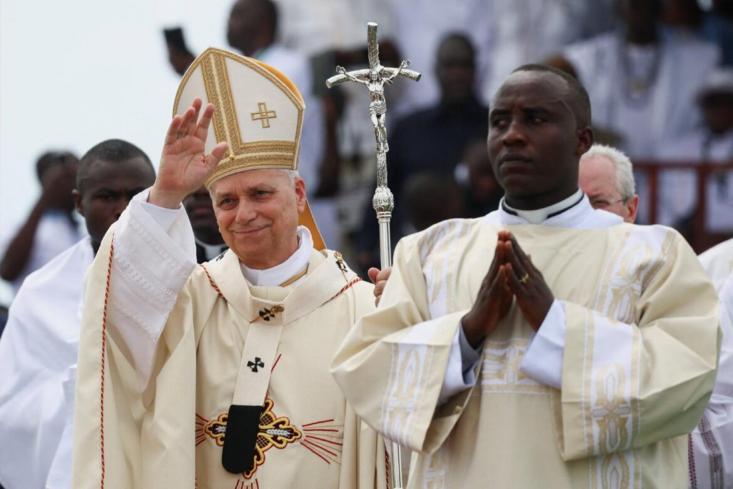
Pope Leo XIV celebrated Mass for more than 120,000 people in Cameroon’s largest city on April 17, urging “beloved children of the African continent” to share God’s love by feeding the hungry and offering the spiritual nourishment of “the bread of life.”
Because of the large turnout, the Mass was held in a parking area next to Douala’s Japoma Stadium under 90-degree heat. Catholics in the crowd told OSV News that they had spent the night outside to claim their spots for the Mass.
Remerit Ngwe, 28, waited 16 hours outside overnight for the papal Mass.
“Since yesterday 7 p.m. we slept here on the stone waiting for the pope,” she told OSV News. “We are so happy we finally saw the pope, Pope Leo, a once in a lifetime experience. Long live the pope!”
Speaking in both French and English during his homily, Pope Leo opened with a striking question to the Cameroonian congregation, “where is God in the face of people’s hunger?”
He turned to the Gospel of John and its account of the multiplication of the loaves and fishes to respond.
“A serious problem was solved by blessing the little food that was present and sharing it with all who were hungry,” Pope Leo said in French.
Pope Leo XIV: ‘There is bread for everyone if it is given to everyone’
“There is bread for everyone if it is given to everyone. There is bread for everyone if it is taken, not with a hand that snatches away, but with a hand that gives,” he underlined.
According to the World Food Programme, 2.9 million people in Cameroon face food insecurity and need humanitarian assistance, with about 23% of the population living below the poverty line.
The pope said the miracle of the multiplication of the loaves and fishes reveals a God who comes “to serve with love, not to dominate.”
“It shows us not only how God provides humanity with the bread of life, but how we can share this sustenance with all men and women who,
Christianity. That is the pride of being a Catholic Christian.”
Cameroon is home to more than 8 million Catholics, nearly 30% of the population, and the Church often serves as a bridge across linguistic and political divides.
Church’s mission in Cameroon
In an interview with OSV News, Father Gabriel Abega Owona of the Diocese of Sangmélima described the Church’s mission in the country.
As a priest, he said, “our daily challenge is to nurture faith within a context of material poverty, yet of immense spiritual richness.”
like ourselves, hunger for peace, freedom and justice. Each act of solidarity and forgiveness, every good effort, becomes a morsel of bread for humanity in need of care,” he said.
“Yet this alone is not enough: the food that sustains the body must be accompanied, with equal charity, by nourishment for the soul a nourishment that sustains our conscience and steadies us in dark hours of fear and amid the shadows of suffering,” he emphasized.
Spiritual nourishment is ‘Christ himself,’ Pope Leo XIV said Pope Leo said that this spiritual nourishment is “Christ himself, who always gives his Church abundant sustenance and strengthens us on our journey by giving us his Eucharistic Body.”
“Sisters and brothers, the Eucharist that we are celebrating is the source of renewed faith, because Jesus becomes present among us.”
“This very altar, around which we gather for the Eucharist, becomes a proclamation of hope amid the trials of history and the injustices we see around us,” he added.
The pope’s message resonated with Cameroonians in the crowd. Ngwe said, “Being a Catholic Christian allows you to partake in the Eucharist, which is the highest celebration.”
She said she loves the “oneness” of the Catholic Church, “When I see Cameroon, when I see Rome, when I see USA, we practice the same
“Being a priest here means being a father, a social worker, and a mediator. My experience is defined by faces: young people seeking work and dignity, families praying for peace, and the explosive joy of the Sunday liturgy which lasts for hours and servesasa trueforetasteofparadise.”
“In Cameroon, the Church is not an institution standing ‘alongside’ society, but rather its beating heart particularly in those areas where the State struggles to reach. The Church manages nearly 1,000 primary schools and hundreds of health care facilities. Indeed, in many villages, the only doctor or teacher available is one provided by the Catholic mission,” Abega Owona explained.
He added that the Catholic Church in Cameroon “serves as a bridge between the Francophone and Anglophone cultures” and strives “to translate the Gospel into concrete actions for human development.”
Switching to English for part of his homily, the pope urged Cameroon’s Catholics to “be the first faces and hands that bring the bread of life to your neighbors, providing them with the food of wisdom and deliverance from all that does not nourish them, but rather obscures good desires and robs them of their dignity.”
Thepope flew 160 miles from Yaoundé to Douala on Friday morning for the Mass, at which he greeted the enthusiastic crowd from the popemobile. After the Mass, Pope Leo made a private visit to the Catholic Hospital of St. Paul in Douala before returning by plane to Cameroon’s capital in the afternoon, where he met with university students and professors at the Catholic University of Central Africa in Yaoundé.❖
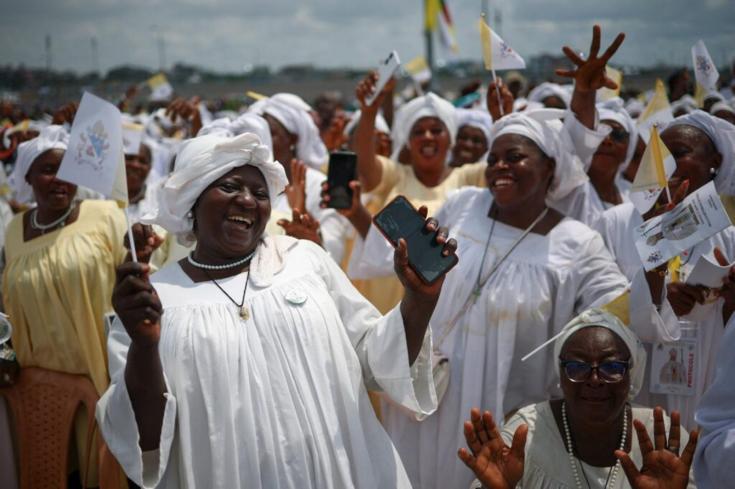
Faithful attend a Mass celebrated by Pope Leo XIV near the Japoma Stadium in Douala, Cameroon, April 17, 2026. (OSV News photo/Guglielmo Mangiapane, Reuters)
(OSV News) As Pope Leo XIV makes his first apostolic journey to Africa April 13-23, some scholars of the Church’s past are hoping he won’t just make history but that he’ll also help the wider Church recover that history.
“It’s important for us to get the message out that Western Christianity is fundamentally African, in the way that Eastern Christianity is fundamentally Greek,” Mike Aquilina, a prolific author on Church history, doctrine and devotion, told OSV News. “Africa is likely where our Latin liturgy developed, and we get our vernacular liturgy today from the Latin liturgy. So many of our traditions came out of Africa because Africa was a great center of Roman learning; of Latin learning.”
Firsthand knowledge of the continent
The pope who traveled all over Africa before his May 8, 2025, election and so has firsthand knowledge of the continent visits on this papal trip Algeria, Cameroon, Angola, and Equatorial Guinea, countries where Catholic residents vary from a fraction of the population to the majority.
In Algeria, there are no more than 9,000 Catholics among more than 45 million people; in Cameroon, Catholics account for approximately 1 in 3 of the 30 million population; in Angola, the Catholic Church is the largest single religious institution, where estimates identify 40%-55% of the country as Catholic; while Equatorial Guinea is one of the most Catholic countries in sub-Saharan Africa with nearly threequarters of its people being Catholics.
“That is where our own Western tradition emerged,” emphasized Aquilina, author of “The Fathers of the Church: An Introduction to the First Christian Teachers.”
Latin tradition out of Tunisia, Algeria
He said, “The Latin tradition came out of places like Tunisia and Algeria, and even the Greek tradition was developed in profound ways in Alexandria, in Egypt, and in Ethiopia. It’s a land of important Christian origins that we all share.”
Each nation has its own attractions for Pope Leo, but Algeria is the land of St. Augustine of Hippo, who is regarded as the greatest of the Latin Church Fathers and is the inspiration for the religious order to which the pope belongs.
“St. Augustine was an African,” Aquilina said. “He spent most of his life in Africa. He spent a small part of his life in Italy, where he was baptized and people associate him with Milan and Rome but he was born and raised in Africa. He died in Africa; and he identified himself culturally with Africa.”
Christianity an ‘asset’ to Algeria
Bishop Michel Guillaud of ConstantineHippone in Algeria told OSV News the pope’s presence will demonstrate that Christianity “is an asset and not a danger” to Algeria.
“The Holy Father has already visited Algeria twice, in 2003 and 2014, when he was prior general of the Order of St.
Augustine,” Bishop Guillard told OSV News. “He is not coming primarily on a personal pilgrimage in the footsteps of St. Augustine, but to meet the Algerian people and to support his Church, drawing on the strong bond between them through the figure of Augustine.”
Still, for someone who, as Aquilina put it, is “fiercely, intensely devoted to St. Augustine,” Pope Leo will obviously relish again walking in the footsteps of his spiritual hero.
‘An element of personal piety’ “I’m certain that there’s an element of personal piety here,” Aquilina said.
“But he also wants, in a sense, to bring the world to the feet of this African master so we can learn and delight in Augustine the way he does.
”
Catholic missionary activity in Cameroon dates to the 19th century; in Angola, the Church has taken on a key humanitarian role for migrants and refugees; and in Equatorial Guinea, there is also a robust missionary legacy. Key themes of the apostolic journey will include peace, care for the poor, interfaith dialogue and the family.
Aquilina noted that conflict has unfortunately marked numerous African regions, including Algeria. A Vatican commission concerned with modern martyrs created in 2023 by Pope Francis found more people were killed in Africa for being Christian compared to other continents.
Lands with a Christian history
Tensions have included “active efforts to wipe out Christian memory in those places,” said Aquilina. “I think they’ve succeeded to some degree and so the rest of us in the world have ceased thinking of them as Christian lands with a Christian history. But that’s false.”
The historically significant Kingdom of Kongo which once included part of what is now northern Angola as well as Congo, the Republic of Congo and parts of Gabon is a vibrant example of the long history of Catholicism in Africa.
Portuguese navigators reached Kongo, in the northwest, in 1483.
“When the Portuguese first reached this area and after a couple of exchanges Kongo sent a mission to Portugal,” John Thornton, professor of
history and African American studies at Boston University, told OSV News.
‘There to teach their language’
“They lived there for four years. It was a group that included nobles and some children, so they could become bilingual,” he explained. “They studied Portugal; they studied Christianity; they learned to read and write; and they taught at least some people there to teach their language, as well.”
“Out of that,” Thornton continued, “they developed what you might call the first catechism, although we don’t have a text for it. When they came back, they had a big baptism of the elite; and then over the next few years, everybody else was brought in.”
The Portuguese, however, wished to retain control of the new Catholics to the detriment of the Church and its evangelizing mission.
Under the Portuguese perpetual clergy shortage
“They tended to block Kongo’s efforts to get its own diocese and its own bishop; they played politics with that,” Thornton said. “And then they never sent very many priests, anyway so Kongo was perpetually, disastrously short of clergy.”
While in Angola, Pope Leo is visiting Muxima, a small town on the Kwanza River.
Every year between Aug. 31 and Sept. 1, over 1 million pilgrims visit Muxima to commemorate an 1833 apparition of the Virgin Mary. In 1924, its church, Nossa Senhora da Conceição da Muxima, was listed as a historical monument, and in 1996 added to the UNESCO World Heritage Tentative List.
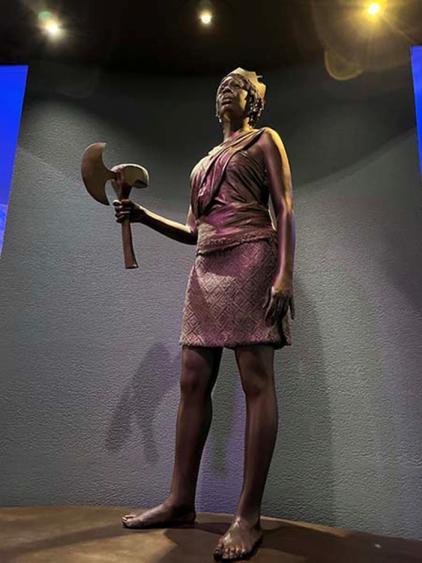
Life of Queen Nzinga Muxima is intertwined with the life of Queen Nzinga (1583-1663), who ruled the kingdoms of Ndongo and Matamba, located in present-day Angola. While she initially attempted diplomacy with Portugal Portuguese explorers and missionaries first came to Ndongo in 1575 she eventually ended up going to war as Portugal’s forces ravaged villages and enslaved tens of thousands of her people. Queen Nzinga threatened Portugal’s fortress in Muxima, and the war she waged over
A statue at the Jamestown Settlement museum in Williamsburg, Va., commemorates Queen Nzinga (15831663), a Catholic monarch who ruled over the kingdoms of Ndongo and Matamba, located in present-day Angola, in this file photo. (OSV News photo/Peter Jesserer Smith)
30 years significantly disrupted the transatlantic slave trade, saving many African people from that fate.
Over this period, Queen Nzinga struggled with her Catholic faith at times, given the scandal of Portugal trying to use Catholicism as a tool for its own colonial agenda; but she was aided by sympathetic Capuchin missionaries from Spain who also advocated for her before the Vatican.
“Nzinga was herself baptized and she returned to the Church, more or less fully, in 1656, when she signed a treaty with the Portuguese,” Thornton said. “They finally decided they couldn’t defeat her,” he added, “And at that point, she returned to the Church and finished her days as a good Christian.”
The Angolan portion of the papal journey is also an opportunity for Pope Leo to get in touch with his own African roots. He has Afro-Creole heritage from New Orleans and Haiti through his maternal grandparents Joseph Martinez and Louise Baquié.
Many Black Catholics descend from Africans who were already practicing the Catholic faith when their European coreligionists enslaved and transported them to the Americas; they passed on not only their Catholic faith but also their long fight for freedom to their descendents.
“A huge wave of Congolese were sent to Louisiana by the slave trade,” noted Thornton. “So the Louisiana coast has been influenced by the Kingdom of Kongo.”
Ultimately, Aquilina said he hopes Pope Leo’s apostolic journey can help global Catholics realize their debt to Africa.
“We’re dependent on African Latin tradition,” said Aquilina. “Even though we don’t acknowledge it anymore even though we no longer see it I think it’s good for us to recover our sight in this area.”❖
People listen as Pope Leo XIV celebrates Mass at the Basilica of St. Augustine in Annaba, Algeria, April 14, 2026. (OSV News photo/Simone Risoluti, Vatican Media)
A Christian Perspective on Social Issues
By GHK Lall
Lenten and Easter reminiscences
(Part 1 of 3)
After about seven years, I participated in one Friday afternoon of Stations of the Cross at the Brickdam Cathedral. A session that lasted around 35 to 40 minutes made me look and absorb every Station with a different eye. I sawJesus differently. I sawthe Father (Our Father in heaven) in a different light. It is what is shared today, and is planned for the next couple of weeks. A few reminiscences about Stations of the Cross; a little of the journey, and much more of the messages that left so many deep imprints.
Long before arriving with Jesus at the 14th Station, there is what sweeps off the feet. In rereading the narratives attached to Stations, the rush that seizes and shakes came as early as a quarter of the way in the journeying with Jesus crawling, clambering, towards the Place of the Skull. The encouragement extended to all, from Roman Catholics to believers that answer to a different calling, is to pause and think about how much was given for us all. Me, you, we, us, all.
If ever there was a sacrifice that inspires and makes us want to run and hide in a corner, at the same time, the walk along each Station does just so. At least, it does so to me. Glory to God, glory. Followed by ‘I am not worthy’. Unworthy, am I to be included in the great circle of salvation made possible by one harrowing sacrifice made by one simple man of truth for one world immersed in darkness and the clutches of sin. It is not a grip that is easily releasable or from that viselike hand smoothly escapable. The blood and agony of Jesus, the sacrificial lamb, is what salvages from temptation and sin and leads to salvation.
Often, there is reflecting on the sufferings of Holy Week, from betrayal to abandonment to a horrible death, and to be left in awe that a Father could give that as a Mission to his only Son. What pain he must have felt! How much he must have flinched and shuddered! Thus, when there is ingratitude, through negligence, the pursuit of selfish interests. Through disobedience to the commands and the call of faith-formed and a faith powered form of worship, how much more damage is inflicted on the suffering Christ locked in the ordeal of his anguish. Jesus’s religious adversaries threw all that they had at him in determined, nonstop efforts to weaken him mentally, psychologically, and spiritually. They failed. On top of that, the Romans, not known for kindness or compassion, applied every weapon in their arsenal to tear at his will, and smash his flesh into pieces to
turn him back from his set course. They, too, failed. Jesus rose to every challenge that threatened his mission togiveof himselfasawillingsacrificial lamb for a lost world to be found and brought back into the arc of God merciful fold. Indeed, God loved the world so much
Stations of the Cross reunite us with the scourged, grimacing, and humiliated Christ. Jesus standing before Pontius Pilate, the powerful agent of a dominant superpower, and holding his ground.
me.’ Let that sink in, and let that embolden. Jesus dragging himself forward, one painful step at a time, a tortured body in motion. But a spirit that, though savaged, remains unmutilated in its substance. What an incomparable kind of love that a man should lay down his life for the undeserving, who laugh at his pain! What a savior that, though in his throes, could still think of others, and is still ministering along the way to Calvary, and when nailed and hung high on that Cross, that emblem of divine salvation.
Gracious and loving God, we thank your for the gift of our priests.
If any of this means something, as much as it should and deep inside, then some of the engagements and encounters that dot our own lives, public and private must, out of necessity and spiritual honesty. It is what takes on a new dimension, represents a different degree of servanthood, and the quality of our Christian ethos lived.❖
(To be developed further and continued next week)
Caribbean bishops to meet with Pope Leo (From P1)
the pastoral needs of families and young people, the ongoing mission of evangelisation, the impact of migration and economic hardship, the effects of climate change and natural disasters on Antillean societies, and the continuing effort to strengthen the Church’s mission and witness in the region.
Alongside these meetings, the Ad Limina visit also serves as a spiritual pilgrimage. The bishops will celebrate the Eucharist and pray at the tombs of Saints Peter and Paul, entrusting the people of the Antilles to the Lord and seeking the guidance of the Holy Spirit for the Church’s mission in the region. In this Year of the 800th anniversary of St. Francis’ death, we will undertake a day’s spiritual pilgrimage
to Assisi, the birthplace of St. Francis.
The visit provides the bishops with a chance for prayer, reflection, and renewal, strengthening their ministry as shepherds of God’s people and fostering deeper bonds of unity between the Antilles and the universal Church.
The Bishops of the Antilles Episcopal Conference invite the faithful across the region to join them in prayer during this pilgrimage. They request that the People of God pray for the Holy Spirit to guide their conversations and discernment, and for the visit to promote growth and mission within the Antilles.
As they journey to Rome, the bishops carry with them the faith, hopes, and
concerns of the people of the Region, entrusting them to the Lord and to the intercession of the Blessed Virgin Mary, Mother of the Church, and SaintsPeter andPaul. ❖
Through them, we experience your presence in the sacraments.
Help our priests to be strong in their vocation.
Set their souls on fire with love for your people.
Grant them the wisdom, understanding, and strength they need to follow in the footsteps of Jesus. Inspire them with the vision of your Kingdom.
Give them the words they need to spread the Gospel.
Allow them to experience joy in their ministry.
Help them to become instruments of your divine grace.
We ask this through Jesus Christ, who lives and reigns as our Eternal Priest. Amen
‘Growth is the only evidence of life.’
Saint John Henry Newman (1801-1890)
First Reading Acts of the Apostles 2:14, 22-33
On the day of Pentecost Peter stood up with the Eleven and addressed them in a loud voice: ‘Men of Judaea, and all you who live in Jerusalem, make no mistake about this, but listen carefully to what I say. Men of Israel, listen to what I am going to say: Jesus the Nazarene was a man commended to you by God by the miracles and portents and signs that God worked through him when he was among you, as you all know. This man, who was put into your power by the deliberate intention and foreknowledge of God, you took and had crucified by men outside the Law. You killed him, but God raised him to life, freeing him from the pangs of Hades; for it was impossible for him to be held in its power since, as David says of him:
“I saw the Lord before me always, for with him at my right hand nothing can shake me. So my heart was glad and my tongue cried out with joy; my body, too, will rest in the hope that you will not abandon my soul to Hades nor allow your holy one to experience corruption. You have made known the way of life to me, you will fill me with gladness through your presence.”
‘Brothers, no one can deny that the patriarch David himself is dead and buried: his tomb is still with us. But since he was a prophet, and knew that God had sworn him an oath to make one of his descendants succeed him on the throne, ‘what he foresaw and spoke about was the resurrection of the Christ: he is the one who was not abandoned to Hades, and whose body did not experience corruption. God raised this man Jesus to life, and all of us are witnesses to that. Now raised to the heights by God’s right hand, he has received from the Father the Holy Spirit, who was promised, and what you see and hear is the outpouring of that Spirit.’
Responsorial Psalm Psalm 15
Response: Show us, Lord, the path of life. or Alleluia!
1. Preserve me, God, I take refuge in you. I say to the Lord: ‘You are my God.
O Lord, it is you who are my portion and cup; it is you yourself who are my prize.’ Response
2. I will bless the Lord who gives me counsel, who even at night directs my heart.
Today’s readings focus on a theme of “sojourning.” As Christian stewards, we know our lives are a sojourn towards the ultimate destination of heaven.
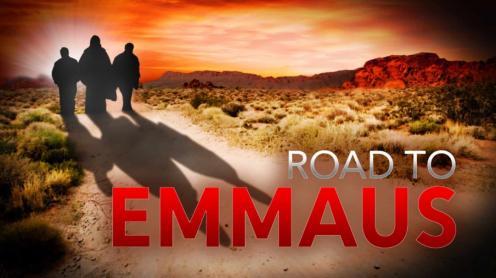
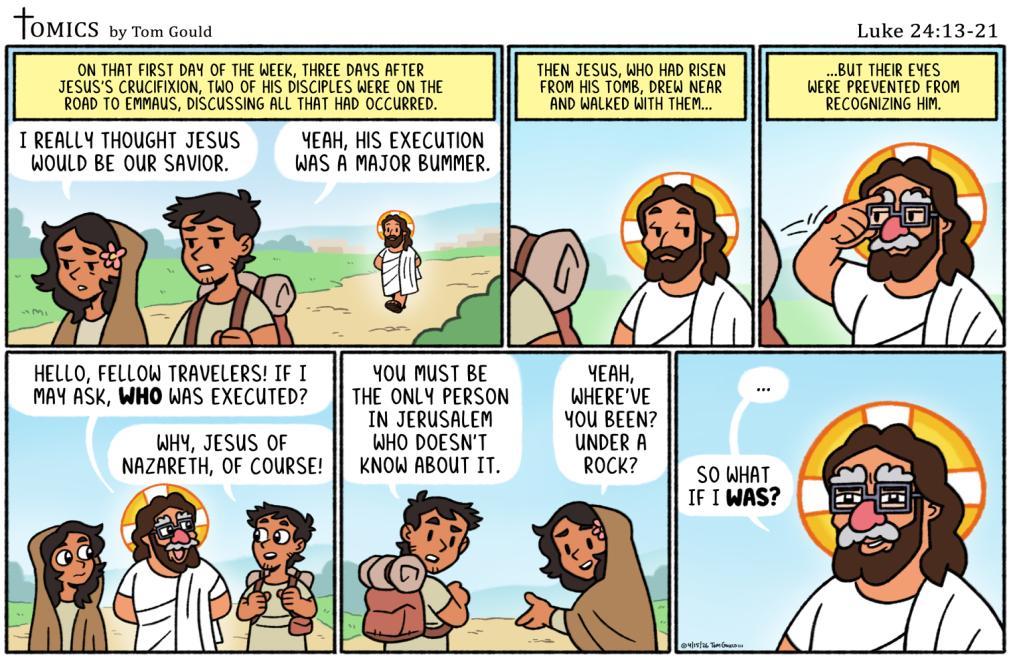
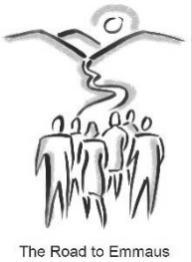
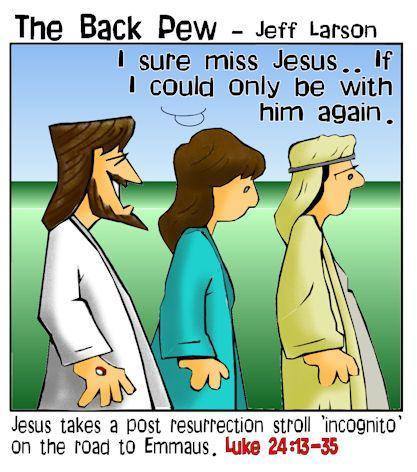
Our Gospel passage today describes the sojourn of the two disciples on the
I keep the Lord ever in my sight: since he is at my right hand, I shall stand firm. R/
3. And so my heart rejoices, my soul is glad; even my body shall rest in safety.
For you will not leave my soul among the dead, nor let your beloved know decay. Response
4. You will show me the path of life, the fullness of joy in your presence, at your right hand happiness for ever. Response
Second Reading
1Peter 1:17-21
If you are acknowledging as your Father one who has no favourites and judges everyone according to what he has done, you must be scrupulously careful as long as you are living away from your home. Remember, the ransom that was paid to free you from the useless way of life your ancestors handed down was not paid in anything corruptible, neither in silver nor gold, but in the precious blood of a lamb without spot or stain, namely Christ; who, though known since before the world was made, has been revealed only in our time, the end of the ages, for your sake. Through him you now have faith in God, who raised him from the dead and gave him glory for that very reason – so that you would have faith and hope in God.
Gospel
Luke 24:13-35
Two of the disciples of Jesus were on their way to a village called Emmaus, seven miles from Jerusalem, and they were talking together about all that had happened. Now as they talked this over, Jesus himself came up and walked by their side; but something prevented them from recognising him. He said to them, ‘What matters are you discussing as you walk along?’ They stopped short, their faces downcast.
road to Emmaus. The two are dejected and despondent after Jesus’ death. They knew Jesus personally. They had heard the Gospel message directly from His lips. They heard the testimony of the women who discovered the empty tomb of our Lord and saw a vision of angels announcing He was alive. They had been informed by other disciples who went to the tomb that all was exactly as the women reported.
How much more obvious could the Good News be?
Then one of them, called Cleopas, answered him, ‘You must be the only person staying in Jerusalem who does not know the things that have been happening there these last few days’.‘What things?’ he asked. ‘All about Jesus of Nazareth’ they answered ‘who proved he was a great prophet by the things he said and did in the sight of God and of the whole people; and how our chief priests and our leaders handed him over to be sentenced to death, and had him crucified. Our own hope had been that he would be the one to set Israel free. And this is not all: two whole days have gone by since it all happened; and some women from our group have astounded us: they went to the tomb in the early morning, and when they did not find the body, they came back to tell us they had seen a vision of angels who declared he was alive. Some of our friends went to the tomb and found everything exactly as the women had reported, but of him they saw nothing.’
Then he said to them, ‘You foolish men! So slow to believe the full message of the prophets! Was it not ordained that the Christ should suffer and so enter into his glory?’ Then, starting with Moses and going through all the prophets, he explained to them the passages throughout the scriptures that were about himself.
When they drew near to the village to which they were going, he made as if to go on; but they pressed him to stay with them. ‘It is nearly evening’ they said ‘and the day is almost over.’ So he went in to stay with them.
Now while he was with them at table, he took the bread and said the blessing; then he broke it and handed it to them. And their eyes were opened and they recognised him; but he had vanished from their sight.
Then they said to each other, ‘Did not our hearts burn within us as he talked to us on the road and explained the scriptures to us?’
They set out that instant and returned to Jerusalem. There they found the Eleven assembled together with their companions, who said to them, ‘Yes, it is true. The Lord has risen and has appeared to Simon.’ Then they told their story of what had happened on the road and how they had recognised him at the breaking of bread.❖
And yet, at times, the reaction of the two disciples describes our own stewardship journey, doesn’t it? We have the fullness of the Catholic faith, the power of the sacraments, the support of our parish family. Yet, we often lose our way. We fail to see all the gifts we have been given. We lack trust in the perfect goodness and almighty power of God. But notice what happens to the two men when eyes are opened once again and theyrecognizeJesusin theEucharist the “breaking of the bread.” They are transformed! Their hearts are set
on fire with love for the Lord and their faith. They recall that their hearts began “burning within” as the Lord was explaining the Scriptures to them. When we find we have lost our way, we can go to the same sources as the two disciples on the road to Emmaus the Scriptures and the Eucharist. In this Easter season, resolve to feast deeply on these two sources of grace. They are the fuel that will propel us on journey towards heaven. ❖
[www.catholicsteward.com/blog/ ]
‘ rose is entirely nonviolent,’ pope Gospel Reflection
The two disciples on the road to Emmaus did not recognise Jesus immediately. They were so engaged in chatting, questioning and searching for answers to the events of the past few days that they did not recognise the stranger who joined them. It was only in the breaking of the bread that they came to know who he was. If we think seriously about it, we will realise that there are many times in our own lives that we too fail to recognise God’s presence immediately. Many times it is only when we share our stories with others that we realise that God is there all along. We just fail to be aware of God’s presence right away. This points out the need to share our faith journey with others and to come together to worship and break bread each week. This will help us to recognise and acknowledge Jesus’ presence as we walk our own Emmaus journey.
Think about it: two disciples walking on a long journey, talking and trying to understand what had been going on. This story is not just about two dejected people but about each and every one of us. Like the two disciples we, many times, travel down a sad and lonely road. And at such times Jesus is nothing more than a figure who lives only in the pages of the Gospels. Then something happens and we feel his presence at our side. The moment we become conscious of that presence, we are no longer alone. Even though we may never go to the Holy Land, all of us have been on our own road to Emmaus. Some of us are very familiar with that road which is the way of failure, sorrow, grief, disappointment, broken dreams. It is through our faith that we recognise the risen Jesus who is with us on our own Emmaus journey, even though we may find it hard to recognise him at first. ❖
[From: Journeying with the Word of God, The Religious Education Department, Diocese of Georgetown, Guyana ]
VATICAN CITY (OSV News) Speaking from the loggia of St. Peter’s Basilica on Easter, Pope Leo XIV delivered a passionate appeal for peace, declaring that the power of the risen Christ is “entirely nonviolent” and calling on world leaders to lay down their weapons and choose dialogue over domination
The address came moments after the pope offered Easter Mass in St. Peter’s Square with more than 50,000 people present and preceded his solemn blessing, “urbi et orbi,” meaning “to the city and to the world,” in which the pope offers an indulgence to Catholics around the world who receive the blessing with the proper dispositions.
‘Be amazed by Christ!’
“In the light of Easter, let us allow ourselves to be amazed by Christ! Let us allow our hearts to be transformed by his immense love for us! Let those who have weapons lay them down! Let those who have the power to unleash wars choose peace! Not a peace imposed by force, but through dialogue! Not with the desire to dominate others, but to encounter them!” Pope Leo said on April 5.
The pope repeated the word peace 13 times in his address, underlining that the peace the risen Christ offers “is not
merely the silence of weapons, but the peace that touches and transforms the heart of each one of us.”
“Let us allow ourselves to be transformed by the peace of Christ! Let us make heard the cry for peace that springs from our hearts!”
At the heart of his message was a meditation on the nature of Christ’s power in the resurrection, which he contrasted with the violence that marks the modern world.
“The power with which Christ rose is entirely nonviolent,” Pope Leo said. That strength, the pope added, “is God himself, for he is Love who creates and generates, Love who is faithful to the end and Love who forgives and redeems.”
‘Abandon every desire for conflict’
“On this day of celebration, let us abandon every desire for conflict, domination, and power, and implore the Lord to grant his peace to a world ravaged by wars and marked by a hatred and indifference that make us feel powerless in the face of evil. To the Lord we entrust all hearts that suffer and await the true peace that only he can give,” he said.
The pope warned against the “globalization of indifference,” a
phrase he credited to his predecessor, Pope Francis, who gave his final “urbi et orbi” blessing from the same loggia on Easter Sunday one year ago the day before he died. Pope Leo invoked the words from Pope Francis’ Easter blessing last year, in which the late pope lamented “what a great thirst for death, for killing, we witness each day in the many conflicts raging in different parts of the world.”
World becoming ‘indifferent’ to violence
“We are growing accustomed to violence, resigning ourselves to it, and becoming indifferent,” Pope Leo said. “Indifferent to the deaths of thousands of people. Indifferent to the repercussions of hatred and division that conflicts sow.”
“We cannot continue to be indifferent! And we cannot resign ourselves to evil!” he added.
Quoting a sermon by St. Augustine, Pope Leo said, “If you fear death, love the resurrection!”
Easter, the pope said, “is the victory of life over death, of light over darkness, ofloveoverhatred.”
His victory ‘came at a very high price’
“It is a victory that came at a very high price,” he added. “Christ, the Son of the living God (cf. Mt 16:16), had to die and die on a cross after suffering an unjust condemnation, being mocked and tortured, and shedding all his blood. As the true immolated Lamb, he took upon himself the sin of the world (cf. Jn 1:29; 1 Pet 1:18–19) and thus freed us all and with us, all creation from the dominion of evil.” “Evil is not the last word, because it has been defeated by the Risen One,” he said.
After giving the “urbi et orbi” blessing in Latin, Pope Leo offered Easter greetings in 10 different languages, including Chinese and Arabic, with loud cheers as he spoke in English and Spanish.
“May you bring the joy of Jesus, who is risen and present in our midst, to all you meet,” he said in English. The pope then joined the joyful crowd in St. Peter’s Square in the popemobile.❖
For 121 years, the Catholic Standard has been sharing the Gospel of Jesus Christ.
Now reaching 10,000+ followers on Catholic Media Guyana Facebook plus going straight to your inbox and WhatsApp, our vibrant weekly e-paper is a trusted source which delivers informative and inspiring stories from across the diocese and around the world.
Want to promote your business or event? Advertise with us! Call675-4542oremail catholicstandardgy@gmail.com ❖
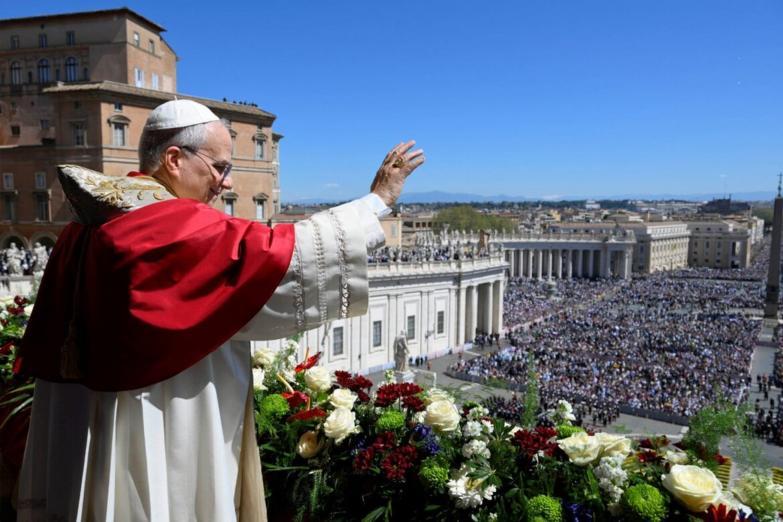
Pope Leo XIV delivers his "urbi et orbi" (to the city and the world) message from the main balcony of St. Peter's Basilica on Easter at the Vatican April 5, 2026. (OSV News photo/Vatican Media, -handout via Reuters)
Easter Egg Hunt at Fatima
Journeying with the Word of God
MAKING THE WORD OF GOD YOUR OWN
Step 1: Lookattoday’sReadingsprayerfully.
1st Reading: Under the guidance of the Holy Spirit, Peter courageously challenges the people to acknowledge that God has raised Jesus to life.
2nd Reading: The challenge of the newly baptised recalls that in the sacrament of baptism we are united with Christ in his death and resurrection.
Gospel: The meaning of Jesus’ life, death and resurrection is revealed to two of his disciples as they share a meal. They share the good news with the others.
1. Would you say we all need our own personal Emmaus journey from time to time? Why is this so?
2.Was there ever a moment in your life when you accompanied someone on their Emmaus journey, helping them to make some kind of sense in the senselessness of the moment? How did you do this?
3.At the end of the journey, when night was falling, the disciples offered hospitality to Jesus. When and how in your life have you ever offered hospitalitytoJesus?
4.We meet the Risen Jesus in the Scriptures and in the Eucharist. In what other way would you say you have met him in your life?
Step 3: Accepting the message of God’s Wordinyourlifeoffaith
The Lord walks with us on our life’s journey but often we fail to recognise him because we are blinded by work and worry, doubt and fear. But our faith helps us to recognise him in our midst. And our faith grows and deepens with every encounter with the Risen Lord.
Step 4: Somethingtothink&prayabout
1.The disciples were walking away from Jerusalem and the pain and sorrow that occurred there just a few days before. Many times I too try to walk away from my sorrows and disappointments. But in the end I am unable to do so. They follow me wherever I go. At times like these I need someone to accompany me on my Emmaus journey. I, too, must walk with people, be present to them and listen to them.
2.Pray that whenever you feel sad and disillusioned that God will renew your faith and your sense of hope.❖
[From: Journeying with the Word of God, The Religious Education Department, Diocese of Georgetown, Guyana ]
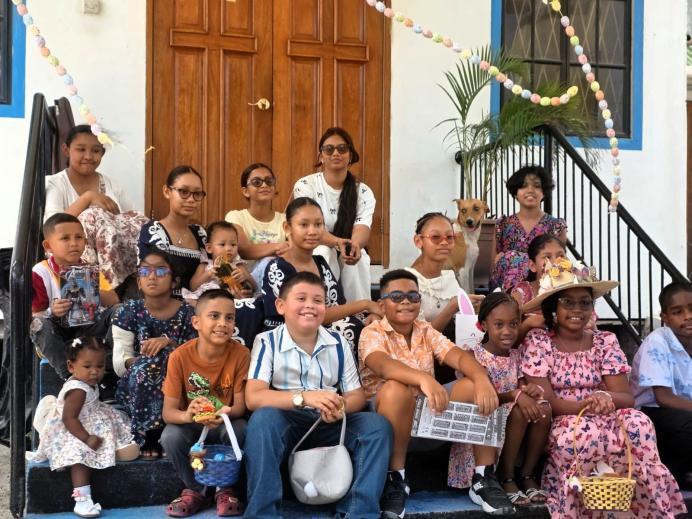
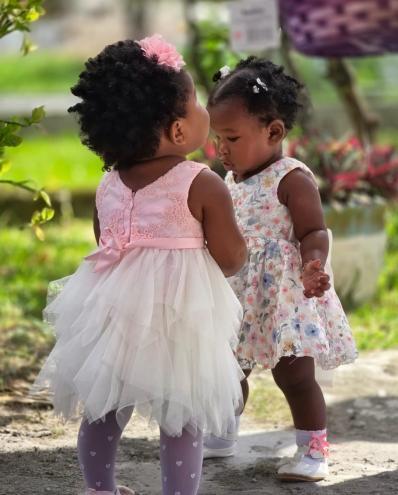
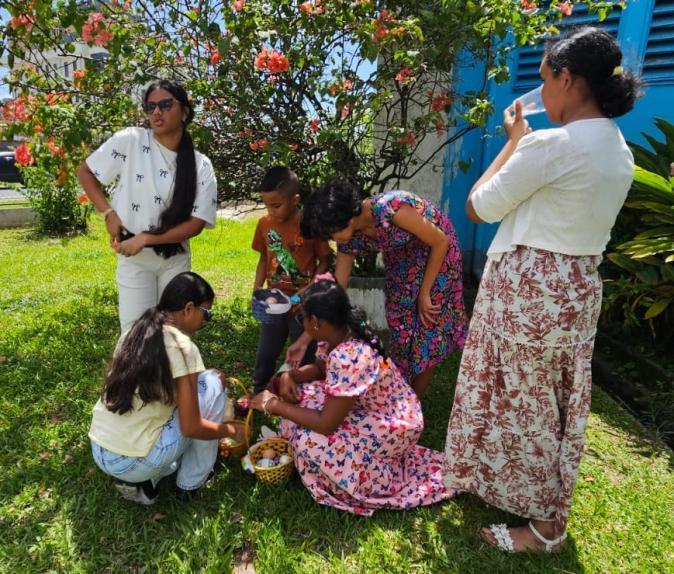
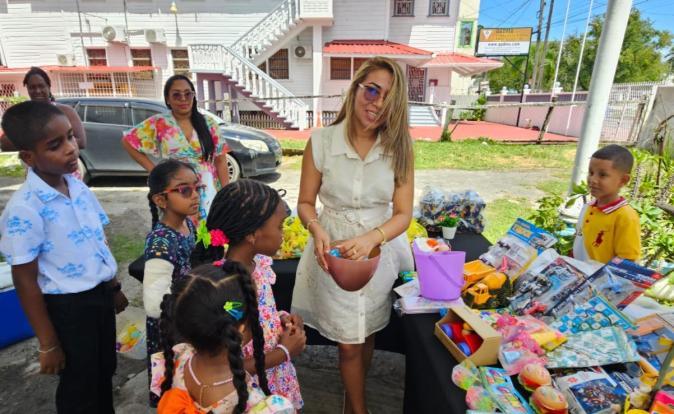
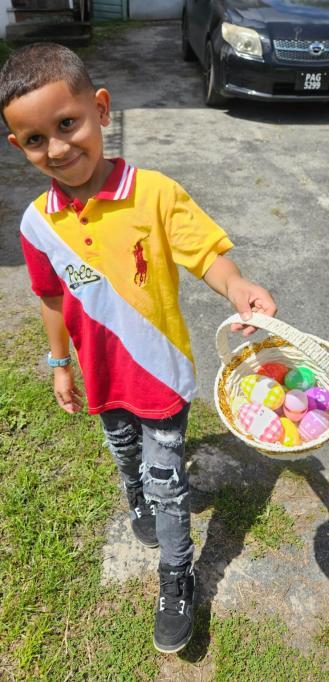
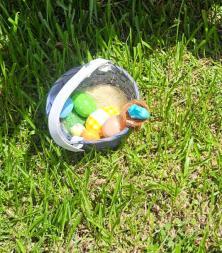
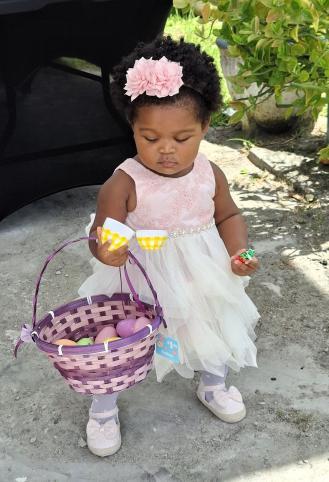
Easter Egg Hunt at Our Lady of Fatima Church, Bourda, Georgetown, last Sunday April 12th.❖(Our Lady of Fatima Church - Guyana FB)
I do not fear Trump, says Pope Leo after US president calls him ‘weak’
(OSV News) Pope Leo XIV said April 13 he has “no fear” of President Donald Trump’s administration and responded to Trump’s criticism by telling journalists that his message to the U.S. president is “the message of the Gospel: Blessed are the peacemakers.”
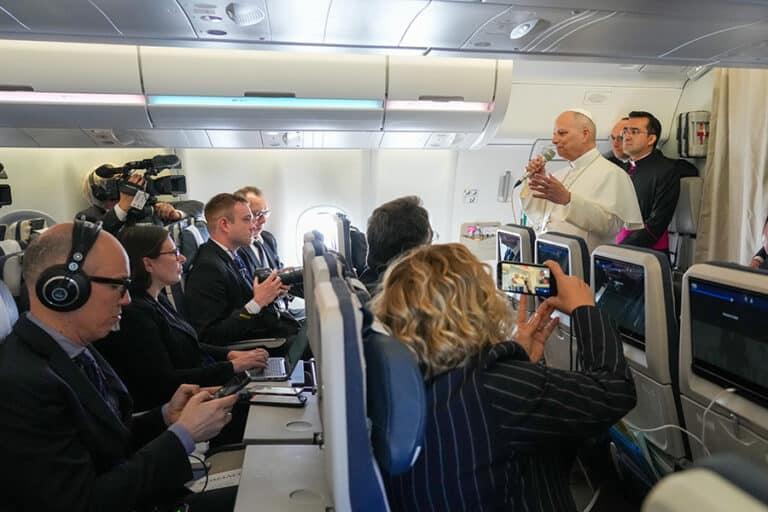
Speaking aboard the papal plane, a chartered ITA Airways flight, en route from Rome to Algiers, the pope said that he had seen Trump’s recent social media post lashing out at him the night before the papal trip.
“I have no fear neither of the Trump administration nor speaking out loudly of the message of the Gospel, which is what I believe I am here to do, what the Church is here to do,” the pope said during the flight in a video recorded by OSV News.
The pope spoke in response to Trump’s comments April 12 calling the pope “weak on crime” and “terrible for foreign policy,” as tensions escalate in the Middle East.
“We are not politicians,” Pope Leo said. “We are not looking to make foreign policy with the same perspective that he might understand it, but I do believe in the message of the Gospel: ‘Blessed are the peacemakers’ is the message that the world needs to hear today.”
Pope Leo added that he did not intend to engage in a political dispute.
“I do not look at my role as being political, a politician,” the pope said. ” I don’t want to get into debate with him. I don’t think that the message of the Gospel is meant to be abused in the way that some people are doing.”
“The message of the Church, my message, the message of the Gospel: Blessed are the peacemakers,” he underlined.
Pope Leo has been a staunch critic of combat operations generally, including those initiated by the U.S. and Israel against Iran on Feb. 28. He also condemned Trump’s threat to wipe out Iran’s “whole civilization,” which the
president later backed down from, citing negotiations with Pakistani mediators.
The pontiff held a special evening prayer vigil for peace in St. Peter’s Basilica April 11.
“I will continue to speak out loudly against war, looking to promote peace, promoting dialogue and multilateral relationships among the States to look for just solutions to problems,” Pope Leo said on the way to Algiers.
“Too many people are suffering in the world today. Too many innocent people are being killed. And I think someone has to stand up and say there’s a better way,” he added.
Trump, writing on Truth Social platform late April 12 said he did not want “a Pope who thinks it’s OK for Iran to have a Nuclear Weapon.”
“I don’t want a Pope who thinks it’s terrible that America attacked Venezuela, a Country that was sending massive amounts of Drugs into the
United States and, even worse, emptying their prisons, including murderers, drug dealers, and killers, into our Country. And I don’t want a Pope who criticizes the President of the United States because I’m doing exactly what I was elected, IN A LANDSLIDE, to do, setting Record Low Numbers in Crime, and creating the Greatest Stock Market in History,” the president wrote on Truth Social.
Pope Leo commented, “It’s ironic the name of the site itself. Say no more.”
Pope Leo, the first U.S.-born pope, has called for the rejection of nuclear weapons, and there is no evidence he supports Iran having such weapons.
Trump claimed Pope Leo was elected as pope because the Church thought an American pontiff would be “the best way to deal with President Donald J. Trump.”
“If I wasn’t in the White House, Leo wouldn’t be in the Vatican,” he wrote.
Several journalists aboard the plane asked Pope Leo about Trump’s comments to which the pope explained, “To put my message on the same plane as what the president has attempted to do here, I think is not understanding what the message of the Gospel is, and I am sorry to hear that but I will continue on with what I believe is the mission of the Church in the world today.
”
Pope Leo spoke to journalists on the first flight of the pope’s 11-day, four-country tour of Africa in which he will visit Algeria, Cameroon, Angola and Equatorial Guinea.
In a separate statement late April 12, Archbishop Paul S. Coakley of Oklahoma City, president of the U.S. Conference of Catholic Bishops, said he was “disheartened” by Trump’s remarks.
“Pope Leo is not his rival; nor is the Pope a politician,” Archbishop Coakley said. “He is the Vicar of Christ who speaks from the truth of the Gospel and for the care of souls.”❖
Trump draws backlash over Pope Leo rant, ‘deeply
PHILADELPHIA (OSV News) Catholic bishops and lay leaders across the political spectrum are expressing their shock and disapproval following President Donald Trump’s online screed against Pope Leo XIV.
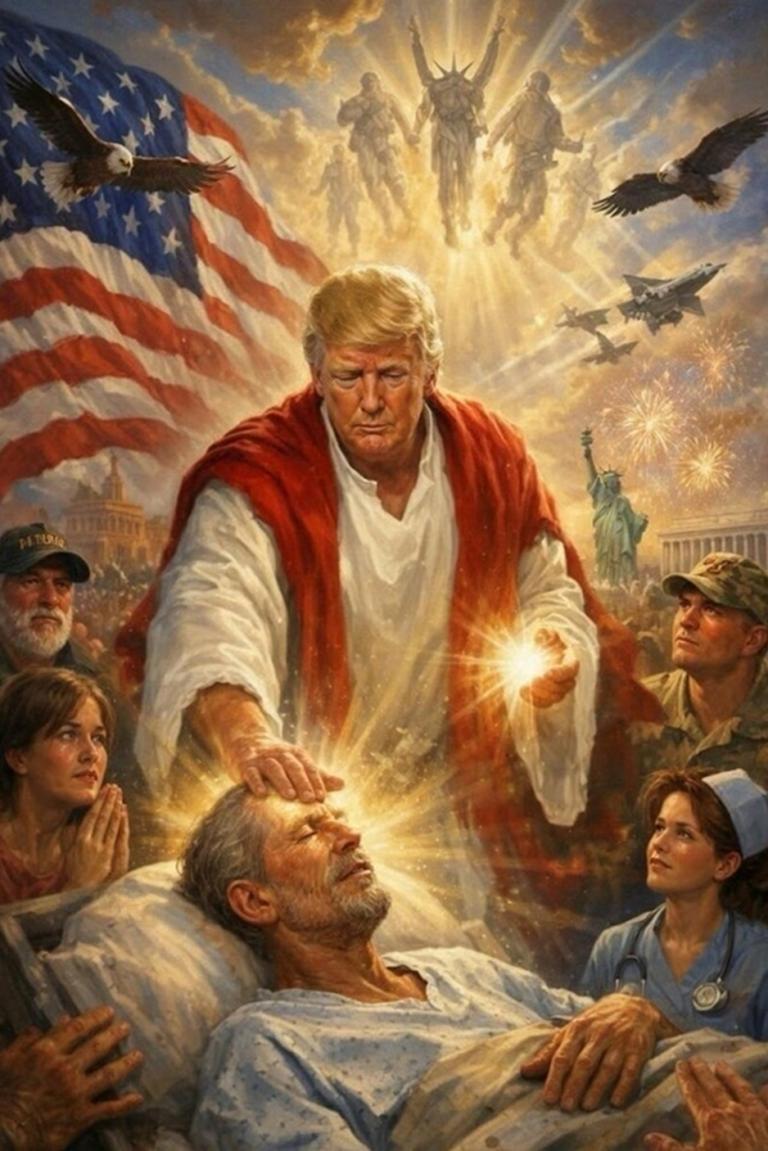
Others have also voiced concern over an image which Trump posted within an hour of attacking the vicar of Christ that appeared to depict Trump as Jesus Christ himself.
Trump deleted the post of him looking like Christ the following day, after an uproar from Christians denouncing the
depiction as blasphemous, but he refused to apologize to Pope Leo.
“Pope Leo said things that are wrong,” Trump said, doubling down on a 330word condemnation of the pope April 12 as “WEAK on Crime, and terrible for Foreign Policy,” and taking credit for the U.S.-born pope’s election.
Archbishop Paul S. Coakley of Oklahoma City, president of the U.S. Conference of Catholic Bishops, issued a statement that evening, saying he was “disheartened that the President chose to write such disparaging words about the Holy Father.”
Archbishop Coakley said that the pope is not Trump’s “rival,” and “nor is the Pope a politician. He is the Vicar of Christ who speaks from the truth of the Gospel and for the care of souls.”
Cardinal Joseph W. Tobin of Newark, New Jersey, who was part of an interview on Pope Leo with CBS’ “60 Minutes” program that aired April 12, told OSV News in an April 13 statement that Trump’s “recent statements and actions convey a grave misunderstanding of the Holy Father’s ministry and a troubling lack of respect for the faith of millions.”
“Pope Leo serves a higher authority and desires to proclaim the Gospel faithfully and advance the Church’s peaceful mission in a world deeply in need of healing,” he said.
“He will continue to speak clearly against war and other offenses against human dignity and to call for authentic dialogue, because the Church’s witness is grounded in the peace of Christ, not in partisan interests,” Cardinal Tobin said.
Other fellow prelates rallied around the pope in the wake of Trump’s broadside. (please turn to page 12)
Pope Leo XIV speaks to reporters aboard the papal flight from Rome to Algeria April 13, 2026. Pope Leo pushed back Israel war in Iran, telling reporters that the
Dear Boys and Girls,
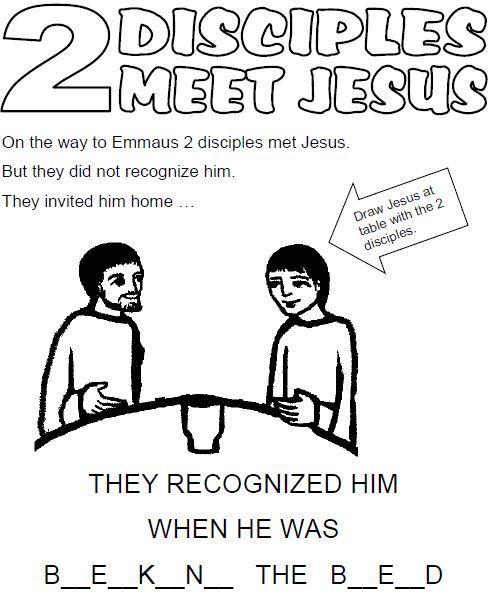
Our Gospel reading today tells an amazing story about a day when Jesus walked and talked with some of his followers, but they didn't even recognize him. Here is what happened.
After Jesus was crucified and risen from the grave, two of his followers were walking on the road that led to a town called Emmaus. They were sad and were talking about what had happened to Jesus. Suddenly, Jesus joined the disciples and walked along with them, but they did not know who he was because God kept them from recognizing him.
"You seem to be having a very serious discussion. What are you talking about?"
Jesus asked them.
One of the men answered, "You must be the only person in Jerusalem that doesn't know what has happened the past few days," Then they told them about how Jesus had been crucified, and buried, and that some women had gone to his tomb, but the tomb was empty. "We have heard that he is alive," they said, "but we have not seen him."
"Do you find it so difficult to believe what was written by the prophets in the Scripture?" Jesus asked. "It was predicted by the prophets that the Messiah would have to suffer all these things before entering his time of glory." Then Jesus quoted passages from the writings of the prophets, explaining what the Scriptures said about himself. By this time, they had come to Emmaus and the disciples invited Jesus to stay with them since it was getting too late in the day to travel. So Jesus stayed with them and when they sat down to eat, Jesus took the bread and blessed it, broke it, and gave it to them. Suddenly, their eyes were opened and they saw that it was Jesus. Then just as quickly as he had appeared to them, Jesus disappeared.
They were so happy and excited to have seen Jesus that they ran back to Jerusalem to tell the others that they had seen Jesus. Do you want to see Jesus? The Bible says, "You will find him if you look for him with all your heart and with all your soul." (Deuteronomy 4:29) Oh, he may not appear to you in the same way he did to the disciples in our story, but If you study God's Word and seek him with all your heart, he will reveal himself to you.
Dear Lord, open our eyes, we want to see Jesus! In Jesus' name we pray, Amen.❖
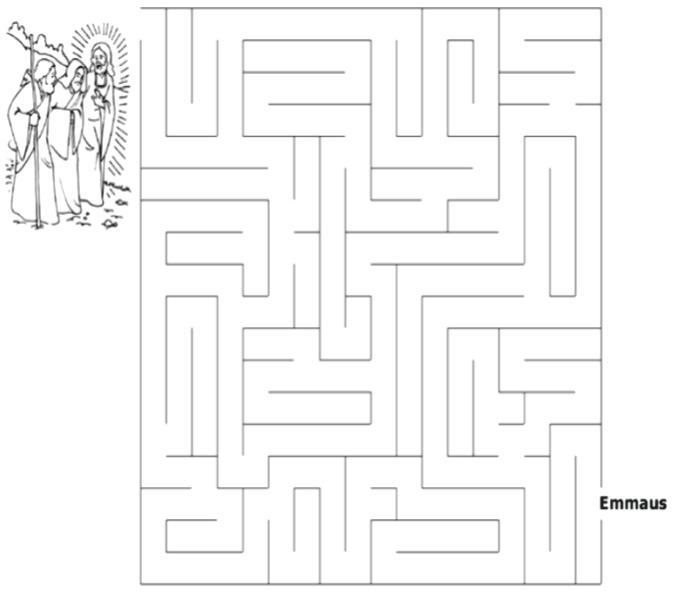
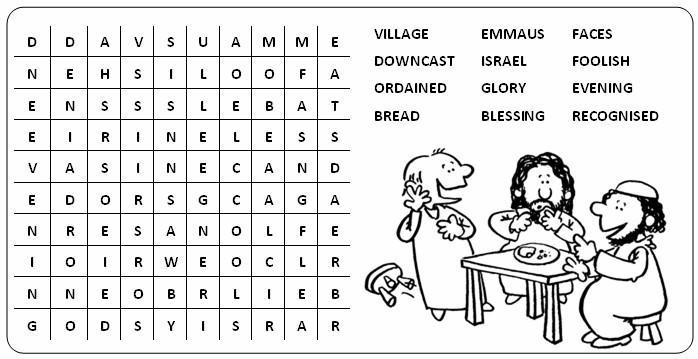
Follow Jesus on the road to Emmaus
‘Anglican heritage’ in the Catholic Church
(CathNews) - The Vatican’s Dicastery for the Doctrine of the Faith has released a new document describing the “Anglican heritage” of the Catholic Church’s personal ordinariates as a permanent reality that makes a “distinctive contribution” to the Church’s evangelising mission. Source: OSV News.
Published on the dicastery’s website March 26, the Vatican document stressed that the Anglican patrimony of the ordinariates founded under Pope Benedict XVI’s 2009 apostolic constitution Anglicanorum Coetibus ordinariates informally known as “the Anglican Ordinariate” is “a living reality” that “looks to the future in the transmission of the faith to future generations”.
The Vatican said the ordinariates –which bring with them a patrimony from the Church of England that developed for nearly 500 years
following the Reformation – offer “a unique reflection of the face of the Church and a distinctive contribution to the living richness of her identity as ‘one, holy, catholic, and apostolic’”.
“The patrimony they have inherited, therefore, not only equips the Ordinariates to welcome communities and individuals into full communion but also continues to shape their distinctive participation in the Church’s mission well into the future,” it stated.
The document followed a March 1-3 meeting between the bishops leading the Catholic Church’s personal ordinariates and the head of the dicastery, Cardinal Victor Manuel Fernández.
RegardingwhattheAnglicanpatrimony is in the Catholic Church, the Vatican document noted Cardinal Fernández’s observation during the homily he gave at the 2024 episcopal ordination of
Bishop David A. Waller of the Ordinariate of Our Lady of Walsingham, which covers the United Kingdom.
“In the case of the Ordinariate, the Catholic faith is inculturated among people who experienced the Gospel in the context of the Anglican Communion,” the prefect preached, noting how elements of the rich Anglican tradition “are now lived out in the fullness of Catholic communion.”
The Vatican document identified seven distinctive traits of this patrimony that it proceeded to describe in detail under the following headings: “a distinctive ‘ecclesial ethos’”; “evangelisation through beauty”; “direct outreach to the poor”; “pastoral culture”; “the family and the domestic church”; “Scripture and preaching”; and “spiritual direction and the sacrament of penance.”❖
By Renika Anand
Humility comes before Honour
C.S. Lewis, a British author, once said “Humility is not thinking less of yourself, it’s thinkingofyourselfless.”
Humility is the essence of all of the most important virtues, including love and compassion. At the same time, it is also a facet of wisdom that we learn through the realisation that the world is much greater than ourselves and the space that we occupy within it.
Our lives are driven by the forces of hope and desire, both of which stem from right within us. As such, it is easy to forget that there are so many other hopes and desires that exist out in the universe, none of which are lesser than our own. The moment we begin to believe that we have a greater role, a better dream or a more important place than those who share this world with us, we lose the ability to make honourable choices.
There are always more beautiful things to find if we choose to direct our gaze upwards, rather than at ourselves. Humility can unravel messages and lessons that we could have never discovered otherwise.
Wisdom’s instruction is to fear the Lord, and humility comes before honour
- Proverbs 15:33 ❖
Fr Joel Thompson SJ
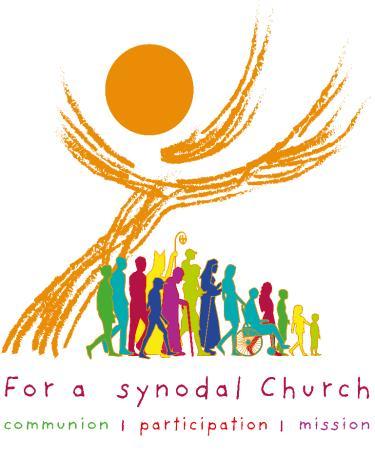
From time to time, we come across “one-man bands”. These are talented musicians who play many instruments on their own. While impressive, there is something far more beautiful about an orchestra: many instruments, many voices, all different, yet united in harmony. This image of “playing/ journeying” together helps us understand what the Church means by synodality. If you have ever wondered what synodality is, this short article offers a guide to its essential features.
What We Believe
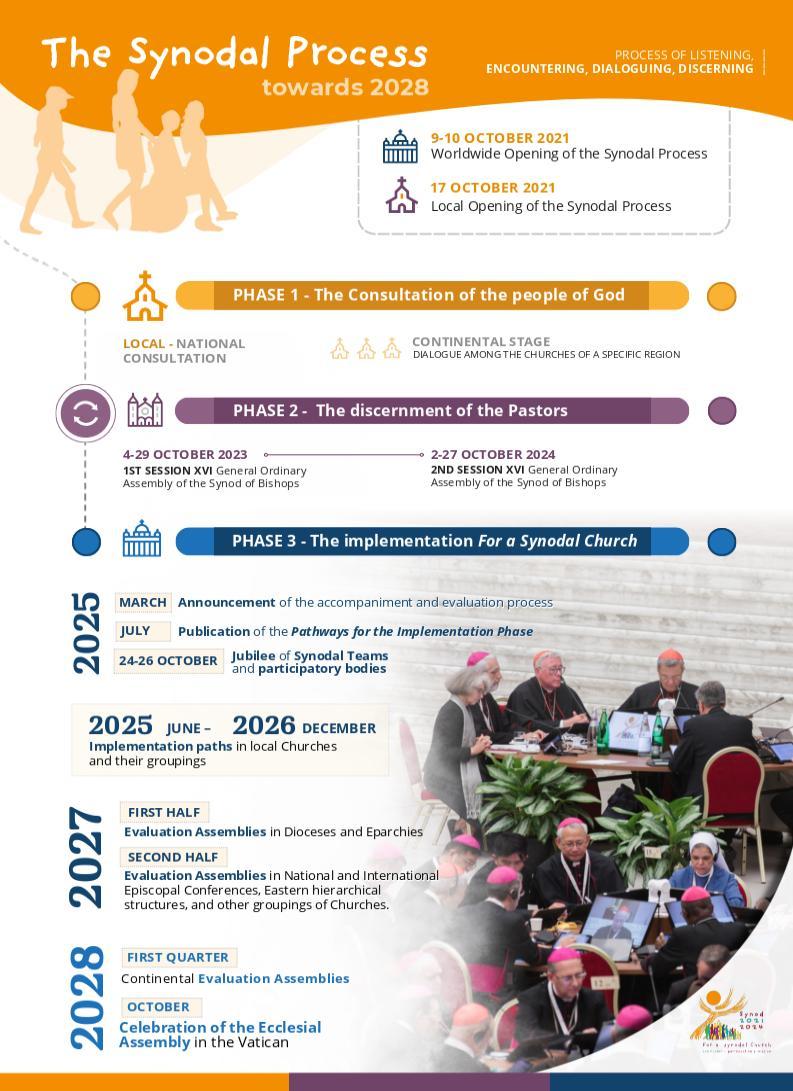
The Synod on Synodality (2021–2024) reminds us that synodality is not an optional program but a “constitutive dimension” of the Church, meaning it belongs to her very nature.
In simple terms, synodality means that the Church is a people who walk together, listen, discern, and respond to the Holy Spirit. It is a path to spiritual renewal that makes the Church more participatory and missionary. The Holy Spirit, one might say, is the conductor of the band/ orchestra by guiding and uniting it. The Church therefore keeps her ears and heart firmly attentive to where the Holy Spirit is leading it. This vision is deeply rooted in Scripture. In Acts 15, the early Church gathers in Jerusalem to discern a difficult question (see Acts 15:1-35). They listen, pray, and finally declare: “It has seemed good to the Holy Spirit and to us…” (Acts 15:28). This is synodality in action.
The Synod highlights three inseparable dimensions:
Communion – unity with God and one another (“that they may all be one” – John 17:21)
Participation – every baptized person has a role (“To each is given the manifestation of the Spirit for the common good” – 1 Corinthians 12:7)
Mission – all is directed toward evangelization (“Go therefore and make disciples” – Matthew 28:19)
This is not easy since pride and ego can get in the way (I feel I know best). That is why the Synod calls for deep conversion and humility.
Synodality is about becoming a listening and discerning Church, centered on Christ. To understand what the conductor would like us to play, we must keep our eyes and hearts fixed on him.
Discernment means that every person, family and parish is meant to be asking: What is God is asking of me/us now? It is not a political process or a democratic vote, but a spiritual journey rootedinprayerandtheHolySpirit
Why It Matters
For many, synodality can sound abstract, but it is about renewing the Church’s life and mission today. A top down and non-inclusive approach weakens and stifles our mission. When only a few people make decisions or carry responsibility, fewer people feel they belong. Groups die when they don’t grow. Synodality invites us into shared responsibility. It calls us to become a listening Church. Listening is an act of love. This means taking seriously the experiences of others. The old, the young, the poor, the overlooked, all have something useful to contribute. The Holy Spirit speaks through the whole People of God, not only through me or those I like. Listening builds trust, and without trust, there can be no real community.
The Synod also emphasizes coresponsibility. The Church is not the work of a few, but the mission of all. Every baptized person shares in Christ’s mission. This calls for greater participation of lay people in decisionmaking and broader representation (age, ethnicity, gender, differently abled etc.) in decision making. Finally, synodality is always for mission. Jesus sends his disciples outward: “As the Father has sent me, so I send you” (John 20:21). Synodality is not inward-looking. It is about becoming a Church that goes forth. In short, it is a movement from maintenance to mission: from simply preserving structurestosharingthe Gospelwithjoy.
How We Live It
Synodality locally depends on our parishes and communities. The Synod was not just a document or event. So, what does it look like in practice?
1. Listening deeply
Create real spaces for listening through parish gatherings, youth forums and family visits. As St James reminds us: “Let every person be quick to hear, slow to speak” (James 1:19). Listening is the first step of synodality.
2. Shared responsibility
Lay people are not spectators. Each person (i.e. YOU!) has gifts to offer. Through prayer, ask the Holy Spirit what contributions you can make. As St Paul teaches, “The body does not consist of one member but of many” (1 Corinthians 12:14).
3. Prayerful discernment
The Synod highlights “conversation in the Spirit”. This is a way of listening to God together through prayer, silence, and reflection. Without personal and communal prayer, synodality becomes just another meeting. Discernment must always be rooted in prayer, otherwise we risk replacing the Holy Spirit with our own preferences and opinions.
4. Missionary outreach
Everything must lead outward. Our parishes must not become closed circles. We are sent to bring Christ to others especially the poor, and those on the margins.
5. Formation and practice
We learn synodality by doing it. Make it a habit in your family and parish to pray and discern together. Parishes that would like to become more familiar with the conversation in the spirit method can contact our local synod implementation team.
Conclusion
Synodality is not a theory. It is a way of being Church. Let us begin today by becoming more prayerful and listening to the Holy Spirit. We are called to discern together and work together. There is no place in the Church for “one-man bands”. ❖
Trump draws backlash over Pope Leo rant
A now-deleted post seen April 12, 2026, on U.S. President Donald Trump’s Truth Social account depicts an AI-generated image of himself that was widely regarded across the political spectrum showing Trump as Jesus Christ. Trump posted the AI-generated image 46 minutes after delivering a social media tirade against Pope Leo XIV. He confirmed with reporters April 13 he posted it but claimed it was intended to show him as a doctor “making people better.” (OSV News photo/@realDonaldTrump/Truth Social handout via Reuters)
Shortly after Trump’s post attacking Pope Leo, Ukrainian Greek Catholic Metropolitan Archbishop Borys A. Gudziak of Philadelphia issued a statement posted to his Facebook page, saying he was “most grateful” to the pope for his “personal integrity, spiritual serenity, ethical clarity and courageous and prophetic preaching of the Gospel and of the truth of God’s love at this time of great moral confusion.
“The world should listen carefully,” he said.
Archbishop Mark S. Rivituso of Mobile, Alabama, backed Archbishop Coakley’s statement, adding in an April 13 message that he affirmed “the Holy Father’s role as a spiritual leader who speaks from the Gospel and for the care of souls.” He encouraged “all the faithful to be one with the Holy Father in praying for and witnessing to the Gospel of Christ’s peace and care for all peoples.”
But when reporters at the White House asked about Bishop Barron’s statement April 13, Trump said he had “nothing to apologize for.”
“Pope Leo said things that are wrong, he was very much against what I’m doing with regard to Iran, and you could not have a nuclear Iran, Pope Leo would not be happy with the end result,” Trump said.
Speaking to Fox News April 13, Vice President JD Vance, a Catholic, addressed Trump’s social media post, saying, “We can respect the pope, we certainly have a good relationship with the Vatican, but we’re also going to disagree on substantive questions from time to time. I think it’s a totally reasonable thing and isn’t particularly newsworthy.
”
Regarding the AI-generated image of Trump looking like Christ, Vance said he believed it was “a joke” and that the president took it down after recognizing “a lot of people weren’t understanding his humor.”
“I think the president likes to mix it up over social media, and that’s one of the good things about this president,” Vance said.
Archbishop George Leo Thomas of Las Vegas said in an April 12 statement that he was “grateful to God for sending us Pope Leo XIV, who is willing to speak truth to power just when we need him the most.”
“Pope Leo is calling for dialogue over diatribe, prayer over politics, and diplomacy above destruction,” said Archbishop Thomas. “We know that he will be unfazed by the President’s ad hominem attacks and sophomoric rhetoric.
”
The archbishop said the pope is “doing what every spiritual leader is called to do to pray for peace, to call for the protection of helpless civilians, and to plead for world leaders to end mass destruction and armed conflict in every part of the world.
“God bless you, Pope Leo,” he said.
“We stand with you in prayer and offer you our loving support.”
innocent life in all its stages as well as the cause of the poor and marginalized,” said McGuire. “Insulting the Pope, and all Catholics by extension, with the hope of making the Church bend to American political agendas, is discouraging and counterproductive.”
The Council on American-Islamic Relations also offered an April 13 message of support, saying, “We stand in solidarity with the Catholic community in the wake of President Trump’s attack on Pope Leo.
”
CAIR referenced an earlier post Trump made, in which he threatened to annihilate Iran while “sarcastically praising Allah,” and said that “the president’s mockery of religion is both deranged and insulting.”
Trump’s social media tirade against Pope Leo was also compounded by a Truth Social post delivered 46 minutes later showing a Christ-like rendering of Trump in white and red robes, laying one glowing hand on a man on a sickbed looking up at him, with Trump’s other hand holding an orb of light.
Surrounding the bed were at least four figures appearing to venerate Trump, who was framed by images of the Statue of Liberty, the Lincoln Memorial, the U.S. flag, warplanes, bald eagles, and five heavenly figures in military gear.
“The graphic exploitation of sacred imagery is deeply offensive and undermines the reverence owed to what believers hold most dear,” Cardinal Tobin told OSV News.
McGuire said Trump’s “use of imagery that mocks Jesus Christ is beyond the pale and is not just insulting to Catholics, but to all Christians.”
A number of prominent evangelical leaders and influencers including Doug Wilson, pastor of U.S. Secretary of Defense Pete Hegseth, and podcast host Riley Gaines also deplored the image as blasphemous.
In an April 13 post on X, Bishop Robert E. Barron of Winona-Rochester, Minnesota, called Trump’s statements about the pope “entirely inappropriate and disrespectful.”
“It is the Pope’s prerogative to articulate Catholic doctrine and the principles that govern the moral life,” he said. “In regard to the concrete application of those principles, people of good will can and do disagree.”
Bishop Barron praised the Trump administration’s engagement with Catholics, noting his membership on the president’s Religious Liberty Commission, and encouraged “serious Catholics within the Trump administration” to meet with Vatican officials “so that a real dialogue can take place.”
“No President in my lifetime has shown a greater dedication to defending our first liberty,” said Bishop Barron, adding, “All that said, I think the President owes the Pope an apology.”
Archbishop Nelson J. Pérez of Philadelphia said in an April 13 statement that the pope and his message “deserve respect and admiration.”
“His continued calls for peace, hope, diplomacy, and the conversion of hearts should be heeded by all,” said Archbishop Pérez, pointing out how Pope Leo “has consistently spoken with clarity and compassion” to promote “peaceful resolutions to complex challenges” that uphold human dignity.
Joining the bishops in protesting Trump’s post was Ashley McGuire, senior fellow at The Catholic Association, an organization dedicated to defending religious liberty and the Church in the public square.
In an April 13 statement to OSV News, McGuire said the association “laments President Trump’s disparaging and disrespectful remarks about Pope Leo.”
“The Catholic Church does not in any way fit into American political boxes. It will always prioritize the protection of
Rev. Jim Wallis, founding director of Georgetown University’s Center on Faith and Justice, told OSV News the image is “the epitome of Christian nationalism,” as well as “stark heresy and a pure blasphemy.”
“Donald Trump has a dangerous messianic complex,” Rev. Wallis said.
Matthew D. Taylor, visiting scholar at the Georgetown center and an expert on Christian nationalist ideology, agreed, adding that the image is “typical of the quasi-messianic status he has recently started to claim for himself.”
“I don’t see how that could possibly end well,” he said.
Amid the outrage, the AI-generated image was removed from Trump’s Truth Social feed on April 13. The president told reporters the same day that he thought the depiction had been of him “as a doctor making people better and I do make people better. I make people a lot better.”
“I did post it,” he said, “and I thought it was me as a doctor and had to do with the Red Cross.”❖
21st Annual Diocesan Bible Quiz concludes
Bishop Francis speaks on Identity: Identified –Navigating the Challenges of Life, a New Testament resource that contains the 24 most pressing issues identified as the biggest in young people’s lives, with advice on how to navigate these challenges and associated ways to identify why God created each one of us in the unique way He did .
it affirms the dignity and purpose of each person and encourages readers to find strength and guidance through Scripture, faith, and community.
During a feedback session, participants and catechists expressed deep gratitude for the experience, describing it as both enriching and spiritually uplifting. Many shared that the quiz helped deepen their prayer life and understanding of the faith. Fr Joel Thompson, SJ, who prepared the questions and study material, offered words of encouragement to all present.
Certificates of participation were distributed, followed by the presentation of trophies. The event concluded in a joyful atmosphere, with games and fellowship celebrating a renewed love for Scripture. Participants were encouraged to continue growing in faith and to allow the Word of God to guide their daily lives.
The Diocesan Youth Ministry Quiz team extends sincere thanks to all catechists, parents, and benefactors, and especially the young participants who made this event a meaningful one. Members of the team: Mrs. Angela Abraham-Parks, Mr. Christopher Sukhai, Mrs. Techanna Couchman, Mr. Justin Thompson, Mr. David Smith, Ms. Graziella Abraham, Fr Joel Thompson SJ and Mr. Joshua Van-Sluytman. Special thanks are also extended to Ms. Jasmine Grant and Ms. Sharon Mortley, and to all those who hosted sessions by reading questions. We appreciate your dedication and enthusiasm. We also extend heartfelt gratitude to all the faithful for your constant prayers and support for our young people. May God continue to bless and guide them as they grow in faith, knowledge, and service.
Final Results
Junior Category
1. St. Joseph, Husband of Mary, Diamond
2.HolySpirit
3. Our Lady of the Mount, Meadow Bank
4. St. Robert Bellarmine, Aishalton
5. St. Ignatius
6. St. Teresa, Campbellville
7. St. Lawrence, Nappi
8. Sacred Heart
9.Cathedral of the Immaculate Conception, Brickdam
10. St. John Berchmans, Sawariwau
11. St. Joachim, Springlands
12. St. Angela Merici, Parfait Harmony
13. St. Jerome, Supply
14. St. Theresa, Karasabai
15. Our Lady of Lourdes, Hosororo
16. Presentation of the Lord, East Hiawa
17. St. Francis of Assisi, Lima Sands
18. Holy Rosary
19. St. Louis, Siriki
20. St. John the Baptist, Plaisance
21. St. Francis Xavier, Charity
22. St. Bernard, Monkey Mountain
23.OurLadyQueenofPeace,Lethem
24.St.FrancisXavier,PortMourant
Senior Category
1. St. Joseph, Husband of Mary, Diamond
2. Holy Spirit
3. Cathedral of the Immaculate Conception, Brickdam
4. Sacred Heart
5. St. Ignatius
6. St. Joachim, Springlands
7. Our Lady of Fatima
8. St. Bernard, Monkey Mountain
9. St. Theresa, Karasabai
10. St. John Berchmans, Sawariwau
11. St. Teresa, Campbellville
12. Presentation of the Lord, East Hiawa
13. Church of the Ascension, New Amsterdam
14. St. Robert Bellarmine, Aishalton
15. St. Francis Xavier, Port Mourant
16. St. Lawrence, Nappi
17. St. Joseph, Kurukabaru
18. Our Lady Queen of Peace, Lethem
Young Adult Category
1. St. Joseph, Diamond
2. Cathedral of the Immaculate Conception
3. St. Francis Borgia, Potarinau, Holy Spirit, & St. Bernard, Monkey Mountain (all tied)
4. St. John Berchmans, Sawariwau
5. St. Robert Bellarmine, Aishalton
6. St. Joseph, Kurukabaru ❖
Bishop Francis presents the Senior Team of St. Joseph Husband of Mary church with the 1st Place trophy.
By Francis Canzius
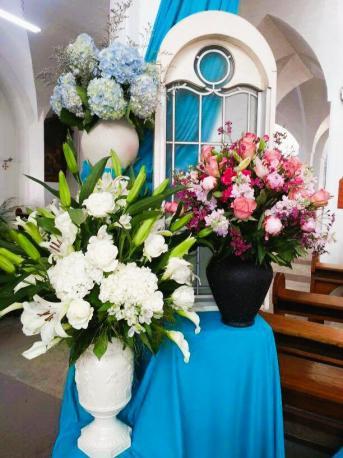
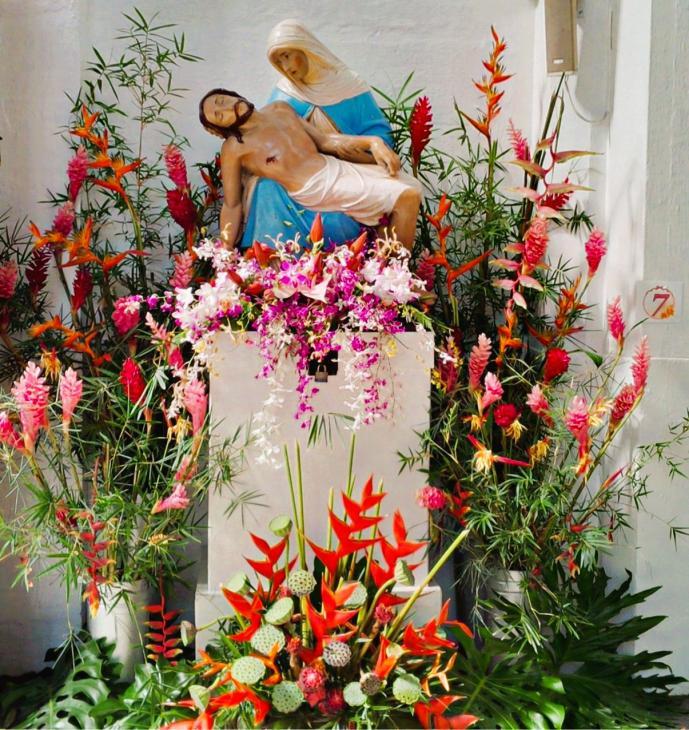
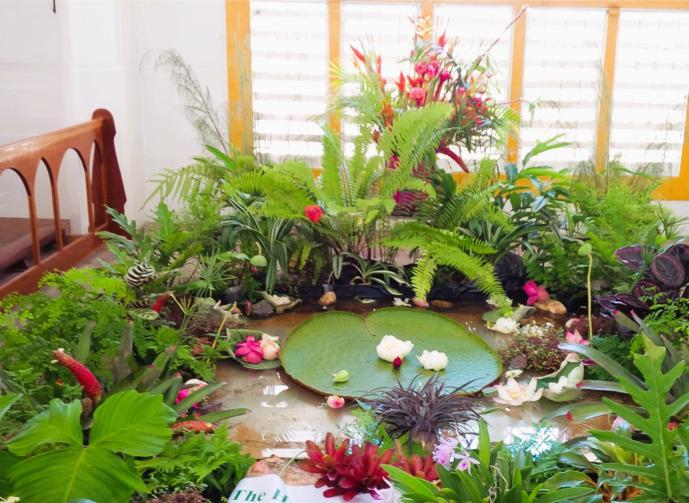
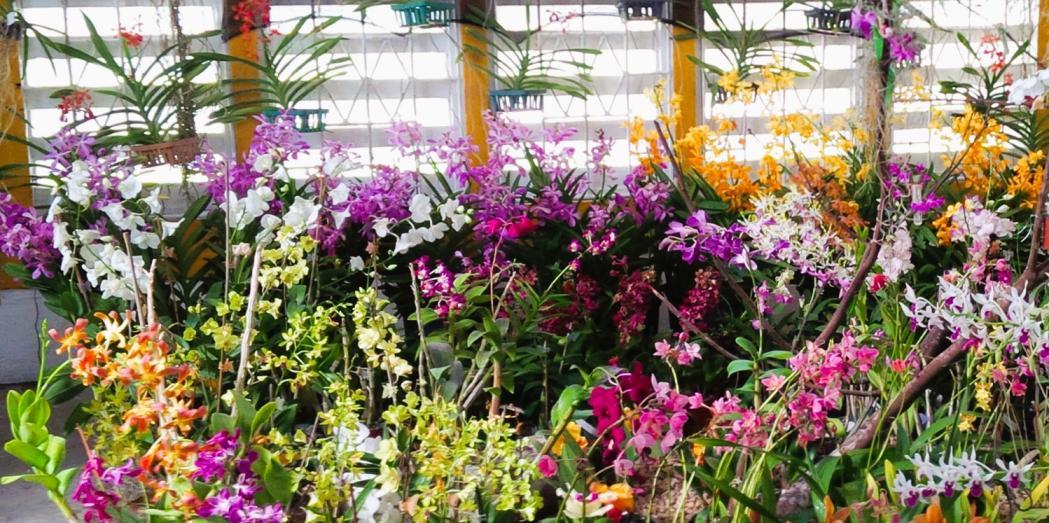
In observance of Guyana’s Diamond Anniversary of Independence this year, A Festival of Flowers will be held at the Cathedral of the Immaculate Conception, Brickdam, on Monday May 25th and Tuesday 26th. Parishes and professional Florists have been invited to decorate different parts of the Cathedral. The Festival of Flowers will be open to the public from 9:00am to 5:30pm on both days. There will be live music during most of the two days. Admission is free, but donations may be made for the upkeep of the Cathedral. With Tuesday May 26th being a national holiday, it is hoped that this will enable many visitors to view the displays.
The last Festival of Flowers was held at the Cathedral eleven years ago to mark the centenary of the laying of the foundation of the Cathedral. This event is only held to mark significant milestones in history. The photos show displays from the 2015 Festival of Flowers, held August 17th & 18th 2015.❖
Saint of the Week
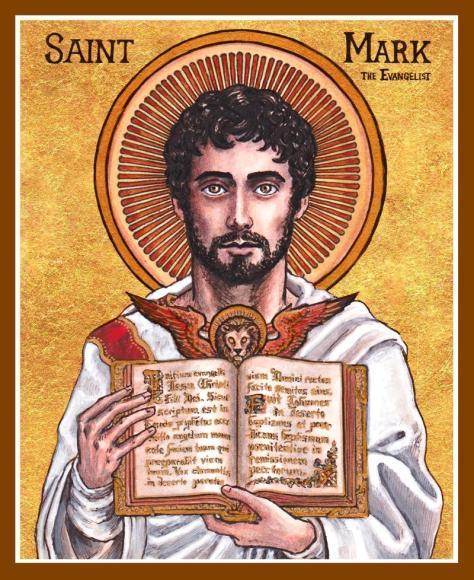
April 25th:Saint Mark
Most of what we know about Saint Mark comes directly from the New Testament. He is usually identified with the Mark of Acts 12:12. He was a cousin of Saint Barnabas. His close contact with Saint Peter is reflected in the composition of the Gospel that bears his name. Traditionally he is credited with founding the Church of Alexandria in Egypt.
The oldest and the shortest of the four Gospels, the Gospel of Mark emphasizes Jesus' rejection by humanity while being God's triumphant envoy. Probably written for Gentile converts in Rome after the death of Peter and Paul sometime between A.D. 60 and 70 Mark's Gospel is the gradual manifestation of a "scandal": a crucified Messiah.
Like one other Gospel writer, Luke, Mark was not one of the 12 apostles. We cannot be certain whether he knew Jesus personally. Some scholars feel that the evangelist is speaking of himself when describing the arrest of Jesus in Gethsemane: "Now a young man followed him wearing nothing but a linen cloth about his body. They seized him, but he left the cloth behind and ran off naked" (Mark 14:51-52).
A winged lion is Mark's symbol. The lion derives from Mark's description of John the Baptist as a "voice of one crying out in the desert" (Mark 1:3), which artists compared to a roaring lion. The wings come from the application of Ezekiel's vision of four winged creatures (Ezekiel, chapter one) to the evangelists.❖ [www.franciscanmedia.org ]