FREE
January - April 2026
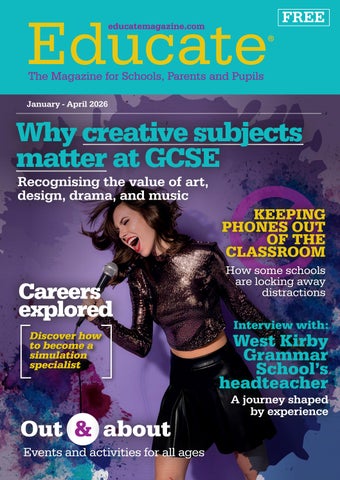
Why creative subjects matter at GCSE Recognising the value of art, design, drama, and music
KEEPING PHONES OUT OF THE CLASSROOM
Careers explored Discover how to become a simulation specialist
Out & about Events and activities for all ages
How some schools are locking away distractions
Interview with:
West Kirby Grammar School’s headteacher
A journey shaped by experience
Online AP to help primary students thrive and grow Our Key Stage 2 provision for year's 5 and 6 combines the core skills of reading, writing and maths, with oracy, wellbeing and PSHE. The flexible programme helps schools to accommodate a wide range of needs and supports internal alternative provision (IAP), flexible, and part-time timetables.
Our programme at a glance Live adaptive teaching with an experienced, qualified teacher 3 x 40-minute lessons, 5 days a week, morning or afternoon Develops functional reading, writing and maths Oracy, Wellbeing, PSHE throughout
Developing the whole child We know the importance of developing the whole child, not just the academic learner. Writing lessons naturally combine with PSHE content, turn-taking, circle time and teamwork. Our maths curriculum is centred around engaging tasks that encourage sharing, movement and confidence in key areas of the National Curriculum. While our reading classes equip students with skills needed for fluency, comprehension and inference alongside dialogue about wellbeing, current affairs and values.
Learn more: academy21.co.uk/primary Talk to us: contact@academy21.co.uk DfE Number: 000/1004
The Online Alternative Provision Experts
Educate Contents
Welcome to the January edition of Educate! Creative subjects at GCSE are no longer optional extras; they are essential. We speak to over a dozen leading experts to explore why creativity matters.
17 21-23
Building on the importance of creative subjects, we meet Simeon Clarke, headteacher of West Kirby Grammar School, and explore how his leadership supports the development of the whole student. From a background in music and stockbroking to education, he champions a student-focused ethos that prioritises confidence, wellbeing, and purpose alongside academic achievement. His approach highlights the value of creativity, problem-solving, and curiosity, skills developed through arts-based learning.
44
8
Features 8-10
44-47
Interview with Simeon Clarke, headteacher of West Kirby Grammar School
Locking away distractions How some schools are keeping phones out of the classroom
17-20 The reason creative subjects matter at GCSE Recognising the value of art, design, music and drama
24-39 Educate Awards 2025 Your gallery of the winners from last year’s awards ceremony
50-51 Explore, celebrate, discover Events and activities for all ages
56-58 Interview with Stuart Hide, T-level course leader at Runshaw College
62-64 Careers explored A guide for students to becomimg a simulation specialist
Published by CPMM Media Group, Suite 4 Pacific Chambers, 11-13 Victoria Street, Liverpool L2 5QQ. Tel: 0151 709 7567 X: @EducateMag Website: www.educatemagazine.com Email: enquiries@cpmmmedia.com Executive Editor: Kim O’Brien kim.obrien@cpmmmedia.com Editorial contributors: Elle Foster, Elizabeth Dale and Freya Martland Photography: Robin Clewley and Andrew Abrahamson Advertising Sales and Sponsorship: Sam Lawrence sam.lawrence@cpmmmedia.com Design and Production: CPMM Media Group Distribution: 0151 709 7567 Printed by Warners Midlands PLC The contents of this magazine are fully protected by copyright and nothing may be reprinted or reproduced without permission. Disclaimer The information contained within Educate we believe to be correct at the time of printing, no responsibility can be accepted for errors or omissions. © Copyright CPMM Ltd 2009.
Full coverage of the Educate Awards, held in November 2025, can be found on page 24. Celebrating the outstanding work of schools, teachers, and support staff, the awards shine a spotlight on the arts, with three unforgettable student-led performances. Part of supporting the whole student in today’s digital world means helping young people manage technology effectively. Mobile phones, however, have presented schools with many challenges, and Educate explores how schools are tackling these distractions, focusing on the use of locking phone pouches. The article examines their implementation, impact on behaviour, wellbeing, and learning, including views from school leaders and trusts, contrasting approaches, costs, and the wider debate over restriction versus educating students to use technology responsibly. In a digital age where schools are navigating the challenges of constant connectivity, technology is at the same time opening exciting new career opportunities. Outside the classroom, skills in computing, simulation, and problem-solving are shaping the jobs of the future. In Educate’s regular careers feature, we look at the career of a simulation specialist, highlighting how STEM skills, creativity, and problemsolving are used to model real-world systems safely. It explores training, skills, and career pathways, showing how this innovative, versatile role offers opportunities across industries and prepares students for a technologydriven future.
!
Educate The Magazine for Parents and Pupils
3
News
Instant school facilities for when the unexpected strikes When Storm Eowyn swept across Cumbria in early 2025, Jericho Primary School was forced to close its main building almost overnight. Structural damage meant pupils could not safely return, leaving leaders with an urgent challenge faced by schools across the UK: how to keep learning on track when the unexpected strikes. Emergencies, from extreme weather and fire damage to sudden changes in pupil numbers, can disrupt education in an instant. At Jericho Primary, the solution came through swift action and the flexibility of modular construction. Working with Portakabin, a two-storey interim
school was delivered and installed in just eight weeks. The building provided ten fully equipped classrooms, staff areas and essential facilities, allowing pupils to remain on site while repairs took place. This rapid response highlights why more schools are turning to temporary modular buildings as part of emergency planning. Far from being a short-term fix, today’s modular solutions meet permanent-build standards. Prefabricated off-site and installed with minimal disruption, they can be deployed in days rather than months – a critical advantage when continuity matters most. Modular school buildings are also
versatile. Schools now use them for far more than extra classrooms: from SEND hubs and wellbeing rooms to intervention spaces, science labs, staff offices and breakout areas. Each space can be tailored to meet safeguarding, accessibility and learning-environment requirements, ensuring pupils and staff are fully supported during challenging times. Preparation is key. A free Emergency Building Plan (EBP) by Portakabin helps schools plan before a crisis occurs. Through a site assessment and detailed planning process, the EBP maps available space, identifies operational needs and pre-plans suitable modular configurations.
Health crisis facing the class of 2035 The Youth Sport Trust’s Class of 2035 Report calls for urgent action to increase physical activity among children. If not, this generation will face poorer health, lower happiness and reduced life chances. The charity’s warning comes after new insights from Sport England. The report, produced with research agency Savanta, uses AI modelling and children’s polling to project the consequences of current inactivity trends. By 2035, if trends continue: • Almost half of children will spend three hours or more on screens daily, up from 34 per cent in 2025 • Over a third will fail to be active for even 30 minutes a day • Obesity rates among 10–11-year-olds will surge to 24 per cent, with 180,000 children clinically obese • Annual Type 2 diabetes diagnoses will double to 500 cases
4
• Schools will see declining attendance and engagement among the least active pupils Sport England estimates active lifestyles provide £8bn in annual healthcare savings through illness prevention. Ali Oliver MBE, Youth Sport Trust chief executive, said: “Children must move, play and be active every day for normal physical, social, emotional and cognitive growth[...] By 2035, without action, we will have delivered a generation with poorer health, lower happiness, lower attainment and lower life chances – a legacy of physical and mental neglect.” The charity has launched the Sport Changes Lives Commission, bringing together experts from healthcare, child development and public health to review evidence and publish recommendations in early 2026. Adella Dando, joint CEO at Liverpool School Sports Partnership, said: “The predicted rise in inactivity, obesity and poor mental health
Educate The Magazine for Parents and Pupils
reinforces why providing high-quality PE, sport and physical activity opportunities has never been more important.” Mat Shaw, CEO of Great Ormond Street Hospital, added: “We need to make sure all children, regardless of
background or health conditions, can access sport and exercise.” The report warns that without bold investment in PE, sport and daily movement, the UK faces a future marked by rising obesity, poor mental health and reduced life chances.
News
CER Education helps the fight against child hunger in schools
St Mary’s College salutes student achievements St Mary’s College in Crosby recently celebrated the achievements of its students at its annual prize giving ceremony, held at Liverpool Metropolitan Cathedral. The event welcomed international corporate lawyer and former pupil, Dan Butler, as guest speaker. Dan, who attended St Mary’s Prep and St Mary’s College from 1990 to 2003 and served as head boy, reflected on how his school experiences shaped his career. After qualifying as a solicitor, he worked in dispute resolution and corporate restructuring in New York and Hong Kong. His work has included major cases such as the insolvencies of BHS and Debenhams, and the post-pandemic reorganisation of Malaysia Airlines. Now a barrister with Erskine Chambers in London, he regularly appears in the High Court – skills he believes were fi rst honed in the St Mary’s debating team. Dan spoke about the lively classroom atmosphere and thoughtprovoking discussions that set him on the path to law. He encouraged pupils to make the most of the opportunities available to them, describing St Mary’s as a school that had played a defi ning role in his own development. Principal, Mike Kennedy, also delivered his annual review, highlighting another strong year for the college. St Mary’s achieved the highest Attainment 8 score of all state and independent schools in Sefton and topped the Archdiocesan league table of 36 Catholic schools. The headteacher also praised pupils’ achievements across sport, music and the performing arts. Sporting successes included national and regional wins in football, rugby and netball, while the performing arts programme featured the school’s annual Liverpool Philharmonic concert and a production of Hippolytus at the Capstone Theatre. The college offers more than 70 extracurricular clubs, ranging from science club and chess to knitting and LEGO robotics. Students also took part in trips to Bavaria, Paris and Gran Canaria, alongside continued success in the Duke of Edinburgh’s Award scheme and the Combined Cadet Force. Mike closed the ceremony by thanking staff, governors and parents for their support and praising the school community for promoting values of peace, care, compassion and justice.
6
Educate The Magazine for Parents and Pupils
CER Education, part of Affi nity Workforce, is taking urgent action to tackle a growing crisis in classrooms: child hunger. New research from Affi nity Workforce’s ‘Before The Bell’ campaign, reveals that almost one in three teachers see hungry children every single day. Many pupils arrive at school unable to concentrate, complaining of stomach aches, and even asking when lunch will be served. Teachers report that in some schools, up to half of pupils start the day without breakfast. This comes as the government announces the national rollout of free breakfast clubs for 500,000 children, a move strongly supported by CER Education. CER is proud to be a part of the ‘Before The Bell’ initiative, funding free breakfasts at four primary schools in January 2026. The impact of hunger on learning is undeniable, with cost remaining the biggest barrier to breakfast provision. More than a third of schools have no breakfast club, and where they do exist, demand often exceeds supply. CER consultants will be visiting the four chosen schools to provide a week’s worth of healthy, nutritious breakfasts to pupils. This is just the beginning for CER Education. It is genuinely committed to driving systemic change so that no child is too hungry to learn. For more details on ‘Before The Bell’ visit: affi nityworkforce.com/before-the-bell-fuel-for-learning/.
New evaluation hub Edge Hill University’s Faculty of Education is set to launch a new Hub for Evaluation of Applied Education and Innovation in March 2026. The new service will work with schools, colleges, early years settings and PVIs, VCSFE organisations and local authorities to offer accessible, research-informed evaluation support. This will include data analysis, theories of change, survey design and analysis (quantitative and qualitative), and a bespoke programme evaluations. Utilising the Faculty of Education’s team of expert researchers and education practitioners, the hub will help educators understand and improve their impact. Insights will help education organisations understand what works for their students and stakeholders, strengthen evidence for Ofsted inspections, and amplify best practice across the sector. The hub is designed with accessibility and scale in mind. There will be opportunities for individual schools and large education-focused charities alike, both through access to ready-made ‘plug-in-and-play’ support, and through bespoke consultation and longitudinal work. The hub will bridge the gap between research and practice, ensuring that innovation and creativity is utilised and shared to improve student outcomes across the sector. Find out more about working with the hub by attending Edge Hill University’s Ormskirk campus for the launch event on Thursday 5 March 2026 at 5:30pm.
EHU_EDUCATE_25.11.25.qxp_Layout 1 02/12/2025 09:11 Page 1
CONSIDERING A REWARDING CAREER IN EDUCATION? Inspire young minds on one of Edge Hill University's Education and Teaching courses. -
140 years teacher training experience.
-
Wide variety of placement opportunities.
-
Ofsted Outstanding Provider.
Study in one of the following age phases or pathways -
Entry into Higher Education including Level 2 equivalencies, Fastrack, and Foundation options. Primary Early Years Education (3-11 years with a specialism in the 3-7 age phase) Primary Education (5-11 years) Secondary Education (11-16 years) Further Education and Skills (16+)
ehu.ac.uk/StudyEducation
SCAN HERE TO FIND OUT MORE
Interview with: Simeon Clarke, headteacher of West Kirby Grammar School
Striking the right note in leadership Simeon Clarke, headteacher of West Kirby Grammar School, didn’t take the usual path into education. From studying music to a brief spell as a stockbroker, his journey has been full of unexpected turns. But it’s this mix of experiences that shapes the way he leads the school today. For Sim, leadership is about more than results – it’s about helping students find their confidence, enjoy learning, and understand their place in the world.
8
Educate The Magazine for Parents and Pupils
“My degree is in music, and I actually did a postgraduate in music because I still wasn’t really sure what I wanted to do. I was just kind of exploring careers; I never had a fi xed sense of where I wanted to go or what I wanted to do. I was always open to whatever opportunities came up,” he shares. After brief jobs in sound engineering and production, Sim realised the freelance life wasn’t quite right for him. He says: “My dad had worked in the city [London]. He’d worked in insurance for years and been very successful. I also had an A-level in economics and an A-level in maths, which were things I was interested in. So I went and worked as a trainee stockbroker for a while. I did that for about six months, and that did not work for me at all.” It was a chance encounter with teaching that redirected his career. After spotting a job for a graduate trainee teacher at Southend High School for Girls, he applied for the part-time role. He comments: “They rang me back straight away, and asked if I was free that afternoon, which I was. I walked in and met the head of music, Chris Lamberti, who’s still one of my best friends and a massive source of inspiration. His energy was amazing, and I could
see that I was going to get on really well with him. I tried taking a couple of lessons with him in the room, and it felt quite natural. I had a real passion for it.
headship came up, much earlier than I would have expected. I applied, the governors agreed, and I’ve been head for about five and a half years now.”
“The headteacher at the time, David Mansfield, was brilliant in terms of helping me transition from stockbroking to trainee teaching. There was probably a fair gap in salary, but it was brilliant. I never looked back. I loved teaching music and became head of music at the rival girls’ grammar school nearby, and I was then appointed assistant head there.”
The school has become a twoway street in shaping its leader. Sim says: “The school and I have grown together. The school starts to get shaped by your vision, and you grow with it, adjusting your perspective based on the school and the community. That’s what I love about it and why it keeps me here.”
It was at this point that Sim became open to exploring opportunities outside of Essex. “My now wife and I realised that apart from family and friends, we weren’t completely rooted in Essex. We could move now, and if we didn’t, maybe we never would. We both grew up about 15 minutes apart, so we decided to take the chance,” he says. For Sim, choosing West Kirby Grammar School was as much about ethos as geography. He explains: “I didn’t know much about the area at first, but my research suggested it was a school whose values and ethos I would have good synergy with. After a couple of days of interviews, I just loved it. The community felt warm and welcoming, the students were great, and the atmosphere was positive. “I really liked the headteacher, Elaine Sargent, but after two or three years she moved on. The opportunity to apply for the
Central to Sim’s approach is a focus on the whole student. Grammar schools are often associated with academic excellence, but Sim is clear: “I spend a lot of time talking to students about the point of school, their fulfi lment, happiness, and wellbeing. At the start of the year, I do assemblies to explain that school is about preparing for life, not just qualifications. It’s about understanding yourself, your place in the world, and what a rich, fulfi lling life looks like.” He draws on philosophies such as ikigai to help students understand balance and purpose. Sim reveals: “Students learn that success doesn’t necessarily mean a high-profi le job – it’s about a sense of wholeness and fulfi lment. I often discuss philosophies like ikigai, which emphasise balance in life as a source of purpose. We use this philosophy to drive learning, good GCSE results and motivation, all of which are important because they open doors, but the ultimate goal is
The school starts to get shaped by your vision, and you grow with it, adjusting your perspective based on the school and the community. Educate The Magazine for Parents and Pupils
9
Interview with: Simeon Clarke, headteacher of West Kirby Grammar School understanding the world, shaping your perspective, and preparing to lead a fulfi lling life.” Student voice is another cornerstone of the school’s ethos. “They’re [students] amazing. I think it’s one of the best features of our school. They’re so eloquent. Anybody who comes in, external visitors, guests, or people assessing our work, always comments on how articulate the students are. Because of that, you’ve got to make sure you capture their voice,” Sim says. West Kirby Grammar School has a robust system to ensure all students are heard. “We’ve always had a very open-door policy,” he shares. “Students know they can always come in, whether it’s a personal problem or something in the school they want to change. Over the last 18 months, we’ve focused on structuring student voice, so we capture the views of many, not just those who are particularly vocal.” The senior student leadership team plays a key role in shaping school life. Sim meets with them each half term to review their ideas and support their projects, from minor frustrations to larger initiatives, ensuring students feel heard and make a real impact. Sim emphasises that the values students carry into adult life are rooted in happiness, confidence, and self-awareness. He says: “That confidence should help them make decisions that are right for them, rather than being influenced by external pressures or what others think. We have six school values that spell out ‘CHOICE’ – community, high expectations, opportunity, innovation, curiosity and endeavour.” 10
The arts, unsurprisingly, hold a special place in Sim’s vision. “I’m probably biased, being a music teacher!”, he states. “The arts are incredibly rewarding, and they help students build relationships and develop a different side of themselves. In classrooms, you get to know students well, but in arts settings, barriers break down. Students see themselves as people, not just learners, which opens conversations about life and the world.”
The arts are incredibly rewarding, and they help students build relationships and develop a different side of themselves.
In November 2025, West Kirby Grammar School was invited to perform at the Educate Awards. The school delivered an electrifying rendition of Six: The Musical!, which reimagines the six wives of Henry VIII as fierce, dynamic pop icons. The school’s talented band, featuring Sim on keyboard, added an extra layer of energy to the unforgettable performance. Sim is passionate about outreach and collaboration beyond the school. He says: “Grammar schools naturally align on a lot of initiatives, particularly because they are single-sex schools, but we also collaborate more broadly. For instance, the Education Endowment Foundation has been running a project in the area for the last 18 months,
Educate The Magazine for Parents and Pupils
focused on maths and adaptive teaching. I’m on the steering committee and one of the implementation leads, working on inclusion and addressing the disadvantaged gap.” West Kirby Grammar School also runs a social mobility initiative that works in partnership with Skyward Kids to further equal opportunities in local communities to support, inspire and empower primary school children. It is a three-year programme which pupils complete in Years 4 to 6. He comments: “They come to our school every few weeks for mentoring, literacy, numeracy, and wellbeing activities. We focus on building mentor-mentee relationships, providing guidance, and helping students see that learning can be fun. They also learn to approach challenges with confidence, problem-solving skills, and curiosity. Partnerships with other schools, like the boys’ school, have been essential to this work and have been really successful.” Reflecting on his broader experience in education, Sim remains humble when asked what advice he would offer to aspiring heads. He admits he doesn’t see himself as particularly wise, but offers this insight: “There isn’t a single model of a ‘great headteacher.’ Successful heads come in many different forms. My advice is: don’t try to be a stereotypical headteacher. Be yourself. Find a school and community where there’s synergy between your personality and the school. Bring your own strengths to the role rather than trying to fit someone else’s image of leadership.” We think those are wise words indeed!
Ignite their curiosity Memorable Learning and Hands-on Fun
Through exploring our curriculumlinked zones and taking part in our shows and workshops, your pupils will be inspired to see the world around them in a new light. All visits include: • Trained Eureka! staff to support your visit whilst you explore • A science show • Space (and time) to eat your packed lunch • Itinerary, risk assessment and other resources • Accessibility & special needs “It was excellent from start to finish. The organisation of the trip is the best trip experience I’ve ever had.” Teacher feedback, March 2025
Get in touch to start your booking! Scan the QR code or call 0151 323 0033 For more information or to book a SEN school: groups@eureka.org.uk
News
Garston primary school celebrates city wide success Garston Church of England Primary School is celebrating a phenomenal achievement, ranking fi rst in the Liverpool Key Stage 2 Performance Tables for its most recent results. This stellar performance positions Garston as a leading light in the city’s educational landscape – a success the school attributes to a united community and collaborative effort. The remarkable success is a testament to the dedication and hard work of the entire school community. The results perfectly reflect the school’s core vision: creating an environment where each and every child is empowered to flourish. This achievement sits within a broader context of success for the Rainbow
Education Multi-Academy Trust (REMAT). Performance data places REMAT in the top seven per cent of trusts nationally, demonstrating that Garston C of E’s success is part of a systemic approach to educational excellence.
Furthermore, six REMAT schools are currently ranked in the top 20 per cent within their respective local authorities – many of these having made remarkable progress since joining the trust. Speaking on the results, Garston C of E headteacher, Rachel Dean, praised the commitment of the staff, pupils, and supportive families at the school. “This significant milestone not only validates the rigorous teaching and learning strategies employed here but also serves as an inspiring example of what can be achieved through strong collaboration across our trust,” she stated. This accomplishment is a huge source of pride and signals a bright future for the school community.
Kraków visit prompts reflection for Wirral students Students at St John Plessington Catholic College, Bebington, recently visited Poland, where they explored the country’s history and culture in what proved to be a moving and memorable trip. 19 students in Years 11 and 12, travelled to one of Poland’s most important and historic cities, Krakow, for four days as part of an educational and inspirational visit. Organised by the school’s religious education department, this is the fi fth year students at St John Plessington, member of Holy Family Catholic Multi Academy Trust (HFCMAT), have visited Krakow as part of the school’s highly valued enrichment programme. During this year’s trip, students participated in a range of activities, including a walking exploration of the Jewish Quarter, a guided visit to Auschwitz-Birkenau, and an insightful tour of Schindler’s Factory. Students also had the opportunity to explore the city of Krakow itself and discover its remarkable architecture, cultural traditions, and welcoming atmosphere. Mr Matthew Jones, key stage coordinator for religious education who accompanied the students on the trip, said: “This trip was an invaluable experience for our pupils. It gave them the chance to see fi rst-hand the impact of one of the darkest periods in human history and to reflect on the importance of tolerance and understanding.” Headteacher of St John Plessington, Mr Peadar McLoughlin, added: “Experiences that go beyond the classroom provide truly powerful learning opportunities for students, inspiring both reflection and personal growth. Our students displayed great
maturity, respect, and empathy during the visit and I’m extremely grateful to the religious education department for providing this meaningful opportunity for students each year.” CEO of HFCMAT, Andy Moor, said: “We work every day to achieve our mission of developing individual excellence, embracing opportunities and building strong communities with Gospel values at the heart. This visit to Krakow nurtured students’ knowledge, compassion, empathy and moral understanding, supporting their wider personal growth which is at the heart of Catholic education.”
The Studio building future careers At The Studio Liverpool, part of the Northern Schools Trust, T-levels offer an immersive, hands-on experience that keeps students closely connected to the industries they aspire to join. With pathways in design and development for engineering and manufacturing, and digital software development, the school combines rigorous technical learning with real-world application to create a strong route into future careers. Students follow a dynamic schedule balancing classroom study, project-based work, and industry placements. Engineering learners explore materials science, design principles, and manufacturing
12
processes, while digital students focus on coding, advanced software development, cybersecurity, and emerging technologies such as AI and IoT. Theory is consistently applied through practical projects that mirror workplace challenges. Collaboration and professional skills are central to the programme. Students tackle live industry briefs, work in teams, and present solutions to peers and professionals. Henrique, a current T-level student, shared his experience at the BRILLIANT Festival: “We attended as exhibitors and did a talk on CAD modelling using Autodesk Fusion 360. We ran a live demo and answered questions.”
Educate The Magazine for Parents and Pupils
Networking opportunities extend beyond school. During a visit to Autodesk HQ in Birmingham, Henrique presented his employer-set project: “It was my fi rst time presenting to professionals. I made valuable connections from across the UK.” Industry insight days with
organisations such as BIMA, Aston Martin, and HelloFresh further enrich learning. Practical workshops remain a cornerstone, with students using advanced equipment including CNC machines, laser cutters, and 3D printers. Mandatory industry placements with partners like Beverston Engineering and Skyhook Games provide hands-on experience and professional exposure. Graduates leave with confidence, technical expertise, and employability skills to succeed in their chosen fields. To learn more about The Studio’s Sixth Form and T-level provision, register for the February open evening via thestudioliverpool.uk.
ST EDWARD’S COLLEGE SIXTH FORM
WHY CHOOSE OUR SIXTH FORM? 2025 grade AAB achieved: 74.6% 75% students progressed to university 43% students progressed to Russell Group universities 12 pupils secured places at highly competitive universities and courses, including Oxford and Cambridge, Medicine and Dentistry programmes, Warwick, and prestigious London institutions. Successful trips to the USA, Poland, Spain, Switzerland, and more
Applications open now!
ST-EDWARDS.CO.UK “LET ALL THAT YOU DO BE DONE IN LOVE" (1 CORINTHIANS 16:14)
News
From Liverpool to NASA: Joy’s inspiring journey with NLA Sixth Form At North Liverpool Academy (NLA), part of the Northern Schools Trust, ambition is nurtured and realised. Joy, a former sixth form student, exemplifies this ethos, taking her passion for science from NLA’s classrooms to NASA’s Kennedy Space Centre in Florida. Her journey began with a simple decision. Reflecting on a physics trip in Year 12, she recalls: “I wasn’t too sure, so I said no. Then, in Year 13, he asked again, and this time I said, ‘Why not?’ I never knew one small decision would change my future.” This choice led Joy to participate in the UK Space Design Competition (UKSDC).
Working in the humans department at the national finals in Imperial College London, she designed lifesupport and comfort systems for a space settlement. Her team’s creativity and determination were rewarded when they were crowned UK National Champions, opening the door to the International Space Settlement Design Competition at NASA. In Florida, Joy joined 400 students from around the world to design a floating settlement on Venus. The challenge tested creativity, problem-solving, and teamwork in an intense, real-world environment. Looking back on the experience, she says: “It wasn’t
just a competition. It was a once-in-a-lifetime experience; the friendships, the challenge, the teamwork, everything felt bigger than us.” Joy also benefited from NLA’s unique enrichment opportunities, including a 10-day tall ship voyage, which developed her leadership and resilience. After achieving As and Bs in A-level maths and A-level further maths, she plans to pursue a higher apprenticeship in mechanical engineering, a path inspired by her sixth form experiences. NLA Sixth Form offers more than academic excellence. Through enrichment, competitions, and international experiences, students gain the
skills, confidence, and ambition to reach extraordinary goals. Joy’s journey shows what is possible when ambition meets opportunity. Year 11 students who are ready to challenge themselves and explore new horizons, can apply to NLA Sixth Form or attend an open event to find out more.
A unique school visit encourages Kirkdale families come together for annual Winter Warmer reflection among pupils Pupils at St Alban’s Catholic Primary School, Wallasey, were invited into moments of reflection as the Jubilee Icon arrived at the school on 26 November 2025. The visit was part of its pilgrimage across the Diocese of Shrewsbury. The icon travelled to all Catholic schools across the diocese as 2025 was the Jubilee Year, themed ‘Pilgrims of Hope’. St Alban’s was the 107th diocesan school to host the Jubilee Icon. The Jubilee Icon depicts the biblical event, the Visitation, where Mary travelled to meet her cousin, Elizabeth, after the angel Gabriel told her that God had chosen her to become the mother of Jesus. St Alban’s hosted the icon for two days during which all pupils reflected and prayed before the icon. They contributed messages of hope in a journal that accompanies the pilgrimage for pupils in other schools to read. Janessa, a pupil in Year 6, said: “It is very special having this icon in our school. We can celebrate the magnificent moment Mary was told she was having a child.” Freddie, also in Year 6, added: “This icon makes me feel happy because it is celebrating a special moment. We were able to sit quietly and reflect on this extraordinary picture.” Headteacher, Mr John McDonald, said: “Hosting the Jubilee Icon has been a truly special moment for our school community. It gave our pupils the opportunity to consider the significance of the Visitation within Catholic teaching, reflect upon this and, ultimately, think about how they can carry hope to others in this Holy Year and beyond.” St Alban’s Catholic Primary School is a proud member of the Holy Family Catholic Multi Academy Trust (HFCMAT), comprising of nine schools, including two secondary and seven primary, across Wirral and Cheshire. CEO of HFCMAT, Mr Andy Moor, added: “The Jubilee Icon pilgrimage is a wonderful example of how schools can come together in faith, solidarity and hope. It’s been fantastic to see St Alban’s play its part in this pilgrimage, making them the latest school within HFCMAT to host the icon.”
14
Educate The Magazine for Parents and Pupils
More than 200 people came together at St Lawrence CE Primary School in Kirkdale on 29 December 2025 for the school’s annual Winter Warmer event, a community celebration designed to tackle loneliness, support families facing food and fuel poverty, and strengthen local connections. Around 55 families attended the gathering, which encouraged people to switch off their phones and take part in a series of family challenges aimed at sparking conversation and teamwork. Guests were served a two-course meal prepared on site, and each family received a small food hamper to take home. Every child also left with a pair of brand new pyjamas, a storybook and a hot chocolate set. Prizes were awarded throughout the day, adding to what staff described as a positive and inclusive atmosphere. The event carried particular significance this year following the County Road riots, which left a lasting mark on the Kirkdale community. Staff at St Lawrence CE Primary School have been working hard to rebuild trust and unity in the area, and the Winter Warmer offered a visible example of that effort. Families speaking more than 30 languages took part, with organisers noting the sense of unity as children and adults from different backgrounds smiled and laughed together. The celebration was made possible through support from several donors, including The Social Brokers, Agent Marketing, Councillor Jow Hanson and The Dan Kay Foundation. School staff also played a central role, giving up part of their annual leave to plan, prepare and deliver the event. The school contributed some of its own budget to cover catering costs. Organisers said the event was marked by “joy and compassion,” offering a welcome counterpoint to the division and hardship often highlighted in national news. They hope the Winter Warmer will continue to grow in future years and serve as a model for how schools can bring communities together during challenging times.
News
Warrington primary school recognised nationally Our Lady’s Catholic Primary School, Latchford, has been awarded the prestigious Primary Science Quality Mark (PSQM) that recognises the school’s dedication to delivering quality science education to the 144 pupils it serves. Our Lady’s has been awarded the quality mark following a year-long programme and fi nal review in which the school had to demonstrate a clear vision for science though an engaging curriculum that provides hands-on investigative opportunities, the promotion of pupil voice, and how science is showcased across the school community. The school, which is part of the Holy Family Catholic Multi Academy Trust (HFCMAT), also had to evidence impact on pupil’s learning and attitudes, as well as plans for continued improvement. Mr David Gilby, head of school at Our Lady’s, said: “We are incredibly proud to receive the Primary Science Quality Mark.
This achievement reflects the hard work and passion of our staff, particularly our science leader Miss Chloe Pickering, not to mention the enthusiasm our pupils show for the subject.” Within the fi nal report, curriculum design was celebrated for being engaging, inclusive and strategically led. Reviewers also noted that the school had made significant strides in science teaching and learning that had been driven by strong leadership and collaboration across the school and trust. The report highlighted that Our Lady’s has much to celebrate and enjoy, stating: “The school community is developing effective practice in providing an inspiring education. “Children have had access to a range of enrichment experiences […]. Science is very high profi le now and everyone at Our Lady’s Catholic Primary School has embraced the changes.”
The Academy of St Nicholas hosts pensioners’ party The Academy of St Nicholas, part of All Saints Multi Academy Trust, recently hosted a special Christmas party for senior citizens in the local area, organised and run by the school’s student councillors and leaders. The event was designed to celebrate the festive season while bringing together members of the local community for an afternoon of music, food, and friendship. Guests from nearby care homes were treated to a Christmasthemed afternoon tea, prepared by the school’s catering team with support from hospitality students. The menu included a selection of sandwiches, pastries, and an array of traditional treats, all served with tea and coffee. The school choir also performed a selection of Christmas songs and carols, which fi lled the room with festive cheer. Students took great pride in hosting the party, welcoming guests, serving food, and ensuring everyone felt included and comfortable. Visitors were full of praise for the students’ professionalism, noting how seamlessly they managed the event from start to fi nish. Year 7 student, Anthony, said: “I really enjoyed spending time chatting to our guests at the party. I found out lots of interesting things and told them about what it is like to be a student here. We laughed a lot together, and I have even been invited to visit them all at their care home!” Mrs Lindsey Bainbridge, associate assistant headteacher at The Academy of St Nicholas, said: “We place great emphasis on student leadership and community partnerships here at the academy. Organising events such as this allows our students to develop practical skills in teamwork, communication, and event management while making a positive contribution to the local community.” Headteacher, Mr Gary Lloyd, added: “A huge congratulations to our student councillors and leaders, who planned and managed our annual senior citizens Christmas party. It was inspiring to see their dedication and attention to detail, which ensured the afternoon was a resounding success and a very special day for all our guests.”
CEO of HFCMAT, Andy Moor, added: “We are delighted that Our Lady’s Catholic Primary School has received the Primary Science Quality Mark. The achievement is a testament to the school’s commitment to delivering an ambitious and inspirational science education for every child. Well done to the entire team!”
Connecting education and industry High-quality employer engagement is central to preparing young people for successful careers in science and healthcare. At Liverpool Life Sciences UTC, this commitment comes to life through its growing mentor programme with Bionow, giving students direct access to industry expertise across the life sciences sector. Liverpool Life Sciences UTC, part of the Northern Schools Trust, specialises in combining academic study with technical and employer-led learning. Through strong partnerships with employers and universities, the school equips students with the knowledge, skills, and professional behaviours needed to progress confidently into higher education and employment – true to its motto: “Every day is an interview.” The partnership with Bionow, the North of England’s life sciences membership organisation, connects students with experienced professionals who act as mentors throughout the academic year. Mentors share career insights, advise on progression routes, and highlight opportunities within the sector. This year, the mentor network has doubled in size, significantly increasing the number of students benefiting from one-to-one support. The Bionow programme complements wider enrichment opportunities at the UTC, including the Workplace Accelerator Programme, a pilot initiative designed to strengthen workplaceready technical skills. 14 Year 12 BTEC applied science students were selected to take part, using immersive VR laboratory simulations to build confidence and competence aligned with modern scientific environments. Reflecting on the impact, John Dyer, said: “Our students continue to rise to the challenge. This pilot showcases the confidence, technical curiosity, and ambition that define our Sixth Form. It’s exciting to see them leading the way in such an innovative training environment.” The UTC’s approach to practical, employer-informed science education has gained national recognition. Students and staff recently contributed to the Royal Society Practical Science Conference, where leading figures praised their commitment to hands-on learning and industry engagement. Prospective students and families are invited to attend the Liverpool Life Sciences UTC open evening this February to tour facilities, meet staff and students, and learn more about specialist pathways and partnerships. Register at www.lifesciencesutc.co.uk.
Educate The Magazine for Parents and Pupils
15
Join our thriving sixth form
Everyone is welcome at St John Bosco Arts College Sixth Form. It’s a place where you can be yourself, discover your true potential, and feel part of a vibrant community. Apply now
stjohnboscoartscollege.com/sixth-form sjbliverpool
sjbliverpool
sjbsixthform
The arts in school
n o s a e r e h T
r e t t a m s t c e E S subj C at G
E H T F O S U T A L T L S A E R H O T F RAISING D OUTCOMES N A S T R A eth Dale b By Eliza
Educate The Magazine for Parents and Pupils
17
The arts in school In November 2025, the government and the Department for Education (DfE) announced new plans for a revitalised curriculum that will see creative subjects such as art and design, drama, and music given equal status to humanities and languages at GCSE. These planned curriculum changes have been made in response to the independent curriculum and assessment review commissioned by the government and led by the CEO of the Education Endowment Foundation (EEF), Professor Becky Francis CBE.
is timely that it [the national curriculum] is now refreshed so that it remains cutting edge and fit for purpose to equip young people for our rapidly changing world.’ Whilst many have welcomed the changes to the updated curriculum and the prominence placed on the arts at GCSE, some critics say that giving more importance to creative subjects could lower academic standards. But is this concern justified or are the arts essential for our young people? The idea that creative subjects are seen as ‘easy’ and dilute academic standards is a misconception that has taken hold over the years, driven largely by the introduction of the English Baccalaureate (EBacc) in 2010 as a performance measure for schools. Prioritising the ‘core’ subjects of English, maths and science, as well as humanities and languages, the EBacc explicitly excludes creative subjects, and, in doing so, has indirectly framed them as non-essential and less academic.
Outnumbered and Mastermind, has also dreamed of the curriculum reflecting the importance of the arts for many years. He comments: “I once heard an eminent scientist on the radio say that he thought STEM subjects were very important and that indeed science would eventually save the world, but he added without the arts and culture ‘what’s the point of saving it?’. In his opinion the arts were equally important as the sciences. I wish the curriculum would reflect that. Our survival as a civilisation depends on it. The arts tell us who we are. We forget that at our peril.” However, this is set to change. The curriculum reform announced at the end of 2025 also includes the removal of the EBacc, a move intended to encourage and empower more students to study the arts.
“When creative subjects are positioned as The late Sir Ken Robinson, an influential peripheral, they figure in education, championed creativity and campaigned tirelessly quickly become for an education system that cultivated creativity and divergent thinking, rather perceived as than focusing merely on measurable optional extras academic knowledge. rather than In an interview with his daughter, Kate Robinson, who completed and published intellectually Sir Ken’s book following his death, rigorous she told Educate back in 2022 that as a species we were facing a crisis of disciplines human resources due to the decreased in their own diversity of talents and skills. In order to fix this, Kate said: “We have to channel right.” our powers of creativity into a more determined vision of the future we want to create.”
A lot has changed since the last review of the national curriculum over a decade ago. We have witnessed artificial intelligence (AI) become mainstream, navigated the UK’s departure from the European Union, and lived through a global pandemic that brought the world to a standstill for months. Within the review’s executive summary, it states: ‘It
18
She added: “If we valued the rainbow of talents and passions that we have, instead of just highlighting a few of them and suppressing the other ones, just think of what we could do under the right conditions.” Liverpool-born Jimmy Mulville, managing director of Hat Trick Productions who has produced iconic shows such as Have I Got News For You,
Educate The Magazine for Parents and Pupils
In response to the curriculum and assessment review, headteacher of West Kirby Grammar School, Simeon Clarke, welcomes the acknowledgement that performance measures have had a narrowing effect on the breadth of the curriculum and believes the government’s changes are a move in the right direction to rebalance curriculum priorities.
The arts in school When delivering careers education have their origin in individual creativity, “Schools that into schools, LCR Careers Hub uses the skills and talent”, generate £124 billion Builder Universal Framework’, a a year to the UK’s economy. Whilst it is value and embed well known that London is the hub of ‘Skills research-informed resource that teaches creativity into and measures eight transferable skills the creative industries, the North West for employment which includes creative contributes significantly to the sector, the fabric of problem solving and communication, generating the third-highest economic their culture skills that can be developed through the output outside of the capital and the study of arts-based subjects. South East, and creating 196,000 jobs and curriculum within the region. Whilst a career within the creative ensure students Discussing these statistics, Jo Ann industries is, evidently, a worthwhile and rewarding choice, the skills Whittingham, head of Liverpool Hope are equipped students gain from studying creative Business School and a chartered with the subjects at GCSE are equally valuable accountant by trade, says: “Creative across a wide range of other sectors. industries is a key area of growth for essential skills the government who are investing In a world where technology and AI are for navigating a more than £60m into this sector to transforming every sector, the ability to growth. That means, taking complex, rapidly turbocharge think creatively is more essential than GCSE music, drama or art might actually ever. Creative subjects teach students changing be the most quietly strategic career to approach problems imaginatively, move a teenager can make.” world.” adapt to new challenges, and generate
“Students, families and schools all respond to the signals that the system sends,” says Simeon. “When creative subjects are positioned as peripheral, they quickly become perceived as optional extras rather than intellectually rigorous disciplines in their own right. “Creative subjects develop different but equally demanding forms of thinking including interpretation, synthesis, evaluation, precision and originality.” Someone else who welcomes the curriculum announcement, seeing it as a “positive and significant step for the future of the workforce and wider economy” is principal lecturer at Liverpool John Moores University (LJMU), Tom Fletcher. As a programme leader within LJMU’s Liverpool Business School, Tom understands what it takes to prepare students for success within today’s modern world. He says: “Creative subjects require skills such as research, independent working, critical thinking, resilience, innovation, adaptability and problem-solving, all of which are attributes consistent with high academic standards and vital for success in the workplace.” Creative industries, defined by the Department for Culture, Media, and Sport (DCMS) as “industries which
With a clear understanding of the career pathways open to students, the arts is a key sector of focus for the likes of Liverpool City Region (LCR) Careers Hub that works with schools and colleges across LCR to connect education and business. A lot of work is currently taking place surrounding its Sound! Music Hub that provides music education and opportunities to young people. Formby High School is one of the lead schools for the music hub and will be using the opportunity to share its curriculum expertise from across its experienced music department. Steve Cook, senior assistant headteacher, says: “We are delighted to be joining the group of lead schools for the new Sound! Music Hub. We hope to use the opportunity to develop high quality training and CPD activities, spearhead some creative project and partnership work, and galvanise our local community of music educators into collective action.” Formby High School is also involved in a pilot with Artsmark to explore the sustainability of a creative school with multiple Artsmark Platinum awards. Steve added: “We will be working alongside a small group of other schools, nationally, to co-create materials, ideas, and projects around the embedding of a creative ethos. We’re keen to explore the impact of students’ engagement in arts education.”
original solutions. “Schools that value and embed creativity into the fabric of their culture and curriculum ensure students are equipped with the essential skills for navigating a complex, rapidly changing world,” comments Emily Reid. Emily works across schools within Holy Family Catholic Multi Academy Trust (HFCMAT) and is the lead for ‘C-Change’, a project set up as part of a national programme into teaching for creativity. HFCMAT was selected as the lead organisation in the North West and piloted a range of innovative teaching approaches focused on creativity across the curriculum. From their research, Emily and the C-Change team discovered that “nurturing creativity can explicitly move education from merely preparing students to know things, to preparing them to make things and solve problems.” And it is not just the research that demonstrates this, employers are saying it too. Michelle Dow is the managing director of All About Futures, an organisation dedicated to building the workforce of the future by supporting young people to make informed choices about their next steps in education and careers through its work with employers across the North West. She says: “Across almost every sector we work with, from healthcare and
Educate The Magazine for Parents and Pupils
19
The arts in school advanced manufacturing to tech, logistics and games, employers tell us the same thing: creative thinking is essential. Employers consistently emphasise that technical skills can be trained, but the ability to think creatively, collaborate effectively and bring a fresh perspective is what sets candidates apart.
“Taking GCSE music, drama or art might actually be the most quietly strategic career move a teenager can make.” “Many see creative capability not as a ‘nice to have’ but as a key driver of innovation, productivity and workforce resilience.” Creativity drives innovation across businesses of all sizes, from global corporations to SMEs (small and medium sized enterprises) and startups, making creative skills essential for entrepreneurship. When discussing critics who worry that giving more weight to creative subjects could weaken academic standards, Dr Steve Nolan, senior lecturer at LJMU’s Liverpool Business School who teaches business with finance, believes people overlook that creativity and business are interconnected. He says: “I think part of the issue is in thinking there is a dichotomy between creativity and business. Any kind of entrepreneurial behaviour is, literally, an
20
act of creation. You need the vision to see a gap in the market and knowledge and inspiration to create some good or service that you will believe in.” Helen Eccleston, associate director of Edge Hill University’s Business School echoes these sentiments. She says: “This shift [placing creative subjects on equal footing with humanities] is significant because it shapes the capabilities students bring with them when they arrive to study business. “In a context of slower economic growth and increasing constraints on global trade, creative thinking becomes even more critical. Firms are less able to rely on scale alone and must, instead, innovate to remain competitive. Growth is driven by pioneering activity that delivers world firsts and disruptive breakthroughs, opening new markets and redefining existing ones. Creativity underpins this capacity and is essential to sustaining the UK’s competitiveness in an increasingly uncertain global economy.” Away from the economic importance and employment opportunities that studying creative subjects generate, the announced curriculum changes will undoubtedly have a positive, direct impact on students whilst in school too. Organisations such as Made By Dyslexia have been championing creativity within the classroom for years, as arts-based subjects provide opportunities for all learners to excel and value diverse ways of thinking that traditional subjects may not always capture. In an interview with Educate in 2023, Kate Griggs, founder of Made By Dyslexia, referenced the strengths often associated with dyslexic people that includes creativity, problem-solving and lateral thinking. Engaging in creative subjects such as music and drama can also support students’ mental health, especially at a time when concerns among young
Educate The Magazine for Parents and Pupils
people have been steadily increasing. Participating in arts-based subjects can foster joy, improve focus, and provide a constructive outlet for emotions, helping students manage the pressures of school life more effectively. As Emily Reid discovered during the C-Change pilot project: “Subjects such as dance, drama and art cultivate cultures where failure is reframed as ‘failing forward’.” The outlook of ‘failing forward’ promotes perseverance, confidence and a mindset that embraces innovation and risk-taking, attributes that provide a foundation for success across all areas of life. At St John Bosco Arts College, winners of Outstanding Arts in Secondary School at the North West’s largest education awards, nurturing students’ gifts, dreams and talents plays a central role in shaping their overall development and preparation for life academically, spiritually, morally and socially. A similar picture has emerged in grammar schools too, where investment in creative subjects challenges the perception that selective education prioritises traditional academic pathways. As Simeon Clarke says: “We invest in the arts precisely because we are ambitious for our students. Academic excellence and creative excellence are not competing priorities; they are mutually reinforcing. “We see students who are more articulate, more collaborative, and more willing to take intellectual risks. Importantly, this translates into strong academic outcomes alongside richer personal development and wellbeing.” So, when considering if raising the status of creative subjects might reduce academic standards or whether the arts are essential for our young people, it is evident that the latter far outweighs any perceived risk.
JOIN A UNIVERSITY THAT GIVES YOU THE SPACE TO CREATE The School of Creative and Performing Arts at Liverpool Hope University is delighted to introduce our suite of exciting creative arts undergraduate degree courses for 2026/27 entry. You will study at our award-winning creative campus with state-of-the-art facilities with a range of courses including: • Acting BA (Hons)
• Fine Art BA (Hons)
• Contemporary Craft BA (Hons)
• Music BA (Hons)
• Contemporary Fashion Design BA (Hons)
• Music Production BA (Hons)
• Dance
• Musical Theatre
Scan the QR code to view our full suite of Creative Arts courses.
Follow us on Instagram: @livhopecreative
For further information about our courses, please contact our enquiry team by telephone: 0151 291 3111 or email: courses@hope.ac.uk
News
Local primary school supports Shoebox Full of Love Pupils and staff from Our Lady of Pity RC Primary School, Greasby, came together in support of Shoebox Full of Love’s Christmas homeless appeal. Each year, the Merseysidebased charity launches a festive appeal for Christmas gifts which are given to vulnerable men, women, children and animals across the region. This is the second year that Our Lady of Pity has supported the initiative. The school, which is proud to be part of Holy Family Catholic Multi Academy Trust (HFCMAT), encouraged donations from families and the wider community. Their contributions gave back to those most in need and made Christmas a little brighter for people and pets who would’ve
otherwise gone without. Key items of the collection included clothes, baby products, toiletries, toys, snacks, games and dog food. Pupils fi lled shoeboxes and Christmas gift bags bags which were delivered to the charity’s drop-off points on the Wirral. Daphne, a Year 4 pupil, said: “We felt inspired to help others during our Catholic Social Teaching. We want everyone to have a nice Christmas, and we want to make people smile too.” Headteacher of Our Lady of Pity RC Primary School, Mrs Kathryn Dunne, added: “We are incredibly proud of the generosity shown by our pupils, families and staff. Supporting Shoebox Full of Love is a meaningful way for our school community to put our faith into action, spreading kindness,
Celebrating Success In September 2025, more than 600 colleagues from across St Joseph Catholic Multi Academy Trust (SJCMAT) gathered at The Edge in Wigan for a remarkable day of reflection, gratitude, and celebration. The ‘Celebrating Success’ trust conference and awards ceremony marked three years of extraordinary growth for the SJCMAT family, a moment to look back on achievements and look forward with renewed purpose. CEO Andrew Truby and the senior executive team opened with a reflection on the trust’s journey since 2022, sharing stories of challenge and triumph – from the transformation of two, once-inadequate schools now judged ‘Good in all areas’, to witnessing the powerful Catholic life flourishing in classrooms and communities across the North West. Videos celebrating mission, learning, and pupil voice brought these successes to life, reminding all present that Christ’s love remains at the heart of every achievement. Awards such as Every Child a Reader and Professional Development recognised the dedication of staff who live out the trust’s mission daily. The staff transform children’s lives through education, one lesson, one act of kindness, one moment of care at a time. Generously sponsored by partners, the awards highlighted excellence across all aspects of school life. The event came to a close with children’s heartfelt messages of thanks. The true purpose of the day was clear: to honour those who make Catholic education not only possible, but life-changing. Through their faith, commitment, and compassion, the staff of SJCMAT continue to open worlds, shape futures, and transform lives in Christ’s name.
To watch highlights from the conference, scan the QR code.
22
Educate The Magazine for Parents and Pupils
compassion and hope during the festive season.” Shoebox Full of Love distributed the fi lled boxes to shelters, outreach groups and families across Merseyside in the lead-up to Christmas. Mr Andy Moor, CEO of HFCMAT, commented: “Well done to Our Lady of Pity RC Primary School for its fantastic
support of this year’s Shoebox Full of Love appeal. This is a wonderful example of our school community living out the values of our Trust. The pupils have shown trust, respect, innovation and courage in supporting others, and it’s inspiring to see the way they’ve come together for this initiative.”
Introducing ‘Friends of SENDSCOPE’ SENDSCOPE Independent School has launched ‘Friends of SENDSCOPE’, a new volunteer-led group created by current and former parents and professionals from within the local community. The dedicated Friends of SENDSCOPE volunteers share a passion for enriching the lives of the children and young people who attend SENDSCOPE Independent School. Their aim is to support the school by raising funds and bringing families together through inclusive community events that enhance pupils’ educational and wellbeing experiences. The launch included a heart-warming mince pie and coffee morning, welcoming families, pupils and local supporters. The event also featured a raffle with a range of prizes generously donated by families and local organisations, reflecting the true spirit of togetherness that defi nes SENDSCOPE. With the money raised at the fi rst event, SENDSCOPE has started work on a new sensory room – a calm, supportive space to help pupils relax, regulate their emotions and feel secure during the school day. The group is already planning its next fundraising event. Friends of SENDSCOPE meet regularly with the SENDSCOPE Student Council to ensure that the voices of pupils are heard. Their ideas help shape future projects. The group’s next major goal is to raise enough funds to provide the school with its own minibus, increasing opportunities for trips, activities and access to the wider community. Judith McGregor, Friends of SENDSCOPE treasurer said: “Friends of SENDSCOPE is built on kindness, generosity and community. Every volunteer involved gives their time because they care deeply about our children. Working closely with our Student Council means pupils are at the heart of every decision we make.” Friends of SENDSCOPE will continue to organise events and fundraising activities throughout the year, offering families regular opportunities to connect, celebrate and make a meaningful difference for pupils.
Great teaching transforms lives. Including yours. Shape the future of your community with SJCMAT’s Teacher Training Programme.
This highly successful, research-informed School-Centres Initial Teacher Training Programme route is perfect for those ready to inspire, lead and make an impact from day one. Our intensive one-year SCITT programme places you at the heart of teaching, offering a truly immersive training experience rooted in real classrooms, real pupils and real professional development.
The Benefits •
Gain a qualified teacher status (QTS) and a postgraduate certificate in education (PGCE).
•
Online and face-to-face training modules.
•
Access to expert training materials.
•
An experienced mentor.
•
The opportunity to train in a school local to you.
What to Expect You’ll spend most of each week working hands-on within a supportive school community across Liverpool, St Helens, Runcorn or Wigan, building confidence through classroom experience. From early September, you’ll be guided by expert mentors who support and challenge your progress every step of the way.
Ready to transform lives?
Find out more:
Apply now at gov.uk/apply-for-teacher-training and select St Joseph Catholic Multi Academy Trust as your provider.
Training Partner
21 of the region’s schools and colleges honoured at the Educate Awards The Educate Awards returned for its fourteenth year, celebrating excellence across 21 vibrant categories and showcasing the very best in education, from sport and the arts to literacy and sustainability. The finalists represented inspiring teachers, passionate support staff, and visionary leadership teams who go above and beyond to transform lives and strengthen communities. As the North West’s biggest and most prestigious celebration of education, the event brought together schools, colleges and multiacademy trusts from Cheshire, Cumbria, Greater Manchester, Lancashire, and Merseyside for an unforgettable evening of recognition and entertainment. In partnership with ASL Group, the sparkling ceremony lit up Liverpool Cathedral and welcomed over 650 guests. The evening was hosted by broadcaster Simon ‘Rossie’ Ross and featured a three-course gala dinner as well as captivating performances from students across the region. The evening began with a moving piece from Endeavour Learning Trust. Combining a powerful monologue with expressive dance, the performance honoured Alice da Silva Aguiar and Bebe King – two beloved pupils from Churchtown Primary School, part of the trust – as well as Elsie Dot Stancombe. All three were tragically lost in the 2024 Southport attack. The performance was a poignant reminder of the resilience and unity within the community. During dinner, students and staff from The Academy of St Nicholas transformed the red carpet into a runway with a spectacular fashion show
24
Educate The Magazine for Parents and Pupils
that explored the environmental impact of fast fashion. The showcase was complemented by a powerful spoken word piece exploring the theme ‘Our World’. West Kirby Grammar School closed the evening on a high note, delivering an electrifying rendition of Six: The Musical! The vibrant retelling of history saw Henry VIII’s six wives reclaim their stories on stage as fierce, dynamic pop icons. Kim O’Brien, founder of the Educate Awards, said: “Congratulations to all of the incredible winners at the Educate Awards! “A big well done to the runners-up and finalists, and thank you to everyone who took the time to enter. Each year, the judges’ job gets harder, and once again, the results were incredibly close. “We’re incredibly proud that the Educate Awards continues to shine a light on the remarkable achievements of schools and colleges across the region. The dedication, creativity and care shown by staff and students never fails to inspire us.” Associate sponsors of the Educate Awards 2025 include: All About Futures, Angel Solutions, Apprenticeships at Liverpool Hope University, CER, CPMM Media Group, Frank Field Education Trust, Liverpool City Region Combined Authority Careers Hub, LJMU, LSSP, Portakabin, Satis Education and SENDSCOPE. Looking ahead, the Educate Awards is set to celebrate its 15th anniversary in 2026, with preparations already well underway. Entries will open in February, and to stay informed, follow the Educate Awards on Instagram, Facebook, X, or LinkedIn, visit educateawards.co.uk, or subscribe to the newsletter through the website.
1
EDUCATE AWARDS 2025 – WINNERS
2
3
4 1. Most Impactful Communications Award – sponsored by CPMM Media Group Winner: St Edward’s College Runner up: Maghull High School 2. Outstanding Commitment to the Environment & Sustainability Winner: Prospect House Specialist Support Primary School Runner up: Hope Academy 3. Careers & Enterprise Award – sponsored by Liverpool City Region Combined Authority Careers Hub Winner: Wirral Grammar School for Boys Runner up: Birkenhead Sixth Form College 4. Outstanding SEND Provision in Mainstream School – sponsored by SENDSCOPE Winner: Whitefield Primary School Runner up: Our Lady and St Swithin’s Catholic Primary School Educate The Magazine for Parents and Pupils
25
5
6
EDUCATE AWARDS 2025 – WINNERS
7
8
26
5. School Library of the Year – sponsored by Portakabin Winner: St Hilda’s CE High School Runner up: St Mary’s Catholic Junior Academy
7. Outstanding Arts in Primary School Winner: St Peter’s C.E. Primary School Runner up: Our Lady of Compassion RC Primary School
6. Outstanding Commitment to STEM – sponsored by All About Futures Winner: Wright Robinson College Runner up: Whitefield Primary School
8. Outstanding Arts in Secondary School Winner: St John Bosco Arts College Runner up: Ormskirk School
Educate The Magazine for Parents and Pupils
9
10
9. Lord Frank Field Community Partnership Award – sponsored by Frank Field Education Trust Winner: Burnley High School Runner up: Accrington St Christopher’s CE High School 10. Mental Health & Wellbeing Award Winner: Locking Stumps Community Primary School Runner up: Chantlers Primary School 11. Outstanding Commitment to Sport in Primary School – sponsored by LSSP Winner: Rowan Tree Primary School Runner up: Cherry Tree Primary School 12. Outstanding Commitment to Sport in Secondary School Winner: St James’ Catholic High School Runner up: Maghull High School
12
Educate The Magazine for Parents and Pupils
27
EDUCATE AWARDS 2025 – WINNERS
11
13
15
EDUCATE AWARDS 2025 – WINNERS
14
13. Leadership Team of the Year Winner: Archbishop Blanch School Runner up: Churchtown Primary School 14. Teacher of the Year – sponsored by CER Winner: Stuart Hide from Runshaw College Runner up: Corie Higgins from Stockport Academy 15. School Support Star of the Year – sponsored by Apprenceships at Liverpool Hope University Winner: Kellie Tisdale from The Birkenhead Park School Runner up: Karla Taylor from SEE (Oldham) CIC 16. Most Inspirational Multi Academy Trust – sponsored by Satis Education Winner: Endeavour Learning Trust Runner up: BePART Educational Trust 17. Most Inspirational Specialist School Winner: Abbot’s Lea School Runner up: The Pendlebury Centre 17
28
Educate The Magazine for Parents and Pupils
16
18
18. Most Inspirational Sixth Form & College – sponsored by LJMU Winner: Ascent Autism Specialist College Runner up: Birkenhead Sixth Form College 19. Most Inspirational Secondary School Winner: Burnage Academy for Boys Runner up: Cardinal Heenan Catholic High School 20. Most Inspirational Primary School – sponsored by Angel Solutions Winner: Churchtown Primary School Runner up: St Peter’s C.E. Primary School 21. WOW Recognition Award – sponsored by ASL Group Winner: Hillside High School Runner up: Green Fold School
19
EDUCATE AWARDS 2025 – WINNERS
20
21
Educate The Magazine for Parents and Pupils
29
EDUCATE AWARDS 2025 – GALLERY
1
2
3
4
5
6
7
1. The spotlight shined bright at the Educate Awards 2025 as guests prepared for an extraordinary evening 2. Kim O’Brien, founder of the acclaimed Educate Awards and managing director at CPMM Media Group 3. A moment of pride for Marton Primary Academy & Nursery as it showed off its 2025 Educate Awards certificate 4. The Academy of St Nicholas turned the red carpet into a runway for a captivating fashion show that highlighted the environmental impact of fast fashion 5. Burnley High School danced to the stage to receive its award 6. Angel Solutions captured the joy of the evening in a charming selfie 7. Natalie Walsh and Jacqui Bebbington, executive principals at SENDSCOPE announced the results of Outstanding SEND Provision in Mainstream School
30
Educate The Magazine for Parents and Pupils
8
9
EDUCATE AWARDS 2025 – GALLERY
10 11
12 13
8. Guests gathered at the Educate Awards 2025 looking effortlessly glamorous 9. Dave Gilbertson brought real energy with his vibrant house beats and live sax flair 10. Hope Academy beamed as it proudly displayed its Educate Awards runner-up certificate 11. Gill Walsh, strategic careers hub lead at Liverpool City Region Combined Authority Careers Hub 12. Guests enjoyed a rich and tender confit of Welsh lamb as the main course 13. St John Bosco Arts College, winner of Outstanding Commitment to Arts in Secondary School Educate The Magazine for Parents and Pupils
31
14
15
17
EDUCATE AWARDS 2025 – GALLERY
16
18
19
20
14. West Kirby Grammar School’s amazing student band delivered an electrifying performance of ‘Six: the Musical!’ 15. One of the stunning awards – a symbol of excellence, dedication, and inspiration in education 16. The fantastic team from Meols Cop High School 17. St Hilda’s CE High School accepted its award from Ben Coupar, regional manager at Portakabin 18. St James’ Catholic High School dazzled all the way down the red carpet 19. The outstanding performers from West Kirby Grammar School wowed the audience with their powerful vocals 20. Michelle Dow, managing director at All About Futures, was delighted to present the Outstanding Commitment to STEM category
32
Educate The Magazine for Parents and Pupils
21
23
24
EDUCATE AWARDS 2025 – GALLERY
25
22
26
27
21. The dedicated team at CER, an associate sponsor of the Educate Awards 22. Students from The Hollins attended the Educate Awards 2025 to celebrate their WOW category nomination 23. Endeavour Learning Trust began their performance with a heartfelt monologue that dedicated the piece to the young girls who tragically lost their lives in the Southport attack in 2024 24. Burnley High School celebrated its win with John Shannon, director of education at the Frank Field Education Trust 25. The Educate Awards 2025 brought together an incredible crowd, filling the drinks reception with energy, excitement, and celebration 26. Smiling staff from St Francis Xavier’s Catholic Academy 27. The inspiring team that makes up St Mary’s Catholic Junior Academy Educate The Magazine for Parents and Pupils
33
28
29
EDUCATE AWARDS 2025 – GALLERY
30
31
32
34
33
28. SENDSCOPE came together on stage with warm smiles 29. With flair and charm, host of the Educate Awards Simon ‘Rossie’ Ross made his way up the red carpet to the stage 30. Liz Hayden and Jenna Everett, directors at Satis Education, stood at the lectern ready to reveal some award-winners 31. The dancers and audience alike were swept up in the powerful emotion of Endeavour Learning Trust’s stunning performance 32. Maghull High School proudly displayed its three Educate Awards certificates 33. The Academy of St Nicholas’ fashion show began with a moving spoken word piece, exploring the theme of ‘Our World’ 34. Ormskirk School cheerfully present its Educate Awards certificate on stage
34
Educate The Magazine for Parents and Pupils
35
EDUCATE AWARDS 2025 – GALLERY
37
36
38
39
40
41
35. The costumes worn by the students at West Kirby Grammar were every bit as dazzling as their performance 36. Guests snapped photos to capture the magic of the evening through their own lens 37. The Mosslands School was delighted to attend the Educate Awards 38. Wright Robinson College celebrated its win with Michelle Dow, managing director at All About Futures 39. The grand venue set the perfect scene for the Educate Awards 2025 40. Lianne Bradford, education manager at Burnley FC in the Community and esteemed Educate Awards judge 41. Rowan Tree Primary School won Outstanding Commitment to Sport in Primary School, sponsored by LSSP Educate The Magazine for Parents and Pupils
35
42
43
44
EDUCATE AWARDS 2025 – GALLERY
45
46
47
42. Guests danced with excitement throughout the evening 43. Abbot’s Lea School is the Most Inspirational Specialist School 44. Stuart Hide, Runshaw College, humbly accepted his award for Teacher of the Year, presented by Elaine Berry, senior divisional manager at CER 45. Archbishop Blanch School walked the red carpet with pride to collect its award 46. Sharon Roden, schools and colleges account manager at LJMU, and a valued associate sponsor of the Educate Awards 47. The Academy of St Nicholas stunned the audience with bespoke fashion pieces designed, created and modelled by students
36
Educate The Magazine for Parents and Pupils
48
51
EDUCATE AWARDS 2025 – GALLERY
49
50
52
48. A huge thank you to ASL Group for working with us as the title sponsor of the Educate Awards 49. Amid the cathedral’s grandeur, guests enjoyed lively conversations and sparkling company 50. West Kirby Grammar School transformed Henry VIII’s six wives into bold, dynamic pop icons who took centre stage to reclaim their stories 51. Tottington High School celebrated making the shortlist and being recognised for its exceptional partnerships 52. Endeavour Learning Trust joined Jenna Everett, associate director at Satis Education, on stage to take home the title of Most Inspirational Multi Academy Trust Educate The Magazine for Parents and Pupils
37
53 54
56
EDUCATE AWARDS 2025 – GALLERY
55
57
58
53. Whimsical costumes brought The Academy of St Nicholas’ fashion show to life, immersing the audience completely 54. Kellie Tisdale from The Birkenhead Park School was crowned School Support Star of the Year by Sue Cronin, director of apprenticeships at Liverpool Hope University 55. Wirral Grammar School for Boys stood proud on stage with Gill Walsh, strategic careers hub lead at Liverpool City Region Combined Authority Careers Hub, to receive its award 56. The passionate and committed team at LSSP, proud associate sponsor of the Educate Awards 57. The tables were elegantly arranged and the cathedral glowed, ready to welcome guests for a night of celebration 58. John Shannon, director of education at the Frank Field Education Trust, graciously presented the award that celebrates collaboration
38
Educate The Magazine for Parents and Pupils
59
60
EDUCATE AWARDS 2025 – GALLERY
61
63
64
62
59. The audience held their breath as students from Endeavour Learning Trust performed awe-inspiring stunts 60. SEE (Oldham) CIC showed dazzling smiles at the awards ceremony 61. Churchtown Primary School appeared with heartfelt strength on stage beside Andy Kent, founder and CEO at Angel Solutions 62. A touching monologue honoured the memory of Alice da Silva Aguiar and Bebe King, beloved pupils of Churchtown Primary School (Endeavour Learning Trust), who, with Elsie Dot Stancombe, tragically lost their lives in the Southport attack in 2024 63. Angel Solutions gathered together on the red carpet 64. Abbot’s Lea School celebrated its win with guests lining the red carpet Educate The Magazine for Parents and Pupils
39
News
Abbot’s Lea School launches new provision to empower students
Win a £20,000 school library transformation UK schools are being invited to enter the Inspiring Libraries competition for the opportunity to win a fully resourced library worth £20,000. The competition, run by Promote Your School, has reopened for 2026 following its launch earlier this year. Open to all UK schools, the initiative aims to support reading for pleasure and improve access to high-quality library spaces. Entry is via a short online form, with the winning school selected at random once the competition closes at the end of the year. The prize includes a complete library transformation, featuring a bespoke literacy wall art project, book shelving and furniture designed to create a welcoming reading environment, along with a bundle of books to encourage reading for enjoyment. The competition highlights the continuing importance of school libraries in supporting literacy development. National reading organisations including the BBC, BookTrust and The Reading Agency promote reading for pleasure as one of the most effective ways to improve literacy outcomes and pupil wellbeing. Research from the BookTrust suggests that children who read for pleasure are more likely to be happier, healthier and achieve stronger learning outcomes. However, access to books and dedicated library spaces remains uneven, particularly in disadvantaged communities. Children’s author, Cressida Cowell, has previously highlighted that one in four primary schools in disadvantaged areas have no library space at all, limiting opportunities for pupils to develop a love of reading when books are not readily available at home. The Inspiring Libraries competition aims to address this gap by giving one school the resources to create a library space that supports literacy, creativity and a lifelong enjoyment of books. To be in with a chance to win, enter for free at: www.promoteyourschool.co.uk/blog/inspiringlibraries
Abbot’s Lea School, Woolton, has launched an innovative provision that enhances support for students who struggle to engage in a traditional classroom environment. The new Flexible Provision aims to remove barriers to learning by providing a supportive and adaptable environment where every student can thrive. It offers an alternative space where students can re-engage with learning at their own pace, build confidence and resilience, access personalised strategies to transition back into the classroom successfully, and benefit from specialised interventions provided by the dedicated in-house multidisciplinary team. Children accessing the Flexible Provision hub remain fully part of the school community. They have opportunities to join their class, maintain friendships, and feel included. Ultimately, the goal is to help young people with the most complex needs to regulate their emotions, interact appropriately with those around them and help them thrive in a range of social situations, supporting them in returning to the classroom as soon as they are ready. Miss Claire Welch, head of therapies at Abbot’s Lea School, said: “The Flexible Provision helps us to meet the needs of
every student in a way that is tailored, timely, and supportive. It ensures that students never feel left behind and can develop the skills and confidence they need to succeed in the classroom and beyond.” Miss Demi Lea, Flexible Provision coordinator, added: “I don’t just help students return to the classroom – I help them rediscover their confidence, their potential and their place in learning. Every step is a reminder of just how incredible our students truly are.”
Student Lucas said: “I like the teachers and my friends, I like how they treat me and what they help me to learn.” Mrs Ania Hildrey, headteacher of Abbot’s Lea School, believes that the Flexible Provision “offers a nurturing environment for students who may feel overwhelmed by the pace or pressures of a traditional classroom, and it ensures that they continue to feel connected to their peers and to the wider school community.”
IChemE and All About Futures team up to bring engineering to life in schools The Institution of Chemical Engineers (IChemE) and All About Futures have announced a brand-new partnership to deliver DiscoverChemEngLIVE Challenge Days in schools during this academic year and beyond. This programme, which has been developed by IChemE and All About Futures, is being delivered regionally by CATCH, Education Academy Scotland and RTC North. It will give schools across Merseyside and Cheshire, Yorkshire and the Humber, Scotland and the North East the chance to explore the exciting world of chemical, biochemical and process engineering through interactive, hands-on experiences – all at no cost to schools. DiscoverChemEngLIVE is designed to spark curiosity, confidence, and creativity in Year 8 students from state-funded schools. Each challenge day blends
40
imagination with practical problem-solving through a series of fast-paced, team-based activities, from tackling sustainability challenges to uncovering how engineers transform everyday materials like seaweed, graphite, and sand into the products we all rely on. The goal is to show students how chemical and process engineers make a real difference, combining creativity, collaboration, and innovation to develop sustainable solutions that improve lives and protect the planet. Dr Rachel Bibby, director of member experience and professional learning at IChemE, shared her thoughts: “Building on the recent success of DiscoverChemEngLIVE events, I am delighted that we’ll be bringing chemical and process engineering to more young people through our collaboration with
Educate The Magazine for Parents and Pupils
experienced delivery partners in these targeted areas in the UK. These events are so important for showcasing chemical and process engineering as an exciting and varied career path and where local employers can demonstrate the range of opportunities they have on offer to future talent.”
Bring your school’s walls to life ®
Instantly add wow factor to your learning environment with zero maintenance Wall Art
TO ARRANGE A FREE SITE VISIT Call: 020 7404 3400 email: wallart@promoteyourschool.co.uk
News
MAT pupils take over Chester Zoo for the day Pupils from across seven of Holy Family Catholic Multi Academy Trust’s (HFCMAT) primary and secondary schools recently took over Chester Zoo to deliver a series of talks to members of the public about some of the most pressing issues facing the world today. Wowing visitors to the zoo with their impressive subject knowledge taken from the schools’ curriculums, pupils held thought-provoking conversations with the public at different animal habitats that focused on topics such as illegal wildlife trade, sustainable palm oil and how to protect coral reefs. Pupils from Our Lady of Pity RC Primary School, Greasby, discussed the importance of using sustainable palm oil in foods and cosmetics to protect wildlife and prevent habitat loss. Meanwhile, pupils from Our Lady’s Catholic Primary School, Warrington, educated visitors on the shocking statistics surrounding illegal wildlife trade such as poaching and overexploitation. Understanding the crucial role bees play in addressing climate change, Year 5 pupils from St Augustine’s Catholic Primary School, Runcorn, demonstrated their knowledge by sharing how bees impact ecosystems, agriculture and biodiversity. Students from St Mary’s Catholic College, Wallasey, provided top tips on how to reduce carbon footprint and contribute to a more sustainable and environmentally friendly future. Lawrence in Year 8, commented: “It was great being at the zoo and being able to interact with likeminded adults who share the same passion when chatting about carbon footprint.” Pupils from St Bernard’s Catholic Primary, Ellesmere Port, spoke about how to protect coral reefs, whilst St Joseph’s Catholic Primary
School, Oxton, provided information on why plastic pollution is harmful to the environment and how it can be reduced. Discussing the impact of climate change and the increasing rise in water levels were pupils from Ss Peter and Paul Catholic Primary School, Wallasey. Creativity and sustainability lead at HFCMAT, Ms Emily Reid, said: “I am incredibly proud of all HFCMAT pupils and students following the Chester Zoo takeover. It was inspiring to see their passion, teamwork, and creativity come to life through their talks and presentations.” Andy Moor, CEO of HFCMAT, added: “It is incredible to see pupils and students from across the academy trust unite in their passion for conservation and sustainability. This is important to us as Catholic schools and imperative to the future of our planet. Our partnership with Chester Zoo is a special one that really brings this to life for our young people and staff.”
Teacher turns waste to wonder Neston High School’s Pat Link was presented with the James Dyson Foundation Excellence Award, which recognises outstanding design and technology (D&T) teachers, for his and the school’s pioneering Makerspace project which turned plastic waste into purpose.
Mr Link, the school’s lead engineering teacher, says that innovation isn’t confined to textbooks; it’s being built, tested, and reimagined daily in the school’s thriving Makerspace. Under his leadership, students are transforming discarded plastics into sustainable products, building their own recycling machines, and earning national recognition for creativity, conservation and STEM excellence. In just eight years, the Makerspace team has recycled over 800,000 plastic bottle tops, turning waste into wonder through engineering ingenuity. Their work has reshaped how students see design, materials, and sustainability, positioning Neston High as a model for hands-on STEM education. What started as a small corner with hand tools and scrap materials has evolved into a fully equipped hub with 3D printers, electronic workstations, fabrication tools, and custom-built recycling machines. Students design in CAD, solder circuits,
code microcontrollers, and manufacture real-world solutions. This hands-on approach ensures that STEM education is tangible, relevant and engaging for all. Supporting this work is Colin Cooper, a fabrication expert and technician, whose technical expertise ensures that every ambitious idea becomes a reality. The students experiment with colouring and blending recycled materials to create unique textures and patterns in their projects. This allows for creativity in design while learning the chemical and mechanical properties of different plastics. Many of the Makerspace’s products, from keychains to planters, are showcased at school events and community fairs, highlighting the potential of upcycled materials. Seasonal challenges have included designing a solar-powered recycling robot or creating a public art installation from plastic waste, encouraging creativity and problem-solving while fostering teamwork and communication.
Rainford High’s winter fayre brings the community together Rainford High spread festive cheer with its annual Christmas fayre. It brought together the whole community: students, staff, families and local residents for a fun-filled evening. Now in its ninth year, the fayre was once again a resounding success. Over 1,000 visitors explored a wide variety of craft stalls. They enjoyed festive treats and even live musical performances from the school’s talented students. Children were especially excited to meet Father Christmas in the beautifully decorated grotto. Competitions and raffles added to the fun and helped boost fundraising efforts. Rainford High raised money for a range of local causes throughout December and the Christmas markets marked the beginning of a month-long series of charitable activities. So far, the school has raised over £5,900. Students and staff continued their season of goodwill in school with a Santa Dash, Foodbank Fridays, and other initiatives aimed at
42
Educate The Magazine for Parents and Pupils
supporting those in need across the community. Leading the fundraising activities was Miss Alexandra FaircloughMarsh, director of business and finance at Rainford High. She said: “The season of goodwill is a much-loved time in our school calendar, and I’m incredibly proud to see our students, staff and families come together to support those who need it most. “A huge thank you to everyone who has donated already. It is wonderful to see our school community working tirelessly to make a positive difference for those in need, spreading kindness and joy throughout the festive season.” Mr Ian Young, principal of Rainford High, said: “Our ethos ‘Everyone Matters, Everyone Helps, Everyone Succeeds’ comes to life in moments like this. Watching our students, staff and families raise money and give up their time during the festive season is inspiring. It shows the positive impact we can have when we all support each other and work together.”
News
Developing confident headteachers for the future Headteachers are at the forefront of leadership in schools, responsible not only for strategic direction but also for fostering a culture of learning, inclusion, and continuous improvement amongst staff and students. As a complex and demanding, but incredibly rewarding role, being an effective headteacher demands the confidence to lead with clarity and purpose, and the national professional qualification for headship (NPQH) supports this. Designed for school leaders who are, or are aspiring to be, a headteacher, the NPQH increases participants’ understanding of the knowledge that underpins expert school leadership. Elizabeth Lambe, interim head of school at St Augustine’s Catholic Primary and Nursery School, Runcorn, began her NPQH journey in Autum 2024 with Inspire Learning TSH. Now working towards her final assessment, Elizabeth attributes the NPQH to helping her refine her approach and build confidence. She explained: “I applied for the NPQH because I really wanted to prepare for headship. The timing worked well as I’d just stepped into an interim head role, and I knew it would help me grow into that position. I already had a strong foundation in leading teams and driving improvement, but I wanted to develop my skills when it came to the strategic side of leadership with things such as vision, culture, and long-term school development.” Since embarking on the NPQH with Inspire Learning TSH, Elizabeth has experienced face-to-face sessions, peer learning groups and mentoring meetings that have been balanced alongside self-directed study. Elizabeth said: “The structure has worked really well for me. The learning builds up logically, and there’s a good balance between the face-to-face sessions, mentoring and self-directed study. I’ve especially enjoyed the face-to-face sessions – working in a smaller group has been great for honest discussion and sharing experiences.” When asked what she would say to someone considering applying for the NPQH with Inspire Learning TSH, Elizabeth said: “It’s such a well-run, supportive programme, and it really does prepare you for headship. The combination of high-quality facilitation and practical learning makes it a brilliant experience – you’ll definitely come away a stronger, more confident leader.” If, like Elizabeth, you’d like to complete your NPQH, you can find out more by visiting: www.inspirelearningtsh.co.uk
Liverpool City Region schools invited to attend British Gymnastics Championships for FREE For a second consecutive year, Liverpool School Sports Partnership (LSSP) has partnered with British Gymnastics to offer free entry and travel to its championships for all schools in the Liverpool City Region (LCR). Returning to the M&S Bank Arena in March 2026, the British Gymnastics Championships will see Olympic, World and European medallists, go head-to-head over four days in a range of events. As the city’s school sports partnership provider, LSSP is working with British Gymnastics to encourage children and young people within its extensive network of schools to participate in the sport. As well as offering LCR schools complimentary entry to sessions taking place on Thursday 19 and Friday 20 March, LSSP, in partnership with Liverpool City Council, has organised free travel to the event for those choosing to travel via public transport with Arriva, Stagecoach, or Merseyrail. LSSP is on a mission to ensure equal access to sport and physical activity opportunities by breaking down the barriers associated with participation, and in April 2025 announced a transformative free transport initiative with Arriva.
Jimmy McGinn, joint CEO of LSSP, said: “We are delighted to be able to extend this exclusive invitation to schools across the Liverpool City Region for another year. It’s brilliant to be partnering once again with British Gymnastics, Arriva, Stagecoach, Merseytravel and Liverpool City Council’s events team to give young people in our city the opportunity to watch this incredible sport.” Alongside the opportunity to attend the free event, LSSP will be hosting its Rise Gymnastics Competition to give pupils the chance to demonstrate their own skills and is offering schools the chance to upskill a member of staff in delivering high-quality gymnastics lessons through its continuing professional development (CPD) programme. Joint CEO of LSSP, Adella Dando, added: “Events like the British Gymnastics Championships inspire the next generation and we’re proud to play our part in the event for another year, opening more doors for children and young people to lead happy, healthy and active lifestyles.” To take advantage of LSSP’s exclusive invitation to the British Gymnastics Championships, as well as its own competition and CPD, schools can email admin@lssp.co.uk.
Educate The Magazine for Parents and Pupils
43
Keeping phones out of the classroom
LOCKING AWAY DISTRACTIONS BY ELLE FOSTER
44
Educate The Magazine for Parents and Pupils
Keeping phones out of the classroom Mobile phones are embedded in almost every aspect of young people’s lives, shaping how they communicate, socialise and spend their time.
negotiable and applied to everyone equally, there were very few issues. Staff were supportive because they could already see the negative impact phones were having in classrooms.
In schools, however, their presence has become an increasingly complex challenge. From classroom distraction to safeguarding and wellbeing concerns, school leaders are grappling with how to manage constant connectivity within learning environments. As a result, many are re-evaluating long-standing policies, and for a growing number of schools, phone pouches have emerged as a practical solution.
“We did have a small number of parents who were vocal on social media at first, but their negative comments were quickly countered by other parents speaking positively about the initiative. That support from families played a key role in making the change successful.”
In practice, the process of locking and unlocking the pouches is straightforward. As students arrive at school, they place their device inside a pouch which has a small magnetic seal that snaps shut. The phone stays with them for the day, in their bag, which is inaccessible until they tap it against an unlocking base on their way out at the end of the school day. Could this lowtech solution to a high-tech problem help the logistical headache of schools storing hundreds of phones? A school in Wirral was one of the first in the North West of England to adopt phone pouches. Headteacher of The Mosslands School, Adrian Whiteley, says: “We made the decision to become a phone-free school because we could clearly see the damage mobile phones were causing to both learning and student mental health. “Phones were creating barriers to communication between students and between students and staff. Distraction in lessons, social pressures at break times, and reliance on constant checking had become normalised. We felt strongly that if we wanted to improve focus, relationships and wellbeing, we had to take decisive action.” Introducing such a significant change can often raise concerns among students, staff and parents alike, particularly when mobile phones are a huge part of daily life. He adds: “The students’ reaction was surprisingly positive. Once they understood that the policy was non-
The impact of the phone pouches was felt almost instantly, with staff noticing a marked shift in behaviour and atmosphere across the school.
“We made the decision to become a phone-free school because we could clearly see the damage mobile phones were causing to both learning and student mental health.” Adrian shares: “The change in culture was immediate. On the very first break time, students were standing in small groups talking to each other. The atmosphere was noticeably calmer and more relaxed, without the constant pull of social media and screens. The way students interact with each other and staff has improved, and the school feels more connected and communicative as a result.” Since changing its phone policy, The Mosslands School has welcomed interest from other schools around the region, keen to see how the system works from an operational point of view. Multi academy trusts are also taking this approach across secondary schools.
St Joseph Catholic Multi Academy Trust (SJCMAT) in Liverpool has introduced it in three of its schools. Amy Richards, head of safeguarding, attendance, behaviour and culture at the trust, explains the reasoning behind it. “Our decision to move towards a phone-free environment was driven by growing evidence, both nationally and within our own trust, that excessive mobile phone use during the school day negatively affects learning, wellbeing and social interaction. “At Notre Dame Catholic College, where we first introduced the pouches, we saw a rapid and significant improvement in engagement, behaviour and concentration. This success gave us clear proof that a structured and consistent approach to limiting mobile phone distractions could transform the school environment. Staff, parents and students also expressed increasing concern about the impact of constant notifications, online pressure and social media conflict, which reinforced our commitment to creating calmer, more focused and supportive learning environments across the trust.” The changes have been noticeable in all three schools. “We have seen improved attendance, a reduction in lateness and far fewer behaviour issues linked to mobile phones. Teachers are reporting higher levels of participation, fewer offtask behaviours and more sustained concentration. “At St Francis Xavier’s Catholic Academy, staff have noted a significant reduction in classroom distractions, fewer social media-related conflicts and a positive shift in peer relationships. Safeguarding and wellbeing indicators have improved, including a decrease in anxiety linked to online activity during the school day.” Amy adds: “Over at St Augustine of Canterbury Catholic Academy, students and staff reported, prior to rollout, that some pupils received over 100 notifications a day in school. Since removing that pressure, students describe feeling calmer, more focused and better able to learn. Engagement in lessons has increased, and students are socialising more positively during unstructured time.”
Educate The Magazine for Parents and Pupils
45
Keeping phones out of the classroom “Across all adopting schools, we have also seen reductions in cyberbullying incidents during the school day and marked improvements in the overall climate for learning.” For The Academy of St Nicholas, which is part of All Saints Multi Academy Trust, the shift to using phone pouches was deliberate and carefully planned, not an overnight change.
Considering the context of the school is particularly important from an operational perspective.
day at 8:45am until 3:15pm and if it is seen it will be confiscated and returned at the end of the day.
Gary shares: “Build your implementation plan around your building and your context. For example, when launching to parents, go directly to them - video calls are a great way to explain the bigger picture.
“Students arrive ready to learn, “In the early days, a few students tried to checking in Gary Lloyd, headteacher of the Garston- smuggle in devices, but using their devices hand-held scanners at entry quickly based academy, shares: “We introduced as part of the removed this barrier. It’s now part of the a six-week ‘soft landing’ period rather school culture!” than switching from phones one week routine.” to a new system the next. Taking time to explain the bigger picture and the ‘why’ behind the change helped students understand the benefits for their learning, and, most importantly, for their mental health and wellbeing.
He continues: “Students arrive ready to learn, checking in their devices as part of the routine. Our student entrance resembles an airport checkin: mobile devices, energy drinks, and similar items aren’t allowed ‘airside,’ so students can flourish and thrive on their school ‘flight’.” Adrian from The Mosslands School has clear advice for schools considering phone pouches: plan carefully upfront, be absolutely consistent, ensure all staff are fully on board, and have clear processes for arrival, departure, and managing non-compliance. But not all schools are looking to make the switch, and phone usage by students is not a major concern everywhere. In fact, some schools report that with clear expectations and consistent enforcement, mobile phones can be managed without the need for additional systems. For these schools, the challenge is less about removing phones entirely and more about setting firm boundaries around when and how they can be used.
“Internal isolations are down by 50 per cent compared to the same time last year, and we have also seen a significant reduction in suspensions for students.” The Mosslands School also reported that overall attendance increased by 1.8 per cent since introducing a phone-free policy, while persistent absence fell from 34.4 per cent to 16 per cent.
46
School leaders also argue that smartphones, when managed effectively, can coexist with learning environments. This approach reflects a wider debate within education about whether restriction or education is the most effective long-term response to young people’s constant connectivity. Ian Young, principal of Rainford High, explains: “At the present time, we operate a ‘use it, see it, lose it’ approach, meaning that phones should be away and out of sight from the start of the
Educate The Magazine for Parents and Pupils
“We have very minimal issues with mobile phones from a safeguarding behaviour or distraction perspective. Possibly, because we have focused on managing phone usage for the past five or six years.” Ian adds: “We see virtually no phone usage in lessons and very low levels of usage in social time, particularly in high-traffic areas with significant staff presence. We are a large site, and I am sure there is phone usage when staff presence is not as significant, but it appears to be listening to music and checking messages from mum and dad rather than instigating issues between other students.” With the government promoting AI and next-generation tech skills, schools face increasing pressure to prepare students for a digital future. Many experts argue that mobile phones can be powerful learning tools when used responsibly, particularly for today’s digital natives who have grown up online.
Keeping phones out of the classroom Research supports this balanced approach. Earlier this year, a University of Birmingham study ‘School phone policies and their association with mental wellbeing, phone use, and social media use (SMART Schools)’, found that banning phones in schools was not linked to higher academic attainment or improved mental wellbeing among pupils. Ian says: “We have considered phone pouches, but we are aware that students do have workarounds and are able to open the pouches if they want to. We are also concerned that we are locking away a significant piece of technological equipment, and I feel we should potentially be trying to educate our young people in how to utilise
these incredible pieces of technology sensibly and appropriately to improve their own lives.”
to manage mobile phones, reduce distractions, and support student wellbeing.
For schools that decide to implement the system, cost is no doubt a key consideration. The initial cost for The Mosslands School was just under £20,000, and the pouches have already lasted for two years. Students are each given a pouch, and they keep it for the duration of their time at school. When a student leaves, the pouch is returned and reused, and if a pouch is lost or damaged, the child is asked to replace it, keeping the system sustainable and manageable.
Experiences and evidence gathered by Educate magazine so far suggest that with careful planning, staff buy-in, and clear processes, the system can become part of the school culture and deliver measurable improvements. While each school will need to adapt the approach to its own context, the growing uptake suggests that, for some, these pouches could make a significant difference in daily school life.
While phone pouches may not be a onesize-fits-all solution, for many schools, they are proving to be a practical way
Educate The Magazine for Parents and Pupils
47
News
Education must adapt to future skills crisis
Liverpool hosts Hands On! International Conference 2025 Liverpool welcomed delegates from 24 countries for the biannual Hands On! International Conference, a leading global event for children’s museums and cultural professionals, hosted by Eureka! The National Children’s Museum. The event showcased St George’s Hall, Museum of Liverpool and Eureka! Science + Discovery. Delegates enjoyed a true Merseyside experience, including an après-conference social at Liverpool’s Cavern Club. Steve Rotheram, metro mayor of the Liverpool City Region, reaffirmed his commitment to museums, science centres and cultural spaces as vital for shaping future innovators and changemakers. Across two days, three keynote speakers inspired delegates. Dame Rachel de Souza, children’s commissioner for England, spoke about improving life chances for disadvantaged children. Dr Helen Charman, director of Young V&A, shared insights from 30 years in cultural learning. Baroness Floella Benjamin OM DBE DL, broadcaster, author and children’s rights campaigner, received a standing ovation after urging delegates to remember the difference museums can make to childhood experiences. Leigh-Anne Stradeski, CEO of Eureka!, said: “We have been thrilled and honoured to host the 2025 Hands On! International Conference. We chose the theme ‘Making A Difference’ because it captures both the inspiration and the challenge of the work we do.” Delegates participated in presentations and workshops showcasing innovative practice from children’s museums worldwide. Hands On! president Jörg Ehtreiber closed the event by thanking organisers and delegates for driving positive change. The conference also hosted the European Museum Academy (EMA) and Hands On! International Children in Museums Award ceremony. Annemies Broekgaarden, EMA board member and head of public & education at the Rijksmuseum Amsterdam, said: “The Children in Museums Award recognises the innovative power of children’s museums, discovery centres, exhibitions and programs internationally.” The local HAIL Quartet, members of the Liverpool Philharmonic Youth Orchestra and the Wirral Youth String Quartet Academy performed. Nube STEAM Discovery Center (El Paso, Texas, USA) was announced as the winner and a Special Commendation went to the Museum of Ethnography in Budapest. Delegates concluded the event visiting Merseyside’s newest children’s attraction, Eureka! Science + Discovery, where they explored best practice in co-creating experiences with children.
48
Educate The Magazine for Parents and Pupils
The National Foundation for Educational Research (NFER) estimates that up to three million jobs could disappear by 2035 as a result of automation and AI. The findings call for urgent action from schools and the wider education system to build a lifelong learning system that equips people with the skills needed for a rapidly changing labour market. Roles in administration, secretarial work, customer service and machine operations are vanishing faster than expected. Overall job numbers are projected to grow but most new roles will be in professional and associate professional sectors. This includes jobs that demand advanced skills such as science, engineering and law. To thrive in this future, the report identifies six essential employment skills (EES): • communication • collaboration • problem-solving • organising and prioritising • creative thinking • information literacy Shortages in these skills already affect 3.7 million workers. The report claims this could rise to seven million by 2035 without decisive intervention. Jude Hillary, NFER’s co-head of UK policy and practice, said: “Meeting
projected skills shortages means a collective response from government, employers and the education system. We need to strengthen early years support, tackle inequalities in schools, and rebuild the adult skills system to deliver growth that benefits everyone.” Josh Hillman, director of education at the Nuffield Foundation, added: “This report highlights the essential skills underpinning employability and offers evidence to help education providers and employers ensure the workforce can build and use them effectively.” Public awareness of the challenge remains low. A YouGov poll found 65 per cent of non-retired people are confident they can keep pace with changing skills needs. However, 53 per cent believe automation will affect their job within a decade. Only 24 per cent feel supported by government to develop new skills. This report is a wake-up call for education. Without urgent action to embed essential skills from early years through to adulthood, technology-driven change could deepen inequalities. The government believes that a resilient, adaptable workforce is not optional, but critical to the UK’s economic future.
When Ofsted visited St. Julie’s they judged that students “value the emphasis that leaders place on social and cultural learning alongside academic achievement. This helps them to develop into confident and independent young citizens” and that “they are thoroughly prepared for life in modern society.” To help give our students the best possible experience we closely consulted them as we completely remodelled our Sixth Form spaces to provide a bright, versatile and comfortable learning environment with all of the facilities that modern learners need. That’s just one reason why record numbers of students gained placed at prestigious Russell Group universities in the Summer. Please visit our website for more details about the St Julie’s Sixth Form experience or start your application today!
Educate The Magazine for Parents and Pupils
49
From gazing at the stars in Northumberland to celebrating Lunar New Year in Liverpool and the Wirral, and blasting off on a cosmic adventure in Manchester, there’s something for curious minds of all ages. Whether you love astronomy, culture, or hands-on science, these events promise interactive experiences, unforgettable memories, and plenty of fun for families, students, and explorers alike.
Celebrate Chinese New Year 2026 – Year of the Horse Chinese New Year 2026 falls on Tuesday, 17 February, marking the Year of the Horse, a symbol of energy, freedom, and strength. Liverpool is celebrating across the city region, including local schools, with family-friendly events and cultural activities throughout the weekend of 21-22 February. Join the University of Liverpool’s Confucius Institute (LCI) for hands-on activities and traditional celebrations. On Saturday, 21 February, head to the Victoria Gallery and Museum from 11am to 4pm to try your hand at Chinese crafts and enjoy a taste of this ancient holiday. On Sunday, 22 February, the festivities continue in Liverpool Chinatown from 11am to 5pm, offering workshops, performances, and interactive experiences for all ages. This is a fantastic opportunity for families, students, and community groups to explore Chinese culture, enjoy vibrant performances, and take part in a festive celebration of the Lunar New Year. For the latest event details, visit the University of Liverpool Confucius Institute website: liverpool.ac.uk/confuciusinstitute/ and keep an eye on local listings for additional workshops and cultural activities across the city. The Wirral Chinese Association is inviting families and communities to celebrate Lunar New Year with a weekend of traditional activities, performances, and hands-on workshops at the Eureka Science and Discovery Centre: discover.eureka.org. uk/event/celebrating-lunar-new-year-year-of-the-horse/. On Saturday 21 and Sunday 22, February, from 11am to 2pm, visitors can enjoy traditional dance and music, try calligraphy, make their own lucky decorations, and explore the art of paper cutting. Full activities are to be confirmed. All activities are drop-in, and adult supervision is required for children. 50
Educate The Magazine for Parents and Pupils
Places to go and visit
Stargazing at Kielder Observatory Step into the universe at Kielder Observatory, located in Europe’s largest Dark Sky Park in Kielder Forest, Northumberland. Open year-round, the observatory offers unforgettable astronomy experiences for all ages. Evening events for adults and teens (12+) run most nights of the week. Look through large telescopes, explore the stars and planets, and enjoy expert talks about the cosmos. Family sessions for ages seven to 12 take place on Saturdays, some Sundays, and during school holidays. Activities are handson and fun. Spot sunspots, view the moon, or gaze at the winter night sky depending on the season. Bookings are essential as sessions often sell out. Events are listed through to May, with summer dates coming soon: kielderobservatory.org New this year, the observatory has a second venue at the Twice Brewed Inn near Hadrian’s Wall, featuring a 20-seat planetarium and telescopes for a simulated and real night sky experience. Whether you’re a family, student, or stargazer, it’s the perfect place to discover the wonders of space.
Blast off with Horrible Science: Cosmic Chaos! The universe-first Horrible Science: Cosmic Chaos exhibition lands at the Science and Industry Museum in Manchester on Friday, 13 February 2026. Join familiar characters from the brand-new TV series and embark on a cosmic adventure through the solar system. Step into the shoes of astronauts, explore distant planets, dance on an alien disco world, feel a mysterious moonquake, and launch your own space rocket. Take part in interactive experiments, tackle playful challenges, and discover surprising science along the way – all while encountering objects from the Science Museum Group’s world-class space collection. But watch out, Dr Big Brain, the galaxy’s greatest evil genius, is recruiting helpers for his diabolical plans. Will you use your science skills to make sense of the solar system, or join forces with a supervillain to create cosmic chaos?
with family discounts available, and children aged three and under go free. Recommended for ages seven plus, with highlights for younger visitors. Book your tickets now for this wild, silly, and out-ofthis-world space adventure: www.scienceandindustrymuseum.org.uk/ whats-on/horrible-science-cosmic-chaos For school groups, the exhibition links directly to the key stage 1 and 2 curriculum, supporting learning about the solar system, planetary movement, gravity and observing the world around us through interactive exploration. Schools can book group visits via the museum’s group booking portal www.scienceandindustrymuseum.org.uk/ groups/how-to-book, with options to build a curriculum-aligned itinerary.
Created in collaboration with the producers of the brand-new Horrible Science TV show, BBC Children’s and Education, Lion Television, and Scholastic, this exhibition brings the beloved books and characters to life for the very first time. Horrible Science: Cosmic Chaos runs from 13 February 2026 to 3 January 2027 in the Special Exhibitions Gallery, Level -1, New Warehouse. Tickets cost £10, Educate The Magazine for Parents and Pupils
51
News
Practical science in action Liverpool Life Sciences UTC and The Studio School, part of the Northern Schools Trust (NST), have teamed up with four local primary schools – Four Oaks, Roscoe, Thomas Gray, and New Park – to deliver high-quality practical science experiences in the CUC’s university-standard laboratories. Led by Sarah-Jane Linkman, innovation lab manager, and Heather Murphy, director of science at NST, the primary outreach initiative supports pupils from Year 2 to Year 6 with curriculum-linked sessions and enrichment activities designed to inspire curiosity and build confidence in science. The programme connects classroom theory with hands-on investigation. For example, Year 3 pupils take part in food-testing linked to nutrition lessons, identifying food groups and discussing balanced diets. Year 4 pupils explore tooth-brushing effectiveness using a glowcoated model mouth, testing variables such as toothbrush type and brushing duration. These activities develop scientific knowledge and enquiry skills, including planning, observation, and evaluation. Enrichment activities support cross-curricular development. Year 2 pupils learn emergency response through a teddy bear fi rst-aid activity, while Year 5 pupils use microscopes to observe samples and then write imaginative stories inspired by their fi ndings. National research highlights the importance of practical science, especially where
classroom provision is limited. The Wellcome Trust’s ‘State of the Nation’ report (2025) found only 42 per cent of primary schools teach science for two or more hours weekly. While 82 per cent of science leaders value the subject, just 30 per cent say senior leadership prioritises it. Outreach programmes like this help bridge the gap, giving pupils early access to specialist equipment and environments they might not experience until secondary school. “These sessions are well received, and students get to use equipment they may not see until secondary school,” explains Sarah-Jane Linkman. “By engaging early, they build confidence and familiarity with science in a completely different environment.” Students from Liverpool Life Sciences UTC and The Studio School also assist in delivering sessions, reinforcing their own learning while developing leadership skills. Through collaborative, hands-on engagement, NST’s primary outreach initiative continues to inspire young learners and strengthen science education across the trust.
Primary school secures silver award for championing inclusive education St Bernard’s RC Primary & Nursery School, Ellesmere Port, has been awarded a Cheshire Young Carers Silver School Award in recognition of its commitment to supporting pupils who are young carers. Cheshire Young Carers (CYC) work collaboratively with schools to ensure young carers are supported academically and pastorally to achieve their full potential, and acknowledges schools who are doing this successfully through its award programme. St Bernard’s, which is part of the Holy Family Catholic Multi Academy Trust (HFCMAT), has been awarded the silver award following its ongoing work to provide an inclusive and supportive environment for the young carers who attend the school. To achieve the silver award, schools must demonstrate they have met the core targets within CYC’s checklist that range from attending briefi ngs and hosting assemblies to completing educational assessments. Within CYC’s report, St Bernard’s was celebrated for the significant progress it had made beyond the foundational steps of the bronze award. Reviewers also noted how the school offers ongoing support through its implementation of individualised support plans. The report stated: “The school has also shown a strong commitment to regular monitoring and evaluation, ensuring that young carers receive consistent and impactful assistance […] We encourage them to continue their excellent work, aiming for the highest standards of support and recognition.” Headteacher of St Bernard’s RC Primary & CYC Young Carers Silver School Award, Mrs Julie Le Feuvre, said: “At St Bernard’s we are committed to ensuring all young carers within our school community feel supported, understood and are empowered to succeed. “We will continue building on this progress throughout the academic year as we strive to achieve the gold award.” Andy Moor, CEO of HFCMAT, added: “I am delighted that St Bernard’s has achieved the CYC Silver School Award. Julie and the team work incredibly hard, and this award reflects the strength of the school’s pastoral provision.”
A celebration of talent, creativity, and inclusion at Maghull High School This year’s production of Legally Blonde Jr. was more than a dazzling musical – it was a vibrant celebration of creativity, community, and the power of true inclusivity. Audiences were treated to a high-energy performance bursting with colour, confidence, and professionalism, brought to life by a cast and crew that reflected the diverse and welcoming ethos of Maghull High School. Working alongside the talented student tech team, ETS transformed the stage into a dynamic blend of Harvard Law’s academic world and Elle Woods’ iconic pink universe. State-of-the-art lighting, wireless microphones, semi-automated rigs, and a professionally rented set elevated the production. Maghull High School students shone as singers, actors, and dancers, delivering
52
performances that were both technically impressive and emotionally heartfelt. The cast brought together younger students taking their fi rst steps on stage and older students demonstrating the skills they have honed over time. This blend of fresh enthusiasm and seasoned experience created a dynamic ensemble. What set this production apart was its commitment to inclusion. Maghull’s student cast and crew represented the full spectrum of the school community, including CLA, SEND, PP, and students with long-term health needs. Every individual received the support required to thrive. This inclusive approach is deeply rooted in Maghull’s values. From ensuring equal access to opportunities and offering practical support such as transport and flexible rehearsals, to providing gender-
Educate The Magazine for Parents and Pupils
inclusive costumes and personalised emotional and physical care, every detail was designed to remove barriers. Students were thoughtfully matched to roles that aligned with their strengths, whether on stage or behind the scenes. Legally Blonde Jr. was a testament to resilience, ambition, and the transformative impact of an inclusive school community. Students at Maghull High School didn’t just put on a show; they demonstrated what a forward-thinking, people-centred education truly looks like.
News
Sixth form students bring joy to local pensioners Students at St John Bosco Arts College Sixth Form, Croxteth, recently hosted a pensioners’ party, welcoming local residents for an afternoon of refreshments and entertainment to support community connections. The party was attended by over 100 members of the community who were served a three-course dinner by St John Bosco’s sixth formers, before enjoying games of bingo and a raffle arranged by the students. Sixth form student, Emily, said: “I’ve really enjoyed helping out and I would love to do it again! It was just so nice and everyone was clearly having fun.” Fellow students of Emily, Maggie and Lucy, agreed with her sentiments. They added: “It was really good fun; we would definitely do it again!”
During the afternoon, Merseybeat tribute band, Searchin’, also performed for the pensioners, recreating the iconic sounds of the swinging sixties with classics such as ‘Sweet Caroline’, ‘Peggy Sue’, and ‘Hi Ho Silver Lining’, that encouraged everyone to get up on their feet and dance. Guests thoroughly enjoyed their afternoon, complimenting the atmosphere, food, live music, and student involvement, with one attendee writing a heartfelt letter that stated: “Nothing is too much trouble and it is clear that they [sixth form students] are genuinely striving to make us feel welcome.” Mrs Lesley Hughes, food technology technician at St John Bosco Arts College who supported sixth formers in organising the party, said: “We were thrilled to welcome so many new and returning faces
Celebrating the power of school support staff In November last year, the North West’s education community came together for the Educate Awards 2025, where the ‘School Support Star of the Year’ award, sponsored by Apprenticeships at Liverpool Hope University, highlighted the vital contribution of non teaching staff. Winner, Kellie Tisdale of Birkenhead Park School (BePART Academy Trust), was recognised for her significant impact on pupil attendance. Kellie has led a marked improvement in the school’s attendance over three years. Rates have risen from 79.7 per cent to 93.8 per cent, placing the school at the top of its demographic cohort. Persistent absence has also fallen by more than 44 per cent. Kellie visited Liverpool Hope University to discuss the work behind the figures. She described her “relentless approach” that involved safeguarding, family support, data analysis and project management. She emphasised that progress depended on a “whole school approach,” with all staff understanding their part in improving attendance. She also credited the BePART Academy Trust for providing the backing needed to challenge entrenched issues. “When support staff are empowered and backed by leadership, the impact on student outcomes is limitless,” Kellie noted. Kellie’s success comes at a time when the education sector faces challenges around recruitment and retention. Recent reports suggest that almost 40 per cent of teachers and support staff expect to leave the profession within the next decade, citing workload pressures and limited progression routes. At the same time, schools continue to underuse the apprenticeship levy, with only around 22 per cent of available funds being drawn down, leaving significant potential investment in staff development untapped. Research from the National Audit Office indicates that high quality professional development is one of the most effective ways to retain staff. Universities and training providers, including Liverpool Hope University, are increasingly working with schools and trusts to create pathways that support career progression for both teaching and non teaching roles. Kellie’s story offers a reminder of the expertise already present within school communities, and how targeted support and professional trust can help staff drive meaningful change for pupils across the region.
54
Educate The Magazine for Parents and Pupils
from local churches, community groups and friendship circles to our annual pensioners’ party. It proved, as always, to be a lot of fun for both our attendees and sixth formers.” Headteacher, Mr Darren Gidman, added: “It was wonderful to see our sixth form students volunteering their time to create special memories for those within our community and living out our Salesian values of support, care and warmth.” St John Bosco Arts College is home to a thriving, co-educational sixth form that offers students a place where they can be themselves, discover their true potential and feel part of a vibrant community. Applications are currently open for September 2026 and more information can be found here: stjohnboscoartscollege.com/sixth-form
Where passion meets purpose Liverpool Hope University understands that creativity isn’t just about making art - it’s about finding your voice, solving problems, and seeing the world differently. Creativity takes many forms, from sketching at home to upcycling clothing or experimenting with digital content. For many young people, these everyday activities are the first steps in developing a creative voice and learning to see the world from new perspectives. Liverpool Hope University’s Creative Campus brings together students who want to explore these interests in greater depth. The creative industries remain a significant part of the UK economy, contributing more than £115 billion each year, and the university’s programmes reflect the breadth of opportunities within the sector. Recent National Student Survey (NSS) results highlight strong levels of student satisfaction with teaching across the university. Many of the tutors working within creative and performing arts are practising artists, performers, designers and makers, bringing current industry experience into the studio and classroom. Students on creative programmes work in dedicated studio spaces equipped with industry standard tools and facilities, allowing them to develop their own practice in a professional environment. The university’s offering spans fine art, film, graphic design, radio, digital creativity, acting, music, musical theatre, drama and dance, encouraging collaboration across disciplines and fostering a sense of creative community. More information about studying creative and performing arts at Liverpool Hope University can be found at: www.hope.ac.uk/creativeperformingarts/studywithus/
News
Under-16s social media ban Australia has become the first country to ban children under 16 from social media platforms, with companies facing fines of up to $50 million for noncompliance. A coalition of UK organisations urges the UK government to implement similar legislation without delay. Campaigners believe that social media is harming children’s health, driving radicalisation and crime, and fuelling an epidemic of mental illness. • The number of children in contact with mental health services has increased almost five-fold since 2016. • Eating disorders among 17 to 19-year-olds have increased sixteen-fold since 2017. • Almost one in five terrorismrelated arrests are now of children under 18. • 27,000 young people are estimated to be exploited in county lines operations, recruited and coordinated through social media. • 70 per cent of children have
seen violent imagery online, many without searching for it. Lord Nash, former schools minister said: “Australia has become the first major nation to protect its children from social media. This should be a wake-up call for us. Britain should be leading the world on child safety, not lagging behind. “My amendment would adopt exactly what Australia has done – at no cost to the taxpayer and
with overwhelming public support.” Daniel Kebede, general secretary of the National Education Union, said: “Every day, teachers see the damage Big Tech is doing to children and young people. Students are arriving at school exhausted, anxious, and already overwhelmed by what they’ve seen on social media. “Australia is leading the way and we cannot let the UK fall
behind.” Dr Becky Foljambe, founder of Health Professionals for Safer Screens and practising GP, said: “We are seeing an epidemic of anxiety, depression, and sleep disorders in young people that correlates directly with smartphone and social media use. This is a public health emergency. Australia has acted to protect its children. The UK government must do the same.” Three quarters of UK adults support banning under-16s from social media. However, opinion across the board is divided. An outright ban may not address the root causes of harm. Social media is deeply integrated into education, communication, and social development. Restricting access could isolate young people, limit digital literacy, and create enforcement challenges. Instead of prohibition, a balanced approach, such as stricter age verification, parental controls, and digital education, might mitigate risks without removing the benefits of online connectivity.
Free breakfast clubs to tackle cost of living Half a million more children could benefit from free breakfast clubs. From April 2026, the government aims to launch a national rollout meaning parents could save up to £450 a year and reclaim 95 hours of time. This initiative aims to help alleviate financial pressures on households while supporting children to start the day prepared for learning. 500 schools will take part in the April rollout and a further 1,500 are set to join in September. The £80 million investment prioritises schools with the highest proportion of pupils on free school meals, aiming to break the link between background and success. The government has increased funding by 28 per cent for an average school, allocating £1 per child and £25 per day for staffing and administrative costs. This funding is intended to support schools in expanding the range of healthy options available at breakfast clubs.
Partnerships with Morrisons, Sainsbury’s, Weetabix and Magic Breakfast will support schools with discounts and free deliveries. Prime Minister, Keir Starmer, said: “Helping families with the cost of living is my number one priority.” Education secretary, Bridget Phillipson, added: “We’re not just filling empty stomachs; we’re supercharging the nation’s morning routines. This is about building a country where background doesn’t mean destiny.” The pilot phase showed 38 per cent of parents struggle to provide a healthy breakfast with time and fussy eating emerging as major barriers. However, breakfast clubs proved to boost
attainment in maths, reading and writing for five to seven-year-olds, and improve attendance and punctuality. Duncan Jacques, CEO of Exceed Academies Trust, said: “Free breakfast clubs have made a real difference for children and families, helping pupils start the day settled and ready to learn.” Jason Elsom, chief executive of Parentkind, said: “Making sure every child begins the day safe, welcome and well-fed is a powerful statement of intent about the kind of country we want to be.” The initiative is both a response to the cost-of-living pressures and a measure aimed at supporting children’s health, education, and development.
Educate The Magazine for Parents and Pupils
55
Interview with: Stuart Hide, T-level course leader at Runshaw College
Teaching excellence rooted in trust 56
Educate The Magazine for Parents and Pupils
In November 2025, Stuart Hide from Runshaw College walked the iconic red carpet at the Educate Awards having been named Teacher of the Year. Following an anonymous nomination that left him stunned when the shortlist was announced, judges praised Stuart’s pioneering delivery of one of the UK’s most technical post-16 qualifications with an approach underpinned by structure, consistency and an unwavering commitment to his students. A T-level course leader for design, surveying and planning for construction at the college, and teacher of civil engineering, Stuart’s journey into education isn’t one that many would see as conventional but it is one that has certainly served him well. Before becoming a teacher, Stuart worked as a royal engineer. “I joined the military at 17 years old after dropping out of college. I was a college dropout which is really weird as I’m in a college teaching now,” he reflects. In a career that saw him serve abroad, including in Iraq, and provide infrastructure support and bomb disposal expertise to troops, Stuart’s trade role was as a draughtsman, producing architectural and civil engineering drawings. Whilst he worked extremely hard and got a lot from his role, Stuart knew that he was never going to remain in the army and decided he wanted to join his
younger brothers in going to university. He says: “I got a few certificates from the military and I had enough UCAS points, despite only having AS-levels from college, to get into university. So, I ended up applying to Leeds for a course in interior architecture and design.” Having been interviewed during his rest and recouperation from Iraq, Stuart was told he needed a portfolio of evidence to demonstrate he could paint, draw and sketch to the required standard. “When I flew back out to Iraq, I bought a sketchbook, watercolours and pencils and packed them,” he fondly remembers. “Any time that I wasn’t out doing a mission or on a patrol and we had downtime, I sketched and drew which didn’t go down well with some of the other soldiers!” Armed with a new-found focus and determined mindset, a defining trait of Stuart’s, he was accepted into university and graduated with a first-class degree, later joining the architectural design company, shedkm. “Unfortunately, I got made redundant in 2012, which was really tough,” he explains. “I thought to myself, I need to do something that is long lasting. I did a lot of military instruction in the army, from weapon handling to battlefield first aid and I thought, I wonder if I can do this in a civilian setting.”
This was the defining moment in Stuart’s career that saw him take the plunge into education, but his military routes laid the foundation for his future successes. Stuart’s first role was as a cover supervisor. He says: “It was a very challenging role, but I liked it. And the kids liked my style of teaching.” Stuart then became a teaching assistant in the same school to experience a range of roles before deciding teaching, unlike the military, was going to be his long-term career. “I went to Edge Hill, got a PGCE in design and technology, and the rest is history,” Stuart comments. “I went teaching all over then. I taught in Wigan, in the Lake District and in Oldham, where I was an assistant headteacher.” Stuart soon took a step back from his role as an assistant headteacher after discovering he was managing more than he was teaching. “I didn’t like it,” he explains. “I took a decent pay cut and went back into teaching again, because the money didn’t matter. The pay increase was brilliant, but I wasn’t happy. I’m more happy when I’m in the classroom.” This was when Stuart joined Runshaw College, initially as a teacher on a Level 3 BTEC course, and he’s now been at the college for eight years. “I absolutely love it,” he says. When the advert appeared to become the course leader of the new T-level in design, surveying and planning for construction,
Educate The Magazine for Parents and Pupils
57
Interview with: Stuart Hide, T-level course leader at Runshaw College
Stuart jumped at the opportunity, with the subject specification lending itself so well to his previous roles in civil engineering and architecture. He says: “I just remember saying to the interview panel, ‘I will make a success of this, and I want you to trust me’.” An echo of a statement said to the interview panel when applying for his undergraduate degree, Stuart explains: “If I’ve got a project, I will make sure it’s completed. It’s going back to the military way. If someone’s given me a task to do, I can’t do it any other way than the best I possibly can.” The college’s trust in Stuart has seen grades top the tables nationally, and students go on to achieve first and second place at the North West’s Apprenticeship and Skills Awards for T-level Student of the Year, as well as highly commended on a national level. It is not just the college that trusts Stuart though, his students do too thanks to his consistent and reliable approach that he’s brought from the military and which now feeds into the team of teachers he manages. “We’ve got to be a dependable and reliable department. I’m consistent with my teaching and they [students] know they can rely on me from day one,” Stuart says. “There’s no grey area with me and I think that’s what they like about my teaching, there’s a line and they know exactly where the line is.” Stuart’s teaching philosophy is built upon having high expectations for all and a genuine belief that all students can succeed: “There’s potential 58
in every single student, irrespective of where they come from or what their background is. Every student, given the chance can thrive, they’ve just got to have the right experience and the right people supporting them. “That’s what we give them at Runshaw College, and they know that from the start. I tell them that I am not interested in what’s happened at high school and that this is a fresh start.”
Stuart explains: “It’s knowing that you can genuinely change somebody’s direction in life. On a personal level, and this has just been within the last few years, I have upped the ante within my teaching. It’s a desire to honour my daughter, Poppy, by supporting young people, real-life causes and communities that make a difference.” Stuart sadly lost his daughter Poppy, something he speaks
Every student, given the chance can thrive, they’ve just got to have the right experience and the right people supporting them.
Mutual respect is also important to Stuart, who believes it is earned from students when teachers demonstrate knowledge of their subject matter and support them to achieve their very best. He says: “There’s been countless moments throughout my teaching career where I’ve had students that completely doubted themselves and then suddenly, they realise that they’re capable. I expect a lot, but I’ll always help them get there.” Seeing students grow is a key motivator for Stuart, who is also a staff governor at Runshaw College, as well as a nonexecutive director at Constructive Futures CIC, a not-for-profit charity that provides opportunities for young people in the sector. When discussing what drives him within his various roles,
Educate The Magazine for Parents and Pupils
openly about and delivers talks on every October to coincide with baby loss awareness week. He also regularly fundraises for charities that supported his family, which saw him compete in an ultra-marathon the day after winning Teacher of the Year at the Educate Awards. Reflecting on his win, Stuart says: “Teaching is full of dedicated people, so even to be considered for it [the award] felt surreal. I’ve been doing this job for quite a long time and I put 100 per cent effort into everything that I do. It’s really nice to be recognised at such a level and it does make you think, it is worth it and I am making a difference.” We can confidently concur, Stuart, our 2025 Educate Awards Teacher of the Year, is making a big difference.
LIVERPOOL CONFUCIUS INSTITUTE A space to learn, share and engage with Chinese culture
Based at the University of Liverpool, the Liverpool Confucius Institute (LCI) is a collaborative project with Xi'an Jiaotong University (XJTU) and the Chinese International Education Foundation. Since 2009, our goal has been to bring Chinese culture to the local community through a range of cultural events, courses and opportunities. From Dragon boat racing, Chinese New Year celebrations, workshops and Mandarin language courses, there is something for everyone. For more information, scan the QR code below.
Chinese New Year Celebrations 2026 2026 is the year of the horse, symbolising energy, freedom and strength, and we’ll be celebrating across the Liverpool city region and in local schools. Join us the weekend of the Chinese New Year for the opportunity to try your hand at Chinese craft and take part in this ancient holiday. Saturday 21st February 2026 Victoria Gallery and Museum 11am - 4pm
126 Mount Pleasant, University of Liverpool, L69 3GW
Sunday 22nd February 2026 Liverpool China Town 11am - 5pm
lci@liverpool.ac.uk liverpool.ac.uk/confucius-institute
News
The key to solving Britain’s social mobility problem Practical, locally-led decisions could unlock opportunity for millions across the UK, according to a new report from the Social Mobility Commission. Initiatives could range from better buses to early work experience. The number of young people who are NEET (not in education, employment or training) now exceeds one million, while 639,000 graduates claim benefits. The report, ‘Regional Insights: Creating fairer chances across the regions’, calls for a place-based approach, arguing that local knowledge is key to tackling Britain’s social mobility challenge. Four priorities emerged: • Give young people real-world work experience before leaving school • Improve transport links to jobs and training • Support those stuck in long-term economic inactivity • Build local pride and belonging Andy Burnham, mayor of Greater Manchester, said: “Greater Manchester is showing what can be achieved when devolved authorities are given the powers and resources to open up opportunities[...] Good growth comes from the bottom up, not top down.” Local leaders stressed the importance of work experience during secondary education. The commission urges local government to expand employer partnerships, improve careers advice, and offer placements aligned with local economies. Sandwell College
exemplifies this through T-level courses combining classroom study with 315 hours of industry placement, boosting confidence and ambition. Steve Rotheram, mayor of the Liverpool City Region, added: “For too long, opportunity has depended on your postcode[...] Freezing bus fares, supporting those struggling most, and giving care leavers free travel are simple interventions that transform life chances.” The report also highlights barriers such as poor transport and digital exclusion, calling for investment in adult skills and connectivity. Building local pride is equally vital, helping people believe success is achievable within their communities. Alun Francis OBE, Commission chair, said: “A one-size-fits-all national approach does not work. Everyone deserves a fair chance to succeed – but what success looks like is different for everyone.” The report concludes that education cannot operate in isolation. Integrated strategies linking schools, employers and local authorities are essential to turn ambition into action.
Funding postcode lottery for SEND pupils A National Foundation for Educational Research (NFER) report exposed inequalities in how pupils with special educational needs and disabilities (SEND) are distributed across England’s mainstream schools. Currently, 56 per cent of pupils with Education, Health and Care Plans (EHCPs) are educated in mainstream schools, up from 49 per cent in 2015/16. However, this inclusion is uneven. Primary schools with the highest EHCP rates have six times more pupils than those with the lowest. Secondary schools show a fivefold
60
difference, and schools with the highest overall SEND rates have more than double the proportion compared to those with the fewest. Schools with high SEND intakes often serve disadvantaged communities and report lower average test scores. While these schools may develop expertise, they face disproportionate pressures on staffing, funding, and specialist support. Parental choice, school ethos, identification practices, and accountability pressures contribute to SEND pupils being concentrated in certain schools. Resourced
Educate The Magazine for Parents and Pupils
provision can attract more EHCP pupils, further increasing demand. Paul Whiteman, general secretary of NAHT, warns these findings expose a deeper systemic flaw. He said: “What we currently see is a postcode lottery in funding allocated to schools by local authorities, meaning children with similar needs can receive vastly different levels of provision depending on where they live. The lack of any genuine correlation between numbers of pupils on roll with additional needs and the total funding schools receive makes no sense to families or schools themselves.” While many schools have developed exemplary provision, inconsistent funding and poor coordination across education, health, and social care perpetuate inequality. NAHT proposes: • Aligning resources with actual need, not arbitrary local formulas • Addressing structural inefficiencies and accountability pressures that deter inclusion • Tackling shortages of specialists such as educational psychologists and speech and language therapists Whiteman concludes: “The end goal must be a system in which parents can be confident their children will get the support they need at any local school.” Achieving this vision requires fair funding, coordinated services, and a commitment to equity. Without these, uneven SEND distribution will remain a barrier to true inclusion.
Interactive
Audible
Responsive
On your device. In your own time. Read the digital edition at
issuu.com
Choosing a career
s r e e ed : r a C plor Ex
Simulation Specialist Imagine being able to test a new product, a complex procedure, or even an entire system without any risk of failure. That’s the world of a simulation specialist, a career that combines technology, creativity, and problem-solving to help people and organisations make smarter decisions. 62
Educate The Magazine for Parents and Pupils
Choosing a career Whether it’s preparing doctors for surgery, improving traffic systems, training pilots or even racing drivers, simulation specialists create virtual environments where real-world challenges can be explored safely. The role is all about modelling reality in a digital space. Simulation specialists design and develop computer-based models that mimic real systems, processes, or scenarios. These simulations allow organisations to experiment with different approaches, test outcomes, and identify solutions without the high stakes of trial and error in the real world. For example, a simulation might show how a hospital could respond to an influx of patients, or how a new manufacturing process could improve efficiency. The possibilities are endless, and the impact is tangible. Getting started in this field often involves a STEM-based education, particularly in subjects such as maths, physics, computing, or engineering. These subjects help students develop the analytical thinking and technical skills needed to understand how complex systems operate. From there, degrees in areas such as engineering, modelling, or systems-based disciplines provide a natural route into simulationfocused careers. The University of Manchester, for example, offers degrees in both aerospace engineering and mechanical engineering, which place a strong emphasis on real-world application. Students have access to advanced simulation facilities through the university’s dedicated Modelling and Simulation Centre, where they can work with industry-standard tools to model, test, and analyse complex systems in a safe, controlled environment. This hands-on experience enables students to apply theory to practical challenges, mirroring the kind of work they may go on to do later in their careers. Alongside academic study, industry experience is particularly important. Internships, placements and projectbased work allow students to tackle
real problems, become confident using specialist software and learn how to explain complex ideas clearly to others. For those who enjoy understanding how systems work and aren’t afraid to test ideas and ask questions, these experiences can be a valuable stepping stone into a challenging and forwardlooking career. Even self-taught skills in programming, 3D modelling, or data analysis can open doors, particularly in tech-focused sectors. What really counts is problemsolving ability, technical competency, and a willingness to learn and experiment. One of the most exciting things about becoming a simulation specialist is how transferable the skills are across different fields. Analytical thinking and problem-solving are at the heart of this role, as specialists must break down complex systems into manageable parts and understand how each element interacts with the others. Strong programming and software skills are also essential. Tools such as Python, MATLAB, R, or specialised simulation software are fundamental to the sector, while knowledge of virtual and augmented reality is increasingly opening up new ways to model and interact with systems. But technical ability alone is not enough. Simulation specialists must be able to communicate complex results clearly to colleagues who may not have a technical background, translating detailed data into actionable insights. Creativity and innovation are equally vital, as designing realistic and effective simulations requires imaginative thinking to capture the nuances of realworld systems. A simulation specialist’s work merges technical expertise with creative problemsolving. They might programme complex equations, build 3D environments, or run simulations to test different scenarios and analyse the results. While highly technical, the role is not just about coding or data; imagination and foresight are essential to ensure simulations are both accurate and practical. After all, a model that doesn’t reflect reality cannot help people
make better decisions. With these skills, simulation specialists can pivot between industries or explore different career paths without starting from scratch, making it a versatile and futureproof career choice. Simulation specialists exist wherever there is a need to model, test, or train safely. They might help doctors practise surgeries in a virtual environment, enable engineers to test a new aircraft or vehicle design without the expense or danger of a prototype, assist urban planners in optimising traffic flow, or support companies in improving manufacturing processes, supply chains, or energy efficiency.
A simulation specialist’s work merges technical expertise with creative problem-solving. What makes this career particularly unique is the combination of technology, creativity, and experimentation. Simulation specialists are modern-day explorers: instead of mapping unknown lands, they map systems, processes, and behaviours. They ask ‘what if?’ and then use their expertise to find out. In doing so, they can create solutions that save time, money, and sometimes even lives. It’s also a career that evolves with technology. Advances in artificial intelligence, virtual reality, and data analytics mean simulation specialists are constantly learning and innovating. Every new tool opens up opportunities to simulate more complex systems with greater accuracy. For students considering their next steps, simulation offers a career that blends innovation, problem-solving, and purpose. It is a role where learning never stops and where technical skills are used to make a meaningful difference.
Educate The Magazine for Parents and Pupils
63
Choosing a career BEng mechanical engineering at the University of Manchester UCAS code - H300 Entry: A*A*A in maths, physics and one other subject www.manchester.ac.uk/study/undergraduate/ courses/2026/03389/beng-mechanical-engineering/
BEng aerospace engineering at the University of Manchester UCAS course code: H400 Entry: A*AA inc maths, physics and one other subject www.manchester.ac.uk/study/undergraduate/ courses/2026/03333/beng-aerospace-engineering/
CASE STUDY Educate magazine speaks to Miles Hinchliffe, who is an engineer within the calculations department at Ansible Motion. Ansible Motion provides high-fidelity Driver-in-the-Loop (DIL) simulation tools that allow real people to participate in virtual test drives so they can safely and efficiently evaluate tomorrow’s vehicles today. 1. Please tell us about your career journey into working with simulators. What inspired you to pursue this career? I’ve had a longstanding passion for all things automotive, sparked by a childhood obsession with Top Gear. That interest naturally grew into a passion for engineering and led me to study mechanical engineering at university. During my time at university, I was fortunate to combine two personal interests, classic cars and France, through a summer internship at Provence Classics, a classic car rental company in the south of France. Around the same time, I became involved with my university’s Formula Student team after discovering their static simulator tucked away in a quiet corner of the engineering building. Intrigued, I asked a technician if I could try it out. He agreed on the condition that I sized up and ordered a new seat for the team. That small challenge led to my deeper involvement and eventually to becoming a subteam leader within the Nottingham Trent University (NTU) Formula Student team. After graduating, I moved back to East Anglia and came across Ansible 64
Motion on LinkedIn. Although the role being advertised required more experience than I had at the time, I applied anyway. Fortunately, the team still wanted to meet me. I met with the newly appointed chief design engineer, Oliver Swan, and we bonded over simulators and classic cars (he owns an early ‘96 generation Porsche 911). Three months later, I started at Ansible Motion as an engineer within the calculations department. 2. What does a typical day look like for you working with simulators? Simply put, no two days are the same. The variety of work is exciting, mentally stimulating and, at times, challenging. While I expected a degree of variation, I was impressed by the sheer scope of work at Ansible Motion. This ranges from the more obvious elements, such as motion bases and vision systems, to less obvious components like operating rooms, facility layouts, cabins, model development and gantries. On a typical day, I might work across 2D CAD (AutoCAD), 3D CAD (SolidWorks), vision system design software (immersiveDesignerPro), and a range of other tools including Excel. 3. Which skills or experiences helped you land your job, and which are most important for success in this field? My internship at Provence Classics certainly helped me get a foot in the door and proved to be a great talking point during my interview. However, much of my preparation came from NTU’s engineering department,
Educate The Magazine for Parents and Pupils
Entry-level roles typically offer starting salaries in the region of £25,000 to £30,000, depending on the sector and location.
particularly its strong focus on design for manufacturing and employability. As part of my final year submissions, I was required to create a professional portfolio that accurately represented the breadth of my work throughout my degree. This portfolio, alongside my dissertation, gave me a solid foundation and helped me take my first step into the professional engineering world. 4. What do you enjoy most about your role, and what makes it exciting or unique? The independence within my role is both thrilling and challenging. When I’m given a project, support and guidance are always available, but typically, only the end goal is defined. The path I take to reach that goal is flexible, provided I can justify my decisions and demonstrate that my approach is grounded in engineering first principles. There are countless ways to approach any given task , and I find it incredibly rewarding to balance creativity with logic. This freedom encourages innovation, which is a fundamental pillar of what makes Ansible Motion such an exciting place to work. 5. What advice would you give to young people interested in a career working with simulators? Don’t be shy! Talk to people and share your work. Post about what you’re doing on LinkedIn, even if it feels cringeworthy at first. The only way potential employers can know about the projects you’ve been involved in is if you show them. No matter how small or insignificant your work may feel, it all contributes.
APPLY NOW SCAN THE CODE TO START YOUR JOURNEY
To book a bespoke 1-1 tour of the facilities, discuss our courses and get support with your application, email us at sixthformapplications@astn.allsaintsmat.org. 51 HORROCKS AVENUE, GARSTON, L19 5NY 0151 230 2570 allsaintssixthformcollege.org.uk
For regular updates, follow us on Instagram at @allsaintssfc
PROUD MEMBER OF
Language in the spotlight
THE WORD THAT DEFINED A YEAR What ‘rage bait’ reveals about students and social media By Freya Martland, PR and marketing intern at CPMM Media Group Ever wondered what a single word could tell us about the last 12 months? The Oxford Word of the Year does exactly that, capturing the trends, scandals and obsessions of the year. From ‘selfie’ to ‘ ’ and now ‘rage bait’, it’s safe to say language is evolving thanks to social media and the all too familiar ‘doom scroll’. For PR and marketing pros, these words aren’t just fun trivia, they’re insight into what makes people click, comment or share… sometimes for all the wrong reasons. The process watches language in motion, identifying new words popping up and older words reinventing themselves in a whole new way. From global headlines to funny moments that get people talking, it reveals how society and culture constantly shape the way we speak. The aim is to highlight the defining themes and moments of each year that took the internet by storm, culminating a word or expression that captures all the cultural chaos. Fiona McPherson, senior editor of the Oxford English Dictionary, explains that the Word of the Year “can provide a window into what is preoccupying us at any given moment – indeed, a look back at the previous winners and also the shortlists can really unlock the memories of what was going on in our lives.” While the Word of the Year changes annually, one thing has remained constant since the launch of the
66
initiative in 2004, technology loves to steal the spotlight. A standout example is ‘selfie’ (2013), which reflected the rise of social media and saw the word’s usage skyrocket by 17,000 per cent compared to 2012. In 2015, Oxford broke its own rules. Not a word or expression but a turning point in digital communication, the winner was ‘ ’ (the face with tears of joy emoji), proving a tiny symbol can say a lot more than words. The continued buzz and visibility around the Word of the Year shows people are more fascinated by language than ever before. Words have moved far beyond basic communication, evolving into powerful expressions that reflect culture, identity and feelings. Words have evolved to showcase the dominance of digital culture. Recent winners and shortlists show social media is where language evolves and the influence of ‘Gen Z’ slang is highly influential. Casper Grathwohl, president of Oxford Languages, said: “These words don’t just define trends; they reveal how digital platforms are reshaping our thinking and behaviour”. The 2025 Word of the Year is ‘rage bait’ (noun). The term refers to online content that is deliberately designed to elicit anger or outrage by being frustrating, provocative or offensive, typically posted to increase traffic or engagement with a particular webpage or social media account.
Educate The Magazine for Parents and Pupils
The phrase, rage bait, has become particularly prominent in 2025 due to the dominance of social media in shaping language and the value of engagement, especially on platforms such as TikTok. It could be argued rage bait is topical within the marketing industry, but why is this? Marketing relies on genuine, authentic content to attract target audiences and inform them of a product or service. However, the rise of rage bait raises questions as to the effect that this engagement method will have on the direction of the industry. This highlights the uncomfortable reality that negative emotions spread faster, and outrage is algorithmically rewarded. While strategies will deliver short-term visibility, they can conflict with the long-term objectives of marketing such as trust building and credibility. With the wide variety of themes across the 21 years of the Oxford Word of the Year, predicting next year’s winner is impossible. Artificial intelligence (AI), as a further advancement in technology, is likely to feature more frequently in communications, making AI-related words or expressions strong contenders for the 2026 title.
Unlock the power of video for your school!
Transform your school’s message with CPMM Media Group’s professional video services tailored to your needs. From dynamic promotional videos to educational content and event highlights, CPMM is here to captivate your audience and elevate your school’s brand.
Creative thinking from people who care about education.
Suite 4, Second Floor, Pacific Chambers,
0151 709 7567
11-13 Victoria Street, L2 5QQ
@CPMM_MediaGroup
Email: enquiries@cpmmmedia.com cpmmmedia.com Educate The Magazine for Parents and Pupils
67