NOVEMBER 2025
Serving the Church in the South West
Inside
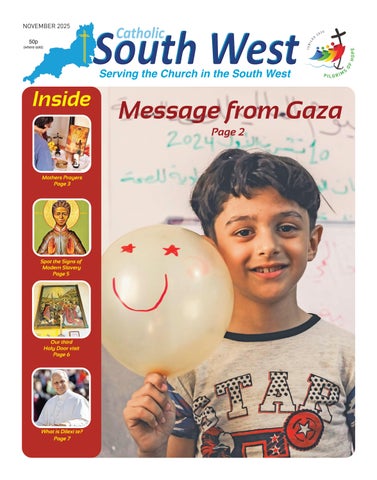
Message from Gaza Page 2
Mothers Prayers Page 3
Spot the Signs of Modern Slavery Page 5
Our third Holy Door visit Page 6
What is Dilexi te? Page 7
2 November 2025 Catholic South West
CONTACTS & DETAILS Catholic South West is a monthly newspaper for Catholics in the Plymouth, Clifton and Portsmouth Dioceses. It is published by Bellcourt Ltd
AIMS
Video message from Gaza's Catholic parish priest
To build community in the South West by sharing stories relating to Catholic life around the South West. To encourage readers to get more involved in - or start - projects and initiatives in the local area. To provide thought-provoking articles to help readers deepen their Faith.
GET INVOLVED We need your help!
Articles: We need your local articles we can only include what we get. So if you have an article or just a photo with a short description - please send it in. Ideas: We need your ideas for the paper and we need your ideas in the paper. If you have any thoughts on what we should include - or if you are thinking about starting a new initiative get in touch - we’d love to support it! Readers: If you can encourage other readers in your parish please do so. Advertising: We rely on advertising - if you know of anyone that would benefit from promoting their business, event or anything else to parishioners throughout the South West, do let us know.
SUBMITTING EDITORIAL
To send in editorial or to get in touch please contact us at: CSW - Bellcourt Ltd N2 Blois Meadow Business Centre Steeple Bumpstead Haverhill, Suffolk CB9 7BN csw@cathcom.org 01440 730399
ADVERTISING
To advertise in Catholic South West please contact us on 01440 730399 ads@cathcom.org
DATES
Catholic South West goes to parishes on the last full weekend of the month. It is printed around the middle of the month - so if you would like to advertise or send in editorial please do it as early as possible.
Wanted Parish Correspondents The Catholic South West is looking for a Parish Correspondent in your parish to send in local news for publication in this newspaper. All items to be emailed to csw@cathcom.org before 10th of the month
Fr Gabriel Romanelli, Parish Priest at the Church of the Holy Family in Gaza, posted this message in Spanish on Facebook after news of the ceasefire agreement. Many thanks to Verity Glover for her translation. Hello, dear brothers and sisters, I hope you are well. So, news has arrived that an agreement has been reached for the first phase, the first stage of what would be a kind of peace-making process; an end to this war, and finally peace in Gaza and (some say) the whole region, God willing. Even so, just as I'm filming this, bombs can still be heard, shells are still falling. In fact, one of our refugees had been accompanying his wife to the hospital - one of the few hospitals still active. Whilst there at the hospital, a bullet from a quadcopter - well, a
EDITORIAL GUIDELINES
1) Think of the readers: If you are writing about an event, think about the readers that don’t know anything about it. Outline what happened, but focus on why people go, why it is important to them, or some teaching that was given. Make sure readers learn something from your article - they don’t just want
drone - struck part of his abdomen. Thank God it didn't reach any internal organs. They were able to perform emergency surgery on him, and remove the bullet lodged there, and he's okay. But I said, this is a sign, we all were and are happy to hear this news, hoping that this really is the beginning of the end of this war, but still… the hostilities continue even now. We hope that all this will come to an end. Thus, the Christian community and neighbourhood has received this news with quiet hope, knowing that peace and agreement have often been discussed. But this time, it seems things are more serious. So, many are already feeling more at ease.
they can think more clearly - what will exist afterwards, what will be left. The aftermath will be horrific. We hope that the world also does not forget the population of over two million people living here. We give thanks to God and all the volunteers worldwide who have worked and continue working towards just and lasting peace for all - as much for Palestine as for Israel. To watch the video in English scan the QR code below.
They are also beginning to consider - and it's not that they hadn't noticed before, but now
to know who was there and what snacks were available! 2) Keep it brief: Make sure you make your point - but keep it brief and punchy. 3) Pictures: Send pictures as they are - even if they are very big to email. Don’t reduce them in size or put them inside a Word document. They look fine on the screen but terrible in the paper!
LEGAL INFORMATION Please note that opinions expressed in this paper and on any linked sites or publications are not necessarily those of the Publishers, Editor, any Diocese or the wider Roman Catholic Church Every reasonable effort is
made to ensure that due acknowledgement, when appropriate, is made to the originator of any image submitted for publication. It is understood that those submitting material for publication in CSW either hold the copyright or have arranged for publication with the appropriate authority.
Catholic South West
November 2025 3
Mothers Prayers of the Solace Community History Mothers Prayers was started in England in November 1995 and has spread rapidly throughout the world with contacts in over 100 Countries and has the approval, support and blessing of Christian leaders of all denominations.
The prayers in the booklet are informal and are just words that speak from a Mother's heart to the Lord. This booklet has now been translated into 40 languages
There are now thousands of groups around the world. Two grandmothers, Veronica and her sister- in- law Sandra, felt led by the Lord to start Mothers Prayers and to pray in a special way for their children They felt that they should bring all the pain and the worries they had for their children to Him and to trust in His words 'Ask and you will receive'.; Through this promise, they understood that the Lord is just waiting to take away pain and to bless and heal them and their children when they come to Him in Faith. During these years there have been many, many wonderful answers to prayers including children coming off drugs, children returning home after being absent for many years, improvements in children's health and relationships (in the family and at school). The mothers also have been blessed and have experienced a great peace.
The Meetings A prayer group may be started with only two mothers. Members meet every week and obey the strict rule of confidentiality. During the meetings a mother may share her worries without the fear of anything being repeated outside of the meeting. The other mothers support her in her prayer and she will feel supported by thousands of mothers around the world who are also part of Mothers Prayers. Mothers experience a great peace with the blessing of this wonderful prayer support. At the meeting we use our special prayer booklet and gather around a small table on which we have placed:A Cross to remind us that Jesus is our Redeemer. A Candle to remind us that He is the Light of the World. A Bible to remind us that He is the Living Word. A small Basket at the foot of the Cross ready to receive the names of our children written individually on small paper discs as a symbol of our placing them into Jesus’ care. We follow our booklet of prayers but we also allow time for spontaneous prayer.
Our Prayer Lord Jesus, we come before you as mothers, wanting you to bless our children, and all children throughout the world. We thank you for our children - they are a precious gift to us. Help us, always to remember this, especially when they are in difficulties Lord, they live in a troubled world a world that does not always acknowledge you, - a world that may sometimes cause them to be laughed at if they admit to belief in you. Help them to be strong, Lord. Helps us to know that you are always with us - sharing in the joys and in the sorrows, joining us in the laughter and weeping with us in the pain. Please give us all the graces we need, to fulfil your plans for our lives and for our duties in our families. You are Almighty God. You can change things. So we turn to you in faith and love knowing that you will answer our prayers. Lord let us always remember how much you love us and our children and how you urge us to come to you with our problems. Amen
Monthly National Catholic Newspaper Catholic news and stories from across the nation and beyond to build the Catholic community and deepen Faith
OCTOBER 2025
Edition 46
www.CatholicPost.co.uk
Parish reinstates flag of Saint George
‘You Too Can Be a Saint’
Blessing of a newly-built Basilica in western Ukraine
page 2
page 6 & 7
page 11
St Francis of Assisi: A Life of Humble Greatness 4th October
A letter to President Trump Dr Swee Ang, Catholic orthopaedic surgeon and co-founder of Medical Aid for Palestine has joined with other medics in an Open Letter to President Trump, appealing for him to use his power and position to stop the genocide and erasure taking place in Gaza. Dr Ang plans to deliver the letter to the US Embassy in Beirut when she attends the 43rd anniversary of the Sabra Shatilla Massacre on 16-18 September. She appeals for people to show their support by signing the letter - see the QR code on page 2. The Honourable Donald J Trump President of the United States of America 15 September 2025
blockade of food, water and medicine creating the most brutal man-made famine ever witnessed, killing hundreds more. Partially destroyed buildings have been systematically bombed to the ground so as to expel the entire population of Gaza City and enforce the mass exodus of a million people who were sheltering in those ruins and rubble. These traumatised people were already severely malnourished, and some near death from famine and diseases. Thousands more will die. The World knows there is only one person who can put an end to this and bring peace to the Middle East. It is with this in mind that we ask you to let Gaza live and give its children a future.
We've seen this before Dear President Trump We are a group of doctors and nurses who worked in Beirut's Gaza Hospital throughout the Sabra Shatila Palestinian Refugee Camp Massacre in 1982, 43 years ago. We are witnesses and survivors of the massacre which took place under the watch of the Israeli Army And now, like countless people round the world, we have watched with horror, pain and anguish the relentless livestreamed killing and demolition of Gaza ever since 7 October 2023. By January 2025, the official body count of Gazans killed was at least 50,000, with a further 10,000 under the rubble, of which 17,835 were children, leaving more than 35,000 kids with one or both parents killed. But while the escalating onslaught seemed unstoppable, almost immediately after your inauguration, the world watched with bated breath the ceasefire you imposed on 19 January 2025. The bombs stopped. Food, medicine and fuel entered beleaguered Gaza, as nearly a million displaced Gazans walked from displacement towards their broken homes. Some called it a Trump-made miracle. But on 18 March, six weeks later, we watched with utter horror the breakdown of the ceasefire . Attacks on Gaza escalated and since then more than 6,000 were killed, with the
We survived the Sabra Shatila Massacre in September 1982 - but more than 3,000 unarmed defenceless Palestinian men, women and children and their Lebanese neighbours were slaughtered in 3 days, at the rate of a thousand killed each day. A further 17,000 were abducted and never returned to their families. It happened under the ceasefire brokered by Phillip Habib, the Middle East Envoy of your predecessor President Ronald Reagan. After a ten-week bombardment of Lebanon by land, air and sea together with a blockade of food, water and medicine, the Palestine Liberation Organisation evacuated to mitigate further loss of lives and destruction of homes, schools, institutions, farms and factories. The most important part of the ceasefire agreement was the safety of the unarmed civilians left behind guaranteed by the Habib Peace Plan. With this assurance, hundreds of thousands of displaced, traumatised, hungry people and wounded orphans returned to rebuild their broken homes and shattered lives. We witnessed their complete trust in the protection of the USA and how, despite the
brutal incessant bombardment of their homes, the killing and wounding of their loved ones (leaving many children orphaned), the separation of their families through the evacuation, they put their hope in the stable future in their refugee camps under the protection of the USA. But when, three weeks later, on 15 September 1982, hundreds of Israeli tanks made a massive land invasion breaking the ceasefire, your predecessor did not protect them. The tanks rolled over fleeing human beings, shelling buildings and over-ran Beirut city. A contingent of tanks headed for Sabra Shatila and hermetically sealed the camp. Under the direct control of the Israeli Army who had made the Kuwaiti Embassy their commandand-control centre, Christian militiamen trained and armed by Israel were sent into the camp to systematically torture, rape and brutally murder the Palestinians and their Lebanese neighbours. Together with Palestinian and Lebanese medical staff we battled to save the lives of hundreds of severely injured patients - shot at point blank by machine guns. We had to pile the dead bodies on top of each other in the hospital mortuary as there was no space left. Frightened camp people fled into our hospital hoping to seek safety. At night, Israel launched military flares to illuminate the sky so that the atrocity could continue. The hospital ran out of blood and anaesthetics; it also ran out of food and water for the desperate people seeking shelter. And when news came that the militia working for Israel shot patients, raped and murdered nurses in a neighbouring hospital, they fled. Our medical team stayed on to operate on the wounded and cared for them. On the morning of 18 September 1982, our hospital was invaded by a group of soldiers who marched us out at machine gun point.
Library of Congress photo. Unsplash They claimed to be Lebanese but answered directly to the Israeli Army. They forced us to leave at gunpoint. We feared for the lives of our patients concerned they would be shot dead once we left. Our patients owed their lives to a Swedish nurse and a medical student who refused to leave and stayed to care for them. As we were marched out of the hospital, we saw dead bodies and terrorised people rounded up by gun men and awaiting execution. There were large military bulldozers tearing down homes and burying people in the rubble. At one point a desperate young mother broke through the line of machine guns to give her little baby to one of us. In a flash, a gunman ordered her back. Mother and child were gunned down along with the others rounded up by the roadside after we left. Continued on page 2
If you have been given the Catholic Post for free in your parish, PLEASE would you be able to donate £1 to your parish for it, or even £10 per year!
The UK’s first Carbon Neutral National Catholic Paper
Subscribe@catholicpost.co.uk 01440 730399 www.catholicpost.co.uk
4 November 2025 Catholic South West
The Importance of World Mental Health Day
World Mental Health Day, observed every year on October 10th, is a global initiative dedicated to raising awareness about mental health issues and mobilising efforts to support mental well-being. First celebrated in 1992 and spearheaded by the World Federation for Mental Health, the day has grown into a powerful reminder that mental health is just as vital as physical health—and that it affects every individual, regardless of age, background or location. In recent years, the importance of mental health has come into sharper focus. The COVID-19 pandemic, economic uncertainty, climate anxiety, social isolation, and geopolitical conflicts have all contributed to a surge in mental health challenges around the world. Depression, anxiety, burnout, and post-traumatic stress disorder (PTSD) are on the rise, and yet stigma and lack of access to mental health care continue to be major barriers for many people. World Mental Health Day plays a crucial role in breaking down these barriers. It offers an opportunity for governments,
organizations, educators, healthcare providers, and individuals to speak openly about mental health, advocate for better services, and promote practices that support emotional well-being. Public events, campaigns, and educational initiatives held on this day help spread awareness and encourage people to seek help when they need it—without fear of judgment. For individuals, the day is also a chance to reflect on personal mental well-being. It encourages people to practice self-care, check in with loved ones, and seek support when necessary. Simple acts like taking a break, connecting with a friend, or reaching out to a counsellor – can have a significant impact on mental health and help prevent crises before they escalate. The Safeguarding team at the Diocese of Plymouth plays a key role in protecting and supporting the wellbeing of individuals, including those experiencing mental/emotional challenges. There are several ways in which the safeguarding team can help you:
Listening and pastoral support – The safeguarding team provides a safe and confidential space to talk about what you may be experiencing, including anxiety, depression, trauma or stress related to abuse or church life. Recognising the fluctuation of mental health is important, and the importance of understanding that not every day may be the same. Some days may feel more intense and difficult to manage than others. Our safeguarding team are dedicated to speaking with and supporting you during your better and your worse days. Creating safe church environments – By promoting safe practices and zero tolerance for bullying, harassment or abuse, the safeguarding team helps foster parish communities where mental health is being protected and supported. Safeguarding and mental health awareness – The diocese runs training sessions for clergy, volunteers and parish staff which includes recognising signs of distress, abuse and poor mental health. This often includes guidance on how to respond
compassionately and direct people to appropriate support. While the safeguarding team is not a clinical mental health team, they maintain links with local NHS mental health services, counselling organisations, statutory and faith-based charities. They can refer individuals to specialist counsellors, crisis helplines or traumainformed support such as: Samaritans Every life lost to suicide is a tragedy | Here to listen TALKWORKS Devon’s NHS Talking Therapies Service We’re Mind, the mental health charity Mind If you or someone you know needs help, you can reach the Diocese of Plymouth Safeguarding team below: Safeguarding Office St Boniface House Ashburton Newton Abbot TQ13 7JL
Catholic South West November 2025 5
Spot the Signs of Modern Slavery and how YOU can help “He has sent me to proclaim liberty to the captives and recovering of sight to the blind, to set at liberty those who are oppressed, to proclaim the year of the Lord’s favour.” (Luke 4: 18-19)
What is Anti-Slavery? Anti-Slavery is an important opportunity to raise awareness of human trafficking and Modern Slavery, and to encourage friends, family, colleagues, businesses and governments to do what they can to prevent it and protect victims.
Why does this matter for the Church? Anti-Slavery is aligned deeply with the Church’s teaching on the inherent dignity of every human person, created in the image of God, giving us an opportunity to reflect on our faith’s call to uphold the dignity of every human being. Modern Slavery and human trafficking deny people their God-given freedom; by observing Anti-Slavery, we can stand against all forms of exploitation and live out the Gospel mandate to love our neighbour and to work for a world where all can live in freedom and dignity. The Catechism of the Church condemns the enslavement of human beings, stating: “It is a sin against the dignity of persons and their fundamental rights to reduce them by violence to their productive value or to a source of profit.” Pope Francis called the faithful to action “…to mobilise all our resources in combatting trafficking and restoring full dignity to those who have been its victims,” warning that: “If we close our eyes and ears, if we do nothing, we will be guilty of complicity.”
facing them in the UK to be recognised and supported to rebuild their lives. Reflecting on the visit Bishop Paul said: “It was evident that the resilience of survivors is a powerful reminder that hope cannot be silenced… We must stay vigilant, continue to broaden our knowledge to ensure that efforts to combat the issue do not cease.”
What is the scale of the problem? Ten years ago, the Modern Slavery Act was introduced, with the aim of protecting the most vulnerable and ending exploitation. A decade on, and Modern Slavery sadly remains a devastating problem: a hidden crime, happening on our streets and in our communities. It is estimated that there are more than 120,000 victims living in the UK today; that is the equivalent of the entire population of Exeter. In 2024, a record 19,125 potential victims were identified and referred into the official National Referral Mechanism (the framework tasked with recording and assessing people reported to be victims of Modern Slavery). For many survivors, identification is only the start of a long process, with major challenges including finding access to safe and secure employment, safe housing, access to high quality healthcare to address their trauma, and integration and welcome into society.
What can I do?
Justice and human dignity have been a central focus for this Jubilee year, with Modern Slavery one of the six key Jubilee themes designated by Pope Francis. Catholics and all people of goodwill are urged to do their part – both in their local communities and in wider national campaigns – to combat the exploitation of vulnerable people and to provide support and welcome for those who have been exploited.
Find out how to Spot the Signs of Modern Slavery and how to report your concerns. Caritas has produced a poster which you can download by scanning the QR code below.
Catholic Social Teaching inspires the Medaille Trust, an amazing organisation working to restore dignity, empowerment and the first steps towards a new life. Bishop Paul McAleenan, lead Bishop for Migrants and Refugees, met with survivors of trafficking and Modern Slavery supported by the Medaille Trust, and heard first hand of the difficulties
Diocese of Plymouth Parish Safeguarding Reps have contact cards with useful numbers to call for help or to report concerns. Contact Alex Miranda, Caritas Diocese of Plymouth Refugee & Migration Project Lead for more details caritas@prcdtr.org.uk
Saint Josephine Bakhita
6 November 2025 Catholic South West
Our third Holy Door visit
to Dorchester Church of the Holy Trinity & The Church of Our Lady, Queen of Martyrs, & St Ignatius
On Wednesday 17th September 2025 – to celebrate the Jubilee Year of Hope a coach with parishioners from within our parish of four churches (Our Lady and St Neot, Liskeard; Our Lady of Light, Sclerder Abbey; Our Lady of the Angels, Saltash; St Joan of Arc, Torpoint) made our third Holy Door visit. We were also accompanied by Fr Cyriacus {our parish priest} and his childhood friend Fr Remigius (an assistant priest in Newcastle upon Tyne). First stop on our pilgrimage was the Church of Our Lady, Queen of Martyrs, and St Ignatius, Chideock, which lies between Bridport and Lyme Regis in West Dorset, half a mile from the Jurassic Coast. Chideock: the village where the Catholic faith never died, has a turbulent history, seven Chideock men – three priests and four laymen – were cruelly put to death for their Catholic faith between 1587 and 1642. This church is a memorial to them the Chideock Martyrs and to all those who kept faith throughout the times of bloody repression. This church, one of the gems of English Catholicism, is dedicated to Our Lady, Queen of Martyrs, and to St Ignatius, founder of the Society of Jesus, was built by Charles Weld in the grounds of Chideock Manor – home to the Weld family for 200 years – and finished in 1872. Weld designed the church in the Italian Romanesque style and did much of the work himself, including the wall decorations, the high altar and side chapels, and the sculpted capitals of the nave pillars. Also housed in the church,
which can be seen by arrangement, is the painting by Francis H Newbery (18551946) a celebrated local artist and depicts five of the Chideock Martyrs. This church was the highlight of our trip, and we were made most welcome. We had time to wander around the church and museum, pray, reflect, meditate and venerate the relics of some of these Martyrs which were displayed on the high altar. We then moved on to Holy Trinity Church, Dorchester – our Third Holy Door – as the coach pulled up, we were met and greeted by Fr Babu and his volunteers, who had given up their day to show us around and made us most welcome. We were given somewhere to sit and have our packed lunch, say our Jubilee Prayers and sing the hymn ‘Make me a Channel of Thy Peace’, walk around the lovely church, reflect and meditate, and a lovely lady gave us a talk, we had our passports stamped. Fr Babu gave us a final blessing, and we had our photo taken by the Holy Door, before Fr Babu waved us off as we boarded our coach and made our long way back to Saltash and Liskeard. Though the clouds were grey and there were spots of mizzling rain, the weather on a whole was kind to us and everyone thoroughly enjoyed the day of peace, friendship and reflection. Article by Rose de Boyer St Neot Group Liskeard, The Parish of Our Lady of The Angels, photos by various sources
Catholic South West November 2025 7
What is Dilexi te?
Your questions answered on Pope Leo XIV's first Apostolic Exhortation On 9 October 2025 the Vatican released Pope Leo XIV's first Apostolic Exhortation on love for those who are poor. This Q&A explains some of the context and key messages of the document.
What is an Apostolic Exhortation? An Apostolic Exhortation is a teaching document from the pope, which often aims to exhort (encourage) a particular virtue or activity. Like many papal encyclicals, apostolic exhortations have often developed themes of the Church's social teaching.
What does Dilexi te mean? Dilexi te means "I have loved you" and echoes the title of Pope Francis' last encyclical letter Dilexit Nos ("he loved us"), on the devotion to the Sacred Heart. The title is taken from the words of Jesus in Revelation 3:9 and the exhortation is addressed "to all Christians on love for the poor."
Why has it been released at this time? Just as Pope Francis completed the exhortation that was started by Pope Benedict XVI, Lumen Fidei, Pope Leo XIV now completes the work Pope Francis started before his death. With the release of his first major magisterial document a few months into his papacy, we read Pope Leo's developed thoughts on the Christian life for the first time, both in humble continuity with Pope Francis and with his own particular style and experience. Signed on the feast of St Francis of Assisi, the document imparts the lesson that St Francis learnt personally and embodied that a preferential love for the marginalised can renew both the Church and society.
What are the key messages in this document? This exhortation is all about God's love for the most vulnerable and marginalised people in our society. This is affirmed with many examples from the scriptures, the saints and religious orders, as well as in the development of Catholic social teaching in dialogue and engagement with the contemporary world. The document speaks of Jesus' identification with the hungry and marginalised, with workers and the rejected in the gospels; about St Francis and St Clare; the shared life of monastic orders and the biblical promise of liberation from oppression. It also describes the multifaceted nature of poverty in the modern world. Social
Pope Leo XIV by Catholic Church England and Wales (Mazur/cbcew.org.uk) exclusion, personal fragility, lack of voice and rights are forms of poverty as well as lacking material resources. Pope Leo urges us, with his predecessor, to avoid old criteria to hide behind the idea that things are always getting better, and to ignore the new subtle forms of poverty, which may be all the more dangerous. We must reckon with increasing inequality, globalisation of indifference and the injustices that burden women. We are reminded that Christ himself became poor, and that therefore we can see Christ in all those who are poor in our world today. We must therefore be particularly attentive to those who are most marginalised in our society and listen to the wisdom that only they can offer.
What is the preferential option for the poor? The preferential option for the poor is a key theme of Catholic Social Teaching, reminding us that those who are experiencing poverty are given special attention in God’s eyes. We are therefore called to put the needs of the marginalised and vulnerable first. In the exhortation, Pope Leo writes that this preference for the poor “never indicates exclusivity or discrimination towards other groups which would be impossible for God... Wanting to inaugurate a kingdom of justice, fraternity and solidarity, God has a special place in his heart for those who are discriminated against and, he asks us, his Church, to make a decisive and radical choice in favour of the weakest.” (#16)
What does Dilexi te say about welcoming migrants? "The experience of migration accompanies the history of the People of God" Pope Leo writes, citing the biblical examples, of Abraham, Moses, the Holy Family in their flight to Egypt and Christ himself in coming to live among us. Dilexi te makes clear that welcoming migrants is therefore a crucial part of the Church's mission, recalling her history of the work which is continued today by Caritas Internationalis and other institutions, stating: "The Church, like a mother, accompanies those who are walking. Where the world sees threats, she sees children; where walls are built, she builds bridges. She knows that her proclamation of the Gospel is credible only when it is translated into gestures of closeness and welcome. And she knows that in every rejected migrant, it is Christ himself who knocks at the door of the community" (#75)
What inspiration does Pope Leo XIV find in the saints? Pope Leo celebrates the example of many holy men and women who have been true witnesses to Christian living in their treatment of those experiencing poverty or sickness, the imprisoned, uneducated and migrants. More than thirty saints are mentioned by name, including St Francis and St Clare, St Augustine, St Benedict, St Teresa of Calcutta and St Oscar Romero.
The exhortation also reflects on the lives of those religious communities, many of them founded by saints, who through their common lives of voluntary poverty, have silently sowed the seeds of a new civilization based on an economy of solidarity rather than accumulation.
What does it mean for the Catholic community? This exhortation is a reminder to us all that love and care for our neighbour and those who are poor and marginalised is a fundamental part of our faith. Pope Leo mentions the need for us to raise our voices to call for an end to unjust structures and systems which keep people poor, even if others consider us foolish or naïve. He also speaks about the importance of almsgiving as a way for us to express this faith and make a concrete difference to our brothers and sisters who are experiencing poverty. “Our love and our deepest convictions need to be continually cultivated and we do so through our concrete actions. … For this very reason, we Christians cannot abandon almsgiving." (#119) CAFOD
To read the full text of Dilexi te, scan the QR code right.
8 November 2025 Catholic South West
Scripture Focus
By Fr Jeremy Corley
Everyday Holiness On Sunday 2nd November we celebrate the Feast of All Saints, transferred this year from 1st November to the Sunday. For this feast, the church could have chosen to highlight those who climbed the extreme heights of holiness—such as the wisest teachers or the most powerful leaders or the great practitioners of prayerfulness. Instead, the feast day gospel gives us a pathway to everyday holiness in the Beatitudes. This teaching, from the opening of the Sermon on the Mount, offers a challenge to us all, from the greatest saint to the simplest believer. Whereas the world praises wealth and comfort, status and pleasure, Jesus exclaims: How blessed are the poor in spirit, because it is to them that God’s kingdom belongs. The poor in spirit are spiritual beggars—they realise that everything they have
comes as a gift from God. And if they have God, they have everything. As St Teresa’s bookmark says: “Let nothing disturb you, let nothing frighten you. All things are passing; only God does not change. Patience gains everything. Whoever has God lacks nothing. God alone suffices.” We all wish to escape sorrow and be happy, but Jesus exclaims: How blessed are those who mourn, those who share in the grief of all who suffer, those who are not immune from pain and sorrow. They will receive consolation in future. We live in a world of strong figures who assert that might is right. But Jesus proclaims: How blessed are the meek, the gentle, the humble. They are the ones who will finally inherit the earth. Many people long to see a world where justice will prevail, but not so many are
willing to suffer to bring about what is right. Jesus proclaims: How blessed are those who hunger and thirst for righteousness, because in future God will satisfy their righteous longing. We all wish to receive kindness and mercy, but we are not always as ready to show it to those who are at fault. Jesus exclaims: How blessed are those who show mercy to others, because they will receive mercy. The world is full of unholy distractions that can turn our minds and hearts away from God. But Jesus proclaims: How blessed are those who keep their hearts pure, because their attention will not be focused on other things, but their eyes will be open to see God. The world often seems to thrive on conflict and division, but Jesus seeks to bring people together in truth and love.
Funeral Services
Jesus exclaims: How blessed are the peacemakers, because they will be recognised as God’s true children. We can frequently notice the need for others to live more righteous lives, but Jesus calls us to fix our own conduct first, even if we may cost us some hardship. So Jesus proclaims: How blessed are those who seek righteousness and are willing to undergo persecution to achieve it, because God’s kingdom belongs to them. The Beatitudes offer us practical guidance on our journey towards everyday holiness. This way is not always easy, but it is the way to true life. Let us ask the Lord to fill us with his grace to accept these challenges, so that we may receive his future rewards.
To Advertise in the Funeral Section contact Nick on 01440 730399 nick@ cathcom.org
Catholic South West
November 2025 9
View from the Pew By Dr Jay Kettle-Williams
Sibling Rivalry Mary is fast approaching term. It won’t be long now till she gives birth. So she might well be wondering what the new child will be like. Unlike many mothers-to-be throughout history, Mary already knows she will be giving birth to a son, and that His name will be Jesus. During the Annunciation event Gabriel had informed a perplexed Mary (Luke 1:31 JB) that she would conceive and give birth to a son and that she was to give Him the name Jesus because He would be great and that He would be called the Son of the Most High. At that point Joseph must have been a bit taken aback. As the putative father, the pater putatus (Latin) – whereby those christened ‘Joseph’ in Romance tongues are often referred to as ‘Pepe’ – must have felt he was on an emotional helter skelter. Poor man! But both blest and blessed nonetheless. I can’t help at this point but spare a thought for the common Hebrew patriarch of the Abrahamic religions, Abraham himself. There’s nothing at all putative about the direct and undisputed association he holds with the three monotheistic religions of Judaism, Christianity and Islam. The blueprint is there in black and white (Please excuse the pun). A comparative and contrastive historical snapshot of the three Abrahamic religions touches on some interesting points:
Judaism 2,000 or so BC the nomadic tribe of Hebrews led by Abraham abandoned polytheism (belief and worship of multiple gods) in favour of monotheism (the worshipping one god). Abraham then led his followers from an area identified as modern-day Iraq to Canaan on the west of the River Jordan. Subsequent famine forced the growing community to move to Egypt where they were enslaved by the Pharaohs. Many years later under the leadership of Moses in the 13th century BC they returned to the area west of the
River Jordan. In 586 BC the Jews’ temple was destroyed by the Babylonians and many Jews were deported to Babylon (now Iraq). Following the destruction of the second temple (70 AD), Jewish emigrés established communities in many parts of the world from southern India to northern Europe. The Jews were driven out of Christian England in 1290, out of Catholic Spain in 1492 and, after persistant persecution elsewhere, most notably at the hands of the Nazis in the 20th century, there has been sustained contention between the Jewish State of Israel, often at variants within itself and its Muslim neighbours.
Christianity Born of the Jewish faith, Jesus was a Jew, Christianity dates back 2,000 years. From being a fringe cult, Christianity established itself by the 4th century AD as the religion of the Roman Empire and Rome became the epicentre of the Church where Popes were elected as successors of St Peter, whom Jesus had appointed to first head His church. The Schism of 1054 saw the Orthodox Christians breaking away from the Roman Catholic Church, reflecting the historical Western Mediterranean (Roman) v. Eastern Mediterranean (Greek) cultural divide. Reaction against Catholic practices fuelled Protestanism, identified by such personnages as John Calvin, Martin Luther and the English monarch Henry VIII.
Islam At the age of 40, Muhammed (570 – 632 AD) had visions in which the Archangel Gabriel taught him to recite the teachings of the one true god, Allah. Those teachings were then recorded in the Qur’an, the Muslim holy book. Muhammed declared himself the prophet of Allah in 616 and began to preach to the Arabic-speaking peoples of the Middle East. In 622 Muhammed was forced to leave Mecca and with his followers he fled to Medina, so marking the beginning of
the Islamic calendar. Muhammed, having attracted many followers, then returned to Mecca and remained Islam’s spiritual leader until his death. Subsequent power struggles ensued with the Sunnis, those calling for continuity with Muhammed’s family line, gaining the majority which they have retained to this day. Tension between the factions is the cause of conflict to this very day. The sorry tale of these three religions is one of protracted contention within their factions, leading even to internecine war between one and other. By way of some random examples: The Battle of Tours (732 AD), The Spanish Inquisition (1478 – 1834 AD); Expulsion in 1492 of the Moors and Jews under Spain’s Catholic Monarchs, Queen Isabella I and King Ferdinand II; The Battle of Lepanto (1571 AD); Muslim military expansion around the Mediterranean echoing the exploits previously associated with Ancient Rome; The Crusades (1095 – 1291) to win back for Christianity The Holy Land … I could go on. Together we could probably fill pages of this publication and many more. Abraham must be turning in his grave. But, menfolk apart for the present, women of the world past and present are not a force to be taken lightly. I have long set great store by their power, be that actual or potential, as instrumental in helping with solutions and finding answers. The women in the Bible, let alone anywhere else, are a case in point. And as for Mary in particular, well, with the devoted ‘Pepe’ at her side, she’s now preparing to present us with the one Godgiven, all-pervading answer. Dr J L Kettle-Williams is an experienced business communications consultant and wordsmith (tutor, writer, translator).
AUGUST 2025 Edition 44
www.CatholicPost.co.uk JUly 2025
Edition 43
No tolerance of abuse
www.CatholicPost.co.uk
The Quiet Revival
pages 6 & 7
page 3
Dalai Lama turns 90
Called and Gifted
Our Lady of Mount Carmel July 16th
Carlo Acutis
page 3
page 15
page 7
Welcome the noise!
page 11
St John Vianney 4 August
To be a pilgrim
Bishops Condemn Vote
SEPTEMBER 2025 Edition 45
As we move into the summer months, many www.CatholicPost.co.uk dioceses across the country will be embarking on pilgrimages. Throughout history and across the world, people have set out on journeys in search of something greater than themselves. The motivations are many and diverse – some want to develop their understanding of themselves and the world, some to deepen their faith or to heal.
500 mile Camino on bikes
Two Paths, One Call to Holiness
"It changed how I see care"
page 6
page 7
page 14
For Catholics, a pilgrimage is a spiritual journey to a holy place. The most popular and sacred destinations are Lourdes (with an estimated 200 million visitors since Teresa: 1860 when Mother pilgrimages there began), Santiago de Compassion Compostela A Beaconinof northern Spain and of course, the Holy5th LandSeptember which the current fighting has made impossible to visit. Unlike a holiday, where relaxation and sightseeing might be the goal, a pilgrimage is about inner renewal. As the journey progresses, so does the soul’s transformation.
Jubilee of Youth
At its heart, a pilgrimage Camino Way, Spain is an invitation to stories fosters bonds that Image: Burkard Meyendriesch encounter God in a profound can last a lifetime. simple way. The effort accommodation, or walking As one pilgrim said: “I left required—planning, travelling, through relationship with God, as a stranger and rain—become stepping outside a pilgrimage offers the acts of love and trust. In a world returned with a family.” your comfort zone—becomes chance to step away from part of the that prizes convenience, pilgrimage the prayer. Along the way, pilgrims reminds us encounter the extraordinary. ordinary and of the value of perseverance often find For many, It is a reminder and humility. pilgrimage is a response to moments of quiet to reflect that the Christian life itself a deep and listen, away need is a pilgrimage—a for healing—physical, emotional, from the noise of daily life. journey towards the ultimate or Not every pilgrimage requires Many pilgrimages spiritual. destination: boarding a plane heaven. Sites such as Lourdes in France include the Sacraments: or or walking hundreds daily Mass, Holywell of miles. Across the UK, in Wales have long been associated opportunities for Confession, there are countless opportunities and Eucharistic with miraculous for local So, where might God cures and profound grace. Adoration. Walking in the be calling you? To the footsteps of saints Even pilgrimages. Historic shrines when physical healing does like Walsingham quiet of or standing in places marked Walsingham’s shrine, the not come, in Norfolk, the by Marian pilgrims often healing holy well of St Winefride discover a peace that brings in waters of Holywell, or perhaps apparitions can awaken a deeper Wales, and Scotland’s Carfin a Camino route love for God inner restoration. Grotto attract through the In surrendering burdens and and a renewed sense of faith. rolling countryside? Wherever thousands each year. A pilgrimage can be the intentions to God, they find as path leads, the promise is a renewed sense simple the same: God walks as setting aside a day to visit of hope. a nearby with those who seek Pilgrimage also reminds us Him. church or cathedral with a prayerful that faith is not a heart. The solitary journey. Visiting shrines essence of pilgrimage is not and cathedrals Pilgrimage is in the distance Scan the not always easy—and that is where generations have QR Code part below travelled prayed creates a of its power. for inspiration but in the disposition of the It involves early mornings, heart—a about where to go tangible connection to the in the UK. willingness to seek God Church’s history unfamiliar and allow Him to places, and sometimes and to the Communion of long, transform the journey. Saints. Whether demanding walks. These challenges strip travelling alone, with family, away or as part of a comforts and distractions, creating space group, pilgrims experience for If the idea of pilgrimage a unique fellowship God to work has ever moved you, in the heart. Small sacrifices— along the way. Sharing meals, perhaps now is the time to prayers, and giving up control respond. Whether of schedules, enduring you are seeking healing, clarity, or a deeper
Matthias Zomer
after the second reading, society. As we stated and renew the of many Catholic Wiseman we nurture happen, the future it is essential thatGwen cbcew.org.uk threat. people have to institutions could be under innate call that many for others. compassionately care of the parliamentary This is not the end and Wales believe that not lose hope. We ask The Bishops of England process, and we should of to continue to pray for improving the quality and availability the Catholic community to whilst they consider palliative care offers the best pathway members of parliament of life. We will and to pray that government reducing suffering at the end profession to help this legislation life from for this, and we ask the Allowing the medical promote and protect continue to advocate and Wales have been will change the culture will act to to support those who The Bishops of England patients end their lives Catholic community fears conception until natural death. in their opposition for the dying in our and cause legitimate consistent and outspoken we of healthcare work tirelessly to care or who are assisted suicide, and those with disabilities to the legalisation of the view, during this hospices, hospitals and care homes. amongst expressed have MPs have that We in other ways. are shocked and disappointed compassion involves especially vulnerable debate, that genuine Terminally Ill Adults (End especially voted in favour of the Archbishop John Sherrington those who need care, flawed in principle with about the future of accompanying disability and old age. The Archbishop of Liverpool of Life) Bill. This Bill is We are also concerned sickness, of give us great cause for because experience during Issues for the the heart of the lives several provisions that palliative care, not least Lead Bishop for Life vocation to care is at loved there are explicit Conference. look after their For Bishops’ concern. days into me, the location itself turned the suggests that, unless so many people who may be required to cois the sign of a truly compassionate a pilgrimage of memory. The last time I was in a protections, hospices were to ones and believes in promoting assisted suicide. If this The Catholic Church that field was World Youth Day 2000 with care. operate with compassionate and life culture of Saint John Paul II, packed in with 2.5 million young people, the largest gathering in the history of Europe. Coming back twenty-five years later was unexpectedly emotional. In 2000, I travelled with the Diocese of Westminster, backpack on my shoulders, utterly unprepared for sleeping overnight in a vast field and without a care in the world and little sense of how those days would mark me. We slept little, laughed, sang, and prayed much and friendships were forged that I never thought possible. Seeing a new generation at prayer where we once stood made one truth unmistakable: Christ’s promise to be with His Church endures – always and for everyone.
statement on the Archbishop Sherrington Terminally Ill Adults Third Reading of the (End of Life) Bill
I first stood at Tor Vergata in 2000. Returning for this Jubilee, I watched a new generation pray, sing, and be sent as witnesses of Christ’s hope, joyful disciples for today’s world.
If you have been given the Catholic Post for free in your parish, PLEASE would you be able to donate £1 to your parish for it, or even £10 per year!
free in your parish, the Catholic Post for per year! If you have been given parish for it, or even £10 able to donate £1 to your
PLEASE would you be
Around one million pilgrims were estimated at this year’s Youth Jubilee. Pope Leo XIV led a dialogue-style prayer vigil in which three young people from Mexico, Italy, and the United States asked about friendship, the courage to choose, and how to meet the Risen Lord in daily life. The Holy Father’s answers, rooted in Scripture and Saint Augustine formed a simple pathway.
Pope Leo XIV arrives for a prayer vigil during the Jubilee of Youth at the Tor Vergata field in Rome Image: Vatican Media
On friendship. “Our life begins with a bond,” he reminded us. We grow through relationships and the cultures that shape us, which must be read with discernment embracing what is noble, rejecting what harms. Friendship with Jesus is our “guiding star,” the love that makes human friendships sincere, generous, and true. Hence the appeal: “Dear young people, love one another in Christ!” Because “friendship can
truly change the world. Friendship is a path to peace.” On the courage to choose. Choosing is not merely selecting something; it is deciding who to become—ultimately, “choosing someone.” We learn to choose by remembering we were first chosen: life is a gift, born of Love. Anchored on that rock, choice “always leads to
the greatest good.” Courage flows from Christ’s love: “It is Jesus you seek when you dream of happiness.” The Pope pointed to radical, meaningful vocations - marriage, priesthood, consecrated life where self-gift makes us truly happy. His invitation was direct: “Find the courage to make difficult choices and say to Jesus: ‘You are my life, Lord.’” Continued on page 4
If you have been given the Catholic Post for free in your parish, PLEASE would you be able to donate £1 to your parish for it, or even £10 per year!
£1.80 provides a child with a meal every weekday for a month
Donate now at www.reachfoundationuk.org Your money goes a long way! Reach Foundation UK charity no: 1171521
10 November 2025 Catholic South West
Bishop McAleenan’s message for the World Day of Migrants and Refugees 2025 Every year the World Day of Migrants and Refugees (WDMR) is celebrated on the last Sunday of September but this year, to coincide with the Jubilee of Migrants, the day was celebrated over the weekend of 4 and 5 October. The theme Migrants, missionaries of hope, emphasising the resilience and faith of migrants and refugees in the face of hardship. The Lead Bishop for Migrants and Refugees, Bishop Paul McAleenan, offered this message for the day. This year, 2025, the annual World Day of Migrants and Refugees was celebrated on the 4 and 5 October. In Rome, in this year of Jubilee, Pope Leo will presided over two days of celebrations and festivities. Closer to home in England and Wales, parishes and schools also marked the event. It is a day for acknowledging the presence of migrants and refugees in our communities, celebrating their contribution and becoming more aware of the difficulties they encounter. The World Day of Migrants and Refugees is not a new event – it has been marked in the Catholic Church since 1914 – an indication that the movement of people from their homeland is not a recent phenomenon. Throughout history, people have migrated in search for a better life for themselves and their families. However, the number of displaced people is growing due to war, persecution, poverty and the climate emergency which is robbing many people of the opportunity
to build a sustainable life in their place of origin. Everyone loves their country, including those who are forced to leave their homeland. As we move through the streets of our towns and cities today, we see a proliferation of flags and insignia flying from lamp posts. For many, these represent love of country and patriotism. Yet, unfortunately, such displays are also often associated with sentiments opposed to immigration and migrants. Love of country is honourable and so is love of neighbour. In speeches, demonstrations and rallies, which have taken place in recent months and weeks, those two virtues – love of country and love of neighbour – have not come together. “Who is my neighbour?”, Jesus was asked. In answer, Jesus gave the Parable of the Good Samaritan – my neighbour is anyone in need.
Our Christian response What should our Christian response be to those who are finding their ways to our shores? Those who have made their way here have done so in desperation – motivated by their desperate plight. That desperation is combined with a longing for a better life. Anyone who has encountered refugees and migrants can confirm that ‘hope’ is present too. Pope Leo speaks of these travellers as “witnesses of hope”. He speaks of how their courage and tenacity bear heroic
To Advertise contact Nick on 01440 730399 nick@ cathcom.org
Angels Unawares statue by Timothy Schmalz testimony to a faith. Faith that sees beyond what our eyes can see and gives them strength to defy death on the migration routes – many of which are perilously unsafe.
Our duty to care for those who seek refuge Hostility and prejudice towards migrants and refugees, whatever its source – whether it is spoken or indicated in another way – must not make us lose hope or harden our hearts. It is our obligation to try and understand why migrants appear among us; our duty is to care for those who seek refuge in our country.
In the current reality of heightened tensions and angry language, I wish to thank all who support migrants and refugees and advocate their cause and dignity. We express our gratitude to those in parishes, schools and communities, to educators, teachers, priests, deacons and the lay faithful who, in these difficult times, continue to insist on the need to welcome the stranger, even in the face of opposition. Your good work and deeds are seen, heard and appreciated. May you never lose hope. May Mary, Solace of Migrants pray for you and for all who travel in hope of a better life.
Catholic South West
November 2025 11
Cardinal ‘shocked to the core’ by Synagogue attack in Manchester
Cardinal Vincent Nichols, President of the Catholic Bishops’ Conference of England and Wales, has released a statement expressing his shock and assuring the Jewish community of his prayers after the terror attack on the Heaton Park Hebrew Congregation Synagogue in Manchester recently (2 October). “The killing of two Jewish worshippers, the injuries inflicted on others, and the attempt to drive a car into a crowd in Manchester today are expressions of utter hatred that must not be tolerated in this land. That such an attack is directed at the Jewish community, and on Yom Kippur, this most solemn of days, shocks me to the core.“ Jewish and Christian people are closely bound together in our common faith in God. Indeed, in the Catholic tradition, Jewish people are held to be the ‘elder brothers’ in faith of our Christian family. My prayers, and those of the Catholic community, are heartfelt and profound: for those who have died, the bereaved, the injured, and those who will feel less safe tonight. “It is a duty of us all to work together to ensure a more cohesive and respectful society, one in which such violence and inhumanity have no place.”Cardinal Vincent Nichols Archbishop of Westminster President, Catholic Bishops’ Conference of England and Wales
Cardinal welcomes Archbishopdesignate Sarah Mullally as new Archbishop of Canterbury Cardinal Vincent Nichols, Archbishop of Westminster and President of the Catholic Bishops’ Conference of England and Wales, has welcomed the announcement that the Bishop of London Dame Sarah Mullally will be the next Archbishop of Canterbury. “On behalf of the Catholic Bishops’ Conference of England and Wales, I welcome the news of the appointment of Bishop Sarah Mullally as the next Archbishop of Canterbury. “She will bring many personal gifts and experience to her new role. The challenges and opportunities facing the new Archbishop are many and significant. On behalf of our Catholic community, I assure her of our prayers.
“Together we will be responsive to the prayer of Jesus that we ‘may all be one’ (John 17:21) and seek to develop the
bonds of friendship and shared mission between the Church of England and the Roman Catholic Church.”
12 November 2025 Catholic South West
You can use both sets of clues to solve the puzzle: the solutions are the same.
CRYPTIC Down 1 Chaldean place found among the chapters is a place to worship (6) 2 Given the chance to become talented in goal (7) 3 Upright individual with a North Dakota base (2,3) 4 20 city of silver toppled by revolutionary modern-day artillery (6) 6 Epic Hanoi struggle made the old country (9) 7 No point in Ealing lass working for these Jesus People (9) 12 Moses' boy is found in stranger's home (7)
14 Lift needed to the north – that's the place to get to! (6) 16 Goth in the French style, endlessly wealthy (6) 17 Bathsheba's dad, one investing in land bordering on Persia (5) QUICK Across 5 One of David's leading musicians, in charge of transport (9) 8 Partially burn; domestic cleaner (4) 9 Clan leader in Judah (3-5) 10 Father of Rebecca, nephew of Abraham (7) 11 Roman province of W Turkey, which included Ephesus (4) 13 Mordecai's great-grandfather (4) 15 Exodus craftsman and designer (7) 18 Spectacular unexplained events, particularly in the NT (8) 19 Temple prophet who saw the infant Jesus (4) 20 Series of Greek, non-Jewish, towns to the south of the Sea of Galilee (9) QUICK Down 1 Holy site, from the Greek 'kuriakon (doma)' (6) 2 Authorized; facilitated (7) 3 Without pause or interruption over a considerable period of time (2,3) 4 One of the 20, locale of the miracle of Legion and the swine (6)
6 Maritime country of ancient times, chief ports Tyre and Sidon (9) 7 Compatriots of Jesus (9) 12 Son of Moses and Zipporah (7) 14 Dwelling place of the blessed; Nirvana equivalent (6) 16 Barbaric Visigoth whose army sacked Rome in 410 AD (6) 17 Warrior of David and father of Bathsheba (5) SOLUTION Across: 5 Chenaniah, 8 Char, 9 Ben-Hanan, 10 Bethuel, 11 Asia, 13 Kish, 15 Bezalel, 18 Miracles, 19 Anna, 20 Decapolis. Down: 1 Church, 2 Enabled, 3 On end, 4 Gadara, 6 Phoenicia, 7 Galileans, 12 Gershom, 14 Heaven, 16 Alaric, 17 Eliam.
CRYPTIC Across 5 Achan – he in trouble, being David's musicians' roadie (9) 8 Grill fish? (4) 9 Live with Gran when occupied by Chinese family's clan leader (3-5) 10 God, about Thursday, and late, finally gets to Rebecca's dad (7) 11 China setting is quasi-American in part (4) 13 Father of the first Israelite king and the first king in south Haran (4) 15 Tabernacle he designed out of misplaced zeal, being consumed by 10's god (7) 18 False claims queen is involved in Bible's supernatural bits (8) 19 Articles going back and forth citing Tobit's wife (4) 20 Is a Scottish policeman last month, first to put ten cities in the Book? (9)