EastAnglia Catholic
Newspaper of the Diocese of East Anglia
Mini-Pilgrimage for priesthood discernment – page 2
Young leaders find renewal and hope at Clare Priory – page 6
Deacon Matthew reflects on royal visit
Deacon Matthew Allen of the Diocese of East Anglia reflected on the historic visit of King Charles III to St Paul’s Basilica and the Pontifical Beda College in Rome, describing it as a moment of humility, unity, and shared Christian service.
n King Charles III and Queen Camilla concluded their recent visit to the Vatican with a gesture of warmth and accessibility, greeting well-wishers outside the Basilica of St Paul’s Outside the Walls — one of Rome’s four major basilicas. It was a moment steeped in both history and humanity: the first time in more than 500 years that a reigning English monarch had entered the basilica, a site of deep spiritual and historical resonance for the Christian world.
Following the public greetings, His Majesty continued his engagements at the Pontifical Beda College, a seminary for older vocations where men from across the English-speaking world prepare for priesthood. The Beda, located in the heart of Rome, has long maintained close ties with the Catholic Church in England and Wales — including the Diocese of East Anglia.
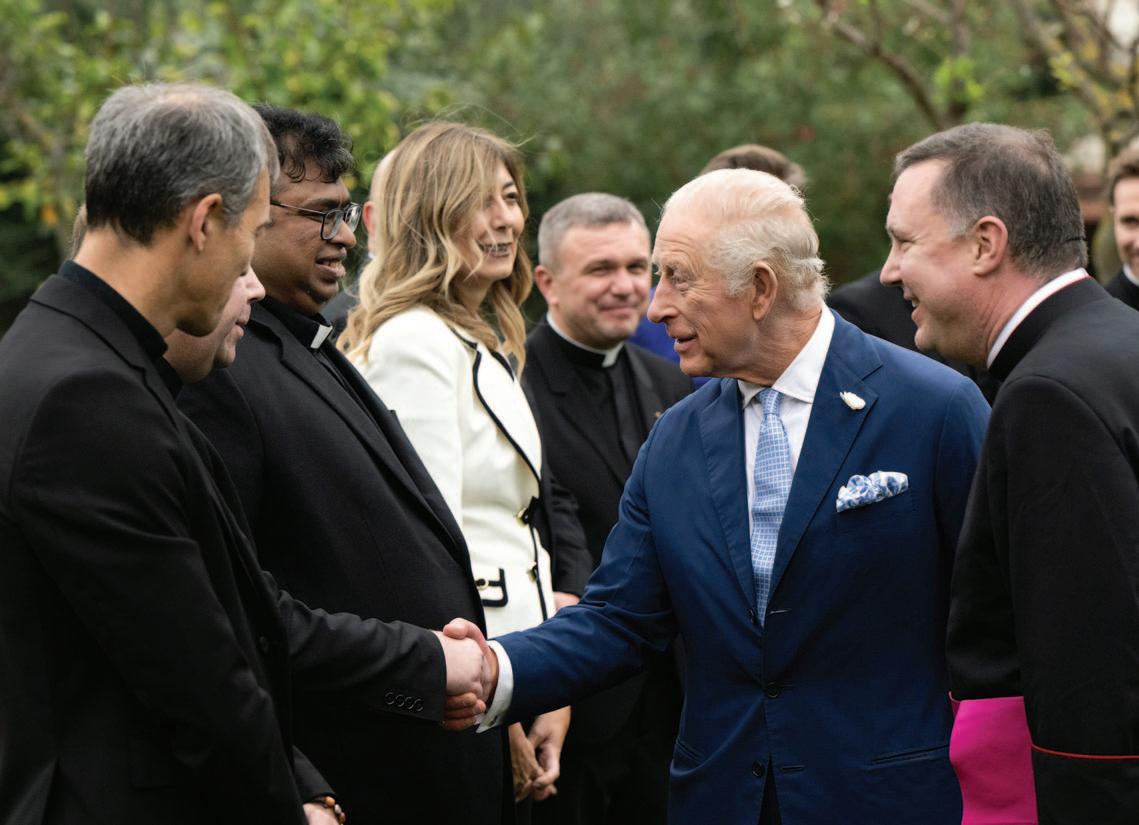
Among those present for the royal visit was Deacon Matthew Allen, a seminarian from East Anglia who is due to be ordained to the priesthood next year. Deacon Matthew shared his reflections on the significance of the occasion:
“When word spread that His Majesty the King would be visiting the Beda College during his time in Rome, there was a quiet sense of wonder among us. It was not only the novelty of welcoming a monarch, but also the deeper symbolism of that encounter — a British sovereign stepping into the daily
life of a Roman Catholic seminary, where faith and service are being shaped in quiet fidelity. His visit formed part of a truly historic moment: the first time in more than five centuries that a reigning English monarch entered the Basilica of St Paul Outside the Walls, visited a Catholic seminary, and prayed with the Holy Father.
The visit itself was marked by simplicity and warmth. His Majesty showed genuine interest in our formation and in the diverse community that makes up the Beda. There was no sense of distance or ceremony for its own sake; rather, it felt like a meeting of fellow servants, each called to a particular vocation of service. That encounter spoke powerfully of leadership rooted in humility and care — a reminder that service, whether royal or priestly, finds its true measure in the love offered to others.
As the visit concluded, we were left with n story continues on page two.
Students meet Pope in unforgettable pilgrimage – page 9
Reformation remembered in Cambridge
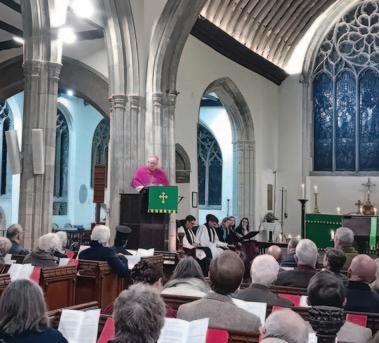
n On 16 November, a special Evensong at St Edward’s, Cambridge marked the 500th anniversary of Robert Barnes’ “Reformation Sermon”, bringing Catholics and Anglicans together in prayer for Christian unity.
Five hundred years ago this Christmas Eve, an Augustinian friar named Robert Barnes climbed the pulpit of St Edward’s Church in the centre of Cambridge. With passion and conviction, he denounced the shortcomings of the clergy of his day, including those of Cardinal Wolsey. He did not speak of doctrine, yet his bold address would later be remembered as the “Reformation Sermon”. It launched his role as a Protestant reformer, established a friendship with Martin Luther, and set him on a path that would shape English church history until his death. On 16 November, that momentous sermon was remembered not with division but with prayer for unity. Inspired by Gerard Banaszkiewicz and Dominic McDermott, two Catholics with a deep desire for reconciliation, the Vicar-Chaplain of St Edward’s, Revd Mark Scarlata, and the Catholic Chaplain to the University of Cambridge, Fr Paul Keane, came together to organise a special Evensong at St Edward’s.
Supported by the Choir of Fisher House, the Catholic Chaplaincy of the University, both Anglicans and Catholics gathered, from town and university alike, committing themselves anew to Christ’s call for unity. Bishop Peter Collins joined the ecumenical celebration and preached from the very same pulpit that once held Robert Barnes.
It was an extraordinary moment. One imagines that Barnes himself, a figure of reform in his time, could never have foreseen such a gathering: Christians united in prayer, sharing a vision of reconciliation in the very place where he had once challenged the Church.
Five centuries on, that Cambridge pulpit continues to speak, not with the language of division but with the hope of Christian unity.
Deacon Matthew meets King Charles III. Picture credit: © Mazur/cbcew.org.uk
Picture credit: © Mazur/cbcew.org.uk
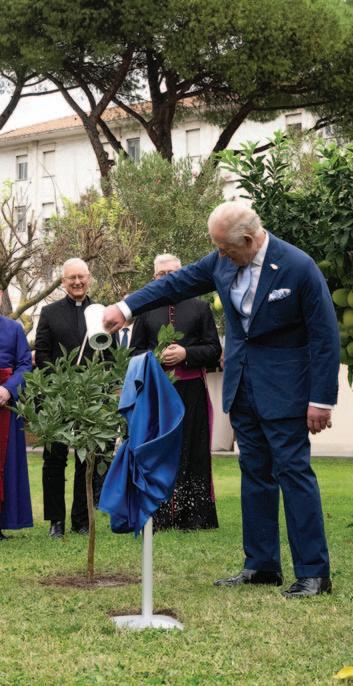
King Charles III at Beda College
n story continued from page one. we were left with gratitude — not only for the honour of the occasion, but for what it revealed about the continuing journey of friendship between Christians. In the heart of Rome, for a brief moment, faith, history, and hope stood together. It was a moment that spoke softly yet clearly of reconciliation, of shared service, and of the grace that bridges divides long thought unbridgeable.”
The King’s presence at both St Paul’s Basilica and the Beda marked a powerful gesture of unity and goodwill, reinforcing the ongoing relationship between the Catholic Church and the monarchy. For those preparing for priesthood — like Deacon Matthew — it was a reminder that leadership and service are ultimately bound by the same call: to serve with humility, compassion, and faith.
EastAnglia
Newspaper of the Diocese of East Anglia
EDITOR: Charlie Bohan-Hurst
communications@rcdea.org.uk
Articles and photographs for the next edition are very welcome and should be sent to the editor, ideally via email, by Friday, 16 January.
Diocese website: www.rcdea.org.uk
Advertising: Contact Nick at Cathcom on tel 01440 730399 or email him at ads@cathcom.org
Publisher: Cathcom Ltd, 0207 112 6710
Inclusion of adverts is the responsibility of Cathcom and does not imply endorsement by the Diocese of East Anglia.
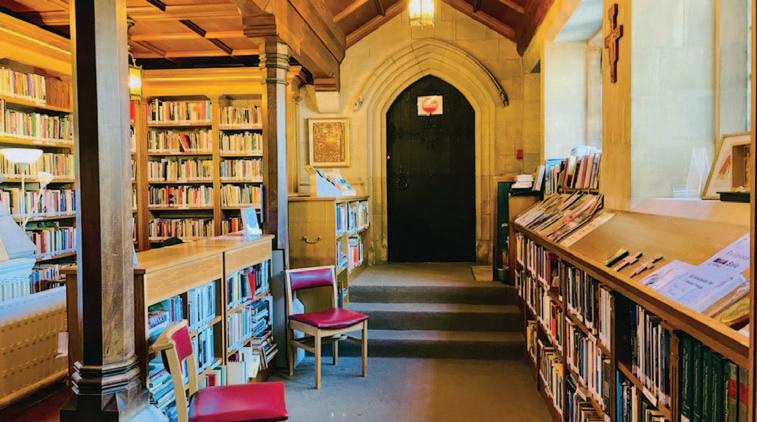
n Tucked away within St John’s Cathedral, the Duckett Library is a hidden gem for anyone who loves books and learning.
This welcoming lending library is lined with elegant oak bookcases – some installed as part of the Narthex development, and others generously funded by the Friends of the Cathedral.
Membership is free and open to anyone living within the Diocese of East Anglia. Although the library’s opening hours are limited, members can browse the online catalogue, request books by email, and collect them from the Cathedral Shop, which is open daily. Visitors joining a Tower Tour or a Hidden Places Tour will also enjoy a visit to the library as part of their experience.
The collection contains around 5,000 religious books, covering a wide range of topics. Alongside biblical and theological works, you’ll find volumes on Church history, spirituality, the lives of the saints, local people and buildings, and all aspects of Church life – even children’s storybooks.
The Duckett Library: Faith & Learning Mini-Pilgrimage for priesthood discernment
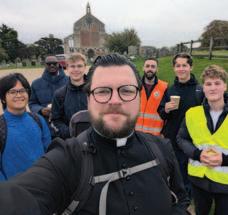
The Diocesan Vocations Team hosted a short pilgrimage during the Marian Jubilee to bring together men from across the diocese who are open to a possible calling to the diocesan priesthood on Saturday 11 October 2025.
n The event began with a candlelit Mass and Adoration at the 12th-century Anglican church in Framingham Earl.
There, Fr Peter Wygnanski preached about Mary’s role in perfecting a masculine capacity to love: in the pattern of family life, a lived experience of Mary’s spiritual motherhood helps a man by transforming his affections, uniting them with Christ’s own, and enabling him to grow more fully into a spiritual son and brother as the essential basis for any — God willing — spiritual fatherhood.
This time of prayer was followed by an
Whether you’re reading for personal interest or academic study, there’s something for everyone to discover.
If you have a love of books and some time to spare, the library also welcomes new volunteers to join its friendly team.
To find out more and browse the catalogue, visit www.sjbcathedral.org.uk, select ‘About’ from the menu, and then ‘Duckett Library’ or you can also send an email to duckettlibrary@sjbcathedral.org.uk
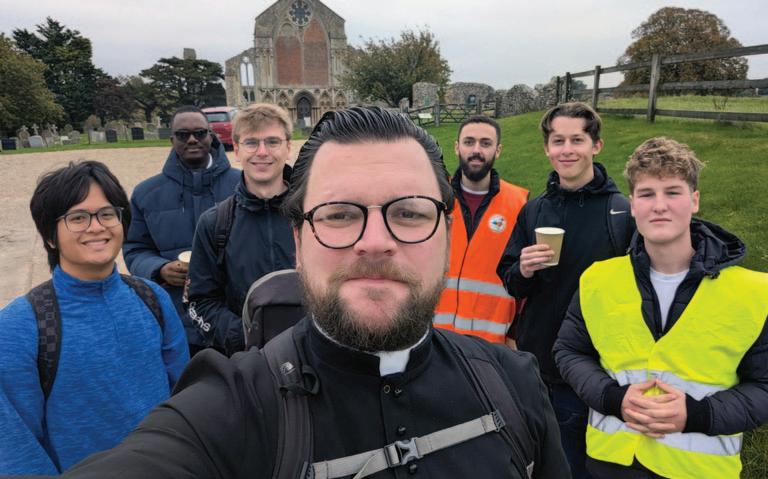
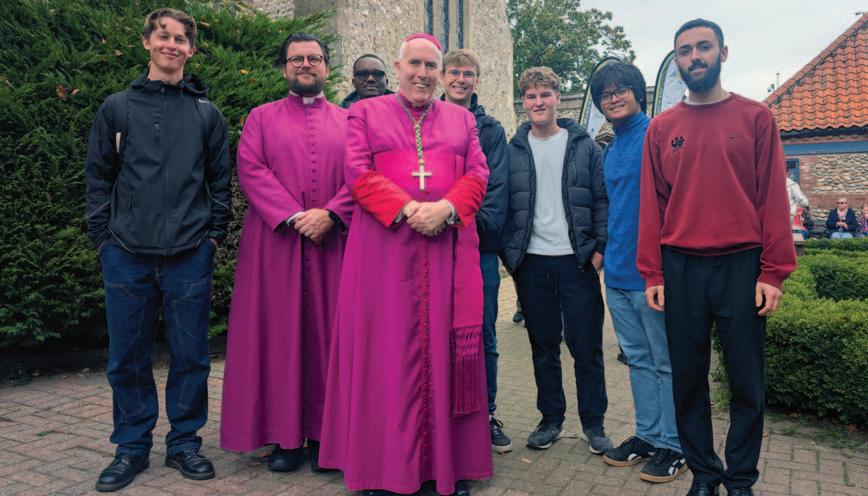
Fr Peter Wygnanski led the pilgrimage for those open to a possible calling to the diocesan priesthood.
informal social evening hosted by the Ignite Team in Poringland. The following morning began with Morning Prayer among the ruins
of Binham Priory, before participants walked to the Shrine of Our Lady of Walsingham to join Bishop Peter in celebrating the Jubilee of Marian Spirituality. After the celebration, Bishop Peter took the opportunity to commission the Ignite Team for their work across the diocese at the Slipper Chapel. Fr Peter, the Assistant Diocesan Vocations Director leading the event, said:
“The friendship of other men who are seriously asking what God’s call is for their lives is a crucial source of support and encouragement for those generously discerning a vocation to the priesthood. Events like this, offering an experience of God both through the sacraments and Christian fraternity, are among the most effective ways we have to promote vocations to the priesthood in East Anglia. We continue to pray for those men who are at the first stages of answering that call.”
Bishop Peter Collins joined those on the pilgrimage.

Doctor of the Church: St John Henry Newman Finding God in every stone
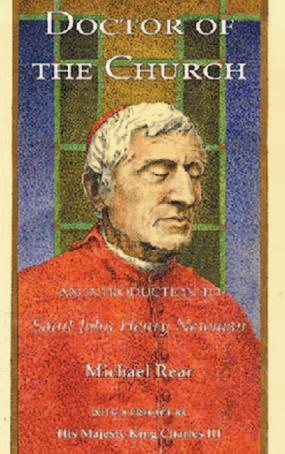
Pope Leo XIV has declared St John Henry Newman a Doctor of the Church, recognising his profound theological insight, enduring influence on both Anglicanism and Catholicism, and prophetic relevance to today’s secular age. Fr Michael Rear has published Doctor of the Church: An Introduction to St John Henry Newman and gives an overview below.
n 1 November 2025, the Solemnity of All Saints, coinciding with the Jubilee of the World of Education in Rome, was the day
Pope Leo XIV chose to declare St John Henry Newman a Doctor of the Church. St John Henry becomes the 38th Doctor of the Church, and only the second Briton, after the Venerable Bede; taking his place among such luminaries as St John Chrysostom, St Thomas Aquinas and St Teresa of Avila.
A distinguished Fellow of Oriel College, Oxford and Vicar of St Mary’s University Church, he became the leader of the Oxford Movement with others like John Keble, author of that favourite hymn Blest are the Pure in Heart, and Dr Pusey. The Movement began in 1833 with the purpose of renewing the Church of England, which in those days was in poor shape. Most parish churches were badly attended and one MP suggested that since Canterbury Cathedral was so dilapidated and unused it should be purchased by the local cavalry for stabling its horses.
They began the Oxford Movement with a series of ninety tracts calling for a restoration of the spiritual life, particularly of bishops and priests, taking as their starting point, not the sixteenth-century Reformers, but the Early Fathers; those bishops and theologians who were the immediate successors of the apostles and the earliest interpreters of the Scriptures. It had unexpected consequences. As Newman later wrote:
“In truth, this fidelity of the ancient Christian system, seen in modern Rome, was the luminous fact which more than any other turned men’s minds at Oxford forty years ago to look towards her with reverence, interest and love. It affected individual minds variously of course: some it eventually brought on to conversion, others it only restrained from active opposition to her claims; but none of us could read the Fathers, and determine to be their disciples, without feeling that Rome, like a faithful steward, had kept in fullness and vigour what our own Communion had let drop.”
Newman’s conversion was an intellectual struggle. Like many Anglicans in those antiCatholic days, he had been taught that the Roman Catholic Church was barely Christian and the Pope the antichrist. He thought that doctrines concerning the papacy and the Blessed Virgin Mary had gone beyond the teaching of Scripture, and he set out to study what he called the ‘Development of Doctrine’; concluding that the teachings of the Catholic Church had developed from Scripture where they had been implicit. He used the analogy of a human body, that from an embryonic form developed into a man. The Body of the Church had done the same.
The Oxford Movement Newman left behind continued under Dr Pusey and it continues still to bring a catholic influence to Anglicanism. In his obituary of Newman, Dr Church, the Dean of St Paul’s Cathedral, wrote:
“[He] was the founder, we may almost say, of the Church of England as we see it. What the Church of England would have become without the Tractarian Movement we can faintly guess, and of the Tractarian Movement Newman was the living soul and the inspiring genius.”
Despite him leaving it, the Church of England has never forgotten all he did for it, and recognises him as a saint in its calendar. The present King represented the Queen at Newman’s canonisation, when Prince of Wales. On the eve of the canonisation, he gave a remarkable lecture in Rome, speaking of his legacy in both Churches.
“In the age when he lived, Newman stood for the life of the spirit against the forces that would debase human dignity and human destiny … At a time when faith was being questioned as never before, Newman, one of the greatest theologians of the nineteenth century, applied his intellect to one of the most pressing questions of our era: what should be the relationship of faith to a sceptical, secular age? … As an Anglican, he guided that Church back to its Catholic roots … He gave the Catholic Church renewed confidence as it re-established itself in a land from which it had once been uprooted. The Catholic community in Britain today owes an incalculable debt to his tireless work, even as British society has cause for gratitude to that community for its immeasurably valuable contribution to our country’s life.”
Newman’s mighty intellect ranged over many subjects from the purpose of education, the role of the laity (in which he was a pioneer) to the task, as the King noted, of bringing the Gospel to a sceptical age. He left on one side the traditional intellectual arguments for belief in God and chose rather to direct people to their hearts and to conscience, that voice of God which everyone has within them. People with little education can have a strong faith, he observed, and set out the steps to discover faith and certainty.
Bishop Robert Barron, the founder of Word on Fire Institute, gave a lecture in St Mary’s Oxford, packed as it was in Newman’s day with students and others. His subject was Newman and the New Evangelisation. “I believe Newman’s apologetic path, intelligent, spiritually honest, psychologically astute, biblically grounded, will prove efficacious in our work today; and therefore, a rediscovery of what Newman recommended 150 years ago will prove very helpful in the concrete work of preaching, teaching and evangelising.” He added, if it happens that “Newman is named a Doctor, we should really take advantage of that, and study his writings deeply.”
Shortly before he died, Pope Benedict XVI said: “Newman — Doctor of the Church, that would be a light for the darkness of this time!”
The significance of saints being declared Doctors is the recognition by the Church of the depth of their understanding of the Faith, and the orthodoxy and truth of their teaching and writing. Quite remarkably this includes the corpus of his Anglican writings as well as his Catholic. Doctors have made an exceptional contribution to theology and the formulation of Christian faith; they are reliable
witnesses to the Faith and therefore of great relevance to the Church, not only in their own day but for the future.
There was an extraordinary element of the prophetic about Newman.
He predicted what we today call the ‘secular society’ in which Christianity is pushed out of the market square into the sidelines, so that it has no influence in society or on law-making. ‘As to religion, it is a private luxury, which a man may have if he will; but which of course he must pay for, and which he must not obtrude upon others, or indulge in to their annoyance.’
What then must the Church do? He tells us in a speech he made upon being made a cardinal in 1879:
“It must not be supposed for a moment that I am afraid of it. I lament it deeply, because I foresee that it may be the ruin of many souls; but I have no fear at all that it really can do aught of serious harm to the Word of God, to Holy Church, to our Almighty King, the Lion of the tribe of Judah, Faithful and True, or to His Vicar on earth. Christianity has been too often in what seemed deadly peril, that we should fear for it any new trial now. So far is certain; on the other hand, what is uncertain, and in these great contests commonly is uncertain, and what is commonly a great surprise, when it is witnessed, is the particular mode by which, in the event, Providence rescues and saves His elect inheritance. Sometimes our enemy is turned into a friend; sometimes he is despoiled of that special virulence of evil which was so threatening; sometimes he falls to pieces of himself; sometimes he does just so much as is beneficial, and then is removed. Commonly the Church has nothing more to do than to go on in her own proper duties, in confidence and peace; to stand still and to see the salvation of God. ‘The meek shall inherit the land and delight themselves in abundant peace’ (Ps 37:11).”
Years earlier, in 1840, he wrote similar words that have a very contemporary ring:
“The Church is ever militant. Sometimes she gains, sometimes she loses, and more often she is at once gaining and losing in different parts of her territory. Scarcely are we at peace when we are in persecution. Scarcely have we gained a triumph, when we are visited by a scandal. No, we make progress by means of reverses, our griefs are our consolations, we lose Stephen to gain Paul, and Matthias replaces the traitor Judas.”
Doctor of the Church: An Introduction to St John Henry Newman is available at the Cathedral Bookshop, and the Slipper Chapel Shop, Anglican Shrine Shop and Epiphany in Walsingham, and all bookshops including Amazon.

n Nine-year-old Maximilian Clovis from Walsingham shares how discovering the hidden beauty inside ordinary stones helped him see God’s presence in all of creation.
This summer, my grandparents came to visit like they do every year. It’s always super exciting because they bring surprises for all of us – and I have eight brothers and sisters, so that’s a lot of surprises! This time, they gave me something really special – a gem and rock collection. I love rocks and stones and always ask my dad questions like, “What’s inside this one?” or “Why is this one so shiny?”
My dad saw how much I liked them and asked me if I wanted a lapidary machine. I didn’t know what that was, so I asked him. He said it’s a machine that cuts open stones and polishes them. I got so excited! I ran to get my money jar that I’d been saving and Dad said he’d pay half. Soon, we had a real machine with a diamond blade! Don’t worry – it’s not sharp, so I could use it safely.
When I started cutting open stones, I couldn’t believe what I saw. Some of the plainest, most boring-looking rocks had the most beautiful patterns and colours inside. It felt like God had hidden tiny treasures in them. I started thinking that maybe God put beauty in everything, even things that look ordinary. That made me want to find the most amazing stones God placed in Norfolk.
We’re not allowed to take stones from the beach, so Dad bought me a big bag of stones that came from near the Norfolk Sea. Every time I opened one, it was like a surprise from God – like a Kinder Egg but made of stone! Each one was different and special.
My biggest dream is to find the most valuable stone in England. It’s called Blue John. It looks normal on the outside but inside it has purple, blue and white crystals. I think it’s one of the most beautiful things God made. When I’m older, I’m thinking of being a geologist so I can discover all the beauty God created in forming our home – planet Earth.

Christian communicators celebrated
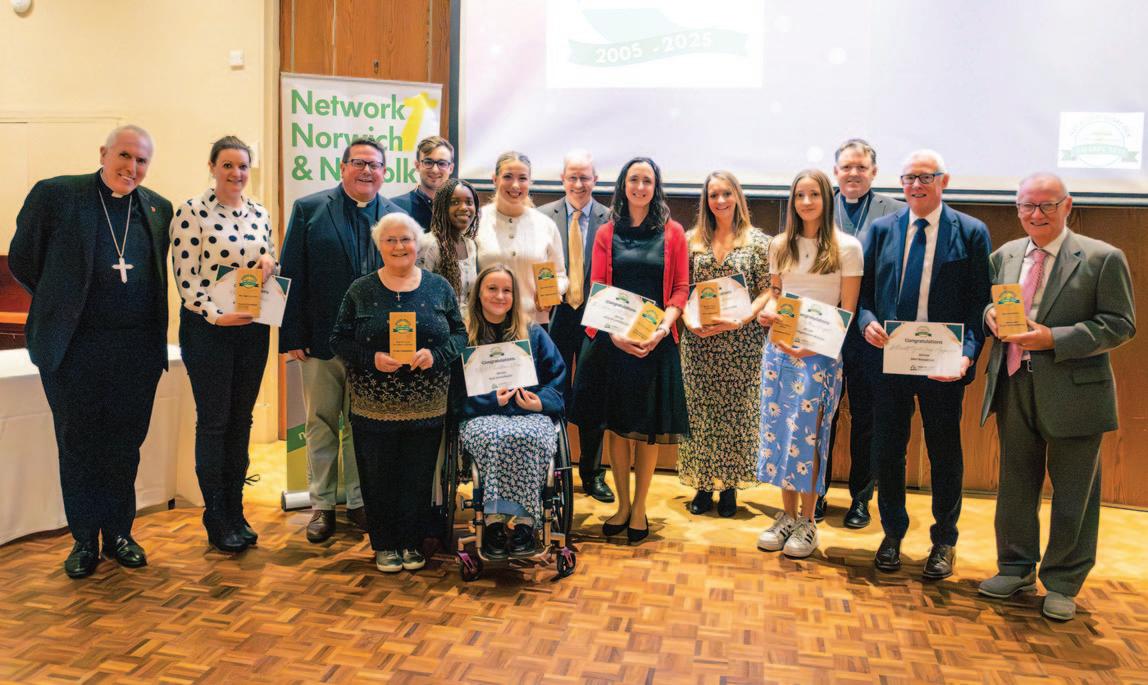
The vibrant world of Christian communication in Norfolk was celebrated at a special awards ceremony held at the Cathedral of St John the Baptist, Norwich, on 23 October.
n Hosted by Network Norfolk as part of its 20th anniversary celebrations, the Norfolk Christian Communications Awards recognised excellence and creativity across websites, social media, photography, newsletters, digital projects and individual contributions. The event brought together representatives from churches, charities and Christian organisations across the county. Among those honoured were Norwich Foodbank, The Cathedral of St John the Baptist, UEA Christian Union, The Matthew Project, Hethersett Parish, and St Mary Magdalene, Gorleston.
It was also a night of particular success for the Diocese of East Anglia. The Cathedral of St John the Baptist received the award for Best Norfolk Church Website, recognising its engaging and accessible online presence. In addition, the Diocese received a commendation in the Best Picture of the Church in Action category.
Network Norfolk Website publisher Keith Morris, who established Network Norfolk two decades ago, addressed the audience, saying: “The main reason we are here tonight is to honour all those of you who work so hard and creatively in the communications environment – a role that is very often hidden away behind the scenes, but is of vital importance to the work of all the churches, organisations and groups which


Want to advertise?

Catholic East Anglia reaches over 7,000 Catholics in East Anglia. Contact Cathcom Ltd on 01440 730399 or at ads@cathcom.org

you represent.
We have had an amazing response to the whole idea of the awards with more than 100 entries, many of which were of exceptional quality. Our distinguished judging panel chose the best 42 as finalists. We then opened up the awards to a public vote, and the response was overwhelming, with more than 800 different people taking the time to cast over 2,000 votes.”
The evening was also addressed by the Rt Rev Peter Collins, Bishop of East Anglia, and
the Rt Rev Graham Usher, Bishop of Norwich, both of whom commended the contribution of Christian communicators in proclaiming the Gospel through modern media.
Bishop Peter Collins reflected on the impact of Network Norfolk and its founder: “What Keith has contributed, through the establishment of the Good News newspaper first of all, and now the Network Norfolk website as we know it, has been a great service to the proclamation of the Gospel in this
region and in this place.
I would like to simply thank him for the work that he has done in service to the wider church, it has been invaluable.”
The event highlighted the growing importance of digital and creative outreach in sharing the Christian message across Norfolk and beyond — a fitting tribute to two decades of Network Norfolk’s ministry of communication.
Dominic’s theology graduation
Mbongiseni Nyathi, known as Dominic, is being supported by the Diocese through propaedeutic formation for the priesthood in South Africa. Formerly a parishioner at the Cathedral, and with the support of so many in the diocese, it is hoped Dominic will be able to return to the United Kingdom to begin seminary in the coming years. He reports on his recent graduation from St Augustine College of South Africa.
n As I officially obtained my Honours Degree in Theology on 17 October 2025, my journey with St Augustine College of South Africa stands out as a deeply enriching and transformative experience. The pursuit of this degree has not only strengthened my academic foundation but has also profoundly deepened my spiritual formation and pastoral understanding. The College’s unwavering commitment to excellence in theological education, intellectual dialogue, and faith-based
inquiry has continually inspired me to grow in both knowledge and service to the Church.
As a seminarian, I was particularly grateful for the College’s decision to postpone its graduation ceremony so that it could be celebrated jointly with St John Vianney Major Seminary in Pretoria. This thoughtful gesture reflected the spirit of unity and collaboration within the Church’s academic community. It was a great joy to meet and share fellowship with brother seminarians from across South Africa.
My heartfelt gratitude goes in particular to Bishop Peter Collins, Bishop Emeritus Alan Hopes, the Parish of Our Lady of the Assumption and the English Martyrs in Cambridge through Monsignor Eugène Harkness, and my friends from the Cathedral of St John the Baptist community for their unfailing guidance, support, and encouragement throughout this challenging yet grace-filled period of my life. Their prayers, pastoral care, and mentorship have been a constant source of strength, and I am deeply thankful for their presence in my difficult journey.
My time in South Africa has not been without its challenges, yet it has been equally rich in grace,
growth, and faith. As I prepare to return to the Diocese of East Anglia in the coming year, I do so with a renewed sense of purpose and dedication. The experiences and lessons gained in South Africa will continue to guide me in my ministry and service to God’s people. I carry forward not only the knowledge acquired at St Augustine College, but also the enduring sense of faith, hope, and love that has shaped my time here.
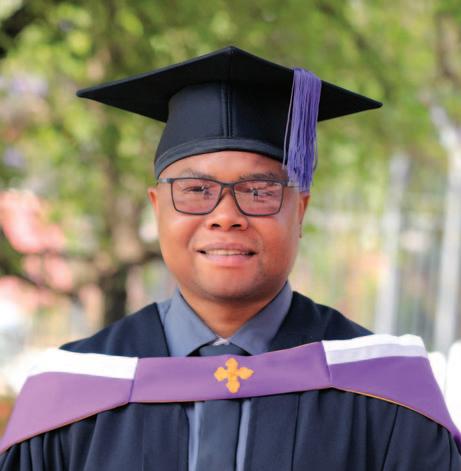
Dominic on his graduation day.
The winners of each category with their awards.

Filipino heritage night brings joy to St Ives parish
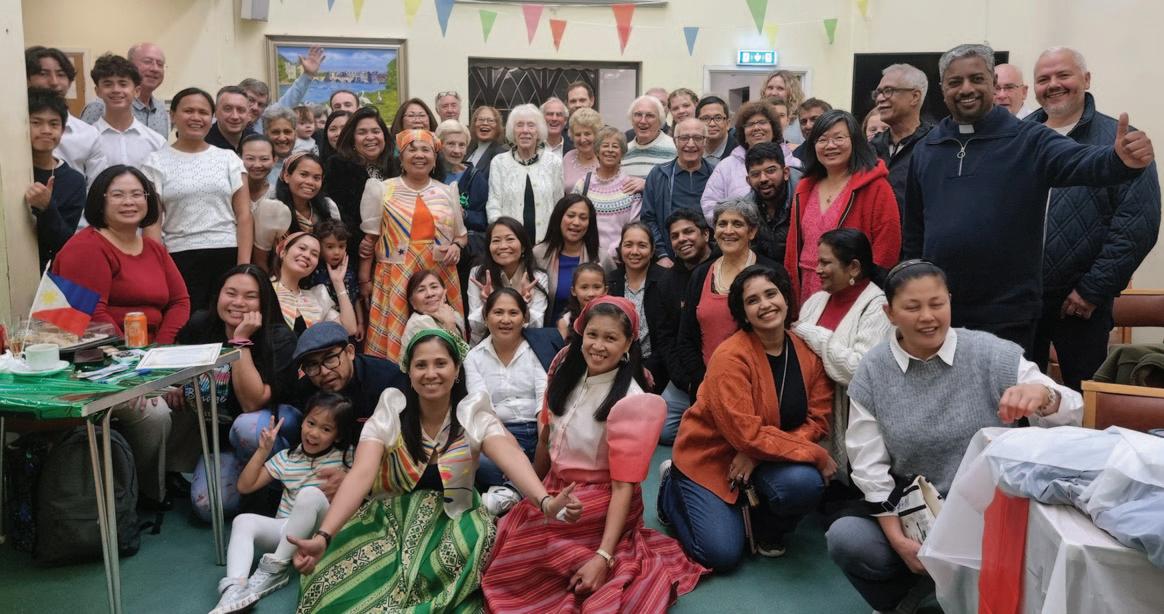
The Filipino community at Sacred Heart Catholic Church, St Ives, Cambridgeshire, gathered on Saturday, 11 October 2025, to celebrate Filipino Heritage Night – an evening filled with colour, music, faith and togetherness.
n Now in its second year, the event showcased the rich traditions, artistry and flavours of the Philippines, delighting more than eighty parishioners and guests in the parish hall.
The celebration opened with a lively Filipino folk dance in traditional attire, setting the tone for a joyful evening. The hall buzzed with laughter through karaoke, bingo, games and a parish quiz, while the aroma of classic Filipino dishes filled the air. Guests enjoyed favourites such as adobo, lumpia and lechon.
The theme, “Bayanihan”, captured the Filipino spirit of communal unity and generosity. Rooted in faith and compassion, it reminds everyone of the joy of helping others selflessly. In this spirit, the event also served as a fundraiser for Sacred Heart Church.
Fr Trindade J. Monteiro, Priest-in-Charge, together with the Filipino community and parish social group, expressed gratitude to all
who supported the evening. Tickets sold out in just over a week, and the event raised around £1,200 for the parish. As the night closed with games, prizes and
laughter, a strong sense of unity and gratitude filled the hall. The organisers look forward to hosting another vibrant festival next year, continuing to share their culture, faith and the
true meaning of Bayanihan with the wider parish family.
Caritas East Anglia festival in Peterborough
n Over the last two years Caritas East Anglia has held festivals in each Deanery, the sixth festival was held in St John Fisher Catholic High School in Peterborough on 1 November.
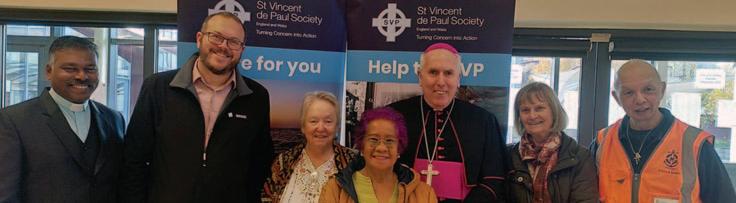
Every festival starts with Mass, followed by an opportunity to meet representatives from groups involved in social action within the deanery over refreshments. Groups represented include local organisations, national and global organisations. Caritas festivals are part of Caritas East Anglia’s ongoing mission to support and coordinate social outreach in the diocese. They celebrate the contributions faith-based and charitable organisations make to the community, locally, nationally and internationally, foster connections between them and encourage local people to get involved.
Organisations represented in Peterborough were: Angel Tree; CAFOD; Citizens UK Peterborough; Hope into Action Peterborough; Modern Slavery; Peterborough
Foodbank; Stella Maris; St Oswald’s Friendship Meals Group; SVP and UCM. Each festival has been joyful and inspiring. The Peterborough festival was no exception, after an intimate and moving Mass in the school chapel attendees moved to the school hall for dialogue over refreshments provided by the Union of Catholic Mothers.
David Livesey, Caritas East Anglia Administrator said, “As with all our festivals, there was much to celebrate and learn from about the ways in which the homeless, hungry and lonely in Peterborough are being supported and encouraged to voice their concerns. Hopefully this raised awareness will lead to more involvement by the Catholic community of Peterborough in these valuable organisations”.
The next Caritas festival is on 6 December and is for the Bury St Edmunds deanery. It will be held at St Edmund, King and Martyr Church, 21 Westgate Street, Bury St Edmunds, IP33 1QG starting with Mass at 10am.
Promote your business, school or charity in this space and help support

Catholic
EastAnglia
The Catholic East Anglia newspaper depends upon the support of advertisers to pay for its production and distribution.
Would your business like to reach new customers?
Would your charity like to recruit new volunteers or supporters?
Would your school like to reach prospective pupils?
Catholic East Anglia regularly reaches an audience of over 6,500 Catholics across Norfolk, Suffolk, Cambridgeshire and Peterborough, delivered direct to parish churches and schools.
To explore the opportunities and value-for-money rates, please contact Natasha at publishers Cathcom Ltd on tel 01440 730399 or email natasha@cathcom.org

Cathcom Ltd is the largest publisher of Catholic diocesan newspapers in the UK, serving ten dioceses.
The parish community in St Ives celebrates Filipino heritage.
Diocese reports major recovery and growth in 2024
n The Diocese of East Anglia has published its Annual Report and Financial Statements for the year ended 31 December 2024, revealing a year of significant financial recovery and continued growth in faith and community life.
Total income rose by 20% to £8.1 million — the highest level since before the pandemic — while expenditure fell by 1%. The Diocese achieved a surplus of £1.4 million, a marked turnaround from the £0.4 million deficit in 2023.
Alongside these results, the Diocese reported strong signs of spiritual renewal. Regular Mass attendance grew across several parishes, particularly among young families and new parishioners.
There were over 800 baptisms, 539 confirmations (up 40%), two priestly ordinations, and the addition of four new seminarians and four men in formation for the permanent diaconate. Parish missions and outreach programmes encouraged renewed engagement in the life of the Church.
The Diocese also celebrated its growing cultural diversity, with active participation from Polish, Filipino, Indian, African and Latin American communities. Parishes continued to offer hospitality and support to migrants and refugees through pastoral and practical outreach.
Safeguarding remained central to diocesan life. Following an independent audit by the Catholic Safeguarding Standards Agency, the Diocese received one of the highest possible assurance ratings for its safeguarding standards.
The year also saw progress in environmental sustainability and youth engagement. In Hunstanton, parishioners funded the installation of £27,000 worth of solar panels, while nearly 700 pupils gathered for the annual Schools Mass at the Cathedral, celebrating faith and community spirit.
The Rt Rev Peter G Collins, Bishop of East Anglia, commented:
“The past year has seen our diocesan family continue to grow, with a consistent increase in the numbers regularly attending to celebrate Sunday Mass. Communal resilience is evident across the network of our parishes and schools. Our communities are more diverse than ever, a feature that is nurturing spiritual renewal. Our faith, hope and charity are made manifest in an amazing array of activities and projects.”
The Trustees expressed their gratitude to clergy, religious, volunteers, donors and partners whose dedication sustains the mission of the Church. The 2024 Annual Report reflects a Diocese united in faith, strengthened by diversity, and confident in its mission for the future.
Looking to the future, the Diocese is committed to building on this renewed momentum — strengthening parish life, supporting clergy and families, investing in its historic and spiritual heritage, and continuing to welcome and serve all who seek a home in the Catholic community.
The full report is available on the diocesan website.
Young leaders find ren at Clare Pri
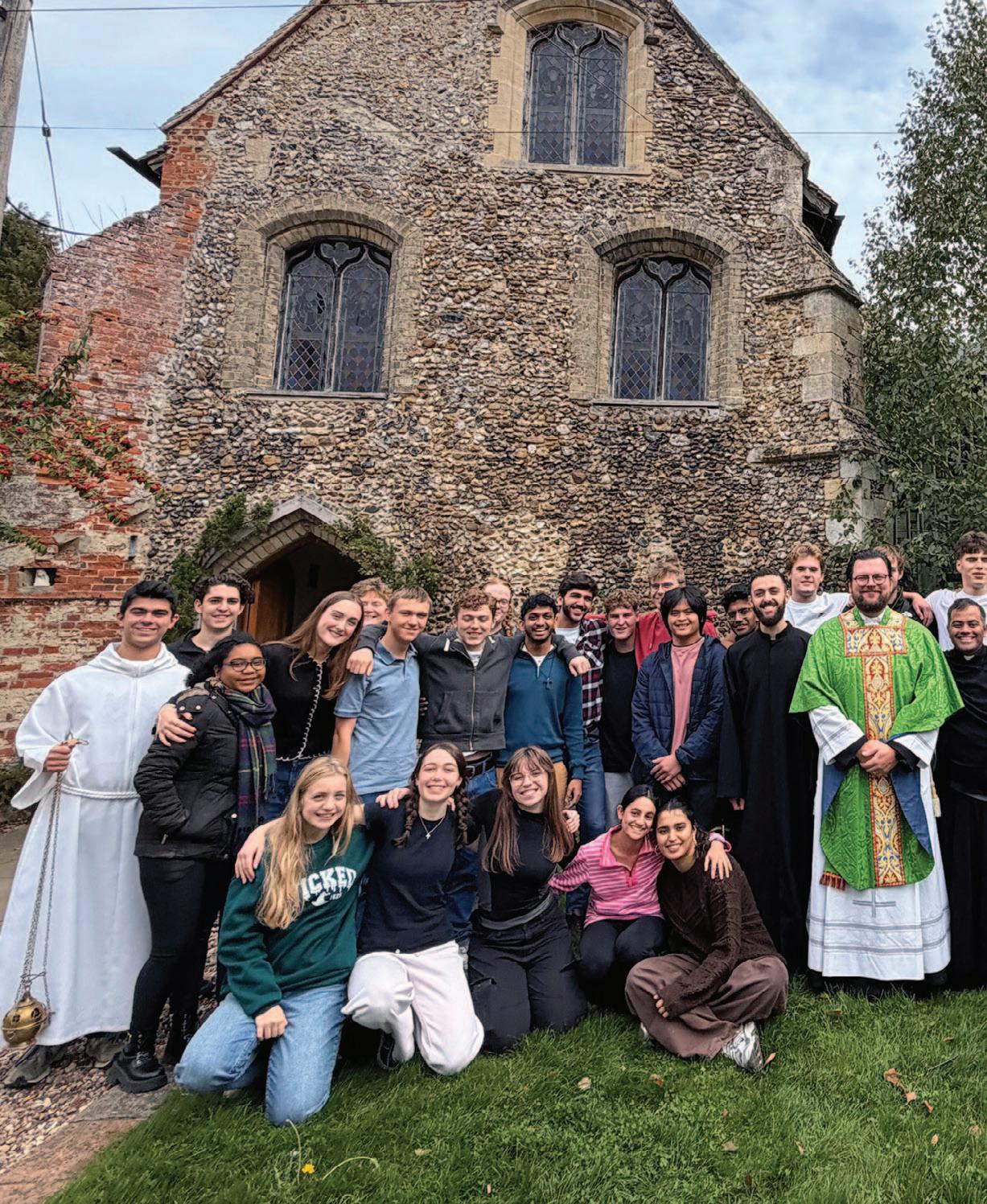
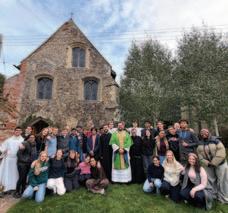
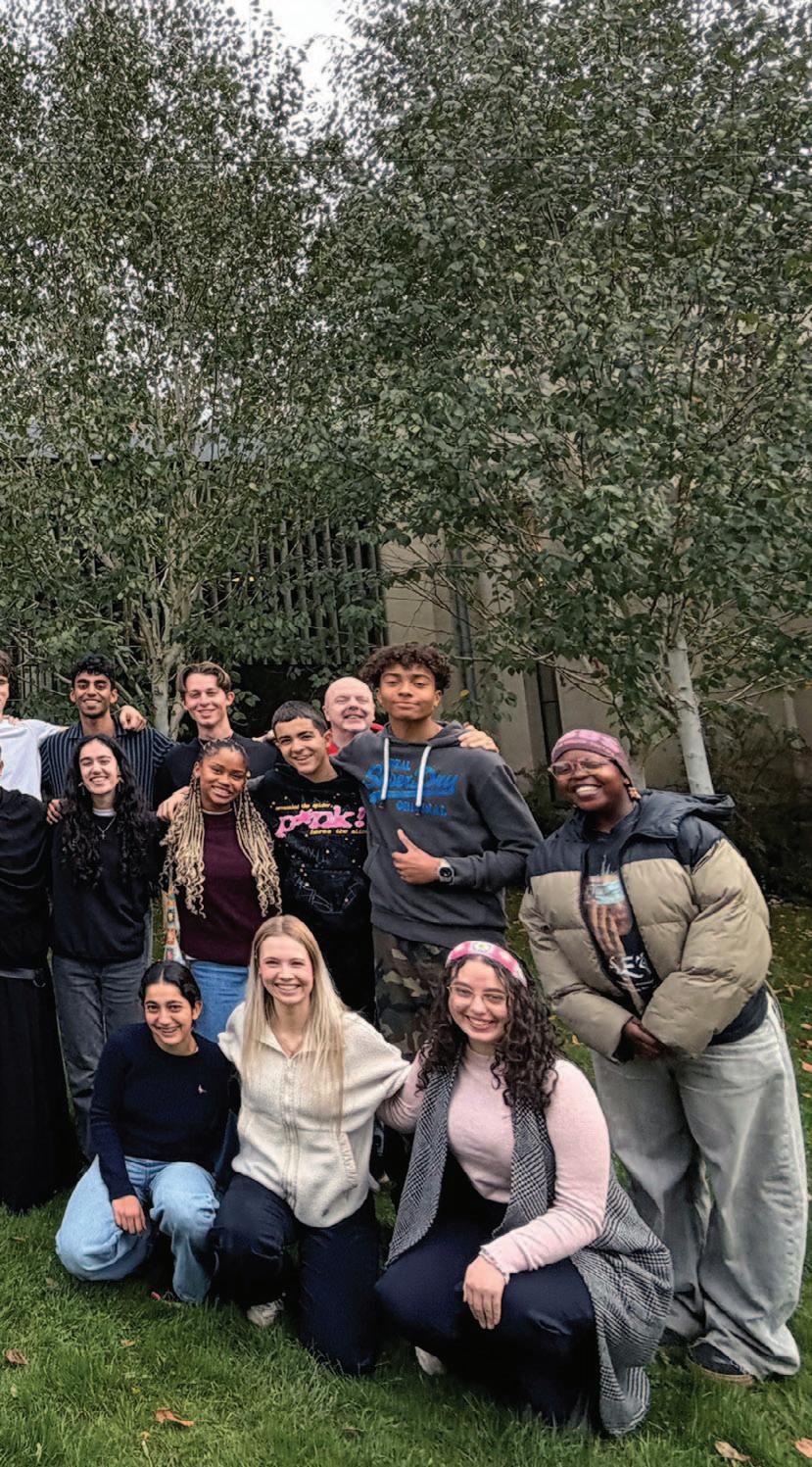
During the weekend of 18-19 October 2025 around 35 young leaders from across the Diocese of East Anglia gathered at Clare Priory for a retreat coordinated by the Diocesan Youth Service — a weekend that proved to be not only restorative but deeply transformative. The Ignite Team reports.
n Amid the quiet beauty of Clare, the young people, aged 16 and above, entered into a time of prayer, healing and renewal. The retreat offered space away from the demands
of daily life — space to listen, to be still, and to encounter the gentle presence of Christ anew.
From the very first evening, there was a tangible sense of unity and openness. Friendships quickly formed as the group shared meals, laughter and conversation.
Talks by Fr Gladson Dabre OSA and former Ignite Team member Alex Thanickal, both part of the evangelisation initiative, “Transform Ministries” invited reflection on the personal call of discipleship and the reality of God’s love that meets us in our brokenness. The evening concluded with adoration before the Blessed Sacrament — a time of deep silence and encounter that set the tone for the rest of the weekend.
Saturday’s programme moved between joyful community and moments of profound interior reflection. Luc Wallace from the Ignite Team led a talk on performance mentality and
the freedom that comes from knowing we are loved by God not for what we do, but for who we are. Later, the Sacrament of Reconciliation and prayer ministry provided a powerful opportunity for healing. For many, this became a turning point — a moment of letting go, of rediscovering peace, and of allowing the Holy Spirit to move deeply within.
Fr Gladson’s evening talk on intimacy with the Lord led naturally into a healing service and adoration, during which many participants described a renewed sense of hope and closeness to Christ. The quiet joy that followed was palpable — a reminder that the work of the Spirit is often gentle, yet utterly life-changing.
Throughout the weekend, moments of laughter and play were woven between the times of prayer. Even the light-hearted games and shared meals became expressions of
The group of young leaders outside Clare Priory.

ewal and hope
Christian joy and fellowship. Late on Saturday night, some gathered to pray the Rosary together, while others shared stories and laughter — a beautiful image of the Church alive in youthful community and prayer.
By Sunday morning, although physically tired, the group was spiritually alight. Alex’s final talk focused on mission — how the experience of God’s love naturally sends us out to share it. The closing Mass, celebrated by Fr Peter Wygnanski, was filled with gratitude and joy, followed by emotional testimonies from those who had encountered the Lord in new and unexpected ways over the weekend.
As the group parted ways after lunch, there was a strong sense that something lasting had been planted — not just memories of a wonderful retreat, but a renewed commitment to live out the Gospel in everyday life. The young
leaders left Clare Priory with hearts burning with love for Christ and a deep desire to bring that love to their parishes, schools, and communities.
Fr Peter, who gave support throughout the weekend, said: “We are most grateful to Clare Priory and Transform Ministries for generously enabling this blessed retreat. The Diocesan Youth Service now looks forward to building on the graces received as we continue to encourage these young people to flourish in lives of faith and empower them to support youth ministry in their parishes and deaneries.”
The weekend was a witness to the vitality of the Church’s young people and to the quiet yet powerful work of the Holy Spirit in our Diocese. It offered hope — that the future of our Diocese is not only in good hands, but in hearts that are truly alive with faith.
Bishop Peter’s engagements
DECEMBER
Dec 10, Wed
Bishop to UEA Carol Concert at the Cathedral from 18:00.
Dec 11, Thurs
Bishop to attend Vocations Committee Meeting in Poringland at 11:00.
Dec 13, Sat
Bishop to visit HMP Wayland and say Mass and give Candidates the Sacrament of Confirmation.
Dec 21, Sun
Bishop to preside at Candlelit Carol Service in St John’s Cathedral at 1500.
Dec 24, Wed
Bishop to celebrate Midnight Mass at Cathedral, preceded by carols at 23:30.
Dec 25, Thurs
Bishop to celebrate Mass at HMP Norwich at 09:00.
Dec 25, Thurs
Bishop to celebrate Solemn Pontifical Mass of Christmas at the Cathedral at 11:00.
2026
JANUARY
Jan 6, Tues
Bishop to celebrate Solemn Mass for Epiphany at the Cathedral at 10:00.
Jan 10, Sat
Bishop to attend the Caritas Steering Committee Meeting in Poringland at 11:00.
Jan 13, Tues
Bishop to Westminster with Ecumenical Leaders.
Jan 19, Mon
Bishop to meet with CT Shire & Soke (Churches Together).
Jan 20, Tues
Bishop to Cardinal’s Ecumenical Service of Vespers at Westminster at 17:00 followed by reception.
Jan 21, Wed
Bishop to attend Bishop’s Council Meeting in Poringland at 11:00.
Jan 22, Thurs
Bishop to celebrate Mass at Notre Dame High School at 11:00.
Jan 23, Fri
Bishop to meet with Ignite Team at 17:00.
Jan 26 – 27, Mon – Tues
Bishop to attend the EWARC Meeting, overnight in Northampton
Jan 28, Wed
Bishop to attend a lunch for Ecumenical Leaders arranged by Churches Together in Cambridgeshire from 11:00.
Jan 29, Thurs
Bishop to attend the AGMs of the Our Lady of Walsingham Trust and St John the Baptist Trust from 10:00.
Jan 30, Fri
Bishop to the Annual Katherine of Aragon Commemoration Service at Peterborough Cathedral at 11:00.
FEBRUARY
Feb 2, Mon
Bishop to attend The Presentation of the Lord (World Day for Consecrated life) Annual Meeting of Religious and Mass at the Cathedral at 11:00.
Feb 5, Thurs
Bishop to Diocesan Liturgy Commission Meeting at 11:00 in Poringland.
Restoration of OLEM progresses
n Residents and visitors to the city of Cambridge are soon to be treated to a slow but spectacular unveiling, as the first stage of the restoration of one of the city’s landmark buildings reaches completion.
For over six months, the tower of the Church of Our Lady of The Assumption and The English Martyrs (OLEM) has been concealed behind scaffolding and safety netting while specialist conservators and stonemasons have carried out essential repairs to the iconic Grade I listed church. With the works now drawing to a close, the extensive scaffolding will be dismantled over the next three months, revealing the restored and cleaned tower in all its glory.
Built at the end of the nineteenth century in the French Gothic style and completed in 1890, OLEM is the second largest Roman Catholic place of worship in East Anglia. A design competition, open to Catholic architects, was won by Dunn & Hansom of Newcastle. The church was the gift of one woman – Mrs Yolande Lyne-Stephens – who spent nearly seventy thousand pounds of her personal fortune to bring it to life.
The imposing 214 ft (65 metre) tower and spire is the tallest structure in the city of Cambridge and a familiar local landmark. Recent survey work undertaken by the parish revealed serious issues with the upper-level stonework of the pinnacles and gargoyles that adorn the tower. This prompted the launch of a large-scale restoration and repair project to safeguard the building for future generations.
Matthew Champion, Heritage Officer for the Roman Catholic Diocese of East Anglia, stated that: “I think all of those who have worked on this project have been impressed by the sheer quality of workmanship and the skills of the Victorian craftsmen who originally built this iconic church. Using only hand tools, and working on a timber scaffold, they built something that rivals many medieval cathedrals. It has been a real privilege to get to see the church from an entirely new perspective, and work with many talented modern craftspeople to ensure that we preserve this Gothic revival masterpiece for future generations to appreciate.”
Rt Revd Mgr Canon E. Harkness, Rector and Parish Priest at OLEM, said: “It has been truly inspiring to witness the care and craftsmanship that have gone into restoring our beloved church. This project is a wonderful expression of faith in action, ensuring that Our Lady of The Assumption and The English Martyrs will continue to stand as a beacon of hope and beauty for the people of Cambridge for generations to come.”
As stage one of the restoration nears completion, the project team are now planning the next steps in what is expected to be an extensive programme of restoration for the historic church.
Unity Corner with Dr Ian Watson
Unity Corner is a regular feature on Christian Unity by Dr Ian Watson, County Ecumenical Officer for Norfolk and Waveney. Here he discusses the scriptural foundation for Christian unity.
n When out and about I’m sometimes asked what the scriptural basis is for ecumenism. In answering I mostly refer to John 17:20–23. Here, in His high priestly prayer, Jesus says:
“I do not ask for these only, but also for those who will believe in me through their word, that they may all be one, just as you, Father, are in me, and I in you, that they also may be in us, so that the world may believe that you have sent me. The glory that you have given me I have given to them, that they may be one even as we are one, I in them and you in me, that they may become perfectly one, so that the world may know that you sent me and loved them even as you loved me.”
I find this passage wonderful and (for the most part) persuasive. It is certainly the one most people use to justify ecumenism. It underscores unity as a reflection of the divine relationship and its purpose in witnessing to the world. However, it is not the only passage we can refer to, as the theme of unity is woven throughout Jesus’ teachings in John’s Gospel.
For example, in John 10:16 Jesus says, “And I have other sheep that are not of this fold. I must bring them also, and they will listen to my voice. So there will be one flock, one shepherd.” And in John 13:34–35 Jesus gives a new commandment: “Love one another. As I have loved you, so you must love one another. By this everyone will know that you are my disciples, if you love one another.”
For me, these passages in John portray love as the fundamental bond that unites the disciples of Christ. They also indicate that unity among believers is not just a horizontal relationship but is deeply vertical, namely, rooted in Christ Himself. In John 15:5 Jesus says, “I am the vine; you are the branches. If you remain in me and I in you, you will bear much fruit; apart from me you can do nothing.” In John’s Gospel it is clear that Christian unity is meant to reflect the relationship within the Trinity – a unity that is divine and grounded in the shared love and life of the Father, Son, and Holy Spirit.
There are other biblical passages from the Synoptic Gospels that also emphasise unity among Jesus’ followers. Even though they tend to have a different flavour from those in John’s Gospel, they all underscore the importance of Jesus’ teachings that direct His followers towards a unity that transcends individual differences, rooted in their common relationship with Him.
For example, in Matthew 18:19–20 Jesus says, “Again, truly I tell you, if two of you agree on earth about anything they ask, it will be done for them by my Father in heaven. For where two or three are gathered in my name, I am there among them.” This verse highlights the power and presence of unity in prayer and community.
In Mark 9:50 Jesus advises, “Have salt among yourselves, and be at peace with one
another.” This call to peace urges all disciples to cultivate unity and harmony in their relationships.
And in Luke 9:49–50, when John expresses concern about someone casting out demons in Jesus’ name, Jesus responds, “Do not stop him, for whoever is not against you is for you.” Here Jesus’ openness suggests a broader notion of unity among those who work in His name, encouraging acceptance and cooperation.
Adding to the Gospels, of course, are St Paul’s letters, which are prolific in arguing for Christian unity.
For example, in 1 Corinthians 1:10 Paul appeals for unity, urging believers to “agree in what you say” and to avoid divisions, highlighting the necessity of concord among the faithful.
In Ephesians 4:1–6 he writes about maintaining the “unity of the Spirit through the bond of peace,” describing one body, one Spirit, one hope, one Lord, one faith, one baptism, to emphasise the fundamental unity in the Church.
In Philippians 2:1–2 Paul encourages believers to be “of the same mind” and “having the same love, being in full accord and of one mind,” promoting unity through humility and shared purpose.
And in Colossians 3:14–15 Paul urges believers to “put on love, which binds everything together in perfect harmony,” and to let peace “rule in your hearts,” as members of one body.
What, then, can we glean from these scriptural passages to guide our thinking on Christian unity? Well, together, I believe they help us identify the key essentials for unity. I can sum these up as follows. In John, unity reflects the divine relationship that serves as a witness to the world. Here, the love of Christ is the fundamental bond among Christians. The Synoptic Gospels underscore unity through prayer, community, tolerance, peace and acceptance. While Paul’s letters urge believers to avoid divisions, have mutual respect, be humble, have a shared purpose, and maintain the “unity of the Spirit”.
I am greatly encouraged that the Roman Catholic Church has a strong commitment to ecumenism based on this scriptural understanding. Informed by Tradition and the guidance of the Holy Spirit, this commitment is not new and has been present throughout history, encapsulated by the early Church Fathers, which we can see in the teachings of Saints Ignatius, Irenaeus, Cyprian, Augustine and Athanasius.
Despite the somewhat bumpy ride through subsequent schisms and various major theological disputes, this commitment remains in contemporary Church thought, especially since the Second Vatican Council.
Demonstrative of this is Unitatis Redintegratio (1964). This decree on ecumenism, which emerged during Vatican II, emphasises the importance of unity by acknowledging that divisions among Christians contradict Christ’s will and scandalise the world. It calls for dialogue, mutual understanding, and cooperation among all
baptised Christians.
This position is reflected in the Catechism of the Catholic Church (CCC 820–822), which expands on the necessity of unity, stating, “The desire to recover the unity of all Christians is a gift of Christ and a call of the Holy Spirit.” It goes on to encourage prayer, dialogue, ecumenical formation, collaboration, and fraternal knowledge among Christians.
Several Papal Encyclicals also encourage ecumenism. For example, in Ut Unum Sint (1995) Pope John Paul II urges all Christians to work together in overcoming divisions to achieve unity. Pope Francis, in Evangelii Gaudium (2013), calls for a commitment to ecumenism as part of the Church’s evangelising mission. In Laudato Si’ (2015) Francis specifically argues that care for creation provides a unique opportunity for ecumenical collaboration. As an aside, this was surely a major encouragement for King Charles to pray alongside Pope Leo at a recent ecumenical service in the Sistine Chapel – the first time a monarch of our country has prayed publicly with the Pope since the Reformation!
Whether or not many practising Catholics recognise it, the Roman Catholic Church clearly sees Christian unity not as a peripheral issue, but as essential to the mission of witnessing Christ to the world. It rightly encourages all the faithful to be focused on healing historical wounds, to learn from one another, and to work together in areas of mutual concern, such as social justice and moral issues.
As County Ecumenical Officer (and a practising Catholic myself), I am very much sustained by how the Church views ecumenism, which, at least in my opinion, encapsulates the scriptural grounding for Christian unity in the passages I have highlighted.

New members join Ignite team
The Ignite Team is the Youth Mission Team for the Diocese of East Anglia. Established in 2014, it serves Jesus in the Church by sharing the Gospel with children and young people across Norfolk, Suffolk, Cambridgeshire and Peterborough. Two new members have now joined the team.
n The team works with parishes and schools to offer opportunities for authentic encounters with Christ through retreats, interactive sessions, youth Masses, school missions and other events. Full-time members join for a year at a time and are supported by Ignite Lite volunteers who help when available.
In addition to parish and school work, the team helps organise diocesan youth events such as the Ignite Festival and Candlelight Christmas Mass, and produces online content for young people on social media and
YouTube.
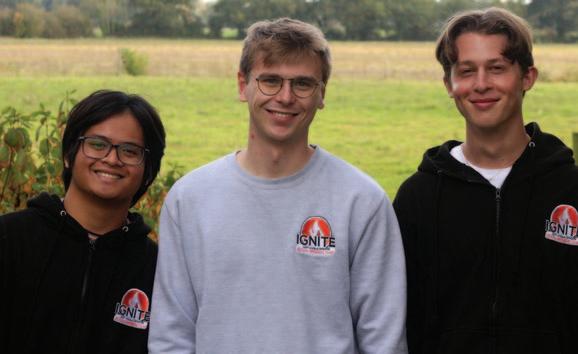
Last summer, we said farewell to Alex Thanickal and Alex Curley-Warren, who completed their ‘gap years’ with the Ignite Team. Remaining with the team for another year is Luc Wallace, who is now joined by Nicholas Villaroman and Luke Hardy.
Luke Hardy: “I am originally from Nottingham, but through my time at UEA I came to call the Diocese of East Anglia home. I found a home in the Cathedral of Saint John the Baptist and the UEA chaplaincy, where I first encountered the Ignite team.
I am a recent convert to the faith. I was raised in a secular, none-religious household. Throughout my teenage years I considered myself an atheist, and was militant in my anti-religious views. I started to consider the reality of the Christian faith around the age of 16, and after a long process, started to consider myself a Christian. Experiences with the rosary and a deep love of history brought me to the Catholic Church. After five years, and many ups and downs, I was finally baptised, confirmed and received into the church during my third year of university. After completing a Masters in history,
I realised my heart was crying out to serve God and to bring people the same deep joy and love I had experienced, and so decided to come back to East Anglia and join the Ignite team.”
Nicholas Villaroman: “Hi, I’m Nicholas Villaroman. I was born and raised in the Philippines where I used to be an antisocial school bully and attention-seeker. My father brought us to the UK when I was 15 and we lived in Ipswich. I stopped being a school bully because the kids were bigger! I used to blame God for the bad things that happened in my life. But over time, I slowly turned to God, and I became more social and understanding. I would go help out in St. Mary’s Catholic Parish, Woodbridge Road and go to
mass there regularly. I became interested in joining the Ignite Team when I went on one of the retreats they were running last year in Ipswich. I really liked helping out and after chatting to the two Alex’s and Luc, I realised I could join the Ignite Team after my A-levels. I got good results (A*BC) and part of me wanted to go to a university, but God had other plans. I applied to join the team and here I am!”
Students meet Pope Leo XIV in Rome
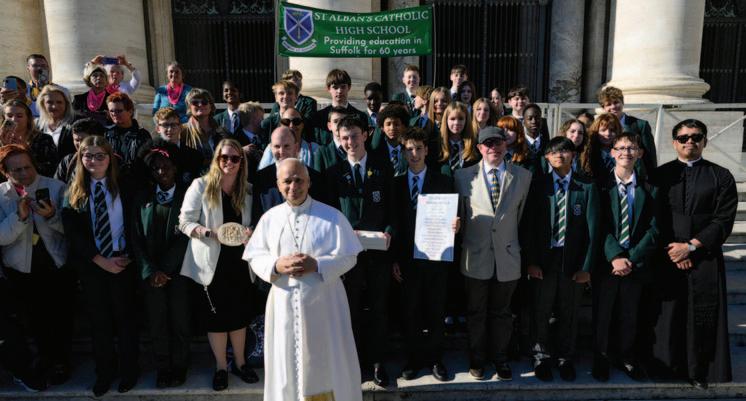
Students from St Alban’s Catholic High School in Ipswich embarked on a remarkable four-day pilgrimage to Rome, culminating in a personal audience with His Holiness Pope Leo XIV.
n The journey formed part of the Jubilee Year of Hope and marked the beginning of the school’s 60th anniversary celebrations. Joining the group was Fr Jude Belnas, who accompanied them throughout, offering spiritual guidance and support. The pilgrimage began with a welcome Mass in the Basilica of the Sacred Heart. Celebrated by Fr Jude, the Mass set a prayerful and reflective tone for the days ahead. Surrounded by the grandeur of Rome’s sacred architecture, students, staff and clergy gathered in thanksgiving, reminded that they were part of a wider Church family.
On the second day, the group visited the Basilica of St Mary Major, one of Rome’s four papal basilicas. They entered the Holy
Door and were amazed by what they encountered. Students stood reverently before the tomb of Pope Francis, venerated the reliquary of the Holy Cradle, and prayed before the ancient icon of Salus Populi Romani. Mass was again celebrated in the basilica, with Fr Jude leading the group in prayer.
Later, the students toured the Vatican Museums, marvelling at the marble artwork, the intricately designed ceilings, and, above all, the Sistine Chapel. The visit left them in awe as they gazed upon Michelangelo’s breath-taking frescoes. Many asked thoughtful questions about the recent conclave, curious about where a newly elected Pope goes immediately afterwards and the exact location of the famous chimney that signals white smoke. Their curiosity revealed how deeply they were connecting with the living traditions of the Church.
The guides were so impressed by the students’ engagement that they were granted special permission for a photograph of the Sistine Chapel ceiling, making the visit all the more memorable.
After leaving the chapel, the group continued to the Tombs of the Popes, passing
the resting places of St Paul VI, Blessed John Paul I and Benedict XVI. Many paused in quiet prayer for the shepherds of the Church.
Upon entering St Peter’s Basilica, students were left lost for words by its immense beauty. Those with Polish heritage were particularly moved when praying before the tomb of Pope St John Paul II, a moment of deep personal significance.
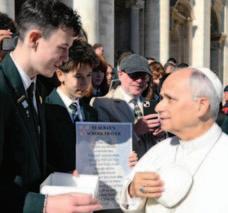
The highlight of the pilgrimage came on the third day, when the students attended a papal audience. Pope Leo XIV personally greeted several of them, shaking hands and offering blessings. The School Chaplain, Paul Gilbert, also had the privilege of shaking hands with His Holiness, strengthening the bond between the school and the wider Church.
It was Fr Jude who introduced the group to the Holy Father, ensuring that all students and staff received a warm welcome. The school’s prayer was formally blessed, and the Pope received a zucchetto, which he in turn blessed for the school community.
Year 10 student Olivier Ksiezarek reflected: “It was a day I will never forget. To meet His Holiness was an honour beyond words. I never expected to be so close and to shake the Pope’s hand.”
Fellow student Noah Witkowski added: “It was the best day of my life – to experience meeting the Pope and to have a quick conversation with him. I am so thankful for this opportunity and to be here with Olivier, made it more special for us both.”
For many, the encounter was not only a personal highlight but a spiritual milestone. Students spoke afterwards of feeling part of the universal Church in a way they had never experienced before, their faith strengthened by the Pope’s blessing and presence.
That afternoon, the group visited the Pantheon, standing beneath its iconic dome and reflecting on the continuity of faith and his-
tory across centuries.
The final day of the pilgrimage blended history with joy. Students toured the Colosseum, imagining the lives and witness of early Christians, before visiting the Trevi Fountain, where many offered prayers for the future.
A gelato-making workshop in the afternoon brought laughter and delight, and the day ended with a celebratory evening at a bowling alley — a chance to relax and unwind after several days of profound spiritual experience.
Paul Gilbert, School Chaplain and organiser of the pilgrimage, expressed his pride in the students and gratitude for the experience: “It took a year to organise, but it was worth every moment. The students were exemplary throughout, and I am so pleased that so many had the chance to meet His Holiness. This was truly a trip of a lifetime, one that has created countless memories for our school community.”
Headteacher Mr Corless also reflected on the significance of the experience: “I am deeply grateful that our students were able to experience this in the Jubilee Year of Hope, and to meet His Holiness Pope Leo XIV in his first six months as Pope. It was a privilege for them, and I am equally thankful for the dedication and effort of the staff who accompanied the trip. Their commitment ensured that this was not only a spiritual journey but also a formative experience that our students will carry with them for the rest of their lives.”
The pilgrimage was not only a spiritual adventure but also a living testimony to the Jubilee Year of Hope and the school’s 60th anniversary. For St Alban’s Catholic High School, the journey to Rome will be remembered as a milestone of faith, unity and joy — a moment in which history, tradition and youthful spirit came together in the heart of the Church. It was, truly, a pilgrimage of hope and thanksgiving.
Nicholas Villaroman, Luke Hardy & Luc Wallace (left to right).
Picture courtesy of Vatican Media.
Putting the ‘Hallow’ back in Halloween
St Etheldreda’s Church in Ely celebrated All Saints’ Day with a lively children’s pageant and games honouring the saints, combining festive fun with a reminder to follow their example and seek heavenly treasures. Monica Underwood reports.
n What did the newest saint, Carlo Acutis, mean when he said, ‘All people are born as originals but many die as photocopies?’ Originality seems to be a speciality of the saints, who conformed to the will of God and therefore contrasted so boldly with the world.
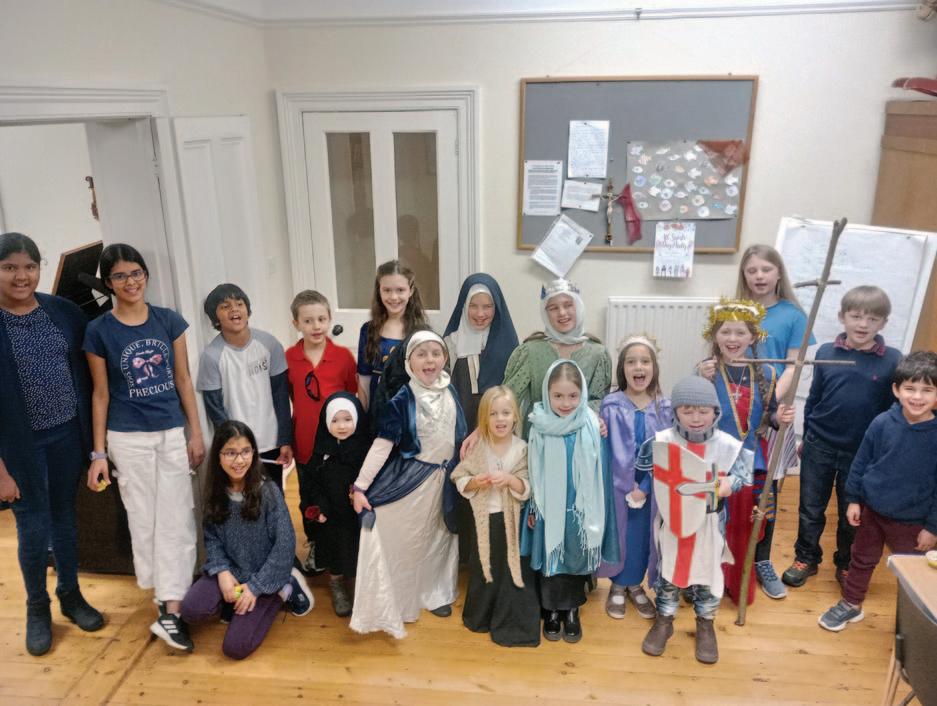
A pageant of children, many dressed as saints, arrived at St Etheldreda’s on 1 November to celebrate All Saints’ Day. From St John the Baptist to St Carlo Acutis, and St Rita to St Thérèse of Lisieux, the costumes reminded us of the unity and diversity of the Church’s 2,000-year history.
As well as making presentations on their chosen saints, guests took part in games such as saint charades. Younger children flocked to the ever-popular ‘Saint Peter’s Fishing Game’, reeling in both fish and chocolate coins. They also enjoyed doing saint puzzles and colouring in pictures of saints.
St Laurence’s leads live broadcast
n Radio Maria England was delighted to host a special live Rosary broadcast on Monday, 6 October, featuring Year 6 students from St Laurence’s Catholic Primary School in Cambridge. The students joined Radio Maria listeners across the country at 2pm to pray the Rosary live from their school chapel.
The broadcast formed part of Mark 10 Mission’s Rosary Challenge for October and reflects Radio Maria’s ongoing mission to inspire a deeper devotion to the Rosary among young people and families across the nation. The Rosary Challenge is to pray a decade of the Holy Rosary each weekday in October. With the help of Archbishop John Wilson, Archdiocese of Southward, Mark 10 Mission has created videos to guide young people through all twenty Mysteries of the Holy Rosary.
Mrs. Veronica Harvey, Inclusion Manager and SENCo at St Laurence’s Catholic Primary School, shared: “In the midst of busy school life, taking the time to say the Rosary with the community of Radio Maria was an opportunity to put faith into practice together. It helped the children grow closer to God through prayer, reflection, and meditation on the life of Jesus and Mary. It increased our sense of unity and community with everyone coming together in one voice for peace, hope, and gratitude. Praying the Rosary connects the school to the wider Catholic tradition, reminding children that they are part of a global faith family that has prayed these same words for centuries.”
Older children earned prizes by answering quizzes, learning how to recognise saints in pictures through their symbols. A scavenger hunt challenged them with even harder questions: Who was the first American-born saint to be canonised? Saint Elizabeth Ann Seton, a widowed mother who founded a religious order and opened schools. Which early Church Father said, ‘Ignorance of the Scriptures is ignorance of Christ’? Saint Jerome, who translated the Bible into Latin in the 4th century.
A humorous and sometimes grisly favourite of the parish’s yearly party appeared in the form of ‘Saints Guessing Jars’. Children could win one of the twelve jars by guessing the number of sweets, such as St Lucy’s chocolate eyeballs, St Patrick’s jelly snakes, St Francis’ animal crackers, or the Holy Innocents’ jelly babies.
the party with a scrumptious tea, we announced the winners of the costume contest and sent children home with handfuls of treats and prizes. We hoped,
treasures in heaven, like the saints.
Stella Maris brings Christmas joy to seafarers and fishers
Christmas can be a challenging time for seafarers. They miss spending this special time of the year with their family.
n Many struggle to cope with homesickness. Christmas just doesn’t feel like Christmas when you’re thousands of miles away from home and can’t be with the people you love.
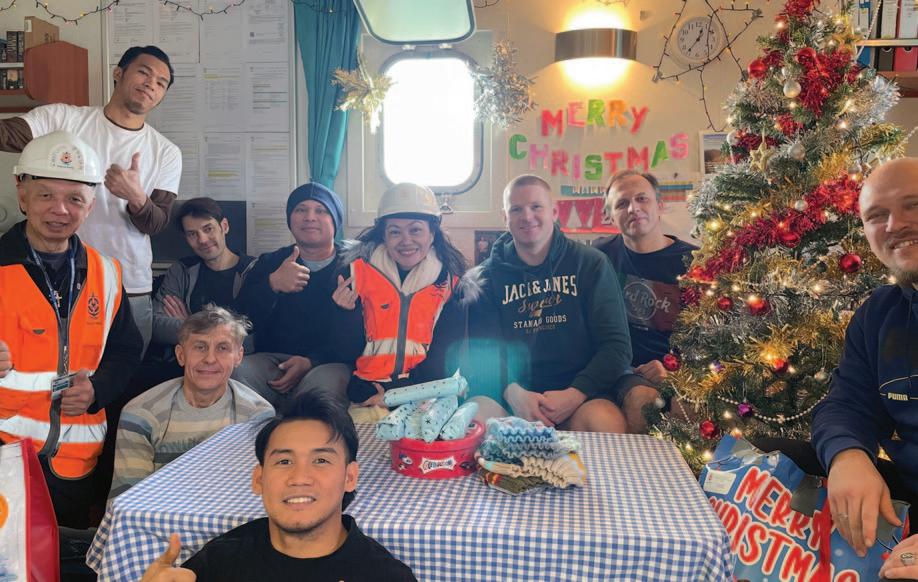
But seafarers arriving on ships at the ports of Felixstowe and Ipswich in the Diocese are never forgotten, thanks to Stella Maris regional port chaplain Julian Wong and the Stella Maris volunteer ship visitors.
Thanks to the generosity of many parishes, groups, business and well-wishers in East Anglia, Julian receives hundreds of donated items which he and his team pack to make Christmas presents and parcels which they distribute to seafarers during their ship visits over the Christmas period. Apart from handing out the gifts which are always gratefully and delightfully received by the crews of ships, Julian will also ensure that he offers them the
chance to practice their faith over the Christmas period, by taking them to church or organising Mass onboard.
Last year, he arranged for Fr Jude Belnas, from St Mary’s church, Ipswich, to celebrate Christmas Mass onboard a ship which was attended by six of the seven crew members. The seafarers were extremely grateful for being able to celebrate Mass at such a significant time of year.
On Christmas Eve last year, Julian also distributed Holy Communion to seafarers from another ship, who sadly could not at-
tend Mass due to their busy work schedules. However, he was able to take the ship’s chief officer to midnight Mass. Seafarers will be far from their families and friends on Christmas Day, but the gifts that Stella Maris’ chaplains and ship visitors bring them and the pastoral and spiritual they provide brings seafarers joy, making sure that they are not forgotten.
Please say a prayer for seafarers and fishers this Christmas. And if you can help please visit:
https://stellamaris.org.uk/christmas/
Concluding
too, that they would go home with a much deeper message: to store up
Participants of the children’s pageant at St Etheldreda’s.
Seafarers enjoying a Christmas get together.
Faith in the Home
The Nativity
n In this Faith in the Home article, Dr Antonia Braithwaite discusses how the family Nativity scene reminds us to keep Christ at the centre of Christmas and reflect His love in our daily lives.
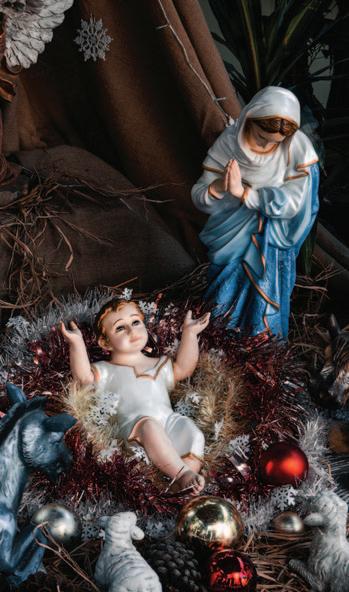
As December begins and families start to decorate their home, one tradition invites us to pause amid the bustle and refocus our hearts on the ‘reason for the season’: setting up the family Nativity scene. This is more than a nostalgic decoration, the nativity scene is a quiet catechist — a visual reminder that God chose to enter our ordinary world through the simplicity of a family, in the poverty of a stable. It’s good for families to have a nativity scene on display in their home.
The first Nativity scene was created 800 years ago by St. Francis of Assisi. He wanted people to grasp the wonder of the Incarnation, and so he arranged a humble manger with hay and live animals and towns people to play the roles of Mary, Joseph and the shepherds.
For parents today, the Nativity scene offers a beautiful way to keep Christ at the centre of the season. While children naturally look forward to Father Christmas and the joy of giving and receiving gifts, a family Nativity scene helps ensure that the story of Christ’s birth remains at the heart of the celebration in their home.
Throughout Advent the nativity scene should have an empty manger, and then on Christmas morning the little figure of baby Jesus is placed in the manger. He is born! Some families have the tradition of gathering round the Nativity scene first thing on Christmas morning, or after Midnight Mass, and placing baby Jesus in the manger before any presents are opened.
The Nativity also reminds parents that holiness grows in ordinary family life. The stable was not perfect or polished, but it was filled with love. When we show humility, patience, forgiveness, and joy in our homes, we reflect the same light that shone that first Christmas night.

St Benet’s Minster faces restoration challenges
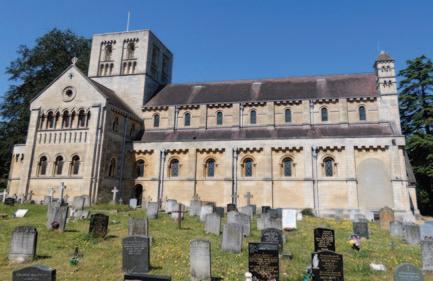
n The Diocese of East Anglia has confirmed that St Benet’s Minster Church in Beccles, one of the region’s largest and most architecturally ambitious Roman Catholic churches, has been added to Historic England’s Heritage at Risk Register.
The listing reflects longstanding problems with the church’s roof and rainwater systems, which have led to decades of deterioration within its historic fabric.
St Benet’s, built between 1899 and 1901 for the Benedictine monks of Downside Abbey, is the work of local architect Francis Easto Banham. Renowned for designing several churches across East Anglia in a variety of medieval styles, Banham chose a striking Romanesque design for St Benet’s. He is believed to have drawn inspiration from the priory church at Blyth in Nottinghamshire and the Norman tower at Bury St Edmunds. Funding for the project came largely from the generosity of the local Catholic community.
Although Banham originally envisaged an even larger church, financial constraints meant that his full plans were never completed. Nonetheless, St Benet’s remains the third largest Catholic church in East Anglia. Banham himself regarded it as his finest achievement. When he died in 1924, he left £1,000 for its upkeep and requested to be buried in the churchyard.
Historic England designated the church
Grade II* in January 2023, praising its “ambitious scale and the quality of the materials used.” Subsequent investigations into the structure uncovered concealed damage to stonework and ancient timbers, prompting the decision to add it to the Heritage at Risk Register. The Register highlights vulnerable historic sites across England, helping guide conservation efforts and ensuring that attention and resources are directed where they are most needed.
Diocesan Heritage Officer Matthew Champion emphasised the scale of the task ahead, saying:
“St Benet’s is an architectural masterpiece on a monumental scale, and certainly not what you expect to find tucked away in the Waveney valley. It was built in the style and scale of a Romanesque priory, and as such presents a number of challenges due to its sheer size and complexity. Sadly, modern parishes don’t come with all the resources of a medieval monastery, it is beginning to show its years, and we now need to fully understand the issues the church faces before putting in place a plan to remedy them. Being put on the Heritage at Risk Register is an opportunity to concentrate and prioritise on what needs to be done to ensure the building’s future.”
The Bishop of East Anglia, the Rt Rev Peter Collins, reflected on the church’s enduring significance:
“St Benet’s Minster holds a special place in the spiritual and architectural heritage of our Diocese. It stands as a visible sign of our faith and of the generations who have worshipped and served within its walls. Our churches are not only sacred spaces for prayer and worship but also vital instruments in the mission of the Diocese, places where faith is nurtured, community is built, and Christ’s presence is made known. As we face the challenges of preserving this remarkable building, we do so with gratitude for the legacy it encapsulates and with renewed commitment to ensuring that St Benet’s continues to serve the people of Beccles and beyond for many generations to come.”
The Diocese will now work closely with Historic England, specialists, and the parish community to develop a long-term plan for the conservation of this remarkable landmark.
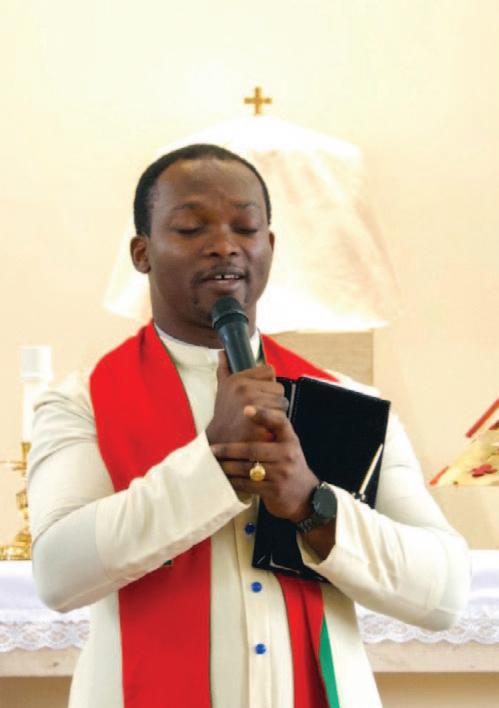
Fr Alvan Ibeh: God knows all
In his regular column Fr Alvan Ibeh reminds readers, as the year ends, to take comfort in knowing that God sees, knows, and cares about every detail of their lives.
n Whether we like it or not, this year has finally come to an end, with us being in the last month of the year. It feels like just yesterday that we were saying Happy New Year and welcome on board to flight 2025. By the time you are reading this message, this flight must be preparing for landing. Normally, before the flight lands, there are always last-minute checks by the hostess and the passengers too, to make sure everyone is safe for landing. It’s also within this moment that the passengers review the flight so far — whether it has been a smooth one or not.
So, if you are reading this now, it means we have all been fortunate to see our flights landing, and hopefully safely, at the end of the year. This now is the opportunity to ask ourselves the question, “How has it been so far?” Has it been a very smooth flight for you so far? Or has it been a very rough and tumultuous flight, not just for you but also for your family?
Now, no matter how the flight has been for you and maybe your household too, I have this to say to you to encourage you: “God knows it all.” Do you know nothing is hidden before Him? Do you know He knew it all even before it happened? In Matthew
10:29–31, Jesus says: “Are not two sparrows sold for a penny? Yet not one of them will fall to the ground outside your Father’s care. And even the very hairs of your head are all numbered. So don’t be afraid; you are worth more than many sparrows.”
What a comforting message! Jesus reminds us that God knows everything about us. Nothing in our lives is hidden from Him — not our struggles, our worries, or even our silent tears.
No doubt, sometimes we may feel forgotten, overlooked, or uncertain about what’s next. But Jesus reminds us that we are never out of God’s sight. He is aware of every detail of our lives — even the number of our hairs, you can imagine — meaning that His love for us is personal and constant.
So, are you afraid? Does life feel uncertain for you? There is always one thing to remember: “God knows it all — and He cares.”
He is watching over you in the quiet moments, guiding your steps and working all things together for your good. Let this truth fill your heart with peace as we gradually come to the end of this year. You are seen. You are known. You are loved. Wishing you a
blessed and favoured new year ahead. My social media handles: Facebook, Instagram, TikTok – @voiceofhopefamily; YouTube: @Fr Alvan Ibeh SMMM. Do follow us and share in our messages of hope.
St Benet’s Minster, Beccles.
Picture gallery from parishes around the Diocese
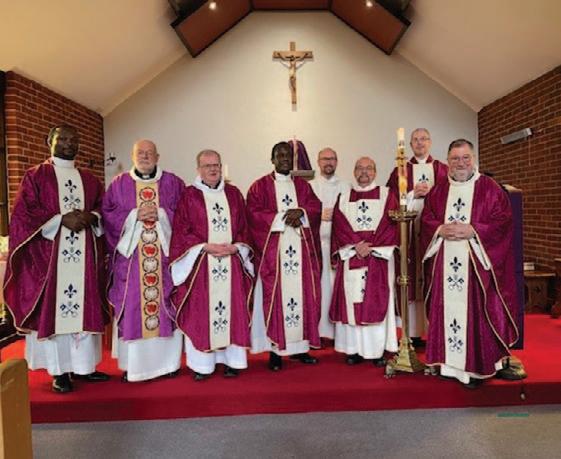
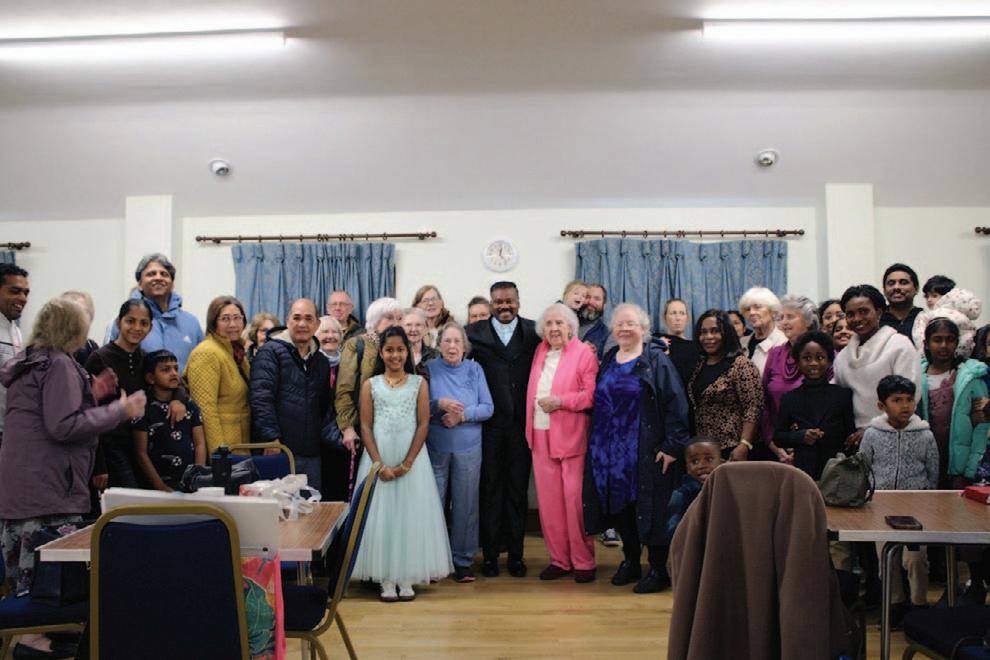
n The parish community of the Sacred Heart, North Walsham, gathered joyfully after Mass on Sunday 2 November to honour two remarkable milestone birthdays, celebrating a combined 190 years of life, faith and service.
Parishioner Mary Rayner, pictured centre-right in pink, celebrated her 100th birthday on 28 October, while Becky Walker, centre-left, marked her 90th birthday just two days later on 30 October.
Mary was born in Birmingham in 1925. She recalls the Second World War years as challenging times, with bombing raids and strict rationing shaping daily life. During this period she served in the Girl Guides Life Brigade, assisting in Rest Centres for those displaced by air raids.
After training as a teacher, Mary taught at the Convents of St Paul’s, Olton Court and St Mary’s. Following her marriage, she devoted her time to raising her family. The Rayners later moved to Surrey, where Mary became very active in the parish of St Thérèse of the Child Jesus. Around seventeen years ago she settled in North Norfolk, quickly becoming an important part of the Sacred Heart parish community and forming many valued friendships.
Becky’s story begins much further afield. Born in California, USA, in 1935, she attended local schools before entering the Convent of the Sisters of Charity of the Blessed Virgin Mary. After seventeen years of religious life, she discerned a different path and later married. Becky and her husband first moved to Malaysia before settling in England during the 1980s. Living in Trunch, she worked as a teacher and remained deeply rooted in parish life. Since moving to North Walsham in 2015, Becky has continued to serve her community as both Sacristan and Eucharistic Minister, and like Mary, has made many cherished friendships.
During the celebration, Father Peter presented both Mary and Becky with bouquets of flowers, cards signed by parishioners and, most notably, an Apostolic Blessing from the Holy Father. The festivities concluded in true birthday style with cake and warm parish cheer.
The parish also recognised two other birthday celebrations. Andrea Ani and Anna Aby each received a bouquet and a cake in honour of their special day.
The afternoon was filled with gratitude and admiration for the witness these wonderful women have offered through their faith, love and dedication to parish life. May God continue to bless them abundantly in the years ahead.
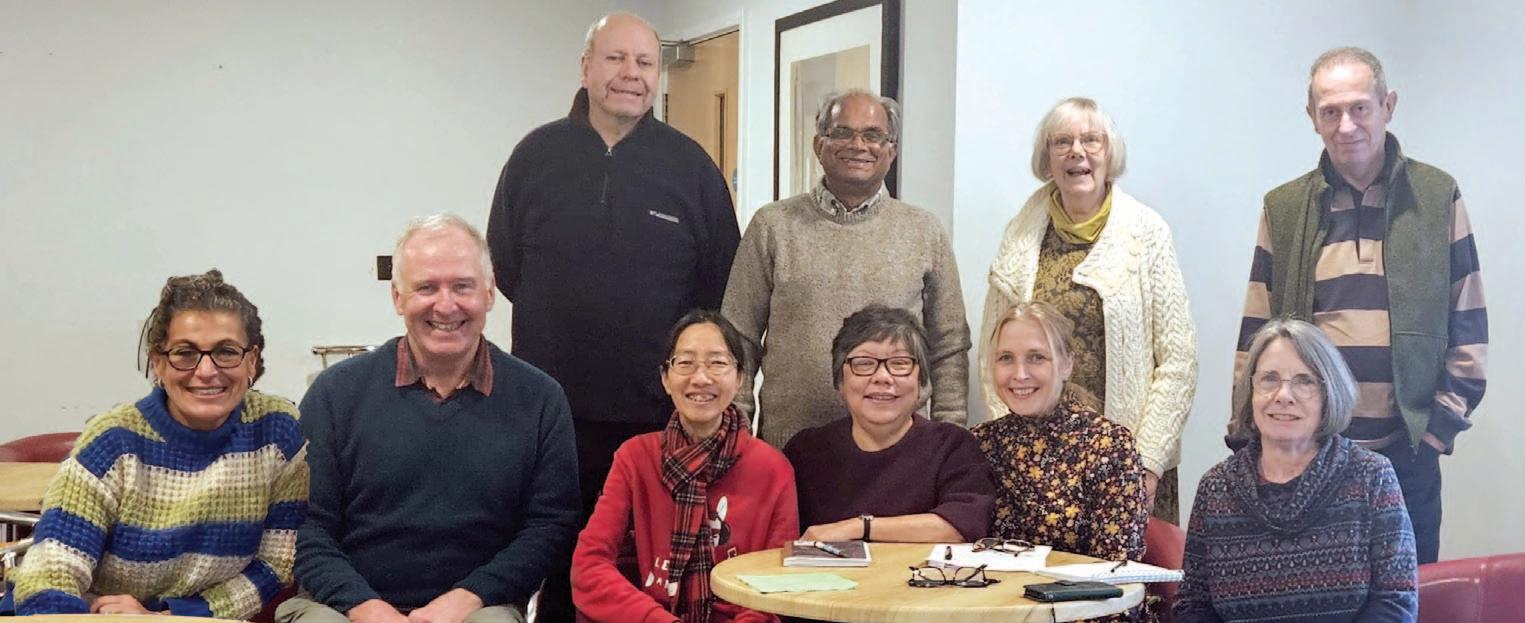
n The Diocese's Listening and Prayer Ministry held a training day on "Helping with Loss and Grief" given by Mr Simon Mustoe-Arthur, together with Bishop Peter Collins who spoke on "Why do bad things happen to people". If you are going through life difficulties, whatever they might be, and need someone to talk to, the Diocese offers a free ministry of listening and prayer. Whatever challenges you’re experiencing, talking it through in a supportive and prayerful environment can bring comfort, lighten your burden, and help you find a way forward. All information can be found here www.rcdea.org.uk/listening-and-prayer/ or email listeningministry@rcdea.org.uk
n The regular meeting of the Coastal Deanery was held on 5 November at St Edmund’s Church Halesworth.