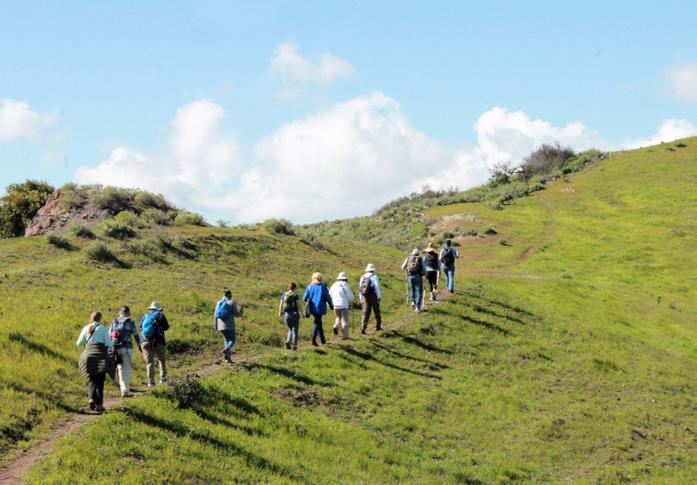
Our mission is to be an exemplary steward of island resources through a balance of conservation, education and recreation.
EXECUTIVE TEAM
David I. Solomon, Interim President and CEO
Pepe Barton, Director of Communications
Adam Finck, Chief of Programs
Deborah Honadel, Chief of Human Resources
Rob Ledebur, Chief of Facilities and Capital Planning
Clark Lee, Director of the Executive Office
MaryBeth Leonard, Senior Executive Coordinator
CONTACT US
P.O. Box 2739 Avalon, CA 90704 310-510-2595
320 Golden Shore, Suite 220 Long Beach, CA 90802 562-437-8555 CatalinaConservancy.org
Editors
Pepe Barton Aja Goare
Graphic Design
Rebecca Kim
A NEW CHAPTER FOR CATALINA ISLAND
When the opportunity to lead the Catalina Island Conservancy came to my attention, I didn’t hesitate to step in as Interim President and CEO. Those who know me well, professionally and personally, weren’t surprised. I've spent the better part of four decades in the for-profit world, leading companies through complex transactions, managing billion-dollar portfolios, and navigating some of the more demanding corners of American business. But the opportunity to serve an organization that exists entirely in service of a place this extraordinary? It was an easy yes
I want to be transparent with you, as members: I am here in an interim capacity while the Board conducts a search for the Conservancy's permanent President and CEO. My job is to keep the organization moving forward with purpose and momentum, and given what I've encountered in my first weeks, I can tell you there is plenty of both.
Why Catalina?
I've had the privilege of working around the world, from Manhattan to Singapore, London to Buenos Aires. I've managed portfolios in some of the most notable real estate markets in the world. Very few places are as immediately and lastingly compelling as Catalina Island. It’s easy to understand what draws people here and what drives the dedicated staff and volunteers who work every day to protect it.
Catalina is not simply a beautiful place. It is a fragile, irreplaceable ecosystem, one that supports rare and endemic species found nowhere else on Earth and stands as one of the last significant wildland areas in Southern California.
Unlike conservation efforts in distant places like the Brazilian rainforest and the Great Barrier Reef, this is our own backyard. We can see it, visit it and feel it. While Catalina isn't the largest of the Channel Islands, it is the most accessible and home to a thriving community. Visited by more than a million people a year, Catalina is also
where thousands of schoolchildren experience a wild place, many for the first time.
The Conservancy is committed to keeping it that way. Conservation efforts help ensure the Island remains accessible to everyone, regardless of background or means. Restoring the Island does not close it off. It keeps it open.
I first came to Catalina 26 years ago. At that time, the water in the Avalon harbor was nowhere near as clean as it is today. Now you can see 20 to 30 feet to the bottom with an abundance of marine life, including the native Garibaldi (Hypsypops rubicundus), a now protected vibrant orange icon recognized as California’s official marine fish.
That transformation didn't happen by accident. It happened because people made deliberate choices. We are now in another such moment, one where we can take action that will make a lasting difference and see the results in our own lifetimes.
That is why I am proud to be here, and that is why your membership is so critical.
A Transformative Moment
The California Department of Fish and Wildlife recently approved the Conservancy's restoration management permit, clearing the final regulatory hurdle for Operation Protect Catalina Island.
This is a milestone that reflects years of sustained effort. My predecessor, Whitney Latorre, and the entire Conservancy team invested enormous effort in bringing this permit to approval. That includes 13 community forums, meetings and events, and 63 letters of support from community members, conservation partners and tribal stakeholders, which laid the groundwork for everything that comes next.
Operation Protect Catalina Island is a coordinated, multi-decade restoration plan built around three connected goals: creating healthy soil and water systems, bringing back native vegetation at landscape scale and removing invasive species, notably the invasive mule deer that have been degrading the Island's ecosystems for generations.
The science behind this work is clear. Invasive annual grasses now dominate 35% of the Island's ecosystems. These grasses rebound quickly after fire, crowding out
the slower-growing native plants that better resist future burns. Invasive mule deer accelerate this cycle by consuming native vegetation before it can recover. When native vegetation cannot return, soil erodes and rainfall runs off rather than recharging the aquifer that supplies freshwater to the town of Avalon. Unlike mainland deer populations, these animals cannot migrate off the Island and have no natural predators, conditions that make lethal population removal necessary.
We recognize the connection that many have to the deer. The Conservancy genuinely explored every alternative. Relocation, contraception and sterilization were all seriously considered, but each proved unworkable at the scale of Catalina Island. The California Department of Fish and Wildlife independently determined that lethal removal is the only viable path to meaningful ecosystem recovery.
The Conservancy has incorporated community input throughout this process. Aerial shooting by helicopter, originally under consideration, was removed from the plan based on that feedback. What remains is a ground-based approach conducted by trained professionals under strict safety protocols, phased over multiple years. Some of the harvested meat will be donated to the California Condor Recovery Program, supporting these critically endangered birds.
What Comes Next
With permit approval, restoration work is already underway. This spring, we’re conducting pollinator surveys that use DNA to identify the important habitat changes for moth and butterfly species on the Island, at least six of which are only found on Catalina. We’re also preparing for a fenced, 10-acre pilot restoration area near Airport in the Sky, where our team will refine native planting, seeding and monitoring techniques before expanding to a 105-acre high-priority zone and eventually scaling across the Island in phases. This is patient, science-driven work. It may not yield results overnight but will produce lasting change over years and decades.
As I step into this role, I am committed to making sure our organization and this Island are in a stronger position when I hand things off than when I arrived. You, as members, make that possible. Thank you for your belief in this place and in the work we do together to protect it. ■
David Solomon serves as interim president and CEO of the Catalina Island Conservancy.
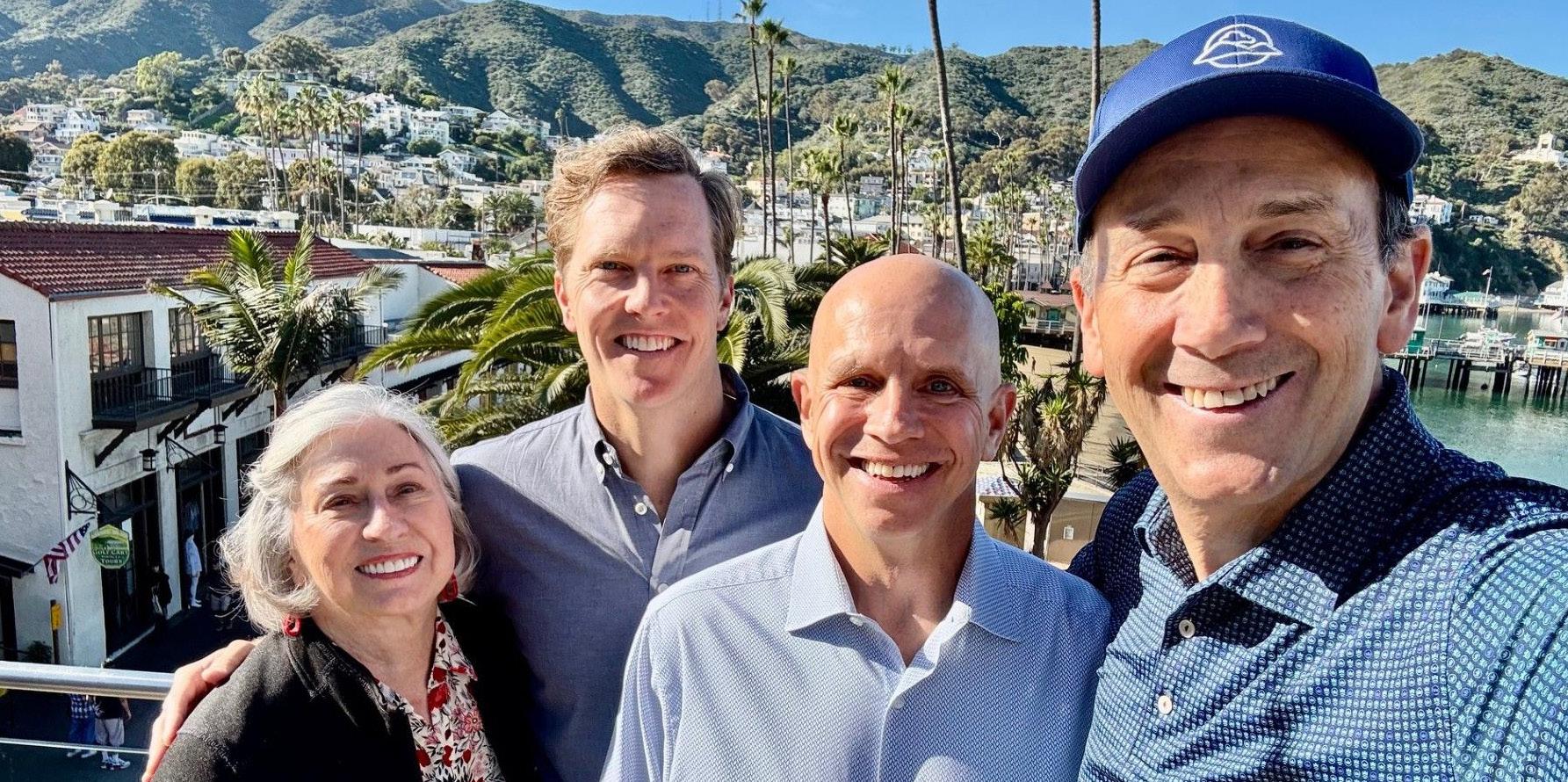
David Solomon with Maureen Ramer, Chair of the Board of Directors, Adam Finck, Chief of Programs, and Rob Ledebur, Chief of Facilities and Capital Planning
Meet the New Director of Recreation
From Childhood Adventures on Catalina to Conservancy Leader
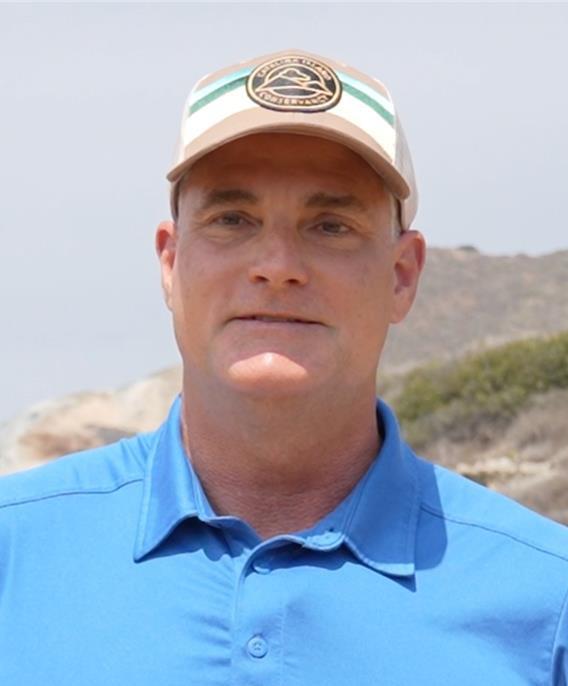
Decades of experience recreating in the outdoors prepared Scott Ammons for what he calls the “perfect job.”
As a boy, Scott Ammons first visited Catalina Island drifting onto the water in paddleboats under an expansive blue sky. That early experience sparked a passion for recreation that developed into a lifelong career, ultimately leading him to a position directing the Conservancy’s recreation division.
“My grandpa had a boat, so we used to come here on the boat and play around in the coves,” he recalled about trips to Parson’s Landing. “Watching the sun go down over that cove, then the next morning waking up fully refreshed as the sun comes up on the other side… It’s just an absolutely stunning place to be.”
The Island fox and other endemic animals, as well as rare plants found nowhere else in the world are just a few of the Island’s icons that thrilled Ammons back then. Even after decades of exploring the Island’s wildlands, Ammons said the landscape of mountain ridges that climb down to the shoreline continues to transfix him.
Over time, Ammons expanded his love for the outdoors through all types of recreation opportunities.
“As a teenager, I was mountain biking, rock climbing and whitewater rafting and doing a lot of backpacking in the Sierras,” he explained. He went on to become an outdoor educator and joined the National Outdoor Leadership School, a Wyomingbased global wilderness school. He helped educate and train students on leading recreation outings in a sustainable and ecofriendly way. While enrolled, Ammons led groups across the Western U.S.
“I was leading 30-day wilderness trips,” he shared. “We’d do whitewater rafting trips on the Green River in Utah, basically anything in the Western U.S. that was whitewater, backpacking or canyoneering and some climbing.”
His career in outdoor education took him to REI, an outdoors retailer and recreation co-op. He led REI adventures and that path brought him back to Catalina Island.
“I thought the Trans-Catalina Trail was an amazing opportunity for an adventure travel trip,” he said of the rugged 38.5-mile hike along the Island’s interior. “Catalina is both nationally and internationally famous, a place people want to come. The TCT is on people’s bucket list from all over the world.”
Ammons launched a longtime partnership between the Conservancy and REI, where recreationists would visit the Island for adventures in the interior – the same places Ammons spent time as a child.
“We were doing backpacking trips to Parson’s Landing and Little Harbor, then doing camping trips at Two Harbors, where we’d kayak, snorkel, mountain bike, hike,” he said.
After more than 18 years with REI, Ammons decided to forge a new path. But this new route wasn’t unfamiliar — he joined the Catalina Island Conservancy in 2025 as the Director of Recreation.
“I could not have designed a better position for what I know how to do and my experience, so it just felt like it was meant
to be,” he shared. “Conservation is necessary to make sure there are places left in the world that are still in their natural state, because I think humans — in order for us to get back to how we’re meant to be — need a place without the urban landscape, need to get back into nature, experience it and rejuvenate.”
That rejuvenation, he said, comes from breaking out of the boring, daily routine and trying something new, seeking adventure, getting off the grid and leaving technology behind.
“Where you use your phone for photos and nothing else. No email, no one’s calling you,” he explained. “Basically, you get out into the backcountry, wild places, the wilderness. Just experiencing life the way humans were meant to experience life, with all your five senses.”
Ammons wants to share his love for Catalina Island with outdoor enthusiasts around the world. He has big goals for his department, including expanded access and recreational uses of the Airport in the Sky, added programing and community engagement at Conservancy operated sites, and a stronger emphasis on the connection between cultural and natural resources of the Island. Ammons believes these efforts can introduce visitors of all ages to a place that leaves lasting memories and a deep passion for such a unique island. ■
THE LONELIEST TREE in NORTH AMERICA
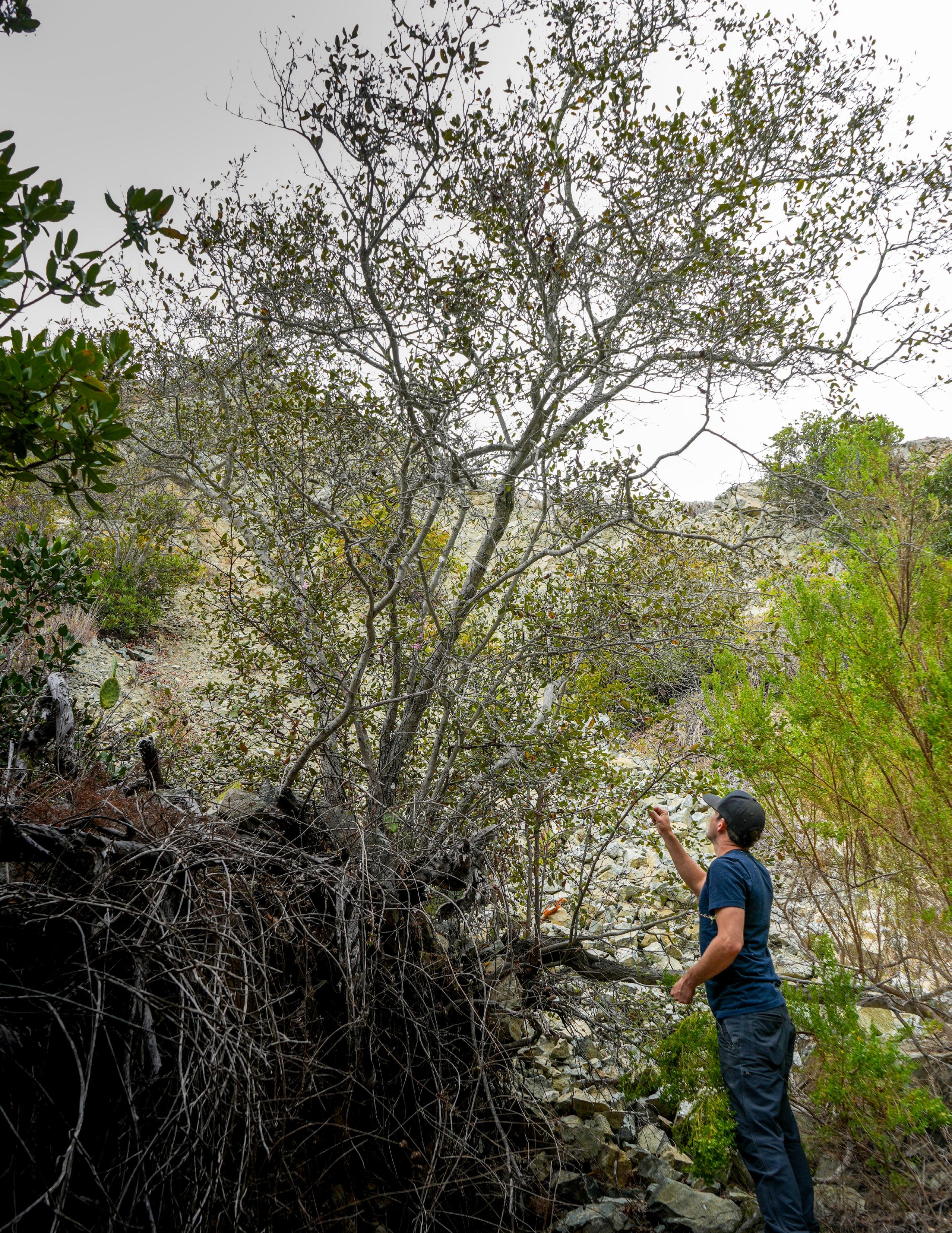
As he approached the exposed roots of a tree growing beneath a hillside of rocks in a steep canyon, an expression of concern enveloped Kevin Alison’s face.
“This is Tree D and I’m very worried about Tree D,” Alison said aloud as he surveyed the Catalina Island Mountain mahogany (Cercocarpus traskiae). The ailing tree is one of just six wild specimens remaining on Catalina Island, which is the only place on Earth where it exists.
In this corridor of Wild Boar Gully, a small grove fights for survival as perilous threats loom all around it.
“It really shows that when it comes to conservation, there’s usually a bunch of different challenges that are in combination together that can impact a species’ survival,” said Alison, the Conservancy’s native plant manager. “So, it’s not just one thing – not just hybridization, not just the legacy of [herbivore] browsing or the small population size – in addition, there’s also
climate change, fire risk, low biodiversity and habitats.”
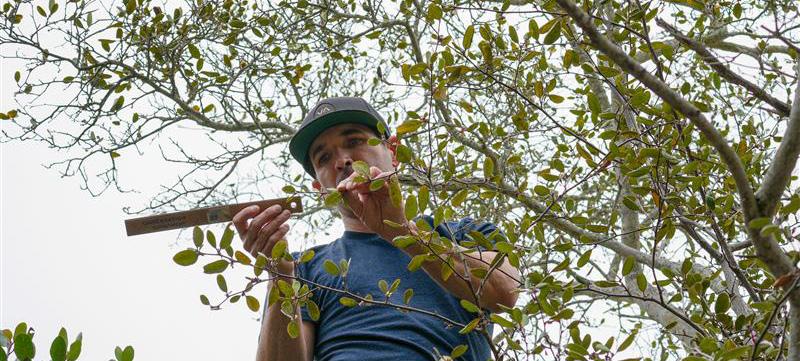
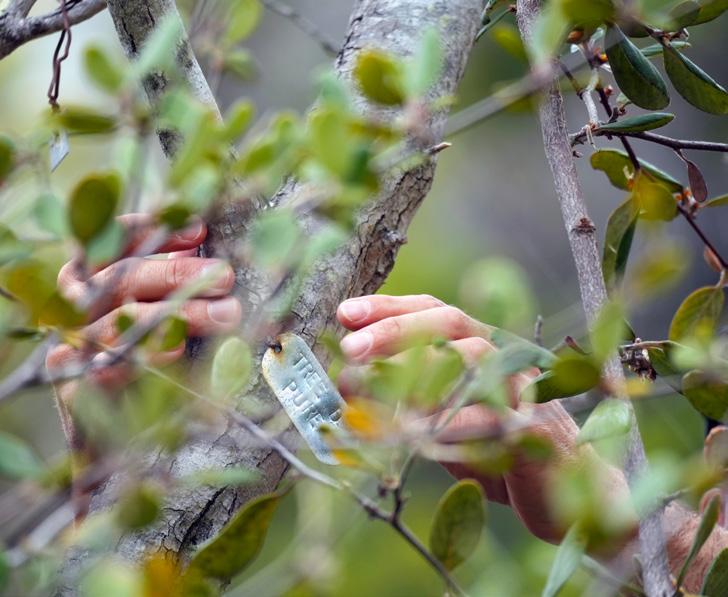
The task at hand for Alison and Lead Native Plant Technician Lexy Coons on this day of surveillance was to assess the grove for new growth, damage from pests or weather and any other changes from the previous year.
From high up in the branches, Alison took measurements and called them down to Coons, who recorded the data on a clipboard below. Their notes indicated that Tree D showed limited-to-no new growth, drought stress and overall decline in health.
The plight of the imperiled plant can be difficult to understand. That’s because there is common mountain mahogany all over the Island and even the mainland. But as Alison explains, those plants – including the ones found at the Trailhead Visitor Center and Wrigley Memorial & Botanic Garden, are hybrids (Cercocarpus betuloides var. blancheae).
“There are thousands of them around the Island, and they also occur on other islands. But what’s so unique about what we’re here to see today is the other species, the Cercocarpus traskiae or Catalina Island endemic mountain mahogany,” he said. “They’re in the same genus – both are mountain mahogany – but they’re entirely two separate species.”
The hybridization occurs when the pollen of the dominant common species overwhelms the last six individuals of “pure” mahogany. The pure plant is overloaded with hybrid pollen, leading to virtually all new seedlings produced being hybrids. As a result, the plant is now struggling to produce pure seed. Hybridization does occur naturally with many types of plants, but the unique situation on Catalina Island – where the hybrid is outcompeting the endemic mahogany for survival – is due to the extremely low number of existing pure plants.
“When you get to such a small population size, rare plant conservation comes
down to trying to save and capture and preserve all the genes in that gene pool because every gene in that population is critical to its survival and adaptability into the future,” said Alison, who has been working with the species for about seven years. “There are only six known pure individuals left and they’re very vulnerable to one big major fire and we could lose the entire species.”
But capturing those genes isn’t so simple; the two traditional methods of reproducing rare plants – seeds and cuttings – have not been successful. The seeds are all hybrids and the cuttings, which receive root hormone, fail to produce a new root system. This is where a new method and a lot of science comes in.
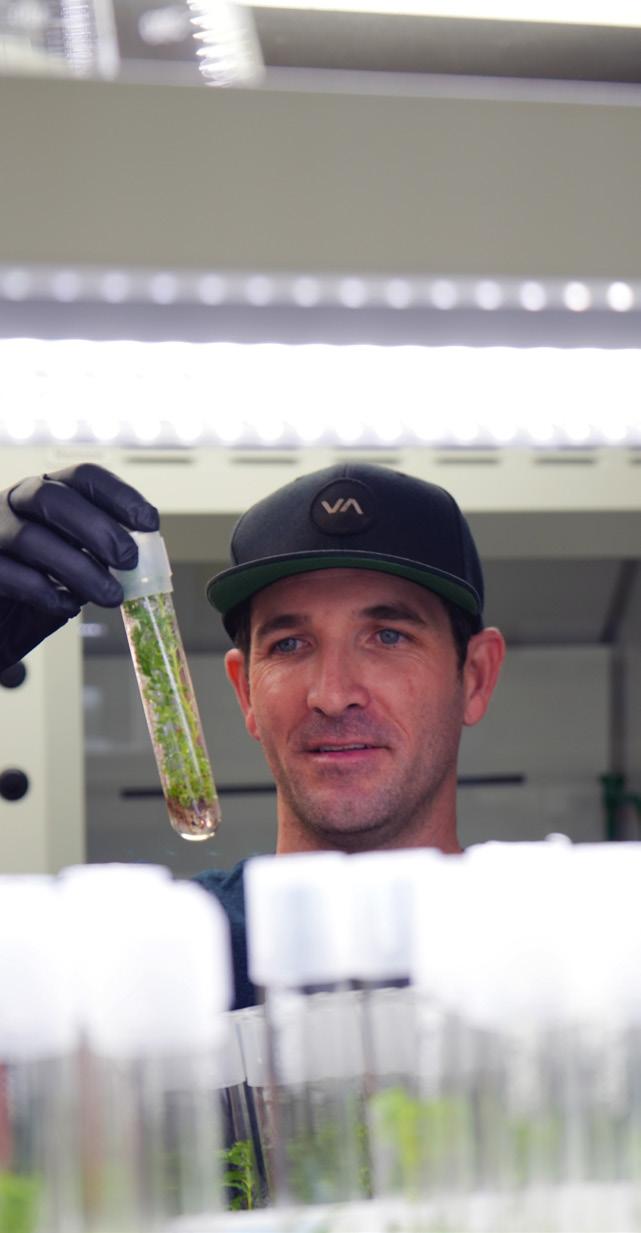
Cloning, where the full genomic sequence is captured and replicated, would allow the Conservancy to plant this exact same grove elsewhere on the Island. Alison is developing a method of cloning these plants in a lab, known as “plant tissue culture.” This may sound like a work of
Kevin Alison holds a test tube that contains a cloned Ironwood tree growing in a nutrient gel.
science fiction, but Alison learned this technique while preserving rare plants at the University of Hawaii at Hilo, where he studied natural resource management. And while this approach is new on Catalina Island and much of the United States, Alison has already had success using a different Catalina endemic.
“We’ve been successful with our endemic Catalina ironwood (Lyonothamnus floribundus ssp. floribundus) with the cloning protocol, which has never been done before, and we’re working through the protocol right now,” he said, noting that he’s optimistic about early cloning efforts with the mahogany. “It’s going to take some science, going to take some investment in the science.”
In a small, brightly lit lab within the Conservancy’s remote office at Middle Ranch, test tubes of miniature ironwood trees and rare island cactus are growing in nutrient gel that’s been treated with bleach in a rigorous sterilization process. Even the slightest presence of microbes can lead to
mold that kills off the plant. This delicate process is intensive and requires carefully monitored environmental and sanitation conditions – before, during and after cloning. But to prevent the extinction of North America’s loneliest tree, drastic and creative measures are necessary.
“What I think is really showcased here in this story is we’re not putting all our eggs in one basket when it comes to our methods of conservation,” said Alison. “We’re expanding our tool belt and have all these methods involved to work in tandem together to prevent plant extinction and ensure that high biodiversity continues on Catalina Island for all species.”
At a recent workshop at the Huntington Library and Garden, Alison was among an exclusive small group of scientists to learn about and practice cryopreservation. The technique utilizes liquid nitrogen to create an exceptionally low temperature (around
–300 degrees F) for storing and preserving seeds and plant parts.
“We’re trying to get these plants into suspended animation,” said Alison. “Hans Solo was preserved in carbonite – we’re flash freezing them to slow their metabolism. We froze everything to the point that the biology is relatively inactivated. Later, you can take them out of cryopreservation, warm them and extract tissue culture. That takes experimentation.”
Alison believes seeds stored in this deep freeze could be preserved decades, compared to the months and years currently afforded by typical seed banks.
“We now have the complete puzzle with all pieces to hopefully prevent plant extinction,” said Alison.
The age of the trees in this grove is unknown, but they were already sizable
when famed botanist Blanche Trask first wrote about them in 1897. These endemics bear within their branches a rich history of the Island and its wildlands. With the thoughtful intervention of conservationists, that story will continue to unfold into the next century. ■
Thank you to all who support our rare plant work at the Ackerman Native Plant Nursery, especially:
• James H. Ackerman Family and Evalyn M. Bauer Foundation
• Renton Family Fund, In Memory of Malcom and Virginia Renton
• Glanville Grill Foundation
• Jeff and Elizabeth Wallace
• Jennifer Walston Johnson
• Doug and Jeanie Shelton
• Janice Rutherford Hinds
Scan the QR code to watch the video.
Opposite page: Alison measures the branches of “Tree D” for signs of growth. This page: During his assessment of the mahogany grove, Alison notes how rock slide damage to the tree’s roots has negatively impacted its health.
Tracking Climate Change Threats Every 3 SECONDS
Every three seconds, encrypted messages that could predict disaster and save lives are being transmitted across Catalina Island.
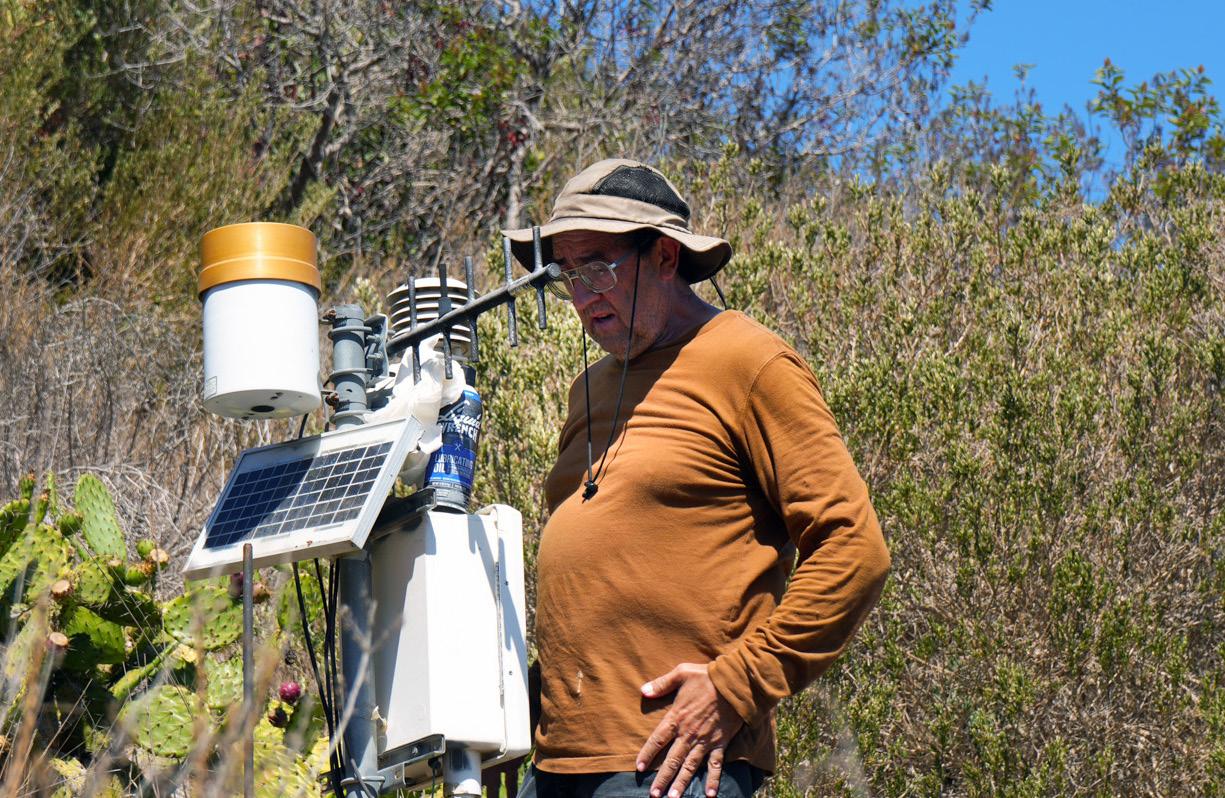
A series of 11 weather stations funded by the Catalina Island Conservancy and maintained by the Desert Research Institute are constantly collecting information about humidity, temperature, precipitation and solar radiation – all factors in fire risk. A few of them also record soil moisture levels from 4 to 20 inches deep, depending on soil quality.
Asked whether the stations are essential for fire mitigation, Associate Research Scientist at the Desert Research Institute
Greg McCurdy didn’t miss a beat.
“Yes, in fact not only mitigation, but then if there’s [a fire], combatting and fighting it,” he said. “They’ll use data from these stations to see where the fire is going to go, how quickly it is going to move.”
Knowing the weather conditions on the ground, firefighters can better respond to a wildfire by understanding its potential direction and speed, slowing its spread to save lives, property and wildlands. From his office in Reno, McCurdy and his team analyze the data collected by the stations on Catalina. To ensure the stations are working properly, McCurdy makes an annual trek to the Island, visiting each site to
assess its functionality. He’s been doing this work since the stations were first erected about two decades ago.
“Initially it started out by looking at the lower and mid-level canyons to look at varieties of impacts of the Pacific Ocean weather, channel weather and north end weather,” he said. “Originally, there were three stations planned – Wild Boar, Parson’s Landing and one below here at White’s Landing, to look at vegetation and the environmental impact.”
But after the 2007 Island Fire tore through more than 4,750 acres in the hills north and west above Avalon, a series of additional stations were added. That was in part due
to the resulting threat of rockslides near Avalon School, the local school in town.
“We do have stations above the school that are monitoring to watch the recovery from that fire,” said McCurdy. “The data from all the stations can be put into fire forecasting. All that data from all the stations is then telemetered to NOAA (National Oceanic and Atmospheric Administration).”
During his August visit, McCurdy determined the station atop the Avalon School school was in need of major improvements, including a battery. This station is especially important, he said, because it acts as a hub by centralizing the data from the other stations around the school.
Keeping the stations operational involves assessing the instrument for damage from weather, animals or insects, replacing faulty parts, cleaning out debris and removing moisture with desiccant, a substance that absorbs moisture from its surroundings. Though unassuming in their appearance, these stations not only produce critical information for wildfire response on the Island, but they can help predict weather threats to the mainland.
“It’s not unusual at all that you’ll see a system moving off the ocean [toward mainland]. It definitely hits the Island before the mainland,” he said. “You can actually see precipitation rates increase here and you can watch the radar and satellites, so it’s a confirmation of what’s happening here.”
The Island is known for dead spots and
limited cell service, so weather instruments can’t rely on regular networks. Instead, they record measurements every three seconds and send the information by satellite. All of this information is saved and used to track and report changes in the weather.
And these details, especially soil moisture and solar radiation, provide important insights to scientists about conservation efforts. Without the weather information, McCurdy believes it would be more difficult to determine what environmental conditions were impacting vegetation on the Island.
“It’s possible to focus on certain areas with the native plants and see [if there are] areas where they’d thrive better. With these stations, you can kind of quantify that information a little better,” he explained.
After a week of hiking to the stations across Catalina with Conservancy staff, McCurdy and his two colleagues completed their assessments and repairs, ensuring the stations will keep collecting important information about island weather. As the threat of climate change continues, early insights into weather-related threats will be increasingly valuable for preserving life of all kinds on Catalina Island.
Visit the Conservancy’s wildfire awareness website to learn more about daily conditions and fire threat, as well as ways to reduce fire risk. ■
THE Catalina Island Conservancy
Opposite page: There are 11 weather stations across the Island that collect important data used by local and national agencies. This page: Greg McCurdy checks the functionality of the weather stations to ensure each sensor is active.
Every three seconds, critical data is transmitted to help scientists understand and respond to climate threats.
Through a long-standing partnership with the Desert Research Institute, the Conservancy provides access, logistical support and on-the-ground expertise to keep these weather stations running.
Your support strengthens this vital collaboration.
Give today to help protect Catalina’s people, plants and wildlife from the growing threat of hotter, drier conditions.
Scan the QR code to support the mission.
catalinaconservancy.org/donate
Students Explore Catalina Beyond Avalon
Like Stepping Into Another World
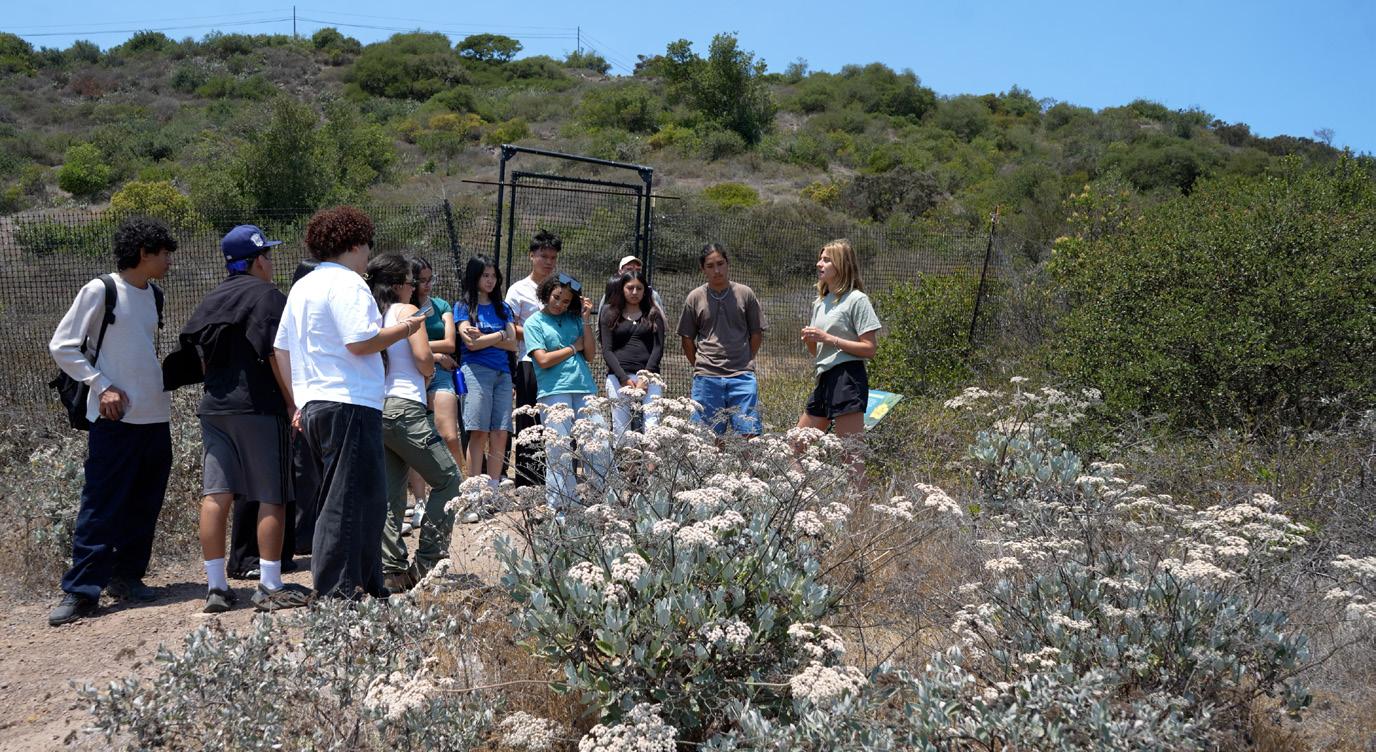
Looking up from beneath towering trees at the Catalina Island Restoration Area, students considered the answer to the question they’d just been asked.
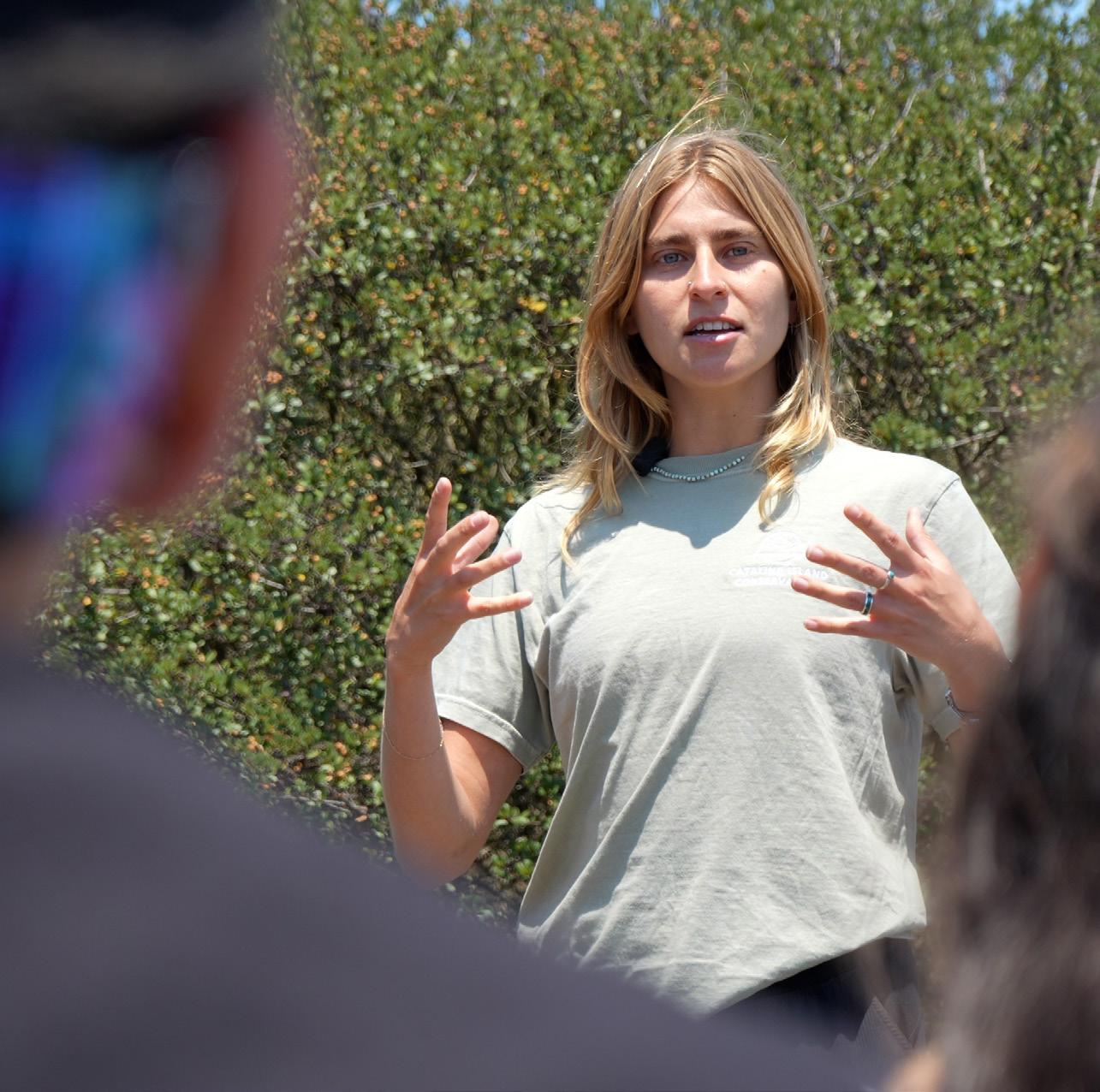
“How many individual Ironwood trees do you think this is?” asked Senior Naturalist Alex Brainerd from inside the enclosure, which was constructed by the Conservancy to demonstrate natural regrowth of native plants following wildfire without the threat of browsing by invasive deer.
The teenagers murmured guesses among themselves before one brave student offered a number. “Is it just one?”
“That’s right, it’s a trick question,” said Brainerd, as the boy who answered beamed with pride.
The group of students may have been new to the Island, but they were already familiar with some aspects of its vegetation. As members of the Heritage Project, a program by the Los Angeles Conservancy for high school students, these young visitors were in the middle of a three-week-long summer experience about conservation and how it relates to their own personal histories.
“A lot of these kids have never been to Catalina before, so to them, it’s a really new experience to get to experience an island like this off the coast of California, especially an area that’s so undeveloped and has so many acres of wildlands to get to experience nature,” added Brainerd.
“For many, this is their first experience camping, hiking, being outside for more
than an hour at a time, just being in nature and connecting to this story of history is pretty rare,” said Sarah Lann, LA Conservancy Director of Education.
Looking forward to the camping at Two Harbors that was planned for later that night, Michael Tan, 17, was excited.
“Of course, it’s scary for the first time to go camping but so far it’s pretty fun,” said Tan.
Oliver Jimenez, 15, was no stranger to the outdoors but said visiting Catalina felt special.
“It’s really like stepping into a whole other world,” he said. “It’s interesting because we get to go into a lot of places where, like if you’re a regular tourist going to Catalina, you’ll probably just stay in Avalon. But
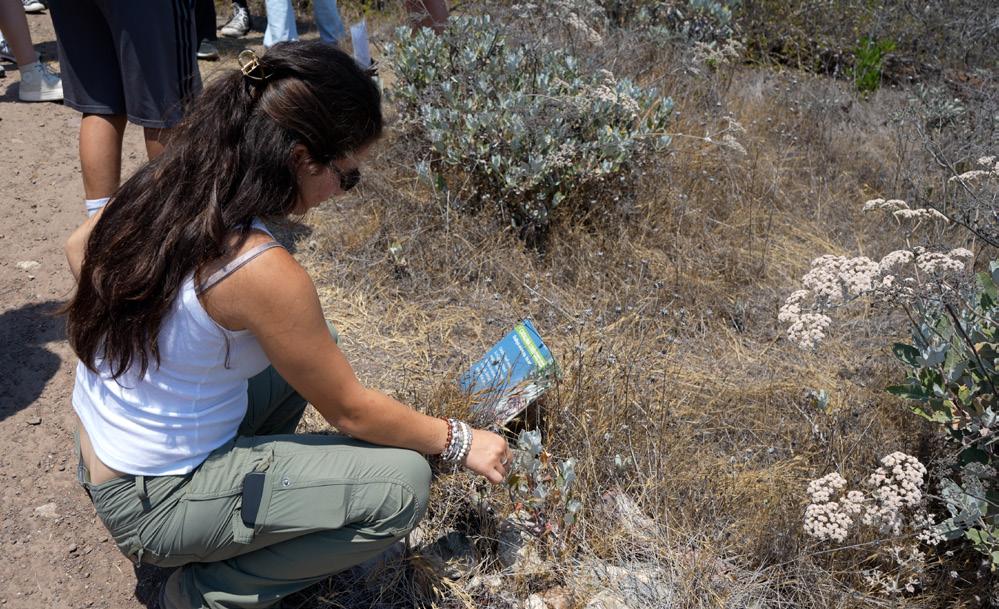
and photographed plants throughout the demonstration area.
Left to right: Alex Brainerd introduces students to White’s Exclosure and explains how fencing out deer has protected native plants; students touched, smelled
Experiencing this protected space allowed students to see firsthand how conservation protects native ecosystems.
here it’s completely unique and you get a whole new sense of nature and it totally reshapes your understanding of the world around you.”
After observing the plants at the restoration area, the students traveled to Airport in the Sky for lunch before stopping at the soap stone quarry. This archaeologically significant place has cultural value to the Gabrieleno-Tongva people, who inhabited the Island for thousands of years before colonization, and continue as important partners to the Conservancy.
“We bring them here so they can get a sense for what was here before the built environment, to connect to Indigenous and Tongva history, native plants and animals that are specific to Catalina,” said Lann.
“The Channel Islands have a really deeply rooted human history of thousands and thousands of years of cohabitation of humans and the landscape, so sharing that history as well as significance of the Tongva – the people who are Indigenous to Catalina – is really important,” said Brainerd.
As the threats of climate change persist, students like Jiminez are eager to experience the Island and understand its delicate ecosystem.
“To see them now is really good and to grow a connection helps you understand why we need to protect and conserve these areas,” said Jimenez.
And though conservation is front of mind for many students on this visit, not all of them are envisioning a future career in
conservation. Lann said that’s the point. Conservation is everyone’s responsibility, regardless of their title.
“Our goal is really not to make them into the next historic preservationist – if they want to, great,” she said. “But a lot of them are really interested in architecture or urban planning or marketing or business or the environment and we think there’s a way you can become a good steward of the place you live through all those different channels.”
For Brainerd, whose work within the Conservancy’s education department aims to introduce and inspire people of all ages to think about protecting their environment, early access and exposure is key.
“In this time of the world, it’s really important to educate the youth about preserving natural spaces and stewarding lands because the more people get involved with that work, the better we can cohabitate with the planet,” she said.
The Conservancy regularly hosts students and school groups of all ages on the Island for immersive experiences, whether that’s educational programming or volunteerism. As Los Angeles County’s largest outdoor classroom, the Island serves as a space for cultivating curiosity among students to foster a love for the outdoors and an understanding of conservation. Children from underserved communities are given meaningful access to the interior, where they learn about native plants, wildlife and environmental restoration. ■
Help Make These Experiences Possible
Catalina Island inspires curiosity, learning and awe. Your support gives students from across Southern California the chance to connect with nature and history in unforgettable ways. Donate today to help us continue inspiring the next generation of environmental stewards.
Experience the Island Through Students’ Eyes
Scan the QR code to watch the video, catalinaconservancy.org/donate
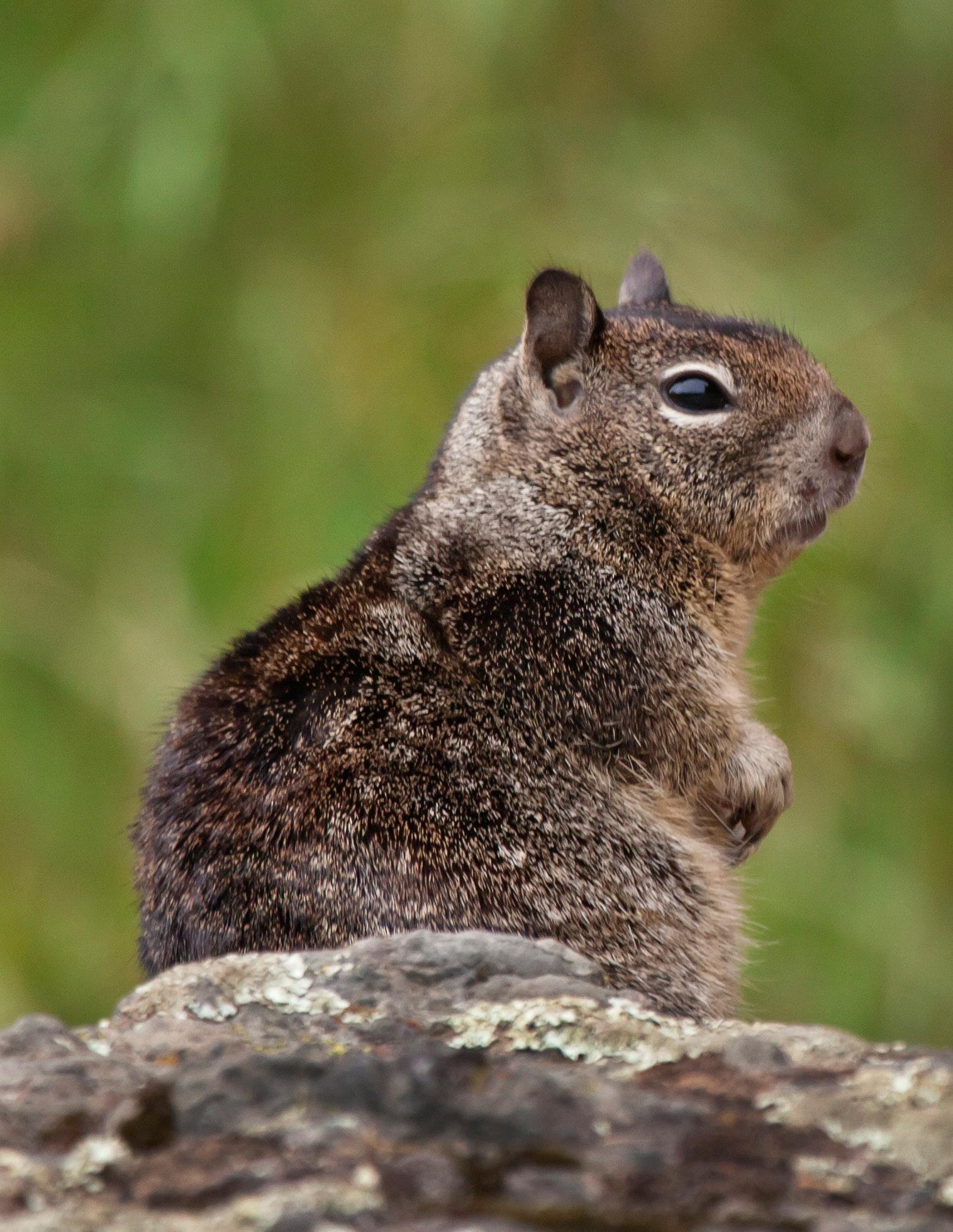
Catalina ground squirrel ENDEMIC SPECIES
Spermophilus beecheyi nesioticus
The Catalina ground squirrel is an Island endemic that helps maintain ecosystem balance by dispersing seeds and serving as prey for native predators. Adapted to Catalina’s conditions, it plays an important role in sustaining healthy wildlife communities.
PLAN YOUR ADVENTURE
How Much Time Do You Have?
No matter how long you’re here, the Catalina Island Conservancy offers unforgettable experiences in the wildlands that inspire, educate and protect.
oNE hour
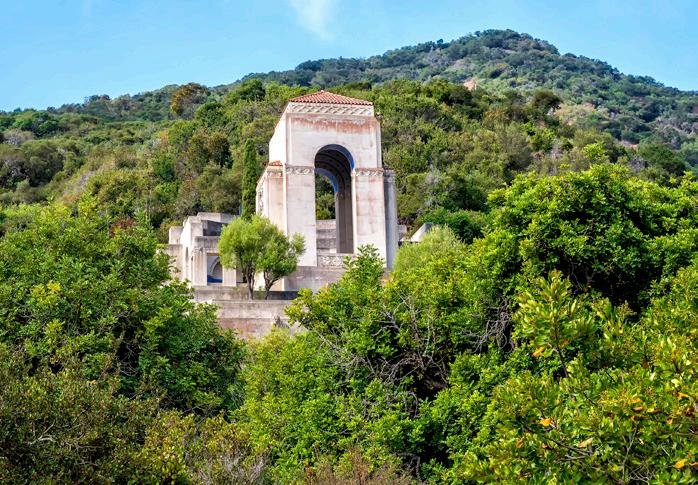
Wrigley Memorial & Botanic Garden
See rare and native island plants
Access Garden to Sky Trailhead
TWO hourS
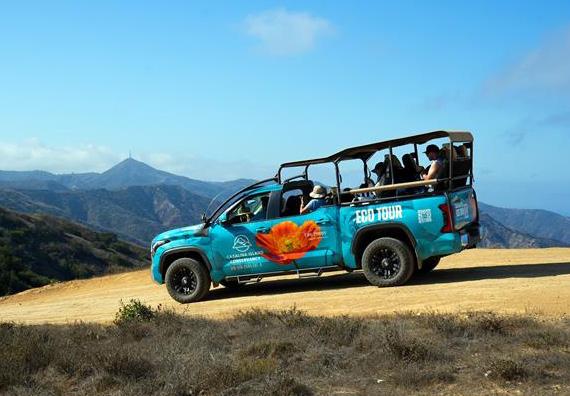
Conservancy Eco Tour
Join naturalist-trained guides
Spot foxes, bison and eagles
THREE hourS
Enjoy panoramic canyon views
Ride a free shuttle
Explore protected wildlands
Support conservation
Expanded Conservancy Eco Tour
Good deeper in to wildlands
See dramatic views and canyons
FULL DAY OR MORE
Hike the Trans-Catalina Trail
Trek 38.5 miles into the wildlands
Hike just a section or go end-to-end
Visit active about restoration sites
Learn more about conservation
Camp in remote designated areas
Access permits and maps online
Volunteer Groups Receive Complimentary Campsite Stays
Each year, more than a million visitors come to Catalina Island and many of them never venture beyond Avalon. But to truly enjoy the respite of nature, camping at one of the Island’s campsites can offer an opportunity to unwind and recharge. A new perk offered to volunteer groups enables visitors to experience the great outdoors at a major discount.
“We want to offer the camps to our volunteers as a thank you for volunteering with us,” said Conservancy Volunteer Manager Miguel Campos. That includes transportation to and from Avalon to either Black Jack Volunteer Camp or Laura Stein Volunteer Camp.
To take advantage of the deal, which can amount to savings worth hundreds of dollars, a group of friends, family members or an organization can simply volunteer with the Conservancy. Campos said the standing Tuesday and Thursday volunteer days are a great way to get involved with work in the Ackerman Native Plant Nursery, along the Island’s coastline or wherever else restoration work is taking place.
Chris Young, director of volunteers and workforce development, envisions this as
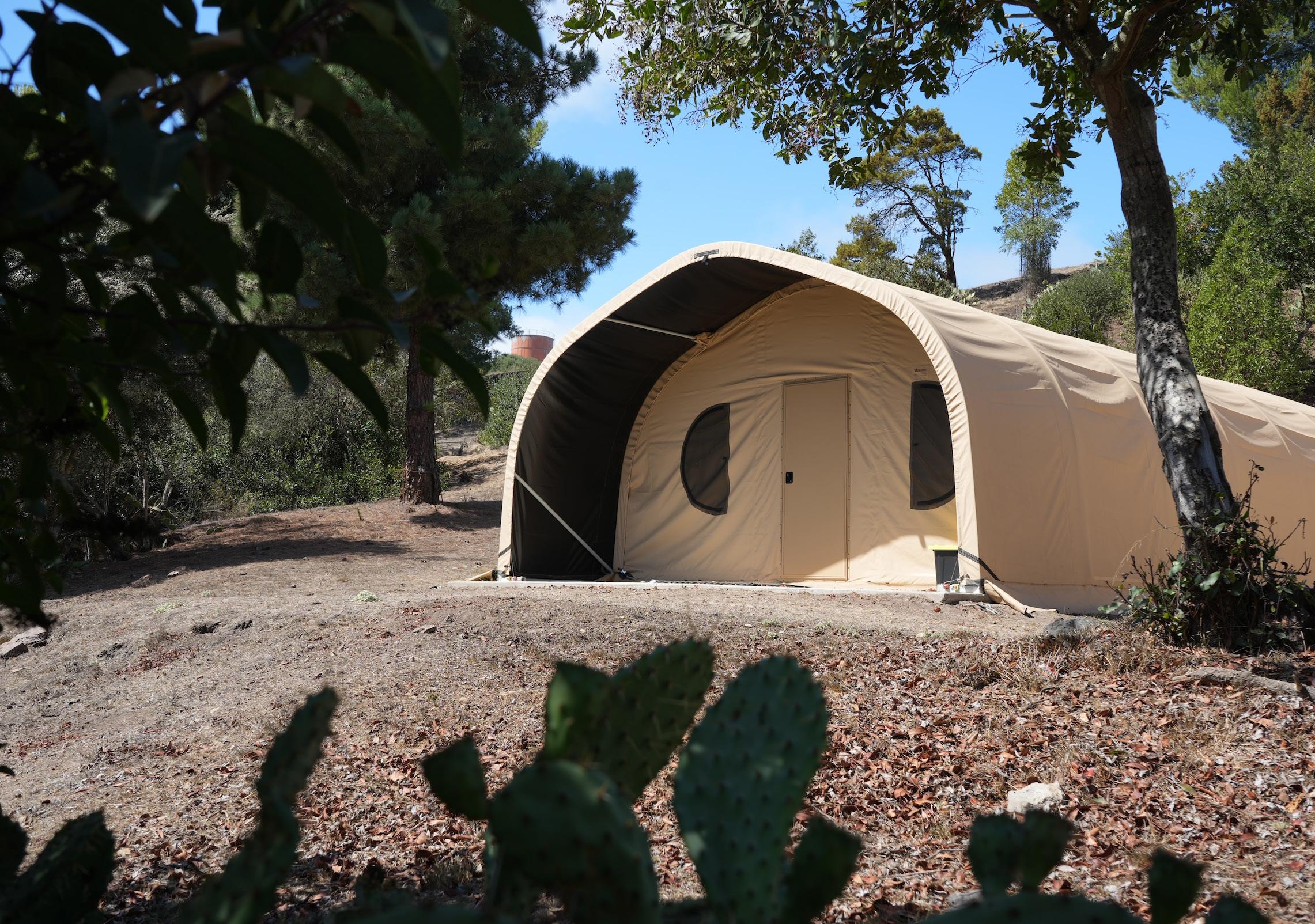
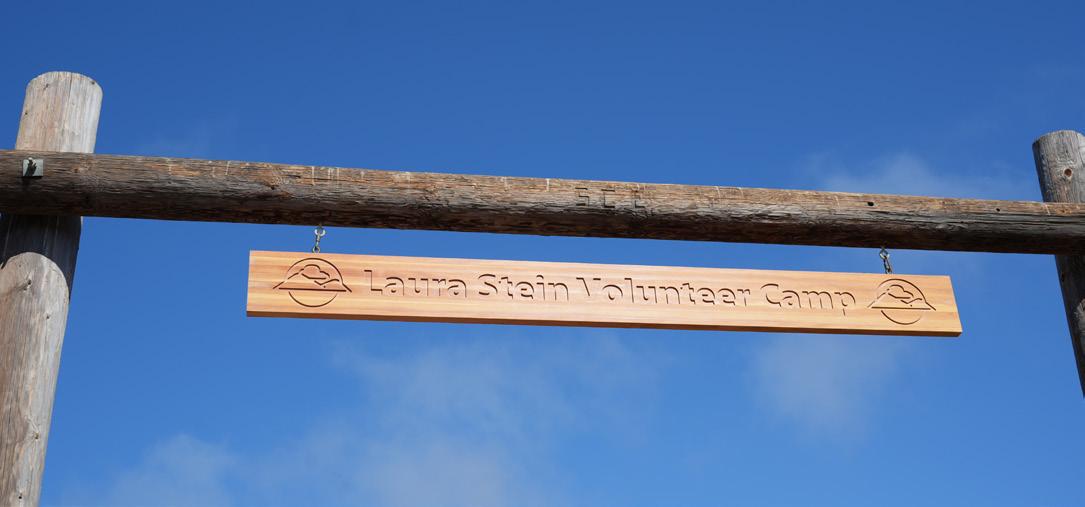
Opposite page: Canvas tents at Black Jack Volunteer Camp can each house eight campers at the Island’s highest point. This page: Laura Stein Volunteer Camp is an oceanfront campsite equipped with running water, bathrooms and a kitchen.
an opportunity for outdoors enthusiasts to utilize a cost-effective way to experience new adventures. “A family or group of friends can come up Friday and volunteer, then enjoy the camps Saturday and Sunday,” he said.
Black Jack and Laura Stein Lower and Upper Volunteer Camps were recently renovated to include several new features that improve the camping experience.
These upgrades were made possible through grant funding from the Watershed Conservation Authority’s Community Connection to Wildland program.
Black Jack features four new canvas tents, each outfitted with eight cots. Laura Stein includes four tents – two at the upper campsite and two at the lower campsite. Both campgrounds offer bathrooms with showers, and a kitchen with running water, refrigerator and cooktop. They are solar powered.
“We’re glamping up here,” said Campos.
It may not be truly “roughing it,” but Campos said the camps are most certainly immersed in the Island’s wildlands.
Visit the Conservancy events calendar at catalinaconservancy.org/events for volunteer opportunities or email Miguel Campos directly at volunteers@catalinaconservancy.org.
Volunteer opportunities include invasive plant removal, native plant nursery opportunity (seed sowing, dividing of seedlings, repotting), trail work in the spring, weeding and erosion control in Wrigley Memorial & Botanic Garden, walking the fences of restoration areas to check for breaches, beach cleanups and support with wildlife projects.
“We’ve got squirrels running through here. Foxes come smell your food, they like to know what you have,” he said. “We get a lot of fox that come through and bison that roam right through here.”
Black Jack is located in the mountainous interior, while Laura Stein is perched above a cliff with an ocean overlook. Either way, Campos said past volunteers have appreciated having a place to rest their heads away from the hum of Avalon.
“You go from the busy, busy touristy town to nice and quiet nature,” he said. “It’s such a unique experience for them. First, they’re on an island. A lot of them have experience camping and hiking but never on an Island. What they take from volunteering with us is taking in all the uniqueness we have – plants and animals.” ■
Thank you to all who support our volunteer camp program, especially:
• Watershed Conservation Authority and its Community Connection to Wildlands Program
• Matt and Christina McManus
PLAN YOUR NEXT VOLUNTEER TRIP
Scan the QR code to watch the video.
We Navigated the High Seas to Catch Elusive Sea Birds
The waves sparkled underneath the bright moon as our little boat drifted closer to Bird Rock. It was late as we drifted along, off the coast of Little Harbor. When our inflatable vessel approached the giant rock, we prepared ourselves for the leap. My feet pushed off the boat and I successfully made it over the water onto the rock without getting wet.
One by one, members of our small team pulled themselves up onto the cold, smooth landing. The white surface – a coating of powdery bird droppings – dusted up as we walked across. It may have been dark, cold and somewhat gross (reread that last sentence) but it was great to be in the company of leading bird experts from CIES (California Institute of Environmental Studies), specifically Mike Parker, Jon Dachenhaus, and Darrell Whitworth.
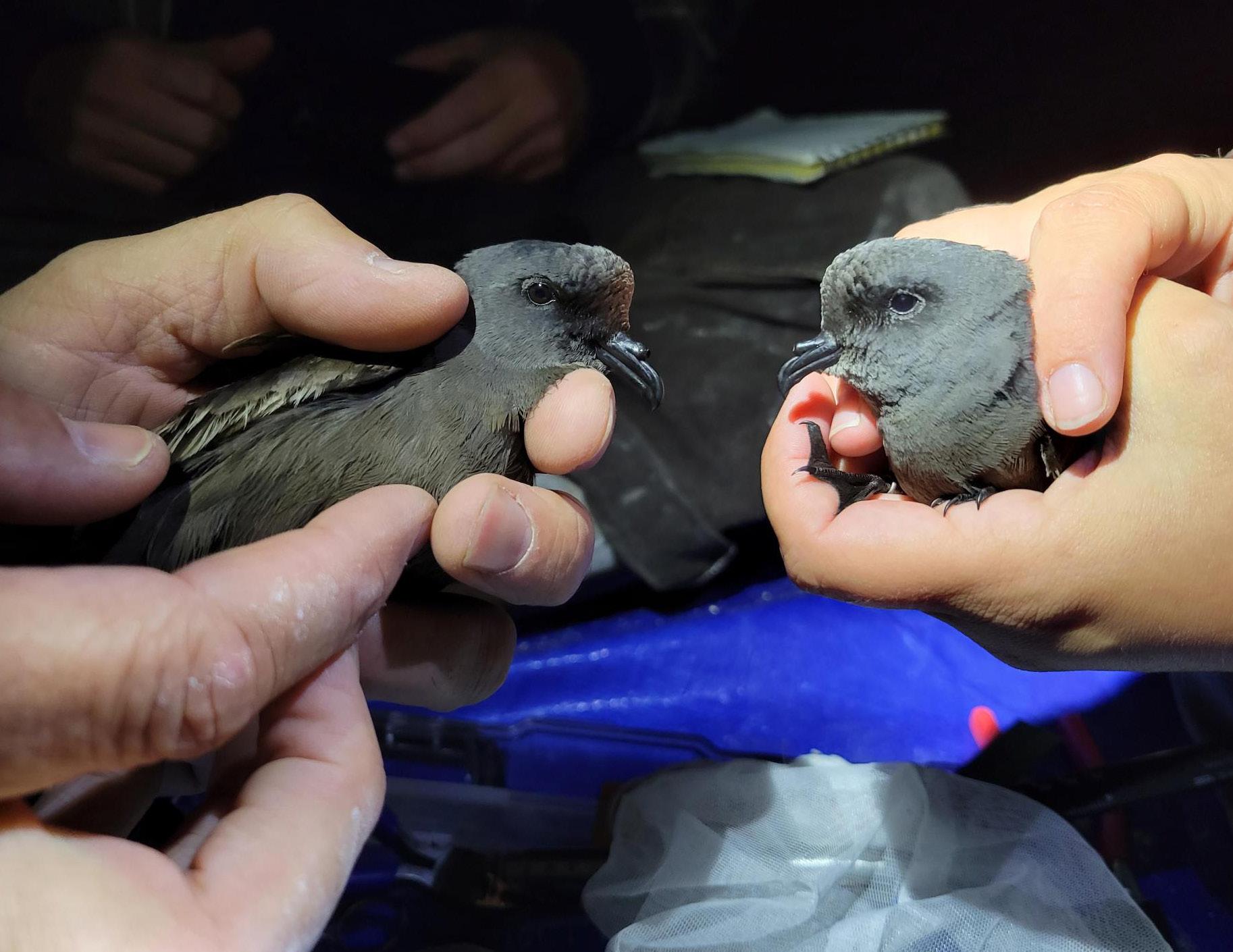
Our goal was to place numbered bands on the legs of ashy storm-petrels, as well as Leach’s storm-petrels. The ashy storm petrels had been so elusive that no one had ever been successful in banding them on Catalina Island. This was our chance.
We set up mist nets to catch the birds and a large speaker on the rock that played ashy stormpetrel and Leach’s storm-petrel bird calls to attract them. They fly in – they’re curious, they’re addicted to the drama and want to know what’s going on. Unwittingly, the birds flew into our nets, allowing us to very gently take them out of the net then place numbered bands on their legs while they are in our hand, before setting them free.
Notes from the field
Bird banding is a really common strategy for understanding birds. It is basically a bracelet with an identifying number on it, so if we catch the bird again next year, we’ll know these birds are repeat visitors to the Island. That’s an indication that they’re using the Island as breeding habitat.
The small, palm-sized birds spend most of the non-breeding season out on the open ocean. During breeding season, they use rocky coastal areas for their burrow-nesting habitat. Because of their vagabond lifestyle, it has historically been
challenging to encounter them. The largest known breeding colony is on the South Farallon Islands where the presence of predators or humans is minimal. But given the number of birds captured this year on Bird Rock, we suspect Catalina Island may be another breeding location.
That’s important because the birds are listed by the state as a Species of Special Concern. Their populations are in decline, but the reason isn’t well understood. Predation, coastal development and climate change are some of the culprits but there’s still a lot we don’t know. It’s
good to get information about what habitat they’re using and how many birds are showing up. We can use this to gauge in the future how they’re doing and whether their population is trending up or down, shifting and what habitats they’re using. There is an Ashy Storm-Petrel working group that is dedicated to better understanding this species and unifying sampling efforts across the California Islands. Our data contributes to this.
Scan the QR
Netting over a dozen sea birds was a thrill – not just for the pure adrenaline of being on a rock in the ocean at night, but for the simple fact that our work will lend to research that could help preserve this species into the future. While not all our work at the Conservancy involves such daring data capture, the success of this mission reminded me of the talented – if not agile – group of scientists I’m grateful to work alongside.
- Katie Elder Wildlife Conservation Manager
Ashy storm petrels are an elusive sea bird that have been difficult to study.
Fox Vehicle Deaths Surge Amid Population Increase
The fox monitoring season occurs annually between October and early December. In the 2025 season, 374 individual foxes were captured; 265 on the East End and 109 on the West End. Some foxes were captured multiple times for a total of 584 captures. Pups, which are under a year old, were captured 16 times, an increase from last year.
At the rendezvous point at Middle Ranch, researchers stood together, illuminated by the headlights of their trucks, to check off their supply lists.
After loading the supplies into their vehicles around 5 a.m., the teams of scientists drove in different directions across Catalina Island to locate foxes.
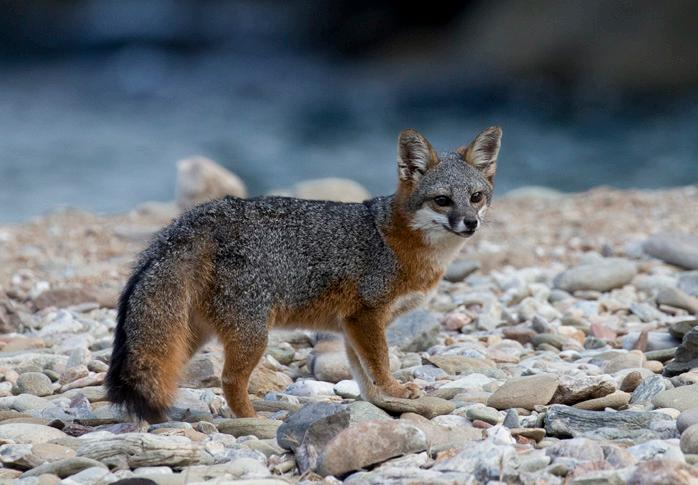
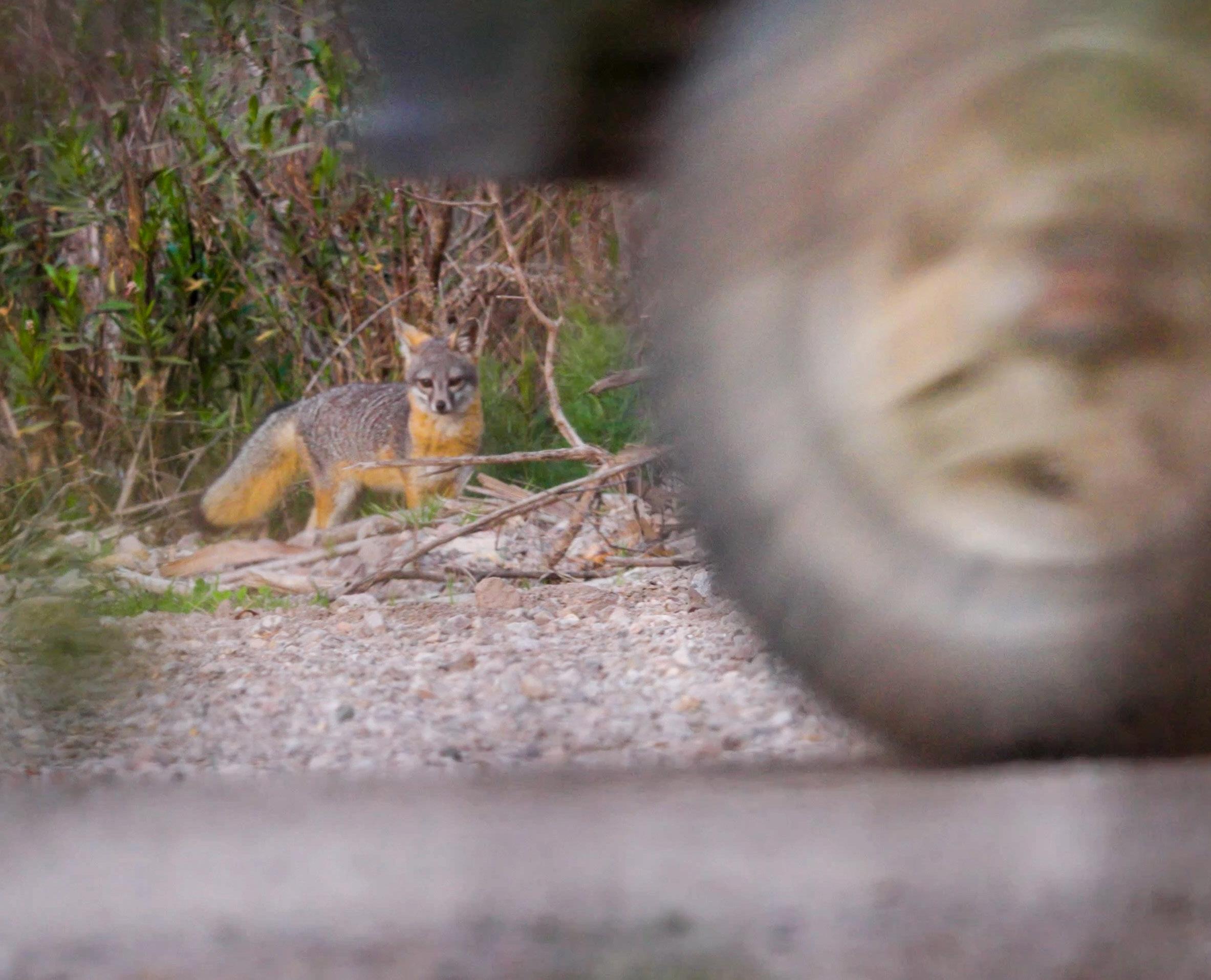
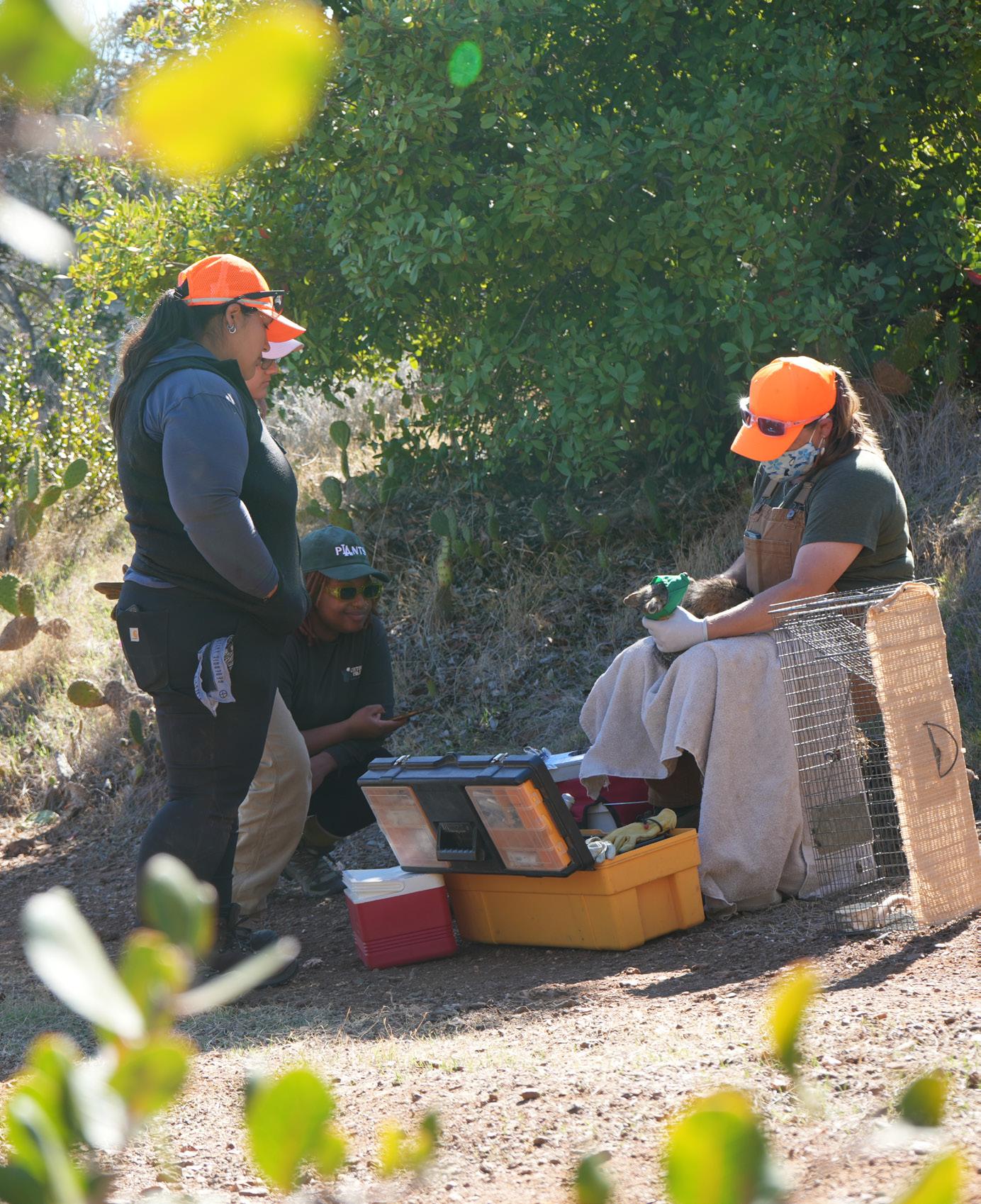
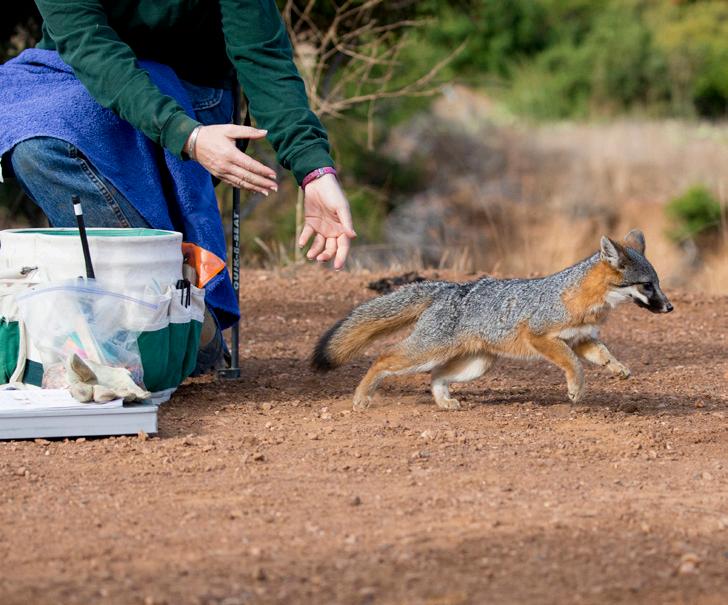
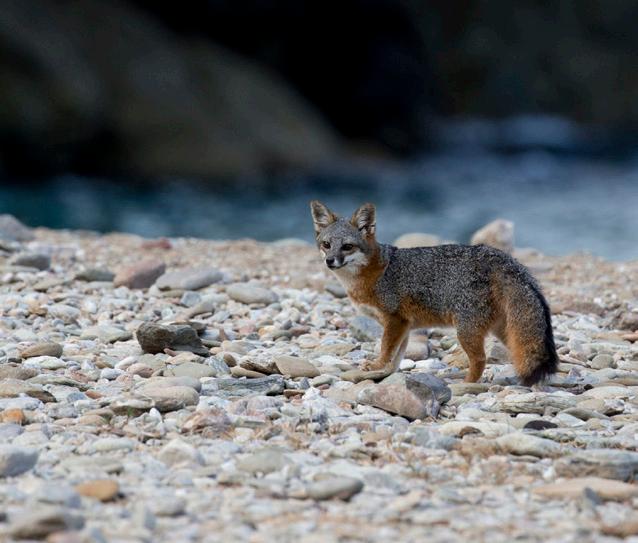
The Santa Catalina Island fox (Urocyon littoralis catalinae) is a diminutive relative of the mainland gray fox and is endemic to six of the largest California Channel Islands. The Catalina Island fox is its own unique subspecies that in 1999 was nearly wiped out by an outbreak of canine distemper virus. With intervention from the Institute for Wildlife Studies and later the Conservancy, the fox population rebounded over the next six years as shared in a recent fox documentary, “Back from the Brink: Resurgence of the Catalina Island Fox.” As part of the fox recovery strategy, the Conservancy conducts annual fox monitoring across the entire island. Teams trap foxes to track population numbers, vaccinate against canine distemper virus and rabies, microchip newly captured foxes, and fit some animals with radio collars.
Before administering vaccines, Rudy completed the animal’s assessment, including its weight, physical condition and presence of parasites before administering vaccines. “His body condition is about a three out of five,” she told wildlife biologist Destiny Saucedo. “And he’s covered in fleas.”
The finding wasn’t unique to this fox. In the 2025 monitoring season, the Conservancy recorded a 21% increase in foxes with ectoparasites like lice, fleas and ticks. In total, about 85% of all foxes captured had at least one parasite, an increase from 70% in 2024. Scientists say these infestations are a direct result of fox interactions with dogs, cats and deer on the Island.
Rudy applied ivermectin to the fox’s ears and treated it for mites, which were brought over by cats and cause cancerous tumors. Using a bite stick, a repurposed knitting needle, Rudy opened the fox’s mouth to review its teeth for an age estimate. This one was a bit older.
“They live about an average of nine to 12 years,” Rudy explained.
Blood samples taken from this fox are one of 147 samples collected this season. The DNA helps researchers assess the species for disease and other biological changes. This fox, along with 323 others, received vaccines for rabies and canine distemper.
This year, blood samples detected the presence of five infectious canine diseases. More than half of the foxes tested positive for canine adenovirus type 1. The disease causes infectious canine hepatitis, an acute liver infection, and affects most foxes on the other five islands. Prior to 2010, Catalina was the only Channel Island where this disease was not detected among foxes.
Once she completed her assessment of
Seated on a camp chair overlooking Little Harbor, Conservation Operations Biologist Becky Rudy conducted an exam on a feisty male fox. While it was still in the trap, Rudy ran the chip reader over the fox’s neck. “I think this is a new guy,” she said.
the mature fox, Rudy let it go and the animal scampered off into the wildlands. This one, in particular, was not fitted with a radio collar. It was too old for Rudy to consider. Radio collars are typically applied to younger, unvaccinated foxes and serve as the “canary in the coal mine” in the event that a new disease arrives on the Island. The collar emits a mortality signal that allows researchers to locate the fox carcass and bring it in for an examination. This season, Rudy and other monitors fitted 21 new foxes with radio collars, making for 60 total collared foxes on the Island by the end of 2025.
Though disease is an obvious and historical threat to the foxes’ wellbeing, humans are actually to blame for most untimely fox deaths. In 2025, 24 of the 41 fox fatalities were human related. The record shows 18 foxes were killed by vehicles, two died
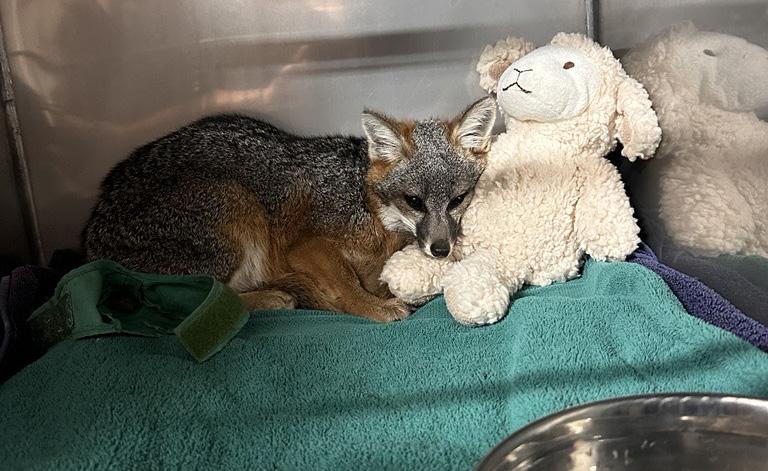
This fox was found with an injured toe. Island Veterinarian Dr. Richard Denny treated the injury and the fox eventually recovered at the clinic before it was released into the wild.
from dog attacks and five were unknown causes but potentially rat poison.
One female fox captured on the West End appeared in rough shape. Rudy marked it a one out of five on physical condition and suspected this fox was very old. “It looks like we last caught her in 2020 and she was believed to be about seven or eight then,” Rudy said after scanning the fox’s microchip. Rudy injected the fox with subcutaneous fluids to help hydrate the fox and then released it.
At the start of the season, the fox monitoring team encountered a juvenile male
fox with an injury to its back left toe. The team brought the fox to Dr. Richard Denney, the Island veterinarian. Denney determined the injury was not trap related, rather it appeared to have been sustained in a fight with another animal. No fractures were identified but the fox did have soft tissue and tendon damage that could harm its chance for survival. The fox was admitted to the Middle Ranch Veterinary Field Clinic for rehabilitation and after 17 days, it had recovered and was released into the wild.
Since its near extinction in 1999, the Island fox population has rebounded from a low
of about 100 to an estimated 2,162 foxes in 2025. This season marked an increase of 188 foxes from last year. It’s a testament to the Conservancy’s fox monitoring practices and Island restoration plan, which is designed to support native species’ recovery. To learn more about the history of the species and the Conservancy’s efforts, watch “Back from the Brink: Resurgence of the Catalina Island Fox.” ■
Scan to watch the documentary.
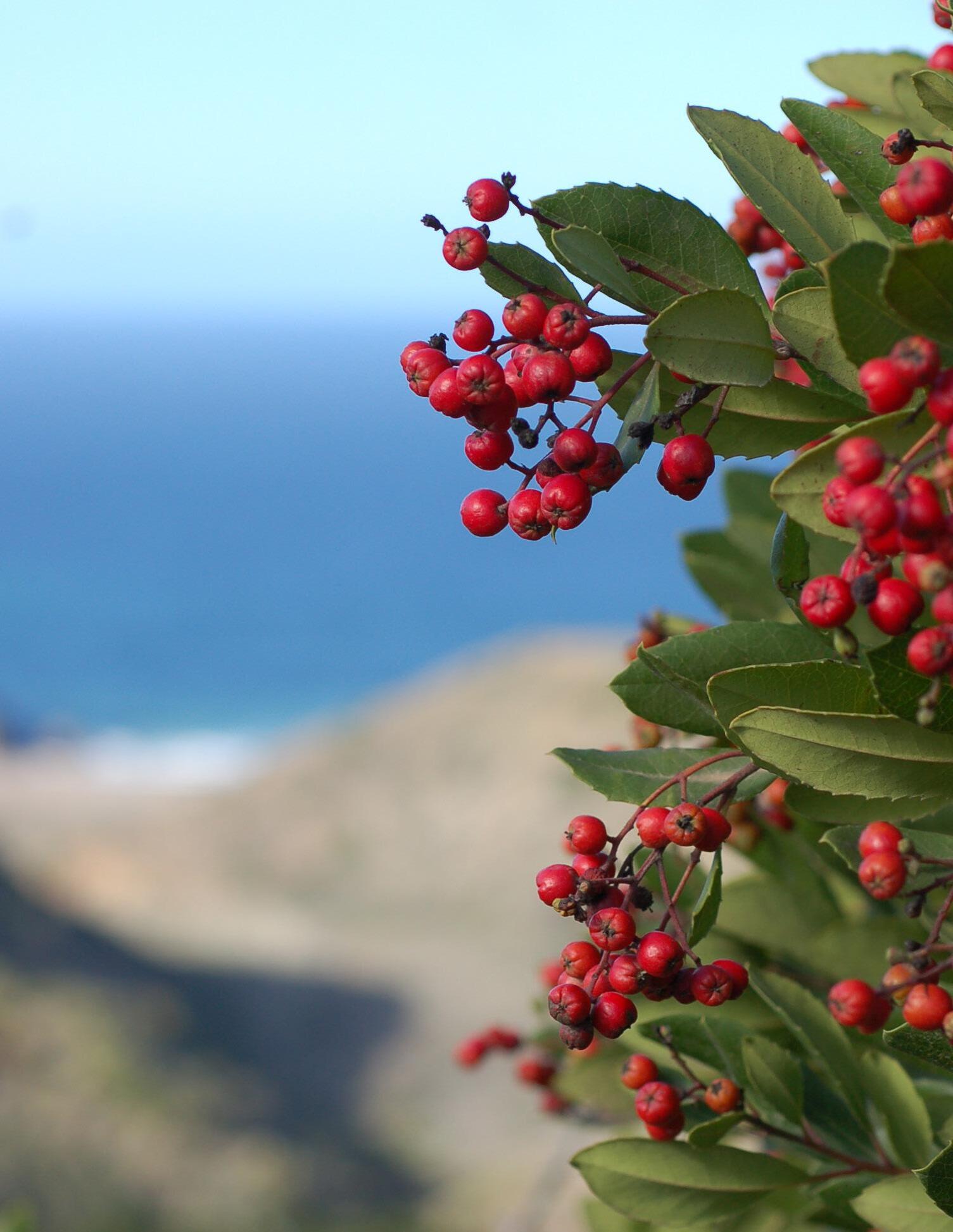
Toyon NATIVE SPECIES
Heteromeles arbutifolia
Also known as Christmas berry for its bright red winter berries, this native plant appears as a shrub or small tree on Catalina Island. It is a critical source of food for wildlife, it’s droughttolerant and has historical and cultural significance to the Gabrieleno-Tongva community. They call it ashuuwot and have utilized the plant as medicine, food and supplies.
Conservancy Launches Fire Danger Program and Fox ambassador
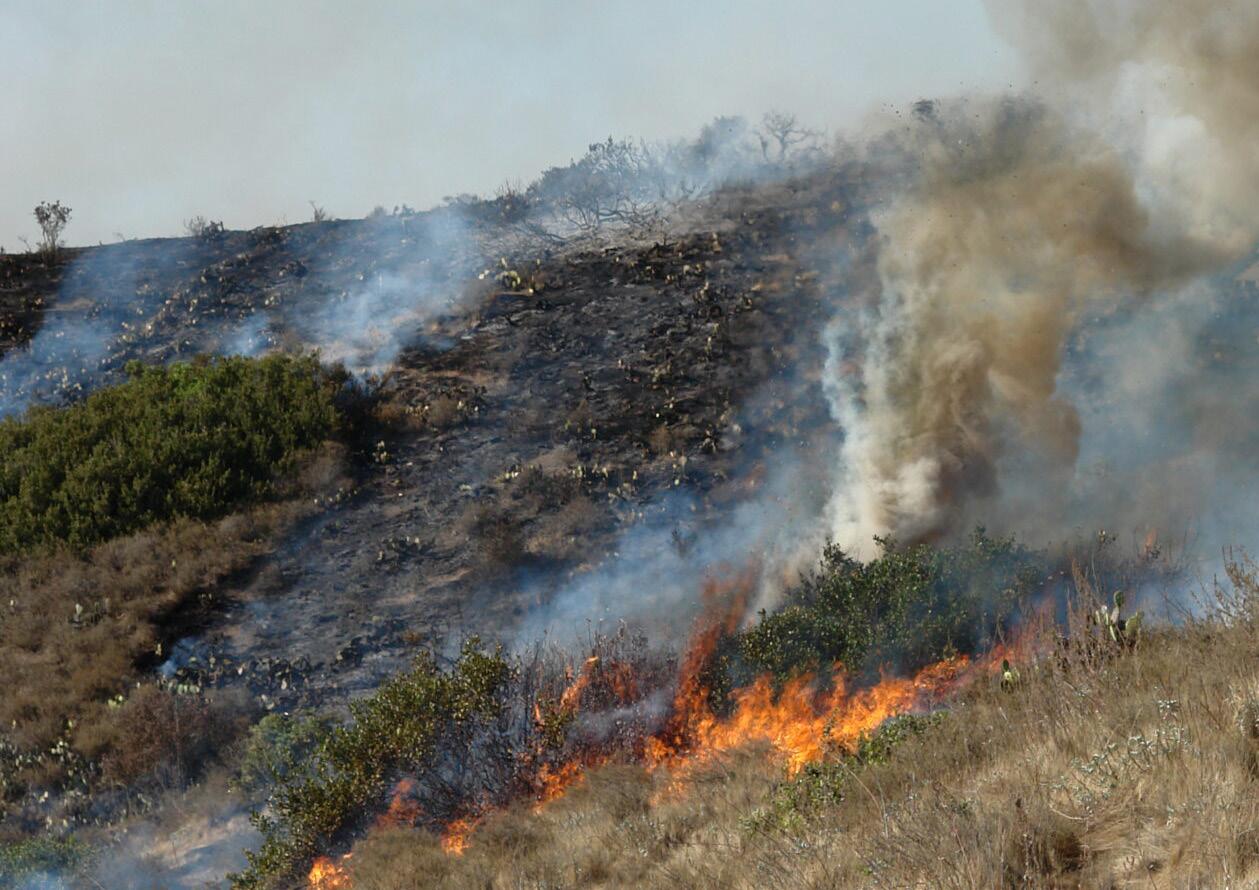
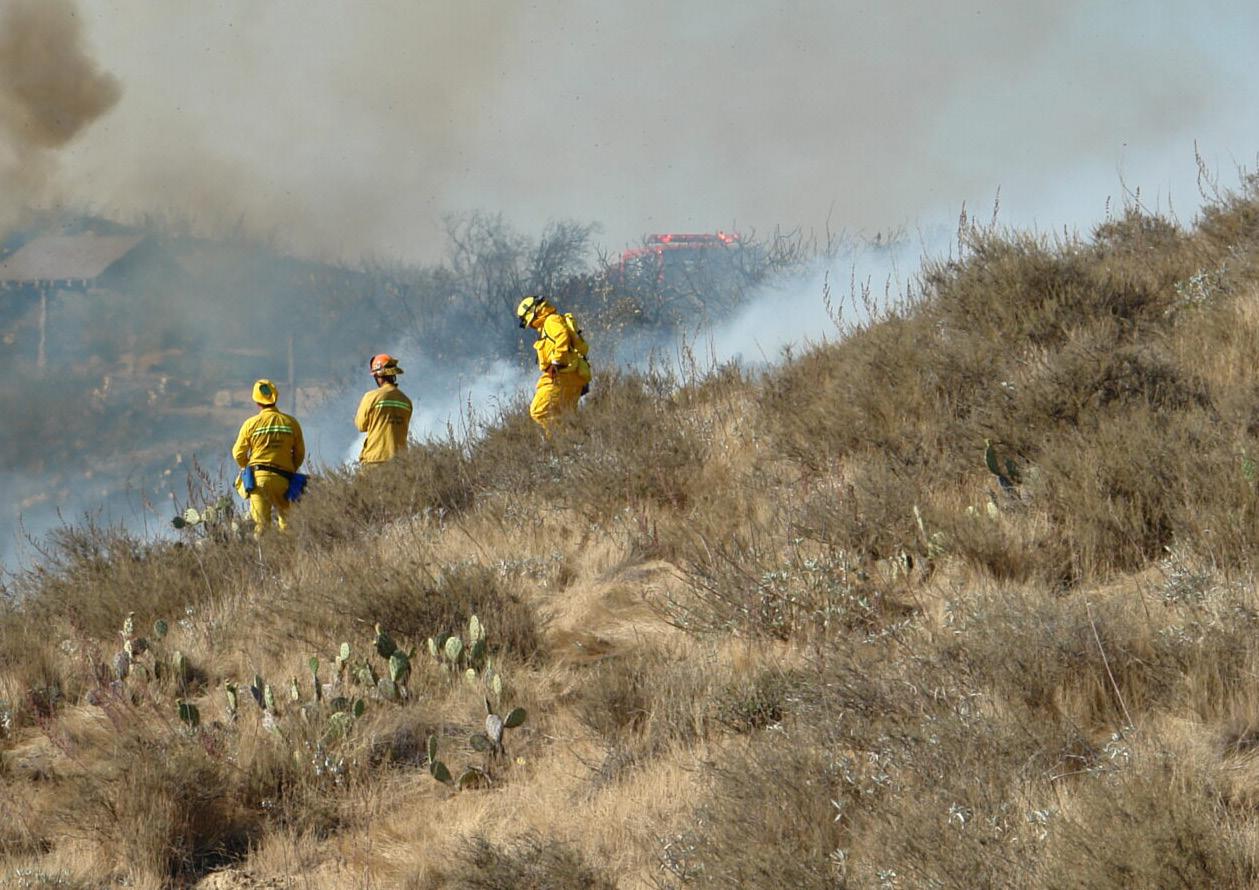
Firefighters monitor the flames during the 2006 Junction Fire on Catalina Island.
The devastating fires across Los Angeles last January are a stark reminder that fire season is every season. Catalina Island knows this reality well. Nearly two decades ago, the Island Fire scorched thousands of acres and came dangerously close to the town of Avalon, an event that continues to shape the Conservancy’s work toward a more wildfire-resistant, climate-resilient Island.
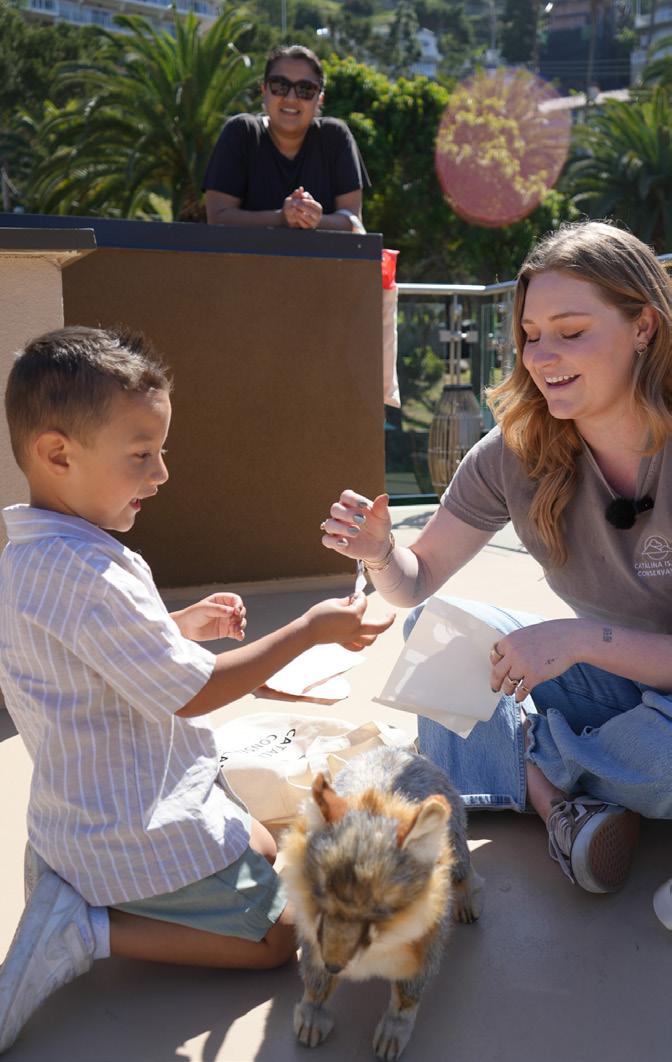
To help prevent future devastation, Catalina Island Conservancy launched a daily fire danger awareness program in August 2025. The campaign is paired with a fox mascot and “Be Fire Free for Fox Sake” slogan inspired by the Island’s endemic Catalina Island fox. Following the program’s launch, the Conservancy invited local students to suggest names for the mascot at community events last year. From those submissions, the name submitted by Julian Murillo Hernandez, 3, of Avalon
was selected as the final name: Isla (ees-la). The name, which also means “island” in Spanish, will help connect the mascot to the Island itself while honoring the Catalina Island fox’s role in the ecosystem.
The campaign aims to turn awareness into action by reducing wildfire risk and the frequency of human-caused fires, protecting Catalina’s wildlands, wildlife and the community of Avalon.
The name “Isla” was submitted by Julian Murillo Hernandez, a 3-year-old Avalon boy, seen here with Conservancy Content Producer Claire Jepsen while his mother, Teresa Hernandez, looks on. The Conservancy recognized him with gifts, including his very own plush fox toy.
A Conservation Symbol Turned Wildfire Ambassador
The Conservancy drew inspiration from one of Catalina’s greatest recovery stories, the Catalina Island fox. Once on the brink of extinction due to canine distemper, the fox made one of the fastest comebacks in Endangered Species Act history thanks to conservation efforts and community support.
That story of resilience connects directly to wildfire. During the 2007 Island Fire, several foxes were treated for burns to their paws, skin and ears. The campaign slogan, “Be Fire Free For Fox Sake,” underscores how closely the fate of the Island’s wildlife and people are tied to fire prevention.
“A wildfire-resilient Catalina is central to our work,” said Pepe Barton, director of communications for Catalina Island Conservancy. “Isla makes fire awareness relatable for families and visitors, and the daily fire rating gives everyone clear next steps to lower wildfire risk on the Island.”
DAILY FIRE DANGER LEVELS
Each morning, the Conservancy posts a fire danger level — Low, Moderate, High or Extreme — based on local weather, fuel moisture and the Island’s Burning Index, which estimates wildfire intensity and difficulty to control. Danger levels are shared on the Conservancy’s website at catalinaconservancy.org/firefree. Fire danger signage is planned for display in highly traveled areas of the 88% of the Island that the Conservancy protects.
“Understanding today’s risk leads to more informed decision making,” said retired Captain Kevin Frye of the Los Angeles County Fire Department. “When people see advertised daily fire danger levels, they are more likely to change their habits to help prevent wildfires that could threaten Island neighborhoods and businesses.”
By pairing ratings with action, the Conservancy aims to make wildfire prevention a routine consideration for residents and visitors.
Be Fire Free For Fox Sake
The campaign spreads the message across Catalina through education programs, signage, posters and digital outreach in newsletters and social media. Residents and visitors are encouraged to take simple steps to prevent the next wildfire:
• No smoking or fireworks, including sparklers, in the Island’s wildlands.
• Avoid flames on windy days and during Red Flag Warnings.
• Secure chains and gear to prevent sparks. Never park on dry grass.
• Use stoves and grills only in permitted areas.
• If you see smoke, call 911 and then notify a Conservancy ranger.
Part of a Larger Resilience Effort
The program complements broader conservation efforts led by the Conservancy through Operation Protect Catalina Island. The initiative focuses on habitat regeneration, native plant restoration and species management to mitigate wildfire risks and protect biodiversity. By restoring native vegetation and removing invasive species such as mule deer, the Conservancy is improving soil stability, retaining more moisture in the landscape and reducing the threat of catastrophic wildfires. ■
For today’s fire danger level, wildfire prevention tips and shareable flyers, please visit catalinaconservancy.org/firefree
Scan the QR code to learn more.
A Lifetime of Adventure and a Legacy of Resilience
“Catalina Island changes you. Experiencing such rare ecosystems firsthand and building lifelong friendships with the Island community gives us a powerful sense of hope and optimism for the future. We’re proud to support the Catalina Island Conservancy and help ensure future generations have the chance to visit, learn about conservation and become the leaders and stewards our natural world so urgently needs.”
Lori and Brian Rennie, Ironwood Society members
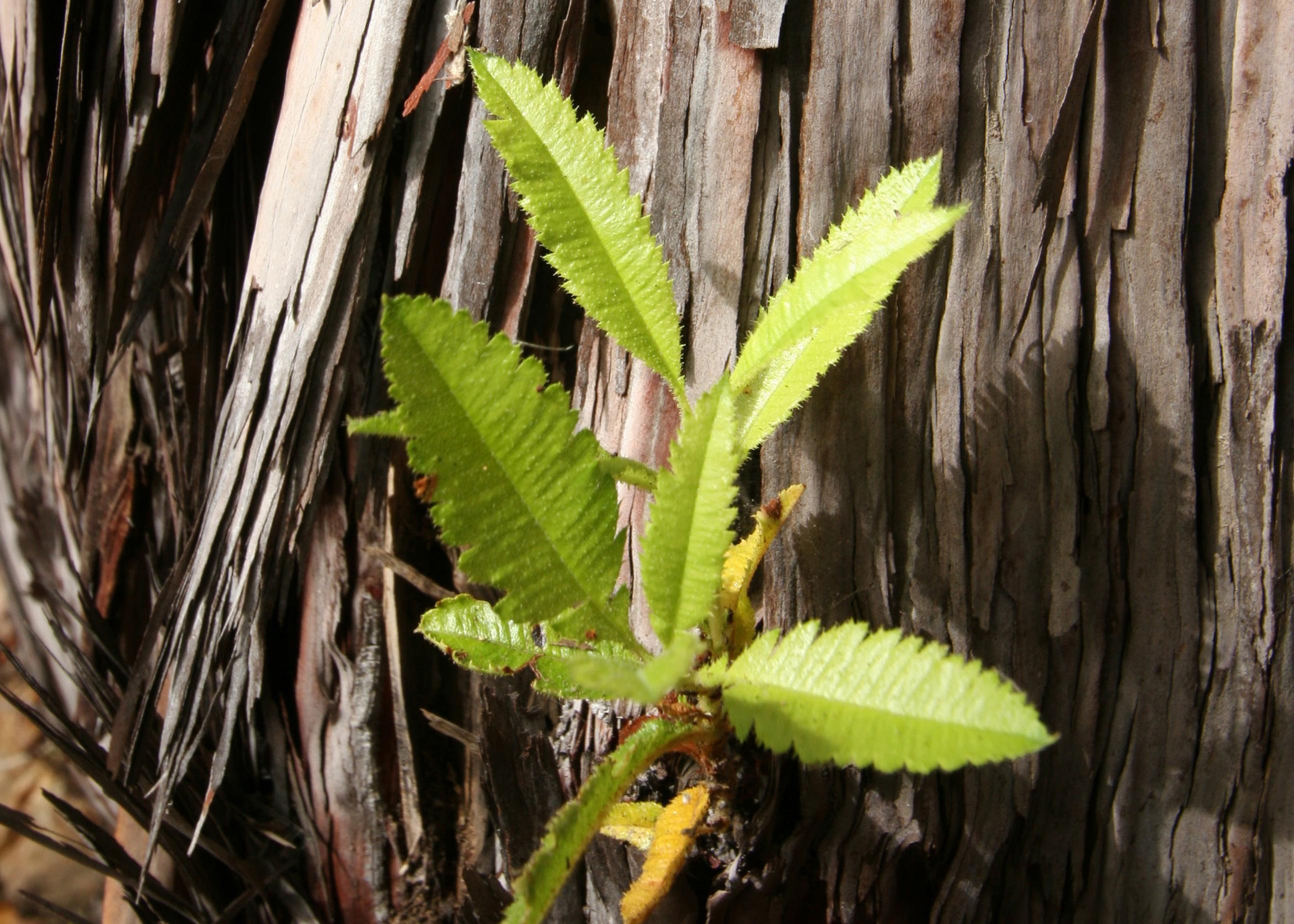
The Ironwood Society is named after the Catalina ironwood (Lyonothamnus floribundus ssp. floribundus). Each grove regenerates through one enduring root system that sprouts new life through many generations.
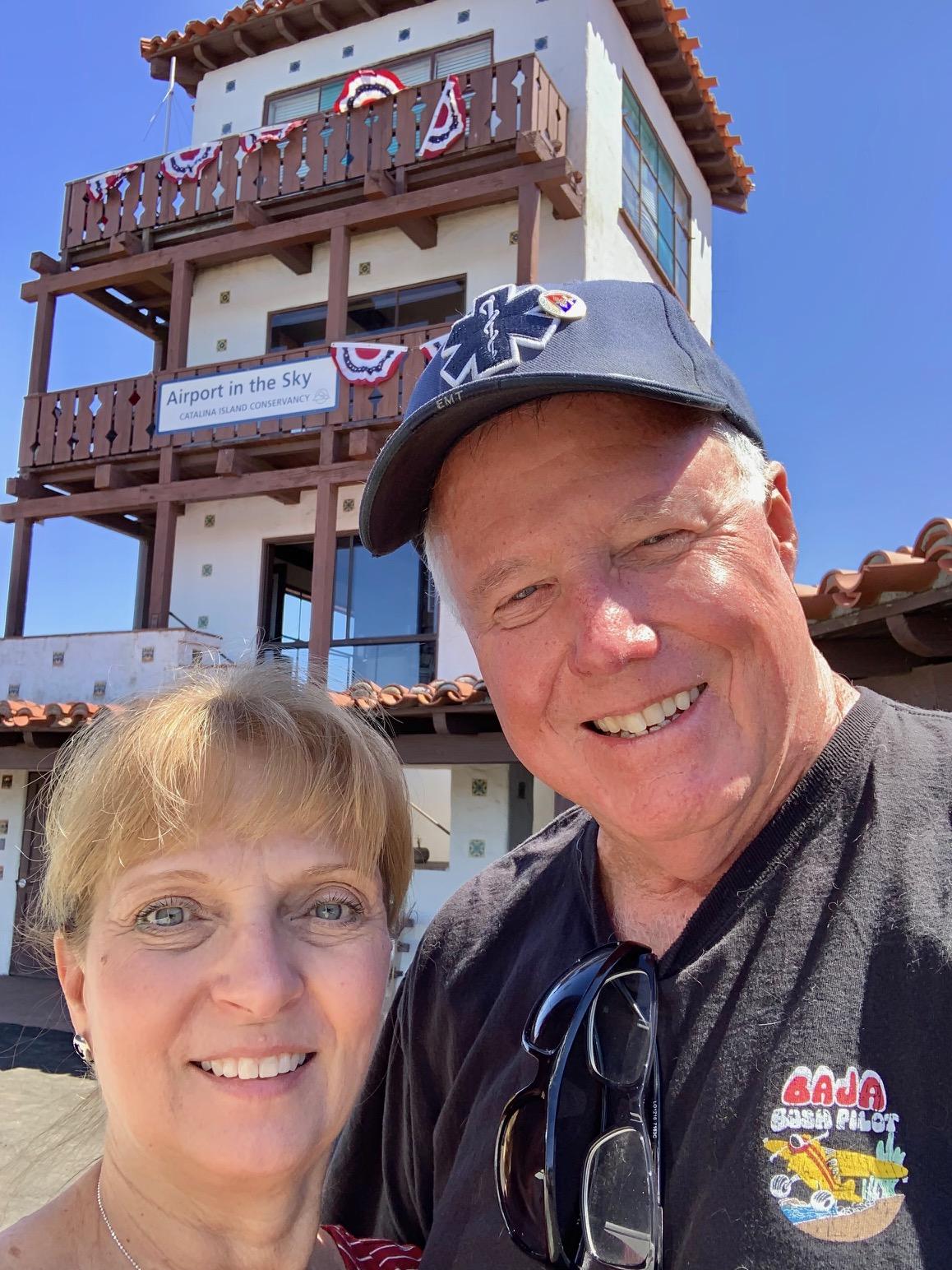
Catalina Island has long been a cherished getaway for outdoor enthusiasts Brian and Lori Rennie from Joshua Tree, California. The couple visits multiple times a year to enjoy its rugged beauty and unique ecology, along with the welcoming community committed to its preservation. Over decades of hiking, exploring and flying into the Airport in the Sky in Brian’s private plane, their connection to Catalina Island has only deepened.
Brian and Lori see preserving Catalina Island as a natural extension of their conservation efforts in their desert home just outside Joshua Tree National Park. For Brian, a lifelong passion for the outdoors, including rock climbing and mountaineering, was forged at an early age through his adventures with Scouting America. His connection to Catalina Island began in the 1970s, when he spent six months at the University of Southern California Marine Lab doing research for his mas-
ter’s degree in marine biology.
Lori, a Chicago native, quickly discovered her own passion for nature after meeting Brian in 1999. She founded a youth outdoor education nonprofit for public school students. This effort was driven by her belief in cultivating the next generation of environmental stewards, a value closely aligned with the Catalina Island Conservancy’s youth programs and education mission.
Brian and Lori chose the Ironwood Society, the Conservancy’s planned giving program, to help ensure a resilient future for this natural wonder. Named for the endemic Catalina ironwood tree (Lyonothamnus floribundus ssp. floribundus), one of the Island’s rarest trees, the Ironwood Society offers several paths to make a difference. Members can choose to make gifts by will or trust, name the Conservancy in their assets, give through an IRA charitable rollover, or support
the Conservancy and generate income through a charitable remainder trust, among many other personalized options.
Each gift helps protect Catalina’s endemic and native species, accelerate conservation science, expand environmental education and create responsible outdoor recreation and cultural experiences.
Learn more about how you can join the Ironwood Society at catalinaconservancy.org/legacy. ■
Scan the QR code to learn more.
As a Catalina Island Conservancy member, you can enjoy unlimited year-round admission to the Wrigley Memorial & Botanic Garden as well as access to special events, hikes, publications, discounts and more. But your membership goes even further with admission to more than 380 gardens across North America through our partnership with the American Horticultural Society.
As a Conservancy member, you help ensure Catalina Island remains resilient against climate change, wildfire and invasive species. Your membership strengthens our mission to protect Catalina’s unique, endemic species and restore Island ecosystems now and into the future.
NEW TEAM MEMBERS
Adam Littlefield Director of Facilities and Infrastructure
The Island’s buildings, roads, trails and vehicles are now under the oversight of Adam Littlefield, the Conservancy’s new director of facilities and infrastructure. Most recently, Littlefield served as executive vice president of operations at Colusa Indian Energy, a power-generation firm, where he directed construction, maintenance, compliance, fleet, facilities and partnerships. His decades of experience include leadership roles at Investment. com, Fello, Zillow Group and Invitation Homes, where he managed national teams and field crews, worked closely with contractors and vendors, and developed processes to keep teams on track and projects running smoothly.
Scott Ammons Director of Recreation
A self-described life-long outdoorsman, Scott Ammons is no stranger to Catalina Island. As the former manager of REI’s outdoor programs and outreach for Southern California, Ammons led recreation trips to the Island for years. His previous roles include outdoor education management and instruction at non-profits like the Boojum Institute for Experiential Education, Chadwick School, Beach Cities Health District and National Outdoor Leadership School (NOLS). He is responsible for managing and championing the Conservancy’s nearly 165 miles of recreational roads and trails and 62 miles of secluded coves for camping, biking, hiking, touring and creation of new recreational opportunities.
Tom Guntrip Director of Business Administration
With a wealth of experience in operations management, strategic planning and risk management, Tom Guntrip steps into the role of director of business administration. Prior to working at the Conservancy, he served as director of transportation services at Southern California Edison, where he led a team of 280 employees, managed a $150 million annual budget and oversaw fleet electrification and safety initiatives that cut incidents by more than 50%. A veteran of the U.S. Army and graduate of West Point, Guntrip brings to the Conservancy expertise in cross-functional leadership and process improvement. He’s an avid outdoorsman with a passion for exploring natural landscapes.
Clark Lee Director of the Executive Office
As director of the executive office, Clark leads operations that directly support the work of the president and CEO while coordinating executive initiatives to ensure business runs smoothly. His proven track record of more than two decades in public policy, civic engagement and executive leadership includes, notably, serving as acting chief of staff in the Biden-Harris Administration at the U.S. Department of Health and Human Services Office for Civil Rights. A licensed attorney in California, Clark also co-founded a public affairs firm and has held senior leadership roles across political, government and nonprofit organizations, including NextGen Climate Action Committee and the Los Angeles League of Conservation Voters. Throughout his career, Clark’s work has helped advance civil rights and privacy law, equity initiatives and interagency collaboration.