CATALINA ISLAND
CONSERVANCY MEMBERSHIP MAGAZINE
SUMMER 2026
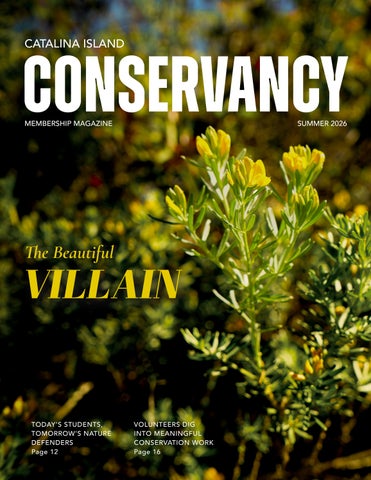
The Beautiful
VILLAIN
TODAY’S STUDENTS, TOMORROW’S NATURE DEFENDERS Page 12
VOLUNTEERS DIG INTO MEANINGFUL CONSERVATION WORK Page 16
EXECUTIVE TEAM David I. Solomon, Interim President and CEO Pepe Barton, Director of Communications Wendy Butts, Interim Chief of Development Adam Finck, Chief of Programs Deborah Honadel, Chief of Human Resources Liz Jensen, Chief Financial Officer Rob Ledebur, Chief of Facilities and Capital Planning MaryBeth Leonard, Senior Executive Coordinator
CONTACT US P.O. Box 2739 Avalon, CA 90704 310-510-2595 320 Golden Shore, Suite 220 Long Beach, CA 90802 562-437-8555 CatalinaConservancy.org Editors Pepe Barton Aja Goare Graphic Design Rebecca Kim
Our mission is to be an exemplary steward of island resources through a balance of conservation, education and recreation.
2
IN THIS ISSUE What it Takes to Protect Catalina
4
Powerful Mission and Love of Outdoors Attracted New Conservancy CFO
6
Catalina Island Shrew Spotted After Years Without a Trace
8
Today’s Students, Tomorrow’s Nature Defenders
12
Trans-Catalina Trek Experience Offers Hike Without the Headache
14
Volunteers Dig into Meaningful Conservation Work
16
The Beautiful Villain: Rescuing Catalina from Flammable, Invasive Plants
18
First Ever Recapture of Sea Bird Offers Insights into Lifestyle
22
Native Plant Restoration Science Enhanced with New Greenhouse
24
Notes from the Field: Updated Island Bird Checklist Guides Birders
26
Level Up to Leadership Circle
28
Member Benefits Expand
30
3
What It Takes to Protect Catalina I
n January, we shared the news that the California Department of Fish and Wildlife approved our restoration management permit, clearing the way for Operation Protect Catalina Island. That approval was years in the making. It also marked a new beginning.
complex operations and large portfolios. I can tell you that few of them compare to the task of keeping a wild island whole. At Catalina’s scale, the ordinary work of stewardship becomes a monumental undertaking, and every member of our team plays a part.
Protecting a place this size is not the result of a single decision. It is daily work, carried out across 42,000 acres by Conservancy teams who go unseen by most visitors. Our staff maintains roads and trails, protects native wildlife and rare plants, cares for the Wrigley Memorial & Botanic Garden, keeps the airport running, helps visitors explore, and maintains housing for employees who live and work here. None of that happens on its own. It takes collaboration, commitment and coordination, every day and through every season.
The Threat on Our Minds
I have spent four decades managing
4
A key part of that work includes reducing the risk of wildfire. CAL FIRE designates Catalina as a Very High Fire Hazard Severity Zone. The Island sits miles from the mainland, limiting how quickly help can reach us when minutes matter. And the ground itself has changed. Invasive annual grasses now dominate 35% of the Island’s ecosystems. These grasses dry out fast, burn easily and
rebound quickly after a fire, crowding out the native plants that can slow flames and hold the soil in place. This is why fire resilience is at the center of our planning. It guides our partnership with Los Angeles County Fire Department and shapes where we clear brush, how we manage vegetation, and which investments we prioritize first. Wildfire prevention sits alongside habitat restoration at the heart of Operation Protect Catalina Island. Removing invasive mule deer and reducing invasive grasses are among the most effective tools we have to lower the Island’s fire risk. We are not doing this alone. This year, our partner, the Conservation Corps of Long Beach, was awarded an $897,000 grant from CAL FIRE to manage flammable invasive vegetation and support the fire breaks that protect Avalon and
surrounding infrastructure. Separately, the San Gabriel and Lower Los Angeles Rivers and Mountains Conservancy awarded more than $2.2 million over two years for wildfire prevention work, including brush clearing along more than 26 miles of trails and roads, invasive plant management, and workforce development for the crews who do the work. These are meaningful investments in keeping this community and the Island safe.
A Cautionary Tale Close to Home To understand what is at stake, we only need to look across the Channel. This past May, a human-caused fire tore across Santa Rosa Island, a neighboring Channel Island. It burned for nearly three weeks
and charred about 29 square miles, close to a third of the Island. What happened there was generations in the making. More than a century of grazing by non-native animals stripped away more than 75% of Santa Rosa’s native vegetation and destroyed a rare cloud forest of oak and pine that had survived on coastal fog. Here is the part that should give us all pause. Even after every non-native grazing animal was removed, the forest did not return on its own. The damage was so severe that large-scale restoration is still required decades later. The fire-prone grasslands that now cover much of Santa Rosa are not natural. They are what invasive animals leave behind, and they are the fuel that allowed this spring’s fire to spread so far and so fast. That is precisely the future Operation
From left to right: Catalina Island Conservancy board member Jeff Ball, an unidentified guest, U.S. Sen. Adam Schiff and Interim Conservancy President and CEO David Solomon pause for a photo during a visit to the Island’s interior.
Protect Catalina Island is working to prevent. We have the science, the permit, and the chance to act before Catalina follows the same path toward becoming an island of invasive grass.
The Path Toward a Global Stage There is good reason to look forward with optimism. In 2028, the world will turn its attention to Southern California for the Olympic and Paralympic Games. The City of Long Beach, just across the Channel and the departure point for the ferry to Catalina, will host more Olympic events than any city except Los Angeles. Millions of visitors will be a short crossing to our shores. It is a remarkable chance to show the world a wild island that has been cared for with intention, and to welcome more people to experience this place. That is the future we are planning and investing in: an Island that is safer, healthier and open to everyone, regardless of background or means. Restoring Catalina does not close it off. It keeps it open.
This is Partnership None of this is simple, and none of it is free. Caring for 42,000 acres takes time, money and an enormous amount of coordination. As a nonprofit, we depend on partnerships to make it possible. Our Leadership Circle, dedicated members, partners and supporters share our vision for this land. Your support helps us clear brush, restore habitat, maintain infrastructure and ensure community safety. Thank you for standing with us. The work ahead is significant, and so is the opportunity. With your partnership, Catalina will be stronger, more resilient and welcoming for the generations who come next. ■ David Solomon serves as interim president and CEO of the Catalina Island Conservancy.
5
M e e t O UR N e w Chie f F in a n c ial Of f icer
Powerful Mission and Love of Outdoors Attracted New Conservancy CFO G
rowing up in Orange County, Elizabeth Jensen remembers how a clear day would allow her to look out across the ocean and see an island amid the open water. The first time she got to visit Catalina, that mythical place across the water, was with a group of girlfriends in high school. “We had a really nice time,” recalled Jensen. “Unfortunately, I got seasick on the ride over.” She was nervous to repeat that part of the experience when she was asked to come to the Island for an interview for the Catalina Island Conservancy’s chief financial officer position. Fortunately, the boat ride and the interview went smoothly. She got the job. “I always tell people you can do finance and accounting anywhere, so why not do it somewhere where there is a mission attached to the organization, where you’re helping people or the planet,” she said. “I really feel that finance and accounting is a huge support to being able to accomplish the mission.”
6
Prior to starting work at the Conservancy in April, Jensen was the chief financial and administrative officer at Goodwill of Orange County. In her three years with the nonprofit, she oversaw the fiscal management across 22 retail locations and e-commerce operations, annual audits and tax reporting, and served as the liaison to the organization’s Finance, Audit and Investment Committees. Earlier, Jensen served as chief financial officer of the Roman Catholic Diocese of Orange, where she stewarded the financial resources of its parishes and schools in support of the strategic plan and mission. She oversaw finance, accounting, investments, internal audit, information technology and risk management. She’s always been passionate about giving back. Through her work with the Conservancy, Jensen said she’s grateful to live out her philanthropic values in a beautiful work environment. “The Island has such beauty,” she said. “The waters are crystal clear, you can see the fish swimming in the water, you can
see the growth of the native plants, witness the bison roaming and see the foxes running around. You feel so far from the mainland. You feel like you’re on vacation. It’s such a special place.” In her first week on the job, Jensen joined a Conservancy Eco Tour that deepened her perspective. “Our naturalists pointed out the Catalina Island mountain mahogany tree, which is here in the garden, and every time I walk past it, I just stop and stare at it,” she said. In her new role, Jensen is focused on supporting this special place by developing a strong operating budget that can successfully carry out the Conservancy’s mission across its three pillars of conservation, education and recreation. “We’re going to take a look at historical trends and forecast future revenues and expenses, to help us develop our strategy,” she said. “The leadership team is looking at the top three to five priorities of the organization, and that’s where we’re going to put our focus. Attaching numbers
Chief Financial Officer Liz Jensen takes a walk through the Wrigley Memorial & Botanic Garden.
to those priorities is going to help us make good business decisions.” And though she’s a number cruncher, the digits she’s staying away from, for now, are 38.5. “I don’t think I’m ready for the Trans-
Catalina Trail,” she said. “I’m not a hiker, I walk. I have a nice 5-mile walking path at home that I walk. But I need to start my hiking era.”
doors. And she will be doing a lot more of that as she works with her team on the Island. ■
When she’s not on the walking path, Jensen said she’s likely out shopping with her three daughters or enjoying time out-
7
The endemic Catalina Island shrew was spotted by a camera trap on the Ben Weston Trail in March 2026.
8
CATALINA ISLAND SHREW
Catalina Island Shrew Spotted After Years Without a TracE I
t had been years since anyone had seen the small fuzzy creature with a long snout on Catalina Island. Scientists had even feared it was extinct until it resurfaced in 2003. But in March, new surveillance footage captured the endemic shrew devouring a meal on the Ben Weston Trail. An adult shrew is less than 4 inches long from the nose to the tip of its tail and weighs under 4 grams. Though it resembles a rat or mouse, it’s not a rodent. Shrews are insectivores and use their long noses to access hidden insects below the dirt. Given their petite size and browngray coloring, the mammal is particularly difficult to spot. Conservancy volunteers had just placed the camera traps near the trail in January. Secured into the bottom of an overturned 5-gallon bucket, the cameras are triggered by a motion sensor.
because scientists don’t want to actually catch the shrew. “Because they’re insectivores, they have a really high metabolism, so they have to eat constantly or they’ll die,” Elder said. “Trapping them is risky because when their population is so low that you think they’re extinct, you can’t afford to accidentally kill any individual.”
The camera surveillance has been ongoing since 2018. But within the first four years of monitoring, only two shrews were seen on camera. The Catalina Island shrew was listed as a Species of Special Concern in 1996 by the California Department of Fish and Wildlife. They have a short lifespan of 12 to 16 months, so environmental shifts such as prolonged drought could have a serious effect on their population size.
Mealworms are used as bait to lure the shrew into the trap, where it is photographed before moving on unharmed.
“We bait the buckets with mealworms because the shrews are attracted to the sound of the mealworms crawling in the bucket,” explained Wildlife Conservation Manager Katie Elder. “We put the mealworms in these metal tea strainers, and the shrews are just circling the tea strainers trying to get at those mealworms.” The bucket has small holes in it that allow the shrew to enter and exit freely. That’s
9
Mealworms and grass are placed in a tea strainer, and the shrews are attracted to the sound.
Due to their elusiveness, the true size of the shrew population is not known. Island researchers refer to its mainland relative for information about its breeding and lifestyle behaviors. “Shrews have been historically found in riparian areas, so near a waterway,” Elder explained. “We’re in Ben Weston where there’s a lovely stream that’s here all year round. February-May is the time of year that their relatives on the mainland are in peak breeding season, which corresponds with their high activity levels that we’ve detected here on the Island. Because we know so little about the shrew, we’re just kind of guessing right now and going off info we know from mainland relatives.” For Patricia McCormick, an Island resident and longtime Conservancy volunteer, plac-
ing camera traps was a great way to learn about Island wildlife while exploring a place she loves. “The tenacity of the people that have to study it and to hope for a single shrew sighting is really impressive, it gives me hope for the future,” she said. “And the shrew – we don’t even know what its impact is on island life, so that’s what I want to be part of, something bigger than myself.” Throughout the experience, McCormick channeled one of her favorite outdoor explorers.
And researchers learned something important, too. Catalina can still count the shrew among its Island residents. “We thought that the shrew was extinct for a long time, but we were able to detect it so now we’re just trying to better understand it and see what we can do to support their population,” said Elder. This monitoring operation was funded in part by the Glanville Grill Foundation. ■
“John Muir, when he would study animals and plants, after he got to know them and draw a picture of them, he’d rise up in berserk ecstasy,” she said. “I think I’m
Follow along as volunteers place camera traps Donate to support our conservation programs catalinaconservancy.org/donate
10
approaching that in learning something new.”
Scan the QR code to watch the video.
ENDEMIC SPECIES
Avalon Hairstreak Butterfly Strymon avalona One of the rarest butterflies in the U.S., the Avalon Hairstreak Butterfly is in the Lycaenidae family. It’s distinguished by its gray wing, which has red or yellow spots near its hindwing. White spots around the wing’s edge are also possible. It’s found in chaparral and feeds on nectar from flowers like laurel sumac (Malosma laurina) and St. Catherine’s lace (Eriogonum giganteum var. giganteum).
11 8
Today’s Students, Tomorrow’s Nature Defenders T
he world that children are growing up in today is filled with distractions, their phone screens grabbing their attention like a powerful magnet. But in Catalina’s remote wildlands, the screens lose their pull. In late spring, a group of young students set their phones aside, disconnected from social media, and instead became fully immersed in nature.
Watershed Conservation Authority’s Community Connection to Wildlands Program takes Southeast Los Angeles County youth on nature-oriented adventure activities to locations beyond the urban environment. The program provides participating students with transportation, accommodations, activities, tents, sleeping bags, meals and other camping essentials.
Through this partnership, the students traveled to the Island to experience the Wrigley Memorial & Botanic Garden, Ben Weston Beach, Black Jack Campground and even went underwater with a submersible excursion. Conservancy staff guided the students, teaching them about the Island’s native and endemic plants and animals.
“This is so important for children because they get a chance to connect to the environment, to explore and get away from all the technology and all of the noise,” said Patrice Morris, a chaperone and counselor at Thurgood Marshall Elementary School.
“I am so proud of the WCA program because students who might not otherwise have the opportunity can sleep under Catalina’s stars, explore its wildlands and experience the Island as a living classroom,” said Director of Education Dr. Jolie Colby. “My hope is that they leave with more than just memories, but a lasting sense of connection, belonging, and responsibility for this remarkable Island.”
“The kids are our future, and it’s really important for us to spark that steward in them,” said Education Program Coordinator Gerardo Luna. “They see how important it is to take care of the plants and just see that there’s a world out there that we need to take care of.”
For many of the children, ages 11 and 12, it was their first time on Catalina, and their first time hiking and camping. The
12
On their hike to Ben Weston Beach, Luna and educator Nicholas Burgess pointed out
See Catalina through Children’s Eyes
Students aged 11 and 12 learn to use binoculars to view Catalina’s coastline. plants along the path. The students were invited to touch and smell various plants and describe the senses they were feeling. “It was amazing today, such a fulfillment, a calm and a peace,” said Morris. “We indulged in listening to the birds and the sounds of the ocean, the waves.” Once they made it to the beach, the group paused for a moment of reflection through writing. “We introduced them to nature journaling, which is something I wish I was introduced to as a kid,” said Luna. “I think it’s a beautiful way to connect and just save that moment. The brain is going to bring all these memories and all the emotions they were feeling on this trip. I view it as grabbing that moment and saving it forever.” For Burgess, who has led the Community Connection to Wildlands Program for the Conservancy for two years, it was a reminder of his early years on the Island. “I remember the people who showed me this Island,” he said. “The first time jumping into the water and swimming over bat rays and getting my mind revamped and hooked on this place. And I hope these memories last for them and in 20 years they remember this day as well. [Leading them] is an honor, a privilege.” After a full day of exploration, the children
The Conservancy turns Catalina’s wildlands into LA County’s largest outdoor classroom, where students of all ages get their first taste of hiking, camping and discovery. Your support makes it possible for students to participate in these enriching programs, regardless of family finances.
gathered at Black Jack Campground near Catalina’s highest peak for a meal and discussion. They shared their favorite parts of the day and what they learned. “I hope they feel like they’ve challenged themselves, pushed themselves and grown,” said Burgess. “They’ve maybe conquered a fear, stepped out of their comfort zone and leave feeling not only a connection to this place, but the confidence to go out hiking and camping. And not only learned about themselves but the Island and the endemic plants and animals, some sort of passion for the outdoors.” As the sun set, they kicked around a soccer ball before everyone’s favorite camp activity: s’mores. The next day brought a cool morning for breakfast at picnic tables before they loaded up to head to town for one last adventure. The students gathered on the green pier and filed onto a submersible, which took them for a partially underwater tour of the shore near Avalon. As they fired fish food from the submersible’s cannons, the children let out excited gasps when hundreds of fish in a variety of colors and sizes gobbled up the food. “You can see it on their faces,” said Luna. “I get excited and I can see that excitement transmitted to them.” After a weekend of new adventures and
Scan the QR code to learn more. Donate to support our education programs catalinaconservancy.org/donate
lasting memories, the children bid farewell to Catalina before riding back to the mainland. It was a trip they won’t soon forget. “Those connections can go deep and they last a lifetime,” said Burgess. “It’s about instilling a belongingness in the wilderness and outdoors, an appreciation for it and a stewardship so they can value it and continue to cherish it and respect it their whole lives.” This experience is supported by the Watershed Conservation Authority’s Community Connection to Wildlands Program, which provides youth from Southeast Los Angeles County with free, immersive outdoor learning opportunities. To date, more than 200 students have participated in this program. ■
13
Trans-Catalina Trek Experience Offers Hike Without the Headache S
cenic views of lush mountainsides, sparkling ocean waves and vast curtains of clouds make the TransCatalina Trail (TCT) a bucket list hike for outdoor enthusiasts around the world. But traveling 38.5 miles on foot while carrying 20 pounds or more of gear on your back can be challenging for even the most seasoned hiker. A new Conservancy-guided experience offers this magical hike without the headache.
14
meals prepared by Conservancy staff and campfire setup at select campsites. Ferry tickets, campsite fees and permits are included in the price. The next trek is scheduled for October. Ammons has hiked the trail a dozen times and recalls that it was the perfect way to spend his 50th birthday.
only found on Catalina. The trail officially opened in 2009 and previously ended at the remote Starlight Beach before it was redirected for a more convenient ending point in Two Harbors. Ammons guided hikers on this trail for years in his previous role at REI, the outdoor retailer, where people from age 18 to 80 trekked across the 38.5 miles.
“We wanted to help recreators enjoy the Trans-Catalina Trail and immerse themselves in Catalina’s beautiful landscape without the added work of carrying their gear, planning each leg or cooking their meals,” said Conservancy Director of Recreation Scott Ammons.
“We hiked in early spring after the winter rains when the Island was lush and green,” he recalled. “My friend and I put together the trip to celebrate both of our 50th birthdays. We hiked the trail in reverse, started with just the two of us then others joined along the way. By the time we ended in Avalon for a celebratory dinner, there were 10.”
“When it’s green in the spring, people say it reminds them of Ireland,” he said. “You get to sleep on beaches, take dips in the ocean, see an incredible natural landscape with endemic plants and animals. It’s a varied landscape, going from the top of the Island with pine trees and mountain mahogany near Black Jack down to palm trees and Catalina liveforever at Little Harbor.”
This newly added experience called the Trans-Catalina Trek includes a gear shuttle service, guided hike with 5-day itinerary,
Whether it’s to celebrate a milestone birthday or to embark on a challenging trek, the TCT offers a unique hiking experience
He said hikers appreciate the fact that there are no predators like mountain lions or bears to worry about. However, it is
MEMBERS Get special discounts on the Trans-Catalina Trek. All Conservancy members receive 10% off. Leadership Circle members receive $500 off. Managing more than 200 miles of recreational trails and roads requires a lot of resources and your support helps us with critical maintenance.
important to note other risks like dehydration and sun exposure, primarily, as well as rattlesnakes and bison encounters. There are many ways to make the experience your own. Hikers typically start the Trans-Catalina Trail in Avalon and finish in Two Harbors, but it can be done in reverse, which offers different views and challenges. It can be completed in as few as three days, but Ammons suggests five. “You need to be in very good shape to do it in three days,” he advised. “If you have some hiking experience, most people can do it in five days and that’s what I prefer. It’s much more enjoyable that way as you have time to experience each of the beautiful campsites and relax a little.” Before embarking on the adventure, whether you’re on a guided hike or not, Trans-Catalina Trail hikers should under-
stand the path’s physical demands and pack thoughtfully. There are stretches of the trail that don’t have water, shade or bathrooms. And the weather can vary significantly depending on the season and time of day. Plus, cell service can be limited or non-existent on much of the trail.
Hit the trail! Register now to join us on a fall trek. Donate to support our recreation programs catalinaconservancy.org/donate
“Making sure you have the right gear, food and water can be the difference in having fun or struggling,” said Ammons. For those who come prepared, hiking the Trans-Catalina Trail is a memorable experience that takes hikers through places few others ever get to see; the soapstone quarry is a sacred Indigenous site, bald eagles nest in tall trees, the endemic Catalina Island fox scampers across steep mountainsides and pelicans dive into the sea to catch lunch. These postcard moments are just a boat ride away. ■
15
Volunteers Dig into Meaningful Conservation Work
Volunteers with University of Nevada, Las Vegas help remove ice plant at White’s Landing.
16 17
21
R
estoring landscapes, improving trails and cleaning up the coastline are just a few of the ongoing needs of Catalina’s wildlands. This work occurs across the 42,000 acres of rugged Island land managed by the Conservancy, which is supported by the help of dedicated volunteers. At a recent Tuesday volunteer day, a dozen students with the University of Nevada, Las Vegas (UNLV) joined in to remove invasive ice plant (Carpobrotus edulis) at White’s Landing. UNLV is a longtime partner of the Conservancy, supporting our work for more than a decade. Working alongside them were five volunteers from the Hun School of Princeton, New Jersey, who traveled thousands of miles from the East Coast to get their hands dirty on Catalina. Ice plant is a highly invasive succulent shrub that’s native to the coast of South Africa. It usually flowers from March through June and grows quickly, taking over coastal scrub, grasslands, chaparral, bluffs, dunes and beaches. “Ice plant takes a community to remove, and what’s worse is that it’s not native,” said Carley, a UNLV volunteer. “The native plants are in cages to be protected and this ice plant took over everything around the beach.” The Conservancy’s volunteer and education departments coordinate all year to ensure a steady stream of volunteers continues working on the landscape while gaining insights, experience and community as they complete meaningful habitat restoration. During this particular assignment, the groups worked four days alongside
Conservancy staff. They not only helped pull ice plant, volunteers also collected seeds of common yarrow from Ben Weston to Cottonwood Beaches, conducted erosion control and pulled weeds at the Wrigley Memorial & Botanic Garden. They also joined Conservancy Trails Manager Kevin Ryan in clearing branches that had encroached on hiking trails. Director of Volunteers and Workforce Development Chris Young kept the energy light, riffing on a song playing in the background. “I’ll meet you in the middle if there’s no ice plant,” he sang to the volunteers. The goal of these outings is not simply hard work – but great fun.
See how volunteers get their hands dirty while weeding at white’s landing
There are countless volunteer opportunities throughout the year, including recurring options like up-potting plants at the Ackerman Native Plant Nursery. The Conservancy also offers a newly introduced All-Inclusive Catalina Service Retreat for a fee, where individuals and groups can perform important conservation work while camping and enjoying prepared meals. ■
Scan the QR code to watch the video.
17
62,876 Genista plants removed in first half of 2026
TH E BEAUT IF U L V IL L A IN
Rescuing Catalina from Flammable, Invasive Plants 18
A
cross many of Catalina Island’s sprawling hillsides and rugged valleys, a striking villain plots a sinister takeover. “Genista linifolia is probably the number one invasive plant we manage on the Island,” said Invasive Plant Manager Aaron Kreisberg. Sunny yellow flowers on a vibrant green stem make the plant, commonly known as flax-leaf broom, pop on the landscape. Those who are naïve to its reputation might regard it as a pretty wildflower, but this plant wreaks havoc on the native ecosystem. “They just take over,” said Kreisberg. “They totally shift the environmental baseline and create a fuel loading hazard. Allowing the genista to establish and spread shifts that baseline and then the unique biodiversity of Catalina is under threat.” Historians believe the plant likely made its
way to the Island through landscaping at St. Catherine Hotel. By 1923, it was already documented in a plant guide called “Flora of Santa Catalina Island (California),” where it was noted that flax-leaf broom had not yet established a foothold on the Island. But it didn’t take long for the golden buds to adapt, and it now dominates the foothills around Avalon Bay. Catching flax-leaf broom before it goes to seed is critical to getting ahead of its spread. “The flowering plant develops a flower, gets pollinated and once pollinated, develops into a seed pod,” explained Kreisberg. “You can see several seed pods here and each has six to eight seeds. They split open when they’re ready and the seeds are ejected several feet away from the plant, so they’re very effective at spreading themselves.” “It’s just an avalanche once one gets started,” said Jane Weichert, CIES invasives manager.
On a windy day in March, uprooting these plants was especially important to prevent the seed pods from being distributed by the wind. Kreisberg, Weichert and their crews hiked through the Middle Cottonwood watershed in search of infestations. They used chainsaws to cut the plant at the base, creating a stump that the crews then dabbed the exposed cut with herbicide that they applied through a bingo dauber. “We used to have little squeeze bottles but they would leak,” explained Weichert. “To reduce excess chemicals, we put it into the little bingo dauber, and you just daub it onto the plant.” Flax-leaf broom is one of about 80 invasive plant species identified by the Conservancy as weeds in need of control and/or eradication across 42,000 acres of Conservancy land. That list includes fennel (Foeniculum vulgare), Harding grass (Phalaris aquatica), black mustard (Brassica nigra), artichoke thistle (Cynara cardunculus) and milk thistle (Silybum marianum). The Conservancy’s Operation Protect Catalina Island is a long-term restoration plan designed to restore the native habitat. Removing invasive plants that disturb soil, water and ecosystem health is a key part of this plan. To support this work, the Conservancy has been partnering with California Institute of Environmental Studies (CIES) to manage the spread of invasive plants, tracking down established populations in places like Toyon Bay, Empire Landing, Haypress and along Middle Ranch Road. “We’ve loved working down here and they keep inviting us back every year,” said Weichert. “So, we’re expanding our crew down here to two more invasive techs, native techs and wildlife tech as well. CIES we love our work on the island, so dedicated to it and we’re happy to see that the Conservancy is just as dedicated as us.” This work is made possible in part thanks to our donors, especially San Gabriel and Lower Los Angeles Rivers and Mountains Conservancy and Natural Resources Conservation Service.
19
And the work continues... Controlling the spread of invasive, flammable plants on Catalina Island is a year-round effort that requires constant monitoring and removal. Reducing wildfire risk and frequency is a key element of the Conservancy’s Operation Protect Catalina Island. That work will now be better supported by significant funding awarded in May by the San Gabriel and Lower Los Angeles Rivers and Mountains Conservancy (RMC) Board. Just over $2.2 million in funding will support fire prevention efforts like invasive plant management and brush clearing. If you set foot upon the Island’s wildlands, you will likely see habitat restoration work like the projects completed through the CIES and Conservancy partnership. CAL FIRE designates Catalina as a Very High Fire Hazard Severity Zone. About 350,000 visitors explore Conservancy lands annually, alongside 4,000 island residents. Yet the Island sits far from mainland disaster resources, with few options for evacuation. The 2007 Island Fire broke out on the hillsides above Avalon and devastated 4,750 acres (about 10% of the Island). The human-caused blaze was driven by wind and fueled by extremely dry vegetation. It’s a harrowing example of how quickly fire can spread and how much damage it can cause. The Conservancy’s landscape restoration strategy is shaped by landscape conditions on Catalina Island, where native vegetation has converted to highly flammable invasive grasses. Those grasses now dominate 35% of ecosystems. Fennel, Harding grass, mustard and flaxleaf broom are among the most flammable.
These plants increase fire frequency, negatively impact native species and result in documented biodiversity loss. Crews will treat invasive plants across 10 acres around Shark Harbor and Cottonwood Canyon, as well as within a 10-acre restoration testing site near Airport in the Sky. The grant supports invasive plant surveys across 1,000 acres in eight priority watersheds including Shark Harbor, Cottonwood Canyon, Coffeepot Canyon, Grand Canyon, Silver Canyon, Rattlesnake Canyon, Hamilton Cove and Avalon Canyon.
This work will advance Operation Protect Catalina Island and will focus on restoring rare island ecosystems that are naturally more resilient to wildfire and climate stress. It will also provide 64 weeks of workforce development opportunities for corpsmembers through Conservation Corps of Long Beach. ■
Crews will also clear and maintain wildfire buffers for 26.25 miles across six trail
Want to help? Join us as a volunteer to make a positive impact. Donate to support our conservation programs catalinaconservancy.org/donate
20
and road segments (Airport Rd. to Black Jack Campsite, Middle Ranch Rd., Airport to Little Harbor via Trans-Catalina Trail, Black Jack to Airport in the Sky via TransCatalina Trail, and Airport Rd., and some other smaller segments).
Scan the QR code to sign up.
NATIVE SPECIES
Fragrant pitcher sage Lepechinia fragrans This evergreen shrub is in the mint family and is identifiable by its vibrant purple flowers and fragrant, fuzzy green leaves. Fragrant pitcher sage (Lepechinia fragrans) attracts hummingbirds, bumblebees, insects, moths and butterflies. It’s endemic to California and native on Catalina Island.
21
First Ever Recapture of SEA BIRD Offers Insights into LIFESTYLE
A
rare seabird not typically seen from the mainland was recently recaptured on Catalina Island through the Conservancy’s bird banding survey program. The recapture of a Scripps’s Murrelet will help conservationists better understand this threatened bird.
This recaptured bird is believed to be at least 3 years old.
Researchers began banding Scripps’s murrelets on the Island in 2000. The birds, which are small with white chests and black backs like a penguin, tend to flock to rocky cliffs on the Island’s East End and Lobster Bay. Conservationists have banded hundreds of birds over the past few decades but March 2026 was the first time they recaptured a bird with an existing leg band. “The recapture tells us it’s site specific,” said Wildlife Conservation Manager Katie Elder. “It was originally caught as an adult in 2024 and came back after two years to the exact same spot. So, it’s at least three years old. The bird was on the water with a mate both times.” The birds are threatened due to their extremely limited nesting range, vulnerability to introduced predators on breeding islands, and risk from oil spills in their narrow habitat range, according to the National Park Service. The work was completed with longstanding partners from California Institute of Environmental Studies, Jon Dachenhause and Darrell Whitworth. When a seabird returns to the same area, it can indicate that it is using the location to nest year after year.
22
“The adults began showing up in March and we saw our first eggs in April this year,” said Elder. “We’re hoping to further understand what impacts their nest success because that’s crucial to their existence. It’s the life stage when both the adults and chicks are most vulnerable.” Scripps’s murrelets typically lay two eggs, Elder said. They lay one and leave it unin-
cubated, then once the second egg is laid, the bird lays on both with the goal that they will hatch at the same time. “The chicks are born ready to go. Once they hatch, they jump straight into the water within one to two days,” said Elder. “Their nests aren’t like a typical bird nest. There’s no nest building – they find a spot in a rock wall and crawl in.”
Facilities staff created this cave-like structure to protect the nest from other birds.
To support their nest success, the conservation team worked with facilities staff to create a safe nesting area that wouldn’t be disturbed by other birds. Facilities Manager Josh Olsen had the idea to create a cave-like enclosure for the birds. “It’s like a cube with the top removed, a hollowed out interior and a little doorway in the wall of the cube,” explained Olsen. He made a wooden form and filled it with expansion foam. Once the foam cured, he mixed stucco and attached it to the foam to give the structure weight.
“Once it’s placed, they add some rocks on it to create a cave environment,” said Olsen. This innovation has proven successful and the Scripps’s murrelets are regularly using the enclosures to nest. That makes it easier for conservation staff to locate the birds and survey their health and behavior. For Olsen, creative thinking that makes positive impact is the reason he loves his work.
these kinds of things. I like problem solving. Working on the Island isn’t usually as straightforward as facilities work elsewhere, so it’s always interesting.” Of interest to Conservationists is how these birds migrate and breed, and how those behaviors are affected by climate variables. Recapturing this bird is the first step to understanding the species. ■
“I’m fourth generation on the Island,” he said. “One of the reasons I chose to work for the Conservancy is to help with
Watch a fledgling prepare to leave the nest
Scan the QR code to watch the video.
23
Native Plant Restoration Science Enhanced with New Greenhouse
24
A
new greenhouse at the Ackerman Native Plant Nursery will help acclimate native and rare plants as Conservancy staff transition them to the conditions of Catalina’s wildlands. This state-of-the-art greenhouse is the biggest improvement to the facility since it was built in 1999.
and clean the water as it percolates and moves through the nursery. The water drips down to the garden below, watering thirsty plants like the scarlet monkey flower and stream orchid, native plants on Catalina. The greenhouse will also assist in some fog capture, which feeds into the precipitation garden, according to Alison.
Construction of the 1,440-square-foot structure took place this spring over the course of 13 days. It replaces a simple shade house structure that the native plants team affectionately called “Baby House,” because it’s where seedlings got their start. The greenhouse can hold up to 8,000 small plants but will likely house between 2,000-4,000 at a time.
The precipitation garden, fog harvesting materials and bioswales (a naturally engineered drainage that mimics a creek or stream), are all emulating the natural hydrologic cycle on Catalina. They’re useful as an educational tool as much as a conservation garden. These features help create a more closely controlled environment for delicate young plants.
“We’re using it to start baby plants but it’s essential for doing tissue culture on plants like our rare Catalina Island mahogany and ironwoods,” said Native Plants Manager Kevin Alison. “Conditions won’t get too cold, too hot or too dry and it’s protected from elements like wind. We do get near frost in Middle Canyon. It doesn’t stay long but it can harm baby plants.”
“Plants coming from the lab are really sensitive,” said Alison. “They don’t have that thicker waxy cuticle layer with strong stems and leaves. Too much sun, wind and moisture could kill off the plants. They need to be acclimatized or hardened off, which slowly transitions them to a more natural setting.”
The evaporative cooler, also known as a swamp cooler, acts as a low-tech air conditioner. Water is fed into the system and drips down the corrugated wall. Air is pulled into it by exhaust fans and as air goes through with dripping water, evaporation occurs and creates a cool down, as well as increased humidity. If it gets too hot, a motor will automatically open sections in the roof for heat to escape.
The Catalina Island mountain mahogany (Cercocarpus traskiae) and Catalina ironwood (Lyonothamnus floribundus subsp. floribundus) are endemic, meaning they’re only found on Catalina Island. Just six pure mahogany are known to exist and under 150 ironwood groves remain. Alison and his team have been trying various approaches like cloning (making a genetic copy of a plant by growing a new plant from its cells or tissue), hydroponics (a method of growing plants using a water-based mineral nutrient solution instead of soil), air layering (a propagation technique that encourages a branch to grow roots while still attached to the parent plant) and other innovative strategies to prevent both species from dying out.
Outside the new greenhouse, a precipitation garden uses plants to stabilize, utilize
“The seeds and the baby plants are hope,” explained Alison. “It’s hope for the future
Inside the greenhouse, an evaporative cooler regulates internal temperature and humidity. And a convertible roof opens and closes in response to temperature shifts.
learn about the innovative science THAT helps preserve these precious plants.
The entrance to the greenhouse with its ventilation roof open. Above: Seedlings are “hardened” to be more resilient in a wild setting.
and our efforts to build and set this environment up for success. It is an investment in that future and the future of Catalina. We can take action to protect this Island. This is a major tool to prevent extinction.” By having this new structure, the Conservancy can collect seeds and replicate different ecosystems around the Island. It’s a tool, Alison said, in helping restore native and endemic species on Catalina as part of Operation Protect Catalina Island. Construction of the new greenhouse was made possible in part thanks to the support of the Renton Family. ■
Scan the QR code to watch the video.
Donate to support our conservation programs catalinaconservancy.org/donate
25
ld
Notes from the Fie
New Island Bird Checklist Guides Birders de
By Laura Vandezan
ating place to Catalina is a fascin n vironment. Birding ca en l ra tu na r ei th in s often-overlooked an to in e observe bird ps im gl a us s ve ral land landscape and gi erses me in the natu m connect us with the Is im it w ho is re he ost about birding e and world. What I love m s both a sense of peac te ea cr It e. lif ay yd e stress of ever gger than myself. bi ng hi et world and removes th m so of rt pa el e time and helps me fe excitement at the sam the health, so documenting s it d an m te ys os ec e t deal about th en “underbirded,” be ly al ic Birds can tell us a grea or st hi s ha d ry important. The Islan ing the Island. Every sit vi species found here is ve or on g in liv s rd m, ited records of the bi ents of the ecosyste meaning we have lim em el y ke of g in nd clearer understa observation builds a sights. providing valuable in n. ecting that informatio ll co in le ro t an rt po those ientists play an im Today, community sc ogy’s eBird app, I know ol th ni Or of b La l el rn ings into the Co ed by researchers us be ill When I enter my sight w at th se ba ta ribute to a growing da . observations will cont of this collective effort rt pa am I at th ve lo I ture. and birders into the fu scovered a cerulean di I , ol ho Sc on al Av le I was teaching at door. It was the first m oo In October 2022, whi sr as cl y m om fr of cerulea) just 10 feet , creating a great deal warbler (Setophaga ty un Co s le ge An s Lo is species in all of were many other e er th , recorded sighting of th nd ke ee w e m sa ing community. That island before. This e th on excitement in the bird d te en m cu do d ecies that had not been to make an unplanne s sightings of unique sp rd bi ng ti ra ig m ed nditions that caus was due to weather co . pit-stop on the Island
26
When I first started getting serious about birding in 2020, I picked up a free checklist to guide my observations. That checklist was made in 2015, and while it was very helpful, it was outdated. Some species listed as common were no longer regularly seen, and several recently observed species weren’t included. We are excited to release a new checklist featuring 318 species, including 15 species more recently spotted on the Island. This checklist also shows the time of year and relative rarity of species recorded on the island. The “accidentals” section refers to birds that are not typically expected here
but have appeared in the past. That unpredictability is one of the most exciting parts of birding — there is always a surprise or two. Catalina has become a destination for birders because of these unusual and exciting bird sightings. We also have island endemics and unique species that makes the Island especially interesting for bird study. The spotted dove (Spilopelia chinensis), for example, is an introduced species whose native range is India and Asia. While it was once commonly seen throughout Los Angeles County, Catalina is now one of the only reliable places to observe them in the entire United States.
Along with the new bird checklist, the Conservancy offers bird excursions and conducts bird surveys to document species across different locations over time. We hope this new checklist makes it easier for more people to explore the Island’s wildlands, connect with nature and participate as community scientists. Whether you are an experienced birder or simply curious about the birds around you, every observation helps tell the story of Catalina’s unique ecosystem. The next exciting discovery could be waiting just around the corner — and it might be yours to find.
Pick up your free bird checklist at the Conservancy’s Trailhead Visitor Center in Avalon. 27
LEVEL UP TO LEADERSHIP CIRCLE
Leadership Circle members arrive by private boat to White’s Landing for the luncheon.
28
Increase your giving by Sept. 7 to join our next event on Sept. 10 at the Natural History Museum of LA County featuring a preview of their Channel Islands exhibit.
A
private boat ride from Avalon to White’s Landing ushered in Leadership Circle members to a beautiful, coastal lunch with Conservancy leaders and fellow supporters. This exclusive experience in June was just one of many special events curated for members. Dozens of supporters gathered on the beach for a prepared lunch and presentation by Interim President and CEO David Solomon, Chief of Programs Adam Finck and Director of Recreation Scott Ammons. They shared insights into the organization’s goals, exciting programs and new recreation opportunities. Seated on the beach with waves crashing nearby and views of the sprawling landscape, it was an idyllic setting for a meal and conversation.
Leadership Circle is a dynamic community of stewards, adventurers and advocates for the protection of Catalina Island who give annually and generously. The support of this top group of donors strengthens the Conservancy’s commitment to being a world-class model for balanced land conservation solutions, a premier recreation and learning destination, and a leading example of how to build successful cultural partnerships.
Scan the QR code to learn more.
Want to increase your impact? Level up to Leadership Circle. Your partnership and commitment make it possible for the Conservancy to expand access to meaningful outdoor experiences while advancing our mission of conservation, education and recreation. ■
29
MEMBER BENEFITs EXPAND
Conservancy Eco Tour Discounts Go beyond Avalon. Explore the Island on the Official Tour of Catalina’s Wildlands.
Did you know members get special discounts?
Led by expert naturalists, this open-air adventure takes you into rugged interior landscapes, scenic overlooks and rare habitats that most visitors never experience.
We recently expanded our member benefits to include offers for supporters at every level.
Along the way, you may see Catalina Island foxes, bald eagles, bison, native plants, sweeping canyons and unforgettable views of the Island’s interior and coastline. Your guide will share the stories behind the land — from Catalina’s natural history to the restoration work helping protect this Island.
30
Friend - $5 off* Explorer - $10 off* Adventurer - $15 off* Conservationist - $25 off* Discoverer - $50 off* Naturalist - $100 off* Islander (locals only) – 2-5 free seats* *Once per year
NEW STAFF Liz Jensen Chief Financial Officer With extensive experience in nonprofit finance, Liz brings to the Conservancy a strong track record of finance management and strategy. Her prior work at Goodwill of Orange County and Roman Catholic Diocese of Orange included oversight of annual audits and tax reporting, stewardship of financial resources, supervision of information technology and risk management. Previously named Chief Financial Officer of the Year in 2023 by the Orange County Business Journal, she is a member of the American Institute of Certified Public Accountants and the California Society of Certified Public Accountants. She is a certified public accountant and holds a bachelor’s degree in accounting from the University of Notre Dame. Liz also sits on the Accounting Department Advisory Board for Notre Dame.
UPCOMING EVENTS Sept. 10
Every Tuesday
Every Thursday
Leadership Circle Natural History Museum
Volunteer at Ackerman Native Plant Nursery
Restore and Explore
Sept. 19
Sept. 24
Oct. 4
Membership Plein Air Paint & Sip
Naturalist 2 Training
Foxtober Pop-Up Beachwood Brewing in Long Beach
For more information about these events, visit catalinaconservancy.org/events or call 562-437-8555
31
P.O. Box 2739 Avalon, CA 90704
Conservancy Benefactor Members Alison Wrigley Rusack, Chair • Trevor Fetter • Anthony Michaels, Ph.D. • Maria Pellegrini, Ph.D. • Austin Rusack
Conservancy Board of Directors Maureen Ramer, Ed.D., Chair • Shaun Tucker, Vice Chair • Jeff Ball • Randy Boelsems • Robert Breech Victoria Seaver Dean • Christy Murphy • Blanny Avalon Hagenah • Thomas Hathaway • Geraldine Knatz, Ph.D. Patrick Meegan • Calen Offield • Troy Pilalas • Madeleine Todd For more information, visit catalinaconservancy.org or call 562-437-8555