
Castle Howard Tree and Shrub Nursery Brochure 2025

Page 1


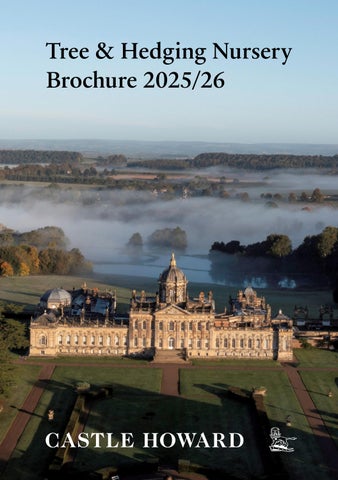
Tree & Hedging Nursery Brochure 2025/26

Welcome

Welcome to the Castle Howard Tree & Shrub Nursery catalogue for the 2025/26 season.

The nursery has been growing high quality trees and shrubs for over 50 years. Where possible, we gather seed on the Estate itself and once again, we are pleased to offer locally sourced hardwoods ideal for new plantations.

Demand for all species is high this year and, in some cases, stocks are limited so we would recommend ordering early to avoid disappointment.

Full details of age, provenance and country of growth for the trees listed in this catalogue are available on request.

The nursery is open from 7.30am to 4.00pm Monday to Friday for pre-booked orders from 1st November 2025. Please telephone or email us for a quotation, more information or advice.

For orders & enquiries call: 01653 648646

Email: Chris Wanless, Forestry Administrator cwanless@castlehoward.co.uk

Transplant & Undercut Seedlings

Common Alder

(Alnus glutinosa)

The Common Alder, Alnus glutinosa, is a mediumsized deciduous tree native to most of Europe and parts of western Asia and northern Africa. It is widely recognized for its ecological value and its ability to thrive in moist, challenging conditions.

Height: typically grows to a height of 15 to 25 metres (50 to 80 feet), though in ideal conditions it can occasionally reach up to 30 metres.

Bird Cherry (Prunus padus)

The Bird Cherry, Prunus padus, is a deciduous tree or large shrub native to much of Europe and northern Asia. Known for its fragrant spring flowers and ecological value, it is often found growing in woodlands, riverbanks, and hedgerows.

Height: typically reaches 8 to 15 metres (26 to 50 feet) in height, sometimes taller in optimal conditions.

Image: Alamy / Steve Holroyd

Wild Crab Apple (Malus sylvestris)

The Wild Crab Apple, Malus sylvestris, is a small deciduous tree native to the woodlands and hedgerows of Europe, including the British Isles. It is a charming species admired for its spring blossoms, wildlife value, and role as an ancestor of cultivated apples.

Height: typically grows to a height of 4 to 10 metres (13 to 33 feet), occasionally taller under ideal conditions.

Downy Birch (Betula pubescens)

The Downy Birch, Betula pubescens, is a mediumsized deciduous tree native to much of Europe and parts of Asia. It is commonly found in wetter, cooler habitats than its close relative, the Silver Birch, and is well adapted to challenging soils and northern climates.

Height: typically grows to a height of 10 to 20 metres (33 to 66 feet), occasionally taller in ideal conditions.

Oak

(Quercus robur)

The English Oak, Quercus robur, also known as Pedunculate Oak, is one of the most iconic and long-lived deciduous trees in Europe. Revered for its immense ecological value, impressive stature, and cultural significance, it is a dominant species in many ancient woodlands, parklands, and hedgerows.

Height: typically grows to 20 to 40 metres (66 to 130 feet) tall. Mature specimens can have a spread nearly as wide as their height.

Image: Alamy / Ernie Janes

Field Maple (Acer campestre)

The Field Maple, Acer campestre, is the UK’s only native maple species. This small to medium-sized deciduous tree is valued for its compact form, attractive foliage, and tolerance of a wide range of conditions. It is commonly found in hedgerows, woodlands, and field margins, often as part of mixed native planting schemes.

Height: typically reaches 8 to 15 metres (26 to 50 feet) tall, occasionally taller in optimal conditions.

Goat Willow (Salix caprea)

The Goat Willow, Salix caprea, also known as Pussy Willow, is a hardy, fast-growing deciduous tree or large shrub native to Europe and western Asia. It is widely recognised for its early spring catkins, tolerance of poor soils, and high value to wildlife.

Height: typically grows to 6 to 10 metres (20 to 33 feet), though it can occasionally reach up to 15 metres. Often forms a bushy, multi-stemmed shrub in exposed or unmanaged areas.

Image: Alamy / Florapix

Grey Willow (Salix cinerea)

The Grey Willow, Salix cinerea, also known as Grey Sallow, is a hardy, moisture-loving deciduous shrub or small tree native to the UK and much of Europe. It is commonly found in damp or boggy ground and is a key component of wet woodland and scrub habitats.

Height: typically grows to 4 to 10 metres (13 to 33 feet), usually remaining a large, multi-stemmed shrub or small tree in most conditions.

Hornbeam

(Carpinus betulus)

The Hornbeam, Carpinus betulus, is a native deciduous tree widespread across Europe, including the UK, prized for its hard timber, dense foliage, and adaptability. It is commonly found in mixed woodlands, hedgerows, and parklands and is often used for formal hedging and topiary due to its tolerance of pruning.

Height: typically grows to 15 to 25 metres (50 to 82 feet), occasionally reaching up to 30 metres in ideal conditions.

Image: Wikimedia Commons / Joanna Boisse

Norway Maple (Acer platanoides)

The Norway Maple, Acer platanoides, is a large deciduous tree native to northern and eastern Europe. It is widely planted as an ornamental and street tree due to its fast growth, broad canopy, and striking autumn color. However, it can be invasive in some areas outside its native range.

Height: typically grows to 20 to 30 metres (65 to 98 feet) tall, with a broad, spreading crown.

Pin Oak

(Quercus palustris)

The Pin Oak, Quercus palustris, is a medium to large deciduous tree native to eastern and central North America. It is popular in landscaping for its distinctive shape, fast growth, and striking autumn foliage. Although not native to the UK, it is often planted in parks and large gardens.

Height: typically grows to 18 to 25 metres (60 to 82 feet), sometimes reaching up to 30 metres.

Image: Alamy / M Schuppich

Red Norway Maple (Acer platanoides)

The Red Norway Maple is a cultivated variety of the Norway Maple (Acer platanoides), prized for its dramatic deep red to purple foliage throughout the growing season. It is widely used as an ornamental shade tree in parks and large gardens due to its colourful leaves and stately form.

Height: typically grows to 15 to 20 metres (50 to 65 feet) tall, with a broad, rounded canopy.

Rowan (Sorbus aucuparia)

The Rowan, Sorbus aucuparia, also known as Mountain Ash, is a small, graceful deciduous tree native to the UK and much of Europe. Renowned for its feathery foliage, creamy spring flowers, and bright red berries, it is a favourite in both wild and cultivated landscapes.

Height: typically grows to 8 to 15 metres (26 to 50 feet), with a light, upright form.

Image: Alamy / Clement Philippe

Sessile Oak (Quercus petraea)

The Sessile Oak, Quercus petraea, is a majestic deciduous tree native to the UK and much of western and central Europe. It is one of the two native British oaks (alongside English Oak), and is typically found in upland, acidic soils. Known for its straight trunk and impressive longevity, it plays a vital role in ancient woodlands and biodiversity.

Height: typically reaches 20 to 30 metres (65 to 100 feet) in height, with some specimens growing even taller in optimal conditions.

Silver Birch

(Betula pendula)

The Silver Birch, Betula pendula, is a graceful, medium-sized deciduous tree native to the UK and much of Europe. It is instantly recognisable for its striking white bark, light canopy, and elegant, drooping branches. Often referred to as a pioneer species, it readily colonises open ground and plays an important ecological role in woodland regeneration.

Height: typically grows to 15 to 25 metres (50 to 82 feet), occasionally taller in optimal conditions.

Small-leaved Lime (Tilia cordata)

The Small-leaved Lime, Tilia cordata, is a tall, broad-crowned deciduous tree native to the UK and much of Europe. A characteristic species of ancient woodlands and historically significant in traditional coppice systems, it is also valued in parks and avenues for its elegant form and fragrant flowers.

Height: typically grows to 20 to 30 metres (65 to 100 feet), sometimes taller in ideal woodland conditions.

Sweet Chestnut

(Castanea sativa)

The Sweet Chestnut, Castanea sativa, is a large, long-lived deciduous tree introduced to the UK from southern Europe, likely by the Romans. Though not native, it has become naturalised in many ancient woodlands and is widely valued for its edible nuts, durable timber, and majestic form.

Height: typically grows to 20 to 35 metres (65 to 115 feet), with a broad crown and impressive girth in maturity.

Sycamore (Acer pseudoplatanus)

The Sycamore, Acer pseudoplatanus, is a large, vigorous deciduous tree that is naturalised in the UK, having been introduced from central and southern Europe during the Middle Ages. Though not native, it is now widespread and valued for its robust growth, resilience, and attractive foliage, though it can become invasive in some settings.

Height: typically grows to 20 to 35 metres (65 to 115 feet), forming a tall, broad-crowned tree.

Wild Cherry (Prunus avium)

The Wild Cherry, Prunus avium, is a striking deciduous tree native to the UK and much of Europe. Known for its showy spring blossom, shiny bark, and rich autumn colour, it brings strong ornamental and ecological value to both natural and planted landscapes.

Height: typically grows to 15 to 25 metres (50 to 82 feet), with a broad crown and straight trunk.

Conifers

Douglas Fir (Pseudotsuga menziesii)

The Douglas Fir, Pseudotsuga menziesii, is a large, fast-growing conifer native to western North America, but widely planted in the UK for timber production, shelterbelts, and landscape value. Known for its towering height, straight trunk, and soft, fragrant needles, it is one of the most important commercial forestry species in Britain.

Height: typically grows to 40 to 55 metres (130 to 180 feet) in the UK, occasionally taller in ideal conditions. In its native range, it can exceed 90 metres.

Grand Fir

(Abies grandis)

The Grand Fir, Abies grandis, is a tall, fast-growing evergreen conifer native to the Pacific Northwest of North America. Introduced to the UK in the 19th century, it is valued for its impressive height, soft, aromatic foliage, and ornamental appearance in parks, large gardens, and some forestry plantations.

Height: in the UK, it typically grows to 40 to 55 metres (130 to 180 feet), occasionally taller in optimal conditions, making it one of the tallest firs grown in Britain.

Lawson’s Cypress (Chamaecyparis lawsoniana)

Lawson’s Cypress, Chamaecyparis lawsoniana, is a medium to large evergreen conifer originally from the Pacific coast of North America. Introduced to the UK in the 1850s, it is widely planted as an ornamental tree, in hedging, and occasionally in forestry plantations. Known for its elegant form and attractive foliage, it is available in numerous cultivated varieties of varying shape and colour.

Height: typically grows to 20 to 40 metres (65 to 130 feet) in ideal conditions, though many garden cultivars remain much smaller.

Nordmann Fir (Abies nordmanniana)

The Nordmann Fir, Abies nordmanniana, is a large, elegant evergreen conifer native to the mountains surrounding the Black Sea in the Caucasus region. It is widely grown in the UK as a popular Christmas tree and for ornamental planting due to its lustrous dark green foliage and symmetrical conical shape. Height: typically grows to 30 to 50 metres (98 to 164 feet) in mature woodland settings, with exceptional specimens reaching even taller heights.

Norway Spruce (Picea abies)

The Norway Spruce, Picea abies, is a large, fastgrowing evergreen conifer native to northern and central Europe. It is widely planted in the UK for timber production, Christmas trees, and as an ornamental tree in parks and gardens. Known for its classic conical shape and graceful drooping branches, it is one of the most common spruce species in Europe.

Height: typically grows to 35 to 50 metres (115 to 165 feet), occasionally taller in ideal conditions.

Oriental Spruce (Picea orientalis)

The Oriental Spruce, Picea orientalis, is a medium to large evergreen conifer native to the Caucasus region and northeastern Turkey. It is occasionally planted in the UK as an ornamental tree and for forestry trials due to its dense foliage, graceful form, and tolerance of wet conditions.

Height: typically grows to 20 to 30 metres (65 to 98 feet) in the UK, with potential to reach greater heights in its native range.

Scots Pine

(Pinus sylvestris)

The Scots Pine, Pinus sylvestris, is a native evergreen conifer widely distributed across the UK and northern Europe. Renowned for its distinctive orange-red bark, tall straight trunk, and hardy nature, it is a key species in native woodlands and commercial forestry alike.

Height: typically grows to 20 to 35 metres (65 to 115 feet), with some specimens reaching up to 45 metres.

Serbian Spruce (Picea omorika)

The Serbian Spruce, Picea omorika, is a slender, elegant evergreen conifer native to the mountainous regions of the Balkans, particularly Serbia and Bosnia. It is valued in the UK as an ornamental tree for its graceful, narrow conical form and distinctive dark green foliage with silvery undersides.

Height: typically grows to 20 to 30 metres (65 to 98 feet) in cultivation, occasionally reaching up to 40 metres in native habitats.

Sitka Spruce (Picea sitchensis)

The Sitka Spruce, Picea sitchensis, is a large, fastgrowing evergreen conifer native to the west coast of North America. It is the most widely planted conifer in the UK for commercial forestry due to its rapid growth and valuable timber. Sitka Spruce is also used in large parks and estates as a shelterbelt or specimen tree.

Height: typically grows to 35 to 70 metres (115 to 230 feet) in ideal conditions, making it one of the tallest conifers grown in the UK.

Western Hemlock

(Tsuga heterophylla)

The Western Hemlock, Tsuga heterophylla, is a large evergreen conifer native to the Pacific Northwest of North America. It is occasionally grown in the UK for ornamental planting and timber production, valued for its graceful, drooping branchlets and soft, feathery foliage.

Height: typically grows to 30 to 60 meters (98 to 197 feet) in its native range; in the UK, it usually reaches 20 to 35 metres (65 to 115 feet).

Image: Alamy / Eric Agar

Hedging Plants

Hawthorn

(Crataegus monogyna)

The Hawthorn, Crataegus monogyna, is a small deciduous tree or large shrub native to the UK and much of Europe. Known for its dense, thorny branches, attractive white spring flowers, and bright red berries, it is commonly used in hedgerows, wildlife planting, and traditional countryside landscapes.

Height: typically grows to 5 to 10 metres (16 to 33 feet), though it can occasionally reach up to 15 metres.

Image: Alamy / Frank Teigler

Beech

(Fagus sylvatica)

The Beech, Fagus sylvatica, is a large, majestic deciduous tree native to much of Europe and widely naturalised in the UK. It is prized for its smooth, silvery-grey bark, dense canopy, and vibrant autumn foliage, commonly found in ancient woodlands, parks, estates and hedgerows.

Height: typically grows to 30 to 40 metres (98 to 131 feet), with some specimens reaching over 45 metres.

Image: Alamy / Konrad Wothe

Copper Beech (Fagus

sylvatica ‘Purpurea’)

The Copper Beech, Fagus sylvatica ‘Purpurea’, is a striking cultivar of the native European Beech distinguished by its rich, coppery-purple foliage. It is widely planted as an ornamental tree in parks, gardens, and along avenues, admired for its vibrant leaf colour and stately form.

Height: typically grows to 25 to 35 metres (82 to 115 feet), slightly smaller and more compact than common Beech.

Image: Alamy / Stefan Sutka

Hornbeam

(Carpinus betulus)

The Hornbeam, Carpinus betulus, is a native deciduous tree widespread across Europe, including the UK, prized for its hard timber, dense foliage, and adaptability. It is commonly found in mixed woodlands, hedgerows, and parklands and is often used for formal hedging and topiary due to its tolerance of pruning.

Height: typically grows to 15 to 25 metres (50 to 82 feet), occasionally reaching up to 30 metres in ideal conditions.

Blackthorn

(Prunus spinosa)

The Blackthorn, Prunus spinosa, is a dense, thorny deciduous shrub or small tree native to the UK and much of Europe. It is well known for its early spring white flowers and dark, blue-black fruits called sloes, which are used in preserves and liqueurs.

Height: typically grows to 3 to 5 metres (10 to 16 feet), sometimes reaching up to 6 metres as a small tree.

Mixed countryside hedging available

Mix includes: Hawthorn, Field Maple, Hazel, Dogwood, Dog Rose, Crab Apple, Guelder Rose, etc

Alder Buckthorn (Rhamnus frangula)

The Alder Buckthorn, Frangula alnus, is a deciduous shrub or small tree native to Europe and commonly found in the UK’s damp woodlands, hedgerows, and wetlands. It is valued for its dark green foliage, clusters of creamy white flowers, and glossy black berries.

Height: typically grows to 3 to 6 metres (10 to 20 feet), occasionally reaching up to 8 metres.

Cherry Plum (Prunus cerasifera)

The Cherry Plum, Prunus cerasifera, is a small deciduous tree native to southeast Europe and western Asia, widely naturalised in the UK. It is admired for its early spring blossom and edible fruits, often grown as an ornamental or fruit tree in gardens and parks.

Height: typically grows to 6 to 10 metres (20 to 33 feet).

Dog Rose (Rosa canina)

The Dog Rose, Rosa canina, is a native deciduous scrambling shrub widespread across the UK and Europe. It is well-known for its beautiful, fragrant pale pink to white flowers and bright red hips, often found growing in hedgerows, woodland edges, and scrubland.

Height: typically grows to 1.5 to 3 metres (5 to 10 feet), sprawling as a climber or dense shrub.

Dogwood (Cornus

sanguinea)

The Common Dogwood, Cornus sanguinea, is a deciduous shrub native to much of Europe, including the UK. It is well-known for its striking red stems in winter, clusters of creamy-white flowers in spring, and dark blue-black berries in autumn. Commonly found in hedgerows, woodland edges, and scrubland.

Height: typically grows to 3 to 5 metres (10 to 16 feet).

Guelder Rose (Viburnum opulus)

The Guelder Rose, Viburnum opulus, is a deciduous shrub native to Europe, including the UK, commonly found in hedgerows, woodlands, and damp places. It is admired for its attractive clusters of white flowers and bright red berries.

Height: typically grows to 4 to 6 metres (13 to 20 feet).

Hazel

(Corylus avellana)

The Hazel, Corylus avellana, is a deciduous shrub or small tree native to the UK and much of Europe. Commonly found in woodlands, hedgerows, and scrub, it is valued for its edible nuts, wildlife benefits, and traditional use in coppicing.

Height: typically grows to 3 to 8 metres (10 to 26 feet), occasionally taller if left uncut.

Holly (Ilex aquifolium)

The Holly, Ilex aquifolium, is a native evergreen tree or large shrub found throughout the UK and Europe. Well known for its glossy, spiny leaves and bright red berries, it is a traditional symbol of winter and widely planted for ornamental and wildlife value.

Height: typically grows to 10 to 15 metres (33 to 50 feet), though can be smaller as a shrub or larger in maturity.

Larger Trees

Image: Alamy / Erhard Nerger

Canadian Serviceberry (Amelanchier candensis)

Amelanchier canadensis, commonly known as Canadian Serviceberry or Juneberry, is a small deciduous tree or large shrub native to eastern North America. It is admired for its striking white spring flowers, edible berries, and brilliant autumn colour, and is often used in ornamental planting schemes in the UK.

Height: typically grows to 6 to 8 metres (20 to 26 feet), occasionally taller in ideal conditions.

Beech

(Fagus sylvatica)

The Beech, Fagus sylvatica, is a large, majestic deciduous tree native to much of Europe and widely naturalised in the UK. It is prized for its smooth, silvery-grey bark, dense canopy, and vibrant autumn foliage, commonly found in ancient woodlands, parks, estates and hedgerows.

Height: typically grows to 30 to 40 metres (98 to 131 feet), with some specimens reaching over 45 metres.

Image: Alamy / Christian Hütter

Copper Beech (Fagus sylvatica ‘Purpurea’

)

The Copper Beech, Fagus sylvatica ‘Purpurea’, is a striking cultivar of the native European Beech distinguished by its rich, coppery-purple foliage. It is widely planted as an ornamental tree in parks, gardens, and along avenues, admired for its vibrant leaf colour and stately form.

Height: typically grows to 25 to 35 metres (82 to 115 feet), slightly smaller and more compact than common Beech.

Oak

(Quercus robur)

The English Oak, Quercus robur, also known as Pedunculate Oak, is one of the most iconic and long-lived deciduous trees in Europe. Revered for its immense ecological value, impressive stature, and cultural significance, it is a dominant species in many ancient woodlands, parklands, and hedgerows.

Height: typically grows to 20 to 40 metres (66 to 130 feet) tall. Mature specimens can have a spread nearly as wide as their height.

Image: Alamy / Robert Wyatt

Rowan (Sorbus aucuparia)

The Rowan, Sorbus aucuparia, also known as Mountain Ash, is a small, graceful deciduous tree native to the UK and much of Europe. Renowned for its feathery foliage, creamy spring flowers, and bright red berries, it is a favourite in both wild and cultivated landscapes.

Height: typically grows to 8 to 15 metres (26 to 50 feet), with a light, upright form.

Silver Birch (Betula pendula)

The Silver Birch, Betula pendula, is a graceful, medium-sized deciduous tree native to the UK and much of Europe. It is instantly recognisable for its striking white bark, light canopy, and elegant, drooping branches. Often referred to as a pioneer species, it readily colonises open ground and plays an important ecological role in woodland regeneration.

Height: typically grows to 15 to 25 metres (50 to 82 feet), occasionally taller in optimal conditions.

Italian Alder (Alnus cordata)

The Italian Alder, Alnus cordata, is a fast-growing, deciduous tree native to southern Italy and Corsica. It is widely planted in the UK for shelterbelts, landscaping, and reclamation schemes due to its tolerance of poor soils and dry conditions. Known for its heart-shaped leaves and ability to thrive in challenging environments.

Height: typically grows to 20 to 25 metres (65 to 82 feet), sometimes taller in optimal conditions.

Large-leaved Lime (Tilia

platyphyllos)

The Large-leaved Lime, Tilia platyphyllos, is a tall, broad-crowned deciduous tree native to parts of Europe, including southern Britain. Less common than the Small-leaved Lime, it is valued for its majestic form, fragrant flowers, and rich biodiversity support.

Height: typically grows to 20 to 30 metres (66 to 98 feet), with a broad, domed crown.

Hornbeam

(Carpinus betulus)

The Hornbeam, Carpinus betulus, is a native deciduous tree widespread across Europe, including the UK, prized for its hard timber, dense foliage, and adaptability. It is commonly found in mixed woodlands, hedgerows, and parklands and is often used for formal hedging and topiary due to its tolerance of pruning.

Height: typically grows to 15 to 25 metres (50 to 82 feet), occasionally reaching up to 30 metres in ideal conditions.

Turkish Hazel (Corylus colurna)

The Turkish Hazel, Corylus colurna, is a large, deciduous tree native to southeastern Europe and western Asia. It is the largest of the hazel species and is often planted as a hardy urban tree due to its tolerance of pollution, compacted soils, and drought.

Height: typically grows to 15 to 25 metres (50 to 82 feet), occasionally taller.

Turn static files into dynamic content formats.
Create a flipbook
Castle Howard Tree and Shrub Nursery Brochure 2025 by Castle Howard - Issuu