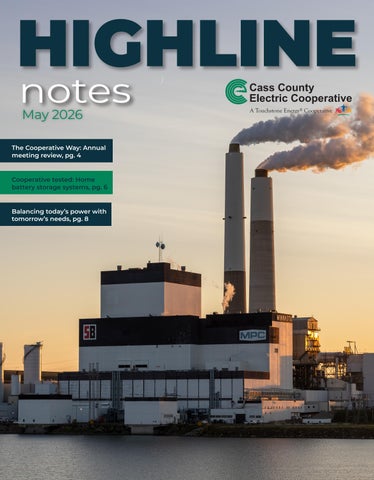
HIGHLINE notes
May 2026
The Cooperative Way: Annual meeting review, pg. 4
Cooperative tested: Home battery storage systems, pg. 6
Balancing today’s power with tomorrow’s needs, pg. 8
editorial
Paul Matthys, president/CEO, Cass County Electric Cooperative
I want to update you on the most significant new project in our service area, the Applied Digital AI Factory, called Polaris Forge 2, being built near Harwood, North Dakota. This project represents a major investment in our region and delivers tangible, long-term benefits to our cooperative and members.
As many of you know, Applied Digital is building a nextgeneration computing campus designed to power artificial intelligence and other highdemand digital technologies. The first phase of this facility will be about 280 megawatts (MW). To put this in perspective, a large hospital with similar physical space has a peak demand of 4.5 MW.
Tech giant Oracle has signed a 15-year lease with Applied Digital Corporation for the Harwood AI data center campus. Applied Digital will maintain control of the building infrastructure, while Oracle will control the IT staff and hardware.
This project began construction in early September 2025 and is projected to come online in December 2026 to early 2027.
Now, what does that mean for Cass County Electric and for our members?
First, it means strong load growth and financial stability. Large industrial loads like this help spread our fixed costs over more kilowatt hours. That supports long-term stability for all member-owners. It strengthens our cooperative’s financial foundation and helps us continue delivering reliable, affordable power. A portion of the excess revenues, called margins, will be used to fund our resource transition fund.
Second, this project brings significant economic benefits to our communities. We’re looking at 200-250 permanent jobs, plus 600–800 construction and contractor positions. It increases local spending, supports area businesses, and contributes to the tax base. It’s the kind of development that helps our region grow in a sustainable, forward-looking way.
Third, we are working closely with Applied Digital, Minnkota Power Cooperative, and North Dakota leaders to ensure this large new load is integrated safely and responsibly. Energization will
be phased, and the necessary infrastructure upgrades will be cost-recovered through project revenues—not through member rate increases. This means the infrastructure costs, including system upgrades, will be fully paid for by Applied Digital, not our legacy members. It is also important to note that the AI factory will have 192 3516E Caterpillar generators for emergency backup and grid resiliency.
Finally, this project positions Cass County as a leader in the fast growing digital infrastructure economy. North Dakota has been working hard to attract high tech industries, and this facility is a clear sign that those efforts are paying off. We’re proud that our cooperative is playing a key role in supporting that progress.
In short, the Applied Digital AI Factory is a win for our cooperative, our communities, and our member-owners. It reflects our cooperative values of innovation, integrity, and commitment to our communities.
Thank you for your continued trust and support. I look forward to keeping you updated as this project moves forward.
11 save
12 impact
Communications:
13 recipes 15 ads
SUMMER EVENTS
14 safety
CCEC is proud to support community events across our service area, helping bring people together and make local experiences possible.
From small-town gatherings to larger celebrations, our sponsorships reflect our commitment to the members and communities we serve.

BOARD MEETING HIGHLIGHTS - FEBRUARY 2026
The Cass County Electric Board of Directors met in person on Feb. 24, 2026, and discussed the following topics:
• Moved to approve the February 2026 consent agenda of the regular board meeting consisting of minutes, monthly department reports, director expense report, and the report on small capital credits for terminated members in 2025.
• Received the Chairman’s Report.
• President/CEO Paul Matthys gave the President’s Report, providing updates from meetings attended.
• Received an update from Minnkota Power Cooperative.
• Received the January 2026 financial report.
• Received reports from the directors
who attended the NDAREC Annual Meeting.
• Received a report from the joint Minnkota/Square Butte board meeting.
• Received the System Reliability Report from 2025.
• Moved to accept the 2025 financial audit as prepared and presented by Eide Bailly, LLP.
• Moved to approve the January 2026 capital credit estate payments.
• Reviewed upcoming meetings and events.
• Voted Director Kalvin Hoff as Minnkota Power Cooperative director nominee for 2026.
• Voted Director Terry Kraft as Square Butte Electric Cooperative director nominee for 2026.
BOARD MEETING HIGHLIGHTS - MARCH 2026
The Cass County Electric Board of Directors met in person on March 31, 2026, and discussed the following topics:
• Moved to approve the March 2026 consent agenda of the regular board meeting, which includes minutes, monthly department reports, and the director expense report.
• Received the Chairman’s Report.
• President/CEO Paul Matthys gave the President’s Report, providing updates from meetings attended.
• Received the February 2026 financial report.
• Received a report on the wholesale
rate ncrease.
• Received a report on the construction work plan.
• Received a report from the Minnkota Power Cooperative and Square Butte board meeting.
• Received a report from the NRECA PowerXchange Conference.
• Moved to approve March 2026 capital credit estate payments.
• Reviewed upcoming meetings and events.
The next board meeting is scheduled for Tuesday, May 26, 2026.
Morgan Bachelor
Sara Hand
Jocelyn Lura Hovland
Printer: Forum Communications Printing
Board of Directors:
Paul White, Secretary
Douglas Anderson
Vanessa Kummer
Stacey Ackerman
Tom Seymour
Glenn Mitzel, Board Chair
Wendy Loucks
Kalvin Hoff, Treasurer
Terry Kraft, Vice Chair
Executive Staff:
Paul Matthys, President/CEO
Troy Knutson, VP of Engineering & Operations
Chad Brousseau, VP of Member & Energy Services
Andy Weiss, VP of Corporate Services & CFO
Mitchell Lyter, VP of Information Technology & CIO
Highline Notes (USPS 244-740) is published monthly by Cass County Electric Cooperative Inc., 3312 42nd St. S., Suite 200, Fargo, ND 58104. Periodicals postage paid at Fargo, North Dakota 58104, and at additional mailing offices.
Postmaster: Send address changes to Highline Notes 3312 42nd St. S., Suite 200 Fargo, ND 58104
© Copyright Cass County Electric Cooperative 2026. All rights reserved.
Questions: 701-356-4400 800-248-3292 info@kwh.com
Call Before You Dig: 800-795-0555 or 811
Cass County Electric Cooperative is an equal opportunity provider and employer.
Information about the cooperative, articles of incorporation, bylaws and more can be found at CassCountyElectric.com.

Annual Meeting: The Cooperative Way
Cass County Electric Cooperative (CCEC) members came together on April 14 at the Delta by Marriott in Fargo for the cooperative’s 88th Annual Meeting, an evening centered on connection, community, and a shared commitment to The Cooperative Way.
More than 500 members and guests attended, enjoying time to connect before the business portion of the meeting began.
Vice President of Member and Energy Services Chad Brousseau welcomed attendees and reflected on the importance of the annual meeting.
“The annual meeting is one of the clearest expressions of what makes the cooperative model different,” he said. “Everything we do is centered on serving our members.”
Board Chair Glenn Mitzel called the meeting to order and highlighted a year defined by growth, momentum, and preparation for the future. He emphasized the board’s continued focus on safety, reliability, affordability, and responsible planning.
“This is The Cooperative Way,” Mitzel said. “Putting members first and making decisions that serve the long-term interests of our communities.”
Director elections were held for four positions. Members elected:
• Stacey Ackerman, District 4
• Tom Seymour, District 5
• Terry Kraft, District 6
• Glenn Mitzel, District At-Large
All were elected by unanimous ballot.
President and CEO Paul Matthys shared updates on the cooperative’s strong performance and the evolving energy landscape. He highlighted continued growth across the system and the importance of balancing new opportunities with the responsibility to protect existing members.
“Our focus remains clear,” Matthys said. “Providing safe, reliable, and affordable energy while preparing for the future.”
Meeting presentations also highlighted ongoing investments in safety and reliability, including inhouse locating services and a new
public safety outreach role, both aimed at protecting employees, contractors, infrastructure, and the communities CCEC serves.
Financial updates reflected a strong and stable position, with continued efforts to manage rising power costs while maintaining affordability for members.
The meeting concluded with a drawing for door prizes, with 10 members receiving $100 local business gift cards.
As the evening wrapped up, Mitzel thanked members for their engagement and continued support. “Your participation is what keeps this cooperative strong,” he said.
A special thank you goes to the Delta by Marriott, Mobile Pro, and all who helped bring the event to life.
Most importantly, thank you to the members who continue to shape the future of Cass County Electric Cooperative. That is The Cooperative Way.
Guided by experience, grounded in service
Cass County Electric Cooperative’s board of directors continues to play a vital role in shaping the future of your cooperative. Elected by fellow members to serve three-year terms, directors must live in the district they represent, ensuring local leadership and a strong connection to the communities they serve. In addition to district representation, one director serves in an at-large role, representing all members across CCEC’s service area.
Once elected, directors take on two primary responsibilities: setting policy and providing financial oversight. Working alongside CCEC’s CEO and leadership team, they help guide long-term strategy and establish priorities that support a reliable, forward-looking electric
The directors in green were reelected at this year’s annual meeting.

system. This work requires an understanding of both the broader energy landscape and the day-to-day operations of the cooperative. Directors also fulfill an important fiduciary role by reviewing financial performance, assessing risk, and ensuring compliance with applicable laws and regulations.
Additional responsibilities of the board include:
• Serving as the voice of the membership.
• Hiring and evaluating the CEO.
• Authorizing and reviewing independent financial audits.
To carry out these responsibilities effectively, CCEC directors remain committed to ongoing education. Through training in governance, utility operations, and oversight,


they continue to strengthen the knowledge needed to lead with confidence. Each director is also expected to earn their Certified Cooperative Director credential during their first term, reflecting a commitment to professional growth and strong governance.
As stewards of the cooperative model, your directors are elected by you and serve with your best interests in mind. They take that responsibility seriously, upholding the democratic principles that make CCEC unique. While other utilities may be driven by shareholders, CCEC remains focused on its members. Your board is proud to carry that mission forward, guided by accountability, integrity, and a commitment to the communities we serve.


Tom Seymour District 5, West Fargo
Paul White District 1, Stirum
Doug Anderson District 2, Arthur
Vanessa Kummer District 3, Colfax
Stacey Ackerman District 4, Reiles Acres
Glenn Mitzel District At Large, Fargo
Kalvin Hoff District 8, Fargo
Wendy Loucks District 7, Fargo
Terry Kraft District 6, West Fargo
CCEC’s goal is to be a trusted energy advisor as new technologies emerge, backed by real-world testing so we can share what works for members.

COOPERATIVE TESTED
Home battery storage systems
When Cass County Electric Cooperative (CCEC) wants to learn about new technology, they don’t rely solely on web research or hearsay. They put the tech to the test. So, when it came time to take a Tesla Powerwall battery storage system for a spin, they recruited someone on staff to give it a shot in his home.
“Our members were starting to get interested in battery storage, so I’m kind of the guinea pig,” said Nick Ludowese, CCEC manager of GIS & Data Analytics. “Because I live on our system and do data analysis for the company, they decided that it would be good to put it here.”
“Nick’s a data guy, but he’s also a tech guy,” said Troy Knutson, CCEC vice president of Engineering & Operations. “He was one of the people who helped design our timeof-day rate, so he understood what we were trying to do.”
Nearly a year ago, the CCEC team had a Tesla battery storage system installed in the garage of Ludowese’s West Fargo home, including a disconnect switch for safety and a power quality recorder to collect key energy data.
The biggest questions the co-op hoped to answer with the help of Ludowese’s Powerwall were straightforward: How does battery storage work in a home? What are the pros? What are the cons? And how can it be paired with the CCEC time-of-day rate for savings?
Nearly a year into testing, they’ve found answers to most of their questions.
How does it work?
The 13.5-kilowatt-hour (kWh) Powerwall pulls energy from the CCEC grid and stores it until it needs to be used. To take advantage of the co-op’s time-of-day rate, Ludowese charges the battery during non-
peak times, when the demand for electricity is lower and he receives a lower time-of-day electric rate of $0.052 per kWh. Then, when demand rises and electricity climbs to an on-peak price of $0.222 per kWh (usually weekdays from 6-9 a.m. and 4-8 p.m.), he can simply use that less expensive stored energy to power his home.
“It basically puts my house on nonpeak permanently,” he explained, adding that the 13.5-kWh battery is plenty to get the family through peak hours. “There are maybe a couple hours in the summertime when I’ll run out of battery because of our air conditioning, but then it just seamlessly switches back to grid. And we don’t notice a thing.”
Ludowese notes that his home doesn’t have electric heat, which could require more battery power in the cold winters. The system is stackable, so larger operations can scale the amount of daily power

needed. But for the size of his house and his family, one Powerwall is all he requires. “Getting the system that fits your house and lifestyle is important,” he said.
What are the benefits?
A key benefit of the battery storage system on the time-of-day rate is that Ludowese saved nearly $500 compared to what he would have paid on the standard rate over a year. Nearly 50 CCEC members now take advantage of the time-of-day rate for saving on electric vehicle charging, but battery storage may be the next best use case.
“Overall, Cass County Electric also saved $572 on demand charges with this battery being there,” said Chad Brousseau, vice president of Member & Energy Services. “It’s a win-win for the member and the utility.”
As for performance, the Powerwall worked flawlessly as a backup uninterruptible power supply (UPS) – even though outages on the CCEC system are rare. To test an outage scenario, co-op lineworkers physically disconnected the home from the grid, and the battery system took over without even a blink. Ludowese says during a real outage, the Powerwall could power his home for more than a day, without the need to start up an outdoor generator. It’s a great solution for those who work from home, have active sump pumps or

power medical equipment.
“We put the system through the ringer with emergency tests,” Brousseau said. “We performed all kinds of different scenarios –dropping one phase, dropping full power, going just on battery alone versus having the battery with the grid there to back it up.”
“It performed well during all of that,” Ludowese said.
What are the challenges?
The upfront cost of a battery storage system is likely the highest hurdle. Including installation costs, a Tesla Powerwall can cost a homeowner nearly $15,000. With an annual energy bill savings of $500, it would take 30 years to recover the initial cost. Average CCEC energy prices (11.72 cents per kWh) are lower than many areas of the country (California averages 27.05 cents per kWh), so payback on a similar time-of-use program would ultimately take longer for CCEC members, who have enjoyed stable rates for nearly a decade.
Another small challenge is keeping the battery efficient in a northern climate. The Powerwall can only discharge power in temperatures as low as 4 degrees below zero, so they’re recommended to be installed indoors for best winter capacity, following specific firesafety guidelines.

Although the Powerwall comes with a 10-year warranty, CCEC will be looking closely at the data into the future to determine what kind of battery degradation occurs from twice-a-day cycling over the course of many years. Kasey Kyllo, Power Quality & Scada Technician for CCEC, can pull information from the system’s power quality recorder over time, which will give clear evidence of any differences in performance. The first year is only the very beginning of analysis. “As we all know, battery technology is going to be changing, getting better,” Kyllo said. “It’s interesting to think about what it might come to.”
Final take
Overall, the CCEC team has found a home battery system will offer the most benefits to those who have solar panels and want to store and utilize all their solar power, or for those who would like a backup UPS with seamless transition from grid to battery power. For those looking to save money, the time-of-day rate pairs well with the system but won’t overcome the initial cost.
“If you’re considering a battery, give your utility a call first,” Brousseau said. “We’ve invested time testing these systems so we can help members understand what works and what doesn’t. Our goal is to be a trusted energy advisor as new technologies emerge.”
ALL-OF-THE-ABOVE Balancing today’s power with tomorrow’s needs
“Don’t put all your eggs in one basket.” It’s a familiar saying, and it still applies to how electric cooperatives plan for your power today and into the future.
At Cass County Electric Cooperative, our goal is to provide electricity that is reliable, affordable and responsibly sourced. One of the best ways to do that is through a balanced, diversified energy mix. Every generation resource has its strengths and challenges, whether it is cost, reliability, availability, or long-term sustainability. Relying too heavily on any single source can expose utilities to unnecessary risk.
Through our partnership with Minnkota Power Cooperative, your electricity is currently generated using a mix of coal, wind, and hydro resources. This diversified approach helps ensure steady, around-the-clock power, even as conditions change.
As we look ahead, planning for the future becomes even more important. Some existing generation resources across the region are more than 50 years old. Maintaining and eventually replacing these facilities will require significant long-term investment. At the same
time, electricity demand continues to grow, and expectations around reliability and affordability remain high.
That is why Minnkota and its member cooperatives are carefully evaluating future power supply options. Natural gas is one of several resources being studied because of its ability to provide reliable, on-demand energy that can complement renewable sources. However, no decisions have been made. Any potential investment will be thoroughly evaluated to ensure it aligns with long-term reliability, cost, and member value.
Decisions about new generation are not made lightly. Building or acquiring large-scale power resources can cost hundreds of millions of dollars and require decades of planning and commitment. These are long-term investments designed to serve members not just today, but for generations to come.
By continuing to take a thoughtful, diversified approach, Cass County Electric Cooperative remains focused on what matters most: delivering dependable power while being responsible stewards of your energy future.
PROS AND CONS OF GENERATION RESOURCES
DISPATCHABLE / BASELOAD INTERMITTENT
Abundant, domestic fuel source
Can reliably run 24 hours per day
Cost-competitive with other resources
Currently, almost impossible to permit
Can be difficult to ramp up and down to accommodate renewable production
Higher CO₂ intensity than natural gas, although CO₂ capture technology is advancing
NATURAL GAS
Lower CO₂ emission levels than coal
Currently, natural gas is low-priced
Can be run 24/7 or used during peak events
Flexible operation
Fuel costs have been historically volatile
Pipeline infrastructure not adequate for projected demand
Potentially more expensive to install CO₂ capture technology
No air emissions
Cost-competitive with other resources
air emissions Can reliably run 24 hours per day
Currently, almost impossible to permit
Affects fish and wildlife habitat
Alters the natural flow of rivers
Virtually no resources in development (some dams being removed)
fuel cost
Costs are higher than other resources, but are trending downward
Has intermittent production (produces about 45% of its potential on an annual basis)
Requires investment in backup generation resources
Turbines take a larger footprint to produce the same energy as other resources
Wind farms can impact bird and wildlife populations
Cannot operate in extreme cold or wind conditions
Has intermittent production (produces about 15-18% of its potential on an annual basis)
Requires investment in backup generation resources
Solar panels take a larger footprint to produce the same energy as other resources
Production affected by clouds, snow and extreme cold temperatures No air emissions
Can be dispatched when needed
Pairs well with renewable resources
Technology is in its infancy at grid scale
Costly to deploy and requires investments in other generation resources to charge the batteries
Can only dispatch for 2-4 hours at a time when energy can be needed for days
Battery components require significant amounts of rare earth elements, which are almost exclusively produced by China

Keeping rates stable
We know that any increase to your electric bill matters. With the cost of everyday essentials rising, no one wants to see higher energy costs. At Cass County Electric Cooperative, we understand that, and we are focused on doing everything we can to keep electricity affordable while continuing to provide the reliable service you count on.
CCEC has maintained stable rates for more than a decade and is forecasting a modest 1.3% increase in 2026.
As your member-owned cooperative, we take that responsibility seriously. It is our job to manage the costs we can control and keep your bills as low as possible, while ensuring your power is there when you need it.
We do this through careful planning, steady system growth, and responsible cost management. We continue to invest in our system, look for efficiencies, and make financial decisions that support long-term stability. We also work closely with our power provider to manage costs behind the scenes so we can limit the impact on our members.
CCEC works with Minnkota Power Cooperative, a North Dakota-based, member-owned cooperative that generates and delivers the electricity we provide to our members. Like us, Minnkota is focused on reliability
and keeping costs as low as possible.
We work together to plan ahead, manage costs, and keep your power flowing, even when challenges arise. Changes in policy, weather events, and equipment issues can impact the electric system and come with significant costs, sometimes reaching into the millions. Through it all, both organizations remain focused on managing those impacts and maintaining reliable, affordable service for the members we serve.
Over the past 10 years, the cooperative’s average residential rate has increased by only about 1.2 cents per kilowatt-hour. In 2025, the average price was 11.7 cents per kilowatt-hour, well below the national average of 17.8 cents. Even with this year’s increase, members will continue to pay less than many households across the country.
As a not-for-profit cooperative, any margins we generate are returned to members based on how much electricity they use. These earnings are tracked as member equity, also known as capital credits. This approach helps us invest in our system, reduce borrowing costs, and support long-term rate stability. When possible, those funds are returned to members over time.
CCEC is also actively working to manage wholesale power costs.
Beginning April 1, 2026, those costs increased by 4.1%, along with a temporary additional charge through the end of the year tied to higher energy costs in 2025, when an extended maintenance outage at one of Minnkota’s power plants led to increased wholesale power market purchases to maintain reliable service.
Rather than passing these costs directly on to members, CCEC will absorb that temporary charge along with a significant portion of the increase. This helps limit the impact and keep rates as stable as possible.
For members, the result is a net rate increase of about 1.3% in 2026. That equals roughly $2 per month for an average home and about 60 cents per month for an average apartment.
Rates at CCEC are set locally by a board of directors elected by the membership. These directors balance affordability, reliability, and long-term planning when making decisions. As members themselves, they pay the same electric rates, reinforcing accountability and transparency.
We remain focused on what matters most, providing safe, reliable electricity while working every day to keep costs as low as possible for our members. That is The Cooperative Way.

The energy cost of
convenience save
Modern homes are built for comfort and convenience. From extra appliances to smart features, it has never been easier to make daily life a little simpler.
But those conveniences often come with a hidden cost: ongoing energy use that adds up over time.
Today, energy efficiency is not just about what you own. It is about how many “extras” are quietly running in the background.
The second fridge you forgot about
That extra refrigerator or freezer in the garage or basement can be one of the biggest hidden energy users in a home.
While it is convenient for storing drinks, bulk groceries, or game-day food, older or rarely maintained units often run less efficiently than newer kitchen appliances. In colder climates, garages can also create temperature swings that make these units work harder.
If the unit is not consistently full or frequently used, it may be costing more than it is worth.
Always-on entertainment
Televisions and entertainment systems have become a central part of many homes, and in some cases, they are running for hours each day.
A second TV left on for background noise or a gaming system that stays powered up can quietly increase energy use. Even when not actively in use, many of these devices remain in standby mode, still drawing power.
Convenience has made it easy to turn things on, but just as easy to forget to turn them off.
The luxury of “always ready”
Features like built-in ice makers, beverage coolers and heated flooring bring an extra level of comfort to everyday life.
Ice makers cycle regularly to maintain a steady supply, even when ice is not needed. Heated floors provide consistent warmth but often run longer than expected, especially during colder months.
Individually, these features may not seem significant. Together, they can noticeably increase
overall energy use.
When you use energy matters
Beyond how much energy you use, timing also plays a role in your energy costs.
Cass County Electric Cooperative offers a voluntary Time-of-Day program that allows members to choose a rate based on when electricity is used throughout the day. By enrolling, your home receives different pricing during higher-demand and lowerdemand hours, giving you more control over your energy use and costs.
Shifting energy use to times when demand is lower, like early morning or later in the evening, helps reduce strain on the system and supports more stable rates for all members.
For homes with multiple convenience items, this can be an easy way to balance comfort with cost. Running laundry, dishwashers or other appliances during lower-demand hours can make a meaningful difference without changing your routine too much.
Members are helping members. For less than $1 per month, you can make a difference in your community. Participation is simple: Your monthly electric bill is rounded up to the nearest dollar, an estimated average of $6 per year. You can see your current contribution on your electric bill. A volunteer board meets quarterly to distribute the funds used primarily within Cass County Electric Cooperative’s service area for charitable, educational, environmental, and emergency assistance purposes. The funds are never used for political purposes or utility bills.
Operation Round Up
Cass County Electric Cooperative Foundation
March 2026
2026 year-to-date summary

Featured recipient: The Educators’ Lab Joy Project
The Educators’ Lab is a nonprofit organization dedicated to supporting teachers through innovative, hands-on professional development. Its Lab Joy program helps educators address challenges in their classrooms while reconnecting with their purpose and passion for teaching. By fostering collaboration and practical problem-solving, the organization empowers teachers to create meaningful, lasting improvements in their schools. Ultimately, The Educators’ Lab Joy Project aims to strengthen both educator well-being and student success.
Check out our Pinterest page for more recipes!

Sunrise breakfast foil packs
Ingredients
2 cups frozen hash browns (thawed)
4 eggs
½ cup shredded cheese
¼ cup diced peppers or onions
Salt and pepper
Instructions

recipes
Warmer days mean it is time to fire up the grill and take meals outside. Foil pack cooking is a simple, low-mess way to prepare a variety of meals, whether you are at home, at the lake, or around a campfire.
With just a few ingredients and a sheet of foil, you can create hearty dinners, quick breakfasts, and even desserts. These recipes are flexible, easy to customize, and perfect for busy summer schedules.
Warm berry crumble foil packs
Ingredients
2 cups mixed berries
1 cup cooked breakfast sausage or diced ham
2 Tbsp sugar
½ tsp cinnamon
½ cup rolled oats
¼ cup flour
3 Tbsp brown sugar
3 Tbsp butter, softened
Heat grill or oven to 400°F. Divide hash browns and meat evenly into foil packets. Add vegetables, then gently crack one egg into each pack. Season and seal loosely to allow steam. Cook for 15–20 minutes, until eggs reach the desired doneness. Sprinkle with cheese before serving.
Cheesesteak foil packs
Ingredients
1 pound thinly sliced steak
1 green bell pepper, sliced
1 small onion, sliced
1 cup sliced mushrooms (optional)
1 Tbsp Worcestershire sauce
1 Tbsp olive oil
4 slices provolone cheese
Salt and pepper
Instructions
Heat grill or oven to 400°F. Toss steak and vegetables with oil, Worcestershire sauce, and seasonings. Divide into foil packets and seal. Cook 12–15 minutes, stirring once if possible. Carefully open, top with cheese, and close again for 1–2 minutes until melted. Spoon onto toasted hoagie buns for a classic sandwich feel.
Instructions
Heat grill or oven to 400°F. Toss berries with sugar and cinnamon, then divide into foil packs. In a separate bowl, mix oats, flour, brown sugar, and butter until crumbly. Sprinkle topping over berries. Seal and cook for 10–15 minutes, until the fruit is bubbling and the topping is set.
Loaded ranch potato foil packs
Ingredients
2 cups diced potatoes
2 Tbsp melted butter
1 Tbsp ranch seasoning mix
½ cup shredded cheddar cheese
4 slices cooked bacon, crumbled
2 Tbsp chopped green onions
Sour cream for serving
Instructions
Heat grill or oven to 400°F. Toss potatoes with butter and ranch seasoning. Divide into foil packets and seal. Cook 25–30 minutes until tender. Open packs and sprinkle with cheese and bacon. Return to the heat briefly until the cheese melts. Top with green onions.
Power Up Safely
Become an Energy Explorer
With an adult, explore your neighborhood and learn electrical safety tips! Find each of the items listed below. Once you have located it, check it off by putting the letter in the box next to the item. Then unscramble the letters to crack the code!
Power Pole
Never climb equipment.
Letter: A
Power Lines
Stay far away.
Letter: F
Streetlight
Report issues to an adult.
Letter: T
Green Box (Transformer)
Stay back. Do not touch.
Letter: S
Something Electric
Keep away from water.
Letter: Y
Electric Meter
Do not tamper.
Letter: E
Crack the Code
Use the letters on the left to solve the riddle. Hint: It is CCEC’s #1 Core Value!
Safety Reminders
• Stay away from power lines
• Do not climb power poles or trees near lines
• Stay back from green transformer boxes
• Keep kites and drones away from power lines
• Never put objects into outlets
• Use outlets only with an adult’s help
• Keep cords away from water
• Stay in your home during lightning storms
• Always tell an adult if something looks unsafe
• Keep hands dry when using anything electric
For Sale:
ads
Member Market
All ads must be 40 words or fewer and will be abbreviated following our guidelines. No real estate or commercial ads will be accepted. Ads are published for members at no charge as space permits on a first-received, first-printed basis. Ads are due by the 10th of the month prior to publication. Members may submit only one ad per issue. Editor reserves the right to edit or reject any ad. Email ads to: ccec@kwh.com
2014 BMW 320I x-drive, all black, high miles, exc. cond. 701-660-9468
2004 750 HONDA Shadow motorcycle, VT 750 Cruiser, 3,400 mi., great shape, custom paint, looks great, pics avail., $3,000/OBO. 701-840-0470
2017 Salem Villa Classic, 38’, 2 slide outs, full-size fridge, full bath, lots of storage, dbl. sink, oven, hide-bed couch, 2 recliners, table, chairs, king bed, patio door, ceiling fan, exc. cond., $24,500/OBO. 701-740-2382
42” round dining table plus 12” leaf, 4 chairs, American made, med. brown wood, $350/OBO. Estee Lauder Double Wear makeup, color Dusk 3C1, 3 unopened bottles, $20. 701-730-2184
2 - 2025 QK16R CGT mini excavators, new, hydraulic thumbs, elec. fan to keep the engine compartment & operator cool, $4,000/ea. New 25x45 w/ 12’ sidewalls metal building kit in crates, 2 framed garage door openings, 1 framed walk door, doors not incl., $7,500. 701-388-5858
2016 Winnebago camper, main bedroom in front w/ queen bed, 2 full size bunk beds in rear, bathroom w/ shower, stove, oven, fridge, heat & AC, dining room one slide-out, TV w/ DVD player, pantry w/ lots of storage, outdoor kitchen slide-out & shower, power awning, LED deck lights, & outside speakers. $16,500. 701-866-6192
Kodak digital camera, standard aluminum folding tripod w/ plastic fittings & carrying case, expands to 51” tall, $15. 701-388-1107
cond., runs great, elec. start, reverse, 4,400 mi., new complete top end recently, $2,450. 2-place trailer after snowmobile sells. Craftsman riding lawn mower, 20 HP Briggs & Stratton, 46” deck, new carburetor, spark plug, air filter, exc. cond., $800 firm, cash only. 701-840-0179
Performax 16” scroll saw, good cond., $50. 2023 Airstream Flying Cloud, 23’ FB twin travel trailer, in perfect cond., w/ many extras, serious buyers only. $81,500. 701-640-7639
2 organs, Conn & Baldwin, vintage, work fine, $300/ea/OBO. Pick up only. 701-840-2580
74” Bobcat rock bucket, $2,500. IH Swather 24’ Model 75, $500. 58 Ford grain truck, $300. 701-678-2908
Narrak adult e-bike. 701-361-7343
Northstar PTO Generator, 12,000 watt, includes PTO shaft & trailer, $2,000. 2014 BMW 320i Xdrive, $6,000. Text 701-660-9468 or email trvstd@aol.com
Diamond Willow, different lengths for making canes & walking sticks. Large selection of hand-carving tools. 701-200-5149
Wanted:
Buying guns, estates, taxidermy, ammo, & other hunting-related items, paying cash. 701-866-7246
Class of 1975 Fargo South High School Yearbook. 701-237-5257
Used steel fence posts for barbed wire fencing. 701-680-2216
Old gravity box wagon. 701-6782908
Decades of Value

Cowhide Boots
1937... $15/pair
2026... $180/pair
Increase... 12x
Electricity
1937... 5¢/kWh
2026... *11.7¢/kWh
Increase... 2.34x
* 2025 Average selling price
Affordable, reliable electricity is something you can count on as a cooperative member. While the cost of everyday items has increased, the cost of electricity has remained a powerful value.

Scan here to unsubscribe
5 STEPS FOR SAFE DIGGING
Careless digging can put people and underground facilities at risk. Always call 811 before you dig.

2-3
NOTIFY
Call 811 or make a request online two to three days before your work begins. The operator will notify the utilities affected by your project.

WAIT
Wait two to three days for affected utilities to respond to your request. They will send a locator to mark any underground utility lines.

CONFIRM
Confirm that all affected utilities have responded to your request by comparing the marks to the list of utilities the 811 center notified.
In case you missed it: Last year, CCEC added
members, keep


RESPECT
Respect the markers provided by the affected utilities. The markers are your guide for the duration of your project.

DIG CAREFULLY
If you can’t avoid digging near the markers (within 18–24” on all sides), consider moving your project location.