Donghoon Shin
Sy. 5720/01
ISMN 979-0-2042-5720-1
Co-commissioned by Unsuk Chin and Festival d’Automne à Paris 2015
First Performance
27, November 2015, Salle des Concerts-Philharmonie 2, Paris, France
Ensemble InterContemporain
Tito Ceccherini, Conductor
For the Librarian, Mr. B
Donghoon Shin
Yo
For Large Ensemble (2015)
Flute (doubling Piccolo)
Oboe
Bb Clarinet (doubling Bass Clarinet in Bb)
Bassoon (doubling Contra-Bassoon)
Horn in F Trumpet in C (doubling Piccolo Trumpet) Trombone
Percussion: 2 Players
Xylophone, Almglocken, Marimba, Slapstick, 2 Maracas, 4 Wood Blocks,
3 Metal Blocks, Glockenspiel, Very small suspended cymbal, Guiro, Tubular Bell, Crotales, Water Hand Bell, Small Tam-tam, 3 Chinese Cymbals, Tuned Thai Gong,
3 Tom-toms, Timpani, Snare, Tambourine, 2 Bongos, 2 Congas, Slapstick,
3 Suspended Cymbal, 3 Tom-toms (muted), Pedal Bass Drum, Flexatone, 4 Wood Blocks, Vibraphone, Bass Drum, Cymbal on Timpani, Large Tam-tam, Tubular Bell, Bass Marimba
Harp
Piano
2 Violins
Viola
Violoncello
Double Bass (with 5 Strings)
The score has been written in C
Duration: 12’ 30’’
Piccolo, Xylophone and Hand bells sound one octave higher than notated.
Glockenspiel and Crotales sound two octaves higher than notated.
Double Bass, Contrabassoon sound one octave lower than notated.
Accidentals (including grace notes) only affect the pitch to which they directly refer,not other octaves, for the duration of the bar in which the accidental is written.
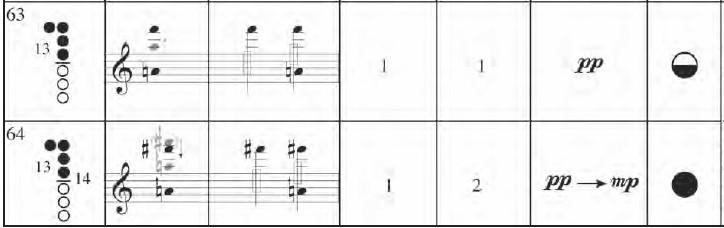
Bass Clarinet Multiphonics Chart
Excerpt from The Bass Clarinet, a Personal History written by Harry Sparnaay
Copyrighted by PERIFERIA Sheet Music
Programme Note
When I first read Borges’ short stories I was a pretentious thirteen-year-old. In retrospect it was not possible to assimilate his vast literary and philosophical world at that age, yet for some reason, I was completely entranced by his writing- especially those pieces which demonstrate the idea of intertextuality such as The library of Babel and Pierre Menard, Author of the Quixote. Ever since, Borges has been a 'librarian' figure for me (he did consider himself a librarian) of the world of text, introducing many eminent writers and their masterpieces to me, from Homer through Cervantes and Stevenson to Bioy Casares.
I was twenty-two and an aspiring composer when I came to realise the tragic irony of Borges’ short stories, especially from his late years. One day, after reading <Borges and I>, I suddenly started crying, shedding gallons of tears. In my mind I saw a poor human being confined in his own construction. The game of intertextuality which he invented for amusement did not spare the writer himself in the end. Hence his confession: Thus my life is a flight and I lose everything and everything belongs to oblivion, or to him.
My piece Yo, an homage to Borges and my musical response to his writing, portrays the writer as a lost child zigzagging in a labyrinth constructed by itself. I made five different musical fragments reflecting five passages respectively extracted from <The library of Babel>, <The Aleph>, <The Garden of Forking Paths>, <Pierre Menard, Author of the Quixote> and <Borges and I>. For instance, the repeated rhythm pattern and the pitch material consisting overlapped fifths which circulate endlessly over twelve notes are derived from the passage in <The Library of Babel>, I declare that the library is endless. The melody lines of the piccolo flute and contrabassoon, symmetrically juxtaposed, represent <Borges and I >.
By juxtaposing, superimposing, combining and dismantling the fragments I created a musical labyrinth in a perverted sonata form. What initially starts as a playful game proves to be a fatal trap. Like Borges and 'al otro' (the other) in <Borges and I>, the fragments get more and more blurred until they finally lose their musical characteristics and become undistinguishable.
This piece is a tragic story of dissolution of one’s self. And a personal tribute to the greatest hero of my adolescence years.
In London, Donghoon Shin
**Damp : Damp on the strings inside piano by using a left hand. Producing 'empty-woody-resonance'.
Play the notated
Tambourine,
Cbsn.
P.Trpt.
Sandpaper Blocks
Tambourine, 2 Bongos & 2 Congas with
4 4 (
thepossiblehighestharmonicsnotes
thepossiblehighestharmonicsnotes
thepossiblehighestharmonicsnotes
thepossiblehighestharmonicsnotes
thepossiblehighestharmonicsnotes
Senza sord.
Senza sord.
AirNoiseGlissando : Exhale through the instrument. Produce glissando sound by gradually changing phoneme sounds. for example from [O:the darkest sound] to [I:the brightest sound].
muta in Tpt. in C
Perc. 2
1 Hp.
1
(Almglocken)
(3 Ch. Cymb.)
(Bs. Marimba)
S S
Î Ï Ï Ï Ï Î Ï Ï Ï Ï Ï Î damp immediately!! ( C # / B An ) Î 2 8 3 8 œ > œ Œ 3 S S œ ˘ ≈Œ
(3 Ch. Cymb.)
(Bs. Marimba)
3 4