Lisa Streich LASTER
Concerto for motorised piano & orchestra 2018/2019
Partitur
Sy. 5712/01
ISMN 979-0-2042-5712-6

Concerto for motorised piano & orchestra 2018/2019
Partitur
Sy. 5712/01
ISMN 979-0-2042-5712-6
INSTRUMENTATION
1 solo motorised Piano
2 Flutes
1. Picc. / Flute
2. Flute / Bass Flute
2 Oboes
2 Clarinets in Bb 2 Bassoons
2 Horn in F 2 Trumpets
1. Picc. Trumpet in Bb / C-Trumpet
2. C-Trumpet
2 Tenor Trombones 1 Tuba
1 Harp 1 Piano
2 Percussion
Percussion I: G-Timpani, Whip, Triangle, Gran Cassa, Wash Board + soft Timpani stick, drum stick, soft bass drum stick
Percussion II: D-Timpani & C-Timpani, Triangle, Whip, Wash Board + soft Timpani stick, drum stick
8 Violin I
6 Violin II
4 Viola
4 Violoncello
3 Double Bass
1.& 2. 4-string 3. 5-string DISPOSITION
Cl. Bsn. Trp. Trb. Tba.
Fl. Ob. Hn.
Pno. Hp.
Vln. IIVla.
Perc. I
Perc. II
Vlc. Db.
Vln. I
S. Pno. Cond.
(What is most crucial with this disposition is that Perc. I is to the left of the orchestra and Perc. II is to the right. The exact disposition of the rest of the orchestra is less important)
DURATION: ca. 20'
REMARKS


+ 1/4 + 1/2 + 3/4


- 3/4 - 1/2 - 1/4
SOLO MOTORISED PIANO
The motorised installation which lies on top of the piano consists of a long metal stick. Attached to the metal stick are four motors with paper strips attached to it. These paper strips pluck the strings inside the piano (psalterium-like). For more information and rent contact the composer: mail(a)lisastreich.se
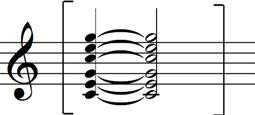
= silently depressed chord / silently held chord in 3rd pedal
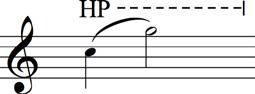
= half pressure = press the key down until you reach a small resistance beforehand (without letting the hammer audible hit the string). Press the key from this point when it's supposed to sound - very soft sound.
= shows which motor to activate. 1. strikes the lowest strings, 2. the mid low strings, 3. the mid high strings, 4. the high strings.
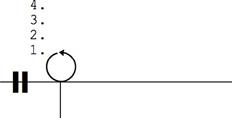
= the first voice shows that the paper attached to the motor flaps twice during one turn of the motor (2nd voice)
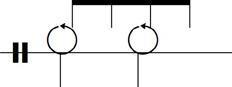
= slow motor in an unspecific tempo
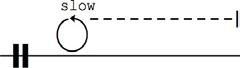
= increasing tempo in the motor (from nothing / from no velocity)

= decreasing tempo in the motor (to nothing / to no velocity)

! = prepare next chord beforehand
WOOD WINDS
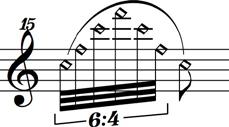
= whistle tones
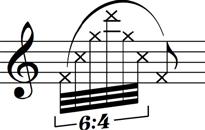
= kissing notes
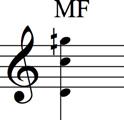
= Multiphonic BRASS
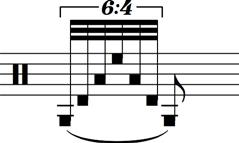
= blow air through the instruments and change the overtones by changing random keys in given rhythm
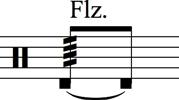
= blow air through the instrument while executing a Flatterzunge on the first 1/8th note PERCUSSION
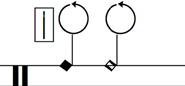
= hit flat with the drum stick on the rim of the timpani - hammering sound (the technique applies for the whole bar unless cancelled by another indication)
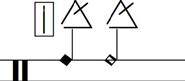
= press one side of the triangle onto the skin of the Timpani / Gran Cassa while hitting the side of the Triangle with a drumstick (Hammer-like sound with resonance occurs) (if not desolved, the technique stays for the whole bar)
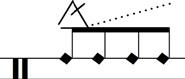
= press one side of the Triangle onto the Timpani and hit the side of the Triangle with a drumstick, striking pregressively closer to the Timpani head with each attack.
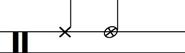
= play the whip
= gliss along the wash board with the drum stick - loud rattling sound occurs
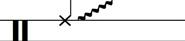
= drum stick

= soft bass drum stick

= soft Timpani stick

HARP
= hit deepest strings with a long round glass
PIANO
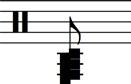
= half pressure = press the key down until you reach a small resistance beforehand (without letting the hammer audible hit the string). Press the key from this point when it's supposed to sound - very soft sound. = make a strong gliss on the lowest copper strings. Glove recommended.
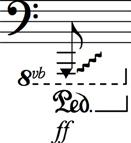
I II = roman numerals above a note indicate the string on which to play III IV
c.l. = play col legno
c.l.cr. = play col legno crini
c.l.b. = play col legno battuto
ord. = play ordinario with the bow hair

= indicates the velocity of the bowing: 0 = no velocity
0.5 = very very slow = approx. 60 sec. per bow (unstable tone) 1 = very slow = approx. 15 sec. per bow (stable tone) 2 = slow = approx. 3 sec. per bow 3 = medium velocity = approx. 1 bow per sec. 4 = fast = approx. 1.5 bows per sec. 5 = very fast = approx. 2 bows per sec. 6 = as fast as possible = approx. 2.5 bows per sec. all numbers lower than 1 should result in an unstable, grainy sound. No matter what the indicated speed is, the entire length of the bow should always be used. The indication "6" does not mean a normal tremolo! the dynamics indicate in this case the bow pressure: ppp = very very light bow pressure
pp = very light bow pressure
p = light bow pressure
mf = medium bow pressuref = high bow pressure
ff = very high bow pressure
= let the bow rest on the strings and perform an arpeggio with almost now bow speed. A soft metallic sound occurs. This gesture is primarily choreographic and should be performed with an exaggerated arm movement.
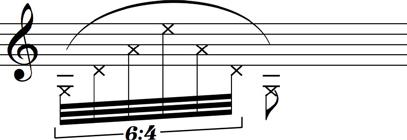


= only women hum the same note as they're playing = only men hum the same note as they're playing = men and women hum the same note as they're playing
TECHNICAL RIDER
- electrical output near the solo pianist
- a slight local amplification should be prepared for the concert

Vln. I 1 ppp 0.3 & Vln. I 2 ppp 0.3 & Vln. I 3 ppp 0.3 & Vln. I 4 ppp 0.3 & Vln. I 5 ppp 0.3 & Vln. I 6 ppp 0.3 & Vln. I 7 ppp 0.3 & Vln. I 8 ppp 0.3 & Vln. II 1 ppp 0.3 & Vln. II 2 ppp 0.3 & Vln. II 3 ppp 0.3 & Vln. II 4 ¡ + ppp 0.3 & Vln. II 5 ¡ + ppp 0.3 & Vln. II 6 ¡ + ppp 0.3 & Vla. 1 ¡ + ppp 0.3