Lisa Streich CIVIL SONG
Sy. 5710/01 ISMN 979-0-2042-5710-2

Sy. 5710/01 ISMN 979-0-2042-5710-2
Stora, blodröda anemoner betäcka alla steniga sluttningar. Och liksom man i andra länder insamlar frukter och bär, så går man i Palestina ut på blomsterskörd.
Selma Lagerlöf: Jerusalem I. Stockholm: Albert Bonniers Förlag, 1931.
Now a flash of gold on the tracks where with their delicious brown rumps horses run, ridden by boys who seem even younger and don´t know there´s light in the world all around them.
Pier Paolo Pasolini: Roman Poems. San Francisco: City Lights Books, 1986.
Hände, was tatet ihr, als ihr die Hände von kleinen Kindern waret? Hieltet ihr eine Mundharmonika, die Mähne eines Schaukelpferdes, fasstet der Mutter Rock im Dunkel... Ihr würgenden Hände, war eure Mutter tot, eure Frau, euer Kind?
Dass ihr nur noch den Tod in den Händen hieltet, in den würgenden Händen.
Nelly Sachs: Gedichte. Nobelpreis für Literatur 1966. Zürich, Coron Verlag, 1980.
How often they stand still and slowly look around as though they have never been here before.
At the far edge of the field, next to the woods, they are walking from right to left, and because of where they are, their dark bodies entirely disappear against the dark woods behind them, while their legs are still visible against the snow - black sticks twinkling against the white ground. Today, they are all three lying down.
Lydia Davis: THE COWS. Louisville: Sarabande Books, 2011
It comes as a great shock around the age of five, or six, or seven to discover that Gary Cooper killing off the Indians, when you were rooting for Gary Cooper, that the Indians were you.
James Baldwin/Raoul Peck: I am not your Negro. New York: Vintage Books, 2017.
SCORING
SOPRANO 1 (I, 1) + Whip
SOPRANO 2 (I, 2)
SOPRANO 3 (II, 1)
SOPRANO 4 (II, 2) + Egg Slicer
SOPRANO 5 (III, 1)
SOPRANO 6 (III, 2) + Egg Slicer
SOPRANO 7 (IV, 1)
SOPRANO 8 (IV, 2) + Egg Slicer
ALTO 1 (I, 1)
ALTO 2 (I, 2) + Egg Slicer
ALTO 3 (II, 1)
ALTO 4 (II, 2) + Egg Slicer
ALTO 5 (III, 1)
ALTO 6 (III, 2) + Egg Slicer
ALTO 7 (IV, 1)
ALTO 8 (IV, 2) + Egg Slicer
TENOR 1 (I, 1)
TENOR 2 (I, 2) + Egg Slicer
TENOR 3 (II, 1)
TENOR 4 (II, 2) + Egg Slicer
TENOR 5 (III, 1)
TENOR 6 (III, 2) + Egg Slicer
TENOR 7 (IV, 1)
TENOR 8 (IV, 2) + Egg Slicer
BASS 1 (I, 1)
BASS 2 (I, 2) + Egg Slicer
BASS 3 (II, 1)
BASS 4 (II, 2) + Egg Slicer
BASS 5 (III, 1)
BASS 6 (III, 2) + Egg Slicer
BASS 7 (IV, 1)
BASS 8 (IV, 2) + Whip
DISPOSITION
T6 T5 T4 T3
A1 A2 A3 A4 A5 A6 A7 A8 T7 S2 B7 T2 S4
B5 S6
B3 T8 S8 B1 T1 S7
B2 S5 B4
S3
S1
REMARKS


+1/4 +1/2 +3/4


-3/4 -1/2 -1/4

B6
B8
The piece is notated enharmonically, e.g., C and C both occur and are equivalent. The purpose of this is to make rehearsal time as efficient as possible. The musicians may ignore quarter tone deviations in the early rehearsals and add them later to achieve the correct timbres, beatings, and expressive character.
PRONOUNCIATION
L = as in Lima
H = as in hotel
O = as in Oscar
S = as in Sierra
CH = as in Czech
SCH = as in stretch
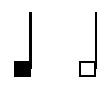
= airy sound

= imitate the musical line from the voice above you using the given unvoiced consonant. Use as overtone-rich a sound as possible, and try to create one sound or line with the voiced (sung) line.
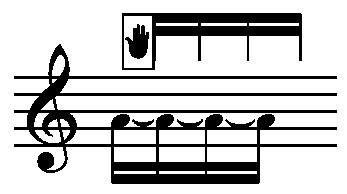
= 16th-note rhythm created by touching the open mouth with the palm of the hand.
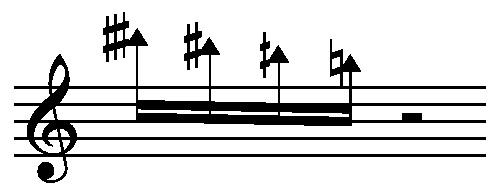
= descending quarter tone scale beginning on a freely chosen, very high note.
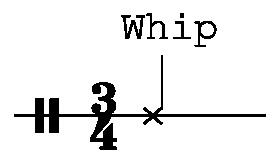
= clap the whip together
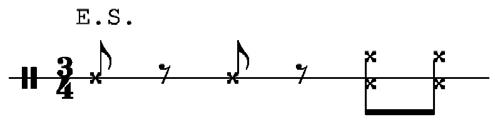
= pluck random string/pair of strings on an egg slicer
CHOREOGRAPHIC NOTATION (SINGERS)
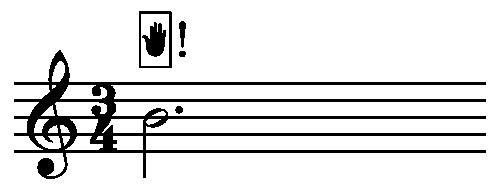
this notation is used to create waves wandering through the choir

= the dynamic for the material below this sign should be taken from the conductor. Sing only when the conductor's arm is pointing in your general direction. A f is indicated with a raised arm, and a ppp when the conductor's arm is low. A niente is shown with a closed fist. Listen to your neighbours, and try to create a continous sound, which moves through the choir. When the conductor's hand moves towards, you begin to sing softly. When the conductor's hand moves away from you, make a decrescendo to niente.
= indicates the beginning of a traditionally conducted passage (appears at the end of the sections using the technique described above).

CHOREOGRAPHIC NOTATION (CONDUCTOR)
this notation is used to create waves wandering through the choir.
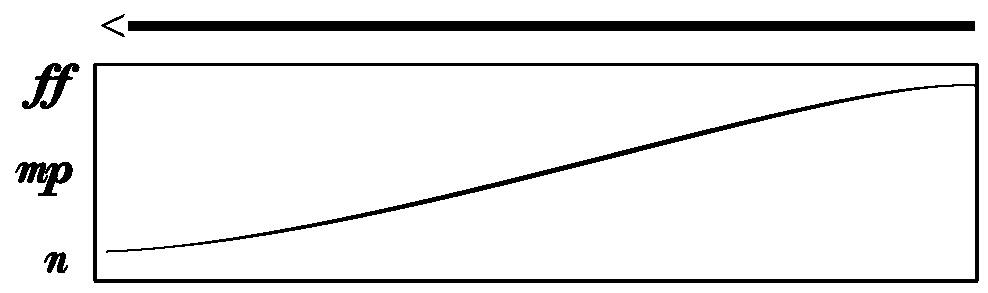
= the arrow indicates the direction of the choreographic wave through the choir (here: from the right to the left)
= the line in the square indicates the dynamic progression of the wave. Indicate a f with a raised arm and a ppp with a lowered arm. Close your fist for niente.
Attention: there are parts that have to be conducted both traditionally and choreographically at the same time. In those cases, use one arm for each way of conducting.
Try to execute the piece as immobile as possible, with as little expression in your face as possible. The mouth should be comfortable open without exaggerating vocals and consonants. Like a wax cabinet or the mermaid with a cut off tung in H. C. Andersens "Den Lille Havfrue". All the textures can be immagined like under water or under a surface. The whole piece should be very organic and fluid. Use free vocals if none are given and breathe freely whenever you need to.