CopyrightbyG.Ricordi&Co./Forperusalonly
Intrumentation
4 Sopranos
4 Altos
4 Tenors
4 Basses
Flute
Oboe
Clarinet in B (also Bass Clarinet in B )
Horn in F + Egg Slicer + bow
Trumpet in C + Egg Slicer + bow
Bass Trombone + Egg Slicer + bow
Timpani (+ Triangle + Drum Stick)
Percussion 1 (Bass Drum, High Triangle, Cymbals, Soft Bass Drum Mallets)
Percussion 2 (Horse Whip and Horse Rod + small table or chair to hit rod on)
Percussion 3 (Horse Whip and Horse Rod + small table or chair to hit rod on)
Harp + Egg Slicer
Harpsichord + Egg Slicer
Violin I
Violin II
Viola
Violoncello
Double Bass
CopyrightbyG.Ricordi&Co./Forperusalonly
Score is in C
Duration: 14–16 minutes
Remarks
Accidentals
+ 1/4 1/2 + 3/4
- 3/4 - 1/2 - 1/4
Singers
= sing with airy sound
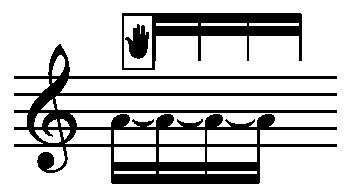
= 16th-note rhythm created by touching the open mouth with the palm of the hand.
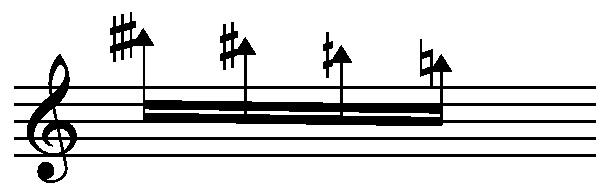
= descending quarter tone scale beginning on a freely chosen, very high note.
vib. = sing with vibrato
m. vib. = sing with a lot of vibrato = use technique as before
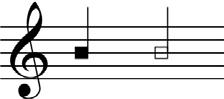
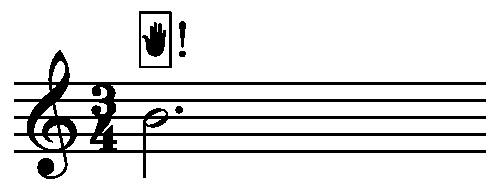
= the dynamic for the material below this sign should be taken from the conductor / a dancer. Sing only when the conductor’s / dancer’s arm is pointing in your general direction. A is indicated with a raised arm, and a when the conductor’s/dancer’s arm is low. Listen to your neighbours and try to create a continuous sound which moves through the choir. When the conductor’s / dancer’s hand moves towards you, begin to sing softly. When the conductor’s hand moves away from you, make a decrescendo to niente
= dal niente and al niente
Pronunciation
o = as in boat
a = as in Mama
m = as in Mama
L = as in Love
u = as in you
i = as in feet
Winds
= play with airy sound
= key noise
= air noise only
ST = slap tongue
= pluck a string on the Egg Slicer
= bow on Egg Slicer
“ ” = dynamics in quotation marks refer to the intensity of performance technique, not the actual loudness of the resulting sound.
Timpani
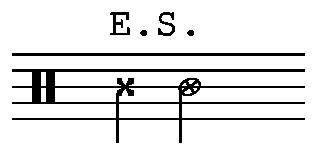
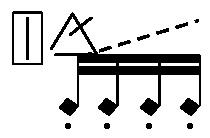
= press one side of the triangle on to the skin of the Timpani while hitting another side of the Triangle with a drumstick (Hammer-like sound with resonance occurs)
= hit along the side of the Triangle - a transition in sound occurs to the above described technique
Percussion
= play with drum stick
= play with soft bass drum mallets
= play on Triangle
Harp / Harpsichord
= pluck string of an Egg Slicer
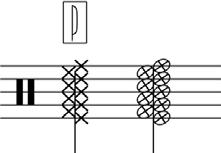
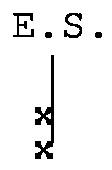
= pluck two strings of an Egg Slicer simultanously
Strings
I II = roman numerals above a note indicate the string on which to play III IV
ord. = play ordinario
s.t. = play sul tasto
s.p. = play sul pont
m.s.p. = pay molto sul pont
c.l. = play col legno tratto (only with the wood of the bow)
c.l.cr. = play col legno crini (both wood and hair of the bow)
c.l.b. = col legno battuto
= play on the rib or on the side of the bridge (white noise should occur)
= descending quarter-tone scale beginning on a freely chosen, very high note.
= Bartók pizz
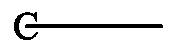
= transition from one technique to another
= indicates the velocity of the bowing:
0 = no velocity
0.5 = very very slow = approx. 60 sec. per bow (unstable tone)
1 = very slow = approx. 15 sec. per bow (stable tone)
2 = slow = approx. 3 sec. per bow
3 = medium velocity = approx. 1 bow per sec.
4 = fast = approx. 1.5 bows per sec.
5 = very fast = approx. 2 bows per sec.
6 = as fast as possible = approx. 2.5 bows per sec.
all numbers lower than 1 should result in an unstable, grainy sound.
No matter what the indicated speed is, the entire length of the bow should always be used.
The indication “6” does not mean a normal tremolo!
the dynamics indicate in this case the bow pressure:
= very very light bow pressure
= very light bow pressure
= light bow pressure
= medium bow pressure
= high bow pressure
Choreographic Notation (Conductor / Dancer)
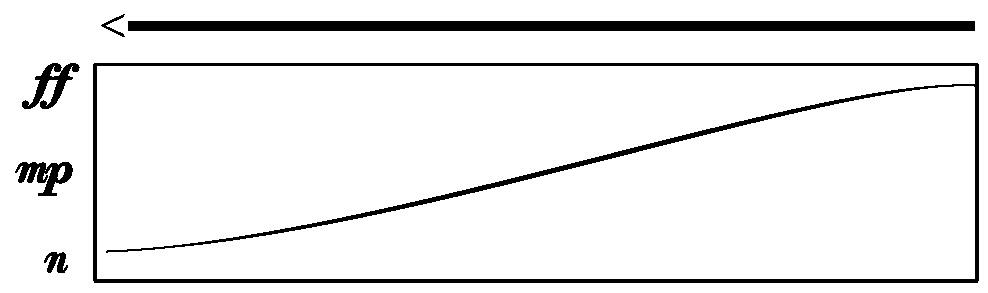
This notation is used to create waves wandering through the choir.
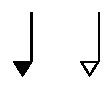
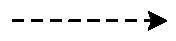
= the arrow indicates the direction of the choreographic wave through the choir (here: from the right to the left)
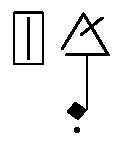
= the line in the square indicates the dynamic progression of the wave. Indicate a with a raised arm and a with a lowered arm.
Disposition
The ensemble can be placed freely according to space. Singers should be placed from left to right on stage: S A T B The depth of the position on the stage doesn't matter.
Percussion 3 and 3 should be to the left and to the right on the stage with about 5 diameter around them. They should whip towards the singers with the back to the audience.
ATTENTION!
Keep enough space around Percussion 2 and 3, otherwise people can get hurt.
S A T B
S A T B SCENE
S A T B
S A T B (an example)
Perc 2
Audience
Perc 3