EVERY FAMILY FED: TRI-AREA MINISTRY
FOOD PANTRY
GREAT HARVEST RISES TO THE OCCASION
BAD LUCK NEVER TASTED SO GOOD
EVERY FAMILY FED: TRI-AREA MINISTRY
FOOD PANTRY
GREAT HARVEST RISES TO THE OCCASION
BAD LUCK NEVER TASTED SO GOOD
Spectacular New Gated Waterfront Community! Hyco Lake - 60 Miles North of RDU Airport

PRIME LOCATION
• Spectacular 430-Acre Waterfront Peninsula –3.5 Miles of Shoreline!
• New Private Gated Community
• Less than 65 Miles from GSO & RDU Airports
• Gated with Paved Roads & Street Lights
• Live at the Lake and Work from Home!
• Fully Recreational Lake for Boating, Fishing, Waterskiing, Wakeboarding & More
• World-Class Bass Fishing

• Planned Community Docks* & Boat Launch*
• Community Waterfront Park with Pool, Pavilion & Fireplace
• Community Boat & RV Storage for Property Owners
WATERFRONT LIVING MADE EASY
• Estate-Sized Waterfront Homesites from .5 – 2.5 Acres
• Our Final Lakefront and Lake Access Homesites Being Released
• Buy Now, Build Later

• Choose from Several of the Area’s Finest Custom Home Builders
• Excellent Financing Available
• Ask How to Buy Property With Your IRA
• Properties Sold on a First Come, First Served Basis


















































Seeing patients within 48 hours. Learn more at wakemed.org/wake-ortho.

Love
JULY/AUGUST 2026
GROUP PUBLISHER Bill Zadeits
PUBLISHER Kris Schultz
EDITOR Erin McKnight
SENIOR EDITOR Emily Uhland
COPY & DIGITAL EDITOR Tara Shiver
SOCIAL MEDIA Arlem Mora
CONTRIBUTORS
Erica DeLong
L.A. Jackson
Andrea Richards
PHOTOGRAPHY
Jonathan Fredin, Chief Photographer
PRODUCTION
Atiya Batts, Graphic Designer
Dylan Gilroy, Web Designer
Beth Harris, Graphic Designer
Matt Rice, Webmaster/SEO
Rachel Sheffield, Web Designer
Lane Singletary, Graphic Designer
ADVERTISING
Maureen Powell, Senior Account Executive
Paige Gunter, Senior Account Executive
Karen White, Senior Account Executive
PUBLIC RELATIONS
S&A Communications, Chuck Norman, APR
ADMINISTRATIVE
Kristin Black, Accounting
Cherise Klug, Traffic Manager
Lisa White, Senior Event Coordinator & Distribution Manager
Valerie Renard, Human Resources
Wake Living © is published six times annually by Cherokee Media Group. Reproduction or use, without permission, of editorial or graphic content in any manner is prohibited. Subscriptions are $18/year.
WAKE LIVING
701 Cascade Pointe Lane, Suite 103 Cary, North Carolina 27513 (919) 674-6020 • (800) 608-7500 www.wakeliving.com
This publication does not endorse, either directly or implicitly, the people, activities, products or advertising published herein. Information in the magazine is deemed credible to the best of our knowledge.






shop our Hot Zone Meals on the app

Scan to view recipes



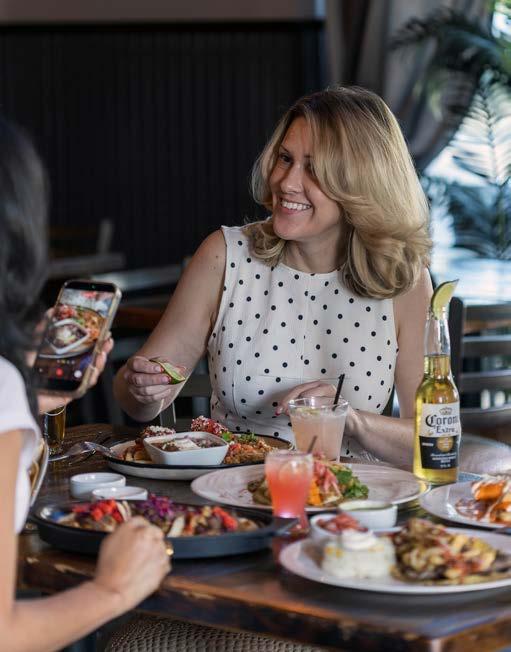
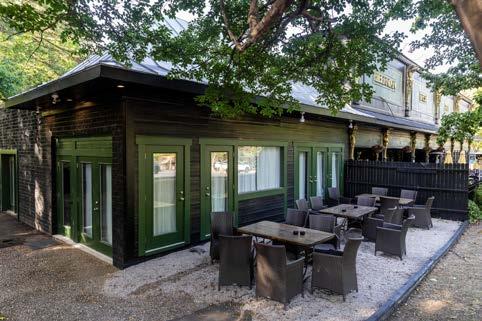
The Wake Living team, including Erin McKnight, was fortunate to be treated to warm hospitality and delicious eats at 13 Tacos & Taps.
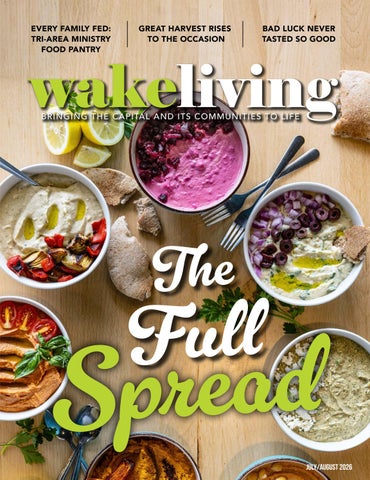
Every year we dedicate our July/August issue to food, and every year we are reminded of the same thing: The best stories are told at the table.
This year’s cast is a good one. There’s Janette Campbell at Great Harvest Bread Company, who bought a bakery on a whim in 2019 and has continued to spend every morning since milling wheat before sunrise alongside her beloved team.
There’s The Dry Cleaners, the speakeasy tucked behind the Hibernian Pub in North Raleigh that you have to find before you can enjoy — and that is absolutely worth finding.
There’s Chef David at 13 Tacos & Taps, who dreams recipes in his sleep and builds fusion tacos so layered his guests have been known to request the jasmine rice with a birthday candle instead of cake.
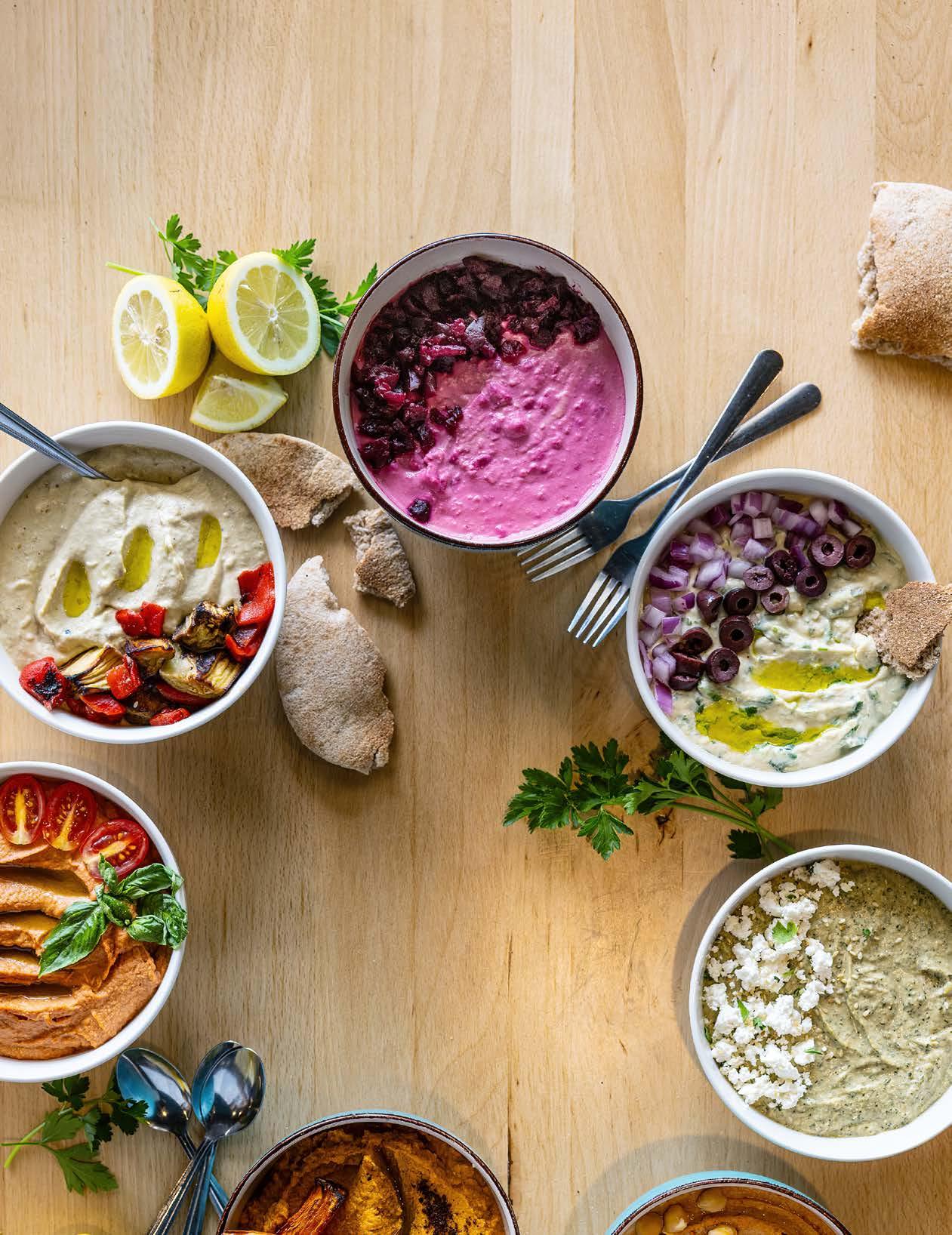
There is, of course, Sassool, now in its eighth year of the Hummus Mix-off, where community entries prove once again that Raleigh takes its spreads seriously.
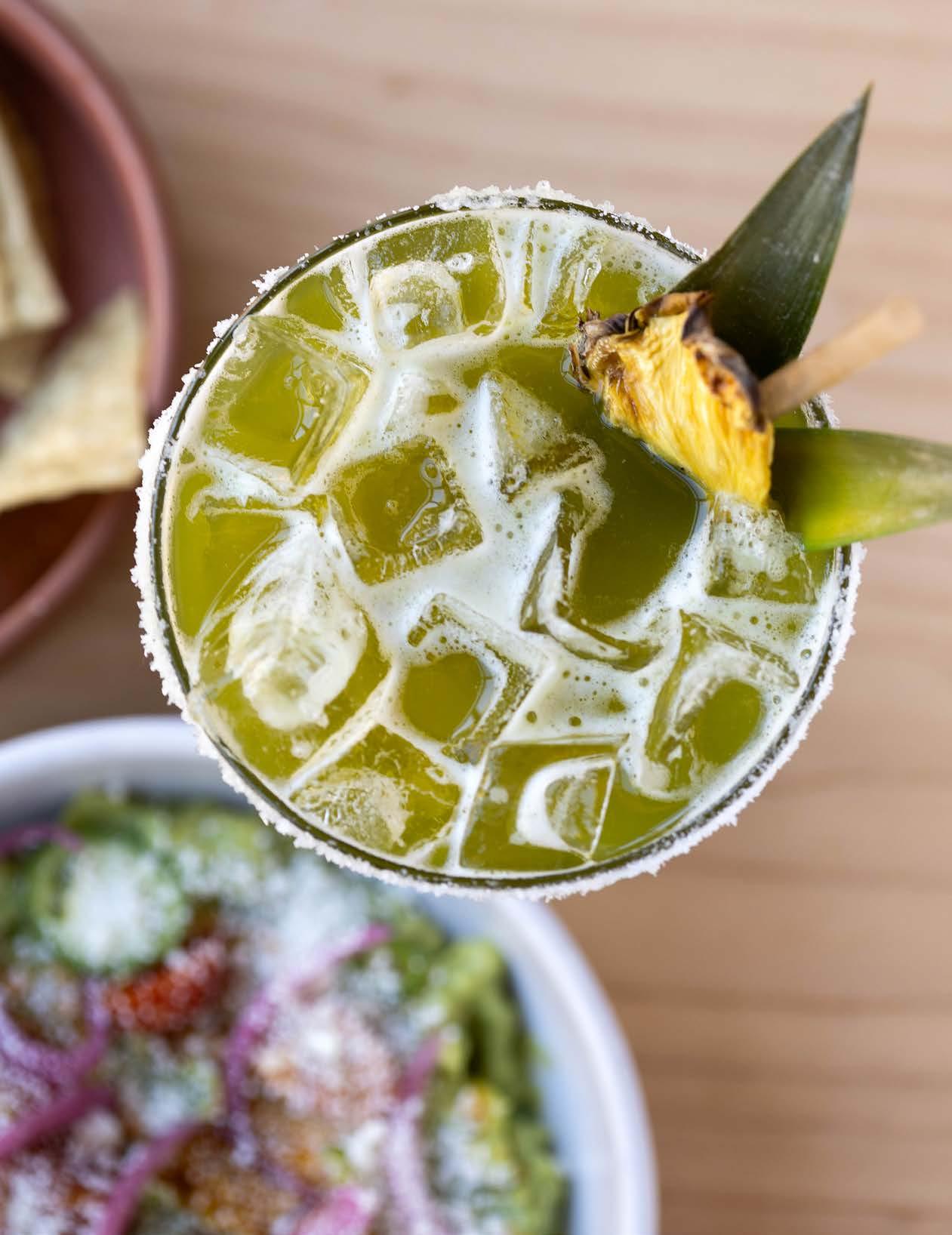
And there’s Mala Pata, where the kind of bold, soulful Mexican cooking that makes you want to linger over a second margarita has found a very happy home.
And then there is Tri-Area Ministry Food Pantry, where nearly 2,000 families a month are served with quiet dignity and a hundred pounds of food — fresh produce, meat, eggs, bread — by an entirely volunteer operation that has never once run short of people willing to show up for one another.
That’s our community. Generous and hungry in all the right ways. Dig in.
Thanks for reading!

Erin McKnight, Editor




EPISODE 66
Host Melissa Wistehuff takes you beyond the pages of


Raleigh’s Culinary Growth: An Interview with Amber Moshakos
Lost Towns and Ghost Stories: A Conversation with Heather Leah
EPISODE 65

How Shibumi Shade Took Over the Beach with Dane Barnes
EPISODE 67



EPISODE 68

Brewing
The Real Story Behind the North Carolina
Accent with Dr. Walt Wolfram
Something Special with Sam Nelson of Pretty Good Coffee Company
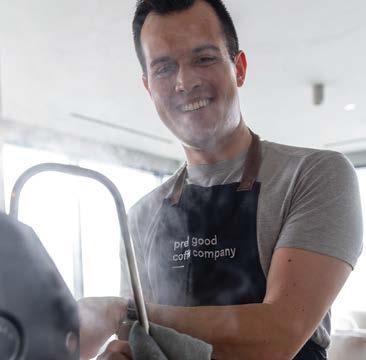
EPISODE 71


July 11, August 8, September 12
11 a.m. to 4 p.m.
Raleigh Iron Works
Local artisans paired with live music, presented by Triangle Pop-Up on the second Saturday of each month.
July 23–26
Raleigh Convention Center galaxycon.com/pages/galaxycon-raleigh
Anime, cosplay, comic books, gaming, sci-fi, and more fandoms collide at this four-day fest packed with celebrities, panels, exhibits, and lots more! Singleday and multi-day passes available, $45 and up for adults, kids 4 and under free.

July 30 & August 13, 7–9 p.m. Moore Square Park, Raleigh
Start the weekend early with a free outdoor Thursday night concert. Bring chairs and blankets to get comfy, and visit the onsite food trucks to fuel up. July: Fancy Gap. August: Harvey Street.
July 31, 6–10 p.m.
August 1, noon to 6 p.m. Koka Booth Amphitheatre, Cary boothamphitheatre.com
Savor smoky, saucy goodness from pulled pork and brisket to chicken and ribs, paired with all-you-care-to-taste samples of beer and bourbon. Plus, yard games, vendors, live music, seminars, and more. Tickets $55 and up.
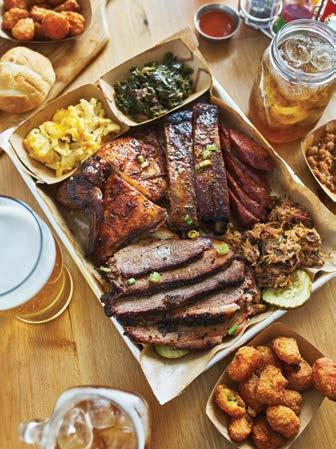
August 16, 11 a.m. to 4 p.m. Moore Square, Raleigh
This third annual event brings peace, love, and good vibes to Raleigh with a day of live music, vintage-inspired vendors, artists, food trucks, and classic cars.

August 22, 8 p.m.
Holding Park Aquatic Center, Wake Forest
Bring the whole family to enjoy a movie from a poolside lounge chair. Tickets go on sale August 1 at wakeforestnc.recdesk.com. $7 per person.
August 22, 2–10 p.m.
Hillsborough Street, Raleigh packapalooza.ncsu.edu
NC State students, faculty, staff, alumni, and friends kick off the academic year with a street festival and block party. Enjoy performances on multiple stages, family-friendly activities, food, and lots of Wolfpack spirit capped off by fireworks at the Belltower.
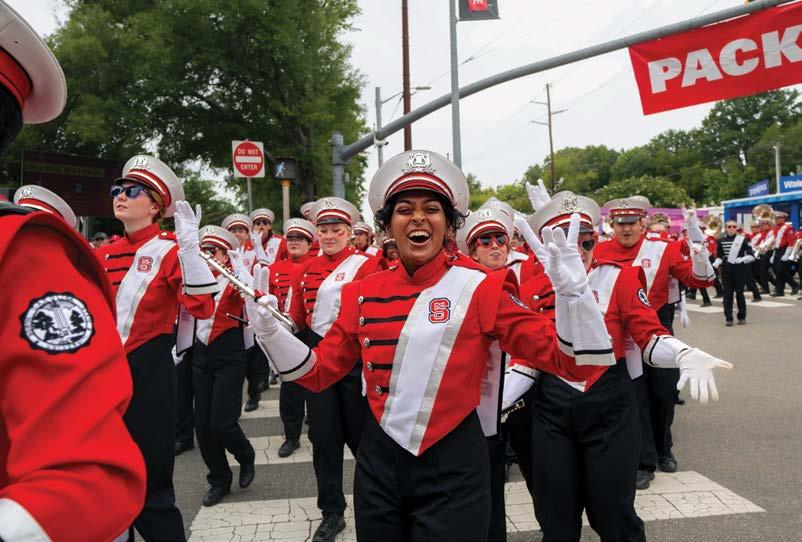
August 22–23, 9 a.m. to 5 p.m.
Cary Town Hall Campus carync.gov/lazydaze
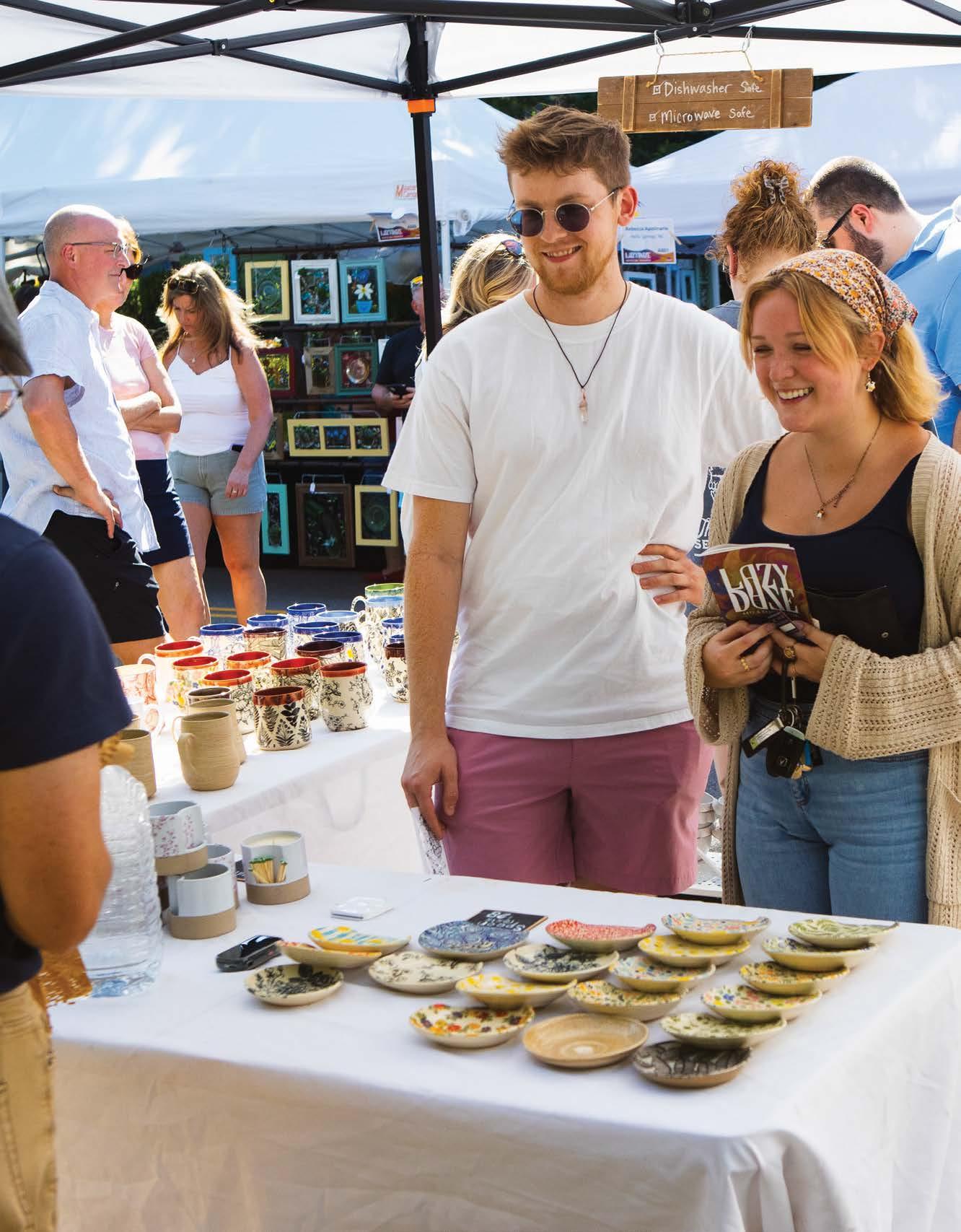
The prestigious juried arts festival that draws hundreds of artists and thousands of visitors to downtown Cary celebrates 50 years of community spirit. Shop for art, enjoy live entertainment on four stages, and visit food trucks and the beer garden. Kids get their own Collectors Market with $5 pieces, plus opportunities for play, crafts, and more.
August 29, noon to 4 p.m.
Gipson Play Plaza, Dix Park, Raleigh
Support teen makers, artists, and entrepreneurs showcasing their creativity at this outdoor market.
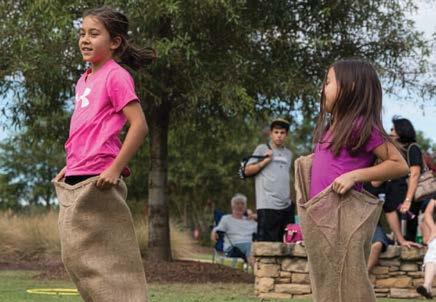
September 6, 5–7 p.m.
E. Carroll Joyner Park, Wake Forest
The Wake Forest Parks, Recreation & Cultural Resources Advisory Board invites people to disconnect from their devices and reconnect with their community, friends, and family. Compete in sack and relay races, cornhole, and miniature golf; visit onsite food and dessert trucks; and end the evening with a free concert.
WRITTEN BY ERIN MCKNIGHT | PHOTOGRAPHED BY JONATHAN FREDIN
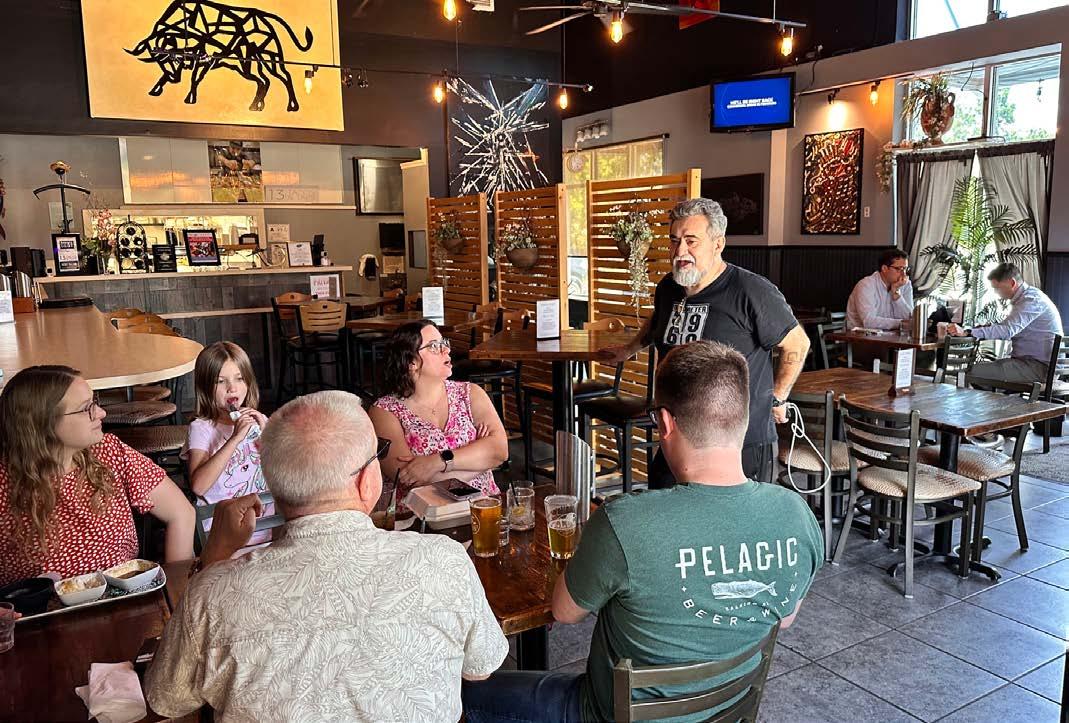
Some restaurants, you come across. Others find you. For many guests at 13 Tacos & Taps in Raleigh’s Falls River neighborhood, it’s the latter. Word travels — from a neighbor, a coworker, a social media post — and curiosity wins.
And once you walk through the door and peruse options on the extensive menu, you can expect to be told by co-owner Marilyn Peraza: “Just start with picking anything because you’ll be back, and then you can work on the rest.”
She’s not wrong. The return rate at 13 Tacos & Taps hovers around an impressive 50%, and local loyalty runs deep. This is the kind of place where regulars are known by name, where instead of birthday cake a young girl requests jasmine rice with a candle in it, and where guests leave humming a jingle dreamed up by Marilyn herself and composed by AI.
Lucky 13, indeed.
The Road to Falls River
Chef David — José David to those who knew him before North Carolina — Peraza has spent a career in kitchens, blending the culinary traditions of his Mexican heritage with the flavors and techniques he’s absorbed along the way.
the specials menu into something entirely his own. “The fusion started in my head,” he says.
When the reception from diners was good, the idea of a food truck followed. When that food truck developed a devoted fan base, a brick-and-mortar felt inevitable.
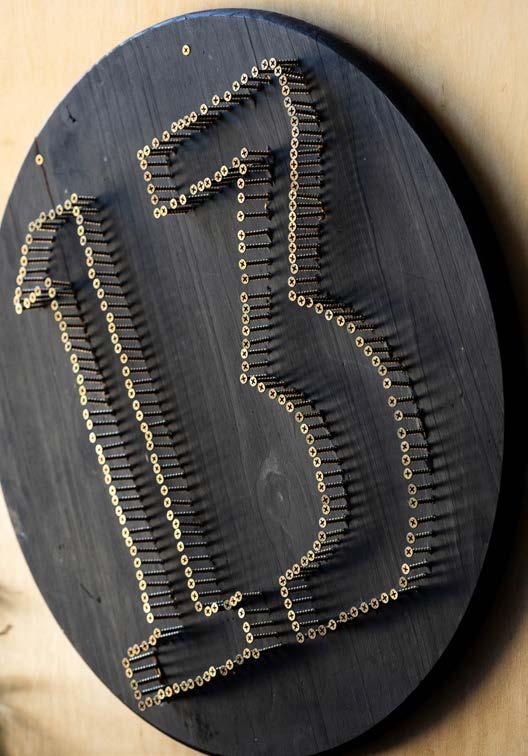
Whether
as
art on the wall or flavor in the Chef’s Special 13th Taco, here the number 13 brings good fortune.
That instinct toward innovation took shape early, during his years cooking Colombian Mexican cuisine and quietly reworking
David and Marilyn — married 26 years, together 31, and business partners for most of that time — had already run a successful restaurant, David’s on the Avenue, in Delray Beach, Florida.
Family circumstances brought them to the Raleigh area, but after achieving accolades such as being voted Best Mexican restaurant in Palm Beach and Broward Counties, the pull of the kitchen traveled with them.
When David and Marilyn launched The 13th Taco food truck in 2016, they established support — in the form of milelong lines — that would follow them through the doors of their Falls River location when it opened three years later.
The menu at 13 Tacos & Taps resists easy categorization. It’s rooted in Mexican cuisine — certified Angus beef birria braised low and slow, served traditionally with consommé or loaded into queso; classic enchiladas built on scratch-made mole; and fajitas for two featuring filet mignon, chicken, or shrimp. But the Taco Fusion section of the menu is where
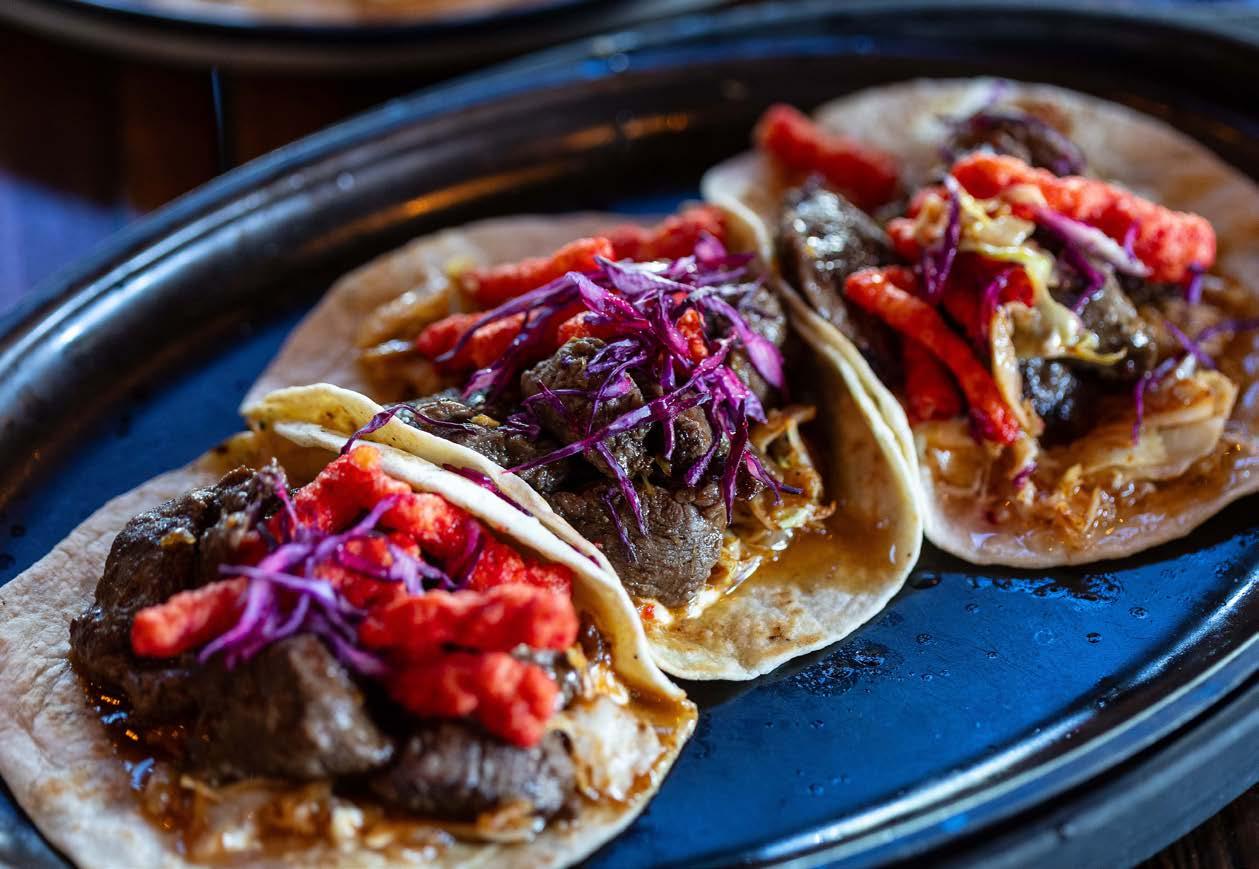
David’s imagination gets to run loose and is what keeps guests coming back for more.
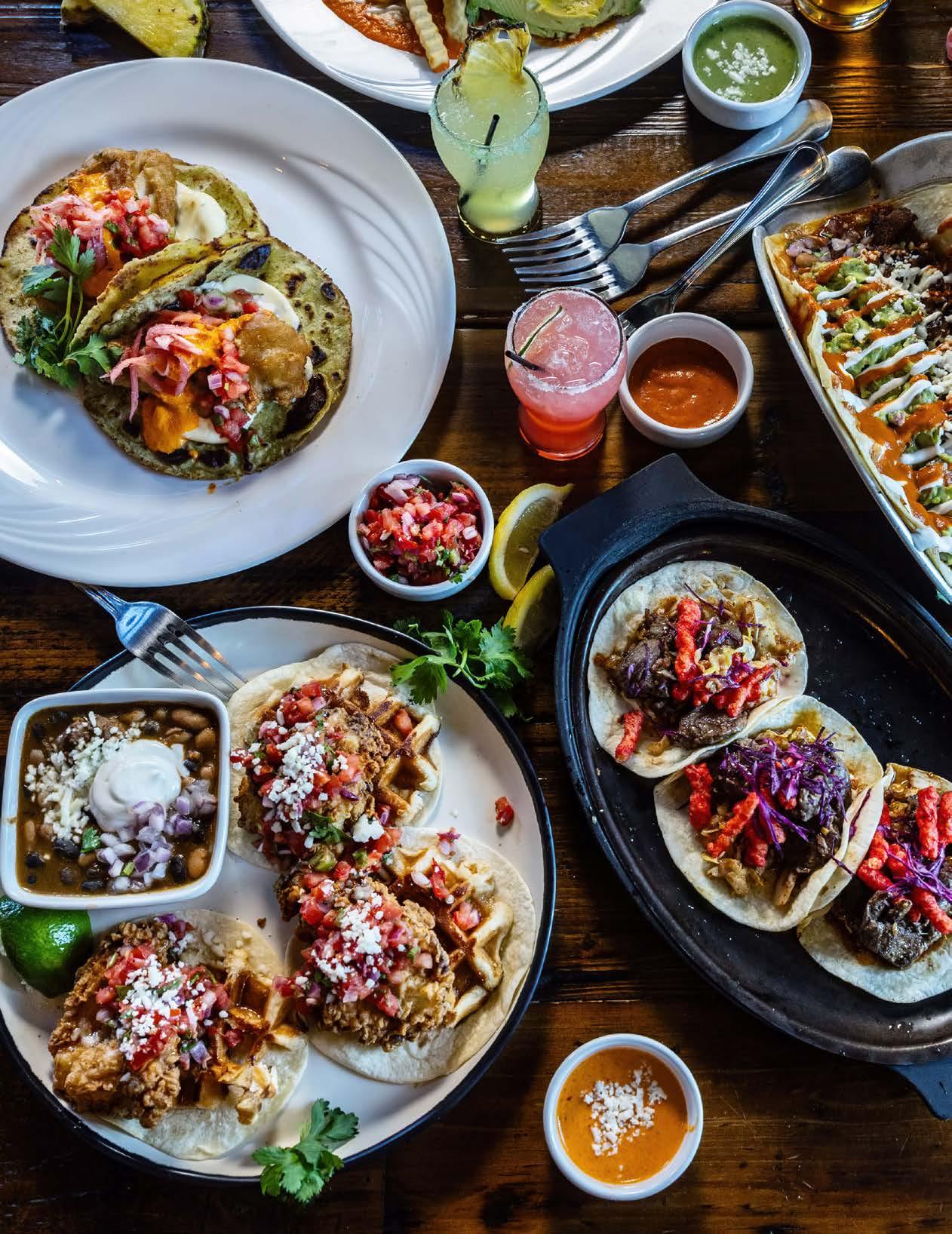
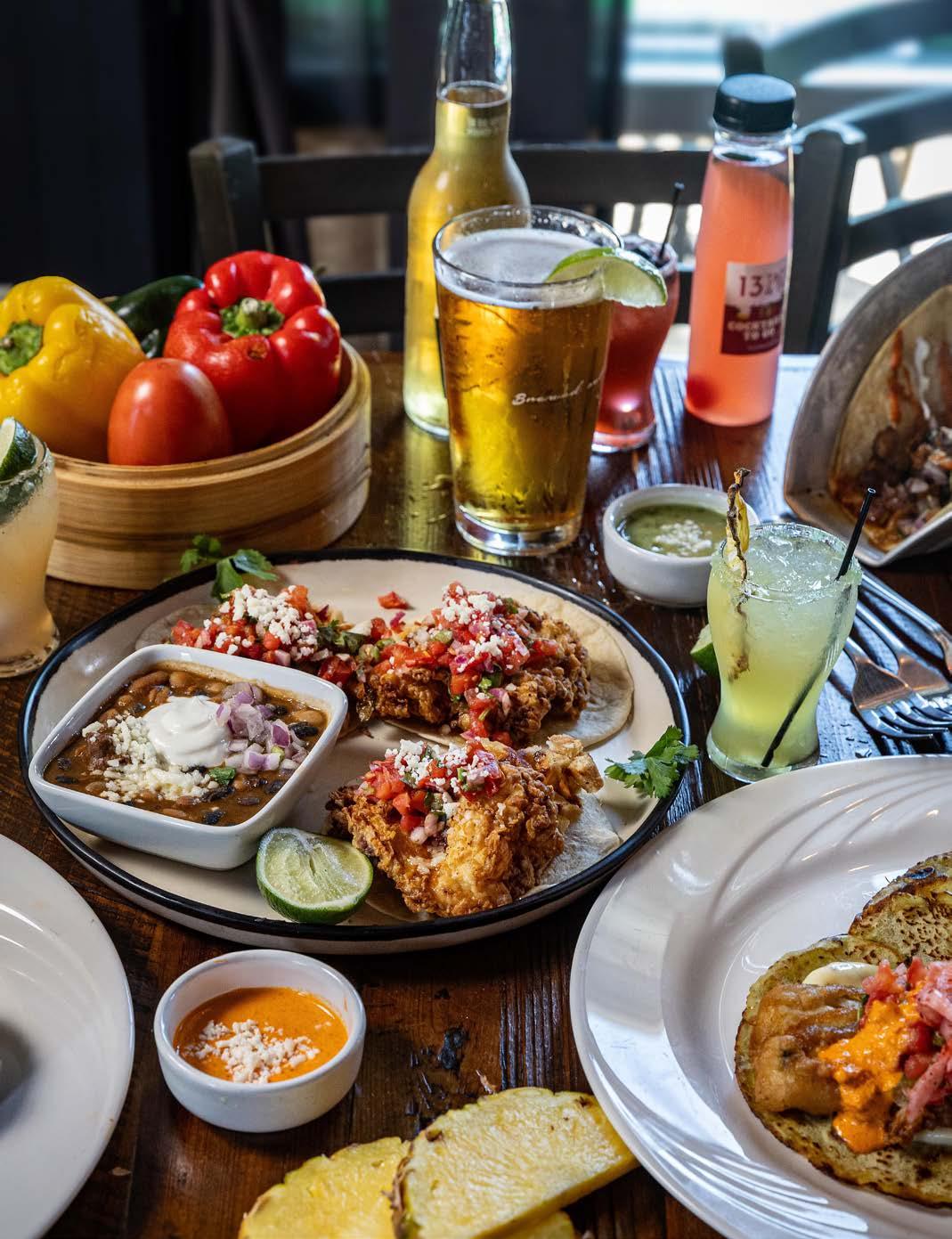
The Moo Moo Tres — seared filet mignon with fire-roasted poblanos, bell peppers, onion, queso fresco, and citrus cilantro emulsion on flour tortillas — has been winning awards since the food truck days, including People’s Choice at Taco Palooza, and is the menu item David considers his “trademark.”
The Korean “Porky” BBQ wraps slowbraised pork butt in a sweet and spicy Korean glaze with da bomb slaw on corn tortillas. The Porky Asia layers smoked pork belly with a hint of orange and ginger, apple relish, and sesame seeds. The Taco Lao combines seared filet mignon in a Vietnamese and macha chili sauce glaze with citrus cabbage, carrot, and sesame.
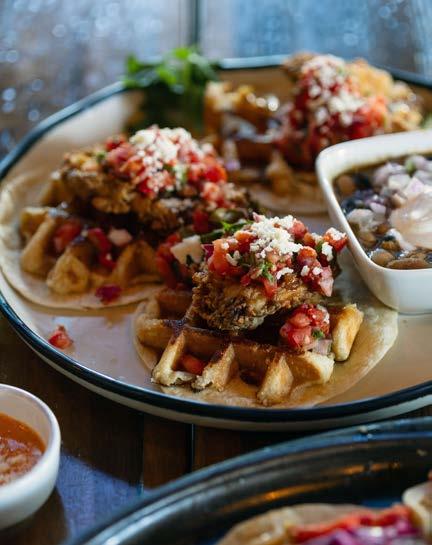
And then there’s the Chicken & Waffles taco: double-dipped breaded chicken, smoky maple syrup, pico de gallo, queso fresco, and waffle on flour tortillas. This one has its own devoted following, with some guests even preferring to eat it cold. (The trick to this loaded taco, we learn from Marilyn, is to treat it like a regular taco and fold it, waffles and all.).
“The tortilla,” David says, with practiced consideration, “is a good vessel to deliver food.” A sign on the wall reading #Everything fits in my tortilla affirms the notion to be true. What underpins David’s experimental approach is a signature layering of flavor that guests notice and talk about. Marilyn has watched this pattern play out over the years: “They say they taste every single layer,” she





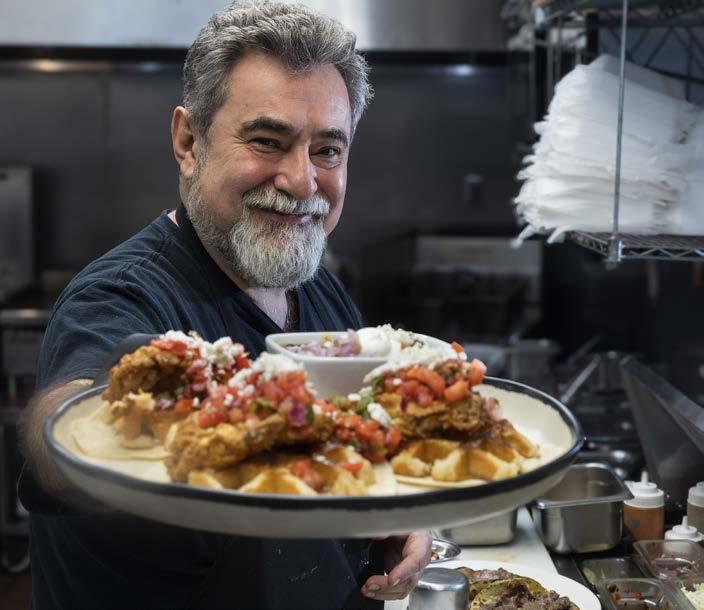
“HE’LL GO TO BED AT NIGHT AND DREAM OF A RECIPE,THEN COME IN THE NEXT DAY AND CREATE IT HERE … AND IT ENDS UP A HUGE SUCCESS.”
explains to her husband, who seems touched by, though not unaccustomed to, his wife’s praise. “There might be five different things in it, and they taste every single layer.”
When asked how he achieves this layering of flavors that both blends and builds, David simply responds, “Focus.”
Many of his best ideas arrive when his mind is free to contemplate. “He’ll go to bed at night and dream of a recipe,” Marilyn explains, then “come in the next day and create it here … and it ends up a huge success.”
David shares that because of a careful regard for balance, there’s little fear of flavors clashing. He recalls how, with the food truck, if they ran out of something, like the sauce that goes on the Moo Moo, they could use the Red Bird’s and it would taste “phenomenal,” as the sauces work with multiple proteins to include fish.
Another creation is already in the works, David adds. The Moo Moo Cuatro is a new iteration featuring a spicy béarnaise on filet that he’s been developing in his head. Watch for it.
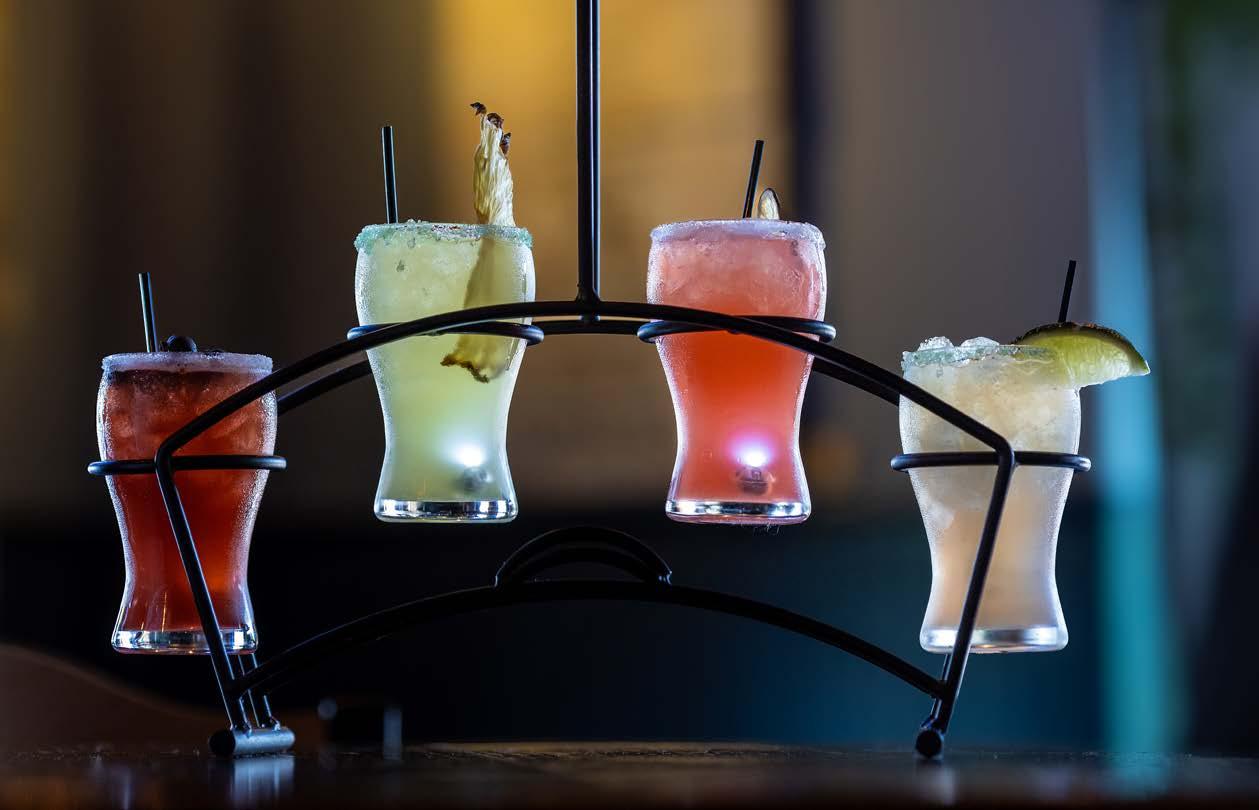
If the food is considered the soul of 13 Tacos & Taps, the margaritas are its heartbeat. The restaurant was recognized by Yelp as home to the best margaritas in North Carolina — an
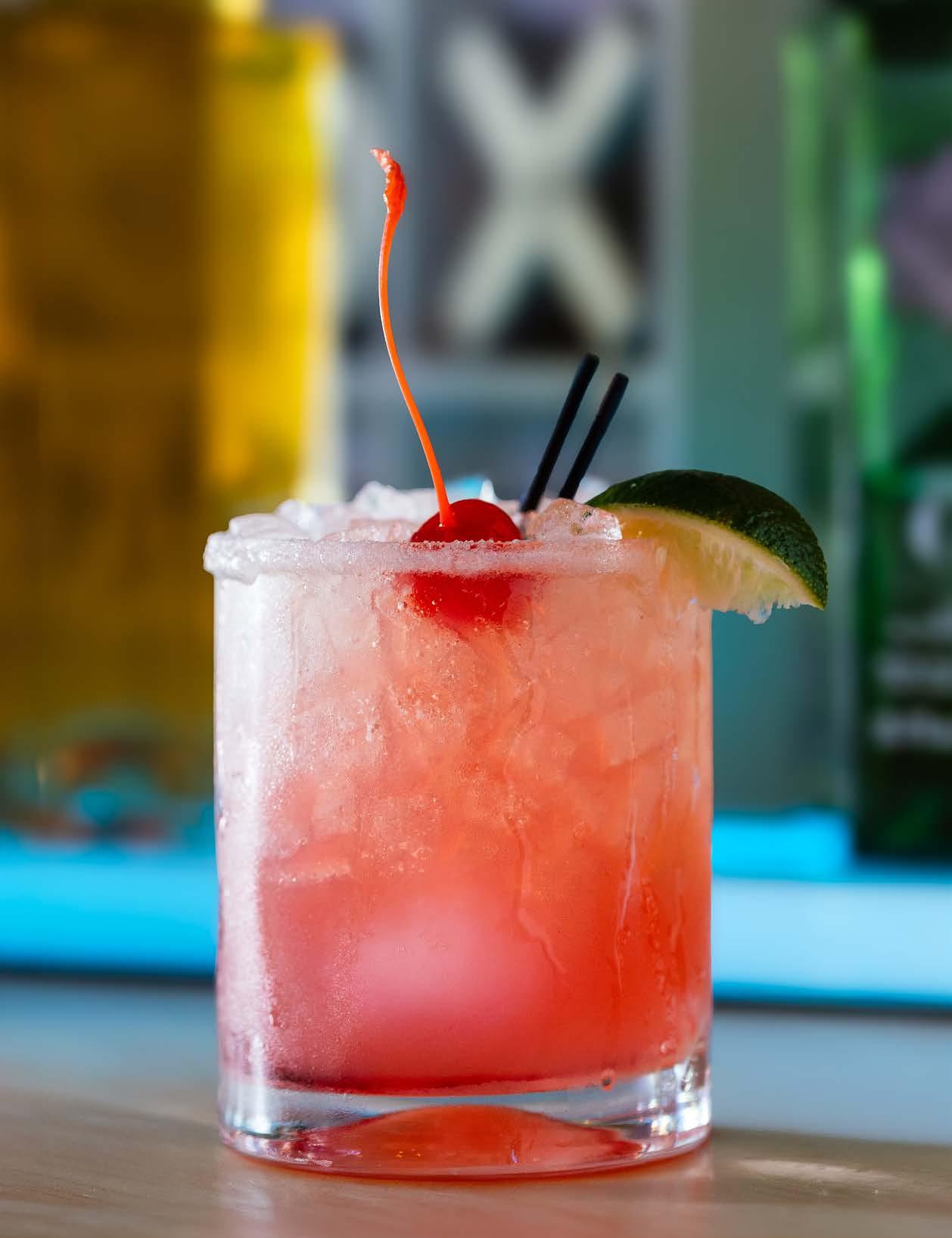
honor the team credits to their house-made mix, a proprietary blend that isn’t leaving the building anytime soon.
“We make our own mix,” Marilyn says. “That is the big secret” to the classic house and slew of flavored margaritas. And the demand is real. Regulars have been known to purchase the mix by the half gallon to take home.
The Details Matter
13 Tacos & Taps is also a curated environment, with the walls showcasing rotating work for sale by local artists, including pieces from a father-son duo who have become family friends of Marilyn and David.
One striking work, The Matador, contains a hidden figure that only one person has ever officially spotted. The restaurant’s lighting shifts through colors at night, entirely changing the way the painting reads.
“Each time it changes, it changes what you’re seeing,” David says. “It comes alive.”
As if guests’ senses need more of an awakening, the music playing overhead instills a decidedly eclectic atmosphere. Much of the playlist is AI-generated, curated by Marilyn. (This includes a track about the Chef’s Special 13th Taco — currently fish — which guests have been known to request copies of.)
If focus is the secret ingredient in David’s fusion, consistency is what arrives on the plate. In an industry defined by turnover, the team has remained largely unchanged, and most of the kitchen staff has been there for four to six years. One employee has been on board since day one. “I don’t pester her,” David says jokingly when asked about this loyalty before turning contemplative: “I show her.” When it comes to the team he’s built, and to whom he expresses his gratitude
with a living wage, he says, “I’m thankful for what we’ve accomplished.”
Attention is the culture at 13 Tacos & Taps, and not just from the chef and staff. When a supplier accidentally substituted a different variety of rice, yet all the other ingredients remained unchanged, a trusted regular immediately noticed the difference in the addictive “crack rice” as it’s been referred to since the food truck days.
With two years remaining on their current lease, David and Marilyn are beginning to look ahead to a smaller footprint possibly focused on takeout and perhaps to licensing the 13 Tacos concept so that other operators can carry it forward. This is where consistency, already a strength, can become an enduring asset in the form of a partner who




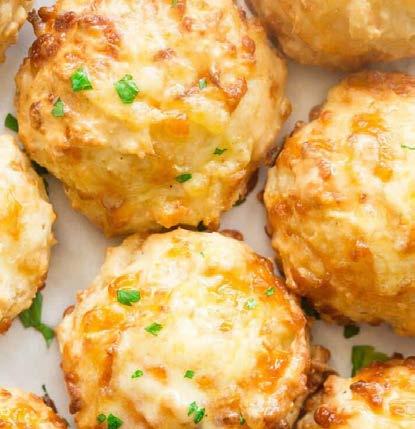
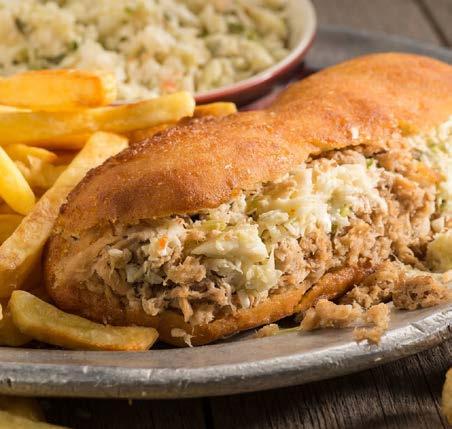

Your Internet is how you keep long-distance friendships close. Order a birthday gift at midnight. Draft the business plan you’ve been sitting on. Watch the game while your kids stream something else entirely. There are as many ways to use the Internet as there are people using it.
Why settle for Big Tech Internet when you can have Internet that’s all yours?
With Ting, you’ll get:
Fast, reliable gig+ fiber internet with equally fast upload and download
Consistent, straightforward pricing with no contracts since 2014
Enough Internet for everyone and every device in your home without data caps
Optional unlimited mobile for just $10/month per line
*Excluding taxes and fees.
Make The Internet your Internet.
Scan the QR code or check your address at ting.com

trains deeply, understands the standards, and carries the name forward with integrity.
In the meantime, a Saturday open-air market with live music launches later this summer and promises to uphold the creative and community components of 13 Tacos’ winning recipe.
The goal, as it has always been and despite increasing competition in North Raleigh, is straightforward: to serve food that people want to eat and will come back for.
“I’ll sit over there,” Marilyn says, gesturing toward the hosting stand where guests can expect to find her, “and I’ll look at the people and I’ll think, They’re in our restaurant eating this food and loving it …”
“That is such a good feeling,” David chimes in before heading back into the kitchen to create — or create anew. t 13tacosandtaps.com @13tacosandtaps
WRITTEN BY ERIN MCKNIGHT | PHOTOGRAPHED BY JONATHAN FREDIN
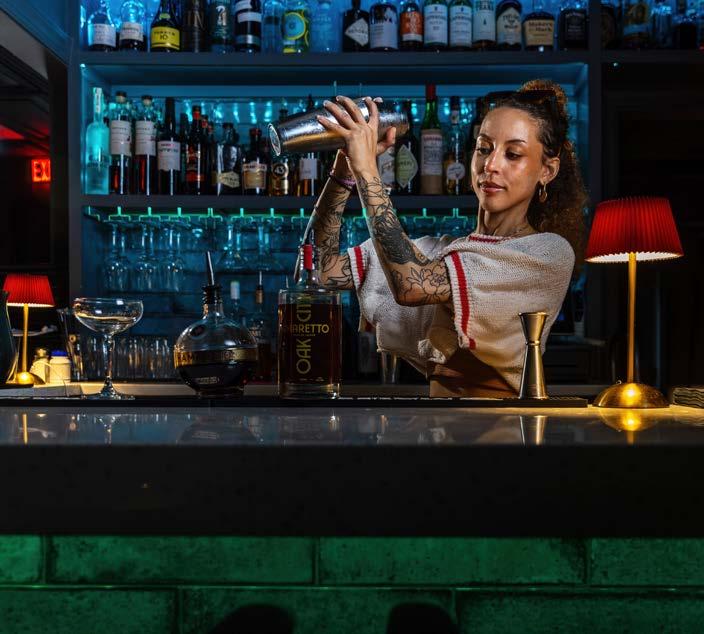
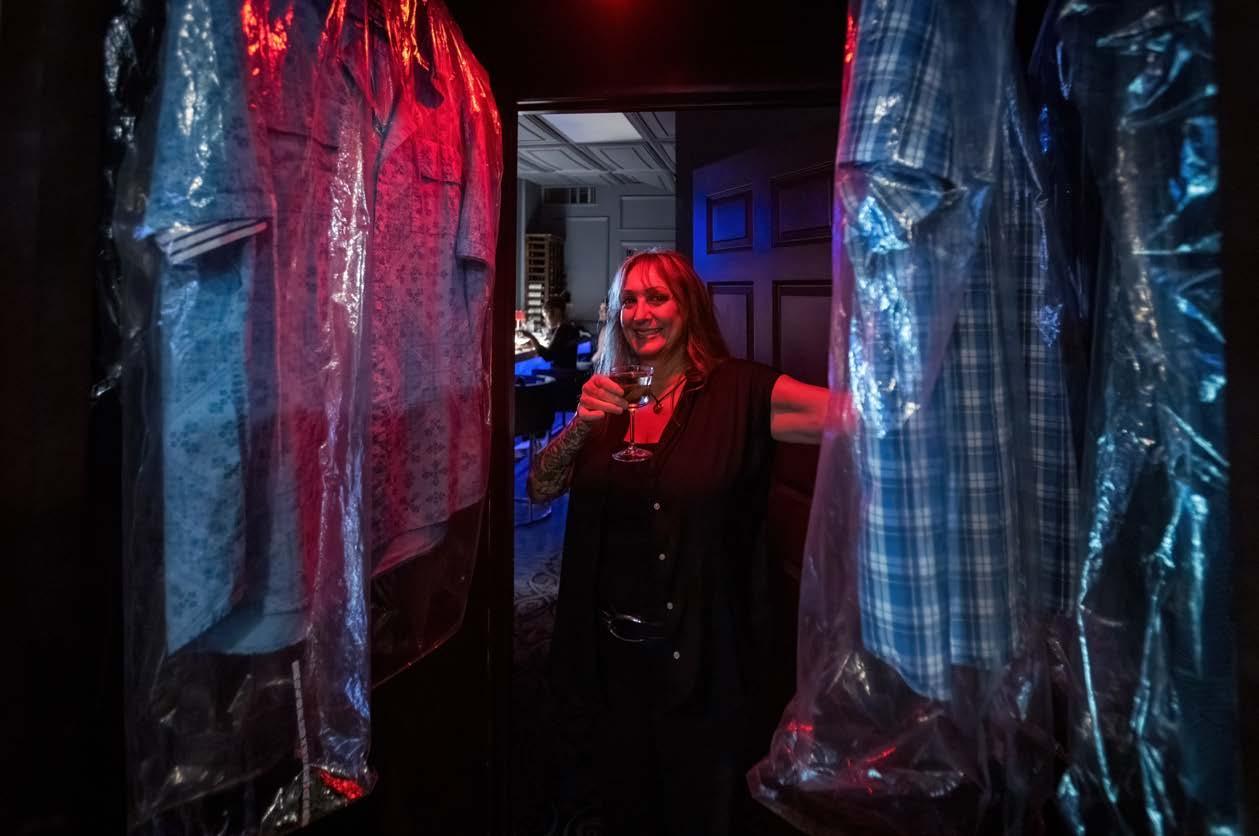
There’s a door tucked behind the Hibernian Pub on Falls of Neuse Road that most people have walked past without a second glance. It doesn’t announce itself with a marquee, velvet rope, or neon sign. But what’s behind that door makes for the kind of experience you will want to wash, rinse, and repeat.
The Dry Cleaners opened in October of 2025. In that short time, it has already established itself as a genuine, unhurried cocktail experience in a setting that feels like it was designed for exactly the kind of evening you’ve been longing to have. “There are no cocktail bars or speakeasies or any-
thing like that in North Raleigh,” says general manager Sue Kempen, who has been with the Hibernian Hospitality Group for 12 years. “There’s no place like this.”
She’s right. And the story of how it got here is as good as anything on the curated menu.
For many years, the space next to the Hibernian Pub was exactly what the name suggests: a working dry cleaners. When the business moved out in 2019, the building sat empty, attached to one of North Raleigh’s most beloved Irish pubs. Hibernian owner Niall Hanley acquired the full property, and the question became what to do with it.
The answer, as Sue tells it, came from a simple but pointed observation from Niall: “What doesn’t the North Raleigh area have?” And so the former dry cleaners was gutted, refitted — new plumbing, new bar, new everything — and transformed into something the community didn’t know it was waiting for.
So while the name stayed, The Dry Cleaners is now no starch and all spirits.
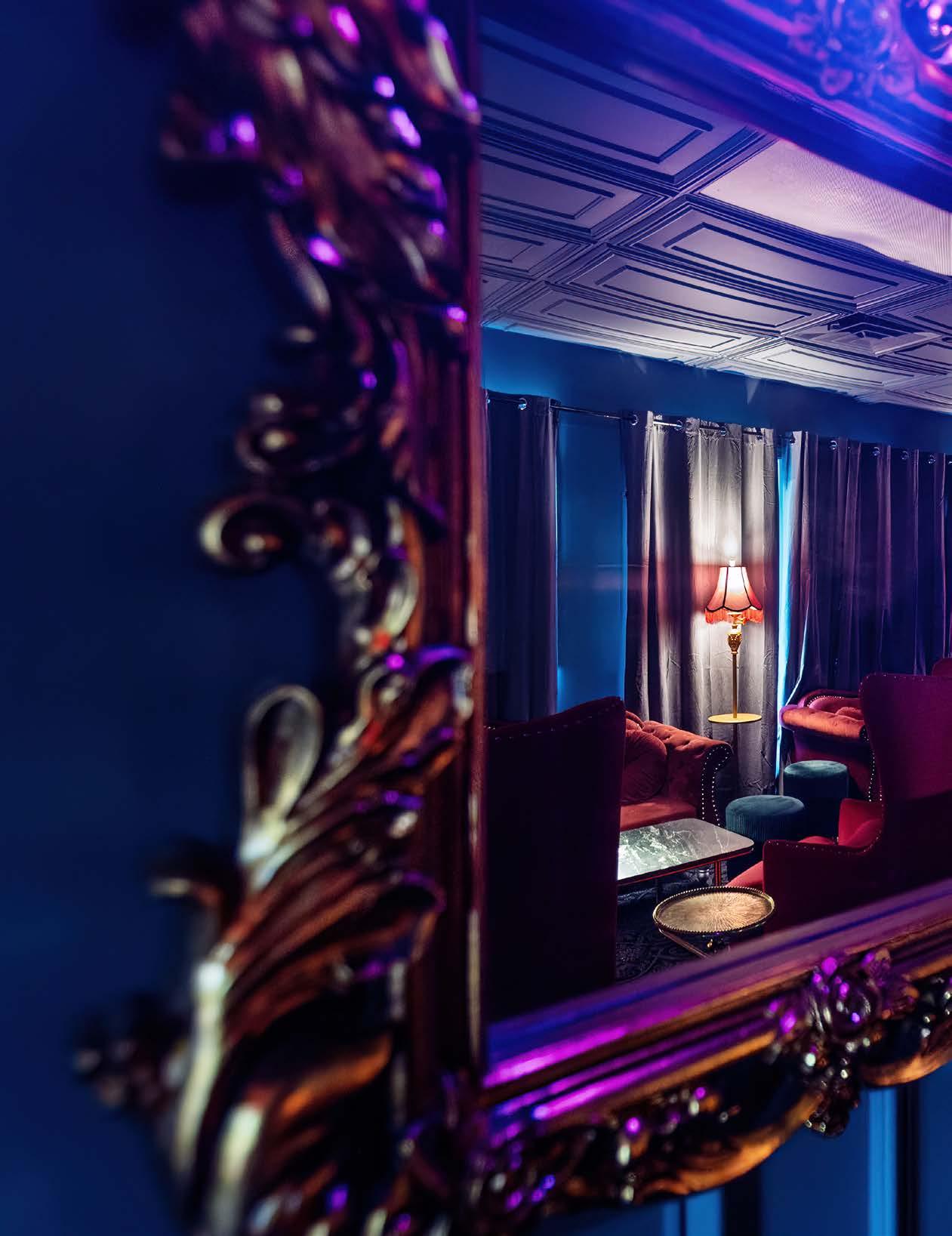
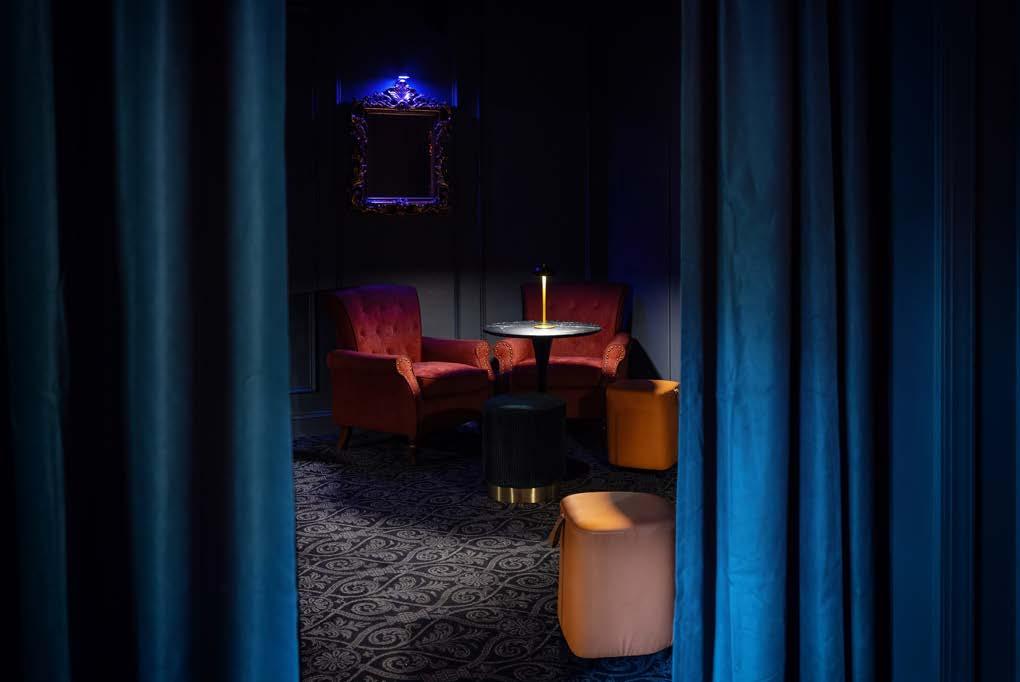
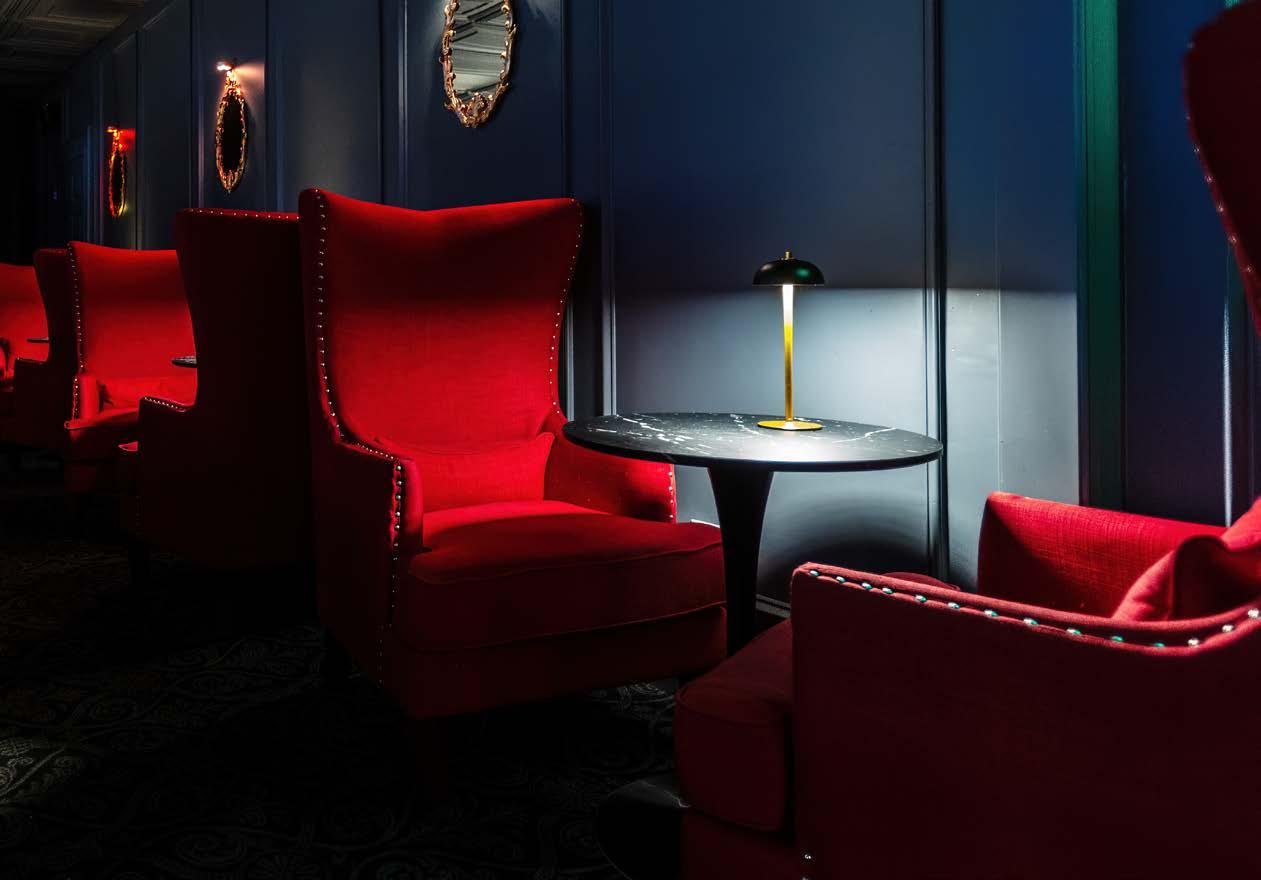
Deep grays and low light, red velvet and wing-back chairs, and table lamps that cast amber pools of light immediately establish the atmosphere. “We have little lights that go over each mirror in the building,”


Celebrate the LAZY DAZE of summer during two unforgettable days in Downtown Cary. Featuring hundreds of artists, live entertainment, delicious food, and family-friendly experiences. A must-see tradition for five decades!
AUGUST 22 23 | DOWNTOWN CARY 9 A.M. 5 P.M. FOLLOW @caryartdaze VISIT carync.gov/lazydaze














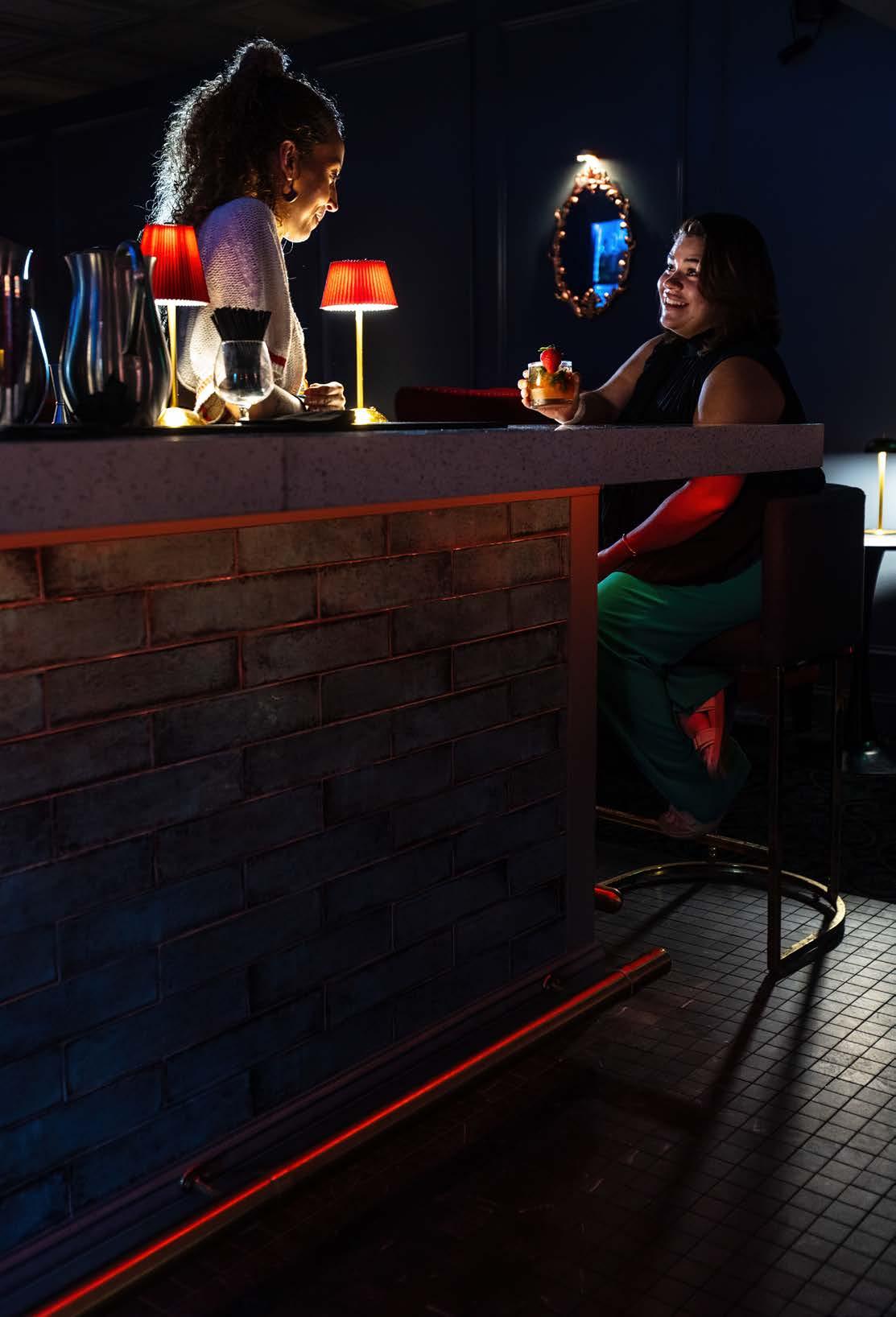
Sue explains. “We don’t have any overhead lights. Everything is table lamps.”
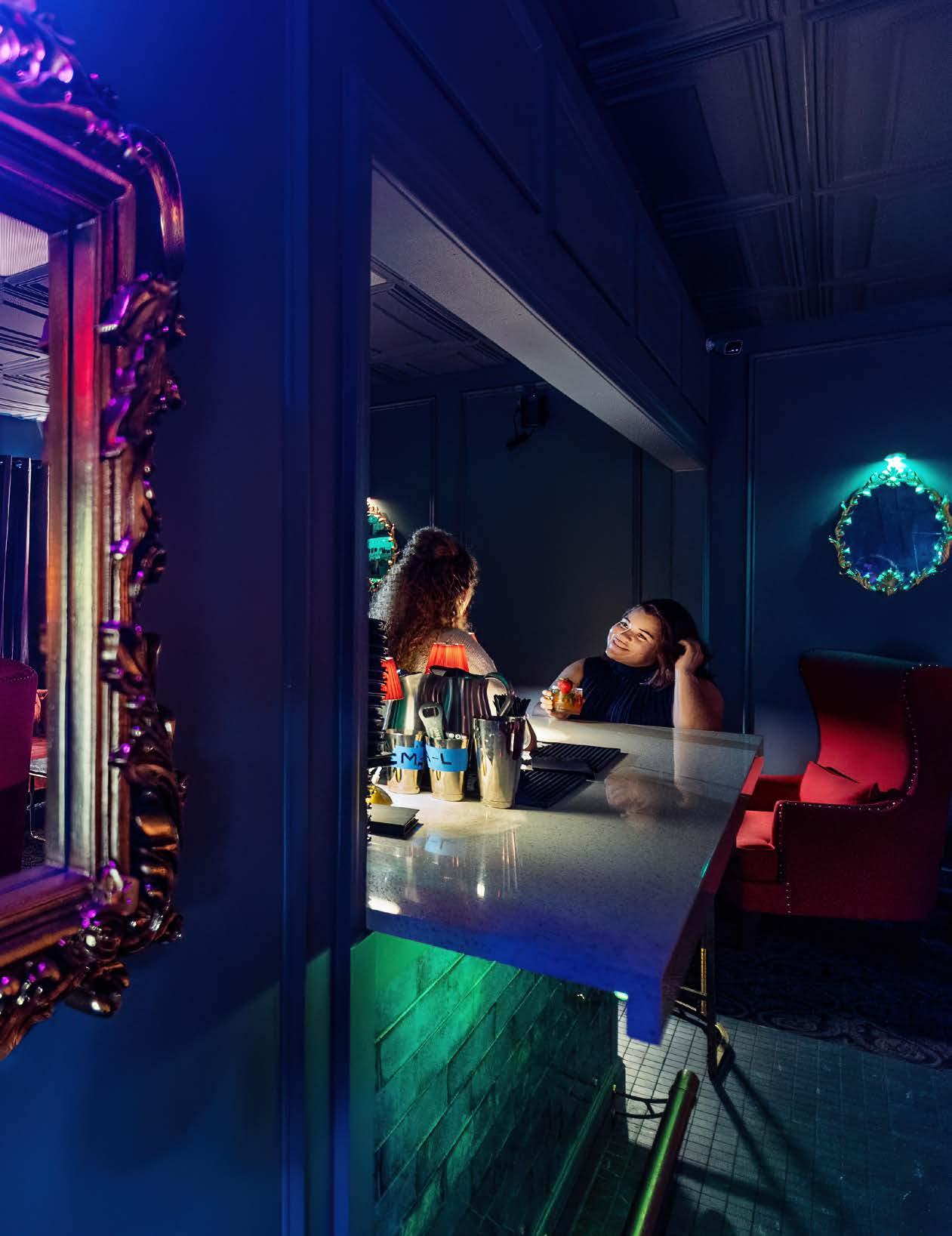
The effect is precisely what you’d hope for from a speakeasy: intimate without being cramped, atmospheric without feeling overdone. Clusters of seating are arranged around coffee tables — couches that seat three, flanked by a pair of generous wingback chairs — so that a group of friends can settle in for the evening and feel like they have their own private corner, even when the bar is full. “You can have intimate, cozy conversations yet be in a room with a lot of other people,” Sue says.
With 10 bar stools and seating for approximately 50 guests, The Dry Cleaners is notably more spacious than your average speakeasy, but the mood, as Sue describes it, is still “smoky, sexy, intimate.”
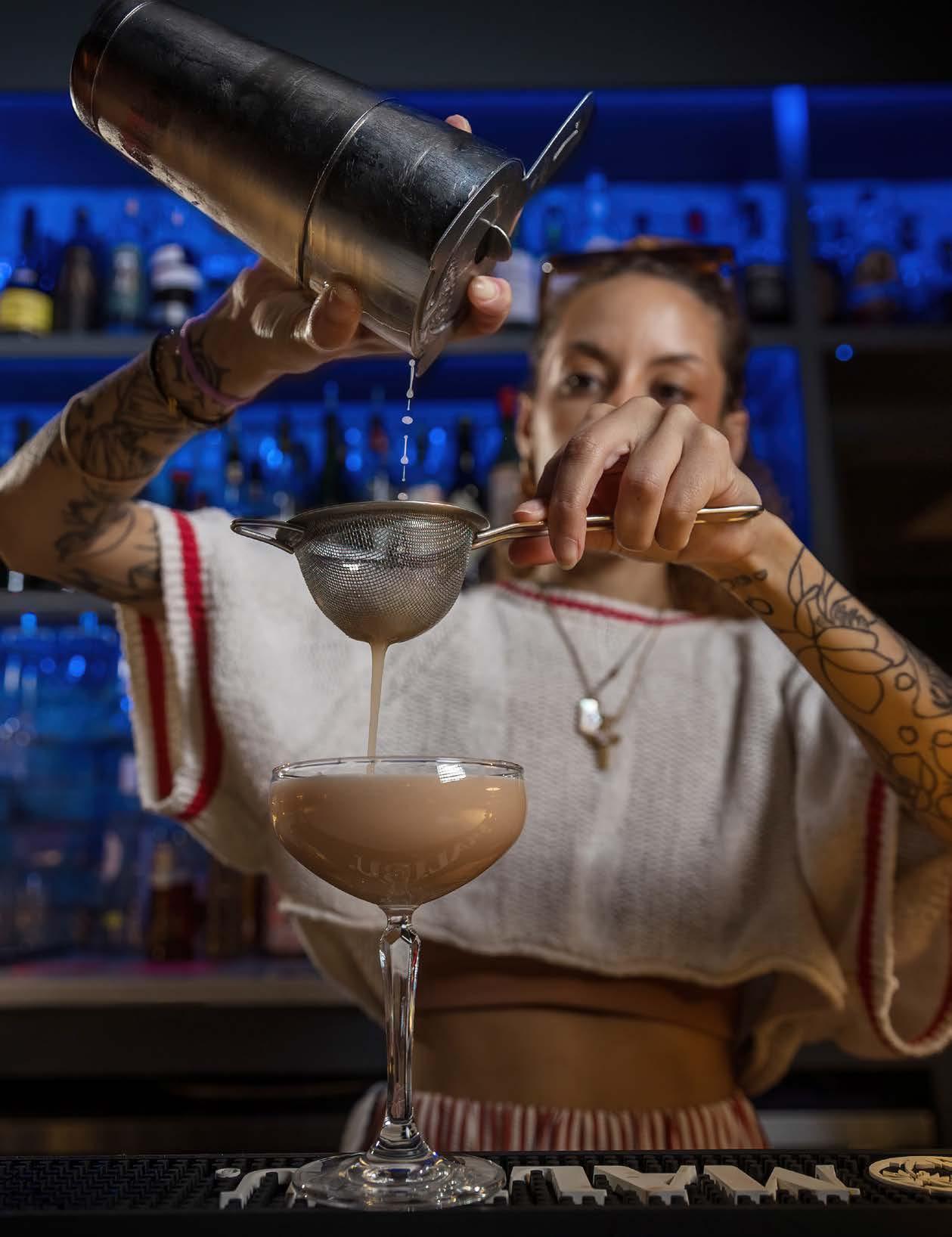
If the space sets the scene, the bartenders write the story. Sue — who worked as a bartender and describes herself as “oldfashioned, Manhattan, martini, and all that” — is the first to acknowledge that the four craft bartenders behind the bar operate at an entirely different level. “It’s the difference between being a cook and a chef,” she says.
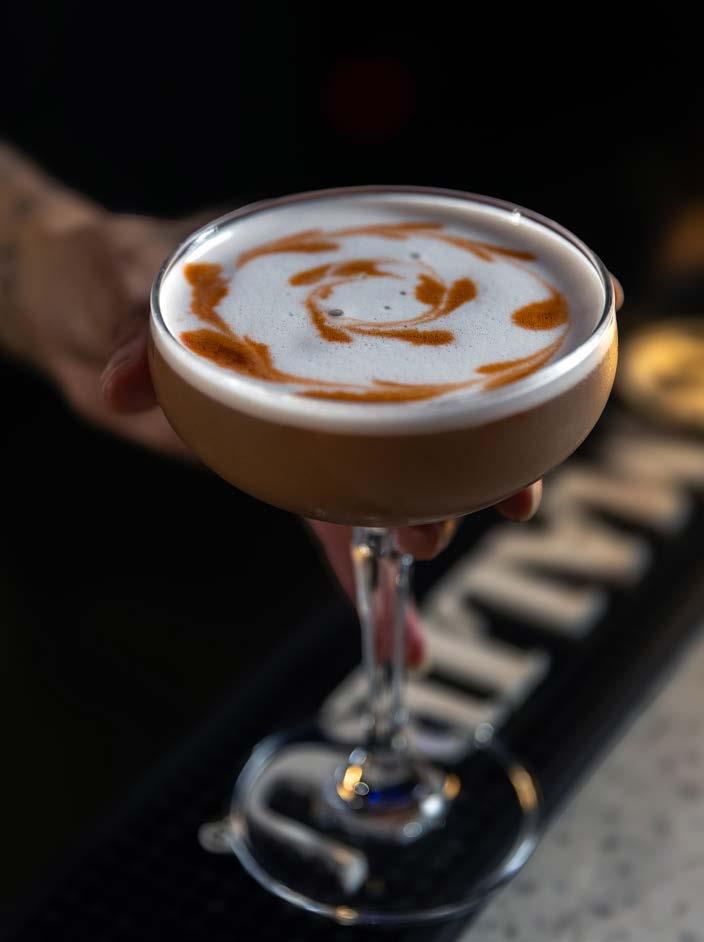
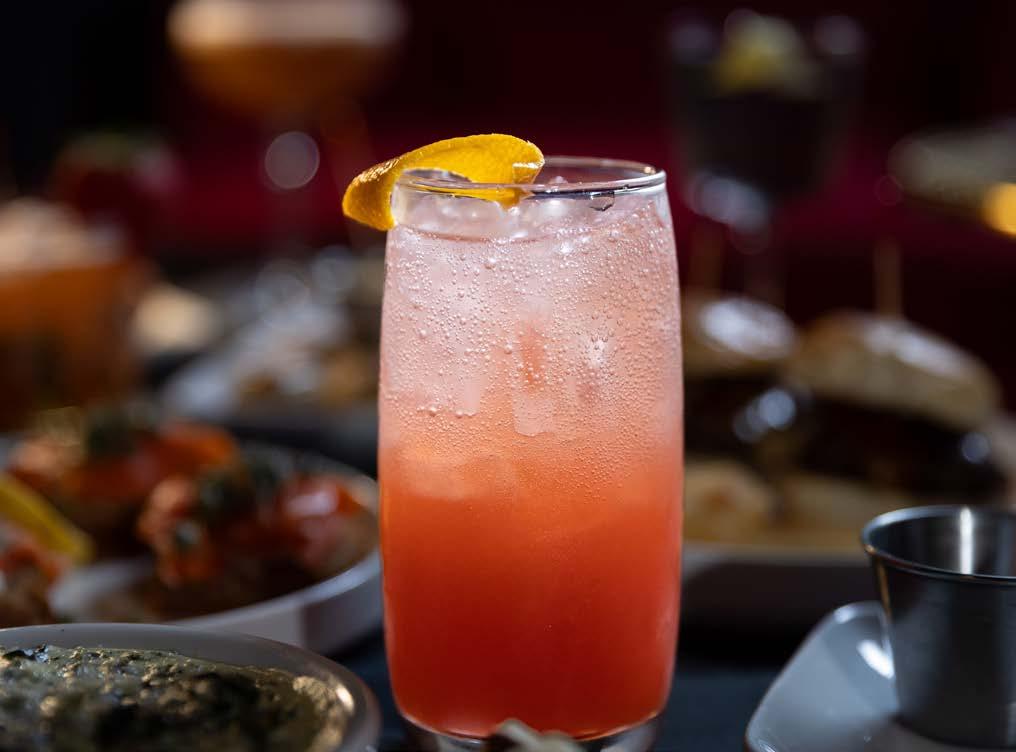
The menu leans into the classics while leaving plenty of room for imagination, and the cocktail program includes one feature that immediately distinguishes The Dry Cleaners from most bars in the area: the dealer’s choice. Bartenders don’t simply ask what spirit you prefer. They ask questions. What flavor profile are you drawn to? Do you like something smoky? A little sweet? Any allergies? Floral notes — yes or no?
“They actually will talk to a guest and get a feel for what the vibe is that they want to drink, what their flavor palate is, and come up with something from there,” Sue says.
The tool chest behind that process is impressive. The Dry Cleaners stocks what Sue believes is one of the largest selections of bitters in the city — roughly 20 varieties, spanning Japanese, smoked, orange, cocoa,

and floral options. “We have real pros in here,” she says simply.
And while the speakeasy concept carries all the intrigue of Prohibition-era passwords and hidden entrances, Sue is straightforward about the barrier to entry. “It’s not the type of speakeasy where you need a password. You just need to find us, and we’re happy to show you where we are.”
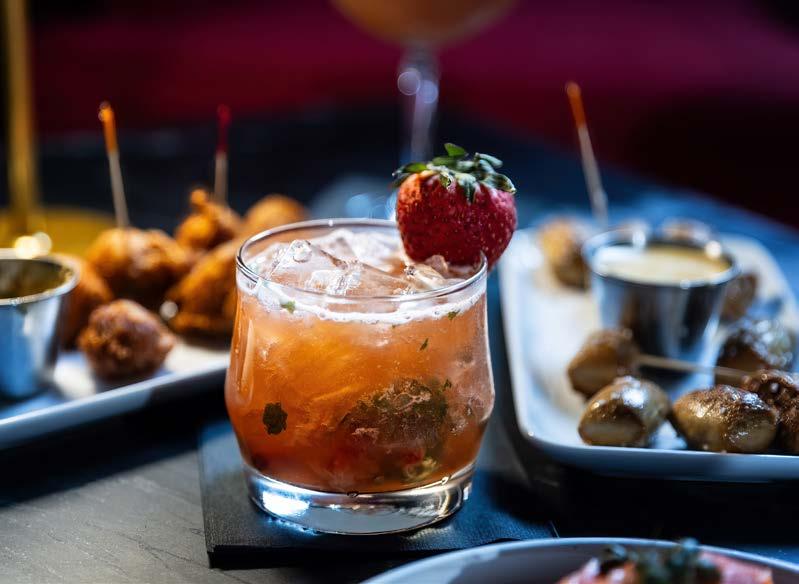
The same philosophy behind the cocktail program informed the recently launched small bites menu. Sue and kitchen manager Kelly Wilmes approached it with the guiding principle that every bite should belong in a cocktail bar, which meant thinking carefully about how food interacts with what is in the glass.
“
They actually will talk to a guest and get a feel for what the vibe is that they want to drink, what their flavor palate is, and come up with something from there.
— Sue Kempen, General Manager, The Dry Cleaners






























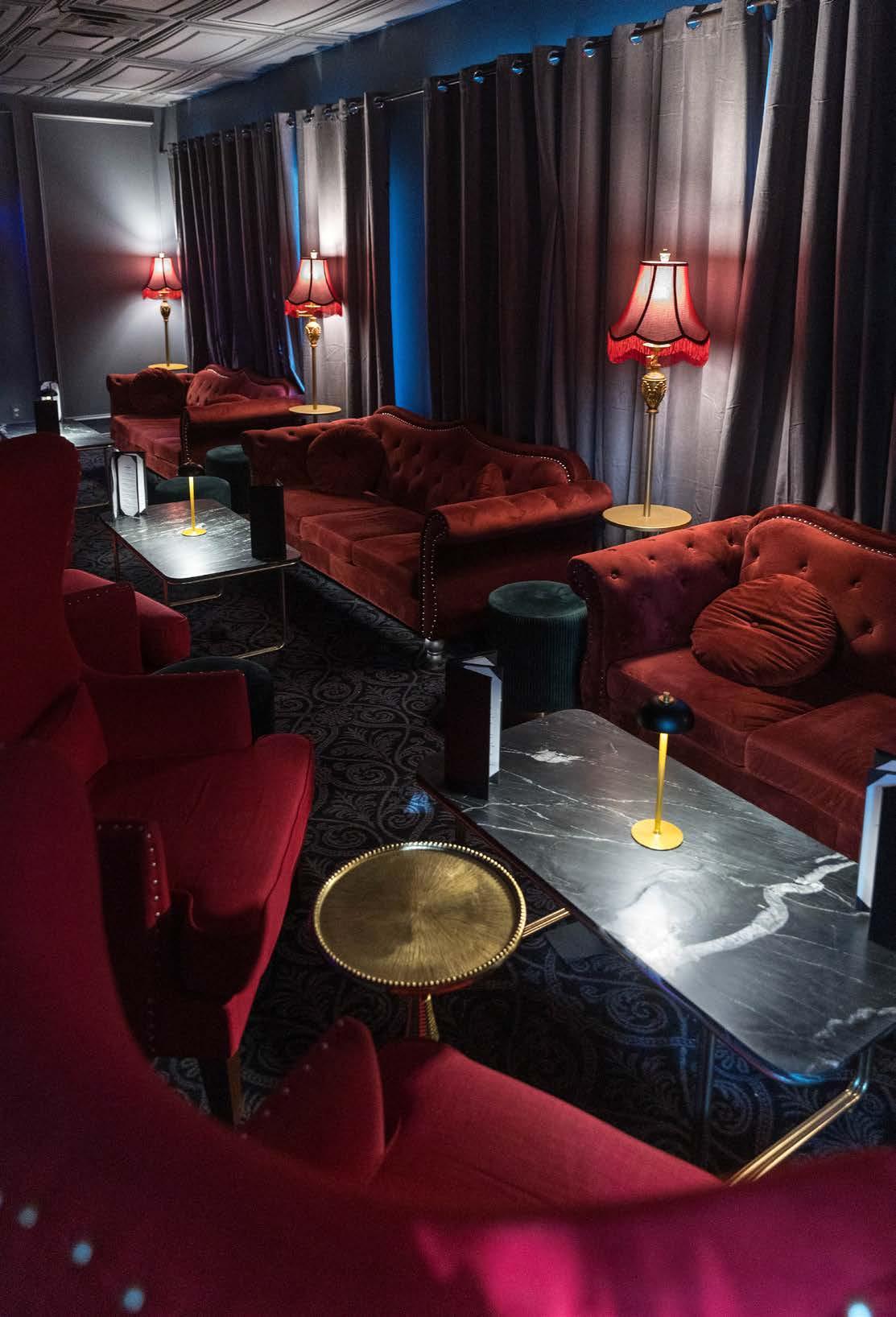
Seating is intentionally intimate and designed so guests can get comfortable.
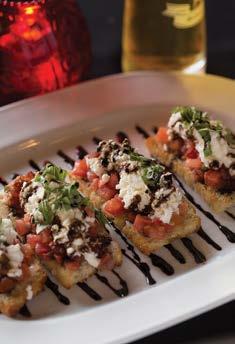
An elevated small bites menu complements the cocktail, wine, and beer offerings and requires no utensils to enjoy.
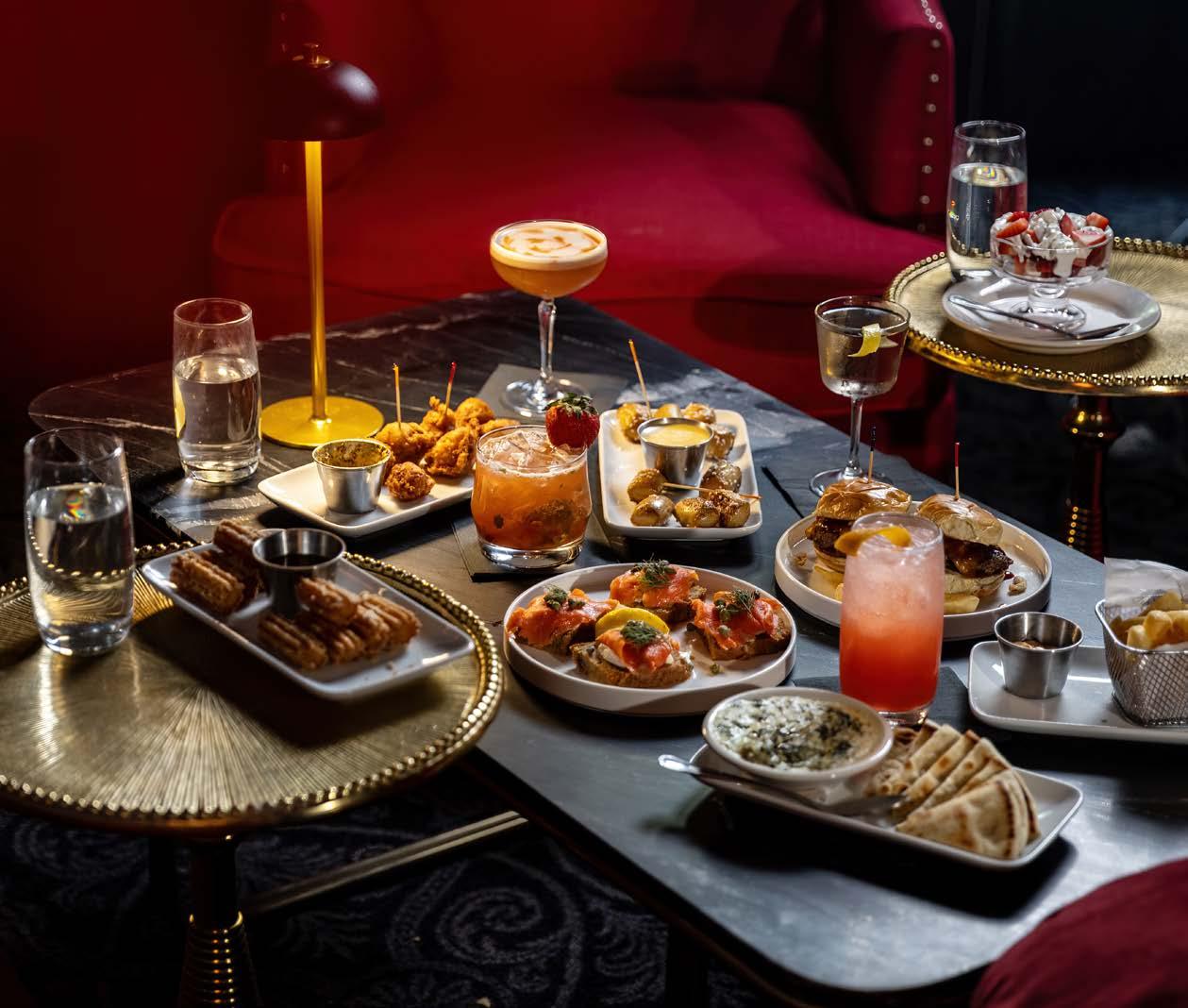
Garlic, for example, was ruled out. “Garlic does not go well with cocktails at all,” Sue explains. Instead, a smoked salmon BLT is finished with citrus aioli, a natural complement to the spirits it is served alongside. Classic pub staples from the Hibernian have been elevated for the setting: Guinness-battered bangers replace the standard cocktail frank; Perios and A whiskey barbecue slider with house-made sauce and crispy onions takes the place of a more straightforward version. The smoked salmon canapé — brown bread, cream cheese, salmon, capers — arrives assembled rather than deconstructed.
“You don’t need silverware. It’s very shareable. It’s small. It’s not going to fill you up,” Sue says.
The food menu is designed to augment an evening, not anchor it.
Ask Sue who The Dry Cleaners is for, and she doesn’t hesitate: everyone. On any given night, a group of seniors might be settled into the couches while a table of younger guests dressed for the evening claim a corner of the bar. Couples. Groups of friends. People who wandered over from the Hibernian looking for something quieter. People who have never set foot in the Hibernian. “We are all inclusive,” Sue says. “Anybody is welcome in here.”
The one firm boundary is that it is a 21-and-over venue, exclusively.
Two private events have already been hosted, including a holiday party for the Canes that filled the space on a night when the doors stayed closed to the public. Private cocktail parties are available any day of the week, with a minimum of 25 guests for off-night bookings.
For now, The Dry Cleaners is open Wednesday through Sunday starting at 4 p.m. In mid-fall, the team is expected to grow.
But The Dry Cleaners will be exactly as you found it: low-lit, unhurried, and very glad you found that door. t drycleanerscocktail.com
@drycleanerscocktail









































The Sassool Hummus Mix-Off returns for an eighth year
WRITTEN BY ERIN MCKNIGHT | PHOTOGRAPHED BY JONATHAN FREDIN


From buzzy TV shows to international awards, Charlotte’s food scene is having a moment. Stay in the heart of it all at The Dunhill Hotel, uptown’s only historic boutique hotel, and savor Southern-inspired dining at our restaurant, The Asbury. 237 North Tryon in Uptown Charlotte | dunhillhotel.com




This summer, the most serious competition in Raleigh isn’t on the court — it’s in the bowl.
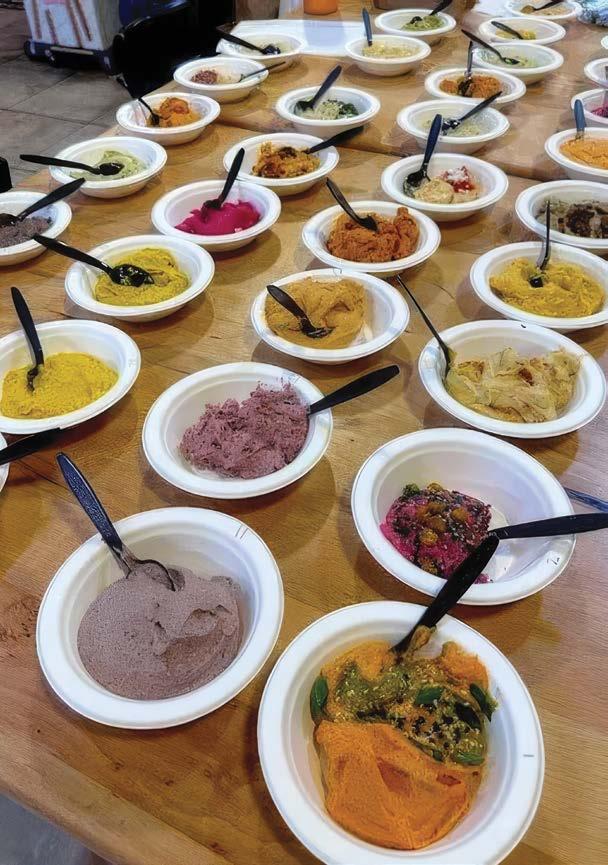
While the prize isn’t cash or a trophy, a record deal or reality TV contract, the winner of Sassool’s annual Hummus MixOff takes home something arguably more valuable: the knowledge that their hummus — their recipe, their ratios, their obsessive fine-tuning of ingredients — has been declared the best in the room by people who really, truly care about these things.
Now in its eighth year, the mix-off has become one of the more anticipated food events on the local calendar. It’s a celebration that is one part friendly
competition, one part community gathering, and one part love letter to a dish that has featured on the Sassool table since the family owned and operated restaurant opened its doors in 2014. Open to the public, this year’s mix-off will be held August 8 from 3–5 p.m.
Marketing Director Simone Lawson traces the idea back to the cultural moment when competitive cooking shows became popular. “We wanted a way to create some hype or excitement around our food and get the community involved,” she says. “We wanted it to be something exciting like a competition where people are bringing new ideas and no one is creating the same recipe.”
As one of Sassool’s staple items, hummus was the perfect canvas.
The event has evolved considerably since its first year, when Sassool reached out to a small circle of local chefs: people they admired, Mediterranean cooks in their network, and culinary friends willing to step away from their own kitchens for an afternoon. Eight competitors took part.
By year two, the format had already shifted. Pulling working chefs away from their restaurants was a significant ask, so instead they invited local food bloggers and influencers. The decision to host social media personalities was twofold, Simone explains, “because we highlighted them, we posted
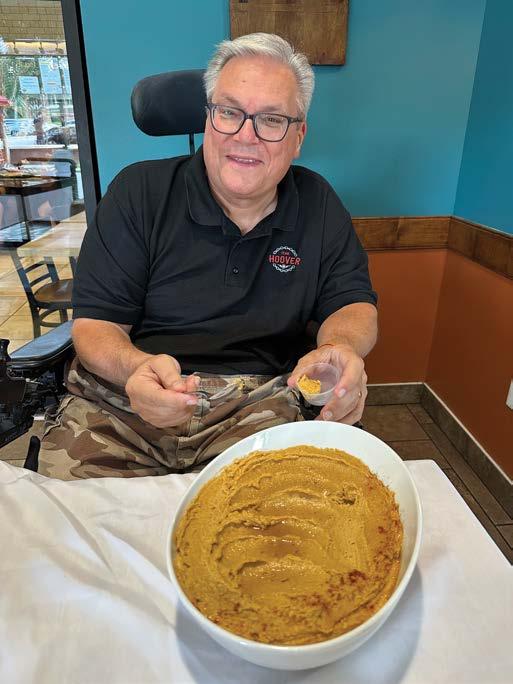
about them, we had their social media handles available at their tables. But also, they were passionate about food, so for them to be asked to make a recipe that could be featured … it was really cool.”
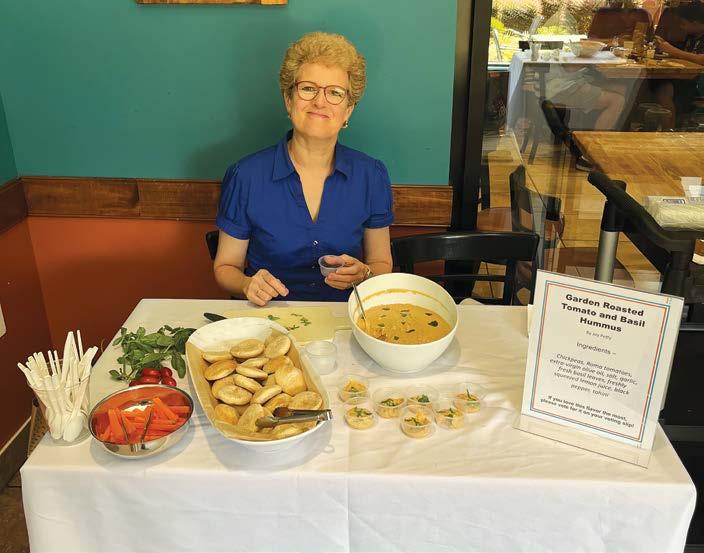
That chapter lasted three years. Then, four years ago, Sassool welcomed anyone who was a fan, who saw the competition on social media, or who had an idea and a blender. The result was that entries rose from a dozen to 52. Welcoming everyone, Simone says, “has created even more hype around the event, more interest, and more flavors.”
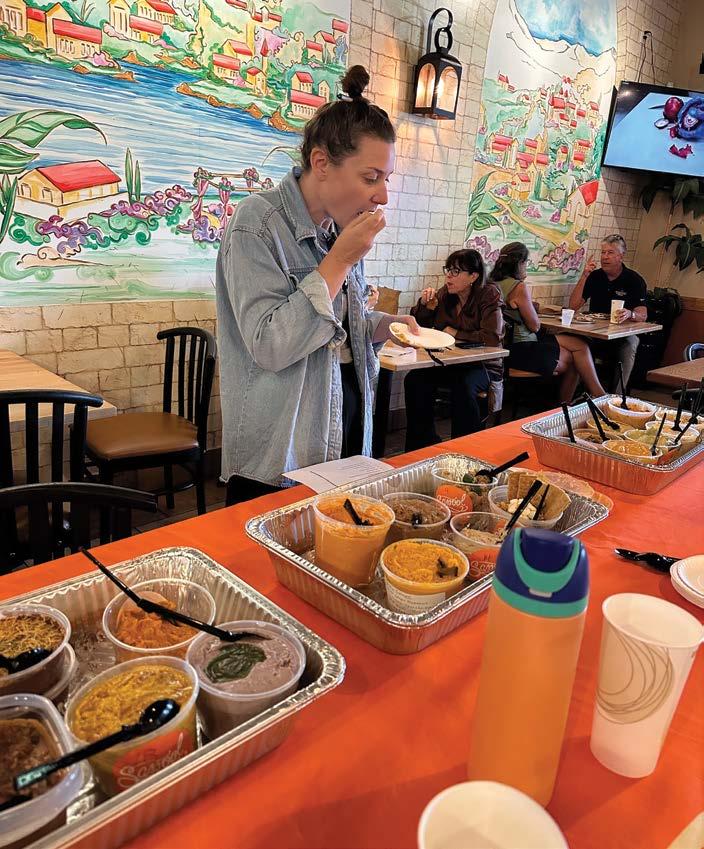
The competition format has matured into two rounds, where judges evaluate all submissions in a semifinal round and narrow the field to five recipes. Then the community takes over, sampling the contenders and casting their votes. It’s a democratic and spirited process, which is exactly as it should be given the Sassool spirit.
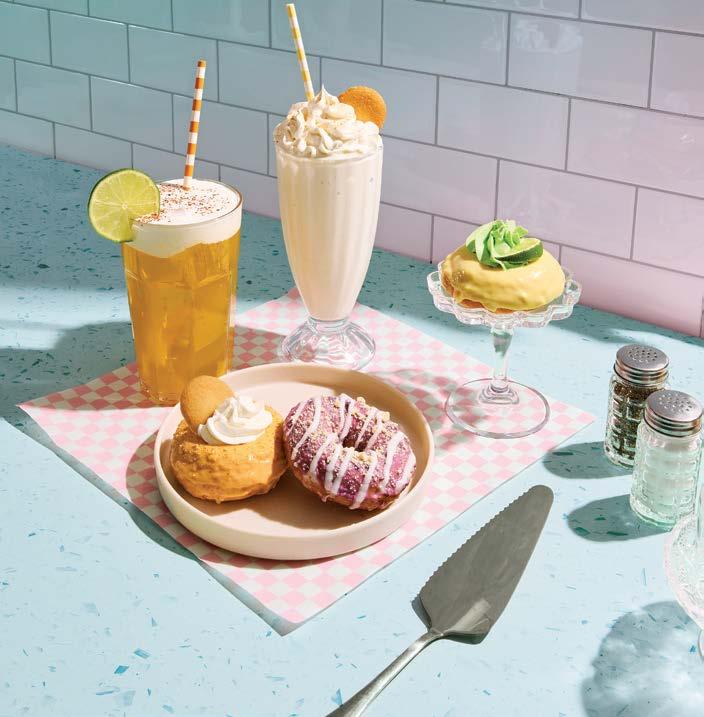
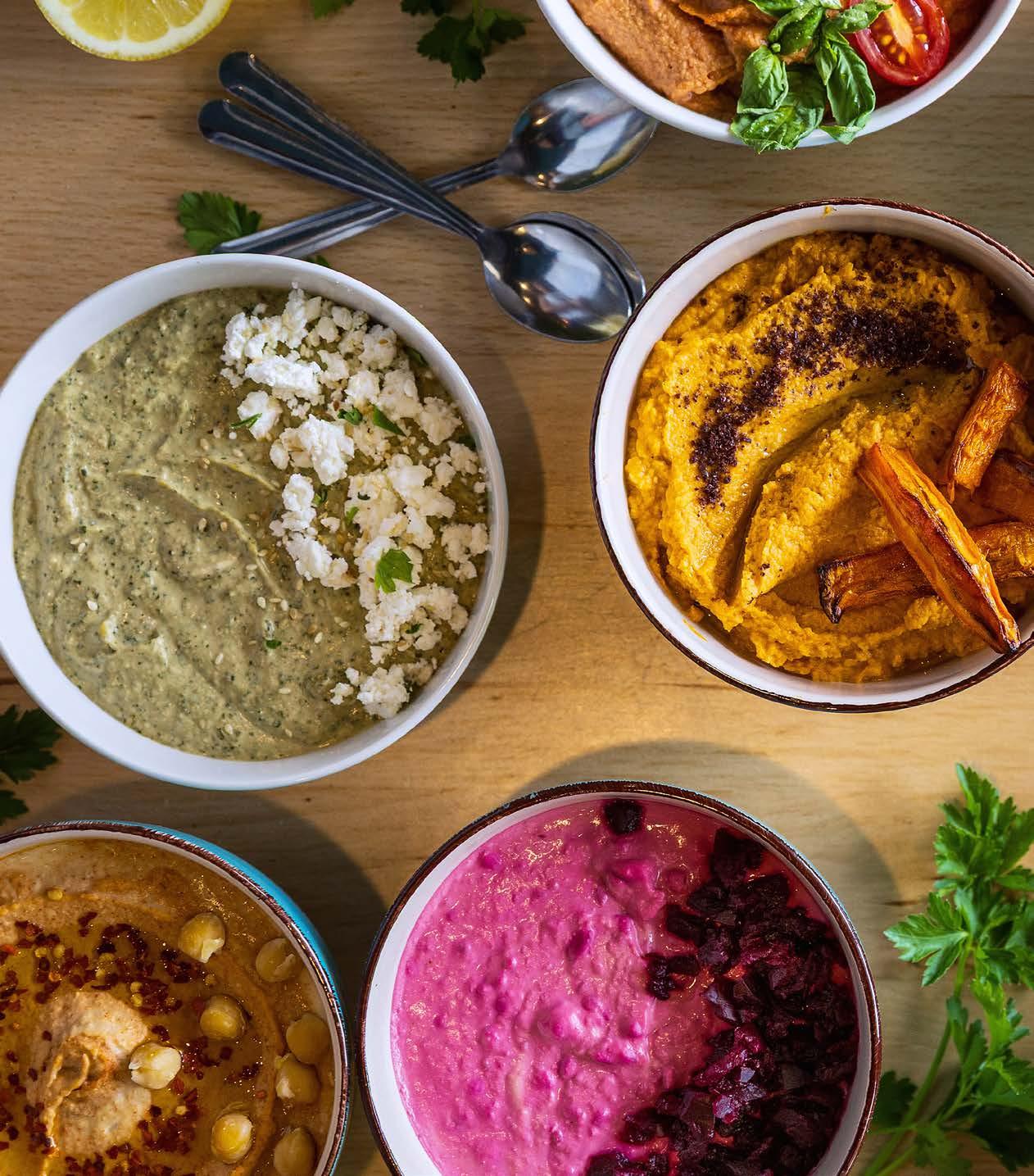
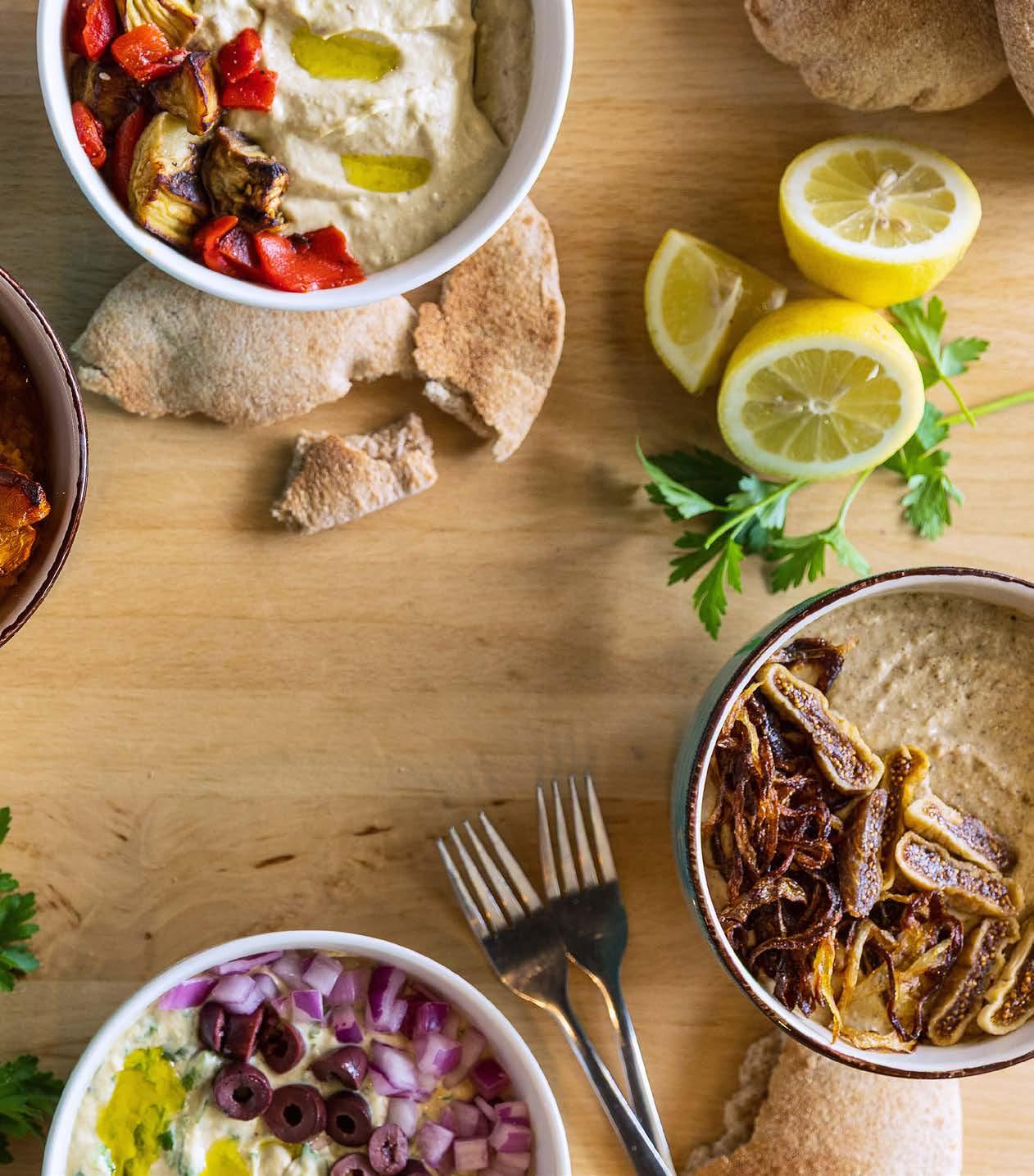
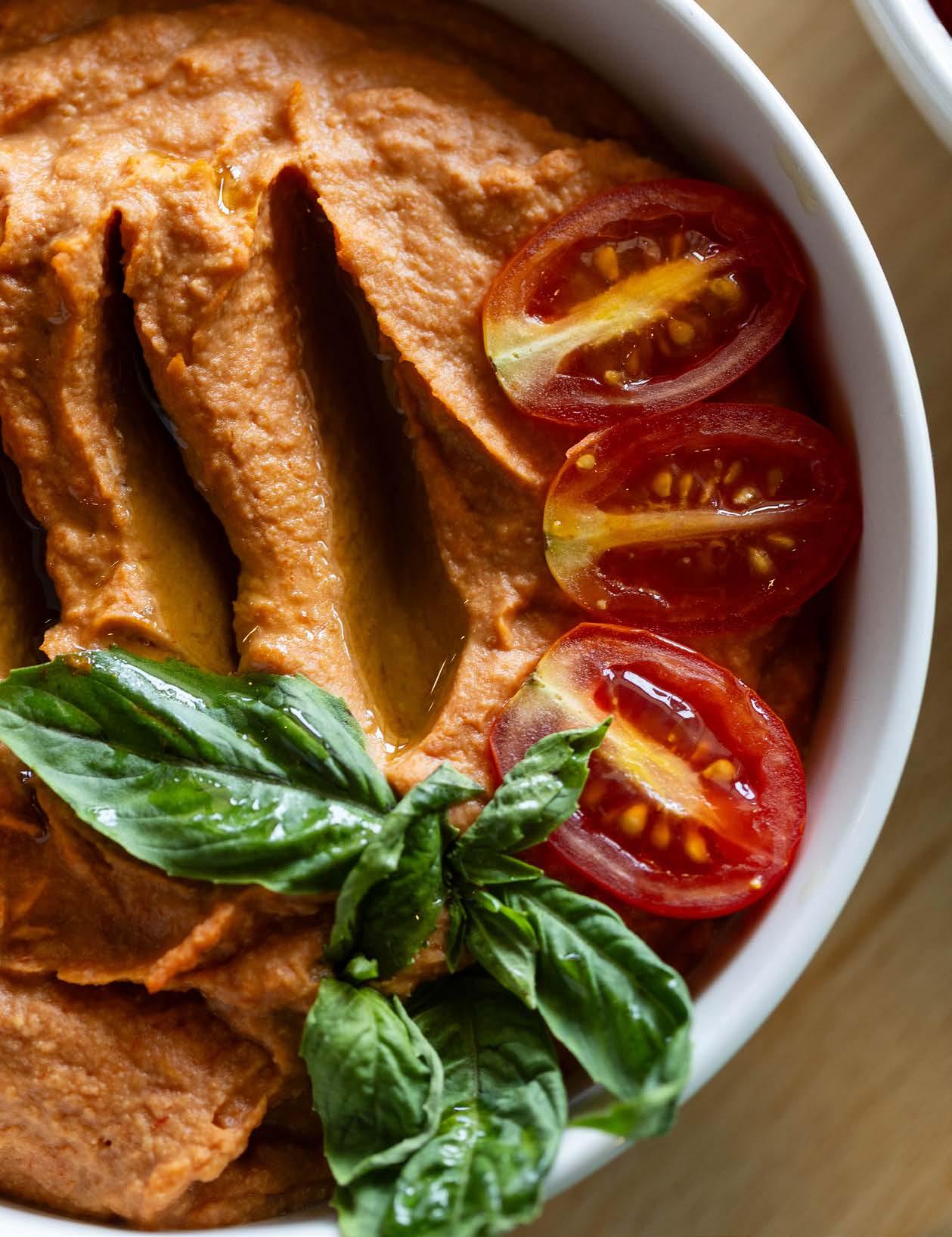
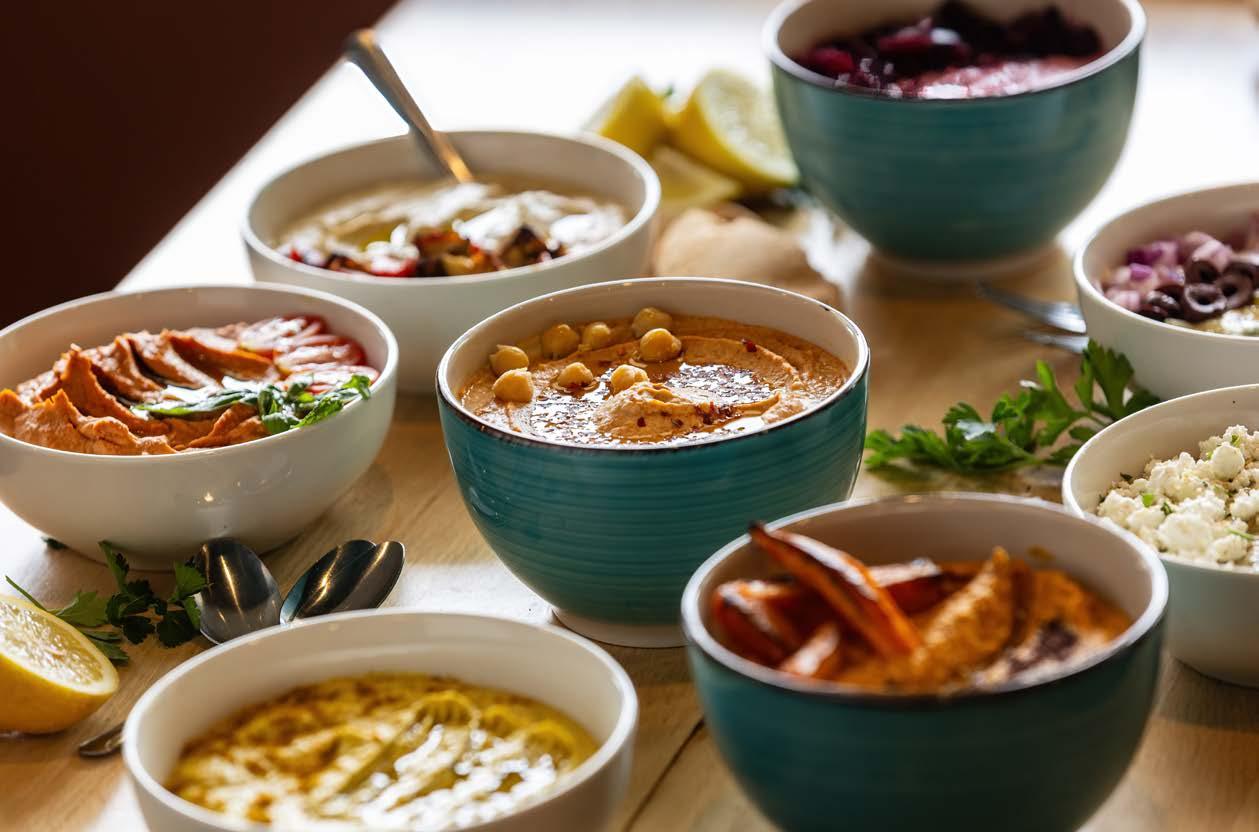
Over the years, the winning flavors read like a delicious argument for culinary imagination. A roasted beet hummus that wowed as much with its color as its taste. A deeply savory mushroom caramelized onion. An herb hummus topped with house-made tomato jam. A spicy sweet potato that balanced heat and earthiness.
And then there was the basil pistachio. “I’ve never had pistachios in hummus,” Simone admits, “but man, does it work.” Perhaps the most unexpected winner was a dessert hummus that stopped everyone in their tracks. “It was called the Sahara Dessert Hummus, and it tasted like chai,” Simone says. Not every adventurous entry lands, of course. When it comes to what separates a good hummus from a great one, Simone says freshness matters and creaminess is “very, very, very, very important.” But the defining quality is more philosophical than technical. “What makes it a great hummus is that you don’t forget you’re eating hummus,” she says.
For all the creativity the mix-off celebrates, Sassool’s foundation remains unchanged. The traditional hummus on
“ The whole idea of hummus and any other mezze dish is that community aspect.
— Simone Lawson, Marketing Director, Sassool




the menu is a cherished family recipe. “So many people have come to me even before knowing it was my grandmother’s recipe, saying, ‘You guys have the absolute best hummus in town,’” Simone says. “People will come from the grocery store and say, ‘I just finished shopping, but I had to come by just to get a container of hummus. Because we can’t get the hummus anywhere else the way yours tastes.’”
Simone credits her grandmother’s extraordinary palate for that loyalty. “She had such a balanced palate. She really had it to a science where one flavor was not overwhelming the other. Every one really complemented the others. And it shows.”
That legacy is precisely what makes the mix-off, beyond the competition itself, so meaningful. Promoting hummus in a
way that welcomes everyone — not just Lebanese and Mediterranean diners, or food insiders, but the whole community — feels like an extension of what her grandmother understood intuitively: This food brings people together.
“The whole idea of hummus and any other mezze dish is that community aspect,” Simone says. “You’re sharing it with others. You’re sitting. You’re having face-to-face interaction with people, which is so unique these days. … It’s gold.”
And despite all mix-off participants receiving rewards, with added exclusive opportunities for the five finalists, the winning recipe doesn’t disappear when the event ends. In addition to media exposure — and, of course, bragging rights — each year’s champion is featured in Sassool’s case as a
special for the following month, meaning that even guests who never competed get to taste what the community chose.
Simone envisions the mix-off eventually outgrowing the restaurant walls with a larger venue, an outdoor setting, more entries, more votes … more of everything. “We’re never short of ideas,” she says, “and I think we can just continue to make it bigger, better, more fun, more community engagement, and just continue this celebration around Mediterranean food.”
For now, though, the eighth annual Hummus Mix-Off is exactly what it has always been at its core: an open invitation to share your best hummus recipe in a setting where it will be savored. t
sassool.com
@sassoolcafe
WRITTEN BY ERIN MCKNIGHT | PHOTOGRAPHED BY JONATHAN FREDIN
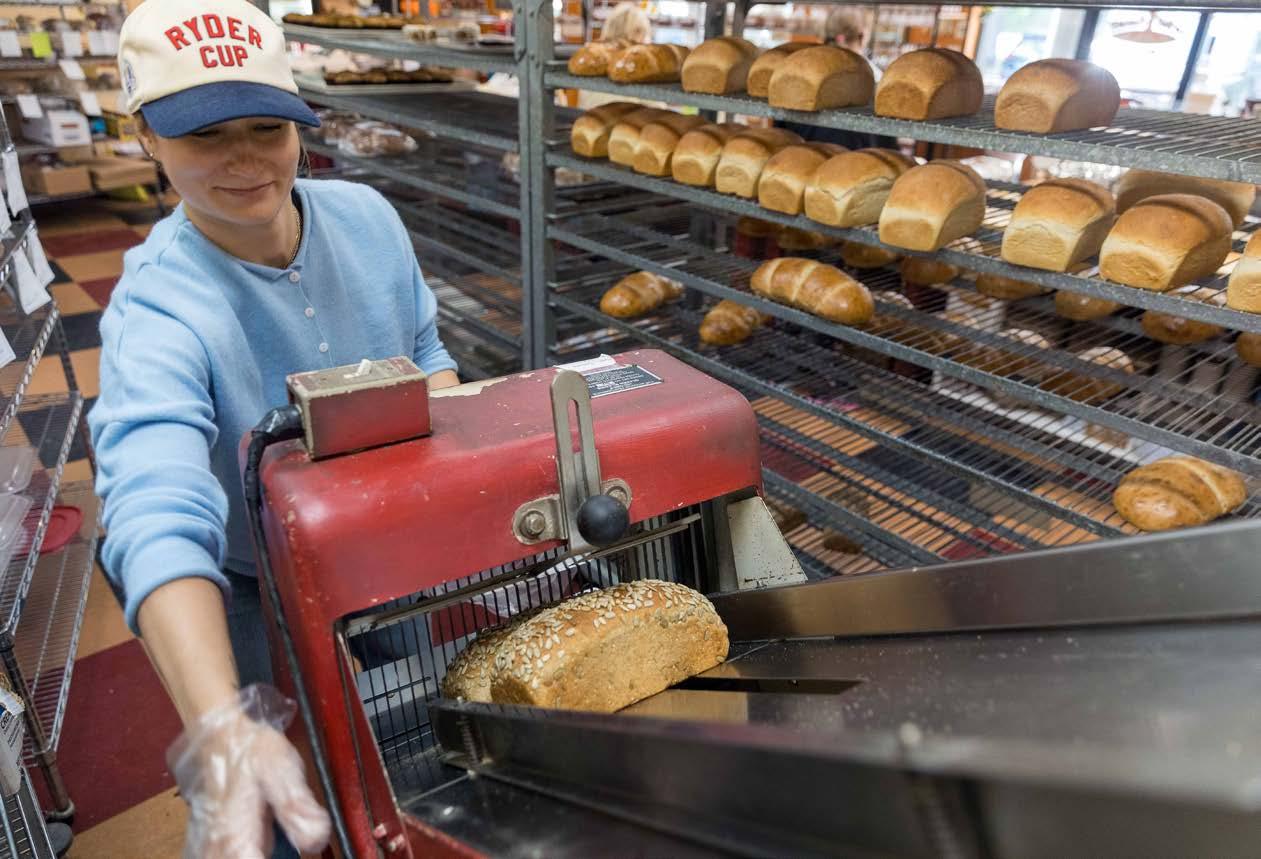
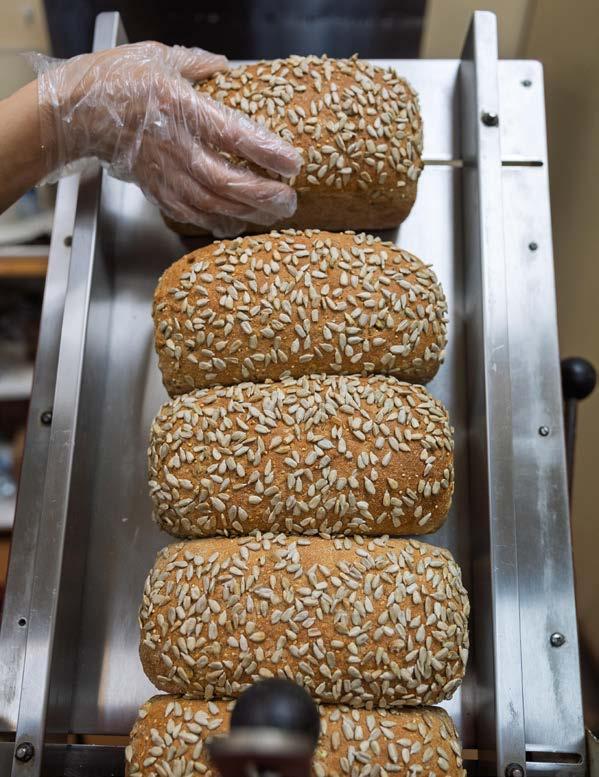
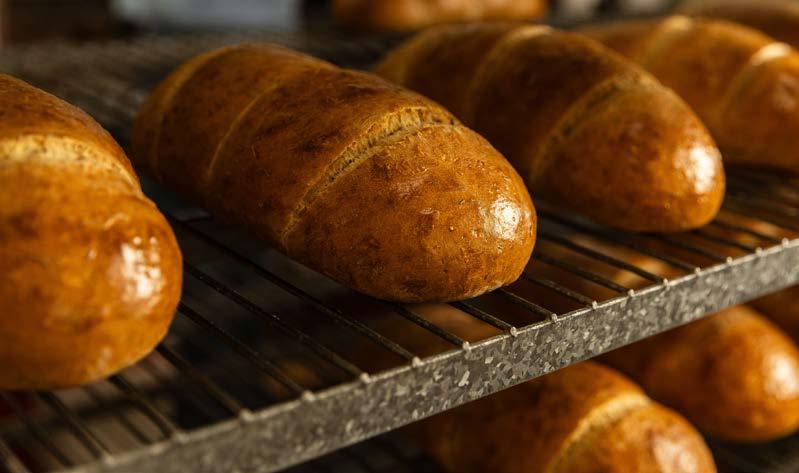
The bakers arrive between midnight and 3 a.m. By the time the rest of Raleigh is pouring its first cup of coffee, the sponges have been fermenting for hours, the wheat has been milled, and the first loaves are well on their way. By 10 a.m., when the slicer starts rolling and customers begin arriving for their bread — which must cool completely before it can be cut — the team has already been at it for the better part of a morning.
“It takes us eight hours from the time we start to get a loaf of bread sliced and in a bag,” says owner Janette Campbell. “That’s how dedicated these people that work here are.”
Eight hours for bread that most people will finish within the week, if it lasts more than a few days.













That is the Great Harvest way, since 1976, when the company’s founders discovered what happens when you take exceptional wheat, grind it fresh, and refuse to cut corners. The Raleigh location has carried that philosophy forward for years, now under Janette’s ownership.
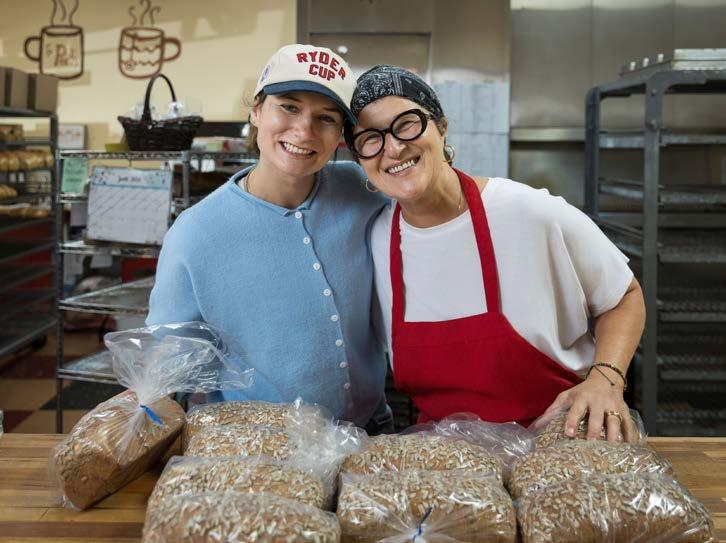
Not that she set out to own a bakery. In 2015, when her children were in high school and no longer needed a full-time mother at home, she was looking for something to do. Despite living in the Triangle for years, she didn’t even know Great Harvest was here. But she walked in, started as a baker, and has never left.
When the previous owner announced in 2019 that he was ready to retire, the news hit the staff hard. “We were all just like, Wait a minute — we love this place so much,” Janette says. “What about us? For some reason, the words came out of my mouth: ‘I’ll buy it.’”
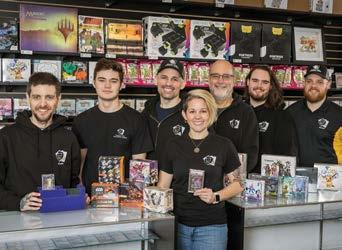
Nothing changed. The bakers stayed. The front-of-house staff stayed. The bread stayed. What Janette inherited — and fiercely protects — is a culture that runs deeper than any job description. A team of 13 people who think of themselves not as employees and a boss, but as what Janette describes as a “bakery family.” She explains: “No one thinks of me as their boss or their owner because I don’t let them. We are a team, and it takes all of us working together to make a happy bakery and a happy place — and then that projects across the counter to our customers.”
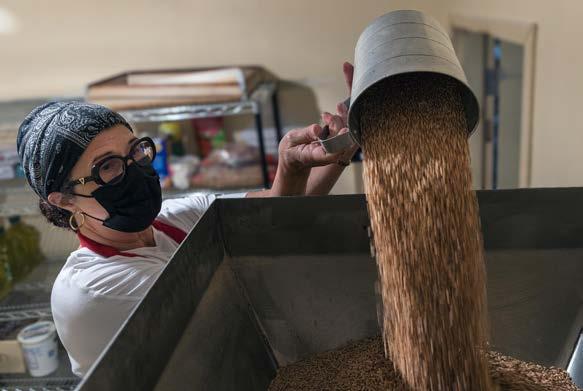
Everything at Great Harvest starts with hard red wheat berries grown by farmers in Montana that are cultivated for quality and shipped to Lead Mine Road, where they are milled fresh in-house. Every single day. “We use them within three days,” Janette explains. “The nutrition is 100% in there. Once you bake the item, you lock the nutrition in. If you let that wheat sit there for weeks, you’re losing the nutritional value a little bit each day.”
What goes into the bread after that is equally straightforward: no additives, no preservatives, no dough conditioner. “Honey is our preservative,” she says. “Honey goes into almost all of our breads.” The result is a product that is more honest than what fills most grocery store shelves — and Janette makes no apologies for it. Great Harvest
“might be a little bit more expensive than other people, but it’s fresh. It’s made from scratch. It’s made every day. We’re giving you the best product that I think is out there.”
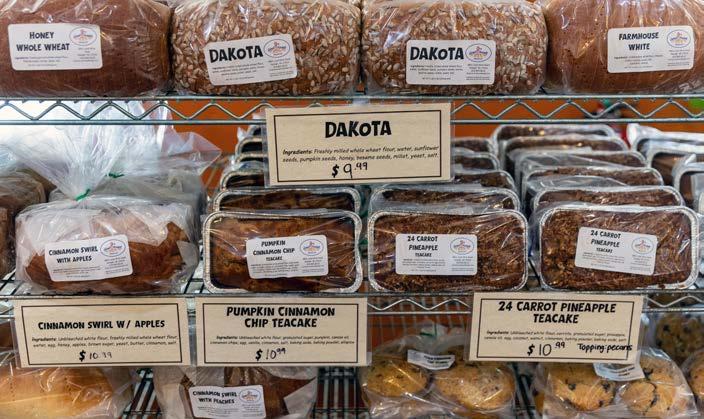
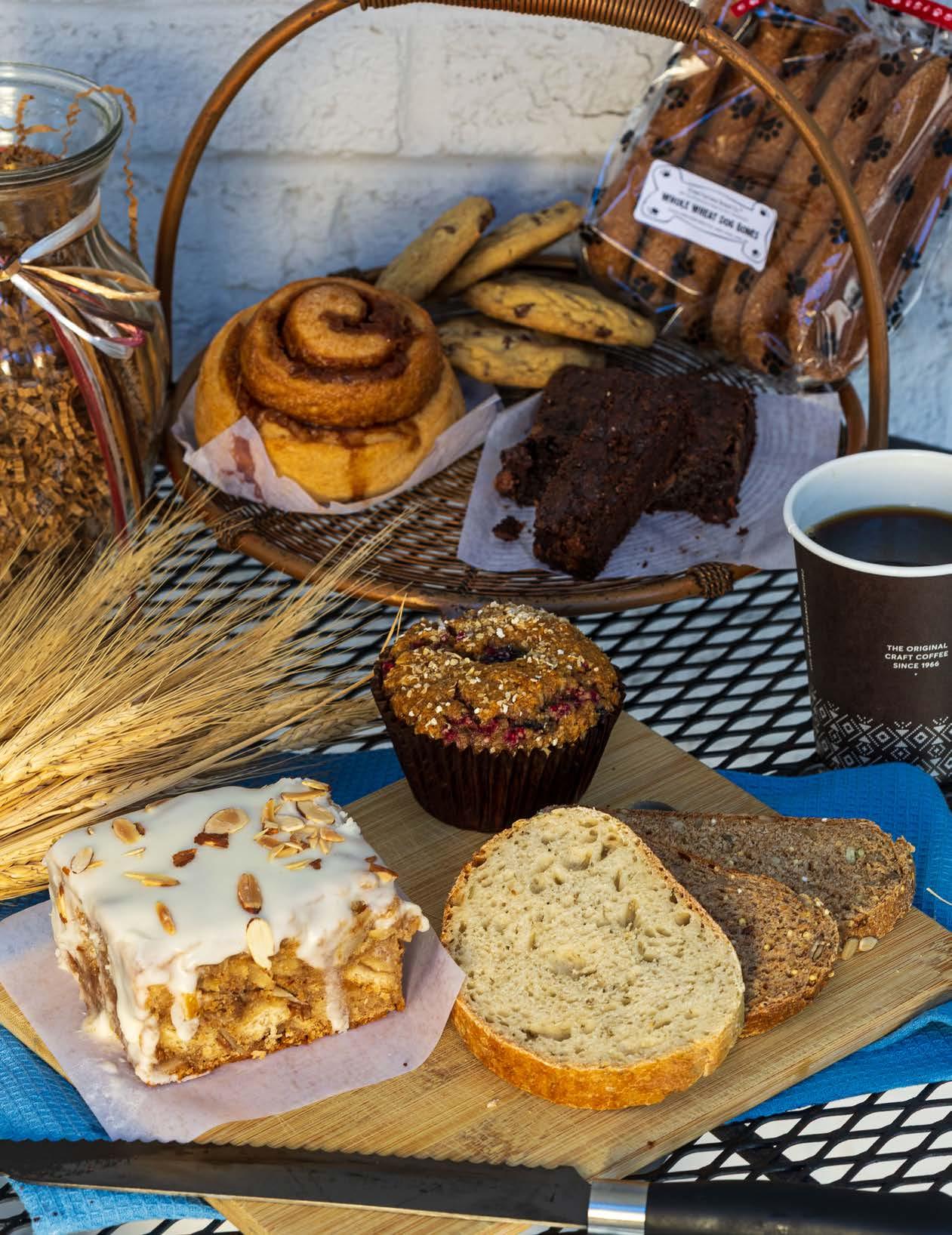
The daily lineup centers on perennial favorites — Honey Whole Wheat, Cinnamon Swirl, the seed-packed Dakota, and Farmhouse White — while a rotating cast of
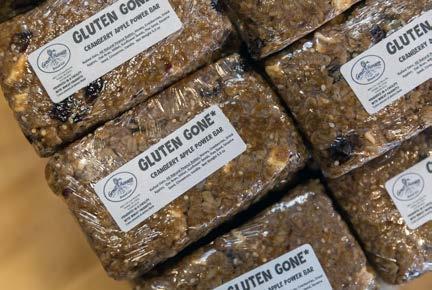
ABOVE: Gluten Gone Thursdays at
give guests even more options without additives, preservatives, or shortcuts.
LEFT: From fan-favorite Dakota to the ever-changing Baker’s Choice rotation, everything on this shelf was milled in-house, baked from scratch, and finished before the morning rush.
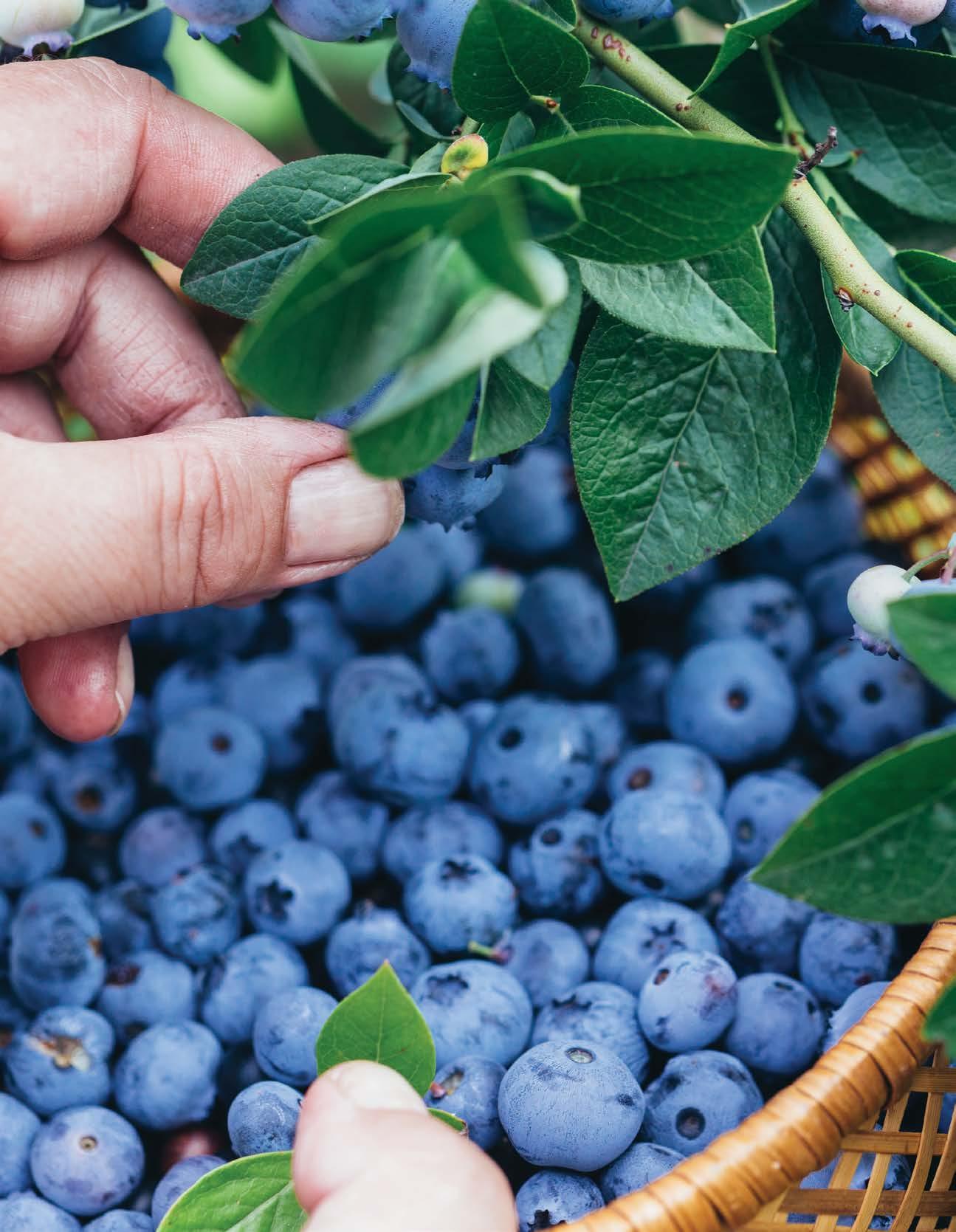
Baker’s Choice breads, scones, muffins, and cookies keeps the schedule lively. Rotations have included Cracked Pepper Parmesan, Spinach Feta, Fontina Pesto, Asiago Pesto, Blueberry Cream Cheese Swirl, Peach Cinnamon Swirl, and a Jalapeño Cheddar Swirl that has developed its own following.
Wednesdays bring a High Protein Low Carb bread that Janette describes with barely contained enthusiasm. “We can’t nail it down on our shelves. It just flies out of there because, number one, it’s delicious. And number two, it’s pretty darn good for you.”
Thursdays are devoted to the Gluten Gone line, a full range of buckwheat-based breads and muffins developed for glutenintolerant customers, made in separate pans before any other breads hit the table. Janette is careful to distinguish these from certified gluten-free products, but the intention is clear: No one who walks through the door should leave without options.
“A lot of people that have dietary issues and digestive issues, they can eat our Honey Whole Wheat bread without problem,” she says. “Our Honey Whole Wheat is so pure because we get those wheat berries whole and we’re milling them; there is nothing being added in there.”
The rotating Baker’s Choice program is where Great Harvest’s creative spirit comes fully alive and is, unsurprisingly, a team effort. “I come in and I work production with
my bakers in the morning, and we are always talking about, hey, I saw this recipe, or hey, I had an idea,” Janette says. “We are all foodies and we love it. What could we do with this? What could we do with that?”
The customers are equally involved. “They will call us up and tell us, ‘You made this last month; can you put it back on the schedule?’” she says. “Everybody decides what we’re going to make. It’s not just the people that work here. Our customers also have a say.”
That responsiveness to the community is baked, quite literally, into everything Great Harvest does. There is no online ordering, no DoorDash, no algorithm standing between the bakery and its customers. “We want to see our customers,” Janette says. “We want to talk to you. We want to know who you are. And we want you to know who we are.”
If there is a story that captures what Great Harvest Bread Company means to the
community, it is this one: Last November, the bakery’s oven — a massive, irreplaceable piece of equipment — broke down. The verdict from the repair company was that the parts no longer existed and the oven needed to be replaced. Thanksgiving and Christmas, the bakery’s two busiest seasons, were suddenly in jeopardy.
Janette made a phone call to a contact in Wisconsin who dealt in old restaurant equipment. He couldn’t help directly, but he knew someone who could: an out-of-state retired mechanic who had spent his career working on exactly these ovens. His hands weren’t what they once were, but he said, “If you can get me laborers, I will come.”
The laborers arrived within a week. Some of them were customers. “They literally said, ‘I’m in. Call me. We’re going to help you get through this,’” Janette recounts. The oven was torn down and rebuilt, and Thanksgiving was saved.
Ask Janette why people’s eyes light up when they walk into a bakery and she doesn’t hesitate. “I think food translates love,” she says. “The best gift you can give to a person is food, whether you have made it for them or you have purchased it specifically for them.”
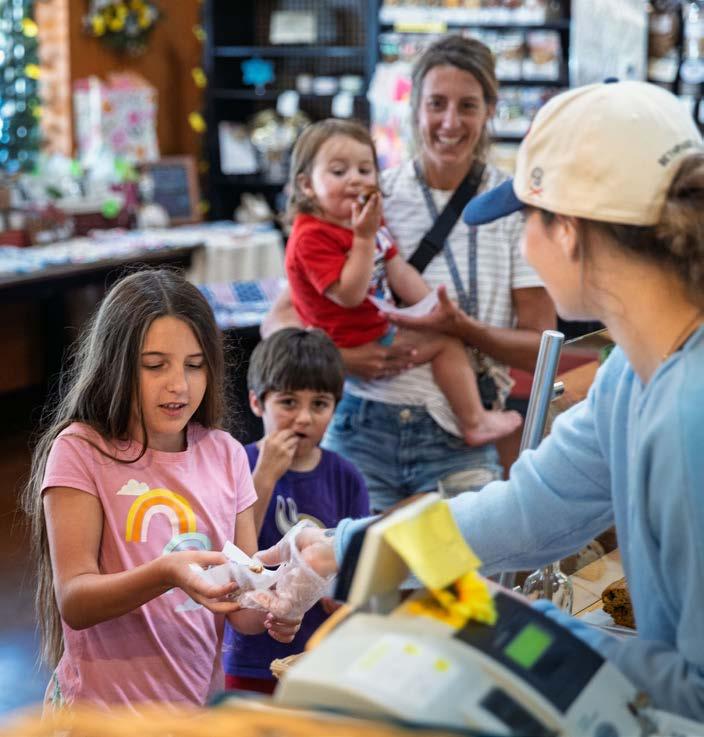
In a world of overnight shipping and algorithm-driven recommendations, Great Harvest Bread Company is a place that operates entirely on human terms. Come in. Meet the people. Try a free slice from the sample board. And understand what it feels like to be a welcome regular somewhere.
“This place is big love,” Janette says. “We love big and we laugh loud. It’s just an amazing environment. There’s so much joy in here.”
The bread doesn’t hurt either. t greatharvestbreadraleigh.com @greatharvestraleigh
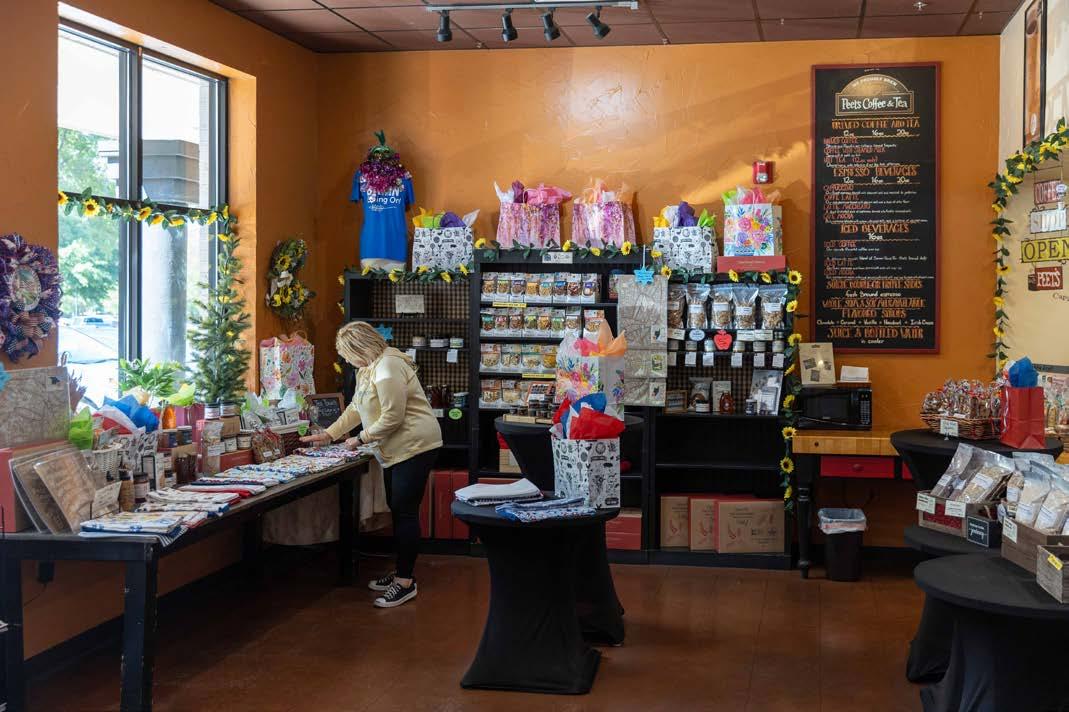

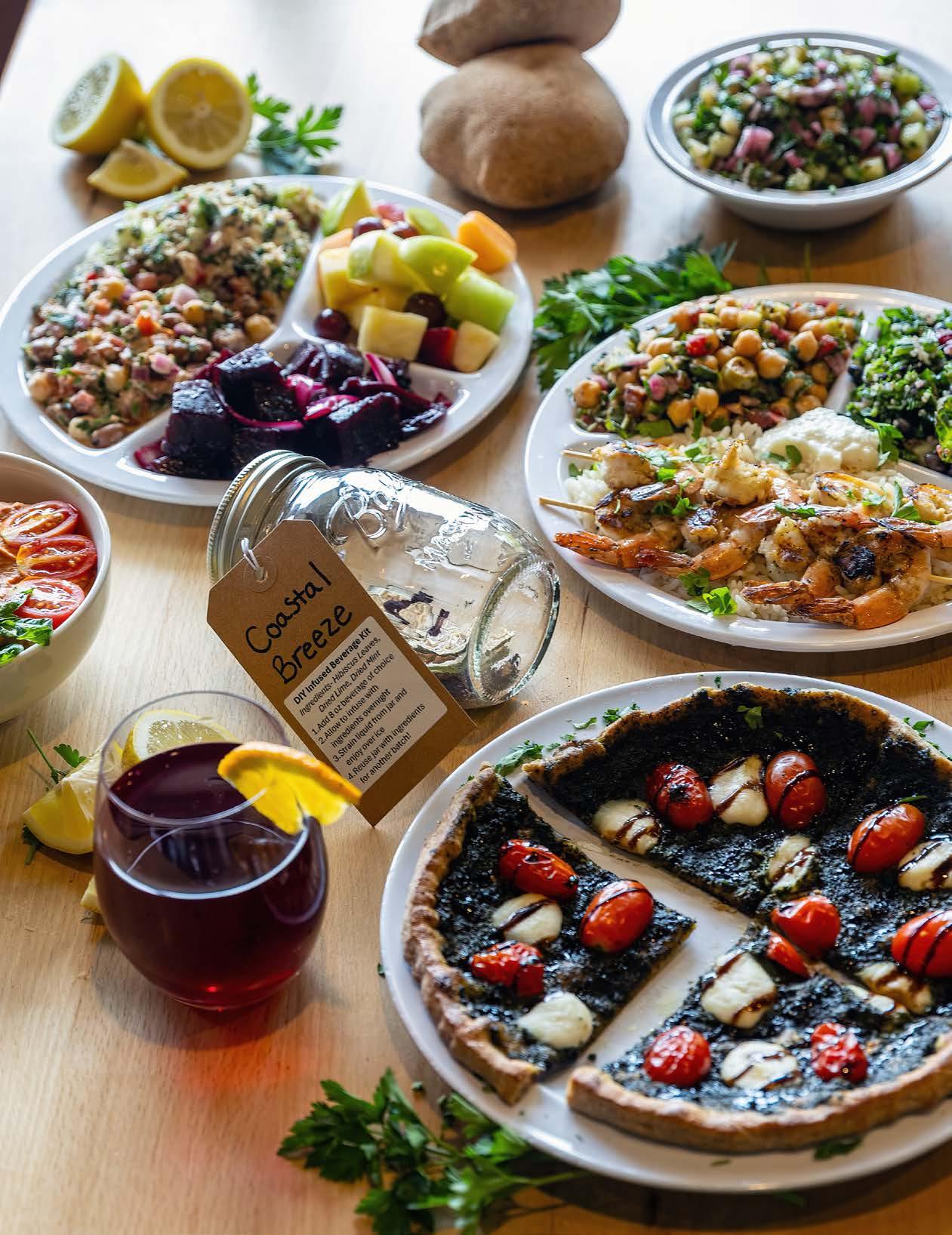
Sassool Café is redefining fast-casual Mediterranean dining with a focus on fresh ingredients, wholesome recipes, and a deep commitment to family tradition. Known for its vibrant menu rooted in the Mediterranean diet, Sassool makes it easy to enjoy healthy, flavorful meals whether dining in, taking out, or sharing with family at home.
All produce is prepped inhouse daily, resulting in a colorful variety of dishes offered each day. From nutrient-rich salads to comforting warm entrees, every meal is made with care and inspired by centuries-old traditions. The menu fits seamlessly into a variety of eating regimens, making Sassool a go-to for health-conscious food lovers.
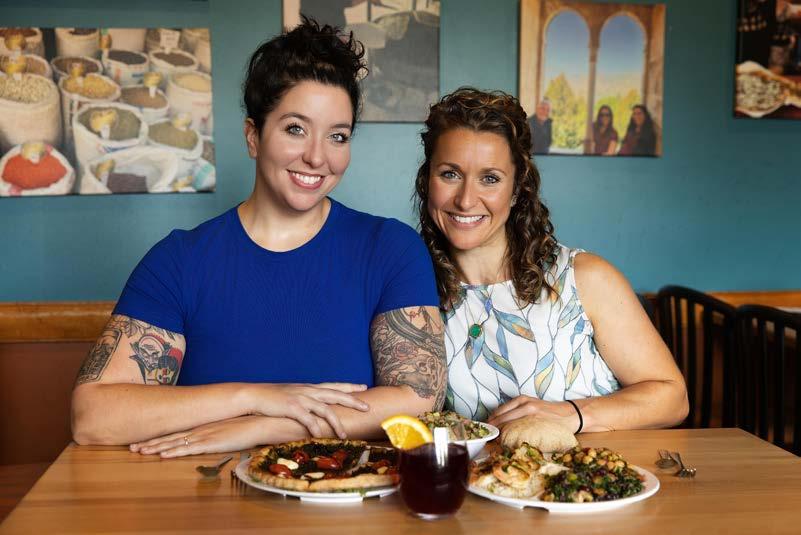
“Our goal is to create food that not only tastes good, but also brings people together,” says owner Mounir Saleh. “It’s how my mother, Sassool, showed love — by feeding people — and we’re proud to carry that spirit into everything we do.”
With spacious dining rooms and large family-style tables, Sassool invites guests to relax, connect, and savor their meal in a welcoming environment. That same sense of connection extends to the
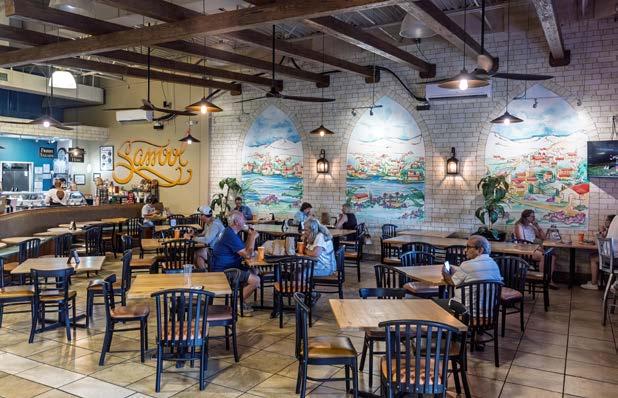
restaurant’s catering services, which are popular for off-site events and special occasions. The team at Sassool takes pride in bringing the full experience to guests, wherever they gather, and seeing their food become part of cherished memories.
The restaurant also sources ingredients close to home — literally. At FigMINT Farms, the family grows more than 1,800 pounds of fresh mint annually, a signature element in many dishes. The goal is to continue expanding the farm’s offerings, with more vegetables grown onsite to be used in the kitchen.
One of Sassool’s most beloved community offerings is its Dinner in the Pines series, hosted at FigMINT Farms each spring and fall. These ticketed events combine a picturesque setting with a multi-course Mediterranean meal, making them a musttry experience for local food lovers.
Whether gathering around a table in the restaurant or under the pines at the farm, Sassool delivers more than just a meal — it offers nourishment, tradition, and the joy of shared experiences.

Tradition meets innovation at Farina, a cozy neighborhood joint in Lafayette Village that serves up comforting Italian American fare. Diners feel at home dressed up or down, stopping in for a quick bite or lingering to celebrate a special occasion.
“When people go to Italy, they think the food is so good. The produce is why,” says coowner and operating partner Ian Moore. “The dishes are all basic; they’re just using stuff that’s in season.” Ian visits Raleigh’s State Farmers Market for fresh produce and works with a host of other vendors to acquire locally sourced ingredients.
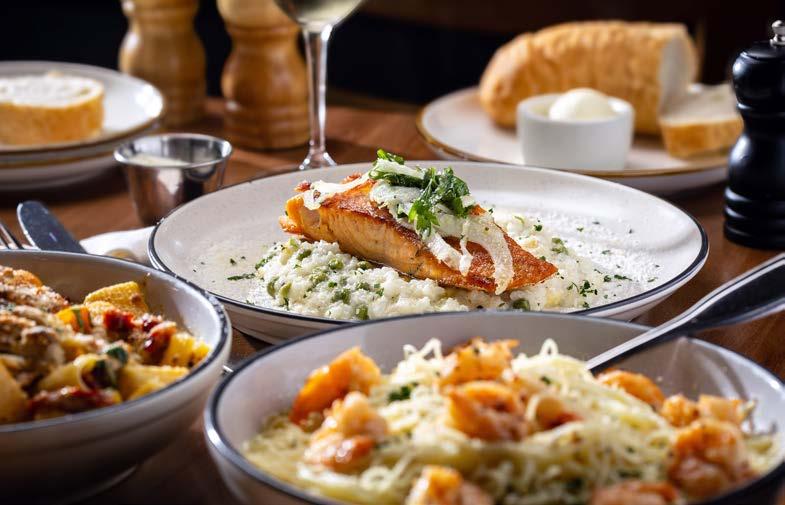
Coffee and espresso come from Black & White Coffee in Wake Forest. Ronnie Moore’s Farm in Meadow grows the heirloom tomatoes. Bread is baked fresh by Oxford’s Strong Arm Baking Company. And Locals Seafood delivers the freshest shrimp and mussels straight from the North Carolina coast.
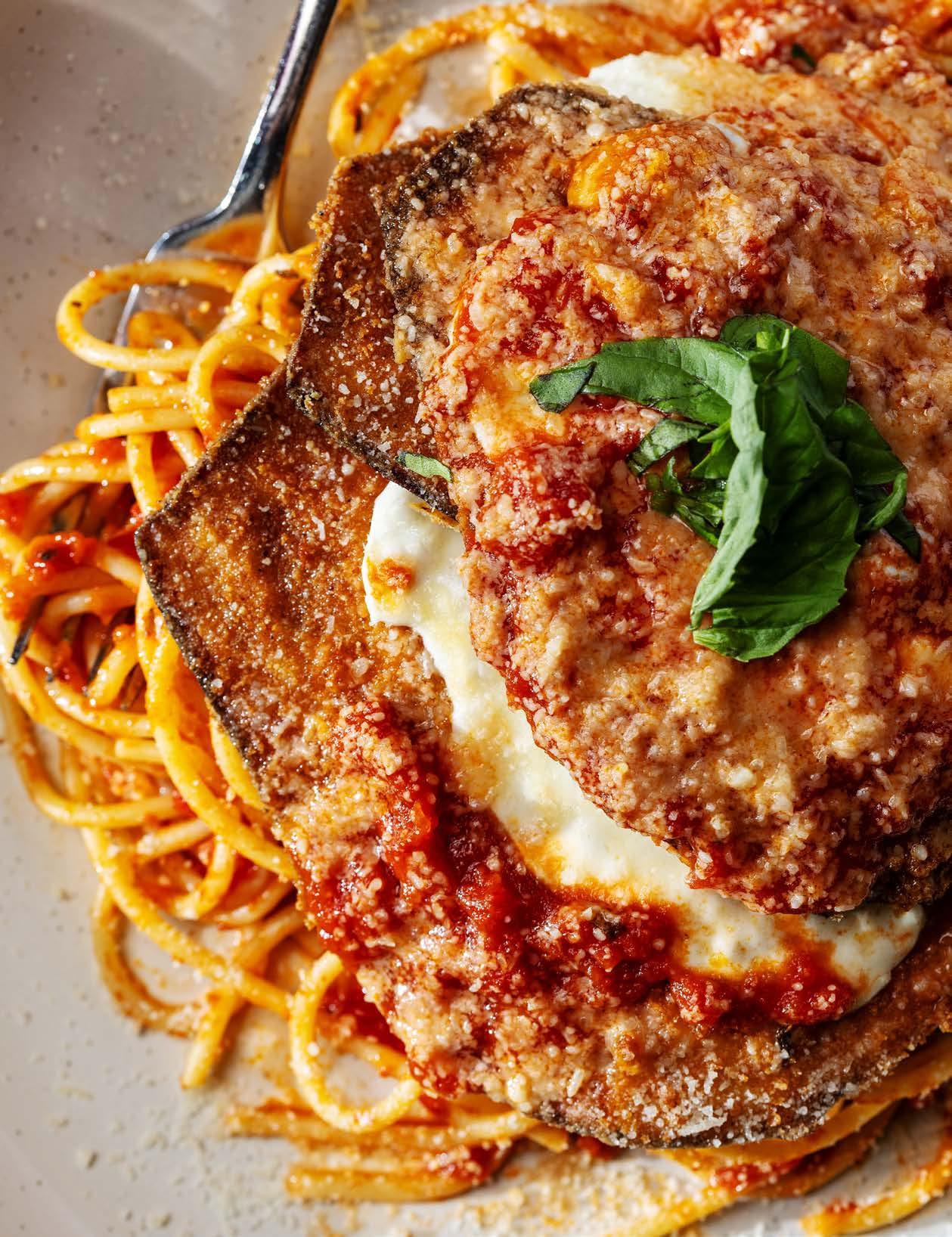
Staples like eggplant parmesan, chicken marsala, shrimp scampi, lasagna, and bolognese are crafted with practiced precision, yielding plates that are comforting without being boring.
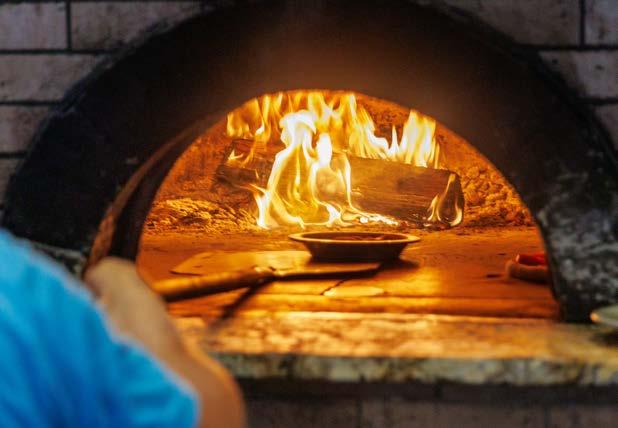
Classic pepperoni and margherita pizzas emerge from the woodfired oven with perfectly crispy blistered crust. For something more distinctive, try the Pancetta Bianco featuring fig preserves, gorgonzola, and arugula, or Wild Mushroom with truffle oil and fontina cheese.
Pastas run the gamut from carbonara and baked rigatoni to stuffed gnocchi and a decadent Sunday Gravy you’ll be thankful is available seven days a week.
The lunch menu offers many of the same favorites, plus a French Dip made with braised short rib that was so popular as a special it earned a permanent spot on the rotation.
Any time of day, finish your meal on a sweet note with the iconic delicate-yet-decadent flavor of housemade tiramisu.
Don’t miss the monthly jazz night, which invites a three-piece band of Enloe students to provide live music.
Online ordering is available for convenient pickup or delivery. And the catering team is always ready to provide a bespoke experience featuring fresh, handcrafted dishes tailored to your event’s needs.

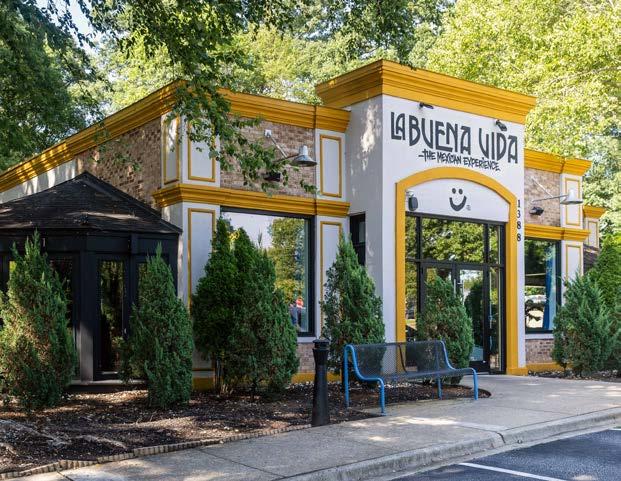
La Buena Vida, the dynamic Mexican restaurant brand founded by hospitality duo Salvador Alvarez and Juan Sanchez, continues to redefine dining in North Carolina. As the owners of JalmMex Hospitality Group, one of the fastest-growing hospitality groups in the region, Alvarez and Sanchez bring bold energy, vibrant culture, and unforgettable food to every new location.
With the opening of their third La Buena Vida last spring, their footprint continues to grow.
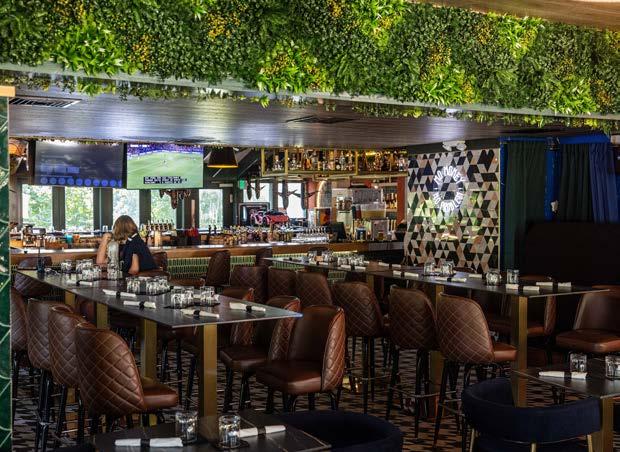
“Every time we open a new location, we bring a little more of our story and unique energy to the community,” Salvador says.
That story is deeply rooted in culture, family, and hospitality, and it’s felt in every detail of the La Buena Vida experience.
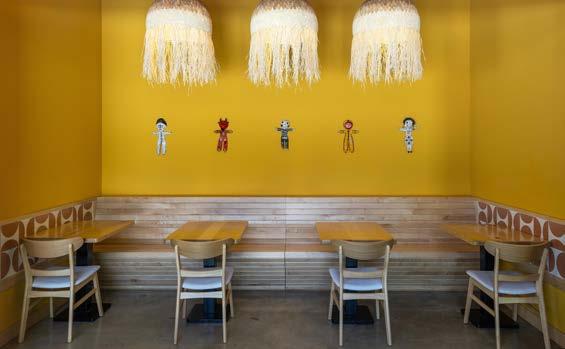
By day, La Buena Vida offers a welcoming, family-friendly atmosphere ideal for brunches, business lunches, or casual gatherings. Guests are greeted with vibrant colors, bespoke furnishings, and a design aesthetic that channels summer in Mexico with a touch of glamour.
But when the clock strikes 9 p.m., everything changes.
The lights dim. The music turns up. And the energy shifts. Servers in El Chapo masks deliver tomahawk steaks in bedazzled suitcases. Shot flights land on miniature airplanes. Sparklers light up the room as staff drop the beat, all while making sure your glass never runs dry. It’s immersive, theatrical, and unforgettable.
Eater magazine’s Matt Lardie described La Buena Vida as one of the “Most Funnest, Most Wildest, Most Unbelievably Extra Restaurants in America.”
The beverage program features dramatic takes on the classics alongside bold signature drinks. Along with fresh margaritas, guests can enjoy lychee martinis, espresso martinis, old fashioneds, and house-crafted cocktails. A curated wine list pairs perfectly with the menu’s bold flavors.
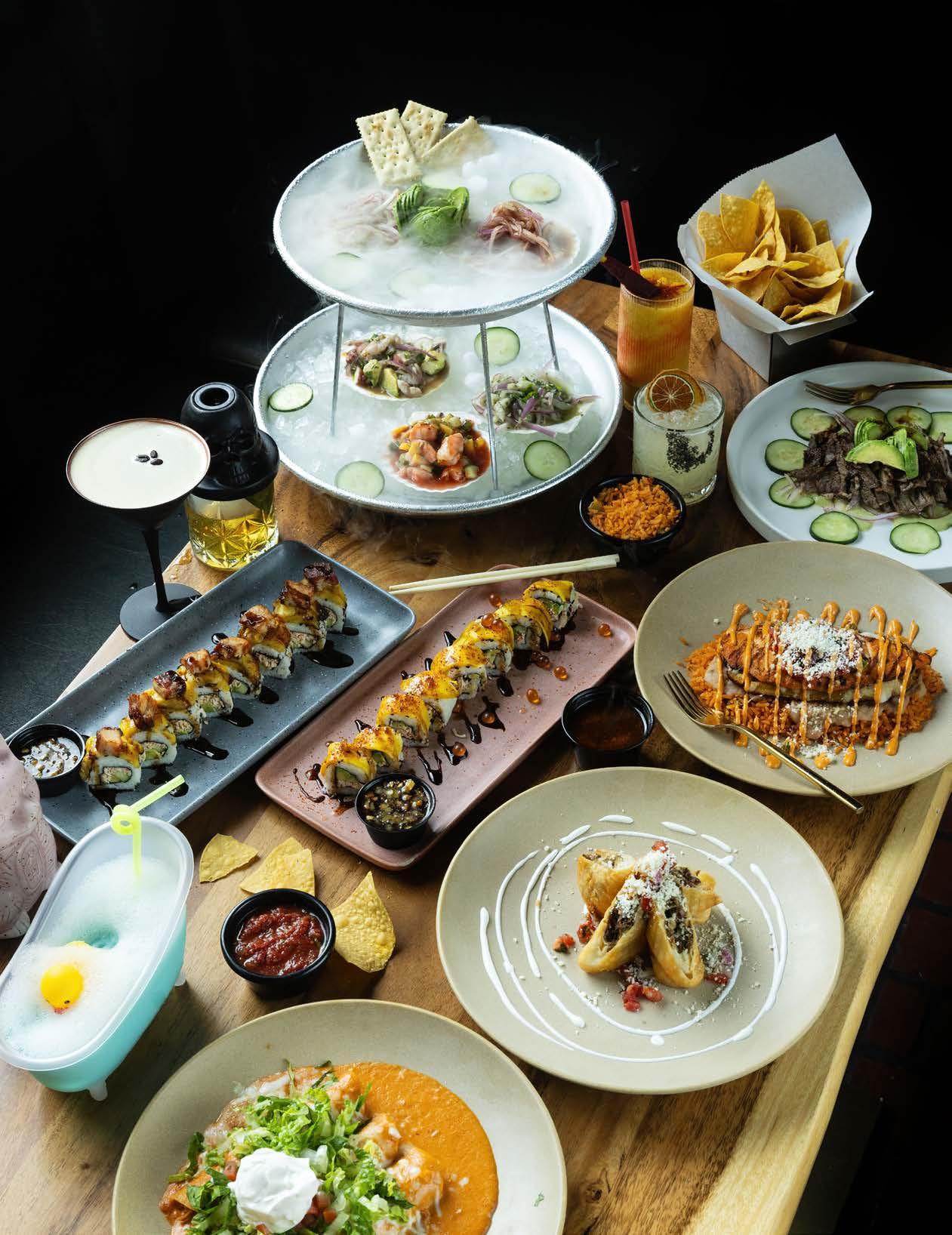
From Mexican sushi platters and quesabirrias to seafood towers, tomahawk steaks, and brunch spreads, the menu is made for sharing and storytelling. Each dish honors Latin roots while embracing creative, playful presentation.
With success through their other concepts: Chido Taco, Gringo a Go Go, and Fonda Lupita, Salvador and Juan are building more than restaurants. They’re creating spaces where joy takes center stage.
So whether you’re coming for brunch, a family dinner, or a big celebration, at La Buena Vida, the party starts with the food and ends with an unforgettable night.

WRITTEN BY ANDREA RICHARDS | PHOTOGRAPHED BY JONATHAN FREDIN
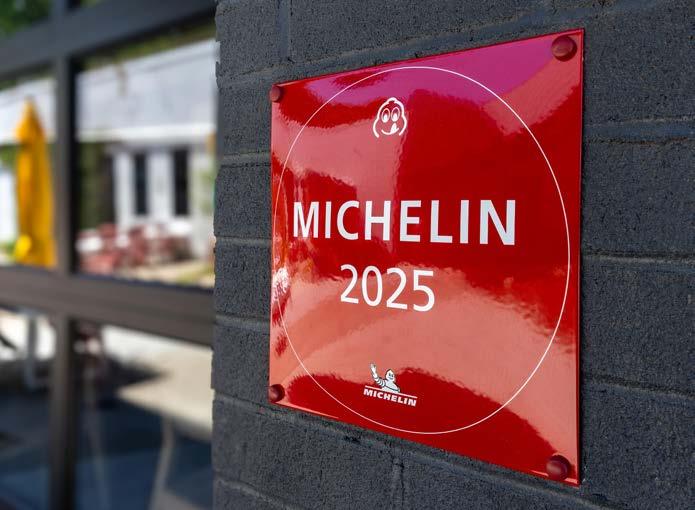
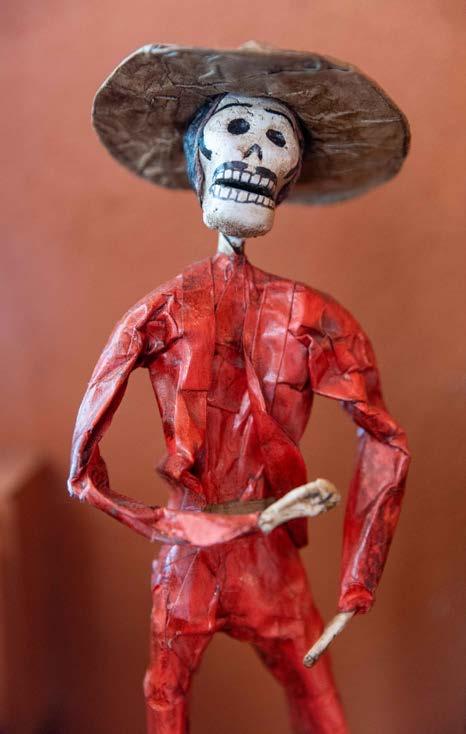
Starting a restaurant is never easy, but for Mala Pata, which opened a year ago in Raleigh’s Gateway Plaza, the multiyear journey to opening day was so tough the owners named the Latin American restaurant after a slang term for bad luck. But in just one year of service — Mala Pata celebrated its first birthday in May — they turned that bad luck around, even earning a Bib Gourmand award from the prestigious Michelin Guide along the way.
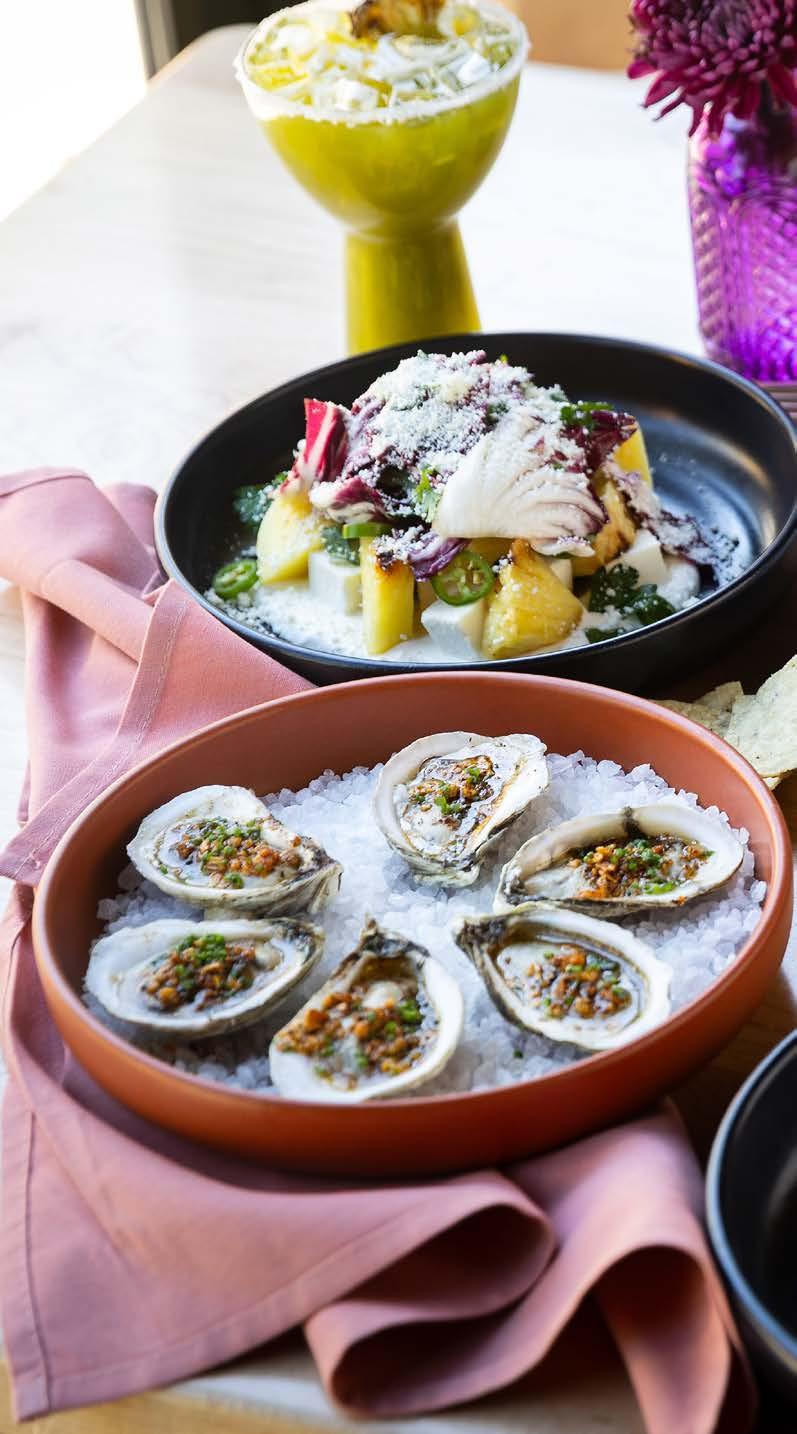
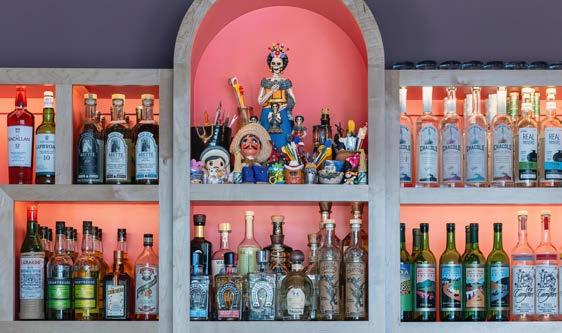
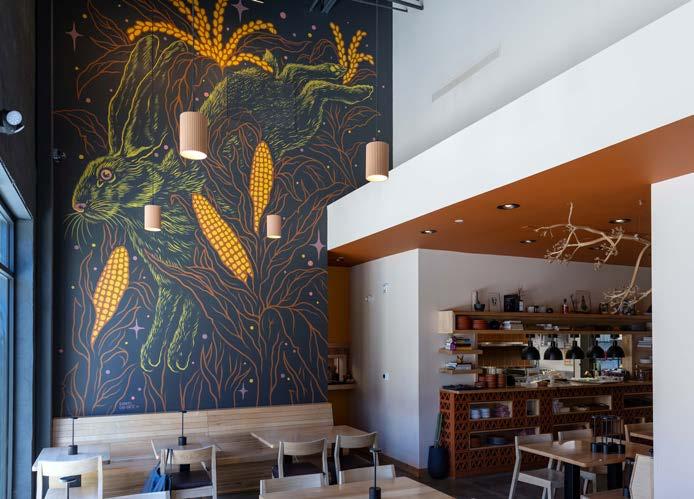
This is a “friendly, family-style place,” where simple ingredients and careful technique form the philosophy that drives every dish.

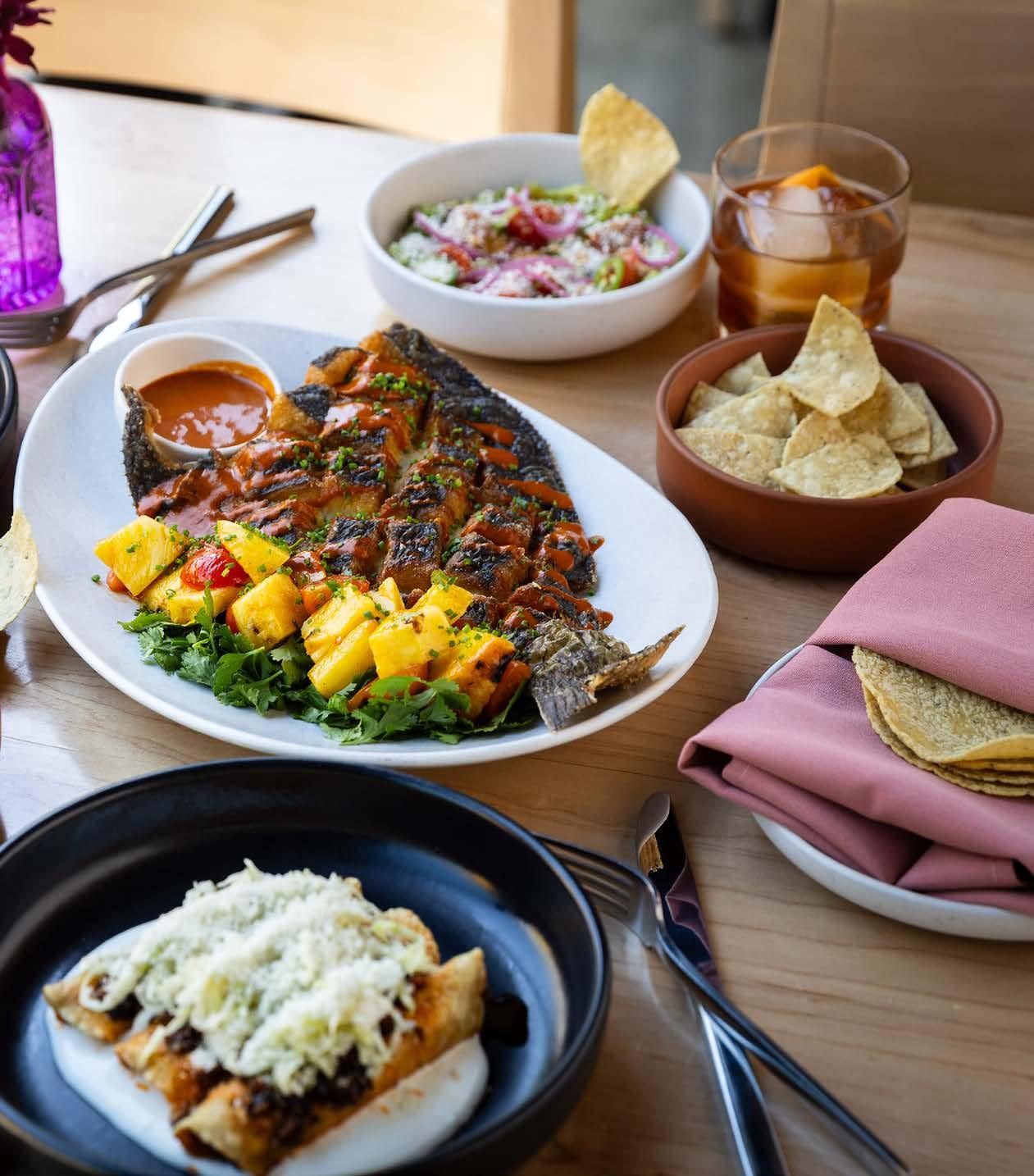
“There’s a long story of how we got here,” says Marshall Davis, one of the restaurant’s partners. “And I think it’s been even more meaningful and important that our first year has been so strong.”
Created and owned by a consortium of familiar veterans from the Raleigh hospitality industry, Mala Pata is a testament to partnerships forged in difficult times. It all started back in the pre-pandemic days, when Angela Salamanca, the owner of Centro, a Mexican restaurant in downtown Raleigh, and Marshall teamed up to open Gallo Pelón, the first mezcal bar in the Southeast, above Centro.
With the success of the mezcaleria, the two entrepreneurs soon hatched another restaurant idea, one that would celebrate masa, made in-house using a traditional nixtamalization process and heritage corn from Oaxaca.
“For me personally — and I think that for Marshall, too — one of the things that really drives the concepts of the places that we create is we see a thing or experience a thing, and we’re like, oh, my God, can we have this at home? How can we share this with everybody we love?” Angela says, recalling the travels in Mexico that inspired her to develop Mala Pata.
Similarly, Marshall recounts a particular food vendor in Oaxaca called El Lechoncito de Oro, famed for their rolled pork lechon tacos, topped with crispy pork skin and hot sauce. There’s an homage to these tacos on the menu at Mala Pata that he swears will never come off the menu. “The first time we went (to Oaxaca) I might have eaten 36 because they are one- or two-bite tacos — they are so delicious and simple and there’s nothing to hide behind.”
The idea was to open the nixtamal restaurant at the Durham Food Hall, and a series of pop-up taquerias perfected the menu. But the pandemic forced a pivot to fast-casual for the new space and away from the delicacy of tacos on fresh tortillas, which would not have survived the transit of takeaway. So the team created Ex-Voto, with its now famous sturdy “crunchwraps” and burritos.
Meanwhile, Angela and Marshall bonded with their food hall neighbors, Locals Seafood, who were similarly struggling to survive lockdown. When the dust settled, two entities — Angela and Marshall, alongside Locals Eric Montagne and Zack Gragg, who today serves as Mala Pata’s executive chef — decided to partner on the restaurant and name it appropriately, celebrating the bad luck that brought them together.

“One of the things that really drives the concepts of the places that we create is we see a thing or experience a thing, and we’re like, oh, my God, can we have this at home? How can we share this with everybody we love?”
— Angela Salamanca, Co-owner, Mala Pata
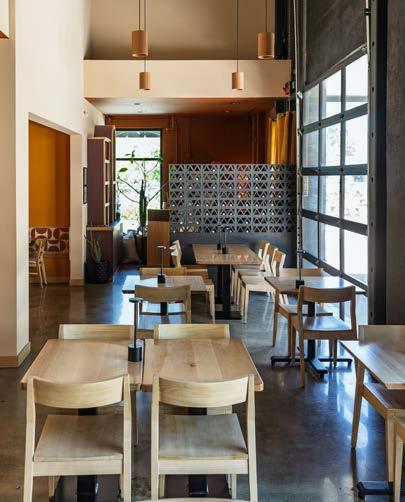

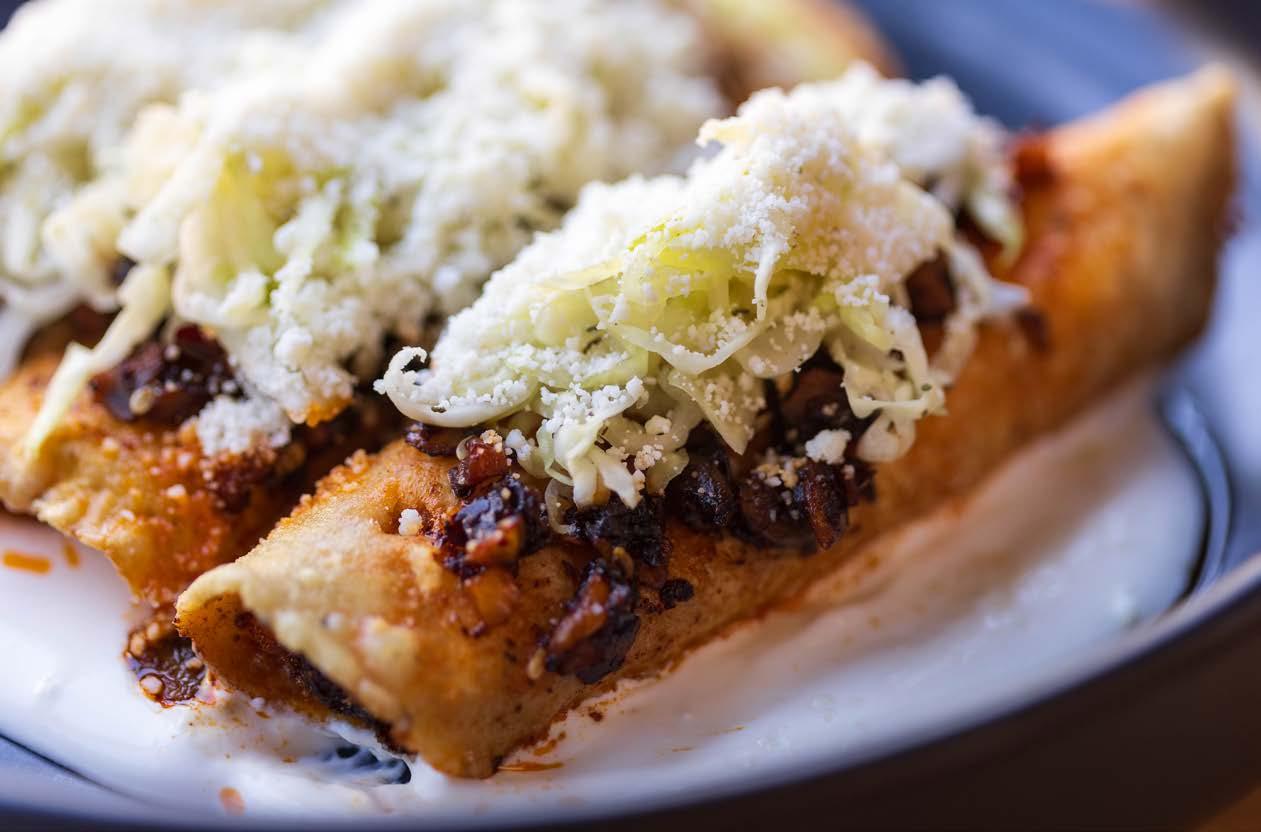
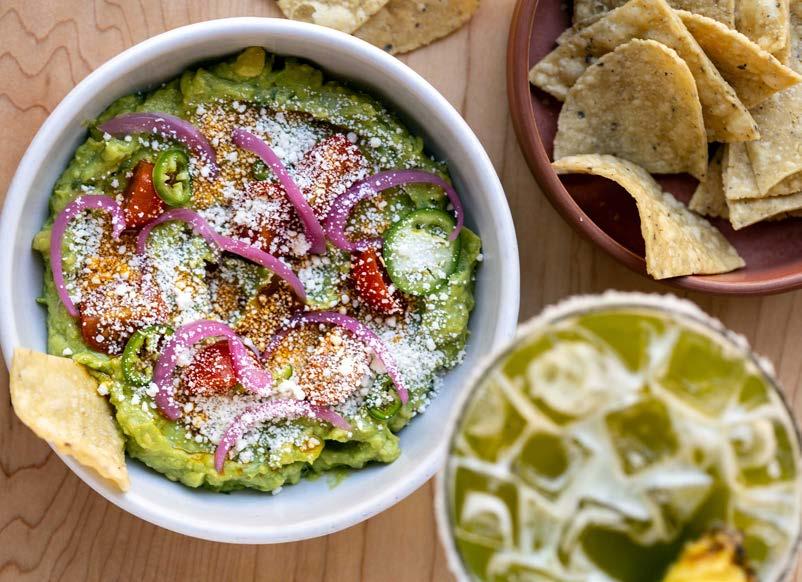
The nixtamalization process is a good metaphor for Mala Pata — it’s a long, patient process that yields incredible results with a multitude of applications provided you have the skill and craftsmanship. The menu at Mala Pata is a testament to the power of the fresh tortilla in its many expressions — from the soft white corn and pork tallow tortillas that encase rich carnitas in those lechoncito tacos to the fried flautas and crispy tostadas and corn chips, perfect for hoisting the aquachile verde or guacamole to your mouth.
Most items on the menu are meant to be shared — this is a friendly, family-style place, where you’ll want to try as many items as possible, so think small plates and lots of them.
For Marshall, the place to start is with the crispy buñuelos, which he describes as a “Colombian hush puppy kind of thing” and attributes for getting him into the restaurant business in the first place. “It was one of the first things Angela ever served me when we first met almost 15 years ago. It was so good that I ended up working for her as a manager at a restaurant, just so I could be around her cooking.” These pillowy, golf-ball sized starters are savory, salty, and only slightly sweet (the agave butter served on the side adds to that) with an incredible crunch on the outside and a soft, light interior. It’s a marvel made from corn and cassava.
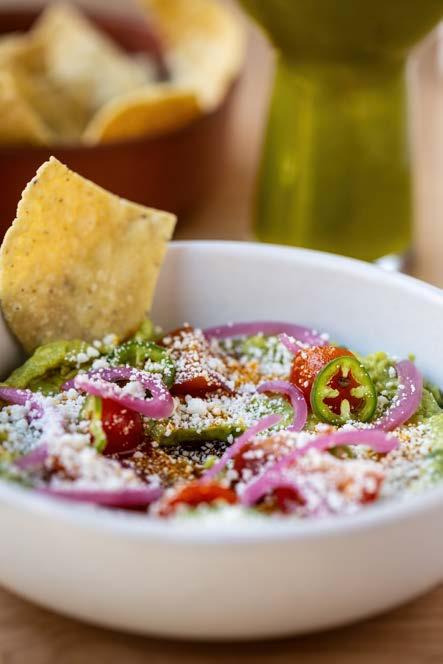






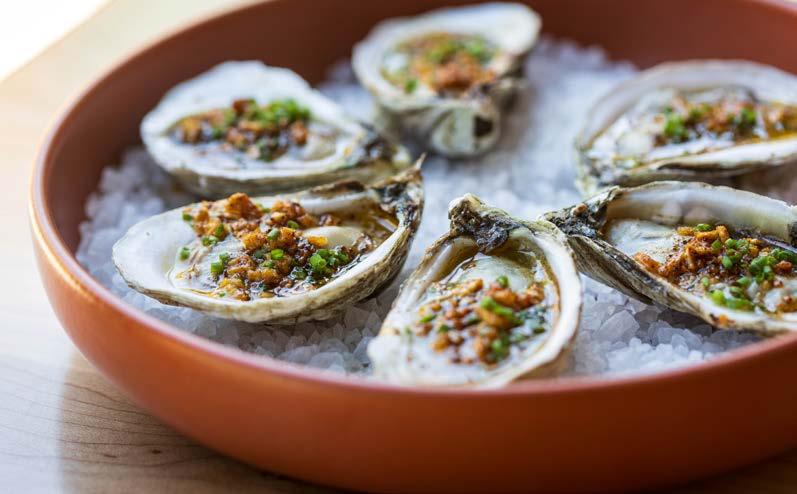
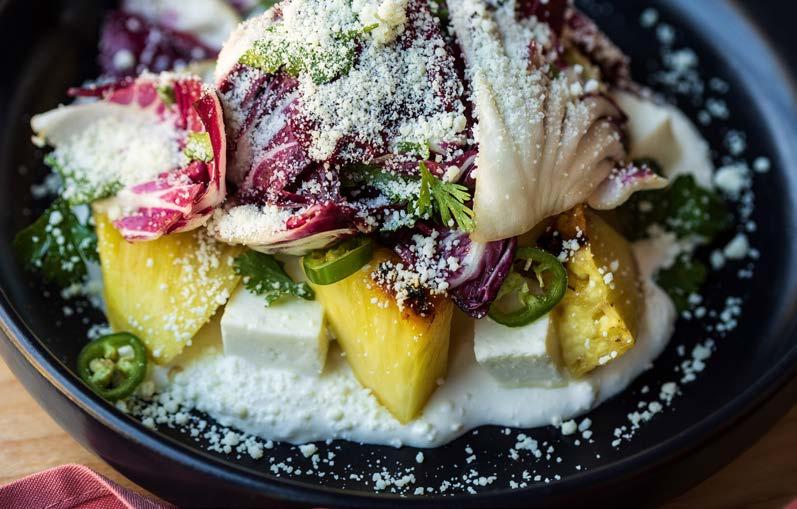
Everything on the “Botanas” part of the menu is easy to share, and I’d order almost all of it if I had a group of four or more. The aguachile verde, with NC shrimp, serrano pepper, and cucumber, is fresh and zippy, as are the salads, one featuring sugarcoated pepitas, the other a combo of grilled pineapple, radicchio, serrano, and queso fresco crema (get it; it’s delicious).
Personally, I think it’s a crime to go it alone into the “plates” section of the menu; why stop sharing now, especially when each item offers multiple pieces? Who isn’t curious about the Cheerwine mole on the rajas enchiladas? And who needs three flautas de papas after all those starters? The flautas are wonderful, as one would imagine: warm whipped potatoes in deep fried tortillas, smothered in queso Oaxaca, salsa macha, and crema, with a bit of crunchy curtido atop to cut through all the cream. The other two offerings in this section of the menu are those popular lechoncito tacos (great with a beer!) and the fish tacos that change with the seasons.
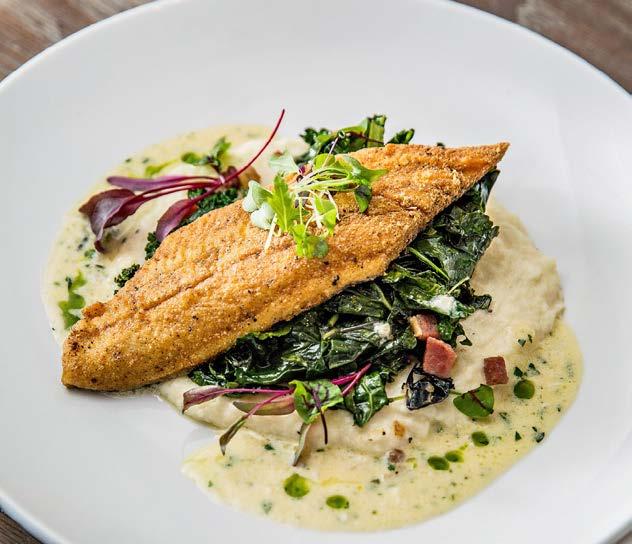
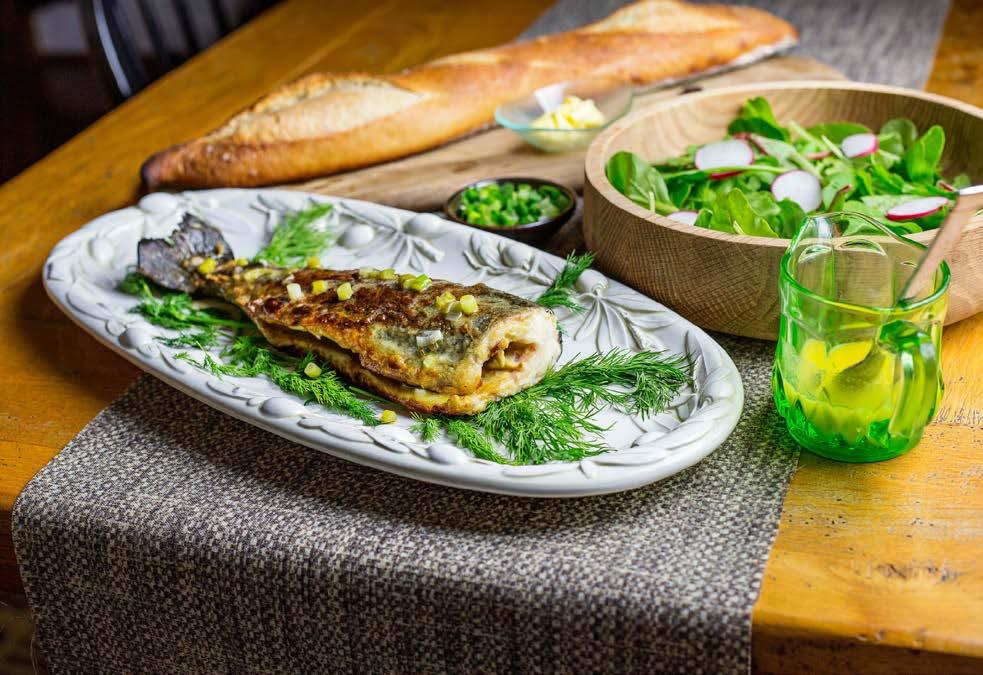
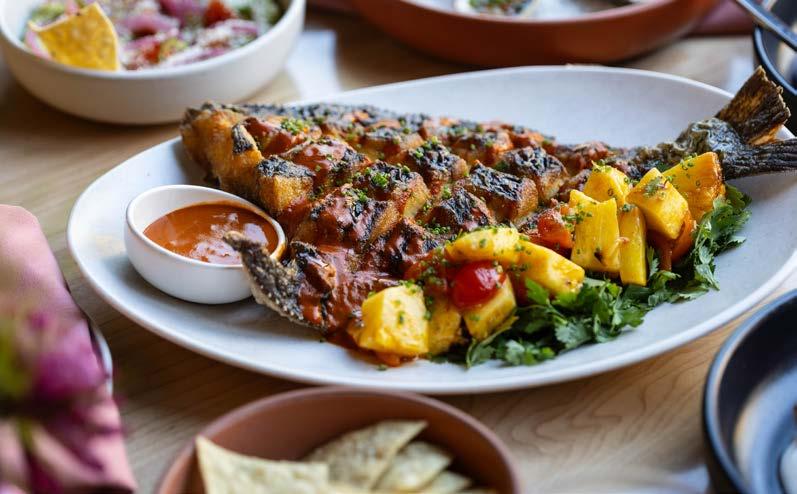
Larger-format dishes, called platters, feature large, impressive proteins meant to serve the table. For me, the pescado frito, a cubed and fried whole flounder, is a standout. It’s perfectly cooked, the delicate and flaky meat a stark contrast to its outside. Served, like all pastor, with an al pastor sauce and pineapple, there’s a depth of flavor and a balance between smoky and sweet, earth and ocean. I felt like this was a dish I should be eating closer to the sea, like I was on vacation.
“I dream about the flounder,” Angela says when I tell her how much I enjoyed the dish. “This is the precious gift that we’ve had with working in partnership with the guys from Locals: their vast knowledge of the North Carolina seafood world. I mean, it’s just like the biggest blessing — we get first dibs on all seafood because these are our partners.”
“It’s been a full, intense year, but I’m really grateful for the opportunities and everything that I’m learning because it’s been really beautiful.”
— Angela Salamanca, Co-owner, Mala Pata
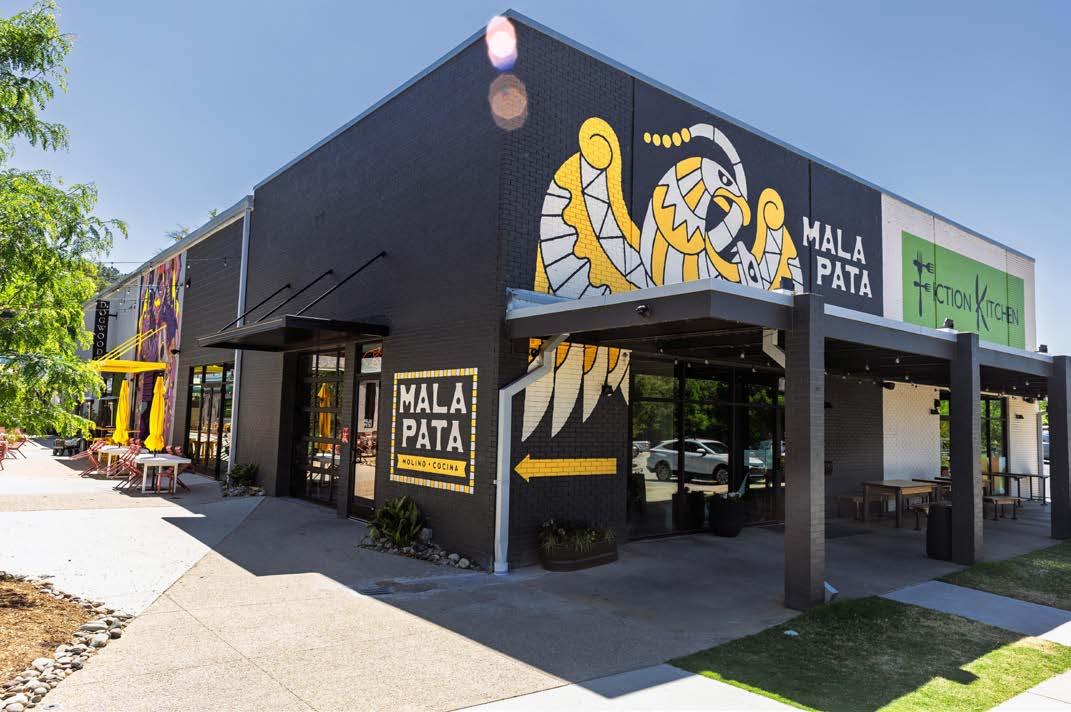
As Mala Pata shows, building up the right partnerships can bring out the best — in ingredients, in service, in ideas and execution, and in learning how to be flexible in increasingly difficult times for the hospitality industry. It also does something else, which isn’t a product of the restaurant as much as its foundation: It builds community. In the year that Mala Pata has been open at Gateway Plaza, the mid-century shopping center that serves as its home has changed too, adding more communal spaces, more landscaping and plants, and more tenants. No doubt, having a Michelinrecognized restaurant in the space helps to activate these new spaces.
To celebrate Mala Pata’s first anniversary, the restaurant threw a patio party at the plaza with a DJ, a piñata, and a special food and drink menu. It was a smashing success, a perfect way to culminate a year — nay, many years — of hard work paying off. But the Mala Pata team — Marshall Davis, Angela Salamanca, Zack Gragg, Eric Montagne, Justin Pasfield, and general manager Alison Houser — are hardly the types to rest on their laurels. When I ask Angela what her hopes are for the restaurant’s second year, she responds with a list: to have a bit more curiosity within the menu, to extend the hours (they are adding dinner service on Sundays), and “to continue to activate the plaza with intentional events.”
“It’s been a full, intense year, but I’m really grateful for the opportunities and everything that I’m learning because it’s been really beautiful,” she says. As she looks to the future, she doesn’t forget to enjoy the present. t malapatanc.com
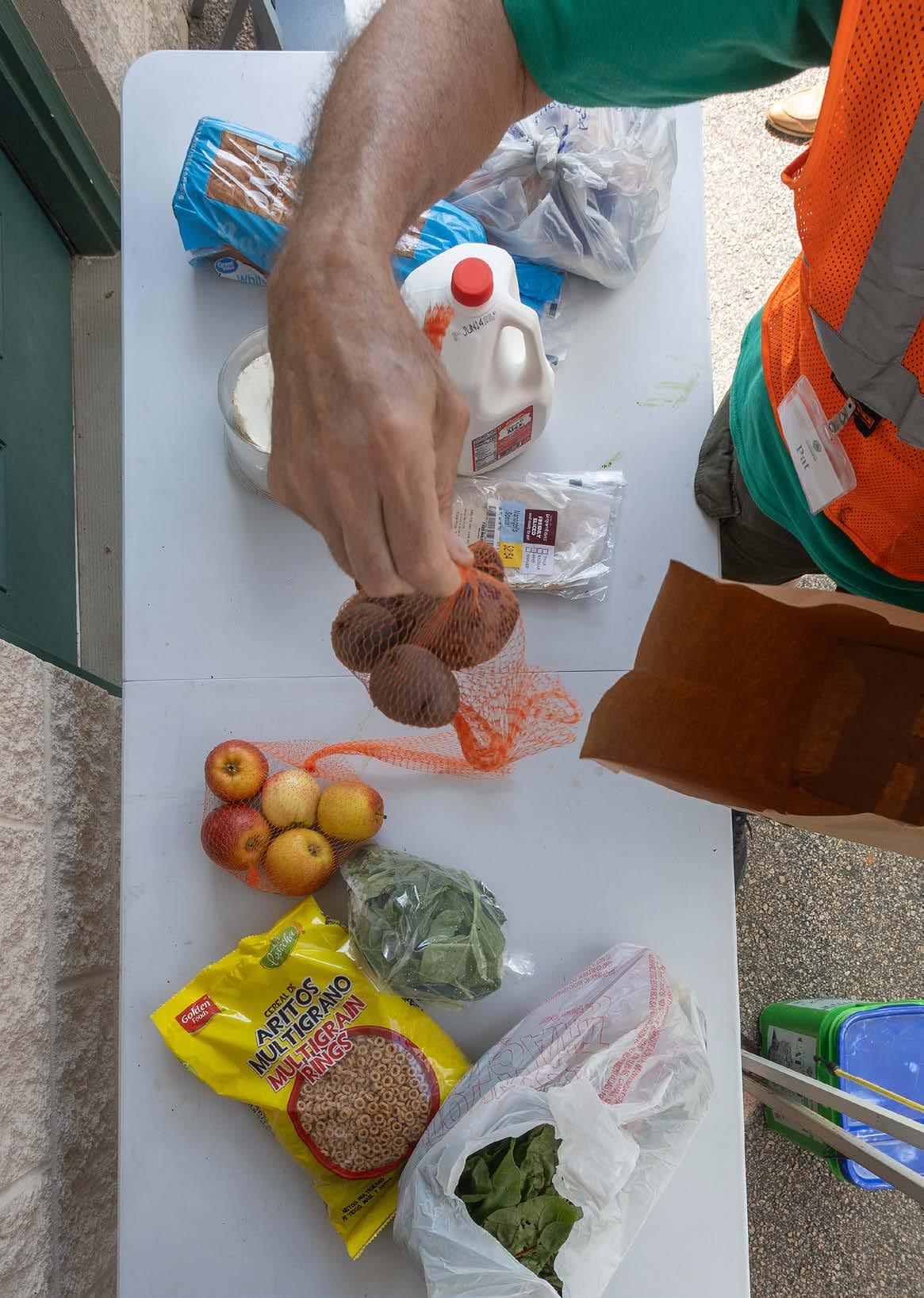
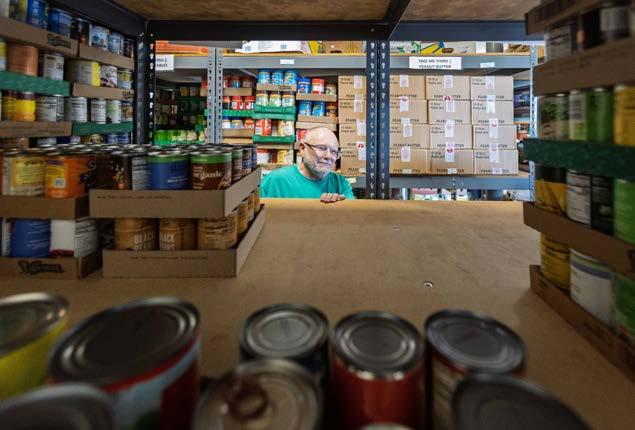
Every family receives almost 100 pounds of thoughtfully curated, wholesome food, no matter when in the month they visit.
WRITTEN BY ERIN MCKNIGHT | PHOTOGRAPHED BY JONATHAN FREDIN
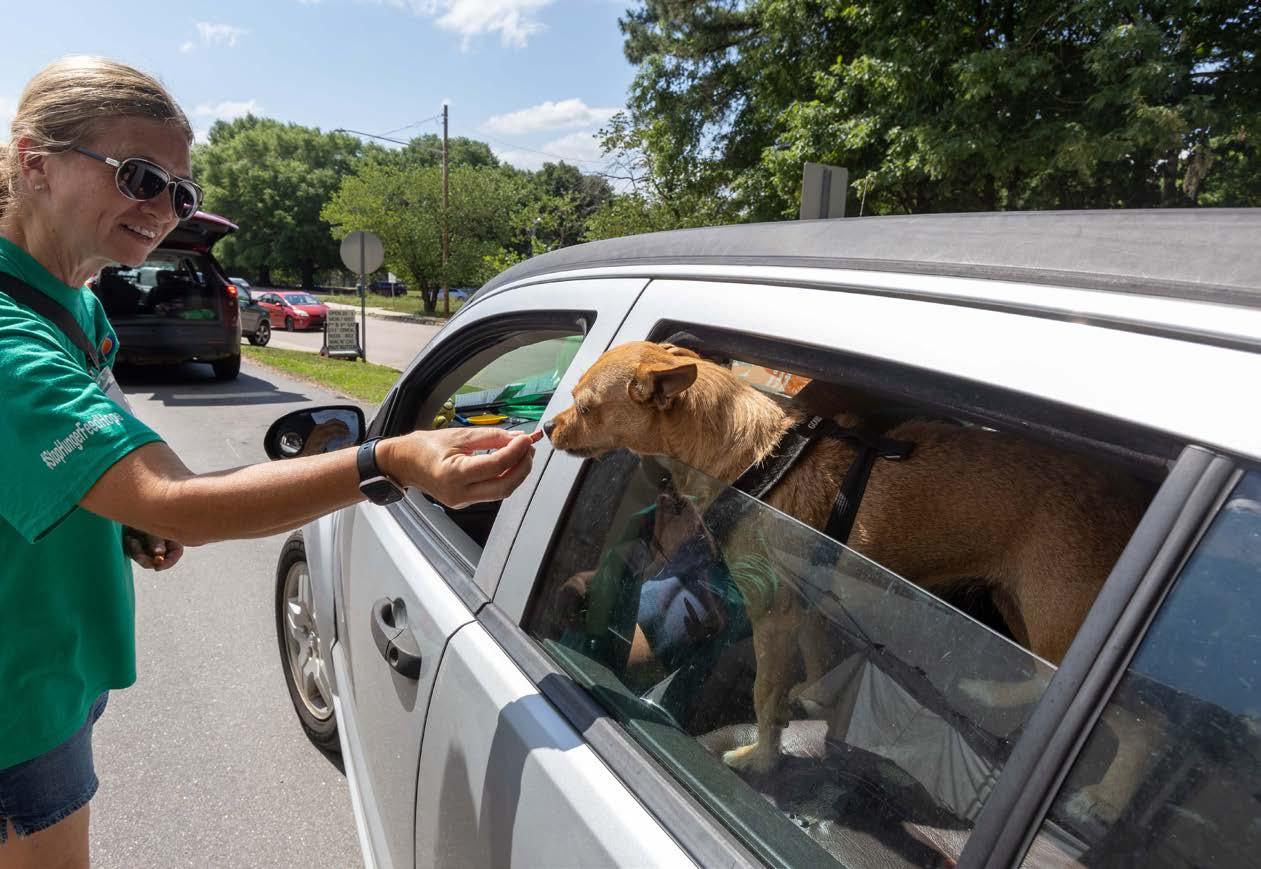
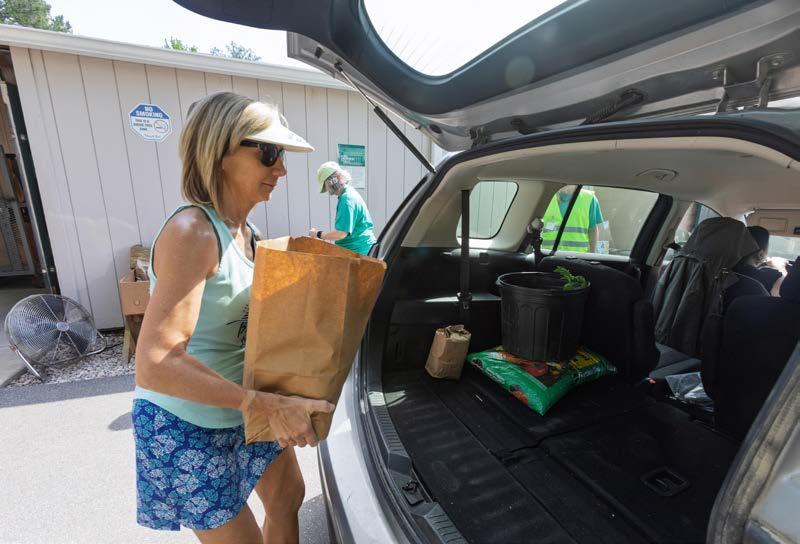
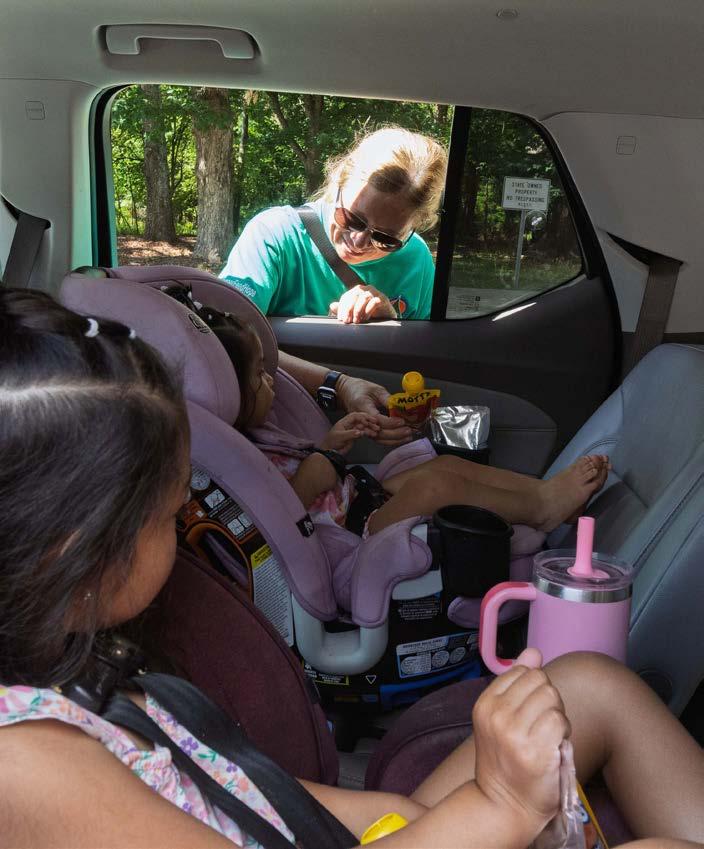
Drive along Wake Forest’s E. Holding Avenue on Mondays, Wednesdays, and the second and third Saturday of each month from 10 a.m. to 1 p.m. and you’ll see a snaking line of cars and volunteers in green T-shirts darting between vehicles with practiced efficiency. Although TriArea Ministry (TAM) Food Pantry Board Chair Mike Burger jokingly says, “We have borrowed every good idea from Chick-fil-A,”
this isn’t a fast-food drive-through — what’s happening here is something far more substantial than a quick meal.
On any of the 10 days the pantry opens every month, between 200 and 250 families will pass through. In May, 1,731 families were served. With an average of three and a half people per household, that’s nearly 6,000 individuals who received food, compassion, and dignity — all from a 100% volunteer
operation that has quietly anchored the community since 1988.
“I was at the post office shortly after we moved here,” Mike recalls about his introduction to the nondenominational food pantry, “and I saw this nondescript little building and a long line of cars. I’m thinking, What’s going on over there?” After checking it out, Mike started to offer his time … and 11 years later he’s giving the tours.
What visitors find inside TAM is an impressive logistics operation. Donations arrive and are immediately date-checked and sorted into categories. Supermarket partners — three Harris Teeters, two Lowes Foods, a Food Lion, and others — donate food that has aged out of their inventory but is still perfectly usable. Two vans run pickup routes. A pig farmer collects whatever can’t go to families. Almost nothing ends up in the landfill.
Each family that comes through leaves with a gallon of milk, a half-dozen eggs, a loaf of bread, five pounds of meat, one leafy green, two types of fresh vegetables, two types of fresh fruit, and bags of nonperishables that include canned goods, rice, beans, pasta, peanut butter, and more. Hygiene products, diapers, pet food, and even Milk-Bones for dogs round out the offerings. On the day Wake Living visited, the Wake Forest Garden Club was on hand with container garden kits — tomatoes, peppers, marigolds (for pest control), lettuce, soil, and instructions — so families could begin to grow their own produce.
“In total, it’s about 100 pounds of food,” Mike says about the five bags of food every family can receive once a month. “And it’s even loaded into the car.”
It would be easy to make assumptions about who pulls through the TAM line, but the data reveals that the vast majority, 75%, are working and just not earning enough to make ends meet. The pantry’s demographic picture is a cross-section of the community: Approximately 30% of recipients are African American, 25% are Hispanic, 25% are Caucasian, and the remainder is a mix of backgrounds. The numbers of men and women are roughly equal. Approximately 18% are children under 17, and a similar portion are senior citizens over 65. Interestingly, only about 35% of families come every single month. The average is six visits per year, suggesting that for many the pantry is a safety net used strategically and not a permanent dependency.
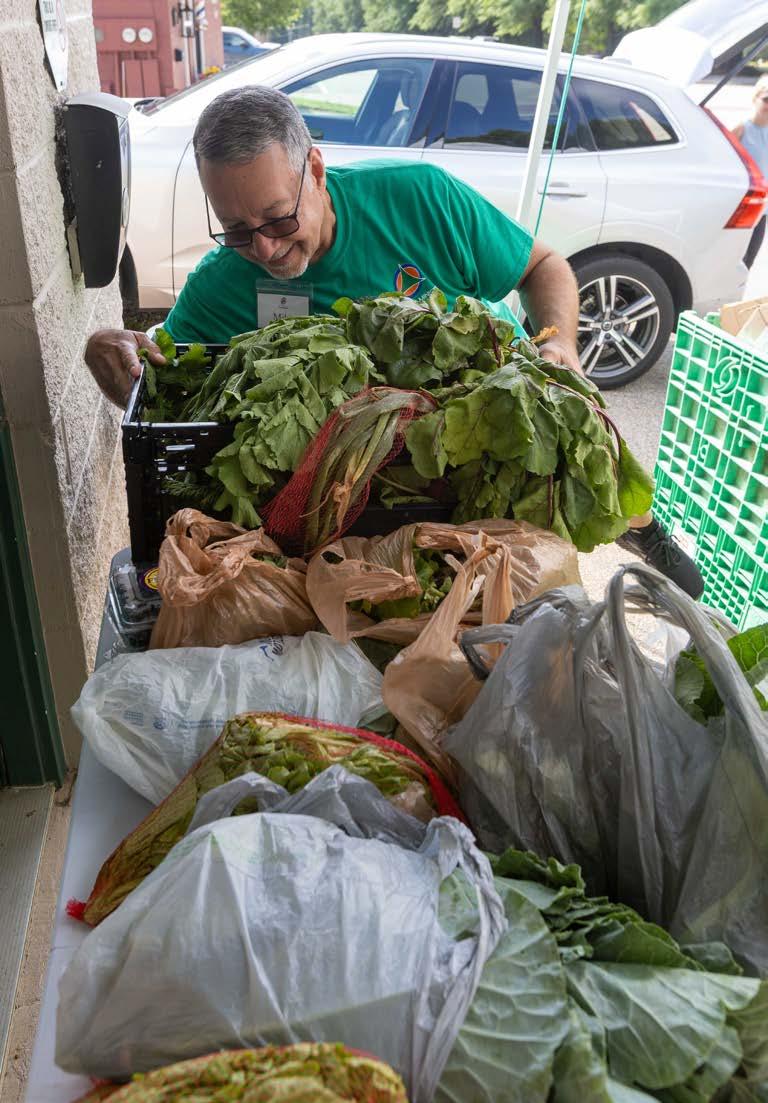
In total, it’s about 100 pounds of food and it’s even loaded into the car.
— Mike Burger, Board Chair, TAM Food Pantry









































Before the pandemic, the pantry served fewer than 600 families a month. Since then, that number has more than tripled and shows no signs of declining. “What we assumed would happen was that it would spike, and then it would gradually go back down,” Mike says. “But we haven’t had a dip at all. It tends to grow between 10% and 12% year over year.”
Inflation, he says, is a major driver. When the grocery bill climbs but the paycheck doesn’t, something has to give. “At the end of the month, you just don’t have enough to eat. So you’re going to come here.” And when families do come to TAM, they aren’t asked for ID or a referral. It doesn’t matter where they live or what their income
is. As Mike explains: “If you’re hungry, you come. We’ll provide food.”
Behind every statistic is a face, and Mike carries several of them with him. He recalls how during the recent government shutdown a TSA agent came through, in uniform. It had been a month since he’d gotten paid. He had a family to feed and was the sole breadwinner. “I thought to myself, That could be me,” Mike shares, aware that most people aren’t more than a few months from having to wonder how they’re going to put food on the table.
There was also the young mother who walked in pushing a stroller with two young children. She’d never visited a food pantry
before and was visibly struggling with being there. Volunteers quietly helped her through the process, but when they asked her about diapers, she initially declined, suggesting that they should be left for someone who needed them more.
When the team stepped away and returned, the young woman was in tears. “Is it too late for me to change my mind?” she asked. “I really need those diapers.” Her husband had been injured and couldn’t work. She didn’t know where else to turn. So, she loaded up her kids and walked over 2 miles to the pantry, where Mike considers it “a blessing” that he and the other volunteers can help families in need.



Volunteer hours, food donations, financial contributions, and advocacy are all included when Mike says, “We enjoy an enormous amount of community support.”
Approximately one-third of food comes from the regional food bank, one-third from community donors, and one-third is purchased outright by the pantry using donated funds. That purchasing power — with 100% of resources going into buying food — enables the pantry to guarantee consistency. Every family, every visit, receives the same quality and quantity of food regardless of what has been
Volunteers are always welcome, and the pantry is fortunate to have nearly 30 people serving during every distribution day. They are the reason the operation works: arriving early to unload trucks, sort donations, pack food, and load vehicles, whether the forecast calls for blazing heat, driving rain, or winter cold. In fact, there has never been a day when there weren’t enough helping hands. An outside bin accepts food or hygiene donations at any time. And if none of those fit your circumstance, Mike simply asks that
“We’re giving people food,” he says. “And we’ll give people food next month, too.” But that doesn’t address the reason they’re hungry in the first place.” So he forces himself to “operate with blinders on … because we can’t boil the ocean. Would it be better if everybody had a job with a living wage so they could afford to buy the food, and then they wouldn’t have to come here? Of course. But we can’t affect that. What we can affect is making sure that those people who are maybe out looking for work or going to school are
While TAM’s goal is obsolescence and to one day have no reason to exist, Mike knows that until then, the line of cars will keep coming — and Tri-Area Ministry will keep showing up to feed the community, one car at a time. t
triareaministry.com @tamfoodpantry
BY ERICA DELONG
I’d love to say that my family has mastered our goal of meal prepping and eating all our meals at home. But honestly? Life is busy, and I can’t resist the deliciousness scattered throughout the Triangle. This is why friends and family always ask me where they should eat for every occasion. So, where do we go to celebrate when life calls for something special?
It’s tradition to visit Angus Barn. I don’t just love it for the fantastic food; it’s the people, too. Owner Van Eure and the team work tirelessly to make every customer feel valued and love giving back to the community. You can dress to impress or just come as you are. Though it’s a nationally recognized steakhouse, I always go for
the three-cheese ravioli with white sauce — hands down my favorite. Reservations can be tough to snag because it gets busy. You can book online 120 days in advance.
Pro tip: The Wild Turkey Lounge opens at 3 or 4, depending on the time of year, and is available on a first-come, first-served basis, so drop by for an early dinner. Ask your server about a special tour where the kids can grab a scoop of ice cream with sprinkles.
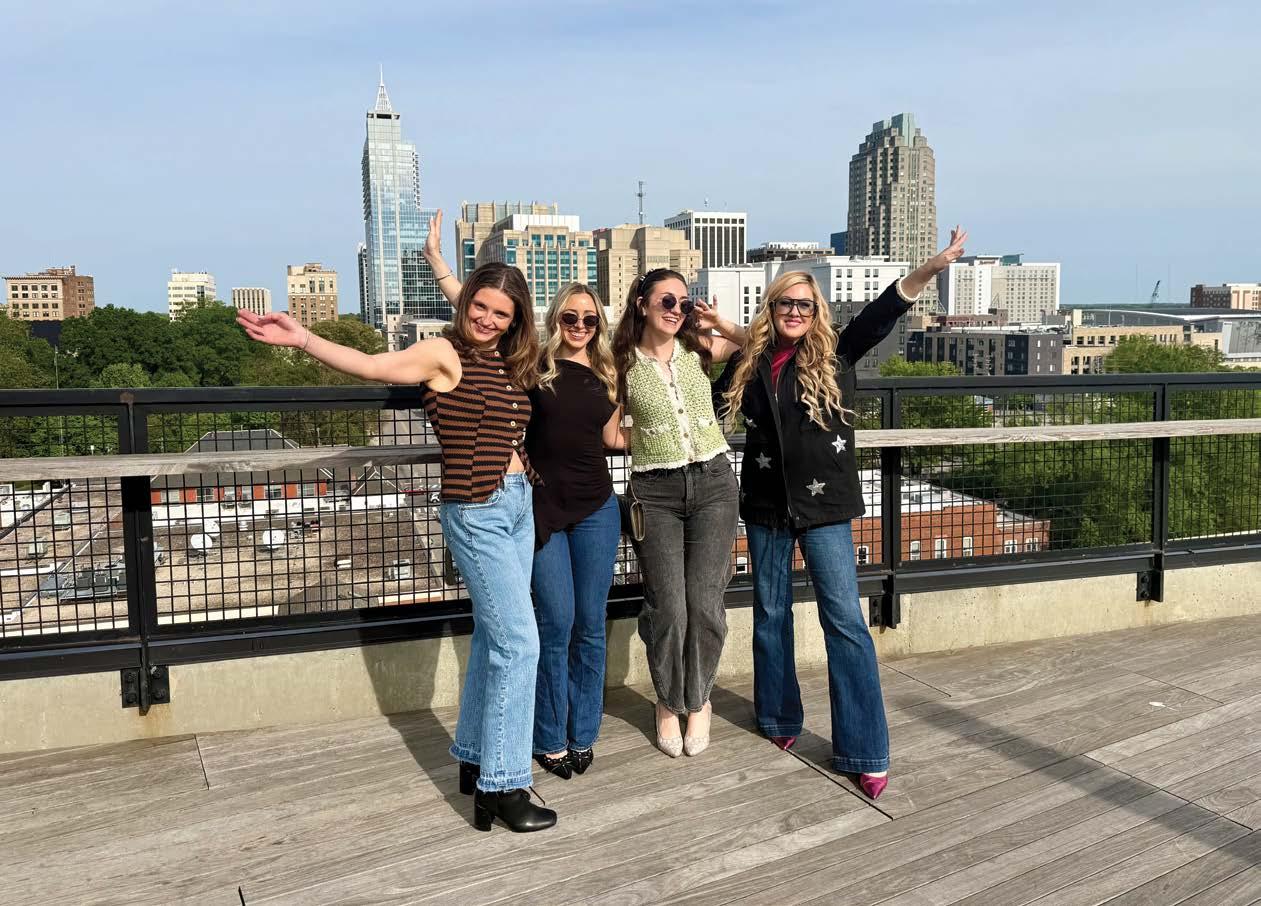
For an elevated girls’ brunch, RH Rooftop in North Hills is perfect. Capture gorgeous group pics and enjoy some shopping afterward. The restaurant sits atop a 60,000-square-foot design gallery with stunning home décor. You can even book a table online for their fantastic
weekend brunch menu. Their burger is always a fan favorite! Remember to register your car for the onsite parking.
Planning a bridal luncheon or a larger group gathering? Birdie’s Barroom & Kitchen is your spot. They serve breakfast, lunch, and dinner and offer custom menu packages for daytime events. Their Blue Ridge Room can host groups up to 24, and the Veranda Patio is a fenced-in outdoor area that’s just beautiful. If you’re a shrimp and grits lover, this is the spot. And I’m obsessed with their pull-apart bread in a cast iron skillet — yes, please!
Need a pregaming spot before a concert? Swing by the Bar & Lounge at the Umstead, a short drive from Lenovo Center. No
reservations required — grab a bar seat or a table for dinner. They often have live music, and it’s always busy. I’ve enjoyed lunch with friends there, showing up at 11 a.m. to secure a table. On nice days, grab an outdoor seat and snap a pic with the fresh flowers in the lobby.
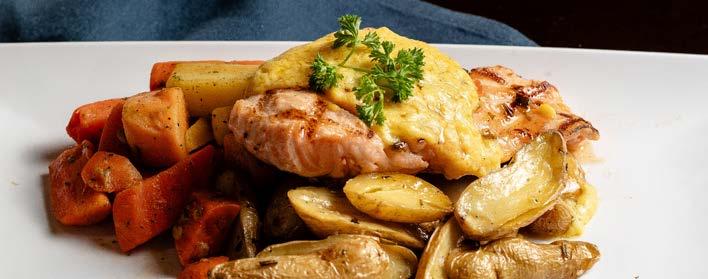
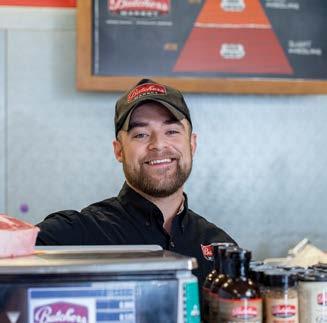
Craving a “homemade meal” but don’t feel like cooking? The Butcher’s Market offers a great selection of ready-made meals you can order online or just stop in. With several Triangle locations, some options might vary by spot. Grab some kabobs for the grill or a complete meal that’s ready to heat and serve. If you’re heading to a friend’s event, swing by on the way for some spinach and artichoke dip or chicken salad.
For a spot that wows with ambience, check out La Terrazza in Raleigh. On the
ninth floor of The Dillon mixed-use development, it offers a southern Italian and Mediterranean menu with indoor and outdoor dining. The skyline views are amazing, making it a prime date-night location. We’ve hosted client events there too, as it’s perfect for showing off your city. And the newly renovated outdoor bar is breathtaking!
Burger cravings present a tough challenge because there are just so many great spots around the Triangle. For our family, The Cowfish tops the list. You really can’t go wrong with their menu. Plus, the kids love being entertained by the fish tank or playing out front. They now offer reservations, which is a huge plus. And if you’re in the mood for a salad, they’re big enough to share!
If you’re a pizza lover like us, don’t forget about Amedeo’s Italian restaurant. Sometimes overlooked because it’s been around forever, this spot is a Wolfpack fan’s paradise, serving authentic dishes since 1963. The founder, Amedeo (Dick) DeAngelis, was a former NC State football player. The pizza is fantastic, and it’s a familyfriendly spot that makes you feel like you’re truly part of history when you visit.
The Triangle is now a thriving foodie community, with new spots popping up everywhere. I could keep making recommendations (Doc B’s guacamole is the best I’ve ever had!) but I have to stop somewhere. Happy eating! Where’s your favorite spot to celebrate in the Triangle? Let me know.t
@EricaDeLong
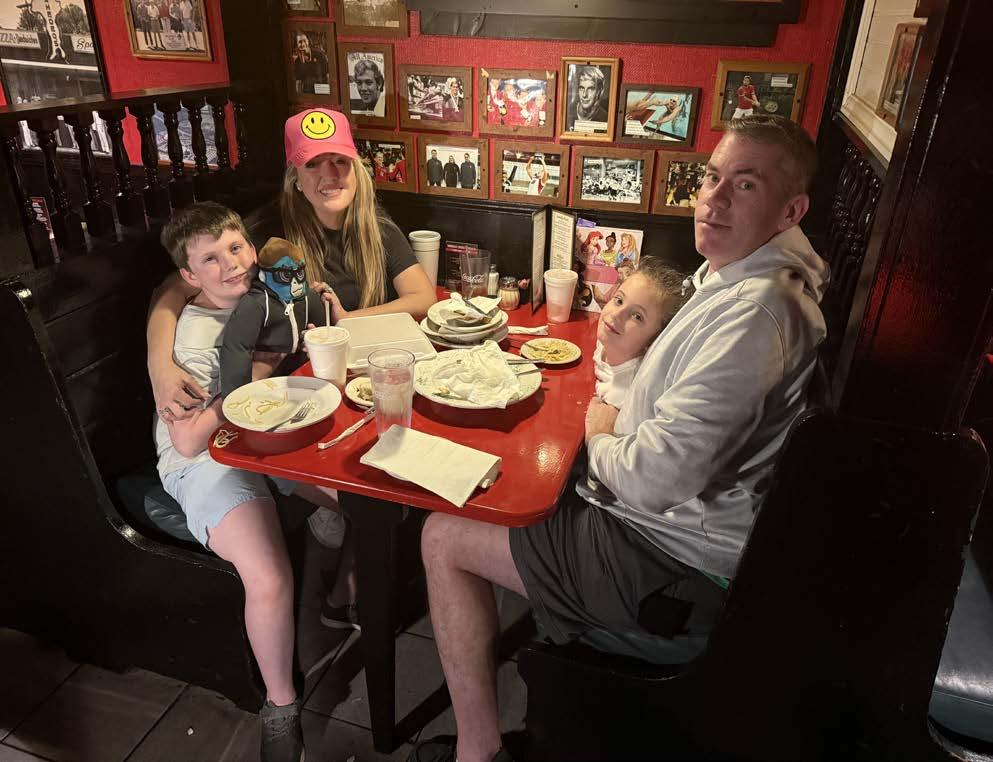
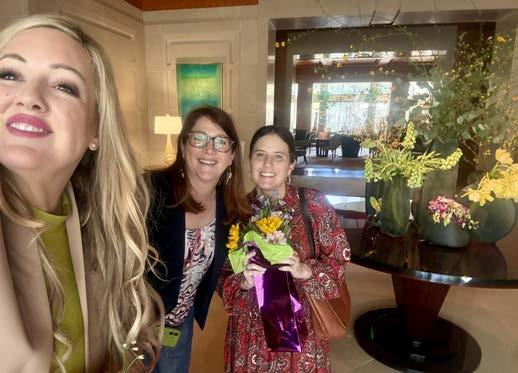
LEFT: Amedeo’s Italian — family friendly with history BELOW: Always grab a pic with the lobby flowers when stopping by the Umstead
NO
CONTRIBUTED BY DR. EDMOND SUH, D.D.S.
Did you know approximately 1 in 4 people have a fear of going to the dentist, resulting in anxiety crippling enough to make them want to skip dental procedures altogether? If this is you, take note: With sedation dentistry, there are several ways you can experience both major and minor dental procedures while remaining in a state of relaxation and reduced awareness in order to get the care you need.
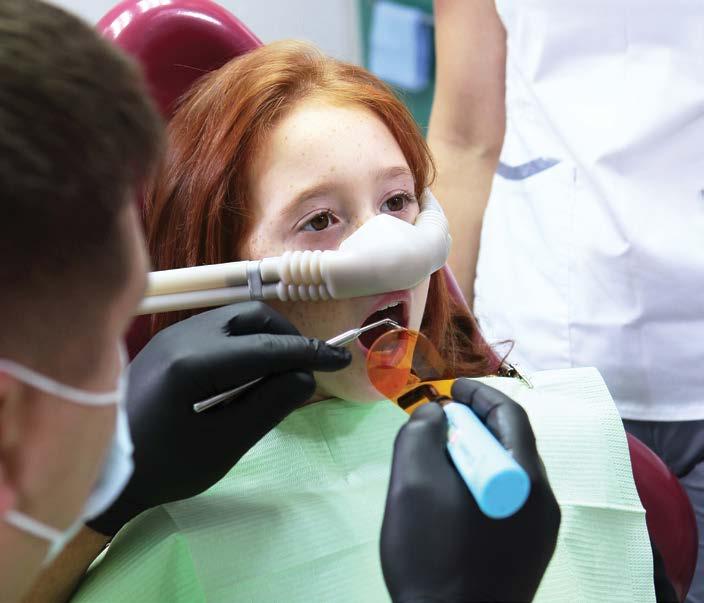
Nitrous oxide, commonly known as laughing gas, is a mild sedative delivered through a comfortable fitted mask or nosepiece. Breathing this in throughout your procedure helps you feel calm and at ease while remaining fully alert and able to respond. Since the effects wear off quickly, you will not need to arrange for someone to accompany you for a ride home and you will be able to resume your normal activities quickly.
Conscious oral sedation is when you will be given a prescription for a gentle, yet effective, sedative you can pick up at a pharmacy of your choosing. Your dentist will give you instructions as to the exact time the sedative should be taken, as it takes some time for the medicine to take effect. It will also be necessary to have someone drive you to and from your appointment. When you arrive, you will be relaxed and possibly drowsy. Consider bringing in music, movies, or an audiobook you can listen to with earphones. This will help drown out any noises that may cause anxiety.
Administered directly into the bloodstream, IV sedation provides a deeper level of calm and can be easily adjusted throughout
the procedure to maintain optimal comfort. This method is particularly useful for those undergoing extensive or complex treatments, as it allows for a more relaxed and stress-free experience … one you probably won’t remember at all! Like oral sedation, you will need to have someone drive you, as the effects may take several hours to completely wear off.
Be sure to talk with your dentist about the different types of sedation if you:
• Experience severe dental anxiety or phobia.
• Have difficulty sitting still for extended periods.
• Require extensive or complex procedures.
• Have a sensitive gag reflex.
• Experience difficulty becoming numb with local anesthesia.
• Have a low pain threshold.
• Need treatments for issues like gum disease.
At Supremia Dentistry in Wake Forest, their friendly and compassionate team will take the time to talk with you and make sure you are comfortable and anxiety-free. And the best part? It’ll all be over before you know it!
Edmond W. Suh, D.D.S., is the owner of Supremia Dentistry in Wake Forest. He is an international lecturer on advanced esthetic dental procedures and leads an award-winning team that has completed extensive training and continuing education to implement the latest technologies and techniques. For more information on sedation dentistry or other dental issues, call (919) 556-6200 or visit supremiadentistry.com.

As your squash patch reaches maturity under the strengthening summer sun, welltended plants should begin brimming with their delectable edibles, meaning you can reap the benefits by harvesting … and harvesting … and harvesting. Before you know it, you might be up to your neck in crookneck, straight neck, patty pan, or zucchini fruit.
But as much as you like squash, I’m sure you don’t want to eat it a zillion times or more until the first frosts of late fall bite the warm-season veggie garden. So, what to do? Pickle or freeze the excess? Give extras away? Or, as an alternative, perhaps try a new way to savor this old garden-to-kitchen staple?
Before squash plants bear fruits, they produce their bright yellow flowers, which, believe it or not, are edible. And tasty. With a flavor like squash fruit but fainter, these blossoms aren’t strangers in fancy restaurants, being served raw in salads as well as sautéed, fried, or baked for elegant side dishes.
Interested? Don’t chomp on a mouthful of flowers just yet — there’s a few basics to go over first, starting with insecticides. If you insist on spraying your garden with commercial bug killers, make dang sure they are cleared for use on vegetables, and even then, try to limit applications.
Now, let’s talk botanical birds and bees. Squash plants have both male and female flowers, with the he-blooms being typically perched on extended stems, while the she-blooms nestle closer to the bases of leaf stalks. There are usually many more male flowers than female blossoms, so if you want to also maintain a steady crop of squash fruit through the growing season, go for some of the boys first.
Although overall squash production will be reduced, female flowers can be picked as well. To make these blooms more interesting edibles, wait until a baby squash grows to
about 1 to 2 inches long on each blossom base before harvesting.
Kitchen prep is pretty simple: First, examine the flowers for bugs, especially bumblebees — I can’t tell you how many times I have found these chubby buzzers blissfully asleep in blossoms. Then, snip out the pistils or stamens tucked inside the blooms, and wash the petals. Finally, let your inner culinary creativity be your guide.
I have enjoyed lightly fried squash blossoms with ranch dressing as a nifty appetizer myself, but do a search for “squash flowers,” and you will find a ton of other tantalizing recipes to try! t
L.A. Jackson is the former editor of Carolina Gardener Magazine. Want to ask L.A. a question about your garden? Contact him by email at lajackson1@gmail.com.
Written and photographed by L.A. Jackson

If you find the foliage of your carrot, parsley, fennel, cilantro, or dill plants being munched on by rather large green caterpillars with yellow dots banded by black and white stripes, don’t be so quick to reach for the bug spray. These are immature forms of the eastern black swallowtail butterfly. Instead of using insecticides on such beauties-to-be, consider growing more of their favorite plants than you will need for yourself in a separate part of the garden. Then, serve them up as sacrificial suppers, meaning when you find any of these caterpillars on “your” plants, simply relocate them to “their” plants to feast upon so they can bulk up for their continuing metamorphosis that will eventually result in pretty butterflies.
• To help prevent moist conditions that can be ideal for the development of nasty foliar diseases, use a soaker hose for irrigation or water plants early in the morning so leaves will dry off quickly in the rising sun.
• Enjoy a good drink after a long session in the summer garden? Your insect-eating feathered friends do, too, so be sure to clean out and refill the birdbath at least once a week during these hot, hazy days.
• With The Great Annual Autumn Leaf Drop coming soon, take time to examine your woody ornamentals and cut off any dead, diseased, or damaged limbs. Leave healthy branches alone because pruning them this month could encourage new growth that might not have time to harden off before killing freezes settle in for the winter.
• Now is a good time to prepare planting sites for fallplanted, spring-flowering bulbs. Dig and turn over the beds at least 12 inches deep and add beaucoup compost or commercial soil conditioner to fluff up the growing ground for your pretties-to-be.




Named after the year Carolina Brewery opened, 1995 pays homage to the past, but it’s here to stay. A crisp, bright, easydrinking lager brewed with Helios and Saaz hops, it was built for summer gatherings, backyard cookouts, and holiday weekends, with a June release date timed to coincide with America’s 250th anniversary.
“1995 is a celebration of where we started and the community that has supported us along the way,” says founder Robert Poitras. “As we approach America’s 250th anniversary, it felt like the perfect time to create a beer that honors both our founding year and the traditions that bring people together.”
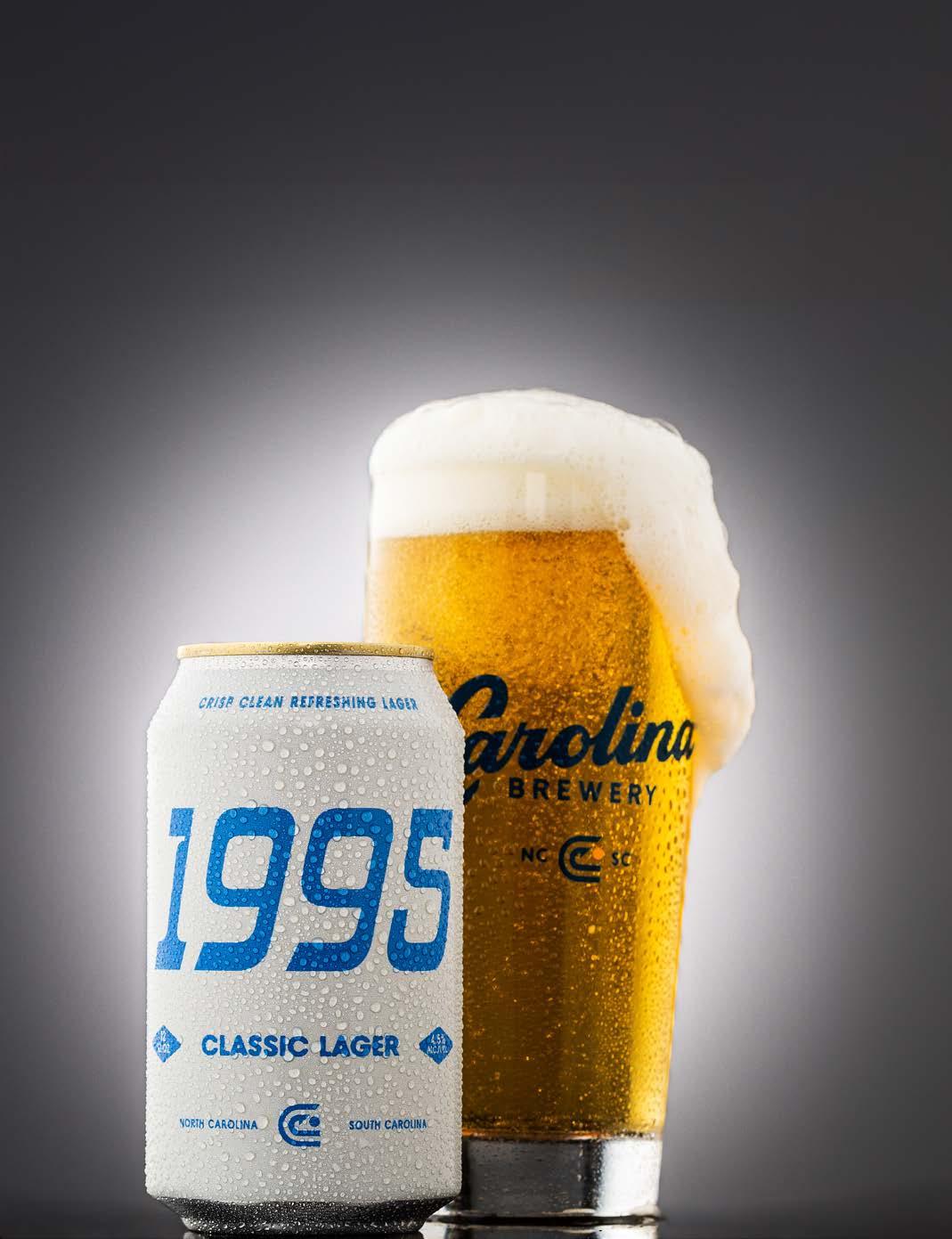
Carolina Brewery is a place where friends gather to enjoy madefrom-scratch dishes and high-quality craft beer. The brewery has received numerous accolades in the press and at respected beer festivals throughout the world, including four medals at the Great American Beer Festival and more than a dozen medals at the World Beer Championships. It operates two restaurant locations in Chapel Hill and Pittsboro. carolinabrewery.com @carolinabrewery


recipes from readers
FROM JULIE TOMLINSON
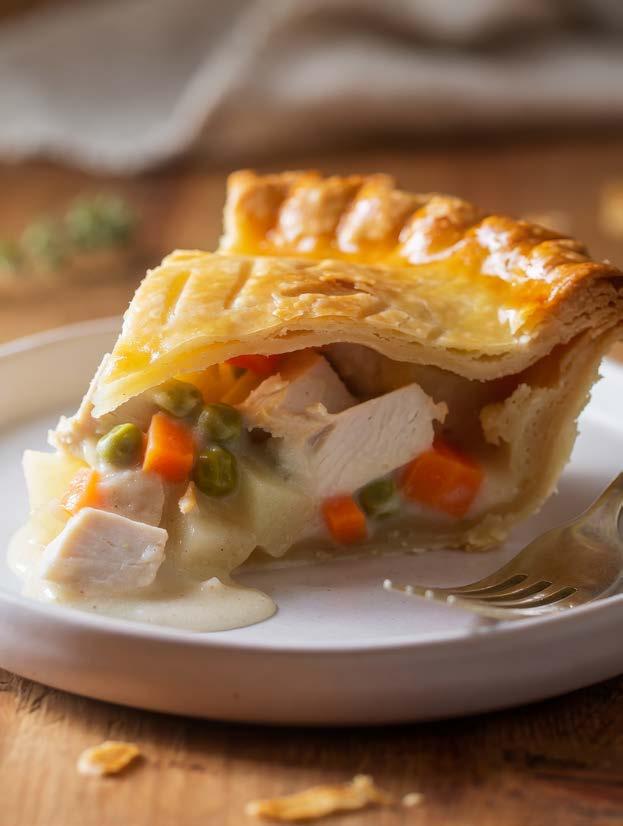
An easy and delicious recipe. Add or remove veggies however you want. You can also use this recipe to make homemade chicken soup. Just cut up the veggies, shred the chicken, and cook it in chicken broth.
6 carrots, chopped
6 stalks celery, chopped
1 cup peas, fresh or frozen
1 cup green beans, fresh or frozen
1 cup corn kernels
1 yellow onion, diced
1 cup red potatoes, quartered
3 cups chicken broth
1 teaspoon thyme
½ teaspoon salt
½ teaspoon ground black pepper
4 (0.87 ounce) packets dry chicken gravy mix
4 cups water
1. Preheat oven to 425 degrees. Place a baking sheet on the rack you’ll bake the pie on.
2. Combine the carrots, celery, peas, green beans, corn, onion, red potatoes, and chicken broth in a large pot. Season the vegetable mixture with thyme, salt, and black pepper; bring to a boil. Reduce heat to medium-low, cover, and simmer until the vegetables are tender, about 15 minutes. Drain the vegetables and set aside.
3. Put dry chicken gravy mix into another saucepan and slowly whisk in the water until smooth. Bring the mixture to a boil, reduce to medium-low, and simmer until partially thickened, about 1 minute. Set the gravy aside (it will thicken more as it cools).
4. Press one of the pie crusts into the bottom of a 9-inch pie dish. Spoon a layer of gravy (about cup) into the crust. Layer the cooked vegetables and shredded chicken into the crust until the filling is level with the top of the pie dish. Pour the rest of the gravy slowly over the filling until gravy is visible at the top. Scatter butter pieces over the filling and top with second crust. Seal the two crusts together and crimp with a fork.
5. Whisk the egg and milk together in a bowl. Brush the egg wash over the top crust. Pierce the top crust several times to vent steam.
6. Bake the pot pie in the preheated oven until the filling is bubbling and the crust is golden brown, about 45 minutes to 1 hour. Check periodically to see if the edge of the crust is browning too quickly; if needed, cover the edge with a strip of aluminum foil to prevent over-browning.

1 (15 ounce) package double-crust ready-to-use pie crusts
1 whole roasted chicken, bones and skin removed, meat shredded
¼ cup butter, cut into pieces
1 egg
¼ cup milk
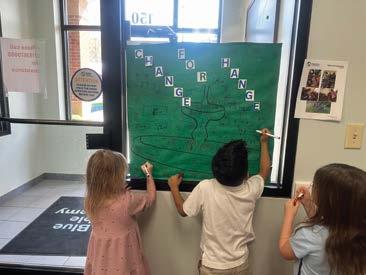
Big Blue Marble
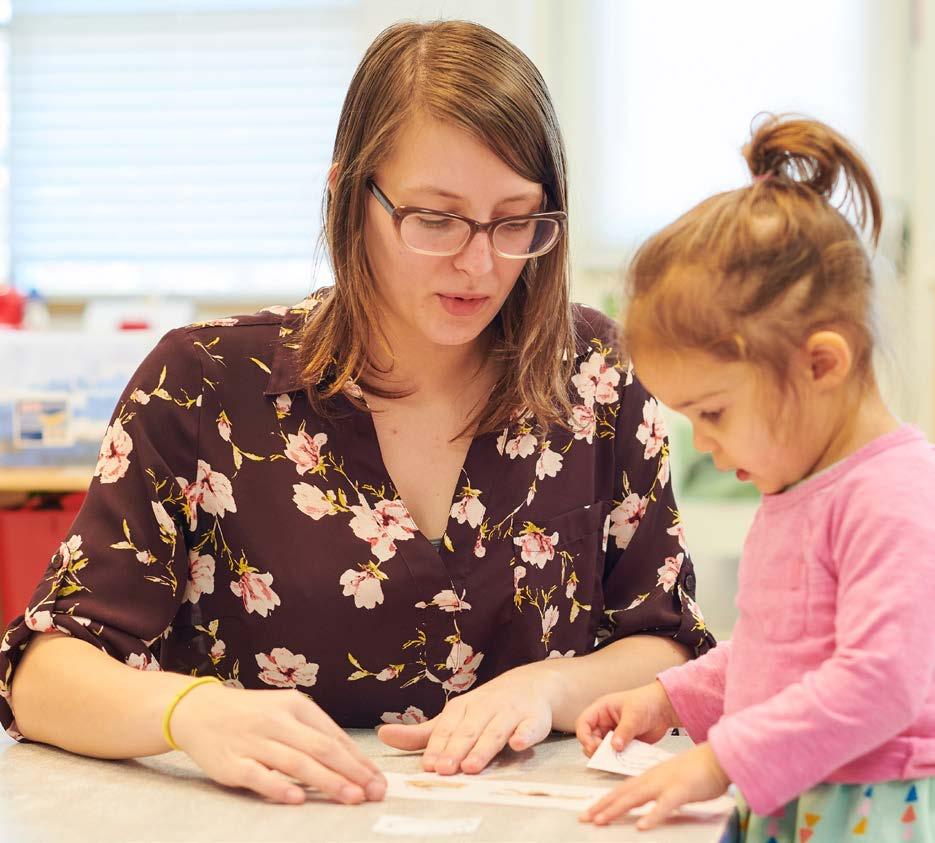
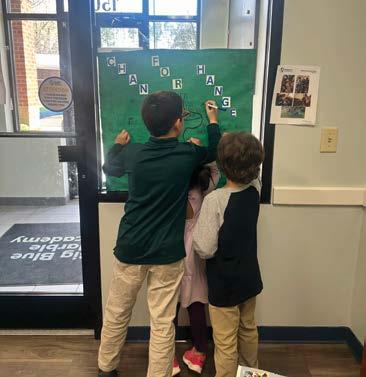
Academy students in Wake Forest, Cary, Holly Springs, Waxhaw, Wesley Chapel, and Park Crossing participated in the Change for a Change project, raising $1,448 to provide pre- and postnatal care for 14 mothers and their babies at the Rotifunk Hospital in Sierra Leone, Africa.
Throughout March and April, the students collected change to benefit Mission of Hope’s Madonna project at the hospital. The students learned about maternal healthcare and made posters to inform the community of the need, then counted and rolled the donated coins.
“We want Big Blue Marble Academy students to understand that they are capable of making a difference at any age,” says BBMA CEO Jomar Jenkins. “Our Passport to Community programs, like Change for a Change and other Heart Projects, help our young learners to be mindful of those around them while identifying opportunities to help, in big and small ways.” In total, BBMA students raised more than $17,000, supporting 175 new mothers. bbmacademy.com
Coastal Credit Union named Allison Liston as its new Vice President of Legal and Compliance. She will lead the development and execution of Coastal’s legal and compliance strategy, supporting the credit union’s strategic goals while helping identify, assess, and mitigate legal and reputational risk. She will oversee the vendor management and procurement functions and provide legal and compliance guidance across the organization. Her responsibilities include negotiating and reviewing vendor and software agreements, analyzing changes in regulatory requirements, advising leadership and business units on legal and compliance matters, supporting corporate governance, and ensuring policies and procedures align with applicable federal and state laws.

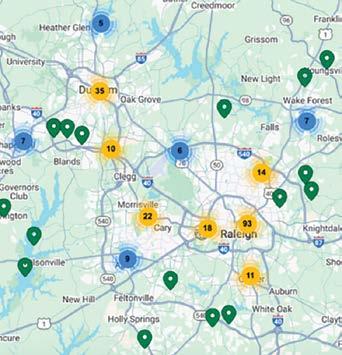
During National Volunteer Week in April, Raleigh-based nonprofit Activate Good, which matches volunteers with opportunities across the Triangle, helped create 1,330 sign-ups leading to more than 3,300 hours of service. The organization celebrated its 20th anniversary in 2025 with a recordbreaking 34,258 sign-ups. More than 400 of the nonprofit’s 550-plus community partners are based in Wake County. activategood.org
The Wake Forest Parks, Recreation & Cultural Resources Department held two ribbon cutting ceremonies in early May for the debut of Dunn Creek Greenway Phases 3 and 4 and opening of Miller Park. Both ceremonies featured remarks from Mayor Ben Clapsaddle.
The Dunn Creek phases added 1.8 miles of greenway to the existing network. Phase 1 of the Miller Park opening included restoration of an unstable stream that flows through the park and renovations of the park’s amenities and greenway system to enhance connectivity in the 2-acre park.
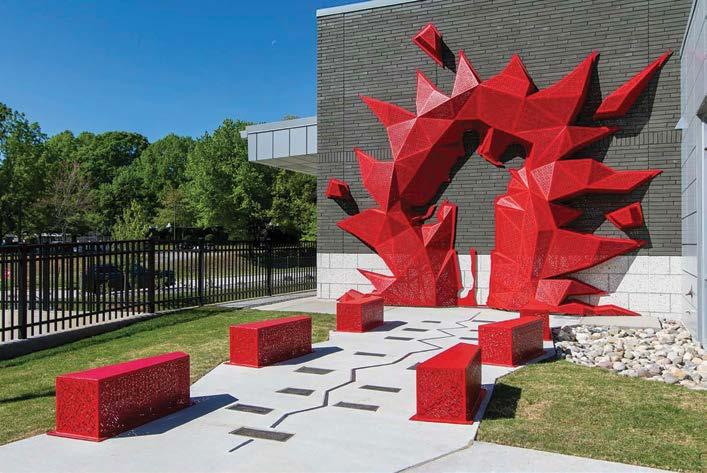
Raleigh’s new Fire Station 3 opened on April 27 and welcomed the public for an open house on June 15. The 11,105-square-foot station houses a fire engine with a total of 12 firefighters and serves Southeast Raleigh.
The Victor, a public art installation created by Maxwell Emcays, depicts a firefighter emerging from a blaze carrying a figure. The firefighter does not wear a helmet, representing firefighters from the Victor Company, Raleigh’s first volunteer Black fire company that operated in the building that housed the original Fire Station 3. Six benches line a path beside the installation, laser cut with the department’s core values of Courage, Service, United, Protect, Sacrifice, and Honor.
celebrated the opening of the new Peggy Garner Britt Resource Center in April. The state-of-the-art facility aims to set a new standard for animal welfare in North Carolina by doubling the number of spay/neuter surgeries performed by SPCA of Wake County each year, expanding lifesaving veterinary medical programming, and increasing access to education and resources for pet owners in the community. “This expanded campus represents a transformational step forward for animal welfare in our region — expanding not just what we do, but how many lives we can reach and impact,” says Kim Janzen, SPCA of Wake County president and CEO.


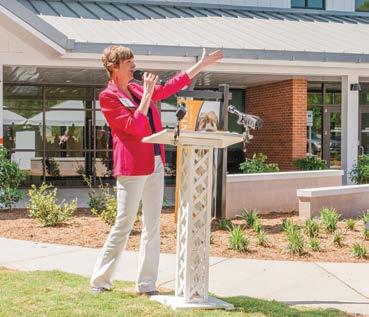
Two Wake County students were among 13 chosen from across North Carolina in the annual Farm to School Calendar Contest, sponsored by the North Carolina Grange. The students were recognized at the Got to Be NC Festival in Raleigh on May 16. Their art will be featured in a 2027 calendar, with each month’s artwork representing a different commodity. The calendar also includes educational facts about agriculture.
“It’s clear from this artwork that these students have a good understanding of farms and what agriculture looks like here in North Carolina,” says Agriculture Commissioner Steve Troxler. “It was a very competitive year with over 3,500 entries from 58 countries.”
The Wake County winners included Ryan Openchowski, a fifth grader from Davis Drive Elementary, and Namya Singhal, a fifth grader from Morrisville Elementary.
BY JONATHAN FREDIN

A change in perspective reveals inspiration everywhere. I spent a week finding letters in the world around me, and it turns out I am still learning my ABCs.




Voted Best Medical Spa every year since 2018


Michael Law MD, Voted Best Plastic Surgeon in the Triangle every year since 2018, owns and operates Blue Water Spa.

Award-Winning Medical Spa specializing in Transformative, Safe & Effective Services
Natural Looking Neurotoxin, Filler and PRF & Lasers for ALL Skin Types