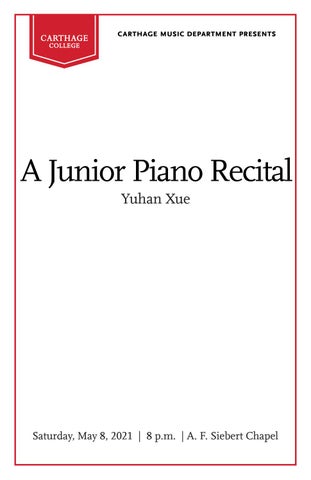
carthage music department presents
A Junior Piano Recital Yuhan Xue
Saturday, May 8, 2021 | 8 p.m. | A. F. Siebert Chapel
program There is no intermission Autumn Moon over the Calm Lake
Lü Wencheng (1898-1981) Transcription by Chen Peixun (1922-2006)
Fantasie in C Major Op.17 Robert Schumann (1810-1856) I. Fantastic and passionate (Durchaus phantastisch und leidenschaftlich vorzutragen) II. Moderate, energetic (Mässig - Durchaus energisch.) III. Slowly and Quiet (Langsam getragen - Durchweg leise zu halten.) With the original ending from Schumann’s manuscript.
Yuhan Xue is a student of Dr. Wael Farouk. This Recital is given in partial fulfillment of the Instrumental Performance Degree Requirements.
program notes Autumn Moon over the Calm Lake is a transcription of the Chinese folksong which was written in the 1930s by Lü Wencheng and performed with Chinese traditional instruments, showcases the natural serenity of the West Lake in Hangzhou. This repertoire has brought a peaceful scene of quiet and charming West Lake under the bright autumn moon in a blowing breeze evening. The poetic artistic conception also embodies people’s yearning for a better life, longing for peace and love for nature. “You can only understand the Fantasie if you go back to the unhappy summer of 1836 when we were separated.” As Schumann wrote in his letter to his wife Clara of his great Fantasie in C major. This repertoire was dedicated to Franz Liszt, the Fantasie began its life - publicly, at least - as a musical tribute to Beethoven. Later Schumann changed the titles of the movements as he revised the Fantasie, but eventually as confirmed in a letter to Clara on 16 April 1838, he quoted them as “Ruins, Victory Arch, and Constellation”. The first movement includes a quote from Beethoven’s song cycle An die ferne Geliebte (To the distant beloved). The ubiquitous ‘Clara theme’ is heard immediately in descending octaves of the right hand and fell all over the first movement. There are allusions to sonata form - a full recapitulation in the first movement. Schumann hovers anxiously near and around the key of C major, never really affirming it until the last few bars of the first movement. The second movement had a visceral effect on Clara: “It makes me hot and cold all over,” she said. The obsessive march-like quality becomes all the more intense (and difficult to play) by its continuous dotted rhythms. The third movement - timeless and sublime - is like an extended song without words. Interestingly, Schumann abandoned his idea of reintroducing the principal theme of the first movement. There are ravishing diversions to the keys of A-flat and D-flat major (a Neapolitan sixth chord in root position, but still somehow as far from C major as we could be. Beethoven again comes to mind). The final C major chords of the piece - though voiced exactly as they were at the end of the first movement - could not feel more different: if earlier they seemed hopeful (or at least unresolved), they now seem resigned and filled with unbearable sadness.
upcoming events for carthage community Music Theatre Workshop: Song for a New World May 14 &15 • 7:30 p.m. A. F. Siebert Chapel • Tickets required Student Recital: Nathan Takahashi Saturday, May 15 • 7:30 p.m. Recital Hall • Tickets required Performing Arts Series: Opera ‘Round K-Town Sunday, May 16 • 3 p.m. A. F. Siebert Chapel • Tickets required Student Recital: Katiann Nelson Monday, May 17 • 7:30 p.m. A. F. Siebert Chapel • Tickets required
connect with us
tickets required
carthage.edu/fine-arts 262-551-5859 facebook.com/carthagefinearts instagram.com/carthagefinearts
Get tickets 24/7 at carthage.edu/tickets or 262-551-6661 noon to 5 p.m. Tuesday – Friday