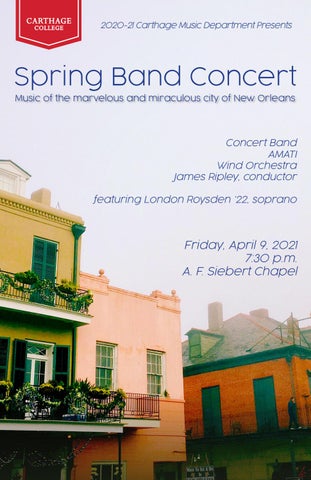
2020-21 Carthage Music Department Presents
Spring Band Concert Music of the marvelous and miraculous city of New Orleans
Concert Band AMATI Wind Orchestra James Ripley, conductor featuring London Roysden ‘22, soprano
Friday, April 9, 2021 7:30 p.m. A. F. Siebert Chapel
program There is no intermission. Please remain seated during esnemble changeovers.
Concert Band Heaven-Haven Poem of the Wind
Michael Merrill (b. 1988) Hirokazu Fukushima (b.1971)
AMATI Goodnight Moon Eric Whitacre (b. 1970) lyrics by Margaret Wise Brown (1910-1952) transcribed by Verena Möscenbichler-Bryant London Roysden ’22, soprano
Wind Orchestra The American Scene, Suite No. 2 “The South” 3. A New Orleans Street (The festive spirit of yesterday) Symphony No. 1, “New Orleans” Jackson Square Storm Lament Play!
William Grant Still (1895-1978) Carl Holmquist (b. 1983)
Combined Bands Berceuse and Finale from “Firebird Suite” (1919) Igor Stravinsky (1882-1971) transcribed by Robert Longfield
personnel
* AMATI Wind Orchestra Flute Gabrielle Garnowski * Bailey Schneyr * Emma Eckes *
Trumpet Colin Conway Michael Freeman * Caroline Lilly
Oboe Amber Ward Hannah Wong *
Trombone Sam Hoopingarner Taylor Zorn *
Bassoon Emma Azinger Bryan Weiss *
Euphonium Eric Benson *
Clarinet Emma Hardwick * Lexy Klawonn * Katiann Nelson * Maile Riedel * Zachary Ward * Bass Clarinet Sophie Shulman * Saxophone Alexandrea Bawek * James Chaudoin * Sophia Larsen Joseph Mihevc * Julia Owens Horn Samantha Ardery Meg Larson * Lena Welch *
Tuba Drake DeBoer John Lew * Percussion Aaron Paulsen Henry Meyer Aaron Paulsen Lily Peterson Christian Plonski * William Shuster Hailey Williams * Piano Nick Renkosik
personnel Concert Band Flute Milo Allen Gabriela Booth Emma Eckes Clarinet Natalie Cambone Tajaniah Drone Rosemary Ehle Jack Massari Abby Vidruk Saxophone Karlee De Jesus Alec DiGriolamo Luke Eidsor Olivia Luetterman Trumpet Vinny David Jarrod Thompson Guillermo Trujillo
Horn Courtney Boeder Grace Chapa Jonathan Landeweer Audrey Marshall Samuel Williams Euphonium Lucus Schneider Tuba Michael Flesher Emily Frost Percussion Grace LaBriola Olivia Schwefel Noah Wilson
program notes Heaven-Haven Michael Merrill began playing the saxophone in fifth grade and singing in choir during high school, getting involved in theater and stage musicals along the way. He started “composing” at around twelve when he would fiddle around at the piano, trying to play various tunes by ear and experiment with different patterns. Stuart Welsh at West Albany High School, Oregon, premiered his first orchestration for band in the spring of 2006. Merrill attended Brigham Young University-Idaho where he studied music education and composition under Dr. Daniel Kerr, and later with Darrell Brown. While at BYUIdaho, Michael received commissions from various students for their senior recitals. He received many awards and recognitions for his music, including two 2nd prizes (Glory to God in the Highest, winter 2012, and Anthem for Doomed Youth, fall 2012) and one first place in the school’s Research and Creative Works Conference (Mass for the Last Days, winter 2014). In the fall of 2013, Michael’s operetta Perfection of the Life (libretto by Ray Alston) was selected for performance by the school’s opera scenes program. Merrill graduated with a B.M.A. in composition and saxophone performance in April of 2014. In 2016 he earned an Master of Music in vocal music with commendation from the University of Aberdeen under the tutelage of Royal Composer Paul Mealor OStJ. He completed his Ph.D. in 2020. Heaven-Haven is a setting of the poem by Gerard Manley Hopkins, relating to a nun’s religious vows of dedication, faith and quest for peace. Poem of the Wind Hirokazu Fukushima graduated from Maebashi-Minami High School and received his Bachelor’s Degree from Tokyo College of Music, as well as a Certificate Diploma in Music. He studied composition with Reiko Arima. Today, he is an active composer and arranger of band and orchestra music. He organized Ensemble Poire, which does unique performance activities including peculiar movements and comedy. He was nominated to the Asahi Composition Prize for Harvest Waves and awarded the same for his Chant for Dosozin in 1999, and the Japan Bandmasters Association Shitaya Prize for Ryujo no Mai in 2003. He was also director of wind band composition at the National Cultural Festival held in Gunma in 2001. Poem of the Wind was scored for flexible instrumentation for the All Japan Band Competition so as to provide an opportunity for smaller ensembles (originally a mixed octet of winds and percussion) to participate in this most prestigious event. It’s two contrasting sections are related through the melodic motives of a major second and perfect fourth, although ingeniously reshaped with both ornamental and rhythmic variety. Goodnight Moon The children’s book by Margaret Wise Brown is a beloved classic of textual simplicity and emotional depth. This setting for wind ensemble and soprano was crafted by one
program notes of the composer’s dear friends, Verena Mösenbichler-Bryant, currently Director of the Duke University Wind Symphony and Executive Director of the World Youth Wind Orcheestra. The composer writes: Over the past few years I must have read Goodnight Moon to my son a thousand times. Somewhere around reading number 500 I began hearing little musical fragments as I read, and over time those fragments began to blossom like a simple, sweet lullaby. I knew it was a long shot, but I asked my manager, Claire Long, to contact HarperCollins, and see if they would allow the text to be set to music. To my surprise and elight they agreed—the first time they had ever allowed Goodnight Moon to be used in such a way. I composed the piece relatively quickly, originally setting the text for harp, string orchestra, and my son’s mother, soprano Hila Plitmann. The Melody of Goodnight Moon will forever make me think of those quiet nights with my son Esh, reading him to sleep. A New Orleans Street One word that could sum up Still’s life and work could very well be “integration.” Integration—of musical styles and influences, of races and cultures – was actually Still’s explicit byword at least from around 1949. He arrived at his most integrated composing style, which he called “universal,” starting in the late ‘30s, once he had lived in Los Angeles for a while. He explained the process of his development in a 1967 interview: While I still intended to devote myself to giving expression, to a very large extent, to the use of the Negroid idiom…I did not want to confine myself to that particular idiom because I think [that] here in America we have so many idioms. The Indian music, the Creole music, and so on. I would like to write music that expresses America…rather than confine myself to writing just Negro music. [Even so], the Negro, being part of America [is important, and I am] not leaving him out. The overarching philosophy of integration motivates The American Scene: Five Suites for Young Americans, indeed could serve as a thesis statement for it. Still dedicated the suite to the Pasadena Interracial Women’s Club, an organization founded on the intentional sharing of cultures. In 1957, The American Scene was composed for the “Standard [Oil] School Broadcast” on radio. This music-appreciation broadcast, which reached throughout the west coast, was the oldest educational radio program in the United States, and produced at that point by Still’s friend, Adrian Michaelis. The composer, conductor, and arranger Carmen Dragon selected several segments from it—Florida Night, Levee Land, New Orleans Street, and Grand Teton —for the broadcast. The suite wasn’t performed in its entirety, however, “until November 18, 1990. The conductor, Jack Abell…wanted to do a premiere of WGS that would be known for its importance in future years. He thought that WGS would rise into the public consciousness in future decades“ (Judith Anne Still, 2018).
program notes The entire work is made of fifteen short, easily digestible, programmatic units that traverse the country creating an integrated mosaic of different landscapes and various cultures’ contributions to The American Scene, “A New Orleans Street” situated in “The South” with “Florida Night” and “Levee Land”. – Program note from Portland Youth Philharmonic 8/3/2018 Symphony No. 1 Carl Holmquist is a composer, conductor, and music educator. He is the Director of Bands and Fine Arts Department Chair at the H-B Woodlawn Secondary Program in Arlington, VA, where he teaches concert bands, jazz band, and music theory. He earned a BM in Music Education from St. Olaf College, where he studied conducting and composition with Timothy Mahr and Steven Amundson. He also earned a MM in Instrumental Conducting from George Mason University, where he studied with Mark Camphouse and Anthony Maiello. As a composer, he has written numerous works for concert band, orchestra, chamber ensembles and vocal ensembles, and has been commissioned by middle school, high school, university, and community ensembles across the country. His works for band and string orchestra have been published by Alfred Publishing, C. Alan Publications, Bandworks Publications and Grand Mesa Music Publishers. He was one of three composers to participate in the 2008 Young Composer Mentor Project, sponsored by the National Band Association. Holmquist also received first prize in the 2006 Claude T. Smith Memorial Composition Contest for his work, Play! This opening movement is a depiction of New Orleans before the storm. We begin with street music in Jackson Square, which is a central gathering place in the French Quarter. The brass section, building incrementally from low to high, introduce the hymn tune Nettleton, which is commonly sung to the text “Come thou Fount of Every Blessing.” The percussion, and woodwinds join the sound through interjections, as if more musicians are coming to the square to join in the fun. The music then shifts as a funeral procession enters the square. The traditional Dixieland band of trumpet, clarinet, trombone, tuba, and drums plays a slow and solemn dirge, which is followed by the whole ensemble joining in that mournful song. Then, in keeping with the tradition of a New Orleans funeral, the band kicks off the up-tempo second line rhythm and everyone marches home for a joyous celebration of life. An original melody, which will return in the final movement, is combined with the familiar tunes of “Oh When the Saints” and “Swing Low, Sweet Chariot” to bring the movement to an uplifting close. The second movement is my attempt to conjure up that storm of August 29, 2005 known as “Hurricane Katrina”. Blistering unison lines are passed back and forth between woodwinds and brass and then the low woodwinds play a foreboding melody that is the same as the blistering melody, but augmented into longer note values, as if the storm is approaching from a distance. Then the musical tension increases through heightened chromaticism, frequent key changes, and increasingly contrapuntal textures. Fragments of the hymn tune Nettleton, which we heard in the first movement, are heard multiple times, each time more desperate. Finally, the
program notes chaos and confusion in the music surges to a climactic and dramatic pause. Then the music bursts forth with destructive power, breaking through the levees and engulfing the city with water. The music dissipates, the storm is over, but the city is devastated. The music of the “Lament” represents the pain, despair, and disillusionment of the city in the wake of the storm. The melodic material at the beginning of this movement is derived from fragments from the funeral procession from the first movement and from the storm melody from the second movement. Mournful solos by the euphonium, horn, and soprano saxophone lead us into another statement of the Nettleton hymn tune, this time transformed into a minor key. Finally, the movement ends with the low brass and woodwinds playing repeated descending chords while the “heartbeat” that is played by the piano slows down separately from the rest of the ensemble and dies away. A simple tune emerges from the silence. The music grows. The vibrant city is being rebuilt. We hear the rhythms of the second line. The musicians are returning to Jackson Square. This time, to celebrate new life! Come, thou Fount of every blessing, tune my heart to sing thy grace; streams of mercy, never ceasing, call for songs of loudest praise. Teach me some melodious sonnet, sung by flaming tongues above. Praise the mount! I’m fixed upon it, mount of thy redeeming love.
connect with us
tickets required
carthage.edu/fine-arts facebook.com/carthagefinearts instagram.com/carthagefinearts
Get tickets 24/7 at carthage.edu/tickets 262-551-6661 noon to 5 p.m. Tuesday – Friday