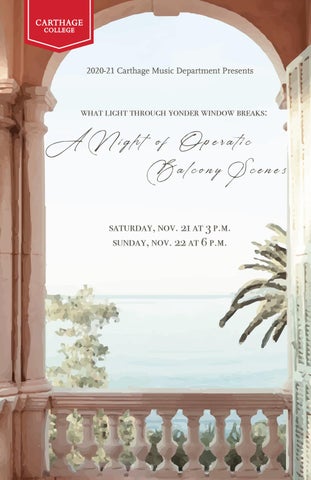
2020-21 Carthage Music Department Presents
what light through yonder window breaks:
A Night of Operatic Balcony Scenes saturday, nov. 21 at 3 p.m. sunday, nov. 22 at 6 p.m.
program I. Das Rheingold: Opening Scene Richard Wagner (18131883) Woglinde: Sarah Jenkins Wellgunde: Morgan Taylor Flosshilde: Katiann Nelson Alberich: Matt Burton The Magic Flute: Speaker/Tamino Scene Wolfgang Amadeus Mozart (1756-1791) Tamino: Christopher Glade Speaker: Tom Cargille The Magic Flute: Pa ‌. Pa ‌. Pa Papageno: Matt Burton Papagena: Faith Albright Romeo and Juliet: Balcony Scene (1818-1893) Romeo: Nathan Takahashi Juliet: London Roysden
Charles Gounod
II. Four Balcony Scenes from Non-Existent Operas (b. 1960) The Riddles of Turandot Turandot: Sarah Jenkins Calaf: Nathan Takahashi Mandarin: Mitchell Dziewior Six Years Tom: Tom Cargille The Priest: Matt Burton
Gregory Berg
program Catcalls The Singer: London Roysden The Audience Member: Mitchell Dziewior The Grays Emmitt: Christopher Glade Emma: Morgan Taylor Emily: Faith Albright
performers Faith Albright Matt Burton Tom Cargille Mitchell Dziewior Christopher Glade Sarah Jenkins Katiann Nelson London Roysden Nathan Takahashi Morgan Taylor
a word from gregory berg Very little live opera has been performed during the COVID-19 pandemic. The only staged productions of which I am aware have been done with the stage marked by crisscrossing lines to delineate squares within which each individual singer must be confined. When I saw photographs of a couple of such productions, I was immediately troubled by two things: 1) These singers were having to interact at a distance from one another, even in scenes (such as love duets) in which distance between characters makes no theatrical sense. I couldn’t imagine creating any kind of truly authentic theatrical experience in this kind of production. 2) Such a production, with singers still a few feet from each other, was still not going to offer any sort of meaningful reduction of risk for the singers. Nevertheless, I was determined to see if we couldn’t come up with some variation on this sort of production that might allow us to do an effective in-person operatic performance while somehow keeping our student singers safe. This past summer, when I walked through Siebert Chapel to make some preliminary plans and tried to imagine how (or if ) such a physically-distanced production could work in that space, I suddenly realized that a far preferable possibility was staring me right in the face: the balconies! Siebert Chapel has balconies on three sides of its central space, and placing one singer on the ground floor and another up in the balcony would allow the singers to be significantly spaced from each other – and such distancing would be entirely plausible if we were talking about authentic balcony scenes such as the most famous of all balcony scenes – from Shakespeare’s Romeo and Juliet. I immediately knew that this needed to be the central premise of our fall opera production. When our Opera Workshop class convened this fall – at that point we were entirely virtual at Carthage – I explained the concept of Balcony Scenes and then assigned the students to create their own Balcony Scene scenarios. They came up with a marvelous array of possibilities, some of which see fruition in this production. The first half of our program features scenes from three different operas – Romeo and Juliet by Gounod, Das Rheingold by Wagner, and The Magic Flute by Mozart. The first of these is, of course, the most famous balcony scene of them all; the other scenes were chosen because they could be easily adapted into the format of a balcony scene. The second half of the program features four operatic balcony scenes that I have created for the students: “The Riddles of Turandot,” Catcalls,” “The Grays” and “Six Years.” It has allowed our students to perform opera at a safe distance from each other yet in a way that feels remarkably authentic. I am proud of them for their flexibility, resourcefulness and good cheer in the midst of these difficult circumstances.
program notes Our program begins with a sharply abridged excerpt from the opening scene of DAS RHEINGOLD by Richard Wagner, the opera that serves as the prologue for his monumental 4-opera Ring Cycle. Das Rheingold was first performed on its own in 1869, and heard for the first time as part of the complete Ring Cycle in 1876. The opera opens with an extraordinary orchestral prelude that leads into an exuberant trio from the Rhine Maidens, who are guarding the magical gold that rests on the bottom of the Rhine River. At one point, the Maidens are approached by the Nibelung dwarf Alberich, who tries to flirt with them but to no avail. Alberich eventually catches sight of the gold, and is ultimately successful in grabbing it for himself, which sets in motions the dramatic events that ensue in the rest of the Ring. THE MAGIC FLUTE, Mozart’s penultimate opera, received its first performance in 1791, a few months before the composer’s untimely death. We are presenting two scenes from the opera. The first is when Prince Tamino approaches the temple of Sarastro, believing (mistakenly, as it turns out) that Sarastro has kidnapped Pamino for evil purposes. The Speaker who guards the door tries to correct Tamino’s misunderstanding. It is a powerful encounter and a scene unlike any other in opera. The second scene comes towards the very end of the opera, when the happy-go-lucky bird catcher Papageno is finally allowed to be united with the woman of his dreams, Papagena. Their breathless love duet is not only about their love but also about the many children that they look forward to having together. The first half of our program ends with the most famous of all Balcony Scenes, from ROMEO AND JULIET. Shakespeare’s tragedy has been transformed into a number of different operas, the most famous being Charles Gounod’s opera, which received its world premiere in 1867. We will be presenting the first love duets between the titular characters, which is that iconic scene in which Romeo appears beneath Juliet’s balcony and utters the famous words “what light through yonder window breaks.” We are performing an abridged version of this scene. The second half of our program features four Balcony Scenes that I have composed especially for this production and for these students. THE RIDDLES OF TURANDOT is based on a 12th century Persian story that was brought to the stage by, among others, Carlo Gozzi and Friedrich Schiller. Puccini’s opera is the most notable treatment of this story, which in the libretto is set in ancient China. The title character is irresistibly beautiful but hates all men because of a brutal act committed against one of her
program notes ancestors, Priness Lou-ling, thousands of years earlier. From that point on, her descendants have created the barbaric custom in which any man who seeks the hand of the current princess must answer three riddles correctly or face execution. SIX YEARS is set in a confessional booth, and involves a young man who is riddled with guilt because of something he did six years earlier while playing a football game. CATCALLS involves a singer and an unruly member of the audience. THE GRAYS chronicles what ensues when an ordinary guy in the midst of an ordinary workday encounters a troubled woman on a ledge who intends to jump to her death.
thank you’s Everybody involved in the Opera Workshop would like to express their appreciation to: Dr. Eduardo Garcia-Novelli, chair of the music department, for his support. Michael Love and John Voynovich for their cooperation in recording this performance. Tianna Conway and her staff for their assistance with the program and publicity. The private voice teachers of these students for fostering their talents so lovingly. Trevor Parker, a Carthage graduate and former voice student of Gregory Berg’s, who kindly offered valuable input from his background as a former football player for the crafting of the scene Six Years. Carthage’s COVID Coordination Committee for their guidance in how this performance could be safely done within the college’s pandemic protocols.
upcoming events for carthage community Flying and Falling, Fall Dance Show Dec. 4-5 • 7:30 p.m. Dec. 6 • 3 p.m. Pre-Recorded Virtual Event A Carthage Christmas “ Come, With Healing in Thy Wings” Dec. 11-12 Dec. 13 Pre-Recorded Virtual Event • Registration required carthage.edu/events/christmas-festival
connect with us
tickets required
carthage.edu/fine-arts facebook.com/carthagefinearts instagram.com/carthagefinearts
Get tickets 24/7 at carthage.edu/tickets 262-551-6661 noon to 5 p.m. Tuesday – Friday