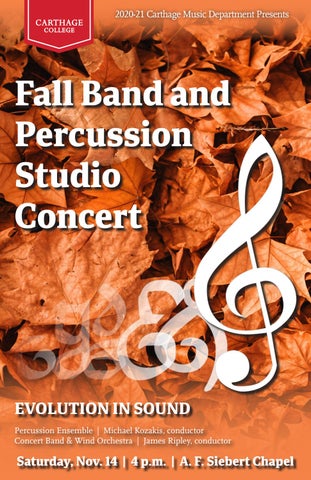
2020-21 Carthage Music Department Presents
Fall Band and Percussion Studio Concert
EVOLUTION IN SOUND Percussion Ensemble | Michael Kozakis, conductor Concert Band & Wind Orchestra | James Ripley, conductor
Saturday, Nov. 14 | 4 p.m. | A. F. Siebert Chapel
program This afternoon’s concert explores the evolution in sound through history with each of our ensembles -- from the relatively recent developments in the Percussion Ensemble, to the earliest types of wind ensembles in the Renaissance period.
Percussion Ensemble
Michael Kozakis, conductor
4/4 for Four (1973)
Anthony Cirone (b. 1941)
Escape Velocity (2008)
Dave Hall (b. 1983)
A Little Prayer (1978)
Evelyn Glennie (b. 1965)
Concert Band
James Ripley, conductor
A Little Prayer Evelyn Glennie transcribed by Luc Vertommen Dances from “Orchesographie” (1596) Thoinot Arbeau Pavan “Belle qui tiens” (1520-1595) Les Boufffons arranged by Makoto Onodera Pinagay (Branle coupe) Basse Dance Branle de Malthe Branle des Chevaulx Folk Suite (1963) I. Get on Board, Little Children Intermission Music Pre-Recorded Archival Selections “Arrival Platform Humlet” From the concert of Nov. 14, 2015
William Grant Still (1895-1978)
Percy Grainger
“Introduction and Capriccio” John Barnes Chance From the concert of March 15, 2015 Kaitlyn (Dolata) VandeVen, piano soloist “Respite” From the Japan Tour concert of Jan. 26, 2020 “Pathfinder of Panama” From the Japan Tour Concert of Jan. 26, 2020
David Reeves John Philip Sousa
program AMATI James Ripley, conductor Rondino (1793)
Ludwig van Beethoven (1770-1827)
Wind Orchestra
James Ripley, conductor
Dances from “Terpsichore” (1612) Passemezze pour les cornets La Bourée Spagnoletta Volte
Michael Praetorius (1571-1621) arranged by Tohru Minakuchi
See What His Love Can Do (1725)
Johann Sebastian Bach (1685-1750) arranged by Percy Grainger, realized by Barry Ould
New Orleans Symphony (2006) Carl Holmquist IV. PLAY! (b. 1983)
personnel Concert Band Flute Milo Allen Gabriela Booth Emma Eckes Clarinet Audrey Bakanowicz Natalie Cambone Tajaniah Drone Rosemary Ehle Jack Massari Abby Vidruk Saxophone Jared Bauer Karlee De Jesus Alec DiGriolamo Luke Eidsor Olivia Luetterman
Trumpet Miles Chubin Vinny David Jarrod Thompson Guillermo Trujillo Horn Courtney Boeder Jonathan Landeweer Stewart Lilly Audrey Marshall Euphonium Lucus Schneider
Tuba Drake DeBoer Michael Flesher Emily Frost John Lew Tylor Pederson Percussion Adam Blackwood Grace LaBriola Henry Meyer William Schuster Noah Wilson Piano Samuel Williams
personnel Wind Orchestra Flute Gabrielle Garnowski Bailey Schneyr Oboe Amber Ward* Hannah Wong* Bassoon Emma Azinger* Bryan Weiss* Clarinet Emma Hardwick* Lexy Klawonn Katiann Nelson* Maile Riedel Zachary Ward Bass Clarinet Sophie Shulman
Saxophone Alexandrea Bawek James Chaudoin Sophia Larsen Joseph Mihevc Julia Owens
Euphonium Eric Benson
Horn Meg Larson* Lena Welch*
Percussion Aaron Paulsen Lily Peterson Christian Plonski Hailey Williams
Trumpet Colin Conway Michael Freeman Caroline Lilly
Tuba Ethan Kozlowski Cayla Pazen
Piano Nick Renkosik
Trombone Sam Hoopingarner Timothy Wagner Taylor Zorn
* denotes AMATI ensemble
program notes 4/4 for Four Anthony J. Cirone received his Bachelor of Science and Master of Science degrees from The Juilliard School where he studied with the famous, solo timpanist of the New York Philharmonic, Saul Goodman. Upon graduation, he was offered the position of Percussionist with the San Francisco Symphony under Maestro Josef Krips. During his 36-year tenure with the Symphony, Cirone also performed under the Musical Directorship of Seiji Ozawa, Edo DeWaart, Herbert Blomstedt, and Michael Tilson Thomas, along with noted guest conductors, such as Leonard Bernstein, Igor Stravinsky, Aaron Copland, Eugene Ormandy, Kurt Mazur, Rafael Kubelik, and James Levine. Mr. Cirone was also Professor of Music at San JosĂŠ State University and Chairman of the Percussion Department. He conducted the Percussion Ensemble, taught Fundamental Literature and Techniques, Percussion Pedagogy, and Notation/ Computer Music Typography classes. He has also been on the faculties of San Francisco State University, Stanford University, and The Jacobs School of Music at Indiana University where he chaired the Percussion Department. His students have gone on to hold positions in major orchestras and universities throughout the world.
program notes Mr. Cirone is a prolific composer, with more than 100 published titles, including textbooks, symphonies for percussion, sonatas, a string quartet, and works for orchestra and concert band. Escape Velocity Escape Velocity was composed in the Spring of 2008 for the Texas Christian University Percussion Ensemble. The quartet features three keyboards and a djembe part, although each player plays several other percussion instruments, often simultaneously with their primary part. This piece is influenced by the music of Béla Bartók as well as “drum ‘n’ bass” artists like Venetian Snares and Aphex Twin. Dave Hall is an Assistant Professor of Percussion and Jazz Studies and coordinator of the percussion program at the University of Nebraska. Before his appointment in Lincoln he was a percussion instructor at Texas Christian University (TCU) and also taught lessons, ensembles, and courses at the University of North Texas as a teaching fellow. He regularly performs as a solo marimbist, drummer, orchestral percussionist, and steel pan artist as a result of his diverse skills as a percussionist and omnivorous musical approach. He has played snare drum for the Phantom Regiment and Crossmen Drum and Bugle Corps, the TCU PASIC Champion Indoor Drumline, and the Dallas Mavericks Drumline. At North Texas, he performed with nearly every major ensemble including as a vibraphonist with the acclaimed One O’Clock Lab Band. In addition to regular engagements in the United States, he has also performed abroad in Spain, Puerto Rico, Belgium, France, Italy, and at the Montreux Jazz Festival in Switzerland. A Little Prayer Dame Evelyn Glennie is the first person in history to successfully create and sustain a full-time career as a solo percussionist, performing worldwide with the greatest orchestras, conductors and artists. Evelyn paved the way for orchestras globally to feature percussion concerti when she played the first percussion concerto in the history of the Proms at the Royal Albert Hall in 1992. Evelyn has commissioned over 200 new pieces for solo percussion from many of the world’s most eminent composers to vastly expand the percussion repertoire. She regularly provides masterclasses and consultations to inspire the next generation of musicians. The film ‘Touch the Sound’ and her enlightening TED speech remain key testimonies to her innovative approach to sound-creation. Leading 1000 drummers, Evelyn had the honour of a prominent role in the Opening Ceremony of the London 2012 Olympic Games. Evelyn was awarded an OBE in 1993 and now has over 100 international awards, including the Polar Music Prize and the Companion of Honour. She was recently appointed the first female President of Help Musicians, only the third person to hold the title since Sir Edward Elgar and Sir Peter Maxwell Davies. A Little Prayer was composed at the age of 13, expressing her spiritual feelings and at the same time displaying a pleasantly relaxed dimension to the marimba. Note from: www.evelyn.co.uk
program notes Dances from “Orchesographie” Thoinot Arbeau’s Orchesographie is the best-known European dance manual printed before 1600. It contains 47 choreographies that reflect a remarkably extensive sampling of dances performed in sixteenth-century France. These include descriptions for the most widely referenced dances throughout sixteenth-century Europe: the basse dance, branle, pavane and gaillarde, and the only known extant choreography of the volta. The text is written in the form of a dialogue between master Arbeau and his student Capriol, a typical literary form in the Renaissance. Included in the text are representative musical examples, from which this suite of dances has been drawn. Folk Suite William Grant Still was very much a person of his own time and his own place. The influences upon him as a young child, for example, provided for the inevitable shaping of a boy whose father, a university professor, had died before his child was born; and also of a boy whose mother, a successful teacher and landowner, had married again. The stepfather was a good man who took the child as his own and gave him the background of culture that both parents valued: literature, good conversation, and music. Still had gone to Wilberforce University (Ohio), a pre-med student as his mother wished, but he became more and more involved in musical matters until he could no longer deny that profession. It was as a family renegade that Still entered the musical world. Worse than that (for his mother), he affiliated himself with composer/ produced/publisher W.C. Handy, who is remembered as the “Father of the Blues” and an important influence on popular music in the 20th century. In each of three phases of his career, Still was very much in a time and a place that defined his thinking. First was the training period, a full apprenticeship served in several places. He received instruction wherever he found it and in a wide scope of styles, from Handy to Chadwick and Varese. This background made Still one of few American composers who have achieved recognition without advanced study or a teaching career in an academic setting. The second phase was in New York, where he led two lives: that of an arranger and performer in popular music, and that of a composer of concert music. This phase culminated in his decision to investigate his African heritage and to being African musical ideals into his concert music. As if by providence, his mother remained a strong influence here, for he sought out the spiritual and deeply aesthetic elements of the African heritage; Sahdji and the Afro-American Symphony are tremendously powerful in part because they focused on distinctly African elements, transcending the mere influence of jazz, which European and American contemporaries were investigating. The last phase of Still’s career took place in Los Angeles, where he moved after receiving a Fulbright award in 1935. Again he lived two musical lives: making his living this time by writing film scores and, later, music for television; but he always devoted himself to concert music, and wrote numerous works for band, Folk Suite from 1965 being among his final compositions.
program notes That Still’s writing was an amalgam of African and European, of his own heritage and the heritages of both Africa and the United States, made him, above all, an American composer. The supreme quality of the music, along with the success of his career (with more honorary doctorates than any other composer), made Still a composer of the highest importance-- for Black Americans, and perhaps more importantly, for all Americans. Note by Dr. Edith Borroff (SUNYBinghamton) Rondino Rondino in E-flat major likely dates from 1793 and was probably intended to be included within the Octet, Op. 103. However, Beethoven eventually changed his mind, and the composition was first published in 1830. The horn presents the initial theme, which is dutifully answered by the rest of the ensemble. Soon the clarinet provides a minor version of the tune, leading to a delicate interplay between the oboe, horn and the bassoon. The opening melody returns as a refrain, this time gracefully ornamented by the oboe and bassoon. In the second episode, the horns perform a mournful duet. The refrain returns once more, with flute and oboe ornamentation providing additional interest. In the coda, the music quietly abates, with the horns providing alternating passages of calls heard close by and from a distance. Dances from “Terpischore” Praetorius devoted most of his life to church music: he published more than twenty collections, mostly of settings of Lutheran chorales, and a number of others are known to have existed in manuscript. He also planned a series of collections of secular music named after the various Greek muses, including Euterpe (Italian and English dances), Thalia (toccatas and canzonas) and Erato (German secular songs). Unfortunately, he managed to publish only one, Terpsichore, musarum aoniarum quinta (1612), consisting of 312 dances in four, five and six parts. The contents of Terpsichore are often assumed to be the compositions of Praetorius himself, however they are collections of different French dance styles—some written by him, while others are harmonizations of melodies supplied for the collection. See What His Love Can Do Bach’s three Leipzig cantatas for Misericordias Domini all are inspired by Psalm 23, In his 20-minute long Cantata BWV 85, “Ich bin ein guter Hirt” for Misericordias Domini 1725, Bach emphasizes the Good Shepherd theme, found only in John’s gospel. The tenor solo, in pastoral style similar to the well-known “Jesu, Joy of Man’s Desiring”, uses the following text: See, what His love can do My Jesus in his own safekeeping keeps those who are his own firmly enclosed and on the beam of the cross he has shed for them his own precious blood. Percy Grainger’s setting of this work for band dates from his years teaching at the
program notes Interlochen Arts Academy, where he would select music known as his “Chosen Gems for Winds” and arrange them in flexibly-scored arrangements to be performed by various combinations of musicians. New Orleans Symphony, “PLAY!” “PLAY!” is the fourth and final movement of the composer’s New Orleans Symphony, written in response to the devastating effects of Hurricane Katrina on the city of New Orleans, its struggles to rebuild, and its subsequent rebirth. It uses for its basis the hymn tune “Sing a New Church into Being”. The winner of the 2007 Claude T. Smith Memorial Band Composition Contest, this final movement is indeed a joyful, playful, and exciting romp. The symphony was written for the Minnesota Symphonic Winds, under the direction of Dr. Timothy Mahr. Mr. Holmquist is the director of bands at the H-B Woodlawn Secondary Program in Arlington, Virginia.
upcoming events for carthage community Opera Workshop Nov. 21 • 3 p.m. & Nov. 22 • 6 p.m. Pre-Recorded Virtual Event Flying and Falling, Fall Dance Show Dec. 4-5 • 7:30 p.m. Dec. 6 • 3 p.m. Pre-Recorded Virtual Event A Carthage Christmas “ Come, With Healing in Thy Wings” Dec. 11-12 Dec. 13 Pre-Recorded Virtual Event • Registration required carthage.edu/events/christmas-festival
connect with us
tickets required
carthage.edu/fine-arts facebook.com/carthagefinearts instagram.com/carthagefinearts
Get tickets 24/7 at carthage.edu/tickets 262-551-6661 noon to 5 p.m. Tuesday – Friday