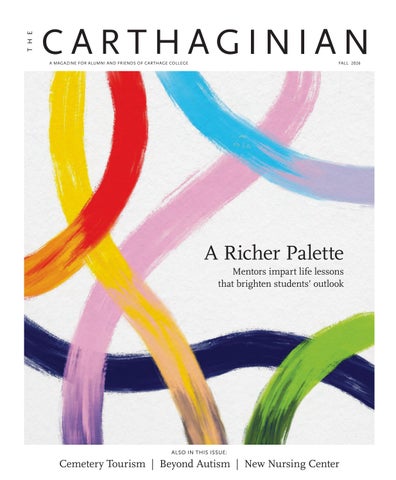
T H E
C ARTHAGINIAN A MAGAZINE FOR ALUMNI AND FRIENDS OF CARTHAGE COLLEGE
FALL 2026
A Richer Palette Mentors impart life lessons that brighten students’ outlook Savannah Reisner ’27 loads a model into the subsonic wind tunnel as Professor Murat Dinc looks on in Carthage’s Engineering Center.
UPCOMING EVENTS Sept. 3
Oct. 9-11
Oct. 23-25, 29-31
Opening Reception: Everything All at Once Printmaking Exhibition
Homecoming and Family Weekend
New Play Initiative: The Theory of the Leisure Class
Sept. 25
Beacon Awards Presentation Class Reunions (1’s and 6’s)
Dec. 4-6
Spotlight on Sports Conference featuring Jordan Solomon of Arctos Partners
Chapel 50th Anniversary Worship
Carthage Christmas Festival
Theatre Reveal Open House
Sept. 25-27, Oct. 1-3
Feb. 9
Greg Berg and Friends Concert
Performing Arts Series: The Gesualdo Six
Fall Musical: Elegies For details about these and many other events, go to: CARTHAGE.EDU/CALENDAR
ALSO IN THIS ISSUE:
Cemetery Tourism | Beyond Autism | New Nursing Center
THIS GUIDE
HOMECOMING
AND FAMILY WEEKEND
OCT. 9-11, 2026 Join us for an unforgettable weekend jam-packed with ways to reunite, reconnect, and reminisce. If your Carthage class year ends in a 1 or a 6, it’s time to celebrate your reunion!
WEEKEND HIGHLIGHTS: • Homecoming Brunch • Homecoming Parade • Football Game featuring the Beacon Awards - Christine King ’97 - Jill Theobald ’01 - Matt Ulmer ’06 - Owen Lewer ’20 • Firebird Fanfest • Homecoming Concert
Students quickly made use of the new Duncan Family Nursing Education Center in Hedberg Library. See more photos of the space on page 7.
F26_CARTH_Cover Inside.indd 1
Scan the QR code to see the full schedule and purchase reunion tickets. We can’t wait to celebrate with you!
CARTHAGE.EDU/HOMECOMING F26 HC AD.indd 1
8/5/26 2:09 PM 7/31/26 9:42 AM
IN THIS ISSUE
12
COVER STORY
A Richer Palette
Alumni impart life lessons that brighten students’ outlook in new mentorship programs.
20 In the Key of We
Future music teacher Jerry Farias ’27 sets a shining example for students with autism.
26 A Graveyard Shift
Cemeteries aren’t just for funerals, as Ashlynn Rickord Werner ’15 is demonstrating.
1
IN THIS ISSUE THE CARTHAGINIAN Fall 2026 Issue
3 4 16 20 25
On Campus
The Carthaginian is Carthage College’s award-winning magazine, published each spring and fall to celebrate the people, stories, and achievements that define our vibrant community. Mailed to alumni, families, donors, and friends, each issue brings you compelling features, alumni spotlights, campus news, and highlights of the remarkable ways Carthage is making an impact. The magazine is managed by the Office of Marketing and Communications.
Athletics
All issues published since Fall 2013 can be viewed online: carthage.edu/carthaginian
President’s Message
Our alumni symbolize the power of community.
Carthage opened the Duncan Family Nursing Education Center, introduced a community entrepreneurship program, and more.
Five years into the esports era, the Firebirds have built a thriving program fresh off a national championship.
The Arts
Both A. F. Siebert Chapel and Wartburg Theatre underwent significant renovations.
Alumni
Stay in the loop with news from our accomplished graduates.
29
Commencement Honorees
Get to know Distinguished Alumni Award winner Julie Elginer ’95 and honorary degree recipient Robert A. Cornog.
30 33 In Memoriam
A recent Master of Music graduate successfully auditioned for “American Idol.” Carthage remembers Professors emeriti Ben Bailey, Len Scharmach, and others we’ve lost.
2
Vice President for Marketing and Communications Elizabeth Young
Managing Editor Mike Moore
Class Notes
36 39 45
Carthaginian Editorial Team
Faculty & Staff
The Events and Conference Services staff works hard to put on special events and community programs that only seem effortless.
Pastor’s Message
Contributing Writers Mike Moore Julie Thomas Traci Parker Andrew Horschak Freedom Tomasello ’27
Design/Art Direction Jess Wicinski ’20 Steve Janiak Kim King ’06
Photographers/ Illustrators Steve Janiak Hunter Montano Kassidy Nader ’27
Cover Illustration Jess Wicinski ’20
Chair of the Board of Trustees Gina Madrigrano Friebus ’76
President John R. Swallow
Vice President for Advancement Philip Hood
For More Information The Carthaginian Office of Marketing and Communications 2001 Alford Park Drive Kenosha, WI 53140
Reflect on those who have been guiding lights for us, and do the same for others.
262-551-6021 editor@carthage.edu
A Crimson Thread
Update Address/Mailing Preferences carthage.edu/mycontactinfo 800-551-1518 alumnioffice@carthage.edu
A lasting Carthage connection leads to a liver transplant for alumnus Ian Privett ’17.
Fall Carthaginian 2026
PRESIDENT’S MESSAGE
The company a student keeps One of the most enduring strengths of Carthage College is that our students never complete their education alone. Each year I am reminded that what happens here is shaped not only in our classrooms, laboratories, studios, and athletic facilities, but also by the people who invest themselves in our students’ success. Faculty members teach and challenge them. Staff members create additional opportunities for growth and belonging. And, increasingly, our alumni are helping students envision what comes next — and how to get there. In this issue of The Carthaginian, you will read about the Aspire Mentoring Program and the meaningful connections developing between students and the graduates who came before them. These relationships are what we hope every Carthage student finds here. Alumni who once sat in these same classrooms, wrestled with the same questions, and made the same start in their careers, certain or uncertain, are coming back to share their encouragement and offer what they have learned since.
carthage.edu
This mentorship is practical and timely: candid advice about careers, internships, and the decisions in front of them. The more lasting gift is confidence — the reassurance of hearing how someone they admire handled uncertainty, dealt with setbacks, and kept going. Because there are many pathways to a meaningful life and career, the example of someone who has walked one is far more powerful than an anecdote or LinkedIn page. This is not a departure from what Carthage has always done; it is an extension of it. From its founding, the College committed to an education that was thorough and practical — preparation for a life and a livelihood, not only for a transcript. Mentorship carries that commitment past commencement, into the years when its value is tested. It is also a reminder that Carthage is not only a place, but a community that lasts. The relationships built here continue long after graduation, creating a network of people across the country and beyond who return to strengthen the
college that formed them. Sustaining and widening those connections is central to the work ahead. Through Aspire, through deepening partnerships with employers, through experiential learning, and through the generosity of those who fund scholarships and student support, we are opening more routes for talented students to make the most of a Carthage education — and build the lives they want. I am deeply grateful to the alumni, parents, donors, faculty, staff, and friends who make this work possible. Your willingness to share your time, expertise, and encouragement is what this kind of community is made of. Thank you for being part of that work. Together, we keep the light that began at Carthage traveling far beyond campus — across generations, and into lives not yet imagined.
John R. Swallow
3
ON CAMPUS
A record 670 students took part in Commencement weekend May 22-23. See what’s next for Carthage’s graduating class on pages 8 and 9.
A season of growth During the spring 2026 semester, Carthage …
CREATED exciting new
PARTNERED with the Racine Unified School District
pathways for students by adding several undergraduate programs: a Bachelor of Fine Arts (B.F.A.) in theatre arts with specialized concentrations for aspiring actors, set designers, and playwrights.
to address a critical shortage of special education teachers. Through the Racine Initiative for Special Education (RISE), the district sponsors educators seeking special education licensure through Carthage’s Accelerated Certification for Teachers program.
CONVENED a regional conversation about the value
majors in human resources and biochemistry, each available as either a Bachelor of Arts or Bachelor of Science.
of a vibrant artistic and cultural scene. Through a Feb. 19 Carthage Business and Professional Coalition event, community leaders explored how investment in the creative industries can yield significant returns, attract and retain top talent, and stimulate innovation.
RAISED nearly $685,000 for scholarships and
student-centered programs during Red & Ready Giving Days on March 19 and 20. During the annual 36-hour celebration, 1,049 alumni, parents, students, employees, and other friends of the College made gifts, easily exceeding the goal of 1,000 donors.
A Carthage Ripple Effect A new study illustrates Carthage’s statewide economic impact. Millions of dollars are infused into Wisconsin’s economy each year through the College’s operational expenditures and purchases by employees, students, visitors, and alumni.
ANNUAL IMPACT BY GROUP CAMPUS COMMUNITY
$175M
in economic activity
115,141
visitors welcomed
OUR ALUMNI
8,584
living in Wisconsin
$1.4B
in economic activity
Source: Wisconsin Association of Independent Colleges and Universities (2024-25 estimates)
carthage.edu
5
ON CAMPUS
New School of Health optimized for future of care About 550 industry leaders, community members, students, and alumni joined Carthage on April 23 to celebrate the grand opening of the Carthage College School of Health. Keynote speaker Steve Serota, an innovator in medical laboratory testing, praised the College for its commitment to prepare well-rounded, compassionate healthcare professionals. He recently became CEO of a regional lab network based in Texas after nine years as president of Wisconsin Diagnostic Laboratories. As we enter an era of rapidly advancing technology, Mr. Serota said, practitioners must learn to use the tools — but also to question their findings. “Algorithms can guide us, but they cannot absolve us,” he explained. “They
6
cannot replace the clinician who pauses and says, ‘Something doesn’t feel right.’ That instinct, that curiosity, is what saves lives. This is where the School of Health becomes not just an academic program, but a moral compass for the future of care.” The new school reinforces Carthage’s determination to meet the rising demand for healthcare in the region. Since welcoming its first students last fall, the School of Health has formed new employer partnerships, increased scholarship funding, and expanded facilities. Mr. Serota noted the new school lifts up the College as a whole. “These are not students who are wandering toward purpose. These are students who feel a responsibility to others long before they ever put on a white coat or step into a clinic,” he said. “They come here with a conviction that someone, somewhere, needs them, and
that their education is the first step toward answering that call.” Carthage intends to make the new school a responsive talent incubator that relies on real-time input from regional employers and practitioners. President John Swallow emphasized the importance of those partnerships. “The people of this region are counting on us to get this right,” he said. “Every one of them will walk into a clinic or a hospital and need a nurse. As the workforce narrows and the demand for care grows, that nurse will appear because of what people gathered in places like this chose to build together.” Earlier in spring, Carthage trustee Tom Duncan and his wife, Jan, announced a giving challenge to support School of Health scholarships. They pledged to match up to $200,000 in gifts, a challenge their fellow Carthaginians met within weeks.
Fall Carthaginian 2026
NEW NURSING CENTER MIRRORS THE REAL THING In February, Carthage dedicated the Duncan Family Nursing Education Center, a new 11,000-square-foot facility designed to reflect a real-world clinical environment. Located on the lower level of Hedberg Library, it’s named in honor of donors Tom and Jan Duncan and their family’s multigenerational commitment to healthcare and education. The couple provided $1.3 million for the facility, matching a grant from Wisconsin’s State Building Commission. This unique center includes a nurses’ station, 12 low-fidelity patient bays, three debriefing conference rooms, two classrooms, and student workspaces. It complements the original nursing space in Lentz Hall, where summer renovations are wrapping up.
carthage.edu
Erin Duncan ’01, left, stands with her parents, Tom and Jan, outside the Carthage nursing facility that the family funded.
7
ON CAMPUS
Graduate Spotlight: Class of 2026
persistence & purpose
Graduates from the Class of 2026 are already channeling their Carthage experiences into early success. A total of 670 students crossed the Commencement stage May 22-23, which put the class on pace to set another record. See where some of these impressive new alumni are beginning their careers. YESENIA GONZALEZ ’26 is already making a difference in one of healthcare’s most demanding specialties. After working as a nurse extern at Aurora Medical Center in Kenosha, she accepted a full-time position as a critical care nurse in the intensive care unit.
“I had the opportunity to learn from my instructor, both in the classroom and at the bedside during complex clinicals. Her guidance and encouragement helped me recognize my passion for the ICU.”
While earning a Bachelor of Arts in musical theatre, CHASE JUSTER ’26 portrayed a range of characters in Carthage productions. Now he’s a resident actor for Charleston Stage in South Carolina, leading educational workshops and performing in shows like “Little Women” and “The Wizard of Oz.”
“The close, personal relationships with faculty truly set me up for success. If I did not have faculty who actually cared about my education, I would not have learned the lessons needed to feel confident in such an unpredictable career.”
8
Fall Carthaginian 2026
Looking back on his path to a Bachelor of Science in physics, JORDAN BOPP ’26 saw significant personal and professional growth. He’s been accepted to the nuclear engineering program at North Carolina State University, where he will pursue a Ph.D. while studying under experimental plasma physicist Florian Laggner.
“My experience with the Wisconsin Space Grant Consortium, headquartered at Carthage, was my research launchpad, enabling additional research opportunities in fusion — which ultimately led to the opportunity for graduate studies.”
taking the lead Lorin Bucur B.A. in Political Science / Chinese FULBRIGHT ENGLISH TEACHING ASSISTANT
Taipei, Taiwan
Daelah Edwards M.A. in Athletic Training ATHLETIC TRAINER
After completing a Bachelor of Arts in criminal justice in December, JOSHUA STAIR ’26 jumped right in as a re-entry facilitator at SGA Youth and Family Services in Lake County, Illinois. To break the cycle of poverty and reduce recidivism, he provides career readiness for those exiting the juvenile detention system.
“As I matured mentally, along with gaining newer ideas and ways of thinking from my classes, I was able to unlock a grander perspective on life that allowed me to become the person I am today.”
DAKOTA MARTIN ’26, who joined Northwestern Mutual as an intern in 2024, received a promotion to full-time investment account analyst after graduation. Building on her Bachelor of Arts in accounting and finance, her new job with the Milwaukee firm focuses on securities reporting and analyzing month-tomonth changes.
“Carthage gave me the ability to double major and still graduate within four years. The assignments and projects have helped prepare me for the professionalism expected in the workplace.”
carthage.edu
Lonestar Soccer Club – Austin, Texas
TJ McVey B.A. in Economics / Finance MACRO SALES ANALYST
Natixis Corporate & Investment Banking – New York, N.Y.
Rej Bedini B.A. in Criminal Justice GRADUATE STUDENT – LAW
Arizona State University
Ainsley Stallworth B.A. in Data Science JUNIOR DATA SCIENTIST
AbbVie – North Chicago, Ill.
Ryan Cholewinski B.A. in Elementary Education STEM TEACHER
Bullen Middle School – Kenosha
9
? y now e h t are irds
alk age w
t ore s and celebration m e On ride, nt joy, p ceme en e the Reliv 026 Comm 2 ities. of the festiv d n e week
asses s l c e l b se rgetta Carthage couursiness o f n U B he veal t g. , from
hw nd umn Searc Search al ear, a y n o i at d. lande wn, gradu o t e hom
t i d e s s i m you
yin em ni re ith th and D Alum w g n d i e v tay in Li that s ssues I o t s Ethic
e s a c In
w-up o l g s rena’ FirebirdA e l Tarb arena get a ss than
e b r, Wher here fellow Firieby major, yemaore.
tos o h p d Awar
Fun
-CHI E K en M ts, and e w t be t the e spo
hou orit s, fav res throug m e g en ventu or. Hidd ed ad go corrid t c e p a unex -Chic aukee w l i M
r f Embe ough picturessoand
l thr team Scrol ding ed in n a t s onor ut the o -athletes h nt t. stude l even a u n n the a
e h the eover in l Watc k a m red inspi e. ut a min
Find links to this and other digital content, plus current and past issues of The Carthaginian magazine:
CARTHAGE.EDU/CARTHAGINIAN
10
Fall Carthaginian 2026
ON CAMPUS
Proving ground for local startups Carthage introduces Launch Kenosha program Beginning this fall, Carthage will offer a free community entrepreneurship program called Launch Kenosha that follows a wellestablished blueprint for startup success. Professor Joseph Tenuta brought the regional BizStarts Institute to Kenosha last year. After a successful debut, Carthage is branching off with a new name and vision while retaining much of the original curriculum. Modeled after an internationally recognized program devised by University of Notre Dame professor Michael Morris, Launch Kenosha employs a credentialed learning system. Each program graduate receives a certificate from Carthage and Notre Dame. Open to all Kenosha residents, the experience begins in October with a six-week business bootcamp. Carthage faculty members from the School of Business and Economics will lead sessions at the Kenosha Innovation Center focused on starting and operating a successful venture.
Then, over the winter and spring, Launch Kenosha participants will get one-on-one coaching from experienced mentors and project assistance from student consultants. “Launch Kenosha is designed for City of Kenosha residents who have always wanted to start their own businesses but lacked the support to do so,” says Prof. Tenuta. “Carthage is committed to leveraging our expertise to serve our neighbors.” Carthage students have already seen the benefits from multiple vantage points. Three of them were among the 14 Kenosha entrepreneurs to complete the program in 2025-26: David Montesinos ’26, Chase Crippen ’28, and Bryson Palacio ’28. “The program has been extremely helpful,” says David, whose fitness and personal development business is driven by the weight-loss journey he undertook a couple of years ago. “It’s given me a structured environment to take an idea and start turning it into something real. “Through mentorship and feedback
These local entrepreneurs made up the 2025-26 cohort of BizStarts Institute Kenosha, now known as Launch Kenosha.
carthage.edu
Bryson Palacio ’28, shown at a business pitch competition where he won first prize, picked up skills and contacts for his startup venture, Brysob LLC.
from experienced entrepreneurs, I’ve been able to think more critically about the company’s business model, branding, and long-term direction. It’s also been inspiring to be surrounded by other students who are working on their own ventures and taking steps to build something meaningful.” Between the Kenosha program and a separately run BizStarts Institute in Racine, 10 other Carthage students pitched in as paid consultants. Pierce Bakker ’29 assisted an electrical contractor in the Racine program, creating a packet template and a tutorial on bookkeeping software. “The highlight of this experience has been gaining insight into the contracting field — particularly from an electrician’s perspective — and understanding the nuances they navigate,” Pierce says. “Since contracting differs so much from a traditional office environment, learning about it has been an especially rewarding experience.”
11
COVER STORY
A Richer Palette Mentors guide students to success in life, career
o
The traditional Etiquette Dinner in April doubled as the wrap-up celebration for the yearlong Aspire Mentoring Program.
n a Wednesday evening in April, dozens of well-dressed Carthage students, alumni, and friends gathered in the Todd Wehr Center to brush up on social graces. The traditional Etiquette Dinner simulated the kind of restaurant setting where a formal job interview might take place. Carolyn Serdar, executive director for career and professional development at Carthage, walked the dinner guests through a few of the little-known and sometimes counterintuitive rules. She advised them to access their chair from the left side when sitting down at the table. She explained that they should pass both the salt and pepper shakers at once, even if the person only asked for one of them. And, to help them remember whose plate and glass are whose, she shared the “BMW” trick: bread, meal, water (from left to right). No jobs were on the line that particular night, rendering it a safe space to practice. If someone mistakenly used the salad fork on their chicken breast, the whole table just laughed it off.
The dinner doubled as the year-end celebration for Carthage’s reimagined alumni mentoring program, bringing together mentors and mentees who were already well-acquainted. So the conversations soon drifted to more deeply human topics — the kind that are rarely as simple to solve as “Where should I put my napkin?” (Answer: Folded on your lap, with the triangle pointed down.)
Marco Binotti ’20, left, catches up with his Carthage mentee, Vigo Etshitshi ’26.
12
Fall Carthaginian 2026
Nearly all fortune 500 companies have mentoring programs in place, demonstrating the widespread belief in their value. At colleges and universities, there’s mounting evidence linking mentorship to higher retention and job placement rates. Carthage’s career development and alumni offices collaborated to launch the Aspire Mentoring Program in fall 2024. After making 24 successful matches that first year, organizers extended the reach to 60 pairs in year two. “It’s a mutually uplifting experience,” said Amy Malczewski M.Sc. ’24, internship and experiential learning coordinator at Carthage. “Despite their attachment to their phones, Gen Z really craves personal connections. And alumni love to turn around and make sure the students behind them find success.”
expected of them, they always rise to the occasion,” said Ms. Malczewski. The results blew them away. Mentees described the program as “one of the most meaningful experiences” they’ve had and credited it for their “exponential” growth.
A deeper connection Based on their applications and intake interviews, participating students are matched with graduates from similar majors or extracurricular interests. The questionnaire even accounts for compatible personalities. Judging from the year-end essay that Winter Roland ’27 turned in to the Aspire Center, organizers nailed that pairing with mentor Josh Baker ’12. Winter felt apprehensive going into the program, but that vanished in the get-toknow-you session.
“It’s a mutually uplifting experience.” Over the years, as the College’s approach to mentorship has evolved, alumni have always proven willing to step up. What sets this iteration apart? The clearly defined curriculum. “When our students know what’s
carthage.edu
“Josh is an intelligent and sassy millennial who is not afraid to speak his mind if he sees an injustice, and that was clear very early on,” wrote Winter, a Gen Z-er with a similar worldview. As mentorship graduated to friendship,
Winter confided that the heap of conflicting advice from various well-meaning adults had become more burdensome than beneficial. Mr. Baker provided some relief in the form of a parable about a squirrel that can survive on poisonous mushrooms — as long as it only consumes a small quantity. The lesson? You don’t have to follow every tip someone sends your way; choose the nuggets that fit your situation and discard the rest. The pairs are supposed to meet virtually at least one hour a month. Transportation funding is available through the Tarble Experiential Learning Fund for any students who want to visit their mentors in person. Conversations center on pre-defined topics like goal-setting, internship preparation, and the hopes and dreams that accompany life after college. After each session, mentees crystallize their thoughts in writing and add them to their My Aspire Plan — an online repository that tracks their career readiness over four years.
13
COVER STORY
After moving to the United States from Estonia in northern Europe, Liisu Horeb ’28 faced a longer learning curve than most of her Carthage classmates. Her mentor, Levi Latoz ’20, provided much-needed stability. “It ended up being much more than just guidance,” Liisu gushed in her final essay. “It became a space where I could talk openly about uncertainty, pressure, and what it actually means to try to build a future while still figuring yourself out.” Today, Mr. Latoz has a promising position with the Commercial Law Development Program in Washington, D.C., but he knows a thing or two about uncertainty. The COVID pandemic struck during his final college semester, temporarily scuttling the Fulbright fellowship he had won to assist English instructors in Taiwan. Until the program resumed, he passed the time working as a substitute teacher and contemplating a hazy future. “Though I enjoyed my time working with kids from my hometown, it was
“It ended up being much more than just guidance.” 14
certainly quite a change from what I had expected to be doing post-Carthage,” says Mr. Latoz. “It was a very early lesson on what I would later learn is relevant to most of the challenges we face in life: Our response makes all the difference.” In other words, the bumpy ride has made him a better, more relatable mentor.
Gift of perspective Often just a few years removed from their own college days, these helpful alumni remember what it’s like for a professional who’s just starting out. The smallest steps can seem monumental. So, when mentees hit them up for interview pointers, they happily oblige. Carthage mentors have provided a more important gift: permission to abandon their futile chase for the perfect resume. “Being the most qualified is not enough,” mentee Cameron Porcaro ’28 learned. “You can have every certification and the largest professional network in the world, but passion and motivation are what truly set you apart
from others in your field.” Recalibrating your mindset can be liberating. “I began to rethink my own expectations for what a career should look like,” wrote Azahna Luschen ’27, one of three mentees who were awarded $1,000 scholarships for their active participation and growth in the program. “Careers do not have to be linear, and that took a significant amount of pressure off me as someone who does not have a perfectly defined plan.” Besides its alumni base, the College taps into the wider community and its growing professional network. This past spring, nine members of a women’s empowerment organization called Tempo Kenosha signed up to mentor female Carthage students. When the local nonprofit began brainstorming ways to support emerging women in business, co-founder Gina Madrigrano Friebus ’76 steered the discussion toward her alma mater. It’s a relatively informal arrangement, leaving
Volunteers from the women’s empowerment nonprofit Tempo Kenosha began mentoring female Carthage business students.
the meeting times and frequency up to the participants. Ms. Madrigrano Friebus, chair for the Carthage Board of Trustees, believes the Tempo Kenosha mentors’ diverse experience can open students’ eyes to paths they might not have considered. “A lot of times, you don’t get the job you really wanted right out of college. Sometimes you have to pay your dues,” she says. “You’ve got to walk out of your comfort zone. That’s how you get ahead as a woman in business.”
Peer prePpers Before they can excel in the workforce, of course, students have to conquer college. Those same upperclassmen who thirst for real world tutelage have learned enough at Carthage to show newcomers the ropes. That’s the idea behind peer mentoring, and several student-run initiatives have sprouted across campus using that model. In the Engagement and Inclusion Center, organizers pair returning students with any interested freshmen who need help finding their footing. So far, it has appealed most to firstgeneration collegians and students of color. Individual academic areas have spawned their own, narrowly focused mentoring options. The Nursing Student Council coordinates one for first-year nursing majors. Representing the sophomore cohort, Olivia Artman ’28 and Lauren Deguzman ’28 oversaw the program in 2025-26 even as they continued to lean on their own mentors. “The transition from freshman to sophomore year and beyond can be very overwhelming, so having an upperclassman who could tell me what
carthage.edu
to expect made the transition easier,” Olivia recalls from her first year. “Any time I had to pick classes, running it by my mentor to get their advice was very helpful.” In the Allied Health Science Program, Emma Mickelson ’27 is one of the most prolific mentors. Last year, she took eight freshmen under her wing. One Monday each month, AHS mentors lead workshops that walk freshmen through topics like study habits, job shadowing, and internships. They’re also expected to email each mentee monthly and schedule individual check-in meetings. “I love being a mentor,” says Emma, who’s pursuing a career as a physician assistant. “I love being able to help how I can around Carthage and show everyone the amazing opportunities that made me want to go here.”
Community mentor Tom Graybill, a former news producer, greets aspiring broadcaster Andrew Czysz Jr. ’27 at the Etiquette Dinner.
15
ATHLETICS
ACHIEVEMENT UNLOCKED ESPORTS PROGRAM TURNS 5 FOLLOWING BREAKOUT SEASON
W
hen Carthage introduced esports as a varsity program in 2021, coaches and players expected no sympathy from established competitors in the fastgrowing sport. The newbies knew the onus was on them to catch up — to “git gud n00b,” in gamers’ parlance. So they did. Coming off its best season to date, Carthage Esports turns 5 years old this fall. More than 400 colleges and universities in North America now field varsity teams for these video game competitions, but the Firebirds haven’t flinched. “It’s really cool to see how much our program has grown,” says Robert Xiong, M.Sc. ’23, who took over as director of esports in 2023 after one season as a graduate assistant. “We’re really showcasing what we can be.” Last year’s roster consisted of 53 players across six game titles: “League of Legends,” “Overwatch,” “Rainbow Siege Six,” “Rocket League,” “Super Smash Bros. Ultimate,” and “Valorant.” The games require different skill sets,
16
so each has a separate coach. Sometimes multiple Carthage teams compete in the same game, identified by colors — with Red signifying the top unit. The Overwatch Red team claimed the Firebirds’ first national esports championship in May. Between captain Mason Stenger ’27, Ethan Anderson ’27, Billy Flanagan ’28, Adam Hollis ’28, Deacon Kirvan ’28, and Joy Schultz ’27, OW Red topped its division in the spring season-ending National Esports Collegiate Conference (NECC) online event. That capped a dominant year in “Overwatch,” a team-based hero shooter game. Coached by Austin Schuller, the Reds won more than 90% of their matches in 2025-26. “Bringing home the first national championship was awesome,” Mr. Xiong says. “To see their passion and to hear them say, ‘I’m going to get a ring!’ is great. We’re just like any other sport. We put in the time. We put in the work.” Earlier that month, Rocket League Red (captain Alex Vaile ’26, Kyle Branski ’29,
and Owen Perry ’29) traveled to San Antonio with coach Timmy Connors as the first Carthage team to advance to the prestigious Scholastic Esports Championship and compete in person. Having earned a promotion to the NECC’s top division, the Firebirds held firm against elite competition. They were eliminated in the group stage. “Our ‘Rocket League’ team made an unbelievable progression,” says Mr. Xiong. “They were matched up with some of the best teams in the country. It was a historic accomplishment for the program, for sure.” When Mr. Vaile was admitted to Carthage, he didn’t even know esports was offered. Specializing in “Rocket League,” a game that combines driving and soccer, he saw the fledgling program take off. “The overall skill keeps going up every year,” says Mr. Vaile, a four-year team member who recently graduated with majors in accounting and finance. “From when I first started, we were nowhere near as good as we are now. It comes down
Fall Carthaginian 2026
The Firebirds’ Overwatch Red team won the NECC national championship in May.
Program director Robert Xiong M.Sc. ’23, right, works closely with student-athletes in the Carthage Esports Arena.
to the coaching and the environment that we’ve built. Everyone wants to get better.” Esports is the only co-ed team among Carthage’s 28 varsity sports. “Esports is about skill and communication,” says Thalia Sullivan ’29, who became a core member of the division-winning “Valorant” team as a freshman. “We can relate in some way or another, and I think that’s why we were able to get acquainted quickly and work as a team.” After wrestling throughout middle and high school, Thalia was pleasantly surprised to learn she could turn her gaming hobby into a collegiate sport. Though well-versed in the gameplay of “Valorant,” a character-based tactical shooting game, she had some catching up to do to succeed at this level. “Everything was new to me, but the team made me feel included and answered all my dumb questions with no issue,” Thalia says. The Firebirds practice and compete in the Carthage Esports Arena, which has 24 gaming stations with custom-built PCs on the lower level of the Todd Wehr Center. Matches are streamed live on Twitch and YouTube, with commentary from student broadcasters. After earning a master’s degree in sports management at Carthage, Mr. Xiong now teaches an Esports
two-thirds of their matches last season. “Winning creates a culture in your program,” Mr. Xiong says. “We all support each other. I think that’s why we’re able to win so much, because everybody supports each other no matter what game they play.”
carthage.edu
class in that thriving graduate track. It’s hard to find a faster-growing sector in the entertainment industry. He’s looking to continue growing the varsity program by recruiting and retaining high-quality student-athletes. Across all game titles, the Firebirds won more than
GAMER TAG QUIZ Esports players show their individuality through gamer tags. Can you connect each tag to the Carthage competitor who uses it? KATHERINE RIECKMANN ’28
Majors: Biology / Music Hometown: Pardeeville, Wis. ALEX CHULUUNBAT ’27
Majors: Accounting Hometown: Mount Pleasant, Wis. THALIA SULLIVAN ’29
Major: Game Development Hometown: Chicago DEACON KIRVAN ’28
Major: Game Development Hometown: Maple Grove, Minn. JOY SCHULTZ ’27
Majors: Environmental Science / Biology Hometown: Chicago
JELLYFISH FIREROSE22 FEROCIOUSPIG JUMPYWIZARD PARAMEDIX
Answers: Rieckmann/Firerose22, Chuluunbat/ParaMedix, Sullivan/Jellyfish, Kirvan/FerociousPig, Schultz/JumpyWizard
17
ATHLETICS
A flurry of Firebird firsts Combining historic firsts with consistent success, Carthage Athletics enjoyed a semester to remember, as several teams made postseason runs to close out their seasons in style. “These past few months offered a tremendous reminder of what’s possible when talented people work together toward a common goal,” says Ryan Kane, director of athletics. “What makes me most proud is that these achievements reflect the culture our coaches, staff, and studentathletes have built together.”
NEW TERRITORY Carthage (16-4) made it to the NCAA Division III tournament for the first time in women’s lacrosse, advancing to the second round in Granville, Ohio. The NCAA berth came thanks to the team’s first College Conference of Illinois and Wisconsin tournament championship. Kaitlyn Goff ’27 was the league’s co-
18
defensive player of the year. With a late-season surge, the women’s water polo team earned its first bid to the USA Water Polo D-III national championships in Claremont, California. There, they defeated their opening-round opponent before being eliminated the next day. Carthage attacker Kamille Graham ’27 made the all-tournament team.
FAMILIAR HEIGHTS
Ohio. The Firebirds (23-4 overall) were victorious in the conference tournament, thanks in part to a furious comeback by player of the year Francisco Silveira ’26. Two Firebirds track and field competitors earned first-team All-America honors at the NCAA D-III outdoor meet in La Crosse, Wisconsin. Jackie Tuzil ’26 took fifth in the women’s discus, and Dylan Parker ’27 placed sixth in the men’s 400-meter final.
The Firebirds (25-4) came incredibly close to another national men’s volleyball title, losing to Springfield (Massachusetts) College on its home court in the NCAA D-III championship match. Led by firstteam All-Americans Ryan Bartz ’27 and Ryan Morey ’26, Carthage finished atop the CCIW for the third straight season. Qualifying for the NCAAs as a team for the 12th time in men’s tennis, Carthage fell to host school Denison University in round two after winning its opener at Granville,
Taken as a whole, the success bodes well for the future. “Across our department, we’ve seen both veteran coaches and newer members of our team do outstanding work, supported by families, alumni, and friends who care deeply about Carthage Athletics,” says Mr. Kane. “Momentum is building, which makes this an exciting time to be a Firebird.”
Fall Carthaginian 2026
ATHLETICS NOTES
TENNIS
Coach Lindsley surpasses 900 wins On April 17, longtime head coach Brady Lindsley ’95 reached 900 combined wins between the Carthage men’s and women’s tennis programs. He has guided both teams since 1997. By the conclusion of the 2025-26 season, Coach Lindsley had 511 wins with the Firebird men and 396 with the women’s squad.
MEN’S LACROSSE
WOMEN’S TRACK AND FIELD
Neff ends 18-year run
Alumna enters Head coach David Neff, who had guided the Hall of Fame program since its inception, stepped down in June after 18 seasons and 197 victories. He led the Firebirds to three straight College Conference of Illinois and Wisconsin championships and NCAA Division III tournament berths from 2015 through 2017.
SOFTBALL
An individual three-peat
For the third consecutive season, coaches selected Clare Rettler ’26 as CCIW offensive player of the year. She closed her career with the second-best batting average (.575) and thirdmost hits (299) ever in D-III, topping the all-time Carthage lists in those categories plus runs and stolen bases. She joined the Minot (North Dakota) Honeybees of the summer collegiate Northwoods League.
The United States Track & Field and Cross Country Coaches Association inducted former Carthage standout Shea’na GrigsbyTaylor ‘06 into the NCAA Division III Athlete Hall of Fame in New Orleans. She won eight national championships over her four-year career as a hurdler, sprinter, and relay team member.
WOMEN’S WRESTLING
First NCAA qualifier Jasmin Ocampo ’29 advanced to the sport’s inaugural NCAA championship in March. By placing third in the 207-pound division at the regional meet, she became Carthage’s first national qualifier since the NCAA sponsored women’s wrestling. A coalition of U.S. wrestling organizations previously sponsored the tournament.
INVEST IN THE TRIUMPHS OF CARTHAGE STUDENT-ATHLETES AND ATHLETIC PROGRAMS Learn more and make your gift today:
CARTHAGE.EDU/CHAMPIONS
THE ARTS
In the key of we
Future music teacher sets example for neurodiverse community
Gradually and painstakingly, Jerry Farias ’27 found his voice. He’ll need it in a few short months, when the Carthage senior begins his spring 2027 student teaching semester at a yet-to-bedetermined elementary school in his hometown of Waukegan, Illinois. That should be the last hurdle standing between Jerry and a Bachelor of Music degree in music education. He spent his youth clearing the figurative hurdles that unexpectedly blocked his path. Diagnosed with an autism spectrum disorder (ASD), Jerry was still learning to talk at an age when other kids were solving basic math problems. That’s not to suggest he’s unique for making it this far. In recent years, as society’s understanding of these disorders has grown, higher education has become a more realistic target. Researchers estimate that as many as 285,000 undergraduate students nationwide have an ASD. But few are as open about it. Jerry represents the neurodiverse community as a published author, a class speaker, and a fundraiser. And he credits much of his growth to the uplifting atmosphere he’s encountered here at Carthage. “I consider Carthage a second home — a place where I got to meet people, make friends, and finally express myself to others,” he says.
Fall Carthaginian 2026
Physical voice
According to the latest estimates from the Centers for Disease Control and Prevention, 1 in 31 American children have been diagnosed with an autism spectrum disorder. Boys are four times more likely than girls to have one. Delayed speech is a telltale sign, and Jerry remained nonverbal well after his official diagnosis at age 3. The young boy from Waukegan had to quite literally discover his voice. Thanks to occupational and speech therapy, Jerry kept improving. By age 6, he could talk. Socially, however, fitting in remained an elusive goal throughout the elementary years. Then he discovered music. One night in fifth grade, students were given a chance to test out different band instruments. Mom and Dad steered him toward the clarinet, a consensus choice for beginners. Jerry had other ideas. A different, more exacting instrument grabbed him and wouldn’t let go. As a teacher pulled the bow across the strings of a violin, the sweet melody
Creative voice
The more he practiced, the more his confidence rose. In middle school, a more comprehensive special education program left no room for music, so his parents got him private lessons. Music even gave Jerry a way to connect with his family’s vibrant Mexican heritage. He joined a local group called Mariachi Estrellas and learned to play traditional string instruments like the vihuela and guitarron. In eighth grade, he encountered another hurdle, as severe symptoms later attributed to anxiety and obsessivecompulsive disorder forced his parents to homeschool him for much of the year. Those problems subsided in time for high school, where he became concertmaster of the orchestra. Around that time, an intriguing career path appeared to him: not just to play music, but to spread his contagious enthusiasm for it by teaching others. Jerry enrolled at the College of Lake County, a two-year school in Grayslake, Illinois, and declared a major in music education.
“It was like my dreams came true ... I’m forever grateful that I found Carthage.” reached his ears. “I heard that sound and said ‘I want to do that.’” When Jerry took up the violin, something in him awakened. “It’s my voice,” he says now. “Music made me who I am.” Although it might be cliche to call music the universal language, there’s a lot of truth to that — chords cut across boundaries. Just as two people who speak different languages can hear the same note without a translator, Jerry could express himself to a neurotypical person more clearly through music.
carthage.edu
He branched out, musically speaking, by learning the cello, viola, bass, piano, and an assortment of brass and woodwind instruments. Versatility is essential for K-12 music teachers, after all. Looking ahead to the next leg of his educational journey, Jerry was stung by the rejection letter from a nearby four-year college. His longtime private instructor advised him to look into Carthage, so Jerry applied the next day and got in. The acceptance packet opened a valve of pent-up emotions. “It was like my dreams came true. God
told me ‘Your career’s not over,’” he says. “I’m forever grateful that I found Carthage.”
Trailblazing voice
As his time at the community college wound down, Jerry applied for a small scholarship to help offset educational expenses. A national organization called KFM Making a Difference offers the awards to students with autism spectrum disorder. Jerry didn’t get the funding, but the consolation prize was arguably better. His scholarship essay caught the eye of the nonprofit’s founder and CEO, Kerry Magro, who published an excerpt last year in the book “Autistics on Autism: The Next Chapter.” It’s the second in a series edited by Mr. Magro, who overcame his own challenges from autism to become an award-winning speaker and author. Unexpectedly catapulted into the spotlight as a role model for the neurodiverse community, Jerry started to lean into that role. A turning point came during the Introduction to Music Education course, when Carthage music professor Ed Kawakami invited him to give a presentation to inform his classmates about autism. “At first, I was quite nervous talking about this publicly. I had this fear that people would think differently of me,” Jerry admits. “They were actually quite supportive, which is what got me out of my shell.” He’s a violinist in the Carthage Philharmonic, one of the College’s main instrumental ensembles. That has allowed him to take part in the long-running Christmas Festival (twice) and other public concerts. Last spring, Jerry put his talents to use as a guest performer in Rockout for Autism, a variety show that Carthage sorority Kappa Phi Eta holds annually. Proceeds benefit the Allendale Association, a northern Illinois nonprofit
21
Supporting the neurodiverse community
Adjunct professor Charlene Kluegel gives Jerry Farias ’27 a private violin lesson.
that serves children with emotional and behavioral challenges. Then in May, Jerry gave a solo recital (with accompaniment from faculty pianist Fumi Nakayama), one of the last remaining requirements he needed to fulfill for a concentration in instrumental performance. The program, titled “Dreams Pursued,” expressed his personal journey through selections from Wolfgang Mozart, Ludwig van Beethoven, and other classical composers.
Teaching voice
Jerry’s various diagnoses qualify him for special services offered through Carthage’s Learning Accessibility Services office. He’s allowed extra time on tests, and he gets seating preference in the classroom. But Prof. Kawakami, who has become one of his trusted mentors, knows those privileges won’t extend to the real world. That’s why he has gradually been putting his pupil in more sink-or-swim situations that a teacher has to navigate. And Jerry swims. “Rather than shrink from what could be overwhelming, he actively solicits feedback from his peers as well as from me. Invariably, I see that feedback reflected in his performance in future sessions,” says Prof. Kawakami. “As
22
he manages the challenges of his neurodiversity, it is incredibly impressive that he is open to change — refreshingly, without any ego.” No more struggling to fit in; classmates at Carthage have accepted Jerry for who he is. Theirs is a mutual support network. “As future educators, his cohort will encounter students on the autism spectrum,” says Prof. Kawakami. “They have hearteningly rallied around Jerry, learning from him as he learns from them.” After learning as an observer for three years in elementary classrooms, Jerry spent his 2026 spring break teaching band and orchestra in Waukegan middle schools. He’s ready to dive into the student teaching experience. Faculty members remind students that a good music instructor imparts bigger lessons than do-re-mi. Kids who get involved in music strengthen skills like teamwork and problem solving while gaining a safe place to thrive socially and emotionally. Jerry understands that. He lived it. While growing into the best educator he can be, his already remarkable journey has spawned an even broader goal. “I want to inspire and motivate others by demonstrating that anything is possible.”
As colleges welcome a rising number of neurodivergent students — a category that includes those with various forms of autism — Carthage is strengthening its efforts to ensure every student has the support they need to thrive. Leading that work is Warren Wolchuk ’20, director of Learning Accessibility Services. Drawing on his background in special education, Mr. Wolchuk helps students with documented disabilities access accommodations and advocate for their needs. Unlike K-12 schools, where the law requires educators to prepare an individualized education plan (IEP) for each eligible student, colleges rely on students to initiate the accommodation process. That transition is made easier at Carthage thanks to the personalized attention and fast response times Mr. Wolchuck and the faculty can provide. This summer, research students Madi Bochat ’27 and Katherine Mahoney ’27 are partnering with education professor Nina Weisling to better understand how neurodiverse students feel about the transition to college. Through surveys and focus groups, the team will gather feedback to help strengthen support. Prof. Weisling has become another leading voice on the topic, presenting to Carthage faculty colleagues about the neurodiverse population and its distinct needs. She also led a similar session with her sister, a professor at Miami University in Ohio, at a national teacher conference in February.
Fall Carthaginian 2026
Beauty and function Reinforcing its commitment to the arts, Carthage made more than $3 million in improvements to its performance facilities this year.
Thanks to the generosity of the Straz Family Foundation and other supporters, Carthage’s theatre spaces in the David Straz Center have been refreshed:
Inside A. F. Siebert Chapel, workers replaced the floor-level pews with 570 upholstered chairs and installed terrazzo flooring so staff can easily reconfigure the space for worship services, concerts, and community events. This integral section of the chapel is named Grace Kolakowski Hall in honor of the Kenosha arts patron whose $2 million gift spurred the updates.
Main-stage audiences in Wartburg Theatre will immediately notice the updated box office, seating, and flooring. New sound equipment, lighting, and projection technology enhance the experience for attendees and crew members alike.
New artwork adorns the walls in the chapel hallways.
carthage.edu
EVEN SHINIER IN PERSON See these sparkling spaces up close during Homecoming and Family Weekend 2026. Theatre Reveal Open House Friday, Oct. 9 | 5-7 p.m. Chapel 50th Anniversary Worship Sunday, Oct. 11 | 10 a.m. CARTHAGE.EDU/HOMECOMING
Themed signage now welcomes visitors to the Studio Theatre, an intimate venue that also received new flooring and seats.
23
LEADERS IN PHILANTHROPY
Bridging the gap in civic leadership Carthage has long benefited from alumni who pair professional excellence with a deep commitment to giving back. Few embody that ethos quite like Kevin Brunner ’77, whose contributions span decades of public service and philanthropic dedication to his alma mater. As a longtime municipal administrator, Kevin understands that, for many college students, the path to a career in public service begins with a hands-on internship. However, in local government, many of these positions remain unpaid or underpaid. Students are often forced to accept an unrelated part-time job just to pay the bills. To eliminate this barrier and pave the way for the next generation of civic leaders, Kevin and his wife, Nancy, established an endowment at Carthage. Students pursuing internships in local government can apply for up to $2,500 in funding — enough to make those vital opportunities practical.
By establishing the Local Government Service Scholarship Endowment, these visionary donors ensure that Firebirds who aspire to enter public service have access to unparalleled experiential learning. Since graduating from Carthage with a bachelor’s in political science, Kevin has compiled more than 40 years of experience serving local governments as both a practitioner and a consultant. He went on to serve his alma mater on the Alumni Council and received the Distinguished Alumni Award in 1994. The new scholarship covered housing costs for Azahna Luschen ’27 during her summer internship in the northern Wisconsin city of Spooner, where short-term rental options are limited. As an intern in the State Public Defenders Office, she gained valuable exposure to legal terminology, court procedures, and the progression of cases through the justice system. Through their enduring commitment, the Brunners and other Leaders in Philanthropy are laying a permanent foundation that guarantees a vibrant, thriving Carthage for decades to come.
If you would like to create or contribute to a Carthage scholarship fund, please contact the Office of Advancement at giving@carthage.edu or 262-551-5700.
Leadership Giving Society members give $1,000 or more cumulatively ($250 for alums 0-5 years out; $500 for alums 6-10 years out) to any area of the College in a fiscal year, which runs from July 1 through June 30. Tiers recognize higher levels of giving. Membership is renewable annually. Enduring Gift Society members have cumulative lifetime giving totaling $100,000 or more (exclusive of estate commitments). Tiers recognize higher levels of giving. Membership is lifetime. Alford Park Loyalty Society members have contributed any amount to the College for three or more consecutive fiscal years (July 1 through June 30). Tiers recognize greater consecutive years of giving. Membership is renewable annually. Denhart Society members have made Carthage a part of their legacy through estate commitments and planned gifts. Membership is lifetime. Sustainers have demonstrated an ongoing commitment by setting up recurring gifts that provide steady, reliable support for Carthage.
To learn more about our philanthropic societies and see online donor honor rolls, please visit: carthage.edu/leaders-in-philanthropy
Alumni
In May, alumni volunteers (left to right) Dorothy Jones ’10, Cynthia Johnson ’78, and Tom Lee ’93 handed out alumni pins to 2026 Carthage graduates in the Caf.
Alumni News | Class Notes | In Memoriam carthage.edu
5
ALUMNI
A GRAVEyARD SHiFt CARTHAGE ALUMNA REFRAMES THE CEMETERY AS A DESTINATION
T
raditionally, cemeteries have been places of quiet reflection, where the voices of mourners gathering to remember loved ones mingle with the peaceful noises from nature’s own playlist. Ashlynn Rickord Werner ’15, an experienced professional in the death care industry, is working to broaden the inventory of sounds emanating from the cemetery. The rev of a classic car engine. The whirr of a movie projector. The voice of a knowledgeable docent. This Carthaginian has carved out a prominent niche in the “cemetery tourism” movement. The idea is to make these spaces more of a destination, offering programs that draw people in to learn and
26
even celebrate. “You’re not only there to serve those whose loved ones are buried on site,” she says. “You can be an asset to the wider community.” It’s not a frivolous pursuit. Landlocked cemeteries with a dwindling supply of plots to sell also face the reality of shrinking public funding and private endowments, leaving innovation as the key to longterm survival — especially as more and more people opt for cremation. She’s become enough of an expert to launch a consulting business, A Grave Affair, that shows others how to develop programming and then use it to generate revenue.
Fall Carthaginian 2026
NEW DooR oPENS Entering Carthage with a clear interest in museum management, Ms. Rickord Werner majored in history and religion. Before senior year, she completed a summer internship at the National Hellenic Museum in Chicago. Encouraged by Professor Sandie Bisciglia, one of her undergraduate mentors, Ms. Rickord Werner applied to Harvard Divinity School and got into the Master of Theological Studies program. “For my thesis, I investigated the intersection of religion with mental health and disability studies, which took me to long-shuttered mental institutions and unmarked graves,” she explains. “I had always wondered, ‘How can I get into those spaces legally?’ And that project got me in!” Unfortunately, she found slim pickings in the way of museum job prospects. In 2019, with reality setting in, Ms. Rickord Werner saw an opening for a director of cemeteries for the city of Providence, Rhode Island, and applied. She was pleasantly surprised to get the job, although the offer came with a major caveat. “I was told, if I wanted to stay, I had to find new sources of revenue,” she recalls. “Otherwise, the position could be eliminated.” No pressure there. She developed a slate of historical tours. One included the Declaration of Independence signatories who are buried there, while others shed light on past epidemics by highlighting victims of smallpox and yellow fever. A special Valentine’s Day program explored starcrossed lovers. Sensitive to customers’ concerns about strangers potentially disturbing their loved ones’ resting places, Ashlynn Rickord Werner ’15 leads a historical tour at Ms. Rickord Werner steered Spring Lake Cemetery in Aurora, Illinois, where she’s a volunteer board member. clear of anyone who had
carthage.edu
passed away in the past 50 years. Children’s graves were off-limits altogether. At the time, the late Tom Noer, another of Ms. Rickord Werner’s Carthage faculty mentors-turnedfriends, couldn’t quite grasp the appeal of her new profession. She shrugged off his good-natured teasing. “It’s not that much of a leap, if you think about it,” she says. “Cemeteries are just outdoor museums.” Suddenly, her childhood fascination with ancient Egypt — complete with a report in which she laid out the mummification process in minute detail — made perfect sense. It wasn’t a quirky phase; it was foreshadowing.
SuRVEy SAyS? After a successful two-year run in Providence, she landed a fully remote position that allowed her and husband Brad Werner ’15 to return to the Midwest. From the home they share with their 2-year-old daughter in Batavia, Illinois, Ms. Rickord Werner oversees customer success throughout the Americas for PlotBox, which makes software for cemetery, crematory, and funeral home management. While she no longer oversees day-to-day graveyard operations, the Carthage alumna has maintained — in fact, greatly expanded — her involvement in cemetery tourism. In addition to her consultancy, Ms. Rickord Werner serves as a volunteer board member at a cemetery in Aurora, Illinois, which recently marked America’s 250th anniversary with a car show and veterans’ tour. In June, she published the results of a survey that gauged the status of cemetery tourism nationwide. The findings show an industry willing but not necessarily equipped to adapt. Among the survey respondents, 63 percent indicated their cemeteries offer special programs. Extending the target audience beyond history buffs, they offer movie nights, artisan markets, birdwatching, 5K races, and more. October
27
ALUMNI | NEWS (stretching into early November) is consistently the busiest month, as officials lean into the popularity of Halloween and Día de los Muertos. However, barely one-third of the facilities charge admission and keep track of the proceeds. That reinforced her belief that A Grave Affair fills a need. Her consulting business caters to busy and underfunded cemetery officials, with an array of starter kits available online. Ms. Rickord Werner also designed a series of lectures in which she lays out the keys to finding interesting stories and the strategies to turn visitors into donors or future customers. She’s content to be a lifer in the death care industry. The multifaceted work is a testament to the well-rounded education Ms. Rickord Werner got at Carthage. She’s part researcher, part storyteller, and part entrepreneur. “I have always been a person who wears many hats,” she says. “I thrive on that.”
What 72 Cemeteries Told Us About Public Engagement The first national snapshot of cemetery tourism & programming reveals surprising insights, challenges, and opportunities.
A Grave Affair | The State of Cemetery Tourism & Programming Report
28
ToMBSToNES, TREES, AND TyCooNS Carthage students are working to attract more people to Kenosha’s oldest cemetery by digitally mapping some of its unique features. After Green Ridge Cemetery was officially declared an arboretum in 2025, special projects coordinator Ellen Kupfer ’75 reached out to Carthage professor Wenjie Sun for help in educating the public about it. Last fall, as part of the Applied GIS class, seniors Ainsley Stallworth ’26, Steven Espinosa ’26, and John Kunath ’26 built a web app that visitors can use to locate and learn about 28 species of trees on the cemetery property. A QR code on the cemetery brochure now directs users to the map. Happy with the work, Ms. Kupfer enlisted Prof. Sun’s help with phase two of the app project. This fall, a new group from the class will add locations and brief bios for local business founders, Revolutionary War soldiers, and other historically significant figures interred at Green Ridge.
Fall Carthaginian 2026
Developers of tools and minds While sending the Class of 2026 off on a promising journey, the College recognized two longtime Carthaginians at Commencement for their professional achievements and service.
DISTINGUISHED ALUMNI AWARD
JULIE ELGINER The Distinguished Alumni Award was presented to Julie (Terhark) Elginer ’95, an associate professor at the UCLA Fielding School of Public Health. Often among UCLA’s highest-rated instructors, Prof. Elginer models the compassion that Carthage faculty showed her, such as when Professor Dave Brunn arranged for staff at the Mayo Clinic to administer an accounting exam as she cared for a terminally ill family member. Previously recognized with the 2025 Bruin Excellence in Civic Engagement award, Prof. Elginer has built a career at the intersection of public health and public service. Her advocacy has contributed to progress in perinatal mental health, HIV prevention, food stamp eligibility, and the fight against human trafficking. Prof. Elginer has been active in Junior League Los Angeles and has held multiple state and local leadership roles. She worked as a financial analyst and marketing manager before answering the call to education in 2011 — a seed planted back in her very first J-Term course at Carthage: So You Want to Be a Teacher.
HONORARY DEGREE
ROBERT A. CORNOG An honorary Doctor of Laws was presented to retired business and civic leader Robert A. Cornog, a Carthage trustee emeritus. In a career spanning more than 40 years, Mr. Cornog guided some of the region’s most notable manufacturers. Building on his success as president of the Kenosha-based MacWhyte Company, he spent a decade as chairman, president, and CEO of toolmaker Snap-on Inc. He chaired the Kenosha Area Business Alliance as well as the influential Wisconsin Manufacturers & Commerce. Long after retiring in 2002, Mr. Cornog shared his leadership expertise on boards at Johnson Controls, We Energies, Oshkosh Corporation, and Road America. Mr. Cornog formed a lasting connection with Carthage, first as an advisor and later as a trustee and fundraising campaign co-chair. Together with his wife, alumna Virginia “Ginger” Cornog ’74, he established a scholarship for English majors. The family also operates a charitable foundation. Watch tribute videos for each of these honorees: youtube.com/@carthagecollege
carthage.edu
29
ALUMNI | CLASS NOTES
Class Updates 1960s STEVE BURVAL ’68 of Des Plaines, Illinois, was granted a memorable trip to Washington, D.C., through the Honor Flight Chicago program. He was one of 111 veterans of the Vietnam War to take part on May 14, 2025, enjoying a day of honor and gratitude for their service.
1970s NORMA (BUTH) MORTIMER ’70 of Milwaukee composed “The Funky Dinosaur” for young musicians, and middle school band students gave the first public performance last year in West Allis, Wisconsin. In retirement, Ms. Mortimer volunteers at the Wisconsin Humane Society and works in Optimist Theatre’s summer Shakespeare in the Park series. KEN BATES ’72, Ph.D., accepted the Distinguished Alumni Award for Educational Achievement from the Bradford High School Alumni Association in Kenosha. His career in education spanned more than 50 years, including roles as a teacher, coach, professor, principal, and superintendent. DR. GREGORY PIERANGELI ’78 of Racine, Wisconsin, retired earlier this year after practicing optometry for 41 years in military, private, corporate, and commercial settings. He enjoyed mentoring young doctors in his most recent position as market clinical manager for Wisconsin and Illinois at MyEyeDr.
30
1980s SHAN JENSEN ’81 retired from the University of Southern Indiana after 32 years as a professor and was granted faculty emeriti status. She looks forward to having more time for travel, painting, and reading. REV. JOHN NELSON ’81 of St. Charles, Illinois, retired June 30, 2025, after serving Jesus for 39 years at Hosanna Lutheran Church. The very next day, he began a new position as deployed pastor at Messiah Lutheran Church, caring for clergy members and their families. JEANINE (RIESS) HAUTZINGER ’82 of Pleasant Prairie, Wisconsin, retired Jan. 2 after 38 years with Kenosha County’s Juvenile Court Intake. She looks forward to volunteering, managing and singing in her rock band, and traveling with her husband, family, and friends. KRIS (BACHMANN) TARANTINO ’84 of San Antonio wrote her second children’s picture book, “BedSlime Blues,” which was released Feb. 3. The story, full of monster mayhem, aims to show kids the big concept of perfect peace, what it is, and how it feels.
1990s RICHARD BEHOF ’91 was appointed public defender for McHenry County (Illinois) in February after many years as an assistant in the office. A news release praised Mr. Behof for his “strong commitment to the constitutional rights of indigent defendants and to the fair administration of justice.”
ERIK PEDERSEN ’95 of Crystal Lake, Illinois, recently accepted a new position as district GIS coordinator for the Illinois Department of Transportation. GEORGE WILLIAMS ’98 of Racine, Wisconsin, wrote his first book, titled “Basketball Diplomacy.” Published in March, this deeply personal story blends family legacy, community roots, and the transformative power of basketball into a blueprint for leadership, resilience, and hope.
2000s PAUL FERGUSON ’00 has been hired as vice president for shared services at Graybar, the St. Louis company announced in March. AMY GAIL HANSEN ’00 wrote “Happier Here With You,” a newly published novel that highlights family, food, and the beauty of Wisconsin’s Driftless region. RYAN BANTA ’01 was a lead instructor for USA Track & Field’s Podium Coaches Camp in July 2025 at the Chula Vista Elite Athletic Training Center near San Diego. TANYA PREWITTWHITE ’04 authored “Peaceful Renegade,” a newly published book that “challenges the deeply ingrained social conditioning that keeps us small, silent, and stuck — and shows us how to reclaim our inner voice and live life on our own terms.”
Fall Carthaginian 2026
NATHAN HAWK ’05 received a 2025-26 Teaching Excellence Award for his work as a clinical assistant professor at Texas A&M University, honoring his “exceptional dedication to student-centered teaching and the advancement of education.” Prof. Hawk also won a teaching innovation grant from the university’s College of Education and Human Development, allowing teacher candidates to explore how virtual reality can be embedded into K-12 classrooms. BRIANNA SCHROEDER ’05 celebrated the 10th anniversary of her Indianapolis firm, Janzen Schroeder Ag Law, on Dec. 1. MICHAELA ROSS ’08 took a new position in March as Congress editor for Politico, where she edits the daily Inside Congress newsletter. JASON WENDT ’08 of Chicago wrote “Beyond the Numbers: A HighAchiever’s Guide to Financial Freedom Without Sacrifice,” a newly published book that shows readers how to align their wealth with their values. A private launch party took place in March. NICHOLAS BROOKS ’09 was promoted to detective at the Kenosha County Sheriff’s Department in February. ERIC STIBBE ’09 of Beloit, Wisconsin, earned a master’s degree in English from Southern New Hampshire University in December.
carthage.edu
2010s STEPHANIE (ZIPP) CLANFIELD ’10, was one of four professionals to be recognized as Rising Stars at the Chicago Advertising Federation’s annual Advertising Woman of the Year celebration in April. LAUREN HANSEN ’10, M.ED. ’15, collaborated with DEAN MATTHEWS ’83 to write “Finding IT: Becoming Your Greatest Leadership Self,” which was published in January. The book details the origins of Carthage’s former Character Quest leadership program (which Mr. Matthews co-founded with his son, Derek ’10) and the lessons Ms. Hansen took from participating in it. LAWRENCE KOHN ’11 is now recognized in “Marquis Who’s Who” publications for his notable career in the plumbing industry. Mr. Kohn owns and operates Olympian Plumbing LLC in Niles, Illinois. BREE MCMAHON ’12 was awarded tenure and promoted to associate professor of graphic design at the University of Arkansas School of Art. Prof. McMahon also took on an additional role as art and wellness strategist. ERIC SHINNICK ’12 joined the State University of New York at Canton in November as vice president for administration and chief financial officer. TYLER PROCHNOW ’13, M.ED. ’15, received the 2026 Judy K. Black Early Career Research Award at the American Academy of Health Behavior conference in Austin, Texas. As an assistant professor at Texas A&M University, he studies the impact of social connectedness on physical and mental health.
ANABEL MARTINEZ ’14 was appointed department administrator of world languages and biliteracy for grades 6-12 at West Aurora (Illinois) School District 129, which takes effect for the upcoming 2026-27 school year. CONNOR WEXTER ’14, M.ED. ’16, was hired in February as an associate women’s volleyball coach and recruiting coordinator for Kansas University. There, he assists Jayhawks head coach and fellow Carthage Athletic Hall of Fame inductee Matt Ulmer ’06, M.Ed. ’08. MADISON CHESTNUT KISER ’15 of Kenosha accepted an Eddy Award in March 2025 on behalf of Essentia Health, where she’s the retirement plan manager. Her team placed second in its category in the annual contest organized by Pensions & Investments newspaper. At the publication’s conference last October in Pasadena, California, Ms. Kiser took part in a panel discussion titled “Gen Z vs. Millennials: What Do the Largest Workforce Segments Want?” PAIGE VARDA ’18 reports that she’s been living and teaching in Taiwan for the past eight years with her husband, Jon Liao, and their two cats.
2020s NATEYA TAYLOR ’20 directed and produced “Something in the Water,” a short film about the impact of lead poisoning on Milwaukee’s Black community. Over the past 15 months, it has won awards at the Reel Black Film Fest (Kansas City), the Outer Banks Environmental Film Festival (Manteo, North Carolina), the SOGO Film Festival (Stoughton, Wisconsin), and the Watertown (Wisconsin) Public Library Film Festival.
31
ALUMNI | CLASS NOTES RYAN MOLLO ’21 earned a master's degree in education and now teaches history at Southland College Prep Charter High School in Richton Park, Illinois. KYLA GRISMER ’24 was named editor-inchief of the Northern Illinois University Law Review, beginning with the Fall 2026 issue. Ms. Grismer is on track to complete a Juris Doctor degree from NIU in 2027. JOSEPH KOWALCZYK ’24 completed a fellowship at the State Cartographer’s Office as he continues toward a master’s degree in cartography and geographic information science at the University of Wisconsin-Madison.
ADELE SENZIG ’24, M.SC. ’25, plays linebacker for the Midwest Mountain Lions in the American Women’s Football League alongside her full-time job as an account executive with Legends Global at the University of Wisconsin-Madison. Fellow Carthage alumna HANNAH KOEHLERT ’24 is a Mountain Lions teammate. BRYCE SCHAUM ’25 signed a minor league contract with the Milwaukee Brewers organization in May. The pitcher was assigned to the Class A Wilson Warbirds.
Family Updates JEAN (MANTUANO) HUBBARD ’75 AND JOHN HUBBARD ’74 of Lakewood Ranch, Florida, celebrated their 50th anniversary with a cruise in May 2025. MARISSA (NARLOCK) BECKMAN ’10 and her husband, Casey, welcomed their third child, Franciszka Jane, via adoption Feb. 20. The couple had fostered “Frankie,” who’s now 2, since birth. SAMANTHA (FLORIO) HAMPE ’11 of Mount Prospect, Illinois, welcomed daughter Emerson Marie on April 7. She joins big brother Carter. LAURA GRIMES ’13 of Washington, Illinois, married Matt Collins on July 12, 2025. The wedding party included two other alumni: the bride’s brother, Brett ’17, and Molly (Dupuis) Hultquist ’13.
32
MIKAYLA WRIGHT ’25 was accepted (with advanced standing) into the Child Welfare Training Program at the University of Wisconsin-Madison.
HEATHER MAY ’13 of Menomonee Falls, Wisconsin, and her partner, Lyle, welcomed their first child together June 27, 2025. Lincoln Michel joined the family with his big brother, Matthew. DREW CONNOLLY ’21 of Kenosha married Morgan Knutson in October. He works as a nurse in the emergency room and on the surgical floor at Froedtert South hospital system. Mr. Connolly is part of a threegeneration Carthage family.
BEN WOODS, M.M. ’25, successfully auditioned for the 24th season of “American Idol.” Although his performances weren’t shown on the recorded program, Mr. Woods earned a Golden Ticket as one of 127 aspiring singers who advanced to the show’s “Hollywood Week.” Last November in Nashville, Tennessee, the Carthage alumnus performed for judges Luke Bryan, Carrie Underwood, and Lionel Richie. Despite missing the cut when the field was trimmed to 30 contestants, Mr. Woods looks back on the experience as a huge positive. “Throughout the process, I continued to remind myself to enjoy every single moment and live fully in it — and that’s what I did,” he writes. “There were an initial 200,000 submissions to audition on the show and, to go as far as I did, I count it as a blessing!”
KELLY (BIGGS) MCINERNEY ’21 AND WILLIAM MCINERNEY ’21 of Chicago married June 28, 2025, in Elk Grove Village, Illinois. They met in Spanish class as Carthage freshmen.
Fall Carthaginian 2026
In Memoriam Ben Bailey John W. “Ben” Bailey Jr., professor emeritus of history, passed away May 16 in Naples, Florida. He was 92. Specializing in American history courses, Prof. Bailey served on the Carthage faculty for 33 years until his retirement in 2001. He won the Distinguished Teaching Award in 1977-78, and alumni in professions as wide-ranging as
law enforcement, education, and ministry all cite him as a major influence. Prof. Bailey was a respected scholar and author whose main research interests included the American West, Native American history, the Civil War, and World War II. In retirement, he divided time between Wisconsin’s Door County and Naples.
Mardell Fisher Mardell Fisher ’17, who managed dozens of signature campus events during a long career at Carthage, passed away Jan. 30 at age 63. After joining the Office of Advancement in 1997, Ms. Fisher worked for 21 years in alumni, family, and donor relations but was best known for putting on memorable celebrations — including Commencement ceremonies,
building dedications, and Christmas Festival buffets. She closed out her time with the College as director of admissions programming. Ms. Fisher exemplified perseverance, earning a bachelor’s degree in English after taking Carthage classes part time for 19 years.
Dr. Clifton Peterson Inspired to live in a community with a liberal arts institution, Dr. Clifton Peterson became a dear friend of Carthage while maintaining an orthopedic surgery practice in Kenosha. He passed away at 99 on Feb. 20. In all, Dr. Peterson gave more than $500,000 to Carthage, establishing a scholarship for students from designated
counties in Iowa (where he grew up) and Wisconsin. He served on multiple academic advisory committees and helped plan the Smeds Tennis Center. Taking an interest in campus beautification, Dr. Peterson assisted with the Pike River cleanup and procured the “Vortex” sculpture that stands in front of the Campbell Student Union.
Mickey Riggle Mary “Mickey” Riggle ’86, whose sincere hospitality touched countless Carthaginians, passed away Feb. 20 at her home on Washington Island, Wisconsin. Over the decades that her husband (the Rev. Dudley Riggle) served the College in pastoral and faculty roles, Mrs. Riggle opened her home to the campus community for
carthage.edu
dinners and celebrations. Having left college early to take a teaching position, the longtime educator re-enrolled at age 50 and completed her degree at Carthage. Her surviving relatives include Pastor Riggle and their two daughters, including fellow alumna Laura ’80.
33
ALUMNI | IN MEMORIAM
In Memoriam Len Scharmach Leonard “Len” Scharmach, professor emeritus of sociology, passed away July 3 at age 92. Ordained as a Catholic clergyman, he served as a parish priest and a university chaplain before joining the Carthage faculty in 1972. Prof. Scharmach taught here for 29 years, specializing in the sociology of news media.
1950s Rev. Paul Dumke ’51 Willmar, Minn. May 20, 2026
Peg (DeFrancisco) Miller ’66 Dixon, Ill. May 15, 2026
Clyde Alexander ’55 Fortville, Ind. Jan. 16, 2026
Helen (Kenyon) Clinton ’67 Kewaunee, Wis. May 10, 2026
Jan Evensen ’55 Stillwater, Minn. Feb. 11, 2026
Lynn Wenzel ’67 Monticello, Ill. Jan. 26, 2026
Rev. Ronald Graham ’57 Quincy, Ill. Jan. 14, 2026
Judith Larsen ’69 Beach Park, Ill. March 2, 2026
1960s
1970s
Terry Keegan ’60 Littleton, Colo. June 28, 2025
Jim Pitcher ’70 Pleasant Prairie, Wis. April 6, 2026
Lynn Troute ’61 Surprise, Ariz. Jan. 13, 2026
Art Wachholz ’70 Venice, Fla. Jan. 25, 2026
Gretchen Diab ’62 Mt. Morris, Ill. March 18, 2026
Mary Ann ‘Din’ Lyle ’71 Vero Beach, Fla. March 6, 2026
Jim Nelson ’65 Oak Creek, Wis. March 29, 2026
Mark Ferris ’72 Hiles, Wis. Feb. 25, 2026 Gordon Hubbs ’72 Liberty, Mo. Jan. 25, 2026
34
Fueled by a longstanding interest in European languages and cultures, he frequently also taught beginner courses in Italian and Latin during J-Term. Notably, Prof. Scharmach co-led a study tour through Eastern Europe just weeks after the fall of the Berlin Wall.
Ann Scott ’72 Wisconsin Rapids, Wis. March 21, 2026
Kevin Hennessey ’96 Kenosha, Wis. March 25, 2026
David Gregorski Kenosha, Wis. Jan. 16, 2026
Peggy (Hugunin) Hughes ’74 Mequon, Wis. April 28, 2026
Elaine Tredinnick ’99 Ingleside, Ill. Nov. 25, 2025
Bill Katt Jr. Kenosha, Wis. Jan. 22, 2026
2000s
Margaret Russell Pleasant Prairie, Wis. Feb. 23, 2026
Rob Waters ’75 Racine, Wis. Dec. 11, 2025
1980s Sue Collins ’86 Gillett, Wis. Oct. 14, 2025 Jerry Larson ’88 Crystal Lake, Ill. Sept. 28, 2025 Ronald Peterson ’89 Kenosha, Wis. Dec. 20, 2025
1990s Kim (Kloth) Thorn ’93 Antioch, Ill. March 27, 2026 Lisa Clements ’94 Kenosha, Wis. April 22, 2026
Robert Tracy Jr. ’03 Baraboo, Wis. Jan. 30, 2026 Christine Andreasen, M.Ed. ’08 Mount Pleasant, Wis. Jan. 24, 2026
2010s Clare (Rudd) Pikunas ’13 Evergreen Park, Ill. May 16, 2026
Friends of Carthage Susan Adamowicz Kenosha, Wis. March 9, 2026 Dennis Filippelli Kenosha, Wis. Feb. 27, 2026
Greg Salzbrenner Kenosha, Wis. Feb. 21, 2026 Mary Scharmach Wauwatosa, Wis. March 22, 2026 Janice Selby Waukesha, Wis. Feb. 27, 2026 Ken Sokal Kenosha, Wis. Feb. 4, 2026 Pat Tomsheck Kenosha, Wis. Sept. 3, 2025 Dorothy Wentland Silver Lake, Wis. Feb, 4. 2026
Fall Carthaginian 2026
ALUMNI | SPREADING THE WORD
Class Notes Submission Form Deadline for the next issue is October 15, 2026
Name (first/maiden/current last name)
Class Year
Street Address
Professional Title
Employer
City
State
Mobile/Home Phone
Marriage Announcement
Other News (attach additional sheets as necessary)
Name (first/maiden/current last name)
Class Year
Spouse’s Name (first/maiden/current last name)
Date of Marriage
Class Year
City and State of Current Residence
ZIP
Business Phone
Besides family updates, here are some other examples of news for alumni to share: • Job changes, promotions, or retirements • Awards and other milestones (professional or recreational) • Publications, studio recordings, art exhibitions, etc. • New service projects, civic appointments, etc. • Third-generation (or more) Carthage students
Birth/Adoption Announcement Parent’s Name (first/maiden/current last name)
Class Year
Parent’s Name (first/maiden/current last name)
Class Year
Daughter’s Name (first/middle/last)
Son’s Name (first/middle/last)
Date of Birth
Place of Birth
Death Announcement Name of Deceased (first/maiden/last name)
Class Year
City and State of Residence
Date of Death
Survivor (first/maiden/current last name)
Relationship
Class Year
Survivor (first/maiden/current last name)
Relationship
Class Year
Submit online
carthage.edu/classnotes Or tear off this form along the perforated edge and mail to:
Carthage College, Office of Alumni and Family Engagement, 2001 Alford Park Drive, Kenosha WI 53140. Photos are welcome! (Please send non-returnable photos.) carthage.edu
35
FACULTY & STAFF
Top of their class in hospitality
Staff’s extra effort makes new and traditional events seem effortless
Y
An elegant setup for the President’s Dinner in July maximized the newly renovated space inside Grace Kolakowski Hall within the A. F. Siebert Chapel.
When guests don’t notice the work behind the scenes, it means our operational decisions came together exactly as planned. 36
ou may not know who set up the chairs, tested the microphones, or adjusted a dozen details at the last minute, but you remember how everything felt. The swell of Firebird pride at Homecoming. The emotion of Commencement. The energy of move‑in day. At Carthage, that feeling is the result of months of planning, meticulous coordination, and quiet problem‑solving by the Events and Conference Services staff. These are the professionals whose effort makes memorable events seem effortless. Adam Koenig, executive director of the student experience and strategic campus initiatives, puts it this way: “When guests don’t notice the work behind the scenes, it means our operational decisions came together exactly as planned.” Mr. Koenig works in tandem with Meggan Mazanet ’09, director of auxiliary programs and business development, to plan and execute a diverse portfolio of events for anywhere from 5 to 5,000 guests. They’re joined by event coordinator Cole Stramer, who also oversees intramural sports and group fitness classes, and multimedia producers John Voynovich ’10, M.Ed. ’13, and Luke Scully. Besides orchestrating the College’s most meaningful and complex celebrations, this small team supports youth summer camps, academic and professional conferences, and weddings. Events and
Conference Services accommodates the distinct needs of each client in terms of parking, dining, facilities, and technology, while developing contingencies for changing weather conditions. The system relies on good communication and precise timing.
Behind every event
Collaboration across campus is essential for every major event. In fact, the chance to work with colleagues from all departments drew Ms. Mazanet back to Carthage in 2018. Earlier in her career, she had worked here as operations office manager and customer service manager from 2001 to 2010 while earning a degree in sociology. “I often say it takes a village to run an event successfully,” explains Ms. Mazanet. “We have a great team of folks who pay attention to every detail and have a lot of pride and dedication in what they do.” With so many moving parts, she has learned to expect the unexpected — like the localized power failure that occurred during the first event in her return. The team scrambled to find battery-powered spotlights, and the show went on. “We know there is potential for last‑minute changes,” Ms. Mazanet says. “Planning ahead and being organized minimizes those changes, and it allows our team to stay clear‑headed and troubleshoot when they do arise.”
Fall Carthaginian 2026
During Commencement, the Events & Conference Services team relies heavily on its student staff.
That same preparation extends to the many outside organizations that choose Carthage for their camps, conferences, and celebrations. Each summer, the campus welcomes guests for a mix of athletic, religious, and performing arts events that often involve multi-day stays in the residence halls. Harand Camp of the Theatre Arts has been held on campus for more than 20 years, with the Illinois Cheerleading Association’s annual camp not far behind. Over time, the cheer camp’s registration numbers have noticeably skyrocketed. “Groups come back year after year because of our facilities and the service and experience the College, our department, and our student employees provide,” says Ms. Mazanet. “Long-standing relationships and partnerships grow between our department and our guests, and that’s what leads to our legacy clients returning again and again.”
Transferable skills
The day‑to‑day execution of campus events depends on a larger student staff. “Student employees are pivotal to the success of not only our department, but the event itself,” says Ms. Mazanet. “They’re the boots on the ground when it comes to setting up events and running A/V and sound needs.” The role often becomes an unexpected
carthage.edu
professional training ground. Students learn to address challenges in real time, communicate clearly under pressure, and operate as part of a professional team. “A career in events is not usually at the forefront of a student’s mind, but we’ve had a number of students who have taken the skills and knowledge they’ve gained into the next phase of their careers,” adds Ms. Mazanet. Weddings are the next targeted growth area on the events team’s list. Historically, a few alumni or employees have chosen to get married on campus each year, but Carthage is ready to make that option available to the wider community. There’s a lot to offer, between photos with the sparkling lake as a backdrop, ceremonies in the newly renovated A. F. Siebert Chapel, and receptions in the Todd Wehr Center. Even as events continue to grow in both scale and scope, tradition remains the anchor. “Most signature events like Commencement have a familiar rhythm year after year,” says Mr. Koenig. “We keep the ceremony and tone rooted in tradition while introducing modern event design elements, so the experience feels both meaningful and dynamic.” When the last guests depart and the lights go down, the campus grows quiet again. Spaces are reset. Equipment is stored. And plans begin for whatever comes next.
Multimedia producer Luke Scully sets up the audio-visual equipment for Commencement. Live streams of the weekend ceremonies drew 3,385 total views.
Domanick Knott ’28 checks in participants as they arrive for a cheerleading camp at Carthage in early July.
37
Your passion, your path Do you have a bachelor’s degree but want to further your education and advance your career? Enroll in a graduate program at Carthage. We offer master’s degree programs and certifications in a variety of fields.
MASTER OF SCIENCE*
1 to 1.5 years
Business Innovation Nursing – Nurse Educator Sports Management
MASTER OF EDUCATION*
1.5 to 2 years
Accelerated Certification for Teachers Bilingual Licensure Curriculum and Instruction Sports Leadership in Education Teacher Leadership
MASTER OF MUSIC
1 year
Music Pedagogy Music Theatre Vocal Pedagogy
MASTER OF ARTS
2 years
Athletic Training * These programs can be taken partially or entirely online.
Learn more at: CARTHAGE.EDU/GRADUATE
FACULTY & STAFF
PASTOR’S MESSAGE
The power of a guiding light Our students are the heart of what makes Carthage who we are. They are curious, driven, and have incredible hope for their futures — all traits that help them to make the most of their Carthage experience. At times, those same traits can push them to the edge of their capacity. If we’re honest, all of us get to that point sometimes. Most of my initial conversations with students who come to me for support center on three questions. Whenever you’re in a moment of crisis or simply want to reflect on the current season of your life, I invite you to reflect on these as well: • How do you center and ground yourself? • What matters to you and why? • Who can you reach out to for life-giving conversation and encouragement? When I sit with students at those challenging moments, I try to remind them of the gifts and resources they have within and around them. Some lean on prayer. Others lean on their families, or friends, or a long walk along the lake. Sometimes it’s as simple as sitting together, quieting the noise that is all around, and trusting that each of us is called to this
carthage.edu
moment. And, very importantly, we don’t have to do life on our own. Throughout his life, Jesus mentored those around him. He taught, encouraged, equipped, and empowered them. After his death and resurrection, through their grief and heartache, Jesus’ disciples trusted what he taught them and formed the beginnings of the Church. Out of these beginnings, the next generation was mentored, and on and on, forward to today. Think about your mentors and the impact they have had on you. How have they helped to call forth and deepen the gifts and purpose already within you? You have the opportunity to do the same for others. Who needs your mentorship, and how can you shape the future of faith at Carthage and in your community? We all need people to support us, whether we are Carthage students, alumni, or friends of the College. Thank you for enriching the faith and life of others, both through this college and beyond. You are a gift to who we are and who we will be! Rev. Adam Miller-Stubbendick Dudley Riggle Endowed Chair for Campus Ministry
39
FACULTY&&staff STAFF faculty
Retirements 32 YEARS
DAN MILLER
Professor of Neuroscience
Clear guidance sets faculty, staff honorees apart At a year-end reception on May 12, Carthage honored faculty and staff for their dedication and excellence throughout 2025-26.
31 YEARS
GREG BERG
Associate Professor of Music 22 YEARS
ED HALVERSON
End User Support 21 YEARS
SHERYL KONRAD
Laboratory Manager / Senior Lecturer of Biology 18 YEARS
PATTY RIEMAN
Professor of Education 12 YEARS
MICHELE HANCOCK
Vice President of College Culture for Inclusion
40
DISTINGUISHED TEACHING AWARD
JENNIFER CLARK
DISTINGUISHED STAFF AWARD
MICHAEL POLZIN
Assistant Professor of Economics
Director of Public Safety
Jennifer Clark received this year’s Distinguished Teaching Award — the College’s most prestigious faculty honor. After several years as an adjunct instructor, Prof. Clark joined the full-time faculty in 2022. Students gravitate to her relatable and inclusive teaching style. “She consistently introduces new material by giving clear, relevant examples and then breaking them down in a way that helps you understand the concepts more deeply,” one student wrote on the nomination form. “She invites the entire class into thoughtful discussions, encouraging you to analyze ideas, share perspectives, and connect the content to real‑world situations.” Deeply committed to local governance, Prof. Clark has served on the Lake County (Illinois) Board since 2018.
Michael Polzin received the Distinguished Staff Award. He came to Carthage in 2022 after a 31-year career with the Racine Police Department. Colleagues wrote that Mr. Polzin’s integrity, clear direction, and humility motivate them to “go the extra mile” for him. Under Mr. Polzin, the Office of Public Safety has expanded its collaboration with other campus departments and community law enforcement agencies. “He doesn’t stand on the sidelines — he stands with his team,” another staff member wrote. “In extreme heat, bitter cold, pouring rain, and snow, he is right there beside them. That kind of leadership isn’t just seen — it’s felt. It builds trust, strengthens unity, and reminds everyone that they are not alone.”
Fall Carthaginian 2026
Your Carthage. Their Carthage.
MyCarthage. Wondering how daily life on campus has changed since you attended? Know high school students who are curious about Carthage? Check out our student-run Instagram account and see the world through our students’ lens. MYCARTHAGE
www.instagram.com/mycarthage
carthage.edu
FACULTY&&staff STAFF faculty
Updates GREGORY BERG , associate professor of music, composed
“We Who Are Free” to commemorate the United States’ 250th anniversary. The DeKalb (Illinois) Festival Chorus and its director, Carthage alumnus Paul Marchese ’99, commissioned the piece and performed it May 16. Prof. Berg derived the lyrics from 10 different presidential inauguration speeches. LESLIE CAMERON , professor of psychological science, received the Women’s Leadership Award for her “outstanding impact on the squash community and beyond” at the Windy City Open in Chicago. Prof. Cameron is an accomplished squash player who won a national title in her age group in 2023. KEVIN CROSBY, professor of physics, astronomy, and computer science, and his collaborators in the nonprofit Space for Teachers organization issued a nationwide classroom challenge based on the hit movie “Project Hail Mary.” Selected teachers will fly their students’ designs on a parabolic flight. Prof. Crosby is the co-founder and chief operating officer of Space for Teachers. RACHEL MARTINEZ , assistant professor of nursing, completed a Doctor of Nursing Practice. Her project was conducted at an inpatient drug and alcohol treatment facility, where she helped implement a tool that uses social determinants of health (food, education, income, shelter, transportation, etc.) as high predictors for patient outcomes.
SCHOLARS IN THE HUMANITIES Carthage appointed two faculty members from the Division of Arts and Humanities to five-year terms in distinguished professorships: RICK MEIER was appointed as the
new Maxwell Distinguished Professor of English Literature through 2031, succeeding Alyson Kiesel. He plans to enhance the Visiting Writers Series and create a parallel Visiting Scholars Series. A prolific poet, Prof. Meier was a recent finalist for the Edna Meudt Poetry Book Award for the collection titled “A Companion.” STEPHANIE MITCHELL was
reappointed as Valor Distinguished Professor of Humanities through 2031. She will expand research tracking the influence of a transatlantic network of women’s organizations on authoritarian regimes during the Cold War. Prof. Mitchell received the 2026 Judy Ewell Award for an article that she wrote for Women’s History Review.
ENDIA MCWHORTER-ROBBINS , director of engagement
AMY NYREN , assistant professor of nursing, earned a Doctor of
and inclusion, completed the University of Illinois doctoral program in education policy, organization, and leadership, with a concentration in diversity and equity in education.
Nursing Practice in educational leadership. Her project was titled “Developing Professional Nursing Values Through Virtual Reality Simulation.”
CORINNE NESS, dean of arts, humanities, and education, and MATTHEW HOUGLAND, chair of the Music Department, recently
JAMES UNGUREANU, adjunct professor of Intellectual Foundations, launched an essay series in the University of Notre Dame’s Church Life Journal titled “The Stories We Live By: Myth, Reason, and the Search for the Good Life.” The series expands on core themes from Prof. Ungureanu’s teaching at Carthage.
traveled to China, where they gave lectures, led workshops, and collaborated with faculty and students at the Shanghai and Zhejiang conservatories and the Zhejiang Vocational Arts Academy.
42
Fall Carthaginian 2026
MADE TO REP THE
EVERYDAY PIECES THAT SHOW CARTHAGE PRIDE SHOP IN-STORE OR ONLINE CARTHAGEGEAR.COM
Giving to the Carthage Fund supports what matters most:
OUR STUDENTS.
Make your support for Carthage easier with recurring giving. Just set your gift frequency and amount, then relax until you feel ready to change it. Your gifts lead the way to fulfill our promise to students today and secure futures for those who follow.
Give Today. Impact Tomorrow. Scan the QR code to set up your recurring gift today!
Exploring the through lines that connect Carthaginians of all ages and roles
A CRIMSON THREAD
Students enjoy a sunny day outside Pat Tarble Residence Hall in the mid-1990s.
carthage.edu
45
A CRIMSON THREAD
From residence life to lifeline Carthage connection facilitates organ transplant
As former Carthage staff member Nina Fleming scrolled through Facebook, she paused on a post by Ian Privett ’17, who was a resident assistant during her time in the Office of Residential Life. Mr. Privett needed a liver transplant, and he was asking friends to consider becoming living donors. Living donation allows the recipient to receive a portion of a healthy person’s liver. The liver is the only human organ that regenerates, so both the donor’s and recipient’s livers grow back to full size and function. While he was a student at Carthage, people knew Mr. Privett for his warmth, humor, and ability to connect with others. Few knew he had spent years living with primary sclerosing cholangitis (PSC), a progressive liver disease that scars the bile ducts and can eventually lead to liver failure. The post led Ms. Fleming to complete a donor questionnaire because she wanted to help. Also, after observing the living liver transplant journey of Carthage alumna Shannon Mladucky ’05, when they worked together at the Veterinary Specialty Center, she had a sense of what it meant to be a living donor. “Watching Shannon and her donor go through the process of testing, surgery,
Ian Privett ’17 and his living donor, former Carthage staff member Nina Fleming, are all smiles at Northwestern Memorial Hospital in Chicago before Mr. Privett’s successful liver transplant.
and recovery, and having someone to ask questions to, encouraged me to apply,” Ms. Fleming says. After extensive testing at Northwestern Memorial Hospital, Nina learned she was a match. The next step was calling Mr. Privett with the good news. “I was awestruck at her generosity,” he says. “Nina had gotten tested without even letting me know.” Leading up to surgery, the two
“I experienced a few weeks of discomfort in exchange for giving Ian a chance at a healthier life.” 46
reconnected through phone calls before their pre-op reunion in person. On Jan. 14, they underwent a 16-hour transplant surgery that changed both of their lives. Ms. Fleming recovered quickly and returned to her work as a clinical manager at Medvet Chicago, with no long-term health concerns. “I experienced a few weeks of discomfort in exchange for giving Ian a chance at a healthier life,” she says. “Being able to give him that opportunity without any long-term health consequences myself seemed like a no-brainer.” Mr. Privett’s recovery was longer, including hospital readmissions throughout February. By mid-March, he was able to return remotely to his career in college admissions, a career
Fall Carthaginian 2026
Did you know ...
path inspired in part by mentors like Ms. Fleming at Carthage. Now free from the constant itching, fatigue, and other complications caused by PSC, Mr. Privett is beginning to enjoy simple things again. The recovery has given him a healthier appetite and renewed energy. He continues to share updates through a Facebook page, Ian’s Liver Transplant Journey, while family fundraising efforts help offset transplant-related costs. These two Carthaginians hope their story inspires others to consider becoming living donors.
carthage.edu
Carthage had a fivetime national speedskating champion? Heavily recruited out of high school, multisport student-athlete Bill Heinkel ’71 chose Carthage in part due to its proximity to the Wisconsin Olympic Ice Rink in West Allis. By then, he had already won four national speedskating titles in various age groups, and he later added a fifth. Meanwhile, Mr. Heinkel excelled in football and baseball while studying physical education and health at Carthage, earning induction into the Athletic Hall of Fame in 1987. He coached high school football for more than 30 years, retiring in 2013.
47
A CRIMSON THREAD
PAGE FROM THE PAST
How freshman orientation evolved In just a few days, hundreds of Carthage freshmen will attend New Student Orientation. Four days of organized activities are planned to help the new arrivals find their bearings. In the early 1900s, each academic year on the previous campus in Carthage, Illinois, began with a series of initiations. Freshmen waged a class fight — more like a glorified capture-the-flag showdown, based on the combatants’ descriptions — against their sophomore counterparts. And the YWCA and YMCA co-sponsored “the Grind,” a social gathering for newcomers to mingle with returning students and faculty. There, the 1920 yearbook teased, upperclassmen realized “some of those people we thought were freshmen are teachers, and vice versa.” Jokes aside, the Grind became the origin of numerous Carthage love stories. “Each story runs practically along the same line,” read an entry in the 1945
yearbook. “He met her at the annual Grind, he bumped into her as he rounded the corner of Dr. Neumann’s Bible class, she was a librarian and he needed help (he said), or else he knew from the moment he first gazed into her pale blue eyes … that she was the only one he would ever be content to take on that long walk down life’s rocky path.” Freshmen were greeted with playfully exaggerated disdain. A satirical 1913 yearbook essay titled “The Ascent of the Sun-Bonnet Babies” imagined them as crabby infants climbing the metaphorical hill of knowledge. By the 1950s, sophomores had developed a number of rituals to keep the lowly newcomers in their place. Offenders who dared to set foot on Evergreen Walk or failed to address an elder as “sir” or “ma’am” during this unofficial probationary period could be sent to “Freshman Court” for a harmless punishment. The most well-known rule, requiring freshmen to wear beanies until Homecoming, survived for a while after the campus relocation to Kenosha. Gradually, these rites of passage gave way to modern activities that emphasize camaraderie and support. Those include a VIP Night with food and bookstore specials, as well as The Great Game, an interactive campus scavenger hunt. Beneath the fun, orientation has always served a serious underlying purpose. “In some respects, the first three or four weeks of college are like basic training in the army. Things Two happy Carthage students are shown wearing their freshman beanies in this photo from the 1951 Crimson Rambler yearbook. seem to come at you with bewildering
48
This sketch from the 1913 yearbook depicts a freshman arriving at Carthage.
speed and perhaps do not partake of any logic in your eyes,” Academic Dean Earl Spangler told students and their families in fall 1969. “You are here in order to survive it so that you can get down to the real substance of learning, thinking, and acting in a responsible manner.” In that analogy, there are no drill sergeants barking out orders … just a welcoming crew helping wide-eyed recruits to make sense of their new surroundings. The goal for New Student Orientation in 2026 remains what it was back then: ensuring that the incoming class emerges in tip-top social and intellectual shape for the real mission.
Fall Carthaginian 2026
HOMECOMING
AND FAMILY WEEKEND
OCT. 9-11, 2026 Join us for an unforgettable weekend jam-packed with ways to reunite, reconnect, and reminisce. If your Carthage class year ends in a 1 or a 6, it’s time to celebrate your reunion!
WEEKEND HIGHLIGHTS: • Homecoming Brunch • Homecoming Parade •F ootball Game featuring the Beacon Awards - Christine King ’97 - Jill Theobald ’01 - Matt Ulmer ’06 - Owen Lewer ’20 • Firebird Fanfest • Homecoming Concert
Scan the QR code to see the full schedule and purchase reunion tickets. We can’t wait to celebrate with you!
CARTHAGE.EDU/HOMECOMING
T H E
C ARTHAGINIAN A MAGAZINE FOR ALUMNI AND FRIENDS OF CARTHAGE COLLEGE
FALL 2026
A Richer Palette Mentors impart life lessons that brighten students’ outlook Savannah Reisner ’27 loads a model into the subsonic wind tunnel as Professor Murat Dinc looks on in Carthage’s Engineering Center.
UPCOMING EVENTS Sept. 3
Oct. 9-11
Oct. 23-25, 29-31
Opening Reception: Everything All at Once Printmaking Exhibition
Homecoming and Family Weekend
New Play Initiative: The Theory of the Leisure Class
Sept. 25
Beacon Awards Presentation Class Reunions (1’s and 6’s)
Dec. 4-6
Spotlight on Sports Conference featuring Jordan Solomon of Arctos Partners
Chapel 50th Anniversary Worship
Carthage Christmas Festival
Theatre Reveal Open House
Sept. 25-27, Oct. 1-3
Feb. 9
Greg Berg and Friends Concert
Performing Arts Series: The Gesualdo Six
Fall Musical: Elegies For details about these and many other events, go to: CARTHAGE.EDU/CALENDAR
ALSO IN THIS ISSUE:
Cemetery Tourism | Beyond Autism | New Nursing Center