carthage music department presents
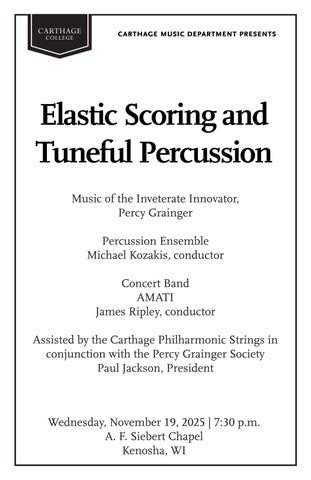
Elastic Scoring and Tuneful Percussion Music of the Inveterate Innovator, Percy Grainger Percussion Ensemble Michael Kozakis, conductor Concert Band AMATI James Ripley, conductor Assisted by the Carthage Philharmonic Strings in conjunction with the Percy Grainger Society Paul Jackson, President
Wednesday, November 19, 2025 | 7:30 p.m. A. F. Siebert Chapel Kenosha, WI
program Five Part Fantasy AMATI
John Jenkins/Grainger
Arrival Platform Humlet Bahariyale V. Palaniyandi
Percy Grainger arr, Grainger
Blithe Bells
J. S. Bach/Grainger Percussion Ensemble
La Bernadina
Josquin des Prez/Grainger
O Mensch, Bewein Dein' Sunde Gross Prelude in the Dorian Mode
Bach/Grainger Andtonio de Cabezon/Grainger
Ye Banks and Braes O' Bonnie Doon Concert Band La Vallee des Cloches
Percy Grainger
Maurice Ravel'Grainger
Sekar gadung
arr. Grainger
Gamelan anklung (Berong pengètjè)
arr. Grainger
Eastern Intermezzo
Percy Grainger Percussion Ensemble
personnel AMATI Mandy Nelson, flute Toby Staaden, oboe Hope Johnson, clarinet Neil DuJardin, bassoon Michael Alyward, horn
CONCERT BAND Danille Tranchita, flute Joe Raymond, oboe Ash Wilcox, oboe Ely Aita, clarinet Ružená Rongholt, clarinet Kaylie Szczepanik, clarinet
Meg Williams, clarinet Dontice Wooley, contrabass clarinet Ava Bartecki, alto saxophone Grace Grassinger, alto saxophone Dawson Stache, trumpet Amelia McCray-Grotto, trombone
PERCUSSION ENSEMBLE Avery Conger Cece Cooper Lydea King Emma Libecki J. P. Lucas
David Ku Nick Pelczynski Drake Thomas Rey Trejo
ADDITIONAL PERFORMERS Michael Alyward, piano Alasdair Ladd, piano Addison Kelnhofer, piccolo & celeste Dr. Deborah Masloski, piano Mandy Nelson, flute & piccolo
PHILHARMONIC STRINGS Ben Thoma Meghan Keiffer-Zagar Lauryn Klinger Hailey Hoelzer Elizabeth Whittier
Rebecca DeBoer Danika Stewart Aubri Smith Riley Gaylord
program notes Tonight's program, supported and in partnership with the Percy Grainger Society, presents two of Percy Grainger's most innovative approaches to musical orchestration, the use of "elastic scoring" and "tuneful percussion". Originating from both uniquely inventive philosophies on "democratic music" and pioneering work in what we would now call "ethnomusicology", Grainger's settings began with the promise to bring music from throughout the ages, and from around the world, to all types of musical ensembles -- what his friend Henry Cowell would notably say as: "I want to live in the whole world of music". Generous support for tonight's concert has been provided by the Grainger Museum, at the University of Melbourne, and collections coordinator Lauren Davis. Print music resources were provided by long standing scholars and proponents of Grainger's music, Keith Brion and Barry Ould. Brion's efforts in publication of some of the set of elastically scored "Chosen Gems for Winds" (several performed here tonight), and Barry Ould's monumental effort to generate engraved, scholarly editions, of literally ALL of Grainger's exhaustive output of music through his Bardic Editions, and Schott Music has made this event possible. Rental of the steel marimba and nabimba were arranged through Percussion Services, Ltd., Michael Lorenz, owner. ELASTIC SCORING In his preface to the score of "Spoon River", describing the practice he termed "elastic scoring", Percy Grainger wrote: My “elastic scoring” grows naturally out of two roots: 1. That my music tells its story mainly by means of intervals and the liveliness of the part-writing, rather than by means of tone-color, and is therefore well fitted to be played by almost any small, large or medium-sized combination of instruments, provided a proper balance of tone is kept. 2. That I wish to play my part in the radical experimentation with orchestral and chamber-music blends that seems bound to happen as a result of the ever wider spreading democratization of all forms of music. As long as a really satisfactory balance of tone is preserved (so that the voices that make up the musical texture are clearly heard, one against the other, in
program notes the intended proportions) I do not care whether one of my “elastically scored” pieces is played by 4 or 40 or 400 players, or any number in between; whether trumpet parts are played on trumpets or soprano saxophones, French horn parts played on French horns or E flat altos or alto saxophones, trombone parts played on trombones or tenor saxophones or C Melody saxophones; whether string parts are played by the instrument prescribed or by mandolins, mandolas, ukuleles, guitars, banjos, balalaikas, etc.; whether harmonium parts are played on harmoniums (reed-organs) or pipe-organs; whether wood-wind instruments take part or whether a harmonium (reed-organ) or 2nd piano part is substituted for them. I do not even care whether the players are skillful or unskillful, as long as they play well enough to sound the right intervals and keep the afore-said tonal balance – and as long as they play badly enough to still enjoy playing (“Where no pleasure is, there is no profit taken” – Shakespeare). This “elastic scoring” is naturally fitted to musical conditions in small and out-of-the-way communities and to the needs of amateur orchestras and school, high school, college and music school orchestras everywhere, in that it can accommodate almost any combination of players on almost any instruments. It is intended to encourage music-lovers of all kinds to play together in groups, large or small, and to promote a more hospitable attitude towards inexperienced music-makers. It is intended to play its part in weaning music students away from too much useless, goalless, soulless, selfish, inartistic soloistic technical study, intended to coax them into happier, richer musical fields – for music should be essentially an art of self-forgetful, soul-expanding communistic cooperation in harmony and many-voicedness. TUNEFUL PERCUSSION Similarly, in A Commonsense View of all Music (1934), Grainger's lecture on "tuneful percussion" (instruments capable of defined pitch, rather than indefinite) stated: “Of late years the bell-makers of Europe and America have adapted many Asiatic and other exotic tuneful percussion instruments to our European pitch and scale requirements, with the result that we are able to decipher Oriental music from gramophone records and perform them on the Europeanized Oriental instruments whenever we want to. I have tried the experiment of orchestrating Debussy’s Pagodes for a complete tuneful percussion group - thus, as it were, turning back to its Oriental begin-
program notes nings the Asiatic music Debussy transcribed for a Western instrument (the piano). In so doing I am merely giving it back to the sound-type from which it originally emerged.” Grainger's interest in the opportunity for these instruments as a "fourth family" in the orchestra, as well as his interest in Asiatic music after hearing a gamelan ensemble at the Paris Exposition Universelle of 1889, came together following his move to the United States. Grainger's career as a concert pianist afforded him the opportunity to visit the Deagan percussion factory in Chicago, where he was able to work the Frank Deagan to develop and incorporate a wide variety of these instruments (including the "nabimba", "steel marimbaphone", and "metal marimba") into his orchestral works such as The Warriors (1913-16) and In a Nutshell (1916) Grainger's realization of Debussy's Pagodes for a large collection of tuneful percussion instruments and piano, written in 1928, can be regarded as the first work written for the "percussion ensemble". intended to coax them into happier, richer musical fields – for music should be essentially an art of self-forgetful, soul-expanding communistic cooperation in harmony and many-voicedness.
OUR THANKS TO PERCY GRAINGER SOCIETY LIFE MEMBER
Professor James Ripley
WHOSE DEDICATION AND VISION BRING PERCY GRAINGER’S MUSIC TO LIFE YOUR DEVOTION INSPIRES US AND KEEPS PERCY GRAINGER’S JOY OF DISCOVERY EVER PRESENT
The Percy Grainger Society 7 Cromwell Place White Plains, New York 10601 PGS Membership
www.percygrainger.org
email info@percygrainger.org for complimentary student membership information
upcoming events Christmas Festival December 4–6 • 7:30 p.m. Sunday, December 7 • 4 p.m. A. F. Siebert Chapel "Speakeasy" Gradate MT Recital Febuary 6–7 • 4 p.m. H. F. Johnson Recital Performing Arts Series: Alysha Umphress Thursday, Febuary 12 • 7:30 p.m. H. F. Johnson Recital Student Recital: Vivian Alexander Saturday, Febuary 21 • 7:30 p.m. H. F. Johnson Recital Spring Studio 1 - Dear Elizabeth Wednesday, Febuary 25 • 7:30 p.m. David A. Straz Jr. Center, DSC 66 Spring Studio 2 - Train to Nibroc Thursday, Febuary 26 • 7:30 p.m. David A. Straz Jr. Center, DSC 66
Arts at Carthage acknowledges that the land on which our building stands is part of the traditional Potawatomi, Sioux, Peoria, Kickapoo, and Miami peoples past, present, and future. These homelands reside along the southwest shores of Michigami, North America’s largest system of freshwater lakes. We honor with gratitude the land itself, and the people who have stewarded it throughout the generations. Many Indigenous peoples thrive in this place—alive and strong, and this calls us to commit to continuing to learn how to be better stewards of the land we inhabit as well.
connect with us
tickets required
carthage.edu/arts 262-551-5859 facebook.com/CarthageVPA instagram.com/CarthageVPA
Get tickets 24/7 at carthage.edu/tickets or 262-551-6661 noon to 5 p.m. Tuesday – Friday