

Sierra Club Bulleti11
America
Mohawk (03970) A ten mch boo t In ta n mustang leather Side pull s trap, steel s h ank, link tred outsole and heel
Forrester (03381) Rugged e1ghl-lnch h i gh boot In water and acid resistant r edwood mustang leathe r with white c o n trast stitch i ng Non-slip, 011 proof Du rables sole and heel Steel shank and cu sh ion i nsole Lined m supple cream l eather.
Clermont Ferra nd (02033) Our finest quality hikmg boot fashioned m deep blue rough out suede With Vibram security sole and heel for sure-foot ed comfort
Sierra Club Bu
Rog er Olmsted
Pete du Po11t
Patricia Rambach
Don Coombs
David Plowden
For the W olverine dealer nearest you call this toll free number (800) 243-6000 In Connect icut, 1 (800) 882-6500 @ 1972, Wolverine Products , Rockford, M 1ch1gan 49351 A d iv i sion of www Wolverine World Wide, Inc
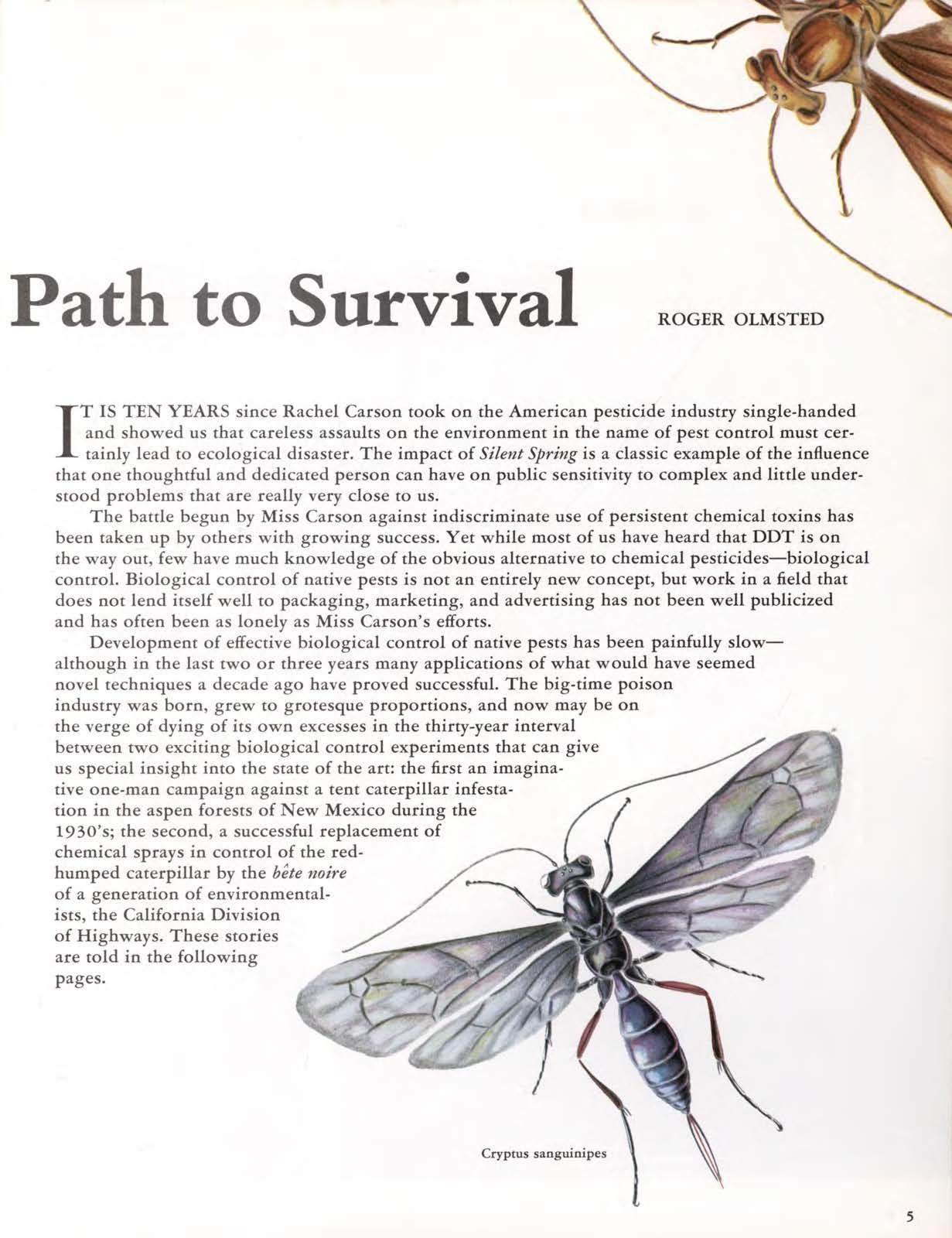
Cover: This bea11tij11l drawing of a Podalooia occideocalis was do11e by No rman Appleton. The insect is one of several 11at11ral predators or parasites of the Rocky Mountain tent caterpi llar d i scovered by Mr. Appleton during his pioneering research in biological pest controls. This story is part of Roger Olmsted's article "Notes 011 the Path to Survival" begi1111i11g 011 the following page.
Directors
RAYM OND SHERWTN
LAURENCE I. M oss
J UNE VIA VANT
Staff
President MICHA EL MCCLOSKEY
Vice President WrLLIAM BRON SON
Secretary NANCY DOO LEY
PAUL SWATEK Fourth Officer SHERllY POTTER and WILLIAM Srn1 Fifth Officer J OSEPH DOBIE
CHARLES HUESTIS
Treasurer DANIEL GRIDLEY
JOHN BEYER
l>HTLLTP BERRY PAUL BROOKS Regional Vice Presidents
CLAIRE DEDRICK AUG UST FR UGE
Exewtive Director Editor
News Editor
Editorial Assistants Prod11ctio11
Design Co11s11/tant
WILUAM FUTRELL RIC HARD L EONARD RICHARD CELLARlUS ALFRED FORSYTH
MARTTN LITTON JOHN RICKER JOSEPI-1 FONTAINE EDWIN ROYCE
RICHARD SILL THEODORE SNYDER SANFORD TEPFER
Founded in 1892, the Sierra Club works in the United States and other coun tries to restore the quali t y of the natural environment and to maintain the integrity of ecosystems. Educating the public to unders tand and s upport the se objectives i s a basi c part of the club's program. All are inv ited to participate in its activities, which include programs to '" •. , study, exp lore, and enjoy wildlands " The Sierra Club Bulletin. published 10 times a year, is lhe officia l magazine of the Sierra Club, 1050 Mills Tower, San Francisco, Calofornia 94104. Annual dues are $15 (first year $20) of which $3 is for subscription to the Bullelln. (Non-member subscriptions: one y ear $5 ; three years $12; sing le copies SOc.) Second class postage paid at San Francisco, California and ad ditional mailing office. Copyright © 1972 by the Sierra Club. No part of th e contents of this magazine may be reproduced by any means without the written consent of Sierra Club Bulle tin Other Sierra Club offices: Alaska: 119 Sewa rd Street, Juneau, Alaska 99801 / International: 777 United Nations Plaza, New York, N.Y. 10017 / Legal Defense Fund: 311 California Stree t, San Fr ancisco, California 94104 / Midwest: 444 West Main, Madison, Wisconsin 53703 / Northwest: 4534½ University Way NE, Seattle, Washington 98105 / Sacramento : 927 10th Street, Sac ramento, California 95814 / Sierra Club Books: 597 Fifth Ave., New York, N.Y. 10017 / Southern Cahforn,a: 2410 Beverly Boulevard Los Angeles, California 90057 / Southwest: 2041 E Broadway, Tucson, Arizona 85719 / Washi ngton. 0.C.: 324 C Street , SE, Washington, 0 .C. 20003 / Wyoming and Northern Great Plains : P.O Box 72 1, Dubois, Wyoming 82513.
Habrocycus (species undetermined)
All four of these drawings, like those on the cover, were exec111ed by Norman Appleton during his search for biological controls lo stop a devastating tent caterpillar infestation in the aspen forest near Santa Fe, New Mexico, prior to JIVorld War II.
Notes on the
"The road we have long been traveling is deceptively easy ... but at its end lies disaster. The other fork of the road-the one 'less traveled by'-offers our last, our only chance to reach a destination that assures the preserva#on of our earth."
Rachel
Carson, Silent Spring

Theronia atalaotoe folvesceos
Tetrascichus malacosoma,
Path to Survival
IROGER O L MSTED
T IS TEN YEARS since Rachel Carson cook on th e Am e rican pesticide industry singl e-handed and showed us that careless assau lt s o n the envi ronm e nt in the name of pest contro l must certainly lead to ecological disaster. The impact of Silent Spring is a classic exampl e of t h e influence that one thoughtfu l and dedicated person can h ave on publi c sensitivity to complex and little understood problems that are really very close to us.
The battle begun by Miss Carson aga inst indiscriminate us e of persistent chemical coxins has been taken up by others with growi n g success. Y et while most of us have h ea rd t h at DDT is on the way out, few have much knowledge of th e obvious alternative to chemical pesticides-biol ogica l contro l. Biological control of nativ e pests is not an e ntire l y n ew c oncept, but work in a field t h at does not lend itself well to packaging, m ark et ing, and advertising has not been we ll publ icized and h as often been as lonely as Miss Carson's e fforts.
Development of effective biological contro l of native pests h as b ee n painfull y slowalthough in the last two or three years many a pplications of what wou l d h ave seemed novel techniques a decade ago have proved successful. Th e big-time poison industry was born, grew co grotesqu e proportions, and now may be on the verge of dying of its own excesses in the thirty-year int e rval between two exciting biological control experiments that can give us special insight inco the state of t h e art: the first a n imaginative one-man campa i gn against a tent cate rpill ar infestation in the aspen forests of New Mexico during the 1930's; t h e second, a successfu l replacement of chemica l sprays in control of the redhumped caterpillar by the bete noire of a generation of environmenta lists, the California Division of Highways. These stories are told in the following pages.
Cryptus sanguinipes
Part One: Blazing a Trail in New Mexico
"T HE
ENTIRE region was made unfit for recreation, fishing, riding, or biking. Streams were clogged with the dead bodies, polluting drinking water supplies. The ugly, furry things dropped from the trees as one walked beneath. Trout streams were dammed up every ten or 20 feet with caterpillar bodies. A pervasive stench filled the air for miles."
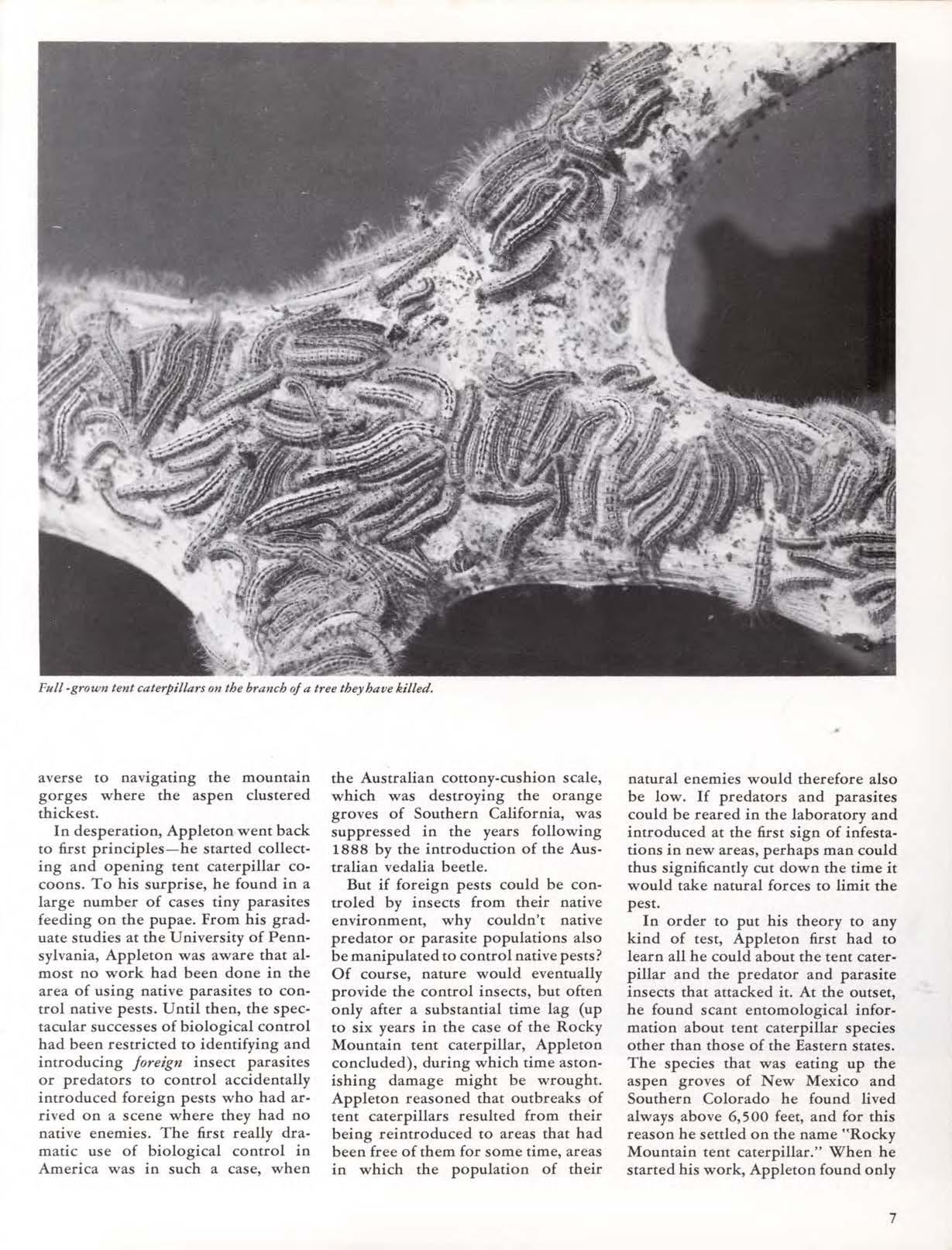
This was the scene in the aspen forests around Santa Fe that confronted Norman Appleton at the height of a devastati ng tent caterpillar invasion in the 1930's. Appleton, trained as a biologist, but known to the Santa Fe community for his activity in art and music and for bis Aspen Ranch Schoo l, decided to try to do something about the i nfestation which had defoliated some 1,200 square miles of the most scenic mountain areas of New Mexico, includ i ng his own beloved Aspen Ranch. The outcome of seven years of almost single-handed study and experimentation was then and scill is today a novel and promising approach to the use of benefici al insects in the control of native pests.
In the last 2 S years the quick answer to the problem would have been aerial spraying of pesticides, and this was also the initial i dea of Nor man Appleton. Bue he found the fish and game department opposed to potential poisoning of wildlife, and airplane pilots
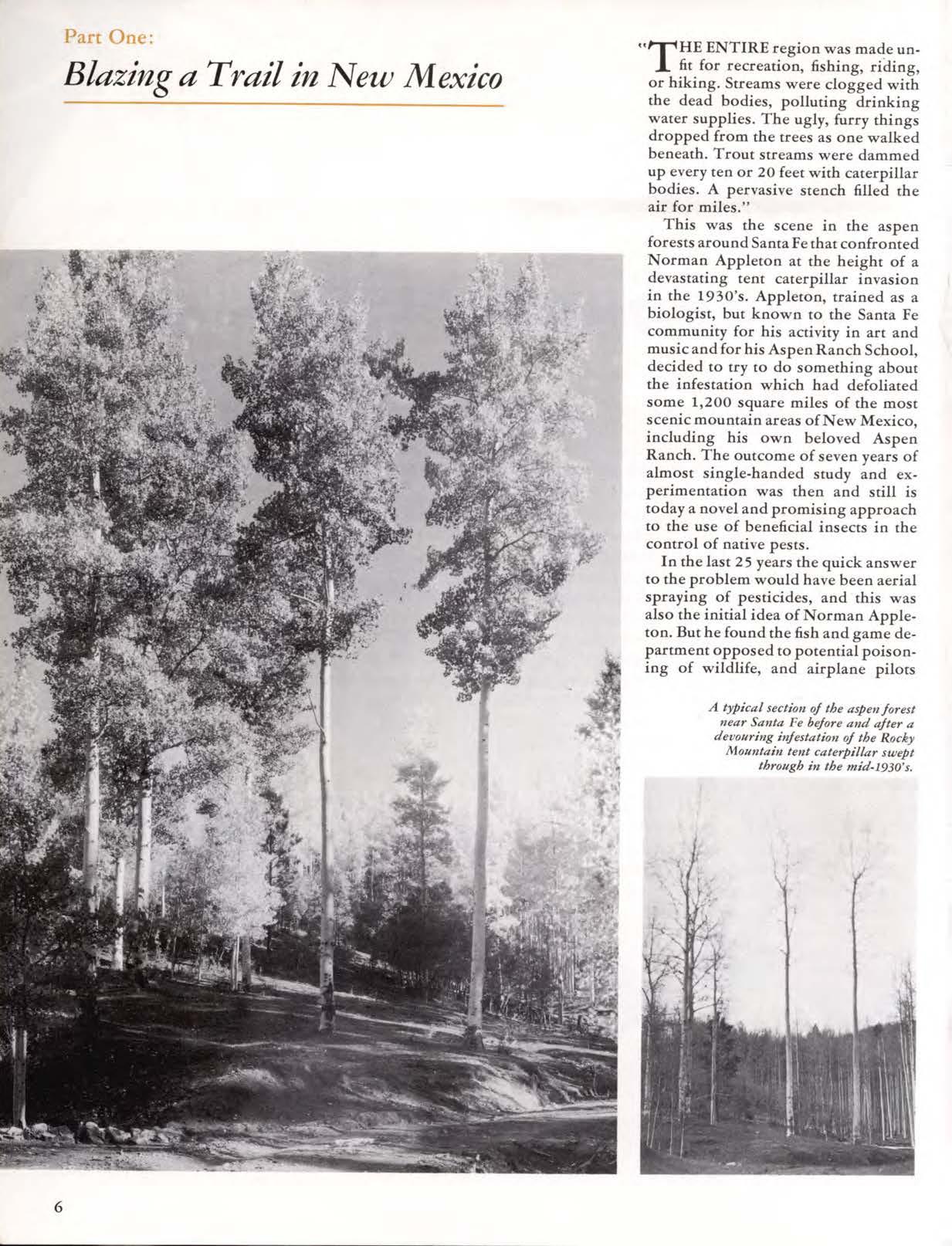
A typical section of the aspen forest 11ear Sa11ta Fe before and after a devo11ri11g infestation of the Rocky Mountai11 tent caterpillar swept thro11gh i11 the mid-l930's.
averse to navigating the mountain gorges where the aspen clustered thickest.
In desperation, Appleton went back to first principles - he started collecting and opening tent caterpillar cocoons. To his surprise, he found in a large number of cases tiny parasites feeding oo the pupae. From his graduate studies at the University of Pennsylvania, Appleton was aware that almost no work had been done in the area of using native parasites to control native pests. Until then, the spectacular successes of biological contro l had been restricted to identifying and introducing foreign insect parasites or predators to control accidentally introduced foreign p ests who h ad arrived on a scene where they had no native enemies. The first really dramatic use of biological control in America was in such a case, when
the Australian cottony-cushion scale, which was destroying the orange groves of Southern California, was suppressed in the years following 1888 by the introduction of the Australi a n vedalia b eetle.
But if foreign pests could be controled by insects from their native environment, why couldn't native predator or parasite populations also be manipulated to control native pests? Of course, nature would eventually provide the control insects , but often onl y after a substantial time lag (up to six years in the case of the Rocky Mountain tent caterpillar, Appleton concluded), during which time astonishing damage might be wrought. Appleton reasoned that outbreaks of tent caterpillars resulted from their being reintroduced to areas that h ad been free of them for some time, areas in which the population of their
natural enemies would therefore also be low. If predators and parasites could be reared in the laboratory and introduced at the first sign of infestations in new areas, perhaps man cou l d thus significantly cut down the time it would take natural forces to limit the pest.
In order to put his theory to any kind of test, Appleton first had to learn all he could about the tent caterpillar and the predator and parasite insects that attacked it. At the outset, he found scant entomological information about tent caterpillar species other than those of the Eastern states
The species that was eating up the aspen groves of New Mexico and Southern Colorado h e found lived always above 6,500 feet, and for this reason he settled on the name " Rocky Mountain tent caterpillar." When he started his work, Appleton found only
F11/l -grow11 tent caterpi/la,-s 011 the branch of a tree they have killed.
.five species of parasites recorded for what appeared to be this caterpillar. During hi s study, however, he identified 28 kinds of insects that affected the life cycle of the Rocky Mo u ntain tent caterpillar a nd was a b le co work out the life histories of many of them and use them in contr ol operations.
For two years Appleton collected, observed, and classified entirely on h is own initiative and without any outside support. This situation was soon co c h ange, however, when the newly created state WPA office in Santa Fe invited him co put his artistic tal ents to work illustrating a study of beneficial hawks of New Mexico. One day, the state d i rector, Gordon Herkenboff, dropped into App l eton's office, where he saw drawings of tent caterpillars and of some of their wasp parasites. He became highly interested in Appl eton's work and when some time lacer he was asked by a party of visiting officials what could b e done about a devastated aspen forest they were drivi ng t h rough, Herkeohoff replied that he knew somebody who had a promis i ng approach. The result was that Appleton soon found hims elf with a laboratory and dark room, a l ab assiscaoc, and labor co help in fie l d projects-the means to collect and rear parasites and to attempt control operations in the .fiel d.
The n atural contro l on the Rocky Mountain tent ca terpillar begins in midsummer as soon as the female moth lays her eggs. Appleton found four k i nds of minute wasp -like insects of the order Hymeooptera that deposit thei r eggs i n those of the cent caterpillar. Ac var ious subsequen t stages of its development t h e pest is subject to the attack of other Hymenoptera (fourwioged insects characterized by bees, ants, and wasps) or by Dipcera (twowioged insects typified by flies, goats, and mosquitoes). One of the most effective i nsect enemies of the Rocky Mountain tent caterpillar found by Appleton was a new species of solitary wasp (named Podalonia occidentalis from specimens supplied by hi m) wh i ch is akin co the digger wasps . This wasp attacks the full-grown caterpill ar, st inging it i nto insensibility a nd transporting ic to a burrow which she has prepared. She deposits a tiny white egg on the side of the cater pillar, then .fills and conceals the hole in which she has buried it. Like the other parasites of the t ent caterpillar, the wasp does not itself feed off
caterpillars, but uses the paralysed host as a future food supply for h er carnivorous young. T h e ti ny maggot that batch es from the wasp's egg enters the body of the ca t erpillar and gradually consumes it. Another important p~rasite of the caterpi llar stu died by App l eton is the Sarcophaga aldrichi. These extremely beneficial Diptera attack the full-grown caterpillar and insert their maggots beneath the skin of the host, who usually lives l ong enough to spin its cocoon and transforms co the pupa before it su ccu mbs.
If the cent caterpillar i s not attacked by one of these parasit es ac this stage, there are others that assault it when it s huts itself up i n i ts cocoon. Seven species of the ichneumon fli es (wasplike Hymenopcera) were observed to parasicize tent caterpilJ ar cocoons in New Mexico. There are some 16,000 species of ic h neumoos, all of them p aras ites, and many of them prey on what we wou l d consider pests.
In add iti on to th e many parasites of the ten t caterpillar, Appleton found th ree insect predators. Minute, colorless mites attack the baby caterpillars as they emerge from their egg shells. A large fly, popularly known as t h e "assassin" or "robber" fly, was seen frequently to attack h alf-grown larvae. Finally, a large ground beetle, Calosoma calid,nn, was observed to eat many caterpillars in a single day.
Dis ease also plays a large role in controlli ng many pest infestations, and Appleton observed a vira l disease of t h e tent caterpillar that was destroying up to 2 5 percent of th e population in some cases. He concluded that Sarcophaga fl ies might materially assist in spreadi n g this disease, as both ma le and female fli es were fou nd crawlin g all over th e pests and flitti n g from one caterpillar to another as they lapped up the exudations from the mouth and cuticle.
From t h e outset of the study Appl eton had assumed that delibe r ate introduction of some of the most important parasites at the time an outbreak was first observed mig h t avert a seri ous infestatio n . T h e opporruoicy co test thi s theory came soon after cbe i denci.6. cacioo of beneficia l in sects was in h an d , and methods of collecting them had been establi shed. On July 14, 1937, che Supervisor of Carson National Forest ca lled from Taos to r eport a small but heavy infestation of tenc caterpillars in some 50 acres of
aspen just north of a division of the Santa Fe National Forest that had been heavily infested for some years. T h e challenge was co see whether or not timely introduction of parasites might not save the Taos forests from the scourge that had devastated the Santa Santa Fe forest.
No digger wasps were found ac the site o( the new infestation, and only two percent of the 500 caterpillar cocoons that were examined produced ichn eumon parasites. However, 39 p ercent of the cocoons produced Sarcophaga. which, as the strongest flyers among the com.moo parasites, had apparently been blown in by the unusually strong southeast wind of the precedin g summer. Because the cent caterpillars would soon become mochs, mace, and produce eggs, an estimated half-million Tetrastichid egg paras ites were rushed in. These wasps had been gathered the winter before by t h e simple expedient of collectin g tent caterpillar egg masses from an area w h ere che incidence of Tetrastichid parasites was very high. The eggs were kept in storage at a commercial i ce h ouse. Taken out of cold storage and placed on a bare cement floo r, the eggs soon hatch ed our their caterpill ar crop - which died of starvation in a couple of days. The rest of the eggs were now either infertile or contained paras ites. These eggs were then taken to the threatened area and th e p aras ites allowed to emerge in th eir own time.
lo the spring of 1938, Appleton's team caug ht 3,000 bi g female digger wasps and introduced them to the infested site. Io Appleton's words, "le was thrilling to watch these a lli es of man pounce upon their prey as soon as th ey were liberated from their cages." I n addition to the ichoeumons and the diggers, 45,000 Sarcophaga flies were bro ught in. These had been hatched ouc in the l aboratory by stackin g mesh-bottomed trays of caterpillar cocoons known to h ave a high inci dence of Sarcophaga over a base filled with moist sawdust. When the Sarcophaga maggot emerged from the caterpillar cocoon, ic dropped co the gro un d and burrowed; thus, Appleton wound up w ith sawdust trays of Sarcophaga puparia that could be kept dormant in the refrigerator until needed. W h en they were allowed co complete their metamorphosis and mate, chey were introduced to trays of diseased caterpillars. Released at the infested
Sierra Club 1973 Calendars ORDER ENVELOPE

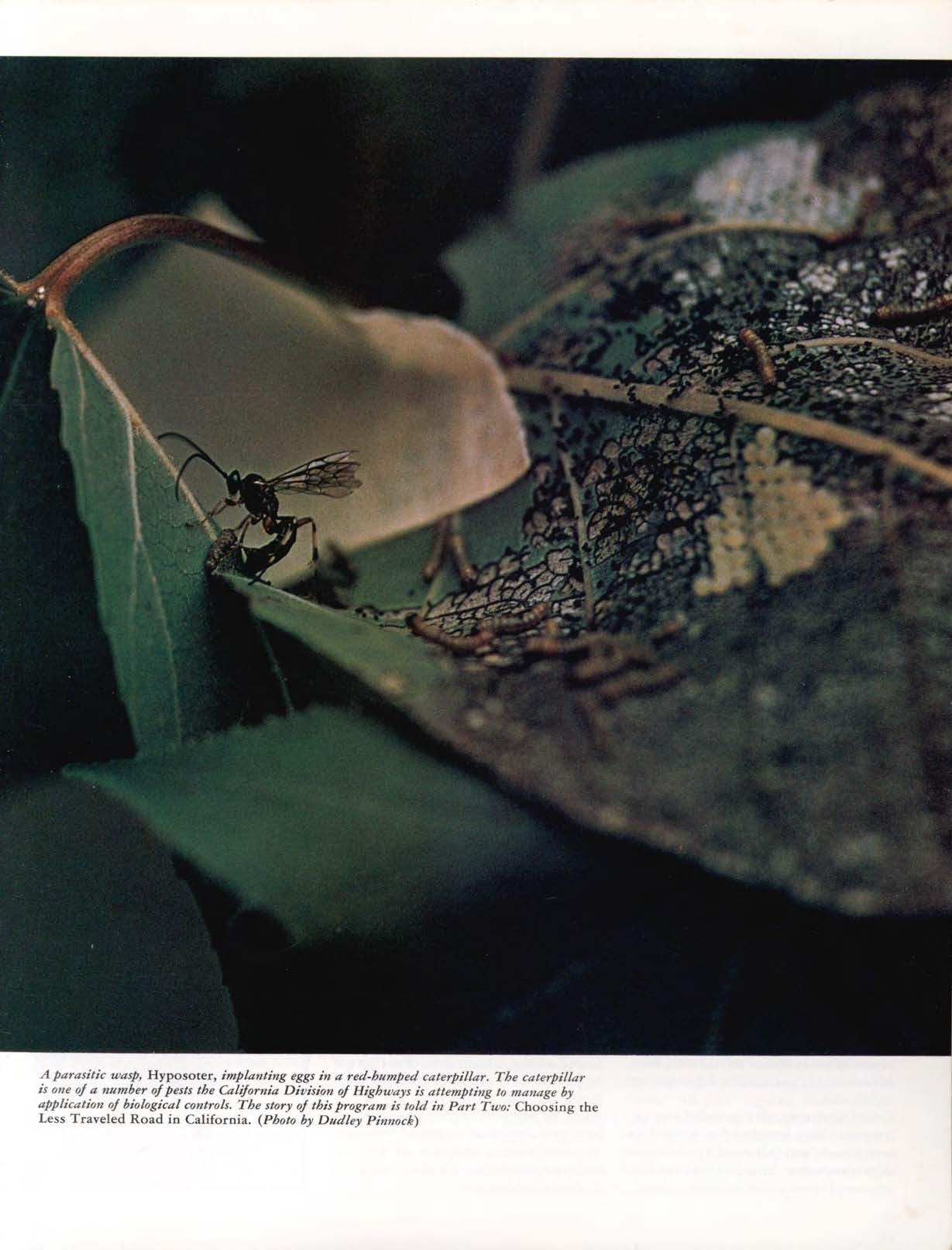
A parasitic wasp, Hyposoter, imp/a,,fing eggs in a red-humped caterpii/ar. The caterpill,,r is one of a >1umber of pests the California Divisio11 of Highways is attempti>1g to manage by applicatio11 of biological crmtrols. The story of this program is told in Part Tuw Choosing the Less Traveled Road in Califocnia. (POOto by Dudley Pinnock)
...
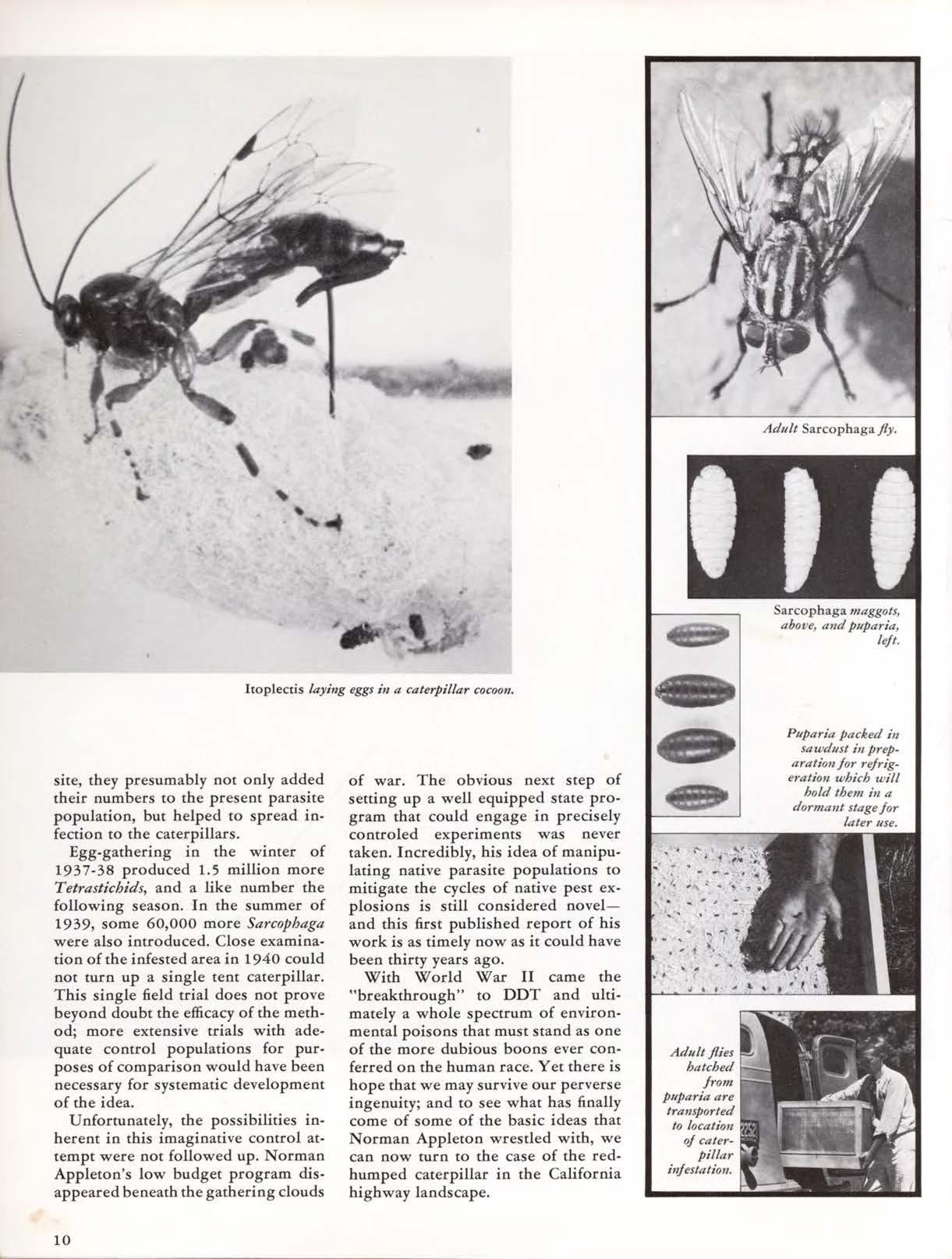
l toplect is laying eggs in a caterpillar cocoo11.
site, they presumably not only added their numbers to the present parasite population, but helped to spread infection to the caterpillars.
Egg-gathering in the winter of 1937-38 produced 1.5 million more Tetrastichids, and a like number the following season. In the summer of 1939, some 60,000 more Sarcophaga were also introduced. Close examination of the i nfested area in 1940 cou ld not turn up a single tent caterpillar. Th is single field trial does not prove beyond doubt th e efficacy of the method; more extens i ve trials with adequate control populations for pu rposes of compari son would have been necessary for systematic development of the idea.
Unfortunately, the possib i li ties i nherent in this imaginative control at• tempt were not fo llowed u p . Norman Appleton's low budget program disappeared beneath the gathering clouds
of war. The obvious next step of setting up a well equipped state progra m that cou l d engage in precisely contro l ed exper iments was never taken. Incredibly, his idea of manipulati ng nati ve parasite popu lations to mitigate the cycles of native pest exp losions is still considered noveland this first published report of his work is as timely n ow as it cou ld have been thirty years ago.
With World War II came th e "break through" to DDT and ultimately a whole spectrum of environmental po i sons ch at must stand as one of the more dubious boons ever conferred on the h uman race. Yet there is hope that we may survive our perverse ingenuity; and to see w h at h as finally co m e of some of the basic ideas t hat Norman Appleton wrestled with, we can now turn to the case of the redh umped caterpillar i n th e Cali forn i a highway landscape.
Adult flies hatched from p11paria are transported to location of caterpillar i11festatio11.
P11paria packed i11 saivd11st in preparation fo1· refrigeration which will hold them ii, a dorma11t stage for later 11se.
Sarcophaga maggots, above, a11d p11paria, left.
Choosing the L ess Tra veled Road in Ca lifornia
IT COMES as a bit of a shock to reflect that the Division of Highways, with ics thousands of acres of plantings, may be the biggest gardener in California. As such, it bas co contend with a variety of p ests, one of the most destructive of which is che redbumped caterpillar. This p est attacks a wide variecy of trees and s hrubs , but particularly favors the Liq11idambar, an ornamental tree resembling a maple, whose l eaves (if there are any left uneate n) cum a brilliant crimson, yellow, or purple in the fall.
Needl ess co say, the Division of Highways was a user of the latest chemical pesticides during che 1960's. Toward cbe end of the decade che division had to face the prospect of growing restrictions on the use of chemical agents and a growing popular sentiment against large-scale and repeated spraying. For instan ce, in 1969 S1111set (a magazine of tremendous influence among \Y/escern homeowners and gardeners) came out against the use of dangerous chlorinated hydrocarbons , thus g i ving something like the Good Housekeeping Seal of Approval to Rachel Carson's charges. le was also coming co be more generally understood that the most powerful, p ersistent, and popular pesticides sometimes produced dismayingl y negative results by killing off natural para sites and predators along with the pests, leaving the field clear for a devastating resurgence of the pest population or an unexpected substitution of a new pest for the old one.
The Division of Hig hways turned to the Univer sity of California at Berkeley for help. Dudley E. Pinnock, a young encomologist from England by way of Australia, had just completed an effective trial of the u se of microbal control of the Ca lifornia oakworm, and in 1970 he undercook the s tatesponsored project of developing a suitable method of biological control of the red-humped caterpillar.
Pinnock 's main weapon in attacking the red -humped caterp illar was to b e
Bacillus thttringiensis, an insect pathogenic bacteri deadly only to caterpillars Norman Appleton had noticed in his study of the Rocky Mountain tent caterpillar that a disease of the caterpillar might be one of the most effective controllers of the pest; by 1970 biological control workers saw this as the most promising approach. Commercia l preparations of Bacillus thuringiensis have been used to control caterp illars in l ettuce, cabbage, and other crops for a decade. They can be diluted and sprayed with the usual equipment. Lik e the most powerful p esticides, the agent could approach 100 percent effectiveness. This idea, oddly enough, was one of the older ones in the fie l d of biological control; fifty years ago French peasants were observed to collect a few dead (i.e. diseased) caterpi llars , chrow chem in a bucker of wate r , let them steep for a w hile , then spray their cabbage parches. Soon most of the other caterpillars would become diseased and die.
A second weapon in Pinno ck's armory was to be manipulation of th e parasite population, buc unlike Appleton, he did not seek to introduce his parasitic wasps directly. Study showed him chat a major factor in limiting parasitic wasp populations was probably the availability of adequate nectar supplies. \Y/asps deprived of nectar died quickly, while those g i ven nectar or honey-water could surv i ve for weeks. In the highway plantings he found chat there a pp eared co be a serious shortage of plants that the parasites of the red-humped caterpi llar could feed on in lat e season. Thus, a Jong-range goa l in control of che caterpillar is co introduce plantings which create a favorable environment for its parasites. This program is underway now.
Contro lled ex p er im ents with Bacillus thuringiensis application co Liquidambar leaves in the laboratory and trees in the field indicated chat complete control of the red-humped caterpillar mighc be achieved. Noc only
would beneficial insects not be harmed, but there would b e no health hazard to highway personnel handling the biological agents, co the general public, to livestock, or to the general environment. Finally, the tests indicated that che direct savings in cost of treatment might be as high as 40 percent, compared to the costs of using chemical controls.
The program of biological control was accepted and instituted by the Division of Highways. Now, two years lat er, the Division of Highways can report that ic has been able co suspend completely the use of pesticides in the control of the red-humped caterpillar. As the pro gram to create a more attractive environment for natural parasites develops, there is every reason to believe coses and labor effort will continue co decline.
The red-humped caterpillar story could be matched by ocher successes in biological control achieved in che lase few years. Y ee it is still true chat biological contro l by and large lives on shoestring budgets when outlays are compared to che immense expenditures involved in the development and application of chemical poisons. The fascinating possibilities of Norman Appleton's experiments have never been followed up , though his project cosc very litcle; the successful Division of Highways program was launched on che basis of control experiments conducted by Dudley Pinnock and two technicians with modest eq uipm ent in a short period of time.
A nation as notable as ours for such things as its war machine, its freeways and scagnaoc auto traffic, a nd its burgeoning suburbs may not easily be convinced of the desirabifoy of spending money on something that is not self-defeacing - buc we are offered the clear possibility of controlling our insect pests without poisoning ourselves.
A crucial element in the development of biological controls is going co be the development of balanced systems chat do not have the disruptive effects on the environment that have marked the widespread use of pesticides. Even biological control could be abused by fastening onto singletrack "miracle" agents. We are coming co understand that we must li ve in and with our world, and that we must respect our environment instead of over-manipulating it in the interest of short -term and ofcen illusory gains.
The Tocks Island Dam Fight
PETE du PONT
HAD I BEEN approac hed on the day of my swearin g-i n in J anuary, 1971, and told that six month s l ater I would b e on my feet on the floor of the House of Repr ese ntatives, opposing t h e powerful House Appropri a tions Committee, not to m e ntion m any of my co ll eag ues in neighbo r in g states, over an environmental di spute invo lving Tocks I s l a nd D a m a nd the National Environmental P o l icy Act, I would have returned a n incredulous stare. After all, I had come to Congress inten t o n sin kin g my t ee th into s u ch knotty issues as drug abuse, foreign policy, the econo my , and congress ion a l reform. Such acronyms as NEPA were as new to my lexi c on as I was to Ca pitol Hill. And though I cheri shed t h e beauty and heritage of t h e D el awa r e River Valley, I knew n othing about a ce rta in tiny sliver of l a nd lying north of the famed Delaware Water G a p known as To cks I sland.
Th i s was a ll to c h a n ge wit hin a few month s in a pr ocess which I ca n best describe as t h e "gree nin g" of Pe te du Pont. I wou ld soon find myself girding fo r a solo attack, Don Quixote style, aga inst some of the institutions w h ich the e ld ers in Congress r ever e the most-the Appropriations Committee, publi c works proj ects, a nd s ile nt freshmen congressmen.
B ut my motive was more than a p e nchant for ma soc hi s m. I sought to s h arpen t h e t eet h of NEPA and focus the conce ntration o f th e Cong ress on the need to stand firm in our n ation al e n vironm e n tal policy. And , too, t h ere was something truly worth saving-the Delaware Water Gap and th e D e l aware River itself.
From above Milford, Pennsylvania, to the famed Water Ga p , the D elaware flows through one of th e most beau ti ful riv e r valleys in the co untry. To the east, in New J ersey, looms the forested ridge of Kitcatinny Mountain , along w hi ch runs the Appalachia n Trail. On the west, i n Pennsylvania, sw ift s treams an d waterfall s s pl as h ove r the rim of t h e Pocono upland an d cut stee p g orges filled w ith da rk hemlock t r ees an d rhododen dron. Farm fields an d woodlands quilt the valley itse lf along broad river bottoms and acro ss rolling l ands veine d by brooks s p angled h e re and th ere w ith ponds. Central to a ll is the majestic silver ribbo n of the Delaware. Whether riffling or serene l y pooled , th i s centra l reach of t he river's overall Z-s h a p ed co urse flows st r aight to Wallpack Bend , writhes back upon itself in a great double curve a nd t h e n h eads onward, s m oot hin g i ts tones, to a dramatic thrust thro ugh the great gap near Stroudsburg, Pennsylvania.
''. . . a few young voices said 'Aye' and the 'Noes' rolled across that chamber like thunder. The lions had won, of course. And some miles upriver, the yellow bulldozers of the Corps of Engineers were fueled and ready to begin corrective surgery on the earth."
Pete du Pont serves as Congressman at Large
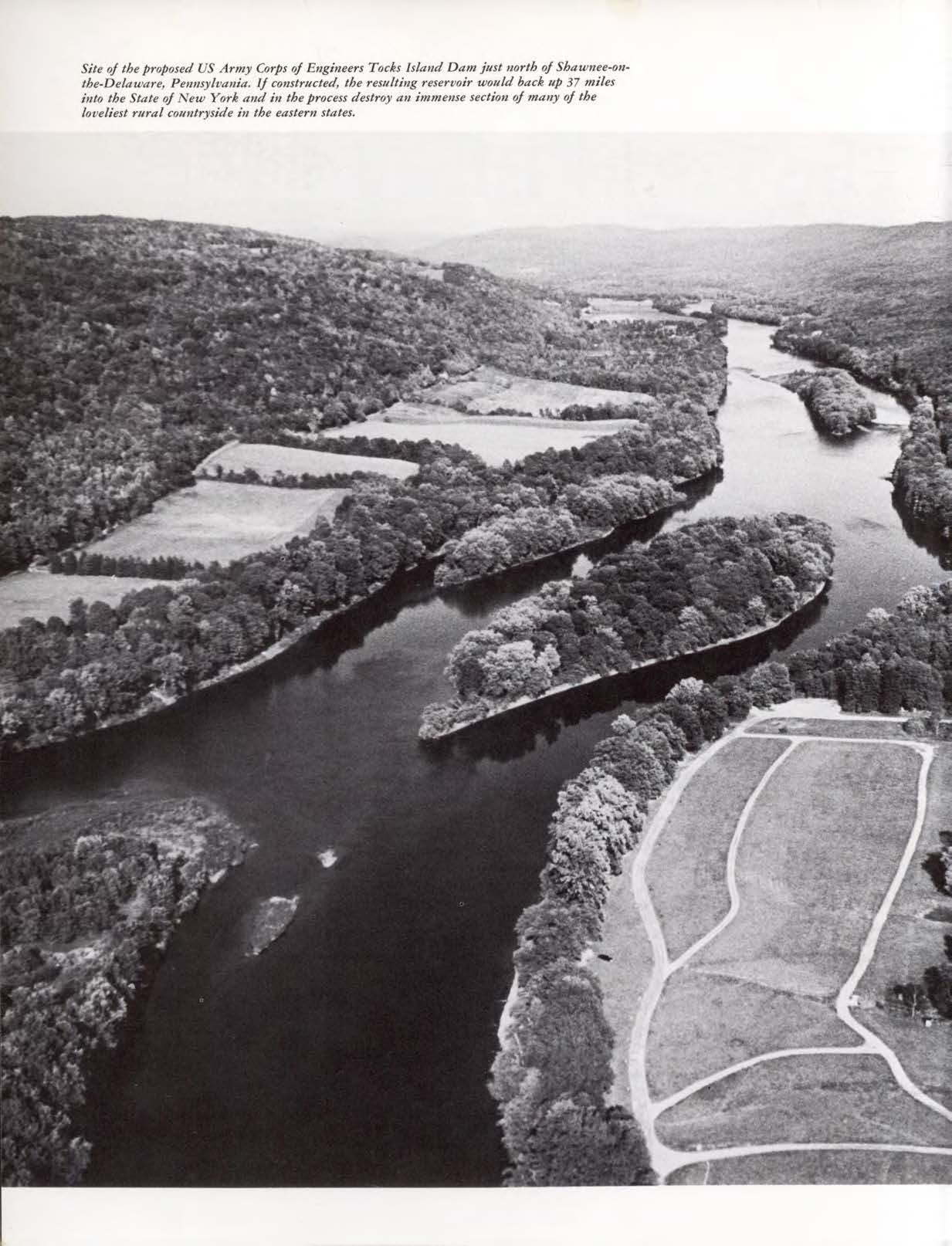
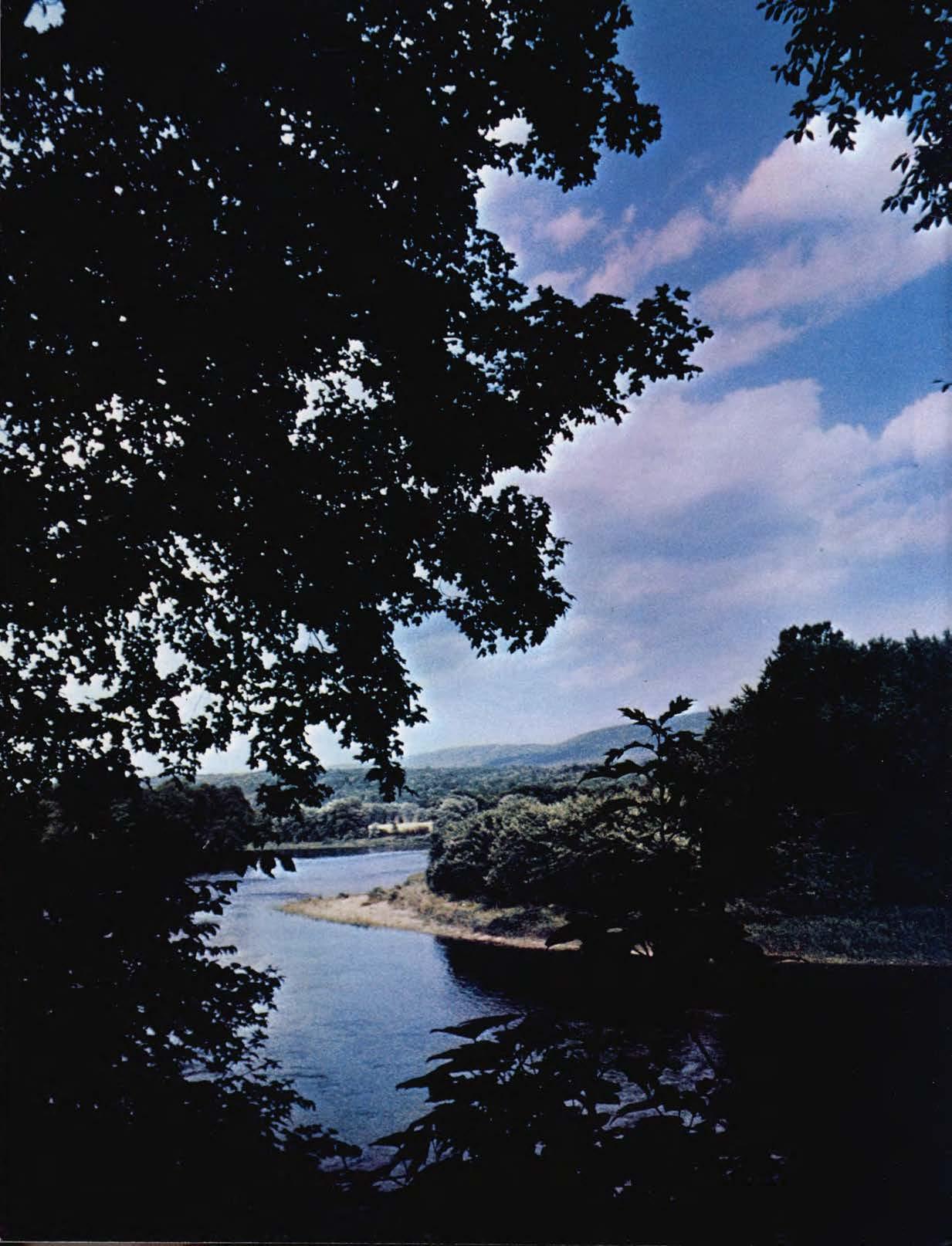
Site of the proposed US Army Corps of E11gi11eers Tocks lsla11d Dam just north of Shawnee-011the-Delaware, Pe1111sylt1a11ia. If constructed, the res11lti11g reservoir would back up 37 miles into the State of New York a11d in the process destroy a11 immeme section of 111a11y of the loveliest rural countryside in the eastern states.
Photos by H. Scott Heist
This is hi storic country, w i th memories of Ind ian times. Dutchmen seeded here before William Penn founded his colony. Wars came, and the valley linked George Washington's revolutionary forces in upper New York wich chose near Philadelphia. Today, che valley still retains char same peaceful, rural charm. And it is just "over th e mountain" from th e sprawling megalopolis, 62 miles from th e h eart of New York Cicy, and 7 5 miles from the center of Philadelphia.
Bu t late in 1962 much of this bucolic landscape with its historic sites and setting was threatened by congressional authorization for construction of che Tocks I sland D am. The area would be flooded by conscruccion of a 3,200-foot-long dam upstream from che D elaware Water Gap, 100 feec downstream from Tocks Island. The res ult would be a 3 7-mile-lon g lake extending as far north as Pore J ervis, New York.
The clam was author iz ed by the Flood Control Act of 1 962 primarily to prevent flooding, but also to provide supplies of wacer, hydroelectric power, and recreation opportunities. I n 1955 there was an unusual convergence of two hurricanes along the eastern seaboard chat caused severe flooding, resulting in extensive p roperty damage and 99 d eat h s. The deachs caused by the flood, h owever, occurred along tribu taries where a seri es of minor impoundments have since been constructed, not on the Delaware itself. The Army Corps of Engineers nevertheless insisted che project was necessary. Corps economises cried sweecen in g che pork barrel by attributing all sores of fringe benefits to the project: fishing, swimming, boatingand badly needed h ydroelectric power for the hungry megalopolis to the east. But oppos iti on to the pro j ect was growing: conservationi sts, independent scienti sts and, more recendy, elected officials and government agencies began co question whether the construction of a clam was the best or even an appropri ate means of satisfying any of these needs. By 1971, the emphasis had changed, and the fringe benefits outweighed all others. Furthermore, costs had soared to more than $300 million with more than half o f that expenditure justified as an investment in creati on. The plan now called for che National Park Service to admini ster a 72,000-acre D elaware Water Gap National Recreation Area.
A Park Service sign ac D ingman's Ferry, Pennsylvania, a few miles south of the water gap, proclaims:
"In a land already rich in historic and natural resources, man is shapin g a recreation area full of opportunities for the refreshment of body, mind and spi rit."
A few miles away anoth er road s i gn constructed by local skeptics reads: "Eat an engineer for lunch. Nix on Tocks."
The graffitti war was beating up, but the wheels of the Corps grind slow ly, and construction on the dam was delayed for almost ten years for lack of available funds.
The passage of the National Environmental Policy Act of 1970 saw th e Tocks I sland Dam enter its second decade of controversy. NEPA, in effect, declared a whole new ball game in water resource development; for beyo nd the elaborate review procedures set out in the statute (which mean very little by themse l ves) lay the first major step towa rd s development of comprehensive national resource planning.NEP A's applicati on to Tocks did little to alter the build-now-studylater attitude within the Corps of Engineers. It has created, however, a stalemate which has allowed a period of review by many public officials and scientists, calling into question the corps' entire dam-building philosophy and permitting the Congress to begin th e long task of putting teeth i nto our environmental policy.
The corps' first gambit was to ignore the intent of NEPA. There were enough available studies on Tocks Island to "line t h e bottom of the r eservoir" claimed one Corps official. The Tocks I s land library was indeed voluminous, but the major environmental issues still remained undisclosed and unstudied. Prior to the Appropriations Committee deliberations in May of 197 1, the corps made a pro forma attempt to comply with NEPA by submitting an eight-page statement on the projected environmental impact of the project. An eightpage report on the environmental impact of a $300 million dam! The supporters of the project were ready to begin constructi on.
I n conjunction with my general objections to the Corps' build-nowstudy-later attitude, which seemed to violate the spirit of the Nati onal Environmental Policy Act, there were numero u s questions concerning the
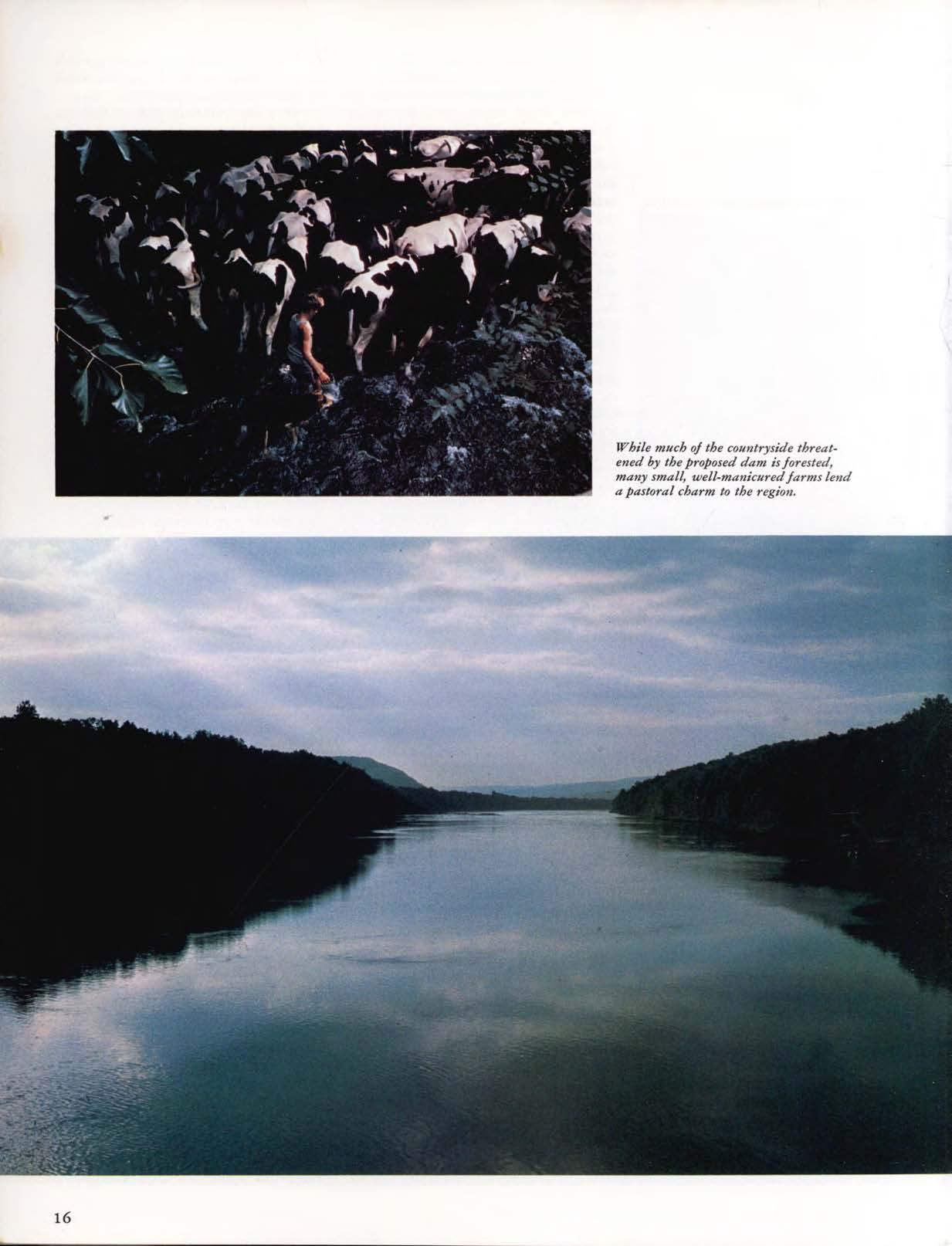
While m11ch of the co11ntryside threatened by the proposed dam is forested, many small, well-manicured farms lend a pastoral charm to the region.
impact of che dam on upper Delaware Bay. Meetings with local scientists convinced me chat a serious ecological imbalance might occur with the impoundmeoc. Biologists predicted chat by shutting off annual spring flows, the lower part of the river would be robbed of nutrients, and certain areas of the upper bay would not be flushed out with fresh water. Many forms of fishlife - oysters in particular- could be adversely affected.
On the basis of this local environmental concern and in che belief chat cheNarional Environmental Policy Act would be meaningless if we simply used the impact statements as postscripts to construction, I decided co seek deletion of construction funds from the annual public works appropriation bill.
This decision marked che beginning of what was to be an initiation into che intricacies of the power structure on the Hill and of che frustration of trying to convince half of my 434 colleagues that a dam that had been under study for ten years needed further study. My first attempt at persuasion was with the House Public Works Appropriations Subcommittee. Delighted in having secured one half hour to present my views, I went to che hearings armed with voluminous memoranda and two experts from che University of Delaware. After receiving a gracious southern welcome from Chairman Joe Evins of Tennessee, I was quickly informed chat I had only five minutes to present my testimony. Even that was divided three ways. My expert witnesses had just enough time to identify themselves before we were politely informed that the pressing business of the committee unfortunately prevented further testimony. In che eyes of che committee, it seemed to me, I was as unwelcome as che many concerned and articulate citizens who also came co plead with it. Upon leaving the hearing room, I thought the prospects of convincing che rest of the House to be remote indeed. This feeling proved to be an underestimate of the difficulties that lay ahead.
As expected, the House Appropriations Committee reported out the annual Public Works Appropriation bill with some $3. 7 million dollars designated for the construction of Tocks Island Dam. Only two days lay between the day che bill was reported out aod its consideration oo the floor.
Engaging the enthusiasm - or even the attention - of harried Members of Congress for the amendment I was going to offer was a monumental task. We churned out "Dear Colleague" letters, called the offices of members who had good environmental records, and began the unfamiliar task of cornering members oo the floor to request their assistance. Mose were skeptical, some sympathetic, and none could understand why I insisted on this form of self-immolation. Most incredulous of all was our local newspaper reporter, seasoned by years of log rolling and pork barreling. "The Appropriations Committee? Joe Evins? Do they let Christians in too, or just the lions?" I did, however, receive able support from three colleagues: Hamilton Fish of New York, Guy Vander Jagt of Michigan, and Pete McClosky of California. Each promised to give floor speeches supporting my amendment.
"Let there be no mistake about the real issue io this case, " I doggedly continued to a disinterested audience of tired colleagues. "It is not che Tocks Island Dam, it is not the Delaware River. The real issue here is whether we are going to have any teeth in our environmental laws." It was a hot July night, the kind Washington is famous for, and Congress wanted a vacation. For hours I waited for the reading of the bill to progress as one issue after another sapped the patience of the world 's greatest deliberative body. Theo came the perennial dogfight over the Dickey-Lincoln hydroelecrric project in Maine. As usual, a debate on the merits of public power vs. private power ensued. But even politicians become bored listening co politicians. Determined chat this phoenix-like project was not going to be resurrected, the leadership terminated debate amid shouts of "Vote! Vote!" Dickey-Lincoln was reduced to dust.
Tired from che rigors of defending or abusing public power projects, members drained out of the hot chamber as my remarks concluded:Incerrupted by groans of boredom, pleas to vote the amendment down, and the clap of the Speaker' s gavel attempting to keep the House in order, I argued against build-now-study-later, and my time had expired.
Now the proponents of the project were recognized. A series of memorable oratories followed-the most ascerbic of which exist only in my mind, since their authors later used
their right to "revise or extend" their remarks to expunge chem from the record. Representative Frank Thompson of New Jersey suggested chat the gentleman from Delaware was to be commended for his zeal despite his lack of information, but chat if he were really concerned about the environment he would concentrate his efforts on those many polluting factories (bearing what name, I wonder) in bis own •district. Mr. Thompson then concluded with a since-expunged quote worth remembering. The ecologists had gone so far, he suggested, that "everytime we want to erect a seesaw, someone objects that it will hurt che bunny rabbits."
Noc to be outdone, Representative Jim Wright of Texas relied on Kipling to make his point:
"It is suggested that we have further study. This reminds me of Kipling's description of old men. He said:
'They peck out, dissect, and extrude to the mind
The flaccid tissues of long-dead issues
Offensive co God and mankind
Like vultures over an ox
That che army has left behind.'"
In a final burst of Biblical zeal, he concluded:
"We cannot keep people from intruding upon che earth. And che interests of people must come first. Nature sometimes, as in this case, needs che corrective surgery of intelligent man, under the injunction given to us in the Book of Genesis, to subdue che earth and husband its resources."
The marathon continued. TheHouse grew impatient. And che end came swiftly. The record shows only chat the motion offered by the gentleman from Delaware was rejected. In fact, a few young voices said "Aye," and che "Noes" rolled across that chamber like thunder. The lions had won, of course. And some miles upriver, the yellow bulldozers of the Corps of Engineers were fueled and ready to begin corrective surgery on the earth.
Despite the fact chat the battle had been lost in one house of Congress tbe war continued elsewhere. In the course of the controversy over the Corps' draft of the environmental impact statement, Senator Clifford Case of New Jersey led a forceful and effective one-man crusade to have the project thoroughly reviewed by an impartial and independent body of experts. He called upon the Council on Envi-
ronmental Quality, which oversees the NEPA process, to appoint the National Academy of Science or some such group to the task. Eventually CEQ arranged a compromise involving an i nteragency federal review of the Corps' final impact statement The key finding of the review was contai ned in a 100-page report prepared by the Corps of Engineers' own consultants. The report, which confirmed the fears of conservati onists, concluded that because of the high level of agricu l tural run-off and wastes from poultry farms along the Delawar e, any iropoundment would res ult in rapid eutrophi cac i on, jeopardizing the quality of the water s upply and recreational aspects of the project.
CEQ immediately ordered a moratori u m on the project until the pollution sources could be identified and controlled. Controlling thi s kind of p o llu tion is not easy. The very least requirement wou l d be a complicated and expens i ve regional sewage system. Such a system wou l d still not adeq u ately treat the nutr i ents that drain from th e agricultural fields. And in all likelihood , t h e cost of the regional treatment system would far outweigh th e cost of the project itself. Several legislacors i ncluding Senators Buckley and Case and Congressman Do w, qu ic kly qualified or withdrew their initial support Since th en, the Governors of New Jers ey, New York, an d D elaware have all p u blicly expressed the kind of doubts that politically signal the kiss of death.
The Hous e and Senate Appropriati ons Committees have also responded in unprecedented fas h ion by deleting construction funds until these environmental problems are resolved. In th e meantim e, they have earmarked more than $15 million for land acq uisition. Th is action suggests what may be the only rationa l alternative to the Tocks I sland Dam, one long advocated by conservationists and most recently by th e Park Service itself-a national recreational area utilizing all of the land intended for the original project plus 10,000 "extra" acres of scenic ri verside lands that would otherwise be inundated. In other words, a park without a dam.
This revised plan wou ld in effect represent the first and maj or step necessary toward p r otecting the river and riverscape from the urbanization of New York, New J ersey, and Pennsylvania. Complementing the park
would be the proposed Delaware National Scenic River along the upper reaches of what is probably the East's most widely enjoyed canoeing stream.
The emergence of such a proposal at this time gives a glimmer of hope that water resource planning may be given new direction. The debate has at least reached Congress. Cherished concepts of water resource planning and accounting criteria are now being seriously challenged. And at long last, Congress has begun to question the very function of the Army Corps of Eng i neers in this field. Senacor Clifford Case has, for examp l e, introduced a bill (S. 34 71) that wou l d curtail many of the Corps' traditional functions while at the same time encouraging it to assume added responsibilities to protect the environment. The bill would not only encourage the Corps to cake an active part in sewage treatment and soli d - waste projects but would a lso halt any Corps project eight years old or older that has not received funds for construetion. By eliminating older and no longer justified projects, such action would have the effect of turning NEPA into the mechanism for advance planning that Congress intended it should be.
T h e future of Tocks is still uncer-
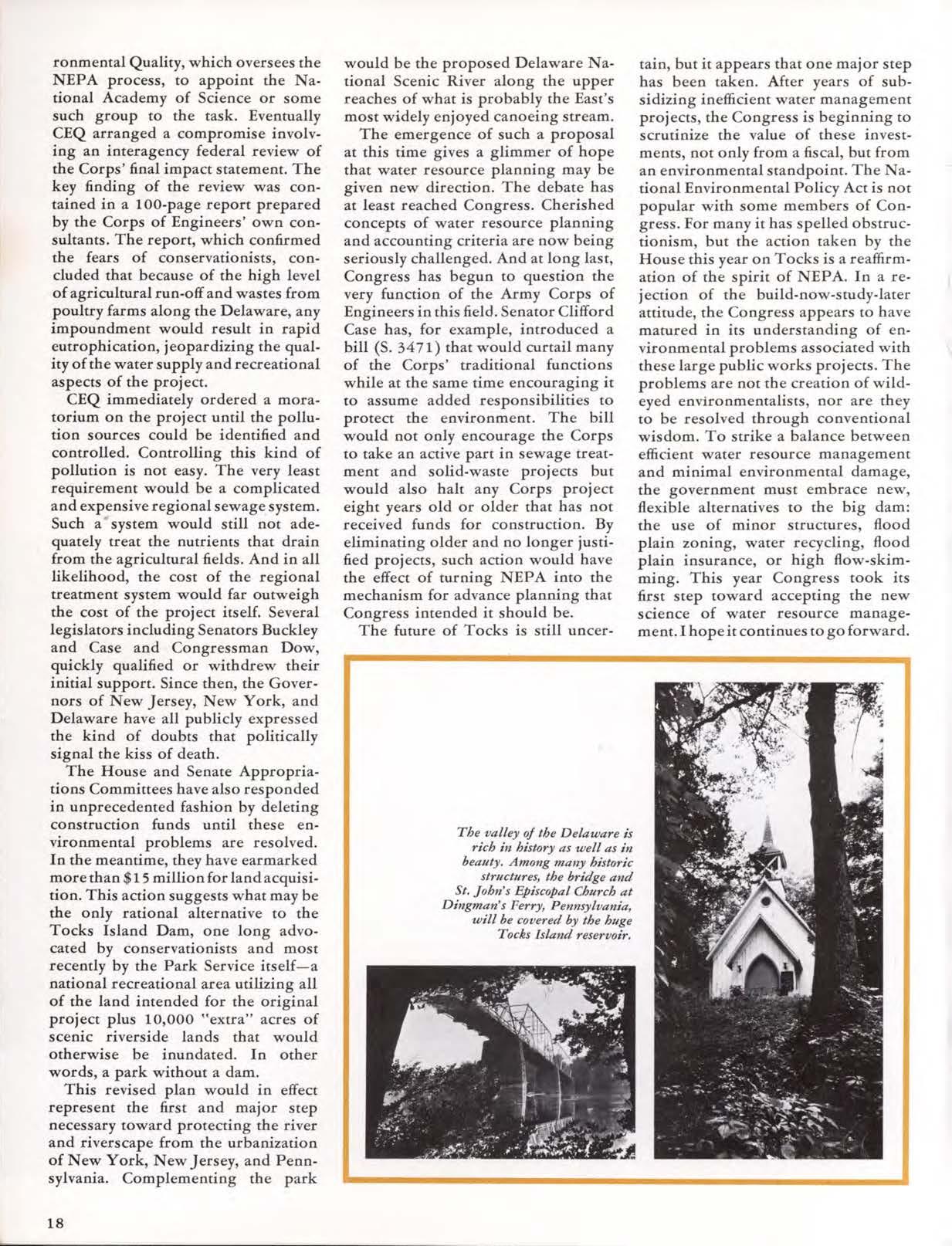
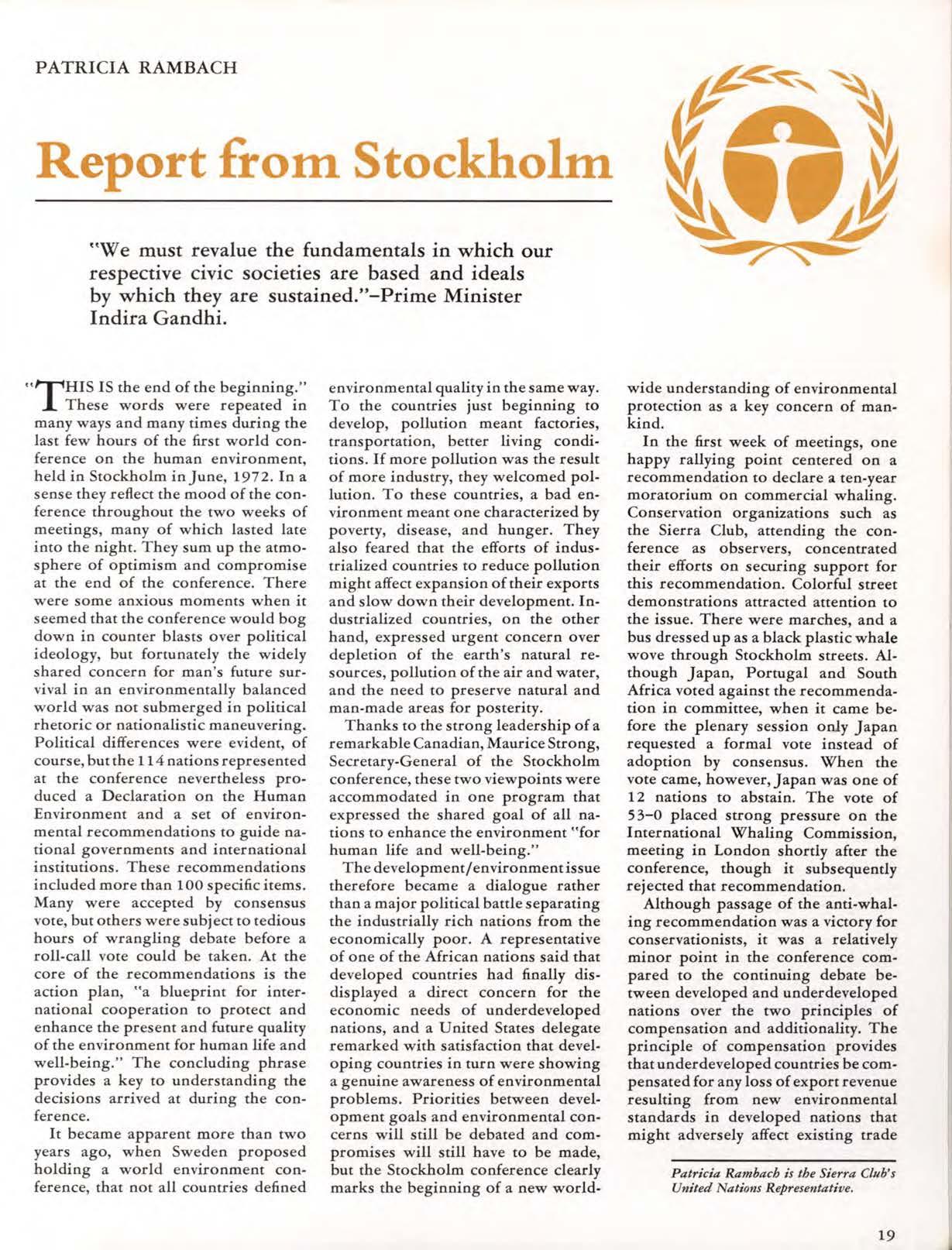
Th e valley of the Delaware is rich in history as well as ill beauty. Among many historic structures, the bridge a11d St. John's Episcopal Ch11rch al Di11gman's Ferry, Pe1111sylva11ia, will be covered by the huge Tocks Island reservoir.
tain, but it appears that one major step has been taken. After years of subsidizing inefficient water manag emen t projects, the Congress is beginning 10 scrutinize the value of these investments, not on l y from a fiscal, but from an environmental standpoint. The National Environmental Policy Ace is nor popular with some members of Congress. For many it has spelled obstructionism, but the action taken by the House this year on Tocks is a reaffirmation of the spirit of NEPA. In a rej ection of the build-now-study-lacer attitude, the Congress appears 10 have matured in its understanding of e nvironmental problems associated with these large public works projects. The problems are not the creation of wildeyed environmentalists, nor are they to be resolved through conventional wisdom. To strike a balance between efficient water resource management and minimal environmental damage, the government must embrace new , flexible alternatives to the big dam: the use of minor s tru crures, flood plain zoning, water recycling, flood plain insurance, or high flow-skimming. This year Congress took its first step toward accepting the new science of water resource management. I hope it coocinues to go forward.
Report from Stock olm
"We
must revalue the fundamenta l s in w h ich our respective civic societies are based and ideals by which they are sustained."-
Prime Minister Indira Gandhi
.
" T HIS IS the end of the beginning."
These words were repeated in many ways and many times during the lase few hours of the first world conference on the human environment, held in Stockholm in June, 1972. In a sense they reflect the mood of the conference throughout the rwo weeks of meetings, many of which lasted late into the n ight They sum up the atmosphere of optimism and compromise at the end of the conference. There were some anxious moments when it seemed that the conference wou l d bog down in counter biases over political ideology, but fortunately the widely shared concern for man's future survival in an environmentally balanced world was not submerged in political rhetoric or nationalistic maneuvering. Political differ ences were evident, of course, but the 114 nations represented at the conference nevertheless produced a Declaration on the Human Environment and a set of environmental recommendations to guide national governments and international institutions. These recommendations included more than 100 specific items. Many were accepted by consensus vote, but others were subject to tedious hours of wrangling debate before a roll-call vote could be taken. At the core of the recommendations is the action plan, "a blueprint for internationa l cooperation to protect and enh ance the present and future quality of the environment fo r human l i fe and well-being." The concluding phrase provides a key to understanding the decisions arrived at during the conference.
le became apparent more than two years ago, when Sweden proposed holding a world environment conference, that not all countries defined
environmental quality in the same way. To the countries just beginning to develop, pollution meant factories, transportation , better living conditions. If more pollution was the result of more industry, they welcomed pollution. To these countries, a bad environment meant one characterized by poverty, disease, and hunger. They also feared that the effor ts of industrialized countri es to reduce pollution might affect expansio n of their ex ports and slow down their development. Industrialized countries, on the other band, expressed urgent concern over depletion of the earth's natural resources, pollution of the air and water, and the need to preserve natural and man-made areas for posterity.
Thanks to the strong leadership of a remarkable Canadian, Mauri ce Strong, Secretary-General of the Stockholm conference, these two viewpoints were accommodated in one program that expressed the shared goal of all nations to enhance the environment "for human life and well-being."
The development/environment issue therefore became a dialogue rather than a major political battle separating the industrially rich nations from the economically poor. A representative of one of th e African nations said that developed co untries had finally disdisplayed a direct concern for the economic needs of und erdeveloped nacions, and a U niced States delegate remarked with satisfaction that developing countries in turn were showing a genuine awareness of environmental problems. Priorities between development goals and environmental concerns will st ill be debated and compromises will still have to be made, but the Stockholm conference clearly marks the beginning of a new world-
wide understanding of environmental protection as a key concern of mankind.
Ia the first week of meetings, one happy rallying point centered on a recommendati on to declare a ten-year moratorium on commercial whaling. Conservation organizations such as the Sierra C lub, attending the confer ence as observers, concentrated their efforts on securing support for this recommendation. Colorful street demonstrations attracted attention to the issue. There were marches, and a bus dressed up as a black plastic whal e wove through Stockholm streets. Although Japan, Portugal and South Africa voted against the recommendation in committee, when it came before the plenary session only Japan requested a formal vote inst ead of adoption by consensus. When th e vote came, however,Japan was one of 12 nations to abstain. The vote of 5 3-0 placed strong pressure on the International Whaling Commission, meeting in London shortly after the conference, though it subsequently rejected that recommendation.
Although passag e of th e anti-whaling recom mendation was a victory for conservationists, it was a relatively minor point in the conference compar ed to the contin uing debate between developed and underdeveloped nations over the two principles of compensat ion and additionality. The principle of compensation provides that underdeveloped countries be compensated for any loss of export revenue resulting from new environmental standards in developed nations that might adversely affect existing trade
Patricia Rambach is the Sierra C/J,b's United Nations Representative.
arrangements. The underdeveloped countries passed a recommendation endorsing this principle despite strong opposition by the US and other industrial nations. Under this proposal, for examp l e, the US could not stop importing high sulfur-content oil from Venezuela until it paid Venezuela for the prospective loss of income. The US, in opposing chis recommendation, argued that environmental programs in developed nations could not be made contingent on compensation arrangements. It further stated that it was willing to consider some compensation, but only by negotiation in given cases. Thus for the present, the developing countries achieved a rather hollow victory, perhaps at the expense of obtaining more realistic, viable concessions.
The principle of additionality provides that underdeveloped nations be
"Governments were asked to set aside biological preserves in a ll major eco logical regions as baselines to aid in research on t he ecological effects on pollution."
reimbursed for the costs of protecting the e nvironment in addition to whatever economi c aid they receive for development purpos es. They wish to th ereby ensure that such economic a id will not be diverted from its basic purpose.
For the first time at these meetings there was recognition openly expressed by the United Kin gdom char developed countries will have to assume additional costs if they wane co ensure that industri al growth is to be environmentally sound. The Sierra Club has strong ly supported the need for additiona l funds and will continue to work on new ways to make this principle more acceptable.
It is signi ficant that the developing nations , so long deprived of using their own natural resources and so consc ious of their newly won national sovereignty, also recognize the limits of these resources and the importance of preserving certain ecosystems. Thus , in a mood of mutual understanding, the conference recommended that there be an exchange of information on mining practices, including to·
formation on restrictions which should be imposed on mining in certain locations and on ''the environmental conditions of mine sites."
The importance of natural reserves of various sorts was stressed in a number of resolutions. Governments were encouraged to enter into treaties to protect representative ecosystems of international significance. In addition, governments were asked to set aside biological reserves in all major ecological regions as baselines to aid in research on the eco logical effects of pollution. The urgency of protecting these and other areas to conserve wild stocks of generic material - gene pools -was stressed in a surprisingly full set of resolutions.
In related resolutions, the conference recognized that declines in the numbers and varieties of wildlife may have an ultimate effect on human life as a result of pollution and loss of generic diversity. In a turnabout from the initial drafts emphasizing economics, Japan successfully amended the provisions dealing with worldwide forestry to underline the importance of forests in conserving soil, watersheds, wildlife, and recreational valu es, and it called for res earch to provide better understanding of the relationship between the forest biomass and the well-being of the earth 's biosphere.
The conference also called for a shift from chemicals to control agricultural pests to an integrated approach emphasizing biological contr ols. In addition, the conference called for recycling of crop and animal wastes, including us e of soils for sewage waste disposal.
Io a number of resolutions, the conference pointed to the need for more research to identify envi ronmenta l problems, particularly in the less developed countries. Ir asked for pilot srudies ro demonstrate how alternative approaches to resource development would work in representative ecosystems; for improved systems of economic and social cost -ben efit analyses co eva luate these alternatives; a nd for economic and technical a id in adopting chem. Int ernational assistance agencies were in structed to incorporate environmental impact considerations in their processes for d e t ermining where and w h en to m ake grants , and the Secretary-General was directed to seek out international aid projects affecting ecosystems of in -
"The conference also called for a shift from chemicals to an integrated asproach emphasizing biological controls."
ternational significance to work out methods of conducting post-audits of their impact and, wherever feasible, advance assessments of this sore. These two recommendations could be rhe bases for what could grow into the UN equivalent of the US's NEPA pro cedure. Underdeveloped countries also perceived that e nvironmentalism might bring them some immediate economic benefits and asked for emphasis in world trade on the use of natural, instead of synthetic, products and labor-intensive modes of production which minimize the drain on energy resources.
Another recommendation provided for monitoring the effects of energy use and production, especially the emission of air pollutants, oil spills, and radioactivity. The conference also adopted recommendations on pollution calling for new monitoring systems, research, and high er standards. One program which will get under way quickly is the so-called "Earthwatch," which will moo i cor changes in the environment that are international in scope and serve as a warning system. This includ es measuring the amounts of pollution in the oceans and air, the paths traveled by pollutants, and so on.
The conference rejected efforts to weaken language calling for accelerated family planning programs to stem the population explosion, and adopted a recommendation, which sharply divided the industrialized countries from the poorer nations , to establish a voluntary fund to improv e housing and remove slums. Oo this issue, the representatives of China evoked gasps from the other delegat es by l eavin g the conference hall b efore the vote on the new fund was taken. H aving pushed to become rh e spokesman for the Third World, China instead be gan to assume the gadfly role
"China's walk-out left it in a strange and isolated position."
chat Brazil had assumed. China's walkout left it in a strange and isolated position.
Much protest acrivity, inside and outside the conference, focused on the impending nuclear test planned by France for the end of June in the South Pacific on Mururoa atoll. The countries that could be affected by the blast, especially Peru and New Zealand, led the debate calling for the abandonment of all further nuclear tests, whether in che atmosphere or not. France and China however remained adamant in their determination co continue testing for national security reasons. Debate on this issue carried over into the private working group meetings where it resulted in a Declaration on the Huma n Environ-
"St ates have accept e d the responsib ility t o ensur e that thei r ac t ivi ties do not damage the environment of other states."
meat. Conference planners had hoped to avoid extensive debate at the world meeting, but China had not taken pare in the advance negotiations, and ocher countries were not fully satisfied with the draft prepared for the conference. Therefore, the weary delegates were forced to establish a special working committee, which met through the weekend and often late into the night co redraft the declaration. In addition to Peru ' s efforts co strength en the principle that called for the cessation of all nuclear testing, African states also introduced the apartheid issue into the declaration discussions. I o a cliff-hanging series of meetings, with the outcome an uocerraioty until the last hours of the conference, a compromise declaration was finally produced.
Many environmental organizations bad been disappointed with the original draft declaration because, among other things, it was not specific enough in its concern for preserving a balance between nature and human devel opments. The declaration, passed by acclamation, is even less acceptable in chis respect, but in the long negotiating sessions the environmental viewpoinc was frequently supported over delegate objections that were more often than not based on political mo-
tives. This resulted in a number of forward seeps.
The declarati on lists 25 principles on which future action shou l d be based. One principle stands out as a major breakthrough in international cooperation . States have accepted the responsibility co ensure chat their activities do not damage the environment of other states. This princi p l e of state responsibility opens the way for industrialized cou ntries co cake a l ea ding role i n advancing environmental goals by accepting ooc only r espons ibility, but also b y developing procedures for the settlement of en vironmental disputes, for example, by mediation or third- parry negotiation. The Sierra Club intends to work for this approach and will also encourage the practice of issuing annual reports on the state of the nation's environment.
Ocher principles ca ll on governments to protect and im p rove the human environment, assert that "the natural growth of population continuously presents problems for the preservation of th e environment, ... and urge that the discharge of toxic substances be halted to prevent irreversible damage to ecosystems."
The declaration also recommended the establishment of ongoing international machinery, including a governing counci l of 54 member states which would sec policy for international environmental cooperati on and a small professional secrecar iac co
" Much prote st activity
insid e a n d outsid e th e conferen ce foc used on th e imp e nding nucle ar t est p l a nn e d b y France. . . ."
carry out programs and coordinate environmental activities within the United Nations system. The executive director who would head chis secretariat would be responsible for longrange planning of UN programs in the environmental field. He will also admin ister the new env ironment fund established, on the initiative of the United Scates, to provide for financing of i nternational environmental programs. The amouoc of t h e fund h as been set at $ 100 million for five years, woefully inadequate at the outset to
"One p r ogra m . .. is ' Earthw atch,' w hich will monitor changes in the environme nt that are int ernationa l in s c ope and serve as a warning syste m ."
cover all of the projects recommended in the acti on plan. The conference secretariat es timates chat these would requ i re at least $167 mil li on. The United Scates has p ledged a contri b ution of $40 million over a five -year period. Oth er co u ntries, including Australia, Canada, Japan, the Netherland s and the United Kingdom, have pledged amounts that bring the t otal co more t h an $60 million. An environmental coordinati ng board will be set up to help ensure coordination of UN activi ti es.
Ao essential ingredient in international envi ronment protection i s the acceptance of strong internat iona l convent ions co set standards and control h aphazar d u se of th e world's resources. Ther e was disappointment th at a number of s u ch conve ntions cou l d not b e completed i n time to be announced at the confer ence. O n ly the Convention on the Conserva tion of Wetlands o f Internacional I m p ortance will soon be ready for signing. The Convention co Ba n D ump i ng o f Poisonous Substances into the Oceans was me n ti oned i n de b ate but is not yet ready fo r s i gni ng and will be negotiated further at a m eeting in London this fall. T h e Un i ted States ope n e d up a new iss u e at t h e conference b y s u ggesti ng exemption of th e military from pr oposed d umpi ng regulations-a dangerous precedent if accep ted. The D anish Minister for Environmental P r otection stresse d the i mportance o f curbing ocean dumpi ng at the conference. H e annou nced that 1 2 Europea n states h ave agreed to a regional convention on d um p ing and urged that there be a global agreement to protect w h at is the "co mmon pro p erty" of all manki nd. T h e World H eri tage T rust co n vention, still a draft, h as been broadened to protect both natura l and man-made areas and m i ght be ready for signature in November, 1972. The Convention co Pro tect Endangered Species will be discussed again in the meeti ng to be
called by th e Un ited States in the fall. Negotiations for a Convention to Set Aside Certain I s land s for Sci e nc e have slowe d down co await further UN s cud y
Ac the h e ight o f conference negotiations, i nterest was di verced one afterno o n by an un official proposal, pre-
"The outcome of this conference makes clear
that organizations like the Sierra Club have a new warrant to use in building greater environmental awareness throughout the
world ."
seate d to M a uri ce Stron g by members of an American co mmun e, th e Hog Farm, which called for a ten-year moratorium on the " hunting, killing, and environmental poisonin g" of th e mo st endanger ed speci es of all - Homo sapiens. Th e ir cry was one of many in the meetings h e ld in other forums surrounding th e conference that protested aga inst ecocidal warfare, in p arti cular th e war in Inda- China. Except for C hin a, h owever, there wer e only sporadic effo rts within the co nference itself to discuss war and disarmament i ssues. T h ese h ad been care full y set as ide for debate in ocher i nternational forums.
Although population issues were not d ealt w ith by the conference except in terms of human serc l eme nc probl ems, they were forcefully debated in the neighboring Environmenca l Forum where nongo vernmental organizations, individuals and so m e government spokesmen met in workshop sess ions on these i ss u es and oth er politi ca lly controvers ial subj ects. It was at the En vir onmenta l Forum that Barry Com mon er and Paul Ehrlich held a ngry exch a n ges on populati on growth and Third World developmenc problems Nationalistic Swedis h g roups domina ted anoth er forum where th ey sponsored speeches condemn in g th e capitali stic syscem as the ca use of environmental decay. They al so provided p oetry readings an d oth er e nt ercainm ents for th e thousands of people from Sweden and e lsewh ere who had co m e to the conference city. Perhaps i f th e Soviet Uni on and most of t h e Ease European states h ad
be en pr esent, th e diatribes against western political systems and the i nsistence on maintaining national sovereignty would have been stronger.
T his may h appen of course, when environmental planning begins to cake shape w ithin the UN The Eastern bloc countries did not attend the conference in p rotest aga in st the excl usion of East Germany, which bad n ot qualified for representation under the technical ruling approved by the UN gener a l assemb l y.
T h e outcome of this conference makes it clear that organizations like the Si erra Club have a new warrant to use in building greater environmental awareness throughout the world Th e Si erra Club , and citizen groups ch at formerly h ad little concern with environmental matters, b u t that have s uppo rted United Nation activities, were encouraged by Maruice Strong co reshape their present activi ties to become a vital ad junct co future international environ ment al cooperation.
HIGHLIGHTS OF THE STOCKHOLM CONFERENCE
0 R ecommended a permanent highl evel environmenta l unit to coordinate UN activiti es and a UN Environm e nt al Fund of $100 million over the first five years
D Urged the signing of an I nternacional Convention co Restrict Ocean Dumpin g
0 Re commended steps co cue down on th e release of d angerous pollutants inc o the e n vironment.
D R ecomme nd ed a global "Earchwatch" pro gram to monitor enviro nment trends in the air, oceans, on the land, a nd for human health.
D Urged com plet ion of ocher conservation conventions.
D Called for intern ational efforts co co ll ect and preserve t h e world 's genetic resources.
0 Urged a ten-year m oracorium on commercia l w h aling.
D R ecommended che creation of an Environmental Referral Service to h elp exc h ange environmental knowhow a mong all coun tries .
D Sou g ht to prevent national environmental action s from creating un-
The conference opened doors to stronger citizen involvement. It is up co the Sierra Club and others to se i ze th is special opportunity
Prim e Minister Indira Gandhi of Io dia, in her speech before the plenary conference, pointed to perhaps the most significant factor that has begun co emerge from the confe r ence and from all the debate of the past few years. She said: "We must revalue the fundamentals on which our respective ci vic societies are based and ideals by which they are sustained. If there is to be a change of h earc, a change of direction and methods of functi oning, it is n ot an organization or a co untryno matter how well intentionedwh i ch can achi eve it. While each country muse deal with that aspect of the problem which i s most relevant co it, it is obvious chat all countries must unite i n an overall endeavor. There is no alternative to a cooperative approach on a global scal e to the entire spectrum of our problems."
fair trade barriers against exporcs of developing countries.
0 Urged higher priorities for environmenta l values in international aid programs.
D Urged more emphasis on population policy and aid for family planning in areas with environmentally harmful population growth.
D Asked governments to establi sh bio lo g i cal reserves in major ecological regions co aid research on the ecological effects of pollution.
D Called for research on the rol e of forests in the earth's biosphere
D Urged a shift from chem i ca l control of agricultural pests co a mor e in tegrated approach emphasizing biolog i cal controls
D Instructed international assist• ance age n cies to use environmental impact statements as cools for determining how and where to allocate assistance funds.
0 I nstructed the Secretary-General to co n duct post-audi ts on the environmental impact of significant international assistance projects.
0 Agreed on che D eclaration of Hu man Environment containing new principles to guide future i nternational environmental action, including the principle that states are responsible for damage to the environment of other states or incernational areas.
NewsVit~w
Club wins restratining order in wi ld er n ess smit; is countersued
A federal district judge in Washington, D.C., has issued a temporary restraining order halting issuance of any n ew contracts for logg i ng or other development i n wilderness inventory areas throughout the country. The order, affecting over 50 million acres, will remain in effect pending a hearing for preliminary injunction.
The Sierra Club, Natural Resources Defense Council, North Cascades Conservation Council and Colorado Open Space Council filed su i tJune 16th against Secretary of Agricultur e Earl Butz and Forest Service Chief John McGuire seeking to hale any incursions; into the last remaining large units of undeveloped national forest land u1ntil the areas are studied for possible inclusion i n the wilderness sys-cem.
The Forest Servi,~e has been conducting a mammoth, nationwide study to d etermine which of these l ase "de facto wilderness areas " in the national forests will be preserved and which will be developed. Those areas which had not !been recommended for further wilderness study by June 30th w,ould have been subject to immediate development, includ in g logging, road-building and other acti vities which would permanently destroy their wilderness character. The Club cont e nds the review has been grossly deficient, with insufficient opportunity for public participation, too li ttle time co conduct the studie:s, and failure by the Forest Service to ,:onsid er many known wilderness ar,eas for possible preservation.
The day after the restraining order was issued, the W escern Timber Association and seven timber companies slapped a $20 million countersuit on the Club, charging that its suit would cost the lumber companies $10 million. They added another $10 million in punitive damages. Si erra Club President Raymond J Sherwin called che timb er association's action a "ploy to muddy the issues " and a "frivolous suit, " and poioced our char the restraining order does not interfere with any existing contracts, but applies only to future ones. Further, i c affects only those areas of de facto wilderness of 5,000 acres or more char were inventoried by the service and on which sal es are scheduled. "This appears to be an effort on the part of che timber industry to intimidate us in order to prevent our talking to the Forest Service about what industry does to public lands, " Sherwin said. "Do they think the only people entitled to talk about the use of publi c lands are those in the timber industry?" He also noted that if the C l ub wins its case, the court, nor che Sierra Club, will be stopping future timber sales. "And i f we lose, chen there is only the slight delay imposed by the restraining order. "
Coast initiative w ins spot on California ballot
The initiative to protect California's coast has won a spot on the Novemb er ballot. The 3 2 5,000-signature requirem e nt was surpassed by a substantial margin, thereby permitting che people to determine the
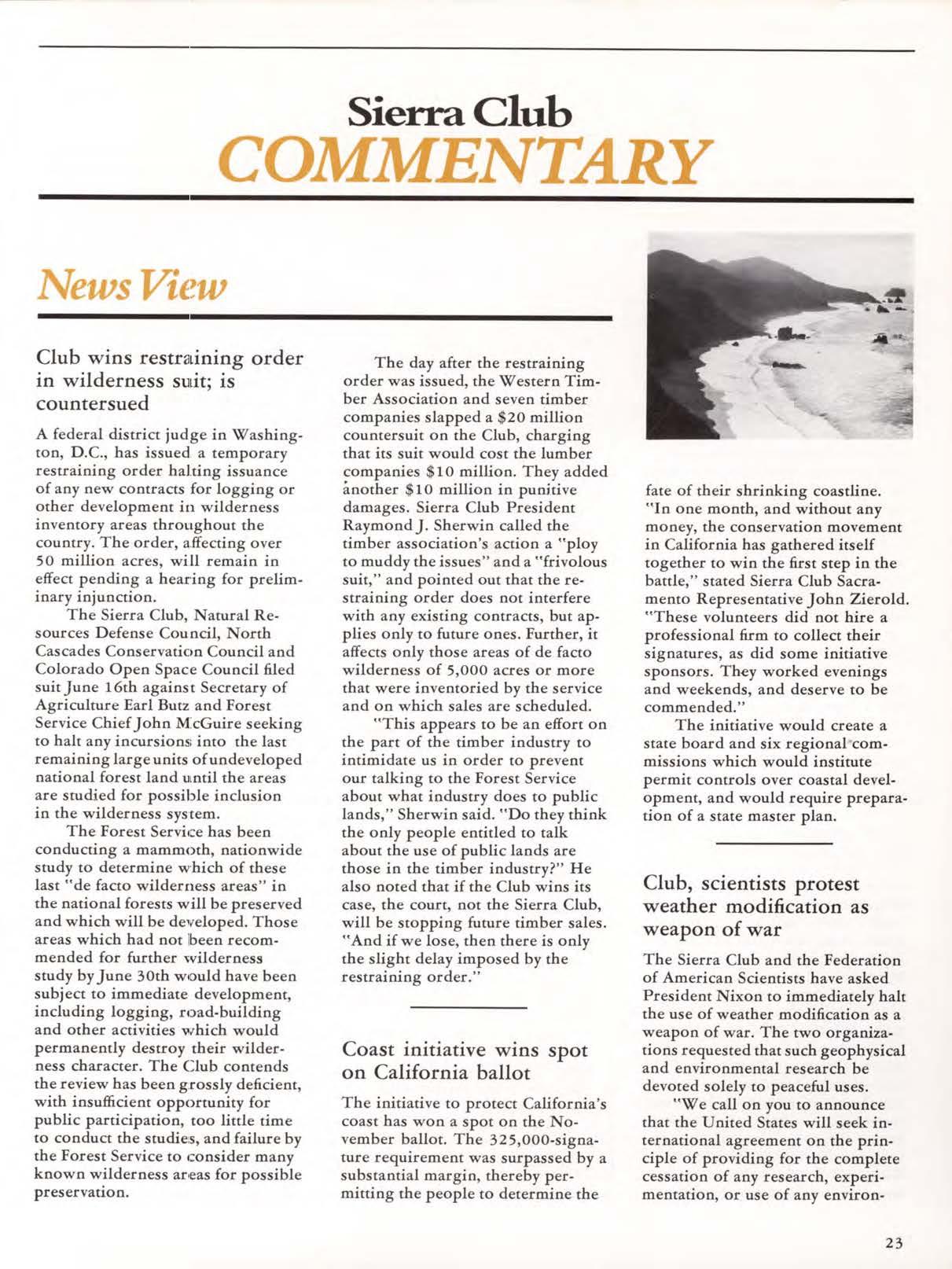
face of their shrinking coastli ne. " I n one month, and without any money, the conservation movement in California has gat h ered itself together to win the first step in the battle," s tared Sierra Club Sacramento Representative John Z i erold. "These vol u nteers did not hi re a professional firm to collect t h eir signatures, as did so m e initiative sponsors. They worked evenings and weekends , and deserve co be commended."
The initiative would create a scare board and six regional commissions which would institute permit contro ls over coastal development, and would require preparation of a stare master plan.
Club, scientists protest
weather modification as wea pon of war
The Sierra Club and the Federation of American Scientists have as k ed President Nixon to immediately hale the u se of weather modification as a weapon of war. The two organ iz ations requested that such geo ph ys ica l and environmental research be devoted solely to peaceful u ses.
"We ca ll on you to announce that the United States will seek international agreement on th e principle of providing for the complete cessation of any research , exp erimentation, or use of any environ-
mental or geophysical modification activity as a weapon of war," states a leccer signed by Club President Raymond J. Sherwin and Federation C h airman Marvin L. Goldberger.
The request came in response co recent reports th at the United States has been seeding clouds over North and South Vietnam and Laos to i ncrease and control rai n for military purpos es.
T h e groups' concern about the use of weather modification is based on two grounds: first, it violates the D eclaration of the Unite d Nations Conference on the Human Environment adopted last month in Stockholm which declares that "states ... have the respons i bility to ensure th at activi t ies within their jurisdiction or control do not caus e damage to the environment of other states;" and secondly, the effects of weather mod ification are almost totally unk nown but could have serious consequences.
D r. Goldberger, former chairman of the Strategic Weapons Panel of the President's Science Advisory Committee under President) ohnson, h as long been involved at the highest l evel in advising the government on weaponry matters.
The federation is a 26-year-old public servi ce organization of scientists and engineers, including more than 20 Nobel Prize winners and former officials from a ll major government agencies I ts goal is co make science serve soc iety.
Club granted standing to sue in Min eral King case
A federal district judge in Sao Francisco h as granted the Sierra Club's morion to amend its complaint in the suit to halt Disney Productions ' planned resort complex in Mineral King.
T h e motion to amend was filed in response to the Supreme Court's ruling th at the Club's original complai oc alleged insufficient faces upon w hi ch to base standing co sue. The Club examined its int erests in and hi storic u se of t h e area, and now has reworded its complaint to point out that its chapters and members regula rl y conduct outi ngs in M i neral King, and that its "esthecic, recreational and e n vironmental interests"
Editorial
"C ONGRESS will only pass our bills when there are enough people in Congress who believe in our cause." This is a truism which has long been accepted by most groups advancing legislation, but for varied reasons environmentalists have been slow to absorb its meaning. Like most truisms, it somewhat oversta tes the case. Sufficiently aroused public opinion can sway fence-sitters. But the reverse is certainly the case: we can get nowhere with a hostile Congress. Our troubles with the House of Representatives in the 92nd Congress show how true this is.
Congress, of course, has wanted to keep citizen groups who influence legislation from also try in g to influence eleccioos as well. To be exempted from paying taxes on income they receive, Congress has required that non-profit groups such as the Si erra Club must agree co stay completely out of the elective process. This requirement, however, should not induce a blind spot in our percepcioo of the real world in w hi ch decisions affecting the environment are made.
Much of the success of our legislative program rides oo the outcome of each election, and this is particularly true this fall. Because the Club has to stay out of the election, each dub member individ u ally must bear an even greater responsibility. Each member should find his or her own way to make our environmental beliefs felt in elections.
First, examine the record of the candidates. The Builetin reports votes on some pivotal issues. The League of Conservation Voters (324 C Street S.E., Washiogcon, D .C. 20003) provides a good record of key votes by members of Congress. Comparable groups exist in many states to evaluate the record of legislators. Read books such as Nixon a11d the Environment (New York: Village Voice Books, 1972). From such sources, fiod out who our friends are and who is consistently against us. Be sure to base your evaluation on a representative group of voces over a number of years so that exceptions do not distort the pattern.
Second, find a way to help the candidates with good records. If you are a constituent, do all the th ings that count most: contribute financially, help with ca n vassing, offer to do research, and to write and make speeches if you are able. In doing this, make sure tbe candidate and his staff know you are doing it because of your candi d ate's environmental stands. If you are not a constituent, you may still be able to do these things for a nearby candidate; in any event , don ' t fail to make a campaign contribution (with i n limics they are deductible).
Where an in cumbent with a bad record has no really outstand i ng challengers, it may still be important to become involved. Because such incumbents often have seniority, they are chairmen of committees handling environmental legislation. If they are not re-elected, someone else wi ll become chairman who may not be such a bottleneck on the committee, even though the newly elected Congressman may be no great improvement. It is important also to soften up incumbents wit h poor environmental records by criticizing them at election time when they a r e vulnerable and more inclined to listen. Ask them challeng, ing questions at public meetings; write letters to editors for publication; encourage their critics.
Finally, become involved in the political process in a permanent way. Electoral patterns are not going to change overnight. It takes a sustained effort. Start participating locally in the political party of your choice. Lobby it to improve its environmental stance. Stay with the effort so that you can grow to have influence in it.
Though the Club is handcuffed as far as elections are concerned, the point is that you are not. 140,000 aroused members could have a profound impact i n November.
Michael McCloskey, Exec11tive Director
A chance tc>' enjoy Wilderness,. · to better understa'rio it to aid in its prot.eG _i o through The Sierra Cluo .......

"To protect and conserve our natu1ral resources, to w1dertake and publish scientific and educational studies concerning aU aspects of man's environment, and to educate people to the need to preserve and restore the quality of that environment and the integrity of those ecosystems."
I wish to support the purposes of the Sierra Club. Please make me a member and bill me according to the class indicated below. (Additional members other than spouse use separate form.)
Mr. Mrs. Miss NAME Mr.&Mrs.,____________________________________
ADDRESS
Please allow fa11r to six weeks far processing.
Dues include subscription to the Sierr:i Club Bulletin (SJ) and chapter publications (S1). "Admission fee is waived for junior mcmbers,f111/-1i111c students through age 23, and life m~mbers.

would be inju red by conversion of the area into a ski de,velopmenc. The Club also alleges that over the years ic has conducted conservati on campaigns to have Miae:ral King i nclu ded in Sequoia N:at ional Park. These "all egations fall well w i th in what we interpret to be the meaning of the Supreme Coun opinion on this subject of standing requirements," Ju dge William T. Sweigert wrote in his order.
In addition, the amended complaint adds nine i nd i viduals and the Mineral King District Associ ation, an organization of local cabi n owners, as plaintiffs. It also adds a new cause of action under the National Environment Policy Ace by alleging the defendams have failed co prepare an enviro1nmental impact statement, a study of alternatives or a cost-benefit analysis ,of the proj ect.
Cen
tur
h a lt e d
y Freeway work
The U.S. District Courc in L os Angeles has ordered che state of California to hale work on che proposed 17-mile Century Freeway, running between the Los Angeles Airport and Norwalk. T h e court issued a preliminary injunction July 7th and ordered the state to prepare an environmenra l impact statement, to hold new hearing:s o n air and noise pollution, and 1to prepare additiona l studies o n rel,ocation procedures.
The suit was filed by the Sierra Club, Envi ronmental Defense Fund, the NAACP and otht:rs last February against officia ls of th.e Department of Transportati on, the Federal Highway Administra1ti on, the California Highway Commiss ion and the state Department of P u blic Works. Attorneys in the case hailed the order as a "complete victory," and said, "This may mark the end of the freeway era in the Los Angeles metropolitan reg i on." Added Sierra Club Southern California Representative Larry Moss, "This is the most r esou nding decis i on i n volving a freeway anywhere. '' '
Despite the injumction, the judge said the state cou ld buy r i ght-ofway property from tine indivi duals and businesses who '"free l y and voluntarily" decide t•o leave the
route's path. H e emphasized his order would not determine the future of the freeway, b ut left ics fate in the han d s of federa l and state agencies. As proposed, the freeway wou ld run through ei ght comm unities, including Watts, would cost some $530 milli on and wou ld displace 21,000 peop le.
Ca n ada re j ects
Vill age La ke Louise
The Canadian government has rejected a $30-million project that would have created a huge recreational resort in che heart of Banff National Park. (See "Downhill at Lake Louise," Sierra Club Bulletin, Apr i l, 1972 ) Mini ster of Northern Development J ean Chretien called the prop osed deve l opment "too large," and said, "It would result in undue concentrati on of visitors and residents in the area " Village Lake Louise, Ltd., a private company owned in part by Standard Oil of New J ersey, had proposed to build a luxurious tourist town capab le of accommodating 8,500 sk iers, and new overnight accommodations for at least 3,500.
The proposal had spark ed the i re of Canad ian conserva t ionists, w h o argued that Banff's celebrated mounta i n scenery shou ld not be spoiled b y ski runs and other modern tourist facilities.
Supr
e m e Cour t
de ni es
a ppea l co bl o c k St o r m Kin g
By a vote of eight to one, the Supreme Co u rt struck down conservationists' appeal to block construction of the St0rm King pumped water storage plane in New York. The Scenic Hudson Preservation Conference, the Sierra Club, and fo u.r ot h er petitioners had asked the co urt to review a Court of Appea ls ruling which upheld issuance of a construetion license by the Federal Power Commission. With Ju stice Willi am 0. Doug las dissent i ng, the court declined tO review that decision.
However, the seven-year battle is far from finished, since a second s u it challengi ng a state -issued water quality standards certificate is
pending in the New York Appellate Court. The s u it brought before the Supreme Court asserted that ch e p l ane would despoil the scenic beauty of the H u dson River highlands.
Cro-Co
n Ca n a l f o llo wup
In the June issue of the Bulletin we publis h ed Jonathan Ela's delig h tfu l poke at the US A.rmy Corps of Engineers, "From Sea co Shining Sea or Through the Rockies at 3 1 Knots. " The story described an alleged corps plan to build a crossconcinencal barge canal wide and deep enough to carry our bi ggest aircraft carriers from Bost0n t0 San Diego or Seattle.
Response co the piece was mixed. I n a wire service article which appeared i n major dailies across the country the story was described as "a piece of satire in che best tradition of Mark Twain." One reader, Dean McLaug h lin of Aon Arbor, Michigan, wroce to say that the proposal was "ill considered" and offered a number of amendments co ic including:
" no considerati on bas been given to the unmistakable benefits that would obtain from alternative routings. For example, nowhere do I find meocion of flooding Death Valley, or tunneli ng through the Si erra in the vicinity of Mt.Whitney, both of which would y ield tremendous economic return t h rough the improvement of conditions among Owens Valley tobacco growers.
"I would also urge to your attention the advantages of a causeway t0 Hawaii , for the purpose of improving rail service, and the installation of a subway between Tierra del Fuego and Tristan de Cunha, co faciHcate evacuation of chat island should it again become necessary.
"Finally, I propose that Mt. Vesuvi us should be plugged and a valve installed, so that future er uptions can be scheduled more conveniently for the benefit of tourists."
The response of the corps itself was good natured, even though the satire may well come back co haunt them. A spokesman put it this way: "I'm sure we could build a crosscontinental canal, buc I don' t think the country is ready for ic. "
Regional Reps' Reports
MIDWEST
It may seem odd that controversies should be mounting in regard to as venerable an institution as the Mississippi River, but the fact is that decisions are being made right now that will determine whether Old Man River will be increasingly exploited and degraded for commercia l profit, or whether it will be revived and saved.
The diversity of approaches toward management of the Upper Mississippi - upstream from about Sr. Louis - can be seen in the list of studies either recently completed or currently. being conducted by various governmental entities:
• Upper Mississippi Basin Comprehensive Study.
• Upper Iowa Wild and Scenic River Study.
• Lower St. Croix Scenic River Study
• Northwest IlJinois-Northeast Iowa National Recreation Area Study.
• Year-Around Navigation Study.
• Mississippi River-Lake Superior Connection Study.
• Twelve-Foot Channel Study.
• Upper Mississippi River National Recreation Area Study.
Several of these deserve commeor. The Upper Mississippi Basin Comprehensive Study is river basin planning at its bulkiest, having resulted in a multi-volume report outlining the various present and projected uses of the entire watershed, and all of the water resources required to sustain those uses. An Upper Mississippi River Basin Commission has just been established co further the work of the task force that prepared the report, and this commission may in che future represent a dangerous developmental th.rust chat will destroy the natural values that remain in the Upper Mississippi.
Two of these studies are being conducted by the Corps of Engineers, and represent the interests o f the
dominant exp loiting use of the river, barge navigation. These a re the studies for extending the navigation season (analogous to a parallel study being conducted on the Great Lakes), and the proposal to deepen · the navigation channel from nine to 12 feet. Both of these projects contain the potential to ruin noncommercial resources, and both represent an unfortunate intensification of the exploiters' cl.rive to convert the river to a single use.
The most exciting proposal concerning the Upper Mississippi is the concept of an Upper Mississippi River National Recreation Area. Originally spelled out in legislative form in H.R. 5468, the concept has a grande ur that matches that of the river itself. The recreation area would screech from Minneapolis co St. Louis, a distance of 660 miles, and consist of the following components:
214,000 acres currently under public ownership
+ 300,800 acres co be acquired in fee tide
= 514,800 acres total fee ownership
+ 73,700 acres to be placed under easement
= 588,500 acres land in fee and easement
+ 390,000 acres water
= 978,500 acres land and water in fee and easement.
This proposa l woul d protect the magnificent Upper Mississippi bottomlands-sandbar s, islands, sloughs, inlets, and other interesting features - while at the same time give visual prot ection co the towering bluffs that rim the valley in the northern section.
Uafortuoacely this proposal has barely seen the light of day, as the bill's a uth or, Congressman John Kyl of Iowa, h as repudiated th e concept by introducing H.R. 10529, a substantially altered version of the NRA. The scale of the proposal was greatly reduced: fee acquisiti on dropped from 300,800 acres to 55,300, and the 73,700 acres of easement were virtually eliminated, with only 3,500
acres remaining. The bulk of what is left in H.R. 10529 is water, and the 2 1 4,000 acres currently in state parks, Corps of Engineers management, and two national wildlife refuges. In terms of acreage, it is dear that the only legislation currently before Congress, the Kyl Bill, is woefully inadequate.
There is a further problem that may be of even greater importance. Under the provi sions of H.R. 10529, the Corps of Engineers essentially retains its supremacy in the management of the river. Cynics even poinc out that much of the acreages pecified in the Kyl Bill consists of islands that would ha ve to be acquired anyway in order to construct the 12foor channel referred to above. The corps can hardly. be ousted from the Mississippi Valley at this time, but any national recreation area proposal must truly protect the river and must modify in a significant way the mandate under which it has been managed to dace.
The reasons for these modifications are money, and the political power of the corps. The original NRA proposal would be enormously expensive, requiring as much as half a billion dollars for acquisition and development. When the amount of visitor use is considered, however, it begins co look like a bargain, as it bas been estimated chat as many as 100 million visitor days might be recorded an nu ally by the year 2000. Stack ing the deck in favor of the corps is an old tradition in Mississippi Valley politics, and is one of the major obstacles to any kind of river preservation.
The Nixon Administration h as evidently co me down solidly for the status quo ante. At h earings held in June on H.R. 10529, administration witnesses recommended no action "for the present time" and disingenuously suggested that pending land-use l egislation could do the job just as well. Even half a loaf is evidently too much for the White House, th e Office of M anagement and Budget, and the related political cronies of each to swallow. On the other hand, James Curtis of t h e Iowa Chapter of the Si erra Club strongly urged that the recreation area concept be expanded to something more similar to the original proposal.
Washington Report
CW. Lloyd Tupling
ONSERVATIONISTS have long he l d t h at the multipl e uses for which national forests exis t are p retty well limited to timber, forage, recreation, wildl ife habita.t and watershed protection. But a recent report from the joint economic committee spotlights another major use of national forestsenhancement of profit s for a few large, integrated timber corporations.
The revel ation i:s contained i n a July 15, 1972, compendium of papers for the committee, entided " T he Economics of Federal Subsidy Programs." A section on th e federal tax subsidy of the timber industry, authored by Emil M. Sunley, J r., an eco n c,mist with the Office of Tax Analysis of the Treasury D epartment, shows that capital ga ins from timber cut on federal land are a significant factor in t h e :S 130-million to $ 1 4 0-million tax subsidy enjoyed annually by the timber industry.
Sunley points ou.t that virtually a ll inco m e from growing timber is eligibl e for taxation at the preferential capital gains rates, rather than ord i nary income. "Tax data indicate that large int egrated corporations wi th significant amounts of income from logiging, lumber, plywood, pulp and various paper products are able to shift nearly all their i ncome inco th e lightly taxed capital-gains category," Sunley reported. This means that t h e income is taxed at a 30 percent rate, rather than the ordinary corporate levy of 48 percent.
Th e fact that timber companies get long-t erm capita l gains benefits from national forest timb,er, as well as th e ir own timber, is not widely known. So long as the timber contract with the Forest Ser vice bas been in effect for at least s i x months, capital gains benefits are available to the purchaser. "The typical purchaser does nothing until he has owned the timb er or held the right to cut the timber for the :six month period necessary to qualify for capital gains treatment, " Sunley r,!ported.
T his helps to explain why t he volume of federa l timber under contract for cutting is mor e than double the an nual allowabl e cut. Pur chasers delay cutting to maintain a flow olf capital ga ins benefits.
Sunl ey p oin ts ou1t that th e indire c t subsidy to th e timber industry ha s three main components: (ll ) the capital gains treatment of income derived from the increase in the value: of standing timber; (2) mismatching of income and expense; and ( 3) the conversion of ordinary in come into capital gains.
" Though Congr·ess inte nded to extend capital gains treatment to the income from growi ng timber, Congress did much more than that ," Sunley d eclared. " A major portion of the costs nec essary to grow and carry timber may be deducted currently even though the income is recognized for tax purposes only wh e n the timber is sold, The current deduction reduces income from logging or manufac1:u.ring which otherwise would be taxed at ordinary races and increases the gain on the lat er sale of timb er whi ch is taxed at capital gains rates. In short, the ta1x law permits mismatchin g of income and expense which results in a conversion of ordinary income into capital gains.
"There is no compelling evid ence t h at the timber tax subsidy i s effective in increasing the suppllies of timber or in encouraging conservation," he said , "extendi ng capital gains treatment to public timber has no relationship to conservation or good forest manag eme nt. "
" The timber subsidy," he added, " may encourage the cutting of new t imber rather than the recycling of paper and other wood products."
For n ea rl y 30 ye:a.rs, the timber industry has escaped all efforts to reform its tax subsidy program. This may be because t he matter is not well understood by the public. P er h aps the report o f the Joint Eco nomi c Co mmittee will start a tread toward illumination o f this tax bonanza.
And so the battle just keeps rolling a long. The fare of the Mississippi River is important not only to the bald eagles and great blue herons chat reside there, and not only to the densely populated upper Midwest, but to all people who dream of rafts a nd river rats, and who feel that o ur nation 's mightiest a nd most historic stream should be a source of national pride, and not just another cause for remorse and regret.
Jonathan Ela
NORTHWEST
Th e continuing battle between Oregon conservationists and the U.S. Forest Service over the proper use of French Pete Valley in Oregon's ce ntral Cascades has now become a campaign issue in this year's U.S. Senate race between incumbent Senacor Mark Hatfield and former Senator Wayne Morse. H atfield apparently favors the Forest Service's plan to permit dear-cut logg i ng in the valley while Morse clearly opposes the plan.
The first skirmish over French P ete Valley occurred in 195 7 when, by adm inistrative action, the Secretary of Agriculture reclassified the Three Sisters Primitive Area as the Three Sisters Wilderness. In doing so, h e omitted French Pete Valley, which had been part of the former primitive area. Speaking for mosr of the Oregon Congressional delegation, Sen. Wayne Morse th en urged that French P e t e Valley b e i ncluded in the newly designated wilderness and decried the "reaction ary economic interests" in hi s state who out of greed would wreck " chi s cathedra l of natural beauty."
The second skirmish over French Pete Valley occurred in the fall of 1969 when students from the University of Oregon led almost 1,000 people in a peaceful march to protest the Forest Service's imminent plan to open the valley to Joggers. I a response to the march, the Forest Service agreed to postpone proposed timber sales and to restudy its p l ans for th e valley.
The Forest Service completed this new study lase summer a nd released its results in October, 1971. This new management plan, which recommended road- building and
commercial logging as th e m a jor uses of French Pete Valley, provided lictle change from the service's previous plans. Coming at the h eig ht of public concern over the Forest Service 's emphasis on timb er production co the exclusion of other natural values, this new plan sparked a second rally at the Uni vers it y of Oregon on November 18 , 1971.
Addressing th e rally, Si erra Club Execu ti ve Director Mik e McClosk ey called the fight for French P ete a conservation issu e of historic importance.
"If we can beat the timber industry here on their own gro und , we can beatthem anywhere," McClosk ey said.
Willi Unsoeld, the famed Mt. Everest climber, echoed M cCloskey's remarks and lacer l e d the marchers in "We Shall Overcome" on his harmonica. Senator George McGo vern sent a telegram, which commended the students for th eir "valiant" efforts on behalf of French Pete Vall ey.
The rally received good pr ess coverage and provided more publicity for the bill introduced two and on e-half years ago by Or egon's junior Senator, Bob P ackwo od , which would establish th e French Pete Creek Intermedi ate Recreation Area. Conservationists charge that Senator Mark Hatfield h a d, until lase May, k e pt this bill (S.866) bottled up in the Senate Interior Committee, on which he sits, and that he finally p ermitte d a hearing on the bill only as a means of winning s uppo rt from conservationists in his up com ing election contest with Wayne Morse.
The he ari ng on S.866 was scheduled for May 25, 1972, in Washington, D. C. Knowing, however, that few Oregon citizens would b e able to attend, co ns e rvationists formed the " Or egon Citizens' Committee on Interior a nd Insul ar Affairs " and scheduled th ei r own Fr ench Pete hearing for May 16, 1972, in the Eugen e City Council chambers. T he committee unanimous l y e lect ed as its chairman Frank Barry, University of Or ego n law professor and national vice-president of The Wilderness Society. Barry gathered three p anels of citizens to act as "Senators" for th e h earing and hired a co urt rep orter co prepare an accurate transcript of the proceedings. In advance publicity releases , the co mmitte e
seated that all vi ews regarding the future of French Pete would be welcomed and cons i dered.
Sen Packwood telegrammed the hearing sponsors his congratul ations on their "splendid idea" and said that "whil e it seems impossible to move Washington, D.C. co Oregon in r esponse co these i ss u es so close co the hearts of Oregonians, it is now proven that citizen participation can overcome even chat obstacle "
The result of the all -day hearing was nearly unanimous s upp ort for Seo P ack wood's bill to designate French Pete Valley an " Int ermed iate R ecreation Area." The vote: 123 for; two against.
Sen. H atfield telegrammed his promise to include the citizens' committee's 3 36-page transcript in the official hearing record, but it now seems that this r ecord has gone co t h e printer without the statements of the Eugene witnesses. Sen. Hatfield h as pledged to vis it French Pete Valley this summer and reconsider his position. Conservationiscs are urging him to include this vall ey i n the omnibus de facto wi l derness bill he promised over a year ago to introduce.
Meanwhile, it will b e i nteres ti ng to watch Oregon 's Senatorial race in November. It may not be the last skir mish in the bactle over French Pete Valley, but many Oregon cooservationiscs think it will b e the lase important one.
Roger Mellem (substitutin g for Brock Evans)
ALASKA
Thr ee special study reams from Interior and one from Agriculture are in Alaska this summer to look over the 80 million acres in "national int erest" lands and 47 m illi on acres in " publi c interest" lands withdrawn by Secretary Rogers Morton last March as pan of bis land withdrawals under the Alaska Native C la im s Settlement Act. "National int erest" or Section 1 7 d-2 lands are those that w ill be cons id ered by Congress for possible inclusion in the n ation a l park, wild and scenic r i vers, forest, and wildlife refuge systems. "Publi c interest" or Section 17 d-1 lan ds are less valuab l e for "four
systems" purposes, but contain ocher important public values. lo September che secretary's 80 million acre withdrawa l authority under the Act expires, and the study teams are reviewing the two categories prior to mid-July, when they will recomm end to the secretary any boundary adjustments they feel are necessary. Following the secretary's September decision, the study teams wi ll begin detailed field studies and preparation of their legislative proposa ls.
With 32 members, the Park Service's study team qua l ifies as the best-equipped to follow through on detailed recommendations to Congress. Team members are on four- co s i x-month ass i gnment, and return for another stint next year. A fivemem b er team frnm the Bureau of Outdoor Recreation has established a permanent office here. Team members are focusing on potential wild a nd sce nic rivers. A seven-man Fish and Wildlife Service team will later be assisted by six-member teams on the legislative proposals. The Forest Service's fo ur-man team, in the curiou s position of making recommendations to anoth er departmencInter i or-is awaiting Morton's Septemb er deci sions before proc eedi ng with detailed nat ional forest proposals I o additio n, the Bureau of Land Man agement, U.S. Geological Survey, and t h e Bureau of M in es will be advising the secretary on the boundary adjustments.
Although the study t eams' recommendations are confined to which public interest lands should be cha n ged to national interest lands, witho u t regard co ultimate agency j urisdiction, t h e sh ifts that will be made-or not made-will determine in large measure which agency will ultimately have j u risd iction. The Forest Service, for example, has identified severa l existing d-2 areas and i s asking that additional d-2 acreage be added to them. This ad-
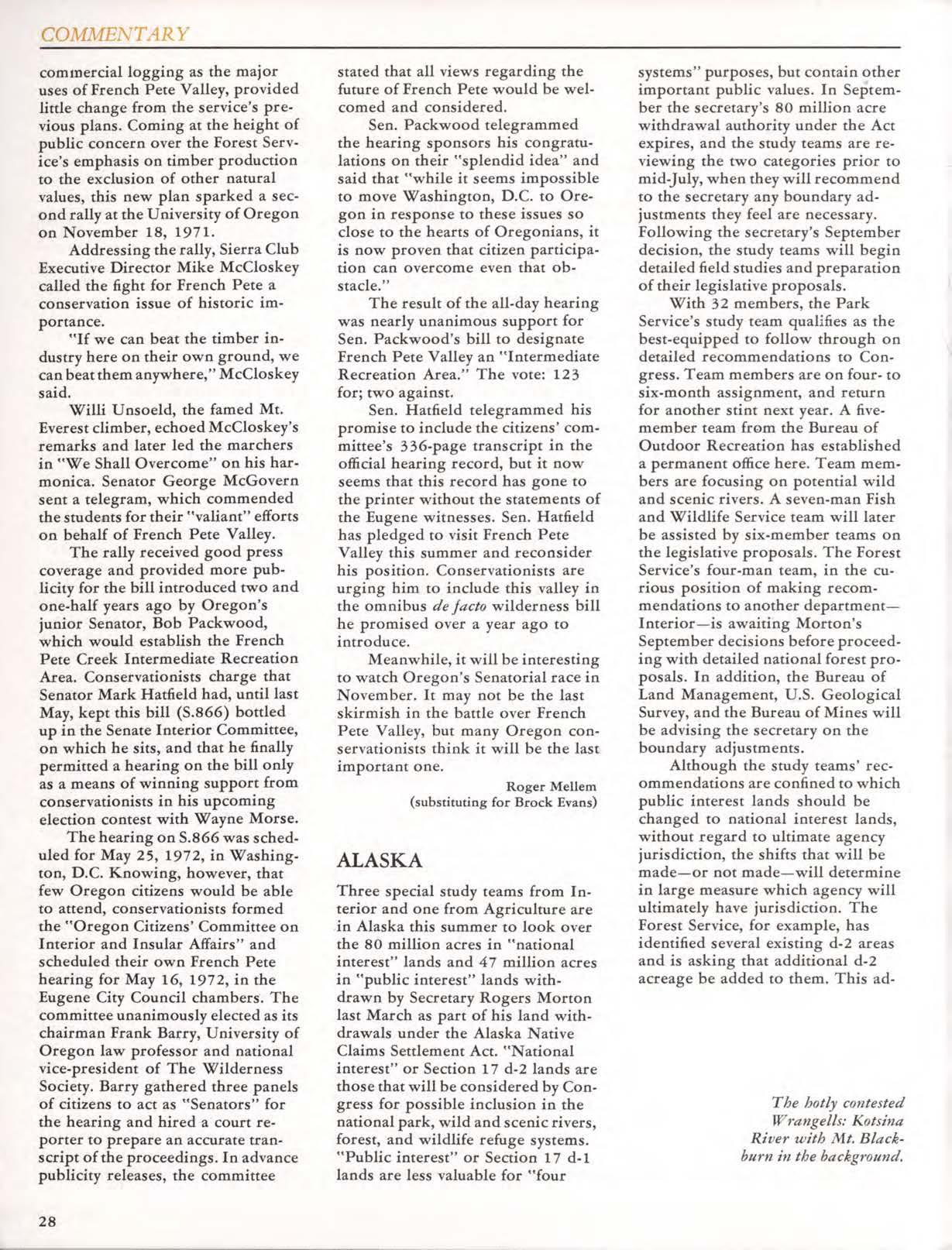
The hotly contested Wrangells: K otsina River with Mt. Blackburn in the backgr-ormd.
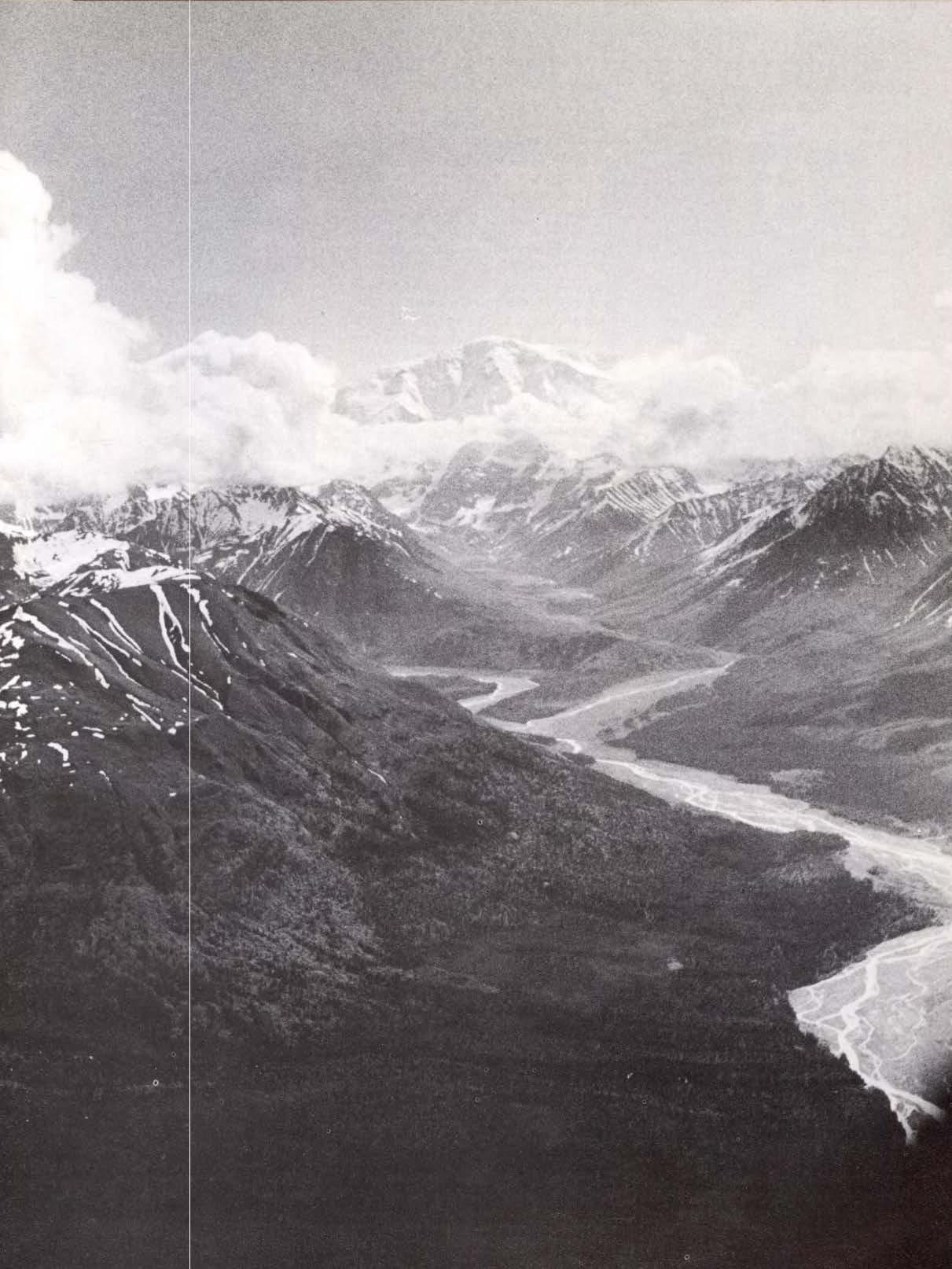
ditional d-2 acreage, however, can only come from existing d-2 lands identified for park or wildlife refuge purposes by the Park Service and the Fish and Wildlife Service. In the Wrangell Mountains, presently a "public interest" area, the multipleuse agencies within Interior are arguing that the Wrangells should remain a d-1 area, while the other "four systems" agencies have recommended d-2 status. If the secretary does not change the area to a d-2 area, the Bureau of Land Management will continue its jurisdiction over the area.
More advice to the secretary on the "four systems" areas may be expected from the recently formed Joint Federal-State Land Use Planning Commission. An initial meeting here with Secretary Morton is scheduled for late July or early August. As expected, Governor Egan's appoint• ees include three cabinet members noted for their pro-development attitudes, and the other two will probably concur much of the time. On the federal side, the secretary's appointments were more balanced, with two members, Celia Hunter of the Alaska Conservation Society, and Richard Cooley of the University of California, Santa Cruz, expected to defend the national interest.
Because of the state's suit against the secretary's March land with• drawals, the question of ultimate ownership of some key "four systems" land is unresolved. State members of the commission may be expected to recommend state ownership, and the commission will probably not play an important role in the disposition of the 80 million acres until the lawsuit is settled and the study teams submit their legislative proposals.
Conservationists will also be submitting their recommendations on the boundary adjustments to the secretary. The major disagreement between conservationists and the secretary is over the ultimate withdrawal status for the Wrangell Mountains, perhaps the foremost wilderness and scenic area in the state. In January, the state administration laid claim to the area to prevent any future "four systems " jurisdiction. In March, Secretary Morton backed the state out of the area and withdrew it for Native selection
purposes and for "public interest" or d-1 purposes. His choice of d-1 was a disappointment to conservationists and the Park Service becau se of their decades-long interest in t h e area and the clear intent by the congressional supporters of the nationa l interest provisions that the Wrangell Mountains be given d-2 status . (Apparently Morton was overruled at the White House level at the l ast moment following pressure from the mining lobby and its m u ltiple-use supporters i n Interi or and Congress . ) d-1 status for the Wrangells meant that mining claim locations could continue, and eventual multi p l e-use classification. State land selectio n could also be allowed.
Also complicating the national park effort is a million-and-threequarter acre Native defici ency area east of the Copper River from which the Native regional corporation will select one-third of the total. T h is land is all of unquestioned national park quality. What is not selected by the Nati ves should be given the maximum degree of protection until Congress can complete ac tion on a Wrangell Mountains national park proposal. Under the present secondary withdrawa l covering Native deficiency lands not selected by the Natives, multiple use classifications and state selections could follow, thereby stopping the eventua l inclusion of these ex-deficiency lands in what could be the most spectacular unit of the nationa l park system. A stronger secondary withdrawal is in order.
Thus for the W rang ells to be considered by Congress as one of the "four systems" areas in the next few years, the Secretary must change the approximately four mi llion acres of "public interest" lands to "national interest" lands, give the unselected Native deficiency lands interim protection pending congressional action, and work with the Copper River Native corporation in order that the national interest in t h e remaining unselected deficiency lands be protected. Opposition to the change to d-2 will be intense, and the present state administrati on can be expected to join this chorus because "public interest '' status for t h e Wrangells could ultimately ope n the way for state selection.
Jack Hession
take off ounces
With Frostline·s complete line of do-it-yourself outdoor gear. All designed with the backpacker in mind. All our kits are made of light rugged Nylons. Like this Frostline Frame Sack. Fits any pack frame up to 15½" wide. Choice of one compartment or two. The material is 7.5 oz. waterproof Urethane-coated Nylon. And it weighs in at only 23 oz.
Like all our Frostline kits. the Frame Sack comes with explicit instructions and all the material s you need to put it together on a home sewing machine. At $13.95, our one compartment kit costs about half the price of comparable ready-made items.
So make your next weekend excursion w i th Frostline. We'll make it a little easier on your back. And a lot easier on your pocket.
Frostline. The kits made in America by everyone.
T HE S U GGESTE D TRIAL: You simply agree to buy four C lub choices within the nex t twelve months at special m embers' prices
260. THE OXFORD 411. ALL MY DICTIONARY OF FRIENDS /\RE QUOTATIONS GOING TO BE (Pub price $12 50) STRANGEFIS by LARRY.
431. THE RISE MC MUURY ANO FALL OF ( Pubpric:e$7.SO) THE TH IRD REICH by WILLI AM L. 262 THE SIURER DEFENSE ( Pub price $15 ) NEVER RESTS by
F. LEI! BA.ILEY will, HARVEY ARONSON ( Pub pri<:e $7 95)
234 THE OXFORD HISTORY OF THE AMERICAII PEOPLE by SAMUEL ELIOT MORISON Illus ( Pub pri,ce $ 15)
114. Pub price $15
391. BURY MY HEART AT WOUNDED KNEE by DEE BROWN Photos. ( Pub price $10.95 )
364 JONATHAN LIV INGSTON SEAGULL by RICHA RD BACH Photos. ( Pub price $4.95)
562 THE CLOSING CIRCLE b)• BARRY CO MMONER (Pub price $6.95)
223 WITHOUT MARX OR JESUS The New Amerl· can Revolution Has Begun by JEAN•FRAN',()IS REVEL ( Pub price $6.95 )
530 THE MYTH OF THE MACHINE The Pentagon of Power by LEWIS MUMFORD ( Pub price $12 .9 5)
3 71. THE PROPHET by XAHILIL GJB"RAN Jllu strated. Boud Delun Edition ( Pub price $10 )

341. Pub price $25
244. THE NEW YORK TIMES COOK BOOK Edited by CRA IG CLAIBORNE lllustr3ted ( Pub price $9 95 )
558 SILE NT SPRI NG bw RACHEL CARSON ( Pub pri•ce $6 95 )
569 THE COMPLETE WALKE R by COLIN FLETCHE R (Pub price $7 95)
554. STALKING THE WILD ASPARAGUS by BUELL GIBBONS (Pub price$ 7.95)
413. THE SETTLERS by M eYER LEV I N (Pub price $10)
177. :Pub price $12.50
121. THE COMPLETE BOOK OF BICYCLI Nil by E\JOENB A1.. SLOANE ( Pub price $9 .!95 )
221. l'M OK -YOU'RE 01(: A Practical Gulde to Transacllonal Analysis t,y THO MAS A. HARRIS , M .D. ( Pub price $5 95)
389. THE DOUBLE-CROSS SYSTEM b,y J. c, MASTEJ:MAN (Pub pric:e $6.95)
382. THE TERM INAL. MAN by MICHAEL CRJCITTON ( Pubpri<:e $6.95 )
412 THE DESCENT OF WOMAN by £LA-IN£ MORGAN ( Pub price $7.95)
107. THE WAY THINGS WORK An Illustrated Encyclopedia of Technology Volume I ( Pub price $9.95 )
214. THE WAY THINGS WORK Volume II. Illustrated ( Pubpr!ce$9.95 )
127. THE POETRY OF ROBERT FROST Edited by EDWARD CONNERY LATHEM ( Pub price $ 10 95 )
FOR YOU and all vitall y intere sted people like you, the Book-of-theM onth Club h as es t ab li shed a Quality of Life division Now there i s an exceptiona l opportunity fo r you to enjoy all the benefits of members hip in the B ookof-the-Month Club a nd at the sa me time to choose from among the best books being published abou t nature and the environment.
B y enrolling in the new Qu ality of Life Divi sion, you will receive with each issue of the B ook-of-the-Month Club News a special a nnouncemen t describing books like those show n here - books which help uncover the roo t causes of our enviro n mental problems, search out positive altern at i ves and lead the way to th e human values that matter. Y ou will also find in the announcement the Quality of Life Newsletter , which is published just for members.
The News, a l iterary magazine publi shed by the C lub 15 or 16 time s a year and sent to you approximately every 23 days, describes the regular Book-of-theMonth Club Selection and scores of other books, most of which are available at substa ntial discounts - up to 40 % on more expensive volumes. All these books a re ide ntica l t~ the publish ers' edition s in format, s ize and qua lity. If y ou wish to pu r chase the r egular Selection, do nothing and it will be shipped to you automatically. H owever, there is no obligation to purchase any particular volume. If you do not want the Selection (or any other book) - or if you want one of the Quality of Life t itles or one of the Alternates offered in th e News-simply indicate your decision on the co n venient form provided and mail the form so th e Club r eceives iL by the date speci fied on it. If you continu e a fter th i s experimen• ta! membership, you will earn, for every Clu b Selec tion or A ltemate or Quality of Life tille you buy, a Book-of-theMonth C lub Book-Dividend Cred it. Each Credit, upon payment of a nomin al sum, often o nl y $ 1.00 or $ 1.50somewhat more for unu sually e xpensive volumes o r sets - will entitle you to a Book D ividend~ which you may choose from over 100 fine library volumes available over the year. This unique library-building system enable s membe r s to save 70 % or mo re o f what t hey would otherwise have to pay.
565 NANTUCKET by PATRICIA COFFIN ( Pub pri ce $8.95 )
559 THE FRAIL OCEAN by WESLEY MARX ( Pubpricc $6 95 )
421. A HAPPY DEATH by ALBERT C A M US ( Pub price $5 95 )
354 . THE BOYS OF SUMMER by ROGER KAHN Photos ( Pub price $8.95 )
335. THE 419. THE GER• ASSASSINS MAN LESSON by by ELIA 'KAZAN SIEGFRI ED LENZ ( Pub price $7 .95) (Pub price $ 8. 95) Sierra Cl11b - Ballanti11e Books
113. GENTLE 567 . THE LAST WILDERNESS REDWOODS rext edited by b)• FRAN~OtS DAVID BROWER LEVDET. Pho t os Photos (Pub price $7. 50) ( Pub price $7.50 )
568 ON THE LOOSE by TERRY and RENNY RUSSE LL. lllustrnted (Pub price$7 .50)
551. "IN WILD· NESS IS THE PRESERVATION OF THE WORLD " THOREAU SELECTIONS w/1/r Photos by ELIOT PORTER (Pub price $7 SO )
BOOK-OF-THE •MONTH CLUB, I NC Quality of Life Division
280 Park Ave., N.Y.C., N Y. 10017 2-A437 -7 Ple35e enroll me as a member or the B ookof-the-Month Club, Quality of Li fe Division. and send me the four volumes whose numbers I have indicated in the boxes below, billing me $1.00 for all four volumes I agree to purchase at least four additional Selections, Alternates or Quality or Ure titles during the first year I am a member, paying special members' prices. My membership is cancelable any time after I buy these four books. A shipping charge is added to all shipments. INDICATE BY NUMBER THE FOUR BOOKS YOU WANT
1 Pomo Feathe red Basket
This line coiled basket decorated with feathers and abalone shell pendants comes from the Pomo people of Northern California. They were highly prized treasures and were given as gilts. sometimes to a shaman in reward tor his performance on a ceremonial occasion or for a successful healing. Abalone ornaments a re extremely old among Pac ific Coast cultures.
2 Aba lone Shell Necklaces
These two necklaces are typ ical of those used w ide ly among Pacific Coast Indians as dance ornaments. Archeolog ical findings indicate an exceedingly long tradition ot abalone shell ornaments. These nec klaces were made by a member ot the Pomo Indians of Northern California.
3 A laskan Eskimo Mask
Masks li ke th is were used among the Eskimo In dances and religious rites. This one appears to represent the spirit ot an unidentified sea mammal or the Shaman who possessed that spirit. Masks were frequently worn throughout the Indian world by the men who acted out rel i g ious rites and in dances that symbolized the spiritual and historical traditions of their culture.
4 San Ildefon so Black Ware Pot
This pot from the San Ildefonso Pueblo ,n New Mexico is believed to be one ot the first signed pots made by Mar la Martinez and decorated by her husband. Julian, who inven ted the technique for making this now famous style of pottery This pot was purchased from Maria in 1923 or 1924.
The National American Indian Council offers you a unique assortment of greeting cards ...which you11 be proud to use at Christmas and throughout the year
For the first time, authentic American Indian artifacts and objets d 'a rt, faithfully reproduced in full col or on high gloss stock , can now grace your Christmas greetings or personal notes. They are offered in an economical assortment, specially packaged and priced, by the National American Indian Council. Authenticated by the Lowie Museum of the University of California, these cards are selected to illustrate the scope and intens ity of previously overlooked native art forms. All proceeds from the sale of these cards go to help the American Indian, in a variety of projects sponsored by NAIC. The counci l, composed of more than a thousand Indian organizations, was recognized by the White H ouse in May 19 72 as the officia l national organization for the non-reservation Indian. The Council is self-
supporting, and thi s is its first effort at raising its own funding.
This special assortment of 48 cards and matching envelopes is attractivel y priced to introduce you to our fu ll line .
Rarely could you expect to receive s uch a value ... or to do so mu ch for a wort h y cause. Please send the coupon today, and allow 45 days for delivery.
National American Indi a n Council Belli Building San Francisco, CA 94111
D I e nclo se $6 for the special 48-cards and envelopes set
D I en close $10 for two sets, 96 cards in all
D Please enclose you r illustrated list of ad ditional cards
Name
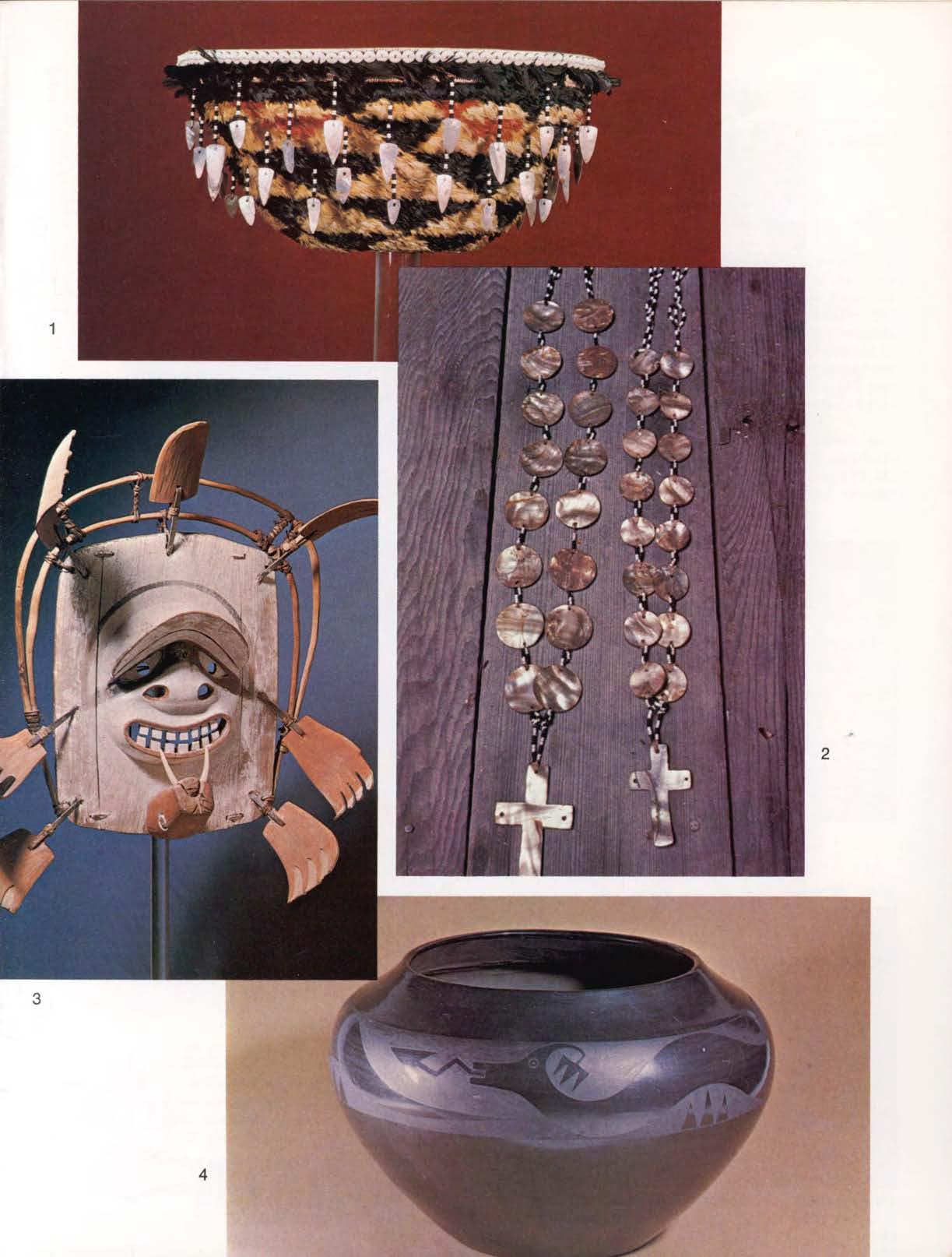
DRIVE A DATSUN. PLANT A TREE. GET A POSTER.
From now until October 15, when you test drive a Datsun at a participating
dealership, we'll pay the U.S . Forest Service to plant a tree in a national forest. And give you this 18" by 24" Ansel Adams poster, too. Yes, we do have an ulterior motive: to acquaint you firsthand
with Datsun's value and .. 1 engineering excellence. SISJ America needs more
trees, so we thought we'd help out a little.
The Cl·ub Looks at Itself
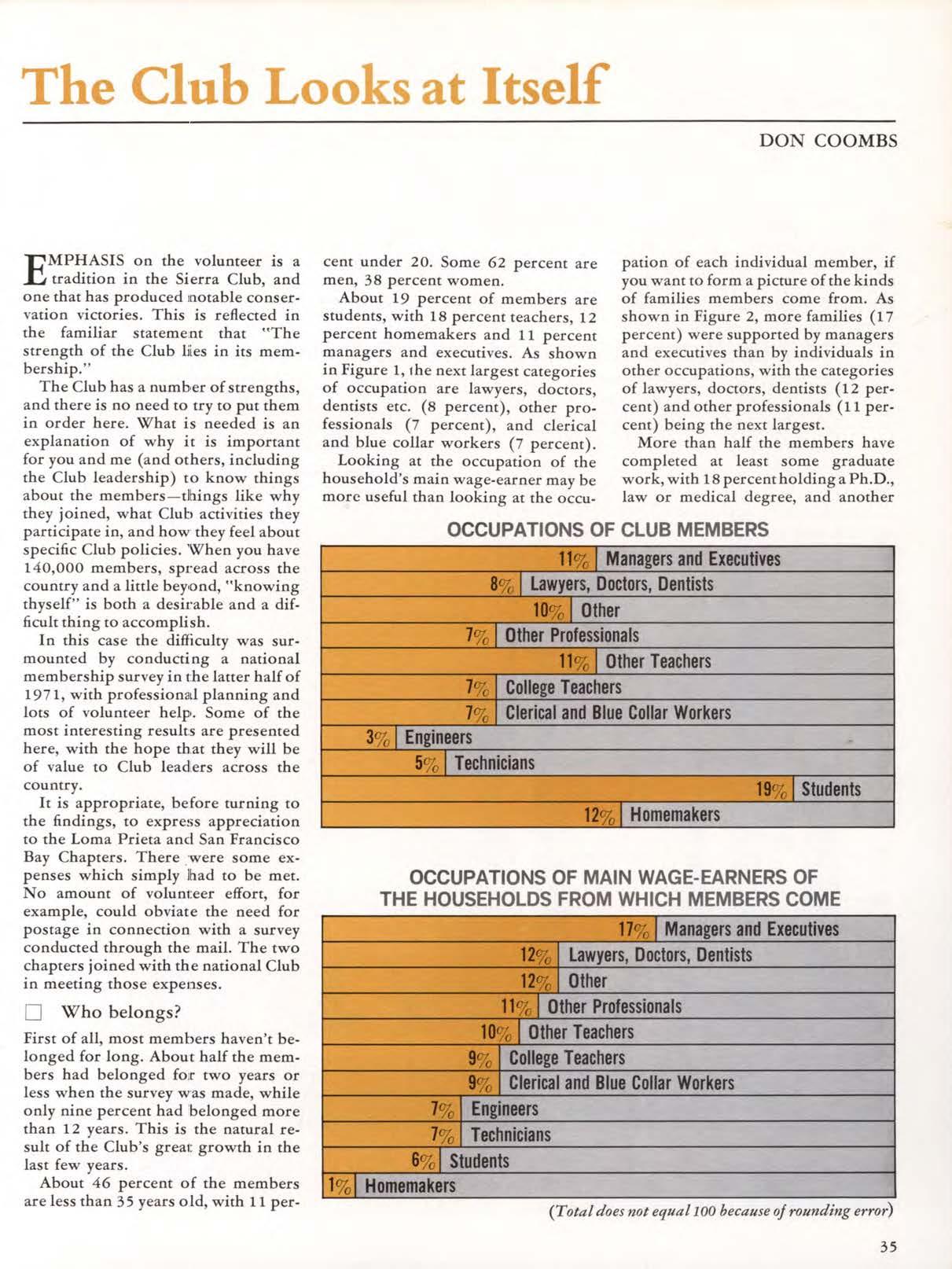
EMPH ASI S on the volu nteer is a tradition i n the Sierra C l ub, and one that has produced inotab le conservation victor i es. Th i s is r eAected in th e famili ar statemem that "The strength of the Club hes in its membershi p ."
The Club has a number of strengths, and there is no need to try to p ut th em in order here. What is n eede d is an ex p lanat ion of w h y it is important for you and m e (a n d others, including t h e Club leadersh ip) to know things about t h e members - tlbings like why t h ey joined, what Club acti vi ties they partici pate i n, and how they feel about specific Club p oli cies. 'W h en you h ave 140,000 members, spread across the cou ntry and a little beyond, "knowi ng thyself" is both a desira b le and a d ifficult th i ng to accompl ish.
I n th is case the difficulty was surmounted by conducting a nationa l membershi p survey in t h e l atter ha lf of 1 971, w i th professional! p lan n i ng and lots of vol unteer h elp,. Some of the most interesting res u lts are presented here, with t h e hope th.at th ey w ill be of value to Club l eadlers across che country.
le is appropriate, befor e turni ng to the findings, to express appreci ation t0 the Loma Prieta and San Francisco Bay Chapters. There were some exp enses w h ich sim pl y lbad co be met. No am ou nt of volu ni:eer effort, for example, could obvia t e the need for p ostage i n connection with a survey cond u cted t hroug h t h e mai l. T h e two chap ters j oined with t h e nat io n a l Clu b in meeti n g those expenses.
D W h o belo ngs?
First of all, most members haven't belonged for long. Abo u t h a lf t h e m embers had belonged fo1 r two year s or less w h en th e survey was made, wh il e only nine percent h ad belonged more than 12 years. T h is i s th e natural resu l t o f the C l ub's great growth in th e last few years.
About 46 percent of the members are less than 3 5 years old, with 1 1 per-
cent under 20. Some 62 p ercent are men, 38 perce nt wome n
About 19 percent of members are stu dents, with 18 percent teachers, 1 2 p ercent homemakers and 11 percen t managers and executives. As shown in Figu re 1, 1he next largest categories of occupati on are lawyers, doctors, dent ists etc. (8 p ercent), oth er professionals (7 percent), and clerical and blue co llar workers (7 percent)
L ooking at the occu pation of t h e h ouseh o ld's main wage-earner may be m ore useful th an looking at the occu-
pacion of each indivi dual member, i f you want to form a picture of the k i nds of families members come from. As shown i n Figure 2, more fam i lies (1 7 percent) were s upported by managers and executives than by individu a ls in other occupations, w i th the categories of lawyers, doctors, dentists (12 percent) and other professionals (1 1 percent) being the next largest.
More than half the mem bers h ave compl eted at least some graduate work, with 18 perce n t h olding a P h.D ., law or medical degree, and anoth e r
OCCUPATIONS OF CLUB MEMBERS
11% I Managers and Executives
8% I Lawyers, Doctors, Dentists
10% I Other
7% Other Professionals
11% I Other Teachers
7% College Teachers
7% Clerical and Blue Collar Workers
3% I Engineers
5% I Technicians
19% I Students 12% I Homemakers
OCCUPATIONS OF MAIN WAGE-EARNERS OF THE HOUSEHOLDS FROM WHICH MEMBERS COME
17% I Managers and Executives
12% Lawyers, Doctors, Dentists
12% Other
11 % I Other Professionals
10% I Other Teachers
9% College Teachers
9% Clerical and Blue Collar Workers
7% Engineers
7% Technicians
6% I Students
1% I Homemakers
(Total does not
21 percent holding a masters degree. This is even more impressive when you remember that some members aren't yet old enough to enroll in college.
D W h y di d members joi n?
About 45 percent joined to show general support of the Club's conservation activi ties, but not 10 parti cipate i n them personally About 41 p ercent joi ned i n order to participate per -
sonally in C l u b outdoor acti vities, an d 18 percent j oined in order to be able to part i ci pa te personally in co n servati on activities. (A few peop l e gave more than one reason for j o i n ing, so the total here is more t h an 1 00 percent. ) Combi ning the "sup por t conservation" categories produces roughly a 60 perce n t conservat io n , 40 percent o u tdoor acti vities split in reasons for j oini ng.
A definite trend exists here, as can be seen below. Most of th e C lub 's long-term members origi nally j o i ned
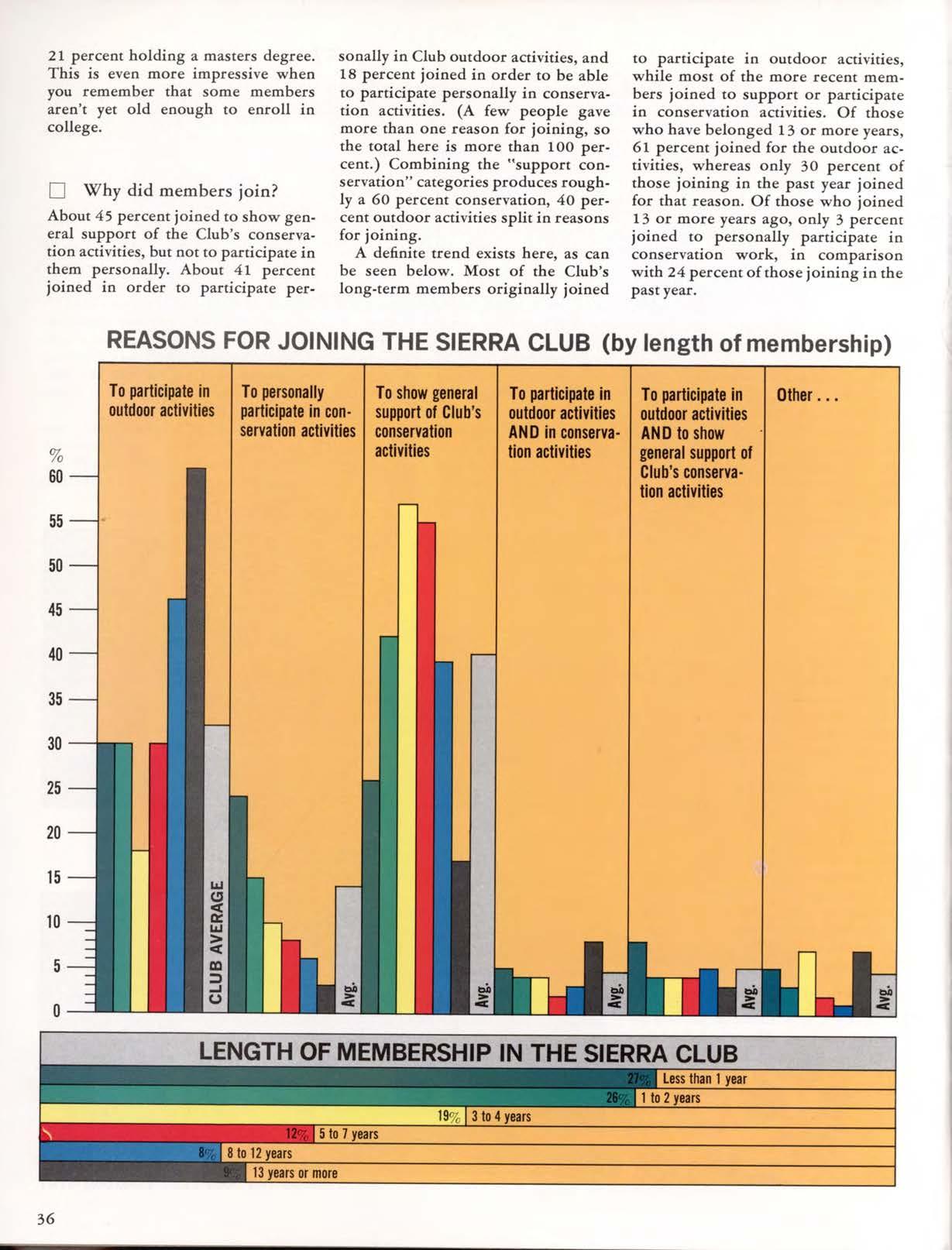
To participate in outdoor activities
To personally participate in conse rvation activities
To show general supp ort of Club's conservation activities
To participate in outdoor activities AND in conservation activities
to parti ci p ate i n outdoor acuvmes, while most of the more recent members joined to support or participate in conservati on activities. Of those who have belonged 13 or more years, 61 percent joined fo r the outdoor activit i es, w h er eas on l y 30 percent of those joi ning in the past year joined for t h at reason. Of t h ose who joined 1 3 or more years ago, only 3 percent j oined to p ersonally participate in conservation work, in compar ison wit h 24 percent of those joining in the past year.
To participate in outdoor activities AND to show general support of Club 's conservation activities
LENG TH OF MEMBERSHIP IN THE SIERRA CLUB
D Is the Club an elit ist group?
At this point we should consider whether the Sierra Club is an elitist group, in the bad sense of the word. The average member bias much more e ducation and a "more professional" job than the average U.S. citizen. But two big points should be made:
1) Nobody attends conservation meetings or goes on outings or sends in his dues who is an '"average member" ; averages are statistical, but members are real and individual, and the Club does have members of all descriptions and backgrounds.
2) If the Club doesn,' t seek special and selfish privileges for its members, and if it actively attemJpts to broaden ics membership base, being called e lit e isn ' t exactly a stin,ging criticism.
A 1969 study of Sierra Club membership by Bill Devall deals specifically wich the charge ,of elitism, and makes the point that Club members favor a simpler - and indeed less expensive - style of outd1oor recreation than do ocher segmencs of the general public. While power vehicles - such as snowmobiles, dun~: buggies and trail cycles - are turninig ouc to be big sellers in this country, Sierra Club members eschew them for such quiet alcernatives as skis, canoes and kayaks.
As demonstrated b•~ data in the Devall srudy, Club m~mbers favor a go-light approach to the outdoors rather than the hit-it-with-horsepower approach. There is a great deal of challenge in planning carefully and getting by with the minjimum of equipment and supplies, andl this is appreciated by many Club members. The result is that they don ' t :destroy the environment to the extent that ochers do, with luxury trailers, power boats and go-anywhere trail bike s . As a result, many more people can enjoy the outdoors-and at on ly modest investmenc - with the Sierra Club approach to recreation. Looked ac this way, che Club is anything but ",elitist."
Both the Devall study and the more recent survey which is being reported h ere indicate that there is a "blue ribbon" quality abou,t Sierra C l ub membership, however. It 's nice to be able to demonstrate tlhis if you are rrying to interest a company in running advertising in the Bulletin (becaus e the readers obvious l y h ave great purchasing power) or if you wish to augment the self-satisfaction of mem-
bers over whom they've chosen to associate with. It ' s not so nice to be stuck with the b l ue ribbon tag when you need to convince government officials that there is wide support for environmental measures. Club leaders need to be abl e to make a strong case for there being nothing selfish about a program of preserving what's left of our narural beauty and wilderness , for everyone, and need to be able to sh ow how this meshes with programs to limit pollution. Anyone who thinks the Club has restrictive membership policies should be signed up immediately or - if he already belongsbe involved in the Club ' s efforts to greatly increase its membership among the minorities.
(There are promising indications that conservation is coming to have a much wider appeal. One b i t of evide n ce is the concern expressed by black high school seniors last year, when 54,000 were polled on what national issues they thought important. They were more interested in the federal government' s controlling pollution than in ics expanding any ocher programs, including those for school desegregation and urban renewal. About 88 percent of the students wanted to see increased federal involvement in controlling environmental pollution, with "eliminating poverty," "pr eventing crime" and "provi ding compensatory education for the disadvantaged" rated right behind. Some 76 percent wanted more done on urban renewal, and 73 percent wanted more done on achieving schoo l desegregation. Some 47 percent favored increased federal effort to limit population growth.)
D How did members get the informati on which l ed to their joining?
Personal communication is important in gaining new members; 58 percent got the information which led chem to join from a friend or a relative. Next as a source of such information came publications, with 13 p e rcent listing non-Club publications and 12 percent listing Club publications.
Fully three-fourths of the members reported discussing the possibility of joining the Club, in the course of the past year, with a potential member. Younger members talked to oth ers about joining more than did older members , but th e re was no similar re-
lationship betw e en age and number of new members actually signed up. About 1 4 perce nt of the members claimed to have recruited one person in the past year, and 12 percent claimed two recruits. There was a busy core of 1 percent wbich claimed that each had recruited nine or more members. The longer-term members recruited significantly more new members than the shorter-term members did. Some 56 percent of the 13-yearsor-longer members claimed to have had a hand in recruiting at least one new member in the past year , as compared to only 3 5 percent of the one to two-year members.
D Should the Club concern itself with the conservation problems of such special groups as the urban poor and ethnic minorities?
The balance of sentiment was against the Club so involving itself. About 40 percent strongly disagreed with such a proposal, while 15 percent strongly agreed. But the younger the member, the less he opposed such involvement. Although 58 percent of all members either strongly or "somewhat" opposed such involvement, only 46 percent of those under 35 were opposed, and only 43 percent of those under 25. Members from households whose main wage earners were managers or executives tended to be more opposed to such involvement, while members from households whose main wage earners were students, clerical or blue collar workers or "other professionals " were less opposed.
D What Club actions were considered most commendable? What actions were considered unwise?
Not surprisingly, far more "especially commendable" actions than unwise actions w ere li s ted on th e returned questionnaire. Each of seven different commendabl e acrions w er e m e ntioned by more than 5 percent of the members. Only one acrion classified as unwis e- the Club ' s stand on various aspects of power generation - was m e ntion e d by a s many as 5 p ercent of the members.
Opposition to the Disney development of Mineral King was cited most a s a comm e nd a bl e acrion (by 19 per-
Club actions considered "especially commendable" or "unwise" (with proportion of respondents who listed each)
Especially comme11dable
Opposing Mineral King 19
Opposing SST 17
Alaska Pipeline 16
Saving the Redwoods 11
Saving the Everglades 8
Defending Grand Canyon 6
Forest Practices 5
Oil-Opposing Offshore
Drilling and Spills 4
Saving San Francisco Bay 3
Preserving W' ild Rivers 3
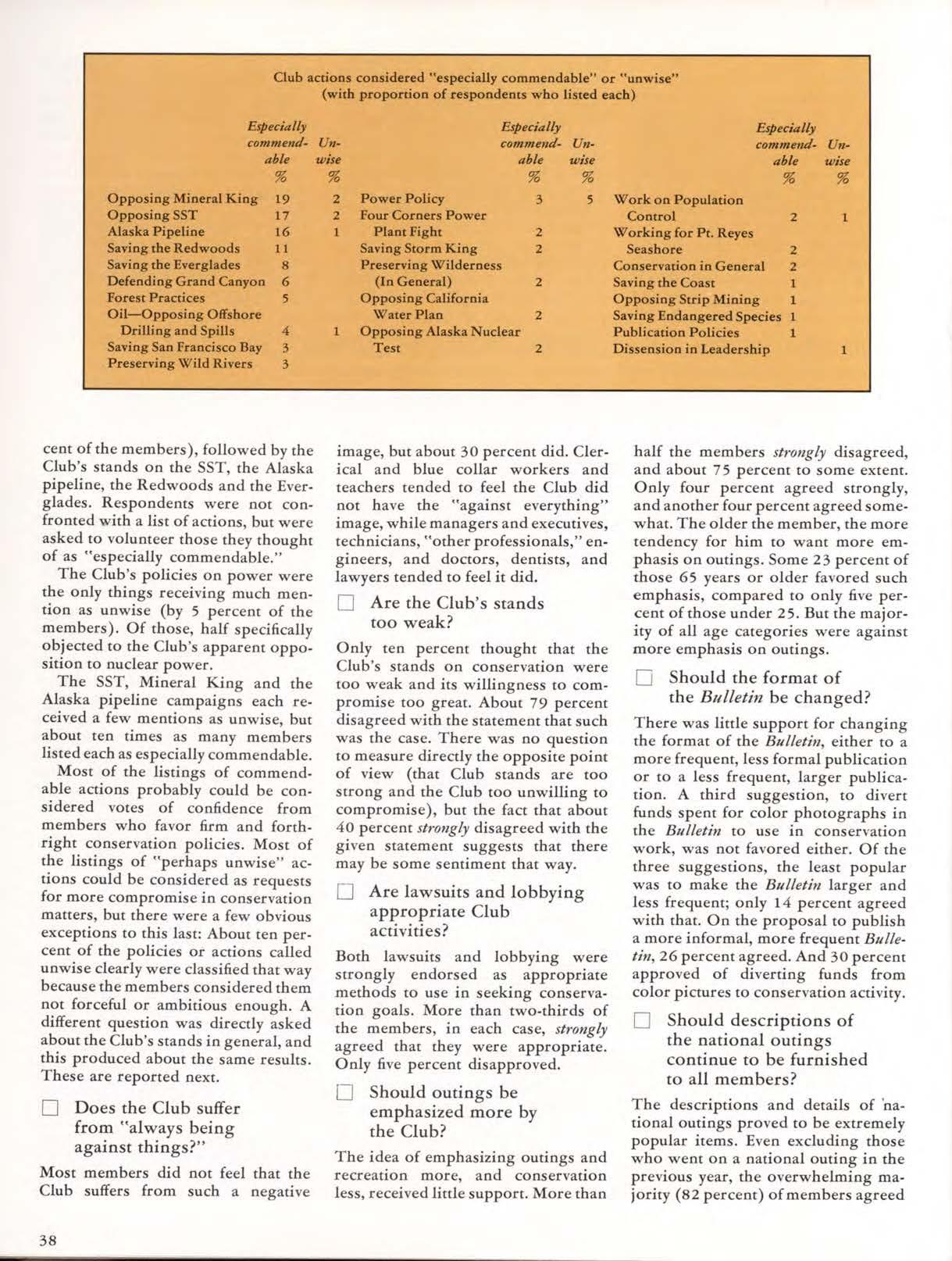
1
Publication Policies 1
Dissension in Leadership 1
cent of the members), followed by the Club's stands on the SST, the Alaska pipeline, the Redwoods and the Everglades. Respondents were not confronted with a list of actions, but were asked to volunteer those they thought of as "especially commendable."
The Club's policies on power were the on l y things receivi ng much mention as unwise (by 5 percent of che members). Of those, half specifically objected to the Club's apparent oppos iti on to nuclear power.
The SST, Mineral King and the Alaska pipeline campaigns each received a few mentions as unwise, but about ten times as many members listed each as especially commendable.
Most of the listings of commendable actions probably could be considered votes of confidence from members who favor firm and forthright conservation policies . Most of the listings o f "perhaps unwise" actions could be considered as requests for more compromise in conservation marters, but there were a few obvious exceptions to this last: About cen percent of the policies or actions called un wise clearly were classified that way because the members considered them not forceful or ambitious enough. A different question was di r ectly asked about the Club's stands in general, and this produced about th e same results. These are reported next.
D Do es t h e C lub suffe r fr o m "al ways b ei ng against things?"
Most members did not feel t h at the C lu b s u ffers from such a negative
image, but about 30 percent did. Clerical and blue co llar workers a nd teachers tended to fee l the Club d id not h ave the "agai n st everythin g" image, wh ile managers and executives, technici ans, "other professionals," eng i neer s, and d octors, dent ists, an d lawyers tended to feel i t did
D Are the C l ub's sta nd s too wea k?
Only ten percent thought that the Club's stands on conservation were too weak and ics willingness to comprom ise coo great. About 79 percent disagreed with che statement chat suc h was the case There was no q u estion to measure directly the opposite point of view (that Clu b sta n ds are too strong and the Clu b coo unwilling to compromise), but the face chat about 40 percent strongly disagreed with the given statement suggests chat there may be some sent im ent chat way.
D Are l awsuit s and l ob b yi n g app ropria te Club acti vities?
Both lawsuits and lobbyi ng were strongly endorsed as appropriate methods co use in seeking conservation goa ls. More than two-thirds of the members, in each case, strongly agreed that they were appropriate. Only five percent disapproved.
0 Shou ld outings be em ph as i zed more by the Club?
The idea of emph asizing outings and recreation more, and conservat i on less, recei ved little support. More than
half the members strongly disagreed, and about 7 5 percent co some excenc. Only four percent agreed strongly, and another four percent agreed somewhat. The older the member, che more tendency for him to wane more emphasis on outings. Some 23 percent of chose 65 years or older favored such emphasis, compared to only five percent of chose under 25. Bue the majority of all age categories were against more emphasis on o u ti ngs.
D Sh ou l d the format of the B11 /letin b e c h a n ged?
There was little support for changing the format of th e Blllleti11, e i th er to a more freq u ent, less formal publication or co a less frequent, larger pu blicati on. A third suggest i on, co divert funds spent for color photographs in the Bulletin co use i n co n servation work, was not favored either Of the t h ree suggestions, rhe lease popular was to make the Bulletin larger and less frequent; only 1 4 percent agreed with th at. On the proposal to publish a more informal, more frequent B111/etin, 26 percent agreed . And 30 percent approved of diverting funds from color pi ctures to conservation activity
D Sho uld descriptions of the national outings co n tin u e to be furnished co a ll m e mb ers?
The descriptions and details of 'national outings proved co be extremely popular items. Even excluding t h ose w h o went o n a nat i onal outing in the previous year, the overwhelming majority (82 percent) of members agreed
with this statement: ".Even thou gh I may not go on na ti onally annou nced Sierra Club outings, the descri p tions and details in the pub lished lisrings are interesting and potentially val uable co me."
D What co n tent i s mos t des i rable in the B 11/letin?
Shore items on coose1:vati on activiry received cop ratings, w h i l e i llustrative art and news about the Club's internal affairs recei ved the 1,owest racings. Even the "least des i rable " content was rated quite desirable, however; only 14 percent of the members cons i dered illustrative art to be flatly undesirable. The other 86 percent rated it e i ther "quite important or des i rable" or "inbetween."
D Where is rel i able conservation i nfo r ma ti o n ava i lab l e?
It probably is not surprising that members rated national Sierra C lu b leaders as the most reliiable source of conservation informati on, with leaders of ocher conservati on organizations and of local Si errn Club chapters following. Ac che other end of the raci ngs were the Administration io Washington and - at the very bottom - spokesmen for industry
D What chapter activit i es are of most inte1resc to members?
"Wal ks and trails" achieved the highest "participation-inte1rest" ranking, wit h peak climbing and scuba diving being ranked lowest. ( A t that time the Club's first scuba diving section h ad just been formed, io the Loma Prieta chapter.) The different acci vi ti es li sted were ran k ed from i nmrescing-co -themosc - members to interesting - to-th eleast.
D H ow ac ti ve io c onse rva ti o n are Si e rr a Cl ub memb e r s?
H a lf belo n g to rwo or more conservation orga ni zations, cou n ti ng th e Sierra Cl ub as one. Abo u t 20 p ercent be long to three, and 1 3 percent to four. Abo u t o n e p erceoc rep orted mem b ership in ten or more.
H alf contri buted money (not just member s hip dues) to one or m o r e conservat ion-oriented organizati ons or campai gns io rh e last year, and almost half atten d ed one or more conservation -o ri ented meetings in the past year. Some ten percent reported attendi ng nine or more such meetings.
A bout 60 p ercent se n t th eir views on conservati on matters to government officials at least once in t h e p as t year, with 1 5 percenr reporting nine or more such communi cati o n s. Longterm members tended to communicate more with elected or ap pointe d governmeoc offici als th an d id new m emb ers. The only excep ti ons were the members who h ad b e longed for 13 or more years; they communicat e d l ittle more than the new members di d
Some 42 percent r eported devoti ng time to work ing for a conservation cause at least once in the last year, with 12 perce n t rep orting nine or more s u ch occasi ons.
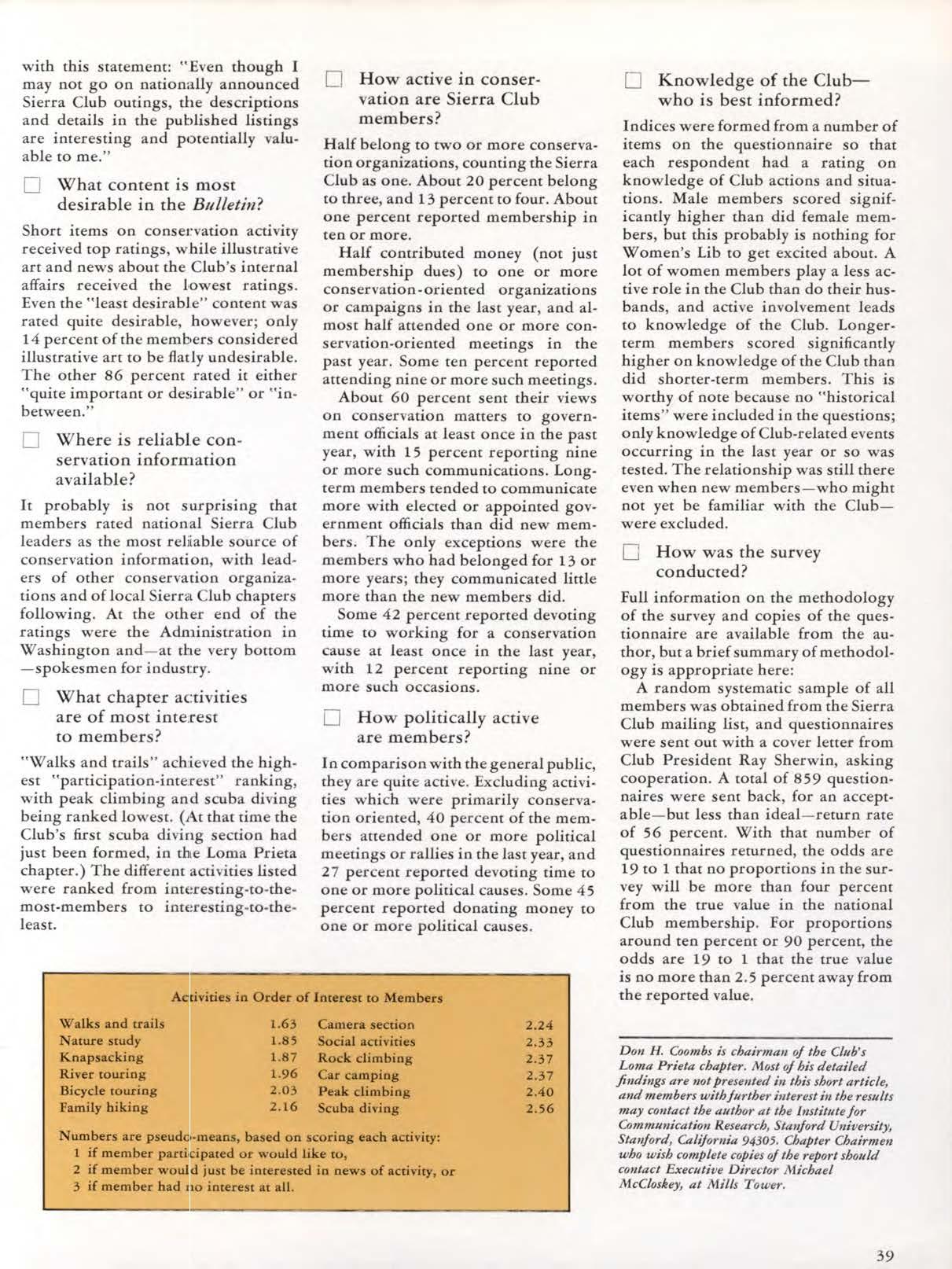
DH ow poli tica ll y active are me mbers?
I n comparison with t h e general p ublic, they are q u ite active. Excluding activities w hi ch were primarily conservation oriented, 40 percent of th e members attende d one or more p olitical meetings or rallies i n the last year, and 2 7 p ercent rep orted devoting time to one or more politica l ca uses. Some 4 5 percent reported donating money to one or more political causes.
Ac ivities in Order of Inierest to Members
DKn ow l edge o f the Cl u bw h o is best i nformed?
In dices were formed from a number of items on the questi onnaire so that each respondent had a rat i ng on knowledge of Clu b actions and siruati o n s. Male members scored significantly higher than did female members, but t hi s probably is nothing for Women's Li b to get exci ted about. A lot of women members play a l ess acti ve role in the Club than do their h u sbands, and acti ve involvement l eads to knowledge o f the Club. Longerterm members scored s i gni ficantly hi g h er on knowledge of the Club than d i d shorter-term members. This is wor thy of note beca u se no "historical i tems" were i ncluded in the questions; on l y knowledge of Club-related events occurr i ng in the last year or so was tested The relatio n ship was sti ll there even when new members-who might n ot yet be familiar with the Clubwere excluded.
0 H ow was the survey co n d u cted?
Full information on the methodology o f che s urvey and copies of t h e quest i onnaire are available from the author, but a brief s u mmary of methodology is appropriate here:
A random systematic sample of all members was obtained from the Sierra Club mailing list, and questionnaires were sent out with a cover letter from Club P resident Ray Sherwin, asking cooperation. A coral of 859 questionnaires were sent back, for an accepta b le - b ut less than ideal - return race of 56 percent. W i th that number of questionnaires returned, the odds are 1 9 to 1 that oo proportions in the survey w i ll be more than four percent from the true value in the national Club membership. For proporti ons around ten percent or 90 percent, the odds are 19 to 1 t h at the true value is no more th an 2 5 percent away from the re p orted value
Walks and trails
Nature study
Numbers are pseudc -means, based on scoring each activity :
1 if member parti ipaced or would like to,
2 if member wou cl just be incerested in news of activity, or
3 if member had l[o imeresc at all.
Don H. OJombs is chairman of the Club's Loma Pri eta chapter. Most of his detailed ji11dings are not presented i11 this short article, and members with f11rthet· i11terest in the results may co11tact the author at the lnstit11tefor OJ1111111111icatio11 Research, Sta11ford U11iversity, Sta11ford, California 94305. Chapter Chairmen who wish complete copies of the report should contact Exemtive Di,-ector Michael McCl-0skey, at Mills Tower.
Qrumtlt1
1973 S-1em Club Wildemm {w:all) CaJendar{s) @S3.2s each
1973 Sierra Club Engagement Calcndar(s) @Sps each
Quantity clisc:ouac: Tm or more ofcitbcr: __ Wildemca c:alcndan @S3.oo each
State tax rata _ Engagement alcndan @$3.00 each
Total amount of order
and Sau FT;111cuco coumics .s.J'o/~ NewJcncy s~ New Yodr. 7%-
Pkase print or type
Note Plimmdado11-.ewtlrmdlmg. Tbiao&raoocltbzoaab30 Sepciember 1v,aoa1J.

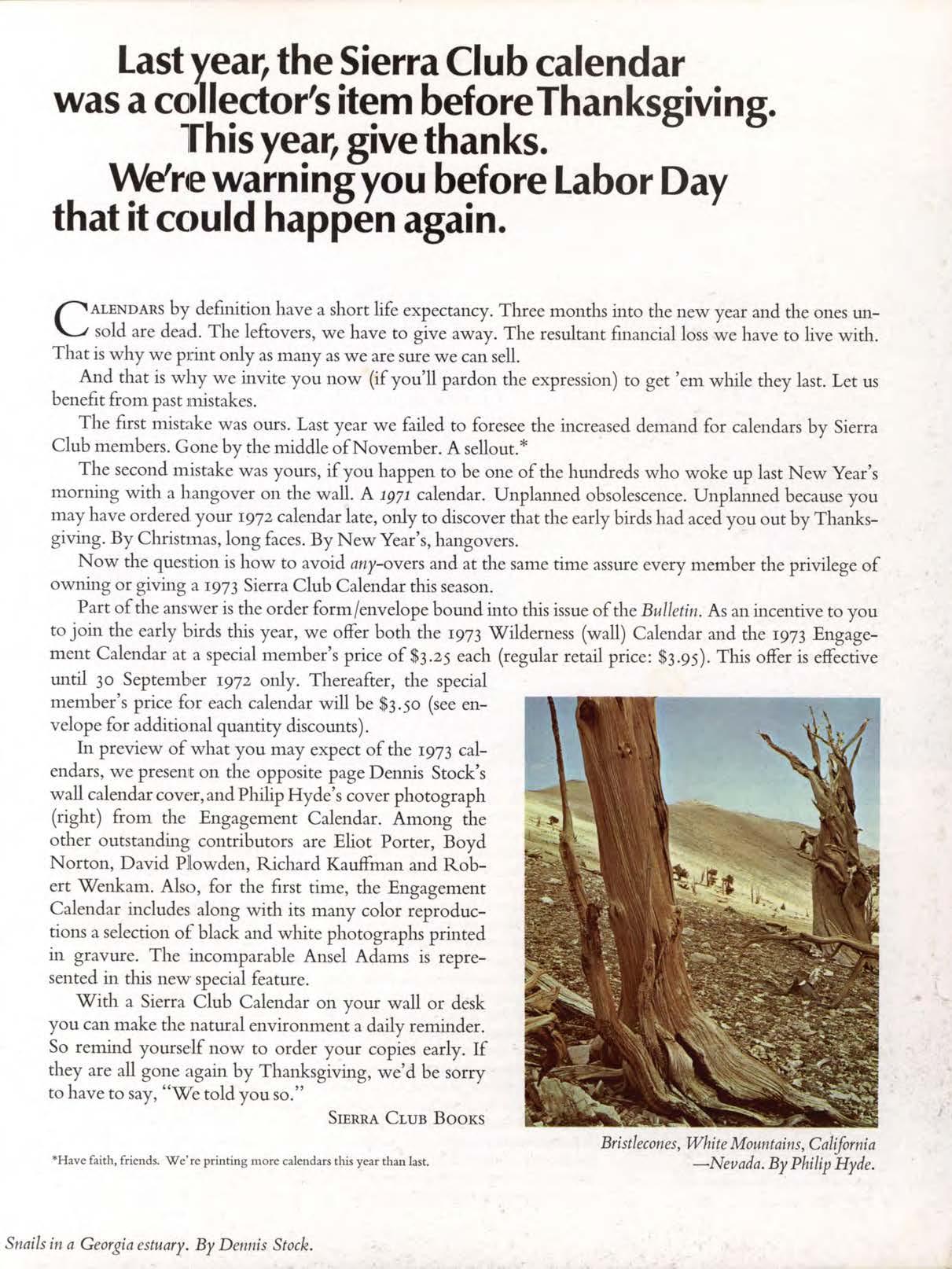
Last year,
the
Sierra Club calendar was a co•llector's item before Thanksgiving. lrhis year, give thanks. We'rte warning you before Labor Day that it cc,uld happen again.
CALENDARS by definition have a short life expectancy. Three months into the new year and the ones unsold are dead. The leftovers, we have to give away. The resultant financial loss we have to live with . That is why we print only as many as we are sure we can sell.
And that is why we invite you now (if you'll pardon the expression) to get 'em while they last. Let us benefit from past 1mistakes.
The first mistake was ours. Last year we failed to foresee the increased demand for calendars by Sierra Club members. Gone by the middle of November. A sellout.*
The second mistake was yours, if you happen to be one of the hundreds who woke up last New Year's morning with a hangover on the w all. A 1971 calendar. Unplanned obsolescence. Unplanned because you may have ordered your 1972 calendar late, only to discover that the early birds had aced you out by Thanksgiving. By Christmas, long faces. By New Year's, hangovers.
Now the quesition is how to avoid any-overs and at the same time assure every member the privilege of owning or giving a 1973 Sierra Club Calendar this season.
Pare of the answer is the order form/envelope bound into this issue of the Bulletin. As an incentive to you to join the early birds this year, we offer both the 1973 Wilderness (wall) Calendar and the 1973 Engagement Calendar at a special membe r 's price of$3.25 each (regular retail price: $3.95). This offer is effective until 30 September 1972 only. Thereafter, the special member's price for each calendar will be $3.50 (see envelope for additional quantity discounts).
In preview of what you may expect of the 1973 calendars, we presenlt on the opposite page Dennis Stock's wall calendar cover, and Philip Hyde's cover photograph (right) from the Engagement Calendar. Among the other outstanding contributors are Eliot Porter, Boyd Norton, David Pllowden, Richard Kauffman and Robert Wenkam. Also, for the first time, the Engagement Calendar includes along with its many color reproductions a selection of black and white photographs printed in gravure. The incomparable Ansel Adams is represented in this new special feature .
With a Sierra Club Calendar on your wall or desk you can make the natural environment a daily reminder. So remind yourself now to order your copies early. If they are all gone again by Thanksgiving, we'd be sorry to have to say, "W'e told you so."
SIERRA CLUB BOOKS
•Have faith, friends. We're printing more calendars this year than last.
Bristlecones, White Mountai11s, California -Nevada By Philip Hyde.
Porkies, Prairie Dogs and other Useful Varmints
DAVID PLOWDEN
for thems e lves. " I like to sit back and let nature do the work," h e says. "She's a hell of a lot smarter at it than we are."
Lasater was born in south Texas some 60 years ago. Hi s frontier cattlem an fat h er had owned a 400,000-acre spread there, a nd w h en t h e e lder Lasater died, Tom returned from Prin ceton U ni versity to take over the operatio n He not on l y took it over but redirect ed it by developing the B eef. master, a cross breed of Brahman, Shortho rn, and H ereford, and one of the few new strains certified in this century b y the U.S. D epartment of Agriculture.
FRO M THE HIGHWAY, the Lasater Ranch looks the same as any other catt l e operation out there on the rolling p la i ns between Limon and Colorado Springs. Corral, b arn, and ranch house are set well back from the road. Th ere is a windmill or two The cottonwoods spread out along t h e creek. T h e grass is short and straw colored. The bulls and heifers appear in good shape. As for Lasater himself-he fits, too. Tao and lean, he would seem the prototypical cowman going about his business in a prototypical sort of way. And yet for all the appearances o f conformity, Tom Lasat er is about as traditional as a Yankee taco. W hile most other cowmen are committed remorselessly to a p ersonal war against nature, Lasater l eaves nature alone. H e regards his 2 5,000-acre ranch as a protected w ildlife area, and posts it as such. Under a rigi d, self-i mposed nokill policy toward predators and poisonous weeds alike, he eschews the pest icides and h erb icides favored by other ranchers , and tolerates no shooting on his land. For the 1,100 head in his h erd, there are a few concessions: artificial water holes, and supplemental feed in the wi n ter. But by and larg e, Tom Lasate r l ets his cows fend
This story is takeufrom Floor of the Sky: the Great Plains, a Sierra Club Landform Book by David Plowden, a free-lance writer a11d photographer who has authored a 1111mber of books i11cl11di11g The H and of Man on America.
Land values in south Texas began to skyrocket in the 1940's, so L asater went north into Colorado to find a new home fo r his B ee fmaster. Near Matheson, he found the high , dry country appea lin g. The ranch h e sel ected was a ramshackle affai r and the land, he reca l ls, "was all fenced up into li ttle parcels. " But Lasater would soon change all of that The herd was moved nor th first. Th eo, in 1950, he brought his family to Math eson, too. "We just came up for t h e summer," he says, "and forgot to go back home."
Lasater's partnership with nature is no newfangled arrangement induced b y Earth Day enthusiasms or sou lsearch ing reappraisals of the order of things. C uri ous l y, for the son of a pioneer, his u nderstanding of ecological principles developed at an early age. I n Texas, be was appalled by what he now calls the "promiscuous" pois oning of predators and weeds by cowmen. He once followed a cowman's bait line and observed the carnage wrought by the 10-40 po i son. "They didn't just get the animals they were out to get with those baits," Lasater recalls. "They got everything. I vowed then I'd never get i nto that kind of thing if I were running things." And, with one instru ctive exception, he h asn't.
When Lasater first came to Matheson, he found the ranch overrun with rabbits. "There were just jillions of them everywhere," he says, with t h at magnificent taste for hyperbole common to so many cowboys. Lasater left the rabb its alone, though other cowmen warned h im h e was making a mistake. Soon, h e noticed a significant i ncrease in the number of coyotes on t h e ranch " I mean there got to be just jillions of t h em, too," he says. "Well, you can imagine what happened The
coyotes were here because there was plenty to eat, and by-and-by they leveled off that rabbit population. Then most of them moved on, but t h ey sure left behind a neat maintenance crew, just to make sure those rabbits never got out of hand again. Now the rabbits and coyotes are in balance. And they're in balance because we left both alo n e."
Coyotes set most cowmen's teeth to grinding. Not La sater's. In all these years of ranching, h e says he bas lost only two calves tO coyotes, and that was in the fall of 1971 at the height of a drought which b ad r educed the coyote's natural food supply. Says Lasater: "Coyotes don ' t like beef that much anyway. Give them a choice and they'll take large insects and rodents every time."
According t0 Lasater, cowboys don't a pprec iate porcupi nes much more than coyotes. Once, the cottonwoods along th e creek bed of the Big Sandy were infested with the animals. The porkies were out on the limbs of the cott0nwoods, chewing away on the dead wood - in effect, pruning the trees. "I figured they must have known what they were doing," says Lasater. "So I left them alone, and after a while they moved on. Then I hear from some ot h er people around here that they're losing their cottonwoods. The trees are dying a ll over the place. But not on my p lace. So I asked some of these people if there bad been a lot of porcupines around, and they said there had been, until they shot them out of the trees. Cowboys wi ll s ho ot a t anything. T hey 've been doing their best to ruin this land for a hundred years."
On one occasion, when L asacer was still new in Colorado, he allowed some local officials to dissuade him from his no-kill management policy. There was a substantial prairie-dog town on the ranch The officials said that was bad, so Lasater baited the area with poison. Lat er , a foreman n ew to the ranch asked Lasater why it was th at the grass in one p articular area was richer and th i cker than anywhere else. Lasater looked for himself. It was the site of the prairie-dog t0wn. The extirpated doggies had clearly aerated the root system of the grass that grew over their ru,nnels. Now, Lasater imports prairie dogs. H e is determined to establish them once again as a functional component of th e ranch's ecosystem.
An important component, of course,
is the grass itself. And here again Lasater lets nature call the shots. No chemical fertilizers are broadcast about in an effort to squeeze from the soil what the soil cannot naturally give. No exotics are birought in. Lasater simply relies on the durability of the native grasses, th,e blue gramma and western wheatgrass. Over the course of a year, he tries to leave at least half of his range:land ungrazed, so that the grass has a good chance to recover and to come in strong and well rooted the next time the herd passes through. As for locoweed and Lambert's crazyweed, largely the products of overgrazing in times before his own, Lasater leaves 1the control of these poisonous plants to natural succession. And slowly th ,e native grasses
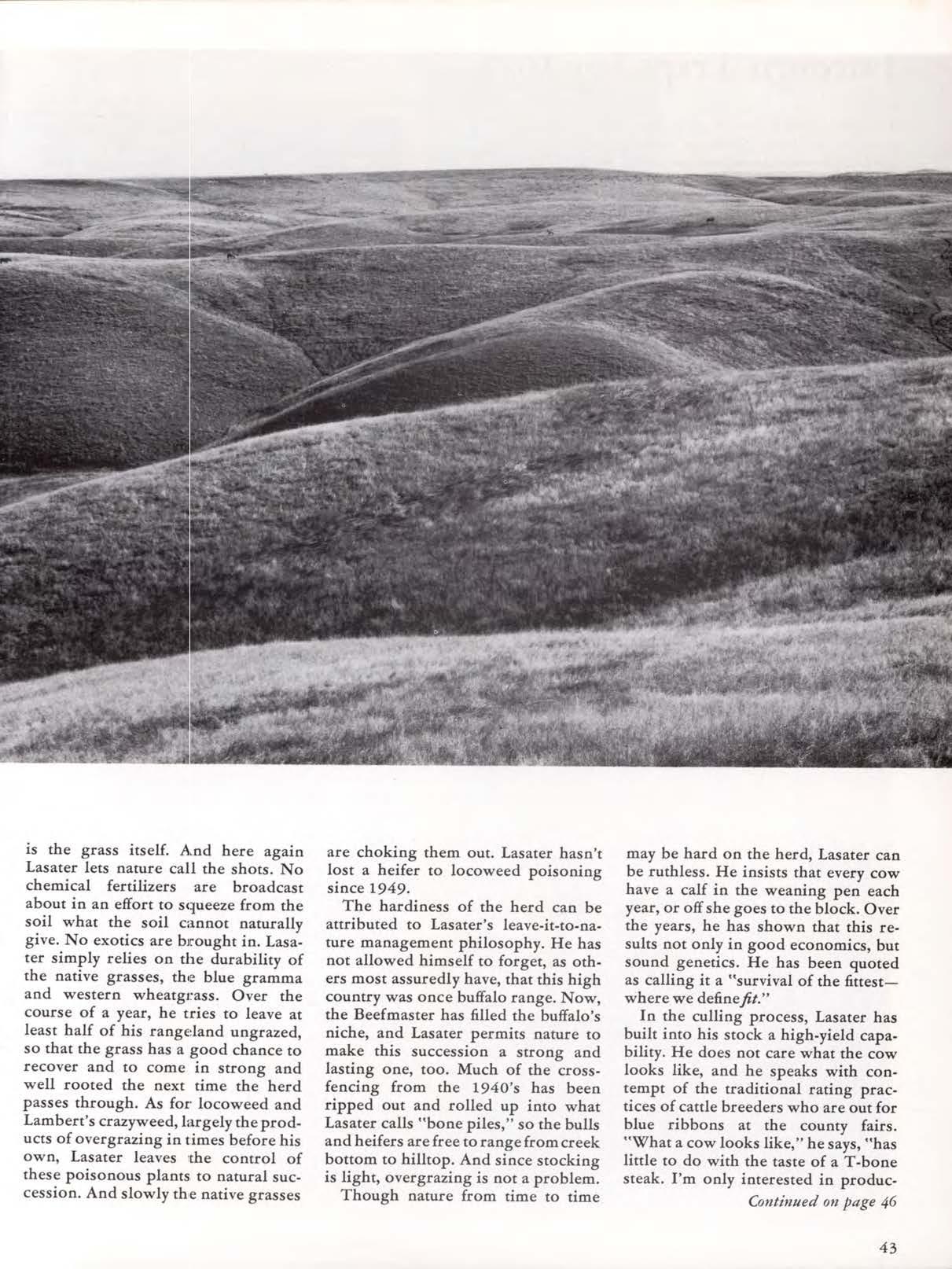
are choking them out. Lasater hasn't lost a heifer to locoweed poisoning since 1949.
The hardiness of the herd can be attributed to Lasater's leave-it-to-nature management philosophy. He has not allowed himself to forget, as others most assuredly have, that this high country was once buffalo range. Now, the Beefmaster has filled the buffalo's niche, and Lasater permits nature to make this succession a strong and lasting one, too. Much of the crossfencing from the 1940's has been ripped out and rolled up into what Lasater calls "bone piles," so the bulls and heifers are free to range from creek bottom to hilltop. And since scocking is light, overgrazing is not a problem. Though nature from time to time
may be hard on the herd, Lasater can be ruthless. He insists that every cow have a calf in the weaning pen each year, or off she goes to the block. Over the years, he has shown that this results not only in good economics, but sound genetics. He bas been quoted as calling it a "survival of the fittestwhere we define.fit."
In the culling process, Lasater has built into his stock a high-yield capability. He does not care what the cow looks like, and he speaks with contempt of the traditional rating practices of cattle breeders who are out for blue ribbons at the county fairs. "What a cow looks like," he says, "has little to do with the taste of a T-bone steak. I'm only interested in produc-
Continued on page
Foreign Trips for 1973
The whole earth is hard to get to know, and harder yet to save. But the United Nations is setting up machinery for world-wide conservation, and our help is needed if i t is to succeed. Ch,b members going on overseas trips get a better pict ure of what needs to be done, and can meet the peop l e who will have to be involved in doing it
Actually, we will all have to be involved. As informal roving emissaries, Club members traveling abroad can ga i n insight s, make contacts, and develop good will that can aid the Clu b's new office at the United Na t ions in it s work of helping the UN to keep the whole earth healthy.
M I CH AEL McCLO SKEY Execut ive D irector
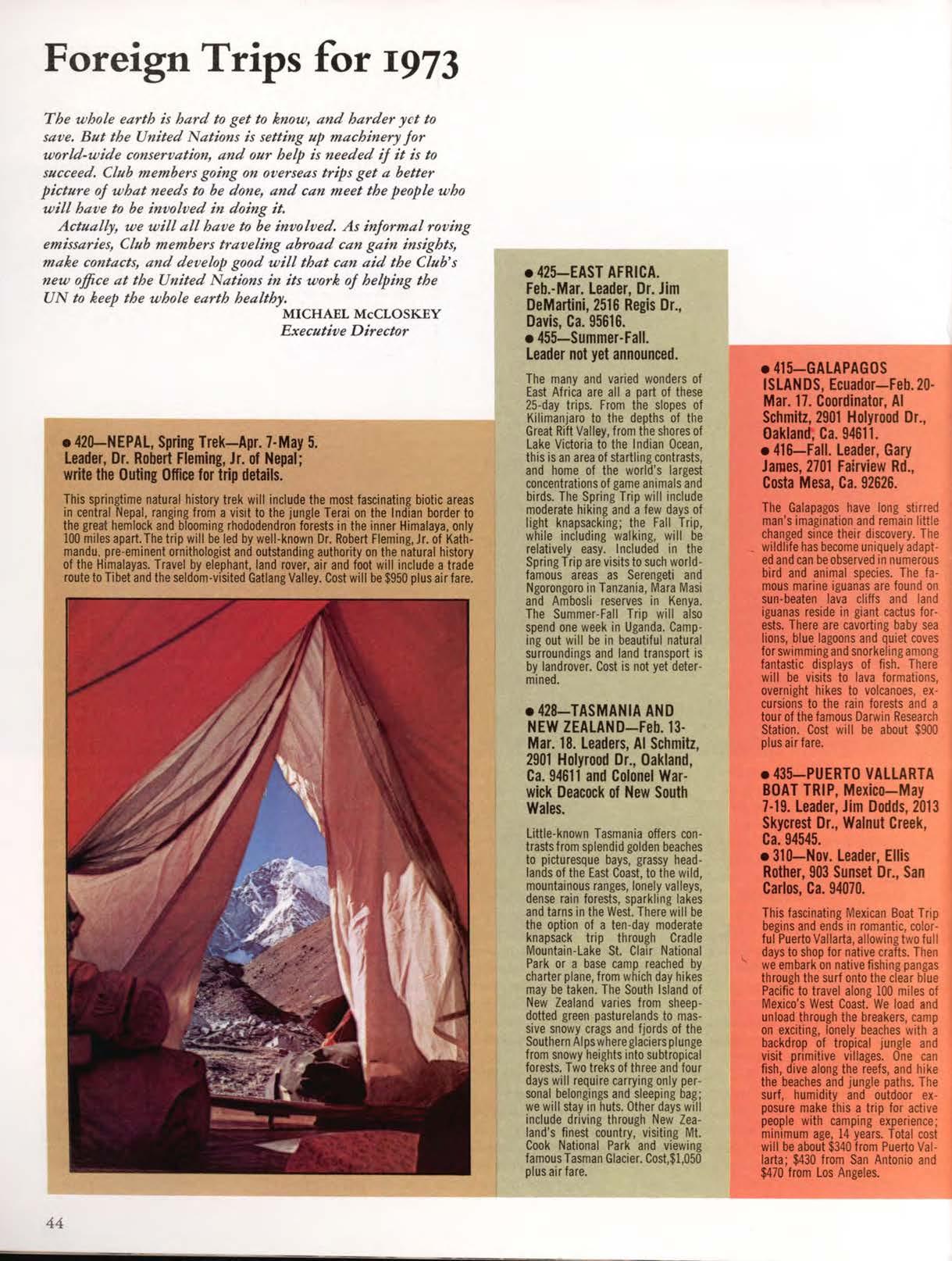
• 42~NEPAL, Spring Trek-Apr. 7- May 5.
Leader, Dr. Robert Fleming, Jr. of Nepal ; write t he Outing Office for trip details
This springtime natural history trek will include the most fascinatinJ biotic areas in central Nepal, ranging from a visi t to the j ungle Terai on the Indian border to the gr!l'l hemlock and_ bloomi ng rhododendron forests in the inner Himalaya, only 100 miles apart. The tnp will be led by well-known Dr Robert Fleming Jr. of Kathmandu. pre-eminent ornithologist and outstanding authority on the natural history of the Hni:ialayas. Travel by ele_p~ant, land rover, air and foot will include a trade route to Tibet and the seldom-visited Gatlang Valley. Cost will be $950 plus air fare.
• 425-EAST AFRICA.
Feb.-Mar. Leader, Dr. Jim DeMartini, 2516 Regis Dr., Davis, Ca. 95616.
• 455-Summer-Fall. Leader not yet announced.
The many and varied wonders of East Africa are all a part of these 25-day trips. from the slopes of Kilimanjaro to the depths of the Great Rift Valley, from the shores of Lake Victoria to the Indian Ocean, this is an area of startling contrasts, and home of the world's largest concentrations of game animals and birds. The Spring Trip will include moderate hiking and a few days of light knapsacking ; the Fall Trip, while including walking, will be relatively easy. Included in the Spring Trip are visits to such worldfamous areas as Serengeti and Ngorongoro in Tanzania, Mara Masi and Ambosli reserves in Kenya. The Summer-Fall Trip will also spend one week in Uganda. Camping out will be in beau tiful natural surroundings and land transport is by landrover. Cost is not yet determined.
• 428-TASMANIA AND NEW ZEALAND-Feb. 13· Mar. 18. Leaders, Al Schmitz, 2901 Holyrood Dr., Oakland, Ca. 94611 and Colonel Warwick Deacock of New South Wales.
Little-known Tasmania offers contrasts from splendid golden beaches lo picturesque bays, grassy headlands of the East Coast, to the wild, mountainous ranges, lonely valleys, dense rain forests, sparkling lakes and tarns in the West. There will be the option of a ten -day moderate knapsack trip through Cradle Mountain -La ke St. Clair National Park or a base camp reached by charter plane, from which day hikes may be taken. The South Island of New Zealand varies from sheepdotted green pasturelands to massive snowy crags and fjords of the Southern Alps where glaciers plunge from snowy heights into subtropical forests. Two treks of three and four days will require carrying only personal belongings and sleeping ba~; we will stay in huts. Other days will include driving through New Zealand's finest country, visiting Mt. Cook National Park and viewing famous Tasman Glacier. Cost,$1,050 plus air fare.
• 415-GALAPAGOS ISLANDS, Ecuador-Feb. 20Mar. 17. Coordinator, A l Schmitz, 2901 Holyrood Dr., Oaklamt, Ca 94611.
• 416-Fall Leader, Gary James, 2701 Fairview Rd., Costa Mesa, Ca. 92626
The Galapagos have long stirred man's imagination and remain little changed since their discovery. The wildlife has become uniquely adapted and can be observed in numerous bird and animal species. The famous marine iguanas are found on sun-beaten lava cliffs and land iguanas reside in giant cactus forests. There are cavorting baby sea lions, blue lagoons and quiet coves for swimming and snorkeling among fantastic displays of fish. There will be visits to lava formations, overnight hikes to volcanoes, excu rsions t o the rain forests and a tour of the famous Darwin Research Station. Cost will be about $900 plus air fare.
• 435-PUERTO VALLARTA BOAT TRIP , Mexico-May 7-19. Leader, Jim Dodds, 2013 Skycrest Dr., Walnut Creek, Ca. 94545.
• 31~Nov. Leader, Elli s Rother, 903 Sunset Dr., San Carlos, Ca. 94070.
This fascinating Mexican Boat Tnp begins and ends in romantic, colorful Puerto Vallarta, allowing two full days to shop for native crafts. Then ' we embark on native fishing pangas through the surf onto the clear blue Pacific to travel along 100 miles of Mexico's West Coast. We load and unload through the breakers, camp on exciting, lonely beaches with a backdrop of tro~ical jungle and visit primitive villages. One can fish, dive along the reels, and hike the beaches and j ungle paths. The surf, humidity and outdoor exposure make this a trip for active peo~le with camping experience; minimum age, 14 years. Total cost will be about $340 from Puerto Vallarta; $430 from San Antonio and $470 from Los Angeles.
• 450-NORWAY RUCKSACK TRIP-July 30-Aug. 19 Leader, Jim Watters, 600 Caldwell Road, Oakland, Ca 94611.
Here Is an adven turous 3-week hike and gl aci er tour, exp loring the f j ords and mountains of west cen tral Norway and the pristi ne wi lderness d northern subalpine ranges. We will view the extraordinary scenery of the Jotunhe1men and visi t the Jostedalsbre, crossing Europe's largest glacier. Then on to the majestic, untamed slopes of the Romsdal and fi nall y, Just south of t he Arctic! Circle, explo re BorgefJell National Pa rk , cam pi ng out m th is re mote, pri mi ti ve laird of expansiv e granite, tundra, water falls and abundant wildli fe. Combined wi t I some touring, this will be a fairly strenuous backpacking t re k, camping in all wEia ther for about half the trip, crossing glacie rs and climbing some peaks. Cost will be about $4 50 plus air fare.
• 452-WAL KI NG IN NORWAY- Aug. 10 to Sept. 1 Leader, Betty Osborn, 515 Shasta Way, Mill Valley, Ca 94941.
Trails and cairned ro utes wi th comfortable hut s and lodges provi de access to th e beauty and grandeur of Norway's vast mou ntain ranges for t hose who like to hi ke. The mountains of southern Norwa y with t heir ab unda nce of fi ords, waterfa lls, glaciers, snow-cover ed pea ks and picturesque villages will all bel a part of this three-week visit to Finse, the Aurland Valley, the Jotu nheim en an li the Sun more There will be easy glacier crossings and peaks to climb; some sightseeing will be included while traveling between hiking areas by boat, bu s and tra n. Cost will be abo ut $450 pl us air fare
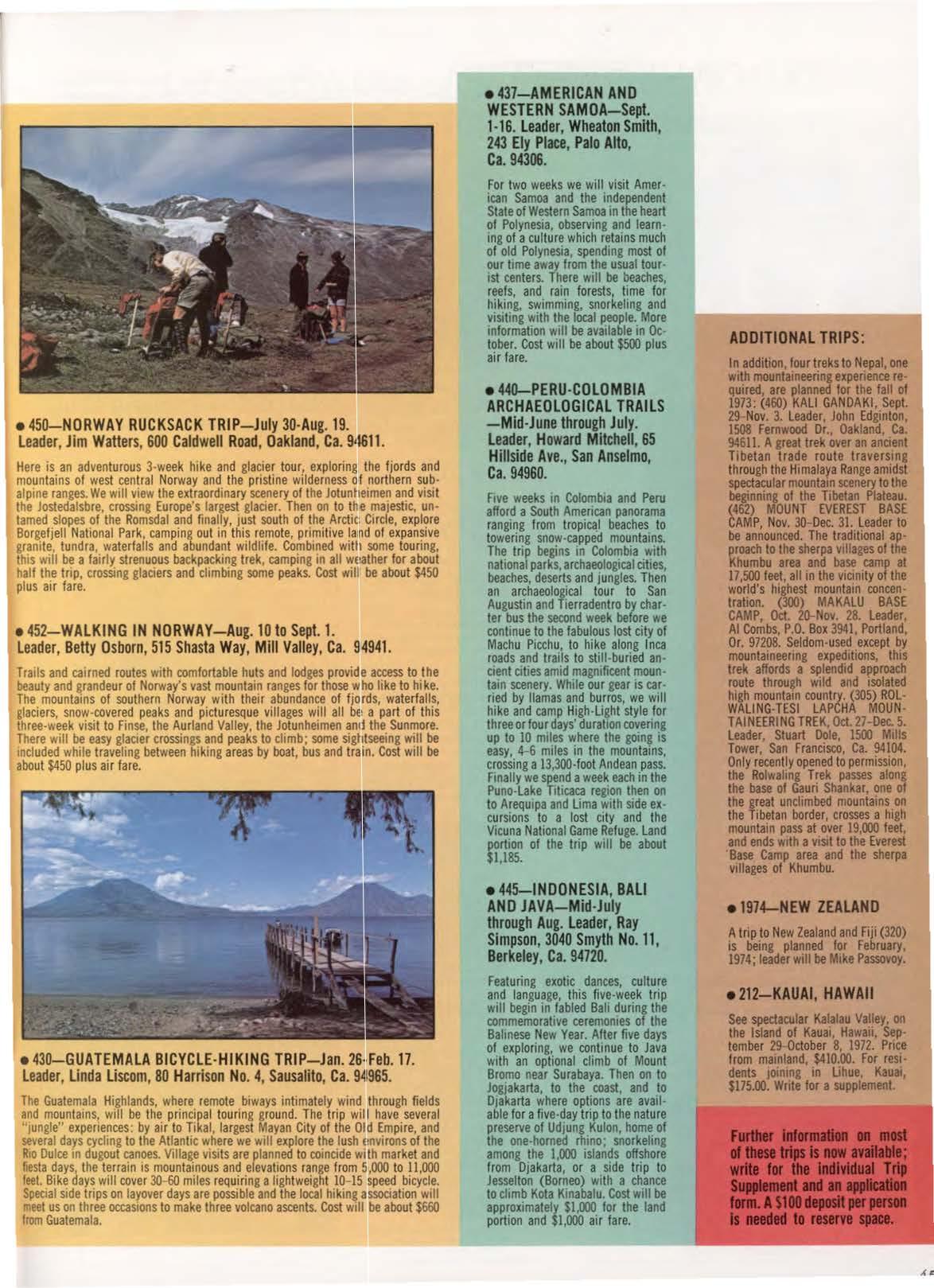
• 430-GUATEMALA BICYCLE -HIKING TRIP-J an 26 Feb 17 Leader, Li nda Li scom, 80 Harrison No. 4, Sau salito, Ca. 9~\965.
T Ie Guatemala Highlands, where remote b1ways i nlimat ely wind lthrough fields and mountains, will be the prin cipal tourin g ground The trip wi l ' have several "jungle" experiences. by air to Tikal, largest Mayan City of the Old Empire, and Se'veral days cycling to t he Atla ntic where we will explore the lush 11nvirons of the Rio Dulce in dugout canoes. Village visits are plann ed to coinci de wi!h market and fiesta days, t he terrai n is mountainou s and elevations range from 51,000 to 11 ,000 feet. Bike days will cove r 30 60 miles requiring a lightweight 10- 15 speed bicycl e Special side trips on layover days are possible an d t he local hiking association will meet us on three occasions to make three volcano ascents. Cost will be about $660 from Guatemala.
• 437-AMERICAN AND WESTERN SAMOA-Sept. 1-16 Leader, Wheaton Smith , 243 Ely Place, Palo Alto, Ca. 94306
For two weeks we will visit American Samoa and the independent State of Western Samoa in the heart of Polynesia, observing and learn ing of a culture which retains much of old Polynesia, spending most of our lime away from the usual tour 1st centers. There will be beaches, reefs, and ram forests, lime for hiking, swimming, snorkeling and visiting with the local people. More information will be available in October. Cost will be about $500 plus air fa re
•
440-PERU-COLOMBIA ARCHAEOLOGICAL TRAILS
-Mid-June through July. Leader, Howard Mitchell, 65 Hillside Ave., San Anselmo, Ca 94960
Five weeks in Colombia and Peru afford a South American panorama ranging from tropical beaches to towering snow-capped mountains. The t rip begins in Colombia with national parks, archaeological cities, beaches, deserts and Jungles. Then an archaeological tour to San Augustin and Tierradentro by charter bus the second week before we continue to the fabulous lost city of Machu Picch u, to hike along Inca roads and trails to still-buried ancient cities amid magnificent mountain scenery. While our gear Is car ned by llamas and burros, we will hi ke and camp High-Light style for three or four days' duration covering up to 10 miles where the goine Is easy, 4-6 miles in the moun tains, crossing a 13,300-foot Andean pass. Finally we spend a week each in the Puno-Lake Titicaca region then on to Arequipa and Lima with side ex cursions to a lost city and the Vicuna National Game Refuge. Land portion of the trip wall be about ~1,185.
• 445-INDONESIA, BALI
AND JAVA-Mid-July through Aug. Leader, Ray Simpson, 3040 Smyth No. 11 , Berkeley, Ca. 94720.
Featuring exotic dances, culture and language, th is five-week t rip will begin in fabled Bali during the commemorative ceremonies of the Balinese New Year. After five days of explori ng, we contin ue to Java wi t h an op tional climb of Mount Bromo near Surabaya. Then on to JogJakarta, to the coast, and to DIakarta where options are avail ab le fo r a five-day t rip to the nature preserve of UdJung Kulon. home of the one-horned rhino; snorkelin1; among the 1,000 islands offshore from Djakarta, or a side tr ip to Jesselton (Borneo) wi th a chance to climb Kola Kinabalu. Cost will be approximately $1,000 for the land portion and $1,000 air fare.
ADDITIONAL TRIP S:
In addition, four treks to Nepal, one with mountaineering experience required, are planned for the fall of 1973: (460) KALI GANDAKI, Sept. 29 Nov. 3. Leader, John Edgin ton, 1508 Fernwood Dr , Oakland, Ca. 94611. A great trek over an ancient Tibetan trade route traversing through the Himalaya Range amidst spectacular mountain scenery to tho beginning of the Tibetan Plateau. (46"2) MOUNT EVEREST BASE CAMP, Nov. 30- 0ec. 31. Leader to be announced. The traditional approach to the sherpa villages of the Khumbu area and base camp at 17,500 feet, all in the vicinity of the world's highest mountain conccn • trat1on. (300) MAKALU BASE CAMP, Oct. 20-Nov. 28. Leader. Al Combs, P.O. Box 3941, Portland, Or. 97208. Se ldom-used except by mountaineering exped1taons, this trek affords a splendid approach route throu~h wild and isolated high mountain country. (305) ROLWALING-TESI LAPCHA MOUN • TAINEERING TREK, Oct. 27- 0ec. 5. Leader, Stuart Dole, 1500 Mills Tower, San Francisco, Ca. 94104. Only recently opened to permission, the Rolwahng Trek passes along the base of Gauri Shankar, one of the great unclimbed mountains on the Tibetan border, crosses a high mountain pass at over 19,000 feet, and ends with a VJSII to the Everest ' Base Camp area and the sherpa villages of Khumbu.
e 1974--NEW ZEALAND
A trip to New Zealand and Fiji (320) is being planned for February, 1974; leader will be Mike Passovoy.
• 212-KAUAI , HAWAII
See spectac~lar Kalalau Valley, on the Island of Kauai, Hawan, September 29 October 8, 1972. Price from mainland, $410.00. For resI • dents Joining in Lihue, Kauai , $175.00. Write for a supplement
Furda lnfarmallan • most " these trips Is now milablt; write for the lndlvldual Trip Su..1,meat and • fann. A$100 dlposlt per persea Is needed to resem space.
AN AMERICAN INDIAN CHILD NEEDS
YOU AS A SPONSOR AND PERSONAL FRIEND .•.
A friend 10 help. A friend 10 wri1e to. A friend to share his-or her- joy as a young life is Iransformed from ap• palling hardship lo bright new hope and pride -because of your compassion
Spon so ring an Am erican I ndian child Ihrough Futures For Children c an work many wonders:
• Keep "your child" in school by directly financing shoes, clothing, and other necessiIies. (Right now man y Indian c hildren have li11le more Ihan Ihe Ihreadbare cl oIhes on Iheir backs.)
• Open a new world "beyond Ihe reservaIion " for your c hild Ihrough your co ncerned friend· ship.
• Provi de hope, self-esteem and confid ence-perhaps for the first t ime in a c hild's life.
Decide now to sponsor a young I ndian boy or girl. II will be a rewarding experience for your entire family. I@ ,~u;;;.-;;;~~.;.; 71 I 5612 Parkston Road , I Wash i ngt on, D.C 20016 I
I • Ye s, I ( we) want 10 sponsor an I America n Indian child
I O a boy O a girl D either I
En closed is a c heck for$ ___ I ($ I S monIhly; $45 quarterly ; $90 I semi-annually; $ I80 annually)
I • H ere's help, not as a Sponsor, but I II with a check for $ ____ I
• Plea se send more informati on.
Varmints ( co11 ti1111ed )
ing the best beef e ffici en tly. " l e ft co themselves, n ature, Beef. master, and the likes of Tom Las ater mi ght go on forever doing just that on the Co lorado plains. But eve n the big world of sky and grass and occasiona l springs is bitched to the larg er world around it And the larger world is closing in fast.
W a ter, for instance. Two aquifers s urface on the ranch at Mathesonthe ubiquitou s Ogallal a and the Fox Hill sandstone formation. Yet Denver, 85 miles to the northwest and sprawling ever outward, is drai nin g the former, while the l evel of the latte r declines as irrigators min e the Og a lla la co the south. "We'll see the day, " says Lasater , "when water out h ere will b e more valuable than oil."
Directorv
CORRESPONDENCE COURSE IN CONSERVATION
Learn and Do more about conservation. Comprehensive, study-at-home course In Fish and Wildlife, Parks and Recreation, Forestry, Environmental Conservation, and Ecology.
Be a Knowledgeable leader in conservat ion Wr ite: National School of Conservation Dept. SC-1, 1129 20th St. N.W. Wash ington , D.C 20036 for fre e school catalog
Sierra Safari invi tes You along! Camping this Fall and Winter - Yosemite, Sept. 8-10 & Oct. 21-23; Death Valley, Nov. 19-25; Anza Borrago, Dec. 23-30; Baja, Jan. -Fe b.-wlth gourmet meals, good companionship, activities for all ages. For details write Bill and Mavis Clark, 223 Taurus Ave., Oakland, CA 94611.
HIPHUGGER BACKPACK
All of the weight is on a fully padded, ventilated , pivoting backband
Lasa ter is a lso l ess than optim1suc about the future of the inde p e ndent range operator. On the one band, b e se es the industry b ecoming incr easingly centralized through the integr ation of everyth ing from br eed ing to distribution unde r single management. On the other, he sees the cowman being pushed into marginal country. Or, what is even more likely, the cowman being forced co turn to recreation, co "bring in the dudes." Some ranchers in Texas, says Lasater, are already earning more money from the sale of hunti ng righ ts th a n from the sale of beef. Lasat e r himself allows as bow h e sometimes thinks he should b ecome a vegeta ri an and tak e in city slickers for a living. "Trouble is," he adds, " I can't stand vegetabl es-a nd like dude s even worse."
656 B Front St. El Cajon, Calif. 92020 WRITE FOR CATALOG
The Cadillac of Backpacks Since 1962
Trail Guide and Field Identification Guides
100 Northern California Hiking Trails
100 Southern Cali fornia Hiking Trails
100 Oregon Hiking Trails
$5.95
$5.95
$5.95
WILDFLOWERS 1, The Cascades $6. 95
Available a t your Sporting Goods Dealer or Book Store The Touchstone Press P. 0. Box 81, Beav erton, Oregon 97005
the Saragoy, we have sturdy, well• b uilt pouches except o urs fit on your boct We manufacture backpacking and mountaineering equip men t our c olor catalog is free.
SIERRA DESIGNS, Dept. SCB-3 4th and Addison Sh., Berlteley, CA 94710
ASCENT
An entertaining and informative 16mm color 30 minute film about mountain climbing in Yosemite produced by KQED and Virginia Duncan now available for sale and renlal Sale of print $325 Rental S2 7.50 per showi ng FILMWAIGHT (415) 863-6100 Diamond Heights Box 31348 San Francisco. Cahl 94131
CLIMBING IN THE ANDES
Mountain Travel is offering i.l three-week climbing to ur to Ecu ador combin i ng asce n ts of vol ca nos l lini za Sur Cotopaxi. Cayambe and th e famed Chimborazo (20,557) with sight se eing in t he ancient capital of Quito and the rural countryside Stamina and experience req uired but little te c hn ical cli mb ing.
No ve mbe r 8 throu gh 28 $750 plu s ai r fare W ritf' for Ecuador t r,n su(J(Jlemf'nt plus boo k le t con r a,n,ng comple t e t r,p J,s r ,ngs Dept. SB, M oun r a,n T r a v el US A, 620 1 Meda u Place Oakl an,1. Cal,t 9 4 6 11
Like
Let the Editors of TIME-LIFE BOOKS introduce you to the Science of Survival
It's yours for a 10-day free trial as your introduction to the
LIFE NATURE LIBRARY
I n Ecology, you'll discover why this newest of the natural sciences may well be the most important ... for unles~ man learns to coexist with the other animals and even plants, he may not exist at all.
Author Peter Farb, noted consultant fo r the Smithsonian Institution, shows with vivid examp les how man upsets the ecology of an environment.
The extermination of America's buffalo herds turned fertile areas into barren wastelands ... the European watercress, introduced into New Zeala nd, grew to gigantic size and choked the channels of river:, ... a s ingle rabbit colony, introduced into Australia, turned into a rampaging horde that nearly destroyed that country's grasslands.
Absorbing text , remarkable illustrations "Magnificently illustrated ," write~ The New York Times. And indeed the graphics of Ecology are striking. The book includes more than 100 unusual color and b lackand-wbite photographs, plus page after page of color illustrations commissioned expressly for Ecology. For example, in color pictures you'll ~e in deta.il the entire ecological community of a rocky shoreline just how plants and animals hold their places in spite of tides. l o both pictures and text , you'll gain fresh insights into the interrelationships of life how animals compete or cooperate how smog and water pollution bligh t both city and farm.
In the final chapter of Ecology, you'll read about America's head-on co llision with nature how almost a hundred North American mammals are on t he verge of extinction. What man isn't bulldozing out of existence he is buryi ng-20 billion tons of paper, 28 billion bottles and 48 billion cans are discarded in the U.S. each year.
10-day free reading offer
You may read and examine Ecology for 10 days with no obligation. The
Among other volumes in the !!ID NATURE LIBRARY
The Sea, The Birds, Animal Behavior
book is absorbi ng and ti m ely reading fo r anyone concerned with the quality of our environment. I t is also a good introduction to the LIFE Nature Library, a series pra ised by naturalists and ed ucators alike. (Th e vo lumes have been se lected by the State of California as supplementary r eading for secondary schools.)
Volume by volume, the series explore~ many areas of the natural world ... such as The Sea, The Birds a nd Animal Behavior. Once you 've dipped into Ecology, you may be interested in seeing some of the other volumes. However you are not obligating yourself to do so by accepting this invitation to examine Ecology. You'll find co mplete details of this offer in the order form provided. Just fill it in a nd send it. to borrow Ecology with our com pliments and no ob li gation.
TIME-LIFE BOOKS DEPT.0248, 7 TIME & LIFE BLDG., CHICAGO, ILLINOIS 60611 I Yes, I would like to examine Ecolol/Y, Please send It to me for 10 days' free examination and enter my subscription to I the LI FE Nature Library. If I decide to keep Ecolory, I will pay $4,95 ($5.25 in Canada) plus shipping and handling. I I then will receive future volumes in the LIFE Nature Library I series. ship ped a volume at a time every other mon1h. Each is $4.95 ($5.25 in Canada) pl us shipping and handling, and I comes on a JO-day free examination basis. There is no minimum number or books that I must buy, and I may cancel my I subscrip1ion at any time, simply by notifying you. If I do not choose to keep Ecoloiy, r will return the book I within 10 days, my subscription for Cu1ure volumes will be I canceled and I will not be under any funher obligation. Namc______=-c---,--,.......------(Pleasc p rint) I I Address,__________________ I
Hows~ bags with DuPont Dao:, Hber611 Il conquered Mt.McKinleJ
as told by Paul Petzoldt**
"In June of 1971, our National Outdoor Leadership School set out to spend a month and a half on Alaska's Mt. McKinley. The objective was to set up a training class that would teach how to adjust to high altitudes and how to keep warm in rain, snow and freezing cold. All 30 of us took along sleeping bags and parkas filled with Dacron* polyester Fiberfill II. What follows is a report of this equipment's performance.
" On the lower glaciers of Mt. McKinley, the bags were continually getting soaked due to very heavy rains. However, we'd wring them out, hang them over snowshoes, and they'd be completely dry in about 15 minutes.
"As we reached even higher altitudes, we began s leeping in snow caves, and of course, the bags got wet there too. But we would just hang them out to let the water freeze, and in a matter of minutes, the ice would sublimate. An added reward to the bags was that even if we couldn't get them completely dry due to bad weather, they'd keep their loft around us, and everyone slept very comfortably.
"From our final camp at 17,40( made several summit assaults. Tl team of seven reached the 19,500 f •. At that elevation, the temperature was -16°F., with winds gusting to 40 mph. Our .. parkas, which were also filled with Fiberfill II, kept us very warm, even though we were quite tired. In all, 10 of the 30 members reached 19,000 ft. or higher r, •/ and there wasn't a single complaint of discomfort due to cold.
''The NOLS McKinley Expedition was the largest expedition in the history of the mountain, and the first to use gear filled with 'Dacron', rather than down. I would have to say that Fiberfill II made history right along with us. We couldn't have been more pleased with these items in all phases of their functioning. We plan to make a New Year's expedition to the Grand Teton, and we will most definitely take along gear filled with Fiberfill II."
**Pa ul Petzo ldt is a Teton guide, legen dary mountaineer, and Director of the N a tional Outd oor Leadership School with headquarters in La nder, Wyo. Equ ipment for this expedition was produced under his d i rection u sing material given to him by Du Pont.