A TASTE OF
ITALY
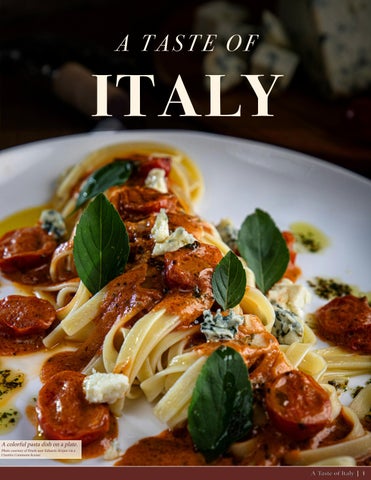
A colorful pasta dish on a plate.
Photo courtesy of Pexels user Eduardo Krajan via a Creative Commons license.
A Taste of Italy | 1 -
THE DAY STARTS AT THE BAR.
While lavishness, slowness, and calm describe a typical Italian meal, the first words that come to mind to describe breakfast at a bar are simplicity, speed, and ritual.
Fresh coffee mid-brew.
Photo courtesy of CoffeeGeek author Mark Prince via a Creative Commons license.
2 | A Taste of Italy
F
irst of all, when we do not have breakfast at home, we stop at a bar — no, not that kind. What we call a bar in Italy is the equivalent of a café. So don’t be surprised if an Italian friend asks to meet at the local bar at 8 a.m. for a drink — that means a coffee! The Italian breakfast is quick, something to fuel you up before getting into the office. During the morning rush hour, approaching the counter of a bar can be an intimidating ordeal. Everyone is shouting orders at the barista, trying to make themselves heard over the clattering of cups and the noise of the giant, shiny espresso machine. Italians rarely sit down at the tiny tables scattered around the neighborhood café. Follow their lead and stand at the counter, espresso cup in one hand and pastry in the other. It’ll be over in a matter of minutes, as you’re expected to quickly yield your spot to the next customer to not disrupt the morning flow. Drinking your coffee at the bar is also a ritual, something Italians cannot do without. It’s always the same drink, the same pastry, at the same place every morning, so after a while, you become a well-loved regular. The barista will recognize you from afar, give you a nod, and make you il solito, the usual, without you even needing to ask.
A Taste of Italy | 3 -
A sandwich in someone’s hand outside a shop in Florence, Italy. Photo courtesy of Pexels user Anh Nguyen via a Creative Commons license.
4 | A Taste of Italy
LUNCH LIKE A LOCAL. Street-side simplicity, panino al prosciutto
T
he magic of Italian sandwiches lies Sides like olives, pickled vegetables, or a in their simplicity and the quality simple arugula salad with lemon and olive oil of their ingredients. Unlike other dressing enhance the meal, adding an extra
cuisines that might rely heavily on sauces delicious layer of complex texture and flavor.
and spices, Italian sandwiches celebrate the natural flavors of each component. The bread, One of the greatest strengths of Italian often a crusty ciabatta or a soft focaccia, sandwiches is their versatility. Perfect for any creates the perfect canvas for the vibrant occasion, they can be elegantly simple for a fillings. Italian meats such as prosciutto, quick lunch or elaborately constructed for salami, and mortadella add depth and a dinner party. Their ease of customization character, while mozzarella, provolone, or allows them to cater to a pretty wide range pecorino cheese lend their creamy textures. of dietary preferences and occasions. One of the earliest forms of an Italian Whether you’re having a picnic in Rome sandwich is linked to the panino. Using a or walking the streets of Florence, there’s simple ciabatta bread, the panino is elegantly an Italian sandwich to fit the bill. This stuffed with a variety of meats, cheeses, and adaptability makes them a staple for meal vegetables, each selection offering a glimpse planners and food enthusiasts alike. The into Italy’s rich culinary diversity.
portability of Italian sandwiches makes them ideal for outdoor gatherings. Easy
Pairing your Italian sandwich with the right to assemble, serve, and enjoy, they ensure beverage or side can elevate your meal to a a hassle-free dining experience without new level. For a classic experience, consider compromising taste or quality. For those a glass of Chianti or a crisp Pinot Grigio that seeking a casual yet delicious meal option, complements the flavors of the sandwich. Italian sandwiches offer a perfect solution.
A Taste of Italy | 5 -
Never rush
Cena — when time loosens its grip at Italian dining is not just about eating — it is about gathering. Dinners are sacred times where family and friends come together to socialize, celebrate, and create memories around the table. Italians take their enjoyment of food and drink very seriously, and dinner follows a thoughtful, practiced rhythm: antipasti, primi, secondi, dolci, and a final espresso or settling digestivo.
Primi follow, often a smaller-sized dish of pasta, risotto, or gnocchi. This is where regional tradition really has a moment to shine. A bowl of pappardelle with ragù, a delicate risotto, or handmade ravioli reflects generations of culinary memory. Emphasis remains on quality and flavor rather than quantity. The pace always remains slow and steady, and never hurried.
Dinner is rarely, if ever, rushed. It unfolds in lengthy courses, each meant to be savored. Even the pauses between dishes are part of this ritualistic experience — providing attendees with extra time to talk, refill a glass of wine, or lean back in their chairs to take a moment before the next delicious plate arrives at the table.
Secondi center on protein — typically a meat or fish — prepared simply to highlight natural ingredients. Unlike in many countries, the main course is not automatically paired with sides. Contorni are ordered separately: sautéed greens, roasted vegetables, or a salad, brought after the second course. Each plate is given its moment of appreciation before the next one arrives.
Antipasti begin the meal — small, simple dishes meant to awaken the appetite. Bread, prosciutto, cheese, bruschetta, or seasonal vegetables are served, never as the focus, but as a slow introduction. The goal is balance, not excess. These first bites are designed to open the evening slowly, encouraging meaningful conversation rather than filling you up too quickly. 6 | A Taste of Italy
Dolci close the evening, followed by a tiny espresso and a digestivo to settle the meal. Restaurants do not bring the bill unless you ask. Dinner is not measured in minutes. It is a ritual of courses, wine, and unhurried company, a moment where time loosens its grip at the table.
hed.
t the table
Fresh lasagna on a plate.
Photo courtesy of Flickr user Hanahmark via a Creative Commons license.
A Taste of Italy | 7 -
Gelato Culture
As important as drinking espresso or taking an evening aperitivo, gelato is a vital part of Italian culture. Italians enjoy it year round, but in summer it is an absolute necessity. From suited businessmen to gossiping nonni, gelato is one of the few foods happily eaten on the street, all day and all night. On Sunday nights, families gather for la passeggiata — a leisurely walk often accompanied by a refreshing gelato, lingering in piazzas as the day slowly fades and conversations stretch late into the evening air.
Two hands holding gelato cones in Venice, Italy.
Photo courtesy of Pexels user Maksym Harbar via a Creative Commons license.
8 | A Taste of Italy
~ ~
~