

Dear Friends and Neighbors,
The second quarter of 2026 gave North Carolina a housing market moving on fundamentals rather than urgency. Inventory is rebuilding, buyers are engaging, and prices are holding. Our markets are expressing that balance differently, but the underlying story runs consistently from the coast to the mountains
Charlotte set the tone The region closed the quarter at a median sales price of $407,000, up 0 5%, with the average up 2 2% to $536,341 Those are modest gains, but durable ones, set against inventory that expanded 5 6% to more than 13,000 homes Closed sales held steady at 12,457. Mecklenburg County led on price, with its median up 3.3% to $469,900, while Union and Lancaster counties posted the strongest volume growth at 13.9% and 4.4%. At 3 6 months' supply and 50 days on market, Charlotte remains the deepest and most liquid market in the state
The Triad did what the Triad does best: deliver value High Point led the region with 7 8% median growth, and Winston-Salem posted gains of its own at a $317,125 median Greensboro's median eased to $317,000 even as closed sales rose 2.9%. Inventory expanded sharply across the Triad, up 29.3% in Winston-Salem and 34.9% in Greensboro, giving buyers their widest selection in years without meaningfully undercutting values
The Triangle turned in the quarter's most decisive numbers Closed sales rose in every market: Wake County up 10 0% to 5,181, Durham County up 17 5%, Raleigh up 6 2% Prices eased modestly, and mostly in the buyer's favor Price per square foot fell 5 1% in Durham County and 3.0% in Wake, which means buyers are securing more home for the same money. Homes still sold in 24 to 30 days at roughly 98.5% of original list price. Demand there is expanding to meet supply rather than retreating from it
In the Asheville and Western North Carolina mountains, recovery continued to gather strength Closed sales rose 8.8% across the Asheville region, 11.8% in Buncombe County, and 11.0% in Henderson. The regional median finished at $425,887, up 1 4%, and months' supply tightened even as inventory grew, evidence that the added listings are being absorbed Marion, McDowell, and Burke remain among the state's most affordable markets as they rebuild after Hurricane Helene. Along the coast, Jacksonville ran counter to every trend, with its median up 3 6% and just 2 6 months of supply, the tightest market in this report
Two themes tie it together Buyers have time again Homes are taking longer to sell nearly everywhere, and that pace is producing better decisions on both sides of the table. Pricing discipline has also become the difference between a closed sale and a stalled listing Homes that are prepared well and priced to current market value are still moving quickly at near-full list price
Mortgage rates in the low-to-mid 6% range continue to support activity, and any meaningful easing would release demand that has been building for two years. North Carolina's fundamentals have not wavered: job growth, in-migration, and communities people genuinely want to live in
Our commitment to you remains unchanged. Across every market in this report, our associates are here to advocate, to listen, and to guide with honesty and care Thank you for the trust you place in our team, and we look forward to a strong close to the year
Warmest regards,
Tania Moore, President | Qualifying Broker ERA Live Moore

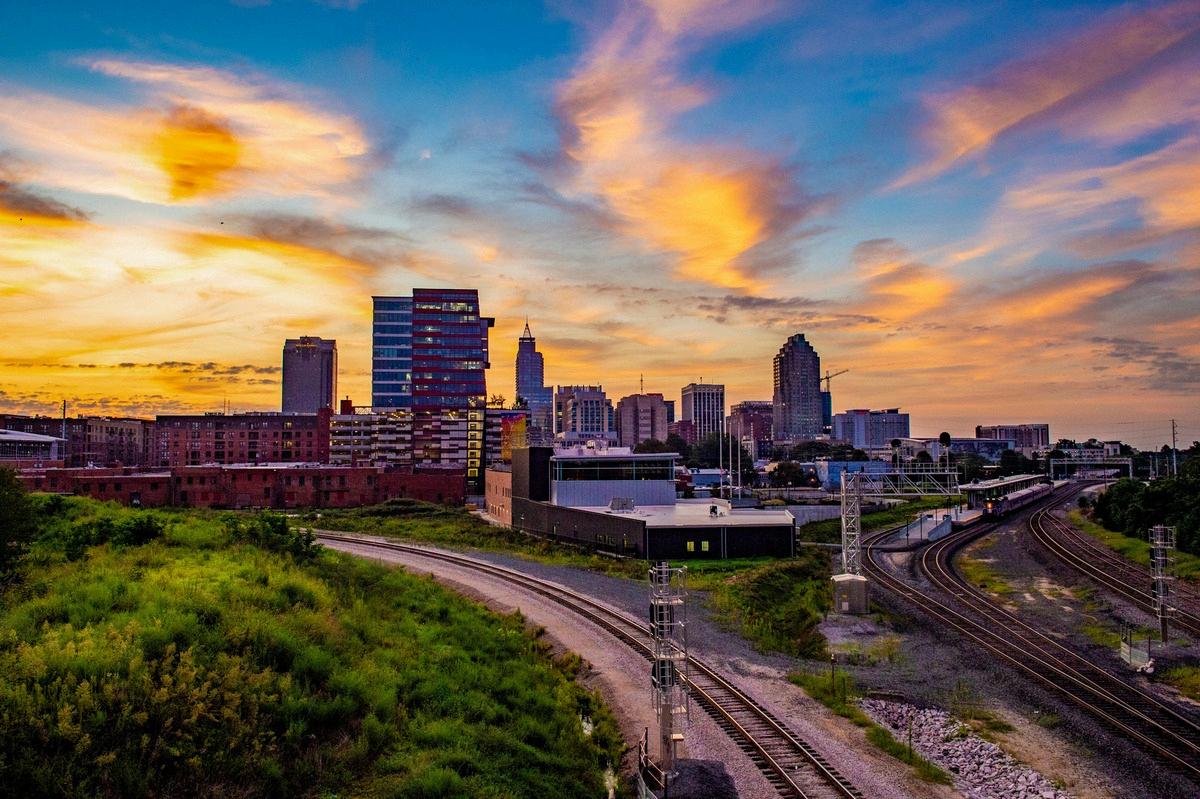
The Triangle closed the first half of 2026 with demand doing the talking. Across Raleigh, Durham, and Wake County, closed sales rose in every market Wake up 10.0%, Durham County up 17.5%, Raleigh up 6.2% even as inventory expanded at a similar or faster clip. That is the defining feature of the quarter: supply is growing, and buyers are absorbing it.
Prices eased modestly, and mostly in the buyer's favor Wake County's median settled at $481,000, down 2 1%, while Durham County's slipped 1 5% to $425,000 More telling is price per square foot, which fell 5 1% in Durham County and 3 0% in Wake buyers are simply getting more home for the same money Raleigh moved the least in either direction, with the median off just 1 1% to $454,995 and months' supply holding flat at 3 5, the deepest and most balanced position in the region
Speed has not gone away Homes are selling in 24 to 30 days across the Triangle, and sellers are still capturing between 98 1% and 98 6% of original list price — margins most markets in the country would envy Durham stands out as the region's affordability story, pairing the strongest sales momentum with the largest per-foot adjustment. Anchored by a strong employment base, worldclass universities, and sustained national attention, the Triangle remains one of North Carolina's most resilient and dynamic regions.
For Buyers. Inventory is up meaningfully more than 22% in Durham and per-square-foot values have come down. This is the most negotiating room buyers have had in years and desirable homes still move quickly.
For Sellers. Demand is real and sales volume is rising. Homes priced to current value and presented well are closing in roughly a month at near-full list price.
Bottom Line: The Raleigh–Durham–Chapel Hill market remains a cornerstone of North Carolina real estate stable, competitive, and gaining momentum heading into the second half
Raleigh held remarkably steady through the second quarter The median sales price slipped just 1 1% to $454,995 while closed sales advanced 6.2% to 1,982, a combination that points to a market clearing at prices buyers consider fair Inventory grew 6 8% to 1,955 homes and months' supply held flat at 3 5 the deepest of the four Triangle markets, and the clearest evidence of genuine balance Days on market extended to 30, the longest in the region, giving buyers meaningful time to evaluate Of the Triangle markets, Raleigh moved the least in either direction.

Median Price Per Square Foot
Pct of Orig Price Received
Average Days on Market Inventory
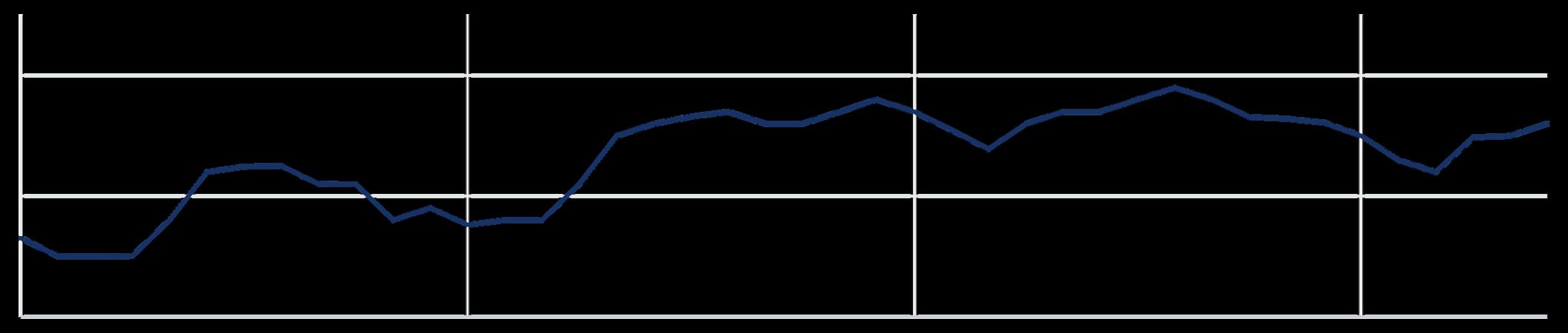
The Median Sales Price in Q2 2026 for a single family home in Raleigh was $454,995 for a year-over-year deccrease of -1.1%
As of July 2026 the Average Month's Rent in Raleigh for a 2 bedroom was $1,540
Raleigh Occupied Housing Units 51% of homes are owner-occupied households and 49% are renter-occupied households
The Median Sales Price in Q2 2026 for a single family home in the Wake County was $481,000 for a year-over-year decrease of -2.1%
The city of Durham mirrored its county with slightly sharper edges Closed sales rose 17 6% to 1,310 against a 22 5% inventory build to 1,199 homes, lifting months' supply to 3.6. The median sales price eased 2 3% to $420,000 while median price per square foot dropped 5 5% to $223, the largest per-foot adjustment among the four markets, and the sharpest improvement in buyer value Days on market rose only modestly to 25, and sellers held 98 5% of original list price. Durham enters the second half as the Triangle's most affordable major market with its strongest sales momentum

New Listings Closed Sales
Median Sales Price
Median Price Per Square Foot
Pct of Orig Price Received
Average
Durham County posted the Triangle's most decisive quarter Closed sales jumped 17 5% to 1,389 while inventory expanded 22 7% to 1,268 homes, the largest supply build in the region, pushing months' supply to 3 6 The median sales price eased 1 5% to $425,000, but median price per square foot fell a steeper 5 1% to $224, suggesting buyers are securing more home for their money Homes sold in 25 days and sellers still captured 98 6% of original list, the strongest ratio in the Triangle Demand here is expanding to meet supply rather than retreating from it.

New Listings
Closed Sales
Median Sales Price
Median Price Per Square Foot
Pct of Orig Price Received
Average Days on Market Inventory of Homes for Sale
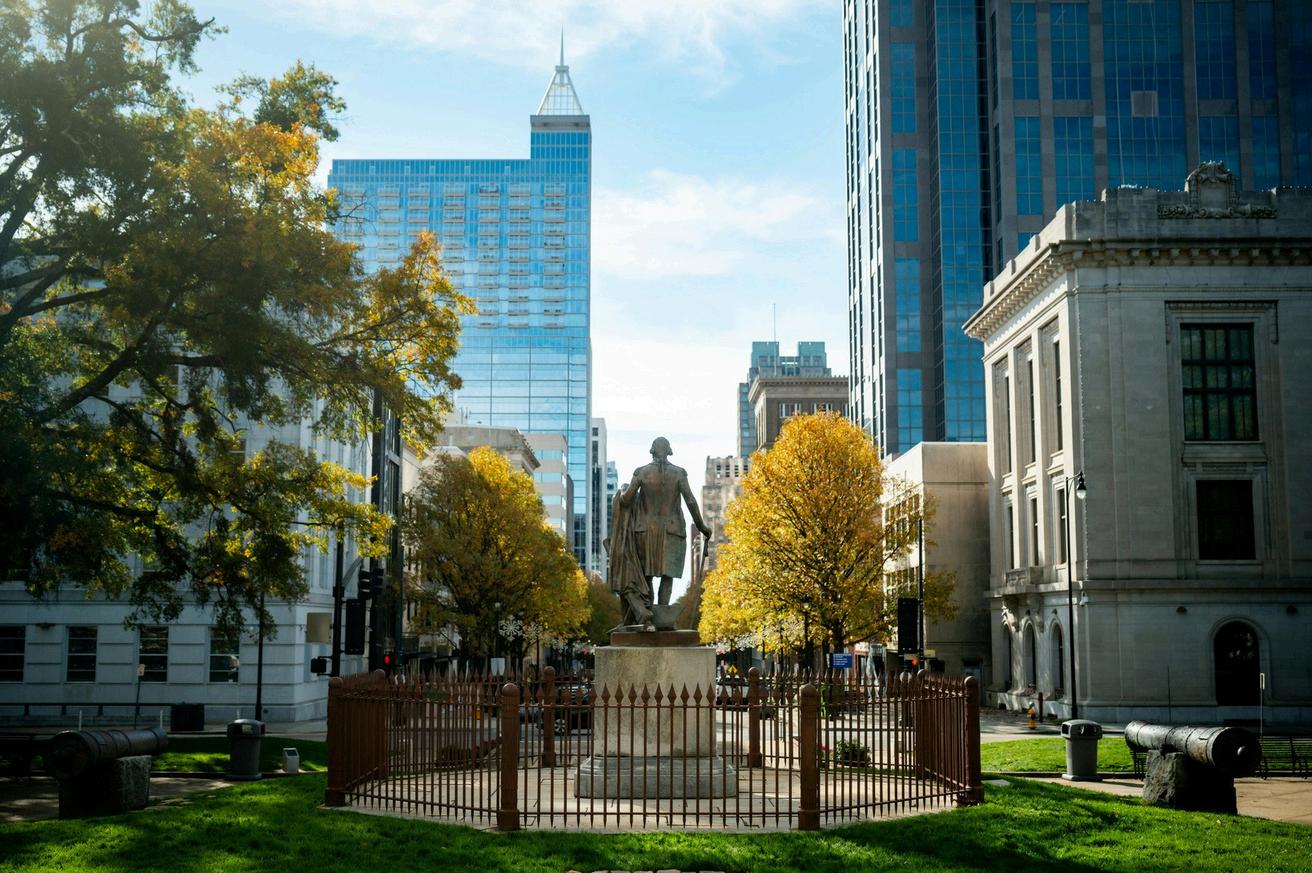
Wake County closed the second quarter with buyers returning in force. Closed sales rose 10 0% year over year to 5,181, the strongest June reading in the three years we track, even as the median sales price eased 2 1% to $481,000 Inventory climbed 10 1% to 4,623 homes and months' supply nudged up to 3 3, yet the added supply is being absorbed rather than accumulating Homes are taking 24 days to sell, four days longer than a year ago but still brisk by any historical measure Sellers captured 98 4% of original list price, a fractional give-back that reflects negotiation, not weakness

New Listings
Closed Sales
Median Sales Price
Median Price Per Square Foot
Pct of Orig Price Received
Average
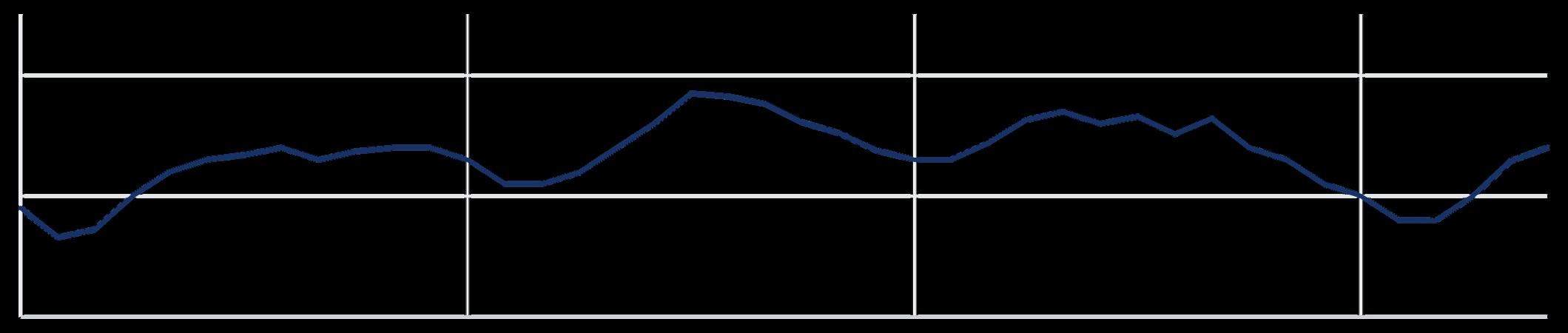
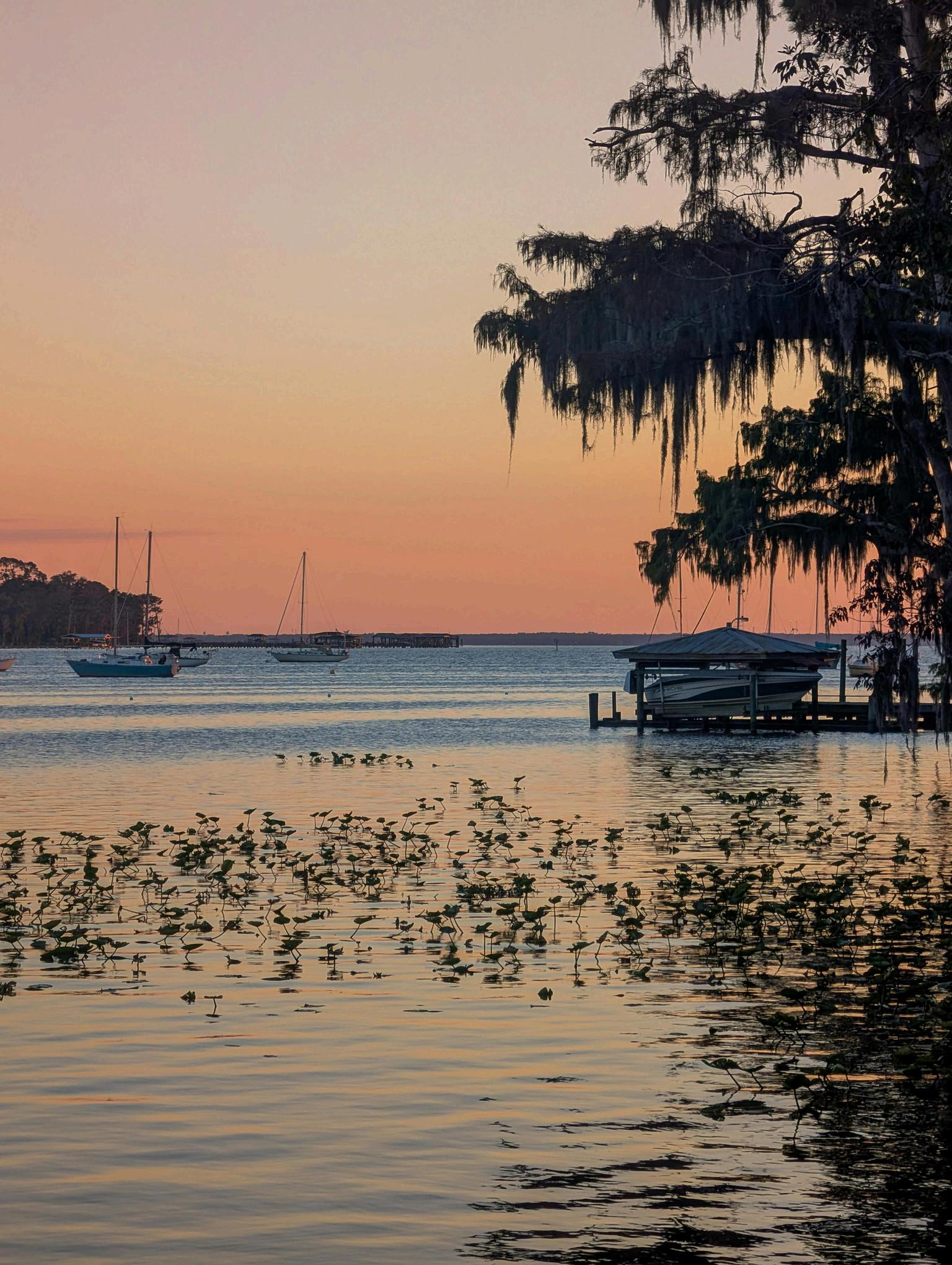
Jacksonville closed the second quarter running counter to the Triangle Where the Raleigh–Durham markets saw values ease, Jacksonville firmed: the median sale price rose to $290,000 in June, up 3.6% year over year, and sellers captured 98.8% of original list price — a ratio that improved rather than eroded. Closed sales advanced 6.0% to 638 for the quarter against 790 new listings. Inventory built 26.8% to an average 478 homes, but at 2.6 months' supply Jacksonville remains materially tighter than any Triangle market. Homes took 52 days to sell, the region's most deliberate pace, reflecting a military-anchored buyer pool that moves on its own timetable. Affordability and steady demand from Camp Lejeune and MCAS New River continue to underwrite this market as it heads into the second half.
Historical Median Sales Price for Jacksonville Market Activity
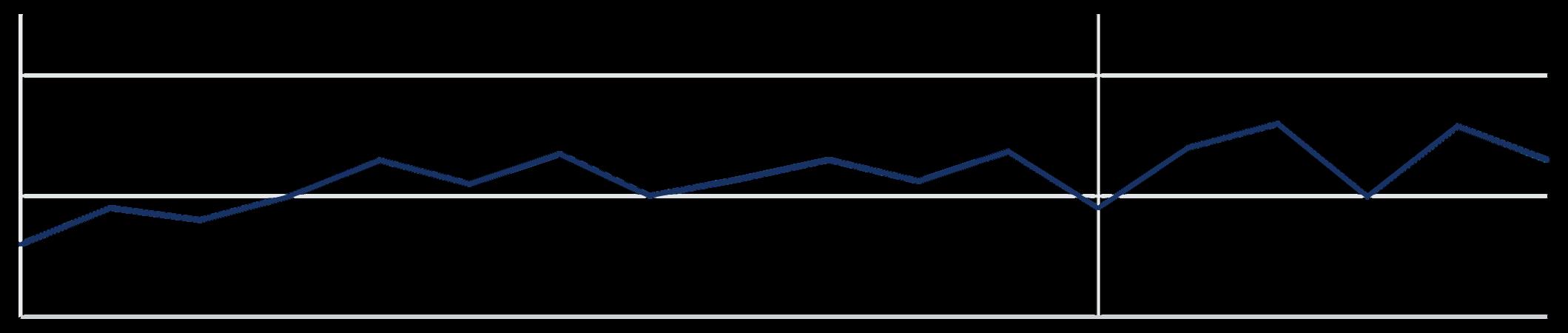
The Charlotte region carried its momentum through the second quarter with a market that stayed remarkably level; steady prices, growing inventory, and buyers who have both the time and the choices to shop deliberately Median sales price ticked up 0 5% to $407,000 and average sales price gained 2.2%, while inventory expanded 5.6% to 13,082 homes. Closed sales edged up 0.8% to 12,457, a pace the region has now held for two consecutive years.
Across Mecklenburg, Cabarrus, Union, York, and Lancaster Counties, the story was one of divergence within stability. Mecklenburg led on price, with the median up 3.3% to $469,900 and the average up 5.6%, though closed sales pulled back 3.0% as inventory grew 9.5%. Union County went the other direction, posting a 13.9% jump in closed sales, and Lancaster added 4.4%, evidence that demand is migrating outward toward value York County held nearly flat on both price and volume, while Cabarrus saw median values soften 3 7% against modest inventory growth.
Homes throughout the region are taking longer to sell, approximately 50 days on average, up from 45 a year ago, while sellers are still capturing 96 2% of original list price That combination describes a patient market, not a weak one Charlotte's economic strength, urban energy, and growing surrounding communities continue to anchor its appeal, and it remains a market where the "three P's" preparation, pricing, and presentation separate the listings that close from the ones that linger.
For Buyers. More inventory and more days on market mean more leverage and more time to decide The surrounding counties, particularly Union and Lancaster, continue to offer the region's best combination of value and lifestyle
For Sellers. Pricing to current market value matters more than ever. Homes that are wellprepared and realistically priced are still closing in under two months at near-full list price.
Bottom Line: The Charlotte region enters the second half as one of the Southeast's most stable and dynamic markets; balanced, resilient, and well-positioned for measured growth
The Charlotte region closed the second quarter on steady footing Median sales price ticked up 0 5% to $407,000 and average sales price gained 2.2% to $536,341, while inventory expanded 5.6% to 13,082 homes Closed sales held essentially flat at 12,457 At 3 6 months' supply and 50 days on market, Charlotte remains the deepest and most liquid market in North Carolina, and homes that are wellpriced and well-presented continue to set the pace.
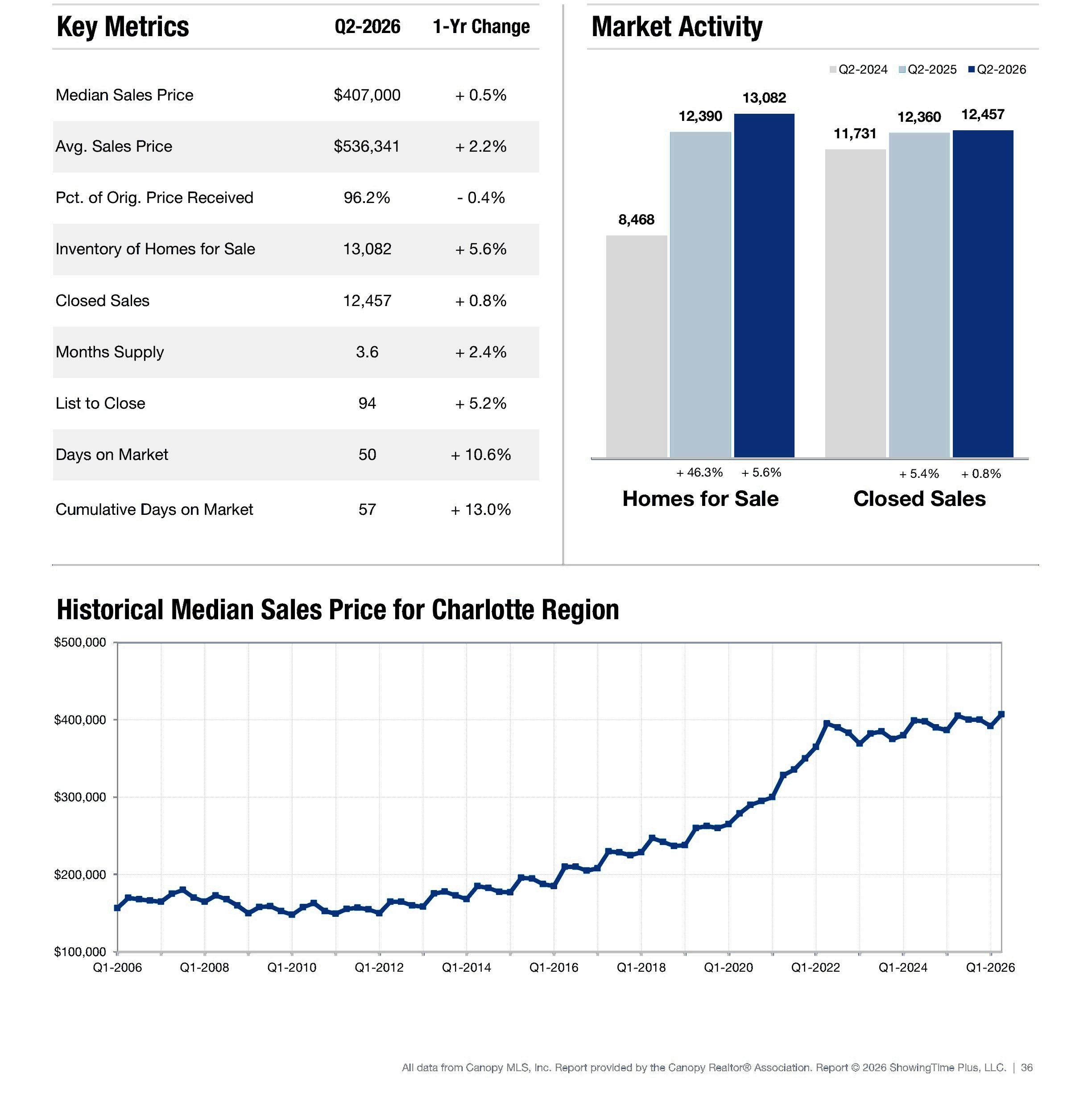
The Median Sales Price in Q2 2026 for a single family home in Charlotte was $407,000 for a year over year increase of 0.5%
As of July 2026 the Average Month's Rent in Charlotte for a 2 bedroom was $1,779
Charlotte Occupied Housing Units 49% of homes are owner-occupied households and 51% are renter-occupied households
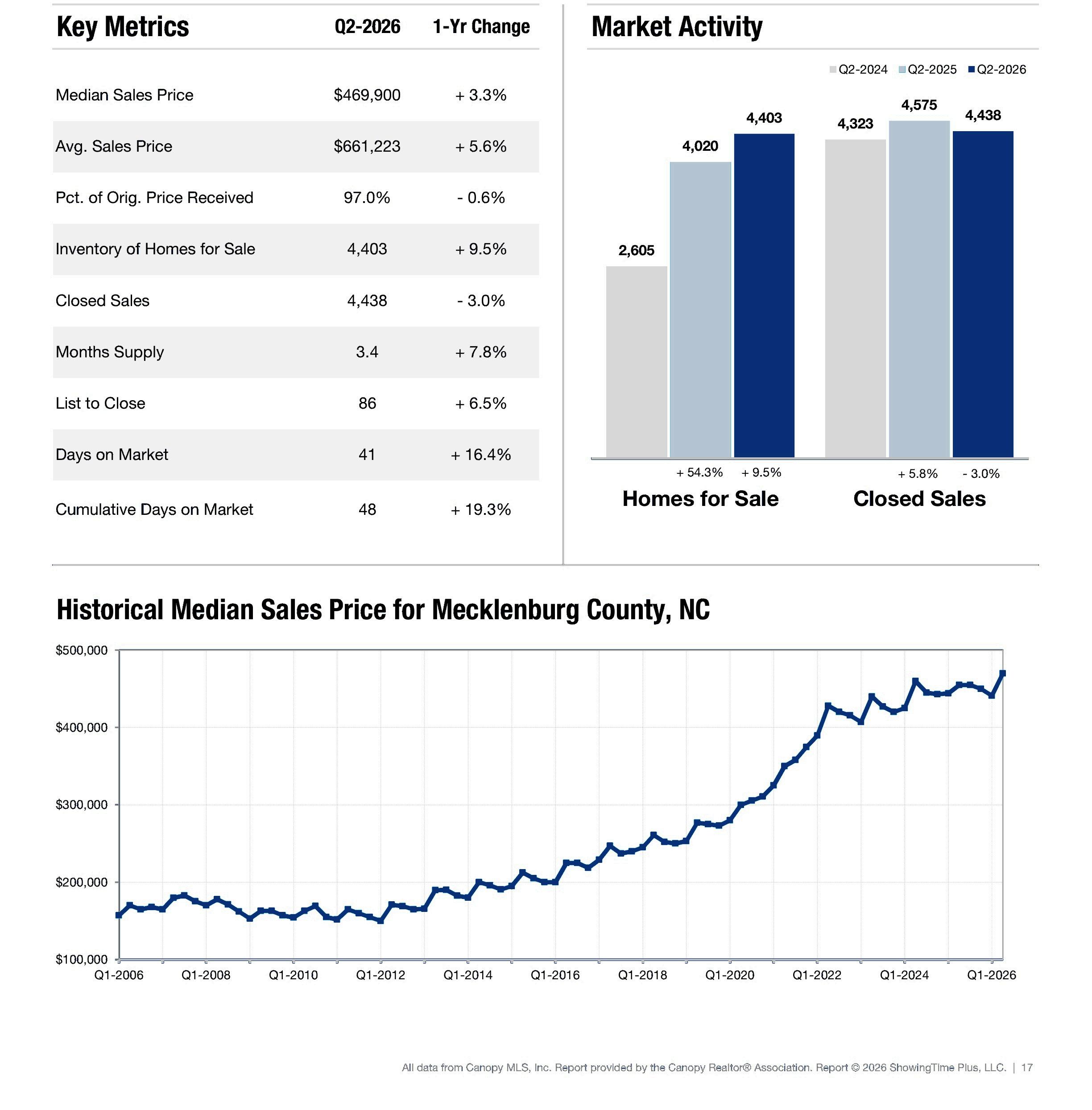
The Median Sales Price in Q2 2026 for a single family home in Mecklenburg County was $469,900 for a year over year increase of 3.3%
Mecklenburg County led the region on price in the second quarter, with the median up 3 3% to $469,900 and the average up 5 6% to $661,223 Closed sales eased 3 0% as inventory grew 9.5%, lifting months' supply to 3.4. Even so, homes sold in 41 days and sellers captured 97.0% of original list price, the strongest ratio in the Charlotte area, and a sign that competition for well-positioned properties has not let up
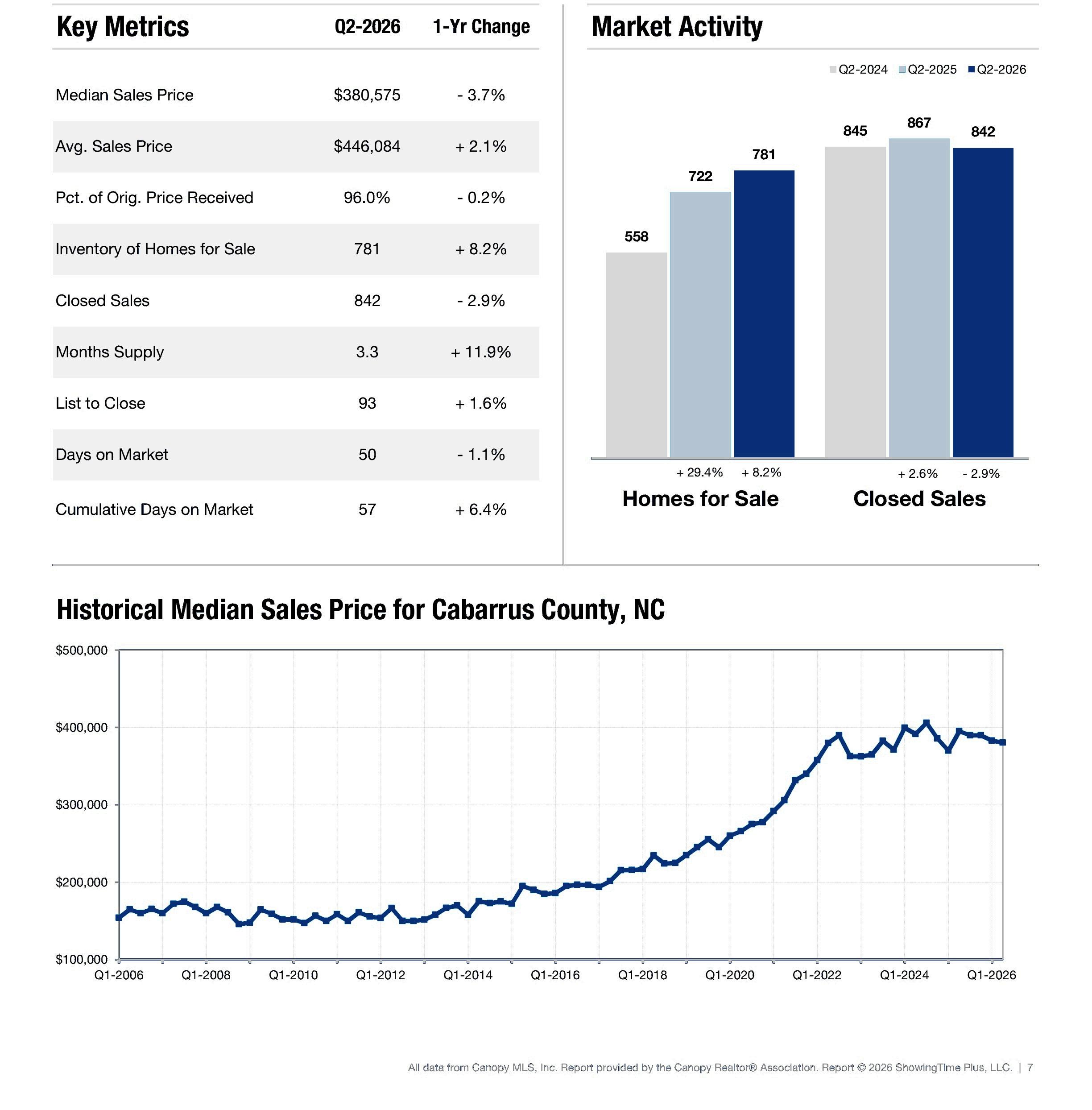
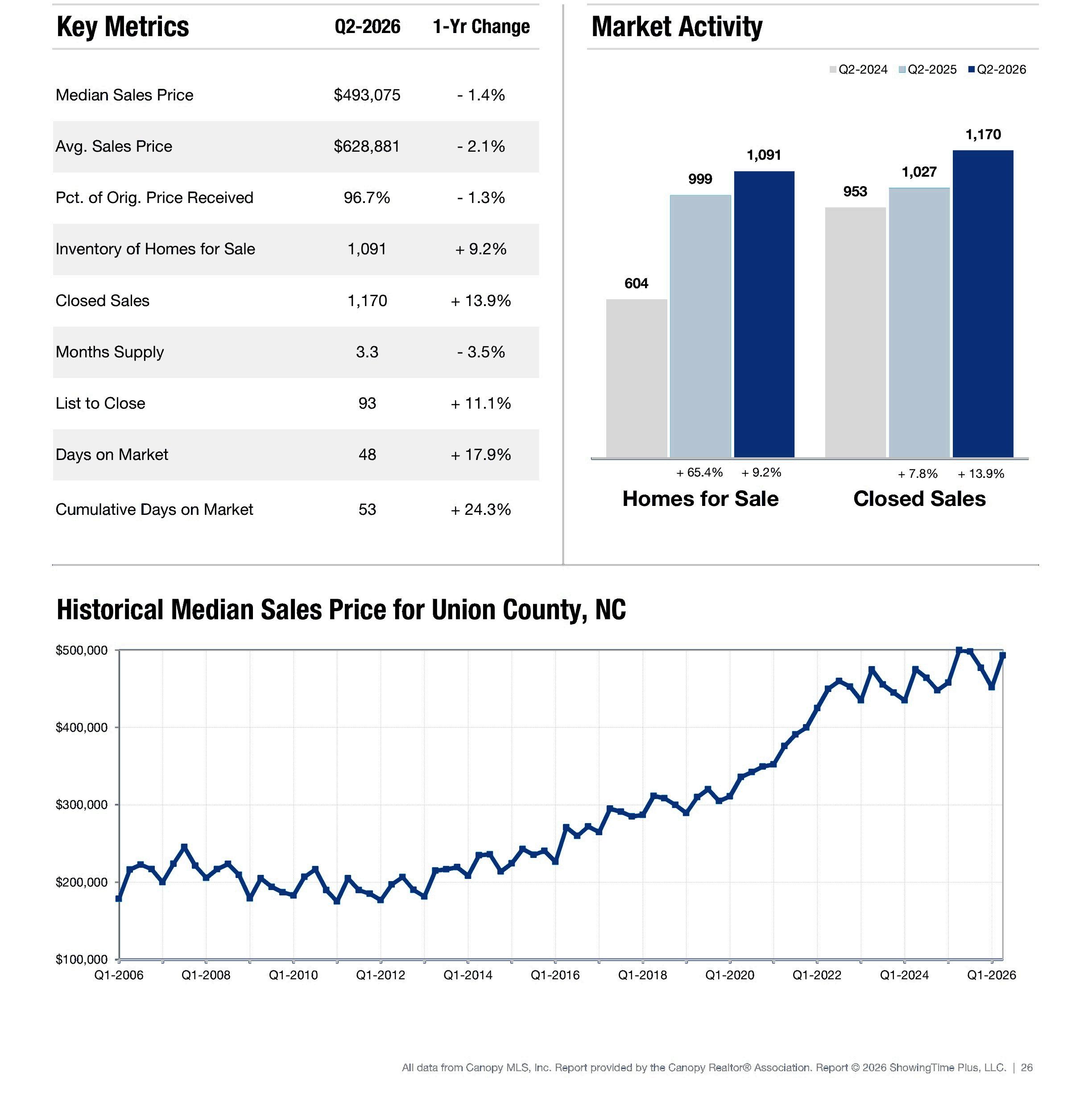
Cabarrus County saw median values soften 3 7% to $380,575 in the second quarter, even as average sales price rose 2.1% a mix pointing to activity shifting toward the county's more attainable price points Inventory grew 8 2% while closed sales eased 2 9% Union County moved the other way, posting a 13 9% gain in closed sales to 1,170, the strongest growth in the Charlotte area, with the median holding near $493,075.
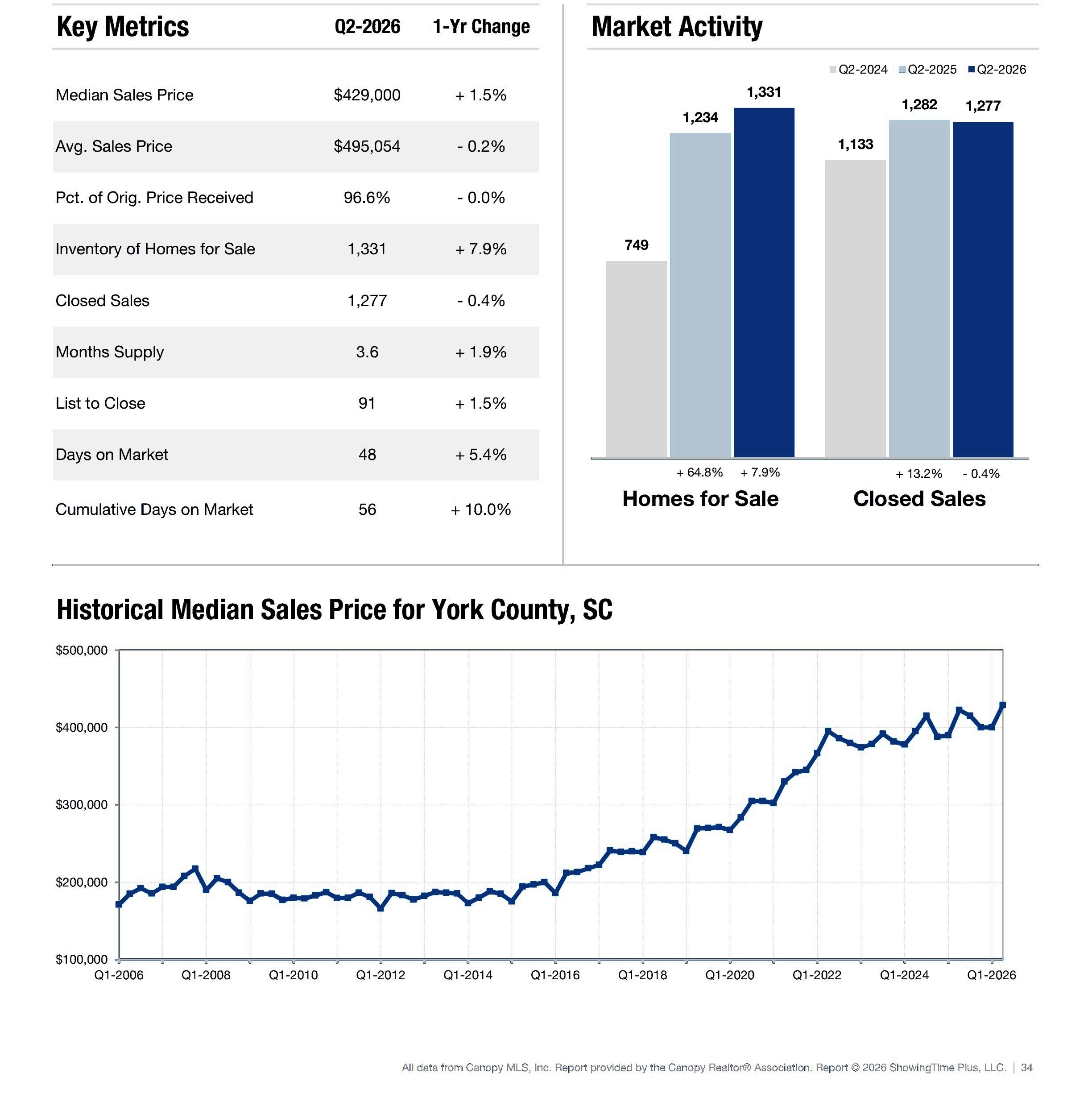
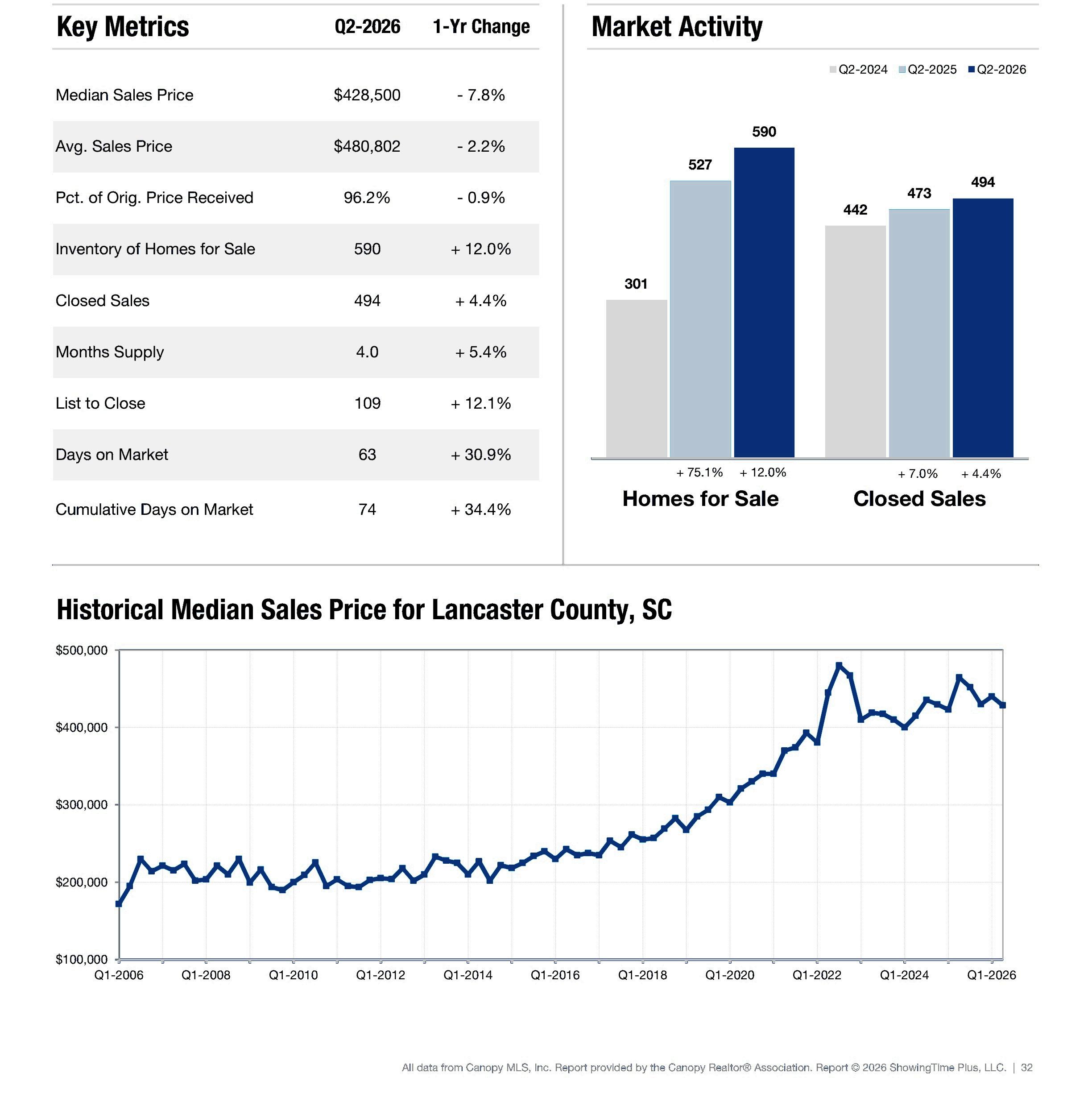
York County held steady on nearly every measure, with the median sales price up 1.5% to $429,000, closed sales flat at 1,277, and inventory expanding 7 9% Lancaster posted the area's sharpest price adjustment the median fell 7 8% to $428,500 but buyers responded, lifting closed sales 4 4% against a 12 0% rise in listings Both counties reflect a market where realistic pricing is still rewarded with activity.
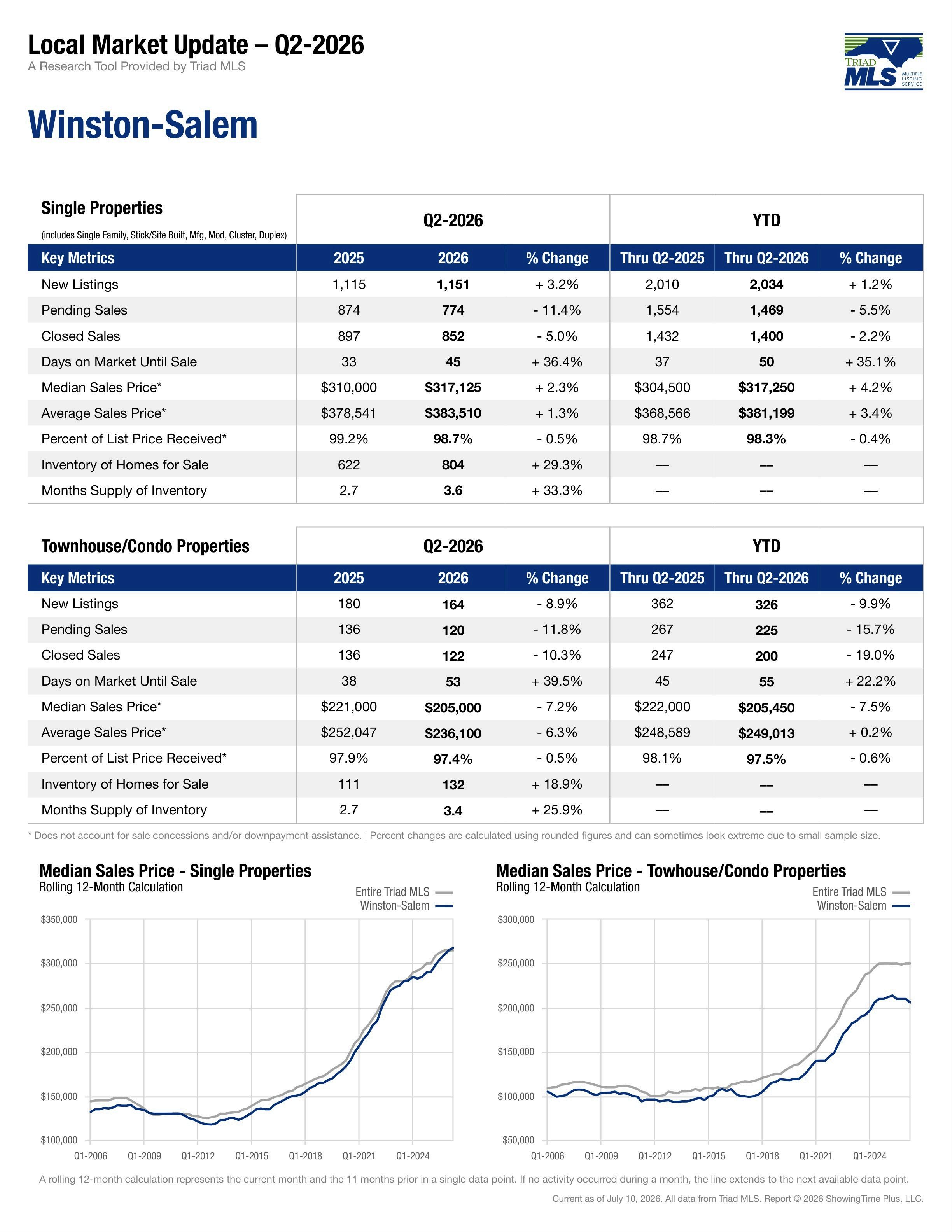
The Triad closed the second quarter on solid footing, propelled by affordability and steady demand. Winston-Salem posted gains in both median and average sales price for single-family homes, with the median reaching $317,125 Inventory surged 29 3%, giving buyers ample choice, while closed sales eased 5 0% and homes took 45 days to sell. Townhouse and condo values softened, keeping Winston-Salem among North Carolina's most attainable metros
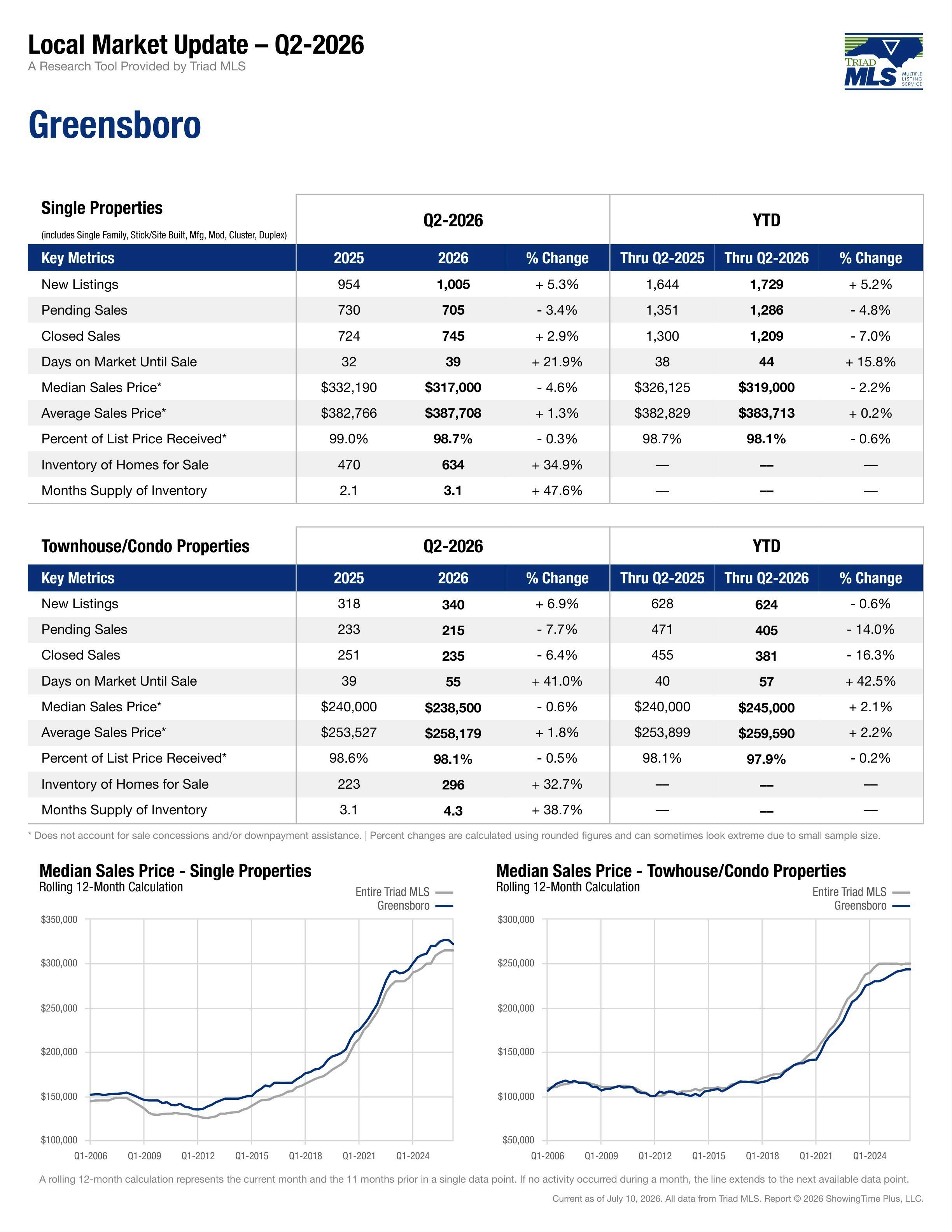
Greensboro remains one of North Carolina's more affordable metro markets, and second-quarter buyers took notice: closed sales rose 2 9% while the median eased 4.6% to $317,000. Inventory climbed sharply again, up 34.9%, giving shoppers the deepest selection they have had here in years. Days on market extended to 39, but sellers still captured 98.7% of list price.
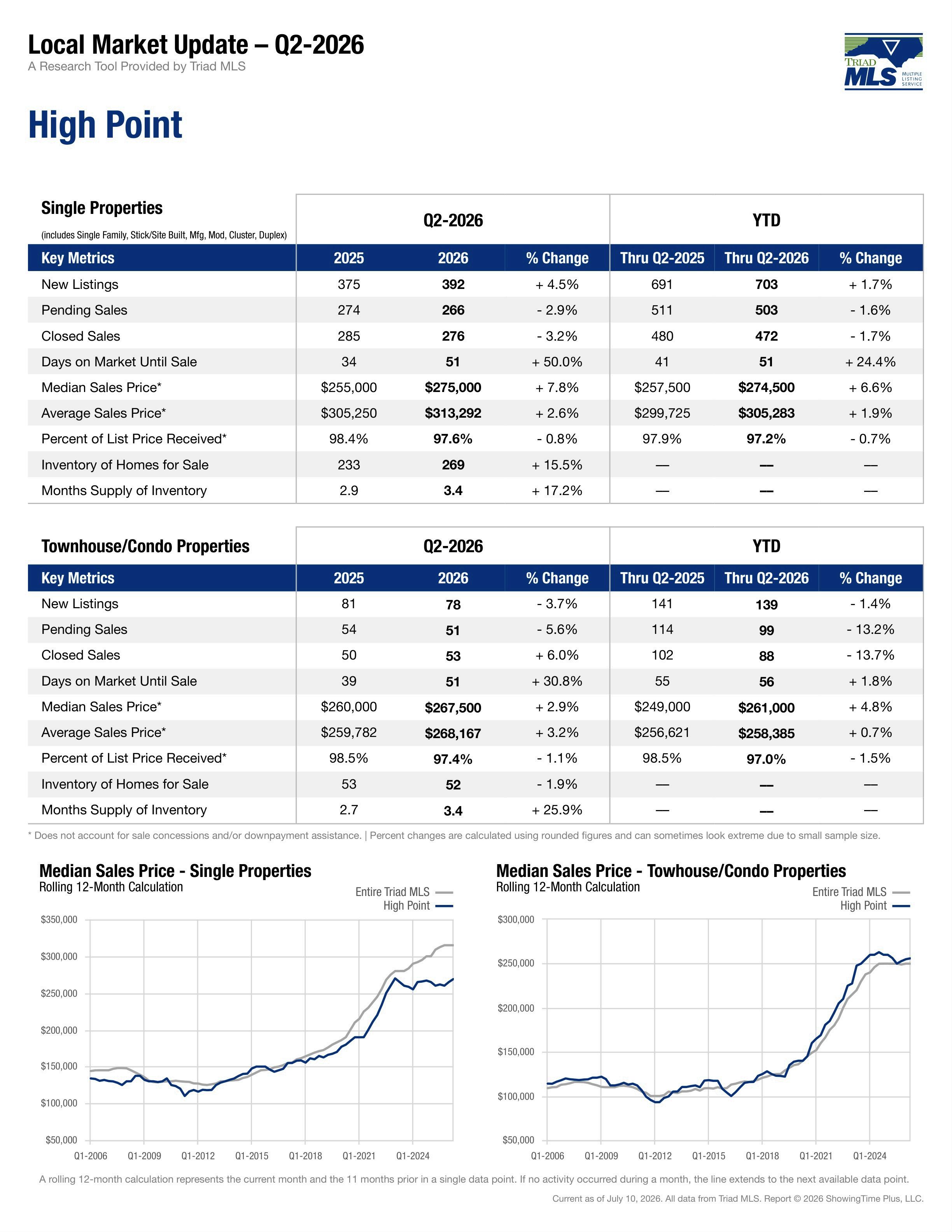
High Point delivered the Triad's strongest price growth in the second quarter, with the singlefamily median up 7 8% to $275,000 and townhouse and condo values up 2 9% Inventory expanded 15 5% and closed sales eased slightly, while homes took 51 days to sell, adding a more measured pace that rewards careful preparation. For value-driven buyers, High Point continues to offer the region's most compelling entry point
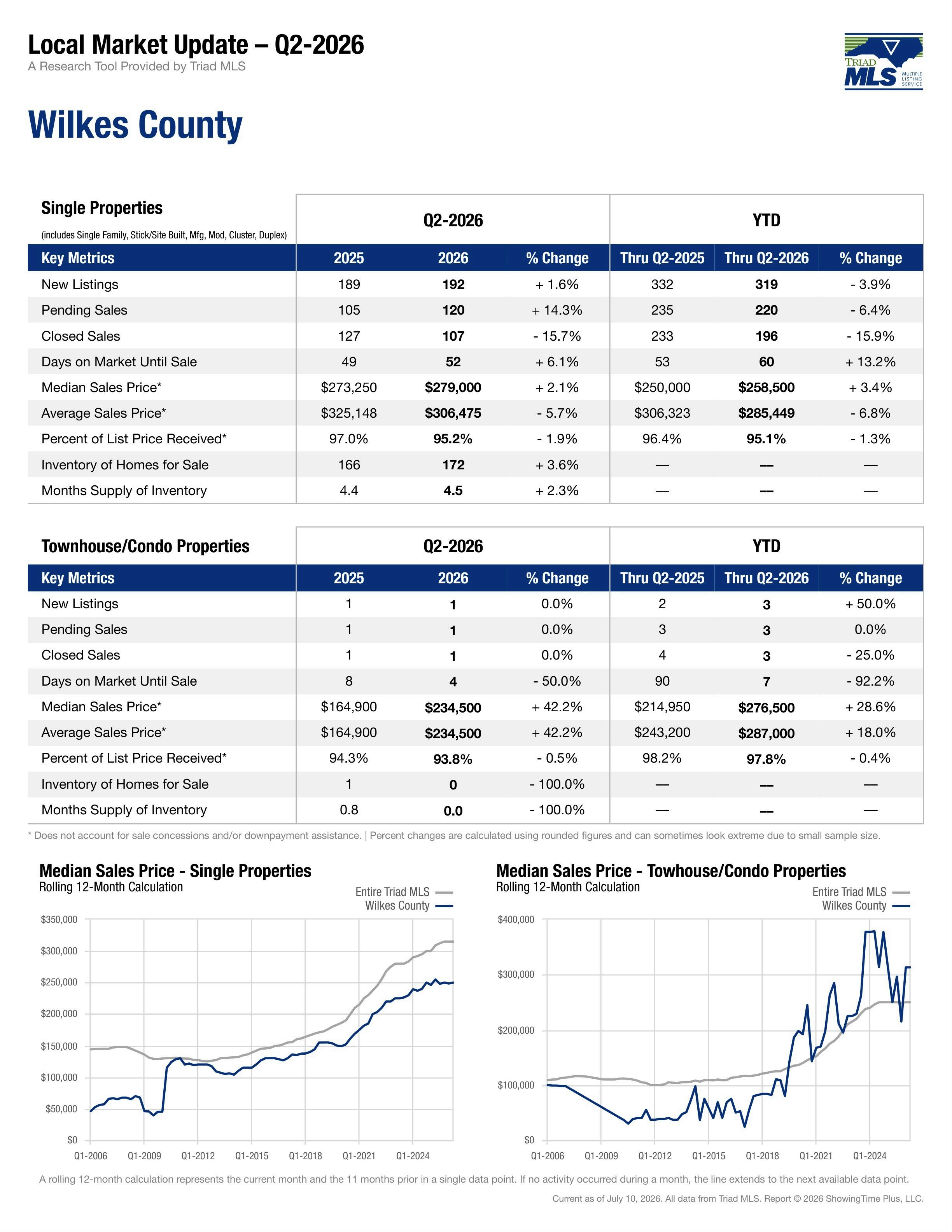
Wilkes County continued to offer strong affordability in the second quarter, with the median sales price up 2 1% to $279,000, still well below larger metro areas Closed sales pulled back 15 7%, though pending sales rose 14 3%, pointing to renewed activity heading into the third quarter Inventory edged up 3 6% The market continues to appeal to value-focused buyers seeking proximity to Winston-Salem without metro-level pricing
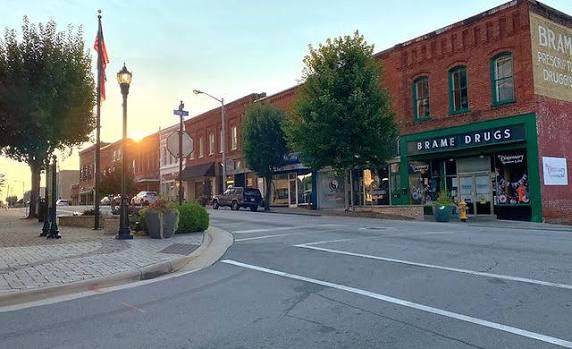
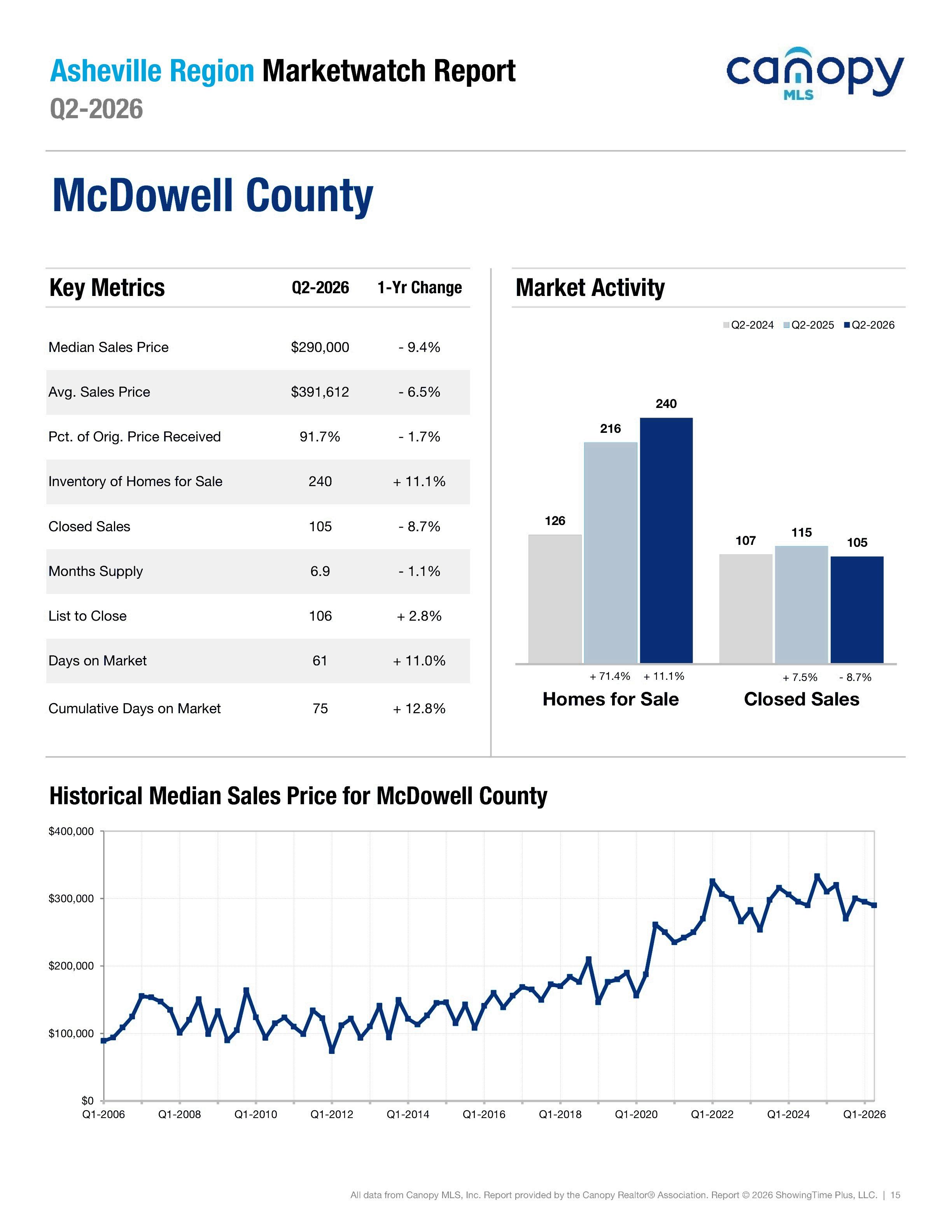
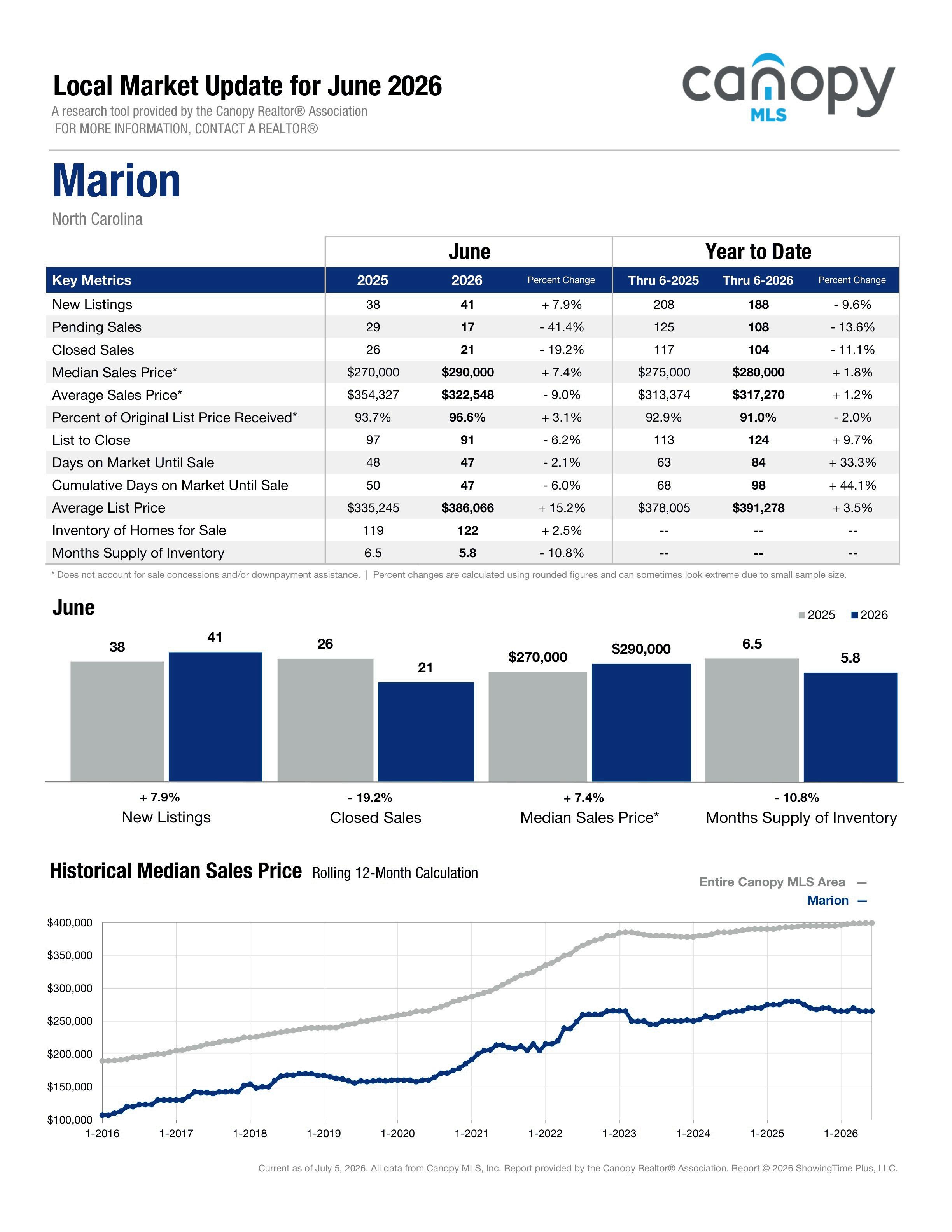
Marion and McDowell County remained among North Carolina's most affordable markets in the second quarter, with the median sales price at $290,000 Values pulled back year over year and closed sales eased 8 7%, while inventory expanded 11 1% The added selection and adjusted pricing reflect a market still finding its footing after Hurricane Helene, and one that presents a genuine opportunity for value-driven buyers and long-term investors as momentum rebuilds through 2026
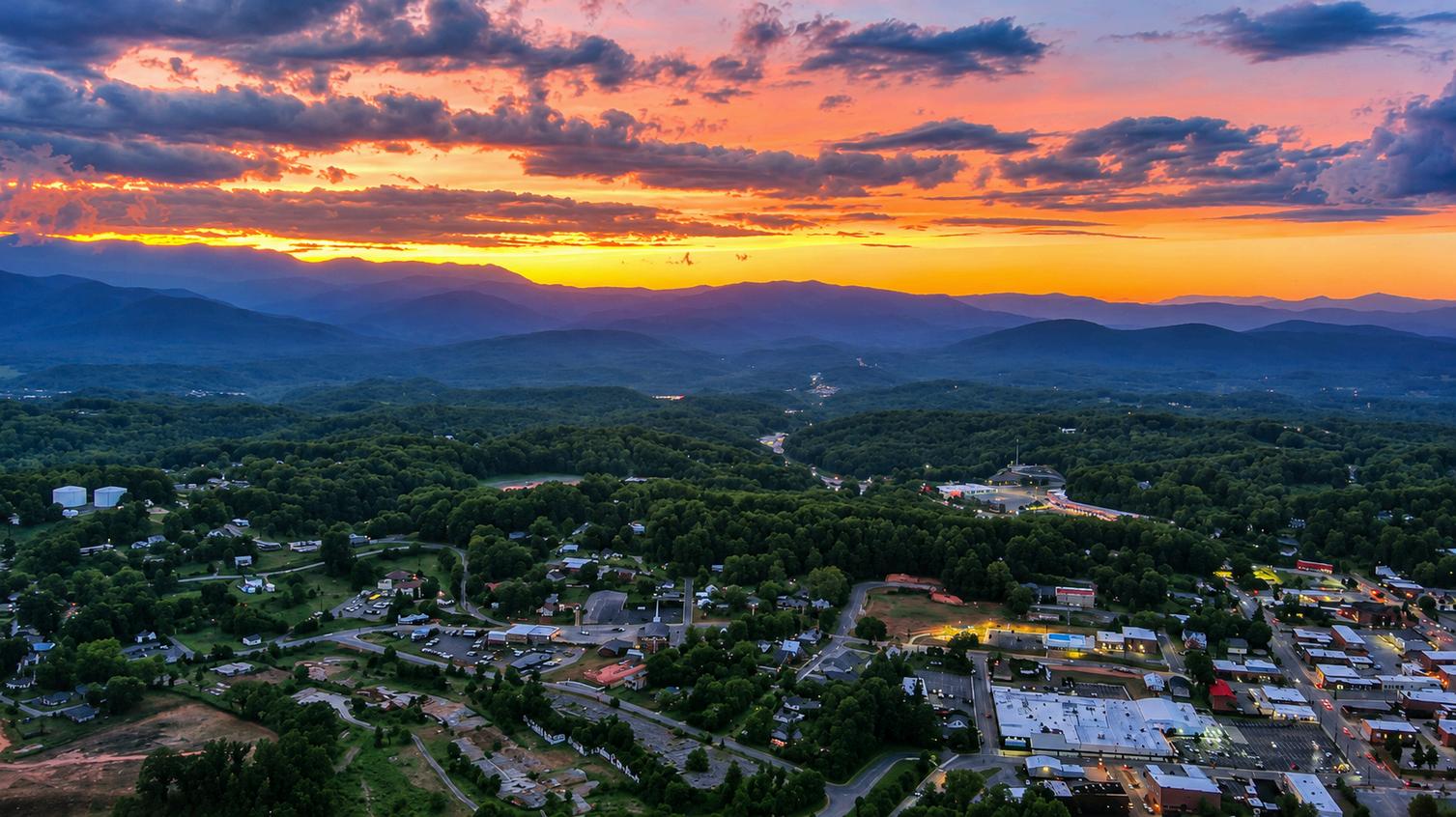
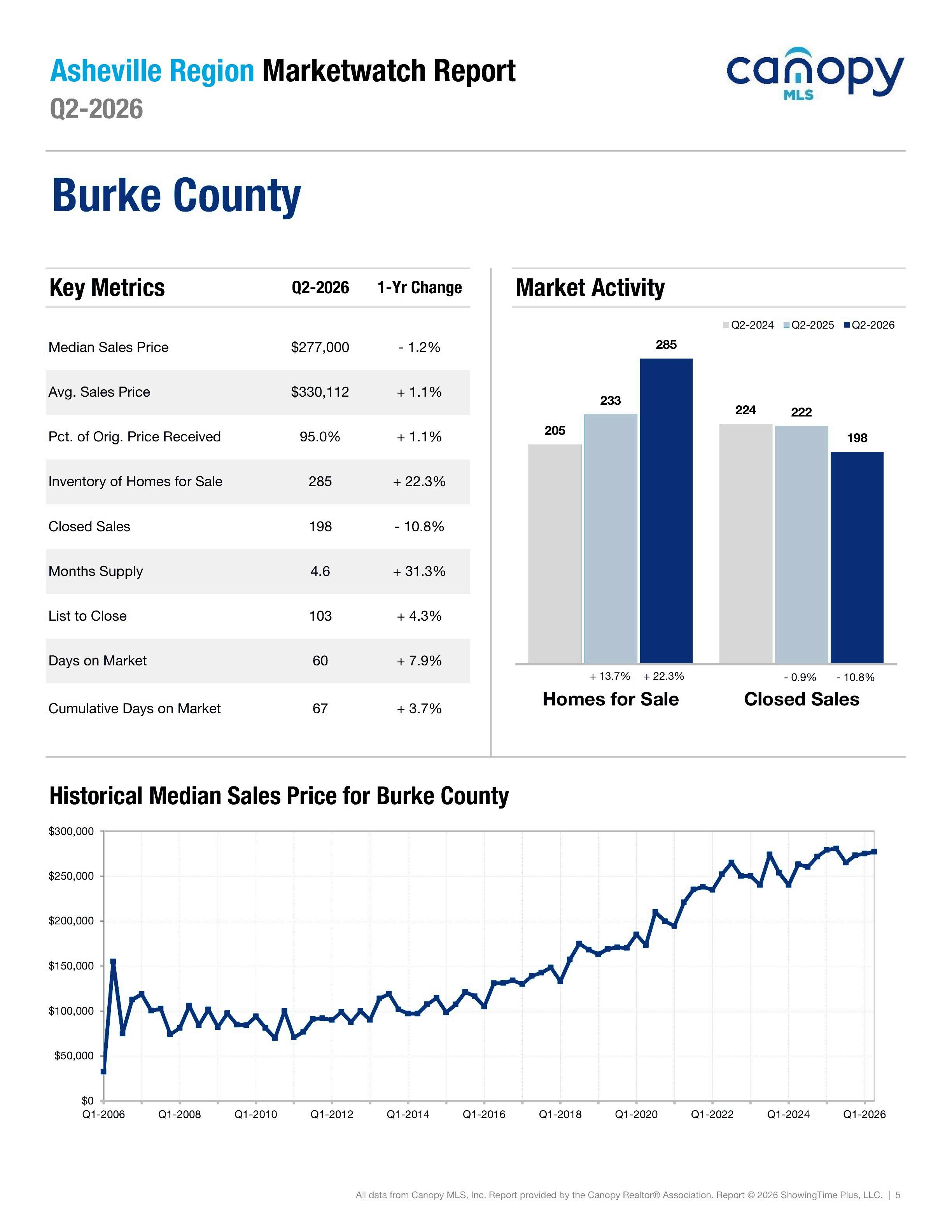
Burke County held its ground as a steady, community-driven market in the second quarter, with prices staying largely stable; the median at $277,000 and the average up 1.1%, despite a double-digit drop in closed sales. Inventory expanded more than 22%, lifting months' supply to 4.6 and giving buyers the widest selection in years. As the region continues to recover from Hurricane Helene, Burke remains a draw for families and professionals seeking long-term stability
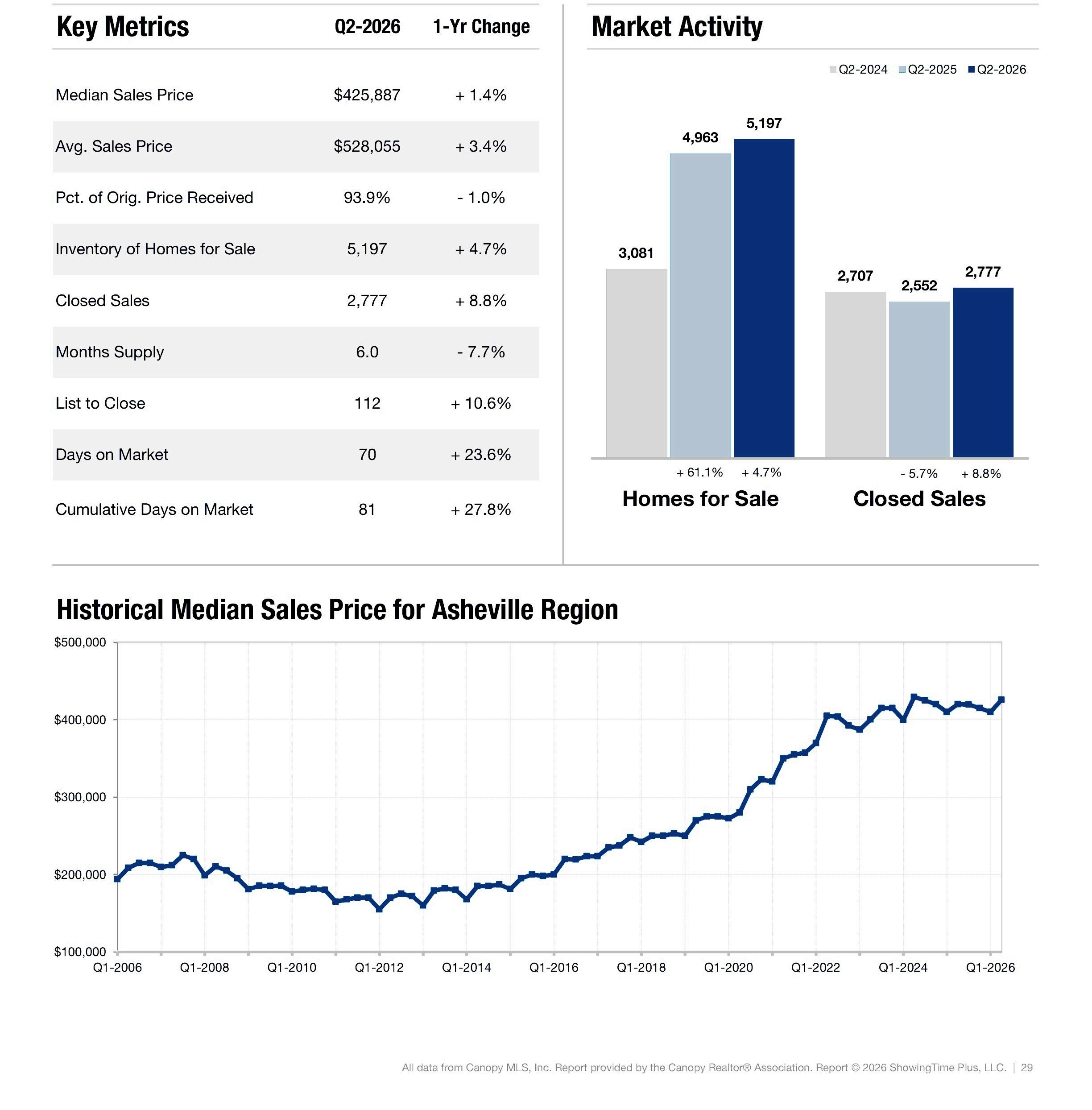
Asheville closed the second quarter with buyers back in motion Closed sales rose 8 8% year over year while the median sales price held firm at $425,887, up 1 4% Inventory grew 4 7%, but months' supply tightened to 6 0 as the added listings were absorbed rather than accumulating Homes are taking 70 days to sell, giving buyers meaningful room to evaluate without leaving sellers behind
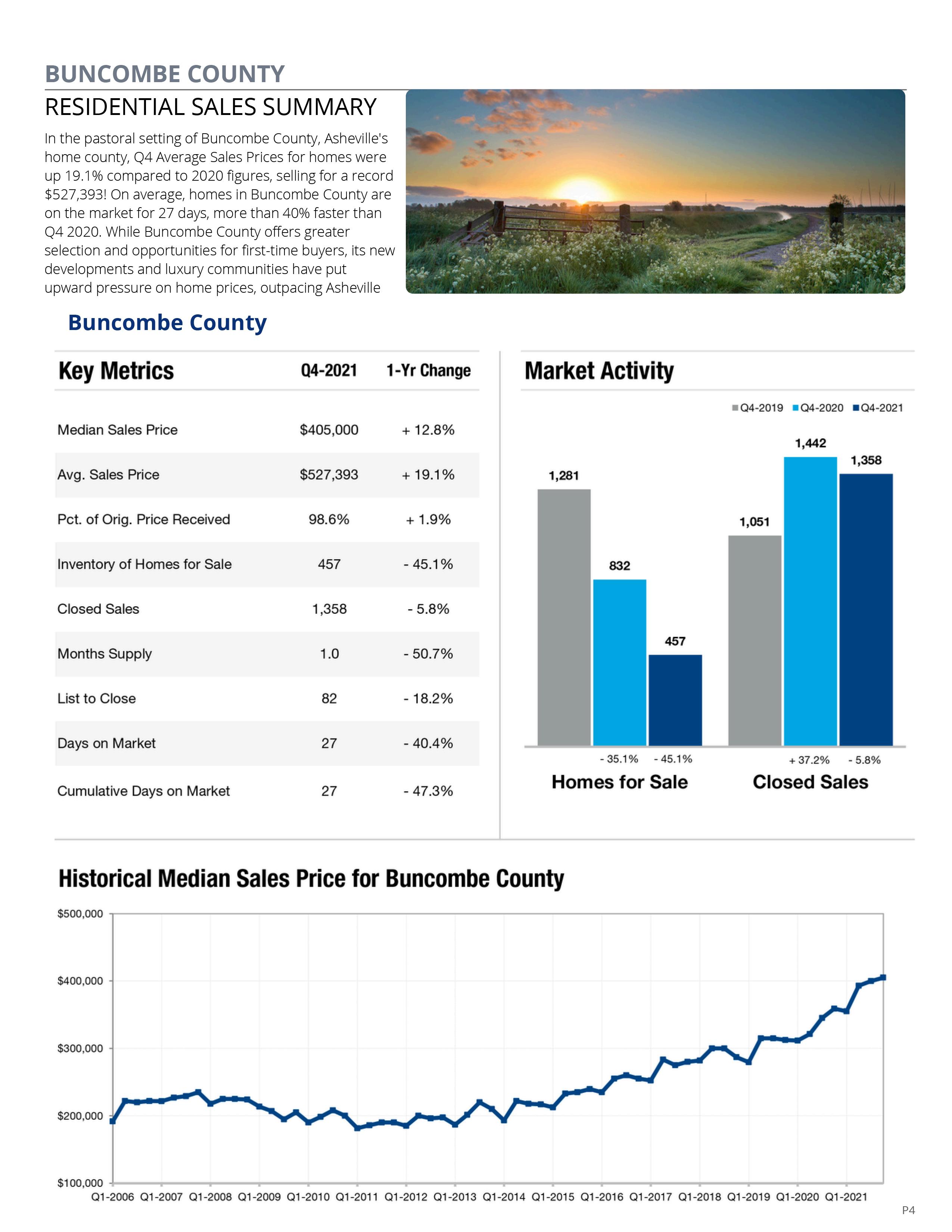
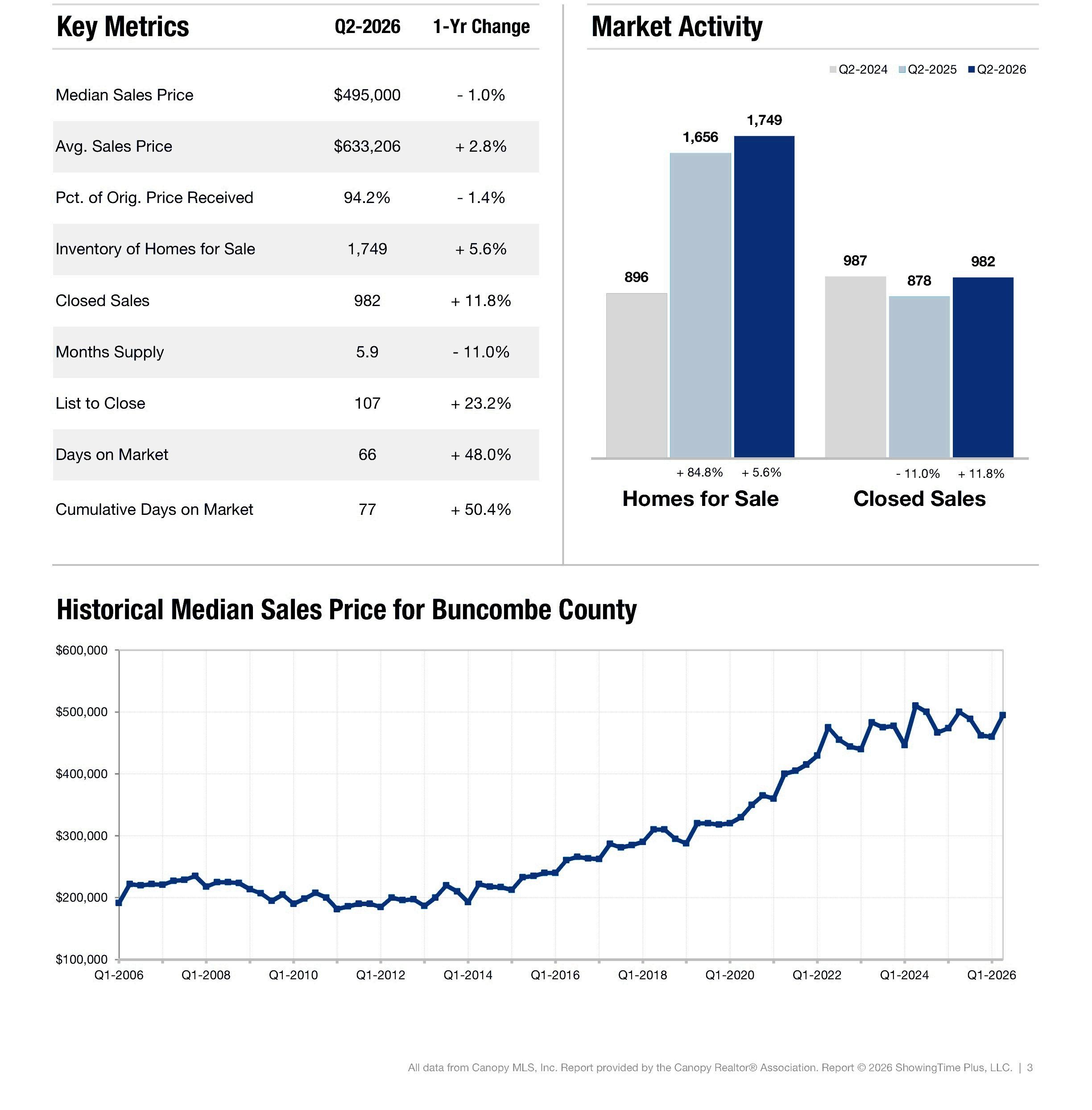
Buncombe County posted the region's strongest demand in the second quarter, with closed sales up 11.8% year over year. The median sales price eased just 1 0% to $495,000 while the average climbed 2 8% to $633,206, reflecting continued interest in new development and luxury communities Inventory rose 5 6%, yet months' supply tightened to 5.9. Homes are spending longer on market at 66 days, a more deliberate pace that rewards wellprepared listings
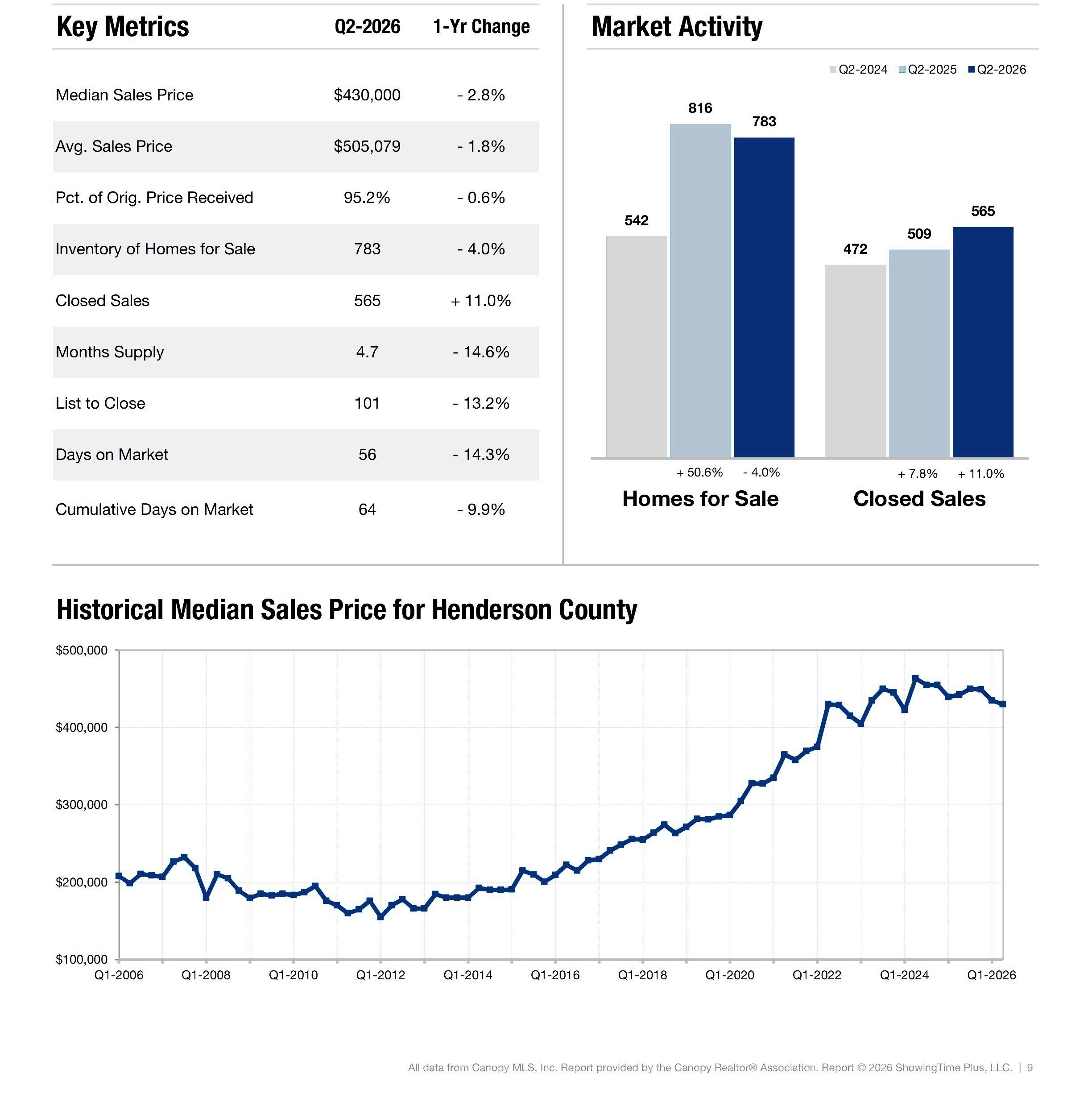
Henderson County turned in a standout quarter. Closed sales rose 11.0% year over year even as inventory contracted 4.0%, pushing months' supply down to 4 7, the tightest in the Asheville region Homes sold in 56 days, roughly two weeks faster than a year ago, and sellers captured 95.2% of original list price. Median values eased 2.8% to $430,000, keeping the county attractive to buyers seeking value within reach of Asheville