New Frontier Chronicle, May/June 2026 | Vol. 44, Issue 03
Cadets aid Kona Low relief efforts
Spring Campaigns align with the aftermath of a historic storm in Hawaii.
BY KIARA ARMENDARIZ, CADET
Following final exams, cadets from the Western Territory were sent out on Spring Campaigns to serve alongside various Salvation Army units throughout the western U.S., applying what they learn on campus to the real world.
This year, six groups (brigades) of cadets served across the Hawaiian islands, Pacific Northwest and in Redondo Beach, California. Cadets dispatched to Hawaii arrived in the midst of a historic Kona Low storm and quickly got to work assisting with various relief efforts. Cadet Kiara Armendariz chronicled their experiences.
In preparation for Spring Campaigns at the College for Officer Training at Crestmont (CFOT), the second-year cadets assigned to the Hawaiian and Pacific Islands Division had clear visions and intentions for their forthcoming ministries there. The Kona Low storm that hit Hawaii in March changed those plans. Its scope was not something anyone had anticipated.
Three brigades were set to serve: one on the Big Island, another on O’ahu, and the third in both Maui and Kaua’i. Almost immediately, each was asked to pivot into Emer-
gency/Disaster Services (EDS) response, and the resulting efforts across the islands resulted in a number of engagements of practical aid and spiritual care.
In disaster response, it is often easy to focus on tasks: meals to prepare, supplies to distribute, schedules to maintain. However, each brigade’s intentionality in practicing the power of presence opened doors for deeper connections.
Mālamalama Brigade
On the Big Island, this truth was evident during various community feedings. The Mālamalama Brigade prioritized offering prayer during meals, which turned quick interactions into moments of pause, comfort and encouragement.
One particularly powerful experience was during an open-air service held after a
KONA LOW PAGE 13
STRANDED ABROAD
Juneau Corps member finds help on the journey home.
BY HILLARY JACKSON
Tim Hower’s journey from Juneau, Alaska, to the Holy Land started out like that of many who make the spiritual pilgrimage.
Joined by his best friend, who had traveled from Michigan, the pair saw many of the sites— Jerusalem, the Western Wall, Via Dolorosa, Galilee, Capernaum, Mount Hermon, and others.
Hower even read a prayer of Psalm 122 from the Jaffa Gate—the video of which was shared as the call to worship during a Sunday service at the Juneau Corps, where he attends.
After 10 days of a trip of a lifetime, the pair were at the airport to return home when plans suddenly changed. War had broken out. What happened next, Hower said, was a series of “God things,” including help from The Salvation Army,
which delivered him safely home to Juneau.
As thousands were trying to quickly get away from the airport in Tel Aviv, an American-Israeli woman, who works for a San Jose tech firm, pulled out her phone and made the pair a reservation
STRANDED PAGE 10
“
I DON’T KNOW ANY OTHER DENOMINATION THAT SETS ASIDE TIME TO TALK ABOUT HOLINESS.
Bill
Ury
‘In His Presence’
A reflection from the 2026 Territorial Holiness Retreat
BY AMY REARDON, MAJOR
Nearly 140 Salvationists from across the western U.S. joined together March 5-8 for a Holiness Retreat at the Crestmont Campus in Rancho Palos Verdes, California, with guest speakers Envoys Dr. Bill Ury and Reverend Diane Ury, The Salvation Army’s National Ambassadors for Holiness.
Emphasizing the importance of the retreat, Bill Ury said, “I don’t know any other denomination that sets aside time to talk about holiness.”
While there are many conferences in the Christian world about evangelism—Sunday school, youth ministries, small groups, to name a few—it is a singular privilege to come together with brothers and sisters to contemplate and learn more about holiness. As a participant, I felt very blessed to be there.
The theme for the weekend was “In His Presence.” Each meeting began with praise and worship that was both joyful and reverent. The first night, after a stirring testimony by Cadet Cesar Rodriguez, Territorial Commander Commissioner James Betts preached, stressing that holiness is a precious jewel from God that we neglected for a while—but God is bringing to the forefront again in large measure. He gave a memorable demonstration of God’s presence filling us in such a way that our cup remains full even as the love of God pours out through us to everyone around us. In other meetings, we heard
RETREAT PAGE 12
Tel Aviv, Israel
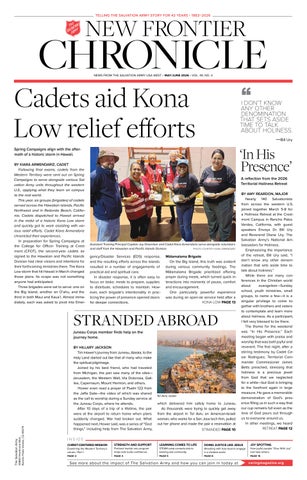
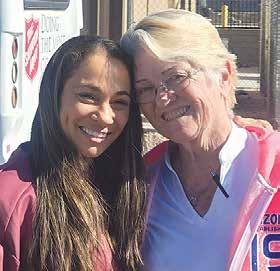
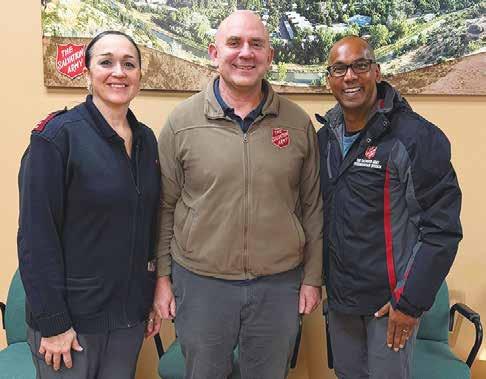
Assistant Training Principal Captain Joy Groenleer and Cadet Kiara Armendariz serve alongside volunteers and staff from the Hawaiian and Pacific Islands Division. |PHOTO COURTESY KIARA ARMENDARIZ
FROM THE EARLIEST DAYS OF SALVATION ARMY MINISTRY IN THIS TERRITORY, OUR MOVEMENT HAS BEEN DRIVEN BY THAT SAME CONVICTION. CHRIST HAS SHAPED HOW WE PREACH, HOW WE
‘Christ‑Centered Mission’ is our reason for being
IPHIL LUM, LT. COLONEL
n early 2026, Territorial Commander Commissioner James Betts—following work of the Territorial Executive Council—introduced five values for the West: Christ-Centered Mission, People Matter, Faithful Stewardship, Care-Driven Leadership and Future Focus. Here and in issues to come, various leaders will reflect on what these values mean.
Over the years, I have learned that the most important question we ask as leaders in The Salvation Army is not what we are doing, but why we are doing it. Our answer has always been clear, and it must remain so: everything begins and ends with Christ.
I remember in a previous appointment working on a significant project where the right path forward was not immediately obvious. The pressures were real—limited resources, competing priorities and strong opinions about what should happen next. As we worked through the details, I found myself increasingly unsettled. The plans
were sound, the logic was clear, but something felt incomplete.
It was only when we intentionally paused to pray, to listen, and to ask whether our decision truly reflected Christ’s character and calling that clarity came. The decision did not become easier, but it became clearer. That moment has stayed with me because it reminded me that when Christ is not at the center, even good work can lose its way.
From the earliest days of Salvation Army ministry in this territory, our movement has been driven by that same conviction. Christ has shaped how we preach, how we serve, how we lead and how we care for people. Methods have changed, communities have evolved, but our purpose has endured.
“He [Christ] is before all things, and in him all things hold together” (Col. 1:17). Today, a Christ-centered mission must continue to shape our daily routine. It shows up in how we treat one another, how we make decisions under pressure, how we steward resources and how we design ministry. Evangelism and service
International leaders gather in Nairobi
In March, Salvation Army leaders from around the world gathered in Nairobi, Kenya, for the International Conference of Leaders to help shape the movement’s future. Themed “Compass: The Way Forward,” the conference focused on strengthening spiritual life, leadership development, mission impact and financial sustainability.
“This is holy ground! Ours is a sacred task! The Lord is with us!” said General Lyndon Buckingham in his opening address.
Compass was adopted as a framework to guide International Headquarters and territorial headquarters worldwide in shaping strategies that support a thriving, contemporary Salvation Army. Developed in response to global challenges, it will help territories create locally relevant strategies while working toward shared goals, including officer wellness, resource allocation and long-term financial self-reliance. NFC
EDITORIAL STAFF
remain inseparable when Christ is central.
As we look ahead, this value takes on even greater significance. We are leading in a time of complexity, scrutiny and rapid change. Innovation is necessary—but identity is essential. Centering ourselves on Christ guards us from mission drift and grounds our vision in something far deeper than trends or urgency. In him, our mission holds together.
This value calls something specific of our leaders. It challenges us to model what we proclaim—to keep Christ central in our calendars, our conversations, our planning and our priorities. I invite each leader to ask regularly: Does this decision reflect Christ? Does this direction point people to him?
If we get this right, everything else will follow. Christ-centered mission is our heartbeat—our reason for being—and the sure foundation for the future God is calling us to build together. NFC
Have you seen a territorial value in action? Tell us about it at new.frontier@usw. salvationarmy.org.
Fresh from IHQ:
1 2 3
A new International Positional Statement (IPS) reaffirming The Salvation Army’s strong commitment to religious free dom.
An updated International Positional Statement (IPS) on the Use of Power, reaffirming the Army’s commitment to ensuring that power is exercised with love, justice and mutual respect.
The four-part “Unalterable” podcast, exploring the historical and evolving role of women in leadership across the movement.
Read more about these items at SalvationArmy.org/News
ONLINE AND SOCIAL MEDIA
Christin Thieme, Editor-in-Chief and Literary Secretary
“Sharing stories of goodness is lovely, but I think that would be selling Jesus short. He’s not only telling stories about goodness, he’s telling stories that challenge and that indict and that try to make us better than we are.”
—Dr. Amy-Jill Levine on The Do Gooders Podcast Episode 258: Jesus the storyteller
Listen to the interview here:
Hills visit India
South Eastern Territory
Commissioner Edward Hill, Chief of the Staff, and Commissioner Shelley Hill, World Secretary for Women’s Ministries, visited the India South Eastern Territory in February, encouraging spiritual renewal and a renewed focus on mission. Their visit brought together officers, soldiers and community members with a shared call to deeper faith, unity and service.
Kevin Dobruck, Art Director 562/491-8328 • kevin.dobruck@usw.salvationarmy.org
Edward Hill reminded staff and nursing students that “the ‘S’ on the Salvation Army uniform is not decoration but destiny: Saved to Serve.”
The visit also included ministry at children’s homes and corps, along with the dedication of a new territorial headquarters, emphasizing that the Army’s future depends not on structures, but on committed lives and faithful service. NFC
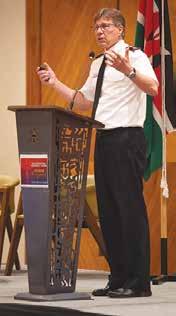
Commissioner Ted Horwood speaks to international leaders in Nairobi, Kenya.
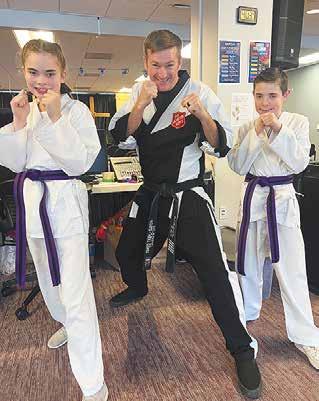
Once a week in Portland, Oregon, Rylie Govern files into a room with more than a dozen other kids and parents taking part in The Salvation Army Clackamas County Corps martial arts program.
“For many of the kids and parents, the program provides a vehicle for exercise and exposure to different types of martial arts, said Corps Officer Lt. David Culley, organizer and instructor of the program. Yet for others, like 12-year-old Rylie and her 11-year-old brother Tristian Meyerriecks, the program also serves as an outlet to socialize, release pent-up energy and build new confidence.
THE WHOLE MARTIAL ARTS PROGRAM PROMOTES BEING KIND AND DOING OUR BEST, WHILE HAVING FUN AND LEARNING SKILLS—IT HOPEFULLY WILL LAST THEM ALL THEIR LIFE.
Debbie Hays, mother of two participants
“My kids both have autism and attention-deficit/hyperactivity disorder [ADHD], and it causes them to get bullied quite often,” said Debbie Hays, who adopted Rylie and Tristian three years ago. “In this environment, they feel totally accepted for who they are.”
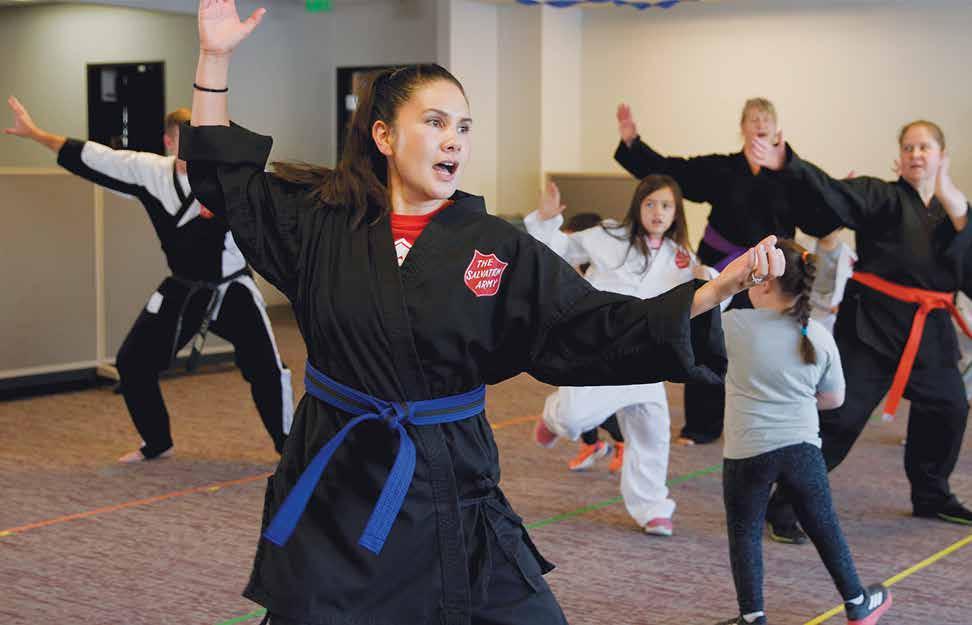
First started in 2022, the program has now seen more than 30 students complete at least one season, with many of them moving up through the ranks of the traditional Taekwondo belt system, which includes white, yellow, orange, green and purple belts. The program has become a resource for students to get active and navigate the everyday challenges that come with growing up in the modern age, Culley said.
Portland martial arts program helps kids build confidence.
Strength and support
BY LIZETH BELTRAN
“We hear kids saying ‘Oh, I was bullied today, someone called me something,’ or ‘Someone got in my spot in line and it really bummed me out,’” he said. “When I notice kids low that day in class, I know that they went through something that in their mind was hard, it was challenging, it was tough. My goal in class is to provide them an opportunity to thrive, to succeed, to be the example—to encourage others and to be encouraged.”
Born initially as a pilot during the pandemic, the classes were a dream of sorts for Culley, who grew up
studying and practicing martial arts his whole life. When he and his wife, Lt. Sarah Culley, landed in Rancho Palos Verdes, California, for training to become Salvation Army officers, the opportunity presented itself for David Culley to offer something: Enrichment and exercise through martial arts.
“There was very little happening for anybody outside, in school or extracurriculars,” said David Culley. That prompted him to start outdoor, masked-up classes to
Top Left: Corps Officer Lt. David Culley stands with participants. Above: Corps Officer Lt. Sarah Culley joins in the martial arts class.
|PHOTOS COURTESY THE SALVATION ARMY CLACKAMAS COUNTY CORPS
MARTIAL ARTS PAGE 10
Long-time volunteer leads Idaho service extension
BY KAREN GLEASON
Twelve years ago, Richard Brown left Houston for a business opportunity in Ketchum, a mountain town in Blaine County, Idaho. His kids had just graduated from high school—the time was right. Soon after, he realized something important was missing from his life: his connection to The Salvation Army.
As a former board member and chair of The Salvation Army Houston Adult Rehabilitation Center (ARC), Brown had grown accustomed to seeing firsthand how the organization helps restore lives.
“I really missed it,” Brown said. “I missed The Salvation Army. I missed being part of that work.”
At the time, Brown was still commuting back to Houston regularly to complete his ARC board term. During that transition, he attended a national Salvation Army convention in Phoenix, where he heard a woman share a story that mirrored his own.
The speaker, who had retired and moved to a small community, realized she missed being involved with The Salvation Army. She saw a need locally and began a one-person service extension effort that eventually grew into a volunteer-supported program.
Salvation Army service extension units are volunteer-run outposts in communities without a local Salvation Army corps community center. Relying on community donations, they offer temporary emergency assistance, including help with rent, utilities, medical and dental expenses, food and other essential needs, helping bridge the gap for families struggling to make ends meet.
“After I heard the woman talk, I thought, ‘We can do that here,’” Brown said.
Despite the presence of the affluent Sun Valley resort, service workers in Blaine County’s rural small towns face significant need. A Wood River Valley community needs assessment found that about 41 percent of households fall into the ALICE category—Asset Limited, Income Constrained, Employed—meaning families are working but still struggle to afford basic living expenses. In a region where housing and everyday costs continue to rise, a single unexpected expense can quickly create a financial crisis.
Brown contacted The Salvation Army Twin Falls (Idaho) Service Center to learn how to start a
Finding treasures and fresh starts
Gillette (Wyoming) Thrift Store powers Salvation Army services.
BY HILLARY JACKSON
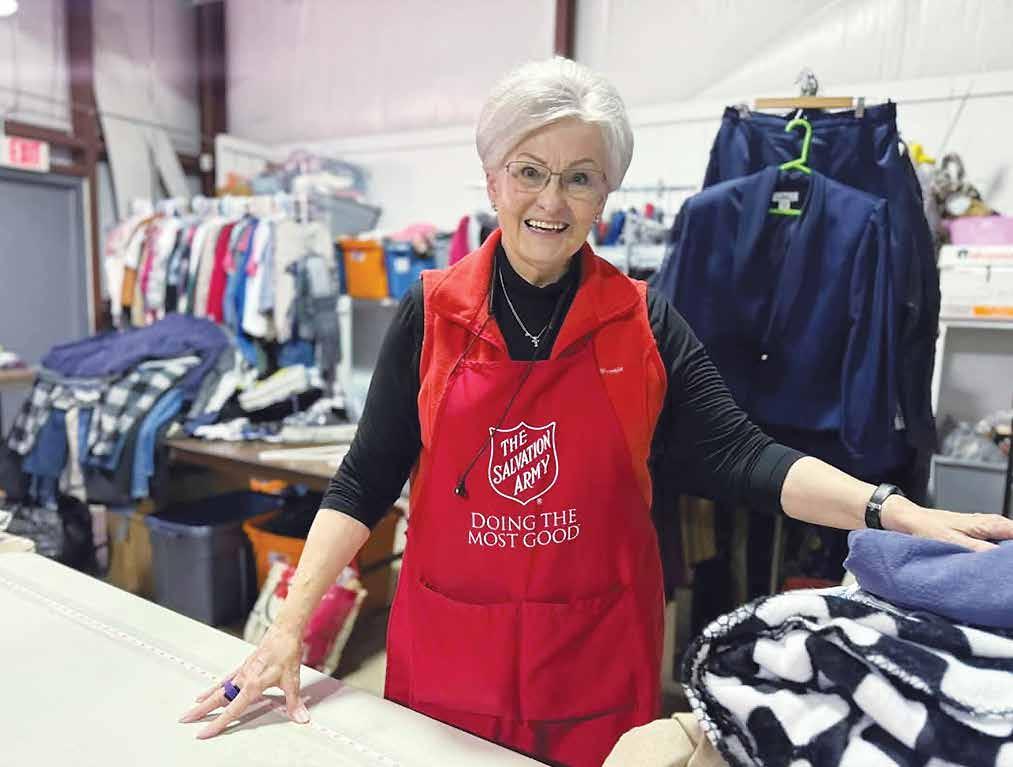
Every morning before Bec Pelz starts a volunteer shift at The Salvation Army Thrift Store in Gillette, Wyoming, she sits and prays in her car for the encounters ahead.
“We just want to love everybody and make everybody feel that they’re important,” she said. “We depend on the people who come in here and buy things in our thrift store because that’s what keeps our mission going.”
The thrift store is the engine for The Salvation Army’s work in Gillette, and is powered by volunteers who aim to help shoppers find just what they’re looking for—and feel like family along the way.
Last year, the thrift store netted $184,000, which The Salvation Army Gillette Service Extension Director Jenny Hartung said goes directly to client services, covering one paid staff position, rent and about $10,000 worth of food a month.
In Gillette, a town of some 30,000 people, The Salvation Army distributes over 2,000 food boxes a month.
“We have a huge food pantry—it’s a very big need here,” Hartung said. “So it’s really important then to have good people manage the store.”
And that’s where volunteers, like Pelz, come in. Hartung said she has set the tone of the shop, starting with her effort to genuinely extend a warm welcome to everyone who comes through the door.
“Everyone is treated as if we’ve invited them over to our home for dinner and we’re so happy to see them,” Hartung said.
The thrift store sits on the ground floor of The Salvation Army’s 15,000 square foot presence in Gillette and focuses on maintaining an inventory of items people would need to set up a home or productively contribute to society.
“What we figured out is that if we price it to sell then it moves, and then we get another piece in. God just provides,” Hartung said. “Every single time I think, ‘Gosh, this whole room’s empty.’ Next thing you know, a guy will pull up with a whole van full of antiques and fill it right back up.”
She added, “We never run from a position of have not. We always run from a position of have and share.”
Much of the sharing comes through honoring vouchers
provided to individuals and families participating in case management who are transitioning to permanent housing. Last year, about $22,000 worth of vouchers were redeemed at the store.
IT BRINGS A LOT OF JOY TO JUST SEE PEOPLE GET TREASURES.
—Bec Pelz
“When people come in and they get a voucher toward some housewares or clothing, everybody gets excited to be able to help them,” Pelz said.
She recalled one mom who was new to town and needed bedding for her kids.
“We were able to help her get all set up,” Pelz said. “It was enjoyable to see the look on her face and her kids’ faces when they got all these things to help them set up their home.”
Sometimes the job looks like helping an individual find a new pair of shoes they need to start their next job.
“Steel-toed boots for guys are huge,” Pelz said. “We’ll see what we can find for them.”
The work is relational—Pelz knows the store’s regulars and what they’re looking for. If she finds something that fits the bill, she’ll call them up.
“It brings a lot of joy to just see people get treasures,” she said. “You’re excited when you’re checking them out and ringing them up—telling them ‘Oh this is really cute!’ ‘I love that!’ and just being happy with them and for them when they buy their purchases.”
Checkout is where it all comes together for many shoppers. There, a sign reads: “All of your purchases help fund our food pantry, so thank you for feeding our neighbors in need.”
The result? An organic round-up program. Often, Pelz said she’s told “Oh, keep the change. Just put it in the till for the food pantry.”
“We can get $10, $15, $20 a day in spare change from people just saying, ‘That’s OK, you keep the change.’ And every little bit helps,” she said.
In January, the store collected $262 from shoppers’ round-up donations alone.
“They’re willing to give, too,” Pelz said. “They understand how important it is.” NFC
Bec Pelz at The Salvation Army Gillette (Wyoming) Service Extension Thrift Store |PHOTO
Richard Brown rings in hope in Idaho’s Blaine County.
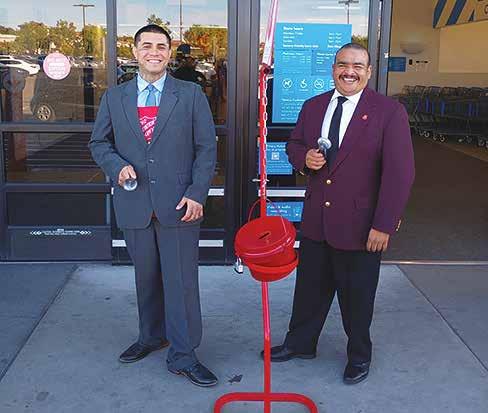
Richard Brown (middle) and family members at the red kettle
|PHOTO COURTESY RICHARD BROWN
STEAM camp connects kids to learning and community in Hollywood.
Learning comes to life
BY HALEY OSNESS
Laughter and the buzz of hands-on discovery filled The Salvation Army Hollywood Temple (California) Corps March 15 as children gathered for a free STEAM day camp, exploring science, technology, engineering, art and math through interactive activities.
Hosted by volunteers from Help On the Go, a nonprofit focused on helping students grow academically and build confidence, the camp brought together 20 children ages 7-15 for a day of learning and fun.
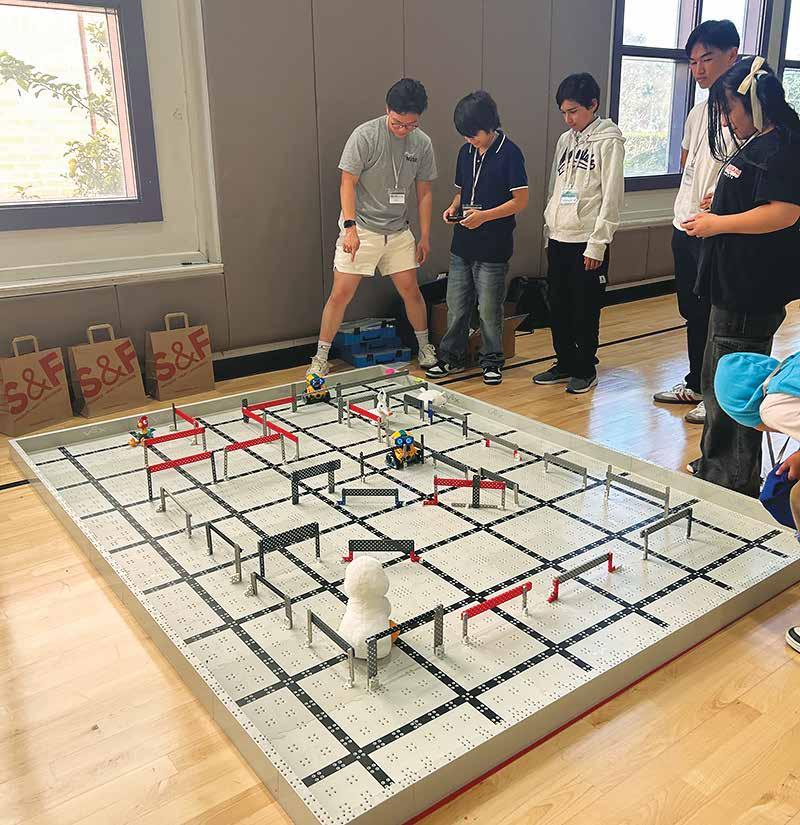
At stations around the gym, volunteers guided attendees through activities, like navigating robots through a maze, building marshmallow towers, creating paper helicopters and more.
At each station, participants earned tickets to redeem for prizes like games, electronics and building kits. Older participants also had the option to take on a longer project, building mini solar-powered cars.
“It’s a great way to bring more kids into the corps,” said Hollywood Temple Corps Officer Major Lorena Strickland, noting the event is part of the corps’ efforts to increase opportunities for local youth.
“We can connect kids to our programs and help them get involved so they know we’re here for them,” she said.
For some kids, the camp marked their first visit to The Salvation Army after learning about it through flyers, online posts and friends.
For 8-year-old Issac Cruz, who attended with a friend, one of the highlights of the day was making a bouncy ball, carefully choosing his own colors for the design.
“It’s fun because it’s something I’ve never done before,” he said before competing with others to see whose ball could bounce the highest.
Another first? Operating a remote-controlled robot through a maze, racing his friend to the finish line. Cruz placed first in his group, earning two tickets toward his desired prize, a basketball, worth 7.
Opening these kinds of doors for children to try new things is central to the work
WE WANT TO MAKE SURE THE STATIONS ARE BOTH FUN AND SOMETHING KIDS COULD LEARN FROM. IT’S COOL TO SEE THAT COME TO LIFE.
—Kayla Kim “
of Help on the Go, said CEO Julia Jung.
“Working with The Salvation Army helps us to bring these experiences directly to kids,” she said. “It also connects them to a place where they can continue to learn and be part of a nurturing environment.”
When Help On the Go goes out into the community for volunteering and outreach, Jung is supported by teams of Los Angeles-area high school students
who make up the nonprofit, serving as volunteer mentors, tutors and leaders for younger children and their peers.
In recent months, volunteers have painted murals at The Salvation Army Siemon Center, hosted educational summer camps at the L.A. Red Shield, and, through their Washington-based music outreach group Classic4U, performed concerts at Salvation Army housing facilities.
At the Hollywood Temple Corps, Project Muse—the art branch of Help On the Go—spent weeks transforming a once-blank learning center with a collection of murals.
Now, the space, featuring an underwater ocean scene and a sunflower field beneath the Hollywood sign, serves as an inviting place for youth to gather, study and relax for years to come.
“They’ve been a blessing to our corps,” said Strickland.
Through projects like these, Help On the Go strives for ways to brighten spaces and encourage connection, creativity and growth among youth.
“We look for those needs and gaps in the community and step in where we can,” Jung said. “Sometimes all it takes is a group effort.”
According to Jung, student volunteers help shape and develop activities and events, contributing ideas such as the STEAM stations—often drawing from experiences and activities they enjoyed as younger kids.
“It’s fun and meaningful for the kids and community members,” she said. “But it’s also helping our student volunteers become leaders.”
Kayla Kim, a Help On the Go student leader, helped develop some of the stations—including a marble tower race—and guided younger participants
Top: Kids race robots to the finish line of a maze. Bottom: Kids display their completed marble towers.
|PHOTOS BY HALEY OSNESS
A grocery delivery—and an invitation
Groceries delivered with kindness led one woman to a new church home.
BY KAREN GLEASON
The Salvation Army Yuma (Arizona) Corps received a simple request: a woman asked for a ride to church.
Shirley Collins had heard the corps offered transportation to worship services—not from seeing a program announcement, but instead after someone knocked on her door.
Delivery driver Nikita Lopez met Collins while working her routine Spark deliveries, bringing grocery orders from Sam’s Club and Walmart to homes across Yuma.
When Lopez delivered Collins’ order, the exchange didn’t end with a simple handoff.
“We just started talking,” Collins said. “She was so kind and caring. It was sincere.”
During the conversation, Collins shared that her husband had died seven years earlier and that she had recently moved back to Yuma. Without many friends nearby, she said her house—and life—often felt overwhelming.
Lopez listened.
When Collins mentioned she no longer drove and couldn’t get to church, Lopez told her about the Yuma Corps—worship services, rides to church and a women’s Bible study.
Collins later contacted the corps, requesting transportation.
“When I asked how she heard about us, she told me about her conversation with Nikita,” said Corps Officer Lt. Jonathan Herzog. “She said Nikita had such warmth and joy about her and invited her to the corps.”
The following Sunday, when the regular driver was unavailable, Lopez picked Collins up herself.
At that first service, Collins said she was warmly welcomed and prayed over.
“It was magical,” she said.
Since then, Collins has become part of corps life. She attends women’s Bible study, and a corps member now regularly transports her to worship and gatherings.
“She made friends quickly,” Herzog said. “We’ve seen that she feels welcomed and loved.”
For Collins, the impact has been simple and profound.
“It just put me up in the world again,” she said. “I’ve made wonderful friends.” NFC
Do you have a good corps story? Send it to newfrontier@usw.salvationarmy.org.
Skilled volunteers give back to corps
At the Murrieta (California) Corps, volunteer expertise fills the gaps.
BY HALEY OSNESS
When repairs and costly upkeep began piling up at The Salvation Army Murrieta (California) Corps in July 2025, Captains Sidney and Reyna Salcido knew they needed a solution they could afford, and with a tight budget, hiring outside help wasn’t always possible.
“We began asking volunteers who came through the doors what skills they had,” said Captain Sidney Salcido. He explained that many volunteers arrive to fulfill court-ordered community service hours through a partnership with the city, which refers individuals to the Murrieta Corps.
“People often come in expecting to work in the food pantry or do standard organizing and cleaning,” Salcido said. “But once we learn their skills and abilities, we can match them with other needs around the corps.”
Soon, volunteers began helping in unexpected ways, arriving—as Salcido said—in God’s perfect timing.
Just days after a plumbing problem arose, a volunteer with plumbing experience repaired it within hours, saving the corps hundreds of dollars. Another individual with IT experience then repaired the camera livestream equipment, allowing the corps to stream Sunday services again after months of technical issues.
“Some of the support has become consistent and reliable,” Salcido said, adding that all outdoor landscaping is now completed by a volunteer. “It’s a blessing to have people showing up to give their time.”
With volunteer time valued nationally at $34.70 per hour in 2025, according to Independent Sector, the hours donated at the corps translate into meaningful savings that can instead support its programs.
“Because of the help, we can put more of our resources into helping families in the community,” he said.
When the Murrieta Corps needs extra hands for events or seasonal fundraising, Salcido turns to Patrick Rogrigue, a full-time volunteer who networks with the community and helps connect people to tasks at the corps.
As a Perris Adult Rehabilitation Center (ARC) graduate, Rogrigue works with men in recovery and invites them to serve alongside him.
“Giving back is part of being in recovery,” Rogrigue said. “By being of service to others, the door to lasting change begins to open.”
Rogrigue has remained connected to the ARC since graduating and becoming a Salvation Army soldier in 2009. Following 13 years as assistant manager at The Salvation Army Temecula Thrift Store, he retired and shifted his focus to volunteering and supporting others walking the same path he did.
Each week, he returns to the Perris ARC to help teach
“
WE’VE SEEN GUYS ARRIVE UNSURE OF THEMSELVES, BUT THEY SOON REALIZE WHAT THEY’RE CAPABLE OF. WORKING WITH THEIR HANDS OFTEN STARTS REPAIRING WHAT’S GOING ON INSIDE.
Patrick Rogrigue
early recovery classes and build relationships with participants, often serving as a mentor to men in the program.
On Sunday mornings, he loads as many men as he can into the van and drives them to service at the Murrieta Corps, where many greet guests, serve refreshments and stay afterward to continue volunteering.
“Men experience what it’s like to be connected and live differently than they’re used to,” Rogrigue said.
As he manages much of the food pantry, Rogrigue invites men in recovery to join him, helping them practice routines and taking responsibility. He said an average of seven program graduates return to volunteer with him each week.
Through a contact list of more than 100 people, Rogrigue maintains connections by sending daily devotional text messages and reaching out when additional help is needed—requests he said are often met without hesitation.
“Through Patrick’s networking and his ability to reach so many people in the community, we don’t have to worry as much about finding help when needs arise,” Salcido said.
Rogrigue also works with individuals who need community service hours, helping some complete more than 40 hours of volunteer service at the corps.
The benefit comes to volunteers as well, Rogrigue said, as he’s seen many discover renewed belonging that strengthens their recovery.
“We’ve seen guys arrive unsure of themselves, but they soon realize what they’re capable of,” Rogrigue said. “Working with their hands often starts repairing what’s going on inside.”
He recalled one ARC participant who began by bellringing during the holidays and has since returned multiple times to help with small repairs around the corps.
“People’s self-esteem grows once they realize their abilities are greater than what they previously thought,” Rogrigue said. “They start to see God’s plan for them.”
Nikita and Shirley
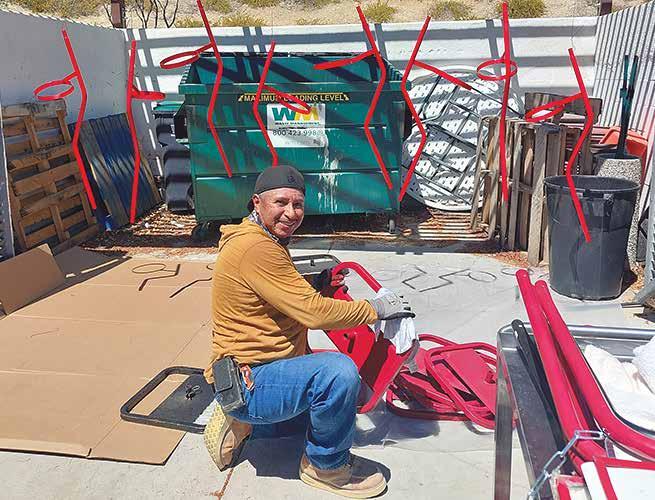
Top: Volunteer Saul Valdez sands and repaints the Murrieta Corps kettles ahead of bell-ringing season. Above: ARC Kingsmen step out to bell ring and serve their community.
Aphone call. A credit check. Another message left for a property manager.
Inside The Salvation Army’s Tucson Hospitality House, finding a permanent home for a shelter guest rarely happens with a single conversation.
The process takes weeks, as individuals and families enter the 21-day emergency shelter and begin working alongside a case manager to navigate the search for stable housing.
“There are a lot of moving pieces,” said Kim Graham, a case manager at Tucson Hospitality House. “We help take care of many of the stressors for clients—they’ve already been through enough.”
When searching for housing, the goal goes beyond finding an available unit. Case managers work closely with clients to secure housing they can afford to maintain, reviewing income, exploring housing options, and contacting property managers willing to consider tenants exiting homelessness.
“We want to make sure each individual is safe for the long term,” Graham said.
According to research published in the National Library of Medicine, nearly one in four adults who exit shelter for housing return to homelessness within 18 months, often due to rising rent, loss of income or other challenges that make housing difficult to maintain.
Graham, along with other case managers at Hospitality House, works to prevent that cycle by connecting with property managers and community partners who help create housing opportunities clients can realistically maintain.
“Sometimes it just takes finding the right person who’s
Full Circle
Kettles remind one woman of the enduring presence of The Salvation Army.
For Theresa Estrada-Gaxiola, The Salvation Army has never been just a place or a program. It has been a steady presence, quietly walking beside her through some of the hardest and most meaningful chapters of her life.
In her teenage years, The Salvation Army provided food vouchers, shoes and clothing for her family in addition to toys at Christmas. Those simple acts of care met practical needs, but more than that, they offered hope.
The journey to home
BY HALEY OSNESS
willing to work with us,” Graham said. “Those connections can make all the difference for clients.”
Housing within reach
On the receiving end of many of Graham’s calls is Property Manager Greg Eilmann, who oversees multiple housing complexes in Tucson.
Through his recent connection with Tucson Hospitality House, three clients have secured housing since 2025.
“He’s someone I can call, explain a client’s situation, and he’s willing to work with more complicated circumstances,” Graham said.
After Graham makes the initial contact, Eilmann helps identify apartments that may be a good fit for those preparing to leave shelter. Graham then gathers applications, confirms income and ensures tenants are moving into a place where they can feel comfortable and stable.
“Our apartments target incomes between 40 and 60 percent of the area median income,” Eilmann said, explaining rents are designed to remain affordable for residents with limited income.
Individuals moving into the units managed by Eilmann also have access to supportive services through a partnership with La Frontera Center, which offers continued case management, health support and connections to other community resources.
“Sometimes people just need someone willing to give them a chance,” Eilmann said. “If we can help provide a stable place, we see how that can make a big difference.”
Community connections
To help build lasting stability, Graham seeks housing options in areas where individuals can foster connections and have access to services, transportation and community support. She then accompanies clients to
At 18, Estrada-Gaxiola became pregnant and moved out on her own. Money was tight, and when she could, she shopped at The Salvation Army Thrift Store. Even in her struggle, she gave back by dropping coins into red kettles whenever she could.
“I remembered what The Salvation Army did for us,” she said. “I never forgot.”
In her thirties, Estrada-Gaxiola found the Lord. She and her husband opened their home for a Bible study. Just one month into the study, someone asked her a simple question: “Do you happen to take care of people?”
It led to a life-changing connection.
“
ONCE WE SEE SOMEONE WALK THROUGH THE DOOR OF THEIR OWN PLACE, THERE’S USUALLY A SENSE OF RELIEF. THEY KNOW IT WILL TAKE TIME TO SETTLE IN, BUT THEY’RE FINALLY ON STABLE GROUND.
—Kim Graham
tour units and meet with property managers, advocating on their behalf throughout the process.
“If someone has family or friends nearby, we try to find housing somewhere close by so they’re not starting over alone,” Graham saidIn some cases, she has even been able to help place former clients in the same complex.
“We want people to feel connected and happy where they live,” Graham said.
Research from the National Library of Medicine shows individuals exiting homelessness who are placed in communities where they can build relationships are more likely to remain stably housed and less likely to return to homelessness.
The apartment complexes Eilmann manages include shared spaces where residents gather for meals, movie nights and social activities.
Two weeks after moving into her unit with help from Eilmann and Graham, former Hospitality House client Rita Reeder said community involvement has boosted
HOUSING PAGE 10
It was through that moment that Estrada-Gaxiola met Nancy Lane Booth-Goodwin. Estrada-Gaxiola became Booth-Goodwin’s assistant in 2016, and when she later learned that Booth-Goodwin is the great-great-granddaughter of William and Catherine Booth, the founders of The Salvation Army, everything came into focus.
Last Christmas, Booth-Goodwin,
her son, and her niece gifted Estrada-Gaxiola figurines of red kettles and bell ringers. She plans to add to the collection each year and keep it displayed year-round, a daily reminder of what The Salvation Army did for her and her family.
“This story is full circle,” Estrada-Gaxiola said. “The Salvation Army came into my life as a young girl and stayed with me through raising my children. Their hope has been immeasurable.” NFC
Do you have a heartwarming kettle story? Send it to newfrontier@usw. salvationarmy.org.
How Tucson’s Hospitality House helps clients transition from shelter to housing.
Kim Graham at work at The Salvation Army Tucson’s Hospitality House
Stories of Salvation Army kettles
BY ERIN L. WIKLE, CAPTAIN
ately, as I find myself scrolling through updates, I keep circling back to a question I already know by heart—the one so many of us are quietly carrying: in the face of breaking news that arrives faster than we can process and heavier than we can shoulder alone, what do we do?
The highlight reel of the last year alone featured senseless killings, mass deportations, a government shutdown, catastrophic flooding, assassinations and other attempts, protests of every kind and fragile ceasefire agreements—each headline forceful enough to divide us, ignite a social media firestorm and reinforce the uneasy sense that being right now matters more than preserving relationships. In such a climate, even faithful believers are unsure how to respond.
What do we do as we watch and wait, wondering if things might improve in time—when we feel deep sorrow about the state of our nation and a wariness of saying the wrong thing, or anything at all?
It’s OK to be rattled, confused or overwhelmed by what we are seeing. It’s OK to grieve lives lost and lament the absence of peace.
What may be more concerning is not our discomfort—but our indifference.
Christians divided on political issues have wrestled with how best to engage conversations in a divided world. Some say prayer must be paired with visible action. Others argue activism apart from prayer loses its soul. Still others insist that doing justice requires engagement with legislative systems while also calling on the one upon whose shoulders Scripture says the government will rest.
It has become normal to air political grievances online—saying what we would never say face to face. As the chasm of tolerance widens, Jesus stands ready to extend a grace we too often withhold from one another.
It is a real temptation to simply look away. It seems a lesser of two evils—as though not taking a stand seems the better bet. But if we are not careful, desensitization can slowly give way to indifference—and indifference can quietly immobilize.
As missional people, immobilization has consequences. It leaves space unoccupied where God has positioned us to bring to earth what is in heaven—and what we neglect does not remain neutral for long. It diminishes our witness in a world aching for hope.
Are we not The Salvation Army?
So, we return to the question: What does it look like to respond like Jesus?
In a divided and weary world, our calling is not toward louder opinions or quieter retreat, but toward a justice that reflects the heart of Jesus—faithful, compassionate and embodied in action.
Scripture as our starting point
Jesus’ ministry was wildly offensive to those who lacked understanding and life-changing to those who longed for rescue. The Pharisees were so offended by Jesus’ fulfilling the law—healing on the Sabbath, curing an unclean woman, casting demons from the afflicted,
Doing justice like Jesus
“
IN A DIVIDED AND WEARY WORLD, OUR CALLING IS NOT TOWARD LOUDER OPINIONS OR QUIETER RETREAT, BUT TOWARD A JUSTICE THAT REFLECTS THE HEART OF JESUS—FAITHFUL, COMPASSIONATE AND EMBODIED IN ACTION.
concerning himself with those outcast and without rights. He took risks. He acted boldly and decisively, choosing obedience even when it incited danger. Yet his boldness was never rooted in outrage; his authority was never loud, but Spirit-shaped.
Matthew recounts the response of those afraid of Jesus’ power, whose response was to plot his death: Aware of this, Jesus withdrew from that place. A large crowd followed him, and he healed all who were ill (Matt. 12:15).
Jesus doesn’t spurn the crowd or demand they go away—in faith, they follow, and full of compassion, he heals them. All of them. What follows in Scripture is an echo of Isaiah’s prophecy, signaling Jesus’ humble arrival as the fulfillment of this ancient promise:
“Here is my servant whom I have chosen, the one I love, in whom I delight; I will put my Spirit on him, and he will proclaim justice to the nations. He will not quarrel or cry out; no one will hear his voice in the streets. A bruised reed he will not break, and a smoldering wick he will not snuff out, till he has brought justice through to victory. In his name the nations will put their hope” (Matt. 12:18-21).
This is a vision of justice rooted not in force, but in faithfulness. Not in volume, but in authority given by the Spirit of God.
Jesus deals gently with the weary and wounded, protecting what is fragile and restoring what is nearly extinguished. His justice extends beyond borders—to the stranger, the outsider, the one considered “other.”
What Jesus feels for those on the margins of society is not for us to simply observe and applaud as spectators. Instead, we are invited to participate. 2
Peter 1:4 says, “He has given us his very great and precious promises, so that through them you may participate in the divine nature.”
Filled then with the Spirit, we too can be moved with compassion, extend love beyond our own means, and engage a mission that God has called each of us to.
Isaiah writes to the leaders and people of Judah who had grown corrupt in their dealings with one another, failing to love one another well. To those who belonged to one fractured nation, he says: Learn to do right; seek justice. Defend the oppressed. Take up the cause of the fatherless; plead the case of the widow (Is. 1:17).
John would later reference this moment in history when he wrote, “Whoever claims to love God yet hates
a brother or sister is a liar. For whoever does not love their brother and sister, whom they have seen, cannot love God, whom they have not seen (1 John 4:20).
Again and again, God calls people away from empty ritual and toward embodied compassion—justice that moves, righteousness that flows, mercy that walks humbly alongside faith.
Jesus lived this fully.
Wherever he went, whatever he did, he submitted himself to the will of the Father for the sake of others. He invited his disciples to come close—to watch, to learn, to experience, to ask questions, and then to go and do likewise, empowered by the Spirit to love beyond their own capacity.
If justice formed by the Spirit is our calling, then we need not imagine what it looks like—we have been practicing it for generations.
Our response
Throughout the world, The Salvation Army is at work in communities of every kind—from the beginning, we have always been about and for others
In the U.S. alone, after-school programs reflect dozens of nations, providing educational and emotional support to help children thrive. Salvation Army officers trained in law have helped community members navigate complex systems with care, while others have multiplied limited resources to provide hot meals to field workers. In immigrant communities, centers open their doors daily to elderly neighbors, and recovery programs continue to restore lives.
So where do you find yourself today?
We each must decide whether we will remain unmoved or allow compassion to disrupt us; whether we will stay guarded or engage with humility and grace in the face of issues that press upon our witness and mission.
If our response is to call upon the God of justice and engage the brokenness before us, then the invitation is not toward certainty or control—but toward Spirit-filled compassion in faithful action.
Not complacency. Not indifference. Not performative outrage.
But a love that reflects the heart of Christ—gentle with the other, courageous in obedience, faithful in tension and hopeful enough to believe that justice, molded by God’s Spirit, is not only possible but already at work among us. NFC
LEARN TO DO RIGHT; SEEK JUSTICE. DEFEND THE OPPRESSED. TAKE UP THE CAUSE OF THE FATHERLESS; PLEAD THE CASE OF THE WIDOW.
—Isaiah 1:17
NEW APPOINTMENTS
Effective July 1, unless otherwise noted:
TERRITORIAL HEADQUARTERS
Personnel Services
Captain Caroline Rowe, Territorial Education Secretary—Education Department
Business Administration Services
Major Derek S. Strickland, Territorial Secretary for Business Administration (with the rank of Lt. Colonel)
Program Services
Major Terry Masango, Territorial Secretary for Program (with the rank of Lt. Colonel)
Major Rutendo Masango, Assistant Program Secretary for Corps Ministries (with the rank of Lt. Colonel)
Spiritual Life Development
Major Angela M. Strickland, Spiritual Life Development Secretary (with the rank of Lt. Colonel)
College for Officer Training
Captain Dustin L. Rowe, Training Principal
Northwest Division
Lt. Colonel Kelly K. Pontsler, Divisional Commander
OUT OF TERRITORY
Lt. Colonel Brian Saunders, Chief Secretary, USA Southern Territory (with the rank of Colonel)
Major Robert Reardon, Under Secretary for Program Resources, International Headquarters
Major Amanda Reardon, Editor of The Officer Designate, Editor of The Officer, International Headquarters—Aug. 1
Major Marcelino Soriano, IHQ Auditor, International Headquarters
HOUSING
FROM PAGE 7
her mood and helped her feel at home.
“It’s nice to have people around who look after one another,” Reeder said, adding she enjoys living in a complex designed for adults 55 and older.
A lasting home
For individuals exiting homelessness, stable housing can mean more than just a place to live; it offers a chance to rebuild routines, relationships and a new sense of belonging.
“Once we see someone walk through the door of their own place, there’s usually a sense of relief,” Graham said. “They know it will take time to settle in, but they’re finally on stable ground.”
She recalled one man who recently moved into a complex managed by Eilmann.
“He just looked around and told us, ‘This is my home,’” Graham said. NFC
MARTIAL ARTS
get people outside and moving, he said. When the Culleys were assigned to the Clackamas County Corps in Portland, Culley knew he wanted to start a program there.
Kids and adults attending the martial arts program will find Sarah Culley practicing by their side on the floor. A brown belt in martial arts, Sarah Culley is not an instructor for the program, but sees the opportunity as a ministry of her own to be in class, said David Culley.
“She plays an intentional role of asking kids questions in class and is the eye to the kids who are feeling down when they come in,” he said. “She’s a wonderful martial artist, her true purpose in her
mind, I think I can say, is she wants to be the support for the students.”
Hays said her children received significant support from the Clackamas County Corps and those in the martial arts program when she finalized the adoption of Rylie and Tristian in 2023.
“Everyone in the program helped celebrate that and accepted my kids for who they are and where they are in life,” she said. “They’ve made them feel welcome and that they belong.”
While Hays said Rylie and Tristian have both struggled with a sense of belonging at school and other sports, at The Salvation Army they are treated like family. And they get continuous encourage-
RICHARD BROWN FROM PAGE 4
unit in Blaine County. Soon after, he was leading the all-volunteer Salvation Army Wood River Service Extension Unit, serving individuals and families throughout the Wood River Valley while continuing to run his oil and gas company.
“I’m thinking of recent needs we’ve filled—the last three or four have been rent assistance… And we’ve got a soft spot for kids. In some of these families, the kids kind of get lost in the mix,” Brown said, noting that children’s needs can be put on hold while parents struggle to pay for housing and food.
He said The Salvation Army’s annual Red Kettle campaign, held each holiday season, is central to meeting these needs.
Brown leads bellringing efforts at locations including Atkinson’s Market in Ketchum and—new in 2025—at the Albertsons in Hailey.
With the help of volunteers John Dimant and Al Oliver—two deacons from his church—the two sites raised $37,087 during the 2025 kettle season to support Salvation Army assis -
STEAM CAMP
FROM PAGE 5
throughout the STEAM camp as they tried new activities.
“We want to make sure the stations are both fun and something kids could learn from,” Kim said. “It’s cool to see that come to life.”
For Jennifer Rodriguez, the camp offered a chance to see her 11-year-old daughter, Jasmine, try things with confidence.
“She loves science,” Rodriguez said. “Seeing her have so much fun with the robots—I know she’ll be talking about it for a while.”
Rodriguez, a longtime member of the Hollywood Temple Corps, said she’s excited to see more opportunities like this for kids in the area.
“I know my daughter will tell her friends about it, and I’m sure other kids will too,” Rodriguez said. “That’s how things like this grow.”
Help On the Go has been invited back to host a summer Vacation Bible School at the corps.
“You can see how much something like this stays with kids,” Rodriguez said. “It’s not just one day—it sticks.” NFC
tance throughout Blaine County. It was the most successful kettle season yet.
The bellringing tradition has become a yearly commitment for Brown—one he has maintained for the past 12 years. He said the kettles provide an opportunity to explain to people he might not otherwise encounter how The Salvation Army uses their donations. And sometimes people tell him stories about The Salvation Army—stories he said motivate him to continue to serve.
“Richard understands that bell ringing is about connection as much as it is about donations,” said Lloyd Potter, Service Extension Director for The Salvation Army Cascade Division. “By taking time to thank donors and explain how the funds stay local, he helps people see the real impact their generosity has in their own community.”
Brown said he especially appreciates when people share how The Salvation Army helped them or their family.
“Sometimes a little old lady will wander up and say, ‘Can I tell you a story?’ Those moments really move you,” he said.
Serving at the red kettles defines the
STRANDED
ment to keep working at their practice.
“The whole martial arts program promotes being kind and doing our best, while having fun and learning skills—it hopefully will last them all their life,” said Hays.
For Tristian, one of the most important things about martial arts is the joy he gets out of it.
“Martial arts is fun because Lt. David makes it fun,” said Tristian, who now holds an advanced purple belt alongside his sister. “Martial arts gives me exercise and teaches me how to protect myself.”
Rylie has also found the sport beneficial. “I’ve always been very social—[the program] it’s helped me make even more friends, which I like,” she said.
Now the two siblings are preparing for their next challenge: Training to test for a blue belt. NFC
SOMETIMES A LITTLE OLD LADY WILL WANDER UP AND SAY, ‘CAN I TELL YOU A STORY?’ THOSE MOMENTS REALLY MOVE YOU.
Brown
—Richard
holiday season for Brown—it’s woven into the fabric of his life.
“I don’t know what I’d do during the holidays without it,” he said. “We start the week before Thanksgiving, and before you know it, it’s Christmas Eve—it’s just kind of a blur.”
His faithfulness has not gone unnoticed.
“Richard Brown’s story is a powerful reminder that one person’s willingness to serve—supported by a team and a caring community—can make an extraordinary impact,” Potter said. “Through faithfulness, generosity and partnership, these volunteers help ring in hope for Ketchum, Hailey and beyond.” NFC
FROM PAGE 1
a boutique seaside hotel in Tel Aviv, where they ended up staying for 12 days.
At the hotel, Hower recalled air-raid sirens day and night, signaling time to get to the bunker.
“I didn’t get any sleep in 12 days,” he said. “We developed a community among the people in the bunker.”
In the bunker, some 15 people—speaking Hebrew, English, French, Croatian and German—had in-depth conversations, Hower said, along with a surprising amount of laughter, too.
“My best friend was saying, ‘Was it Satan that got us stuck or was it God?’” he said. “I think it was God because we wouldn’t have met all these interesting people…It was a real community in the bomb shelter, all of us trying to figure out how to get out.”
Finally, Hower said they got the first flight out—to Prague, where he and his friend spent three days unwinding. Another God thing? Prague happened to be where his corps officer, Major Petr Janousek, served from 2015-2018.
Janousek was able to connect the travelers to The Salvation Army homeless hostel, House of Bohuslav Bures, where he was once a chaplain as one of
WE DEVELOPED A COMMUNITY AMONG THE PEOPLE IN THE BUNKER.
—Tim Hower
his roles when he was Prague Corps Officer. The pair was accommodated in the guest room.
“I had the privilege to serve in several different countries with The Salvation Army … and it is always a blessing to have a personal connection,” Janousek said. “But even if we don’t, it is usually easy to find a connection and help when needs arise…With The Salvation Army, the world is suddenly quite small.”
The experience got Hower thinking about the book of Esther—a book of the Bible he finds interesting, since God is not mentioned, but you can see him working through the circumstances.
“This whole trip, you could see the invisible guiding hand of God,” he said. “It was an interesting pilgrimage, but it’s good to be back.” NFC
Dinner delivered across Billings
BY HALEY OSNESS
Each evening in Billings, Montana, two vans depart from The Salvation Army corps and head into neighborhoods across the city, delivering meals to people who might otherwise go hungry.
When Salvation Army brass band music and hymns begin to play from the van at each stop, neighbors line up, knowing dinner has arrived. Within minutes, as many as 25 people per stop receive their free meals before the vans move on to the next location.
The evening delivery routes are part of The Salvation Army’s meal program in Billings, which distributes an average of 300 meals each night, five days a week, across the community.
On busy occasions, they’ve prepared and delivered as many as 600 meals in one day.
Throughout the route, the vans stop at 20 different locations, including apartment complexes, hotels and senior housing communities, reaching individuals and families who may face barriers to accessing balanced meals on their own.
“We’re serving a variety of folks,” said Billings Corps Officer Captain Colin Pederson. “Some stops reach people experiencing homelessness, some are at hotels where residents don’t have kitchens, and several are people living in disability housing.”
Across the state, the need for balanced meals remains significant, with an estimated 1 in 8 Montanans experiencing food insecurity, according to the Montana Food Bank Network.
Even as Montana’s largest city, Billings spans a wide geographic area, with agri-
cultural land separating neighborhoods by miles, and some residents living more than 10 miles from the nearest grocery store.
“We’re a spread-out community,” Pederson said. “There are people all across Billings who need support—not everyone has easy access to food.”
Helping meet that need relies on teams of volunteers—some who prepare and pack meals at the corps, and others who drive the vans and distribute food along the routes.
“Our meal program is one of the biggest ways volunteers serve here,” Pederson said. “They’re essential to the entire operation.”
He noted that once the food is cooked at the corps, around five volunteers come in a day to package the meals and prepare them for delivery.
Dinners often feature foods that can be easily reheated, such as pasta, rice dishes and other simple, hearty options.
“We keep in mind what can be made in
A purchase with purpose
The personal reason behind one shopper’s visit
Johnny Aguilera didn’t walk into the thrift store only looking for a bargain.
Stories of Salvation Army thrift stores
As he stepped into The Salvation Army’s newly opened store in Chino, California, he passed rows of neatly arranged clothing and shelves filled with secondhand finds—but he wasn’t there just to browse.
For him, the place meant something more. It was personal.
At the time, his father was enrolled in The Salvation Army’s San Bernardino Adult Rehabilitation Center (ARC), a six-month residential program, working toward recovery and a new path forward.
When he learned that the store’s proceeds benefit
large batches and what poses the fewest dietary restrictions,” Pederson said. “It may be a simple meal, but for many people it means knowing someone is thinking about them.”
As meal preparation wraps up each evening, volunteers load the food into vans and set out on the evening routes across Billings.
One volunteer delivery driver, Jack Klein, said the deliveries often bring small moments of connection along with a meal.
“Over time, you start to recognize people,” Klein said. “You see the same faces week after week, and it feels good to know we’re part of the reason they have dinner.”
Klein said he began volunteering after hearing about the opportunity from his father-in-law, who served as a meal delivery driver at the Billings Corps for six years. When he retired and stepped back from the role, Klein said it felt natural to step in and continue the work.
the San Bernardino ARC, Aguilera said he wanted to show up and give back to the program that helped his father.
“I wanted to come out and support because of the changes
I’ve seen in my dad,” Aguilera said. “He’s doing so much better since joining the ARC. He’s reading the Bible every day now, and it’s a major difference from where he was before.”
He admitted he had never shopped at The Salvation Army before, but now that he wants to support his dad and others in the program, he plans to become a regular.
“I know I’ll be back,” he said. “I’ll also be encouraging my friends and family to check it out.” NFC
WE DON’T ALWAYS FULLY KNOW WHAT SOMEONE MIGHT BE GOING THROUGH. BUT IF WE CAN MAKE SURE THEY HAVE SOMETHING TO EAT AT THE END OF THE DAY, THAT MATTERS.
—Colin Pederson, Captain
“He talked about the value of this program over the years,” Klein said. “When he retired from driving, it felt like a good way to continue something he cared about.”
Today, Klein drives the van a few nights a week, ensuring meals reach people waiting along the delivery route. He noted that the busy schedule leaves only about 15 minutes at each stop, but volunteers still take time to greet people and check in when they can.
“You get to know people a little bit,” Klein said. “Sometimes it’s just a quick hello, but it’s nice to follow up and see how they’re doing.”
He recalled one man who often waits outside before they arrive.
“He looks forward to the social interaction,” Klein said. “He gives us updates about what he’s going through, about his family, and we’re happy to listen.”
Moments like that, Klein said, remind him and the other volunteers that they can do more than deliver a meal.
“It may be some of the only social interaction they have for the day, so we want to make it count,” he said, adding they also inform clients about Salvation Army programs, resources and church services.
Pederson said that although the corps operates an in-person food pantry, delivering meals into neighborhoods reflects The Salvation Army’s mission of meeting people where they are.
“We don’t always fully know what someone might be going through,” Pederson said. “But if we can make sure they have something to eat at the end of the day, that matters.” NFC
Customers line up to shop at the Chino thrift store on opening day.
(L/r) Captain Felecia Pederson, Captain Colin Pederson and Major Nesan Kistan |PHOTO COURTESY CAPTAIN COLIN PEDERSON
MAJOR MARILYN GREGORY, June 7, 1939–Feb. 25, 2026
Major Marilyn Gregory was promoted to Glory Feb. 25 from Santa Ana, California.
Marilyn Grace Bawden was born June 7, 1939, in Pendleton, Oregon, to Kenneth John Bawden and Evangeline Grace Bawden, the eldest of five children. A fourth-generation Salvationist and officers’ kid, Marilyn moved frequently with her family. Eventually, she entered The Salvation Army School for Officer Training in San Francisco in 1958 with the Pioneer Session and was commissioned in 1959.
In training, she met fellow Cadet Robert (Bob) Gregory—who was also commissioned in 1959—and after briefly serving as single officers, they married on Jan. 24, 1961. Together, the Gregorys served as corps officers in Redwood City and Hayward, California; Tacoma, Washington; Kauluwela Mission Corps, Hawaii; and several appointments in
the Intermountain Division. Marilyn also held divisional headquarters roles in the Northwest, Intermountain, Southern California and Cascade divisions, including positions in women’s ministries and the League of Mercy. The Gregorys also served in Adult Rehabilitation Centers (ARC) in multiple cities and concluded their active service as administrator and director of special services at the San Francisco ARC.
The Gregorys had three children: Cherilee, Susan and Steven.
In 2003, the Gregorys retired from the San Francisco ARC and settled in Orange, California, later moving to nearby Santa Ana. They were faithful soldiers at the Tustin Ranch (California) Corps.
In retirement, Marilyn was active in the Women’s Auxiliary and worked for the College for Officer Training, grading papers and providing counseling. The Gregorys traveled in their RV across the West to visit their children, grandchildren and great-grandchildren.
Marilyn is survived by her children, Su-
san (Skip) Olsen and Steven (Michele) Gregory; brother Ron Bawden; sisters Linda Griffin and Jan Williams; son-in-law Major Scott Ramsey; eight grandchildren and six great-grandchildren. She was predeceased by her husband, Major Robert Gregory and by her daughter, Major Cherilee Grace Ramsey.
A celebration of life service took place March 22 at the Tustin Ranch Corps.
MAJOR ROBERT (MICK) SOUDERS, Nov. 9, 1942–March 24, 2026
Major Robert Michael “Mick” Souders was promoted to Glory March 24 from Roseburg, Oregon.
Mick Souders was born Nov. 9, 1942, in San Diego. He married Leslie Seeley in 1965, and their daughter, Andrea, was born in 1970.
In 1986, the couple entered The Salvation Army School for Officers’ Training in Rancho Palos Verdes, California, with the
Proclaimers of the Gospel Session. They were commissioned and ordained as officers in June 1986. They served in corps across the Western Territory, including Twin Falls, Idaho; Redding and Auburn, California; Ketchikan, Alaska; and Salem, Albany, Gresham, La Grande and Roseburg, Oregon. Among many rewarding assignments, they worked closely with the Tlingit Indian tribe in Alaska. They also held Adult Rehabilitation Center (ARC) appointments in San Francisco and Denver, and at the ARC Command.
The Souders retired as active officers in 2008 and settled in Roseburg. They volunteered as docents at Wildlife Safari in Winston, Oregon, world-renowned for its cheetah breeding program.
Major Mick Souders is survived by his daughter Andrea (Bob) Purdon; grandchildren David, Matthew and Katie; and extended family members. His wife, Leslie, predeceased him in 2023.
No service is planned. NFC
JOY
—Christin Thieme
RETREAT
the heartfelt testimonies of Rick Potter of the Centennial (Colorado) Corps and Territorial Secretary for Business Administration Lt. Colonel Kelly Ponstler.
In his preaching, Bill Ury stressed the entire message of the Scriptures is that God wants us to be with him. God’s presence makes everything holy, and he wants us to walk in his presence. Un-holiness, he said, is the absence of the presence of the Holy One.
Diane Ury stressed that the nature of God is self-giving, holy love. She offered a deeper understanding of grace; it isn’t simply being saved from sin, it is God wanting to give himself to us. A holy life is a life desperate for him, when the Christian knows he needs him every hour of the day.
Dr. Kenneth Collins of Asbury Theological Seminary taught two sessions about John Wesley, our theological forefather who explored and explained the biblical doctrine of holiness. Collins parsed Wesley’s teaching both on holiness and on the care for the poor. Though this portion
of the weekend was more lecture-style, Collins spoke passionately and we were, again, challenged.
A number of workshops were offered during the retreat in English and Spanish, with delegates having the opportunity to attend two of them. In addition, time was set aside for silent reflection each day. Delegates were given daily “sealed orders”—that is, devotions—as well as instructions for a prayer walk. With bright blue skies and the expanse of the ocean before our eyes, it was easy to sense the presence of God in our solitary moments with him.
Truthfully, God is always present with us. But it is good to set aside time to concentrate on that presence. The teaching, preaching, conversation and gorgeous setting of the retreat allowed that opportunity. Every delegate with an open heart had the chance to be further shaped and filled by the Holy Spirit. Praise God that our Army sets the stage for such life-changing moments.
Holiness retreat delegates participate in worship. |PHOTO COURTESY LYDIA FAIRCLOUGH
KONA LOW
FROM PAGE 1
feeding. Worship music filled the space, and for a moment, the chaos of the storm gave way to peace.
The brigade was also reminded of the value of stewardship and making the most of what was available. Whether it was organizing food pantry supplies, maintaining a clean and functional space, or managing time effectively, the brigade saw how the small details contributed to the larger mission. A well-kept facility, a thoughtfully prepared meal, or a timely response all communicate care and dignity to those being served.
Nā Nalu Maluhia Brigade
In O’ahu, the long hours and demanding tasks revealed something deeper than routine. The Nā Nalu Maluhia Brigade learned caring for people in crisis was not about having the right words but about the willingness to listen.
Many individuals and families who were displaced needed a space to talk, to process, and even to express frustration. The brigade was able to be a part of this space while rotating shifts in an overnight shelter held at The Salvation Army Hawaii Kroc Center in Kapolei. Offering a hug, a listening ear, or even time to sit became a ministry in itself, and these small moments reminded brigade members
Kawaiola (Water of Life) Brigade – Kauai and Maui, Hawaii
Malamalama (Light) Brigade – Big Island, Hawaii
Na Nalu Maluhia (Peaceful Waves) Brigade – Oahu, Hawaii
Ground Breakers Brigade – Portland, Oregon
Echoes of Grace Brigade – Seattle, Washington
Trinity Brigade – Redondo Beach, California
that kindness does not have to be grand to be impactful.
Kawaiola Brigade
The Kawaiola Brigade faced a lesson of learning to pivot and be adaptable in
RELIEF EFFORTS CONTINUE
A powerful storm system brought severe weather across the Hawaiian Islands March 12–15, unleashing heavy rain that triggered flash floods, mudslides, uprooted trees and widespread disruption statewide.
Ahead of the storm’s arrival, the State announced school closures and asked non-essential workers to stay home—a reminder of just how serious conditions were on the ground.
The Salvation Army Hawaiian and Pacific Islands Division mobilized its Emergency/Disaster Services (EDS) team March 12, quickly serving more than 600 meals to first responders, shelter residents and community members in need in the first 48 hours. Four days later, Salvation Army units across O’ahu, Maui and Hawai’i had served more than 1,600 meals to residents affected by floods and power outages—and it was just the beginning.
“As long as there is community need, we’ll be there,” said Hawaiian and Pacific Islands Divisional Commander Major Troy Trimmer.
As relief efforts continue, here are six ways The Salvation Army has helped:
• The Salvation Army led a Community Resource Hub at Oahu’s Waialua District Park.
• Echelon Hawaii volunteers supported families impacted by flooding during Emergency/Disaster Services intake at The Salvation Army Kaneohe Corps.
• Revolution Hawaii participants washed cars and did laundry for survivors.
• Southwest Airlines delivered cleanup kits to support The Salvation Army’s efforts.
• The Salvation Army was among a select group of organizations participating in KHON’s Hawai’i Together Flood Relief Telethon March 31.
• In Hilo, Walmart managers and associates assisted with volunteers from The Salvation Army, Ka’u Rural Health Community Association and the Red Cross to distribute supplies and gift cards to the Ka’u community. NFC
With reporting from Katie Gao
Maui. From the moment of their arrival in Kahului, programs were cancelled, and they followed the guidance of the corps officers. Though the shift felt abrupt, it quickly became clear that flexibility is essential in ministry. Needs change rapidly, and the ability to pivot is not just helpful but is necessary.
The challenges in Maui brought the team closer because cooperation and trust were required as they delivered meals, cleaned the flooded Kahului Corps, and navigated housing changes. One of the most impactful moments came not from the work itself, but from the example that the corps and brigade officers left. Seeing leadership step into the same physical labor, without hesitation, reinforced the idea that leadership in ministry is not about position but about participation.
Lessons learned
Perhaps most importantly, this experience deepened our understanding of what The Salvation Army represents in times of disaster. Meeting physical needs and bringing the hope of Christ during uncertain situations is what makes our ministry so unique.
The Kona Low response was not defined by disruption and chaos but by opportunity; an opportunity to grow, to serve, and to witness God at work in the midst of difficulty. It challenged us to move beyond our plans and expectations and step into a responsive form of ministry.
Our time spent in Hawai’i tested flexibility, endurance and faith, but it also revealed resilience, compassion and unity. For each brigade, the experience was more than a disaster response. It was a living example of what it means to serve others in the name of Christ.
As the communities of Hawai’i continue to recover, the impact of these efforts remains not only in the meals served or hours given, but also in the relationships built and the hope shared. NFC
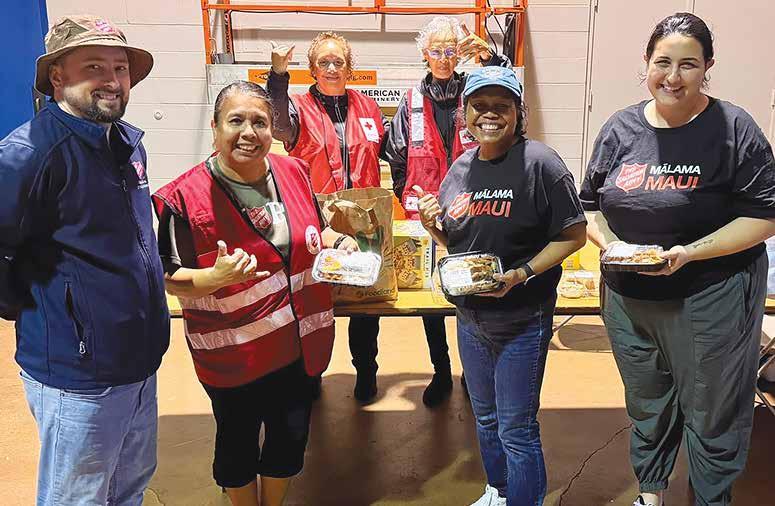
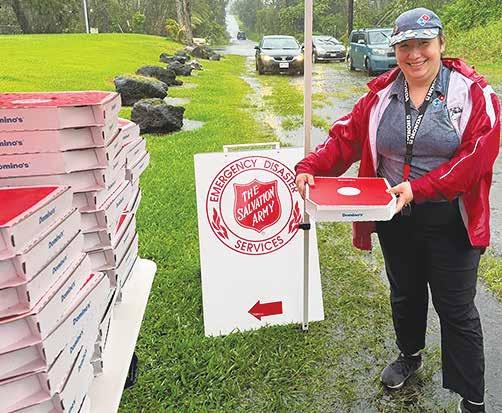
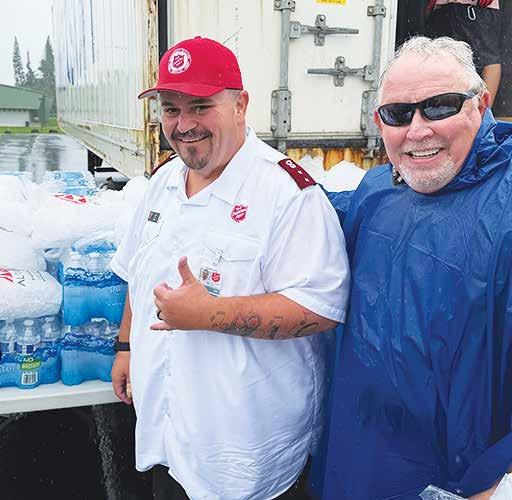
(L): The Salvation Army Hilo (Hawaii) Corps partnered at points of distribution throughout the community. (R): Hilo Corps Officer Captain Sam LeMar stands alongside fellow responders during a distribution event.
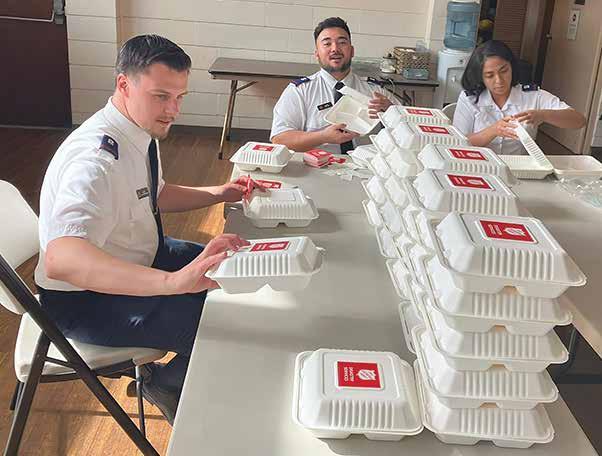
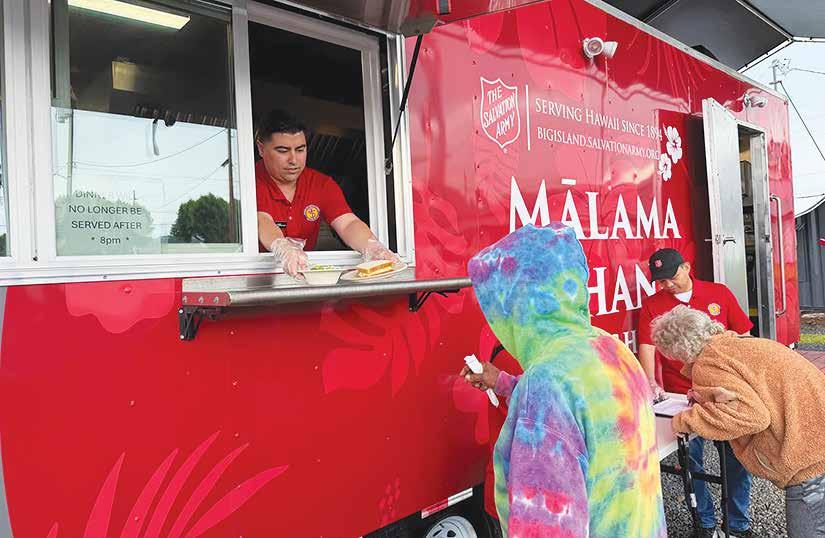
(L): Cadets Elias Markham, Kivo and Janae Ide prepare food boxes for meal distribution.(R): Volunteers serve meals from the Mālama ‘Ohana Kitchen food trailer in Hilo.
New leaders installed
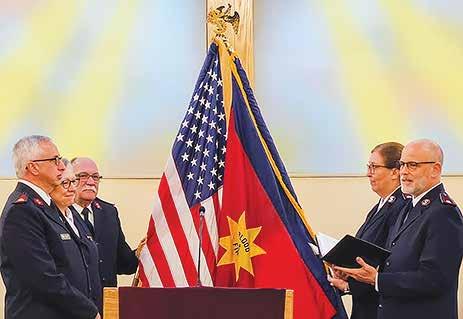
Commissioners James and Sue Betts installed Majors Daniel and Doreen Freeman as divisional leaders in a ceremony Feb. 8 at the Anchorage Corps. During the meeting, young people from the Anchorage Korean Corps presented special music, and Commissioner Sue Betts shared a prayer of dedication for the Freemans, inviting the congregation to lay hands on the leaders to show support.
Grant boosts feeding program
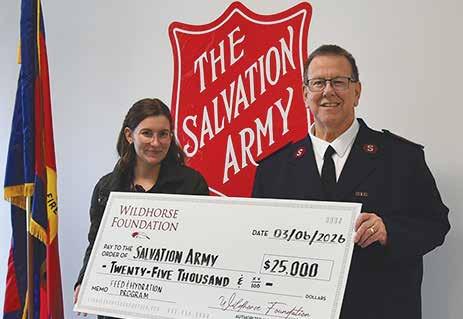
The Salvation Army Pendleton (Oregon) Corps, led by Majors DeWayne and Toni Halstad, received a $25,000 grant from the Wildhorse Foundation, a community fund established by the Confederated Tribes of the Umatilla Indian Reservation. The grant will support the corps’ daily feeding program, which serves about 150 meals each day. “As the need for meals continues to grow and food costs rise, programs like this make a real difference,” said Ella Meyers, the foundation’s administrator.
DEL ORO
Portrait day for Oakland seniors
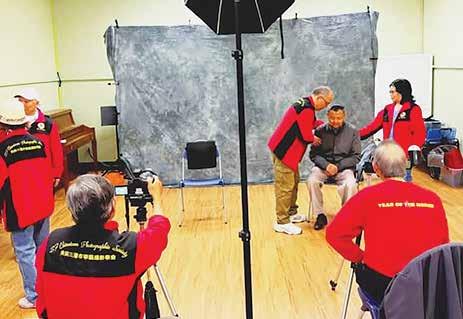
The San Francisco Chinatown Photographic Society provided free professional portraits for seniors March 10 at the Oakland Chinatown Corps. A team of nine volunteer photographers captured more than 100 images of about 80 seniors and staff, including individual, couple, group and family portraits. The team printed and distributed the photos free of charge as keepsakes. The group is scheduled to return on Mother’s Day.
Majors Esther and Timothy Hsu are the Oakland Chinatown Corps Officers.
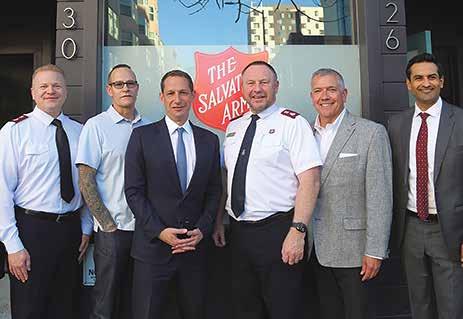
Dorsey and Health and Human Services Chief Kunal Modi recently visited The Salvation Army Hope House, where individuals experiencing homelessness receive a recovery-focused continuum of care.
During the visit, they observed The Way Out program, which offers sober-living housing, addiction treatment, life skills classes, mentorship and workforce training. They also shared a meal prepared by Culinary Training Academy students.
Majors Janene and Michael Zielinski are the Golden State divisional leaders.
HAWAIIAN AND PACIFIC ISLANDS
Hanapepe holds spring break VBS
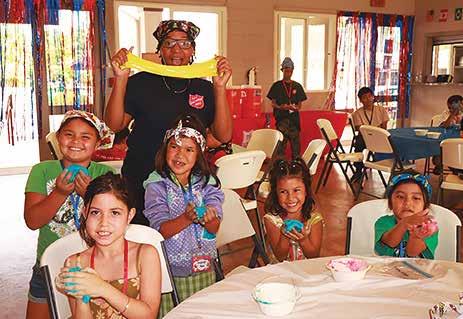
Some 25 children ages 5-13 attended the Hanapepe (Hawaii) Corps’ spring break Vacation Bible School, held March 17-21. The VBS, themed “Heroes of Faith,” featured activities, games, food and lessons from Scripture. “In speaking to a lot of the kids, they all had a great time during the opening chapel time learning songs, hearing the Bible story for the day, and learning the memory verse,” said Corps Officer Lt. Jose Gonzalez. “They also said that the games and team challenges were their favorite parts.” The week was supported by volunteers from Revolution Hawaii, a discipleship program for young adults, and the Kawaiola Brigade from College for Officer Training.
Lts. Andrielli and Jose Gonzalez are the Hanapepe Corps Officers
INTERMOUNTAIN
Grand Junction holds pie fundraiser
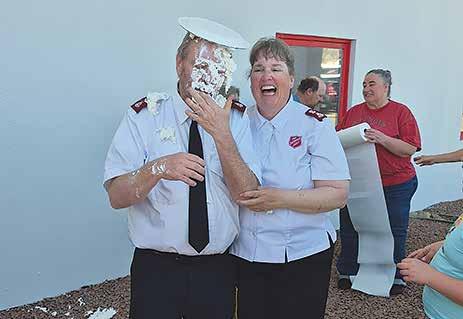
The Grand Junction (Colorado) Corps hosted a “Pies in the Face” fundraiser March 29, raising $1,082 for Salvation Army World Services. The event brought together community members for a day of laughter and generosity, with each pie thrown helping support missionaries serving communities around the world. Corps members pledged donations for the chance to toss pies at willing participants, including staff, fellow members and Grand Junction Corps Officers Majors John and Sabrina Tumey.
NORTHWEST
Kids Rock the Kroc
The Coeur D’alene Kroc Center hosted its first-ever Rock the Kroc recital the evening of March 28, bringing together parents, friends and community members for a free family-friendly concert. More than 40 creative arts
students, ages 10-17, took the stage after three months of studying music theory, attending group rehearsals and practicing individually. From choir and dance to guitar and drums, each performer had the opportunity to showcase their newly developed skills and build confidence on stage.
Lts. Jeffrey and Kristin Boyd the Coeur D’alene Kroc Center Corps Officers.
SOUTHERN CALIFORNIA
Giveaway meets family needs
The San Diego Centre City Corps hosted its first TNT (Toys N Things) Family Giveaway, reconnecting with Angel Tree families and others identified through daily services as being in urgent need. Families received household items, hygiene products, food and leftover Christmas toys, along with donated 37-inch TVs—one for each family—courtesy of a local hotel. One mother of nine, moved to tears, said the support came just as her family had been praying for help.
Captain Jeremy Alexander is the Centre City Corps Officer.
SOUTHWEST
‘Ugly Quilt’ group donates thousands of sleeping bags
Since the Ugly Quilt group started in 1990, volunteers have made 18,000 sleeping bags that are distributed by The Salvation Army and other partners for people experiencing homelessness. The group meets at First Methodist Church’s Outreach Center in Mesa, Arizona, every Thursday to sew sleeping bags, and each comes with a bag of hygiene items and other essentials. “Last month when Donna delivered to The Salvation Army, it was a bad situation for a couple who lost their jobs… and their apartment,” said Co-leader Nona Weisser. “Donna saw them receive, from The Salvation Army, the sleeping bags, and they were thrilled.”
David Sauer is the social services director of the Mesa Citadel Corps.
ARCC
Anaheim beneficiaries attend Christafari concert
Program participants with the Anaheim ARC traveled to the Huntington Beach Pier Amphitheater March 21 to attend a free Christafari reggae concert. The Christian reggae band is known for blending traditional reggae music with messages of hope and faith. “The group has a way of bringing us into the spirit of the Lord,” said Anaheim ARC Administrator for Development Captain Timothy Pemberton. “It’s an opportunity for the guys to experience worship in a different setting and be uplifted in their recovery journey.”
CFOT
Cadets raise funds for Kenya West Territory
Cadets at the College for Officer Training held a World Services fundraiser to support the Kenya West Territory, offering items such as Christian-themed bracelets, sticker packs, bookmarks, pocket crosses and a board game. Cadet Brad Kolb also contributed by providing car washes by appointment on the Crestmont campus.
Fundraising efforts are ongoing. Cadets Janae Ide and Rachel Utrera are offering “Sing-O-Grams” for occasions including birthdays and special celebrations, with proceeds supporting the same initiative.
Major Terry Masango is CFOT Training Principal. NFC
GOLDEN STATE
City leaders visit Hope House program
San Francisco Mayor Dan Lurie, Supervisor Matt
THE FRUIT OF THE SPIRIT IS LOVE, JOY, PEACE, PATIENCE, KINDNESS, GENEROSITY, FAITHFULNESS, GENTLENESS AND SELF-CONTROL. THERE IS NO LAW AGAINST SUCH THINGS (Gal. 5:22-23, NRSV).
Joy spotting
Joy shows up in our lives in big moments and quiet ones—in service, in community, in faith and sometimes in unexpected places. As part of our ongoing storytelling, we’re looking closely at how joy is experienced in real life, and how joyful people engage with The Salvation Army to “Give With Joy” and help others.
Joy in The Salvation Army
We asked our audience and found most respondents said their understanding of joy has changed through involvement with The Salvation Army.
It has helped me move from thinking joy was mostly about the things I was receiving; now I feel it is more about the things I am giving.”
SHANNON LAMB (Denver, Colorado)
Give With Joy
“Give With Joy” is an open invitation to anyone who longs to ease the burdens of others to join The Salvation Army in lifting humanity with a smile on their face and in their heart. FOUR WAYS TO GIVE WITH JOY: • Volunteer • Donate money • Donate material goods • Pray
SEE MORE about the impact of The Salvation Army and how you can Give with Joy today at caringmagazine.org.
I used to think joy was something personal, but now I realize that the greatest joy comes from the spiritual bond we share. Even with people I haven’t known for long, loving Jesus makes us feel like a true family, and that has completely changed my perspective on joy.”
—MAJOR AERAN OH (Sunnyvale, California)
“Happiness is not joy. True joy comes from God and often is not as easy to explain due to the fact that God’s economy is not man’s economy.”
—MARILYN STANFORD (Conway, Arkansas)
WHERE HAVE YOU EXPERIENCED JOY? Drop us a note newfrontier@usw.salvationarmy.org.