Permission is granted for the reprinting of any material in this publication subject to due acknowledgement of the source.
Letter of Transmittal
January 2025
To: The Conference of Heads of Government
The Caribbean Community (CARICOM) remained focused on advancing economic integration, foreign policy coordination, human and social development, and security cooperation among Member States during 2024.
Work progressed on a common external trade policy with a view to increasing the integration of Member States into the global economy. We sought to enhance bilateral trading arrangements, and there were significant engagements at the multilateral level.
CARICOM undertook a comprehensive review of the CARICOM Common External Tariff and the attendant Rules of Origin, and work is ongoing to advance the registration of regional entities to the CARICOM Interactive Marketplace and Suspension Procedure (CIMSuPro).
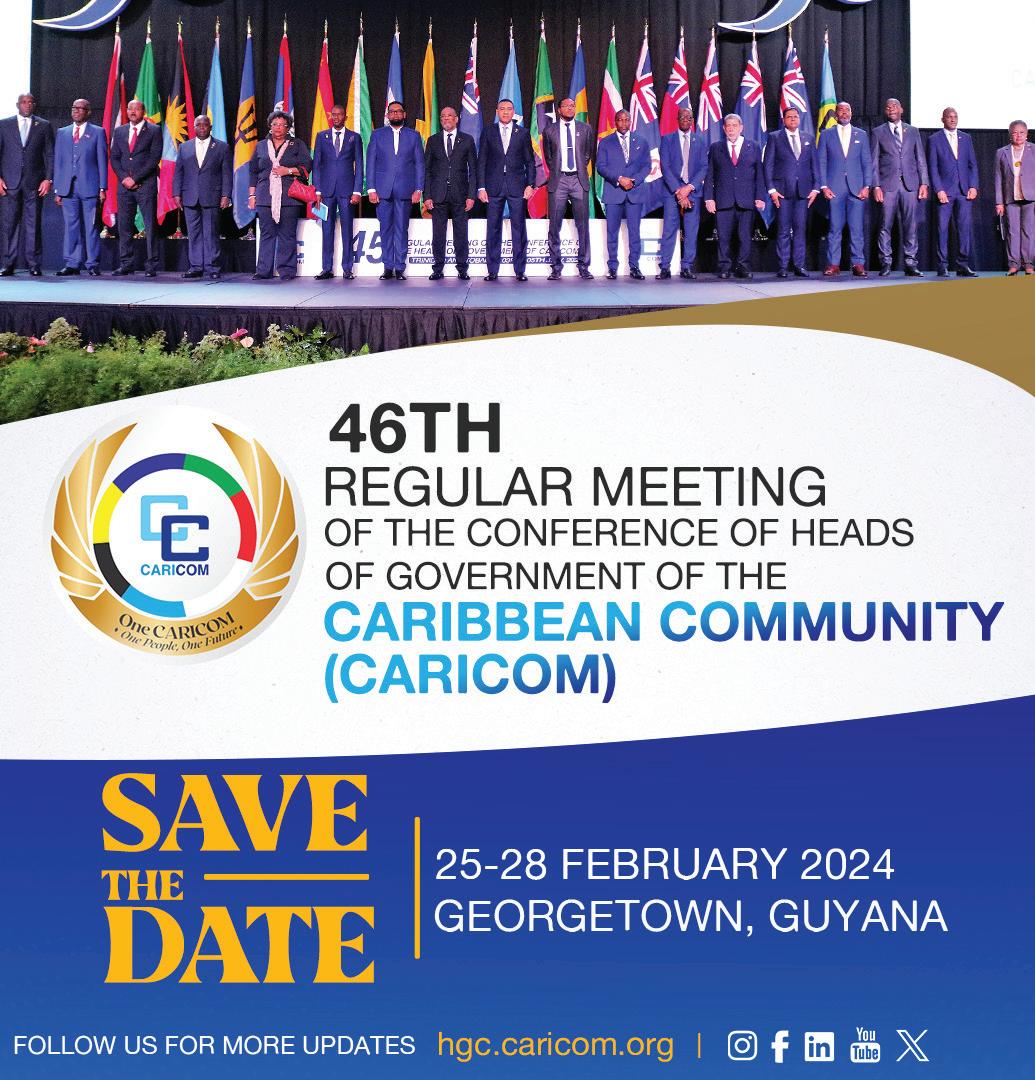
As CARICOM advanced work on free movement of all CARICOM nationals within the Community, a draft Protocol, which proposes language to amend Articles 45 and 46 of the Revised Treaty, was completed and submitted to the Conference at its Forty-sixth Regular Meeting in February.
The Secretariat conducted national consultations on CSME implementation arrangements and procedures in several Member States, as part of an ongoing programme to increase public understanding of the CARICOM Single Market and Economy (CSME). There was also significant capacity building of CARICOM Youth Ambassadors to foster a deeper appreciation for the tenets of the CSME.
As part of our thrust to deepen economic integration, CARICOM focused on the design of the legal and regulatory framework for credit reporting, deposit insurance, the regional securities market and protecting the rights of financial consumers in the Community.
A critical initiative during the year was the establishment of a Working Group on
Financing for CARICOM Development under the leadership of the Hon. Bharrat Jagdeo, Vice-President of Guyana, to identify and make recommendations on innovative sources of funds to support Member States’ growth and transformation strategies towards economic and climate resilience.
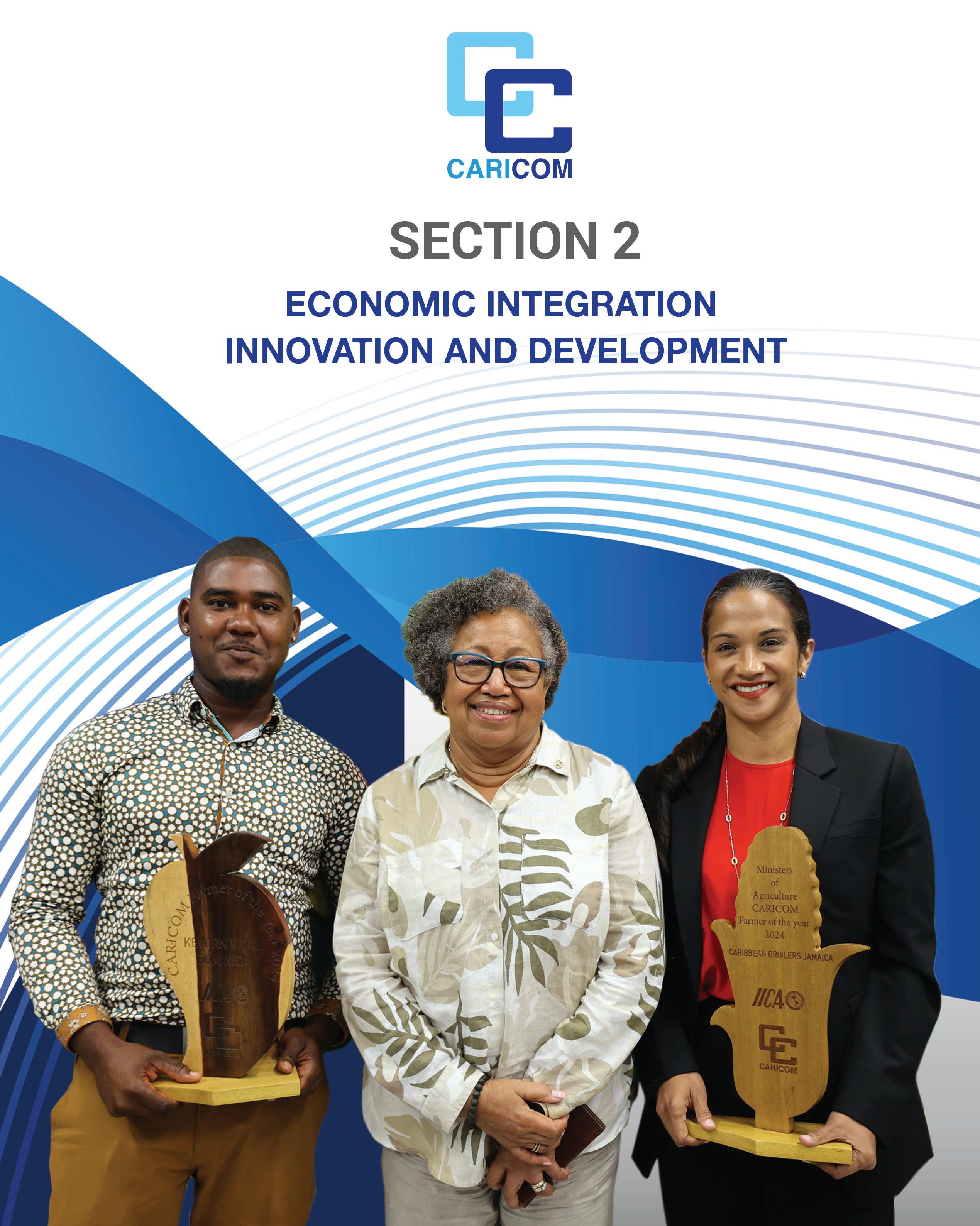
CARICOM focused on implementing the agreed activities under our flagship food security initiative, Vision 25 by 2025. In this regard, we launched the Regional Youth in Agriculture Strategy and CARICOM Boost to support youth and women in agriculture, and increased public awareness and capacity building through various strategies and with support from valued partners.
The 18th Caribbean Week of Agriculture staged in St. Vincent and the Grenadines in October was highly successful. Held under the theme ‘Climate Smart Agriculture for a Sustainable Future’, the event attracted over 485 stakeholders from across the globe, including all CARICOM Member States and Associate Member States.
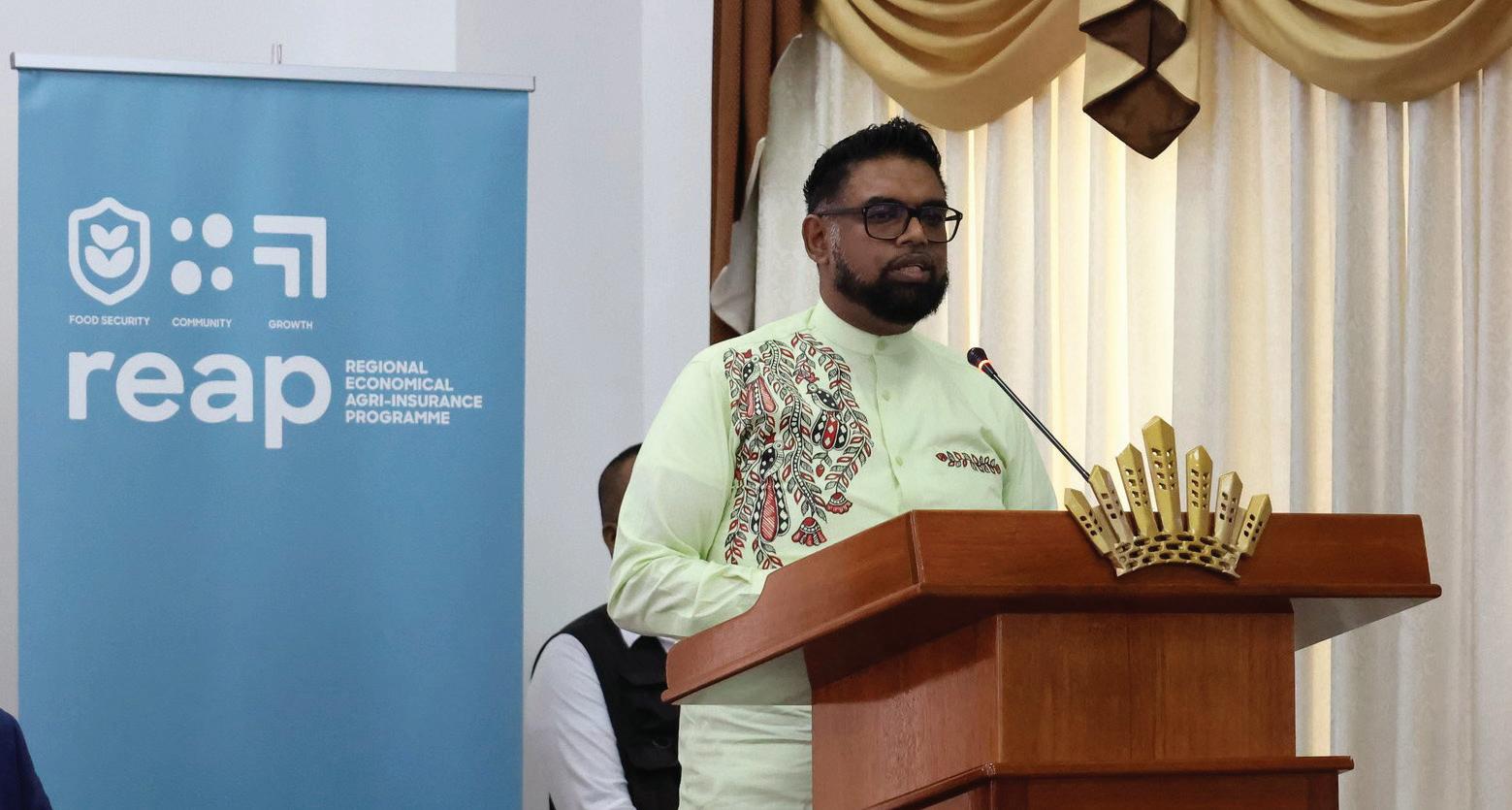
A highlight of the agriculture programme was the launch of the Regional Economical Agri-Insurance Programme (R.E.A.P), an agricultural insurance product, which provides farmers with assistance in managing risk, and offers greater protection against total loss or devastating economic fallout due to severe weather events.
CARICOM worked closely with regional stakeholders and international partners to implement impactful projects to increase energy awareness, information, and knowledge-sharing, and to drive practical solutions to address the Region’s energy needs. This included signing three Memoranda of Understanding with regional and international partners to support the Region’s sustainable development goals.
Increased regional connectivity was advanced with additions to airlift and efforts to establish a regional ferry service to facilitate easier movement of people and goods, particularly agricultural produce.
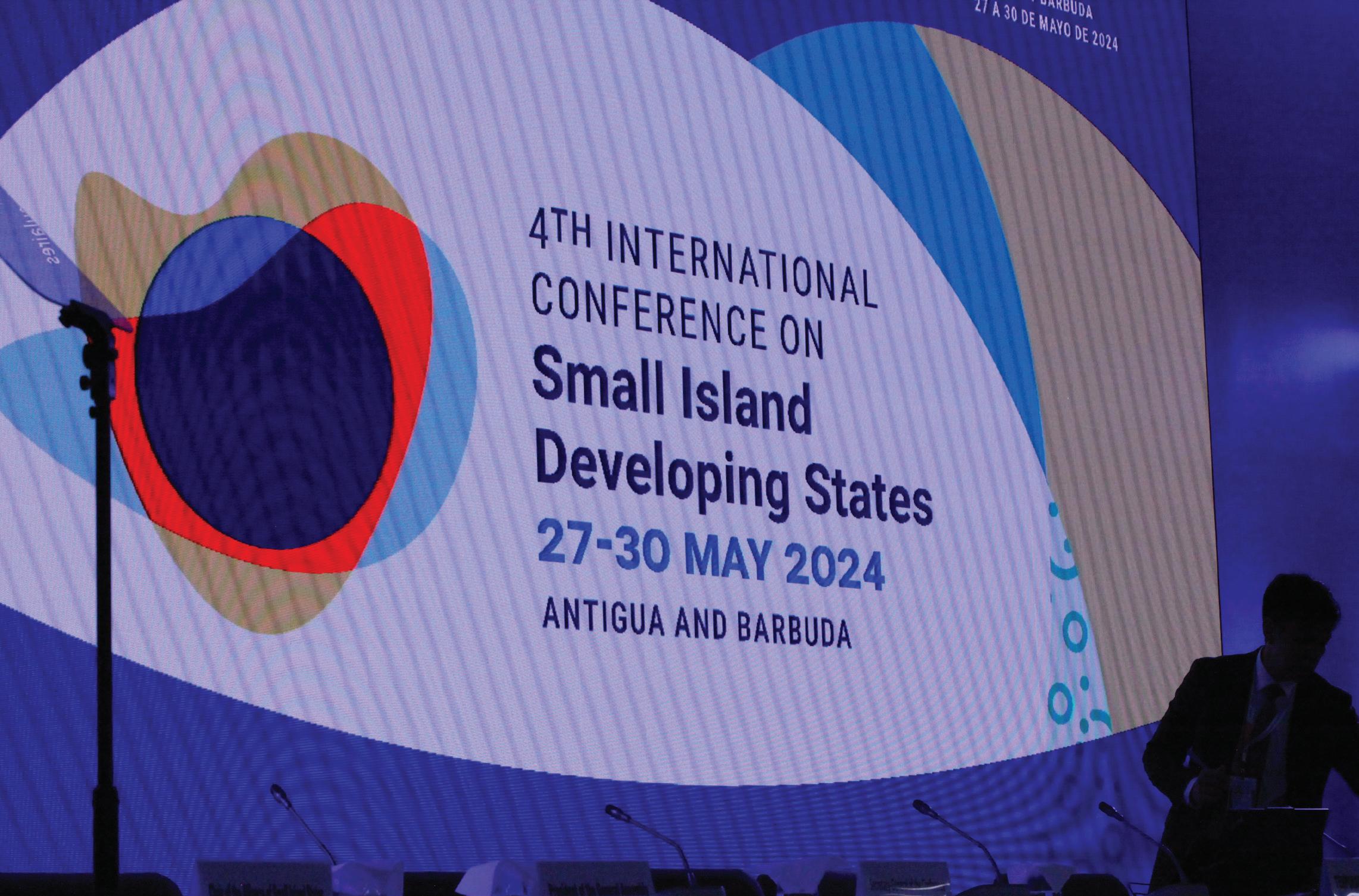
The Fourth International Conference on Small Island Developing States (SIDS4) was held from 27 - 30 May 2024, in St John’s, Antigua and Barbuda, under the theme of ‘Charting the Course toward Resilient Prosperity’. A key outcome was the Inter-governmentally agreed, political document, the Antigua and Barbuda Agenda for SIDS (ABAS) that sets out a new Programme of Action for SIDS.
This and other efforts to bolster the Region’s climate adaptation efforts were brought into sharp focus as the record-breaking Hurricane Beryl severely impacted several CARICOM Member States in July, highlighting the vulnerability of our Region to the increasing incidence of major weather events.
On the matter of digital development, CARICOM Heads of Government approved a Strategic Framework for Digital Resilience 2025-2030, which is intended to engender concerted efforts, including in advancing the CARICOM Single ICT Space.
Enhancing social resilience is a priority of CARICOM’s plan to build “A Community for All.” To this end, sustained human and social development efforts to support reduced levels of poverty, equitable access to health, quality education and significant improvement of citizen security, underpinned the Community’s work in 2024. Highlights under this umbrella include optimising the implementation of the CARICOM Human Resource Development (CHRD) 2030 Strategy; groundwork to transition the Region towards the realisation of a common data space in education; the Mental Health First Aid Programme to build the capacity of youth workers and leaders to provide first-response support to youth experiencing emotional distress; and efforts to address HIV/AIDS and the incidence of NCDs.
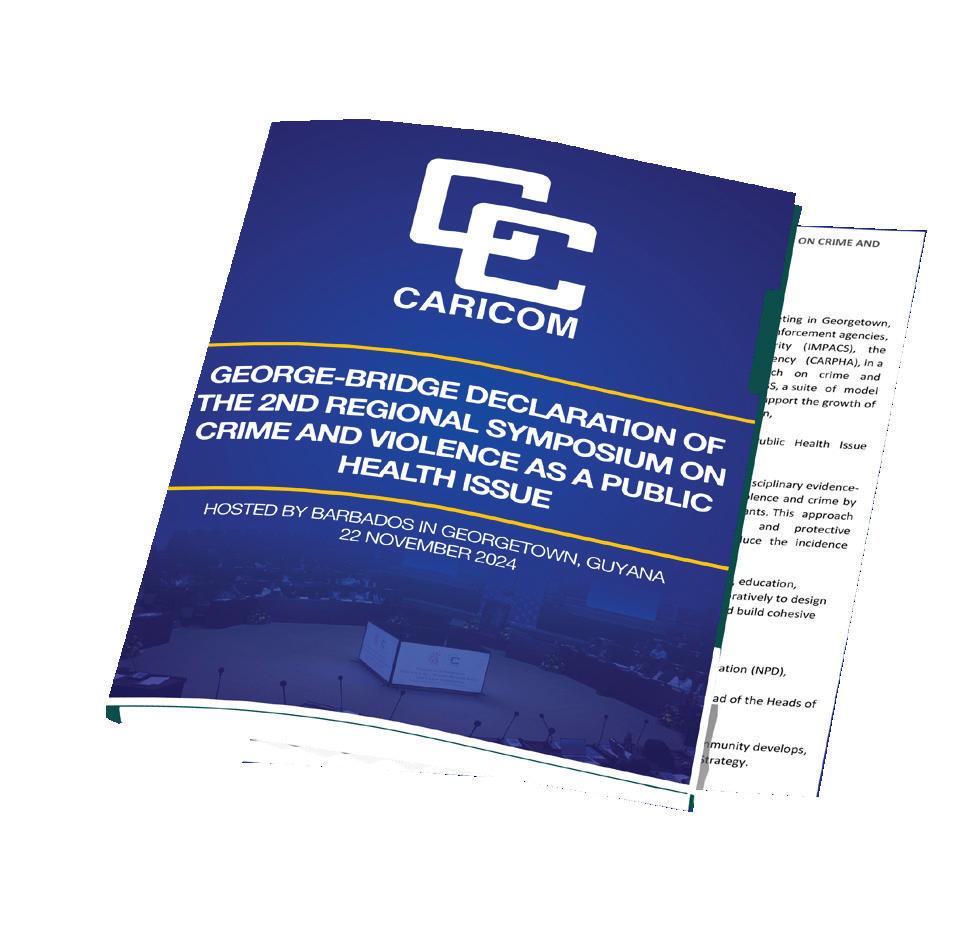
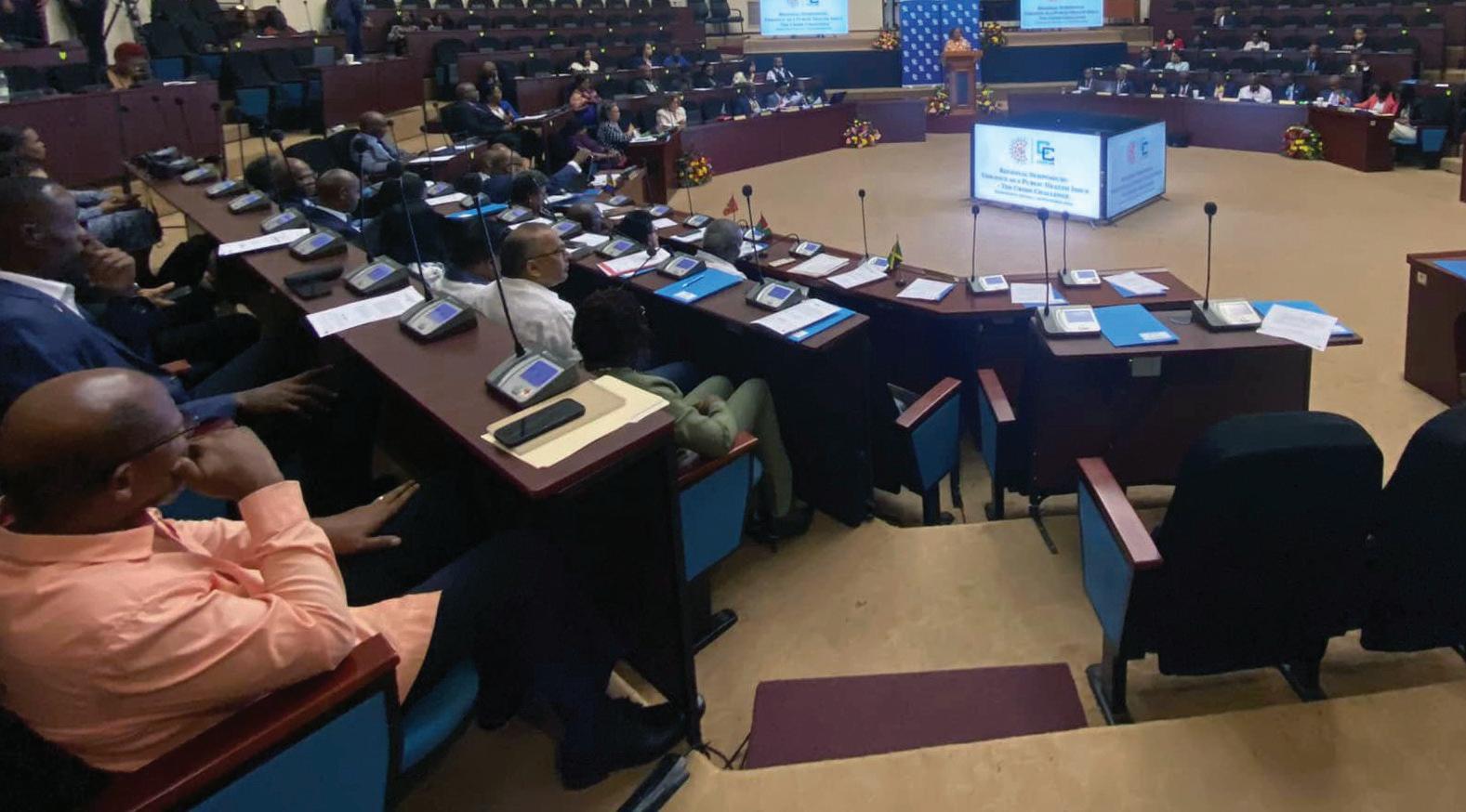
CARICOM hosted the Second Regional Symposium, “Violence as a Public Health Issue – The Crime Challenge”, which advanced actionable solutions for implementation at the national level, and featured knowledge sharing on successful preventative interventions for crime and violence in the Caribbean. The GeorgeBridge Declaration was a significant outcome of this Symposium, highlighting CARICOM’s regional approach to crime and security management.
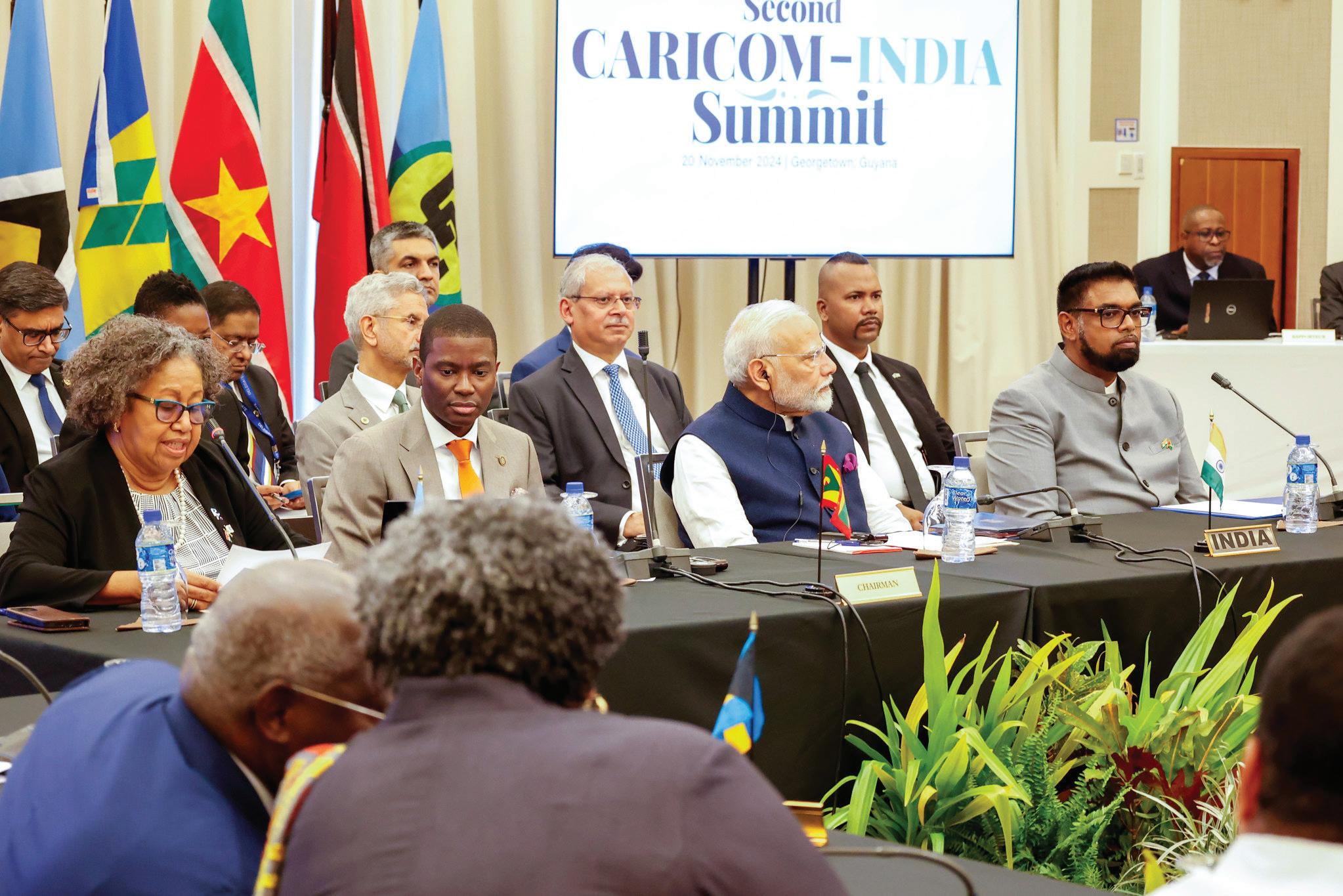
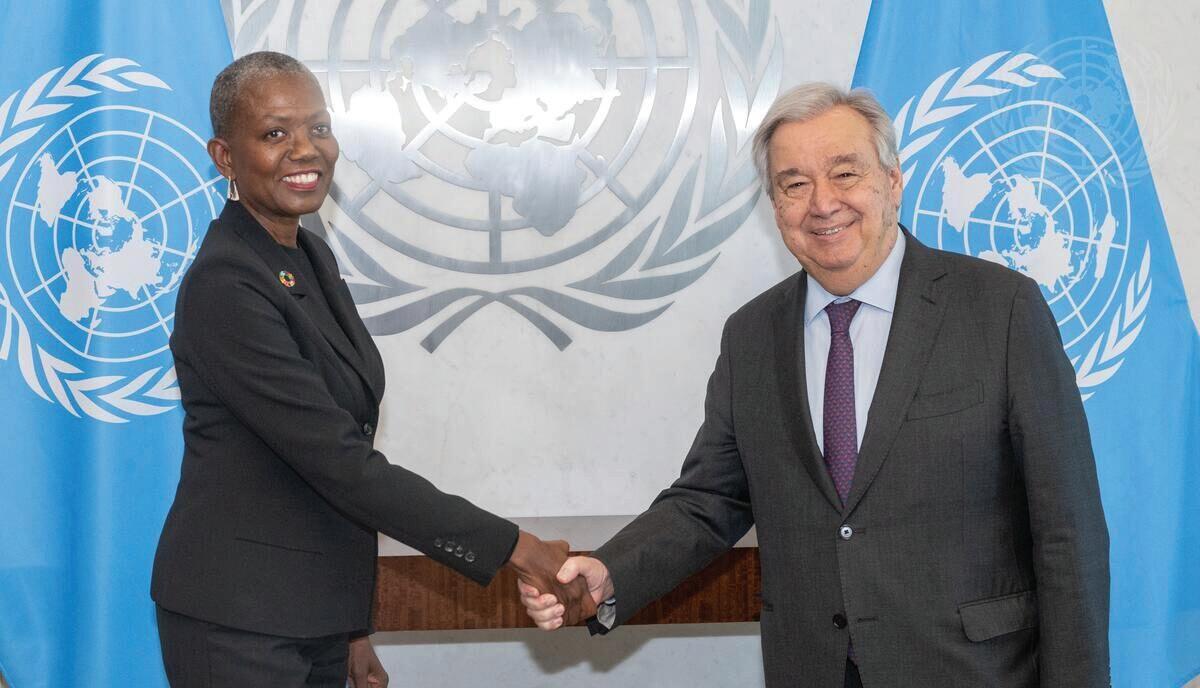
Our efforts to advance foreign policy coordination continued apace, with CARICOM advocacy on multiple forums as we addressed regional and international geopolitical matters. The Community welcomed Curaçao as the sixth Associate Member of the Caribbean Community during the Forty-seventh Regular Meeting of the Conference of Heads of Government in Grenada, July 2024. We also appointed a new Caribbean Community Permanent Observer to the United Nations, Dr. Leslie Wade, a national of St. Kitts and Nevis, who will provide critical representation at all relevant meetings at the UN, engage with the CARICOM Caucus of Permanent Representatives to the UN, and promote diplomatic interactions for the CARICOM Secretariat.
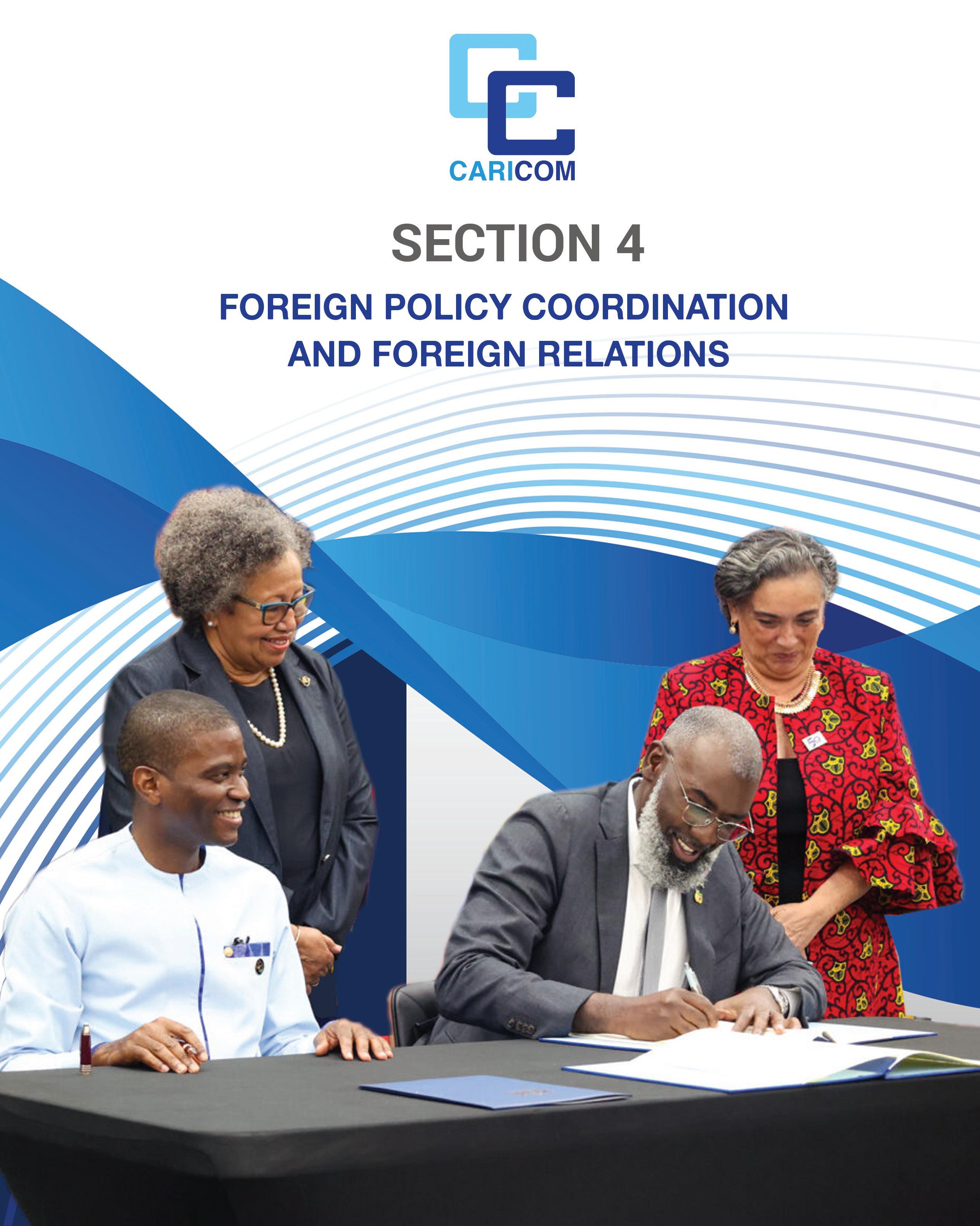
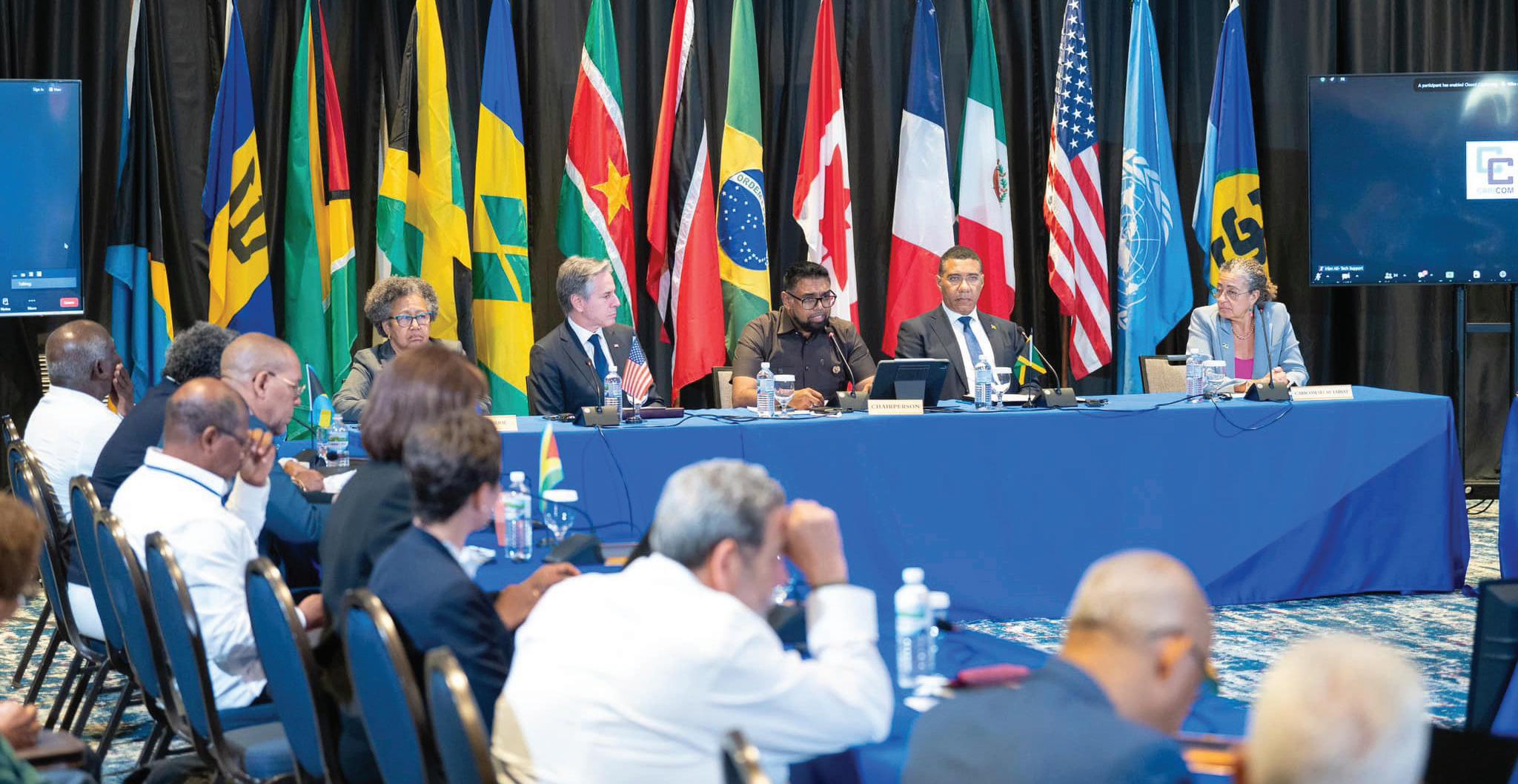
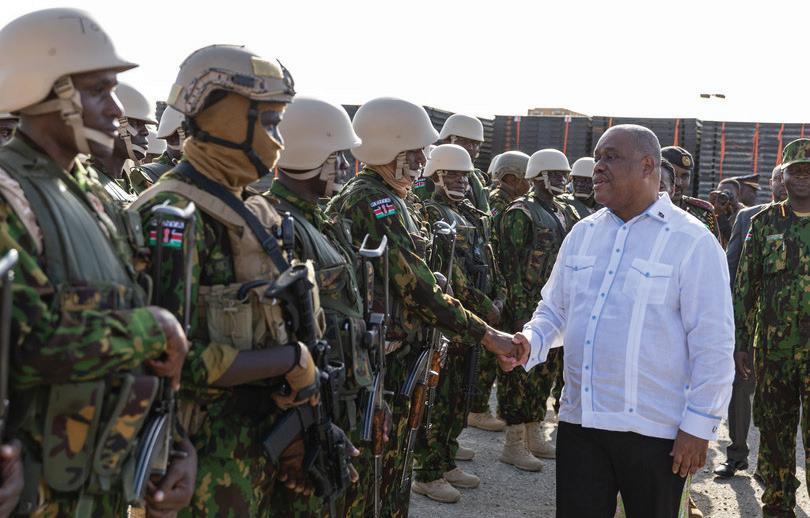
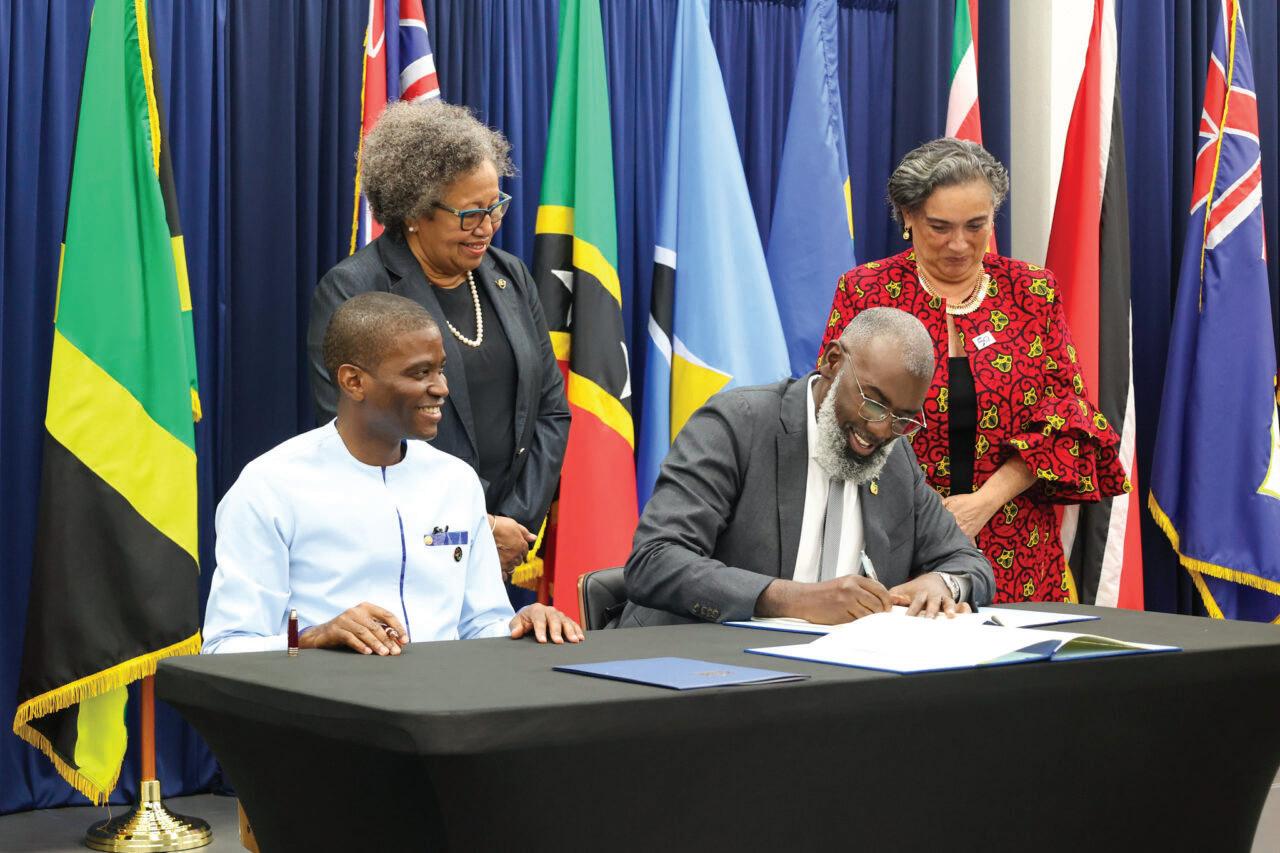
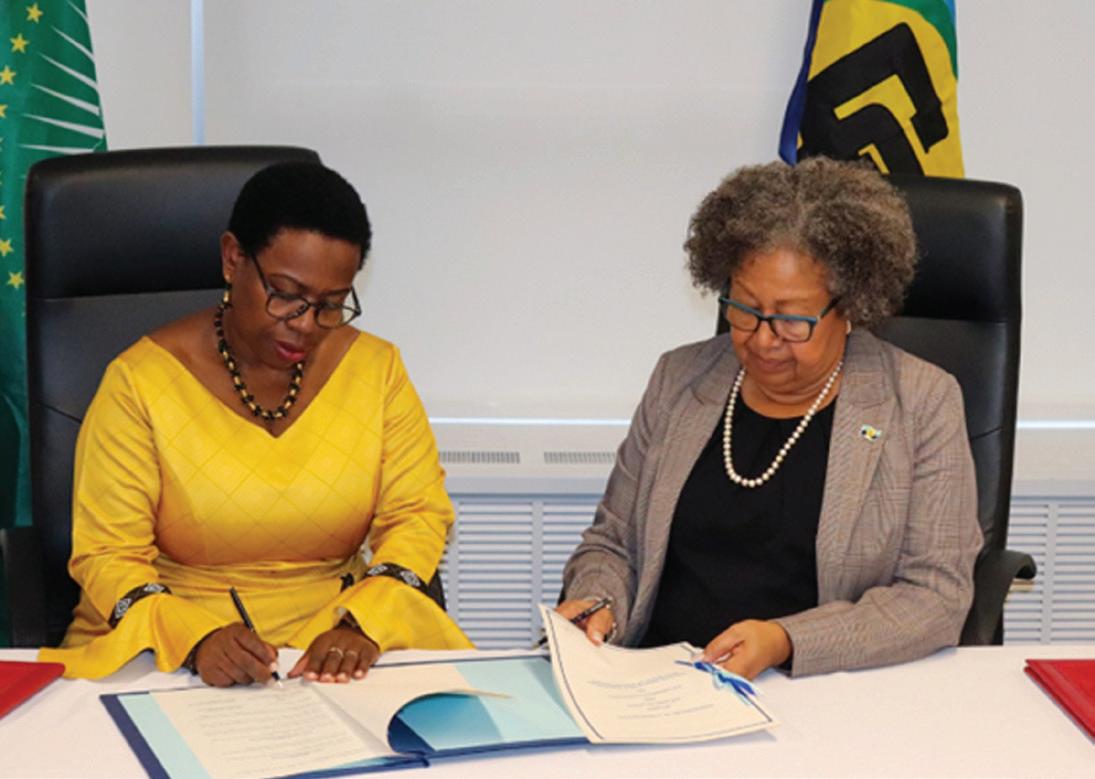
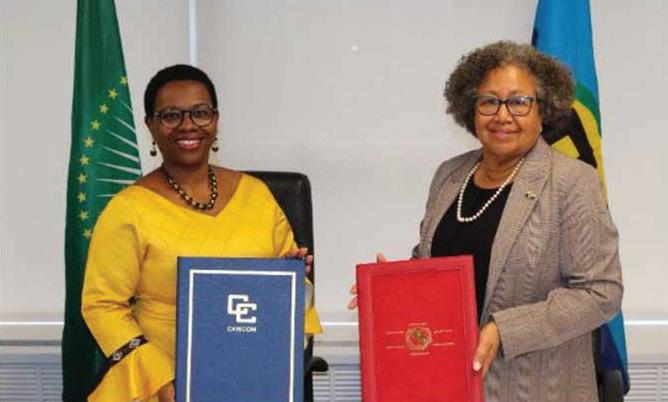
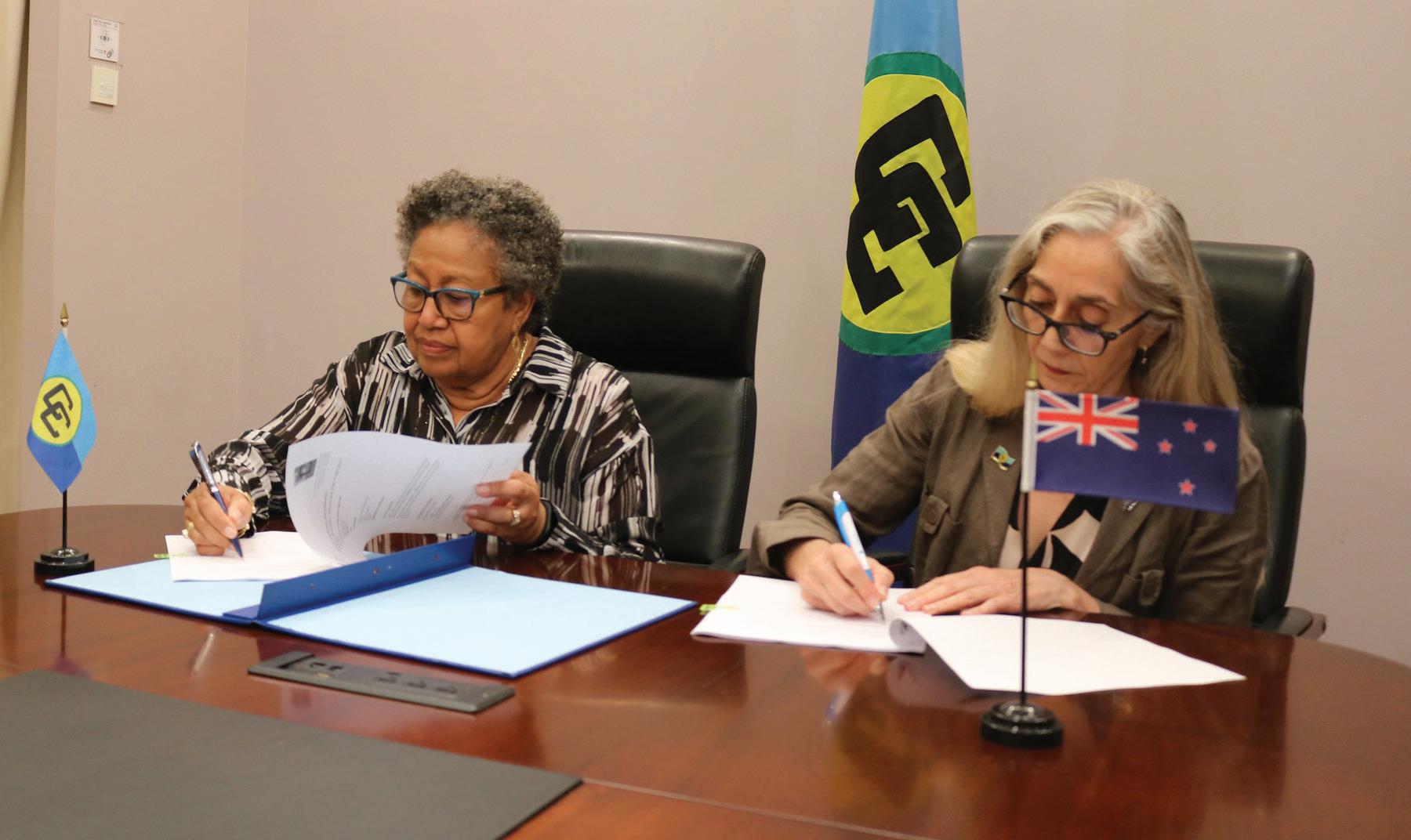
We also continued to support Haiti’s political transition and regional security efforts, and deepened relations with strategic partners, such as through a Memorandum of Understanding signed by the CARICOM Secretariat and the African Union Commission (AUC) to enhance cooperation.
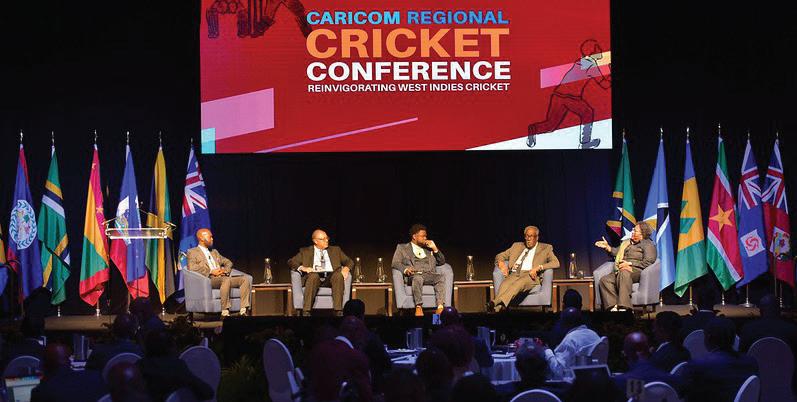
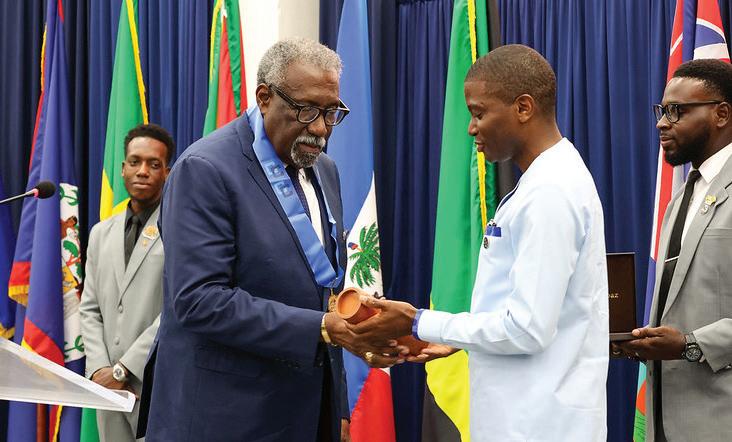
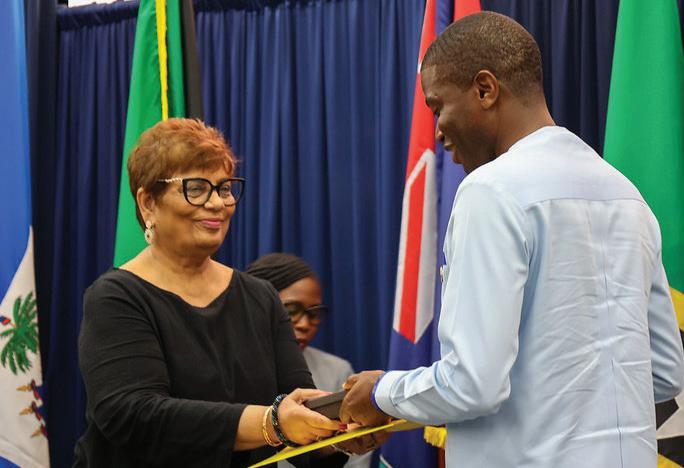
In July, CARICOM awarded Sir Clive Lloyd and the Honourable Roderick Rainford
with the Order of the Caribbean Community. We acknowledge the invaluable contributions from them, the CARICOM Diaspora, public and private sector leaders, international partners, and all CARICOM citizens, to the development of the Region and efforts to safeguard its resources for future generations.
In keeping with its mandate of helping to foster a people-centred, sustainable and internationally competitive Community, the staff at the Secretariat undertook a wide range of activities to advance economic integration, strengthen collaboration among the Community’s Organs and Bodies, expand Community membership, increase engagement with Community stakeholders; enhance enterprise risk management; and improve the dissemination of information about the Community’s work.
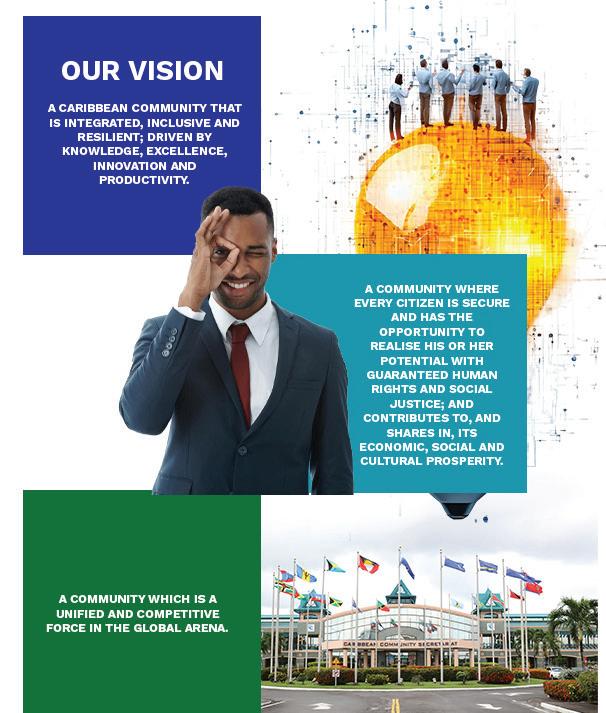
Our goal remains to create “A Community for All” that is integrated, inclusive and resilient, and which is a unified and competitive force in the global arena.
CARLA N. BARNETT, Ph.D, CBE SECRETARY-GENERAL
DIRECTION OF THE COMMUNITY’S EXTERNAL TRADE POLICY
During the period under review, the Secretariat coordinated the Community’s pursuit of a common external trade policy with a view to increasing the integration of Member States into the global economy. The recommendations and Decisions of the Twenty-Fifth Prime Ministerial Sub-Committee on External Negotiations (PMSC-EN) and the 106th Special Meeting of the Council for Trade and Economic Development (COTED) mandated the assessment of the Community’s trade performance and readiness to undertake market access commitments with external trade partners. There was also a call for more strategic use of the existing bilateral trade agreements and arrangements, to enhance trade performance.
READINESS ASSESSMENT
The assessment of Member States’ readiness to engage in further negotiations on the liberalisation of tariffs, began in April 2024. Preliminary desk research conducted by the Secretariat on the trade performance of Member States for the period 2012 to 2021 was presented to trade officials from Member States, who discussed the findings at a meeting in September 2024.
National consultations with public and private sector principals commenced to discuss their experiences under the trade agreements that the Region has already concluded, and their prospects for expanded trade were initiated in Member States. To date, consultations were conducted in three Member States, with the remaining engagements scheduled for 2025. An analysis of the findings and relevant recommendations on the readiness of Member States to engage in further trade liberalisation, will be completed.
SERVICES AND INVESTMENT
Work progressed on the development of national inventories of existing Non-Conforming Measures (NCMs) within Member States, through comprehensive audits
of measures affecting trade in services and investment. These audits focused on measures in CARICOM countries that do not align with international trade agreement obligations, such as national treatment, Most Favoured Nation (MFN) treatment, market access, performance requirements, and senior management/ board composition.
The completed inventories will improve Member States’ understanding of their regulatory status quo and help Member States to identify specific economic activities for which they wish to reserve the flexibility to adopt or maintain NCMs. This activity is also intended to improve Member States’ capacity to develop their services and investment liberalisation offers in the context of trade negotiations, and improve their capacity to engage in discourse on the development and direction of the Region’s trade policy and strategies.
ENGAGEMENT AT THE MULTILATERAL LEVEL
During the reporting period, the Secretariat supported the Community’s participation in the multilateral trading system,
including coordinating preparations for the Thirteenth World Trade Organisation (WTO) Ministerial Conference (MC13) that took place 26 February to 2 March 2024 in Abu Dhabi, United Arab Emirates. The Secretariat assisted Member States with the implementation of the outcomes of this Conference and provided technical support for the Community’s engagement in the second wave of fisheries subsidies negotiations. Negotiations on agriculture reform; discussions on WTO reform and dedicated discussions under the Work Programme on Electronic Commerce advanced in this period.
The Secretariat advocated for the development of an UNCTAD Strategy to Support SIDS, including an UNCTAD Trust Fund for SIDS and contributed to the finalization of a Memorandum of Understanding with the UNCTAD Secretariat, which would provide a structured framework for collaboration in areas of mutual interest.
ENHANCING
The Secretariat supported updating of the Community’s existing trade agreements with partners in Latin America and the
Caribbean. Negotiations progressed on the Agreement on Trade, Economic and Technical Co-operation between CARICOM and Colombia. As mandated by the COTED, the Secretariat advanced the preparation of CARICOM’s offer of additional preferential access to Colombia. Negotiations will resume and be concluded in the first half of 2025.
The Community’s engagement with the United States on trade and economic cooperation gained momentum at the Trade and Investment Council (TIC) and at the political level through Ministerial engagements between CARICOM Ministers of Trade and the United States Trade Representative, Ambassador Katherine Tai. The Secretariat co-ordinated the inaugural discussions between CARICOM and US Senior Officials under the Joint Work Programme on Trade in Services to build collaborative relationships and identify opportunities and initiatives to expand bilateral services trade between CARICOM and the US. In collaboration with USTR Officials, the Secretariat organised ad hoc engagements of CARICOM and US Senior Officials on priority initiatives to strengthen and improve the Region’s performance and utilization of the trade preferences under the Caribbean Basin Initiative (CBI).
The Community also strengthened trade and economic cooperation with Canada through engagement in the CARICOMCanada Foreign Ministers’ Group. Additionally, the Secretariat supported the Community in its implementation and review of the Economic Partnership Agreement (EPA) with the European Union.
During the reporting period, the Secretariat deepened engagement and dialogue with the African Union Commission and
AFREXIMBANK regarding collaborative initiatives to support enhanced trade and economic relations between the regions. The Secretariat also contributed to the successful staging of the Third Africa Caribbean Trade and Investment Forum (ACTIF) in The Bahamas. Discussions among officials of the Secretariat and bilateral counterparts took place with SIECA and Cuba.
COORDINATING THE IMPLEMENTATION OF TRADE FACILITATION MEASURES
Working collaboratively with USAID and US Customs and Border Protection (CBP) the Secretariat, conceptualised and developed the “CARICOM Customs Trade Facilitation Fundamentals and Skills Building Programme”, through which 18 mid to senior level customs officials from CARICOM Member States received expert training in valuation and classification, trade risk management best practices and administration of advance rulings. The Programme was delivered by CBP experts at its facilities at the Miami Seaport in Florida, United States of America, 21 October to 1 November 2024. It is expected that the participants will serve as champions and trainers to help implement these best practices in their domestic customs administration.
The Secretariat also collaborated with United Nations Council for Trade and Development (UNCTAD) to convene the Third Global Forum for National Trade Facilitation Committees in the framework of the Global Supply Chain Forum in Barbados in May 2024. In June 2024, the Secretariat also supported the development and launch of a regional trade facilitation strategy for the Pacific Islands at the Ninth Global Review of Aid for Trade. Consistent with the mandate of the Conference of Heads of Government for the Community to prioritise co-operation on trade facilitation under its arrangements with bilateral trading partners, collaboration is underway with the Secretariat and the Central American Economic Integration (SICA) to promote intra-regional co-operation in the framework of the CARICOM-SICA Plan of Action.
CUSTOMS & TRADE POLICY
COMPREHENSIVE REVIEW OF THE CET AND RULES OF ORIGIN
In 2024, regional consultations regarding the revision of the CARICOM Common External Tariff (CET) and the attendant Rules of Origin advanced. The final document on the general rules of interpretation and the schedule of rates of the CET were approved by the Fifty-Ninth Regular Meeting of the COTED in November 2024. Additionally, the base
document for the rules regarding Community origin and the product specific rules of origin were revised, pending further assessment, to ensure consistency with the provisions of the Revised Treaty of Chaguaramas.
Implementation of the CARICOM Interactive Marketplace and Suspension Procedure (CIMSuPro)
A critical success factor for the operation of CIMSuPro is a fully populated database of products produced in all Member States. At present, about 100 entities of an estimated 1,000 regional entities have registered their products. The process of registration of entities is the responsibility of the Offices of the Competent Authority in each Member State.
During the period under review, work advanced on the update of the system to improve its operational and security features. A regional public awareness and outreach programme, with support from the CDB, will be implemented to introduce and promote the system to firms and other stakeholders.
REPORTS OF SUSPENSIONS OF THE CET AND SAFEGUARD CERTIFICATES CONSIDERED BY THE SECRETARY-GENERAL AND BY MEETINGS OF THE COTED
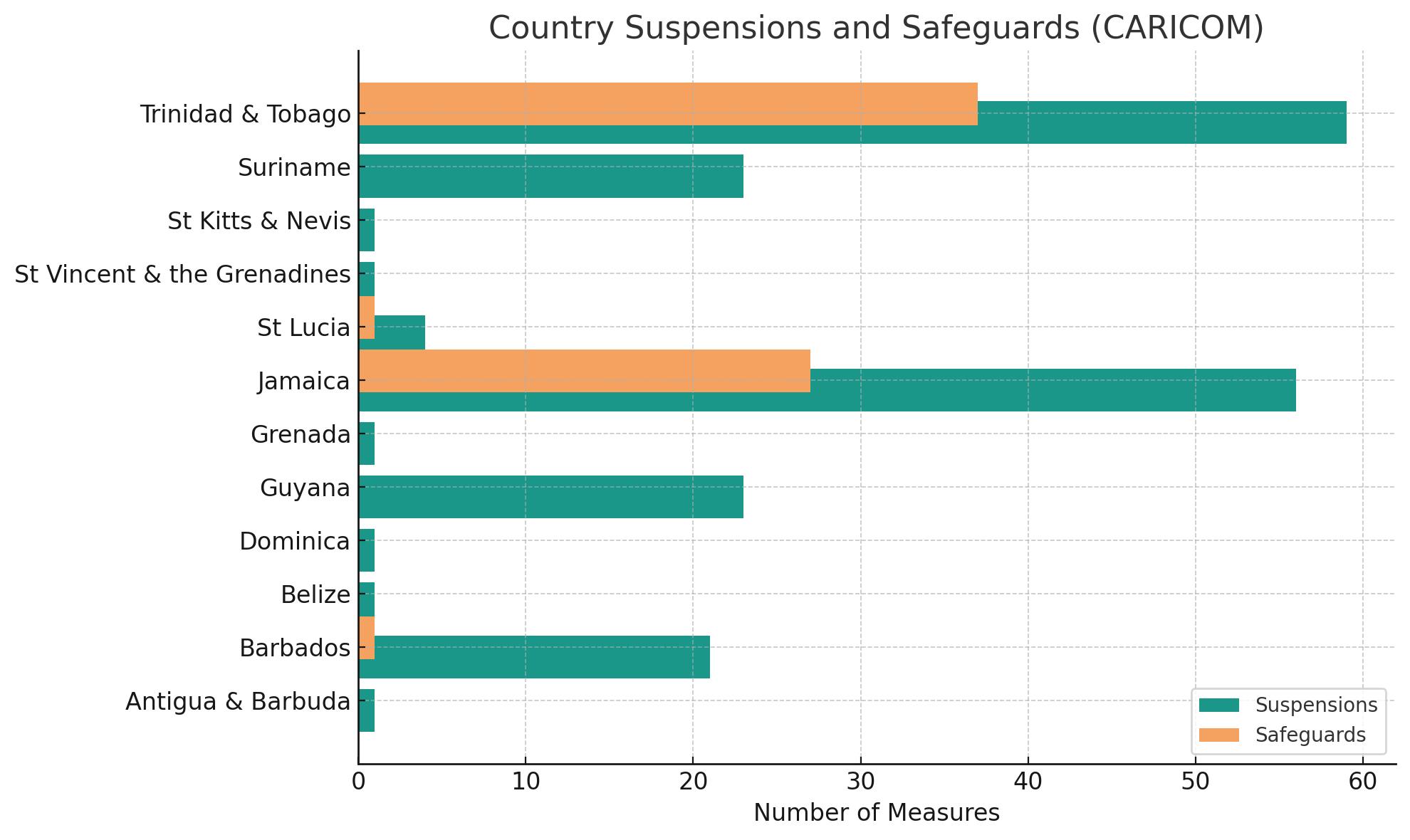
During the period 1 January 2024 to 31 December 2024, under the provisions of Articles 83 and 84 of the Revised Treaty, the Secretary-General processed 192 requests for suspension of the CET and 66 requests for invocation of the Safeguard Mechanism. These requests were received from twelve (12) Member States that participate in the CARICOM Single Market and Economy (CSME). The full list is highlighted below:
CERTIFICATION AND APPROVAL OF PARTIAL SCOPE TRADE AGREEMENTS
In the reporting period, the Community received requests for certification and approval of the Trinidad and Tobago-Chile Partial Scope Trade Agreement and the Belize - El Salvador Chile Partial Scope Agreement. As such, Article 80 (3) (b) was reviewed to certify that the Agreements do not prejudice or place at a disadvantage, the position of other CARICOM States vis-à-vis the Revised Treaty. Member States also began their review of the draft Partial Scope Agreements with a view to having a Special COTED Meeting convened in the first quarter of 2025 to further consider the requests.
STUDY TO REVIEW THE LIST OF INELIGIBLES
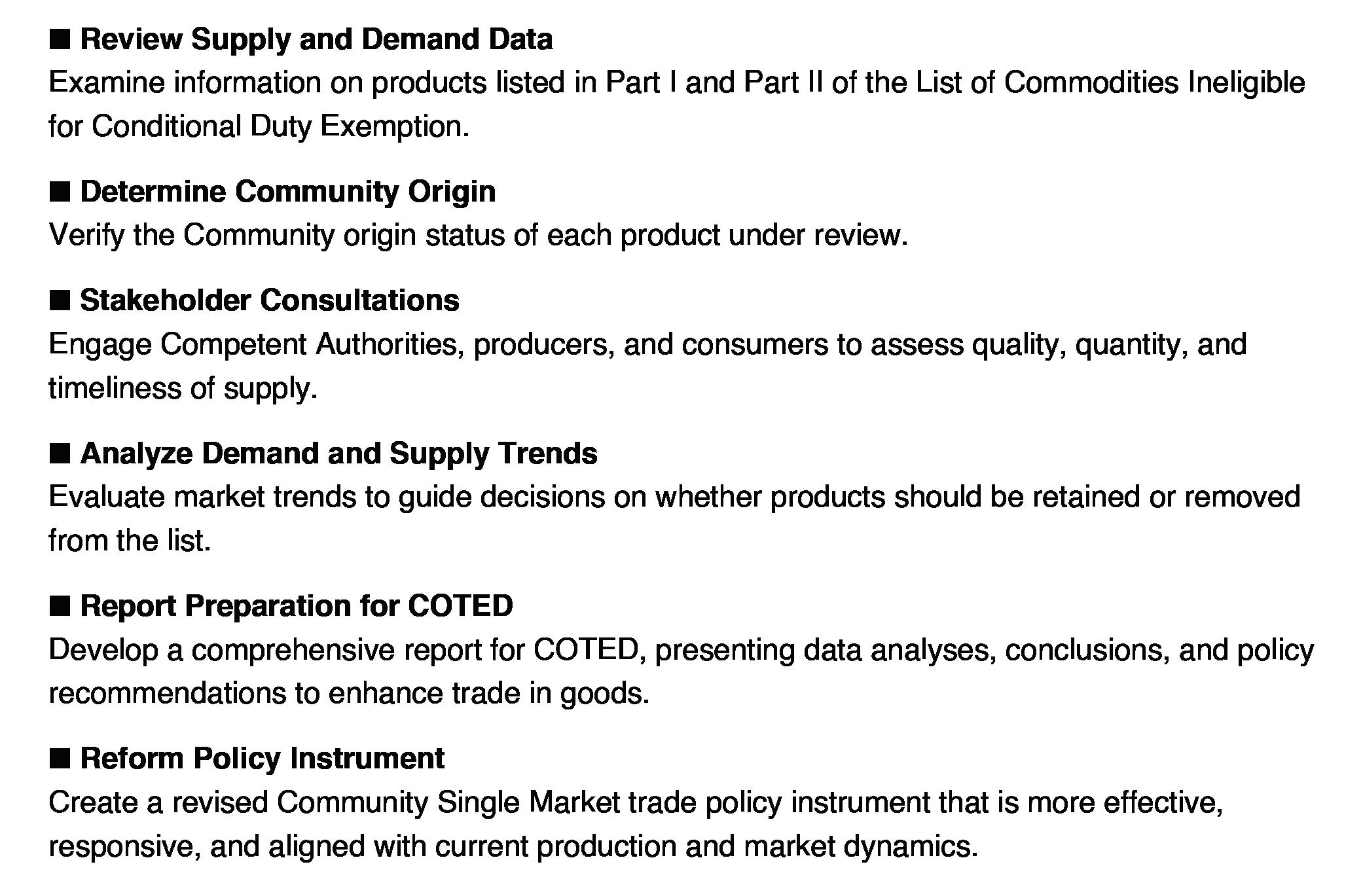
As part of the Comprehensive Review of the Common External Tariff and Rules of Origin, COTED approved the review of the existing List of Commodities Ineligible for Conditional Duty Exemption that represents 195 commodities for which there is regional production. The specific objective of the project will be to examine productivity in CARICOM Member States to assess the level of production of each commodity in relation to satisfying 75% of regional demand for that commodity. To this end, the study seeks to address the following elements:
CARICOM MONITORING MECHANISM FOR RICE, CEMENT AND SUGAR
COTED has established Monitoring Mechanisms for four (4) key commodities, namely rice (13th COTED, 2002), red kidney beans (23rd COTED, 2007), cement (31st COTED, 2010) and sugar (97th Special COTED, 2021). There has been mixed performance of these Mechanisms, and the Fifty-Ninth Regular Meeting of the COTED in November 2024 agreed that these should be reviewed and strengthened, where applicable. The Secretariat has commenced work to support timely and comprehensive reporting to these Mechanisms by Member States.
IMPLEMENTATION OF A SIMPLIFIED CUSTOMS PROCEDURE
COTED has given a mandate to the Customs Committee to develop a simplified customs procedure in keeping with the Protocol on Contingent Rights of the CSME set out under Article 239 (e) of the Revised Treaty of Chaguaramas. Draft terms of reference for a consultancy for the execution of the work were completed during the first quarter of 2024. Work is to be undertaken with the support of development partners.
MEMBER STATES’ COMPLIANCE WITH PROVISIONS OF THE REVISED TREATY AND DECISIONS OF THE COTED
The complaints of breaches in the application of the Common External Tariff (CET) by Member States were discussed at the Fifty-Eighth and Fifty-Ninth Meetings of the Council for Trade and Economic Development (COTED). These complaints included issues related to the non-application of the CET by some Member States for several products. The Secretariat continued to monitor actions taken by Member States towards removal of the identified restrictions on an ongoing basis.
PROCEDURES TO ADDRESS THE USE OF SPECIFICATIONS IN REQUESTS FOR SUSPENSION OF THE CET AND SAFEGUARD CERTIFICATES
In April and October 2024, the Secretariat convened the Technical Working Group (TWG) designated by COTED to examine and make recommendations regarding the use of specifications in applications for suspension of the CET and the granting of Safeguard Certificates. Significant draft proposals to address the concerns of Member States in respect of this matter emanated from the work of the TWG. At the request of some Member States, additional time was granted for further reflection and internal consultation on the proposals to facilitate the submission of definitive comments and positions. The TWG will continue working to finalise recommendations for the consideration of the COTED.
CARICOM SINGLE MARKET ADVANCING WORK ON FREE MOVEMENT OF ALL CARICOM NATIONALS
The Secretariat coordinated and supported Member States in the preparation of the drafts of a Protocol through the Inter-Governmental Task Force (IGTF) to amend the Revised Treaty of Chaguaramas to give effect to the Heads of Government decision at their 45th Regular Meeting, on free movement of all CARICOM nationals by 31 March 2024. The draft Protocol, which proposes language to amend Articles 45 and 46 of the Revised Treaty to give effect to the Decision, was completed and submitted to the Conference at its Forty-Sixth Regular Meeting in February 2024.
SUPPORT TO THE HARMONIZATION OF LAWS AND ADMINISTRATIVE PROCEDURES RELATED TO BUSINESS AND LABOUR MARKETS
The Secretariat facilitated a consultancy which completed drafts of model harmonised companies, partnerships and insolvency laws to support the establishment and operation of businesses in the Community, as well as to facilitate the mutual recognition of companies. The consultancy was undertaken by the British Institute for International and Comparative Law and funded with assistance from the 11th European Development Fund (EDF) Strengthening the Framework for CARICOM Integration and Cooperation Processes (SFCICP) Programme.
ASSESSING THE PROCEDURES AND PROCESSES FOR CSME IMPLEMENTATION
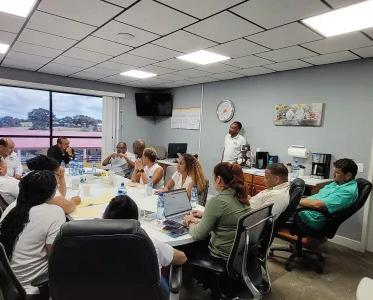
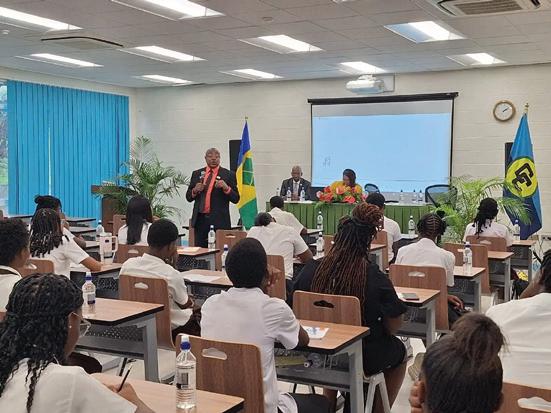
A team from the Secretariat visited Saint Lucia, St. Vincent and the Grenadines, St. Kitts and Nevis and Belize to conduct national consultations on CSME Implementation Arrangements and Procedures in Member States.
Through these country missions, the Secretariat engaged directly with all key stakeholders on matters pertaining to the CSME,assessed procedures and arrangements in place to support its implementation and gained insight into the constraints limiting implementation. These sessions also provided the opportunity for stakeholders to identify possible solutions. As a consequence of the country mission, there was increased interest in the CSME within both the public and private sectors. A notable example is St. Vincent and the Grenadines’ amendments to its domestic legislation to recognise all 12 categories of skilled Community nationals, up from the seven categories that were previously legally recognized.
DEVELOPING A REGIONAL MIGRATION POLICY
The Secretariat collaborated with the International Labour Organization (ILO) to design a study to undertake an analysis of the labour market in CARICOM Member States. The study will result in the development of a Regional Labour Migration Policy which is part of a wider Regional Migration Policy.
STRENGTHENING THE CSME FOCAL POINT NETWORK
During the period under review, the effectiveness of the CSME Focal Points in Member States was strengthened to create a more responsive communication environment and enhance the collective capacity to address challenges. This new approach has resulted in enhanced collaboration and knowledge sharing, increased accessibility and responsiveness as Focal Points are able to address queries and concerns more quickly, thus ensuring greater support to stakeholders.
REGULATION OF MERGERS AND ACQUISITIONS
At the 59th Regular Meeting of COTED, the policy for the regulation of mergers and acquisitions in the CSME was approved. This paves the way for the drafting of a protocol to amend the Revised Treaty of Chaguaramas which will empower the CARICOM Competition Commission (CCC) to review mergers and acquisitions with a cross-border dimension or cross-border effect.
ADVANCING THE COMMUNITY COMPETITION POLICY
During the reporting period, the Secretariat established a Technical Working Group (TWG) pursuant to a decision of the 58th Regular Meeting of the COTED, to examine the feasibility of the inclusion of utilities regulation in the work of the CCC. The TWG reviewed and approved the Terms of Reference (ToR) and Research Proposal to undertake this work. These instruments were presented to the 59th Regular Meeting of the COTED for notification.
EXPOSING CARICOM YOUTH AMBASSADORS TO THE CSME AND REGIONAL INTEGRATION PROCESSES
The Secretariat developed a Skilled Workers Programme to expose several stakeholders to the CSME. From 8-12 July 2024, 17 CARICOM Youth Ambassadors from nine Member
States participated in a CSME CYA Attachment programme in Guyana. Participants are expected to develop national plans of action to engage their peers on the CSME and regional integration.
ADMINISTERING PUBLIC PROCUREMENT IN THE COMMUNITY
The Secretariat advanced the work towards attaining common rules on public procurement. Two meetings of the Permanent Joint Council (PJC) on Public Procurement were convened and the following were recommended for approval by the Contracting Parties to the Protocol on Public Procurement:
Proposals for rules, procedures and guidelines for public procurement.
Proposals for the framework agreements, including emergency procurement;
Proposals for bonds, securities and guarantees for administering public procurement in the Community;
The Community Manual on Public Procurement.
The PJC also discussed the Terms of Reference (TOR) for the design of training
ECONOMIC DEVELOPMENT POLICY, TAX ADMINISTRATION AND RESEARCH
The CARICOM Secretariat, has intensified its work in support of the consolidation of the CARICOM Single Market and Economy (CSME). The macroeconomic policy coordination work programme, comprising cooperation initiatives in the financial sector, capital market development, investment attraction and tax administration, helps to facilitate the efficient working of the regional trade regime. The work programme also builds resilience by fostering macroeconomic stability, while the work on innovation (including information and communication technology), climate change mitigation and disaster risk reduction are indispensable for sustainable growth and development. The sectoral work in agriculture, industry and services is aimed at executing Community Policy in furtherance of regional production integration goals, while activities in energy and transportation provide critical crosscutting support to the productive sectors.
The current regional and international environment necessitates a focus on strengthening resilience and fostering innovation in Member States. The retreat from non-reciprocal trade arrangements, and recognition of special and differential status for small states means that efforts have to be redoubled to avoid further erosion internationally while trying to deal with the effects at home. Some of the 2024 highlights are the activities in the Agriculture Programme to support recovery from the effects of Hurricane Beryl and return the 25 by 2025 initiative as a priority item; progress with the Single Registration of service professionals; progress with the implementation of the Multilateral Air Services Agreement; launch of the CARICOM Cyber Resillience 2030 project; and successful coordination of the regional negotiation stance on global issues that affect the Region. These and others are outlined below:
MACROECONOMIC POLICY COORDINATION
The Community’s macroeconomic policy initiatives seek to advance the realisation of the CSME as a platform for the growth and development of the Community. Accordingly, the work programme comprises initiatives related to the modernisation of the regional financial sector including capital market development and integration; fiscal policy (including tax administration) cooperation; as well as investment policy coordination and harmonisation. These initiatives have been prioritised by the Conference of Heads of Government as prerequisites for incentivising the regional market infrastructure for the effective functioning of the CSME.
Financial Sector Cooperation.: With Member States’ approval of several financial sector policies, the focus in 2024 was on the design of the legal and regulatory framework for credit reporting, deposit insurance, the regional securities market and protecting the rights of financial consumers in the Community.
Credit Reporting: The Approved CARICOM Credit Reporting Policy is aimed at promoting the modernisation and efficient functioning of the credit market in Member States while facilitating the crossborder exchange of credit information within the Community. It is expected that the formal cross-border exchange of credit information would be initiated through the portability and right of access modes which may then evolve into the development of full-scale regional networks as the appropriate scale of demand materialises.
The Draft CARICOM Credit Reporting Model Law and Regulations were revised
in accordance with the deliberations and recommendations emanating from a Regional Consultation of Finance and Central Bank officials, which the Secretariat convened, and has been prepared for further legal scrutiny.
Regional
Securities Market
and
Capital Market Development: The CARICOM Policy for the Development and Regulation of the Regional Securities Market provides a platform for the emergence of the integrated capital market envisaged in Article 44 of the Revised Treaty. Following Member States’ approval of the Policy, a high-level regional consultation (comprising regulators as well as officials from the Ministries of Finance, Legal Affairs; and Central Banks) was convened to review the Model Law and Regulations which will articulate a set of common standards for core policy areas.
These standards will be aimed at harmonising and simplifying the legal requirements for conducting securities business in the Community. Such harmonisation will eliminate the complexity ofnavigating multiple legislative arrangements, remove process duplication while promoting regulatory equivalence and building confidence in the quality of securities regulation in the Community. The Revised Model Law and Regulations have been finalised for further legal scrutiny by Member States.
Deposit Insurance. The CARICOM Deposit Insurance Policy promotes the adoption of a modern, harmonised policy and a legal and regulatory framework for deposit insurance systems in the Community, to provide eligible depositors with a minimum level of protection in the event of the failure of a financial institution.
Member States will adopt a CARICOM
Model Deposit Insurance Law which will serve as a benchmark for the introduction of deposit insurance legislation or the reform or enhancement of the existing legal framework. The Secretariat has procured the requisite technical expertise to draft the Model Law and regulations, as well as a complementary initiative to provide technical recommendations for a regional resolution regime for financial institutions.
Financial Consumer Protection - The CARICOM Financial Consumer Protection (FCP) initiative builds on the CARICOM Consumer Protection framework and is intended to formulate a common financial consumer protection regime in the Community to protect the clients of financial institutions, promote consumer confidence, and preserve regional financial stability. The Draft CARICOM FCP Policy promotes the establishment of a modern, harmonised financial consumer protection (FCP) framework for CARICOM Member States which is consistent with international best practices, and which will promote transp arency, efficiency and the deepening of retail markets in the
Community. This Policy is being prepared for further consideration by Member States.
Fiscal Policy (including Tax Administration) Cooperation. During 2024, the Secretariat continued to support Member States by raising awareness about external sources of budgetary support, particularly in the wake of Hurricane Beryl. The Secretariat also coordinated the activities of the Prime Ministerial SubCommittee on Financing to Rebuild after Hurricane Beryl. This Sub-Committee was established to develop strategies to facilitate the mobilisation of financing for reconstruction and recovery from Hurricane Beryl and other systems that may have impacted Member States during the season.
Efforts were also directed at capacitybuilding and strengthening of CARICOM Tax Administrations primarily through the execution of the work programme for the Caribbean Organisation of Tax Administrators (COTA). The COTA work programme included initiatives such as the COTA Essay Competition 2024 which is aimed at encouraging young people to become knowledgeable about the tax administration function as potential taxpayers and decision-makers in the private and public spheres, as well as to engender an interest in this field as a career choice. Glenya Leader, a student at Saddlers Secondary School, St Kitts and Nevis won the competition under the topic ‘How can Tax Administrators adapt to the challenges of the rapidly changing global environment?’
Another major initiative on the COTA Work Programme was the convening of the first in-person Technical Conference and General Assembly since the COVID-19
pandemic. The Twenty-Sixth COTA Technical Conference and General Assembly was held in Saint Lucia from 22-26 July 2024 with most Member Administrations in attendance along with representatives from several partners in the regional and international tax community. Under the theme – ‘Tax Resilience in a Rapidly Changing Global Environment’, the Conference provided an opportunity for wide ranging discussions, and sharing of information and experiences, on domestic taxation priorities and Member Administrations’ obligations in respect of compliance with the global tax standards. Conference participants acquired invaluable information that can support the optimisation of domestic resource mobilisation to contribute to building economic and climate resilience in CARICOM Member States. The 2024 Technical Conference received its charge from the Honourable Phillip J. Pierre, Prime Minister and Minister of Finance of Saint Lucia who applauded COTA as a longstanding regional organisation exemplifying the importance of cooperation and collaboration.
The Prime Minister emphasised the need to always recognise that size considerations matter in policymaking, particularly for small states within CARICOM, where one size does not fit all.
He called for considerations of vulnerability and resilience-building to be infused in the decisions concerning the international tax agenda, in particular. The Prime Minister also advised tax administrators that public relations and communication with taxpayers must be made a priority element of the tax administration function. The Secretariat continued to maintain and foster longstanding relations with the
Organisation for Economic Cooperation and Development (OECD) to facilitate ongoing support to Member States as they seek to implement commitments made with respect to the global tax transparency and reform agenda. Accordingly, a CARICOMspecific seminar was organised on 8 May 2024 following the 11th Global Forum Competent Authorities Conference held on 6-7 May 2024 in Bridgetown, Barbados.
CARICOM WORKING GROUP ON FINANCING FOR DEVELOPMENT
In recognition of the importance of upscaling development finance to build economic and climate resilience of Member States, the Forty-Sixth Regular Meeting of the Conference of Heads of Government (February 2024) established a Working Group on Financing for CARICOM Development under the leadership of the Hon. Bharrat Jagdeo Vice-President of Guyana. The objective of the Working Group is to identify and make recommendations on innovative sources of funds including deposits in banking and non-banking financial institutions in the Community. These funds will be used to support Member States’ growth and transformation strategies towards economic and climate resilience. The Working Group consulted with the Committee of Central Bank Governors which has targeted the issue for active consideration.
AGRICULTURE AND AGRO-INDUSTRIAL DEVELOPMENT
In the period under review, the Secretariat focused on implementing the agreed activities under the Region’s flagship food security initiative, Vision 25 by 2025, which seeks to implement actions and critical areas of intervention to tackle the Region’s mushrooming food import bill. The initiative’s goal is to improve intra-regional trade, achieve food and nutrition security and create wealth and economic opportunities for every CARICOM Member State. It is a longterm social and economic partnership among Member States, regional private sector (including the CARICOM Private Sector Organisation, CPSO), regional organisations, producer groups, development partners, and civil society.
Major areas identified by Vision 25 by 2025 include the removal of Non-Tariff Barriers (NTB) to intra-regional trade, derisking the agricultural sector, improving agricultural transportation and logistics, facilitating trade, encouraging investment in production and infrastructure, adopting innovation and technology, research and development, and mobilising resources.
SG Dr. Barnett at the CWA
Highlights in 2024:
1. Youth Participation, Empowerment and Development
CARICOM BOOST: Women and Youth in Agriculture: The Secretariat is leading this two-year, USD1.6M project that aims to enhance the capabilities and capacities of 47 CARICOM women and youth farmer groups in sustainable production, climate change resilience, and profitability. The project supports the goal of Vision 25 by 2025 to reduce the Region’s food import bill and increase sustainable production through climatesmart and post-harvest technologies. Procurement of the services of consultants and input suppliers commenced in preparation for the final implementation of the project in 2025. By utilising protected structures and appropriate cold storage unit technologies, the project is expected to support 188 youth and women farmers across 10 CARICOM Member States: Belize, Dominica, Grenada, Guyana, Haiti, Jamaica, Montserrat, Saint Lucia, St. Vincent and the Grenadines, and Suriname. Indirectly, over 36,000 people are benefitting from this initiative.
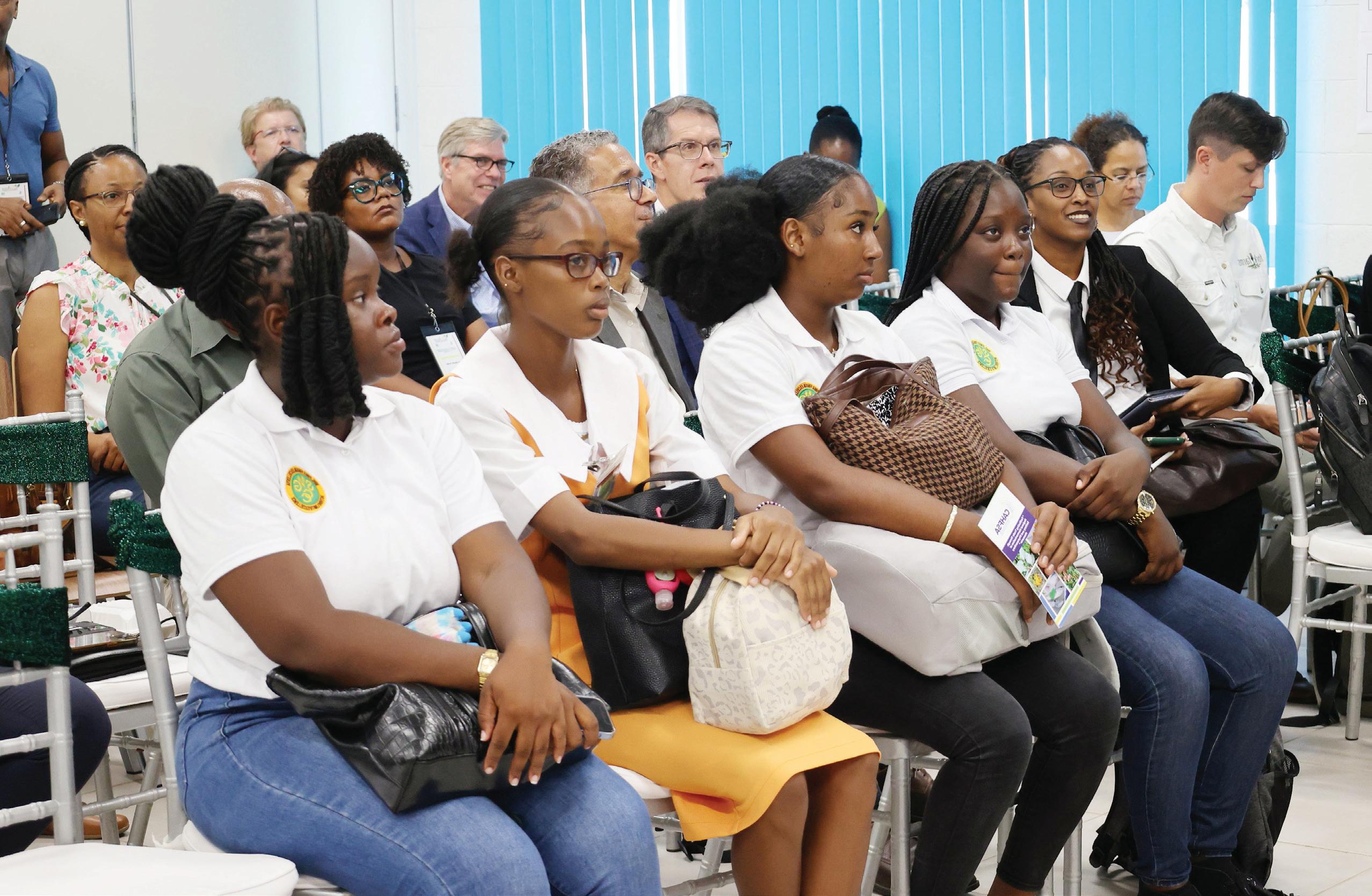
Young people in attendance at the CWA 2024 session on leveraging technology in agriculture
The Regional Youth in Agriculture
Strategy: The Secretariat supported the creation of the strategy which the Region adopted in 2024, in keeping with the youth in agriculture objectives outlined under Vision 25 by 2025. This strategy aims to transform and revitalise youth engagement in agriculture and places emphasis on education and capacitybuilding, access to resources, networking and mentorship, market linkages, infrastructure development, sustainable agriculture, policy, awareness, and promotion. It is expected that the strategy will foster youth involvement and provide the necessary resources and support to achieve the key actions outlined. Priority items were identified for greater resource mobilisation and implementation. The strategy is essential in ensuring the future sustainability and innovation of the agricultural sector.
2. PUBLIC AWARENESS AND VISIBILITY
i. Food for Lunch Webinar
Sessions: As part of the drive to increase awareness of Vision 25 by 2025, the Secretariat hosted two webinars in the year under review. The first was themed ‘Money Grows’ on 17 May 2024 and the second, on 8 November 2024, was held under the theme ‘Money Grows: Young Agrientrepreneurs in Action’. These sessions promoted knowledge-sharing and served to inspire young agri-entrepreneurs to contribute to a more dynamic and engaged agricultural community.
ii. CARICOM Agriculture High School
Video Competition: In partnership with the Inter-American Institute for Cooperation on Agriculture (IICA), the Secretariat organised a competition which invited regional high schools to showcase their agricultural projects and highlight student involvement
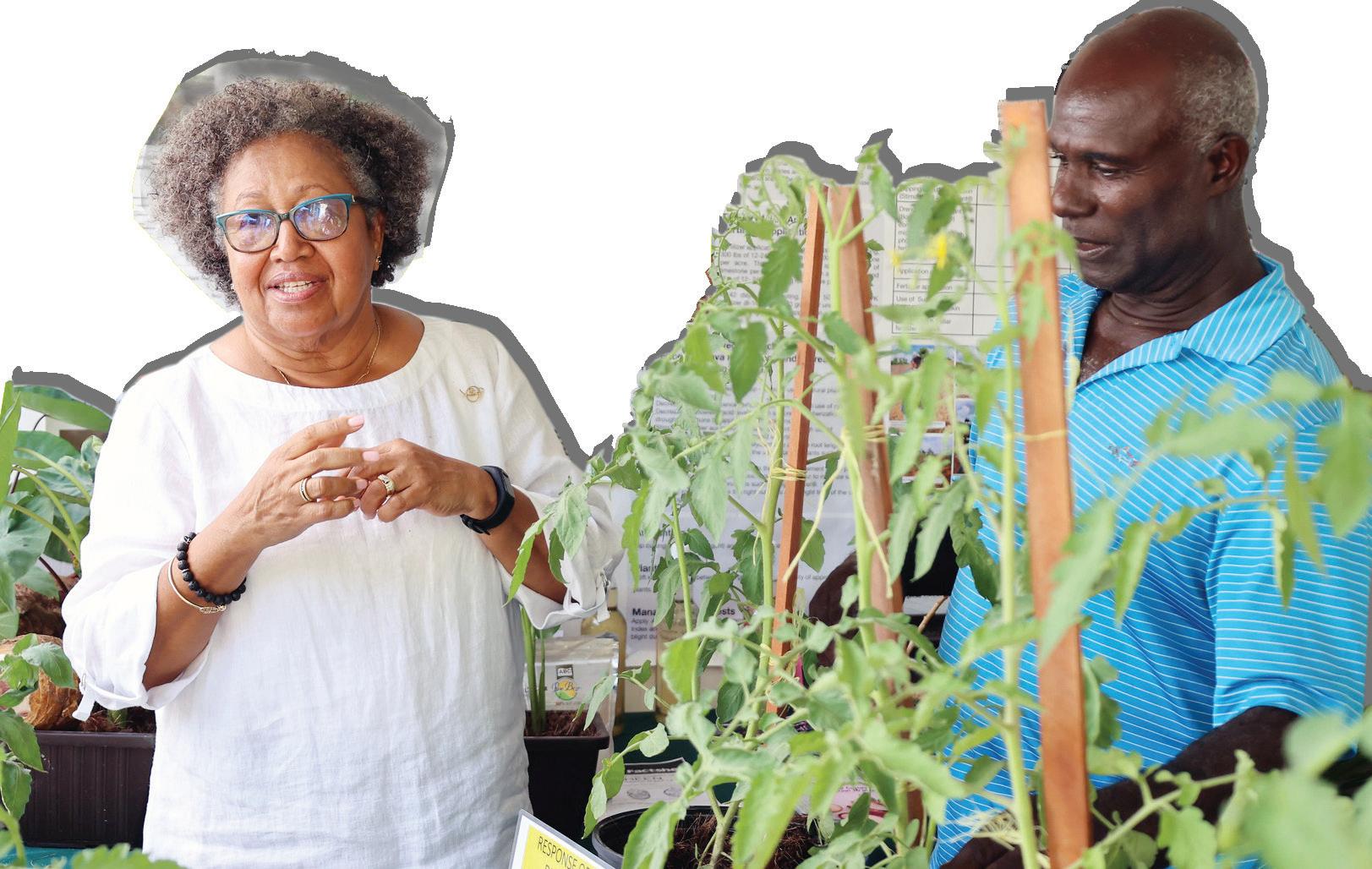
Dr. Carla Barnett, CARICOM Secretary-General at IICA booth at CWA Trade Show and Expo
in production. The competition received 44 video submissions from secondary schools across Member States: Antigua and Barbuda, The Bahamas, Barbados, Belize, Guyana, Jamaica, St Vincent and the Grenadines, and Trinidad and Tobago; and from Associate Member, Turks and Caicos Islands. The video competition was successful in its goals of raising awareness and interest in agriculture among young people and encouraging them to consider agriculture as a career path, thus fostering a new generation of agricultural professionals.
iii. The Secretariat also partnered with other stakeholders to publish over 30 information notices and awareness outputs which highlighted regional events and opportunities in agriculture and food security, including the announcement of the results of the Survey on Caribbean Food Security with the world Food Programme.
3. HUMAN CAPITAL DEVELOPMENT: TRAINING AND CAPACITY BUILDING IN AGRICULTURE
The Secretariat, with support from the Food and Agricultural Organisation (FAO), organised two training courses on regional and international agricultural trade.
The session on ‘Agriculture in International
Trade Agreement (AITA)’ in April 2024 attracted 115 participants, while 130 people attended the ‘Agri-Food Trade Promote Regional Capacity Building Training” in November 2024.
The training courses contributed significantly to enhancing the capacity of regional stakeholders to engage in and benefit from agricultural trade. They also supported the overall goal of regional food system transformation by improving market access and trade efficiency.
4. BUILDING ECONOMIC RESILIENCE
The 18th Caribbean Week of Agriculture (CWA) 2024: The Secretariat coordinated activities to mark the 18th Caribbean Week of Agriculture in St. Vincent and the Grenadines from October 7-11, 2024, under the theme ‘Climate Smart Agriculture for a Sustainable Future’. The event attracted over 485 stakeholders from across the globe, including all CARICOM Member States and Associated Member States. CWA, the premier event on the regional agricultural calendar, fosters collaboration and synergy among regional stakeholders, and enhances the development of the Region’s food systems agenda through shared knowledge and strategic partnerships.
b. FAO Hand-In-Hand (HIH) Investment Notes: The Secretariat coordinated the participation of Member States - Barbados, Jamaica, and St. Vincent and the Grenadines, in the FAO Hand-In-Hand Initiative, which developed Agricultural Investment Notes on Irrigation. These notes were presented to donors and the private sector at the Hand-InHand Investment Forum, held at the FAO Headquarters in Rome 15-17 October 2024. The investment notes aim to generate up to US$200M in investment for the Region to support the development of critical agricultural infrastructure, promote sustainable practices and boost the overall productivity and efficiency of regional food systems.
c. Agriculture Insurance: REAP
Insurance Launched: The Secretariat lent support to the development and launch of the Regional Economical Agri-Insurance Programme (R.E.A.P), an agricultural
insurance product that was identified by the Special Ministerial Task Force on Food Production and Food Security, in collaboration with Lynch Caribbean Insurance Brokers. The product, which provides farmers with assistance in managing risk, offers greater protection against total loss or devastating economic fallout due to severe weather events. Since its launch on 21 June 2024, seven Member States (Barbados, Dominica, Grenada, Guyana, Saint Lucia, St. Kitts and Nevis, and St. Vincent and the Grenadines) have signed letters of intent to adopt the product. The availability of this regional insurance product is very important to the Region since it enhances the resilience and sustainability of the agricultural sector.
d. Implementation of various Regional Agriculture Policies: In collaboration with stakeholders throughout the Region, the Secretariat made significant advancement in the implementation of
H.E. Dr. Irfaan Ali, President of Guyana, and lead Head of Government with responsibility for agriculture in the CARICOM Quasi Cabinet, launches the REAP product in Georgetown, Guyana
various regional policies, such as the Regional Agricultural Disaster Risk Management Policy and Action Plan lead by the Caribbean Disaster Emergency Management Agency (CDEMA), Regional Trade in Animal and Animal Products Policy, and the Regional Agricultural Health and Food Safety Policy lead by CAHFSA.
5. MAINSTREAMING INCLUSIVENESS IN PUBLIC POLICY
i. CARICOM/WFP Caribbean Real-Time Food Security Dashboard:
In collaboration with the World Food Programme (WFP), the Secretariat developed a Caribbean Real-Time Food Security Dashboard to enable frequent and accurate monitoring of food security trends. This initiative builds on data from seven rounds of the Caribbean Food Security and Livelihoods Survey conducted in 2020. The dashboard will enhance operational planning, early warning capacities, and resilience-building by providing realtime data from monthly surveys across 10 Member States - Barbados, Belize, Dominica, Grenada, Guyana, Jamaica, Saint Lucia, St. Vincent and the Grenadines, Suriname, and Trinidad and Tobago. This data will also facilitate connections with external partners to prioritise assistance and strengthen regional and international coordination and knowledge-sharing efforts. Data collection began in November 2024, and the dashboard is set for full activation in March 2025.
Stakeholder Management and Coordination:
During the period under review, the Secretariat continued to engage with all its stakeholders and development partners on regional agricultural and food security issues. The engagements included a partners’ forum
which was held in the first quarter of the year with a specific objective to coordinate the various projects and programmes throughout the Region in support of Vision 25 by 2025. This was further supported by joint project implementation and resource mobilisation activities among all partners and the Secretariat. The main partners for the period were: Inter-American Institute for Cooperation on Agriculture (IICA), World Food Programme (WFP), Food and Agriculture Organisation of the United Nations (FAO), The University of the West Indies (The UWI), Agriculture Alliance of the Caribbean (AACARI), Caribbean Agricultural Health and Food Safety Agency (CAHFSA), Caribbean Agricultural Research and Development Institute (CARDI), Caribbean Regional Fisheries Mechanism (CRFM), Caribbean Development Bank (CDB), Caribbean Agricultural Productivity Improvement Activity (CAPA), United States Agency for International Development (USAID), European Union (EU), Partnership Initiative on Sustainable Land Management (PISLM), CARICOM Private Sector Organisation (CPSO), Caribbean Agriculture Business Association (CABA), World University Service of Canada (WUSC), Inter-American Development Bank (IDB), World Bank (WB), and the United Kingdom (UK)
Cross-collaboration with offices within the Secretariat resulted in the successful hosting of Community meetings in 2024 including the 115th Special Meeting of Council of Trade and Economic Development (COTED) – Agriculture in October, and those of the Ministerial Task Force (MTF). Similarly, the Secretariat developed, and contributed to the creation, of briefs, and policy and position papers for the Regular Meetings of the Conference of Heads of Government, summits and bilateral meetings with third countries.
SERVICES
In the year under review, the Secretariat provided input for three regional services statistics projects – national accounts, tourism satellite accounts and trade in services statistics.
The Regional Strategic Plan for Professional Services
Work significantly advanced in 2024 on Professional Services and the Single Registration of Professionals. In this regard, the Secretariat coordinated three meetings of the Regional Services Project Steering Committee (RSPSC) to (a) advance consensus-building on the proposed Draft Professionals Bill and the Caribbean Community (Single Registration of Professionals) Act, (b) identify and finalise the various components of the Community’s Regime for the Single Registration of Professionals. The latter included the qualifications requirements for Single Registration, the Common Application Forms, and the features of the Single Registration Card/Certificate.
Consultations were also held with various professional groups – architects, engineers, management consultants, doctors, veterinarians, pharmacists, nurses and midwives, and medical laboratory technologists. The Secretariat also facilitated consultations with seven Member States – Barbados, Belize, Guyana, Saint Lucia, St. Vincent and the Grenadines, Suriname, Trinidad and Tobago.
POSTAL AND COURIER SERVICES
The Secretariat piloted and participated in seven preparatory meetings which were held with the Universal Postal Union (UPU) and the Caribbean Postal Union (CPU) to finalise the five-year Implementation Plan (2024-2027). This facilitated the approval of the Implementation Plan by the Caribbean Council of Ministers Responsible for Postal Affairs at its Twentieth Meeting in Jamaica on 7 June 2024.
The Ministers with responsibility for postal services also established the Postal Technical Working Group on the Implementation of the
Regional Postal Strategy to oversee the work. This Group held its first meeting on 26 July 2024 and met ten times during the last quarter of 2024. As a result, a database of 500 micro and small businesses has been developed. A Training Needs Assessment of these businesses was undertaken during the last quarter of 2024. These businesses are to be the targeted beneficiaries of training and facilitation of trade using the region’s postal network.
TOURISM SERVICES
The Secretariat’s relations with the Caribbean Tourism Organization (CTO) strengthened in 2024 with the appointment of Ms. Dona Regis-Prosper as its new Secretary General, who was introduced to the Heads of Government at their 46th Regular Meeting, 25-28 February 2024, in Georgetown, Guyana. In 2024, the Secretariat participated in three meetings of the CTO Board of Directors. The Secretariat also provided support to the CTO’s consultancy: ‘Reimagining Plan for 2025-2027’. Efforts commenced on realigning the Regional Strategy and Implementation Plan for Tourism Services and the emerging strategic plan of the CTO.
Focused attention was also given to strengthening the Secretariat’s capacity to guide the Regional Programme for the Sustainable Development of the Sector in keeping with the mandate of Article 55 of the Revised Treaty. The Secretariat participated in three regional activities: (1) Roundtable and Workshop on Tourism Futures: Resilience, Sustainability and Development, which was funded by the Japan International Cooperation Agency (JICA): 7-8 February and jointly executed by the Global Tourism Resilience and Crisis Management Centre (GTRCMC) of the Mona Campus of The University of the West Indies; (2) Second EU-Caribbean Global Gateway Conference on Sargassum, 1-2 October; and (3) Follow-up meeting, 1 November, which focused on the valorisation of sargassum seaweed. They were jointly sponsored by the Government of Grenada and the European Union.
Initial encounters on joint tourism cooperation took place with Greece, Georgia and USVI where the Secretariat articulated the Community’s strategy for tourism. These engagements are expected to lead to improved multi-destination tourism, and support for the growth of the intra-regional travel and tourism market in 2025.
In 2024, particularly in the latter part of the year, the Secretariat continued to coordinate work on the CARICOM Industrial Policy 2035. With support from the CARICOM Development Fund (CDF), a consultant was engaged to undertake the revision, streamlining and redrafting of the policy, taking into account the work done by Member State, Suriname, in its capacity as Lead on Industrial Policy, and the previous drafts of the Policy done in 2012 and 2019. In December 2024, the Consultant met with the Technical Working Group (TWG) at its third meeting. This TWG was established by the decision of the Conference of Heads of Government to consider and complete a revised draft for the consideration and approval of Ministers and ultimately, Heads of Government. The Consultant is expected to complete the draft by end of January 2025 with a period for feedback and completion by 31 March 2025.
TRANSPORTATION
In the year under review, the Secretariat continued to engage the attention of and provide technical support to the regional transport ministers on matters related to air and maritime transportation.
Air Transport: The engagements with the Ministers led to developments in the context of the Multilateral Air Services Agreement (MASA) where the Special Meeting of the Council for Trade and Economic Development (COTED) on Transportation, in June 2024, approved elements of the draft short-term implementation plan for the operationalisation of the MASA and agreed to the continued need for a coordinated regional approach to its operationalisation. In addition, the Ministerial Meeting endorsed the need for engagement with all relevant parties and other stakeholders on institutional governance, regulatory matters, and building out protocols pertaining to the MASA, including the resolution of policy issues. The MASA is in force in 12 CARICOM Member States.
The Transport Ministers also endorsed the concept of an Air Transport Symposium, and the Meeting of the Conference of Heads of Government of the Caribbean Community in July 2024, supported the convening of the symposium, in Barbados during the first quarter of 2025. The theme of the symposium is ‘Enhancing Cooperation for a Sustainable, Effective and Efficient Regional Air Transport Sector’. This symposium is expected to address policy, economic, technological and regulatory developments toward effective operationalisation of the MASA and the establishment of a single market for air transport within CARICOM
Maritime Transport: Ministers at the Special Meeting of COTED – Transportation, also decided to establish a CARICOM Maritime Technical Working Group (CMTWG) to address maritime issues which are pertinent to the Region. The working group, which is coordinated by the Secretariat, met in December 2024 and focused on the state-of-play and critical issues under active negotiation in the International Maritime Organisation (IMO), specifically matters relating to the Carbon Intensity Indicator (CII) and the Green House Gas (GHG) Emissions Levy which have implications for the Region’s maritime industry.
CARIB-Smart: The Secretariat played an instrumental role in the establishment of a CARIB-Smart Technical Assistance Programme that is designed to address the legislative, policy and institutional reform (LPIR) gaps identified by IMO’s mandatory audits, and the Preparatory Phase Project. The programme will focus on building the capacity for ratification/accession and effective implementation and enforcement of IMO instruments and the regional safety codes.
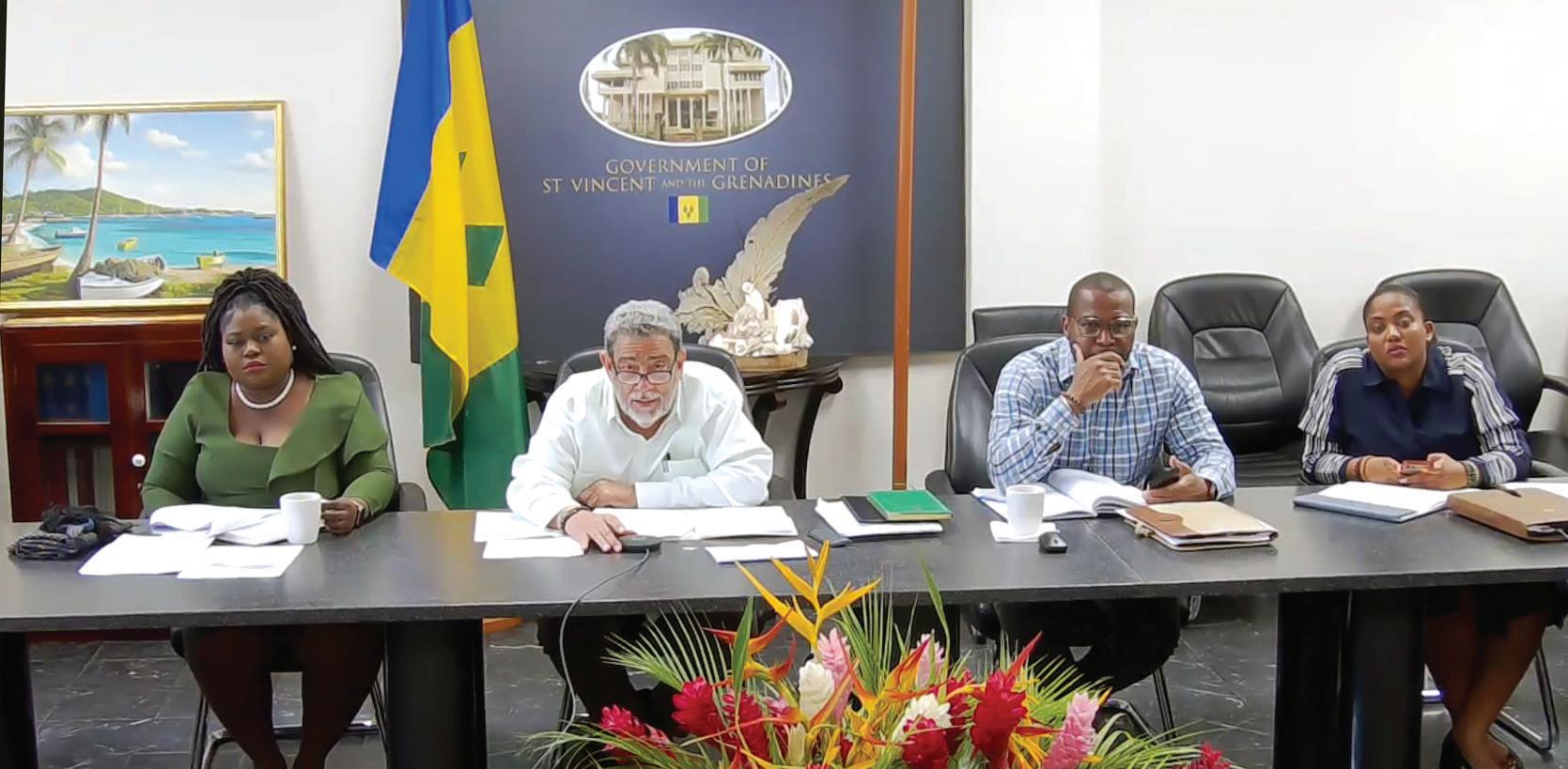
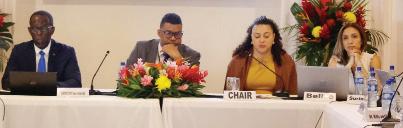
Figure 1 Dr. the Hon. Ralph Gonsalves, Prime Minister of St. Vincent and the Grenadines and Lead Head of Government with responsibility for Transport in the CARICOM Quasi Cabinet, (2nd, l) chairs the Special Meeting of the COTED on Transportation
Regional Ferry Service: During the year under review, the Secretariat coordinated and facilitated efforts to advance developments with respect to the establishment of a regional ferry service. In the first quarter of 2024, work commenced towards the operationalisation of a dedicated ferry service for Trinidad and Tobago, Guyana and Barbados through the acquisition of a vessel provided by the Government of Trinidad and Tobago and the establishment of a company, Cari-Cargo, to facilitate the easier movement of goods, particularly agricultural produce. Further work is still being undertaken, including from regulatory and administrative perspectives and the appropriateness of the vessel identified.
Free Movement: COTED recommended to the Conference of Heads of Government, the inclusion of categories of aviation professionals in the Regime of Skilled Community Nationals. The recommendation is specific to aircraft maintenance engineers, professional pilots, air traffic controllers, and flight operations officers. This represents a significant milestone in the movem ent of this category. Additional consultations are also being undertaken on other categories of aviation professionals.
ENERGY
In 2024, the Secretariat enhanced the capacity for sustainable energy sector development through the improvement of energy and climate resilience by enhancing the capacity for sustainable energy sector development. The Secretariat worked closely with regional stakeholders and international partners to implement impactful projects that increased energy awareness, information, and knowledge-sharing, and that drove practical solutions to address the Region’s energy needs while advancing its sustainable development goals.
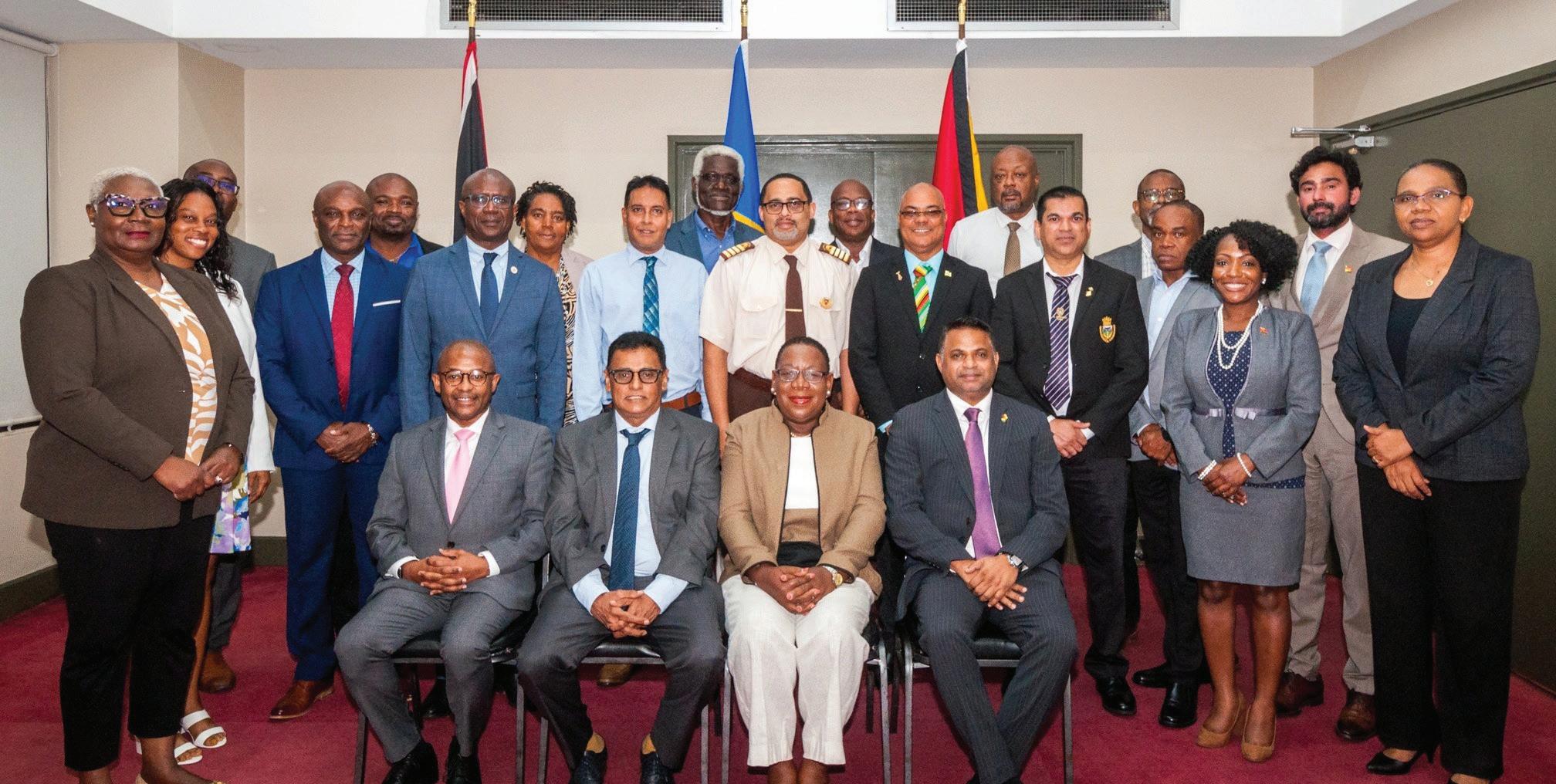
Participants at a meeting on operationalising the regional ferry service in Port of Spain, Trinidad and Tobago
MEMORANDA OF UNDERSTANDING
On 22 July 2024, CARICOM and the Global Green Growth Institute signed a twoyear Memorandum of Understanding. The collaboration focused on the development and implementation of regional policies, plans, and financing instruments, as well as information knowledge-sharing and the development of a project pipeline including four project concepts. During the reporting period, the collaboration resulted in the establishment of a database framework, and the production of a promotional video for CARICOM Energy Month (CEM) 2024.
On 22 September 2022, CARICOM and UNDP signed a five-year Memorandum of Understanding, intended to provide technical assistance across several programme areas, including energy. The MoU is operationalised through action plans. The first Annual Work Programme centred on sustainable energy, sustainable development, and citizens’ safety and security. UNDP successfully presented the New Financing Innovation Labs during a CEM 2024 webinar.
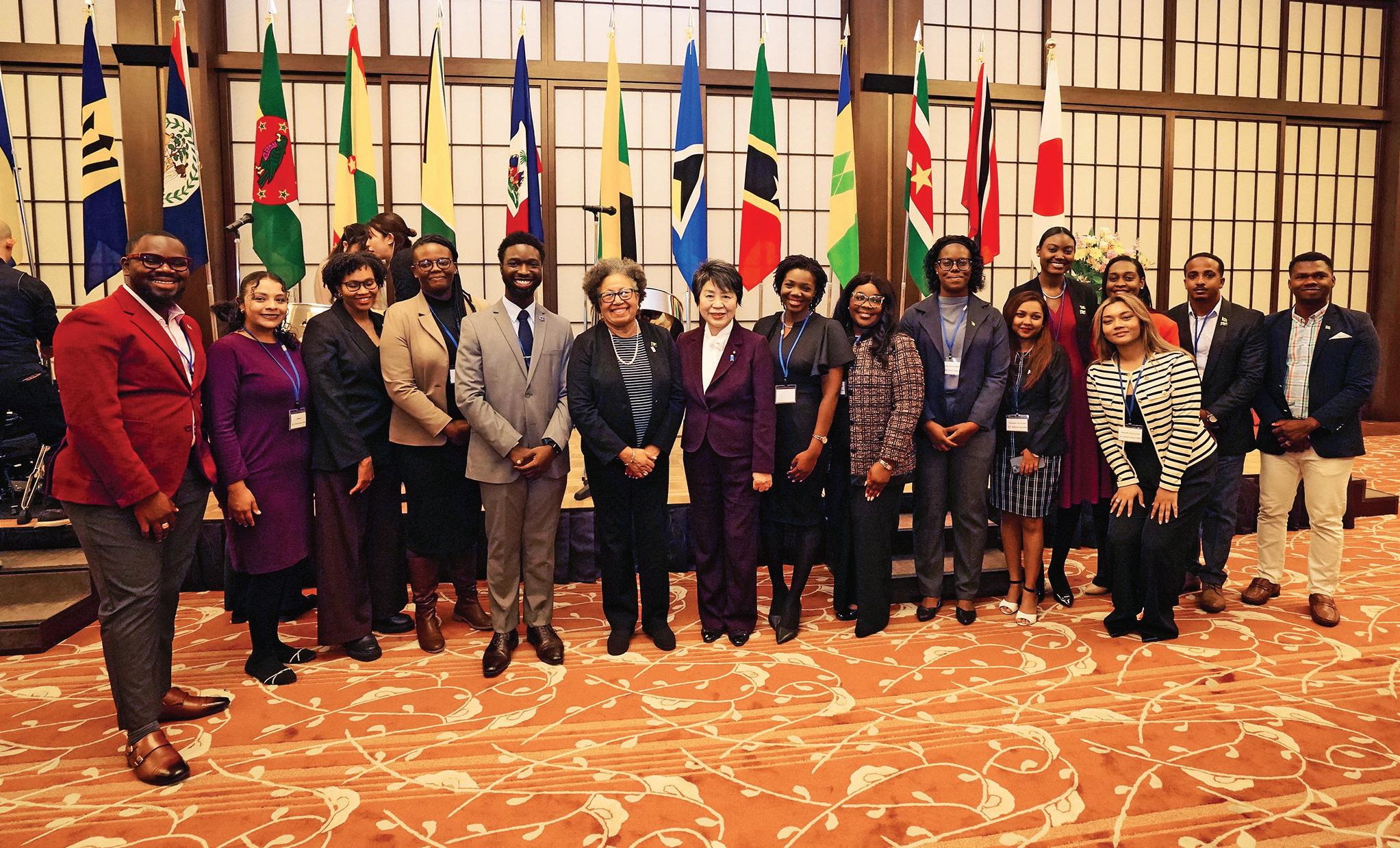
The Secretariat and the Caribbean Centre for Renewable Energy and Energy Efficiency (CCREEE) signed a MOU on 12 June 2024 for the implementation of a project titled ‘Development of an Energy Access Programme Business Model to Include Micro-Grid Development and Design Planning Parameters to Support Energy-Poor Communities in CARICOM Member States’. The Japan-CARICOM Friendship Cooperation Fund (JCFCF) financed the project with a total of US$39,528, while CCREEE contributed in-kind support valued at US$22,315. The Secretariat is the Executing Agency, and CCREEE is the Implementing Agency.
The project aimed to develop a business model incorporating clean energy, energy efficiency, and self-sustainable electric power systems to reduce negative environmental impacts. It also sought to establish technical guidelines for the planning and development
of micro-grid design and implementation parameters. Through this project, there is the exchange of knowledge and expertise among regional and national institutions that are responsible for or interested in supporting the just energy transition. It is the expectation that the project will be replicated across other CARICOM Member States. Belize, Dominica, and Suriname are the beneficiaries of the project, which is expected to be completed by March 2025
The Secretariat supported Member States by actively participating in various forums, meetings, and workshops, to advance regional energy priorities and strengthen collaboration with its Member States. Representation at the Caribbean Renewable Energy Forum in March 2024 and the workshop on right-sizing electricity regulations in Small Island Developing States (SIDS) within the Caribbean, facilitated knowledgesharing and targeted policy discussions.
Engagements with key development partners, including the Global Green Growth Institute (GGGI), United Nations Development Programme (UNDP), Inter-American Development Bank (IDB), Caribbean Development Bank, RTI International, and GIZ, further bolstered strategic partnerships. These efforts collectively enhanced the Secretariat’s capacity to deliver innovative solutions and address energy challenges across the Region.
Through its series of network meetings, the Secretariat successfully kept the Energy Focal Points in Member States informed about active projects at both regional and Member State levels, thus fostering greater collaboration and transparency. These meetings served to advance development initiatives.
CARICOM Energy Month was hosted in November 2024 under the theme ‘Invest in Sustainable Energy: Accelerate the Transition’. Twelve Member States actively participated in CEM 2024. The SecretaryGeneral and Energy Ministers from The Bahamas, Barbados, Belize, Grenada, Guyana, Jamaica, Saint Kitts and Nevis, and St Vincent and the Grenadines, issued statements highlighting the importance of investing in sustainable energy. Several Member States organised and executed activities such as energy fairs, quizzes, webinars, panel discussions, symposiums, competitions, school awareness sessions, school competitions, school tours, and an LED glow walk, and produced videos, all centred around the theme.
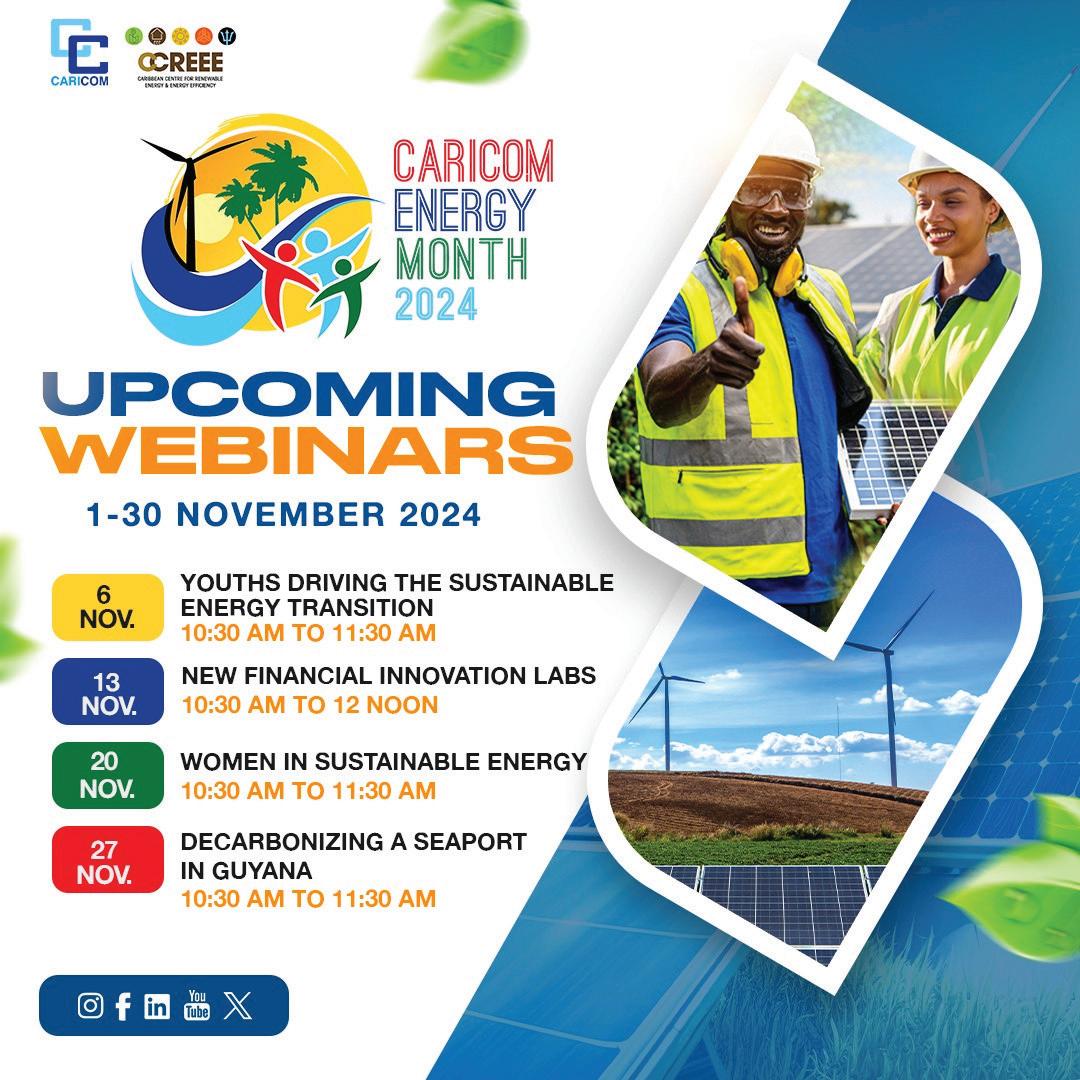
The Secretariat collaborated with partner organisations to host a series of well-attended webinars every Wednesday during CARICOM Energy Month, covering key topics, such as the role of youth and women in advancing the sustainable energy transition, as well as the launch of new financial innovation labs.
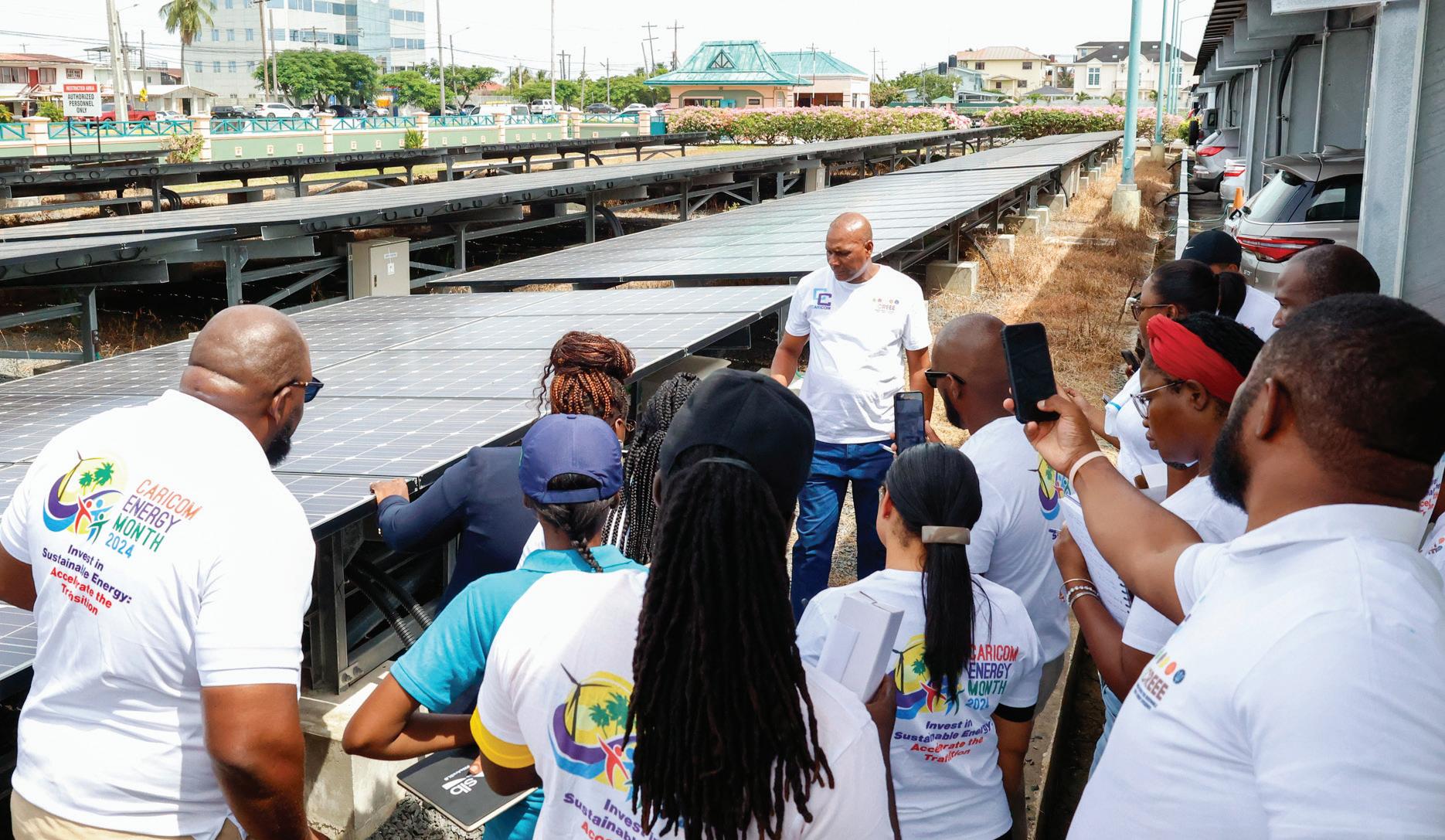
A significant highlight of the month of activities was the successful organisation of tours for 50 students from the Faculty of Technology and Engineering and the Faculty of Earth and Environmental Sciences of the University of Guyana. The students had the opportunity to tour the CARICOM Secretariat’s solar Photovoltaic plant, battery energy storage system (BESS), and building energy management system (BEMS).
Students get a closer look at the solar panels in the CARICOM Secretariat compound in Georgetown, Guyana
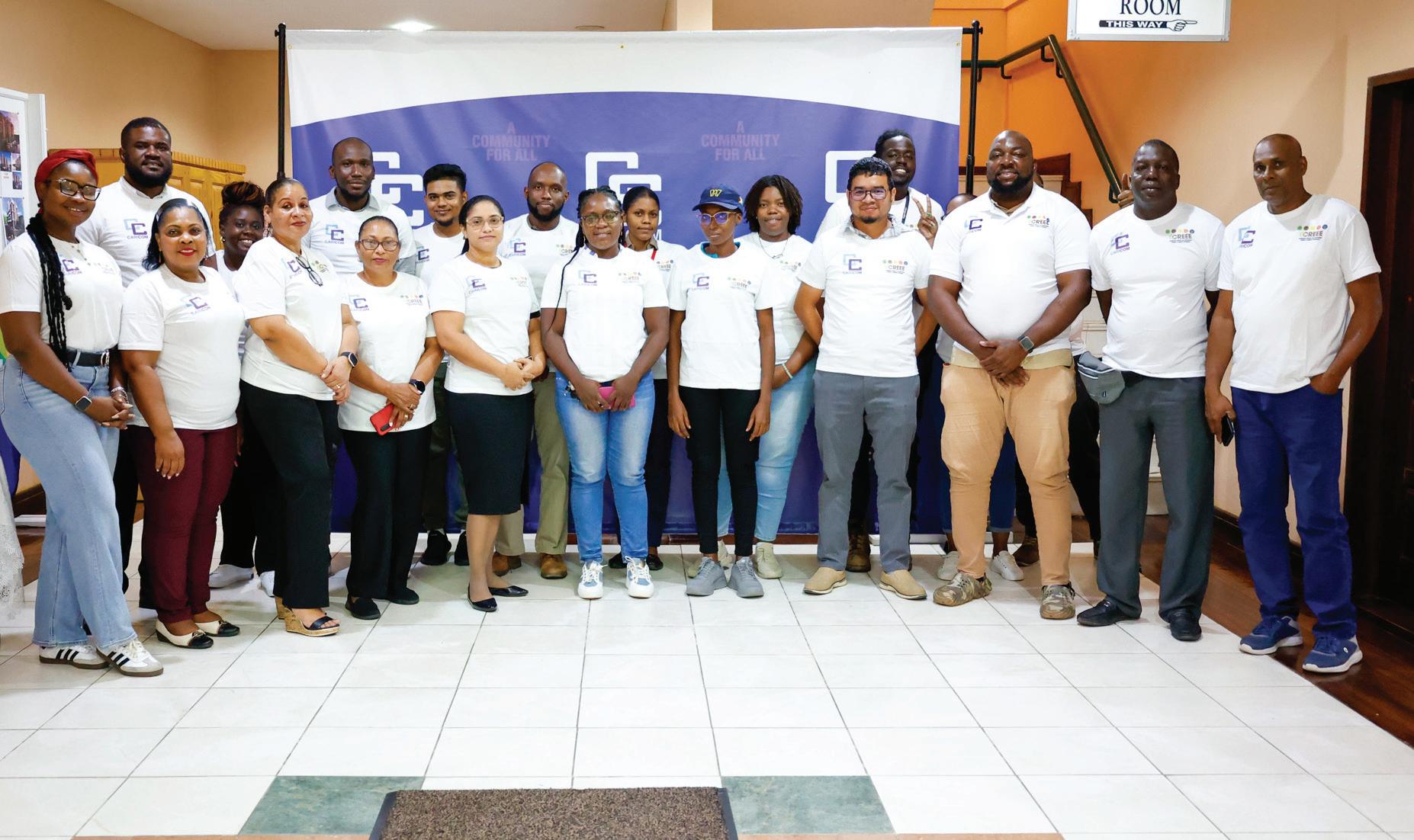
Figure 2 - CARICOM Secretariat members of staff and some of the students who participated in the tour
One of the standout activities of the month was the ‘No-Iron Day’ challenge, which sparked widespread interest across the Region. Participants demonstrated how energy conservation can be achieved through mindful clothing choices, showcasing the potential for everyday actions to support sustainable energy practices.
SUSTAINABLE ENERGY AWARDS
In collaboration with the Caribbean Centre for Renewable Energy and Energy Efficiency (CCREEE), the Secretariat launched the inaugural Sustainable Energy Youth Award (SEYA) and invited nominations for the third CARICOM Women in Sustainable Energy (W.I.S.E.) awards on 1 December.
The SEYA award seeks to recognise a young individual who is passionate about sustainable energy and committed to fostering positive change in the sector. The award targets youths aged 16 to 35 years who showcase innovation, creativity, and dedication to their communities by advocating for
CARICOM Members of Staff observe No-Iron Day
and actively contributing to the energy transition at local, national, and regional levels across the public, private, and civil society sectors. IDB has committed to funding the SEYA to the sum of UD$6,125.
The W.I.S.E awards recognise women engaged in the Sustainable Energy Sector within CARICOM. The four categories are: Business and Entrepreneurship, Social Impact, Community and Advocacy, Policy and Regulations, and Utilities and Industry. The awards seek to honour women who have shown dedication, innovation, creativity, and a commitment to their communities by driving the energy transition at local, national, regional, or international levels across the public, private, and civil society sectors. Both awards will be presented in 2025.
BUILDING ENERGY MANAGEMENT SYSTEM (BEMS)
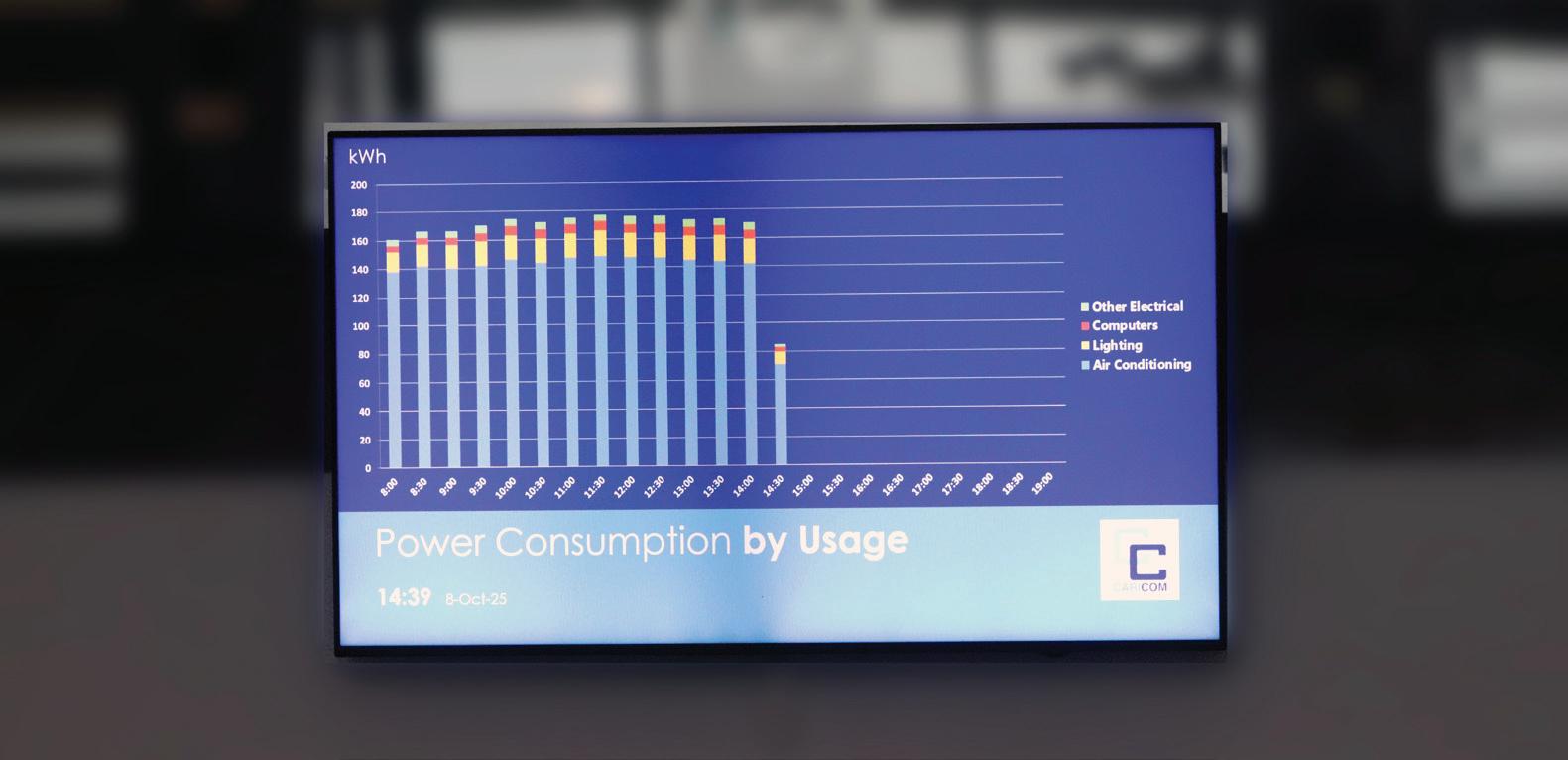
The Secretariat continued to optimise the use of its advanced Building Energy Management System (BEMS), which monitors the energy supplied and consumed from both the national grid and the Solar Photovoltaic Power Generation Plant located at the Secretariat. There has been a reduced reliance on the national grid for powering the
ENVIRONMENT AND SUSTAINABLE DEVELOPMENT
The year under review was very busy in the multilateral environment and sustainable development space with international engagements and several Conference of the Parties (COP) meetings taking place in the latter quarter of the year.
The Secretariat coordinated to ensure, as far as possible, a high level of participation, coordinated regional positions, shared expertise and an efficient use of resources. The Ministers with responsibility for the environment and sustainable development of CARICOM played a strong leadership role during this active year.
Secretariat building.
FOURTH INTERNATIONAL CONFERENCE ON SMALL ISLAND AND LOW-LYING COASTAL DEVELOPING STATES (SIDS)
The Fourth International Conference on Small Island Developing States (SIDS4) was held from 27 - 30 May 2024, in St John’s, Antigua and Barbuda, under the theme of ‘Charting the Course toward Resilient Prosperity’. The main outcome of the Conference is the Inter-governmentally agreed, political outcome document, the Antigua and Barbuda Agenda for SIDS (ABAS) that sets out a new Programme of Action for SIDS.
While Member States participated in a hectic schedule of interactive dialogues, side events and bilateral meetings, there were specific regional activities endorsed by the One Hundred and Twelfth Special Meeting of the Council for Trade and Economic Development (COTED) - Environment and Sustainable Development. These included two regional Side Events that highlighted the work of the Member States, Regional Institutions and Development Partners. These were:
(i) The Caribbean Community Environment and Natural Resources Policy Framework - A Driver for Environmental Protection and Planetary Sustainability: “Advancing Interregional Cooperation, Partnerships and Institutional Innovation”, which was held on 28 May 2024; and
(ii) Leveraging CARICOM Natural Capital to Capitalise on Innovative Financial Instruments to Drive CARICOM Resilience and Sustainable Development, which was held on 29 May 2024.
Additionally, in accordance with the recommendations of the Region’s Climate Change Negotiators, regional bilateral engagements were convened with key Climate Finance
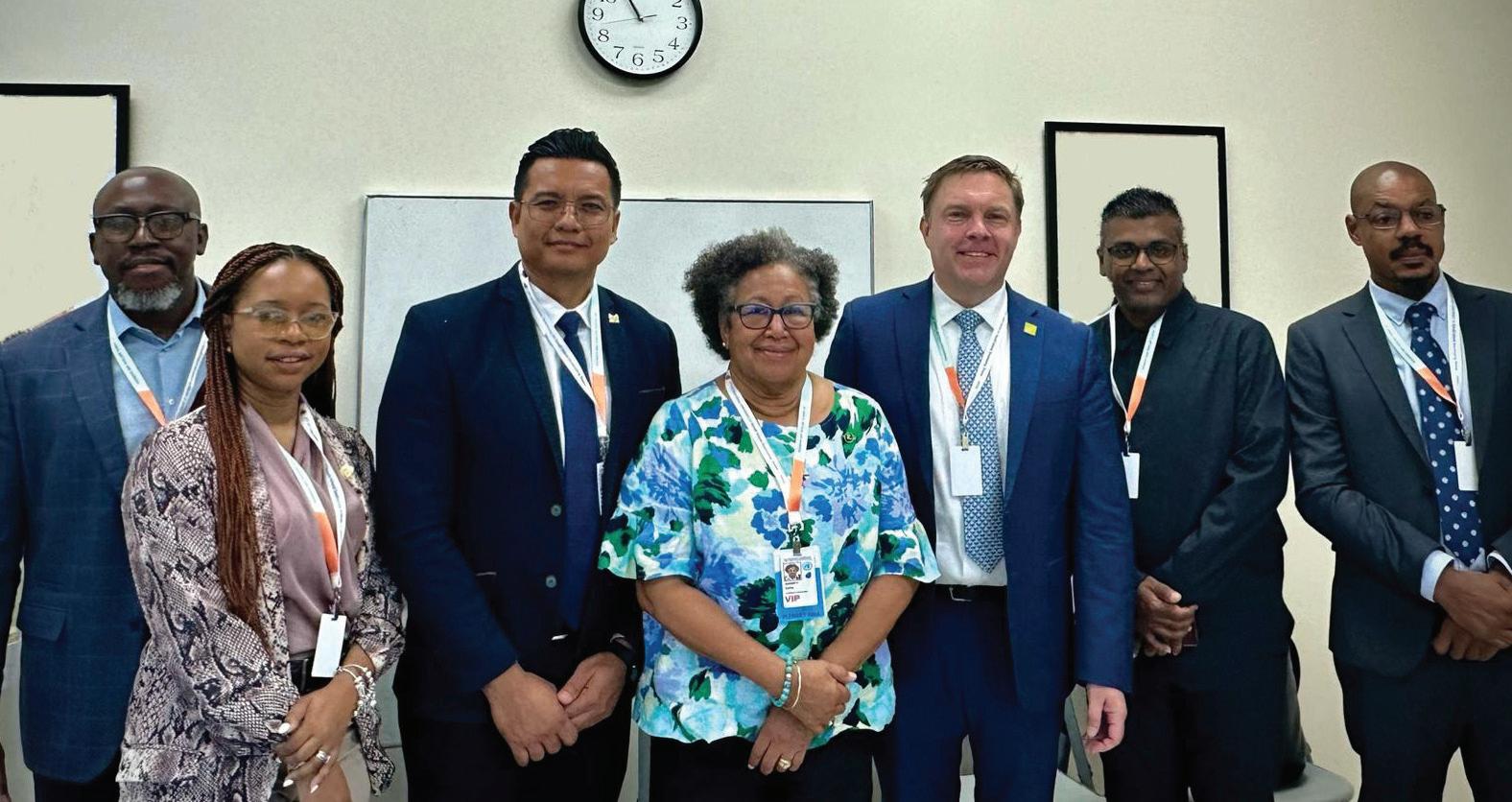
Dr. Carla Barnett, CARICOM Secretary-General (centre), after her bilateral with the Adaptation Fund Secretariat
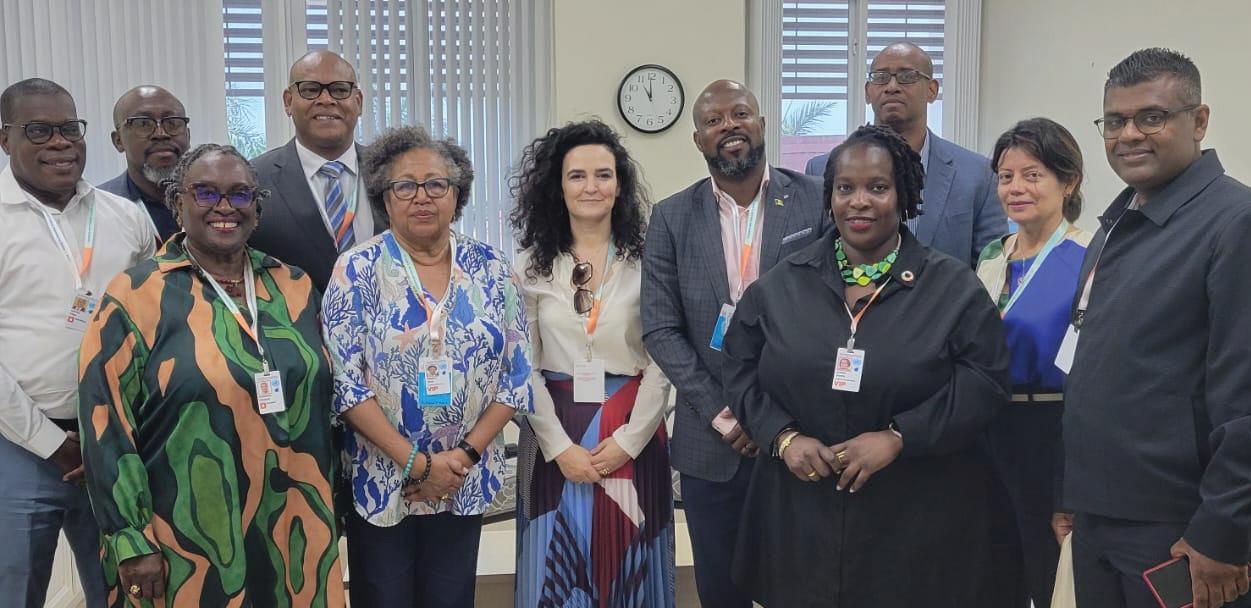
Dr. Carla Barnett, CARICOM Secretary-General, after the bilateral meeting with the Green Climate Fund
OCEANS
The Secretariat continued to anchor the regional coordination of a CARICOM MultiStakeholder Advisory Group, spearheading the Region’s commitment to sign and/or ratify the new agreement under the Law of the Sea on Biodiversity Beyond National Jurisdiction. Through support from Pew Charitable Trust, the Second Meeting of the CARICOM Multi-Stakeholder Advisory Group (MSAG) to support ratification of the High Seas Treaty and participation in COP 1 of the Treaty was convened 11-12 April 2024, in hybrid format. BBNJ negotiators and legal experts raised awareness on legal requirements for treaty nationalisation and ratification. The group also engaged with donor partners to explore opportunities for capacity-building support for ratification and early treaty implementation.
The fifth session of the United Nations Environment Assembly (UNEA-5.2) adopted resolution (5/14) in 2022, to develop a Legally Binding Instrument on Plastic Pollution with the ambition to complete the negotiations by the end of 2024. The CARICOM Secretariat supported Member States in this process of negotiating a Plastics Treaty, through virtual preparatory, and one in-person meeting, to help prepare CARICOM Negotiators for the Intergovernmental Negotiating Conferences. These preparatory meetings continued ahead of the fifth Session of the Intergovernmental Negotiating Conference (INC-5). This Fifth Session will resume in mid-2025 due to absence of consensus in key areas of the negotiations. The Secretariat will continue to support coordination and preparation of Member States.
The Secretariat was able to secure assistance from the Government of the United Kingdom to commence a project entitled, ‘Towards A Caribbean Community (CARICOM) Framework for Strengthening Oceans Governance - Effective Engagement in the International Oceans Agenda’. The project aims to support the collaborative development of a CARICOM Blue Economy Policy which is intended to articulate apolicy that fosters improved governance, regional coordination and ultimately, enhanced capacity of Member States to sustainably manage both sovereign and shared marine resources.
Initial stakeholder consultations among sector groups and regional institutions took place in November and December during the scoping phases.
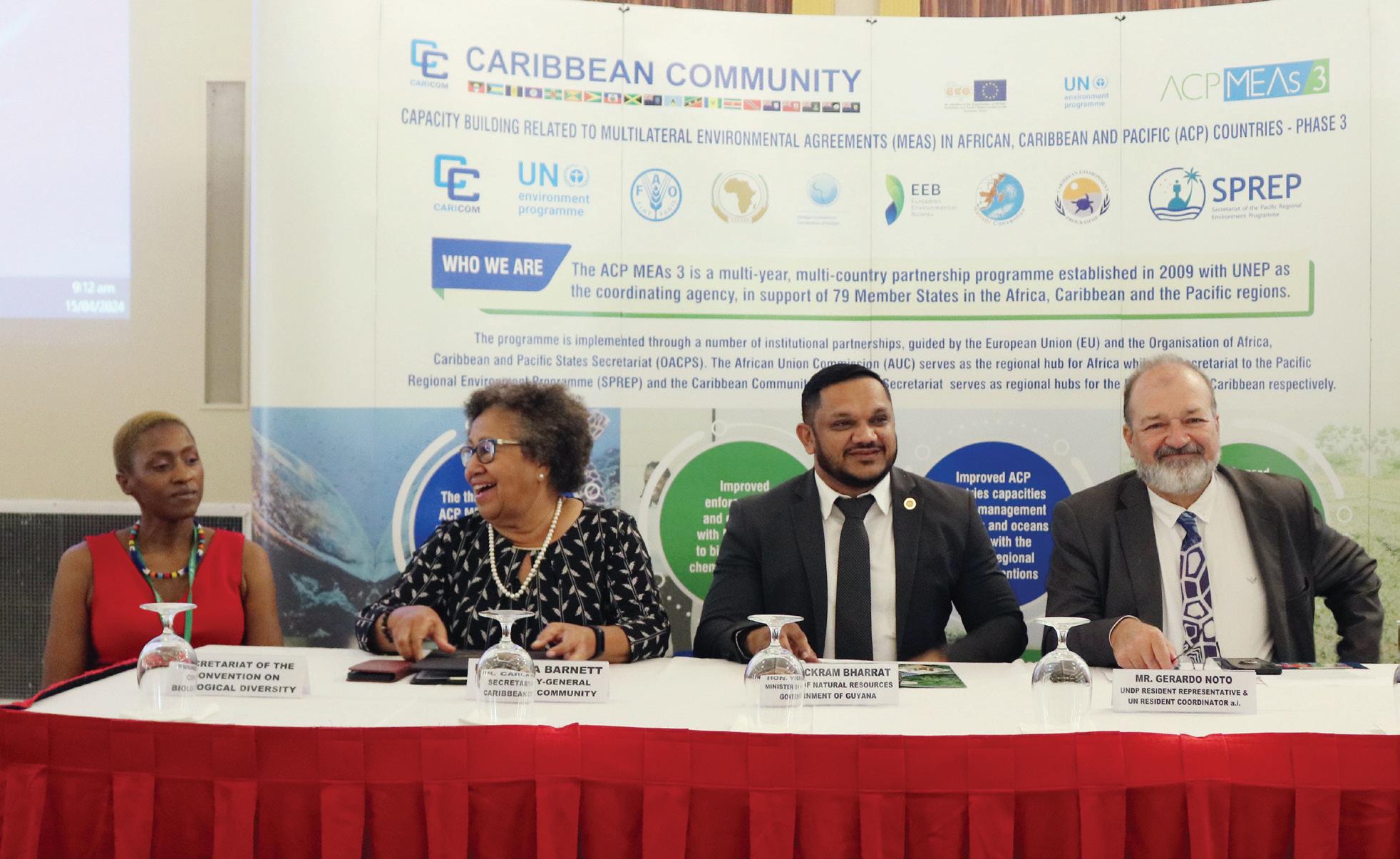
• The ACP Monitoring of Multilateral Environmental Agreements (MEAs) Project facilitated a national workshop in Dominica and Grenada, 6-7 March and 12 March 2024, respectively. The CITES Secretariat provided technical support to CITES National Authorities to develop National Legal Framework and Institutional Guidelines for the implementation of the CITES Convention . The workshop helped to increase capacity and awareness of the requirements and benefits of developing adequate national legislation for the implementation of the Convention in Dominica and Grenada.
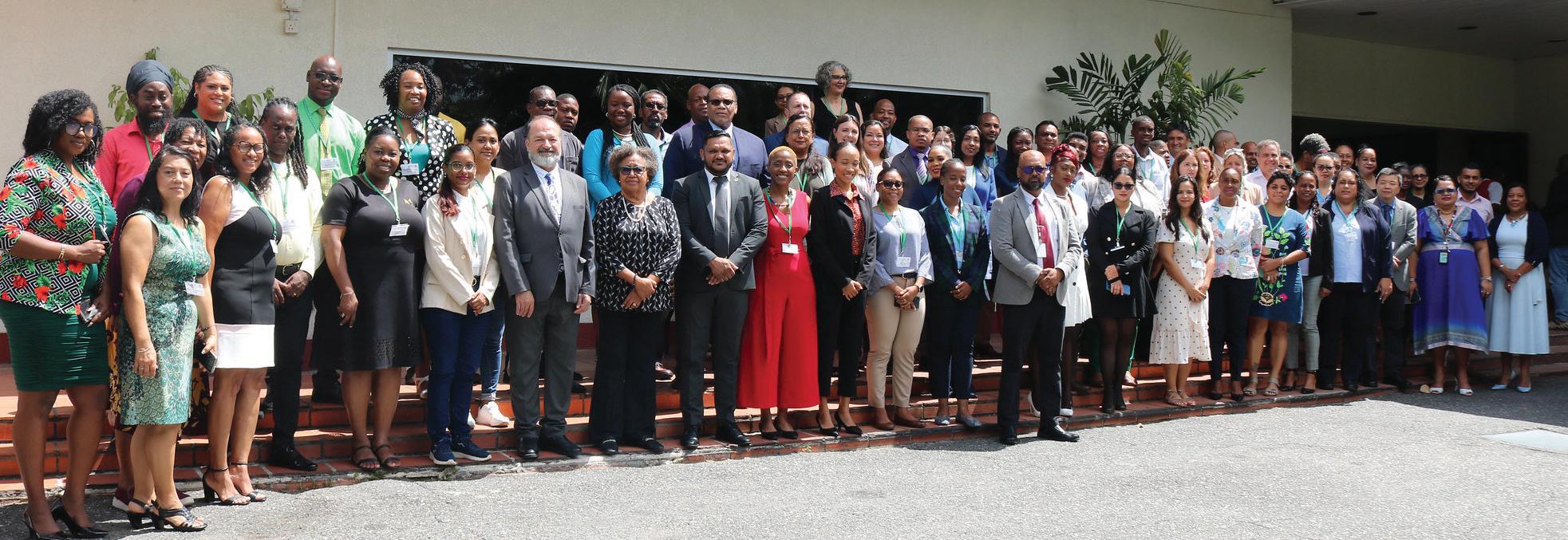
The CARICOM Secretary-General, facilitators and participants at the Biodiversity Workshop in Georgetown, Guyana
• With assistance from the Caribbean Hub-ACP MEAs Project, the Secretariat, UNCBD Secretariat and relevant partners collaborated to convene a sub-regional dialogue on national biodiversity strategies and action plans (NBSAPs) for the Caribbean countries. This session was held in Georgetown, Guyana from 15 -17 April 2024, and provided an opportunity for participating countries to share experiences and lessons learned, address challenges and identify possible opportunities and solutions to enhance the development and implementation of NBSAPs.
• The Secretariat organised a joint Caribbean SIDS-SIDS Peer Learning Workshop on ‘Data Solutions for Nature – From Data Governance and Production to Data Reporting and Dissemination’ and a capacity building workshop on ‘Building Panel Data for Effective Monitoring of Multilateral Environmental Agreements (MEAs) in CARICOM’. Both sessions, which were convened from 29 April – 2 May 2024 were supported by the United Nations Department of Economic and Social Affairs (UNDESA) and the Government of Belize.
• Prior to COP16, CARICOM CBD Parties participated in a mock COP workshop, which focused on the drafting of statements and interventions from the floor. Countries also discussed and identified national and regional priorities related to biodiversity. The Secretariat co-organised this regional workshop (11-13 October 2024) in collaboration with the OECS Commission and the Caribbean Biodiversity Fund.
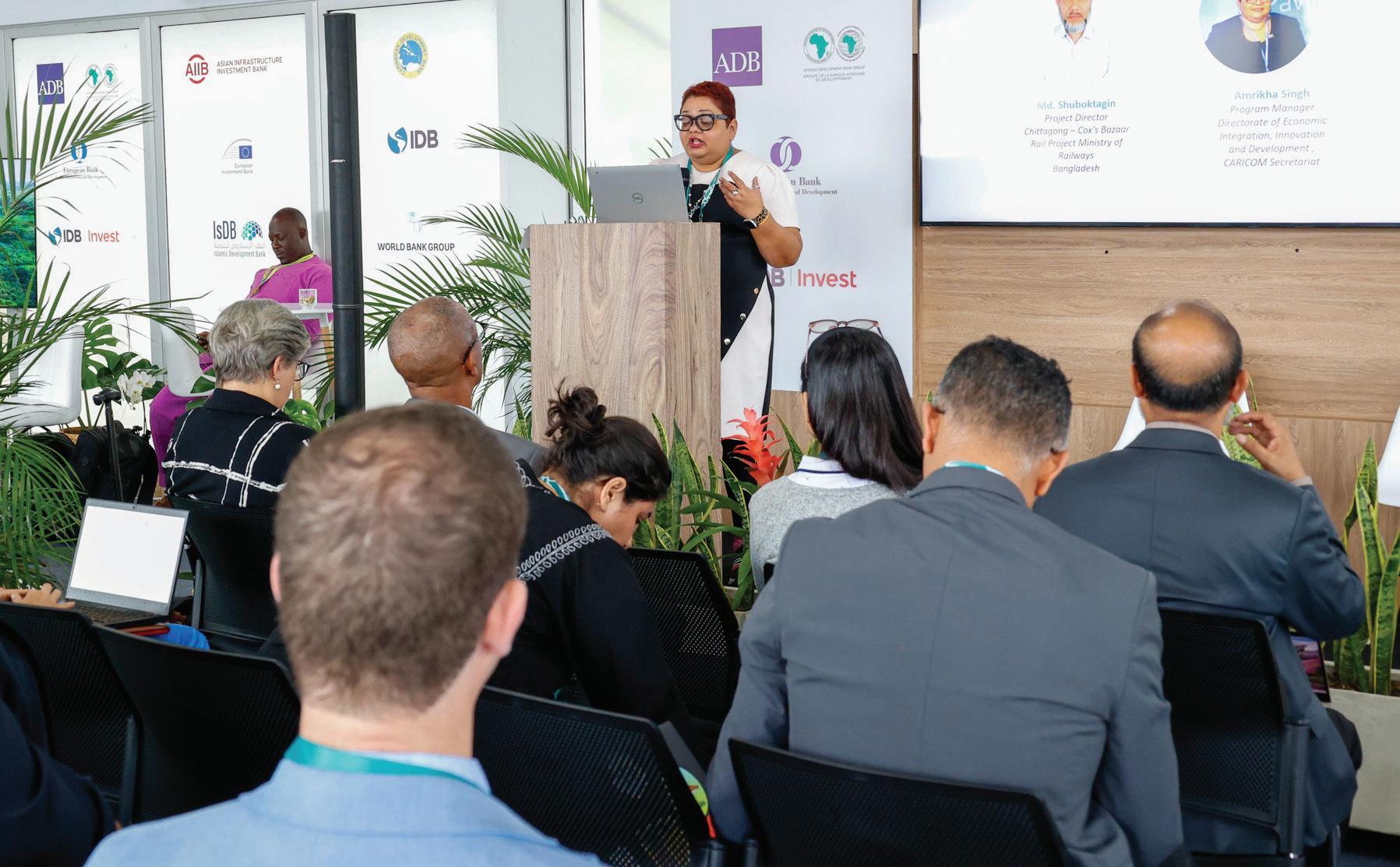
Ms. Amrikha Singh, Programme Manager, Sustainable Development, CARICOM Secretariat, leading a session
• The Secretariat also provided on-the-ground coordination, technical and administrative support and facilitated media engagements with CARICOM delegations to advance the CARICOM Position at COP 16 in Cali, Colombia, 20 October – 2 November 2024.
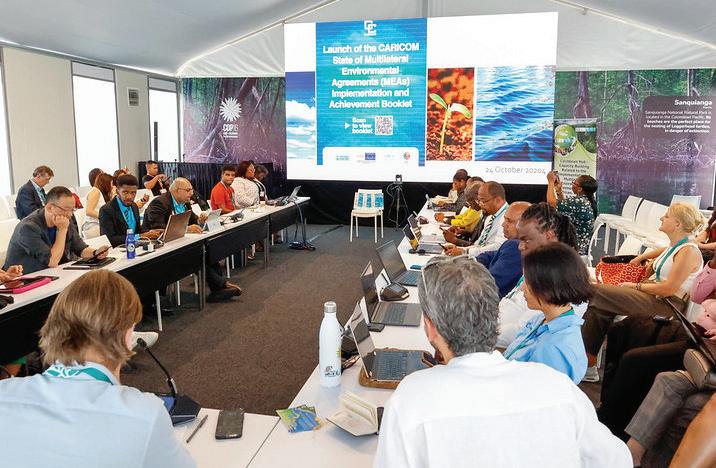
• During COP 16, the Secretariat held bilateral meetings with GEF, UNEP, EU and other regional and international agencies to advance the interests of the Region. Additionally, the Secretariat hosted two side events focusing on ‘Regional Challenges and Opportunities for Technical and Scientific Cooperation (TSC)’ in collaboration with Humboldt Institute. One of the particularly noteworthy highlights during this two-week activity was the launch of the CARICOM State of Multilateral Environmental Agreements (MEAs) Implementation and Progress Booklet which has data and reporting as its focus.
Launch of the CARICOM State of Multilateral Environmental Agreements Implementation and Progress Booklet, 24 October 2024
CLIMATE CHANGE
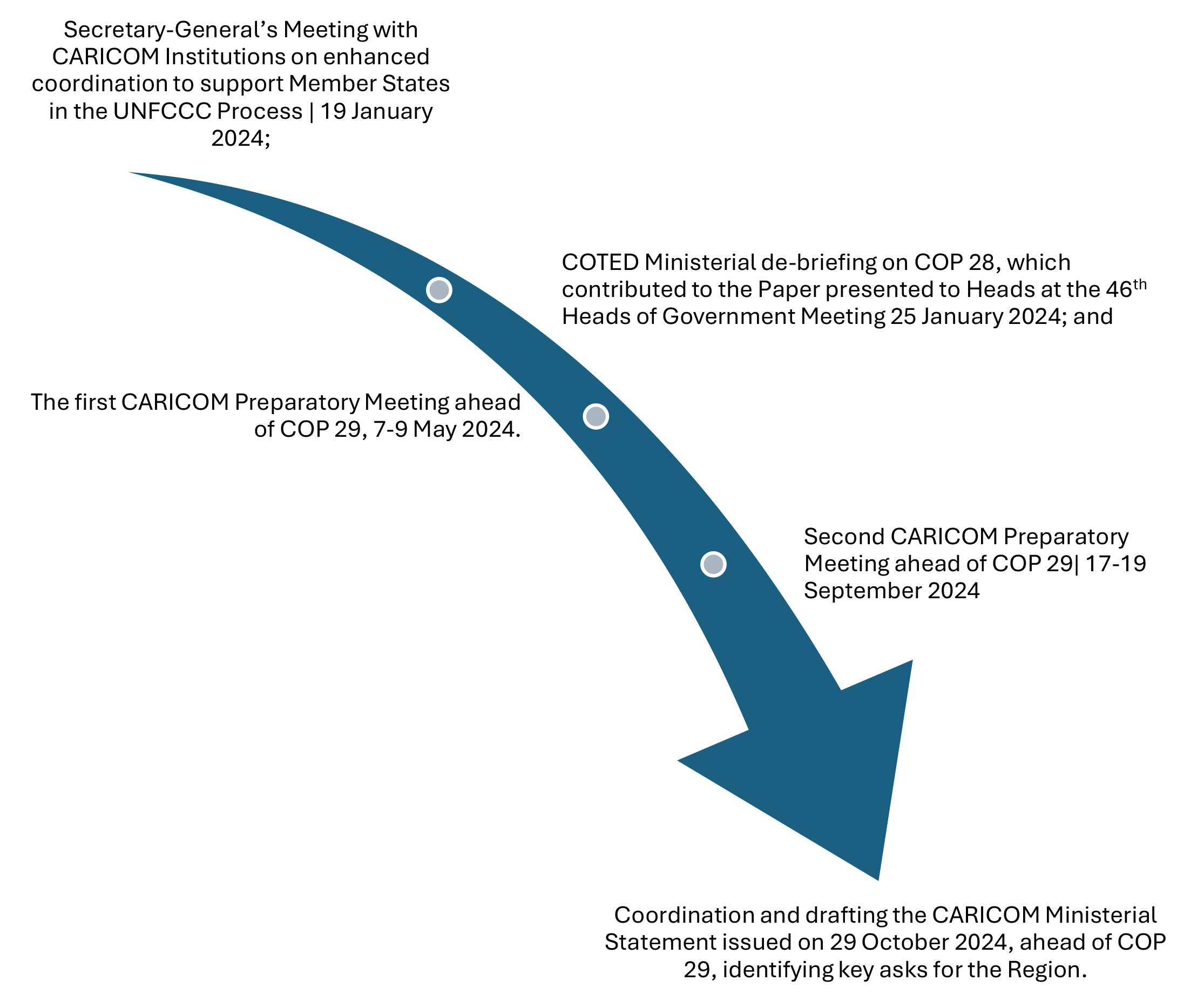
The Secretariat worked closely with the Caribbean Community Climate Change Centre (CCCCC) to provide support and coordination to Member States as they prepared for COP29 in Baku, Azerbaijan.
Some of the activities supported by the Secretariat included:
ICT4D
Throughout 2024, the Secretariat maintained its momentum, driving key digital transformation initiatives to foster regional digital integration, enhance cybersecurity resilience, improve digital literacy, and promote gender inclusion in technology.
ADVANCING THE CARICOM SINGLE ICT SPACE
The CARICOM Single ICT Space continued to be a central output of the Secretariat’s strategy, as reflected in the CARICOM Secretariat Strategic Plan 2022-2030, which has guided the implementation of various ICT-related initiatives. Activities in the year under review focused on developing a consolidated action plan; engaging strategic public and private partners to support and promote policy harmonisation and strengthen infrastructure; and raising awareness of digital technologies across Member States.
STRATEGIC FRAMEWORK FOR DIGITAL RESILIENCE 2025-2030
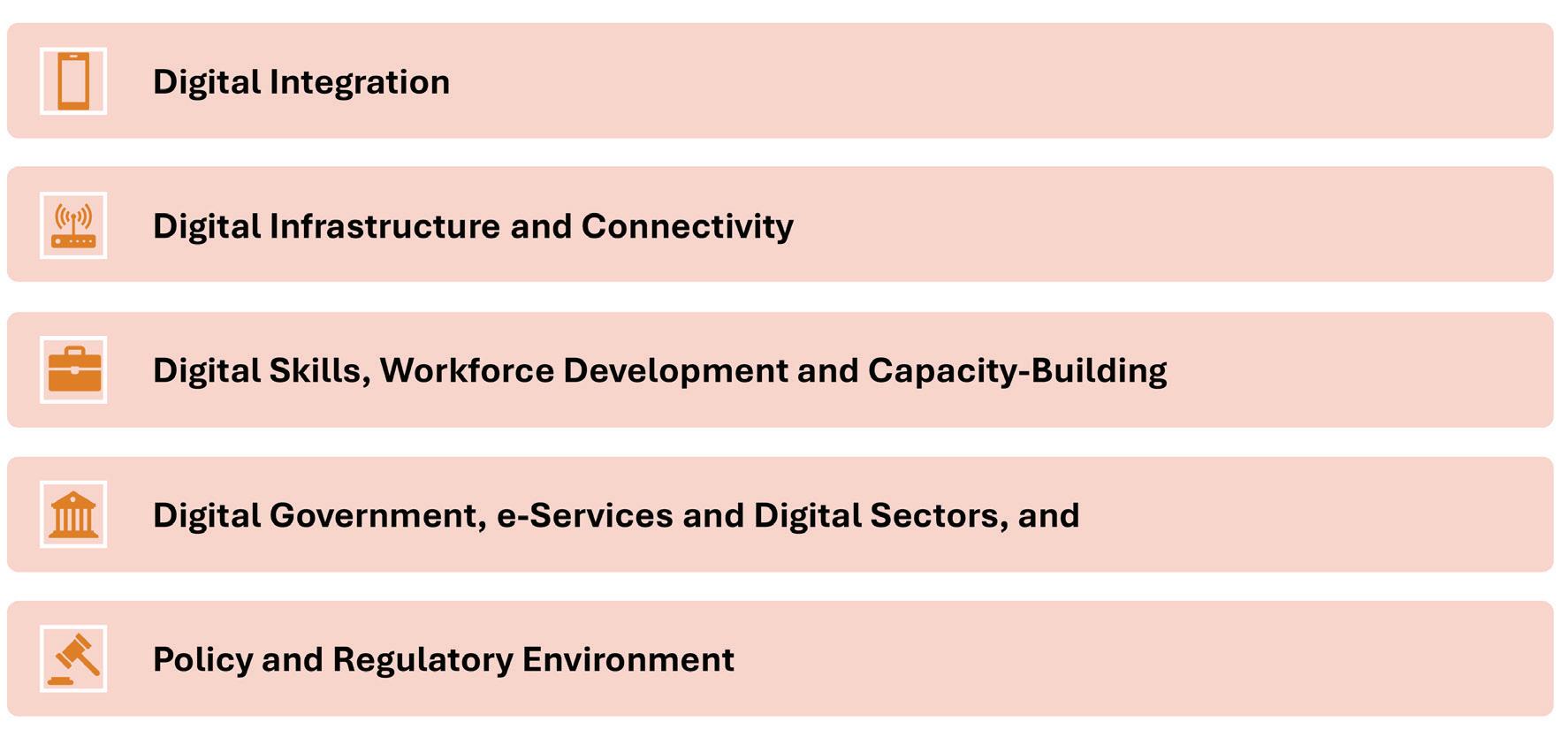
In July 2024, the Conference of Heads of Government approved a Strategic Framework for Digital Resilience 2025-2030. The framework is intended to engender concerted efforts in digital development including advancing the CARICOM Single ICT Space, in five key areas:
THE 11TH EDF ICT SECTOR GAP ANALYSIS PROJECT
The Secretariat advanced the 11th European Development Fund (EDF)-funded ICT Sector Gap Analysis Project. A key achievement was the completion and circulation of the first draft of National ICT Profiles for all Member States. In-country consultations were conducted in The Bahamas, Guyana, Jamaica, Suriname, and virtually in Bermuda from August to October 2024. Additional consultations are planned for Barbados, Belize, and Grenada, with a validation workshop scheduled for 2025 in Barbados.
CARICOM CYBER RESILIENCE STRATEGY 2030 PROJECT
In February 2024, the CARICOM Cyber Resilience Strategy 2030 Project was officially launched with funding from the United States Agency for International Development (USAID) Eastern and Southern Caribbean (ESC). The Secretariat served as the project focal point. Cambridge Global Advisors (CGA) was contracted to lead the project’s execution, which engaged over 200 stakeholders through a series of consultations held in-person and virtually. Key deliverables included a draft CARICOM Cyber Resilience 2030 Strategy, National Cyber Wellness Profiles, a Cyber Crime Checklist, and an Overview of the Cyber Workforce.
CARICOM GIRLS IN ICT PARTNERSHIP
The CARICOM Girls in ICT Partnership, which the CARICOM Secretariat anchors, continued its mission of fostering gender inclusivity in technology careers. As part of the approved action plan, efforts in 2024 included a successful International Girls in ICT Day observance in April 2024. In collaboration with Restore a Sense of I Can (RSC) International based in Trinidad and Tobago, the partnership delivered 12 virtual sessions to an audience of over 52,000 participants. These sessions covered critical topics such as digital inclusion, artificial intelligence, cyber safety, and girls’ empowerment, underscoring CARICOM’s commitment to lessening the gender gap in ICT.
Teams from the CARICOM Secretariat and Cambridge Global Advisers after a consultation on the cyber resilience strategy
CARICOM DIGITAL SKILLS TASK FORCE
The Secretariat continued its support for the CARICOM Digital Skills Task Force, which was established by the Twenty-Fifth Special Meeting of the Council for Human and Social Development (COHSOD) on 17 November 2020. Consultations and capacitybuilding initiatives undertaken in 2023 supported the finalisation of the Task Force’s Draft Final Report. The Forty-Eighth Meeting of COHSOD – Education, held in October 2024, approved the Final Report and provided key mandates that will serve as a roadmap for strengthening digital skills in CARICOM.
CAPACITY BUILDING INITIATIVES
The Secretariat supported and facilitated several capacity-building initiatives to equip regional stakeholders with critical ICT knowledge and skills:
In partnership with the Erline Bradshaw Foundation (Barbados), the Secretariat delivered an eight-week online training programme to 150 women from CARICOM and other regions, including Asia, the Americas, and Africa. The training covered topics such as artificial intelligence, blockchain, financial technology, and sustainable development, with a module on Technology and Regulatory Compliance delivered by the Secretariat. Participants concluded the programme by adopting an Eco-Technology Justice Resolution in September 2024.
DIGITAL AGRICULTURE WORKSHOP
During the 18th Caribbean Week of Agriculture in St. Vincent and the Grenadines, the Secretariat delivered a digital Agriculture Workshop under the theme ‘Sustainable Development Through Digital Agriculture: Empowering Women, Youth, Agriculture Farmers, and Indigenous Peoples’. This session highlighted the potential of digital solutions in transforming agriculture and promoting sustainable development across the Region. The Secretariat will support the development of an e-agriculture strategy in 2025.
ENGAGING YOUTH
The Secretariat conducted capacity-building on the CARICOM Single ICT Space and its role in the CARICOM Single Market and Economy (CSME) for the CARICOM Youth Ambassadors Programme (CYAP). This engagement fostered dialogue on the role of youth in digital development and emphasised the importance of inclusive participation in shaping the Region’s digital future.
Notably, the Secretariat conceptualised and collaborated with USAID, Canada, National Democratic Institute (NDI), House Democracy Partnership (HDP), International Republican Institute (IRI), and ParlAmericas to deliver a Digital Economies Workshop on 7-8 September 2024. Held in Miami, this workshop engaged Members of Parliament from 14 CARICOM Member States and focused on the use of e-governance tools in parliaments and discussions on the characteristics of the digital economy, their impact on society, and their potential benefits and risks.
The Secretariat partnered with the United Nations Educational, Scientific and Cultural Organization (UNESCO Caribbean office) and the International Telecommunications Union (ITU) to support the Region in developing policies and building capacity in artificial intelligence. The Secretariat also contributed peer reviews and technical input to the Caribbean AI Policy Roadmap, further advancing the Region’s digital policy landscape.
RESOURCE MOBILISATION
The Secretariat actively pursued resource mobilisation and strategic partnerships in 2024 to support the work of the Community by drafting proposals and briefs, and convening meetings with partners such as Korea, Greece, Colombia, India and the United Arab Emirates (UAE).
Ms. Jennifer Britton, Deputy Programme Manager, ICT4D, CARICOM Secretariat (centre), at the Digital Economies Workshop
HUMAN AND SOCIAL DEVELOPMENT
Enhancing social resilience is a priority of CARICOM’s plan to build “A Community for All.” To this end, sustained human and social development with reduced levels of poverty, equitable access to health, quality education and significant improvement of citizen security underpin the scope of the work of the Directorate of Human and Social Development (HSD) of the CARICOM Secretariat.
COMMUNITY DEVELOPMENT
CARIBBEAN FESTIVAL OF ARTS (CARIFESTA)
In 2024, progress was made in delivering on regional priorities in the Culture sphere. The areas of focus were preparations for CARIFESTA XV in Barbados, implementation of the ACPEU funded project: “Creative Caribbean – An Ecosystem of “Play” for Growth and Development,” and implementation of the regional reparations agenda.
The Forty-Sixth Regular Meeting of the Conference of Heads of Government held in Guyana in February 2024 accepted the offer of the Government of Barbados to host CARIFESTA XV and set in motion preparations for the Festival, which is scheduled for 22-31 August 2025.
The event promises a diverse and engaging offering of performing, visual, literary and culinary arts, as well as symposiums and conversations; community events; creative industries business networking; signal events, super concerts and legacy projects. The theme for CARIFESTA XV is “Caribbean Roots - Global Excellence.”
REPARATIONS FOR NATIVE GENOCIDE AND SLAVERY
In 2024, the work of the CARICOM Reparations Commission (CRC) focused on the revision of the Ten Point Plan for Reparatory Justice and the preparation of the Regional Negotiating Strategy for Reparations. Regular quarterly meetings of the Commission were held, and the Third Retreat of the CRC was convened from 5-7 February in Jamaica to start the process of revising the Ten Point Plan. Work also commenced on the reparations negotiating strategy for the Community.
Aligned with the decisions on reparatory justice of the Thirty-Fifth Intersessional Meeting of Heads of Government held in September 2023, actions were taken to have reparations included on the agenda of two high-level meetings. These include the Fourth Small Island Developing States Conference (SIDS4) held in Antigua and Barbuda, 27 – 31 May 2024 and the Commonwealth Heads of Government Meeting (CHOGM) held on 21-25 October
2024 in Apia, Samoa. The Secretariat provided a draft negotiating text for consideration in the CHOGM Communique and a related draft Declaration on Reparatory Justice . At CHOGM, the Draft Declaration on Reparatory Justice was excluded; however, Commonwealth Heads of Government agreed to the inclusion of two paragraphs in the Communique, which in effect encapsulate the substance of the Declaration that Caribbean countries had sought to negotiate.
There was an agreement between CARICOM Member States and the United Kingdom (UK) that reparations would be discussed in the UK-Caribbean Forum in the first quarter of 2025. The CARICOM Reparations Commission plans to visit the UK in the first half of 2025 to engage with the Caribbean diaspora, high commissions, media, universities and civil society on the reparations agenda.
AFRICAN UNION YEAR FOR REPARATIONS
CARICOM Heads of Government have been advancing initiatives for greater cooperation with the African Union (AU) on the reparations agenda and other areas of collaboration. Over the past 3 years, momentum has been building in the AU with respect to reparations for the trans-Atlantic trade in enslaved Africans and chattel slavery in the Americas.
The AU Assembly held on 17-18 February 2024 in Addis Ababa, Ethiopia, endorsed the recommendations of the Accra Reparations Conference; designated reparations for enslavement, colonialism and apartheid, as a flagship project of the AU and further decided that the theme of the Year 2025 would be ‘‘Justice for Africans and People of African Descent Through Reparations.”
The AU Year for Reparatory Justice presents an opportunity to consolidate cooperation between the African Union and CARICOM, and implement activities already supported by the Conference of Heads of Government, including an Africa-CARICOM Summit on Reparations preceded by a civil society forum; the launch of the CARICOM-AU joint legal and academic committee; a high level political forum and resolution on reparatory justice at the United Nations and further coordinated action in the Commonwealth.
SECOND INTERNATIONAL DECADE FOR PEOPLE OF AFRICAN DESCENT (2025-2034)
Consistent advocacy by governments and civil society in the Region and throughout the African diaspora for a Second International Decade for People of African Descent produced successful results at the Seventy-Ninth UN General Assembly, which on 17 December 2024, adopted a resolution declaring the observance of the Second International Decade from 2025-2034.
The Second Decade provides renewed impetus to advance CARICOM’s reparations agenda for repair, justice and development of people of African descent and the Indigenous people. The CARICOM Reparations Commission will continue to partner with the UN Permanent Forum on People of African Descent and the UN Working Group of Experts on People of African Descent to realise tangible outcomes during the Decade.
CREATIVE CARIBBEAN:
AN ECO-SYSTEM OF “PLAY FOR GROWTH AND DEVELOPMENT”
The Secretariat, in collaboration with UNESCO and The UWI, successfully submitted a project “Creative Caribbean: An Ecosystem of “Play for Growth and Development,” which was awarded €3 million for cultural development in the Caribbean Region, under the 11th European Development Fund (EDF) ACP-EU programme: ‘Towards a viable cultural industry.’ The project was approved by the ACP and the EU and the Contribution Agreement was signed in December 2020.
Creative Caribbean also involves the roll out of SKEM (Skills, Know-how, Experience, Monitoring & Evaluation) activities. These entail the engagement of technical assistance to deliver outputs that will strengthen the enabling environment for the development of the creative sector in the Region. The following SKEM activities are being implemented by the project partners:
CARICOM SECRETARIAT:
Contract for the development of a CARICOM Model Creative Industry Development Bill
The Secretariat is engaging the services of a legal consultant to develop a CARICOM Model Creative Industries Bill to incentivise the development of the creative industries in the Region.
GENDER
In the sphere of gender, the Secretariat focused on the finalisation of the CARICOM Regional Gender Equality Strategy (CRGES) and the implementation of the Pilot for Strengthening Gender-Responsive Planning and Reporting on Gender Statistics Project funded by the Caribbean Development Bank.
BUILDING RESILIENCE
HUMAN RESOURCE DEVELOPMENT (HRD) [EDUCATION]
In 2024, the CARICOM Secretariat focused on optimising the implementation of the CARICOM Human Resource Development (CHRD) 2030 Strategy. The Strategy, which is at the mid-point of implementation, targets the development of the “Ideal Caribbean Person” articulated by the Heads of Government in 1997. The period under review was a critical year in identifying, assessing and aligning the various cross-sectoral enablers around the goal of accelerating the Strategy. To this end, the Secretariat completed the following activities in 2024:
CARICOM HRD 2030 STRATEGY
Education Ministers at the 48th Council for Human and Social Development (COHSOD) approved a proposal to complete initiatives in the CHRD 2030 Strategy to support an intensification of the Strategy’s implementation. This followed the completion of a situational analysis that assessed the progress of the CHRD 2030 Strategy against 26 key performance indicators. Member States have committed to support measures to modify the Strategy’s implementation plan, which would rapidly advance the Strategy into the Regional Action Plan (RAP) Phase 2 and enable the various professional networks needed to facilitate sharing of effective practices across the Region.
Participants of the 48th Meeting of the Council for Human and Social Development (COHSOD) –Education which took place in Port of Spain, Trinidad, October 2024
EDUCATION DATA STRATEGY FOR THE CARICOM REGION
Member States approved the development of a results-driven education data strategy to address various gaps in the Region’s education data ecosystem. The Secretariat completed a situation analysis of the capacity of Member States and Associate Members to collect, consolidate and use education data for planning. Member States mandated the Secretariat to begin laying the groundwork to transition the Region towards the realisation of a common data space.
POLICY ACTIONS TAKEN EDUCATION TRANSFORMATION IN THE REGION
Recognising the acceleration of the global education transformation agenda, Education Ministers endorsed the establishment of a Regional Transforming Education Task Team to support the implementation of the CHRD 2030. The Task Team is intended to reduce duplication of efforts and avoid bottlenecks by harmonising national activities around the common framework of the CHRD 2030 Strategy. Member States also approved an Agenda for Action and a Youth Mandate for Education Transformation, which emerged from consultations among policymakers and stakeholders who gathered for the inaugural Regional Policy Dialogue on Education Transformation.
ADVANCING THE LIFELONG LEARNING SECTOR
Member States agreed to revise the qualifications framework in the Region to ensure that they support the awarding of micro-credentials. Efforts to digitalise the delivery of technical, vocational education and training (TVET) through the digitalisation of the TVET Delivery Project were significantly advanced in 2024. The Project Team commenced the technical work to ensure that students in the Region’s lifelong learning sector will be able to access TVET offerings online by December 2025. The operations of the Caribbean Association of National Training Authorities (CANTA) were strengthened when education ministers approved the Revised Quality Assurance Criteria and Guidelines for the
Representatives (including Dr Denise Stoney-JamesProject Manager, Deputy Programme Manager of Education CARICOM Secretariat) from the First Joint Steering Committee (Digitalisation of Technical and Vocational Education and Training (TVET) Delivery Project) meeting in Christ Church, Barbados.
Caribbean Vocational Qualification (CVQ) and the Guidelines for the Development and Review of Regional Occupational Standards for use in CANTA Member States.
POST-PANDEMIC LEARNING RECOVERY
The Secretariat’s flagship programme to address pandemic-related learning loss, the Learning Recovery and Enhancement Programme (Let’s REAP), completed a second cycle of training, resulting in the certification of 1,098 teachers from the Region. Let’s REAP, which is supported by the Caribbean Development Bank (CDB) and the Organisation of Eastern Caribbean States (OECS) Commission, continues to empower teachers with the skills to identify learning gaps, develop targeted solutions and work collaboratively in professional networks.
YOUTH DEVELOPMENT
The CARICOM Secretariat employs a multifaceted approach to youth participation, empowerment, and development; focusing on strengthening the policy framework, collaboration, capacity building, and coordination and implementation of impactful initiatives.
Significant Initiatives:
The Secretariat employed several key initiatives to achieve the youth development goals of the CARICOM Youth Development Programme (CYDAP) and the strategic priorities of the CARICOM Secretariat:
• Aspiring Youth Empowerment Programme (AYEP) was designed to enhance self-reliance and economic resilience among young people (18-35 years). This involved the implementation of masterclasses focused on business and self-development. Over 50 young people enrolled and completed the training.
• Skilled Workers Programme/CYA Attachment Programme: Aimed at enhancing CSME implementation and advocacy through in-person and virtual workshops for CYAs. Seventeen (17) CYAs from the CARIFORUM Member States received support to participate in-person in this programme. Four (4) CYAs from Associate Member States participated online. The programme also included an audience with the SecretaryGeneral which was highly appreciated by the participants.
Participants of the Skilled Workers Programme/CYA Attachment Programme with CARICOM Secretary-General Dr Carla Barnett (seated, third from right)
Saint Lucian Chef John Altius, AYEP graduate
• The Mental Health First Aid Programme aimed at building the capacity of youth workers and leaders to provide first-response support to youth experiencing emotional distress, including issues stemming from natural disasters and environmental threats. During the period under review, 60 young people enrolled in the programme.
The Eco Restorers Project in Trinidad and Tobago supported by the EU CARIFORUM Climate Change and Health Project (CCH)
Youths participating in the Climate Change and Health Orientation and Training for CARICOM Youth Ambassadors (CYAs) with facilitator, Adrianus Vlugman in Georgetown, Guyana | April 2024
• Numerous Climate Change and Health Projects under the Pan American Health Organization (PAHO) Agreement were implemented with support from the Secretariat. Twelve (12) project proposals across various CARICOM Member States, addressing issues such as coastal and wetland degradation, sustainable agriculture, and climate change resilience were submitted for implementation by CYAs and other regional youth leaders. Implementation of two projects from the CYAs for Antigua and Barbuda and Trinidad and Tobago, were initiated.
The Wetland and Coastline Assessment and Management Project in Antigua and Barbuda, developed for the EU CARIFORUM Climate Change and Health Project (CCH)
STRATEGIC PARTNERSHIPS AND COLLABORATIONS:
The successes of the Secretariat’s Youth Development Programme are as a result of the strategic collaborations undertaken to achieve the youth development goals as delineated in the CYDAP:
• The Commonwealth Secretariat provided substantial financial and in-kind support, particularly for the AYEP. Ongoing support is committed to the development of the CARICOM Youth Development Index (CYDI) and other key youth initiatives.
• The collaboration with the Caribbean Development Bank (CDB) resulted in a regional youth forum addressing crime and corruption.
• The partnership with UNICEF facilitated a productive youth mental health survey, highlighting prevalent challenges in the Region.
• With the support of PAHO, through a grant agreement for the Climate Change and Health Project, several initiatives were undertaken, including mental health first aid training, events marking World Mental Health Day, and nine (9) project proposals for implementation focusing on climate change and health. This also facilitated the participation of CYAs in the Small Island Developing States (SIDS) conference on child and youth segment and the Conference of the Parties (COP 29).
• The Canadian High Commission facilitated an engagement promoting gender equality and the involvement of women in leadership roles.
The British High Commission supported the Draft Memorandum of Understanding for the implementation of the Empowering Marginalised Youth and Entrepreneurs.
CARICOM YOUTH AMBASSADOR PROGRAMME (CYAP)
a. Through the CARICOM Youth Ambassador Programme (CYAP), the Secretariat continues to promote regional integration and empower youth in the Region. There are 28 CARICOM Youth Ambassadors (CYAs) representing 11 Member States and 3 Associate Members.
The election for the new executive team was organised by the CYAP Dean, Vanessa Burke from the Cayman Islands. Representatives from Trinidad and Tobago, Antigua and Belize were elected to serve on the executive team.
The CYAs continued to serve on various committees, participate in online initiatives and working groups for projects undertaken regionally and locally in collaboration with or by the CARICOM Secretariat, and represented the voice of youth throughout the Community. Some of these activities included the World Mental Health Day - Online Chat; national parliaments; SIDS Conference; COP 29; CARICOM ICT Steering Committee; Commonwealth Youth Council; UWI Mona Campus’ regional integration session; Health Caribbean Coalition/UNICEF Forum; Caribbean Movement Steering Committee; Commonwealth NCD Forum; youth diversion and rehabilitation programmes, among others.
At the strategic level, CYAP is undergoing a rebranding exercise to increase visibility, refine the programme’s identity and enhance its relevance.
Caribbean youths participating in the CYA Chat on World Mental Health Day
Participating in a debate at the University of Guyana.
b.
c.
d.
HEALTH SECTOR DEVELOPMENT
In 2024, the CARICOM Secretariat prioritised the implementation of the Caribbean Cooperation in Health IV (CCHIV) Framework which is in its final year. This initiative, which provides the framework for Member States to address common health problems, aims to deliver regional public goods to support post-pandemic recovery and combat non-communicable diseases (NCDs). As the CCH-IV Framework concludes its ten-year implementation period, it will undergo an evaluation to establish priorities for its next iteration. To this end, the Secretariat accomplished several key activities throughout 2024.
SAFE, RESILIENT AND HEALTHY ENVIRONMENTS PANDEMIC PREVENTION, PREPAREDNESS AND RESPONSE
Member States have demonstrated a strong commitment to pandemic prevention and preparedness by enhancing their regional and national capacities for effective response. A notable achievement has been the participation in the ongoing international negotiations for a Pandemic Agreement under the WHO, which aims to address the challenges faced during the COVID-19 pandemic. The Intergovernmental Negotiating Body (INB) has been working towards finalising the agreement by May 2025, with plans to present outcomes at the Seventy-Eighth Session of the World Health Assembly. Additionally, following the amendments to the International Health Regulations (IHR) 2005, Member States have been working
to establish National Health Authorities to ensure compliance, marking a significant policy advancement in strengthening health governance.
In tandem with these efforts, the Caribbean Public Health Agency (CARPHA) has launched the Pandemic Fund project, which will be implemented from 2024 to 2026. This project focuses on reducing the public health impact of pandemics in the Caribbean and aims to bolster surveillance, laboratory systems, and workforce capacity, ultimately contributing to regional health security. The CARICOM Secretariat and the PAHO/WHO have played a vital role in supporting these initiatives, highlighting a coordinated approach to addressing public health challenges in the Region. Member States are reinforcing their commitment to building resilience against future pandemics through these strategic efforts.
PARTNERSHIP AND RESOURCE MOBILISATION FOR HEALTH CARICOM-HEDPAC MOU
The CARICOM Secretariat explored a partnership with the Health Development Partnership for Africa and the Caribbean (HeDPAC) as a collaborative initiative focused on achieving universal health coverage and tackling common health challenges. After receiving support from COHSOD and COFCOR, Heads of Government endorsed partnerships among Member States for sustainable health development. A key achievement was the drafting of a Memorandum of Understanding (MoU) signed between CARICOM and HeDPAC in August 2024. This MoU focuses on cooperation in human resources for health, medical
education, knowledge exchange, and enhancing regulatory capacities. This partnership aims to strengthen regional health systems, facilitate technology transfer, and promote economic growth. Implementation of the MoU is expected to improve healthcare delivery, and engender resilient health systems, and better health outcomes across both regions.
HEALTH AND WELLBEING OF CARIBBEAN PEOPLE THROUGHOUT THE LIFE COURSE
ADDRESSING NON-COMMUNICABLE DISEASES
The Secretariat commenced preparations for the 4th UN High-level Meeting on NonCommunicable Diseases (NCDs) and Mental Health in September 2025:
The Forty-seventh (47th ) COHSOD Meeting in September 2024 assigned the CARICOM Secretariat the responsibility to coordinate with NCD-related health institutions and Member States. By February 2025, the Secretariat and stakeholders are expected to have compiled a time-bound CARICOM NCD priorities list. This list will inform COHSOD’s discussions and contribute to the Outcome Document of the UN meeting, demonstrating a united commitment to address NCDs.
Additionally, these initiatives will advance the Caribbean region’s progress towards the 2030 Sustainable Development Goals (SDGs). The Secretariat is working with stakeholders to finalise the priority NCDs, marking a significant policy-level decision to enhance collective action against NCDs in the Region.
EXPANDED PROGRAMME OF IMMUNISATION
The Declaration of Nassau in 2023 marked a significant policy-level achievement by Member States in the Caribbean, leading to notable gains in immunisation across the Region. This commitment was further reinforced during the 38th Caribbean Expanded Program of Immunisation (EPI) Managers’ Meeting, held in conjunction with the Caribbean Immunisation Technical Advisory Group (CITAG) meetings in St. Kitts and Nevis in October 2024.
During these sessions, CITAG reviewed comprehensive reports from regional EPI Managers, and engaged in strategic discussions to enhance immunisation coverage among Member States. The recommendations generated during the plenary are poised to drive meaningful improvement in the Region’s vaccination rates.
The global EPI programme has successfully averted an estimated 154 million deaths, emphasising the critical role of vaccines as the most cost-effective health intervention.
This progress reflects a collective policy commitment by Member States to safeguard community health.
KEY POLICY DECISIONS – 47TH COHSOD HEALTH
The Forty-seventh COHSOD Health Meeting 27 - 28 September 2024 in Washington D.C, produced several key policy decisions:
Participants of the Forty-Seventh COHSOD – Health | CARICOM Deputy Secretary-General, Dr Armstrong Alexis (seated, centre) and Chair of the Forty-Seventh COHSOD—Health, Hon. Cassanni Laville, Minister of Health, Wellness and Social Services of Dominica (seated, extreme left) and other delegates.
GLOBAL FUND
CARICOM-PANCAP- CVC-COIN CARIBBEAN MULTI-COUNTRY
GLOBAL FUND GRANT PROJECT
CARICOM Secretariat as the Office of the Principal Recipient (PR) of the PANCAP-CVC-COIN Caribbean Multi-Country Global Fund Grant, successfully provided governance and oversight to key Implementers, mainly the Coordinating Unit of the Pan Caribbean Partnership against HIV and AIDS (PANCAP), Caribbean Vulnerable Communities Coalition (CVC), and Centro de Orientación e Investigación Integral (COIN) during this reporting period.
The project’s top-down/bottom-up implementation strategy has driven transformative change with PANCAP leading high-level regional advocacy with key decisionmakers such as the COHSOD while CVC and COIN engaged key population (KP) networks ensuring their voices influence regional policies.
Notable achievements
within the period under review:
Policy Reform and Human Rights Advocacy
A comprehensive evidence-based report was developed to guide policy and law reform across selected Member States. The report also examined human rights and genderrelated barriers that continue to impact access to services for key populations (KP), helping to close programming gaps in HIV response strategies.
Strengthening Community-Based Interventions
Community-Based Organisations (CBOs) in participating Member States implemented advocacy-focused initiatives aimed at expanding KP services and increasing domestic HIV financing. Special attention was given to addressing human rights and gender inequalities that hinder access to care for key populations.
Mobilising Resources for Key Populations
Implementing partners provided technical guidance to Civil Society Organizations (CSOs), including those in Jamaica and Haiti, helping them build the capacity to submit successful proposals. These proposals targeted funding from social enterprise incubators, social contracts, international development partners, governments, and private-sector entities.
Monitoring and Accountability on Human Rights Violations
CARPHA, supported by PANCAP-PCU, produced annual reports documenting human rights violations across select Member States. These publications highlighted reported cases, national advocacy actions, and the progress of corrective measures taken by governments.
Enhancing HIV Prevention and Treatment Services
PANCAP-PCU, in collaboration with PAHO, provided technical training and mentorship to CSOs and National AIDS Programme (NAP) managers in selecting beneficiary countries, empowering them to deliver differentiated HIV prevention and treatment services in both public healthcare facilities and community settings.
Through these strategic efforts, the CARICOM Secretariat has supported the Project’s Implementers through management, governance and oversight of the Project’s funds and Work Plan, to advocate for policy reform, amplifying the voices of key populations, and strengthening regional HIV response mechanisms. The project coordination supports a sustainable, inclusive, and rights-based approach to public health in the Caribbean.
CRIME AND SECURITY REGIONAL SECURITY
FIREARMS AND OPERATION HAMMERHEAD
During the period under review, the Crime Gun Intelligence Unit (CGIU) continued to work with countries on a bilateral basis and with United States Government (USG) Partners to train persons on E-Trace, serial number restoration, crime scene management, and identification of firearms components and parts.
MARITIME SECURITY
In keeping with the commitment of the Joint Action Statement of the Eleventh Caribbean—United States Security Cooperation Dialogue (November 2023), a Technical Working Group Meeting on Maritime was convened in March 2024 to advance cooperation regarding the implementation of the Maritime Strategy.
The Meeting agreed to convene an annual Caribbean Coast Guard Commanders’ Conference and a Caribbean Maritime Law Enforcement Conference (Border Security Agencies). Stakeholders also reached consensus on developing sustainable and complementary maritime security, defence, and law enforcement training programmes in the Caribbean that utilise existing national and regional training facilities and facilitate harmonisation of security measures.
In addition, stakeholders proposed the development of a CARICOM-Dominican Republic Deployable Task Force in which participating nations/institutions contribute organic assets to conduct recurring regionally planned surge operations. A task force would consist of a maritime patrol aircraft, a maritime vessel (OPV), two interceptor boats, and potentially a rotary asset.
ANTI-CORRUPTION
A series of consultations were held between January and May 2024 with national and regional technical and policy experts whose mandates included anti-corruption and illicit finance. Heads of Government mandated this in the Declaration emanating from the Regional Symposium: Violence as a Public Health Issue – The Crime Challenge Symposium in April 2023. Consultations were also held with the CARICOM Security Cluster, Financial Intelligence Units (FIUs), Financial Investigations Branches/Bureaux (FIBs), Integrity Commissions, International and Regional Partners and officials from Ministries of National Security and Offices of the Attorney General.
The purpose of these consultations was to examine mechanisms that already existed at a national and regional level and to understand the gaps as well as the support required by CARICOM Member States and Associate Members’ in combatting corruption and illicit finance. Following these consultations, a dialogue titled “Roadmap towards greater Caribbean cooperation and coordination on Anti-Corruption and Illicit Finance” was convened in partnership with the UK Foreign, Commonwealth and Development Office (FCDO) and Wilton Park, for CARICOM Ministers with responsibility for national security, to determine the most effective way forward to address the issues of corruption and illicit finance in the CARICOM Region.
CBSI TWG ON CRIME PREVENTION
The Twelfth Meeting of the Caribbean Basin Security Initiative (CBSI) Technical Working Group (TWG) on Addressing Crime by focusing on At-Risk Youth and Vulnerable Populations was held 10-12 January 2024, in St. George’s, Grenada, under the theme “Adaptive Management in Citizen Security”. The discussions focused on youth crime and violence prevention (CVP), adaptive management, and public health-informed approaches.
CYBER-SECURITY
During the latter part of 2024, there was a notable rise in ransomware attacks on vital sectors, primarily healthcare and finance, with attackers using advanced methods like double extortion.
To combat these challenges, the Community continued to advance actions, which included improving incident response plans, boosting cybersecurity and cybercrime investigative training for key stakeholders and regional and international partners and advancing sensitisation. In addition, regional cyber resilience was strengthened through projects aligned with the priority areas of the CARICOM Cybersecurity and Cybercrime Action Plan (CCSCAP), which emphasises public awareness, capacity-building, and regional and international cooperation.
The concerted efforts and strategic initiatives undertaken by the CARICOM Secretariat and its partners throughout 2024 reflected a strong commitment to enhancing regional human and social issues. The Secretariat continues resource mobilisation efforts, the strengthening of existing partnerships and working with regional institutions and Member States on regional human and social issues.
ICC MEN’S T-20 WORLD CUP 2024 TOURNAMENT
The First Special Meeting of the Council for National Security and Law Enforcement (CONSLE) and Attorneys General of the ICC Men’s T20 World Cup 2024 Host Countries was held from 8-9 March 2024, in Trinidad and Tobago, to agree on measures to be taken in preparation for the event.
The Meeting considered several critical issues including the establishment of a single domestic space, infrastructural and security matters, legislation and the visa regime to be implemented to facilitate the movement of teams, officials and fans during the tournament.
Given that there was insufficient time to implement a Single Visa Regime, the Meeting agreed to establish a Single Domestic Space comprising the Six CARICOM Host Countries (Antigua and Barbuda, Barbados, Guyana, Saint Lucia, St. Vincent and the Grenadines and Trinidad and Tobago) and to establish a regime of Mutual Recognition of Visas for those for the period 15 May 2024 to 15 July 2024. Consequently, it was decided that the Host Countries would enact appropriate sunset legislation to give effect to the Mutual Recognition of Visas issued by countries which agreed to facilitate travel.
The gathering, which brought together the highest levels of national security and legal government officials in the Region, also agreed that the CARICOM Host Countries would enact such legislation as required for ICC Men’s T20 World Cup 2024, including legislation regarding advance cargo information, advance passenger information, traffic control, the hosting of matches and management and control of match venues, with the relevant sunset clauses, where appropriate. Decisions regarding operational requirements and infrastructural and security requirements to support a single domestic space were also made.
The Hon. Dale Marshall, SC, Attorney-General and Minister of Legal Affairs of Barbados (second from right) is flanked by Alison Drayton, CARICOM Assistant Secretary-General, Human and Social Development, and Lt. Col. Michael Jones, Executive Director of CARICOM IMPACS. Sherwin Toyne-Stephenson, CARICOM Programme Manager, Crime and Security is at extreme left.
SECOND REGIONAL SYMPOSIUM: VIOLENCE AS A PUBLIC HEALTH ISSUE –THE CRIME CHALLENGE | NOVEMBER 2024
Addressing the surge of crime in the Region continues to be a priority for CARICOM Heads of Government. It is against this backdrop that the leaders, policymakers, technocrats, specialists and stakeholders gathered for the Second Regional Symposium: Violence as a Public Health Issue – The Crime Challenge, 22-23 November at the Arthur Chung Conference Centre (ACCC) in Georgetown, Guyana.
The Symposium advanced actionable solutions for implementation at the national level. Knowledge sharing on successful preventative interventions for crime and violence in the Caribbean was a critical element of the Symposium. Regional examples were highlighted as potential programmes for replication or scaling up across the Caribbean.
The George-Bridge Declaration, a significant document in the context of the Caribbean region’s crime and security concerns, was an outcome of this Second Regional Symposium. The Declaration highlights CARICOM’s regional approach to crime and security, including establishing a Task Force to draft model legislation; strengthening the Regional Security System (RSS); implementing targeted programmes for children and youth affected by violence; criminal rehabilitation and addressing the critical importance of mental health and education among other strategic interventions.
CARICOM REGIONAL CONFERENCE ON CRICKET
The CARICOM Regional Cricket Conference (CRCC) was hosted by Dr. the Honourable Keith Rowley, (then) Prime Minister of the Republic of Trinidad and Tobago and former Chairman of the Prime Ministerial Sub-Committee on Cricket, on 25-26 April 2024. The two-day conference was held in Trinidad and Tobago, under the theme “Reinvigorating West Indies Cricket- A Symposium for Strategic Collaboration and Innovation”. The objective of the Conference was to create a collaborative environment to secure the commitment of CARICOM Governments, Cricket West Indies (CWI) and territorial boards to strategically advance the sport while exploring the business trajectory. The other participating stakeholders included relevant agencies, organisations, cricketing legends, former and current players, clubs, coaches and administrators.
Among the issues raised were governance; Cricket as a product/brand; monetarily incentivising West Indies Cricket; technology; commercialisation of Cricket; territorial boards; promoting Women’s Cricket and gender equality; and Cricket on the school curriculum.
Some of the key discussions included:
Cricket Governance and Support: The PMSC agreed to the formation of a SubCommittee to develop a structured framework for collaboration between the Caribbean Community and Cricket West Indies (CWI), focusing on facilities, funding, and regional government support.
International Advocacy: The body also agreed to establish a seven-member Expert Group, featuring Sir Clive Lloyd, to advocate with the International Cricket Council (ICC) for the fair treatment of West Indies Cricket.
Player Development and Infrastructure: There was consensus on strategic initiatives to enhance mentorship for young players, improve fitness standards, increase opportunities for long-format play, and strengthen player-board relations.
Education and Cultural Heritage: Additionally, the PMSC endorsed an initiative to integrate the rich legacy of West Indies Cricket into the regional education curriculum, utilising innovative media strategies.
Acknowledging that a holistic approach was necessary for West Indies Cricket to be reinvigorated, a summary of the issues raised was presented to the Twenty-first Meeting of the Prime Ministerial Sub-Committee on Cricket (PMSC) on Cricket which met, on 21 November 2024, in Georgetown, Guyana. The recommendations from that Meeting were submitted to the Forty-eighth Meeting of the Conference of Heads of Government which was held in Barbados on 19 – 21 February 2025.
Dr The Honourable Keith Rowley, (then) Prime Minister of the Republic of Trinidad and Tobago and former Chairman of the Prime Ministerial Sub-Committee on Cricket
FOREIGN POLICY COORDINATION AND FOREIGN RELATIONS
SUPPORT TO HAITI
In 2024, the Community continued to support Haiti in finding a Haitian-led solution to the ongoing multi-faceted crisis in the Member State. The CARICOM Eminent Persons Group, designated by Heads of Government to enable CARICOM’s good office’s role in Haiti, facilitated discussions among political, civil society and business sector stakeholders. These discussions aimed at defining a transitional governance structure for the country, to help it return to political and constitutional order through free and fair elections.
(Then) Prime Minister of Haiti, Ariel Henry made key concessions on Haiti’s governance, such as forming a presidential council, launching the electoral process and proposing his resignation, in February. These developments followed several discussions including a formal coordination meeting in the margins of the Forty-sixth (46th) Regular Meeting of the Conference of CARICOM Heads of Government involving CARICOM Heads of Government and Haiti’s major international partners, represented by senior officials Canada, France, United States of America, United Kingdom (UK), and the United Nations (UN).
In March, the Community coordinated a High-Level Meeting of International Partners of Haiti in Jamaica, with Haitian stakeholders joining virtually. After extensive discussions, Haitian stakeholders agreed to form a nine-member Transitional Presidential Council (TPC), including seven voting members and two non-voting members, representing political parties, business sector, civil society, and inter-faith sectors. A fully Haitianowned and Haitian-led initiative, the representatives of the nominating sectors developed a Political Accord on 3 April 2024 to guide the establishment of the TPC. Despite some public skepticism, the TPC was installed in April, following which the TPC Coordinator was designated. A new Prime Minister and Government were installed in June.
The March 2024 High Level Meeting on Haiti in Jamaica.
At the request of Haitian stakeholders, the Eminent Persons’ Group continued to play an active and supportive role in facilitating political dialogue with the stakeholders and the Transitional Presidential Council. It maintained relations on Haiti with representatives of international partners such as the USA and Canada. Despite numerous challenges, the Haitian Government had made considerable progress in forming a National Security Council to address security issues, preparing for constitutional reform, and completing the delayed establishment of a Provisional Electoral Council. This Council also set in motion a referendum scheduled for May 2025 as well as plans to hold free and fair elections between November-December 2025.
During the period under review, the TPC experienced internal disagreements, independence issues, and corruption allegations, which impacted its credibility among the Haitian people. Tensions between the Prime Minister Garry Conille and the Council, led to his dismissal and replacement by Alix Didier Fils-Aimé. A reshuffling of the government occurred in October 2024.
The Community welcomed the first deployment of the Multinational Security Support (MSS) Mission to Haiti in June, which followed the UN Security Council Resolution 2699/2023 backing the MSS to support the security and stability efforts of the Haitian National Police.
(Former) Haiti Prime Minister Garry Conille meets members of the first contingent of Kenyan police, who arrived on 25 June as part of the Multinational Security Support mission.
CURAÇAO BECOMES AN ASSOCIATE MEMBER OF THE CARIBBEAN COMMUNITY
CARICOM Heads of Government welcomed Curaçao as the sixth Associate Member of the Caribbean Community during the Forty-seventh (47th) Regular Meeting of the Conference of Heads of Government in Grenada, July 2024. H.E. Gilmar Pisas, Prime Minister of Curaçao, pledged to leverage the cultural and economic strength of Curaçao for the benefit of the Community. He also indicated Curaçao’s commitment to engage in functional cooperation in renewable energy, agriculture, digital technology, communications, human capital development, climate resilience, and sustainable development.
UNITED NATIONS
Officials from the CARICOM Secretariat and the UNDP met in March in Georgetown, Guyana, to finalise a 2024 Action Plan of cooperation, to operationalize the CARICOM-UNDP MOU signed in September 2022, focusing on governance, climate resilience, sustainable energy, citizen safety, economic development, innovation, and institutional strengthening.
Led by CARICOM Deputy Secretary-General Dr. Armstrong Alexis and UNDP’s Deputy Regional Director Ms. Linda Maguire, the discussions emphasised renewable energy, sustainable development, and citizen security. CARICOM highlighted interests in AI regulation, workforce upskilling, and updating energy policies. A study won reducing prolonged pre-trial detention was also proposed.
As Ambassador Dennis Francis concluded his term as President of the 78th UN General Assembly, he met with CARICOM Secretary-General Dr. Carla Barnett in August. They discussed sea level rise, climate change,
H.E. Gilmar Pisas, Prime Minister of Curaçao signing the Agreement. Looking on are CARICOM Chair, Hon. Dickon Mitchell, Prime Minister of Grenada (left); CARICOM Secretary-General Dr Carla Barnett (2nd,left) and Justice Lisa Shoman, General Counsel, CARICOM.
the situation in Haiti, and the Summit of the Future in September 2024, which aimed to address global governance gaps and promote cooperation on sustainable development goals (SDGs).
In September, CARICOM Heads of Government and the Secretary-General participated in the UN High-Level Week at the UN Headquarters in New York. This included various engagements and bilateral meetings on the sidelines of the Seventy-ninth (79th) United Nations General Assembly (UNGA), as well as their participation in the UN SecretaryGeneral’s main event, Summit of the Future.
CARICOM leaders endorsed the UN-led Pact for the Future, a comprehensive international agreement adopted on September 22 at the Summit of the Future, which aims to enhance global cooperation and address the pressing challenges faced by developing nations.
The Pact, which includes a Global Digital Compact and the Declaration on Future Generations, addresses key global issues such as peace, security, sustainable development, climate change, digital cooperation, and human rights.
Held at the UN Headquarters in New York, the Summit featured CARICOM leaders advocating for Small Island Developing States to have a greater say in international financial decisions and greater access for increased financing climate change and development. CARICOM leaders stressed the importance of digital cooperation, AI governance, and cybersecurity. They also emphasized the need to involve young people in decision-making processes to ensure sustainable development.
NORDIC COUNTRIES
CARICOM Foreign Ministers met with their Nordic counterparts for the annual CARICOM-Nordic Ministerial Meeting with Sweden serving as the host. The discussions covered priority areas for the Community including cooperation in energy, disaster risk management, blue economy, and the unfairness of EU blacklisting practices
SINGAPORE
Minister of Foreign Affairs of Singapore, H.E. Dr. Vivian Balakrishnan, also hosted a luncheon for CARICOM Foreign Ministers and the Secretary-General, providing an opportunity to discuss issues for the strengthening of CARICOM-Singapore cooperation.
INDIA
In the margins of the UNGA, CARICOM Foreign Ministers met with their Indian counterpart, H.E. Dr. Subramanyam Jaishankar, Minister of External Affairs of India, in the margins of the UNGA at the Fifth CARICOM-India Ministerial Meeting. Discussions focused on bilateral initiatives since the Fourth CARICOM-India Ministerial Meeting in 2023 and the deepening of cooperation in areas such as health, financial technology, support for Small and Medium Enterprises (SMEs), and training programmes for civil servants and forensic experts, among others.
CARICOM and India also strengthened relations through the Second CARICOMIndia Joint Commission Meeting, convened virtually in November to followup on the commitments made during the Fifth CARICOM-India Ministerial Meeting. CARICOM and India committed to enhanced cooperation in economic and commercial affairs; energy and infrastructure; agriculture and food security; health and pharmaceuticals; technology and innovation; human resource and capacity building; and people-to-people contact. The meeting also served as a
preparatory engagement for the Second CARICOM-India Summit. The Summit, which took place on 20 November 2024 in Georgetown, Guyana, represented yet another milestone in the development of CARICOM-India relations as the Prime Minister of India, Shri Narendra Modi, made a historic visit to the Region to engage with CARICOM Heads of Government.
This historic occasion provided a vision for collaboration between India and the Community, focusing on seven key pillars. These pillars emphasised capacity
CARICOM-India Ministerial engagement, September 2024
building and knowledge exchange in telecommunications; leveraging India’s digital public infrastructure; and promoting sustainable agriculture and food security in the face of climate change. The Summit also signalled the importance of renewable energy adoption, utilising space technology for disaster management and resource mapping, and enhancing economic cooperation through maritime connectivity and development of the blue economy.
CARICOM and Japan marked a significant milestone in their relationship by celebrating CARICOM-Japan Friendship Year 2024, acknowledging over three decades of collaboration since their initial engagement in 1993. This celebration was highlighted by the CARICOM Secretary-General’s official visit to Tokyo, in March, for the opening ceremony, where she engaged in discussions with key Japanese officials, including the Foreign Minister, Her Excellency Yoko Kamikawa. Their dialogue focused on strengthening technical cooperation and advancing shared priorities such as the Women, Peace, and Security agenda, underscoring a commitment to deepening the partnership between CARICOM and Japan.
Additionally, the Twentieth CARICOM-Japan Consultation was convened in Georgetown, Guyana in July 2024. Being among the first of the Community’s development partners to extend emergency assistance to Member States following Hurricane Beryl, Japan reiterated its solidarity with the Region. Japan also conveyed its intent to strengthen its cooperation with the Community in accordance with the Three-Pillars Approach to CARICOM-Japan Cooperation. These include focusing on sustainable development for SIDS, deepening bonds through exchanges, and collaborating on global issues.
CARICOM and Japan ended the year convening the Eighth Japan-CARICOM Ministerial Conference in Tokyo, marking a continued commitment to the long-standing partnership. Dr the Hon. Vince Henderson, COFCOR Chair, emphasised the positive impact of past collaborations across various sectors, advocating for sustained support through mechanisms like the Japan-CARICOM Friendship and Cooperation Fund
CARICOM SG’s visit to Japan, in March 2024, coinciding with an exchange visit of young diplomats to Japan under the JUNTOS! programme
Minister for Foreign Affairs Mr. TSUGE Yoshifumi welcomes CARICOM Secretary-General Dr Carla Barnett
UNITED KINGDOM
The inaugural meeting of the CARICOMUK Cooperation and Consultation Mechanism, held in November 2024, laid the groundwork for enhanced collaboration between the two parties.
Key areas of focus included the UK’s commitment to supporting sustainable development in the Region, including development assistance towards citizen security, economic growth for women and girls, and resilient infrastructure. Strategies to maximise the potential of the CARIFORUM-UK Economic Partnership Agreement (EPA) to address market access barriers and increase development cooperation were also addressed.
Climate action and finance; blue economy and ocean governance; health security; resilient agriculture and food security; disaster risk finance; cyber security; energy cooperation; migration; regional security cooperation; including support for Haiti and funding for the Multinational Security Support Mission, were also discussed. Both sides engaged in constructive dialogue on global issues, including the conflicts in the Middle East and Ukraine, expressing deep concern regarding the escalating violence in these regions and stressed the need for peaceful resolutions. Both sides agreed on the importance of continued engagement through focused consultations, a joint working group, and knowledge exchange.
ARGENTINA
CARICOM and Argentina maintained a positive relationship throughout the reporting period. In June 2024, in the margins of the Fifty-fourth Regular Session of the OAS General Assembly in Paraguay, Her Excellency Diana Mondino, Minister of Foreign Affairs, International Trade and Worship of Argentina, hosted the CARICOM Foreign Ministers at the customary High-Level Working Breakfast.
CARICOM Foreign Ministers welcomed Argentina’s willingness to engage in dialogue and cooperation with the Region. They emphasised the importance of moving these discussions beyond the OAS General Assembly to a more organised and adaptable framework. Both parties recognised the pressing need to activate the CARICOMArgentina Joint Commission to enhance cooperation in areas of shared interest.
BRAZIL
The engagement between Heads of Government of CARICOM and President Luiz Inácio Lula da Silva, in the margins of their Forty-sixth Regular Meeting in Guyana in February 2024, significantly bolstered the relationship between CARICOM and Brazil.
CARICOM welcomed Brazil’s efforts to establish new diplomatic missions in CARICOM Member States, and the Lula administration’s commitment to addressing the Region’s key priorities, such as climate change, regional security, intra-regional connectivity, and sustainable development. Additionally, CARICOM welcomed Brazil’s support of the reform of the international governance architecture as proposed in the Bridgetown Initiative and advocated for proposals to be championed during Brazil’s G20 Presidency.
Both parties acknowledged the significance of political dialogue and agreed to organise the Second CARICOM-Brazil Summit. Leaders also committed to enhancing technical cooperation in areas of shared interest by activating the CARICOM-Brazil Joint Commission and scheduling its inaugural meeting for 2025.
CANADA
Relations between CARICOM and Canada continued to deepen following the historic CARICOM-Canada Summit held in Ottawa, in 2023. The reporting period saw numerous engagements between CARICOM HighLevel Officials, the CARICOM SecretaryGeneral, and Canadian authorities to advance post-Summit initiatives.
In January 2024, the Secretary-General met with the Honourable Bob Rae, Permanent Representative of Canada to the United Nations, in Guyana. The Secretary-General
Chair of CARICOM, H.E. Dr Mohamed Irfaan Ali, President of Guyana (L), and President of Brazil
Lula Da Silva (R)
indicated that CARICOM Member States recognised the long-standing and friendly relations with Canada. Heads of Government welcomed continued efforts from both sides to further strengthen the partnership, including support for Haiti.
During the Nineteenth (19th) Special Meeting of the Council for Foreign and Community Relations (COFCOR) held in Georgetown, Guyana, in February 2024, Foreign Ministers engaged with the Honourable Ahmed Hussen, Minister of International Development of Canada. The discussions centered on the long-standing and excellent bilateral relations, with both parties expressing their commitment to continue engaging in a renewed partnership. Canada reaffirmed its support for CARICOM in key areas such as renewable energy, agriculture and food security, climate finance, and local capacity building. Additionally, Canada pledged ongoing support for resolving the multidimensional crisis in Haiti.
CARICOM welcomed several financial announcements made by Canada. Delegates however, urged the country to reconsider its current approach to visa requirements for citizens of the Community and expressed CARICOM’s deep concern on the release of travel advisories which negatively impact Member States’ economies.
In June 2024, the CARICOM Secretariat facilitated the Third Meeting of Senior Officials of the CARICOM-CANADA Dialogue via videoconference. The Meeting focused on several bilateral, regional, and multilateral issues of mutual interest, including climate change, access to finance, regional security with a particular focus on the situation in Haiti, and trade and investment.
CARICOM Foreign Ministers and Canadian Minister for International Development (Centre)
CUBA
In December 2024, the CARICOM Secretary-General made an official visit to Cuba. During the visit, Secretary-General Barnett attended the “International Conference Cuba 2024: Decade of People of African Descent: Equality, Equity, Social Justice”. The SecretaryGeneral’s participation in the conference provided a valuable platform to strengthen collaboration with committed partners, such as Cuba, who have demonstrated their commitment to combating racism and discrimination.
During the visit, which coincided with the commemoration of 52 years of diplomatic relations between CARICOM and Cuba, the Secretary-General engaged with several Cuban authorities, including the Hon. Bruno Rodríguez Parilla, Minister of Foreign Affairs, the Hon. Juan Carlos García Granda, Minister of Tourism, the Hon. Oscar Pérez-Olivia Fraga, Minister of Foreign Trade and Foreign Investment, and Mrs. Teresa Amarelle Boué, General Secretary of the Federation of Cuban Women.
Dr Carla Barnett (centre) during an engagement with Ambassadors of the Caribbean Community accredited to Cuba.
Dr Barnett meeting with the Minister of Trade and Foreign Investment of Cuba
Secretary-General, Dr Barnett with officials from the Center for Genetic Engineering and Biotechnology
UNITED STATES OF AMERICA
The CARICOM-US relationship was revitalised in 2024 through political engagements. During the Nineteenth (19th) Special Meeting of the Council for Foreign and Community Relations (COFCOR) held in Georgetown, Guyana, in February 2024, the COFCOR met with a high-level US delegation led by H.E. Linda Thomas-Greenfield, Permanent Representative of the United States to the United Nations (UN). CARICOM Foreign Ministers conveyed the Community’s gratitude for the increased engagement of the United States with the Region.
They also welcomed the US government’s announcements regarding investments to support regional initiatives in several key areas. These included tourism, waste management, coastal marine biodiversity, and water security in Haiti. The Ministers also voiced the Community’s significant concern regarding the United States’ travel advisories, which adversely affect the economies of Member States.
In January 2024, the Secretary-General met with Mr. Daniel Erikson, the United States Deputy Assistant Secretary of Defence for the Western Hemisphere, in Guyana. The Secretary-General appreciated the ongoing CARICOM-US partnership in addressing regional security issues and urged the US to continue supporting Guyana’s sovereignty, a peaceful resolution to the border dispute with Venezuela, efforts to resolve the crisis in Haiti, and the Community’s fight against climate change.
Engagements also continued within the Partnership to Address the Climate Crisis (PACC
2030) mechanism. Accordingly, officials of the CARICOM Secretariat participated in the Senior Leaders Meeting on the US-Caribbean Partnership to Address the Climate Crisis, which was held virtually in December 2024.
A handshake of goodwill between the CARICOM SG, Dr Carla Barnett and Mr. Daniel Erikson, the United States Deputy Assistant Secretary of Defence for the Western Hemisphere
SOUTH AFRICA
In March 2024, CARICOM Foreign Ministers engaged with H.E. Dr. Grace Naledi Mandisa Pandor, Minister of International Relations and Cooperation of the Republic of South Africa, for the Inaugural CARICOM-South Africa Ministerial Meeting. Both sides exchanged views on the ongoing situation in Gaza and in Haiti; climate change and climate financing; development financing; and the Fourth International Conference on Small Island Developing States (SIDS), which was held in Antigua and Barbuda, 27-30 May 2024.
Foreign-Ministers in discussions with US Permanent-Representative to the UN.
Discussions also centred on the signing of the CARICOM-African Union Memorandum of Understanding, CARICOM-African Union trade relations, and the development of infrastructure to facilitate trade between the Community and Africa. Exploring a system of regular CARICOM-AU engagement was agreed, including reciprocal invitations to the respective Chairs of the Council for Foreign and Community Relations (COFCOR) and the AU Executive Council, to permit their attendance at the regular meetings of each body.
TWENTY-SEVENTH MEETING OF THE COFCOR
In May 2024, the Council for Foreign and Community Relations (COFCOR) convened its Twenty-seventh (27th) Meeting in Dominica. Chaired by the Foreign Minister of Dominica, Dr the Hon. Vince Henderson, the meeting addressed a wide range of critical issues facing the Region.
Climate change remained a top priority with the COFCOR strongly endorsing Barbados’ commitment to host the Board of the Loss and Damage Fund, a crucial mechanism for assisting vulnerable nations impacted by climate change. Recognising the need for a unified voice, COFCOR urged all CARICOM Member States to join the Climate Vulnerable Forum.
The meeting focused on strengthening ties with key partners. Building on the recent dialogue between CARICOM Heads of Government and Brazilian President, Luiz Inácio Lula da Silva, the Council emphasised the importance of deepening existing relationships with Brazil. Opportunities to enhance partnerships with the African Union and avenues for further cooperation with Canada, Cuba, India, and Japan, were also discussed.
On the multilateral front, the COFCOR addressed pressing issues within the United Nations (UN), including the need for Security Council reform. The meeting also discussed the development of an international legal instrument for the conservation of marine biodiversity in areas beyond national jurisdiction.
In addition, the COFCOR engaged in preparations for the 2024 UN Summit of the Future and the Global Digital Compact. The complex situation in Haiti remained a major concern. While welcoming the establishment of a new Transitional Presidential Council, COFCOR expressed deep concern over the escalating security crisis. Ministers pledged continued support to Haiti in restoring stability, holding free and fair elections, and achieving sustainable peace and development.
CARICOM Foreign Ministers met with the Qatar’s Minister of State for Foreign Affairs in the margins of the Meeting, to discuss strengthening bilateral relations. CARICOM expressed gratitude for Qatar’s support in areas such as infrastructure, climate change, and disaster relief. Qatar also indicated its interest in deepening ties through a potential agreement with the Gulf Cooperation Council (GCC).
Regarding Cuba, COFCOR issued a statement renewing its long-standing call for the US to remove Cuba from its list of State Sponsors of Terrorism and to end the unjust and harmful economic embargo. The statement also underscored CARICOM’s dedication to regional solidarity and its opposition to unilateral coercive measures.
Twenty-seventh (27th) Meeting of COFCOR, Dominica, 2024
MULTILATERAL AND HEMISPHERIC RELATIONS
CARICOM-AFRICAN UNION (AU) MEMORANDUM OF UNDERSTANDING (MOU)
The CARICOM Secretariat and the African Union Commission (AUC) signed a Memorandum of Understand (MoU) to enhance cooperation between both organisations, in the margins of the 79th United Nations General Assembly (UNGA). The CARICOM Secretary-General and the Deputy Chairperson of the African Union Commission (AUC) H.E. Dr. Monique Nsanzabaganwa signed on behalf of their respective organisations. The MoU is aimed at deepening CARICOM-AU relations by developing platforms for people-to-people contact and building solidarity through initiatives such as a diaspora volunteer exchange.
The signing of the Memorandum of Understanding, October 2024
ASSOCIATION OF CARIBBEAN STATES (ACS)
In May 2024, CARICOM participated in the Twenty-ninth (29th) Ordinary Meeting of the Ministerial Council of the Association of Caribbean States (ACS) in Suriname. The meeting was chaired by H.E. Albert Ramdin, Suriname’s Minister of Foreign Affairs, Foreign Business, and International Cooperation. It was preceded by other ACSrelated engagements, including the Sixteenth (16th) ACS Business Forum of the Greater Caribbean and the Eighth International Cooperation Conference of the Association. These meetings took place within the special context of the Association’s 30th anniversary, under the theme “Connecting the Great Ocean and Continental States of the Greater Caribbean.”
The CARICOM Secretariat also participated in the Colloquium co-hosted by the University of Cartagena, in celebration of the Thirtieth (30th) Anniversary of the ACS, held in October 2024, under the theme “Convergence and Cooperation in the Caribbean”.
H.E. Albert Ramdin Minister of Foreign Affairs, Foreign Business & International Cooperation, Suriname
COMMUNITY OF LATIN AMERICAN AND CARIBBEAN STATES (CELAC)
The Eighth (8th) Summit of Heads of State and Government of CELAC was convened on 1 March 2024 in St. Vincent and the Grenadines, concluding the country’s ProTempore Presidency. During the Fortysixth (46th) Regular Meeting of the Heads of Government Conference in February 2024, the Conference expressed appreciation to, and congratulated, the Government of St. Vincent and the Grenadines on its successful Chairmanship and Pro-Tempore Presidency of CELAC, which marked the first time a Member State of CARICOM had chaired the organisation.
The Summit ended with the adoption of the Kingstown Declaration, which outlines CELAC’s position on social, political, and economic issues affecting the hemisphere.
These matters included strengthening CELAC and the sustainable development of the Latin American and Caribbean subregions. The torch was passed to the Republic of Honduras which assumed the Pro-Tempore Presidency of CELAC. An Extraordinary Summit was later convened to address the forceful entry of Ecuadorian security forces into the Mexican Embassy in Quito on April 5, 2024, and the seizure of former Vice-President Jorge Glas during the raid. CARICOM issued a Statement condemning this action and emphasising the importance of adhering to international law and diplomatic principles for a peaceful resolution.
ORGANIZATION OF AMERICAN STATES (OAS)
In June 2024, CARICOM Assistant Secretary-General for Foreign and Community Relations, Ms Elizabeth Solomon represented the Secretary-General at the Fifty-fourth (54th) Regular Session of the OAS General Assembly in Paraguay. The CARICOM Secretariat organised a caucus meeting for CARICOM Foreign Ministers to coordinate their positions and strategies on OAS issues before the General Assembly began. Topics discussed included Suriname’s candidacy for the OAS Secretary-General position, an update on the situation in Haiti, Antigua and Barbuda’s offer to host the Fifty-Fifth OAS General Assembly, and meetings on the sidelines of the OAS General Assembly.
CARICOM Foreign Ministers were hosted by their Excellencies Luis Almagro and Nestor Mendez, Secretary-General and Assistant Secretary-General of the OAS respectively, to the traditional Working Breakfast in the margins of the Fifty-Fourth (54th) Regular Session of the OAS General Assembly. Discussions revolved around the situation in Haiti, Guyana Venezuela border controversy, attempted coup in Bolivia, and development projects in the hemisphere. Ministers commended Secretary-General Almagro on his successful tenure at the helm of the organization. Foreign Ministers also reiterated CARICOM’s support for the candidature of H.E. Albert Ramdin, Minister of Foreign Affairs, Foreign Business and International Cooperation of the Republic of Suriname, to the post of Secretary-General of the OAS.
Prime Minister of Grenada, Hon. Dickon Mitchell and OAS Secretary-General H.E. Luis Almagro, June 2024
RESOURCE MOBILISATION AND TECHNICAL COOPERATION
In 2024, the CARICOM Secretariat signed Memoranda of Understanding (MOUs) with several third states, including New Zealand, the United Kingdom, France, and Korea. These partnerships will facilitate enhanced cooperation and the mobilisation of resources for various Community initiatives. A MOU was also signed between the CARICOM Secretariat and the African Union Commission to strengthen the bonds between Africa and the Region through economic, cultural, and people-to-people exchanges.
Germany, in collaboration with the European Union, Brazil, and CARICOM, provided funding for the digitisation of technical and vocational education and training delivery, amounting to EUR 1,250,000.
Japan also contributed to the Region’s development through funding for a consultancy to assess the Caribbean Examination Council’s regional examination for nursing registration (US$29,892) and a project to advance the regional multi-hazard early warning system (MHEWS) programme for enhanced disaster management in CDB Participating States (PS) (US$2,198,500).
The Caribbean Development Bank (CDB) supported the implementation of the CARICOM Interactive Marketplace & Suspension Procedure (CIMSuPro) Portal Phase 1, allocating US$43,665 in the project.
New Zealand contributed to the region’s development through the CARICOM Boost: Women and Youth in Agriculture initiative, with a funding allocation of $1,600,000.
CARICOM Secretary-General, Dr. Carla Barnett, and the new Ambassador of New Zealand to CARICOM, Her Excellency Linda Charlotte Te Puni, signing the Grant Funding Agreement.
Additionally, the Commonwealth Secretariat provided funding of GBP25,000 to draft policies and legislation aimed at addressing the increasing burden of non-communicable diseases (NCDs), with a focus on reducing trans fatty acids and sweetened beverages.
The Republic of Korea played a significant role in supporting CARICOM’s development through the funding of various projects, including the CARICOM Secretariat Enterprise Resource Planning (ERP) (US$915,299.00), a project to enhance public security capacity in Haiti (US$1,900,000), and the appointment of a CARICOM Envoy on Climate Change to increase the region’s climate diplomacy capacity (US$538,000.00).
The United Kingdom contributed to the Region’s environmental sustainability by funding a framework to strengthen ocean governance (190,000 Pounds Sterling) and the publication of the Caribbean Community Environment and Natural Resources Policy Framework Programme (20,000 Pounds Sterling).
The CARICOM-Colombia Technical Cooperation Programme for the period 20242025 identified several projects for implementation in 2024, including the evaluation and certification of labor competencies, the ImPARAbles initiative for the Paralympic development of Latin America and the Caribbean, the Caribbean Cuisines Exchange for Sustainable Development, strategies to combat cybercrime, collaborative emergency response in urban search and rescue operations, and the digital transformation of agrifood systems.
Korea-Caribbean Partnership engagement, Seoul, Korea, November 2024
The Secretariat is also in discussion with Greece on cooperation in marine transport and its supporting infrastructure; and with Mexico, to leverage that country’s knowledge and expertise to upgrade its archival and records management capacity.
During the reporting period, the Community and Spain signed new five-year agreement for technical cooperation in food and nutrition security, health, climate change, and disaster risk reduction. This agreement was approved at the IV (4th) Meeting of the Joint Commission of the Spain-CARICOM Fund held at the CARICOM Secretariat in Georgetown, Guyana. The meeting aimed to establish priorities and strategic objectives for the new cooperation program.
Assistant Secretary-General Elizabeth Solomon from CARICOM and His Excellency Antón Leis García from Spain signed the agreement. Assistant Secretary-General Solomon emphasised the alignment of the cooperation areas with CARICOM’s goals, including improving food security, addressing climate change, and strengthening health systems. She highlighted CARICOM’s focus on reducing the region’s food import bill by 25% by 2025 and enhancing health outcomes, particularly in maternal and child health and non-communicable diseases.
Ms. Elizabeth Solomon, Assistant Secretary-General for Foreign and Community Relations, meeting with H.E. Dr. Christophe Eick, Germany’s Ambassador to CARICOM, July 2024 in Grenada
CARICOM PERMANENT OBSERVER TO
THE UN
In September, the Community welcomed the new Caribbean Community Permanent Observer to the United Nations, Dr. Leslie Wade, a national of St. Kitts and Nevis. Dr. Wade presented her credentials to the UN Secretary-General, Antonio Guterres on 5 December in New York.
The CARICOM Permanent Observer will provide critical representation at all relevant meetings at the UN, engage with the CARICOM Caucus of Permanent Representatives to the UN, and promote diplomatic interactions for the CARICOM Secretariat.
UN Secretary-General António Guterreswelcoming Dr Leslie Wade to the UN
ACCREDITATIONS
Throughout 2024, the Community strengthened Ambassadors to CARICOM of several third of Belgium, Federative Republic of Brazil, Canada, Republic of Latvia, Portugal, Romania, Regionally, a new Ambassador of Grenada
ACCREDITATIONS
strengthened its ties through the accreditation of countries. These included Australia, Kingdom Canada, Republic of Chile, Republic of Korea, Romania, Republic of Slovenia, and Switzerland. Grenada was accredited to the Community.
STRENGTHENING COMMUNITY RELATIONS
The focus of community relations through foreign policy coordination included backing a Haitian-led resolution to the complex crises in the CARICOM Member State, reaffirming CARICOM’s support for Guyana’s territorial integrity and sovereignty, providing aid to the hurricane-affected islands of Grenada and St. Vincent and the Grenadines, and acknowledging the significant contributions of notable CARICOM nationals to regional integration.
Strong support was given to a Haitian-led solution to the multidimensional crisis in the sister member. In March, CARICOM led an engagement involving Haiti’s political leadership, international partners, including Brazil, Canada, France, Mexico, the United Nations, and the United States. These efforts led to an agreement on the formation of a Haitian-led Transitional Presidential Council (See Section 4 for details). In the months that followed the Eminent Persons Group (EPG) continued to provide CARICOM’s good office role in Haiti, meeting with stakeholders on their requests.
During the reporting period, CARICOM maintained its unequivocal support for the sovereignty and territorial integrity of Guyana, and a peaceful resolution to the border controversy between Guyana and Venezuela.
In April, the Community condemned Venezuela’s enactment of “the Organic Law for the Defence of Guyana Essequiba,” stating that it heightened tensions with Guyana and endangered regional peace and security. CARICOM condemned Venezuela’s unilateral actions, which breached the Joint Declaration of Argyle signed on December 14, 2023, in Argyle, Saint Vincent and the Grenadines.
During the reporting period, CARICOM showcased its dedication to aiding Member States in times of crisis and facilitating quick recovery for impacted communities. In response to the severe effects of Hurricane Beryl on several Member States, the Community provided various forms of support.
In July, CARICOM acknowledged the outstanding contributions of Sir Clive Lloyd and the Honourable Roderick Rainford with the Order of the Caribbean Community.
In July, CARICOM acknowledged the outstanding contributions of Sir Clive Lloyd and the Honourable Roderick Rainford with the Order of the Caribbean Community.
Renowned Guyanese cricketer Sir Clive Lloyd was honored for his illustrious contribution to West Indies cricket, while the Honourable Roderick Rainford was recognised for the outstanding role he played in regional integration which included in the adoption of the Grand Anse Declaration in 1989, which paved the way for the CARICOM Single Market and Economy (CSME). Dr Nesha Z. Haniff Rainford, wife of Roderick Rainford, received the award on behalf of her husband.
Conferral of the OCC to Sir Clive Lloyd by Chair of CARICOM, Hon. Dickon Mitchell, July 2024 in St George’s, Grenada
The wife of Roderick Rainford, receiving the OCC on behalf of her husband at the Opening Ceremony.
The CARICOM Committee of Ambassadors continued to play a crucial role in working closely with the Organs and Bodies of the Community, the CARICOM Secretariat and the Community Institutions and Associate Institutions to develop and maintain an efficient system of consultations at the national and regional levels to advance implementation at the national level.
In 2024, the Caribbean Community mourned the loss of five distinguished figures: His Excellency Leonard Archer, Sir Neville Nicholls, the Right Honourable Justice Michael de la Bastide, Madame Justice Desiree Bernard, Mr Justice Jacob Wit.
Ambassador Archer, former Bahamian Ambassador to CARICOM, played a key role in enhancing CARICOM’s international relationships and integrating Haiti as a Member State.
Sir Neville Nicholls served the Caribbean Development Bank (CDB) with distinction in progressively critical roles from 1971 until his retirement in 2001. As President of the bank, he served for three terms with vision, wisdom and a deep understanding of the Region’s socio-economic landscape.
Madame Justice Bernard exemplified the principles of exceptional professional growth, achieving outstanding academic credentials in law and pioneering as the first woman to hold numerous significant positions, such as Justice of the Court of Appeal of Guyana, Chief Justice of Guyana, Chancellor of the Judiciary of Guyana, and Judge of the Caribbean Court of Justice (CCJ).
Mr Justice Wit, who retired from the CCJ in December 2023, contributed greatly to the region’s legal profession, particularly in military, constitutional, international and international human rights law. His legacy includes promoting best practices in Caribbean jurisprudence through the CCJ Academy for Law.
The Right Honourable Mr Justice Michael de la Bastide was a former Chief Justice of Trinidad and Tobago and the first President of the Caribbean Court of Justice, a role to which he applied his extensive knowledge of the law and administration. He will be remembered for establishing the foundation for high-functioning, responsive, regional jurisprudence, a hallmark of the CCJ.
THE CARIBBEAN FORUM OF AFRICAN, CARIBBEAN AND PACIFIC GROUP OF STATES (CARIFORUM)
In 2024, the CARICOM Secretariat (through the CARIFORUM Directorate) made significant strides in its mission to promote policy and dialogue with the European Union (EU), foster development cooperation with the EU and the United Kingdom (UK) and enhance trade relationships with the EU and its Member States within the Framework of the CARIFORUM-EU Economic Partnership Agreement.
Engagements of the CARIFORUM Council of Ministers in February, May and June provided policy direction on EU-Caribbean political processes which were discussed at an EU-Caribbean Political Event held in the margins of the Small Island Developing States (SIDS) Conference in May. The Samoa Agreement and broader Caribbean-EU partnerships were principal agenda items.
During the reporting period, the Secretariat strengthened relations with the Organisation of African, Caribbean and Pacific States (OACPS) through participation in several engagements including the Extraordinary Meeting of OACPS Trade Ministers in preparation for the 13th World Trade Organisation Ministerial Conference in February 2024, 117th Session of the OACPS Council of Ministers in July, and the118th Session of the OACPS Ministerial Council in December. These engagements advanced key decisions, such as the operationalisation of the Samoa Agreement and the adoption of the Caribbean-EU Regional Protocol to replace the Cotonou Partnership Agreement.
DEVELOPMENT COOPERATION
In the realm of development cooperation, several new programmes under the Caribbean Regional Multi-Annual Indicative Programme (CRMIP) 2021-2027 were launched. These initiatives included funding for the implementation of the Economic Partnership Agreement (EPA), business development, and pharmaceutical manufacturing, a combined total of €25 million. Further, €21.8 million in additional funding was approved for various programmes, including a Dominican Republic-Haiti bi-national initiative.
During the reporting period, emphasis was placed on creating synergies and optimising opportunities across the myriad cooperation programmes under the CARIFORUMEU cooperation. In October, the Secretariat hosted a Caribbean-EU Development Cooperation Workshop on the funding opportunities through various cooperation instruments to foster collaboration across regional projects. Initiatives under the 11th European Development Fund (EDF) Caribbean Regional Indicative Programme (CRIP),
three Caribbean-EU Partnerships within the CRMIP 2021-2027, and the INTERREG Caribbean Programme were in focus.
Work also advanced on a €19 million EU-CARIFORUM Food Security Programme, which was launched in 2023 to support the Caribbean Community’s goal of reducing the region’s food import bill by 25% by 2025.
Capacity-building initiatives in the areas of competition, public procurement, trade facilitation and customs and legal drafting were conducted during the reporting period to enhance national and regional institutional capacities in CARIFORUM States. These efforts were supported by scholarships and professional development programmes at the primary, intermediary and postgraduate levels. Additionally, an International Trade Professional Development Microprogramme was designed and executed in collaboration with the University of Ottawa.
The Secretariat demonstrated effective resource management, overseeing 27 regional projects under the 11th EDF CRIP. These projects addressed several critical areas including climate change; regional economic cooperation and integration; disaster management; environment and sustainable energy; and crime and security.
During the reporting period, the Secretariat secured grant funding for EPA implementation to the tune of €1 million under the NDICI-Global Europe Programme. This funding targeted the implementation of key initiatives of the CARIFORUM-EU EPA, to advance the integration of CARIFORUM States into the world economy. The Secretariat also negotiated and secured an interim grant from the UK to support the implementation of
Supporting the Caribbean goal of reducing the food import bill by 25% by 2025.
the CARIFORUM-UK EPA and to assist the private sector to convert market access into market presence.
TRADE AND ECONOMIC PARTNERSHIP IMPLEMENTATION
In the area of international trade, the Secretariat worked to place CARIFORUM States in a better position to benefit from their economic partnerships with the EU and UK. Awareness campaigns and technical missions were conducted to enhance the understanding of the EPAs among policymakers and the private sector.
Sessions were held with members of parliament, trade officials and the private sector in Suriname and Belize. The Bahamas and St. Kitts and Nevis received technical support on customs-related matters.
During the reporting period, the Secretariat organised successful regional consultations focused on trade in goods, cultural cooperation, mutual recognition of qualifications and experience and the protection of geographical indications. Sessions were also conducted with the OACPS on the EU Autonomous Trade Measures and their potential impact on Trade. Technical missions were conducted in The Bahamas, Barbados, Belize, Guyana, St. Kitts and Nevis, Suriname and Saint Lucia to address gaps in implementation of the EPAs in those countries.
A joint technical review focused on the operations of the CARIFORUM-EU Economic Partnership Agreement was conducted to determine, inter alia, its impact, status of implementation and costs and consequences of implementation to guide possible adjustments to the Agreement by the Parties. A Draft Review Report was completed for consideration at a ministerial level engagement with the EU at the Fifth Meeting of the Joint CARIFORUM-EU Council in the first quarter of 2025.
Additionally, five joint EPA institutions met during the reporting period to advance the implementation of the EPA Trade in Services, Development Cooperation, Agriculture and Fisheries, and Trade Facilitation.
The Secretariat also provided support for the EU and CARIFORUM States, signing an instrument establishing the Special Committee on Services. A CARIFORUM-UK Special Committee on Services established in October, has created a dedicated space to address issues affecting the region’s trading relationship with the UK.
Significant strides were made in strengthening regional integration and wider Caribbean cooperation with the French Caribbean Outermost Regions (FCORs) and Overseas Countries and Territories (OCTs).
Efforts to bolster regional integration were evident through the deepened collaboration with French Caribbean Outermost Regions and Overseas Countries and Territories. Through partnerships with the INTERREG Caribbean Programme, the Secretariat facilitated funding opportunities valued at €85.7 million. The launch of a Regional Technical Cooperation Facility further supported integration by addressing key challenges and fostering dialogue between the Secretariat, FCORs, and OCTs.
During the period, significant focus was placed on communication and visibility of CARIFORUM programmes and activities, thus raising awareness of the initiatives and their benefits to citizens. A growing social media presence and regular dissemination of information ensured that stakeholders remained informed and engaged.
GOVERNANCE REPRESENTATION
The Secretariat represented the Community in the following cases:
CARIBBEAN COURT OF JUSTICE
1. Ellis Richards and others v The State of Trinidad and Tobago
2. DCP Successors Limited v The State of Jamaica
The Secretariat appeared in the following cases:
Caribbean Community Administrative Tribunal
1. Gerald Crick v Caribbean Community Secretariat (No. 2 of 2024)
2. Deborah Barrow v Caribbean Community Secretariat (No. 3 of 2024)
COORDINATION
The Secretariat continued to coordinate the implementation of the decision of the Conference, taken at its Forty-Fifth Regular Meeting to work towards the free movement of all CARICOM nationals within the Community. To this end, the Secretariat facilitated further meetings of the Inter-Governmental Task Force (IGTF) and the Legal Affairs Committee to examine and advance outstanding amendments to the Revised Treaty of Chaguaramas. The draft amendments were presented to the Conference at its FortySixth Regular Meeting and subsequent meetings of the Inter-Governmental Task Force, the Legal Affairs Committee, the Chief Medical Officers and the Conference, considered outstanding technical and policy issues.
TREATY REGISTRY
Highlights of Legal Instruments and Agreements – 2024
A. Legal Instruments Signed / Ratified in 2024
The following instruments were signed, ratified, or acceded to by Member States during 2024:
• Agreement: Associate Membership of Curaçao
Agreement between the Caribbean Community and the Kingdom of the Netherlands, in respect of Curaçao, defining the terms and conditions granting Curaçao the status of Associate Member of the Caribbean Community (28 July 2024)
• Protocol to Amend Article 32 of the Revised Treaty of Chaguaramas (CSME)
Signed by: Antigua and Barbuda Dominica
St. Kitts and Nevis
Date: 28 February 2024
• Protocol to Amend the Revised Treaty to Allow for Enhanced Cooperation Among Member States
Signed by: Antigua and Barbuda (28 February 2024) Suriname (28 February 2024)
• Protocol on Public Procurement for the Caribbean Community
Signed by: St. Kitts and Nevis (28 February 2024)
• Declaration of Intent to Provisionally Apply the Protocol on Public Procurement
Signed by: St. Kitts and Nevis (28 February 2024)
• Agreement on the Return or Sharing of Recovered Assets
Signed by: St. Kitts and Nevis (28 February 2024)
• Declaration of Intent to Provisionally Apply the Agreement on the Return or Sharing of Recovered Assets
Signed by: St. Kitts and Nevis (28 February 2024)
• Revised Agreement Establishing the Caribbean Examinations Council (CXC)
Signed by: St. Kitts and Nevis (28 February 2024)
B. Agreements Ratified
• Protocol to Amend Article 32 of the Revised Treaty of Chaguaramas
Ratified by: Guyana (5 March 2024)
• Protocol to Allow Enhanced Cooperation Under the CSME
Ratified by: Guyana (5 March 2024)
• Agreement Establishing the Caribbean Centre for Renewable Energy and Energy Efficiency (CCREEE)
Ratified by: Grenada (13 May 2024)
• Protocol Amending the Revised Treaty to Incorporate CONSLE and IMPACS
Ratified by: Trinidad and Tobago (29 July 2024)
C. Agreements Acceded To
• Agreement Establishing the Caribbean Disaster Emergency Management Agency (CDEMA)
Acceded by:
– Sint Maarten (4 June 2024)
– British Virgin Islands (15 October 2024)
D. Agreements / Memoranda of Understanding
Signed by the Secretary-General (2024)
• Grant Funding Arrangement – CARICOM BOOST: Women and Youth in Agriculture (28 February 2024)
• MOU with the Government of the United Kingdom (FCDO) Framework for Strengthening Oceans Governance (4 March 2024)
• MOU between the Caribbean Community and Agence Française de Développement (AFD) (25 April 2024)
• MOU between the Rural Development Administration of the Republic of Korea and CARICOM
Cooperation in Agricultural Research and Development (10 June 2024)
• MOU between the Global Green Growth Institute (GGGI) and CARICOM Green Growth Cooperation (22 July 2024)
• MOU between the African Union and CARICOM Upscaling Engagement and Linkages with People of African Descent (26 September 2024)
• MOU between CARICOM and CDEMA
Implementation of the Regional Multi-Hazard Early Warning System (MHEWS) Programme (November 2024)
Model Laws Approved by the Legal Affairs Committee
• CARICOM Arrest Warrant Model Bill
• CARICOM Advance Passenger Information / Passenger Name Record Bill
REGIONAL STATISTICS PROGRAMME
Advancements in the Implementation of the CARICOM Regional Strategy for the Development of Statistics (RSDS) 2019-2030.
The CARICOM RSDS is country-owned, built on and informed by the initiatives developed by Member States/ Associate Members through the Advisory Group on Statistics (AGS) and the Standing Committee of Caribbean Statisticians (SCCS). The five priority areas are essentially inter-connected such that the implementation of actions under one area impacts actions in the other priority areas, leading to a cross-fertilisation of the strategic priorities.
PRIORITY 1: STANDARDS AND HARMONISATION HARMONISED DATA
In 2024, the Secretariat continued to broaden the CARICOM data landscape, updating more than 55 harmonised datasets for ten of its Member States. These datasets included data spanning the last five years in areas such as national accounts; international trade and balance of payments; banking and finance; central government operations; environment statistics; social and gender statistics and SDG Indicators, in accordance with the established Regional Statistical Work Programme (RSWP).
The Meeting of the Advisory Group on Statistics underway in Belize
QUALITY ASSURANCE
Embarking on a transformative journey to ensure the production of high-quality statistics in the Region, the Secretariat, with support from the European Union’s Eleventh (11th) European Development Fund Programme: Strengthening the Framework of CARICOM Integration and Cooperation Process (SFCICP), launched a technical consultancy for Improving Statistics in CARICOM through the Implementation of the CARICOM Quality Assurance Framework for Statistics (CQAF) and a System of Peer Reviews against the CARICOM Code of Good Statistical Practices (CGSP).
The project activities were launched on November 18, 2024. The first two phases: inception and the sensitisation phase, were executed during the last two months of 2024. The inception phase focused on engagement with the Secretariat, while the sensitisation phase engaged Member States, Associate Members and Regional Institutions. More than 60 representatives from organisations within CARICOM participated in the Regional Sensitisation Seminar on December 18, 2024, signaling the continued collaboration and commitment to enhancing statistical practices in the Region.
CAPACITY BUILDING
Support for statistical capacity building and harmonisation also continued during 2024, building on the gains of the previous Ninth and Tenth EDF Programmes. The Secretariat concluded two major technical consultancies under the ongoing 11th EDF SFCICP, namely in National Accounts and Trade in Services.
During the year, 13 technical assistance missions were organised within the framework of the 11th EDF Workplan for Statistics. These were delivered in national accounts, trade in services and environment statistics with funding under the 11th EDF. Regional capacitybuilding workshops to improve the implementation of international statistical standards and enhance regional and international reporting from Member States and Associate Members in the areas of national accounts, trade in services, merchandise trade and statistical data and metadata exchange (SDMX) were also conducted with funding support from the European Union.
Virtual Regional Workshop on National Accounts
PRIORITY 2: GOVERNANCE
GLOBAL STATISTICAL DEVELOPMENT
Through its governance thrust, the Secretariat aims to establish an effective CARICOM Statistical System which is intended to facilitate the efficient coordination of the National Statistical System (NSS), with the National Statistical Office (NSO) playing a pivotal role. CARICOM actively participates in the Global Forum for Statistics to advocate for the interests of our Member States and Associate Members. In early 2024, twelve (12) statistical interventions were prepared in collaboration with Member States and presented during the 55th Session of the United Nations Statistical Commission (UNSC), the highest decisionmaking body of the global statistical system. Our Region has also been steadfastly advocating for a change in the working methods of the Statistical Commission and increased r epresentation for CARICOM. This has led to the adoption by ECOSOC of the resolution for the enlargement of the Statistical Commission from 24 to 54 Members, increasing the likelihood of greater representation and inclusiveness, particularly for Caribbean SIDS. These interventions aimed to influence the global agenda for statistical development to ensure that CARICOM SIDS are not left behind. It was also expected to result in increased resources/assistance to strengthen regional capacity to advance the production of high-quality, comparable, national and intra-regional statistics. CARICOM’s priorities in these forums include building capacity to report on food and nutrition security, innovation, climate change, well-being, tourism and other areas that critically impact our Region.
ETHICS AND THE CHANGING DATA ECOSYSTEM
In response to the evolving data landscape, the Secretariat, in collaboration with the United Nations Statistics Division (UNSD), Statistics Institute of Jamaica (STATIN), and the Statistics Division of the Economic Commission for Latin America and the Caribbean (ECLAC), conducted a 2.5-day capacity-building workshop from December 2-4, 2024, in Kingston, Jamaica. The workshop aimed to strengthen the capacity of national statistical systems in Caribbean SIDS to adapt to the rapidly changing data ecosystem. It fostered collaboration and knowledge-sharing among senior statisticians and experts, ensuring that Caribbean SIDS are equipped to modernise their statistical systems and address emerging challenges. The Region also collated strategic action items for submission to the UN System for the modernisation of official statistics and beyond.
STANDING COMMITTEE OF CARIBBEAN STATISTICIANS (SCCS)
The Secretariat facilitated the coordination of regional statistical activities and supported the functioning of the SCCS. This Body, a regional mechanism for decision making in statistics, was established in 1974 by the Council of Ministers of the Community as a vehicle for harmonising and improving the range and quality of statistics in CARICOM. During the period 31 October - 8 November 2024, the Secretariat, in collaboration with the Member State of Belize and with support from the European Union, The Commonwealth Secretariat and UNFPA convened the annual series of statistical meetings in Placencia, Belize to deliberate on matters related to statistical development. The SCCS convened its Forty-ninth (49th) Meeting on 6-7 November in Placencia. The Body welcomed Curaçao, its newest member and held critical discussions on the way forward. Member States and Associate Members highlighted the achievements of the Regional Statistical Work Programme, approved the Secretariat’s Statistical Work Plan for 2025 and advanced the supporting frameworks of the RSDS.
OPTIMAL FUTURE STATE FOR STATISTICAL COORDINATION
In 2024, with funding support from the Caribbean Development Bank (CDB), the Secretariat launched the Assessment of the Optimal Future State for the Coordination of Regional Statistics. This initiative is intended to evaluate and enhance the statistical systems across CARICOM and lay the foundation for an efficient system that is robust and capable of meeting the evolving data needs of the Region. The project examines the statistical needs of key stakeholders in the Region, identifying gaps, leveraging the best international practices and recommending improvements for a more integrated and responsive CARICOM Statistical System.
PARTNERSHIPS
The Secretariat, in furthering the goals of the RSDS, continued to build, expand and maintain its partnerships with the international community. Key meetings were held during the year with the United Nations Development Fund (UNDP), Republic of Korea, Inter-American Development Bank (IDB), United Nations Economic Commission for Latin America and the Caribbean (UNECLAC), Food and Agriculture Organisation (FAO), Brazil Cooperation Agency (ABC), Brazilian Institute of Geography and Statistics (IBGE), UN Women and the Pacific Community.
PRIORITY 3 AND 4:
INTEGRATED STATISTICAL SYSTEM AND INNOVATION
Against the backdrop of Integrated Statistical Systems, the establishment of a cohesive and coherent architecture in the
production, processing and dissemination of statistics underscores the approach to the implementation of the entire RSDS. The integrated statistical system is characterised using a common set of tools and processes for the compilation, analysis and dissemination of various domains of statistics. The RSP collects and publishes large amounts of data each year and exchanges many datasets with other international organisations. With support from the 11th EDF SFCICP, the Secretariat enhanced its regional databases by implementing electronic warehousing, archiving and storage for regional statistics.
CENTRAL REPOSITORY FOR STATISTICS
A digital, centralised repository for regional statistics has been created. These efforts position the Secretariat as the central hub for past, present and future statistics for CARICOM Member States and Associate Members. This platform standardises published datasets and metadata to make them accessible to CARICOM citizens and the international community. Considering the c hallenges in exchanging data and interoperability with other platforms, the Central Repository was developed to comply with the SDMX ISO Standard. Regional Census Strategy
Census remains the most fundamental tool for understanding our CARICOM populations and serves as the cornerstone of demographic knowledge, providing insights into population size, distribution, composition and trends. The year 2024 marked the end of 2020 Round of Population and Housing Censuses, globally. Although a challenging round with active hurricane seasons, COVID-19 pandemic and losses in human capacity, the digital revolution
has completely transformed the landscape of census taking in the Region. Countries in the Region are now adopting advanced technologies to make data collection, processing and sharing faster and more reliable.
During the year, a comprehensive situational assessment of the census taking was conducted under a Consultancy funded by the 11th EDF SFCICP. The project focuses on strengthening capacity in census data cleaning, analysis, and dissemination incorporating the use of Geographic Information System (GIS) and Infographics.
Work continued during the year on the implementation of the Regional Census Strategy including the development of common tools for Population and Housing Census. This included the support for the activation of the Centre of Excellence for Information Technology (IT) in Statistics, namely the Statistical Institute of Belize (SIB). The Centre provided support to Antigua and Barbuda for the development and use of applications to improve data collection, field management and census administrative processes to conduct
census activities.
During this period, the Secretariat, through the Regional Census Coordinating Committee (RCCC), supported Member Countries in concluding the 2020 Round. Eighteen countries participated in the Round. The regional mechanism enabled the exploitation of several technologies such as online platforms for recruitment and training, online data collection platforms, mobile devices and mobile data collection applications, machine learning for data analysis, small-area estimations, satellite imagery and geospatial technology, as well as cloud storage to name a few. These tools not only enhanced the efficiency and accuracy of census operations but also ensured that the data is more readily available for users.
E-CISTAR
Our flagship digital infrastructure for sustainable capacity building in statistics programme, the electronic Caribbean Institute for Statistical Training and Research (e-ECISTAR), came to fruition in 2024 with the support of a consultancy
funded under the 11th EDF SFCICP. This digital space now provides access to training and capacity-building courses, as well as other resources, to advance a system of training, knowledge and research to individuals in the national statistical systems thus creating a more consistent and common institutional statistical environment in the Region.
PRIORITY 5:
ADVOCACY AND COMMUNICATION YEAR OF STATISTICS
Creating a culture where everyone in the Community is more “statistics literate” remains a high strategic priority. In 2024, the Standing Committee of Caribbean Statisticians celebrated its golden jubilee, marking 50 years since its establishment. This milestone underscores the Committee’s enduring commitment to advancing statistical literacy and fostering a deeper understanding of the vital role statistics play in shaping our societies. It is against this backdrop that November 2024 to November 2025 was declared the Year of Statistics in CARICOM. The “Year” was launched during the Fourth HighLevel Advocacy Forum held in Placencia, Belize, on November 4, 2024. The theme for the Year of Statistics is ‘Improving Lives through Statistics: Strengthening and Innovating Together.’
HIGH-LEVEL ADVOCACY FORUM
The Fourth High-Level Forum on Statistics, held in Belize under the theme: “Strengthening Statistics through the Regional Strategy for the Development of Statistics for a Resilient Caribbean
Community (CARICOM)”, attracted high-level stakeholders from Member States, Associate Members, the UN System, Regional and other International Institutions. Panellists and participants included high-level representatives from the United Nations Statistical Division (UNSD), United Nations Economic Commission for Latin America and the Caribbean (UNECLAC), UN Women Multi-Country Office – Caribbean, United Nations Populations Fund - Sub-Regional Caribbean Office, Commonwealth Secretariat, Caribbean Regional Youth Council, Caribbean Development Bank, Permanent Secretaries, former Members of the Standing Committee of Caribbean Statisticians, Environmental Systems Research Institute, Inc., (ESRI), the global market leader in GIS and other Senior Consultants/Statisticians.
REGIONAL CENSUS SYMPOSIUM
During the week of statistical activities in Placencia, Belize, a Regional Census Symposium was convened to advocate for support and resources to complete the 2020 Round. The Symposium facilitated
Delegates at the Fourth High Level Advocacy Forum on Statistics in Belize
the exchange of main challenges experienced, lessons learned, best practices, achievements and innovative approaches in the managerial, technical and methodological aspects of conducting the 2020 Round of Population and Housing Censuses within CARICOM. Several key recommendations to inform the Regional Census Strategy were proposed, including the need for enhanced data quality assurance mechanisms, development of population registers, increased training for census personnel and the adoption of advanced technological tools to streamline data collection and processing. These recommendations aim to ensure the accuracy, reliability and timeliness of census data in future rounds.
CARIBBEAN STATISTICS DAY
Caribbean Statistics Day is celebrated on 15 October annually. The theme selected for Caribbean Statistics Day 2024, ‘Improving Lives through Statistics: Strengthening and Innovating Together’, underscores the critical role that statistics play in enhancing the welfare of CARICOM citizens. By leveraging accurate and timely data, policymakers can make informed decisions that promote economic growth,
CARICOM Deputy Secretary-General, Dr. Armstrong Alexis and Director, Regional Statistics, Mr. HalimBrizan share a light moment at the Fourth High Level
Delegates at the Fourth High Level Advocacy Forum on Statistics in Belize
Delegates in conversation after the opening of the Fourth High Level Advocacy Forum on Statistics
social development, and environmental sustainability. The celebration of Caribbean Statistics Day serves as a reminder of the power of data to transform lives and build a better future for all. The occasion was marked by regional celebrations, which included stakeholder engagements, radio interviews, competitions and a social media video production featuring congratulatory greetings on the Fiftieth (50th) Anniversary and Caribbean Statistics Day from the Secretary-General and some of the chief statisticians in Member States.
STATISTICAL ADVOCACY/HIGH-LEVEL COMMUNICATION
The Secretariat represented the Community, in high-level panel discussions in key policy areas that demand statistics for successful outcomes. These included the following:
PARIS21 holds a privileged position at the heart of the global data ecosystem. Continuing its partnerships to drive decision-making processes, the Secretariat participated in the development and finalisation of the PARIS21 2026-2030 Strategy. This strategy aims to further enhance the production and use of high-quality data for sustainable development, ensuring that robust statistics remain central to informed policymaking worldwide.
PARIS21 holds a privileged position at the heart of the global data ecosystem. Continuing its partnerships to drive decision-making processes, the Secretariat participated in the development and finalisation of the PARIS21 2026-2030 Strategy. This strategy aims to further enhance the production and use of high-quality data for sustainable development, ensuring that robust statistics remain central to informed policymaking worldwide.
ADVANCEMENT OF SUPPORTING FRAMEWORKS UNDER THE RSDS
Upon endorsement of the RSDS, the Heads of Government recommended the development and implementation of supporting frameworks for the RSDS.
To enhance statistical capacity and collaboration across the Region, significant strides have been made in the advancement of these frameworks, particularly the Monitoring and Evaluation Framework and the Resource Mobilisation Strategy.
MONITORING AND EVALUATION (M&E) FRAMEWORK
Significant progress was made in the development of the RSDS M&E Framework. Compliance scorecards to support the M&E Framework have been developed in collaboration with Member States for all strategic priorities of the RSDS. This framework is crucial for tracking progress and ensuring alignment with regional statistical goals.
RESOURCE MOBILISATION STRATEGY
Implementation of Resource Mobilisation Strategy included the following:
The achievements of 2024 in implementing the Community Framework, specifically the CARICOM RSDS, and the cross-fertilisation of strategic priorities not only strengthened the regional statistical system but also enhanced CARICOM’s capacity to address emerging challenges and seize new opportunities. These efforts have been crucial in sustaining the consistency and comparability of data across Member States and Associate Members.
THE OFFICE OF THE SECRETARY-GENERAL (OSG)
The OSG manages the implementation of governance reforms, deepening CARICOM unity, and strengthening global influence in line with Article 6 of the RTC and the Secretariat’s Strategic Plan. In the year under review, OSG strengthened collaboration among the Organs and Bodies, expanded Community membership, increased engagement with Community stakeholders, including social partners; enhanced enterprise risk management, and improved information and communication about the Community’s work.
ACCREDITATIONS
On 4 November 2024, the Republic of Latvia established diplomatic relations with the Community, accrediting its first Ambassador. This brought the number of Third Countries and Organisations accredited to the Caribbean Community (CARICOM) to fifty-one, marking an important milestone in the CARICOM diplomatic community from April 1996.
The year also witnessed strengthened ties with fourteen other Third States, with the accreditation of new Ambassadors from Australia, Belgium, Brazil, Canada, Chile, Colombia, Ireland, Republic of Korea, Kingdom of The Netherlands, New Zealand, Portugal, Romania, Slovenia and Sweden. The Community also welcomed a new member to the Permanent Committee of CARICOM Ambassadors, with the accreditation of the Ambassador of Grenada.
At the end of 2024, the Community recorded 17 women holding the position of Ambassadors to CARICOM.
RISK MANAGEMENT
In 2024, the Secretariat continued its engagement in risk management through initiatives that contributed to strengthening risk identification and mitigation strategies; supported departments in refining their internal control mechanisms; and reinforced a structured approach to enterprise risk management.
Recognising the importance of capacity building, the Secretariat delivered extensive risk management training amounting to over 140 hours of instructional sessions to support the departments that undertook comprehensive risk assessments. These sessions strengthened risk management competencies and equipped staff with the necessary skills to navigate an evolving risk landscape.
The Secretariat remains committed to embedding risk management best practices into its operational framework, ensuring that its risks are effectively managed to support the achievement of organisational objectives.
To further strengthen its risk management culture, the Secretariat will focus on integrating best risk management practices into all functions across the organisation. This approach will foster greater resilience and proactively address uncertainties and optimise opportunities in a dynamic operating environment.
COMMUNITY GOVERNANCE AND INSTITUTIONAL DEVELOPMENT
During the under review, the Secretariat focused on deepening economic integration, improving decision-making and implementation effectiveness, strengthening policy coordination with third countries, building robust platforms for effective functional cooperation among Member States, and strengthening strategic relationships with CARICOM Social Partners. Two Associate Institutions, CARICOM Private Sector Organisation (CPSO) and the Caribbean Congress of Labour (CCL), continued to participate in technical working groups and Community Organs.
At its Forty-seventh (47th) Regular Meeting in July 2024, the Conference of Heads of Government of CARICOM engaged with the private sector, youth, labour sector, and civil society to improve citizen participation in the regional integration process. CARICOM Heads of Government agreed that robust inclusive consultations must continue with the private sector, civil society, and labour, including through a social tripartite approach, which is vital to ensuring that decision-making in the Community Organs is adequately informed by Community Stakeholders.
Throughout the year, the Secretariat conducted inclusive consultations with the private
sector, social partners, and civil society to ensure their perspectives were incorporated into mechanisms established for regular and enhanced interactions with the Conference and Community Organs, and to facilitate their inputs into the policies and programmes to promote regional development. Regional civil society stakeholders, including the Caribbean Policy Development Centre (CPDC), Healthy Caribbean Coalition, and individual civil society representatives, shared their insights on key regional development issues. These issues included sustainable regional food systems and policy framework, regional manpower planning and skills matching, expanded access to social protection, the adoption of evidence-based octagonal front-of-packaging warning labels, and
INTERNAL AUDIT
During the year ended 31 December 2024, eleven (11) assurance audit engagements and three (3) consultancies were executed. Twelve (86%) were either completed or substantially completed, while two (14%) were in progress.
Audits were conducted in some key and high-risk areas to add value and improve the operations of the organisation. Key high-risk audits included cybersecurity, operation of the solar photovoltaic power system, project management, fixed assets management, staff compensation adjustments and ethical practices.
Additionally, in accordance with the terms of our formal Memoranda of Understanding, we continued to provide support to four (4) Community Institutions in providing their newly established Internal Audit Functions with technical internal audit assistance, guidance and training to assist them in enhancing their audit capacity and strengthening governance and internal controls within their Institutions.
The overall implementation rate of internal audit recommendations of 75% reflected a 3-percentage point improvement when compared with the rate of 72% for the corresponding period in 2023.
COMMUNICATIONS
IMPROVING A DEEPER UNDERSTANDING OF THE WORK OF THE COMMUNITY AND THE SECRETARIAT
The period under review was another active one for the CARICOM Secretariat, as significant and notable efforts were made to foster a deeper understanding of the Community’s work and the Secretariat’s activities. Consequently, the communication machinery, resources and platforms were in full use in 2024.
With specific reference to internal communication, staff of the Secretariat received 472 blog posts via the SharePoint (Intranet) platform; 325 individual email blasts; 117 videos and six newsletters in 2024. All these efforts were intended to keep staff and internal stakeholders informed of and energised about the work of the Community and the Secretariat. The research and data from these initiatives revealed that there was heightened interest in the work of the Community and the Secretariat, which translated into higher click rates and greater perusal of content.
As part of the social media strategy, the Secretariat maximised its existing social media platforms to tap into the audience in the digital world. During the period, Facebook, Instagram, X, LinkedIn, Vimeo and YouTube were mainly used to engage with platform followers. These five platforms provide a combined audience (fans/ followers) of 154,908 which is an 18% increase from 2023. Across platforms, the Secretariat gained 27,626 new fans/followers, with
the majority from LinkedIn (an increase of 52%). The number of times our content was seen on the pages (also called ‘page impressions’) was 6,605,441 (an increase of 39.6%). During the period, our content reached 3,642,838 users across platforms.
The table summarises the social media performance across the five (5) platforms:
In 2024, a total of 4,937 posts (inclusive of stories, videos) were shared across all platforms, an increase of 4.4% from 2023. Our posts garnered 7,130,593 impressions (an increase of 12.8%) and reached 3,628,977 users (an increase of 38.2%).
In 2024, 34 live streams were hosted on our platforms and 35 campaigns were executed. Some of these included: #46HGC, #47HGC, Second Regional Symposium: Violence as a Public Health Issue – The Crime Challenge, World Mental Health Day, CARICOMIndia Summit, and the Japan-CARICOM Friendship Year. There were over 30 social media collaborations with various regional and international entities in 2024.
The Secretariat also provided support for the hosting of the Forty-sixth and Forty-seventh Regular Meetings of the Conference of CARICOM Heads of Government held in Guyana and Grenada respectively; Meetings of the Council for Foreign and Community Relations (COFCOR), Council for Trade and Economic Development (COTED); Council for Health and Social Development (COHSOD); Special Meetings of COTED for Agriculture, Sustainable Development, Information and Communications Technology for Development (ICT4D) and Transportation; CARICOM-India Summit in Guyana; Eighteenth (18th) Caribbean Week of Agriculture in St Vincent and the Grenadines; CARICOM Regional Cricket Conference in Trinidad and Tobago; Second Regional Symposium: Violence as a Public Health Issue – The Crime Challenge in Guyana, Climate Change and Health Orientation Training for CARICOM Youth Ambassadors and the CARICOM Youth AmbassadorsCSME Attachment Programme. Communication efforts were also expended for the annual commemorations of Caribbean Statistics Day, High-Level Forum on Statistics, Girls in ICT Day, Caribbean Wellness Day and CARICOM Energy Month. Support was also provided for partnered initiatives such as the Pan American Health Organization (PAHO) - Multisectoral and Stakeholder Consultation and the Launch of the REAP insurance programme.
The Secretariat also partnered with Community Institutions and stakeholders to host four webinars, namely “Ask an Expert: “What you need to know about Mpox”, “World Hepatitis Day 2024 ”, “Ask an Expert: What you need to know about Prostate Cancer” and “World No-Tobacco Day 2024”. The Food for Lunch webinars, which were launched in 2023 to raise awareness of the Region’s aspirations for food and nutrition security among CARICOM citizens, also received the requisite communications support during the period under review.
The work of the Office of the Secretary-General also received support through the production of videos, messages and the coordination of public awareness initiatives for official statements, speeches and commemorations.
To keep the regional and international media informed of and engaged with the work of the Community, 207 media advisories, releases, statements and communiques were dispatched in 2024. Simultaneous posting was also done to the corporate website, thus expanding the reach of the information to this critical stakeholder group.
During the first half of 2024, the Secretariat also continued its public education and outreach efforts by conducting tours and hosting visits from students and strategic partners. Twenty-two (22) academic institutions visited the Secretariat to deepen their understanding and appreciation of the work of the Community. The Secretariat also participated in an outreach activity at Queen’s College in Georgetown, Guyana.
To facilitate a more structured and strategic approach to the communication activities and deliverables, the Secretariat also finalised a Style Guide for the Annual Report, Brand Guidelines and new Guidelines for Visits and Tours. A draft proposal for the launch of a Gift Shop was also completed.
THE OFFICE OF THE DEPUTY SECRETARY-GENERAL (ODSG)
The ODSG supports the Office of the SecretaryGeneral through the corporate management of the Secretariat and the strategic positioning of the work programme of the Secretariat to the wider Community and external partners. Consistent with the 2022-2030 Strategic Plan, the ODSG continued to harness the human resource, financial, and technological capabilities of the Secretariat towards achieving a Community that is integrated, inclusive and resilient; driven by knowledge, excellence, innovation and productivity.
Bold initiatives, worthy of highlights, were undertaken over the period under review. Technological capabilities were strengthened through the purchase of an enterprise-grade Enterprise Resource Planning (ERP) solution that will integrate and streamline the corporate operations of the Secretariat. This will be deployed in 2025. Additionally, financial capabilities were enhanced through the cost-reduction initiatives undertaken to facilitate more efficient operations within the Secretariat. Human resource capabilities were strengthened through the strategic restructuring of key functional areas into new corporate units, and the recruitment of staff in key areas to support programme delivery. Of note is the decision, during the period under review, to prohibit the use of plastic bottles, in keeping with the organisation’s commitments to reduce pollutants and mitigate the wider effects of climate change.
The summaries that follow offer synopses of the work and achievements of the functional areas under the purview of the ODSG.
PROGRAMME SUPPORT
In alignment with the commitments outlined in the Strategic Plan 2022-2030, the Secretariat established a Programme Support Unit (PSU) in 2024 to facilitate a more holistic programmatic approach. The PSU is structured to support the directorates, departments and units to facilitate greater operational efficiency and effectiveness in the execution of core and donor-funded programmes.
During the period under review:
CARICOM Deputy Secretary-General, Dr. Armstrong Alexis
1. Strengthening the Secretariat’s Annual Work Programme Development Process
The Secretariat’s Annual Work Programme development process was reviewed and redesigned. Some of the changes included the development of standardised tools and templates etched in Results-Based Management (RBM) approaches.
2. Results-Based Monitoring and Evaluation
The Secretariat took steps to ensure that monitoring and evaluation (M&E) across the organisation is fit for purpose and aligned to ensure achievement of the strategic outcomes set out in the Secretariat’s 2022-2030 Strategic Plan. These included strengthening the job descriptions for M&E officers and initiating the recruitment of these officers. This activity also involved designing the tools and measures required to enable evidencebased programme design, implementation, and learning.
3. Enhancing Technical Capabilities
Technical assistance was provided to directorates, departments and units to foster capacity building and knowledge sharing. Programme and project preparation, ensuring alignment with strategic priorities and programme and project management industry best practices, were some of the areas covered.
PRIORITIES FOR 2025 AND BEYOND
Significant strides were made in 2024, driving a programmatic approach across the Secretariat and fostering a culture of Results-Based Management. Through streamlined processes, capacity building, and the development of critical tools and systems, the foundation is laid for the delivery of an even greater impact in 2025, supporting the Secretariat’s strategic vision and advancing the Region’s development goals.
CONFERENCE SERVICES
The Secretariat continued to support the process of consultation and decision-making within CARICOM through the provision of effective and efficient conference service support for Community meetings. These services included preparation and dissemination of documentation in accordance with established protocols; meeting administration and logistics; rapporteurial support as well as unofficial translations for short documents. The production of meeting reports including the recording of the decisions taken by the Organs of the Community is a critical function since these decisions also comprise Community Law. The Unit serviced 148 meetings in 2024.
The use of information technology has enhanced the speed and efficiency of the dissemination of documentation to Member States and other stakeholders and has significantly reduced the need for printed copies. This approach also provided Member States with a very secure platform to access meeting documentation and other administrative information.
PROCUREMENT UNIT
The Secretariat delivered procurement services for goods, consulting, and non-consulting services (including travel related services) that met the operational needs of directorates, programmmes, or sub-programmes within the organisation, and in some cases, other Regional Institutions. During 2024, the following outputs were realised:
• Over 2400 internal requisitions (IRs) for goods and non-consulting services were processed, while over 1000 travel requests and a further 830 accommodation requests were processed by the Travel Unit. Additionally, 16 major consultancy tenders were launched. This included a tender to select a new provider of Group Health Insurance to staff of the Secretariat and other Regional Institutions.
• The Secretariat managed Component Three (3) of the 11th EDF Support to the Administration of Criminal Justice in the Caribbean Programme by undertaking procurement for the CCJ, CCAT and the CLE. The value of this project is Euro 1,260,000.
The Secretariat has continued to adopt value-based strategic procurement that translated into bottom line improvements to the organisation, thus ensuring that the procurement strategy was aligned with, and supported the overall goals and objectives of the Community Strategic Plan.
All project activities were accomplished within the implementation scope and schedule, culminating in the successful completion of the project on 2 May 2024. This initiative enhanced the Secretariat’s digital transformation efforts, thereby improving efficiency, communication, and operational resilience.
The Secretariat developed a Cybersecurity Plan adopting the approach by the Centre for Internet Security (CIS) Controls. This structured framework provides actionable guidance to strengthen the organisation’s security posture, reduce risks, demonstrate compliance, and adapt to evolving cybersecurity challenges. This plan ensures a proactive approach to mitigating cyber threats and safeguarding organisational data and systems.
An advanced email security system was implemented to enhance protection against email-based threats. This has benefited the Secretariat and reduced the risk by prioritising vulnerabilities and hardening systems.
This system significantly improved the Secretariat’s ability to identify, prevent, and respond to email security threats, ensuring a safer communication environment.
HUMAN RESOURCES DEPARTMENT
TRAINING AND DEVELOPMENT
In 2024, nine (9) training programmes were executed. The areas of training include protocol and etiquette, audit, Spanish language, cultural exchanges, food service, negotiation skills and human resource management. All staff were exposed to the Protocol and Etiquette programme and Information Technology Security Awareness, while twenty-six (26) staff members received training in the other areas. These training opportunities were funded via the CCS or sponsoring organisations.
As part of the Secretariat’s corporate responsibility thrust, four (4) students from the Hugh Wooding, Eugene Dupuch and Norman Manley law schools were accommodated through the Secretariat’s 2024 Internship Programme for two (2) months. These students were Guyanese and Barbadian. In addition, the Secretariat hosted two (2) research students in the Directorate of Human and Social Development. These opportunities were all undertaken on a pro-bono basis.
POLICIES
The Secretariat’s Internship Policy was reviewed and received final approval by the EMC. A Career Path and Promotion Policy for the Secretariat was drafted during the period under review and will be considered by the EMC for approval and implementation.
COMPENSATION REVIEW
In 2024, the 52nd Meeting of Community Council approved the Report from the Compensation Review that was undertaken in 2023. One of the recommendations from the Report was that staff emoluments should be moved to the 75th percentile in accordance with the decision of 26th Meeting of the Common Market Council. Staff welcome this decision since their emoluments were lower than the 35th percentile of regional comparators.
RECRUITMENT AND SELECTION
During January to December 2024, fourteen (14) positions were advertised, thirteen (13) were funded by Member States and one (1) by CARPHA. They are as follows:
1. Programme Manager, Community Relations
2. Deputy Programme Manager, Foreign and Community Relations
3. Deputy Programme Manager, Economic Development, Tax Administration and Research
4. Senior Project Officer, Monitoring, Evaluation and Learning Development (MEAL)
5. Project Officer, Foreign and Community Relations
6. Research and Protocol Officer, Office of the Secretary-General
7. Coordination and Corporate Reform Officer, Office of the Deputy SecretaryGeneral
8. Project Officer, CARICOM Single Market, 11th EDF Project
9. Information Management Officer, Project Coordinating Unit
10. Project Assistant, Young Professionals Programme, 11th EDF
11. Project Assistant, Economic Development Policy, Tax Administration and Research, 11th EDF
12. Project Officer, Energy (re-advertised)
13. Executive Secretary to the Assistant Secretary-General, Economic Integration, Innovation and Development (EIID)
14. Executive Director, Caribbean Public Health Agency (CARPHA)
Interviews were conducted for the following positions:
1. Statistician/Technical Coordinator, Statistics, 11th EDF | 23 January 2024
2. Manager, Conference Services | 12 June 2024
3. Senior Accounts Clerk, Global Fund | 20 July 2024
4. Deputy Programme Manager, Foreign and Community Relations | 4 September 2024
5. Project Officer, Foreign and Community Relations | 13 September 2024
6. Project Assistant, Young Professionals Programme | 11 October 2024
7. Information Management Officer, 11th EDF Project | 18 October 2024
8. Project Officer, Energy | 12 November 2024
9. Programme Manager, Community Relations | 12 November 2024
Other positions are at different stages in the recruitment process.
ON-BOARDING
Eight (8) people (two nationals from Jamaica; one from Trinidad and Tobago, one from Belize, one from Saint Vincent and the Grenadines and three from Guyana) were onboarded for the period 1 January to 31 December as follows:
1. Amb. Janice Miller| Chef-de-Cabinet, Office of the Secretary-General
2. Dike Noel | Manager, Communications
3. Gordon Watson| Project Officer, Customs and Trade
4. Deon Nicely-Simpson| Adviser, Human Resource Management
5. Roy Collins| Office Attendant, Administrative Services
7. Emil Waight| Special Assistant to the Secretary-General
8. Dr. Wendell Samuel| Senior Economic Adviser to the Secretary-General
OFF-BOARDING
Twenty-three (23) people demitted office between January to December 2024.
PROMOTIONS
Thirteen (13) staff members were appointed on promotion during the period under review, three (3) of whom went through the recruitment process.
PERFORMANCE MANAGEMENT
The Secretariat continued to manually administer the Performance Management System notwithstanding the inaccessibility of the Employee Self-Service following the breach of the HRIS. As a result, one hundred and thirty-nine (139) performance reports were completed to facilitate the renewal of contracts and payment of relevant benefits.
WELLNESS INITIATIVES AND OTHER STAFF ACTIVITIES
The Secretariat hosted six wellness activities during the period: three Market Days; one Grand Market Auction; two Health Seminars (Men’s Health and Women’s Health) and one session on wealth management.
Caribbean Wellness Day, which was commemorated by the Secretariat, included health checks, health talks and a mini fitness walk.
The Secretariat hosted the annual Staff Talent
Celebration under the theme “Unveiling Talents, Igniting Ideas, Connecting People” during the period 25 to 29 November 2024 and hosted an End of Year Dinner and Staff Party for staff and their families.
Staff members continuously availed themselves of counselling services as required.
HEALTH AND LIFE INSURANCE
The Secretariat’s Health Insurance Plan with Sagicor Life Inc. ceased effective 1 April 2024; however, the Life Insurance Plan was maintained. All payments including refunds under the health plan were processed up to 31 March 2024.
SAGICOR LIFE
Preparation of life insurance payments were completed up to 31 December 2024. Coralisle Group (CG)
As a result of the cessation of the Sagicor Health Plan, the Secretariat procured a Health Plan under the Coralisle Group (CG) Insurance Company. This became effective 1 April 2024.
CG INSURANCE (HEALTH)
Preparation of health insurance payments were completed up to 31 December 2024.
INFORMATION RESOURCES
The Secretariat supported the information needs of staff and the Commu nity with access to a wealth of information. This included maintaining subscriptions to essential resources such as newspapers and the electronic research database EBSCOhost. The Secretariat has begun to catalogue valuable resources generously donated by former Secretary-General Edwin Carrington and upload them to the Library’s Online Public Access Catalogue (OPAC).
INTERNATIONAL STANDARD BOOK NUMBER (ISBN)
The Secretariat continued to support the Caribbean Publication Industry by administering the Caribbean Regional ISBN Agency. During the reporting period, the agency issued 30 single ISBNs, 216 blocks of 10 ISBNs, five blocks of 100 ISBNs, and one block of 1000 ISBNs.”
RECORD AND INFORMATION MANAGEMENT
Throughout the reporting period, the Secretariat collected and archived information vital to the Community’s objectives. This encompassed managing all incoming and outgoing correspondence and packages and maintaining comprehensive records, both active and inactive. Furthermore, the Secretariat continued digitising, archiving, and effectively managing the CCS Repository for Meeting Documents.
OUTREACH AND AWARENESS
The Secretariat supported the planning and hosting of the 53rd Association of Caribbean Universities, Research and Institutional Libraries (ACURIL) Conference in Guyana, May 12-16, 2024, under the theme “From Metadata to Big Data: Trends and Hidden Treasures in Libraries, Museums, and Archives in the Caribbean. As part of this engagement, the Secretariat hosted a visit and conducted a tour of the Documentation Centre and Registry for conference delegates. Staff actively participated in the conference and workshops, gaining valuable insights into the latest trends in the Library and Information sector. Administrative Services
During the reporting period, the Secretariat facilitated the arrangements for the new Official Residence for the Secretary-General. Corporate offices were maintained in a safe and secure environment. Proper and effective management of official travel and all logistic and security arrangements for staff and guests attending official meetings were executed.
It is notable that over the period the Secretariat finalised a Net Billing agreement with the Guyana Power and Light Inc. (GPL) which will allow the Secretariat to benefit from savings on its energy use. By supplying excess electrical power supplied to the GPL grid from its Photovoltaic (PV) Plant during off-peak periods, the Secretariat was able to lower the costs associated with its energy consumption in 2024. This is expected to continue and directly result in significant saving to the Secretariat over the medium- to long-term.
FINANCE AND ACCOUNTING
Financial Overview
In the fiscal year 2024, the Community Council approved the Member States’ resources Budget of EC$72,928,858. Additionally, the International Development Partners’ (IDPs) budget of was approved at EC$29,110,649.
The approved Member States’ budget together with other income of EC$472,605 represents total revenue of EC$73,401,463 for the year. Other income includes support for administrative expenses from IDPs (such as from management fees on projects funded by development partners, interest, and gains from the disposal of assets).
In addition to the above, the CARICOM Secretariat received funds of EC$38,768,711 (US$14,269,466) from IDPs.
Member States Contributions
The Member States Assessed Contribution for the fiscal year 2024 was EC$73,293,503 A summary is provided in the table below:
CARIBBEAN COMMUNITY (CARICOM) SECRETARIAT CONTRIBUTION ASSESSMENT
The actual expenditure from Member States’ resources amounted to EC$63,123,145 and the IDP resources totalling EC$20,514,271 was spent.
The table below provides a summary of Approved budget and actual expenditure from Member States’ contributions for the year 2024:
The Secretariat received an unqualified opinion on its Financial Statements for 2024 from the External Auditors.
APPENDIX 1 - THE CARIBBEAN COMMUNITY (CARICOM)
The Caribbean Community (CARICOM) comprises fifteen Member States and five Associate Members. The Member States are: Antigua and Barbuda, The Bahamas, Barbados, Belize, Dominica, Grenada, Guyana, Haiti, Jamaica, Montserrat, St. Kitts and Nevis, Saint Lucia, St. Vincent and the Grenadines, Suriname, and Trinidad and Tobago. The Associate Members are: Anguilla, Bermuda, British Virgin Islands (BVI), Cayman Islands, and Turks and Caicos Islands (TCI).
CARICOM was established on the basis of the (original) Treaty of Chaguaramas, signed on 4 July 1973, in honour of the birthday of Norman Washington Manley, a leading advocate of the West Indies Federation and one of Jamaica’s national heroes. The Treaty and its Annex (setting out the details of the Common Market Arrangements) came into effect on 1 August 1973.
In July 2001, the Revised Treaty of Chaguaramas including the Establishment of the CARICOM Single Market and Economy (CSME) was opened for signature at the TwentySecond Regular Meeting of the Conference of Heads of Government held in The Bahamas. The Revised Treaty entered into force on 1 January 2006, following the deposit, with the Secretary-General, of the Twelfth Instrument of Ratification by the Government of the Commonwealth of Dominica on 8 November 2005. Prior to that, it had been provisionally applied.
The Revised Treaty applies to all CARICOM Member States, except The Bahamas and Montserrat. Through a Special Membership Agreement signed in February 2006, The Bahamas maintains its membership and participation in the Community as it existed immediately prior to the entry into force of the Revised Treaty. At the same time, The Bahamas signed a Special Agreement enabling the entry into force of the Revised Treaty.
Montserrat also signed a Special Membership Agreement, as it had not at the time, received the requested Entrustment from the Government of the United Kingdom which would have allowed that Member to sign and ratify the Revised Treaty. In 2014, the Government of Montserrat received the Entrustments to enable its accession to the Revised Treaty. While its full accession continues to be pursued, Montserrat participates in some areas of the CARICOM Single Market, including the trade regime and elements of the movement of skills regime. Montserrat has also joined critical Community Institutions, such as the CARICOM Regional Organisation for Standards and Quality (CROSQ) and the Caribbean Agricultural Health and Food Safety Agency (CAHFSA).
The Republic of Haiti was formally accepted as the fifteenth Member State of CARICOM in July 2002 and became a party to the Revised Treaty in 2008. Haiti has partly implemented the trade regime and efforts continue to fully integrate that country into the CSME arrangements.
The Community has the following objectives as set out in Article 6 of the Revised Treaty of Chaguaramas establishing the Caribbean Community including the CARICOM Single Market and Economy signed in July 2001:
a. Improved standards of living and work;
b. Full employment of labour and other factors of production;
c. Accelerated, coordinated and sustained economic development and convergence;
d. Expansion of trade and economic relations with Third States;
e. Enhanced levels of international competitiveness;
f. Organisation for increased production and productivity;
g. The achievement of a greater measure of economic leverage and effectiveness of Member States in dealing with Third States, groups of States and entities of any description;
h. Enhanced co-ordination of Member States’ foreign and (foreign) economic policies;
i. Enhanced functional cooperation including:
(i) More efficient operation of common services and activities for the benefit of its peoples;
(ii) Accelerated promotion of greater understanding among its peoples and the advancement of their social, cultural and technological development; and
(iii) Intensified activities in areas such as health, education, transportation and telecommunications.
The Principal Organs of the Community are:
o The Conference of Heads of Government commonly called `The Conference’; and
o The Community Council of Ministers commonly called `The Community Council’
The Conference of Heads of Government is the Supreme Organ of the Community. It consists of the Heads of Government of the Member States. Its role includes:
o Determining and providing policy direction; and
o Final authority for the conclusion of treaties on behalf of the Community and for entering into relationships between the Community and International Organisations and States.
The Conference is also responsible for making the financial arrangements to meet the expenses of the Community but has delegated this function to the Community Council. The Conference seeks to arrive at decisions by consensus. When consensus cannot be achieved, the matter may be put to a vote.
BUREAU OF THE CONFERENCE
The Bureau of the Conference consists of the incumbent Chairperson of the Conference, as Chair, as well as the Incoming and Outgoing Chairpersons of the Conference. The
Secretary-General serves on the Bureau as an ex officio member.
The decision to create the Bureau of the Conference was taken at the Special Meeting of the Heads of Government in October 1992. It came into operation in December 1992.
The responsibilities of the Bureau are to:
o Initiate proposals;
o Update consensus;
o Facilitate implementation of Community decisions; and
o Provide guidance to the Secretariat on policy issues
o The Community Council of Ministers
The Community Council of Ministers is the second highest Organ of the Community. It consists of Ministers responsible for Community Affairs and any other Minister designated by Member States. It is responsible for:
• the development of Community strategic planning and coordination in the areas of economic integration, human and social development, security, and external relations; and
• reviewing and approving the work programme and budget of the CARICOM Secretariat.
The Community Council also serves as a preparatory body for the meetings of the Conference.
ORGANS AND BODIES
The Principal Organs of the Community are assisted by the following Organs (Ministerial Councils) and Bodies:
• The Council for Trade and Economic Development (COTED), which promotes trade and economic development of the Community including, among other things, overseeing the operation of the CSME;
• The Council for Human and Social Development (COHSOD), which promotes human and social development;
• The Council for Finance and Planning (COFAP), which is responsible for economic policy coordination and financial and monetary integration;
• The Council for National Security and Law Enforcement (CONSLE), which is responsible for coordinating the Community’s response to security threats, to ensure a safe and stable Community; and
• The Council for Foreign and Community Relations (COFCOR), which determines relations between the Community and International Organisations and Third States and promotes the development of friendly and mutually beneficial relations among Member States;
The Bodies are:
• The Legal Affairs Committee, comprising Ministers responsible for Legal Affairs and/or Attorneys-General of Member States. The LAC is responsible for providing the Organs and Bodies with advice on treaties, international legal issues, the harmonisation of laws of the Community and other legal matters;
• The Budget Committee, comprising senior officials and responsible for reviewing the draft work programme and budget of the CARICOM Secretariat and for making recommendations to the Community Council; and
• The Committee of Central Bank Governors, comprising the Governors or Heads of the Central Banks or their nominees and responsible for making recommendations to the COFAP on matters related to monetary cooperation, payments arrangements, free movement of capital, integration of capital markets, monetary union and any other related matters referred to it by the Organs of the Community.
THE SECRETARY-GENERAL OF THE CARIBBEAN COMMUNITY
The Secretary-General is the Chief Executive Officer of the Community. He/She is appointed by the Conference of Heads of Government. The Secretary-General serves a five-year term of office. In 2016, in the context of the ongoing reform process, the Conference agreed that there would be a limit of two terms for the Secretaries-General.
The Secretary-General is also head of the CARICOM Secretariat, the principal administrative organ of the Community.
The Secretary-General provides political, technical and administrative leadership as well as advice and support for the work of the Principal Organs, Organs and Bodies of the Community and to Member States. He is supported by an Executive Management Team within the CARICOM Secretariat comprising the Deputy Secretary-General; the General-Counsel; the Assistant Secretaries-General responsible for Trade and Economic Integration, Human and Social Development and Foreign and Community Relations; and the Director-General responsible for Trade Negotiations.
The Secretary-General also serves as the Secretary-General of the Caribbean Forum of
African, Caribbean and Pacific (ACP) States (CARIFORUM) - the grouping comprising the independent CARICOM Member States, Cuba and the Dominican Republic. Information about CARIFORUM is provided at Appendix II.
The current Secretary-General is Dr Carla Barnett, a national of Belize. Dr Barnett assumed the Office of Secretary-General in August 2021.
Past Secretaries-General of
Mr. Fred Cozier, a national of Barbados, was Secretary-General of the Caribbean Free Trade Association (CARIFTA), the predecessor to CARICOM, during the period 19681969. He was succeeded by Hon. William Demas, OCC, who served as SecretaryGeneral of CARIFTA from 1970 and oversaw the transition from CARIFTA to CARICOM.
THE CARIBBEAN COMMUNITY (CARICOM) SECRETARIAT
The CARICOM Secretariat is the principal administrative organ of the Caribbean Community. Its Mission is: To provide dynamic leadership and service in partnership with Community Institutions and groups, toward the attainment of a viable, internationally competitive and sustainable Community, with improved quality of life for all.
Functions of the CARICOM Secretariat:
(a) Service meetings of the Organs and Bodies of the Community and take appropriate follow-up action to such meetings.
(b) Initiate, organise, and conduct studies on issues related to the achievement of the objectives of the Community.
(c) Provide, on request, services to Member States on matters relating to the achievement of the Community’s objectives.
(d) Collect, store, and disseminate to Member States information relevant to the achievement of the Community’s objectives.
(e) Assist Community Organs in the development and implementation of proposals and programmes aimed at achieving the objectives of the Community.
(f) Coordinate, in relation to the Community, the activities of donor agencies and international, regional, and national institutions for the achievement of the Community’s objectives.
(g) Prepare the draft budget of the Community for examination by the Budget Committee.
(h) Provide, on request, technical assistance to national authorities to facilitate the implementation of Community decisions.
(i) Conduct, as mandated, fact-finding missions to Member States.
(j) Initiate or develop proposals for consideration and decision by the Organs to achieve Community objectives.
STRUCTURE OF THE CARICOM SECRETARIAT
The Secretariat has the following Offices and Directorates:
o Office of the Secretary-General
o Office of the Deputy Secretary-General
o Office of the General-Counsel
o Directorate for Economic Integration, Innovation and Development
o Directorate for CARICOM Single Market and Trade
o Directorate for Human and Social Development; and
o Directorate for Foreign and Community Relations
INSTITUTIONS AND ASSOCIATE INSTITUTIONS OF THE COMMUNITY
The Community has established the following Institutions and Associate Institutions with specialised functions which contribute to the achievement of its objectives:
COMMUNITY INSTITUTIONS
Caribbean Agricultural Health and Food Safety Agency (CAHFSA) https://cahfsa.org/
As per Decision of the Twenty-First Inter-Sessional Meeting of the Conference of Heads of Government (March 2010, Dominica)
Caribbean Agricultural Research and Development Institute (CARDI) http://www.cardi.org/
As per Article 21 of the Revised Treaty
Caribbean Centre for Development Administration (CARICAD) https://www.caricad.net/
As per Article 21 of the Revised Treaty
Caribbean Public Health Agency (CARPHA) https://www.carpha.org/
As per Decision of the Twenty-First Inter-Sessional Meeting of the Conference of Heads of Government (March 2010, Dominica)
Caribbean Aviation Safety and Security Oversight System (CASSOS) http://cassos.org/
As per Decision of the Twenty-Ninth Regular Meeting of the Conference of Heads of Government (July 2008, Antigua and Barbuda)
CARICOM Competition Commission (CCC)
http://www.caricomcompetitioncommission.com/
As per Articles 171-174 of the Revised Treaty
Caribbean Community Climate Change Centre (CCCCC)
http://www.caribbeanclimate.bz/
As per Decision of the Thirteenth Inter-Sessional Meeting of the Conference of Heads of Government (February 2002, Belize)
Organisation of Eastern Caribbean States (OECS) Commission https://www.oecs.org/
As per Article 22 of the Revised Treaty.
University of Guyana (UG)
https://www.uog.edu.gy/
As per Article 22 of the Revised Treaty.
Caribbean Congress of Labour (CCL)
As per Decision of the Fortieth Regular Meeting of the Conference of Heads of Government (July 2019, Saint Lucia)
CARICOM Private Sector Organization (CPSO)
https://thecpso.org/
Designated as an Associate Institution of the Community in accordance with Article 22 of the Revised Treaty of Chaguaramas (Forty-First Regular Meeting of the Conference of Heads of Government, 29 October 2020, Video Conference)
Caribbean Court of Justice (CCJ) https://www.ccj.org/
Pursuant to Article 211 of the Revised Treaty and the Agreement establishing the CCJ.
THE COMMUNITY ALSO HAS A FUNCTIONAL COOPERATION RELATIONSHIP WITH THE FOLLOWING INSTITUTIONS IN THE REGION:
Caribbean Export Development Agency (Caribbean Export)
https://www.carib-export.com/
Council of Legal Education (CLE) http://www.clecaribbean.com/