Updated CFMC Response EO 14276
Council(s)
Priority Action type (e.g. Changes to Regulations, Relevant CFR Citation under Title 50 (if Number Orders, Guidance Documents, Other Similar applicable) Agency Actions)
Updated description of recommended action(s)
Rationale of how the recommended action(s) stabilize markets, improve access, enhance economic profitability, and prevent closures
Proposed plan and schedule for implementation
Responsible entities
CFMC
1
Regulation - Review species currently managed 50 CFR 622.431 and 622.440; 50 CFR under the Puerto Rico, St. Croix, St. 622.471 and 622.480; 50 CFR 622.506 and Thomas/St. John Fishery Management Plans to 622.515 determine if any species are no longer in need of federal conservation and management.
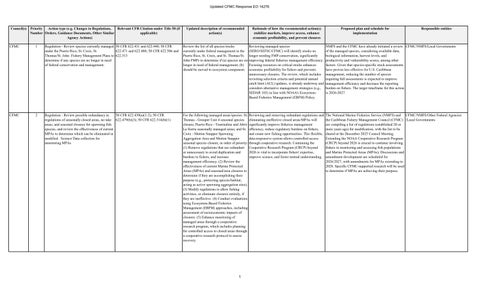
Review the list of all species/stocks Reviewing managed species NMFS and the CFMC have already initiated a review CFMC/NMFS/Local Governments currently under federal management in the (SERO/SEFSC/CFMC) will identify stocks no of the managed species, considering available data, Puerto Rico, St. Croix, and St. Thomas/St. longer needing FMP conservation, significantly biological information, harvest levels, and John FMPs to determine if (a) species are no improving federal fisheries management efficiency. productivity and vulnerability scores, among other longer in need of federal management, (b) Focusing resources on critical stocks enhances factors. Given that species-specific stock assessments should be moved to ecosystem component. economic profitability for fishers and prevents have proven less effective for U.S. Caribbean unnecessary closures. The review, which includes management, reducing the number of species requiring full assessments is expected to improve revisiting selection criteria and potential annual catch limit (ACL) updates, is already underway and management efficiency and decrease the reporting considers alternative management strategies (e.g., burden on fishers. The target timeframe for this action is 2026-2027. SEDAR 103) in line with NOAA's EcosystemBased Fisheries Management (EBFM) Policy.
CFMC
2
Regulation - Review possible redundancy in 50 CFR 622.439(a)(1-2); 50 CFR regulations of seasonally closed areas, no take 622.479(b)(3); 50 CFR 622.514(b)(1) areas, and seasonal closures for spawning fish species, and review the effectiveness of current MPAs to determine which can be eliminated or modified. Science Data collection for monitoring MPAs
For the following managed areas/species: St. Reviewing and removing redundant regulations and The National Marine Fisheries Service (NMFS) and CFMC/NMFS/Other Federal Agencies Thomas - Grouper Unit 4 seasonal species eliminating ineffective closed areas/MPAs will the Caribbean Fishery Management Council (CFMC) /Local Governments closure; Puerto Rico - Tourmaline and Abrir significantly improve fisheries management are compiling a list of regulations (established 20 or La Sierra seasonally managed areas; and St. efficiency, reduce regulatory burdens on fishers, more years ago) for modification, with the list to be Croix - Mutton Snapper Spawning and create new fishing opportunities. This flexible, shared at the December 2025 Council Meeting. Aggregation Area and Mutton Snapper data-responsive system allows controlled access Extending the NOAA Cooperative Research Program seasonal species closure, in order of priority: through cooperative research. Continuing the (CRCP) beyond 2026 is crucial to continue involving (1) Remove regulations that are redundant Cooperative Research Program (CRCP) beyond fishers in monitoring and assessing fish populations and Marine Protected Areas (MPAs). Discussions and or unnecessary to avoid duplication and 2026 is vital to incorporate fishers' expertise, burdens to fishers, and increase improve science, and foster mutual understanding. amendment development are scheduled for 2026/2027, with amendments for MPAs extending to management efficiency. (2) Review the 2028. Specific CFMC-supported research will be used effectiveness of current Marine Protected to determine if MPAs are achieving their purpose. Areas (MPAs) and seasonal/area closures to determine if they are accomplishing their purpose (e.g., protecting species/habitat, acting as active spawning aggregation sites). (3) Modify regulations to allow fishing activities, or eliminate closures entirely, if they are ineffective. (4) Conduct evaluations using Ecosystem-Based Fisheries Management (EBFM) approaches, including assessment of socioeconomic impacts of closures. (5) Enhance monitoring of managed areas through a cooperative research program, which includes planning for controlled access to closed areas through a cooperative research protocol to assess recovery.
1
Updated CFMC Response EO 14276
Council(s)
Priority Action type (e.g. Changes to Regulations, Relevant CFR Citation under Title 50 (if Number Orders, Guidance Documents, Other Similar applicable) Agency Actions)
Updated description of recommended action(s)
Rationale of how the recommended action(s) stabilize markets, improve access, enhance economic profitability, and prevent closures
Proposed plan and schedule for implementation
Responsible entities
CFMC
3
Regulation - Revision of Compatible and Non- 50 CFR 622 Subparts S, T, U compatible Regulations Between Federal and State Governments
Review list of current federal regulations The review strategy will examine the rationale for Discussions on regulatory compatibility have already CFMC/NMFS/PRDNER/USVIDPNR; and determine the feasability of (1) started at the request of commercial fishers. current regulations to identify those that could be Local Governments. Conducting a management evaluation revised. It aims to improve management, increase Additional discussions could be scheduled during the strategy (MSE) to remove unnecessary December 2025 and Spring and Summer 2026 regulatory compliance, and enhance economic regulations; and (2) establishing compatible profitability by opening up fisheries previously Council meetings. A Management Strategy regulations in federal waters as applicable. regulated or prohibited. Establishing a coherent and Evaluation (MSE) review is dependent on the consistent set of regulations, and removing One set of regulations for commonly availability of funds and staff. unnecessary ones, will ultimately benefit all fishers. managed species.
CFMC
4
Regulation - Consider alternative approaches for Annual Catch Limits
(1) Consider allowing a portion of the This action increases flexibility for managers and Proposed plan: (1) As the list of federally-managed CFMC/NMFS stocks are being evaluated (see regulations priority unharvested ACL be added to the next year's provides economic benefits to fishers through catch limit for that particular stock (carry #1), start discussions at Council meeting to determine increased harvest opportunities and reduced over). (2) Evaluate the use of alternative community disruptions. Deregulation, particularly for the remaining stocks 1) if ACLs should be revised, methods for setting reference points for data- if overregulation is preventing the harvest of 2) if alternate methods for data-limited stocks limited stocks in the U.S. Caribbean developed through the SEDAR 103 (scheduled for Annual Catch Limits (ACLs), would enhance fisheries (e.g., ecosystem reference point) 2026-2027) are available for use, and 3) if carry-over profitability and allow for carry-over to decrease ACLs are appropriate. Note - thru the SEDAR 103 closures due to overages. Additionally, alternate management methods for data-limited fisheries in process, the SEFSC is working with the local the U.S. Caribbean will help address challenges and government staff to complete a quality result in stable markets and ecosystems. assessment/quality control (QA/QC) of all U.S. Caribbean commercial and recreational data available for the managed species.
CFMC
5
Regulation - Revise accountability measures for 50 CFR 622.440(b); 50 CFR 622.480(b); 50 Pelagic stocks are new to management in managed pelagic stocks CFR 622.515(b) the US Caribbean. The AM for pelagic stocks in all three FMPs need to be revised to determine corrective action(s) to take when the annual catch limit is exceeded.
CFMC
6
Regulation - Revise the accountability measure 50 CFR 622.440(c) for the Caribbean Spiny Lobster in Puerto Rico. Science/Data collection: survey that samples individuals larger than those being caught in the fisheries to confirm there are large individuals in the population (SSC and Fishers' reccommendation).
The Puerto Rico spiny lobster AM needs to The recommended action would try to better be revised in response to a series of ACL understand how environmental and economic overages. conditions impact landings and determine a more appropriate response (AM) to ensure sustainability of the fishery.
After the evaluation of stocks action (see regulations priority #1), the Council will develop an amendment to the Puerto Rico FMP to modify the spiny lobster AM. Target date is 2028.
CFMC
1
Other similar agency action - Reestablish the collection of recreational data in the US Caribbean (Science/Data collection)
Restablish recreational fishing data collection efforts in the U.S. Caribbean. The MRFSS/MRIP program was halted in 2017 and has not resumed to date.
Effectively implement the Marine Resource NMFS/Local Governments/CFMC Information Program (MRIP) in the US Caribbean (PR and USVI). USVI just implemented a recreational fishing license and reporting (2025).
50 CFR 622.440; 50 CFR 622.480; 50 CFR 622.515
2
The recommended action would consider the After the evaluation of stocks action (see regulations NMFS/CFMC regional seasonality and availability of pelagic priority #1), the Council will develop an amendment to the FMPs to modify the pelagic AMs. Target date is stocks and its influence over markets. This is 2028. expected to improve social and economic opportunities while complying with required mandates (MSA). Understanding seasonal markets and harvest regimes will enhance economic activity by preventing continuous overages.
Local state recreational fishing licenses will assist data collection efforts in the region. If these licenses and data are certified for federal use, it could be used in stock assessments and in ACL monitoring efforts, enhancing management in the US Caribbean.
NMFS/CFMC
Updated CFMC Response EO 14276
Council(s)
Priority Action type (e.g. Changes to Regulations, Relevant CFR Citation under Title 50 (if Number Orders, Guidance Documents, Other Similar applicable) Agency Actions)
CFMC
2
Other similar agency action - Assess commercial and recreational fishing data to determine fishing effort in the U.S. Caribbean. Develop methodology to determine fishing effort by gear type as needed. (Science/Data collection)
CFMC
3
Other similar agency action - Prioritize socioeconomic data needs for decision-making in the U.S. Caribbean fisheries (Science/Data Collection)
CFMC
4
Other similar agency action - Conduct queen conch population assessment in the U.S. Caribbean (Science/Data collection)
CFMC
5
Other similar agency action - Enforce import regulations for spiny lobster and queen conch
Other Agencies
Guidance document - Develop implementation guidelines and policies that would help domestic spiny lobster and queen conch products compete against imports.
Updated description of recommended action(s)
Rationale of how the recommended action(s) stabilize markets, improve access, enhance economic profitability, and prevent closures
Work with local agencies to update the Enhancing the understanding of fishing effort is mechanisms (e.g., commercial catch crucial for better management of Caribbean reports) to acquire effort data from the fisheries, as this remains a persistent data gap in commercial and recreational sectors. This stock assessments. information would improve data inputs/models used in Caribbean stock assessments and the evaluation of actions (e.g., managment measures) in FMP amendments Explore the factors that currently prevent Use a systematic approach to guide the the integration or use of socio-economic consideration of socio-economic factors in stock data for management decisions in the assessment and fisheries management. Enhance region, including: (1) Insufficient frequency fisheries management in the US Caribbean via the and resolution of socio-economic data, often incorporation of these primary indicators of the with disparate timeframes; (2) Insufficient status of the markets. involvement of social scientists in the stock assessment, review, and management advice process; (3) Poor buy-in and lack of trust from stakeholders, which impedes the integration of Local Ecological Knowledge (LEK)
Spiny lobster regulations - 50 CFR 622.409; 50 CFR 622.446; 50 CFR 622.486; 50 CFR 622.521; Queen conch regulations - 50 CFR 622.481(e)
Proposed plan and schedule for implementation
Responsible entities
These efforts are underway at the SEFSC (SEDAR 91 NMFS/Local Governments/CFMC Puerto Rico spiny lobster and SEDAR 103 Application of Alternate Assessment Methods), but there is a need for dedicated staff to improve data collection for the benefit of the industry and the scientific understanding of the U.S. Caribbean fisheries. Implementation TBD as funding becomes available. Further ongoing efforts to include socie-economic NMFS (Caribbean Strategic Planningdata into data-limited stock assessments. SEDAR 103 SEFSC)/NMFS U.S. Caribbean Application of Alternate Assessment Methods -October 2025-2027.
Evaluate the population status of the queen conch stock(s) in the U.S. Caribbean to determine if a new rebuilding plan is needed. The assessment would allow the Council to reconsider the current management regime (e.g., harvest prohibitions, area, and seasonal closures). Extend the assessment to closed areas managed by other jurisdictions/agencies, such as the monuments in St. Croix, USVI, and facilitate collaboration with these entities.
An assessment provides the scientific foundation to NMFS SEFSC will continue queen conch research in CFMC/NMFS/Local Governments/DOI prevent overfishing and potentially lessen harvest the U.S. Caribbean. This includes encouraging fishers (VI Coral Reef National Monuments; restrictions, which stabilizes markets and ensures a and academics to apply for Cooperative Research Buck Island Reef National Monument) stable supply of queen conch. Using advanced and Program (CRP) grants for advanced technology surveys in the EEZ, with compensation for fishers' remote technology, combined with AI and fisher work. If a seasonal closure is re-enacted in the EEZ, a training, will improve the population assessment, enhance the understanding of conch dynamics, and ban on imports during the closure could be an contribute to a database of environmental impacts. additional measure. The target date is dependent on Fisher involvement can also enhance profitability funding availability. and help decrease illegal markets.
Continue monitoring imports and enforcing regulations such as minimum size, meat, and tail weight regulations. Consider a ban on imports during Annual Catch Limit (ACL) overage closures. Develop and implement policies that would help domestic spiny lobster and queen conch products compete against imports.
Illegal imports are detrimental to the domestic Enforcement action NMFS industry, often fetching a lower price per pound. To help maintain the price of local lobster, a temporary ban on imports could be considered during domestic closures. Illegal imports are detrimental to the domestic Coordinate with the appropriate agencies to prohibit Other Agencies industry, often fetching a lower price per pound. To the sale of queen conch and other seafood during local help maintain the price of local lobster, a temporary and federal seasonal closures. Additionally, increase ban on imports could be considered during the advertisement of species closures and enhance the marketing of queen conch and other fish during the domestic closures. open seasons.
3