CARIBBEAN
Figure 8.4. Reported distribution of potential habitat-forming corals (larger gorgonians, etc.). References include CITES 2007 and those listed in Appendix 8.1.
Figure 8.5. Distribution of deep water features and corals found in the U.S. Caribbean and adjacent area. References include EarthRef.org 2007 and those listed in Appendix 8.1.
Gulf Stream system. However, it occurs more as an eddy field along the Bahamas Archipelago rather than as a constant flow (Gunn and Watt 1982).
IV. STRUCTURE AND HABITAT-FORMING DEEP CORALS
A wide variety of deep-sea corals occur within the wider Caribbean region. These include stony corals, gorgonians, soft corals, stylasterids, black corals, lithotelestid coral and sea pens. The knowledge about the distribution of these corals is generally considered poor, greater for some groups than others. Cairns (1979) notes, with regard to deep-sea stony corals, that the southern coasts of the Greater Antilles (Cuba and Hispaniola) and Costa Rica are not well sampled and that the Straits of Florida (including the northwest coast of Cuba) and the Lesser Antilles are well sampled. Many species of deep-sea corals occur within the U.S. Caribbean. Species with an Antillian distribution (occurring within the Greater and Lesser Antilles) may also occur in U.S. Caribbean waters.
Deep-sea corals of interest to this chapter, are those termed “structure-forming” and “potential habitat-forming”. Structure-forming corals are associated with deep-sea coral habitat such as coral banks, bioherms and lithoherms. Both structure and non-structure forming corals occur within the study area (Figures 8.3, 8.4 and 8.5). Bayer (1961) describes the importance of octocorals (gorgonians and soft corals) in the reef building process and framework of shallow reefs. The importance of octocorals in deep water reefs is not yet understood but may be great in terms of contribution to framework and baffling of marine sediment, larger octocorals are expected to contribute and baffle more than smaller species. Appendix 8.1 details the attributes of each coral species including distribution.
a. Stony corals (Class Anthozoa, Order Scleractinia)
Ninety-nine species of azooxanthellate hard corals are reported from the study area in depths below 100 m. Most are small single polyp species, shaped like cups, which often occur solitarily (e.g. Figure 8.6). Solitary corals are not reported to form significant structures. Nine species of structure-
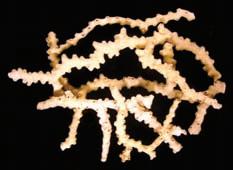
building and branched azooxanthellate hard corals are reported from the study area: Dendrophyllia alternata, Desmophyllum dianthus (also known as Desmophyllum cristagalli), Enallopsammia profunda, Enallopsammia rostrata, Lophelia pertusa, Madracis myriaster, Madrepora oculata, Madrepora carolina and Solenosmilia variabilis (Cairns pers. comm.). Table 8.1 and Figures 8.7
- 8.10 and 8.15 describe and illustrate structurebuilding corals.
Six species of azooxanthellate hard corals are regarded as the major structure-forming species: E. profunda, E. rostrata, L. pertusa, M. carolina, M. oculata and S. variabilis. Two genera (Lophelia and Solenosmilia) constitute two of
Table 8.1. Structure-forming deep water stony corals of the wider Caribbean region. The measurements given in brackets correspond to the approximate horizontal length for each specimen illustrated.
Species Description
Dendrophyllia alternata
D. alternata occurs throughout the North Atlantic. This coral forms bushy colonies up to 1 m in height and has been described as a reef builder. It occurs at depths of 279 - 900 m in the tropical western Atlantic. Regionally, it has been recorded with M. oculata and M. myriaster (Cairns 1979; Cairns and Stanley 1982; Le Goff-Vitry 2003). [30 cm, specimen recovered at 290.8 m off Curacao]
Desmophyllum dianthus
Enallopsammia profunda
D. dianthus (also known as D. cristagalli) forms densely branched colonies is reported to contribute to reef formation. It occurs globally to 2,460 m and in the tropical western Atlantic from 155 - 1,939 m. Regionally, it has been recorded with E. profunda, L. pertusa, M. oculata, and S. variabilis (Cairns 1979; Cairns and Stanley 1982; Rogers 1999). [10.8 cm, specimen recovered at 597 m off the east coast of Florida]
E. profunda occurs globally and is endemic to the western Atlantic. It forms massive bushy colonies, up to 1 m thick, and is regarded a major structure-forming species. It occurs from 403 - 1,748 m and is often associated with L. pertusa, M. oculata and S. variabilis (Cairns 1979; Cairns and Stanley 1982; Rogers 1999; Reed 2002; Freiwald et al. 2004). [30.7 cm, specimen recovered at 801 m in the Straits of Florida off Cuba]
Enallopsammia rostrata
Lophelia pertusa
E. rostrata occurs in the U.S. Caribbean and globally. This coral forms massive bushy colonies and is regarded a major structure-forming species. It occurs from 300 - 1,646 m in the tropical western Atlantic. It is associated with L. pertusa on deep-water reefs in the north Atlantic and has been recorded with S. variabilis, M. oculata, and E. profunda in the wider Caribbean (Cairns 1979; Rogers 1999; Reed 2002; Freiwald et al. 2004). [31.4 cm, specimen recovered at 1,097 m off Bermuda. Specimen includes L. pertusa and D. dianthus]
L. pertusa occurs in the U.S. Caribbean, globally, and is well known from the north Atlantic. This coral forms bushy colonies up to a meter in height and is regarded the most common reef-building deep/cold-water coal. It has been reported from waters as shallow as 25 m to as deep as 3,383 m. Regionally, it is most common between 500 - 800 m. L. pertusa is often found associated with E. profunda and has been recorded with D. dianthus, M. carolina, M. oculata, and S. variabilis in the wider Caribbean (Cairns 1979; Cairns and Stanley 1982; Rogers 1999; Dawson 2002; Reed 2002; Freiwald et al. 2004). [24.3 cm, specimen recovered at 793 m in the Straits of Florida off Cuba]
Illustration
Species Description
Madracis myriaster
Madrepora carolina
M. myriaster occurs in the U.S. Caribbean and throughout the wider Caribbean. It forms bushy colonies and is reported as a main framework builder of deep-water coral banks in Colombian waters. Regionally, it has been recorded with M. carolina. It occurs from 37 - 1220 m in the tropical western Atlantic (Cairns 1979; Reyes et al. 2005; Santodomingo et al. 2006). [30.2 cm, specimen recovered at 200 m off Jamaica]
M. carolina occurs in the U.S. Caribbean and throughout the tropical western Atlantic. This coral forms bush-like colonies with a thick base and isassociatedwithcold-waterreefs associated with cold-water reefs as a structure-forming species.Itoccursfrom53-801m . It occurs from 53 - 801 m (most commonly between 200 - 300 m). Regionally, it has been recorded with E. profunda, E. rostrata, and D. dianthus (Cairns 1979; Dawson 2002; Freiwald et al. 2004). [27.6 cm, specimen recovered at 333 - 375 m in the northwest Providence Channel off Grand Bahama Island]
Madrepora oculata
Solenosmilia variabilis
M. oculata occurs in the U.S. Caribbean and globally. This coral forms large bushy colonies and is regarded a major structure-forming species. It occurs from 55 - 1,950 m. It is commonly associated with L. pertusa in the eastern and northeastern Atlantic and Mediterranean Sea. Regionally, it has been recorded to occur with E. profunda, E. rostrata, D dianthus, L. pertusa, and S. variabilis (Cairns 1979; Rogers 1999; Dawson 2002; Reed 2002; Freiwald et al. 2004) [24.1 cm, specimen recovered at 634 m in the Gulf of Mexico]
S. variabilis occurs globally. This coral forms bushy colonies and is regarded a major structure-forming species. It occurs from 220 - 2,165 m and is known from the northern slope of the Little Bahama Bank from 1,000 - 1,300 m, where it is associated with deep-water banks. It is often found associated with L. pertusa, Madrepora spp., and E. profunda, and has been recorded with E. rostrata and D. dianthus in the wider Caribbean (Cairns 1979; Mullins et al. 1981; Cairns and Stanley 1982; Rogers 1999; Freiwald et al. 2004). [20.7 cm, specimen recovered at 1,000 m in the North Atlantic Ocean]
llustration
Figure 8.6. Assorted solitary deep water stony corals: a) Stephanocyathus diadema, from The Bahamas at 1,779 m; b) S. laevifundus, from St. Vincent at 576-842 m; c) Caryophyllia ambrosia caribbeana, from Surinam at 1,318-1,343 m; d) Deltocyathus eccentricus, from Jamaica at 457-558 m; e) Bathypsammia tintinnabulum, from the Straits of Florida at 689-699 m (B. tintinnabulum is not known from the region but is presented here for comparison).
8.7. Deep sea coral habitat (M. oculata and Paramuricea sp.) at 2,230 m in the Bahamas (Straits of Florida off Cat Cay). Photo credit: Reed 2006.
Figure 8.8. Structure-forming coral (E. profunda) providing habitat for unidentified crustaceans and a crinoid. Photographed from submersible at 2,721 m in Straits of Florida. Photo credit: Reed 2006
the four major constituents of known world-wide deep-water coral banks at depths of 400 - 700 m (Cairns and Stanley 1982). Both M. oculata and M. carolina are regarded as minor constituents of coral banks in the Straits of Florida (Cairns 1979).
Solenosmilia is the dominant structure-building coral found on deep coral banks north of the Little Bahama Bank (Reed 2002) (Table 8.2, Mullins Reefs), where Madrepora and Enallopsammia also occur. Lophelia and Enallopsammia are common components of the lithoherms east of the Little Bahama Bank in the Straits of Florida (Reed 2002) (Table 8.2, Bahamas Lithoherms). Four major structure-forming species E. rostrata, L. pertusa, M. oculata and M. carolina have been
Figure 8.9. Close up of the potential structureforming coral D. alternata, sampled by submersible, from the Netherlands Antilles, at 290.8 m.
reported from the U.S. Caribbean.
Another major structure-forming species, Oculina varicosa, occurs throughout the Caribbean. O. varicosa is a facultative zooxanthellate species (i.e. it occurs with zooxanthellate in shallow water and without in deeper water). O. varicosa is reported to 152 m and forms bushy colonies several meters in height (commonly at 45 - 91 m). It is described as a main framework builder of deep-water banks off Florida’s central eastern coast. However, as no deep water banks of O. varicosa have been reported from the wider Caribbean (only shallow water species) this species is not considered further.
Madracis myriaster, an azooxanthellate stony coral found throughout the wider Caribbean, is reported to form bushy shaped colonies and significantly contribute to habitat formation on
Figure 8.10. Close up of the major structure-forming coral M. oculata, sampled by submersible from the Straits of Florida at 746.4 m. Photo credit: Reed 2006.
Figure
Figure 8.11. Large deep-sea black coral (Leiopathes glaberrima) recovered from 304 m in the North Atlantic (approximately 116 cm in height).
Figure 8.13
Bubblegum coral (Paragorgia johnsoni) sampled by submersible from 620 m west of the Little Bahama Bank in the area of Bahamas Lithoherms (approximately 51 cm in height). Photo credit: Amy Wolfrum.
Figure 8.12. Large deep water gorgonian (Paracalyptrophora sp.) and deep water sponge (Pachastrellidae sp.). Photographed from submersible at 2,193 m in The Bahamas (Straits of Florida) (gorgonian is approximately 53.5 cm in height). Photo credit: Reed 2006.
Figure 8.15
Bamboo coral (Keratoisis flexibilis) on deck and utilizing a deep water structure-forming coral (E. profunda) as substrate (bamboo coral is approximately 34 cm in height). Coral recovered from 806.5 m by submersible. Photo credit: Reed 2006.
Figure 8.14. Large deep water gorgonian (Paramuricea sp.) providing habitat for an unidentified crustacean. Photographed from submersible at 2631 m in The Bahamas (Straits of Florida off Cat Cay) (gorgonian is approximately 33 cm in width). Photo credit: Reed 2006.
reef formation” (Cairns and Stanley 1982). D. alternata and D. dianthus are detailed in Table 8.2.
The distribution of major and potential structureforming species in the study area generally follows the Antillian arc and the margins of the continental shelves of South and Central America (Figure 8.3).
b. Black corals (Class Anthozoa, Order Antipatharia, Families Cladopathidae and Schizopathidae)
Approximately thirty-two species of antipatharia are reported from the wider Caribbean in depths below 100 m, with thirteen considered potentially important habitat-forming species. Eight species are reported from the U.S. Caribbean, with five considered potentially important habitat-forming species: Antipathes americana, A. caribbeana, Plumapathes pennacea, Tanacetipathes hirta, Parantipathes tetrasticha. Opresko and Sanchez (2005) list two regional black coral species of commercial importance: A. atlantica and A. gracilis. Both species are considered potentially habitat-forming. The maximum reported height of deep water antipatharians occurring in U.S. Caribbean waters is 61 cm (P. tetrasticha). Figure 8.11 illustrates a large deep-sea black coral.
c. Gold corals (Class Anthozoa, Order Zoanthidea)
One species of gold coral is reported from the Caribbean region. Messing et al. (1990) describe a large zoanthidean tentatively identified as Gerardia sp. in Bahamian waters. This species
is considered habitat-forming as colonies 1 m tall and 1.5 m across were reported. Gerardia sp. was found in dense stands on lithoherm crests, where current flow was the greatest.
d. Gorgonians (Class Anthozoa, Order Gorgonacea)
Approximately one hundred and forty-seven species of gorgonians are reported from the wider Caribbean at depths below 100 m. Thirteen species are reported from the U.S. Caribbean (more are expected). Forty-four species are considered potential habitat-forming species, with twelve occurring in U.S. Caribbean waters: Acanthogorgia goesi, Callogorgia americana Americana, Diodogorgia nodulifera, Ellisella barbadensis, E. elongata, Narella bellissima, N. pauciflora, N. deichmannae, N. obesa, N. guadelupensis, Riisea paniculata and Swiftia exserta The maximum reported height of a wider Caribbean deep water gorgonian is 300 cm (Pseudoplexaura porosa), and 244 cm for U.S. Caribbean waters (E. barbadensis). Two species of red or pink corals (family Coralliidae); 13 species of bamboo coral (family Isididae); one species of bubblegum coral (family Paragorgiidae); and 34 species of red tree coral (family Primnoidae) are known from the region. Detailed distribution data (beyond occurring in the western Atlantic) was available for only 54% (82) of known deep water gorgonians. Height and/or width data was available for 34% (50) of known deep water gorgonians. It is expected that many more gorgonians are potential habitat-forming species. Figures 8.12 - 8.16 and 8.17 illustrate deep-sea gorgonians.

Figure 8.16 Large deep water gorgonian Nicella americana, collected from 165 m off the Dominican Republic (approximately 53 cm in width).
Figure 8.17. Deep water coral habitat at 829.4 m in The Bahamas (Straits of Florida). A variety of deepsea corals are illustrated, including the soft corals Anthomastus agassizi (red in color) and Pseudodrifa nigra (brown in color). Photo credit: Reed (2006).
Figure 8.18. Sea pens (Renilla reniformis), from Curacao, Netherlands Antilles (each approximately 2 cm in width). This species occurs to 108 m or more.
e. True soft corals (Class Anthozoa, Order Alcyonacea and Suborder Stolonifera)
Twenty species of true soft corals (Alcyonacea) are reported from the wider Caribbean in depths below 100 m. Only one is considered a potentially important habitat-forming species; Neospongodes portoricensis, with a maximum reported height of 30 cm. Only one is reported from the U.S. Caribbean: Stereotelesto corallina
Detailed distribution data was available for 35% (7) of known deep water alcyonaceans. Figure 8.17 illustrates a deep-sea soft coral.
f. Pennatulaceans (Class Anthozoa, Order Pennatulacea)
Pennatulaceans, or sea pens, live in softsediment and are known to form extensive groves in some areas (Morgan et al. 2006). Eight deep-water sea pens are reported from the wider Caribbean. One species is reported from the U.S.
Figure 8.20. Deep-sea stylasterid (Stylaster miniatus) providing substrate for a solitary deep water stony coral (Paracyathus pulchellus) and other unidentified invertebrates, the Straits of Florida, at 191 m (stylasterid is approximately 10 cm in width).
Caribbean: Renilla reniformis, with a maximum reported height of 6.5 cm it is not considered an important habitat-forming species (illustrated in Figure 8.18). It is bioluminescent. The maximum reported height of a deep water pennatulacean occurring in the wider Caribbean is 210 cm, for Funiculina quadrangularis. According to Picton and Howsen (2002) F. quadrangularis is often found in very large colonies. This order contains the deepest deep-sea corals, many occur below 1,000 m, with one species (Umbellula magniflora) reported from 6,300 m in the Caribbean Sea basin. Most deep water sea pens are found on basin floors, rises and trenches throughout the Caribbean region including the Caribbean Sea basin, Aves Ridge and Puerto Rico and Cayman Trenches. Height and width data were available for 25% (2) of known deep water sea pens.
g. Stylasterids (Class Hydrozoa, Order Anthoathecatae, family Stylasteridae)
Forty-one species of stylasterids are reported from the wider Caribbean at depths below 100 m. Only one is regarded as a potential habitatforming species; Distichopora sulcata (Figure 8.19), with a maximum reported height of 25 cm and width of 30 cm, endemic to the waters off northwest Cuba. However, additional larger stylasterids are likely - during a submersible dive James and Ginsburg (1979) recorded a larger unidentified stylasterid measuring “about 30 cm across” growing out from a rock wall at 290 m off Belize Glovers Reef). Fifteen smaller (non habitat-forming) species (<25 cm in height or
Figure 8.19. Large deep water stylasterid (Distichopora sulcata) dredged off Havana, Cuba (approximately 33 cm in width).
width) occur in U.S. Caribbean waters. All wider Caribbean stylasterids are referenced by Cairns (1986).
Puerto Rican waters contain two stylasterid species: S. atlanticus and S. spatula. Stylasterids have been recorded with many other species of deep water corals and can serve as substrate allowing invertebrates to gain a foothold (Figure 8.20).
Deep Coral Habitat Types
Deep Coral Mounds
A variety of terms have been used for the unconsolidated sea floor elevations with which deep-sea corals occur. In general these structures are described as “capping mounds of unconsolidated sediment and coral rubble, which are often built on an underlying lithified substrate”
Deep sea corals often occur as individual and/ or scattered colonies on the sea floor (Cairns 1979, 2000). More numerous colonies can form clumps or thickets of varying density (Mullins et al. 1981; Messing et al. 1990) (Figures 8.7, 8.8 and 8.10). These bush-like aggregations can form habitat on suitable substrate and contribute to the formation of deep sea bio-buildups through their skeletal debris and by trapping pelagic sediment. Two types of deep-sea biobuildups are reported from the wider Caribbean region (deep coral mounds and lithoherms); their morphologies and compositions, and deep-sea coral banks are discussed below. Seamounts are also discussed.

Figure 8.21. Idealized regional deep coral mound (not to scale). Associated benthos as follows: 1) Etmopterus sp. (dogfish sharks); 2) pteropods; 3) Brotulid sp. (fangtooths); 4) Diretmus sp. (dorys); 5) Myctophid sp. (lanternfish); 6) Macrouid sp. (grenadiers); 7) Stomias sp. (dragonfish); 8) Hexactinelida sp.; 9) Cirripathes sp.; 10) S. varibilis; 11) M. oculata; 12) Galatheid sp. (deep-sea crabs); 13) crinoids; 14) gorgonians; 15) Iridogorgia sp.; 16) Antipathes sp.; 17) Macruan sp.; 18) Keratoisis sp.; 19) Munida sp. (squat-lobsters); 20) Stylasteria sp.; 21) Nematocarcinidae sp. (deep-sea shrimp); 22) Glyphocrangon sp.; 23) solitary corals; 24) Chrysogorgia sp.; 25) Synaphobranchus sp.; 26) Lithodid sp.; 27) Nymphaster sp.; 28) porifera; 29) Alcyonaria sp.; 30) Nephropsis rosea; 31) Holothurian sp. 32) Ophiuroid sp.; 33) Turrida sp.; 34) Cruriraja sp. (skates). Sources listed in Appendix 8.2.

Figure 8.22. Hypothetical development sequence of deep coral mounds (not to scale). Figure adapted from Mullins et al. 1981, based in part on Squires 1964 and Neumann et al. 1977.
(Reed 2002). These structures have been called deep-water coral banks; deep-sea coral mounds; colony thickets; coral thickets; coral structures, deep-water coral reefs; and bioherms (Stetson et al. 1962; Squires 1964; Neumann et al. 1977; Mullins et al. 1981; Reed 2002). The accepted geological term for mounds rich in unbound skeletal debris is biostrome (Bates and Jackson 1987). In what follows we use “deep coral mounds” for this type of buildup.
In the study region these deep coral mounds occur in areas with strong currents and/or upwelling where they accrete by a combination of coral skeletal debris and trapped suspended sediment swept into coral structures (Mullins et al. 1981). The resulting structures range in height over the surrounding sea floor from a few meters to 50 m (Reed 2002).
The most extensive known occurrence of deep coral mounds reported in the Caribbean is found on the northern slope of Little Bahama Bank at depths between 1,000 to 1,300 m (Mullins et al. 1981). Here, where bottom currents were reported to be as much as 50 cm/sec and temperatures of 4-6o C, numerous banks are inferred to occur in an area of 2,500 km2 with relief over the surrounding sea floor ranging from 5-40 m (ibid). The surface sediments of these mounds consist predominantly of pelagic organisms such as planktonic foraminifera and pteropods, with small amounts of coral skeletal debris and other invertebrates in the coarser grain sizes (ibid). These mounds appear to be developed by the baffling action of the thickets of deep corals that traps pelagic sediments and build on unconsolidated mounds. Other coelenterates found on these mounds include gorgonians, alcyonaceans and antipatharians (Figure 8.21). Mullins et al. (ibid) present a useful schematic model of the sequential development of these mounds (Figure 8.22) based on previous publications (Squires 1964; Neumann et al. 1977). Figure 8.3 illustrates the distribution of deep coral mounds. Table 8.2 details these occurrences.
Lithoherms
In contrast to the unconsolidated deep coral mounds, lithoherms (Neumann et al. 1977; Messing et al. 1990; Reed 2002) are composed of varied communities of benthic organisms growing on successive crust-like layers of friable limestone. Lithoherms have also been referred
Figure 8.23. Idealized lithoherm of the Straits of Florida (not to scale). Figure adapted from Messing et al. 1990.
to as bioherms, deep-water biohermal buildups and muddy carbonate buildups (Neumann et al. 1977; Reed 2002). Regionally, they are reported only from the eastern side of the Straits of Florida at depths between 500 and 700 m below sea level. According to Messing et al. (1990) the lithoherms are elongate mounds up to 300 m long and 50 m high. Their surfaces show successive friable limestone layers composed of fine-grained carbonate skeletal sediment with variable amounts of coral debris. The cement of the crust-like layers of lithoherms is composed of magnesium calcite with 10-14 mole % magnesium (Wilbur and Neumann 1993).
Messing et al. (1990) describe and illustrate (Figure 8.23) a distinct, tripartite biozonation of one of these lithoherms, which they ascribe to variations in current velocity produced by the mounds, also described by Genin et al. (1986). On the steeper margin or side facing into the current (upcurrent margin) where velocities may reach 100 cm/ sec, corals (L. pertusa) predominate (“corals” in Figure 8.23). A zone of zoanthids forms along the upcurrent crest (gold coral = “zoanthids” in Figure 8.23) and crinoids and alcyonarians occur behind this zone (“crinoids and alcyonarians” in Figure 8.23) and on the flanks of the lithoherms (Genin et al. 1986). Figure 8.3 illustrates the distribution of known lithoherms. Table 8.2 details these occurrences.
Deep-sea Coral Banks
Reyes et al. (2005) describes two azooxanthellate deep water coral habitats (banks) at depths greater than 100 m off Colombia’s Caribbean shelf. Substrate included hard bottom limestone (fossilized reef) and metamorphic rocks. It is unclear to what extent these corals are building upon themselves (i.e. as with bio-buildups) or simply opportunistically taking advantage of suitable substrate (limestone platform). Reyes et al. (ibid) suggested similarities with shallow water reefs and stated a need for further investigations. Figure 8.3 illustrates the distribution of known deep water coral banks. Table 8.2 details these occurrences.
Seamounts
Deep sea corals are known as intimate associates of seamounts throughout the world (Freiwald et al. 2004; Clark et al. 2007). EarthRef.org (2007) lists four seamounts occurring within the U.S. Caribbean waters: Grappler Seamount; Whiting
Seamount; Mona Seamount; and Dos Ni’os Knoll. Figure 8.5 illustrates their locations. The potential that seamounts throughout the region are home to deep water coral ecosystems deserves further attention.
Relevant Geological and Oceanographic Processes
Five processes play significant roles in the distribution and composition of bio-buildups: (1) foremost is amplification of current velocities by submarine topography; (2) the biological production of skeletal debris; (3) physical trapping and stabilization of sediment by thickets of corals, sponges and alcyonarians to build elevated accumulations; (3) availability of hard substrate for recruitment of corals; and (4) the submarine cementation that produces lithoherms. Process 3 is the most significant for deep water banks.
Increased current velocities appear essential for flourishing deep corals both because they can locally sweep away sediment to expose the hard substrate that encourages settlement of coral larvae and they provide a supply of plankton on which the corals feed. In addition, increased currents bring a continued supply of pelagic sediment to help build local relief (mounds and lithoherms).
Two kinds of submarine topography can accelerate current velocities. One, where water flow meets or is constricted between land masses, for example, the seaways or channels between islands of the Lesser Antilles or Windward Islands (Figure 8.2). The larger and deeper inter island spaces produce the major seaways; the more numerous, smaller and shallower ones produce similar but smaller increases in velocity. A second kind of topographic constriction occurs when water flow meets elevations of the sea floor, typically platforms or banks of calcareous deposits. The spaces between large and longlived platforms of the Bahamian Archipelago and the Florida Peninsula are sites of increased flow velocities between adjacent platforms. A smaller scale example of topographic constriction of currents is present in the series of shallow banks of calcareous deposits, which have developed on the Nicaragua rise and channel flow from the Caribbean Sea contributing to the initiation of the swift Yucatan Current. Localized sediment accumulation, either physical or as a result of
the La Parguera region along the southwestern coast of Puerto Rico.
Inspection of regional unpublished research reports and dredge station sorting sheets illuminate interesting possibilities for deep coral habitat. Selected citations from dredge reports (individual station records) and notes include the following:
For the U.S. Caribbean: in Navassa Island waters two major structure forming corals (M. oculata and E. rostrata) were recovered, at 1,200 m, along with solitary corals (Stephanocyathus laevifundus and of the families Deltocyathus and Desmophyllum), gorgonians (of the genus Acanella, Iridogorgia and Chrysogorigia) and deep water fish (Staiger and Voss 1970).
For waters adjacent to the U.S. Caribbean: in British Virgin Islands waters, at 205 - 380 m, one potential structure-forming coral species (M. myriaster) was recovered from the same location in a trawl net “festooned with stalked crinoids”. Deep water fish and crustaceans were also recovered (Staiger 1969); in Saba waters, in 512 m off the northern edge of the Saba Bank, a large deep water gorgonian (C. multiflora) was recovered along with deep water fishes (Anon. 1956); south of Hispaniola in 135-169 m, the potential structure forming coral species (M. myriaster) was recovered along with numerous sponges, gorgonians and other invertebrates in a net noted as “We had to use the crane to lift it aboard…. The catch was very good”. Deep water fish and crustaceans were also recovered. Similar “excellent” and “magnificent” catches were also noted from two nearby trawl sets that also recovered M. myriaster (Staiger and Voss 1970; Voss 1971).
For waters throughout the region: in Venezuelan waters with L. pertusa at 406 m - “it was the best 10 ft. otter trawl tow I have seen in six years. There was a greater variety of organisms and a greater number than we usually get in a 41 ft. otter trawl tow” (Anon 1968); in the Straits of Florida, in waters just off just off Havana, Cuba, where M. carolina, M. oculata, and M. myriaster have been recovered - “the “pentacrinus grounds” [crinoid grounds] discovered by the Blake off Havana are world famous” (Voss 1966b); and in the Straits of Florida just southeast of the area of lithoherms on the Little Bahama Bank) with L. pertusa, S. varibilis and E. profunda at 738 m - “Tremendous amount of coral in net. Needed crane to lift it aboard. Good catch of fish and invertebrates” (Anon. 1973). Though no direct information was found regarding the regional transport of deep coral
larvae, the cosmopolitan distribution of shallowwater benthos of coral reefs as well as many deep water coral species (including the major structure-forming corals) indicates long term connectivity throughout the basin.
VI. SPECIES ASSOCIATIONS WITH DEEP CORAL COMMUNITIES
Fauna of deep-sea bio-buildups are among the least studied of marine assemblages. For example, the identification of deep-sea gorgonians, collected in the Caribbean and the Bahamas in the early 1960’s, are, to date, being revised (e.g., Cairns 2007); deep-sea Gold corals collected on lithoherms in the Bahamas in the 1970’s still await full identification (Messing pers. comm.), and crustaceans collected in the 1880’s have long waited proper scientific descriptions (Larsen 1999).
Inspection of archival data and grey literature, including original station data sheets, cruise narratives and biological survey reports from 28 locations within the region identify a wide assortment of associated species occurring with the major structure-building deep-water corals; E. profunda, L. pertusa, M. carolina, M. oculata and S. varibilis (Appendix 8.2). Figure 8.21 illustrates several of these species in an idealized deep coral mound. Many of the reported associated species may grow to almost one meter in height (larger cnidarians and porifera).
Large deep sea sponges (phylum Porifera) are a potentially important megafauna component of deep sea coral habitats. Deep sea sponges have been recorded with structure-forming and potential habitat-forming corals (Appendix 8.2) and on deep water mounds, lithoherms and banks. It is unknown what habitat role they may play on deep water coral habitats. Colin (1978) reports that in some areas of shallow water reefs the biomass of sponges “can exceed that of any other group, including reef-building corals.” Lang et al. (1975) reported that sponges (sclerosponges) can act as primary framework builders of reefs at depths of 70-105 m off Jamaica. Of primary interest are the larger calcareous sponges (class Calcarea), deep water glass sponges (class Hexatinellida), demosponges (class Demospongiae) and sclerosponges (class Sclerospongiae). Deep-sea sponges have been recorded up to 122 cm wide
Measure of Impact
at deep-sea coral depths in the Straits of Florida. Figure 8.12 illustrates a deep-sea sponge. Deepsea sponges are subject of pharmacological investigations.
A number of fishes have been observed or collected in association with deep coral habitats. While most of these are demersal species (Appendix 8.2), certain commercially important pelagic species may also associate with deepsea coral habitat. Swordfish (Xiphias gladius) have been encountered by submersibles visiting deep sea corals (Lophelia) in the Straits of Florida (Nizinski and Ross 2002) and in Bahamian deep waters at 600 m (Harbison and Janssen 1987). Larger deep coral mounds and lithoherms may play similar roles to seamounts, which are thought to attract pelagic fish because of an “enhanced primary productivity due to particular oceanographic conditions supporting a rich ecosystem” (Allain et al. 2006). In effect, seamounts influence oceanic currents in a way that promotes plankton to develop, acting as a feeding source for resident fish, attracting larger pelagic predators. These pelagic species are thought to use the seamounts unique underwater features primarily for food but also potentially as spawning grounds and/or nursery areas.
VII. STRESSORS ON DEEP CORAL COMMUNITIES
Serious potential threats to deep water coral communities found in other U.S. waters are
not currently found in the U.S. Caribbean. No current examples were found of significant threats to deep water corals from the following: harvesting of precious coral, cable laying, oil and gas exploration, sedimentation, invasive species and destructive fishing practices (such as bottom trawling).
Fishing occurs to deep coral depths (>100 m) in the U.S. Caribbean and throughout the region. This activity is mainly focused on deep water snapper and grouper and includes commercial and recreational fishing effort. An extensive deep water fishery, primarily for snappers, occurs around Puerto Rico (Appeldoorn pers. comm.). Target species include black snapper (Lutjanus griseus), blackfin snapper (L. buccanella), vermilion snapper (Rhomboplites aurorubens) and silk snapper (L. vivanus) (FAO 1993; Kojis 2004; Cummings and Matos-Caraballo 2003).
Gear utilized in commercial deep water snapper and grouper fishing in the U.S. Caribbean includes vertical set line, bottom longline, handlines, electric or hydraulic reels and traps (Kojis 2004; Tobias 2004). Similar effort is reported throughout the region (FAO 1993). Figure 8.25 illustrates a typical commercial fishing vessel capable of fishing offshore for deepwater snapper and grouper in the U.S. Virgin Islands. The maximum reported depth for line fishing is 366 m (Swingle et al. 1970). The maximum reported depth for trap fishing is 183 m (Sheridan et al. 2006). During submersible observations, Nelson and Appeldoorn (1985) encountered ghost fishing
Current efforts to manage fisheries the Caribbean waters are exacerbated by a regional ‘lack of capacity’ in fisheries management (Haughton et al. 2004). Traditional management strategies (such as catch and release) may not work for deep-water species, as fish brought up from deep-sea coral depths expire en-route. Additionally, remoteness of location may play an important role with regard the management of deep-sea coral habitats. For example, the major structure forming corals M. oculata and E. rostrata have been found in the waters surrounding Navassa Island (Figure 8.5), an extremely remote uninhabited U.S. territory and illegal fishing activities are reported from Navassa’s waters (Miller 2003). However, the closest inhabited United States territory, Guantanamo Bay Naval Base (Cuba), is located approximately 170 km distant.
Throughout the region, future fishing activities pose a significant potential threat, as shallow water fisheries resources are depleted and commercial and recreational effort moves into deeper water (Prado and Drew 1999; FAO 2000; Koslow et al. 2000; Roberts 2002). Inspection of research station sorting sheets and current literature reveal numerous fish species associated with deep corals that belong to taxa currently harvested in other regions and may be harvested in the Caribbean in the future. Fishes include targeted and by-catch deep-sea species such as deep-sea codfish, rattails or grenadiers, hake, dory, sea robins, wreakfish (Polyprion americanus) and sharks (Merrett and Haedrich 1997; Carpenter 2002; Freiwald 2004; Gordon 2004) (locations of these sites are illustrated in Figure 8.3, species are listed in Appendix 8.2). Wreakfish (Sedberry et al. 1994) and dogfish sharks are currently harvested in U.S. continental waters. Wreckfish and have been observed on deep coral habitat (mounds and lithoherms) in the Straits of Florida (Messing et al. 1990). Dogfish sharks are reported on deep coral mounds and lithoherms (Nizinski and Ross 2002) and associated with occurrences of structure-forming corals throughout the region (Appendix 8.2).
No significant threat of deep water trawling was found for the wider Caribbean. However, deep water shrimp trawlers are currently exploring fishing beyond 70 m in depth off Colombia (Gracia pers. comm.) and Reyes et al. (2005) note the need to asses the impacts of trawl fishing on the deep water coral banks off Colombia.
Oil and gas exploration does currently occur in the to U.S. Caribbean. However, this activity occurs in the southeast Caribbean, notably off Trinidad and Tobago, and in Straits of Florida waters off northwest Cuba. It is unknown what effect these activities have on deep coral communities. It is also unknown to what extent regional underwater cables and lines affect deep coral communities.
The harvest of precious corals, red and black corals, is prohibited in the U.S. Caribbean and there are no reports of current harvest activities. However, black coral jewelry, reportedly manufactured from corals harvested in the Cayman Islands, is available for purchase in the U.S. Virgin islands (Greenberg and Greenberg 2006; Bernard K. Passman Gallery, St. Thomas, pers. comm.). Black coral sold in the U.S. Caribbean is reportedly harvested in the western Caribbean from coral beds located at depths of 61-122 m (200-400 ft) (Bernard K. Passman Gallery, St. Thomas, pers. comm.). Regional countries listed by the Convention on International Trade in Endangered Species of Wild Fauna and Flora (CITES) trade database as exporting black coral (Antipatharia spp.) since 2001 include the Bahamas, British Virgin Islands, Cayman Islands, Cuba, Colombia, Dominican Republic, Mexico, Panama, and Trinidad and Tobago (Figure 8.4, some locations may be transshipment points) (CITES 2007). The basil axis of black coral is used in the manufacture of jewelry (Opresko and Sanchez 2005).
VIII. CURRENT CONSERVATION AND MANAGEMENT ACTIVITIES
In the U.S. Caribbean deep-water corals and other marine resources are under the jurisdiction of territory (USVI: 0-3 nmi from shore), commonwealth (Puerto Rico: 0-12 nmi from shore) and federal management authorities (U.S. EEZ and the waters around Navassa Island). Fisheries in the U.S. EEZ around USVI and Puerto Rico are managed under fishery management plans developed by the Caribbean Fishery Management Council (CFMC), based in Puerto Rico. Deep sea coral language in the recently reauthorized Magnuson-Stevens Act includes an affirmation of the Council’s authority designate zones to protect deep sea corals from physical damage from fishing gear as part of their fishery management plans, without having to
prove that corals constitute essential fish habitat [as amended by the Magnuson-Stevens Fishery Conservation and Management Reauthorization Act (Public Law 109-479), see Chapter 1]. Navassa Island is managed by the U.S. Fish and Wildlife Service as a National Wildlife Refuge that includes a 12 mile radius of marine habitats around the island. Commonwealth and territorial management authorities include the Puerto Rico Department of Natural and Environmental Resources and the United States Virgin Islands Department of Planning and Natural Resources.
Current efforts to manage fisheries in Caribbean waters are focused on shallow-water coral reef areas and associated fisheries (conch, grouper, Caribbean spiny lobster, etc.) (Sala et al. 2001; Theile 2001; FAO 2003). However, the Territory of the U.S. Virgin Islands includes antipatharians (black corals) in its local Endangered Species Act (ESA), thus granting the authority to protect black corals (no matter the depth) within USVI territorial waters. Puerto Rico implements the Federal Endangered Species Act (Federal ESA) in local waters. However, currently, no deep coral species are listed under the Federal ESA. The Caribbean Council manages corals under the Corals and Reef Associated Invertebrates of Puerto Rico and the U.S. Virgin Islands Fishery Management Plan (Coral FMP) (Caribbean Fishery Management Council 1994). It lists many coral genera and species that are found in both shallow and deep waters. Those species found in deep water (including Iciligorgia schrammi (deep sea fan), Telesto spp., Ellisella spp. (sea whips) and antipatharians (black corals) would be protected under the Coral FMP. There are no conservation or management efforts specifically targeting deep-water corals for the U.S. Caribbean or the wider Caribbean region.
An assessment of regional deep-sea recreational and commercial fishing effort, especially deep drop fishing, would provide managers with information concerning the potential impact of this activity has on deep-sea corals. The collection of socioeconomic information and perceptions and attitudes to policy options, along with standard fisheries information (such as fishing effort, frequency of activity, landing and bycatch information, etc.), could help minimize any negative impacts of policies directed at the conservation of deep sea coral ecosystems
IX. REGIONAL PRIORITIES TO UNDERSTAND AND CONSERVE DEEP CORAL COMMUNITIES
Morgan et al. (2006) advocate that ecosystembased management, research and mapping and a ban on destructive fishing practices in deep sea coral areas are necessary to provide sufficient protection for deep-sea coral ecosystems.
Ongoing projects that may generate information regarding the distribution deep coral communities include the previously mentioned benthic habitat characterization effort by NOAA (NOAA 2007) and a coral reef assessment and habitat mapping effort of Navassa Island National Wildlife Refuge by NOAA and the National Park Service (Miller pers. comm.). The Navassa Island effort, although currently focused on shallow water reefs, could include deep-water investigations. Currently, no activities in the U.S. Caribbean are focused on the biology and ecology of deep coral communities.
Mapping the locations of deep coral habitat would be a valuable component of any true ecosystem based management program for the U.S. Caribbean. Mapping the locations of coral habitats gives a crucial spatial framework for managers to better understand the effects of ocean uses on the environment. Figure 8.5 illustrates existing managed areas in the U.S. Caribbean and surrounding waters that have potential deep water coral habitat (waters >100 m). Navassa Island Wildlife Refuge is the only managed area that includes documented deep water structure-forming and potential habitatforming scleractinian corals (E. rostrata, M. oculata and M. myriaster).
Examples of archival data awaiting further inspection include the following: video footage and photographs recorded during the submersible observations around Puerto Rico and the U.S. Virgin Islands reported by Nelson and Appeldoorn (1985), stored at the National Marine Fisheries Service (NMFS) Southeast Fisheries Science Center in Pascagoula, Florida (Appeldoorn pers. comm.); video footage and dive records recorded during submersible observations at Navassa Island by the Center for Marine Conservation (now The Ocean Conservancy); station records from numerous research cruises kept on microfilm at the NMFS South East Fisheries Science Center
in Miami, Florida; and cruise reports and other information kept at the academic institutions that carried out much original deep sea research - the University of Miami’s Marine Invertebrate Museum in Miami, Florida, is one such location.
An assessment of regional deep-sea recreational and commercial fishing effort, especially deep drop fishing, would provide managers with information concerning the potential impact of this activity. The collection of socioeconomic information and perceptions and attitudes to policy options, along with standard fisheries information (such as fishing effort, frequency of activity, landing and bycatch information, etc.), could help minimize any negative impacts of policies directed at the conservation of deep sea coral ecosystems.
X. CONCLUSIONS
It is clear from this review that the U.S. Caribbean and the wider Caribbean region contain a huge diversity of deep water corals. However, information on regional distribution of deep corals is limited and needs great expansion if deep corals can be part of any meaningful ecosystem based management strategy. Nevertheless, the thorough description of deep coral mounds and lithoherms in the Bahamas and in the Straits of Florida and deep coral habitat off Colombia provides valuable information on the bathymetric and hydrographic conditions favoring the development of deep coral communities. From this information inferences may be made regarding the morphology, composition and organism zonation of regional deep coral communities and the potential for deep coral habitat in the U.S. Caribbean.
The lithoherms of the Straits of Florida are remarkable examples of the interaction of strong currents with a varied suite of benthos (corals, zoanthids, crinoids, alcyonarians, etc.) a rain of pelagic sediments and syndepositional cementation of the sediments and skeletal debris. This interaction produces currentresistant structures with a continual supply of new hard substrate for an attached and boring benthic community. It is these same interrelated processes that allow the development of ocean facing, wave-resistant shallow reefs. There are strong indications that the Straits of Florida contain undiscovered large areas of deep coral
mounds and/or lithoherms and banks. Similarly, it seems likely that other areas throughout the Caribbean, including United States territories, with stronger currents may also have deep coral ecosystems. The possibility that deep-sea coral habitat in these areas harbor fish, which are exploitable (Appendix 8.2 and 8.3), deserves further attention.
Technical note
All images by Steven J. Lutz unless otherwise noted. Images may be modified for clarification.
Bayer FM (1966) Dredging and trawling records of R/V John Elliot Pillsbury for 1964 and 1965. Studies in Tropical Oceanography 4 (1): 82-105
Bayer FM (2001) New species of Calyptrophora (Coelenterata: Octocorallia: Primnoidae) from the western part of the Atlantic Ocean. Proceedings of the Biological Society of Washington 114 (2): 365-378
Bayer FM, Muzik KM (1977) An Atlantic Helioporacean coral (Coelenterata: Octocorallia). Proceedings of the Biological Society of Washington 90 (4): 975-984.
Bayer FM, Muzik KM (1979) The correct name of the helioporan coral Lithotelesto micropora Bayer & Muzik. Proceedings of the Biological Society of Washington 92(4): 873-875
Bedford Institute of Oceanography (2003) Identification Sheets for Corals in Atlantic Canada. Marine Environmental Sciences Division, Bedford Institute of Oceanography, Department of Fisheries and Oceans, 8 pp
Brook G (1889) Zoology 80 LXXX: Report on the ANTIPATHARIA. By George Brook, F.L.S., F.R.S.E. Bound in Volume 32: 222 pp
Brooks R (2007) Deep drop fishing. Bass Pro Shops, OutdoorSite Library. Undated world wide web article, accessed August 2007. Available on-line at: <http://www.basspro.com/webapp/ wcs/stores/servlet/CFPage?mode=ar ticle&objectID=31353&storeId=10151 &catalogId=10001&langId=-1>
Cairns SD (1977) Guide to the commoner shallow-water gorgonians of South Florida, the Gulf of Mexico, and the Caribbean region. University of Miami Sea Grant Field Guide Series 6: 74 pp
Cairns SD (1979) The deep-water scleractinian of the Caribbean Sea and adjacent waters. Studies on the Fauna of Curacao and other Caribbean Islands 57: 1-341
Cairns SD (l986) A revision of the Northwest Atlantic Stylasteridae (Coelenterata: Hydrozoa). Smithsonian Contributions to Zoology 4l8: l3l pp
Cairns SD (1999) Species Richness of Recent Scleractinia. Atoll Research Bulletin 459: 13-46
Cairns SD (2000) A revision of the shallowwater azooxanthellate Scleractinian of the western Atlantic. Studies on the Natural History Caribbean Region 75: 321 pp
Cairns SD (2001) Studies on western Atlantic Octocorallia (Coelenterata: Anthozoa). Part 1. The genus Chrysogorgia Proceedings of the Biological Society of Washington 114(3): 746-787
Cairns SD (2005) Western Atlantic DeepWater (>200 m) Octocorallia. Unpublished list, dated 11/2005
Cairns SD (2007) Studies on western Atlantic Octocorallia (Gorgonacea: Elliseidae). Part 7: The genera Riisea Duchassaing & Michelotti, 1860 and Nicella Gray, 1870. Proceedings of the Biological Society of Washington 120 (1): 1-38
Cairns SD, Bayer FM (2002) Studies on western Atlantic Octocorallia (Coelenterata: Anthozoa). Part 2: The genus Callogorgia Gray, 1858. Proceedings of the Biological Society of Washington 115(4): 840-867
Cairns SD, Bayer FM (2003) Studies on western Atlantic Octocorallia (Coelenterata: Anthozoa). Part 3: The genus Narella Gray, 1870. Proceedings of the Biological Society of Washington 116(2): 617-648
Cairns SD, Bayer FM (2004a) Studies on western Atlantic Octocorallia (Coelenterata: Anthozoa). Part 4: The genus Paracalyptrophora Kinoshita, 1908. Proceedings of the Biological Society of Washington 117 (1): 114–139
Cairns SD, Bayer FM (2004b) Studies on western Atlantic Octocorallia (Coelenterata: Anthozoa). Part 5: The genera Plumarella Gray, 1870; Acanthoprimnoa, n. gen.; and Candidella Bayer, 1954. Proceedings of the Biological Society of Washington 117 (4): 447–487
Cairns SD, Bayer FM (2002) Studies on western Atlantic Octocorallia (Coelenterata: Anthozoa). Part 2: The genus Callogoria Grey, 1858. Proceedings of the Biological Society of Washington 115 (4): 840-867
Cairns SD, Bayer FM (2006) Studies on western Atlantic Octocorallia (Coelenterata: Anthozoa). Part 6. The genera Primnoella Gray, 1858; Thouarella Gray, 1870; Dasystenella Versluys, 1906. Proceedings of the Biological Society of Washington 119(2): 161-194
Cairns SD, Stanley G (1982) Ahermatypic coral banks: Living and fossil counterparts. Proceedings of the Fourth International Coral Reef Symposium, Manila (1981) 1: 611-618
Cairns SD, Zibrowius H (1997) Cnidaria Anthozoa: Azooxanthellate Scleractinia from the Philippine and Indonesian regions. In:Crosnier In: Crosnier A, Bouchet P (eds) Resultats des campagnes MUSORSTOM, volume 16. Memoires du Museum national d’histoire naturelle 172: 27-243
Caribbean Fishery Management Council (1994) Fishery Management Plan, Regulatory Impact Review and Final Environmental Impact Statement for Corals and Reef Associated Plants and Invertebrates of Puerto Rico and the U. S. Virgin Islands, 60 FR 58221. Available on-line at: <www. caribbeanfmc.com/coralFMP.htm>
Carpenter KE (ed) (2002) The living marine resources of the Western Central Atlantic. Volume 1: Introduction, molluscs, crustaceans, hagfishes, sharks, batoid fishes, and chimaeras. In FAO Species Identification Guide for Fishery Purposes and American Society of Ichthyologists and Herpetologists Special Publication 5. FAO Rome, pp 1375-2127
Chuenpagdee R, Morgan LE, Maxwell S, Norse EA, Pauly D (2003) Shifting gears: Assessing collateral impacts of fishing methods in the U.S. waters. Frontiers in Ecology and the Environment 1(10): 517–524
CITES (Convention on International Trade in Endangered Species of Wild Fauna and Flora) (2006). On-line species database of CITES-listed species. Accessed June 2006. Available on-line at: <http://sea.unepwcmc.org/isdb/CITES/Taxonomy/ ?displaylanguage=eng>
CITES 2007. CITES trade database. On-line database. Accessed August 2007. Available on-line at: <http://www.unepwcmc.org/citestrade/trade.cfm>
Clark MR, Tittensor D, Rogers AD, Brewin P, Schlacher T, Rowden A, Stocks K, Consalvey M (2006). Seamounts, deep-sea corals and fisheries: vulnerability of deep-sea corals to fishing on seamounts beyond areas of national jurisdiction. UNEPWCMC, Cambridge, UK. 86 pp
Colin P (1978) Caribbean Reef Invertebrates and Plants. Neptune City, New Jersey: T.F.H. Publications, Inc.: 512pp
Correa T, Grasmueck M, Eberli G, Rathwell G, Viggiano D (2006) Morphology and Distribution of Deep-Water Coral Reefs in the Straits of Florida. Project prospectus: 3 pp
Cummings NJ, Matos-Caraballo D (2003) Summarized reported commercial landings in Puerto Rico from 19692001 with specific notes on the Silk Snapper landings category. NOAA, NMFS, Caribbean Deepwater SEDAR Data Workshop Report 4 SEDAR
DOC-5: 14 pp
Dawson JP (2002) Biogeography of azooxanthellate corals in the Caribbean and surrounding areas. Coral Reefs 21 (1): 27-40
Dulvy NK, Freckleton RP, Polunin NV (2004) Coral reef cascades and the indirect effects of predator removal by exploitation. Ecology Letters 7: (5): 410–416
EarthRef.org (2007) Seamount Catalog. World wide web digital archive, accessed August 2007. Available at: <http:// earthref.org/cgi-bin/er.cgi?s=sc-s0main.cgi>
FAO (Food and Agriculture Organization of the United Nations) (1993) Marine fishery resources of the Antilles: Lesser Antilles, Puerto Rico and Hispaniola, Jamaica, Cuba. FAO Fisheries Technical Paper 326: 235 pp
FAO (2000) Fishery Country Profile for the Republic of Trinidad and Tobago. FAO FID/CP/TRI Rev 2 May 2000. World wide web article, accessed April 2005. Available on-line at: <http://www.fao. org/fi/fcp/en/TTO/profile.htm>
FAO (2003) Report of the second Workshop on the Management of Caribbean Spiny Lobster Fisheries in the WECAFC Area. FAO Fisheries Report 715
Freiwald A, Fosså JH, Grehan A, Koslow T, Roberts JM (2004) Cold-water coral reefs. UNEP-WCMC, Cambridge, UK: 84 pp
Fratantoni DM (2001) North Atlantic surface circulation during the 1990’s observed with satellite-tracked drifters. Journal of Geophysical Research 106: 2206722093
Genin A, Dayton PK, Lonsdale PF, Spiess FN (1986) Coral on seamount peaks provide evidence of current acceleration over deep-sea topography. Nature 322: 59-61
Gordon AL (1967) Circulation of the Caribbean Sea. Journal of Geophysical Research 72: 6207-6223
Gordon J (2004) Deep-sea fisheries of the Atlantic Ocean. Presented at Deepsea Fisheries: Ecology, Economics and Conservation (September 12-14, 2004) Woods Hole Oceanographic Institution and New England Aquarium. World wide web article, accessed August 2005 Available on-line at: <http://www.whoi.edu/institutes/oli/ activities/symposia-deepsea-gordon. pdf>
Gosner KL (1978) Peterson Field Guides, Atlantic Seashore from the Bay of Fundy to Cape Hatteras, Houghton Mifflin, 336 pp
Greenberg H, Greenberg D (2006) The U.S. Virgin Islands Alive (second edition). Hunter Travel Guides, Hunter Publishing Inc, Edison, NJ: 322 pp
Gunn JT, Watt DR (1982) On the currents and water masses north of the Antilles/ Bahamas Arc. Journal of Marine Research 40: 1-48
Gyory J, Mariano AJ, Ryan EH (2005a) “The Caribbean Current” Ocean Surface Currents. World wide web article, accessed March 2005 Available online at: <http://oceancurrents.rsmas. miami.edu/caribbean/caribbean.html>
Gyory J, Rowe E, Mariano AJ, Ryan EH (2005b) “The Florida Current” Ocean Surface Currents. World wide web article, accessed March 2005 Available on-line at: <http://oceancurrents. rsmas.miami.edu/caribbean/florida. html>
Gyory J, Mariano AJ, Ryan EH (2005c) “The Loop Current” Ocean Surface Currents. World wide web article, accessed March 2005. Available online at: <http://oceancurrents.rsmas. miami.edu/caribbean/loop-current. html>
Gyory J, Mariano AJ, Ryan EH (2005d) “The Yucatan Current” Ocean Surface Currents. World wide web article, accessed March 2005. Available online at: <http://oceancurrents.rsmas. miami.edu/caribbean/yucatan.html>
Harbison GR, Janssen J (1987) Encounters with a Swordfish (Xiphias gladius) and Sharptail Mola (Masturus lanceolatus) at Depths Greater Than 600 Meters. Copeia 1987 (2): 511-513
Hartman WD (1973) Beneath Caribbean Reefs. Discovery 9: 13-26
Haughton M, Mahon R, McConney P, Kong GA, Mills A (2004) Establishment of the Caribbean Regional Fisheries Mechanism. Marine Policy 28: 351359
Humann P (1993) Reef Coral Identification: Florida, Caribbean, Bahamas. Jacksonville, Florida: New World Publications, Inc.: 239 pp
James NP, Ginsburg RN (1979) The Seaward Margin of Belize Barrier and Atoll Reefs. Special Publication 3, International Association of Sedimentologists, Blackwell Science Publishing, Oxford, London, Edinburgh, Melbourne: 203 pp
Johns WE, Townsend TL, Fratantoni DM, Wilson WD (2002) On the Atlantic inflow to the Caribbean Sea. DeepSea Res I (49): 211–243
Kapela W, Lasker HR (1999) Size dependent reproduction in the Caribbean gorgonian Pseudoplexaura porosa. Marine Biology 135:107-114
Keller NB, Pasternak FA, Naumov DV (1975) Bottom deep-sea Coelenterata from the Caribbean Sea and Gulf of Mexico (from material from the 14th expedition of the `Akademik Kurchatov’). In: Scientific studies Caribbean Sea, Gulf of Mexico and adjacent waters. Transactions of the P.P. Shirshov Institute of Oceanology (Trudy Instituta okeanologii im. P.P. Shirshova) 100: 147-159 [in Russian with English summary]
Kojis B (2004) Census of the Marine Commercial Fishers of the U. S. Virgin Islands. U.S. Virgin Islands Division of Fish and Wildlife: 91 pp
Kojis B (2005) NOAA Fisheries - State Marine Fisheries Directors’ Biennial Meeting 2005 - US Caribbean. 2005 State Directors’ meeting, April 11-13, 2005. PDF presentation
Koslow JA, Boehlert GW, Gordon JDM, Haedrich RL, Lorance P, Parin N (2000) Continental slope and deepsea fisheries: implications for a fragile ecosystem. ICES Journal of Marine Science 57 (3): 548-557
Lang JC (1974). Biological zonation at the base of a reef. Amer.Sci.,62(3):272Amer. Sci., 62 (3): 272281
Lang JC, Hartman WD, Land LS (1975). Sclerosponges: Primary framework constructors on the Jamaican forereef. Journal of Marine Research 33 (2): 952-959
Larsen K (1999) Deep-sea tanaidacean (Crustacea: Peracarida) from the Albatross cruises 1885-86, with keys to the suborder Neotanaidomorpha. Journal of Natural History 33 (8): 1107-1132
Lee TN, Johns WE, Zantopp R, Fillenbaum ER (1996) Moored observations of western boundary current variability and thermohaline circulation 26.5°N in the subtropical North Atlantic, Journal of Physical Oceanography 26: 962963
Le Goff-Vitry MC (2003) Molecular ecology of the deep-sea coral Lophelia pertusa in the North East Atlantic. PhD thesis. University of Southampton.
Littler MM, Littler DS (1999) The First Oceanographic Expedition to Navassa Island. Reef Encounter 25: 26-30
Melton International Tackle 2006 Master Catalog (2007). Fishing tackle and accessories catalog, 182 pp
Messing CG, Neumann AC, Lang JC (1990) Biozonation of deep water lithoherms and associated hardgrounds in the northeastern Straits of Florida. Palaios 5: 15-33
Merrett NR, Haedrich RL (1997) DeepSea Demersal Fish and Fisheries. Chapman and Hall Great Britain: 296 pp
Miller MW (2003) Status of reef resources of Navassa Island: Cruise report Nov. 2002. NOAA Technical Memorandum NMFS-SEFSC-501: 119 pp
Morgan LE, Tsao CF, Guinotte JM (2006) Status of deep sea corals in U.S. waters, with recommendations for their conservation and management. Marine Conservation Biology Institute, Bellevue, Washington: 64 pp
Mullins HT, Newton CR, Heath K, Van Buren HM (1981) Modern deep-water coral mounds north of Little Bahama Bank; criteria for recognition of deep-water coral bioherms in the rock record. J Sed Res 51 (3): 999-1013
Mumby PJ, Dahlgren CP, Harborne AR, Kappel CV, Micheli F, Brumbaugh DR, Holmes KE, Mendes JM, Broad K, Sanchirico J, Buch K, Box S, Stoffle RW, Gill AB (2006) Fishing, Trophic Cascades, and the Process of Grazing on Coral Reefs. Science, Vol. 311 (5757): 98 – 101
McNeill D (2006) Dimensional Aspects of Deepwater Mounds, eastern Straits of Florida. Project prospectus, 3 pp
Nelson R, Appeldoorn DS (1985) A submersible survey of the continental slope of Puerto Rico and the U.S. Virgin Islands, Cruise Report, RV Seward Johnson, October 1–23: 76 pp
Neumann AC, Ball MM (1970) Submersible observations in the Straits of Florida: geology and bottom currents. Geological Society of America Bulletin 81: 2861-2874
Neumann AC, Kofoed JW, Keller GH (1977) Lithoherms in the Straits of Florida. Geology 5 (1): 4-10
Nizinski M, Ross S (2002) Views Forward, Views Aft, August 14, 2002. On-line research cruise log dated August 14, 2002. Accessed December, 2006, Available on-line at: <http://www. oceanexplorer.noaa.gov/explorations/ 02sab/logs/aug14/aug14.html>
NOAA (National Oceanic and Atmospheric Administration) (2005) Deep-Sea Coral Collection Protocols. NOAA Technical Memorandum. Deep-Sea Coral Panel of Experts. Draft dated January, 2005: 56 pp
NOAA(2007) Benthic Habitat Characterization and Bathymetry of Mid-water Habitats in the USVI and Puerto Rico (2007). Project on-line prospectus, accessed July 2007. Available on-line at: <http:// www8.nos.noaa.gov/nccos/npe/ projectdetail.aspx?id=402&fy=2007>
OBIS (Ocean Biogeographic Information System) (2006) On-line database, accessed July 2006. Available on-line at: <www.iobis.org>
Offshore Fishing Forum (2006) The Marlin Club, Offshore Fishing Forum. Message posted by WahooKing on January 13, 2005. Retrieved from the world wide web February 2006. Available on-line at: <http://www.marlinnut.com/cgi-bin/ dcforum/dcboard.cgi?az=printer_form at&om=639&forum=DCForumID3 >
Opresko DM (1972) Redescriptions of antipatharians described by L.F. Pourtales. Bulletin of Marine Science 22(4): 950-1017
Opresko DM (1974) A study of the classification of the Antipatharia (Coelenterata: Anthozoa), with redescriptions of eleven species. Ph.D. Dissertation, University of Miami: 149 pp
Opresko DM (1996) New species of black coral (Cnidaria: Anthozoa: Antipatharia) from the Caribbean, Bulletin of Marine Science 58: 289-300
Opresko DM (2002) Revision of the Antipatharia (Cnidaria: Anthozoa). Part II. Schizopathidae. Zoologische Mededelingen, Leiden. 76: 411–442
Opresko DM (2003) Revision of the Antipatharia (Cnidaria: Anthozoa). Part III. Cladopathidae. Zoologische Mededelingen, Leiden 77 (31): 495536
Opresko DM (2006) Antipatherian Corals
Reported from the Caribbean. Unpublished list
Opresko DM, Cairns SD (1994) Description of the new genus Allopathes (Cnidaria: Antipatharia) and its type species Cirripathes desbonni. Proceedings of the Biological Society of Washington 107(1): 185-192
Opresko DM, Sanchez JA (2005) Caribbean Shallow-water Black Corals (Cnidaria: Anthozoa: Antipatharia). Caribbean Journal of Science 41 (3): 492-507
Pasternak FA (1975) Deep-sea pennatularian genus Umbellula from the Caribbean Sea and Puerto-Rican Trench. In: Scientific studies Caribbean Sea, Gulf of Mexico and adjacent waters. Transactions of the P.P. Shirsov Institute of Oceanology 100: 160-173 [in Russian with English summary]
Peters EC, Cairns SD, Pilson MEQ, Wells JW, Jaap WC, Lang JC, Vasleski CE, St. Pierre Gollahon L (1988) Nomenclature and biology of Astrangia poculata (Ellis and Solander, 1786). Proceedings of the Biological Society of Washington 101(2): 234-250
Picton BE, Howson CM (eds) (2000) The species directory of the marine fauna and flora of the British Isles and surrounding seas. Ulster Museum and The Marine Conservation Society, Belfast and Ross-on-Wye. CD-ROM Edition. On-line photographic guide, page: Funiculina quadrangularis (Pallas, 1766). Accessed November 2006. Available on-line at: <http://www. seaslug.org.uk/marinelife/species. asp?item=D10500>
Pillsbury JE (1890) The Gulf Stream - A description of the methods employed in the investigation, and the results of the research. USCC-Geodetic Survey Silver Spring MD, pp 461-620
Pourtalès LF de (1867) Contributions to the Fauna of the Gulf Stream at great depths. Bulletin of the Museum of Comparative Zoology, Harvard, 1: 121-142
Pourtalès LF de (1871) Deep-sea corals. Illustrated catalogue of the Museum of Comparative Zoology at Harvard College 4: 93 pp
Pourtalès LF de (1874) Zoological results of the Hassler Expedition, deep-sea corals Illustrated Catalogue of the Museum of Comparative Zoology 8: 33-49
Pourtalès LF de (1880) Report on the results of dredging, under the supervision of Alexander Agassiz, in the Caribbean Sea, 1878-79, by the United States Coast Survey steamer “Blake”. VI. Report on the corals and Antipatharia. Bulletin of the Museum of Comparative Zoology 6 (4): 95-120
Prado J, Drew S (1999) Research and Development in Fishing Technology in Latin America. FAO Fisheries Circular 944 FIIT/x2173
Reed JK (2002) Comparison of deepwater coral reefs and lithoherms off southeastern U.S.A. Hydrobiologia 471: 43-55
Reed JK, Shepard A, Koenig C, Scanlon K, Gilmore G (2005). Mapping, habitat characterization, and fish surveys of the deep-water Oculina coral reef Marine Protected Area: a review of historical and current research. In: Freiwald A, Roberts J (Eds), Cold-water Corals and Ecosystems. Proceedings of the 2nd International Symposium on Deep-Sea Corals Sept. 9-12 2003 Erlanger Germany. Springer-Verlag Berlin Heidelberg, 1243 pp
Reed JK (2006) Final Cruise Report, Bahamas-Florida Deep-Water Reef Expedition: Discovery and Exploration of Deep-Water Reefs in the Straits of Florida, May 22-30, 2006. Submitted to: The Bahamas Department of Fisheries- Ministry of Agriculture, Fisheries, and Local Government, DVD (Cruise Report and images)
Reyes J, Santodomingo N, Gracia A, Borrero-Pérez G, Navas G, Ladino LM, Bermúdez A, Benavides M (2005) Southern Caribbean azooxanthellate coral communities off Colombia. In: Freiwald A, Roberts J (Eds) Cold-water Corals and Ecosystems Proceedings of the 2nd International Symposium on Deep-Sea Corals Sept. 9-12 2003 Erlanger Germany. Springer-Verlag Berlin Heidelberg, 1243 pp
Rezek R, Bright TJ, McGrail DW (1985) Reefs and banks of the northwestern Gulf of Mexico. Their geological, biological, and physical dynamics. John Wiley and Sons, New York: 259 pp
Roberts CM (2002) Deep impact: the rising toll of fishing in the deep sea. Trends in Ecology & Evolution 17: 242-245
Rogers AD (1999) The biology of Lophelia pertusa and other deep-water reefforming corals and impacts from human activities. International Review of Hydrobiology 84 (4): 315-406
Rowe E, Mariano AJ, Ryan EH (2005) “The Antilles Current” Ocean Surface Currents. World wide web article, accessed April 2005. Available online at: <http://oceancurrents.rsmas. miami.edu/atlantic/antilles.html>
Sala E, Ballesteros E, Starr RM (2001) Rapid decline of Nassau grouper spawning aggregations in Belize: fishery management and conservation needs. Fisheries 26: 23-30
Santodomingo N, Reyes J, Gracia A, Martínez A, Ojeda G, García G (2006) Madracis coral communities off San Bernardo Islands (Colombian Caribbean). Bulletin of Marine Science, in press, manuscript received November 2006, 29 pp
Sedberry GR, Ulrich GF, Applegate AJ (1994) Development and status of the fishery for wreckfish (Polyprion americanus) in the southeastern United States. Proceedings of the Gulf and Caribbean Fishery Institute 43: 168-192
Sheridan P, Hill R, Kojis B (2006) Trap Fishing in the U.S. Virgin Islands: How and Where Effort is Exerted. Proceedings of the Gulf and Caribbean Fisheries Institute 57: 175-188
South Atlantic Fishery Management Council (1998) Final Habitat Plan for the South Atlantic Region: Essential Fish Habitat Requirements for Fishery Management Plans of the South Atlantic Fishery Management Council. 457 pp. Available on-line at: <http://www.safmc.net/Default. aspx?tabid=80>
Spalding MD (2004) A guide to the Coral reefs of the Caribbean. University of California Press: 256 pp
Squires DF (1964) Fossil coral thickets in Wairarapa, New Zealand: Journal of Paleontology 30 (5): 904-915
Staiger JC (1968a) Narrative of the Cruise p6802 to the Northwestern Caribbean, March 11-26, 1968. Processed Report Marine Invertebrate Museum RSMAS University of Miami: 24 pp
Staiger JC (1968b) Narrative of the Cruise p6806 to the Southern Caribbean, July 6 - August 3, 1968. Processed Report Marine Invertebrate Museum RSMAS University of Miami: 71 pp
Staiger JC (1969) Narrative of the Cruise p6806 - Antillean Arc, June 27 - July 31, 1969, 1968. Processed Report, RSMAS, University of Miami, 65 pp
Staiger JC (1971) Narrative of the Cruise p7101 - Central America, January 20 - 5 February 1971. Processed Report Marine Invertebrate Museum RSMAS University of Miami: 31pp
Staiger JC, Voss GL (1970) Narrative of the Cruise p-7006 - Hispaniola and Jamaica, June 26 - July 23, 1970. Processed Report Marine Invertebrate Museum RSMAS University of Miami: 57 pp
Steneck RS, Sala E (2005). Large Marine Carnivores: Trophic Cascades and TopDown Controls in Coastal Ecosystems Past and Present. In: Large Carnivores and the Conservation of Biodiversity, Ray JC, Redford KH, Steneck RS, Berger J (Eds). Island Press: 512 pp
Stetson TR, Squires DF, Pratt RM (1962) Coral Banks Occurring in Deep Water on the Blake Plateau. American Museum Novitates 2114: 1-39
8.1. Deep-sea corals of the wider Caribbean region, including those located in the U.S. Caribbean
Appendix
Bold denotes major and potential structure-forming scleractinia (species associated with deep water banks, lithoherms, etc.) and potential habitat-forming antipatharia, octocorallia, pennatulacea, and hydrozoa (species greater than or equal to 25 cm species greater than or equal to 25 cm in height or width
Bold denotes distribution including U.S. Caribbean territories
For material examined: HBOI = Harbor Branch Oceanographic Institute; USNM = United States National Museum
Widespread Caribbean and Bahamas, including the U.S. Virgin Islands
Anomocora fecunda
Cairns 1979, 2000; Cairns and Zibrowis 1997
Cairns 1979, 2000; Reyes et al. 2005
30-329
500-700 Cairns 1979
Straits of Florida, southern Caribbean
Cairns 1979, 2000, UNEP-WCMC 2003; Reyes et al. 2005 Caryophyllidae Anomocora marchadi
Straits of Florida, southern Caribbean, Lesser Antilles
Straits of Florida, Bahamas, Lesser Antilles
Throughout Caribbean, including Puerto Rico 0-263 Cairns 1999, 2000
Mexico, Colombia 274-311 Cairns 1979; Reyes et al. 2005
Cairns 1979, 2000; Reyes et al. 2005
Straits of Florida, Yucatan Channel, Lesser Antilles; Venezuela 45-494
Southeastern Caribbean, Lesser Antilles 27-274 Cairns 2000
Straits of Florida, southeastern and western Caribbean 13-220 Cairns 2000
Anomocora prolifera
Caryophyllidae
Anthemiphyllia patera
Anthemiphylliidae
Astrangia poculata
Rhizangiidae
Balanophyllia bayeri
Dendrophylliidae
Balanophyllia cyathoides
Dendrophylliidae
Balanophyllia dineta
Dendrophylliidae
Balanophyllia floridana
Dendrophylliidae
Balanophyllia hadros Only off Nicaragua 238-274 Cairns 1979
Dendrophylliidae
Cairns 1979, 2000; Reyes et al. 2005