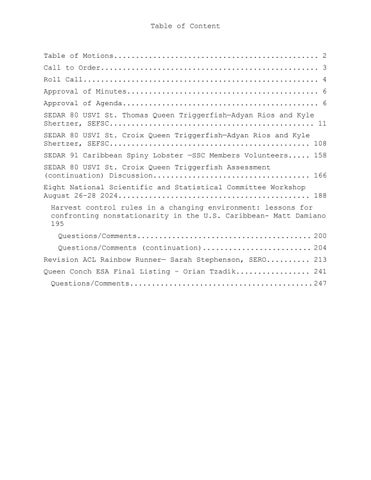
SEDAR
SEDAR
SEDAR
Table of Motions
PAGE 174: The SSC moves to accept the catch at FSPR 40 as the ABC for the queen triggerfish in both island platforms. Saint Thomas/Saint John 97,809 pounds and Saint Croix, 18,808 pounds. Motioned by Juan J. Cruz-Motta and seconded by Jason Cope. The motion carried on page 177.
CARIBBEAN FISHERY MANAGEMENT COUNCIL SCIENTIFIC AND STATISTICAL COMMITTEE
HYBRID MEETING
COURTYARD MARRIOTT
ISLA VERDE, PUERTO RICO
APRIL 9-11, 2024
The Caribbean Fishery Management Council’s Scientific and Statistical Committee convened at the Courtyard in Isla Verde on Tuesday morning, April 9th , 2024, and was called to order at 10:00 A.M. by Chairman Vance Vicente.
Call to Order
VANCE VICENTE: Well, good morning, all. The SSC on April 9 to April 11, 2024, meeting is taking place now, here, at the Courtyard by Marriott Isla Verde Resort in Boca de Cangrejos, Carolina, Puerto Rico. It's beginning today, April 9, 2024, exactly at 10:00 A.M. Atlantic Standard Time. This is a three-day public hybrid meeting. Day one is April 9, 2024, from 10:00 A.M. to 5:00 P.M. Day two, April 10, 2024, from 10:00 A.M. to 5:00 P.M. And day three, April 11, 2024, from 10:00 A.M. to 2:00 P.M., Atlantic Standard Time.
First of all, I want to welcome everybody, in particular, the District Advisory Panel members, or if they're not members, the Chairs, which are Nelson Crespo, which is the Puerto Rico District Advisory Panel Chairman, Julian Magras, which is the Saint Thomas/Saint John District Advisory Panel Chair, Gerson Martínez, who is the Chair of the Saint Croix District Advisory Panel. I also want to welcome, well, the SSC members that will be participating today. We will find out who's going to be missing when we make the roll call.
I also want to welcome and thank the Council staff for their continued support in solving logistical problems of all the SSC meetings. So, thank you very much. And to the Southeast Fisheries Science Center scientists, particularly, to those speakers that will be lecturing us with various topics. These are Adyan Ríos, Kyle Shertzer, Sarah Stephenson, and maybe somebody else depending on whether we find out whether there will be an additional speaker today.
Before we begin the roll call, I have been asked to read out the rules for this meeting, which were kindly prepared by Kiara Matías, which is the administrative assistance of the Caribbean Fishery Management Council. So let me go through this protocol
before we go for the roll call.
Number one, keep microphones off. If virtual, make sure you have the microphone set to mute. If in person, please set your computer's microphone to mute and ensure you have the face-to-face microphone on the red light. The green light is only for when you have a turn to speak.
Second, please raise your hands to be granted a turn. You will be notified when it is your turn. Third, you must speak loudly and clearly, please. That way we can hear your testimony better. Four, the meeting is being recorded, so please do not make vocal noises, chew gum, suck candies, and things like that.
Number five, it is very important to identify yourself with your name and last name for each time you speak. I've been asked also that you mentioned the date, but I'm not sure. Number five, there will be verbatim transcriptions of the meeting, and the transcriber needs to identify the speakers.
I will add number 6. Please be polite in your comments. Treat each other nicely and in a very formal way. So, thank you for your attention and cooperation. So, unless there are no comments at this time, we will begin the roll call.
Okay. First, the SSC members beginning with-- go ahead. Let's go clockwise. Walter?
Roll Call
WALTER KEITHLY: Walter Keithly, SSC member.
JORGE R. GARCÍA-SAIS: Buenos días a todos. Reni García, SSC member.
TODD GEDAMKE: Todd Gedamke, SSC member.
JUAN J. CRUZ MOTTA: J.J. Cruz, SSC member.
MICHELLE SCHÄRER-UMPIERRE: Michelle Schärer, SSC member.
VANCE VICENTE: Liajay. Who else? Tarsila?
TARSILA SEARA: Good morning. Tarsila Seara, SSC member.
VANCE VICENTE: Erik Williams, will he be present?
ERIK H. WILLIAMS: Yes. Good morning, all. Erik Williams, SSC
member in Southeast Fisheries Science Center.
VANCE VICENTE: Okay. Thank you. Jason Cope?
JASON COPE: Yes. Good morning. Jason Cope, SSC.
VANCE VICENTE: We cannot hear you, Jason.
JASON COPE: Hold on a second.
VANCE VICENTE: No. We still cannot hear you.
JASON COPE: Is that better?
VANCE VICENTE: That's better.
JASON COPE: Jason Cope, SSC.
VANCE VICENTE: Okay. Thank you. And I think I'm left. Vance Vicente, Chair of the SSC committee.
JASON COPE: I will see if I can sort this out. Sorry. Can you hear me at all?
VANCE VICENTE: Yes. Very well.
JASON COPE: Okay. Great. Good morning, everyone.
VANCE VICENTE: Richard Appeldoorn has been excused. Okay. I guess, let's start clockwise past Reni. Matt?
MATTHEW D. DAMIANO: Good morning, everybody. Matt Damiano, Southeast Fisheries Science Center.
ADYAN RÍOS: Good morning. Adyan Ríos, Southeast Fisheries Science Center.
KEVIN MCCARTHY: Good morning, everyone. Kevin McCarthy, Southeast Fisheries Science Center.
GRACIELA GARCÍA-MOLINER: Buenos días. Graciela García-Moliner, Council staff.
LIAJAY RIVERA GARCÍA: Buenos días. Liajay Rivera García, Council staff.
CRISTINA OLÁN MARTÍNEZ: Buenos días. Cristina Olán, Council staff.
KIARA M. MATÍAS ROJAS: Buenos días. Kiara Matías, Council staff.
JULIAN MAGRAS: Julian Magras, DAP Chair, Saint Thomas/Saint John. Good morning, everyone.
NELSON CRESPO: Good morning, everyone. Nelson Crespo, DAP Chair, Puerto Rico.
GERSON MARTÍNEZ: Good morning, everybody. Gerson Martínez, Saint Croix, DAP Chair.
VANCE VICENTE: Okay. People online?
CRISTINA OLÁN MARTÍNEZ: Online, we have Carly Daiek, Jesús Rivera-Hernández, Kate Zamboni, Leigh Fletcher, Maggie Ríos, María López, Rachel Banton, Refik Orhun, Sarah Stephenson, Sennai Habtes, Tarsila Seara, Vanessa Ramírez, Virginia Shervette, and Wilson Santiago.
Approval of Minutes
VANCE VICENTE: Okay. Second, I would need a motion to approve the minutes, the verbatims, specifically the September 27, 2023, SSC meeting and of the November 28, 2023, SSC meeting. We need a motion to get that over with.
WALTER KEITHLY: I will move this.
VANCE VICENTE: Speak loudly. I cannot hear you.
WALTER KEITHLY: This is Walter Keithley. I will make a motion to accept the minutes for the two meetings.
VANCE VICENTE: Okay. Any oppositions? Oh, a second? Anybody?
JASON COPE: I will second that. This is Jason Cope.
Approval of Agenda
VANCE VICENTE: Thank you, Jason. Any oppositions? No abstentions? So, the verbatims of September 27, 2023, SSC meeting and the verbatims of the November 28, 2023, SSC meeting has been approved.
Maybe I went too fast on this. We need to go over the schedule to see if there are any changes, any oppositions. So far, we've
been scheduled, today, between 10:30 A.M. and 12:30 P.M. the SEDAR 80, U.S.V.I., Saint Thomas queen triggerfish, Adyan Ríos from the Southeast Fisheries Science Center, and Kyle Shertzer, also from the Southeast Fisheries Science Center, at the Atlantic Fisheries Branch. That will be from 10:30 to 12:30.
Between 12:30 and 1:30, we have a lunch break. Between 1:30 and 3:00 P.M., we will go over the SEDAR 80, U.S.V.I. Saint Thomas queen triggerfish assessment continuation and discussion. Between 3:00 P.M. and 3:15 P.M., there will be a break. Between 3:15 and 5:00 P.M., we need to write down the specific SSC recommendations on the SEDAR 80 U.S.V.I. Saint Thomas queen triggerfish assessment.
So, Graciela, any additions that we need for today?
GRACIELA GARCÍA-MOLINER: No. I would ask the Science Center if the scheduled time that we have on is fine. Right?
VANCE VICENTE: Okay. So, April 9th , schedule is approved.
Tomorrow, April 10th , 2024, between 10:00 A.M. and 12:30 P.M., SEDAR 80, U.S.V.I., Saint Croix queen triggerfish, which will also be presented by Adyan Ríos and Kyle Shertzer, both from the Southeast Fisheries Science Center. Between 12:30 and 1:30, there will be a lunch break.
Between 1:30 and three P.M., we will continue with the SEDAR 80 U.S.V.I. Saint Croix queen triggerfish assessment and discussion. Between 3:00 P.M. and 3:15 P.M., there will be a break. Between 3:15 and 5:00 P.M., we need the SSC recommendations and the SSC final recommendations to be presented to the Council in the next meeting, which will be April 24th and 25th , I believe, of this month.
The last day, April 11th , 2024, between 10:00 A.M. and 11:15 A.M., there will be some discussion regarding the Eighth National Scientific and Statistical Committee Workshops, which so far is being proposed for August 26 to August 28, 2024.
Between, 11:15 and 12:15 PM, there will be a revision of the annual catch limit for the rainbow runner, which will be presented by Sarah Stephenson from the Southeast Regional Office. Between 12:15 and 1:15 P.M., SEDAR 91, Caribbean spiny lobster. We need to have the SSC members volunteer for this SEDAR meeting.
Between 1:15 and 2:00 P.M., there will be other business, which
include the IRA proposal update, SERO and Southeast Fisheries Science Center updates, next meeting. Anything else that we need to add, Graciela?
GRACIELA GARCÍA-MOLINER: So, Mr. Chair, we had a request for a presentation from the Endangered Species Act queen conch listing as threatened. So, we are contacting Orian Tzadik or Jennifer Lee from the Regional Office to see when they need to accommodate this presentation. That will also be presented to the Council. The Council asked for the SSC to hear what they have to say prior to the Council meeting.
As far as I know-- I've been trying to figure out if there's going to be an Equity and Environmental Justice Update for us during this meeting or not. And just, you know, whatever news the Regional Office and the Science Centers have for us, they can either provide that information while we're going through the discussions of the SEDAR, or at some point during the discussion to be presented to the Council.
As far as I know, that's the only issues that we have, pending.
VANCE VICENTE: But we also have to remember that these other businesses are going to be taken care of in the last day, April 11th , 2024, which will be half a day. By 2:00 PM, we are going to stop the meeting.
So, you have to be brief, and we need to know in time. If you can advance some of the information before the last day, we would appreciate it.
The order of business may be adjusted as necessary to accommodate the completion of agenda items. Okay? The meeting will begin on April 9th , 2024, at 10:00 A.M. and will end on April 11th , 2024, at 2:00 P.M.
GRACIELA GARCÍA-MOLINER: Thank you, Mr. Chair.
VANCE VICENTE: So, we need a motion to approve this three-day SSC meeting agenda. Walter?
WALTER KEITHLY: Yes, Mr. Chairman. I'll make a motion to approve the agenda. However, I have one request. And that is, there's a lot of commonalities between the two documents we'll be reviewing today and tomorrow. The Saint Thomas Queen Triggerfish assessment and the Saint Croix Triggerfish assessments. I'm hoping, and it's a request, I guess, on my part, that the Center, when they're presenting the results, try
to combine, to the extent possible, the commonalities and differences between the two reports. Thank you.
VANCE VICENTE: Okay. You're welcome. I would say three reports. I would say the Puerto Rico queen triggerfish in addition to the Saint Thomas/Saint John queen triggerfish and, and the Saint Croix to see how the results compare so we can see holistically what this stock assessment estimate of these species is.
Adyan, will you be able to, or Kevin, this will be on the last day.
KEVIN MCCARTHY: So, we want to revisit. I mean, Puerto Rico is done and off to the Council at this point. So, what exactly are we wanting to see?
VANCE VICENTE: Specifically, how it compares with the Saint Thomas/Saint John queen triggerfish and the Saint Croix queen triggerfish. So just to see what similarities are between the catch advice, for example, between the three. Something simple. Something so that we can look at the species more holistically in the Caribbean.
KEVIN MCCARTHY: So that may be something we can put together for a brief presentation on the final day.
VANCE VICENTE: If you can, if you have the time, that would be good.
KEVIN MCCARTHY: We’ll see what we can do.
VANCE VICENTE: Okay. Thank you. Thank you, Walter.
JUAN J. CRUZ MOTTA: I think the spirit of Walter's suggestion was to minimize time, not to add more work to the Science Center. Like, I guess, for example, if there is a method section that would be common, if we can just join that. I think that was-- Thank you.
WALTER KEITHLY: Yes, Mr. Chairman. That was my intent. It was to, at least, again, it's more the methods that I noticed a lot of commonalities between the two reports. But I also noticed some differences on the year selected for the phase and period or the equilibrium periods and so forth. That's what I'd like to, to the extent possible, I'd like the center to provide those commonalities and differences when they're giving the first report. Thank you.
VANCE VICENTE: Okay. I agree. Forget about Puerto Rico. Kevin?
KEVIN MCCARTHY: So, Walter, just so I'm clear, we're talking about both in the presentation this meeting and in future reports. Is that correct?
And I think what you'll find is that, well, one, we're not going to spend a lot of time dwelling on the data. We've talked about that extensively. But we, I think, in the presentation tomorrow, we’ll find that we've gone through a lot of those-- a lot of the stuff we'll have already covered today, so we won't dwell on that either, we'll try and move along pretty rapidly, if that's what you're getting at.
WALTER KEITHLY: Yes. That's fine. Again, I just I tried to move things along a little bit. I gave just one concrete example that I noticed the equilibrium catch prior to whatever year, starting year, 1998 as I recall. For one of the models, I think it was Saint Croix, used the entire time period from 1998 through 2019, whereas the Saint Thomas assessment only used two or three years in that equilibrium catch prior to when the data began.
I'd just like to have a bit of an explanation as we're going through these documents. Why there are these differences and also commonalities where possible. Thank you.
VANCE VICENTE: Okay. Thank you, Walter. Any other comments, suggestions regarding the schedule? If not, I need a motion for approval of the next three-day meeting.
WALTER KEITHLY: I'll make the motion to approve it again.
VANCE VICENTE: Okay. Second?
JUAN J. CRUZ MOTTA: Second.
VANCE VICENTE: Thank you. Any abstentions? I don't see any raise hand. I don't see any comments regarding the schedule.
So, in that case, we can move ahead, starting a little bit early, with Adyan Ríos’ presentation on the SEDAR 80, U.S.V.I., Saint Thomas, Queen Triggerfish, Adyan Ríos and Kyle Shertzer. Are you ready, Adyan? Okay. Kevin?
KEVIN MCCARTHY: So, I'm going to take the floor for just a second and introduce everybody to Matt Damiano, who's our new stock assessment biologist. I just wanted to make sure that you all met Matt. He joined less than two months ago and has hit the
ground running and has jumped in and provided support for SEDAR 80 and will be working with Adyan on SEDAR 84. And then, later this year, he'll take the lead on SEDAR 91, which is spiny lobster. So, I just wanted to introduce Matt to the group.
We had a request from Jason Cope to provide some information, and I just wanted to get some clarification on that. Jason, you'd asked for us to upload some of the models. I want to make sure that we're clear on what it is you would like to see, because there's a lot of information we could upload, and I want to make sure we're responding to the request in a way that makes sense.
VANCE VICENTE: Yeah. Thank you. Jason?
JASON COPE: Yeah. This is Jason Cope, SSC. One. Matt, welcome. It's great to have you on board. Second, Kevin, I was thinking. There's usually a folder that just spits out all of the stock synthesis three files and just dropping that onto the Google Drive, just so folks who want to look at different aspects of it, whether it's the input files or the report output file or anything else.
Yeah. I was just simply dragging the whole beast of a folder, dump it into the Google Drive if that's alright for each one, for the base models.
ADYAN RÍOS: Yeah. For the reference. Thank you. I was going to say that the whole folder is just ginormous. But yes.
JASON COPE: Yeah. We don't want to wait for ten gigs to load on the thing. Yeah. No. The reference models, only for those, that would be great. Thank you.
KEVIN MCCARTHY: Okay. Yeah. We can do that, Jason.
ADYAN RÍOS: Will the Council send us the Google Drive address, or do you want us--
GRACIELA GARCÍA-MOLINER: So, this is a folder that was created for the SSC members. So, we'll give you access so that you can upload whatever you need. So, it's not for the general public. Then once the information is presented here, then that becomes part of the general public information. For example, your reports are already part of what the record is for the SSC. The presentation will become afterwards. But anything else, it's specifically for the SSC matters.
VANCE VICENTE: Okay. Thank you. Any other comments? No? So, Adyan, are you ready?
SEDAR 80 USVI St. Thomas Queen Triggerfish—Adyan Rios and Kyle Shertzer, SEFSC
ADYAN RÍOS: Yeah. I think we'll go ahead and upload that during the break but go ahead, so we can get through the introduction and the overview information that we have today. I need to be sharing my screen, and it looks like I am all set to do that. So, I will give it a shot.
So, we'll just start with an outline of the presentation. We will start with a review of relevant terms. There's a lot of stock assessment terminology we'll be bringing up. And so just for the public hybrid format, we wanted to introduce some of those terms that we'll be hearing throughout the rest of the day.
And then we will talk about a summary of the data and methods. And we'll get through that, kind of, in the generalization of both islands, since they have so much in common. And then specifically, we will review the data and stock assessment results for Saint Thomas and Saint John today and Saint Croix tomorrow.
So, starting with our relevant terms, we wanted to just reintroduce the model that we're using. So, stock synthesis is a statistical catch at age, population modeling framework that's used very broadly, in the U.S. and elsewhere. It simulates the dynamics of a fishery. So, topics like mortality, maturity, growth, as well as the dynamics of the fishery. Selectivity, effort.
And what's really, useful about it is its flexibility and being able to incorporate different types of data. Data can be associated with the age of fish that are seen, with the sizes, from fishery dependent and independent sources.
The way we're using SS is, we're using it with a maximum likelihood approach. This means that the model is trying to find the best parameter values of the equations that are defining those relationships that finds the best match between the observed data that we have and the predicted data in the model. And we want to minimize the difference between the observed and the and the predicted.
So that's what that means. That finding that, maximizing that
likelihood is minimizing that difference to achieve a good match across the data.
And the way we can interpret and compare and review models, one tool and one diagnostic that we have is a likelihood profile. So, this allows us to iteratively run SS to evaluate model performance across a range of values of an input parameter. So, we can determine whether the model is fitting the data better or worse as we vary a parameter over a range of bounds that we give it.
To provide a visual, we have an example here of a likelihood for steepness, and the different colors show different model components and the total difference in the log-likelihood. And so, what you want to see is the best model fit will always be where this value goes the lowest, where it goes on the y-axis to 0. And then you can see that where the value of the parameter that you're profiling is, where that happens, where that goes to 0, that's where the model is saying you have the best fit between your predicted and your observed components.
Then the different colors show you which part of the model is being fit well or fit more poorly. And so, in this example, we see that the difference between the observed and the predicted values is most pronounced between, in the recruitment, in the fit to the recruitment time series, and then followed by the length data and then, almost not very sensitive at all, to fitting the index.
So just, we'll come back to this plot again later, but I just wanted to use it as a reference for what the colors mean and what we're aiming for, like a u-shape or something that tells us which parameter space, which results of the estimate of that parameter best fit the data and which parts of the data.
Next, we're going to talk, briefly about selectivity. And we're going to talk about the size-based selectivity and how that is referring to the sizes of fish that are targeted or that are available and vulnerable to the fishing gears utilized. And today we're going to be talking about domed-shaped selectivity.
So instead of inferring that once fish become targeted by the fishery, they remain targeted, the types of gears and the types of fisheries that we are going to be talking about, we're applying the domed-shaped selectivity, which tells us that the largest individuals of the population are not targeted, or available to the fishery.
To accomplish that, we're using a double normal. So that's, think of the normal distribution, and it's just a normal distribution rise on the left and a normal distribution fall or descent on the right. And that's actually built up with six parameters. And in specific, we'll be talking a lot about the final selectivity particularly of the NCRMP survey.
But I did want to just, kind of briefly, allow that visualization of what this double normal looks like. We've got two parameters that determine the maximum selectivity, so the peak, and how wide that peak is, that highest level of selectivity and the sizes associated with those. And then we've got parameters that tell us how wide the rise to that selectivity of the curve is and how wide is the descent back to our final selectivity. And then the last two parameters relate to where the selectivity starts and where it ends.
On the right here, we've got an illustration of three different types of selectivity. In the black line, we see a what's called a logistic selectivity, so just a rise to full selectivity. And comparing black to blue, that rise can be very steep and knife edge, very sharp going straight up or it can be, you know, some of the individuals are targeted, but not all of them, until they are completely targeted.
And then in red, we have visualized how that compares to interpret the domed-shaped selectivity, which is small fish are not targeted until they are, until they've reached that size that the fishery aims to capture. And then eventually, they are no longer targeted and they’re too big or they're just inaccessible and not vulnerable to the fishery.
We're going to briefly mention the stock-recruitment relationship. This is about the relationship between the adult spawning biomass and the number of recruits. This is an important relationship with components that we'll talk about in a moment. But a lot of what we're trying to do is understand the productivity of the stock. Because our goal isn't to have the maximum number of fish in the water, it is to understand the productivity and the potential of what can be extracted on a sustainable basis. And so that's really important.
The stock-recruitment relationship, getting at that productivity is what allows you to better understand your stock as a whole. And when that's not possible, you can still take what you know and what you know about recent trends and the situations to generate management advice. But this is kind of what our data rich models aim to do.
Two important components of defining that relationship are steepness, which we also refer to as H, and R naught or we also call that R0. So, steepness is also referred to as recruitment compensation. So, as your stock gets smaller, how affected is your recruitment? If it's a high number, it means that it's not very affected at all. So, your recruitment can be high regardless of your stock size. And that is something that we are going to also talk about because by using a high steepness, we are thinking of our stock as connected to a larger population with recruitment that is variable because it's not solely dependent on the current biomass that is within the location that we're modeling.
Next, we've got R0 or R naught, and this is the recruitment at unfished conditions. And so, this is really applying thinking about what the scale is of how much recruitment is actually possible. And by having that, that is theoretically what the stock at an unfished state is capable of producing. That helps us understand, you know, once we have context of where the stock is, how much is it capable of producing for a fishery at a sustainable level into the future.
We're going to talk a little bit today about, very briefly, or you might have seen in the report that we use soft priors, so those are the diffuse priors. But first I'll talk more about the kind of more traditional priors that are described in statistics, and those are informative priors.
So, in our models when we have a parameter and we have information about it, you can inform the model and allow that model to both fit the data and fit the range and the probabilities that you are giving it so that it can take that into account when looking for that maximum likelihood fit. So that's providing information.
Then there's also diffuse priors, which provide weak information and just keep a parameter within a ballpark. When you're estimating various parameters, sometimes you can think about it as the model searching like a grid for the best combination between all the parameters that you're estimating. And sometimes some of those combinations can get locked and go off into outer space. So, a tool that we have for kind of keeping the model or like, in this case, the selectivities in the same ballpark of the shape and the location of where they are estimated, we are able to use these soft priors, diffuse priors, with SS.
Two diagnostics that we are going to take a look at as well, are
jitters and retrospectives and we'll have a visual on the next slide. But I wanted to talk a little bit about what jitters are. And so, when we do a jitter, we rerun the model a number of times and we change the input parameters, the starting point. So, where those parameters are starting to search across this grid of finding a best combination and fit across them, we change those parameters, in this case by 20%, randomly X number of times. For this assessment we did it 30 times, and we rerun the model to see if it arrives at the same result.
If your model doesn't arrive at the same result, it can mean that it's just kind of heading off into a direction that where the model has hit the bounds or that your model hasn't achieved a true answer, like a best answer. And so, when you run the jitter, and it performs well, that gives you the confidence that your model isn't accidentally or serendipitously giving you a result. It's a result that is being provided regardless of the range of inputs that you start with.
A retrospective adjusts the model peeling off a year, removing the last year of information, and then doing that iteratively to understand what if we had one year of fewer data, two years, three years, four years. We did this through five years, and when we talk about retrospectives, especially when we're in a period of improving data availability, quantity, and quality, that's something to think about, right? Because as we continue to collect more data each year, when we have good quality and better and more information, that allows the model to kind of be really emphasized and focused on that same result that it is getting.
However, when some of your data rich years get peeled off, we sometimes see trends in the retrospective that show that, yeah, you would have gotten a different result because if you didn't have these data that you have now. And so that's something, that we'll talk about when we look at retrospective in a moment, but I did want to just kind of give that context of what those terms and diagnostics and tools are.
So, on the left here, we have the results of a very good jitter, and these are just borrowed for this conversation quickly from Saint Croix. We also have a very good jitter for Saint Thomas as well because we have achieved these stable models with those soft priors.
So, this plot shows us the different components, the likelihood values of the different components that are being calculated in the model.
Oh, sorry. Go ahead, Jason.
JASON COPE: Thank you. Yeah. Jason Cope, SSC. Adyan, thank you. I am not familiar with this presentation of jitters. I was curious if you wouldn't mind explaining a bit more. I'm used to looking at did the model achieve the same log likelihood, negative log likelihood value and how different if they're going back to the same model or if they're off. And also looking for things if you got better fits, all those sorts of things.
This plot seems a little bit more detailed, and I was wondering if you wouldn't mind explaining it a little bit more.
ADYAN RÍOS: Absolutely. Thank you. So, the plot that I think the single plot that, we typically show is the top right square of this one, which is what the total likelihood is across all of those model runs. In this case, all of the model runs achieve the same lowest likelihood. So, there were no runs of this model that resulted in a higher or lower total maximum likelihood.
Yeah. So, when a jitter performs well, like this plot is showing, that's typically all you need to see. But we are able to also, if there are discrepancies in the models that have been run, this plot allows you to attribute that to the component just like the likelihood profile allows us to break down the likelihood from the best fit to the different components of the data. If there were some different fits to this overall model, we could better understand where those differences are coming from. So, if it was that one model fit the catch better or fit the catch worse or fit the recruitment better or the length composition better or worse, you would see things sticking out or changing across what's a flat line here across runs.
JASON COPE: Thank you.
VANCE VICENTE: So, what we're trying to do is to assess the model stability. Right?
ADYAN RÍOS: Yes.
VANCE VICENTE: Okay. Okay. Thank you.
ADYAN RÍOS: And then on the right here, we see an example of a retrospective, and what it means when we pull off individual years. And so, you see that, you know, there's some trend, but overall, the big picture of what the model is telling us is similar. However, we do have differences, but that's something
we're allowed to explore and understand. Where are those differences coming from and what can we expect into the future as we continue to have, consistency in data collection going forward.
VANCE VICENTE: Thank you.
ADYAN RÍOS: I believe this is the second to last of our terms today. We wanted to bring up the topic, the words forecast and projection. We kind of use them interchangeably. Forecast is kind of like closer in time but forecast and projection we’ll be talking about those. Those are estimates of future yields under specified scenarios. So, in this case, what we're able to kind of do with the results that we'll be talking about today is, you know, if we continue the scenario that is our understanding of what's currently happening with recruitment and with fishing, we can provide projections of what those landings, those OFLs, can be.
We can do that in a few different ways that we'll talk about, but what's important to also introduce and discuss briefly is the topic of an uncertainty grid. And so, with an uncertainty grid, we're able to run SS under different scenarios to evaluate and potentially combine results across our axes of uncertainty.
And our axes of uncertainty, that's just a terminology for the different topics of uncertainty that we might want to consider with this framework. So, this SS framework allows us to, you know, be pretty explicit about our assumptions about the stock’s biology, about the dynamics of the fishery. And then, it also allows us to explore uncertainty to components of the data or of the parameters in the model.
The last slide of the terminology overview is the OFL and the ABC which is, where we're trying to go with our stock assessments to provide the overfishing limit, to provide that and then talk about the uncertainty associated with that value so that you all can provide guidance on the allowable biological catch. And then thereafter the Council accounts for the other factors that need to be taken into consideration for setting the ACL.
So that brings us to the end of the first section. I think we are able to just kind of keep going into the next one and then perhaps consider, a break, but it's still nice and early, so let's keep going.
In this section, everything is relevant to both islands, and
then we'll dive into the model results and specific differences as we as we talk about the specific islands.
So, there are three types of data that we're going to talk about. The first is the fishery dependent data, and that involves the removals and the length composition data that are available. We also have the fishery independent index of abundance and the length composition associated with that. And then we have biological data or information about growth, maturity, mortality, and connectivity.
VANCE VICENTE: Excuse me.
ADYAN RÍOS: Yes.
VANCE VICENTE: Just for clarity, when you say both islands, it should be specific that you're referring to Saint Thomas/Saint John. Right?
ADYAN RÍOS: Sorry. I should say, both island platforms.
VANCE VICENTE: So, both Saint Thomas/Saint John and Saint Croix. Okay.
ADYAN RÍOS: And Saint Croix, yes. Because the data inputs and the methods are the same. Mostly. Yeah.
VANCE VICENTE: Thank you. So, the next section to just kind of, we'll dive into these individually, but just to kind of give you this overview. We'll talk about the model development and how it fits. We'll look at the jitters and the retrospective diagnostics. We'll talk about the assumptions and, look at the likelihood profiles. And then we will talk about the uncertainty grid, the projections, and the estimates of fishing mortality in OFL.
So first, we're going to touch on the fishery dependent removal estimates and length composition data. Here's a little a few more details about what we have there. So, we have annual species-specific landings for major commercial fleets ever since they started being reported as species specific. That year varies, so that's why our start year is different between the two islands.
So, the known target and take of specific sizes. That is information that we have that we have already discussed together that we have brought in the topic of the market driven size of the targeted fish. And we also have the length data from the
port sampling that's been conducted over the years. And as we've discussed previously, we actually decided to collapse that information, to create a composite because of this targeted behavior to a specific size where we're not really expecting to see pulses in the recruitment of fish, when they're so heavily, specifically targeted at a given size by the fishery. But we still use these data in the model to inform selectivity.
And so, on each of these slides where we talk about these data components, we're also going to talk about what specifically, in the model, they're kind of tied to and what they most influence.
The first is for when we have our commercial landings. We have our start year. These data are used to inform the fleet specific selectivity and the shape of that selectivity. And then the models estimating what the fishing mortality is at the start of the time series. So, just an important note that we know these start years are relatively recent, and we know that the fishery was already existing for some time prior to the start year of these models when we have that species specific landings data.
And just for context in the image, you know, I think we've talked about this before but, in Saint Thomas it's mostly the trap fleet, and in Saint Croix it's mostly the dive fleet with a small component of the trap.
So next up, we've got the fishery independent index of abundance. Okay.
CRISTINA OLÁN MARTÍNEZ: You have Erik Williams with the raise hand.
VANCE VICENTE: Okay. Erik?
ERIK H. WILLIAMS: Yeah. Thanks. Adyan, quick question to go back to the fishery dependent data and this might be a stock synthesis question that I'm unfamiliar with. When you are fitting to a composite length composition, how is the predicted composite being computed? In other words, what years is it using? Is it using multiple years or is it one specific year?
ADYAN RÍOS: So that's a great question. So, when you provide the composite information to assess, you do tell it the range over the years with which it should also aim to summarize and fit that information across those range. But it has the freedom to individually estimate each year's worth of information. And the way it kind of allocates that is, you do still give it where that composite information came from across years.
So, if the more recent years had the most data being contributed to that composite, the SS fitting algorithm will attempt to apportion that, that composite should fit better in those years than in the years that have low sample size. So, while you do kind of collapse across all years and give SS the freedom to estimate information across those years, you do give it a little bit of information about how that composite was created across the years, where it came from.
ERIK H. WILLIAMS: Yeah. Thanks for that, Adyan. I think this will be a discussion that'll just permeate through these assessments, at least from my perspective, is understanding how then that implies to the model that there's some information about recruitment or not in length composition data. I won't go into details yet. I think it'll be an important discussion point for both of these assessments is what are we expecting to get in terms of information for the model parameters from these length composition data and in the way that we put them into the model. So just general topic to keep note of.
ADYAN RÍOS: Thank you.
VANCE VICENTE: Jason, do you have a comment?
JASON COPE: Oh, no. Adyan said it well. I was just emphasizing the fact that the effect of sample size in each year is still going to weight how that composite fit behaves. So essentially what Adyan saying. Thank you.
VANCE VICENTE: Okay. Thank you.
ADYAN RÍOS: So, next we'll talk about the fishery independent data, and we have an index of abundance for each island platform as well as associated length composition data. And we have the SEDAR working paper that describes both the survey as well as the queen triggerfish specific results. That is just reference, but just briefly, we talk here a little bit about the maximum depth, of this survey and we talk about how we do have observations from deeper water. And this is something we talked about, in a previous meeting to help guide what we think about the level of domeness in this visual census of divers going out and seeing the fish.
VANCE VICENTE: Okay. So that's a reef visual survey. Fishery independent data.
ADYAN RÍOS: Yes.
VANCE VICENTE:
Thank you.
ADYAN RÍOS: And what we did notice is that we do have length distributions from the fish that were observed, but in some years, they didn't see very many fish. And even though, you know, like we did for the commercial fleet, one way to account for low sample sizes like that, is the concept of building a composite. Another way to go about, if you do want to use the data to kind of more directly inform recruitment and pulses of sizes in the fishery, is to kind of exclude information that won't have a good distribution. Because if you don't have enough samples, you can have a very jagged and potentially biased information about the sizes of fish that are currently out there.
And so, for the current assessment we chose 30 fish to kind of define that. This really kind of isolates the RVC to the years where they had a lot of sampling and excludes the years of low sample sizes where fitting those data could kind of bias or confuse the model. Because even though they had low observations of fish, they still did a lot of dives, but we don't have a lot of fish measured, so when you tie together the sizes that they saw in a given year with the index and the observed information, those years were not kept for the current assessment.
And so that's all used to inform the selectivity that we discussed previously and about, you know, thinking that we do have larger individuals. We do see them in their deep-water dives. We do see a higher fraction of large individuals in deeper water. That's only been conducted around Saint Thomas, that deeper water survey, but that provides us that guidance of thinking of this nearly logistic but still domed relationship that we can expect in our model for what fish are available to be seen by this survey.
And then with the annual length compositions, we're able to see whether and have the model try and fit to pulses that we see of fish throughout like three-year-old on one year, four-year-old the next year, five-year-old the following year, and try and see those cohorts and understand that recruitment happened in order for those cohorts to come into existence.
I also wanted to bring up some of the references that were the guiding information for the life history information in the assessments. The first is the Shervette and Rivera Hernández report. That's capturing a summary of the life history information from cooperative, local, and recent studies. They
saw a maximum age of 23 in the Caribbean. A maximum age has been observed of 40, but that is outside of the Caribbean. I think, previously, the age was, I think, the previous observed age was much lower.
I see a hand. Erik?
ERIK H. WILLIAMS: Yeah. I this this will come up later, but I thought I'd inject it again early. So, if you go back to your point to about, used to inform recruitment from those length compositions. I'm skeptical of that. And so, I want to inject that thought as you go through the presentation and as we look at the data and we look at the fits. Is there really a recruitment signal in those length comps? That’s the question. And so, just keep that in mind as we continue through the presentation.
ADYAN RÍOS: Thank you. So just some additional information about the advances of this life history information is, it's really neat to see how many fish were collected in these recent years as well as the technology that they can use to validate those observations of ages.
And then, we also have kind of information that supports how we parameterize the model when it comes to that steepness and to that connectivity between the spawning stock and recruitment. And so, we do have genetic information that shows us that there really is high genetic connectivity in the region.
VANCE VICENTE: Sorry. Regarding the maximum age of 23 in the Caribbean, then you have a semicolon, 40 means what?
ADYAN RÍOS: So, looks like I didn't finish my thought there. But, no, the 40 is the maximum observed for the species outside of the region.
VANCE VICENTE: Thank you.
ADYAN RÍOS: And so, these resources informed the life history dynamics in the stock assessment model. And then, it's also kind of what we use to base our assumption for steepness.
We haven't touched on sigma_R, but that's the variability in recruitment. So how variable you expect one year to be to the next, relates to that. We use the value of 0.6 for the assessments. So that covers the data, the three data sections of general overview of the data. Next, we'll talk about the general overview of the models.
VANCE VICENTE: Walter?
WALTER KEITHLY: Thank you, Mr. Chairman. A question. I don't know if there's proper time for the question, but you say you have fishery dependent removals. In fact, you only have the removals from one segment, one sector of the fishery, that being the commercial fishery. There's no data for the recreational removals. If you have, just give a, say, a large negative correlation between your commercial removals and your unknown recreational removals. Would that have an effect on model results?
ADYAN RÍOS: Absolutely. So, the stock assessments will always try to fit your data, so removals are an important component of the data that the model is trying to fit to. So, if they were negatively correlated and you only had data from one, then that would mean that-- I don't know. You'd have to play it out. You could potentially simulate that, or explore that sensitivity with, like, management strategy evaluations, trying out different relationships between what you expect.
For something like spiny lobster where recreational values were also unknown, they were implicitly assuming that they were just, you know, positively, equally related to the commercial landings, therefore, it becomes kind of like, the model is only interpreting the removals. And so, the scaling is only technically relevant to the portion that you're modeling, that that you're understanding the removals for when it comes to the outcome of what the productivity might be.
WALTER KEITHLY: Thank you.
VANCE VICENTE: Julian Magras.
JULIAN MAGRAS: Question. In this assessment, was any of the recreational data from tournaments used? Similar to, like, the yellowtail assessment that we just started. The information that was provided by fish and wildlife for the yellowtail through some of those tournaments. Example, the Mother’s Day fishing tournament, which was actually a queen triggerfish fishing tournament, should be able to have given you, some type of information under a recreational catch, even though that tournament only took place once a year.
As it pertains to the queen triggerfish being fished recreational, that's a pretty small number compared to as where it would be, different when it comes to, let's say, Dolphin and
Wahoo. So, I just wanted to put that on a record. Thank you.
VANCE VICENTE: Thank you, Julian.
ADYAN RÍOS: Yes. So, those were not included in the data review and inclusion process, so it's a good research recommendation to bring to the table for future models or review process of data.
Okay. So, we've talked about these kinds of steps towards the model development, previously. And so, they're just a summary of the path we've gone down. We attempted to balance model complexity with model stability, and we incorporated changes based on our past discussion. And so, of those was simplifying the length composition data, using the composite, another term for that is a super year, where you still inform the relative weights across years, but you allow the model to fit to the composite of data across those years.
We were also able to remove those jagged and low sample sizes from the RVC survey years, just for the length composition. And we applied the domed-shaped selectivity for both the fleets and the survey, and we fixed steepness at 0.99. We used a maximum likelihood approach to assess the goodness of fit of the model to each data source. So particularly our data sources are the catch, the indices, and the length composition data.
We looked at the jitter analysis, to achieve and investigate model stability. We also conducted the retrospective analysis to understand what the removal of these more recent years of more data rich information, how that affects the results.
We talked about priors previously, so this is where they come into play and how they were used. So, stabilizing the jitter and retrospective required using the diffuse, the soft priors, on selectivity parameters that were not being well informed by the model. And so those were the-- you know, we talked about the width of the rise and the fall of the selectivity, and we also ultimately fixed where the rise of the survey selectivity happens.
Those were all inferred based on the model estimate. Those soft priors do the job of keeping the parameter within that space, because the selectivity would otherwise kind of slightly shift and cause some of those parameters to hit bounds.
So just kind of summarizing the assumptions of the model. And so, we talked about the initial or kind of the reference model using a fixed selectivity at 90%, so 0.9 and this was informed
by the evidence, the ancillary information that we have of higher proportions of larger triggerfish observed in deeper areas than the shallow areas surveyed by the regular RVC, reef visual census. So that was called the deep census. Right?
We talked already about the high regional connectivity. By assuming the steepness and that lack of a relationship between our spawning stock and our productivity of recruitment, the fixed parameter of 0.99 for that relationship. And lastly, we talked about how fisheries existed prior to the start year of the model, and so that means that we were estimating what the magnitude of that fishing effort and mortality, where it was, at the at the beginning of the time series that we use in the model.
To those points, we're able to profile those topics and understand how the likelihood would improve for the different components across different ranges of values that those could be set to. That allows us to see how each data source influences the estimates that the model produces.
So, we have profiles for steepness for the final location of the survey select activity. The initial equilibrium catch, and the unfished recruitment. So that start year-- Sorry. The initial equilibrium catch is that start year fishing mortality, and we also have the unfished recruitment, which was related to that scale of how much recruitment would happen, what is the potential productivity of an unfished state of the stock that scale. And the initial equilibrium catches, for both models, was based, the provided amount of landings in that period was based on the geometric mean over the first three years of landings.
Okay. This brings us to the last overview slide, which talks a little bit about the uncertainty grid, how projections were conducted, and a little bit about the estimates of F and OFL. So, projections were developed for the reference model as well as across a factorial grid of model runs to capture uncertainty across key data assumptions. Those kind of axes of uncertainties came from our previous discussion. Those were, natural mortality and the level of catch during the equilibrium catch that starts right at the beginning of our time series, whether it was, you know, higher or lower for both of those.
We also, utilize landing statistics through 2022. 2023 data are not available because the calendar year is not the same as the fishing year for the data. And so, we do have data finalized for the most recent landings information through 2022. And 2023 was an average, a geometric mean of those most recent three years of
information.
We also ran the projections using an MSY proxy of F_SPR40%. We ran the projections using future recruitment based on the mean recruitment across the whole time series, for each island platform. So, the uncertainty grid included nine runs permutated across multipliers of initial catch. So, half as much the reference value, or 1.5 times the reference value. And we also looked at three multipliers of natural mortality, 0.9, so 90% or, you know, 10% lower and 10% higher. That 10% relates to about plus or minus two years in longevity, that's one way to think about it when we're kind of looking across what these different estimates of natural mortality mean.
And so, for an uncertainty grid approach, this is really exciting to be able to use this platform to explicitly ask these kinds of questions. You know, we can consider wider ranges where we have more uncertainty or are interested in certain topics or try different axes of uncertainty building in this method into our processes and assessments going forward.
So, we are able to obtain an OFL for each of the runs from the uncertainty grid, and we are able to bootstrap those. That’s in a way to kind of account for-- we do see differences in these results, and so if we were to rerun these and get a slightly different result from each one of them based on just the statistics and probability of the outcomes of those runs, you can combine those. There are a few different ways you can combine those, but what that allows you to do is to generate a PDF, a probability density distribution, across your model runs to use potentially multiple models.
In this case they are equally weighted, but other approaches of uncertainty grid are also able to use weights to say, you know, these are some of the most probable setups for the model, but then there's also maybe some others to explore and how you can weigh those and combine those to provide an understanding across different settings that you can make in the model and then understand what the implications are from those.
We also calculated the F_current. This is something that we can compare to the F_spr40 to understand whether there's overfishing happening. That was calculated as the fishing mortality rate average, the geometric mean over the three most recent years, with the terminal year of the model being 2019.
Okay. So that is the summary of the data and the methods. And so, our next section-- Uh-huh. Go ahead.
VANCE VICENTE: Regarding the OFL? Are you using the fish mortality over F_MSY greater than 1?
ADYAN RÍOS: So, to get at the overfishing, what we would do is we would take the F_current, so the fishing mortality at the end of the period being modeled compared to what the fishing mortality is predicted to be. The fishing mortality rate is predicted to be if the stock were at the 40% SPR.
VANCE VICENTE: Thank you.
CRISTINA OLÁN MARTÍNEZ: You have Jason Cope.
VANCE VICENTE: Jason Cope, please come in.
JASON COPE: Thank you. Yeah. Jason Cope, SSC. Adyan, I will admit, I sometimes get confused on what stock synthesis is reporting as an F value. I don't know if this is the right time to sort it out, but I was curious. I think in the starter file you have to tell it kind of what version of F you want to see. Is it exploitation rate? Is it apical, which you wouldn't want? Is it a sum of Fs across things? Do you know, off the top of your head, what-- one minus SPR is also a very common one. Do you know which version of F you are reporting or comparing here?
ADYAN RÍOS: Yes. The harvest rate.
JASON COPE: Great. Thank you.
ADYAN RÍOS: So, the harvest rate is the amount of the population removed from the total population each year? The adult population.
JASON COPE: Yeah. A discrete of. Yeah. Perfect. Thank you.
ADYAN RÍOS: Yeah. So, any additional questions?
VANCE VICENTE: Yes, Michelle.
MICHELLE SCHÄRER-UMPIERRE: Thank you. When you do your super year composites for the length data in the commercials, do you also apply that minimum threshold per year of lengths available?
ADYAN RÍOS: So, I did not. Part of the reason for keeping years with low data is that you're collapsing across them anyways. So, I did allow those-- I did kind of kept it that at the end of it, a couple samples coming from one year and, you know, many
samples coming from another year are still all samples coming from the same population. So, that's something that can be done easily, but since it's a super year approach, it felt like it was not needed to do.
I do want to clarify that the commercial data are weighted by the number of trips. So, we also know that, you know, some individual sample sizes might come from the same trip and so therefore they're not independent, so the weighting of the commercial data is on the number of trips from which those samples came.
VANCE VICENTE: Regarding the maximum age, 23 for the Caribbean versus 40 overall, might that suggest that the Caribbean is possibly a distinct population?
ADYAN RÍOS: So, this is a really interesting topic that comes up for a lot of species. I think it's important to-- it does come up in our research recommendations that it is really important information to know but, you know, the aging and the validation that has been undergone does tell us what we know and what we've seen in the region. Elsewhere, I think it was North Carolina where this 40-year-old fish was observed, there can be reasons for why that happens for species.
JESÚS RIVERA-HERNÁNDEZ: Sorry. Adyan, I can't raise my hand.
ADYAN RÍOS: That's Jesús. Do you want--
JESÚS RIVERA-HERNÁNDEZ Yeah. The difference is, like, for the triggerfish in North Carolina that is 40 years, there is no fishery for them there. They are just a weird catch that we get some of them, and we [age?] them. But there is not a heaven or a paradise for triggerfish on North Carolina. So that maybe is the difference on the ages. So, you have a non-fished population that people don’t know, people don't want them, and then, you have the Caribbean, that with the limitations of the gears, you can get up to 23 years or with the limitation of the [depth?]. So, that is the reason for it. Sorry for interrupting.
ADYAN RÍOS: Thanks. I think-- do you want to look at the chat.
VANCE VICENTE: Yes.
ADYAN RÍOS: Virginia noted, “Latitudinal gradients, older fish for many species occur at higher latitudes.” And Jason asked, “How routinely are they seen above 25 years old?”
JASON COPE: In North Carolina specifically.
VANCE VICENTE: I have another question. Has there been a specific genome analysis of the different populations and see what the genetic similarity are between latitudes or whatever?
ADYAN RÍOS: Yeah. So, there is the publication that shows that there was not genetic differentiation across the areas sampled, but we'd have to look back at the paper to understand the areas sampled.
Yeah, so this is definitely something that continued life history information and that collaboration with obtaining large samples, large fish, to get at, to understand how old these fish are. Just like humans, you can have people that are very old that are very tall, or you can have people that are very old that are not so tall, but presumably those largest individuals are some of the oldest and adults that are out there.
VANCE VICENTE: But in general, the external morphological characters are similar throughout the wider Caribbean region. Right?
ADYAN RÍOS: To our knowledge and it's an excellent research recommendation to further explore to kind of understand.
Oh, sorry. I got to leave it to Vance. Vance, we've got a hand over here and a hand over there.
VANCE VICENTE: Sorry. J.J. Yeah.
JUAN J. CRUZ MOTTA: That Anthony 2017 publication says that, actually, the Western Atlantic is a single population, well mixed. VANCE VICENTE: Thank you.
CRISTINA OLÁN MARTÍNEZ: Erik Williams.
VANCE VICENTE: Erik, come in.
ERIK H. WILLIAMS: Yeah. Thank you, Vance. So, you know, actually, this discussion just reminds me of something, a bigger topic that we need to discuss, that we're discussing right now, possible implications for uncertainty in natural mortality because of differences in perceptions of longevity.
In your uncertainty grid, you only use plus or minus 10%. And so, the general question is, is this uncertainty grid characterizing uncertainty sufficiently for our needs? And I'm
not sure of the answer of that yet, but I think it's a topic of discussion that we'll need to have for this assessment.
VANCE VICENTE: Okay. Thank you. Jason Cope.
JASON COPE: Yeah. Thank you. Jason Cope, SSC. On Erik's comment, the one thing that stood out to me about the grid is not just the plus or minus, but the fact that it is symmetrical. And, Erik, I'm not sure if this is what you're getting at. To me, it seems like there's a lot more uncertainty about the M being lower than the natural mortality being higher. Meaning, there's more uncertainty about the longevity being greater than a certain value than it is being less than the certain value.
For me, when it comes to natural mortality, there's absolutely nothing wrong with exploring asymmetrical uncertainty because that's typically what we have. And so, again, Erik, I'm not sure if that was kind of what you were alluding to as well, but I had a similar thought about maybe the grid for natural mortality, in particular, might be a little different.
VANCE VICENTE: Well, I think this is very important because if you look at the von Bertalanffy equation, it starts with the L_max, and the L_max is related to the maximum age or something like that. I'm not a fisheries biologist, but it's a question.
ADYAN RÍOS: That's correct. So, the information that you have for your maximum size and your maximum age are going to affect your model. And so, this is a great conversation, and I think it's really exciting to have this grid approach available to us, because we are able to exclude or give lower importance and lower weight to versions of the model that are not of particularly considered high axes of uncertainty for us, or in which direction they are uncertain. So, it is completely possible to exclude runs that are not deemed feasible or not the area of the uncertainty that we're interested in exploring and accounting for with our approach, and to what extent that we want to gauge that level of uncertainty when it comes to the range of the multipliers or of the values that we use to inform those runs.
VANCE VICENTE: Yeah. Thank you, Adyan. Any other questions, comments? Oh, Julian.
JULIAN MAGRAS: So, we're seeing the oldest fish showing up here is 23-25 years old. I think one of the reasons for that could be, I'm not saying that's the reason, because of the market driven fishery. Now I think an assignment for future assessment
of this specie should be that we collect some information on those bigger fish that are being released. Because we might surprise ourselves to see the big fish and the quantity of big fish that are out there, but we're not targeting them.
Do we know where they at? We have a pretty good idea where they are, both, on the north side of the island and the south side of the island of Saint Thomas and Saint John. But because of the market issue, we've very seldomly bring in big fish; only if it's an order that we have for that species.
So, when samples are collected, it's what is brought in at that time. Now, Virginia did get to collect some of the bigger ones, but it was the bigger ones that were caught at the time while she was doing her study. So, I'm just throwing out there for future information to be collected maybe we can do something for that. Thank you.
VANCE VICENTE: Thank you, Julian. Adyan?
ADYAN RÍOS: Yes. I do want to highlight the importance of research recommendations in this process, and we do have some of them in the report. So, Julian touched on them already. So, like, understanding the discards not only tells us about the large size of individuals that are being discarded, but it also provides us more information about that selectivity. And keeping some of those for life history studies and continuing life history studies does help us reduce the uncertainty in these decisions and in our understanding of the information that this model is based on.
VANCE VICENTE: Thank you, Adyan. We would like to go over your research recommendations.
ADYAN RÍOS: We have those in the presentation later.
VANCE VICENTE: Okay. Thank you. We call for a break 15 minutes, please.
ADYAN RÍOS: Do you want a break? Yeah.
VANCE VICENTE: I don't know. I think you do. You're the one doing all the work.
ADYAN RÍOS: Sure.
VANCE VICENTE: Okay. Let's have a 15-minute break. Be back at 11:45.
(Whereupon, a brief recess was taken.)
VANCE VICENTE: Well, welcome back. It's 11:48 A.M., April 9, 2024. We will continue with Adyan Ríos regarding the SEDAR 80, queen triggerfish, Saint Thomas/Saint John. So, let's begin.
ADYAN RÍOS: So, next up, we will do the review of the data and stock assessment results for Saint Thomas and Saint John. I’m just starting with a little context of the biology in the model.
So, we've got the length weight relationship informed from the recent collaborative local life history work by Virginia and Jesús. We also have the maturity information from that work as well. I think it's just interesting, and worth noting that we see the maturity increasing around 20 centimeters, a little bit after we see 50% maturity. And if we go over to the lengths and the age plot, 20 centimeters is a range somewhere around 3-year-olds. So, some fish might have matured a little bit younger, some fish, a little earlier, but that just kind of gives us context of when these fish mature, and what size and age they are.
And instead of kind of looking at the data and then at the fits to the data, I thought since we've seen these data in the reports as well as in previous introductions to these data, we can just talk a little bit about the model fit to the data, and at the same time see what we're getting from the data.
And so, here in the top right, we have the observed and predicted commercial landings. We see that the general trend is declining over the time series, with the time series starting in the in the late 1990’s, so in 19-- oh, sorry. I believe it's 2000. This year here being that three year mean of the first three years.
Here in the bottom right, we have the index of abundance. You can tell that, like, you know, those error bars kind of tell you which years have a lot of samples versus fewer samples compared to each other, as well as, what's happening over time. In the recent years, we do see an increase in that in the data, so those circles that you're seeing plotted on that plot.
We do have another year of information available, 2021, and that is information that does tell us that that point continues to be high. So, it's something, you know, the terminal year of the model will be very influential on what we understand the stock-what to be happening in that last year of the model. And so, I
just wanted to provide context of that extra year of information that is ancillary to the terminal year of this assessment.
On the left, we have the average length being predicted as a blue line, as well as the average length being plotted for the years where we have the length composition data from the diver survey. So, those are the years where there were more than the 30 fish measured. And so, you can see the difference between the number of years in the index and the number of years, the length there, kind of gives you some context of the years that had less than 30 fish sampled, or length measurements available.
We'll also next look at kind of like an overview of the length data and the fit. And so, the fits are pretty good. We've got a fit to the commercial data, the selectivity, the domed selectivity that we'll talk about in a moment, over time. The observed is plotted here in gray as well as with the green line on top of that. And then the RVC, we do see kind of like a jagged shape. And that's also potentially related to the bin size that we're using. In early years, they used five-centimeter bins, and in later years, they did use one-centimeter measurements. However, the decision to use the entire time series kind of forced us to use the five-centimeter bins, and that's something that we used throughout the model.
On the right here, you see the Pearson residuals. So, this is also a way of looking at where there's misfits between the predicted and observed data, where is that happening. And I do want to point out that sometimes with the super year approach, it will just plot it at the start of the period. So, even though this is plotted here for 2002, it is covering the full time series. And so, those data are being fit pretty well. We've got low residuals.
And then, the plot at the bottom. This type of plot is something we want to inspect to see if we see any patterns and how the data are fitting. Is the model always predicting too many big fish or always under predicting too many small fish? And so, this kind of not seeing a full, full pattern is a good thing. And so, we do have some misspecification, and particularly in the last year, we do see a blip of a lot of big individuals that were in fact observed by the RVC data, by the RVC divers. So, we did see more large fish in this in this last year of data that we do have.
Another way of seeing the RVC data, in addition to the two ways we just saw, it is also these individual year plots. And again, these are the years that had more than 30 fish contributing to
this distribution. We do see, kind of, to some extent, the range that was seen across years and how those large individuals came into the story here for 2019. And good fits for the two most recent years of data which are associated with some of the highest sampling effort that the RVC has done in the region.
I think I'm just going to go through all of the slides that we have, and then I think we can always circle back because I know there's been some discussion already about some of the topics.
But going forward, here's what we have for the length selectivity, and so that domed selectivity for the commercial fleet, and then that slightly domed shape for the survey. What this is showing too is that the RVC also sees, more small individuals than what the fishery is capturing. And so, that is kind of, yeah, just interesting that that comes through on the selectivity here for the region that we're looking at, which is Saint Thomas.
And just going back to here, where that comes from, in the gray is our observed data, so we do see that the RVC is seeing smaller fish and larger fish than what the survey is capturing in line with our understanding of the targeting behavior of this fishery.
Next up, we'll look at the derived quantities. Here we have the fishing mortality in the top left, and that is the harvest rate. So, the proportion of the stock harvested, starting around, between like, 0.13 there. And then, kind of what's really noticeable about what we see in the landings as well as in our derived fishing mortality rate, is this decline over the past decade. So, like, since 2010, we see a pretty strong decline in both our catch as well as our fishing mortality rate estimated in the model.
On the right, we see how the spawning biomass has been predicted to have been changing. And that kind of goes in line with the decline in removals, and in the fishing rate, kind of is showing up at the same time as this kind of increase in the in the biomass of the stock.
On the lower left, we see the recruitment signals and in particular we see these spikes in 2010 and in 2017. These are also something that we plot for the retrospectives, and so just kind of highlighting that these years are just what the model is predicting that had really strong recruitment events that led to the cohorts or to large fish being seen in some of the length composition data.
We do have a stable jitter, after the soft priors on the selectivity parameters that were set at the estimates. And here's where we get to the retrospective and that result of peeling off information. So, I'll let you know what we're seeing across the different plots here, but you already know what the concept of the retrospective is doing.
In the top left, we have what's happening to the spawning stock biomass over time. In the middle here, we have the recruitment. The shadow represents the 95-percentile confidence interval, and same with these bars. Here we see the recruitment, so the age zero recruits. This is the fishing mortality in the top right. On the left is the fit to the index. And in the center bottom is our estimate of unfished recruitment, R naught.
We do see there is a slight retrospective pattern, but we do see how, like, that's also driven by the signal and the parameters that we're predicting, which are recruitment, R naught and, what information we have from the data in these more recent years.
We'll come back to any plot that we have kind of breezed through, but I will, kind of briefly, point us to our likelihood profiles, all four of them. So here on this slide, we have two. We have the likelihood profile for steepness, which the reference model kept it at 0.99. However, we can see that the total likelihood is in black. We do see this u-shape with a minimum estimate around 0.85 or 0.84.
What we do see as well is kind of what is that driven by. So as steepness increases, it's doing a better job fitting recruitment in blue as well as the length data. However, that results in a poorer fit to the index data in orange. And so, this is a way to interpret how our model is set up currently. And we also have on the right here with, R naught, which is the parameter that we're also estimating-- This is something we talked about before. I showed these previously in a table format where it was kind of shaded in green to show--
Oops. I just disconnected accidentally from the meeting. Is my Wi-Fi on? Yes. Trying to reconnect. Sorry about that.
And so here on the right, we do see that the estimate of R naught is also kind of showing a little bit of-- what's it called that game where you play where you pull a string? Tug-of-war between the different data components. So that's also something that, you know, we can talk about. When it comes to data components, you can also give them different weights or
allow the model to estimate their weights, to re-weigh and kind of a way of saying, you know, these are data that we're really confident about, versus these are data that we're not so confident about. However, for the reference model, we kept it as the data were input. So, we didn't apply any reweighting for the reference model.
Next, we have profiles on the initial F as well as the final level of the RVC. I'll talk a little bit about how these are coming from because these are a little bit less intuitive as far as what the values are. And so, this range of initial F is the actual estimate of initial F that we have for these individual runs, but the way these were set up was with increasing that equilibrium F or decreasing it. And so, what our model is suggesting, again, with the conflict between the data sources, is that it achieves a better fit with higher equilibrium catches being put into the model, which directly translates to a higher initial F estimated in that start year of the model.
However, you know, this decision about what initial equilibrium catch we used in the reference model was based on the kind of understanding of the fishery operating at a pretty consistent level, or what we think, for those start years of the model. But we also do explore this in the uncertainty grid whether the initial equilibrium catch was much higher or much lower and so that's the interpretation of this plot.
And then on the right, the scale is what's tricky, because the value of 90% is actually 2.2 because this is a logit scale, and the value of 0 is actually 50%. So, in the future I will try and translate that back to regular percentages. But I will point out that we did only explore between 50% and a 100% selectivity, since this was the range over which we were kind of using our informed understanding of what we're seeing in the RVC versus the deep RVC and what we think this level of domed is or whether it's logistic as far as when they're in the water, are they seeing all the fish? And if not, then what proportion are they not seeing, of those large individuals?
And so, while this is estimating at a lower, like a more domed shaped, again, we see the conflict between the data sources, and we do see, in our reference model, that this was fixed. And this is, again, something the selectivities and the shape, you know, assuming a domed shaped selectivity is pretty important, but I think we do have the support, based on our past discussions and on what we have from this ancillary RVC data. However, I just do want to point out that that level of domeness is important because it does tell you how many fish are out there that are
not being seen or accounted for in this model which tells you about your total biomass.
Okay. Going through or kind of thinking back to the overview of the methods that we talked about. The overview of the methods and diagnostics and everything that gets us through the fit, the jitter, the retrospective, as well as the likelihood profiles, which brings us now to the uncertainty grid and the results of the uncertainty grid for F. And so, on these next two slides, we'll be showing the results for the different nine iterations of the model that were part of the uncertainty grid.
We do see here just some summaries of what the M was. So, whether it was 10% lower or 10% higher. What the initial catch equilibrium was? So, was it half as much or, 1.5? Or, you know, our reference case? Our reference case is in the square. Then, we also have a median presented across, you know, if you were equally weighing all of these runs, which earlier we talked about you don't necessarily have to do that. However, the median across those runs, because we looked at a symmetrical uncertainty grid, it’s similar to the reference run.
Just an important takeaway from this is that across these axes of uncertainties, all of these, kind of suggest that overfishing is not occurring. And so, that is a takeaway from the explorations thus far.
Next, we have the OFLs resulting from these projections. And for context, I've also included on the far right here, the current catch limits as well as what recent years of catch are. And again, we have the reference model in the blue square. And when we talk about developing the PDF of how we capture uncertainty across model runs from the uncertainty grid, there are a couple ways of doing that. And so, I'll talk-- the term here being bootstrapping. So, we can bootstrap the individual runs and then look at all of that as a way to come up with a distribution of uncertainty.
Another way is called a deterministic way, which is, we kind of take the mean across each year of these, so that's what that mean is reported there, as well as the standard deviation across these models, to also kind of get at understanding the distribution and the uncertainty that's being captured across all of these runs. And so that's something that's pretty easy to switch between, but for the report and the presentation I have right now, it's that deterministic method. But it's also something that, is pretty easy to switch between to be able to kind of account for uncertainty using the grid in the way that
the conversation deems most appropriate.
So, we do have some additional slides that we'll walk through. Just continuing to consider, you know, what some of the takeaways are and what some of the applications and steps towards determining best available scientific information and to potentially considering what decisions, for an ultimate reference model, are and how the uncertainty and scientific uncertainty can be captured through the Caribbean Fisheries Management Council control rule towards getting at an OFL estimate, and then accounting for uncertainty to provide guidance to the Council for ABC, allowable biological catch.
So, we have integrated assessments, using length data and an index of abundance and modeling best practices. I do think it is worth highlighting that, you know, we are using these approaches that are more explicit, less implicit, right, about what assumptions and decisions need to be made in order to integrate these data. And so that's, I think, really exciting on how we're able to incorporate these data into this framework and then ask questions. And later steps, potentially, run additional management strategy evaluations about additional questions and circumstances that we want to consider and understand what we know about the stock and its dynamics into the future.
So that's kind of related to the second point here, and so I won't revisit that one. And then, our third point here is that we did see conflicting signals across the relatively few sources of data. We did have to kind of make those explicit assumptions for selectivity and steepness, in order to kind of obtain a stable model based off of those decisions informed by the conversations that we had.
We did see that based off of the uncertainty grid presented that the results suggest that overfishing is not occurring. However, because of lacking this spawner-recruit relationship that's being informed and estimated by our understanding of the stock, you remember that productivity, we’re not able to confidently provide MSY and stock status without better understanding that.
So that is a way to kind of understand the limitations of the model. However, by taking into account what we, see and understand from the data that we do have, we are able to kind of come up with recommendations for OFL that if we assume that future recruitment continues at the levels that we've seen, that can be kind of guiding the ballpark of where those landings can be for our understanding of all the trends that we have in the model and the assumptions that we've had to make in order to
achieve stable models. And then, from there, we can continue to improve data inputs and further refine and address key uncertainties. So that's a summary of what has been prepared and presented so far.
A few extra slides that I'll get into is just an example of what the deterministic mean looks like. If you take the average and the standard deviation from a given year. Let's say we're talking about the 2024 distribution, and we take the average and the standard deviation coming from all nine models or a different number combination of those models, we can obtain that deterministic mean across models. However, we can re also run this where it's less symmetrical and where we run the individual models, we bootstrap those, and then create the composite.
The median results to be different, but the mean is the same. And so, it just depends on, you know, if that's something that we want to try and use. The difference is we also have to presume a level of uncertainty. And so, sigma is something that we’ll also revisit, the importance of sigma. The sigma that we get from these methods versus the sigma that you also have in the control rule.
So, let me go back here. I do have it in my notes here as to what the CVs are. This is about 20% CV on the 2024, and it goes down to-- so the CV is just the standard deviation divided by the mean. So, just kind of giving you context of that ballpark. This is about, 0.2 to 0.14. Let me double check that. Yeah. So, from 0.2, 0.14, 0.13, and 0.12 is our CV.
Moving on, we have here the control rule to review briefly. So, I've just focused the control rule into Tier 2 data moderate and Tier 3. I did want to just kind of revisit this table that provides guidance for, you know, what level the assessment is at, you know, a way to describe the assessment and its condition for use, as well as the kind of on the books options for acquiring ABC from that OFL.
And so, for data moderate, that's Tier 2, the conditions for use say, “approaches where two of three time series are deemed informative by the assessment process.” So, catch, age or length composition, and index of abundance. And the assessment can provide, MSST, MFMT, and a PDF of OFL. MSST is maximum sustainable stock threshold, and MFST is maximum fishing mortality threshold.
And the ABC in Tier 2, comes from using the PDF of the OFL where that sigma, that standard deviation must be greater than 1.5
sigma_min. And just to note here, which kind of explains why that is, is that in principle, there should be more uncertainty with increasingly data limited or data moderate approaches than with data rich approaches. And so that’s why that's specified.
For Tier 3, we have a different Tier that's attributed to data limited assessments where an accepted assessment is available. And here we have the conditions for use as relatively data limited or out-of-date assessments with MSY being defined using a proxy. The ABC here comes from the OFL, also reduced by scientific uncertainty to reflect the difference between OFL and ABC, with the two options for obtaining the ABC, which is where you have a PDF of OFL where that sigma would be twice times the sigma_min, or where the ABC would be the buffer times the OFL, where the buffer must be less than or equal to 0.9. And so, I did just want to kind of bring this back into anticipating where the conversation will go after we've talked more about the model development, its fits, and its settings.
Let's see. We also have kind of lined up some of the general research recommendations. So that's something I can talk through now. I'll just kind of get through all of these slides, and then we can kind of open for questions and discussion.
Yeah. Okay. So, we're going to come back to research recommendations. And so, with that, please let me know any slide to go back to, or where we can start the discussion.
VANCE VICENTE: Walter.
WALTER KEITHLY: Thank you, Mr. Chairman. I just have a very general question or comment maybe even. Actually, it's a two-part question. Maybe the industry representatives are more knowledgeable or can help out on the first part of it is, our traps generally considered relatively non-selective gear. I know that you've said if it's not a plate size triggerfish you may throw it back in the water and so forth, discarded. But in terms of the species being caught and all, are traps relatively non-selective?
VANCE VICENTE: Julian?
JULIAN MAGRAS: When you say “non-selective,” what do you mean by non-selective?
WALTER KEITHLY: In terms of, what species you can catch in the trap or are caught in a trap. I know in Puerto Rico, for example, I looked at the data and many, many species are being
caught co-occurring or jointly with queen triggerfish. Can you target-- I guess my question is, can you really target queen triggerfish to a large degree?
JULIAN MAGRAS: If we want to target them, we can target them to a large degree. I'll draw you a perfect example. Last week I went out one day and I pulled the traps after soaking for one week. I caught all the different species in that catch, but I baited with lobster shell, squid, and menhaden and pull those same traps within 24 hours. In pulling those same traps within the 24 hours, my catch, 95% of it, was queen triggerfish because that's what I was targeting with the lobster shell that I got from the restaurants.
So, if I have a demand for the queen trigger, I can directly target them. So, what I would catch, mostly, in that reel would be queen triggerfish, the hind strawberry grouper, conies, yellowtail snapper. The other species, one or two, but 95% of the catch.
I have done some port samples where it was sampled in a 24-hour [inaudible], and it can clearly identify exactly what I'm saying.
WALTER KEITHLY: Okay. I guess what I'm thinking of is, I would have liked to have seen a table that, at a minimum, would have a little bit of background, such as the number of trips wherein queen triggerfish were being caught, or were caught. And then I see that in both Saint Croix and Saint Thomas, the reduction in catch occurred almost at the exact same time.
That could be for economic reasons as is often discussed, but if that's the case, I would certainly expect to see a proportionate reduction in the number of trips. I understand maybe fishing more traps on a given trip and all, but I think some background information might be useful in terms of sorting out, or trying to, what is happening. Especially, when I see the, almost, mirror images of the catches falling in about 2008 for both islands and all, both platforms. Thank you.
JULIAN MAGRAS: In our regular catches, 60% of the catch, of the guys that fish on the south side of the island and the west side of the island is queen triggerfish. As it pertains to the guys that fish in the traps, we have guys that fish in the traps that target the lobsters. We have guys that fish in the traps that target the fish. We have fewer fishermen, and our market has reduced drastically.
WALTER KEITHLY: That's what I'd like to see. If the market's been reduced, you should expect to see a proportionate reduction in the number of trips. I'm just saying that it'd be nice to have some background information to confirm that these reductions, that we are seeing on both platforms, is the result of reduction number trips.
JULIAN MAGRAS: Well, I think you can request from the Center, Fish and Wildlife to look at the guys, because it's identified who your trap fishers are in the fish trap industry, and you can look at those guys and look at the number of trips that they have done.
Since the trap reduction program has gone into place, and it's been a while, you should be able to pull those numbers of the number of trips by the trap fishers. Now, it's going to be a little lower for after the hurricanes, but outside of that way, the guys that have been getting back to normal over the last two years, three years the most, you might see a little increase in the number of trips. But you should be able to pull that information off of what's been reported.
WALTER KEITHLY: Sure. That should be a relatively [crosstalk].
JULIAN MAGRAS: But I can't give you that number, you would have to get that number from the guys that report it.
VANCE VICENTE:
Adyan?
ADYAN RÍOS: So, the number of trips. We do have that; it is part of preparing these data for the assessment. They do show that same decline. Right? I think a really useful research recommendation is to consider what level of uncertainty there may be in both the trips and the landings. But as far as what we put into the model, what kind of drives the scale of understanding the landings, it's just the landings. So, we're not giving it the effort, but it is true that the effort--
You know, indices of abundance were attempted, however, we did review those data previously, but they were kind of also driven by what we kind of refer to as the market dynamics of the amount of catch on a given trip not being fully influenced by the number of fish out there, but how much the fishermen wanted to catch and wanted to sell and would go out and specifically catch that much, which makes it very difficult to develop an index of abundance, because It’s hyper stable. They are able to go out and catch the size and the quantities that they want on a trip. So, that’s why we did not use the fishery dependent index.
We can, I think, over break or later in the week, show the number of trips, but the number of trips is, you know, related. I believe we’ll see this when we do, is that it does similarly, parallel to what we see in the landings. So, the number of reported trips, the trend is similar to the number of reported landings, and we can dig that up from previous work.
VANCE VICENTE: Yeah. Julian, before you answer or ask or whatever, I have a question.
Do you keep track of how many of the traps are baited in proportion to un-baited traps? Because, like, what you mentioned is really critical in order to determine or estimate catch per unit effort.
JULIAN MAGRAS: Yes, we do. So, it's not every time or every week that we bait. It’s when we choose to bait for what's needed. Normally, it's just a regular five-to-seven-day soak that we pull the traps.
But I wanted to also comment to something that Walter is saying that you would be able to see the decline or the increase in the number of trips. A perfect example is every time I attend a meeting. Okay? I fish with two other commercial guys, and one of them is actually a trap guy. Me and him run both operations off of his boat. So, every time I'm at the meeting, that boat doesn't move. I'm the captain. There's no other captain for that boat.
So, let's use an example. This week, I'm here. I might have fished two to three days this week. That's two to three less trips for me pulling traps. Then I have the Council meeting coming up. Then I have the MRIP meeting coming up. So, every time, that's just me alone that I attend these meetings, those are trips that are not going to happen. And then last week for Easter, the other set of guys who went camping and didn't fish for the whole week, where I fished Easter. You know? We have Carnival coming.
So, within all of those times, you can see, if you're really looking at the months and looking at the data, you can see where those numbers of trips have decreased. But we have never looked at it to that extent, but it's there, and you will be able to see.
VANCE VICENTE: Yeah. Thank you, Julian. Good point.
CRISTINA OLÁN MARTÍNEZ: Jason Cope.
VANCE VICENTE: Okay. Jason.
JASON COPE: Yeah. Thank you. I realize the time, and your lunch is about a minute away. I was going to suggest, an outline for us, post lunch, to talk through things, because there's a lot to talk through. So, my recommendation would be to start with some of the more fundamental inputs in the model, mostly life history. Begin there. We've had some discussion on catch, which is great.
I would target natural mortality and steepness as probably two things we want to discuss. And as we discuss that, we can move forward into talking about model structure and then model output.
I'm presenting this because I think if we don't do the fundamental stuff beforehand, we'll get ahead of ourselves, and talk about models that could possibly radically change with different treatments. So that would just be my recommendation after lunch, would be to start with life history, questions on the inputs, and discussions on that. Because I think our attempt here, and Adyan or others can, please, correct me. I think we're trying to locate a reference model before we're able to properly take advantage of this grid, search, or this uncertainty accumulation stage, which will get us ultimately to the point that we want to get to as an SSC, which is what is the OFL so we can recommend the ABCs.
Does that do that proposal seem alright to others?
VANCE VICENTE: It does to me. Any other thought, or disagreement? Anybody else? So, I think that we're ready for lunch. Right? It's 12:30. It's probably being served right now, so we'll see you at 1:30.
(Whereupon, the meeting recessed for lunch on April 9, 2024.)
APRIL 9, 2024
TUESDAY AFTERNOON SESSION - - -
VANCE VICENTE: Okay. Good afternoon. Welcome back. It's, 1:35 P.M. of the SSC, meeting of April 9th to 11th , 2024. We will
continue with the discussion on the SEDAR-- let me see if I'm right. Yeah. SEDAR U.S.V.I. Saint Thomas, queen triggerfish assessment, continuation and discussion. So, I would ask Adyan, whenever she is ready, to continue with her presentation.
ADYAN RÍOS: One second.
JORGE R. GARCÍA-SAIS: Mr. Chairman, I have a question, regarding the presentation, that I didn't have to time to ask her.
Adyan, you mentioned about some of your conclusions were about conflicting data in your analysis. Can you elaborate a little bit on that?
ADYAN RÍOS: Briefly, yes. The data that are going into the model are length composition data, and the indexes, and the likelihood profiles show us that in order to fit the index well, you cannot fit the length composition all that well, and in order to fit the composition data well, you cannot fit the index all that well. However, you are able to kind of explicitly see that, and then attempt to address and include more data that helps you reconcile as we iteratively improve assessments moving forward.
JORGE R. GARCÍA-SAIS: Okay. Because it is also interested to note that, for example, in the commercial catches, what you see is a very definite trend of reducing landings. Right? Whereas the diver senses sort of doesn't reflect that, at all. I saw that that had something to do with what you were saying about conflicting trends or whatever, conflicting data.
ADYAN RÍOS: So, we do have the slides up and we did have a proposal to begin, just for the SSC to discuss the fundamentals, life history, catch, natural mortality, and steepness. So, are we ready for that discussion?
VANCE VICENTE: Jason Cope.
JASON COPE: The other thing I hoped to distinguish as we have this discussion, I mean, I think you pointed this out too, was there are things that might be able to be explored in the current model, and then there are things that should be future research. And I think we should note, of the things that we would like to see, which ones are more, I guess, better suited for future research recommendations rather than, “we want the model to do that right now.” And I think collecting those as we move along is going to be really important because we'll have a
nice robust list of things for next time, but also acknowledge that everything can't be answered right now, nor does it need to, and there are maybe a few things we can focus in on for this time and collect everything else as future research recommendations. Does that sound reasonable as a suggestion to everyone?
VANCE VICENTE: Yes. Any comments on that? No? No comment. Yes, Erik Williams?
ERIK H. WILLIAMS: So, to Jason's point, I normally wouldn't mind categorizing that into two separate bins, sort of things that we could do now and things that should be done later, but are there things that we should be doing now? Or is this at the stage where we just need to take what we have here and move on?
Because this assessment is certainly getting very long in the tooth, and it seems like we just need to, at some point, just say, “Okay. We've done as best we can, and can we use this for ABC determination? And yes. There is probably a long laundry list of things that could be done to improve, but are they sort of deal breakers, I guess?
So, I'm just trying to understand where we are in the process. Is this meant to be sort of finalized at this meeting or is there going to be follow-up work?
VANCE VICENTE: Well, in my opinion, we have to conclude this. We have to recommend a catch advice to the Council for the next meeting on the 24th and the 25th . So, yes, we have to come to some kind of agreement among us on what's going to be our recommended ABC, our recommended OFL, our ACT, annual catch target, and based on the information that we have, which is the best available information, we will be looking, or implementing all or some other recommendations which we still have not discussed this afternoon. Jason?
JASON COPE: Yeah. Thank you. This is Jason. Yeah. I appreciate Erik's distinguishing that. What it sounds like then is that we can make several comments on things that we want to maybe recommend for next time, but it almost sounds like at this point, we should just have an overall discussion on the base model being acceptable for the best scientific information available. And then, we can have, maybe at that point, if that's found to be true, we can then maybe talk through the things that we would like to see next time and capture those, and then get to the business of saying, “How do we want the uncertainty treated? what category do we consider this assessment in?” And
all of that stuff, to move us quickly to the OFL/ABC discussion.
VANCE VICENTE: Erik.
ERIK H. WILLIAMS: And I yeah, I think, that's a perfectly good idea, Jason. I would just add one more bin to that sort of things to discuss. So, I think there's a distinction here also between, specific things that we'd want to see done in the future for this assessment, but I think there is an overall discussion that needs to be had about general approaches that we're going to take with this model construct.
Because my understanding is the Caribbean is embarking on this sort of path of using sort of SS or SS like assessments, in a data limited type fashion or a very constrained fashion, which is a fine approach. But in doing so, there's some key decisions that, since this is the first step forward that I would want to make sure that we're not setting a precedent that we might later want to change or might change later on. I just want to make sure we distinguish between things that are specific to this assessment, concepts versus what might be done in future assessments using this same sort of platform.
You know, a couple things that come to mind is things like the treatment of the stock recruitment curve. Another one might be the treatment of uncertainty, as Jason was alluding to. So, I think, those are both specific and general topics, and I just want to make sure we, because we are embarking on sort of a new assessment enterprise for this region, I think we want to make sure we get off on a good foot and don't necessarily constrain ourselves because this happens to be the first precedent that we're setting with triggerfish.
TODD GEDAMKE: Super short comment. Erik, I entirely agree with you. I think that's a really good strategy.
VANCE VICENTE: Okay. Thank you, Todd. Any other comments, questions? None?
So, let's proceed to write something up and see if we agree with the conclusions of the model, the base model, which in general what the Council needs, they need to know what our advice is based on all the analysis of all the data to the best the best way that we can. I think there is an agreement both, not only for Saint Thomas/Saint John, but also for Saint Croix that the stock is there. I mean, there is no overfishing, and the spawning biomass has been increasing and that the population is healthy at this time. Are we going to agree on the numbers, what
the recommended the recommended ACLs or recommended OFL, ABC?
And do you want to put that table on the on the screen? Let's see. Let's go over it and see what we can consolidate to present to the Council. As Adyan pointed out, there's a lot of uncertainty in the in the data. So, the fact that we agree that there is not an OFL, how much will we recommend for an annual catch limit and to specify that this is going to be for a short time period until we get more data together, analyze it, and that this may change next year. That's my suggestion.
So, we have it on the screen. Do we agree, the OFL projections and uncertainty grid. If you look at the current catch limits in pounds on top, SYL 205,621 pounds. ABC, 102,810 pounds. Annual catch limit of 97,670. If we compare that with the recent years of catch in pounds for 2019 it was 35,971. In 2020, 38,152. In 2021, 40,723. In 2022 it was the lowest, 28,685.
So, what are our recommendations based on those numbers? Or how we how we going to state it, Jason? You're pretty good in synthesizing and writing things up.
JASON COPE: Yeah. Yeah. So maybe if I could take a step back, because I don't think I'm totally prepared to say that these exact numbers are the recommendation just quite yet. What I do feel strongly about is that the general framework presented here, the statistical catch at ages framework with the information provided, I do believe is the best available way forward and information available. So, I do feel comfortable stating that.
The three are specifications that maybe, personally, I would have done different, and I think that's just reflective of the fact that there is a large amount of uncertainty here. And because of that large amount of uncertainty, there might be some reconsideration on it exactly here, and Adyan, I think you pointed out the fact that what we have here, you've done a lot of presentation here, where this can be adjusted to reflect maybe alternative statements on our believability among the different model specifications that I believe are along the [lows?] here. And so there might be a bit of room for what we have here, not even asking for necessarily different model runs, but just different weightings of what we have in front of us.
And so, I think that is part of the discussion, but I think I just want to break this down by saying, I'm comfortable proposing in a statement that the framework that was presented as a general framework to move forward, integrate this different
data together with the highly constrained model because of the inability to estimate parameters is definitely appropriate. I think that also leaves the question open on what category we're talking about, because what we have not talked much about is the stock status determination criteria of the relative stock status.
When I look at the model, I think it says it's just below unfished. It's very, very high stock status. Adyan, I think you mentioned that you weren't certain if this was going to be usable for stock status determination, but I may have heard that wrong. So, I think there's still some discussion on what we feel comfortable pulling out of this, because, obviously, if you don't feel comfortable about the stock status, that plays into more uncertainty around the OFL.
And so, having a conversation about category and so forth, I think these are the things that will come before we state the numbers are exactly what we think we want to move forward. So let me stop there and ask folks if that initial statement of the general framework moving forward, being acceptable, best scientific information available is what we have at hand, and the highly constrained model is reflective of a lot of uncertainty. And then maybe stop there, we'll have the next set of discussions, which I think gives us the opportunity to maybe accumulate all of these strong recommendations that are either assessment specific or, as Erik pointed out, more general statements on, are we setting a precedent, or are we just reflecting this opportunity here to do this assessment, but we want to highlight things that we want to rethink, within this general framework, on what to do in the future.
That'll move us a step forward to get to this OFL discussion, but I think we want to solidify a couple of things before we get there. Thanks.
VANCE VICENTE: Yeah. Thank you, Jason. If you can centrifuge that a little bit and write it down so we can put it on the screen and then start from there. Okay.
JASON COPE: Sure. Do we have a shared document?
VANCE VICENTE: Yes. I would like to have something written, synthesized, of what you just said so we can put it on the screen and then discuss it.
JASON COPE: Yeah. Does someone want to start that official document? I'm happy to jump in and [crosstalk] in there.
VANCE VICENTE: Sounds great, to initiate the document, but I would like to see it written down, so that we can put it on the screen and then add, comment on it and let's think about it because that was a good synthesis, but--
JASON COPE: Happy to. Yeah, that was a lot.
VANCE VICENTE: We need to simplify it even more so if you can do a little bit of intellectual centrifuging to see what the precipitate is.
JASON COPE: Yes. Can do that. Thank you.
VANCE VICENTE: Thank you. Appreciate it, Jason. Who's up next? Erik?
ERIK H. WILLIAMS: Yeah. Thank you, Vance. I was just going to ask, so since we're already starting to talk about ABC, what does this ABC represent, since we don't have any recreational fishing in here? So, is this just commercial, and do we need to make sure that that point is clear?
VANCE VICENTE: Yeah. It will be commercial, and we have the same problem for Saint Croix that we don't have any recreational data. So based, I mean, on the limitations that we have, of having no recreational data, with the limited data that we have on commercial catch, this is what we can recommend or consider recommending. Walter?
WALTER KEITHLY: Yes. Thank you, Mr. Chairman. I don't see how you could have an MSY for a given sector when you have more than one sector in a fishery, in the sense that if you reduce recreational catch, you can certainly increase commercial and vice versa. So, I don't think you can state that you can have an MSY for one specific sector when you're missing data for the other sector.
VANCE VICENTE: Yes. The problem is that we're working not only with limited data, but with very limited data. And we have to come up with something to start from something. Otherwise, we're going to keep circling around and not being able to come up with catch advice. So that's why I’d like to have it written down, and then we can work from there on what do we feel more comfortable with, where do we think that we cannot say anything.
So, if we feel that there's some issues like the MSY that we don't have the enough information because there's no
recreational data and other lacks, then we say, “hey, we cannot provide catch advice.” Todd?
TODD GEDAMKE: Yeah, I'd ask. I just asked about this, before, and I think the MSY aspect is being accounted for in a sustainable yield metric and a proxy. So, if the Center could maybe clarify, Kevin or Adyan, if you just clarify on that, because I think the big breakthrough for me, in this room, was the idea of not defining MSY and going for a proxy.
So, Walter, your point is very, very well taken as a recreational unknown, but if they come up with a proxy for the commercial sector, that will take into account, and then you deal with the recreational sector as it comes into play. So, you know, I’ll let you follow-up in case I miss something, but you guys all watched me go, “Thank goodness.”
VANCE VICENTE: Yeah. That's good. Thank you, Todd.
ADYAN RÍOS: Yes. That is that is correct. The proxy is what we what we have.
VANCE VICENTE: I mean, I like what Adyan said in the report, “Although these findings suggest that higher landings can be sustained in the short term, it will be advisable to gather more length composition data and further enhance the fisher independent index.”
So, what the Council needs is to know-- they have to give some numbers to the fishers. I mean, we have to come up with that. We have to come up with it today and tomorrow with both and with whatever limitation. Because the Council is the one that is going to make the final decision on ACL, etcetera, but they need to have some numbers. The only numbers that we can give solidly right now is that higher landings can be sustained, and that's what the fishers have been questioning and or asking for, and this is their livelihood. We cannot mess around with this.
I mean, we have to come up with something solid and think of the resource. I think we think that the resource is healthy, and they want to fish more, and they need to increase their catch. Well, we have got to have that balance. Julian?
JULIAN MAGRAS: Well, I don't know about fishing more because its market driven. So, even if we stay at our ACL that's in place right now, or even go a little bit higher, it's not to say that we are going after that because there is no market, and we don't export. And I don't see any market coming into play for
this species anytime soon. It's just what the market demand is.
So, I know you guys have a job to do, but I'm just throwing that out there. I know in the future, if we can collect the information that's needed to make the assessment better, you know, a suggestion for me would be leave the ACL where it is, and let's look at what Adyan was saying. We have a list of information that needs to be gathered for the next assessment. That's what I would say. Thank you.
VANCE VICENTE: Yeah. That’s good, Julian. Because, to clear, the very low landings in 2022 does not reflect the status of the stock. It's just that it is market driven and that’s for the record. Reni?
JORGE R. GARCÍA-SAIS: Yeah. Thank you, Mr. Chairman. I've said this many times. I'm going to say it again. I believe that we need some kind of socioeconomic index to go with these fishery models. It would aid us a lot in taking this kind of decisions, because I completely agree with Julian in the fact that, they have an ACL right now which they are not meeting. So, in the sense that there is no big change in the economy, why should we change that towards a higher or lower level, you know?
It makes much more sense to just leave it like that, as it is. Since the recent analyses have shown that there is no overfishing going on, it's further reason to not to make any further changes in the ABC at least, with what we are concerned here.
But certainly, what we will really need, we've been like this for more than a decade now, is a socio-economic index to guide us towards taking this kind of decisions. Particularly, when the landings are far apart from the ACL. So, we don't really know what's going on because the demand is not enough for the fishermen to work towards those ACL limit.
So, I still insist that this kind of socioeconomic index should be part of all of these analyses. We've been working so many years without them, at some point-- Yeah, everybody knows that that may be the reason, but quantitatively, we don't have any data.
VANCE VICENTE: Yeah. Thank you. Any comments? Yeah. Todd.
TODD GEDAMKE: So, there's a couple of things going on. First, of all, I just want to get back. I liked Jason's suggestion structure of looking at vetting the methodology and Erik's
comments regarding some of the broader issues that we need to address.
And then, we will need to get into the numbers and the advice that you, as Chair, are going to force us to make sometime during the next 48 hours, which is your job. But I'm also hearing from both sidebars I'm having and fishermen in this, that you have values that are orders of magnitude greater than the current landings that are coming out of this current assessment.
So, you have values in a whole distribution where the lowest end of what is currently the base model is, I don't know, how many times higher, ten times higher or five times higher than the current. Some scientists suggested, why don't we just take the lowest value in there, put that in with rationale explaining that this takes into account the current-- I think we still should have a discussion of some of the uncertainty.
And then also the fisherman suggestion, which is, you know, let's keep it at its current level or go up. So, I'm just wondering if there's a possibility of us coming to an agreement, which says, let's go two times higher than the current ACL. Let's use our current and use our discussion to get into the methodology because the more we can vet the methodology that's going to move forward in this, the more we can get going.
And it's a question of doing no harm with this. Is that value going to come into play in some way that is going to cause any problems? And if we're not landing anywhere near currently what is being recorded, then maybe there's a possibility of cutting right to the chase, taking into account our uncertainty, and then moving on to the more technical aspects that will help the Center move forward.
VANCE VICENTE: Yeah, Todd, but the comment is that going to a low value, for example, or the lowest value is not fair because you know the demand is going to increase. Okay? So, the fishers should have the opportunity of being allowed to increase their catch because their stock seems healthy and even though they don't exploit it, they still have that opportunity to expand their fisheries in case that the demand increases. You don't know what's going to happen. Yeah, Todd?
TODD GEDAMKE: I would-- that was not at all the context of my comment. I just want to be clear because you're talking about restraining the fishermen, and I was saying an order of magnitude greater. Therefore, it's impossible that those six
primary guys in Saint Thomas and those 12 primary guys have ten times the amount of time they do to go out there and harvest that-- Especially, with the trap reduction.
So, my point is, is let's set it at a value that's not going to constrain the fishermen, which is where we're at somewhere in here. Let the Center work forward on some of these methodological approaches and go from there. I mean, we can look at the distribution. We can look at these values. I have critiques on certain aspects. Jason and Erik are definitely going to have critiques.
But I was just trying to expediate some of the nitty gritty as we get into the details of these numbers, because you're well above what they're doing with this whole distribution. I could knock this distribution down, if I wanted to, by manipulating things, but the point being is that there's no signals, that I'm seeing, anywhere in here, that are cause for concern.
And with that and their current structure, let's look at the structure and go, “You know what? I think that all makes a reasonable approach.” Let's let Jason and Erik chime in on how you would explore some of the uncertainty of this whole thing and look at a clean number towards the end of this. And I'm not sure we'd have to get some advice from the Center and others as to how we would put a rationale in there for that, but a thought.
VANCE VICENTE: Okay. Thank you, Todd. There's a hand up. I don't know who?
ERIK H. WILLIAMS: I was going to respond to Todd. I don't disagree with what you're saying, Todd, in principle, except that, it's in violation of sort of the MSA and what we're charged to do. You know, we are meant to set ABC. That is our only sort of hammer we get to swing at the SSC, and that ABC is very strictly defined as a reduction from OFL.
And so, we're kind of constrained in that sense, that we have to work with the OFL and the PDF around that OFL that comes out of the assessment in setting our ABC. So, I like what you're saying. I think we would be overstepping our bounds.
I think what you're proposing is something the Council should probably consider, after we set what is probably going to be, I agree with you, a very high ABC based on these assessment results.
VANCE VICENTE: Okay. Walter? Oh, Julian. Sorry.
JULIAN MAGRAS: Right at lunch break, I had an off the record discussion with Walter. Walter, I hope you don't mind me saying this, but he was talking about the economy in the Virgin Islands. As a social economic person, he looks at numbers. He saw that the numbers are doing very good in the Virgin Islands as money being in the island. But then I explained to him, yes, there's a lot of money passing through the island, but a lot of this money is going back to the Philippines. It's going back to Haiti. It's going back to Santo Domingo.
A lot of our workers on the island are foreign workers right now, because we don't have the local people to fill those positions. A lot of our contractors that have been hired, are from off the island. A lot from Puerto Rico, a lot from the United States, and more and more from all over the place. So, where the economy might be looking good, the money is not staying there. So, the small businesses, like the commercial fishers, are seeing the reduction in their sales.
This time of the year between the Easter and Carnival, what's taken place in three weeks, is supposed to be one of our busiest times of moving our product. We're in the middle of the tourist season, trickling, coming down. We're not seeing it. We are not seeing it.
Between the imports that's coming in, and all the foreign workers sending their money back to their countries, that is not helping us. I agree with Reni 150%. An assessment on the economy needs to be done. I also agree with what Todd was saying earlier. It all makes sense.
What I don't see is the need, and imagine, I'm a commercial fisher. You don't hear me saying that we don't need a higher number. I would say, “Give me the higher number.” You can give me the higher number right now, but I'm just letting you all know we're not going to reach that higher number anytime soon.
Sometimes when you put a higher number to something, what happens is, when you revisit it, “oh, well, the fishers never got to this number. Is it really because of the economy or is it because of overfishing?” It always is in the back of my mind that scientists look at things differently than we look at it.
It's so important when we go through this process that we're very careful on what we put forward. That's why I said, from my perspective, leaving a number where it is or even going a little
bit higher. I don't need no big number because I cannot see, anytime, in the near future, especially what's going on throughout the world that this is going to get any better.
There's always an opportunity, when you set ACLs, like we did when we set some ACLs in the past, that we say, “Accountability measures would not kick in unless we look at why this was overrun.” And here's another prime example. Here's another prime example. If that time comes and we overrun it, then this committee would revisit it to see what actually caused that. Did the economy change?
The number of fishers is not going to go up. The numbers of fishers are going down, and they're going down quickly because a lot of the guys are older guys, and we have a very few young fishers that have gotten into the fishery. So, I just want to put that out there again. So, it's something for you guys to think about when we're running the table.
Normally, you would hear us cry, “Well, we need this big, large number.” But for the queen triggerfish, I'm not seeing a market that's going to ask for more than we are giving them right now. Thank you.
VANCE VICENTE: Yeah. Thank you, Julian. Any comments? Well, what’s clear now is the alternative to leave things as they are. The ABC as it is, ACL as it is, OFL as it is. That's going to be an alternative, one of which we're going to have to consider before making a final recommendation as a committee. Okay, Jason, please. Yeah.
JASON COPE: Thank you. So, Erik and I have been adding things to this document that you see on the screen. Definitely, please look at that and see if that's capturing the spirit of our conversation and the things that we want, as you said, to kind of distill it down to the major parts.
One thing I wanted to note. I am looking at bullet point 4. As we are working towards some of those other bullet points, which are the big ones that we want to answer, I think we're just putting those in as placeholders, those are things we want to write something down for, but we're not quite there yet. Is this the right time now to really flesh out some of these research recommendations?
And I really like what both Erik and Todd were emphasizing, is that there's a distinction between the specific assessment and then the general approach. Things that we will have to deal with
probably in like-minded assessment approaches. It seems like now is the time to maybe flesh those out, because I think those will also play into how we determine what this assessment has information on and how that plays through ultimately to the ABC.
VANCE VICENTE: Let's, read what we have on the screen one by one so you can think about it and make comments at the end. It reads, SSC recommendation, SEDAR 80, U.S.V.I., Saint Thomas.
One, the general integrated modeling framework of stock synthesis three is an acceptable and flexible framework for the current and future application of data for queen triggerfish.
Second, the current data life history, both, determined through previous meetings and stock assessment as reviewed by the SSC, represents the best scientific information available.
Three, there are many sources of uncertainty and is highly constrained. That is, many parameters are fixed and not well known, many assumptions about the data, stock assessment and reconsideration in future assessments, and current discussion on setting catch limits. I would add there, you know, the lack of data, the lack of a recreational data.
Following, there are several issues regarding future research recommendations that need strong consideration in future stock assessments. Research recommendations in the stock assessment document will outline these points.
Next, statements of stock status overfishing. Next, what Tier category do we consider this assessment? Again? We're going to be discussing that again. Okay. We will.
Next, how do we recommend uncertainty be treated? And last, what is the acceptable biological catch that we recommend? Thank you, Jason.
JASON COPE: I'd also, maybe a check-in with our assessment team, Adyan. How is this representing the work? I feel it's sometimes depressing to see months of work distilled down to a handful of bullet points, but that’s kind of what our job is to do. But I want to make sure. Is there anything that you feel like we've overlooked, or we haven't gotten to yet?
ADYAN RÍOS: No. This is a good list of bullet points that captures what to discuss and what decisions could be made to put forward.
VANCE VICENTE: One question, Adyan. We haven't gone specifically through, one by one, the recommendations.
ADYAN RÍOS: We have some recommendations that are already compiled.
VANCE VICENTE: Can we read them?
ADYAN RÍOS: Yes.
VANCE VICENTE: This is the pertinent time to do it. So, do you want to read them, or you want me to or what?
ADYAN RÍOS: Also, do you have my presentation easy to pull up?
VANCE VICENTE: I have it here. So, want me to read them?
ADYAN RÍOS: Yeah, but they're already screen sharing.
VANCE VICENTE: Yeah.
ADYAN RÍOS: It's slide 35 and 36. I can also jump in and screen share. No one's screen sharing right now. So, 35. Here we go. Yep. This is where we have the research recommendations compiled.
VANCE VICENTE: Examinations of growth. Okay. It's a little bit different than what is in the report.
ADYAN RÍOS: Slightly. Yes. The wording from the report is slightly different, just to kind of simplify the topics. Would you like to—
VANCE VICENTE: So, you would like to summarize it like that, the recommendations? Okay.
ADYAN RÍOS: Yeah. So, we have on this slide some general research recommendations and then on the next slide some, general modeling recommendations.
So going back to the data. Continue collecting the species- and gear-specific landings. Increase numbers of port-sampled length measurements. Document fleet-specific targeting and discarding behavior to support domed selectivity. Continue fishery-independent index of abundance and corresponding length composition. Continue examinations of growth, in particular of larger individuals for better characterizing maximum growth and maximum age. Support stock demographic studies to better
quantify connectivity patterns between island platforms.
For the assessment research recommendations. If this current approach and values are BSIA, best scientific information available, consider interim data-limited applications. So, by being able to monitor the index or other data streams as they come in real time, that can be something, between assessments, that helps you keep track of what's happening in closer real time than full blown assessments.
Consider management strategy evaluation to identify data needs and ensure management advice is robust to key uncertainties. This is another one that relates to having this platform allows us to then further explore that as an option. And something that we know we are trying to consider is environmental indicators and how those can also-- what information we have about how the environment is connected to this species and how that might help us also understand current changes or what to expect for recruitment in upcoming years based on what we see happening in the environment.
VANCE VICENTE: Thank you, Adyan. I see two things, missing or maybe I missed it. It's, one, try to determine what is the percent of the discards. I don't see it there and I think it's very important regarding fishery mortalities. And second, I don't see anything, any recommendation regarding the recreational pressure? So that should be added in there too, I think. I don't know. Any comment? Yes, Matt?
MATTHEW D. DAMIANO: I just want to add one point regarding the management strategy evaluation bullet up there. This would be the ideal platform to look into the performance of a socioeconomic index for use in setting ACL levels.
Given the large number of uncertainties in the data, I think that this is something well worth considering, if the committee really does want to look into using a socioeconomic index for management.
VANCE VICENTE: Thank you, Matt. Also, Adyan, what were you thinking, specifically, regarding, “Consider exploration and inclusion of environmental indicators.” I mean, can you narrow that? And specifically, like, what about the environment is more relevant to your stock assessment models?
ADYAN RÍOS: So, I guess, more generally, this comes from the drive to think about more than a stock in isolation and to think about how it's connected to its environment. And kind of the
full direction of ecosystem-based management involves ecosystem models.
However, if we do have theories that connect recruitment or extra mortality or movement to things that are happening in the environment, those can be explored. So, I think this is a general statement to pursue, however, we are often talking about environmental changes and the importance of keeping an eye on the environment because something could happen that maybe would lead to higher stock recruitment or lower stock recruitment?
VANCE VICENTE: I see. Well, regarding the discussions, this specific species, the queen triggerfish, Reni brought a good point, environmental point, which is the habitat. Also, there's been some talk about the behavior. The behavior and habitat, as an example, because we need to narrow this ecosystem approach to something that is tractable and specific to our issue here, which is the queen triggerfish stock assessment. Hand up? Jason?
JASON COPE: So, a specific comment and a general one. Specific to the “Considered interim data-limited applications.” It's an interesting idea to come up with little management procedures to kind of check-in. The alternative to that might be just as simple or even simpler. If you do have additional indices and whatever information, you can put them right into this exact framework and just call an update or whatever.
You keep all of the same model structure as before. You just add additional data and just run the run the assessment, which shouldn't be too much of a big deal. And you treat it just like you did before, so you just get an update. So that's just one recommendation here where you cannot have to do a full kind of tear down and build back up of an assessment, which we typically do for benchmark, but just do a simple update with more information as it comes in to monitor.
I think my other question was, was that going to be used for actual management, or was that going to be used to indicate stock prioritization as far as the next needed benchmark? Like, if you saw something in an interim data-limited application, is that saying, “oh, we should really do another full assessment here to see what's going on,” or was it actually going to be used as something for management?
And then I have a general question, after that.
ADYAN RÍOS: Okay. So, as far as the “Considering of interim applications,” for the purpose of identifying stocks that need
to be up for assessment or for determining, potentially, short-term management advice between assessments, those are both very useful purposes for investigating data as it's coming in. I would say that those are both worthy of consideration for what we can attempt to do, potentially, for this species and for more species as we have the methods to revisit and redo, like we do now with something like the index of abundance to continue monitoring.
So, I think, it was not specific. I think both of those are on the table. I think, originally, the intent was, with management advice based on an accepted assessment, you're able to also consider how long of time before it comes back for assessment and what to do with that short term management advice process in between.
And so, there's a lot of-- some of these research recommendations are very connected in that general theme of, how soon we want to revisit this, what can we do in the meantime, how do we stay on top of our time series that are coming in. And I think Kevin wants to add.
VANCE
VICENTE: Kevin, please.
KEVIN MCCARTHY: Thanks. So, one thing I'll throw out here, and maybe we can keep rolling with whatever topics you all need to discuss. Coming out of our strategic planning workshop that we had down here almost a year ago now, is a group that we're referring to as the Toolbox Group. So, looking at other ways that we might inform management over and above sort of these standard or traditional stock assessment. That would include these interim approaches.
You've got a stock assessment in place. Now, what can we do to sort of, short of another stock assessment, get a read on where the stock is headed. And, as Adyan mentioned, that will probably loop in a number of these recommendations and concerns. So, just putting that out there, that this is certainly on our radar, not just at the Science Center, but all the partners, and we're happy to hear recommendations and ideas about how that might be accomplished.
I would also put out there that within NOAA, there's something called a Lantern Detail. So basically, we're getting input from somebody else outside of our group, who will put some time into this. The beauty of this is, we don't have to pay them, which is nice. But that's somebody, who is another expert, who can consider these issues and questions and really focus on it as
part of their work time. So, it’s definitely on our radar.
VANCE VICENTE: Yeah. That's good, Kevin.
JASON COPE: Yeah. That Lantern Detail is great. May I ask my general question? To keep us moving ahead.
ADYAN RÍOS: Yes.
JASON COPE: Thank you. Maybe just to tie that off. The whole idea of stock prioritization, right, is a huge topic and it's a really challenging one, but very important when we have so many species and so limited resources and people to actually keep up on this.
Just, if folks are interested, I don't know if I've shared this before, but we just built a tool that we use to prioritize our stocks. Very similar sort of things that we're discussing here, and it's something that if Caribbean Branch would be interested in talking more, offline, with me about, I'd be more than happy to share experiences on that because it's a prioritization thing. When do you revisit things, how often, etcetera, etcetera is really challenging.
My general, comment was, at this point, it sounds like we're at the point where we want to maybe collect some more specific research recommendations, and I was strongly suggesting that that go fully into all of the recommendations coming out of the discussion we have here, go directly into the assessment, not into an SSC document that's going to get buried somewhere. I think it'll be much easier for future assessors to find in the assessment document and having it all in one place.
I heard two really good ones. There is consideration of discards and, recreational catches. I have, a handful of modeling ones. But is it alright to maybe go into that? I know others had some things. Can we spend just a little bit of time collecting those? And then if it's alright for the assessment team to put that officially into their document just so that it’s all in one nice place. Does that seem reasonable to everyone?
VANCE VICENTE: Yes. Thank you, Jason. Any comments for Jason? Adyan, do you have any comments, any specific comments?
ADYAN RÍOS: No. Perhaps if we want to just-- is that in the same document that we're going to be draft-- well, sorry, outside? So, is there a new document that we can be taking those notes in?
VANCE VICENTE: I think we can add on what we've been talking about, which is many more things than what I thought we were going to come up with, to what Jason brought up on the screen, including your recommendations, the ones that you just presented, adding further research on the discard and recreational data. I think those two things, Jason agreed with me.
There were other things that Jason was talking about, which I still have to digest.
ADYAN RÍOS: Do you want--
JASON COPE: So, for the assessment team, how best-- I don't know if you want to take notes or you want us to take quick notes on this document, but then send them to you. Because it wouldn't be in our statement necessarily, it would just be-Right here, we would just note that we talked about them, but then they'd be collected in the assessment.
KEVIN MCCARTHY: So, Jason, I think, we can add them to the list that Adyan already has begun. It'll be in this presentation, but we can pull it out and make it a separate document, eventually. If that works for everybody.
JASON COPE: Just add it to the slide?
VANCE VICENTE: Yes.
KEVIN MCCARTHY: Exactly.
JASON COPE: That'd be great, I think. If that's alright. And then, basically, just kind of cut and paste it and put it into the assessment sort of thing, is what I was thinking, just so it's all there.
KEVIN MCCARTHY: Yep. That makes sense.
JASON COPE: Okay. So, I have some, but I don't need to go first. I'm happy to let others go first, but I had some that I definitely wanted to add.
Any takers? Or you want me to do a couple and then others can throw their hands in, and we can just go back and forth?
ADYAN RÍOS: So, your recommendations-- sorry for jumping in. You mentioned you had a modeling recommendation. So, we have
that on the next slide. So, I guess I was just going to direct towards data recommendations as well, and then I'll pass it back.
JASON COPE: Yeah. So, you want to-- should we stick with the data recommendations first and then move on to the modeling?
ADYAN RÍOS: Yeah.
JASON COPE: That sounds smart. Yeah.
VANCE VICENTE: Graciela?
GRACIELA GARCÍA-MOLINER: I do have a question regarding some kind of economic index, of some sort, that we need to include in here, that we probably have the information for, but needs to be dug out of the local government datasets.
VANCE VICENTE: Erik, please.
ERIK H. WILLIAMS: Sorry. I was actually typing something else. So, this is either-- and it'll come up in our sort of region wide stock assessment issues. This is both a data and a modeling issue, and that is, when using length composition data, we use it with some implicit assumptions that aren't ever tested, and sometimes we can't tell whether it's true or not. But that applies to this model is, when you put in annual length compositions and you're estimating free recruitments, you're assuming those annual length compositions have some sort of recruitment signal in them.
My experience from the South Atlantic is that is rarely the case. Given the size of the length bins, we often record the data in, the sample sizes we collect, as well as the just general variability, plasticity of size at age that we see for these species, it's virtually impossible to expect annual length composition data to give you any information about recruitment.
That's a hypothesis, because I haven't fully tested it. But I believe it to be true, and therefore, I think that's why I put this in the category of either data slash assessment research, is to figure out, you know, when we have so much variability in size at age for these species, can we really put in annual length composition data and expect to draw out a recruitment signal? And if the answer to that is no, then we probably should not be using them in an annual basis and always just use them as a composite and expect only to get selectivity from length composition data and not expect to get recruitment.
And, in fact, by putting them in, the way we did in this model, I suspect we're potentially flattening out recruitment, and that the index would be driving recruitment estimates far more than it is right now in this model. But that's just, again, so that's sort of the recommendation. How do you want to characterize that, as either a data/modeling, data slash modeling issue, but it's something that is of concern. Particularly, in our tropical, subtropical waters where we do have either protracted spawning seasons, a lot of plasticity and variability in size at age, it ends up washing out any signal that we hope to get, that you might see in sort of more temperate water fishes, with respect to size at age and size compositions.
VANCE VICENTE: Okay. Thank you, Erik. Jason, please come in.
JASON COPE: Yeah. To comment on that. That's a really interesting thing. It is one of the things that stuck out to me here, was the size of the length bins at five centimeters for something that grows to less than 50 centimeters. Those are quite coarse in my experience. And to Erik's point, given the coarseness of that, I think an overlooked aspect of some of these integr-- not just integrated models, but to the use of biological composition are the bin sizes. And whether they are too fine or they are too coarse, you can get some really aberrant behavior. A five centimeter does seem very coarse.
And so, on the side of collecting data, I would definitely recommend the possibility of trying to bin that or measure them at a higher resolution, at least as two centimeters, to be able to pull out the possibility of picking up recruitments. As Erik noted, we have pretty good success of following recruitments with length data, by itself, in temperate species.
This interacts-- with the bin size, it interacts with how fast they grow to L_infinity, it also interacts with, as Erik noted, the coefficient variation at, for a given age, the lengths within that age. And if that's too big, and I'm not sure what the CVs are being assumed here. We typically find, if it's around 10%, or 10%- 12% lower, less than that, and your bin sizes are fairly resolved, one, two centimeters, say, two centimeters, you can do a pretty good job. But that's a lot to hang stuff on. So curious, on comments back if that would be, on the data collection side, higher resolution at minimum might recover some things. But I don't know what the CVs at length are for these species, and if they are like 15%, 20%, yeah, you might just be washing out most of the signal.
ADYAN RÍOS: Yeah. Those are great points. I do want to point out that the five-centimeter bin size came from retaining the early years of the index. And so, it was the limiting factor to use the full time series. Using the full time series was not recommended for SEDAR 84 coming up. So, they are kind of letting go the early years of that data set in order to benefit from the higher resolution in the later years. And so, they are collecting, they have been, in recent years, I think like the past five years, with the sampling being every other year, have been collecting it at one centimeter. And so, we will have the option to explore any bin size, because we also have it at one centimeter from the commercial fishery.
And then speaking to, can we expect a recruitment signal? I wanted to kind of ask a question back. Are there ways to design size collection, specifically towards, for example, recruitment indices that would, more directly, provide information about recruitment and whether that's something that could also be put forward as a research recommendation priority?
JASON COPE: So yes. And I think it comes down to the question between fishery-dependent and fishery-independent. Right? The perfect, if you wanted to measure recruitment, you would be measuring like age zeros or things that recruit real tiny ones and focusing in on those to actually create a recruitment index. But when we get to our fishery-dependent stuff, we often like to avoid catching immature individuals, but that’s exactly kind of what we need. We need a bunch of immature individuals being caught because that's in the sweet spot of the growth curve to actually pick up some of these.
The farther we move over the selectivity curve and catch mature individuals, we, in one, induce a lag in when we detect any possible recruitment, and two, we kind of blur it out, because now the sizes and the ages get all confused, and it's hard to pick that signal up. So, yeah, if you really are interested in recruitments, you'd want a fishery fishing immature individuals, which is not what you want for sustainability purposes probably. But you would want to have an index, that's independent of the fishery, picking up the small ones.
ADYAN RÍOS: Thank you. Ready to move on to model?
ERIK H. WILLIAMS: Yeah, to that point. I was just going to say, I think basic biology is against us in the tropics again, because I think the big killer for us, that is not a temperate fish phenomenon, is the protracted spotting seasons we often have for many of our species. We're usually talking six months,
sometimes year-round, reproduction that's occurring. And once you have that in place, you're washing out any signal, pretty clearly. And then add on top of that, just typical growth plasticity and growth morphs that might exist. So, it’s an uphill battle, at least from my experience in the South Atlantic and certainly in the Caribbean as well.
JASON COPE: Another really good point. We have been doing, in some of these tropical places that I work, in other countries, monthly length comps, which obviously is a higher level of sampling. But you might be able to track things a little bit more, but Erik's point is a very good one. Sometimes, biology is just against you, unless you're having really large recruitments. And that's kind of-- There's this question between constantly recruiting versus constantly recruiting, but every once in a while, getting a really big spike. And it’s kind of just takes some investigation here to see what kind of animal you have, and what conditions you have, which of course are changing and making it difficult.
So, these are all really fair points on the fact that, it might be a little bit more challenging. I feel like I was seeing a little tiny recruitment, like the pulses that you picked up, I felt like you could see them being tracked in the length comps, in these assessments, as coarse as they were. So, it didn't seem like it was picking out random recruitment residuals just to go high and to go low, but it could be integrating over months, and it is more complicated than these tropical situations.
VANCE VICENTE: Okay. Todd Gedamke?
TODD GEDAMKE: I just, wanted to throw this in as a success story. It's a cooperative project that was initiated by Puerto Rico. We were actually able, recently, to get fishermen to videotape every single individual that comes on board their boat. Therefore, we got all the discards, we got everything for the lower classes, we're starting to pick up some recruiting signals in there.
There is a possibility of using that type of approach in the future, where you could start taking a look at sort of a cooperative program where, within a string, five or ten traps have smaller mesh size or some experimental size where they're actually picking up recruitment signals that could be done cooperatively with the group.
So, the NOAA is developing approaches, the Center is developing approaches right now that will be useful in this in the near
future.
VANCE VICENTE: Yeah. Thank you, Todd. That's a real good point. We're aware that that study was one of the few that took into account discards of reef fish. Kevin?
KEVIN MCCARTHY: Todd, you beat me to the punch, but that's okay. You know, the other thing that we're-- I think it's great that we're getting all this down. On the other side, the other thing that we need to consider is how to be creative and inventive given the level of funding that we're likely to see.
So, the project Todd was just talking about, because of the nature of the data and the way they're being collected, might be a very cost-effective way of getting at an awful lot of information. Not just these kinds of monthly size comps, but also discards and a lot of the other things on this list. So, I like the idea of putting up a bunch of ideas and the willingness of folks to be creative and inventive.
VANCE VICENTE: Yeah. Thank you, Kevin. Hand up, I think it's Jason Cope.
JASON COPE: Yeah. Kevin, to this really important point. I think making these lists long and explicit is very important because it allows people to realize what's truly needed. Often, we are asked to do a lot with very little and to keep on doing that.
On my coast here, we have a monthly meeting with fishers and other people who are interested in understanding stock assessment. One of the requests I got was, if you could do a stock assessment, what exactly would you want? What do you need? And the fishermen really are trying to understand what is it that informs a stock assessment. What can we help you get?
What's really nice about that, is you can have a discussion saying, “We need quite a lot, and it takes resources, and it takes time, and it takes a lot of people helping.” I think that's part of the narrative here. It's not just that, “Hey, this is where we're at right now.” We want to do this better in the future, and we need a lot of help and it's going to come from all sorts of different angles.
And so really being very explicit about what is needed, I think, is very appropriate for these assessments and saying, “Hey--" I mean, I love the fact that you have this flexible framework that you're doing stuff in, and it can help us make decisions now,
without any shame by saying, “Wow. We also are missing a lot of things.” We need to consider how we're going to do this, whether it's through creativity, more resources, all of the above. I think you want to list as much as possible so people can appreciate how much it takes to really do this well.
VANCE VICENTE: Thank you, Jason. Julian? Yeah.
JULIAN MAGRAS: I like the idea that we are trying to do the study with a smaller, size mesh. Because when we used to fish with the inch and a half mesh year back, I think it was ‘95. I think it was the year. I think that was the year or 2005. I'm not a 100% sure in the year. You used to see us a lot of those small ones.
Last week, Friday, I was telling the guys earlier, today at breakfast, that I actually caught one, and I don't know how he stayed inside of the trap. And my rehaul, in my bait and rehaul, that's one of the smallest one. I was going to bring him to the meeting in my back, but he was so cute that I let him go. But it goes to show you.
Because we just came through a big spawning cycle. It's going through another spawning cycle again right now. So, a lot of those small recruits are out there, we just don't see them like that. There are certain areas that they're in. I would love to, you know, set a couple of traps there, and you will get to see those small ones, lots, and lots of them.
It was about that big. Just a little bit bigger than the two-inch mesh.
VANCE VICENTE: Don't let the aquarium people find that out. Any question or comments? Adyan, do you want to keep going? Thank you. Reni?
JORGE R. GARCÍA-SAIS: I have a comment. I know I'm off the wall on this. You know, in 2010, Julian stated that the Saint Thomas fisheries were demand driven. It shocked me, you know. I mean, I was shocked with that because in Puerto Rico, you know, the reality was kind of different. But it's been 14 years and we've never tested that. What evidence do we have that their fishery is demand driven? Mathematically, I mean, statistically. What do we have? Nothing.
It's never been tested. We've never tested that. So, you know, I mean, we're looking at all these nitty gritties, but the fundamental aspect of the fishery is not well known. It's not,
you know, we haven't done our homework. So, I mean, all this is very nice from the point that we already know the fundamentals of their fishery, but we don't. We just believe him.
It's kind of shocking to me, you know, that we carry on and on and on, and go into the very, very details and usually arrive at the uncertainty. So, you know, it's an interesting mental exercise for all of us here.
VANCE VICENTE: Okay. Thank you, Reni. Any comments? Anybody else? Okay. Adyan?
ADYAN RÍOS: I forwarded the slide of research recommendations for the assessment. I don't know, do we want to break this into two slides for, kind of, general framework and future or-- I guess we can just start with one slide and then if there's a natural kind of need for two slides, we can take it there. Kevin?
KEVIN MCCARTHY: So, I think what I've heard from people is that there are recommendations related to SEDAR 80, although we're sort of at the end of the line here. But there may be some recommendations that come naturally out of that. And then there are some more general kinds of recommendations. It would be good to separate those two, but we can just sort of take them as they come and split them out at some point.
VANCE VICENTE: Yeah. Thank you, Kevin. I have a comment regarding—
[Part of Dr. Vicente’s comment was not audible in the recording]
This assessment was completed. The SEDAR 80 U.S. Caribbean queen triggerfish operational assessment process consisted of webinars between January 2021 and March 2022. How many webinars, did it consist of, or is there other ways or an additional way to conduct this SEDAR assessments? I don't know. It's just a question.
KEVIN MCCARTHY: We have been pretty fortunate in that SEDAR has been reasonably flexible here in the Caribbean. So, I think that that's part of the-- that's an aspect of the assessment process that we want to optimize. I think we only learn that as we do a few more of these. You know, it's an ongoing process. I think we learned-- What we learned is that the SEDAR 80 model is not the way to go, so we've changed some things.
The SEDAR 84 model seems to be working a little better. I feel
like this is a new process. Even though we've done SEDARs for quite a while, in the Caribbean, we've got a lot of new faces in the game. So, I think having what, back in the day, SEDAR used to call a benchmark and maybe they'll call it a benchmark again. There's a lot of things in flux in how SEDAR operates.
I think that that's a good model for us where we have an in-person data workshop. We have a couple of webinars beforehand. We do an in-person data workshop, get all the people in the room, talk about the data. I think for the modeling part of it having a series of webinars like we're going to do for 84 is a good way to go. I think that's kind of where SEDAR-- that's one of the points of failure for SEDAR 80. We didn't follow that model. We had a different process we were following that didn't work out. And then, we have an in-person review workshop that operates much like this. And then it goes to the SSC.
Right? So, there's a CIE review that's in person. It's typically in Miami. It doesn't have to be. And then, it comes to the SSC. And the SSC members are, as you know, part of it, you know, through every stage. Different people at every stage, but SSC membership and participation at every stage. I think that's a good way to go, but I'm open to suggestion, and I'm certainly open to changing things up if we think there's a better way, a better fit for what we're doing down here.
And then, there are updates. Like, Adyan did an update, a year, whenever it was, ago for the spiny lobster assessment. But we had one on the books. Right? So, she was able to just revisit that, follow all the same guidance, and produce an update. So, we're going to be doing those too, but I think the first time we come around to a species, the first time it's seen in a SEDAR context, that benchmark approach is the way to go.
And then, following that, you know, the Council can decide what kind of process it wants to see. Do they want another benchmark? Do they want an update? And that's a bit of a negotiation between the Science Center and the and the Council. And SEDAR, like I said, has been pretty receptive to the way we want to do business down here, and we ought to establish something because they may change their minds in the future.
VANCE VICENTE: Yeah. Thank you. That's nice to know. Any comments? So, the reason I asked is that I was the Chair of one of the SEDARs. I can’t remember. It was a long time ago. It was up in Miami, and it was, like, three or four days. It was very intense. And there were people outside, members, invited experts, and it was very intense and very time consuming. I
never felt so lost in my life, actually. It was all math and modeling and--
KEVIN MCCARTHY: Yeah. Well, you're going to get another chance because that's how 84 is going to end up. So that's a review workshop, and we'll be doing the same. Now, whether or not you're the chair of that, it remains to be seen. But that's how 84 will play out. And that's the last part of the SEDAR process before it goes to the SSC.
ADYAN RÍOS: So, I recall, from earlier discussions, some of the keywords I wrote down were general statistical framework. We also wrote down spawner-recruit relationship and treatment of uncertainty. So, these are kind of just topics that we discussed previously that I just kind of thought would, maybe, point us to rediscussing some of the things that have been mentioned throughout the meeting more explicitly.
So, any additional comments on the research related to the spawner-recruit relationship?
VANCE VICENTE: Hand up, I think, is-- Oh, Jason?
JASON COPE: Yes. Thank you. So, okay. For the spawner-recruit relationship, I had expressed worry about using steepness of very high value. I think you argued for this particular model that one of the reasons you could have such a high steepness is because of this larger connectivity. And so just being explicit that that is assuming that even if you fish this population down, you have a high confidence that outside the area, you can receive recruitments to kind of pump the population back up. As long as that is a strong feeling about the biology of this stock, which I'm not an expert in, I think that argument is alright.
What I wanted to distinguish it from was, I think what we talked about before was, having a high steepness as a representation that there is no stock-recruit relationship. Another way of saying that, in the vernacular of stock-recruit relationships, is called a null stock-recruit relationship. You just don't have any relationship between spawner biomass and recruits.
We had a big discussion amongst several assessment folks here on the West Coast on this particular topic. I brought it up just to understand it better. I also brought it up to Rick Methot, the developer behind stock synthesis, and he did want to confirm that a steepness equals one in stock synthesis is not the same as a null hypothesis. It's actually a very high assumed
reproductive capacity, and that's because there's a recruitment penalty involved, and there's sigma_R, and there's other things that you really are going to be adjusting the population to.
So, pointing out the fact that one of the assumptions here, is that there's quite a bit of reproductive capacity or compensation available for this stock. So, even if you did fish it really far down, the assumption of this current model is that it's really, really high.
Again, maybe that fits the assumption of this connectivity across other regions, and if that's so, then that's fine. I think it's worth noting though for future consideration when doing this, just revisiting that strong assumption, because there's really no way to go backwards. You've already kind of peaked the recruitment compensation in this assessment. You can only dial it down; you can't dial it up. And so that’s a less conservative or maybe precautionary approach. Just noting it for future recommendation.
The other consideration here that's linked to this is the fact that within this framework, which is quite nice, you could have a multi-area assessment. So, basically, one set of files for all the islands, but three areas or however many areas you want, and they're all linked through recruitment. So, you would have to come up with some sort of allocation of how much recruitment you think is going to each place. Curious to know if that would be a worthwhile recommendation, to consider this multi-area.
Because right now we're doing multi-area assessments, and I think it's very reasonable, at this point, to have done it this way. Essentially assuming there are three separate assessments with Puerto Rico and the other islands and the two assessments we're looking at this time around. But also, with this kind of hovering about a more of a bigger connectivity with regions outside these areas that we are considering.
Again, you can put those all into one model, given that we are sharing essentially the same life history and other things. And you can have different fleets. You can have all the other things, all the other features that you have. The one thing that you would have to do though, is say, “Of this kind of global recruitment that's kind of coming in, how much do we think is going to each island?” But it would allow a more formal way of connecting the areas.
Is that worth consideration into the future? So, the one is just the steepness being really, really, really high. Just making
sure that's revisited next time around, not just assumed. Secondly, this potential idea of exploring, a unified sort of a multi-area stock assessment rather than separate completely separate areas.
VANCE VICENTE: Yeah. Jason, that's that sounds like a real good suggestion.
JASON COPE: It's quite easy to set up too. So maybe just to lower the expectation of, “Oh, my word, that sounds like a lot of work.” It's actually really simple to set up this thing. It's just applying different assumptions of how much you think is going to each island.
Again, I'm not saying that's what should be done. Just for future rate research recommendation, a consideration that that might be a valuable way of thinking about these areas.
VANCE VICENTE: Yeah. Jason, can you expand a little bit on the methodology of this multi-area studies? Does it involve plankton studies? Can you tell me what the methodology is?
JASON COPE: Well, yeah, that's a great question. Right? You would have to come-- you would like to be more informed on how much-- if you have sort of a common pool of recruits, how much do you think is going to each island? That's for the ecologists and others to maybe think through, if you have some idea about that, but that's the one connection.
Other than that, everything that Adyan and others have done already. You set up everything else the same. You're just putting all of the different fleets into one model file and just assigning them to the different areas. And in the biology section, you're basically just setting up a recruitment exchange place, so that it says, “Oh, of all the recruits that are coming into the system, this is much is going here. This one is going to this area, and this one is going to this area,” if you're doing three areas.
And that's it. It’s something that we've used for certain species, not for others. It's just an option within this framework, and it seems like it might be worth a discussion with biologist ecologists moving forward that might be a nice way to do assessments in the future.
VANCE VICENTE: Yeah. Thank you very much. Todd?
TODD GEDAMKE: Jason, love it. If this gets on the list, I will
say revisit this, and I also would just like to somewhat point out the seven-year process of developing island-based management plans when I suggested this in 2008 or 2007, that there was an extreme fear of intermingling different places. Okay?
With that being said, Jason, you work internationally, you've probably got other examples, but I sent this group a couple works from Bill Harford down in Belize. It's called the three-box model. It does exactly the same thing. It's also been a primary recommendation of mine for lobster because we already have the genetics to show you how the outside influences in here.
So, Jason, I think this is, for me, it’s just an absolute, something to at least have on the list, but there's political and logistic considerations that need to get done.
VANCE VICENTE: Okay. Thank you, Todd. I think, one more question, and then we're ready for a break. Erik Williams?
ERIK H. WILLIAMS: Yeah. So, I'm going to rain on Todd’s and Jason's parade. I think it's a not a good place to spend our time on that, because it layers another assumption on top of the assumptions we're already making about recruitment. Now you're layering an assumption that it's all from one source and that some fraction of it is consistent through time in how it distributes. That sound like a good idea to me, and it just complicates the model.
I can imagine running stock synthesis, and one of your area crashes, you got to debug the whole model. It just not a good idea from my point of view, but I understand the idea. But I don't know that we can definitively say right now, what proportion of recruitment is coming from local versus outside influences. We have a suspicion that a lot of it's from outside, but there's got to be some local contribution as well.
And as this stock seems to get bigger, which it looks like it is from our stock assessment, you know, does that ratio of contribution from local reproduction versus outside reproduction change? So that just sort of starts to peel away at that bigger model in terms of validity and assumptions that then have to be piled onto it.
VANCE VICENTE: Yeah. Thank you, Erik. I think Todd has a response to that.
TODD GEDAMKE: Yeah. Just a quick follow-up. And, Matt, I
apologize, but I'm going to basically just return my assessment to MSE. This is where you go with MSE in the beginning phases of some of this stuff. For lobster, in particular, we do know how much is coming from outside. And for other things, we do know. So, in MSE, this would be a good opportunity to explore MSE. And Erik, I get where you're coming from on this.
But for certain ones where we have to make assumptions and we do know outside; this is a perfect opportunity to get some MSE involved that can complement our interpretation of the assessments.
VANCE VICENTE: Thank you, Todd. I suggest, ten-minute break. Be back at 3:20. It’s 3:09.
(Whereupon, a brief recess was taken.)
VANCE VICENTE: We're restarting the afternoon meeting. It's 3:30, P.M., and we will be reviewing the SSC recommendations and the notes taken by Jason Cope. Okay, Jason.
JASON COPE: Yeah. Thank you. A quick one. One thing that can be done next time is you could incorporate the aging growth data directly into the model. You can put it in as either a fake fleet or a fake survey. It doesn't matter. But you can get it in there, and that'll allow you to estimate the growth curve internal to the model and propagate that uncertainty within the current model. Also helps adjust the growth estimates to the selectivity, possibly, if that's relevant. A lot of times you just ignore it.
But it’s nice to be able to put that stuff in, so you can do that next time, instead of using the same data and then fixing it in the assessment, which was done this time, which is also very typical. But for this framework, we can also put it in.
ADYAN RÍOS: Okay. Let's see. Do we want to leave the interim data limited applications? Just kind of these general, kind of we have the second slide, and I just wanted to just kind of open the floor for any additional recommendations to include for the framework.
JASON COPE: I'm not sure if this is data or model specification. Is there anything worth-- it's there and I missed it. Sorry. About the initial catch size? Especially, if that hadn't considered maybe recreational fishery and all that other stuff.
Is it worth just noting that revisiting what that assumption-Because I'm assuming a historical catch reconstruction's probably not going to happen. That would be amazing if it did, but if it doesn't, you have to reconcile the fact that there was some catch beforehand and revisiting what that might be.
ADYAN RÍOS: So, to consider potential ways of estimating it again in different ways? I mean, we have--
JASON COPE: Yeah. Yes. If there are, like, with discards and other things, if there's a reason to revisit that, and/or if there is a push to try to actually formalize a historical catch reconstruction in some way, just noting that that's future recommendations, something to consider. Unless folks think that that's just not worth it.
ADYAN RÍOS: Those are relevant gaps in our current knowledge, so I think that those are good.
Okay. So, I can share back to what we were just discussing, where it was this part. Research recommendations in the assessment document will outline these points, and so we can incorporate these additional recommendations into the documents.
And so, with that, I think do we want to circle back in order for this list and I'll turn it back over.
JASON COPE: Are we on to the next bullet point? Is that where we're at?
ADYAN RÍOS: Go ahead. I'm not sure. Vance, do you want to start? Which bullet point?
VANCE VICENTE: Okay. So, Jason, this is your final, have you reviewed it? No additional statements? So, let's go ahead. Let's read them one by one again. No. Let's see.
JASON COPE: Yeah. So, I mean, I think these last 4, I think, are where we're at in need of discussion. Now that we've talked about the sources of uncertainty, we've documented research recommendations for the future, and we've already said what we have, as a reference model, is what we can start to use to think through what kind of assessment we consider it and how we treat the uncertainty, all together just to maybe see. I think this is where we're at now. So, these are placeholders for discussion.
VANCE VICENTE: Okay. Erik.
ERIK H. WILLIAMS: Yeah. Never mind. I skip me.
VANCE VICENTE: J.J.
JUAN J. CRUZ MOTTA: I mean, what I understand is that now we have to discuss whether it's overfished or is being overfished? Yes, I want to propose a motion that is not. Thank you.
VANCE VICENTE: Second? Reni, second. Walter?
WALTER KEITHLY: Mr. Chairman, have we accepted everything above these last four items?
VANCE VICENTE: Well, we read them. There was no objection.
WALTER KEITHLY: I don't think you're taking a question, or I don't think—
VANCE VICENTE: Well, let's go one by one and then. You just suggesting going one by one and then see if there is a motion to accept them or change them?
WALTER KEITHLY: Well, if you don't mind, I even have concerns with the beginning one. The stock synthesis [crosstalk]
VANCE VICENTE: Okay. Walter let's start with the SSC recommendations for SEDAR 80 U.S.V.I. Saint Thomas item number one. Walter?
WALTER KEITHLY: Again, I would probably abstain if we voted on this issue because my knowledge is somewhat limited. But again, I brought up the issue of the recreational fishing early on and we really don't even know the trend on landings, if recreational fishing is significant at all, and I don't know.
When you look at the virtual or what do you call it, the visual, the fishery-independent results. They bounced around so much that increased by 50% one year, decreased by 50% the next year. I don't think the population can change that quickly. Now, there is certainly a lot of error in visual inspections. But again, I'm not sure we even know the trend for either the landings or based on the independent data, or the dependent data. Therefore, I am concerned even with that very first motion there about the integrated modeling framework being acceptable. Thank you.
VANCE VICENTE: Thank you. Jason?
JASON COPE: Yeah. Thank you. Maybe I can clarify it. The intent
of that first bullet point is simply to recognize the fact that there is a flexible framework that can incorporate many types of data. It can also explore the deficiencies and the assumptions around using those different types of data. So, whether you think there's a lot or a little recreational fishery, you can put those into this framework and explore that.
You can also, as far as the indices go, add additional variance that would allow the model to balance the index versus the rest of the model information. And so, really, it’s a platform under which we can explore exactly those types of concerns in the data. I think what we saw was the fit to the index had a general trend, but it wasn't able to capture the highs and lows as noted. And, basically, what it's doing is down weighting that index's influence as far as the chasing those highs and lows, which is probably what we want to see, because I agree, biologically, why would we see it jumping all over the place?
The model's expectation is not that it's jumping all over the place. So, again, that first bullet point is really to emphasize there's an integrated framework system that's flexible enough to incorporate all sorts of different types and qualities of data. And we can either explore assumptions or choose to weight data we think have signals, stronger signals, more over ones that we don't think has such strong signals.
The second bullet point is my attempt to recognize that there's a process here, and that that data had gone through workshop and had been found to be acceptable, same with the life history. And then those were put into an assessment, which we reviewed and said, technically, here are the places where there's gaps, here are the places where there's uncertainty. But given what there is, the best available information is being used and applied appropriately.
And then, that leads us to this idea of highlighting that there is uncertainty, that we don't believe that this is a highly informed model in all cases. And then we just spent a bunch of time outlining all of the places that we'd like follow-up and future research, which then brings us to the current point.
So, I don't know if that's helpful on that first one just to say that's more a very broad statement that there is a place where we can explore all of these uncertainties, not to say that we're brushing over the weaknesses and lack of signal or strong, weird responses in the data. Not to say that we're taking those for face value, but we have a framework that can down weight it, can explore alternative treatments, all of those things.
VANCE VICENTE: Yeah. Walter, any response to Jason? Or maybe what might help regarding item one, the general integrated modeling framework of stock synthesis 3 is acceptable? Do you need another definition other than “acceptable” that may provide more flexibility to interpretation of item one?
WALTER KEITHLY: I guess it comes down to and I hear what Jason says, I think I agree with him though. He certainly has much better understanding of the model than I do. Again, I guess question comes down more what I'm thinking. Are the results useful at all for management purposes? And so, I guess they're two separate issues that we ought to be looking at.
I will buy his argument that, being stocks synthesis 3 is general enough and that its framework can be used for many purposes even with very limited data, if you know what other information you have to incorporate into the model.
VANCE VICENTE: Then maybe instead of acceptable, it reads useful and flexible framework rather than acceptable? Or how specifically would you like to express item number one? First, I think it should be there. If you want to change the verbiage of it, well, give me a suggestion.
WALTER KEITHLY: No. It's again, based on what Jason said, I think the first item is fine.
VANCE VICENTE: Okay. So then second, the current data life history, both, determined through previous meetings and stock assessments as reviewed by the SSC represents the best scientific information available. Any objections to that statement? I don't find any objections. But are there any comments on it? Reni?
JORGE R. GARCÍA-SAIS: I have a comment because, for example, maybe we're using the best scientific information available, but there's other information that we are not using. For example, we have on this table the queen triggerfish exploitation rates. They have decreased three-fold in the last decade. So, I mean, have we explained this here? I don't think so.
I mean, such an important aspect of the fishery, we're not-- I mean, I don't see anybody explaining that, you know, in any way.
VANCE VICENTE: Well, Reni, I'm sorry, but I think Julian explained it. There's been a [crosstalk]
JORGE R. GARCÍA-SAIS: Yeah. Julian gave a fisherman’s point of view of what's going on, which he has been telling us for 14 years, you know, and that's fine. But I mean, do we believe him? Yes. We believe him, you know. Because we don't have any other piece of information to tell him that he's wrong. But it looks, you know-- Shouldn't we be justifying or explaining with data that super important aspect of the fishery?
That's my point of view. You know, I mean, how can we-- You know, we're here deciding on such things that are not really tangible, you know. And that's where all these-- How he says, so many sources of uncertainty, but the biggest uncertainty, which is why is the fishery declining in such an incredible rate? We are not explaining it mathematically, statistically. We are not explaining it. Our explanation is because Julian says so.
I mean, is that good for everyone here? It's not good for me. I believe him, but it is not good. You know, in terms of, scientifically, I don't think that it is our take to just take that as the whole sort of justification for that. We should have had an index, a socioeconomic index, or some kind of index that could be explaining that variability over time, since the other kinds of data suggests that we don't have an overfishing problem.
The fishery is not overfished. It's not undergoing overfishing, but it's declined three-fold.
So, you know, I mean, it's probably demand driven, but how do we, here, as a committee, explain that? What is the evidence that we have that that is true? Because Julian says so. Come on.
VANCE VICENTE: But remember that there's also other data. There's the life history data, which is valid and--
JORGE R. GARCÍA-SAIS: Yeah. I'd like to see that correlated with the drop in the landings.
VANCE VICENTE: Well, okay. Hand up. Michelle?
MICHELLE SCHÄRER-UMPIERRE: I think Walter brought that point previously, and we're going to get to see the number of trips. Right? So that's not going to explain why there's less trips, but it will explain why there's less pounds over time. So, I think, up to there, I'm game.
JORGE R. GARCÍA-SAIS: That is, you know, I think that is one of the correct ways of looking at it. I mean, I think that we still
have a lot more to do. You know, we could be thinking about the cruiser trips, rooms rentals, the amount of tourists coming into the islands. All that, we should have had that. Not now. Ten years, 12 years ago, we should have had a much better grip of that, much better grip. So, we can explain those incredible variations in the landings.
VANCE VICENTE: Reni, I can see that. What I suggest to you is how would you rewrite item number two, or would you recommend it to eliminate completely? And then we can bring it to a vote. Okay? But let’s hear what Todd has to say and then Jason.
TODD GEDAMKE: Reni, I agree. I don't question Julian's take. I see data. I don't think looking at the trips and the pounds is going to make any difference at all because we're looking at reporting behavior.
But it's above and beyond the point. What I'm trying to do now is cut, like you just did, let's cut this off. I agree with you entirely, but there is a hole in there. So, the current life history data, this is the one we're looking at, number two there, says that it represents the best scientific information available. So, the life history information is age, growth, maturity, so on.
Do you have a problem with that? I don't think so. However, there are several issues that are regarding future research recommendations need strong consideration. So, my hope and recommendation to move this forward would be add a little bit of language farther on that says address the demand-based issue.
VANCE VICENTE: I think that’s one way to deal with this problem. Reni, that's a good point. The way I would rewrite it would be, “Current data life history, both, determined through previous meeting and--” “preliminaries,” “or the stock assessment including,” I mean, “although there is a lot of uncertainty in it.” Add an uncertainty phrase in there of some sort, and then that that will take care of that, that, yes, there is problems with the stock assessment or something like that. Just add an uncertainty phrase in there somehow, and then that would maybe satisfy your problem. Okay. Good. Any other questions? No?
So, let's go to three and then we can look at it and then see if we agree on both where we accept it as it is. And if there is any objection on any specific item, rewrite it as you think you should read it, and then we reevaluate.
So, item three is, “There are many sources of uncertainty and is highly constrained. Many parameters are fixed and not well known,” I mean, okay. “Many assumptions about the data, stock assessment that need consideration in future assessments, and current discussion on setting catch limits.” There's a lot of the uncertainty written in there.
Four, “There are several issues regarding future research recommendations that need strong consideration in future stock assessments. Research recommendations in the stock assessment document will outline these points.”
Then, “statements of stock status, overfished, overfishing.” And last, can you move it up a little bit, please? “What Tier category do we consider this assessment?” I mean, we’ve discussed this possibly for the last three years. Okay? We need to finally agree on this.
And then, “How do we recommend uncertainty be treated?” And last, “What is the ABC that we recommend?” despite all the uncertainties and subjectiveness and sometimes good components of these six statements.
So, well, we still have some time for more discussion, but we have to complete the discussion of the Saint Thomas and Saint John triggerfish assessment this afternoon. Okay. J.J.?
JUAN J. CRUZ MOTTA: Which point do you specifically want to talk about now? Look at all the points, and if anybody has any specific, objections or strongly demands a rewriting or restatement of any of the statement to come up and say it now. That's my point. Hand up. Jason?
JASON COPE: Yes. Thank you. Referring back to the conversation we just had earlier, that decreasing catch is also coupled with the fact that the model thinks that there's a big recruitment in 2017 coming through, which is elevating the population to really high levels, which also drops fishing mortality. So, I think that's part of the reason the fishing mortality is dropping so much. It's not just dropping catch, it's also that the population is going up with less catch.
And so that's going to, in the model's terms, explain why we see that. But this gets into this whole idea of-- So one, I want to highly recommend, if there is a research recommendation suggestion that we can add that would get at understanding whether it's the trips or whatever it is, make sure that someone writes it up, and we capture that and provide that to the
assessor so they can put that in there, so that's part of that research recommendations.
But this leads us to the uncertainty part. A lot of this is predicated on the fact that we believe the biggest recruitment of the whole time series happened like seven years ago or something like that, which is really sending this thing upward. And so, I just wanted to highlight that as we talk about uncertainty. If that turns out to be not as strong or whatever, that will really influence future catch. Right? It would go down.
So just something, we're riding on a very large recruitment suggestion from the model that may or may not play out in the future as strongly as it currently presents itself. And that's just one example of the type of things we'll want to talk about when it comes to uncertainty. I think we all probably believe there's quite a bit of uncertainty here, and so we want to make sure that whatever median value of the OFL we're considering and how we want to put together all of these other models together, that we consider that we don't currently have, in addition to that wonderful grid that was run, I don't think we have a version that downplays that recruitment into the future. It just continues the population on in an average recruitment sense, but it's still playing off a big recruitment moving through the population for the next ten plus years. So just be aware of that.
VANCE VICENTE: Okay. Hands up. Erik?
ERIK H. WILLIAMS: Just to add to that. I mean, I don't think you're going to see a run that's going to downplay that in that recruitment value. That recruitment value is going up because the index is going up. That's what's clearly driving it. In fact, you can see that in the retrospective analysis, as soon as you drop that last data point of the index, that recruitment disappears.
So, this is all predicated on our belief that that index is reflecting abundance, which this is what this whole assessment is riding on. If that's incorrect, then, you know, this whole thing is a wash. But that's not the case. I mean, we do, sort of have faith, for lack of a better term, in this index, and that's what we're putting all our eggs in that basket.
I would also add that the decline in the fishery is consistent with the upturn in the index, which would suggest a production function response, which would be you reduce catch, and you get
a response in increased population. It happens to occur through recruitment, but that's one of the few mechanisms the stock assessment model has for causing increases in abundance anyways.
So, in my mind it's all consistent why the fisheries declining. Yeah. That's a socioeconomic issue, but not relevant to the assessment. The data is the data. Why it's declining, yeah, that's outside of the scope of the stock assessment.
VANCE VICENTE: Yeah. That's a good point, Erik. Any other questions or comments?
JASON COPE: I mean, maybe just one. I mean, looking at this, if I'm looking at the right index, it goes until 2017. That's right. But the big recruitment is in 2017. And so, I'm wondering if that's not more a response to the 2010 recruitments. I'm not a 100% sure. I'm trying to look through the data really quick to see where such a big signal would have come for 2019 recruitment. It does not look necessarily like it's coming from the index. I'm trying to look at the biological data.
ERIK H. WILLIAMS: Jason, the last the last index point is 2019, and it is probably the larger-- it's the 2nd largest value in the time series.
JASON COPE: Right. But the selectivity on that, they're not getting little ones. So, if the recruitments in 2019, I don't think they would be that.
ERIK H. WILLIAMS: No. The recruitment's in 2017.
JASON COPE: Oh, sorry. Sorry. Sorry. Okay. So, recruitment 2017 and 2019 is the last index? Okay. And so, if they're getting in around two, which might be totally possible. I would have to look at the selectivity activity then. Oh, yeah. Because there's gaps there.
ERIK H. WILLIAMS: Yep.
JASON COPE: Okay. Got you. Yeah. It's not even hitting the whole high point. It can't even get there, which is interesting. Interesting. Okay. Thank you.
VANCE VICENTE: Okay. Let's go back to the points, to Jason's points. Yeah. I think the last four are questions which directly or indirectly are being addressed by the recommendations.
I don't know whether we should leave them there or try to see
which one we can answer. Like for example, what tier category do we consider this assessment? We discussed this now several times.
From what I see, we are we're treating it as a data-limited and not data-moderate or something in between. I think that was what Adyan and so yes to the last time, but there is no there's nothing in between. You feel that it's, with the data that you have, and the interpretations of that data, suggest that it is data limited. Well, then, it is data limited.
If you think that there is some or enough information as to consider moderate, then it's moderate. But from all the models that I've been reading and everything, I mean, I personally think it is data limited, but I don't know. This is really outside my expertise.
So, I don't know. Is there a hand up? Probably, Jason, ¿verdad?
CRISTINA OLÁN MARTÍNEZ:
Erik.
ERIK H. WILLIAMS: Sorry, Vance, but those last four bullet points are things that the SSC has to answer. That's why we put those there. We cannot skip over these. We actually have to make a statement about overfished or overfishing. We have to make a statement about what category this assessment fits into for the ABC control rule. Yeah. All of these and we have to set an ABC. That’s our charge.
VANCE VICENTE: Okay. Fine. So, we start with the Tier category, which I think is the one that has been most discussed, by this committee in other meetings. So, let's-- Julian?
JULIAN MAGRAS: One other thing that I wanted to point out though, because I know it's been taken into consideration, but I haven't heard it mentioned here today, and I haven't mentioned it today.
We talk about the declines. You had Irma and María, 2017. We are in 2024. Over the last two years is when the fishers are actually getting back to where they were back in 2017. Not only that, but a lot of the restaurants that were damaged during those hurricanes, the older people never came back.
And you had the pandemic. During the pandemic, a lot of restaurants could not do business the way they used to do business or at all. And I know of several of them between the Saint Thomas and Saint Croix district that never came back. So,
all of that--
This is why what Reni and Walter are saying. This is why that socioeconomic study needs to be done, because you're not seeing what's happening there. So, I just needed to make sure that that was on the record.
VANCE VICENTE: Yes. That's been discussed several times, and it’s falling on J.J. Labs with the ecosystem approach taking the whole universe in consideration. There's a hand up.
CRISTINA OLÁN MARTÍNEZ: Walter and then Jason.
VANCE VICENTE: Walter then Jason.
WALTER KEITHLY: Thank you, Mr. Chairman. Just for the record, I didn't say that socioeconomics belongs directly in a stock assessment. I said that it can help, or I may have said this, it can help explain the results of a stock assessment.
But I want to go back to something Erik said, because I'm a little confused. If I heard him correctly, he said that we are charged with recommending an ABC. That is only if we accept the assessment, I would assume, and then go farther to say, that assessment is valid for management purposes or useful for management purposes.
I've tried to bring up some of the uncertainty I have in what's been done due to lack of recreational data and the visual surveys just bouncing all over the place. So, somebody might be able to clarify this issue, but I don't think, until the point that we say that the assessment is useful for management, that we have to pick an ABC. Thank you.
VANCE VICENTE: Yeah, Walter. But the way I see it is that with all its limitations and uncertainties, okay, we can recommend an ABC assuming that there's a lot of limitations, many variables that need to be revisited through this model, this stock assessment model, or other models in the near future. At least I feel comfortable with saying that, but there's a hand up.
WALTER KEITHLY: Jason convinced me that stocks synthesis model, the first item, was appropriate. I don't have problems with that now. But that does not automatically then translate to, “the results are useful for management purposes.”
If you have horrible data going into it, and I'm not saying we do, but if we have significant problems with the data that goes
into the stocks synthesis model, unless everything else is specified correctly, the variability and so forth, are the results of value for management purposes? That's all I'm saying.
VANCE VICENTE: Okay. Thank you, Walter. There is a hand up.
CRISTINA OLÁN MARTÍNEZ: Erik Williams.
ERIK H. WILLIAMS: So, yeah, to Walter's point. I mean, I was-and I'm sorry, Walter but I was under the impression that our second bullet sort of addressed that, and that was when we declared that this was best scientific information available. I thought that that went hand in hand with then, “therefore, it is useful for management.”
But, yeah, if you see a distinction there, then by all means, we definitely need to dive into that further and make sure we all agree that it is useful for management, and we can set ABC with this.
CRISTINA OLÁN MARTÍNEZ: Jason Cope.
JASON COPE: That second bullet point was also meant to acknowledge the process. I think it's really important if we're going to have data workshops and life history workshops and being part of the SEDAR process. And I know that months can stretch on between these things. It is still part of the process.
So, the way that I'm operating is, whomever was part of those workshops, I trust that they've evaluated these things and said, “They are, at that moment, the best information available for us to use.” And I think the analysts here took those findings in the workshop, applied the data, applied reasonable model specifications, balance the information as reasonable as possible, shown that there's gaps and there's issues and there's uncertainty, but putting that all together, I think bullet point number two is just saying, “Having followed the process, we've deemed each of these steps appropriate, and therefore,” having reviewed this, I think we're saying, “We say that the analyst's treatment of that data is appropriate, and gives us the best scientific information available for us to now move on to this.”
What that becomes then, is the challenge of, okay, acknowledging all these imperfections, and there's tons of them, we just wrote a bunch down on the research recommendations. How do we negotiate that uncertainty into something that is an ABC that we can move on from, and then look forward to the next iteration
where it's going to address some of these really important issues.
So, sweeping nothing under the rug, but saying, “We have a result, and we feel like it went through the proper process. Here we are. Let's provide some recommendations.”
That brings me to my question, I look at Tier 2 and Tier 3 and I think, technically, it is fitting a Tier 2. My question is, though, what is the MSST here? Do we have an overfished target in-- I mean, do we have a limit for stock status, or a target for stock status, and then an overfished limit for this species? Because what's apparent is, if we go by this assessment, it says it's almost near unfished. So, by any reference point, it's going to be-- and the fact that the catch has dropped, unless there's a bunch of hidden recreational fishery that is fishing and we don't know about it.
Overfishing, I think we feel pretty certain is not happening, and it seems like this thing is not overfished. But relative to how close it is to certain things; do we even have reference points for stock status determination? Because it's very vague here in Tier 2. To be honest, it's vague in Tier 3 as well, because it's-- SSB_MFMT, but I don't know what SSB_MFMT is, unless it's the spawning biomass as related to the proxy F_MSY. So, more clarification for me.
VANCE VICENTE: Yeah. Thank you, Jason. Adyan, just address that.
ADYAN RÍOS: Yes. So, we do comment in the report on overfishing in line with what was just summarized, that overfishing, based on all the model runs, is not occurring. However, when it comes to the overfished status and the maximum sustainable stock threshold, so that reference point would tell us whether the stock is above or below the size that would produce maximum sustainable yield in the long term.
Without being able to establish that productivity, that maximum sustainable yield, and being unable to really scale the population of what is the population-- without that spawner-recruit relationship to tell us what that productivity is, and really defining what the stock is that produces that, we can't really say whether the stock is at that level or not. And so, what the guidance has been in this situation was to-- The center does support, providing this F proxy for determining a short term catch advice.
And that also requires the assumption of recruitment, and it also requires assumption that the fishery dynamics continue as they’ve currently been going. If something drastic were to change in our understanding of recruitment or the operation of the fishery, then these short-term projections, that are based off of our understanding that overfishing is not occurring, would need to be quickly revisited.
But that kind of puts us to more directly answer the question that this this model does not really allow us to understand, without that responder recruit relationship better defined, we do not have a benchmark for stock size.
JASON COPE: We should state that that is the common situation, at least in my experience. For most areas, they don't claim to know the stock-recruit relationship super well, so they have a proxy for both F_MSY, based on some SPR rate, and then they also have a proxy for the stock status.
Some places use 40%; they change it for what they think are relatively more highly productive things. So, the fact that there isn't a good lockdown productivity curve here doesn't exclude the ability for us to compare it to a proxy for these things.
But it sounds like their proxies aren't established yet for this type of species, so we don't really have it, which leads me to my, having read the document and seen that, it almost felt like, are we then excluded from Tier 2 because of that?
And again, I don't think we necessarily should be because you can come up with a proxy, but because we don't have one right now, it was your interpretation that we would be a tier three just because we don't have a specified proxy SDC or MSST in this case?
VANCE VICENTE: Thank you, Jason. There's a hand up, and then, J.J.
CRISTINA OLÁN MARTÍNEZ: Erik Williams.
ERIK H. WILLIAMS: Yeah. So, I am now utterly confused because we are declaring the main recruitment in this model as being R0, which implies that it is the virgin recruitment. And if you just take the F proxy, which we've established as a 40%, and do the math at that recruitment level, that gives you SSB_MFMT that you need for that equation. So, we do have MSST. So, I am confused now, because we can get a biomass benchmark out of this model,
unless we're declaring-- I'm just lost now.
JASON COPE: Oh, just a quick response. And that is correct. Stock synthesis actually provides three different metrics, one of which is that, and two others which are based on proxies, either by relative biomass or by SPR, by which you can do exactly this sort of thing.
But what Erik's saying, it's contained in the report files of stock synthesis, that exact value. Whether you want to use that and believe the curve fully or come up with a proxy around that is really the question. But this assessment does imply that there does exist this stock status that we could use.
VANCE VICENTE: Thank you, Jason. J.J.?
JUAN J. CRUZ MOTTA: So, based on the arguments that I'm hearing, it would be hard to set up a reference point with what we have. So, I would avoid, in my personal opinion, going Tier 2.
The other aspect is, yeah, it's right. We have two of three time series, so we check that. But, as Walter was pointing out, is, some of that data series, there are concerns about it. Like, for example, the visual censuses. It went through for this, SEDAR, but it didn't go through for the one that we're conducting now. So, for those two arguments, I would, motion to go Tier 3. Thank you.
VANCE VICENTE: Adyan?
ADYAN RÍOS: I just wanted to kind of respond slightly to the-We do have MFMT. However, the MSST requires like a long-term stabilization of the assumed recruitment, which is poorly defined based on the lack of the spawner-recruit relationship.
And because of making that assumption over the longer term, I believe that's why the Center for the Puerto Rico amendment also provides the MFMT, however, not the MSY proxy explicitly, because it is something that's projected so far into the future under those assumed dynamics. That's kind of the justification for also precluding a statement from the Center in the report regarding stock status.
The numbers exist to calculate it. However, the assumption that you have to make is so far into the future my understanding is that that’s what precludes us from making that statement.
However, the application of current fishing dynamics and current and mean recruitment, and knowing that the stock is presumably not experiencing, well, on our results, not experiencing overfishing, does provide the support that for the Center's document and what we've included in the report to state that, higher landings than are currently being caught can be supported. But we can't say what that MSY proxy would be and where that would level off so far into the future with this long-term recruitment assumption.
VANCE VICENTE: Thank you, Adyan. There's a hand up-- Ay perdona, Reni.
JORGE R. GARCÍA-SAIS: Adyan, you said that at the current fishing rates, that the stock would not be undergoing overfishing. But what about at the level of ACL?
ADYAN RÍOS: So, these models are suggesting that over the past decade, there's been a decline in fishing mortality with a corresponding increase in biomass existing in the water. So, when we're in this situation that the stock is above the level or presumably well above a level, the guidance, right, the model suggests you can fish this stock very strongly, it's called, we we've refer to it as the ramp down to MSY. And while that's something that we can see and understand to be driven by what we can see for these short-term dynamics, we can expect to see changes as we continue to include really good sample sizes and the higher resolution of information into these models.
So, I think it's just the technicality of how we define MSY and the benchmark. But that's kind of the explanation that I have for why we-- there is a theoretical buildup of the stock because of this decreased fishing. If fishing were to be at that level, what would theoretically happen would be that the total stock size would be declining. However, that's not something that we truly expect to see, because the current landings are not at that level and we have so much evidence and testimony, you could say, of what the dynamics are for the cur-- like, yes, the fishing effort has been increasing to levels to before the hurricanes-- or sorry, to those levels, right, recovering and that's what we kind of expect to see going forward. We don't really expect there to be a tenfold increase in landings.
VANCE VICENTE: Thank you, Adyan. There was a hand up. And then if Reni wants to answer back.
CRISTINA OLÁN MARTÍNEZ: Erik Williams.
ERIK H. WILLIAMS: Not to belabor this too much, but, I mean, the reality is we do have a biomass reference point by definition because we made an assumption about recruitment, and that sets the stage for a biomass benchmark.
Not only did we make an assumption about the stock-recruit relationship, but we also made an assumption about the proxy we're going to use. So that's all you need. There are no long-term projection implications, I mean, unless what you're suggesting is the stock-recruit relationship is going to change in the future. Sure. It could, but we're under current management conditions.
Under current conditions, we have an estimate of mean recruitment, and there's no reason to suspect that that mean recruitment is going to change anywhere in the future, unless somebody's hypothesizing a different stock recruitment model than what we just assumed, which is mean recruitment. That recruitment's going to be, the recruitment we should expect to see into the future ad nauseam, until shown otherwise. And that's what we should be basing our biomass benchmark on.
VANCE VICENTE: Any other question? Okay. Hands up.
CRISTINA OLÁN MARTÍNEZ: Jason Cope.
JASON COPE: Yeah. I appreciate what Erik just said. I agree fully. I mean, if we have the life history, we have the reference points. The life history defines the reference points.
So, if we are-- Now, whether we want to hedge that by saying there's uncertainty in those life history values we are presuming, and we therefore want to use, as I have been saying, a proxy, not those exact values, but a proxy, that is something that can be done. But we have the values needed to say whether overfishing is occurring, and if it's overfished or not.
VANCE VICENTE: Thank you, Jason. Todd?
TODD GEDAMKE: I don't want to belabor anything. I'm just going to refer to the second statement, highly constrained model. Period. Like, I'll highly constrain this model and make it say whatever you want. So, until we nail things down, I don't know what-- you know, really, going back to a possibility of a biological benchmark in this, although theoretically, they're absolutely 100% correct. I don't understand.
I mean, we're into a highly constrained model. Period. You look
at M, the M sensitivities that were done in this case are 0.91.1 That's not a sensitivity analysis. I mean, that's a little trigger to get us going, and that's where we're at with this.
So, I have voiced my opinion on this so many times, but you can either highly constrain it and make it say what you want it to make it say, which is what we're kind of doing, in some way. Or we can go on another route. So, if this is back on the table, for going biological benchmark, then, you know, we're going to be discussing for a little while.
ERIK H. WILLIAMS: Vance, if I might yeah, this is Erik. Just in response to that. Todd, I can't let that go unaddressed. Yes. This is a highly constrained model, but it has all the pieces we need to actually get what we need from this to determine overfishing and overfished and manage the stock and set an ABC.
Yes. It's conditional on a lot of things we fixed, but we carefully considered those values that we fixed. And we never at one point said, “Okay. We're completely uncomfortable fixing this. Therefore, this whole assessment must be stopped.” We never reached that point. What we reached is a point where we have a model that we all believe is used for management.
I feel like now everybody's peeling back from that all of a sudden. Where did the conversation turn a right corner here all of a sudden?
VANCE VICENTE: I think that-- oh, I'm sorry. Todd?
TODD GEDAMKE: I actually have extracted the transcripts to determine exactly the point at which that occurred. We did that last year at some point in time. So, if you want to revisit that, we can. But we clearly stated, the Center stated, the bosses stated everything that we're not going biomass benchmark on this. So, if you want to revisit that-- That's why I'm saying, we're opening up a whole can of worms that we closed out last year or the year before.
VANCE VICENTE: Thank you, Todd. Hand up, Jason?
JASON COPE: Well, so would kind of like to revisit back the statement that we're producing. I also want to see where it's kind of gone off. Because as far as I can tell, we've accepted a framework. We've accepted a reference model. We've accepted the fact that it's highly constrained. Therefore, there's a lot of uncertainty.
Highly constrained does not disqualify something from being used for management. It just means we need to be cognizant that we need to work in the uncertainty. And as Todd mentioned, right, sensitivities around things, that’s where you start including among model uncertainty, which is very important and that was, I believe, the intent of the grid search sort of thing, to kind of start to incorporate uncertainty. We do it several different ways.
You can do decision tables where you have a high and low and a middle state of nature that allows you to sort of incorporate uncertainty, less model runs, but still attacking the uncertainty or bracketing it in an important way. I feel like that's where we're at. So, I'm not sure if people disagree that overfishing and overfished, like, we can't agree on that.
I know that the category thing is still a little bit up in the air, but I just don't know where we're at with these four things here. Because I feel like having said the first four bullet points, we have something we can use to set ABCs. The big question to me is not whether it's overfished or overfishing's occurring, it's how do you treat uncertainty when setting the ABC from the OFL?
VANCE VICENTE: If I may, Jason, see if you can help me on this. I think that we agree that we're under a Tier 3 category. Data limited. I mean, if anybody strongly objects that, please raise your hand, and give me an explanation because we have got to move forward.
JASON COPE: I'm not going to necessarily object to it. I'm just going to say that I would like to look at the category three and understand what that means. If it just means using the uncertainty in a higher buffer or a higher degree of uncertainty, well, then that makes total sense. But if it's using weird proxies for MSST and these arbitrary values, I would be less into that, given that we do have quantitative information to come up with uncertainty around this model.
And maybe, to Todd's point, maybe it's not fully satisfied. Like, it's fully satisfied in the sense that maybe we feel like we want less symmetry, more exploration. All of that's a legit conversation. But I think what we need is-- I think we have a model that can give us what we need, and I would hope we don't fall back to just some overly simplified approaches because it's in the Tier 3.
JORGE R. GARCÍA-SAIS: Vance, I wanted maybe to suggest that, I
mean, if we revisit the main criteria that we used on the on the latest ABC recommendations for queen triggerfish, Saint Thomas/Saint John. What was the criteria that we use? And has the criteria-- do we have reasons to change that criterion now? I mean, what differences have evolved since our last assessment for ABC for these species?
I mean, with all the complexities that we are discussing here, and we are going around and around, I don't see how this model, that we discussed today, puts us in a direction of suggesting an ABC amount.
So, you know, considering that the current landings are far from the ACLs, and that the stock is not undergoing overfishing. The fishermen are good with the ACL that they have on the ABCs that were recommended to arrive at that ACL. I don't see anywhere near, in the next half hour, that we're going to arrive at an ABC different from what we did last time.
So, from my perspective, the stock ain't broken. Don't fix it. Let's keep it as it is, and try to solve things in this direction, not going all over the place. You know? I would be thinking about just leaving it like it is, the ABC that we said the last time, and then consider if there are any strong reasons not to do that.
VANCE VICENTE: Yes. That's why I said earlier that that is one of the alternatives, but we have to consider other alternatives. Like, for example, if there is an agreement that we are under a Tier 3, data poor category, there's some ways of coming up with a number for ABC, OFL, proxy of MSY, and then, of course, making a strong statement that there are many assumptions and many uncertainties that were discussed during this meeting, and then let's see what the numbers come up. Irrespectively, whether it's the same or lower or higher than what we decided the last time. I don't know. What do you think Adyan?
ADYAN RÍOS: Definitely determining a category provides the gui--
VANCE VICENTE: Well, we have to.
ADYAN RÍOS: Yes. --provides us the guidance for what the A--
VANCE VICENTE: And I assume that it's going to be a Tier 3, and then let's use the formulas to estimate what the ABC and see what comes out. See the OFL and see the proxy of MSY and see what the numbers look like and compare that to what we decided
last year. Because I don't want to let all this energy and effort go to waste.
ADYAN RÍOS: So, I guess I would recommend just kind of making that statement. Let's see what the hand raise.
VANCE VICENTE: Hand raise. Jason.
JASON COPE: Yeah. Thank you. So, when you get in these situations where there's a lot of uncertainty, and maybe the “It ain't broke, don't fix.” I mean, that's an important consideration.
So, understanding where things are at, one thing, instead of chasing the maximum amount of fish that you could under this very highly uncertain life history, one thing you can do, and I think, I'm trying to go back to the document, there seems to be a proxy SPR value in here. Adyan, maybe you can, say if that's alright. It seems like it's 40% FSPR.
ADYAN RÍOS: Correct.
JASON COPE: So, if the reference model was run under the FSPR of 40%, it would provide to you, in the management quantity section of the report file, what is the sustainable catch at that level. Not, what's the exploitation rate that you would multiply by your exploitable biomass, but what is the actual sustainable at SPR 40%.
And that could what we call a hockey stick sort of control rule, where you're basically saying, if you're at or above your MSST, you're going to just stick with the sustainable catch at your proxy fishing rate. And what that does is it buffers against chasing the scale of the population higher.
And so, my question now becomes, I guess, the same as what was just asked. If we could find out what that is, how does that relate to the catches currently? And if that's not cutting catches, not super far off or whatever, maybe that's a good way to incorporate this whole amount of uncertainty that we have, because it would be quite a cautionary approach to some level, right, if you got the life history completely wrong, it may not be precautionary. But given what we think the life history is and given where we think the stock status is well above 40%, wherever you'd be at 40% SPR, it's a precautionary approach.
But if it's around what's being caught, that would fit the “If it ain't broke, don't fix” approach. I think it would be
consistent with that.
VANCE VICENTE: Jason, just a question. If you were to summarize what we've been discussing, I would say something like this. I don't know. Correct me if I'm offline or whatever, but it would sound something like, “Based on the species, the queen triggerfish of Saint Thomas and Saint John is a data limited species regarding knowledge under Tier 3, with all this limitation on the landing, fishery-dependent and fisher-independent data, we proposed the following short term catch advice based on the model that we've been discussing today,” and then pfft something like that.
And then, from there add and can put all the decorations that you want and all the notes and footnotes and whatnot. But we have to summarize what we've been doing.
JASON COPE: Yeah. I mean, part of the summary, what I'm hearing from folks is that you're not looking to cut down the fishery, but you're also not looking to blow up the catch limit to the point where you might activate a bunch of latent effort that's out there, unintentionally or undesirable. Plus, we don't even know what's going on with the recreational side. So, there is some worry about ballooning up something.
And so, I think that's the nature of the comments I'm hearing about. If what they're catching is within the sustainable realm, well maybe we don't need to mess around with it. And so, I appreciate that angle, I guess I was just trying to tie it to a reasonable control rule. Something that's tied to the biology and tied to the assessment, where the assessment can confirm that whatever's being caught isn't going to be overly liberal in its recommendation given, as you said, it's data limited and assumption heavy.
Right? That's the other key point here. There's a lot of assumptions, and there's limited information to free ourselves from those assumptions. And because of that, we can either explore that, explore the violation of assumption, how much that matters to what we care about, by doing a lot of sensitivities, and then incorporating them into some ensemble, or looking at bookends, or whatever. Or we can say this reference model, highly uncertain, heavily assumed, gives us a value at the MSST, a sustainable catch of this much, and that's in the ballpark of what we're doing now, and we feel like that is a precautionary way.
It's a little bit different way of looking at uncertainty. I
like the idea of using these models to incorporate a lot of among model uncertainty and doing the ensembles and using that PDF to pick a buffer and all that stuff. I think that it is really, really transparent that way, but I understand that would be asking a lot more work from both the committee here and the analysts.
And so, I'm just curious, Adyan, I don't know if you already have the SPR, if it was already set to SPR 40 in the forecast file, if so, that management measure would be sitting in the reference model, and we can look at it.
VANCE VICENTE: Yeah. Thank you, Jason. That also makes me think, I mean, with regards to a summary statement to very specifically and scientifically list what the deficiencies are that we're basing our recommendations.
Like, one, specifically, we don't know what the discard is. Number two, we don't have any recreational data or no recreational data was used to come up with the recommendations. List all the assumptions of the models. They’ll know what the uncertainty list is, and then we can say whatever we finally can summarize. You know? But make making sure that we let the people know, let the Council know that there's a lot of limitations on what we're proposing. With that, I will feel comfortable.
I will not feel comfortable in coming out with a very solid statement saying, “Hey. This is our recommendation, period.” No. No. So, explained what the limitations are, but the limitations for what? And that's what we're looking for, and that's what we need to write down.
ADYAN RÍOS: So-- Oh yeah, Todd has his hand up, and I also have some replies.
TODD GEDAMKE: So, Vance, I think you're saying list the assumptions and you're not comfortable with the number. I think that's what Erik was saying, we have a charge. We have to kind of come up with that. We've been going kind of back and forth.
Jason, I really like your idea. The hockey stick type approach is a precautionary approach. It's kind of analogous, in some weird way, to looking at the PDF and going towards that lower end of the whole thing, but as Erik pointed out, it can't be arbitrary. That PDF would have to be potentially revisited and so on.
But Jason's approach, I think, Adyan hopefully has a number or a 100
look at this, but that approach, I'm not sure if everyone gets it, that approach is grounded in solid precautionary principles that would be reasonable.
ADYAN RÍOS: So, these models and the short-term OFL projections in the report were run at F_SPR30. So, that is already set up.
And so, if we look at Tier 3, running that into the future does take that into, like, being able to look at what that yield is, where does it, where does it stabilize into the future is a direct approach of getting that, and that is correct. So, it is going to be precautionary because it will be slightly lower than what this assessment is currently saying is, you know, extremely possible of these high landings. So that is a number that can be extracted from the data.
I don't currently have it because I only ran 30-year projections, so I need to check if it stabilizes. I think it might, but I need to look into how long-- maybe I might have to run it out a little longer.
JASON COPE: And, Adyan, you shouldn't have to run it at all. Those are precalculated in stock synthesis. We could open up the report file and the value-- because this would not be changing over time. This would be a constant value for each year because of the hockey stick flattening, and it is based on to maintain you at SPR30%. Fishing down to that, as you're saying, in equilibrium, but you don't have to do the projection, since synthesis has already done that calculation for you and provided the value, so it's way simpler, than what you would have to do. It's already sitting there, I think. And I could show, we could talk about it.
I should also say, we're spending a lot of time on this one. My presumption is that we are going to revisit basically all of this stuff in the next assessment. So, I think we've spent a lot of time today on this one. We shouldn't be doing the same stuff tomorrow. I think this has set a template for us to, I hope, get through the next one much faster. And so, getting it kind of right and talking it out here, I think, benefits our next discussion, hopefully.
VANCE VICENTE: I have a suggestion. I don't know. I've been thinking that it might be better and more productive, to listen to the presentation of Saint Croix tomorrow and stop here and then make a final discussion and final recommendation after we look at this whole, Saint John/Saint Thomas, and Saint Croix scenario because there's a lot of questions that may be answered
in tomorrow's presentation.
So, my suggestion is to-- I don't think we're getting too far here, and I think that with tomorrow's presentation, we'll be able to digest what we discussed today and see what we have to do to digest tomorrow. And then at the end, make a joint discussion or recommendation for the two platforms. I don't know just to think about it, but that’s that will be my suggestion. Reni?
JORGE R. GARCÍA-SAIS: Yeah. I just wanted to make to know, and be sure if our last ABC recommendation for queen triggerfish, Saint Thomas, was Tier 3 based? 4? Okay.
So, you know, we should see what was the criteria that we use then for that recommendation and then compare, with the data that we have now, to see if there is any justification, you know, to go into Tier 3 or to make an analysis somewhat different from what we did last time.
VANCE VICENTE: I think on our on our last meeting regarding the Saint Thomas/Saint John, queen triggerfish we did not decide whether it was a Tier 2 or Tier 3. We did not. We discussed that and I think the conclusion was that it was going to be a 2.5 or something in between which does not exist. So, yes.
JORGE R. GARCÍA-SAIS: But Adyan is saying that it was Tier 4.
VANCE VICENTE: No.
ADYAN RÍOS: Do you have it? Go ahead. So, Tier 4 is no accepted assessment available. So, there was no assessment that informed the process. This was the sustainable yield level process that takes into account SSC discussions on the productivity and susceptibility and gets at the percentile and the buffer, based off of a period of time over which landings were considered stable and sustainable, not necessarily maximally sustainable.
VANCE VICENTE: Todd?
TODD GEDAMKE: Mr. Chair, if I may. I think the conversation that we're building up to here is really essential. I think that what we went from, which Adyan just summarized, which is where we're going to, involves a massive amount of work.
My considerations are taking that step too far, but I think we need to move in that direction. And we need to move to doing these. The question is, and we're going back and forth, is how
far do we go? So, if I may, I think, Jason, the point you just made-- so Jason, I'm giving you a heads up. If we could summarize your hockey stick explanation one more time, that would be really good.
And if I may ask Erik for his comments. Hopefully, he's not getting a cup of coffee right now. But I think it's important because Erik and I were talking a little bit about the PDFs and the legal requirements. And Erik, I'd love to hear your comments on Jason's last thought. And then if Jason could summarize, because that's really where we're going to regroup tomorrow. Hopefully, we don't have to revisit a lot of this, if that's okay with you.
VANCE VICENTE: Okay. Agree?
TODD GEDAMKE: Erik, you there? And I would like just to hear your take on the idea of using hockey stick if it can be short.
ERIK H. WILLIAMS: Yeah. No. I completely agree with it. I think Jason's idea will work. You know, I was actually chatting behind the scenes with Adyan, you know, the whole notion about whether we can compute overfished or not, I agree. We probably, in the end, probably shouldn't, but what I was going off of is what is in the assessment, so I made some suggestions to Adyan to make some corrections to the assessment.
We should stop calling, the mean recruitment R0, and we should strip out any of the virgin biomass calculations that are in that report, because that's what's been leading me down that road is this notion that we have an R0 and that we have a virgin biomass, which we don't. We'll just need to make that clear in the assessment.
But, yes, other than that, I agree with what Jason was proposing.
TODD GEDAMKE: Jason, use your brilliant layman language skills and give us a hockey stick summary if you don't mind. I think that's going to be key in the way we want to go with this.
JASON COPE: Okay. I will do my best. I just put in the chat what I think would be this-- So, this is a constant catch, so think of it that way. It flattens it out. So, when you are above your target, instead of chasing more and more catch going as your biomass increases, you're flattening it out, and you're staying at your target biomass, at the target MSY. And so that's where this flat top hockey stick, what they call the hockey
stick. Right? Because below that, you would decrease your catches as you go below your target. And then when you get to your target, you keep it constant.
And so, then the question comes in, where does that flat top come from of catches? And so, the recommendation is, if we had an SPR rate of fishing that was reasonable for the life history of this species-- Adyan, it looks like in your model that you shared on the on the drive, it's at 40%, which is consistent with what I think I read in your in your assessment document, that would put it at a constant catch of 209 metric tons, which I'm not sure we could turn that into pounds. And I'm not sure where that would go on your, gosh, what was it, table something?
ADYAN RÍOS: Ten.
JASON COPE: Table? did you say 8, 9?
ADYAN RÍOS: I think Table ten. Yeah. Ten has the OFL for 2024 to 2027 for each of the grid runs.
JASON COPE: Yeah. So, I'm not sure if that qualified as a coherent description of the hockey stick and what we're going for.
TODD GEDAMKE: I understood it.
ADYAN RÍOS: Yeah. It's just the challenge is, the table is in pounds, and this is in metric tons, so that's the only disconnect that we're stuck on with our own brains.
TODD GEDAMKE: Ballpark times 2.
JASON COPE: Is it 2,200 times metric tons?
TODD GEDAMKE: Yes.
JASON COPE: Yeah. So, the I mean, shoot. That is huge. I mean, that’s outside your-- if I'm reading that right, that's outside of your 209 times 2,200 is like 460,000 pounds, which is way, way big. Something seems-- well, fishing set-- so, this is your grid, fishing set at F_SPR40%. Something feels strangely off.
This is the Saint Thomas model. So, I think, I believe I have the right one. Wait. Okay. Sorry. Sorry. Sorry. I think I'm looking at the wrong thing. Okay. Sorry. Give me a second here. I'm almost there. I was looking at the wrong thing. Here we go. This is more like it. Ah, this is more like it. 44 metric tons.
Much better. Holy cow. That would have been bad.
Yeah. Okay. So, yeah. Much smaller. So, this is, in our very rough estimate, 96,800 pounds. That is a lot smaller than this, and the reason this is so high, all of these are so high, is because it's almost at unfished stock status. So, it's chasing that exploitable biomass, which is massive, way up the curve, and so you're multiplying your F_MSY times exploitable biomass, which is massive, and so that's why you're getting huge.
So, what are the actual catches? Maybe I can just look at. Instead, we don't want to be overly conservative where you all of a sudden start constraining someone on a stock that you think is nowhere near overfished or overfishing is occurring. What's current catch?
TODD GEDAMKE: Jason, last couple years, 2019 was 36,000 pounds.
JASON COPE: Yeah. Okay. There you go. So, it's like three times what was being caught. And then, historically, when's the last time they caught over, like, 100,000? I mean, I don't even-Let's see. I don't even see it on here. I see 96, which would put you right at that value in 2003 or so, around 96, if that's if that's correct.
So, yeah, that value would be at the high end of the historical reported again, we don't have any rec stuff in here. Commercial catches, we're pretending like that didn't even happen, the recreational stuff. But that's putting you-- it's a very generous thing to put it at, since no one's caught anywhere near that, even half that recently.
TODD GEDAMKE: Jason, I sort of left Noah at SPR20 being our benchmark, and we've moved up for a bunch to 40. I mean, we're right in the realm of things here. And the question that I would have for you is, would there be any indication to go with a lower SPR projection forward on this given the life history? Because three times is not, you know, that goes at historical and that, you know, that's reasonable. But is there a biological thing that we might be concerned about for a life history like a trigger, which I don't have my head wrapped around?
JASON COPE: Yeah. It’s an awesome question. It’s so interesting here because I'm looking at the outputs of this model. And so, what it does-- and I know we're at three minutes till closing time here but let me make this rather quick.
It reports three different ways of looking at it. It reports it
based on the SPR that you gave it. It reports it on a biomass target that it may or may not has been given in some way. And then it estimates from the life history, basically like a yield per recruit sort of thing, and it estimates what it would be. And gosh, here it says, the SPR and MSY, it says it's 0.4.
Now 0.2, I don't know if you're talking SPR or if you're talking, Todd, 0.2 being the overfished level. Not the overfishing SPR, but the overfished. Like, you don't want to drop below 0.2 or 20% of the unfished biomass. That would be the limit.
TODD GEDAMKE: Yeah.
JASON COPE: Yeah. That's the limit. Here, we're talking about target SPR rate, which would lead you to, in this case, a biomass target of around 40%. And MSY, they're all really consistent with around 44 point something metric tons at MSY, and all the SPRs being somewhat around 0.4 based on the biology, based on what was input. That's what I'm seeing from the from the model files here.
So, strangely consis-- I would've thought that this would've been a little lower. I would have thought this would have been like an SPR maybe 0.3something, to be honest. But I don't know. It says 0.4 high with high certainty, so I'm not sure what that means. Very strange since the steepness is so high, but that's what I'm seeing.
TODD GEDAMKE: Thank you, Jason. I appreciate the mental support.
JASON COPE: Yeah. Yeah. But we're looking around a little under 97 metric tons. I'm sorry, 97,000 pounds for-- now I don't know if we're calling this an OFL or ABC because. Right? The ABC is supposed to be lower than the OFL.
TODD GEDAMKE: So, I think, Jason, if we all go ahead with that, Reni's desire gets solved. Everyone else is-- Because the current ACL is 97,000 pounds.
JASON COPE: Yeah. It's right on. It's interesting. It's kind of scary, actually. But again, I don't know if we call that an OFL or an ABC, because I think we mean that to be an ABC, but we're supposed to be getting an OFL, and then buffering off of that a certain amount. This is the tricky part. Right? There's what comes out of the assessment, and then there's the SSC buffering away through precaution, but we're already creating a hockey
stick, which should be the ABC.
I mean, what you could say is, I mean, you could show the buffer, the effective buffer. Right? The effective buffer is whatever the ratio of 97,000 is divided by 287 or 80,000, that's the effective buffer that we're applying to this. Because we're not chasing the F_MSY times exploitable biomass, which is a very typical control rule, we're doing the hockey stick.
So, we could back calculate what our assumed buffer is and explain why we chose this hockey stick.
ADYAN RÍOS: And that's following what we think-- That's within the rule.
JASON COPE: Yeah. I mean, I yeah. However you get to it, I think-- it’s all coming from the assessment, and it's all coming from the SSC, so I think that would all fit within the rules.
ADYAN RÍOS: So, we can calculate that, and then have that for both island platforms tomorrow, I think. It's pretty straightforward.
JASON COPE: Yeah. Unless there's another reason that the [weigh?] is, for some reason, should be treated differently, and I don't know. But if not, absolutely.
ADYAN RÍOS: I'm not a 100% sure, but I think that other regions have also, like, instead of using ramps, also kind of lean towards using this value that is the target into the future, as a way to account for uncertainty. You know, hopefully this is something we will also revisit. This won't be forever. This is going to be something that we're going to want to continue updating with, more data streams as they're coming in.
JASON COPE: So, I just I'm looking-- I'm sorry. This is-- We do need to wrap up today, I realize. But Adyan, I do see one thing we need to update. I looked at your forecast file, and the way that it's treating the MSY calculation, which is what Todd was asking, it's actually basing it just because of the default setup in the forecast. It's basing it off the SPR, so it's predefined to be 0.4. That's why it's saying 0.4, and that's why I was like, “oh, that's weird.”
There's one little thing if we change and rerun the forecast model, it will update that, and I'm guessing probably put it into somewhere SPR of, like, 0.3, which would then increase what that is based off of. But if folks are happy with the fact that
0.4, that proxy, because we're admitting we don't know what the life history is. This is why we have proxies. We have a little bit more of a conservative proxy. If you want to use point 4, then that's giving us what we just talked about.
ADYAN RÍOS: Just for previous space, that 0.4 was a recommendation from previous conversations and so, it’s something that we can update, but we just need to determine an SPR value. Correct?
JASON COPE: Yes. I mean, so if we flip that thing on, it will calculate, based on the life history, what it thinks the SPR rate would be consistent with life history. Then you’ll have this proxy of 0.4, and then we could compare the two, talk about the pros and cons, and then you have at least both.
Sorry. This is, like, the worst way to end the day is, like, all this uber tech--
ADYAN RÍOS: Why don't we meet briefly after just to make sure that we're on the same page as to what to touch and how to present that comparison?
JASON COPE: Yeah. And if everyone's curious and or excited about seeing this sort of thing, then, yeah, we have the charge to go ahead and bring this to everyone tomorrow. And like you said, there's a good chance this will be consistent with the other model, how we'll treat it, and so we're kind of expediting that as well.
Does anyone-- I'm sorry. It's so late in the day. Does anyone have any worries about this?
TODD GEDAMKE: I think it's elegant, Jason.
ERIK H. WILLIAMS: It works for me.
JASON COPE: At this point in the day, it definitely works for me as well.
VANCE VICENTE: Works for you, Todd?
TODD GEDAMKE: Yeah.
VANCE VICENTE: Okay. So, we adjourn? Wow. Yeah. I guess we adjourn the meeting. It's 5:05, April 9, 2024, and we begin tomorrow at 10:00 A.M. as scheduled.
So, if that's all, thank you very much for your patience. And everybody, see you tomorrow. Thank you.
(Whereupon, the meeting recessed on April 9, 2024.) - - -
APRIL 10, 2024
WEDNESDAY MORNING SESSION - - -
VANCE VICENTE: Well, good morning, all. It's now ten o'clock A.M. We will commence the second day of the April 9th to 11th SSC meeting, in relation to the queen fisheries. Jesus Christ. Regarding the SEDAR queen triggerfish assessments of Saint Thomas/Saint John and Saint Croix. Today the main topic is the SEDAR 80 U.S.V.I. Saint Croix assessment discussions. I welcome everybody, the chair of the Caribbean Fisheries Management Council, the DAP chairs, the Southeast Fisheries Science Center scientists at the SSC, and the Council staff.
There are a few changes in today's, proposed changes, in today's schedule. One is that we have pending issues regarding yesterday discussions on the queen triggerfish of Saint Thomas/Saint John, such as the recommendations, the points brought up by Jason, and the comparison or contrast of the Saint Thomas/Saint John queen triggerfish population platform, versus Saint Croix. I asked, Kevin and Adyan whether it is better to have these additions at the end of the Saint Croix presentation, and they agreed.
But before everything, let's have the roll call. First, let's start with the panel, with the chairs. Yeah.
CARLOS FARCHETTE: Carlos Farchette, Council Chair.
JULIAN MAGRAS: Good morning. Julian Magras, DAP Chair, Saint Thomas/Saint John.
NELSON CRESPO: Good morning, everyone. Nelson Crespo, DAP Chair, Puerto Rico.
GERSON MARTÍNEZ: Good morning, all. Gerson Martínez, DAP Chair of Saint Croix.
VANCE VICENTE: Okay. SSC? Walter?
WALTER KEITHLY: Walter Keithly, SSC member.
JORGE R. GARCÍA-SAIS: Buenos días. Reni García SSC member.
MATTHEW D. DAMIANO: Matt Damiano, Southeast Fisheries Science Center.
ADYAN RÍOS: Adyan Ríos, Southeast Fisheries Science Center.
KEVIN MCCARTHY: Kevin McCarthy, Southeast Fishery Science Center.
VANCE VICENTE: Vance Vicente, Chair SSC.
GRACIELA GARCÍA-MOLINER: Graciela García-Moliner, Council staff.
TODD GEDAMKE: Todd Gedamke, SSC.
JUAN J. CRUZ MOTTA: J.J. Cruz, SSC.
MICHELLE SCHÄRER-UMPIERRE: Michelle Schärer, SSC.
LIAJAY RIVERA GARCÍA: Liajay Rivera, Council staff.
CRISTINA OLÁN MARTÍNEZ: Cristina Olán, Council staff.
KIARA M. MATÍAS ROJAS: Buenos días. Kiara Matías, Council staff.
CRISTINA OLÁN MARTÍNEZ: I am also going to read the names of the people that are in Zoom. Carly Daiek, Erik Williams, Jason Cope, Jesús Rivera-Hernández, Julie Neer, Kate Zamboni, Maggie Ríos, María López, Rachel Banton, Refik Orhun, Sarah Stephenson, Sennai Habtes, Tarsila Seara, Vanessa Ramírez and also Virginia Shervette
VANCE VICENTE: Okay, thank you. Before we commence the presentation, Adyan Ríos’ presentation on the assessment of the queen triggerfish from Saint Croix, Matt Damiano from the Southeast Fisheries Science Center asked me for permission to make an announcement, which I think is very relevant to our projects. So please, Matt.
MATTHEW D. DAMIANO: Hi, everybody. Matt Damiano. I am inviting everybody attending this meeting, online and here, to a special session that the Caribbean Fisheries Branch has organized together with the Pacific Island Fisheries Science Center at the
annual meeting of the American Fisheries Society this year in Honolulu, Hawaii.
As everybody, I think, is now painfully aware, we often deal with major data limitations. And so, the theme of this session is really to bring together these two parts of the United States to discuss these common issues that we encounter in fishery science and management, and to share our challenges, our successes, and what we think we can do in the future.
The deadline for abstracts is currently April 26th , so it's coming up pretty rapidly. As usual, I anticipate that this deadline will be extended, but I would like to invite you all to submit an abstract for a typical length talk of 15 minutes, or a lightning talk for five minutes. And if anyone is interested, we'll also be hosting a discussion panel. So, if you're interested in being a panelist, please let me know.
My email is at the bottom of this announcement here, and I will be the one reviewing abstracts, so I look forward to what everybody has to submit. And thank you very much, Vance, for the time to speak.
VANCE VICENTE: Yes, Matt. Thanks for such a relevant announcement. I hope that some of us will be able to participate in one way or the other. So, I asked Adyan if she's ready for her presentation. Thank you. Good morning, Adyan.
SEDAR 80 USVI St. Croix Queen Triggerfish—Adyan Rios and Kyle Shertzer, SEFSC
ADYAN RÍOS: Good morning, Vance. Thank you. Okay. So, we will be looking at the assessment results for Saint Croix this morning. And, jumping into that, we've got the same biological information as we saw for Saint Croix.
Jumping into the fits to the data. We have two fleets in this model, and they each have their corresponding geometric mean for the initial catch, as for the reference model. We have a commercial trap fleet that has been declining over the time series. A dive fleet that increased and then has been declining, pretty sharply, since 2009.
We have an index of abundance from the diver survey. We'll note that some years have very variable number of dives. So, the amount of effort is very variable. And in our recent years, we do see a little bit of an uptick in that last year of information. The model's not really picking it up, but it's
definitely not as pronounced as the increase that we saw for Saint Thomas. And the fit to the index is missing some of the years and particularly those, with really high uncertainty. We see that those are in there, and then it's missing some because it can't just bounce around all that much.
On the left, we have the averages of the length data associated with those indices. Again, only including years that had more than 30 fish contributing to that average. We do see that the recent years have an increase in the average length, also suggesting that declines in catch have led to growth and increases. However, that’s the mean length and so that's how the model is fitting these data inputs.
One second. Let me turn on this animation. Okay. So now, another way of looking at those length data, is shown here. On the left, we've got the distribution of the different sizes for the different fleets. We've got commercial trap in the top left, commercial dive in the bottom left, and the reef visual census survey in the top right here of the left side of this slide. And we see the data, the super year approach, the composites are fit pretty exactly, and then we see some misfit, but a pretty good overall fit to the survey data.
When we look at how those data fit across time, we can look at the Pearson residuals, and we do see that there are a couple of sequential years where we see an overestimate of the young fish.
And just kind of highlighting differences to Saint Thomas. In Saint Thomas, our most recent year, 2019, had very large fish, but here we see that in 2017 is where the largest fish were observed during the survey. I believe that overall, this is a smaller maximum that was observed in Saint Croix compared to Saint Thomas.
TODD GEDAMKE: Adyan, five centimeters bins on these two?
ADYAN RÍOS: Correct. Yeah.
Yeah. So, our largest bin for Saint Thomas was 66. Here, the largest observed was 51.
Going back to the slideshow, there's one more way to look at these length data and these fits. Again, these are showing years that had more than 30 fish measured. We do see that 2017 is where they saw those large fish. The model still takes into account sample size across years. Like for example, in 2019, they did 300 dives compared to in 2009 when they did a 157 or a
118.
JORGE R. GARCÍA-SAIS: How many fish are those in about 50 centimeter in 2017, in the RVC survey? Is that one fish? Is that ten fish? Or how many fish?
ADYAN RÍOS: So, this is not provided so much as fish, so much as the density estimates. Well, no. It is, it is. So, I can look that up?
JORGE R. GARCÍA-SAIS: Yeah. Because, I mean, we've seen presentations here that put queen triggerfish maximum size at 45. And then that's 51 from a visual survey. I'm not questioning, you know, the expertise of the people doing this, but, you know, it's not-- I mean, it's within the realm of error, you know, to identify maybe one or two fish at that size, which is very close to the maximum size reported for that fish. You know? It's just raising a flag here. You know? Just don't get it too seriously, because it may be an error.
ADYAN RÍOS: They had a 137 fish in 2019 and 241 in 2019. So, in these last two years, they're getting a lot of fish. But yeah, we can definitely break down how much the proportion-- just translate that proportion of those sizes back to the total number of fish and know how many fish are in that plus group.
JORGE R. GARCÍA-SAIS: Actually, the fish looks above 50 centimeters.
ADYAN RÍOS: That's the size bin associated with it. So, that is the size bin of 51 to 55. Yeah.
TODD GEDAMKE: Adyan, could you pull 40 plus instead of 50 plus for me?
ADYAN RÍOS: 40 plus. This didn't come up yesterday, but when I was reviewing this model with colleagues, some of them did say that a good practice too is to use a plus group close to your highest sizes, so that you're not kind of chasing-- you'll still, theoretically, see these recruitment events of these large individuals, but the resolution at that level and those small sample sizes might be worthy of a of a plus group. So that's something to try in future models. Cristina?
CRISTINA OLÁN MARTÍNEZ: Erik Williams.
ERIK H. WILLIAMS: Yeah. Thanks. So, Adyan, you know, this is kind of a loaded question, and it circles back to a comment I
made yesterday. Do you think these annual length compositions are providing information on recruitment?
ADYAN RÍOS: So, that's what they're attempting to do. They've really ramped up their sample size, so I think we're headed in that direction. I am happy with the really productive discussions we had for SEDAR 84, regarding these data as well, recently in the data workshop. So, you know, there are a few options for how to peel back complexity of how this is being used, so you also could super year some of the years you were concerned with, things like that, but those are just kind of additional ways of trying to, kind of, decrease the resolution that we're attempting, so in a way of simplifying how these data are going into the model so that they're not as high resolution if we don't think that they should be as high resolution for recruitment pulses.
VANCE VICENTE: Okay. So, raise hand.
CRISTINA OLÁN MARTÍNEZ: Erik William.
ERIK H. WILLIAMS: In response to that, you know, again, this is gut instinct to some degree, but it's gut instinct from 30 years of stock assessments. This data has zero signal for recruitment and should not be put in the model expecting to get a signal for recruitment.
You have, tremendous variability in size at age. You have very coarse length bins. In fact, you have less length bins than actual ages that this composition is supposed to represent. And, therefore, by putting this in the model, in the way that you have, with the expectation that it is containing information on recruitment, you're sort of biasing potential recruitment estimates, in my opinion.
Again, this is not-- I don't have a paper or an analysis that I can point to, but I bring this up because this may be an ongoing issue with this NCRMP survey, the resolution at which they're measuring those fish, the sample sizes they're collecting, etcetera, etcetera, that this is something that might be worth looking into from a research standpoint, a simulation standpoint, you know, what is going to be required in terms of sample size and bin resolution to actually expect to see a recruitment signal for these species.
But right now, on the face of it, there's no way you're getting a recruitment signal from this. But that's, again, as I say, that's opinion at this point.
VANCE VICENTE: Yeah. Thank you, Erik. Adyan?
ADYAN RÍOS: Thanks, Erik. Yeah. There are, potentially, different ways to go about working with these data that we also discussed for SEDAR 80 because they are able to also provide an index and length compositions associated with just the adults. So, there, you could utilize these data differently into the future. So, that's something that was also discussed for SEDAR 84.
VANCE VICENTE: Jason?
JASON COPE: Yeah. Good morning, everyone. Can you hear me alright?
VANCE VICENTE: Yes.
JASON COPE: Great. Thank you. Yeah. I will share my concern about the sampling, the bin size here. That is worrisome.
One thing that could be done is, if you do have a model that ran it without estimation of recruitment, we could see if there is a diagonal residual pattern. I kind of see, like, there might be one. I'm looking at 2008 through 2012, and that is coarse blob. So, it is kind of hard to follow it. You kind of see a mode moving through the population a bit, possibly, but I think this general issue of such coarse bins, I think Erik said it very well, is worrisome.
I think if the bins were finer, given the rest of the life history, I don't think there's anything saying you couldn't get a signal from recruitment out of this data. But for me, the number one thing is the coarseness of the bins, really making this more of a blobby composition that's losing the detail, as Erik had mentioned. Thanks.
VANCE VICENTE: Thank you, Jason. Adyan?
ADYAN RÍOS: 2015, 2017, and 2019 have the one-centimeter resolution, and then prior to that, it's the five centimeters. I just wanted to emphasize that difference in the time series of how they have improved their bin size and sampling effort.
VANCE VICENTE: Reni?
JORGE R. GARCÍA-SAIS: Adyan, I'd also like you to clarify if the deep CRMP surveys were included in this size distribution
data set.
ADYAN RÍOS: The deep NCRMP work was ancillary to the data that are in either model. So, that was not included for Saint Thomas or Saint Croix. Those data, that research, those deep dives, my understanding is that they were only done in Saint Thomas. At least the data that I was able to review, was only for Saint Thomas.
JORGE R. GARCÍA-SAIS: So, they're not included here, in any way?
ADYAN RÍOS: Correct.
JORGE R. GARCÍA-SAIS: Thank you.
VANCE VICENTE: Okay. Adyan, continue, please.
ADYAN RÍOS: So next up, we have our selectivity, and we have the two fleets coming out very similar in their selectivity. We have our RVC, following kind of the same recommendations and process that we used for Saint Thomas.
Here are the derived quantities, the time series of the fishing mortality rate, so the harvest rate. We see that it was pretty drastically declining starting from 2009 to 2010, and then been pretty low reflecting what we see happening in the landings in recent years, following the hurricanes, very low.
And we have the summary of the biomass on the right. So, it's a pretty, overall, increase over time. And we also have recruitment with, you know, really strong outstanding estimates for 2006 and 2007 and 2012. The model with the soft priors on the selectivities is stable and, provide a jitter with all of the same maximum likelihood estimate across all those runs.
And next, we have the retrospective with peeling off years of information and how that affects the spawning biomass, the estimates of annual recruitment, the estimates of the fishing mortality, the fit to the index, and the estimate of a base recruitment.
Moving on to the likelihood profiles. We have on the left, the likelihood profile for steepness. So, a difference to Saint Thomas, was that Saint Thomas was identifying a steepness lower than what we've used in the model, whereas here, Saint Croix's likelihood profile shows that the best fit across the data, between the observed and predicted data, was at this highest
steepness.
We will next look at the virgin recruitment in Logspace. So, the estimate for that is between 5.2 and 5.4, but when we look at how the components are reacting to that, we see that we’ve got the fit to the equilibrium catch in green, the fit to the index data in orange, and we have the length data in this green over here.
VANCE VICENTE: Adyan, excuse me. We have Erik Williams.
ERIK H. WILLIAMS: Yeah. Thanks, Vance. This is Erik again. So, this is just another area to bring this up that came up in discussion yesterday and just so everybody's clear.
We talked about whether we could get a biomass benchmark or not, and I think we circled around to the point that we probably couldn't. Part of that was, well, what we're seeing here is the R0 is being labeled as R0 and virgin recruitment, which it is not, I guess, because we're assuming that we can't get a biomass benchmark. So, this is really just mean recruitment.
So, I think the distinction needs to be clear. When you say you're modeling a stock with a Beverton-Holt function, and if you're setting the steepness at 0.99, you're still implying that that average recruitment is then R0. But I think in this assessment, we're meant to not do that. What we're saying is, it's just mean recruitment, and we're using that 0.99 as a convenient way to model mean recruitment.
At least that's my understanding. So, correct me if that's incorrect. But I think there's some nuance here that we need to be very clear about the language we're using then, because I think that's what leads to confusion on my part. I'm sure if I'm confused, others are. Or maybe I'm just confused because I'm getting so old.
But it I think we need to steer clear of virgin recruitment and R0, unless we are meaning to actually compute a biomass benchmark based on that stock recruitment function, even though it has a steepness of 0.99. So, I don't know if that was clear, but I think it's an important distinction to make sure we understand.
VANCE VICENTE: Thank you, Erik. Adyan, will you--
ADYAN RÍOS: Yeah. Thank you, Erik.
The following likelihood profiles are for the initial_F and the final selectivity associated with the domed shape of the survey selectivity. So, for that, we explored from 50% to 100%, and it is suggesting that, you know, that it is trying to-- you obtain a better fit between the observed and predicted data if the model is more domed than what we imposed at 90%, based on the discussions regarding the deep NCRMP. And that's driven mostly by the fit to the length data.
So, using that reference model, we did follow the same exercise of the uncertainty grid, of looking at 10% lower, 10% higher M, and 50% lower-- or half as much and 50% more initial catch. And we ran those permutated nine model runs, and we are able to extract the F_current as the geometric mean of the most recent three years, 2017 to 2019, for each model, as well as what the F associated with the proxy of SPR 40% would be, and that gets us-- our base model has a FSPR of 0.14.
Obtaining the ratio of F_current to FSPR 40. That ratio is a rate of 0.18. And just like, Saint Thomas, this indication of decreasing landings, suggests that the stock is not experiencing overfishing.
JORGE R. GARCÍA-SAIS: Adyan, what would be the rate at which you would start considering that overfishing was occurring?
ADYAN RÍOS: If it was larger than one.
VANCE VICENTE: Well, I want to remind you that before you comment, please identify yourself for benefit of the transcripts. Thank you.
ADYAN RÍOS: Just to kind of move through the slides. I know we have some topics to still talk about, but--
Next, we have the reference information on the right, that shows us what the current catch limits are and what the recent years of catch have been, as well as the 2024 to 2027 reference model OFLs.
This box is in the wrong place, so let's fix that. I will re-share this once I finalize all the changes. Okay. So those are the slides we have prepared for Saint Croix.
We did do some additional work with the input from the discussions from yesterday. We could move into talking about the hockey stick and the Tier 3 discussion, but I know that there's probably topics regarding this particular model that you may
want to discuss before we do that, or we could go into doing that. Let me know what we should do next.
VANCE VICENTE: I'm sorry. Just a question. What does SYL mean? I don't remember.
ADYAN RÍOS: So, SYL is for Tier 4 species in the control rule. Since there's no accepted assessment, the process for SYL involved looking at historical time-- oh, sorry, sustainable yield level. Would you like to know how it's calculated? [laughter]
VANCE VICENTE: Thank you. Juan Cruz?
JUAN J. CRUZ MOTTA: Thank you. I don't hear any question or comments on the model, so my suggestion would be to go straight to those last points on yesterday bullet points. That was to decide if it was overfished or not, Tier 3 or Tier 2, and then talk about the ABC. Thank you.
VANCE VICENTE: Thank you. Let's leave that for Adyan to decide.
ADYAN RÍOS: I can pull that up and pull up the Tiers really quick. That's in this presentation.
I'll put this up on the slide while I pull up the bullets from yesterday's discussion.
VANCE VICENTE: Okay. Jason?
JASON COPE: Thank you, Mr. Chair. Jason Cope, SSC. Just to confirm with everyone. These two models are very similar, down to the catch. The trend in catch history and the trend in F, and the increase in the population in the more recent time period. One of the bigger differences is you don't have that really big recruitment, in this model, that bolsters the population even more into the future. And so, you do have an increase, it's just not as prominent in this one. But everything else, as far as I can see, is pretty similar between the two assessments. And therefore, a lot of the comments we made yesterday would carry over.
And so, just me being explicit about the fact that a lot of those research recommendations, the majority of them, seem to be relevant to this one as well, and to make sure that those would go also into the into the research recommendations, for this assessment, not just the one that we talked about yesterday.
I just wanted to confirm with both the stock assessors and other members of the SSC if there was anything else, besides that big, big recruitment that's kind of making one jump up more than the other, if there was any other big difference between the two assessments that they noted that we just want to make sure we recognize before we kind of go into what I'm assuming will be a very similar discussions about both, when it comes to OFL, setting OFLs and designating stock status and so forth. Thanks.
VANCE VICENTE: Thank you, Jason. J.J.?
JUAN J. CRUZ MOTTA: As an SSC member, I would like to second what Jason just said. There are a lot of commonalities between the two models. Thank you.
VANCE VICENTE: Thank you, J.J. Adyan?
ADYAN RÍOS: Also confirming from the assessment side.
VANCE VICENTE: Okay. Thank you.
ADYAN RÍOS: I guess we could also move on to the discussion of what the yield could be, you know, using what we kind of referred to yesterday as the hockey stick approach. We do have a slide now to kind of review that concept and the numbers that come out towards applying that approach. So, I'll take us there next. Would we like to see that for Saint Thomas or for Saint Croix?
Let's go with Saint Cro--
VANCE VICENTE: You can start with either one.
JASON COPE: Yeah. I was going to say, go ahead and pick one. I think it's going to be very similar.
VANCE VICENTE: Right. It is up to you.
ADYAN RÍOS: Okay. So first, we just have a graphic to, kind of, help define the concept.
We have the concept of, you know, if your stock is below the SPR 40, you may not want to completely ramp up your fishing to really beyond what that sustainable yield might be. A way to go about setting this is, regardless of having a larger population size, you would want to aim for the target catch that would be associated with the yield at the SPR 40%.
And so, here are the results for Saint Thomas, and we have what we saw previously. So, this first reporting of numbers in this table here shows what the OFL was when we ran the annual specific projections at F_SPR30. And then we're also able to report on the yields that would level off following the F_SPR40%.
We've also gone ahead and just calculated what ratio that is, and therefore, we're able to provide what the buffer would be if we were to compare what this number is compared to the annual OFLs, those high values associated with the stock being at a high level. And we also have allowed the model to estimate the SPR and we are able to report that as an SPR of 21.7%, is what the model was estimating.
And so, we think that the SSC could consider something between, you know, 40% or discuss what level of SPR is most appropriate. And we still have the current limits and the recent years of catch, for reference on the slide.
JORGE R. GARCÍA-SAIS: Adyan, sorry. Reni García. Is this Saint Thomas or Saint John?
ADYAN RÍOS: This is Saint Thomas.
JORGE R. GARCÍA-SAIS: Oh, okay.
ADYAN RÍOS: Saint Thomas/Saint John, not Saint Croix. Correct.
VANCE VICENTE: Adyan, regarding the SPR level, when I bring this up to the Council, the Council members sometimes question it, and they like to see a more wider spectrum. They ask, why specifically this, or how different it would be if we use a FSPR of 10, 20, 40. So, I'm just advising you that that will come up.
ADYAN RÍOS: Yeah. And, you know, I think what we think about-there's references that kind of point towards 30% or 40% depending on life history, and, you know, that's something to discuss what the SSC is comfortable with. I think it's useful to allow the model to estimate it, but we also know that we have limited data going into the model, so I would still be cautious with the 20%. But 20%, has been used for some species considering that, the data and the life history type for other species.
VANCE VICENTE: Okay. Thank you. I think there is a raise hand, Erik? Who?
CRISTINA OLÁN MARTÍNEZ: Jason Cope.
JASON COPE: Yes. Thank you, Chair. Just to make sure people understand what's going on here.
As you can see, in the annual OFL, you have it starting high and then going lower. If we went back to that control rule slide that was shown by Adyan, that would be moving back down. So yeah. On the hockey stick. Sorry. The hockey stick one.
The population currently thinks it's at-- I don't even know what, but it's, like, eighty something percent. So, it's very high on that straight blue line. And so, as you fish it, you're going to fish down the biomass, and so it's basically just moving down that blue line until you get to, in this case, if your target's 40%, 40%.
And so that's why each year is going down. It's not because the population's crashing or something bad is happening. I just want to make sure that this is clear for everyone. This is the normal response as you fish down towards a target, and it should, given the assumption that steepness is 0.999, that is directly influencing what the ultimate MSYSPR estimated by the model is, which is, as Adyan has shown, about 21% or so, SPR 0.21. And so that's what that's getting at.
What this hockey stick thing is saying is, okay, if you assumed an SPR-- If you said, forget the steepness, we don't really know what it is, but we are going to use other life history theory and say, steepness around 40%, given the natural mortality and other things, does not seem unreasonable for a species like this. We can then calculate the value of the catch, assuming an SPR 40% is a sustainable thing that you want to maintain. That's where that, whatever it was in your chart, was it 98, 96, 97, 1,000 pounds.
And then the hockey stick says, “Okay, let's just say, stay there.” Whereas that other one, 128, is the other extreme thing. “No. We're going to base it, not on SPR, but we're basing it on our steepness of 0.999, which realizes an SPR of 0.21, and that's going to give you a 128 pounds a year.” Which again, basically, the buffer that she's showing is that distance between that blue line and the purple hockey stick and it gets smaller and smaller the closer you get to that target. So exactly. Yeah. Yeah.
So, I just want to make sure that this is all making very-Hopefully, this is a useful visual for folks, and that this is
making sense. The difference between chasing the MSY through multiplying what you think is your sustainable harvest rate times the exploitable biomass versus this more precautionary approach of saying, “We're just going to go with the constant catch based on a target,” and not pretend like we know any more than we do about the scale of population, about the productivity of the population. We're going to go with a proxy SPR.
And then, to the point that was just brought up, you can argue what that proxy SPR is. Is it somewhere between 0.2-0.4? It probably is, in reality, that's a heck of a range. Most likely, given the other aspects of the biology, it's probably somewhere between 0.3-0.4, most likely.
And so, I think that's where we're at at this point if folks are comfortable with this idea of the constant catch hockey stick. It really just comes down to what are people comfortable with as a proxy SPR, and then we can just ignore the whole worry about steepness, and we can just think of it in terms of SPR. Thank you.
VANCE VICENTE: Thank you, Jason. I don't see any raised hand, but I have a com-- Oh, there's one raised hand.
CRISTINA OLÁN MARTÍNEZ: Erik Williams.
ERIK H. WILLIAMS: So, Jason, that whole discussion was fine, except that I worry about-- It works in this situation. I'm worried about whether it works in all situations. So, again, thinking about the stock assessment enterprise overall and the precedent we're setting with decisions we make for these stocks.
Implicit in what you just described is some assumption about sort of virgin stock size or long-term recruitment. So, I'm still hung up on how we get away from-- or how we-- it's still tied in there, this concept of, sort of, unfished biomass or something around that, in some ways. And so, I'm just concerned, because this is a case where we have, what looks like, a lot of fish out there, and we're backing off of catching what we could catch at OFL, or an ABC adjusted from OFL, and instead, we're calculating ABC based on-- it’s not really based on OFL. It's just based on something entirely different.
So, I'm worried about, in terms of application of the ABC control rule, and how we apply that control rule in all situations, and we're not really doing that here. We're picking out a sort of different way of calculating ABC that's not really based on OFL. It actually ignores OFL. Am I correct? and is that
a valid concern?
JASON COPE: Yeah. Well-- no. No. This is a good conversation. And, Chair, is it alright if I respond to that? I know other hands were up. Okay. I will-- yeah. No. So, you make several really important points here. This is what we want to make sure we understand.
The R0, for the model, that is reality. And there's an interesting aspect to it that we haven't talked about, the fact that a Lorenzen curve was used. And that Lorenzen curve actually says that your average recruitment takes a real big hit the first two, three years. And so, I have not explored this, but I think that R0, let's just call it-- because it is. It is, technically in this model it is because there's an equilibrium catch and so forth. There is an unfished population out there that that R0 is representing, but then this equilibrium catch gets applied to it, as well as this elevated natural mortality in the younger years, which may increase that R0.
Because that R0 is quite big for such a small area, and that's something that stuck out to me. Why we care about this is, what you're saying, Erik, it's setting the scale for this population. So, for instance, if we understood that the-- let's just say that the harvest rate was, say, 10%, just to make it simple. That is an exploitable rate that we could agree on. But if we don't know how many fish are out there, it's hard to set a catch limit because it's going to be 10% times what?
And this is, Erik, the big thing that you're bringing up. We don't really understand fully what the scale is here because there's an interplay between steepness, which is really, really high, and all of these other life history parameters. We are saying the best available scientific information, that we're going with, is this one specified model that has steepness of 0.99, natural mortality of whatever, growth of whatever, selectivity, etcetera. And given we assume that the catch history is correct, and we know it's not, because we're already missing recreational stuff and discards, and we said that, the scale is already going to be biased. When I say scale, again, I mean how many fish. Literally how many, in weights or numbers, of fish are out there.
Okay. So, we know that the scale is going to be messed up, and my worry was, if we follow a traditional control rule for OFL, where we're either chasing it-- because, I think we're essentially saying this gets back to the reference point. Do we think it's above a target or so? And if so, the traditional
control rule says, “Chase your MSY by multiplying your exploitable biomass by your maximum sustainable yield harvest rate.
My suggestion here is, that there is so much uncertainty in scale, there's uncertainty in the productivity of the stock, it might be better to do two things. One, lean back on an SPR target. So, an F_MSY proxy that is somewhere between 0.3 and 0.4 SPR and we can show that that that kind of goes with these types of life histories. And then secondly, because we don't-- So, that’s saying we don't really know the productivity of the stock.
The other thing we really don't know a lot about is how many fish are out there. This is my worry. This is why I think the hockey stick approach, in situations where you're really uncertain about the scale, setting a conservative catch limit, a precautionary catch limit that's a constant catch based on a hockey stick, is a way of saying, “We don't feel good enough to chase the OFL up and down the F_MSY exploitable biomass slope. We're just going to say it's somewhere around a sustainable yield that we think is reasonable, and we're just going to stick with it.”
And the other element in this very particular case, and I really like, Erik, how you point out, we need to differentiate, “Hey. We this is a [inaudible] we have a very specific reason for choosing it now.
The other big thing here is that there is an immediate clamoring that we got to open up this fishery, that there's got to be a lot more catch. And it just so happens that there isn't going to be a lot of disruption to the fishery if the SPR 0.4 is used. It just so happens that it is coming out with a catch limit that is not far off of what's already there. It's very far away of what's being taken, and therefore, we're building even more scale-based buffers in by saying, “We're not going to try to jack this scale up a lot because we don't know what it is, and we're going to hedge on the productivity of the stock or the life history, because we still got questions there.”
So, for me, that's the philosophy behind this hockey stick and a proxy SPR to tackle both uncertainty and productivity, and in scale. Let me stop there and let me make sure that makes any sense to anyone.
ERIK H. WILLIAMS: Yeah. This is Erik. I'll chime in. Yeah. I follow your logic and I think that makes sense. I agree with
your, sort of, assertion of putting this forward. I just think we need to make sure we document and make sure that we're clear that this is a unique case, otherwise, I'm fine with it.
JASON COPE: While we're having this discussion, I'll try to write some things into that statement we have explaining those things, just so we can have it out and be able to refine it and talk more if we need to.
VANCE VICENTE: Matt Damiano, please.
MATTHEW D. DAMIANO: Hey, everyone. Matt Damiano, Southeast Fisheries Science Center.
I just want to add a thought that might address some of Erik's consternation, which is that perhaps, Erik, you want to make a research recommendation that moving forward we look at using the null or the mean recruitment model in future assessments first, to avoid this assumption of an equilibrium unfished population when coming up with future control rules. I think this would also look at applying the hockey stick HCR uniformly in the future. Thanks.
VANCE VICENTE: Thank you, Matt. Any other comments? Question? Julian.
JULIAN MAGRAS: And we do have a lot of unfished areas. We have the MCD, which is 14 square miles. We don't know what's going on inside of there with the queen triggerfish. We have the Germanic Bank where the bottom gear is prohibited year-round. We have the Coral Reef Monument south of Saint John, which has been known for one of the biggest areas for queen triggerfish also. Then we have the [STEER?] inside the marine reserve. That's another juvenile habitat area.
So, we have all of those areas. Your RVs are showing you that the numbers are there, the fish are there. Those numbers are high. So, you know? We're going back and forth, back, and forth from-- What I think that I am understanding is, we don't know what the stock is. We will never know what the stock is because we don't know what's going on in those areas. From what it's showing, the stock is a very healthy stock. Very, very healthy stock.
So, I'm a little confused with a lot of the stuff that's going on here. So, you know, it is scientists’ terminology, and I think it needs to be broken down a little bit more for the fishermen to understand what's going on. Thank you.
VANCE VICENTE: Yeah. Thank you, Julian. Also, in Saint Croix, you have the National Park Monument, which also has a very young population. We don't know what's going on. There were some visual censuses there, so we have some idea. But like you said, there are other areas that need to be looked at, but you're not allowed to fish, so we don't know what's happening there other than the visual surveys and the fisheries-independent survey.
Well, in the meantime, while there are no other hands, I have a question for Adyan.
I don't see anything on the ACT, the annual catch target. From what I know, the very little that I know about all these complications is that it is calculated by 90% of the proposed ACL. Does that still hold or no? Oh, that's for Pelagic. I'm sorry. Yeah. Erik Williams?
ERIK H. WILLIAMS: Yeah. Vance to that point, the SSC doesn't deal with ACT or ACL for that matter. All we worry about is ABC, and then the Council takes it from there. And they can set ACL equal to ABC or less, and they can opt either to set an ACT or not. They don't have to set an ACT. That's an optional thing that's in the Magnuson Act.
So, yeah, the SSC should be just solely focused on ABC.
VANCE VICENTE: Yeah. Thank you for reminding me. So, any other comments, further discussion on this topic, or is it time to summarize and write something down? Hand up. Jason?
JASON COPE: Yeah. Thank you, Mr. Chair. I am trying to write something down. Just a heads up. At the bottom of the same document we were using yesterday, which I realized other things have been added too, at the at the bottom of that, that's where I'm trying to summarize some of these things that we've talked about. Specifically, in regard to treatment of an OFL, an ABC. And as Erik has said, we're just trying to get ourselves to an ABC, from there, others take over.
VANCE VICENTE: Yeah. Thank you very much. We'll be waiting for you. In the meantime, is there any further discussion while Jason does his homework? His very useful homework, by the way. Particularly for us that are very limited in knowledge in these modeling and mathematical equations. Reni García?
JORGE R. GARCÍA-SAIS: Maybe a question for Adyan or anybody that can shed light here. I'm curious to know if at the current
fishing rate, the queen trigger population is going to increase. I mean, the size of the population. At the current fishing rate, is the population going to keep increasing?
VANCE VICENTE: Adyan, please.
ADYAN RÍOS: So, the estimates of the current harvest rate are very low, and so, the stock would continue to increase if the current landings were to remain at the current rate and if recruitment continues to be similar into the future.
VANCE VICENTE: J.J., please.
JUAN J. CRUZ MOTTA: That's assuming that the only source of mortality is fishing. The habitat is degrading, the conditions of the world. I mean, that answer is true only if, the only source of non-natural mortality is fishing, which I doubt it to be true. Thank you.
VANCE VICENTE: Hand up?
CRISTINA OLÁN MARTÍNEZ: Jason Cope.
JASON COPE: That's me not lowering my hand. I’m writing and not lowering my hand.
VANCE VICENTE: Well, in the meantime, I have a question for Adyan. I'm sorry. I don't mean to take your time to tutor me on this issue. I'm not that knowledgeable on this matter.
But reading occasional articles, like, for example, ‘Comparison of mean length-base mortality estimators and age-structure models for six southeastern US stocks.’ That article, I understood. It was very simple. It's a very simple, model.
Regarding mortality and that we have known so little about it, would it be useful to use other models, like, for example, this length-based mortality estimator just to estimate if there is overfishing or not and the formula they use is as simple as I can understand it. It's F over F_MSY is greater than one. It's overfished.
In other words, like, if you use simple model that would not take time and effort just to compare with the mortality estimates and the overfishing estimates that we make with this model. Would that be useful? I see Kevin lifting his finger. The index finger, by the way. Go ahead.
KEVIN MCCARTHY: Yeah. Thanks, Vance. This is Kevin McCarthy. So, I think I mentioned yesterday, but if I didn't, it's a phantom memory that didn't really happen, but anyway, we've got a-- coming out of that strategic planning, we do have this toolbox working group, and they're looking at things like that.
They're looking at other methodologies because, you know, recall that we did a data triage to identify those species that at least appear to have the data necessary to do this level of a stock assessment. But that's a handful of species in the region. We're going to have to have some creative ways, and some more data limited ways of getting at some management advice for other species.
So, those kinds of data limited approaches are definitely on the table, and they're not limited to that. You know, we want to have some-- once we do have an assessment, we want to think of some ways to have some indicators. There's lots of-- we don't need to dwell on that too much. But yeah, we're definitely thinking of other ways to get at management advice.
VANCE VICENTE: Yep. Thank you, Kevin, very much. Ea rayo. There are two hands. That one came up first. Okay. J.J. and then Erik. Please, J.J.
JUAN J. CRUZ MOTTA: I just want to take advantage of Kevin’s comment. I would like to propose to the committee, especially to the Chair, what do you think, would it be a good idea, that within the committee, we start discussing those alternative tools, in addition to, of course, cover what we have to do by law, which is evaluate this assessment, right?
But I think it will be a good idea that we give ourselves the time to start talking about alternatives. Just if that can be scheduled in the future? Thank you.
VANCE VICENTE: Yeah. Thank you. We just started doing that now, but we need to expand more on that. Does Kevin want to expand more on this issue? Well, since there is this hiatus right now, maybe I suggest we take a ten-minute break, and then we come back. Oh, Erik. I'm sorry, Erik. Didn't mean to ignore you.
ERIK H. WILLIAMS: Yeah. No worries, Vance. Thanks. Yeah. This is a good topic. You know, model complexity and methods that work for the data that we have are important. I will say one phrase that needs to sort of reside in most people's minds is, “There's no free lunch.” What I mean by that is, simpler methods come with some big assumptions. The question is, are we
supported in making those assumptions? Do we have good values to insert for fixed values or assumptions?
And so, we all, I think, recognize that population dynamics and what drives fish populations is complex. It is absolutely complex. There's a lot of factors at play. Stock assessments have tended to become more and more complex through time for very good reasons, because to capture those processes, we have to have complex models. So, when you start to scale back from that complexity, you, by definition, are losing information, making assumptions, and fixing parameters that you don't know.
And so, we have to recognize that fact, that the balance we're trying to achieve in stock assessment is to use the information we have, in hand, to the best ability that we can to draw out that information about the population and use it in a model construct. I rarely see the case where we over complexify, if that's a word, our models. Our models are usually tailored to the data that's available.
And in most cases, I would argue that the models are insufficiently complex for what we really need. And so, we're always sort of playing catch up. We're never fully satisfied with what we get out of our assessment models.
So, this notion of actually peeling back even further and going to simpler approaches, I caution, because it just comes with more assumptions, more potential bias, all these other things. So, that’s just my note of caution. Again, coming from 30 years of assessment experience, if that's worth anything. Thanks.
VANCE VICENTE: Yeah, Erik. Well, understood. J.J.?
JUAN J. CRUZ MOTTA: Yeah, Erik, I totally and fully agree with you that if we try to model, to predict what is going to happen, I doubt very much that simplifying the models will solve the issue. I'm totally with you. But then some of these methods do not assume that, in this complexity, it will be very hard to predict that it's going to happen.
So, the alternative tools start with the realization that it doesn't matter how complex we do these models, we will not be able to reflect the reality of a tropical system. So, when we're talking about different tools, not all of them are trying to model or to predict what is going to happen with a single population. Those tools, what are trying to understand is how the system, as a whole, is working, and we take it from there. But it's not the time to keep this discussion.
Erik, Jason, I would really, really love to meet you in person and have this discussion in the same room, even if it's necessary for the SSC to move to the West Coast. Thank you.
VANCE VICENTE: Yeah. Thank you. Thank you, J.J. Yeah. We all want to see you and meet you, Jason.
JASON COPE: I would love-- hey, I would love to be there right now. I'll tell you that.
VANCE VICENTE: Okay. Thank you. Any comments?
JORGE R. GARCÍA-SAIS: One comment, Vance. I like, you know, for us to consider some time, you know, since we spent more than a year looking at the ecosystem-based models, look where does the outlook of queen triggerfish fishery looks in light of an ecosystem-based model. You know? I believe much more complex than these models, you know, to start with. You know?
So, you know, I think that Erik's comment is essentially an understatement. I mean, we're looking at an issue, a problem that is much more complex than these models. But it's much more attainable, much more in reality, when you look at it from an ecosystem-based model, than from this mathematical model that requires so many assumptions, so many-- and invariably lead to uncertainty.
I mean, I'm not saying that an ecosystem-based model will not lead to uncertainty or will not carry on a big baggage of uncertainty, because it always will. The reality is that nobody will ever know. We will not know.
But I mean, I think that we are leaving aside very important tools and parameters that need to be incorporated in a conceptual model to look at these fisheries and make management recommendations. Thank you.
VANCE VICENTE: Yeah. That's good. I think I'm going to let J.J. answer that, but I think there are enough compartments in the ecosystem model that you can narrow down maybe to a specific situation, such as the queen triggerfish. That's my guess. I don't know. I will let J.J. contribute to that.
JUAN J. CRUZ MOTTA: Yeah. From the analysis we have done from the ecosystemic point of view, the triggerfish-- I mean, like, it doesn't matter what you do to the triggerfish, it doesn't matter.
It doesn't matter to define the status of the fisheries as a whole, right now. There are more important things affecting the fisheries than the densities or the abundances or the total biomass of the triggerfish, the queen triggerfish. That's what the result says. Thank you.
VANCE VICENTE: Yeah, thank you, J.J. Any comments to that?
JUAN J. CRUZ MOTTA: And, sorry, now that I'm saying this, that's why I will strongly suggest, we move ahead with the decisions on this assessment, because from my perspective or my understanding of the fisheries as a whole, it doesn't matter if we go with 283 starting off at OFL or 294 or 170. The reality of that is that it doesn't make a difference for the fishery as a whole. If we look at it as a whole.
But by the way, I totally support what has already been written there. I totally support that we have to follow this procedure, that we have to evaluate this assessment. This is the best thing that we have right now to make decisions, and for management. I totally support—
The only thing that I'm saying is, let's decide on the three points down there that we need to decide. Thank you.
VANCE VICENTE: Yes. Thank you. Yes, we're waiting for Jason. That's why I suggested to have a ten-minute break and have Jason work on this assignment, but there's another hand up. Jason?
JASON COPE: Yeah. This conversation, sorry, is too good. I do have a lot there, so people can take a look. Definitely look at that. I don't think I'm going to be adding all that much more. But I did want to add maybe a couple of other things that we want to talk about. Because this this whole conversation, everything that everyone's saying is so important for us to keep in mind, in the front of our mind as we move forward with these types of assessments, which are going to be-- this is going to be the typical situation we're in. Right? It's going to be lots of uncertainty.
As a stock assessor, I never think that I'm going to deliver the answer. I primarily think of myself as a collector of uncertainty. I am trying to figure out all the places where we don't know things and present that in an appropriate way for the reviewers and for the SSC and for the Council to be able to understand, “okay, this is what we don't know.”
And this brings me to my next very important point, which is where we are at in the process here is, how do we connect stock assessment output and all of the assumptions that we make or the uncertainty we have, how do we translate that and connect that to management decisions? And this is where our control rules come in.
And so, I want to emphasize to folks that the assessment is only part of the process. The other part is how do we digest and use that information coming out. Whether it's highly uncertain or tons of data is giving us really good information.
And by the way, even in place where we collect a lot of data, there's still massive uncertainty. I struggle with those assessments all the time because we have big conflicts in data and etcetera, etcetera. So, there's always uncertainty. Having a control rule that we understand, under certain conditions, is very, very important.
So, I just want to bring up that as an SSC, we definitely want to talk about what are these control rules. I think what I've written down here, I think, in a situation where you have a lot of uncertainty in productivity or life history, to put it another way, and you have a lot of uncertainty in how many fish you think are out there, and others have just said other reasons why we don't know what that is, and this very interesting situation where there is just no reason to inflate the catches to some massive numbers.
This sort of hockey stick proxy FMSY-based approach can be very powerful. It can kind of get at all of the issues that you're struggling with in a way that is process oriented, like it has rules, and it has very specific reasons why you are doing it. But it's not the only way to do it. And so, this idea of developing control rules under large amounts of uncertainty, probably depends on where that uncertainty is coming from.
And so, I just want to encourage and promote this idea of us thinking, as an SSC, about the control rules maybe a bit more, so we feel comfortable. Even if the analysts are doing their absolute best and their best job is showing us how much they don't know, we know how we're going to digest all of that uncertainty.
I also want to say that the assessment team, their grid approach and ensemble modeling, and just coming up with formal ways to use more than just one model in that summation of uncertainty, I think is also a really important thing. This gets at the, how do
we get away from strong assumptions as Erik is pointing out.
If we have multiple hypotheses, multiple models that allow us to consider different outcomes, the big decision then becomes how do you weight those? How do you put them together? But at least you have a method or way of collecting uncertainty in all these different ways, which we know is out there.
And so, I just don't want us to be afraid of uncertainty. It's always going to be there. I think we just want to embrace it as much as we can and figure out, “okay, what do we do with it?” That's going to be our big discussion. Thanks.
VANCE VICENTE: Yeah. Thank you, Jason. Any reactions to Jason? Comments? There are none, so we just keep on waiting for Jason to finish his manuscript. Julian, go ahead?
JASON COPE: Go ahead and take a look at it now. I think there's plenty there. I’ll read over if I missed something, but there's plenty there for folks to look at.
VANCE VICENTE: Okay. In the meantime, let's have Julian. He raised his hand.
JULIAN MAGRAS: You know, just following up with my colleagues, you know, the old white females also spawn nearly year-round up to 90 times a year. And because they got their eggs until they hatch, they ensure a higher rate of survival for the juvenile phase. So, I just want to throw that out there because we hear the question about the survival, the quantity, and everything that's going on. And, you know, I think the mortality rate for the queen triggerfish are especially very, very low. There's plenty of food out there for them. You don't hear that the queen triggerfish have a die-off like other species might have a die-off.
So, you know, I just don't want-- you know, we have had a lot of discussion yesterday, a lot of discussion here today so far of uncertainty, uncertainty, uncertainty. This is a stock that's a very healthy stock. I said yesterday on the record, and say it again today, we're not asking for any extreme number.
You know, I said we can stay where we at, but I don't want to see that number come below. Because we are not fishing to that number, we shouldn't set a lower number there right now.
So, I just want to make sure that that's clear. You guys have a task to do, but I know there's going to be different options
that will be presented to the Council to make a decision and vote on. I will also have a voice there at that time, at the table.
So, I'm just throwing that out there. You know, there's a lot of different variables when it comes to the queen triggerfish and how they nest and spawn and the quantity of spawning they do on a yearly basis. So, I just wanted to put it on the record. Thank you.
VANCE VICENTE: Yeah. That that's a good point. From what I have read, not so much observed, I would classify this species as a eurytopic species. In other words, a species that is highly tolerable to changes in the physicochemical environment.
So, like, for example, it would be species that would probably resist climatic change related issues versus a stenotic species, which have a very low tolerance to changes in temperature, pH, etcetera. So, anyhow, that's just a comment. Reni García?
JORGE R. GARCÍA-SAIS: Just a few more comments regarding life history. I completely back up the statement about the life history in terms of the development. The queen triggerfish doesn't hatch as a pre-larva. It hatches as a as a postflexion larva. So, it hatches as a swimming fish, in other words. It doesn't hatch as a larva without a tail that is completely at the mercy of the current. You know, it's actually hatches as a postflexion larva.
Also, consider that queen trigger has a really high habitat plasticity, both habitat and depth plasticity. It can live from depths of 20 feet to 200 feet. You know? So, it has a huge depth range. It has a huge habitat range as well. So, it's a fish that that adapts to a lot of conditions, and his diet is also very wide in terms of some opportunistic species as well.
So, in terms of its planktonic life. You know, it's a relatively short planktonic life relative to other species that hatch as a preflection larva.
So those are things that reduce its mortality at the early stages.
VANCE VICENTE: Yes. I think that this kind of information is very important for the sample, ecosystem approach and climatic changes stuff. I just read this morning that the U.S. Department of Interior assigned $50,000,000 for Puerto Rico from Ira Funds, to specifically evaluate climatic changes again and climate
associated factors, including biological, physical, and whatnot.
So, there's a lot of money coming in, but it's practically all oriented towards climatic change, ecosystem, this widespread. And I don't know if that is proportional to the funds that, for example, the Southeast Fisheries Science Center funds get to do specific modeling and specific population analysis of just commercial species. I just find a disparity in federal funds right now.
In the meantime, we're waiting to see something popping up in the screen for further discussion and analysis, it's always there.
Okay. So, let's go over it. This is what Jason just prepared or reviewed. It's called, ‘Reasoning for setting OFL for queen triggerfish using a hockey stick control rule.’
I'm still not sure about the hockey stick model. I still don't, at least personally, I still have not digested, but I’ll keep on going.
“Point number one, there is high uncertainty in both, the life history, especially steepness, which strongly determines fishing mortality reference points, and therefore stock productivity that determines how much population can be fished and the scale of the population or how many fish are available to be caught.
Point number two states, despite the above uncertainty, there are strong signals indicating the stock status is good. Specifically, that the stock is not overfished.” That's the same for both, for Saint Thomas/Saint John and Saint Croix. “Lower catches reflect that overfishing is likely not occurring.
Point number three, considering both, the uncertainty in major assessment inputs and outputs and recognizing that stock status seems healthy, a precautionary approach to establishing an ABC is suggested as follows. This is what we're commanded to do. One, use the reference model as BSIA, best scientific information available. This will establish the overfishing limit, OFL, values based on a proxy F_MSY, based on SPR 40%, 0.4, or something else is suggested based on—" and there's question marks there to see if we can expand on this.
“Subpoint two of point three, the ABC is determined by using the F_MSY proxy to account for productivity uncertainty and a hockey stick approach to constant catch (constant catch being set at the proxy F_MSY value) is used to establish the ABC. The
acceptable biological catch, ABC, will thus be a constant value with a buffer that varies each year relative to the OFL. This constant catch decreases variance in catch limits under such (thus avoids chasing noise or uncertainty) and buffers against the uncertainty in population scale.
Next, in the case of queen triggerfish, this approach to setting ABC provides catch limits well above what is currently being taken but does not inflate the catch limits to levels that overweight what we believe is known about both the productivity and scale of the stock. Insert the figure from Adyan's presentation.”
So that's what we have. Julian?
JULIAN MAGRAS: Can we go back up to the first point? So, I just wanted to comment on the first point about the high uncertainty of the life history there. I'm going to read this here, another message I got here.
I never thought about that either because of the selection of the fish that we choose to harvest because of what the market demands are, very few of the larger females are removed from the fishery. With those females, you have a reproductive output left to continue producing to the stock.
So, because of how we are fishing this stock, this particular species, queen triggerfish, it's been good for that stock. Because we're not bringing in a lot of the larger fish, and the fish that we are catching does not impact the reproductive stage of that fishery.
So, I just want to put that out there. You know, we have a lot of uncertainty. Hopefully, in the future, a lot of those questions will be answered by us doing some more studies, but I just wanted to put that out there also. I’m trying to put out as much information to close some of the gaps in.
VANCE VICENTE: No. That that information is very valuable, and I think we have addressed it in recommending putting more effort in determining what the discard of these species is, which we don't have data on. What we have is very little and has been irrelevant to be included in the model. But that point has been continuously being laid out, and it's a very, very good point. Thank you, Julian. Erik Williams?
ERIK H. WILLIAMS: Yeah. This is Erik. To Julian's point, I think the other thing he's hinting at, which I think is
something we could consider in a future assessment, is the reproductive value of bigger older fish. Right now, the reproductive measure we're using in this assessment is just spawning stock biomass. But, you know, there's a lot of literature out there that is now suggesting that bigger, older fish add more value to the reproduction, other than just their size and the and the increase in eggs that they produce. That either the quality of the eggs they produce, or even the way in which they reproduce, affords a higher survivability of their offspring. And so, we can build that into the assessment model, and I think that that's something to consider for the next assessment.
VANCE VICENTE: Thank you, Erik. Any comments on the written testament? Jason?
JASON COPE: If this does seem like it's in the right direction and it's capturing things appropriately and explaining things alright, when we get to it, the things that still is outstanding to me is, what F_MSY proxy are we willing to go with right now. Adyan has, I think, provided it for SPR 40. So that’s what we’ve currently seen. We've also seen a version where it's the extreme, where it's SPR 0.21, which I would advise as a bit optimistic for a proxy.
But I think that that is still outstanding, and then having to explain kind of why we picked it. Those are the two gaps that I was not comfortable filling in, without a full discussion from the SSC numbers.
VANCE VICENTE: Thank you, Jason. I would also like to see specifically the figure that Adyan is supposed to be inserting in there. Can we have that on the screen. Thank you.
JASON COPE: I did include an upside-down hockey stick. I'm sure that was exactly what you were hoping for.
VANCE VICENTE: That one I understand. Erik, please.
ERIK H. WILLIAMS: Yeah. Thank you, Vance. This is Erik. So, on the subject of an appropriate proxy, I think SPR 40 is probably the better way to go.
I feel like we've talked about it, but maybe we haven't because-- maybe I'm thinking of other SSCs and other Councils because this comes up all the time.
But the reason I would say 40% is it is probably a good value to
go with is, the literature tends to be leaning that way. If you look at sort of the history of the literature on this subject that SPR proxies are good proxies to use. And sort of simulation studies and meta-analysis and all of that that sort of looks at cases where you have stock recruit curves and how that relates to SPR rates, where things tend to be headed is more towards the SPR 40%.
Early on in the literature, they started out at, say, SPR 30, 35%, but I think more of the recent literature tends to lean towards SPR 40% as a good default assumption about an SPR proxy. So, I would say, for that reason, I would support that we stick with SPR 40% as a default proxy.
VANCE VICENTE: Any reactions to Erik's comment?
JUAN J. CRUZ MOTTA: I second Erik's suggestion.
VANCE VICENTE: Okay, thank you. Also, Jason, I would like to see ABC values using the different OFL scenarios and different buffers so that we can decide what are we going to present the Council regarding the ABC.
I don't think I'm going to show this hockey stick model to the Council because they're going to hit me with a hockey stick on the head, and they're going to probably kick my head off. But, anyhow, if that's being required, I would do it. I don't know. But I would like to have a simpler form of explaining it and, like, chasing MSY and UMSY over exploitable b.
You know, I would like to have it further simplified. I don't know. That's my suggestion. And I think-- Jason?
JASON COPE: Yeah. We could do-- what's the [jai alai?] thing? We could use that. That kind of has a curve over too. So, if that is a good one, we could use that. No. That’s fine. That's obviously a little goof me putting in that thing. I do not think that needs to be formally in the statement.
But I do want to say that Adyan has provided us OFLs and ABCs under, I believe, this SPR 40, which I agree with Erik, it's well established. Whether people are just taking a couple of publications and just reproducing that, but it's been used a lot, I think is the point. I don't think you're going to get a ton of argument against it. So, I think that's a fine place to be.
Adyan has provided us the OFLs that come from the actual model,
so those will be those real big values. And then the constant catch hockey stick, which is, like around, for Saint Thomas, 97,000 pounds. And then, we can show that the buffer just changes. It gets smaller and smaller as you go through time because you would have been fishing it down, but you won't be fishing it down that much because you're going to be setting a limit at the conservative proxy level. But we can show how those buffers would differ through time.
But I think it's all there. Adyan, isn't that true?
ADYAN RÍOS: Yeah. I think, we could potentially visualize the difference between, kind of, a very risky approach to taking these OFLs and trying to chase what maximum landings could be, risking, exceeding sustainable landings in the long run, versus the-- so just like plotting it out on a time series with historical catches, I think, will be a helpful visual that will still show, you know, where current landings are and what the potential hockey stick in effective catch would look like?
JASON COPE: I think the one precedent this does set that is good, is that it-- if you were coming out of assessments with OFLs and ABCs, they're just so far beyond what's being caught, and the fishery hasn't been unduly held back. There just isn't a great reason to promote, like, orders of magnitude increases in catches. And so, especially for things that have high uncertainty in places where the data collection is still challenged.
So, I think this is one of the aspects of this where I think it's a fine precedent to say, “Catches are way below. Even this very precautionary--" I shouldn't say very precaution, I think it's appropriately precautionary. With this appropriately precautionary approach, the realized catches are well below that, likely. Again, we're missing some things, but even if you put in discards, I'm assuming it wouldn't get anywhere near this sort of level. And that's a good precedent to set.
It's scary when all of a sudden, it's 10 to 20 times what the catches, the limit is what has been being caught and then you create a latent effort issue that you might regret in the future.
VANCE VICENTE: I don't know. I'm kind of ignorant on this. But, in that graph, even though it's a hypothetical, would it be useful to have some kind of a value for optimal yield, from the information that we have from the queen triggerfish. To make to make it more digestible.
ADYAN RÍOS: So, I'm planning to prepare a time series. So, on the x-axis will be time, and on the y-axis will be the catch. It’ll have what the catches have been in recent years, as well as what the predicted OFLs are for the F_SPR40 model, as well as where this value of yield at F_SPR40 lays. So, it'll be translated to that kind of visual.
VANCE VICENTE: Thank you very much. That will be extremely-looking forward to that. Jason again.
JASON COPE: Yeah. Sorry. Just to be clear. What we're looking at, this control rule, forget the hockey stick, the actual control rule, this was just for us, internally here at this meeting, just to make sure we understand roughly what's going on. Because this has all sorts of other things.
This is really showing a proportional threshold rule, based on a 40% and 10% rule. This is a West Coast thing. In no way, am I suggesting-- I mean, not that this is bad or even inappropriate, but I'm not at all suggesting that this is the actual control rule to use. It was mostly to show how, when you get above targets, which it seems like in every reasonable measure we're probably at, at least with this reference model, looking at it, you're just chasing the MSY estimate. And, again, the hockey stick will take you away from having to do that and provide that precaution in the uncertainty and the scale and the life history of the stock.
But just the other elements of this, if we want a figure formally in the statement, I think we might want to just make sure it's more generic in some way and doesn't carry with it a bunch of other possible assumptions that people translate, like, “Oh, if you fall below the target, your proxy, then, yeah, now you are in this 40 and 10 rule,” and I don't think that's what-we're not talking about that end of the control rule.
VANCE VICENTE: Yeah. Jason, just for purpose of refreshing, what does the green line and the dash purple lines, represent? I don't remember.
JASON COPE: So, yeah. Real quickly. So, the solid blue line is, if you were if you were in, let's just say, F_MSY, proxy F_MSY, F_MSY, whatever, there's a harvest rate under which you can fish at that will take you down to 0 once you make the population extinct possibly. And so that that's kind of what that is. It's like fishing at this at that rate. And as the population gets smaller-- so, say again.
Say it's 10%. You can take 10% of the population, wherever it's at. But as you get lower, lower, lower, you keep taking 10%, if you're not getting recruitments or whatever, maybe you get really, really low. That's what that constant line is, is that the catch is under a constant exploitation rate. Therefore, the actual catches are a line, a solid line.
What these proportional rules are saying is, you have a target. Once you hit that target, if you go below the target, you actually want to adjust it, and that's where the green and the broken line come in. You are now adjusting that line to say, “We want to be more precautionary. We want that decrease in catch to be more severe as we go below our target.” And instead of having that line pinned to 0, in this case, it's pinned to 10%.
But then you see where the green line ends, is that 25%? That's the limit. If you go below the stock status limit, you are officially in a rebuilding plan. You are now overfished, and you would go into this other thing called a rebuilding plan, which you don't want to get me started about how we do rebuild plans. That's a whole other thing.
But that's why that green line stops. It is that it says, “Once you get below your limit reference point, you have a different set of rules that you are playing under.” But the line, the actual line that goes from 40 to 10, is that adjusted higher slope, therefore a higher change in catch as your catch rate change as you drop below your target. So that’s how this--
And this proportional rule, I mean, you can simulate these. Right? They're shown to be very effective if you don't have a bunch of uncertainty in life history and scale and things. Right? If you know stuff, these things work as they should. If you don't know stuff, you might want this to be different. The severity of this decrease could be different. But it's all based on your reference points.
I don't think we necessarily have these defined well, for our system here, and so that's why we're kind of coming up at least with a target F_MSY proxy. That's kind of be our target. But I don't think we've defined these other points of a limit and other things yet, in order to fully realize this proportional rule. I hope that's helpful.
VANCE VICENTE: Yeah. Thank you, Jason. Much better. Any other questions for Jason? I suggest that we take a ten-minute break, please. Be back.
(Whereupon, a brief recess was taken.)
VANCE VICENTE: We're back from coffee break. We only have about half an hour before we go for lunch, so Jason, you know, we won't be able to complete everything in the next half hour. So, let's see what you have for the time being. Thank you.
JASON COPE: Has everyone had a had a chance to look through what's there, and are there any questions or any worries about what's there so far?
VANCE VICENTE: Anybody wants to have a discussion on these topics before we break for lunch in about half an hour? Walter?
WALTER KEITHLY: Yes. I will say I have serious doubts regarding use of this model for estimating an ABC. At some point you just have so much uncertainty in a model that the credibility of the model is reduced significantly, and I think that's the case that we're seeing now.
VANCE VICENTE: J.J.?
JUAN J. CRUZ MOTTA: So, Walter, what would be the alternative that you would use to define ABC? Thank you.
WALTER KEITHLY: I have not thought that through yet, and I don't know. Again, would picking a random number out of the air within a given range be any less accurate than we're seeing. I don't know. You know, it's the problem when you have, as we've discussed now for two days or two years, we have such limited data. And until we get some better data, I just don't see a strong ability to use SS3 and some of these other models for estimating ABC.
VANCE VICENTE: Yeah. But one way to address the uncertainties, what I suggest and what I think is what Adyan is doing, is let's look at a whole range of possibilities using different values for OFL and of the buffer and let's look at the widest range that we can, and then we can discuss on that and see which one appears to be more realistic. Because uncertainty is going to be everywhere. It is everywhere.
So that’s one way, and I think that's what Adyan is working on right now to be able to come out with the closest, most valuable value. Hand raised. Jason Cope?
JASON COPE: This gets back to, I think, one of the first points
in the statement, is that there is a process-- and I just want to hearken back to the fact that meetings have been made to go through the data and then say whether they are representative data and whether they can be used.
And then, the life history, right, there's a meeting on that. And whether it was-- it's not that there's nothing known about queen triggerfish. There are large uncertainties, but natural mortality, there is a ballpark that we are in that seems very reasonable.
Virginia and Jesús, I believe, massively updated our understanding of what queen triggerfish life history is, which is extremely different than what is in, like, fish base and other databases out there. So, there has been some real advances in understanding.
Absolutely, there still remains uncertainty. We can look at that in the model. But there is a process that says the data is best available data. Life history is best available life history, and it's not insufficient to consider. And given that, this very flexible framework can embrace the qualities of the data and the life history and allows a platform that you can, again, look at the uncertainty, and Adyan has shown through the likelihood profiling and other sensitivity runs, some of those uncertainties. And, yes, she could run 500 more models to explore uncertainty. We always can.
But at this point, I feel like the admittance that there's plenty to do and I think we've outlined through research recommendations a lot of data treatme-- I mean, across the board. As well as things that are missing.
But I think it comes down to, is this the best availabl-There's science behind this. There's statistical fitting. There's hypothesis testing. There are things like that. So, the science is there. If this information is the best information available, which I believe those other workshops have noted it is, and then we are emphasizing the imperfections and the needs to build on things next time, and the fact that we are applying a pretty precautionary control rule given all of those uncertainties, I'm hoping that that is a process that at least is not sweeping anything under the rug. It's emitting everything very forwardly and transparently, but also saying, “We don't really need to pull anything just completely out of the air, we do have some basis of understanding life history. Some idea that catch has been going down. Some idea of the productivity as uncertain as it might be. And that puts us within a realm of
considerations, and then we're applying a precautionary control rule on top of that to get an ABC.”
The OFL is the OFL. It’s that very large value. But we're applying a precaution through the ABC, because I think as an SSC, what we're saying is, “There's still a lot of uncertainty, but [inaudible] that and it's still coming out really high catches, but we're not inflating it even more by using a less strict control rule.
And so, I'm just hoping that all of these arguments are building to at least never forgetting all of the uncertainty that's here, and all the work that we should all still be wanting to have done in the future. But also saying, we can do more than just guess. We can do more than just make a number up. I think that the work that Adyan and others have put in allows us to do that.
So that’s my take on putting all of this together. Walter's point about uncertainty is, I hope, very upfront and always there. It's definitely on my mind. But I think we have a system that can allow us to do better than just guess some catches.
VANCE VICENTE: Yeah. Thank you, Jason. Reni García?
JORGE R. GARCÍA-SAIS: Yeah. You know, one of the things that I am still trying to figure out is, where is it that this model tells us how to go about ABC? You know? Even before that, I am having trouble figuring how does the model tells us what tier group do we fall in from the output of the model?
I mean, the model output, where is it? You know. Where is the answer? You know? Where is the output? Where are those three model you can read, at the end the end of the line, that tell us, “Okay. So based on the model, we should go and follow the considerations in Tier 3, in Tier 2, or else.”? It comes kind of after the presentation and you see all the trends and stuff. You know, you still come up with, like, a subjective conclusion that, yeah, the population is good, but where's does that leaves us in relation to the tier position or ABC? I still frankly, I don't see it.
VANCE VICENTE: Reni, well, there are biological reference points which we have addressed for the queen triggerfish, and that is, for example, the current status determination criteria, SDC, for U.S. Caribbean queen triggerfish are MFMT equals fish mortality at maximum sustainable yield or a proxy. In this case, we agree that it's going to be FSPR 40%.
MSY equals the long-term yield at F_MSY or its proxy. In this case, FSPR is 40%. MSST equals 0.75 times SSB_MSY, where SSB_MSY is a long term SSB produced when fishing at F_MSY or its proxy.
And optimal yield is undefined. It's often an equilibrium yield at 75% of the F_MSY or its proxy. I mean, am I wrong Adyan?
I mean, that's what we've been doing, and we've been following. That's what the model is doing, and this is what we got. That there's uncertainty? We've gone over uncertainty. We agree that there is a high degree of uncertainty. And whatever numbers for the ABC that we come up to present to the Council, we will stress, I will stress that there is a lot of uncertainty, and that's why we have these research recommendations.
And that's it. And we've done our homework. Thank you. Walter?
WALTER KEITHLY: Mr. Chairman, just follow-up. Again, I don't mean to be critical at all on the process. I think the Science Center and everybody else done a very credible job, as good jobs can be done given the data. And that's why I agreed with item number one from yesterday, those items, and number 2. But I will also still assert that even though we've done the best job possible, what we have is not suitable for management.
You know, we've constrained the model in so many different ways and so forth. And I keep thinking back my mind a statement by an economist, Nobel Prize economist, who once said, and I'm paraphrasing a little bit, but not much. “If you torture the data enough, you'll get it to confess.” The question is, what are we getting it to confess to?
And I'm bothered by this still. And again, I just have serious questions about what we're seeing. Thank you.
VANCE VICENTE: Yeah. Thank you, Walter. But regarding what we're doing and the data that we have, and the models we have been using is useful for management, it's up to the Council. Our job is to give them the scenario, and the Council will decide what will be the ACL. No? No. I'm sorry. I'm wrong.
GRACIELA GARCÍA-MOLINER: So, ABC is the SSC. You tell the Council this is our ABC. The Council then deals with any reduction that they see fit or not depending on management uncertainty.
VANCE VICENTE: But the Council cannot go, above our ABC recommendations? So again, I mean, the Council will eventually
decide what would be the ACL and the annual catch target too, and they make their own decisions. I mean, the Council is the Council. We're just an advisory team, scientific advisory team, and I feel comfortable with that.
JORGE R. GARCÍA-SAIS: So, Vance, have, we made any kind of significant progress beyond what we had the previous time that we set these ABCs for queen triggerfish?
VANCE VICENTE: Yeah. Well, the previous ABC estimates were based on a different model. Okay? And a different approach, which was proven not to be useful for management purposes. That's why we decided, the Center decided to use this new model approach. This hasn't been done in any other species that I know of. Right Adyan?
I mean, the modeling that we're using for assessment, it has not been used-- This is the first time it's been used for the Caribbean species. That's my question.
ADYAN RÍOS: It was also used for lobster and for the Puerto Rico queen triggerfish.
VANCE VICENTE: Okay. Thank you.
JORGE R. GARCÍA-SAIS: Well, you know, I still don't see what was the failure of the previous model? I mean, did it fail? Are we modifying it because the other one failed, or was there a problem with the previous assessment?
VANCE VICENTE: Adyan answer that, please?
ADYAN RÍOS: Yeah. This species, the management currently is based off of a Tier 4 analysis that does not have a stock assessment. There is no accepted stock assessment for this species yet.
VANCE VICENTE: And you stated that very clear in your report that the previous Tier 4 was not useful for management purposes. I believe that's-- I'm looking up here your report. Let's see. Okay, Reni. Yeah. This is in Adyan’s report.
It says, “Previous U.S. Caribbean triggerfish assessments have attempted to quantify stock status and conditions using traditional stock assessment procedures, example, yield per recruit, catch curve analysis, and length frequency examinations. These evaluations resulted in an unsatisfactory stock status determination due to insufficient data to
parameterize the models. Furthermore, it was not possible to give reliable annual catch advice. Example, OFL, ABC, ACL. So, the report starts like that.
JORGE R. GARCÍA-SAIS: Well, I see that we haven’t sort of moved much. You know, we're having problems trying to figure out an ABC from this model. I mean, I still like to see the numbers, you know. We're still going around and around and around and around, and there's no numbers on the table. You know?
JUAN J. CRUZ MOTTA: You are doing those.
JASON COPE: Yeah. We do have those numbers. Adyan showed us those numbers in one of the slides today. So, we do have them. We could put them into the statement here, or we could go back to that slide. But I do think it's a good idea now to revisit those. Now if we're agreeing on SPR 40 and this hockey stick approach, we can go back and demonstrate what's in bullet points in reality and actually get both the OFL's and ABC's.
VANCE VICENTE: It's a chat from whom?
CRISTINA OLÁN MARTÍNEZ: Virginia Shervette.
VANCE VICENTE: Oh, okay. Virginia. Do you want to read it out?
CRISTINA OLÁN MARTÍNEZ: Yes. “Why did the SSC find the P.R. assessment acceptable, but is struggling with these two? What is different with P.R. compared to this?”
VANCE VICENTE: Yeah. That's why I requested at the beginning, yesterday, that we look at the numbers, at the three including Puerto Rico, but you know, it was opposed. We got just to look at Saint Thomas, Saint John, and Saint Croix. But eventually, at some point, we will have, at least individually, go through that work and see what the difference and look at the species, these commercial species holistically within the Caribbean. That was my suggestion; it was not approved. Todd?
TODD GEDAMKE: Reni, I understand your frustration on this whole thing entirely, and I've had sidebars talking about some of these Tier 4 and going up. What did we do last time? What we did last time, we basically tried a whole lot of different things. We've tried a number of other different approaches, and different scenarios, and they've been unsatisfying in many ways.
Vance just read the statement that it was not able to determine stock status. And my hang up and my one thing that I've been
sticking to in all of this as we move forward is the uncertainty in the landings alone, results in that scale issue that Jason's been talking about. I think that that's really important in there. But I think the important thing, what I am kind of trying to move forward, and I know that others are too, is that that Tier 4 and that average catch, we did set it up in a way where you could say the number is this and multiply above it.
But what we're doing here is we're trying to set up a structure, or a process that gives a basis that can be worked on over and over rather than just defaulting to the end. And I have some of the same concerns you do, but the question now is do we want to go backwards and go back to an average catch and then bump off of that up a little bit and go right back to where we were before, or do we say, “okay, we've now got this approach. Jason has addressed some of my concerns, addressed others' concerns.” And this hockey stick, yeah. Is it ideal? I'm not sure it's ideal. But what it does, by avoiding any of the overfished and biomass scaling issues, it allows us to take a relook at it if we get better information.
So, I sense your and Walter, you know, I appreciate your comments too, but I think that if there's any way that we can put forward that Tier 3 with whatever caveats, we get to move ourselves at least forward a little bit. But don't bury your concerns in the process and make sure that these statements are correct, and that you agree with them.
But I think if we can move that one step forward in a one way or the other, then that would be ideal.
VANCE VICENTE: Thank you, Todd. Walter.
WALTER KEITHLY: Thank you, Mr. Chairman. And thank you, Todd. You know, my concern is a subjective concern, you know, about uncertainty, which is what all of this is about. So, somebody else could have a different opinion, and they may be right.
I just give my personal concerns given the fact that, as you said, you have questions about some of the data. I have concerns about the constraints placed on the model and so forth, in addition to the data. And so, It’s my own personal opinion. That's all.
VANCE VICENTE: Yeah. Thank you, Walter. I see a hand up. Jason Cope.
JASON COPE: Yeah. Thank you. And thank you, Todd, for your
words. I think it’s a good time for you to remind us of some of this history and where things came from and this really important perspective.
And Walter, I'm really appreciative of you speaking up. Because when things seem weird, right, we want to be able to talk about them. I want to say with the Tier 4, and I'm certainly not a fan of Tier 4 because I want to hearken back to something Erik said. Tier four is hugely laden with assumptions. All of these assumptions that we're worried about in this current model are even more so in Tier 4. You just can't see them as clearly.
I could take the modeling framework that Adyan has used, and I could replicate last time's tier four analysis to show and reveal all of those assumptions and they would not look good. And so, what I want to encourage is, because we're able to see-I think it's because we're able to see a lot more of the warts now because we're in this framework. I think that's a really good thing because it uncovers what we don't know. It uncovers things we don't feel great about and that propels, hopefully, future research into fixing those things and addressing them.
Things like the Tier 4, where you're just taking average catch and doing stuff, it's hiding everything. It's hiding all of the assumptions. There is an implicit assumption on what your MSY is, and what your target is, and all of these things. But it's not expressed, and it's not seen, but it is there.
This framework is exposing all of those ugly parts, and I'm glad people don't feel super excited about all of it because there are lots of voids. But I think it's an opportunity to address those deficiencies in the future, while being very explicit about what we are assuming. And because we're assuming those things, we can deal with them in a control rule like this, that says, “You know what? We're not going to just take the assessment for face value and use those OFLs and then come up with some buffer off the OFL. We're actually going to do a different control rule because of the scale uncertainty, because of the productivity uncertainty and we're going to move ahead that way. But we also have this really great list of things that need to be addressed, soon, so we can improve things.”
So that's my kind of soapbox pitch on why moving to a framework like this actually makes things uglier. Because we're holding up a mirror. Whereas I think, these other simpler things can just really hide everything. Thanks.
VANCE VICENTE: Thank you, Jason. Todd.
TODD GEDAMKE: Jason, your intelligence, and experience shines through. I would almost invert that statement and not-- I agree with your conclusion. However, I think that for everyone that I'm looking at here and everyone that's been involved in this process, once you go into SS, everything is hidden. Everything is a black box.
People don't really understand how the dynamics work of a lot of these things. I mean, we're talking a hockey stick. For you, you'd say hockey stick, you put a joke in it. I loved your jai alai comment. That was fantastic. But we don't have some of that--
So, it is imperative that we really touch on those assumptions. And I agree with why we didn't move forward with some of those other ones, because we couldn't assume constant recruitment for some of the length-based methods. Well, what are we doing here? We're assuming constant recruitment. We're doing some of these other things that you have the understanding to be able to attest. But in some way, it's challenging for this group to get their head wrapped around what some of those assumptions mean, and how that uncertainty is being dealt with.
So, as we discuss things, just keep that in mind that you've got such a greater level of understanding of the intricacies of this, and the gut level understanding. For some of us this doesn't-- we don't have it generally here.
VANCE VICENTE: Thank you, Todd. Right now, it's 12:30. I think lunch is ready and we have to be there at the cafeteria, and then we can come back at 1:30. Okay with you, Jason?
JASON COPE: Sounds great.
VANCE VICENTE: Okay. See you. We’ll be back at 1:30.
(Whereupon, the meeting recessed for lunch on April 10, 2024.) - - -
APRIL 10, 2024
WEDNESDAY AFTERNOON SESSION - - -
VANCE VICENTE: Okay. Good afternoon. This is the afternoon session of the second day of the Scientific and Statistical
Committee meeting. This April 10, 2024, being held here at the Marriott in Isla Verde. We're going to give you a few minutes. There are a few people that have not returned from lunch.
Okay. It's 1:35, and we will begin the afternoon meeting of the April 10th SSC meeting. Only one member. We do have quorum, but one of the SSC members is still absent.
So, let's open the discussion, the presentation summary that will be presented to us again by Adyan.
So, Adyan Ríos, anytime you want, you can begin.
ADYAN RÍOS: Thank you, Vance. I'm just going to share my screen. So, going back to the approach for establishing ABC as documented currently in the meeting notes, I wanted to come back to showing what those numbers turn out to be for Saint Thomas, which we looked at briefly, and then I do want to show it for Saint Croix, which we have not looked at that result yet.
And so here we have, Saint Thomas. The notes do, kind of, converge to the group's decision as on a SPR40, was my understanding.
So, if you were to project the OFL, the landings that currently could be predicted are extremely high by an order of magnitude, but however, over time, it's suggesting, that those go down to a stable level, which would be the yield at FSPR 40%. And so, the buffer gets smaller and smaller every year, but during these initial years, it's a pretty substantial buffer and it meets the rule of the Tier 3, B option.
The ABC is what I believe we would interpret as this value, buffered from the larger values. And so, this would change the ABC from 102, to 97. So, 102,810 to 97,809. This was the result for the Saint Thomas, queen triggerfish stock assessment projecting at FSPR 40%.
On this slide we also had another run, but we did talk about that being a very risky scenario, and it's a much higher estimate.
So, next I'll show Saint Croix to just kind of come back to finalizing the language as to the methods.
VANCE VICENTE: Yes, Adyan. Thank you. Can you label it, you know, Saint Thomas?
ADYAN RÍOS: Yes.
VANCE VICENTE: Thank you.
ADYAN RÍOS: Okay. So, for, Saint Croix, we saw that the pulse in recruitment towards the final year was not as pronounced as it was in Saint Thomas. So, these were not as high compared to-so, that's something to note.
What we see is the annual OFL's that come out of applying the same methodology of FSPR 40% for those short-term projections of OFL. And then, identifying an ABC, which reflects a 15% to 24% buffer from the respective annual OFL's that we have for the short-term management advice. And so, the ABC would be changing from 22,579 pounds to 18,808 pounds.
Apologies. I can make that a little bit bigger.
VANCE VICENTE: Okay. Erik Williams.
ERIK H. WILLIAMS: Thanks, Vance. This is Erik. So, Adyan, what is the current ABC? Or is there a current ABC?
ADYAN RÍOS: Yes. The current ABC is on the right side of the slide. It's 22,579 pounds.
ERIK H. WILLIAMS: Yeah. Okay. So, one thing that would help, and I understand why this was set up the way it was, is put the entire time series of landings and then put a line of the previous ABC and then put a line for the current proposed ABC all on one plot. Because I think that helps in sort of framing this whole thing. And include even those recent years of pounds, if you can, and then include the projected OFL years if you want.
But having that all in one spot, because it's still confusing having to flip between tables and understanding how this relates to recent catch and current catch. I mean, this is all in table format I see, but if we could do it in a graphic, I know that goes a long way in explaining things to fishermen and others.
ADYAN RÍOS: Mhmm. Yeah. I do have that planned, and then we do have similar plots that we made for the spiny lobster stock assessment update, where we do have kind of like solid lines for the years of data and dash lines for the different levels for catch advice.
However, we just need to take a break to code that up with the files for queen triggerfish. So, we'll work on that, and share that as soon as it's available.
VANCE VICENTE: Walter.
WALTER KEITHLY: Yes. Thank you, Mr. Chairman. Real quickly, could you put up the Saint Thomas/Saint John table again?
ADYAN RÍOS: Yes.
WALTER KEITHLY: Question out of curiosity almost. Why is the OFL, the annual OFLs in Saint Thomas/Saint John, an order of magnitude of five or six times higher? Is it strictly because there is a much higher current stock because the lack of fishing in Saint Croix right now. An excess stock, I should say.
ADYAN RÍOS: Yeah. So, both islands have-- oh, sorry. Go ahead. I see a hand up.
VANCE VICENTE: Jason. Yeah. Adyan, I’ll let you answer that. I was going to answer Walter because he has a really good observation, and we should make that clear. But if you were going to answer it, go for it. That can work.
VANCE VICENTE: Okay, Adyan.
ADYAN RÍOS: Okay. So, both islands have low Fs in recent years. What we see in Saint Thomas that's different from Saint Croix is also a really strong recruitment in the most recent years. So, the buildup of biomass that is currently able to be, could potentially exploit it if you were to kind of go at it at this level of fishing down the stock, which is to the MSY, which is a risky thing to do. As opposed to the hockey stick approach, this is saying that there's a lot of build up for you to do that with.
However, just based off of discussions we had earlier, like, that's all contingent on what we're seeing in this most recent year of recruitment. And so, it does kind of come back to, yes, that build up is what is reflected in these high OFL values. However, that is very contingent on this last year of data, that show this recruitment pulse and we would look forward to really incorporating more data to see if that is something that sticks around and continues to be supported by the data that we continue to be collecting.
Jason, do you want to add to that?
JASON COPE: Yeah. No, that’s great. I’d maybe just add to it, in kind of a different way to look at it.
The relative level of the stock in Saint Thomas and Saint John, for the reasons that Adyan has mentioned, is closer to an unfished stock size than in Saint Croix. So, that's why these buffers-- you're starting at a higher level to fish down to the target from, in Saint Thomas and Saint John, so that's why the buffers are bigger, and that's why the difference between the OFL and this hockey stick sustainable catch, is greater.
WALTER KEITHLY: Mr. Chairman, if I could have one follow-up question.
VANCE VICENTE: Yes, Walter.
WALTER KEITHLY: Just one quick follow-up question. And again, I'm just trying to help me sort through everything. Why would we expect such a different recruitment pulse from one island to another? Is there any reason one might expect that?
VANCE VICENTE: They are on different geological platforms. They are isolated.
WALTER KEITHLY: I understand that.
VANCE VICENTE: Well, Saint Croix is not part of the Puerto Rican continental shelf. But Saint John and Saint Thomas are. We all share the same platform, the same shelf area.
Saint Croix has a much more limited shelf, shallow shelf extension too. And there may be some other smaller scale difference in regarding the availability of rubble, rhodolith, and such things.
WALTER KEITHLY: It seems to me that recruitment-- pulses of recruitment are driven, I would think, even though you all can correct me, by environmental factors. I would think it'd have similar environmental factors between, at least between Saint Thomas and Saint Croix. And I'm not going to say anything else after that.
VANCE VICENTE: J.J.
JUAN J. CRUZ MOTTA: Very quickly, Walter. The EBFM work has shown that environmental conditions are very different in Saint Croix than Saint Thomas and Saint John. Also, ecologically, the
fish assemblages are totally different. Thank you.
VANCE VICENTE: And the geological composition is very different. Saint Croix is much more complex geologically wise than Saint Thomas explanation.
WALTER KEITHLY: Thanks for that explanation.
VANCE VICENTE: Todd.
TODD GEDAMKE: So, there was a request on the floor-- This pulse is coming from the visual census. Yes?
ADYAN RÍOS: Yes.
TODD GEDAMKE: So, the whole signal is coming out of the visual census in the last year, basically?
ADYAN RÍOS: So, the most recent year of the RVCs in Saint Thomas shows a more pronounced increase in the index, and that most recent year also has some of the largest fish that have been seen, but the-- so, there's two ways you can see that.
And then for Saint Croix, we don't see a pronounced increase in the index in the most recent year of the RVC. However, we did see an increase in the mean length over the whole time series, but the change in Saint Croix of what that index is saying, so that population stock size, that index of abundance, is increasing more in Saint Thomas than in Saint Croix.
TODD GEDAMKE: So, it’s from the last year of the RVC data that the signal is coming from in Saint Thomas.
There was a request on the floor earlier, from Reni, about the numbers of individuals for over-- because this is the five-centimeter categories, in the last year and we're-- so, I asked for above 40. This is also just-- I think it's going to hinge on the last year of the RVC. I'm just wondering what the numbers are that we're looking at.
ADYAN RÍOS: So, I just wanted to point out that we have the index on the slide now and the fit to it, for Saint Thomas/Saint John.
VANCE VICENTE: Kevin?
KEVIN MCCARTHY: So, the request for information. If the committee wants that for their deliberations, then I want to
make sure that we're clear on what everybody's asked for, and we're going to then request a break for the analyst to put that together, so you can continue using that information as part of your conversation. If you don't need it for the conversation, that's fine. We can keep on moving. So, it's up to you all.
TODD GEDAMKE: Yeah. Reni’s request was for the number of individuals-- and this was done prior to the 1st break this morning, I believe, was for the number of individuals above 50. The 50-to-55-centimeter category. My request was to expand that to the 40 and above. So, you're basically looking at around-and you said, your response was that sometimes it's valid to put a plus category in to take account of these things.
So, this was just basically in getting ready for this conversation this morning.
KEVIN MCCARTHY: Were there other requests that came up? I just want to make sure I understand.
TODD GEDAMKE: Kevin, I don’t want to-- this is just-- we have concerns about the differences between the two.
KEVIN MCCARTHY: I'm not-- I want to make sure we're responding to everything you all have asked for.
TODD GEDAMKE: Yeah. I don't think-- I just think that people are looking at characterization of what's driving the differences between Saint Thomas and Saint Croix. This all boils down to going to be what is a handful of fish in RVC in five-centimeter bins.
KEVIN MCCARTHY: Sure. I get it. I just want to make sure that whatever's been asked for, if we're going to take time to get it, I want to make sure we cover all the all the requests.
TODD GEDAMKE: And then let me let me let me just even maybe cut this to the chase again and some other people can weigh in. Let's assume that it is six fish, then what? Like, is there a reason we're doing this and asking you this? This morning, it was for the discussion. Now we're at the point of let's try to get this finalized.
So, you know, and I don't have an answer to that. It's just a question. If it's a handful of fish, then there should be some consideration of I don't know.
VANCE VICENTE: Reni García.
JORGE R. GARCÍA-SAIS: Just want to point out, I've done these surveys now for three cycles, NCRMP surveys. And there's a whole bunch of people doing these surveys, you know. Fish look bigger under water. You know? So, take that in mind. Sometimes you have to estimate the length of this fish from quite far away. You know? So, I mean, there is a good room for error, you know.
I've collected queen triggerfish, and the big triggerfishes are generally in the 40-to-45-centimeter class. Exceptionally large specimens I've seen above 45, approaching 50 centimeters, and that is about it. You know, I am not saying that there's no fish bigger than 50 centimeters. You know? Could be. But the biggest ones I've seen are in the 48 to 50, and there are not many, you know. They're rare.
VANCE VICENTE: Yes, Todd.
TODD GEDAMKE: Just I think with the procedure we've set up, the question that was just raised is what's driving it? And it's this last component. There are all sorts of other caveats. So, I think both you and Walter suggested, what is the driving force? So, the question is, as a group, are we going to discuss doing anything because of any concerns with that data?
We can't go back and start questioning all the RVC data because that's what we-- well, my opinion on that has been expressed numerous times, and I'm defending sticking with it now just because of going with it. But the question is what are we going to do with it?
So, we're now looking at values and the question Walter raised, it's four times greater in an order of magnitude than the other places. Is it because of this one thing and does the SSC want to do anything or make any decisions that would change that?
That's really where we're at.
VANCE VICENTE: Yeah. Thank you, Todd. Walter?
WALTER KEITHLY: I'll just respond. No. I don't expect any changes to do with that. It's an issue of curiosity on my part, and I figured that it was primarily due to the less exploited nature of the Saint Croix fishery than in the Saint Thomas fishery, but just wanted to assert that. Thank you.
VANCE VICENTE: Regarding to the size of the fish and the magnification due to the higher density of the medium, that they
looked larger under the water, one third larger. I think there was a presentation given to us on the methodology of how this reef visual survey was done. I think it was established by Jim Bohnsack, and they do have a scale. They just don't estimate it. I mean, they have a scale in which they base the size of the fish. No?
JORGE R. GARCÍA-SAIS: There is a stick a stick with a scale, but, I mean, it's good for fishes that allow you to put the scale in front of them, but a queen triggerfish will stay reasonably far away from you. You know, they don't just get so close that that you can actually measure them with a stick. So, it’s not easy.
I mean, it’s something that depends a lot on how many fishes has the diver, who is estimating the size, measured. You know? So, you had gone through the experience of having the fish in front of you and measuring it, weighting it, you know, many times many times, so you can see it underwater and say that's pretty much like a 35 or a 40 or a 45. Oh, wow. That should be almost a 50-centimeter fish, you know.
I mean, that’s the way it is, you know. It doesn't come with a label.
VANCE VICENTE: No. I know. But the sampling error of this reef visual census has been addressed, and they repeated in the same location at the same time with different things and they do have a correction value or an error value for the measurements.
I don't remember, because that was about two years ago, three years ago, but there was such a presentation. I don't remember any details, but--
JORGE R. GARCÍA-SAIS: Vance, I'm not questioning the data. I'm not questioning it at all. All I asked for was for them to give me an idea of the sample size. You know? I mean, for those big fish, above 45 centimeters, how many were they? You know, 1, 2, 3, 10, 20.
VANCE VICENTE: Okay. Thank you, Reni. Any response to that? Any comments? So then, Adyan, we carry on. Kevin?
KEVIN MCCARTHY: So, Adyan and Matt are working on those requests, which are the number of fish in those big size groups and, also the plot that Erik Williams had asked for. So, they’re working on that now. So, it's going to take a little while, but we’ll let you know when we're there. Thanks.
VANCE VICENTE: Okay. Thank you. In the meantime, we have two hands. I think it's-- Must be Erik or Jason, one of the two, I guess.
JASON COPE: Erik, go first.
ERIK H. WILLIAMS: Yeah. Actually, I didn't have my hand up, so it is you, Jason.
JASON COPE: Okay. I'll make it quick. I was just going to say just a general comment. Again, really good discussion. I think this is kind of bleeding a little into research recommendations on understanding things. I really like the that we're kind of reemphasizing the fact that this very uncertain, for many reasons, recruitment, that is bolstering up the Saint Thomas/Saint John population, it's doing two things. It's increasing the number of fish that are out there but also the number of fish relative to where it thought it started. And so, it's putting it really high up there closer to the unfished scale.
And again, all of that uncertainty we recognize, I think we've noted in the statement, and for our purposes today and in these sessions, I think we're taking care of it in the control rule, in the hockey stick approach, which is saying, the reason we're not chasing fish up and down that F_MSY slope, and we're actually pinging it to the hockey stick, flat, constant catch, is exactly because of these things.
And so, the additional requests, I'm not sure they're going to-I don't anticipate them changing the form of the control rule that we're suggesting here. I do think they're good things to do to understand better what's going on. I think I put that into the very important category of research recommendations that help us understand how all of these things go together because I think it's a great observation and question to ask, why is one thing happening on one island and not on others? Especially if you feel that there is some kind of connectivity etcetera.
Excellent questions. I think that is something that should get rolled into what we do next time. I don't think it's going to affect the control rule that we've come up with. Thanks.
VANCE VICENTE: Thank you, Jason. Any further discussion while Adyan and Kevin work on the response to our request? The floor is open.
In the meantime, Graciela had some time, a little bit of time during lunchtime to look at the-- okay. Jason?
JASON COPE: Just something specifically in the Saint Croix. I'm encouraged by what we're seeing from that, the application that can [inaudible] rule again with that one.
I really like Erik's suggestion of the plot that we will soon be getting. But I just wanted to put it out there that I think the control rule is doing exactly what we want it to do in both of these assessments. And so, I'm not sure if that's been stated in any way but I just wanted to put it out there that I'm encouraged by what Adyan has shown and I think this plot is going to help us all see it really well.
VANCE VICENTE: Yeah. Thank you, Jason.
Like I was saying, we had a little bit of time, maybe not enough time, to look at the Puerto Rico, SEDAR 80 Puerto Rico to see how different Puerto Rico is from the U.S. Virgin Islands, Saint Thomas/Saint John, and Saint Croix.
For one thing, what I could see in such a short time was that, well, the biological reference points were all the same.
MFMT equals the F_MSY or a proxy. But in the case of Puerto Rico, the FSPR was 30%. In other words, that needs a discussion. The MSY equals a long-term yield at F_MSY or its proxy, in this case F_SPR 30%. Different from the Virgin Islands. The MSST was 0.75 times SSB_MSY, where SSB_MSY is a long term SSB produced when fishing at F_MSY or its proxy. And the optimum yield is undefined, often an equilibrium yield at 75%F_MSY or its proxy.
I didn't have much time to look at anything else, except that the data uncertainties are very similar to Saint Thomas and Saint Croix.
Uncertainty in life history parameters, L infinity and uncertainty around spatial differences in life history inputs across islands. Uncertainty in reported landings and in the expansion factor for used to calculate fleet-specific total landings. Lack of historical landings before 1983.
We have a much longer data, temporal wise, in Puerto Rico versus the U.S. Virgin Islands because since 1983, we've been separating the balistes by species.
Fisheries dependent indices of abundance, particularly the
Commercial Dive Index, could be improved by further refining measures of effort. Those were the data uncertainties.
The model uncertainties. One, Limited information was available to evaluate changes in catch rates that were not related to abundance. Example, area of fishing, targeting. And next, the spawner-recruit relationship and other key model parameters, for example, steepness and mortality, were fixed. Future efforts should attempt to better characterize the scientific uncertainty.
So that's as far as I got in reviewing the Puerto Rico stock. I don't know if Graciela wants to add anything to it, or are there any comments, Graciela?
GRACIELA GARCÍA-MOLINER: No. I really don't have any comments. I think that we should move on with the Saint Thomas and Saint Croix.
VANCE VICENTE: Yes. But they're working on the tables and the graphs. So, the idea is to fill in time. Okay. So, if there are no comments, well, there are no comments. We'll just keep on waiting. I don't want to put pressure on them. I mean, they need to take their time. So, well the floor is open. If you want to say anything, go ahead.
GRACIELA GARCÍA-MOLINER: So just one thing. I mean, you can go to the website, to the Caribbean Fishery Management Council webpage, and in there on December 2022, you have the presentation by the SSC to the Council regarding all the decisions that you made with the Puerto Rico queen trigger. So, it's all spelled out in there. If you want to take a look at that, that's--
VANCE VICENTE: Yeah. That's good. So, yes. There is a hand up.
CRISTINA OLÁN MARTÍNEZ: Not a hand, but a comment from Julie Neer. She is asking, “Could the committee move on to some of the topics scheduled for tomorrow while the analysts work?”
VANCE VICENTE: I don't know at this point. I would like that. Let me look at what the other business are, but it's a good suggestion. Let me see what-- okay. Kevin.
SEDAR 91 Caribbean Spiny Lobster —SSC Members Volunteers
KEVIN MCCARTHY: I'm going to guess that Julie wants to know about SEDAR 91 participants.
VANCE VICENTE: Okay.
KEVIN MCCARTHY: Well, it's on your agenda for tomorrow.
VANCE VICENTE: Yeah, let's take care of that. Yeah. If you are ready to expand on this.
KEVIN MCCARTHY: Oh, it’s not up to me to say which of the SSC are going to be involved.
VANCE VICENTE: No. No. But you can give a brief description of what’s going-- It’s going to be the lobster, right? The spiny lobster.
KEVIN MCCARTHY: Yeah.
VANCE VICENTE: So, Give us a summary, please.
KEVIN MCCARTHY: Sure. Let me find the schedule. So, SEDAR 91 is Caribbean spiny lobster on all three island platforms. Things get moving this summer when we have a data scoping call in June. It'll be the week of June 17th right now on the books. Then there's some data deadlines which doesn't really involve you all. There's a pre-data workshop webinar in October, the week of October 7th . So, most of the summer will be data things. Doesn't require your participation, really.
The next thing of note would be the in-person data workshop, which is November 13 through 15 of this year, likely to be in Saint Thomas. Following the data workshop, as with all data workshops, there are reviews of draft reports. And so, whoever-I think typically we have we ask for three SSC representatives to sit in on the data portion, three additional people to sit in on the assessment workshop portion, which is virtual meetings. Those begin in January of 2025. They run from January through April of 2025.
Then there are a series, again, of report drafts to review, to contribute to. And then, the review workshop, which again would have three SSC members in addition to CIE reviewers, is scheduled for Miami in August of 2025.
So, we're looking for three people for each of those segments. Data, modeling work, so the assessment workshop series, and then the review. And then, once it goes through that review with CIE, as well as SSC, it will come back to you in one of your meetings for your final input.
VANCE VICENTE: Okay. So, three SSC member for the data. Three for the assessment. Right? And three for the review process.
KEVIN MCCARTHY: I think that's the way we're set up for SEDAR 84. Right?
VANCE VICENTE: Yeah. If you can tabulate it, you know, topics. It’s done?
GRACIELA GARCÍA-MOLINER: So, we have the terms of reference on the screen, and you should have a copy of those too.
VANCE VICENTE: I don't have it on hand. Okay.
GRACIELA GARCÍA-MOLINER: So, the only thing is that the SSC members who are participating in the data and the assessment workshop cannot be part of review process, unless that has changed?
KEVIN MCCARTHY: I think that's true. Julie could tell us if we are wrong about that.
JULIE NEER: You are correct.
VANCE VICENTE: Okay. So, for the data workshop, we need three SSC members. I don't know. Is this volunteer or what?
KEVIN MCCARTHY: I'm not volunteering, but because I'm not on your SSC. I'm there anyway.
VANCE VICENTE: No, I know.
KEVIN MCCARTHY: But I would say, maybe you could put under that column header with data workshop that it is November-- let me make sure I get the right dates. November 13 through 15. In Saint Thomas.
VANCE VICENTE: Okay. Yeah. Let's write that down on the table so we can make sure who's going to be able to [crosstalk]
KEVIN MCCARTHY: 13 to 15. Those are the actual dates of the workshop itself. There'd be travel on either end of that, because those will be three full days. Those of you who were at the last data workshop know that they're very long days.
VANCE VICENTE: Okay. But then do the same thing for the assessment workshop, please?
KEVIN MCCARTHY: The assessment workshop is virtual meetings.
VANCE VICENTE: Okay. Put it there.
KEVIN MCCARTHY: There will be, right now, they're scheduled for four of them. The fourth one is an optional one if we need it. We don't have the exact dates, but we know the weeks that we're looking for. So, the first one is the week of January 27, 2025.
VANCE VICENTE: Okay. Even though it's temporary, yes. Let's have it in there.
KEVIN MCCARTHY: And then the second one will be the week of February 24th , 2025. And then the third is the week of March 24th , 2025. And the final one is the week of April 21st .
VANCE VICENTE: The same thing for review workshop, please.
KEVIN MCCARTHY: So, the review workshop is just scheduled for August of 2025 in Miami. So, we don't have a week or a day or anything, but August 2025 Miami.
VANCE VICENTE: How many days?
KEVIN MCCARTHY: Maybe Julie has a better answer than I do. Do you know how many days are those typically, Julie? I mean, we do have three, so I would assume it's going to be at least three days.
JULIE NEER: It will likely be-- we'll have to see how different the different assessments are. But it could be as a half day Monday, three full days Tuesday, Wednesday, Thursday, half day Friday. But that will kind of depend on how many differences are between the models for the reviewers to have to dig through. It'll be at least three days. It may be a half day on either end.
VANCE VICENTE: Yeah. Thank you.
JULIE NEER: One more note with regard to the review workshop. We do need someone to serve as the Chair as well, during that process. Someone from the SSC ideally, but it's not required. But we will need a Chair. And if you're serving as the Chair, you are not a reviewer. So, whoever, if someone participates in the data or assessment stages, they could serve as the Chair at the review without a conflict. They just can't serve as a reviewer. Hope that helps.
VANCE VICENTE: Yep. I remember that. So, let's see. Let's let the SSC members-- okay. There's a hand up.
CRISTINA OLÁN MARTÍNEZ: Jason Cope.
JORGE R. GARCÍA-SAIS: That November is 24. The November date is 2024?
JULIE NEER: Yes.
JORGE R. GARCÍA-SAIS: Oh, okay.
JASON COPE: Can you all hear me?
CRISTINA OLÁN MARTÍNEZ: No, Jason. We are not hearing you clearly. Try again.
JASON COPE: Okay.
CRISTINA OLÁN MARTÍNEZ: Now we can.
JASON COPE: Now you can? Okay. No idea what's going on. Sorry about that. A question about the assessment workshop. It says the weeks of, are those full day, multi day, part day within those weeks?
JULIE NEER: Jason, this is Julie. Kevin can correct me if I'm wrong. Usually, our assessment webinars are about three or four hours at a time. So, it'll be roughly one day during those identified weeks.
JASON COPE: Okay. Perfect. Thanks. I mean, while I have my hand up, I'm happy, wherever you want to stick me. I'm probably best suited for assessment workshop or review workshop. Either one. Whatever is most useful.
VANCE VICENTE: Okay. Let's put his name there for both.
JORGE R. GARCÍA-SAIS: You can count on me for the data workshop.
VANCE VICENTE: Okay. Just put it down. J.J.?
JUAN J. CRUZ MOTTA: Data workshop.
VANCE VICENTE: Okay. J.J. on the review data workshop. Todd, I would like to see you somewhere in there.
TODD GEDAMKE: Yeah. Vance, I'm going to defer as I did with the last couple scheduling events because I work a lot on contracts that are travel, so I would like to see how my schedule temps out before I can commit to one of these weeks.
VANCE VICENTE: Okay. Thank you. Michelle?
MICHELLE SCHÄRER-UMPIERRE: Data workshop.
VANCE VICENTE: Kevin.
KEVIN MCCARTHY: So just as a sales pitch. August in Miami is a wonderful place to be. It'll be 98 degrees and a 150% humidity, so I don't want to dissuade anybody from not jumping on that bandwagon and a hurricane.
JULIE NEER: Plus, the option of a hurricane.
KEVIN MCCARTHY: If we're lucky.
VANCE VICENTE: Thank you. Okay. Volunteer to be the chair for the review. We need one more for the assessment workshop and one more for the review workshop. You mentioned, like, three, right? in each of the items?
KEVIN MCCARTHY: Three. Yeah. It's usually three.
VANCE VICENTE: Does it have to be three? Can it be 2?
JULIE NEER: It can.
KEVIN MCCARTHY: I think it can. And, you know, Rich isn't here, so, I mean, you guys can do what you want with the people who didn't make the meeting.
VANCE VICENTE: Oh, really? Then let's put Richard in there.
JULIE NEER: Just note that Jason could either participate in the assessment, or he can be the chair of the review, but he can't serve as a reviewer on something that he was part of the assessment.
So, Vance, if you're going to do the Chair for the review workshop, then Jason will just do the assessment, which is great.
VANCE VICENTE: Okay. I don't want to do that to Richard unless
I speak to him.
GRACIELA GARCÍA-MOLINER: Okay. So, we have three for the data workshop. We already have two for the assessment, and one person for the review, which is you. You could assign, you know, Richard. We can send him a message and see if he wants to be part of the review process. And then you also have Walter.
VANCE VICENTE: Walter. You might be useful.
WALTER KEITHLY: At my age, I don't know if I'll be around 18 months from now. But assuming I am, I will volunteer for the review workshop, assuming that I am not the Chair of it.
JULIE NEER: This is Julie. I would say that's a really good start, and if we could get Rich to volunteer to participate in the review portion, that would be wonderful. And then, we'd have two SSC reviewers plus an SSC chair, three people for data, and two for assessment.
VANCE VICENTE: Okay. So, let's put Richard for the review workshop, and if he is not able or something, then we will look for an alternative or we just go empty.
CRISTINA OLÁN MARTÍNEZ: She entered to the meeting. She's there. Tarsila is here, in the meeting, in the Zoom meeting.
TARSILA SEARA: I am. Can you hear me?
VANCE VICENTE: Yes. Go ahead. Which are the three columns you would like to participate?
TARSILA SEARA: Well, unfortunately, I can't put my name in any of the columns. This is probably something-- this is not the best way of letting everybody know, but I won't be able-- I will need to step down from my SSC duties, since I am now a part of the Northeast Fisheries Science Center, Social Sciences Branch. And I will say for the record, it was not my choice, but, unfortunately, I will need to step down from the SSC.
VANCE VICENTE: Well, we're sorry to hear that, but you will still be the big team. So that's good. Todd?
TODD GEDAMKE: Yeah, Vance, you can, with Graciela prodding, put me down, with a question mark, for the assessment workshop.
VANCE VICENTE: Okay. Let's do that.
TODD GEDAMKE: And continue to recruit.
VANCE VICENTE: Kevin, please.
KEVIN MCCARTHY: So, I don't want to overstep, but I know you all are in the process of recruiting new SSC members. Is there a timeline on that? Because you may have some additional people that could-- especially, since we're not looking at needing anybody until next year, right, because you've got the data workshop filled. We're now looking at a year from now, and you presumably will have filled out the SSC by then, hopefully. I'm just wondering what the time-- it's going to happen in before a year goes by, I would assume.
VANCE VICENTE: Graciela, please.
GRACIELA GARCÍA-MOLINER: So, the Council will be addressing the vacancies in the SSC at the April meeting. So, you know, depending on the outcome of that, then we'll request their volunteering for any of the SEDARs.
KEVIN MCCARTHY: Right. So, it’s good that some of these, the participation is needed in a year from now. So, it's not like they'll get on the SSC, and they right away go into one of these things. They'll go to a meeting or two before then. An SSC meeting or two. Great. Thank you.
VANCE VICENTE: Yeah. Thank you, Kevin. Any comments? Julian?
JULIAN MAGRAS: So, with me seeing this here, for the fishers to be part of this process, it's going to be Daryl Brian, Winston Ledee, and myself. And if more is needed, I'll be more than happy to provide some more names for this lobster assessment process.
VANCE VICENTE: Okay. Kevin needs to intercept.
KEVIN MCCARTHY: So, Julian, that that's great news. I think that those are-- that's something that not the SSC, but the Council recommends. So, the SSC only deals with the SSC folks, so be sure to let the Council know of the interest of those folks. I think that's right. Julie, if I'm misspeaking, always correct me, please. Thank you.
JULIE NEER: No. That's why I had [crosstalk]
VANCE VICENTE: That can be brought up on the CFMC meeting at the at the end of this month, 24th - 25th . Yeah. Okay? Thank you.
Sorry, Julie. Sorry, Julian.
JULIE NEER: No. That's okay. That's why I was raising my hand is that, yes, in addition to the SSC participation you'll see here, certainly for the data, we want a bunch of other people providing. There'll be data providers as well as stakeholders, who are also sometimes data providers, will be invited, and the Council makes those appointments as well for the assessment process. Additional folks can serve as observers and through further review workshop as well. And those appointments go through the Council. Thanks.
VANCE VICENTE: If there are any other DAP members that are interested in participating, please, let Miguel and the rest of the Caribbean Fishery Management and the Chairman, which we have here, to let them know to see what arrangements could be made. Go ahead, Nelson.
NELSON CRESPO: Thank you, Mr. Chair. I am going to do it in writing for the next Council meeting.
VANCE VICENTE: Okay. Thank you. So, I think for the time being, that takes care of the participation of the SSC members for the data workshop, assessment workshop, and review workshops.
So maybe we can, while Adyan keeps on working on this table and graphs, we can-- okay, Kevin. Go ahead.
KEVIN MCCARTHY: Ten minutes.
VANCE VICENTE: Yep. Ten minutes. Let's give her ten minutes with no pressure. Yeah. Let's take a ten-minute break until everything is ready.
(Whereupon, a brief recess was taken.)
VANCE VICENTE: Okay. We'll resume the afternoon meeting of the April 11th SSC meeting here at Isla Verde, Puerto Rico.
So, Jason asked us to continue. He's ready and so is Adyan Ríos. Okay. So, let's open up for discussion. We start with Adyan.
SEDAR 80 USVI St. Croix Queen Triggerfish Assessment (continuation) Discussion
ADYAN RÍOS Yes. Gracias. So, we'll get started with some of the plots that were requested, and we will show those first. So, I will share my-- whoops. Got it. --share my screen. So, here we
have the number of individuals that were, 40 plus as well as 50 plus.
On the left for Saint Thomas/Saint John, for 50 plus, there were only four individuals. I've generally drawn a line as to where that is on this plot, on the right, that shows what the proportions and the size bins are. And so, this plot on the right shows those.
The next slide also shows the same table, but corresponding to the bin sizes, you know, the cutoffs on this table. So, it's going to be 36 up since that 36 bin captures the 40, as well as 51 up. But this plot on the right will remain the same.
So, here explicitly is 40 plus counts and 50 plus counts, and the way I did this was just back calculate the proportions that we have, and using the total number of samples, total number of fish that we have, for these years.
We have this for Saint Croix as well. So, this visually shows you—this plot, these bubbles, these proportions add up to one each year. And so, these bubble size shows you, proportionally, which bins had the data each year. And there's four individuals above, 50. And then if we go to the next slide, above 51, it's actually only one. So, all of the other three that were there were at the 50-bin size.
And bringing it down to 36 instead of 40. We have, 33 individuals, 9, 18, and then we also see what the difference, you know, what we have for total number of fish.
So, the 51 plus is of one fish. One in the most recent year. 50 plus, there were three fish at 50, one at this highest bin of that 66.
And then here, I'm now taking us to Saint Croix. We have two fish that were larger than 50 in 2017. We also see the total numbers of fish and the total number of fish that were in that 40 up. And this next slide shows that 36 up.
So, the largest bins are really reflected by one or two fish. However, the four largest bins are reflected by more substantial numbers of fish.
VANCE VICENTE: Yeah. Julian has a question.
JULIAN MAGRAS: Is this from Port Sampling or is this the RV? This is the RV. Sorry, because I kind of missed it. Thank you.
VANCE VICENTE: Yeah. Visual census. Okay. Adyan, you can continue.
ADYAN RÍOS: Next, we have the visualization of the catch as well as the OFLs at F_SPR40. So, catch is shown in the black line. That's the known catch that we have through 2022, with 2023 as the geometric of the of the previous three years.
So, that's what we put into the model, and then the model provides OFL estimates starting in 2024, and that is shown in the wine color. So, that's what's shown over here.
Next, we have what the catch would be at the F_SPR40, and so that's in blue. We also included that same estimate, which was, you recall the F_SPR20, 21 and 20. So that's also plotted on there for reference. However, the discussion was taking us in towards the F_SPR40.
And then, lastly, in purple. For reference, we have what the old ABC, what's on the books as far as the ABC from the Tier 4 SYL process applying the control rule to obtain ABC from the SYL.
JUAN J. CRUZ MOTTA: Just trying to go back to the table. Are you sure that the ABC you estimated is around 20,000 for Saint Croix. I think it was higher. It was around 90 something. You know, the table you showed before? No. My apologies, sorry. Thank you. Yeah. My apologies. Sorry.
VANCE VICENTE: Erik.
ERIK H. WILLIAMS: Yeah. Just to clarify. I mean, I think everybody realizes, but to make sure. So, the blue line, catch at F_SPR40, is the ABC that we're recommending for both of these. Correct?
JASON COPE: That's correct.
VANCE VICENTE: Okay. J.J.?
JUAN J. CRUZ MOTTA: No, sorry, Vance. You still need time to look at that?
VANCE VICENTE: We can see that, in both cases, the catch at FSPR is below the old ABC. By different magnitudes depending on if you are in Saint Thomas/Saint John or using the Saint Croix catch. Any discussions on these graphs? Reni? Oh, J.J.?
JUAN J. CRUZ MOTTA: I don't know if this is a motion or a suggestion that we adopt those ABCs as a recommendation.
VANCE VICENTE: Yes. That is why I am going around the table to see if there are any preoccupations, any objections?
JUAN J. CRUZ MOTTA: No objections.
VANCE VICENTE: But yes, I would like to have somebody place down the motion to accept the two graphs, Saint Thomas/Saint John catch with the OFL at FSPR40. Catch at FSPR-- OFL at FSPR40, catch at FSPR40, catch at FSPR21 with the old ABC based on the Tier 4 rather than Tier 3. Reni?
JORGE R. GARCÍA-SAIS: Vance, you mentioned earlier that for Puerto Rico, the final decision was to use FSPR30. I was wondering if, somebody can clarify what was the criteria, and why we are using 40 here and 30 in Puerto Rico?
VANCE VICENTE: Yeah. We'll pass that question to Adyan. Why was an FSPR30 used in Puerto Rico versus FSPR40 for Saint Thomas, Saint John, and Saint Croix. Adyan?
ADYAN RÍOS: So, these values, when we're not able to estimate them, we've been taking them from literature, which involves, like, meta-analysis of values, and so those reports continue to come out and give us more information.
So, I think that at that time, we didn't consider 40, and 30 was something that the SSC was comfortable with, considering the life history. You could change to that in this situation, or you could stick with 40.
You know, as we learn more about the species and more literature of people researching this topic of what SPR is and how it relates to different life histories, we get at a more, potentially relevant, SPR value.
VANCE VICENTE: Thank you. Reni, does that answer your question?
JORGE R. GARCÍA-SAIS: Yeah. Well, okay. I don't really know-you know, I can understand that that was the criteria. I don't really recall what was the information, you know, leading to that decision, but that's fine. Otherwise, for Saint Thomas/Saint John, the difference between the old ABC and the suggested one is very, very, very small. In both cases, the catches are well below what, it's been proposed either now or in the old ABC. So, I think that there's going to be some time,
since these fisheries evolve to see where actually the real trends are.
You know, I have reasons to believe that there's something strange about all these in terms of the decline, you know, and I mean, with all the socio-economic hearsay, because since we don't have any data to prove it, well, all I can do is believe it. You know? Throw it down my-- What can I do? Believe it or resign, you know?
VANCE VICENTE: Thank you. Thank you, Reni.
I have a suggestion before we continue proposing a motion to adopt those two graphs. Can we have a figure number and a title so that we can refer back to this in the future?
For the motion, I would like to say, “based on the figure, blah blah blah blah, summarizing the catch for Saint Croix and Saint Thomas, figure number,” even though it can be in parentheses, so that we can refer back to what we're voting on.
JASON COPE: Can we drop this into the statement?
VANCE VICENTE: Yes. Yes.
JASON COPE: And then and then give it a name, and then refer to it.
VANCE VICENTE: Okay.
JASON COPE: Maybe while that's happening. To Reni’s comment, which I think is important. Did we capture the whole issue about the socioeconomic side of, again, captured in the research recommendations, which should go into the assessment that there is a strong recommendation that there needs to be a further understanding.
Because I'm not fully clear if we're having a hard time understanding the mechanism behind the declining catch or if there is a thought that the catch is not being fully recorded, and that declining catch may not be a true representation of what's being removed out of the system.
Either way, whatever it is and whatever we think, should be captured in a strong research recommendation that should be sorted out along with if we could add, more discussion on what is the most appropriate SPR, F_MSY proxy would be, given that we do have a difference between the Puerto Rico and the other
islands.
VANCE VICENTE: Yeah. Thank you, Jason. Well, it has been discussed. It's been commented on, but not consolidated, as a major recommendation issue.
So, if you can have some writing on that, so that we can capture this on one of the recommendations, that there is a socioeconomic variable, which we have not accounted for officially. I mean, verbally, yes. We have heard Julian's comment and Reni's comment, several times, but it needs to be captured in a written fashion. So, yes, I think that's important to consolidate.
Yes. Erik?
ERIK H. WILLIAMS: Yeah. Thanks, Vance. This is Erik. I think the other thing to add to this plot or a note or even change the axis title is that ABC and catch is commercial only, and that just needs to be clarified.
VANCE VICENTE: Good point. Todd, nothing? Yeah. I agree not only commercial, but also, what is the trap? Include that this includes trap plus, diving data and the visual data that has to come in there to know exactly what we're talking about.
It's a historical project, the catch [inaudible] but based on trap data, for example, Saint Thomas, Saint John and mostly dive data. No? I don't know. Matt?
MATTHEW D. DAMIANO: These are just the catch data in black. So, what it-- yeah. It's total catch. For Saint John and Saint Thomas, that's the catch from the single fleet. And for Saint Croix, that's the catch for both fleets combined.
VANCE VICENTE: Okay. Maybe that should be maybe stated, maybe, with the ref-- even though we know, but it may be unnecessary to have it in the figure. Kevin?
KEVIN MCCARTHY: But it is fair to say that-- okay, you've already got commercial. So, that was going to be my caveat. So, you've already covered it.
VANCE VICENTE: Adyan?
ADYAN RÍOS: Technically, for both islands, they're all gears. For Saint Thomas, we used only one fleet, so we put all the landings into that fleet. And for Saint Croix, we had two
fleets, but we allocated anything that wasn't from those gears proportionally into those two fleets.
KEVIN MCCARTHY: So, all the commercial landings accounted for?
VANCE VICENTE: Okay. Got it. And that’s going to be written in the in the in the recommendations.
Where we refer to this figure, there should be a statement, you know, again, reiterating what-- we heard it here all day, but somebody from the outside might not be that familiar with what we're talking about here, in house. Todd?
TODD GEDAMKE: Yes. Jason was asking about mechanism. You're asking for some word clarification, reported landings.
VANCE VICENTE: Right. Thank you.
TODD GEDAMKE: Because that is a mechanism.
VANCE VICENTE: Graciela?
GRACIELA GARCÍA-MOLINER: So, two things. One, the island-based FMPs, so in the beginning of the changes that we have made in the management, in the EEZ, address the issue of no recreational harvest reported in the Virgin Islands. So, that’s a given that we have to improve on. I believe that the Marine Recreational Information Program is actually dealing with that and the DPNR is also dealing with that.
VANCE VICENTE: Yeah. Todd?
TODD GEDAMKE: Yeah. Just a short follow-up on take. We did conduct some pilot studies on recreational, and the literature is all really suggesting minimal recreational impact, on these guys and other ones.
So, if anyone asks my personal opinion or if you have concern, it's unwarranted, however, not scientif-- I don't have a dataset to show you. I don't think this is of a major concern, at all, for this.
VANCE VICENTE: Yeah. And the details are in the report. So, if anybody looking at this wants to look at the details, they can read both of the SEDAR 80 reports, that--Matt?
MATTHEW D. DAMIANO: (Dr. Damiano’s comment is inaudible on the recording.)
VANCE VICENTE: Yeah. Thank you. Graciela?
GRACIELA GARCÍA-MOLINER: So, the only other thing that I would like to bring to the discussion, is the changes from the census from 2010 to 2020 in the Virgin Islands specifically. So, for Saint Croix, you had a percent decrease of 19% of the population, you know, from one census to the other. And in Saint Thomas, 18.2 and in Saint John, 6.9% drop in the population over that period of time.
So just, you know, we have been talking about it, and the census data is available. 2010 to 2020.
JORGE R. GARCÍA-SAIS: No, what I would-- you know, I can’t keep this out of my head, but I’m thinking about, if that is a socioeconomic related issue, we should see it in all species, right? In all species that are captured by fish traps. So, it'd be nice to see what happens with the lobster. Very nice to see it.
To see if all the species that are captured by fish traps reflect that same trend. Something tells me that it's not going to happen.
VANCE VICENTE: There’s different demand for different species at different levels. Julian probably is going to say that. I don't know. Go ahead, Julian.
JULIAN MAGRAS: You're not going to see the same thing in a lobster, because a lobster has a different demand. The hotels do not buy-- we're talking about queen triggerfish. The hotels don't buy queen triggerfish, but the hotels buy lobsters. High end restaurants buy lobsters, but they don't buy queen triggerfish.
But you will see, like, when we had the lobster run last year and still lobsters are running pretty good, where the guys, the catch per unit effort, was scaled back. Where a guy would go out, let's use Daryl as an example, five days for lobsters a week; he had to scale back to two and three days because he couldn't get the product sold. That information should be in the CCR collection. So, there's a way to look at it. As far as showing the difference and decline, you're going to see it there.
But when we look at other species, you're going to see where the trap fish has declined. Once we do those assessments, you will
see the difference.
JORGE R. GARCÍA-SAIS: No. I am saying because I remember that the trends were different. That’s why I am making the comment. This one came out of the blue. You know? I made the comment because I remember that the trend for lobster was different. I didn't know what to think. You know? So that thanks for the explanation.
VANCE VICENTE: No. But that’s a very valid point because looking at other assessment studies, they compare using the same methodology with different species. Sometimes they show the same pattern, whether it was lower mortality or higher mortality in some of the species, and depending, not only the species, but the time. The time period was very, very relevant.
For example, in the last year that the estimates of the six Southeastern U.S. stocks, in the very last year, they were all very similar. They were all overfished. You know?
But in other time frames, they were not. But that's a very valid point. Yeah. I would like to see that compared with other species. Any other comments on this figure before we throw it out? I mean, before we put it on the floor for the motion. Okay. Matt?
MATTHEW D. DAMIANO: Matt, Southeast Fisheries Science Center. Can you give us a couple of minutes to correct an error we just found?
VANCE VICENTE: Sure. Sure enough.
MATTHEW D. DAMIANO: Thank you.
VANCE VICENTE: Yeah. Reni, I remember, looking at the different catch data for Puerto Rico, I remember that was the year, 2005, everything dropped irrespective of the species.
JORGE R. GARCÍA-SAIS: Except lobster.
VANCE VICENTE: Except lobster. And, definitely, when there is a collective drop, that really tells you something is really happening, you know? That could be tractable, whether it was environmental, whether it was a storm, whether it was whatever, you know. Epidemic, you know, COVID, and earthquake, or whatever.
We're back into action. So, either Adyan or Matt is going to
continue the presentation.
ADYAN RÍOS: So, we just double checked, and now we're confident in this plot. And so, what you have is the OFLs in the in the top right of each plot and then the respective catch levels, as well as the old ABC in purple and the catch in black.
JORGE R. GARCÍA-SAIS: (Dr. García-Sais’ comment is inaudible on the recording.)
ADYAN RÍOS: So, this line here is the predicted OFL, and it's over here for Saint Croix.
VANCE VICENTE: Yes, Matt.
MATTHEW D. DAMIANO: So, just to clarify, the only the only thing that we changed was, one of the values for the Saint Thomas/Saint John OFL there in wine or brown, as I see it. We just made a minor error in a table, earlier, that I pulled these values from, and we've corrected that. So that's all.
VANCE VICENTE: Okay. Good. Thanks. So, we have to continue. J.J., are you ready to propose a motion to accept the figure developed during this SSC meeting in August-- I mean, August, Jesus Christ. April 11, 2024. I'm sorry. Oh, jeez. April 10th historic projected catch benchmarks. It's shown on the screen. It will be referred to as such in the in the statements. So, is there a motion to accept the figure?
JUAN J. CRUZ MOTTA: Well, it's to accept the catch at FSPR 40 as the ABC. That is the motion. Any second? Second the motion? Anybody?
JASON COPE: I will second it. I was hoping someone else would since I talk so much, but I will second it.
VANCE VICENTE: Okay. So, then I guess the next step is to vote on it, whether we accept it. If there are any objections, or abstentions, let us know. The floor is open for voting. In accepting, the related figure-- Walter?
WALTER KEITHLY: Yes, sir. Can you repeat the motion once again.
JUAN J. CRUZ-MOTTA: To adopt the catch at FSPR 40 as the ABC. Basically, to get the blue line as the ABC.
VANCE VICENTE: Adyan, do you have the pounds? Yeah, read the pounds, please.
ADYAN RÍOS: So, let's go-- For Saint Croix, the catch at FSPR 40 is 18,808 pounds and for Saint Thomas and Saint John, the catch at, FSPR 40 is 97,809.
VANCE VICENTE: Thank you, Adyan. So, the motion is still on the table for voting and approval. Jason seconded the motion. Any objections to the motion? There's one objection.
WALTER KEITHLY: Mr. Chairman, I will abstain from the motion.
VANCE VICENTE: One abstention. So, voting for approval of the motion. Can you raise your hands? What? In favor of the motion, exactly. Yeah.
J.J. and Jason, the way it reads, motion 1, the SSC moves to accept the catch at FSPR 40 as the ABC for both, Saint Thomas/Saint John, 97,809 pounds for Saint Thomas/Saint John, and Saint Croix, 18,808 pounds. Does that read properly, Jason?
JASON COPE: Yes.
VANCE VICENTE: For queen triggerfish.
JUAN J. CRUZ-MOTTA: Yes, Vance, no objection to that.
VANCE VICENTE: No objections? Any objections to the motion? Okay. We have, three participants with their hands raised. Erik Williams, please.
VANCE VICENTE: Yeah. No. My hand was just raised to accept the motion.
CRISTINA OLÁN MARTÍNEZ: After Erik, Tarsila and then Sarah Stephenson.
VANCE VICENTE: Okay. Tarsila.
TARSILA SEARA: That was the same. That was just me raising my hand for the vote.
VANCE VICENTE: Okay.
CRISTINA OLÁN MARTÍNEZ: Sarah Stephenson.
SARAH STEPHENSON: Hi. This is Sarah Stephenson from the Southeast Regional Office. I don't think you need to amend your motion, but in addition, we will want to know the OFLs because they're changing from year to year. So, the OFLs that correspond with this recommended ABCs, so that we could include them in the
amendment if it gets voted to ament.
So, I believe it was 2024 to 2027. So, if the tables that Adyan showed originally that had the OFL values for those years, if that's also what's being recommended with the acceptance of these ABCs and recommendation. That's it. Thank you.
VANCE VICENTE: Thank you. Adyan, do you want to comment on that?
ADYAN RÍOS: Yeah. So, there's a couple slides. There are two tables where we showed that. And then on one side, we also have the mean across years, which is an approach for OFL that has been used for lobster and for queen triggerfish in Puerto Rico, where the OFL was just the average across three years or four years. So, you could have the year specific OFLs and report the buffer as those individual years. However, I do think it is an appropriate example to follow of, potentially, having the OFL be the mean of those OFLs that you saw plotted on that chart and shown in those tables.
VANCE VICENTE: Okay. Thank you.
So, the motion stands as it is. There's a hand up.
CRISTINA OLÁN MARTÍNEZ: Sarah Stephenson.
SARAH STEPHENSON: Sorry. I just didn't put it down.
VANCE VICENTE: Okay. So, the OFL consideration will be taken care of in the statements, but the motion remains as written. And I don't see any of there's one abstention. I don't see any objections to the motion, so the motion is approved. I guess?
Yes. I would like to ask for the vote by voice. Identify yourself in favor or in opposition or abstention. Okay. Let's start with Walter.
WALTER KEITHLY: I abstain.
VANCE VICENTE: Okay. Walter abstains. Reni García?
JORGE R. GARCÍA-SAIS: Yes.
TODD GEDAMKE: Yes.
JUAN J. CRUZ-MOTTA: Yes.
MICHELLE SCHÄRER-UMPIERRE: I agree.
VANCE VICENTE: Erik?
ERIK H. WILLIAMS: Yes. I agree.
VANCE VICENTE: Jason Cope?
JASON COPE: Yes.
VANCE VICENTE: Tarsila?
TARSILA SEARA: Yes.
VANCE VICENTE: Thank you. Vance Vicente, yes.
Okay. So, the motion carries. There's one abstention and eight approved. Eight “yes” and one absent. So, motion carries.
Jason-- okay. Kevin? Yes. I just want to see if Jason and Erik have any specific comments on the OFL issue brought up by Sarah Stephenson. Erik, or Jason?
ERIK H. WILLIAMS: Nope. No comments from me.
VANCE VICENTE: Okay. Thank you.
JASON COPE: No. I mean, it was basically just to make sure that that's captured. Maybe I missed the detail.
VANCE VICENTE: Okay. Thank you. Oh, Kevin?
KEVIN MCCARTHY: I just want to be sure that the SSC agrees and we're clear on how we're providing OFL. Right? So, let's make sure everybody's clear on that. Because we sort of jumped right to ABC, which was sort of where we're headed with this method. But we need we need an OFL, because if you exceed OFL, there's different implications than if you just exceed ABC.
And SERO needs OFL on the books. So, what's the guidance? We can provide it; we just want to make sure that we're giving you what you're asking for.
VANCE VICENTE: Jason.
JASON COPE: Yeah. I'm hoping we captured that in our statement where we mentioned that the OFL is coming from the reference model, and it's coming from the way that model is specified. But
that the control rule that we've come up with, the hockey stick, is based on the SPR of 40. And we're basically saying, “There's an OFL from the reference point, there's an ABC coming from this control rule based on SPR using that reference model, but then the buffers change through time.”
And so, it's kind of instead of going from OFL, to a buffer, to an ABC, we kind of said, “Here's an OFL, here's an ABC, and here happened to be the differences between the two in the realized buffers.” I hope that makes sense.
VANCE VICENTE: Kevin.
KEVIN MCCARTHY: Thanks, Jason. I just wanted to make sure that was on the record.
VANCE VICENTE: Okay. Hand up. Erik?
ERIK H. WILLIAMS: No. I actually--
CRISTINA OLÁN MARTÍNEZ: Sarah Stephenson.
SARAH STEPHENSON: Hi. Thank you. Just one little additional thing. I believe the model projected OFLs through 2027. So, is that the last OFL that is recommended? If so, that particular OFL would then continue through time unless another stock assessment was conducted.
So that's what I'm looking for too. Is, like, if the OFLs are changing every year, I just need OFLs with their corresponding year. And if there's an end OFL that's going to just continue through time, that's what I need to know as well. So, thank you.
VANCE VICENTE: Yeah. Thank you, Sarah. Kevin or Adyan, do you want to comment a response for that? Hand up.
CRISTINA OLÁN MARTÍNEZ: We have Jason and then Erik.
JASON COPE: Erik, go ahead. You go first.
ERIK H. WILLIAMS: We'll probably say the same thing, Jason. So, Sarah brings up a good point that we need to discuss what is the time at which we're going to apply this ABC. Partly, I'd like to hear what the Science Center has to say about that, on how long we should do the projections and trust the values from that projection and use those for management.
KEVIN MCCARTHY: So, the Science Center position was that this
would be short term management advice. So, that does not have a number attached to it. But what we'd be looking for is some additional management advice. Perhaps with an update assessment not far beyond 2027. So, if we can get an update within that time frame, I think that's the way we would like to proceed.
And a strict update assessment, not the full-blown benchmark kind of approach like 84 is.
VANCE VICENTE: I'm sorry. I didn’t hear you. What kind of assessment?
KEVIN MCCARTHY: Just the strict update.
VANCE VICENTE: Update assessment. Okay. Thank you. Jason Cope.
JASON COPE: This is going to be a technical pain in the butt, but I think we need to put it out there. Even though, as the SSC, we care about the ABC, and we've just decided that it would be constant, so however long until you prioritize another assessment, you would be at that level. But that's the ABC. That's actually not our MFMT. That's not our overfishing measure. The OFL is our true overfishing level.
To properly get that, basically, you have to do this iterative forecast, and what I mean by that is-- or basically, what you need to do-- not even iterative. We've discovered what we want the constant catch to be. I think what you'd want to do is now go hardwire that constant catch into the forecast for x amount of years that you want to know the OFL. The model will calculate what the OFL should be, but it'll also forecast by--
Because right now, we're assuming that OFL is marching downward because we're assuming we're catching a lot the first year and then a little less the next, a little less the next because we're fishing the thing down. But what we're actually saying is, “We're going to fish way below all of that. Therefore, we don't really think that the population's going to drop that much.” And so, the buffers are in actuality, if all of this played out to be true, are going to stay higher after any given year because we would not have fully taken out the OFL, therefore the population wouldn't have dropped as much.
And so, in essence, because of that, it would need to say, “Okay, well, if you're taking less, then the new OFL would actually be higher than what you think it's going to be in the next year now.” And so, it takes hardwiring it in, running it one year.
Actually, no. It doesn't. We would just put in that constant hardwired catch, and you have to assign it. Well, I don't know how many fleets. Is there just one fleet? Is it just one commercial fleet? I forgot.
ADYAN RÍOS: Saint Thomas has one fleet; Saint Croix has two. [crosstalk] proportion [crosstalk]
JASON COPE: Allocated-- Yeah. Yeah. A proportion between two. Do that constant catch. That would output the actual OFL.
And now, I don't think any of us are necessarily worried that we're going to get anywhere near the OFL, but for the record and for the recording of the actual overfishing limit, that is the proper thing to do, and that is, I think, what is being asked for the OFL.
We have our ABC, that's all good. The actual OFL though, is not going to be exactly what we're seeing here because it has to play through, in the forecast, assuming much lower catch is going to be taken out in the future.
And here's the other thing, these are projections. That would assume, that OFL would assume, that you're fully attaining the ABC, which we also don't think is true. And so, to truly get what you think the OFL would be in the future, you would have to guess what it is going to be like. “You're only going to capture one quarter of the actual ABC,” then that would reset. It's not resetting our ABC, it's resetting the OFL. And that's why I say it's a big technical pain in the butt.
The incorrect, but quick and probably good enough shorthand is just to take what we have now, knowing that we would not be fully obtaining the OFL and that this is an underestimate of what the actual OFL probably would be, but we're so far away from it that we don't really care that much, and we're just putting something on the books just to track it.
But, yeah, it really depends on how exact you want to get. You always run into this with these projection games. So, I felt like I had to bring that up. It's a super technical pain in the rear, but it also is kind of most technically correct. Does that make sense to anyone else?
VANCE VICENTE: Yes. Adyan Ríos, please.
ADYAN RÍOS: Yeah. I'm going to just put the plot, the table
back up really-- oh, wait. I can't.
So, if we were to go back to that table, the number that shows for 2025-- Okay. Now I might be able to-- Nope. I think I might have typed my name in slightly different, so I'm no longer a cohost. Thank you.
So, I don't think 2024 changes, but 2025, this value of OFL assumes that this was caught, and this value assumes that this was caught, and this value assumes that this was caught.
JASON COPE: That’s right.
ADYAN RÍOS: So, if what was actually caught in 2024 was actually 97, then this would be a much higher number. If this was also 97, this would be a higher number and so on.
And if this isn't even-- if not even 97 is achieved, then this kind of high number would just kind of-- that biomass, that aggregated buildup would just continue to be pushed forward a year.
Something that also comes to mind is the way that the Caribbean also determines overfishing with, I believe it's a moving average as well. And so, I think that as we have those catch data, it's important to update these models with the catch data that we do have, to reflect that OFL. But for having something on the books I think we can kind of expect this build up to, kind of, continue to migrate, if the exploitation is not drastically increasing, which we don't expect it to. So, we can expect the buildup to continue to be in existence.
And so, whether we want to chase that and report as often as we want to, that's something to consider.
JASON COPE: Yeah. And that’s well said. The funny thing here is, right, as an SSC, we did our job. We did an ABC. We actually don't even care about the OFL, I don't think. The OFL comes out of the assessment, and that's another thing. the SSC is in charge of the ABC. But obviously, it's anchored to the OFL, so it just feels uncomfortable not to link it in some way.
But like you said, if there's averages or whatever, there's just a recognition here that the OFL is going to be some sort of flippy floppy number that we are well far off of, and the ABC is still well above what's being caught here. I just want to flag that just so others can think through what you think would be the most appropriate, given all of these, like, averaging and all this stuff. Or is it worth running another forecast with the
assumption of this constant catch value running it forward, and then pulling out the forecasted catch from that.
So, there is an additional step that could be done, or you could just average over something. This is where I want others to feel comfortable about it. Because I think we've got our ABC, it's just the OFL is a little weird.
VANCE VICENTE: Yeah. Thank you, Jason. Adyan, do you want to comment on Jason? Nope. Thank you, Jason.
Yeah. Adyan, regarding SEDAR 80, is there anything else that you need to add or to clear or expand on? Matt? No? So, I guess that we're done with this.
ADYAN RÍOS: So, I think Jason was still proposing, or asking for everyone's thoughts on that approach of kind of using the run that we have or rerunning it with the ABC specified as part of the forecast of predicting. You know, the forecast shouldn't assume that the OFL is going to be the target because the ABC is going to be the target. Even though we still know that the ABC is still high compared to the current catch. So that's something that can be done for how OFL gets reported.
He also commented on how OFL is really a product of the assessment, and so it's kind of, since the determination for ABC is based off of the assessment model, it sort of doesn't matter too much how OFL is reported. I do think that there are different consequences for overfishing, should it exceed OFL versus ABC, but it's so unlikely that it--
And when it comes to keeping these up to date, we would want to incorporate and rerun these and get more current numbers as often as possible, including as recent data as possible. I do look forward to our increased automation and data availability to do that.
And so, is that the direction we want to go, not just currently for this assessment, but kind of as a as a general practice? Do we want to do this extra run or just leave it as is?
VANCE VICENTE: Yeah. Thank you, Adyan. Any response to that, Jason?
JASON COPE: I was kind of hoping others would have a stronger take on that. I mean, I would love [inaudible] assessment [inaudible] kind of like things to be maybe as right as possible given all the squishiness, but I also don't think that there
should be something to get [inaudible] and suck away energy from the from the SSC's meeting and stuff like that.
So, I mean, I'm curious to see what-- I mean, I think what's going to happen is you're just going to have something that's more like 2024, because so little is being taken out that it's not going to really drop it much. So, my guess is it's going to be somewhere around 2024's OFL, for most of it, and it won't be super exciting.
And so, if you took an average of this, yeah, this this OFL is overestimating what's actually probably going to be taken out. But like we said, we don't even know what's going to get taken out. We don't even think that the ABC is going to get taken out. So, doing a projection of the ABC is still probably overestimating what's actually going to happen, and what can we say about that?
So, this is where I'm like, the amount of effort to go in and try to figure out what the right OFL is. I don't think there's any way for us to really know what it is. And so, yeah, I'm kind of at-- any and all of it is fine with me. I'm pleased with the ABC. I think we have a lot of good logic behind it, and that feels good. How we represent the OFL seems a little more wonky.
Sorry. Totally useless response to your question.
VANCE VICENTE: Todd, please.
TODD GEDAMKE: Jason, love the love the technical difficulties. A simple way out could, I'm just going to throw a few things out here. We could average these for this time period and say that the SSC has concerns regarding the projections and not incorporating recent catch and the ability to do timely analysis annually. Therefore, we recommend the average of this. Option B, the SSC is really concerned about this and therefore, we're going to take the lowest value of this, or the 25th percentile of this and go forward.
I agree, Jason. It would be very interesting. I'm not sure right now we want to get these guys going on all this. So, I think if the SSC is really concerned, we could come up with some way of either averaging or taking a lower value in here. I think we're still going to be three times what is being-- four or five times what is being landed. So, I don't think there's going to be any concern on the stakeholder side of this at all.
So, you know, we could catch our uncertainty on this question
just by looking at this and going the SSC recommends the lowest value of the OFL, or the SSC recommends an average of these four values of the OFL? Just some thoughts.
VANCE VICENTE: Yeah. Thank you, Todd.
JASON COPE: Yeah. We're just so far away from it. We would be taking this, I think, with a lot more seriousness if we were anywhere close and we were really counting every fish. It just seems like we're so far away from the OFL, and there's still a huge buffer between triggering the ABC overage.
Not that I'm thinking there's really any in-season management to know if we're approaching it. So, we're not going to know until we go over it, but it just seems like-- someone's going to be alerted to the fact, like, “Wow. There's a lot of queen triggerfish coming in. This is abnormal.” Something to alert people's attention, like, “woah, the catches are really, really going up,” and you might feel weird. But it's just so far away.
Yeah. Maybe taking the average. I mean, all of these numbers are just going to be, kind of, weird OFL numbers. They're really not fully anchored to a reality. They’re kind of just representations of something that we need in our books, and we take serious. And if that's the case, doing something--
The real answer is probably going to be something closer to that higher level, if you believe the assessment is high productivity and all that stuff. Whereas, if you took the lower-level value, you are, again, appreciating the fact that there's uncertainty in this whole thing, and you're lowering the OFL because of it.
VANCE VICENTE: Yeah. Thank you, Jason. Adyan and then Kevin.
ADYAN RÍOS: I'll just kind of point out, yeah, like, I do like the idea of just taking the average for ease of reporting, but I also kind of like leaving it as is because if we do take the average, technically, we could rerun the model to get the OFL at the average and retake the average.
It's like this iterative potential of obtaining it. And to some extent, just leaving it as is, maybe communicates that you know exactly what was done and shows that ramp of overfishing, purposely overfishing in order to reduce the stock down to a smaller size is not something that the is being recommended, and instead the hockey stick approach of raising to this level of catch is the recommended.
So, it's like the inverse of the hockey stick. Instead of the hockey stick kind of pointing this way, it points this way. And-- go ahead.
ADYAN RÍOS: Yeah. You're saying something that I think is really good for us here, and I think I agree with you that maybe just keeping this as is. Because one thing that you'll notice, in other regions, what they do is, the farther you get away from the assessment, the larger the buffer becomes on some of these management qualities because you're getting farther away from the data, and you're projecting further with compounding assumptions.
And so, what we're doing, essentially, here is having this thing, this OFL, just naturally by the assumption. I think it should be written up, like, this assumes that you're taking all of it out. But what it's building in, is this buffer in the OFL saying that it's going down, which is an attribute that is generally acceptable when you're getting further away from the information and you're getting farther out in the projection period.
So, I think just by chance, by the nature of this thing going down, it has that attribute. It's not calibrated exactly the way you would do it normally, but it has that attribute. It's an easy thing, we already have it, and we're just not going to find, I don't think, anything that's, like, really all that better. So, I agree with you. Maybe we just stick with what you're showing.
VANCE VICENTE: Yeah. Thank you, Jason. Adyan?
ADYAN RÍOS: Todd?
TODD GEDAMKE: All I was just going to say, which Adyan might be jumping into, Sarah Stephenson others are going to need 28 plus. So, then the next question is-- and Jason that was a fantastic logic explanation, I loved it. Then the next question is going to be do you take 2027 onward, or what do you do after that? So that's going to be the next thought, carry that forward or continue with the discounting from distance from assessment process.
I think for simplicity's sake, I'd say we look at just maintaining 2027 into the future and putting or revisiting this on the table later.
VANCE VICENTE: Yeah. Thank you, Todd. Adyan. I'm sorry. There's
a hand up. Erik?
ERIK H. WILLIAMS: Sorry to throw a monkey wrench and all, but the logic is not there. So first off, OFL, if it was constant, and under our uncertainty is increasing over time, we would expect the buffer to increase over time. In this case, our buffer is actually going to shrink over time with respect to OFL because we have a constant ABC.
But that's a pointless conversation. The OFL is a nonsense figure anyways. The most important number we're putting out here is the ABC because the Council's going to be held to that level and cannot exceed it, and that's what OFL is. It's sort of irrelevant. It's a box filling exercise.
The more important discussion which I raised earlier is, how long do these projections last? I think Todd was getting at that with his last question is, what is the terminal year of our ABC recommendation, or is it ad infinitum? I don't think that's the case, but we're going to have to figure out when does our recommendation end, which then puts the ball in the managers and the assessment scheduler's lap to update that information by that time or come up with some mechanism to get a new ABC recommendation.
So that’s the discussion that I was sort of getting at, what is the terminal, if there is a terminal year, of our ABC recommendation?
VANCE VICENTE: Yeah. Thank you. That's why I think in the motion, we should have something regarding what the temporal scale is going to be, even though this is going to be short term, you know, between 2024 and 2027. But you have to write something there to address with the temporal scale. I agree with you, Erik. Jason?
JASON COPE: Yeah. So, on the temporal scale, absolutely. If it needs to go to 2028, the projection can be adds-- years can be added. You can add as many years as you want, but I think that temporal scale needs to be determined, so the analysts can provide whatever years they want.
And just to clarify what I was saying, because Erik's absolutely right. In the case of our kind of weird buffer, which we're comparing to a constant catch, the buffer is decreasing. I guess what I was saying was, under situations where you are at target, what tends to happen, as you get away from the assessment, your buffer, what I mean buffer increases, your OFL actually
decreases because, I mean, the OFL could be altered downward because of uncertainty in the future.
And I guess that that's what I meant to say, is not the buffer specifically to our situation, which is compared to a constant, which you're, Erik, absolutely right. It's kind of converging to it. It's moving towards it. But the quality that we do have here is that as we go into the future, the OFL is not ballooning up, and it's not staying huge. It's actually coming down.
And now, all I mean by that simply is that that's probably a good thing, not a bad thing in this case. As we get farther away, we would probably not want the OFL to keep ballooning up even though we're going to be taking probably it's very small catches that it probably could stay at the high level. The fact that it's kind of going downward is if you had to go in a direction, that's the direction you'd probably want.
I hope that clarifies stuff, because I think Erik and I are saying-- are meaning the same thing, and I wanted to clarify the whole buffer. Our stuff here is probably not the thing to look at.
VANCE VICENTE: Yeah. Thank you, Jason. That was good. Adyan Ríos?
ADYAN RÍOS: I wanted to highlight that the RVC data, has two additional full survey years, and recently they had 2023 and 2021 completed in the region, so that's two more of the high-resolution length bins. Right now, there's only three years in the data of those high-resolution length bins. So that's a really good thing, to know that we have two more years now going from three to five available to us.
So, I just wanted to state, so as we think about how far into the future this assessment should guide management advice with the hope of also incorporating new data that are becoming available to us for updates.
VANCE VICENTE: Thank you, Adyan. Any other comments? Well, I see none, so let's carry on with our next topic or do we need to expand on anything. Matt?
Yes. We can start discussing the Boston meeting. We already have the participants listed up in a table. I think we're ready to show it on the screen. Hold on a second.
JASON COPE: I see hands up from two folks.
VANCE VICENTE: Okay.
CRISTINA OLÁN MARTÍNEZ: We have Sarah Stephenson and then Erik Williams.
SARAH STEPHENSON: Thank you. Just for the record. Since no decision was made to change what was shown in that table, I'm going to assume that the recommendation is to use the OFLs as projected and shown at this meeting for the years 2024 to 2027 and then the ABC for those same years. And then if an update assessment is conducted, then those numbers would change. If not, then the numbers for 2027 would remain what's on the books. So, if there's no discussion about that, then that's what's going to be in my write up for this meeting. Thank you.
VANCE VICENTE: Yeah. Thank you, Sarah. That's what has been permeating. So, thank you. Yeah. Thank you. Erik?
ERIK H. WILLIAMS: So, yeah. Thanks, Sarah. That clarifies it for me as well. I just want to make sure everybody's clear. Basically, we're setting an ABC ad infinitum. We're not putting a time constraint on it. So, it's going to last in perpetuity until the next assessments done.
Just want to make sure everybody's aware that that's what we just did, and we're okay with that.
VANCE VICENTE: Yes. That's right, Erik. Thank you.
Eight National Scientific and Statistical Committee Workshop August 26–28 2024
GRACIELA GARCÍA-MOLINER: So, Mr. Chair, you had talked about this at the last SSC meeting. So, the National SSC will be coming up in August 26th to 28th in Boston. So, the steering committee is still dealing with either three or four reps from the SSC groups. Jason participated in the last call of the steering committee, and there is-- I don't know if he has some information on the proposal for including a Caribbean topic or subtheme.
These will have to be appointed by the-- you already provided this to the Council. So, you will be appointed by the Council to participate.
VANCE VICENTE: So that will be in the next meeting, this October 24-25? That's when the Council will decide. Is that in
their agenda or not?
GRACIELA GARCÍA-MOLINER: In April. I mean, I think that the appointment for three of the four has already been done, at the last Council meeting, but they'll be ratified at the April meeting.
VANCE VICENTE: Okay. Thank you, Graciela. Matt, are you ready to expand-- Well, Jason, go ahead.
JASON COPE: Yeah. Did you want me to tell everyone what they are requesting us to provide a talk on?
VANCE VICENTE Yes.
JASON COPE: It’s interesting. It’s kind of changed, and I'm curious who in the group might be able to lend support with this because I think it's different than maybe what we thought we would present.
But what they've asked, Vance, you have this. They sent an email out, actually, specifically today, asking for this. It says, they want a 15-minute talk on the use of local ecological knowledge to set reference points in ABCs.
And the theme of this whole thing, while they were, kind of, hovering around maybe data limitations and sort of stuff like that, they've really locked more into adaptation due to climate and other changes in systems and how SSCs deal with that sort of thing. But they were asking us for, specifically, on this topic of local ecological knowledge, setting reference points and all of those things.
I am really curious to hear from members of the SSC where they think that there might be examples of this or where there could be examples of this that should be highlighted as potential.
VANCE VICENTE: Well, I haven't spent much on that topic, so I don't have anything, ready yet, but Jason has something to say. J.J. Yeah.
JUAN J. CRUZ-MOTTA: I would like to-- yeah, Tarsila raised her hand. Go ahead, Tarsila, please.
TODD GEDAMKE: You were just going to say you want to volunteer?
VANCE VICENTE: Okay. Tarsila.
TARSILA SEARA: J.J., go ahead. I can add to what you're going to say, unless you want me to talk first, but that's totally fine with me.
JUAN J. CRUZ-MOTTA: Yes, please. Remember, you are the good cop.
TARSILA SEARA: Oh, no. No. I mean, I don't have much to contribute. But what I was going to say is that, you know, we have been thinking and exploring this topic. And also, as part of the working group that I'm leading right now in the socioeconomic data gaps for the strategic planning, that is one topic that we have been discussing quite a lot, and there are some examples.
I was just going to mention as one potential example here could be what's been done in the SEDAR process, because there are some examples of using that kind of information in that process. And I think, that's one of the things that we've been trying to compile are some of those examples as part of that working group.
So, this is a topic we have been exploring. We'll have a lot more to share once we have the recommendations from that working group. So, I would be happy to share more on that topic and to help with this effort, if possible.
VANCE VICENTE: Yeah. Thank you. J.J.
JUAN J. CRUZ-MOTTA: Yeah. the other thing that, in addition to that that we have been exploring, is whether, actually, not the ABCs, but the ACL, when we look at them altogether, if they're actually achievable for the fisheries as a whole. So, it's like viewing the ACLs, but we could do the exercise also with the ABCs from an ecological point of view, if you want.
And that's actually-- but that second part doesn't take into consideration knowledge from stakeholders or all the traditional knowledge? Thank you.
VANCE VICENTE: Yeah. Thank you, J.J. I mean, reading the email that I just got. It's addressed to Vance, Richard, and Jason.
When he says, I'm writing on behalf of Doctor Lisa Kerr, Scientific Coordination Subcommittee Chair, to invite you to provide a talk at the SCS8 Workshop, which will take place between August 26- August 28, 2024, at the Seaport Hotel in Boston, Massachusetts.
And she says, specifically, we're hoping your talk would be approximately 15 minutes. So, that would be one presentation? That would be one talk? Okay. That was one of the questions.
JASON COPE: Yeah. One talk.
VANCE VICENTE: Okay. And that would be J.J. presenting, I guess. At least Todd was pointing out to him.
JUAN J. CRUZ-MOTTA: Yeah. What I was going to propose is, like, I can meet with Tarsila, I don't know, in the next few days. Whenever she's available. Then come back, to you, Vance, and Jason with the idea of what the talk would be about and see what you reckon, if that will be a good presentation, that will be a good message for this setting. Thank you.
VANCE VICENTE: That sounds good. We'd like to get together and see if we all agree on the topics. Sennai has raised his hand. Let's hear it from you, Sennai.
SENNAI HABTES: Hey, Vance. Apologies, everyone. I've been a little quiet at the meeting considering I'm not actually on the SSC and not there, so I apologize for not being there and present.
I think, you know, a good area that you guys can look at, a lot of the management we've been trying to do through the EBFM, to develop the FEP has the use of local ecological knowledge. Meaning, there was a big stakeholder engagement process where there was a lot of work groups that were developed with stakeholders for the fishery to do the risk assessment process. And that is something that was done both through the SSC, but then also through outside meetings, with local agencies and NGOs.
So, I think that's one thing that can be highlighted as to how that information is being used to guide the development of the fisheries ecosystem plan, as well as, the focus of the EBFM working group and path was really stakeholder driven, because there are a lot of management needs that are not within the agency's purviews that are dealing with fisheries within the U.S. Caribbean. And they've seen a lot of declines in the habitat and water quality and other things that are concerning to them and drive this need for beyond single species stock assessment and management in the region.
I think both J.J. and Tarsila because they're so critical,
through their Lenfest work that they've developed, would be great people to present on that at the SCS workshop.
VANCE VICENTE: Thank you, Sennai. Hand up. Tarsila, please come in.
TARSILA SEARA: Yes. Yeah. Thank you for that, Sennai. I just have a quick question, just for clarification.
I was under the impression, initially, that we were talking about specifically, in terms of setting ABCs and control rules, but is this broader into, you know, providing input to management, or is it just focused on this particular aspect?
VANCE VICENTE: I don't know, J.J.?
JUAN J. CRUZ-MOTTA: I mean, from what Jason said, I have the impression that it's specific for setting up ABCs. But, Jason, please correct me if not.
JASON COPE: Sure. I can attempt to. What it says is reference points and ABC. I will say, I'm not always a 100% sure what people are meaning when they say these words sometimes. Now ABC is pretty specific, but reference points is a lot of different things.
And so, I think there's leeway here to work things in. That is, basically, what is the important information that's going into helping make management decisions? And those management decisions are typically, because we're under the MSA, linked to some sort of reference, some sort of whether it's an OFL or ABC, something that we need to manage too. And so, I guess I don't want to limit the creativity of the this this group.
I also know that this assignment given to us, wasn't super thought out. So, with that, and I don't mean that in a talking down way. I think it means they look to the Caribbean region as possibly having insight and creativity.
So, how do you manage when information/content is low, resources might be low, and there's lots of different species. How do you still put together reference points and set catch limits and all these things?
You're probably going to have to lean heavily on local knowledge and local expertise to make some of these tougher decisions in lieu of having direct data and large amounts of uncertainty. So, I feel like there's a lot of room to move with this assignment.
No. I do not feel qualified as someone who would be able to—I’m definitely looking to everyone else as the experts in the region on this.
VANCE VICENTE: Yeah, Jason. Thank you. I agree with you. The way it reads, this talk would fall under the subtheme of adaptation of reference points, control rules, and rebuilding plans to a changing environment. I mean, environment.
It's got to be more specific, or we're being charged to specify or simplify what are they talking about regarding the changing environment. I mean, there's different scales. There are physical changes, biological changes, long term historical changes in the chemistry of the water, the pH of the water, the temperature, sea surface temperature, and changes in upwelling patterns. I don't know.
I mean, this is really, I mean, very difficult to-- But, I guess, that what we're being charged is to come up with something that could seem tractable because this, right now, is really broad, and it's going to take a lot of thinking and a lot of narrowing down. This is not something that just pops out of anybody's mind, rapidly.
So, I'm willing to help work with J.J. and see if we can provide a talk that is tractable, measurable, significant, and that makes some sense. But right now, yes, I agree with you. I mean, this is something very, very complex, not too straightforward.
JASON COPE: May I add some more context for everyone who's thinking about this, that might be useful?
VANCE VICENTE: Yes. Go ahead, Jason.
JASON COPE: So, just to put this into perspective. The way that they brought or were putting together the agenda is that they have keynotes on bigger talks, and then they have what are called case studies. And I believe this ask of our region is within the case study section. And so, that's one thing.
The other thing to know is the overall theme, if I can read a couple of bullet points here for you all. “Core function SSC is for setting ABCs, consistent with the MSA. SSCs have been challenged in applying ABC rules that achieve management goals given the degree of climate and ecosystem change and scientific uncertainty that the Council regions are experiencing. Ecosystem information is increasingly being integrated into the tactical
application and strategic decision making on ABC control rules. That's certainly true for some regions, certainly not true in others. And then lastly, social science can provide critical insights to the SSCs and Councils on the potential for control rules to achieve management goals and how fisheries and communities can adapt to dynamic conditions.”
So, I think for us, what this means is, changing system, how do we deal with that? How do we deal with uncertainty in general? And because of large amounts of uncertainty and or changing conditions, how do we incorporate expert opinion, local expert knowledge, and some of these other considerations when trying to figure out how in the heck we set it in ABC.
I think we kind of lived through this over the last day and so. Right? Because we had to use a lot of uncertainty, a lot of questions, put a model before us, and then come up with a control rule that's kind of reflecting some of these things. We talked about drop in catches, why is that happening? We talked about coherence among different areas.
So, I think there's a lot of-- there's certainly no lack of stuff that we could put together for a 15-minute talk, which is just going to fly by. So, I think it needs to be really focused. And I think the right people need to be involved with this. And so maybe getting back to the list of folks, it says three people going with one staff member.
I know some of us have been identified. I just want to open up the discussion. I think we need the right folks that know about this, and they could deliver this message. And if that means changing around who's selected to attend this meeting, I think we should have that for consideration if we didn't already have that for consideration. Thanks.
JUAN J. CRUZ-MOTTA: If necessary, I can give my spot to Tarsila, if she's still part of the SSC.
JASON COPE: Well, the same with me. Right? Like, I am happy to help support as much as possible, but I realize I need to take a step back and look at the experts here. I don't live in the region. I don't know the region as well as most of the people on the SSC.
I know technical things. I know how to talk about ABCs, and then dealing with uncertainty, I can be helpful with that. But when it comes to local knowledge, I fall backwards in that, and so I just want to respect that. And if we have a crew that kind of
can fit everything together, I also don't mind taking a step back, and having others go.
VANCE VICENTE: Yeah. Thank you, Jason. I mean, looking at this rebuilding plants to changing environment. I mean, the environment has changed because-- positively, by man. For example, take the ecosystem Bay of Tampa Bay, how it has been restored by controlling the point source of pollutions, you know, especially phosphates and nitrates and that. And the system has restored.
You know, rebuilding plans to a changing environment. Okay. Well, here's a changed environment, which was by man, but positively. And then there are other cases, where the environment has changed by natural causes, sometimes positively, sometimes negatively.
So, we need to really focus on what it is that they really want. I'm still on the very early embryonic stage on this conference. Matt?
MATTHEW D. DAMIANO: Thanks, Vance. It may be helpful for me to give the presentation I've prepared for this meeting because it is on this topic, and maybe something we want to elaborate on in a talk at the national meeting.
VANCE VICENTE: I don't have any objections to that. I'll be very happy to listen to it. We have, like, 20 minutes before closing up. Would that be enough, or would you like to do it tomorrow or what?
MATTHEW D. DAMIANO: As long as everybody's brains aren't totally cooked, I would be fine with doing it right now, but I'm also fine waiting till tomorrow morning if you wanted to adjourn early.
VANCE VICENTE: No. If there are no objections with the committee, we are happy to hear from you. I mean, right now, we're on this topic. Thank you, Matt. Go ahead.
Harvest control rules in a changing environment: lessons for confronting nonstationarity in the U.S. Caribbean- Matt Damiano
MATTHEW D. DAMIANO: Adyan is bringing the slides up. Thank you.
Okay. So, I've prepared a short presentation called, Harvest Control Rules in a Changing Environment: Lessons for Confronting Nonstationarity in the U.S. Caribbean. The lion's share of the
work that went into this presentation, really was done by Kyle Shertzer. So, I can only take credit for what I say today and a small amount of the work that's presented.
So briefly, I brought up this word nonstationarity, but let's give some definitions of what this is. So, stationarity in statistics refers to a process that has a mean and a variance that is not affected by-- does not change over time.
So, in this top figure here, we're looking at some random process with a mean centered around 0 in that black line. And then, pretty random variability around that mean over the course of, let's say, 200 years. Nonstationarity occurs when you have some sort of time dependent change in that pattern. And so, this can manifest in a number of different ways.
The first on the bottom left is you have a trend. So, now you have a change in the mean and an associated change in the direction of the variance. So, that would be an example of a positive trend. The opposite is also an example of nonstationarity. Another example is that you have some sort of shift in the mean at some point. So, in the example in the bottom center, you have a mean centered around 0 for, say, the 1st 100 years. Still random variation around this mean, but then from the year 101 to 200, you have a shift to a mean centered around five. Again, the variation is still random.
In the final example we have here is a shift in variance. So, for those 1st 100 years, there's a variance constrained to a certain range. Something like negative five to positive 5. And then, for the last 100 years, that variance has expanded. So now your range is larger than that. These are some of the ways that statistically we see nonstationarity manifest.
So, relating this to things like environmental processes, we've observed things like environmental nonstationary in datasets like sea surface temperature. So, imagine that first figure where you had a mean centered around 0 and random variation. But in this example in the top left, when we look at sea surface temperature, there are spikes that go beyond that range of variation in the negative and the positive. In the earlier part of this time series, we see spikes going down. So, that would indicate much lower than average sea surface temperature. But since we know that temperature in the oceans is increasing, it shouldn't be too surprising to see these spikes occurring above that older random variation.
Similarly, and correspondingly, if we look at the upwelling
chart over on the right, we see some spikes of positive upwelling in those earlier years in the time series and then reduced upwelling in recent years, which is likely associated with both sea surface and bottom temperature. And then, on the bottom left is a measure of bottom temperature, which, again, sort of correspondingly shows some decreases in that earlier part of the time series and then increases at the end.
So, to reiterate, what we're seeing is environmental nonstationarity, particularly in the last few years of these time series based on these observations of real environmental variables.
Subsequently, this environmental nonstationarity can affect fish populations. So, this often manifests as a change in spatial distribution. Many of you are likely familiar with various literature that suggests that fish are going to move deeper or further north so that they can stay aligned with their thermally optimal habitat.
But it can also affect growth rates. Fish don't necessarily grow the same in all temperatures. Survival rates, things like natural mortality. Fishing often exacerbates these kinds of negative effects of nonstationarity on survival.
And then this last example is the one that I'll be focusing on with some lessons learned from the South Atlantic, which is how do we deal with nonstationarity in recruitment? Whether this is related to an environmental variable, we have yet really to discover that. But we do have evidence of recent poor recruitment in a number of important stocks.
So recent stock assessments that have estimated recruitment for black sea bass, gag grouper, scamp, red grouper, red porgy, and snowy grouper all show decreasing recruitment. And I'll show you some figures of that shortly. And then for those species that don't have a stock assessment, certain trends in the indices of relative abundance are also decreasing for some of these species.
And here are some papers about some of these species, scamp, red porphyry. And then, this paper at the bottom, I highly recommend looking into by Kaitlynn Wade, which looks at the recruitment failure and some recruitment success for many stocks in the South Atlantic snapper grouper bottom fishery.
VANCE VICENTE: Excuse me. What does SERFS stand for?
MATTHEW D. DAMIANO: Oh, I'm sorry. SERFS is the Southeast Reef Fish Survey. So, this is the fishery independent survey where Chevron traps are deployed with GoPro cameras on top to generate our indices of relative abundance.
So, here are the estimates of recruitment from each of those stocks that have a stock assessment. As you can see, it's quite stark. Most of these species up here are grouper species. Give everybody, a few more seconds to digest this plot.
VANCE VICENTE: I mean, it's very clear.
MATTHEW D. DAMIANO: Yeah. I think it speaks very well for itself. I don't need to walk you through what's happening here.
Okay. Now that that's burned into your retinas, I'll go on to the next slide.
So, what are the implications of this nonstationarity in recruitment? Well, for one, as we're all well aware from this process, our estimates of recruitment are highly influential on our biomass benchmarks. And so, what happens when you have recruitment changing over time, you have this nonstationary process, is, the goal posts are going to move in terms of generating your biomass benchmarks, and then also your rebuilding time frames.
So, estimating stock status, becomes challenging. And when exactly we're going to be able to rebuild the stock, is something that we really don't know.
So, this brings me to the good news, which is that fishing benchmarks such as the F associated with reducing biomass to 40%, or in many of the stock assessment examples shown. Reducing F to FSPR 40%, like the proxy we've been looking at for this stock assessment, are relatively robust to nonstationarity, specifically in recruitment.
And so, the South Atlantic Scientific and Statistical Committee takes the approach of assuming that recent recruitment is reliable, and then using this proxy to set catch advice. And so, what we've seen in a couple of different simulation experiments, is that when you use this harvest control rule of FSPR 40%, even if you don't know what biomass is, biomass should trend toward the target level.
And so, the two examples I'm going to show you are from the work that Kyle Shertzer has done looking at South Atlantic scamp, and
then, a management strategy evaluation of South Atlantic black sea bass that I did with Kyle and Jie Cao from North Carolina State University.
So, here I have a sort of cartoon example of the South Atlantic scamp simulation results. So, what we have on the top right is recruitment simulated, about 80 years forward in the future. This is just a hype-- Yes, Vance.
VANCE VICENTE: I have a question because some of you may not know what this scamp is, but the scamp is a grouper. Right?
MATTHEW D. DAMIANO: Yes.
VANCE VICENTE: But strictly of the Gulf of Mexico, or does it have a wider distribution towards the—
MATTHEW D. DAMIANO: There's also a South Atlantic stock for scamp.
VANCE VICENTE: Okay. Thank you.
MATTHEW D. DAMIANO: No problem.
So, the recruitment is simulated forward 80 years for a hypothetical scamp population in the South Atlantic. But every 20 years, the recruitment changes in the mean. So, thinking back to those examples of nonstationarity, this is when you have a shift in the mean over time.
So, it begins at a low recruitment level, and then it rises to the mean level of recruitment from the stock assessment, drops to a midpoint between the low and the mean, and then in the last 20 years, goes up to a level that is higher than the mean from the stock assessment.
When we apply F40 or F40% of SPR, the resulting spawning stock biomass is essentially fished down to a proportionate level to the recruitment. So, no matter what the level of recruitment is, the harvest control rule will reduce the spawning biomass to 40%.
Even if, for example, I was to take my thumb and cover that y-axis that shows the magnitude of spawning stock biomass. So, pretending, for example, that we don't actually know what the underlying biomass is. Hypothetically, it should have the same effect every time.
Incidentally, I saw this exact effect when I did the management strategy evaluation for South Atlantic black sea bass. I used the harvest control rule that was designed to reduce the SPR to 40%. And so, on the top right, I have recruitment under three scenarios. In black is the average or mean recruitment from the most recent stock assessment that was completed last year. And then, I have a recent recruitment, which averages those very high highs, and very low lows over 2012 to 2021. And then a low recruitment scenario, which uses that very negative slope period of recruitment during 2014 to 2019.
And so, fishing at FSPR 40% under each of these recruitment scenarios resulted in an estimated spawning stock biomass reduced to 40% of its unfished size. So, this further demonstrates the same take home message, which is, this particular harvest control rule is at least robust to nonstationarity in mean recruitment. At least for these grouper stocks.
However, there is need for further research. So, a recent study conducted by, Jie Cao, Kevin Craig, and myself showed that increased temperature doesn't always result in a shift in spatial distribution. So, it's not necessarily going to meet our objectives for management to try and respond to this using spatial management measures.
Additionally, we may want to look into correlations between ecosystem indicators. So, indices derived from oceanographic models, and correlate those with some-- or I'm sorry, correlations with ecosystem indicators like indices of relative abundance, and look at correlations with indices from large scale oceanographic processes. So, Mandy Karnauskas conducted a study some years ago that did this for stocks in the Gulf of Mexico. And I suspect that something similar for the South Atlantic and the Caribbean would be very useful.
And then, lastly, management strategy evaluation and simulation studies are going to be useful to determine whether or not our harvest control rules are going to be robust to nonstationarity. As I demonstrated, the FSPR40 is robust to nonstationarity and mean recruitment. But we also need to look into things like nonstationarity in growth and nonstationarity in survival. Because these can also happen as a result of environmental influence.
And with that, I'll be happy to take any questions that you have.
Questions/Comments
VANCE VICENTE: That an extremely interesting presentation with very much abundant and significant information that we definitely need. So, I know we will not have time to go through a full discussion on this because it's close to five o'clock, but may I ask you if it's possible for you to send the presentation to the SSC members?
MATTHEW D. DAMIANO: Yeah. Absolutely.
VANCE VICENTE: I would really like that, because I would like to look at it, actually today, tonight. And then, if tomorrow there's any significant question after digesting the presentation, I think then tomorrow we should take some time.
MATTHEW D. DAMIANO: Yeah. I hope nonstationarity haunts everyone's dreams tonight, so you have good questions tomorrow.
VANCE VICENTE: This is really good. It looks really good. Julian, do you have a comment? We don’t have too much time but go ahead.
JULIAN MAGRAS: Yeah. If I could get a copy of that presentation also, that would be great. But I want to say excellent presentation. I know about the group of species that you chose because I've been to the South Atlantic. I sit in a reef fish committee. So, I know a lot of the people up there. We’ve had a lot of conversations about the fish that were chosen to do the project that you do here.
So, what my main question is, can we do something like that with some of the Caribbean species? You know, to see how it looks. Also, our temperatures here on the water may be different due to the fact that around Saint Thomas, Saint John, Saint Croix, Puerto Rico, we are surrounded by water. So, water is always flowing. So, our temperatures seem to be a little different than it is up in the South Atlantic area, so it would be good to see. I'm sure there's some information that has been collected.
Maybe along the way, one of these days, if you got time, if you could, like, do something similar like that for the Caribbean area, you know, just so we can see what it looks like. It'd be very interesting since, you know, we are concerned with the Caribbean fishery here in this group. So great job.
VANCE VICENTE: Yeah. that’s really good. We have Jason raising his hand. And after Jason, I think we're going to call this
meeting off, because it's five o'clock in the afternoon. It's been a very long day. Go ahead.
JASON COPE: Couple of quick process questions. This would be a fun talk to talk through. I think we've officially finished with the assessment side of things. Right? Were we expecting the assessment folks to come back tomorrow to be with us? I just didn't know what the expectations are.
I mean, if they're here, then we can have more discussion on this tomorrow, and that'd be great. But I didn't want, if they were planning not to be here tomorrow, it'd be brutal to drag them in for a discussion. So, clarification there.
And then, the other clarification is, I don't think we're completely done with our topic regarding the National SSC meeting coming up in August. Who's going? Whatever else. So, we're still wrapping that topic up. Correct?
VANCE VICENTE: Yes. We'll wrap that up tomorrow.
JASON COPE: Thank you.
VANCE VICENTE: Thank you. Kevin?
KEVIN MCCARTHY: Yeah, Jason. This is Kevin. Matt and I, at least, were planning on being here tomorrow because, initially, he was going to do this presentation tomorrow, but we had some extra time today. And, you know, we paid for the whole week, so we're not getting off the ride yet.
JASON COPE: Nice. Okay. Great. That's wonderful. Thanks.
VANCE VICENTE: Well, thank you all. It's five o'clock in the afternoon, and I propose to adjourn. Any oppositions? Tomorrow at 10 A.M. Thank you, Graciela.
Bye and thank you very much, all, for your contribution. And, Matt, thanks again for your presentation. That was great.
(Whereupon, the meeting recessed on April 10, 2024.) - - -
APRIL 11, 2024
THURSDAY MORNING SESSION - - -
VANCE VICENTE: Okay. Good morning, all. We are about ready to begin, so please take your seats.
Again, welcome all. I want to acknowledge the Chair of the Caribbean Fisheries Management Council, Carlos, and the DAP Chairs also, welcome. And everybody else that is here, SSC members. And Adyan from NOAA Fisheries.
This is the last day of the three-day SSC meeting, April 9 to April 11th , 2024, SSC meeting being held here at the Marriott courtyard in Isla Verde, Carolina, Puerto Rico.
Well, we have an agenda today. It’s the following. I will go through the agenda, and if there's any-- oh, the roll call. Let's start with Walter. We'll go around clockwise, and then we'll go to the DAP Chairs. Walter?
WALTER KEITHLY: Walter Keithley, SSC member.
JORGE R. GARCÍA-SAIS: Reni García, SSC member. Good morning to all.
MATTHEW D. DAMIANO: Matt Damiano, Southeast Fisheries Science Center.
ADYAN RÍOS: Adyan Ríos, Southeast Fisheries Science Center.
KEVIN MCCARTHY: Kevin McCarthy, Southeast Fisheries Science Center.
ORIAN TZADIK: Orian Tzadik, NOAA Fisheries.
VANCE VICENTE: Vance Vicente, Chair SSC.
GRACIELA GARCÍA-MOLINER: Graciela García Molina, Council staff.
JUAN J. CRUZ-MOTTA: J.J. Cruz, SSC member. Good morning.
TODD GEDAMKE: Todd Gedamke, SSC.
MICHELLE SCHÄRER-UMPIERRE: Good morning. Michelle Schärer, SSC.
LIAJAY RIVERA GARCÍA: Bueno días. Liajay Rivera García, Council staff.
CRISTINA OLÁN MARTÍNEZ: Good morning. Cristina Olán, Council staff. I'm sorry. I am having trouble with this screen. I also
going to read the names on Zoom-- okay. I'm sorry. Sorry. Thank you.
CARLOS FARCHETTE: Carlos Farchette, Council Chair.
JULIAN MAGRAS: Good morning. Julian Magras, DAP chair, Saint Thomas/Saint John.
NELSON CRESPO: Buenos días. Nelson Crespo, DAP Chair, Puerto Rico.
GERSON MARTÍNEZ: Good morning. Gerson Martínez, DAP Chair, Saint Croix.
VANCE VICENTE: Okay, Cristina. Let's see--
KIARA M. MATÍAS ROJAS: Buenos días. Kiara Matías, Council Staff.
CRISTINA OLÁN MARTÍNEZ: Ahora. Okay. Ricardo Lugo, Sarah Stephenson, Martha Prada, Vanessa Ramírez, Jason Cope, María López, Kate Zamboni, Jesús Rivera-Hernández, Maggie Ríos, Erik Williams, Rachel Banton, Wilson Santiago, David Behringer.
I'm not seeing any other names, but if I missed anyone, please, state your name for the record.
VANCE VICENTE: Okay. Thank you. We have an agenda today. First, we have from 10:00 A.M. to 11:15 A.M., the Eighth National Scientific and Statistical Committee Workshop, August 26-28, 2024. Yesterday, we had a presentation from Matt Damiano. I would like to allocate some time to have a brief discussion. He already gave his presentation, so it might not take one hour and fifteen minutes, but we'll do our best. From 11:15 to 12:15, we have the revision of the ACL Rainbow Runner by Sarah Stephenson.
And then, at 12:00, we'll have lunch because I think what we have left for the items on this meeting, I think it will run relatively fast. I don't know. But I think we will have time for lunch between 12:00 and one o'clock. At 12:15 to 1:15, SEDAR 91, Caribbean Spanish lobster, SSC members. We already went through that yesterday, so we don't have to cover that.
At 1:15 to 2:00 P.M., we have other business. IRA proposal update, SERO and Southeast Fisheries Science Center updates, and then next meeting, and then we adjourn. So, I think this should go rather smoothly. Yes, Graciela.
GRACIELA GARCÍA-MOLINER: So, you have a couple of things. One, that you have a presentation from the protected resources on queen Conch. So, Orian Tzadik is here.
We also have an update from the Regional Office regarding the amendments that the Council has going on right now, so you'll be aware of all of that. There are no IRA proposal updates because there is still no word on IRA funding for the Council. The Science Center doesn't have any updates for this meeting, but we'll put that in the agenda for the next meeting so that you'll know everything that is happening at the Science Center.
I just have one question. I just want to make sure that the SEDAR 80 is done. Science Center doesn't have any other questions for the SSC. Okay. So, thank you very much.
VANCE VICENTE: Thank you, Graciela.
So, are there any comments before we begin the meeting officially? Well, it's 10:0:7 A.M., April 11th , 2024. I would like to allocate some time to discuss yesterday’s presentation by Matt, which I have here. He will be going to be presenting this in the next National SSC committee, right?
Questions/Comments (continuation)
MATTHEW D. DAMIANO: The plan is to give an extended version of this that will have-- and by the way, sorry, Matt, Southeast Fisheries Science Center. Have an extended version of this talk prepared for the National SSC meeting that will cover some additional simulation work that looks at nonstationarity in growth and survival, in addition to those results from recruitment.
VANCE VICENTE: Yeah. Thank you. Have any of you reviewed his presentation or have any questions or discussion that you want to present here to Damiano? Reni García?
JORGE R. GARCÍA-SAIS: Yeah, Matt. I really enjoyed your presentation yesterday. I believe that it has very relevant implications here in Puerto Rico, not only for deep water snapper grouper fishery, but maybe as well even for the surface water fishes, the whole fish community, in fact.
I wanted to ask you because you presented some of the information from the South Atlantic. I wonder if there has been similar kinds of studies associated with the North Atlantic since most of the waters that feed the water column in Puerto
Rico, especially waters that are below the Caribbean surface mix layer at about 60-80 meters, come from the North Atlantic. You know, the Sargasso Sea water, the Atlantic Central Water Mass, and so forth, are the waters that actually have a direct influence, to start with, with the deep-water fisheries, particularly of deep-water snapper and grouper.
So, I wanted to know if you had any research related with the influence of such water masses on the Caribbean, and particularly from the standpoint of climate change and the expected increase in water temperature, which not only that, but it also bears an influence on the reduction of the salt oxygen, reduction of TOC, increasing acidity. So, all those factors.
I kept, you know, thinking whether, there's something, some progress, or some research associated with North Atlantic waters as it may influence Caribbean deep waters.
VANCE VICENTE: Yeah. Thank you, Reni. Matt?
MATTHEW D. DAMIANO: Thanks for the great question. I am not aware of studies that have been done specifically focused on the Caribbean and the influence of those currents on fish communities in the Caribbean, but I do think that that would be an exciting avenue of research to pursue.
VANCE VICENTE: Yeah. Reni, that's a really good question. For example, one thing that maybe Reni was referring to is, like, changes in the thermocline, influence of the subtropical underwater. So sometimes there's upwelling from subtropical water and things like that. How might does be affecting the short term and in the long term, the Caribbean fisheries? That's a very relevant question. Thank you.
VANCE VICENTE: Well, for instance, we've been noting now-- we have been studying with the ROV, surveys of the of insular slope, and some rift top of the seamounts in Puerto Rico, and we've seen penetration of shallow water species down to 200 feet and 300 feet.
We don't have any previous assessments of that, but I was wondering if that may be a trend, an increasing trend over the years in which fishes find the water just too warm, and they start moving down to the waters where, probably, they've never been. You know? So, exploring new habitats for those species.
VANCE VICENTE: Yeah. Reni, thank you. I've looked at some of the deep water transects that have been conducted by NOAA. And
one thing that I’ve noticed is, like you just said, many of the shallow species extend down to 300-400 feet, but particularly those that are autotrophic but with cyanobacteria, like sponges, for example. They can extend really deep.
But the Scleractinia autotrophic, zooxanthellae symbiotic associated, they disappear. You do not find them that deep. You do find species that do not have endosymbiotic autotrophic algae. Okay. Thank you.
Does anybody else have a question for Matt regarding his presentation yesterday?
Okay. I have two things to say. First, I really like your templates. The stationary template as well as the nonstationarity templates. They're very relevant. It makes us think in the long term, in the long run how could these parameters vary, and how they may, do affect, actually, one way or the other, weather we perceive it or not, the marine populations within this column.
Then I have one question, one physical and one biological. For example, regarding sea surface temperature, I looked at the template-- no, well, at the summary between 2000 and probably, 2020, and I see that you put a block for the last 15 years, or so.
And then, my question, I mean, if you look at it, that would fit into the shift in the mean rather than the shift in the dispersion values, such as the variance. But then, we know that there are decadal fluctuations. So, how would you classify sea surface temperature, under which template, when you know that there are oscillations in this parameter? That's one question.
And then second, I like the estimates of recruitment from stock assessment. I was looking at the at the gag recruitment signal between 1980 and 2010, and that significant drop from the 0 signal, was that taken into account to predict that this was going to be a problem species?
Like, for example, the gag has been determined overfished. I think it was 2021, 2022, that should have been a signal. I mean, that should have been used for management because now it's overfished, and 80% of the gag population has-- the population has been deficient. The allowed fisheries have been reduced by 80% until that fish is recovered.
But this kind of information is really valid for management.
Have we done anything like this for the Caribbean? I mean, how much do we know about recruitment signal, and how do you come about it? Those are my two questions. Thank you.
MATTHEW D. DAMIANO: Yes, those are both great questions. Thank you, Vance. First and foremost, I will pass your compliments on the nonstationarity slide and the estimated recruitment slide on to Kyle Shertzer who put those together. I can't take any credit for that.
And then with respect to your question about sea surface temperature, that's a great observation.
I would agree with you that it looks like a shift in the mean, because in the years prior to that, you have a relatively consistent distribution of peaks and troughs. But as you say, you have these decadal oscillations. I think, not based on these figures, but based on some other figures that I've looked at from AOML, the Oceanography Lab, there do appear to be trends in some of these larger and longer scale oceanographic processes that I think would support the idea that we're seeing an actual shift in the mean.
And then, in regard to your question about gag. I believe I was still a lowly PhD student when they were doing that assessment, so I don't have a lot of insight into when folks working on the assessment were looking at past recruitment. And whether or not they saw that as a warning sign, I think that the realization that this is a process happening for a lot of different stocks all at once is a relatively recent revelation. And so, I think, perhaps it wasn't as clear of a warning sign then, perhaps it was something that folks thought would return to the mean level. But once we saw that all of these stocks are not only not returning to the mean level, but suggesting something of perhaps a regime shift, I think the problem is being taken much more seriously now.
VANCE VICENTE: Regarding this scamp. I understand that it is in a dangerous position, population wise, and their essential fish habitat has not been determined. Their recruitment habitat hasn't been determined. And those things should be complemented with the with the with the recruitment signals and come up with, at least to be able to forecast which species are going to be more sensitive to all these changes that are occurring and have occurred in the past.
But thank you. Those are my comment. Thank you very much. Are there-- okay. There's a hand up.
CRISTINA OLÁN MARTÍNEZ: We have two hands up. First, Jason Cope and then Erik Williams.
JASON COPE: Yeah. Good morning. Can you hear me alright?
VANCE VICENTE: Yes.
JASON COPE: Thank you. Yeah. Thank you, Matt. I was curious to get maybe your comments back. We had discussions yesterday about our choice for queen triggerfish of SPR 40 being a way in which we can deal with the uncertainty in a lot of things. One, is scale in the population which you show very clearly in your slides here of these different, kind of average recruitment levels, as well as productivity, which is also kind of mixed up in here as well.
I just wanted to maybe get your thoughts on the exercise that we've had this week, thinking through uncertainty and choosing reference points. The fact that what you're showing us here is yet another sort of dimension of uncertainty that in our data limited context, we probably will struggle always finding the signal and knowing where we're at.
So maybe your take on using these sort of reference points as a way to absorb that uncertainty and allow us to buffer against these types of changes?
Do you see that as an effective way for us to do that? Or do you have warnings for us when we apply those sorts of things? Thanks.
MATTHEW D. DAMIANO: Thanks, Jason. That's a really great question. Thank you for making the connection between the approach that the SSC has chosen to move forward with, and the content of this presentation.
I think that I would caution that the results of these simulations demonstrate a consistent robustness of SPR 40 to nonstationarity in recruitment. But we also see that we can choose this sort of precautionary approach, and it's going to have a predictable effect on the spawning stock biomass.
Where I just want to make sure I'm not overextending the conclusion of these simulation studies is that if there are additional sources of nonstationarity that we're unaware of, like in growth or survival, I wouldn't want to say that choosing the F 40% is necessarily going to be robust to all of that
uncertainty. That being said, given the data in hand and given all of the great work that was done to try and explore uncertainty in the uncertainty grid, I think that the SSC can be confident that they're making probably the most precautionary choice out of the options that were made available.
I hope that's a satisfactory answer.
JASON COPE: Yeah. No. And I think maybe just to quickly add and then let Erik join the discussion.
I was going to say, I think what you show is that the F40 does-because it's taking the life history side of the productivity side in a precautionary way, we use a fairly precautionary approach, it's able to absorb a lot of that uncertainty and nonstationarity and change in that way. I guess the biggest warning for us is always to keep an eye on the scale. Because even if we get the F_MSY right, if we think there are way more fish out there than there truly are, then we could get ourselves in trouble.
And I think this, again, leads back to this hockey stick decision for us now, to not chase the scale even if we have a robust, as you have put it well, proxy for the maximum sustainable yield fishing rate. And so, I think putting those sorts of things, I think, I just think your presentation was just a really excellent way for us to see these issues.
I'm really excited to see, like you said, growth and some of the other things you're doing. The larger, the more expanded version of this y'all are doing some really good really, really good work, and I just wanted to make sure that folks made that strong connection. This isn't just about climate change and other things.
What you're bringing up, is relevant to a lot of what we wrestle with in our assessments, and so it's super valuable work. Thank you.
VANCE VICENTE: Thank you, Jason. Do you want to respond, Matt?
MATTHEW D. DAMIANO: I just want to respond briefly to that and emphasize that your comment about scale is really well taken. Because if you pursue this constant catch level of F_SPR40, you can get a population that is at a technically sustainable size, but that magnitude may very well be quite low and below whatever biomass threshold you don't want to go past. So, that's another-- I just want to emphasize that caution.
And then add one more comment as far as the utility of the approach that the SSC has adopted. It's good practice never to adopt an approach that has been untested. And so, one thing that I want folks to take away from this presentation is that we're looking at two independent simulation studies that test the same harvest strategy. And just based on best practices, you know, this suggests that you are not adopting something that has a high probability of being unsuccessful. Thanks.
VANCE VICENTE: Thank you, Matt. Erik, please.
ERIK H. WILLIAMS: Yeah. I was just going to fill in some thoughts and discussion on our experience in the South Atlantic. I think, Vance, you asked, why we didn't detect this earlier.
I think this sort of came to light about five years ago or so, when we started to see multiple stocks with similar patterns in recruitment. I mean, this gets to the issue of what fisheries really does. Fisheries science, you have to look at it in what it is, and that is we're always looking backwards in time. We're never really looking forward in time.
We're always looking at what just happened. We try to get the most recent data to see what happened yesterday instead of a year ago or two years ago. But, often, the best we can do is we're looking at a year or two ago of what happened and in terms of having certainty in our estimates and our population models. You know, the most recent years is actually sometimes where most of the uncertainty can come into some of these assessment models.
So, I want everybody to recognize that that is the framework we're working in. We're not really a good predictive science. We're a hindcast, look at what happened, science, which then gets to the issue of how do you detect nonstationarity, and what does it take to detect nonstationarity? And that's where, I think the South Atlantic is a perfect example.
We started to see the beginning signs of that by seeing a few stocks with similar recruitment patterns, and we had, like, maybe three or four years of bad recruitment. And we're like, scratching our heads. Okay. Is three to four years of bad recruitment, evidence of some sort of change in the system? Typically, not. So, it takes more time. Well so it took us more and more years of data until it finally settled in that, “Hey. Yes. We can now stamp this as there's something going on in the system.”
Recognize that that's the way it's going to operate pretty much everywhere. And what we do know is happening, I think the predictive science that can help us, is the predictive climate science. And the predictive climate science does tell us that the system is going to change.
The problem we have is we don't know how that's going to manifest. And I go, again, back to the South Atlantic. I would not have predicted that recruitment failure was going to be one of the mechanisms we would see in our system. I would have thought we would have seen the classic, what everybody thinks happens is a northward shift in the distribution of a lot of our species. And actually, we're not really seeing that; there's maybe a few cases. Instead, how it manifested itself in the South Atlantic looks like a collapse in recruitment for several species.
So, again, the lesson to learn here is that, you know, detecting nonstationarity takes time and data, and so we're always going to be looking back at it. But I think the thing we can do to plan for it is know that we should actually expect nonstationarity. We may not know what form it's going to take, whether it's going to be a trend, or a shift in the mean, or a shift in the variance. But just knowing that it's coming, is probably what we should sort of embrace, and sort of build that into our precautionary system, which I think we just talked about, I feel like we're doing with our SPR 40%, with the way we're approaching things.
And so that would be sort of my perspective, is just expect nonstationarity. And to the degree that we can build that precaution into our whole fishery, that will serve us well. Thanks.
VANCE VICENTE: Thank you, Erik. We have Jason Cope again.
JASON COPE: Yeah. I really like what Erik just said.
He emphasized some extremely important points for all of us to just understand really well. I really appreciate emphasizing how, even with a lot of data, we might be able to be able to look back and figure out where we are now. But even in assessments with lots of data, predictive power is low and it's not a surprise that when the next assessments are done and there could be evidence of productivity shifts or something else, those previous forecasts might just have been wrong. And it's not because we didn't have good data before, it's just that we
just don't have future data. We don't have that predictive power.
And so, I really appreciate Erik's breakdown of that. We talk a lot about uncertainty in the assessments that we're doing and where our current status is, but then we forecast to the future, what should we be catching. And then the implementation of that has all sorts of uncertainty. So just the appreciation, we're always going to have uncertainty. We're always going to be wrestling with this. And so just a real appreciation for what Erik said. Thanks.
VANCE VICENTE: Yeah. Thank you, Jason. Any other, comments or questions for Matt? J.J., you were going to say something regarding the National SSC meeting. No?
JUAN J. CRUZ-MOTTA: Are we switching topics?
VANCE VICENTE: Yeah. Do you have anything to say on his talk on the Eighth National Scientific?
JUAN J. CRUZ-MOTTA: Ah, Matt's presentation? I had the opportunity to talk to Matt over dinner yesterday. Thank you. I mean, it was all a conversation about the importance of scales in detecting nonstationarity. You know, like, if you span or shorten the scale of your study, that could influence detecting nonstationarity. Which is somehow related to Erik's point. But thank you, Vance.
VANCE VICENTE: Okay. I thought that you might have something regarding your potential presentation in this meeting.
JUAN J. CRUZ-MOTTA: Ah, okay. So, we are switching topics. Okay. Thank you, Vance. Sorry. I was confused. I have a suggestion before we go through the agenda, and it's as follows.
Yesterday, there was a statement we started working on, the one that Jason was writing. I don't know if we could go and decide on that statement because I think it will be important that that statement goes together with the ABC decision. But this is a suggestion for the floor, for the committee, if you want to go that way.
And then I'm more than happy to talk about the plan for the SSC. I just talked to Tarsila last night and this morning and we have a plan. Thank you.
VANCE VICENTE: Okay. That's what I wanted to know. Thank you.
Any other comments, questions for Matt? If not, I want to thank him again. Thank you very much, Matt.
So that we can proceed for the next topic.
JUAN J. CRUZ-MOTTA: No. If it's approved and I missed that, it's okay. Thank you.
VANCE VICENTE: I would rather go through today's schedule. [crosstalk]
JUAN J. CRUZ-MOTTA: No, no, no. I missed that part. Sorry. So, we keep going ahead.
VANCE VICENTE: And Matt was here yesterday, so, you know, we had his inputs and Jason’s already and Erik. Everybody has put their inputs, and it was approved.
So, is Sarah Stevenson ready for her presentation on the revision of the ACL Rainbow Runner?
Revision ACL Rainbow Runner— Sarah Stephenson, SERO
SARAH STEPHENSON: Good morning. I am, although can Cristina drive. I don't have a presentation, but we provided a background information document. It should be in your briefing book. And I was just going to kind of run through that as a presentation. So, thank you, Cristina.
So, good morning, everybody. I'm Sarah Stephenson with the Southeast Regional Office. I'm going to kind of just lead this discussion today on rainbow runner.
First off, a little background. The Council is developing an amendment to the Puerto Rico Fishery Management Plan to reclassify the rainbow runner from a reef fish species to a pelagic fish species. And if you recall, the SSC weighed in on that decision to move the species at your May meeting, last year. So, you have kind of seen this topic before.
But at the December Council meeting when, SERO staff, when María was giving a presentation to the Council on the management measures that would change under this amendment, moving the rainbow runner from a reef fish to a pelagic fish, during the discussion of that presentation, kind of some concerns came up.
And so, the first little bolded information here is kind of what the Council is tasking the SSC with. I'll give a little bit more
detail, but I kind of want to first to point out what you've been asked to do today and then we'll kind of go through the information.
So, following that discussion of that presentation, the Council is tasking you with evaluating the need to revisit annual catch limits for rainbow runner, and we'll talk about it a little bit more. And the main concern there was that the commercial ACL that is currently set may be too low.
And then back to the requests. Specifically, is there any new information to consider for the species that would help respecify those ACLs? At this time, as we've talked about, there's no recreational data available. There is a recreational ACL, but there's no data to compare to the recreational ACL. And so, under our management policy, the commercial ACL becomes the ACL kind of for this the entire stock.
So, for instance, right now as a reef fish, if the commercial ACL is exceeded, then the accountability measure would apply to all fishing. So commercial and recreational would be affected by a potential closure. So that's kind of where we are now.
So now we'll kind of go back through a little bit more specifics of the discussion. I'm not going to rehash each of these dates, but we put them in here to kind of just set the timeline if you're interested. So, we'll kind of jump to the December Council meeting and get a little bit more of the specifics.
So, there is a link to the presentation that was given, if you are interested on those management changes. But basically, moving rainbow runner from a reef fish to a pelagic fish means that it's going to now be removed from the aggregate reef fish recreational bag limits. It's going to be removed from the requirements of the Bajo de Sico seasonal closure, which is specific to reef fish. And then it's going to move from under the reef fish accountability measures, which I just kind of mentioned a little bit, under the pelagic fish accountability measures, which are just quite different, kind of, in how they're structured. So that that was the presentation they were given.
So, following that presentation, the concerns that came out were that the current commercial ACL may be too low. It’s in the table down below, but I'll just tell you right now.
The commercial ACL is 913 pounds, whereas the recreational ACL is 8,091 pounds. So, this is mostly a recreationally targeted
species. And so, the fact that we don't have that recreational landings data and the fact that, now, the commercial ACL of 913 pounds is the one for the stock, it just, it's concerning. It was concerning to some constituents.
I believe, and Nelson can chime in later if he wants. But he kind of gave a little bit of a testimony saying, he's seen hundreds of pounds of rainbow runner get harvested, sometimes by select commercial fishermen. It's not targeted, but, you know, when it's good or whatever, there have been-- so if one guy can catch 100 pounds, then you can imagine for a whole year, 913 pounds, for an ACL, may be too low.
I'll give a little bit more of this information later too, but the rainbow runner on the Puerto Rico DNER catch form, is not a listed species. There's a couple species of jacks, but, otherwise, the rainbow runner would have to be written as an add on species or could potentially get have gotten lumped under jacks, just jacks in general.
So that was kind of the main discussion and that will be kind of question number one, you'll see below, for the SSC to weigh in to kind of consider.
And then the second part that kind of came up in the discussion was that if the species is moved to pelagic fish, which is going to be because we're developing that amendment, what would then happen if the commercial sector increased catch of this species? So now it's going to have that same ACL of 913 pounds, but it would also have an ACT established, which is going to be 10% of that 913, which is obviously going to be lower.
So, what's going to happen if landings exceed the ACT? So, does moving it from a reef fish to pelagic, what does that do in general and for reporting and would that show up in the data? And so, all of these kinds of questions related to moving it from the reef fish to a pelagic fish.
So, if you'll scroll down to now. So, I've kind of chunked this into two questions and we can just maybe go question by question.
So, question number one. It does have two parts. But the first question. (a) Is there a need, in your opinion, to revisit ACLs, both commercial and or recreational for this species, for rainbow runner?
The second kind of follow-up are, is there any new landings
information available for the species that would be helpful to do that? We've heard throughout this meeting, that there is no recreational data coming in anymore. So that's a consideration. So, there's commercial landings. There's the linked information from the trip intercept program, but it's very limited what we have.
So, the previous process that was used to set that 913 pounds ACL, it looked at a series of years, which is in that second row there, 1988 to 2016. Those were years of landings use. We did exclude 2005. And so, it was the same process that Adyan was kind of talking about yesterday with the Tier 4, because this is a Tier 4 species. So, we used the 75th percentile during that time. You know, as we scaled up, we buffered down, and then that was to get the ABC and then the Council set the ACL from that ABC. So that was kind of the process.
So, the data that was used to set that ACL was really just the commercial landings. The recreational side was similar, it was a similar process, except we had recreational landings at that time for years 2000 to 2016. But otherwise, the same process was used. You use the 75th percentile, you scale up, you buffer down, and then the Council set its ACL from that ABC you recommended.
As I mentioned in that first line, it's not on the catch form. So, during that process for rainbow runner, what kind of the SSC in concert with the Science Center did, was to use some proportion of the jacks catch all category and apply that to the rainbow runners. Because if you go just look at rainbow runner landings, it's very low, it's sporadic, and that probably has a lot to do with the fact that it's not an actual species listed on the catch form.
So those factors have not changed since we set the ACLs, from today. So that's part of your discussion. Again, is there anything additional? We do have additional commercial landings, right? The terminal year was 2016. We, at SERO, have years through 2019. In 2020, Puerto Rico DNER started using the electronic reporting, and there's been a slight hiccup with SERO having access to those landings. So, it’s not put in place yet. The Science Center is working on it.
So, it's not to say that that data could not be obtained. But at SERO, we don't have access to it. I don't have it for you today, to present, I have through 2019 as a table at the end if you were interested.
And so that's kind of the first kind of question that you need
to think about. Let's see. For the notes, yes. This is an add on species, so very low. Species-specific landings are reported. Bycatch for the species is not reported in Puerto Rico. We, at SERO, only have landings through 2019 and that's due to the eReporting starting in 2020. I also don't know what percentage of the landings that are being reported on the app might be reported as rainbow runner versus jacks. It's still of a concern for that reporting method, but rainbow runner is at least available under the other fish as a drop-down species. I believe it has a picture and Wilson can correct me if I'm wrong on that.
And then, let's see, the Recreational Data Collection Program was discontinued in 2017 and though progress is being made, nothing official has restarted to date. So, again, we're all aware that we don't have the recreational landings information that we want. And then, as I mentioned before, under the accountability measure, that commercial ACL applies for all harvest.
So, I believe that's the end. There is a little bit of more just kind of information under this table for you to maybe consider in your discussion. And then, just as an FYI, we do annual monitoring of the landings to the ACLs. And the ACL for rainbow runner, since the new FMP, the Puerto Rico FMP has been implemented, have not been exceeded, so no accountability measure has been triggered or applied. And then, we're still awaiting. We're hoping to maybe have more updated landings information than 2019 to do the monitoring for this calendar year, but we haven't received that yet.
And then, so we just put together some kind of questions that might be helpful during your discussion. What data would be needed to update the commercial ACL other than the commercial landings? What time period would you want to use? Would you want to use the same process as we did before, which includes some percentage of that jacks catch all, use the 75% of landings, scale up, buffer down, like, use the same process, basically. Another thing to consider that could be a request, after you've maybe made your decision for question number one is should the Council send a request to DNER to add rainbow runner?
And the other two jacks that we're managing under the Puerto Rico FMP are also on that catch report form. So that's a recommendation that you could make. And then likewise, should we just look at the total ACL, so no sector ACLs be set?
And so, all of these kinds of questions are coming up because we are doing the amendments for this species. So, it's really tied
to the species. Some of these implications apply to other species that are managed in Puerto Rico, so maybe you don't want to do it just for rainbow runner, which that's an option too. You could say, we think this is needed but we don't want to do it for just one species, we want to do it for all that are applicable. And really kind of sink your teeth into looking at the data that we have and the ACLs that were set and maybe what's the best step forward. But for now, the question is specific to Rainbow Runner.
So, I'm going to stop there. I'm going to look and see, well, I think I saw a couple of questions pop up. Jason, do you want to ask your question?
VANCE VICENTE: Jason, please.
JASON COPE: Sure. If that's easier. And, again, this might just be my ignorance, and I apologize for that. I'm just trying to follow the whole story here.
It sounds like recreational fishery is no longer being monitored. It had in the past at some level, but not anymore. It also sounds like to me that the commercial fishery is only partially being monitored. I'm trying to reconcile the anecdote that someone's catching 100 of pounds in a day or whatever, one person, and that would seem to make the ACL low, but then it's never being triggered. The ACL has never been triggered.
Could you confirm, like, how much commercial catch is being monitored or if it's fully being monitored or not? And then I have a follow-up question.
SARAH STEPHENSON: I might kick that question to either Kevin with the Science Center. I don't think we have any DNER reps with us, or even Nelson. But I think a lot of that issue could just be in part due to the species is not on the catch report form. So that's where, maybe, a lot of the-- you know, if someone really is taking the time and filling out that form and being very specific and know “I caught a 100 pounds of rainbow runner.” That's what's happening recently. So, I don't know, and this is where Nelson could maybe answer the question. Has there been an increase in fishermen, not necessarily targeting rainbow runner, but catching and keeping rainbow runner, and then thus, you know, reporting it on the form. So, Kevin, first, do you know anything about the actual mechanics of that reporting system that you could speak to. And then, Wilson, specifically to what fishermen are catching.
VANCE VICENTE: Okay. Let's have, Kevin McCarthy and then Nelson Crespo.
KEVIN MCCARTHY: Yeah. Sarah, I think you've covered it pretty well. So just for those of you who are unfamiliar with the reporting. So, from 2000 to 2016, MRFSS and then MRIP recreational survey was happening, they did a little bit of sampling in 2017, but they were sort of not really functioning terribly well. And then with the hurricanes, that was the end of that program.
I will say that DRNA is quite far along in reestablishing a recreational fishing survey. So, they've got people in the field now, and they're doing a pretty big pilot survey. I think they're going to go for several months and then reexamine the data and update their survey design. So, that's good news for the future. It doesn't really help us out right now with this question.
On the commercial side, there are official reported logbook forms that in Puerto Rico, the nice thing was that since 1983 reporting was species-specific. However, you're right, Sarah. Rainbow runners was not and is not on the form, so that relies on someone writing it in. I think that's why we have these 800 pounds or 900 pounds whatever it was ACL for the commercial side.
It is showing up. We just pulled the data from the electronic logbook reporting system, just the other day, and it is showing up. However, because nothing's ever simple, what we see happening with this electronic logbook data is that the average number of species reported on a trip is much lower than for the paper forms, which is also lower than the number of species you'll see on a port sampling, where there's a sampler there seeing all the fish that's coming in off the boat.
So, some of that could be sort of, app fatigue. You've got to go through all these drop-down menus, and after three or four species, the fisher may just have had enough and doesn't report a few species that aren't really a significant part of the catch. I don't know that that's what's happening, but that's one hypothesis.
So that's a little bit of the story of how landings are reported. So, hopefully I covered that.
VANCE VICENTE: Yeah. Nelson.
NELSON CRESPO: Thank you, Mr. Chair. Hola Sarah. It is true that the rainbow runner is not a fish that the fishermen target every day. The only target, especially with the live bait fishers, when they go on to catch some tunas and they don't find anything, maybe they catch a couple, or if they have an order for restaurants.
I can see during the year a couple of landings of 100 of pounds. I was texting with one of my fishers and he says he reports everything. He also reports the runners. Maybe it's the only report that the DNR counts because he's the only one that I know that used to catch them maybe one or two times per month.
But I'm curious, how about completely removing it from being managed? Because this is not a species that receives a lot of pressure. Only a few fishers go there, catch a couple 100 of pound during the year, and that's it. You know, in my opinion, that species is never going to be in danger.
VANCE VICENTE: Do we have anything from the Virgin Islands regarding the runner?
JULIAN MAGRAS: Well, we don't manage it. I was going to say the same thing that Nelson said, to request it to be removed because it's not an important species. We don't have it under management back in the U.S.V.I.
VANCE VICENTE: Thank you, Julian. Michelle?
MICHELLE SCHÄRER-UMPIERRE: From 2019 on, in addition to the electronic reporting, there is still paper reporting, and I think that's increasing. It didn't switch a 100%. So, I think there might be data in the paper reports for the past whatever years that could be scoped.
VANCE VICENTE: Thank you, Michelle. Kevin?
KEVIN MCCARTHY: I'll have to go back and look at the data that were pulled, but Stephanie also pulled the paper forms. We actually have more ready access to those. I think in the recent years she wasn't seeing any because it is a write in. You know, it's always better data if it shows up on the form, right? Because the people know they should be reporting it. If we're relying on write ins, it's always going to be a bit of an issue.
VANCE VICENTE: Well, I don't see any hands up, but I have a comment.
Sarah, you might want to refresh my mind, but in the December 23rd , 183 CFMC meeting, I looked at the life history characteristic data for the Caribbean, and contrary to the Gulf of Mexico, we don't know anything about the biology. We don't have any biological data that could be useful for the von Bertalanffy or population estimates or stock assessment or anything of the like.
So, if we don't have that, I don't how we can be talking about ACLs and things like that, because this is elementary information that we do not have for that species in the Caribbean unless I am wrong.
SARAH STEPHENSON: Just a quick reply to that. So, I think that's true, and that's probably why the species will not be high on the SEDAR menu, like, you know, the prioritization of species. But you do currently have commercial and recreational catch limits.
And so, the Council is just interested in your opinion on is there enough information and is there a need, so that's kind of the two-part question, to update the catch limits for the species.
VANCE VICENTE: Yeah. Thank you. Well, regarding available information. I mean, from the table that you gave us, you look at rainbow runner commercial landings from 1988 to 2019. I mean, after 2003, we don't have nothing. We have blank blank blank, confidential confidential blank confidential confidential. One value of 57 pounds in 2014.
I mean, I don't know how we can be talking about establishing ACLs or target levels because, I mean, with the information that we have, I don't think we're ready to responsibly assign ACL values. Anyhow, that's my personal opinion.
There's a hand up. Jason?
JASON COPE: Thank you, Mr. Chair. And Vance, I think I'm going to maybe build off of what you're saying. The Magnuson-Stevens Act or the Sustainable Fisheries Act, right, we were mandated to set catch limits for everything, and it's put many regions in a real bind to come up with something. Even though we're not really truly monitoring to it, there's just a lot of pitfalls in doing that.
I understand what why what has been done has been done, but we do have the (h)(2) provision. We have these alternative ACL
options that have emerged, that seem to fit situations like this better, than kind of just coming up with a catch limit. And Vance, as you're saying, there's a lack of basic information, and we have no idea, absolutely no idea if this is anywhere near the ballpark.
And again, we talk about not knowing the scale of things, it's hard to measure how many fish are out there. This is directly saying, “Not only do we know how many fish are out there, but we also know what a sustainable level, taking and removing from that, [inaudible] fish.”
And that's a high bar, and it does not seem we're anywhere close to meeting it. Again, recognizing that the Science Center and others and SSC have been doing their best to provide the Council with information to fulfill the mandated duty to come up with these things.
So, I just, at least, wanted to raise up the idea of the (h)(2) provision alternative ACL. Now, I'm saying that because at some point, we're going to really need to dip our toes into considering that seriously. This, I understand, sounds very low priority on everyone's mind. It's something that's been brought up and needs to be reconciled, but it sounds like it's a low priority, low concern for whatever reason. I don't know if there's a PSA done that shows that this thing has low vulnerability to overfishing or some sort of indicators like that.
So, I understand there may not want to be a big effort on such a low priority stock. And again, hopefully, I'm characterizing this properly in saying “low priority.” But I just wanted to at least bring up the fact that it does not seem that setting a weight/numbers-based catch limit is what this species is ready for, and we do have the permission to explore alternative ways of doing this.
I don't know if there's appetite for the species to do it. I do think that whatever number gets used is probably kind of just a number, and it doesn't really truly reflect anything real about the condition or the sustainability of the stock. Thanks.
VANCE VICENTE: Yeah. Thank you, Jason. But, as a scientific and statistical committee member, I believe that this should be addressed at some level, even though it's not a priority species. I think in the next meeting or in some coming meeting, we should discuss this formally. You know, like, one of the items to be discussed in, probably, the next meeting. I'm not
saying to dedicate a whole day to this, but I think that if we're going to be responsible, we should address this issue at some level.
And one alternative would be to invite any expert on this species, anybody that is doing or has done work in the Gulf or some person, some expert on this specific species that can give us a virtual presentation or something. And then, we can come up with a conclusion or with a recommendation from the SSC. That would be my recommendation. I don't know, what's your response to that, Jason?
JASON COPE: Yeah. You know, I just wrote up a response. I agree with you. I don't think it's for-- there can be a stock prioritization process for assessments and so forth, but we've already been told that the priority is that every species in a management plan gets a catch limit.
Whether that catch limit is in numbers or biomass or some other metric is now kind of up for discussion because of the (h)(2) provision. And I think that is a fruitful discussion to have. I think it will be a discussion that will pull in other species and maybe provide a more effective way as we lean on, we talked about it yesterday, local ecological knowledge and other ways to indicate what truly is going on with the stock and what is there.
How can we monitor that we are doing right by it and by the community's access to it. And so, balancing these things, I think this is a bigger discussion that will pay off for other species as well. But I am with you. I don't think a low priority stock, it might not deserve the Science Center's limited resources to do assessments for, like, everything. Right? There's a prioritization process there with finite analysts to do actual stock assessments. But for setting catch limits, we are supposed to be setting them for everything. Thanks.
VANCE VICENTE: Yeah. I agree. All I'm requesting or asking is to recollect existing data on that species, irrespectively whether it's in the Caribbean or not. I mean, this species is worldwide distribution. And the closest neighbor where we know that we have biological data is the Gulf of Mexico.
Just look at what is the existing data? What do we know about the biology of these species in other locations? What factors regulate the population in other areas? Are they being regulated elsewhere? What do we know about these species elsewhere?
I'm not saying to conduct a full-fledged biological study on this on the Caribbean, but the least that we can do is look at existing data and see how the SSC feels about existing data with respect to the proposed ACL. That's all I was suggesting. Kevin?
KEVIN MCCARTHY: Thanks, Vance. So, that falls under the work that we've been doing on the data triage. So, we've probably covered a lot of that. In summarizing, I'd have to go dig it up, but we could talk about it at some point once I find that information, and I suspect that there's probably not a lot.
VANCE VICENTE: Yeah. Well, the species has come up several times for discussion. That's why I justify looking at what existing data. But anyhow, Julian, you have something to say?
JULIAN MAGRAS: Well, I'm here thinking, you know, I've been part of this process for 20 years. This month makes 20 years. About seven years ago when we had a discussion about setting the annual catch limits and putting the different Tiers to each one of the different species, one of the things that we did with low species was we lumped it in with another group of fish with an indicator species as what you're looking at.
So, because the rainbow runner is a jack family and you already have an ACL for jacks, one of the easiest things to do, instead of trying to manage it by itself, would be to put it into the jacks’ group, and you pick an indicator out of it. I could be wrong. I'm not a scientist, but from all I've heard over the years. That would be the easier way out of going and do a full-fledged, trying to set an ACL just for that unimportant species. That's my comment.
VANCE VICENTE: Thank you, Julian. Todd Gedamke. I'm sorry. I was giving you my back, so I did not see your hand.
TODD GEDAMKE: Vance, no worries at all. I just want to make one comment as a scientist and a half-blank fisherman.
That is that rainbow runner, I agree entirely with what both Nelson and Julian have said. It is low priority from a scientific and a fishing standpoint. It's just really difficult to target.
I'm not sure of the path forward. I actually kind of like that suggestion, Julian. But I just wanted to stress that I believe it's low priority, and there's many things that we need to focus on, and rainbow runner should be expending huge amounts of our dollars or time.
VANCE VICENTE: Thank you, Todd. Reni García.
JORGE R. GARCÍA-SAIS: I don't think-- maybe it's low priority now, and I believe-- I'm even surprised that the ACL is so low for rainbow runner because I know by fact that there are many commercial fishermen, especially the deep-water snapper grouper fishermen, sometimes, the current is too strong for bottom fishing, so they go out to Bajo and the slope habitats, and fish for rainbow runners. Particularly, if they know that they are running.
This is a schooling fish that, in its adult stage, can be 8-10 pounds. So, you get a dozen of them, and you make a good catch. In the Dominican Republic, it is highly valued as a fish source. In fact, it's a restaurant type. In the menu, it's sold as salmon. It's the Dominican salmon.
So, I believe that maybe it doesn't have the prominence it has right now in Puerto Rico because we don't have fish attracting devices. If we would have FADs in Puerto Rico, I'll tell you that the catches of the rainbow runner would skyrocket high. So, that’s my take on that.
You know, maybe it's lower priority now, but this fish has incredible potential as a commercially valuable species.
VANCE VICENTE: Yeah. Thank you very much, Reni. Excuse me. Do you want to talk?
ORIAN TZADIK: Sure. Just so you know, Reni, they are putting in FADs off of Culebra. The project's been approved. So maybe rainbow runner will be jumping up.
VANCE VICENTE: Okay. So, a hand up.
CRISTINA OLÁN MARTÍNEZ: We have Sarah and then Jason.
SARAH STEPHENSON: I just wanted to kind of comment on a couple of the points questions that were made.
To Jason's point about the productivity of the species during the FMP process, the SSC did kind of assign a productivity and susceptibility to each species that's going into each FMP. And for rainbow runner, it was considered high productivity and low susceptibility to the fishing. And so, based on those, you know, that kind of affected, like, the scaler that was used.
So, anyway, so that was point one. And then, to Julian's point about lumping it in with jacks, I think that would be great. But, unfortunately, for the Puerto Rico FMP, the three jacks that are included are all managed individually. And so, you have, crevalle jack, African pompano, and then rainbow runner.
I believe, and this is where more experienced fishermen could help me out, but the first two, crevalle and African pompano, are more true reef fish as opposed to the pelagic fish. So, it might not make sense to lump all three of those, but that is an option forward. And that would, of course, require revising ACLs for all three of those species.
You're still going to have, I think, a similar situation because I believe neither one of those other two are on the catch report form. So, you're still kind of in the same situation that you are now where landings of the species, are just written as add on, or maybe just lumped with jacks. So, you still might have the same kind of problem. So, I just kind of wanted to point those two things out. Thank you.
VANCE VICENTE: Thank you, Sarah. There's a note, from Virginia Shervette, which reads--
CRISTINA OLÁN MARTÍNEZ: “SEAMAP-Caribbean catches a few rainbow runners each year of their Puerto Rico hook and line survey. So, there might be some local size data for Puerto Rico.”
VANCE VICENTE: Thank you. Yeah. Adyan just asked me the question. I just checked the database. There are only fifteen rainbow runners on the databases. On the SEAMAP-C. Thank you.
VANCE VICENTE: Thank you. There is a hand raised. Who is this?
CRISTINA OLÁN MARTÍNEZ: We have Sarah Stephenson. We have Jason and María López.
SARAH STEPHENSON: Sorry, I just forgot to lower my hand again.
JASON COPE: Thank you. And make sure people don't overlook, Erik Stapper’s picture with that rainbow runner there in the chat.
But what I did want to say is, with full appreciation for the low priority, and I'm going to give a suggestion of what we might be able to do with that, in a moment.
I just wanted to say a general warning about stock complexes and
putting things into complexes. I have observed it to be not a great solution in the long run for the management of species. It becomes more of a way to hide species away from management, to be honest. It's a step up, just one step up from making something an ecosystem component, that's a hot take. I don't know if it is, but that’s how I feel.
I think, having done pretty extensive analysis on what it means to put something in a complex, it is not an easy thing to do properly. And, again, all the issues of scale and productivity and susceptibility and all these things come into play when you want to group things together. And it isn't just pure family tree relatedness. And so, I just wanted to put that warning out.
But what I do want to note here is that if folks truly believe-I still feel like we're having a monitoring issue of truly knowing how much is being removed from the system. But if folks think that what's being removed from the system right now is low vulnerability, this is the time to get that monitoring good enough to understand what that level is, and to have that as a reference point moving into the future if you're not going to do an assessment and you still want to monitor by catches.
Because if the fisheries open up, and people all of a sudden start catching a lot, then you're going to have to recalibrate and figure out where the heck you are, as far as what truly is sustainable. And so, this is definitely a triage, really rough thing to do.
But if setting a number or weight-based catch limit is the ultimate desire, and you truly think that the vulnerability is pretty low right now and that you have an idea of what's being removed or could go out and at least do one good year of monitoring to get an idea of what that kind of is, it gives you some sort of reference to know that you may not want to exceed that by all that much or a certain percent that you feel comfortable.
Because if it ever does break open, you're going to be basically subjected to what Erik mentioned before was not only the fact that you can't forecast well in the future, but you don't really have much of a foundation to build the assessment off of, and you're going to be really struggling. So maybe an opportunity to build a reference benchmark for an ACL that most folks can agree is sustainable right now before it does blow up. Thanks.
JASON COPE: There are several hands up. But I have one question I think everybody should be having in the back of their mind. Do
we know how different the rainbow runner is from other jacks, biologically, ecologically, feeding habits? I mean, do we know anything about that? I don't think we do.
That's why I'm saying, how can we assign a management measure such as ACL and everything if we don't know? We have no knowledge.
Anyhow, we have a question from the Saint Croix DAP Chair.
GERSON MARTÍNEZ: Jason just touched my point. I wanted to say exactly what Jason said, to monitor, but I wanted to add an extra year. Monitor for years, and then you come back and revisit. Because this is a new species that is being looked at now that you guys didn't even know existed before.
For us in the Virgin Islands and Saint Croix it is an accidental catch. We normally catch those when we are catching tuna and wahoo and dolphin. Over there, they grow really big. The biggest one I caught, I think was 27 pounds, which is about almost four feet long.
But I think it's feasible to look into it for the next two years and then come back and establish a number instead of trying to do it now, and then they overshoot that number, that ACL, and then we are in trouble. Thank you.
VANCE VICENTE: That's a very good suggestion. There's a hand up.
CRISTINA OLÁN MARTÍNEZ: María López.
MARÍA LÓPEZ-MERCER: Hi. Good morning, everybody. This is María López with the Caribbean Branch, SERO. So, I have a couple of comments, and I agree with all the suggestions that you guys have.
So, regarding the process that was used during the development of the island-based fishery management plans, there was a process of identifying those stocks that were in need of federal conservation and management, and these species came out as a species that was important to the recreational sector. Right? And I believe that was the Criterion D of the five criterion that we have, to decide if species were going to be included for management or not.
Right? So, the from the jacks, we previously, under the reef fish plan, we have different species that were managed. And
through that process, it ended up being that three jack species were new to management and were added to the plan instead of the other ones. And those are those three species that Sarah mentioned earlier, the African pompano, the crevalle jack, and the rainbow runner.
Now through the process too was how to group the species, how to manage the species into either individual stocks or stock complexes. And through that process, other than using the PSA, there was also testimony from the DAPs and SSC members, which was very important as to whether decide to manage the species at the individual stock or the stock complex.
Now, one of the things most important, because this was mostly a recreational species, was the way that it was caught. So, for, crevalle jack, the testimony indicated that it was a species that was harvested closer to shore and our mangrove channels. For, the African pompano, more commonly caught off the beach, and then the rainbow runner, it was more common in open water. Right? And then because of the different susceptibilities and vulnerabilities, it was decided to put it as different stocks. Manage as different stocks.
Now, with regards to the ask that the Council has, the request is to remove the species from that reef fish group and put it into being managed as a pelagic species. So that means that regardless, the species will be managed as its own stock. Right? Because there's no other stocks included in the pelagic group that would include a jack that could be managed with this. Right? So that's outside of the question.
So, if the Council were to move forward with the reclassification of the species as pelagic stock, then the SSC would have to consider, right, all the things that you have mentioned before about, you know, what is the priority of the species? Do we have the information needed to make changes at this time? Are there other methods, for example, alternative ways to set ACLs or to monitor the species later on, etcetera.
So those are things that the SSC may consider suggesting to the Council so they can move forward, if the Council is interested in moving forward.
Now, the reason the Council wants to move forward or decided to do this amendment is because when the species is being managed as a reef fish, it has a recreational bag limit. And it would also not be allowed for harvest. It is also currently not allowed for harvest during the Bajo de Sico seasonal closure.
So that was one of the reasons why the constituents came to the Council and said, this is not how we catch the species. We don't catch the species as a reef fish. We're having issues with having a bag limit for a species that doesn't really fit into the reef fish category. We usually fish for these species in Bajo de Sico. This is not a reef fish species.
Where I want to get with this is, like, if the Council were to move forward, then-- because I think, right, that’s where they want to go. Their recommendations could be on the line of, “Hey. What do we need to accomplish in the near future to get the data? Because, obviously, this is a mostly a recreational species. However, we don't have the adequate monitoring, or I think very, very important, the species is not really being, perhaps, assessed from the commercial catch report forms because it's an add-on species. Right?
So maybe one suggestion could be, like Sarah mentioned before, a recommendation from the Council to the DNER to add the species as a direct species so we can collect information on it, and on the eReport forms or in the catch report forms. And this is not something just for the rainbow runner. It's also for some other species that we are now managing under the Puerto Rico FMP.
And I don't know if this exactly applies to the U.S. Virgin Islands too, but we need to get more information on them, and they're not included in the forms. So, that's what I want to say. I think, you know, continue monitoring and, also if, like Kevin said, the recreational. If the Puerto Rico, DNER will be starting to monitor recreational landings soon, then that will be a good opportunity then to see what really is the harvest from the recreational sector.
And from SEROs perspective, once we have the data, the more recent data for landings for the species, because, you know, as you saw, we only have 2019, and there has been changes in the harvest patterns or the amount of rainbow runner that commercial fishers have been catching, it will be good to see if we can see that in the landings. And then, we will have a better idea of how far away we are from the ACL or how much we have been over the ACL for this one. Thank you.
VANCE VICENTE: Yeah. Thank you, María. Before I go to Todd, I would like to read Jason Cope’s message, which reads-- before it erases out. ”The unknown nature of the recreational catches seems a main issue here, of course. Any monitoring to establish baseline catches for a benchmark ABC needs the recreational
catch in it.” Let's go to Todd.
TODD GEDAMKE: Graciela reminded me. I spent three years of my life monitoring ports in Puerto Rico, and I actually have some data on this. So, let me give you some numbers.
We got in Puerto Rico during our survey, I am just going to give you observed landings because it was not something that we prioritized for expanding. In a one-year survey, we observed 672 pounds of rainbow runner.
And then, Nelson, dead on. 519 of those pounds were West Coast high stratum, which is basically the deep-water snapper guys that are going out and having a rough day. Everything that was stated here. It is number 55 in the rank of observed species in Puerto Rico, that we saw.
So, there is a little information. I mean, ballparking on this without thinking about it, multiply by 10. I mean, take what we observed, multiply it by 10. You're at a scale of 6,000 - 7,000 pounds with the commercial catch. Okay?
Now you go to recreational. Jason, your point. I mean, as people that are fishing for-- Nickey, recreational tuna, wahoo, they’re picking up rainbow runners. The recreational catch is going to be at a reasonable, like, a moderate level, at a bare minimum. You're going to pick up one or two here and there on the whole thing.
So, I believe that there is going to be recreational catch that is comparable to the commercial catch. But you're also not dealing with massive amounts, and I think Nelson identified our one individual on the West Coast that is picking up a 100 pounds here and there, and then we've got a couple other people in other places.
So, I mean, the recreational catch for me alone in 2017 of rainbow runner was about 100 pounds. I didn't report it anywhere.
VANCE VICENTE: Yeah. Thank you, Todd. Reni?
JORGE R. GARCÍA-SAIS: I sort of agree with Todd's point of view. I think that it's a good ballpark to start with. I think that that commercial catch for rainbow runners, I think it is in that range because of the option of commercial fishermen of deep-water snappers to actually target rainbow runner when things are rough with the bottom fishing. 237
It's not only one. I know there's a group of hardcore, deep-water fishermen that actually are prepared to target rainbow runner fishery if things with the bottom fishing is not going good.
So that 6,000 - 7,000 pounds, is a good benchmark from where to depart from. I think if we go into FADs, that catch is going to increase but remarkably. You know? That's what they do in Dominican Republic. You know? That's where most of the catch is associated with these FAD structures, and they get rainbow runners. You know? A lot of them.
VANCE VICENTE: Yeah. Thank you, Reni. We have a hand up.
CRISTINA OLÁN MARTÍNEZ: Wilson Santiago.
WILSON SANTIAGO: Hello. Good morning, everyone. Wilson Santiago for the record. Yes. I want to make a comment about the commercial landings reports in Puerto Rico.
So, about what María said. In the paper form, it doesn't appear, but it can be added by hand if they catch it. But in the eReporting app, it is shown. You know? It’s over there, the name and the species. So, it appears in the eReporting form, but in the paper, they have to add it by hand.
I just wanted to add something about Reni's comment right now. In Puerto Rico, rainbow runner is not a target species by the deep-water snapper fishers. When they catch it is when they are looking for tuna, for bait. When they are looking for bait for the deep-water snappers of fish, if the rainbow running appears, they catch it. But it's not a target that, for example, “Today I'm going fishing and I'm going to catch rainbow runners.”
Just to add something to that. Thank you for the opportunity.
VANCE VICENTE: Yeah. Thank you very much, Wilson. Are there any other hands up? I mean, based on what I hear, and this is my opinion, I think that at least in the next SSC meeting, we should recollect and analyze what has been discussed here and maybe add whatever existing information exists on the biology of these species elsewhere. But we should address it at some level. I don't know, that’s my suggestion. Michelle?
MICHELLE SCHÄRER-UMPIERRE: I think we have information to consider a total ACL. And yes, it's wrong, but meanwhile, we don't have anything else. So, we can work on getting better
information, but not drop it.
VANCE VICENTE: That’s what I'm saying, to recollect all these opinions here in the next meeting. And then, as the Scientific and Statistical Committee come up with some recommendation based on what has been discussed today and based on whatever existing biological information exists for these species elsewhere. That's my personal recommendation as a member.
JORGE R. GARCÍA-SAIS: Vance, I'm kind of confused. Is the rainbow runner in or not in the DNER commercial catch report form? If it is not, we should move to include it. You know, that would be my main recommendation. You know, to start somewhere, because I believe that the species has a lot of potential.
VANCE VICENTE: Yeah. Thank you. Yeah. I don't think it's listed under the DNER forms. I don't know. Nelson might know. Nelson?
NELSON CRESPO: On the electronic reporter, you can report on it. They have the pictures and have the space to report it, but the paper one doesn't.
Also, I want to add that at least in my town, in Rincon, we have a couple of small trucks that used to sell sushi. They are asking for, not a big amount, but for some rainbow runner to have in their menu. And everybody loves it, but, you know, it's not a big demand fish.
VANCE VICENTE: Is there a hand up? Who is it?
CRISTINA OLÁN MARTÍNEZ: We have Sarah, but before Sarah, I want to add to Nelson Crespo's comment that I'm a consumer of that fish in Rincon, so I know. Sarah, please.
VANCE VICENTE: Okay. Sarah, please come in.
SARAH STEPHENSON: Thank you. So, if I may just have Cristina scroll back up a little bit to where it says, “question one.”
And then, with the two parts, it sounds like, maybe the only recommendation coming out of today's meeting for this first question would be, the Council could send a request to the Puerto Rico DNER to add it to the forms.
And so, these are the questions that you don't have to-- you don’t necessarily need to make a motion, but if you could, by vote or by consensus, answer (a) is there a need to revisit them? And then, (b), is there any new information?
And it could be like, yes or not at this time or you want more time, which it sounds like you do. You may want to consider revisiting ACLs for other species because the lack of recreational data doesn't just apply to rainbow runner, it applies to all of them right now that had recreational ACLs.
So, exploring the (h)(2), like, if you want to do that as an SSC, like, “Yes, we would like to maybe take a look at ACLs. For now, we recommend that the Council sends a letter getting the species that are managed that aren't on the forms be added to the forms,” because, again, rainbow runner is not the only species that we're managing that's not on the paper forms.
So, if you could, just kind of and then it'll wrap up this first part of the discussion and then we just move to the second one. So, thank you.
VANCE VICENTE: Todd, do you have something to say?
TODD GEDAMKE: For (a), I say yes, and for (b), I also say yes.
I mean, I think we've made the point that 913 pounds is pretty clearly not inappropriate. And the new information we have, we have at least a years of port sampling. We've got some other stuff that puts us in a different ballpark. Puts us in almost an order of magnitude higher.
VANCE VICENTE: Yeah. Thank you, Todd. Another hand, who is it?
Wilson Santiago.
WILSON SANTIAGO: Oh, yes. Thank you. Yes. I will be directing this issue to Daniel Matos-Caraballo in the DNER, for the DNER commercial logbook report. So, I would be addressing it. If the Council wants to make an email and send it directly to Daniel, and Ricardo López, but I will direct this issue to see if we can add the rainbow runner in the paper form. Okay?
VANCE VICENTE: Yeah. Thank you, Wilson. Do we have any other comments? María López, please.
MARÍA LÓPEZ-MERCER: Real quick. I just want to remind the SSC, try to think about these questions, in relation to the Council's desire to amend the FMP to reclassify the species. Right? What I'm trying to say is, you know, obviously, it’s the Council decision to move forward or not move forward or hold the amendment and that will depend on what you guys recommend as
well. So, I just wanted to remind you of that so we can keep that in the back of our heads when we are answering the questions.
VANCE VICENTE: Yeah. María, correct me if I am wrong, but I think that we have all agreed that the species be moved from reef to pelagic. I don't think there has been any questions on that.
What we need to know is whether we are going to put some effort into finding out or synthesizing the information that we have that can be useful for recommendations for management on these species. And, again, I mean, a question that I still have is, do we know how different the rainbow runner is-- I mean, the rainbow runner has been lumped in with the rest of the jacks. Okay? I think the significant question is, how different in behavior, feeding habits, migration is the blue runner different from the other jacks? Particularly, how different it is from the other two jacks that are being managed?
That’s the kind of question that I think we should be looking at. At least one of them.
MARÍA LÓPEZ-MERCER: Yes. Vance, I agree with you. Yes. The recommendation is made and, certainly, if those are the recommendations from the SSC, I think they will be very well received and some efforts can be put into getting there, so we can collect that information. And then, the Council will consider-- I'm assuming. Right? The Council will consider those recommendations when they review them in the next meeting and then decide if they are going to move forward with this based on these findings and those recommendations that you have.
VANCE VICENTE: Yeah. I don't think right now in this meeting, we should come up with a formal recommendation from the SSC. I mean, I think this should be treated as a topic, as a main topic or as a topic in the next SSC meeting where we recollect all this information, synthesize it, and then what do we agree on recommending to the Council. Kevin?
KEVIN MCCARTHY: Thanks, Vance. So, two comments.
First to Wilson, if you're going to talk with Daniel about changes to the form, I'd be interested in participating in that conversation, maybe we can think about the form and whatever changes you all want to make in a holistic way, because as someone mentioned, there are other species that are managed that are not on there. On the other hand, it is your form. I'm not
trying to move in and take over. I just want to be part of the process.
The other thing is, if the SSC is looking for information from the Science Center, you know, obviously, that would be some kind of request from the Council. So, you may want to put together some language for the Council to make that request, so that you all are getting whatever information you think is helpful.
VANCE VICENTE: Yeah, thank you. We'll do that. Todd?
TODD GEDAMKE: Just a quick comment. I think it was Sarah, but someone brought we did the full PSA on this a couple years ago, so we evaluated all of the available information. We have voted. We went through it entirely, and I think in this discussion, we have discussed every bit of data that are available for this. So, I just want to say that I'm not sure that you're going to get a whole lot more out of dedicating a lot of time into this. Maybe the Science Center or anyone else knows of other information that are available. I don't think there is any other information, and I think that's why we're being tasked with this question, except no one's totally sure exactly what to do with it.
VANCE VICENTE: Thank you, Todd. Kevin?
KEVIN MCCARTHY: Yeah, Todd. I'm not looking for more work. I'm just saying if you all want something from us, craft a statement so that you all are going to be asking for whatever you think is helpful, and I don't disagree with you about how much may or may not be available.
VANCE VICENTE: Thank you, Kevin. Graciela?
GRACIELA GARCÍA-MOLINER: So, Michelle had a point regarding the ACLs being lumped together. You've done this for a number of other species that either have more commercial and less recreational or have no recreational, etcetera. So that might be a recommendation to have, you know, only one for the rainbow runner.
Also, you know, as Kevin pointed out, the forms that need to be changed, that needs to be seriously discussed because it creates many other problems.
Grisel is looking to see. She says that they confirmed that they've seen it in the recreational catch, but she's looking for the numbers, not very common. However, there is another sector
that deals with the rainbow runner and that's the charter operators.
So, you know, having said all that, you know, you do have a number of recommendations. One, tell the Council to consider talking about adding it to the list. Two, have a lumped ACL for the rainbow runner. There was something else. Three, insist on the data collection for the recreational fishery that is so needed and that would include the charter operators and that would bring in the additional information that you're looking for.
And fourth, thinking about what Reni said about the potential for species that can develop into a full blast fishery, it addresses the issue of the Council talking about sub-utilized species or underutilized species, and rainbow runner is one of those. So, we are telling people, here is another species that you can take and keep effort away from those that we consider are more under pressure. So, you know, that's another aspect of the thing that the Council is thinking about.
And finally, I don't want to mention this, but rainbow runner has been associated with ciguatoxin, and the Council had been thinking about having a workshop for the chemistry of poisonous toxins in fish. So that's also on the agenda for the for the Council.
JUAN J. CRUZ-MOTTA: (Dr. Cruz-Motta’s comment is inaudible on the recording.)
GRACIELA GARCÍA-MOLINER: No, the rainbow runner.
So, you know, that's another side of research that needs to be done. And finally, one more point, and I don't know how to answer this. Maybe Matt has some insight into this regarding the changes that we're seeing in our environment. I mean, would these species actually be one of those that will be more often seen than before. So, you know, changes in the temperature, changes in the oceanographic issues that we are having, the sargasso affect, you know, the rainbow runner catch. So, you know, a number of issues that are associated to this fishery. Thanks.
VANCE VICENTE: Yep. That’s really good, Graciela. So, some of that could be answered if you would know more about the biology of the species, which we don't. Todd?
TODD GEDAMKE: I just wanted to say thank you, Graciela, for 243
contacting Grisel, because that is, I believe, the only other source of information that we have. And that's not my prog, but thank you very much for bringing that up, and that is another source that could be considered.
VANCE VICENTE: Nelson, sorry. I didn't see you.
NELSON CRESPO: Thank you, Mr. Chair. A quick comment. Also, if you think it's appropriate, I can get you in contact with a few fishers that are the ones who catch most of the rainbow runner in my town, the good ones. I can ask his phone numbers, and I can provide it to you.
VANCE VICENTE: Yeah. Thank you, Nelson. But this has to be done collectively. I mean, there's a lot of information that out there that I didn't know. Todd, Graciela and everything. I don't know. Okay? But I that's why I think it should be all recollected. But anyhow, any other comments? Todd?
TODD GEDAMKE: Yeah, I'm just going to throw one thing out there, not that Kevin wants any more work, or anyone wants more work.
But with the port sampling project and with Nelson, with the local knowledge there, you could expand those numbers out from a one-year survey to actually have a scientific basis for port sampling expanded for estimated landings over the course of the year. That would be one way of doing it that I think we could do relatively quickly. But I think also, Graciela just said that's it. I mean, I don't think there's any more information out there.
VANCE VICENTE: I'm not requesting much more effort on this except, using what we have, synthesize it, and being able to transmit it out. That's all I'm requesting. I mean, my personal asking, not as a Chairman, but as an SSC member. Jesús?
JESÚS RIVERA-HERNÁNDEZ: The data provider for triggerfish, stoplight, and yellowtail snapper for life history.
I remember now that also Wess Merten, I think that he has the FAD monitoring. So, he may have some information, maybe, that can help for what you guys are looking for. Thanks.
VANCE VICENTE: Thank you. Hand up. Michelle?
MICHELLE SCHÄRER-UMPIERRE: I think we can help Sarah out by answering, yes. There is a need. I mean, what we have, we really
aren't too confident in. So, there is a need. And then is there any new landing information available? We don't know. Maybe it's out there. We don't know about it. I think a call for information is simple enough, and then we can look at it again.
VANCE VICENTE: Thank you, Michelle. Hand up?
CRISTINA OLÁN MARTÍNEZ: Sarah Stephenson.
VANCE VICENTE: Sarah Stephenson, come in, please. Thank you.
MICHELLE SCHÄRER-UMPIERRE: Yes. Thank you. Michelle kind of did what I was hoping to just do, which is bring us back to these questions.
So, I think her answer is fine if that's the consensus of the group. We can move on to the next part. But I kind of didn't want to assume that everybody was a yes and a maybe. We don't know. We'd like more information, but it sounds like that's where we are.
And, again, remember that these issues that are applicable to rainbow runner might also be applicable to other species under the FMP. And if we're coming back and revisiting this at a future meeting, we could bring information on those other species too. For instance, these have a very low commercial ACL compared to the recreational ACL and provide you with those species to think of too.
But for right now, we're just focusing on rainbow runner. But I did just want to kind of remind you that it's not just this one species that has these data limitation issues going on right now.
VANCE VICENTE: Yeah. Thank you, Sarah. We have about 15 minutes more for discussion before 12:00 when the lunch will be ready. So rather than changing topics, I would like to continue this discussion for the next 15 minutes. Reni García?
JORGE R. GARCÍA-SAIS: Vance, I would like Ori to give us a little bit more insight about what's going on with the FADs in Culebra. I mean if it's not something that—
VANCE VICENTE: Yeah. Ori?
ORIAN TZADIK: I don't know much about it. I just know that they're in the process of producing them, and they're going to be putting some in off of Culebra. I'm sorry. I wish I knew
more.
JORGE R. GARCÍA-SAIS: But do you know if it's an offshore FAD or it's an inshore coastal FAD? Or is this going to be a shelf edge or where is it going to be?
ORIAN TZADIK: Yeah. It would have to be inshore because we're-yeah. The reason I know about it is because they're talking about consultations for endangered species. And then they have to consult in order to put them in. So, that’s all I know, just that they exist. Sorry.
JORGE R. GARCÍA-SAIS: Regarding that, I don't know why we have not really exploited that possibility since the Dominican Republic, you know, they are concentrating most of the pelagic fisheries on these FADs. You know? I mean, I'm not sure if it's because of some kind of regulations that we are not able to do that or some geo logistic constraints or what is it? But I know that even people from Puerto Rico are going to D.R., to the Dominican Republic to fish pelagics at this fish aggregation area. So, I don't know why we have not exploited that alternative. You know?
VANCE VICENTE: Yeah. Thank you, Reni. Michelle?
MICHELLE SCHÄRER-UMPIERRE: Yeah. Based on what I've read is that the FAD project that the Puerto Rico DNER started and is continuing, is designed for recreational fishing based on the Hawaii model.
VANCE VICENTE: Yeah. Thank you, Michelle. I think Sarah wants to come in.
SARAH STEPHENSON: I was just going to say that's kind of a nice segue to the next question, if that's appropriate.
VANCE VICENTE: Yes. Go ahead.
SARAH STEPHENSON: So, with this amendment that we're developing with the Council, the rainbow runner is going to get moved from reef fish to pelagic fish. So now it'll fall under the accountability measure that's in place for pelagic fish, which is different, as I mentioned before.
We still compare annual landings that we have, which in this case, we just have the commercial landings. We compare that to the ACL for that sector, and any kind of accountability measure would apply to everybody. But the pelagic accountability measure
doesn't automatically result in, like, a fishery closure, kind of like the reef fish process can. The reef fish doesn't automatically do it too, we have checks and balances that are in place. But if it's determined that landings exceeded the ACL because catch increased, then, generally what we have as the application of the accountability measure is a closure.
For pelagic fish, on the other hand, right now, the language says if landings exceed the catch target, which we will establish a catch target for rainbow runner, NIMFS in consultation with the Council will determine appropriate corrective action. And that was put in there because pretty much all of the pelagic species are new to management. A lot of them are migratory. And so there wanted to be a little bit of buffer.
So, question number two here is, are there any corrective actions that the SSC could think of to try to protect dolphin, wahoo, soon to be rainbow runner, king mackerel, cero mackerel, and there's a couple other, barracuda? Those species that were listed as pelagic. In the FMP, there was that little footnote that said, “corrective action could include actions such as the fishing season reduction or modifications to the ACL.” It could include other things such as a bag limit or trip limit. There's lots of different management options that are useful to try to protect a species if you think that catch exceeded those targets.
But for now, this is just kind of a more-- are there any recommendations that the SSC would like to give to the Council for the pelagic species? Thank you.
VANCE VICENTE: Okay. Thank you, Sarah. Any other, comments, questions?
Graciela brought up a whole bunch of good points and information that is available elsewhere, which many of us have not read, or review. I mean, you mentioned something, regarding the ciguatera. That is something I really don't want to bring up right now. I mean, unless you have information that this particular species is particularly dangerous because of the high incidence of ciguatera, that would be one thing. But I think any large fish, I mean, that we know associated with the shelf area potentially, I guess. But this is really a different topic, and we have to be very responsible, and that really deserves a meeting from the Council if the Council requested because that really directly affects all fishers.
So that's something that needs to be looked at in the future,
but I don't think it's a topic for today. Any other comments on this topic? So, it's 11:55. I think we can close this morning session and get ready for lunch. You have five minutes to get ready for lunch, and then we’ll meet back at 1:00. Thank you.
(Whereupon, the meeting recessed for lunch on April 11, 2024.)
APRIL 11, 2024
THURSDAY AFTERNOON SESSION
VANCE VICENTE: We're about ready to begin the afternoon meeting of the SSC, April 11th , 2024. So please take your seats.
Okay. Good afternoon. It's one o'clock. We're beginning the afternoon session of the last day, April 11th of 2024, SSC meeting being held at the Marriott Resort in Isla Verde, Carolina, Puerto Rico.
This afternoon, we're happy to have Orian Tzadik, who is going to explain to us the recent designation of Aliger gigas before known as Strombus gigas, queen conch, carrucho, caracol reina, and many-- botuto, and other names.
So, the recent designation was from a federally managed species to threatened species under the Endangered Species Act. So welcome, Orion. Anytime you want to begin.
Queen Conch ESA Final Listing – Orian Tzadik
ORIAN TZADIK: Thank you, Vance. Caracol Rosado, also. Arrastrao. Okay. We could just spend the whole time talking about names of conch, it sounds like.
Okay. Well, good afternoon, everybody. Thanks for having me. I was asked to come and speak on the recent listing of queen conch under the Endangered Species Act. So, I'm going to be presenting on the listing itself.
Some of these slides may look familiar to some of you if you were at the last Council meeting, or the last Council meeting I presented at, because a lot of this goes through this process of how a species is listed. But then I also want importantly at the end, want to focus on next steps.
So, like I said, a lot of this, you may have seen before already. So, I wanted to put up some key messages here just to kind of get across what we're talking about today.
So, in February of this year, the final listing determination was published in the federal register that the queen conch would be listed as threatened under the Endangered Species Act. Importantly, a threatened listing does not automatically assign protective regulations to the species, but it does assign protections that are afforded under section 7 of the Endangered Species Act, as I was just speaking with Vance.
This includes, permitting processes where federal agencies need to ensure that their activities that they carry out, fund, or authorize will not jeopardize the continued existence of the species. So, this has a lot to do with permitting for construction in water, things like that. And, you have to you have to account for species that are listed on the Endangered Species Act.
So, the species, like I said, was listed in February, and the next steps will include the designation of critical habitat and the initiation of recovery planning. And so, what we are focused on now is now that the species is on the list, we're focused on getting it off the list.
And that would be through a series of-- well, I'll get into it in a bit, but that's through a recovery planning process. That, will include stakeholder engagement and any protective regulations that will be put out, would be put out under section 4 of the Endangered Species Act, specifically section 4(d). And that is the mechanism by which regulations can be implemented for a threatened species.
And then, one last point I want to bring up is that a threatened species does not automatically become an endangered species over time. That is a misconception based potentially on the definitions of threatened versus endangered, and we'll go into that in a second. But a separate assessment would need to demonstrate that the species is presently at risk of extinction to warrant an endangered listing.
So, it's not something that just happens automatically after listing a species is threatened. It is something that would have to go through the entire process the entire listing process over again.
Alright. So, as I was discussing before, how do species become protected under the Endangered Species Act? Basically, a species must be listed if it is threatened or endangered due to any of the following five factors, any individual or a combination of. And those five are, present or threatened destruction, modification, or curtailment of habitat; overutilization for commercial, recreational, scientific, or educational purposes; disease and predation; inadequacy of existing regulatory mechanisms; or other natural or human made factors.
So, the ESA requires that NOAA Fisheries lists these species based solely on scientific and commercial information as available. So importantly, at the time of listing, economic impacts cannot be considered.
So, as I mentioned, there is a difference between threatened versus endangered, and the main difference has to do with the timing. So, an endangered species is interpreted to be presently at risk of extinction, whereas a threatened species is not currently at risk of extinction but is likely to become so in the foreseeable future.
Endangered species are automatically protected through prohibitions in section 9 of the Endangered Species Act, and those include prohibitions on several types of takes. Harming, harassing, collecting, killing, that sort of thing.
In contrast, threatened species can only receive protections through a separate regulation issued under section 4(d) of the Endangered Species Act. These regulations occur separately from the listings. These are also called 4(d) rules, and they can include the section 9 prohibitions, but what's exciting about the 4(d) rule is that they can be customized specifically to tailor to the species in question.
And, again, I will reiterate that a threatened designation does not automatically become an endangered listing over time. Further evaluation would need to demonstrate that the species is presently at risk of extinction to warrant an endangered species listing.
And this is how that is done, in theory. This is the process by which a species would get listed. So, you see in the top right of your screen, the petition is received from an outside source. NOAA Fisheries then has 90 days to review it. If a negative finding is decided upon, then the species is not listed under the act. If after the 90-day review, there's a positive 90 day finding, then there's a public comment period and the initiation
of the status review.
Status review takes one year, and it could result in a 12-month warranted finding, which would then result in a proposed rule being published, or it could be a 12-month finding that suggests it's not warranted, and again, the species would not be listed. After the proposal rule is published, we receive more public comment. And after one year of the proposed listing, we either put out a final rule or we withdraw the proposed rule.
In this case, where we are is that we've now published the final rule, and we're moving on to those last two bubbles on the bottom of the screen, critical habitat determination and importantly, recovery planning.
Alright. I'm not going to go too much into this, but this is that process that I just described on the previous slide, although how it was done with queen conch. And up until about, 2019, it was a lot of litigation between the petitioners and NOAA Fisheries, and there was a little bit of back and forth. And then in 2019, NOAA Fisheries assembled the status review team to do the comprehensive review of all information available.
And in 2022, May of 2022, that was put out as a status review and subsequently published as a proposed rule in the federal register. We then accepted public comment and extended public comment and held a virtual public hearing, and then considered all of those comments and reevaluated. And in February of 2024, we published the final rule to list it as threatened under the Endangered Species Act.
So, if anybody has an interest to review the status review, we've probably seen this slide a few times before, but this is a scientific audience, so I thought I'd put it in here. Those QR codes will take you to the status review and the peer review report of that status review.
Very quickly, the status review team consisted of seven science and policy experts from NOAA Fisheries. And then, the status review itself summarized the best available scientific and commercial information on the species and then it presents an evaluation of the status and extinction risk and is then published as a NOAA technical memorandum.
The status review considered information from approximately 39 jurisdictions throughout the Caribbean. Evaluating landings from two international databases. Considered the best available data
on reproduction, depensatory processes, and reproductive density thresholds. A population connectivity model was developed to look at the impacts from localized low adult densities on population wide connectivity patterns.
And, again, the best available information on existing regulatory measures, fisheries management, and compliance and enforcement were all included. There was an independent peer review that was done. And, again, that report is available online.
Very briefly, the key findings of the status review suggested that overutilization of the species throughout its range was the major contributor to its status. The regulation, there are significant issues with compliance and morphometric regulations, enforcement, and IUU fishing throughout the Caribbean.
The status review highlighted depensatory processes in that the majority of the jurisdictions were found to be below the minimum adult density threshold required to support mate finding. And these populations are not reproductive and therefore not contributing to the recruitment and population growth.
There's also broken connectivity throughout the region for similar reasons. And the status review ID'd climate change as a likely contributor to impact the status of Queen Conch. While it's not yet fully realized, there is thought that there could be devastating implications for queen conch over the next century.
So, the extinction risk was done, and it was found that the trajectory of the species puts it at a high level of extinction in the foreseeable future. Foreseeable future, in this case, is the time horizon for evaluating whether a species is more likely than not to be at risk of extinction. And for queen conch threats, we decided that that foreseeable future was 30 years. And for the climate change threat, we put that out to the year 2100, so approximately 77 years.
Alright. So, that's the status review. That moves into a proposed rule and then on to a final rule. So, the key findings from the status review were used to inform the proposed rule and ultimately the final rule.
The status review found that the queen conch ran at a moderate risk of extinction throughout the range, and no public comments offered any new data that was outside the range of the data that was considered in the status review. So, the best available
science indicated that the queen conch warrants its listing as threatened.
And, again, you see those five factors on the right-hand side and of those, three of them were identified as contributing to this listing determination for queen conch, and that would be B, D and E. So, overutilization, inadequacy of existing regulatory mechanisms, and other or human made factors, in this case climate change.
Alright. So, a question that we've been asked quite a bit is, will the listing of queen conch under the ESA create new prohibitions? And I will repeat that threatened species do not automatically receive protective regulations. Listing a queen conch does not create any additional, or more specific, prohibition on queen conch trade or harvest at this time.
We do intend to initiate recovery planning. And again, as I mentioned, the mechanism to do that, and for any regulations, would be through section 4 of the Endangered Species Act, the 4(d) rule. And, again, what is nice about that is that it could customize prohibitions and regulations to provide for the conservation of the species.
Now, any 4(d) rule that does go into effect needs to go through a separate notice and comment period, similar to how the listing determination did in the first place. So, at the bottom there, those are the current fisheries in the U.S. Puerto Rico and Virgin Islands have territorial fisheries, and a federal fishery exists in Saint Croix. And the final rule does not establish any new prohibitions on harvest for these or any other jurisdictions at this time.
Alright. So, what's next? As I mentioned, section 7 has already kicked in, and section seven consultations will now need to consider queen conch. And so, any new permitting or actions done by federal agencies will need to consider queen conch as well.
Okay. Then in terms of recovery planning. As I mentioned, the protective regulations would have to occur under section 4(d) of the Endangered Species Act. And in order to inform our consideration of this approach, we are going to be seeking information from the public and have already started to do so.
So, there are eight in-person workshops that are planned, two here in Puerto Rico, one in Virgin Islands, and one in Florida. And there will be several other virtual workshops that'll be planned to solicit stakeholder input and suggestions towards
effective management.
We are very interested in what the stakeholders throughout the region have to say on the topic. I've already heard from some, and I think we're getting very good input from people who, quite frankly, want to see the same thing we do, which is a recovery of the species and to get this species off of the endangered species list. We'll also need to be pursuing critical habitat designation. And so, we are also soliciting information on physical and biological features that may support the designation of critical habitat within the U.S. jurisdictions.
And then, I also wanted to point out, for the purpose of this audience, that the science that is currently being pursued for this species, one of the things that was apparent in the status review is that this species has been understudied compared to its impact on the fisheries in the region. And that there's still a lot left to learn about the species. And so, you see there some current projects underway from NOAA Fisheries. There are four different things listed there to evaluate and enhance the information that's coming in about this species. I just heard about another potential one this morning, so that's exciting.
We also are in touch with several academic researchers who are doing science throughout the region. And, currently, what we're focused on is some pretty basic stuff because, like I said, this is a species that has been chronically understudied. So, we're looking at genetic connectivity. We're trying to evaluate and monitor in a more effective way to get more robust and trustworthy stock assessments and be able to inform management.
And we're doing population assessments in localized areas that we feel they're particularly vulnerable, for example, in Port Everglades in Florida. And then we're also supporting, in several cases, some aquaculture that has been started, primarily here in Puerto Rico and in a few other places throughout the Caribbean, and some of the other research, the ongoing research.
Again, important for this crowd is that being listed on the Endangered Species Act provides the opportunity for territories and states to corroborate with NOAA Fisheries through, scientific research grants through section 6 of the Endangered Species Act.
That was what I had to share with you guys, and we can take any questions.
Questions/Comments
VANCE VICENTE: Yeah. Thank you very much, Orian. Very good summary. Not very extensive, but very solid, very consolidated. So, we have, Gerson.
GERSON MARTÍNEZ: Good morning, all. Orian and I, we had a conversation outside, and we agreed on a lot of points. But I have to emphasize two points of any species that we try to protect. If we don't have enforcement-- and I know this board is not for that. If we don't have enforcement to police any regulation that we put in black and white, we are just putting ink on paper.
I think that we are in the right path, but we also have to get people involved, the people who give money for enforcement, to police these regulations. Because you can put regulations from here to kingdom come and if there's nobody out there to patrol it-- right now we have issues.
I don't know how much officers we have in Saint Croix. I think, 7? Five. Five for 268, if I'm not mistaken. And they don’t only have a hat for fisheries. They have hats for restaurants. They have hats for land stuff, constructions. You need to have personnel dedicated 100% to fisheries, that are 100% out in the water patrolling our resources. Because we can put regulations--
We have done our homework in the Virgin Islands to overprotect the species. I’ve told you. We don't have three months; we have five months of closures. And the regulations, everybody here knows how steep our regulations are to protect that resource.
But again, without enforcing reinforcement, we're just wasting our time. Because if you don't have somebody to police, people are going to do-- even outsiders, people that don't even live in our island can come and poach our stock.
ORIAN TZADIK: Yeah. Thanks for that. As you mentioned, we did we did speak beforehand, and I think that's an important part of what we've been discussing is, one, identifying the problems. And as you as you aptly point out, we are lacking in enforcement in this region. There's no question about that. And the second is what can we do about it?
And so, as I mentioned to you, I think it's important that everybody we can get participates in these workshops, and we get by in, not just from enforcement agencies, but from everybody. And if we can all be on the same page about what we want, then I
think the enforcement, you know, we can definitely pursue it and we will, but we can also develop creative regulations that minimize the need for enforcement. Minimize, you know, at the same kind of enforcement.
So, these are things that I've been hearing from some of the stakeholders, some really creative solutions that, you know, I look forward to continuing talking with everybody about.
VANCE VICENTE: Maybe you're referring to the possibility of using the same fishers to look after their own resource, we’ve been doing that regarding marine reserves, for example.
ORIAN TZADIK: Right. Exactly. There are different opportunities for different methods and different possibilities. And so, like I said, we're really interested to hear, because I've already, just speaking with several individuals, I've already heard a lot of really good suggestions.
GERSON MARTÍNEZ: In this process, before any drastically measures are made, I would like you guys to consider involving the fishermen in these studies. Because I don't want a guy that don't know our waters-- And I know this is for the whole Caribbean and the states and whatsoever, other places. But in our island, I know when you guys see our resource, you guys are going to be amazed.
But I would like you guys to involve fishermen when you got when you come and do these studies, surveyors, and whatsoever to do counts, so you guys can understand and see what we are telling you is not just an exaggeration of what we think is out there. It's what we actually see every day from juvenile conchs to adult conchs with half an inch and more thickness of lip. Just to show you.
Not only in our shallow grass beds or sand beds, in top of hard bottom and reef structures. And also, we have seen them coming off from the drop off where there is some accessibility for them to come up from 600 feet and up. We had been diving up to 110, but not diving for that. When we used to do studies for the Nature Conservancy, we saw conch coming in from the big drop-off to little passages of sand.
The Nature Conservancy has that information, if you ask them for it, they will give it to you. Where that little opening, hundreds and hundreds of conchs were just squeezing into there, like ants, to come to the shallows. So, they are not just in the shallow. They are in any depth.
I was telling somebody yesterday here, that I caught, in a line, a fishing line, I hooked a conch from 350 feet of water, and it was gigantic. And when it reached there, we couldn't grab it on time. It hit the boat, and it came off the hook, and it fell off. I wish I would have held it in my hand because it was immense. The size from almost 400 feet of water.
We were doing, blackfin and [inaudible] fishing single hooks. And that was amazing to see, that they are down there just like the lionfish. These species are coming from the deep to the shallows. They are not just in the shelf. They're coming from down there.
I don't know to what extent. I know Graciela has been surveying with cameras to whatsoever depths, and I don't know if you guys have seen them down there with the chillos and the negritas, but we know for a fact they are down there.
ORIAN TZADIK: Thanks, Gerson.
VANCE VICENTE: Thank you, Gerson. Michelle?
MICHELLE SCHÄRER-UMPIERRE: Yeah. This is a technical question. So, you talked about the 4(d)rule and/or together or separate is the recovery plan?
ORIAN TZADIK: Yeah. Those are separate things, but they obviously go hand in hand, if deemed appropriate. But they can exist separately. Yeah.
MICHELLE SCHÄRER-UMPIERRE: Right. But the recovery plan is obligated?
ORIAN TZADIK: No. It is not obligated by Congress. It's not in the act. It's what we do, but it's not-- so, critical habitat is obligated. The recovery plan is just part of what we do.
VANCE VICENTE: But eventually, you also have to have an assigned recovery team. Can you explain how is that done? How are people selected and who decides that? Democratically or does that comes from top to the bottom?
ORIAN TZADIK: Yeah. So, again, that's not required. It's something that gets done sometimes. There is a designated recovery coordinator, a single person, and then that person can decide how they want to go about constructing a team. And there is a way to make it formal, and there is a way to do it
informally. And so, it just kind of depends on the species and the situation.
VANCE VICENTE: Yeah. Thank you. Okay, Michelle and then Graciela.
MICHELLE SCHÄRER-UMPIERRE: So, what pertains to this group is the rebuilding plan, right, under Magnuson. And, I think, the Council is working on it, I believe. And I think that's an important conversation that is going to lead into the recovery plan.
So, rebuilding of conch, and then, maybe not forgetting about nassau grouper before we jump into conch.
VANCE VICENTE: Graciela?
GRACIELA GARCÍA-MOLINER: Okay. So, a couple of things. One, the federal waters of the coast, from 64°34’ to the west, are totally close to fishing for a conch. In addition to that, the state waters and the Department of Interior have quite large areas that completely prohibit any take from those areas. The monuments, the coral park, the MCD, the seasonal closures for the other species, etcetera. So, there is quite a large area where population must be recovering, yet there is no actual monitoring of any of these areas.
Is there any funding opportunity? And this is also a problem of equity and environmental justice for, you know, the fishers that are just allowed to fish for conch in the Lang Bank area, that's it, for the federal waters. So, you know, using them, as Gerson was saying, for the acquisition of data, in order to describe and finalize critical habitat for the conch where they come in and recruit as juveniles. The changes that have taken place in these habitats that we know of, but, again, some of that data needs to be brought to the digital era of GIS, etcetera, so that we can put some numbers to that.
Is there any funding or any possibility to do these kinds of things? SEAMAP gold copy, for example, for queen conch still has not been done. And there has been changes in the way that these data are collected.
So, in terms of coming back to the rebuilding plan, the aging of conch is still ages away from being finalized. And that's something that-- these are practical things that need to be done. So, do we have any plans to bring in money for monitoring, money for bringing the data to the table, etcetera?
ORIAN TZADIK: Yeah. So, one of the projects I put on one of the previous slides there, is doing several of the things you're talking about. And J.J. has been working with the PI on that project, Jennifer Doerr. It's that third bullet, Evaluation of fisheries in the U.S. Caribbean to inform stock assessments and management. And that will include, monitoring aspect in some of those areas that you were talking about, throughout Puerto Rico and the Virgin Islands.
And then again, I want to highlight again section 6. I mean, that's exactly what section 6 is for, is so that we could advance some of this knowledge and try and get things going in that sense. And, like I said, I mean, there--
Yes. The short answer is, yes. There are funding opportunities, obviously, that need to be applied for. And, we've already seen successful application, personally I think, to the interest that is being generated from this listing.
I also was told that I had misspoken. So, to answer Michelle's question, section 4(f) of the ESA directs NOAA Fisheries to develop and implement recovery plans for threatened and endangered species, unless such a plan would not promote conservation of the species. So, we do need to make them.
VANCE VICENTE: J.J. Yeah.
JUAN J. CRUZ-MOTTA: Thank you, Orian, for the presentation. While you were doing the presentation, I was looking at the report, and there is a connectivity analysis there. Is that based on only currents or also genetic analysis?
ORIAN TZADIK: Yeah, so right now it was a physical model. The second one there, is trying to corroborate it with genetics. So, we will, yeah, hopefully we'll have that information soon.
JUAN J. CRUZ-MOTTA: And the second question came up after Michelle's comment. Is then nassau listed? Is it listed then?
MICHELLE SCHÄRER-UMPIERRE: Hace ocho años.
JUAN J. CRUZ-MOTTA: I know you're new in this position? Right? But can you talk about the rebuilding plan on that? Like, what was the experience? I know it's not directly related to conch, but I want to know how, based on a real case, how it goes. Like, what has happened and so on and so forth.
GRACIELA GARCÍA-MOLINER: They are two different things. The rebuilding plan is for the fisheries itself, which doesn't have anything to do with the recovery plan. So, to address nassau and queen conch, in terms of the Endangered Species Act, that would have to be, Orian.
JUAN J. CRUZ-MOTTA: I thought you were in charge of the rebuilding plan.
ORIAN TZADIK: The recovery plan. That’s different. So, rebuilding plans are to do with stocks that have been deemed overfished or undergoing overfishing. It's Magnuson. Yeah, it's under Magnuson. Whereas the recovery plan has to do with the Endangered Species Act. But what you're asking me, I think, applies. It's the same, you're just mixing the words.
JUAN J. CRUZ-MOTTA: Yes. Yes.
ORIAN TZADIK: Well, with Nassau Grouper-- yeah. I mean, I can tell you what I know off the top of my head, which, I would rather look at things. But just off the top of my head, I can tell you that, yeah, in 2016, it was listed as threatened. And, basically, since then, there was a recovery outline that was put together, and the fishing among all Councils, and state agencies has been eliminated.
So, there's ACLs of 0 in the Caribbean and the South Atlantic, and they are also prohibited from fishing in Florida and Puerto Rico and the Virgin Islands. At this point, that's kind of where we are. They created this recovery outline, which should be translated into a recovery plan. And then, any sort of recovery actions that would take, need to occur from there.
Having said that, people have been using the recovery outline as if it was the recovery plan and have initiated a lot of research onto it. So, there's a study that Michelle was a part of, to look at the aggregations off of Southwest Puerto Rico. And then, I have since brought in the ocean acoustics division of NOAA and provided a few more resources to try and amplify that project. Because that was identified as a as a priority. Trying to locate these new aggregations and quantify them and monitor them, etcetera. And so, we are doing the things that are in the recovery outline, or at least using them to try and promote projects.
But that’s where we stand at this time.
VANCE VICENTE: Thank you. Julian.
JULIAN MAGRAS: Let me start off with this question. So, this listing is just for Puerto Rico and the U.S. Virgin Islands or the entire Caribbean?
ORIAN TZADIK: So, the listing is considered a worldwide listing. But for the conch, obviously, that's just the Caribbean because that's where they exist. Yeah, Florida too.
But what we are allowed-- the regulations that we implement are only in our own jurisdiction.
JULIAN MAGRAS: Which is the US. So, none of the other Caribbean Islands, where they’re harvesting the conch to death and flooding our markets that make it very difficult right now for us to sell our product. You see where I'm going with this?
ORIAN TZADIK: Yeah. Absolutely. That's been identified as a big problem. And so, like I said, I've had some preliminary conversations-- I don't really want to put a whole bunch of stuff on the record about what we're doing and everything right now. But I've had preliminary conversations that have very creative solutions for some of those things.
So, for example-- I’m not putting anything out there right now, but, for example, if we hear from our constituents in our jurisdictions that the real problem has to do with imports that are flooding the markets, that's something we can do through a 4(d) rule. We can regulate those imports. And by regulating imports, we can do something. We actually can make an impact. And so that's definitely along the lines of what is possible and what we can do.
That's the sort of information that we need to hear from all the stakeholders and all the people who are on the ground and people working in the ocean, on the fish houses, and in the restaurants to tell us exactly what's happening and what would help and how we can promote the recovery of the species, like I said, to get it off the list.
JULIAN MAGRAS: Yeah. That would be great, because recently, over the last couple months, we have seen a big influx of conch and lobster tails being imported into our fishery. The fishermen are struggling to get rid of the product.
We don't catch conch in Saint Thomas, but I buy my conch from Gerson. So, Gerson has taken a big reduction this year, because I'm not able to sell what we have, so we can't buy it. So, he
had to scale back drastically.
So, if in this ruling something can be done to help us with the quantity of imports that's coming in, it would be great. Because we got it coming from Anguilla. Now, we got a new guy that just got a CITES permit. So, he's bringing it in from Tortola. And then we got this other company that's calling their self, Florida something. I have the information on my phone. And they're working through SeaWorld, the company SeaWorld that brings in a lot of the seafood, and they are killing us. We lost more than 50% of our lobster customers to SeaWorld. So that's how bad the situation is. So, I wanted to get that on a record.
And then, as it pertains to studies for the conch. I know in the past some studies have been done in the Virgin Islands and some good studies. The question is, when another study is initiated, is there a certain percentage of the hectares that was done in the previous study revisited to see, or is it all new hectares? Because I know Fish and Wildlife was doing a study here, recently, on conch. I have no information on it to know if they were looking at any of those old hectares that was done a few years back with Chanel Gordon and I forgot who the other scientist was.
Papers were written, a lot of information was produced on that. So, every time I try to ask the question, are any of these hectares being examined back to compare? Or are we just leaving the computer shoot out the random dives? Same things as the lobster study they're doing. Same thing that happens with SEAMAP. Random coordinates are spit out. They go there. 90% of the time, they catch nothing or see nothing, and the results of that can be very negative to the fishers.
Just like Gerson was saying earlier. If we're going to do some studies for the conch, especially on their jurisdiction, the fishers need to be included so they can actually take them to where the juvenile is, where the bigger are, everything, and see the broader picture instead of just jumping over into that square and there's nothing, “Oh, there's nothing left.”
That's the issue that we have. Thank you.
ORIAN TZADIK: Yeah. Thank you, Julian.
ORIAN TZADIK: Yeah. Thank you for that information. Like I said, I mean, you know, this is the type of information we're really looking for at these workshops. So, I encourage you to spread the word as well, and try and get people, try and get
participation at this workshop. The one for the Virgin Islands is not set in stone, but we're looking at, I think it's May 28th . So, the end of May is what we're looking at for the Virgin Islands one.
But you bring up a really good point, about the distribution. Gerson kind of mentioned it too. Conch by their nature is very patchy, have a very patchy distribution. And they are, just without any influence from us, you're going to go to one place and you're going to see none, and you'll go 100 feet to the side, and you'll see a 1,000.
And so, we are aware of that problem, and it's very different than any other organism that we're used to dealing with. Fish, probably we can say, “look, if you jump on a coral reef, you know, you want to get kind of representative samples and you'll likely see the majority of the fish. If not, they kind of move in this general pattern, etc.” We don't have that sort of information for conch, and it's problematic. And it's problematic with some of the studies that have been done, and it's problematic with some of the studies that are going to be done. That's something that absolutely has to be accounted for.
As far as whether old study sites are being revisited, I can't speak to that, I don't know. It would have to be-- you know, that's going to most likely be at the discretion of the individual researcher. And often, if it's not a person from the same team as the original research, it often does not happen that way.
But again, maybe it should with conch because this is different. I don't think it's such a big deal, again, going back to just any run of the mill fit, let's just say one of the snapper species, one of the shallow water snapper species, if we're looking at yellowtail, for example, I don't think it's so crucial to go to the same spot year after year. I mean if you get a representative sample of the reef, most likely you're getting a representative of the yellowtail community. Yellowtail population. With conch it's not like that.
If Rich Appeldoorn were here, you know, he's devoted decades to conch research. And one of the things that he told me was that conch are necessarily persistent in time and space. So, like, yes. Where you saw them 20 years ago is most likely where you're going to see them again now, all other factors being equal. So very good points. Thank you.
VANCE VICENTE: Nelson Crespo.
NELSON CRESPO: Thank you, Mr. Chair. Orian, more or less, Julian summarized what we spoke about this morning, but, you know, the concern that I expressed to you this morning is the lack of data regarding the conch.
I think on slide five you mentioned that when somebody submits a species for evaluation, you have 90 days to investigate. Are those results available, in detail, for the public to evaluate it?
ORIAN TZADIK: Yeah. The 90 day is not an evaluation of whether the petition warrants listing. After 90 days, we don't say, “Okay, yes, we're going to list it,” or not. We say whether it's warranted to initiate a status review. We say it’s warranted enough, the petition, you know, we get a lot of these petitions, and sometimes they're just whatever. Anybody can write a petition and they can say anything they want it to say. So, a lot of times they can get thrown out pretty easily. That's what that 90-day period is. It helps us screen what's coming in.
And so after 90 days, if we say, “Look, this one is actually serious, this one's a real petition with real points that needs to be considered,” then we assemble a status review team, we assemble all the experts, we start getting the status review together, we assess the status of the species, and we put it out for peer review, and we go through the entire process.
Does that answer the question?
NELSON CRESPO: More or less. But the criteria that they use to move this species as endangered species, is that information available so we can review it and analyze?
ORIAN TZADIK: Yeah. So, the status review is that information. We had it, you know, I--
VANCE VICENTE: Every five years, right?
ORIAN TZADIK: That's different. But yeah, Vance just mentioned to me that under the Endangered Species Act, after listing, every five years we need to kind of provide an update, a status update.
But, with reference to what you're talking about, the status review is publicly available. It's on the website. It’s published as technical memorandum. And so is the peer review report. So, everything we've put out on this topic is publicly
available.
VANCE VICENTE: Graciela and then Reni.
MICHELLE SCHÄRER-UMPIERRE: (Dr. Schärer-Umpierre’s comment is inaudible on the recording.)
ORIAN TZADIK: So, yeah. Michelle is just pointing out that this listing in particular has made us very aware that we need to be putting out these materials in Spanish as well as English, and we've been doing that to the best of our ability.
I know we did it with the proposed rule, which largely, a big part of it, is the status review. I'm not sure that it was done for the status review. But the proposed rule and the final rule are all out in Spanish.
VANCE VICENTE: Yeah. Thank you, Graciela. Oh, I'm sorry. I saw you first. Reni García?
JORGE R. GARCÍA-SAIS: Yes. I just want to comment on Gerson's view. On the fact that enforcement-- I mean, we can go throughout the entire process of listing and then establishing management alternatives, but if enforcement is not within the core of these management alternatives, I don't think there's really any point in doing so much. Because, for example, I mean, after everything is done, and the recommendations are done, and the management plan is settled and everything, you need the enforcement to go along with that management recommendation or regulation.
So, in Puerto Rico, we are-- and I want to get this on the record as well. You know, outside of the nine miles estate that we have zero harvesting of queen conch on the West Coast of Puerto Rico, we're seeing, even recently, a lot of conchs being poached right there. You know?
I don't think that we're going to do any meaningful management if we are unable to incorporate enforcement into these regulations.
ORIAN TZADIK: Yeah. Thanks for that comment. I'm going to note that we're inviting DNER and DPNR to these workshops as well. Because they are an integral part of the enforcement calculation. NOAA Fisheries, at its best, could maybe have a handful of agents down here. That's not going to patrol the several hundred fishers that we've got out there and not to mention the recreational guys.
This is a system that, throughout the United States, exists as a reciprocity agreement between state agencies and the federal agencies. And so, the state agency rangers get deputized under federal law, and so that they are able to enforce things like the ESA. And that's something that we need to pursue here in the in the Caribbean a little stronger.
I think we'll all agree that if you go to Florida and you have a fishing violation, you're not worried about NOAA Fisheries coming after you, you're worried about FWC. And the reason is because they have the boots on the ground, they're deputized by NOAA Fisheries, and they're able to be the people that-- they're able to do that sort of work. And so that's the sort of thing that we need here.
And, you know, like I said, DNER and DPNR are going to be highly encouraged to attend these workshops. I really encourage you guys as stakeholders to make those voices heard at those workshops and make it very clear what is needed for the recovery of this species, and others quite frankly.
VANCE VICENTE: Graciela.
GRACIELA GARCÍA-MOLINER: So, one of the of the main issues that we've been having has to do with not paying the fisheries for the knowledge and the actual fishing that they do in order to give that information to science. So, what I mentioned about the SEAMAP queen conch gold copy includes, in the 90s, a survey with the fishers of where the juveniles were, where they were at that time, and that in relation to the nautical charts.
So, we have to bring that up to the digital era and use it. And we have to pay the fishers for the 30 plus years of experience that they've had diving all around the area. They know where the queen conchs are and where they are not. So that can be done through Cooperative Research Program, for example, and bring both the enforcement and the scientists together in this recovery plan.
So, there is quite a bit of data. The data needs to be updated. I don't know if we're going to have the same success that we had in the nineties prior to the FMP and establishing limitation on the size, establishing a seasonal closure, and then in 2005 establishing a complete closure of the EEZ. And so, it's a lot of trust that needs to be rebuilt in order to achieve what I think we all want to do.
So, you know, in terms of that and that monitoring, that really needs to be done on the ground here, with the people who are actually involved in the fishery. Otherwise, we're going to have scientific studies that go towards areas that have zero opportunity of finding conch, which then gets back into the statistics of presence and absence and that kind of thing. So that that is a problem.
The second issue with that is that we also need to bring to the digital era the changes in the habitat, especially the recruitment of those small queen conch that has been so much impacted by a whole bunch of other things that have nothing to do with fishing. That can be done. I mean, there are digital maps that we've recovered from paper maps and stuff like that, so that's available. But it takes time and someone to sit there and measure, you know, how much changes have there been in the seagrasses, in the relationship between the seagrass and the sand, etcetera, to really look at the recruitment problem with the conch.
And finally, in terms of the imports. We do have a precedent with the spiny lobster with the size of the tails that can be brought to Puerto Rico, and the Virgin Islands with 3.5-inch carapace length versus 3.0 inches in the Florida area. Florida is really the extreme range of the conch. So, we should be really concentrating on the fact that we do have it here and it's probably more viable than we think.
We still have to explore the 200, 300 feet areas that we've had closed for, I don't know how many, forever, because no one has been diving or doing anything in those depths, which might provide the population that we need to replenish, quote, unquote, if that's what we need to do, the queen conch in the shallower areas. However, we might not be able to recover because the habitats have been degraded, or have changed, etcetera.
So, it's a number of issues that are happening at the same time and I think that that the one way forward with this is to actually have fishers involved in the specific research that we need to do. I think that Walter mentioned earlier, today, to me, one study from 1990something, where the fishers were the ones conducting the difference in terms of abundance and sizes by depth and that kind of thing. So, you know, that probably was one of the most successful studies that we've had. I think it's 99. It was Jose Rivera and the fishers from the West Coast.
So, you know, things like that really need to be brought to date
and done.
VANCE VICENTE: Yeah, Graciela, regarding the involvement of fishers in this type of assessment and enforcement, etcetera. Unfortunately, we don't get any proposals. I mean, I get to be a reviewer. I've done it on several years for the cooperative research. I think only one proposal for the U.S. Caribbean, that came from the Virgin Islands.
But from Puerto Rico, I haven't seen one. So, we really need to move in that direction to involve the fishers like Gerson, I don't know, Nelson and their associates and Julian and get something prepared. Because I see all these funds going to other projects, sharks and this and that. I say, where's Puerto Rico? Where's Saint Thomas? Where's Saint John? I mean, nothing. Nothing.
ORIAN TZADIK: So, yeah, thank you, Graciela, for those comments. There was a lot there. I don't-- I had a lot of responses as you were talking.
One thing I want to point out though is, with regards to habitat degradation. There's a group working in Culebra that have been monitoring, they've had a long-term monitoring of water quality and the seagrass, and they would be-- I tried recently to kind of plug in with them. They would be the ones to partner with for a conch study, I believe, because they're already looking at it. They've got long term data. This has to do much more with the road erosion and then the consequent water quality problems.
But, you know, in this sense, it just wasn't the right timing, and we didn't have the right capacity to do the kind of study we were looking at. But in terms of looking at something and seeing what's happening presently, you know, there's something in place there already, which would be nice. And then, potentially apply to what you're talking about with going back and retroactively looking and saying, “oh, and look, in these places, this and this has happened.”
VANCE VICENTE: If I may. We talk about the influence, maybe, of the habitat affecting the conch populations and water quality and this and that, but nobody has talked about predation. I don't do any fishing, queen conch fishing, but every time I do transects, I see a conch, whether queen conch or a male conch. I always look at it to see if it's alive or not. A lot of them, I have not done any quantitative analysis are empty. And there's no mark on them by fishers. I mean, there's no evidence that this individual has been fished. I don't know. I said, “What the
heck is happening here?”
You know, and watching a program, “The Fisheries of Cuba,” you know what I saw? The main source of predation Ginglymostoma cirratum, nurse sharks. They pick them up, they suck the meat, and they leave it there. But for me, I was shocked. I didn't know what was causing that type of mortality. Maybe a lot of the mortality is by natural predation.
But I don't know. I just wanted to make that point. I didn't know if you knew anything about that.
ORIAN TZADIK: Yeah. I mean, we've heard their primary predators are going to be nurse sharks and octopus.
VANCE VICENTE: Yeah, but octopus will not [crosstalk]
ORIAN TZADIK: Right. Exactly. But my point was that, for the most part, as adults, they tend to not be predated on. It's more like the juveniles and then the kind of subadults would be maybe more the ones with the nurse sharks. That's what we've seen, that's what I've been told.
I can tell you though, anecdotally, when I go diving and I see a lot of empty shells, more of them do have holes than not.
VANCE VICENTE: Most of them?
ORIAN TZADIK: Yeah.
VANCE VICENTE: In this video, they showed the nurse shark. They pick it up and just sucking all the biomass out.
Are there anymore, questions or comments for Orian? If not, the next topic will be the next SSC meeting. Graciela, don't go, just a question. I think, regarding the next SSC meeting, maybe we should wait until the Caribbean Fishery Management Council meets and see what the discussions is on what we have been discussing the last three days plus whatever other issues they have before assigning topics for the next meeting. I don't know. That's my suggestion.
GRACIELA GARCÍA-MOLINER: So, Mr. Chair, if I may. So, you do have the National SSC coming up, and it would be good for the SSC to see the presentation that is being prepared for that, before it goes to the National SSC. We can have a completely virtual meeting so that we can do that one topic.
We will get information from the Council regarding where we're going next. We've taken notes of any other topic that has, come up during this meeting. So, if you do have any additional topics, please let us know and we'll do a poll to see what would be the best available time to have the meeting. Okay?
VANCE VICENTE: Thank you. We’ll leave it to you. Inform us. Send us any email.
GRACIELA GARCÍA-MOLINER: So, after the Council meeting, we'll come back and start planning the next SSC meeting and let you know as soon as we have a date.
It might be, like, half a morning or a morning if you're just going to look at the National SSC presentation or if we have information from the EBFM Technical Advisory Panel that wants to present to you. So, does Mandy, she had talked about presenting the ecosystem status report to the SSC also.
So, we do have a number of topics that are online. We would like to include in the next SSC meeting also reports and updates from the Southeast Fisheries Science Center and the Regional Office because we're all working together towards achieving the one goal of having the best available information available, best available data. So, I think that we should put that in the in the agenda.
Other than that, I can’t think of anything else.
VANCE VICENTE: Okay. Thank you. First, I want to thank Orian for his presentation. That was great. And to the Southeast Fisheries Science Center, Adyan and Matt and Kevin, they always make very significant contributions during all these SSC meetings, so I appreciate that. DAP panel Chairs. Carlos, who's been patiently sitting there.
So, I really want to thank everybody and the Council staff and-Yes, Graciela.
GRACIELA GARCÍA-MOLINER: Sorry to interrupt, but we did have-we're not going to present it today. I already texted María, and we've been texting back and forth. But for the next SSC meeting, you'll have the same review that the Council receives regarding where the amendments are and what's coming down the pipeline so that you are aware of the timeline for all of those amendments. So next time. Thank you.
VANCE VICENTE: Okay. Thank you, Graciela. So, I think we're
done.
GRACIELA GARCÍA-MOLINER: You need a motion to adjourn.
VANCE VICENTE: Orian?
ORIAN TZADIK: Actually, Cristina, could you put it back up?
JORGE R. GARCÍA-SAIS: Motion to adjourn.
ORIAN TZADIK: Just want to say that these are the two workshops that we have planned already for the East and the West of Puerto Rico. One would be in Cabo Rojo and the other one's in Humacao, and those are for May 7th and May 9th . So, for everybody who is interested in Puerto Rico, please consider attending one of these workshops.
And then, like I said, we're in the process of putting together the ones for Florida and the Virgin Islands. Virgin Islands, tentatively, May 28th and, Florida, tentatively, May 22nd . It's going to be in Saint Croix.
VANCE VICENTE: Okay. Do we want to hear anything from the SSC member before we adjourn?
JORGE R. GARCÍA-SAIS: Motion to adjourn.
VANCE VICENTE: Okay. Anybody second it? Okay. So, I officially declared--
MICHELLE SCHÄRER-UMPIERRE: Second.
VANCE VICENTE: Ay, what?
MICHELLE SCHÄRER-UMPIERRE: So, I officially declared this meeting finished. C'est fini. Se terminó. Thank you. Thank you very much. Thanks to all of you for your patience and for tolerating me for three days.
JORGE R. GARCÍA-SAIS: Saludos a todos.
GRACIELA GARCÍA-MOLINER: Thank you, Mr. Chair. Bye, Reni.
(Whereupon, the meeting adjourned on April 11, 2024.)