
DEPARTMENT OF COMMERCE
National Oceanic and Atmospheric Administration
50 CFR Parts 223 and 226
[Docket No. 221005–0211]
RIN 0648–BL53
Endangered and Threatened Species; Designation of Critical Habitat for the Nassau Grouper
AGENCY: National Marine Fisheries Service (NMFS), National Oceanic and Atmospheric Administration (NOAA), Commerce.
ACTION: Proposed rule; request for comments.
SUMMARY: We, NMFS, propose to designate critical habitat for the threatened Nassau grouper pursuant to section 4 of the Endangered Species Act (ESA). Specific occupied areas proposed for designation as critical habitat contain approximately 2,353.19 sq. kilometers (908.57 sq. miles) of aquatic habitat located in waters off the coasts of southeastern Florida, Puerto Rico, Navassa, and the United States Virgin Islands (USVI). We have considered positive and negative economic, national security, and other relevant impacts of the proposed critical habitat.
We are soliciting comments from the public on all aspects of the proposal, including our identification and consideration of impacts of the proposed action.
DATES: Written comments and information must be received by December 16, 2022.
Public hearing meetings: If requested, we will hold at least one public hearing on this proposed rule.
ADDRESSES: You may submit data, information, and comments on this document identified by NOAA–NMFS–2022–0073, as well as the supporting documents, by the following methods:
• Electronic Submission: Submit electronic information via the Federal e-Rulemaking Portal. Go to www.regulations.gov and enter NOAA–NMFS–2022–0073. Click on the ‘‘Comment’’ icon and complete the required fields. Enter or attach your comments.
• Mail: Submit written comments to Assistant Regional Administrator, Protected Resources Division, NMFS, Southeast Regional Office, 263 13th Avenue South, St. Petersburg, FL 33701.
Instructions: Comments sent by any other method or received after the end of the specified period may not be considered. All comments received are
a part of the public record and generally will be posted for public viewing on www.regulations.gov without change. All personal identifying information (e.g., name, address, etc.), confidential business information, or otherwise sensitive or protected information submitted voluntarily by the sender will be publicly accessible. NMFS will accept anonymous submissions (enter ‘‘N/A’’ in the required fields if you wish to remain anonymous). Attachments to electronic comments will be accepted in Microsoft Word, Excel, or Adobe portable electronic file (PDF) formats only. The petition and previous rulemaking documents related to the listing of the species can be obtained electronically on our website at: https:// www.fisheries.noaa.gov/species/nassaugrouper#conservation-management. The Endangered Species Act Critical Habitat Report that was prepared to support the development of this proposed rule is available on www.regulations.gov (enter NOAA–NMFS–2022–0073) for public review and comment.
FORFURTHERINFORMATIONCONTACT: Patrick Opay, Patrick.Opay@noaa.gov, 727–551–5789.
SUPPLEMENTARYINFORMATION: Background
Section 3(5)(A) of the ESA defines critical habitat as (i) the specific areas within the geographical area occupied by the species, at the time it is listed, on which are found those physical or biological features (I) essential to the conservation of the species and (II) which may require special management considerations or protection; and (ii) specific areas outside the geographical area occupied by the species at the time it is listed, upon a determination by the Secretary of Commerce (Secretary) that such areas are essential for the conservation of the species. (16 U.S.C. 1532(5)(A)). Conservation is defined in section 3(3) of the ESA as the use of all methods and procedures which are necessary to bring any endangered species or threatened species to the point at which the measures provided pursuant to this Act are no longer necessary (16 U.S.C. 1532(3)). Section 3(5)(C) of the ESA provides that, except in those circumstances determined by the Secretary, critical habitat shall not include the entire geographical area which can be occupied by the threatened or endangered species.
Section 4(b)(2) of the ESA requires the Secretary to designate critical habitat for threatened and endangered species under the jurisdiction of the Secretary on the basis of the best scientific data available and after taking into
consideration the economic impact, the impact on national security, and any other relevant impact of specifying any particular area as critical habitat. This section also grants the Secretary discretion to exclude any area from critical habitat if the secretary determines the benefits of such exclusion outweigh the benefits of specifying such area as part of the critical habitat. However, the Secretary may not exclude areas if such exclusion will result in the extinction of the species (16 U.S.C. 1533(b)(2)).
Once critical habitat is designated, section 7(a)(2) of the ESA requires Federal agencies to ensure that actions they authorize, fund, or carry out are not likely to destroy or adversely modify that habitat (16 U.S.C. 1536(a)(2)). This requirement is in addition to the section 7(a)(2) requirement that Federal agencies ensure their actions are not likely to jeopardize the continued existence of ESA-listed species. Specifying the geographic area identified as critical habitat also facilitates implementation of section 7(a)(1) of the ESA by identifying areas where Federal agencies can focus their conservation programs and use their authorities to further the purposes of the ESA. See 16 U.S.C. 1536(a)(1). The ESA section 7 consultation requirements do not apply to citizens engaged in actions on private land that do not involve a Federal agency, for example, if a private landowner is undertaking an action that does not require a Federal permit or is not federally-funded.
This proposed rule summarizes relevant information regarding the biology and habitat use of Nassau grouper, the methods used to develop the proposed critical habitat designations, and the proposed critical habitat. The following supporting documents provide more detailed discussions of information and analyses that contributed to the conclusions presented in this proposed rule: Nassau Grouper Biological Report (Hill and Sadovy de Mitcheson, 2013), Endangered Species Act Critical Habitat Report (NMFS, 2022). These supporting documents are referenced throughout this proposed rule and are available for review (see ADDRESSES).
On July 5, 2022, the United States District Court for the Northern District of California issued an order vacating regulations, promulgated in 2019, that adopted changes to 50 CFR part 424 (84 FR 45020, August 27, 2019) (the 2019 rule). Among other things, the 2019 rule made changes to the definition of ‘‘physical or biological features’’ (50 CFR 424.02) and the criteria for designating specific areas outside the
geographical area occupied by the species as critical habitat (50 CFR 424.12(b)(2)). On September 21, 2022, the U.S. Court of Appeals for the Ninth Circuit granted a temporary stay of the district court’s July 5th order. As a result, the 2019 rule is once again in effect, and we are applying the 2019 regulations here. For purposes of this determination, we considered whether the analysis or its conclusions would be any different under the pre-2019 regulations. We have determined that our analysis and conclusions presented here would not be any different.
As detailed in the sections that follow, the specific occupied areas proposed for designation as critical habitat for the Nassau grouper contain approximately 2,352.27 sq. kilometers (908.22 sq. miles) of marine habitat within the western North Atlantic Ocean, including two sites used for spawning.
Species Description
Nassau grouper, Epinepheuls striatus (Bloch 1792), are long-lived, moderate sized fish (family Epinephelidae) with large eyes and a robust body. Their coloration is generally buff, with distinguishing markings of five dark brown vertical bars, a large black saddle blotch on the caudal peduncle (i.e., the tapered region behind the dorsal and anal fins where the caudal fin attaches to the body), and a row of black spots below and behind each eye. Juveniles exhibit a color pattern similar to adults (e.g., Silva Lee, 1977). Individuals reach sexual maturity between 4 and 8 years (Sadovy and Colin, 1995; Sadovy and Eklund, 1999). Nassau grouper undergo ontogenetic shifts in habitat utilization: larvae settle in nearshore habitats and then as juveniles move to nearshore patch reefs (Eggleston, 1995), and eventually recruit to deeper waters and reef habitats (Sadovy and Eklund, 1999). As adults, individuals are sedentary except for when they aggregate to spawn—the timing of which appears to be linked to both lunar cycles and water temperature (Kobara et al., 2013).
Maximum age has been estimated as 29 years, based on an ageing study using sagittal otoliths (Bush et al., 2006).
Maximum size is about 122 cm total length (TL) and maximum weight is about 25 kg (Heemstra and Randall, 1993).
Natural History and Habitat Use
The Nassau grouper, like most large marine reef fishes, demonstrates a bipartite life cycle with demersal adults and juveniles but pelagic eggs and larvae. It transitions through a series of ontogenetic shifts of both habitat and
diet from larval to adult stage. Adults are sedentary except for spawning periods. Reproduction is known only to occur during annual aggregations, in which large numbers of Nassau grouper, ranging from dozens to tens of thousands, collectively gather to spawn at predictable times and locations.
In the following sections, we describe the natural history of the Nassau grouper as it relates to habitat needs from the egg and larval stage to settlement into nearshore habitats followed by a progressive offshore movement with increasing size and maturation.
Egg and Larval Planktonic Stage
Fertilized eggs are pelagic, measure about 1 mm in diameter, and have a single oil droplet about 0.22 mm in diameter (Guitart-Manday and Jua ´ rezFernandez, 1966). Data from eggs produced in an aquarium (GuitartManday and Juarez-Fernandez, 1966) and artificially fertilized in the laboratory (Powell and Tucker, 1992; Colin, 1992) indicate spherical, buoyant eggs that hatch 23–40 hours following fertilization. Eggs of groupers that spawn at sea will require a salinity of about 30 parts per thousand (ppt) or higher for them to float, but slightly lower salinity can be tolerated even though the eggs sink (Tucker, 1999).
The pelagic larvae begin feeding on zooplankton approximately 2–4 days after hatching (Tucker and Woodward, 1994). Newly hatched larvae in the laboratory measured 1.8 mm notochord length and were slightly curved around the yolk sac (Powell and Tucker, 1992). Nassau grouper larvae are rarely reported from offshore waters (Leis, 1987) and little is known of their movements or distribution. The pelagic larval period has been reported to range from 37 to 45 days based on otolith analysis of newly settled juveniles in the Bahamas (Colin et al., 1997) with a mean of 41.6 days calculated from netcaught samples (Colin, 1992; Colin et al., 1997). Collections of pelagic larvae were made 0.8 to 16 km off Lee Stocking Island, Bahamas, at 2 to 50 m depths and from tidal channels leading onto the Exuma Bank (Greenwood, 1991). Larvae were widely dispersed or distributed in patches of various sizes (Greenwood, 1991). Larvae collected 10 days after back-calculated probable spawning date measure 6–10 mm standard length (SL) and attain a maximum size of 30 mm SL (Sheneker et al., 1993).
Larval Settlement
After spending about 40 days in the plankton, in the Bahamas, Nassau grouper larvae have been found to
recruit from the oceanic environment into demersal, bank habitats through tidal channels (Colin, 1992). This recruitment process can be brief and intense, and has been found to be associated with prevailing winds, currents, and lunar phase occurring in short pulses during highly limited periods each year (Shenker et al., 1993). These late larvae-early juvenile Nassau grouper (18–30 mm TL) were collected with plankton nets as they moved inshore from pelagic environments to shallower nursery habitats (Shenker et al., 1993). The link between spawning and settlement sites is not understood.
Most of what is known about the earliest cryptic life stages is known from research in the Bahamas where recently settled Nassau grouper were found to be on average 32 mm TL when they recruit into the nearshore habitat and settle out of the plankton (Eggleston, 1995). Newly settled or post-settlement fish found by Eggleston (1995) ranged in size from 25–35 mm TL and were patchily distributed at 2–3 m depth in substrates characterized by numerous sponges and stony corals with some holes and ledges residing exclusively within coral clumps (e.g., Porites spp.) covered by masses of macroalgae (primarily the red alga Laurencia spp.). Stony corals provided attachment sites for red algae since direct holdfast attachment was probably inhibited by heavy layers of coarse calcareous sand. This algal and coral matrix also supported high densities and a diverse group of xanthid crabs, hippolytid shrimp, bivalve, gastropods and other small potential prey items. In the USVI, Beets and Hixon (1994) observed groupers on a series of nearshore artificial reefs constructed of cement blocks with small and large openings and found the smallest Nassau groupers (30.0–80.0 mm TL) were closely associated with the substrate, usually in small burrows under the concrete blocks. Growth during this period was about 10 mm/ month (Eggleston, 1995).
Juveniles
After settlement, Nassau grouper grow through three juvenile stages, defined by size, as they progressively move from nearshore areas adjacent to the coastline to shallow hardbottom areas that include seagrass habitat. The size ranges for the three juveniles stages, which we discuss in more detail below, are approximations and are not always collected the same way between studies. Juvenile Nassau grouper reside within these nearshore hardbottom areas for about the next 1 to 2 years, where they are found associated with structure in areas intermediate between the
nearshore and offshore reefs in both seagrass (Eggleston, 1995; Camp et al., 2013; Claydon and Kroetz, 2008; Claydon et al., 2009, 2010; Green, 2017) and hardbottom areas (Bardach, 1958; Beets and Hixon, 1994; Eggleston, 1995; Camp et al., 2013; Green, 2017).
Juvenile Nassau grouper leave these refuges to forage and when they transition to new habitats (Eggleston, 1995; Eggleston et al., 1998).
Newly Settled (Post-Settlement)
Juveniles ( 2.5–5 cm TL)
Most of what is known about the earliest demersal life stages of Nassau grouper comes from a series of studies conducted from 1987–1994 near Lee Stocking Island in the Exuma Cays, Bahamas as reported by Eggleston (1995). These surveys and experiments in mangrove-lined lagoons and tidal creeks (1–4 m deep), seagrass beds, and sand or patch reef habitats helped identify the Nassau grouper’s early life ontogenetic (i.e., developmental) habitat changes. Benthic habitat of newly settled Nassau grouper (mean = 31.7 mm TL, standard deviation (SD) = 2.9, n = 31) was described as exclusively within coral clumps (e.g., Porites spp.) covered by masses of macroalgae (primarily the red alga Laurencia spp.). These macroalgal clumps were patchily distributed at 2 to 3 m depths in substrate characterized by numerous sponges and stony corals, with some holes and ledges. The stony corals (primarily Porites spp.) provided attachment sites for red algae since direct holdfast attachment was probably inhibited by heavy layers of coarse calcareous sand and minor amounts of silt and detritus. The open lattice of the algal-covered coral clumps provided cover and prey and facilitated the movement of individuals within the interstices of the clumps (Eggleston 1995). Post-settlement Nassau grouper were either solitary or aggregated within isolated coral clumps. Density of the post-settlement fish was greatest in areas with both algal cover and physical structure (Eggleston, 1995). A concurrent survey of the adjacent seagrass beds found abundance of nearly settled Nassau grouper was substantially higher in Laurencia spp. habitats than in neighboring seagrass (Eggleston, 1995).
Eggleston (1995) found the functional relationship between percent algal cover and post-settlement density was linear and positive compared to other habitat characteristics such as algal displacement volume, and the numbers of holes, ledges, and corals. Recentlysettled Nassau grouper have also been collected from tilefish, Malacanthus
plumieri, rubble mounds, with as many as three fish together (Colin et al., 1997). They have been reported as associated with discarded queen conch, Strombus gigas, shells and other debris within Thalassia beds (Claydon et al., 2009, 2010) in the Turks and Caicos Islands, although the exact fish sizes observed are not clear. Post-settlement survival in macroalgal habitats is higher than in seagrass beds, showing a likely adaptive advantage for the demonstrated habitat selection (Dahlgren and Eggleston, 2000). Nassau grouper remain in the shallow nearshore habitat for about 3 to 5 months following settlement and grow at about 10 mm/month (Randall, 1983; Eggleston, 1995).
Early Juveniles ( 4.5–15 cm TL)
Band transects performed near Lee Stocking Island, Bahamas, 4–5 months after the settlement period (June 1991–93) found that early juveniles (mean = 8.5 cm TL, SD = 11.7, n = 65) demonstrated a subtle change in microhabitat; 88 percent were solitary within or adjacent to algal-covered coral clumps (Eggleston, 1991). As the early juveniles grew, reef habitats, including solution holes and ledges, took on comparatively greater importance as habitats (Eggleston, 1991). Low habitat complexity was associated with increase predation rates and lower the survival of recruits (Dahlgren and Eggleston, 2000).
Early juveniles in the Bahamas have a disproportionately high association with the macroalgae Laurencia spp. and other microhabitats (e.g., seagrass, corals) used according to availability (Dahlgren and Eggleston, 2001). Reports from Mona Island, Puerto Rico (AguilarPerera et al., 2006) found early juveniles (60–120 mm TL) at the edge of a seagrass patch, under rocks surrounded by seagrass, in a tire, and in a dissolution hole in shallow bedrock.
A conspicuous change in habitat occurs about 4–5 months postsettlement when Nassau grouper move from nearshore macroalgae to adjacent patch reefs located within either seagrass or intermediate hardbottom areas. In the Bahamas, early juvenile Nassau grouper (12–15 cm TL) exhibited an ontogenetic movement from macroalgal clumps to patch reef habitats in the late summer and early fall after settlement in the winter as demonstrated by a significant decrease in the macroalgal habitat and concomitant increase in the seagrass meadows (Eggleston, 1995). Similarly in the Turks and Caicos, 87 percent of early juvenile Nassau grouper (identified as less than 12 cm TL, n = 181) were found in seagrass and 10 percent were found in rock or rubble
habitat (Claydon and Kroetz, 2008). Within the Turks and Caicos seagrass habitat, 44 percent of the early juveniles were found in discarded conch shells and 33 percent were found along blowout ledges (Claydon and Kroetz, 2008) and individuals were rarely seen in open areas, instead they were usually seen in close proximity to a structure or sheltering within structure (i.e., discarded conch shell or blowout ledge). Density of Nassau grouper (>12 cm TL) was found to increase when discarded conch shells were placed in seagrass habitat (Claydon et al., 2009) perhaps due to reduced mortality as the structure limited access of larger predators (Claydon et al,. 2010).
On shallow constructed block reefs in the USVI, newly settled and early juveniles (3–8 cm TL) occupied small separate burrows beneath the reef while larger juveniles occupied holes in the reefs (Beets and Hixon, 1994).
Juvenile fish are vulnerable to predation (large fish, eels, other groupers and sharks) and utilize refuges to protect themselves (Beets and Hixon, 1994; Eggleston 1995; Claydon and Kroetz, 2008) and to forage for crustaceans (Eggleston et al., 1998; Claydon and Kroetz, 2008). Juveniles often associate with refuges proportional to their body size (Beets and Hixon, 1994) and seek new shelter as they grow (Eggleston, 1995). Suitable refuges may protect juveniles from predation, but juveniles leave their refuges to forage for food and during ontogenetic shifts in habitat (Eggleston, 1995).
Late Juveniles ( 15–50 cm TL)
Camp et al. (2013) conducted a broadscale survey in the shallow nearshore lagoons of Little Cayman and found Nassau grouper (12–26 cm TL) on hardbottom areas more frequently than other more available habitats (sand, seagrass and algae). Eighty-two percent of juvenile Nassau grouper (mean = 18.4 cm TL, SD = 3.4, n = 142) were found at depths from 1.0–2.3 m in hardbottom habitat that provided crevices, holes, ledges and other shelter, with 10–66 percent of the holes with grouper also containing one or more cleaning organisms (i.e., banded coral shrimp, Elacatinus gobies, and bluehead wrasse, Thalasoma bifasciatum). A small percentage of Nassau grouper (3 percent) were found in other habitat sheltered in holes (i.e., concrete blocks or conch shells). Overall, the vast majority of juvenile Nassau grouper were associated with some form of shelter that should help them avoid predators, suggesting that shelter
represents a primary determinant of microhabitat use (Camp et al., 2013).
As late juveniles, Nassau grouper may occupy seagrass habitats for food and protection from predators (Claydon and Kroetz, 2008); they forage for crustaceans in seagrass beds (Eggleston et al., 1998) and use structures such as macroalgae and hardbottom substrate as refuge (Eggleston, 1995; Camp et al., 2013). In a survey of seagrass bays in the USVI, Green (2017) found juvenile Nassau grouper (n = 46, 6–30 cm TL) more abundant with taller canopy and less dense native seagrass compared to higher density and low canopy height; differences in abundance were attributed to the higher canopy providing better cover from predators (Beets and Hixon, 1994). Tall seagrass also increases hiding places for their prey (Eggleston, 1995) and the less dense seagrass habitats permitted better movement by Nassau grouper to forage (Green, 2017).
Juvenile Nassau grouper also rely on hardbottom structure for providing prey. Nassau grouper residing on patch reefs are capable of short bursts of speed that allow them to ambush crabs located up to 7 m away from a patch reef and return to a reef within 5 seconds (D. Eggleston Pers. Comm. as cited in Eggleston et al., 1999). Structure in these areas can be natural or artificial and include crevices, holes, ledges, and other shelters. Suitable refuges provide cover for juvenile Nassau grouper with crevices proportionate to their body size (Beets and Hixon, 1994).
As juveniles grow, they move progressively to deeper banks and offshore reefs (Tucker et al., 1993; Colin et al. 1997). In Bermuda, Bardach (1958) noted that few small Nassau grouper (less than 4 inches or 10 cm TL) were found on outer reefs and few mature fish were found on inshore reefs; weight of mature individuals trapped in the deep areas was about double that taken in the shallow areas. While there can be an overlap of adults and juveniles in hardbottom habitat areas, a general size segregation with depth occurs with smaller fish in shallow inshore waters (3 to 17 m) and larger individuals more common on deeper (18 to 55 m) offshore banks (Bardach et al., 1958; Cervigo ´ n, 1966; Silva Lee, 1974; Radakov et al., 1975; Thompson and Munro, 1978).
Adults
Both male and female Nassau grouper typically mature between 40 and 45 cm SL (44 and 50 cm TL), with most individuals attaining sexual maturity by about 50 cm SL (55 cm TL) and about 4–5 years of age (see Table 1 and additional details in Hill and Sadovy de
Mitchenson, 2013) with most fish spawning by age 7+ years (Bush et al., 2006).
Adults are found near shallow, highrelief coral reefs and rocky bottoms to a depth of at least 90 m (Bannerot, 1984; Heemstra and Randall, 1993). Report from fishing activities in the Leeward Islands show that although Nassau grouper was fished to 130 m, the greatest trap catches were from 52–60 m (Brownell and Rainey, 1971). In Venezuela, Nassau grouper were cited as common to 40 m in the Archipelago Los Roques (Cervigo ´ n, 1966). Nassau groupers tagged with depth sensors in Belize exhibited marked changes in depth at specific times throughout the year: 15–34 m range from May through December, followed by movement to very deep areas averaging 72 m with a maximum of 255 m for a few months during spawning periods, then returning to depths of about 20 m in April (Starr et al., 2007).
Adults lead solitary lives outside of spawning periods and tend to be secretive, often seeking shelter in reef crevices, ledges, and caves, rarely venturing far from cover (Bardach, 1958; Starck and Davis, 1966; Bohlke and Chaplin, 1968; Smith, 1961, 1971; Carter, 1988, 1989). Although they tend to be solitary, individuals will crowd peacefully in caves or fish traps with some proclivity to re-enter fish traps resulting in multiple recaptures (Randall, 1962; Sadovy and Eklund, 1999; Bolden, 2001). Nassau grouper have the ability to home (Bardach et al., 1958; Bolden, 2000) and remain within a highly circumscribed area for extended periods (Randall, 1962 1963; Carter et al., 1994; Bolden, 2001). In the Florida Keys, adult Nassau grouper (n=12) were found more often in highand moderate-relief habitats compared to low-relief reefs (Sluka et al., 1998). Habitat complexity has been found to influence home range of adult Nassau grouper with larger home ranges at less structurally-complex reefs (Bolden, 2001). Nassau grouper are diurnal or crepuscular in their movements (Collette and Talbot, 1972). Bolden (2001) investigated diel activity patterns via continuous acoustic telemetry and found Nassau groupers are more active diurnally and less active nocturnally with activity peaks at 1000 and 2000 hours.
Importance of Shelter
For many reef fishes, access to multiple quality habitats and microhabitats represents a critical factor determining settlement rates, postsettlement abundances, mortality rates, and growth rates because suitably sized
refuges provide protection from predators and access to appropriate food (Shulman, 1984; Hixon and Beets, 1989; Eggleston et al., 1997, 1998; Grover et al., 1998; Lindeman et al., 2000; Dahlgren and Eggleston, 2000, 2001; Dahlgren and Marr, 2004; Eggleston et al., 2004). Many adult reef fish and invertebrates use intermediate hardbottom areas as juveniles.
As Nassau grouper move from their nearshore settlement habitat, through intermediate hardbottom/seagrass habitats, to the offshore reefs they occupy as adults, shelter is an essential component that connects these habitats and provides cover. Availability of suitably sized shelters may be a key factor limiting successful settlement and survival for juvenile Nassau grouper and related species that settle and recruit to shallow, off-reef habitats (Hixon and Beets, 1989; Eggleston, 1995; Lindeman et al., 2000; Dahlgren and Eggleston, 2001). In addition, shelters of different sizes may govern the timing and success of ontogenetic movements to adult habitats (Caddy, 1986; Moran and Reaka, 1988; Eggleston, 1995). Camp et al. (2013) found juvenile Nassau grouper use shelters of varying sizes and degrees of complexity. Suitably-sized refuge from predators is expected to be a key characteristic supporting the survival and growth of juvenile Nassau grouper and other species, with access to food resources likely representing another key, and sometimes opposing, characteristic (Shulman, 1984; Hixon and Beets, 1989; Eggleston et al., 1997, 1998; Grover et al., 1998; Dahlgren and Eggleston, 2001). The transition to these new habitats, however, heightens predation risk if habitats are far apart (Sogard, 1997; Tupper and Boutilier, 1997; Almany and Webster, 2006) and there is minimal cover between them (Dahlgren and Eggleston, 2000; Caddy, 2008). Nassau grouper rely on shelter to safely move between these interconnected habitats. Benthic juvenile fish rely on complex structure to protect themselves from predation and the simplification of habitats can lead to declines in recruitment (Caddy, 2008). Stock replenishment is threatened by degradation of the habitats of successive life stages. Nassau grouper must often risk predation by crossing seascapes where cover connectivity is limited. Loss of cover therefore increases mortality, reduces foraging success, and affects other lifehistory activities.
Diet
In the planktonic stage, the yolk and oil in the egg sac nourish the early yolksac larva as it develops prior to
hatching. The pelagic larvae begin feeding on zooplankton approximately 2–4 days after hatching when a small mouth develops (Tucker and Woodward, 1994). In the laboratory, grouper larvae eat small rotifers, copepods, and mixed zooplankton, including brine shrimp (Tucker and Woodward, 1994). Diet information for newly settled Nassau grouper is based on visual observations indicating that young fish (20.2–27.2 mm SL) feed on a variety of plankton, including pteropods, ostracods, amphipods, and copepods (Greenwood, 1991; Grover et al., 1998). A similar invertebrate diet has been described for recently settled and post-settlement stage (25–35 mm TL) Nassau grouper in the Bahamas that live within the macroalgae and seagrass blades and forage for xanthid crabs, hippolytid shrimp, bivalves, and gastropods (Eggleston, 1995).
More detailed diet information is available for juveniles and adults. Stomach contents of juvenile Nassau grouper (5–19 cm TL) collected from seagrass beds near Panama contained primarily porcellanid and xanthid crabs with minor amounts of fish (Heck and Weinstein, 1989). Four dominant prey were ingested by small (<20 cm TL) Nassau grouper in the Bahamas: stomatopods, palaemonid shrimp, and spider and portunid crabs (Eggleston et al., 1998). Fish and spider crabs made up the bulk of the diet for both mid-size (20.0 cm–29.9 cm TL) and large (≤30 cm TL) Nassau grouper in opposite proportion: spider crabs dominated the diet of the mid-size fish while fish were the most important prey for large Nassau grouper (Eggleston et al., 1998). Juveniles generally engulfed their prey whole (Eggleston et al. 1998). Smaller juveniles ate greater numbers of prey than larger grouper, but the individual prey items ingested by larger grouper weighed more (Eggleston et al., 1998). Similar ontogenetic changes in the Nassau grouper diet were reported by Randall (1965) and Eggleston et al. (1998) who analyzed stomach contents and determined that juveniles fed mostly on crustaceans, while adults foraged mainly on fishes.
As adults, Nassau grouper are unspecialized-ambush-suction predators (Randall, 1965; Thompson and Munro, 1978) that lie under shelter, wait for prey, and then quickly expand their gill covers to create a current to engulf prey by suction (Thompson and Munro, 1978; Carter, 1986) and swallow their prey whole (Werner, 1974, 1977). Numerous studies describe adult Nassau groupers as piscivores, with their diet dominated by reef fishes: parrotfish (Scaridae), wrasses (Labridae),
damselfishes (Pomacentridae), squirrelfishes (Holocentridae), snappers (Lutjanidae), groupers (Epinephelidae) and grunts (Haemulidae) (Randall and Brock, 1960; Randall, 1965, 1967; Parrish, 1987; Carter et al., 1994; Eggleston et al., 1998). The propensity for adult Nassau grouper to consume primarily fish (Randall, 1965; Eggleston et al., 1998) may be due to increased visual perception and swimming-burst speed with increasing body size (e.g., Kao et al., 1985; Ryer, 1988). Large Nassau grouper are probably foraging on reef-fish prey that are either associated with a reef (Eggleston et al., 1997) or adjacent seagrass meadows. In general, groupers have been characterized from gut content studies as generalist opportunistic carnivores that forage throughout the day (Randall, 1965, 1967; Goldman and Talbot, 1976; Parrish, 1987) perhaps being more active near dawn and dusk (Parrish, 1987; Carter et al., 1994). Comparison of Nassau grouper stomach contents from natural and artificial reefs were found to be generally similar (Eggleston et al., 1999). While Smith and Tyler (1972) classified Nassau grouper as nocturnally active residents, Randall (1967) investigated Nassau grouper gut contents and determined that feeding can take place around the clock although most fresh food is found in stomachs collected in the early morning and at dusk. Silva Lee (1974) reported Nassau grouper with empty stomachs throughout daylight hours.
Spawning
The most recognized Nassau grouper habitats are the sites where adult males and females assemble briefly at predictable times during winter full moons for the sole purpose of reproduction. These spawning aggregation sites are occupied by Nassau grouper during winter full moon periods, from about November and perhaps extending to May (USVI) (Nemeth et al., 2006). Aggregations consist of hundreds, thousands, or, historically, tens of thousands of individuals. Some aggregations have consistently formed at the same locations for 90 years or more (see references in Hill and Sadovy de Mitcheson 2013). All known reproductive activity for Nassau grouper occurs in aggregations; pair spawning has not been observed. About 50 spawning aggregation sites have been recorded, mostly from insular areas in the Bahamas, Belize, Bermuda, British Virgin Islands, Cayman Islands, Cuba, Honduras, Jamaica, Mexico, Puerto Rico, Turks and Caicos, and the USVI; however, many of these may no longer
form (Figure 10 in Hill and Sadovy de Mitcheson, 2013). While both the size and number of spawning aggregations has diminished, spawning is still occurring in some locations (NMFS, 2013).
Spawning aggregation sites typically occur near the edge of insular platforms in a wide (6–50 m) depth range, as little as 350 m from the shore, and close to a drop-off into deep water. Sites are characteristically small, highly circumscribed areas, measuring several hundred meters in diameter, with a diversity of bottom types: soft corals, sponges, stony coral outcrops, and sandy depressions (Craig, 1966; Smith 1990; Beets and Friedlander, 1992; Colin, 1992; Aguilar-Perera, 1994).
Fidelity at one aggregation site (Grammanik Bank, USVI) has been investigated (Bernard et al., 2016) revealing some adults will return to the same location across years. Adults are known to travel hundreds of kilometers (Bolden, 2000) to gather at specific locations to spawn. While aggregated, the Nassau grouper are extremely vulnerable to overfishing (Sadovy de Mitcheson et al., 2008).
It is not known how Nassau grouper select and locate aggregation sites or why they aggregate to spawn. Variables that are considered to influence spawning site suitability include geomorphological characteristics of the seabed, hydrodynamics including current speed and prevailing direction of flow to disperse eggs and larvae, seawater temperature, and proximity to suitable benthic habitats for settlement. The link between spawning sites and settlement sites is not well understood. The geomorphology of spawning sites has led researchers to assume that offshore transport was a desirable property of selected sites. However, currents in the vicinity of aggregation sites do not necessarily favor offshore egg transport, leaving open the possibility that some stocks are at least partially self-recruiting. Additional research is needed to understand these spatial dynamics.
The biological cues known to be associated with Nassau grouper spawning include photoperiod (i.e., length of day), water temperature, and lunar phase (Colin, 1992). The timing and synchronization of spawning may be to accommodate immigration of widely dispersed adults, facilitate egg dispersal, or reduce predation on adults or eggs.
Movement
‘‘Spawning runs,’’ or movements of adult Nassau grouper from coral reefs to spawning aggregation sites, were first
described in Cuba in 1884 by Vilaro Diaz, and later by Guitart-Manday and Juarez-Fernandez (1966). Nassau grouper migrate to aggregation sites in groups numbering between 25 and 500, moving parallel to the coast or along shelf edges or even inshore reefs (Colin, 1992; Carter et al., 1994; Aguilar-Perera and Aguilar-Davila, 1996; Nemeth et al., 2009). Distance traveled by Nassau grouper to aggregation sites is highly variable; some fish move only a few kilometers, while others move up to several hundred kilometers (Colin, 1992; Carter et al., 1994; Bolden, 2000). Observations suggest that individuals may return to their original home reef following spawning.
Larger fish are more likely to return to aggregation sites and spawn in successive months than smaller fish (Semmens et al., 2007). Nassau grouper have been shown to have high site fidelity to an aggregation site with 80 percent of tagged Nassau grouper returning to the same aggregation site, Bajo de Sico, each year over the 2014–2016 tracking period in Puerto Rico (Tuohy et al., 2016). The area occupied during spawning by Nassau grouper is smaller at Bajo de Sico compared to Grammanik Bank off St. Thomas. Acoustic detections of tagged Nassau grouper revealed a southwesterly movement from the Puerto Rican shelf to the Bajo de Sico in a narrow corridor (Tuohy et al., 2017).
Activity and Behavior
Spawning occurs for up to 1.5 hours around sunset for several days (Whaylen et al., 2007). At spawning aggregation sites, Nassau grouper tend to mill around for a day or two in a ‘‘staging area’’ adjacent to the core area where spawning activity later occurs (Colin, 1992; Kadison et al., 2010; Nemeth, 2012). Courtship is indicated by two behaviors that occur late in the afternoon: ‘‘following’’ and ‘‘circling’’ (Colin, 1992). The aggregation then moves into deeper water shortly before spawning (Colin, 1992; Tucker et al., 1993; Carter et al., 1994). Progression from courtship to spawning may depend on aggregation size, but generally fish move up in the water column, with an increasing number exhibiting the bicolor phase (i.e., when spawning animals change to solid dark and white colors, temporarily losing their characteristic stripes) (Colin, 1992; Carter et al., 1994). Following the release of sperm and eggs, there is a rapid return of the fragmented subgroup to the bottom. All spawning events have been recorded within 20 minutes of sunset, with most within 10 minutes of sunset (Colin, 1992).
Repeated spawning occurs at the same site for up to three consecutive months generally around the full moon or between the full and new moons (Smith, 1971; Colin, 1992; Tucker et al., 1993; Aguilar-Perera, 1994; Carter et al., 1994; Tucker and Woodward, 1994).
Examination of female reproductive tissue suggests multiple spawning events across several days at a single aggregation (Smith, 1972). A video recording shows a single female in repeated spawning rushes during a single night, repeatedly releasing eggs (Colin, 1992).
Spawning Aggregations in U.S. Waters
The best available information suggests that spawning in U.S. waters occurs at two sites that may be reconstituted or novel spawning sites in both Puerto Rico and the USVI (Hill and Sadovy de Mitcheson, 2013): Bajo de Sico in Puerto Rico (Scharer et al., 2012) and Grammanik Bank in the USVI (Nemeth et al., 2006). A spawning aggregation site historically existed on the eastern tip of Lang Bank, USVI that was extirpated in the early 1980s; however, we have insufficient information regarding its current value to Nassau grouper spawning and are seeking additional information through this proposed rule.
Bajo de Sico, Puerto Rico
Bajo de Sico, Puerto Rico is a submerged offshore seamount located in the Mona Passage off the insular platform of western Puerto Rico approximately 29 km west of Mayaguez (Scharer-Umpierre et al., 2014). Reef bathymetry is characterized by a ridge of highly rugose rock promontories ranging in depths from 25 to 45 m, which rises from a mostly flat, gradually sloping shelf that extends to 100 m. Below this depth, the shelf ends in a vertical wall that reaches depths of 200–300 m to the southeast and over 1,000 m to the north (Tuohy et al., 2015). Most of the shallow (<180 m depth) areas of this 11 km2 seamount are located in the U.S. exclusive economic zone (EEZ). Bajo de Sico is considered mesophotic coral ecosystems due to the range of depths and coral/algae development. The area less than 50 m depth includes a reef top, vertical reef wall and rock promontories, colonized hardbottom with sand channels, uncolonized gravel, and substantial areas of rhodolith reef habitat (Garcia-Sais et al., 2007).
In 1996, NMFS approved a 3-month seasonal fishing closure (December 1 through February 28) in Federal waters at Bajo de Sico to protect spawning aggregations of red hind (61 FR 64485, December 5, 1996), although the closure
also protects Nassau grouper spawning aggregations (Scharer et al., 2012). During the closure period, all fishing was prohibited (61 FR 64485). A later rule prohibited the use of bottomtending gear, including traps, pots, gillnets, trammel nets, and bottom longlines, in Bajo de Sico year-round (70 FR 62073, October 28, 2005). In 2010, NMFS approved a modification to the Bajo de Sico seasonal closure, extending the closure period to 6months (October 1 through March 31), altering the restriction to prohibit fishing for and possessing Caribbean reef fish in or from Federal waters at Bajo de Sico during the closure period, and prohibiting anchoring by fishing vessels year-round in the area (75 FR 67247, November 2, 2010). The 2010 rule is still in place.
In February 2012, a Nassau grouper spawning aggregation was identified at Bajo de Sico when at least 60 individuals were observed via video and audio recordings exhibiting reproductive behaviors (Scharer et al., 2012). While actual spawning was not observed on the 2012 video recordings, all four Nassau grouper spawning coloration patterns and phases (Smith, 1972; Colin, 1992; Archer et al., 2012) were observed, including the bi-color phase associated with peak spawning times (Scharer et al., 2012). Subsequent diver surveys conducted between January 25 to April 5, 2016, indicated between 5–107 individuals at the site, with the greatest number occurring in February (Scharer et al., 2017). The highest detection rate from tags (n = 29) inserted into Nassau grouper occurred in February and March, with other detections in January and April, all peaking following the full moon (Scharer et al., 2017). The depth range (40 to 155 m) being used by Nassau grouper at the Bajo de Sico exceeds other locations (Scharer et al., 2017).
Grammanik Bank, USVI
Grammanik Bank, USVI is located approximately 4 km east of the Hind Bank Marine Conservation District (MCD), on the southern edge of the Puerto Rican Shelf. Grammanik Bank is a narrow deep coral reef bank (35–40 m) about 1.69 km long and 100 m wide at the widest point located on the shelf edge about 14 miles south of St. Thomas. It is bordered to the north by extensive mesophotic reef and to the south by a steep drop-off and a deep Agaricea reef at 200–220 ft (60–70 m) (Nemeth et al., 2006; Scharer et al., 2012). The benthic habitat is primarily composed of a mesophotic reef at depths between 30–60 m, which includes a combination of Montastrea
and Orbicella coral and hardbottom interspersed with gorgonians and sponges (Smith et al., 2008). Corals are present on Grammanik Bank at depths between 35 and 40 m and the coral bank is bordered to the east and west by shallower (25 to 30 m) hardbottom ridges along the shelf edge sparsely colonized by corals, gorgonians and sponges (Nemeth et al., 2006). When Hind Bank MCD was established in 1999 as the first no-take fishery reserve in the USVI to protect coral reef resources, reef fish stocks, including red hind (E. guttatus), and their habitats (64 FR 60132, November 4, 1999), fishing pressure is thought to have moved to the adjacent Grammanik Bank (Nemeth et al., 2006). Fishing is prohibited for all species at Hind Bank MCD year-round. At Grammanik Bank, fishing is prohibited for all species, with an exception for highly migratory species, from February 1 to April 30 of each year to protect yellowfin grouper (Mycteroperca venenosa) when they aggregate to spawn (70 FR 62073, October 28, 2005; Scharer et al., 2012).
Approximately 100 Nassau grouper were observed aggregating at the Grammanik Bank in 2004 between January and March (Nemeth et al., 2006). This discovery marked the first documented appearance of a Nassau grouper spawning aggregation site within U.S. waters since the mid-1970s (Kadison et al., 2009); however, commercial fishers were quick to target this new aggregation site and began to harvest both yellowfin and Nassau groupers (Nemeth et al., 2006). In 2005, NMFS approved a measure developed by the Caribbean Fisheries Management Council (70 FR 62073, October 10, 2005) that closes the Grammanik Bank to fishing for all species, with an exception for highly migratory species, from February 1 through April 30 each year. Diver surveys and collection of fish in traps recorded 668 Nassau grouper at Grammanik Bank between 2004 and 2009 (Kadison et al., 2010). The fish were of reproductive size and condition and arrived on and around the full moon in February, March, and April and then departed 10 to 12 days after the full moon. The number of Nassau grouper observed in diver visual surveys suggest that Nassau grouper spawning biomass has increased at the aggregation site from a maximum abundance of 30 individuals sighted per day in 2005, to 100 per day in 2009 (Kadison et al., 2009). By 2013, a maximum abundance of 214 individuals was recorded per day (Scharer-Umpierre et al., 2014). Since then the maximum number of Nassau grouper counted per day during
spawning periods has continued to increase, reaching over 500 in 2020, 750 in February 2021, and at least 800 in January 2022 (R. S. Nemeth, unpublished data). The behavior of Nassau grouper in the aggregation has also changed dramatically in the past few years. From 2004 to 2019, Nassau grouper were found aggregating in small groups of 10, 20, or maybe as high as 40 individuals, resting close to the bottom among the coral heads. Nassau grouper were also observed to swim down the slope to 60 to 80 m, presumably to spawn, to an extensive Agaricia larmarki reef that Nassau grouper also use for shelter (R.S. Nemeth, unpublished data). These deep movements were later verified with acoustic telemetry data, and Nassau grouper were suspected of spawning near this deep reef area. Since 2020, however, the Nassau grouper are now observed in groups of 100 to 300 fish aggregated 5 to 10 m above the bottom. On January 24, 2022 (7 days after full moon), researchers captured the first ever observation of Nassau grouper spawning at the Grammanik Bank at 17:40 and a second spawning rush at 18:10 (Nemeth Pers. Comm., February 13, 2022). Spawning occurred well above the bottom in 30 to 40 m depth. Vocalization by Nassau grouper has indicated that abundance and possibly inferred spawning of Nassau grouper peaked at Grammanik Bank after the full moons in January through May (Rowell et al., 2013).
Nemeth et al. (2009) first reported synchronous movement of Nassau grouper during the spawning period between Hind Bank MCD and Grammanik Bank using acoustic telemetry. Both Nassau and yellowfin groupers primarily used two of three deep (50 m) parallel linear reefs that link Grammanik Bank with the Hind Bank MCD that lie in an east-west in orientation parallel to the shelf edge; the linear reef about 300 to 500 m north of the shelf edge was used mostly by Nassau grouper. Acoustic telemetry and bioacoustic recordings were later integrated by Rowell et al. (2015) to identify a synchronized pathway taken by pre- and post -spawning Nassau grouper to the Grammanik Bank spawning site from the nearby Hind Bank MCD. While not every Nassau grouper was found to use this spawning route, the majority (64 percent) of the tagged fish followed this specific route on a regular or often daily basis during the week when spawning was occurring at Grammanik Bank. Because 56 percent of the tagged Nassau grouper (n = 10) traversed between Hind Bank MCD and
Grammanik Bank during spawning, it was suggested by Nemeth et al. (2009) the boundary of the Grammanik Bank fishing closure area be expanded to the south, north and west to protect the moving fish.
It remains unknown whether the recovery of the Nassau grouper aggregation at Grammanik Bank is a result of: (1) Remnant adults from the nearby overfished aggregation site (the historical Grouper Bank, now located within the Red Hind Bank Marine Conservation District), shifting spawning locations to the Grammanik Bank, a distance of about 5 km (this scenario is supported by Heppel et al. (2013) who found that Nassau grouper visit multiple aggregation sites during the spawning season, yet all fish aggregate and spawn at a single location); (2) larvae dispersed from distant spawning aggregations elsewhere in the Eastern Caribbean that have settled on the St. Thomas/St. John shelf, matured, and migrated to Grammanik Bank spawning site (this is supported by Jackson et al. (2014) who found strong genetic mixing of Nassau grouper populations among Lesser and Greater Antilles, including Turks and Caicos; Bernard et al. (2015) also found that external recruitment is an important driver of the Grammanik Bank spawning aggregation recovery); and/or (3) self-recruitment by local reproduction from the remnant population.
Critical Habitat Identification
In the following sections, we describe the relevant definitions and requirements in the ESA and implementing regulations at 50 CFR part 424 and the key information and criteria used to prepare this proposed critical habitat designation. In accordance with section 4(b)(2) of the ESA, this proposed critical habitat designation is based on the best scientific data available and takes into consideration the economic impact, the impact on national security, and any other relevant impact of specifying any particular area as critical habitat. Scientific data used to identify potential critical habitat includes the information contained in the biological report for the Nassau grouper (Hill and Sadovy de Mitcheson, 2013), the proposed and final rules to list the Nassau grouper under the ESA (79 FR 51929, September 2, 2014; 81 FR 42268, June 29, 2016), articles in peer-reviewed journals, other scientific reports and fishery management plans, and relevant Geographic Information System (GIS) data (e.g., shoreline data, U.S. maritime limits and boundaries data) for geographic area calculations and
mapping. To identify specific areas that may qualify as critical habitat for Nassau grouper, in accordance with 50 CFR 424.12(b), we included the following considerations in the process: Identifying the geographical area occupied by the species at the time of listing; identifying physical or biological habitat features essential to the conservation of the species; identifying the specific areas within the geographical area occupied by the species that contain one or more of the physical or biological features essential to the conservation of the species; determining which of these essential features may require special management considerations or protection; and identifying specific areas outside the geographical area occupied by the species that are essential for the species’ conservation. Our evaluation and conclusions are described in detail in the following sections.
Geographical Area Occupied
The phrase ‘‘geographical areas occupied by the species,’’ which appears in the statutory definition of critical habitat (16 U.S.C. 1532(5)(A)(i)), is defined by regulation as ‘‘an area that may generally be delineated around species’ occurrences, as determined by the Secretary (i.e., range). Such areas may include those areas used throughout all or part of the species’ life cycle, even if not used on a regular basis (e.g., migratory corridors, seasonal habitats, and habitats used periodically, but not solely by vagrant individuals) (50 CFR 424.02).
Nassau grouper are found in tropical and subtropical waters of the western North Atlantic. The 2016 listing rule identified the distribution or range of the Nassau grouper as ‘‘Bermuda and Florida (USA), throughout the Bahamas and Caribbean Sea’’ (81 FR 42268, 42271; June 29, 2016) based on existing literature (e.g., Heemstra and Randall, 1993). They generally live among shallow reefs, but can be found in depths to 426 feet (130 m). Many earlier reports of Nassau grouper up the Atlantic coast of Florida to North Carolina have not been confirmed (Hill and Sadovy de Mitcheson, 2013).
We investigated the distribution of Nassau grouper in the Gulf of Mexico. As summarized in the 2016 listing rule, Nassau grouper is generally replaced ecologically in the eastern Gulf of Mexico by red grouper (E. morio) in areas north of Key West or the Tortugas (Smith, 1971). Nassau grouper are considered a rare or transient species off Texas in the northwestern Gulf of Mexico (Gunter and Knapp, 1951 in
Hoese and Moore, 1998). The first confirmed sighting of Nassau grouper in the Flower Garden Banks National Marine Sanctuary (FGBNMS), which is located in the northwest Gulf of Mexico approximately 180 km southeast of Galveston, Texas, was reported by Foley et al. (2007). Since then, no additional Nassau grouper have been reported in the FGBNMS despite an extensive survey by remote operated vehicles (E. Hickerson, FGBNMS, personal communication, 2021). There are two records (1996 and 2006) of Nassau grouper in the Gulf of Mexico from the NMFS Southeast Area Monitoring and Assessment Program (SEAMAP) reef fish video (RFV) survey. This RFV survey of hardbottom habitats in the Gulf of Mexico has been conducted annually since 1992 (with the exception of 1998–2000 and 2020) at approximately 300 sites targeting snappers and groupers at mesophotic reefs out to the 200 m depth contour between the Florida Keys and Texas. Both sightings were presumed adult Nassau grouper and both occurred off the Florida west coast: one off the panhandle and one west of the Dry Tortugas (K. Rademacher, NMFS, personal communication 2021). We conclude from the paucity of these reports that the Nassau grouper does not regularly occur in the Gulf of Mexico.
Because we cannot designate critical habitat areas outside of U.S. jurisdiction (50 CFR 424.12(g)), the geographical area under consideration for this designation is limited to areas under the jurisdiction of the United States that Nassau grouper occupied at the time of listing. At the time of listing, the range of the Nassau grouper spanned the wider Caribbean, and specifically the east coast of Florida including the Florida Keys, Puerto Rico, and USVI in the United States.
Physical and Biological Features
The statutory definition of critical habitat refers to ‘‘physical or biological features essential to the conservation of the species,’’ (16 U.S.C. 1532(3)), but the ESA does not specifically define or further describe these features. ESA implementing regulations at 50 CFR 424.02, however, define such features as follows:
The features that occur in specific areas and that are essential to support the lifehistory needs of the species, including but not limited to, water characteristics, soil type, geological features, sites, prey, vegetation, symbiotic species, or other features. A feature may be a single habitat characteristic, or a more complex combination of habitat characteristics. Features may include habitat characteristics
that support ephemeral or dynamic habitat conditions. Features may also be expressed in terms relating to principles of conservation biology, such as patch size, distribution distances, and connectivity.
To assess habitat features that may qualify as ‘‘essential to the conservation’’ of Nassau grouper, we considered the physical and biological features that are essential to support the life history needs and are essential to the conservation of Nassau grouper within the areas they occupy within U.S. waters. Section 3 of the ESA defines the terms ‘‘conserve,’’ ‘‘conserving,’’ and ‘‘conservation’’ to mean: ‘‘to use and the use of all methods and procedures which are necessary to bring any endangered species or threatened species to the point at which the measures provided pursuant to this Act are no longer necessary.’’ 16 U.S.C. 1532(3).
Because the reduction in the number of Nassau grouper through historical harvest and fishing at spawning aggregations was a major factor in the listing determination (81 FR 42286, June 26, 2016), Nassau grouper conservation clearly necessitates increasing the number of individuals, particularly the spawning population. Therefore, we have identified physical and biological features that support reproduction, recruitment, and growth as essential to conservation. For the Nassau grouper, critical habitat includes physical and biological features to support adult reproduction at the spawning aggregations, and settlement of larvae, and subsequent growth to maturity. These features are essential to the conservation of the species because long-term population recovery relies on successful recruitment and the existence of individuals across a broad size range. Nassau grouper populations are dependent on settlement of pelagic larvae to coastal locations and rely on a contiguous reef system to accommodate ontogenetic habitat shifts from inshore locations to nearshore patch reefs and hardbottom areas and subsequent movement into offshore reef habitats as the individuals mature. Both natural and artificial reefs are used. While in nursery habitats, juvenile grouper associate with a variety of microhabitats, including macroalgae, seagrass, empty conch shells, coral patches, sponges, rubble mounds produced by sand tilefish, Malcanthus plumieri, (Bloch 1786), artificial structures, and debris (Eggleston 1995; Colin et al. 1997; Eggleston et al. 1998; Aguilar-Perera et al. 2006; Claydon and Kroetz 2008; Claydon et al. 2009, 2011). Nassau grouper conservation requires habitat to support ontogenetic growth
from larval settlement in the nearshore to maturity, with appropriate interhabitat connectivity to support ontogenetic movement from nearshore habitat used for larval settlement, to intermediate areas used by juveniles, and finally to offshore areas used by adults.
The following essential features have been identified:
1. Recruitment and developmental habitat. Areas from nearshore to offshore necessary for recruitment, development, and growth of Nassau grouper containing a variety of benthic types that provide cover from predators and habitat for prey, consisting of the following:
a. Nearshore shallow subtidal marine nursery areas with substrate that consists of unconsolidated calcareous medium to very coarse sediments (not fine sand) and shell and coral fragments and may also include cobble, boulders, whole corals and shells, or rubble mounds, to support larval settlement and provide shelter from predators during growth and habitat for prey.
b. Intermediate hardbottom and seagrass areas in close proximity to the nearshore shallow subtidal marine nursery areas that provide refuge and prey resources for juvenile fish. The areas include seagrass interspersed with areas of rubble, boulders, shell fragments, or other forms of cover; inshore patch and fore reefs that provide crevices and holes; or substrates interspersed with scattered sponges, octocorals, rock and macroalgal patches, or stony corals.
c. Offshore Linear and Patch Reefs in close proximity to intermediate hardbottom and seagrass areas that contain multiple benthic types, for example, coral reef, colonized hardbottom, sponge habitat, coral rubble, rocky outcrops, or ledges, to provide shelter from predation during maturation and habitat for prey.
d. Structures between the subtidal nearshore area and the intermediate hardbottom and seagrass area and the offshore reef area including overhangs, crevices, depressions, blowout ledges, holes, and other types of formations of varying sizes and complexity to support juveniles and adults as movement corridors that include temporary refuge that reduces predation risk as Nassau grouper move from nearshore to offshore habitats.
2. Spawning Habitat. Marine sites used for spawning and adjacent waters that support movement and staging associated with spawning.
Need for Special Management Considerations or Protection
Specific areas within the geographical area occupied by a species may be designated as critical habitat only if they contain essential features that ‘‘may require special management considerations or protection’’ (16 U.S.C. 1532(5)(A)(i)(II)). Special management considerations or protection are any ‘‘methods or procedures useful in protecting the physical or biological features essential to the conservation of listed species’’ (50 CFR 424.02). Only those essential features that may need special management considerations or protection are considered further.
The essential feature components that support settlement, development, refuge, and foraging (essential feature 1, components a through d) are particularly susceptible to impacts from human activity because of the relatively shallow water depth range where these features occur as well as their proximity to the coast. As a result, these features may be impacted by activities such as coastal and in-water construction, dredging and disposal activities, beach nourishment, stormwater run-off, wastewater and sewage outflow discharges, point and non-point source pollutant discharges, and fishing activities. Coastal and in-water construction, dredging and disposal, and beach nourishment activities can directly remove the essential feature that supports settlement, development, refuge, and foraging by dredging or by depositing sediments, making habitat unavailable. These same activities can impact the essential feature by creating turbidity during operations. Stormwater run-off, wastewater and sewage outflow discharges, and point and non-point source pollutant discharges can adversely impact the essential feature by allowing nutrients and sediments from point and non-point sources, including sewage, stormwater and agricultural runoff, river discharge, and groundwater, to alter the natural levels of nutrients or sediments in the water column, which could negatively impact the substrate characteristics or health (e.g., seagrass and corals). Further, the global oceans are being impacted by climate change from greenhouse gas emissions. The impacts from all these activities, combined with those from natural factors (e.g., major storm events) affect the habitat, including the components described for this essential feature. We conclude that this essential feature is currently and will likely continue to be negatively impacted by some or all of these factors.
The spawning aggregation sites essential feature (essential feature 2) is affected by activities that may make the sites unsuitable for reproductive activity, such as activities that inhibit fish movement to and from the sites or within the sites during the period the fish are expected to spawn, or create conditions that deter the fish from selecting the site for reproduction. Further, because the spawning aggregation sites are so discrete and rare and the species’ reproduction depends on their use of aggregation sites, the species is highly vulnerable at these locations and loss of an aggregation site could lead to significant population impacts. impacts.
Based on the above, we determined that the essential features may require special management considerations or protection.
Specific Areas Within the Geographic Area Occupied by the Species Containing the Essential Features
To determine what areas qualify as critical habitat within the geographical area occupied by the species, we are required to identify ‘‘specific areas’’ within the geographical area occupied by the species that contain the physical or biological features essential to the conservation of the species (50 CFR 424.12(b)(1)(iii)). Delineation of the specific areas is done ‘‘at a scale determined by the Secretary [of Commerce] to be appropriate’’ (50 CFR 424.12(b)(1)). Regulations at 50 CFR 424.12(c) also require that each critical habitat area be shown on a map. Because the ESA implementing regulations allow for discretion in determining the appropriate scale at which specific areas are drawn (50 CFR 424.12(b)(1)), we are not required to, nor was it possible to, determine that each square inch, acre, or even square mile independently meets the definition of ‘‘critical habitat.’’ A main goal in determining and mapping the boundaries of the specific areas is to provide a clear description and documentation of the areas containing the identified essential feature. This is ultimately crucial to ensuring that Federal action agencies are able to determine whether their particular actions may affect the critical habitat.
Available habitat and bathymetric data layers were examined with the help of databases from Florida Fish and Wildlife Conservation Commission
Unified Florida Reef Tract, the Nature Conservancy, and NOAA to determine the contiguous areas of appropriate habitat complexity that contained a combination of habitat characteristics relevant to the Nassau grouper essential
feature related to habitat providing for development, refuge, and foraging. For example, we used information from the National Centers for Coastal Ocean Science Benthic Habitat Mapping program that provides data and maps at http://products.coastalscience. noaa.gov/collections/benthic/ default.aspx and the Unified Florida Reef Tract Map found at https:// myfwc.com/research/gis/regionalprojects/unified-reef-map/. projects/ unified-reef-map/. projects/unified-reefmap/.
These resources provide maps and information on the location of seagrass; unconsolidated calcareous sediment of medium to very coarse sediments (not fine sand) including shell and coral fragments interspersed with cobble, boulders, corals, and rubble mounds; continuous and discontinuous areas of seagrass and inshore patch and fore reefs; coral reef; and, colonized hardbottom. Areas of these habitat types that were not sufficiently close to satisfy the need for contiguous habitat that could support nearshore to offshore movement of the species from larva to adult were excluded. Species presence or absence was also used to inform the decision making. Expert opinion was important to identifying areas that contain the feature. These experts included a NMFS regional GIS lead, a NMFS Nassau Grouper Recovery Coordinator with 30 years of protected species experience and who did research on Nassau grouper, and other Nassau grouper researchers. NMFS staff jointly reviewed all data prior to delineating proposed units, consulting with these experts.
To map these specific areas we reviewed available species occurrence, bathymetric, substrate, and water quality data. The highest resolution bathymetric data available from multiple sources were used depending on the geographic location. In Florida and the FGBNMS, contours created from National Ocean Service Hydrographic Survey Data and NOAA ENCDirect bathymetric point data National Park Service (NPS) and contours created from NOAA’s Coastal Relief Model were used. In Puerto Rico, contours were derived from the National Geophysical Data Center’s (NGDC) 2005 U.S. Coastal Relief Model. In USVI, contours derived from NOAA’s 2004–2015 Bathymetric Compilation were used. In Navassa, contours were derived from NOAA’s NGDC 2006 bathymetric data. These bathymetric data were used with other geographic or management boundaries to draw the boundaries of each specific area on the maps in the proposed critical habitat designation.
Within the geographical and depth ranges of the species, certain areas contain the appropriate substrates, however, due to their consistently disturbed nature, these areas do not provide the quality of substrate essential for the conservation of the threatened Nassau grouper. These disturbances are caused by human activities. While these areas may provide substrate for recruitment and growth, the periodic nature of direct human disturbance renders them poor habitat. In some of these areas, the substrate has been persistently disturbed by planned management activities authorized by local, state, or Federal governmental entities at the time of critical habitat designation. For the purpose of this proposed rule, we refer to the areas disturbed by planned management activities as ‘‘managed areas.’’ We expect that these areas will continue to be periodically disturbed by such planned management activities. Examples include dredged navigation channels, vessel berths, and active anchorages. These managed areas are not under consideration for critical habitat designation.
NMFS is aware that dredging may result in sedimentation impacts beyond the actual dredge channel. To the extent that these impacts are persistent, are expected to recur whenever the channel is dredged, and are of such a level that the areas in question have already been made unsuitable, we consider them to be included as part of the managed area and therefore are not proposing to designate them as critical habitat.
GIS data of the locations of some managed areas were available and extracted from the maps of the specific areas being considered for critical habitat designation. These data were not available for every managed area. Regardless of whether the managed area is extracted from the maps depicting the specific areas being proposed as critical habitat, no managed areas are part of the specific areas within the geographical area occupied by the species that contain the essential feature 1.
Spawning site locations were identified and mapped based on review of literature, including existing maps used in Caribbean Fishery Management Council management measures, codified in the Code of Federal Regulations (CFR), and confirmation with species experts. The identified marine sites used for spawning and adjacent waters that support movement and staging associated with spawning are: Bajo de Sico (waters encompassed by 100 m isobath bounded in the Bajo de Sico spawning area off the west coast of Puerto Rico) and Grammanik Bank and
Hind Bank (waters which make up the Grammanik Bank and the Hind Bank, interconnecting waters between these banks, and waters extending out to 366 m directly south from Grammanik Bank, located south of St. Croix). The species has been known to spawn in the waters of the Grammanik Bank and to use the nearby Hind Bank for staging and movement to and from the spawning area.
Areas Outside of the Geographical Areas Occupied by the Species at the Time of Listing That Are Essential for Conservation
ESA section 3(5)(A)(ii) defines critical habitat to include specific areas outside the geographical area occupied by the species at the time of listing if the areas are determined by the Secretary to be essential for the conservation of the species. Our regulations at 50 CFR 424.12(b)(2) further explain that the Secretary will identify, at a scale determined by the Secretary to be appropriate, specific areas outside the geographical area occupied by the species only upon a determination that such areas are essential for the conservation of the species.
While the most serious threats to Nassau grouper are historical harvest, fishing at spawning aggregations, and inadequate law enforcement (81 FR 42268, 42280–81, June 29, 2016), loss of the habitats used by groupers during various life stages may influence their distribution, abundance, and survival. For example, alterations or destruction of nearshore nursery areas and degradation of hardbottom habitat can affect Nassau grouper’s ability to grow and survive. The proposed critical habitat will help conservation of spawning areas within U.S. jurisdiction (but not address fishing at the spawning aggregations or enforcement of any spawning area protections as that cannot be addressed by this rule). The critical habitat identified in this proposed rule identifies key habitat necessary for promoting the recruitment, refuge, and forage habitat necessary for the conservation of the species. Based on our current understanding of the species’ biology and conservation needs, we have not identified specific areas outside the geographical area occupied by the species that are essential for its conservation. The protection of the specific areas identified in this proposed rule from destruction and adverse modification stemming from federal actions will help support the species’ habitat-based conservation needs.
Application of ESA Section 4(a)(3)(B)(i) (Military Lands)
Section 4(a)(3)(B)(i) of the ESA prohibits designating as critical habitat any lands or other geographical areas owned or controlled by the Department of Defense (DoD), or designated for its use, that are subject to an Integrated Natural Resources Management Plan (INRMP) prepared under section 101 of the Sikes Act (16 U.S.C. 670a), if the Secretary [of Commerce] determines in writing that such plan provides a benefit to the species for which critical habitat is proposed for designation. Our regulations at 50 CFR 424.12(h) provide that, in determining whether an applicable benefit is provided, we will consider:
(1) The extent of the area and features present;
(2) The type and frequency of use of the area by the species;
(3) The relevant elements of the INRMP in terms of management objectives, activities covered, and best management practices, and the certainty that the relevant elements will be implemented; and
(4) The degree to which the relevant elements of the INRMP will protect the habitat from the types of effects that would be addressed through a destruction-or-adverse-modification analysis.
NMFS contacted the Department of Defense to determine if any areas controlled by the DoD coincide with any of the areas under consideration for critical habitat. Naval Air Station Key West (NASKW) is the only installation controlled by the DoD, specifically the Department of the Navy (Navy), that coincides with any of the areas under consideration for critical habitat. On July 14, 2022, the Navy requested in writing that the areas covered by the 2020 INRMP for NASKW not be designated as critical habitat, pursuant to ESA section 4(a)(3)(B)(i).
The NASKW INRMP covers the lands and waters (generally out to 50 yards (45.7 m)) adjacent to NASKW, including several designated restricted areas. The total area of the waters covered by the INRMP that overlaps with areas considered for the proposed critical habitat is approximately 800 acres (3.2 sq km). Within this area, the species and proposed essential feature 1 are present, specifically young juvenile fish and nearshore shallow subtidal marine nursery and intermediate hardbottom and seagrass areas in close proximity to the nearshore shallow subtidal marine nursery areas. As detailed in the INRMP, the plan provides benefits to the threatened Nassau grouper and areas
included in the proposed critical habitat through the following NASKW broad programs and activities: wetlands management; floodplains management; soil conservation and erosion control; stormwater and water quality control; coastal and marine management; threatened species and natural communities management; wetlands protection and shoreline enhancement; federally listed species assessments; community outreach and awareness; fish and wildlife conservation signage; marine resources surveys. These types of best management practices have been ongoing at NASKW since 1983; thus, they are likely to continue into the future. Further, the plan specifically provides assurances that all NASKW staff have the authority and funding (subject to appropriations) to implement the plan. The plan also provides assurances that the conservation efforts will be effective through annual reviews conducted by state and Federal natural resource agencies. These activities address some of the particular conservation and protection needs that critical habitat would afford. These activities are similar to those that we describe for avoiding or reducing effects to the proposed critical habitat. Further, the INRMP includes provisions for monitoring and evaluating conservation effectiveness, which will ensure continued benefits to the species. Therefore, pursuant to section 4(a)(3)(B)(i) of the ESA, we determined that the INRMP provides a benefit to Nassau grouper, and areas within the boundaries covered by the INRMP are ineligible for designation as critical habitat.
Application of ESA Section 4(b)(2)
Section 4(b)(2) of the ESA requires that we consider the economic impact, impact on national security, and any other relevant impact, of designating any particular area as critical habitat.
Additionally, the Secretary has the discretion to exclude any area from critical habitat if the Secretary determines the benefits of exclusion (that is, avoiding some or all of the impacts that would result from designation) outweigh the benefits of designation. The Secretary may not exclude an area from designation if the Secretary determines, based upon the best scientific and commercial data available, exclusion will result in the extinction of the species. Because the authority to exclude is discretionary, exclusion is not required for any particular area.
The ESA provides the Secretary broad discretion in how to consider impacts. (See H.R. Rep. No. 95–1625, at 17,
reprinted in 1978 U.S.C.C.A.N. 9453, 9467 (1978)). Regulations at 50 CFR 424.19(b) specify that the Secretary will consider the probable impacts of the designation at a scale that the Secretary determines to be appropriate, and that such impacts may be qualitatively or quantitatively described. The Secretary is also required to compare impacts with and without the designation (50 CFR 424.19(b)). In other words, we are required to assess the incremental impacts attributable to the critical habitat designation relative to a baseline that reflects existing regulatory impacts in the absence of the critical habitat. The consideration and weight given to any particular impact is determined by the Secretary. Courts have noted the ESA does not contain requirements for any particular methods or approaches.
(See, e.g., Bldg. Indus. Ass’n of the Bay Area et al. v U.S. Dept. of Commerce et al., 792 F.3d 1027 (9th Cir. 2015), upholding district court’s ruling that the ESA does not require the agency to follow a specific methodology when designating critical habitat under section 4(b)(2)). NMFS and the U.S. Fish and Wildlife Service have adopted a joint policy setting out non-binding guidance explaining generally how we exercise our discretion under 4(b)(2). See Policy Regarding Implementation of Section 4(b)(2) of the Endangered Species Act (‘‘4(b)(2) Policy,’’ 81 FR 7226, February 11, 2016). For this proposed rule, we followed the same basic approach to describing and evaluating impacts as we have for several recent critical habitat rulemakings, as informed by our 4(b)(2) Policy.
The following discussion of impacts is summarized from our Critical Habitat Report, which identifies the economic, national security, and other relevant impacts that we project would result from including each of the specific areas in the proposed critical habitat designations. We considered these impacts when deciding whether to exercise our discretion to propose excluding particular areas from the designations. Both positive and negative impacts were identified and considered (these terms are used interchangeably with benefits and costs, respectively). Impacts were evaluated in quantitative terms where feasible, but qualitative appraisals were used where that is more appropriate to particular impacts. The primary impacts of a critical habitat designation result from the ESA section 7(a)(2) requirement that Federal agencies ensure their actions are not likely to result in the destruction or adverse modification of critical habitat,
and that they consult with NMFS in fulfilling this requirement. Determining these impacts is complicated by the fact that section 7(a)(2) also requires that Federal agencies ensure their actions are not likely to jeopardize the species’ continued existence. One incremental impact of designation is the extent to which Federal agencies modify their proposed actions to ensure they are not likely to destroy or adversely modify the critical habitat beyond any modifications the agencies would make because of listing and the requirement to avoid jeopardy to the listed Nassau grouper. When the same modification would be required due to impacts to both the species and critical habitat, there would be no additional or incremental impact attributable to the critical habitat designation beyond the administrative impact associated with conducting the critical habitat analysis.
Relevant, existing regulatory protections are referred to as the ‘‘baseline’’ for the analysis and are discussed in the Critical Habitat Report. In this case, notable baseline protections include the ESA listing of the species (81 FR 42268, June 29, 2016), and other species listings and critical habitat designations (e.g., elkhorn and staghorn coral, 73 FR 72209, November, 26, 2008).
The Critical Habitat Report describes the projected future Federal activities that would trigger ESA section 7 consultation requirements if they are implemented in the future because the activities may affect the essential features. These activities and the ESA consultation consequently may result in economic costs or negative impacts. The report also identifies the potential national security and other relevant impacts that may arise due to the proposed critical habitat designation, such as positive impacts that may arise from conservation of the species and its habitat, state and local protections that may be triggered as a result of designation, and educating the public about the importance of an area for species conservation.
Economic Impacts
Economic impacts of the critical habitat designations primarily occur through implementation of section 7 of the ESA in consultations with Federal agencies to ensure their proposed actions are not likely to destroy or adversely modify critical habitat. The economic impacts of consultation may include both administrative and project modification costs; economic impacts that may be associated with the conservation benefits resulting from designation are described later.
To identify the types and geographic distribution of activities that may trigger section 7 consultation on Nassau grouper critical habitat, we first reviewed the NMFS Southeast Region’s section 7 consultation history from 2011 to 2021 for:
• Activities consulted on in the areas being proposed as critical habitat for the Nassau grouper and
• Activities that take place outside of the proposed critical habitat but whose effects extend into the critical habitat and are therefore subject to consultation.
In addition, we conducted stakeholder outreach to identify future activities that may affect Nassau grouper critical habitat that may not have been captured by relying on the section 7 consultation history. Through this outreach, we did not identify any additional activities that may affect Nassau grouper critical habitat. Stakeholders included the U.S. Army Corps of Engineers (USACE), the U.S. Air Force, the Department of the Navy, and the U.S. Coast Guard (USCG). We reviewed the USACE’s Jacksonville District permit application database to identify all permit applications for projects located within the proposed critical habitat area. We also will review more recent consultation information provided by these or other agencies prior to the publication of any final rule. We determined all categories of the activities identified have potential routes of effects to both the threatened Nassau grouper and the proposed Nassau grouper critical habitat, or to other species or designated critical habitat and the proposed Nassau grouper critical habitat. We did not identify and we do not anticipate Federal actions that have the potential to affect only the Nassau grouper critical habitat.
We identified the following eight categories of activities implemented by seven different Federal entities as having the potential to affect the essential features of the Nassau grouper critical habitat: habitat:
• Coastal and in-water construction (e.g., docks, seawalls, piers, marinas, port expansions, anchorages, pipelines/ cables, bridge repairs, aids to navigation, etc.) conducted or authorized by USACE or USCG;
• Shipwreck and Marine Debris Removal (USCG, NOAA);
• Scientific Research and Monitoring (NOAA);
• Water quality management (revision of state water quality standards, issuance of National Pollutant Discharge Elimination System (NPDES) permits and Total Maximum daily load (TMDL)
standards under the Clean Water Act and ecological risk assessments associated with pesticide registrations under the Federal Insecticide, Fungicide and Rodenticide Act) authorized by the Environmental Protection Agency (EPA);
• Protected area management (development of management plans for national parks, marine sanctuaries, wildlife refuges, etc.) conducted by the National Park Service (NPS) and NOAA National Ocean Service (NOS);
• Fishery management (development of fishery management plans under the Magnuson-Stevens Fishery Conservation and Management Act) conducted or approved by NMFS;
• Aquaculture (development of aquaculture facilities) authorized by EPA and USACE, and funded by NMFS; and
• Military activities (e.g., training exercises) conducted by DoD.
Future consultations were projected based on the frequency and distribution of section 7 consultations conducted from 2011 to 2021, review of USACE permit applications over the same time frame, and outreach to Federal stakeholders. We consider it a reasonable assumption that the breakdown of past consultations by type (into informal, formal, and programmatic consultations) and activity category (e.g., in-water and coastal construction, water quality management) from the previous 10 years coupled with information provided by federal stakeholders likely reflects the breakdown of future consultations. We accordingly assume that the number and type of activities occurring within or affecting Nassau grouper critical habitat will not change in the future.
As discussed in more detail in our Critical Habitat Report, all categories of activities identified as having the potential to affect the proposed essential features also have the potential to affect Nassau grouper, which is listed as a threatened species, or other listed species or critical habitat. To estimate the economic impacts of critical habitat designation, our analysis compares the state of the world with and without the designation of critical habitat. The ‘‘without critical habitat’’ scenario represents the baseline for the analysis, considering protections already afforded the proposed critical habitat as a result of the listing of Nassau grouper as threatened and as a result of other Federal, state, and local regulations or protections, including other species listings and critical habitat determinations. The ‘‘with critical habitat’’ scenario describes the state of the world with the critical habitat
designation. The incremental impacts that will be associated specifically with the critical habitat designation if finalized as proposed are the difference between the two scenarios. Baseline protections exist in large areas proposed for designation. In particular, areas proposed for Nassau grouper critical habitat designation overlap to varying degrees with the presence of the threatened or endangered Nassau grouper, green sea turtle, loggerhead sea turtle, hawksbill sea turtle, corals, and smalltooth sawfish; and critical habitat designated for green, loggerhead, and hawksbill sea turtles and Acropora coral species. These areas already receive significant protections related to these listings and designations, and these protections may also protect the essential features of the proposed Nassau grouper critical habitat (please refer to Critical Habitat Report). Importantly, we do not expect designation of critical habitat for the Nassau grouper to result in project
modifications for any of the activities that may affect the critical habitat.
Administrative Section 7 Costs
The effort required to address adverse effects to the proposed critical habitat is assumed to be the same, on average, across categories of activities. Informal consultations are expected to require comparatively low levels of administrative effort, while formal and programmatic consultations are expected to require comparatively higher levels of administrative effort. For all formal and informal consultations, we anticipate that incremental administrative costs will be incurred by NMFS, the consulting Federal action agencies, and, potentially, third parties. For programmatic consultations, we anticipate that costs will be incurred by NMFS and the consulting Federal action agencies. Incremental administrative costs per consultation effort are expected on average to be $10,000 for programmatic, $5,400 for formal
consultations, and $2,600 for informal consultations (NMFS 2022).
We estimate the incremental administrative costs of section 7 consultation by applying these per consultation costs to the forecasted number of consultations. We anticipate that there will be approximately 12 programmatic consultations, 10 formal consultations, and 117 informal consultations that will require incremental administrative effort. Incremental costs are expected to total approximately $380,000 over the next 10 years (discounted at 7 percent), at an annualized cost of $54,000. We conservatively assume that there will be approximately eight re-initiations of existing consultations to address effects to Nassau grouper critical habitat. We anticipate the re-initiations to be on consultations related to fishery management, military, construction, and scientific research and monitoring activities.
BILLING CODE 3510–22–P
Largo
$40,000 $1,100 $25,000 $2,400 $0 $2,600 $3,100 $1,700 $75,000
Marathon $27,000 $1,100 $0 $2400 $0 $2 600 $3 100 $0 $36 000
Big Pine Kev $51,000 $1,100 $0 $2400 $0 $2 600 $3 100 $0 $60 000
Key West $1,500 $1,100 $0 $2,400 $1,700 $7,500 $3,100 $0 $17,000 New Ground $1,500 $1,100 $0 $2,400 $0 $2,600 $3,100 $0 $11,000
Shoal
Florida, All $120,000 $5,300 $25,000 $12,000 $1,700 $18,000 $16,000 $1,700 $200,000 Mona Island $1,500 $3,200 $0 $2,300 $0 $0 $1,500 $5,100 $14,000 Desecheo $1,500 $3,200 $0 $2,300 $0 $0 $1,500 $0 $8,500 Southwest $6.500 $3.200 $0 $2300 $0 $0 $6 400 $3 300 $22 000 Northeast $13,000 $4,900 $0 $2 300 $0 $5 000 $1 500 $1 700 $28 000 Vieques $1,500 $3.200 $0 $2300 $0 $19 000 $1 500 $1 700 $30 000 Isla de Culebra/ $1,500 $3,200 $0 $2,300 $0 $0 $1,500 $0 $8,500 Culebrita
Puerto Rico, All $26,000 $21,000 $0 $14,000 $0 $24,000 $14,000 $12,000 $110,000 Navassa $1,500 $910 $0 $710 $0 $0 $1,500 $0 $4,600
USVI- STT $13,000 $5,400 $0 $2 000 $0 $0 $3 000 $0 $24,000 USVI- STJ $1,500 $5,400 $0 $2 000 $0 $0 $3 000 $0 $12.000 USVI-STX $6,500 $7,000 $0 $2,000 $0 $0 $3,000 $0 $19,000
USVI,All $21,000 $18,000 $0 $6,100 $0 $0 $9,100 $0 $54,000 Ba.io de Sico2 $1,500 $910 $0 $710 $0 $0 $1,500 $0 $4,600 Grammanik $1,500 $910 $0 $710 $0 $0 $1,500 $0 $4,600 Bank/Hind Bank2
Total $170,000 $47,000 $25,000 $34,000 $1,700 $42,000 $43,000 $13,000 $380,000
Source: NMFS Section 7 consultation database.
1 The estimates may not sum to totals due to rounding.
2 We analyzed the incremental costs of consultation on effects to the Bajo de Sico and Grammanik Bank/Hind Bank spawning site feature separately from costs of consultation on effects to the essential feature related to settlement, development, refuge, and foraging.

In summary, significant baseline protections exist in the areas proposed for the Nassau grouper critical habitat. The incremental impacts for the proposed designation are projected to reflect the incremental administrative effort required for section 7 consultations to consider effects to the critical habitat. Taking into consideration several assumptions and uncertainties, total projected incremental costs are approximately $380,000 over the next ten years ($54,000 annualized), applying a discount rate of 7 percent.
Notwithstanding the uncertainty underlying the projection of incremental costs, the results provide an indication of the potential activities that may be affected and a reasonable projection of future costs.
National Security Impacts
Impacts to national security could occur if a designation triggers future ESA section 7 consultations because a proposed military activity ‘‘may affect’’ the physical or biological feature(s) essential to the listed species’ conservation. Interference with missionessential training or testing or unit readiness could result from the additional commitment of resources by the DoD or USCG to modify the action to prevent adverse modification of critical habitat or implement Reasonable and Prudent Alternatives. Whether national security impacts result from the designation also depends on whether future consultations and associated project modifications and/or implementation of Reasonable and Prudent Measures and Terms and Conditions would otherwise be required due to potential effects to Nassau grouper or other ESA-listed species or designated critical habitat, regardless of the Nassau grouper critical habitat designation, and whether the Nassau grouper designation would add costs beyond those related to the consultation on effects to Nassau grouper or other species or critical habitat.
As described previously, we identified DoD military operations as a category of activity that has the potential to affect the essential features of the proposed critical habitat. However, for the actions that may affect Nassau grouper critical habitat, designating critical habitat for Nassau grouper would not result in incremental impacts beyond administrative costs because the consultations would otherwise be required to address effects to either the Nassau grouper or other listed species or the substrate feature of designated critical habitat for Acropora corals. In 2022, we requested
descriptions and locations of any geographical areas owned or controlled by the DoD or the USCG that may overlap with the areas under consideration for critical habitat that they would like considered for exclusion due to impacts to national security. The USCG responded that maintenance and replacement of fixed Aids to Navigation (AToNs) may affect the proposed habitat by generating sedimentation of the seafloor surrounding piling or other foundations. USCG further indicated that use of floating AToNs may result in removal of the essential feature related to development, refuge, and foraging through chain scouring and placement of the sinker. However, USCG already implements measures to mitigate the impacts of AToN operations to corals, hardbottom, and seagrass, per the programmatic biological opinion on USCG’s AToN program (National Marine Fisheries Service, 2018a). While we do not anticipate that the proposed critical habitat designation would result in incremental modifications to USCG’s AToN operations or affect national security matters, we expect USCG would be required to re-initiate consultation on the programmatic biological opinion to address impacts to the Nassau grouper critical habitat. This would represent an incremental administrative impact of the proposed rule, which is considered in the economic analysis, but would not affect national security.
The Navy suggested that NMFS consider areas around Naval Air Station Key West for exclusion under ESA section 4(b)(2), however, Navy concerns have been addressed through the previously described INRMP exclusion. No areas managed by other DoD branches were identified as potentially of concern.
Other Relevant Impacts
We identified three broad categories of other relevant impacts of this proposed critical habitat: Conservation benefits, both to the species and to the ecosystem; impacts on governmental or private entities that are implementing existing management plans that provide benefits to the listed species; and educational and awareness benefits. Our Impacts Analysis discusses conservation benefits of designating the areas, and the benefits of conserving the species to society.
Conservation Benefits
The primary benefit of critical habitat designation is the contribution to conservation and recovery. That is, in protecting the features essential to the
conservation of the species, critical habitat directly contributes to the conservation and recovery of the species. This analysis contemplates two broad categories of conservation benefits of critical habitat designation:
(1) Increased probability of conservation and recovery of the species, and (2) Ecosystem service benefits.
The most direct benefits of the critical habitat designations stem from the enhanced probability of conservation and recovery of the species. From an economic perspective, the appropriate measure of the value of this benefit is people’s ‘‘willingness-to-pay’’ for the incremental change. While the existing economics literature is insufficient to provide a quantitative estimate of the extent to which people value incremental changes in recovery potential, the literature does provide evidence that people have a positive preference for listed species conservation, even beyond any direct (e.g., recreation, such as viewing the species while snorkeling or diving) or indirect (e.g., fishing that is supported by the presence of healthy ecosystems) use for the species.
In addition, designating critical habitat can benefit the ecosystem. Overall, coral reef and benthic ecosystems, including those comprising Nassau grouper proposed critical habitat, provide important ecosystem services of value to individuals, communities, and economies. These include recreational opportunities (and associated tourism spending in the regional economy), habitat and nursery functions for recreationally and commercially valuable fish species, shoreline protection in the form of wave attenuation and reduced beach erosion, and climate stabilization via carbon sequestration. Critical habitat most directly influences the recovery potential of the species and protects ecosystem services through its implementation under section 7 of the ESA. Our analysis finds that the proposed rule is not anticipated to result in incremental project modifications. However, the protections afforded reefs and seagrasses as subcomponents of an essential feature of proposed Nassau grouper critical habitat could increase awareness of the importance of these habitat types, which in turn could lead to additional conservation efforts.
In addition, critical habitat designation may generate ancillary environmental improvements and associated ecosystem service benefits (i.e., to commercial fishing and recreational activities).
While neither benefit can be directly monetized, existing information on the value of coral reefs provides an indication of the value placed on those ecosystems.
Impacts to Governmental and Private Entities With Existing Management Plans Benefitting the Listed Species
Among other relevant impacts of the critical habitat designations that we considered under section 4(b)(2) of the ESA are impacts on the efforts of private and public entities involved in management or conservation efforts benefiting listed species. In cases where there is a federal nexus (e.g., a federal grant or permit), critical habitat designation could necessitate consultation with NMFS to incrementally address the effects of the management or conservation activities on critical habitat. In such cases, these entities may have to allocate resources to fulfill their section 7 consultation obligations as third parties to the consultation—including the administrative effort of consultation and, potentially, modification of projects or conservation measures to avoid adverse modification to the critical habitat—that, absent critical habitat designation, would be applied to management or conservation efforts benefiting listed species. Thus, the potential for reallocation of these private and public entities’ resources would be limited to the incremental administrative costs of section 7 consultations that would occur absent Nassau grouper critical habitat. Therefore, we do not expect that designating critical habitat for the Nassau grouper would diminish private and public entities’ ability to provide for the conservation of the Nassau grouper.
Education and Awareness Benefits
The critical habitat designation could potentially have benefits associated with education and awareness. The potential for such benefits stems from three sources: (1) entities that engage in section 7 consultation, including Federal action agencies and, in some cases, third party applicants; (2) members of the general public interested in conservation; and (3) state and local governments that take action to complement the critical habitat designation. Certain entities, such as applicants for particular permits, may alter their activities to benefit the essential features of the critical habitat because they were made aware of the critical habitat designation through the section 7 consultation process.
Similarly, Federal action agencies that undertake activities that affect the
critical habitat may alter their activities to benefit the critical habitat. Members of the public interested in conservation also may adjust their behavior to benefit critical habitat because they learned of the critical habitat designation through outreach materials or the regulatory process. In our experience, designation raises the public’s awareness that there are special considerations to be taken within the area identified as critical habitat. Similarly, state and local governments may be prompted to enact laws or rules to complement the critical habitat designations and benefit the listed species. Those laws would likely result in additional impacts of the designations.
However, it is not possible to quantify the beneficial effects of the awareness gained through, or the impacts from state and local regulations resulting from, the proposed critical habitat designation.
Exclusions Under Section 4(b)(2)
We are not exercising our discretion to exclude any particular areas from designation based on economic, national security, and other relevant impacts. In summary, there are significant baseline protections that exist in the areas proposed for the Nassau grouper critical habitat, and as a result, the incremental impacts of the proposed designation are low and reflect the incremental administrative effort required for section 7 consultations to consider the critical habitat. Taking into consideration several assumptions and uncertainties, the total projected incremental costs are approximately $380,000 over the next 10 years ($54,000 annualized), applying a discount rate of 7 percent. Further, the analysis indicates that there is no particular area within the proposed critical habitat units where these costs would be highly concentrated.
Moreover, we anticipate that no particular industry would be disproportionately impacted. We are not proposing to exclude any areas on the basis of national security impacts as no national security concerns exist related to the proposed critical habitat designation. We are not proposing to exclude any particular area based on other relevant impacts. Other relevant impacts include conservation benefits of the designation, both to the species and to the ecosystem. We expect that designation of critical habitat will support conservation and recovery of the species. Future section 7 consultations on some of the activities that may affect Nassau grouper will also consider effects to the critical habitat. While we do not expect these
consultations to result in additional conservation measures, the additional consideration of effects to the critical habitat will increase overall awareness of the importance of Nassau grouper and its habitat. For these reasons, we are not proposing to exclude any areas as a result of these other relevant impacts.
Proposed Critical Habitat Designation
Our critical habitat regulations state that we will show critical habitat on a map with more detailed information discussed in the preamble of the critical habitat rulemaking and made available from NMFS (50 CFR 424.12(c)). When several habitats, each satisfying the requirements for designation as critical habitat, are located in proximity to one another, an inclusive area may be designated as critical habitat (50 CFR 424.12(d)). The habitat containing the essential features, and that may require special management considerations or protection, is marine habitat of particular benthic composition and structure in the Atlantic Ocean and Caribbean Sea. The boundaries of each specific area were determined by the presence of the essential features and Nassau grouper, as described earlier within this document. Because the quality of the available GIS data varies based on collection method, resolution, and processing, the proposed critical habitat boundaries are defined by the maps in combination with the textual information included in the proposed regulation. This textual information clarifies and refines the location and boundaries of each specific area.
Occupied Critical Habitat Unit Descriptions
Based on the available data, we identified specific areas that contain the essential features. The specific areas or ‘‘units’’ can generally be grouped as the: Navassa Island unit, Puerto Rico units, USVI units, Florida units, and spawning units. The units and their general location are listed here (refer to the maps and regulation text for more details).
Navassa Island Unit. Waters surrounding Navassa Island. Area = 2.468 sq. km.
Puerto Rico Unit 1—Mona Island. Waters off the west and south coast of Mona Island. Area = 18.344 sq. km.
Puerto Rico Unit 2—Desecheo Island. Waters off the southwest coast of the island. Area = 0.468 sq. km.
Puerto Rico Unit 3—Southwest. Waters off the southwest coast of the Puerto Rico main island. Area = 112.393 sq. km.
Puerto Rico Unit 4—Northeast. Waters off the northeast coast of the Puerto Rico main island. Area = 48.754 sq. km.
Puerto Rico Unit 5—Vieques Island. Waters off the west and northeast, east, and southeast coasts of the island. Area = 9.488 sq. km.
Puerto Rico Unit 6—Culebra/Culebrita Islands. The Culebra area consists of waters off the southeastern Culebra coastline. The Culebrita area consists of waters off the western and southern coasts of the island. Area = 4.149 sq. km.
United States Virgin Island Unit 1— St Thomas. Waters off the east coast of St. Thomas Island and waters off the southwest, south, and southeast coast of the Water Island. Area = 9.183 sq. km.
United States Virgin Island Unit 2— St. John. Waters off the east coast of the island. Area = 6.552 sq. km.
United States Virgin Island Unit 3— St. Croix. Waters off the east end of St. Croix Island and waters off the north coast of Buck Island. Area = 50.35 sq. km.
Florida Unit 1—Biscayne Bay/Key Largo. Waters south of Rickenbacker Causeway, including portions of waters from the coastline into Biscayne Bay, and waters off the eastern coastline to 80°29′21″ W, 25°01′59″ N. Area = 1279.696.
Florida Unit 2—Marathon. Waters off the southern shoreline approximately between Knights Key to 80°55′51″W, 24°46′26″ N. Area = 172.379.
Florida Unit 3—Big Pine Key to Geiger Key. Waters off the south side of coastline and US 1 from approximately Geiger Key to Big Pine Key. Area = 372.369 sq. km.
Florida Unit 4—Key West. Shoal waters south of Woman Key. Area = 127.078 sq. km.
Florida Unit 5—New Ground Shoal. New Ground Shoal waters. Area = 31.042 sq. km.
Florida Unit 6—Halfmoon Shoal. Halfmoon Shoal waters. Area = 33.615 sq. km.
Florida Unit 7—Dry Tortugas. Waters encompassing Loggerhead Key and waters surrounding Garden Key and Bush Key. Area = 4.437 sq. km.
Spawning Site Unit 1—Bajo de Sico. All waters encompassed by 100m isobath bounded in the Bajo de Sico spawning area bound within the following coordinates: (A) 67°26′13″ W, 18°15′23″ N, (B) 67°23′08″ W, 18°15′26″ N, (C) 67°26′06″ W, 18°12′55″ N, and (D) 67°26′13″ W, 18°12′56″ N. Area = 10.738 sq. km.
Spawning Site Unit 2—Grammanik Bank/Hind Bank. All waters which make up the Hind Bank and the Grammanik Bank, interconnecting
waters between these banks, and waters extending out to the 200 fathom line directly south from Grammanik Bank. Area = 58.77 sq. km.
Effects of Critical Habitat Designations
Section 7(a)(2) of the ESA requires Federal agencies, including NMFS, to insure that any action authorized, funded, or carried out by the agency is not likely to jeopardize the continued existence of any threatened or endangered species or destroy or adversely modify designated critical habitat. Federal agencies are also required to confer with NMFS regarding any actions likely to jeopardize the continued existence of any species proposed for listing under the ESA, or likely to destroy or adversely modify proposed critical habitat, pursuant to section 7(a)(4).
A conference involves informal discussions in which NMFS may recommend conservation measures to minimize or avoid adverse effects (50 CFR 402.02). The discussions and conservation recommendations are documented in a conference report provided to the Federal agency (50 CFR 402.10(e)). If requested by the Federal agency and deemed appropriate by NMFS, the conference may be conducted following the procedures for formal consultation in 50 CFR 402.14, and NMFS may issue an opinion at the conclusion of the conference. This opinion may be adopted as the biological opinion when the species is listed or critical habitat designated if no significant new information or changes to the action alter the content of the opinion (50 CFR 402.10(d)).
When a species is listed or critical habitat is designated, Federal agencies must consult with NMFS on any agency actions that may affect a listed species or its critical habitat. During the consultation, we evaluate the agency action to determine whether the action may adversely affect listed species or critical habitat and issue our findings in a letter of concurrence or in a biological opinion. If we conclude in the biological opinion that the action would likely result in the destruction or adverse modification of critical habitat, we would also identify any reasonable and prudent alternatives to the action. Reasonable and prudent alternatives are defined in 50 CFR 402.02 as alternative actions identified during formal consultation that can be implemented in a manner consistent with the intended purpose of the action, that can be implemented consistent with the scope of the Federal agency’s legal authority and jurisdiction, that are economically and technologically feasible, and that
we believe would avoid the likelihood of destruction or adverse modification of critical habitat.
Regulations at 50 CFR 402.16 require Federal agencies that have retained discretionary involvement or control over an action, or where such discretionary involvement or control is authorized by law, to reinitiate consultation on previously reviewed actions in instances where:
(1) Critical habitat is subsequently designated that may be affected by the identified action; or
(2) New information or changes to the action may result in effects to critical habitat in a manner or to an extent not previously considered. Consequently, some Federal agencies may request reinitiation of consultation or conference with NMFS on actions that may affect designated critical habitat or adversely modify or destroy proposed critical habitat.
Activities subject to the ESA section 7 consultation process are those activities authorized, funded, or carried out by Federal action agencies, whether on Federal, state, or private lands or waters. ESA section 7 consultation would not be required for Federal actions that do not affect listed species or critical habitat and for actions that are not federally funded, authorized, or carried out.
Activities That May Be Affected
Section 4(b)(8) of the ESA requires that we describe briefly and evaluate in any proposed or final regulation to designate critical habitat those activities, whether public or private, that may adversely modify such habitat or that may be affected by such designation. As described in our Critical Habitat Report, a wide variety of Federal activities may require ESA section 7 consultation because they may affect the essential features of Nassau grouper critical habitat. Specific future activities will need to be evaluated with respect to their potential to destroy or adversely modify critical habitat, in addition to their potential to affect and jeopardize the continued existence of listed species. For example, activities may adversely modify the substrate portion of the development essential feature by removing or altering the substrate. These activities, whether public or private, would require ESA section 7 consultation when they are authorized, funded, or carried out by a Federal agency. A private entity may also be affected by these proposed critical habitat designations if it is a proponent of a project that requires a Federal permit or receives Federal funding. Categories of activities that may be
affected through section 7 consultation by designating Nassau grouper critical habitat include coastal and in-water construction, protected area management, fishery management, scientific research and monitoring, shipwreck and marine debris removal, aquaculture, water quality management, and military activities.
Questions regarding whether specific activities may constitute destruction or adverse modification of critical habitat should be directed to us (see ADDRESSES and FORFURTHERINFORMATIONCONTACT).
Identifying the extent or severity of an impact on the essential features at which the conservation value of habitat for the listed species may be affected is inherently complex. Consequently, the actual responses of the critical habitat to effects to the essential features resulting from future Federal actions will be case and site-specific, and predicting such responses will require case and sitespecific data and analyses.
Public Comments Solicited
We request that interested persons submit comments, information, and data concerning this proposed rule during the comment period (see DATES). We are soliciting comments from the public, other concerned governments and agencies, the scientific community, industry, or any other interested party concerning the areas proposed for designation and appropriateness and description of the essential features. We also request comment on areas we are proposing for exclusion, including but not limited to the types of areas that qualify as managed area. We also solicit comments regarding specific, probable benefits and impacts stemming from this designation. We also seek comments on the identified geographic area occupied by the species. We seek information that would assist in further characterizing spawning aggregation sites (environmental parameters). We seek information about any additional sightings in the Gulf of Mexico not addressed in this proposed rule or supporting information, as well as information about any additional areas that might be spawning aggregation sites, and any additional information on larval dispersal and settlement areas. We seek any additional information about recent observations of Nassau grouper at the historical Nassau grouper spawning aggregation site on the eastern tip of Lang Bank, USVI that was extirpated in the early 1980s. We seek information regarding how the invasive seagrass, Halophila stipulacea, may impact the value of juvenile Nassau grouper habitat.
You may submit your comments and materials concerning this proposal by any one of several methods (see ADDRESSES). We will consider all comments pertaining to these designations received during the comment period in preparing the final rule. Accordingly, the final designations may differ from this proposal.
Information Quality Act and Peer Review
The data and analyses supporting this proposed action have undergone a predissemination review and have been determined to be in compliance with applicable information quality guidelines implementing the Information Quality Act (Section 515 of Pub. L. 106–554). On December 16, 2004, OMB issued its Final Information Quality Bulletin for Peer Review (Bulletin). The Bulletin was published in the Federal Register on January 14, 2005 (70 FR 2664), and all of the requirements were effective by June 16, 2005. The primary purpose of the Bulletin is to improve the quality and credibility of scientific information disseminated by the Federal government by requiring peer review of ‘‘influential scientific information’’ and ‘‘highly influential scientific assessments’’ prior to public dissemination. ‘‘Influential scientific information’’ is defined as information that the agency reasonably can determine will have or does have a clear and substantial impact on important public policies or private sector decisions. The Bulletin provides agencies broad discretion in determining the appropriate process and level of peer review of influential scientific information. Stricter standards were established for the peer review of highly influential scientific assessments, defined as information whose dissemination could have a potential impact of more than $500 million in any one year on either the public or private sector or for which the dissemination is novel, controversial, or precedentsetting, or has significant interagency interest.
The information in the Critical Habitat Report supporting this proposed critical habitat rule is considered influential scientific information and subject to peer review. To satisfy our requirements under the OMB Bulletin, we obtained independent peer review of the information in the critical habitat report and incorporated the peer review comments into the report prior to dissemination of this proposed rulemaking. Comments received from peer reviewers are available on our website at http://www.cio.noaa.gov/ services programs/prplans/ID346.html.
Classification Takings (Executive Order 12630)
Under E.O. 12630, Federal agencies must consider the effects of their actions on constitutionally protected private property rights and avoid unnecessary takings of private property. A taking of property includes actions that result in physical invasion or occupancy of private property, and regulations imposed on private property that substantially affect its value or use. In accordance with E.O. 12630, this proposed rule would not have significant takings implications. A takings implication assessment is not required. These designations would affect only Federal agency actions (i.e., those actions authorized, funded, or carried out by Federal agencies). Therefore, the critical habitat designations does not affect landowner actions that do not require Federal funding or permits.
Regulatory Planning and Review (Executive Order 12866)
This proposed rule has been determined to be not significant for purposes of E.O. 12866 review. A report evaluating the economic impacts of the proposed rule has been prepared and is included in the Critical Habitat Report, incorporating the principles of E.O. 12866. Based on the economic impacts evaluation in the Critical Habitat Report, total incremental costs resulting from the critical habitat are approximately $380,000 over the next 10 years ($54,000 annualized), applying a discount rate of 7 percent.
Federalism (Executive Order 13132)
Executive Order 13132 requires agencies to ensure state and local officials have the opportunity for meaningful and timely input when developing regulatory policies that have federalism implications. Policies that have federalism implications are those with substantial, direct effect on the states, on the relationship between the Federal government and the states, or on the distribution of power and responsibilities among the various levels of government. If the effects of the rule on state and local governments are sufficiently substantial, the agency must prepare a Federal assessment. Pursuant to the Executive Order on Federalism, E.O. 13132, we determined that this proposed rule does not have significant federalism effects and that a federalism assessment is not required. However, in keeping with Department of Commerce policies and consistent with ESA regulations at 50 CFR 424.16(c)(1)(ii), we will request information for this
proposed rule from state and territorial resource agencies in Florida, Puerto Rico, and USVI. The proposed designations may have some benefit to state and local resource agencies in that the proposed rule clearly defines the essential features and the areas in which those features are found. Clear definitions and information about the critical habitat may help local governments plan for activities that may require ESA section 7 consultation.
Energy Supply, Distribution, and Use (Executive Order 13211)
Executive Order 13211 requires agencies to prepare Statements of Energy Effects when undertaking an action expected to lead to the promulgation of a final rule or regulation that is a significant regulatory action under E.O. 12866 and is likely to have a significant adverse effect on the supply, distribution, or use of energy. This rule, if finalized, will not have a significant adverse effect on the supply, distribution, or use of energy. Therefore, we have not prepared a Statement of Energy Effects.
Regulatory Flexibility Act (5 U.S.C. 601 et seq.)/Initial Regulatory Flexibility Analysis (IRFA)
We prepared an initial regulatory flexibility analysis (IRFA) in accordance with section 603 of the Regulatory Flexibility Act (RFA) (5 U.S.C. 601, et seq.). The IRFA analyzes the impacts to small entities that may be affected by the proposed designations and is included as Appendix B of the Critical Habitat Report and is available upon request (see ADDRESSES section), and is summarized below. We welcome public comment on this IRFA, which is summarized below, as required by section 603 of the RFA.
Our IRFA uses the best available information to identify the potential impacts of designating critical habitat on small entities. However, a number of uncertainties complicate quantification of these impacts. These include (1) the fact that the manner in which these potential impacts will be allocated between large and small entities is unknown; and (2) as discussed in the main body of the economic report, uncertainty regarding the potential effects of critical habitat designation, which requires some categories of potential impacts be described qualitatively. Absent specific knowledge regarding which small entities may be involved in consultations with NMFS over the next 10 years, this analysis relies on industry-and-location-specific information on small businesses with North American Industry Classification
System codes that were identified as relevant to the major activity categories considered in the economic analysis and which operate within counties or territories that share a coastline with the proposed critical habitat. Activities considered in the economic report and the IRFA include in-water and coastal construction, water quality management, protected area management, fishery management, aquaculture, military, scientific research and monitoring, and shipwreck and marine debris removal. Based on the relevant consultation history and forecast of future activities that may affect the proposed critical habitat, only in-water and coastal construction activities are anticipated to involve third parties that qualify as small entities. Given the uncertainty regarding the proportion of consultations on construction activities that will involve third parties, the analysis conservatively assumes that all future consultations on these activities will involve third parties and that all of these third parties will be small entities. All of the counties and territories that share a coastline with the proposed critical habitat have populations of more than 50,000, so no impacts to small governmental jurisdictions are expected as a result of the critical habitat designation.
The maximum total annualized impacts to small entities are estimated to be $4,073, which represents approximately 8 percent of the total quantified incremental impacts forecasted to result from the proposed rule. These impacts are anticipated to be borne by the small entities in the construction industry that obtain funds or permits from Federal agencies that will consult with NMFS regarding Nassau grouper critical habitat in the next 10 years. Given the uncertainty regarding which small entities in a given industry will need to consult with NMFS, the analysis estimates impacts to small entities under two different scenarios. These scenarios are intended to reflect the range of uncertainty regarding the number of small entities that may be affected by the designation and the potential impacts of critical habitat designation on their annual revenues. Under both scenarios, the IRFA assumes that entities conducting in-water and coastal construction activities in the Florida units are limited to those entities located in Miami-Dade and Monroe Counties, entities conducting in-water and coastal construction activities in the Puerto Rico units are limited to those entities located in Puerto Rico, and entities conducting in-water and coastal
construction activities in the USVI units are limited to those entities located in the USVI.
Under Scenario 1, the analysis assumes that all third parties involved in future consultations are small and that incremental impacts are distributed evenly across all of these entities. For the Florida units, where we estimate hundreds of small entities participate in the in-water and coastal construction industry, Scenario 1 accordingly reflects a high estimate of the number of potentially affected small entities (six) and a low estimate of the potential effect in terms of percent of revenue. The assumption under Scenario 1 that six small entities will be subject to consultation annually reflects the forecast that six consultations will occur annually on in-water and coastal construction activities involving third parties. This assumes that each consultation within the in-water and coastal construction industry involves a unique small entity. This scenario, therefore, may overstate the number of small entities based in Miami-Dade and Monroe counties that are likely to be affected by the rule and understate the revenue effect. Scenario 1 also assumes that each consultation within the inwater and coastal construction industry in the Puerto Rico and USVI units involves a unique small entity. For the Puerto Rico and the USVI units, because section 7 consultation on construction activities is anticipated to occur at a rate of 0.9 per year, or nine consultations over 10 years, we assume that 0.9 small entities will be impacted per year. Therefore, Scenario 1 does not yield the same overstatement of the number of small entities likely to be affected (unless the third party entities involved in the consultations on the construction activities in Puerto Rico and USVI are not small entities) or the same understatement of the revenue effect for these jurisdictions. The analysis anticipates that, across the three jurisdictions where there are small entities that are assumed to conduct inwater and coastal construction, approximately eight small entities will incur $4,073 in annualized costs under Scenario 1, including $523 in costs to Florida-based small entities and $513 in costs each to Puerto Rico-based small entities and USVI-based small entities. Annualized impacts of the rule are estimated to make up less than 1 percent of average annual revenues of approximately $1.29 million for each affected small entity.1
1 Average annual revenues were calculated based on company-specific revenue data sourced from the Dun & Bradstreet Hoovers database.
Under Scenario 2, the analysis assumes that all third parties participating in future consultations are small and that costs associated with each consultation action are borne each year by a single small entity within an industry. This method likely understates the number of small entities affected and overstates the likely impacts on an entity for the Florida units. As such, this method arrives at a low estimate of potentially affected entities in Florida units and a high estimate of potential effects on revenue, assuming that quantified costs represent a complete accounting of the costs likely to be borne by private entities. Under Scenario 2, $3,141 in annualized impacts would be borne by a single small entity in Florida. For Puerto Rico and USVI, we maintain the assumption in Scenario 1 that 0.9 small entities per year bear the third party costs of consultation. This assumption reflects our forecast of nine consultations on construction projects over 10 years in both Puerto Rico and USVI. This scenario forecasts that annualized impacts to single entities in both Puerto Rico and USVI would be $513. Though this scenario almost certainly overstates the costs borne by a single small entity in Florida, the impact is nonetheless expected to represent less than 1 percent of the average annual revenues for the single entity. Impacts to single small entities in Puerto Rico and USVI are also anticipated to be less than 1 percent of average annual revenues.
While these scenarios present a range of potentially affected entities and the associated revenue effects in Florida, we expect the actual number of small entities affected and revenue effects will be somewhere in the middle. In other words, some subset of the small entities in Florida greater than one and up to six will participate in section 7 consultations on Nassau grouper critical habitat and bear associated impacts annually. Regardless, our analysis demonstrates that the greatest potential revenue effect is less than 1 percent across scenarios and jurisdictions.
Even though we cannot definitively determine the numbers of small and large entities that may be affected by this proposed rule, there is no indication that affected project applicants would be only small entities or mostly small entities. It is unclear whether small entities would be placed at a competitive disadvantage compared to large entities.
There are no record-keeping requirements associated with the rule. Similarly, there are no reporting requirements.
No Federal laws or regulations duplicate or conflict with this proposed rule. However, other aspects of the ESA may overlap with the critical habitat designations. For instance, listing of the Nassau grouper under the ESA requires Federal agencies to consult with NMFS to ensure against jeopardy to the species. Overlap of the presence of other ESA-listed species, including listed corals, and Acropora critical habitat with the areas proposed for critical habitat designation protects the essential features of the proposed critical habitat to the extent that projects or activities that may adversely affect the proposed critical habitat also pose a threat to the listed species or to Acropora critical habitat. Several fishery management plans, developed under the authority of the Magnuson-Stevens Fishery Conservation and Management Act, serve to prevent overfishing of Nassau grouper prey and promote the spawning, breeding, feeding, and growth to maturity of reef fish such as the Nassau grouper. Overlap of the proposed Nassau grouper critical habitat with several Federal protected areas affords the critical habitat extensive protections against potentially damaging activities. Some of these consultations on activities associated with these protections will need to be reviewed to consider potential effects to Nassau grouper critical habitat.
The RFA requires consideration of alternatives to the proposed rule that would minimize significant economic impacts to small entities. We considered the following alternatives when developing the proposed critical habitat rule.
Alternative 1: No Action Alternative
No action (status quo): We would not designate critical habitat for the Nassau grouper. Under this alternative, conservation and recovery of the listed species would depend exclusively upon the protection provided under the ‘‘jeopardy’’ provisions of section 7 of the ESA. Under the status quo, there would be no increase in the number of ESA consultations in the future that would not otherwise be required due to the listing of the Nassau grouper. However, we have determined that the physical and biological features forming the basis for our critical habitat designation are essential to the Nassau grouper’s conservation, and conservation of the species will not succeed without these features being available. Thus, the lack of protection of the critical habitat features from adverse modification could result in continued declines in abundance of Nassau grouper, and loss of associated economic and other values
the grouper provide to society, such as commercial diving services. Small entities engaged in industries that depend on the presence of Nassau grouper or elements of the species’ critical habitat, particularly coral reefs, would be adversely affected by continued declines in the Nassau grouper. Thus, the no action alternative is not necessarily a ‘‘no cost’’ alternative for small entities. Moreover, this option would not be legally viable under the ESA.
Alternative 2: Preferred Alternative
Under this alternative, the areas designated are waters from the shoreline to depths ranging from 2 m to 30 m in seven units in Florida, six units in Puerto Rico, three units in USVI, and one unit at Navassa Island; and in deeper, offshore waters up to 200 fathoms (366 m) deep of the Bajo de Sico and Grammanik and Hind Banks spawning sites. An analysis of the costs and benefits of the preferred alternative designation is presented in Section 10.1 of the Economic Report. Relative to the no action alternative, this alternative will likely result in an increase in administrative costs of section 7 consultations that would already occur absent designation. We have determined that no categories of activities would require consultation, and no project modifications would be required, in the future solely due to this rule and the need to prevent adverse modification of the proposed critical habitat. However, due to the protections afforded the essential features of the proposed critical habitat under this alternative, it is likely that consultations on future Federal actions within those categories of activities will require additional administrative effort to address specific impacts to Nassau grouper critical habitat. This additional administrative effort would be an incremental impact of this rule. Consultation costs associated with those projects with larger or more diffuse action areas, i.e., projects that may affect a wider range of listed species or critical habitats, would likely be largely coextensive with listings or other regulatory requirements.
The preferred alternative was selected because it best implements the critical habitat provisions of the ESA by including the well-defined environmental features that we can clearly state are essential to the species’ conservation, and because this alternative would reduce the economic impacts on entities relative to an alternative that encompasses a larger geographical area (see Alternative 3).
Alternative 3: Different Geographic Boundaries
We considered a third alternative that would have delineated the designation for all nearshore units containing the development, refuge, and foraging essential feature based a single depth contour of 30 m. We evaluated this alternative based on our experience with the 2008 Acropora critical habitat designation, which created a single designation for both acroporid corals species from 0 to 30 m depth, generally, and to ensure inclusion across units of areas where the growth and development essential feature is abundant. However, the areas in which the development, refuge, and foraging essential feature is sufficiently abundant and contiguously located to appreciably promote conservation of the species comprise variable depth swaths across units. Under Alternative 3, a larger number of future activities could affect the Nassau grouper critical habitat and trigger the need for ESA section 7 consultation, resulting in higher incremental administrative costs compared to the preferred alternative. Thus, we rejected this alternative because, relative to the preferred alternative, it would likely increase incremental costs of the proposed rule without incrementally promoting conservation of the species.
The agency seeks specific comments on its Initial Regulatory Flexibility Act analysis.
Coastal Zone Management Act
We have determined that this action will have no reasonably foreseeable effects on coastal uses or resources under the CZMA in Florida, Puerto Rico, and USVI. Upon publication of this proposed rule, these determinations will be submitted to responsible state agencies for review under section 307 of the Coastal Zone Management Act.
Paperwork Reduction Act of 1995 (44 U.S.C. 3501 et seq.)
This proposed rule does not contain any new or revised collection of information requirements. This rule, if adopted, would not impose recordkeeping or reporting requirements
on state or local governments, individuals, businesses, or organizations. Therefore, the Paperwork Reduction Act does not apply.
Unfunded Mandates Reform Act (2 U.S.C. 1501 et seq.)
This proposed rule will not produce a Federal mandate. The designation of critical habitat does not impose a legally-binding duty on non-Federal government entities or private parties. The only regulatory effect is that Federal agencies must ensure that their actions are not likely to destroy or adversely modify critical habitat under section 7 of the ESA. Non-Federal entities that receive Federal funding, assistance, permits or otherwise require approval or authorization from a Federal agency for an action may be indirectly impacted by the designation of critical habitat, but the Federal agency has the legally binding duty to avoid destruction or adverse modification of critical habitat. We do not anticipate that this rule, if finalized, will significantly or uniquely affect small governments. Therefore, a Small Government Action Plan is not required.
Consultation and Coordination With Indian Tribal Governments (Executive Order 13175)
The longstanding and distinctive relationship between the Federal and tribal governments is defined by treaties, statutes, executive orders, judicial decisions, and agreements, which differentiate tribal governments from the other entities that deal with, or are affected by, the Federal government.
This relationship has given rise to a special Federal trust responsibility involving the legal responsibilities and obligations of the United States toward Indian Tribes and with respect to Indian lands, tribal trust resources, and the exercise of tribal rights. Pursuant to these authorities, lands have been retained by Indian Tribes or have been set aside for tribal use. These lands are managed by Indian Tribes in accordance with tribal goals and objectives within the framework of applicable treaties and laws. Executive Order 13175, Consultation and Coordination with Indian Tribal Governments, outlines the
responsibilities of the Federal government in matters affecting tribal interests.
In developing this proposed rule, we reviewed maps and did not identify any areas under consideration for critical habitat that overlap with Indian lands. Based on this, we preliminarily found the proposed critical habitat does not have tribal implications.
References Cited
A complete list of all references cited in this rulemaking can be found on our website at https:// www.fisheries.noaa.gov/species/nassaugrouper#conservation-management and is available upon request from NMFS (see ADDRESSES).
List of Subjects
50 CFR Part 223
Endangered and threatened species, Exports, Imports, Transportation.
50 CFR Part 226
Endangered and threatened species.
Dated: October 6, 2022.
Samuel D. Rauch, III, Deputy Assistant Administrator for Regulatory Programs, National Marine Fisheries Service.
For the reasons set out in the preamble, NMFS proposes to amend 50 CFR parts 223 and 226 as follows:
PART 223—THREATENED MARINE AND ANADROMOUS SPECIES
■ 1. The authority citation for part 223 continues to read as follows:
Authority: 16 U.S.C. 1531–1543; subpart B, §223.201–202 also issued under 16 U.S.C. 1361 et seq.; 16 U.S.C. 5503(d) for §223.206(d)(9).
■ 2. In §223.102, amend the table in paragraph (e) by revising the entry for Nassau grouper under the ‘‘Fishes’’ subheading to read as follows:
§223.102Enumeration of threatened marine and anadromous species.
* * * * *
(e) The threatened species under the jurisdiction of the Secretary of Commerce are:
Species 1 Citation(s) for listing determination(s)
Critical habitat ESA rules Common name Scientific name Description of listed entity
1 Species includes taxonomic species, subspecies, distinct population segments (DPSs) (for a policy statement, see 61 FR 4722, February 7, 1996), and evolutionarily significant units (ESUs) (for a policy statement, see 56 FR 58612, November 20, 1991).
PART 226—DESIGNATED CRITICAL HABITAT
■ 3. The authority citation for part 226 continues to read as follows:
Authority: 16 U.S.C. 1533.
■ 4. Add §226.230 to read as follows:
§226.230Critical habitat for the Nassau grouper.
Critical habitat is designated in the following state and territories as depicted in the maps below and described in paragraphs (a) through (d) of this section. The maps as clarified by the textual descriptions in this section are the definitive sources for determining the critical habitat boundaries.
(a) Critical habitat boundaries. Except as noted in paragraph (c) of this section, critical habitat is defined as:
(1) Navassa Island—All waters surrounding Navassa Island, from the shoreline to the 30 m isobath.
(2) Puerto Rico Unit 1—Isla de Mona—All waters from the western and southern shorelines out to the coral reef edge in 20–30 m depths.
(3) Puerto Rico Unit 2—Desecheo Island—All waters from the southwest shoreline out to the edge of the coral reef habitat in about 30 m depth.
(4) Puerto Rico Unit 3—Southwest— All waters from the southwestern shoreline of Puerto Rico, between Playa Tres Tubos just south Mayaquez and Punta Ballena in Guanica, extending offshore to depths of about 10m and, near La Parguera, to depths of about 15 m.
(5) Puerto Rico Unit 4—Northeast— All waters from the northeastern shoreline of Puerto Rico out to depths of about 10 m between Cabeza Chiquita and Punta Lima.
(6) Puerto Rico Unit 5—Vieques Island—There are two areas that make up this unit. First, all waters from the southwestern shoreline out to the inner reef in depths of about 2 m between Punta Boca Quebrada and Punta Vaca. Second, all waters from the southeastern and northeastern shorelines out to the inner reef in depths of about 2 m between Punta Mulas and Ensenada Honda near Cayo Jalovita.
(7) Puerto Rico Unit 6—Isla de Culebra—There are two areas that make up this unit. First, all waters from the southeastern shoreline of Isla de Culebra out to the reef ledge in depths of about 15 m between Punta del Soldado and Cabeza de Perro, excluding the bays of Puerto del Manglar and Ensenada Honda. Second, all waters from the southern shoreline of Isla Culebrita out to the nearshore reef in depths of about 5 m between the western point of the island and Punta del Este.
(8) United State Virgin Islands Unit 1—St. Thomas—There are two areas that make up this unit. First, all waters off the southeast end of St. Thomas between Stalley Bay and Cabrita Point out to the reef ledge in depths of about 15 m and surrounding Great St. James, Little St. James, and Dog Islands. Second, all waters on the south side of Water Island from the shoreline out to the coral reef in depths of about 5 m between Druif Point and the south end of Sand Bay.
(9) United State Virgin Islands Unit 2—St. John—All waters on the east end of St. John from the shoreline out to the inner coral reef in depths of about 2 m between White Point on the south coast and Leinster Point on the north coast.
(10) United State Virgin Islands Unit 3—St. Croix—There are two areas that make up this unit. First, all waters on the east end of St. Croix from the shoreline to the outer coral reef edge in depths of about 10 m on the north coast and 15 m on the eastern point and south coast between Batiste Point and Pelican Cove Beach, excluding the Christiansted navigation channel. Second, all waters on the north side of Buck Island between the shoreline and the coral reef in depths of about 5 m.
(11) Florida Unit 1—Biscayne Bay/ Key Largo—All waters of Biscayne Bay (bounded on the north by the Rickenbacker Causeway), Card Sound (bounded on the south by Card Sound Road), and the Atlantic Ocean out to the coral reef and hardbottom in depths of about 20m between Stiltsville, south of Cape Florida, and Harry Harris Beach Park near the south end of Key Largo, excluding the Intracoastal Waterway; unit overlaps areas of Miami-Dade and Monroe County.
(12) Florida Unit 2—Marathon—All waters from the southern shoreline of the City of Marathon in Monroe County out to the 15 m isobath between Knights Key and Grassy Key, excluding the Boot Key navigation channel.
(13) Florida Unit 3—Big Pine Key to Geiger Key—All waters south of U.S. Highway 1 out to the 15 m isobath between the eastern point of Big Pine Key and Geiger Key in Monroe County.
(14) Florida Unit 4—Key West—All shoal waters south of Woman Key between 5 and 30 m depth that contain coral reef and hardbottom and seagrass habitat in Monroe County.
(15) Florida Unit 5—New Ground Shoal—All New Ground Shoal waters shown in the map below for this unit in Monroe County.
(16) Florida Unit 6—Halfmoon Shoal—All Halfmoon Shoal Waters shown in the map below for this unit in Monroe County.
(17) Florida Unit 7—Dry Tortugas— There are three areas which make up this unit located in Monroe County. First, all waters surrounding Loggerhead Key to depths of about 2 m. Second, all waters surrounding Garden Key to depths out to about 3.5 m. Third, all waters surrounding Bush Key to depths out to about 5.5 m.
(18) Spawning Site Unit 1—Bajo de Sico—All waters encompassed by the 100m isobath in the Bajo de Sico area.
(19) Spawning Site Unit 2 –Grammanik Bank/Hind Bank—All waters which make up the Hind Bank and the Grammanik Bank, interconnecting waters between these banks, and waters extending out to the 200 fathom line directly south from Grammanik Bank.
(b) Essential features. The features essential to the conservation of Nassau grouper are: are:
(1) Recruitment and developmental habitat. Areas from nearshore to offshore necessary for recruitment, development, and growth of Nassau grouper containing a variety of benthic types that provide cover from predators and habitat for prey, consisting of the following:
(i) Nearshore shallow subtidal marine nursery areas with substrate that consists of unconsolidated calcareous medium to very coarse sediments (not
fine sand) and shell and coral fragments and may also include cobble, boulders, whole corals and shells, or rubble mounds, to support larval settlement and provide shelter from predators during growth and habitat for prey.
(ii) Intermediate hardbottom and seagrass areas in close proximity to the nearshore shallow subtidal marine nursery areas that protect growing fish from predation as they move from nearshore nursery areas into deeper waters and provide habitat for prey. The areas include seagrass interspersed with areas of rubble, boulders, shell fragments, or other forms of cover; inshore patch and fore reefs that provide crevices and holes; or substrates interspersed with scattered sponges, octocorals, rock and macroalgal patches, or stony corals.
(iii) Offshore Linear and Patch Reefs in close proximity to intermediate hardbottom and seagrass areas that contain multiple benthic types, for
example, coral reef, colonized hardbottom, sponge habitat, coral rubble, rocky outcrops, or ledges, to provide shelter from predation during maturation and habitat for prey.
(iv) Structures between the subtidal nearshore area and the intermediate hardbottom and seagrass area and the offshore reef area including overhangs, crevices, depressions, blowout ledges, holes, and other types of formations of varying sizes and complexity to support juveniles and adults as movement corridors that include temporary refuge that reduce predation risk as Nassau grouper move from nearshore to offshore habitats.
(2) Spawning Habitat. Marine sites used for spawning and adjacent waters that support movement and staging associated with spawning.
(c) Areas not included in critical habitat. Critical habitat does not include: Managed areas where the substrate is continually disturbed by
planned management activities authorized by local, state, or Federal governmental entities at the time of critical habitat designation, and that will continue to be disturbed by such management. Examples include, but are not necessarily limited to, dredged navigation channels, shipping basins, vessel berths, and active anchorages. Pursuant to ESA section 4(a)(3)(B), all area subject to the Naval Air Station Key West Integrated Natural Resources Management Plan.
(d) Maps of Nassau grouper critical habitat.
(1) Spatial data for these critical habitats and mapping tools are maintained on our website and are available for public use (www.fisheries.noaa.gov/national/ endangered-species-conservation/ critical-habitat).
(2) Overview maps of each proposed critical habitat unit follow.
BILLING CODE 3510–22–P

Legend
67°S6'07"W,1&"6':M"N 67'56'21 "W, 18"6'38"N 67°57'15."W,.18"5'39"N 67"56'48"W, 18'6'20"N 67'50'42"W,.18"4'20"N 67°50'4 W, 18'4'54"N
Isla de Mona
ca

Map

At
Ocean
Points
A 67'29'14"W, 18'23'06"N
B 67"29'30"W, 18"23'09"N
C: 67"28'50"W,18'22'34"N
D 67"28'50"W, 18"22'4i"N
fstand
Legend
Proposed Nassau GrouperCriticaiHabitat
Caribbean Sea
Dominican Rep!JbfiQ
Desecheo Island
Slila overview Ma
6r11·1o·w,1s·os·12"N
61·12'04"W,1s·os·12"N
67"02'51"W, 17'57'51"N 18°10'!11
67"02'54"W, 17'57'12"N
I E 66"SJ3'18"W, 17°56'3:3"N

I F 66.58'09"W, 11•s6'33"N
G 66'51'49"W, 17°56'21"N
66'51'49"W, 17'.56'45"N
Points
2W
A 8 C 0
18'20'N 65°38'40"\N, 18'22'51 "N 6S 0 38'45"W, 18°23'06"N 65."41'31"\N, 18"11'02"N 65°41'28"\N, 18'10'4S"N

18"12'N
Caribbean Sea
2:W
Atlantic Ocean
Legend
Proposed
CiH/bb1H,n Sea overvrewMa
1s·o6'09"N 6s•34•4o•w, 1s·o6'08"N 65.31'55"W, 18"04'46"N
F 65°2l'17"W,18"07'02"N
65.21'24"W, 1&•06'43"N
65"20'56''W, 18"06'43"111
65"26'44"W,18°09'20"111
65°26'39"W, l8°09'16"N

Map 7.
65"18W
Rico Unit
De Culebra/ Culebrita
-
l8"19'N
Isla De Culebra
J
65"14W 65'13W
1a0 20'N I <::,, --
K L 18"18'N 1.5 \i1ometers 18"1TN -Miles 1
Points
c A 65"14'43"W, 18"18'32"N I
8 65"14'34"W,18"18'27"N J
C 6S 0 17'06"W,18"16'37"N K 1s•1&N
D 65°17'09"W,18"16'38"N L
E 65"16'56"W,1s•17•3s"N M
F 65°16'28"W,18"17'43"N N
G 65°15'19"W,18"17'58"N
H 65°14'59"W,18"18'17"N
65°18W 65'1TW 65°16W 65°15W
legend
Proposed
6S 14'18"W,l8°19'14"N 65°14'21"W,l8°19'12"N 65'13'49"W,18"18'23"N 65~13'31"W, l8°18'23"N s·1e'N 65°13'10"W, l8°18'46"N 6s•13•1s·w,1s·1s•4s•N
65°14W 65"13W
Atlantic Ocean
Puerto Rico {
/~\
Isla De CUlebra
Caribbean Sea overview Ma
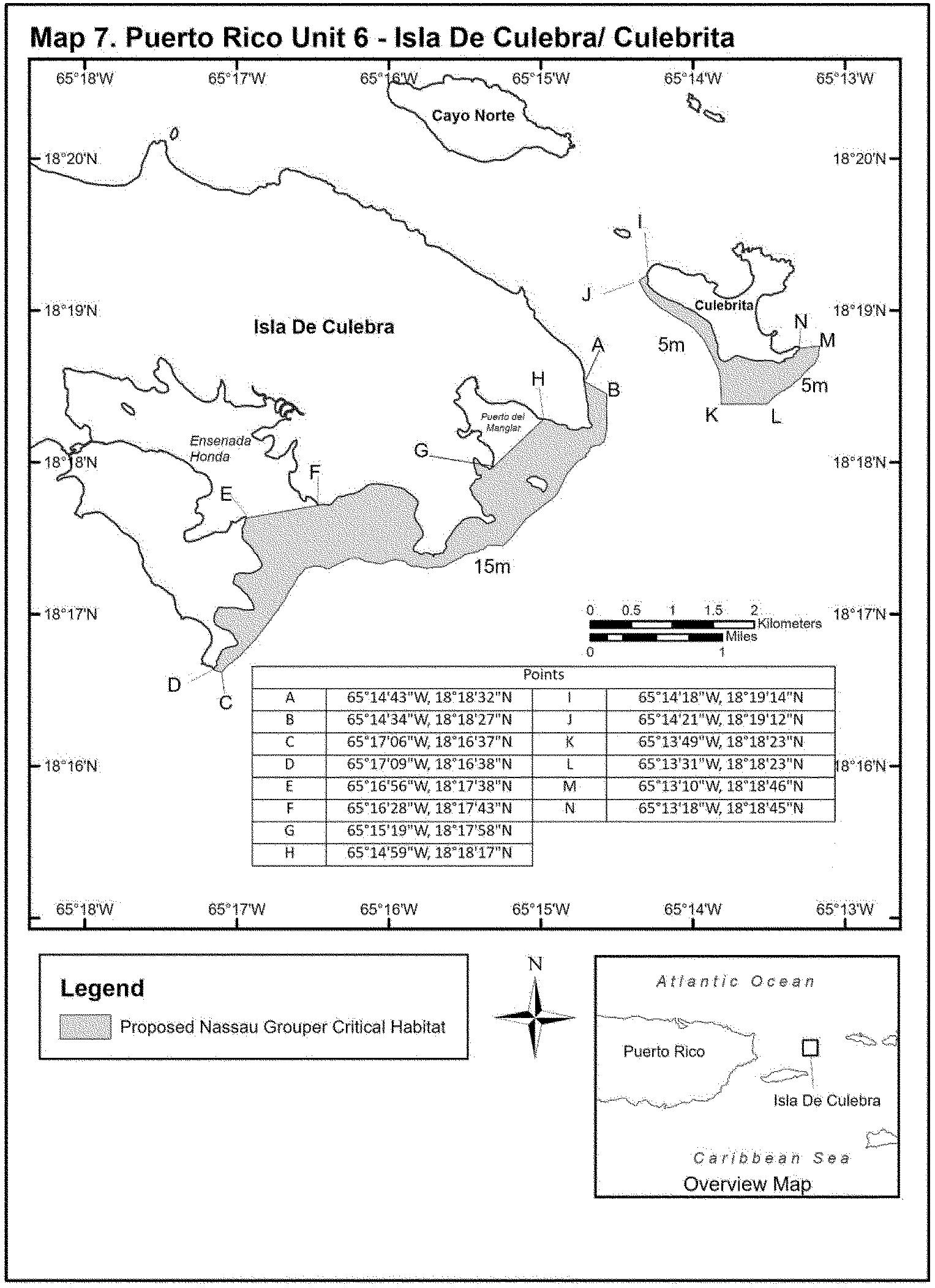
Map

St Thomas
Q C 1s·20•0•
18'18'0"N
Pofr\ts
A 64·s2•4s"w,1s·1a·21"N
s 64"52'48"W,18"18'09"N
C 64~49'5S"W, 18°19'38"N
D 64°50'00"W,18°19'35."N
E 64"57'36"W, 18.18'56"N
i' 64°57'i38"W,18°18'S8"N
G 64"S6'26'W, 18"19'20"N
H 64"56'29"W, 18°19'19"N
O"W
'O"W
,/ Dogtsland
C,!Jrfbbean Sea 18°16'0"
18"21'
Caribbean Sea 18"19'
Points 64'43'56"W, 18"18'50."N 64'43'56"W, 18'18'4!,l"N 64'43'14"W,18'22'06"N 64'43'14"W, 111"22'04"N 18"18'
Overview Map

Ocean
Puerto l, Rico~(~ St.John
Legend
H
A 64"36'40"W,17°47'14"N
B 64'36'39"W,17'47'18" N
C 64"37'35"W,17°47'5l"N
0 64'38'03"W,17'47'30''N
E 64"37'54"W, 17°47'18"N
F 64'37'39"W,17'47'18"N 64" N.
Caribbean Sea Points

<i H l J K l M
64"42'12"W, l7"42'1l"N 64e42'12"W, 17'41'20"N 64"35'03"W, l7'46'18"N 64'36'25"W,1r45'Sll"N 64"39'07"W,17"47'04"N 64"43'53"W, 17"46'13"N 64'44'07"W, 17'45'58"N
64° 6W
Overview Map
Atranti.c ocaa.11
17"48' 17°44' 17°40'
St.Cf'OiX
Caribbean Se-a
Map

Points
A 80"~'22"W, 25"40IOO"N
8 80"09'29"W,25"37'5S"N
C ao·os•~1"w.2s•as'14"N
l!5'50'N
D 80'24'51"W,24'58'55"N
E 80'2.9'21"W,25"01'59"N
Largo
legend
Gu/Iof Mexico
24•4xN
24.40'N
Points
A SO~SS'Sl"W, 24'46'26"N
B 80"55'52"W,:24'46'1S"N
C 80'56'07"W, 24"45'47"N 24"38'1\1

D 80'54'.25"W;24'41'2.S"N
£ 81'07'2B"W,.24'37'12"N
F 81"07'29"W, 24'42.'24"N
G 81'06'55"W,.24'42'2&"N
H B1"06'Sl"W,.24'4.2'0B"N 24'31l'N
I sr06'S;!"W,.:z4'42'0S"lil
a,·ow 80'5/l'W SO'Sll'i/11
Legend
Proposed
s1·1s'OO"W,24"34'11"N
81°35'30"W,24•3o'l8"N

a1·sow 81'45'1/11
Point$
81'S9'S4"W.24'30'51"N
24"2S'NB 82"01'26"W,:24'30'51"N
82"01'26"W,24°26'26''N 81°56.'25"W,24'26'13"N 81'48'11"W,24'27'SO"N 81'48'11"W, 24"28'46"N 81'S0'36"W,24°29'3S"N 81·sa·2s•w,.24•2s•o1"N 81'56'2S"W,24°30'32"N 24"20'N 8i'45W
FL
Gulf of AtlanHe Oc&a,r

Me
24"30'N
40W.
Legend
Proposed
Points
A 82°31'45"W, 24•2G130"N
B 82°34'00"W, 24°27'51"N
C 82°35'45"W, 24°27'4S"N
D a2•37•1s"w, 24°2G'45"N
E 82°36'00"W, 24°25'54"N
F 82"32'00"W, 24°24'48"N
82"36'W
N
Marquesas Keys
Gulf ot Mi!x.ico \.
New Ground Shoal
Index Map: 82'32W 82'30'W

Gulf of Mexico
24'22'N 24".2ti'N
OVerviewMa
Points
A 82°20'00"W, 24°38'15"N
B 82°22'30"W, 24°38'21"N
C 82"25'45"W, 24°39'24"N

D 82°20'15"W, 24°40'00"N
E 82°20'15"W,24°40'18"N
F 82°24'00"w', 24°40'48"N
G 82°27'15"W, 24°40'00"N
H 82°23'42"W, 24°37'30"N
I 82°20'00"W, 24°37'30"N
Map 17. Florida Unit7
A B t 0 E F G H
D
82'55'36"W,24.37'38"N s2•ss'39"W, 24•31'53"N s2·s2•24nw,24•37•31"N S2*52'31"W, 24°37'31"N 82'52'36"W,24.37'31"N s2·s2•29•w.24•3s•os"N 82°S2'21"W,24•3s'OO"N s2·s2·1s"w,24•31•so"N
Points
s2·s2·12"W,24°37'S1"N s2•s2'14"W,24•37•s1"N s2·s2•1rw,24•3s•o2·N s2·s221"w,24•3s'07"N s2·s140"W;z4•3s:19"N S2'52'02"W, 24"37'22"N si•s2'23"W, 24'37'28"N si·s2·1s·w,24"37'29"N
Gulf of Mexico
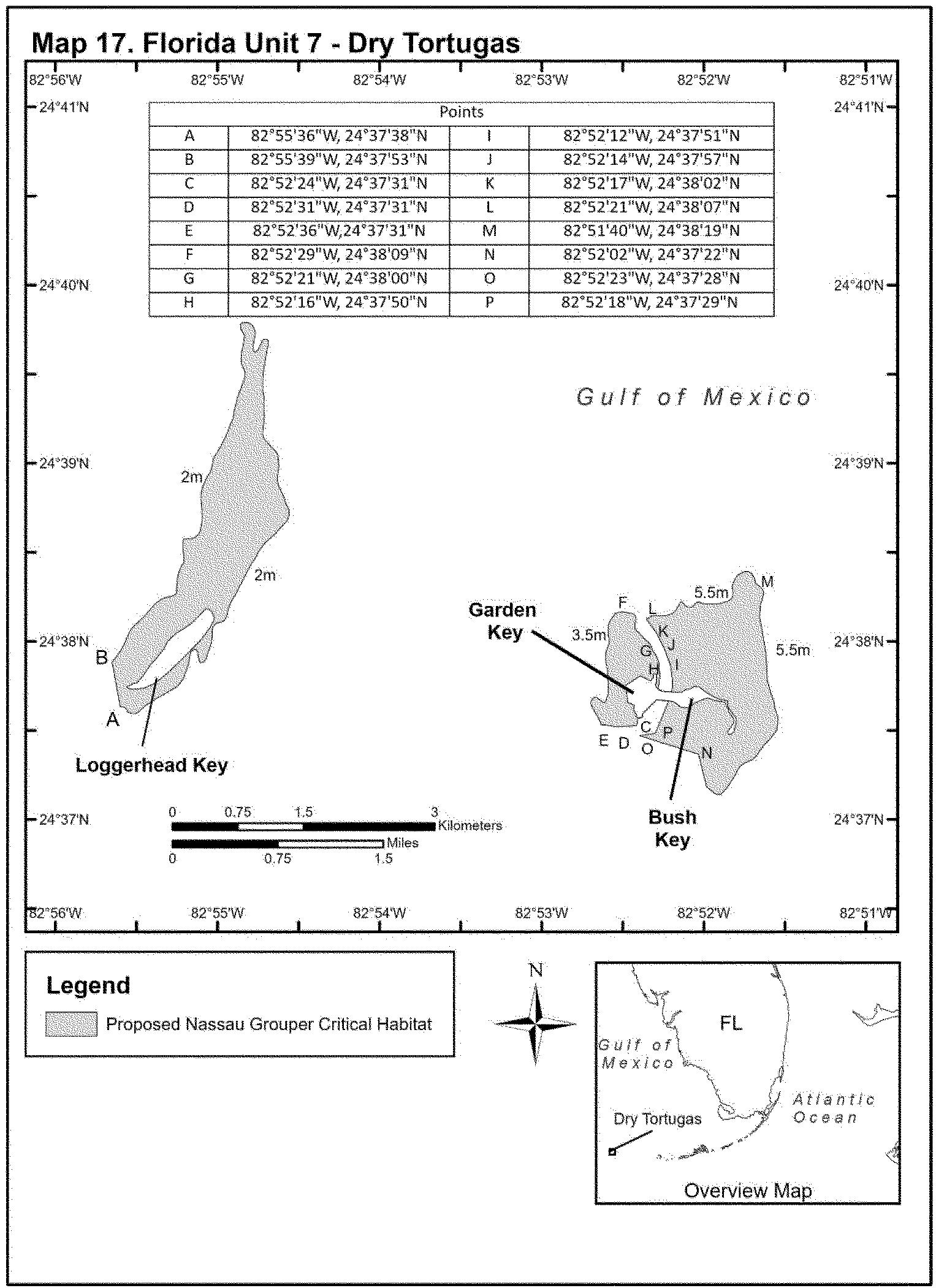
Key
Loggerhead Key
ll2'53W
ll2"5SW
Key

Map 19. Spawning Site Unit 2 ..
8"20'1\1
Points
A 6S"Ol:i'OO
B 54•59•oo•w,18"13'13"N
C 64°56'20"W,18"11'55"N
D 64'56'13"W, 18"11'39"N
E 64'56'.13"W,18'11'06"N
F 64"59'01"W,18'10'53"N
G 64'59'00"W, 18"11'48"N
H 65'06'01"W,.18'10'43''N
Bank and Hind Bank
Legend -200Fathom line
llll Proposed Nassau Grouper Critical Habitat

Atlantic Ocean Grammanilc Bank. and Hind Bank Caribbei!ll't Sea Overview Ma
[FR Doc. 2022–22195 Filed 10–14–22; 8:45 am]
BILLING CODE 3510–22–C