López-Ortiz, R. “Mariculture Government Efforts in Puerto Rico”. Caribbean Fishery Management Council’s Mariculture Hybrid Workshop. March 24,2026, 28 de enero de 2026, 9:15 a.m.–9:30 a.m.
Ricardo López Ortiz, MS, PhD
Director Commercial Fisheries Research and Management Division 787-999-2200, rlopez@drna.pr.gov
Mariculture Government Efforts in Puerto Rico
Through the lens of the Commercial Fisheries Research and Management Division
López-Ortiz, R. “Mariculture Government Efforts in Puerto Rico”. Caribbean Fishery Management Council’s Mariculture Hybrid Workshop. March 24,2026, 28 de enero de 2026, 9:15 a.m.–9:30 a.m.
Framing the Presentation
We operate at the intersection of:
• Science
Policy
Field implementation
Our goal: support responsible mariculture development while protecting natural resources
López-Ortiz, R. “Mariculture Government Efforts in Puerto Rico”. Caribbean Fishery Management Council’s Mariculture Hybrid
Geography & environment
Tropical waters, extensive coastal/offshore areas, and diverse ecosystems enable continuous, multi-species mariculture production. Existing fishing experience
Established fishing knowledge and basic infrastructure allow rapid adaptation to mariculture without starting from scratch.
Workshop March 24,2026, 28 de enero de 2026, 9:15 a.m. 9:30 a.m
Complement to wild fisheries
Why M ulture in PR?
Mariculture complements wild fisheries by stock restoration, stabilizing income, reducing fishing pressure, and supplying alternative products during low catch periods.
Puerto Rico
is uniquely positioned to expand
mariculture as a complement to wild fisheries, enhancing food security, economic resilience, and resource sustainability.
Access to federal support
Access to programs and funding from NOAA Fisheries and U.S. Department of Agriculture provides a strong institutional advantage.
Enhancing food security
Local mariculture production strengthens food security by reducing import dependence and increasing supply stability during disruptions.
Economic resilience
Mariculture diversifies income, creates jobs, and reduces economic vulnerability to environmental and market shocks.
Resource sustainability
Mariculture supports sustainable fisheries management by lowering pressure on wild stocks and enabling ecosystem-based approaches.
López-Ortiz, R. “Mariculture Government Efforts in Puerto Rico”. Caribbean Fishery Management Council’s Mariculture Hybrid Workshop. March 24,2026, 28 de enero de 2026, 9:15 a.m.–9:30 a.m.
Government Fr mework
Institutional Structure for Mariculture in Puerto Rico
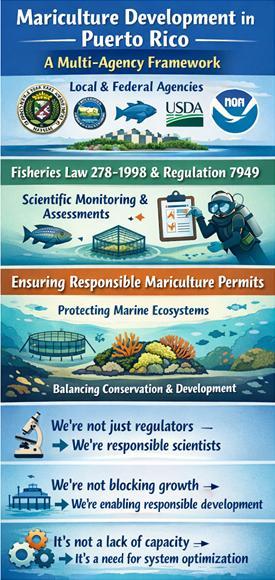
• Multi-agency governance (local + federal)
• DNER: science and permitting role
• Legal framework (Law 278 / Reg 7949)
• Science-based decision-making
• Federal coordination (NOAA, USDA)
A science-based, conservation-aligned framework supports responsible mariculture development.
López-Ortiz, R. “Mariculture Government Efforts in Puerto Rico”. Caribbean Fishery Management Council’s Mariculture Hybrid Workshop. March 24,2026, 28 de enero de 2026, 9:15 a.m.–9:30 a.m.
Fisheries Overview
Current Fisheries Context in Puerto Rico
Limited local production relative to demand
High dependence on seafood imports (~85–90%)
• Income instability
• Vulnerability to external supply shocks
Fishing effort constrained by weather, seasonality, and infrastructure
Localized pressure on key species and habitats
Aging fisher population and limited recruitment of new entrants
• Income instability
• Limited capacity for expansion
• Need to balance conservation with economic needs
• Limits on expanding wild fisheries
• Limited growth of the sector
• Reduced longterm resilience’s
These conditions highlight the need for complementary approaches, such as mariculture, to strengthen fisheries sustainability and resilience.
López-Ortiz, R. “Mariculture Government Efforts in Puerto Rico”. Caribbean Fishery Management Council’s Mariculture Hybrid Workshop. March 24,2026, 28 de enero de 2026, 9:15 a.m.–9:30 a.m.
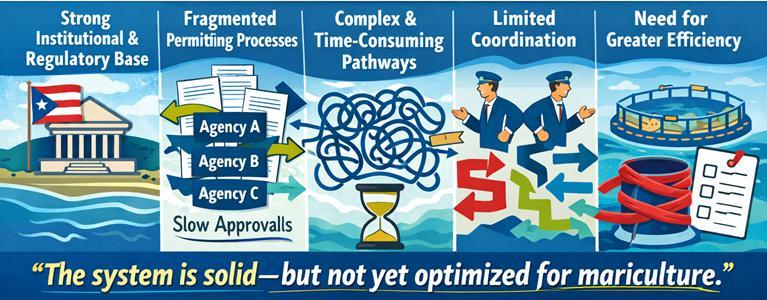
Key System-Level Challenges
Key Barriers to Mariculture Development
• Fragmented permitting process across agencies
• Complex and time-consuming approval pathways
• Limited interagency coordination
• Lack of streamlined mariculture-specific processes
Underlying Drivers
• Distributed authority across local and federal agencies
• Strong but multi-layered environmental compliance requirements
The foundation for mariculture exists, but improved coordination and efficiency are needed to enable responsible growth.
López-Ortiz, R. “Mariculture Government Efforts in Puerto Rico”. Caribbean Fishery Management Council’s Mariculture Hybrid Workshop. March 24,2026, 28 de enero de 2026, 9:15 a.m.–9:30 a.m.
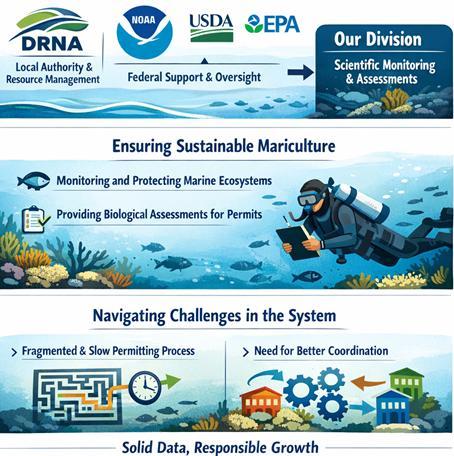
Key Institutions & Roles
• DNER — Permitting & resource management
• NOAA Fisheries — Funding & technical support
• USDA — Aquaculture development
• EPA — Environmental compliance
Science-Based Role (Commercial Fisheries Research and Management Division)
• Monitoring and data collection
• Biological assessments for permits
• Protect wild stocks and ecosystem health
Effective coordination among agencies is essential to support responsible and sustainable mariculture development.
López-Ortiz, R. “Mariculture Government Efforts in Puerto Rico”. Caribbean Fishery Management Council’s Mariculture Hybrid Workshop. March 24,2026, 28 de enero de 2026, 9:15 a.m.–9:30 a.m.
Our Role as a Bridge
• The Division serves as a bridge between:
• Science → Regulatory guidance
• Policy → Technical evaluation
• Proposals → Responsible action
Role of Fisheries Science in Permitting
• Supports mariculture permits and submerged land concessions
• Prevents impacts to wild stocks and ecosystems
• Informs adaptive management
• Connects conservation and development
López-Ortiz, R. “Mariculture Government Efforts in Puerto Rico”. Caribbean Fishery Management Council’s Mariculture Hybrid Workshop. March 24,2026, 28 de enero de 2026, 9:15 a.m.–9:30 a.m.
Division’s Core Role (Mariculture)
• Provide science-based technical review of mariculture proposals
• Focus on preventing impacts to wild stocks and ecosystems
• Ensure appropriate precautionary measures are in place
• Conservation of natural resources is our primary mission
• Support and encourage restoration-focused projects
López-Ortiz, R. “Mariculture Government Efforts in Puerto Rico”. Caribbean Fishery Management Council’s Mariculture Hybrid Workshop. March 24,2026, 28 de enero de 2026, 9:15 a.m.–9:30 a.m.
Permitting & Technical Review
• Provide scientific and technical recommendations
• Support permitting decisions with:
• Ecological assessments
• Fisheries expertise
• Ensure proposals meet environmental standards and best practices
López-Ortiz, R. “Mariculture Government Efforts in Puerto Rico”. Caribbean Fishery Management Council’s Mariculture Hybrid Workshop. March 24,2026, 28 de enero de 2026, 9:15 a.m.–9:30 a.m.
Interagency Support & Incentives
• Promote letters of support to help access funding
• Financial incentives generally come from:
• NOAA Fisheries
• U.S. Department of Agriculture
• The Division typically does not provide direct funding programs
López-Ortiz, R. “Mariculture Government Efforts in Puerto Rico”. Caribbean Fishery Management Council’s Mariculture Hybrid Workshop. March 24,2026, 28 de enero de 2026, 9:15 a.m.–9:30 a.m.
Technical Assistance & Field Support
• Conduct site visits and direct engagement with proponents
• Assist in:
• Development of protocols
• Environmental safeguards
• Risk reduction strategies
• Provide scientific guidance to prevent resource impacts
López-Ortiz, R. “Mariculture Government Efforts in Puerto Rico”. Caribbean Fishery Management Council’s Mariculture Hybrid
Workshop. March 24,2026, 28 de enero de 2026, 9:15 a.m.–9:30 a.m.
Scope of the Division
• Our role is primarily:
• Technical
• Scientific
• Advisory
• We:
• Evaluate all mariculture proposals
• Provide science-based guidance
• Support projects that meet regulatory and environmental requirements
• Lead or support restorationfocused initiatives (e.g., species recovery projects)
• We do not:
• Operate commercial mariculture projects as an agency-driven initiative
• Provide direct funding
• Implementation depends on:
• Federal partners
• Other agencies
• Private sector
López-Ortiz, R. “Mariculture Government Efforts in Puerto Rico”. Caribbean Fishery Management Council’s Mariculture Hybrid Workshop. March 24,2026, 28 de enero de 2026, 9:15 a.m.–9:30 a.m.
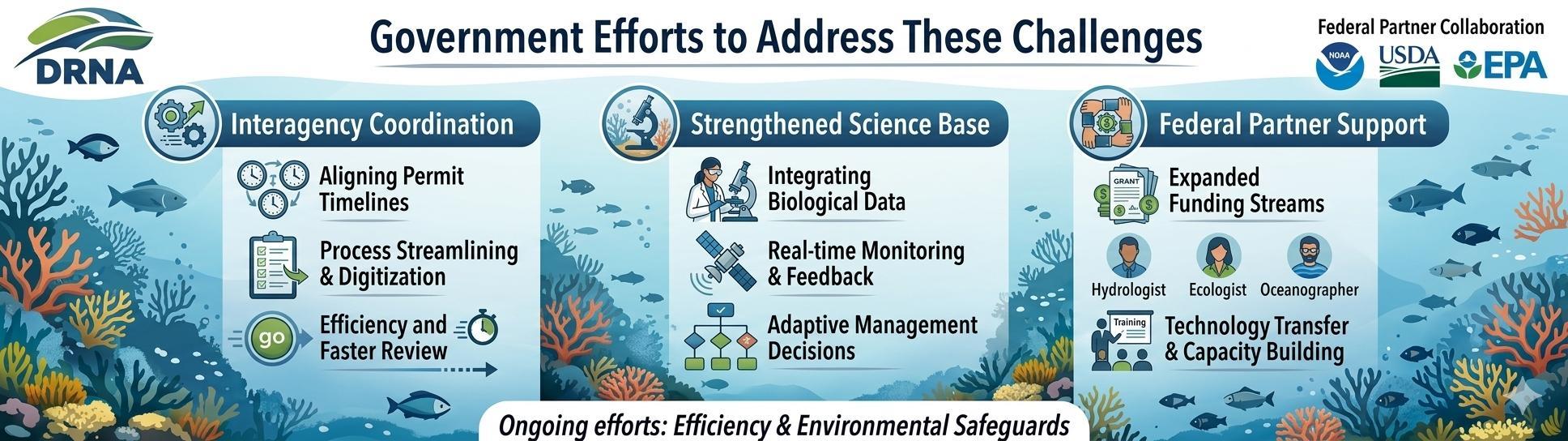
Government Efforts to Address These Challenges
Targeted actions are underway to address key system constraints
Actions to Support Mariculture Development
• Interagency coordination initiatives to improve communication and alignment
• Efforts to streamline permitting processes for mariculture projects
• Integration of science-based assessments into decision-making
• Collaboration with federal partners to expand technical and financial support
Role of DNER (Fisheries Division)
• Providing timely biological evaluations to inform permitting decisions
• Strengthening monitoring and data collection frameworks
• Supporting science-based, ecosystem-compatible development
Ongoing efforts are focused on improving efficiency while maintaining strong environmental safeguards.
López-Ortiz, R. “Mariculture Government Efforts in Puerto Rico”. Caribbean Fishery Management Council’s Mariculture Hybrid Workshop. March 24,2026, 28 de enero de 2026, 9:15 a.m.–9:30 a.m.
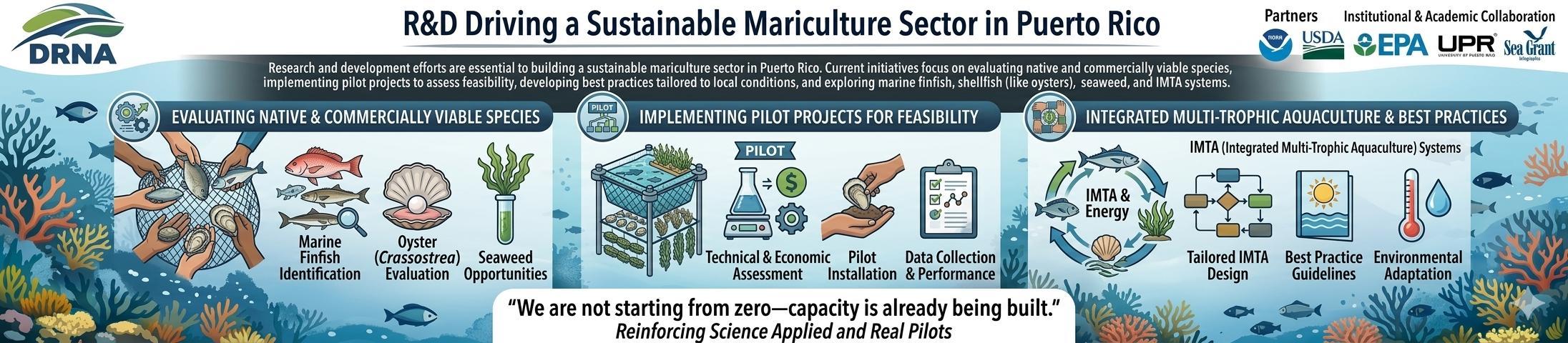
Research & Development (R&D)
Advancing Mariculture Through Science and Innovation
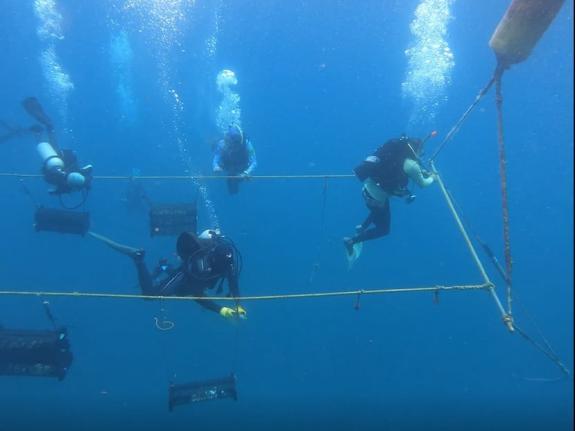
• Collaborative research efforts with academic and institutional partners
• Evaluation of native and commercially viable species
• Pilot projects to assess technical and economic feasibility
Priority Areas of Focus
• Keystone species that holds an ecosystem together
• Development of best practices for sustainable mariculture Research and pilot initiatives are laying the groundwork for scalable and sustainable mariculture in Puerto Rico.
López-Ortiz, R. “Mariculture Government Efforts in Puerto Rico”. Caribbean Fishery Management Council’s Mariculture Hybrid Workshop. March 24,2026, 28 de enero de 2026, 9:15 a.m.–9:30 a.m.
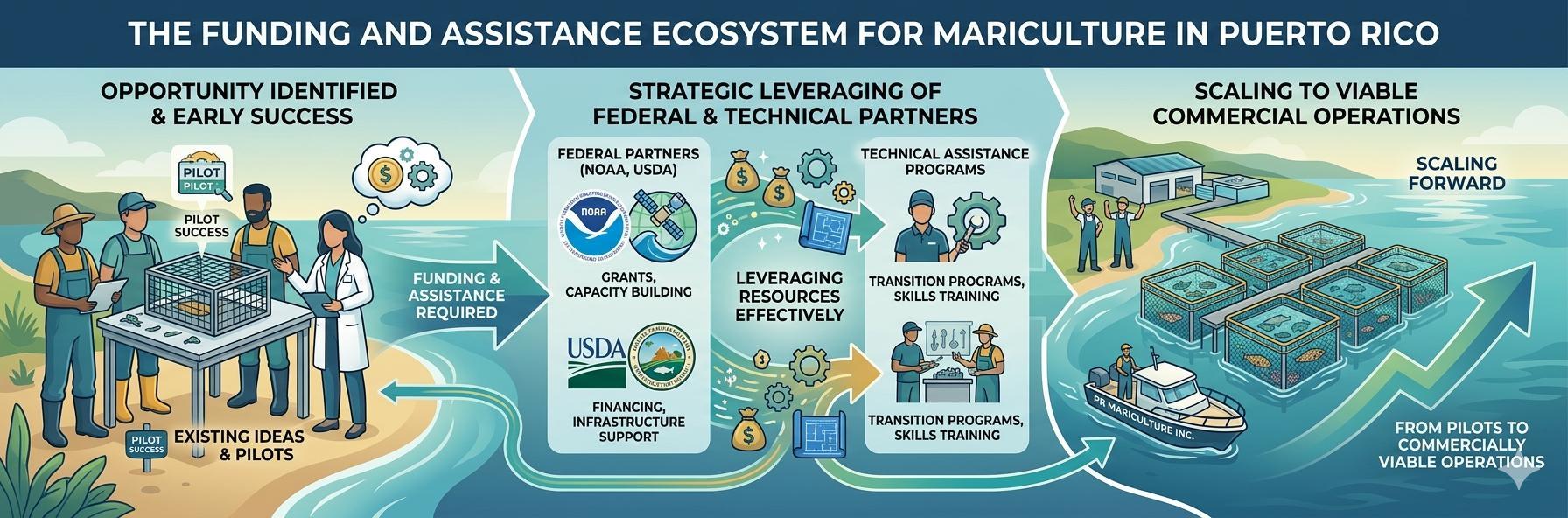
Funding & Programs
Supporting Mariculture Development
• Federal funding opportunities available for aquaculture development
• Grant programs supporting research, pilot projects, and infrastructure
• Technical assistance programs for fishers and entrepreneurs
Key Programs & Partners
• NOAA Fisheries
• Grants for aquaculture development, research, and capacity building
• U.S. Department of Agriculture
• Funding, loans, and rural development support for aquaculture operations
• Local and regional initiatives
• Support for training, technical assistance, and project development
Funding and technical support are critical to scaling mariculture from pilot initiatives to commercial operations.
López-Ortiz, R. “Mariculture Government Efforts in Puerto Rico”. Caribbean Fishery Management Council’s Mariculture Hybrid Workshop. March 24,2026, 28 de enero de 2026, 9:15 a.m.–9:30 a.m.
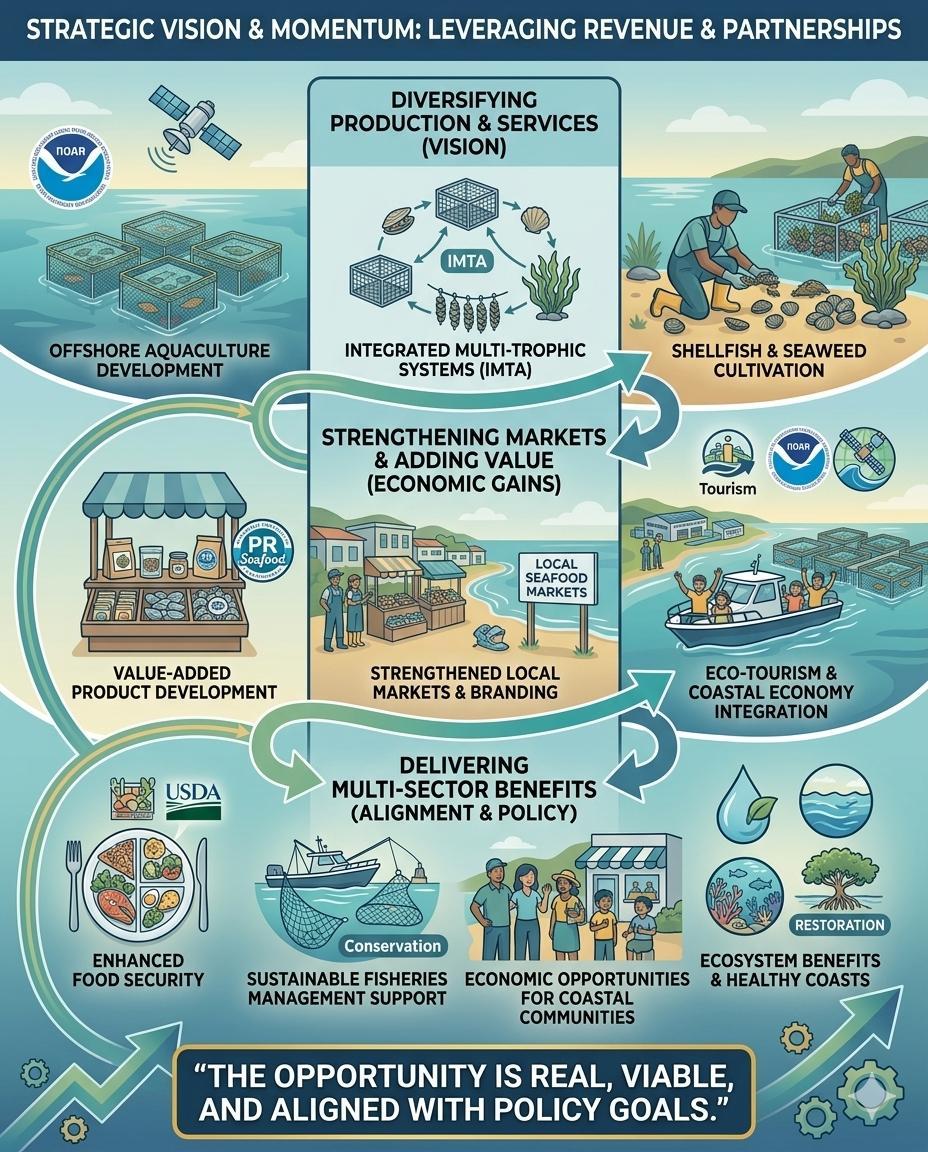
Opportunities for Growth
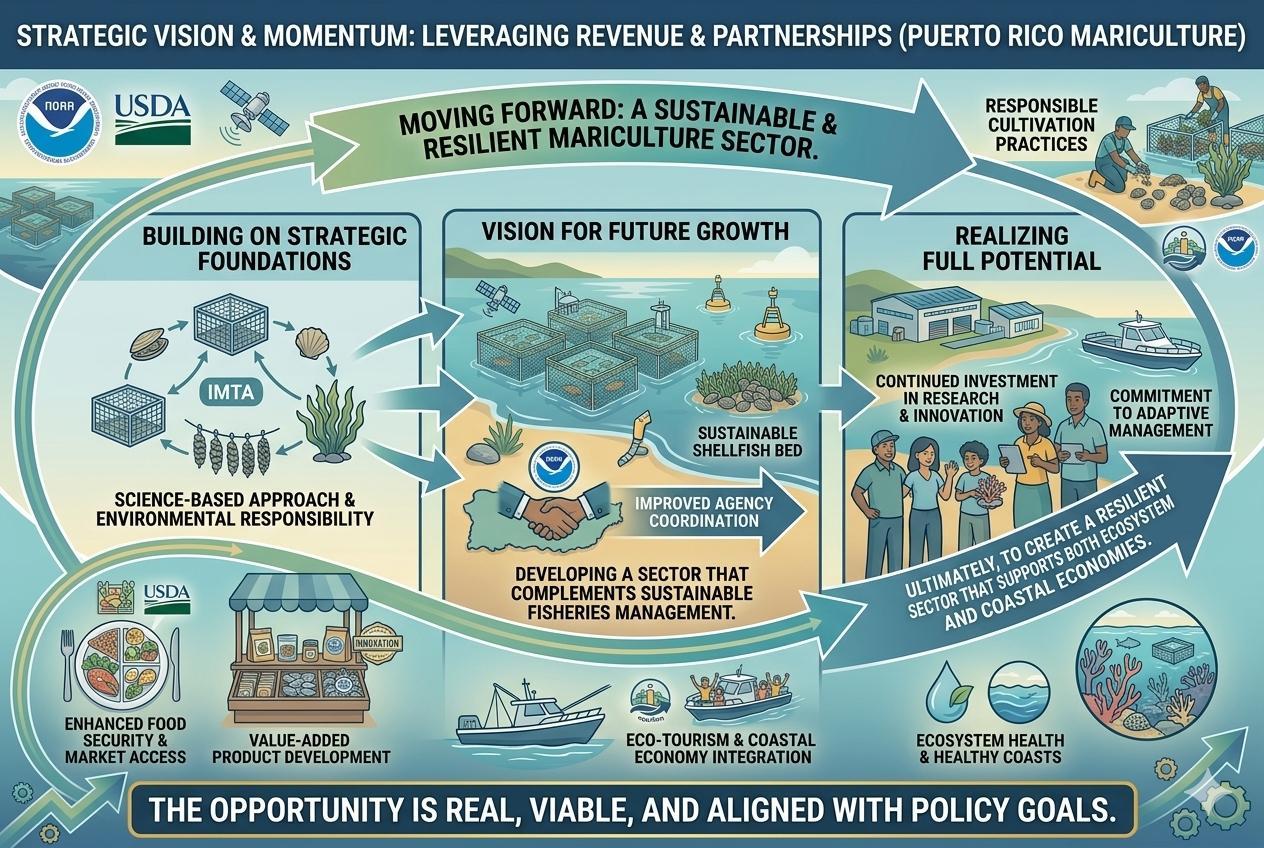
Strategic Opportunities for Mariculture in Puerto Rico
• Expansion into offshore aquaculture in suitable marine areas
• Development of integrated multitrophic aquaculture systems
• Shellfish and seaweed production for ecosystem services and market diversification
• Value-added products and local seafood markets
• Integration with tourism and coastal economies
Alignment with Broader Goals
• Enhancing food security through local production
• Supporting sustainable fisheries management
• Creating economic opportunities for coastal communities
• Promoting ecosystem-based approaches to marine resource use
Puerto Rico has a strong foundation to expand mariculture as a sustainable and economically viable sector.
López-Ortiz, R. “Mariculture Government Efforts in Puerto Rico”. Caribbean Fishery Management Council’s Mariculture Hybrid Workshop. March 24,2026, 28 de enero de 2026, 9:15 a.m.–9:30 a.m.
Applied Mariculture in Puerto Rico (Key Examples)
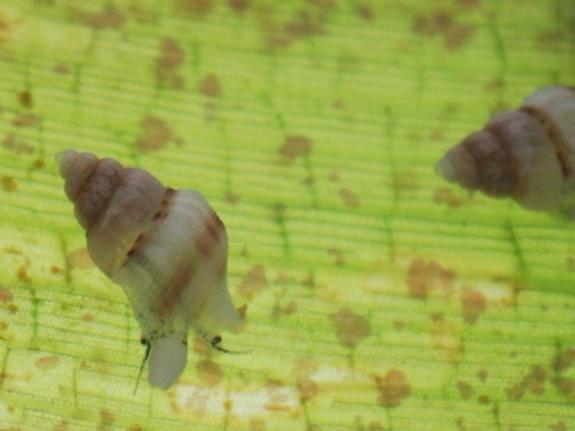
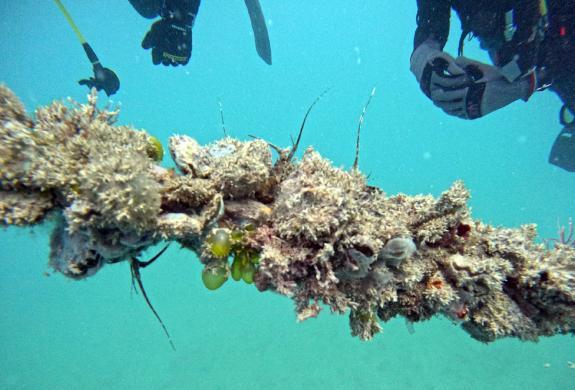
• Queen Conch (Naguabo hatchery)
• Hatchery production and restocking
• Conservation + aquaculture integration
• Oysters (Culebra)
• Restoration and ecosystem services
• Community-based mariculture
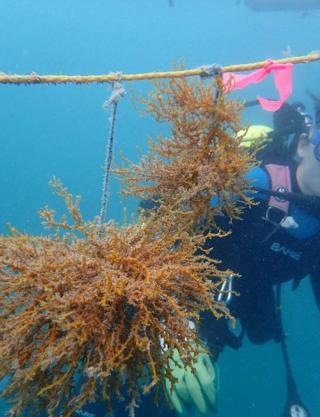
• Seaweed
• Emerging sector with IMTA potential
• Nutrient removal and coastal resilience
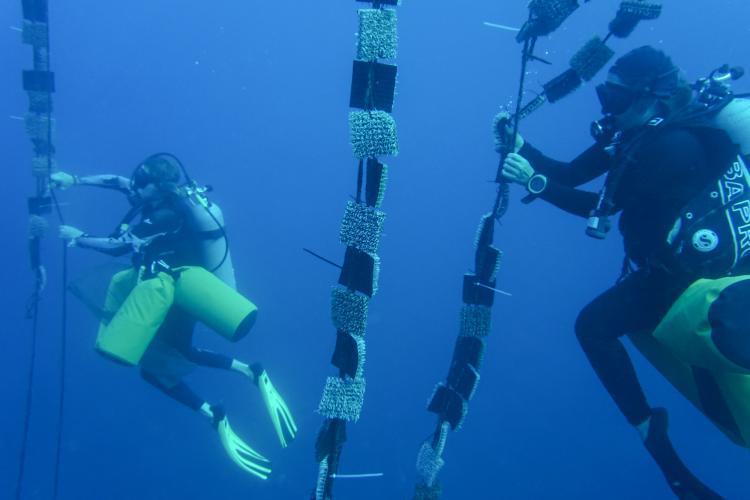
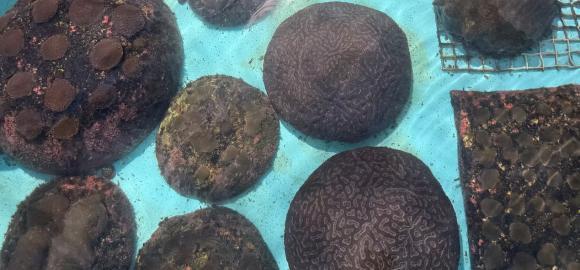
• Coral Restoration
• Propagation and outplanting
• Direct conservation application of aquaculture techniques
• Sea Urchin
• Potential ecological balance and population management
López-Ortiz, R. “Mariculture Government Efforts in Puerto Rico”. Caribbean Fishery Management Council’s Mariculture Hybrid Workshop. March 24,2026, 28 de enero de 2026, 9:15 a.m.–9:30 a.m.
Connecting These Projects to Our Work
• These initiatives are directly supported through:
• Technical evaluation
• Scientific guidance
• Interagency coordination
• The Division ensures projects are:
• Environmentally sound
• Scientifically grounded
• Aligned with conservation goals
López-Ortiz, R. “Mariculture Government Efforts in Puerto Rico”. Caribbean Fishery Management Council’s Mariculture Hybrid Workshop. March 24,2026, 28 de enero de 2026, 9:15 a.m.–9:30 a.m.
Strategic Vision
Advancing Mariculture in Puerto Rico
• Develop a science-based and environmentally responsible mariculture sector
• Integrate mariculture as a complement to sustainable fisheries management
• Strengthen interagency coordination and regulatory efficiency
• Promote innovation, research, and adaptive management
• Support coastal economic opportunities
A coordinated, science-driven approach will be key to unlocking the full potential of mariculture in Puerto Rico.
López-Ortiz, R. “Mariculture Government Efforts in Puerto Rico”. Caribbean Fishery Management Council’s Mariculture Hybrid Workshop. March 24,2026, 28 de enero de 2026, 9:15 a.m.–9:30 a.m.
Key Takeaways
• Puerto Rico has a strong institutional and scientific foundation
• Mariculture can complement and strengthen existing fisheries and conservation
• The Division plays a critical technical and scientific role
• Challenges exist, but targeted efforts are already underway
• Opportunities for growth are significant and achievable
Mariculture development in Puerto Rico must remain:
• Science-based
• Conservation-driven
• Technically sound
DNER ensures that:
• Development proceeds responsibly
• Natural resources are protected
• Innovation is supported within a sustainable framework
Puerto Rico is advancing a science-based, conservation-aligned approach to mariculture as a complement to sustainable fisheries management.